

Design of Hydrophobic Hybrid Ceramic Coatings Based on Silica Modified with Polydimethylsiloxane (SiO2/DMS) for Sustainable Oil Removal

 , and
, and
Abstract
1. Introduction
2. Materials and Methods
2.1. Synthesis of SiO2/DMS Sols
2.2. Impregnation of SiO2/PDMS into a Porous System
2.3. Characterization of Chemical Structure and Hydrophobicity
2.4. Evaluation of Oil Removal Capacity
2.5. Reusability Assessment of the Modified Sponge
3. Results
3.1. Functionalization of Polyurethane Sponge
3.2. Performance Assessment in Contaminant Removal
3.3. Assessment of Contaminant Removal Cycles
4. Conclusions
Supplementary Materials
Author Contributions
Funding
Data Availability Statement
Acknowledgments
Conflicts of Interest
References
- Kılıç, Z. Water Pollution: Causes, Negative Effects and Prevention Methods. İstanbul Sabahattin Zaim Üniversitesi Fen Bilim. Enstitüsü Derg. 2021, 3, 129–132. [Google Scholar] [CrossRef]
- Liu, L.; Wang, P.; Gojenko, B.; Yu, J.; Wei, L.; Luo, D.; Xiao, T. A review of water pollution arising from agriculture and mining activities in Central Asia: Facts, causes and effects. Environ. Pollut. 2021, 291, 118209. [Google Scholar] [CrossRef] [PubMed]
- Fernandez, L. Solving water pollution problems along the US–Mexico border. Environ. Dev. Econ. 2002, 7, 715–732. [Google Scholar] [CrossRef]
- Al-Taai, S.H.H. Water pollution Its causes and effects. IOP Conf. Ser. Earth Environ. Sci. 2021, 790, 012026. [Google Scholar] [CrossRef]
- Sarker, B.; Keya, F.I.; Nahiun, K.M.; Shahida, S.; Khan, R.A. Surface and Ground Water Pollution: Causes and Effects of Urbanization and Industrialization in South Asia. Sci. Rev. 2021, 7, 32–41. [Google Scholar] [CrossRef]
- CONAGUA. Indicadores de Calidad del Agua Superficial 2024; México. Recovered 20 February 2026. Available online: https://www.gob.mx/conagua/articulos/indicadores-de-calidad-del-agua (accessed on 4 March 2026).
- D’Inverno, G.; Carosi, L.; Romano, G.; Guerrini, A. Water pollution in wastewater treatment plants: An efficiency analysis with undesirable output. Eur. J. Oper. Res. 2018, 269, 24–34. [Google Scholar] [CrossRef]
- Zhao, T.; Chen, Z.; Xiao, W.; Zhou, Y.; Zhan, B.; Lyu, Y.; Li, S.; Liu, Y. Cellulose aerogels in water pollution treatment: Preparation, applications and mechanism. Adv. Bionics 2025, 1, 124–151. [Google Scholar] [CrossRef]
- Li, N.; Hu, W.; Gao, Y.; Si, F.; Wen, C.; Lv, L.; Wang, Q.; Ma, B.; Li, K.; Wen, G.; et al. Assessing source water reservoirs as pre-treatment units for simultaneous control of autochthonous and runoff pollution through artificial mixing and aeration technology. Water Res. 2025, 290, 125029. [Google Scholar] [CrossRef]
- Cerff, B.; Key, D.; Bladergroen, B. A Review of the Processes Associated with the Removal of Oil in Water Pollution. Sustainability 2021, 13, 12339. [Google Scholar] [CrossRef]
- Sabir, S. Approach of cost-effective adsorbents for oil removal from oily water. Crit. Rev. Environ. Sci. Technol. 2015, 45, 1916–1945. [Google Scholar] [CrossRef]
- Sharma, K.; Shah, G.; Singhal, K.; Soni, V. Comprehensive insights into the impact of oil pollution on the environment. Reg. Stud. Mar. Sci. 2024, 74, 103516. [Google Scholar] [CrossRef]
- Muvel, H.; Jindal, M.K.; Tewari, P.K.; Anand, V. Minimizing oil pollution: A review of current status and its treatment options. RSC Sustain. 2025, 3, 3681. [Google Scholar] [CrossRef]
- Pan, L.L.; Chen, Y.; Chen, D.; Dong, Y.Q.; Zhang, Z.T.; Long, Y.X. Oil removal in tight-emulsified petroleum waste water by flocculation. IOP Conf. Ser. Mater. Sci. Eng. 2018, 392, 042005. [Google Scholar] [CrossRef]
- Ma, J.; Wu, G.; Zhang, R.; Xia, W.; Nie, Y.; Kong, Y.; Jia, B.; Li, S. Emulsified oil removal from steel rolling oily wastewater by using magnetic chitosan-based flocculants: Flocculation performance, mechanism, and the effect of hydrophobic monomer ratio. Sep. Purif. Technol. 2023, 304, 122329. [Google Scholar] [CrossRef]
- Kriipsalu, M.; Marques, M.; Maastik, A. Characterization of oily sludge from a wastewater treatment plant flocculation-flotation unit in a petroleum refinery and its treatment implications. J. Mater. Cycles Waste Manag. 2008, 10, 79–86. [Google Scholar] [CrossRef]
- Ahmed, N.; Straub, A.; Ali, M. Fats, oil, and grease (FOG) in wastewater: Sources, mechanisms, control, and removal strategies. Int. J. Environ. Sci. Technol. 2026, 23, 161. [Google Scholar] [CrossRef]
- Fezzani, B. Effective Treatment of Highly Alkaline Paper Industry Wastewater by Coagulation-Flocculation Process Without pH Adjustment. Water Air Soil. Pollut. 2026, 237, 210. [Google Scholar] [CrossRef]
- Do, V.T.; Bappy, M.I.; Vu, H.V.; Nhu, H.V.; Chun, D.M. Facile fabrication of a durable polydimethylsiloxane–silica-coated aluminum mesh with superhydrophobic behavior for efficient oil-water separation. Mar. Pollut. Bull. 2026, 223, 118977. [Google Scholar] [CrossRef] [PubMed]
- Li, J.; Li, D.; Hu, W.; Li, J.; Yang, Y.; Wu, Y. Stable superhydrophobic and superoleophilic silica coated polyurethane sponges for the continuous capture and removal of oils from the water surface. New J. Chem. 2015, 39, 9958–9962. [Google Scholar] [CrossRef]
- Kong, S.M.; Han, Y.; Won, N.I.; Na, Y.H. Polyurethane Sponge with a Modified Specific Surface for Repeatable Oil–Water Separation. ACS Omega 2021, 6, 33969–33975. [Google Scholar] [CrossRef] [PubMed]
- Lin, B.; Chen, J.; Li, Z.T.; He, F.A.; Li, D.H. Superhydrophobic modification of polyurethane sponge for the oil-water separation. Surfaceand Coat. Technol. 2019, 359, 216–226. [Google Scholar] [CrossRef]
- Akhter, F.; Jamali, A.R.; Abbasi, M.N.; Mallah, M.A.; Rao, A.A.; Wahocho, S.A.; Anees-ur-Rehman, H.; Chandio, Z.A. A comprehensive review of hydrophobic silica and composite aerogels: Synthesis, properties and recent progress towards environmental remediation and biomedical applications. Environ. Sci. Pollut. Res. 2023, 30, 11226–11245. [Google Scholar] [CrossRef]
- Reynold, J.G.; Coronado, P.R.; Hrubesh, L.W. Hydrophobic Aerogels for Oil-Spill Cleanup? Intrinsic Absorbing Properties. Energy Sources 2001, 23, 831–843. [Google Scholar] [CrossRef]
- Qian, H.; Li, W.; Wang, X.; Xie, F.; Li, W.; Qu, Q. Simultaneous growth of graphene/mesoporous silica composites using liquid precursor for HPLC separations. Appl. Surf. Sci. 2021, 537, 148101. [Google Scholar] [CrossRef]
- Panda, D.; Gangawane, K.M. Superhydrophobic hybrid silica-cellulose aerogel for enhanced thermal, acoustic, and oil absorption characteristics. J. Mater. Sci. 2022, 57, 13385–13402. [Google Scholar] [CrossRef]
- Yang, Q.; Li, X.; Xue, Y.; Peng, H.; Bai, Y.; Li, W.; Zheng, W. Recent advances in fluorinated superhydrophobic materials: Preparation and diverse applications. Chem. Eng. J. 2025, 523, 168236. [Google Scholar] [CrossRef]
- Brassard, J.D.; Sarkar, D.K.; Perron, J. Fluorine Based Superhydrophobic Coatings. Appl. Sci. 2012, 2, 453–464. [Google Scholar] [CrossRef]
- Lohmann, R.; Cousins, J.T.; DeWitt, J.C.; Glüge, J.; Goldenman, G.; Lindstrom, A.; Mark, F.M.; Ang k Patton, S.; Scheringer, M.; Trier, X.; et al. Are fluoropolymers really of low concern for human and environmental health and separate from other PFAS? Environ. Sci. Technol. 2020, 54, 12820–12828. [Google Scholar] [CrossRef]
- Cho, Y.K.; Park, E.J.; Kim, Y.D. Removal of oil by gelation using hydrophobic silica nanoparticles. J. Ind. Eng. Chem. 2014, 20, 1231–1235. [Google Scholar] [CrossRef]
- Salazar-Hernández, C.; Salazar-Hernández, M.; Carrera-Cerritos, R.; Mendoza-Miranda, J.M.; Elorza-Rodríguez, E.; Miranda-Avilés, R.; Mocada-Sánchez, C.D. Anticorrosive properties of PDMS-Silica coatings: Effect of methyl, phenyl and amino groups. Prog. Org. Coat. 2019, 136, 105220. [Google Scholar] [CrossRef]
- Cervantes, J.; Zárraga, R.; Salazar-Hernández, C. Organotin catalysts in organosilicon chemistry. Appl. Organomet. Chem. 2012, 26, 157–163. [Google Scholar] [CrossRef]
- ASTM C20-00; Standard Test Methods for Apparent Porosity, Water Absorption, Apparent Specific Gravity, and Bulk Density of Burned Refractory Brick and Shapes by Boiling Water. ASTM International: West Conshohocken, PA, USA, 2015.
- Shen, X.; Chen, L.; Ma, Y.; Li, Z.; Liang, B.; Zhang, Y.F. Preparation and performance study of commercial polyurethane-modified asphalt. Polym. Bull. 2026, 83, 179. [Google Scholar] [CrossRef]
- Salazar-Hernández, C.; Salazar-Hernández, M.; Carrera Cerritos, R.; Elorza, E.; Mendoza-Miranda, J.M.; Navarro, R. DBTL as neutral catalyst on TEOS/PDMS anticorrosive coating. J. Sol-Gel Sci. Technol. 2017, 81, 405–412. [Google Scholar] [CrossRef]
- Launer, P.J. Infrared analysis of organosilicon compounds: Spectra structure correlations. In Silicon Compounds Silanes & Silicones; Arkles, B., Ed.; Gelest Inc.: Morrisville, PA, USA, 2013. [Google Scholar]
- Varkevisser, T.; Bonn, D. Capillary-viscous retraction dynamics of droplets: The role of the dynamic contact angle. Phys. Rev. Fluids 2026, 11, 0113601. [Google Scholar] [CrossRef]
- McHale, G.; Shirtcliffe, N.J.; Newton, M.I. Contact-Angle Hysteresis on Super-Hydrophobic Surfaces. Langmuir 2004, 20, 10146–10149. [Google Scholar] [CrossRef] [PubMed]
- Lee, D.S.; Noh, B.S.; Bae, S.Y.; Kim, K. Characterization of fatty acids composition in vegetable oils by gas chromatography and chemometrics. Anal. Chim. Acta 1998, 358, 163–175. [Google Scholar] [CrossRef]
- Ghaedi, M.; Mehranbod, N.; Khorram, M. Facile fabrication of robust superhydrophobic polyurethane sponge modified with polydopamine-silica nanoparticle for effective oil/water separation. React. Funct. Polym. 2023, 191, 105657. [Google Scholar] [CrossRef]
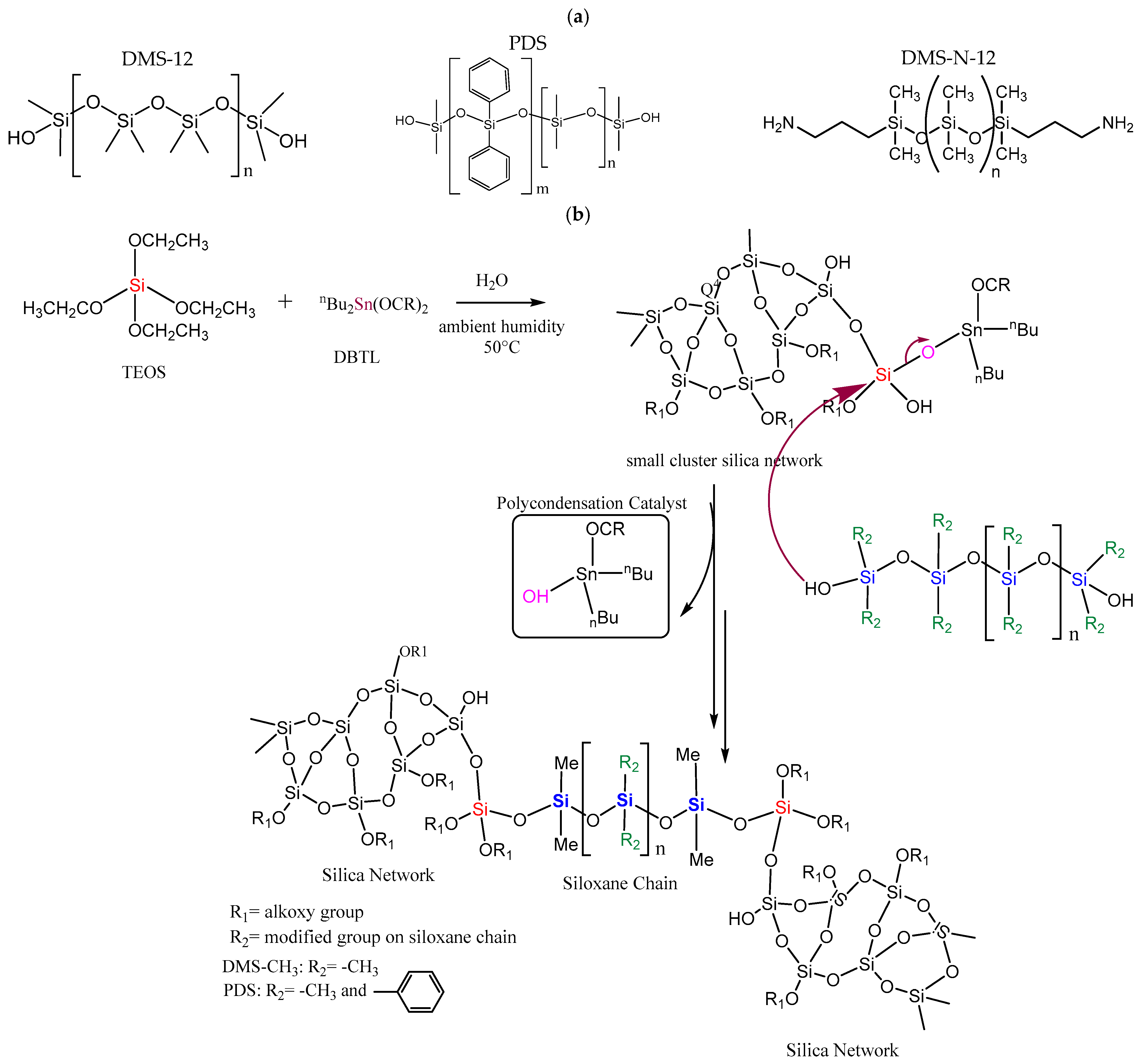
 ) and methyl (–CH3) groups to the ceramic structure. (b) Polycondensation reaction between TEOS and functionalized PDMS.
) and methyl (–CH3) groups to the ceramic structure. (b) Polycondensation reaction between TEOS and functionalized PDMS.
) and methyl (–CH3) groups to the ceramic structure. (b) Polycondensation reaction between TEOS and functionalized PDMS.



| Substance Pollution | Silica-Deposited Matrix | Adsorbate | Reference |
|---|---|---|---|
| Organic solvents, oil | –CF3 Functionalized | oils | [23] |
| Reduced graphene oxide | Fats and oils | [24] | |
| Cellulose–Silica Hybrid | Fats and oils | [25] |
| TEOS (g) | DMS-12 (g) | DMS-A11 (g) | PDS (g) | |
|---|---|---|---|---|
| SiO2/DMS–CH3–1 | 10 | 1 | ||
| SiO2/DMS–CH3–2 | 10 | 2 | ||
| SiO2/DMS–CH3–4 | 10 | 4 | ||
| SiO2/DMS–N–1 | 10 | 1 | ||
| SiO2/DMS–N–2 | 10 | 2 | ||
| SiO2/DMS–N–4 | 10 | 4 | ||
| SiO2/DMS–PDS–1 | 10 | 1 | ||
| SiO2/DMS–PDS–2 | 10 | 2 | ||
| SiO2/DMS–PDS–4 | 10 | 4 |
| PH2O (Percentage) | |
|---|---|
| Polyurethane Sponge | 1810 ± 120 |
| SiO2/DMS-CH3–1 | 45 ± 4 |
| SiO2/DMS-CH3–2 | 34 ± 7 |
| SiO2/DMS-CH3–4 | 17 ± 3 |
| SiO2/DMS-N–1 | 49 ± 4 |
| SiO2/DMS-N–2 | 37 ± 3 |
| SiO2/DMS-N–4 | 22 ± 4 |
| SiO2/DMS-PDS–1 | 40 ±3 |
| SiO2/DMS-PDS–2 | 30 ±3 |
| SiO2/DMS-PDS–4 | 14 ± 4 |
| Vegetal Oil | Gasoline | |||
|---|---|---|---|---|
| Q (g/g PS-Modified) | Increase | Q (g/g PS-Modified) | Increase | |
| Polyurethane Sponge | 11.43 ± 1.24 | – | 11.5 ± 2.3 | – |
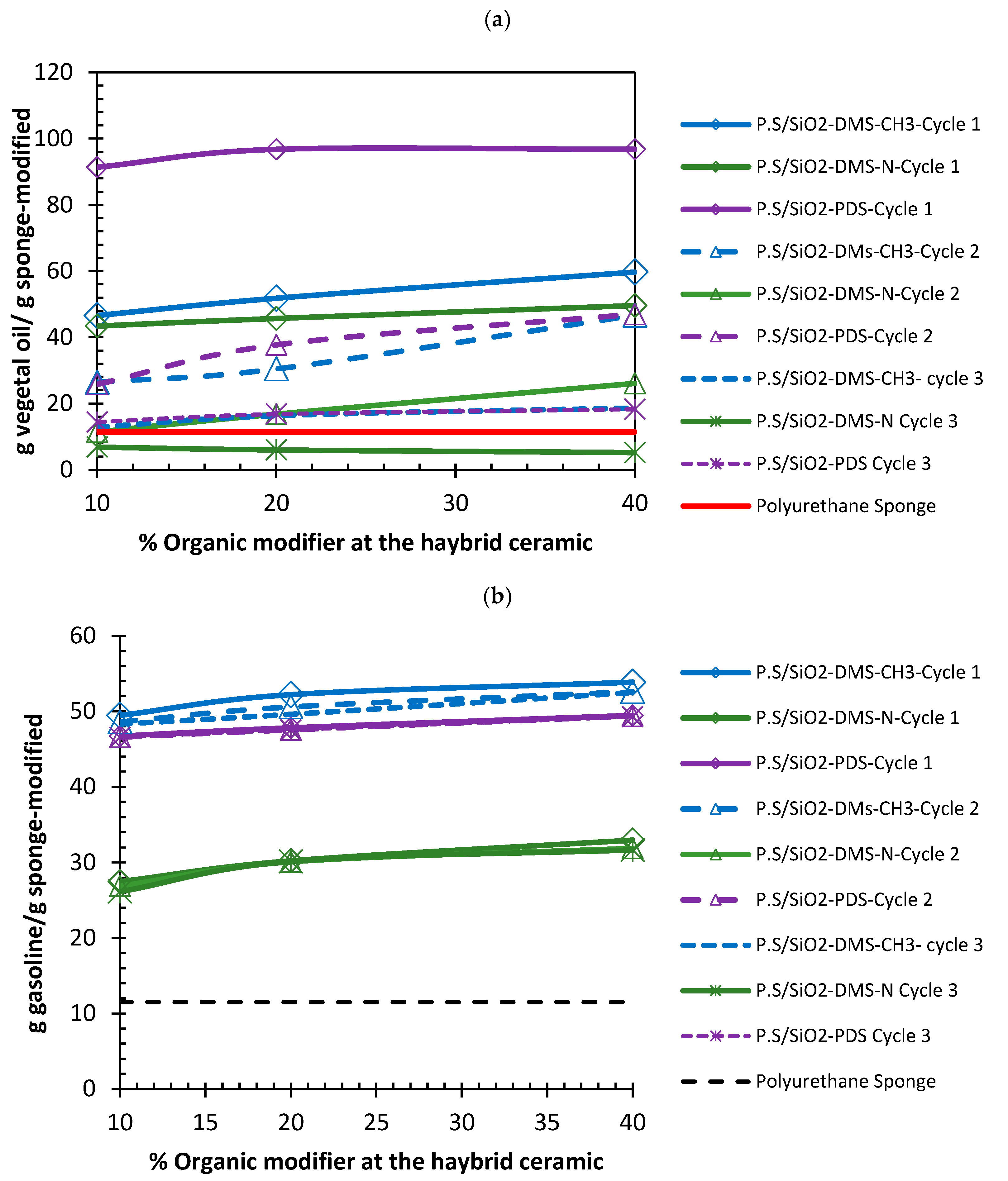
| P.S/SiO2–DMS–CH3–1 | 46.59 ± 2.54 | 4.07 | 49.46 ± 3.43 | 4.30 |
| P.S/SiO2–DMS–CH3–2 | 51.81 ± 3.26 | 4.53 | 52.21 ± 2.62 | 4.54 |
| P.S/SiO2–DMS–CH3–4 | 59.74 ± 3.72 | 5.23 | 53.86 ± 3.73 | 4.68 |
| P.S/SiO2–DMS–N–1 | 43.42 ± 3.23 | 3.80 | 27.48 ± 4.8 | 2.39 |
| P.S/SiO2–DMS–N–2 | 45.70 ± 5.40 | 3.99 | 30.23 ± 3.88 | 2.63 |
| P.S/SiO2–DMS–N–4 | 49.62 ± 4.78 | 4.34 | 32.98 ± 2.78 | 2.86 |
| P.S/SiO2–PDS–1 | 91.40 ± 3.67 | 8.00 | 46.72 ± 3.15 | 4.06 |
| P.S/SiO2–PDS–2 | 96.78 ± 2.74 | 8.47 | 47.81 ± 3.46 | 4.16 |
| P.S/SiO2–PDS–4 | 96.78 ± 3.53 | 8.47 | 49.46 ± 3.26 | 4.30 |
| Removal System | Oil Removal Capacity (g/g) | Organic Solvent Capacity (g/g) | Reference |
|---|---|---|---|
| SiO2 nanoparticles coated with PDMS | 14.28 | – | [29] |
| P.S modified with graphite and PDS | 22–30 | 40–50 | [20] |
| P.S modified Hydrophobic silica (TMHFS-Silica) Flour as hydrophobic group | 16–43 | – | [21] |
| Cellulose modified with hydrophobic silica; methyltriemtoxysilane as hydrophobic group | 24.8 | – | [25] |
| PS modified poly(dopamine) hydrophobic silica formed from TEOS and TMMS | 50 | 40–51 | [40] |
| SiO2/DMS-CH3-1 | 46.59 | – | Present study |
| SiO2/DMS-CH3-4 | 59.74 | – | |
| SiO2/DMS-N-1 | 43.42 | – | |
| SiO2/DMS-N-4 | 45.7 | – | |
| SiO2/PDS-1 | 91.40 | – | |
| SiO2/PDS-4 | 96.78 | – |
| mL Recovered Oil | %Recovery | |
|---|---|---|
| Kerosene | 0.42 ± 0.01 | 21 |
| THF | 0.85 ± 0.04 | 42.5 |
| Hexane | 0.92 ± 0.05 | 46 |
Disclaimer/Publisher’s Note: The statements, opinions and data contained in all publications are solely those of the individual author(s) and contributor(s) and not of MDPI and/or the editor(s). MDPI and/or the editor(s) disclaim responsibility for any injury to people or property resulting from any ideas, methods, instructions or products referred to in the content. |
© 2026 by the authors. Licensee MDPI, Basel, Switzerland. This article is an open access article distributed under the terms and conditions of the Creative Commons Attribution (CC BY) license.
Share and Cite
León-Reyes, M.d.R.; Mendoza-Miranda, J.M.; Puy-Alquiza, M.J.; Villegas-Alcaraz, J.F.; Rodríguez-Dahmlow, J.E.; Carrera-Rodríguez, M.; Salazar-Hernández, C. Design of Hydrophobic Hybrid Ceramic Coatings Based on Silica Modified with Polydimethylsiloxane (SiO2/DMS) for Sustainable Oil Removal. Processes 2026, 14, 896. https://doi.org/10.3390/pr14060896
León-Reyes MdR, Mendoza-Miranda JM, Puy-Alquiza MJ, Villegas-Alcaraz JF, Rodríguez-Dahmlow JE, Carrera-Rodríguez M, Salazar-Hernández C. Design of Hydrophobic Hybrid Ceramic Coatings Based on Silica Modified with Polydimethylsiloxane (SiO2/DMS) for Sustainable Oil Removal. Processes. 2026; 14(6):896. https://doi.org/10.3390/pr14060896
Chicago/Turabian StyleLeón-Reyes, María del Rosario, Juan Manuel Mendoza-Miranda, María J. Puy-Alquiza, José Francisco Villegas-Alcaraz, Jesús E. Rodríguez-Dahmlow, Marcelino Carrera-Rodríguez, and Carmen Salazar-Hernández. 2026. "Design of Hydrophobic Hybrid Ceramic Coatings Based on Silica Modified with Polydimethylsiloxane (SiO2/DMS) for Sustainable Oil Removal" Processes 14, no. 6: 896. https://doi.org/10.3390/pr14060896
APA StyleLeón-Reyes, M. d. R., Mendoza-Miranda, J. M., Puy-Alquiza, M. J., Villegas-Alcaraz, J. F., Rodríguez-Dahmlow, J. E., Carrera-Rodríguez, M., & Salazar-Hernández, C. (2026). Design of Hydrophobic Hybrid Ceramic Coatings Based on Silica Modified with Polydimethylsiloxane (SiO2/DMS) for Sustainable Oil Removal. Processes, 14(6), 896. https://doi.org/10.3390/pr14060896