Article

Thermodynamic Analysis of Composite Metal Oxygen Carriers for Biomass Chemical Looping Gasification Coupled with CO2 Splitting

1
School of Energy Science and Engineering, Nanjing Tech University, Nanjing 211816, China
2
Jiangsu Key Laboratory of Process Enhancement and Energy Equipment Technology, School of Mechanical and Power Engineering, Nanjing Tech University, Nanjing 211816, China
3
School of New Energy, Nanjing University of Science and Technology, Jiangyin 214443, China
4
School of Energy and Power Engineering, Nanjing Institute of Technology, Nanjing 211167, China
*
Author to whom correspondence should be addressed.
Processes 2026, 14(4), 648; https://doi.org/10.3390/pr14040648
Submission received: 29 January 2026 / Revised: 10 February 2026 / Accepted: 12 February 2026 / Published: 13 February 2026

Abstract

Biomass chemical looping gasification coupled with CO2 splitting (BCLGCS) presents a promising carbon-negative route for simultaneous syngas production and CO2 utilization, where the selection of oxygen carriers (OCs) is critical. Compared to single-metal oxides, composite metal OCs offer thermodynamic advantages. This study aims to evaluate the thermodynamic performance of composite metal OCs (LaFeO3, BaFeO3, CaFe2O4, and Ca2Fe2O5) in BCLGCS to overcome the thermodynamic limitations of conventional biomass-CO2 gasification. Gibbs free energy minimization calculations were performed to predict gas compositions and oxygen carrier phase transformations under varying operating conditions. Results show that steam addition promotes gasification by increasing H2 content and lowering required temperatures, but substantially reduces CO2 conversion in the splitting reactor by consuming residual char. Ca2Fe2O5 demonstrates superior adaptability with tunable H2/CO ratios, while LaFeO3 requires high OC loading and BaFeO3 undergoes deactivation via BaCO3 formation. This work reveals inherent thermodynamic conflicts between gasification and CO2 splitting steps, indicating that the optima for syngas production and CO2 utilization are mutually exclusive, an insight not previously quantified in BCLGCS literature. The findings provide theoretical guidance for designing carbon-tolerant OCs and optimizing process parameters, advancing BCLGCS toward practical carbon-negative applications.

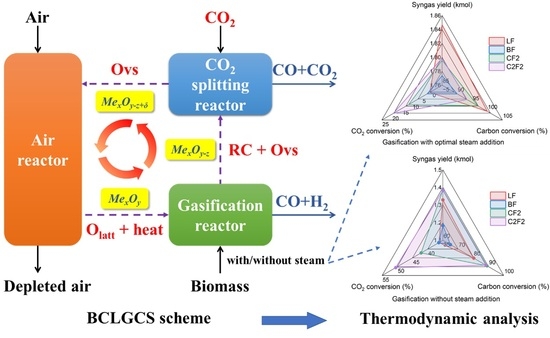
Graphical Abstract

1. Introduction

The persistent reliance of global economic development on fossil fuels has driven a continual increase in greenhouse gas emissions, primarily carbon dioxide (CO2), making climate change one of the most critical challenges of the 21st century [1,2]. Consequently, the development and utilization of renewable energy, along with the advancement of efficient and cost-effective carbon emission reduction technologies, have become pressing priorities for addressing resource, energy, and environmental constraints [3]. As the only carbon-neutral renewable energy source, biomass offers distinctive advantages including resource renewability, sustainable supply, and storable energy, and is regarded as the world’s fourth-largest energy source after coal, oil, and natural gas [4]. Meanwhile, beyond its role as a primary greenhouse gas, CO2 is also an abundant and renewable carbon feedstock. The synergistic utilization of biomass and CO2 can not only diminish societal dependence on fossil fuels, accelerate the transformation of modern energy systems, and support a green recovery of the post-pandemic global economy, but also contribute to carbon sequestration and emission reduction, thereby mitigating global climate change.
Various thermochemical and biochemical routes exist for biomass conversion, each with distinct product spectra and operational constraints. Anaerobic fermentation converts wet biomass to biogas (CH4/CO2) via microbial digestion, offering low energy input and high moisture tolerance, yet suffering from slow reaction rates, limited product flexibility, and incomplete lignin utilization [5]. Pyrolysis produces bio-oil, biochar, and syngas through thermal decomposition in the absence of oxygen [6]. While enabling liquid fuel production, it generates high tar content requiring costly upgrading and exhibits complex product distribution control [7]. Among various biomass utilization technologies, biomass gasification for syngas production offers notable advantages in terms of energy efficiency and production cost, making it an attractive approach for the synergistic utilization of biomass and CO2 [8]. Employing CO2 as a gasification medium not only enables negative CO2 emissions but also leverages its carbon content to enhance syngas yield. However, the thermodynamic stability and kinetic inertness of CO2 often result in incomplete conversion of the feedstock. This leads to elevated tar and residual CO2 in the syngas, which represents a major barrier to the widespread application of biomass CO2 gasification. Specifically, soot particles formed during tar combustion complicate dust removal, while condensed liquid tar at low temperatures can cause pipeline blockage and contamination, threatening the safe and stable operation of downstream equipment [9]. Meanwhile, excessively high CO2 content degrades syngas quality, reduces target product yields, and deactivates catalysts in subsequent synthesis processes [10]. CO2 also dilutes the H2/CO ratio markedly, further restricting syngas applicability in energy and chemical industries. Although intensified reaction conditions, such as high temperature, high pressure, or supercritical CO2, can partially improve the conversion of biomass and CO2, they often compromise overall system efficiency [11]. Therefore, CO2-enhanced biomass gasification remains constrained by challenges including incomplete feedstock conversion, inferior syngas quality, and unsatisfactory process economics.
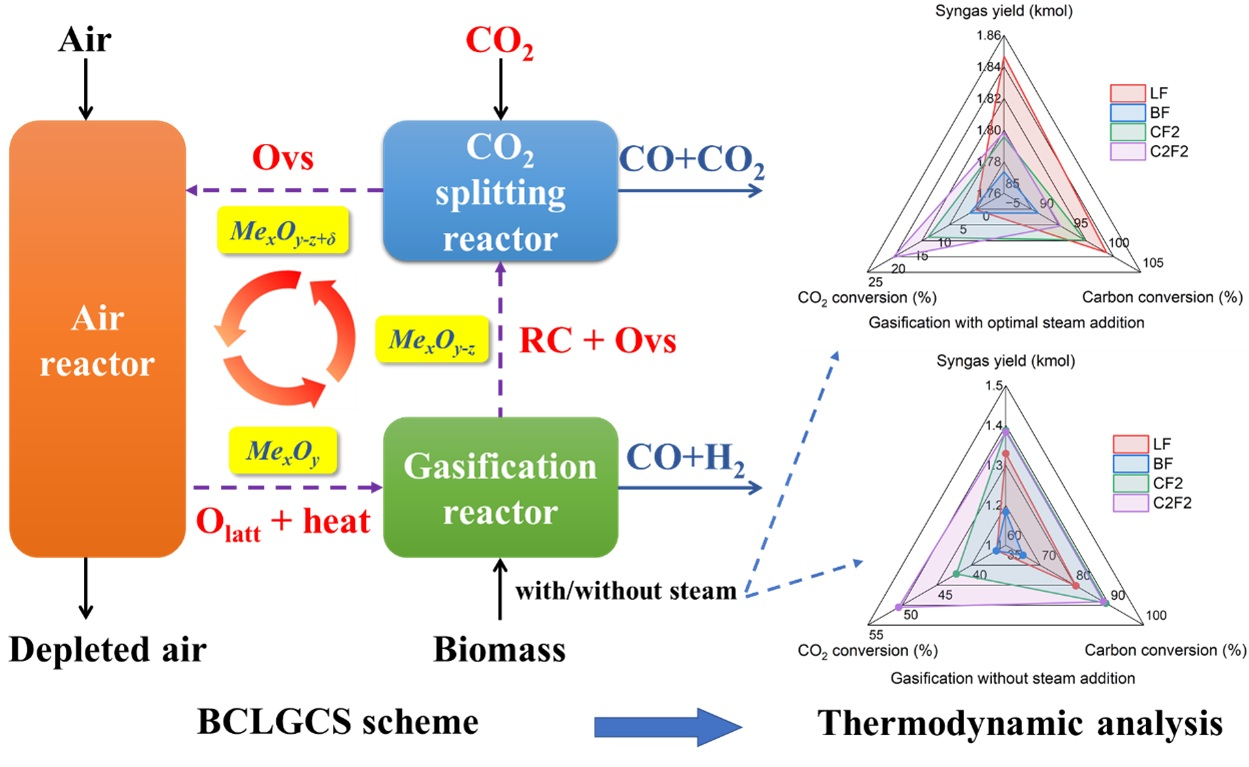
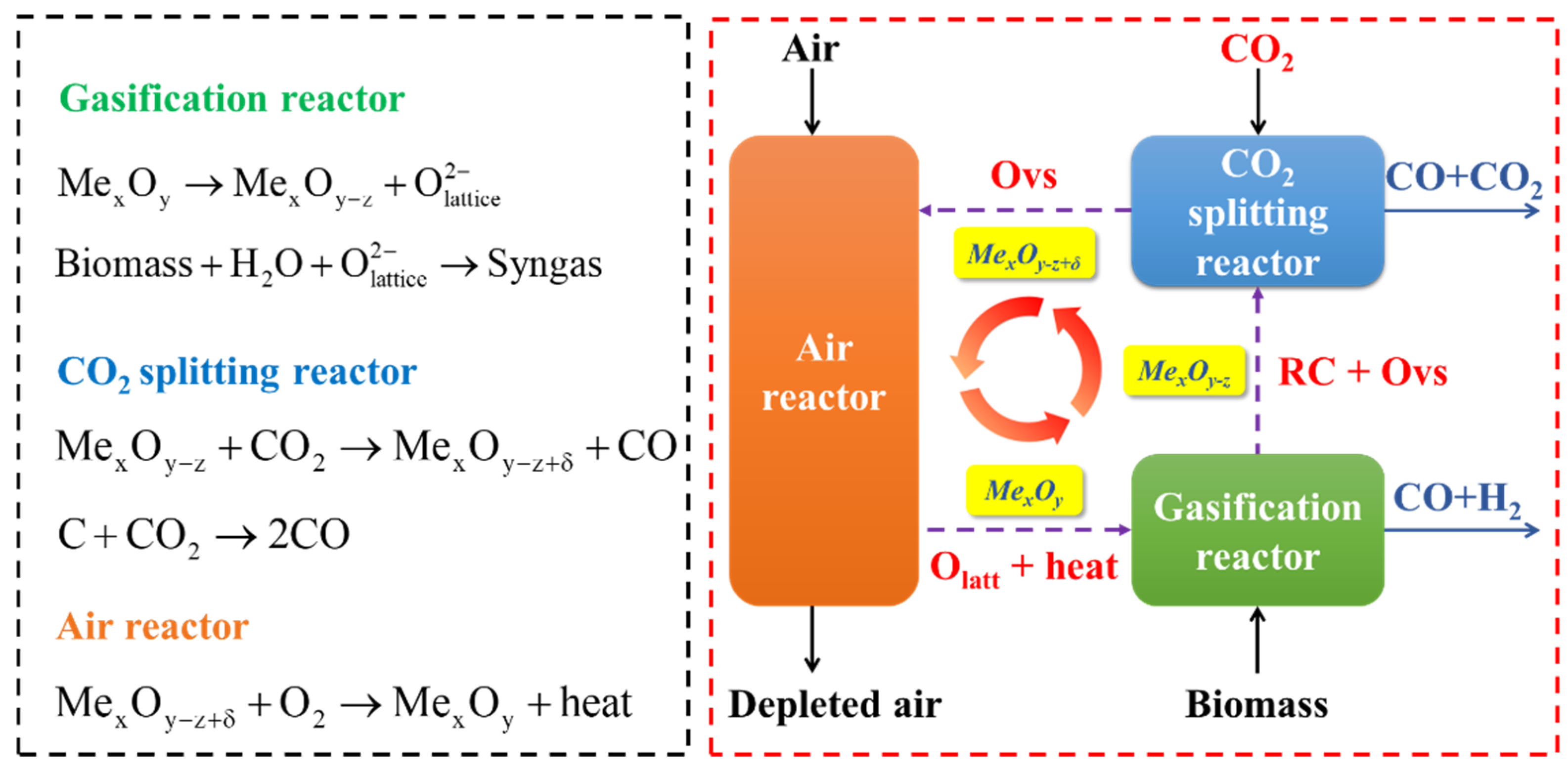
Recently, a biomass chemical looping gasification route coupled with CO2 splitting (BCLGCS) has been proposed to overcome the bottlenecks of conventional biomass CO2 gasification for producing high-quality syngas. This approach transforms the conventional single-step process into two coupled sub-processes: biomass chemical looping gasification and CO2 deoxygenation. Via the orderly exchange of lattice oxygen among biomass, oxygen carrier (OC) and CO2, it achieves in situ directional conversion of biomass tar into small-molecule syngas and highly efficient deoxygenation reduction of CO2 to CO, while maintaining satisfactory system economics [12,13,14]. As illustrated in Figure 1, the BCLGCS system consists of a gasification reactor, a CO2 splitting reactor and an air reactor. Biomass undergoes partial oxidation by lattice oxygen (Olatt) to produce syngas in the gasification reactor, while tar is catalytically reformed into light gases over the active surface species of the OC. In the CO2 splitting reactor, the OCs with oxygen vacancies (Ovs) and residual char (RC) react with CO2 to produce CO. Finally, the reduced oxygen carrier is fully regenerated in the air reactor, releasing the heat required for both the gasification and splitting stages. The BCLGCS syngas production scheme offers distinct advantages: (i) sequential lattice oxygen exchange circumvents the thermodynamic constraints of conventional biomass-CO2 gasification, achieving higher tar conversion and CO2 utilization [15]; (ii) the exothermic oxidation reaction enables autothermal operation of the entire system; and (iii) blending hydrogen-rich syngas with CO allows precise H2/CO ratio control, expanding the applicability of the product gas in downstream energy and chemical applications.
Rational design and activity tuning of OCs are critical for syngas generation, in situ tar reforming, and CO2 splitting. Low OC activity limits lattice oxygen release, resulting in poor biomass conversion and high tar content in the gasification reactor. The reduced OC with few oxygen vacancies, further obstructing CO2 activation and autothermal operation. Excessively high activity, by contrast, causes over-oxidation of the syngas, reducing its yield and quality, while the reduced carrier maintains a high thermodynamic oxygen partial pressure that hinders lattice oxygen exchange and CO2 deoxygenation [16]. While BCLGCS has been experimentally demonstrated, existing studies have predominantly focused on the performance of specific oxygen carriers (e.g., NiFe2O4 [17], LaFeO3 [18], LaMO3 [19]) under limited operating conditions. The synergistic thermodynamic mechanisms governing BCLG and CO2 splitting within the biomass-OC-CO2 multicomponent system remain inadequately understood. This study addresses this knowledge gap by leveraging the thermodynamic equilibrium results. Through Gibbs free energy minimization, a comprehensive thermodynamic analysis of BCLG and CO2 splitting for four composite oxygen carrier systems was performed. The gas product compositions and OC phase transformations across various reaction conditions were precisely predicted, thereby delineating the thermodynamic window for maximizing syngas yield and CO2 conversion. This work provides a critical theoretical complement to existing experimental studies, offering direct guidance for overcoming the thermodynamic limitations of conventional gasification and optimizing process parameters. The findings serve as a valuable reference for BCLGCS toward practical application.

2. Materials and Methods

In the thermodynamic equilibrium calculations, sawdust was used as the feedstock. Table 1 presents the proximate and ultimate analysis results of the biomass. The primary elemental constituents of sawdust are C, H, and O, while the contents of N and S are negligible. In thermodynamic modeling of BCLG, it is common practice to simplify the feedstock composition to C, H, and O only. The simplified formula CH1.144O0.669 was derived from ultimate analysis following the methodology in the reference [20], which demonstrated that thermodynamic results using C-H-O simplification show minimal deviation (<3%) from those including minor elements for biomass gasification equilibrium calculations.
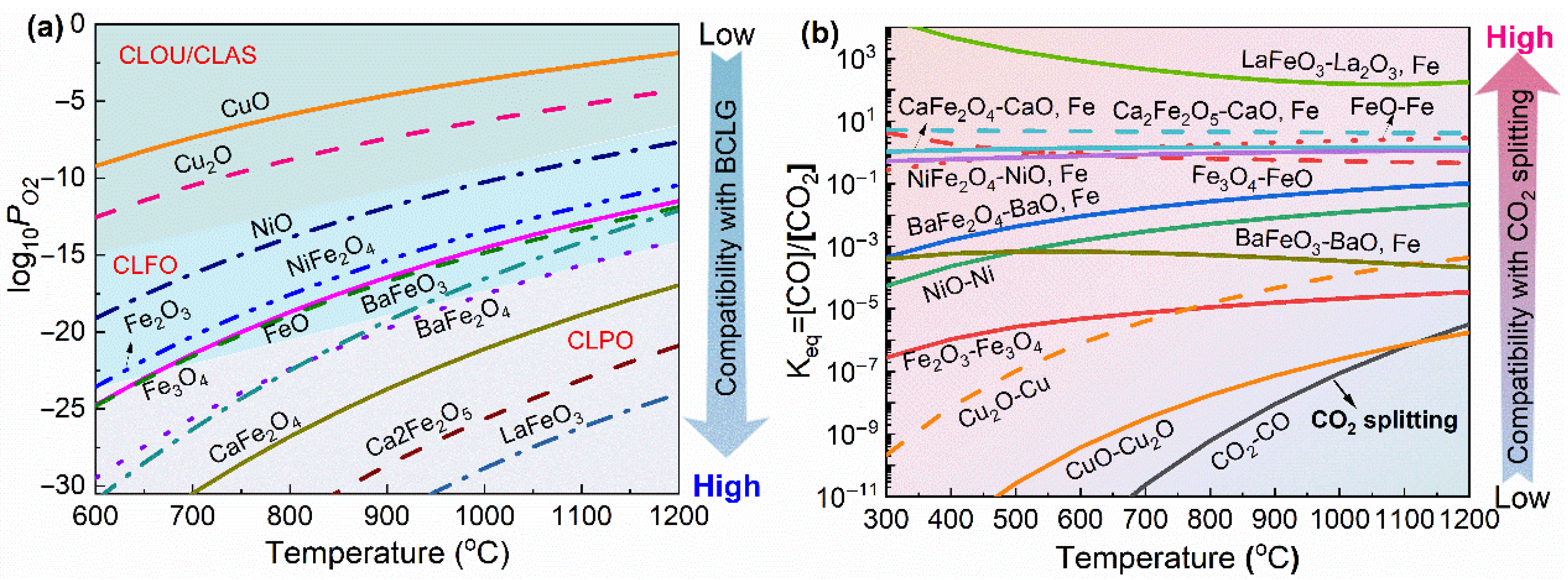
In order to theoretically screen the OCs suitable for BCLGCS process, Ellingham diagrams for common OCs and equilibrium yield diagrams for the CO/CO2 system were drawn in Figure 2. It can be seen from Figure 2a that high-activity Cu-based OCs release molecular oxygen even at moderate temperatures, hindering selective biomass partial oxidation to syngas. Fe- and Ni-based single-metal oxides exhibit strong lattice oxygen release and effective tar cracking capability, yet suffer from syngas over-oxidation, diminished mechanical strength at elevated temperatures, and coking deactivation [21]. Composite metal carriers such as CaFe2O4, Ca2Fe2O5, BaFeO3 and LaFeO3 possess moderated lattice oxygen release, demonstrating superior compatibility with biomass chemical looping gasification. Figure 2b demonstrates that higher equilibrium yields of the CO/CO2 correspond to stronger thermodynamic driving force of OC for CO2 splitting and lattice oxygen transfer. Apparently, composite metal OCs demonstrate high compatibility with CO2 deoxygenation. Therefore, a comprehensive thermodynamic analysis of BCLG and CO2 splitting for four oxygen carrier systems: LaFeO3 (LF), BaFeO3 (BF), CaFe2O4 (CF2), and Ca2Fe2O5 (C2F2) was performed in this work.
In thermodynamic equilibrium calculations, the Gibbs free energy minimization approach was employed by using HSC Chemistry 6.0 software. The total Gibbs free energy of a system is expressed as a linear combination of the chemical potentials of its constituent components:
G = i = 1 N S i G i
The Gibbs free energy depends solely on the amounts of each component present. The method involves determining the composition that corresponds to the minimum Gibbs free energy. It should be noted that the Gibbs free energy minimization method assumes that the system reaches a state of minimum Gibbs free energy, where all possible reactions have proceeded to completion. While real BCLGCS systems are indeed kinetically constrained, equilibrium calculations provide thermodynamic boundaries that are invaluable for identifying optimal oxygen carriers and operating windows without exhaustive experimental campaigns, revealing intrinsic thermodynamic conflicts that persist regardless of kinetics, and establishing theoretical maximum yields against which kinetic models and experiments can be compared. To ensure transparent application of this methodology, the underlying assumptions and their practical implications were stated as follows: (i) all reactions proceed to completion, with no kinetic barriers to reaction rates or diffusion limitations; (ii) the gas and solid phases are perfectly mixed with uniform temperature and composition, and particle-scale gradients are neglected; (iii) no mass loss or environmental interaction occurs during the calculation and elemental conservation is strictly maintained; (iv) gas-phase species follow ideal gas law and solid solutions are treated as mechanical mixtures of pure phases. The advanced gasification modeling that goes beyond equilibrium assumptions could be seen other work [22]. Furthermore, during the solution process, the amounts of components are constrained by the material (element) conservation equations [23]. The gaseous and solid species considered in the products for four OCs system were listed in Table 2.
In the BCLGCS process, the carbon conversion ratio (ηC,con) and the CO2 conversion ratio (ηCO2,con) are two key indicators for evaluating syngas quality and the performance of the CO2 splitting reactor. The carbon conversion ratio is defined as the fraction of carbon in the feedstock that is converted into carbonaceous gases, while the CO2 conversion ratio is defined as the proportion of CO2 consumed relative to the initial amount fed into the splitting reactor. The high-quality syngas means that it has low contents of CO2 and CH4, high calorific value, and the H2/CO ratio is suitable for subsequent chemical synthesis processes. This framework will serve as the basis for evaluating syngas quality in subsequent sections of this work.
η C , c o n = n C , g a s e o u s n C , b i o m a s s × 100 %
η C O 2 , c o n = n C O 2 , i n i t i a l n C O 2 , f i n a l n C O 2 , i n i t i a l × 100 %

3. Results

3.1. Biomass Gasification Process

3.1.1. Effect of OC Loading and Gasification Temperature

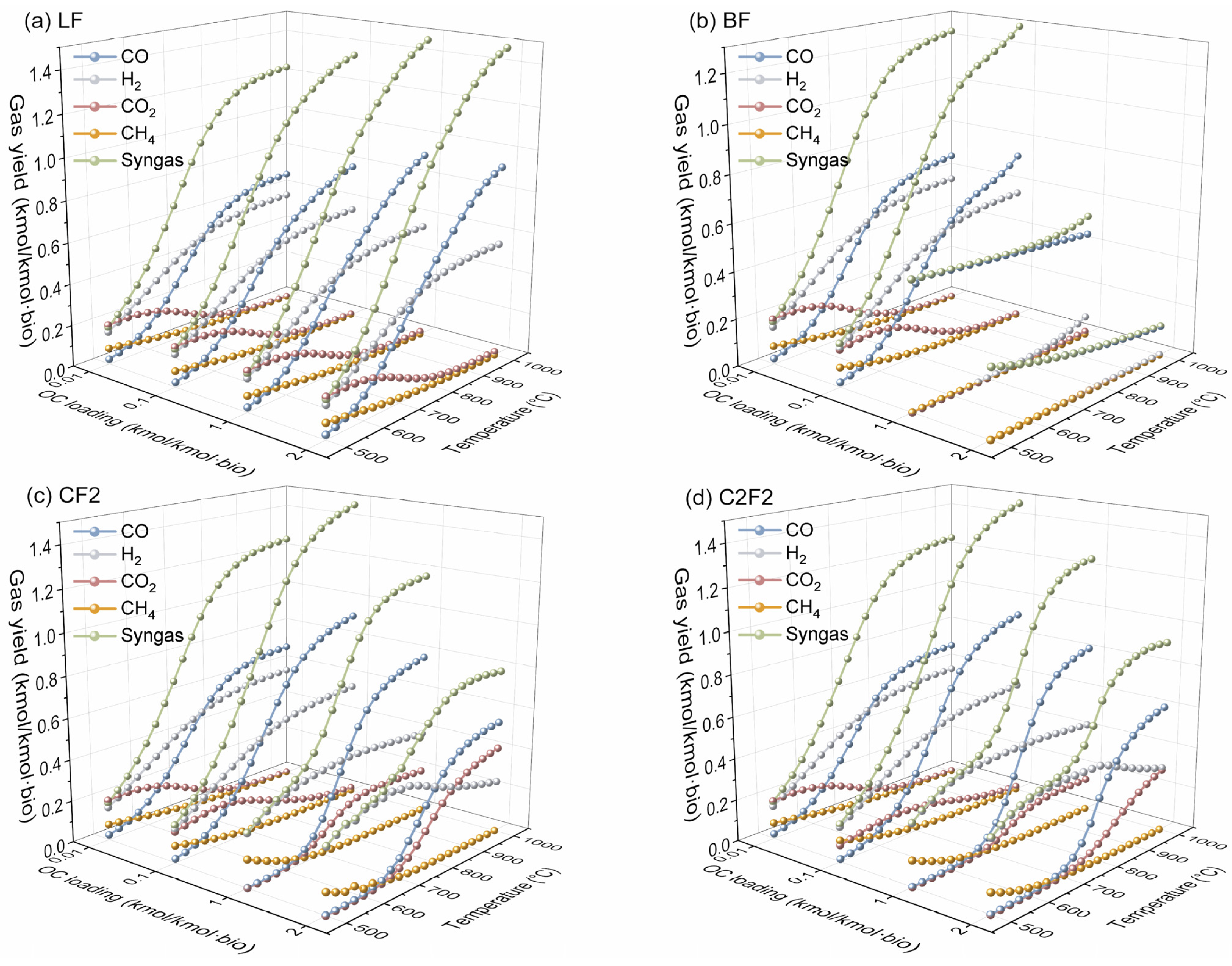
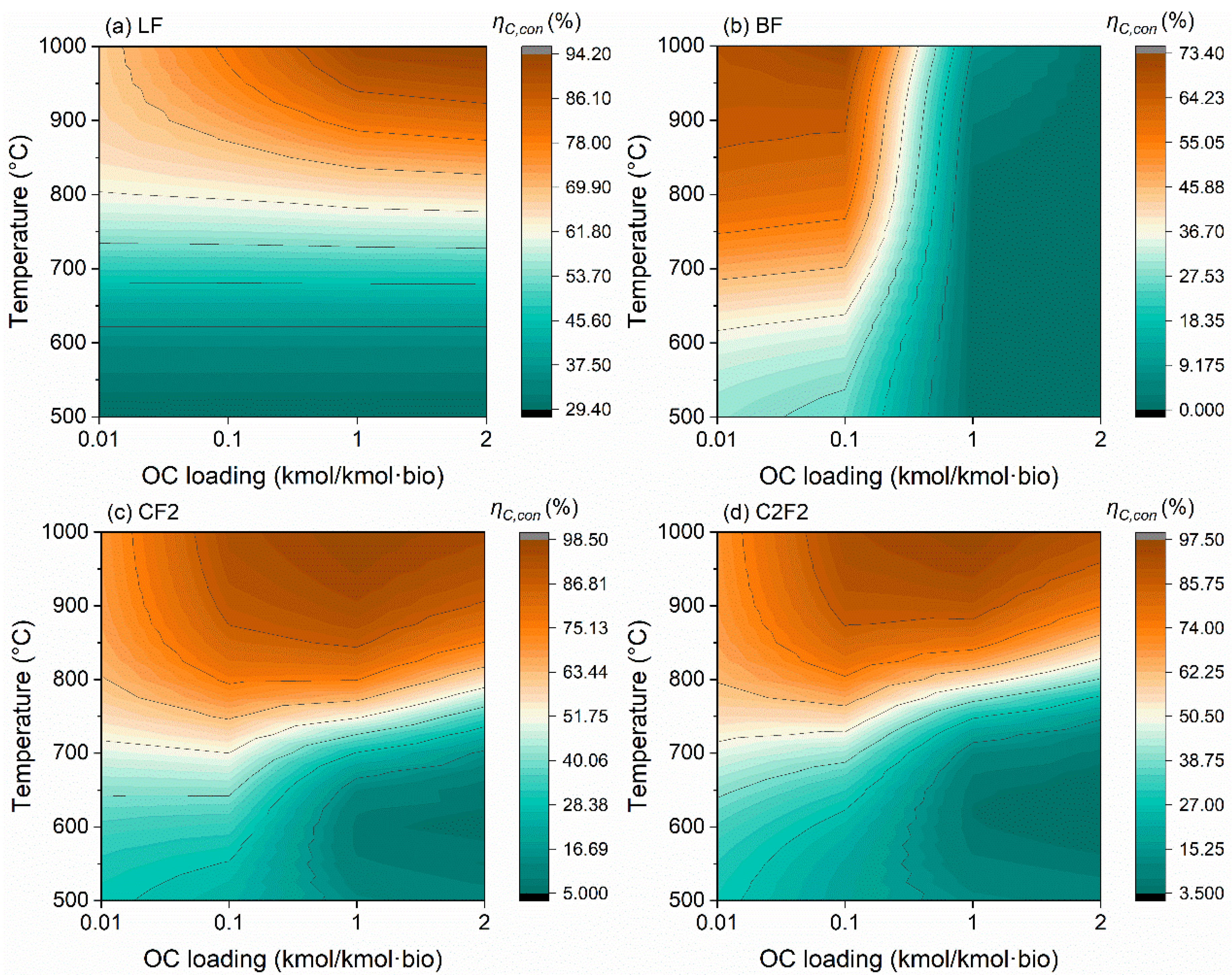
As illustrated in Figure 3 and Figure 4, gas yield distributions of CO, H2, CO2, CH4, and syngas as well as carbon conversion ratio are strongly influenced by both OC loading and temperature. Irrespective of OC type and amount, a consistent trend across all OCs is the pronounced promotion of syngas yield and carbon conversion with increasing temperature, particularly above 800 °C. This is primarily attributed to the enhanced endothermic reactions, such as steam and dry reforming of methane ((R1) and (R2)), water-gas shift (WGS, (R3)), and improved carbon conversion at elevated temperatures [24]. The thermodynamic parameters of these reactions can be seen in Table 3. Meanwhile, CO and H2 yields increase significantly, while CH4 decreases due to reforming reactions. CO2 yield generally shows a declining trend at higher temperatures, except for cases with excessive OC addition where complete oxidation is favored [25].
C H 4 + H 2 O     CO + 3 H 2
C H 4 + C O 2   2 CO + 2 H 2
CO + H 2 O     C O 2 + H 2
2 C + 3 O latt     CO + C O 2
C + H 2 O     CO + H 2
C + C O 2     2 CO
Among the OCs, the perovskite-type LF demonstrates exceptional oxidation resistance, maintaining high syngas yields (1.48 kmol/kmol bio at 2 kmol/kmol bio OC loading, 1000 °C) even at elevated OC loading (Figure 3a). The minimal decrement in CO yield underscores its moderate oxygen uncoupling capability, which prevents over-oxidation while sustaining a favorable CO/H2 ratio of about 1.6. However, the excessively stable crystal structure of LF leads to slow oxygen release kinetics [26]. Under conditions of 1.0 kmol/kmol·bio OC addition and a gasification temperature of 900 °C, the carbon conversion rate remains limited to only 80.29% (Figure 4a). Consequently, a substantial amount of OC is required to achieve complete biomass conversion in practice, representing a major limitation for its scalable engineering application. By contrast, another perovskite BF exhibits BF relatively high reactivity at 0.1 kmol/kmol·bio loading, but suffered severe deactivation when the loading exceeded 1.0 kmol/kmol·bio (Figure 3b and Figure 4b). Under conditions of 1.0 kmol/kmol·bio loading and 900 °C, syngas yield and carbon conversion were drastically reduced to 0.49 kmol/kmol·bio and 32.68%, respectively. This pronounced suppression reflects the structural instability of BaFeO3 and thermodynamically favorable formation of carbonates (BaCO3), which passivate active sites [27,28]. The data indicate that BF transitions from a gasification promoter at 0.01 kmol/kmol·bio to an inhibitor at 1.0–2.0 kmol/kmol·bio, making it unsuitable for syngas generation under high loading conditions. In comparison, the calcium ferrites, CF2 and particularly C2F2, exhibited markedly superior performance compared to the perovskite-type OCs (Figure 3c,d and Figure 4c,d). They achieved higher syngas yields (exceeding 1.8 kmol/kmol·bio) and significantly enhanced H2/CO ratios, especially within a moderate temperature window of 800–1000 °C. This enhanced hydrogen production is attributed to the potent catalytic effect of in situ generated CaO from the reduction of calcium ferrites, which actively promotes the WGS reaction (R3) [29]. Conclusively, among four OCs, C2F2 demonstrates favorable thermodynamic characteristics under equilibrium conditions, suggesting potential for further kinetic and experimental validation. It offered the highest syngas productivity with a broader optimal operational window. Moreover, the ability to tune syngas composition from H2/CO of ~1.0 at low loading to ~0.5 at high calcium ferrite loading demonstrates superior process flexibility compared to conventional gasification. Considering both conversion efficiency and cost-effectiveness, the optimal OC loading is identified as 1.0 kmol/kmol·bio for LF, and 0.1 kmol/kmol·bio for BF, CF2, and C2F2.

3.1.2. Effect of Steam Amount

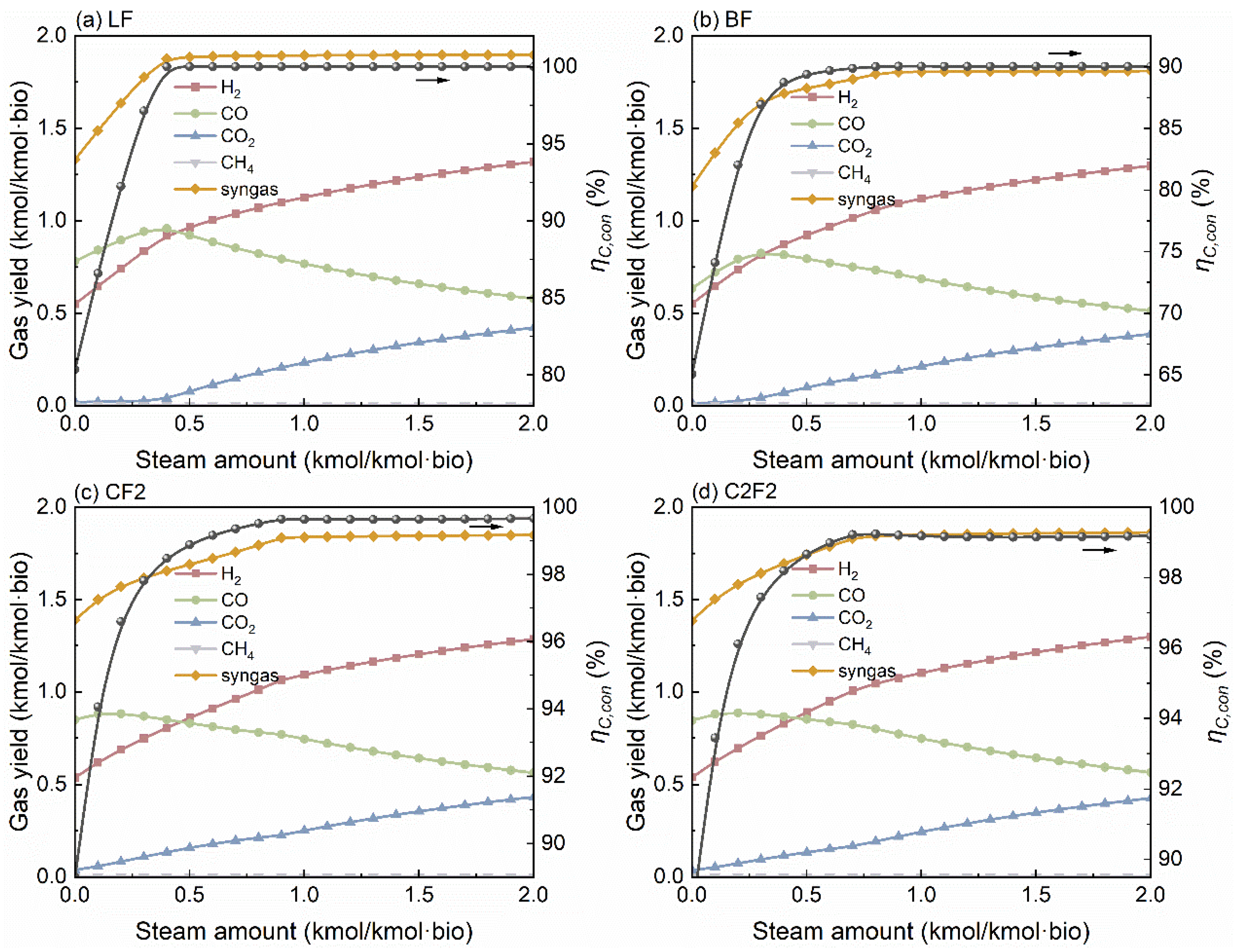
In the BCLG process, an appropriate amount of gasification agents such as steam or CO2 is usually introduced into the gasification reactor to improve the quality of syngas [21]. At optimal OC loading mentioned above, the steam amount was varied to identify optimal conditions balancing gasification efficiency against CO2 splitting performance. As seen in Figure 5, rising steam input consistently promotes H2 and syngas yields while suppressing CO2 and CH4 formation across all four OCs. This is attributed to the enhanced WGS and methane steam reforming reactions under thermodynamic control, which shifts the product distribution toward more H2-rich syngas [30]. Carbon conversion stabilizes when the steam amount reaches a certain level, indicating that the system approaches full carbon conversion under sufficient steam supply via (R5) and (R6). Among the four OCs, LF offers the highest ultimate syngas yield but requires substantial steam (0.5 kmol/kmol·bio) to maximize CO, reflecting its robust perovskite framework that tolerates higher steam partial pressures without structural degradation. However, other three OCs emerges as steam-responsive materials, achieving the highest carbon conversion and syngas production at approximately 1.0 kmol/kmol·bio steam. These findings reveal that steam addition is a powerful lever for product distribution control, but the optimal steam amount must be individually calibrated to balance CO maximization against H2 enrichment. In the present case study at 900 °C, the optimal amounts of steam were 0.5 kmol/kmol·bio for LF, 1.0 kmol/kmol·bio for BF, and 0.9 kmol/kmol·bio for both CF2 and C2F2.
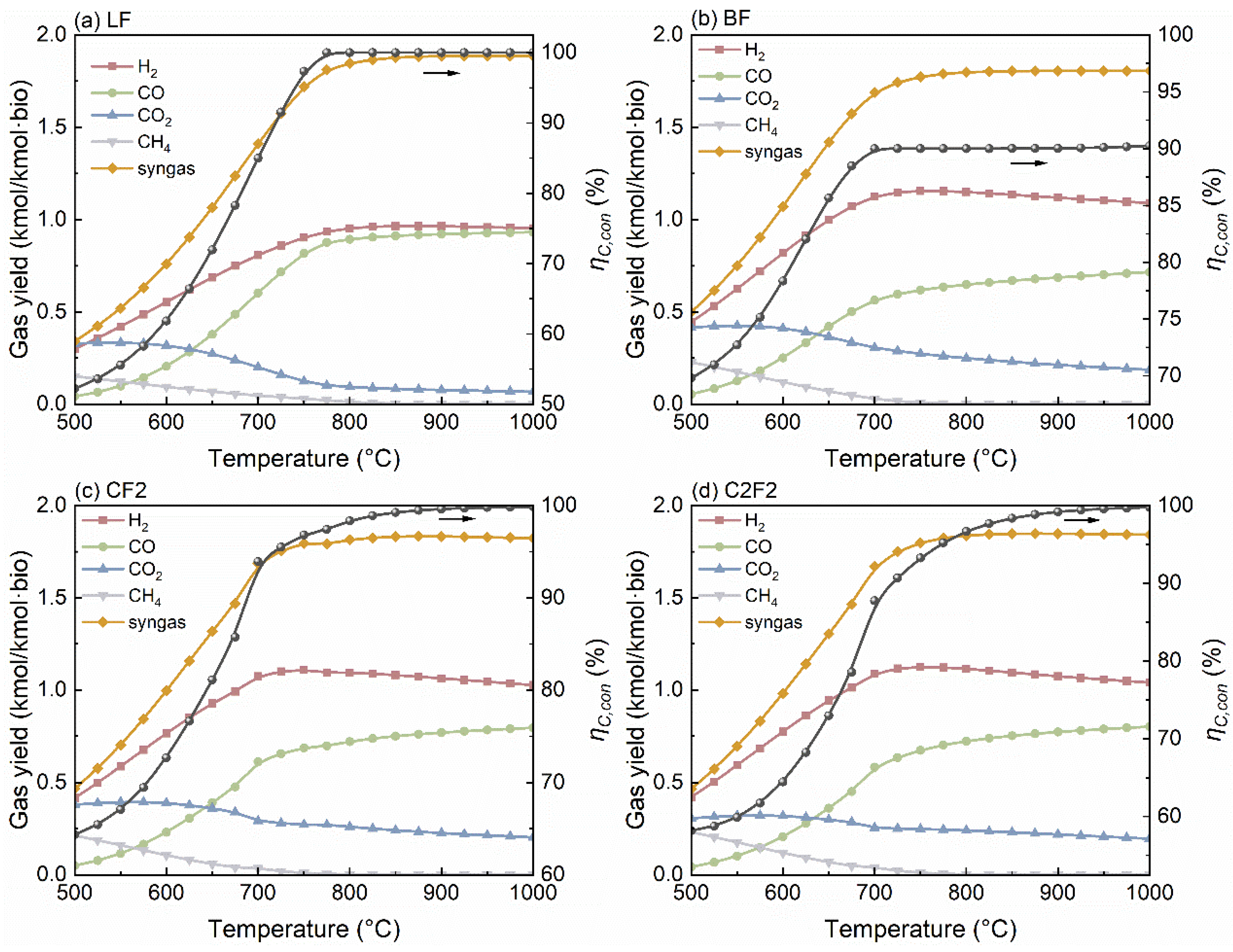
To identify the thermal window for maximum syngas quality under steam-assisted conditions, the effect of temperature on gas yield and carbon conversion for four OCs at each optimal steam amount was explored. The temperature at which syngas yield and carbon conversion reach a stable plateau can be defined as the minimum temperature for efficient gasification under the given conditions. It can be seen from Figure 6 that this temperature is approximately 800 °C for LF, whereas for BF, CF2 and C2F2 it is slightly slower, around 750 °C. Above these temperatures, syngas yields remain nearly constant, indicating that further energy input does not substantially improve gas production but may increase operational costs.

3.1.3. Phase Changes of OCs During CLG

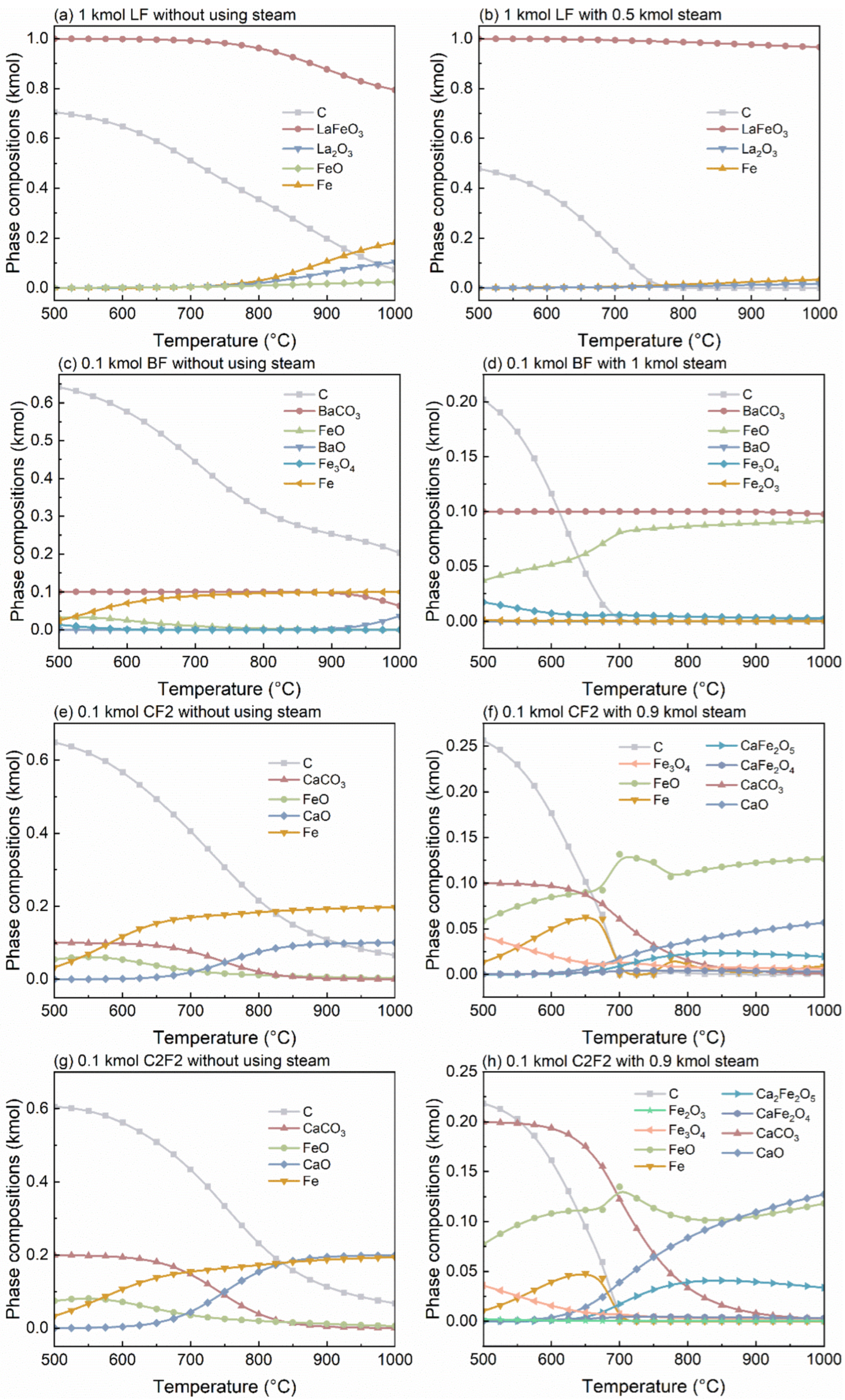
Since the OCs in the CO2 splitting reactor are supplied from gasification reactor, their reduction degree in the latter determines the CO2 splitting performance. Therefore, under the optimal loading of each OC, the variation in phase composition of OCs with gasification temperature was further investigated under two different operating conditions (with and without steam), with results illustrated in Figure 7. Under steam-free conditions (Figure 7a), LF exhibits remarkable structural robustness, retaining its perovskite framework up to 750 °C before progressive reduction yields La2O3, FeO and metallic Fe. This indicated the partial structural collapse via reactions (R7) and (R8) [31,32]. Furthermore, as lattice oxygen is released and products are generated, the coke content decreases rapidly above 600 °C, which is primarily attributed to the char gasification reactions (R4)~(R6). Steam addition (Figure 4b) lowered the reduction extent of the LF. The apparent decomposition occurs only above approximately 800 °C. This is likely because steam primarily acts as an oxidant participating in the gasification of sawdust and replenishes the oxygen vacancies formed after the loss of lattice oxygen in LF. Meanwhile, the coke content decreases markedly and is almost completely consumed above 750 °C, owing to the enhancement of char gasification by steam (R5).
Similar phenomena were also observed for BF, CF2, and C2F2. The difference is that for BF, BaCO3 remains the main component regardless of the presence or absence of steam. This may be due to the fact that BaO formed after BF decomposition (R9) tends to react with CO2 to form carbonate (R10) [33]. The stable structure and low reactivity of BaCO3 thus lead to the decrease in syngas yield at high OC loadings (see Figure 3b). Moreover, steam promotes the oxidation of Fe to FeO, making FeO the predominant iron oxide in BF after reaction. For both CF2 and C2F2, Fe and CaO were the predominant phases of OCs after gasification above 800 °C in the absence of steam, due to the decomposition of CaCO3 formed above 700 °C under high-temperature conditions [34]. With the introduction of steam, the reduction extent of OCs decreased, and CF2, C2F2, and FeO became the major components.
2 LaFeO 3     L a 2 O 3 + F e 2 O 3
F e 2 O 3 + Sawdust     Fe + FeO + syngas + char + tar
2 BaFeO 3     2 BaO + F e 2 O 3 + O latt
BaO + C O 2   BaCO 3
CaCO 3 CaO + C O 2

3.2. CO2 Splitting Process

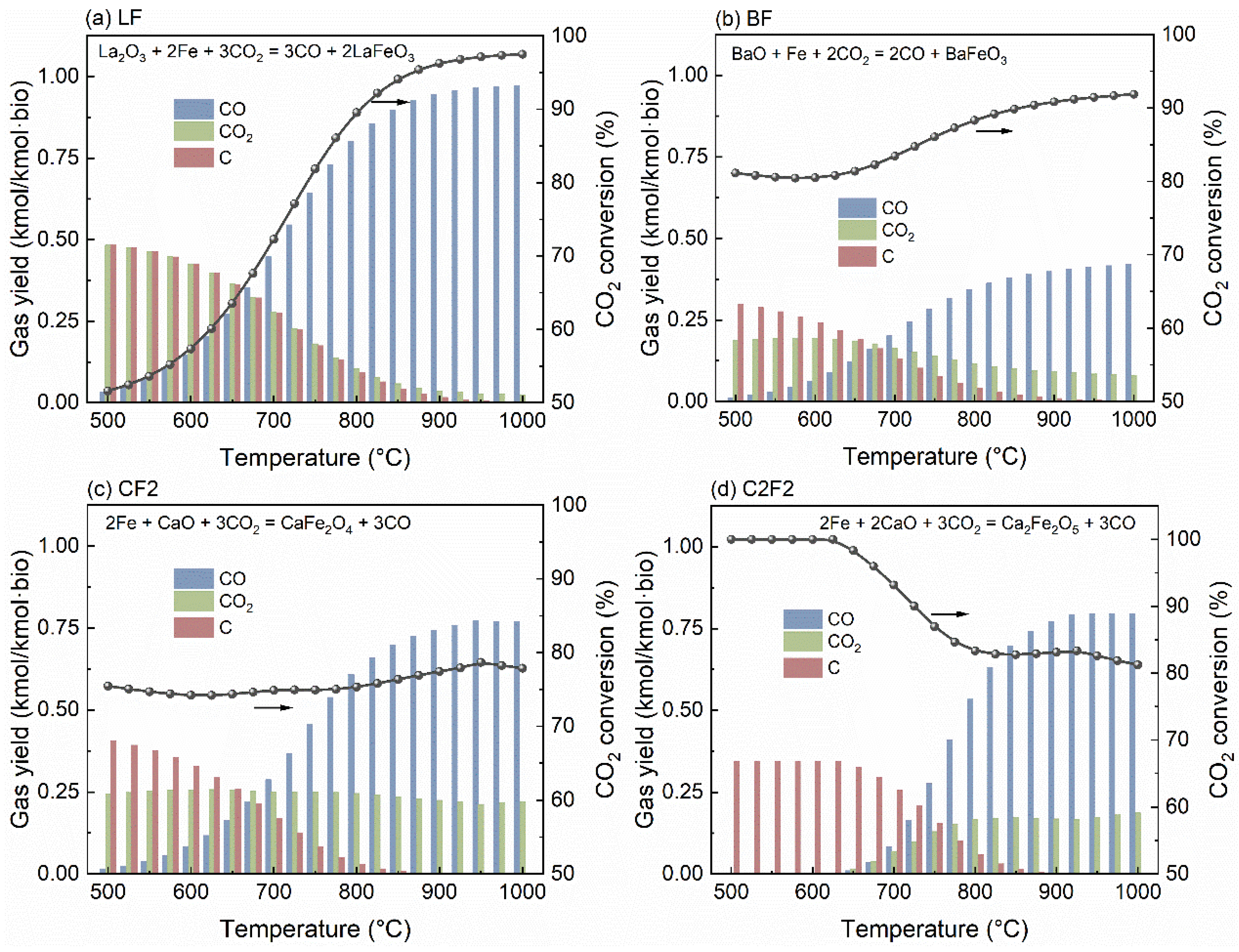
When considering the CO2 splitting reaction in isolation, the reactions between the reduced phases of four OCs and CO2 are theoretically described by reactions (R12)~(R15). The theoretical equilibrium compositions for the CO2 splitting based on the stoichiometric ratios of these reactions are calculated and presented in Figure 8. Among four OCs, the LF-based reaction exhibits the most favorable thermodynamics, achieving 97.5% CO2 conversion at 1000 °C with a steep activation threshold above 600 °C (Figure 8a). CO yield increases monotonically to 0.97 kmol/kmol·bio at 1000 °C, while residual CO2 diminishes to 0.03 kmol/kmol·bio, reflecting strong forward reaction spontaneity. The strongly exothermic nature of LF formation facilitates the efficient reduction of the CO2, which is otherwise thermodynamically less favorable at lower temperatures [35]. However, a critical drawback emerges below 850 °C range, where carbon deposition is remarkably evident. This carbon formation arises from the reverse Boudouard reaction (R6) competing with the desired oxidation pathway, favored at intermediate temperatures where CO concentration is substantial but thermal energy is insufficient to prevent disproportionation [36]. Above 850 °C, carbon gasification becomes dominant, reducing solid carbon to less than 0.04 kmol/kmol·bio. Figure 8b confirms that the BF-based system exhibits less favorable thermodynamics for CO production, attributed to the formation of BaCO3. This suggests that BaO primarily functions as a CO2 carrier rather than an active redox partner, since Ba-containing perovskites exhibit strong CO2 adsorption on surface Ba sites, forming stable carbonates that inhibit oxygen exchange [37]. This could potentially be mitigated through kinetic control or structural modification. The calcium-based systems demonstrate stoichiometry-dependent performance. The single CaO system achieves 77.9% maximum conversion (Figure 8c), while the 2CaO system exhibits a 100% CO2 conversion below 650 °C and decreases to 81.2% at 1000 °C (Figure 8d), reflecting the enhanced thermodynamic driving force associated with C2F2 formation. However, both systems exhibit apparent carbon deposition below 850 °C, indicating that the Fe-Ca-O phase assemblage cannot fully suppress the Boudouard side reaction [38].
L a 2 O 3 + 2 Fe + 3 C O 2 3 CO + 2 LaFe O 3
BaO + Fe + 2 C O 2   2 CO + BaFe O 3
CaO + 2 Fe + 3 C O 2 3 CO + CaF e 2 O 4
2 CaO + 2 Fe + 3 C O 2 3 CO + C a 2 F e 2 O 5
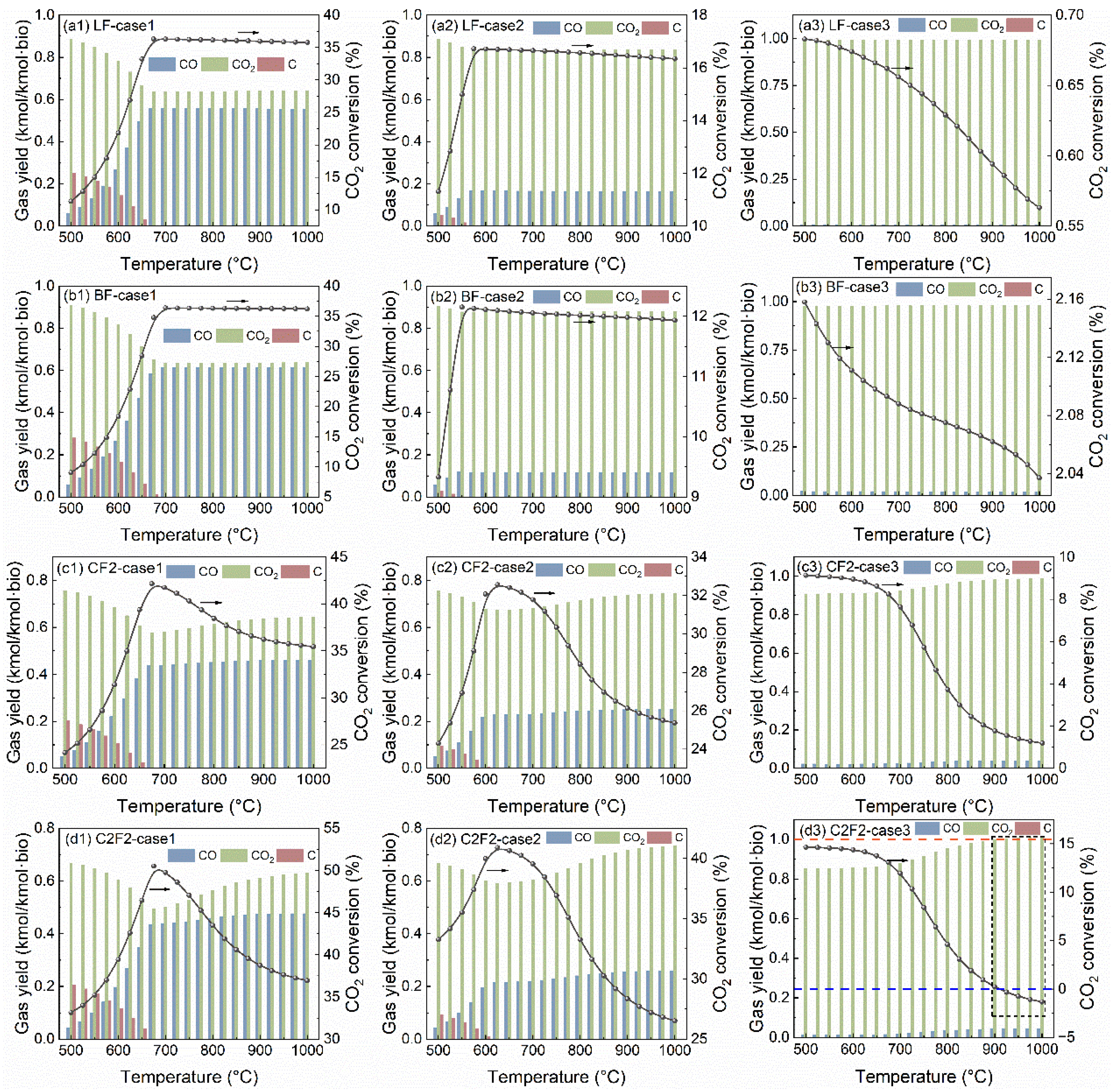
Theoretically, the conversion of CO2 splitting in the four reduced OC systems can reach at least 50%. However, as shown in the results mentioned above, the actual composition of the OC after reduction in the practical CLG process is unlikely to match the theoretical one. Furthermore, the RC during gasification influences the CO2 splitting reaction. The equilibrium composition also differs under steam-present and steam-absent atmosphere, and the reduced state of the OCs under actual operating conditions is even more complex. Therefore, phase equilibrium calculations for CO2 splitting were performed utilizing the equilibrium composition of the reduced OC under two gasification conditions (with/without steam) as the initial composition for the CO2 splitting reaction. The case without steam but considering RC is designated as Case 1, the case without steam and without considering RC as Case 2, and the case with steam where the RC is completely reacted as Case 3. The initial OC compositions are summarized in Table 4.
For LF in Case 1 (Figure 9(a1)), the CO2 conversion increases monotonically from 11.3% at 500 °C to 36.3% at 675 °C and remains stable up to 1000 °C, accompanied by continuous consumption of RC via the Boudouard reaction (R6). When char is excluded from the initial composition (Case 2, Figure 9(a2)), the CO2 conversion rises only modestly, reaching 16.5% at 600 °C. This suggests that RC acts as a primary source for CO production, shifting the reaction equilibrium toward enhanced CO2 reduction. In contrast, under steam-added gasification conditions (Case 3, Figure 9(a3)), the CO2 conversion in the splitting step reaches a maximum of merely 0.68% at 500 °C and subsequently declines with increasing temperature. This decrease is attributed to the complete consumption of RC by steam and the lowered reduction extent of the OC. The former is the dominant factor suppressing CO2 conversion, indicating that, from a thermodynamic perspective, most of the CO2 in the splitting reactor is consumed through the RC gasification reaction. A similar trend is observed for the BF oxygen carrier (Figure 9(b1–b3)). Although the CO2 conversion under Case 3 (Figure 9(b3)) is slightly higher than that of LF, it remains limited to only about 2%. This indicates that the non-stoichiometry of the Ba-Fe-O system is inadequate for efficient CO2 activation [39]. For both CF2 and C2F2 (Figure 9(c1–c3,d1–d3)), the CO2 conversion in both Case 1 and Case 2 increases with temperature below 700 °C, followed by a decrease above this point. The initial rise is attributed to char gasification, while the subsequent decline results from the decomposition of formed CaCO3, which releases CO2 and reduces the net conversion. A parallel trend is observed in Case 3 at temperatures exceeding 700 °C. Notably, negative CO2 conversion occurs above 900 °C for C2F2 (Figure 9(d3)). This indicates that, not only is the initially absorbed CO2 released, but additional CO2 is also produced from the decomposition of incoming carbonates derived from the gasification reactor.

4. Discussion

The optimal operating conditions for sawdust gasification and CO2 slitting steps are summarized in Table 5. In the absence of steam during gasification, a higher gasification temperature (~900 °C) is required to achieve greater carbon conversion and syngas yield for all four OCs. Steam addition significantly enhances gasification efficiency and syngas quality, allowing the gasification temperature to be lowered appropriately. The optimal temperature for the CO2 splitting step should not be excessively high, primarily to prevent the decomposition of carbonates at elevated temperatures. While experimental research on BCLGCS remains in its early stages, available experimental results can substantiate our simulation findings. For instance, Li et al. [18] experimentally investigated LF with a fragmented flaky structure in BCLG coupled with CO2/H2O splitting. Their study demonstrated that steam addition notably increases gas yield and H2 production, consistent with our thermodynamic prediction that steam promotes the WGS reaction and lowers the optimal gasification temperature for LF from 900 °C to 800 °C. Moreover, XRD characterization of reduced LF in their work identified La2O3 and Fe0 as the dominant phases, matching our equilibrium predictions in Figure 7a, where La2O3, FeO, and Fe form above 750 °C.
Although separate evaluation of the two steps yields respective optimal operating parameters, a key trade-off emerges when coupling the two reactors. While the presence of char can thermodynamically promote CO2 conversion via the Boudouard reaction, it reduces gasification efficiency, lowers syngas yield and quality, may inhibit OC activity, and introduces operational complexities [40,41]. Although adding steam during gasification promotes in situ gasification of char to produce syngas [27,42], the consumption of RC fundamentally undermines the driving force for CO2 splitting, making it incompatible with the production of high-purity CO. This thermodynamic analysis suggests that future experimental efforts should prioritize carbon-tolerant OC structures to balance conversion efficiency with material stability. Moreover, in practical applications, enhancing the catalytic performance of OCs through structural modifications, such as doping [19,43], defect engineering [44,45], and surface/interface tailoring [18,46], represents an effective pathway to kinetically improve the efficiency of CO2 splitting. Sun et al. [47] confirmed C2F2 as the most promising basis material for CO2 splitting. With 50 mol% Ce-doping, the maximum CO2 conversion could be increased by 426%, whereas the CO yield (546 μmol·min−1·g−1) increased by 53.6 times compared with Fe·CaO without Ce-doping at 700 °C. Their results further validate the reliability of our thermodynamic predictions.

5. Conclusions

This study conducted a comprehensive thermodynamic analysis of biomass chemical looping gasification integrated with CO2 splitting (BCLGCS) using Gibbs free energy minimization. LaFeO3 (LF), BaFeO3 (BF), CaFe2O4 (CF2) and Ca2Fe2O5 (C2F2) were evaluated as OCs with respect to syngas production, carbon conversion, and CO2 splitting efficiency under various operating conditions. Steam addition enhances gasification by promoting the WGS reaction and lowering the minimum temperature from 900 °C to 750–800 °C, yet simultaneously consumes residual char through gasification reactions, thereby eliminating the Boudouard driving force essential for CO2 splitting. This inherent thermodynamic conflict indicates that the optima for syngas generation and CO2 utilization are mutually exclusive. Among the four OCs evaluated, C2F2 emerges as the most promising candidate due to in situ CaO generation, which catalyzes WGS and enables tunable H2/CO ratios. Conversely, LF requires impractically high loading attributable to its stable perovskite framework and sluggish oxygen release, while BF undergoes severe deactivation via thermodynamically favored BaCO3 formation. CO2 splitting is primarily driven by RC rather than OC re-oxidation, with direct OC contribution remaining minimal. These insights establish theoretical boundaries to guide carbon-tolerant OC design and process integration toward practical carbon-negative applications.

Author Contributions

Conceptualization, J.Y.; methodology, X.W. and X.N.; software, C.H. and J.Y.; validation, X.N. and H.G.; formal analysis, H.G.; investigation, C.H.; resources, X.W.; writing—original draft preparation, C.H. and J.Y.; writing—review and editing, X.W., X.N. and H.G.; project administration, J.Y.; funding acquisition, J.Y. All authors have read and agreed to the published version of the manuscript.

Funding

This research was funded by the National Natural Science Foundation of China (Grant No. 52406140), the Natural Science Foundation of Jiangsu Province (BK20220338), and the Natural Science Research of Jiangsu Higher Education Institutions of China (Grant No. 22KJB480003).

Data Availability Statement

The original contributions presented in this study are included in the article. Further inquiries can be directed to the corresponding author.

Acknowledgments

The authors gratefully acknowledge the support of this research work by the National Natural Science Foundation of China (Grant No. 52406140), the Natural Science Foundation of Jiangsu Province (BK20220338), and the Natural Science Research of Jiangsu Higher Education Institutions of China (Grant No. 22KJB480003).

Conflicts of Interest

The authors declare no conflicts of interest.

Abbreviations

The following abbreviations are used in this manuscript:
BCLGCSBiomass chemical looping gasification coupled with CO2 splitting
OC(s)Oxygen carrier(s)
LFLaFeO3
BFBaFeO3
CF2CaFe2O4
C2F2Ca2Fe2O5
RCResidual char
OlattLattice oxygen
OvsOxygen vacancies
CLOUChemical looping oxygen uncoupling
CLASChemical looping air separation
CLFOChemical looping fully oxidation
CLPOChemical looping partial oxidation
CLGChemical looping gasification
WGSWater-gas shift

References

  1. Zhu, Y.; Raimi, D.; Joiner, E.; Holmes, B.; Prest, B.C. Global Energy Outlook 2025: Headwinds and Tailwinds in the Energy Transition; Resources for the Future: Washington, DC, USA, 2025. [Google Scholar]
  2. Friedlingstein, P.; O’Sullivan, M.; Jones, M.W.; Andrew, R.M.; Bakker, D.C.E.; Hauck, J.; Landschützer, P.; Le Quéré, C.; Li, H.; Luijkx, I.T.; et al. Global Carbon Budget 2025. Earth Syst. Sci. Data Discuss. 2025; in review. [Google Scholar] [CrossRef]
  3. Raheem, I.; Tawai, A.; Amornraksa, S.; Sriariyanun, M.; Joshi, A.; Gupta, M.; Pongprayoon, W.; Bhattacharyya, D.; Maity, S.K. A Comprehensive Review of Approaches in Carbon Capture, and Utilization to Reduce Greenhouse Gases. Appl. Sci. Eng. Prog. 2025, 18, 7629. [Google Scholar] [CrossRef]
  4. Yang, X.; Zhang, Y.; Sun, P.; Peng, C. A review on renewable energy: Conversion and utilization of biomass. Smart Mol. 2024, 2, e20240019. [Google Scholar] [CrossRef] [PubMed]
  5. Yang, X.; Zhang, Z.; Song, L.; Wang, G.; Zhang, J. Solid-State Anaerobic Microbial Ensilage: A Combined Wet Storage and Pretreatment Method for the Bioconversion of Lignocellulosic Biomass. Waste Biomass Valorization 2019, 11, 3381–3396. [Google Scholar] [CrossRef]
  6. Pstrowska, K.; Łużny, R.; Fałtynowicz, H.; Jaroszewska, K.; Postawa, K.; Pyshyev, S.; Witek-Krowiak, A. Unlocking sustainability: A comprehensive review of up-recycling biomass waste into biochar for environmental solutions. Chem. Chem. Technol. 2024, 18, 211–231. [Google Scholar] [CrossRef]
  7. Daryono, E.D.; Jimmy, H.S.; Setyawati, H. Production of Biodiesel Without Catalyst Separation with Palm Oil Interesterification Process Using Essential Oil Biocatalyst. Chemistry 2024, 18, 356–362. [Google Scholar] [CrossRef]
  8. Chang, Y.J.; Chang, J.S.; Lee, D.J. Gasification of biomass for syngas production: Research update and stoichiometry diagram presentation. Bioresour. Technol. 2023, 387, 129535. [Google Scholar] [CrossRef]
  9. Galadima, A.; Masudi, A.; Muraza, O. Catalyst development for tar reduction in biomass gasification: Recent progress and the way forward. J. Environ. Manag. 2022, 305, 114274. [Google Scholar] [CrossRef]
  10. Wibowo, H.; Susanto, H.; Grisdanurak, N.; Hantoko, D.; Yoshikawa, K.; Qun, H.; Yan, M. Recent developments of deep eutectic solvent as absorbent for CO2 removal from syngas produced from gasification: Current status, challenges, and further research. J. Environ. Chem. Eng. 2021, 9, 105439. [Google Scholar] [CrossRef]
  11. Zhou, C.; Ge, Z.; Wang, Y.; Shang, F.; Guo, L. Experimental study on supercritical carbon dioxide gasification of biomass. Carbon Neutrality 2023, 2, 2. [Google Scholar] [CrossRef]
  12. Wei, G.-Q.; Feng, J.; Hou, Y.-L.; Li, F.-Z.; Li, W.-Y.; Zheng, A.-Q.; Li, H.-B. Ca-enhanced hematite oxygen carriers for chemical looping reforming of biomass pyrolyzed gas coupled with CO2 splitting. Fuel 2021, 285, 119125. [Google Scholar] [CrossRef]
  13. Wei, G.; Deng, L.; Yuan, H.; Yang, X.; Huang, Z.; Zheng, A.; Xu, L. Enhanced chemical looping gasification of biomass coupled with CO2 splitting based on carbon negative emission. Energy Convers. Manag. 2022, 260, 115597. [Google Scholar] [CrossRef]
  14. Wei, G.; Yao, Y.; Wu, X.; Yang, X.; Yuan, H.; Huang, Z.; Gao, Z.; Peng, S.; Cai, Y.; Kang, Z. Reaction kinetics and mechanisms for carbon-negative chemical looping gasification of biomass coupled with CO2 splitting. Ind. Crops Prod. 2024, 222, 120083. [Google Scholar] [CrossRef]
  15. Sun, Z.; Liu, H.; Bai, H.; Yu, S.; Russell, C.K.; Zeng, L.; Sun, Z. The crucial role of deoxygenation in syngas refinement and carbon dioxide utilization during chemical looping-based biomass gasification. Chem. Eng. J. 2022, 428, 132068. [Google Scholar] [CrossRef]
  16. Kim, Y.; Lim, H.S.; Kim, H.S.; Lee, M.; Lee, J.W.; Kang, D. Carbon dioxide splitting and hydrogen production using a chemical looping concept: A review. J. CO2 Util. 2022, 63, 102139. [Google Scholar] [CrossRef]
  17. He, F.; Huang, Z.; Wei, G.; Zhao, K.; Wang, G.; Kong, X.; Feng, Y.; Tan, H.; Hou, S.; Lv, Y.; et al. Biomass chemical-looping gasification coupled with water/CO2-splitting using NiFe2O4 as an oxygen carrier. Energy Convers. Manag. 2019, 201, 112157. [Google Scholar] [CrossRef]
  18. Li, W.; Li, C.; Liao, Y.; Liang, S.; Ma, X. Enhanced oxygen activity of LaFeO3 oxygen carriers in biomass chemical looping gasification coupled with CO2/H2O splitting by fragmented flaky structure. Chem. Eng. J. 2023, 471, 144457. [Google Scholar] [CrossRef]
  19. Shen, X.; Wu, Y.; Xu, X.; Su, J.; He, Z.; Jiang, E.; Ren, Y.; Sun, Y. Torrefaction enhanced biomass chemical-looping gasification coupled with CO2-splitting via half doped LaFe0.5M0.5O3 perovskites. Fuel Process. Technol. 2022, 234, 107314. [Google Scholar] [CrossRef]
  20. Wang, K.; Yu, Q.; Qin, Q.; Hou, L.; Duan, W. Thermodynamic analysis of syngas generation from biomass using chemical looping gasification method. Int. J. Hydrogen Energy 2016, 41, 10346–10353. [Google Scholar] [CrossRef]
  21. Goel, A.; Moghaddam, E.M.; Liu, W.; He, C.; Konttinen, J. Biomass chemical looping gasification for high-quality syngas: A critical review and technological outlooks. Energy Convers. Manag. 2022, 268, 116020. [Google Scholar] [CrossRef]
  22. Kim, J.; Oh, H.; Lee, S.; Yoon, Y.-S. Advanced one-dimensional entrained-flow gasifier model considering melting phenomenon of ash. Energies 2018, 11, 1015. [Google Scholar] [CrossRef]
  23. Guo, W.; Zhang, B.; Zhang, J.; Wu, Z.; Li, Y.; Yang, B. Liquid chemical looping gasification of biomass: Thermodynamic analysis on cellulose. Chin. J. Chem. Eng. 2021, 37, 79–88. [Google Scholar] [CrossRef]
  24. Wang, H.; Wang, K.; Wei, J.; Zhang, K.; Su, Y. Thermodynamics Research of Chemical Looping Gasification of Biomass Based on Mn-Based Oxygen Carrier. Hans J. Chem. Eng. Technol. 2018, 8, 151–157. [Google Scholar] [CrossRef]
  25. Goel, A.; Panitz, F.; Moghaddam, E.M.; Ströhle, J.; Epple, B.; He, C.; Konttinen, J. Performance evaluation of biomass chemical looping gasification in a fluidized bed reactor using industrial waste as oxygen carrier. Bioresour. Technol. 2025, 427, 132447. [Google Scholar] [CrossRef] [PubMed]
  26. Dixon, C.A.L.; Kavanagh, C.M.; Knight, K.S.; Kockelmann, W.; Morrison, F.D.; Lightfoot, P. Thermal evolution of the crystal structure of the orthorhombic perovskite LaFeO3. J. Solid State Chem. 2015, 230, 337–342. [Google Scholar] [CrossRef]
  27. Yan, J.; Jiang, S.; Song, T.; Shen, L. Chemical looping catalytic steam gasification (CLCSG) of algae over La1-xBaxFeO3 perovskites for syngas production. Biomass Bioenergy 2021, 151, 106154. [Google Scholar] [CrossRef]
  28. De Silva, K.K.H.; Sato, K.; Naito, T.; Toriyama, T.; Yamamoto, T.; Aso, R.; Murakami, Y.; Varadwaj, P.R.; Asahi, R.; Inazu, K.; et al. Realization of Ideal Ba Promoter State by Simultaneous Incorporation with Co into Carbon-protective Framework for Ammonia Synthesis Catalyst. Adv. Energy Mater. 2025, 15, 2404030. [Google Scholar] [CrossRef]
  29. Wang, Y.; Li, J.; Zhu, S.; Hitch, M. Electronic–Oxygen Synergy at Ca-Fe Dual-Metal Interfaces for Selective Syngas Regulation in Biomass Chemical Looping Gasification. Molecules 2025, 30, 1471. [Google Scholar] [CrossRef]
  30. Qi, J.; Li, H.; Chen, G.; Yan, B.; Yao, J. Thermodynamic modeling and performance analysis of chemical looping gasification combined with steam reforming for municipal solid waste: An Aspen Plus approach. Energy Convers. Manag. 2024, 314, 118655. [Google Scholar] [CrossRef]
  31. Berbenni, V.; Bruni, G.; Milanese, C.; Girella, A.; Marini, A. Synthesis and characterization of LaFeO3 powders prepared by a mixed mechanical/thermal processing route. J. Therm. Anal. Calorim. 2018, 133, 413–419. [Google Scholar] [CrossRef]
  32. Lin, C.; Wang, J.; Huang, Q.; Wang, S.; Jin, J.; Jin, Y.; Chi, Y. Chemical looping gasification of biomass using rare earth oxides doped ferric oxide oxygen carrier for hydrogen-rich syngas production. Can. J. Chem. Eng. 2024, 102, 1395–1407. [Google Scholar] [CrossRef]
  33. Volkova, N.E.; Tolstov, K.S.; Gavrilova, L.Y.; Raveau, B.; Maignan, A.; Cherepanov, V.A. Phase equilibria and stability of intermediate phases in the Sm2O3–BaO–Fe2O3 system. J. Am. Ceram. Soc. 2021, 104, 2410–2417. [Google Scholar] [CrossRef]
  34. Wang, Z.; Ma, C.; Harrison, A.; Alsouleman, K.; Gao, M.; Huang, Z.; Chen, Q.; Nie, B. Enhancement Strategies of Calcium Looping Technology and CaO-Based Sorbents for Carbon Capture. Small 2025, 21, 2412463. [Google Scholar] [CrossRef] [PubMed]
  35. Povoden-Karadeniz, E.; Grundy, A.N.; Chen, M.; Ivas, T.; Gauckler, L.J. Thermodynamic Assessment of the La-Fe-O System. J. Phase Equilibria Diffus. 2009, 30, 351–366. [Google Scholar] [CrossRef]
  36. Li, Z.; Yang, T.; Yuan, S.; Yin, Y.; Devid, E.J.; Huang, Q.; Auerbach, D.; Kleyn, A.W. Boudouard reaction driven by thermal plasma for efficient CO2 conversion and energy storage. J. Energy Chem. 2020, 45, 128–134. [Google Scholar] [CrossRef]
  37. Zhu, Y.; Liu, D.; Jing, H.; Zhang, F.; Zhang, X.; Hu, S.; Zhang, L.; Wang, J.; Zhang, L.; Zhang, W.; et al. Oxygen activation on Ba-containing perovskite materials. Sci. Adv. 2022, 8, eabn4072. [Google Scholar] [CrossRef]
  38. Schnellmann, M.A.; Görke, R.H.; Scott, S.A.; Dennis, J.S. Chemical looping technologies for ccs. In Carbon Capture and Storage; Royal Society of Chemistry: London, UK, 2019. [Google Scholar]
  39. Saqline, S.; Wang, H.; Fan, Q.; Donat, F.; Müller, C.; Liu, W. Investigation of barium iron oxides for CO2 capture and chemical looping oxygen uncoupling. Appl. Energy Combust. Sci. 2024, 17, 100238. [Google Scholar] [CrossRef]
  40. Di Giuliano, A.; Capone, S.; Anatone, M.; Gallucci, K. Chemical Looping Combustion and Gasification: A Review and a Focus on European Research Projects. Ind. Eng. Chem. Res. 2022, 61, 14403–14432. [Google Scholar] [CrossRef]
  41. Kudva, I.K.; Shinde, S.G.; Pandit, K.; Fan, L.-S. Kinetic insights into biomass char gasification for chemical looping reactor design. Chem. Eng. Process. Process Intensif. 2026, 219, 110617. [Google Scholar] [CrossRef]
  42. Xue, S.; Wang, X. Process simulation of chemical looping gasification of biomass using Fe-based oxygen carrier: Effect of coupled parameters. J. Clean. Prod. 2022, 356, 131839. [Google Scholar] [CrossRef]
  43. Qiu, Y.; Ma, L.; Li, M.; Cui, D.; Zhang, S.; Zeng, D.; Xiao, R. Copper and cobalt co-doped ferrites as effective agents for chemical looping CO2 splitting. Chem. Eng. J. 2020, 387, 124150. [Google Scholar] [CrossRef]
  44. Jelmy, E.J.; Thomas, N.; Mathew, D.T.; Louis, J.; Padmanabhan, N.T.; Kumaravel, V.; John, H.; Pillai, S.C. Impact of structure, doping and defect-engineering in 2D materials on CO2 capture and conversion. React. Chem. Eng. 2021, 6, 1701–1738. [Google Scholar] [CrossRef]
  45. Kim, Y.; Kim, H.S.; Kim, H.; Ha, J.; Kang, D. Recent Strategies of Oxygen Carrier Design in Chemical Looping Processes for Inherent CO2 Capture and Utilization. Korean J. Chem. Eng. 2025, 42, 3081–3100. [Google Scholar] [CrossRef]
  46. Liao, X.; Long, Y.; Chen, Y.; Zangiabadi, A.; Wang, H.; Liu, Q.; Li, K.; Chen, X. Self-generated Ni nanoparticles/LaFeO3 heterogeneous oxygen carrier for robust CO2 utilization under a cyclic redox scheme. Nano Energy 2021, 89, 106379. [Google Scholar] [CrossRef]
  47. Sun, Z.; Lei, K.; Smith, L.R.; Dummer, N.F.; Lewis, R.J.; Qi, H.; Aggett, K.J.; Taylor, S.H.; Sun, Z.; Hutchings, G.J. Tailoring an Fe–Ov–Ce–Triggered Phase-Reversible Oxygen Carrier for Intensified Chemical Looping CO2 Splitting. Carbon Energy 2025, 7, e70011. [Google Scholar] [CrossRef]
Figure 1. Schematic diagram of the BCLGCS process.
Processes 14 00648 g001
Figure 2. (a) Ellingham diagram (CLOU: Chemical looping oxygen uncoupling; CLAS: Chemical looping air separation; CLFO: Chemical looping fully oxidation; CLPO: Chemical looping partial oxidation) and (b) equilibrium yield diagram of the CO/CO2 system for different OCs.
Processes 14 00648 g002
Figure 3. Effects of OC loading and gasification temperature on CLG reaction performance of sawdust for (a) LF, (b) BF, (c) CF2 and (d) C2F2.
Processes 14 00648 g003
Figure 4. Effects of OC loading and gasification temperature on carbon conversion during CLG of sawdust for (a) LF, (b) BF, (c) CF2 and (d) C2F2.
Processes 14 00648 g004
Figure 5. Effects of steam amount on gas yield and carbon conversion during CLG of sawdust for (a) LF, (b) BF, (c) CF2 and (d) C2F2 (with optimal OC loading at 900 °C).
Processes 14 00648 g005
Figure 6. Effect of temperature on gas yield and carbon conversion during CLG of sawdust for (a) LF, (b) BF, (c) CF2 and (d) C2F2 at optimal steam amount.
Processes 14 00648 g006
Figure 7. Phase changes of OCs during CLG of sawdust for (a) LF, (c) BF, (e) CF2 and (g) C2F2 without using steam as gasi-fication agent, and (b) LF, (d) BF, (f) CF2 and (h) C2F2 with optimal steam addition (per kmol·bio).
Processes 14 00648 g007
Figure 8. Theoretical equilibrium compositions for the CO2 splitting based on the stoichiometric ratios of reactions (a) R12; (b) R13; (c) R14 and (d) R15.
Processes 14 00648 g008
Figure 9. CO2 splitting performance for (a1a3) LF, (b1b3) BF, (c1c3) CF2 and (d1d3) C2F2 under different initial OC compositions.
Processes 14 00648 g009
Table 1. The proximate and ultimate analyses of sawdust (wt.%, air dry basis).
Proximate AnalysisUltimate AnalysisLHV
MoistureVolatileFixed CarbonAshCHONS(MJ/kg)
Sawdust9.277.612.60.645.094.340.21.93017.75
Table 2. The gaseous and solid species considered in the products for different OCs system.
Species
LaFeO3C(s), C(g), C2(g), C3(g), C4(g), C5(g), CO(g), CO2(g), CH(g), CH2(g), CH3(g), CH4(g), C2H2(g), C2H4(g), C2H6(g), H(g), H2(g), H2O(g), H2O(l), O(g), O2(g), Fe, FeO, Fe3O4, Fe2O3, FeCO3, Fe3C, LaFeO3, La2O3, LaC2, La
BaFeO3C(s), C(g), C2(g), C3(g), C4(g), C5(g), CO(g), CO2(g), CH(g), CH2(g), CH3(g), CH4(g), C2H2(g), C2H4(g), C2H6(g), H(g), H2(g), H2O(g), H2O(l), O(g), O2(g), Fe, FeO, Fe3O4, Fe2O3, FeCO3, Fe3C, BaFeO3, BaCO3, BaO, BaO2, Ba2O, BaFe2O4, BaC2, Ba
CaFe2O4, Ca2Fe2O5C(s), C(g), C2(g), C3(g), C4(g), C5(g), CO(g), CO2(g), CH(g), CH2(g), CH3(g), CH4(g), C2H2(g), C2H4(g), C2H6(g), H(g), H2(g), H2O(g), H2O(l), O(g), O2(g), Fe, FeO, Fe3O4, Fe2O3, FeCO3, Fe3C, CaFe2O4, Ca2Fe2O5, CaCO3, CaO, CaO2, CaC2, Ca
Table 3. Thermodynamic parameters of key reactions in this work.
ReactionsΔH900°C
(kJ/mol)
ΔS900°C
(J/mol·K)
ΔG900°C
(kJ/mol)
CH 4 + H 2 O     CO + 3 H 2 225.695252.393−70.401
CH 4 + CO 2   2 CO + 2 H 2 258.827282.827−72.972
CO + H 2 O     CO 2 + H 2 −33.132−30.4342.571
C + H 2 O     CO + H 2 −583.537−15.329−565.553
C + CO 2     2 CO −550.40515.104−568.125
2 LaFeO 3     La 2 O 3 + Fe 2 O 3 140.547−33.271179.579
BaO + CO 2   BaCO 3 −236.266−133.905−79.176
CaCO 3 CaO + CO 2 165.503142.769−1.986
La 2 O 3 + 2 Fe + 3 CO 2 3 CO + 2 LaFeO 3   −102.94243.710−154.221
BaO + Fe + 2 CO 2     2 CO + BaFeO 3 −49.563−171.133151.203
CaO + 2 Fe + 3 CO 2 3 CO + CaFe 2 O 4 1.54411.163−11.552
2 CaO + 2 Fe + 3 CO 2 3 CO + Ca 2 Fe 2 O 5 −9.40329.068−43.504
Table 4. The initial OC compositions considered in CO2 splitting reaction (unit: kmol/kmol·bio).
Theoretical Initial CompositionsCase 1Case 2Case 3
CO21.0001.0001.0001.000
LFLaFeO3 0.8770.8770.986
La2O30.3330.0610.0610.007
FeO 0.0170.0170.014
Fe0.6670.1060.106
C 0.197
BFBaCO3 0.0970.0970.100
BaO0.5000.0030.003
Fe3O4 0.005
FeO 0.0010.0010.085
Fe0.5000.0990.099
C 0.253
CF2Ca2Fe2O5 0.018
CaFe2O4 0.004
CaCO3 0.0020.0020.032
CaO0.3330.0970.0970.028
Fe3O4 0.011
FeO 0.0060.0060.123
Fe0.6670.1930.193
C 0.109
C2F2Ca2Fe2O5 0.032
CaFe2O4 0.005
CaCO3 0.0040.0040.067
CaO0.6670.1950.1950.064
Fe3O4 0.004
FeO 0.0120.0120.114
Fe0.6670.1870.187
C 0.113
Table 5. Optimal operation parameters of BCLGCS process for various OCs.
OCsGasification ProcessCO2 Splitting Process
Steam-Free ConditionSteam-Added Condition
OC Amount (kmol)Gasification Temperature (°C)Gasification Temperature (°C)Steam Amount (kmol)CO2 Splitting Temperature (°C)
LF1.09008000.5675–725
BF0.19007501.0700–725
CF20.19007500.9675
C2F20.19007500.9675
Disclaimer/Publisher’s Note: The statements, opinions and data contained in all publications are solely those of the individual author(s) and contributor(s) and not of MDPI and/or the editor(s). MDPI and/or the editor(s) disclaim responsibility for any injury to people or property resulting from any ideas, methods, instructions or products referred to in the content.