Article

A Data-Driven Multi-Scale Source–Grid–Load–Storage Collaborative Dispatching Method for Distribution Systems

1
State Grid Fuxin Power Supply Company, Fuxin 123000, China
2
School of Electrical Engineering, Shenyang University of Technology, Shenyang 110870, China
*
Authors to whom correspondence should be addressed.
Processes 2026, 14(4), 603; https://doi.org/10.3390/pr14040603
Submission received: 20 December 2025 / Revised: 22 January 2026 / Accepted: 26 January 2026 / Published: 9 February 2026

Abstract

Currently, distribution system scheduling faces significant uncertainty and dynamic complexity due to the large-scale integration of diverse heterogeneous entities, while conventional approaches suffer from limited capability in modeling user behavior responses and ensuring dispatch accuracy, making them inadequate for source–grid–load–storage collaborative optimization. To address this, this paper proposes a data-driven multi-scale coordinated scheduling method for distribution systems, in which distributed generation outputs, load responses, and energy storage states are extracted and modeled using an improved exponential smoothing technique; a hierarchical and time-divided optimization framework is then developed by combining machine learning and probabilistic modeling with spatial correlation analysis to enhance renewable generation and load forecasting accuracy; and finally, a two-stage robust optimization model considering scenario uncertainties is established through typical scenario generation and uncertainty set constraints to achieve dispatch strategies that balance economic efficiency and low-carbon objectives and supply reliability under fluctuating renewable outputs and dynamic load variations. Simulation results demonstrate that the proposed method reduces total operating cost by 16.4%, decreases carbon emissions by 10.7%, and lowers electricity purchase fluctuation by 8.75%, thereby significantly enhancing system flexibility and adaptability to renewable energy uncertainties and providing a novel pathway for the development of active and intelligent distribution systems.

1. Introduction

With the large-scale grid connection of multiple heterogeneous entities such as distributed energy and energy storage systems, the operation of distribution systems shows significant randomness and uncertainty. Traditional dispatching methods rely on empirical assumptions or single-time-scale models, making it difficult to accurately capture these dynamic characteristics [1,2]. The data-driven distribution network dispatching method can support the refined modeling and prediction of the spatio-temporal correlation between sources, grids, loads, and storage and meet the dispatching requirements of multi-objective optimization. Therefore, the data-driven distribution network dispatching method can better adapt to the development trends of energy transformation and power system upgrading.
At present, the dispatching of distribution networks mainly focuses on the challenges brought by the access of multiple heterogeneous entities and the coordination of various flexible regulation resources. The capacity boundary and voltage boundary models of distribution networks were established, and a general simplification and acceleration method for distribution network optimization problems was proposed [3]. Ref. [4] addressed the significant differences among various energy storage types and the associated coordination difficulty and proposes a joint day-ahead and intraday dispatching framework. Ref. [5] proposed a day-ahead optimal dispatch strategy for active distribution networks based on improved deep reinforcement learning. Another study proposed a two-stage optimal scheduling method considering different control time scales to maximize renewable energy utilization (or penetration) in active distribution networks in active distribution networks [6]. Ref. [7] aimed to address the issues of strong uncertainty and heavy computational burden brought about by the integration of large-scale distributed power sources into the distribution network at the economic dispatching level; a distributed collaborative optimization model based on a data-driven security domain was established in a multi-period schedulable domain. Ref. [8] established a coordinated and optimized dispatching method for distribution networks and photovoltaic storage charging stations considering the coupling of electrical energy and reserve. This method not only alleviates the regulatory pressure brought to the distribution network by the large-scale access of photovoltaic storage charging stations but also achieves a balance between the economic and reliable dispatching of the distribution network [8]. Ref. [9] proposed an active distribution network optimization control strategy based on multi-objective optimization, which reduced the dispatching cost of the distribution network and improved the utilization rate of clean energy without lowering user satisfaction. However, the above-mentioned research only considered the multi-time scale distribution network optimization dispatching methods and failed to conduct hierarchical modeling of the source–grid–load–storage architecture of the distribution network [9].
At present, most distribution network optimizations aim at the safe and economic operation of distribution networks, and robust optimization methods are often adopted to cope with the changes brought about by uncertainties. Aiming at the uncertainty problem of various controllable resources brought to the AC/DC hybrid distribution network by the high proportion of renewable energy access, a multi-objective robust optimization model considering the uncertainties of power generation and load of the distribution network was established [10]; Ref. [11] analyzed the historical data of wind and solar output by using the probability density function and established a robust optimization operation model for active distribution networks based on the minimum confidence interval of the beta distribution of distributed energy [11]. Ref. [12] established a distributed robust optimization day-ahead scheduling model for the collaboration of distribution networks and multiple micronetworks to address the issues of data privacy and uncertainty in new energy output among various micronetworks [12]. Ref. [13] established a division model for distributed power source clusters in distribution networks by combining the modularity index and proposed a robust balance index for the flexible supply and demand of distributed power source clusters [13]. Ref. [14] characterized the features of wind and solar power stations and fast charging stations by using polyhedral uncertain sets, and it constructed a two-stage robust scheduling of day–day and intraday for an active distribution network based on the power demand of integrated stations to optimize power flow and reduce network losses and operating costs [14]. Ref. [15] improved the power flow optimization and node voltage deviation of active distribution networks by quantifying risk preferences and constructing an improved two-stage robust economic dispatch [15]. However, most of the above-mentioned studies describe uncertainty by using probability distribution, interval constraints, or fuzzy sets, all of which rely on static uncertainty sets and fail to deeply integrate the characteristics of data-driven dynamic modeling. In contrast, the data-driven method does not rely on the preset distribution or fixed interval to describe the uncertainty. Instead, it learns the time-varying statistical characteristics and related structures of source–load disturbances from historical and online operation data and constructs a scrollable and updated uncertainty set accordingly, thereby reducing model mismatch and improving scheduling feasibility and economy.
Therefore, in view of the above-mentioned problems of failing to stratify the source–grid–load–storage architecture of the distribution network and failing to combine the data-driven dynamic modeling characteristics, this paper proposes a data-driven multi-scale source–grid–load–storage collaborative dispatching method for distribution systems. Based on the existing data on distributed energy output, load, and energy storage status, a data prediction model is constructed through machine learning and probabilistic modeling methods, and a multi-time-scale and multi-level optimization scheduling framework is built. A multi-objective function optimization scheduling model with the lowest system operation cost, the highest renewable energy consumption rate, and the lowest load loss rate is established. Based on historical data, a typical scene operation library is established. Uncertainty is characterized by the scene generation method. Based on this, a day-real-time two-stage robust optimization model is established to propose a robust scheduling method adapted to source–load uncertainty. Simulation analysis is conducted to verify the effectiveness of the proposed method.

2. Modeling of Dynamic Characteristics of Source–Grid–Load–Storage Based on Data-Driven Coupling Architecture

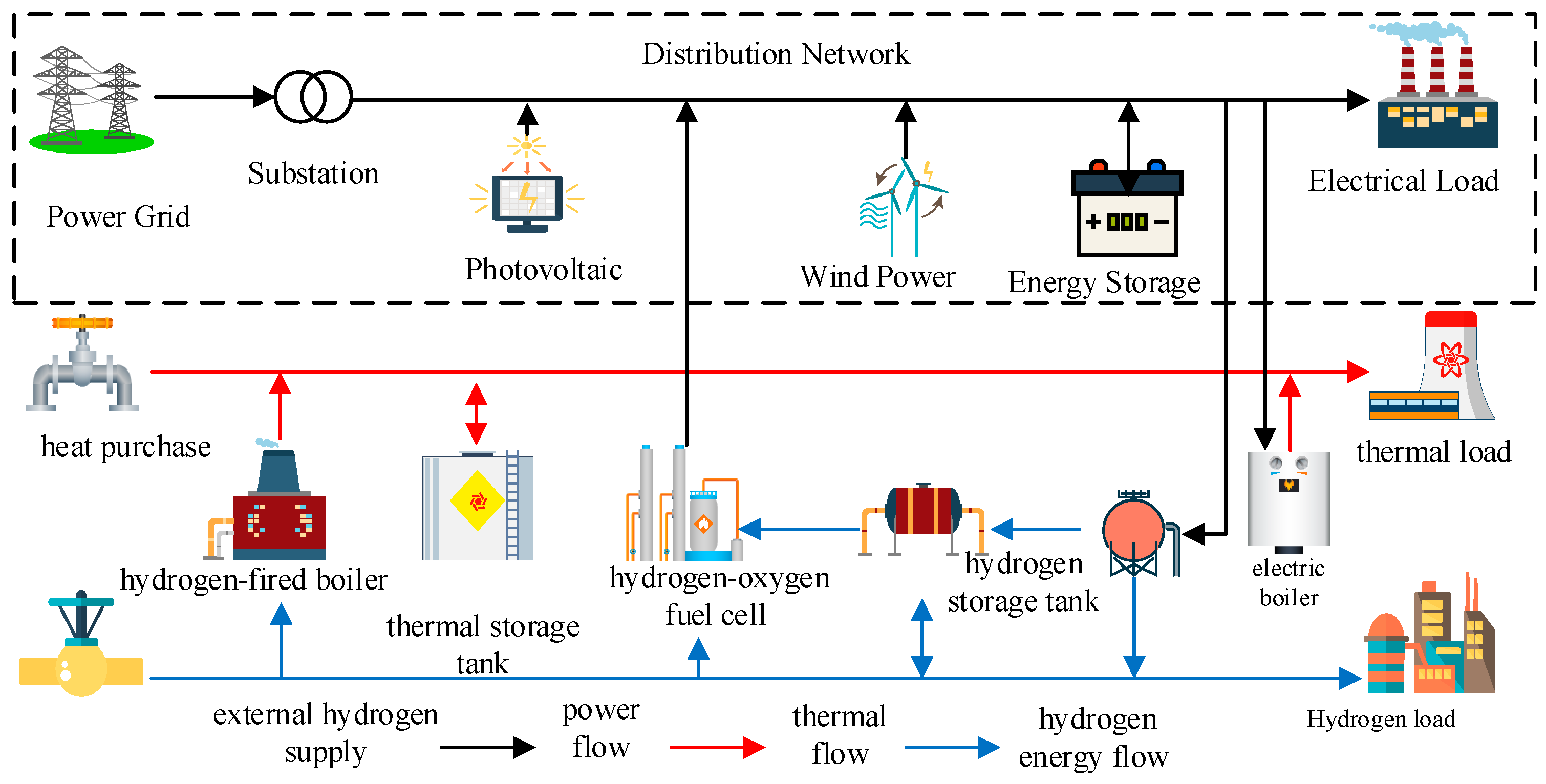
The data-driven source–grid–load–storage coupling architecture of the distribution network, by leveraging advanced data acquisition, processing, and analysis technologies, enables efficient and coordinated operation of distributed power sources and loads [16]. Its core objective is to enhance the flexibility, reliability, and economy of the distribution network through data empowerment in order to adapt to the high proportion of renewable energy access and diverse load demands. The specific structure is shown in Figure 1.
The equation of the energy flow balance relationship among electricity, heat, and hydrogen is shown in Equation (1):
P t E P t H P t R = 1 1 1 0 1 ζ hte 0 0 ζ eth 1 0 1 0 0 0 ζ hte ζ htr 0 T P t PG P t WD P EL , t P HB , t P EB , t P HFC , t
P E , t L P H , t L P R , t L = P t E P t H P t R + P E , t pur P H , t pur P R , t pur + P dc , t BES P dc , t HST P dc , t HSD P cr , t BES P cr , t HST P cr , t HSD
where, P t E , P t H , P t R generate electrical, hydrogen, and thermal power for the equipment; P t W D represents the wind power output at time t; P t P G represents the output power of photovoltaic power generation at time t; P E , t p u r , P H , t p u r , P R , t p u r represent the power purchased by the power grid at time t; P E , t L , P H , t L , P R , t L represent the power consumption of the electrical load, hydrogen load, and heat load at time t, respectively; P c r , t B E S , P d c , t B E S are, respectively, the charging and discharging powers of battery energy storage (BES); P c r , t H S T , P d c , t H S T are, respectively, the charging and discharging powers of the hydrogen storage tank (HST); P c r , t H S D , P d c , t H S D respectively represent the charging and discharging power of the heat storage device; PEL,t, PEB,t, PHB,t, PHFC,t are electrolytic cells, electric boilers, hydrogen boilers, and hydrogen–oxygen fuel cells; ζeth represents the hydrogen production efficiency; ζetr represents the heat generation efficiency; ζhtr represents the hydrogen production efficiency; and ζhte represents the power generation efficiency.

2.1. Modeling of Output Characteristics of Energy Supply Side

In a multi-energy collaborative distribution system, the energy supply side includes not only local distributed energy sources such as wind power and photovoltaic power, but also centralized energy supply from the power grid, heating network, and external hydrogen sources [17]. In this paper, the improved cubic exponential smoothing method is adopted to model its output time series and construct a data-driven output characteristic model of distributed power sources.
In the improved cubic exponential smoothing method, the dynamic smoothing coefficient Ψk,t is a function of t, which changes with the change in prediction number k and time t, and can adapt well to the change trend of time series data with time fluctuation. In order to judge whether the smoothing coefficient Ψk,t is accurate, this study introduces two evaluation parameters: mean square error and relative error. The mean square error formula is shown in Formula (3), and the relative error formula is shown in Formula (4):
σ jfc = P 1 b N 1 b 2 + P 2 b N 2 b 2 + + P t b N t b 2 t
Among them, P t b is the predicted value of b parameter, N t b is the actual value, and σjfc is the mean square error. The smaller the mean square error, the higher the data prediction accuracy and the more reliable the data.
δ xd = Δ t b / N t b × 100 % Δ t b = P t b N t b
where δxd is the relative error and Δ t b is the absolute error.
By performing smoothing operations on historical data of wind power, photovoltaic power, thermal power, electricity, and hydrogen loads, the prediction results of wind power, photovoltaic power, electricity, thermal power, and hydrogen load data can be expressed as:
ϕ k , t = δ k 1 ( 1 δ k ) t P k , t + T b = h k , t + j k , t T + c k , t T 2 h k , t = 3 V k , t ( 1 ) 3 V k , t ( 2 ) + V k , t ( 3 ) j k , t = ϕ k , t 2 ( 1 ϕ k , t ) 2 [ ( 6 5 ϕ k , t ) V k , t ( 1 ) ( 10 8 ϕ k , t ) V k , t ( 2 ) + ( 4 3 ϕ k , t ) V k , t ( 3 ) ] g k , t = ϕ k , t 2 2 ( 1 ϕ k , t ) 2 ( V k , t ( 1 ) 2 V k , t ( 2 ) + V k , t ( 3 ) )
where φk,t is the adaptive dynamic smoothing coefficient, k is the number of predictions, δk is the adaptive smoothing factor, P k , t + T b is the data prediction result, hk,t, jk,t, and gk,t are all prediction coefficients, and V t ( 1 ) , V t ( 2 ) and V t ( 3 ) are the first-order, second-order, and third-order exponential smoothing values, respectively.
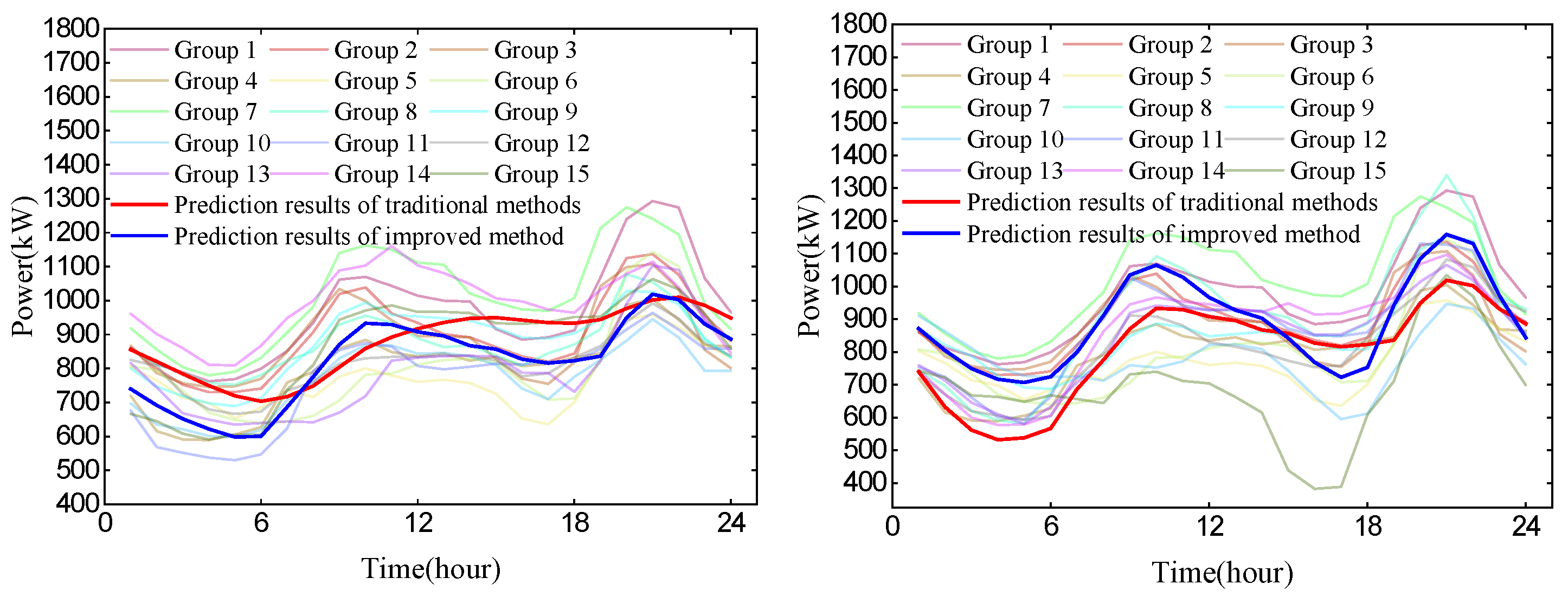
Compared with the traditional three exponential smoothing method, based on the historical data of wind power in March in a certain place, two of the prediction results are selected and displayed as shown in Figure 2.

2.2. Modeling of State Characteristics of Energy Storage System

The flexible charging and discharging characteristics of the energy storage system (BESS) undertake the key functions of peak shaving and valley filling as well as power balance in multi-party collaborative dispatching. The state characteristics of the energy storage system are modeled, mainly focusing on the evolution of its energy storage state (state of charge, SOC) and the constraints of charging and discharging power to enable it to exert quantifiable value in multi-energy coordination and multi-temporal and spatial scheduling. Various energy storage models are shown as follows:

2.2.1. BES Model

E t BES = E t 1 BES + ( P cr , t BES ζ cr BES + P dc , t BES / ζ dc BES )
where E t B E S is the electrical energy stored in the energy storage battery at time t, ζ c r B E S is the charging efficiency of the energy storage battery, and ζ d c B E S is the discharging efficiency of the energy storage battery.

2.2.2. HST Model

H t HST = H t 1 HST + P cr , t HST ζ cr HST + P dc , t HST / ζ dc HST
where H t H S T is the hydrogen stored in the hydrogen storage tank (HST) at time t, ζ c r H S T is the hydrogen storage efficiency of the hydrogen storage tank, and ζ d c H S T is the hydrogen release efficiency of the hydrogen storage tank.

2.2.3. HSD Model

R t HSD = R t 1 HSD + P cr , t HSD ζ cr HSD + P dc , t HSD / ζ dc HSD
where R t H S D is the heat stored in the heat storage tank at time t, ζ c r H S D is the heat storage efficiency of the heat storage tank, and ζ d c H S D is the heat release efficiency of the heat storage tank.
The output power of the power grid, heating network, and external hydrogen purchase should satisfy the following constraint relations:
0 P E , t pur P E , t pur , max 0 P R , t pur P R , t pur , max 0 P H , t pur P H , t pur , max
where, P E , t p u r , m a x , P R , t p u r , m a x , P H , t p u r , m a x represent the maximum power of electricity purchased from the power grid, heat purchased from the heat network, and external hydrogen purchased at time t, respectively.
In the process of low-carbon economic dispatching, it is necessary to conduct data prediction on the output power of wind power and photovoltaic power on typical days. The output power of wind power and photovoltaic power must first meet the following constraints:
0 P WD , t P WD , t max 0 P PG , t P PG , t max
where P W D , t m a x and P P G , t m a x are the maximum power generation power of wind power and photovoltaic at time t, respectively.

3. Spatio-Temporal Information Integrated Prediction Method for Distribution Network Based on Data-Driven Method

To cope with the large-scale access and uncertain disturbances of multiple elements such as source–grid–load–storage in the distribution system, it is necessary to construct a hierarchical and time-sharing collaborative dispatching architecture [18]. Layering corresponds to the division of spatial or control levels, and time-sharing corresponds to decisions of different time scales. The combination of the two can reduce the complexity of the problem and improve real-time performance and reliability. Regional integrated energy systems exhibit significant temporal characteristics on time scales such as day-ahead and intraday, and city-level systems across regions also show typical seasonal differences.

3.1. Construction of Source–Load Power Prediction Model Considering Spatio-Temporal Correlation

In the power distribution system, based on the spatio-temporal characteristics of the energy production and consumption ends in multiple regions and considering dynamic interactions, a wind–solar–load power prediction model based on the spatial correlation of multiple regions is established to provide more accurate and efficient support for energy management. It mainly includes the spatio-temporal distribution characteristic models of wind power, photovoltaic power, and different load demands.
Considering that wind power, photovoltaic power, and load have significant spatial correlation between different regions, single-node time series prediction is difficult to reflect cross-regional synchronous fluctuations and propagation effects. This paper describes the relationship between related regions through space. The Spearman rank correlation coefficient is used to analyze the nonlinear relationship between variables and quantify the degree of interaction between each parameter. It does not depend on the specific distribution assumption of the data. Based on the Spearman rank correlation coefficient and the spatial position coordinates of IES in different regions, the spatial correlation coefficient of IES wind turbine in the i th region is established:
d n , i = 1 6 j = 1 m z j 2 m ( m 2 1 ) r = 1 3 l n , r l 0 , r 2 l 0 , r
where di,n is the spatial correlation coefficient of the x wind turbine in the IES of the i region, m is the sample size of the wind speed historical data, z j 2 is the sum of the rank difference squares of the j th sample data, li,r is the r-dimensional coordinate of the x wind turbine, and l0,r is the reference coordinate of the wind speed measured by the wind farm.
Similarly, based on the Spearman rank correlation coefficient, the spatial correlation coefficient of photovoltaic power generation in the i th region is established. The specific model is as follows:
d g , i = 1 6 e = 1 w p e 2 β ( β 2 1 ) ( l g l 0 l 0 )
where dg,n is the spatial correlation coefficient of the g th photovoltaic power generation plate in the IES of the i th region, β is the sample size of the historical data of the light intensity, p e 2 is the sum of the rank difference squares of the sample data of the e th region, lg is the spatial coordinate of the g th photovoltaic power generation plate, and l0 is the reference coordinate of the light intensity measured by the photoelectric field.
The spatial and temporal distribution characteristics model of seasonal load can be expressed as:
P s Load , E = G t = 1 T P t Load T + ψ d cos 2 π t T + θ d + ψ s cos 2 π t T s + θ s
where P s L o a d , E is the load power in s season, P t L o a d is the load at time t, ψd is the daily load fluctuation amplitude, θd is the phase of the load peak, and T is the time period of one day. ψs is the amplitude of seasonal load fluctuation, θs is the phase of the season where the load peak is located, and Ts is the number of hours in the first quarter.
The weight benchmark of the spatial weight matrix W = [wsj] is obtained by summarizing the spatial correlation coefficients of wind power/photovoltaic power calculated by the Formula (12) in the regional layer, and then normalized by rows and wss = 0, so as to form a normalized spatial weight matrix satisfying ∑j wsj = 1, which is used for the spatial lag term in Formula (14).
Y k ( s , t ) = B k ( s , t ) + τ = 1 p Γ n Y k ( s , t τ ) + m j = 1 N w s j Y k ( j , t ) + ε k ( s , t ) B w t ( s , t ) = f aero ( v ( s , t ) ) B p v ( s , t ) = f p v ( G ( s , t ) , T m ( s , t ) ) B l ( s , t ) = γ 0 + γ 1 T ( s , t ) + γ 2 D ( t )
where kwt, pv, load. Yk(s,t) represents the corresponding power wind power Pwt, photovoltaic Ppv, and load Pload. Bk(s,t) is the baseline function. Γn is the uniform time autoregressive coefficient. m is the spatial lag coefficient. wsj is the normalized spatial weight. εk is the noise term. v, G, Tm, and T represent wind speed, irradiance, component temperature, and ambient temperature, respectively. D(t) is the calendar dummy variable, and γ0, γ1, and γ2 are the load baseline regression coefficients.

3.2. Source–Load Probabilistic Collaborative Prediction Based on TCN

Facing the problem of increased uncertainty and spatio-temporal coupling caused by the coexistence of high-permeability renewable and flexible loads, this paper proposes a source–load probabilistic collaborative prediction method based on TCN. Based on retaining the existing load point prediction as a strong prior, consistency constraints are introduced to uniformly output multi-step confidence intervals for photovoltaic, wind power, load, and net load, enhancing the stability and engineering availability of the prediction and providing support for the coordinated optimization of the economy and safety of the distribution network.
Let the node/region i ∈ N, the time index t ∈ T, and the prediction step size set H = {1, …, H}. The variable type v ∈ {PV, WT, L}, respectively, represents photovoltaic, wind power and load. Given a multivariable historical and exogenous feature sequence with a window length of ω, the goal is to output a probability prediction for each (i, h, v).
Z i , t = TCN θ ( X i , t w + 1 : t ) y ^ i , t + 1 : t + H ( τ ) , v = f v ( τ ) Z i , t
where TCNθ is a temporal convolutional network, i is a node, and Zi,t is the hidden representation vector of node i at time t.
Source–load cooperative consistency:
L coh = i , t , h τ T q D ^ i , t + h ( τ ) L ^ i , t + h ( τ ) R ^ i , t + h ( τ ) 2 R ^ ( τ ) = p ^ ( τ ) , PV + p ^ ( τ ) , WT
where h is the prediction step; Γ q is the sample set; L coh is the consistency loss; D ^ i , t + h ( τ ) , L ^ i , t + h ( τ ) , and R ^ i , t + h ( τ ) are the predicted values of net load, total load, and renewable power generation, respectively; and p ^ ( τ ) , PV , p ^ ( τ ) , WT are the predicted output of wind power and photovoltaic power.
Smooth regular expression:
L quant = v , i , t , h τ T q ρ τ y i , t + h v y ^ i , t + h ( τ ) , v min θ L = L quant + λ coh L coh + λ sm L sm
L quant is the quantile regression loss, L sm is the smoothing loss, and λ s m and λ c o h are hyperparameters.
Constraints and boundaries:
p ^ i , t + h ( τ ) , PV [ 0 , p i , t + h max , PV ] p ^ i , t + h ( τ ) , WT [ 0 , p i , t + h max , WT ] L ^ i , t + h ( τ ) 0
The TCN network architecture design in this paper is used to process sequence data. The input dimension is 24 dimensions, the hidden layer dimension is 64 dimensions, and the output dimension is also 24 dimensions. The network contains four residual blocks. Each residual block uses a one-dimensional convolution with a convolution kernel size of 3, uses an increasing expansion rate [1, 2, 4, 8] to gradually expand the receptive field, and finally reaches a 31-step receptive field, thereby effectively capturing long-distance time dependence. The activation function adopts ReLU combined with the WeightNorm regularization method to improve training stability and model performance. The dropout rate is 0.2, which is used to prevent overfitting; the optimizer uses the Adam algorithm to achieve efficient parameter updating.

4. Distribution Network Source–Load Coordinated Dispatching Considering Two-Stage Robust Optimization

With the deep penetration of distributed energy sources and flexible loads in the distribution network, the system operation presents high uncertainty and strong coupling.
Traditional deterministic dispatching models are difficult to effectively cope with multi-source disturbances such as wind and photovoltaic output fluctuations, user load responses, and energy storage state changes, resulting in difficulty in balancing economy and safety [19,20].
To this end, this section introduces a two-stage robust optimization framework: formulating power purchase, unit output, and energy storage plans in advance at the day-ahead level and making flexible corrections according to uncertain disturbances at the real-time level to achieve safe operation and economic optimization of source–load coordination.

4.1. Two-Stage Objective Function

Under the two-stage robust optimization framework, the dispatching objectives are divided into the first stage (day-ahead planning objective) and the second stage (intraday correction objective).
(1)
First-stage objective: Economic planning
The first stage aims to minimize the operation cost, which mainly includes power purchase cost, distributed power source cost, and reserve cost.
f 1 ( x ) = t c t grid P t grid + i c i DG P i , t DG + i c i DR , cap z i , t DR + ω Y t = 1 T γ y t Δ Y pc t
where P t grid is the power purchase power of the power grid; c t grid is the unit price of power purchase from the power grid; P i , t DG and c i DG are the plan and variable cost of conventional distributed power sources; z i , t DR and c i DR , cap are the capacity reserve of demand response (DR) resources (callable intraday) and its capacity fee; Δ Y pc t is the system carbon emission deviation at time t; γ y t is the carbon trading price at time t; and ω f and ω Y are the system cost weight and carbon trading cost weight, respectively.
(2)
Second-stage objective: Economic correction under uncertainty
In the second stage, considering uncertainties such as wind and solar prediction deviations and load disturbances, a dynamic balance is achieved through energy storage, demand response, and power curtailment, with the goal of minimizing deviation correction costs:
f 2 ( x , y , ξ ) = t c curt i P i , t curt + i c i DR Δ L i , t DR , rt + i c i deg E i , t th + c loss l r l I l , t 2

4.2. Uncertainty Modeling and Related Constraints

With the integration of high-proportion renewable energy, the operation of distribution networks features significant uncertainty. To ensure the economy and security of the system, robust optimization modeling is adopted, incorporating uncertainty sets and relevant constraints to render the scheduling scheme feasible even under the worst-case scenarios.
p i , t RE ( ξ ) = p ^ i , t RE + u ¯ i , t RE | u i , t RE | u ¯ i , t RE L i , t ( ξ ) = L ^ i , t + u i , t L | u i , t L | u ¯ i , t L ( i , t ) | u i , t RE | u ¯ i , t RE + | u i , t L | u ¯ i , t L Γ
where p i , t RE the renewable energy output at time t and node i considers the uncertainty disturbance ξ. p i , t RE is the predicted renewable energy output; u i , t RE , u i , t L are the renewable energy prediction error and the load prediction error; u ¯ i , t RE , u ¯ i , t L are the upper bounds of the renewable energy prediction error and the load prediction error; L ^ i , t is the predicted load demand; and Γ is the budget parameter, enabling the adjustable trade-off between robustness and economy.
With the increase in time, the operation efficiency of retired power battery energy storage and hydrogen energy storage decreases, and its carbon emission reduction effect also decreases. In order to more accurately calculate the carbon reduction effect of energy storage system at different moments in its life cycle, the improved moving weighted average method is used to convert the total carbon emissions of different energy storage life cycles into HECESS daily carbon emissions, and then the HECESS degree carbon emissions are obtained.
In this study, the results of the solution are moved forward by a time unit to deal with this problem. The improved formula can be expressed as follows:
Y ¯ RES , j = x = 1 s w x Y RES , j x ς 1 + ς 2 + ς 3 + ς s = 1 X = x = 1 s 1 ( Y RES , j x Y RES , j x 1 ) v x α j = Y ¯ RES , j + 1 + Y ¯ RES , j + 1 + X 2
where Y ¯ R E S , j is the weighted average carbon emission, Y ¯ RES,j is the moving average carbon emission in a period, and s is the number of moving cycles of carbon emission data. ς x is the weight of YRES,j−x, x = 1, 2, , s, vx represents the weight difference between two adjacent carbon emission data, X represents the overall trend of carbon emission curve in s period, and αj is the daily carbon emission weight coefficient.
According to the above steps, the carbon emissions generated by the full cycle carbon emissions and hydrogen energy storage of the retired power battery are converted into HECESS daily carbon emissions. According to the daily charge and discharge of HECESS, the daily carbon emissions can be further converted into HECESS kilowatt-hour carbon emissions, which can be expressed as:
Y d t = τ d α RES , t Y RES + α H , t Y H 1 + κ b c
where Y d t is the HECESS carbon emissions at time t; αRES,t, αH,t are the daily carbon emission weight coefficient of retired power battery and the daily carbon emission weight coefficient of hydrogen energy storage, respectively. κ, b, c, τd are carbon emission growth rate, system operation year, HECESS daily charge and discharge times, and degree of carbon emission factor, respectively.
Similarly, the carbon emission quota of purchased electricity, wind power, and photovoltaic power can be expressed as:
C E , buy t = τ E α buy , t C E , buy 1 + κ b P E , t buy C WT t = τ WT α WT , t C WT 1 + κ b P WT , t C PV t = τ PV α PV , t C PV 1 + κ b P PV , t
where C E , b u y t , C W T t , C P V t are external purchase of electricity, wind power, and photovoltaic carbon emission quotas at time t, respectively. τE, τWT, and τPV are the carbon emission factors of external power purchase, wind power, and photovoltaic power, respectively. αbuy,t, αWT,t, αPV,t are the daily carbon emission weight coefficients of external power purchase, wind power, and photovoltaic power, respectively.
The system’s carbon emission deviation is the difference between the carbon emission rights quota and the actual carbon emissions, which can be specifically expressed by the following formula:
Δ Y pc t = C pe t Y pf t C pe t = C PV t + C WT t + C E , buy t Y pf t = Y d t + Y load t
where Δ Y pc t is the system’s carbon emission deviation at time t. C p e t , Y p t are, respectively, the carbon emission rights quota and the actual carbon emissions at time t. Y d t is the carbon emissions of the hydrogen–electricity complementary energy storage system at time t. Y l o a d t is the total carbon emissions of the load at time t.
Power balance (bus/system), node voltage constraints, branch power constraints:
i p i , t net + P t grid = 0 p i , t net = P i , t DG + P i , t dis + p i , t RE ( ξ ) L i , t ( ξ ) Δ L i , t DR P i , t ch P i , t curt U i min U i U i max P L min P L P L max
where Ui is the voltage amplitude of the i th node in the distribution network kV; U i min and U i max are, respectively, the lower limit and upper limit of the node voltage amplitude. PL is the power transmitted by the L th line in the distribution network kW; P L min and P L max are, respectively, the lower limit and upper limit of the branch power.
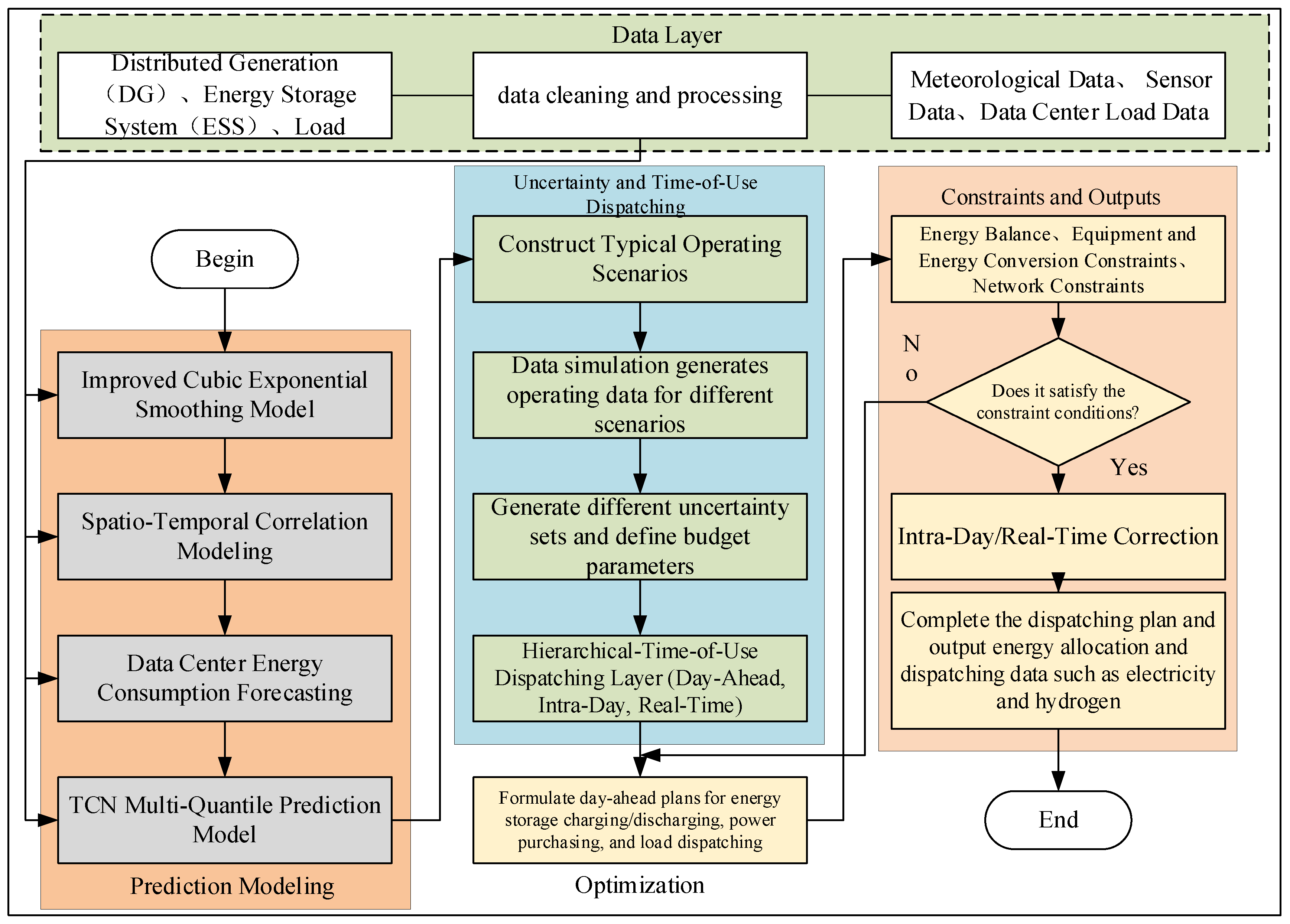
Figure 3 shows the workflow of source–network–load–storage coordinated dispatching based on multi-scale robust optimization.

5. Case Study

5.1. Data Description

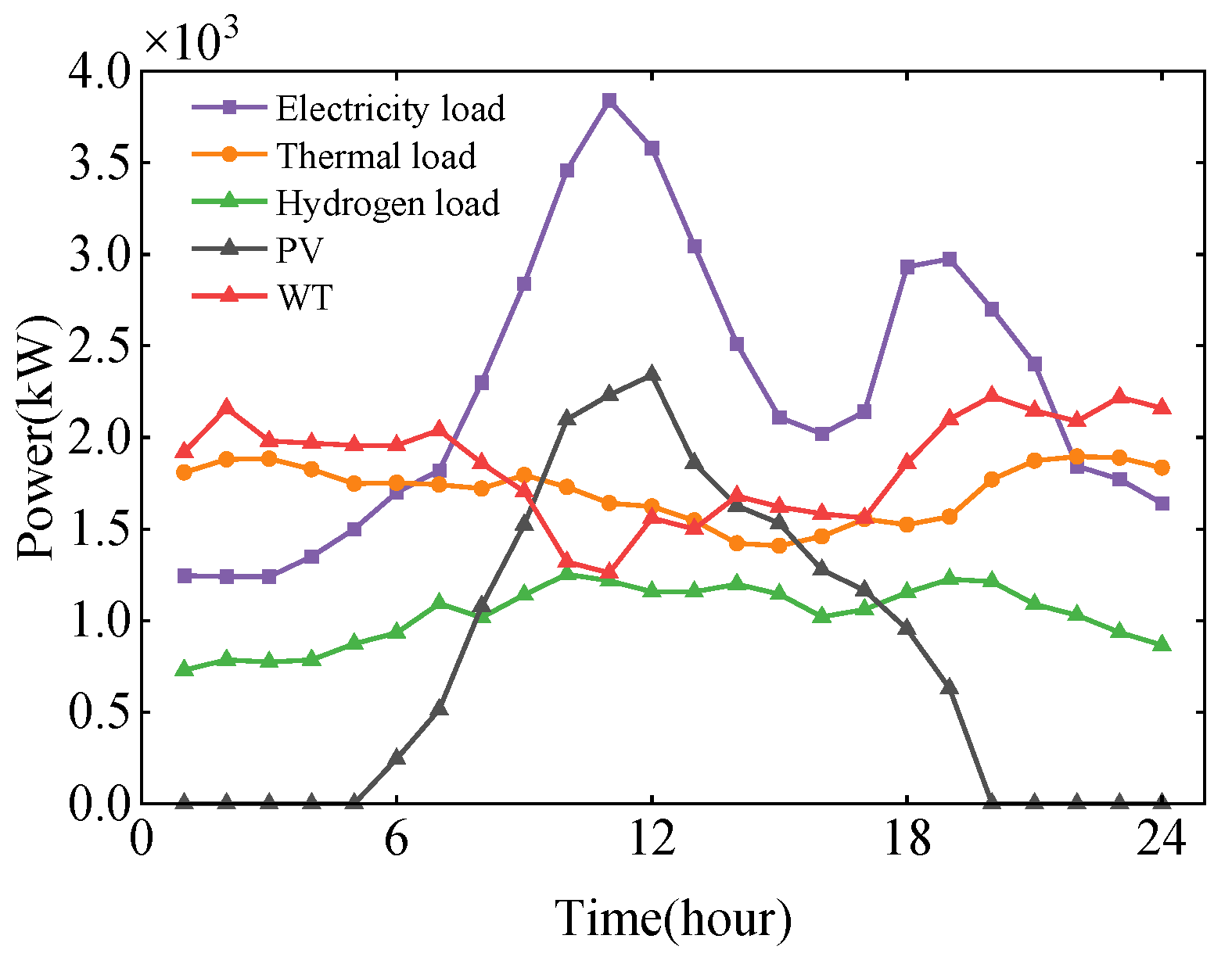
This paper selects a typical IEEE 33-bus distribution network as the case study object, with battery energy storage and hydrogen energy storage configured for case simulation. As a typical medium-voltage distribution system test model, the distribution network can fully reflect the impacts of distributed generation access and energy storage devices on power grid power flow distribution, voltage constraints, and operational economy [21,22]. The prediction curves are shown in Figure 4. In the IEEE 33-bus system, this paper arranges access points for photovoltaic power and wind power, respectively, and sets up multi-energy devices such as HST, HSD, and EL to form a source–grid–load–storage coupled architecture.
The operating parameters of each energy device are listed in Table 1, including energy storage capacity, maximum charging/discharging power, energy efficiency parameters, etc. To further analyze the mechanism of action of retired batteries and the hydrogen-electricity complementary system, this paper constructs three types of typical operating scenarios as shown in Table 2.

5.2. Improvement in Prediction Accuracy Comparison

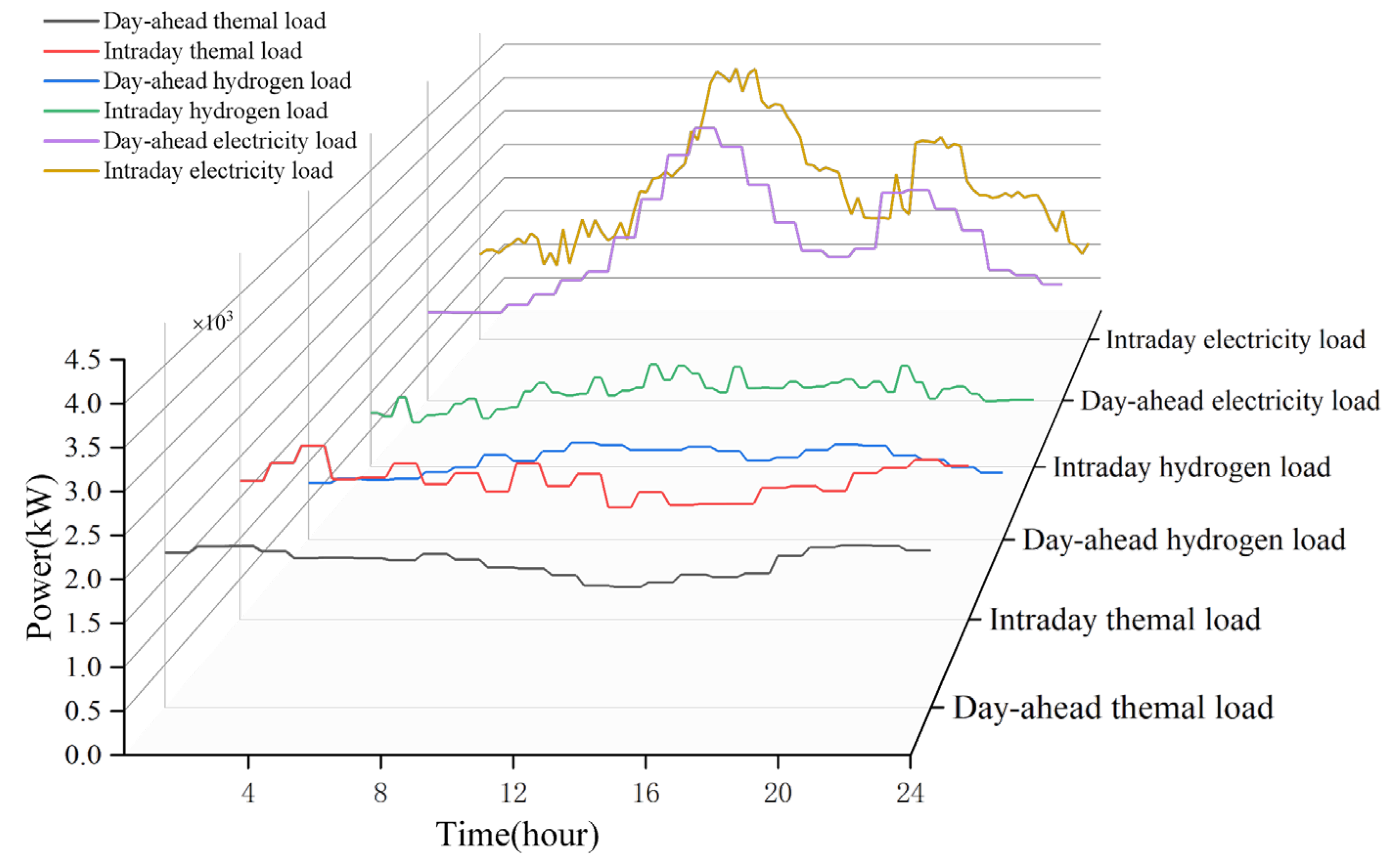
To verify the effectiveness of the intraday multi-time-scale hierarchical rolling dispatch strategy proposed in this paper, intraday dispatch is carried out based on Scenario 2 and Scenario 3 in the day-ahead dispatch. To meet the requirements of electricity, heat, and hydrogen load data for different intraday time scales, further refined prediction of electricity, heat, and hydrogen loads is performed based on the source–load data prediction model. The load prediction results are shown in Figure 5.
As can be seen from Figure 5, intraday prediction can depict the ramping and declining characteristics during 7–12 h and 18–21 h more elaborately than day-ahead prediction: the rise and fall of electrical load during the midday peak period are captured earlier, with peak deviation converged; the depiction of the morning step and afternoon plateau of thermal load is smoother; and the overestimation/underestimation of short-term fluctuations in hydrogen load is corrected. Relying on higher time-frequency information, rolling optimization will synchronously adjust the output of coupled devices and energy purchase power. Under the refined prediction information, the adoption of multi-time-scale hierarchical rolling optimization dispatch results in more accurate intraday optimization outcomes for each load.
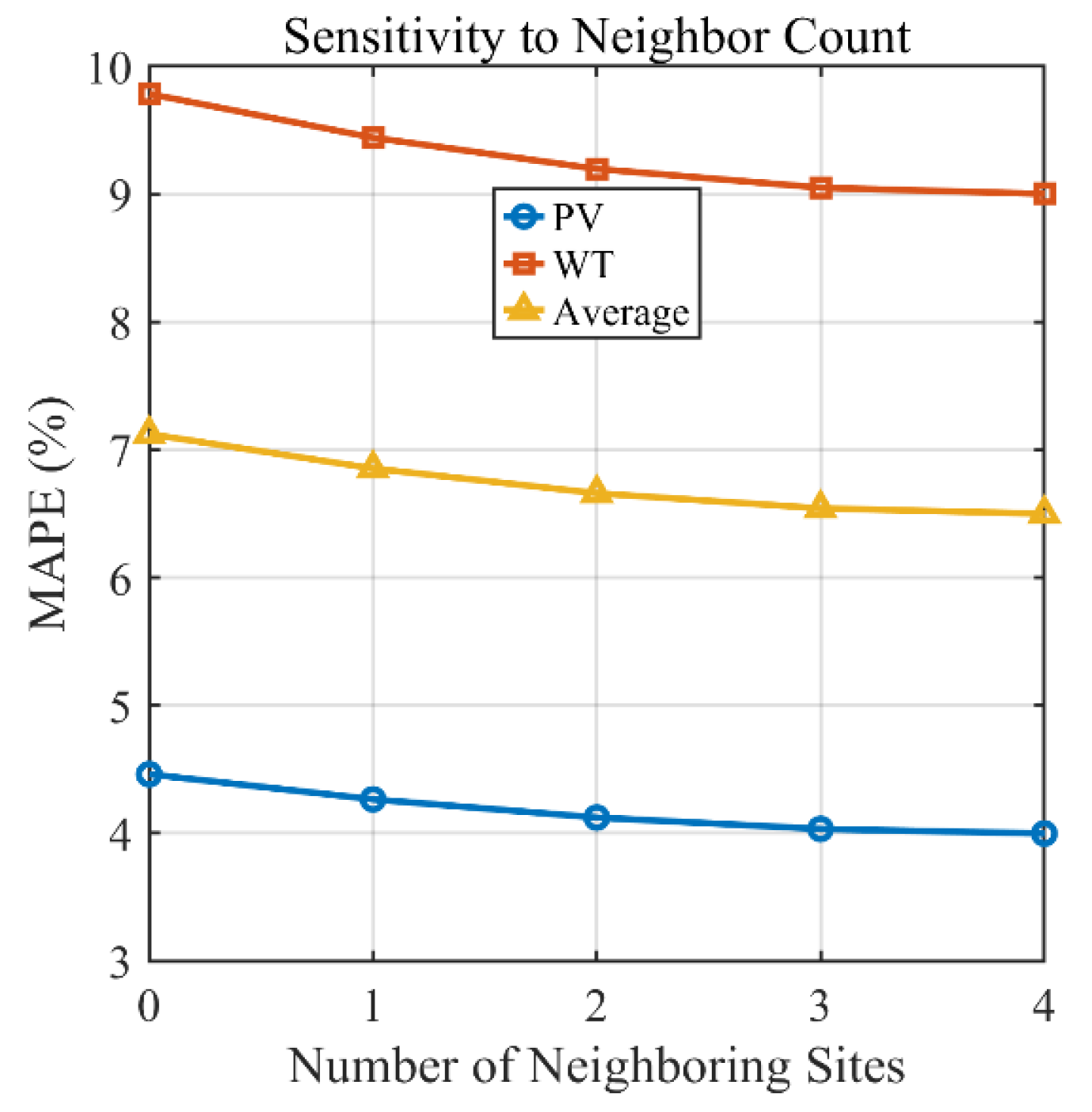
Figure 6 shows the influence of the number of adjacent stations K on the prediction performance. It can be seen that as K increases, the error decreases marginally, indicating that the moderate introduction of adjacent information can improve the robustness of the prediction, but the excessive neighborhood benefit is limited.
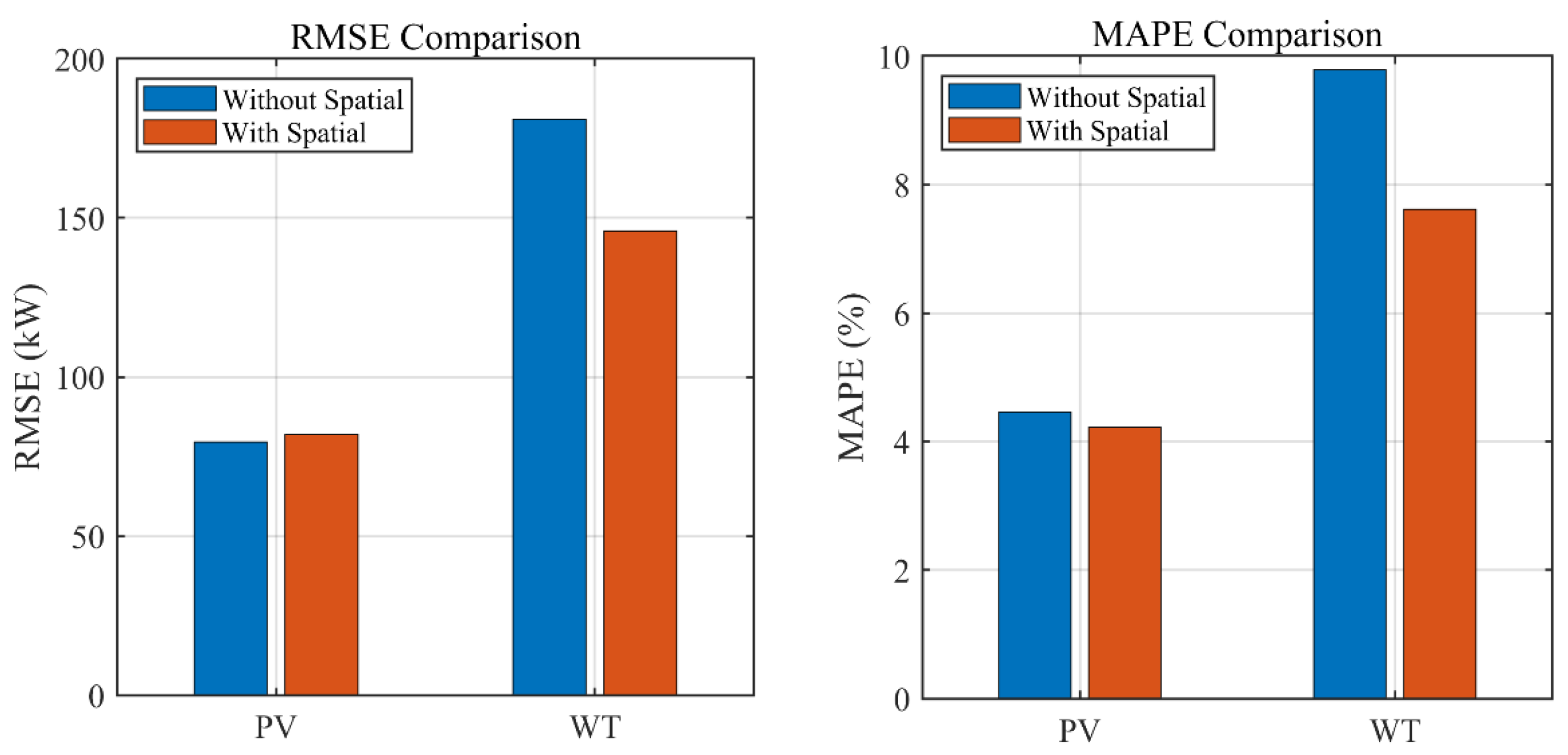
Figure 7 shows the comparison of whether to introduce spatial correlation. The results show that after the introduction of spatial correlation, the electrical prediction error decreases more significantly, the MAPE decreases by about 22.2%, the photovoltaic error also improves by about 5.3%, and the comprehensive improvement is about 16.9%.
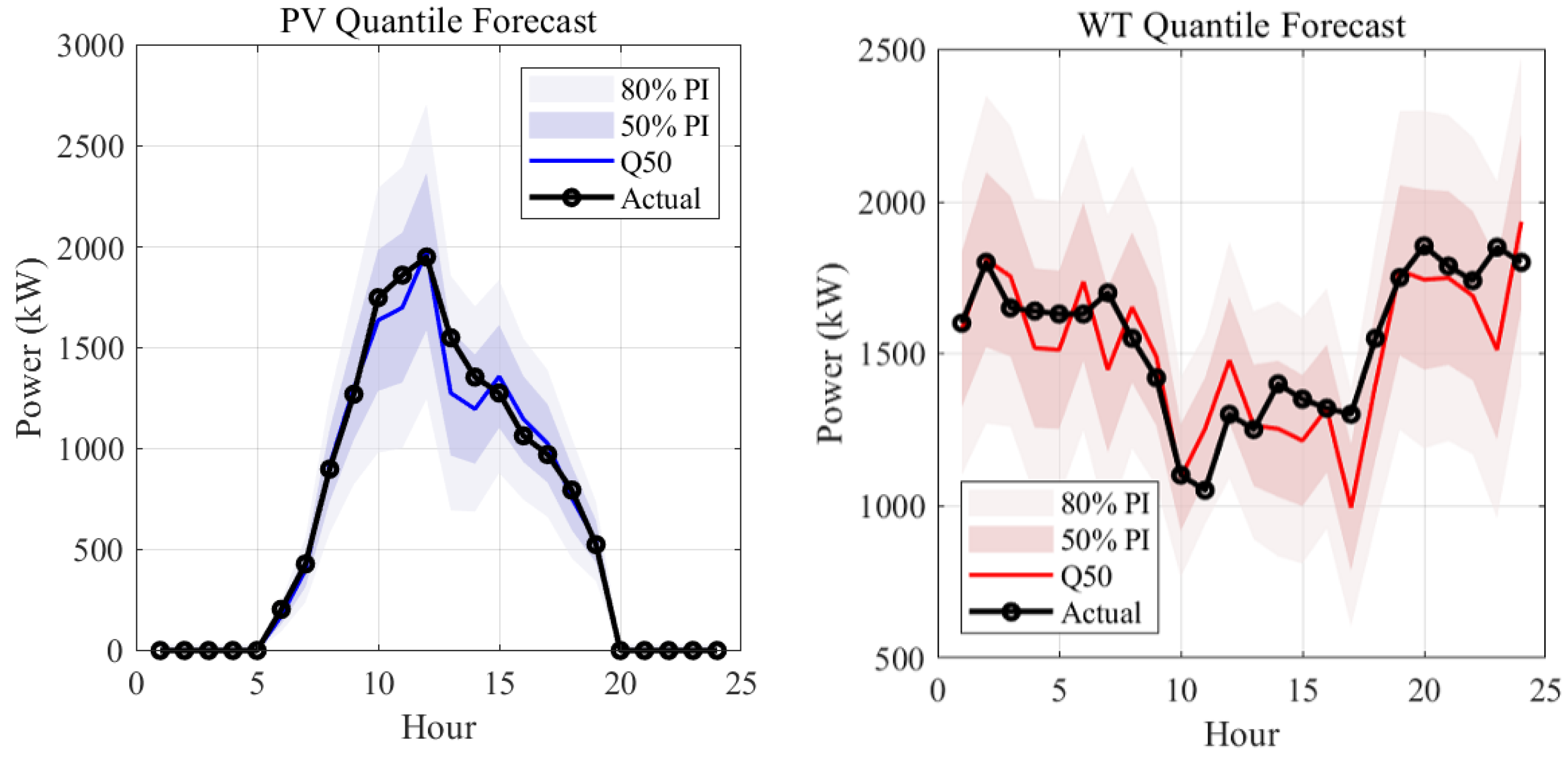
Figure 8 shows the proposed TCN probability prediction results and interval coverage verification. From the diagram, it can be seen that Q50 can better track the trend of output change, and the 50% and 80% confidence intervals can effectively envelope the measured sequence; the coverage statistics show that the average coverage of the 50% interval is about 93.8%, and the coverage of the 80% interval reaches 100%, indicating that the quantile prediction and consistency constraints can provide an uncertainty description that can be used for robust scheduling.
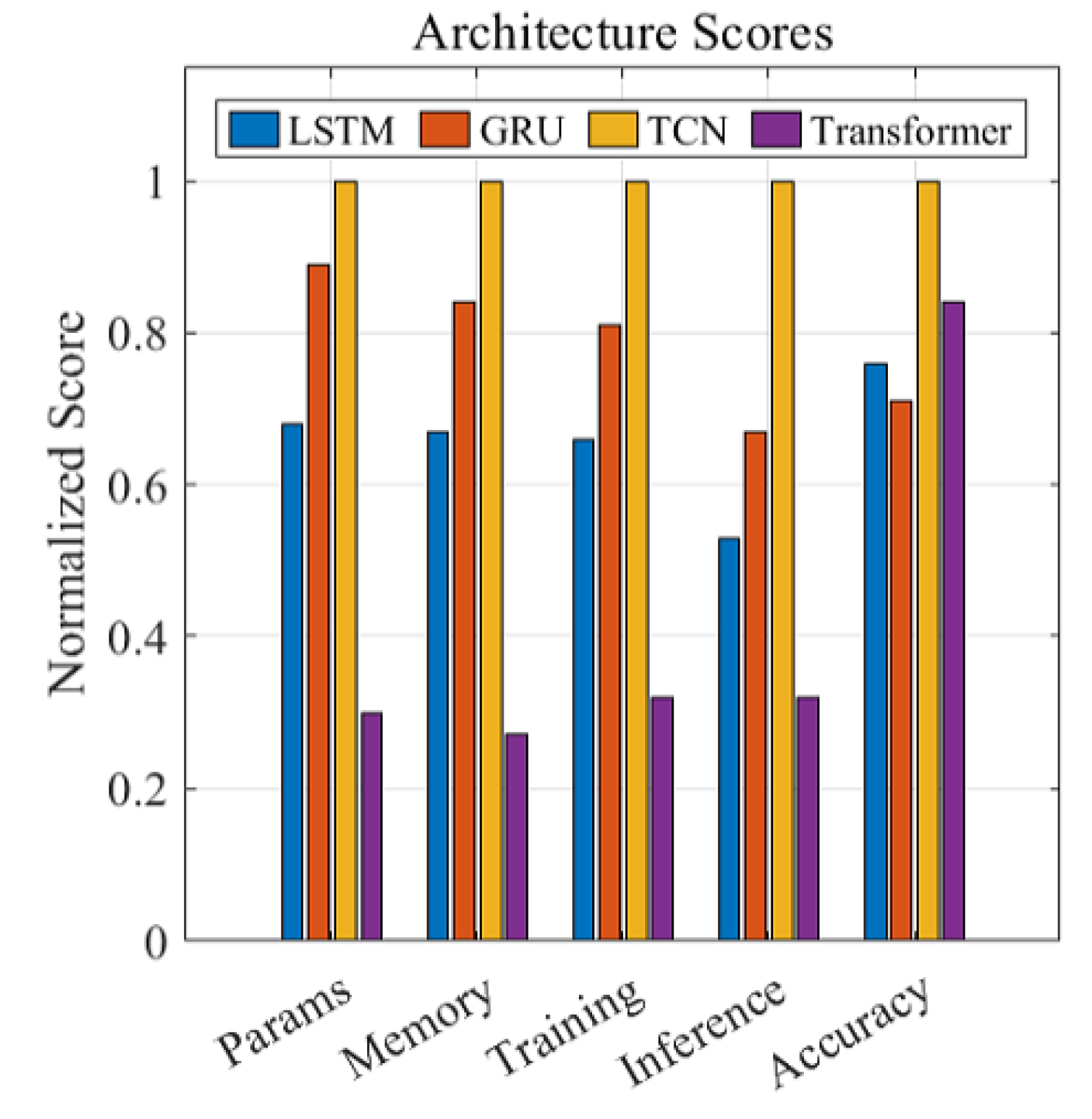
As shown in Figure 9, by comparing with LSTM and other methods in terms of parameter quantity and inference speed, TCN has better comprehensive architecture performance.

5.3. Analysis of Robust Optimization Effect

During the case operation, a two-stage robust optimization model is introduced in this paper to improve the stability and safety of dispatching. Through typical scenario generation and uncertainty set modeling, the model ensures feasibility under different operating conditions in the day-ahead stage. This enables the system to maintain power balance and voltage stability even with prediction deviations, thereby effectively reducing the risks of wind and solar curtailment and power supply interruption. The comparison of load loss rate cost and total operating cost under various scenarios is shown in Table 3, verifying the advantages of the proposed method in improving power supply reliability and economy.
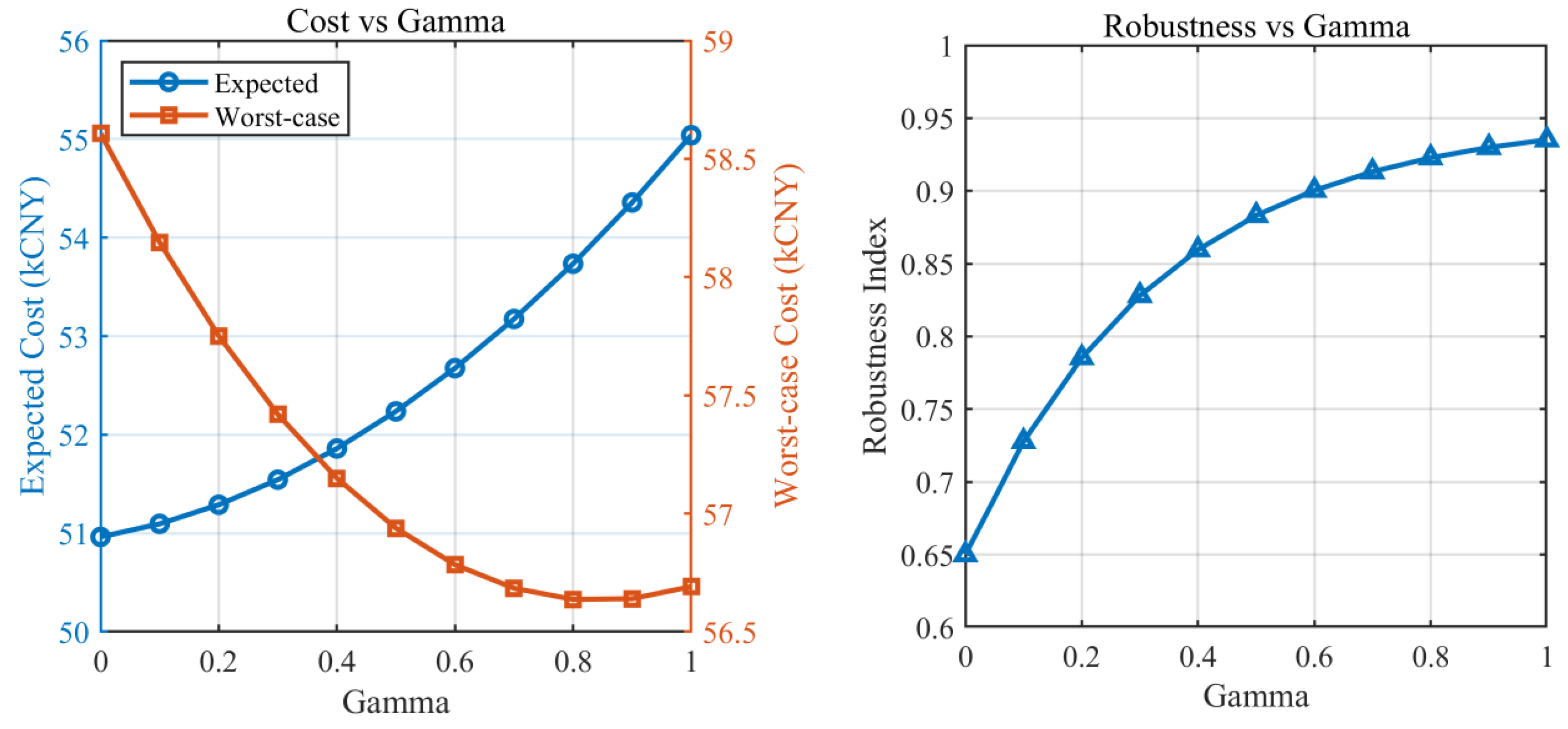
In order to quantitatively describe the impact of the budget parameter Γ on the scheduling results, this paper scans Γ ∈ [0, 1]. The results are shown in Figure 10. With the increase in Γ, the worst-case cost decreases significantly and gradually tends to be stable, while the expected cost increases monotonously, reflecting the typical ‘economy–robustness’ trade-off relationship.
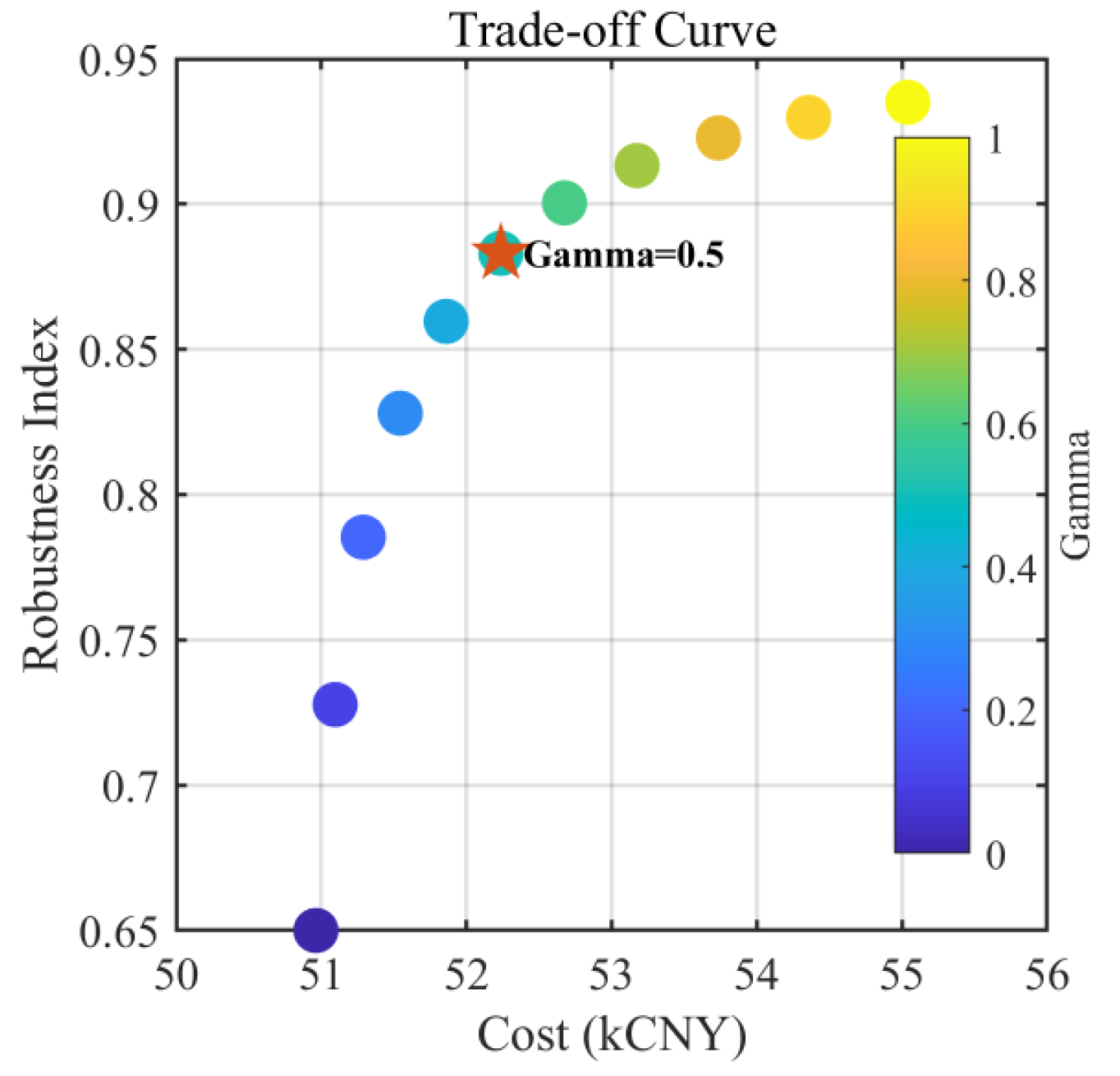
Based on the above analysis, this paper selects Γ= 0.5 as the compromise point. As shown in Figure 11, the robustness is increased to 0.88 when the expected cost is only increased by about 2.5%, and the worst-case risk is significantly reduced.
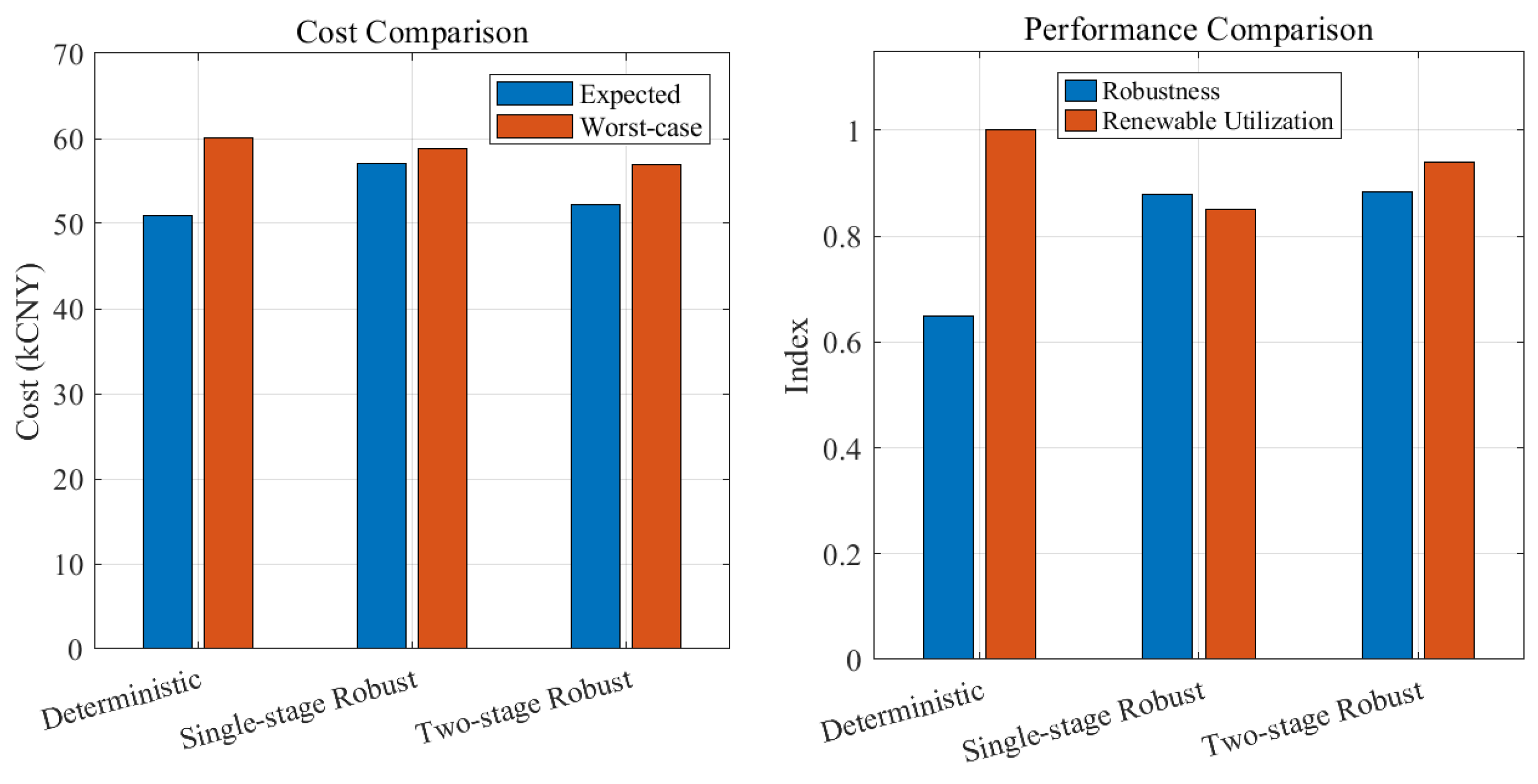
In order to verify the comparative advantages of the proposed two-stage robust optimization under different benchmark strategies, this paper sets up three methods of deterministic optimization, single-stage robustness, and two-stage robustness for comparison. As shown in Figure 12, the expected cost of the deterministic method is the lowest, but the worst-case cost increases significantly and the robustness is low. Single-stage robustness improves robustness, but at the expense of renewable consumption. The two-stage robustness achieves a comprehensive optimization between expected cost, worst-case cost, and robustness and maintains a high level of renewable energy consumption, reflecting the structural advantage of day-ahead plan and intraday correction.
The comparison of load loss rate cost and total operating cost under various scenarios is shown in Table 3, verifying the advantages of the proposed method in improving power supply reliability and economy.
As can be seen from the results, the total operating cost and load loss rate cost of the three scenarios gradually decrease, indicating that different configuration schemes have improved the economy and power supply reliability of the system. In Scenario 1, the load loss cost accounts for 31.5% of the total cost, reflecting the insufficient adaptability of the system in the absence of hydrogen energy complementarity and retired batteries. After introducing retired batteries, the load loss cost drops to 27.2% and the total cost decreases, verifying the dual value of retired batteries. Scenario 3 further reduces the load loss cost to 21.9% through hydrogen–electric coupling. Although the total cost is slightly higher, the flexible regulation capacity of the system is significantly improved.
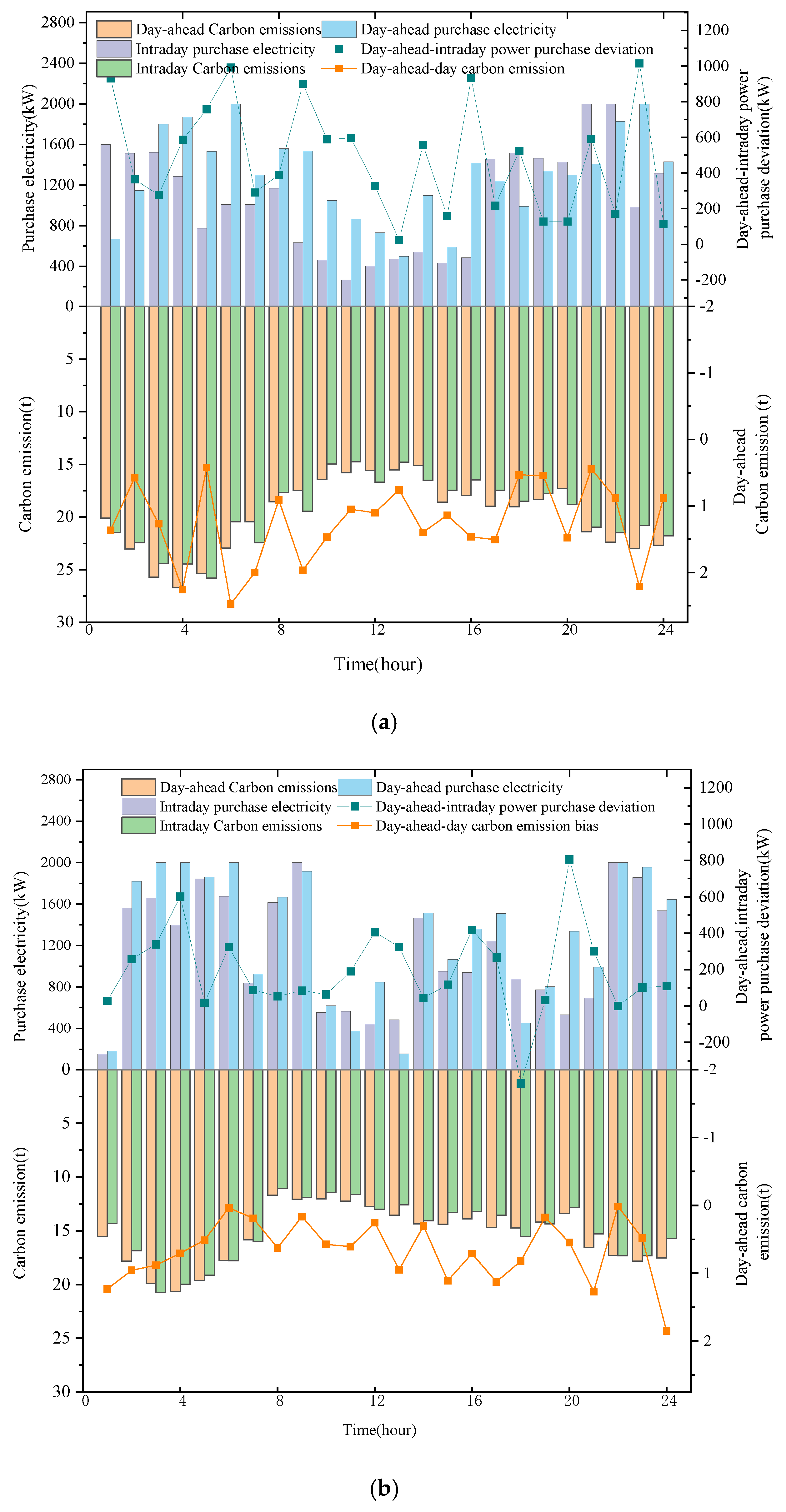
The comparison results of day-ahead and intraday electricity purchase as well as carbon emissions under Scenario 2 and Scenario 3 are shown in Figure 13.
As shown in Figure 13, both Scenario 2 and Scenario 3 experienced fluctuations during the day-ahead-intraday power purchase process, but Scenario 2 was more significant, especially during the periods of 12:00–18:00 and 22:00–23:00, when the power purchase volume fluctuated by more than 20%. Due to the introduction of the hydrogen–electricity complementary energy storage system in Scenario 3, the deviation between the actual purchased electricity and the current plan has been significantly reduced, making the operation more economical and stable. In terms of carbon emissions, the total intraday emissions of both scenarios were lower than before. However, in Scenario 2, there was still an increase at 9:00 and 12:00, while in Scenario 3, the overall trend was downward, with the total intraday carbon emissions only decreasing by approximately 6% compared with before. This indicates that multi-time-scale coordinated dispatching can effectively enhance the low-carbon and economic efficiency of the distribution network.
Compared with Scenario 1, after the introduction of retired power batteries in Scenario 2, the total operating cost decreased from CNY 489,600 to CNY 453,400, a decrease of 7.39%, the cost of load loss rate decreased from CNY 154,100 to CNY 123,500, a decrease of 19.86%, and the reliability of energy supply increased from 0.93 to 0.96, indicating that retired batteries have a direct contribution to reducing costs and improving energy supply security. After the introduction of hydrogen–electricity complementation from Scenario 2 to Scenario 3, the cost of load loss rate is further reduced from CNY 123,500 to CNY 135,500, and the reliability is increased to 0.98. Although the total operating cost is slightly increased by CNY 453,400 to 473,400, the flexibility and resilience of the system are significantly enhanced.
Further analysis shows that in the intraday and real-time phases, the second-stage robust mechanism can effectively deal with extreme situations and ensure feasibility and reliability in the worst-case scenario. During the peak electricity price period from 12:00 to 18:00, the fluctuation range of power purchase in Scenario 3 was significantly smaller than that in Scenario 2. Compared with the day-before dispatching in Scenario 3, the energy purchase fluctuation rate of intraday dispatching decreased by 8.75%, which not only enhanced robustness but also reduced the cost of power loss and load loss rate, while also reducing carbon emissions and power curtailment rate. This indicates that two-stage robust optimization can not only suppress the impact of predictive uncertainty but also achieve reliable power supply and low-carbon economy, providing a strong guarantee for the distribution network in complex operating environments.

6. Conclusions

To achieve the economic operation of the distribution network side, the multi-scale source–grid–load–storage coordinated dispatching method proposed in this paper significantly improves system flexibility and robustness. Data-driven modeling enhances the accuracy of source and load forecasting, hierarchical and time-sharing optimization boosts economy and adaptability, and two-stage robust optimization ensures low-carbon and safe operation under uncertain conditions:
Under the framework of data-driven modeling and two-stage robust optimization, retired power batteries are introduced and coupled with hydrogen energy storage, which significantly realizes the cascade utilization value, reduces carbon emissions by approximately 10.7%, and lowers operating costs by 16.4%.
Through the hierarchical and time-sharing regulation architecture, the hydrogen–electric complementary energy storage system demonstrates greater flexibility and reliability during high-power load periods. Compared with traditional distribution networks, it features a lower load loss rate and stronger energy supply guarantee capability, with the load loss cost reduced to 21.9%.
The proposed multi-time-scale hierarchical rolling optimization dispatching strategy can flexibly adjust power purchasing capacity and mitigate power purchasing fluctuations. Compared with single-time-scale dispatching, the power purchasing volatility is reduced by 8.75%.

Author Contributions

W.X. contributed to the conceptualization and overall research design of the study. X.C. participated in the investigation and data analysis. F.J. and L.L. were responsible for methodology development, model construction, and result analysis. M.L. contributed to the experimental implementation and data curation. Z.Y. and N.Y. prepared the original draft of the manuscript, provided overall supervision of the research, and were responsible for project coordination and funding acquisition. All authors have read and agreed to the published version of the manuscript.

Funding

This work was funded by the Science and Technology Project of State Grid Liaoning Electric Power Co., Ltd. (2025YF-35).

Data Availability Statement

All of the data are contained within the article.

Conflicts of Interest

The authors declare no conflict of interest. The affiliated companies had no role in the study design, data collection and analysis, manuscript preparation, or publication decision. Authors Wenbiao Xia, Xin Chen, Fuguo Jin, Lu Li, Meizhu Lu and Zhuo Yang are employed by State Grid Fuxin Power Supply Company. Ning Yan is employed by Shenyang University of Technology. The remaining authors declare that the research was conducted in the absence of any commercial or financial relationships that could be construed as a potential conflict of interest. The State Grid Fuxin Power Supply Company, Shenyang University of Technology had no role in the design of the study; in the collection, analyses, or interpretation of data; in the writing of the manuscript, or in the decision to publish the results.

References

  1. Prasad, M.B.; Ganesh, P.; Kumar, K.V.; Mohanarao, P.; Swathi, A.; Manoj, V. Renewable Energy Integration in Modern Power Systems: Challenges and Opportunities. E3S Web Conf. 2024, 591, 03002. [Google Scholar] [CrossRef]
  2. Pan, T.; Zhao, Q.; Wang, Y.; Cai, R. Scheduling Optimization of the Thermoelectric Coupling Virtual Power Plant with Carbon Capture System Under the Energy-Side and Load-Side Dual Response Mechanism. Processes 2025, 13, 1777. [Google Scholar] [CrossRef]
  3. Xiao, J.; Zhou, Y.P.; She, B.X.; Bao, Z. A General Simplification and Acceleration Method for Distribution System Optimization Problems. Prot. Control. Mod. Power Syst. 2025, 10, 148–167. [Google Scholar] [CrossRef]
  4. Wang, G.Y.; Wang, C.F.; Feng, T.Y.; Wang, K.; Yao, W.; Zhang, Z. Day-Ahead and Intraday Joint Optimal Dispatch in Active Distribution Network Considering Centralized and Distributed Energy Storage Coordination. IEEE Trans. Ind. Appl. 2024, 60, 4832–4842. [Google Scholar] [CrossRef]
  5. Li, X.Y.; Han, X.S.; Yang, M. Day-Ahead Optimal Dispatch Strategy for Active Distribution Network Based on Improved Deep Reinforcement Learning. IEEE Access 2022, 10, 9357–9370. [Google Scholar] [CrossRef]
  6. Su, Y.; Teh, J. Two-Stage Optimal Dispatching of AC/DC Hybrid Active Distribution Systems Considering Network Flexibility. J. Mod. Power Syst. Clean Energy 2023, 11, 52–65. [Google Scholar] [CrossRef]
  7. Dai, Y.; Xu, W.; Wu, X.; Yan, M.; Xue, F.; Zhao, J. A data-physical fusion method for economic dispatch considering high renewable penetration and security constraints. Int. J. Electr. Power Energy Syst. 2025, 168, 110691. [Google Scholar] [CrossRef]
  8. Yang, M.T.; Liu, Y.X.; Guo, L.; Zhang, Y.X.; Wang, Z.G.; Wang, C.S. A multi-level distributed economic scheduling method of transmission, distribution and micro based on Data-driven Security Domain. Proc. CSEE 2025, 1–17. Available online: https://link.cnki.net/urlid/11.2107.tm.20250225.1334.007 (accessed on 26 February 2025).
  9. Thirumalai, M.; Yuvaraj, T.; Bajaj, M.; Blazek, V. Multi-objective coordinated optimization of renewable-based EV charging stations with user-centric scheduling and grid support in distribution networks. e-Prime-Adv. Electr. Eng. Electron. Energy 2025, 14, 101111. [Google Scholar] [CrossRef]
  10. Lin, B.; Huang, Y.; Yu, D.; Fu, C.; Chen, C. Stochastic Distributionally Robust Optimization Scheduling of High-Proportion New Energy Distribution Network Considering Detailed Modeling of Energy Storage. Processes 2025, 13, 2230. [Google Scholar] [CrossRef]
  11. Zhang, J.; He, Y.G. Fast Solving Method for Two-Stage Multi-Period Robust Optimization of Active and Reactive Power Coordination in Active Distribution Networks. IEEE Access 2023, 11, 30208–30222. [Google Scholar] [CrossRef]
  12. Luo, Y.H.; Nie, Q.B.; Yang, D.S.; Zhou, B. Robust Optimal Operation of Active Distribution Network Based on Minimum Confidence Interval of Distributed Energy Beta Distribution. J. Mod. Power Syst. Clean Energy 2021, 9, 423–430. [Google Scholar] [CrossRef]
  13. Zhou, H.; Liang, J.; Du, X.; Wu, M. Multi-Timescale Reactive Power Optimization and Regulation Method for Distribution Networks Under a Multi-Source Interaction Environment. Processes 2024, 12, 2254. [Google Scholar] [CrossRef]
  14. Yan, X.; Luo, Y.; Tu, N.; Tian, P.; Xiao, X. Multi-Objective Dynamic Reconstruction of Distributed Energy Distribution Networks Based on Stochastic Probability Models and Optimized Beetle Antennae Search. Processes 2024, 12, 395. [Google Scholar] [CrossRef]
  15. Xu, Y.; Zhu, D.-D.; Tang, C.-P.; Wei, S.-M.; Liu, F. Active and Reactive Power Joint Optimization of Active Distribution Network with Charging-Swapping-Storage Integrated Station Participating. J. Electr. Eng. Technol. 2025, 20, 1991–2005. [Google Scholar] [CrossRef]
  16. Yao, X.; Zhang, K.; Liu, C.; Zhu, T.; Zhou, F.; Li, J.; Liu, C. Optimal Low-Carbon Economic Dispatch Strategy for Active Distribution Networks with Participation of Multi-Flexible Loads. Processes 2025, 13, 2972. [Google Scholar] [CrossRef]
  17. Xu, Y.; Liu, J.; Cui, Z.; Liu, Z.; Dai, C.; Zang, X.; Ji, Z. Economic Scheduling Model of an Active Distribution Network Based on Chaotic Particle Swarm Optimization. Information 2024, 15, 225. [Google Scholar] [CrossRef]
  18. Li, B.; Zhao, R.; Lu, J.; Xin, K.; Huang, J.; Lin, G.; Chen, J.; Pang, X. Distributed optimization method for economic dispatch of active distribution networks via momentum with historical information and forecast gradient. Energy Rep. 2023, 9, 1134–1144. [Google Scholar] [CrossRef]
  19. Zhang, Y.; Ai, X.; Wen, J.; Fang, J.; He, H. Data-Adaptive Robust Optimization Method for the Economic Dispatch of Active Distribution Networks. IEEE Trans. Smart Grid 2019, 10, 3791–3800. [Google Scholar] [CrossRef]
  20. Ghorashi, S.M.; Khazaei, J.; Kishore, S. Multi-task deep learning economic dispatch of microgrids with electric vehicles and renewables. Sustain. Energy Grids Netw. 2025, 43, 101766. [Google Scholar] [CrossRef]
  21. Goel, N.; Yadav, N.K. Sustainable microgrid operations: Multi-objective hybrid optimization for combined economic emission dispatch. Electr. Eng. 2025, 107, 8031–8044. [Google Scholar] [CrossRef]
  22. Zhao, D.; Zhang, C.; Ning, Y.; Huo, Y. Real-Time Economic Dispatching for Microgrids Based on Flexibility Envelopes. Processes 2024, 12, 2544. [Google Scholar] [CrossRef]
Figure 1. Data-driven coupling architecture of source–grid–load–storage in distribution networks.
Processes 14 00603 g001
Figure 2. Comparison diagram of prediction results.
Processes 14 00603 g002
Figure 3. Multi-scale robust optimization framework for coordinated source–network–load–storage dispatch in distribution networks.
Processes 14 00603 g003
Figure 4. WT, PV, and load forecasting curves.
Processes 14 00603 g004
Figure 5. Day-ahead and intraday load forecast results for electricity, heat, and hydrogen.
Processes 14 00603 g005
Figure 6. The influence of the number of adjacent stations K on the prediction performance.
Processes 14 00603 g006
Figure 7. The influence of whether to introduce spatial correlation on prediction performance.
Processes 14 00603 g007
Figure 8. TCN probability prediction results and interval coverage.
Processes 14 00603 g008
Figure 9. Compare TCN with other methods in terms of architecture performances.
Processes 14 00603 g009
Figure 10. The relationship curve of Γ with cost and robustness.
Processes 14 00603 g010
Figure 11. Γ trade-off curve.
Processes 14 00603 g011
Figure 12. Comparison of benchmark methods.
Processes 14 00603 g012
Figure 13. Day-ahead-intraday power purchase and carbon emissions results chart. (a) Scenario 2 day-ahead electricity purchase and carbon emission results; (b) Scenario 3 day-ahead, intraday power purchase and carbon emission results.
Processes 14 00603 g013
Table 1. Parameters of various energy equipment.
NameNumerical ValueNameNumerical Value
P max EB , E 1000 kW P max HB , H 1200 kW
ξetr87%ξhtr95%
E RBES , max 2200 kWh P max RBES , cha , P max RBES , dis 400 kW
η182%η085%
ηHFC88% P max HST , cha , P max HST , dis 450 kW
P max EL 2500 kW P max HFC 2000 kW
ηEL85%JMJ142 MJ/kg
Table 2. Comparison table of different battery types and electricity–hydrogen interaction modes.
ScenarioBattery TypesElectric–Hydrogen Interaction Mode
1brand-new batteryseparate operation of electric energy storage and hydrogen energy storage
2retired power batteriesseparate operation of electric energy storage and hydrogen energy storage
3retired power batterieshydrogen–electric complementary energy storage system
Table 3. Comparison of loss of load cost and total operating cost across different scenarios.
ScenarioLoad Loss Rate Cost/10,000 YuanTotal Operating Cost/10,000 YuanEnergy Supply
Reliability (p.u.)
115.4148.960.93
212.3545.340.96
310.3547.340.98
Disclaimer/Publisher’s Note: The statements, opinions and data contained in all publications are solely those of the individual author(s) and contributor(s) and not of MDPI and/or the editor(s). MDPI and/or the editor(s) disclaim responsibility for any injury to people or property resulting from any ideas, methods, instructions or products referred to in the content.