Article

A Novel Predictive Model for Drilling Fluid Rheological Parameters Across Wide Temperature–Pressure Ranges Using Symbolic Regression Algorithm

1
College of Petroleum Engineering, China University of Petroleum-Beijing, Beijing 102200, China
2
College of Petroleum, China University of Petroleum-Beijing at Karamay, Karamay 834000, China
3
School of Mechanical and Energy Engineering, Beijing University of Technology, Beijing 100124, China
*
Author to whom correspondence should be addressed.
Processes 2026, 14(2), 386; https://doi.org/10.3390/pr14020386
Submission received: 24 December 2025 / Revised: 13 January 2026 / Accepted: 21 January 2026 / Published: 22 January 2026
(This article belongs to the Special Issue Advanced Research on Marine and Deep Oil & Gas Development)

Abstract

Accurate prediction of drilling fluid rheological parameters under high-temperature and high-pressure (HTHP) conditions is critical for reliable drilling hydraulics and wellbore pressure control in deep and ultra-deep wells. However, most existing empirical and semi-empirical rheological models are developed for limited temperature–pressure ranges and specific fluid formulations, which restrict their applicability and accuracy under HTHP conditions. In this study, systematic rheological experiments were conducted on multiple drilling fluid systems over wide temperature–pressure ranges (20–200 °C and 0.1–200 MPa). Based on the experimental data, a unified predictive model for key rheological parameters was developed using a symbolic regression (SR) algorithm. The model performance was evaluated using standard statistical metrics and compared with commonly used conventional models. Compared with conventional models, the proposed model shows stronger applicability for predicting the rheological parameters of the investigated oil-based and water-based drilling fluids over a wider temperature–pressure range. It effectively overcomes the limitations of existing models under HTHP conditions (150–200 °C and 80–200 MPa) and demonstrates improved prediction accuracy and robustness for both high- and low-density drilling fluids. The overall prediction errors are generally within approximately 10%. The results indicate that the proposed unified model provides a reliable and computationally efficient tool for predicting drilling fluid rheological parameters under HTHP conditions, facilitating its integration into wellbore hydraulics, wellbore pressure, and equivalent circulating density calculations in deep and ultra-deep well applications.

1. Introduction

Drilling fluid is widely regarded as the lifeblood of drilling engineering and plays a critical role in ensuring safe and efficient drilling operations [1]. During drilling, it performs multiple essential functions, including cooling and lubricating the drill bit, transporting cuttings to the surface, stabilizing the wellbore, and maintaining appropriate wellbore pressure. All of these functions are closely related to the fluid’s rheological properties [2,3,4]. Drilling fluids are complex multi-component systems, and their rheological behavior is strongly influenced by both formulation characteristics and environmental conditions. Among the various influencing factors, temperature and pressure are the most fundamental external parameters affecting drilling fluid rheology [5,6].
With the continuous expansion of oil and gas exploration into deep and ultra-deep formations, reservoir temperatures commonly exceed 150 °C, and may reach above 200 °C, while bottomhole pressures can surpass 150 MPa [7]. The temperature and pressure range along the wellbore spans a wide gradient from the wellhead to the bottomhole, resulting in complex and nonlinear variations in the rheological behavior of drilling fluids. These variations are difficult to fully and accurately characterize, posing significant challenges for both modeling and field application under high-temperature and high-pressure (HTHP) conditions [6,7,8,9].
To date, extensive experimental research on drilling fluid rheology has been conducted worldwide, as summarized in Table 1. The reported experimental temperature ranges span from 4.44 °C to 315.56 °C, while pressure ranges extend from 0 to 275.79 MPa, effectively covering the temperature and pressure conditions encountered in deep and ultra-deep well drilling. However, rheological test data under HTHP conditions remain relatively sparse, making it difficult to comprehensively characterize drilling fluid rheology across wide temperature–pressure ranges typical of ultra-deep wells. In particular, most existing studies have focused on oil-based drilling fluids (OBDFs), whereas rheological data for high-density water-based drilling fluids (WBDFs) are significantly lacking.
The rheological parameters of drilling fluids, including plastic viscosity (PV), apparent viscosity (AV), yield point (YP), flow behavior index (n), and consistency coefficient (K), are essential indicators for characterizing fluid flow behavior. Conventional WBDFs and OBDFs are generally designed to exhibit Bingham plastic behavior, which provides favorable flow characteristics and effective cuttings transport during circulation, especially in high-density systems and deep-well operations [26]. Accordingly, numerous predictive models for rheological parameters of Bingham plastic drilling fluids have been proposed based on laboratory experiments, typically using nonlinear regression or neural network approaches with temperature and pressure as input variables (see Table 2, Table 3 and Table 4).
As shown in Table 2, Table 3 and Table 4, although existing prediction models for PV, AV, and YP demonstrate acceptable performance within certain temperature ranges, many of them exhibit limited reliability under high-pressure conditions, and some neglect pressure effects entirely. In addition, most available models are specifically developed for OBDFs, further restricting their applicability. Consequently, the diversity and limited validity ranges of existing models hinder their practical use under wide temperature–pressure conditions.
At present, research on predictive models for drilling fluid rheological parameters faces two major challenges: (1) insufficient experimental data under HTHP conditions, particularly for WBDF, which leads to large prediction errors and limits model applicability; (2) the lack of a unified predictive model capable of accurately describing rheological parameters across wide temperature–pressure ranges for different drilling fluid systems.
To address these challenges, this study first conducted systematic rheological experiments under HTHP conditions on four representative drilling fluids, including high- and low-density oil-based and water-based systems, generating a comprehensive dataset covering a wide temperature–pressure domain. Subsequently, a symbolic regression (SR) algorithm was employed to establish mapping relationships between rheological parameters and temperature–pressure conditions for each fluid type. The constant terms in the SR expressions were treated as adjustable fitting parameters, and a total of twelve candidate models were evaluated in terms of predictive accuracy. Based on this comparison, a novel unified predictive model for drilling fluid rheological parameters was finally established, which is applicable to multiple drilling fluid types across wide temperature–pressure ranges and was validated using representative OBDF and WBDF formulations.

2. Methodology

2.1. Experimental Study on Drilling Fluid Rheological Properties

To obtain the rheological data of drilling fluids across wide temperature–pressure ranges, a total of 256 rheological tests were conducted under various temperature–pressure combinations. The details are as follows:
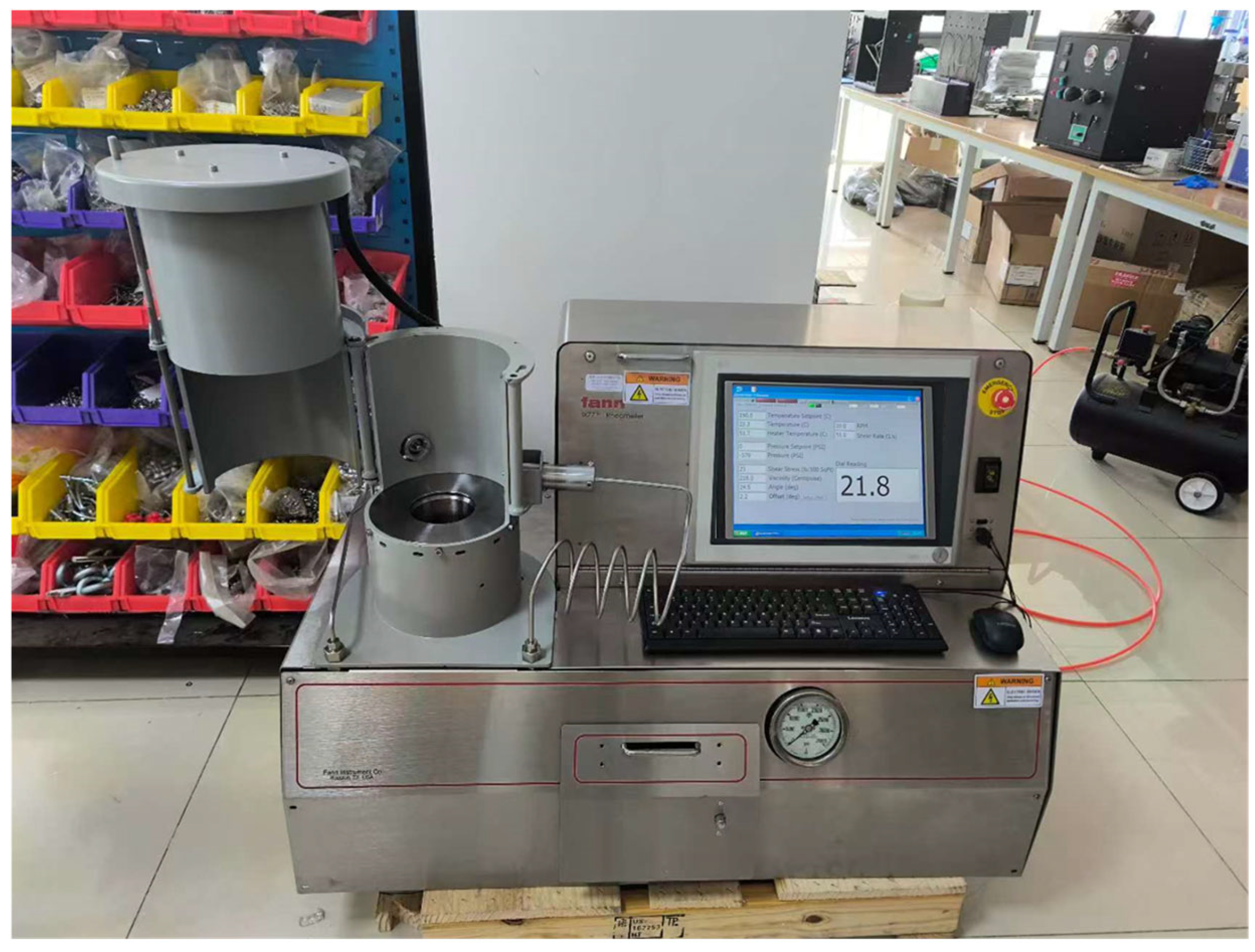
(1) Testing instrument. A Fann iX77 high-pressure and high-temperature rheometer (HTHP) (Fann Instrument Company, Houston, TX, USA) was used for the experiments (as shown in Figure 1). The instrument can operate at up to 316 °C and 206.84 MPa, with a controllable shear rate range of 0.1–1022 s−1.
(2) Drilling fluid types. The tested fluids include WBDFs and OBDFs with densities of 1.5 g/cm3 and 2.0 g/cm3, respectively.
(3) The experimental procedure was as follows:
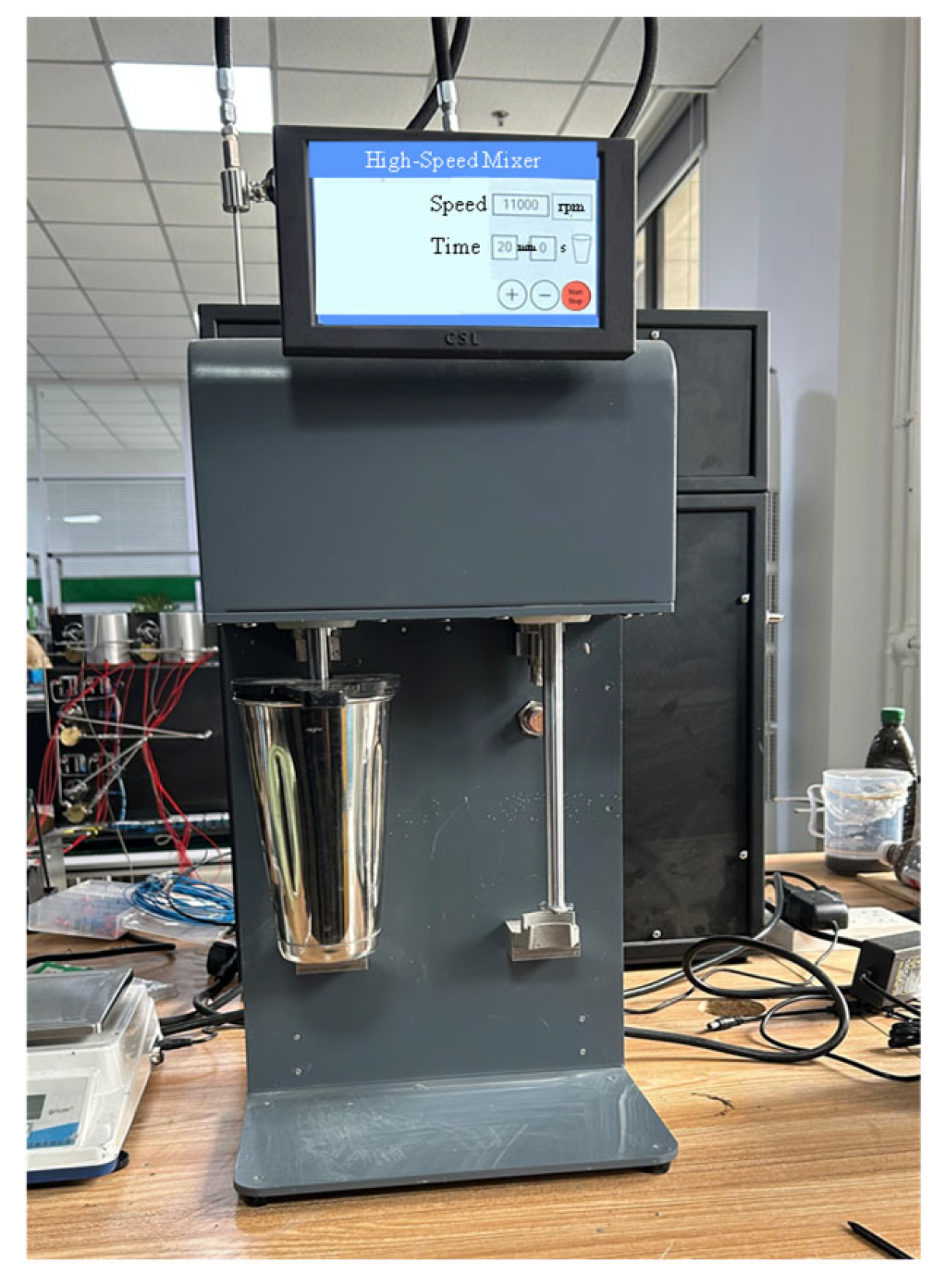
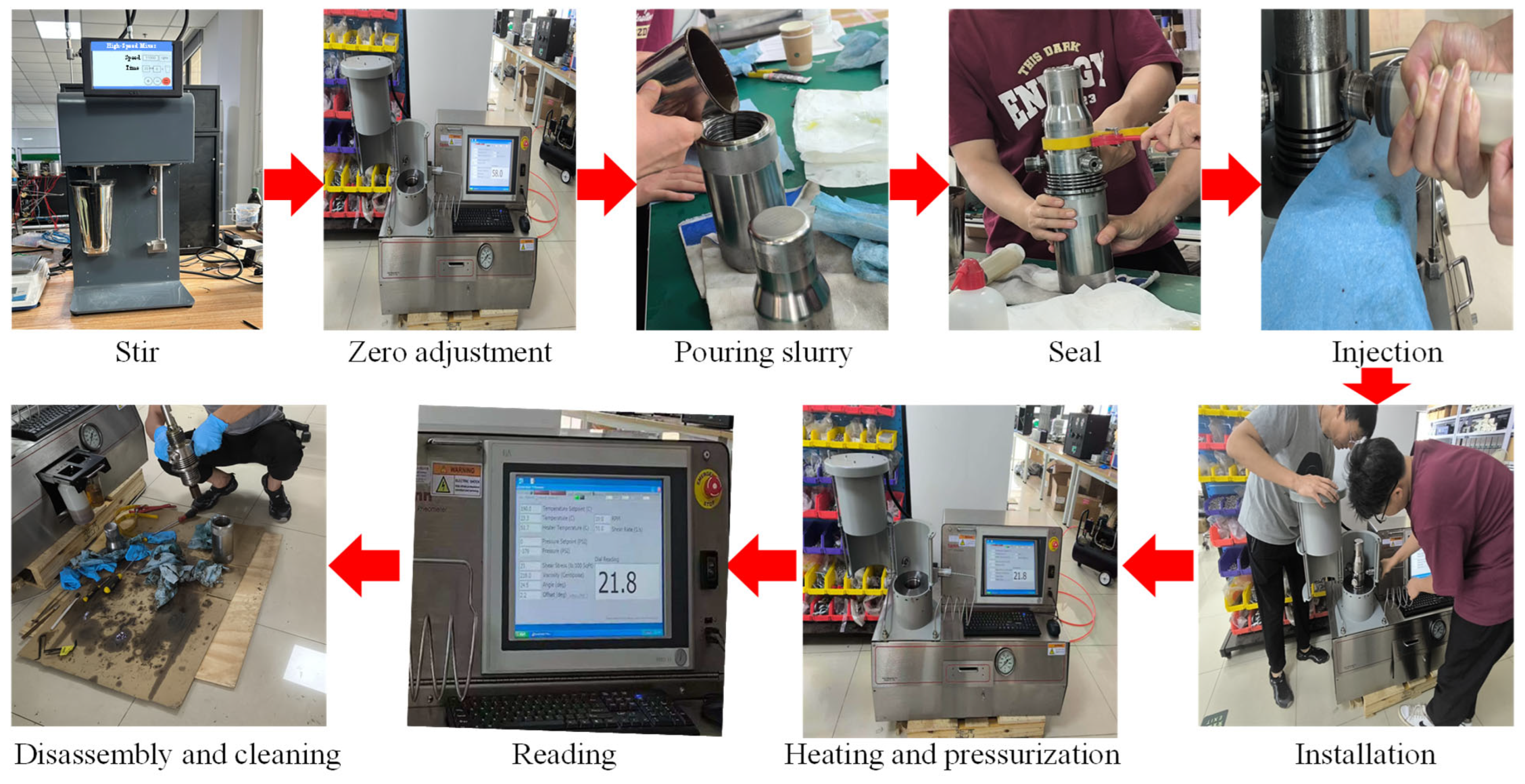
Step 1. The drilling fluid sample was first mixed using a high-speed mixer (as shown in Figure 2) at 2000 rpm for 20 min to ensure uniform mixing.
Step 2. The Fann iX77 HTHP rheometer was zero-calibrated. The mixed sample was then poured into the test cell, sealed properly with O-rings, and enclosed.
Step 3. The sealed test cell was mounted into the heating chamber of the Fann iX77 HTHP rheometer and fixed in place.
Step 4. The target test temperature was set, and the system was automatically heated. The initial pressure was set to 0.1 MPa. When the temperature approached the setpoint, the pressure was increased to the designated test pressure.
Step 5. Each sample was tested at multiple temperature points (20, 45, 70, 95, 120, 145, 150, 160, 170, 180, 190, and 200 °C), with corresponding pressures ranging from 0.1 to 200 MPa. At each condition, shear stress was measured at rotational speeds of 600, 300, 200, 100, 6, and 3 rpm.
The entire experimental workflow is illustrated in Figure 3.

2.2. The Principle of SR Algorithm

Recent studies have demonstrated the effectiveness of symbolic regression and interpretable machine learning approaches in capturing complex nonlinear relationships in engineering systems [37,38]. Compared with other intelligent algorithms such as Random Forest (RF), Long Short-Term Memory (LSTM), Backpropagation (BP), and Convolutional Neural Networks (CNNs), the symbolic regression (SR) algorithm can automatically discover explicit mathematical relationships between input and target variables from a training dataset, providing strong interpretability [39,40,41,42,43]. Currently, various evolutionary algorithms have been adopted to solve SR problems, among which the genetic algorithm (GA) is one of the most widely used approaches [44]. In GA-based symbolic regression, mathematical expressions are typically represented in the form of binary trees, where the root and internal nodes denote mathematical operators [45]. During the tree construction process, if a node represents an input variable or a constant, the corresponding path is terminated, and the node is classified as a terminal node. The quality of each generated expression is evaluated using a fitness function, which generally incorporates two components: the prediction error between the measured and predicted target values, and the complexity of the expression, as shown in Equation (1). Expressions with higher fitness scores are more likely to be selected and retained, thereby increasing their probability of participating in subsequent evolutionary operations.
ϕ i = l 1 + α l 2
where l 1 is the sample loss; l 2 is the model structural complexity loss; α is the model complexity penalty coefficient, and a larger value of α results in a simpler model structure. The term ϕ i is the fitness value of the i-th individual.
The l 1 is calculated as follows:
l 1 = 1 N j = 1 N y j y ^ i , j 2
where N is the total number of samples; y j is the true value of the j-th sample; y ^ i , j is the predicted value of the i-th individual for the j-th sample.
Referring to the Eureqa software (version 1.24.0, Nutonian Inc., Boston, MA, USA) developed by Schmidt and Lipson [46], Table 5 presents the complexity coefficient assigned to each mathematical operation used in the expression. The model structural complexity loss for predicting drilling fluid rheological parameters is calculated as the sum of the complexity coefficients of all operations involved.
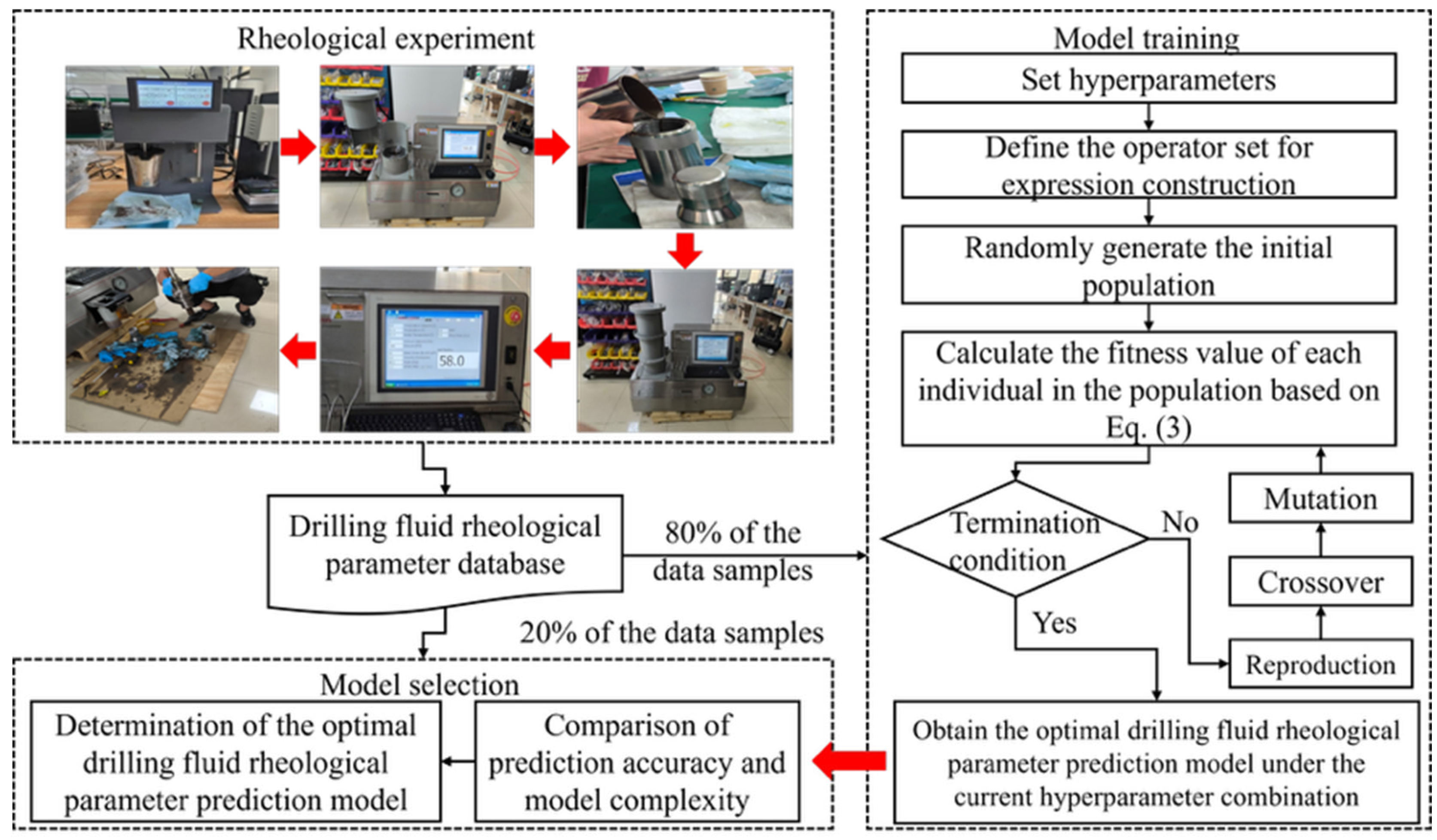
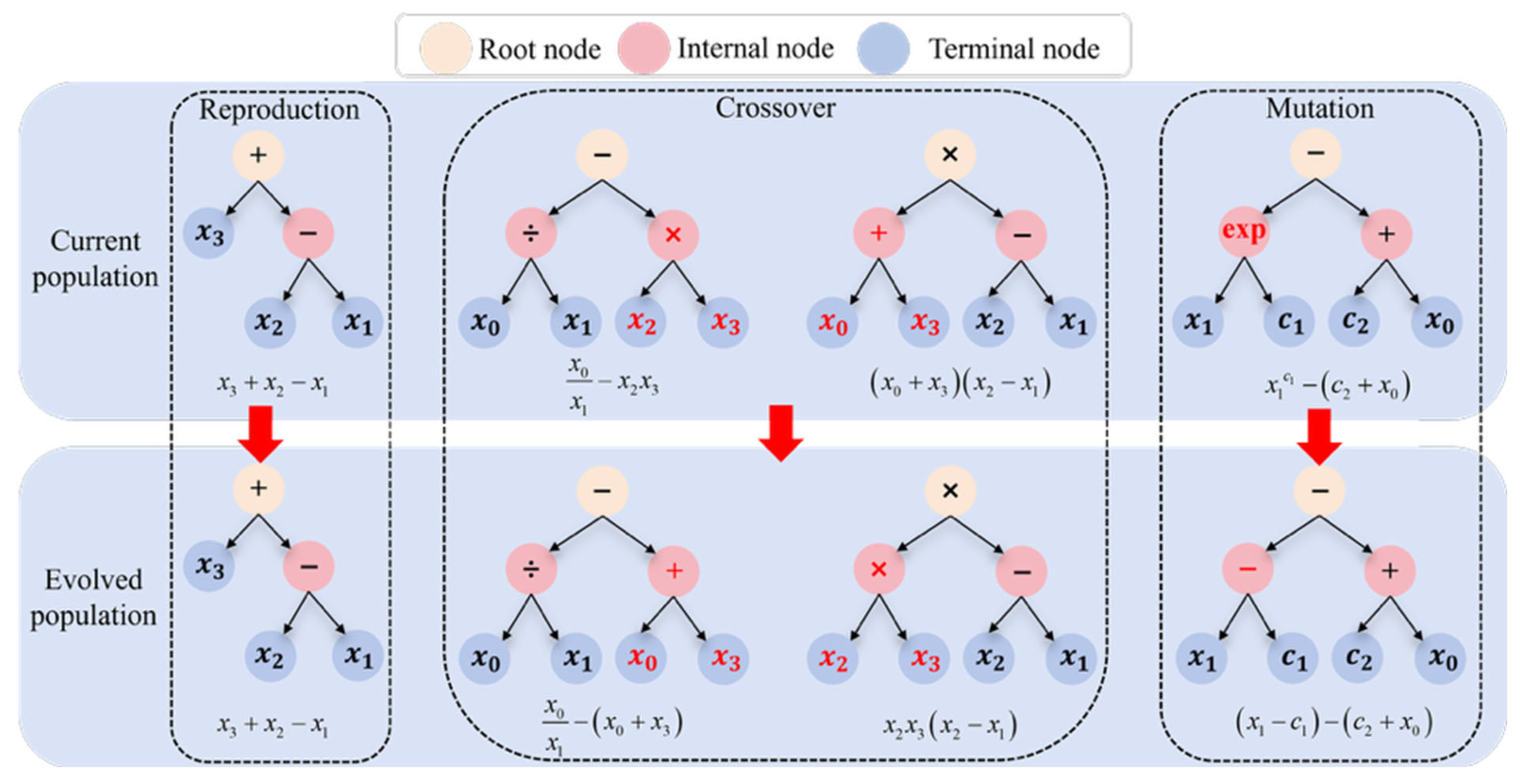
The evolutionary process mainly relies on three operations: reproduction, crossover, and mutation, as shown in Figure 4. The reproduction operation is based on fitness values, where several individuals are randomly selected from the current population and used as candidate individuals for the next generation. The crossover operation involves repeatedly selecting two individuals at random from the candidate pool, and with a certain probability, performing subtree exchange between randomly selected nodes of the two individuals to generate new candidates. The mutation operation applies to the candidate individuals obtained from the crossover operation, where, with a certain probability, the operator or operand at a node is randomly changed to produce new candidate individuals. Finally, a portion of the current population is replaced by the candidate individuals generated after the mutation operation to form the next generation. Through this mechanism, the SR algorithm is able to gradually optimize the structure of expressions in each generation, ultimately obtaining explicit mathematical expressions that fit the training dataset well.

2.3. Construction of Rheological Parameter Prediction Models for Individual Drilling Fluid Types

The objective of this study as to construct a novel predictive model for rheological parameters that is applicable to multiple types of drilling fluids across wide temperature–pressure ranges. Considering that different drilling fluid types exhibit distinct responses in PV, AV, and YP under the same temperature and pressure conditions, it is not feasible to directly apply the SR algorithm to the entire set of rheological test data. Therefore, the first step is to establish predictive models for rheological parameters of individual drilling fluid types across wide temperature–pressure ranges. The modeling procedure is shown in Figure 5.
The specific steps are as follows:
Step 1. Construction of a rheological parameter database for drilling fluids. In this database, each sample includes temperature and pressure as feature variables, while the target variable is either the PV, AV, or YP of the drilling fluid. The dataset is divided into a training set and a testing set in an 8:2 ratio. The training set is used to generate predictive models, while the testing set is reserved for evaluating the generalization capability of the models.
Step 2. Hyperparameter configuration. Key hyperparameters such as population size, number of generations, crossover probability, mutation probability, and the penalty coefficient for model complexity are predefined.
Step 3. Population initialization. A set of basic mathematical operators (addition, subtraction, multiplication, division, exponentiation, and power functions) is predefined. By randomly combining these operators with feature variables, an initial population of a specified size is generated. Each individual in the population is represented as a binary tree, which corresponds to one drilling fluid rheological parameter prediction model.
Step 4. Fitness evaluation for individuals in the population. SR is inherently a supervised machine learning algorithm. If fitness values are calculated solely based on Equation (1), the optimization process may rely excessively on the training data, leading to overfitting. Although adjusting the coefficient α can help regulate model complexity, a purely data-driven approach without physical constraints struggles to ensure that the resulting models conform to known rheological behaviors across wide temperature–pressure ranges. According to empirical rheological laws, the partial derivatives of rheological parameter models with respect to pressure are consistently greater than zero for both WBDFs and OBDFs. For OBDFs, the partial derivative of rheological parameter models with respect to temperature is always less than zero. In contrast, for WBDFs, it is negative when the temperature is below 150 °C and becomes positive when the temperature exceeds 150 °C. This transition behavior and the corresponding temperature were identified based on experimental observations in this study and have also been reported in previous studies, indicating a dependence on drilling fluid formulation [8,9]. To embed this physical knowledge into the model-building process, we refined the fitness function based on Equation (1) by introducing a physics-informed constraint loss that incorporates the correlation constraints between temperature, pressure, and rheological parameters, as formulated in Equation (3). In this study, violations of the physical constraints are penalized using a linear penalty formulation. All constraint penalties are applied with equal weighting across the dataset to ensure consistent enforcement of the physical trends.
ϕ i = l 1 + α l 2 + l 3
where l 3 is the physics-informed constraint loss.
Based on experimental observations in this study, the following correlation constraints were imposed to describe the temperature–pressure dependence of rheological parameters. For WBDFs, l 3 satisfies the following conditions:
l 3 = 1 N j = 1 N max F i P , T P , 0 + max F i P , T T , 0 , T 150   ° C 1 N j = 1 N max F i P , T P , 0 + max F i P , T T , 0 , T > 150   ° C
For OBDFs, l 3 satisfies the following conditions:
l 3 = 1 N j = 1 N max F i P , T P , 0 + max F i P , T T , 0
where P is the pressure, MPa; T is the temperature, °C; F i ( P , T ) is the i-th individual’s predictive model of drilling fluid rheological parameters as a function of pressure and temperature.
Step 5. A new population is generated through reproduction, crossover, and mutation operations, which serves as the initial population for the next generation.
Step 6. Steps 4 and 5 are repeated until the maximum number of iterations is reached. The evolution process is then terminated, and the individual with the highest fitness value in the current population is saved as the rheological parameter prediction model.
Step 7. The model obtained from step 6 is comprehensively evaluated based on its prediction accuracy on the testing set and its structural complexity. If the model performance meets the required criteria, it is saved as the optimal rheological parameter prediction model for the current drilling fluid. If the performance is unsatisfactory, the crossover probability, mutation probability, and model complexity penalty coefficient are adjusted, and steps 3 through 6 are repeated.

2.4. Construction of a Rheological Parameter Prediction Model for Multi-Type Drilling Fluids

The above process establishes rheological parameter prediction models separately for each type of drilling fluid. However, discrepancies exist among the prediction models for the same rheological parameter across different fluid types. As a result, when a new drilling fluid is introduced in field operations, a separate SR-based model must be developed for that specific fluid, leading to a wide variety of models and prolonged training times. This significantly limits the practicality of these models in real-time field applications and is one of the main reasons for the poor generalizability of existing models. To address this issue, a novel predictive model is proposed in this study that is applicable to multiple drilling fluid types. This new model is constructed based on the rheological parameter prediction models developed for the four drilling fluids.
For each type of drilling fluid, the predictive models for PV, AV, or YP obtained through symbolic regression can be generally expressed as polynomial functions of temperature and pressure, as exemplified in Equation (6):
F P , T = 0.2 P 0.5 T + P 2 T + e 3 p 0.05 T P + 4
where F ( P ,   T ) is the rheological parameters at temperature T and pressure P.
Different drilling fluids vary in terms of composition, microstructure, and physical properties. These differences can be reflected by the constant terms in the model. That is, for the same rheological parameter, the overall structure of the prediction model remains similar across different drilling fluids, with variations only in the constant terms. To develop a unified predictive model applicable to multiple drilling fluid types, the constant terms in Equation (6) are therefore treated as adjustable fitting parameters, as expressed in Equation (7):
F P , T = A 1 P A 2 T + P A 3 T + e A 4 P A 5 T P + A 6
where A 1 , A 2 , A 3 , A 4 , A 5 and A 6 are characteristic parameters related to drilling fluid properties that must be determined through fitting with experimental rheological data of the drilling fluid.
To further develop a unified predictive model applicable to PV, AV, and YP, this study utilized the maximal information coefficient (MIC) to assess the correlations among the three rheological parameters [20]. In contrast to Pearson’s correlation coefficient, which only captures linear relationships, the MIC can evaluate both linear and nonlinear associations between variables. The core idea of the MIC is that for any given variable pair (Y, Z), the values of Y and Z are first sorted, after which the conditional distributions P(Z|Y) and P(Y|Z) are estimated. Finally, the MIC is computed by maximizing the mutual information between the two variables.
I ( Y ; Z ) = z Z y Y P ( y , z ) lg P ( y , z ) P ( y ) P ( z ) M I C ( Y , Z ) = max | Y | | Z | < B I ( Y ; Z ) log 2 ( min ( | Y | , | Z | ) )
where I(Y;Z) is the mutual information between variables Y and Z; P(y, z) is the joint probability density between the variables; MIC(Y,Z) is the MIC between the variables; and B is typically set to the total sample size raised to the power of 0.6.
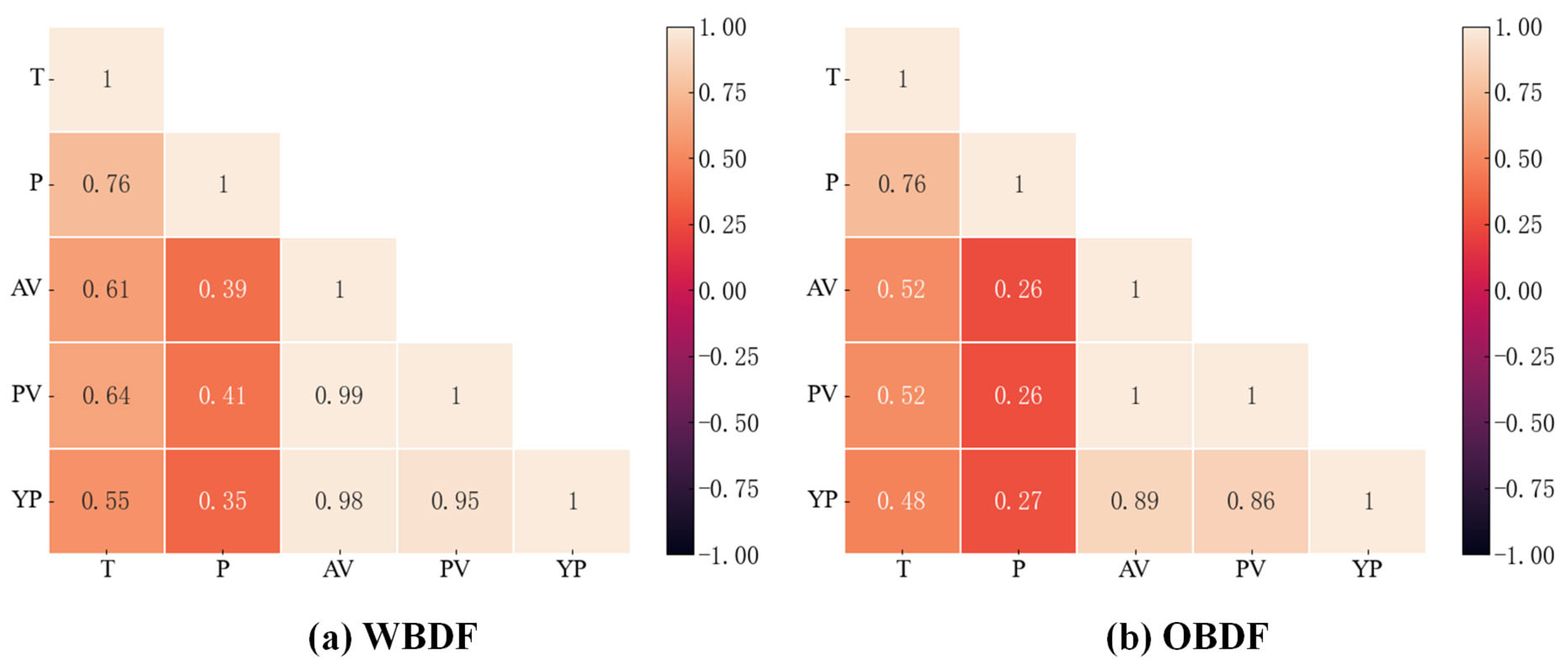
Figure 6 presents the MIC results for the three rheological parameters of water-based and oil-based drilling fluids, respectively. It can be seen that for both fluid types, the MIC between each pair of PV, AV, and YP exceeds 0.85, indicating a strong interdependence. This implies that any one parameter can be derived from another via linear or nonlinear transformations, and that this transformation can itself be captured by the model characteristic parameters. In other words, prediction models for different rheological parameters of the same drilling fluid share a common structure and differ only in their constant terms. To this end, twelve transformed rheological parameter prediction models were first considered. For each model, the characteristic parameters were fitted using the least squares method based on different drilling fluid types and the three rheological parameters. Subsequently, the prediction accuracy of the twelve models was comparatively analyzed across various drilling fluids and rheological parameters. Finally, the model with the highest overall accuracy was selected as the novel unified predictive model for rheological parameters, applicable to a wide temperature–pressure range and multiple types of drilling fluids.

2.5. Model Performance Evaluation Metrics

To evaluate the accuracy and reliability of the model, this study adopted three commonly used metrics: root mean square error (RMSE), mean absolute error (MAE), and the coefficient of determination (R2), providing a comprehensive assessment of prediction performance [33]. Lower RMSE and MAE values, combined with an R2 value approaching 1, indicate better model performance. The specific calculation formulas are as follows:
RMSE = 1 N j = 1 N y j y ^ j 2
MAE = 1 N j = 1 N y j y ^ j
R 2 = 1 j = 1 N y j y ^ j 2 j = 1 N y j y ¯ 2
where y ¯ is the average value of the drilling fluid rheological parameters.

3. Results and Discussion

3.1. Dataset Description

Four types of drilling fluids were tested under various temperature and pressure conditions, with each fluid yielding 64 sets of PV, AV, and YP values. In total, 256 sets of experimental data were collected. These data formed the basis of the rheological parameter database used for model training. Table 6 summarizes the basic statistical characteristics of the rheological parameters for all four drilling fluids.
To ensure that the training and testing sets exhibited similar distributions in terms of temperature, pressure, and rheological parameters, this study adopted an equal-interval sampling method for dataset partitioning. As a result, each rheological parameter for each type of drilling fluid included 51 samples in the training set and 13 samples in the testing set.

3.2. Determination of the Optimal Prediction Model for Drilling Fluid Rheological Parameters

Based on experimental test data, the SR algorithm was applied to each drilling fluid’s rheological parameters to intelligently derive explicit mathematical expressions relating AP, PV, and YP to temperature and pressure. To further improve the model’s accuracy and generalization capability, this study proposes two input parameter combinations for comparative analysis. Parameter combination 1 incorporates temperature and pressure along with reference temperature (set at 20 °C), reference pressure (set at 0.1 MPa), and the corresponding measured rheological parameter values under these reference conditions, which helps characterize the baseline rheological properties of the drilling fluid. In contrast, parameter combination 2 uses only temperature and pressure as input variables.
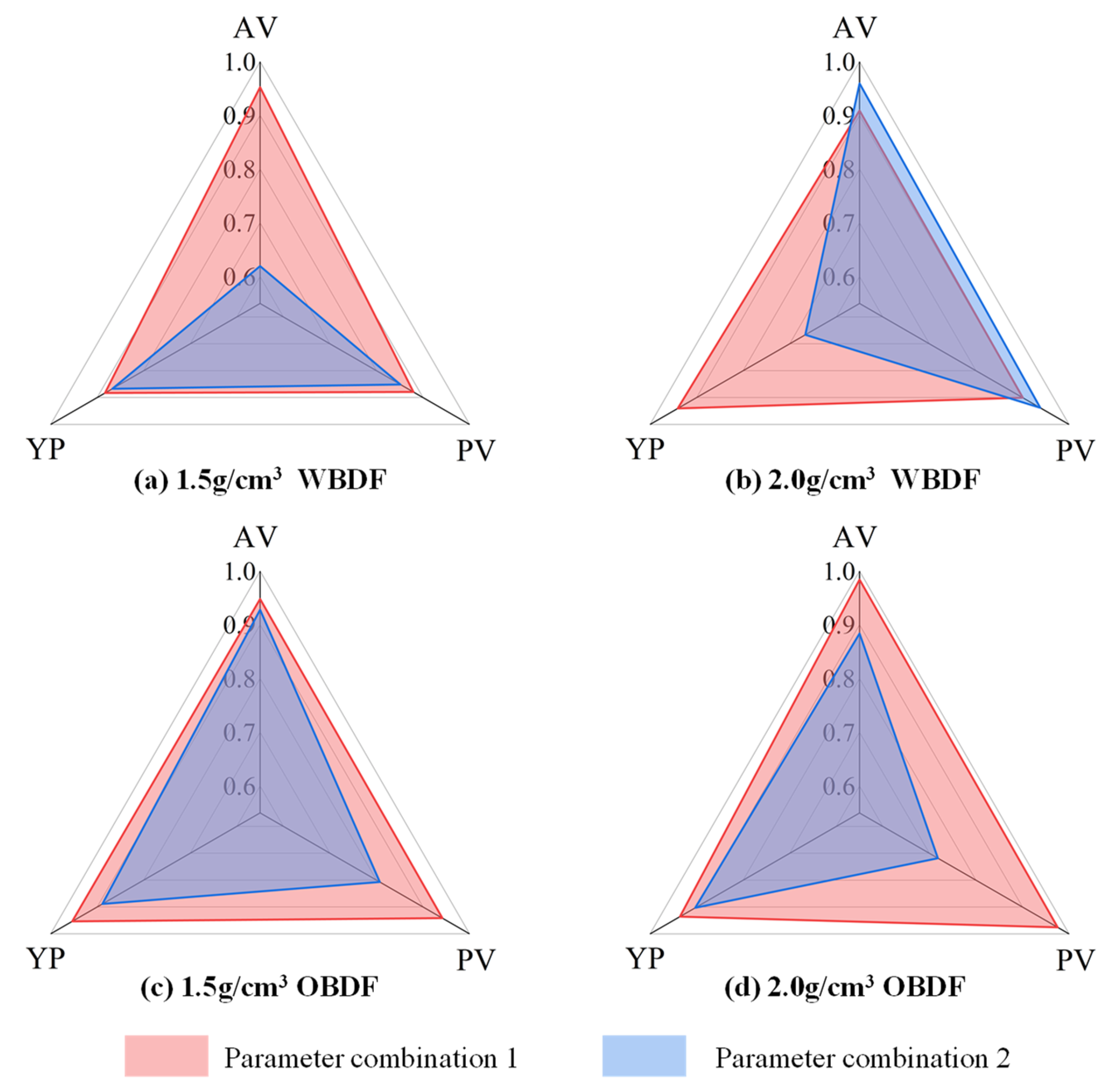
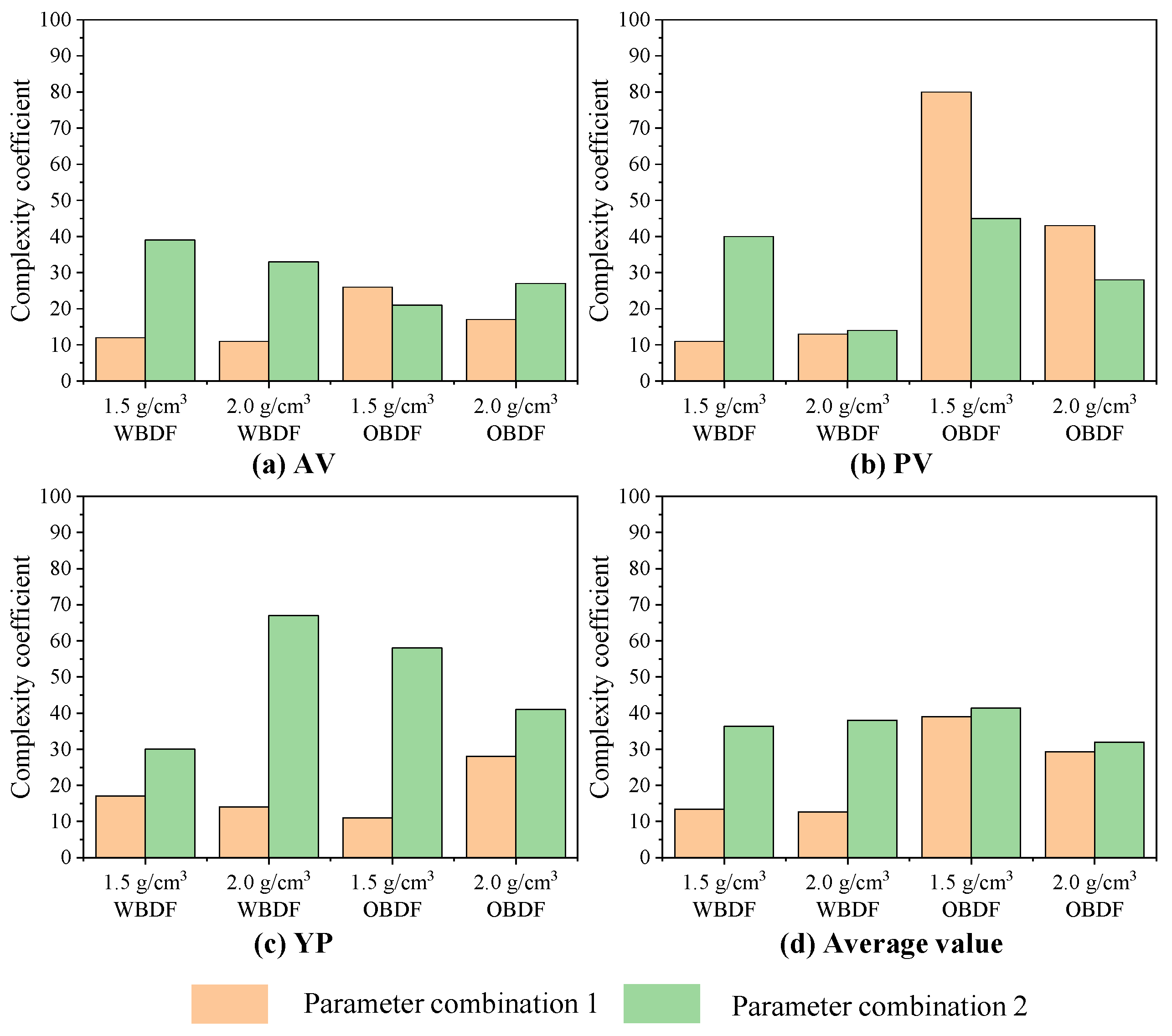
During the model training process, the SR algorithm was configured with an initial population size of 5000. By adjusting key parameters including crossover probability, mutation probability, and model complexity penalty coefficient, we achieved the optimal selection of drilling fluid rheological parameter prediction models through balancing prediction accuracy and expression simplicity. The final optimization results are presented in Supplementary Tables S1 and S2. Figure 7 shows a comparison of the prediction accuracy of drilling fluid rheological parameter models under the two parameter combinations. It can be seen that models developed using parameter combination 1 achieved higher prediction accuracy across all rheological parameter prediction tasks for the four types of drilling fluids. The only exception was the modeling of AV and PV for the WBDF with a density of 2.0 g/cm3, where parameter combination 2 performed slightly better. Figure 8 compares the complexity loss of rheological parameter prediction models for both parameter combinations. The analysis revealed that models developed with parameter combination 1 maintained significantly lower complexity loss compared to those using parameter combination 2, except for the OBDF with a density of 2.0 g/cm3, where the model complexity loss was slightly higher.
Therefore, considering both the prediction accuracy and complexity of the model, this study adopted the expressions constructed under parameter combination 1 as the predictive models for the rheological parameters of the four drilling fluids, as shown in Supplementary Table S1. The primary reason for selecting parameter combination 1 lies in its incorporation of baseline temperature and pressure conditions along with their corresponding rheological parameter values, which effectively serves as a normalization of the sample states, providing a stable reference condition. This approach not only reduces the probability of generating candidate expressions that deviate from physical plausibility in the initial population of the SR algorithm but also significantly narrows the search space, thereby improving algorithm convergence efficiency and model fitting stability. More importantly, the introduction of the baseline condition enhances the model’s adaptability to different drilling fluid properties, enabling the derivation of predictive expressions that are not only accurate, but also compact in structure, clear in form, and possess strong engineering interpretability.
To obtain a unified model structure suitable for different types of drilling fluids and their rheological parameters, this paper first simplified the expressions in Supplementary Table S1. Taking the AV calculation model for OBDF with a density of 1.5 g/cm3 (Formula (7)) as an example, the variables X 0 , X 1 , and X 2 are replaced with reference value (20, 0.1, and 28.6671, respectively), as shown in the following formulation:
F P , T = 0.03488 P + 28.6671 T 28.6671 0.0729 × T + P 0.1 × T + e 28.6671 T 0.05 × T
By setting the constant term in Equation (9) as a fitting parameter, the expression can be further transformed to:
F P , T = A 1 × P + A 2 T A 3 + A 4 × T + P A 5 × T + e A 6 T A 7 × T
The transformed results of other expressions in Supplementary Table S1 are presented in Supplementary Table S3, where each expression can be used to fit characteristic parameters based on the rheological data of the drilling fluid, thereby establishing predictive models for the PV, AV, and YP of the drilling fluid.
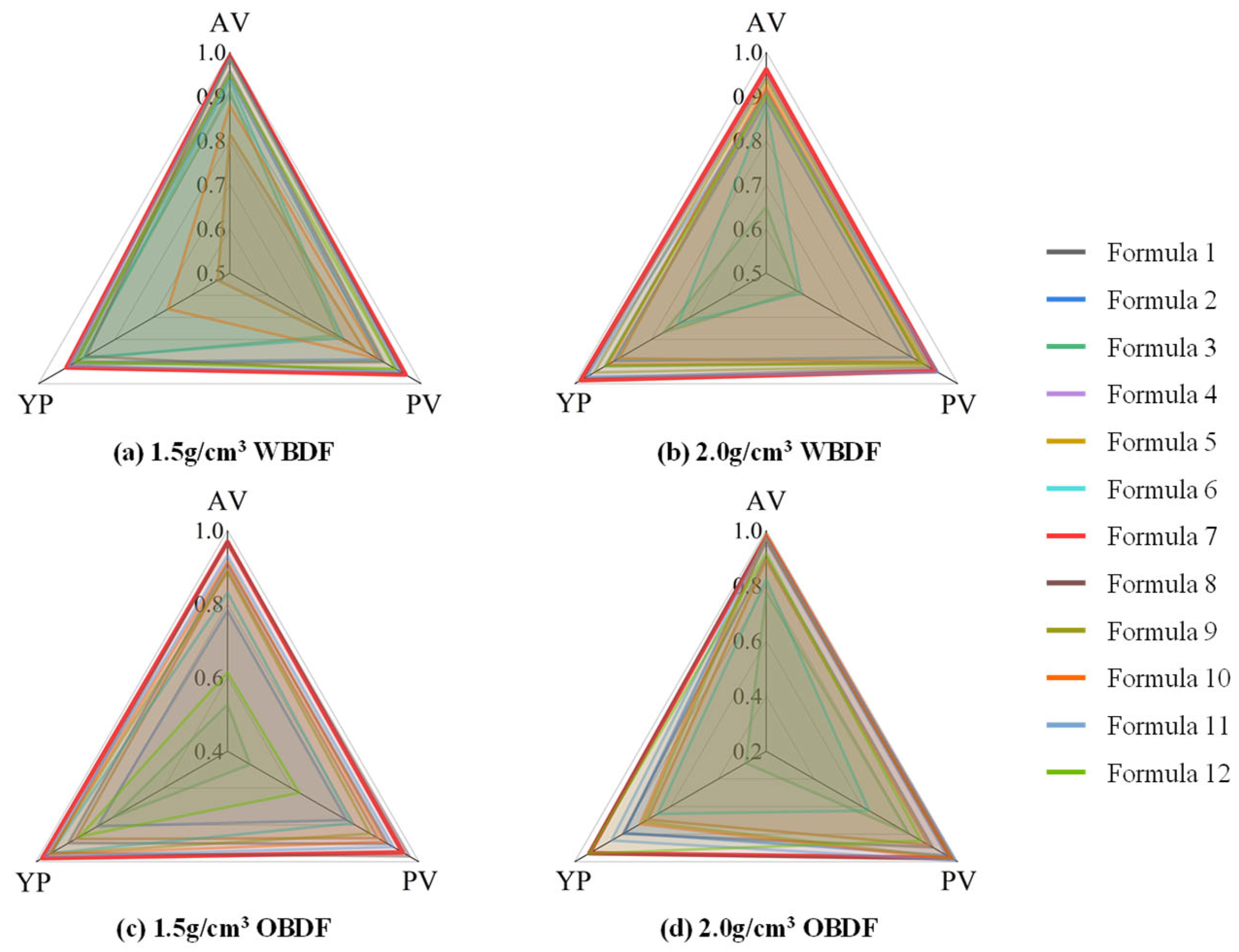
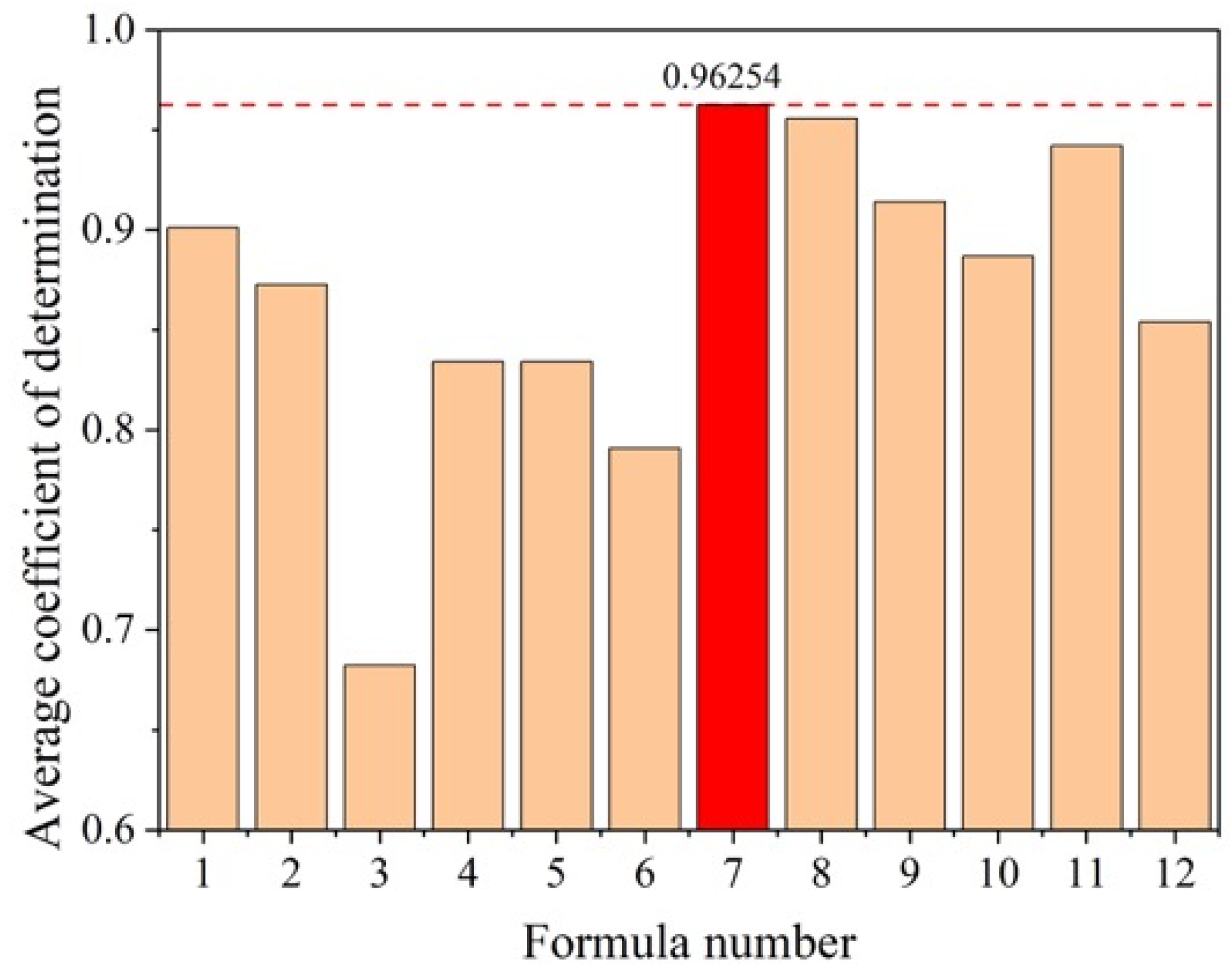
Then, based on the least squares method, the characteristic parameters in each expression from Supplementary Table S3 were fitted using the test data of PV, AV, and YP from four types of drilling fluids. Consequently, each expression yielded a total of 12 sets of characteristic parameters, as shown in Supplementary Table S4. Figure 9 presents a comparison of the R2 for the prediction results of rheological parameters from different expressions across the four drilling fluids. The results demonstrate that the rheological parameter prediction model constructed using Formula (7) achieved the highest accuracy, exhibiting superior predictive performance for all four drilling fluid types. Furthermore, by comparing the average R2 for the prediction results of the three rheological parameters across different expressions, it was observed that the model based on Formula (7) achieved an average R2 value as high as 0.96, as illustrated in Figure 10. This further confirms that the rheological parameter prediction model developed with Formula (7) is applicable to various drilling fluid types across wide temperature–pressure ranges. Therefore, the unified rheological parameter prediction model proposed in this study for multi-type drilling fluids across wide temperature–pressure ranges is expressed as Equation (13).

3.3. Comparison and Analysis of Different Models

To further validate the reliability and accuracy of the newly proposed rheological parameter prediction model for drilling fluids across wide temperature–pressure ranges, this study conducted comparative analyses with two widely used existing models [7]. The specific model formulations are presented as follows:
F ( P , T ) = F ( T 0 , P 0 ) exp [ A ( T T 0 ) + B ( P P 0 ) + C ( T T 0 ) ( P P 0 ) + D ( T T 0 ) 2 ]
F ( P , T ) = exp [ A ln F ( P 0 , T 0 ) + B ( T T 0 ) + C ( P P 0 ) + D ( P P 0 ) ( T T 0 ) + E ( P P 0 ) ( T T 0 ) T × T 0 + G ( T T 0 ) 2 T × T 0 ]
where, A, B, C, D, E and G are characteristic parameters that must be determined through fitting with experimental rheological data of the drilling fluid; F ( P 0 ,   T 0 ) is the rheological parameters at temperature T 0 and pressure P 0 ; P 0 is the reference pressure, MPa; T 0 is the reference temperature, °C.
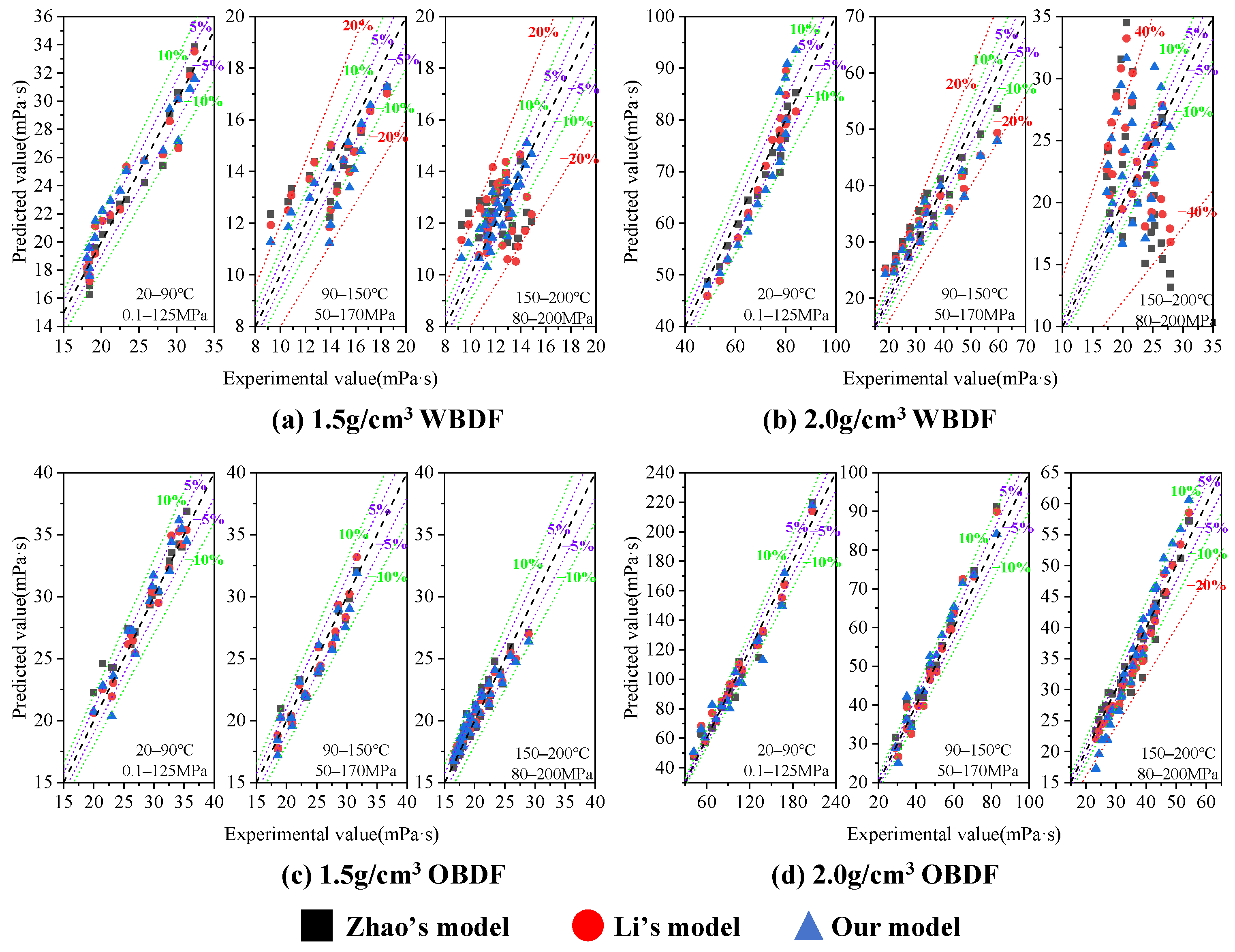
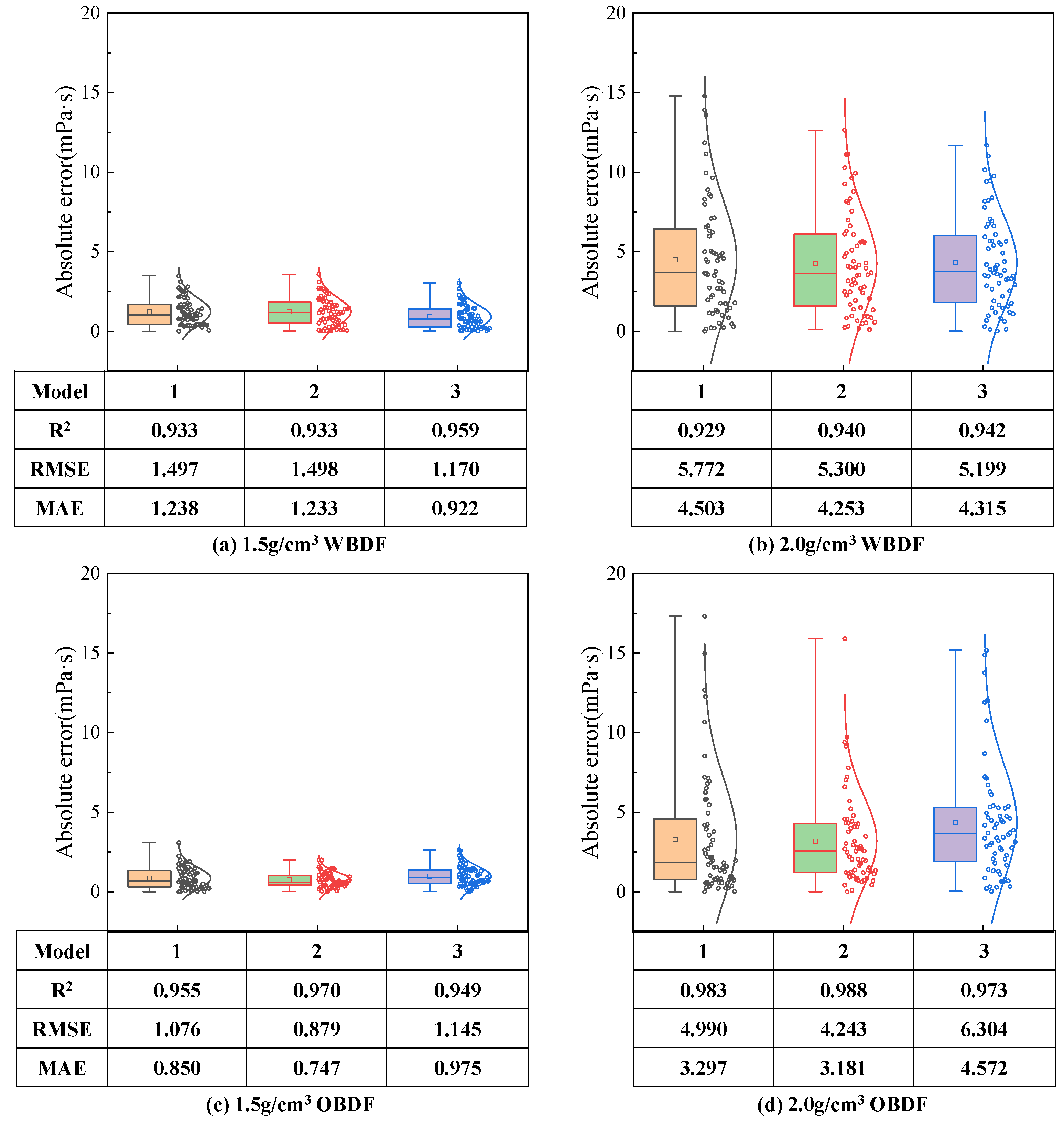
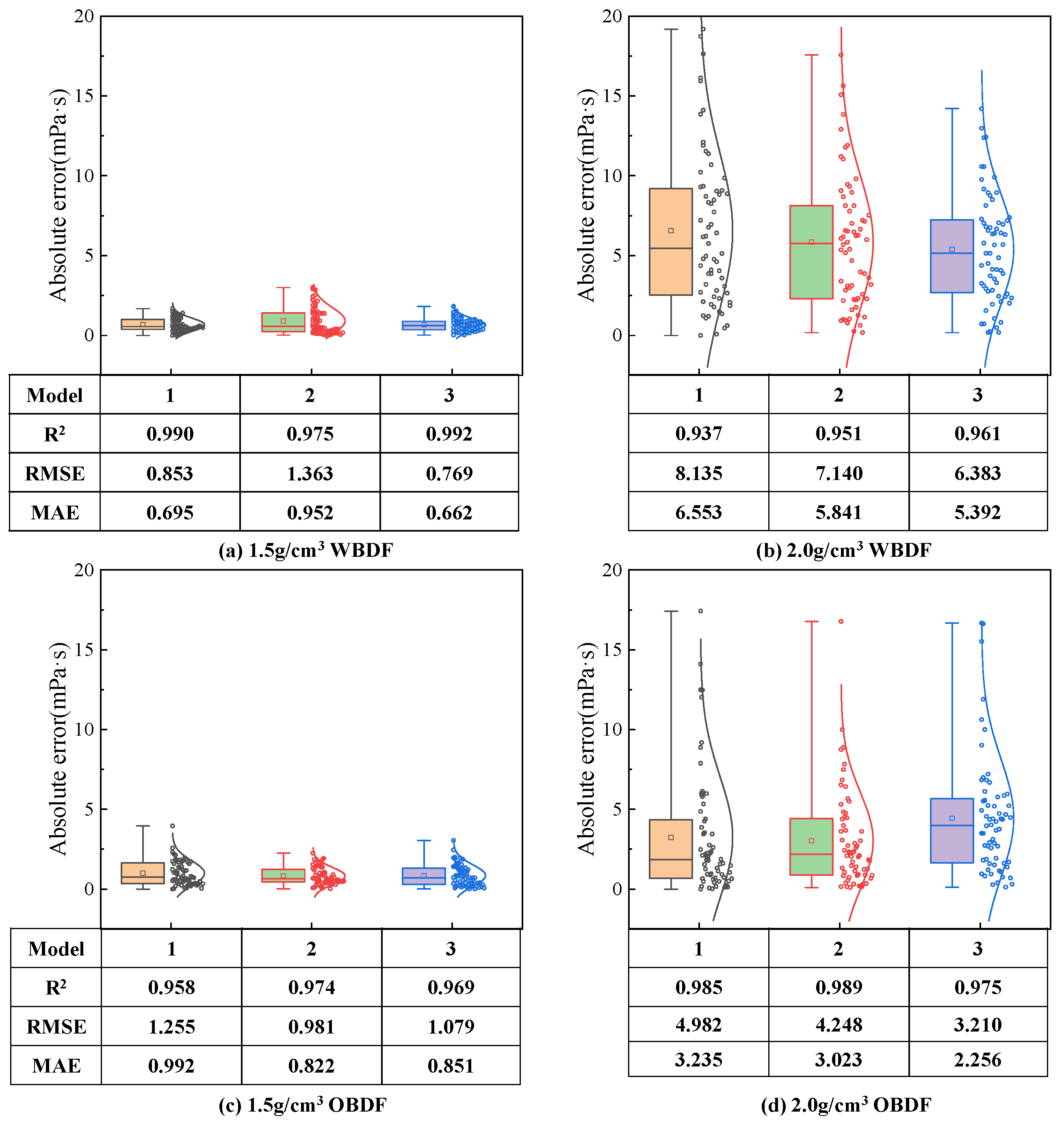
Figure 11 presents a comparison of the PV prediction results for four types of drilling fluids using different models. As shown in Figure 11a, for low-density WBDFs under normal temperature and pressure conditions (20–90 °C, 0.1–125 MPa), the prediction accuracy of the proposed model was comparable to that of models Zhao and Li, with relative errors all within 10%. However, some predictions from Zhao’s model exceeded this threshold. Under HTHP conditions (90–150 °C, 50–170 MPa), the advantages of the proposed model become evident, as predictions from Li’s model and Zhao’s model exceeded 20% in some cases. Particularly in the HTHP range (150–200 °C, 80–200 MPa), while the overall prediction errors of Li’s model and Zhao’s model significantly increased to the range of 10–20%, the proposed model consistently maintained prediction errors within 10%. Moreover, for high-density WBDFs under HTHP conditions, the proposed model showed a more significant advantage, as the prediction errors from Li’s model and Zhao’s model exceeded 40%, as shown in Figure 11b. Similarly, for high-density OBDFs under HTHP conditions, while Li’s model and Zhao’s model showed prediction errors over 20%, the proposed model kept the prediction errors below 10%, as shown in Figure 11d. For low-density OBDFs, all three models performed similarly, with errors within 10%, as shown in Figure 11c. Furthermore, a comparison of the performance metrics of the different models showed that the proposed model outperformed both Li’s and Zhao’s models overall, especially for high- and low-density WBDFs, where the proposed model achieved determination coefficients of 0.942 and 0.959, respectively, as illustrated in Figure 12.
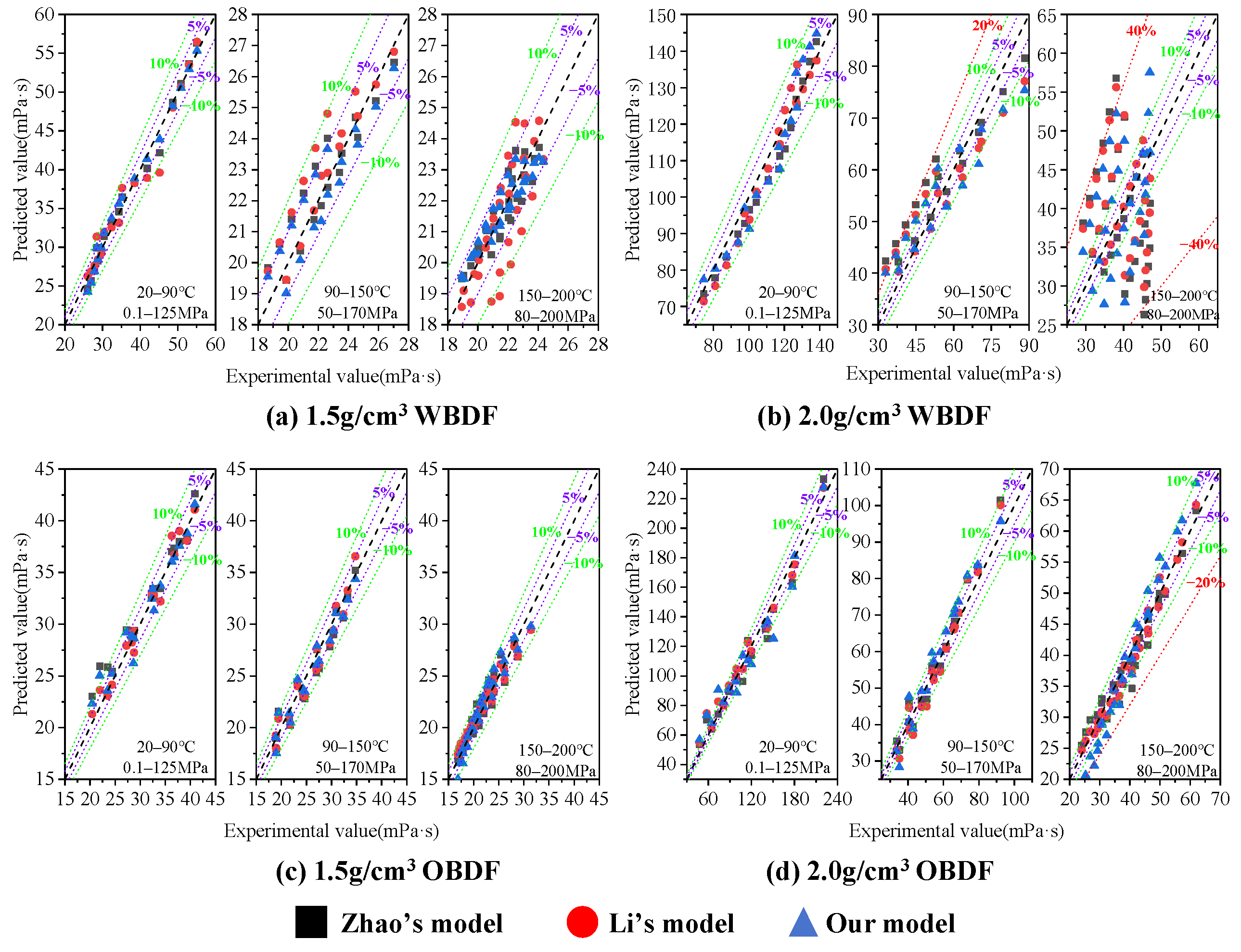
Figure 13 presents a comparative analysis of AV prediction results for four types of drilling fluids using different models. As shown in Figure 13a,b, for WBDFs, the prediction errors of the proposed model, Li’s model, and Zhao’s model all increased gradually with rising temperature and pressure. In particular, under HTHP conditions (150–200 °C, 80–200 MPa), the prediction errors increased significantly. For low-density WBDFs, some predictions from Li’s model exceeded 10%, while for high-density WBDFs, some predictions from Zhao’s model even exceeded 40%. In comparison, the proposed model demonstrated more stable AV prediction accuracy across wide temperature–pressure ranges, with overall errors consistently within 10%. For OBDF, all three models showed similar AV prediction performance, with prediction errors generally around 10% and minimal differences between them, as illustrated in Figure 13c,d. Furthermore, a comparison of model evaluation metrics showed that for WBDFs, the proposed model outperformed both Li’s and Zhao’s models in terms of AV prediction. Specifically, the R2 for high- and low-density WBDF reached 0.961 and 0.992, respectively, as shown in Figure 14a,b. For OBDFs, although the prediction accuracy of all three models was comparable, the proposed model showed slightly better performance in terms of RMSE and MAE, as illustrated in Figure 14c,d.
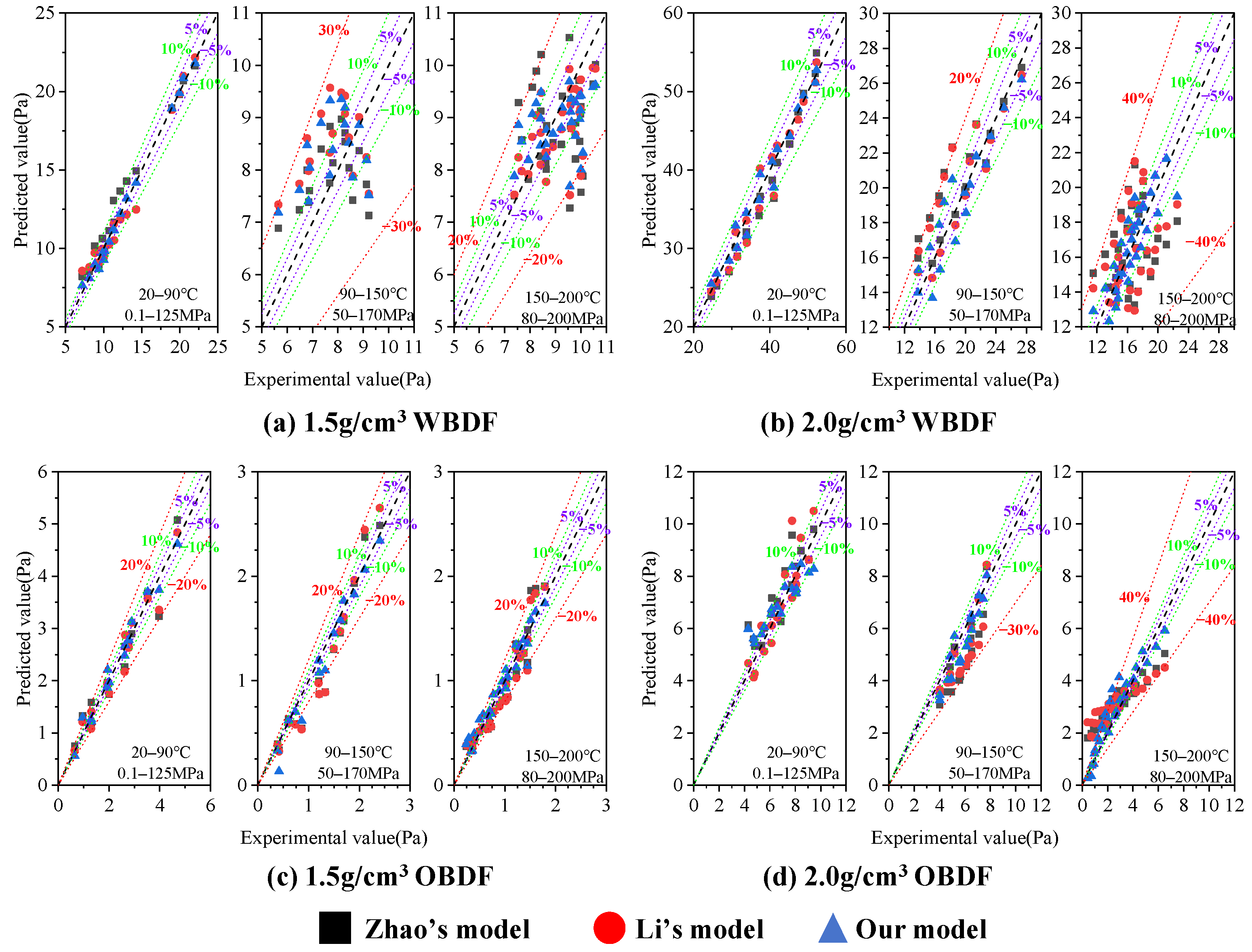
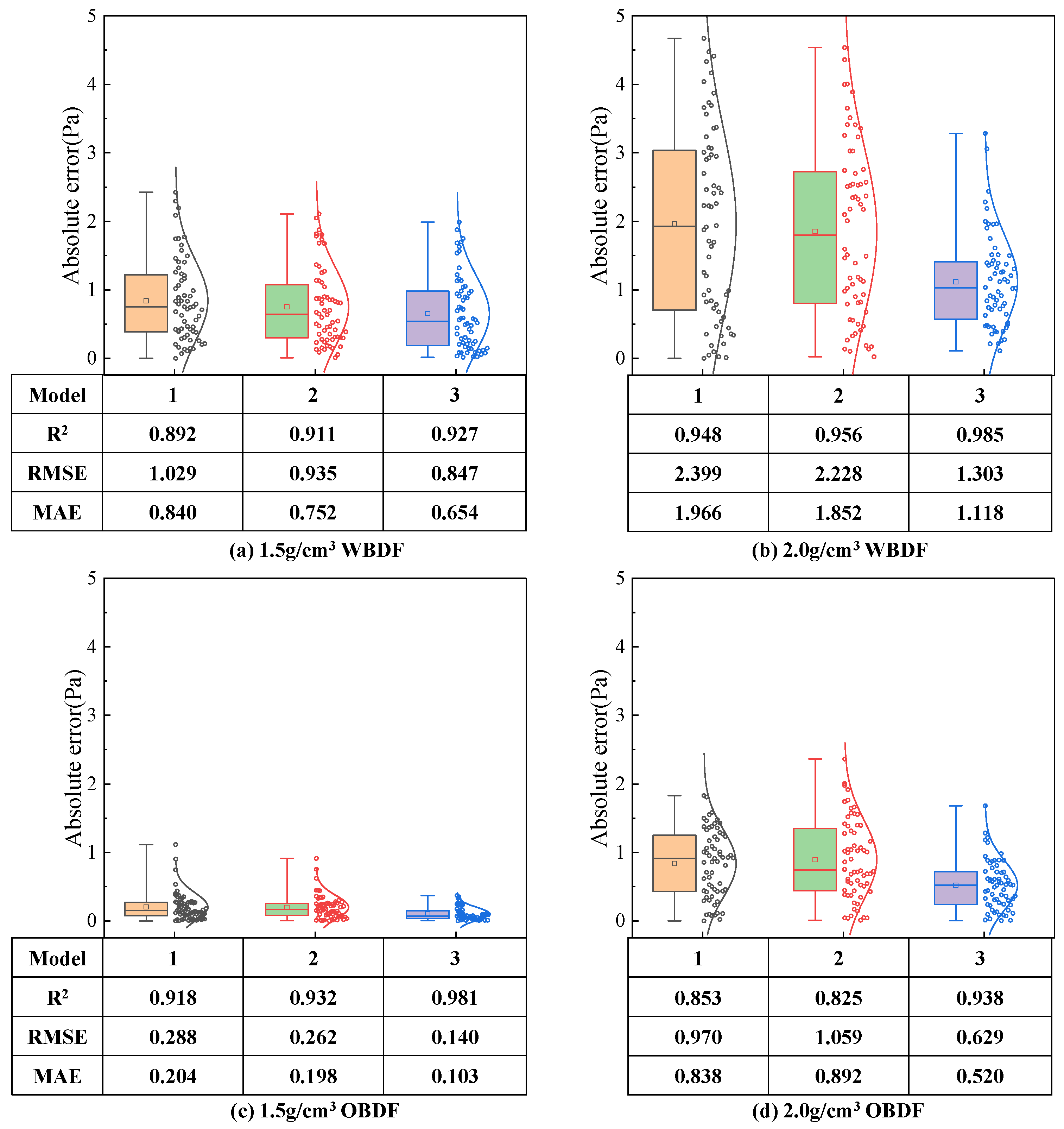
Compared to the prediction accuracy for PV and AV, the proposed model demonstrated significantly higher accuracy in predicting YP across different drilling fluid types, outperforming both Li’s model and Zhao’s model, as shown in Figure 15. Within the HTHP range (90–150 °C, 50–170 MPa), the proposed model achieved markedly better prediction performance for the YP of WBDFs. In contrast, the prediction errors of Li’s and Zhao’s models increased notably with rising temperature and pressure, with some errors approaching 30%, as illustrated in Figure 15a,b. Similarly, for OBDFs under HTHP conditions (150–200 °C, 80–200 MPa), the proposed model again outperformed Li’s and Zhao’s models in terms of YP prediction accuracy, as shown in Figure 15c,d. Furthermore, as illustrated in Figure 16, performance metrics further confirmed the superiority of the proposed model. For example, Zhao’s model yielded a determination coefficient of only 0.982 for low-density WBDFs, indicating considerable prediction error, while Li’s model performed even worse for high-density OBDFs, with an R2 of just 0.825. In contrast, the proposed model consistently delivered high prediction accuracy for YP across all types of drilling fluids, demonstrating broader applicability and greater stability than the existing models.
In summary, the proposed model demonstrates overall improved accuracy in predicting PV and AV compared to Zhao’s model and Li’s model while also exhibiting greater consistency and robustness across various drilling fluid systems. More notably, in the prediction of YP, the proposed model showed clear and consistent advantages across multiple test samples, with significantly reduced error margins and predictions more closely aligned with the experimental values. These findings collectively confirm that the newly developed rheological parameter prediction model for drilling fluids across wide temperature–pressure ranges not only offers higher predictive accuracy but also possesses broader applicability compared to existing models.

3.4. Model Complexity and Field Applicability

In addition to predictive accuracy, model complexity and field applicability are critical considerations for practical deployment in drilling operations. For each drilling fluid, only a limited number of fitting parameters need to be calibrated, which significantly reduces the computational burden associated with parameter identification and enhances the practicality of the model for field applications.
In practical implementation, model calibration can be accomplished using a limited number of rheological measurements conducted at representative temperature–pressure conditions for a given drilling fluid; these temperature–pressure points may be selected according to the downhole temperature and pressure profile at different well depths, typically involving 10–20 experimental points, rather than requiring exhaustive testing across the entire temperature–pressure range. Moreover, the model is expressed in an explicit analytical form, and no numerical iteration is involved in the prediction process. This enables the direct and efficient evaluation of rheological parameters and facilitates integration into real-time wellbore hydraulics calculation workflows.
It should be noted that the proposed model is intended for engineering applications that rely on stable point predictions of rheological parameters, such as wellbore pressure and equivalent circulating density calculations. Therefore, deterministic fitting is considered sufficient for the intended application, as uncertainty quantification is not essential for routine engineering calculations within the investigated operating conditions.

4. Model Error Sources and Future Work

This study establishes a unified predictive model for drilling fluid rheological parameters under wide temperature–pressure conditions. Although the model shows good overall predictive capability, uncertainties arising from experimental measurements and model construction remain and may affect prediction accuracy, indicating the need for further investigation and refinement.
Uncertainties in the proposed model mainly arise from experimental measurements and model formulation. Laboratory measurements of drilling fluid rheological properties under high-temperature and high-pressure conditions are subject to uncertainties related to temperature and pressure control, sensor resolution, and measurement repeatability, which may propagate into the calibration of model parameters and affect prediction accuracy. Although physics-informed constraints are incorporated during model development, the resulting analytical expressions remain approximations of complex rheological behaviors. Simplifications in model structure may therefore introduce residual modeling errors, particularly in temperature–pressure regions where rheological mechanisms undergo transitions.
Furthermore, the present study focused on a limited number of representative oil- and water-based drilling fluids. Future work extend the proposed modeling framework to a broader range of drilling fluid systems [47,48], including polymer-based and flat-rheology, to further evaluate its general applicability.

5. Conclusions

This study developed a unified predictive model for drilling fluid rheological parameters under wide temperature–pressure conditions based on extensive experimental data and symbolic regression. The proposed model demonstrated reliable applicability within the investigated drilling fluid systems, including high- and low-density oil- and water-based formulations. It maintained high prediction accuracy and stability wide temperature–pressure ranges (20–200 °C, 0.1–200 MPa). In particular, the proposed model effectively overcomes the substantial prediction errors encountered by existing models in the HTHP domain (150–200 °C, 80–200 MPa). These advancements make the model especially suitable for the rheological parameter prediction of drilling fluids in deep and ultra-deep HTHP wells. Consequently, it provides a reliable basis for accurate wellbore pressure calculations, supporting safer and more efficient drilling operations in extreme downhole environments. Beyond the investigated fluid systems and operating conditions, future work will extend the proposed modeling framework to a broader range of drilling fluid formulations and further explore its integration into engineering workflows.

Supplementary Materials

The following supporting information can be downloaded at: https://www.mdpi.com/article/10.3390/pr14020386/s1, Table S1: Rheological parameter prediction models for different drilling fluids under parameter combination 1; Table S2: Rheological parameter prediction models for different drilling fluids under parameter combination 2; Table S3: Transformed results of rheological parameter prediction models for different drilling fluids; Table S4: Characteristic parameter values of different formulas for various rheological parameters across four types of drilling fluids.

Author Contributions

Conceptualization: W.C. and H.Y.; Writing-original draft, W.C. and B.W.; Data curation: W.C.; Software: B.W.; Writing-review and editing, H.Y., J.L. and G.L.; Project adminstration: G.Z.; Funding acquisition: J.L.; Validation: G.Z.; Supervision, G.L.; Investigation: Z.S.; Visualization, H.J. All authors have read and agreed to the published version of the manuscript.

Funding

This research was financially supported by the National Natural Science Foundation of China (Grant No. 52474018), the Youth Science Foundation Program of National Natural Science Foundation of China (Grant No. 52404012), the Major Scientific Research Instrument Development Program of National Natural Science Foundation of China (Grant No. 52227804), and the Joint Foundation Program of National Natural Science Foundation of China (Grant No. U22B2072).

Data Availability Statement

The original contributions presented in this study are included in the article. Further inquiries can be directed to the corresponding author.

Conflicts of Interest

The authors declare no conflict of interest.

References

  1. Davoodi, S.; Al-Shargabi, M.; Wood, D.A.; Rukavishnikov, V.S.; Minaev, K.M. Synthetic polymers: A review of applications in drilling fluids. Pet. Sci. 2024, 21, 475–518. [Google Scholar] [CrossRef]
  2. Liu, N.; Zhang, D.; Gao, H.; Hu, Y.; Duan, L. Real-time measurement of drilling fluid rheological properties: A review. Sensors 2021, 21, 3592. [Google Scholar] [CrossRef] [PubMed]
  3. Santoyo, E.; Santoyo-Gutierrez, S.; García, A.; Espinosa, G.; Moya, S.L. Rheological property measurement of drilling fluids used in geothermal wells. Appl. Therm. Eng. 2021, 21, 283–302. [Google Scholar] [CrossRef]
  4. Shan, W.; Zheng, Y.; Wang, W.; Jiang, G.; Sun, J.; Ma, C. Study on the Impact of Drilling Fluid Rheology on Pressure Transmission Within Micro-Cracks in Hard Brittle Shale. Processes 2025, 13, 1339. [Google Scholar] [CrossRef]
  5. Wang, F.; Tan, X.; Wang, R.; Sun, M.; Wang, L.; Liu, J. High temperature and high pressure rheological properties of high-density water-based drilling fluids for deep wells. Pet. Sci. 2012, 9, 354–362. [Google Scholar] [CrossRef]
  6. Yang, L.L.; Li, B.; Chen, X.D.; Yu, L.; Jing, F.M.; Zhang, D. Experimental and numerical study of the rheological characteristics and flow law of water-based drilling fluids in high-temperature and high-pressure wellbores. J. Hydrodyn. 2024, 36, 954–967. [Google Scholar] [CrossRef]
  7. Chen, X.; Wang, S.; He, M.; Xu, M. A comprehensive prediction model of drilling wellbore temperature variation mechanism under deepwater high temperature and high pressure. Ocean Eng. 2024, 296, 117063. [Google Scholar] [CrossRef]
  8. Lei, H.; Cai, C.; Zhang, B.; Luo, J.; Chen, P.; Xiao, D. Experimental Study and Rheological Modeling of Water-Based and Oil-Based Drilling Fluids Under Extreme Temperature–Pressure Condition. Energies 2025, 18, 4687. [Google Scholar] [CrossRef]
  9. Sun, X.; Qiu, S.; Wang, J.; Wang, Z.; Sun, J.; Sun, B. Experiment and methodology for drilling fluid rheology determination under high-temperature and high-pressure conditions. Phys. Fluids 2025, 37, 043118. [Google Scholar] [CrossRef]
  10. Zhao, S.Y.; Yan, J.N.; Shu, Y.; Li, H.K.; Li, L.; Ding, T.W. Prediction model for rheological parameters of oil-based drilling fluids at high temperature and high pressure. Acta Pet. Sin. 2009, 30, 603–606. [Google Scholar] [CrossRef]
  11. Young, S.; Friedheim, J.; Lee, J.; Prebensen, O.I. A new generation of flat rheology invert drilling fluids. In Proceedings of the SPE Oil and Gas India Conference and Exhibition, Mumbai, India, 28–30 March 2012. [Google Scholar] [CrossRef]
  12. Hassiba, K.J.; Amani, M. Salinity effect on the rheological properties of water based mud under high pressures and high temperatures of deep wells. In Proceedings of the SPE Kuwait International Petroleum Conference and Exhibition, Kuwait City, Kuwait, 10–12 December 2012. [Google Scholar] [CrossRef]
  13. Stamatakis, E.; Young, S.; Stefano, G.D. Meeting the ultrahigh-temperature/ultrahigh-pressure fluid challenge. SPE Drill. Complet. 2013, 28, 86–92. [Google Scholar] [CrossRef]
  14. Kumapayi, O.; Bello, K.; Adekomaya, O.; Akintola, A.; Dala, J.; Mohammed, I.; Olafuyi, O. Investigating the effects of contaminants on the performance of mineral oil based versathin dispersant. In Proceedings of the SPE Nigeria Annual International Conference and Exhibition, Lagos, Nigeria, 5–7 August 2014. [Google Scholar] [CrossRef]
  15. Fan, H.; Zhou, H.; Meng, X.; Gao, J.; Wang, G. Accurate prediction model for rheological properties of drilling fluids at high temperature and high pressure conditions. In Proceedings of the SPE Asia Pacific Oil and Gas Conference and Exhibition, Bali, Indonesia, 20–22 October 2015. [Google Scholar] [CrossRef]
  16. Galindo, K.A.; Zha, W.; Zhou, H.; Deville, J.P. High temperature, high performance water-based drilling fluid for extreme high temperature wells. In Proceedings of the SPE International Conference on Oilfield Chemistry, The Woodlands, TX, USA, 13–15 April 2015. [Google Scholar] [CrossRef]
  17. Sairam, P.K.; Pangu, G.; Gajji, B. Innovative and modular equipment design for rheology and compatibility measurement of complex wellbore fluids. In Proceedings of the SPE/IADC Drilling Conference and Exhibition, London, UK, 17–19 March 2015. [Google Scholar] [CrossRef]
  18. Teng, X.Q.; Fan, H.H.; Yang, C.X.; Lai, M.B.; Li, J.X.; Zhou, H.B.; Wang, X.L. The research of new analysis method of rheological property under high temperature and high pressure. Sci. Technol. Eng. 2015, 15, 162–167. [Google Scholar]
  19. Xu, J. Research on Ultra-High Temperature Water-Based Drilling Fluid and Its Rheological Model. Ph.D. Thesis, China University of Geosciences, Wuhan, China, 2015. [Google Scholar]
  20. Ma, G.X. HTHP Well ECD Check and Control Technology Research. Master’s Thesis, China University of Petroleum, Beijing, China, 2016. [Google Scholar]
  21. Kakadjian, E.; Shi, A.; Porter, J.; Yadav, P.; Clapper, D.; Pessanha, W. Low impact drilling fluid for deepwater drilling frontier. In Proceedings of the OTC-Offshore Technology Conference, Rio de Janeiro, Brazil, 29–31 October 2019. [Google Scholar] [CrossRef]
  22. Zhou, H.B. A method of predicting high temperature high pressure rheological property based on viscometer readings. Drill. Fluid Complet. Fluid 2019, 36, 325–332. [Google Scholar] [CrossRef]
  23. Wagle, V.; Yami, A.; Onoriode, M.; Butcher, J. Design, qualification and field deployment of low ECD organoclay-free invert emulsion drilling fluids. In Proceedings of the SPE Russian Petroleum Technology Conference, Virtual, 26–29 October 2020. [Google Scholar] [CrossRef]
  24. Santra, A.; Patel, H.; Shanmugam, S. Next generation high performance invert emulsion drilling fluids with flat-rheological behavior. In Proceedings of the SPE International Conference on Oilfield Chemistry, The Woodlands, TX, USA, 6–7 December 2021. [Google Scholar] [CrossRef]
  25. Li, N.; Liu, H.T.; Zhang, Q.; Liu, X.Q.; Yin, B.T.; Wang, Z.Y. Model for predicting drilling fluid rheological parameters in wide temperature andpressure range. Drill. Fluid Complet. Fluid 2023, 40, 143–155. [Google Scholar] [CrossRef]
  26. Abdullah, A.H.; Ridha, S.; Mohshim, D.F.; Maoinser, M.A. An experimental investigation into the rheological behavior and filtration loss properties of water-based drilling fluid enhanced with a polyethyleneimine-grafted graphene oxide nanocomposite. RSC Adv. 2024, 14, 10431–10444. [Google Scholar] [CrossRef]
  27. Politte, M.D. Invert oil mud rheology as a function of temperature and pressure. In Proceedings of the SPE/IADC Drilling Conference and Exhibition, New Orleans, LA, USA, 5–8 March 1985. [Google Scholar] [CrossRef]
  28. Fisk, J.V.; Jamison, D.E. Physical properties of drilling fluids at high temperatures and pressures. SPE Drill. Eng. 1989, 4, 341–346. [Google Scholar] [CrossRef]
  29. Okumo, I.; Isehunwa, S.O. Prediction of the viscosity of a water-base mud treated with cassava starch and potash at varying temperatures using factorial design. In Proceedings of the SPE Nigeria Annual International Conference and Exhibition, Abuja, Nigeria, 6–8 August 2007. [Google Scholar] [CrossRef]
  30. Ibeh, C.S. Investigation on the Effects of Ultra-High Pressure and Temperature on the Rheological Properties of Oil-Based Drilling Fluids. Master’s Thesis, Office of Graduate Studies of Texas A&M University, College Station, TX, USA, 2007. [Google Scholar]
  31. Teixeira Oliveira, R.C. Long-Range Description of Rheological Properties of a High-Pressure High-Temperature Oil-Based Drilling Fluid. Master’s Thesis, Texas A&M University, College Station, TX, USA, 2016. [Google Scholar]
  32. Igwilo, K.C.; Godspower, I.; Nnanna, O.; Osueke, G.O.; Jude, O.; Pal, A. Modeling the effects of temperature on oil base mud viscosity using polynomial equation. ARC J. 2017, 3, 16–22. [Google Scholar] [CrossRef]
  33. Tchameni, A.P.; Zhao, L.; Ribeiro, J.X.; Li, T. Predicting the rheological properties of waste vegetable oil biodiesel-modified water-based mud using artificial neural network. Geosyst. Eng. 2019, 22, 101–111. [Google Scholar] [CrossRef]
  34. Chen, B.; Li, C.; Zhang, C.J.; Huang, Y.; Liu, G.; Yan, D.; Xu, M.B. High temperature high pressure rheological property of synthetic-based mud. Sci. Technol. Eng. 2022, 22, 1408–1415. [Google Scholar]
  35. Bu, H.; Sun, J.; Wang, C.; Bu, P. Rheological properties of polymer-gel drilling fluids at high temperature and pressure. Chem. Technol. Fuels Oils 2013, 48, 449–458. [Google Scholar] [CrossRef]
  36. Oriji, A.B.; Dosunmu, A. Design and application of drilling fluids for HPHT well—A case study of mafia field. In Proceedings of the North Africa Technical Conference and Exhibition, Cairo, Egypt, 20–22 February 2012. [Google Scholar] [CrossRef]
  37. Makke, N.; Chawla, S. Interpretable scientific discovery with symbolic regression: A review. Artif. Intell. Rev. 2024, 57, 2. [Google Scholar] [CrossRef]
  38. Ouyang, J.; Jiang, Z.; Yang, H.; Li, J.; Cao, P. Prediction model of asphalt emulsion evaporation rate based on CFD simulation and genetic programming-based symbolic regression. Constr. Build. Mater. 2024, 416, 135021. [Google Scholar] [CrossRef]
  39. Angelis, D.; Sofos, F.; Karakasidis, T.E. Artificial intelligence in physical sciences: Symbolic regression trends and perspectives. Arch. Comput. Methods Eng. 2023, 30, 3845–3865. [Google Scholar] [CrossRef] [PubMed]
  40. Hochreiter, S.; Schmidhuber, J. Long short-term memory. Neural Comput. 1997, 9, 1735–1780. [Google Scholar] [CrossRef]
  41. Leung, H.; Haykin, S. The complex backpropagation algorithm. IEEE Trans. Signal Process. 1991, 39, 2101–2104. [Google Scholar] [CrossRef]
  42. Oshea, K.; Nash, R. An introduction to convolutional neural networks. arXiv 2015, arXiv:1511.08458. [Google Scholar] [CrossRef]
  43. Breiman, L. Random forests. Mach. Learn. 2001, 45, 5–32. [Google Scholar] [CrossRef]
  44. Lambora, A.; Gupta, K.; Chopra, K. Genetic algorithm—A literature review. In Proceedings of the 2019 International Conference on Machine Learning, Big Data, Cloud and Parallel Computing, Haryana, India, 14–16 February 2019; pp. 380–384. [Google Scholar] [CrossRef]
  45. Azad, R.M.A.; Ryan, C. A simple approach to lifetime learning in genetic programming-based symbolic regression. Evol. Comput. 2014, 22, 287–317. [Google Scholar] [CrossRef]
  46. Schmidt, M.; Lipson, H. Distilling free-form natural laws from experimental data. Science 2009, 324, 81–85. [Google Scholar] [CrossRef]
  47. Chen, W.; Tang, X.; Wang, L.; Ma, H.; Chen, A.; Zhang, J.; Huang, W.; Zhuang, G.; Zhong, H.; Zhang, X. A Novel Thermo-Thickening Oil-Based Drilling Fluid Based on Composite Thickener Under High Temperature and Pressure. Energies 2025, 18, 6606. [Google Scholar] [CrossRef]
  48. Bin Irfan, M.W.; Busahmin, B. Rheological Characterization and Shale Inhibition Potential of Single- and Dual-Nanomaterial-Based Drilling Fluids for High-Pressure High-Temperature Wells. Processes 2025, 13, 1957. [Google Scholar] [CrossRef]
Figure 1. Fann iX77 HTHP rheometer.
Processes 14 00386 g001
Figure 2. High-speed mixer.
Processes 14 00386 g002
Figure 3. Experimental testing process.
Processes 14 00386 g003
Figure 4. Schematic diagram of population evolution.
Processes 14 00386 g004
Figure 5. Construction process of the drilling fluid rheological parameter prediction model.
Processes 14 00386 g005
Figure 6. Calculated MIC among rheological parameters for different types of drilling fluids.
Processes 14 00386 g006
Figure 7. Comparative analysis of model accuracy under two parameter combinations.
Processes 14 00386 g007
Figure 8. Comparative analysis of model complexity loss under two parameter combinations.
Processes 14 00386 g008
Figure 9. The comparison results of prediction accuracy among different formulas on four types of drilling fluids.
Processes 14 00386 g009
Figure 10. The average coefficient of determination of different formulas for three rheological parameters in four types of drilling fluids.
Processes 14 00386 g010
Figure 11. The comparison of PV prediction results for four types of drilling fluids using different methods.
Processes 14 00386 g011
Figure 12. The comparison of PV prediction errors for four types of drilling fluids using different methods.
Processes 14 00386 g012
Figure 13. The comparison of AV prediction results for four types of drilling fluids using different methods.
Processes 14 00386 g013
Figure 14. The comparison of AV prediction errors for four types of drilling fluids using different methods.
Processes 14 00386 g014
Figure 15. The comparison of YP prediction results for four types of drilling fluids using different methods.
Processes 14 00386 g015
Figure 16. The comparison of YP prediction errors for four types of drilling fluids using different methods.
Processes 14 00386 g016
Table 1. Summary of existing experimental studies on drilling fluid rheological properties.
AuthorDrilling Fluid TypeDensity (g/cm3)NumberTemperature (°C)Pressure (MPa)
Zhao et al. [10]WBDF1.72590~240100.00
Young et al. [11]WBDF1.68244~6510.34~51.71
Hassiba and Amani [12]WBDF1.50820~2320~241.39
Stamatakis et al. [13]OBDF2.281065~3150~275.79
Kumapayi et al. [14]OBDF1.561648~823.40
Fan et al. [15]OBDF2.04/2.554820~1800~8.00
Galindo et al. [16]WBDF1.68648~20413.79
Sairam et al. [17]OBDF1.56424~1486.89~68.95
Teng et al. [18]OBDF2.503020~1801.00~8.00
Xu [19]WBDF1.251360~2006.00
Ma [20]OBDF2.041620~1806.00~8.00
Kakadjian et al. [21]OBDF1.44114~1210.10~137.90
Zhou [22]OBDF1.504820~1800~6.00
Wagle et al. [23]OBDF1.52965~16613.47~64.11
Santra et al. [24]OBDF1.602165~23268.95
Li et al. [25]OBDF/WBDF2.00/1.8315/1260~140/23~18020~100/34.47~131
Table 2. PV prediction model of drilling fluid.
AuthorDrilling Fluid TypeTemperature (°C)Pressure (MPa)Model
Politte [27]OBDF24~1486.89~103.42 μ p = P T P C 2 10 A 2 + B 2 T + D 2 T P + E 2 P + F 2 ρ + G 2 / ρ
Fisk and Jamison [28]OBDF23.9~204.40.1~103.42 μ p = C 1 μ p 0 exp M 1 P + M 2 T z
Okumo and Isehunwa [29]WBDF26.5~80Not considered μ p = 8.094 + 4.156 X 1 + 2.219 X 2 1.469 X 3 + 1.906 X 1 X 2 0.656 X 1 X 3 0.469 X 2 X 3 0.281 X 1 X 2 X 3 + 0.364
Ibeh [30]OBDF148~26068.95~206.84 μ p = 9.10748 + 0.24998 P 0.5 + 6.54 × 10 20 T 8 + 1.479906 P 2 T 3
Zhao et al. [10]OBDF23.9~204.40.1~103.42 μ p = μ p 0 exp A T T 0 + B P P 0 + C T T 0 P P 0 + D T T 0 2
Oliveira [31]OBDF93.3~232.234.5~275.8 μ p = 21609 + 386.70 P 0.037119 + 0.00067988 P 1.9646 T 1.4514 + 16344 T 0.037333 + 3.5032 P 0.68612 γ 1.2339 + 8355.5 γ 0.08160 + 47.852 T 0.37947 γ 0.16185
Igwilo et al. [32]OBDF26.7~82.2Not considered μ p = 0.0005 T 2 0.617 T + 131.06
Tchameni et al. [33]WBDF28~180Not considered μ p = 0.3049 + 0.38511 T 0.2926 B 0.0014451 T 5 0.066311 T B + 0.62061 B 2 + 0.00014671 T 2 B + 0.003081 T B 2 + 0.051231 B 3
Chen et al. [34]OBDF60~15013.8~82.7 μ p = 11.31 exp 6.46 × 10 5 P + 77.35 T
Li et al. [25]OBDF60~14020~100 μ p = exp A ln μ p 0 + B T T 0 + C P P 0 + D T T 0 P P 0 + E T T 0 P P 0 T × T 0 + F T T 0 2 T × T 0
Table 3. AV prediction model of drilling fluid.
AuthorDrilling Fluid TypeTemperature (°C)Pressure (MPa)Model
Zhao et al. [10]OBDF23.9~204.40.1~103.42 μ A = μ A 0 exp A T T 0 + B P P 0 + C T T 0 P P 0 + D T T 0 2
Bu et al. [35]WBDF90~2405~120 μ A = μ A 0 exp A T + B P
Tchameni et al. [33]WBDF28~180Not considered μ A = 33.4 0.13151 T 0.38161 B + 0.0043221 T 2 0.0853 T B + 0.90211 B 2 1.79781 T 3 + 0.00024641 T 2 B + 0.0028621 T B 2 0.069141 B 3
Li et al. [25]OBDF60~14020~100 μ A = exp A ln μ A 0 + B T T 0 + C P P 0 + D T T 0 P P 0 + E T T 0 P P 0 T × T 0 + F T T 0 2 T × T 0
Table 4. YP prediction model of drilling fluid.
AuthorDrilling Fluid TypeTemperature (°C)Pressure (MPa)Model
Politte [27] OBDF32.2~148.9Not considered τ = τ s 0.186 + 145.054 T 1 3410.322 T 2 0.186 + 145.054 T s 1 3410.322 T s 2
Zhao et al. [10]OBDF23.9~204.40.1~103.42 τ = τ 0 exp A T T 0 + B P P 0 + C T T 0 P P 0 + D T T 0 2
Oriji and Dosunmu [36]WBM121.1~26034.5~68.9 τ = B 0 B 1 e p / 1000 + B 2 e T / 1000 B 3 P 2 T 3
Oliveira [31]OBDF93.3~232.234.5~275.8 τ = 39.579 0.49262 P 2.3659 T 3.9311 + log P 10.398 + log 1 T 21.831
Igwilo [32]OBDF26.7~82.2Not considered τ = 0.0001 T 2 0.1521 T + 28.303
Tchameni et al. [33]WBDF28~180Not considered τ = 20.38 + 0.077991 T + 161 B 0.0005381 T 2 0.017181 T B 0.231 B 2 + 0.0001041 T 2 B 0.00053011 T B 2 + 0.018521 B 3
Li et al. [25]OBDF60~14020~100 τ = exp A ln τ 0 + B T T 0 + C P P 0 + D T T 0 P P 0 + E T T 0 P P 0 T × T 0 + F T T 0 2 T × T 0
Table 5. The complexity coefficient of a particular operation.
OperatorComplexity CoefficientOperatorComplexity Coefficient
Constant1Multiplication1
Input variable1Division2
Addition1Exponential function4
Subtraction1Power function5
Table 6. Basic statistical characteristics of rheological parameters for four drilling fluids.
Drilling Fluid Type PV   ( mPa · s) AV   ( mPa · s)YP (Pa)Sample Size
Maximum ValueMinimum ValueAverage ValueMaximum ValueMinimum ValueAverage ValueMaximum ValueMinimum ValueAverage Value
1.5 g/cm3 WBDF32.389.2215.9155.1118.6526.0122.025.669.7564
2.0 g/cm3 WBDF84.1117.3538.74138.2129.2562.7352.2511.5223.1464
1.5 g/cm3 OBDF35.4116.4623.6740.8816.8625.354.700.041.2164
2.0 g/cm3 OBDF207.1423.3858.48220.7723.9864.259.450.094.4864
Disclaimer/Publisher’s Note: The statements, opinions and data contained in all publications are solely those of the individual author(s) and contributor(s) and not of MDPI and/or the editor(s). MDPI and/or the editor(s) disclaim responsibility for any injury to people or property resulting from any ideas, methods, instructions or products referred to in the content.