Review

Therapeutic Potentials and Encapsulation Strategies of Essential Oils

School of Environmental, Civil, Agricultural and Mechanical Engineering, University of Georgia, Athens, GA 30602, USA
*
Author to whom correspondence should be addressed.
Processes 2026, 14(2), 335; https://doi.org/10.3390/pr14020335
Submission received: 15 November 2025 / Revised: 12 January 2026 / Accepted: 14 January 2026 / Published: 17 January 2026

Abstract

Essential oils (EOs) are volatile, strongly aromatic bioactive substances extracted from plants, primarily composed of terpenes, terpenoids, phenylpropanoids, and other oxygenated compounds. Owing to their unique chemical structures, EOs exhibit a wide range of biological activities, including antimicrobial, anti-inflammatory, antioxidant, anticancer, neuroprotective, bone-protective, wound-healing, and gut microbiota-modulating effects, highlighting their potential therapeutic value. However, the composition and bioactivity of EOs are influenced by multiple factors and often compromised by improper storage conditions such as temperature and light exposure, leading to the gradual loss of their functional properties. To overcome these limitations, encapsulation technologies have been employed to enhance EO stability, enable sustained and targeted release, and preserve or even improve their bioactive functions. This review summarizes the major constituents of EOs, their physiological activities, therapeutic value, and mechanisms of action. It also discusses their limitations and suitable encapsulation technologies, materials, and carrier systems for stabilization and delivery.

1. Introduction

In recent years, global market demand for natural therapeutics, botanical extracts, and plant-derived antimicrobials has grown rapidly, driven by consumer interest in “clean-label,” sustainable, and minimally processed products [1]. The essential oils (EOs) market is projected to continue expanding across the pharmaceutical, wellness, and functional food sectors, further highlighting their potential as natural bioactive agents. EOs are volatile, oily liquids with strong aromas, produced through the secondary metabolism of aromatic plants. These plants are typically found in temperate to warm regions, such as the Mediterranean and tropical areas. EOs are distributed throughout nearly all parts of a plant and can be extracted from roots, leaves, seeds, fruit peels, bark, wood, resins, and entire aerial or whole-plant tissues [2]. In nature, essential oils serve not only as “defensive weapons” against pathogens and herbivores but also as volatile signals that attract pollinators and regulate plant–plant and plant–insect interactions [3].
Owing to their diverse physiological functions, EOs have attracted considerable attention in the fields of food, cosmetics, and medicine. The use of EOs dates back thousands of years, with a long-standing history in therapeutic and medicinal applications. Historical records suggest that EOs were already traded as “odoriferous oils” during ancient Greek and Roman times. One of the earliest documented descriptions of EO distillation is attributed to Arnold de Villanova (1235–1311), a Catalan physician, who advocated the medicinal benefits of distilled aromatic waters in his writings [4]. By the 17th and 18th centuries, EO distillation techniques had undergone notable improvement, and in the 19th century, the chemical and biological properties of EOs and aromatic compounds became the subject of systematic scientific investigation. To date, over 3000 essential oils have been identified, with approximately 300 possessing significant commercial value. Advances in techniques such as gas chromatography have enabled detailed characterization of EO composition, improving our understanding of their physiological functions and mechanisms of action, especially their antimicrobial, antioxidant, anti-inflammatory, anticancer, and cardiovascular benefits. These developments have further enhanced the medicinal relevance and therapeutic potential of EOs. In parallel with the expanding use of EOs, regulatory frameworks have also been established to ensure the safety and quality of EO-based products. Agencies such as the U.S. Food and Drug Administration (FDA), European Food Safety Authority (EFSA), and European Medicines Agency (EMA) have developed guidelines governing safety, purity, permissible dosage, and labeling, underscoring the need for scientific validation and standardized quality control.
The extraction efficiency, chemical composition, physiological activity, and functionality of EOs vary depending on the characteristics of the plant, the extraction method, and environmental conditions. Different extraction techniques and extraction times can lead to varying degrees of impact on EO composition, including residual organic solvents, loss of volatile compounds, and the hydrolysis, rearrangement, or oxidation of certain constituents [5]. In addition, environmental factors such as precipitation, temperature, soil, and wind speed, as well as the harvest season of raw materials, can significantly influence EO yield [5,6].
Essential oils also encounter several formulation and application challenges due to their intrinsic instability, physicochemical limitations, and potential safety concerns such as skin irritability and other adverse effects. The practical use of EOs is limited by their high volatility and sensitivity to environmental factors such as light, heat, and oxygen. Additionally, their strong aroma may negatively impact the sensory qualities of food products, and their poor water solubility restricts their applicability in aqueous systems. Encapsulation has emerged as an effective strategy to overcome these limitations, providing protection against degradation, preserving biological activity, extending shelf life, and minimizing unwanted interactions in food and pharmaceutical formulations.
Although many articles have reviewed the physiological functions of essential oils or their encapsulation methods, several limitations remain [7,8]. Most existing reviews focus either on specific therapeutic effects or individual encapsulation methods, but few providing an integrated perspective that links EO bioactivity, molecular mechanisms, safety considerations, and modern delivery technologies. Moreover, limited attention has been given to translational aspects such as pharmacokinetics, stability, dosage optimization, and the safety evaluation of nanoencapsulated EO systems. Addressing these gaps is essential to advancing the application of EOs in both clinical and industrial settings.
This review provides a comprehensive overview of the chemical composition of EOs and highlights the biological activities of both whole EOs and their major constituents. It further discusses the therapeutic potential of EOs in medical applications such as antimicrobial, antioxidant, anti-inflammatory, anticancer, neuroprotective, bone health, wound healing, and gut microbiota modulation. This review also summarizes commonly used encapsulation materials, carrier systems, and techniques, emphasizing their roles in preserving EO activity, improving encapsulation performance, and enabling targeted applications.

2. Chemical Composition of EOs

The metabolites present in EOs mainly include terpenes, terpenoids, phenylpropanoids, and other oxygenated compounds [9]. Their specific composition varies depending on the plant species, geographical origin, harvest season, and extraction method. Within plant cells, such as osmophores, glandular trichomes, ducts, and secretory cavities, EOs are biosynthesized, accumulated, and released into the atmosphere through distinct secretion mechanisms [10].

2.1. Terpenes and Terpenoids

Around 1866, the term “terpene” was first introduced in a textbook by Kekulé (1829–1896) [4]. Terpenes and their oxidized derivatives, known as terpenoids, are abundantly found in higher plants such as citrus species, conifers, eucalyptus, and widely distributed across leaves, flowers, stems, and roots. They represent the largest class of natural products in the plant kingdom [9]. These compounds are composed of isoprene units and are typically classified into hemiterpenes (C5), monoterpenes (C10), sesquiterpenes (C15), diterpenes (C20), triterpenes (C30), and tetraterpenes (C40).
In plants, terpenes are primarily synthesized through two parallel yet complementary biosynthetic pathways: the mevalonate (MVA) and the methylerythritol phosphate (MEP) pathways, which operate in different cellular compartments. The plastid-localized MEP pathway produces isopentenyl diphosphate (IPP) and dimethylallyl diphosphate (DMAPP) as building blocks for monoterpene biosynthesis, while the cytosolic mevalonate (MVA) pathway generates the same precursors primarily for sesquiterpene synthesis. Both pathways yield prenyl diphosphates, such as geranyl diphosphate (GPP) and farnesyl diphosphate (FPP), which are subsequently converted by terpene synthases into a wide range of structurally diverse terpene compounds [11,12]. Terpenoids, in contrast, are oxygenated derivatives of terpenes containing functional groups such as alcohols, aldehydes, ketones, esters, and epoxides. They are typically formed through enzymatic modifications of terpene skeletons, mediated by cytochrome P450 monooxygenases (CYP450), dioxygenases, and dehydrogenases [13]. For instance, in the Lamiaceae family, thymol and carvacrol are biosynthesized via unstable intermediates through the catalytic action of CYP450s and dehydrogenases [14]. Similarly, limonene hydroxylases expressed in Mentha × piperita, M. spicata, and Perilla frutescens hydroxylate limonene to produce perillyl alcohol, carvone, and perillaldehyde, respectively [15].
In addition to their well-established antimicrobial, insecticidal, antioxidant, anti-inflammatory, antitumor, and anticancer properties, terpenes and terpenoids also exhibit anti-UV, bone-protective, neuroprotective, and anti-metabolic disorder activities [16,17,18,19,20,21]. For instance, limonene has been shown to inhibit UVB-induced α-MSH secretion, thereby preventing photoaging by suppressing p53-mediated transcriptional activation of proopiomelanocortin (POMC) [22]. α-Pinene promotes osteoblast differentiation and attenuates TNF-α-induced inhibition of Smad1/5/9 phosphorylation and extracellular matrix mineralization [23]. Treatment with myrcene has been reported to restore dopaminergic neuronal loss in rotenone-induced Parkinson’s disease (PD) rodent models by enhancing mTOR phosphorylation, restoring neuronal homeostasis and autophagy–lysosomal degradation, and preventing α-synuclein accumulation in recovered neurons [24]. Moreover, geraniol promotes the browning of white adipose tissue and ameliorates high-fat-diet-induced obesity by downregulating HMG-CoA reductase [25].

2.2. Phenylpropanoids

Phenylpropanoids are a class of aromatic metabolites found in plants, characterized by a basic molecular structure consisting of a six-carbon aromatic phenyl ring and a three-carbon propene side chain. The aromatic ring may contain methoxy, methylenedioxy, or hydroxyl groups, while the side chain can carry carboxyl or hydroxyl functionalities [26]. Phenylpropanoids are mainly synthesized via the shikimate pathway. Phenylalanine ammonia-lyase (PAL) catalyzes the deamination of phenylalanine to form cinnamic acid, which is then hydroxylated by cinnamate 4-hydroxylase (C4H) to produce the more polar p-coumaric acid. Through a series of enzymatic reactions, various structurally diverse phenylpropanoids are subsequently formed [27]. Common phenylpropanoids found in EOs include eugenol, cinnamaldehyde, methyl eugenol, myristicin, and coumarin [28]. While many exhibit valuable pharmacological properties and are used in medicine, some compounds, such as methyl eugenol, have raised safety concerns related to potential carcinogenic effects. Their potential applications include the alleviation of chronic conditions, promotion of wound healing and antibacterial action, anesthesia and analgesia, and neuroprotection of diseases [29,30,31].

2.3. Other Oxygenated Compounds

EOs also contain certain non-terpene and non-phenylpropanoid constituents, primarily aliphatic compounds. Examples include 1-octen-3-ol, an aliphatic alcohol derived from mushrooms, and the aldehydes decanal and nonanal, which are commonly found in citrus peels. These compounds are typically biosynthesized through fatty acid metabolism, methylation or esterification of aromatic acids, and redox reactions involving aldehydes and alcohols. Their major physiological functions include contributions to aroma, antimicrobial activity, and attracting insects or mosquitoes [32,33,34].

2.4. Factors Influencing the Chemical Composition of EOs

The composition of EOs is significantly influenced by the characteristics of the plant itself. Factors such as plant species, age, nutritional status, and the specific plant part used for extraction can all impact EO composition. For example, in Origanum compactum Benth, a species endemic to Morocco, the relative abundance of p-cymene, γ-terpinene, thymol, and carvacrol varied significantly across three distinct growth stages [35]. Environmental conditions are also key determinants of EO composition. A GC-MS analysis of lemongrass (Cymbopogon citratus) EOs extracted in four different seasons revealed that spring leaves contained the highest amount of citral (81.89%), while those extracted in autumn showed the lowest citral content at approximately 73.48% [16]. The chemical profile of EOs is also dependent on the extraction technique employed. To date, various extraction techniques have been developed [2]. Conventional methods such as steam distillation and solvent extraction are widely used, but they often lead to hydrolysis or volatilization of heat-sensitive compounds, low extraction efficiency, and the presence of toxic solvent residues [36]. To address these limitations, numerous extraction technologies have been developed, such as supercritical fluid extraction, pressurized liquid extraction, pressurized hot water extraction, membrane-assisted solvent extraction, solid-phase microextraction, microwave-assisted extraction, and ultrasound-assisted extraction. These emerging approaches aim to enhance extraction yield, reduce the use of harmful solvents, and preserve the bioactive constituents responsible for the physiological functions of EOs. In addition, the chemical composition of EOs is also affected by the storage conditions of plant materials and analytical parameters applied during compound identification [5].

3. Therapeutic Potentials of EOs

The active constituents of EOs, through their unique chemical structures, confer distinct biological activities and support their therapeutic potential. In addition to the well-established antimicrobial, antioxidant, anti-inflammatory, anti-cancer, and wound healing effects, recent studies have identified several emerging biological activities of essential oils. These newly recognized functional dimensions include neuroprotective effects, potential roles in bone health regulation, and modulation of host–microbe interactions, which have received limited systematic integration in previous essential oil reviews, particularly from a mechanism-oriented perspective. Importantly, these emerging biological activities are increasingly linked to recent clinical applications of essential oils, such as inhalation-based interventions for neurological and emotional disorders and oral administration for gastrointestinal conditions, thereby highlighting their translational relevance.
While these therapeutic effects are discussed in a functional and disease-oriented manner throughout this section, it is important to note that the health-modulating activities of essential oils are not driven by isolated compounds alone. Instead, these effects arise from dominant chemical classes and their associated functional groups. These structural features govern how essential oil constituents interact with biological membranes, enzymes, receptors, and major signaling pathways. In particular, oxygenated terpenoids and phenylpropanoids are frequently responsible for the broad-spectrum antimicrobial, anti-inflammatory, and neuromodulatory activities described in this section. By contrast, terpene hydrocarbons often play indirect roles by enhancing membrane permeability or acting synergistically with more active [37,38]. Together, this chemical class-based perspective provides a unified mechanistic framework for understanding how essential oil composition gives rise to diverse therapeutic and translational potentials.

3.1. Antimicrobial Activity

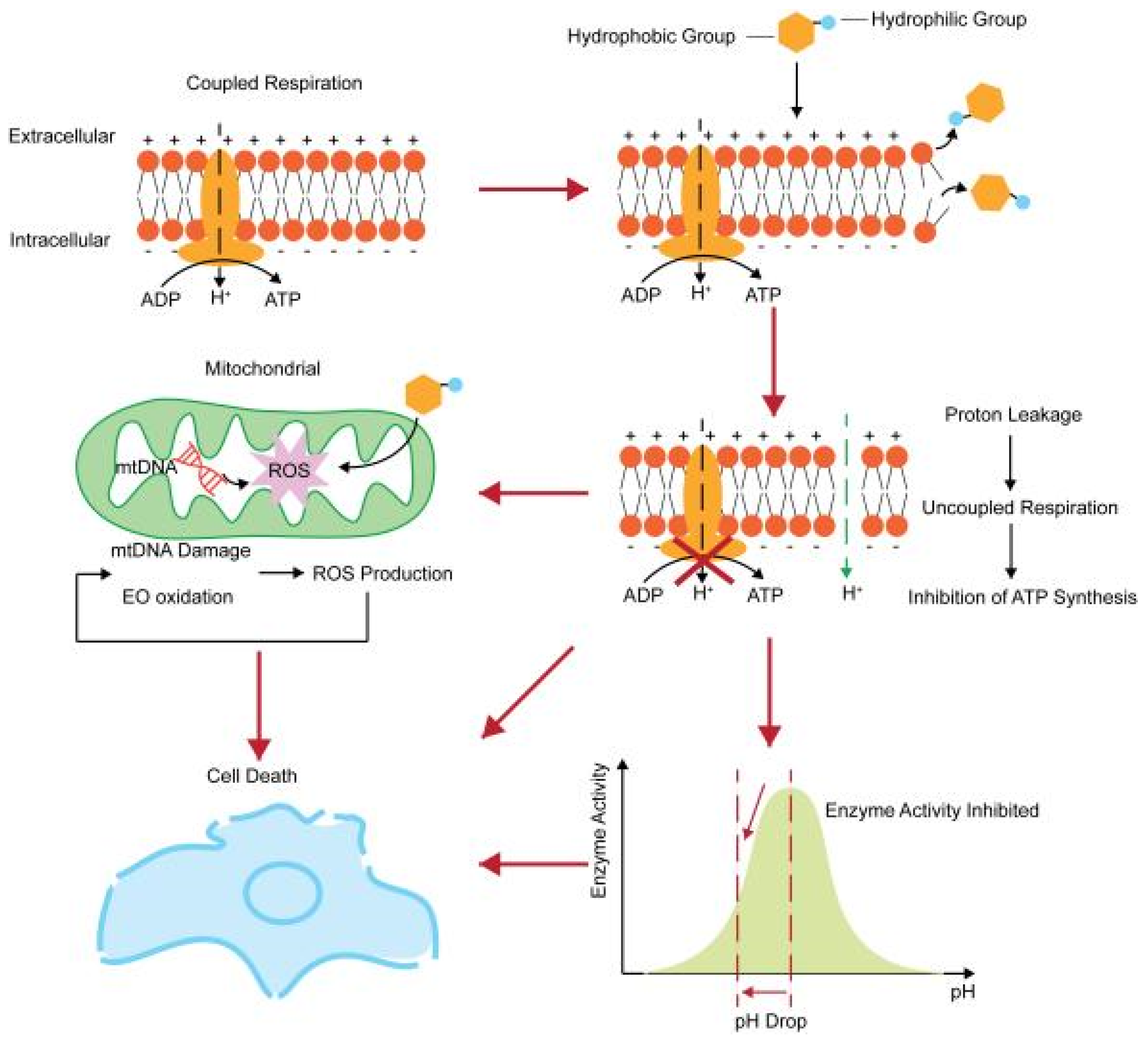
Extensive research has demonstrated the antimicrobial activity of EOs. The major constituents of EOs, such as terpenes, terpenoids, phenylpropanoids, and other compounds, have all been reported to exert notable antimicrobial effects. Due to their hydrophobic nature, these compounds can insert into the phospholipid bilayer of bacterial membranes, disrupting the membrane structure by weakening van der Waals interactions between phospholipids, which leads to increased membrane permeability and loss of integrity. EO components containing hydroxyl (-OH) groups, such as eugenol, a major compound in clove oil, exhibit enhanced membrane-disruptive properties. Their hydrophobic aromatic rings insert into the lipid bilayer’s hydrophobic core, while their -OH groups can form hydrogen bonds with phospholipid headgroups or surface water molecules. This dual interaction amplifies the destabilization of the membrane structure [39]. After incorporation into the membrane, these hydrophobic compounds can cause proton leakage, disrupting the electrochemical potential across the membrane. As a result, bacterial cells increase their respiration rate to restore the proton motive force. However, this uncoupling prevents ATP synthesis, ultimately leading to energy depletion and cell death. The disruption of membrane integrity may also inhibit intracellular enzymes involved in energy metabolism [40]. In a similar manner, hydrophobic compounds can also damage the mitochondrial membrane, where mitochondrial DNA (mtDNA) damage impairs the expression of electron transport chain proteins, leading to excessive accumulation of reactive oxygen species (ROS). Moreover, phenolic EO components may undergo oxidation upon contact with ROS, producing highly reactive phenoxyl radicals, which further amplify ROS generation by damaged mitochondria [41]. In addition to cytotoxicity, a few EOs have also demonstrated genotoxic potential. For example, Artemisia dracunculus L. EOs have been shown to cause DNA damage, primarily due to the presence of estragole [42] (Figure 1).
With their potent antimicrobial activity, EOs combined with appropriate encapsulation technologies have promising applications in wound care, oral hygiene, dermatology, respiratory infection support, and alternative approaches to multidrug-resistant (MDR) bacteria [2]. Dressings incorporating EOs with metallic or metal oxide nanoparticles and chitosan polymers have demonstrated excellent broad-spectrum antibacterial activity [43]. Studies have shown that EO-based irrigants and formulations exhibit strong antibacterial potential against Enterococcus faecalis—a key pathogen in root canal infections, and are effective in disrupting endodontic biofilms [44]. Essential oils such as garlic oil and cedarwood oil have been used to treat skin infections caused by bacteria, fungi, or viruses [45]. Tea tree oil and eucalyptus oil aerosols exhibit strong antiviral effects, inactivating influenza A virus, Escherichia coli, and bacteriophage M13 by more than 95% within 5~15 min of exposure [46]. Sprays and capsule formulations containing these EOs showed moderate effectiveness in relieving symptoms associated with respiratory infections in clinical trials [47,48]. Moreover, clove oil and oregano oil exhibited outstanding antimicrobial potential against multidrug-resistant (MDR) microorganisms, offering a viable alternative to combat the overuse of conventional antibiotics [49].

3.2. Antioxidant Activity

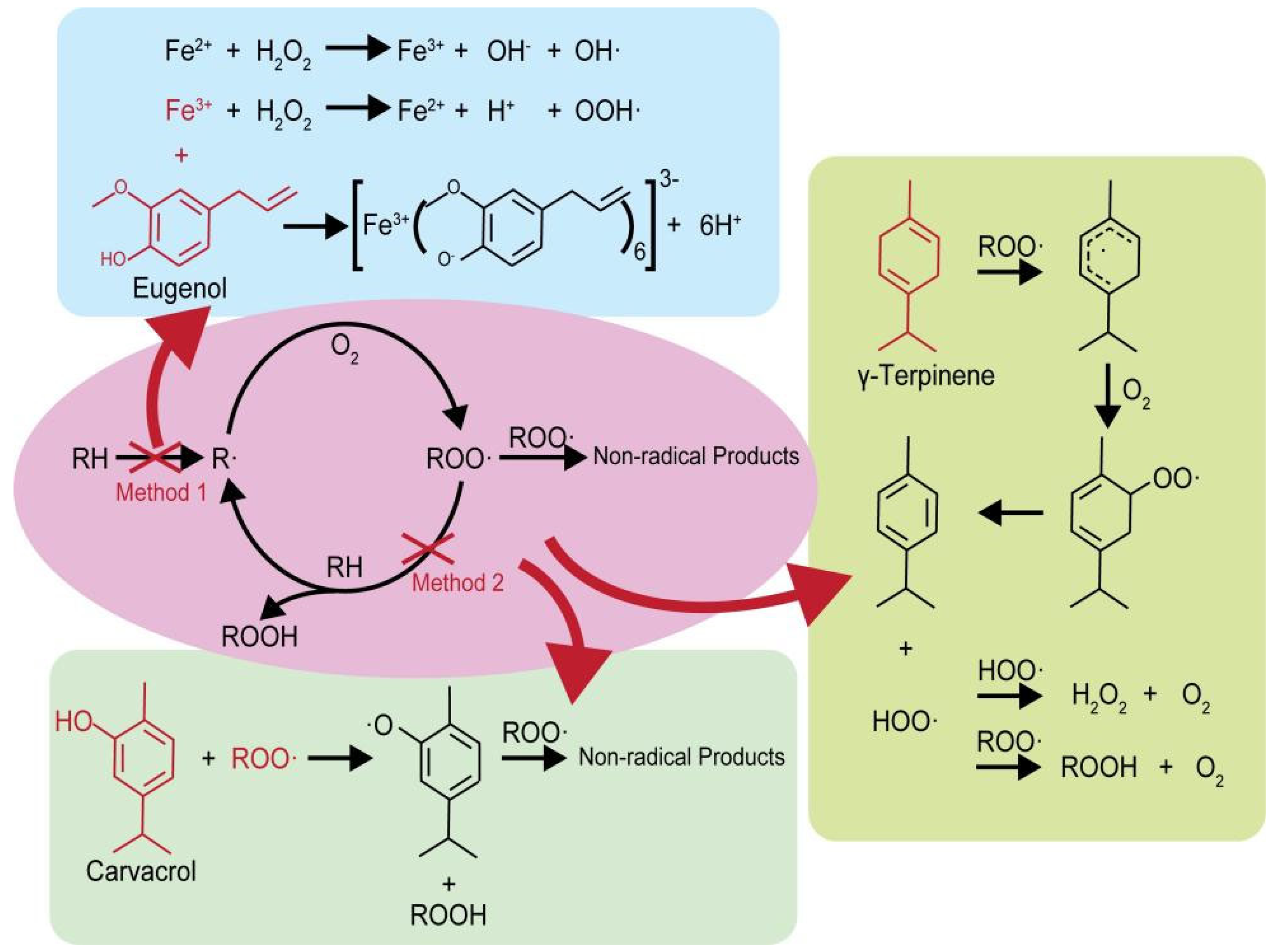
Lipids, proteins, and carbohydrates are all prone to oxidation. Free radicals can react with hydrocarbons to generate alkyl radicals, which subsequently form peroxyl radicals in the presence of oxygen. These peroxyl radicals continue to attack other hydrocarbons, producing new alkyl radicals and perpetuating a chain reaction. The process only terminates when two peroxyl radicals undergo mutual annihilation. Antioxidants inhibit oxidation by interfering with this chain reaction (Figure 2). Phenolic compounds in EOs, such as carvacrol [50], can donate hydrogen atoms to neutralize free radicals in the chain reaction. The resulting phenoxyl radicals formed from phenolics can rapidly terminate through mutual annihilation, thereby halting the propagation of the chain reaction [51]. Some EOs, such as eugenol, can also chelate transition metal ions like Fe2+ and Cu2+, inhibiting Fenton reactions and thus reducing the formation of highly reactive hydroxyl radicals (•OH) [51]. In addition, compounds such as γ-terpinene, although prolonging the oxidation chain, exhibit much higher rates of peroxyl radical decay compared to other hydrocarbons, allowing for rapid chain termination. These compounds are referred to as termination-enhancing antioxidants [50].
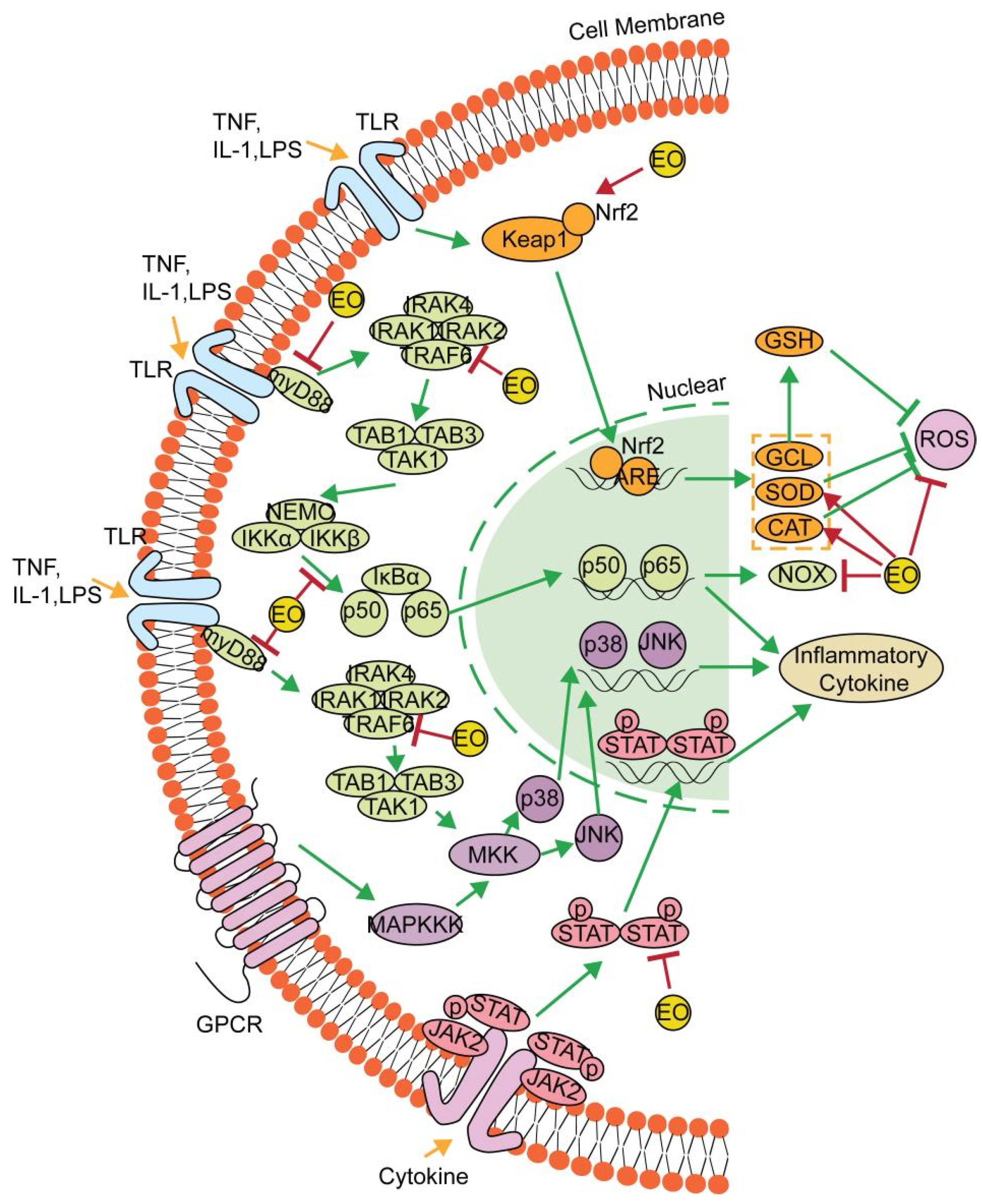
In biological systems, essential oils from Agastache foeniculum, oregano, and thyme contain constituents that can bind to hydrophobic pockets on NADPH oxidase (NOX), superoxide dismutase (SOD), and catalase (CAT). They also modulate redox-related signaling pathways such as erythroid 2–related factor 2 (Nrf2) and nuclear factor kappa-light-chain-enhancer of activated B cells (NF-κB) [52,53,54]. This binding helps modulate the activity of these enzymes and pathways, contributing to antioxidant defense (Figure 3). Some EOs, such as Neocinnamomum caudatum essential oil, have also been shown to restore mitochondrial membrane potential in a concentration-dependent manner and suppress intracellular ROS production [55].
Due to these antioxidant properties, EOs have shown promise as natural antioxidant supplements or adjunct therapies for oxidative stress-related diseases, including diabetes, liver and kidney injury, as well as neurodegenerative disorders [56,57,58].

3.3. Anti-Inflammatory Activity

EOs exert anti-inflammatory effects through multiple synergistic mechanisms. Certain EO components can interact with intracellular signaling pathways—such as NF-κB, MAPK, Nrf2/ARE, TLR and JAK/STAT—by targeting specific proteins, enzymes, or transcription factors. These interactions regulate the expression levels of key inflammatory mediators like TNF-α and IL-1β, thereby modulating cellular inflammatory responses and redox balance [59]. In addition, as discussed in Section 3.2, some EOs reduce ROS, thereby alleviating oxidative stress-induced inflammation (Figure 3). The anti-inflammatory properties of EOs make them promising adjunctive agents in the management of various inflammatory diseases, including wound inflammation, skin inflammation, periodontitis, colitis, and neuroinflammation [60,61,62].

3.4. Anti-Cancer Activity

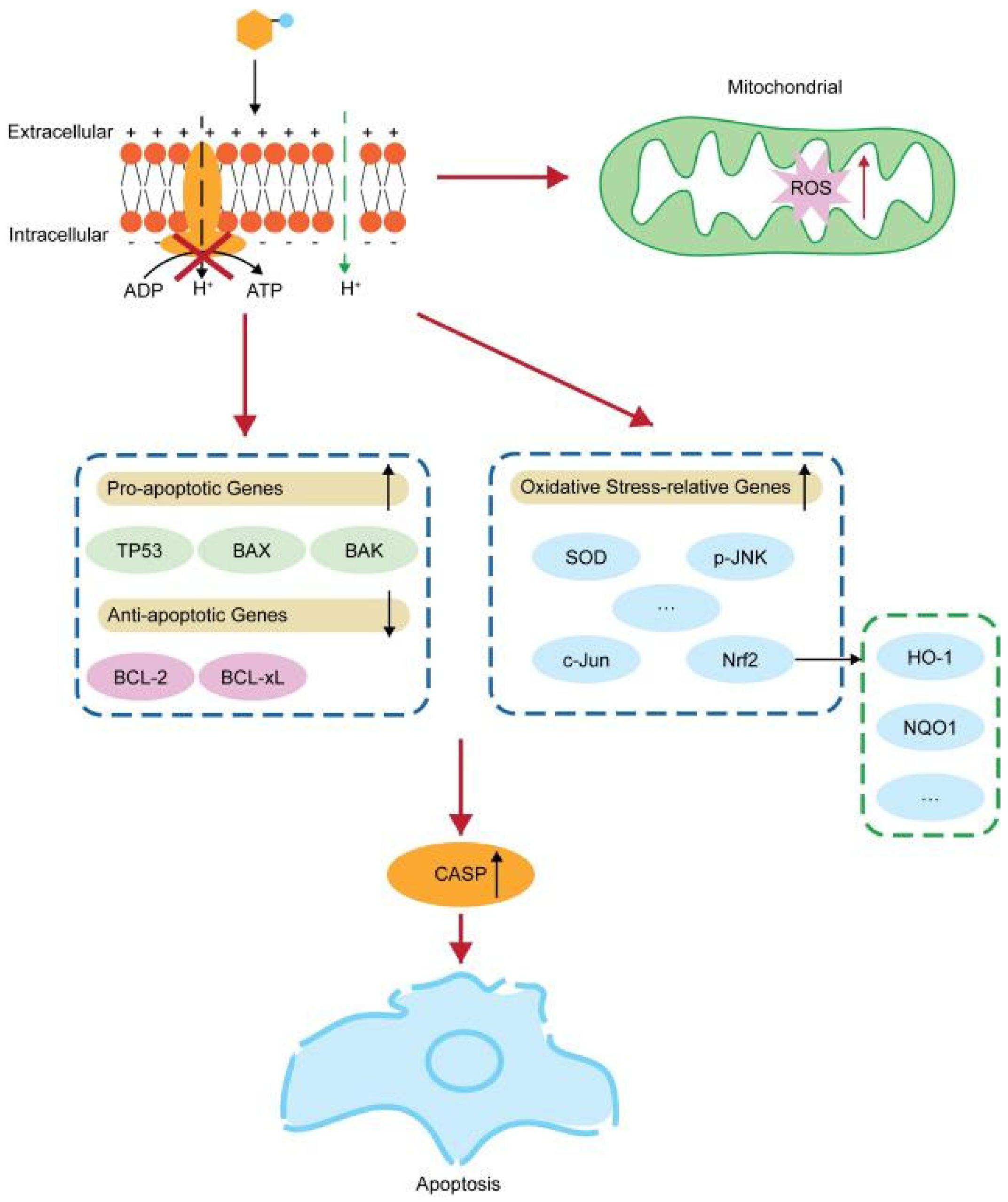
The anticancer mechanisms of EOs are similar to their previously discussed antibacterial, antioxidant, and anti-inflammatory actions. Due to their hydrophobic nature, EOs can disrupt the structures of both cellular and mitochondrial membranes, leading to mitochondrial membrane potential collapse. This disruption increases mitochondrial ROS and elevates oxidative stress-related proteins, including manganese SOD, c-Jun, phosphorylated c-Jun N-terminal kinase (p-JNK), and Nrf2, along with downstream targets such as heme oxygenase-1 (HO-1) and NAD(P)H quinone oxidoreductase 1 (NQO1) [63]. EOs have also been shown to upregulate pro-apoptotic genes (TP53, BAX, and BAK) while downregulating anti-apoptotic genes (BCL-2 and BCL-xL). Moreover, in human gastric adenocarcinoma (AGS) cells treated with Ocimum tenuiflorum EO, the expression of apoptosis-related genes CASP8, CASP9, and CASP3 was significantly increased [63,64]) (Figure 4). However, whether EOs exert similar effects on healthy cells remains to be further investigated. Estanislao Gómez et al. reported that Decatropis bicolor (Zucc.) Radlk essential oil exhibits selective cytotoxicity [65]. It induced dose- and time-dependent cytotoxic effects in MDA-MB-231 breast cancer cells with an IC50 of 53.81 ± 1.691 μg/mL, while having no significant effect on non-cancerous mammary epithelial MCF10A cells (IC50 = 207.51 ± 3.26 μg/mL). Further randomized, controlled, and high-quality clinical trials will be needed to evaluate the safety and efficacy of EOs in cancer treatment.

3.5. Neuroprotection

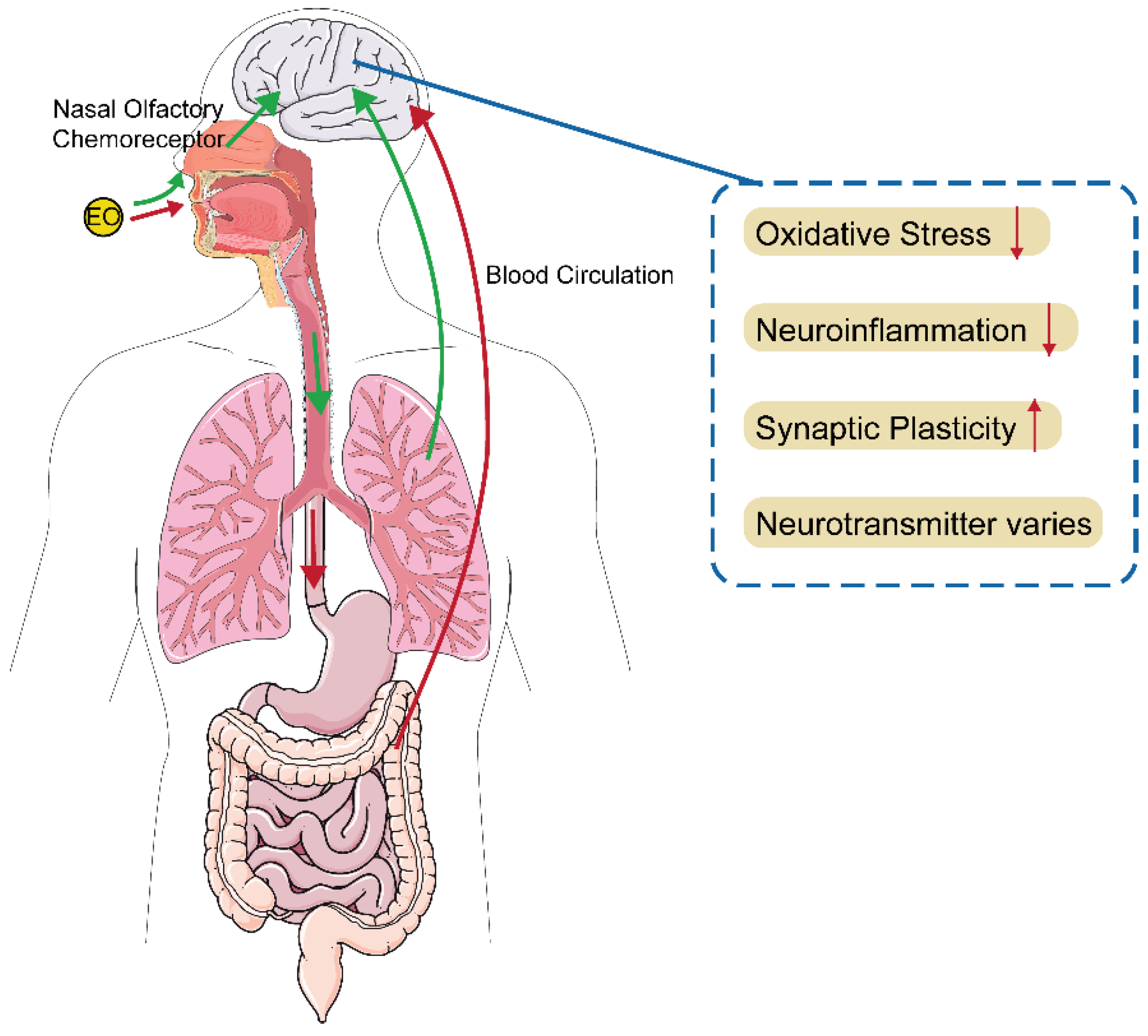
Neuroprotective effects of essential oils have gained increasing attention as an emerging therapeutic dimension, extending beyond their traditional calming or anxiolytic applications. Essential oils can exert neuroprotective effects through both inhalation and oral administration. Inhaled essential oils may influence brain function via the respiratory and olfactory systems or by crossing the blood-air barrier, and can also activate olfactory chemoreceptors in the nasal cavity [66]. Orally administered essential oils, in contrast, act through gastrointestinal absorption followed by systemic circulation to affect the nervous system.
Within the brain, essential oils exert neuroprotective effects primarily by alleviating oxidative stress and neuroinflammation [67,68]. In addition, certain essential oil components modulate neurotransmitter systems, including acetylcholine (ACh), dopamine (DA), and serotonin (5-HT), thereby contributing to improvements in mood, cognition, memory, motor function, and pain-related symptoms. For example, oral administration of lemon essential oil has been shown to modulate norepinephrine, dopamine, and serotonin levels in the prefrontal cortex, striatum, and hippocampus of mice, resulting in antidepressant-like effects [69]. Tsang et al. reported that inhalation of lavender essential oil modulates serotonin synthesis in the prefrontal cortex of rats, influencing anxiety-related behaviors [70]. Moreover, essential oils have been reported to regulate synaptic plasticity. Xu et al. demonstrated that lavender essential oil and its major component linalool increased the expression of synaptic plasticity–related proteins in the mouse hippocampus, including CaMKII, phosphorylated CaMKII, BDNF, and TrkB [71] (Figure 5).
Although the neuroprotective mechanisms of essential oils are not yet fully elucidated, an increasing number of human and clinical studies have explored their potential roles in emotional and neurological health [72]. For example, inhalation aromatherapy with lavender essential oil has been associated with improvements in depressive symptoms and sleep quality in patients with post-stroke depression (PSD), as well as reduced fatigue and improved sleep quality in patients with hematologic malignancies [73,74]. Inhalation aromatherapy with both lavender and chamomile essential oils helped decrease depression, anxiety, and stress levels in community-dwelling older adults [75]. These studies provide preliminary evidence supporting the beneficial effects of essential oils in alleviating symptoms associated with anxiety and depression. Nevertheless, further well-designed and large-scale clinical trials are required to confirm these observations and to clarify the underlying mechanisms.

3.6. Bone Health

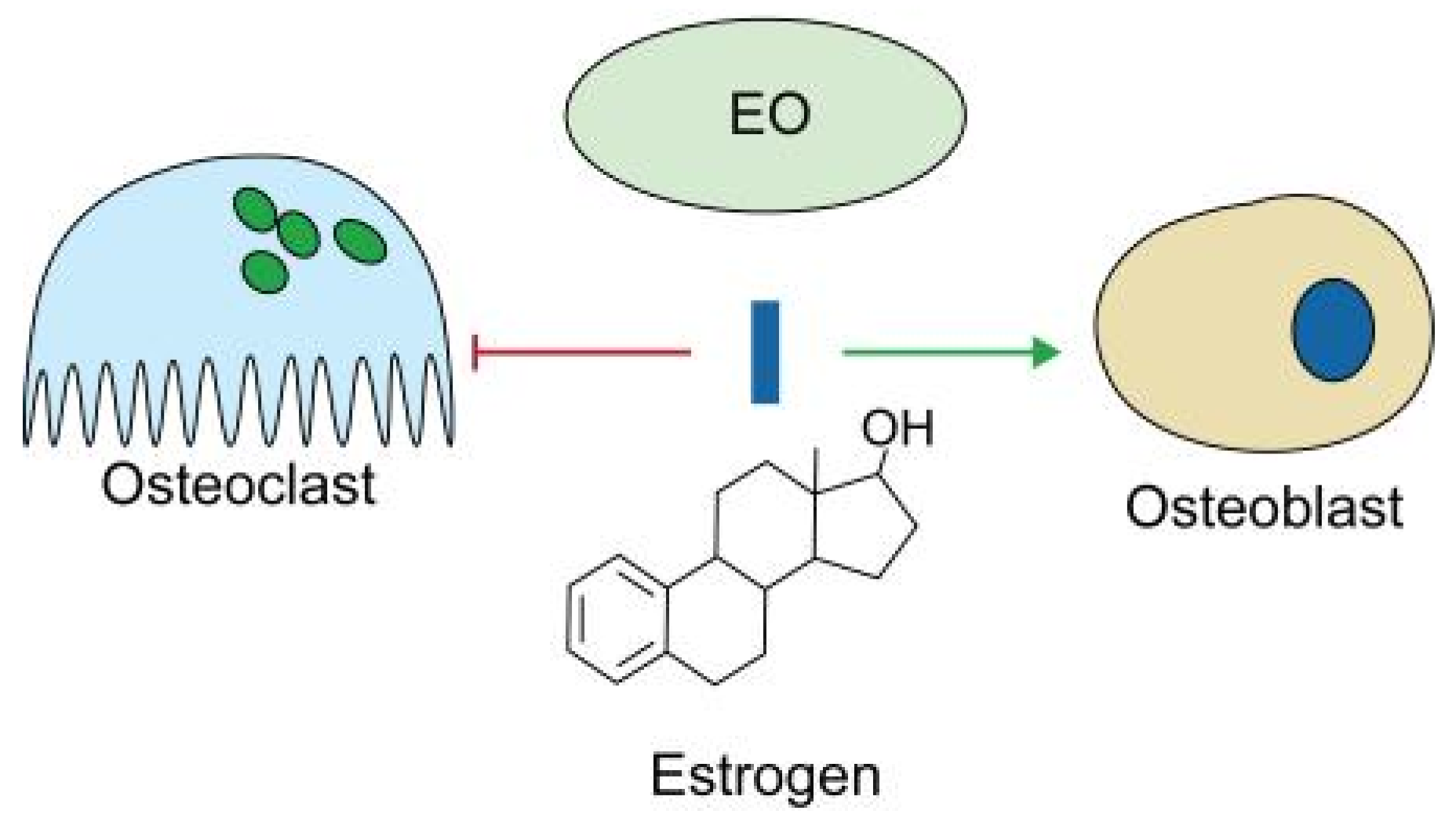
Potential roles of essential oils in bone health–related regulation have gained increasing attention in recent years, although current evidence remains largely preliminary and mechanistic in nature. Existing studies suggest that essential oils may influence bone metabolism by modulating the activity of bone-resorbing osteoclasts and bone-forming osteoblasts. Specifically, essential oils have been reported to suppress osteoclast differentiation through downregulation of osteoclast-related gene expression, while promoting osteoblast differentiation and activity [23,72]. For example, d-limonene, a major constituent of many essential oils, has been shown to inhibit receptor activator of nuclear factor kappa-B ligand (RANKL)–induced osteoclastogenesis and enhance osteoblast activity in vitro [76]. In addition, certain essential oils, particularly those containing anethole, exhibit estrogen-like activity at the molecular level. Given the well-established role of estrogen signaling in bone metabolism and osteoporosis prevention, such estrogen-mimicking properties may contribute to the observed bone-related effects of these essential oils [77] (Figure 6). However, further studies are required to clarify their physiological relevance and translational potential.

3.7. Wound Healing

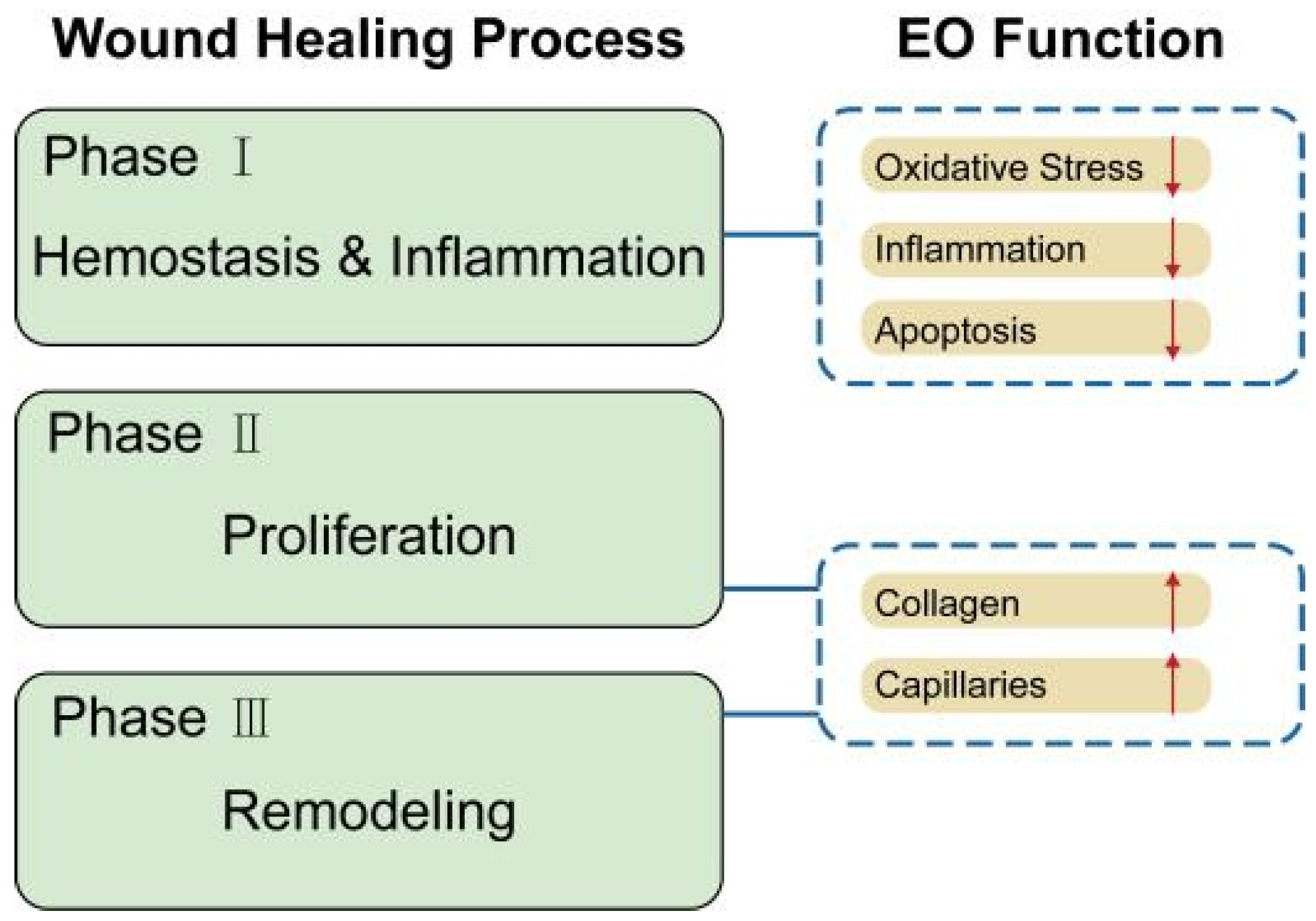
Wound healing can be divided into three continuous phases. The first is the hemostasis and inflammation phase, during which injury triggers a coagulation response. Fibrin and platelets form a blood clot that prevents bleeding and releases chemotactic factors, attracting neutrophils and macrophages to the wound site to clear pathogens and necrotic tissue. This is followed by the proliferation phase, where fibroblasts produce collagen, and tissue repair is promoted through angiogenesis and re-epithelialization. The final stage is remodeling, during which collagen is gradually reorganized and strengthened, excess cells and blood vessels are reduced, and the wound tissue structure is restored, eventually forming a scar. EOs have been reported to act at all three stages of wound healing [78]. In the inflammatory phase, EOs can improve the inflammatory response and accelerate healing by modulating the expression of inflammatory cytokines, oxidative stress, and apoptosis [79,80]. In the proliferation and remodeling phases, EOs can stimulate fibroblasts to produce collagen and promote the formation of new capillaries [81] (Figure 7).

3.8. Host-Microbe Interaction Regulation

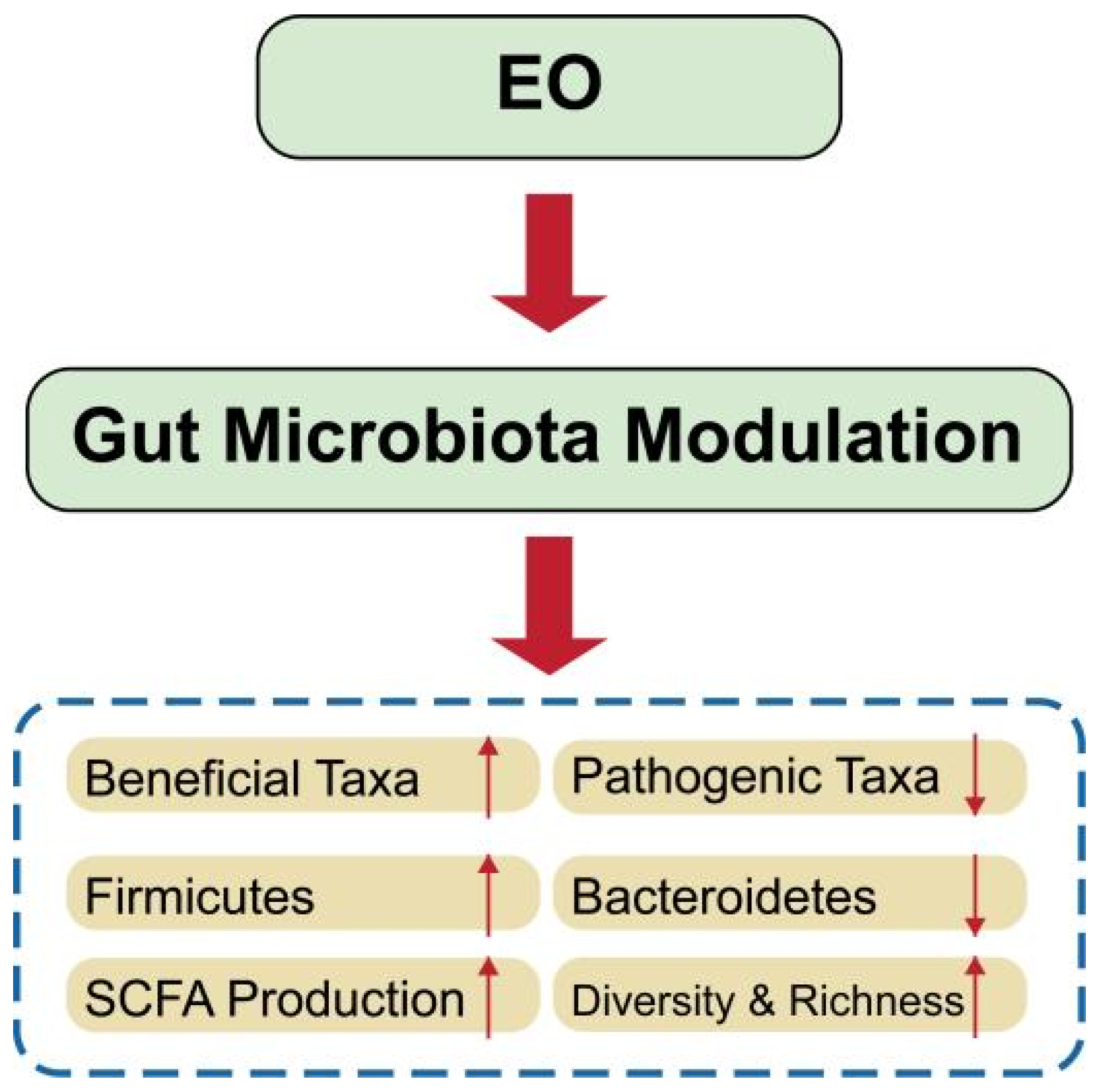
Beyond their conventional antimicrobial properties, recent studies have highlighted the modulation of gut microbiota and microbial metabolites as an emerging, mechanism-oriented functional dimension of essential oils. The gut microbiota and its metabolites are increasingly recognized as key contributors to host immune homeostasis, inflammatory regulation, intestinal barrier integrity, and neurophysiological processes. Therapeutic strategies such as fecal microbiota transplantation and probiotic supplementation have demonstrated that targeted modulation of gut microbial communities can influence disease development and progression. In this context, essential oils, composed of bioactive volatile compounds, have attracted growing interest for their potential to modulate gut microbiota composition and microbial functional outputs (Figure 8).
Dietary administration of essential oils has been shown to enhance microbial diversity and richness in various animal models, contributing to the restoration of dysbiotic gut environments [82,83,84]. Several studies indicate that essential oils may reduce the relative abundance of the phylum Bacteroidetes while increasing Firmicutes, thereby shifting the Firmicutes/Bacteroidetes ratio toward a more balanced state [83,85]. In addition, essential oil supplementation has been reported to selectively enrich beneficial commensals while suppressing pathogenic taxa. For example, in a dextran sulfate sodium (DSS)-induced colitis mouse model, expression levels of TLR4 and TNF-α were positively correlated with the abundance of Helicobacter, and negatively correlated with that of short-chain fatty acid (SCFA)-producing bacteria. Supplementation with cinnamon essential oil led to an increased abundance of SCFA-producing genera, such as Alloprevotella and Lachnospiraceae_NK4A136_group, while decreasing Helicobacter abundance [83]. In a colorectal cancer mouse model, patchouli essential oil was reported to inhibit harmful genera such as Alistipes and Helicobacter, while promoting the growth of health-associated taxa including Akkermansia muciniphila, Bacteroides vulgatus, Bacteroides xylanolyticus, Barnesiella spp., Lachnoclostridium spp., and Lactobacillus spp. [85]. Similarly, in a lipopolysaccharide (LPS)-induced nonalcoholic steatohepatitis (NASH) mouse model, ginger essential oil increased the relative abundance of beneficial Olsenella, while decreasing NASH-associated genera such as Blautia and Tyzzerella [84].
Despite increasing evidence for essential oil–mediated gut microbiota modulation, the underlying molecular mechanisms remain incompletely understood. A recent study by Dahab et al. employed molecular docking and demonstrated that major EO constituents such as α-phellandrene can form stable two- and three-dimensional interactions with β-fructofuranosidase from Bifidobacterium longum. Moreover, compounds such as 3-carene and α-pinene were shown to selectively target Clostridium perfringens and Sutterella wadsworthensis, respectively, suggesting a potential mechanism for EO-mediated modulation of gut microbial composition [86].
Peppermint oil has been widely used in clinical practice for the management of irritable bowel syndrome, particularly for the relief of abdominal pain and gastrointestinal discomfort [87]. However, the overall quality of existing clinical evidence remains variable, with heterogeneous outcomes reported across studies. A recent randomized, double-blind, placebo-controlled trial conducted in a U.S. academic center evaluated the efficacy of enteric-coated peppermint oil in patients with moderate-to-severe irritable bowel syndrome (IBS). The results showed that both the peppermint oil and placebo groups experienced clinically meaningful improvements in IBS symptom severity over a 6-week intervention period, but no statistically significant differences were observed between groups. These findings suggest that while peppermint oil continues to attract clinical interest, its therapeutic benefit in IBS requires further validation through larger and more rigorously designed clinical trials [88].

4. Limitations of EOs

4.1. Physicochemical Limitations

EOs contain various volatile compounds, particularly monoterpenes such as limonene, linalool, menthol, and camphor, which are characterized by high volatility and strong odors. These intense aromas may negatively affect the sensory quality of end products. Furthermore, the main constituents of EOs are hydrophobic and poorly soluble in water, which limits their direct application in aqueous systems such as beverages and injectable pharmaceuticals. In addition to these physicochemical limitations, EOs are highly sensitive to environmental factors, including light, temperature, and oxygen, all of which can significantly compromise their chemical integrity and biological activity. For example, the α-pinene content in rosemary essential oil was shown to decrease to less than 10% after just three weeks of storage under sunlight at 38 °C [89]. Compared to freshly extracted EOs, aged EOs are more prone to changes in odor, texture, and color [90]. In addition to these sensory alterations, aging also affects the physiological activity of EOs. Unsaturated monoterpenes may undergo autoxidation to form peroxides and hydroperoxides, which have been associated with skin irritation, whereas their unoxidized volatile precursors generally exhibit little or no irritant potential [91]. To prevent deterioration, EOs should be protected from light, refrigerated at or below 4 °C, and flushed with inert gas to avoid oxidation [90]. Encapsulation technologies can also be employed to mask the strong odor of EOs, prevent their volatilization, degradation, and oxidation, and enhance their dispersibility in aqueous systems [92].

4.2. Safety Concerns and Adverse Effects

Although most EOs have been shown to exhibit low toxicity, a few possess relatively higher toxic potential. For example, oregano and passion fruit essential oils contain high levels of phenolic compounds that may cause hepatic or dermal irritation, while bitter almond essential oil contains the highly toxic hydrocyanic acid [93]. Therefore, comprehensive safety evaluations of EOs are essential.
Multiple case reports have indicated that the use of essential oils can cause skin irritation. It has been reported that massage therapists using aromatherapy (i.e., treatments involving essential oils) are at an increased risk of developing hand dermatitis [94]. However, sensitization to essential oils is generally uncommon. In one study involving 10,930 patients who underwent patch testing with 12 essential oils, only six oils showed a positive patch test reaction rate greater than 1% [95].
Toxicological assessments in rodent models have demonstrated that most EOs exhibit low or negligible acute oral toxicity. For instance, no mortality or physiological abnormalities were observed in animals treated with up to 5000 mg/kg of essential oil extracted from Psidium glaziovianum leaves and Verbesina macrophylla [96,97]. In some cases, acute oral LD50 values varied by sex. For example, Cinnamomum camphora var. borneol essential oil was found to be mildly toxic to female mice (LD50 = 2749 mg/kg) but virtually non-toxic to males (LD50 = 5081 mg/kg). In repeated-dose oral toxicity studies, mice treated with 500 or 1000 mg/kg body weight of Cymbopogon martini essential oil showed no signs of toxicity or mortality. Biochemical and hematological parameters, as well as histopathological evaluation of liver and kidney tissues, revealed no adverse effects in the treated animals [98]. EOs have also demonstrated low to negligible toxicity in studies involving parenteral administration [99,100]. Furthermore, most EOs did not induce skin irritation when applied within appropriate concentration ranges in dermal tests [101]. However, acute toxicity alone does not fully reflect long-term safety. Evidence regarding chronic exposure, cumulative toxicity, and metabolic activation remains limited. Certain EO constituents, including safrole, estragole, and methyl eugenol, can undergo metabolic conversion into reactive intermediates with potential genotoxic or carcinogenic effects, underscoring the need to evaluate metabolic fate and long-term exposure risks [102].
It is also important to note that the outcomes of EO safety evaluations may depend on the experimental model used. Compared with rodents, which often show low or no toxicity, certain EOs have exhibited moderate toxicity in zebrafish models, with clear concentration- and time-dependent effects. Some EOs, such as Zingiber ottensii Valeton essential oil, have demonstrated embryotoxic and teratogenic effects in zebrafish embryos [103].
Beyond the choice of experimental models, the safety profile of essential oils may also be influenced by factors such as the age, physiological condition, and sensitivity of the target population. Even when safety has been demonstrated in existing in vivo and in vitro models, further large-scale clinical studies are warranted to validate these findings and ensure their applicability across diverse human populations.
In addition to intrinsic toxicity and dermal sensitization concerns, EO components may also interact with conventional pharmaceuticals and alter their pharmacokinetic behavior. Several experimental studies have demonstrated that EOs can influence drug efficacy in vivo. For example, peppermint essential oil was shown to reduce the analgesic effect of cocaine in mice, suggesting a potential pharmacodynamic interaction [104]. Likewise, formulations containing fennel essential oil were reported to diminish the therapeutic efficacy of acetaminophen and caffeine [105]. Beyond these specific examples, mechanistic evidence indicates that many EO constituents can modulate drug-metabolizing pathways. Major EO components such as cedrol and α-pinene influence cytochrome P450 (CYP450) enzymes, thereby altering the metabolic clearance of co-administered drugs [106]. Additionally, several terpenoids have been shown to affect the activity of P-glycoprotein (P-gp), a key efflux transporter involved in drug absorption and multidrug resistance. While P-gp inhibition by terpenes may enhance the removal of toxins and carcinogens, it can also reduce the oral bioavailability of certain pharmaceutical agents [107].

5. Encapsulation Strategies for EOs

To overcome the physicochemical limitations of EOs, various encapsulation strategies have been developed to improve their stability, solubility, bioavailability, and controlled release. This section outlines commonly used carrier materials, carrier system types, and encapsulation techniques reported in the past five years, and summarizes their pharmaceutical applications (Table S1). The specific method involved searching PubMed using the keyword “essential oil encapsulation” for articles published in the past five years (2021–2025), with the following exclusion criteria: (1) studies focusing solely on food preservation or agricultural use without pharmaceutical relevance; (2) EOs used only as minor additives in multifunctional formulations; (3) studies lacking key experimental details (e.g., encapsulation efficiency, particle size); and (4) articles that were reviews, patents, or conference abstracts without primary experimental data.

5.1. Materials

The encapsulation materials for EOs can be broadly classified into natural polymers, synthetic carriers, and hybrid carriers. Natural polymers are generally recognized for their high safety and biocompatibility, making them widely used in the encapsulation of food and pharmaceutical ingredients. They are mainly categorized into polysaccharides, proteins, and lipids. Polysaccharides, such as sodium alginate and chitosan, are extensively applied in EO encapsulation owing to their ability to form gels through ionic crosslinking [108]. Proteins, including zein, soy protein, and whey protein, possess both hydrophobic and hydrophilic domains in their molecular structures, which enables the self-assembly of stable micelles or network structures. In addition, proteins can serve as natural emulsifiers, making them suitable for encapsulation techniques such as emulsification. The presence of multiple functional groups on protein surfaces also allows for the formation of stable complexes with other encapsulating agents, thereby enhancing encapsulation performance [109]. Lipids, such as lecithin and cholesterol, are typically amphiphilic molecules with a hydrophilic head group and a hydrophobic tail. This amphiphilic nature allows them to spontaneously assemble into micelles and bilayers, serving as the primary structural components of nanostructures such as liposomes, solid lipid nanoparticles (SLNs), and nanostructured lipid carriers (NLCs) [110].
Compared to natural polymers, synthetic materials offer distinct advantages in terms of structural tunability, functionalization, and stability. Synthetic polymers such as polylactic acid (PLA), poly(lactic-co-glycolic acid) (PLGA), and poly(vinyl alcohol) (PVA) can be precisely engineered by varying monomer selection, molecular weight, and copolymer composition to control degradation rates, hydrophobicity, mechanical strength, and release profiles [111]. Synthetic inorganic materials, including mesoporous silica and graphene oxide, exhibit high thermal and chemical stability, enabling effective protection of bioactive compounds under harsh environmental conditions. Their porous structures also provide a large specific surface area, which increases loading capacity and allows for sustained release [112]. In addition, synthetic surfactants such as Tween and Span series are widely employed as emulsifiers during the emulsification steps of EO encapsulation [113].

5.2. System Types

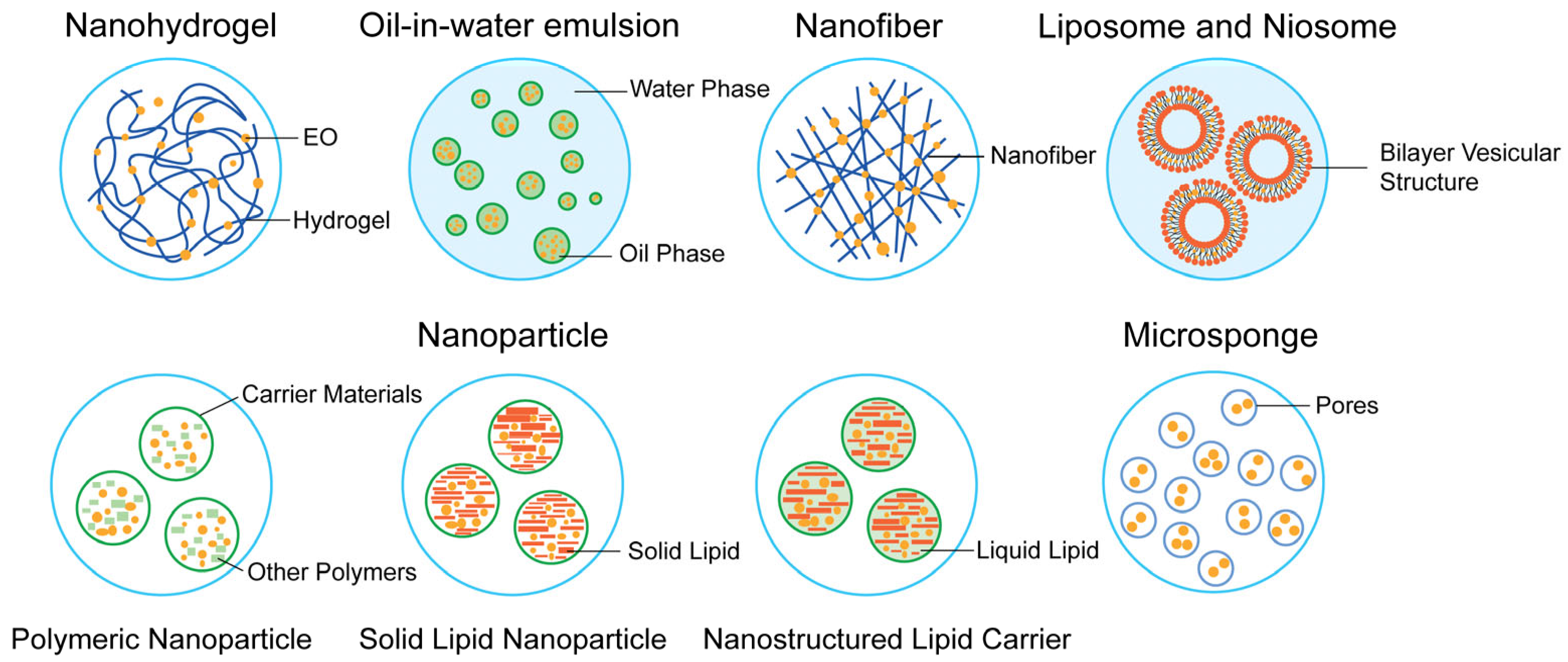
The commonly used carrier systems for encapsulating essential oils mainly include nanohydrogels, liposomes and niosomes, nanoparticles (including lipid nanoparticles and polymeric nanoparticles), oil-in-water nanoemulsions, nanofibers, and microsponges (Figure 9). Nanohydrogels are 3D network structures formed by crosslinking polymeric carrier materials, characterized by strong water-retention capacity and good biocompatibility. Liposomes and niosomes are bilayer vesicular structures formed from lipids or other polymeric materials and are widely used in the pharmaceutical industry [113,114]. Nanoparticles can be divided into lipid nanoparticles and polymeric nanoparticles. Lipid nanoparticles are further classified, based on the state of the lipids, into SLNs, which contain only solid lipids, and NLCs, which contain both solid and liquid lipids [115,116]. Oil-in-water nanoemulsions are dispersed systems in which hydrophobic active compounds are dispersed in an aqueous phase. In essential oil encapsulation, they are often used as intermediate systems in combination with other technologies. Nanofibers, generally produced by electrospinning, have a linear fibrous structure. Microsponges are porous, sponge-like microspheres with interconnected pores that can adsorb and slowly release active compounds [117,118].

5.3. Techniques for Encapsulation

According to Table S1, the main encapsulation techniques for essential oils include emulsification, gelation, solvent evaporation, precipitation, thin-film hydration, adsorption (non-electrostatic), electrostatic complexation, electrospinning, spray drying, and freeze drying. Table 1 summarizes these techniques in terms of encapsulation efficiency, particle size, cost, and scalability, based on the data compiled in Table S1. However, despite their widespread use, several of these techniques still require further development to meet industrial and clinical demands. Solvent evaporation and precipitation methods would benefit from greener, solvent-free alternatives to address regulatory and environmental concerns. Spray drying and freeze drying require optimization to reduce energy consumption and improve powder stability [119]. Electrospinning is also limited by high energy use and poor scalability, highlighting the need for more efficient and continuous processing technologies [120]. These aspects should be taken into account when selecting an encapsulation strategy for industrial applications.

5.3.1. Emulsification

Emulsification is one of the most widely used techniques for encapsulating EOs and other hydrophobic compounds. It involves breaking the oil phase into fine droplets under external mechanical forces and uniformly dispersing them within the continuous aqueous phase to form an emulsion. Surfactants such as Tween and Span are often added to the oil-water mixture to reduce the interfacial tension and form a protective layer around the droplets, thereby improving the stability of the emulsion. Emulsification can be achieved through several approaches, including mechanical stirring, high-shear mixing, ultrasonication, and high-pressure homogenization. Under strong shear forces, the resulting droplets can reach the nanometer scale [121,122]. In addition to their roles in the emulsification processes, ultrasonication and high-pressure homogenization are also widely employed as high-energy techniques for the preparation of solid lipid SLNs and NLCs [115,116,123]. Emulsification is often combined with gelation to enhance the stability and encapsulation performance of the resulting nanocapsules. In this approach, biopolymers such as chitosan are added to the aqueous phase and emulsified with the oil phase (EOs), followed by gelation induced through pH adjustment or ionic crosslinking to form gel [124,125]. Emulsification can also be combined with drying techniques such as spray drying or freeze drying to obtain nanocapsules in solid form, which improves storage stability and facilitates incorporation into solid food or pharmaceutical matrices [111,126].

5.3.2. Gelation

Common gelation strategies include ionic gelation, pH-induced gelation, and UV-induced gelation. Ionic gelation is frequently performed using materials such as sodium alginate and chitosan. Sodium alginate can rapidly form nanohydrogels by crosslinking with calcium ions. Chitosan, which contains positively charged -NH3+ groups, can interact electrostatically with negatively charged -PO42− groups in sodium tripolyphosphate (TPP); the resulting multi-point interactions create a 3D network gel structure. Chitosan can also undergo pH-induced gelation. Under acidic conditions, the amino groups of chitosan are primarily protonated, leading to electrostatic repulsion between polymer chains and resulting in a dissolved state. As the pH increases and the positive charge is reduced, molecular chains reaggregate, and the system transitions from a solution to a gel network. UV-induced gelation has also been applied in essential oil encapsulation. Meng et al. introduced a photoinitiator into the system, which, upon exposure to ultraviolet light, generated free radicals. These free radicals attacked the methacryloyl double bonds of gelatin-methacryloyl (GelMA) molecules, triggering covalent crosslinking to form a three-dimensional network capable of entrapping Artemisia argyi essential oil-loaded nanoparticles [112].

5.3.3. Solvent Evaporation

The solvent evaporation method primarily involves dissolving hydrophobic polymers (e.g., PLGA and EOs in an organic solvent, followed by emulsification to form an emulsion. The organic solvent is then removed by evaporation or under reduced pressure, causing the wall material to precipitate and form polymer-based nanoparticles. This method has also been applied to the preparation of porous-structured microsponges. For example, Jafar et al. prepared thyme essential oil-loaded microsponges using ethyl glycol terephthalate (EGT) as the polymer, polysorbate 80 as the stabilizer, and dichloromethane (DCM) as the solvent through the solvent evaporation method [127].

5.3.4. Precipitation

The solvent precipitation method induces the rapid precipitation of nanoparticles by altering the solution conditions (e.g., by adding a non-solvent) to abruptly decrease the solubility of the wall material. This technique is suitable for hydrophobic polymers such as PVA and PLGA. The polymers and EOs are first dissolved in the organic phase and then injected into the aqueous phase, where nanoparticles immediately precipitate [128].

5.3.5. Thin-Film Hydration

The thin-film hydration method is one of the primary techniques for the preparation of liposomes and niosomes. In this process, vesicle-forming materials and essential oils are dissolved in an organic solvent, which is then removed by rotary evaporation or reduced pressure to form a uniform dry lipid film on the container wall. When an aqueous phase is added, lipid molecules or non-ionic surfactants spontaneously self-assemble into vesicular structures. Cholesterol can be incorporated as a stabilizer to fill the gaps within the bilayer, thereby increasing membrane compactness and enhancing mechanical strength [113,114].

5.3.6. Adsorption (Non-Electrostatic)

The non-electrostatic adsorption method relies on weak interactions, including hydrophobic forces, hydrogen bonding, and van der Waals forces between the carrier and the active compound [129]. These interactions enable the active compound to adsorb onto the carrier surface. Commonly used carrier materials include graphene oxide (GO) and mesoporous bioactive glass nanoparticles (MBGNs). However, non-electrostatic adsorption generally exhibits relatively low encapsulation efficiency. For instance, the encapsulation efficiency of clove essential oil using MBGNs is approximately 50% [130]. Therefore, this method often needs to be combined with other encapsulation strategies to improve encapsulation performance and stability.

5.3.7. Electrostatic Complexation

The method in which two oppositely charged molecules self-assemble to form nanoparticles is referred to as electrostatic complexation. This approach is commonly used for the composite encapsulation of natural or synthetic polymers. For example, chitosan carrying positive charges (-NH3+) can electrostatically interact with oleic acid carrying negative charges (-COO) to form complexes that encapsulate EO derived from lemon peel [131]. This method does not require the use of organic solvents, and it is cost-effective, as well as easy to perform; however, the stability of the complexes is limited, as variations in pH and ionic strength can lead to their dissociation.

5.3.8. Electrospinning

Electrospinning is a technique that uses a high-voltage electrostatic field to stretch a polymer solution into continuous ultrafine fibers. This method is generally combined with emulsification. The emulsion containing EOs is loaded into a syringe, and a high-voltage electrostatic field is applied between the needle and the collector. Under the applied voltage, the surface tension of the solution is overcome, forming a Taylor cone from which a charged jet is ejected. The jet is further stretched and thinned by the electrostatic forces, and the solvent rapidly evaporates, ultimately depositing continuous ultrafine fiber networks on the collector [132].

5.3.9. Spray Drying and Freeze Drying

Spray drying and freeze drying are commonly used techniques to convert liquid formulations into solid powders and are often combined with emulsification, gelation, and other methods [111]. Spray drying involves atomizing the liquid formulation through a nozzle into fine droplets, which rapidly contact a stream of hot drying gas, causing instantaneous evaporation of water and yielding dry powders or particles. Freeze drying, on the other hand, freezes the liquid formulation at low temperature and then removes water by direct sublimation of ice under vacuum to obtain the solid product. Compared with spray drying, freeze drying is more suitable for heat-sensitive and volatile active compounds such as EOs.

5.4. Applications in Pharmaceutical Fields

Encapsulation strategies play a critical role in expanding the therapeutic and industrial applicability of essential oils by directly addressing their intrinsic limitations, including high volatility, poor water solubility, chemical instability, rapid loss of activity, and potential irritation at effective doses [92]. By stabilizing volatile constituents, improving dispersibility, enabling controlled or sustained release, and reducing direct exposure to concentrated oils, encapsulation transforms essential oils from laboratory-active agents into formulations suitable for practical biomedical and industrial use [111]. As a result, encapsulated essential oils exhibit enhanced efficacy, improved safety profiles, and more consistent performance across diverse application scenarios, as summarized in the following pharmaceutical applications. In addition to conventional encapsulation approaches, emerging smart and targeted delivery systems, such as stimuli-responsive carriers and receptor-mediated targeting platforms, are increasingly being developed to address practical challenges including site-specific delivery, off-target toxicity, and insufficient local bioavailability, as further discussed in Section 6.3.
The biological activities and mechanisms of action of EOs have been described in detail in Section 3. As shown in Table S1, in the past five years (2021~2025), encapsulated EOs have primarily been applied in the following areas: antimicrobial, antiviral, anticancer, wound healing, dermatological applications, anti-inflammatory, immunomodulatory, neurological disorders, metabolic diseases, and bone regeneration. Compared with free EOs, encapsulated EOs not only improve stability, water solubility, targeting ability, and controlled-release performance, but also enhance and optimize their biological activities.

5.4.1. Enhancement of Antibacterial Activity

Encapsulated EOs exhibit broad-spectrum antimicrobial activity, effectively inhibiting various Gram-positive and Gram-negative bacteria such as Escherichia coli, Staphylococcus aureus, Pseudomonas aeruginosa, and Klebsiella pneumoniae [133]. They can also control multidrug-resistant (MDR) bacterial infections, treat oral infections caused by Streptococcus mutans and Lactobacillus casei, dermatophytosis caused by Microsporum canis, and urinary tract infections induced by Candida albicans [126,134,135,136]. The choice of encapsulating material can influence the antibacterial efficacy of EOs. For example, one study reported that compared with free EOs, encapsulation within a chitosan-based carrier significantly improved the antibacterial activity against Streptococcus agalactiae, Enterococcus faecalis, and Salmonella enterica [133]. In another study, Alsakhawy et al. found that nanoparticles loaded with lemongrass EO exhibited pronounced antibacterial effects, with two- to four-fold increase in cell wall permeability and intracellular enzyme leakage as compared with free EOs [137].

5.4.2. Enhancement of Anticancer Activity

Encapsulated EOs have demonstrated cytotoxicity against various cancer cell lines, including MCF-7, Hela, HCT-116, HepG-2, HT-29, PC-3, A-375, and A431 [121,124,138,139,140]. The type of carrier material may influence the anticancer efficacy of EOs. For example, compared with free Satureja EO, a chitosan–Satureja EO nanogel (IC50 = 5.59 μg/mL) exhibited stronger cytotoxicity against the tumor-derived KB cell line than free Satureja EO (IC50 = 7.14 μg/mL) or chitosan alone (IC50 = 11.59 μg/mL) [133]. Kryeziu et al. reported that phospholipon 90H-based liposomes loaded with oregano EO showed significantly enhanced cytotoxic activity against MCF-7 cells compared with free EO [140].

5.4.3. Enhancement of Anti-Inflammatory and Antioxidant Effects

The choice of carrier can also influence the anti-inflammatory and antioxidant activities of EOs. For instance, compared with free copaiba EO, poly(ε-caprolactone) nanocapsules loaded with copaiba EO significantly reduced TNF-α secretion by murine macrophages by approximately three-fold [141]. Similarly, encapsulating oregano EO within liposomes markedly enhanced its antioxidant activity [140].

5.4.4. Enhancement of Wound Healing Effects

Encapsulated EOs can promote wound healing and treat skin disorders. However, the hydrophobic nature of certain EO components and their tendency for burst release may limit their future application potential. EO-loaded nanoemulsions have been reported to enhance skin penetration and provide sustained release. This can lead to greater reductions in the transcription of inflammation-related genes (tlr4, cd14, irak-1), lower secretion of pro-inflammatory cytokines IL-6 and TNF-α, and increased secretion of the anti-inflammatory cytokine IL-10. These combined effects ultimately accelerate wound repair [142].

5.4.5. Enhancement of Therapeutic Effects for Neurological Disorders

Encapsulated EOs have shown potential in treating neurological conditions such as Alzheimer’s disease (AD), insomnia, and anxiety. For example, chitosan-encapsulated Piper betle EO was more effective than free EO in alleviating AD-like symptoms, delaying paralysis progression, and reducing serotonin hypersensitivity, reactive oxygen species (ROS) levels, Aβ deposition, and neurotoxic Aβ oligomers in a Caenorhabditis elegans AD model [143]. In the management of insomnia, EO encapsulated in carbon nanofibers reduced nasal mucosa irritation, thereby exhibiting improved anti-insomnia efficacy [144].

6. Future Perspectives

6.1. Advancing EO Bioactive Production Through Biosynthesis

Traditionally, EOs are extracted from plant materials using methods such as organic solvent extraction and distillation. However, to increase the yield of specific bioactive compounds, in addition to optimizing extraction methods, microbial fermentation in suitable host organisms to biosynthesize major components such as monoterpenes has emerged as a promising alternative. For example, Sphingobium sp. can bioconvert R-(+)-limonene into high concentrations of R-(+)-α-terpineol, achieving a yield of 240 g/L within 95 h [145]. In metabolically engineered microbial hosts such as Escherichia coli and Saccharomyces cerevisiae, optimization of metabolic pathways, overexpression of key enzymes, and flux control have significantly increased the production of various monoterpenes [146]. In Pantoea ananatis, the introduction of two biosynthetic pathway gene modules enabled the production of 5.60 g/L (S)-linalool and 3.71 g/L (R)-linalool from 60.0 g/L glucose [147].

6.2. More Clinical Trials

Although EOs and their nanoencapsulated forms show promising in vitro activity, clinical studies remain limited, especially those involving in vivo validation and trials of nanoencapsulated EO systems. Most existing work is based on cell-based assays and murine models, leaving important factors such as pharmacokinetics, bioavailability, long-term toxicity, and the therapeutic window in humans insufficiently characterized. Therefore, future studies should strengthen translational research by evaluating how carrier systems affect EO stability, release behavior, and targeting efficiency in human subjects. In addition, standardized manufacturing protocols, dosage guidelines, and comprehensive toxicological assessment frameworks are needed to support clinical trials and meet regulatory requirements.

6.3. Smart and Targeted EO Delivery Systems

Recent advances in smart and targeted encapsulation systems have demonstrated the potential to further enhance the therapeutic efficacy of essential oils while minimizing side effects, particularly through stimuli-responsive release and tissue- or cell-specific targeting strategies. In the future, the development of smart carriers with stimuli-responsive release and tissue/cell-targeting capabilities could further enhance the therapeutic efficacy of EOs while minimizing side effects. For example, Navarro-Marchal et al. prepared functionalized olive oil liquid nanocapsules via covalent conjugation of an anti-CD44–fluorescein isothiocyanate antibody (αCD44), enabling selective uptake through CD44 receptor-mediated endocytosis and precise targeting of pancreatic cancer stem cells [148]. Similarly, AbouAitah et al. encapsulated savory EO in modified mesoporous silica nanoparticles. The system provides sustained release under low pH and high glutathione (GSH) concentrations that mimic the tumor microenvironment, making it a promising platform for targeted cancer therapy [149].

6.4. Stability, Safety, and Environmental Considerations

Although nanoencapsulation enhances the bioavailability and therapeutic performance of EOs, several aspects still require attention. Stability remains a critical issue, as factors such as oxidation, volatilization, and storage conditions can influence encapsulated EO integrity and release behavior. More in vivo studies are also needed to clarify how different carrier systems affect pharmacokinetics, biodistribution, and overall safety, including possible irritation, sensitization, and long-term toxicity. In addition, with the increasing use of polymeric and lipid-based nanocarriers, their environmental impact and biodegradation should be evaluated to ensure safe disposal and minimize ecological risk.

7. Conclusions

EOs, owing to their natural origin, multi-target activities, and broad therapeutic potential, have demonstrated significant value across multiple health-related fields, including antimicrobial, anti-inflammatory, anticancer, antioxidant, neuroregulatory, and metabolic disorder management. However, the intrinsic drawbacks of EOs, such as high volatility, poor stability, and low bioavailability, have greatly limited their clinical and industrial applications. In recent years, the development of encapsulation technologies has provided an effective means to overcome these limitations. By selecting appropriate carrier materials (e.g., natural or synthetic polymers) and encapsulation methods (e.g., emulsification, gelation, electrospinning, and solvent precipitation), various types of nanosystems have been developed, including liposomes, nanoparticles, nanohydrogels, and nanofibers. These delivery systems not only improve the stability and encapsulation performance of EOs but also enable targeted delivery and sustained release, thereby enhancing therapeutic effects and reducing potential side effects. Despite the abundance of in vitro studies on nanoencapsulated EOs, further in vivo validation, toxicological evaluation, and clinical trials are still necessary. Moreover, emerging technologies such as synthetic biology offer new possibilities for sustainable production of EO bioactive components. In summary, nanocarrier-based encapsulation strategies serve as a crucial bridge in translating EOs from natural therapeutics to clinical applications, with broad prospects and significant practical implications.

Supplementary Materials

The following supporting information can be downloaded at: https://www.mdpi.com/article/10.3390/pr14020335/s1. Table S1: Encapsulation materials, methods, carrier system types, and pharmaceutical applications of EOs. References are cited in the Supplementary Materials [108,110,111,112,113,114,115,116,117,118,121,123,124,125,126,127,128,130,131,132,133,134,135,136,138,139,140,141,142,143,144,150,151,152,153,154,155,156,157,158,159,160,161,162,163,164,165,166,167,168,169,170,171,172,173,174,175,176].

Author Contributions

Writing—Original Draft Preparation, R.Z.; Writing—Review and Editing, B.M. and L.L.; Funding acquisition, resources—L.L. All authors have read and agreed to the published version of the manuscript.

Funding

University of Georgia Faculty Startup Fund Program (grant number: N/A).

Data Availability Statement

This review does not involve the generation or analysis of new data. All data cited in this work are available in the referenced literature.

Conflicts of Interest

The authors report no conflicts of interest.

References

  1. Asioli, D.; Aschemann-Witzel, J.; Caputo, V.; Vecchio, R.; Annunziata, A.; Næs, T.; Varela, P. Making Sense of the “Clean Label” Trends: A Review of Consumer Food Choice Behavior and Discussion of Industry Implications. Food Res. Int. 2017, 99, 58–71. [Google Scholar] [CrossRef]
  2. Burt, S. Essential Oils: Their Antibacterial Properties and Potential Applications in Foods—A Review. Int. J. Food Microbiol. 2004, 94, 223–253. [Google Scholar] [CrossRef] [PubMed]
  3. Rafferty, C.; Lamont, B.B. Plant Tannins and Essential Oils Have an Additive Deterrent Effect on Diet Choice by Kangaroos. Forests 2021, 12, 1639. [Google Scholar] [CrossRef]
  4. Kabara, J.J. Preservative-Free and Self-Preserving Cosmetics and Drugs: Principles and Practices; CRC Press: Boca Raton, FL, USA, 1997; ISBN 978-1-040-21314-8. [Google Scholar]
  5. Mehalaine, S.; Chenchouni, H. Quantifying How Climatic Factors Influence Essential Oil Yield in Wild-Growing Plants. Arab. J. Geosci. 2021, 14, 1257. [Google Scholar] [CrossRef]
  6. McGimpsey, J.A.; Douglas, M.H.; Van Klink, J.W.; Beauregard, D.A.; Perry, N.B. Seasonal Variation in Essential Oil Yield and Composition from Naturalized Thymus vulgaris L. in New Zealand. Flavour Fragr. J. 1994, 9, 347–352. [Google Scholar] [CrossRef]
  7. Valdivieso-Ugarte, M.; Gomez-Llorente, C.; Plaza-Díaz, J.; Gil, Á. Antimicrobial, Antioxidant, and Immunomodulatory Properties of Essential Oils: A Systematic Review. Nutrients 2019, 11, 2786. [Google Scholar] [CrossRef]
  8. Siddiqui, T.; Khan, M.U.; Sharma, V.; Gupta, K. Terpenoids in Essential Oils: Chemistry, Classification, and Potential Impact on Human Health and Industry. Phytomedicine Plus 2024, 4, 100549. [Google Scholar] [CrossRef]
  9. Teixeira, B.; Marques, A.; Ramos, C.; Neng, N.R.; Nogueira, J.M.F.; Saraiva, J.A.; Nunes, M.L. Chemical Composition and Antibacterial and Antioxidant Properties of Commercial Essential Oils. Ind. Crops Prod. 2013, 43, 587–595. [Google Scholar] [CrossRef]
  10. Rehman, R.; Hanif, M.A.; Mushtaq, Z.; Mochona, B.; Qi, X. Biosynthetic Factories of Essential Oils: The Aromatic Plants. Nat. Prod. Chem. Res. 2016, 4, 227. [Google Scholar] [CrossRef]
  11. Bergman, M.E.; Davis, B.; Phillips, M.A. Medically Useful Plant Terpenoids: Biosynthesis, Occurrence, and Mechanism of Action. Molecules 2019, 24, 3961. [Google Scholar] [CrossRef]
  12. Pazouki, L.; Niinemets, Ü. Multi-Substrate Terpene Synthases: Their Occurrence and Physiological Significance. Front. Plant Sci. 2016, 7, 1019. [Google Scholar] [CrossRef] [PubMed]
  13. Bathe, U.; Tissier, A. Cytochrome P450 Enzymes: A Driving Force of Plant Diterpene Diversity. Phytochemistry 2019, 161, 149–162. [Google Scholar] [CrossRef] [PubMed]
  14. Krause, S.T.; Liao, P.; Crocoll, C.; Boachon, B.; Förster, C.; Leidecker, F.; Wiese, N.; Zhao, D.; Wood, J.C.; Buell, C.R.; et al. The Biosynthesis of Thymol, Carvacrol, and Thymohydroquinone in Lamiaceae Proceeds via Cytochrome P450s and a Short-Chain Dehydrogenase. Proc. Natl. Acad. Sci. USA 2021, 118, e2110092118. [Google Scholar] [CrossRef] [PubMed]
  15. Weitzel, C.; Simonsen, H.T. Cytochrome P450-Enzymes Involved in the Biosynthesis of Mono- and Sesquiterpenes. Phytochem. Rev. 2015, 14, 7–24. [Google Scholar] [CrossRef]
  16. da Silva, T.L.M.; da Rosa, G.I.; dos Santos, M.A.L.; Graf, S.L.; Maia, B.H.L.N.S.; Beltrame, F.L.; Ferrari, P.C. Lemongrass Essential Oil (Cymbopogon Citratus (DC) Stapf.) Seasonal Evaluation and Microencapsulation by Spray-Drying. Braz. Arch. Biol. Technol. 2023, 66, e23230016. [Google Scholar] [CrossRef]
  17. Gadelhaq, S.M.; Aboelhadid, S.M.; Abdel-Baki, A.-A.S.; Hassan, K.M.; Arafa, W.M.; Ibrahium, S.M.; Al-Quraishy, S.; Hassan, A.O.; Abd El-Kareem, S.G. D-Limonene Nanoemulsion: Lousicidal Activity, Stability, and Effect on the Cuticle of Columbicola Columbae. Med. Vet. Entomol. 2023, 37, 63–75. [Google Scholar] [CrossRef]
  18. AlSaffar, R.M.; Rashid, S.; Ahmad, S.B.; Rehman, M.U.; Hussain, I.; Parvaiz Ahmad, S.; Ganaie, M.A. D-Limonene (5 (One-Methyl-Four-[1-Methylethenyl]) Cyclohexane) Diminishes CCl4-Induced Cardiac Toxicity by Alleviating Oxidative Stress, Inflammatory and Cardiac Markers. Redox Rep. 2022, 27, 92–99. [Google Scholar] [CrossRef]
  19. Li, Q.; Yu, C.; Chen, Y.; Liu, S.; Azevedo, P.; Gong, J.; Karmin, O.; Yang, C. Citral Alleviates Peptidoglycan-Induced Inflammation and Disruption of Barrier Functions in Porcine Intestinal Epithelial Cells. J. Cell. Physiol. 2022, 237, 1768–1779. [Google Scholar] [CrossRef]
  20. Abe, M.; Asada, N.; Kimura, M.; Fukui, C.; Yamada, D.; Wang, Z.; Miyake, M.; Takarada, T.; Ono, M.; Aoe, M.; et al. Antitumor Activity of α-Pinene in T-Cell Tumors. Cancer Sci. 2024, 115, 1317–1332. [Google Scholar] [CrossRef]
  21. Huang, X.; Yan, P.; Ding, W.; Zhou, C.; Xu, Q.; Li, M.; Ye, L.; Chen, W. α-Pinene Inhibits the Growth of Cervical Cancer Cells through Its Proapoptotic Activity by Regulating the miR-34a-5p/Bcl-2 Signaling Axis. Drug Dev. Res. 2022, 83, 1766–1776. [Google Scholar] [CrossRef]
  22. Kumar, K.J.S.; Vani, M.G.; Wang, S.-Y. Limonene Protects Human Skin Keratinocytes against UVB-Induced Photodamage and Photoaging by Activating the Nrf2-Dependent Antioxidant Defense System. Env. Toxicol. 2022, 37, 2897–2909. [Google Scholar] [CrossRef] [PubMed]
  23. Min, H.-Y.; Son, H.-E.; Jang, W.-G. Alpha-Pinene Promotes Osteoblast Differentiation and Attenuates TNFα-Induced Inhibition of Differentiation in MC3T3-E1 Pre-Osteoblasts. Clin. Exp. Pharmacol. Physiol. 2020, 47, 831–837. [Google Scholar] [CrossRef] [PubMed]
  24. Azimullah, S.; Jayaraj, R.L.; Meeran, M.F.N.; Jalal, F.Y.; Adem, A.; Ojha, S.; Beiram, R. Myrcene Salvages Rotenone-Induced Loss of Dopaminergic Neurons by Inhibiting Oxidative Stress, Inflammation, Apoptosis, and Autophagy. Molecules 2023, 28, 685. [Google Scholar] [CrossRef] [PubMed]
  25. Chand, S.; Tripathi, A.S.; Hasan, T.; Ganesh, K.; Cordero, M.A.W.; Yasir, M.; Zaki, M.E.A.; Tripathi, P.; Mohapatra, L.; Maurya, R.K. Geraniol Reverses Obesity by Improving Conversion of WAT to BAT in High Fat Diet Induced Obese Rats by Inhibiting HMGCoA Reductase. Nutr. Diabetes 2023, 13, 26. [Google Scholar] [CrossRef]
  26. Shinde, S.S.; Sarkate, A.P.; Nirmal, N.P.; Sakhale, B.K. Chapter 20—Bioactivity, Medicinal Applications, and Chemical Compositions of Essential Oils: Detailed Perspectives. In Recent Frontiers of Phytochemicals; Pati, S., Sarkar, T., Lahiri, D., Eds.; Elsevier: Amsterdam, The Netherlands, 2023; pp. 353–367. ISBN 978-0-443-19143-5. [Google Scholar]
  27. Stevenson, P.C.; Aslam, S.N. The Chemistry of The Genus Cicer L. In Studies in Natural Products Chemistry; Atta-ur-Rahman, Ed.; Elsevier: Amsterdam, The Netherlands, 2006; Volume 33, pp. 905–956. [Google Scholar]
  28. Pandey, A.K.; Kumar, P.; Singh, P.; Tripathi, N.N.; Bajpai, V.K. Essential Oils: Sources of Antimicrobials and Food Preservatives. Front. Microbiol. 2017, 7, 2161. [Google Scholar] [CrossRef]
  29. Neto, J.G.O.; Boechat, S.K.; Romão, J.S.; Kuhnert, L.R.B.; Pazos-Moura, C.C.; Oliveira, K.J. Cinnamaldehyde Treatment during Adolescence Improves White and Brown Adipose Tissue Metabolism in a Male Rat Model of Early Obesity. Food Funct. 2022, 13, 3405–3418. [Google Scholar] [CrossRef]
  30. Han, Z.; Li, A.; Xue, Z.; Guan, S.-B.; Yin, G.; Zheng, X. Eugenol-Loaded Polyurethane Gelatin Dressing for Efficient Angiogenesis and Antibacterial Effects in Refractory Diabetic Wound Defect Healing. Int. J. Biol. Macromol. 2024, 271, 132619. [Google Scholar] [CrossRef]
  31. Leiter, E.; Hitchcock, G.; Godwin, S.; Johnson, M.; Sedgwick, W.; Jones, W.; McCall, S.; Ceremuga, T.E. Evaluation of the Anxiolytic Properties of Myristicin, a Component of Nutmeg, in the Male Sprague-Dawley Rat. AANA J. 2011, 79, 109–114. [Google Scholar]
  32. Xiao, Z.; Liu, L.; Niu, Y.; Zhang, J.; Wang, D.; Zhou, C. Mushroom Alcohol(1-Octen-3-Ol)and Other 7 Aroma Compounds Selected from Chinese Dry-Cured Hams Can Enhance Saltiness Perception. Meat Sci. 2024, 208, 109398. [Google Scholar] [CrossRef]
  33. Wang, X.; Dai, M.; Peng, Y.; Huang, M.; Han, X.; Cao, J.; Qiao, J.; Song, Z.; Shi, J. Development of a Novel 1-Octen-3-Ol-Loaded Agar/Curdlan Hydrogel for Inhibiting Peach Fruit Diseases. Int. J. Biol. Macromol. 2023, 251, 126411. [Google Scholar] [CrossRef]
  34. Frunze, O.; Lee, D.; Lee, S.; Kwon, H.W. A Single Mutation in the Mosquito (Aedes Aegypti) Olfactory Receptor 8 Causes Loss of Function to 1-Octen-3-Ol. Insect. Biochem. Mol. Biol. 2024, 167, 104069. [Google Scholar] [CrossRef] [PubMed]
  35. Bouyahya, A.; Dakka, N.; Talbaoui, A.; Et-Touys, A.; El-Boury, H.; Abrini, J.; Bakri, Y. Correlation between Phenological Changes, Chemical Composition and Biological Activities of the Essential Oil from Moroccan Endemic Oregano (Origanum Compactum Benth). Ind. Crops Prod. 2017, 108, 729–737. [Google Scholar] [CrossRef]
  36. Martinez, J.L. (Ed.) Supercritical Fluid Extraction of Nutraceuticals and Bioactive Compounds; CRC Press: Boca Raton, FL, USA, 2007; ISBN 978-0-429-12218-7. [Google Scholar]
  37. Bassolé, I.H.N.; Juliani, H.R. Essential Oils in Combination and Their Antimicrobial Properties. Molecules 2012, 17, 3989–4006. [Google Scholar] [CrossRef] [PubMed]
  38. Hyldgaard, M.; Mygind, T.; Meyer, R.L. Essential Oils in Food Preservation: Mode of Action, Synergies, and Interactions with Food Matrix Components. Front. Microbiol. 2012, 3, 12. [Google Scholar] [CrossRef]
  39. Mateo, C.R.; Prieto, M.; Micol, V.; Shapiro, S.; Villalaín, J. A Fluorescence Study of the Interaction and Location of (+)-Totarol, a Diterpenoid Bioactive Molecule, in Model Membranes. Biochim. et Biophys. Acta (BBA) Biomembr. 2000, 1509, 167–175. [Google Scholar] [CrossRef]
  40. Evans, G.B.; Furneaux, R.H.; Gainsford, G.J.; Murphy, M.P. The Synthesis and Antibacterial Activity of Totarol Derivatives. Part 3: Modification of Ring-B. Bioorganic Med. Chem. 2000, 8, 1663–1675. [Google Scholar] [CrossRef]
  41. Bakkali, F.; Averbeck, S.; Averbeck, D.; Idaomar, M. Biological Effects of Essential Oils—A Review. Food Chem. Toxicol. 2008, 46, 446–475. [Google Scholar] [CrossRef]
  42. Zani, F.; Massimo, G.; Benvenuti, S.; Bianchi, A.; Albasini, A.; Melegari, M.; Vampa, G.; Bellotti, A.; Mazza, P. Studies on the Genotoxic Properties of Essential Oils with Bacillus Subtilis Rec-Assay and Salmonella/Microsome Reversion Assay. Planta Med. 1991, 57, 237–241. [Google Scholar] [CrossRef]
  43. Nabil, Y.; Atta, A.H.; El-Fattah, W.A.; Hafez, H.S.; Elshaarawy, R.F.M. Progress in Chitosan/Essential Oil/ZnO Nanobiocomposites Fabrication for Wound Healing Applications: A Review. Int. J. Biol. Macromol. 2025, 318, 145123. [Google Scholar] [CrossRef]
  44. Marinković, J.; Nikolić, B.; Marković, T.; Petrović, B.; Pašalić, S.; Lal, M.; Marković, D. Essential Oils as Adjuvants in Endodontic Therapy: Myth Or Reality? Future Microbiol. 2022, 17, 1487–1499. [Google Scholar] [CrossRef]
  45. Orchard, A.; van Vuuren, S. Commercial Essential Oils as Potential Antimicrobials to Treat Skin Diseases. Evid. Based Complement. Altern. Med. 2017, 2017, 4517971. [Google Scholar] [CrossRef] [PubMed]
  46. Usachev, E.V.; Pyankov, O.V.; Usacheva, O.V.; Agranovski, I.E. Antiviral Activity of Tea Tree and Eucalyptus Oil Aerosol and Vapour. J. Aerosol. Sci. 2013, 59, 22–30. [Google Scholar] [CrossRef]
  47. Ben-Arye, E.; Dudai, N.; Eini, A.; Torem, M.; Schiff, E.; Rakover, Y. Treatment of Upper Respiratory Tract Infections in Primary Care: A Randomized Study Using Aromatic Herbs. Evid. Based Complement. Altern. Med. 2011, 2011, 690346. [Google Scholar] [CrossRef] [PubMed]
  48. Gillissen, A.; Wittig, T.; Ehmen, M.; Krezdorn, H.G.; de Mey, C. A Multi-Centre, Randomised, Double-Blind, Placebo-Controlled Clinical Trial on the Efficacy and Tolerability of GeloMyrtol® Forte in Acute Bronchitis. Drug Res. 2013, 63, 19–27. [Google Scholar] [CrossRef]
  49. Cruz, A.P.M.; Nishimura, F.G.; Santos, V.C.O.D.; Steling, E.G.; Von Zeska Kress, M.R.; Marins, M.; Fachin, A.L. Essential Oil-Based Soap with Clove and Oregano: A Promising Antifungal and Antibacterial Alternative against Multidrug-Resistant Microorganisms. Molecules 2024, 29, 4682. [Google Scholar] [CrossRef]
  50. Foti, M.C.; Ingold, K.U. Mechanism of Inhibition of Lipid Peroxidation by γ-Terpinene, an Unusual and Potentially Useful Hydrocarbon Antioxidant. J. Agric. Food Chem. 2003, 51, 2758–2765. [Google Scholar] [CrossRef]
  51. Amorati, R.; Foti, M.C.; Valgimigli, L. Antioxidant Activity of Essential Oils. J. Agric. Food Chem. 2013, 61, 10835–10847. [Google Scholar] [CrossRef]
  52. Najafi, F.; Kavoosi, G.; Siahbalaei, R.; Kariminia, A. Anti-Oxidative and Anti-Hyperglycemic Properties of Agastache Foeniculum Essential Oil and Oily Fraction in Hyperglycemia-Stimulated and Lipopolysaccharide-Stimulated Macrophage Cells: In Vitro and in Silico Studies. J. Ethnopharmacol. 2022, 284, 114814. [Google Scholar] [CrossRef]
  53. Zou, Y.; Wang, J.; Peng, J.; Wei, H. Oregano Essential Oil Induces SOD1 and GSH Expression through Nrf2 Activation and Alleviates Hydrogen Peroxide-Induced Oxidative Damage in IPEC-J2 Cells. Oxidative Med. Cell. Longev. 2016, 2016, 5987183. [Google Scholar] [CrossRef]
  54. He, T.; Li, X.; Wang, X.; Xu, X.; Yan, X.; Li, X.; Sun, S.; Dong, Y.; Ren, X.; Liu, X.; et al. Chemical Composition and Anti-Oxidant Potential on Essential Oils of Thymus Quinquecostatus Celak. from Loess Plateau in China, Regulating Nrf2/Keap1 Signaling Pathway in Zebrafish. Sci. Rep. 2020, 10, 11280. [Google Scholar] [CrossRef]
  55. Jena, S.; Ray, A.; Mohanta, O.; Das, P.K.; Sahoo, A.; Nayak, S.; Panda, P.C. Neocinnamomum Caudatum Essential Oil Ameliorates Lipopolysaccharide-Induced Inflammation and Oxidative Stress in RAW 264.7 Cells by Inhibiting NF-κB Activation and ROS Production. Molecules 2022, 27, 8193. [Google Scholar] [CrossRef]
  56. El Azab, E.F.; Mostafa, H.S. Geraniol Ameliorates the Progression of High Fat-Diet/Streptozotocin-Induced Type 2 Diabetes Mellitus in Rats via Regulation of Caspase-3, Bcl-2, and Bax Expression. J. Food Biochem. 2022, 46, e14142. [Google Scholar] [CrossRef] [PubMed]
  57. Saravanan, S.; Pari, L. Protective Effect of Thymol on High Fat Diet Induced Diabetic Nephropathy in C57BL/6J Mice. Chem. Biol. Interact. 2016, 245, 1–11. [Google Scholar] [CrossRef] [PubMed]
  58. Rajendran, P.; Al-Saeedi, F.J.; Ammar, R.B.; Abdallah, B.M.; Ali, E.M.; Al Abdulsalam, N.K.; Tejavat, S.; Althumairy, D.; Veeraraghavan, V.P.; Alamer, S.A.; et al. Geraniol Attenuates Oxidative Stress and Neuroinflammation-Mediated Cognitive Impairment in D Galactose-Induced Mouse Aging Model. Aging 2024, 16, 5000–5026. [Google Scholar] [CrossRef] [PubMed]
  59. Zhao, Q.; Zhu, L.; Wang, S.; Gao, Y.; Jin, F. Molecular Mechanism of the Anti-Inflammatory Effects of Plant Essential Oils: A Systematic Review. J. Ethnopharmacol. 2023, 301, 115829. [Google Scholar] [CrossRef]
  60. Brandenburg, M.M.; Rocha, F.G.; Pawloski, P.L.; Soley, B.d.S.; Rockenbach, A.; Scharf, D.R.; Heiden, G.; Ascari, J.; Cabrini, D.A.; Otuki, M.F. Baccharis Dracunculifolia (Asteraceae) Essential Oil Displays Anti-Inflammatory Activity in Models of Skin Inflammation. J. Ethnopharmacol. 2020, 259, 112840. [Google Scholar] [CrossRef]
  61. Kairey, L.; Agnew, T.; Bowles, E.J.; Barkla, B.J.; Wardle, J.; Lauche, R. Efficacy and Safety of Melaleuca Alternifolia (Tea Tree) Oil for Human Health-A Systematic Review of Randomized Controlled Trials. Front. Pharmacol. 2023, 14, 1116077. [Google Scholar] [CrossRef]
  62. Abbasloo, E.; Dehghan, F.; Khaksari, M.; Najafipour, H.; Vahidi, R.; Dabiri, S.; Sepehri, G.; Asadikaram, G. The Anti-Inflammatory Properties of Satureja Khuzistanica Jamzad Essential Oil Attenuate the Effects of Traumatic Brain Injuries in Rats. Sci. Rep. 2016, 6, 31866. [Google Scholar] [CrossRef]
  63. Lauricella, M.; Maggio, A.; Badalamenti, N.; Bruno, M.; D’Angelo, G.D.; D’Anneo, A. Essential Oil of Foeniculum Vulgare Subsp. Piperitum Fruits Exerts an Anti-tumor Effect in Triple-negative Breast Cancer Cells. Mol. Med. Rep. 2022, 26, 243. [Google Scholar] [CrossRef]
  64. Boonyanugomol, W.; Rukseree, K.; Prapatpong, P.; Reamtong, O.; Baik, S.-C.; Jung, M.; Shin, M.-K.; Kang, H.-L.; Lee, W.-K. An In Vitro Anti-Cancer Activity of Ocimum Tenuiflorum Essential Oil by Inducing Apoptosis in Human Gastric Cancer Cell Line. Medicina 2021, 57, 784. [Google Scholar] [CrossRef]
  65. Estanislao Gómez, C.C.; Aquino Carreño, A.; Pérez Ishiwara, D.G.; San Martín Martínez, E.; Morales López, J.; Pérez Hernández, N.; Gómez García, M.C. Decatropis Bicolor (Zucc.) Radlk Essential Oil Induces Apoptosis of the MDA-MB-231 Breast Cancer Cell Line. BMC Complement. Altern. Med. 2016, 16, 266. [Google Scholar] [CrossRef] [PubMed]
  66. Fung, T.K.H.; Lau, B.W.M.; Ngai, S.P.C.; Tsang, H.W.H. Therapeutic Effect and Mechanisms of Essential Oils in Mood Disorders: Interaction between the Nervous and Respiratory Systems. Int. J. Mol. Sci. 2021, 22, 4844. [Google Scholar] [CrossRef] [PubMed]
  67. Stojanović, N.M.; Ranđelović, P.J.; Simonović, M.; Radić, M.; Todorović, S.; Corrigan, M.; Harkin, A.; Boylan, F. Essential Oil Constituents as Anti-Inflammatory and Neuroprotective Agents: An Insight through Microglia Modulation. Int. J. Mol. Sci. 2024, 25, 5168. [Google Scholar] [CrossRef] [PubMed]
  68. Xu, P.; Wang, K.; Lu, C.; Dong, L.; Gao, L.; Yan, M.; Aibai, S.; Yang, Y.; Liu, X. Protective Effects of Linalool against Amyloid Beta-Induced Cognitive Deficits and Damages in Mice. Life Sci. 2017, 174, 21–27. [Google Scholar] [CrossRef]
  69. Hao, C.-W.; Lai, W.-S.; Ho, C.-T.; Sheen, L.-Y. Antidepressant-like Effect of Lemon Essential Oil Is through a Modulation in the Levels of Norepinephrine, Dopamine, and Serotonin in Mice: Use of the Tail Suspension Test. J. Funct. Foods 2013, 5, 370–379. [Google Scholar] [CrossRef]
  70. Tsang, H.W.H.; Lo, S.C.L.; Chan, C.C.H.; Ho, T.Y.C.; Fung, K.M.T.; Chan, A.H.L.; Au, D.W.H. Neurophysiological and Behavioural Effects of Lavender Oil in Rats with Experimentally Induced Anxiety. Flavour Fragr. J. 2013, 28, 168–173. [Google Scholar] [CrossRef]
  71. Xu, P.; Wang, K.; Lu, C.; Dong, L.; Gao, L.; Yan, M.; Aibai, S.; Yang, Y.; Liu, X. The Protective Effect of Lavender Essential Oil and Its Main Component Linalool against the Cognitive Deficits Induced by D-Galactose and Aluminum Trichloride in Mice. Evid. Based Complement. Altern. Med. 2017, 2017, 7426538. [Google Scholar] [CrossRef]
  72. Sun, W.; Yang, G.; Zhang, F.; Feng, C.; Liang, M.; Jia, P.; Zhao, Z.; Guo, H.; Zhao, Y. Effects of Artemisia Annua L. Essential Oil on Osteoclast Differentiation and Function Induced by RANKL. Evid. Based Complement. Altern. Med. 2022, 2022, 1322957. [Google Scholar] [CrossRef]
  73. Yin, X.-J.; Lin, G.-P.; Wu, X.-Y.; Huang, R.; Xu, C.-J.; Yao, M.-Y. Effects of Lavender Essential Oil Inhalation Aromatherapy on Depression and Sleep Quality in Stroke Patients: A Single-Blind Randomized Controlled Trial. Complement. Ther. Clin. Pract. 2024, 55, 101828. [Google Scholar] [CrossRef]
  74. Yildirim, D.; Harman Ozdogan, M.; Erdal, S.; Selcuk, S.; Guneri, A.; Simsek, E.B.; Can, T.B.; Gunduz, H.; Kuni, A. The Efficacy of Lavender Oil on Fatigue and Sleep Quality in Patients with Hematological Malignancy Receiving Chemotherapy: A Single-Blind Randomized Controlled Trial. Support Care Cancer 2025, 33, 79. [Google Scholar] [CrossRef]
  75. Ebrahimi, H.; Mardani, A.; Basirinezhad, M.H.; Hamidzadeh, A.; Eskandari, F. The Effects of Lavender and Chamomile Essential Oil Inhalation Aromatherapy on Depression, Anxiety and Stress in Older Community-Dwelling People: A Randomized Controlled Trial. Explore 2022, 18, 272–278. [Google Scholar] [CrossRef] [PubMed]
  76. McCallum, L.; Fox, S.W. D-Limonene Suppresses RANKL-Induced Osteoclast Differentiation and Promotes Osteoblast Activity in Vitro. Biosci. Biotechnol. Biochem. 2025, 89, 232–240. [Google Scholar] [CrossRef] [PubMed]
  77. Tabanca, N.; Khan, S.I.; Bedir, E.; Annavarapu, S.; Willett, K.; Khan, I.A.; Kirimer, N.; Baser, K.H.C. Estrogenic Activity of Isolated Compounds and Essential Oils of Pimpinella Species from Turkey, Evaluated Using a Recombinant Yeast Screen. Planta Med. 2004, 70, 728–735. [Google Scholar] [CrossRef] [PubMed]
  78. Costa, M.F.; Durço, A.O.; Rabelo, T.K.; Barreto, R.S.S.; Guimarães, A.G. Effects of Carvacrol, Thymol and Essential Oils Containing Such Monoterpenes on Wound Healing: A Systematic Review. J. Pharm. Pharmacol. 2019, 71, 141–155. [Google Scholar] [CrossRef]
  79. Ao, X.; Yan, H.; Huang, M.; Xing, W.; Ao, L.-Q.; Wu, X.-F.; Pu, C.-X.; Zhang, B.-Y.; Xu, X.; Liang, H.-P.; et al. Lavender Essential Oil Accelerates Lipopolysaccharide-Induced Chronic Wound Healing by Inhibiting Caspase-11-Mediated Macrophage Pyroptosis. Kaohsiung J. Med. Sci. 2023, 39, 511–521. [Google Scholar] [CrossRef]
  80. Asiri, Y.I.; Venkatesan, K. Wound-Healing Potential of Myristica Fragrans Essential Oil: A Multi-Targeted Approach Involving Inflammation, Oxidative Stress, and Apoptosis Regulation. Pharmaceuticals 2025, 18, 880. [Google Scholar] [CrossRef]
  81. Espinosa-Espinosa, L.; Canales-Alvarez, O.; Rodríguez-López, M.G.; Flores-Tinajero, C.A.; Canales-Martinez, M.M.; Rodriguez-Monroy, M.A. Biological Activity of Bursera Schlechtendalii Essential Oil and the Roles of Its Chemical Components in the Wound Healing Process. Int. J. Mol. Sci. 2023, 24, 11040. [Google Scholar] [CrossRef]
  82. Cardoso, L.; Owatari, M.S.; Chaves, F.C.M.; Ferreira, T.H.; Costa, D.S.; Furtado, W.E.; Tedesco, M.; Honorato, L.A.; Mouriño, J.L.P.; Martins, M.L. Lippia Sidoides Essential Oil at Concentration of 0.25% Provided Improvements in Microbiota and Intestine Integrity of Danio Rerio. Braz. J. Vet. Med. 2024, 46, e005323. [Google Scholar] [CrossRef]
  83. Li, A.-L.; Ni, W.-W.; Zhang, Q.-M.; Li, Y.; Zhang, X.; Wu, H.-Y.; Du, P.; Hou, J.-C.; Zhang, Y. Effect of Cinnamon Essential Oil on Gut Microbiota in the Mouse Model of Dextran Sodium Sulfate-Induced Colitis. Microbiol. Immunol. 2020, 64, 23–32. [Google Scholar] [CrossRef]
  84. Panyod, S.; Wu, W.-K.; Hsieh, Y.-C.; Tseng, Y.-J.; Peng, S.-Y.; Chen, R.-A.; Huang, H.-S.; Chen, Y.-H.; Shen, T.-C.D.; Ho, C.-T.; et al. Ginger Essential Oil Prevents NASH Progression by Blocking the NLRP3 Inflammasome and Remodeling the Gut Microbiota-LPS-TLR4 Pathway in Mice. Nutr. Diabetes 2024, 14, 65. [Google Scholar] [CrossRef]
  85. Leong, W.; Huang, G.; Liao, W.; Xia, W.; Li, X.; Su, Z.; Liu, L.; Wu, Q.; Wong, V.K.W.; Law, B.Y.K.; et al. Traditional Patchouli Essential Oil Modulates the Host’s Immune Responses and Gut Microbiota and Exhibits Potent Anti-Cancer Effects in ApcMin/+ Mice. Pharmacol. Res. 2022, 176, 106082. [Google Scholar] [CrossRef]
  86. Dahab, M.; Idris, H.; Zhang, P.; Aladhadh, M.; Alatawi, E.A.; Ming, L.C.; Goh, K.W.; Ser, H.-L. Influence of Maqian Essential Oil on Gut Microbiota and Immunoresponses in Type 1 Diabetes: In Silico Study. Heliyon 2024, 10, e29490. [Google Scholar] [CrossRef] [PubMed]
  87. Alammar, N.; Wang, L.; Saberi, B.; Nanavati, J.; Holtmann, G.; Shinohara, R.T.; Mullin, G.E. The Impact of Peppermint Oil on the Irritable Bowel Syndrome: A Meta-Analysis of the Pooled Clinical Data. BMC Complement. Altern. Med. 2019, 19, 21. [Google Scholar] [CrossRef] [PubMed]
  88. Nee, J.; Ballou, S.; Kelley, J.M.; Kaptchuk, T.J.; Hirsch, W.; Katon, J.; Cheng, V.; Rangan, V.; Lembo, A.; Iturrino, J. Peppermint Oil Treatment for Irritable Bowel Syndrome: A Randomized Placebo-Controlled Trial. Off. J. Am. Coll. Gastroenterol. ACG 2021, 116, 2279. [Google Scholar] [CrossRef] [PubMed]
  89. Turek, C.; Stintzing, F.C. Impact of Different Storage Conditions on the Quality of Selected Essential Oils. Food Res. Int. 2012, 46, 341–353. [Google Scholar] [CrossRef]
  90. Turek, C.; Stintzing, F.C. Stability of Essential Oils: A Review. Compr. Rev. Food Sci. Food Saf. 2013, 12, 40–53. [Google Scholar] [CrossRef]
  91. Hellerström, S.; Thyresson, N.; Blohm, S.-G.; Widmark, G. On the Nature of the Eczematogenic Component of Oxidized Δ3-Carene. J. Investig. Dermatol. 1955, 24, 217–224. [Google Scholar] [CrossRef]
  92. Sousa, V.I.; Parente, J.F.; Marques, J.F.; Forte, M.A.; Tavares, C.J. Microencapsulation of Essential Oils: A Review. Polymers 2022, 14, 1730. [Google Scholar] [CrossRef]
  93. Tisserand, R.; Young, R. Essential Oil Safety: A Guide for Health Care Professionals; Elsevier Health Sciences: Amsterdam, The Netherlands, 2013; ISBN 978-0-7020-5434-1. [Google Scholar]
  94. Crawford, G.H.; Katz, K.A.; Ellis, E.; James, W.D. Use of Aromatherapy Products and Increased Risk of Hand Dermatitis in Massage Therapists. Arch. Dermatol. 2004, 140, 991–996. [Google Scholar] [CrossRef]
  95. Geier, J.; Schubert, S.; Reich, K.; Skudlik, C.; Ballmer-Weber, B.; Brehler, R.; Weisshaar, E.; Uter, W.; Ivdk, F.T. Contact Sensitization to Essential Oils: IVDK Data of the Years 2010–2019. Contact Dermat. 2022, 87, 71–80. [Google Scholar] [CrossRef]
  96. Costa, W.K.; do Nascimento, M.F.; Soares Barbosa, É.L.; Dos Santos Souza, T.G.; Chagas, C.A.; Napoleão, T.H.; Dos Santos Correia, M.T.; Brayner, F.A.; de Oliveira, A.M.; Vanusa da Silva, M. Cytotoxicity, Oral Toxicity, Genotoxicity, and Mutagenicity Evaluation of Essential Oil from Psidium Glaziovianum Kiaersk Leaves. J. Ethnopharmacol. 2023, 303, 115955. [Google Scholar] [CrossRef] [PubMed]
  97. de Veras, B.O.; de Oliveira, J.R.S.; de Menezes Lima, V.L.; do Amaral Ferraz Navarro, D.M.; de Oliveira Farias de Aguiar, J.C.R.; de Medeiros Moura, G.M.; da Silva, J.W.; de Assis, C.R.D.; Gorlach-Lira, K.; de Assis, P.A.C.; et al. The Essential Oil of the Leaves of Verbesina Macrophylla (Cass.) S.F.Blake Has Antimicrobial, Anti-Inflammatory and Antipyretic Activities and Is Toxicologically Safe. J. Ethnopharmacol. 2021, 265, 113248. [Google Scholar] [CrossRef] [PubMed]
  98. Ayenew, K.D.; Sewale, Y.; Amare, Y.E.; Ayalew, A. Acute and Subacute Toxicity Study of Essential Oil of Cymbopogon Martini in Mice. J. Toxicol. 2022, 2022, 1995578. [Google Scholar] [CrossRef] [PubMed]
  99. Cruz, R.C.D.; Silva, S.L.C.E.; Souza, I.A.; Gualberto, S.A.; Carvalho, K.S.; Santos, F.R.; Carvalho, M.G. Toxicological Evaluation of Essential Oil From the Leaves of Croton Argyrophyllus (Euphorbiaceae) on Aedes Aegypti (Diptera: Culicidae) and Mus Musculus (Rodentia: Muridae). J. Med. Entomol. 2017, 54, 985–993. [Google Scholar] [CrossRef]
  100. Long, Y.; Yu, S.; Li, D.; Shi, A.; Ma, Y.; Deng, J.; Li, X.; Wen, J.; Wu, Y.; Hu, Y.; et al. Preparation, Characterization and Safety Evaluation of Ligusticum Chuanxiong Essential Oils Liposomes for Treatment of Cerebral Ischemia-Reperfusion Injury. Food Chem. Toxicol. 2023, 175, 113723. [Google Scholar] [CrossRef]
  101. Xiao, S.; Yu, H.; Xie, Y.; Guo, Y.; Fan, J.; Yao, W. Evaluation of the Analgesic Potential and Safety of Cinnamomum Camphora Chvar. Borneol Essential Oil. Bioengineered 2021, 12, 9860–9871. [Google Scholar] [CrossRef]
  102. Al-Malahmeh, A.J.; Al-ajlouni, A.M.; Wesseling, S.; Vervoort, J.; Rietjens, I.M.C.M. Determination and Risk Assessment of Naturally Occurring Genotoxic and Carcinogenic Alkenylbenzenes in Basil-Containing Sauce of Pesto. Toxicol. Rep. 2016, 4, 1–8. [Google Scholar] [CrossRef]
  103. Akermi, S.; Smaoui, S.; Elhadef, K.; Fourati, M.; Louhichi, N.; Chaari, M.; Chakchouk Mtibaa, A.; Baanannou, A.; Masmoudi, S.; Mellouli, L. Cupressus Sempervirens Essential Oil: Exploring the Antibacterial Multitarget Mechanisms, Chemcomputational Toxicity Prediction, and Safety Assessment in Zebrafish Embryos. Molecules 2022, 27, 2630. [Google Scholar] [CrossRef]
  104. Samojlik, I.; Petković, S.; Stilinović, N.; Vukmirović, S.; Mijatović, V.; Božin, B. Pharmacokinetic Herb-Drug Interaction between Essential Oil of Aniseed (Pimpinella anisum L., Apiaceae) and Acetaminophen and Caffeine: A Potential Risk for Clinical Practice. Phytother. Res. 2016, 30, 253–259. [Google Scholar] [CrossRef]
  105. Samojlik, I.; Petković, S.; Mimica-Dukić, N.; Božin, B. Acute and Chronic Pretreatment with Essential Oil of Peppermint (Mentha × Piperita L., Lamiaceae) Influences Drug Effects. Phytother. Res. 2012, 26, 820–825. [Google Scholar] [CrossRef]
  106. Sharma, K.; Lanzilotto, A.; Yakubu, J.; Therkelsen, S.; Vöegel, C.D.; Du Toit, T.; Jørgensen, F.S.; Pandey, A.V. Effect of Essential Oil Components on the Activity of Steroidogenic Cytochrome P450. Biomolecules 2024, 14, 203. [Google Scholar] [CrossRef]
  107. Yoshida, N.; Koizumi, M.; Adachi, I.; Kawakami, J. Inhibition of P-Glycoprotein-Mediated Transport by Terpenoids Contained in Herbal Medicines and Natural Products. Food Chem. Toxicol. 2006, 44, 2033–2039. [Google Scholar] [CrossRef]
  108. Hesami, S.; Safi, S.; Larijani, K.; Badi, H.N.; Abdossi, V.; Hadidi, M. Synthesis and Characterization of Chitosan Nanoparticles Loaded with Greater Celandine (Chelidonium majus L.) Essential Oil as an Anticancer Agent on MCF-7 Cell Line. Int. J. Biol. Macromol. 2022, 194, 974–981. [Google Scholar] [CrossRef] [PubMed]
  109. Volić, M.; Pajić-Lijaković, I.; Djordjević, V.; Knežević-Jugović, Z.; Pećinar, I.; Stevanović-Dajić, Z.; Veljović, Đ.; Hadnadjev, M.; Bugarski, B. Alginate/Soy Protein System for Essential Oil Encapsulation with Intestinal Delivery. Carbohydr. Polym. 2018, 200, 15–24. [Google Scholar] [CrossRef] [PubMed]
  110. Cagal, M.M.; Taner, G.; Kalaycı, S.; Duman, G. Enhanced Antibacterial and Genoprotective Properties of Nanoliposomal Satureja hortensis L. Essential Oil. Drug Chem. Toxicol. 2025, 48, 180–186. [Google Scholar] [CrossRef]
  111. Alam, A.; Foudah, A.I.; Salkini, M.A.; Raish, M.; Sawale, J. Herbal Fennel Essential Oil Nanogel: Formulation, Characterization and Antibacterial Activity against Staphylococcus aureus. Gels 2022, 8, 736. [Google Scholar] [CrossRef] [PubMed]
  112. Meng, N.; Zhou, C.; Sun, Z.; Chen, X.; Xiong, S.; Tao, M.; Qin, Y.; Hu, K.; Ma, L.; Tian, D.; et al. Tailored Gelatin Methacryloyl-Based Hydrogel with near-Infrared Responsive Delivery of Qiai Essential Oils Boosting Reactive Oxygen Species Scavenging, Antimicrobial, and Anti-Inflammatory Activities for Diabetic Wound Healing. Int. J. Biol. Macromol. 2024, 263, 130386. [Google Scholar] [CrossRef]
  113. Moghadam, R.N.; Majdizadeh, M.; Golbashy, M.; Haghiralsadat, F.; Hemati, M. Laboratory Study: Synthesis and Optimization of Nano Nisomes Containing Bunium Persicum Essential Oil and Investigating Its Toxicity on Trichomonas Vaginalis Parasite and HFF Cell Line. Heliyon 2024, 10, e35967. [Google Scholar] [CrossRef]
  114. Jing, Z.; Li, W.; Liao, W.; Lv, Y.; Liu, Y.; Jiang, H.; Feng, Y. Fructus Xanthii and Magnolia Liliiflora Volatile Oils Liposomes-Loaded Thermosensitive in Situ Gel for Allergic Rhinitis Management. Int. J. Nanomed. 2024, 19, 1557–1570. [Google Scholar] [CrossRef]
  115. de Carvalho, F.V.; Ribeiro, L.N.M.; de Moura, L.D.; Rodrigues da Silva, G.H.; Mitsutake, H.; Mendonça, T.C.; Geronimo, G.; Breitkreitz, M.C.; de Paula, E. Docetaxel Loaded in Copaiba Oil-Nanostructured Lipid Carriers as a Promising DDS for Breast Cancer Treatment. Molecules 2022, 27, 8838. [Google Scholar] [CrossRef]
  116. Tabatabaeain, S.F.; Karimi, E.; Hashemi, M. Satureja Khuzistanica Essential Oil-Loaded Solid Lipid Nanoparticles Modified With Chitosan-Folate: Evaluation of Encapsulation Efficiency, Cytotoxic and Pro-Apoptotic Properties. Front. Chem. 2022, 10, 904973. [Google Scholar] [CrossRef]
  117. Mannai, F.; Elhleli, H.; Feriani, A.; Otsuka, I.; Belgacem, M.N.; Moussaoui, Y. Electrospun Cactus Mucilage/Poly(Vinyl Alcohol) Nanofibers as a Novel Wall Material for Dill Seed Essential Oil (Anethum Graveolens L.) Encapsulation: Release and Antibacterial Activities. ACS Appl. Mater. Interfaces 2023, 15, 58815–58827. [Google Scholar] [CrossRef]
  118. Yehia, R.M.; Lamie, C.; Attia, D.A. Microsponges-Mediated Targeted Topical Delivery of Rosemary Oil for Hair Growth Promotion: Optimization and in-Vivo Studies. Pharm. Dev. Technol. 2024, 29, 604–617. [Google Scholar] [CrossRef] [PubMed]
  119. Kandasamy, S.; Naveen, R. A Review on the Encapsulation of Bioactive Components Using Spray-Drying and Freeze-Drying Techniques. J. Food Process Eng. 2022, 45, e14059. [Google Scholar] [CrossRef]
  120. Malara, A. Environmental Concerns on the Use of the Electrospinning Technique for the Production of Polymeric Micro/Nanofibers. Sci. Rep. 2024, 14, 8293. [Google Scholar] [CrossRef] [PubMed]
  121. Sharma, A.D.; Chhabra, R.; Rani, J.; Chauhan, A.; Kaur, I.; Kapoor, G. Oil/Water (O/W) Nanoemulsions Developed from Essential Oil Extracted from Wildly Growing Calotropis Gigantea (Linn.) Aiton F.: Synthesis, Characterization, Stability and Evaluation of Anti-Cancerous, Anti-Oxidant, Anti-Inflammatory and Anti-Diabetic Activities. J. Biomater. Sci. Polym. Ed. 2024, 35, 2506–2527. [Google Scholar] [CrossRef]
  122. Sharma, A.D.; Chhabra, R.; Jain, P.; Kaur, I.; Amrita; Bhawna. Nanoemulsions (O/W) Prepared from Essential Oil Extracted from Melaleuca Alternifolia: Synthesis, Characterization, Stability and Evaluation of Anticancerous, Anti-Oxidant, Anti-Inflammatory and Antidiabetic Activities. J. Biomater. Sci. Polym. Ed. 2023, 34, 2438–2461. [Google Scholar] [CrossRef]
  123. Dousti, M.; Sari, S.; Saffari, M.; Kelidari, H.; Asare-Addo, K.; Nokhodchi, A. Loading Pistacia Atlantica Essential Oil in Solid Lipid Nanoparticles and Its Effect on Apoptosis of Breast Cancer Cell Line MDA-MB-231. Pharm. Dev. Technol. 2022, 27, 63–71. [Google Scholar] [CrossRef]
  124. Farrag, N.S.; Shetta, A.; Mamdouh, W. Green Tea Essential Oil Encapsulated Chitosan Nanoparticles-Based Radiopharmaceutical as a New Trend for Solid Tumor Theranosis. Int. J. Biol. Macromol. 2021, 186, 811–819. [Google Scholar] [CrossRef]
  125. Naseer, R.D.; Muhammad, F.; Aslam, B.; Faisal, M.N. Anti-Arthritic Effects of Geranium Essential Oil Loaded Chitosan Nanoparticles in Freund’s Complete Adjuvant Induced Arthritic Rats through down-Regulation of Inflammatory Cytokines. Inflammopharmacology 2023, 31, 1893–1912. [Google Scholar] [CrossRef]
  126. Budama-Kilinc, Y.; Kurtur, O.B.; Gok, B.; Kecel-Gunduz, S.; Alpay-Karaoglu, S.; Yılmaz Atalı, P.; Kartal, M. Production of Prophylactic Nanoformulation for Dental Caries and Investigation of Its Effectiveness by In Vitro and In Silico Methods. Pharmaceutics 2025, 17, 167. [Google Scholar] [CrossRef] [PubMed]
  127. Jafar, M.; Ahmad Khan, M.S.; Akbar, M.J.; AlSaihaty, H.S.; Alasmari, S.S. Obliteration of H. Pylori Infection through the Development of a Novel Thyme Oil Laden Nanoporous Gastric Floating Microsponge. Heliyon 2024, 10, e29246. [Google Scholar] [CrossRef] [PubMed]
  128. Aldawsari, M.F.; Foudah, A.I.; Rawat, P.; Alam, A.; Salkini, M.A. Nanogel-Based Delivery System for Lemongrass Essential Oil: A Promising Approach to Overcome Antibiotic Resistance in Pseudomonas Aeruginosa Infections. Gels 2023, 9, 741. [Google Scholar] [CrossRef] [PubMed]
  129. Karlický, F.; Otyepková, E.; Lo, R.; Pitoňák, M.; Jurečka, P.; Pykal, M.; Hobza, P.; Otyepka, M. Adsorption of Organic Molecules to van Der Waals Materials: Comparison of Fluorographene and Fluorographite with Graphene and Graphite. J. Chem. Theory Comput. 2017, 13, 1328–1340. [Google Scholar] [CrossRef]
  130. Damian-Buda, A.-I.; Unalan, I.; Boccaccini, A.R. Combining Mesoporous Bioactive Glass Nanoparticles (MBGNs) with Essential Oils to Tackle Bacterial Infection and Oxidative Stress for Bone Regeneration Applications. ACS Biomater. Sci. Eng. 2024, 10, 6860–6873. [Google Scholar] [CrossRef]
  131. Ibrahim, F.M.; Shalaby, E.S.; Abdelhameed, M.F.; El-Akad, R.H.; Ahmed, K.A.; Abdel-Aziz, M.S.; El Habbasha, E.S.; Rodrigues, C.V.; Pintado, M. Bioactive Potential of Chitosan-Oleic Acid Nanoparticles Loaded with Lemon Peel Essential Oil for Topical Treatment of Vulvovaginal Candidiasis. Molecules 2024, 29, 5766. [Google Scholar] [CrossRef]
  132. Hameed, M.; Rasul, A.; Waqas, M.K.; Saadullah, M.; Aslam, N.; Abbas, G.; Latif, S.; Afzal, H.; Inam, S.; Akhtar Shah, P. Formulation and Evaluation of a Clove Oil-Encapsulated Nanofiber Formulation for Effective Wound-Healing. Molecules 2021, 26, 2491. [Google Scholar] [CrossRef]
  133. Rashidipour, M.; Ashrafi, B.; Nikbakht, M.R.; Veiskarami, S.; Taherikalani, M.; Soroush, S. Encapsulation of Satureja Khuzistanica Jamzad Essential Oil in Chitosan Nanoparticles with Enhanced Antibacterial and Anticancer Activities. Prep. Biochem. Biotechnol. 2021, 51, 971–978. [Google Scholar] [CrossRef]
  134. Hassan, Y.A.; Khedr, A.I.M.; Alkabli, J.; Elshaarawy, R.F.M.; Nasr, A.M. Co-Delivery of Imidazolium Zn(II)Salen and Origanum Syriacum Essential Oil by Shrimp Chitosan Nanoparticles for Antimicrobial Applications. Carbohydr. Polym. 2021, 260, 117834. [Google Scholar] [CrossRef]
  135. de Carvalho, S.Y.B.; Almeida, R.R.; Pinto, N.A.R.; de Mayrinck, C.; Vieira, S.S.; Haddad, J.F.; Leitão, A.A.; Guimarães, L.G.d.L. Encapsulation of Essential Oils Using Cinnamic Acid Grafted Chitosan Nanogel: Preparation, Characterization and Antifungal Activity. Int. J. Biol. Macromol. 2021, 166, 902–912. [Google Scholar] [CrossRef]
  136. Fernandes, L.; Barco-Tejada, A.; Blázquez, E.; Araújo, D.; Ribeiro, A.; Silva, S.; Cussó, L.; Costa-de-Oliveira, S.; Rodrigues, M.E.; Henriques, M. Development and Evaluation of Microencapsulated Oregano Essential Oil as an Alternative Treatment for Candida Albicans Infections. ACS Appl. Mater. Interfaces 2024, 16, 40628–40640. [Google Scholar] [CrossRef]
  137. Alsakhawy, S.A.; Baghdadi, H.H.; El-Shenawy, M.A.; El-Hosseiny, L.S. Enhancement of Lemongrass Essential Oil Physicochemical Properties and Antibacterial Activity by Encapsulation in Zein-Caseinate Nanocomposite. Sci. Rep. 2024, 14, 17278. [Google Scholar] [CrossRef] [PubMed]
  138. Aghabagherzadeh, M.; Karimi, E.; Zareian, M. Folic Acid-Conjugated Chitosan-Coated Solid Lipid Nanoparticles: Precision Targeting of Artemisia Vulgaris Essential Oils for Anticancer Therapy. Chem. Biodivers. 2024, 21, e202300187. [Google Scholar] [CrossRef] [PubMed]
  139. Kamal, I.; Khedr, A.I.M.; Alfaifi, M.Y.; Elbehairi, S.E.I.; Elshaarawy, R.F.M.; Saad, A.S. Chemotherapeutic and Chemopreventive Potentials of ρ-Coumaric Acid—Squid Chitosan Nanogel Loaded with Syzygium Aromaticum Essential Oil. Int. J. Biol. Macromol. 2021, 188, 523–533. [Google Scholar] [CrossRef] [PubMed]
  140. Kryeziu, T.L.; Haloci, E.; Loshaj-Shala, A.; Bagci, U.; Oral, A.; Stefkov, G.J.; Zimmer, A.; Basholli-Salihu, M. Nanoencapsulation of Origanum Vulgare Essential Oil into Liposomes with Anticancer Potential. Pharmazie 2022, 77, 172–178. [Google Scholar] [CrossRef]
  141. Pinto, E.P.; da Costa, S.O.A.M.; D’Haese, C.; Nysten, B.; Machado, F.P.; Rocha, L.M.; de Souza, T.M.; Beloqui, A.; Machado, R.R.; Araújo, R.S. Poly-ɛ-Caprolactone Nanocapsules Loaded with Copaiba Essential Oil Reduce Inflammation and Pain in Mice. Int. J. Pharm. 2023, 642, 123147. [Google Scholar] [CrossRef]
  142. Liu, G.; Wang, J.; Zheng, W.; Han, L.; Huang, J.; He, Z.; Kang, J. Nanoemulsion of the Essential Oil from Blumea Balsamifera (L.) DC. and Its Effect on Trauma Repair. J. Oleo. Sci. 2023, 72, 869–879. [Google Scholar] [CrossRef]
  143. Muthusamy, V.; Govindhan, T.; Amirthalingam, M.; Pottanthara Ashokan, A.; Thangavel, H.; Palanisamy, S.; Paramasivam, P. Chitosan Nanoparticles Encapsulated Piper Betle Essential Oil Alleviates Alzheimer’s Disease Associated Pathology in Caenorhabditis Elegans. Int. J. Biol. Macromol. 2024, 279, 135323. [Google Scholar] [CrossRef]
  144. Hu, Y.; He, X.; Wu, Y.; Zhang, W.; Feng, H.; Liu, H.; Wu, Q.; Gao, L.; Long, Y.; Li, X.; et al. Sedative-Hypnotic Effect and Mechanism of Carbon Nanofiber Loaded with Essential Oils of Ligusticum Chuanxiong (Ligusticum Chuanxiong Hort.) and Finger Citron (Citrus Medica L. Var. Sarcodactylis) on Mice Models of Insomnia. Biomolecules 2024, 14, 1102. [Google Scholar] [CrossRef]
  145. Molina, G.; Pessôa, M.G.; Bicas, J.L.; Fontanille, P.; Larroche, C.; Pastore, G.M. Optimization of Limonene Biotransformation for the Production of Bulk Amounts of α-Terpineol. Bioresour. Technol. 2019, 294, 122180. [Google Scholar] [CrossRef]
  146. Liu, Y.; Ma, X.; Liang, H.; Stephanopoulos, G.; Zhou, K. Monoterpenoid Biosynthesis by Engineered Microbes. J. Ind. Microbiol. Biotechnol. 2021, 48, kuab065. [Google Scholar] [CrossRef]
  147. Hoshino, Y.; Moriya, M.; Matsudaira, A.; Katashkina, J.I.; Nitta, N.; Nishio, Y.; Usuda, Y. Stereospecific Linalool Production Utilizing Two-Phase Cultivation System in Pantoea ananatis. J. Biotechnol. 2020, 324, 21–27. [Google Scholar] [CrossRef] [PubMed]
  148. Navarro-Marchal, S.A.; Griñán-Lisón, C.; Entrena, J.-M.; Ruiz-Alcalá, G.; Tristán-Manzano, M.; Martin, F.; Pérez-Victoria, I.; Peula-García, J.M.; Marchal, J.A. Anti-CD44-Conjugated Olive Oil Liquid Nanocapsules for Targeting Pancreatic Cancer Stem Cells. Biomacromolecules 2021, 22, 1374–1388. [Google Scholar] [CrossRef] [PubMed]
  149. AbouAitah, K.; Hassan, H.A.; Ammar, N.M.; Abou Baker, D.H.; Higazy, I.M.; Shaker, O.G.; Elsayed, A.A.A.; Hassan, A.M.E. Novel Delivery System with a Dual–Trigger Release of Savory Essential Oil by Mesoporous Silica Nanospheres and Its Possible Targets in Leukemia Cancer Cells: In Vitro Study. Cancer Nanotechnol. 2023, 14, 3. [Google Scholar] [CrossRef]
  150. Ben-Khalifa, R.; Gaspar, F.B.; Pereira, C.; Chekir-Ghedira, L.; Rodríguez-Rojo, S. Essential Oil and Hydrophilic Antibiotic Co-Encapsulation in Multiple Lipid Nanoparticles: Proof of Concept and In Vitro Activity against Pseudomonas Aeruginosa. Antibiotics 2021, 10, 1300. [Google Scholar] [CrossRef]
  151. Satapathy, B.S.; Mishra, A.; Biswal, S.K.; Pattnaik, S.; Parida, R.; Biswal, B.; Shaw, T.K. Encapsulation of Alpinia Leaf Essential Oil in Nanophytosome-Embedded Gel as Novel Strategy to Treat Periodontal Infections: Evaluation of Antimicrobial Effectiveness, Pharmacokinetic, in Vitro-Ex Vivo Correlation and in Silico Studies. J. Microencapsul. 2024, 41, 327–344. [Google Scholar] [CrossRef]
  152. Beyaz, H.; Kavaz, D.; Rizaner, N. Chitosan Nanoparticle Encapsulation of Thymus Capitatus Essential Oil: In Vitro Release, Antioxidant, Antibacterial Activity and Cytotoxicity in MDA-MB-231 Cells. Pharm. Dev. Technol. 2025, 30, 385–399. [Google Scholar] [CrossRef]
  153. Ercin, E.; Kecel-Gunduz, S.; Gok, B.; Aydin, T.; Budama-Kilinc, Y.; Kartal, M. Laurus Nobilis L. Essential Oil-Loaded PLGA as a Nanoformulation Candidate for Cancer Treatment. Molecules 2022, 27, 1899. [Google Scholar] [CrossRef]
  154. Bajaj, K.; Kumar, A.; Gill, P.P.S.; Jawandha, S.K.; Kaur, N. Xanthan Gum Coatings Augmented with Lemongrass Oil Preserve Postharvest Quality and Antioxidant Defence System of Kinnow Fruit under Low-Temperature Storage. Int. J. Biol. Macromol. 2024, 262, 129776. [Google Scholar] [CrossRef]
  155. Pinto, E.P.; Menezes, R.P.; de S Tavares, W.; Ferreira, A.M.; de Sousa, F.F.O.; Araújo da Silva, G.; Zamora, R.R.M.; Araújo, R.S.; de Souza, T.M. Copaiba Essential Oil Loaded-Nanocapsules Film as a Potential Candidate for Treating Skin Disorders: Preparation, Characterization, and Antibacterial Properties. Int. J. Pharm. 2023, 633, 122608. [Google Scholar] [CrossRef]
  156. Zhang, M.; Qiu, B.; Sun, M.; Wang, Y.; Wei, M.; Gong, Y.; Yan, M. Preparation of Black Pepper (Piper Nigrum L.) Essential Oil Nanoparticles and Its Antitumor Activity on Triple Negative Breast Cancer in Vitro. J. Food Biochem. 2022, 46, e14406. [Google Scholar] [CrossRef]
  157. Lohani, A.; Verma, A.; Hema, G.; Pathak, K. Topical Delivery of Geranium/Calendula Essential Oil-Entrapped Ethanolic Lipid Vesicular Cream to Combat Skin Aging. Biomed. Res. Int. 2021, 2021, 4593759. [Google Scholar] [CrossRef]
  158. Garcia, L.G.S.; da Rocha, M.G.; Lima, L.R.; Cunha, A.P.; de Oliveira, J.S.; de Andrade, A.R.C.; Ricardo, N.M.P.S.; Pereira-Neto, W.A.; Sidrim, J.J.C.; Rocha, M.F.G.; et al. Essential Oils Encapsulated in Chitosan Microparticles against Candida Albicans Biofilms. Int. J. Biol. Macromol. 2021, 166, 621–632. [Google Scholar] [CrossRef]
  159. Kubiliene, A.; Munius, E.; Songailaite, G.; Kokyte, I.; Baranauskaite, J.; Liekis, A.; Sadauskiene, I. A Comparative Evaluation of Antioxidant Activity of Extract and Essential Oil of Origanum Onites L. In Vivo. Molecules 2023, 28, 5302. [Google Scholar] [CrossRef] [PubMed]
  160. Gholamhossein Tabar Valookolaei, F.-S.; Sazegar, H.; Rouhi, L. The Antibacterial Capabilities of Alginate Encapsulated Lemon Essential Oil Nanocapsules against Multi-Drug-Resistant Acinetobacter Baumannii. Sci. Rep. 2025, 15, 1679. [Google Scholar] [CrossRef] [PubMed]
  161. Hadi, Z.; Ferdousi, A.; Paknejadi, M. Effects of Thymus Daenensis Essential Oil-Loaded Chitosan Nanoparticles on BCR1 Gene Expression in Candida Parapsilosis. Arch. Razi. Inst. 2024, 79, 973–980. [Google Scholar] [CrossRef] [PubMed]
  162. da Silva Campelo, M.; Câmara Neto, J.F.; de Souza, Á.L.; Ferreira, M.K.A.; Dos Santos, H.S.; Gramosa, N.V.; de Aguiar Soares, S.; Ricardo, N.M.P.S.; de Menezes, J.E.S.A.; Ribeiro, M.E.N.P. Clove Volatile Oil-Loaded Nanoemulsion Reduces the Anxious-like Behavior in Adult Zebrafish. Daru 2023, 31, 183–192. [Google Scholar] [CrossRef]
  163. Lotfi, F.; Nemattalab, M.; Hesari, Z. Nano-Encapsulated Melissa Officinalis Essential Oil and Its Antibacterial Effects Against Multi Drug Resistant E. Coli and K. Pneumonia. Curr. Microbiol. 2025, 82, 271. [Google Scholar] [CrossRef]
  164. Emtiazi, H.; Salari Sharif, A.; Hemati, M.; Fatemeh Haghiralsadat, B.; Pardakhti, A. Comparative Study of Nano-Liposome and Nano-Niosome for Delivery of Achillea Millefolium Essential Oils: Development, Optimization, Characterization and Their Cytotoxicity Effects on Cancer Cell Lines and Antibacterial Activity. Chem. Biodivers. 2022, 19, e202200397. [Google Scholar] [CrossRef]
  165. Lei, Z.; Ren, Y.; Wang, J.; Shi, H.; Lin, H.; Chen, H.; Bi, L.; Wang, Y.; Zhang, H. Development and Application of a Curcumin-Cinnamon Essential Oil Nanoemulsion Agent against Mycobacteria. Front. Cell. Infect. Microbiol. 2025, 15, 1582416. [Google Scholar] [CrossRef]
  166. Tong, Q.; Yi, Z.; Ma, L.; Tan, Y.; Liu, D.; Cao, X.; Ma, X.; Li, X. Microenvironment-Responsive Antibacterial, Anti-Inflammatory, and Antioxidant Pickering Emulsion Stabilized by Curcumin-Loaded Tea Polyphenol Particles for Accelerating Infected Wound Healing. ACS Appl. Mater. Interfaces 2024, 16, 44467–44484. [Google Scholar] [CrossRef]
  167. Almeida, L.F.; Gil, G.A.; Moraes, L.N.; Furtado, F.B.; Kakuda, L.; Grotto, R.M.T.; Oliveira, W.P. Nanostructured Lipid Carriers Loaded with Essential Oils: A Strategy against SARS-CoV-2. J. Microencapsul. 2024, 41, 284–295. [Google Scholar] [CrossRef] [PubMed]
  168. Radeva, L.; Zaharieva, M.M.; Naydenska, S.; Foka, P.; Karamichali, E.; Koufogeorgou, E.I.; Georgopoulou, U.; Philipov, S.; Kroumov, A.; Najdenski, H.; et al. Loading of Oregano Oil in Natural Nanogel and Preliminary Studies on Its Antiviral Activity on Betacoronavirus 1. Molecules 2025, 30, 1939. [Google Scholar] [CrossRef] [PubMed]
  169. Ramtin, M.; Sharifniya, F.; Larypoor, M.; Mirpour, M.; Zarrabi, S. Evaluation of the Active Ingredient of Campsis Radicans Essential Oils and Its Antimicrobial Evaluation Against Pathogenic Bacteria. Curr. Microbiol. 2022, 79, 338. [Google Scholar] [CrossRef] [PubMed]
  170. Ahmad, I.; Al-Dolaimy, F.; Kzar, M.H.; Kareem, A.T.; Mizal, T.L.; Omran, A.A.; Alazbjee, A.A.A.; Obaidur Rab, S.; Eskandar, M.; Alawadi, A.H.; et al. Microfluidic-Based Nanoemulsion of Ocimum Basilicum Extract: Constituents, Stability, Characterization, and Potential Biomedical Applications for Improved Antimicrobial and Anticancer Properties. Microsc. Res. Tech. 2024, 87, 411–423. [Google Scholar] [CrossRef]
  171. Geronimo, G.; Rodrigues da Silva, G.H.; de Moura, L.D.; de Carvalho, F.V.; Mendonça, T.C.; Olivo, L.B.; Verlindo de Araújo, B.; Dalla Costa, T.C.; Lavareze, L.; Mariano, F.V.; et al. Enantiomeric Excess Bupivacaine in a Lavender Oil NLC Tested in a Melanoma Model: Prolonged Release and Anticancer Effect. Mol. Pharm. 2025, 22, 3351–3365. [Google Scholar] [CrossRef]
  172. Sathiyaseelan, A.; Zhang, X.; Wang, M.-H. Enhancing the Antioxidant, Antibacterial, and Wound Healing Effects of Melaleuca Alternifolia Oil by Microencapsulating It in Chitosan-Sodium Alginate Microspheres. Nutrients 2023, 15, 1319. [Google Scholar] [CrossRef]
  173. Hu, K.; Jia, E.; Zhang, Q.; Zheng, W.; Sun, R.; Qian, M.; Tan, Y.; Hu, W. Injectable Carboxymethyl Chitosan-Genipin Hydrogels Encapsulating Tea Tree Oil for Wound Healing. Carbohydr. Polym. 2023, 301, 120348. [Google Scholar] [CrossRef]
  174. Satapathy, B.S.; Mohanty, M.; Behera, S. PLGA-Lecithin Nanocarrier Encapsulating Curcuma Caesia Oil in a Mucoadhesive Gel: Efficacy Analysis against Periodontal Infections. J. Microencapsul. 2025, 42, 702–720. [Google Scholar] [CrossRef]
  175. Jawaid, T.; Alaseem, A.M.; Khan, M.M.; Mukhtar, B.; Kamal, M.; Anwer, R.; Ahmed, S.; Alam, A. Preparation and Evaluation of Nanoemulsion of Citronella Essential Oil with Improved Antimicrobial and Anti-Cancer Properties. Antibiotics 2023, 12, 478. [Google Scholar] [CrossRef]
  176. Zhang, L.; Yan, Q.; Zhang, W.; Li, X.; Zhang, X.; Du, S.; Hua, X.; Lin, J.; Shu, G.; Peng, G.; et al. Enhancement of the Functionality of Attenuating Acute Lung Injury by a Microemulsion Formulation with Volatile Oil of Angelicae Sinensis Radix and Ligusticum Chuanxiong Rhizoma Encapsulated. Biomed. Pharmacother. Biomedecine Pharmacother. 2022, 156, 113888. [Google Scholar] [CrossRef]
Figure 1. Antimicrobial mechanisms of essential oils. The hydrophobic constituents of essential oils (EO) insert into the hydrophobic core of the phospholipid bilayer, while their hydrophilic moieties interact with the polar head groups of phospholipids. This interaction disrupts membrane integrity, leading to proton leakage, the occurrence of uncoupled respiration, and the inhibition of adenosine triphosphate (ATP) synthesis. The resulting decrease in intracellular pH impairs the activity of intracellular enzymes. In addition, disruption of the mitochondrial membrane disturbs the membrane potential, causing mitochondrial DNA (mtDNA) damage and accumulation of reactive oxygen species (ROS). The major EO components can penetrate the mitochondrial membrane and undergo oxidation upon contact with ROS, generating additional ROS and ultimately leading to cell death. Abbreviations: EO, essential oil; ADP, adenosine diphosphate; ATP, adenosine triphosphate; ROS, reactive oxygen species; mtDNA, mitochondrial DNA.
Processes 14 00335 g001
Figure 2. Proposed chemical mechanisms underlying the antioxidant activity of essential oils. EOs inhibit the oxidation of hydrocarbons through two main mechanisms. First, phenolic compounds such as eugenol chelate transition metal ions like Fe3+ to suppress the Fenton reaction, thereby inhibiting oxidation at the initial alkyl radical formation stage. Second, monoterpenes such as carvacrol and γ-terpinene, neutralize free radicals or increase the rate of chain termination, thus preventing the propagation of the radical chain reaction.
Processes 14 00335 g002
Figure 3. Cellular signaling mechanisms underlying the antioxidant and anti-inflammatory activities of essential oils. EOs can attenuate oxidative stress and inflammation by modulating cellular signaling pathways such as toll-like receptor (TLR), nuclear factor erythroid 2-related factor 2 (Nrf2), nuclear factor kappa-light-chain-enhancer of activated B cells (NF-κB), Mitogen-Activated Protein Kinase (MAPK), and Janus kinase (JAK)/signal transducer and activator of transcription (STAT). Through these signaling cascades, EOs regulate both the gene transcription and protein expression of antioxidant enzymes, as well as the expression of pro- and anti-inflammatory mediators, ultimately restoring redox balance and suppressing inflammatory responses. Abbreviations: TLR, Toll-like receptor; TNF, tumor necrosis factor; IL, interleukin; LPS, lipopolysaccharide; Keap1, Kelch-like ECH-associated protein 1; Nrf2, nuclear factor erythroid 2-related factor 2; IRAK, interleukin-1 receptor-associated kinase; TRAF, TNF receptor-associated factor; MyD88, myeloid differentiation primary response protein 88; TAB, TAK1-binding protein; TAK, transforming growth factor-β-activated kinase; NEMO, NF-κB essential modifier; IKK, IκB kinase; IκB, inhibitor of NF-κB; p-, phosphorylated; MAPKKK, mitogen-activated protein kinase kinase kinase; MKK, MAPK kinase; JNK, c-Jun N-terminal kinase; GPCR, G protein-coupled receptor; JAK, Janus kinase; STAT, signal transducer and activator of transcription; GSH, glutathione; GCL, γ-glutamylcysteine ligase; CAT, catalase; SOD, superoxide dismutase; NOX, NADPH oxidase.
Processes 14 00335 g003
Figure 4. Anticancer mechanisms of essential oils. EOs can disrupt mitochondrial membrane integrity and increase ROS accumulation. In addition, EO can modulate the expression of oxidative stress-related genes, as well as pro- and anti-apoptotic genes, ultimately leading to the upregulation of caspase (CASP) genes and the initiation of the apoptotic program. Abbreviations: p-JNK, phosphorylated c-Jun N-terminal kinase; c-Jun, cellular Jun; HO-1, heme oxygenase-1; NQO1, NAD(P)H quinone oxidoreductase-1; TP53, tumor protein p53; BAX, Bcl-2-associated X protein; BAK, Bcl-2 antagonist/killer; BCL, B-cell lymphoma; CASP, caspase.
Processes 14 00335 g004
Figure 5. Neuroprotective mechanisms of essential oils. EOs can be administered via inhalation or oral routes. Inhaled EOs primarily influence brain function through the respiratory and olfactory systems, whereas orally ingested EOs act via gastrointestinal absorption followed by entry into the systemic circulation. Their neuroprotective effects in the brain are mainly attributed to alleviating inflammation and oxidative stress, modulating neurotransmitter levels, and enhancing synaptic plasticity. Image adapted from Servier Medical Art (https://smart.servier.com/ (accessed on 8 September 2025)), licensed under CC BY 4.0 (https://creativecommons.org/licenses/by/4.0/ (accessed on 8 September 2025)).
Processes 14 00335 g005
Figure 6. Bone-protective mechanisms of essential oils. EOs are able to exert estrogen-like functions by modulating the differentiation of osteoblasts and osteoclasts. Red T-shaped line indicates inhibition, while green arrow line indicates activation.
Processes 14 00335 g006
Figure 7. Wound-healing mechanisms of essential oils. During the hemostasis and inflammation phases, EOs can alleviate inflammation, oxidative stress, and apoptosis. During the proliferation and remodeling phases, they promote collagen synthesis and angiogenesis.
Processes 14 00335 g007
Figure 8. Regulatory Effects of Essential Oils on Gut Microbiota and Their Metabolites.
Processes 14 00335 g008
Figure 9. Schematic representation of different carrier system types.
Processes 14 00335 g009
Table 1. Key Characteristics of Encapsulation Techniques.
TechniquesEncapsulation EfficiencyParticle SizeCostScalability
Emulsification>75%20~300 nmLowHigh
Gelation30~90%50~5000 nmLowHigh
Solvent Evaporation60~90%50~200 nmMediumMedium
Precipitation50~100%100~500 nmLow-MediumHigh
Thin-Film Hydration60~100%50~200 nmMediumMedium
Adsorption (Non-electrostatic)30~60%Carrier-dependentLowHigh
Electrostatic Complexation60~90%100~500 nmLowHigh
Electrospinning85~100%100~300 nmMedium-HighMedium
Spray DryingFormulation-dependentFormulation-dependentLowHigh
Freeze DryingFormulation-dependentFormulation-dependentHighMedium
Disclaimer/Publisher’s Note: The statements, opinions and data contained in all publications are solely those of the individual author(s) and contributor(s) and not of MDPI and/or the editor(s). MDPI and/or the editor(s) disclaim responsibility for any injury to people or property resulting from any ideas, methods, instructions or products referred to in the content.