Optimization Model for Tensile Strength Prediction in Woven Upholstery Fabrics Containing Recycled PP


Abstract
1. Introduction
2. Materials and Methods
2.1. Materials and Yarn/Fabric Production
2.2. Fabric Testing and Statistical Analysis
2.3. Statistical Modeling and Optimization Procedure
- r-PP/v-PP blend ratios enabling stable filament yarn production,
- selected weft yarn fineness levels used in upholstery fabric manufacturing.
3. Results and Discussion
4. Conclusions
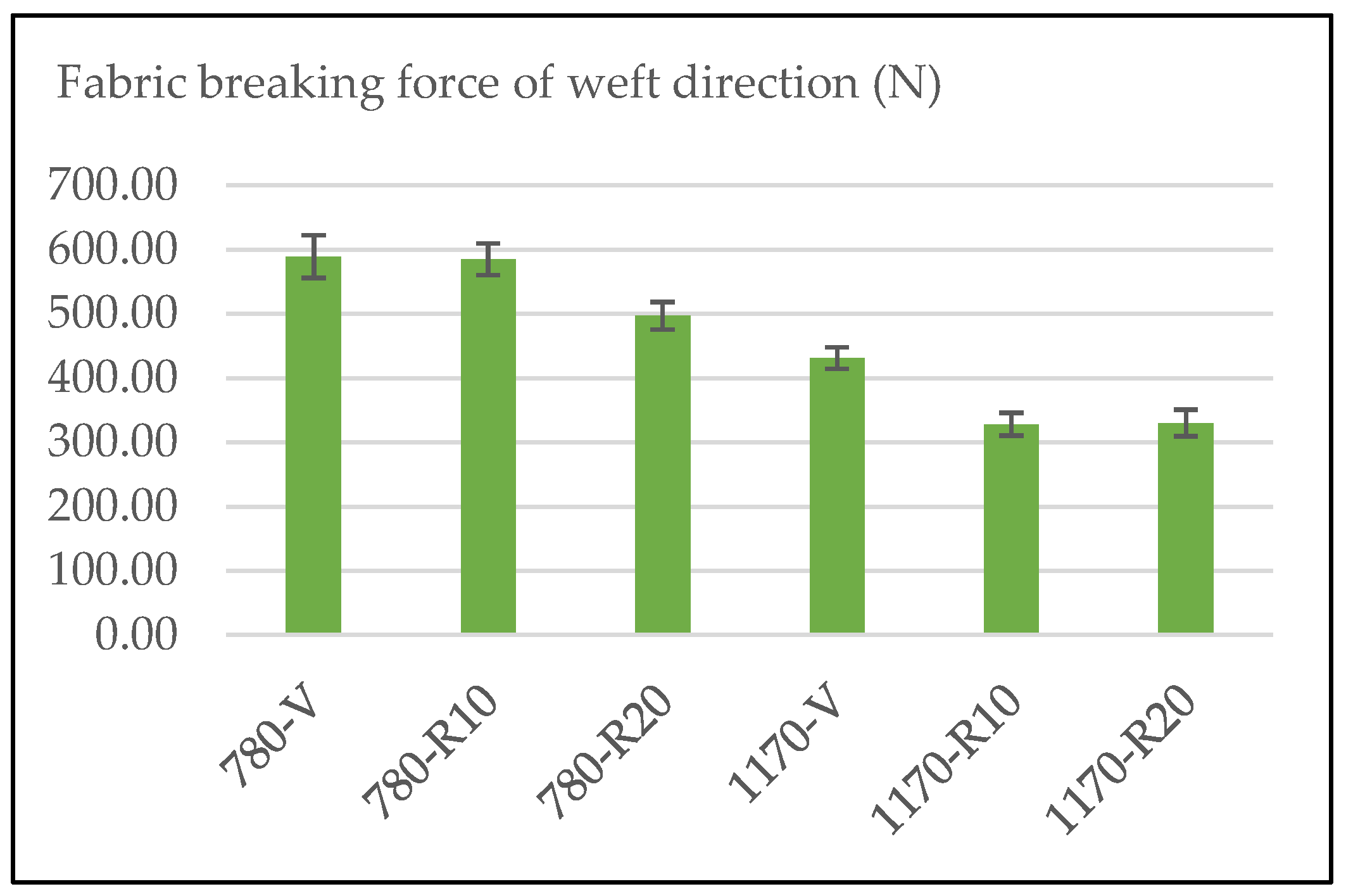
- Weft tensile strength values are affected by the r-PP/v-PP blend ratio and weft yarn fineness, with higher r-PP content generally causing a slight decrease in strength.
- According to TS 11,818 EN 14465, the minimum tensile strength value of upholstery fabrics is required to be 250 N [30]. It is seen that all fabrics have sufficient strength values.
- Variance analysis confirmed that both the blend ratio and yarn fineness significantly affected weft breaking strength (Sig.(p) < 0.05).
- The optimal weft properties determined by the model were 780 dtex yarn with a 10/90 r-PP/v-PP blend, yielding a predicted breaking strength of 562.45 N, tearing strength of 98.5 N, abrasion resistance of 53,750 cycles, and warp seam slippage of 1.068 mm.
- The regression-based model allows the prediction of physical and performance properties before production, reducing the need for trial runs and associated costs, and can be adapted in future studies to optimize other performance parameters such as abrasion resistance or seam slippage.
Funding
Data Availability Statement
Acknowledgments
Conflicts of Interest
References
- Celep, G.; Doğan, G.; Yüksekkaya, M.E.; Tercan, M. An Investigation of Thermal Comfort Properties of Single Jersey Fabrics Including Recycled Fibers. Duzce Univ. J. Sci. Technol. 2016, 4, 104–112. [Google Scholar]
- Qian, G.; Lan, T. Polypropylene Nanocomposite. In Handbook of Polypropylene and Polypropylene Composites; Harutun, G.K., Ed.; CRC Press: Boca Raton, FL, USA, 2003. [Google Scholar]
- Sözcü, Ş. The Production of BCF Yarn and Machine Carpet from Recycled Polypropylene Pellets. Master’s Thesis, Gaziantep University, Gaziantep, Turkey, 2019. [Google Scholar]
- Lukoschek, S.; Frankenbach, L.A.; Cherif, C. Melt spinning of sustainable high-quality polypropylene from post-consumer waste for monofilaments. Text. Res. J. 2025, 95, 2437–2451. [Google Scholar] [CrossRef]
- Frankenbach, L.A.; Lukoschek, S.; Kruppke, I.; Cherif, C. Multifilament spinning of mechanically recycled polypropylene from post-consumer sources for a circular economy in textile applications. Sci. Rep. 2025, 15, 14047. [Google Scholar] [CrossRef] [PubMed]
- Dönmez, U.; Kebeli, D.S. Investigation of Usability of Recycled Polypropylene Nonwoven Waste in Spunbond Fabrics. Uluslararası Doğu Anadolu Fen Mühendislik Ve Tasarım Derg. 2022, 4, 15–31. [Google Scholar] [CrossRef]
- Rokbi, M.; Khaldoune, A.; Sanjay, M.R.; Senthamaraikannan, P.; Ati, A.; Siengchin, S. Effect of processing parameters on tensile properties of recycled polypropylene based composites reinforced with jute fabrics. Int. J. Lightweight Mater. Manuf. 2020, 3, 144–149. [Google Scholar] [CrossRef]
- Erdem, N.; Erdoğan, Ü.H.; Akşit, A. The Production and The Properties of Nano-Composite Polypropylene Filaments. J. Text. Eng. 2008, 15, 14–24. [Google Scholar]
- Tayyar, A.E. Usage of Recycled PET. Pamukkale Univ. J. Eng. Sci. 2010, 16, 53–62. [Google Scholar]
- ASTM D1238; Standard Test Method for Melt Flow Rates of Thermoplastics by Extrusion Plastometer. ASTM International: West Conshohocken, PA, USA, 2021.
- TS EN ISO 139; Textiles-Standard Atmospheres for Conditioning and Testing. Turkish Standards Institution: Ankara, Turkey, 2005.
- TS EN ISO 2062; Textiles—Yarns from Packages—Determination of Single-End Breaking Force and Elongation at Break Using Constant Rate of Extension Tester. Turkish Standards Institution: Ankara, Turkey, 2009.
- TS EN ISO 13934-1; Textiles—Tensile Properties of Fabrics—Part 1: Determination of Maximum Force and Elongation at Maximum Force Using the Strip Method. Turkish Standards Institution: Ankara, Turkey, 1999.
- TS EN ISO 13937-3; Textiles—Tear Properties of Fabrics—Part 3: Determination of Tear Force of Wing-Shaped Test Specimens (Single Tear Method). Turkish Standards Institution: Ankara, Turkey, 2000.
- TS EN ISO 13936-2; Textiles—Determination of Slippage Resistance of Yarns at a Seam in Woven Fabrics—Part 2: Fixed Load Method. Turkish Standards Institution: Ankara, Turkey, 2004.
- TS EN ISO 12945-2; Textiles—Determination of Fabric Propensity to Surface Pilling, Fuzzing or Matting—Part 2: Modified Martindale Method. Turkish Standards Institution: Ankara, Turkey, 2020.
- TS EN ISO 12947-2; Textiles—Determination of Abrasion Resistance of Fabrics by the Martindale Method—Part 2: Determination of Specimen Breakdown. Turkish Standards Institution: Ankara, Turkey, 2016.
- Hayran, M.; Hayran, M. Sağlık Araştırmaları İçin Temel İstatistik; Omega Araştırma: Ankara, Turkey, 2011. [Google Scholar]
- Al-Salem, S.M.; Lettieri, P.; Baeyens, J. Recycling and recovery routes of plastic solid waste (PSW): A review. Waste Manag. 2009, 29, 2625–2643. [Google Scholar] [CrossRef] [PubMed]
- Takarada, W.; Barique, M.A.; Kunimitsu, T.; Kameda, T.; Kikutani, T. Verification of the Influence of Processing History through Comparing High-Speed Melt Spinning Behavior of Virgin and Recycled Polypropylene. Polymers 2022, 14, 3238. [Google Scholar] [CrossRef] [PubMed]
- Aumnate, C.; Rudolph, N.; Sarmadi, M. Recycling of polypropylene/polyethylene blends: Effect of chain structure on the crystallization behaviors. Polymers 2019, 11, 1456. [Google Scholar] [CrossRef] [PubMed]
- Awaja, F.; Pavel, D. Recycling of PET. Eur. Polym. J. 2005, 41, 1453–1477. [Google Scholar] [CrossRef]
- Uyanık, S. A study on the suitability of which yarn number to use for recycle polyester fiber. J. Text. Inst. 2019, 110, 1012–1021. [Google Scholar] [CrossRef]
- Çetin, C. Influence of Woven Fabric Properties and Applied Mechanical Finish on Fabric Strength. Master’s Thesis, Istanbul Technical University, Istanbul, Turkey, 2007. [Google Scholar]
- Uyanık, S.; Parlakyiğit, P.; Ovalı, S. Closed-Loop Recycled Yarn Production from Yarn Wastes and Investigation of Their Physical Properties within the Scope of Sustainability. Çukurova Univ. J. Fac. Eng. 2022, 37, 1087–1101. [Google Scholar]
- Huopaniemi, I.; Suvitaival, T.; Nikkilä, J.; Orešič, M.; Kaski, S. Two-way analysis of high-dimensional collinear data. Data Min. Knowl. Discov. 2009, 19, 261–276. [Google Scholar] [CrossRef]
- Niinimäki, K. Sustainable Fashion: New Approaches. In The Handbook of Design for Sustainability; Aalto University: Helsinki, Finland, 2013; pp. 12–29. [Google Scholar]
- Marcinčin, A. Dyeing of polypropylene fibers. In Polypropylene; Karger-Kocsis, J., Ed.; Polymer Science and Technology Series; Springer: Dordrecht, The Netherlands, 1999; Volume 2. [Google Scholar]
- Ujhelyiova, A.; Bolhova, E.; Oravkinova, J.; Tiňo, R.; Marcinčin, A. Kinetics of dyeing process of blend polypropylene/polyester fibres with disperse dye. Dye. Pigment. 2007, 72, 212–216. [Google Scholar] [CrossRef]
- TS 11818 EN 14465; Textiles—Upholstery Fabrics—Specification and Methods of Test. Turkish Standards Institution: Ankara, Turkey, 2005.


| Extruder parameters | Zone-1 Temperature | 210 °C |
| Zone-2 Temperature | 215 °C | |
| Zone-3 Temperature | 225 °C | |
| Zone-4 Temperature | 240 °C | |
| Extruder Speed | 20.1 rpm | |
| Extruder Pressure | 110 bar | |
| Pump Speed | 18 rpm | |
| Drawing unit parameters | Godet-1 Speed | 300 mpm |
| Godet-2 Speed | 650 mpm | |
| Godet-3 Speed | 975 mpm | |
| Winder Speed | 1000 mpm |
| Fabric Code | r-PP/v-PP Blend Ratio in Weft Yarn Structure (%) | Weft Yarn Fineness (dtex) | Weft Density (ends/cm) | Warp Yarn Fineness and Raw Material | Warp Density (ends/cm) | Weave Type | Weight (g/m2) |
|---|---|---|---|---|---|---|---|
| 780-V | 0/100 | 780 dtex | 14 | 333 dtex/PES | 33 | Plain | 252 |
| 780-R10 | 10/90 | 780 dtex | 14 | 333 dtex/PES | 33 | Plain | 253 |
| 780-R20 | 20/80 | 780 dtex | 14 | 333 dtex/PES | 33 | Plain | 243 |
| 1170-V | 0/100 | 1170 dtex | 7 | 333 dtex/PES | 33 | Plain | 218 |
| 1170-R10 | 10/90 | 1170 dtex | 7 | 333 dtex/PES | 33 | Plain | 215 |
| 1170-R20 | 20/80 | 1170 dtex | 7 | 333 dtex/PES | 33 | Plain | 207 |
| Loom speed | 465 r/min |
| Width of weaving machine | 160 cm |
| Width of fabric | 140 cm |
| Weave type | Plain |
| Weft yarn type | Polypropylene yarn |
| Warp yarn type | Polyester yarn |
| Weft yarn fineness | 780 ve 1170 dtex |
| Warp yarn fineness | 333 dtex |
| Weft density | 14 and 7 ends/cm |
| Warp density | 33 ends/cm |
| Performance Property | Source | df | F | Sig.(p) | |
|---|---|---|---|---|---|
| Weft Breaking Strength | Main effect | Blend ratio | 2 | 65.887 | 0.000 * |
| Weft yarn fineness | 1 | 796.750 | 0.000 * | ||
| Interaction | Blend ratio * Weft yarn fineness | 2 | 21.201 | 0.000 * | |
| Independent Variables | Coefficient | t Value | Sig.(p) |
|---|---|---|---|
| Constant | 350.550 | 30.241 | 0.000 |
| Weft yarn fineness | 211.900 | 15.831 | 0.000 |
| Blend ratio | −42.900 | −3.205 | 0.005 |
| Constraints | Lower Limit | Upper Limit | |
| Weft tear strength (N) | WETS = 79.300 + 19.200 × WF − 8 × BR | 15 | - |
| Warp seam slippage (mm) | WASS = 5.423 − 4.355 × WF + 0.155 × BR | - | 6 |
| Abrasion resistant (Cycle) | AS = 41,250 − 7500 × BR + 12,500 × WF | 20,000 | - |
| Weft fineness | WF | 0 | 1 |
| Blend ratio | BR | 0 | 1 |
| Objective function | |||
| Weft breaking strength (N) | WEBS = 350.550 + 211.900 × WF − 42.900 × BR | ||
| Variables | Optimum Values |
|---|---|
| Weft tear strength (WETS) | 98.5 N |
| Warp seam slippage (WASS) | 1.068 mm |
| Abrasion resistant (AS) | 53,750 cycles |
| Weft fineness (WF) | 780 dtex |
| Blend ratio (BR) | 10% r-PP |
| Maximum weft breaking strength (WEBS) | 562.45 N |
| Measured_WEBS | Measured_WETS | Measured_WASS | Measured_AS | ||
|---|---|---|---|---|---|
| Calculated_WEBS | Pearson Correlation | 0.957 ** | 0.311 | −0.963 ** | 0.715 |
| Sig. (2-tailed) | 0.003 | 0.549 | 0.002 | 0.110 | |
| Calculated_WETS | Pearson Correlation | 0.573 | 0.600 | −0.393 | 0.919 ** |
| Sig. (2-tailed) | 0.234 | 0.208 | 0.441 | 0.010 | |
| Calculated_WASS | Pearson Correlation | −0.929 ** | −0.173 | 0.992 ** | −0.542 |
| Sig. (2-tailed) | 0.007 | 0.743 | 0.000 | 0.267 | |
| Calculated_AS | Pearson Correlation | 0.724 | 0.572 | −0.578 | 0.940 ** |
| Sig. (2-tailed) | 0.104 | 0.235 | 0.230 | 0.005 | |
Disclaimer/Publisher’s Note: The statements, opinions and data contained in all publications are solely those of the individual author(s) and contributor(s) and not of MDPI and/or the editor(s). MDPI and/or the editor(s) disclaim responsibility for any injury to people or property resulting from any ideas, methods, instructions or products referred to in the content. |
© 2026 by the author. Licensee MDPI, Basel, Switzerland. This article is an open access article distributed under the terms and conditions of the Creative Commons Attribution (CC BY) license.
Share and Cite
Esi, B. Optimization Model for Tensile Strength Prediction in Woven Upholstery Fabrics Containing Recycled PP. Processes 2026, 14, 336. https://doi.org/10.3390/pr14020336
Esi B. Optimization Model for Tensile Strength Prediction in Woven Upholstery Fabrics Containing Recycled PP. Processes. 2026; 14(2):336. https://doi.org/10.3390/pr14020336
Chicago/Turabian StyleEsi, Bestem. 2026. "Optimization Model for Tensile Strength Prediction in Woven Upholstery Fabrics Containing Recycled PP" Processes 14, no. 2: 336. https://doi.org/10.3390/pr14020336
APA StyleEsi, B. (2026). Optimization Model for Tensile Strength Prediction in Woven Upholstery Fabrics Containing Recycled PP. Processes, 14(2), 336. https://doi.org/10.3390/pr14020336