Review

Current Trends and Innovations in CO2 Hydrogenation Processes

by
Egydio Terziotti Neto
,
Lucas Alves da Silva
,
Heloisa Ruschel Bortolini
,
Rita Maria Brito Alves
and
Reinaldo Giudici
*
Department of Chemical Engineering, Escola Politécnica, Universidade de São Paulo, Av. Prof. Luciano Gualberto, 380, Travessa do Politécnico, São Paulo 05508-010, SP, Brazil
*
Author to whom correspondence should be addressed.
Processes 2026, 14(2), 293; https://doi.org/10.3390/pr14020293
Submission received: 6 December 2025 / Revised: 1 January 2026 / Accepted: 8 January 2026 / Published: 14 January 2026
(This article belongs to the Special Issue Feature Review Papers in Section "Chemical Processes and Systems")

Abstract

In recent years, interest in carbon dioxide (CO2) hydrogenation technologies has intensified. Driven by the continuous rise in greenhouse gas emissions and the unprecedented negative impacts of global warming, these technologies offer a viable pathway toward sustainability and support the development of low-carbon industrial processes. In addition to methanol and methane, other possible hydrogenation products (i.e., hydrocarbons, formic acid, acetic acid, dimethyl ether, and dimethyl carbonate) are of industrial relevance due to their wide range of applications. Therefore, this review aims to provide a comprehensive overview of the various aspects associated with thermocatalytic CO2 hydrogenation processes, from thermodynamic and kinetic studies to upscaled reactor modeling and process synthesis and optimization. The review proceeds to examine different integration strategies and optimization approaches for multi-product systems, with the objective of evaluating how distinct technologies may be combined in an integrated flowsheet. It then concludes by outlining future research opportunities in this field, particularly those related to developing comprehensive kinetic rate expressions and reactor modeling studies for routes with low technology readiness levels, the exploration of prospective reaction pathways, strategies to mitigate the dependence on green hydrogen (which, today, exhibits high costs), and the consideration of market price or product demand fluctuations in optimization studies. Overall, this review provides a solid base to support other decarbonization studies focused on hydrogenation technologies.

1. Introduction

The increase in carbon dioxide (CO2) emissions in recent years has been a constant topic of debate and concern worldwide, as it represents the most human-emitted greenhouse gas (GHG). According to the 2025 International Energy Agency (IEA) report [1], global CO2 emissions from energy demand and industrial processes grew by 0.8% in 2024, reaching a record 37.8 Gt CO2, which raised the atmospheric CO2 concentration to 422.5 ppm, about 50% higher than pre-industrial levels. This rise is considered one of the main causes of climate change and has significant impacts on global warming, ocean acidification, and other secondary climatic events [2]. On a global scale, China, the United States, and India are the largest emitters, accounting for 51.8% of total CO2 emissions [3]. Brazil ranks as the twelfth largest emitter, with 476 million tons of CO2 released in 2023, representing 1.2% of global emissions.
In 2015, during the UN Climate Change Conference (COP21), the Paris Agreement was established as a historic landmark to curb the emission of GHGs and limit the increase in the average word temperature to 2 °C (preferably 1.5 °C) if compared to pre-industrial levels. A decade later, CO2 emissions increased 10% and the world is far from reaching the target goals, with the last 10 years being the hottest in history and with the average world surface’s temperature reaching the 1.5 °C increase mark in 2024 [4,5]. Therefore, the pursuit of actions and technologies to mitigate CO2 emissions is urgent and of great interest to governmental authorities as well as to public and private sectors of society, including industry, transportation, and energy.
Currently, the strategies studied for reducing CO2 emissions include improving energy efficiency in industrial processes, developing a cleaner energy matrix, and employing carbon capture, utilization, and storage (CCUS) technologies. The energy sector was the largest source of global GHG emissions in 2023, with 60% of the world’s energy coming from fossil fuels. The search and implementation of cleaner energy sources have gained ground, with an increase of 140% (around 2600 GW) of annual electricity capacity of renewable sources since 2015, while the fossil fuels electricity capacity only increased by around 16% (640 GW) [6]. Therefore, even with the increase in renewable sources, there is still a long way to go to achieve a complete worldwide renewable energy matrix.
This underscores the importance of goals such as achieving net-zero emissions, in which the amount of GHG released into the atmosphere is balanced by the amount removed. Among the strategic approaches to accomplishing this balance, carbon capture, utilization, and storage (CCUS) technologies play a central role in removing CO2 from the atmosphere. These technologies have emerged as a promising approach to add economic value to the CO2 molecule, which can be used as a carbon feedstock to produce value-added chemicals such as alcohols, polymers, and hydrocarbons, including light olefins, and fuels [7].
With the advancement of carbon capture technologies, a major challenge emerges: the need to utilize the large volumes of captured CO2, which previously lacked industrially viable applications at such a scale. Recognizing that fossil resources were originally formed through natural carbon hydrogenation during photosynthesis, synthetic CO2 hydrogenation has become one of the most promising pathways to regenerate hydrocarbons that have been combusted [8].
The main limitation of using CO2 as a feedstock is its highly stable nature, with Gibbs free energy of formation ( Δ G 298 ° ) = −394.4 kJ mol−1; therefore, hydrogenating CO2 requires high energy input or a highly active catalyst [9]. However, several technologies enable CO2 hydrogenation, supporting the production of a wide variety of chemicals. The range of possible products extends from simple hydrocarbons and alcohols, such as methane, methanol, ethane, and ethylene, to more complex molecules that require multiple reaction steps, including dimethyl ether (DME), aromatic compounds, and formic acid, among others.
As stated by Karakaya and Parks [10], in theory, a reactant mixture of CO2 and H2 contains the necessary C–H–O elements to produce a wide range of chemicals and fuels, including hydrocarbons and alcohols. While the formation of these products is thermodynamically constrained by equilibrium limitations, the practical feasibility depends on designing processes capable of operating within the appropriate ranges of temperature, pressure, and residence time. Therefore, the research, development, and improvement of these processes is the key to achieving industrial application feasibility of CO2 hydrogenation.
Currently, to the best of our knowledge, there is not a comprehensive review in the literature focused on modeling and simulation studies of the main thermocatalytic CO2 hydrogenation processes. In this context, the present work, divided into three parts, aims to present the state of the art of process synthesis and design through modeling and simulation strategies focused on CO2 hydrogenation. Initially, in Section 2, an overview of CO2 hydrogenation is presented, highlighting aspects related to the feasibility of carbon capture and utilization (CCU), the most suitable industrial CO2 sources, and the potential use of CO2 for different products. Subsequently, in Section 3, the state of the art of the main CO2 hydrogenation processes is presented, including the production of methane, methanol, hydrocarbons, formic acid, acetic acid, dimethyl ether, dimethyl carbonate, and ethanol. For each process, the studies were organized into two main blocks: thermodynamic analyses and kinetic modeling, and process modeling and simulation studies, with a focus on thermocatalytic routes. For some processes, alternative routes based on electrocatalysis are also addressed, since not all products have mature and well-developed thermocatalytic processes. Next, the topics of polygeneration processes and superstructure-based optimization are presented, in which aspects related to the simultaneous production of multiple products, process integration as a strategy to increase technical and economic feasibility, and superstructure-based process design are discussed, considering the growing use of this approach applied to CO2 conversion. In addition, a comparison between these studies and the individual processes previously discussed is carried out, addressing the Technology Readiness Level (TRL) of each process. Finally, in Section 4, the main conclusions on the state of the art of these processes are presented, as well as directions for future research.

2. Promising CO2 Hydrogenation Products

Heat and electricity generation, together with industrial operations, account for approximately half of global carbon dioxide emissions [11]. However, with the application of appropriate carbon capture and utilization technologies, these emissions can be reduced by up to 90% [12]. The associated costs, on the other hand, can be prohibitive, particularly when CO2 concentrations in the source stream are low. Typical CO2 concentrations for different process industries were reported by Husebye et al. [13]. In general, it can be as low as 1% for aluminum production and as high as 65% for natural gas processing. Moreover, hydrogen production generates CO2 with a purity of up to 90%, while ammonia production generates a 100% pure CO2 process stream [14].
Different studies have demonstrated that carbon capture costs decrease significantly as the CO2 concentration in the flue gas increases [13,15]. The study by Lopes et al. [16] evaluated different carbon dioxide sources to determine which are best suited for CO2 conversion processes. Their findings indicate that the most favorable sources are those from natural gas steam reforming (NGSR) for hydrogen production, ethylene oxide process streams, and ammonia production streams, as these processes generate CO2 with higher purity and therefore lower capture costs. Additionally, the study found that integrating process units capable of producing residual hydrogen while simultaneously generating CO2 can provide advantageous feed streams for utilization. Among the evaluated combinations, the highest-scoring options were NGSR coupled with carbon capture technologies and coke oven gas integrated with residual blast furnace gas streams.
A significant transformation in the way industry operates worldwide is required for effective decarbonization strategies to be implemented. It is important to note that the chemical industry tends to follow a linear production model, characterized by limited recycling and reutilization of process streams [17]. For example, only 3–4% of CO2 emissions from refineries, oil and ethanol production, and the fertilizer and steel industries are currently captured for storage or utilization. Moreover, industrial CO2 is classified as a “hard-to-abate” emission source, along with heavy-duty road transport, shipping, and aviation. This classification reflects the fact that process characteristics often make mitigation difficult, economically unfeasible, or would require substantial modifications to existing plants to accommodate the infrastructure necessary for CO2 utilization technologies, including hydrogenation processes [18].
Most industrial production currently depends on oil, natural gas (NG), and coal. In the future, however, not only is the depletion of oil use expected, but alternative fossil resources will need to be complemented by clean, renewable energy sources (e.g., water electrolysis for green hydrogen production) and by carbon dioxide or biomass to supply the chemicals required for everyday applications [19]. One challenge associated with this movement would be the implementation of a fully decarbonized transition, where carbon capture and utilization technologies are combined with clean energy use. This, however, would require 18.1 PWh of low-carbon electricity (55% of the expected global energy demand in 2030). Although the large-scale production of this amount of energy is theoretically feasible, practical implementation is constrained by multiple factors, including cost, land-use competition, public acceptance of energy infrastructure, and limitations in the capacity of electricity grids to accommodate intermittent power supply [20,21]. Also, feedstock availability must be considered when planning future chemical plants. Today, those industries are concentrated where oil and gas facilities are present in abundance and at relatively easy access. As industries shift to CO2 as a feedstock, regions like the Middle East may face reduced production capacity due to limited local CO2 supply. This could challenge regional economic growth, making it important to develop mitigation strategies [22].
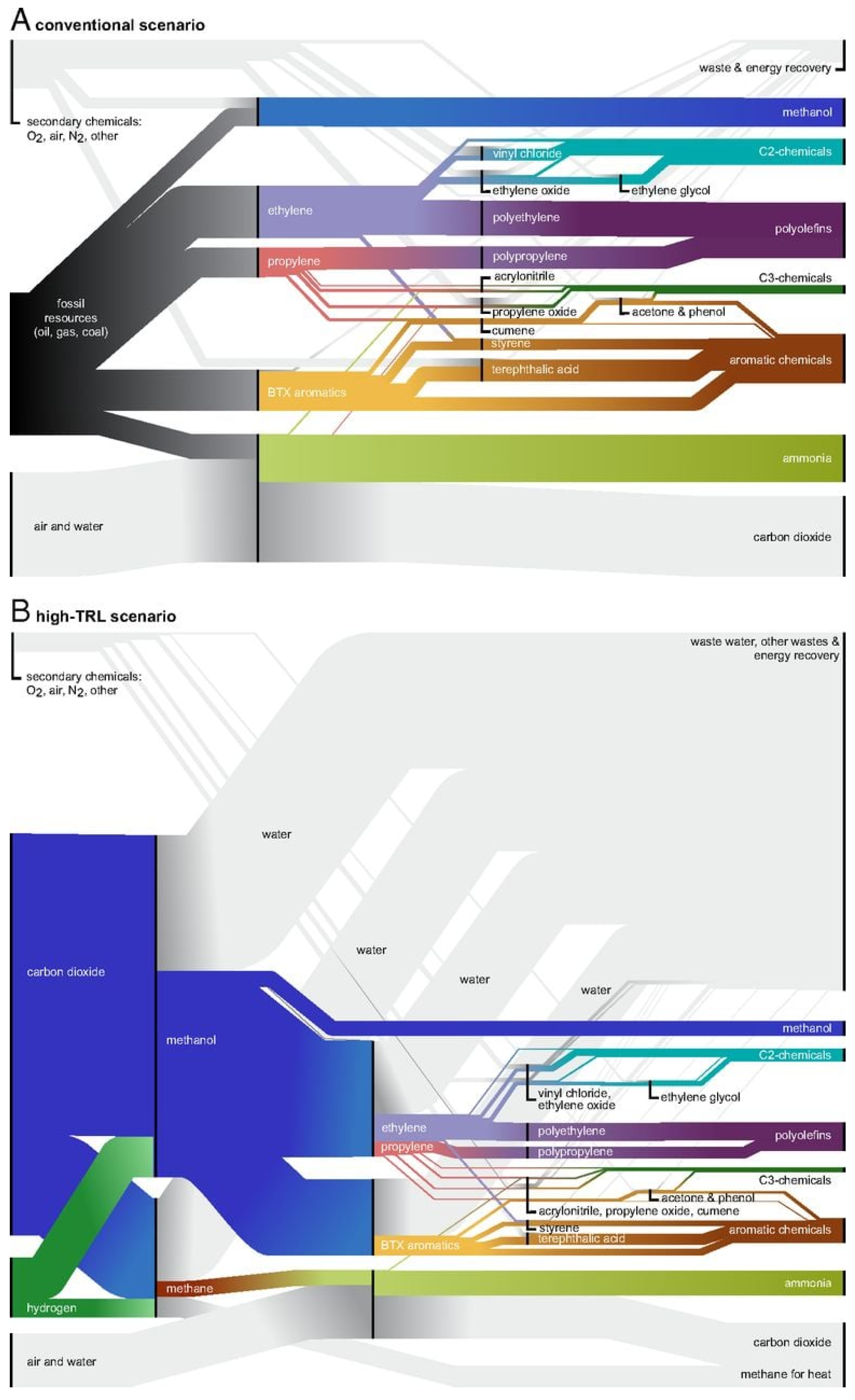
Figure 1, reproduced from Kätelhön et al. [21], compares the current fossil-based scenario with a future scenario in which CO2 utilization and renewable energy are fully deployed at an industrial scale. It illustrates the mass flows involved in producing 20 major chemicals and their projected 2030 demand (not to scale). As shown in the figure, the main CO2-derived products (methanol and methane) are typically obtained through hydrogenation reactions. Chauvy et al. [23] evaluated ten different CO2-derived products through specific process routes, including methanol and methane via hydrogenation. Using a multi-criteria decision analysis (MCDA), they assessed nine key performance indicators (KPIs): technological maturity, geographical constraints, fossil-free operation, market size, competitiveness with respect to alternative technologies, economic viability, CO2 uptake potential (the number of moles of CO2 that a determined product can incorporate in its molecule through a stoichiometric basis), environmental potential, and health and safety considerations. The MCDA employed several methodologies, including LexiMin/LexiMax, the Weighted Sum Method (WSM), the Analytical Hierarchy Process (AHP), and the Elimination and Choice (ELECTRE) method. Details of each approach can be found in the references provided in the aforementioned study [24,25,26,27,28,29,30,31]. Across nearly all MCDA made, methanol ranked first, while methane also appeared among the highest-scoring options for further research and development. These findings are consistent with the high CO2-utilization scenario illustrated in Figure 1 and confirm that hydrogenation processes will play a major role in the transition toward CO2 valorization.
Centi et al. [32] evaluated 38 different works on CO2 hydrogenation to methanol and methane. Among these, only four studies on methanol production [33,34,35,36], and none on methane, reported the possibility of producing the target chemical at a cost lower than or equal to the reference market value. The authors noted, however, that the results exhibited substantial variability, suggesting potential inconsistencies in some of the techno-economic assessments (TEA). They also emphasized the importance of guidelines such as those proposed by Zimmermann et al. [37], which provide a comprehensive framework for conducting and reporting TEA alongside life-cycle assessment (LCA) studies. Taken together, both studies highlight the need for adopting a consistent methodological framework and for providing proper contextualization of reported results in TEA studies of CO2-to-methanol and CO2-to-methane processes, with conclusions that also extend to other CO2-derived hydrogenation products.
Typically, all hydrogenation products are intended for short-term energy storage, including methanol and methane, as well as formic acid, dimethyl carbonate (DMC), formaldehyde, and different hydrocarbons. Long-term storage can be achieved by using these compounds as intermediates to produce durable resins and polymers [38]. Nevertheless, the choice to implement a full-scale carbon dioxide hydrogenation process may be driven by two distinct objectives: the production of high–added value products with relatively low market volume (e.g., fine chemicals) or the production of low–added value products with substantially larger market demand, such as various types of fuels, most of which are associated with short-term storage applications [14]. Moreover, the hydrogenation process may follow either a direct or an indirect pathway. In the indirect route, CO2 is first converted into an intermediate species before the final product is obtained, whereas in the direct route, the molecule is converted directly into the desired product [39].
Chauvy et al. [14] evaluated the CO2 uptake potential for different utilization routes and showed that, among the different CO2-derived, the combined uptake potential of those that can be produced through a hydrogenation pathway (methanol, ethanol, formaldehyde, dimethyl ether, formic acid, acetic acid, and dimethyl carbonate) is approximately 305 MtCO2 per year. Moreover, methane alone presents a possible CO2 uptake potential of 3000 to 4000 MtCO2 per year. A similar analysis was carried out by us using ChemAnalyst annual demand data for additional hydrogenation products reported by Otto et al. [40], indicating that oxalic acid [41] and acetone [42] together could contribute with 7.14 MtCO2 per year. Other products such as propanol [43] and propanoic acid [44] were also considered. However, their contribution would be minimal due to either low annual demand or specific mass.
Apart from those mentioned compounds, it is also possible to produce hydrocarbons of various chain lengths through either a direct or an indirect route. The direct route follows the principles of Fischer-Tropsch synthesis. In the indirect route, CO2 is first hydrogenated to carbon monoxide or methanol, which subsequently undergoes further reactions to produce different classes of hydrocarbons [39,45,46]. It should be noted that direct hydrogenation tends to form light saturated hydrocarbons, with lower chain growth probability values [45]. These differences in product distribution are relevant given the growing need for renewable fuels. In the near future, for example, the demand for renewable jet and road biofuels is expected to increase to 9 billion and 27 billion liters, respectively, by 2030 [47].
Pacheco et al. [48] proposed a framework to evaluate, through an MCDA screening, the most promising CO2-derived chemical products. The approach was divided into three parts: criteria definition, selection of the MCDA tool to be used, and application of a three-level assessment for product prioritization. The criteria were defined based on an extensive literature review and included thermodynamic aspects, scientific relevance, economics, technical readiness level (TRL), CO2 utilization, affordability of producing a single chemical, and innovation potential. In the second part, the methodology presented by Guarini et al. [49] was applied to select the most suitable MCDA technique, which resulted in the implementation of the Technique for Order Preference by Similarity to an Ideal Solution (TOPSIS). Details on this method are available in Behzadian et al. [50]. The third and final part consisted of the three-level assessment, through which the authors narrowed an initial list of 122 candidates to eight top CO2-derived products. Except for urea and salicylic acid (which are not obtained via hydrogenation), all selected products can be produced through hydrogenation routes.
Pacheco et al. [51] and Zhaurova et al. [38] also conducted MCDA analyses at a local level, the former for Brazil and the latter for Finland. While the Brazilian case-study identified methanol, polycarbonates, formic acid, and acetaldehyde as the most promising CO2-derived products, the Finnish study reported that methane, hydrocarbons (diesel and gasoline), and methanol ranked highest among short-term storage options. These findings highlight the importance of proper contextualization, as emphasized by Centi et al. [32] (even though these studies were not properly TEA) to enable meaningful comparisons between proposed results and the specific scenarios under evaluation.
Cui et al. [52] also proposed a framework to identify the most promising CO2-utilization technologies by combining thermodynamics, simplified process modeling, and multi-criteria decision analysis (TOPSIS). The authors evaluated 26 candidate reactions that involved CO2 through different technical, economic, and environmental criteria. Process simulations by means of a simplified flowsheet were used to calculate indicators such as the Return Over Investment (ROI) and the CO2-utilization ratio (the net mass flow of carbon dioxide divided by the mass flow of the desired product). Three screening schemes were applied to ensure robustness. The final results indicated that ethanol, methanol, ethylene carbonate, methane, DME, formaldehyde and dimethyl carbonate had the highest scoring results within the evaluated criteria.
Additionally, to high academic interest, significant industrial interest has emerged in recent years in processes capable of hydrogenating CO2 into different chemicals [19]. Recent examples include:
  • CO2CHEM: A project developed in Brazil through a partnership between Repsol Sinopec Brasil, Hytron (Neuman & Esser Group), the National Service for Industrial Training (from Portuguese, SENAI) and the University of São Paulo (USP). In 2025, the consortium installed a pilot plant that uses CO2 and water as feedstocks to produce renewable fuels [53].
  • Carbon Recycling International: In 2022, the company commissioned a plant in Anyang, China, capable of producing 110,000 tons per year of methanol from CO2. The facility is located adjacent to a coke oven gas plant that provides CO2, which is produced as a by-product. In a separate project, the company signed a landmark agreement to install another plant in Liaoyuan, China, expected to produce 170,000 tons per year of methanol from CO2 [54,55].
  • INPEX and Osaka Gas: The two Japanese companies are constructing a plant to convert CO2 into methane for the production of carbon-neutral city gas. The project, initiated in 2023, is expected to deliver 400 Nm3 per hour of methane, with the demonstration phase scheduled to begin in 2026 [56].
  • Godavari Biorefineries Limited (GBL): The Indian biorefinery company recently initiated, in collaboration with the Institute of Chemical Technology in Mumbai, a pilot project aimed at converting 450 metric tons of CO2 per day into dimethyl ether (DME). The company has already received an award for developing a single-step catalytic process capable of directly producing DME from CO2 [57,58].

3. State of the Art of Main CO2 Hydrogenation Processes

Due to this growing interest from both academia and industry, the following sections provide a detailed overview of the current literature addressing the various aspects of carbon dioxide hydrogenation processes. This includes the technological and catalytic considerations, and also economic, environmental, and integration aspects associated with the feasibility of these utilization routes. The main products considered in this study were those presented by Chauvy et al. [14] that can also be produced through a hydrogenation pathway. Those products, listed in alphabetical order, include acetic acid, dimethyl carbonate, dimethyl ether, ethanol, formic acid, methane and methanol, which were reported to exhibit CO2 uptake potentials ranging from 0.95 to 4000 MtCO2 per year, thereby representing an alternative of being significant contributors to overall emissions reduction. Moreover, hydrocarbons produced through carbon dioxide hydrogenation were also considered, given their previously discussed relevance in achieving the future demand for renewable fuels.

3.1. CO2 Hydrogenation to Methane Processes

The hydrogenation of carbon monoxide to methane, also known as methanation or the Sabatier reaction, is currently one of the most developed hydrogen-conversion technologies [59]. This reaction offers two significant advantages compared to the direct use of hydrogen as an energy carrier: a higher volumetric energy density (40.0 MJ/m3 for methane versus 12.7 MJ/m3 for hydrogen) and improved safety, as there are no restrictions on the input of synthetic methane into the existing natural gas grid [60,61]. The reaction, however, also poses some key disadvantages, which is why its use is currently commercially limited. First, the resulting methane has an increased global warming potential in respect with the carbon dioxide feed, which does not inherently make it a mitigation option. In addition, fugitive emissions can be observed during process operation and along pipeline networks. This contrasts with the combustion of pure hydrogen, which does not generate pollutant emissions [62].
Uchida and Harada [63] reported the main reactions involved in this process. Reactions in Equations (1) and (2) describe the two-step mechanism of the methanation reaction, whose overall formulation is given by Equation (3). Ethane formation (Equation (4)) may also occur as a side reaction. Additionally, coke formation (Equations (5) and (6)), can take place under certain operating conditions, such as high temperatures, leading to catalyst deactivation due to carbon deposition on the catalyst surface.
CO 2 +   H 2     CO + 2 H 2 O ,   Δ H 298 K = + 41   k J / m o l
CO + 3 H 2     CH 4 + H 2 O ,   Δ H 298 K = 206   k J / m o l
CO 2 + 4 H 2     CH 4 + 2 H 2 O ,   Δ H 298 K = 165   k J / m o l
2 C O 2 + 7 H 2     C 2 H 6 + 4 H 2 O ,   Δ H 298 K = 264   k J / m o l
CO 2 + 2 H 2     C + 2 H 2 O ,   Δ H 298 K = 90   k J / m o l
2 CO     C + CO 2 ,   Δ H 298 K = 172.5   k J / m o l
As shown in Equation (3), the CO2 to methane reaction is highly exothermic, meaning it is thermodynamically favored at low temperatures under equilibrium-controlled conditions. However, operating at such low temperatures becomes kinetically impractical, as the reaction would require an excessively long time to reach its final equilibrium state. For this reason, moderate temperatures, typically between 300 °C and 400 °C, are commonly employed to ensure a suitable balance between thermodynamics and reaction kinetics [64]. Since no commercial-scale process for this reaction has yet been developed, understanding its thermodynamic behavior in detail is a valuable first step. A thorough thermodynamic analysis provides crucial insight into feasible operating windows, guides catalyst development, and helps define the practical limits within which the process can be designed [65,66].

3.1.1. Thermodynamic and Kinetic Studies

Swapnesh et al. [67] performed a thermodynamic analysis of carbon dioxide methanation using the Gibbs free energy minimization method, considering the reactions presented in Equations (1)–(3), (5) and (6), as well as the additional reactions shown in Equations (7) and (8). The effects of temperature (450–1200 K) and pressure (1–50 bar) on CO2 conversion, CH4 yield, and CH4 selectivity were evaluated. The study is, however, limited, as it maintained a fixed H2/CO2 feed ratio of 4. Overall, at constant pressure, increasing the temperature up to 850 K resulted in reduced CO2 conversion due to the exothermic nature of Equation (3). Between 850 K and 950 K, conversion increased because the reverse water–gas shift (RWGS) reaction (Equation (1)), which is endothermic, dominated over the other exothermic reactions. As a consequence of this behavior, methane yield decreased almost linearly with increasing temperature at all pressures. Increasing pressure, on the other hand, favored CO2 conversion and methane formation, given that the methanation is a mole-reducing reaction. No coke formation was observed under the process conditions evaluated.
CH 4   C + 2 H 2 ,   Δ H 298 K = + 74.9   k J / m o l
CO + H 2   C + H 2 O ,   Δ H 298 K = 131   k J / m o l
Similar results were obtained by Gao et al. [68] when evaluating the thermodynamics of carbon dioxide hydrogenation to methane. In addition to temperature and pressure, the authors overcame the gap of the previous study by analyzing the effects of varying the inlet H2/CO2 ratio and the presence of water in the feed, both relevant parameters for this reaction. The authors observed that, at the lowest feed ratio, CO2 conversion decreased significantly and methane selectivity also declined. Furthermore, coke formation increased up to 50% at low H2/CO2 ratios and at temperatures up to 500 °C for both pressures investigated. Thus, the feed must contain at least a stoichiometric reactant ratio to avoid substantial coke formation. A similar conclusion was reported by Yarbaş and Ayas [65], although their study was limited to low-pressure operation. The addition of water, on the other hand, did not significantly affect the reaction performance.
Sahebdelfar and Ravanchi [66] compared several experimental studies with the corresponding thermodynamic equilibrium predictions. Two categories of catalysts were evaluated: Ni-based catalysts and noble metal–based catalysts. Overall, Ni catalysts exhibited conversions closer to equilibrium in respect to noble metal catalysts. However, the study showcased few experimental data points for the latter, hindering a broader comparison analysis. Although some of the catalysts evaluated exhibited performances that deviate substantially from equilibrium conditions, the use of a catalyst remains necessary to achieve a feasible process due to the strong kinetic limitations associated with the reaction [69].
Various metals can be employed as the active phase for carbon dioxide hydrogenation. Among them, the most investigated and listed in order of activity for CO2 conversion are ruthenium (Ru), rhodium (Rh), nickel (Ni), iron (Fe), cobalt (Co), platinum (Pt), and palladium (Pd) [70]. Although ruthenium exhibits the highest activity and selectivity towards methane, its cost makes large-scale deployment of such a catalyst prohibitive. Iron, conversely, is the cheapest metal but also displays low methane selectivity. As a result, nickel is the most studied catalyst, as it provides an adequate balance of activity and selectivity, and is not as expensive as a noble metal. However, it presents susceptibility to oxidation under the conditions usually employed in CO2 methanation. Cobalt performs less effectively and is more expensive than nickel. Therefore, it is studied less frequently, while the noble metals rhodium, platinum, and palladium are costly and, in some cases, less active than nickel [71]. In addition, the catalyst support plays a significant role, as it can modify the surface and adsorptive properties of the active phase. Common metal oxide supports include Al2O3, SiO2, TiO2, ZrO2, ZnO and CeO2 [72].
Champon et al. [73] evaluated the methanation of carbon dioxide over a commercial Ni/Al2O3 catalyst with a nickel content ranging from 14% to 17% at temperatures between 623 and 723 K. The authors also derived individual rate equations based on a Langmuir–Hinshelwood–Hougen–Watson (LHHW) mechanism for the RWGS, CO methanation, and CO2 methanation reactions (Equations (1)–(3)). Overall, for this catalyst–support system, CO2 hydrogenation was found to depend on hydrogen concentration and to be inhibited by water formation, as water competes for active catalyst sites. The authors compared their adapted kinetic expressions with the classic study by Weatherbee and Bartholomew [74], who investigated CO2 hydrogenation over a Ni/SiO2 catalyst containing 3% Ni at temperatures between 500 and 600 K. In that earlier work, the reaction rate was found to depend on both H2 concentration and CO2 concentration at low partial pressures, while at high CO2 partial pressures the concentration effect became negligible, and the presence of CO would decrease the reaction rate. According to Weatherbee and Bartholomew [74], the rate-determining step was the dissociation of CO2 into CO and adsorbed oxygen (O*). In contrast, Champon et al. [73] also identified CO2 dissociation as a rate-determining step, but in the context of a bimolecular RWGS pathway in which adsorbed CO2 and H2 react to form H2O and CO, similarly to Wheeler et al. [75].
Lefebvre et al. [76] proposed a kinetic model for a commercial Ni/SiO2 catalyst over the temperature range of 493–593 K in a slurry bubble column reactor (SBCR) using different liquid-phase solvents. Overall, the gas-phase concentration above the liquid phase proved to directly impact the reaction rate. In addition, the presence of water in the liquid phase decreased the reaction rate by approximately 10%, while methane formation did not affect the rate. In a subsequent study, Lefebvre et al. [77] investigated whether the presence of a liquid phase altered the kinetic expression derived for the SBCR. The authors employed the same catalyst in a fixed-bed reactor and verified that the kinetic rate expression obtained for the fixed-bed configuration accurately described the SBCR results. As a conclusion, as long as mass transfer limitations are minimized, the reaction rate remains unchanged and depends primarily on the gas-phase concentration at the catalyst surface.
A simple power-law model was proposed by Chiang and Hopper [78] to describe the hydrogenation of carbon dioxide over a 58% Ni/SiO2 catalyst. Kinetic tests were conducted between 550 and 591 K under varying total pressures and inlet compositions. When compared with LHHW scheme, both approaches produced very similar fits to the experimental data. However, the authors preferred the power-law model, since the analysis made was to correlate data and this proposed scheme is of simpler use. For clarity, all rate expressions reported in the cited literature are summarized in Table 1. Kinetic models for different catalysts or supports can be found elsewhere [72,79,80].

3.1.2. Modeling and Simulation Studies

The development of scaled-up reactors based on kinetic measurement is also a challenging task. Although having a reliable kinetic model is essential for reactor design, scale-up must also account for additional phenomena which, sometimes, are not easily measurable, including mass-transfer limitations within and between phases, as well as convective, conductive, and radiative heat-transfer throughout the reactor structure [81,82]. When it comes to CO2 hydrogenation to methane, several reactor configurations are currently being investigated in greater detail, including fixed-bed reactors, membrane reactors, fluidized-bed reactors, and structured reactors. Modes of operation and the simplifying assumptions employed vary across published studies, underscoring both the diversity and the importance of research in this field [79].
The validation of regressed kinetic parameters through a reactor model was investigated by Miguel et al. [83]. A catalyst containing 20–25% of NiO supported in CaO. Al2O3 was tested at different temperatures (250–350 °C). The final kinetic model was adapted from the formulation proposed by Koschany et al. [84], excluding the surface coverage terms for carbon monoxide and hydrogen. To assess the performance of the proposed kinetic model, the authors validated it using a one-dimensional, isothermal, pseudo-homogeneous reactor model without axial dispersion or mass- and heat-transfer limitations. The model was tested across different gas-hourly space velocities (1.52 and 12.41 g h mol−1) and temperatures (250 °C and 350 °C). Despite being simplified, the model adequately predicted the overall reaction behavior, showing good agreement between experimental and simulated results. It should be noted, however, that the predicted hydrogen consumption obtained by the model deviated significantly from the experimental results, which was attributed to using the system’s mass balance to determine its concentration experimentally. Therefore, the adoption of more accurate measurement techniques is recommended to improve experimental data acquisition and, consequently, to enable the development of more accurate kinetic model expressions that allow a more adequate representation of the hydrogen consumption rate.
A detailed analysis of reactor models was conducted by Schlereth and Hinrichsen [85]. The authors compared different levels of complexity for a fixed-bed reactor, including: a 1-D pseudo-homogeneous model; a 2-D pseudo-homogeneous model accounting for heat-transfer resistances at the tube wall; a 2-D pseudo-homogeneous model incorporating porosity gradients within the tube; a heterogeneous model with dusty-gas approach for the particle modeling; and a 1-D pseudo-homogeneous model incorporating a membrane inside the tube. Several outcomes emerged from this study. First, the authors demonstrated that the system is prone to hot-spot formation and thermal runaway, as slight increases in the coolant temperature (from 279 °C to 285 °C) caused the hot-spot temperature to rise from approximately 290 °C to 700 °C. Second, they concluded that among the pseudo-homogeneous models, despite slight differences in the predicted reactor maximum temperatures, the simplest model adequately captured the main system features and thus enabled a basic understanding of the reactor behavior. The heterogeneous model allowed the authors to identify intraparticle heat- and mass-transfer resistances, particularly for large catalyst pellets and small pore radii. Finally, the membrane reactor configuration, in which CO2 and H2 were supplied in separate compartments, provided effective temperature control (maintaining temperatures below 510 °C) and achieved a yield of 91.7%, close to the equilibrium value of 92%. This latter configuration, however, is limited to assuming a fixed flux density over the membrane on the overall reactor length, which could be improved with its variation was considered.
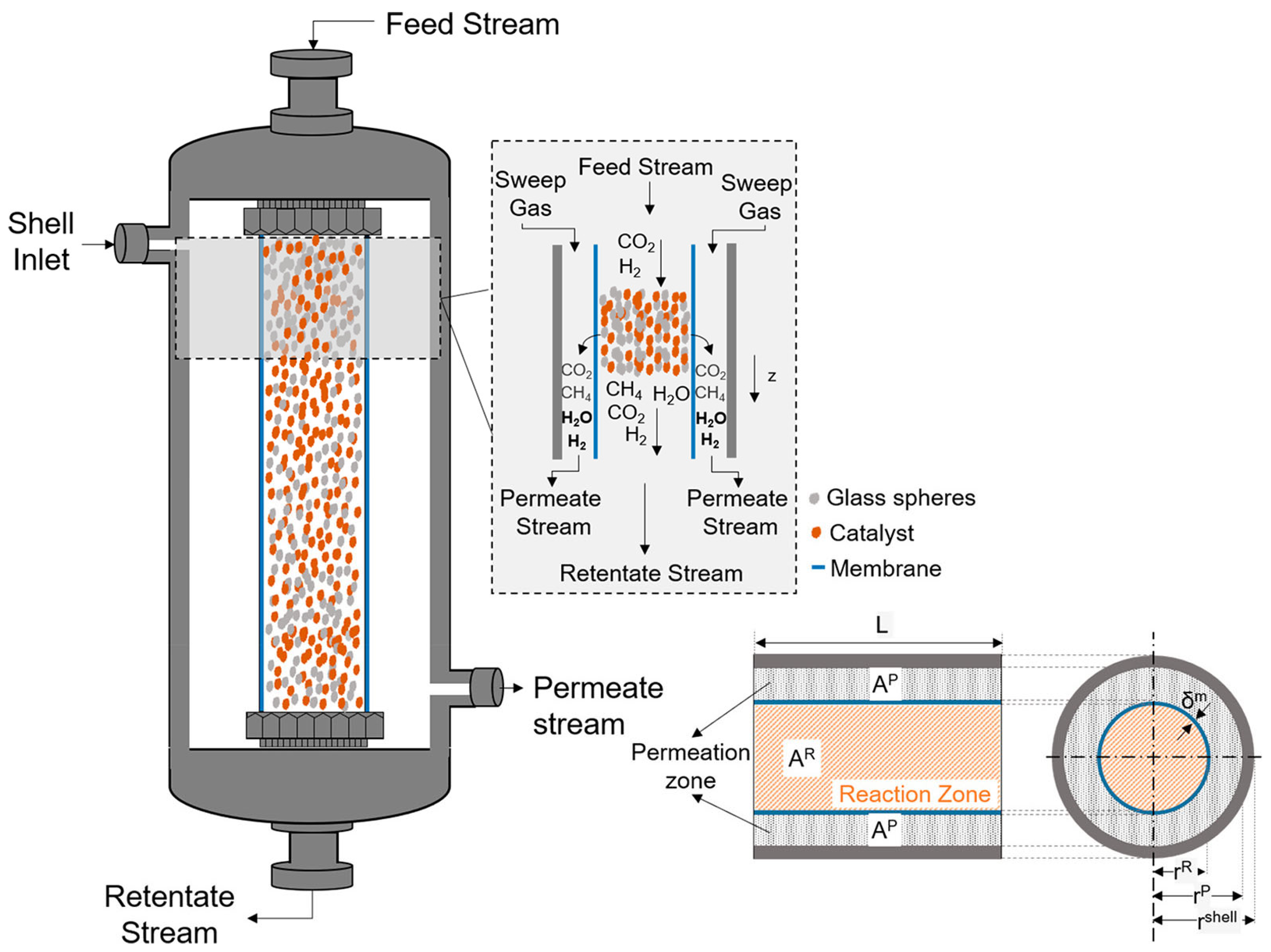
This limitation is later addressed by Faria et al. [86], who evaluated the performance of a selective membrane reactor for water removal for CO2 methanation, following the configuration illustrated in Figure 2. The reactor was modeled using a 1-D non-isothermal, pseudo-homogeneous approach, neglecting internal and external transport resistances. The system employed a 0.15 mm-thick hydroxy sodalite (H-SOD) zeolite membrane, chosen for its selectivity towards water removal. Their results demonstrated that integrating the membrane enhanced reactor performance when compared to the results of a traditional fixed-bed reactor. Across different operating conditions (varying temperature, pressure, and contact time), the membrane reactor had a better performance in respect to the conventional configuration, with CO2 conversions increasing from 63% to 89% under high temperature, pressure, and contact-time conditions. Additionally, the membrane reactor allowed the system to operate efficiently under milder thermal and pressure conditions than those required for a fixed-bed reactor.
A segmented reactor was proposed by Herrmann et al. [87], with an adiabatic fixed-bed reactor fashion to enhance the flexibility of the CO2 methanation process. The proposed system divided the reactor tubes into four thermally coupled chambers, each modeled as a 1-D pseudo-homogeneous plug-flow approach accounting for mass transfer limitations through the use of an effectiveness factor. Unlike a traditional one-bed reactor, the segmented configuration allows each chamber to be independently operated or placed on standby, while heat transfer across the internal walls keeps inactive chambers at adequate temperatures. This thermal coupling enabled the standby operation without external heating, as long as at least one chamber remains active. Under adequate operating conditions, the reactor maintained stable temperature profiles and achieved adequate CO2 conversions across different start-up schemes evaluated. Consequently, this reactor design offers an alternative to conventional systems, particularly in contexts where the supply of green hydrogen is intermittent and subject to fluctuations. It should be noted, however, that the model is limited to analyzing reactor behavior using a 1-D formulation, despite the presence of radial heat fluxes between the chambers. Although these effects can be represented by coupling the model with appropriate 1-D heat-balance expressions, two-dimensional simulations would enable a more accurate characterization of the heat-transfer behavior associated with this segmented system.
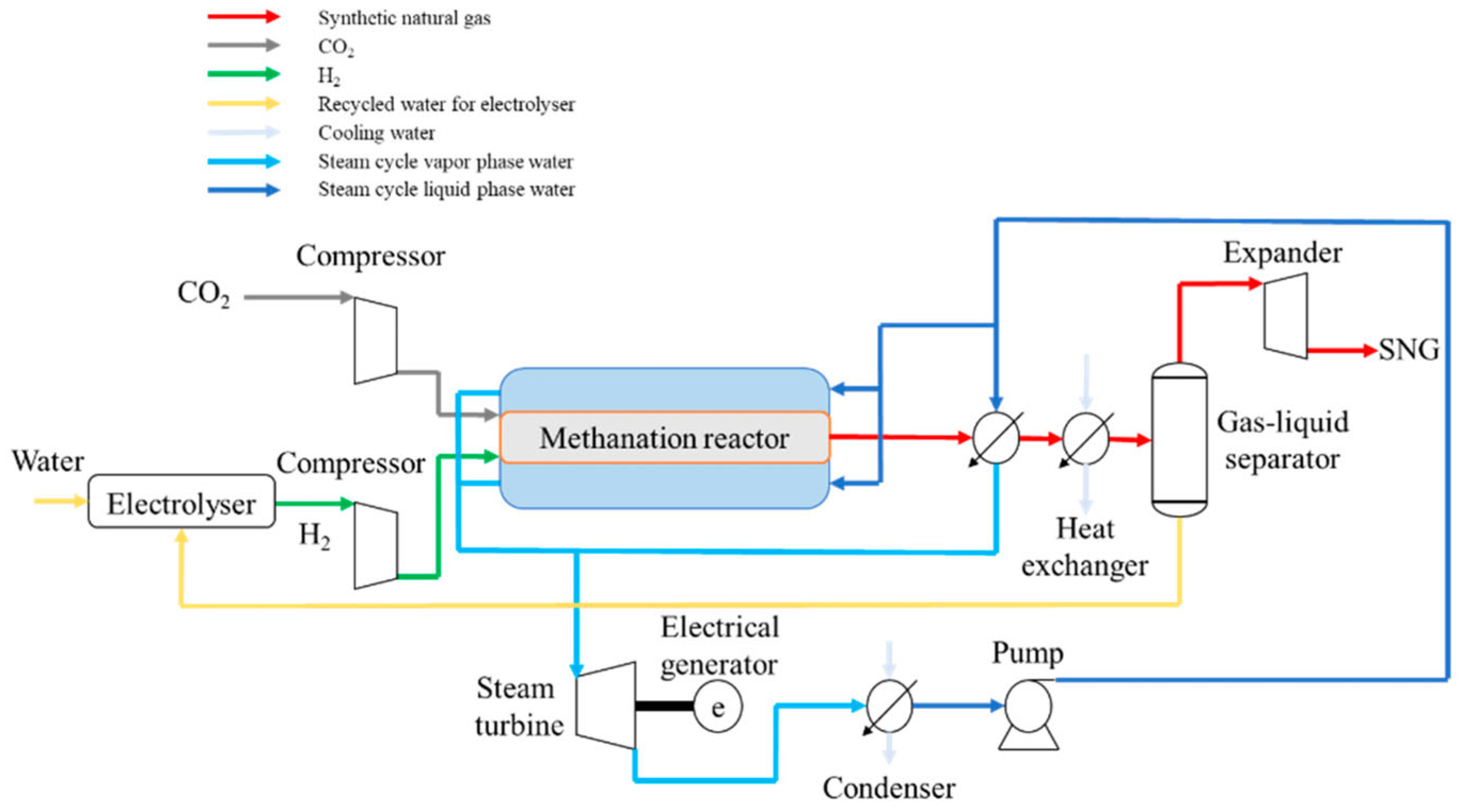
The reactor studies discussed above highlight how modes of operation and reactor configuration influence the local performance of CO2 methanation. However, to better visualize their implications at an industrial scale, it is necessary to extend the analysis beyond isolated reactor behavior. Process simulation tools enable the integration of reactor models into flowsheets, allowing the assessment of technical, economic, and environmental aspects. For example, Szima and Cormos [88] analyzed the impact of different hydrogen sources on CO2 methanation through a techno-economic study following the methodology proposed by Turton et al. [89]. A proposed process configuration is illustrated in Figure 3. The authors evaluated hydrogen production via steam methane reforming (SMR), biomass gasification, electrolysis and photovoltaic (PV) electrolysis, as well as dark and photo fermentation. Two base cases (SMR and electrolysis) were compared against the alternative hydrogen production routes. The results showed that even when CO2 capture credits were considered (20 €/tCO2 and 100 €/tCO2), the overall levelized cost of synthetic natural gas remained less favorable than that obtained using the classical SMR process. For instance, in the base case without credits, the SMR process yielded a methane cost of 5.37 €/GJ, whereas the alternatives ranged from 18.62 to 21.74 €/GJ. PV electrolysis exhibited the highest cost, at 43.56 €/GJ. In terms of carbon dioxide abatement, the study is limited to reporting that the reactor converts 99% of the CO2 fed to the system. However, indirect emissions associated with the CO2 capture technology and the various unit operations within the process are not reported. Given that the study’s objectives are aligned with reducing environmental CO2 concentrations as a justification for implementing such systems, the inclusion of this information would be essential to assess whether the process can, at a minimum, achieve net-zero associated CO2 emissions.
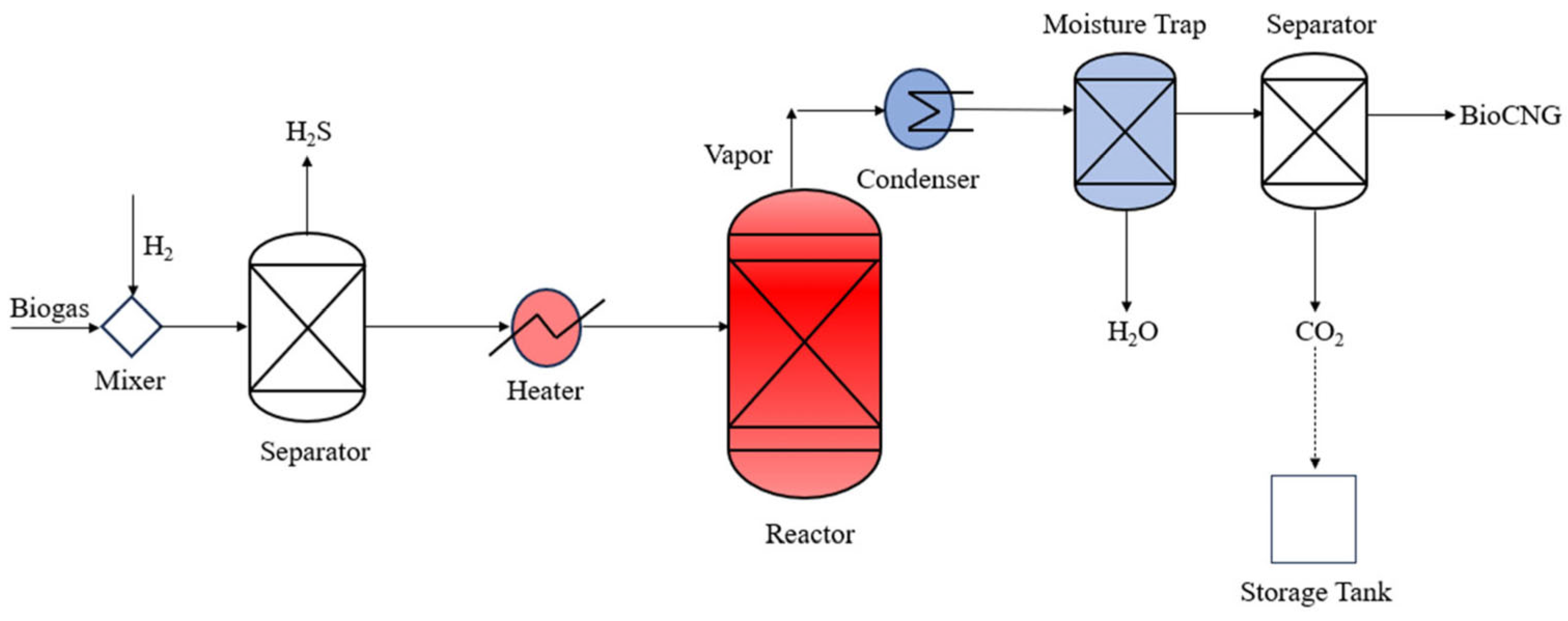
Agrawal and Singh [90] also evaluated methane production via CO2 hydrogenation through a techno-economic analysis and similarly concluded that the hydrogen source plays a decisive role in the feasibility of this process. The authors employed a flowsheet configuration that slightly differs from that of the previous study, as shown in Figure 4. Overall, they found that if the hydrogen cost exceeds $3.5/kg, a methanation plant would not generate negative income. Furthermore, they argued that in a transitional scenario, blue hydrogen (i.e., hydrogen produced by SMR coupled with CCUS technologies) represents the most suitable option for supplying decarbonization plants, as its associated emissions are approximately four times lower than those of conventional SMR. The authors also emphasized that although atmospheric pressure is, in principle, desirable from both technical and economic perspectives, operating the process at 5–10 bar would be more environmentally sustainable. This discussion is, however, qualitative instead of quantitative, since this reported study also does not report the overall carbon dioxide abatement associated with the proposed system. Moreover, only equilibrium reactors are employed, which limits the discussions associated with catalyst selection and reactor configuration and their associated performance.
Instead of assuming a CO2 stream with predefined composition and properties, Lv et al. [91] analyzed the effects of implementing an integrated carbon capture and utilization framework based on CO2 methanation. The authors used the flue-gas specifications of a coal-fired power plant to compare a conventional carbon capture and utilization (CCU) flowsheet with a proposed integrated process. For the integrated scheme, Equations (9) and (10) represent the reactions that take place within the reactor. The conventional approach involved four steps: CO2 capture, desorption, compression, and the hydrogenation reaction. In contrast, the integrated approach comprises only the chemical reactor, where all reactions occur using a direct flue-gas feed. Overall, the integrated approach performed better, yielding a methane production cost of 873.1 €/t compared to 962.86 €/t for the conventional CCU route, with only minor differences in hydrogen consumption. When waste-heat recovery for electricity generation and a carbon tax were considered, the methane cost decreased to 443.26 €/t (compared to 516.96 €/t for the conventional process), close to the threshold of current market prices considered in the mentioned study. The authors also confirmed that this process configuration is capable of reducing overall carbon dioxide emissions. When implemented together with the exhaust gas of a coal-fired power plant, the system emissions were reduced from 366.5 kgCO2/Mwe h−1 for the reference case to 148.93 kgCO2 kgCO2/Mwe h−1 for the conventional CCU flowsheet, and further to 83.6 kgCO2/Mwe h−1 for the integrated configuration when, in both cases, waste heat recovery was taken into account.
CO 2 + CaO CaC O 3
CaC O 3 + 4 H 2 CaO + CH 4 + 2 H 2 O
Wasnik et al. [92] also compared the performance of two case studies of a direct methanation process using flue gas derived from automotive shredder residue (ASR) as a reactant. The first case combined CO2 absorption with power generation from the residual gas. The absorbed CO2 was then compressed and reacted to form methane according to a Gibbs free energy minimization reactor model. The second proposed flowsheet reacts the ASR reactant directly in a three-reactor sequence after going through a compression cycle. While for the first case, the gas turbine for power generation accounted for 48% of the annual CAPEX (out of a $1.4 million in total), in the second case, the compressor system was responsible for 54% of the annual CAPEX (out of a $0.61 million in total). For both process flowsheets, the economic assessment demonstrated that hydrogen accounts for more than 70% of total OPEX. Taken together, the levelized cost for CH4 for Case I performed better with respect to Case II (e.g., 1599 $/t against 1953 $/t, respectively, for 2024 as the target year). The differences were mostly related to the energy efficiency and integration associated with both processes. It was also clear to the authors that the associated costs with H2 are a challenge for the transition to renewable-energy-based processes, since the viability of the proposed process is highly sensitive to overall market prices of hydrogen, synthetic natural gas, and methane.
Overall, this brief review on CO2 hydrogenation to methane aimed to provide a general overview of different aspects associated with this reaction. When it comes to direct processes, which account for all the aspects discussed above, it is clear that, although there is a possibility to develop a framework capable of competing with the SMR-generated natural gas, the current costs of green hydrogen play a crucial role in the future feasibility of a full-scale implementation of a methanation process for carbon dioxide utilization. Moreover, energy efficiency and adequate energy integration, coupled with innovative reactor designs, are valuable tools to accelerate a large-scale deployment of carbon utilization technology such as methane production. Moreover, these aforementioned aspects are the key to overcoming the technical and economic challenges that full-scale implementation of this technology requires. Nevertheless, the overall environmental benefit of CO2 methanation remains dependent on the carbon intensity of the proposed plant, which highlights the need for integrating techno-economic and environmental analyses in order to accurately position this specific technology within a sustainable energy transition future.

3.2. CO2 Hydrogenation to Methanol Processes

Among the various products obtainable through CO2 hydrogenation, methanol is regarded as one of the most attractive and economically promising options [93]. As introduced by Olah in 2005 [94], the “methanol economy” proposes methanol as an alternative energy carrier capable of reducing oil and gas dependency by storing hydrogen in a stable liquid form. Besides its role as both a fuel and a chemical feedstock, methanol is considered an environmentally friendly compound that does not release toxic gases [95]. Today, methanol is widely recognized as a key platform molecule, serving not only as fuel for internal combustion engines and fuel cells but also as a versatile precursor for the synthesis of numerous chemicals [96].
Methanol synthesis from CO2 hydrogenation involves three main equilibrium reactions: the CO2 hydrogenation to methanol (Equation (11)), the methanol formation from CO (Equation (12)) and the RWGS reaction (Equation (1)), as the main side reaction [97]. As can be observed, the methanol synthesis from both CO2 and CO is exothermic, thus favored at lower temperatures, while the main side reaction, the RWGS, is endothermic, hence its equilibrium is favored by temperature increase [98]. Therefore, lower temperatures and higher pressures, according to Le Chatelier’s principle, are the best conditions to obtain higher methanol yields.
CO 2 + 3   H 2 CH 3 OH +   H 2 O H 298 K = 49   k J / m o l
CO + 2   H 2 CH 3 OH H 298 K = 91   k J / m o l

3.2.1. Thermodynamic and Kinetic Studies

Thermodynamic analysis is a great tool to understand the thermodynamic limitations and feasibility of the process. Graaf et al. [99] investigated, in 1986, the chemical equilibrium in methanol synthesis by comparing experimental data with thermodynamic predictions. They showed that the equilibria of both the methanol synthesis and water–gas shift reactions are well described by thermochemical relationships based on ideal gas behavior, with non-ideal effects accurately accounted for using the Soave–Redlich–Kwong (SRK) equation of state. In 1990, Skrzypek et al. [100] examined the thermodynamics of methanol synthesis via CO2 hydrogenation to evaluate the influence of key process parameters on equilibrium conversions and product compositions. They demonstrated that equilibrium compositions and conversions are strongly dependent on the initial feed composition. The authors also pointed out that, from a thermodynamic viewpoint, the direct methanol synthesis from CO2 and H2 represented a promising process for industrial applications.
Kanuri et al. [95] performed an investigation on the equilibrium composition of a reaction system by minimizing the Gibbs free energy, applying the Peng–Robinson equation of state instead of the SRK one. By varying several operational parameters such as temperature, pressure, H2/CO2 mole ratio, and recycling ratio, they evaluate how these parameters affect CO2 conversion and methanol selectivity. They found that the equilibrium conversion of CO2 is regulated by both temperature and pressure, and with increasing temperature, methanol selectivity decreases significantly once the RWGS is favored. In their analysis, with the stoichiometric mole ratio for H2/CO2 of 3, they defined that the highest methanol yield, with 99% methanol selectivity and 48% CO2 conversion, might be reached at conditions with 172 °C and 50 bar. However, by increasing the H2/CO2 ratio, CO2 conversion can be increased to 83% at 186 °C and 50 bar; however, as pointed out by the authors, this increase may not be worth it due to the high cost of H2.
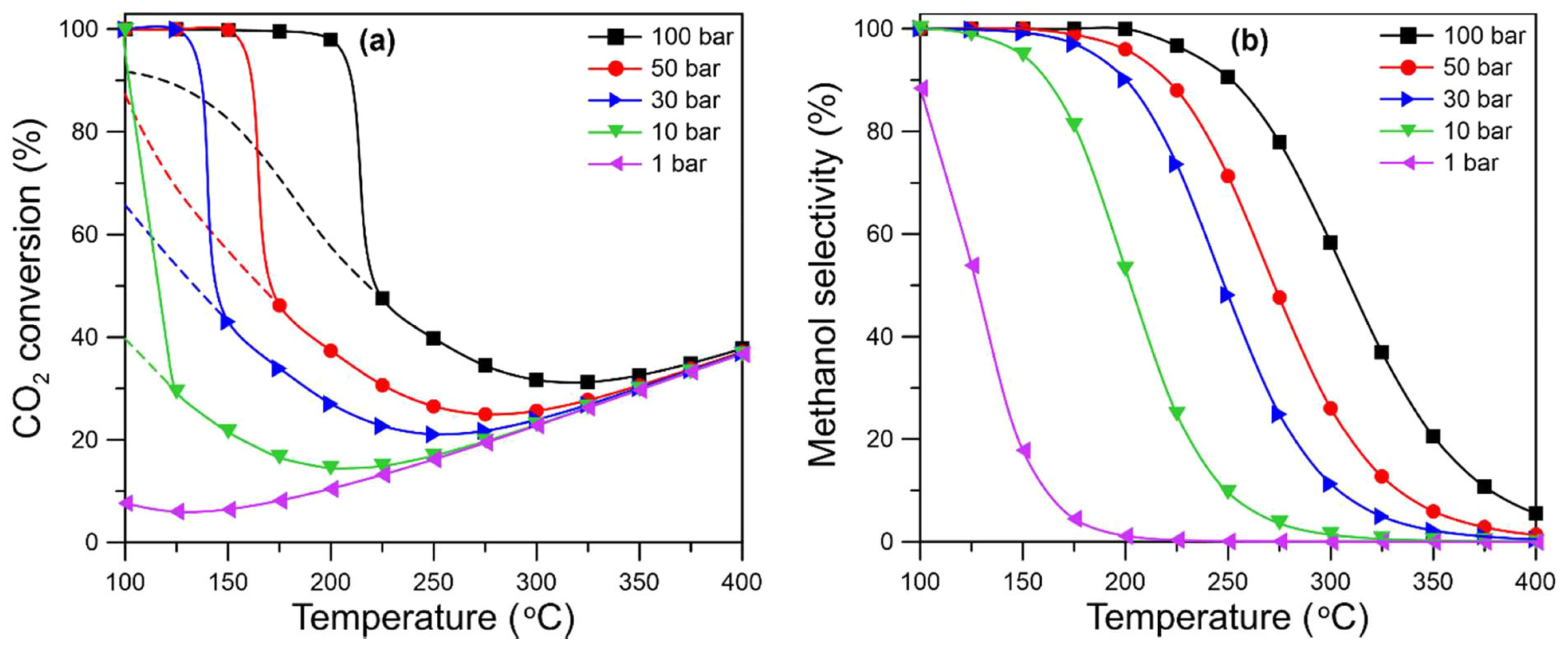
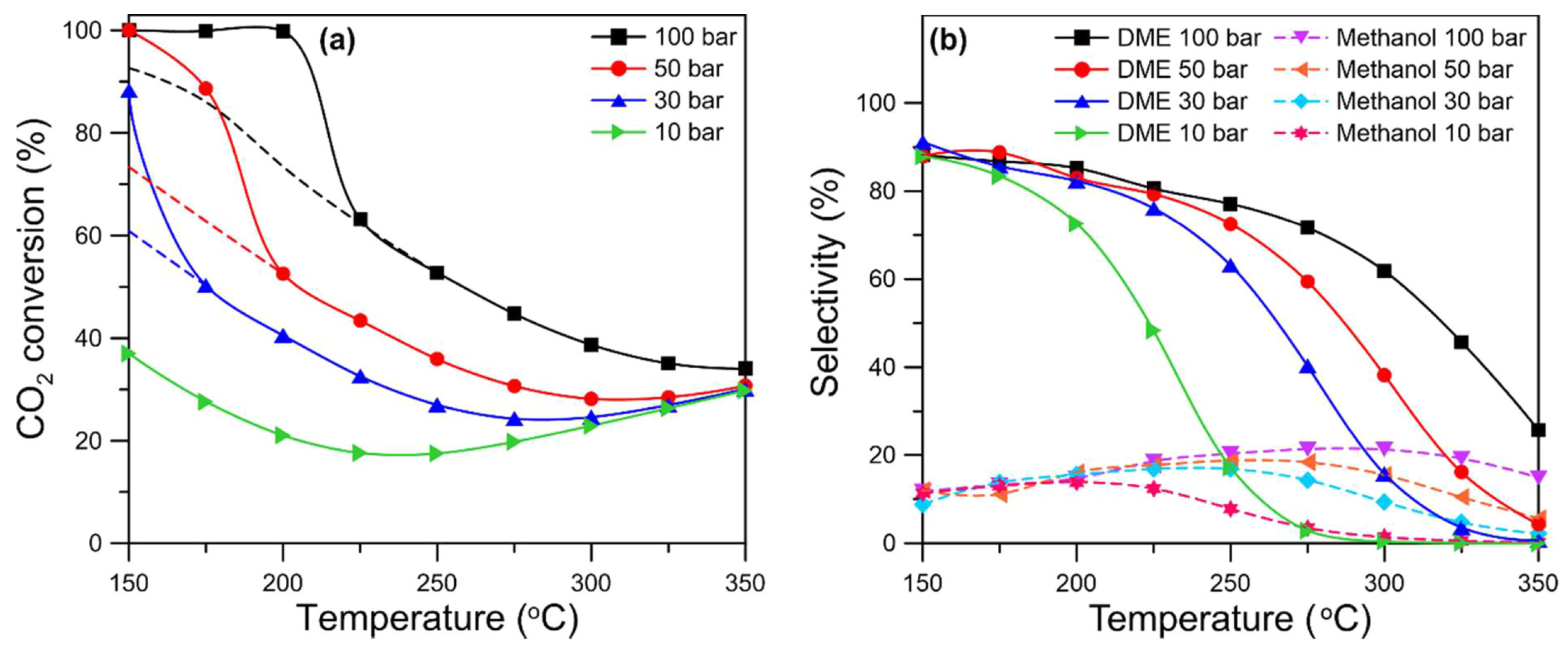
A similar study was carried out by Stangeland et al. [97], which also applied the Gibbs free energy minimization method, however using the SRK model to calculate the properties of the components, as well as combined with phase equilibrium calculations. Figure 5 illustrates the influence of temperature and pressure on CO2 conversion (a) and methanol selectivity (b) for a H2/CO2 feed gas at the stoichiometric molar ratio of 3, as well as the phase equilibrium indicated by the dashed line. Even applying different models, both Stangeland et al. [97] and Kanuri et al. [95] achieved a very similar result on the gas-phase calculations. In addition, Stangeland et al. [97] demonstrated that product condensation can be used to overcome thermodynamic limitations on product yield, enabling substantial increases in CO2 conversion under conditions favorable for condensation, with only minor effects on selectivity. They further noted that, in the absence of product condensation, recycling of unconverted gases must be incorporated into the process design.
Iyer et al. [101] also conducted a thermodynamic analysis under both single- and two-phase conditions, highlighting that methanol’s relatively low volatility can be used to enhance reactor conversion. Product condensation removes methanol from the gas phase, shifting the reaction equilibrium toward higher methanol formation, besides reducing recycle requirements due to increased per-pass conversion. Their analysis demonstrates that evaluating methanol synthesis under two-phase conditions provides valuable insights for process performance improvement.
However, while thermodynamic analysis clarifies the equilibrium constraints of the process, assessing reaction kinetics is essential to identify the conditions under which the system is kinetically controlled versus equilibrium-limited. Several kinetic models have been proposed to describe methanol synthesis, differing in reaction conditions such as temperature and pressure, feed composition, and, especially, the catalyst employed. Some models are formulated for the synthesis of methanol from CO and H2, while others explicitly incorporate CO2 in the feed. The resulting kinetic expressions vary accordingly and depend on the assumed rate-determining step in the reaction mechanism [102].
It is worth noting that most models have been developed for methanol synthesis from syngas and therefore consider both CO and CO2 as carbon sources. Direct CO2 hydrogenation to methanol has attracted interest more recently, and consequently, the majority of available kinetic models are still based on syngas feed conditions. The benchmark catalyst for methanol synthesis from syngas is Cu/ZnO/Al2O3 [103], and most kinetic models have been developed for this system. Notably, two models remain widely used and serve as reference frameworks for subsequent developments: the one proposed by Graaf et al. in 1988 [104] and the later model introduced by Bussche and Froment in 1996 [105].
Graaf et al. [104] proposed a model in which methanol is formed from both CO and CO2, a hypothesis they confirmed experimentally. Their kinetic data were well described by a dual-site Langmuir-Hinshelwood-Hougen-Watson (LHHW) mechanism involving dissociative hydrogen adsorption and three independent reactions: methanol formation from CO2 (1), methanol formation from CO (2), and the RWGS reaction (3). The experiments also supported the assumption of dissociative hydrogen adsorption. Kinetic parameters were successfully determined as functions of temperature, initially over the range of 210–245 °C [104], and later extended to 275 °C when intraparticle diffusion limitations were considered [106], with pressures between 15 and 50 bar.
Bussche and Froment [105] developed a kinetic model based on a single-site LHHW formulation with competitive adsorption among all reacting and inhibiting species. In contrast to the dual-site mechanism of Graaf et al. and their separate treatment of CO- and CO2-derived pathways, this model incorporates the influence of CO, CO2, and products through the adsorption terms and overall driving force. This approach removes the need to define multiple independent reactions and detailed site balances, resulting in a more compact rate expression suitable for reactor simulations. The kinetic parameters were estimated using experimental data collected between 180 and 280 °C and at pressures up to 51 bar, and the authors report that the model can predict catalyst behavior beyond this experimental range. The final equations also describe the effects of inlet temperature, pressure, and feed composition in a physically consistent way.
Other similar kinetic models have been proposed by modifying the number or type of catalytic sites involved in the reactions. Askgaard et al. [107] developed a model based on a mechanism derived from Cu single-crystal studies, identifying the hydrogenation of H2COO* to methoxide and oxide as the rate-limiting step. Lim et al. [108] proposed a mechanism for a Cu/ZnO/Al2O3/ZrO2 catalyst after observing that ZrO2 promotes Cu dispersion, producing smaller metallic Cu particles and increasing CO conversion. By examining different rate-determining steps, they concluded that methoxy hydrogenation, formate hydrogenation, and formate formation govern the CO hydrogenation, CO2 hydrogenation, and WGS reactions, respectively. Park et al. [109] proposed an LHHW-type model for a commercial Cu/ZnO/Al2O3 catalyst considering the three reversible reactions (1, 2, and 3). Their model incorporates three adsorption sites (Cu+, Cu0, and ZnO), including an additional site for CO2 with dissociative hydrogen adsorption, leading to kinetic expressions similar to those reported by Graaf et al. [104].
In contrast, Portha et al. [102] investigated the kinetics of methanol synthesis from direct CO2 hydrogenation under CO-free feed conditions, representative of an industrial application of methanol synthesis directly from CO2 and not from syngas. With two noncommercial catalysts, Cu/ZnO catalyst supported on alumina (CuZA) and zirconia (CuZZ), they carried out experiments in an isothermal fixed-bed reactor at temperatures between 200 and 230 °C and pressures of 50–80 bar. The authors modeled the data using kinetic expressions and adsorption parameters reported by Graaf et al. [104], based on an LHHW mechanism. They noted that, as CO is generated in the reactor and may be recycled to the inlet, their results are particularly relevant for transient operation during start-up, when CO is initially absent.
As the models present a divergence by considering single, dual, and even triple adsorption sites, Poto et al. [110] analyzed kinetic models reported in the literature and took account of them to model the methanol synthesis from CO2 and H2 over a CuO/CeO2/ZrO2 catalyst. Based on the best agreement with the experimental data, Graaf’s dual-site kinetic model was identified as the most suitable one. The corresponding reaction mechanism involves CO2 adsorption at oxygen vacancies of the CeO2-ZrO2 phase, while H2 adsorbs and dissociates on metallic copper sites, enabling hydrogenation of the carbon atom via a formate pathway. According to this mechanism, methanol formation may proceed either directly from CO2 or indirectly from the CO produced via the RWGS, in accordance with Graaf’s original proposal.
With the development of new catalysts for CO2-to-methanol conversion and the increasing use of in situ and operando characterization techniques capable of identifying dominant intermediates and rate-determining steps, several kinetic models have been proposed in the last decade for different new catalyst formulations. Ahmad and Upadhyayula [111] examined CO2 hydrogenation to methanol over a Ga3Ni5/SiO2 catalyst and reported that intermediates and products adsorb competitively on the same active sites. Ahmad et al. [112] later introduced a single-site microkinetic model for methanol synthesis from CO2 over intermetallic Pd2Ga/SiO2 at atmospheric pressure. Ghosh et al. [113] were the first to propose a competitive single-site kinetic model based on LHHW rate expressions for CO2 hydrogenation to methanol over an In2O3 catalyst. The model predicts that, once methanol synthesis becomes equilibrium-limited, the progression of the RWGS reaction leads to a decrease in methanol yield by driving the synthesis reaction in the reverse direction. The single-site formulation was shown to consistently describe the experimental data obtained for the In2O3 catalyst under various operating conditions, indicating the robustness of the model.
Marcos et al. [114] investigated the kinetic behavior of two Cu–ZnO/ZrO2 catalysts to assess how different ZrO2 polymorphs, associated with distinct Cu0/+–ZnO interfacial sites, influence the reaction mechanism. Niquini et al. [115] investigated the kinetics of CO2 hydrogenation to methanol over a Cu/ZnO/ZrO2 (CZZ) catalyst across a wide range of operating conditions. Experiments were conducted at pressures of 30–60 bar, temperatures of 190–250 °C, and H2/CO2 ratios between 1 and 6. The authors developed a lumped six-parameter kinetic model to correlate the data, yielding one of the most broadly applicable models for the CZZ system, supported by an extensive experimental dataset of 500 points.
Although numerous kinetic models have been proposed in recent years, the models presented by Graaf et al. [104] and Bussche and Froment [105] remain widely used, and many subsequent models can be viewed as modifications or extensions of these two approaches. As noted, the reaction mechanism and, consequently, the kinetic model depend strongly on the catalyst employed and the operational conditions. It is worth noting that several new catalysts have been developed; however, the discussion of catalyst selection is beyond the scope of the present review. The choice of a kinetic model for process simulation should therefore account for these factors. Accordingly, Table 2 presents the two main kinetic models applied to CO2-to-methanol process studies, both developed for the commercial catalyst, together with their operational conditions and catalyst systems.

3.2.2. Modeling and Simulation Studies

Different objectives guide the simulation and optimization studies of CO2 hydrogenation processes to methanol. Some studies propose reactor models, others provide a variation on the process to maximize profit or methanol production, or to minimize CO2 emissions, and others even compare different routes or process configurations. Some of these investigations are presented and compared below.
In order to evaluate the effects of inlet temperature and pressure, Fu et al. [116] analyzed CO2 hydrogenation to methanol in a Lurgi-type multi-tubular reactor packed with CuO/ZnO/Al2O3 catalyst using a 2D mathematical model that incorporates detailed reaction kinetics and transport phenomena. The authors found that, to maximize CO2 conversion, the best conditions were defined as 498 K and 55 bar as inlet temperature and pressure, respectively, and that a reactor with 6 m is enough for the CO2 hydrogenation to reach its maximum temperature and near maximum conversion. Under these conditions, the maximum CO2 conversion achieved was around 23%. However, the authors did not explicitly report methanol selectivity, and although they analyzed feeds with and without CO, they did not highlight that in the absence of CO, both CO2 and H2 conversions, as well as the methanol outlet flow rate, increased.
Rafiee [117] evaluated CO2-to-methanol synthesis in fixed-bed reactors under various staging scenarios to improve production and profitability. The study examined the number of reactor stages, cooling-medium temperature, heat-transfer area, and stage volumes as decision variables. The author found out that reactor staging consistently enhanced performance. When methanol production was the objective, a three-stage system achieved a 2.61% increase in the objective function compared to a single stage, along with higher syngas conversion. When annual profit was targeted, a two-stage system delivered a 2.05% improvement relative to a single reactor, driven by increased methanol production. However, it is worth noting that, in all scenarios, the CO2 conversion reached was nearly 22%. The increases reported by a two or three-stage configuration were low and never reached the 23% CO2 conversion achieved by Fu et al. [116] in a single multi-tubular reactor.
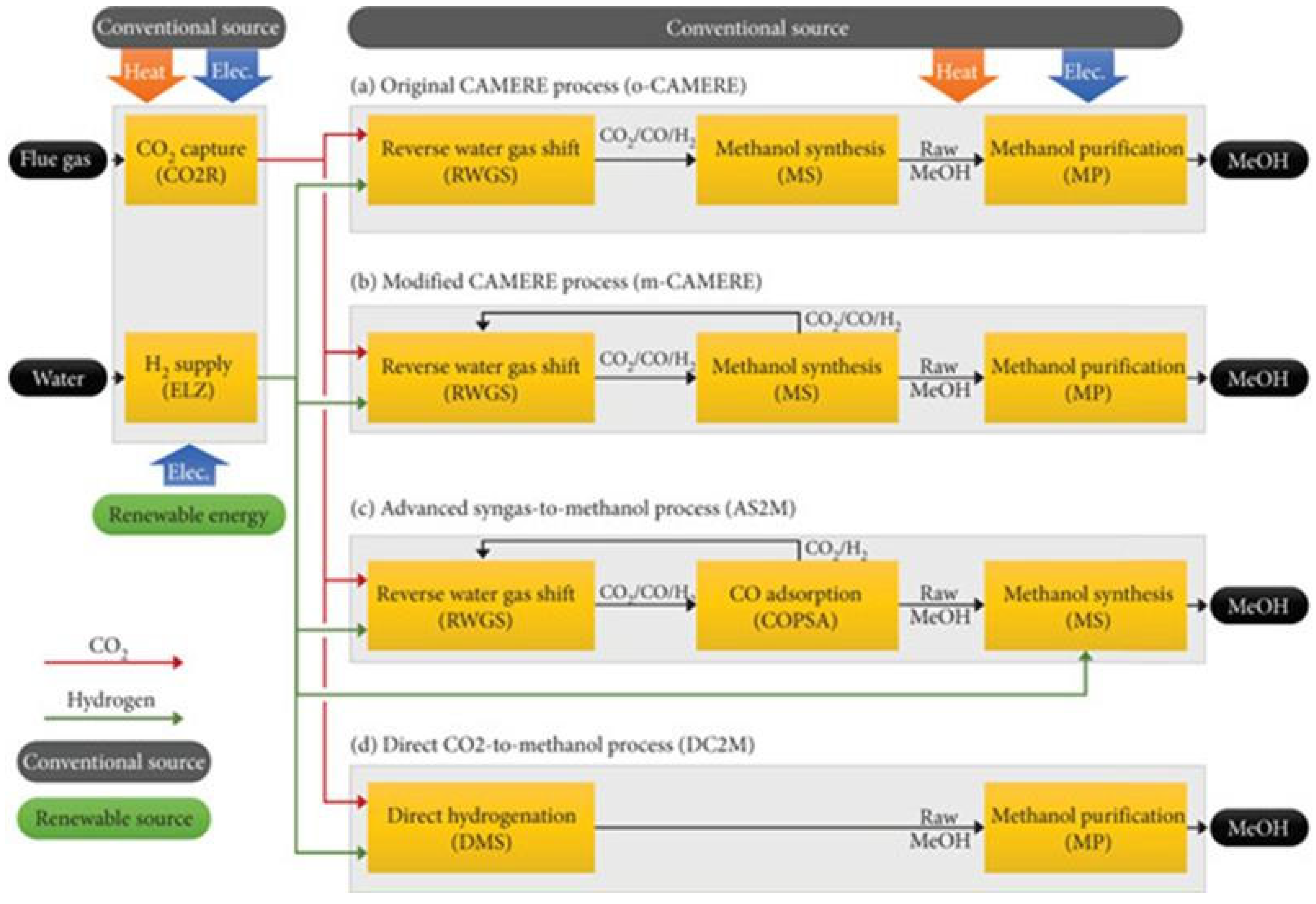
As methanol can be produced by CO2 hydrogenation directly or via CO produced by reverse water gas shift, as it was discussed in both thermodynamic and kinetic investigations, several studies carried out comparisons of these possible processes. Figure 6, presented by Cho et al. [118], illustrates a process scheme of four CO2 to methanol production processes: the CAMERE process [119], where methanol is produced by a two-step process via RWGS; a modified CAMERE process with recycle; an advanced method with separation of CO from a mixture through pressure swing adsorption, recycling only CO2 and H2 to the RWGS reactor; and a direct CO2-to-methanol process. The authors evaluated the latter two processes and found that both processes could achieve improved technical, economic, and environmental performances compared to conventional processes. In particular, the direct CO2 to methanol process showed the lowest unit production cost ($1.02/kg) due to its simple configuration and mild operating conditions. Regarding the CO2 emissions, both processes presented a negative CO2 emission of 0.50 and 0.47 kg CO2/kg MeOH, respectively, mitigating the negative impact of CO2. It is worth noting that, although the authors suggest that these processes can be competitive, they also depend on the H2 production cost to achieve economic feasibility.
The CAMERE process was also investigated by Cui et al. [120] with the addition of an in situ water removal (ISWR), following the method of Catarina Faria et al. [121]. The authors performed a thermodynamic analysis of the CAMERE process at moderate temperatures with ISWR and compared it to a direct CO2 to methanol process also incorporating ISWR. They showed that ISWR substantially improves CO2 conversion in the RWGS step for the CAMERE process, thereby reducing heat-integration constraints and enhancing overall energy efficiency. Under identical conditions (50 bar, 250 °C), the direct process delivered slightly higher methanol yields than CAMERE across most ISWR ratios. Overall, the results indicate that ISWR provides strong thermodynamic advantages for promoting CO2 hydrogenation to methanol in both process routes. This study presents an approach to overcome the thermodynamic limitations of the CO2-to-methanol process; further modeling and simulation, together with economic and environmental analyses, could provide insight into its overall feasibility.
Ren et al. [122] proposed a new configuration of the methanol production process with high thermodynamic efficiency and reduced production cost by integrating steam methane reforming with CO2 captured from power plant flue gas. The authors indicated that the additional CO2 improves the syngas stoichiometric number, increases CO2 conversion, and enhances methanol and carbon efficiency. The process employed a tubed reactor packed with a commercial Cu catalyst, which was found to achieve increased CO2 conversion and methanol production with a higher number of reactors. Economic comparison with coal- and coke-based methanol production indicates a lower total product cost, demonstrating the economic and technical viability of the proposed configuration. Although the configuration and analysis are innovative, the authors present an inconsistency by concluding that increasing pressure negatively affects methanol production and CO2 conversion, whereas their results indicate that both increase with pressure. They note, however, that higher pressure leads to increased power consumption, which adversely impacts the economic performance of the process.
Assessing the thermodynamic limitations of the CO2-to-methanol process, Wang et al. [123] proposed a liquid-phase CO2 hydrogenation process for methanol synthesis using tetraethylene glycol dimethyl ether (TEGDME) as solvent to shift the equilibrium toward methanol formation. Three configurations were evaluated: a liquid-phase process without gas recycling, one with gas recycling, and an optimized version incorporating reactive distillation. All liquid-phase processes achieved CO2 single-pass conversions above 95%, which is largely above gas-phase performance reported in other studies. However, the energy efficiencies are lower than gas-phase operation due to solvent recovery requirements. This approach presents a promising process to achieve high CO2 conversion, and as pointed out by the authors, might become economically advantageous when the electricity price decreases.
In contrast to several studies that consider syngas in the feed composition, Leonzio et al. [124] developed an equilibrium analysis of a methanol reactor with pure CO2 and H2 in the feeding stream. The authors proposed three reactor configurations at equilibrium conditions: a once-through reactor; a reactor with recycling unconverted gases after separation of methanol and water by condensation; and a reactor equipped with a membrane permeable to water. In addition, the study also developed a methodology that assists in the comparison of different process schemes by simulation of two different methanol plant configurations in ChemCad®. The results show that at equilibrium conditions, a reactor with the recycling of unconverted gases ensures the highest CO2 conversion. Furthermore, it was also noted that the use of pure CO2 and H2 in the feeding stream allows an overall ΔH lower than that obtained by the use of syngas in the feed, and therefore a reduced reactor temperature increase.
A comparison between process configurations was also performed by Borisut and Nuchitprasittichai [125], and the authors evaluated three CO2-to-methanol process configurations with the objective of minimizing production cost: a once-through reactor, one reactor with recycling, and two reactors in series. Latin hypercube sampling, which the authors determined as the best technique for the process in a previous report [126], was used to generate operating data, and feedforward artificial neural networks with varying numbers of nodes were trained to correlate operating conditions with production cost. Optimization results showed that the two-reactor configuration achieved the lowest production cost. This result corroborates the findings previously reported by Rafiee [117], in which a two-stage reactor configuration was preferred when the objective was to maximize profit.
As presented, several studies have been proposed to model the CO2-to-methanol process, exploring different configurations to maximize CO2 conversion and methanol production, and applying different strategies to overcome the thermodynamic limitations. On the other hand, there is also another group of studies that have focused on reducing energy consumption, lowering operating costs, and developing CO2-to-methanol processes that are both sustainable and economically feasible. A major cost driver in these systems is hydrogen, which constrains achievable CO2 conversion and methanol yield. As noted earlier, higher H2/CO2 feed ratios enhance CO2 conversion; however, methanol synthesis becomes economically unfavorable at ratios above 5 [95], making hydrogen availability and cost critical factors in process design.
Addressing the challenge of hydrogen cost, Kiss et al. [98] proposed a methanol synthesis process that utilizes wet hydrogen by-product from chlor-alkali production. The central innovation of their process was a stripping unit in which wet hydrogen flows counter-current to the condensed methanol–water stream exiting the high-pressure, low-temperature separator. This configuration simultaneously removes CO and CO2 from the liquid phase, allowing complete CO2 recycle, and strips water from the hydrogen stream, thereby avoiding the adverse effect of added water on equilibrium conversion. Huang et al. [127] used Kiss et al. [98] study as a reference and developed an optimization framework for CO2-to-methanol synthesis, aiming to improve process economics and CO2 utilization. The method integrates Aspen Plus® with a genetic algorithm in MATLAB® to evaluate alternative process configurations and operating conditions using total annual cost (TAC) as the objective function. Application of the framework showed that the optimized design reduced TAC by 44.9% compared with the reference case [98], demonstrating the economic potential of improved process integration and parameter optimization. These two studies can be seen as complementary, as Kiss et al. [98] proposed the innovative technology, while Huang et al. optimized it and introduced a quantitative cost indicator (TAC) that allows a proper analysis of its feasibility.
Kiss et al. [98] study was also the reference to GhasemiKafrudi’s [128] comprehensive optimization of the methanol production process. By evaluating catalyst type, operational conditions, and process modifications, the authors defined Cu/ZnO/Al2O3 as the most suitable catalyst and, along with the defined optimum conditions, eight process configurations were simulated with model validation against data from Kiss et al. [98]. The optimized design reduced reactor temperature, lowered recycle flow by ~38%, and significantly decreased electricity and steam consumption. Moreover, the authors reported that process optimization not only reduced recycle flow and energy consumption but also prevented approximately 7526.35 tons of CO2-equivalent greenhouse gas emissions and 19.43 tons of air pollutants annually per 100 kton y−1 of methanol production, indicating the potential of this process to mitigate CO2 emissions.
Aiming toward a process with reduced CO2 emission, Wang et al. [129] investigated near–zero-carbon methanol production via CO2 hydrogenation, addressing the loss of CO2 and H2 associated with purge gas in conventional processes. To improve carbon and hydrogen utilization, the authors proposed two total-recycling flowsheets: one with flash separation and one with stripping. Both configurations achieved carbon utilization efficiencies above 99.7%, meeting the criteria for near-zero-carbon operation. Although presenting great environmental indicators, the study also showed the high cost associated with the process, with the authors indicating that a reduction in the energy cost may lead to a competitive price of methanol produced by this route.
Using only green electricity, Vaquerizo and Kiss [130] proposed a thermally self-sufficient process for e-methanol production. The core innovation in this study is an integrated heat-recovery scheme, coupled with a dividing-wall column, that minimizes external utilities while enabling high-purity methanol production and nearly complete CO2 conversion. By limiting pressure reduction in the reaction–separation loop to unavoidable circuit losses, the process achieves an electricity demand of only 656 kWh per ton of methanol, corresponding to negative net CO2 emissions (−1.13 kgCO2/kg MeOH) when powered by green electricity. This study presented several sustainability metrics supporting the proposed clean production route and, unlike processes that rely on electricity price reductions to achieve economic feasibility, its thermal self-sufficiency enables competitive performance. However, the estimated methanol production cost remains approximately 20% higher than that of conventional routes due to the cost of green H2 and CO2 capture.
Lin et al. [131] proposed an offshore green methanol synthesis process for CO2 hydrogenation, introducing two main innovations tailored to offshore conditions: a pervaporation unit and an additional CO2 recycle, both designed to handle operational disturbances and increase methanol yield. The system also incorporates a compact gas-cooled reactor and a simplified seawater-based heat-exchange scheme. The additional CO2 recycle increased methanol yield by about 2.5%, with the optimized process reaching 93.38% yield. Although this study achieved a high methanol yield, the production cost remains above market values, and the feasibility of the process depends on reductions in the cost of proton exchange membrane (PEM) water electrolysis, which was used for hydrogen production.
Feili et al. [132] proposed an eco-friendly, integrated system for the co-production of electricity and methanol. The process combines a biogas-driven S-Graz cycle with a biogas steam reforming unit for hydrogen generation, which is then fed to a methanol synthesis unit via CO2 hydrogenation. The system is designed for modular scalability, allowing implementation in applications ranging from small community systems to large industrial plants and enabling the use of locally available biogas resources. This study is distinguished by its integration with biogas, demonstrating economic feasibility and, importantly, scalability that enables local deployment and integration with agricultural systems.
As discussed, the direct hydrogenation of CO2 to methanol represents a promising route for methanol production and CO2 mitigation. Despite inherent thermodynamic limitations, numerous studies have proposed alternative process configurations and technology implementation to overcome these constraints and improve process feasibility. Several catalytic systems and kinetic models have been proposed; therefore, there are consolidated and very accurate models that can be input into process simulations to ensure consistency. Technical and environmental assessments frequently report favorable indicators for CO2 utilization, highlighting the sustainability potential of this pathway. In particular, the integration of CO2-to-methanol plants with CO2 capture, first introduced by Van-Dal and Bouallou [133] and later adopted by several studies, has demonstrated the potential to abate up to 1.6 tons of CO2 per ton of methanol produced. As also highlighted by Bellotti et al. [134], this approach enables low-carbon methanol production.
Overall, the primary challenges remain associated with energy demand and hydrogen supply, particularly the cost of clean hydrogen. Wider industrial implementation, therefore, depends on continued advances in hydrogen production and energy technologies to enhance economic competitiveness. As shown, this topic addresses a broad range of research directions; while this section provides an overview of key developments, more detailed discussions of catalysts and processes are available in dedicated reviews focusing specifically on CO2-to-methanol systems [135,136,137].

3.3. CO2 Hydrogenation to Hydrocarbons Processes

Industrial CO2 hydrogenation to hydrocarbons has gained significant attention in recent years. This process can produce a wide range of value-added products, including olefins, paraffins, fuels, and aromatics. The reaction can proceed through two main pathways: a CO-mediated route and a methanol-mediated route, which may occur either directly or indirectly. In the indirect CO-mediated route, CO2 is first reduced to CO via the endothermic Reverse Water-Gas Shift (RWGS), as shown in Equation (1), followed by CO hydrogenation through the endothermic Fischer–Tropsch synthesis, as shown in Equations (13) and (14). A similar mechanism occurs in the indirect methanol-mediated route, where CO2 is initially converted to methanol (exothermic), as shown in Equation (11), and subsequently converted into hydrocarbons through the methanol-to-hydrocarbons (MTH) reaction, as shown in Equation (15). In the direct route, for both intermediates, CO2 is hydrogenated directly on the surface of a single catalyst to form hydrocarbons, as shown in Equation (16). In process design, the reactions can occur in a single reactor (tandem) using a bifunctional catalyst, or in two separate reactors, one for each step, in the case of indirect route.
nCO + ( 2 n + 1 ) H 2 C n H 2 n + 2 + nH , H 298 K 163   k J / m o l
nCO + 2 nH 2 C n H 2 n + nH 2 O , H 298 K 163   k J / m o l
nCH3OH → (−CH2−)n + nH2O
nCO 2 + 3 nH 2 ( CH 2 ) n + 2 nH 2 O , H 298 K 122   k J / m o l
The challenges in CO2 hydrogenation to hydrocarbons include the thermodynamic limitations of the reactions, kinetic parameter estimation, and heat and water-management issues within the catalytic bed. In the literature, key topics reported include kinetic parameter estimation, reactor modeling and simulation, process intensification, optimization and techno-economic and sustainability assessment.

3.3.1. Thermodynamic and Kinetic Studies

The number of thermodynamic studies on CO2 hydrogenation to hydrocarbons remains limited. Jia et al. [138] carried out a systematic thermodynamic analysis of CO2 hydrogenation considering alkanes, alkenes, alkynes, CO, methanol, carboxylic acids, aldehydes, and alcohols as products. Except for CH4, which has the lowest ΔG°, alkane formation typically follows the order C2H6 > C3H8 > C4H10, as ΔG° becomes less favorable with increasing carbon number. However, for alkenes, the study showed an opposite trend at low temperatures, where C4H8 was more favorable than C3 and C2 alkenes. The study did not explore the formation of long-chain hydrocarbons.
Torrente-Murciano et al. [139] compared hydrocarbon formation via Fischer-Tropsch synthesis with direct CO2 hydrogenation. The results showed that the influence of operating conditions on the FT reaction is similar to that observed in direct CO2 conversion to hydrocarbons. At equilibrium, short-chain hydrocarbons formation is dominant, as the termination step in the FT mechanism is thermodynamically more favorable than the chain-propagation step. In contrast, Benzhen et al. [140] performed a thermodynamic analysis of C8–C16 formation based on CO2 hydrogenation to light olefins followed by oligomerization and hydrogenation of the intermediate olefins. Their results indicated that optimal CO2 hydrogenation conditions occur at temperatures below 400 °C, higher pressures (~30 bar), and elevated H2/CO2 ratios (4:1). On the other hand, the oligomerization of light olefins is favored under milder conditions (<227 °C and <30 bar). Similarly, Ahmad and Upadhyayula [141] showed that high pressures, high H2/CO2 ratios, and the presence of CO enhance hydrocarbon formation from CO2.
As the exact mechanism of CO2 hydrogenation to hydrocarbons has not yet been established, the kinetics of this process remain a topic of debate in the literature. The direct and indirect pathways involving different intermediates of this reaction lead to varied kinetic models. Additionally, the reaction route and mechanism are highly sensitive to catalyst properties (composition, active-site density, structure, and texture) and operating conditions, which influence the interaction of key species (CO2, CO, methanol, H2, and H2O) with the catalyst surface. In general, Fe-K–based catalysts are used for the CO-mediated route, whereas Cu- and zeolite-based catalysts are employed for the methanol-mediated pathway.
In this context, a general kinetic model is often used, considering CO as an intermediate, as shown in Table 3 [142]. In this approach, the CO2 hydrogenation rate is proportional to the partial pressures of CO and H2 and accounts for the competitive adsorption of CO2, CO, and H2, consistent with classical Fischer-Tropsch kinetic models. Nevertheless, kinetic studies have advanced in recent years, mainly for CO-mediated pathways, and several kinetic models have been proposed, as presented in Table 3.
Jung et al. [39] developed kinetic models for CO2 hydrogenation over a Fe-Cu-K catalyst, comparing the direct and indirect CO-mediated routes. Using LHHW-type rate expressions with vacant-site and CO2/CO/H2/H2O adsorption terms, the authors found the indirect CO2 route to be more favorable, showing higher kinetic constants. Additionally, increasing H2 concentration reduced C5+ formation, despite CO2 conversion.
Brübach et al. [143] proposed LHHW rate expressions for the indirect CO2 hydrogenation route over Fe-K/Al2O3, using a lumped kinetic model for the FTS step. The model indicated that strong water adsorption is the main cause of low activity, despite a strong correlation between parameters being observed. Similarly, Panzone et al. [144,145] developed microkinetic models for the same catalyst, comparing monosite and multisite approaches. Monosite kinetic models had a good fit, but gave unrealistic chain-growth probability factors, as they do not account for the formation of oxygenates, while multisite kinetic models include these species but showed a poor fit with data.
For the methanol-mediated route, kinetic models typically describe the two steps separately. First, CO2-to-methanol models are used (as discussed in Section 3.2.1). For the methanol-to-hydrocarbons step, several kinetic models can be found. The first was developed by Chang in 1980 [146], after Mobil announced gasoline production from methanol. This model considers dimethyl ether as an intermediate in equilibrium with methanol.
Ghosh et al. [147] proposed kinetic models for the two-step CO2 hydrogenation to hydrocarbons over an In2O3/HZSM-5 bifunctional catalyst. Their study combined an LHHW-type model for CO2 hydrogenation to methanol on In2O3 with a lumped kinetic model for methanol conversion to hydrocarbons on the zeolite site. Similarly, Portillo et al. [148] developed an original LHHW-type kinetic model for an In2O3–ZrO2/SAPO-34 tandem catalyst, considering 12 reactions involving CO2 reduction to CO, formation of methanol, DME, and light olefins. The model includes catalyst deactivation (mainly of SAPO-34) and accurately predicted light-olefin selectivity. It was also effective for scale-up, enabling optimization of temperature, pressure, and CO2/CO feed ratio.
Table 3. Kinetic models of CO2 hydrogenation to hydrocarbons.
CatalystOperation ConditionsKinetic ModelRef
P (MPa)T (°C)H2/CO2
Fe-Al2O3-Cu-K1300–3603 r C O 2 F T = k F T p C O 2 p H 2 p C O + a H 2 O   F T   p H 2 O + b C O 2   F T   p C O 2 [149]
Fe-Al2O3-Cu-K2.1270–3303 r C O 2 F T = k c n D H p C O 2 p H 2 1 + K H 2 A D p H 2 + K C O 2 A D p C O 2 + K H 2 O A D p H 2 O + K C O A D p C O [39]
r R W G S = k R W G S ( p C O 2 p H 2 p C O p H 2 O K e q R W G S ) 1 + K H 2 A D p H 2 + K C O 2 A D p C O 2 + K H 2 O A D p H 2 O + K C O A D p C O
r C O F T = k c n F T p C O p H 2 1 + K H 2 A D p H 2 + K C O 2 A D p C O 2 + K H 2 O A D p H 2 O + K C O A D p C O
Fe-Al2O3-K1–2280–3202–4 r R W G S = k R W G S ( p C O 2 p H 2 0.5 p C O p H 2 O K e q R W G S p H 2 0.5 ) ( 1 + a R W G S p H 2 O p H 2 ) 2 [143]
r C O F T = k F T p C O p H 2 ( 1 + a F T p H 2 O p H 2 + b F T p C O ) 2
In2O3-HZSM-54250–4001–4 r M T H y d r o c a r b o n s = k p C H 3 O H 1 + K C H 3 O H ( p C H 3 O H + p H 2 O ) [147]
r M T H y d r o c a r b o n s = k p C H 3 O H   p C n H 2 n 1 + K C H 3 O H ( p C H 3 O H + p H 2 O )
In2O3-ZrO3-SAPO-342–5350–4251–3 r M T O l e f f i n s = k n   a S A P O 34 p C H 3 O H 1 + K H 2 O S A P O 34 p H 2 O [148]
r M T P a r a f f i n s = k n   a I n Z r p C n H 2 n p H 2 ( 1 + K C O 2 I n Z r p C O 2 + ( K H 2 I n Z r p H 2 ) 0.5 ) 2

3.3.2. Modeling and Simulation Studies

The reactor design for CO2 hydrogenation to hydrocarbons generally follows the approaches used for conventional Fischer–Tropsch reactors, as FTS is well established and the reactions are similar. Therefore, mass and heat-transfer effects are carefully considered, as the reaction is highly exothermic and produces compounds with varying densities. Kim et al. [150] compared the effect of catalyst particle size on the performance of fixed-bed, fluidized-bed, and slurry reactors for CO2 hydrogenation to hydrocarbons over an Fe-based catalyst. The study showed that larger particles in fixed-bed reactors led to lower CO2 conversion and higher CO selectivity due to external and intraparticle diffusion limitations. Fluidized-bed and slurry reactors achieved higher space time yield (STY) than the fixed bed, with the fluidized bed giving the highest olefin selectivity, while the slurry reactor favored C5+ liquid hydrocarbons. Focused on the heat transfer, Jung et al. [39] performed a CFD study on a fixed-bed mini-pilot reactor and modeled the effectiveness factor of pellet-type catalysts. The results showed that, despite lower CO2 conversion, the reaction heat generation remained extremely high, leading to significant radial temperature gradients in the catalytic bed. In a different approach, with separated reactors, Jhuang et al. [151] investigated CO2 to hydrocarbons over a single and dual-stage reactor with different cooling configurations, optimizing them through multi-objective analysis. Their results showed that a dual-stage design reduced cost by 5–20% compared to a single-stage system, with the first reactor dominated by the RWGS reaction, and the second by FTS.
For scale-up, Willauer et al. [152] evaluated a commercially scaled fixed-bed reactor using an Fe-Mn-K catalyst. The authors observed that CO2 conversion dropped 37% compared to laboratory-scale tests, due to the catalyst composition and physicochemical properties that were not reproduced in the commercial scale. However, a partial recycle of the reactor effluent increased CO2 conversion from 26% to 69% while reducing CO selectivity from 45% to 9%, directing the reaction to hydrocarbons production.
Although traditional reactor designs are still widely studied in the state-of-the-art of CO2 to hydrocarbons, recent advances focus on process intensification, particularly on heat control and strategies for removing water during reaction, as it oxidizes the catalyst, leading to deactivation. Najari et al. [153] modeled CO2 hydrogenation in a membrane reactor and evaluated in situ water removal effects. The results indicated that higher inlet tube temperatures increased hydrocarbon yield, especially C2H4 and C2H6, as the equilibrium was shifted to CO formation, and consequently to FTS. However, excessive water removal led to hot spots, affecting catalytic activity. The same group [154] developed later a one-dimensional non-isothermal model to predict membrane-reactor performance and verified that temperatures of reactor, shell, and tube significantly influenced product yields.
In the current state of the art, only a limited number of studies address process simulation of CO2 hydrogenation to hydrocarbons. Moreover, the available studies typically focus on fragmented aspects, ranging from simplified process simulations to reactor modeling, evaluation of alternative process routes, and, in some cases, techno-economic and life cycle assessments. This makes a direct comparison challenging, particularly because most studies are highly context-dependent.
Meiri et al. [155] studied the simulation of CO2 hydrogenation to liquid fuels. The process of three fixed-bed reactors in series and a single reactor with recycle was compared. A system with a cooler and separator was used to condense water, oxygenates, and liquid fuels (C5+) between reactors. For the reactors in series, RWGS and FTS rates were similar, but C5+ selectivity changed between reactors, as oligomerization of light olefins in the second and third reactors increased due to the feed. Despite this, a single reactor with recycling showed more selectivity to produce liquid fuels, and water removal was critical for CO2 conversion. This emphasizes the importance of process intensification studies, as a membrane separator reactor could be evaluated for water removal, in order to compare with a cooling separation system. The study also did not present a techno-economic assessment.
In a different approach, Chiu and Yu [156,157] carried out a process simulation of direct CO2 hydrogenation to light olefins using a multi-tube packed-bed reactor with a K-Fe/Al2O3 kinetic model. Six reactor configurations were evaluated by varying the number of reactors and the heat-exchange mode. They found that two fixed-bed reactors with co-current heat exchange achieved a maximum CO2 conversion of 75.45% and a light-olefin selectivity of 82.49%. However, achieving a 90% CO2 capture ratio required a specific energy consumption of 3.63 GJ/Ton-CO2. In a similar study, Do and Kim [158] developed a new process for C2-C4 production from CO2 hydrogenation in plug-flow reactors using a K-Fe-Al2O3 catalyst. The study included separation steps using PSA, membranes, and distillation, along with environmental and economic assessments. The process achieved a net CO2 emission of −1.85 kg CO2 per kg of C2-C4 hydrocarbons and a production cost of 3.58 USD/kg, resulting in carbon and energy efficiencies of 99.2% and 42.0%, respectively. However, it should be noted that the reported analysis is highly context-dependent.
Cordero-Lanzac et al. [159] studied the modeling of a reactor and the simulation of a plant for CO2 hydrogenation to light hydrocarbons via the methanol route. The tandem reactor was modeled using a pseudo-homogeneous approach and integrated into the process simulation performed in UniSim. The study validated a kinetic model for the PdZn/ZrO2 + SAPO-34 catalyst and evaluated different catalytic bed configurations, identifying an optimal multilayer bed configuration with active phases for CO2-to-methanol and methanol-to-hydrocarbons reactions. The process achieved a single-pass CO2 conversion of 50% at 350 °C and 35 bar (optimal conditions). However, this resulted in only 26 wt% LPG yield and approximately 70 wt% water yield. The life cycle assessment showed that using gray hydrogen, CO2-based propane exhibited an impact of 9.4 kg CO2 eq/kg, achieving an 18% reduction in global warming potential (GWP) versus fossil propane. Additionally, this indicator can increase to 82% with the use of green hydrogen. Nevertheless, no economic analysis was conducted in the study
Overall, the state of the art in CO2 hydrogenation to hydrocarbons includes advances in catalysis, kinetic modeling, reactor engineering, process simulation, and techno-economic and environmental assessments. Reactor design generally follows established Fischer-Tropsch technology, while multi-stage and membrane-reactor concepts emerge as promising routes for process intensification. Process simulations indicate high CO2 conversion and favorable selectivity toward olefins or liquid fuels, although the high energy demand remains a critical challenge and must be fully addressed in techno-economic and life-cycle evaluations.

3.4. CO2 Hydrogenation to Formic Acid

Formic acid is an important chemical product and a potential hydrogen carrier, as its liquid state facilitates hydrogen transport. Recently, hydrogen carrier molecules have gained significant attention as they enable safe, efficient, and high-density storage and transport of hydrogen in liquid form [160,161]. Currently, formic acid is produced via biomass oxidation or hydrolysis of formamide or methyl formate. Therefore, CO2 hydrogenation to formic acid is a promising route, contributing both to CO2 mitigation and hydrogen storage. However, the gas-phase of this reaction (Equation (17)) is not thermodynamically favorable, as acid formic is formed in liquid state, which is entropically disfavored. Thus, the process is typically carried out in the presence of a solvent that changes the thermodynamic equilibrium, along with a catalyst, which can be either homogeneous or heterogeneous [162]. Other possibilities include second reactions with the formed acid, such as esterification or neutralization with a basic component.
H 2 + CO 2   HCO 2 H , H 298 K 4   k J / m o l

3.4.1. Thermodynamic and Kinetic Studies

Wenjuan et al. [163] carried out a thermodynamic analysis of CO2 hydrogenation to formic acid using the Virial equation of state with two coefficients, evaluating the effects of the H2/CO2 ratio, pressure, and temperature. The results showed that increasing temperature, pressure, and the H2/CO2 ratio enhances CO2 equilibrium conversion. However, even at high temperatures and pressures, the reaction remained thermodynamically unfavorable, requiring product removal through esterification or the use of a weak base to neutralize the acid. Similarly, Jia et al. [138], reported thermodynamic limitations of this reaction, which exhibited an equilibrium constant of 2.43 × 10⁻⁸ at 298 K, an enthalpy of +14.9 kJ/mol and a Gibbs free energy of +43.5 kJ/mol. Increasing temperature and pressure slightly improved conversion but yield of HCOOH was below 0.01% 100–400 °C and 1–300 bar. As an alternative, the authors reported that the addition of NH3 significantly increased the equilibrium constant favoring HCOOH formation. Additionally, thermodynamic studies of this reaction considering promotion with compounds such as, acetonitrile, ionic liquid, ternary amines and polyol solvents are also reported [164,165,166].
The literature does not present many kinetic studies on CO2 thermocatalytic hydrogenation to formic acid. Hutschka et al. [167] investigated the reaction kinetics using Rh catalysts complexed with organic ligands. Although the mechanism was not fully detailed, the authors proposed a catalyst activation step followed by three main steps leading to formic acid formation. First, the Rh catalytic complex is hydrogenated, forming a hydride [A]. Then, CO2 adsorbs on the hydride active site, generating an intermediate Rh1. This step is followed by hydrogen adsorption, forming a second reaction intermediate Rh2, which desorbs generating the HCOOH. The developed kinetic model (Equation (18)) considers the concentration of activated sites on the catalyst, as well as the concentrations of hydrogen and CO2. The denominator accounts for the adsorption of CO2, which occurs first, and the [ H 2 ] [ C O 2 ] species formed (Rh2) as the surface intermediate.
r H C O O H = k 3   K 1 K 2 [ A ] [ H 2 ] [ C O 2 ] ( 1 + K 1 [ C O 2 ] + K 1 K 2 [ H 2 ] [ C O 2 ] )
In contrast, Atsbha et al. [168] investigated the reaction kinetics using Ru catalyst complexed with a covalent triazine framework (CTF). The kinetic model was developed based on a conventional power-law expression, r = k [H2]α[CO2]β, in which the CO2 concentration was assumed with zero-order in relation to CO2. On the other hand, Maru, Ram and Suhkla [169] studied the kinetics of Rh-hydrotalcite catalysts and also proposed a power-law model. However, the study verified that the kinetic dependence on H2 pressure was similar to that of CO2, showing first-order behavior in relation to H2, with a linear increase in the formic acid formation rate up to 60 bar.

3.4.2. Modeling and Simulation Studies

Studies on process modeling and simulation of CO2 hydrogenation to formic acid are still limited. In addition, the available works often present different objectives and use different methods, which makes direct comparison difficult. Despite this, some patents have been reported for the hydrogenation of CO2 to formic acid [170,171,172]. Schaub et al. [173] patented a process for CO2 hydrogenation to formic acid in the presence of a tertiary amine and a homogeneous catalyst based on elements from groups 8, 9, or 10 of the Periodic Table. Although detailed process information was not disclosed, subsequent studies based on this patent were reported by Pérez-Fortes et al. [174] and by Mardini and Bicer [175]. Pérez-Fortes et al. [174] performed an economic assessment of formic acid production plant based on process modeling and simulation developed in CHEMCAD, incorporating the patented separation scheme. The study showed that the process is not economically viable under the conditions analyzed (2016). It was observed that the net present value (NPV) was mainly affected by the contribution of consumables, particularly catalysts, and by the price of formic acid. According to the analysis, considering a reference formic acid price of 650 €/t, even at low electricity prices, the prices required to make the plant profitable were far from market conditions, showing that formic acid price should be 2.5 times higher than the reference value for economic feasibility. The study also highlighted the need for further research and development, especially toward the development of lower-cost catalysts, in order to make formic acid production from CO2 more competitive. In contrast, Mardini and Bicer [175] proposed a process flowsheet for formic acid synthesis via CO2 hydrogenation, integrating compression, reaction, and the use of the product in fuel cells for energy storage. The study demonstrated technical feasibility, with the reactor operating at 60 bar and achieving a CO2 conversion of 19%, leading to a formic acid production rate of 833 kg/h, sufficient to supply a fuel cell with a power output of 168 kW. However, the objective of this study was limited to proposing a process flowsheet and conducting a robust simulation analysis, and no economic or environmental feasibility assessments were reported.
A more comprehensive study with results different from those previously reported was carried out by Kim et al. [176]. The authors simulated a continuous process for CO2 hydrogenation to formic acid, employing a trickle-bed reactor (TBR) integrated with three sequential distillation columns. A pilot plant with a capacity of 10 kg HCOOH/day was constructed and successfully operated for over 100 h, achieving 82% CO2 conversion and a formic acid purity of 92 wt%. Techno-economic analysis showed a 37% cost reduction compared to the reported conventional formic acid routes, with H2 identified as the main material expense (14.7%).
Kim and Han [177] simulated two commercial-scale thermocatalytic processes for CO2 hydrogenation to formic acid. Both processes integrated compression, catalytic conversion, and HCOOH recovery, but under different conditions: Process A used a Ru catalyst and trihexylamine at 105 bar and 366 K, while Process B used a Au/TiO2 catalyst and 1-n-butylimidazole at 180 bar and 313 K. Process B showed a higher conversion (84 mol%) and lower energy demand (−0.40 MWh/tFA). Economic analysis showed that Process A has a lower minimum selling price (US$ 1029/tFA vs. US$ 1037/tFA for B), attributed to its shorter reaction time. Conversely, environmental analysis indicated lower net CO2 emissions for Process B (0.07 tCO2/tFA) compared to Process A (0.36 tCO2/tFA). However, the environmental assessment did not include the impacts of H2 production and transportation.
Park et al. [178] investigated the continuous production of formic acid via CO2 hydrogenation in a pilot-scale trickle-bed reactor using a Ru-modified CTF-supported catalyst (Ru/bpyTN-30-CTF). The process configuration was adapted from a BP Chemicals patent [171] involving the removal of triethylamine and water, ion-exchange column, and final distillation to obtain pure HCOOH, as shown in Figure 7. The process achieved a productivity of 669 g HCOOH gcat−1 d−1 and CO2 conversion up to 44.8%, with good catalyst stability. However, the study focused mainly on catalyst development and did not provide techno-economic or environmental performance analyses. This approach involving ion-exchange columns was also evaluated by Tzitzili et al. [179] from a process and economic perspective. Their results showed that the configuration without ion-exchange columns provides superior technical and economic performance due to lower energy requirements, while the use of columns would only become viable with substantial cost reductions and significant improvements in energy efficiency.
In a different approach, Kim et al. [160] evaluated the potential of formic acid (HCOOH) as a liquid organic hydrogen carrier (LOHC), produced by CO2 hydrogenation with thermocatalytic and electrocatalytic routes, and compared the technology against liquefied H2 transport. The results showed that the formic-acid-based LOHC system remains more expensive than liquefied hydrogen due to high energy demand, becoming cost-competitive only if production costs are reduced by 23–32%. Further improvements in catalysts and electrolyzer systems are required to lower costs at larger scales.
Overall, the thermocatalytic hydrogenation of CO2 to formic acid is a promising route, both for CO2 mitigation and because formic acid can serve as a liquid hydrogen carrier, although the reaction is thermodynamically constrained. Current research explores strategies such as solvent selection, catalyst development, product neutralization, and product reaction with organic compounds to improve thermodynamic feasibility. However, kinetic studies remain scarce in the literature, and while process simulations demonstrate industrial potential with favorable CO2 conversion, these processes still require high energy input. Moreover, economic and environmental assessments are still limited and must consider the source of H2 and the full life-cycle impacts.

3.5. CO2 Hydrogenation to Acetic Acid Processes

Acetic acid (CH3COOH) is a key chemical, given its role in the chemical industry to produce polymers derived from vinyl acetate or cellulose and as a solvent [180]. The most widely used route to produce acetic acid is through methanol carbonylation, a homogeneous reaction catalyzed by Rhodium (Rh) or Iridium (Ir), in which carbon monoxide and methanol react to produce acetic acid. Common operating conditions are a temperature of 150–200 °C and a pressure of 30–50 bar [181]. Recently, driven by the rising concerns on chemical processes’ sustainability and CO2 utilization, great attention has been given to substituting carbon monoxide with carbon dioxide and hydrogen to perform the hydrocarboxylation reaction with methanol, yielding CH3COOH [182,183]. Nevertheless, other process routes incorporating carbon dioxide as a reactant have emerged, namely direct CO2 hydrogenation or the CO2 and methane reaction (the latter having the possibility of being produced through a hydrogenation reaction as stated in previous sections) [184]. Another alternative approach is the conversion of carbon dioxide, lignin and hydrogen, which can also yield acetic acid as a product. The above-mentioned reaction pathways (methanol hydrocarboxylation, CO2 direct hydrogenation, CO2 and methane pathway and CO2 and lignin pathway, respectively) are given in Equations (19)–(22) [138,182,185,186].
C H 3 OH + CO 2 + H 2     C H 3 COOH + 2 H 2 O ,   Δ H 298 K = 137.6   k J / m o l
2 CO 2 + 4 H 2     C H 3 COOH + 2 H 2 O ,   Δ H 298 K = 64.8   k J / m o l
  CO 2 + C H 4     C H 3 COOH ,   Δ H 298 K = 35.04   k J / m o l
C 7 H 8 O + CO 2 + H 2     C H 3 COOH + C 6 H 6 O ,   Δ H 298 K = 66.29   k J / m o l
The following subsections aim to provide a brief review on the key aspects of the aforementioned reaction pathways. It should be noted that, since this is the only route that presents four different reactions involving carbon dioxide hydrogenation, this specific subsection is subdivided by each reaction pathway.

3.5.1. Methanol Hydrocarboxylation to Acetic Acid

The methanol hydrocarboxylation route outperformed the others considered in this section according to the MCDA developed by Pacheco et al. [184]. A thermodynamic analysis carried out by Alcantara et al. [166] demonstrated that pressure increase (over a range of 10–100 bar) would benefit equilibrium conversions of carbon dioxide, with all analyzed pressures reaching almost 100% conversion at the lower temperature range (300–400 K), whereas the temperature increase would diminish carbon dioxide overall conversion given the reaction exothermicity.
It is worth noting that this is a recent reaction pathway, originally developed by Qian et al. [182] and Cui et al. [183]. The former developed a Ru-Rh bimetallic catalyst and used imidazole as a ligand, together with LiI and 1,3-dimethyl-2-imidazolidinone (DMI) as promoter and solvent, respectively. To summarize the reaction pathway, methanol is initially converted into methyl iodide, forming a complex with the active Rh metal. CO2 is then inserted into the complex, which undergoes a reductive elimination with H2, forming acetic acid [182]. The authors reported a maximum yield of 77% at 200 °C with both hydrogen and CO2 partial pressures equal to 40 bar. Subsequently, Cui et al. [183] developed a monometallic catalyst (namely Rh2(CO)4Cl2) inserted in a system containing 4-methylimidazole (4-MI) and Li salts (LiCl and LiI). When compared to the previous study, this specific system proved to be simpler, highly active and selective toward acetic acid production and could operate at milder reaction conditions, reaching 81.8% yield at 180 °C.
Recently, Ahmad et al. [187] synthesized a thermally transformed metal–organic framework catalyst (MIL-88B) with Fe0 and Fe3O4 active sites. The authors demonstrated that the formation of acetic acid occurred at three different main steps: first, aqueous CO2 and H2 would be catalyzed by Fe to produce formic acid; secondly, methanol and LiI react to form methyl iodide and lithium hydroxide; and, lastly, methyl iodide, formic acid and lithium hydroxide react to form acetic acid, water and regenerate lithium iodide. At 70 bar, H2/CO2 ratio of 1 and 150 °C, the authors obtained a selectivity for acetic acid production of 81.7% with a yield of 590.1 mmol/(gcat L).
Although there are few studies reporting catalytic results on the methanol hydrocarboxylation route and no derived kinetic models, Pacheco et al. [184] designed a conceptual process based on the catalyst and kinetic results reported by Cui et al. [183]. The proposed flowsheet consisted of five main zones: feed conditioning and recompression, reaction, liquid and vapor splitting, gas separation and liquid separation. In total, 25.1 t/h of acetic acid were produced. In terms of energy efficiency, the author reported that the gas separation system, the gas recompression and the liquid separation system are zones that require further optimization in order to reduce process inefficiencies. This would involve evaluating different possibilities for unit operations. However, it was also argued that experimental data for this specific system should be gathered in order to assess those different options. It should also be pointed out that the available kinetic data were limited and, therefore, no kinetic models were employed. Instead, the authors made use of a simpler conversion reactor.
Miranda et al. [188] also proposed an integrated flowsheet aiming to produce ethanol, urea and acetic acid, with the latter based on the findings of Pacheco et al. [184]. Overall, an integration strategy of those processes was capable of reducing the primary energy demand by a range of 46–63% when compared to an individualized process schematization. The authors, however, did not perform an economic assessment of the proposed integration. Therefore, apart from the technical and environmental aspects being positive, further analyses of the economic aspects are a requirement to assess the feasibility of this innovative configuration.
Nevertheless, to address the limitations associated with the lack of kinetic models, Sophiana et al. [189] proposed a process scheme that, instead of methanol hydrocarboxylation, employed the conventional methanol carbonylation route using carbon monoxide to produce acetic acid at a total molar flow rate of 496.8 kmol/h with 99.38% purity. The proposed flowsheet configuration employed three different reactors: one dedicated to methane dry reforming, another that produces methanol and lastly, the reactor for the acetic acid production. Even though this process scheme does not follow the hydrocarboxylation route, the authors were able to perform a detailed simulation with available literature kinetic models, and, therefore, increase results robustness.
Other process alternatives also involved the production of methanol as the intermediate for the production of acetic acid, instead of going for a direct conversion [190,191]. Therefore, even though this specific reaction pathway is yet to be further developed, different process alternatives emerge for the production of acetic acid based on the hydrogenation of carbon dioxide.
From what can be seen, methanol hydrocarboxylation is a very promising route with respect to carbon dioxide hydrogenation. There are, however, certain gaps concerning kinetic models, reactor modeling, and process simulation that should be addressed before establishing whether this reaction pathway is a viable alternative. Therefore, based on the current literature, the methanol hydrocarboxylation route proves to be an attractive concept from its technical perspectives, but further kinetic, catalytic, and process-level analysis are required to correctly assess its practical feasibility. Therefore, it would be possible to demonstrate its competitiveness among other CO2 hydrogenation pathways.

3.5.2. Direct Hydrogenation to Acetic Acid

The thermodynamics of direct hydrogenation of carbon dioxide to acetic acid were assessed by Jia et al. [138]. It was verified that, regardless of a pressure increase (from 1 to 300 bar), CO2 conversion was favored at mild temperature conditions, achieving more than 80% conversion at 100 °C. Moreover, at pressures between 100 and 300 bar, 100% of CO2 would be converted at temperatures from 100 to 250 °C. Selectivity toward CH3COOH production is also favored. At both tested conditions (CO2/H2 feed ratios of 1 and 0.5 and pressures of 200 and 50 bar), the obtained selectivity was the highest among all other considered products (formic and propionic acids) at temperatures up to 300 °C. Under the milder conditions (CO2/H2 of 0.5, pressure of 50 bar, and temperature of 100–200 °C), the highest values for carbon dioxide conversion were achieved.
Ikehara et al. [192] analyzed the temperature dependence of acetic acid formation over an Ag-Rh/SiO2 catalyst with 5% Rh at a temperature range of 463–553 K. Even though the selectivity toward the formation of carbon monoxide exceeded 90%, it is worth noting that, among the hydrogenated products, acetic acid had the highest product distribution percentage, reaching 61.3%.
In a different kinetic study, Gnanamani et al. [193] analyzed the hydrogenation of carbon dioxide to several different products (e.g., hydrocarbons, carbon monoxide, methanol, ethanol, acetaldehyde, acetic acid, etc.). The prepared catalyst consisted of a bimetallic FeCo oxalate promoted with potassium (K) and the test conditions comprised a temperature of 240 °C and a pressure of 0.92 MPa. It was found that, overall, a higher hydrogen reaction rate decreased acetic acid formation, which is in agreement with the thermodynamic results reported by Jia et al. [138]. This trend can be explained by the decreased conversions observed for hydrogen when the catalyst was promoted by K. Overall, for lower hydrogen conversions, it would be possible for the reactants to follow a path toward oxygenated compounds, rather than a complete hydrogenation of carbon dioxide, which would produce mostly hydrocarbons.
Lakshman et al. [194] developed a thermally transformed ZIF-67 (a metal–organic framework with Co clusters), which was subsequently doped with a Ni-Co mixture at different proportions. The authors found that a Co-Ni ZIF-67 with Ni:Co at a ratio of 1:2 and a thermal treatment temperature of 280 °C performed best for the production of acetic acid among other tested conditions (ratios of 1:1 and 1:3 and temperatures varying from 240 °C to 310 °C), showing a selectivity of around 40%, with formic acid as a by-product. The authors found that under these specific conditions, an adequate balance between Co2+ and Co0 active sites was achieved, meaning that the catalyst is able to act simultaneously in CO2 reduction and a C-C coupling, with the latter being a requirement for the production of C2+ products [194].
Sibi et al. [195] analyzed the direct CO2 hydrogenation to acetic acid over an intermetallic Ni-Zn catalyst deposited on Zn-rich NixZnyO. For a Ni:Zn ratio of 1:3 calcinated at 900 °C, an operating temperature of 325 °C, a pressure of 30 bar, and an H2:CO2 ratio of 1:2, the carbon dioxide conversion was 13.4% with an acetic acid selectivity reaching around 60%. Moreover, the catalyst exhibited long-term stability after 216 h on-stream, with only slight variations in conversion and selectivity. Another Ni-based catalyst, namely NiO/Al2O3, was synthesized by Hasan et al. [196] and calcinated at temperatures of 550 °C and 700 °C. For the sample calcinated at 550 °C, at 130 °C, 35 bar, and by using 1,4-dioxane as solvent, it was possible to obtain a catalyst that was more selective towards the production of acetic acid rather than formic acid. For instance, after 6 h of operation, a product yield of 7.63 mmol/L of acetic acid was found, higher than the 4.89 mmol/L yield reported for formic acid.
Overall, to the best of our knowledge, studies on the direct hydrogenation of carbon dioxide to acetic acid are scarce, which underscores an important limitation in current research. Studies on catalyst improvement, kinetic and reactor modeling, and process synthesis are limited, as evidenced by the few studies reported in this section. However, a biotechnological route employing microorganisms in order to convert CO2 and H2 into acetic acid is a well-established research area, with a growing number of sources that cover different areas of study [197,198,199,200,201,202,203]. A detailed discussion of this technology lies beyond the scope of this present work. However, comprehensive information can be found in the references provided.

3.5.3. Methane Pathway to Acetic Acid

The thermodynamics of the methane-mediated CO2 conversion to acetic acid were analyzed by both Alcantara et al. [166] and Wilcox et al. [204]. It is worth mentioning that, in both analyses, no significant methane or carbon dioxide conversions were found at a temperature and pressure range of 300–600 K and 10 to 100 atm, respectively. The main explanation for its markedly low spontaneity lies in a high reaction Gibbs free energy (ΔG298K = 70.19 kJ/mol) [188]. Therefore, this pathway has a very low equilibrium constant for acetic acid production.
Wilcox et al. [204] also evaluated the yield of the reaction through a 5% Pd/carbon and 5% Pt/alumina catalysts at 400 °C. For the latter, while the mass spectrum exhibited only CO2, CH4 and acetic acid relative peaks, denoting a high selectivity, the overall reaction yield was estimated to be 1.5 × 10⁻⁶. A similar trend was obtained by Rabie et al. [205] over their Cu loaded M+-ZSM-5 catalyst (with M = Li+, Na+, K+ and Ca2+), which, although the catalysts exhibited high selectivity, also showed poor methane conversion.
A great improvement in catalyst efficiency was reported by Shavi et al. [206] for their CeO2-supported on ZnO catalyst, achieving a methane conversion of 8.33% at 2 bar and 300 °C, with 100% selectivity toward the formation of acetic acid. Based on their work, Medrano-García et al. [207] evaluated ten different scenarios for the production of acetic acid, one of which was the direct methane and carbon dioxide conversion. The authors found that, out of the considered possibilities, when biomethane is used as feedstock, the direct production of acetic acid is one of the most promising technologies, outperforming the conventional fossil methanol carbonylation pathway and reducing its associated product costs by approximately 70%.
Overall, both CH4 and CO2 must be activated in order to make the reaction proceed. This process, however, is not simple, as it requires different catalytic properties associated with these compounds [206]. There is also a severe thermodynamic limitation to this reaction, as seen at the beginning of this subsection, since both molecules are highly stable species [208]. Other catalysts besides those presented in this section were developed, but the same limitations were also observed, as stated in different published studies [186,206,208,209]. Those papers offer a broad overview of the current state of the art with respect to catalyst development and mechanistic pathways. However, a detailed discussion of the latter is beyond the scope of this work, with in-depth information available in the referenced literature.
A promising route to mitigate the intrinsic thermodynamic limitations of this process is the use of non-conventional technologies, i.e., the non-thermal plasma (NTP), which, given the highly energetic electrons generated through this technology, makes it possible to activate inert molecules such CO2 and CH4, even though the reaction temperature remains mild. The activated molecules react, forming radicals, excited atoms, molecules and ions [210,211]. For instance, Wang et al. [211] reported methane and carbon dioxide conversions 18.3% and 15.4%, respectively, through the NTP technology. Moreover, the acetic acid selectivity was reported to be 33.7% at 30 °C and a 10 W discharge power. The combination of plasma with Cu/γ-Al2O3, although slightly reducing the overall conversion, also increased the acetic acid selectivity to 40.2%. Similarly, Li et al. [212] reported a conversion of approximately 35% and 50% for carbon dioxide and methane, respectively, when combining the NTP technology with a Co/SiO2 catalyst at a CO2:CH4 ratio of 2:1 and at temperatures ranging from 55 to 65 °C. The acetic acid selectivity was reported to be close to 20%, with other products being methanol, ethanol and different gaseous species.
It should be noted that, even though there are no detailed kinetic models available in the current literature, this reaction pathway is highly attractive, since it can utilize both CO2 and CH4 as reactants, which are two of the main greenhouse gases responsible for global warming. Nonetheless, the use of non-conventional technologies offers a valuable insight into the possibility of overcoming the severe reaction thermodynamic limitations. Therefore, once a direct reaction pathway between these two gases is proven to be feasible, incentives for the synthesis of different processes are encouraged in order to analyze the real possibility of a large-scale deployment, as recently performed by Medrano-García et al. [207].

3.5.4. Lignin Pathway to Acetic Acid

The conversion of lignin, carbon dioxide and hydrogen to acetic acid was first proposed by Wang et al. [185]. The catalytic system comprised 1-butyl-3-methylimidazolium chloride ([BMIm][Cl]) with Ru-Rh bimetallic catalyst and Li salt additives. At 180 °C and 10 bar, the authors demonstrated that the lignin structure provided the required methyl group for the acetic acid production. The authors analyze the influence of pressure and temperature on reaction yield and conversion. On both cases, an increase in its value (total pressure of 60 bar or a temperature of 180 °C) would allow both conversion and yield to increase, respectively, up to 100% and around 90% for the acetic acid. The aforementioned study was based on the findings reported by Mei et al. [213], who converted lignin, CO and H2O into acetic acid. The reaction was demonstrated to be possible since lignin has abundant methoxy groups (-OCH3), therefore serving as feedstock for selectively producing acetic acid, with conversions up to 87.5% in a RuCl3 catalyst and lithium salts in toluene at 160 °C and a CO pressure of 50 bar.
The development of CO2 and lignin in the acetic acid process is, however, recent. Nonetheless, the research area that seeks to utilize the methoxy group from lignin is a fairly recent field [214] and, therefore, to the best of our knowledge, no further information was found regarding the direct production of acetic acid involving carbon dioxide and lignin. Despite the scarce information, this line of research is not only promising but also offers valuable insights as an alternative process that benefits from carbon dioxide conversion.

3.6. CO2 Hydrogenation to Dimethyl Ether Processes

The direct production of dimethyl ether (DME) from CO2 is an important alternative pathway for green DME synthesis and has gained increasing attention as the demand for sustainable processes grows. DME is a non-toxic and environmentally benign chemical with a wide range of applications. Its market includes aerosol formulations and blending with liquefied petroleum gas for domestic use due to their similar properties. DME is also a promising fuel because it can be easily liquefied at pressures above 5 MPa and has a high volumetric energy density (0.16 kg H2 per L), which makes it a potential energy and hydrogen carrier [215,216]. In addition, DME can serve as a hydrogen source for fuel cells and as an intermediate for producing high-value chemicals and raw materials [217]. It is also expected to play an important role as a chemical intermediate or feedstock in a future methanol–DME economy [216].
DME can be produced from CO2 through two reaction pathways: direct and indirect synthesis, also known as single and two-step processes. It is worth noting that both alternative pathways involve the same chemical reactions and raw materials, which are hydrogenation of CO2 to form methanol, followed by dehydration of methanol to produce DME. The main difference between these two alternative pathways is that, for the indirect synthesis of DME, hydrogenation of CO2 and dehydration of methanol are operated in two separate reactors and catalyzed by respective catalysts. However, hydrogenation of CO2 and dehydration of methanol for direct synthesis of DME take place within the same reactor and are usually catalyzed by a bifunctional catalyst [218].
The overall reaction for converting CO2 to DME is given by Equation (23), but this expression represents only the net reaction. In practice, the process involves several steps: CO2 and CO hydrogenation to methanol (Equations (11) and (12), respectively), the RWGS reaction (Equation (1)), and methanol dehydration (Equation (24)). Equations (1), (11) and (12) correspond to the steps involved in CO2 to methanol synthesis, and the DME route simply adds Equation (24). This indicates that DME is produced through methanol and that both products are formed from similar reaction pathways from CO2.
2   CO 2 + 6   H 2     CH 3 O CH 3  
2   CH 3 OH   CH 3 O CH 3   + H 2 O H 298 K   = 23   k J / m o l

3.6.1. Thermodynamic and Kinetic Studies

As seen above, the DME production from CO2 corresponds to the incorporation of methanol dehydration to the CO2 to methanol reaction route. As both products can be produced from CO2, it is important to carry out a thermodynamic analysis to understand how the operational conditions may favor one or another product. Stangeland et al. [97] performed a comprehensive thermodynamic analysis of CO2 hydrogenation and analyzed how the equilibrium selectivity of methanol, CO and DME was influenced by temperature and pressure. Figure 8 represents how selectivity changes with these parameters, with DME production being more favorable at lower temperatures. It is worth noting that not all the methanol was converted to DME, indicating that there is an equilibrium limitation of this step.
Jia et al. [219] performed a comparative study on the thermodynamics of dimethyl ether synthesis from CO and CO2 hydrogenation. They found that CO hydrogenation has an advantage over CO2 hydrogenation due to synergic effects. They also observed that as the CO2 concentration in the feed increases, DME synthesis gradually shifts from CO hydrogenation to combined CO and CO2 hydrogenation. Also investigating the possibility of synthesis from CO and CO2 hydrogenation, Ateka et al. [217] evaluated the thermodynamics of methanol and DME synthesis from H2, CO, and CO2 to assess the feasibility of incorporating CO2 in the feed of both processes, since these products can also be obtained directly from syngas. They found that CO2 conversion depends strongly on the CO2 content in the feed and is higher in DME synthesis. When comparing the two processes, DME production shows higher oxygenate yield and selectivity.
Chen et al. [220] carried out a thermodynamic analysis of the DME synthesis from syngas with CO2 utilization, comparing the two-step and single-step processes. The authors found that in the two-step method, the addition of CO2 suppresses the CO conversion during methanol synthesis, while in the single-step method, over 98% of CO can be converted. The maximum CO conversion, DME selectivity, and DME yield are higher in the single-step process than in the two-step process. Therefore, the results pointed out that the single-step process has lower thermodynamic limitations and is a better option for DME synthesis.
Although the thermodynamics of DME synthesis are favorable, the route from CO is more favorable than the direct route from CO2 under certain conditions; therefore, it is essential to determine the reaction kinetics and identify catalysts capable of selectively producing DME while ensuring the economic and environmental feasibility of the process. As the DME produced from CO2 (or CO) goes through the process of CO2 to methanol for dehydration to DME, several kinetic models start from the ones proposed to the methanol synthesis (Section 3.2.1).
This is the case of Ng et al.’s [221] study that proposed a kinetic model for a combined synthesis of methanol and DME based on the model proposed by Bussche and Froment [105] for the commercial CuO/ZnO/Al2O3, and by Bercic and Levec [222], for methanol dehydration over a δ-alumina catalyst. The authors physically separated the catalysts with a layer of quartz to guarantee that there was no cross-metal contamination between the catalysts and that the evaluation of these two catalysts, even in the same reactor, could be conducted as if it were two separate sequential reactions.
Differently, Lu et al. [223] investigated the direct synthesis of DME over a bifunctional Cu-ZnO-Al2O3/HZSM-5 catalyst in a laboratory fluidized-bed reactor. Therefore, by applying a tandem catalyst, both reactions should take place in the same particle, and a new mechanism and kinetic model were proposed. Although they used the adsorption constants for CO2, H2, and CO from Bussche and Froment [105]. The adsorption constants for water and methanol were neglected due to the low concentrations of water and methanol in the output mixture based on their experimental results. These results showed that CO conversion and DME productivity are higher than those of fixed-bed or slurry reactors. It is worth noting that, although the authors presented the experimental configuration with CO2 inlet and included CO2 in the proposed mechanism, they did not specify the CO2 feed composition, only indicating that the syngas was CO-rich. Therefore, this model may not be applicable to processes in which CO2 is the only carbon source.
In a similar way, An et al. [224] proposed a kinetic model for the synthesis of DME from the hydrogenation of CO2 over a catalyst obtained by a physical mixture of a fibrous CuO-ZnO-Al2O3-ZrO2, a known methanol synthesis catalyst, and HZSM-5, a methanol dehydration catalyst. Interestingly, although employing a bifunctional catalyst, the model proposed was based on the Graaf et al. [104] model for the synthesis of methanol from CO, combined with a model proposed for the dehydration of methanol, where they assumed that the limiting step in the dehydration reaction rate was the surface reaction between two adjacent methanol molecules. The kinetic rate equations, as well as the operational parameters of the models proposed by Lu et al. [223] and An et al. [224], are presented in Table 4. It is important to note that both models add a new equation to describe de methanol dehydration reaction, whereas the other equations are the same as the ones proposed by Graaf et al. [104] and Bussche and Froment [105] for CO2 to methanol.
More recently, Ateka et al. [225] evaluated the kinetics of a CuO-ZnO-MnO/SAPO-18 catalyst, proposing a kinetic model for the direct synthesis of DME from syngas and CO2 feeds. In their model, the authors considered not only the traditional kinetics encountered for DME synthesis, but also the catalyst deactivation kinetics and the paraffin formation reaction. An excess of acid function was considered for the bifunctional catalyst used so that methanol formation is the limiting step. The deactivation by coke was quantified by a kinetic equation as a function of methanol and DME concentrations. This type of study is important because, for processes in which catalyst deactivation may occur, incorporating a deactivation kinetic model into process simulations enables more accurate evaluation and optimization of system performance.

3.6.2. Modeling and Simulation Studies

As CO2 hydrogenation to DME represents a promising route for both CO2 mitigation and DME production, numerous studies have assessed its feasibility. Through reactor modeling, process design, and economic and environmental evaluations, this pathway has received increasing attention and has become the focus of a growing number of publications.
Different reactor models for DME production were reported in the literature. As a brief summary, microstructured, membrane, and conventional fixed-bed reactors were proposed. While microstructured reactors are known to improve both heat and mass transport limitations, membrane reactors have the functionality of removing water “in situ”, thus affecting the chemical reaction equilibrium toward the formation of DME and preventing catalyst deactivation [218,226,227].
The modeling and simulation of a fixed-bed reactor for the direct conversion of carbon dioxide into DME was developed by Behloul et al. [227]. The authors proposed both a pseudo-homogeneous and a heterogeneous plug-flow modeling approach in order to simulate isothermal, adiabatic, and isoperibolic reactors. First, the authors employed the pseudo-homogeneous model and tested several literature-based kinetic models to select a suitable candidate for a more detailed study and also to evaluate heat and mass transfer limitations. Overall, it was concluded that different kinetic models had a great impact on model predictions, emphasizing that an adequate choice prior to reactor design is imperative. The heterogeneous model, on the other hand, was used to assess mass transfer limitations. The authors found that there is a complex coupling between kinetics and transfer properties, which can be analyzed in greater detail for further optimization studies. Moreover, a membrane reactor, according to the authors, is desirable in order to reduce water inhibition and promote an increase in both CO2 conversion and DME yield.
The most widely studied reactor model is, to the best of our knowledge, the membrane reactors for the production of DME. Koybasi et al. [228] developed a cascade system of packed-bed reactors associated with microchannel heat exchangers containing layers of a sodalite membrane, which allowed selective mass transfer of water and hydrogen between reactants and cooling stream. The proposed configuration was proven to increase a DME yield up to 72%, with its weight-based productivity increasing up to 7 times. A similar conclusion was reported by De Falco et al. [229], in their study of a microporous zeolite membrane reactor model. The material, highly selective to water permeation, allowed the DME yield to increase to 75% against the 57% obtained in a conventional reactor, with a DME selectivity of almost 1. In fact, these reported results are in agreement with Poto et al. [230] findings on their study of the most suitable membrane material for a DME synthesis reactor through CO2 direct conversion. Overall, the authors concluded that zeolites are a suitable material, but attention should be given with respect to stability problems. Also, the authors recommend further studies on carbon membranes.
Ateka et al. [231] also compared the performance of membrane reactors to that of a conventional fixed-bed reactor. The authors found out that the use of a membrane increased CO2 conversions up to 5%, with a DME yield increase of 25% for the direct hydrogenation of carbon dioxide. Nonetheless, membrane reactors were also simulated at process level studies, with Hamedi and Brinkmann [232] comparing a direct CO2 conversion process to DME against the conventional process reactor system that uses syngas as feedstock. As result, the membrane-based direct route offered up to 69.4% in energy savings and an improvement of 7.3% in the overall CO2 utilization efficiency. This conclusion is in agreement with those reported Kartohardjono et al. [233], who compared the direct and indirect DME production process using CO2 from acid gas removal in a gas processing plant in Indonesia. The authors found that, although both strategies enhance DME production, the direct strategy would increase it by 65.1%, whereas the indirect route, by 49.6%. De Falco et al. [234] further advanced their previous work [229] by simulating an industrial-scale plant for one-step DME synthesis from CO2. By proposing a membrane reactor combined with a double recycle loop, they achieved 60% CO2 conversion and a 60% DME yield in a thermally self-sufficient process. However, as noted by the authors, economic and environmental analyses were not performed, and further studies are required to assess the overall feasibility of the proposed process.
Dieterich et al. [235] assessed direct and indirect renewable DME production pathways and showed that the direct route can achieve carbon conversion efficiencies of up to 92.6%, with levelized production costs as low as 2.45 €/kg. Complementarily, Estevam Carvalho et al. [236] investigated the direct DME synthesis in a fixed-bed reactor and found out that the presence of CO in the feed enhanced DME yield, while water removal strategies could improve process efficiency, in agreement with the previously reported studies. At a process-scale level, Perdana et al. [237] simulated the indirect conversion of CO2 captured from flue gas, demonstrating that methanol synthesis at 270 °C and 70 bar followed by dehydration at 260 °C and 15 bar enables the production of DME with 99.8% of purity.
Therefore, as indicated by several studies, DME production via CO2 hydrogenation represents a promising pathway for renewable-based processes. Despite differences between direct and indirect routes, the direct route is generally considered more favorable. Thermodynamic analyses indicate that DME formation from CO is more favorable than from CO2, with the reverse water–gas shift reaction playing a key role, although both CO and CO2 participate in the reaction network. As the CO2 hydrogenation to DME follows the same pathway as the CO2-to-methanol route, with the methanol being dehydrated to DME by the end, many kinetic models adopt the frameworks proposed by Graaf et al. [104] and Bussche and Froment [105] as references, just adding a equation that represents this last reaction. Reactor modeling studies have demonstrated the potential of membrane reactors for this process, particularly because water formation strongly limits conversion and DME yield. However, although several studies address reactor modeling and some include process simulations, comprehensive techno-economic and environmental assessments remain limited. Thus, despite its promise, this route requires further investigation at the process simulation and design levels to achieve higher technology readiness. In particular, improvements in operating conditions to mitigate water inhibition and the development of system-level energy integration strategies warrant systematic future study.

3.7. CO2 Hydrogenation to Dimethyl Carbonate Processes

Dimethyl carbonate (DMC) can be directly synthesized from CO2 and methanol by the direct synthesis route, represented by Equation (25). Global demand for DMC is growing annually, driven by its use as an electrolyte in lithium-ion batteries and as a key feedstock for polycarbonates, low-volatile organic solvents, polyurethanes, and potential diesel fuel additives [238]. DMC is considered an environmentally sustainable chemical due to its low toxicity, biodegradability, and water miscibility, and it can be used to upgrade various renewable feedstocks such as glycerol, triglycerides, fatty acids [239]. It also serves as a safer alternative to carcinogenic reagents like dichloromethane and dimethyl sulfate traditionally used in carbonylation and transesterification reactions.
C O 2 + 2 C H 3 O H ( C H 3 O ) 2 C O + H 2 O Δ G 298 K = 26.2   k J / m o l
Methanol phosgenation was the first route to be commercialized for producing DMC, but its reliance on toxic and hazardous phosgene severely limited its use despite its high reactivity [240,241]. Since then, several alternative synthesis routes have been developed, including oxidative carbonylation of methanol, urea alcoholysis, transesterification route, direct synthesis and indirect synthesis via ethylene oxide. Besides phosgenation, the transesterification and liquid-phase methanol oxidative carbonylation routes have achieved industrialization [242]. However, these routes still present important limitations. Transesterification involves high operating costs and produces large quantities of wastewater and solid residues, while the liquid-phase direct methanol oxycarbonylation process is affected by the formation of corrosive by-products and by catalyst deactivation due to water generated during the reaction [242,243].
Therefore, there is still a gap in the development of a sustainable and economically viable process for DMC production. In a study of possible synthesis routes of DMC, Kohli et al. [238] highlighted that the two most promising next-generation pathways are the direct conversion of CO2 with methanol and the indirect route in which CO2 reacts with ammonia to form urea, followed by conversion of urea to DMC via reaction with methanol, as illustrated in Figure 9.
As the main goal of this review, and since DMC production from methanol and CO2 is more attractive in terms of green technology, atomic utilization, and cost, this route will be addressed. Since this route presents challenges related to the high stability of CO2 and thermodynamic equilibrium limitations [240], the processes and innovations proposed to overcome these limitations will be discussed.

3.7.1. Thermodynamic and Kinetic Studies

The investigation of the direct route for DMC production from CO2 and methanol is challenged by limited thermodynamic data. Unlike CO2, methanol, and H2O, reliable thermodynamic data for DMC are not readily available. Therefore, the gas phase standard free energy (Gibb’s function) and heat capacity for DMC are usually estimated by using the increment theory of Benson’s group [244,245]. Cai et al. [246] investigated the thermodynamics of the reaction by estimating Δ r H and Δ r G at different temperatures and pressures. They observed that, although being an exothermic reaction with Δ r H 298 K ø = 27.90   k J / m o l , it does not occur spontaneously at room temperature, once Δ r G 298 K ø =   26.21   k J / m o l . Bustamante et al. [244] modeled the chemical and gas-phase equilibrium of the direct synthesis of DMC using a quaternary mixture (CO2 + MeOH + DMC + H2O). They found out that MeOH conversion increases with pressure and decreases with temperature, although both variables are limited by the dew point. Corroborating with Cai et al. [246] findings, the authors noted that gas-phase DMC synthesis is a nonspontaneous and exothermic reaction.
Pandey et al. [247] performed a chemical equilibrium analysis of the reactions involved in five CO2-based routes for DMC synthesis and found that the direct route is not the most favorable one. Kongpanna et al. [248] also performed a thermodynamic analysis comparing different routes and achieved a similar result, indicating that the direct route is not favorable due to its higher Gibbs free energy values and lower DMC yields. The authors also pointed out that the ethylene carbonate route is the most promising process alternative for DMC production.
As this route is not consolidated and presents several thermodynamics limitations, there is not yet a stablished catalyst to evaluate kinetics and investigate the reaction mechanism. However, most studies presented CeO2 as a potential catalyst and developed some kinetic evaluation based on it. Marin et al. [249] studied the kinetics for converting CO2 and methanol to DMC with ceria nanorods, pointing that the material presents much lower apparent activation energy than commercial ceria, 65 kJ/mol and 117 kJ/mol, respectively. The evaluation was made at constant pressure of 138 bar. The authors proposed a Langmuir–Hinshelwood mechanism where both CO2 and MeOH interact with ceria and with the adsorption of CO2 onto ceria as the limiting step. They found that the expression that better represents the initial rate of the reaction presents a +1-reaction order with respect to the active site and CO2, and a reaction order of ∼−1 with respect to methanol. The rate law expression for the conversion of CO2 to DMC proposed by the authors is presented in Table 5.
Santos et al. [250] also evaluated the kinetics of the direct synthesis of dimethyl carbonate over CeO2. They conducted a more extensive study, with experiments in a batch reactor varying temperature (378–408 K), CO2/methanol molar ratio (1.1–4.0), and pressure (15–20 MPa) to estimate the kinetic parameters. Both Langmuir–Hinshelwood and Eley–Rideal mechanisms were proposed, and the experimental kinetic data were fitted to determine which model best represented the reaction, finding that the first one presented lower deviation. An activation energy of 106 ± 1 kJ/mol was obtained for the direct synthesis of DMC over CeO2, which is close to the one determined by Marin et al. [249] for commercial ceria. The reaction rate expressions deduced from the Langmuir–Hinshelwood mechanism is presented in Table 5.
As this route faces several thermodynamic limitations, kinetic studies have been performed using systems with added cocatalysts or promoters to favor the reaction. Eta et al. [251] investigated DMC synthesis from methanol and CO2 over ZrO2-MgO catalyst and employed butylene oxide as a chemical water scavenger to shift the equilibrium toward higher DMC production. They adopted an Eley-Rideal mechanism for kinetic modeling and proposed a reaction pathway consistent with the experimental data. The apparent activation energy for DMC formation was determined as 62 kJ/mol. Kabra et al. [252] proposed the use of phosphonium based ionic liquid as co-catalyst for the reaction. They evaluated the direct route of CO2 to DMC over hydrotalcite supported on mesoporous silica through thermodynamic analysis, experimental work, and a validated reaction mechanism and kinetic model. The apparent activation energy was calculated as 12.1 kcal/mol (~50.6 kJ/mol). It can be observed that, in both cases, the apparent activation energies were lower than those reported for systems without strategies to overcome thermodynamic limitations, suggesting that such approaches may be necessary to develop a feasible CO2 to DMC process.

3.7.2. Modeling and Simulation Studies

As discussed previously, the direct CO2 to DMC route is not the most viable pathway due to its thermodynamic limitation. Several techno-economic and life cycle assessment analysis suggested the indirect route of DMC production from CO2, ethylene oxide and methanol as a more commercially promising one [248,253,254]. This route consists of a two-step conversion of CO2 with ethylene oxide to form ethylene carbonate, which then reacts with excess methanol to produce DMC and ethylene glycol [255]. However, several process simulation studies have investigated and proposed innovative approaches to overcome this limitation, a few of them will be presented below.
Ohno et al. [256] employed 2-cyanopyridine as a dehydration agent to overcome both the equilibrium limitation and the separation challenge, since DMC and methanol form an azeotrope that makes their separation complex and energy intensive. The authors evaluated the direct synthesis of DMC from CO2 and methanol over CeO2 with 2-cyanopyridine in terms of greenhouse gas (GHG) emissions using process simulation. The results showed that the cradle-to-gate GHG emissions of the proposed system are significantly lower than those of conventional commercial processes. The corresponding process flow diagram is presented in Figure 10. Kim et al. [257] also proposed a modified process by adding 2-cyanopyridine dehydrating agent, as well as ethylene glycol as an entrainer to separate the azeotropic mixture. The proposed model was developed at pilot-plant scale and achieved 99 mol% DMC in the outlet stream. However, all the different configurations proposed by Kim et al. presented higher CO2 emissions per DMC produced than the process proposed by Ohno et al. [256].
Wu et al. [258] investigated the direct synthesis of DMC from CO2 and methanol in a conventional process and compared it with three optimized alternatives. These optimizations included dehydration reactive distillation and the use of a dehydrating agent. Economic and environmental assessments were carried out by calculating the total annual cost (TAC) and net CO2 emissions. The authors found that the proposed processes using ethylene oxide (EO) as the dehydrating agent and an intensified configuration with a column containing a side reactor could reduce TAC by more than 88% relative to the conventional process. In addition, these configurations showed strong potential to operate as green processes, since the CO2 emissions associated with energy consumption were lower than the amount of CO2 used as carbon source. It is worth noting that the use of EO as the dehydrating agent may lead to a route similar to the indirect one, which helps explain the promising results of the proposed intensified system shown in Figure 11. A similar approach was suggested by Hu et al. [259], who investigated a reactive distillation process with a gas-phase side reactor promoted by in situ hydration of EO. The authors obtained an improved methanol conversion, which reaches 10% at equilibrium in a fixed bed reactor, to a conversion of up to 99.5% in the proposed process. The authors pointed out that, by introducing the auxiliary reaction, the further intensification effect of the in situ hydration of EO in the column can significantly reduce energy consumption. Once again, the process proposed in this study introduces EO in this system and therefore both direct and indirect CO2 to DMC routes take place, allowing the high methanol conversion to be reached.
To overcome equilibrium limitation, Kuenen et al. [260] evaluated the application of membrane reactors for continuous removal of water. By performing process simulations, the authors found that even at favorable conditions, the achieved CO2 conversion is low and the DMC concentration in the reactor outlet is greatly diluted, which leads to large size equipment and high utility costs, therefore making the process not economically viable. In addition, the authors suggested that the focus for new membrane reactors could be on the selective removal of DMC, providing a more concentrated DMC stream and, therefore, leading to a more feasible process.
As discussed, although the direct synthesis of DMC from CO2 and methanol is attractive due to high atom utilization and water as the sole by-product, this route remains at a low technology maturity level and is not yet viable for commercial applications. Significant gaps persist across several research areas, including thermodynamic analysis, catalyst development, kinetic modeling, reactor design and process modeling and simulation. While experimental studies have identified catalysts with promising activity and stability, the lack of robust kinetic models limits process simulation and system-level evaluation. Given the thermodynamic constraints of the direct route, indirect pathways involving ethylene oxide currently exhibit higher feasibility. Nevertheless, continued technological advances and integration with optimized process configurations may enable the direct CO2-to-DMC route to become a viable and sustainable option for industrial DMC production in the future.

3.8. CO2 Hydrogenation to Ethanol Processes

Ethanol has gained significant relevance in recent years due to its use as an alternative fuel and as a fuel additive, especially in United States, Brazil, Canada, and Sweden [261]. Currently, ethanol production is mainly obtained from the hydrogenation of acetic-acid or by the fermentation of biomass. Despite, the literature reports studies on the hydrogenation of CO2 to produce ethanol (Equation (26)) and higher alcohols (Equation (27)). In general, forming C2 compounds from CO2 is more challenging than producing C1 species due to the complexity of C–C coupling reaction, which can lead to by-products. Nevertheless, direct CO2 hydrogenation to ethanol is thermodynamically more favorable than methanol formation, and higher equilibrium conversions can be achieved at 200–400 °C [262,263].
2CO2 + 6H2 → C2H5OH + 3H2O
nCO2 + 3nH2 → CnH2n+1OH + (2n − 1) H2O
CO2 hydrogenation to ethanol can proceed through direct or indirect routes. In the indirect route, CO2 is first reduced to CO via the RWGS reaction (Equation (1)), followed by CO hydrogenation to ethanol. Indirect route via DME synthesis is also reported [264]. In both routes, ethanol formation is highly exothermic, which limits equilibrium conversion at high temperatures.

3.8.1. Thermodynamic and Kinetic Studies

Chen et al. [262] performed a thermodynamic analysis of CO2 hydrogenation to ethanol using the Predictive Soave-Redlich-Kwong (PSRK) model and a RGibbs reactor model in Aspen Plus. They reported a CO2 equilibrium conversion of ~90% below 100 °C, which decreased significantly (<45%) at 350 °C. Conversion also increased with pressure, from 31% at 350 °C and 5 bar to 68% at 350 °C and 70 bar, as expected from the Le Chatelier’s principle. This corroborates the findings of Stangeland et al. [97], who reported a decrease in ethanol selectivity with increasing temperature and decreasing pressure. They also observed a decline in CO selectivity from the RWGS as pressure increased, dropping from 54% at 10 bar to 2% at 100 bar. Chen et al. [262] further evaluated the effect of in situ water removal, observing that CO2 conversion and ethanol selectivity increased from 36% and 72% to 72% and 83%, respectively, when water was removed from the system through a membrane reactor.
CO2 hydrogenation to ethanol can also occur in a gas–solid–liquid system, in a batch reactor using a solvent. Fu et al. [265] performed a thermodynamic analysis of this configuration and found that the saturated vapor pressure and dielectric constant of solvent significantly affected CO2 hydrogenation, H2 and CO partial pressures, and the Gibbs free energy. Solvents with higher dielectric constants, such as dimethyl sulfoxide (DMSO) and N,N-dimethylformamide (DMF), exhibit more negative Gibbs free energy changes compared with cyclohexane and toluene.
The kinetics of CO2 hydrogenation to ethanol is not yet well established in the literature. Most studies focus on catalysis, with only a few proposing detailed reaction mechanisms. Breman et al. [266] investigated the kinetics of CO2 and CO hydrogenation to methanol and higher alcohols, including ethanol, over a Cu/ZnO catalyst. The study discussed possible routes for the intermediates leading to ethanol, assuming that CO is first hydrogenated to methanol, which then reacts via C–C coupling to form ethanol. An indirect kinetic model assuming pseudo–first order and irreversible steps for all elementary reactions (Equation (28)) was proposed to measure the ethanol surface concentration. It should be noted that in this model, ethanol formation depends on the concentration of methanol from CO2 hydrogenation on the catalyst surface ( r C H 3 OH ( CO 2 ) ) .
r C 2 H 5 O H = k O H 2   C C 2   r C H 3 O H k O H 1 C C 1 ( 1 +   r C H 3 O H ( C O 2 ) k O H 1   C C 1 )
In which, k is the kinetic constant and C C n is the concentration of adsorbed Cn species.
More recent studies, despite lacking kinetic models, focus on microkinetic and propose a more direct route from CO2 to ethanol. Wang et al. [267] studied ethanol formation over a Cu/ZnO catalyst and observed HCOOH* intermediates after CO2 adsorption, which subsequently decompose to CHO* species that lead to ethanol, distinct from the route proposed by Breman et al. [266]. Jiang et al. [268] also suggested a direct CO2-to-ethanol route over Pd2Cu catalysts, combining microkinetic modeling with Monte Carlo simulations. Their results indicate a mechanism similar to that proposed by Wang et al. [267].

3.8.2. Modeling and Simulation Studies

In the literature, only a limited number of studies have been proposed for the conversion of CO2 to ethanol at the level of reactor modeling and process simulation. Most available studies are still focused on laboratory-scale investigations and on the development of catalytic materials for this reaction. Nevertheless, both at laboratory and process scales, two main routes are commonly studied and compared: thermocatalytic and electrocatalytic conversion. However, to date, there is a consensus that CO2-to-ethanol processes are not economically viable, especially under the current energy cost scenario.
Atsonios et al. [264] carried out process simulation for ethanol synthesis from CO2 considering two indirect routes: the conventional one through the RWGS reaction as an intermediate and a novel route with DME synthesis as the intermediate reaction. In the second pathway, CO2 is hydrogenated to DME, which is converted to ethanol by carbonylation followed by ester hydrogenation in a dual-bed reactor with different catalysts, operating at 15 bar and 220 °C. The results showed that the ethanol process from DME presented better CCU thermal efficiency compared to the RWGS route, which is a highly exothermic reaction. Economic analysis showed that ethanol from the DME plant studied presented a lower cost (1.1 €/L) compared with ethanol from the RWGS plant (1.4 €/L). Although the DME-based route showed promising, it remains unclear whether this advantage is intrinsic to the reaction pathway or dependent on the assumptions in the process design. To the best of our knowledge, no comparable study has been reported that enables a comparison with these results. Despite this, ethanol from CO2 hydrogenation is still not competitive with the conventional bio-based route, which leads to an ethanol cost of 0.48–0.59 €/L, mainly due to the electricity cost for H2 production via electrolyzer.
He et al. [269] investigated CO2 hydrogenation to ethanol as a strategy for reducing CO2 emissions. The synthesis was simulated in a stoichiometric reactor in Aspen Plus, due to the lack of kinetic data required to model a fixed-bed reactor, at temperatures between 100 and 350 °C and 50 bar. The simulation results showed that a single-pass conversion of approximately 15% and a reaction temperature of 250 °C are the most practical conditions to achieve CO2 reduction in emissions. The study also showed that producing 141 kt/year of ethanol from processing 268 kt/year of CO2 could eliminate up to 86.9% of CO2 emissions. However, it is worth noting that these results provide only a preliminary estimate of the emission reduction potential, since the use of stoichiometric reactor limits the reliability of the predicted operating conditions under industrial scenarios, as it does not account for kinetic and equilibrium constraints that typically reduce yields in real systems.
Currently, a pilot plant for the direct hydrogenation of CO2 to ethanol and hydrocarbons operates in New York, according to Chen et al. [270]. The pilot reactor began producing alcohols in early December 2020, using a patent-pending catalyst composed of earth-abundant metals supported on alumina. The study does not provide details of the technology; however, it reports that the unit can produce ethanol, methanol, and hydrocarbons ranging from hexane (C6) to octacosane (C28).
An alternative to thermocatalysis for ethanol production from CO2 is the electrocatalytic route, which has been studied recently as an emerging technology. In this process, water acts as a proton source for CO2 hydrogenation on the surface of a catalyst, generally Cu-based, the electrode, as shown in Equation (29). This route is mechanistically complex due to the challenge of C–C coupling on the electrode surface. Despite, significant research in electrocatalysis and electrolyzer design has focused on improving the Faradaic efficiency toward ethanol [271,272,273,274].
CO2 +12H+ + 12e ⇄ C2H5OH + 3H2O
In the industrial scale, Kenes and Azimi [275], developed a process for CO2 hydrogenation to ethanol using an electrolyzer module with a Cu-based electrocatalyst, modeled in Microsoft Excel. The system includes upstream CO2 capture and downstream separation via extractive distillation, simulated in Aspen Plus, as shown in Figure 12. Although the model was validated with experimental data showing high Faradaic efficiency, the authors reported that the integrated electrocatalytic process is not economically viable in the current scenario, presenting a negative NPV of −2008 USD/ton CO2 and −18,735 USD/ton ethanol. The main cost was in the high electricity consumption of the electrolyzer cell downstream operations.
Dorn et al. [276] also evaluated the electrocatalytic CO2 hydrogenation to ethanol comparing studies in the literature using flow-cell and zero-gap cells. A techno-economic assessment, including industrial scale downstream purification, was performed. Similarly to the findings of Kenes and Azimi [275], the authors reported that none of the current technologies for this route are economically viable. Zero-gap cells showed more promising than flow cells; however, electricity consumption remains the dominant cost driver. The same conclusion was reported by Zhu and Wang [277] in the electrocatalytic route to produce liquid fuels, including ethanol. The current limitations in catalysts and electrolyzer design result in products with low purity and significantly increasing downstream separation costs. The techno-economic analysis of the study also showed high electricity demand and cost. The authors reinforced the need for advances in reactor engineering to improve overall process efficiency.
Process intensification of the downstream separation for electrocatalytic route was evaluated by Barecka et al. [278]. The authors used a vacuum membrane distiller to concentrate the ethanol produced in the electrolyzer, achieving up to 40 wt% ethanol. The study highlighted the promising potential of membrane-based separation in this process and emphasized the need for further research in both experimental and modeling approaches.
Overall, the current state of the art of CO2 hydrogenation to ethanol remains limited for large-scale production in both thermocatalytic and electrocatalytic routes. From a catalysis perspective, selective catalysts for ethanol and studies on kinetic models are still lacking, hindering progress in reactor modeling. The significant impact of downstream separation on overall costs suggests that process intensification strategies should be considered as a central topic of study. Therefore, future research should focus on integrated approaches that simultaneously address catalyst development, reactor engineering, and downstream separation. Although the electrocatalytic route is promising and more investigated, it is not yet economically viable due to the high electricity demand. Therefore, improvements in electrolyzer performance and downstream separation processes are also required to enable industrial deployment.

3.9. Integrated Processes

Until now, the previous sections of this paper were mostly focused on individualized production routes for each evaluated product. It should be noted, however, that not all processes could be analyzed in depth due to differences in their technology readiness levels (TRLs). Table 6 summarizes the TRL values of the processes considered in this study. Based on the available data, methane and methanol production routes exhibit the highest TRLs. This is evidenced by ongoing commercial-scale implementation efforts, as discussed in Section 2, and by their prominent role in the sustainable transition, as highlighted in Figure 1. These routes also presented the most extensive body of literature. They are followed by CO2-based hydrocarbon production route, which, associated with a TRL of 5–7, is based on the Fischer-Tropsch synthesis, a technology that is already commercially established.
All other routes, while promising, exhibit lower TRLs, indicating the need for future development in order to establish its industrial implementation feasibility. However, due to their early stage of technological maturity, the available literature addressing these processes, at the best of our knowledge, remains limited, which constrained the depth of the process-level analyses conducted in this work.
It should also be noted that, although some technologies are still at an early stage, alternative pathways for carbon dioxide conversion may exhibit higher TRLs for certain products. For instance, microbial conversion of CO2 to ethanol has reached a TRL of 6, while acetate production via this same pathway exhibits TRLs between 4 and 5. In addition, the indirect production of acetic acid through methanol carbonylation or oxidation is already industrially available, corresponding to a TRL of 9, and methanol production via CO hydrogenation also exhibits a TRL of 9 [279]. Therefore, although direct CO2 hydrogenation routes analyzed within the scope of this work remain at an early stage of development, alternative or indirect conversion pathways may represent promising options and are worth in-depth and more detailed research and development.
This section, on the other hand, aims to provide a broader vision of CO2 hydrogenation processes by exploring different integration strategies. First, attention will be given to polygeneration processes associated with carbon dioxide hydrogenation. This approach seeks to achieve the maximum thermodynamic efficiency of a given chemical process by combining the production of two (or more) chemical products and energy services [284]. Moreover, implementing the process integration through a polygeneration approach not only improves the energy efficiency, but it also reduces associated emissions and waste [285].
Another approach, given the great diversity not only of hydrogenation pathways but also of separation systems and CO2 capture facilities, involves the development of the so-called superstructure-based process design. In this framework, all feasible alternatives for a given conceptual process are incorporated into a single integrated structure and evaluated by means of an optimization algorithm to identify the optimal process configuration [286]. Given the considerations outlined above, the following subsections will examine these approaches in further detail.

3.9.1. Polygeneration Processes

Polygeneration relies on methodologies focused on energy saving, aiming to simultaneously produce electricity, heating, cooling and various types of chemicals. Some of the benefits of adopting this technique include heat recovery and increased efficiency, cost reduction, the possibility of selling surplus energy, improved process reliability, and an overall reduction in plant emissions [287,288]. In addition, the proposed system can be supplied by renewable energy sources, as well as by fossil or hybrid technologies. Moreover, almost unlimited configurations for plant layouts are possible, with the chosen conversion technologies dictating the main decisions associated with process design [289,290].
Li et al. [291] proposed a liquefied natural gas (LNG) oxy-fuel power generation combined with green methanol synthesis in a polygeneration system approach. The detailed process configuration is given in Figure 13. It can be seen that the flowsheet is divided into two main zones: energy release and energy storage. The former is where power is generated through LNG combustion with oxygen produced during water electrolysis. At this zone, part of the generated carbon dioxide is recirculated; meanwhile, the remaining part is sent to the energy storage zone. In this area, hydrogen produced from water electrolysis reacts with CO2 to produce green methanol. Through this process configuration, the waste is minimized, reducing 2272 kg/h of carbon dioxide emissions, with a total exergy efficiency of 50.28% for the poly generation system. The levelized production cost for methanol at this process was 683.79 $/t, higher than the reference cost reported by Centi et al. [32], which was, using their conversion factor, around 566 $/t.
The coproduction of both methane and methanol from biogas was demonstrated by Baena-Moreno et al. [292] by the separation of the carbon dioxide species in the biogas through a membrane separation and its subsequent reaction with hydrogen, producing methanol. The process, therefore, integrates the production of two of the most promising CO2-hydrogenation possible products. This integration, however, was markedly dependent on feed-in-tariffs as incentives in order to achieve adequate profitability.
Magnolia et al. [293] proposed a polygeneration plant capable of producing heat, electricity, DME, syngas and methanol by the integration of chemical looping technology with CeO2/Ce2O3 fed by solar energy, biomethane reforming and a solid oxide fuel cell (SOFC) to generate electricity. At the presence of solar irradiation, the overall system efficiency was 62.56%, with an electricity and heat production of 6.17 MWe (electric power) and 111.97 MWt (thermal power). Fuel production occurred only at a high irradiance condition, yielding 0.71 kg/s of methanol, 6.18 kg/s of DME and 19.68 kg/s of syngas. However, the dependence on solar energy resulted in an intermittent regime on the operation of the chemical looping system, increasing the rate of consumption of biomethane and the production of carbon dioxide.
The coproduction of methanol and DME [294] or formic acid [93] has also been reported. In the first case, Vaquerizo and Kiss [294] proposed a single-step CO2 conversion to methanol and DME in flowsheet that coupled reactor containing a bifunctional Cu/Zn/Al/Zr–H-FER catalyst (a combination between the methanol synthesis and a dehydration catalysts) with a thermally integrated heat exchanger network, which promoted the plant’s thermal self-sufficiency, and a top dividing-wall column, that promotes both unreacted CO2 recovery and also serves as a fractionator to obtain DME with high purity. It is worth mentioning that their accurate system design enabled the power consumption to be reduced to 0.76 kWh per kg of products, with only water produced as a by-product. The plant, however, requires an external heat source for its start-up and a backup power source in case of intermittence on the green electricity supply. Following a different approach, Li et al. [93] developed a polygeneration system in which the unreacted gases from the CO2 hydrogenation to methanol process are sent to a reactor operating at a high pressure and containing a Ru catalyst for formic acid synthesis. It was also reported a plant optimization by means of a Mixed Integer Non-Linear Programming (MINLP) model and a two-stage optimization framework, showing that integrating the production of formic acid improved the overall process efficiency and carbon dioxide utilization. Moreover, the authors reported that the integrated plant, when analyzed under price uncertainty and with a flexible design, could be more profitable in comparison with a static design for this specific system.
Based on the available literature, the studies included in this section reinforce the role of process integration strategies, such as polygeneration, on the improvement of the overall performance of CO2 hydrogenation technologies. Despite the differences in process design and energy sources, all the mentioned approaches converge to the development of integrated systems capable of producing different valuable products with high efficiency. Moreover, the reported innovations such as the bifunctional catalyst for methanol and DME coproduction, the thermal integration of process flowsheets, and optimization strategies under uncertainty further highlighted the importance of process intensification in order to achieve technical and economic feasibility. Recommendations in this area include (but are not restricted to) detailed environmental analysis and life cycle assessment, and diversification of output products or cogeneration systems.

3.9.2. Superstructure-Based Optimization

A superstructure is a methodology for designing conceptual processes that enables a comprehensive assessment of several alternative routes for chemical process synthesis. This methodology aims to transform different design possibilities into a mathematical programming framework and then solve it using optimization algorithms, yielding the optimal plant configuration [295]. When applied to the need to reduce carbon dioxide emissions through CCUs, the superstructure framework consists of different aspects and technologies, starting from the CO2 sources and extending through carbon capture, transport, utilization, and the final products separation. To accomplish this, although a direct mathematical approach is possible, chemical systems under study usually exhibit high nonlinearities and different levels of model complexities. Therefore, surrogate models are commonly implemented. Typical examples include artificial neural networks (ANNs), Gaussian processes (Kriging), polynomials, and radial basis functions [286,296].
Dolat et al. [297] investigated the optimization of a superstructure for direct carbon dioxide capture aimed at producing synthetic natural gas. The study evaluated different alternatives for CO2 sources, capture and purification technologies, hydrogen production routes, as well as different reaction and separation systems. The application of the superstructure made it possible to assess not only the impact of these choices on the final process cost, but also demonstrated the need for fiscal incentives to ensure the commercial viability of this route, since the estimated costs remain high even under optimized conditions. On the other hand, the study is limited by not considering capture technologies such as cryogenic separation, by only using PSA and membrane systems for purification, and by focusing exclusively on natural gas as the final product, which restricts the potential profit that could be generated from the sale of a wider product spectrum. or with a more profitable product (i.e., methanol). Moreover, the models employed in the system are treated as simplified surrogates, which could be further improved by incorporating physics-based models.
Lim et al. [298] proposed a superstructure for integrating renewable energy systems with chemical production processes, focusing on carbon dioxide utilization. The study evaluated the combination of different energy sources (such as solar, wind and biomass) with CO2 conversion routes in order to produce polyglycolic acid, vinyl acetate-ethylene, and dimethyl carbonate. The formulation of the problem as a mixed-integer linear programming (MILP) model allowed the simultaneous evaluation of the energy configuration and the selection of chemical pathways, enabling the identification of optimal routes in terms of cost and energy supply. Common to all products, the optimized flowsheet indicated that CO2 has to first be converted through indirect hydrogenation in order to produce methanol, which is the reaction intermediate for all possible products. Although the model offers relevant contributions by proposing an integrated view of different energy systems associated with CO2 utilization, certain simplifications limit its applicability. First, the use of monthly average data for the availability of renewable energy resources does not capture the short-term temporal variability. In addition, the deterministic formulation does not account for uncertainties associated with feedstock prices, product demand, or the intermittency of renewable energy generation. Another important aspect is the exclusion of transportation and storage costs, as well as considering only three final products, which restricts the analysis when compared to other routes of industrial interest. Therefore, although the study provides a promising conceptual framework for the integration of renewable energy systems and CO2 conversion processes, it also requires methodological advances.
Khaidzir et al. [299] developed an integrated optimization framework for carbon dioxide capture and utilization, structured in two main stages. The first stage involved CO2 capture through chemical absorption using the PZ-MDEA solvent, until a minimum purity of 95% is achieved, while the second focused on converting the captured CO2 into methane, methanol or syngas. The methodology combined Aspen Plus simulations with multi-objective optimization via Non-dominated Sorting Genetic Algorithm II (NSGA-II), enabling the simultaneous assessment of cost, emissions and technical performance for each route. The results showed that, under both low and high CO2 concentrations in the feed stream, the methanol pathway offered the most balanced trade-off between economic and environmental feasibility, although the syngas route becomes competitive in scenarios where high CO2 availability is found.
A detailed superstructure-based optimization problem was also developed by Do et al. [300] in order to analyze the optimal process flowsheet to produce methanol, Fischer-Tropsch fuels, DME and gasoline. As a result, the optimization results evidenced that the direct catalytic carbon dioxide hydrogenation is the most suitable technology (both economical and environmentally) for methanol, gasoline and DME production, achieving almost no associated emissions. FT-derived fuels, however, were also deemed unfit given the technology’s high energy demand, which increases total cost and overall emissions. As a suggestion, the authors recommend further investigation into cheaper gas supplies and improvement of the system’s performance, enhancing its overall energy efficiency. The latter, as already seen in the previous subsection, can be achieved through the implementation of polygeneration strategies.
With respect to the examined literature, it is evident that there is a growing interest in superstructure-based optimization of carbon dioxide conversion routes. Moreover, the overall results indicate that one of the most feasible pathways toward the implementation of CCUs in the chemical industry is currently associated with carbon dioxide hydrogenation processes, especially to methanol, which is consistent with the discussions presented in previous sections. Furthermore, it becomes clear that the current cost of green hydrogen remains one of the major barriers that must be overcome to enable the profitable development of such systems.
It is also worth noting that, although most studies focus on green hydrogen, alternative hydrogen sources with low associated emissions can also be applied and should be considered for short- and mid-term scenarios, during which green hydrogen prices are expected to remain high. For instance, these alternatives could be blue hydrogen, derived from SMR coupled with CCUS strategies, and turquoise hydrogen, produced via methane pyrolysis [301]. Despite the advances made in superstructure optimization, there are specific gaps that could be addressed in future studies. In particular, a wider variety of CO2-derived products could be evaluated, even if simplified system representations are required. Additionally, incorporating a stochastic approach that accounts for the variability of renewable resources, as well as fluctuations in market prices and product demand, should also be considered within an optimization framework in order to develop a more robust scenario for the feasibility of carbon dioxide conversion processes, especially those directly associated with hydrogenation technologies.
With respect to assessing whether single- or multi-product processes are more advantageous, both approaches were found to yield reasonable results, with a feasible scenario largely depending on the adopted system assumptions. Moreover, the low technology readiness level of most of the prospective products (except for methanol and methane) makes it difficult to systematically confirm whether multi-product configurations are more advantageous over single-product ones. Nevertheless, further investigation is required to first evaluate whether the analyzed routes can be scaled to the process level by increasing their respective TRL.
With more reliable data, improved kinetic information, and further reactor development, a rigorous comparison between alternative configurations for CO2 hydrogenation routes would become possible. It is worth pointing out that multi-product plants have been reported in the literature to be feasible when compared to single-product units [302]. Moreover, these units can be advantageous given the possibility of also generating electricity, such as those mentioned in the polygeneration section. Due to this scenario, a dedicated study focusing on the comparison between single- and multi-product process configurations is suggested to critically assess the most suitable pathway related to CO2 hydrogenation technologies, even though it has been seen that the available literature information for some routes is scarce. Both methodologies discussed in this section (polygeneration and superstructure optimization) represent valuable tools for conducting such an analysis.

4. Conclusions and Future Outlooks

4.1. Concluding Remarks

This review provided a comprehensive assessment of the main CO2 hydrogenation routes to fuels and chemicals, including methane, methanol, hydrocarbons, formic acid, acetic acid, dimethyl ether (DME), dimethyl carbonate (DMC), and ethanol, highlighting their different levels of technological maturity and development perspectives. Currently, the analyzed state of the art shows that CO2 hydrogenation is a promising carbon utilization strategy, although significant efforts are still required. The different routes are at distinct levels of technological maturity and have progressed differently over time. In addition, each route presents specific reaction characteristics, which may proceed through direct or indirect pathways, increasing the complexity of thermodynamic and kinetic modeling studies.
Across the analyzed processes, several studies have proposed alternative process configurations and technologies to overcome existing constraints and improve overall process feasibility. These include the use of electrocatalytic reactors, membrane-based separation units, chemical additives, solvents, and innovative catalysts, as well as alternative catalytic bed configurations and downstream processing steps. However, despite the promising results from these strategies, most studies do not provide comprehensive technical, economic, and environmental feasibility assessments, which are essential indicators for the further development and advancement of these routes.
Among the reviewed routes, CO2 hydrogenation to methanol, methane, and hydrocarbons stands out as the most mature, supported by consolidated catalytic systems, well-established reactor concepts, and robust kinetic models. As a result, the larger number of fundamental studies available for these routes enables process synthesis and design efforts within modeling and simulation frameworks to advance further, allowing the presentation of more reliable techno-economic and environmental assessments. In contrast, routes toward formic acid, acetic acid, dimethyl ether (DME), dimethyl carbonate (DMC), and ethanol remain at lower technology readiness levels, mainly due to thermodynamic constraints, limited catalyst selectivity and stability, and, critically, the lack of validated kinetic models. This data scarcity significantly restricts progress in reactor modeling, process simulation, the identification of optimal operating conditions, and, consequently, the assessment of technical, economic, and environmental feasibility.
For all the processes studied, the availability and cost of green hydrogen were identified as the main bottlenecks. This challenge underscores the importance of coordinated development and synergy between CCU and clean hydrogen production research areas. Currently, several studies conclude that, although hydrogenation routes are not economically viable under present conditions, they remain promising due to the expected technological maturation in the coming years, which is anticipated to lead to lower green hydrogen costs. However, it is important to note that the reported studies are inherently context-dependent, as techno-economic analyses rely on assumptions related to prices, taxes, and incentive schemes, which may vary significantly across countries and over time.
Finally, the reviewed processes exhibit different levels of technological maturity, ranging from routes already implemented at the pilot or industrial scale to pathways that still face fundamental scientific and engineering challenges. Although CO2-based processes may require additional time to become fully competitive with established commercial routes, continued efforts to integrate carbon utilization technologies remain essential. Further studies on technical, economic, and environmental assessments are needed, particularly with respect to the standardized reporting of these indicators, in order to enable quantitative comparisons among different processes. Overall, CO2 hydrogenation shows considerable potential for the production of fuels and chemicals, despite the challenges discussed throughout this review.

4.2. Future Outlooks

Overall, the future outlooks associated with CO2 hydrogenation processes are largely dependent on the route under analysis, as each of these technologies is associated with a TRL. For more mature routes, such as methane and methanol production, large-scale deployment is largely dependent on the development of intensified and integrated process flowsheets, as well as on the optimization of operating conditions. In addition, the design and development of alternative, system-specific reactor configurations may further enhance the reactor and the overall process performance. Furthermore, further studies of plants incorporating polygeneration strategies and multi-product systems are encouraged, as such approaches may improve the overall feasibility of deploying these technologies on an industrial scale. Moreover, the application of detailed life-cycle assessment, together with the adoption of standardized techno-economic and environmental performance indicators, would be beneficial for a more critical evaluation of the proposed processes.
The production of hydrocarbons, which is currently at an intermediate level of technological maturity, is highly dependent on optimization strategies aimed at reducing the overall energy consumption associated with this route. In this context, the use of membrane reactors and the implementation of multi-stage systems represent promising process intensification options to enhance the feasibility. Additionally, although CO2 hydrogenation to hydrocarbons presents several kinetic modeling studies, it is observed that most models are developed for Fe–K–Cu–Al catalysts. Therefore, future research on the kinetic modeling of already developed promising catalysts is important to ensure that laboratory-scale developments can be applied to reactor modeling and, subsequently, to process simulation.
Conversely, less mature technologies (which comprise the majority of the routes analyzed in this study) require initial improvements in catalytic performance and the development of reliable kinetic rate expressions before more detailed reactor designs and a better understanding of the optimal operating conditions can be investigated in detail. Such efforts are necessary to identify optimal strategies for implementing these technological routes. In addition, alternative reactor technologies, such as electrolyzers and non-thermal plasma (NTP) systems, are suggested as potential alternatives to enhance reaction performance. These advances would, in turn, enable more comprehensive techno-economic and environmental assessments of the different processes, allowing for a broader and more critical evaluation of the feasibility of these hydrogenation routes.
From a general perspective, green hydrogen prices were identified as a critical factor affecting the feasibility of all analyzed routes, since hydrogen constitutes, alongside CO2, the main reactant. The costs associated with industrially relevant flow rates of green hydrogen are often prohibitive for the large-scale implementation of CO2 hydrogenation processes. Therefore, the evaluation of alternative hydrogen production technologies, such as blue hydrogen, is encouraged to assess whether the use of cleaner hydrogen options, other than green hydrogen, could improve process feasibility. Such analyses should be accompanied by detailed environmental assessments to verify whether net carbon dioxide abatement is effectively achieved within the proposed process frameworks. Alternatively, evaluating the hydrogen price thresholds at which green hydrogen-based processes become economically feasible represents another relevant area for further investigation.
Finally, a common limitation observed across all analyzed routes is the lack of standardized process performance metrics, whether technical, economic, or environmental. This absence of uniformization makes rigorous quantitative comparisons between the proposed routes difficult, even when the same products are considered. Therefore, the adoption of standardized methodologies for reporting techno-economic and environmental assessment results, such as proposed by Zimmerman et al. [37], is strongly recommended for future studies, in order to facilitate comparison between processes and support decision making.

Author Contributions

R.M.B.A. conception, E.T.N., L.A.d.S. and H.R.B., data acquisition, drafting, writing—original draft preparation and data curation. R.G. supervision, review and editing. All authors have read and agreed to the published version of the manuscript.

Funding

This research was funded by Fundação de Amparo à Pesquisa do Estado de São Paulo FAPESP (grant numbers 2024/08859-5, 2020/15230-5, 2022/06909-0 and 2024/00435-1), the National Council for Scientific and Technological Development CNPq (grant numbers 304346/2025-0, 310125/2021-9 and 314598/2021-9) and Coordination for the Improvement of Higher Education Personnel CAPES (finance code 001).

Data Availability Statement

No new data were created or analyzed in this study.

Acknowledgments

The authors gratefully acknowledge the São Paulo Research Foundation (FAPESP), the National Council for Scientific and Technological Development (CNPq) and the Coordination for the Improvement of Higher Education Personnel (CAPES).

Conflicts of Interest

The authors declare no conflicts of interest.

References

  1. IEA. Global EnergyReview 2025; IEA: Paris, France, 2025. [Google Scholar]
  2. Lamb, W.F.; Grubb, M.; Diluiso, F.; Minx, J.C. Countries with Sustained Greenhouse Gas Emissions Reductions: An Analysis of Trends and Progress by Sector. Clim. Policy 2022, 22, 1–17. [Google Scholar] [CrossRef]
  3. World Population Review Carbon Footprint by Country 2025. Available online: https://worldpopulationreview.com/country-rankings/carbon-footprint-by-country?utm_source=chatgpt.com (accessed on 7 October 2025).
  4. World Meteorological Organization State of the Global Climate 2024. Available online: https://wmo.int/publication-series/state-of-global-climate-2024 (accessed on 19 November 2025).
  5. Our World in Data CO2 Emissions. Available online: https://ourworldindata.org/co2-emissions (accessed on 19 November 2025).
  6. United Nations. Seizing the Moment of Opportunity: Supercharging the New Energy Era of Renewables, Efficiency, and Electrification; United Nations: New York, NY, USA, 2025. [Google Scholar]
  7. Ismail, I.; Gaganis, V. Carbon Capture, Utilization, and Storage in Saline Aquifers: Subsurface Policies, Development Plans, Well Control Strategies and Optimization Approaches—A Review. Clean. Technol. 2023, 5, 609–637. [Google Scholar] [CrossRef]
  8. Ye, R.P.; Ding, J.; Gong, W.; Argyle, M.D.; Zhong, Q.; Wang, Y.; Russell, C.K.; Xu, Z.; Russell, A.G.; Li, Q.; et al. CO2 Hydrogenation to High-Value Products via Heterogeneous Catalysis. Nat. Commun. 2019, 10, 5698. [Google Scholar] [CrossRef] [PubMed]
  9. Kamkeng, A.D.N.; Wang, M.; Hu, J.; Du, W.; Qian, F. Transformation Technologies for CO2 Utilisation: Current Status, Challenges and Future Prospects. Chem. Eng. J. 2021, 409, 128138. [Google Scholar] [CrossRef]
  10. Karakaya, C.; Parks, J. Thermochemical Processes for CO2 Hydrogenation to Fuels and Chemicals: Challenges and Opportunities. Appl. Energy Combust. Sci. 2023, 15, 100171. [Google Scholar] [CrossRef]
  11. Ritchie, H.; Rosado, P.; Roser, M. CO2 and Greenhouse Gas Emissions. Available online: https://ourworldindata.org/co2-and-greenhouse-gas-emissions (accessed on 31 August 2025).
  12. Nagireddi, S.; Agarwal, J.R.; Vedapuri, D. Carbon Dioxide Capture, Utilization, and Sequestration: Current Status, Challenges, and Future Prospects for Global Decarbonization. ACS Eng. Au 2024, 4, 22–48. [Google Scholar] [CrossRef]
  13. Husebye, J.; Brunsvold, A.L.; Roussanaly, S.; Zhang, X. Techno Economic Evaluation of Amine Based CO2 Capture: Impact of CO2 Concentration and Steam Supply. Energy Procedia 2012, 23, 381–390. [Google Scholar] [CrossRef]
  14. Chauvy, R.; Meunier, N.; Thomas, D.; De Weireld, G. Selecting Emerging CO2 Utilization Products for Short- to Mid-Term Deployment. Appl. Energy 2019, 236, 662–680. [Google Scholar] [CrossRef]
  15. Yun, S.; Jang, M.-G.; Kim, J.-K. Techno-Economic Assessment and Comparison of Absorption and Membrane CO2 Capture Processes for Iron and Steel Industry. Energy 2021, 229, 120778. [Google Scholar] [CrossRef]
  16. Lopes, J.V.M.; Bresciani, A.E.; Carvalho, K.M.; Kulay, L.A.; Alves, R.M.B. Multi-Criteria Decision Approach to Select Carbon Dioxide and Hydrogen Sources as Potential Raw Materials for the Production of Chemicals. Renew. Sustain. Energy Rev. 2021, 151, 111542. [Google Scholar] [CrossRef]
  17. Institute for Future Initiatives (IFI). Recommendation for Society: Sustainable Transition for the Global Chemical Industry; Institute for Future Initiatives: Tokyo, Japan, 2022. [Google Scholar]
  18. International Energy Agency (IEA). Transforming Industry Through CCUS; IEA: Paris, France, 2019. [Google Scholar]
  19. Ampelli, C.; Perathoner, S.; Centi, G. CO2 Utilization: An Enabling Element to Move to a Resource- and Energy-Efficient Chemical and Fuel Production. Philos. Trans. R. Soc. A Math. Phys. Eng. Sci. 2015, 373, 20140177. [Google Scholar] [CrossRef] [PubMed]
  20. Eryazici, I.; Ramesh, N.; Villa, C. Electrification of the Chemical Industry—Materials Innovations for a Lower Carbon Future. MRS Bull. 2021, 46, 1197–1204. [Google Scholar] [CrossRef]
  21. Kätelhön, A.; Meys, R.; Deutz, S.; Suh, S.; Bardow, A. Climate Change Mitigation Potential of Carbon Capture and Utilization in the Chemical Industry. Proc. Natl. Acad. Sci. USA 2019, 116, 11187–11194. [Google Scholar] [CrossRef] [PubMed]
  22. Huo, J.; Wang, Z.; Oberschelp, C.; Guillén-Gosálbez, G.; Hellweg, S. Net-Zero Transition of the Global Chemical Industry with CO2—Feedstock by 2050: Feasible yet Challenging. Green Chem. 2023, 25, 415–430. [Google Scholar] [CrossRef]
  23. Chauvy, R.; Lepore, R.; Fortemps, P.; De Weireld, G. Comparison of Multi-Criteria Decision-Analysis Methods for Selecting Carbon Dioxide Utilization Products. Sustain. Prod. Consum. 2020, 24, 194–210. [Google Scholar] [CrossRef]
  24. Bouyssou, D.; Marchant, T.; Pirlot, M.; Vincke, P. Evaluation and Decision Models with Multiple Criteria; Kluwer Academic Publishers: Berlin, Germany, 2006; Volume 86, ISBN 0-387-31098-3. [Google Scholar]
  25. Mulliner, E.; Malys, N.; Maliene, V. Comparative Analysis of MCDM Methods for the Assessment of Sustainable Housing Affordability. Omega 2016, 59, 146–156. [Google Scholar] [CrossRef]
  26. Saaty, T.L. What Is the Analytic Hierarchy Process? In Mathematical Models for Decision Support; Springer: Berlin/Heidelberg, Germany, 1988; pp. 109–121. [Google Scholar]
  27. Saaty, T.L. How to Make a Decision: The Analytic Hierarchy Process. Eur. J. Oper. Res. 1990, 48, 9–26. [Google Scholar] [CrossRef]
  28. Penadés-Plà, V.; García-Segura, T.; Martí, J.; Yepes, V. A Review of Multi-Criteria Decision-Making Methods Applied to the Sustainable Bridge Design. Sustainability 2016, 8, 1295. [Google Scholar] [CrossRef]
  29. Pohekar, S.D.; Ramachandran, M. Application of Multi-Criteria Decision Making to Sustainable Energy Planning—A Review. Renew. Sustain. Energy Rev. 2004, 8, 365–381. [Google Scholar] [CrossRef]
  30. Papadopoulos, A.; Karagiannidis, A. Application of the Multi-Criteria Analysis Method Electre III for the Optimisation of Decentralised Energy Systems. Omega 2008, 36, 766–776. [Google Scholar] [CrossRef]
  31. Bottero, M.; Ferretti, V.; Figueira, J.R.; Greco, S.; Roy, B. Dealing with a Multiple Criteria Environmental Problem with Interaction Effects between Criteria through an Extension of the Electre III Method. Eur. J. Oper. Res. 2015, 245, 837–850. [Google Scholar] [CrossRef]
  32. Centi, G.; Perathoner, S.; Salladini, A.; Iaquaniello, G. Economics of CO2 Utilization: A Critical Analysis. Front. Energy Res. 2020, 8, 567986. [Google Scholar] [CrossRef]
  33. González-Aparicio, I.; Pérez-Fortes, M.; Zucker, A.; Tzimas, E. Opportunities of Integrating CO2 Utilization with RES-E: A Power-to-Methanol Business Model with Wind Power Generation. Energy Procedia 2017, 114, 6905–6918. [Google Scholar] [CrossRef]
  34. Hoppe, W.; Bringezu, S.; Wachter, N. Economic Assessment of CO2-Based Methane, Methanol and Polyoxymethylene Production. J. CO2 Util. 2018, 27, 170–178. [Google Scholar] [CrossRef]
  35. Kourkoumpas, D.S.; Papadimou, E.; Atsonios, K.; Karellas, S.; Grammelis, P.; Kakaras, E. Implementation of the Power to Methanol Concept by Using CO2 from Lignite Power Plants: Techno-Economic Investigation. Int. J. Hydrogen Energy 2016, 41, 16674–16687. [Google Scholar] [CrossRef]
  36. Barbato, L.; Centi, G.; Iaquaniello, G.; Mangiapane, A.; Perathoner, S. Trading Renewable Energy by Using CO2: An Effective Option to Mitigate Climate Change and Increase the Use of Renewable Energy Sources. Energy Technol. 2014, 2, 453–461. [Google Scholar] [CrossRef]
  37. Zimmermann, A.W.; Wunderlich, J.; Müller, L.; Buchner, G.A.; Marxen, A.; Michailos, S.; Armstrong, K.; Naims, H.; McCord, S.; Styring, P.; et al. Techno-Economic Assessment Guidelines for CO2 Utilization. Front. Energy Res. 2020, 8, 5. [Google Scholar] [CrossRef]
  38. Zhaurova, M.; Soukka, R.; Horttanainen, M. Multi-Criteria Evaluation of CO2 Utilization Options for Cement Plants Using the Example of Finland. Int. J. Greenh. Gas Control 2021, 112, 103481. [Google Scholar] [CrossRef]
  39. Jung, Y.; Min, J.-E.; Park, H.-G.; Jun, K.-W.; Kim, J.-R.; Jeon, M.; Park, M.-J. CFD Modeling of a Mini-Pilot Scale CO2 Hydrogenation to Hydrocarbons Reactor Using Both Direct and Indirect Pathway-Based Kinetic Model. J. CO2 Util. 2024, 86, 102914. [Google Scholar] [CrossRef]
  40. Otto, A.; Grube, T.; Schiebahn, S.; Stolten, D. Closing the Loop: Captured CO2 as a Feedstock in the Chemical Industry. Energy Environ. Sci. 2015, 8, 3283–3297. [Google Scholar] [CrossRef]
  41. ChemAnalyst. Decode the Future of Oxalic Acid. Available online: https://www.chemanalyst.com/industry-report/oxalic-acid-market-2969 (accessed on 21 November 2025).
  42. ChemAnalyst. Decode the Future of Acetone. Available online: https://www.chemanalyst.com/industry-report/acetone-market-272 (accessed on 21 November 2025).
  43. ChemAnalyst. Decode the Future of N-Propanol. Available online: https://www.chemanalyst.com/industry-report/n-propanol-market-2855 (accessed on 21 November 2025).
  44. ChemAnalyst. Decode the Future of Propionic Acid. Available online: https://www.chemanalyst.com/industry-report/propionic-acid-market-2860 (accessed on 21 November 2025).
  45. Visconti, C.G.; Martinelli, M.; Falbo, L.; Fratalocchi, L.; Lietti, L. CO2 Hydrogenation to Hydrocarbons over Co and Fe-Based Fischer-Tropsch Catalysts. Catal. Today 2016, 277, 161–170. [Google Scholar] [CrossRef]
  46. Förtsch, D.; Pabst, K.; Groß-Hardt, E. The Product Distribution in Fischer–Tropsch Synthesis: An Extension of the ASF Model to Describe Common Deviations. Chem. Eng. Sci. 2015, 138, 333–346. [Google Scholar] [CrossRef]
  47. International Energy Agency (IEA). Renewables 2024: Analysis and Forecast to 2030; IEA: Paris, France, 2024. [Google Scholar]
  48. Pacheco, K.A.; Bresciani, A.E.; Alves, R.M.B. Multi Criteria Decision Analysis for Screening Carbon Dioxide Conversion Products. J. CO2 Util. 2021, 43, 101391. [Google Scholar] [CrossRef]
  49. Guarini, M.R.; Battisti, F.; Chiovitti, A. Public Initiatives of Settlement Transformation: A Theoretical-Methodological Approach to Selecting Tools of Multi-Criteria Decision Analysis. Buildings 2017, 8, 1. [Google Scholar] [CrossRef]
  50. Behzadian, M.; Khanmohammadi Otaghsara, S.; Yazdani, M.; Ignatius, J. A State-of the-Art Survey of TOPSIS Applications. Expert. Syst. Appl. 2012, 39, 13051–13069. [Google Scholar] [CrossRef]
  51. Pacheco, K.A.; Reis, A.C.; Bresciani, A.E.; Nascimento, C.A.O.; Alves, R.M.B. Assessment of the Brazilian Market for Products by Carbon Dioxide Conversion. Front. Energy Res. 2019, 7, 75. [Google Scholar] [CrossRef]
  52. Cui, X.; Zhuang, Y.; Dong, H.; Du, J. Multi-Criteria Screening of Carbon Dioxide Utilization Products Combined with Process Optimization and Evaluation. Fuel 2022, 328, 125319. [Google Scholar] [CrossRef]
  53. Repsol Sinopec Brasil Repsol Sinopec Brasil Lança o CO2CHEM, Projeto Pioneiro No Brasil de Produção de Combustível Renovável a Partir Do CO2. Available online: https://repsolsinopec.com.br/noticias/repsol-sinopec-brasil-lanca-projeto-pioneiro-no-brasil-de-producao-de-combustivel-renovavel-a-partir-do-co2/ (accessed on 17 November 2025).
  54. Carbon Recycling International. Cri Signs a Landmark Agreement to Supply Its Technology into One of the World’s Largest e-Methanol Plants. Available online: https://carbonrecycling.com/about/news/cri-signs-technology-agreement-e-methanol-plants (accessed on 17 November 2025).
  55. Carbon Recycling International. CO2-to-Methanol Plant: Commercial-Scale Production in China. Available online: https://carbonrecycling.com/projects/shunli (accessed on 17 November 2025).
  56. INPEX. Nagaoka Methanation Demonstration Project. Available online: https://www.inpex.com/english/business/project/nagaoka-methanation.html (accessed on 17 November 2025).
  57. Godavari Biorefineries. ICC–K. V. Mariwala Award for Effective Chemical Industry–Academia Partnership (2025). Available online: https://www.godavaribiorefineries.com/certifications_awards/icc-%E2%80%93-k-v-mariwala-award-effective-chemical-industry%E2%80%93academia-partnership-2025 (accessed on 17 November 2025).
  58. Gala, S. Godavari Biorefineries Launches Innovative CO2-to-DME Project, Wins Industry-Academia Partnership Award. Available online: https://scanx.trade/stock-market-news/stocks/godavari-biorefineries-launches-innovative-co2-to-dme-project-wins-industry-academia-partnership-award/24313662 (accessed on 17 November 2025).
  59. Abdin, Z.; Khalilpour, K.R. Single and Polystorage Technologies for Renewable-Based Hybrid Energy Systems. In Polygeneration with Polystorage for Chemical and Energy Hubs; Academic Press: London, UK, 2019; pp. 77–131. [Google Scholar]
  60. Su, X.; Xu, J.; Liang, B.; Duan, H.; Hou, B.; Huang, Y. Catalytic Carbon Dioxide Hydrogenation to Methane: A Review of Recent Studies. J. Energy Chem. 2016, 25, 553–565. [Google Scholar] [CrossRef]
  61. Müller, K.; Fleige, M.; Rachow, F.; Schmeißer, D. Sabatier Based CO2-Methanation of Flue Gas Emitted by Conventional Power Plants. Energy Procedia 2013, 40, 240–248. [Google Scholar] [CrossRef]
  62. Styring, P.; McCord, S.; Rackley, S. Carbon Dioxide Utilization. In Negative Emissions Technologies for Climate Change Mitigation; Elsevier: Amsterdam, The Netherlands, 2023; pp. 391–413. [Google Scholar]
  63. Uchida, H.; Harada, M.R. Application of Hydrogen by Use of Chemical Reactions of Hydrogen and Carbon Dioxide. In Science and Engineering of Hydrogen-Based Energy Technologies; Academic Press: London, UK, 2019; pp. 279–289. [Google Scholar]
  64. Acierno, S.G.; Finelli, C.; Lancia, A.; Erto, A. Thermodynamic Analysis of CO2 Methanation for Power-to-Gas Applications: Impact of in-Situ Water Removal on Performances and Heat Release. J. CO2 Util. 2025, 102, 103226. [Google Scholar] [CrossRef]
  65. Yarbaş, T.; Ayas, N. A Detailed Thermodynamic Analysis of CO2 Hydrogenation to Produce Methane at Low Pressure. Int. J. Hydrogen Energy 2024, 49, 1134–1144. [Google Scholar] [CrossRef]
  66. Sahebdelfar, S.; Takht Ravanchi, M. Carbon Dioxide Utilization for Methane Production: A Thermodynamic Analysis. J. Pet. Sci. Eng. 2015, 134, 14–22. [Google Scholar] [CrossRef]
  67. Swapnesh, A.; Srivastava, V.C.; Mall, I.D. Comparative Study on Thermodynamic Analysis of CO2 Utilization Reactions. Chem. Eng. Technol. 2014, 37, 1765–1777. [Google Scholar] [CrossRef]
  68. Gao, J.; Wang, Y.; Ping, Y.; Hu, D.; Xu, G.; Gu, F.; Su, F. A Thermodynamic Analysis of Methanation Reactions of Carbon Oxides for the Production of Synthetic Natural Gas. RSC Adv. 2012, 2, 2358. [Google Scholar] [CrossRef]
  69. Wei, W.; Jinlong, G. Methanation of Carbon Dioxide: An Overview. Front. Chem. Sci. Eng. 2011, 5, 2–10. [Google Scholar] [CrossRef]
  70. Aziz, M.A.A.; Jalil, A.A.; Triwahyono, S.; Ahmad, A. CO2 Methanation over Heterogeneous Catalysts: Recent Progress and Future Prospects. Green Chem. 2015, 17, 2647–2663. [Google Scholar] [CrossRef]
  71. Ghaib, K.; Nitz, K.; Ben-Fares, F. Chemical Methanation of CO2: A Review. ChemBioEng Rev. 2016, 3, 266–275. [Google Scholar] [CrossRef]
  72. Jalama, K. Carbon Dioxide Hydrogenation over Nickel-, Ruthenium-, and Copper-Based Catalysts: Review of Kinetics and Mechanism. Catal. Rev. 2017, 59, 95–164. [Google Scholar] [CrossRef]
  73. Champon, I.; Bengaouer, A.; Chaise, A.; Thomas, S.; Roger, A.-C. Carbon Dioxide Methanation Kinetic Model on a Commercial Ni/Al2O3 Catalyst. J. CO2 Util. 2019, 34, 256–265. [Google Scholar] [CrossRef]
  74. Weatherbee, G.D.; Bartholomew, C.H. Hydrogenation of CO2 on Group VIII Metals II. Kinetics and Mechanism of CO2 Hydrogenation on Nickel. J. Catal. 1982, 77, 460–472. [Google Scholar] [CrossRef]
  75. Wheeler, C.; Jhalani, A.; Klein, E.J.; Tummala, S.; Schmidt, L.D. The Water–Gas-Shift Reaction at Short Contact Times. J. Catal. 2004, 223, 191–199. [Google Scholar] [CrossRef]
  76. Lefebvre, J.; Trudel, N.; Bajohr, S.; Kolb, T. A Study on Three-Phase CO2 Methanation Reaction Kinetics in a Continuous Stirred-Tank Slurry Reactor. Fuel 2018, 217, 151–159. [Google Scholar] [CrossRef]
  77. Lefebvre, J.; Bajohr, S.; Kolb, T. A Comparison of Two-Phase and Three-Phase CO2 Methanation Reaction Kinetics. Fuel 2019, 239, 896–904. [Google Scholar] [CrossRef]
  78. Chiang, J.H.; Hopper, J.R. Kinetics of the Hydrogenation of Carbon Dioxide over Supported Nickel. Ind. Eng. Chem. Prod. Res. Dev. 1983, 22, 225–228. [Google Scholar] [CrossRef]
  79. Tommasi, M.; Degerli, S.N.; Ramis, G.; Rossetti, I. Advancements in CO2 Methanation: A Comprehensive Review of Catalysis, Reactor Design and Process Optimization. Chem. Eng. Res. Des. 2024, 201, 457–482. [Google Scholar] [CrossRef]
  80. Choi, C.; Khuenpetch, A.; Zhang, W.; Yasuda, S.; Lin, Y.; Machida, H.; Takano, H.; Izumiya, K.; Kawajiri, Y.; Norinaga, K. Determination of Kinetic Parameters for CO2 Methanation (Sabatier Reaction) over Ni/ZrO2 at a Stoichiometric Feed-Gas Composition under Elevated Pressure. Energy Fuels 2021, 35, 20216–20223. [Google Scholar] [CrossRef]
  81. Froment, G.F.; Bischoff, K.B.; de Wilde, J. Chemical Reactor Analysis and Design, 3rd ed.; John Wiley & Sons: Hoboken, NJ, USA, 2011. [Google Scholar]
  82. Skaare, S.H. Reaction and Heat Transfer in a Wall-Cooled Fixed Bed Reactor. Ph.D. Thesis, University of Trondheim, Trondheim, Norway, 1993. [Google Scholar]
  83. Miguel, C.V.; Mendes, A.; Madeira, L.M. Intrinsic Kinetics of CO2 Methanation over an Industrial Nickel-Based Catalyst. J. CO2 Util. 2018, 25, 128–136. [Google Scholar] [CrossRef]
  84. Koschany, F.; Schlereth, D.; Hinrichsen, O. On the Kinetics of the Methanation of Carbon Dioxide on Coprecipitated NiAl(O). Appl. Catal. B 2016, 181, 504–516. [Google Scholar] [CrossRef]
  85. Schlereth, D.; Hinrichsen, O. A Fixed-Bed Reactor Modeling Study on the Methanation of CO2. Chem. Eng. Res. Des. 2014, 92, 702–712. [Google Scholar] [CrossRef]
  86. Catarina Faria, A.; Miguel, C.V.; Rodrigues, A.E.; Madeira, L.M. Modeling and Simulation of a Steam-Selective Membrane Reactor for Enhanced CO2 Methanation. Ind. Eng. Chem. Res. 2020, 59, 16170–16184. [Google Scholar] [CrossRef]
  87. Herrmann, F.; Grünewald, M.; Riese, J. Model-Based Design of a Segmented Reactor for the Flexible Operation of the Methanation of CO2. Int. J. Hydrogen Energy 2023, 48, 9377–9389. [Google Scholar] [CrossRef]
  88. Szima, S.; Cormos, C.-C. CO2 Utilization Technologies: A Techno-Economic Analysis for Synthetic Natural Gas Production. Energies 2021, 14, 1258. [Google Scholar] [CrossRef]
  89. Turton, R.; Bailie, R.C.; Whiting, W.B. Analysis, Synthesis, and Design of Chemical Processes; Hall, P., Ed.; Prentice Hall: Upper Saddle River, NJ, USA, 1998; Volume 36, ISBN 978-0132618120. [Google Scholar]
  90. Agrawal, D.; Singh, S.A. Techno-Economic Analysis of Biogas Upgrading via CO2 Methanation for Sustainable Biomethane Production. ChemEngineering 2025, 9, 114. [Google Scholar] [CrossRef]
  91. Lv, Z.; Du, H.; Xu, S.; Deng, T.; Ruan, J.; Qin, C. Techno-Economic Analysis on CO2 Mitigation by Integrated Carbon Capture and Methanation. Appl. Energy 2024, 355, 122242. [Google Scholar] [CrossRef]
  92. Wasnik, C.G.; Nakamura, M.; Machida, H.; Ito, J.; Shiratori, K.; Norinaga, K. Design of an Efficient CO2 Methanation Process and Techno-Economic Analysis with CO2 Capture from the Flue Gas of Automotive Shredder Residue. Chem. Eng. J. 2025, 507, 160737. [Google Scholar] [CrossRef]
  93. Li, Q.; Machida, H.; Ren, X.; Feng, Z.; Norinaga, K. Design and Optimization of the Flexible Poly-Generation Process for Methanol and Formic Acid from CO2 Hydrogenation under Uncertain Product Prices. Int. J. Hydrogen Energy 2024, 54, 635–651. [Google Scholar] [CrossRef]
  94. Olah, G.A. Beyond Oil and Gas: The Methanol Economy. Angew. Chem. Int. Ed. 2005, 44, 2636–2639. [Google Scholar] [CrossRef]
  95. Kanuri, S.; Vinodkumar, J.D.; Datta, S.P.; Chakraborty, C.; Roy, S.; Singh, S.A.; Dinda, S. Methanol Synthesis from CO2 via Hydrogenation Route: Thermodynamics and Process Development with Techno-Economic Feasibility Analysis. Korean J. Chem. Eng. 2023, 40, 810–823. [Google Scholar] [CrossRef]
  96. Jiang, X.; Nie, X.; Guo, X.; Song, C.; Chen, J.G. Recent Advances in Carbon Dioxide Hydrogenation to Methanol via Heterogeneous Catalysis. Chem. Rev. 2020, 120, 7984–8034. [Google Scholar] [CrossRef]
  97. Stangeland, K.; Li, H.; Yu, Z. Thermodynamic Analysis of Chemical and Phase Equilibria in CO2 Hydrogenation to Methanol, Dimethyl Ether, and Higher Alcohols. Ind. Eng. Chem. Res. 2018, 57, 4081–4094. [Google Scholar] [CrossRef]
  98. Kiss, A.A.; Pragt, J.J.; Vos, H.J.; Bargeman, G.; de Groot, M.T. Novel Efficient Process for Methanol Synthesis by CO2 Hydrogenation. Chem. Eng. J. 2016, 284, 260–269. [Google Scholar] [CrossRef]
  99. Graaf, G.H.; Sijtsema, P.J.J.M.; Stamhuis, E.J.; Joosten, G.E.H. Chemical Equilibria in Methanol Synthesis. Chem. Eng. Sci. 1986, 41, 2883–2890. [Google Scholar] [CrossRef]
  100. Skrzypek, J.; Lachowska, M.; Serafin, D. Methanol Synthesis from CO2 and H2: Dependence of Equilibrium Conversions and Exit Equilibrium Concentrations of Components on the Main Process Variables. Chem. Eng. Sci. 1990, 45, 89–96. [Google Scholar] [CrossRef]
  101. Iyer, S.S.; Renganathan, T.; Pushpavanam, S.; Vasudeva Kumar, M.; Kaisare, N. Generalized Thermodynamic Analysis of Methanol Synthesis: Effect of Feed Composition. J. CO2 Util. 2015, 10, 95–104. [Google Scholar] [CrossRef]
  102. Portha, J.F.; Parkhomenko, K.; Kobl, K.; Roger, A.C.; Arab, S.; Commenge, J.M.; Falk, L. Kinetics of Methanol Synthesis from Carbon Dioxide Hydrogenation over Copper-Zinc Oxide Catalysts. Ind. Eng. Chem. Res. 2017, 56, 13133–13145. [Google Scholar] [CrossRef]
  103. Jadhav, S.G.; Vaidya, P.D.; Bhanage, B.M.; Joshi, J.B. Catalytic Carbon Dioxide Hydrogenation to Methanol: A Review of Recent Studies. Chem. Eng. Res. Des. 2014, 92, 2557–2567. [Google Scholar] [CrossRef]
  104. Graaf, G.H.; Stamhuis, E.J.; Beenackers, A.A.C.M. Kinetics of Low-Pressure Methanol Synthesis. Chem. Eng. Sci. 1988, 43, 3185–3195. [Google Scholar] [CrossRef]
  105. Bussche, K.M.V.; Froment, G.F. A Steady-State Kinetic Model for Methanol Synthesis and the Water Gas Shift Reaction on a Commercial Cu/ZnO/Al2O3Catalyst. J. Catal. 1996, 161, 1–10. [Google Scholar] [CrossRef]
  106. Graaf, G.H.; Scholtens, H.; Stamhuis, E.J.; Beenackers, A.A.C.M. Intra-Particle Diffusion Limitations in Low-Pressure Methanol Synthesis. Chem. Eng. Sci. 1990, 45, 773–783. [Google Scholar] [CrossRef]
  107. Askgaard, T.S.; Norskov, J.K.; Ovesen, C.V.; Stoltze, P. A Kinetic Model of Methanol Synthesis. J. Catal. 1995, 156, 229–242. [Google Scholar] [CrossRef]
  108. Lim, H.-W.; Park, M.-J.; Kang, S.-H.; Chae, H.-J.; Bae, J.W.; Jun, K.-W. Modeling of the Kinetics for Methanol Synthesis Using Cu/ZnO/Al2O3/ZrO2 Catalyst: Influence of Carbon Dioxide during Hydrogenation. Ind. Eng. Chem. Res. 2009, 48, 10448–10455. [Google Scholar] [CrossRef]
  109. Park, N.; Park, M.-J.; Lee, Y.-J.; Ha, K.-S.; Jun, K.-W. Kinetic Modeling of Methanol Synthesis over Commercial Catalysts Based on Three-Site Adsorption. Fuel Process. Technol. 2014, 125, 139–147. [Google Scholar] [CrossRef]
  110. Poto, S.; Vico van Berkel, D.; Gallucci, F.; Fernanda Neira d’Angelo, M. Kinetic Modelling of the Methanol Synthesis from CO2 and H2 over a CuO/CeO2/ZrO2 Catalyst: The Role of CO2 and CO Hydrogenation. Chem. Eng. J. 2022, 435, 134946. [Google Scholar] [CrossRef]
  111. Ahmad, K.; Upadhyayula, S. Kinetics of CO2 Hydrogenation to Methanol over Silica Supported Intermetallic Ga3Ni5 Catalyst in a Continuous Differential Fixed Bed Reactor. Int. J. Hydrogen Energy 2020, 45, 1140–1150. [Google Scholar] [CrossRef]
  112. Ahmad, K.; Dabbawala, A.A.; Polychronopoulou, K.; Anjum, D.; Gacesa, M.; Abi Jaoude, M. Kinetic Insights into Methanol Synthesis from CO2 Hydrogenation at Atmospheric Pressure over Intermetallic Pd2Ga Catalyst. Glob. Chall. 2024, 8, 2400159. [Google Scholar] [CrossRef]
  113. Ghosh, S.; Sebastian, J.; Olsson, L.; Creaser, D. Experimental and Kinetic Modeling Studies of Methanol Synthesis from CO2 Hydrogenation Using In2O3 Catalyst. Chem. Eng. J. 2021, 416, 129120. [Google Scholar] [CrossRef]
  114. Marcos, F.C.F.; Cavalcanti, F.M.; Petrolini, D.D.; Lin, L.; Betancourt, L.E.; Senanayake, S.D.; Rodriguez, J.A.; Assaf, J.M.; Giudici, R.; Assaf, E.M. Effect of Operating Parameters on H2/CO2 Conversion to Methanol over Cu-Zn Oxide Supported on ZrO2 Polymorph Catalysts: Characterization and Kinetics. Chem. Eng. J. 2022, 427, 130947. [Google Scholar] [CrossRef]
  115. Rodrigues Niquini, G.; Herrera Delgado, K.; Pitter, S.; Sauer, J. Kinetics of CO2 Hydrogenation to Methanol on Cu/ZnO/ZrO2 Based on an Extensive Dataset. React. Chem. Eng. 2026. [Google Scholar] [CrossRef]
  116. Fu, J.; Sh Majid, M.; Altalbawy, F.M.A.; Hussein, R.M.; Waleed, I.; Mourad Mohammed, I.; Zabibah, R.S.; Al-Majdi, K.; Malik, A. Process Simulation of Methanol Production via Carbon Dioxide Hydrogenation. Case Stud. Therm. Eng. 2024, 54, 103975. [Google Scholar] [CrossRef]
  117. Rafiee, A. Optimal Design Issues of a Methanol Synthesis Reactor from CO2 Hydrogenation. Chem. Eng. Technol. 2020, 43, 2092–2099. [Google Scholar] [CrossRef]
  118. Cho, S.; Do, T.N.; Kim, J. Advanced Design and Comparative Analysis of Methanol Production Routes from CO2 and Renewable H2: Via Syngas vs. Direct Hydrogenation Processes. Int. J. Energy Res. 2023, 2023, 6270858. [Google Scholar] [CrossRef]
  119. Joo, O.-S.; Jung, K.-D.; Moon, I.; Rozovskii, A.Y.a.; Lin, G.I.; Han, S.-H.; Uhm, S.-J. Carbon Dioxide Hydrogenation to Form Methanol via a Reverse-Water-Gas-Shift Reaction (the CAMERE Process). Ind. Eng. Chem. Res. 1999, 38, 1808–1812. [Google Scholar] [CrossRef]
  120. Cui, X.; Kær, S.K. Thermodynamic Analyses of a Moderate-Temperature Process of Carbon Dioxide Hydrogenation to Methanol via Reverse Water–Gas Shift with In Situ Water Removal. Ind. Eng. Chem. Res. 2019, 58, 10559–10569. [Google Scholar] [CrossRef]
  121. Catarina Faria, A.; Miguel, C.V.; Madeira, L.M. Thermodynamic Analysis of the CO2 Methanation Reaction with in Situ Water Removal for Biogas Upgrading. J. CO2 Util. 2018, 26, 271–280. [Google Scholar] [CrossRef]
  122. Ren, B.P.; Xu, Y.P.; Huang, Y.W.; She, C.; Sun, B. Methanol Production from Natural Gas Reforming and CO2 Capturing Process, Simulation, Design, and Technical-Economic Analysis. Energy 2023, 263, 125879. [Google Scholar] [CrossRef]
  123. Wang, D.; Du, Y.; Liao, Z.; Hong, X.; Zhang, S. Liquid-Phase CO2 Hydrogenation to Methanol Synthesis: Solvent Screening, Process Design and Techno-Economic Evaluation. J. CO2 Util. 2024, 90, 102976. [Google Scholar] [CrossRef]
  124. Leonzio, G.; Zondervan, E.; Foscolo, P.U. Methanol Production by CO2 Hydrogenation: Analysis and Simulation of Reactor Performance. Int. J. Hydrogen Energy 2019, 44, 7915–7933. [Google Scholar] [CrossRef]
  125. Borisut, P.; Nuchitprasittichai, A. Process Configuration Studies of Methanol Production via Carbon Dioxide Hydrogenation: Process Simulation-Based Optimization Using Artificial Neural Networks. Energies 2020, 13, 6608. [Google Scholar] [CrossRef]
  126. Borisut, P.; Nuchitprasittichai, A. Optimization of Methanol Production via CO2 Hydrogenation: Comparison of Sampling Techniques for Process Modeling. In Proceedings of the IOP Conference Series: Materials Science and Engineering; Institute of Physics Publishing: Bristol, UK, 2020; Volume 778. [Google Scholar]
  127. Huang, S.Z.; Lin, C.Y.; Wang, C.; Saputra, A.F.; Hananto, H.Y.; Sutanto, N.J.; Raksajati, A.; Adi, V.S.K. Cost-Effective Process Design for Methanol Synthesis from Carbon Dioxide Hydrogenation. J. CO2 Util. 2025, 99, 103171. [Google Scholar] [CrossRef]
  128. GhasemiKafrudi, E.; Samiee, L.; Mansourpour, Z.; Rostami, T. Optimization of Methanol Production Process from Carbon Dioxide Hydrogenation in Order to Reduce Recycle Flow and Energy Consumption. J. Clean. Prod. 2022, 376, 134184. [Google Scholar] [CrossRef]
  129. Wang, D.; Li, J.; Meng, W.; Liao, Z.; Yang, S.; Hong, X.; Zhou, H.; Yang, Y.; Li, G. A Near-Zero Carbon Emission Methanol Production through CO2 Hydrogenation Integrated with Renewable Hydrogen: Process Analysis, Modification and Evaluation. J. Clean. Prod. 2023, 412, 137388. [Google Scholar] [CrossRef]
  130. Vaquerizo, L.; Kiss, A.A. Thermally Self-Sufficient Process for Cleaner Production of e-Methanol by CO2 Hydrogenation. J. Clean. Prod. 2023, 433, 139845. [Google Scholar] [CrossRef]
  131. Lin, D.; Zhang, L.; Pan, C.; Yang, J.; Hu, H.; Tong, B.; Li, Z.; Zhang, X. Design and Numerical Analysis of an Offshore Methanol Synthesis Process through CO2 Hydrogenation. Chem. Eng. J. 2025, 505, 159153. [Google Scholar] [CrossRef]
  132. Feili, M.; Ghaebi, H.; Haghghi, M.A. Data-Driven Optimization of an Innovative Environmentally Friendly Power-Methanol Co-Production System Utilizing Biogas-Driven S-Graz Cycle, Biogas Steam Reforming, and CO2 Capture-Hydrogenation Process. Renew. Energy 2025, 255, 123835. [Google Scholar] [CrossRef]
  133. Van-Dal, É.S.; Bouallou, C. Design and Simulation of a Methanol Production Plant from CO2 Hydrogenation. J. Clean. Prod. 2013, 57, 38–45. [Google Scholar] [CrossRef]
  134. Bellotti, D.; Rivarolo, M.; Magistri, L.; Massardo, A.F. Feasibility Study of Methanol Production Plant from Hydrogen and Captured Carbon Dioxide. J. CO2 Util. 2017, 21, 132–138. [Google Scholar] [CrossRef]
  135. Hong, F.; Qi, Y.; Yang, Z.; Yu, L.; Guan, X.; Diao, J.; Sun, B.; Liu, H. Recent Advances of CO2 Hydrogenation to Methanol. DeCarbon 2025, 8, 100111. [Google Scholar] [CrossRef]
  136. Khalil, M.T.; Wu, X.; Liu, S.; Liu, Y.; Ashraf, S.; Shen, R.; Zhang, H.; Peng, Z.; Jiang, J.; Li, B. Recent Advancements in Catalytic CO2 Conversion to Methanol: Strategies, Innovations, and Future Directions. Green Chem. 2025, 27, 9016–9054. [Google Scholar] [CrossRef]
  137. Biswal, T.; Shadangi, K.P.; Sarangi, P.K.; Srivastava, R.K. Conversion of Carbon Dioxide to Methanol: A Comprehensive Review. Chemosphere 2022, 298, 134299. [Google Scholar] [CrossRef]
  138. Jia, C.; Gao, J.; Dai, Y.; Zhang, J.; Yang, Y. The Thermodynamics Analysis and Experimental Validation for Complicated Systems in CO2 Hydrogenation Process. J. Energy Chem. 2016, 25, 1027–1037. [Google Scholar] [CrossRef]
  139. Torrente-Murciano, L.; Mattia, D.; Jones, M.D.; Plucinski, P.K. Formation of Hydrocarbons via CO2 Hydrogenation—A Thermodynamic Study. J. CO2 Util. 2014, 6, 34–39. [Google Scholar] [CrossRef]
  140. Yao, B.; Ma, W.; Gonzalez-Cortes, S.; Xiao, T.; Edwards, P.P. Thermodynamic Study of Hydrocarbon Synthesis from Carbon Dioxide and Hydrogen. Greenh. Gases Sci. Technol. 2017, 7, 942–957. [Google Scholar] [CrossRef]
  141. Ahmad, K.; Upadhyayula, S. Greenhouse Gas CO2 Hydrogenation to Fuels: A Thermodynamic Analysis. Environ. Prog. Sustain. Energy 2019, 38, 98–111. [Google Scholar] [CrossRef]
  142. Marinho, A.L.A.; Panzone, C.; Chidraoui, A.M.; Roussey, A.; Chappaz, A.; Chatelier, C.; Vachaud, J.; Faucheux, V. State-of-the-Art Direct CO2 Hydrogenation to Liquid Hydrocarbons: Analysis of Fischer–Tropsch and Methanol-Mediated Routes. J. CO2 Util. 2025, 101, 103189. [Google Scholar] [CrossRef]
  143. Brübach, L.; Hodonj, D.; Pfeifer, P. Kinetic Analysis of CO2 Hydrogenation to Long-Chain Hydrocarbons on a Supported Iron Catalyst. Ind. Eng. Chem. Res. 2022, 61, 1644–1654. [Google Scholar] [CrossRef]
  144. Panzone, C.; Philippe, R.; Nikitine, C.; Vanoye, L.; Bengaouer, A.; Chappaz, A.; Fongarland, P. Catalytic and Kinetic Study of the CO2 Hydrogenation Reaction over a Fe–K/Al2O3 Catalyst toward Liquid and Gaseous Hydrocarbon Production. Ind. Eng. Chem. Res. 2021, 60, 16635–16652. [Google Scholar] [CrossRef]
  145. Panzone, C.; Philippe, R.; Nikitine, C.; Bengaouer, A.; Chappaz, A.; Fongarland, P. Development and Validation of a Detailed Microkinetic Model for the CO2 Hydrogenation Reaction toward Hydrocarbons over an Fe–K/Al2O3 Catalyst. Ind. Eng. Chem. Res. 2022, 61, 4514–4533. [Google Scholar] [CrossRef]
  146. Chang, C.D. A Kinetic Model for Methanol Conversion to Hydrocarbons. Chem. Eng. Sci. 1980, 35, 619–622. [Google Scholar] [CrossRef]
  147. Ghosh, S.; Olsson, L.; Creaser, D. Methanol Mediated Direct CO2 Hydrogenation to Hydrocarbons: Experimental and Kinetic Modeling Study. Chem. Eng. J. 2022, 435, 135090. [Google Scholar] [CrossRef]
  148. Portillo, A.; Parra, O.; Aguayo, A.T.; Ereña, J.; Bilbao, J.; Ateka, A. Kinetic Model for the Direct Conversion of CO2/CO into Light Olefins over an In2O3–ZrO2/SAPO-34 Tandem Catalyst. ACS Sustain. Chem. Eng. 2024, 12, 1616–1624. [Google Scholar] [CrossRef]
  149. Riedel, T.; Schaub, G.; Jun, K.-W.; Lee, K.-W. Kinetics of CO2 Hydrogenation on a K-Promoted Fe Catalyst. Ind. Eng. Chem. Res. 2001, 40, 1355–1363. [Google Scholar] [CrossRef]
  150. Kim, J.-S.; Lee, S.; Lee, S.-B.; Choi, M.-J.; Lee, K.-W. Performance of Catalytic Reactors for the Hydrogenation of CO2 to Hydrocarbons. Catal. Today 2006, 115, 228–234. [Google Scholar] [CrossRef]
  151. Jhuang, L.J.; Yang, C.-J.; Yu, B.-Y. Exploration of Alternative Reactor Configurations for the Fischer-Tropsch (FT) Reaction via Direct Hydrogenation of Carbon Dioxide. J. Taiwan Inst. Chem. Eng. 2025, 169, 105989. [Google Scholar] [CrossRef]
  152. Willauer, H.D.; Bradley, M.J.; Baldwin, J.W.; Hartvigsen, J.J.; Frost, L.; Morse, J.R.; DiMascio, F.; Hardy, D.R.; Hasler, D.J. Evaluation of CO2 Hydrogenation in a Modular Fixed-Bed Reactor Prototype. Catalysts 2020, 10, 970. [Google Scholar] [CrossRef]
  153. Najari, S.; Gróf, G.; Saeidi, S. Enhancement of Hydrogenation of CO2 to Hydrocarbons via In-Situ Water Removal. Int. J. Hydrogen Energy 2019, 44, 24759–24781. [Google Scholar] [CrossRef]
  154. Najari, S.; Gróf, G.; Saeidi, S.; Bihari, P.; Chen, W.-H. Modeling and Statistical Analysis of the Three-Side Membrane Reactor for the Optimization of Hydrocarbon Production from CO2 Hydrogenation. Energy Convers. Manag. 2020, 207, 112481. [Google Scholar] [CrossRef]
  155. Meiri, N.; Radus, R.; Herskowitz, M. Simulation of Novel Process of CO2 Conversion to Liquid Fuels. J. CO2 Util. 2017, 17, 284–289. [Google Scholar] [CrossRef]
  156. Chiu, H.-H.; Yu, B.-Y. Synthesis of Green Light Olefins from Direct Hydrogenation of CO2. Part I: Techno-Economic, Decarbonization, and Sustainability Analyses Based on Rigorous Simulation. J. Taiwan Inst. Chem. Eng. 2024, 156, 105340. [Google Scholar] [CrossRef]
  157. Chiu, H.-H.; Yu, B.-Y. Synthesis of Green Light Olefins from Direct Hydrogenation of CO2. Part II: Detailed Process Design and Optimization. J. Taiwan Inst. Chem. Eng. 2024, 155, 105287. [Google Scholar] [CrossRef]
  158. Do, T.N.; Kim, J. Green C2-C4 Hydrocarbon Production through Direct CO2 Hydrogenation with Renewable Hydrogen: Process Development and Techno-Economic Analysis. Energy Convers. Manag. 2020, 214, 112866. [Google Scholar] [CrossRef]
  159. Cordero-Lanzac, T.; Ramirez, A.; Cruz-Fernandez, M.; Zander, H.-J.; Joensen, F.; Woolass, S.; Meiswinkel, A.; Styring, P.; Gascon, J.; Olsbye, U. A CO2 Valorization Plant to Produce Light Hydrocarbons: Kinetic Model, Process Design and Life Cycle Assessment. J. CO2 Util. 2023, 67, 102337. [Google Scholar] [CrossRef]
  160. Kim, C.; Lee, Y.; Kim, K.; Lee, U. Implementation of Formic Acid as a Liquid Organic Hydrogen Carrier (LOHC): Techno-Economic Analysis and Life Cycle Assessment of Formic Acid Produced via CO2 Utilization. Catalysts 2022, 12, 1113. [Google Scholar] [CrossRef]
  161. Avilez, L.A.C.; Rosset, M.; Araújo, P.C.C.; Nascimento, C.A.O.; Alves, R.M.B. Ammonia as a Hydrogen Carrier for Long-Distance Transport. In Reference Module in Earth Systems and Environmental Sciences; Elsevier: Amsterdam, The Netherlands, 2025. [Google Scholar]
  162. Álvarez, A.; Bansode, A.; Urakawa, A.; Bavykina, A.V.; Wezendonk, T.A.; Makkee, M.; Gascon, J.; Kapteijn, F. Challenges in the Greener Production of Formates/Formic Acid, Methanol, and DME by Heterogeneously Catalyzed CO2 Hydrogenation Processes. Chem. Rev. 2017, 117, 9804–9838. [Google Scholar] [CrossRef] [PubMed]
  163. Xu, W.; Ma, L.; Huang, B.; Cui, X.; Niu, X.; Zhang, H. Thermodynamic Analysis of Formic Acid Synthesis from CO2 Hydrogenation. In Proceedings of the 2011 International Conference on Materials for Renewable Energy & Environment, Shanghai, China, 20–22 May 2011; IEEE: Piscataway, NJ, USA, 2011; pp. 1473–1477. [Google Scholar]
  164. Bello, T.O.; Bresciani, A.E.; Nascimento, C.A.O.; Alves, R.M.B. Thermodynamic Analysis of Carbon Dioxide Hydrogenation to Formic Acid and Methanol. Chem. Eng. Sci. 2021, 242, 116731. [Google Scholar] [CrossRef]
  165. Matsubara, Y.; Grills, D.C.; Koide, Y. Thermodynamic Cycles Relevant to Hydrogenation of CO2 to Formic Acid in Water and Acetonitrile. Chem. Lett. 2019, 48, 627–629. [Google Scholar] [CrossRef]
  166. Alcantara, M.L.; Pacheco, K.A.; Bresciani, A.E.; Brito Alves, R.M. Thermodynamic Analysis of Carbon Dioxide Conversion Reactions. Case Studies: Formic Acid and Acetic Acid Synthesis. Ind. Eng. Chem. Res. 2021, 60, 9246–9258. [Google Scholar] [CrossRef]
  167. Hutschka, F.; Dedieu, A.; Eichberger, M.; Fornika, R.; Leitner, W. Mechanistic Aspects of the Rhodium-Catalyzed Hydrogenation of CO2 to Formic AcidA Theoretical and Kinetic Study. J. Am. Chem. Soc. 1997, 119, 4432–4443. [Google Scholar] [CrossRef]
  168. Atsbha, T.A.; Yoon, T.; Cherif, A.; Esmaeili, A.; Atwair, M.; Park, K.; Kim, C.; Lee, U.; Yoon, S.; Lee, C.-J. Integrated Kinetics-Computational Fluid Dynamic-Optimization for Catalytic Hydrogenation of CO2 to Formic Acid. J. CO2 Util. 2023, 78, 102635. [Google Scholar] [CrossRef]
  169. Maru, M.S.; Ram, S.; Shukla, R.S. Kinetic Investigation on Selective CO2 Hydrogenation to Formic Acid over Rhodium Hydrotalcite (Rh-HT) Catalyst. Kinet. Catal. 2023, 64, 276–293. [Google Scholar] [CrossRef]
  170. Challand, N.; Sava, X.; Roeper, M. Processo Para Preparar Ácido Fórmico. Brazilian Patent BRPI0809156A2, 16 September 2014. [Google Scholar]
  171. Anderson, J.J.; Drury, D.J.; Hamlin, J.E.; Kent, A.G. Process for the Preparation of Formic Acid. U.S. Patent 4,855,496, 8 August 1989. [Google Scholar]
  172. Leitner, W.; Hintermair, U. CO2-Hydrierungsverfahren zu Ameisensäure. German Patent DE102011000077A1, 2012. [Google Scholar]
  173. Schaub, T.; Fries, D.M.; Paciello, R.; Mohl, K.-D.; Schäfer, M.; Rittinger, S.; Schneider, D. Process for Preparing Formic Acid by Reaction of Carbon Dioxide with Hydrogen. U.S. Patent 8,877,965 B2, 4 November 2014. [Google Scholar]
  174. Pérez-Fortes, M.; Schöneberger, J.C.; Boulamanti, A.; Harrison, G.; Tzimas, E. Formic Acid Synthesis Using CO2 as Raw Material: Techno-Economic and Environmental Evaluation and Market Potential. Int. J. Hydrogen Energy 2016, 41, 16444–16462. [Google Scholar] [CrossRef]
  175. Mardini, N.; Bicer, Y. Direct Synthesis of Formic Acid as Hydrogen Carrier from CO2 for Cleaner Power Generation through Direct Formic Acid Fuel Cell. Int. J. Hydrogen Energy 2021, 46, 13050–13060. [Google Scholar] [CrossRef]
  176. Kim, C.; Park, K.; Lee, H.; Im, J.; Usosky, D.; Tak, K.; Park, D.; Chung, W.; Han, D.; Yoon, J.; et al. Accelerating the Net-Zero Economy with CO2-Hydrogenated Formic Acid Production: Process Development and Pilot Plant Demonstration. Joule 2024, 8, 693–713. [Google Scholar] [CrossRef]
  177. Kim, D.; Han, J. Comprehensive Analysis of Two Catalytic Processes to Produce Formic Acid from Carbon Dioxide. Appl. Energy 2020, 264, 114711. [Google Scholar] [CrossRef]
  178. Park, K.; Gunasekar, G.H.; Kim, S.-H.; Park, H.; Kim, S.; Park, K.; Jung, K.-D.; Yoon, S. CO2 Hydrogenation to Formic Acid over Heterogenized Ruthenium Catalysts Using a Fixed Bed Reactor with Separation Units. Green Chem. 2020, 22, 1639–1649. [Google Scholar] [CrossRef]
  179. Tzitzili, V.; Misailidis, N.; Parisis, V.; Petrides, D.; Georgiadis, M.C. Synthesis, Design and Techno-Economic Evaluation of a Formic Acid Production Plant from Carbon Dioxide. Processes 2025, 13, 3626. [Google Scholar] [CrossRef]
  180. Le Berre, C.; Serp, P.; Kalck, P.; Torrence, G.P. Acetic Acid. In Ullmann’s Encyclopedia of Industrial Chemistry; Wiley: Weinheim, Germany, 2014; pp. 209–237. [Google Scholar]
  181. Pal, P.; Nayak, J. Acetic Acid Production and Purification: Critical Review Towards Process Intensification. Sep. Purif. Rev. 2017, 46, 44–61. [Google Scholar] [CrossRef]
  182. Qian, Q.; Zhang, J.; Cui, M.; Han, B. Synthesis of Acetic Acid via Methanol Hydrocarboxylation with CO2 and H2. Nat. Commun. 2016, 7, 11481. [Google Scholar] [CrossRef]
  183. Cui, M.; Qian, Q.; Zhang, J.; Chen, C.; Han, B. Efficient Synthesis of Acetic Acid via Rh Catalyzed Methanol Hydrocarboxylation with CO2 and H2 under Milder Conditions. Green Chem. 2017, 19, 3558–3565. [Google Scholar] [CrossRef]
  184. Pacheco, K.A.; Bresciani, A.E.; Nascimento, C.A.O.; Alves, R.M.B. CO2-Based Acetic Acid Production Assessment. In Proceedings of the 30 European Symposium on Computer Aided Process Engineering (ESCAPE30); Pierucci, S., Manenti, F., Bozzano, G., Manca, D., Eds.; Elsevier: Milan, Italy, 2020; pp. 1027–1032. [Google Scholar]
  185. Wang, H.; Zhao, Y.; Ke, Z.; Yu, B.; Li, R.; Wu, Y.; Wang, Z.; Han, J.; Liu, Z. Synthesis of Renewable Acetic Acid from CO2 and Lignin over an Ionic Liquid-Based Catalytic System. Chem. Commun. 2019, 55, 3069–3072. [Google Scholar] [CrossRef]
  186. Tu, C.; Nie, X.; Chen, J.G. Insight into Acetic Acid Synthesis from the Reaction of CH4 and CO2. ACS Catal. 2021, 11, 3384–3401. [Google Scholar] [CrossRef]
  187. Ahmad, W.; Koley, P.; Dwivedi, S.; Lakshman, R.; Shin, Y.K.; van Duin, A.C.T.; Shrotri, A.; Tanksale, A. Aqueous Phase Conversion of CO2 into Acetic Acid over Thermally Transformed MIL-88B Catalyst. Nat. Commun. 2023, 14, 2821. [Google Scholar] [CrossRef] [PubMed]
  188. Miranda, D.d.S.; Martins, L.P.; Teles, B.A.d.S.; Cunha, I.L.C.; Menezes, N.d.A.; Sakamoto, H.; Kulay, L. Alternative Integrated Ethanol, Urea, and Acetic Acid Processing Routes Employing CCU: A Prospective Study through a Life Cycle Perspective. Sustainability 2023, 15, 15937. [Google Scholar] [CrossRef]
  189. Sophiana, I.C.; Adhi, T.P.; Budhi, Y.W. Simulation of Dry Reforming of Methane to Form Synthesis Gas as Feed Stock for Acetic Acid Production. MATEC Web Conf. 2021, 333, 06002. [Google Scholar] [CrossRef]
  190. Haribal, V.; Iftikhar, S.; Tong, A.; Rayer, A.; Sanderson, C.; Li, F.; Neal, L. Technoeconomic and Emissions Analysis of the Hybrid Redox Process for the Production of Acetic Acid with CO2 Utilization. Adv. Sustain. Syst. 2024, 8, 2300453. [Google Scholar] [CrossRef]
  191. Dimian, A.C.; Bildea, C.S. Integrated Syngas Biorefinery for Manufacturing Ethylene, Acetic Acid and Vinyl Acetate. Chem. Eng. Res. Des. 2024, 212, 307–320. [Google Scholar] [CrossRef]
  192. Ikehara, N.; Hara, K.; Satsuma, A.; Hattori, T.; Murakami, Y. Unique Temperature Dependence of Acetic Acid Formation in CO2 Hydrogenation on Ag-Promoted Rh/SiO2 Catalyst. Chem. Lett. 1994, 23, 263–264. [Google Scholar] [CrossRef]
  193. Gnanamani, M.K.; Hamdeh, H.H.; Jacobs, G.; Shafer, W.D.; Hopps, S.D.; Thomas, G.A.; Davis, B.H. Hydrogenation of Carbon Dioxide over K-Promoted FeCo Bimetallic Catalysts Prepared from Mixed Metal Oxalates. ChemCatChem 2017, 9, 1303–1312. [Google Scholar] [CrossRef]
  194. Lakshman, R.; Dwivedi, S.; Mahasivam, S.; Chaffee, A.; Tanksale, A. Selective Conversion of Carbon Dioxide to Acetic Acid over Thermally Transformed Co and Co–Ni ZIF-67 Catalysts. Energy Fuels 2025, 39, 18608–18619. [Google Scholar] [CrossRef]
  195. Sibi, M.G.; Verma, D.; Setiyadi, H.C.; Khan, M.K.; Karanwal, N.; Kwak, S.K.; Chung, K.Y.; Park, J.-H.; Han, D.; Nam, K.-W.; et al. Synthesis of Monocarboxylic Acids via Direct CO2 Conversion over Ni–Zn Intermetallic Catalysts. ACS Catal. 2021, 11, 8382–8398. [Google Scholar] [CrossRef]
  196. Hasan, S.Z.; Ahmad, K.N.; Isahak, W.N.R.W.; Masdar, M.S.; Jahim, J.M. Synthesis of Low-Cost Catalyst NiO(111) for CO2 Hydrogenation into Short-Chain Carboxylic Acids. Int. J. Hydrogen Energy 2020, 45, 22281–22290. [Google Scholar] [CrossRef]
  197. Chaudhuri, A.; Ahring, B.K. Converting CO2 from Biogas with H2 into Acetic Acid in a Trickle Bed Bioreactor with Moorella Thermoacetica or a Homoacetogenic Mixed Culture. Bioresour. Technol. 2026, 440, 133443. [Google Scholar] [CrossRef] [PubMed]
  198. Pacheco, M.; Brac de la Perrière, A.; Moura, P.; Silva, C. Industrial Off-Gas Fermentation for Acetic Acid Production: A Carbon Footprint Assessment in the Context of Energy Transition. C 2025, 11, 54. [Google Scholar] [CrossRef]
  199. Crandall, B.S.; Overa, S.; Shin, H.; Jiao, F. Turning Carbon Dioxide into Sustainable Food and Chemicals: How Electrosynthesized Acetate Is Paving the Way for Fermentation Innovation. Acc. Chem. Res. 2023, 56, 1505–1516. [Google Scholar] [CrossRef] [PubMed]
  200. Xirostylidou, A.; Kontogiannopoulos, K.N.; Chatzis, A.; Samaras, P.; Zouboulis, A.I.; Kougias, P.G. Enhancing Biogenic Carbon Dioxide Conversion to Acetic Acid Using Support Materials and Machine Learning-Based Optimization. Bioresour. Technol. 2026, 441, 133485. [Google Scholar] [CrossRef]
  201. Muñoz-Duarte, L.; Chakraborty, S.; Grøn, L.V.; Bambace, M.F.; Catalano, J.; Philips, J. H2 Consumption by Various Acetogenic Bacteria Follows First-Order Kinetics up to H2 Saturation. Biotechnol. Bioeng. 2025, 122, 804–816. [Google Scholar] [CrossRef]
  202. Xu, M.; Moe, S.T.; Aasen, I.M.; Hillestad, M. Techno-Economic Analysis of CO2-Based Gas Fermentation for Acetic Acid Production. J. CO2 Util. 2025, 101, 103210. [Google Scholar] [CrossRef]
  203. Ragsdale, S.W.; Pierce, E. Acetogenesis and the Wood–Ljungdahl Pathway of CO2 Fixation. Biochim. Biophys. Acta Proteins Proteom. 2008, 1784, 1873–1898. [Google Scholar] [CrossRef]
  204. Wilcox, E.M.; Roberts, G.W.; Spivey, J.J. Direct Catalytic Formation of Acetic Acid from CO2 and Methane. Catal. Today 2003, 88, 83–90. [Google Scholar] [CrossRef]
  205. Rabie, A.M.; Betiha, M.A.; Park, S.-E. Direct Synthesis of Acetic Acid by Simultaneous Co-Activation of Methane and CO2 over Cu-Exchanged ZSM-5 Catalysts. Appl. Catal. B 2017, 215, 50–59. [Google Scholar] [CrossRef]
  206. Shavi, R.; Ko, J.; Cho, A.; Han, J.W.; Seo, J.G. Mechanistic Insight into the Quantitative Synthesis of Acetic Acid by Direct Conversion of CH4 and CO2: An Experimental and Theoretical Approach. Appl. Catal. B 2018, 229, 237–248. [Google Scholar] [CrossRef]
  207. Medrano-García, J.D.; Calvo-Serrano, R.; Tian, H.; Guillén-Gosálbez, G. Win–Win More Sustainable Routes for Acetic Acid Synthesis. ACS Sustain. Chem. Eng. 2025, 13, 1522–1531. [Google Scholar] [CrossRef]
  208. Ezhova, N.N.; Kolesnichenko, N.V.; Maximov, A.L. Modern Methods for Producing Acetic Acid from Methane: New Trends (A Review). Pet. Chem. 2022, 62, 40–61. [Google Scholar] [CrossRef]
  209. Havran, V.; Duduković, M.P.; Lo, C.S. Conversion of Methane and Carbon Dioxide to Higher Value Products. Ind. Eng. Chem. Res. 2011, 50, 7089–7100. [Google Scholar] [CrossRef]
  210. Martín-Espejo, J.L.; Gandara-Loe, J.; Odriozola, J.A.; Reina, T.R.; Pastor-Pérez, L. Sustainable Routes for Acetic Acid Production: Traditional Processes vs a Low-Carbon, Biogas-Based Strategy. Sci. Total Environ. 2022, 840, 156663. [Google Scholar] [CrossRef] [PubMed]
  211. Wang, L.; Yi, Y.; Wu, C.; Guo, H.; Tu, X. One-Step Reforming of CO2 and CH4 into High-Value Liquid Chemicals and Fuels at Room Temperature by Plasma-Driven Catalysis. Angew. Chem. Int. Ed. 2017, 56, 13679–13683. [Google Scholar] [CrossRef]
  212. Li, D.; Rohani, V.; Fabry, F.; Parakkulam Ramaswamy, A.; Sennour, M.; Fulcheri, L. Direct Conversion of CO2 and CH4 into Liquid Chemicals by Plasma-Catalysis. Appl. Catal. B 2020, 261, 118228. [Google Scholar] [CrossRef]
  213. Mei, Q.; Liu, H.; Shen, X.; Meng, Q.; Liu, H.; Xiang, J.; Han, B. Selective Utilization of the Methoxy Group in Lignin to Produce Acetic Acid. Angew. Chem. Int. Ed. 2017, 56, 14868–14872. [Google Scholar] [CrossRef]
  214. Natte, K.; Narani, A.; Goyal, V.; Sarki, N.; Jagadeesh, R.V. Synthesis of Functional Chemicals from Lignin-derived Monomers by Selective Organic Transformations. Adv. Synth. Catal. 2020, 362, 5143–5169. [Google Scholar] [CrossRef]
  215. Kraleva, E.; Armbruster, U.; Saladino, M.L.; Giacalone, F.; Mizugaki, T.; Pieta, I.S. From CO2 to DME: Catalytic Advances, Challenges, and Alternatives to Conventional Gas-Phase Routes. Catal. Sci. Technol. 2025, 15, 5552–5573. [Google Scholar] [CrossRef]
  216. Peinado, C.; Liuzzi, D.; Sluijter, S.N.; Skorikova, G.; Boon, J.; Guffanti, S.; Groppi, G.; Rojas, S. Review and Perspective: Next Generation DME Synthesis Technologies for the Energy Transition. Chem. Eng. J. 2024, 479, 147494. [Google Scholar] [CrossRef]
  217. Ateka, A.; Pérez-Uriarte, P.; Gamero, M.; Ereña, J.; Aguayo, A.T.; Bilbao, J. A Comparative Thermodynamic Study on the CO2 Conversion in the Synthesis of Methanol and of DME. Energy 2017, 120, 796–804. [Google Scholar] [CrossRef]
  218. Jia Le, N.; Yin Fong, Y. Catalytic Conversion of CO2 to Dimethyl Ether: A Review of Recent Advances in Catalysts and Water Selective Layer. J. Ind. Eng. Chem. 2024, 140, 88–102. [Google Scholar] [CrossRef]
  219. Jia, G.; Tan, Y.; Han, Y. A Comparative Study on the Thermodynamics of Dimethyl Ether Synthesis from CO Hydrogenation and CO2 Hydrogenation. Ind. Eng. Chem. Res. 2006, 45, 1152–1159. [Google Scholar] [CrossRef]
  220. Chen, W.-H.; Hsu, C.-L.; Wang, X.-D. Thermodynamic Approach and Comparison of Two-Step and Single Step DME (Dimethyl Ether) Syntheses with Carbon Dioxide Utilization. Energy 2016, 109, 326–340. [Google Scholar] [CrossRef]
  221. Ng, K.L.; Chadwick, D.; Toseland, B.A. Kinetics and Modelling of Dimethyl Ether Synthesis from Synthesis Gas. Chem. Eng. Sci. 1999, 54, 3587–3592. [Google Scholar] [CrossRef]
  222. Bercic, G.; Levec, J. Intrinsic and Global Reaction Rate of Methanol Dehydration over. Gamma.-Alumina Pellets. Ind. Eng. Chem. Res. 1992, 31, 1035–1040. [Google Scholar] [CrossRef]
  223. Lu, W.-Z.; Teng, L.-H.; Xiao, W.-D. Simulation and Experiment Study of Dimethyl Ether Synthesis from Syngas in a Fluidized-Bed Reactor. Chem. Eng. Sci. 2004, 59, 5455–5464. [Google Scholar] [CrossRef]
  224. An, X.; Zuo, Y.-Z.; Zhang, Q.; Wang, D.; Wang, J.-F. Dimethyl Ether Synthesis from CO2 Hydrogenation on a CuO−ZnO−Al2O3−ZrO/HZSM-5 Bifunctional Catalyst. Ind. Eng. Chem. Res. 2008, 47, 6547–6554. [Google Scholar] [CrossRef]
  225. Ateka, A.; Ereña, J.; Bilbao, J.; Aguayo, A.T. Kinetic Modeling of the Direct Synthesis of Dimethyl Ether over a CuO-ZnO-MnO/SAPO-18 Catalyst and Assessment of the CO2 Conversion. Fuel Process. Technol. 2018, 181, 233–243. [Google Scholar] [CrossRef]
  226. Banivaheb, S.; Pitter, S.; Delgado, K.H.; Rubin, M.; Sauer, J.; Dittmeyer, R. Recent Progress in Direct DME Synthesis and Potential of Bifunctional Catalysts. Chem. Ing. Tech. 2022, 94, 240–255. [Google Scholar] [CrossRef]
  227. Behloul, C.R.; Commenge, J.-M.; Castel, C. Simulation of Reactors under Different Thermal Regimes and Study of the Internal Diffusional Limitation in a Fixed-Bed Reactor for the Direct Synthesis of Dimethyl Ether from a CO2-Rich Input Mixture and H2. Ind. Eng. Chem. Res. 2021, 60, 1602–1623. [Google Scholar] [CrossRef]
  228. Koybasi, H.H.; Hatipoglu, C.; Avci, A.K. Sustainable DME Synthesis from CO2–Rich Syngas in a Membrane Assisted Reactor–Microchannel Heat Exchanger System. J. CO2 Util. 2021, 52, 101660. [Google Scholar] [CrossRef]
  229. De Falco, M.; Capocelli, M.; Basile, A. Selective Membrane Application for the Industrial One-Step DME Production Process Fed by CO2 Rich Streams: Modeling and Simulation. Int. J. Hydrogen Energy 2017, 42, 6771–6786. [Google Scholar] [CrossRef]
  230. Poto, S.; Gallucci, F.; Fernanda Neira d’Angelo, M. Direct Conversion of CO2 to Dimethyl Ether in a Fixed Bed Membrane Reactor: Influence of Membrane Properties and Process Conditions. Fuel 2021, 302, 121080. [Google Scholar] [CrossRef]
  231. Ateka, A.; Ereña, J.; Bilbao, J.; Aguayo, A.T. Strategies for the Intensification of CO2 Valorization in the One-Step Dimethyl Ether Synthesis Process. Ind. Eng. Chem. Res. 2020, 59, 713–722. [Google Scholar] [CrossRef]
  232. Hamedi, H.; Brinkmann, T. Valorization of CO2 to DME Using a Membrane Reactor: A Theoretical Comparative Assessment from the Equipment to Flowsheet Level. Chem. Eng. J. Adv. 2022, 10, 100249. [Google Scholar] [CrossRef]
  233. Kartohardjono, S.; Adji, B.S.; Muharam, Y. CO2 Utilization Process Simulation for Enhancing Production of Dimethyl Ether (DME). Int. J. Chem. Eng. 2020, 2020, 9716417. [Google Scholar] [CrossRef]
  234. De Falco, M.; Capocelli, M.; Giannattasio, A. Membrane Reactor for One-Step DME Synthesis Process: Industrial Plant Simulation and Optimization. J. CO2 Util. 2017, 22, 33–43. [Google Scholar] [CrossRef]
  235. Dieterich, V.; Neumann, K.; Niederdränk, A.; Spliethoff, H.; Fendt, S. Techno-Economic Assessment of Renewable Dimethyl Ether Production Pathways from Hydrogen and Carbon Dioxide in the Context of Power-to-X. Energy 2024, 301, 131688. [Google Scholar] [CrossRef]
  236. Estevam Carvalho, A.; Kum, J.; Eurico Belo Torres, A.; Barbosa Rios, R.; Lee, C.-H.; Bastos-Neto, M. Sensitivity Analysis and Multi-Objective Optimization for Design Guideline of Effective Direct Conversion of CO2 to DME. Energy Convers. Manag. 2024, 321, 119092. [Google Scholar] [CrossRef]
  237. Perdana, M.M.G.; Andika, R.; Susanto, B.H.; Steven, S.; Nishiyama, N.; Sophiana, I.C. Transforming CO2 Emissions into Fuel: An Energy Analysis of Dimethyl Ether Production Pathways. Results Eng. 2025, 25, 104330. [Google Scholar] [CrossRef]
  238. Kohli, K.; Sharma, B.K.; Panchal, C.B. Dimethyl Carbonate: Review of Synthesis Routes and Catalysts Used. Energy 2022, 15, 5133. [Google Scholar] [CrossRef]
  239. Fiorani, G.; Perosa, A.; Selva, M. Dimethyl Carbonate: A Versatile Reagent for a Sustainable Valorization of Renewables. Green Chem. 2018, 20, 288–322. [Google Scholar] [CrossRef]
  240. Liu, K.; Liu, C. Synthesis of Dimethyl Carbonate from Methanol and CO2 under Low Pressure. RSC Adv. 2021, 11, 35711–35717. [Google Scholar] [CrossRef] [PubMed]
  241. Yu, B.-Y.; Chen, M.-K.; Chien, I.-L. Assessment on CO2 Utilization through Rigorous Simulation: Converting CO2 to Dimethyl Carbonate. Ind. Eng. Chem. Res. 2018, 57, 639–652. [Google Scholar] [CrossRef]
  242. Tan, H.-Z.; Wang, Z.-Q.; Xu, Z.-N.; Sun, J.; Xu, Y.-P.; Chen, Q.-S.; Chen, Y.; Guo, G.-C. Review on the Synthesis of Dimethyl Carbonate. Catal. Today 2018, 316, 2–12. [Google Scholar] [CrossRef]
  243. Shi, D.; Heyte, S.; Capron, M.; Paul, S. Catalytic Processes for the Direct Synthesis of Dimethyl Carbonate from CO2 and Methanol: A Review. Green Chem. 2022, 24, 1067–1089. [Google Scholar] [CrossRef]
  244. Bustamante, F.; Orrego, A.F.; Villegas, S.; Villa, A.L. Modeling of Chemical Equilibrium and Gas Phase Behavior for the Direct Synthesis of Dimethyl Carbonate from CO2 and Methanol. Ind. Eng. Chem. Res. 2012, 51, 8945–8956. [Google Scholar] [CrossRef]
  245. Zhang, Y.; Khalid, M.S.; Wang, M.; Li, G. New Strategies on Green Synthesis of Dimethyl Carbonate from Carbon Dioxide and Methanol over Oxide Composites. Molecules 2022, 27, 5417. [Google Scholar] [CrossRef]
  246. Cai, Q.; Lu, B.; Guo, L.; Shan, Y. Studies on Synthesis of Dimethyl Carbonate from Methanol and Carbon Dioxide. Catal. Commun. 2009, 10, 605–609. [Google Scholar] [CrossRef]
  247. Pandey, S.; Srivastava, V.C.; Kumar, V. Comparative Thermodynamic Analysis of CO2 Based Dimethyl Carbonate Synthesis Routes. Can. J. Chem. Eng. 2021, 99, 467–478. [Google Scholar] [CrossRef]
  248. Kongpanna, P.; Pavarajarn, V.; Gani, R.; Assabumrungrat, S. Techno-Economic Evaluation of Different CO2-Based Processes for Dimethyl Carbonate Production. Chem. Eng. Res. Des. 2015, 93, 496–510. [Google Scholar] [CrossRef]
  249. Marin, C.M.; Li, L.; Bhalkikar, A.; Doyle, J.E.; Zeng, X.C.; Cheung, C.L. Kinetic and Mechanistic Investigations of the Direct Synthesis of Dimethyl Carbonate from Carbon Dioxide over Ceria Nanorod Catalysts. J. Catal. 2016, 340, 295–301. [Google Scholar] [CrossRef]
  250. Santos, B.A.V.; Pereira, C.S.M.; Silva, V.M.T.M.; Loureiro, J.M.; Rodrigues, A.E. Kinetic Study for the Direct Synthesis of Dimethyl Carbonate from Methanol and CO2 over CeO2 at High Pressure Conditions. Appl. Catal. A Gen. 2013, 455, 219–226. [Google Scholar] [CrossRef]
  251. Eta, V.; Mäki-Arvela, P.; Wärnå, J.; Salmi, T.; Mikkola, J.-P.; Murzin, D.Y. Kinetics of Dimethyl Carbonate Synthesis from Methanol and Carbon Dioxide over ZrO2–MgO Catalyst in the Presence of Butylene Oxide as Additive. Appl. Catal. A Gen. 2011, 404, 39–46. [Google Scholar] [CrossRef]
  252. Kabra, S.K.; Turpeinen, E.; Keiski, R.L.; Yadav, G.D. Direct Synthesis of Dimethyl Carbonate from Methanol and Carbon Dioxide: A Thermodynamic and Experimental Study. J. Supercrit. Fluids 2016, 117, 98–107. [Google Scholar] [CrossRef]
  253. Lee, Y.G.; Lee, H.U.; Lee, J.M.; Kim, N.Y.; Jeong, D.H. Design of Dimethyl Carbonate (DMC) Synthesis Process Using CO2, Techno-Economic Analysis, and Life Cycle Assessment. Korean J. Chem. Eng. 2024, 41, 117–133. [Google Scholar] [CrossRef]
  254. Petrescu, L.; Iurian, C.-A. Green Dimethyl Carbonate Production Feasibility Based on Technical and Environmental Considerations. Fuel 2025, 399, 135663. [Google Scholar] [CrossRef]
  255. Souza, L.F.S.; Ferreira, P.R.R.; de Medeiros, J.L.; Alves, R.M.B.; Araújo, O.Q.F. Production of DMC from CO2 via Indirect Route: Technical–Economical–Environmental Assessment and Analysis. ACS Sustain. Chem. Eng. 2014, 2, 62–69. [Google Scholar] [CrossRef]
  256. Ohno, H.; Ikhlayel, M.; Tamura, M.; Nakao, K.; Suzuki, K.; Morita, K.; Kato, Y.; Tomishige, K.; Fukushima, Y. Direct Dimethyl Carbonate Synthesis from CO2 and Methanol Catalyzed by CeO and Assisted by 2-Cyanopyridine: A Cradle-to-Gate Greenhouse Gas Emission Study. Green Chem. 2021, 23, 457–469. [Google Scholar] [CrossRef]
  257. Kim, S.; Lee, S.G.; Jeong, D.H. Direct Synthesis of Dimethyl Carbonate from CO2: From the Perspective of Dimethyl-Carbonate, a Promising Material for the Future. Chem. Eng. Res. Des. 2024, 203, 630–639. [Google Scholar] [CrossRef]
  258. Wu, T.-W.; Chien, I.-L. CO2 Utilization Feasibility Study: Dimethyl Carbonate Direct Synthesis Process with Dehydration Reactive Distillation. Ind. Eng. Chem. Res. 2020, 59, 1234–1248. [Google Scholar] [CrossRef]
  259. Hu, X.; Cheng, H.; Kang, X.; Chen, L.; Yuan, X.; Qi, Z. Analysis of Direct Synthesis of Dimethyl Carbonate from Methanol and CO2 Intensified by In-Situ Hydration-Assisted Reactive Distillation with Side Reactor. Chem. Eng. Process.—Process Intensif. 2018, 129, 109–117. [Google Scholar] [CrossRef]
  260. Kuenen, H.J.; Mengers, H.J.; Nijmeijer, D.C.; van der Ham, A.G.J.; Kiss, A.A. Techno-Economic Evaluation of the Direct Conversion of CO2 to Dimethyl Carbonate Using Catalytic Membrane Reactors. Comput. Chem. Eng. 2016, 86, 136–147. [Google Scholar] [CrossRef]
  261. Xu, D.; Wang, Y.; Ding, M.; Hong, X.; Liu, G.; Tsang, S.C.E. Advances in Higher Alcohol Synthesis from CO2 Hydrogenation. Chem 2021, 7, 849–881. [Google Scholar] [CrossRef]
  262. Chen, J.; Fu, W.; Liu, S.; He, Y.; Mebrahtu, C.; Zhou, Q.; Zhang, Y.; Wang, X.; Chen, H.; Zeng, F.; et al. Thermodynamic Analysis of Membrane Separation-Enhanced Co-Hydrogenation of CO2/CO to Ethanol. Chem. Eng. Technol. 2023, 46, 2386–2394. [Google Scholar] [CrossRef]
  263. Ait El Fakir, A.; Du, P.; Yang, B.; Dostagir, N.H.M.; Fischer, J.W.A.; Anzai, A.; Shimizu, K.; Toyao, T. A Review on Catalytic Ethanol Synthesis via Hydrogenation of Carbon Dioxide. ChemSusChem 2025, 18, e202500188. [Google Scholar] [CrossRef]
  264. Atsonios, K.; Panopoulos, K.D.; Kakaras, E. Thermocatalytic CO2 Hydrogenation for Methanol and Ethanol Production: Process Improvements. Int. J. Hydrogen Energy 2016, 41, 792–806. [Google Scholar] [CrossRef]
  265. Fu, W.; Tang, Z.; Liu, S.; He, Y.; Sun, R.; Mebrahtu, C.; Zeng, F. Thermodynamic Analysis of CO2 Hydrogenation to Ethanol: Solvent Effects. ChemistrySelect 2023, 8, e202203385. [Google Scholar] [CrossRef]
  266. Breman, B.B.; Beenackers, A.C.C.M.; Oesterholt, E. A Kinetic Model for the Methanol-Higher Alcohol Synthesis from CO/CO2/H2 over Cu/ZnO-Based Catalysts Including Simultaneous Formation of Methyl Esters and Hydrocarbons. Chem. Eng. Sci. 1994, 49, 4409–4428. [Google Scholar] [CrossRef]
  267. Wang, X.; Ramírez, P.J.; Liao, W.; Rodriguez, J.A.; Liu, P. Cesium-Induced Active Sites for C–C Coupling and Ethanol Synthesis from CO2 Hydrogenation on Cu/ZnO(000 1 ¯ ) Surfaces. J. Am. Chem. Soc. 2021, 143, 13103–13112. [Google Scholar] [CrossRef]
  268. Jiang, Y.; Guo, H.; Cheng, F.; Chen, Z.-X. Kinetic Simulations of CO2 Hydrogenation to Ethanol on Pd2 Cu (110). J. Phys. Chem. C 2025, 129, 8096–8105. [Google Scholar] [CrossRef]
  269. He, Y.; Liu, S.; Fu, W.; Chen, J.; Zhai, Y.; Bi, X.; Ren, J.; Sun, R.; Tang, Z.; Mebrahtu, C.; et al. Assessing the Efficiency of CO2 Hydrogenation for Emission Reduction: Simulating Ethanol Synthesis Process as a Case Study. Chem. Eng. Res. Des. 2023, 195, 106–115. [Google Scholar] [CrossRef]
  270. Chen, C.; Garedew, M.; Sheehan, S.W. Single-Step Production of Alcohols and Paraffins from CO2 and H2 at Metric Ton Scale. ACS Energy Lett. 2022, 7, 988–992. [Google Scholar] [CrossRef]
  271. Leonzio, G.; Hankin, A.; Shah, N. CO2 Electrochemical Reduction: A State-of-the-Art Review with Economic and Environmental Analyses. Chem. Eng. Res. Des. 2024, 208, 934–955. [Google Scholar] [CrossRef]
  272. Kaliyaperumal, A.; Gupta, P.; Prasad, Y.S.S.; Chandiran, A.K.; Chetty, R. Recent Progress and Perspective of the Electrochemical Conversion of Carbon Dioxide to Alcohols. ACS Eng. Au 2023, 3, 403–425. [Google Scholar] [CrossRef]
  273. Chala, S.A.; Liu, R.; Oseghe, E.O.; Clausing, S.T.; Kampf, C.; Bansmann, J.; Clark, A.H.; Zhou, Y.; Lieberwirth, I.; Biskupek, J.; et al. Selective Electroreduction of CO2 to Ethanol via Cobalt–Copper Tandem Catalysts. ACS Catal. 2024, 14, 15553–15564. [Google Scholar] [CrossRef]
  274. Zhao, Z.-H.; Huang, J.-R.; Liao, P.-Q.; Chen, X.-M. Highly Efficient Electroreduction of CO2 to Ethanol via Asymmetric C–C Coupling by a Metal–Organic Framework with Heterodimetal Dual Sites. J. Am. Chem. Soc. 2023, 145, 26783–26790. [Google Scholar] [CrossRef]
  275. Kenez, M.C.; Azimi, G. Process Design and Technoeconomic Analysis of Integrated Electrochemical CO2 Conversion to Ethanol. Ind. Eng. Chem. Res. 2025, 64, 21963–21974. [Google Scholar] [CrossRef]
  276. Dorn, M.; Frantzen, F.; Kareth, S.; Weidner, E.; Petermann, M. Electrochemical CO2 Reduction to Ethanol: Comparison of Cell Designs, Process Modeling, Downstream Processes, and Techno-Economic Assessments. Ind. Eng. Chem. Res. 2025, 64, 10056–10069. [Google Scholar] [CrossRef]
  277. Zhu, P.; Wang, H. High-Purity and High-Concentration Liquid Fuels through CO2 Electroreduction. Nat. Catal. 2021, 4, 943–951. [Google Scholar] [CrossRef]
  278. Barecka, M.H.; DSDameni, P.; Zakir Muhamad, M.; Ager, J.W.; Lapkin, A.A. Energy-Efficient Ethanol Concentration Method for Scalable CO2 Electrolysis. ACS Energy Lett. 2023, 8, 3214–3220. [Google Scholar] [CrossRef]
  279. Preikschas, P.; Pérez-Ramírez, J. Technology Readiness and Emerging Prospects of Coupled Catalytic Reactions for Sustainable Chemical Value Chains. ChemSusChem 2024, 17, e202400865. [Google Scholar] [CrossRef] [PubMed]
  280. Huang, H. Membrane Reactor Concepts for Power-to-Fuel Processes. Ph.D. Thesis, RWTH Aachen University, Aachen, Germany, 2023. [Google Scholar]
  281. Turakulov, Z.; Kamolov, A.; Norkobilov, A.; Variny, M.; Díaz-Sainz, G.; Gómez-Coma, L.; Fallanza, M. Assessing Various CO2 Utilization Technologies: A Brief Comparative Review. J. Chem. Technol. Biotechnol. 2024, 99, 1291–1307. [Google Scholar] [CrossRef]
  282. Thonemann, N.; Pizzol, M. Consequential Life Cycle Assessment of Carbon Capture and Utilization Technologies within the Chemical Industry. Energy Environ. Sci. 2019, 12, 2253–2263. [Google Scholar] [CrossRef]
  283. Chauvy, R.; De Weireld, G. CO2 Utilization Technologies in Europe: A Short Review. Energy Technol. 2020, 8, 2000627. [Google Scholar] [CrossRef]
  284. Serra, L.M.; Lozano, M.-A.; Ramos, J.; Ensinas, A.V.; Nebra, S.A. Polygeneration and Efficient Use of Natural Resources. Energy 2009, 34, 575–586. [Google Scholar] [CrossRef]
  285. Jana, K.; Ray, A.; Majoumerd, M.M.; Assadi, M.; De, S. Polygeneration as a Future Sustainable Energy Solution—A Comprehensive Review. Appl. Energy 2017, 202, 88–111. [Google Scholar] [CrossRef]
  286. Ding, X.; Li, J.; Chen, H.; Zhou, T. Superstructure-Based Carbon Capture and Utilization Process Design. Curr. Opin. Chem. Eng. 2024, 43, 100995. [Google Scholar] [CrossRef]
  287. Ubando, A.T.; Marfori, I.A.; Culaba, A.B.; Dungca, J.R.; Promentilla, M.A.B.; Aviso, K.B.; Tan, R.R. A Systematic Approach for the Optimal Design of an Off-Grid Polygeneration System Using Fuzzy Linear Programming Model. In Proceedings of the 27th European Symposium on Computer Aided Process Engineering—ESCAPE 27, Barcelona, Spain, 1–5 October 2017; Espuña, A., Graells, M., Puigjaner, L., Eds.; Elsevier: Barcelona, Spain, 2017; pp. 2191–2196. [Google Scholar]
  288. Amidpour, M.; Khoshgoftar Manesh, M.H. Applications of Cogeneration and Polygeneration. In Cogeneration and Polygeneration Systems; Academic Press: London, UK, 2021; pp. 29–38. [Google Scholar]
  289. Calise, F.; Vicidomini, M.; Cappiello, F.L.; Dentice D’Accadia, M. Polygeneration. In Polygeneration Systems; Academic Press: London, UK, 2022; pp. 1–33. [Google Scholar]
  290. Sonar, D. Renewable Energy Based Trigeneration Systems—Technologies, Challenges and Opportunities. In Renewable-Energy-Driven Future; Academic Press: London, UK, 2021; pp. 125–168. [Google Scholar]
  291. Li, Q.; Machida, H.; Feng, Z.; Norinaga, K. LNG Oxy-Fuel Power and Green Methanol Poly Generation Systems Associated with CO2 Condensation Capture: Techno-Economic Environmental Assessment. Energy Fuels 2024, 38, 13089–13103. [Google Scholar] [CrossRef]
  292. Baena-Moreno, F.M.; Pastor-Pérez, L.; Wang, Q.; Reina, T.R. Bio-Methane and Bio-Methanol Co-Production from Biogas: A Profitability Analysis to Explore New Sustainable Chemical Processes. J. Clean. Prod. 2020, 265, 121909. [Google Scholar] [CrossRef]
  293. Magnolia, G.; Santarelli, M.; Ferrero, D.; Papurello, D. Modeling Analysis of a Polygeneration Plant Using a CeO2/Ce2O3 Chemical Looping. Materials 2022, 16, 315. [Google Scholar] [CrossRef] [PubMed]
  294. Vaquerizo, L.; Kiss, A.A. Thermally Self-Sufficient Process for Single-Step Coproduction of Methanol and Dimethyl Ether by CO2 Hydrogenation. J. Clean. Prod. 2024, 441, 140949. [Google Scholar] [CrossRef]
  295. Mencarelli, L.; Chen, Q.; Pagot, A.; Grossmann, I.E. A Review on Superstructure Optimization Approaches in Process System Engineering. Comput. Chem. Eng. 2020, 136, 106808. [Google Scholar] [CrossRef]
  296. Klimek, A.; Plate, C.; Sager, S.; Sundmacher, K.; Ganzer, C. Superstructure Optimization with Embedded Neural Networks for Sustainable Aviation Fuel Production. arXiv 2025, arXiv:2509.09796. [Google Scholar] [CrossRef]
  297. Dolat, M.; Keynejad, K.; Duyar, M.S.; Short, M. Superstructure Optimisation of Direct Air Capture Integrated with Synthetic Natural Gas Production. Appl. Energy 2025, 384, 125413. [Google Scholar] [CrossRef]
  298. Lim, T.; Xu, Y.; Yuan, Z. Integrating Renewable Energy and CO2 Utilization for Sustainable Chemical Production: A Superstructure Optimization Approach; Van Impe, J.F.M., Léonard, G., Bhonsale, S.S., Polańska, M.E., Logist, F., Eds.; Systems and Control Transactions: Ghent, Belgium, 2025; pp. 2081–2087. [Google Scholar]
  299. Khaidzir, M.S.; Zabiri, H.; Yazid Jay Jalani, M.; Azhari Mohd Amiruddin, A.A. Sequential Integrated Multi-Objective Optimization for CO2 Capture and Utilization into Fuels from Varying CO2 Feedstock. Fuel 2025, 388, 134518. [Google Scholar] [CrossRef]
  300. Do, T.N.; You, C.; Chung, H.; Kim, J. Superstructure Optimization Model for Design and Analysis of CO2-to-Fuels Strategies. Comput. Chem. Eng. 2023, 170, 108136. [Google Scholar] [CrossRef]
  301. Incer-Valverde, J.; Korayem, A.; Tsatsaronis, G.; Morosuk, T. “Colors” of Hydrogen: Definitions and Carbon Intensity. Energy Convers. Manag. 2023, 291, 117294. [Google Scholar] [CrossRef]
  302. Machado, C.F.R.; Araújo, O.d.Q.F.; de Medeiros, J.L.; de Brito Alves, R.M. Carbon Dioxide and Ethanol from Sugarcane Biorefinery as Renewable Feedstocks to Environment-Oriented Integrated Chemical Plants. J. Clean. Prod. 2018, 172, 1232–1242. [Google Scholar] [CrossRef]
Figure 1. Comparison of mass flows in the production of 20 major chemicals under two scenarios: (A) the current fossil-based system relying heavily on oil and gas, and (B) a system where CO2 utilization and renewable energy can be fully implemented (not to scale). Reprinted from Kätelhön et al. [21], Proceedings of the Nation Academy of Sciences of the United States of America (PNAS), 2019.
Processes 14 00293 g001
Figure 2. Schematic representation of the membrane reactor proposed by Faria et al. [86], featuring concurrent sweep-gas flow, and longitudinal and transverse cross-section details. Reproduced with permission from Faria et al. [86], Industrial & Engineering Chemistry Research, published by ACS Publications, 2020.
Processes 14 00293 g002
Figure 3. Synthetic natural gas plant configuration proposed by Szima and Cormos [88]. Reproduced with permission from Szima and Cormos [88], Energies, published by MDPI, 2021.
Processes 14 00293 g003
Figure 4. Synthetic natural gas plant configuration proposed by Agrawal and Singh [90]. Reproduced with permission from Agrawal and Singh [90], ChemEngineering, published by MDPI, 2025.
Processes 14 00293 g004
Figure 5. Effect of temperature and pressure on (a) CO2 conversion and (b) methanol selectivity at phase and chemical equilibrium. Reproduced with permission from Stangeland et al. [97], Industrial & Engineering Chemistry Research, American Chemical Society, 2018.
Processes 14 00293 g005
Figure 6. Process scheme of four CO2 to methanol production processes. Reprinted from Cho et al. [118] (2023).
Processes 14 00293 g006
Figure 7. “Schematic representation of an integrated TRB reactor system for continuous CO2 hydrogenation to produce pure formic acid.” Reproduced with permission from Park et al. [178], RSC Green Chemistry, published by Royal Society of Chemistry, 2020.
Processes 14 00293 g007
Figure 8. (a) CO2 conversion and (b) methanol and DME selectivity in CO2 hydrogenation to a product mixture of methanol, DME, and CO. Reproduced with permission from Stangeland et al. [97], Industrial & Engineering Chemistry Research, American Chemical Society, 2018.
Processes 14 00293 g008
Figure 9. New pathways for dimethyl carbonate production, discussed by Kohli et al. [238].
Processes 14 00293 g009
Figure 10. Process flow diagram of the direct DMC synthesis with 2-cyanopyridine catalyzed by CeO2. Reproduced with permission from Ohno et al. [256], Green Chemistry, The Royal Society of Chemistry, 2021.
Processes 14 00293 g010
Figure 11. Proposed intensified system of DMC synthesis from CO2 and methanol with EO as hydrating agent. Adapted with permission from Wu et al. [258], Industrial & Engineering Chemistry Research, American Chemical Society.
Processes 14 00293 g011
Figure 12. “Process flow diagram of integrated CO2 to ethanol plant”. Reproduced with permission from Kenes and Azimi [275], ACS Energy Letters, published by ACS Publications, 2023.
Processes 14 00293 g012
Figure 13. Polygeneration process structure proposed by Li et al. [291]. Reproduced with permission from Li et al. [291], Energy Fuels, published by ACS, 2024.
Processes 14 00293 g013
Table 1. Kinetic models for CO2 hydrogenation over Ni catalysts.
CatalystOperation ConditionsModelRef
Ni/Al2O3
14–17% Ni
623–723 K r C O 2 , m e t h = k C O 2 , m e t h K H 2 K C O 2 p H 2 p C O 2 ( 1 p C H 4 p H 2 O 2 p H 2 4 p C O K e q , C O 2   m e t h ) ( 1 +   K C O 2 p C O 2 + K H 2 p H 2 + K H 2 O p H 2 O + K C O p C O ) 2 [73]
r R W G S = k R W G S K C O 2 p C O 2 ( 1 p C O p H 2 O p H 2 p C O 2 K e q , R W G S ) ( 1 + K C O 2 p C O 2 + K H 2 p H 2 + K H 2 O p H 2 O + K C O p C O ) 2
r C O , m e t h = k C O , m e t h K H 2 K C O p H 2 p C O ( 1 p C H 4 p H 2 O p H 2 3 p C O K e q , C O   m e t h ) ( 1 + K C O 2 p C O 2 + K H 2 p H 2 + K H 2 O p H 2 O + K C O p C O ) 2
Ni/SiO2
3% Ni
500–600 K r C O 2 , m e t h = k C O 2 , m e t h p C O 2 0.5 p H 2 0.5 ( 1 + K 1 ( p C O 2 / p H 2 ) 0.5 + K 2 ( p C O 2 p H 2 ) 0.5 + p C O / K 3 ) 2 [74]
Ni/SiO2473–573 K r C O 2 , m e t h =   k C O 2 , m e t h c H 2 0.4 c C O 2 0.1 ( 1 + c H 2 O ) 0.1 ( 1 c H 2 O 2 c C H 4 c H 2 4 c C O 2 c 0 2 K e q , C O 2   m e t h ) [76,77]
Ni/SiO2
58% Ni
550–591 K r C O 2 , m e t h =   k C O 2 , m e t h p H 2 0.21 p C O 2 0.68 [78]
Table 2. Graaf’s and Bussche and Froment’s kinetic models for CO2 hydrogenation to methanol.
CatalystOperation ConditionsKinetic ModelRef
P (Bar)T (°C)CO/CO2/H2
Cu/ZnO/Al2O315–50210–2450–22/2–26/67.4–90 r 1 = k 1 K C O ( f C O f H 2 3 2 f C H 3 O H K 1 f H 2 ) ( 1 + K C O f C O + K C O 2 f C O 2 ) [ f H 2 1 2 + ( K H 2 O k H 2 1 2   f H 2 O ) ] [104]
r 2 = k 2 K C O 2 ( f C O 2 f H 2 f H 2 O f C O K 2 ) ( 1 + K C O f C O + K C O 2 f C O 2 ) [ f H 2 1 2 + ( K H 2 O k H 2 1 2   f H 2 O ) ]
r 3 = k 3 K C O 2 ( f C O 2 f H 2 3 2 f C H 3 O H f H 2 O f H 2 3 2 K 3 ) ( 1 + K C O f C O + K C O 2 f C O 2 ) [ f H 2 1 2 + ( K H 2 O k H 2 1 2   f H 2 O ) ]
Cu/ZnO/Al2O315–51180–2800–30/0–30/70 r 1 = k M e O H   p C O 2   p H 2 ( 1 p C H 3 O H p H 2 O K e q 1 p H 2 3   p C O 2 ) ( 1 + k c p H 2 O p H 2 + k a p H 2 + k b p H 2 O ) 3 [105]
r 2 = k R W G S   p C O 2 ( 1 p C O p H 2 O K e q 2 p H 2   p C O 2 ) ( 1 + k c p H 2 O p H 2 + k a p H 2 + k b p H 2 O )
Table 4. Kinetic models for DME synthesis from CO2.
CatalystOperation ConditionsKinetic ModelRef
P (Bar)T (°C)Feed
Cu-ZnO-Al2O3/HZSM-520–40250–270H2:CO 0.6–2.2 r 1 = K 1 P C O 2 P H 2 ( 1 P W P M K P , 1 P C O 2 P H 2 3 ) ( 1 + K C O 2 P C O 2 + K C O P C O + K H 2 P H 2 ) 3 [223]
r 2 = K 2 ( P M 2 P W P D M E K P , 2 )
r 3 = K 3 P W P C O 2 P H 2 K P , 3 P C O 1 + K C O 2 P C O 2 + K C O P C O + K H 2 P H 2
CuO-ZnO-Al2O3-ZrO220–50753–813H2:CO2 3:1 r 1 = k 1 K C O [ f C O f H 2 3 / 2 f C H 3 O H ( f H 2 1 / 2 K f 1 ) ] ( 1 + K C O f C O + K C O 2 f C O 2 ) [ f H 2 1 / 2 + ( K H 2 O K H 2 1 / 2 ) f H 2 O ] [224]
r 2 = k 2 K C O 2 [ f C O 2 f H 2 f H 2 O f C O K f 2 ] ( 1 + K C O f C O + K C O 2 f C O 2 ) [ f H 2 1 / 2 + ( K H 2 O K H 2 1 / 2 ) f H 2 O ]
r 3 = k 3 K C O 2 [ f C O 2 f H 2 3 / 2 f C H 3 O H   f H 2 O f H 2 3 2 K f 3 ] ( 1 + K C O f C O + K C O 2 f C O 2 ) [ f H 2 1 / 2 + ( K H 2 O K H 2 1 / 2 ) f H 2 O ]
r 4 = K 1 k 4 ( f C H 3 O H 2 f D M E f H 2 O K f 4 ) 1 + K H 2 O f H 2 O + K C H 3 O H f C H 3 O H
Table 5. Kinetic models for DMC synthesis from CO2 and methanol.
CatalystOperation ConditionsKinetic ModelRef
P (Bar)T (°C)CO2/Methanol
CeO2 nanorods138125- r = k 1 [ C O 2 ]   [ ] 0 K 2 [ M e O H ] + 1 [249]
CeO2150–200378–4081.1–4.0 r = m k c a t k   [ P C O 2 P M e O H 2 ( P D M C   P H 20 K e q P 0 ) ] [ 1 + K a d s , i ( P P 0 ) ] 3 [250]
Table 6. Different technology readiness level for the CO2 hydrogenation products considered in this study.
ProductTRLReference
Acetic acid *3[279]
Dimethyl carbonate3[280]
Dimethyl ether3[281]
Ethanol1–2[279]
Formic acid2–5[282]
CO2-based hydrocarbons5–7[281,283]
Methane7[279]
Methanol7–8[279]
* The only route with available information was the CO2 and CH4 pathway.
Disclaimer/Publisher’s Note: The statements, opinions and data contained in all publications are solely those of the individual author(s) and contributor(s) and not of MDPI and/or the editor(s). MDPI and/or the editor(s) disclaim responsibility for any injury to people or property resulting from any ideas, methods, instructions or products referred to in the content.