Article

Magnetic Field-Assisted Electro-Fenton System Using Magnetite as a Sustainable Iron Source for Wastewater Treatment


by
Evelyn A. Hernández-Rodríguez
1,
Josué D. García-Espinoza
2,
José Treviño-Resendez
2,
Mónica Razo-Negrete
2,
Gustavo Acosta-Santoyo
2,
Luis A. Godínez
2 and
Irma Robles
1,*
1
Centro de Investigación y Desarrollo Tecnológico en Electroquímica S. C., Parque Tecnológico Querétaro-Sanfandila, Pedro Escobedo 76703, QRO, Mexico
2
Centro de Investigación en Química para la Economía Circular, CIQEC, Facultad de Química, Universidad Autónoma de Querétaro, Centro Universitario, Querétaro 76010, QRO, Mexico
*
Author to whom correspondence should be addressed.
Processes 2026, 14(2), 264; https://doi.org/10.3390/pr14020264
Submission received: 28 November 2025 / Revised: 6 January 2026 / Accepted: 8 January 2026 / Published: 12 January 2026

Abstract

The Electro-Fenton (EF) process is a promising technology for the sustainable remediation of organic contaminants in complex wastewater. In this study, a weak magnetic field (~150 G) was applied to enhance the performance of an EF system using magnetite (Fe3O4) synthesized by a controlled co-precipitation route as a recyclable solid iron source. The magnetite was characterized by FTIR, SEM/EDS, and XPS, confirming the coexistence of Fe2+/Fe3+ species essential for in situ Fenton-like reactions. Under the selected operating conditions (90 min reaction time), magnetic-field assistance improved methylene blue decolorization from 14.2% to 46.0% at pH 3. FeSO4 was used only as a homogeneous benchmark, whereas the magnetite-based system operated without soluble iron addition, minimizing sludge formation and secondary contamination. These results demonstrate the potential of magnetite-assisted and magnetically enhanced EF systems as a low-cost, sustainable alternative for the treatment of dye-containing industrial wastewater and other complex effluents.

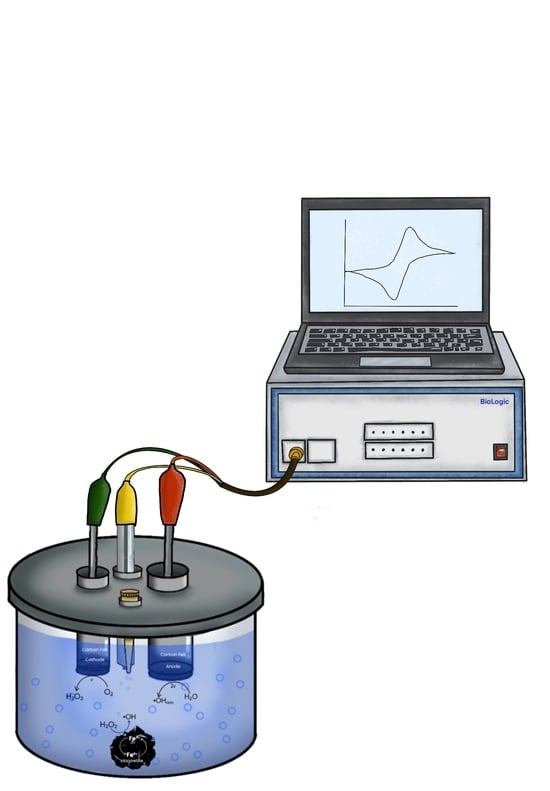
Graphical Abstract

1. Introduction

In recent years, electrochemical advanced oxidation processes (EAOPs) have gained increasing attention as sustainable and efficient technologies for the remediation of complex wastewater. These processes rely on the in situ electrochemical generation of highly reactive hydroxyl radicals (OH), capable of non-selectively oxidizing a wide variety of persistent organic pollutants. Compared to conventional chemical oxidation, EAOPs minimize chemical consumption and sludge formation, aligning with the principles of green chemistry and circular wastewater management.
Among EAOPs, the Electro-Fenton (EF) process stands out due to its ability to generate hydrogen peroxide (H2O2) directly from dissolved oxygen through a two-electron reduction pathway (Equation (1)). Subsequently, the electrogenerated H2O2 reacts with Fe2+ ions to form OH radicals (Equation (2)), enabling efficient degradation of organic contaminants. This process benefits from the continuous regeneration of Fe2+ at the cathode surface, allowing high mineralization efficiency under mild and cost-effective operating conditions [1,2].
O 2 + 2 H + + 2 e H 2 O 2
H 2 O 2 + F e 2 + O H + F e 3 + + O H
The main advantages of this method are not limited to the in situ production of H2O2, but also to the possibility to accelerate the pollutant degradation kinetics by the continuous generation of Fe2+, and the feasibility of complete mineralization at low cost [3,4]. In the pursuit of more sustainable and energy-efficient EF systems, the use of magnetic fields has recently emerged as a strategy to enhance radical generation and pollutant degradation. Previous studies have shown that moderate magnetic fields (800–3200 G) influence the stability and spin dynamics of reactive radical species [5]. However, the role of weaker magnetic fields and their interaction with solid iron sources such as magnetite (Fe3O4) has not been thoroughly explored. Magnetite is particularly attractive for sustainable EF processes because it contains both Fe2+ and Fe3+ structural cations, provides redox-active surfaces, and avoids the need for soluble iron salts that typically lead to sludge generation.
When the EF system operates under a magnetic field, the Lorentz force enhances mass transfer by thinning the diffusion layer, while also influencing the spin conversion of OH radicals from singlet to triplet states, thus extending their lifetime and oxidative capacity [6,7]. This combination of magnetic assistance and solid-state catalysis offers a promising pathway toward cleaner, reusable, and low-chemical EF technologies.
Therefore, the present study quantifies the performance of an Electro-Fenton system using synthesized Fe3O4 as a sustainable, heterogeneous iron source under the influence of a weak magnetic field (~150 G). The work aims to decouple the physical mixing effects from the intrinsic magnetic activation of the catalyst and to elucidate the synergistic effects of magnetic induction on pollutant degradation. By systematically evaluating operative parameters such as pH, dosage, and stirring mechanisms, this study provides a robust framework for the design of cost-effective and environmentally benign advanced oxidation systems for dye-containing wastewater treatment. While FeSO4 is employed as a conventional homogeneous reference to establish a performance benchmark, the ultimate goal of this investigation is to demonstrate that magnetic induction can significantly enhance the catalytic activity of Fe3O4, yielding a viable and sludge-free treatment system despite the inherent kinetic challenges of heterogeneous catalysts. Methylene blue (MB) was selected as a model pollutant because it is a widely used benchmark dye for AOP/Electro-Fenton studies, enabling direct comparison with the literature, and because its strong absorbance band allows robust kinetic monitoring by UV Vis spectroscopy.

2. Materials and Methods

2.1. Magnetite Synthesis

Magnetite nanoparticles were synthesized via the co-precipitation method [8]. Two independent batches were prepared to evaluate reproducibility. In a typical procedure, 200 mL of FeCl3, 2 M (Sigma Aldrich, St. Louis, MO, USA, 97%) and 200 mL of FeCl2•4H2O, 1 M (JT Baker, Phillipsburg, NJ, USA) were mixed to maintain a stoichiometric Fe3+/Fe2+ molar ratio of 2:1. This iron solution was added gradually to 140 mL of NH3 (6 M), prepared from NH4OH (JT Baker, Phillipsburg, NJ, USA, 28–30%), while maintaining the reaction temperature at 50 °C. The solution was manually stirred for 30 min to ensure homogeneity before allowing it to stand for 24 h. After this period, the precipitate was thoroughly washed with deionized water and dried at 105 °C overnight in a natural convection Drying Oven (BINDER GmbH, Tuttlingen, Germany) to obtain Fe3O4 powder. The synthesis yielded 15.17 g and 8.42 g for the full-scale and half-scale batches, respectively, corresponding to an average theoretical yield of 69.1%. This consistency across different scales confirms the reproducibility.
The co-precipitation route was selected as a simple and environmentally friendly synthesis method due to its low energy demand, aqueous medium operation, and absence of organic solvents or toxic precursors. This synthetic strategy aligns with green chemistry principles, minimizing reagent waste and allowing straightforward scalability for sustainable applications.
To confirm the chemical stability of the synthesized Fe3O4 before its use in electrochemical experiments, leaching tests were performed by dispersing 0.1 g of magnetite in 100 mL of deionized water at pH 3 and 7 for 24 h under magnetic stirring.
Overall, the adopted procedure enables the reproducible synthesis of magnetite with low environmental footprint, high structural integrity, and suitable redox properties for its use as a sustainable iron source in the Electro-Fenton process.

2.2. Physicochemical Characterization of Synthesized Magnetite

The synthesized Fe3O4 was characterized before and after its use in the Electro-Fenton (EF) process to ensure structural stability and suitability for environmental applications. A combination of complementary techniques was employed to evaluate the morphology, chemical composition, and surface properties of the material.
Fourier-transform infrared (FTIR) spectroscopy was used to identify characteristic Fe–O vibrational modes and confirm the formation of the magnetite phase. Scanning Electron Microscopy (SEM, ZEISS EVO|MA15, Oberkochen, Germany) and Energy-Dispersive X-ray Spectroscopy (EDS, Bruker XFlash 6130, Billerica, MA, USA) were applied to observe particle morphology, surface texture, and elemental composition. X-ray Photoelectron Spectroscopy (XPS) measurements were carried out to determine the oxidation states of iron species and assess possible surface modifications after electrochemical operation.
To evaluate the environmental stability of the synthesized Fe3O4, leaching tests were performed by dispersing 0.1 g of the material in 100 mL of deionized water at pH 3 and 7 for 24 h under magnetic stirring.
These characterization methods provided a comprehensive description of the structural, chemical, and environmental properties of the synthesized magnetite, ensuring its reproducibility and suitability as a sustainable solid iron source for the EF system.

2.3. Performance of Synthesized Magnetite in an EF Process

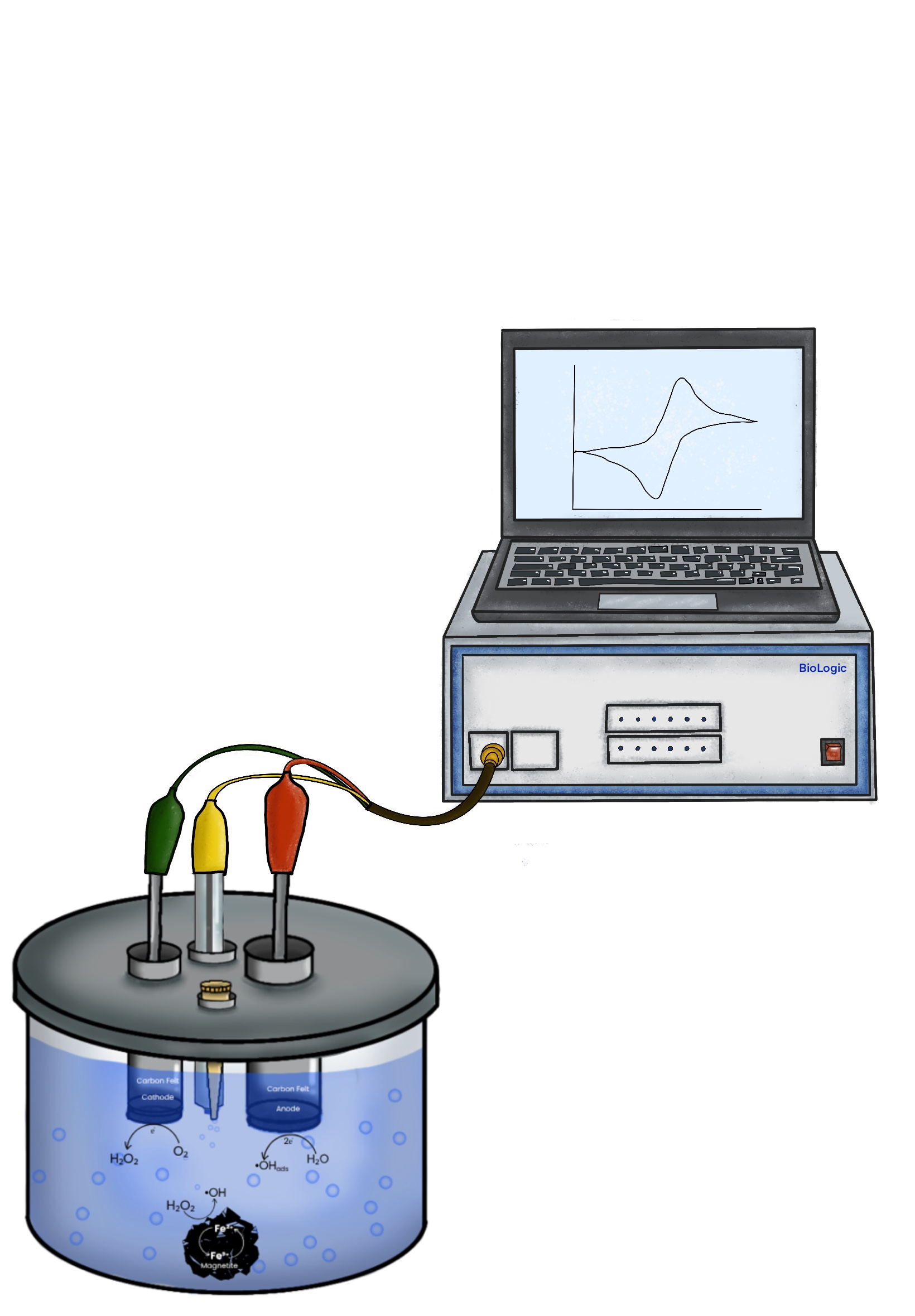
In order to identify the oxygen reduction reaction (ORR) via 2 e to promote hydrogen peroxide formation, cyclic voltammetry experiments were carried out in a three-electrode cell (Figure 1) using a potentiostat (Biologic-SP 50, Seyssinet-Pariset, France). The working and counter electrodes consisted of carbon felt (from Clarimex, Tlalnepantla de Baz, Mexico) and the reference corresponded to a commercial Ag|AgCl electrode. The carbon felt cathode was tightly fitted into a cylindrical plastic holder, exposing a flush-mounted circular geometric area of 1.54 cm2 (1.4 cm diameter). This configuration ensured that only the frontal surface of the felt was in contact with the electrolyte, allowing for a precise normalization of the current density (j, mA cm−2). The volume of supporting electrolyte solution (Na2SO4, 0.05 M, JT Baker, Phillipsburg, NJ, USA) in Batch mode was 30 mL. The process was analyzed at 3 different pH values (3, 7 and 11) to determine the reduction potential in the system.
ORR determination experiments were carried out in Methylene Blue (MB, Meyer Chemistry reagents, 20 mg/L) model dye dissolved in an oxygen-saturated electrolytic solution.
The ORR was imposed for 90 min, and the color removal was followed using UV-Vis spectroscopy (Agilent, Santa Clara, CA, USA, Carey 8454). The Fe sources employed included 0.10 mg L−1 of ferrous sulphate heptahydrate (FeSO4•7H2O) (JT Baker, 99%) and 0.17 mg L−1 of synthesized magnetite powder (Fe3O4), allowing for a direct comparison of their performance in the dye degradation process. The magnetite powder was incorporated into the reactor, where it was concentrated in the lower zone due to the attraction exerted by the magnetic field of the magnetic stirrer. Both ferrous sulphate and magnetite concentrations were adjusted to maintain a theoretical stoichiometric ratio of 1:10 with respect to H2O2, to promote the conditions for the Fenton mixture reaction.
To evaluate the influence of magnetic field, an IKA C-MAG HS4 magnetic stirrer was used to generate a magnetic flux density of approximately ~150 Gauss in the reaction zone. The field intensity and its distribution within the reaction zone were verified using a 3D electromagnetic field meter (PCE G28, Meschede, Germany) equipped with a triaxial probe, ensuring a precise quantification of the field applied to the reactor (Figure 1). This setup ensured continuous mixing and promoted homogeneous dispersion of the reactants during the decolorization of MB, enhancing both, mass transfer and reaction efficiency.
To isolate the intrinsic magnetic effect from purely hydrodynamic influences (such as mass transfer enhancement), control experiments were conducted using alternative mechanical stirring (vortex GENIE 2, 600 rpm, Bohemia, New York, NY, USA) and constant air bubbling (generic air pump). By maintaining equivalent mixing rates without a magnetic field, these controls allowed for a direct comparison, confirming that the performance improvements were due to the MF-induced synergistic effects on the Fe3O4 surface rather than simple fluid motion.
Each experiment was performed in triplicate under room temperature conditions, with continuous oxygen bubbling and continuous magnetic stirring (100 rpm). A blank experiment for comparison purposes was carried in the absence of oxygen and iron.

3. Results

3.1. Physicochemical Characterization of Magnetite

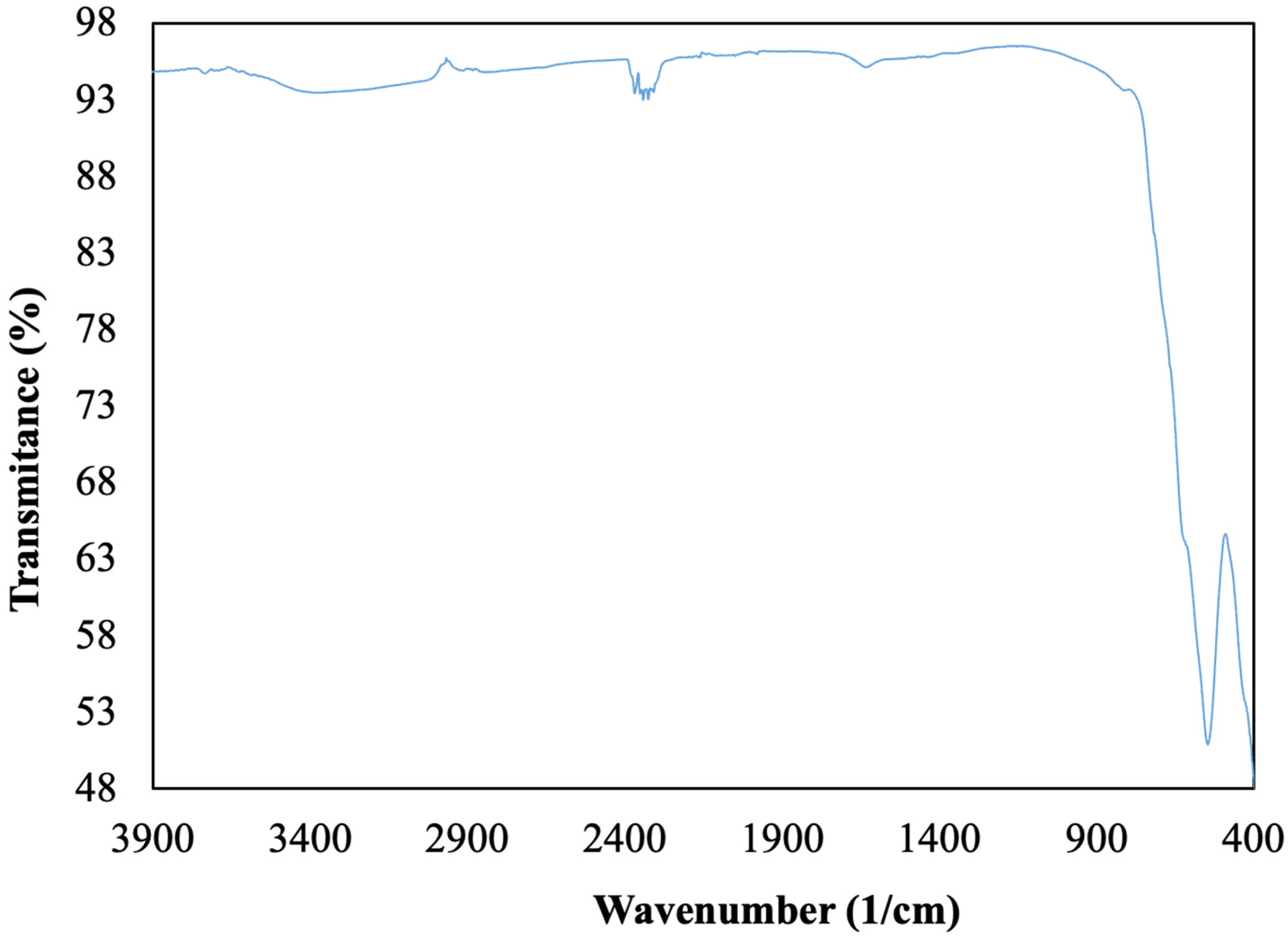
Evidence of the chemical composition of the Fe3O4 used in this project was obtained by FTIR spectroscopy (Figure 2). The FTIR spectrum of the synthesized Fe3O4 shows a strong and broad band with a peak at 548 cm−1, which corresponds to the Fe-O bond characteristic of Fe3O4, which is close to that reported by A. Herrera et al. (2006) (580 cm−1 of a magnetite standard) [9,10,11,12,13].
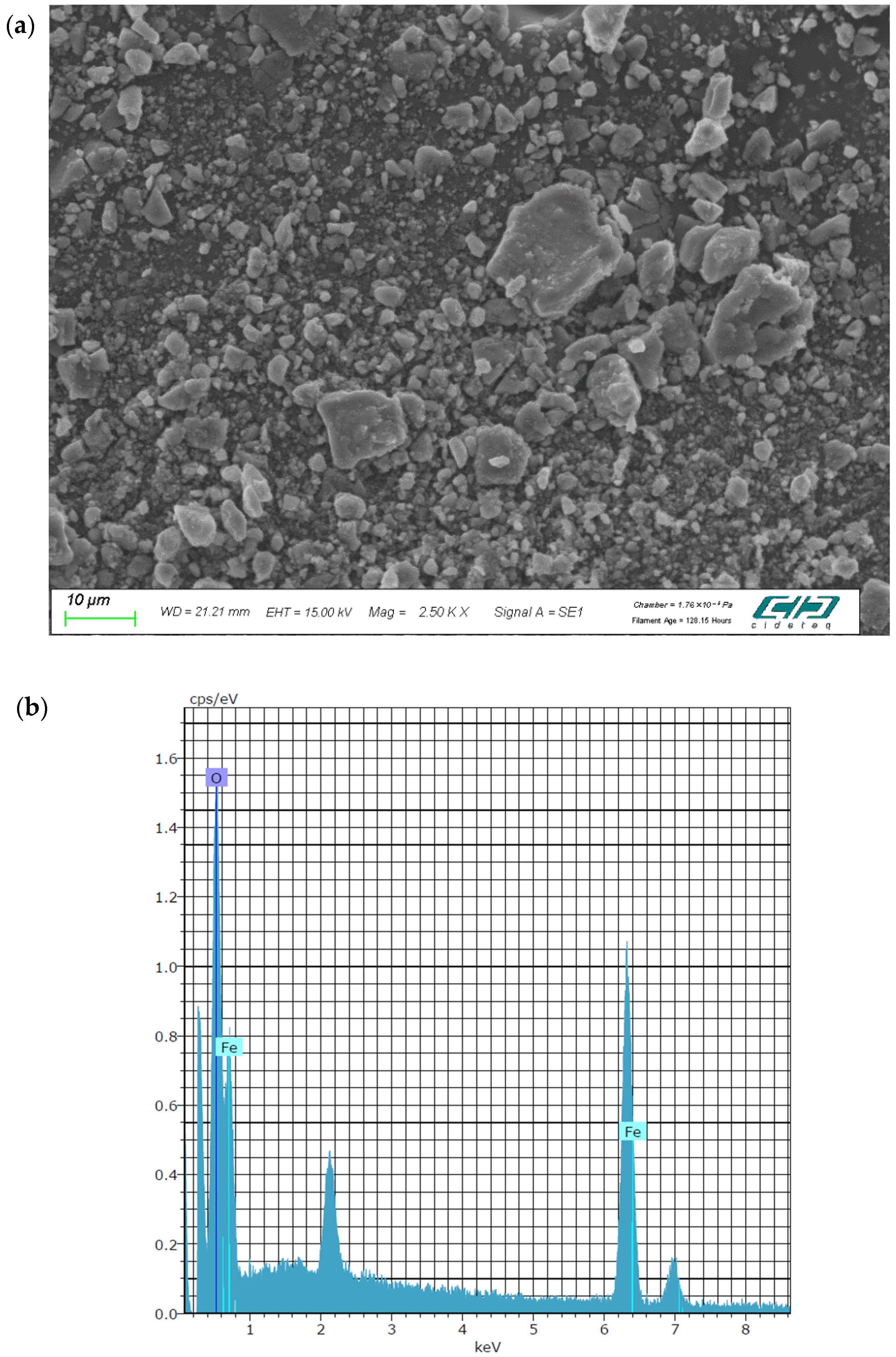
To determine the elemental composition of magnetite, SEM images and EDS spectra were obtained (Figure 3a and Figure 3b, respectively). The elemental compositions are summarized in Table 1. The SEM micrograph of magnetite (Figure 3a) shows agglomerated particles, a common feature of metal oxides. The particles exhibit an irregular morphology, attributed to the milling and sieving processes they underwent to obtain a powder with a size range between 75 and 150 μm. Additionally, the particles have well-defined edges and surfaces with fewer signs of wear or chemical alteration.
The EDS spectrum on the other hand, (Figure 3b) displays intense peaks corresponding to Fe and O, confirming that the sample primarily consists of the expected elements for magnetite. The prominent oxygen peak aligns with the oxidized nature of the compound, while the intensity ratio between the Fe and O peaks matches the expected composition for metal oxide, specifically the characteristic proportion of magnetite [14]. The elemental analysis shows that Fe constitutes 69.22% of the sample’s weight, while oxygen accounts for 30.78%. These values closely match those reported by Kuila et al. (2017) which correspond to 66.56% for Fe and 32.22% for O, with trace amounts of Al and S [15].
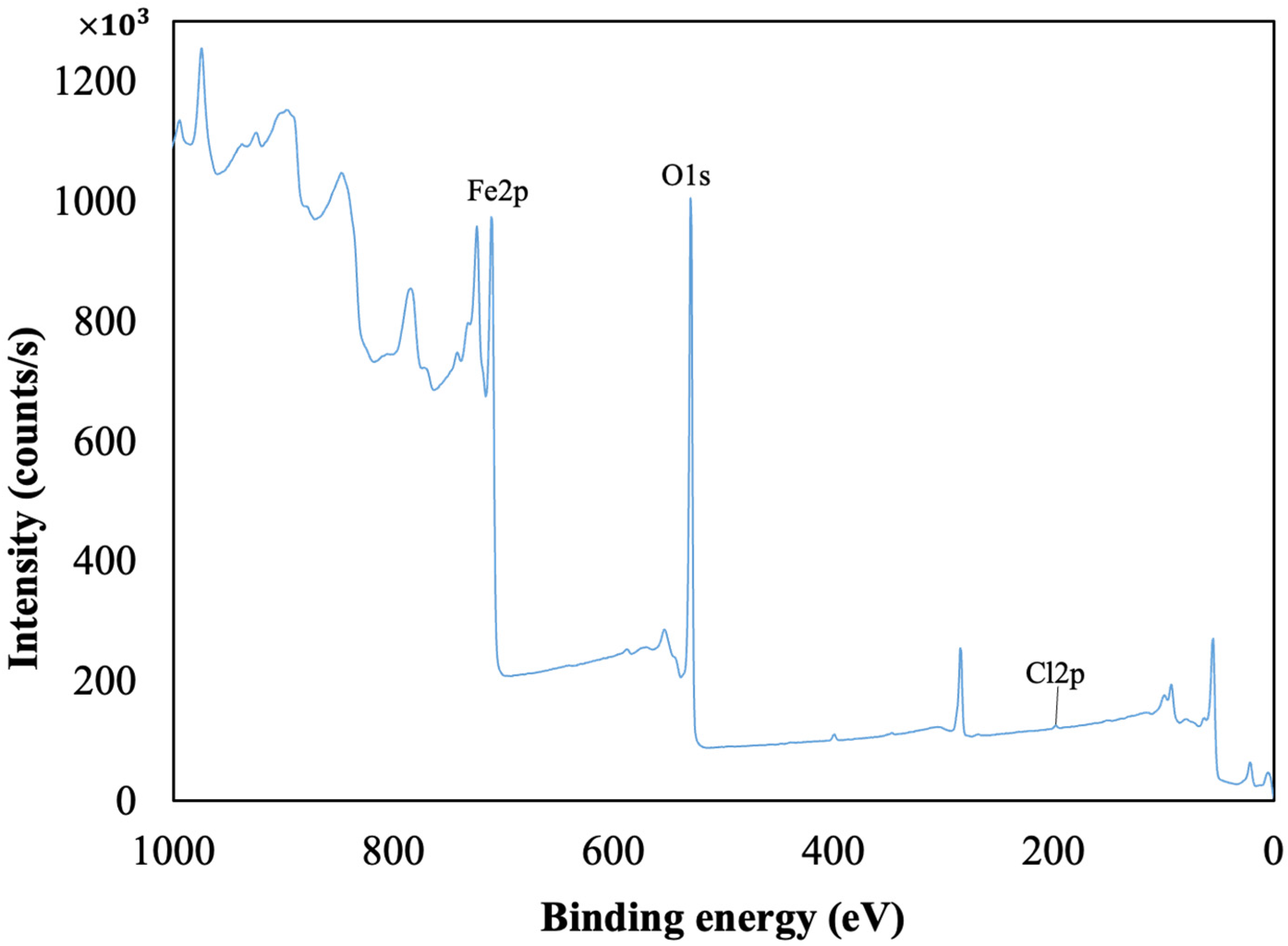
XPS analysis allowed us to identify the chemical composition and oxidation states of the elements in the synthesized Fe3O4 (Figure 4). The iron peak was deconvoluted into its characteristic doublet components. The peaks at 710.5 eV and 724.08 eV correspond to the Fe 2p3/2 and Fe 2p1/2 transitions, respectively. The most intense peak at 710.5 eV, as reported by several authors [15,16,17], is attributed to iron in the magnetite phase, confirming the coexistence of Fe2+ and Fe3+. Notably, the absence of a distinct satellite peak at 718 eV, a fingerprint of the Fe3+ state in Fe2O3, confirms the phase purity of the synthesized Fe3O4 and the absence of significant hematite impurities. Furthermore, the atomic Fe/O ratio of [0.62] obtained from Table 1 is close to the theoretical value of 0.75, providing additional evidence of the material’s identity beyond the initial FTIR characterization [18]. Additionally, the most intense peak for oxygen 1 s at 529.08 eV is attributed to the lattice oxygen in the Fe3O4 phase, a value which is quite close to 530.0 eV, reported by Kim et al. (2006) [16].
Full width at half maximum (FWHM) and atomic composition analysis provide further information on the environment of the elements in the Fe3O4, (see Table 1). The atomic composition helps to evaluate the stoichiometric ratio of the material, ensuring the purity of the synthesized Fe3O4 and detecting possible secondary iron oxide phases. These results are essential to correlate the chemical structure of magnetite with its role in the EF advanced oxidation process.

3.2. Performance of Magnetite in an EF System

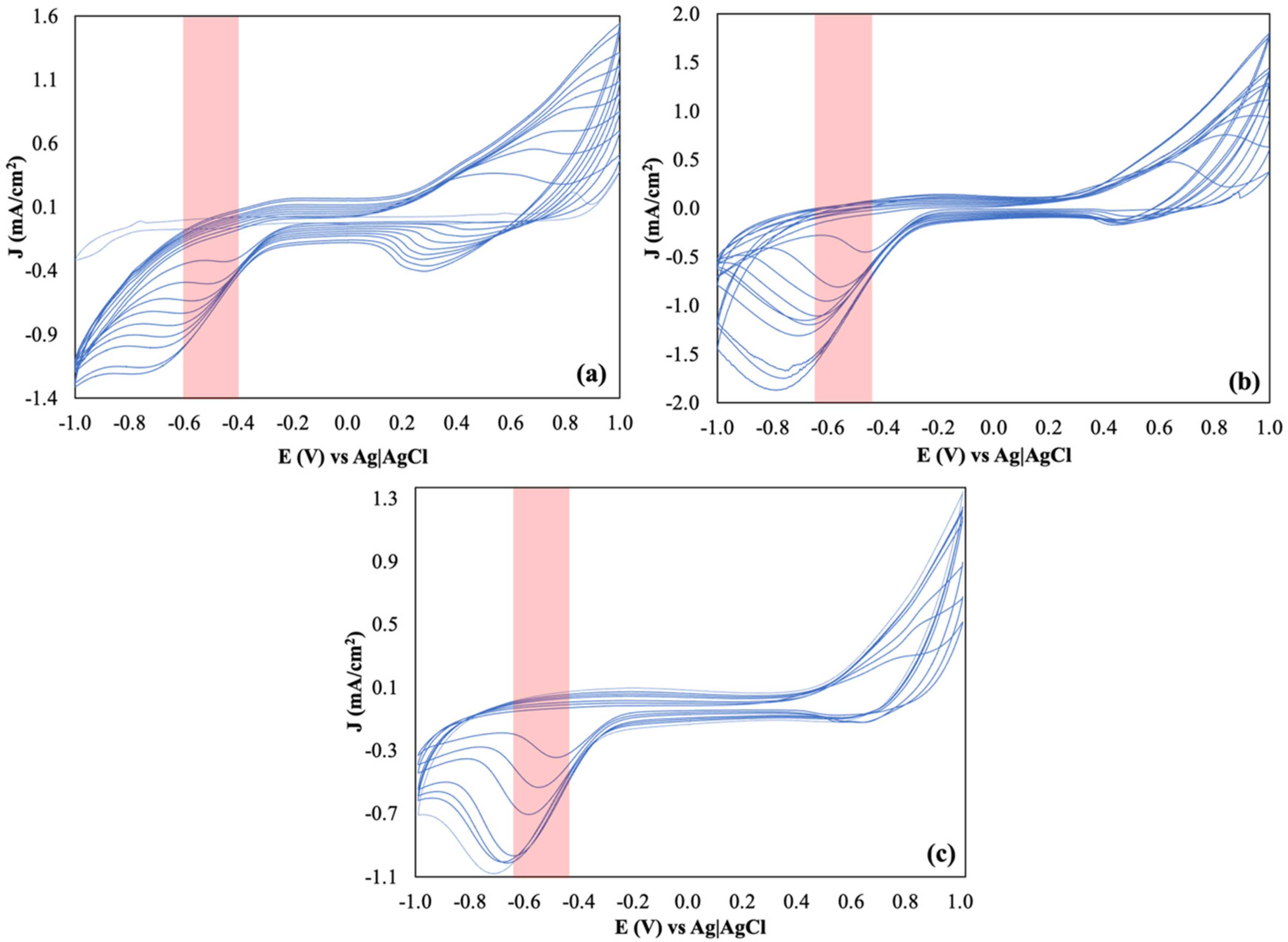
As can be seen in Figure 5, the potentials for the O2 reduction reaction (ORR) in the Na2SO4 0.05 M supporting electrolyte solution, correspond to −0.50, −0.56 and −0.55 V (vs. Ag|AgCl) for pH values 3, 7 and 11, respectively. These values are close to those reported by Xu et al. (2022) [19]. Interestingly, at pH 3 (Figure 5a), the signals appear weaker due to a higher concentration of H+ ions, whereas at pH 7 and 11 the predominant species are OH (Figure 5b and Figure 5c, respectively) [19].
As reported in previous studies from our research group, the validation of the working potential is carried out to ensure that the reaction is occurring at the correct potential [20,21].
For all experiments, cyclic voltammetry was performed under initial conditions without previous O2 bubbling saturation, confirming that the dissolved oxygen concentration corresponded to ambient conditions.

3.3. Study of Iron Ion Effects: Comparison Between Its Presence in Solution and Its Incorporation in Magnetite

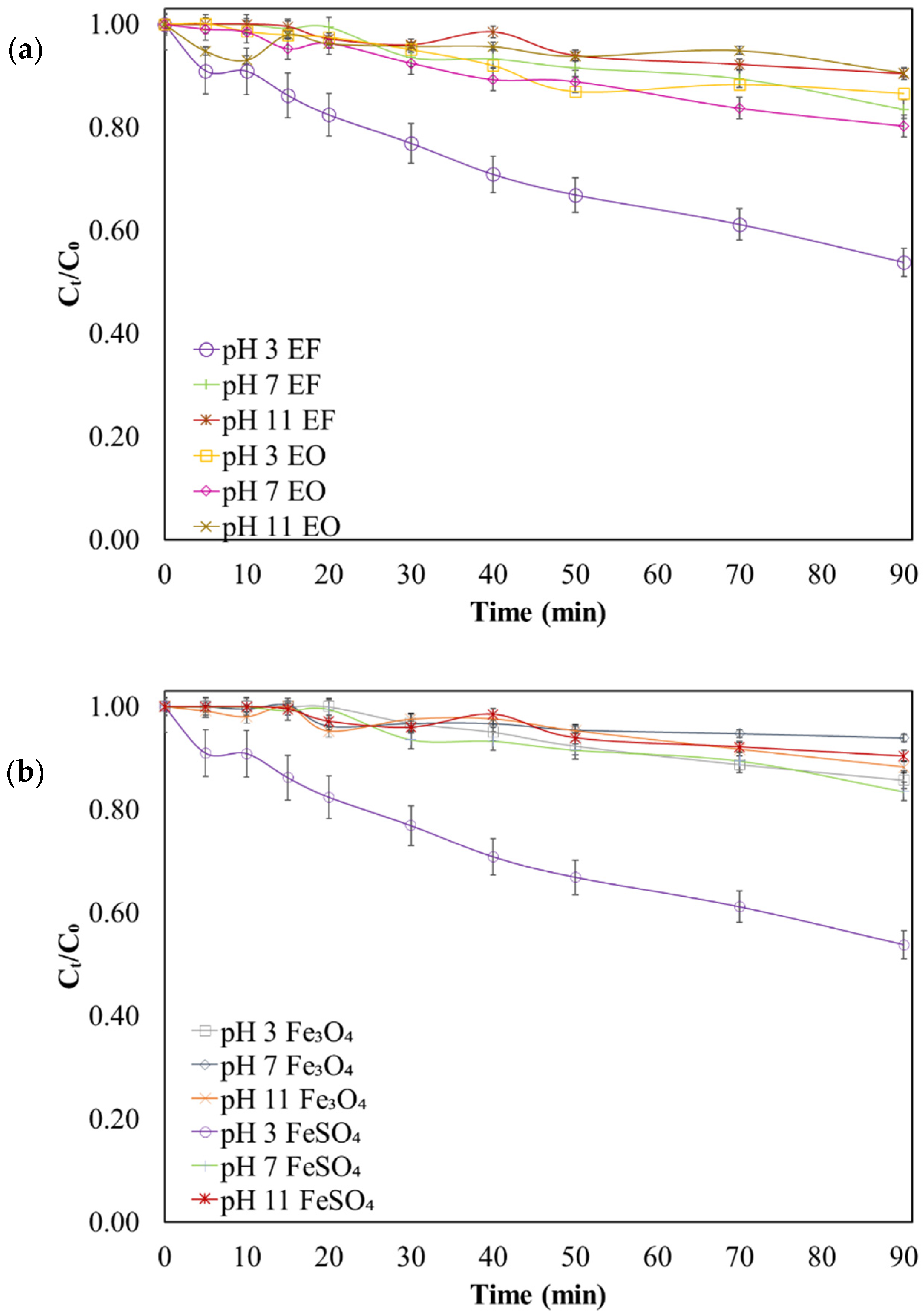
Figure 6a illustrates that the decolorization process was enhanced by the Electro-Fenton process at pH 3, increasing the percentage of decolorization from 13.38 to 46.18% with respect to the electrooxidation (EO) at the same pH value. This is expected since the presence of Fe2+ ion under slightly acidic conditions favors the generation of OH oxidizing species [22,23].
To evaluate the effect of Fe ions, 2 sources (FeSO4 and Fe3O4) were used. Figure 6b shows a greater decolorization when the FeSO4 was used at pH 3 (46.18%), but when the Fe3O4 was used only the 14.22% of decolorization was obtained. That effect is attributed to the fact that when Fe2+ ions in solution concentrate near the electrode favoring the process, as described by Do et al. (2017), who observed that a the OH generation becomes kinetically limited due to insufficient Fe2+ availability for H2O2 activation [24]. To ensure a rigorous comparison between the homogeneous (FeSO4) and heterogeneous (Fe3O4) systems, the amount of each iron source was calculated to maintain the same stoichiometric Fe2+: H2O2 ratio, following the ideal Fenton requirements. While FeSO4 provides instantaneous iron availability, it is well-known to suffer from rapid sludge formation and loss of catalytic activity. In contrast, the Fe3O4 system maintains the iron species within the spinel lattice. The enhanced efficiency observed in the Fe3O4/MF system, despite having the same theoretical iron equivalence as the FeSO4 system, confirms that the magnetic field acts specifically on the heterogeneous surface, promoting the regeneration of Fe2+ active sites and accelerating the production of OH.
Kuntail et al. (2022) reported that a key limitation in Fenton-like systems is the slow regeneration of Fe (II) from Fe (III) [25]. However, the presence of Fe3O4 can partially overcome this limitation because its inverse spinel structure contains both Fe (II) and Fe (III), enabling an internal Fe (III)/Fe (II) redox cycle that facilitates surface-mediated H2O2 activation, as discussed by Pujol et al. (2020) [26]. Accordingly, Fe3O4 can activate H2O2 through surface-mediated pathways (Equation (3)), sustaining OH generation without continuous soluble-iron dosing [27].
  F e   ( I I ) m a g n e t i t e + H 2 O 2   F e   ( I I I ) m a g n e t i t e + O H + O H
The lower decolorization efficiency of the Fe3O4 system (14.22%) compared to FeSO4 at pH 3.0 highlights the kinetic challenges of heterogeneous Fenton processes. The limitation stems from the restricted number of active Fe2+/Fe3+ sites exposed on the particle surface and the additional mass transfer resistance inherent to solid-liquid interfaces. However, the heterogeneous approach is justified by its superior environmental performance, as it avoids the formation of secondary iron sludge and allows for magnetic recovery of the catalyst—advantages that compensate for the lower initial reaction rates when assisted by a magnetic field.
Another notable advantage of using magnetite when compared to the classical Fenton process is that the addition of counter anions, such as Cl or SO42−, to the system is avoided and thus the amount of iron-containing precipitates is significantly lower than that of the classical Fenton process [28].

3.4. Influence of pH on Methylene Blue Decolorization Using FeSO4 and Fe3O4

As it is shown in Table 2, decolorization was significantly enhanced at pH 3 for both Fe sources. This improvement is attributed to three main factors. First, acidic conditions accelerate the decomposition of H2O2 into OH, increasing the availability of these reactive species. Additionally, the oxidation potential of OH rises as pH decreases, further enhancing its oxidative activity. Finally, while the Fe3O4 surface is positively charged at pH 3 (pH < pHPZC ≈ approx. 6.5), the observed decolorization is primarily driven by the heterogeneous Fenton-like reaction on the catalyst surface rather than electrostatic attraction. Since Methylene Blue is a cationic dye, electrostatic repulsion occurs between the dye and the protonated magnetite surface, which is consistent with the low adsorption values (5.06%) obtained in control tests. Therefore, the superior performance at pH 3 is justified by the higher catalytic activity of surface iron sites and the increased stability of reactive oxygen species, which overcome the limited physical adsorption [28,29].
The efficiency of the process was evaluated through the decolorization percentage at the maximum absorption wavelength ( λ m a x = 664   n m ). To ensure that the observed removal was not a physical artifact, adsorption tests were performed, yielding a maximum value of 5.06%. This indicates that the removal efficiency is attributable to the catalytic action of the Fe3O4 surface and the generated OH radicals. While mineralization parameters such as TOC and COD were not monitored, the reduction in the color signal under the best conditions confirms the destruction of the pollutant’s conjugated system, which is the critical first step in its electrochemical remediation.
Furthermore, the standard deviations (σ) associated with the percentage of decolorization provide additional information on the precision of the data obtained. For magnetite, the σ values are low at all pHs studied, varying between 0.019 and 0.038, indicating limited variability in the measurements and high experimental consistency. In contrast, for FeSO4, a higher standard deviation is observed at pH 3 (σ = 0.107), suggesting a higher scattering of the data possibly due to the complexity of the catalytic processes involved. However, at pH 7 and 11, the standard deviations are smaller (0.033 and 0.028, respectively), reflecting a more uniform behavior under these conditions.

3.5. Effect of Magnetic Stirring-Induced Magnetic Field on Decolorization

The presence of a magnetic field significantly enhances the pollutant decolorization process in advanced oxidation systems. As it was pointed out before, the magnetic field promotes the interconversion of the spin configuration of the OH radical from singlet to triplet (S → T). The triplet configuration exhibits a lower probability of recombination, favoring the stabilization of oxidative species such as OH and O2H. In addition, magnetic field can extend the O-O and O-H bond lengths of the electrogenerated H2O2 in the system, facilitating their cleavage and promoting the formation of radical species, as reported by Dan et al., 2021 in their study on the degradation of norfloxacin using a reduced graphene oxide catalyst supported on Fe-Cu (FeCu/rGO) under visible light irradiation [6].
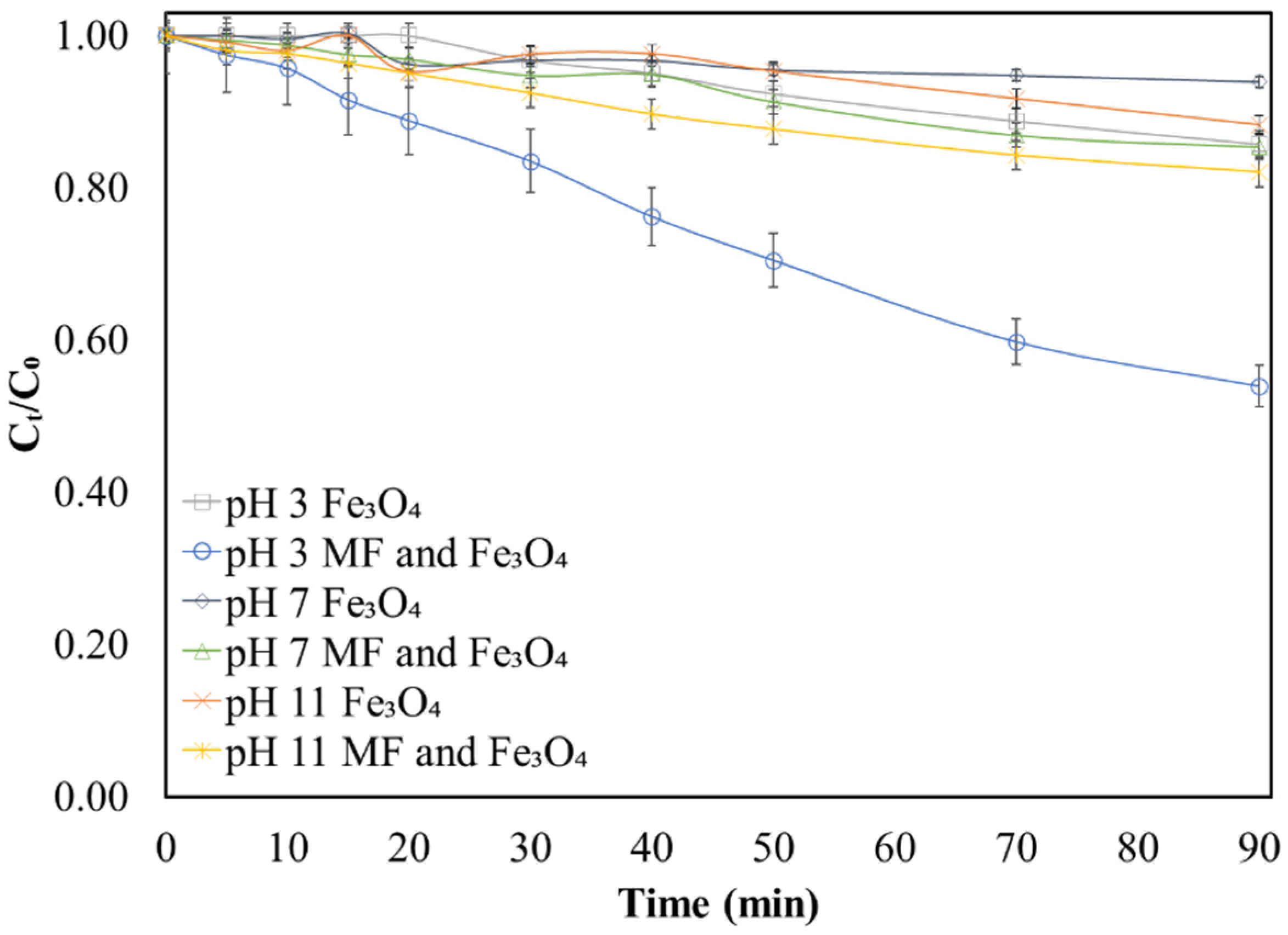
In the case of the system with magnetite (Figure 7), an increase in decolorization from 14.22% to 49.19% was observed at pH 3 when using a magnetic stirrer. This increase is attributed not only to the thinning of the diffusion layer due to the Lorentz force exerted, which facilitates the heterogeneous reaction on the magnetite surface without the dissolution of iron, (enabled by its octahedral structure as it contains both Fe2+ and Fe3+), but also to the interaction between magnetic field and OH, that helps to control parasitic reactions associated with the excess of this radical (Equations (3) and (4)) [7,26,30,31].
The ~150 G magnetic field intensity aligns with the category of Weak Magnetic Fields (WMF), which have been reported to effectively modulate the redox cycle of iron in heterogeneous Fenton systems. At this intensity, the magnetic field provides a sufficient Lorentz force to reduce the diffusion layer thickness at the electrode interface, while simultaneously promoting the spin-dependent stability of the generated OH [7,28,31,32,33].
It is also interesting to note that Pirsaheb et al., 2019 reported that in the degradation of ciprofloxacin using a nanostructured zero-valent iron catalyst, the application of a magnetic field facilitates oxidation and reduction reactions by accelerating the dissolution of iron [7]. This process increases the release of Fe2+, thus promoting the production of OH and accelerating mass transfer. These observations are consistent with the effects observed in systems with magnetite in which the magnetic field also increases the overall efficiency of the process.
To confirm that the magnetic field significantly contributes to the decolorization process and that this effect is not only due to the induced stirring, experiments were also conducted using different types of mechanical stirring (and bubbling stirring). Figure S1 shows that mechanical stirring resulted in similar decolorization levels of methylene blue (37.73% with mechanical stirring and 34.93% with bubbling stirring). In contrast, magnetic stirring (100 rpm) revealed the contribution of magnetic field to the decolorization of MB, by reaching a value of 49.19%.

3.6. Effect of the Magnetite Ratio

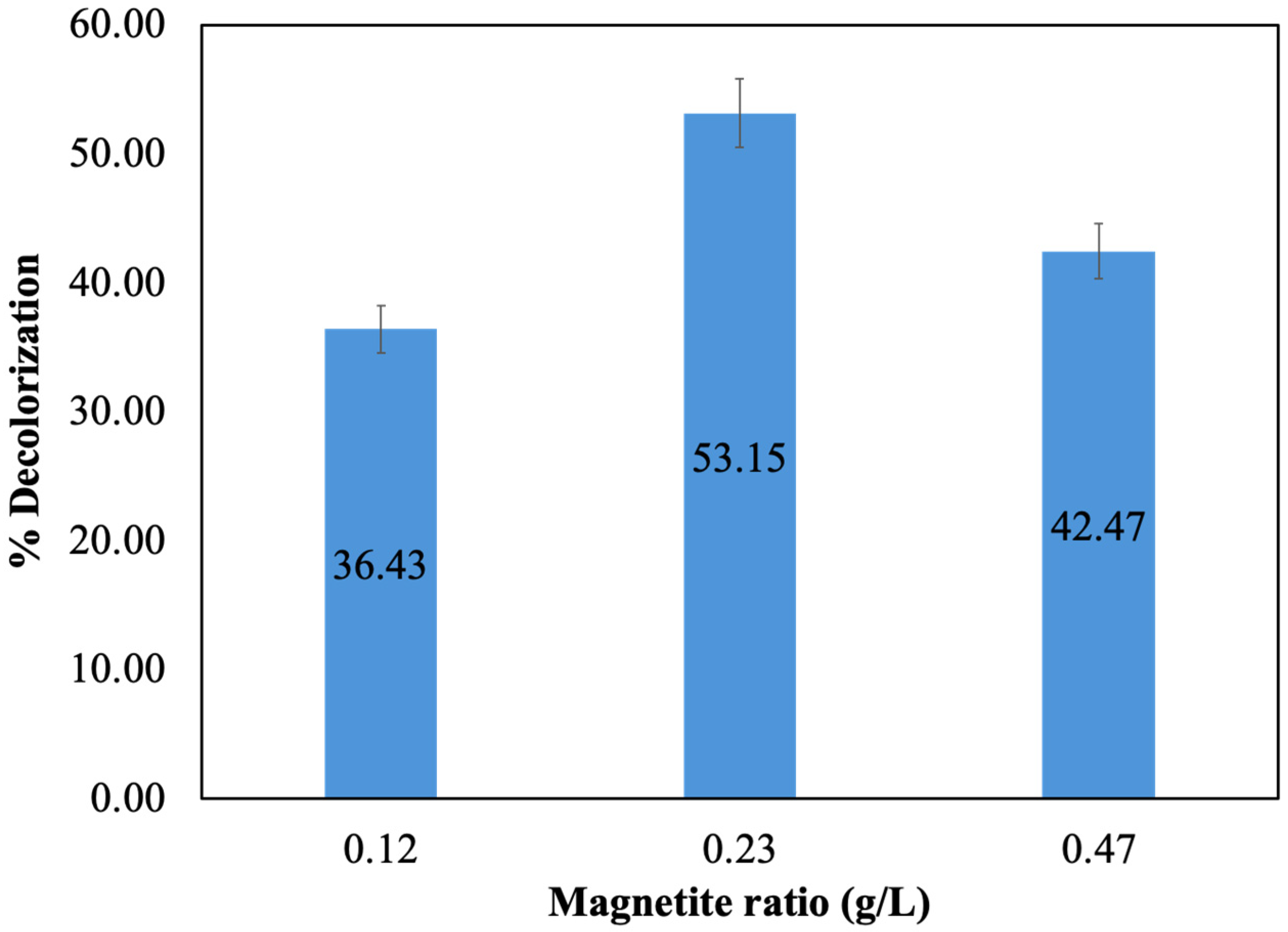
The Fe3O4 dosage plays a crucial role in the system’s efficiency, as reported by Giwa et al., 2020 [34]. As shown in Figure 8, doubling the Fe3O4 concentration from 0.12 g/L to 0.23 g/L enhanced decolorization from 36.43% to 53.25%. While magnetite possesses a porous structure capable of adsorption, control experiments (showing only 5.06% removal by adsorption alone) confirm that the observed trend is predominantly governed by heterogeneous EF kinetics.
The decrease in decolorization efficiency when the Fe3O4 dosage was increased to 0.47 g/L can be attributed to two main factors. First, the radical scavenging effect occurs where an excess of iron species on the surface may lead to the unproductive consumption of hydroxyl radicals ( O H +   F e 2 + F e 3 + +   O H ) or radical recombination, reducing the amount of oxidant available for methylene blue degradation. Second, the application of the external magnetic field promotes the formation of larger magnetic aggregates at higher particle concentrations. This magnetic-induced agglomeration reduces the specific surface area and the accessibility of the active sites, leading to a decline in the overall reaction rate. Therefore, a dosage of 0.23 g/L is required to balance the generation of active species with the physical and chemical stability of the suspension [28].
This decline rules out adsorption as the dominant process, as adsorption would typically increase or plateau with higher dosages, rather than hindering the overall removal. Therefore, the 0.23 g/L dosage represents the point where the availability of Fe2+/Fe3+ surface sites is maximized for H2O2 activation without inducing radical suppression.
This phenomenon, described by Garzón-Cucaita and Carriazo, 2022 is attributed to undesired reactions on the surface of the iron oxide (Equations (4) and (5)), where radical species such as OH and O2H can be captured by the oxide, decreasing their availability for organic degradation [35]. This process is closely related to the mechanism by which iron species participate in the Fenton reaction. Specifically, F e I I and F e I I I refer to surface iron sites in Fe3O4 that can follow either a homogeneous or heterogeneous reaction pathway. The homogeneous mechanism involves the partial dissolution of the oxide, where surface F e I I I is reduced, releasing Fe2+ ions into solution. These dissolved Fe2+ ions then react with H2O2 to generate OH, propagating a chain reaction in agreement with the classical Fenton process [26,35].
F e I I + O H   O H + F e I I I
F e I I + H O 2   H O 2 + F e I I I
Beyond confirming the successful synthesis of Fe3O4, the physicochemical characterization was also intended to assess its suitability as a sustainable and reusable catalyst for environmental electrochemical applications. The combination of Fe2+/Fe3+ oxidation states identified by XPS and the strong Fe–O vibrations observed by FTIR indicate that the material possesses the redox versatility required for efficient Fenton-like reactions without the continuous addition of soluble iron salts.
The particle morphology observed by SEM—irregular yet compact agglomerates—suggests good mechanical stability during electrochemical operation, while the EDS and XPS results confirm a stoichiometric Fe/O ratio consistent with pure magnetite. These properties are comparable to those reported for high-performance heterogeneous Fenton catalysts in recent literature, confirming the reliability of the synthesis route.
In addition, the surface stability of Fe3O4 was monitored before and after electrochemical use to verify the preservation of its structural integrity. No significant changes were detected in the FTIR or XPS spectra, and the iron leaching remained below 0.05 mg L−1, demonstrating that the material resists dissolution and secondary contamination. This aspect is essential for sustainable wastewater treatment, as it prevents iron sludge generation and allows the catalyst to be potentially reused in multiple treatment cycles.
Overall, the physicochemical and structural evidence supports the use of the synthesized magnetite as a robust, low-cost, and environmentally benign catalyst in Electro-Fenton systems aimed at the remediation of dye-containing and other complex wastewaters.

3.7. Comparative Analysis

As summarized in Table 3, the scientific contribution of this study is framed within the context of process intensification through magnetic induction. While some reported systems achieve higher degradation rates, they often rely on auxiliary energy sources such as UV irradiation or complex catalyst architectures involving reduced graphene oxide and noble metals [7]. For instance, Pirsaheb et al. (2019) reached 90% efficiency in 60 min using zero-valent iron, but required a higher magnetic field (300 G) and photo-catalytic assistance [7]. Similarly, immobilized magnetite on steel or carbon-based cathodes has shown 100% removal for various pollutants, but typically over longer operational times or with lower initial concentrations [1,6,36].
The value added of the studied Fe3O4/MF system lies in its operational simplicity and environmental sustainability. This study demonstrates that by using a Weak Magnetic Field (150 G) and a standard synthesized magnetite, it is possible to achieve a 3.5-fold efficiency increase (from 14% to 49% in 90 min) without the need for complex cathode functionalization or UV light. This performance is particularly relevant considering the initial pollutant load (20 mg/L) compared to some immobilized systems. Thus, the magnetic synergy presented here offers a viable, sludge-free alternative that balances energy efficiency with ease of catalyst recovery.

4. Conclusions

Magnetite (Fe3O4) was successfully synthesized by a controlled co-precipitation route, yielding a structurally stable material with the expected Fe2+/Fe3+ redox characteristics for catalytic applications in advanced oxidation processes. When used as a heterogeneous iron source in the Electro-Fenton (EF) system, Fe3O4 effectively promoted the decolorization of methylene blue, particularly under acidic conditions (pH 3), confirming its capacity to drive hydroxyl radical generation without the addition of soluble iron salts.
The application of a weak magnetic field (WMF) did not merely improve the process; it tripled the EF performance, increasing decolorization from 14.22% to 49.19% at pH 3. This synergistic factor (S = 3.45) proves that the magnetic induction effectively overcomes the kinetic limitations of the heterogeneous surface, a claim supported by control experiments where mechanical stirring (and bubbling) failed to reach the same performance. This improvement is attributed to two synergistic effects: (i) the Lorentz force, which promotes diffusion layer thinning and accelerates mass transport, and (ii) the magnetic field’s influence on the spin state of OH radicals, prolonging their lifetime and oxidative reactivity. The process thus benefits simultaneously and supports the hypothesis that improved kinetics enhanced the radical stability.
The best performance was achieved at moderate magnetite dosages (0.23 g L−1), whereas excessive solid loading reduced efficiency due to radical quenching on the Fe3O4 surface. Importantly, the absence of sludge formation and the chemical stability of magnetite under acidic operation highlight its environmental compatibility compared to traditional homogeneous Fenton systems.
The practical applicability of the magnetic field-assisted Electro-Fenton process is enhanced by the magnetic properties of the Fe3O4 catalyst. Unlike homogeneous Fenton processes that produce iron-rich sludge, the heterogeneous Fe3O4 can be efficiently recovered from the treated effluent via magnetic separation. This capacity for recovery, combined with the catalytic stability, points toward a sustainable treatment model. Although multi-cycle stability tests and long-term leaching kinetics were not conducted, the consistent performance and the high degree of decolorization suggest that the catalyst maintains its active surface sites (Fe2+/Fe3+) throughout the reaction period.
Overall, this study demonstrates that magnetite-assisted and magnetically enhanced EF systems constitute a promising, low-reagent and potentially energy-efficient technology for the sustainable remediation of dye-containing wastewaters. While the reduction in reaction time suggests a decrease in specific energy consumption, further techno-economic studies are required to evaluate electrode longevity and operating costs at a larger scale. Future work should explore catalyst reuse, mineralization efficiency (TOC/COD), and scaling potential toward real effluent applications.

Supplementary Materials

The following supporting information can be downloaded at: https://www.mdpi.com/article/10.3390/pr14020264/s1. Figure S1. Effect of the type of agitation in the methylene blue decolorization.

Author Contributions

Conceptualization, I.R.; Methodology, E.A.H.-R. and I.R.; Validation, I.R.; Formal analysis, E.A.H.-R., J.D.G.-E., J.T.-R., M.R.-N., G.A.-S. and L.A.G.; Investigation, J.D.G.-E. and L.A.G.; Writing—review & editing, E.A.H.-R.; Supervision, I.R.; Project administration, I.R.; Funding acquisition, I.R. All authors have read and agreed to the published version of the manuscript.

Funding

This research was funded by “Mexican Secretariat of Science, Humanities, Technology and Innovation” grant number CBF-2025-G-381.

Data Availability Statement

The data presented in this study are available on request from the corresponding author. The data are not publicly available due to privacy or ethical restrictions.

Acknowledgments

The authors thank Centro de Investigación y Desarrollo Tecnológico en Electroquímica (CIDETEQ) for the facilities to conduct this research. This research was developed as part of the agreement of the Laboratorio Nacional CONAHCyT de Ciencia y Tecnología del Agua. Evelyn A. Hernández-Rodríguez also thanks SECIHTI for a fellowship. The authors express their gratitude to Susana Citlaly Gaucin Gutiérrez for performing SEM and EDS analyses and Claramaría Rodríguez González for the XPS analysis.

Conflicts of Interest

The authors declare no conflict of interest.

Abbreviations

The following abbreviations are used in this manuscript:
CIQECCentro de Investigación en Química para la Economía Circular
EFElectro-Fenton
Fe3O4Magnetite
FTIRFourier-transform infrared
SEM/EDSScanning Electron Microscopy and Energy-Dispersive X-ray Spectroscopy
XPSX-ray Photoelectron Spectroscopy
EAOPsElectrochemical advanced oxidation processes
•OHHydroxyl radicals
H2O2Hydrogen peroxide
ORROxygen reduction reaction
MBMethylene blue
FWHMFull width at half maximum
B.E.Binding energy
EOElectrooxidation
σStandard deviation
SSinglet
TTriplet
O2HHydroperoxyl radical
FeIron
pHPZCpH at the Point of Zero Charge

References

  1. Choe, Y.J.; Kim, J.; Byun, J.Y.; Kim, S.H. An electro-Fenton system with magnetite coated stainless steel mesh as cathode. Catal. Today 2021, 359, 16–22. [Google Scholar] [CrossRef]
  2. Fernández, D.; Robles, I.; Rodríguez-Valadez, F.J.; Godínez, L.A. Novel arrangement for an electro-Fenton reactor that does not require addition of iron, acid and a final neutralization stage. Towards the development of a cost-effective technology for the treatment of wastewater. Chemosphere 2018, 199, 251–255. [Google Scholar] [CrossRef]
  3. Brillas, E.; Sirés, I.; Oturan, M.A. Electro-fenton process and related electrochemical technologies based on fenton’s reaction chemistry. Chem. Rev. 2009, 109, 6570–6631. [Google Scholar] [CrossRef]
  4. Nidheesh, P.V.; Gandhimathi, R.; Velmathi, S.; Sanjini, N.S. Magnetite as a heterogeneous electro Fenton catalyst for the removal of Rhodamine B from aqueous solution. RSC Adv. 2014, 4, 5698–5708. [Google Scholar] [CrossRef]
  5. Hao, X.L.; Zou, L.Y.; Zhang, G.S.; Zhang, Y.B. Magnetic field assisted Fenton reactions for the enhanced degradation of methyl blue. Chin. Chem. Lett. 2009, 20, 99–101. [Google Scholar] [CrossRef]
  6. Dan, H.; Kong, Y.; Yue, Q.; Liu, J.; Xu, X.; Kong, W.; Gao, Y.; Gao, B. Magnetic field-enhanced radical intensity for accelerating norfloxacin degradation under FeCu/rGO photo-Fenton catalysis. Chem. Eng. J. 2021, 420, 127634. [Google Scholar] [CrossRef]
  7. Pirsaheb, M.; Moradi, S.; Shahlaei, M.; Wang, X.; Farhadian, N. Simultaneously implement of both weak magnetic field and aeration for ciprofloxacin removal by Fenton-like reaction. J. Environ. Manag. 2019, 246, 776–784. [Google Scholar] [CrossRef] [PubMed]
  8. Ozbey Unal, B.; Bilici, Z.; Ugur, N.; Isik, Z.; Harputlu, E.; Dizge, N.; Ocakoglu, K. Adsorption and Fenton oxidation of azo dyes by magnetite nanoparticles deposited on a glass substrate. J. Water Process Eng. 2019, 32, 100897. [Google Scholar] [CrossRef]
  9. Herrera, A.; Rodríguez, H.; Torres-Lugo, M.; Rinaldi, C. Functionalization of Magnetite (Fe3O4) Nanoparticles for Cancer Treatment. NSTI-Nanotech 2006, 2, 75–78. [Google Scholar]
  10. Cai, G.; Zhu, X.; Li, K.; Qi, X.; Wei, Y.; Wang, H.; Hao, F. Self-enhanced and efficient removal of arsenic from waste acid using magnetite as an in situ iron donator. Water Res. 2019, 157, 269–280. [Google Scholar] [CrossRef]
  11. Vallejo-Espinosa, G.; Pérez-Larios, A.; Nava-Andrade, K. Influence of temperature and stirring on the synthesis of magnetite nanoparticles. Mater. Lett. 2024, 372, 136980. [Google Scholar] [CrossRef]
  12. Mbuyazi, T.B.; Ajibade, P.A. Photocatalytic degradation of eosin yellow and quinaldine red under visible light irradiation by magnetite nanoparticles. J. Mol. Struct. 2025, 1334, 141862. [Google Scholar] [CrossRef]
  13. de Oliveira Guidolin, T.; Possolli, N.M.; Polla, M.B.; Wermuth, T.B.; de Oliveira, T.F.; Eller, S.; Montedo, O.R.K.; Arcaro, S.; Cechinel, M.A.P. Photocatalytic pathway on the degradation of methylene blue from aqueous solutions using magnetite nanoparticles. J. Clean. Prod. 2021, 318, 128556. [Google Scholar] [CrossRef]
  14. Shahid, M.K.; Kim, Y.; Choi, Y.G. Magnetite synthesis using iron oxide waste and its application for phosphate adsorption with column and batch reactors. Chem. Eng. Res. Des. 2019, 148, 169–179. [Google Scholar] [CrossRef]
  15. Kuila, S.K.; Chatterjee, R.; Ghosh, D. Reduction kinetics and characterization study of synthetic magnetite micro fines. In Minerals, Metals and Materials Series; Springer International Publishing: Berlin/Heidelberg, Germany, 2017; pp. 615–631. [Google Scholar]
  16. Kim, K.-C.; Kim, E.-K.; Lee, J.-O.; Kim, Y.-S. Characterization of Magnetic Nanoparticles Synthesized by Sonomechanical Method. In Proceedings of the IEEE Nanotechnology Materials and Devices Conference, Gyeongju, Republic of Korea, 22–25 October 2006; pp. 600–601. [Google Scholar] [CrossRef]
  17. Schwaminger, S.P.; Bauer, D.; Fraga-García, P.; Wagnerb, F.E.; Berensmeier, S. Oxidation of magnetite nanoparticles: Impact on surface and crystal properties. CrystEngComm 2017, 19, 246–255. [Google Scholar] [CrossRef]
  18. More, S.; Raut, S.; Premkumar, S.; Bhopale, S.; Bhoraskar, S.; Morea, M.; Mathe, V. Structural and morphological tuning of iron oxide polymorphs by ECR plasma-assisted thermal oxidation. RSC Adv. 2020, 10, 32088–32101. [Google Scholar] [CrossRef] [PubMed]
  19. Xu, H.; Guo, H.; Chai, C.; Li, N.; Lin, X.; Xu, W. Anodized graphite felt as an efficient cathode for in-situ hydrogen peroxide production and Electro-Fenton degradation of rhodamine B. Chemosphere 2022, 286, 131936. [Google Scholar] [CrossRef]
  20. Banda-Alemán, J.A.; Camacho-Callejas, M.; Salazar-López, M.L.; Robles, I.; Acosta-Santoyo, G.; García-Espinoza, J.D.; Rodríguez-Valadez, F.J.; Manriquez, J.; Godínez, L.A. Alternating polarization of Fe modified carbon fiber materials. towards the development of single-electrode electro-Fenton batch reactors. Electrochim. Acta 2023, 450, 142282. [Google Scholar] [CrossRef]
  21. Leyva-Ruiz, D.; Treviño-Reséndez, J.; Godínez, L.A.; Robles, I.; Acosta-Santoyo, G.; García-Espinoza, J.D. Electrochemical degradation of carbamazepine in water by a flow-through and pilot-scale reactor with carbon felt electrodes: Parametric study under realistic operational conditions. J. Environ. Chem. Eng. 2024, 12, 113232. [Google Scholar] [CrossRef]
  22. Rodríguez-Chueca, J.; Mediano, A.; Pueyo, N.; García-Suescun, I.; Mosteo, R.; Ormad, M.P. Degradation of chloroform by Fenton-like treatment induced by electromagnetic fields: A case of study. Chem. Eng. Sci. 2016, 156, 89–96. [Google Scholar] [CrossRef]
  23. Peña, M.R.; Díaz, C.E.B. Procesos de Oxidación Avanzada en el Tratamiento de Agua; Universidad Autónoma del Estado de México, Instituto Literario núm: Toluca, Estado de México, Mexico, 2020; ISBN 978-607-633-188-0. (PDF). [Google Scholar]
  24. Do, T.M.; Byun, J.Y.; Kim, S.H. An electro-Fenton system using magnetite coated metallic foams as cathode for dye degradation. Catal. Today 2017, 295, 48–55. [Google Scholar] [CrossRef]
  25. Kuntail, J.; Kumar, U.; Sinha, I. Insight into photo-Fenton reaction mechanism on a magnetite-GO nanocomposite: Computational and experimental investigations. Mol. Catal. 2022, 528, 112491. [Google Scholar] [CrossRef]
  26. Pujol, A.A.; León, I.; Cárdenas, J.; Sepúlveda-Guzmán, S.; Manríquez, J.; Sirés, I.; Bustos, E. Degradation of phenols by heterogeneous electro-Fenton with a Fe3O4-chitosan composite and a boron-doped diamond anode. Electrochim. Acta 2020, 337, 135784. [Google Scholar] [CrossRef]
  27. Teixeira, A.P.C.; Tristão, J.C.; Araujo, M.H.; Oliveira, L.C.A.; Moura, F.C.C.; Ardisson, J.D.; Amorim, C.C.; Lago, R.M. Iron: A Versatile Element to Produce Materials for Environmental Applications. J. Braz. Chem. Soc. 2012, 23, 1579–1593. [Google Scholar] [CrossRef]
  28. Xiong, X.; Sun, Y.; Sun, B.; Song, W.; Sun, J.; Gao, N.; Qiaoa, J.; Guan, X. Enhancement of the advanced Fenton process by weak magnetic field for the degradation of 4-nitrophenol. RSC Adv. 2015, 5, 13357–13365. [Google Scholar] [CrossRef]
  29. Wang, W.-M.; Li, X.; Du, X.; Wu, Q.-Y. A feasible approach for azo dye degradation using natural magnetite in heterogeneous Fenton oxidation. Water Cycle 2022, 3, 100–105. [Google Scholar] [CrossRef]
  30. Hernández-Rodríguez, E.A.; Castillo-Suárez, L.A.; Teutli-Sequeira, E.A.; Martínez-Miranda, V.; Vázquez-Mejía, G. Electro-oxidation and solar electro-oxidation of commercial carbamazepine: Effect of the support electrolyte. Sep. Sci. Technol. 2022, 57, 465–483. [Google Scholar] [CrossRef]
  31. Rodríguez-Chueca, J.; Mediano, A.; Ormad, M.P.; Mosteo, R.; Ovelleiro, J.L. Disinfection of wastewater effluents with the Fenton-like process induced by electromagnetic fields. Water Res. 2014, 60, 250–258. [Google Scholar] [CrossRef]
  32. Shi, Z.; Zhang, R.; Zhang, J. Role of weak magnetic field for enhanced oxidation of orange G by magnetic Fenton. Environ. Sci. Pollut. Res. 2021, 28, 59834–59843. [Google Scholar] [CrossRef]
  33. Novikov, V.V.; Yablokova, E.V.; Fesenko, E.E. The effect of weak magnetic fields on the production of reactive oxygen species in neutrophils. Biophysics 2016, 61, 959–962. [Google Scholar] [CrossRef]
  34. Giwa, A.R.A.; Bello, I.A.; Olabintan, A.B.; Belloa, O.S.; Saleh, T.A. Kinetic and thermodynamic studies of fenton oxidative decolorization of methylene blue. Heliyon 2020, 6, e04454. [Google Scholar] [CrossRef] [PubMed]
  35. Garzón-Cucaita, V.; Carriazo, J.G. Óxidos de hierro como catalizadores de procesos tipo Fenton con potencial aplicación en tecnologías de remoción de contaminantes. TecnoLógicas 2022, 25, e2393. [Google Scholar] [CrossRef]
  36. Muzenda, C.; Arotiba, O.A. Improved Magnetite Nanoparticle Immobilization on a Carbon Felt Cathode in the Heterogeneous Electro-Fenton Degradation of Aspirin in Wastewater. ACS Omega 2022, 7, 19261–19269. [Google Scholar] [CrossRef] [PubMed]
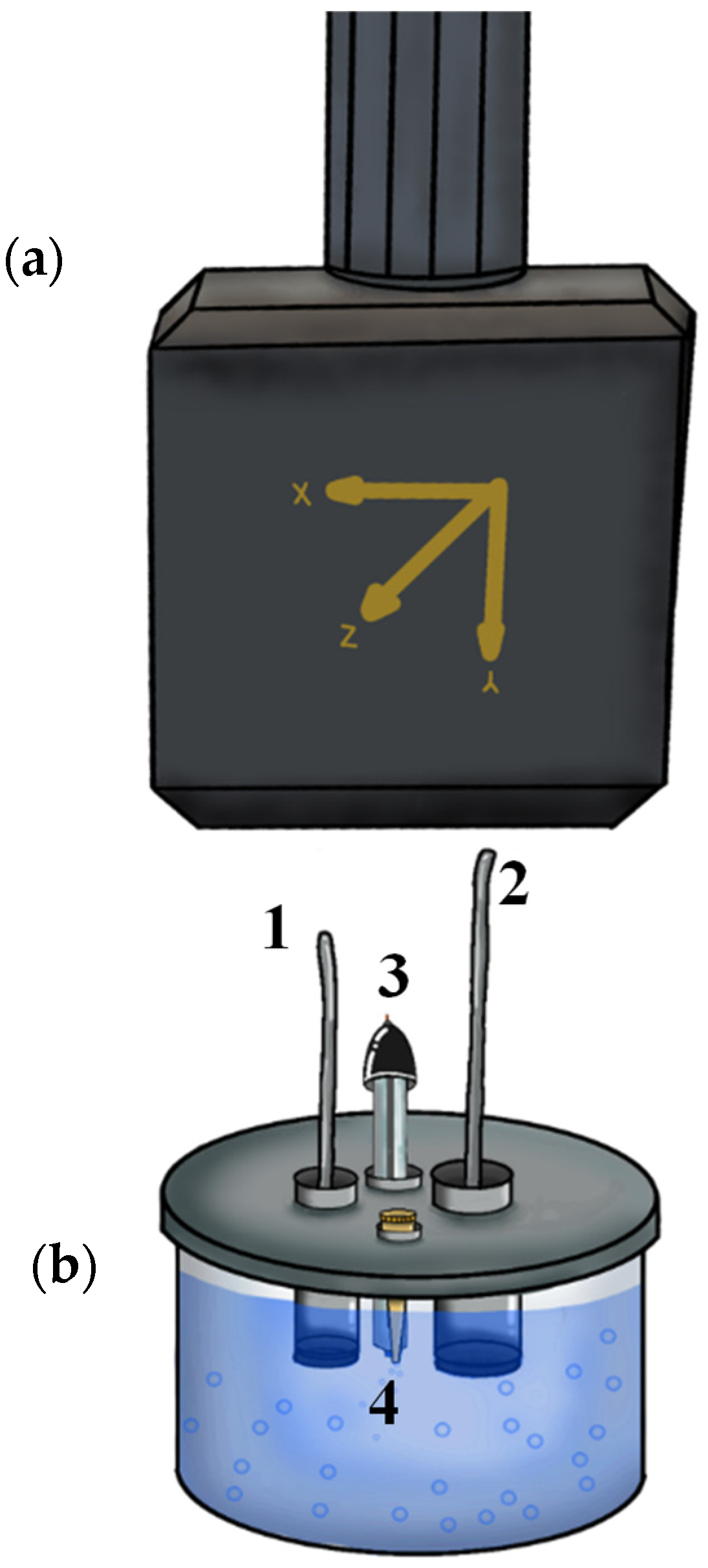
Figure 1. (a) Electrochemical cell used (1. Working electrode (carbon felt); 2. Counter electrode (carbon felt); 3. Reference electrode (Ag|AgCl); 4. Oxygen bubbling) coupled to (b) a gaussmeter with a triaxial probe.
Processes 14 00264 g001
Figure 2. IR spectra of synthesized magnetite in the Electro-Fenton process.
Processes 14 00264 g002
Figure 3. (a) SEM micrograph and (b) EDS spectra of synthesized magnetite.
Processes 14 00264 g003
Figure 4. XPS spectra of synthesized magnetite.
Processes 14 00264 g004
Figure 5. Voltammograms for ORR at different pH values (a) pH 3, (b) pH 7 and (c) pH 11; Na2SO4 (0.05 M), reference electrode: Ag|AgCl, auxiliary electrode: carbon felt and sweep rates from 10 to 100 mV/s. Coloured regions refer to oxygen reduction reaction zone.
Processes 14 00264 g005
Figure 6. (a) Effect of the presence of Fe (Electro-Fenton (EF) and Electrooxidation (EO)) with respect to the pH value and (b) Effect of the Fe source in the Electro-Fenton process with respect to the pH value; Na2SO4 (0.05 M), E°: −0.56 V vs. Ag|AgCl, Ci: 20 mg/L, magnetic stirring: 100 rpm (~150 G) and constant flow of O2.
Processes 14 00264 g006
Figure 7. Effect of the presence of magnetic field (MF) on the Electro-Fenton process with respect to pH; Na2SO4 (0.05 M), E°: −0.55 V (vs. Ag|AgCl), Ci: 20 mg/L, magnetic stirring: 100 rpm (~150 G) and constant O2 bubbling.
Processes 14 00264 g007
Figure 8. Effect of the Fe3O4 rate in the methylene blue decolorization; pH: 3; Na2SO4 (0.05 M), E°: −0.55 V (vs. Ag|AgCl), Ci: 20 mg/L, magnetic stirring: 100 rpm and constant O2 bubbling.
Processes 14 00264 g008
Table 1. XPS Peak position and FWHM of the elements in magnetite.
ElementB.E
(eV)
FWHM
(eV)
Atomic Composition
(%)
Cl2p198.10.930.33
O1s529.81.3161.11
Fe2p710.54.0038.51
Na1s1073.50.140.05
Table 2. Comparison of the pH value in the decolorization of a model molecule.
Fe SourcepHFetot Initial
(mg/L)
Fetot Final
(mg/L)
Decolorization (%) σ
a Fe3O430.900.9314.220.038
70.820.776.070.019
110.850.8111.690.036
b FeSO432.092.0946.180.107
70.911.1316.480.033
110.900.939.570.028
a synthesized magnetite, b iron salt.
Table 3. Comparative analysis of the proposed Fe3O4/MF system with other magnetic-assisted AOPs and magnetite-based setups.
Catalyst/SetupProcessMagnetic Field (G)Pollutant (mg/L)Efficiency (%)/Reaction TimeRef.
Fe0 nanoparticlesPhoto-Fenton300Ciprofloxacin (20)90%/60 min[7]
Fe−Cu/rGOPhoto-Fenton250Norfloxacin (20)88%/60 min[6]
Fe3O4 on Steel meshElectro-Fenton-Methylene Blue (10)100%/80–150 min[1]
Fe3O4/Carbon FeltElectro-Fenton-Aspirin (20)100%/140 min[36]
Synthesized Fe3O4 Electro-Fenton150Methylene Blue (20)49.2%/90 minThis work
Disclaimer/Publisher’s Note: The statements, opinions and data contained in all publications are solely those of the individual author(s) and contributor(s) and not of MDPI and/or the editor(s). MDPI and/or the editor(s) disclaim responsibility for any injury to people or property resulting from any ideas, methods, instructions or products referred to in the content.