Article

Parametric Study of Zinc, Cadmium, and Nickel Ion Recovery Using D2EHPA in a Semi-Pilot Liquid–Liquid Extraction Plant


1
Laboratory of Separation and Purification Technologies, Faculty of Sciences, University of Abou Bekr Belkaid, BP 119, Tlemcen 13000, Algeria
2
Laboratory of Organic Chemistry, Natural Substances and Analysis (COSNA), Faculty of Sciences, University of Abou Bekr Belkaid, BP 119, Tlemcen 13000, Algeria
3
Department of Chemical and Food Engineering, Faculty of Engineering, “Vasile Alecsandri” University of Bacau, 157 Calea Marasesti Street, 600115 Bacau, Romania
4
Department of Environmental Engineering, Mechanical Engineering and Agritourism, Faculty of Engineering, “Vasile Alecsandri” University of Bacau, 157 Calea Marasesti Street, 600115 Bacau, Romania
*
Author to whom correspondence should be addressed.
Processes 2026, 14(15), 2423; https://doi.org/10.3390/pr14152423
Submission received: 23 June 2026 / Revised: 17 July 2026 / Accepted: 24 July 2026 / Published: 27 July 2026

Abstract

Industrial effluents containing zinc, cadmium, and nickel represent both an environmental challenge and a valuable secondary resource. This study investigates the simultaneous recovery of Zn(II), Cd(II), and Ni(II) from nitric acid solutions using di-(2-ethylhexyl) phosphoric acid (D2EHPA) dissolved in commercial diesel fuel in a continuous counter-current semi-pilot mixer–settler extraction system. The effects of key operating parameters, including aqueous-phase pH, initial metal concentration, phase ratio, contact time, stirring speed, and stripping agent, were systematically evaluated. Metal concentrations were determined by atomic absorption spectrometry, while Fourier-transform infrared spectroscopy was employed to investigate the extraction mechanism. The optimum operating conditions were pH 2.45 for Zn(II) and pH 5.38 for Cd(II) and Ni(II), a phase ratio of VA/VO = 1.5/3.5, and a stirring speed of 700 rpm. Under these conditions, high extraction efficiencies were achieved, with Zn(II), Cd(II), and Ni(II) recoveries of 98.52%, 76.86%, and 84.04%, respectively. FTIR characterization, together with slope analysis, suggested a dimeric cation-exchange extraction mechanism involving D2EHPA species in the organic phase. Among the stripping agents evaluated under the present experimental conditions, 0.5 M H2SO4 produced the highest stripping efficiencies for Zn(II), Cd(II), and Ni(II). Although the stripping efficiencies remained moderate, particularly for Cd(II) and Ni(II), these results demonstrate the relative effectiveness of H2SO4 compared with the other stripping agents examined. Further optimization of the stripping conditions is expected to improve metal recovery. The proposed process shows significant potential for industrial wastewater treatment, metal recovery, and resource valorization.

1. Introduction

The rapid expansion of industrial activities, including mining, electroplating, battery manufacturing, metal finishing, and metallurgical processing, has led to the continuous discharge of heavy metals into aquatic and terrestrial ecosystems. Among these contaminants, zinc is an essential trace element that may become toxic at elevated concentrations, whereas cadmium and nickel are of particular concern due to their well-established toxic effects, widespread industrial use, and environmental persistence. Cadmium is recognized as one of the most hazardous heavy metals due to its bioaccumulative nature and severe effects on human health and ecosystems. Nickel, extensively used in stainless steel production and rechargeable batteries, is also considered a priority pollutant because prolonged exposure may cause carcinogenic and mutagenic effects. In addition to their environmental impact, these metals represent valuable secondary resources, and their recovery from industrial effluents is increasingly regarded as a key component of resource conservation and circular economy strategies. Consequently, the development of efficient technologies for the separation and recovery of Zn(II), Cd(II), and Ni(II) from complex aqueous streams has become both an environmental and economic imperative [1,2,3,4].
Liquid–liquid extraction (LLE), also referred to as solvent extraction, is one of the most established hydrometallurgical techniques for the selective separation and recovery of metal ions from aqueous solutions. The process relies on the preferential transfer of dissolved metal species from an aqueous phase into an immiscible organic phase containing a suitable extractant. Compared with alternative technologies such as adsorption, ion exchange, membrane separation, and electrochemical recovery, solvent extraction offers several advantages including high selectivity, rapid phase equilibrium, operational flexibility, and straightforward integration into continuous industrial circuits. Owing to these characteristics, LLE has become a key technology in the recovery of strategic and critical metals from ores, industrial effluents, electronic waste, and spent lithium-ion batteries. Recent developments have further expanded its applicability through the introduction of innovative extractants, environmentally friendly diluents, and intensified extraction systems designed to improve process sustainability and metal recovery efficiency [5,6,7].
Among the various extractants investigated for the solvent extraction of heavy metals, acidic organophosphorus compounds remain the most extensively employed because of their high extraction efficiency and operational reliability. Several extractants have been successfully applied for the recovery of metal ions from industrial wastewaters, including di-(2-ethylhexyl) phosphoric acid (D2EHPA), 2-ethylhexyl phosphonic acid mono-2-ethylhexyl ester (PC 88A), bis(2,4,4-trimethylpentyl) phosphinic acid (Cyanex 272), tributyl phosphate (TBP), Cyanex 923, Aliquat 336, and hydroxyoxime-based extractants such as the LIX series. These extractants differ in their extraction mechanisms, selectivity, and affinity toward specific metal ions. Solvating extractants, such as TBP and Cyanex 923, are generally more effective for neutral metal complexes in highly acidic media, whereas quaternary ammonium salts are primarily used for the extraction of anionic species. In contrast, acidic extractants, including D2EHPA, PC 88A, and Cyanex 272, operate through cation-exchange mechanisms and have demonstrated excellent performance in the recovery of divalent transition metals from aqueous solutions. In the present study, D2EHPA was selected because it offers a favorable balance between extraction performance, operational simplicity, and economic feasibility. Compared with alternative extractants, D2EHPA exhibits high affinity toward Zn(II), Cd(II), and Ni(II), rapid extraction kinetics, excellent chemical and thermal stability, low viscosity, and easy regeneration using conventional mineral acids. In addition, its widespread industrial use, commercial availability, and relatively low cost make it particularly attractive for large-scale hydrometallurgical applications. Unlike more selective extractants, such as Cyanex 272, whose industrial application is often limited by higher reagent costs, D2EHPA provides efficient recovery of multiple divalent metal ions while maintaining competitive operating costs. These characteristics, together with its well-established extraction chemistry, make D2EHPA an appropriate choice for investigating continuous metal recovery in a semi-pilot liquid–liquid extraction system using commercial diesel as an alternative low-cost diluent [8,9,10,11,12,13].
Besides the extractant itself, the selection of an appropriate diluent plays a crucial role in solvent extraction performance. The diluent affects extractant solubility, phase disengagement, viscosity, density, interfacial tension, mass-transfer characteristics, and ultimately the economics of the separation process. Conventional studies involving D2EHPA have largely relied on petroleum-derived solvents such as kerosene, n-heptane, toluene, and commercial aliphatic diluents because of their well-documented physicochemical properties. However, recent efforts toward cost-effective hydrometallurgical operations have stimulated interest in alternative diluents with lower environmental impact and broader industrial availability. Commercial diesel fuel is an attractive option because of its low cost, wide availability, and compatibility with acidic organophosphorus extractants. Nevertheless, despite its practical advantages, the use of diesel as a diluent for D2EHPA-mediated extraction remains poorly documented, especially for multicomponent metal systems and continuous extraction operations. The influence of diesel composition on extraction equilibrium, kinetics, and selectivity therefore warrants systematic investigation [8,12,13].
In comparison with high-purity laboratory diluents, diesel offers practical economic advantages, particularly in regions where access to specialized extraction-grade solvents may be limited. Although D2EHPA has been extensively employed in hydrometallurgical processes for several decades, its extraction behavior has been investigated under a wide variety of experimental conditions and metal systems. Previous studies have reported the recovery of Zn(II), Cd(II), Ni(II), Co(II), Cu(II), Mn(II), Fe(III), In(III), Ga(III), scandium, and rare-earth elements from sulfate, nitrate, and chloride media using D2EHPA dissolved in conventional diluents such as kerosene, Shellsol D70, Exxsol D80, n-heptane, and other aliphatic hydrocarbons. Depending on the nature of the metal ion and the operating conditions, initial metal concentrations have ranged from a few milligrams per litre in wastewater treatment studies to several grams per litre in hydrometallurgical applications, while D2EHPA concentrations have generally varied between 0.01 and 1.0 mol L−1. Under optimized conditions, extraction efficiencies exceeding 95% have frequently been reported for Zn(II), Fe(III), Co(II), and several rare-earth elements, whereas Cd(II) and Ni(II) usually exhibit lower extraction efficiencies because of their stronger hydration and slower extraction kinetics. The loading capacity of D2EHPA is directly related to the extractant concentration and to the stoichiometry of the extracted complexes. As the organic phase becomes progressively loaded with metal ions, the number of available extraction sites decreases, leading to a reduction in extraction efficiency at high metal concentrations. These characteristics have been widely reported for both laboratory-scale and industrial solvent extraction processes [8,9,10,11,12,13,14,15,16].
The majority of published investigations have focused on single-metal systems, where extraction equilibria can be interpreted without interference from competing species. In contrast, real industrial wastewaters generally contain several dissolved metal ions that simultaneously interact with the extractant. Under these conditions, competitive extraction becomes the dominant phenomenon because metal ions compete for the same active sites of D2EHPA according to their respective extraction affinities. In Zn–Cd–Ni mixtures, Zn(II) is generally extracted preferentially, followed by Cd(II) and finally Ni(II), resulting in lower extraction efficiencies for the latter metals compared with single-component systems. Although salting-out effects may slightly enhance extraction in highly concentrated electrolyte solutions by decreasing metal hydration, this effect is generally secondary under the relatively dilute conditions encountered in industrial wastewater treatment. Consequently, understanding the competitive behavior of multicomponent systems remains essential for designing efficient large-scale solvent extraction processes [10,11,12,13,14,15,16,17].
Although extensive research has been devoted to the solvent extraction behavior of metal ions using D2EHPA, most investigations have been limited to laboratory-scale batch experiments performed in separatory funnels or small mixer vessels. Such studies are essential for determining extraction equilibria and reaction mechanisms but often fail to reproduce the hydrodynamic conditions encountered in industrial operations. Parameters such as droplet size distribution, axial dispersion, phase holdup, interfacial area generation, and residence-time distribution become increasingly important during scale-up and may significantly affect extraction efficiency. Continuous counter-current contactors, including mixer–settlers and extraction columns, provide a more realistic representation of industrial processes and allow the evaluation of mass-transfer performance under practical operating conditions. Consequently, semi-pilot-scale studies are indispensable for validating extraction systems under realistic operating conditions and for generating scale-up data necessary for industrial process design [14,15,16].
Another important limitation of the current literature is the predominance of single-metal extraction studies. Industrial wastewaters, metallurgical liquors, and secondary-resource leachates generally contain multiple dissolved metals that compete for available extractant binding sites. Under such conditions, extraction selectivity is governed by complex interactions involving metal speciation, extractant loading, equilibrium chemistry, and mass-transfer phenomena. Understanding the simultaneous extraction behavior of Zn(II), Cd(II), and Ni(II) is particularly relevant because these metals frequently coexist in electroplating effluents, mining wastewaters, metallurgical residues, and battery recycling streams. Several recent studies have highlighted the challenges associated with selective separation of Zn, Cd, and Ni from complex industrial matrices, where competitive extraction and extractant loading effects strongly influence process performance [10,11,17]. Therefore, optimizing their concurrent recovery is essential to maximize process efficiency and improve resource utilization within circular economy frameworks [5,17].
Despite significant advances in solvent extraction technology, to the best of the authors’ knowledge the present study appears to be among the few reported investigations on the simultaneous extraction of Zn(II), Cd(II), and Ni(II) using D2EHPA dissolved in commercial diesel in a continuous counter-current semi-pilot mixer–settler system. Previous D2EHPA-based investigations have mainly focused on single-metal systems, laboratory-scale batch experiments, or conventional diluents such as kerosene and aliphatic hydrocarbons [8,9,10,11,12,13]. In contrast, studies combining alternative diluents with continuous semi-pilot operation remain limited [14,15,16]. The combined effects of diesel as an alternative diluent, multicomponent metal competition, and scale-dependent hydrodynamics remain insufficiently understood. Moreover, a systematic study of key operational variables, including contact time, aqueous pH, feed concentration, phase ratio, agitation speed, and stripping conditions, has not been widely reported for this ternary metal system. Therefore, the objective of the present work is to investigate the extraction behavior of Zn(II), Cd(II), and Ni(II) from nitrate media using D2EHPA–diesel solutions in a semi-pilot mixer–settler, while providing mechanistic, kinetic, and process-engineering insights that may support future process development and industrial implementation. A comparison of representative D2EHPA-based solvent extraction studies and the novelty of the present work is provided in Table 1.
Table 1. Comparison of representative D2EHPA-based solvent extraction studies and the novelty of the present work.
StudyMetal SystemExtractantDiluent
TBP/D2EHPA study [18]Zn(II), Cd(II), Mn(II), Cu(II), Co(II), Ni(II)D2EHPA + TBPKerosene
Fractional factorial study [19]Cd(II), Cu(II), Ni(II)D2EHPA + TBPSynthetic aqueous solutions
Zn separation study [20]Zn(II) from Zn–Ni–Co solutionD2EHPA/TBPNot reported

2. Materials and Methods

2.1. Chemicals and Reagents

Because the choice of diluent can significantly influence extraction performance, the commercial diesel used in this work was characterized using the supplier’s technical analysis report. The diesel was obtained from a local supplier (BAC No. 30304) and filtered before use to remove suspended impurities. According to the supplier’s technical analysis report (Analysis No. 29-2025, dated 12 April 2025), the diesel had a density of 0.832 g cm−3 at 15/4 °C, a viscosity of 2.30 cSt at 40 °C, a sulfur content of 0.09 wt.%, a flash point of 57 °C, a distillation profile of 263 °C (65%), 323 °C (90%), and 369 °C final point, a cetane index of 48.0, and a Conradson carbon residue of 0.008 wt.%. Analytical-grade zinc nitrate [Zn(NO3)2·6H2O], cadmium nitrate [Cd(NO3)2·4H2O], and nickel nitrate [Ni(NO3)2·6H2O] were purchased from Sigma-Aldrich and used as received without further purification. Di-(2-ethylhexyl) phosphoric acid (D2EHPA, 97 wt.%) supplied by Sigma-Aldrich was used as the extractant. Hydrochloric acid (HCl, 37%), nitric acid (HNO3, 68%), sulfuric acid (H2SO4, 98%), and acetic acid (CH3COOH, 25%) were supplied by Prochima (Tlemcen, Algeria). Hydrochloric acid and nitric acid were used for pH adjustment, whereas sulfuric acid and acetic acid were employed as stripping agents during the stripping experiments. Sodium hydroxide (NaOH) pellets were used for pH correction when necessary. All aqueous solutions were prepared using deionized water with a resistivity of 18.2 MΩ·cm.
To avoid ambiguity in the extractant-to-metal balance, the D2EHPA concentration in the organic phase is reported as the total monomer-equivalent concentration. Dissolution of 0.8060 g of D2EHPA in 2.5 L of diesel corresponds to approximately 1.0 × 10⁻³ mol L−1 total D2EHPA. Because D2EHPA exists predominantly as hydrogen-bonded dimers in non-polar diluents, the reactive organic-phase species should be interpreted accordingly when discussing the extraction stoichiometry.

2.2. Semi-Pilot Apparatus

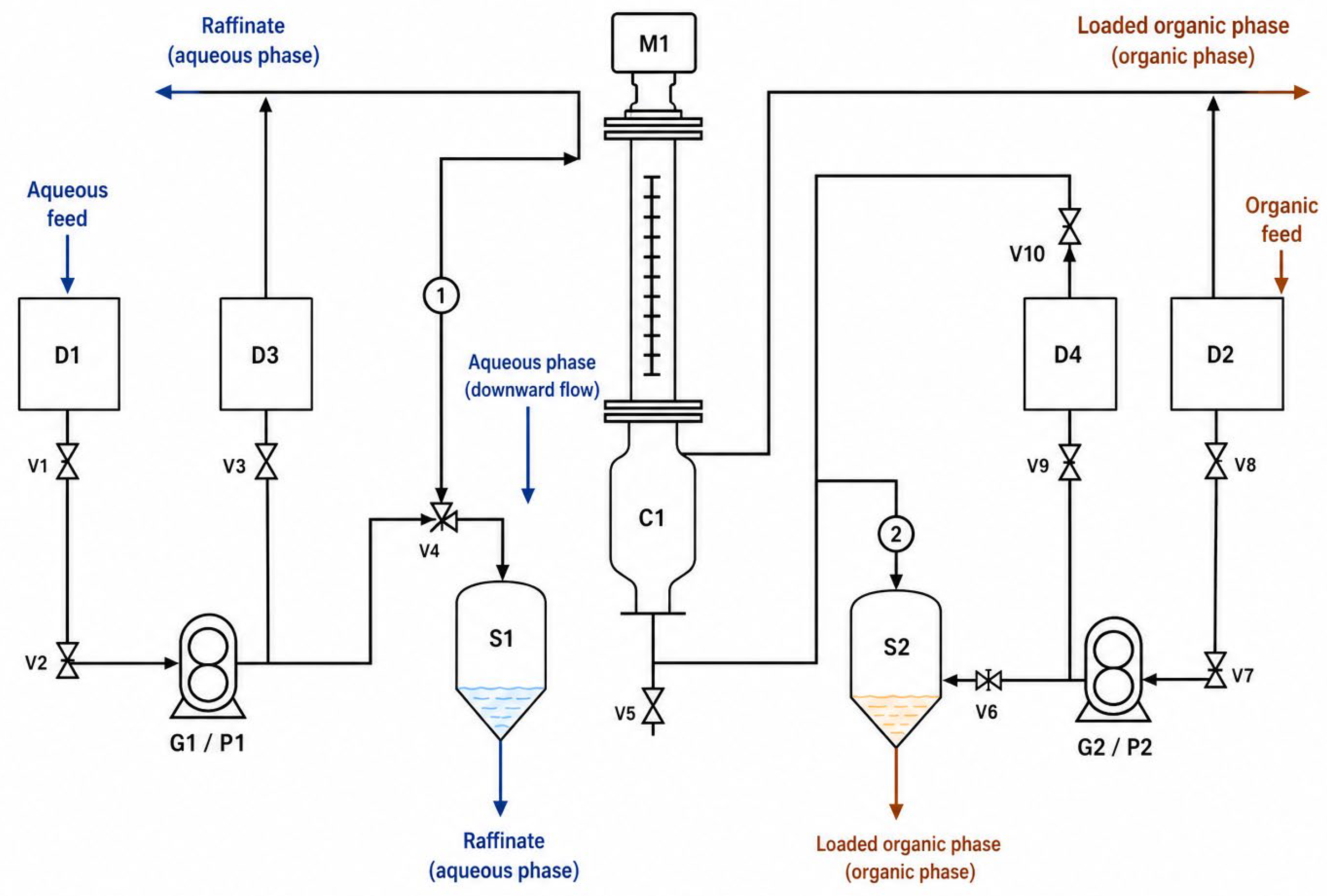
All extraction experiments were carried out in a custom-built semi-pilot counter-current mixer–settler unit (Figure 1). The extraction section consisted of a vertical borosilicate glass column (C1) equipped with a central rotating shaft fitted with fourteen AISI 316 stainless steel disc impellers. Agitation was provided by an electric motor (M1), allowing continuous adjustment of the stirring speed between 0 and 1000 rpm.
The semi-pilot extraction unit was a custom counter-current mixer–settler designed for continuous liquid–liquid contact under controlled agitation. The extraction column consisted of a vertical borosilicate glass tube with an internal diameter of 60 mm and a total height of 100 cm, corresponding to an effective working volume of 3 L. The central shaft was fitted with fourteen AISI 316 stainless steel disc impellers, and agitation was provided by a variable-speed electric motor operating from 0 to 1000 rpm. In the operating mode used in this study, the aqueous phase containing Zn(II), Cd(II), and Ni(II) was introduced at the top of the column and flowed downward, while the organic phase containing D2EHPA dissolved in diesel was fed from the bottom and flowed upward in counter-current mode. Both phases were used at a volume of 2.5 L, and the optimum stirring speed was 700 rpm. The equilibrium contact time was 30 min, as established from the kinetic experiments, and this value was used for all subsequent tests. Phase disengagement was achieved in two borosilicate glass settlers with an internal diameter of 100 mm, allowing separate recovery of the loaded organic phase and the raffinate. The system operated continuously with stable phase separation under the selected operating conditions. However, parameters such as phase flow rates, residence time, effective number of extraction stages, impeller dimensions, settler working volumes, phase disengagement time, and steady-state criteria were not directly measured in the present study. Consequently, the present work should be regarded as a proof-of-concept semi-pilot investigation demonstrating the technical feasibility of continuous extraction rather than a complete process-engineering characterization for industrial scale-up. Future work will include detailed hydrodynamic characterization and scale-up analysis. The extraction unit was connected to two borosilicate glass settlers and two stainless-steel positive-displacement pumps fed from 30 L polyethylene reservoirs, which supplied the aqueous and organic phases independently. Separate collection tanks were used for the loaded organic phase and the raffinate stream.
After each extraction experiment, complete phase disengagement was achieved by gravitational settling in the settler units without the formation of persistent emulsions. The aqueous and organic phases were visually clear before sampling. D2EHPA is highly hydrophobic and exhibits only trace solubility in water under the investigated acidic conditions. Consequently, losses of extractant to the aqueous phase are expected to be negligible. Likewise, the mutual solubility between diesel and the aqueous phase is very limited, minimizing cross-contamination between the two phases. In practical applications, any residual traces of extractant remaining in the aqueous effluent should be recovered by suitable polishing treatments, such as oil–water separation, activated carbon adsorption, or recycling of the aqueous stream prior to discharge, in accordance with environmental regulations.

2.3. Solution Preparation and Extraction Procedure

The organic phase was prepared by dissolving 0.8060 g of D2EHPA in 2.5 L of filtered diesel under continuous stirring at room temperature until complete homogenization was achieved. This composition corresponds to a total D2EHPA concentration of approximately 1.0 × 10⁻³ mol L−1. The aqueous feed solution was prepared by dissolving 1.1371 g of Zn(NO3)2, 0.6859 g of Cd(NO3)2, and 1.2387 g of Ni(NO3)2 in 2.5 L of deionized water. The resulting solution exhibited a natural pH of approximately 5.38 and contained predetermined concentrations of Zn(II), Cd(II), and Ni(II), which were verified by atomic absorption spectrometry (AAS). The above composition corresponds to the reference feed solution containing 100 mg·L−1 of each metal ion, which was used in the kinetic and pH studies. For the investigation of the effect of the initial metal concentration, additional feed solutions containing 20, 50, 100, 150, and 200 mg·L−1 of each metal ion were prepared by appropriately adjusting the amounts of the corresponding metal nitrate salts while maintaining all other experimental conditions unchanged.
The concentrations of Zn(II), Cd(II), and Ni(II) were selected to prepare a representative synthetic multicomponent solution simulating industrial wastewater generated by electroplating, metal-finishing, and hydrometallurgical operations, where these metals frequently coexist. The use of a synthetic solution with a controlled composition ensured high experimental reproducibility and enabled the influence of the operating parameters on the extraction process to be evaluated without interference from other constituents commonly present in real industrial effluents.
The selected D2EHPA concentration was based on preliminary optimization experiments and previous literature reports demonstrating that this concentration provides sufficient extractant availability for the simultaneous extraction of Zn(II), Cd(II), and Ni(II) while maintaining satisfactory phase separation and stable operating conditions in continuous solvent extraction systems. Moreover, the use of a relatively low extractant concentration allowed the influence of the operating parameters on metal recovery to be evaluated without excessive organic phase loading or unnecessary reagent consumption.
D2EHPA is practically insoluble in water and exhibits a strong preference for the organic phase because of its hydrophobic alkyl chains. According to previous studies, only trace amounts of the extractant may partition into the aqueous phase under acidic and mildly acidic conditions. Although the degree of ionization of D2EHPA increases with increasing pH, resulting in a slight increase in its aqueous solubility, these losses remain negligible within the pH range investigated in the present work (1.0–5.38) and are therefore not expected to significantly affect the extraction performance.
Prior to each experiment, the aqueous and organic phases were transferred to their respective feed tanks. The two phases were then introduced into the semi-pilot extraction unit under continuous counter-current flow conditions. After establishing stable hydrodynamic operation, the stirring speed was adjusted to the desired value and maintained throughout the experiment. The composition of the synthetic aqueous feed solution and the corresponding theoretical concentrations of Zn(II), Cd(II), and Ni(II) are presented in Table 2.
Table 2. Composition of the synthetic aqueous feed solution and theoretical concentrations of Zn(II), Cd(II), and Ni(II).
SaltMass (g)Molar Mass (g/mol)MolesTheoretical Metal Concentration (M)Equivalent Metal Concentration (mg/L)
Zn(NO3)2·6H2O1.1371297.480.0038220.00152999.964
Cd(NO3)2·4H2O0.6859308.470.0022240.00088999.980
Ni(NO3)2·6H2O1.2387290.790.0042600.001704100.002
The aqueous feed solution was prepared by dissolving weighed amounts of zinc nitrate hexahydrate, cadmium nitrate tetrahydrate, and nickel nitrate hexahydrate in 2.5 L of deionized water. The theoretical metal concentrations were calculated from the corresponding salt masses, molar masses, and final solution volume. The resulting solution was then analyzed by atomic absorption spectrometry (AAS) to verify the initial concentrations of Zn(II), Cd(II), and Ni(II), and the measured values were found to be in good agreement with the calculated ones.
For the stripping experiments, the loaded organic phase and the aqueous stripping solution were contacted at the same organic-to-aqueous phase ratio (O/A = 1:1; 2.5 L:2.5 L) as that used during the extraction experiments, unless otherwise specified.
Samples of the aqueous phase (1 mL) were collected at predetermined time intervals and analyzed by atomic absorption spectrometry (AAS) to determine the residual concentrations of Zn(II), Cd(II), and Ni(II). Quantitative analyses were performed using an AA-7000 atomic absorption spectrophotometer (Shimadzu, Kyoto, Japan).
All experiments were carried out at ambient temperature (294 ± 2 K). Each experimental condition was tested in triplicate, and the results are expressed as the mean ± standard deviation (SD) of three independent experiments. The corresponding SD values are represented by error bars in the relevant figures.
The extraction efficiency (E, %) was calculated according to Equation (1):
E (%) = [(C0 − Ce)/C0] × 100
where C0 (mg L−1) represents the initial metal concentration in the aqueous phase and Ce (mg L−1) is the corresponding equilibrium concentration after extraction.
The equilibrium aqueous metal concentration after extraction was calculated according to Equation (2):
Ce = C0 (1 − E/100)
where C0 (mg L−1) is the initial metal concentration in the aqueous phase, Ce (mg L−1) is the equilibrium metal concentration remaining in the aqueous phase after extraction, and E (%) is the extraction efficiency.
The organic-phase metal loading was estimated from the depletion of the aqueous phase according to Equation (3):
qorg = ((C0 − Ce) × VA)/VO
where qorg (mg L−1) is the calculated metal loading in the organic phase, VA (L) is the volume of the aqueous phase, and VO (L) is the volume of the organic phase.
The distribution coefficient was calculated according to Equation (4):
D = qorg/Ce
where D is the distribution coefficient (dimensionless), qorg is the calculated metal loading in the organic phase, and Ce is the equilibrium metal concentration in the aqueous phase.
The separation factor between two metal ions was calculated according to Equation (5):
βA/B = DA/DB
where βA/B is the separation factor between metals A and B, DA is the distribution coefficient of metal A, and DB is the distribution coefficient of metal B.
Kinetic experiments were carried out under continuous counter-current operating conditions using equal volumes (2.5 L) of the aqueous and organic phases. The initial pH of the aqueous solution was 5.38, and the stirring speed was maintained at 700 rpm. Samples were collected at predetermined contact times (2–180 min), and the residual metal concentrations were determined by atomic absorption spectrometry to calculate the extraction efficiency. For the pH study, the initial aqueous pH was adjusted between 1.0 and 5.38 using dilute nitric acid or sodium hydroxide solutions while maintaining constant contact time, stirring speed, extractant concentration, and phase ratio. The influence of the initial metal concentration was investigated by varying the concentration of the Zn(II)–Cd(II)–Ni(II) mixture between 20 and 200 mg·L−1 while keeping all other operating parameters constant. The aqueous-to-organic phase ratio (VA/VO) was varied from 1.5/3.5 to 3.5/1.5 while maintaining constant operating conditions. The influence of stirring speed was investigated by varying the agitation rate while maintaining all remaining operating parameters constant.

2.4. Fourier Transform Infrared (FTIR) Analysis

Fourier-transform infrared (FTIR) spectroscopy was employed to characterize the functional groups of D2EHPA before and after metal extraction and to provide evi-dence supporting the proposed extraction mechanism. The FTIR spectra were recorded using an Agilent Cary 630 FTIR spectrometer (Agilent Technologies, Santa Clara, CA, USA). The samples were prepared using the potassium bromide (KBr) pellet method, in which a small amount of the dried sample was finely ground with spectroscopic-grade KBr and compressed into a transparent pellet before analysis. The spectra were collected over the spectral range of 4000–400 cm−1 with a spectral resolution of 4 cm−1, using 32 accumulated scans for each sample at room temperature. A background spectrum was recorded be-fore each measurement and automatically subtracted from the sample spectrum.

2.5. Parametric Study of the Extraction of a Metal Mixture

A systematic investigation of the main physicochemical parameters affecting the extraction of Zn(II), Cd(II), and Ni(II) by D2EHPA was conducted in order to identify the optimal operating conditions for the process. D2EHPA is an acidic organophosphorus extractant that predominantly operates through a cation-exchange mechanism, whereby metal ions are transferred from the aqueous phase to the organic phase in exchange for hydrogen ions [18]. The phosphoryl oxygen atom (P=O) acts as the primary coordination site, enabling the formation of stable metal–extractant complexes. Under highly acidic conditions, D2EHPA may also exhibit solvating properties, contributing to the extraction of specific metal species [8].
In non-polar diluents, D2EHPA exists predominantly in its dimeric form, (H2A2), through hydrogen-bond association, with a reported dimerization constant of approximately 106. The dimerization equilibrium can be represented as:
2(HA)(H2A2)
The extraction behavior of D2EHPA and the stoichiometry of the resulting metal complexes are influenced by several factors, including metal-ion concentration, aqueous-phase acidity, extractant concentration, and the physicochemical characteristics of the organic diluent [10,18]. In the present study, the simultaneous extraction of Zn(II), Cd(II), and Ni(II) from nitrate solutions using D2EHPA dissolved in treated diesel was systematically investigated. The effects of contact time, aqueous-phase pH, initial metal concentration, aqueous-to-organic phase ratio (VA/VO), stirring speed, and stripping conditions were evaluated to establish the optimal extraction parameters and better understand the behavior of the ternary metal system under semi-pilot operating conditions.

2.6. Determination of the Nature of Extracted Metal–Organic Complexes

To determine the stoichiometry of the extracted metal–D2EHPA complexes, the extraction equilibrium was analyzed using the slope analysis method. Assuming negligible solubility of both the extractant and the extracted metal complexes in the aqueous phase, the absence of association between extracted species, and the predominance of D2EHPA dimers in the organic phase, the extraction of a divalent metal ion can be described by the following general reaction [18]:
M ( a q ) 2 +   + n / 2   ( H 2 A 2 ) ( org ) M A 2 ( H A ) n 2 ( org ) + 2 H ( a q ) + 2 H ( a q ) +
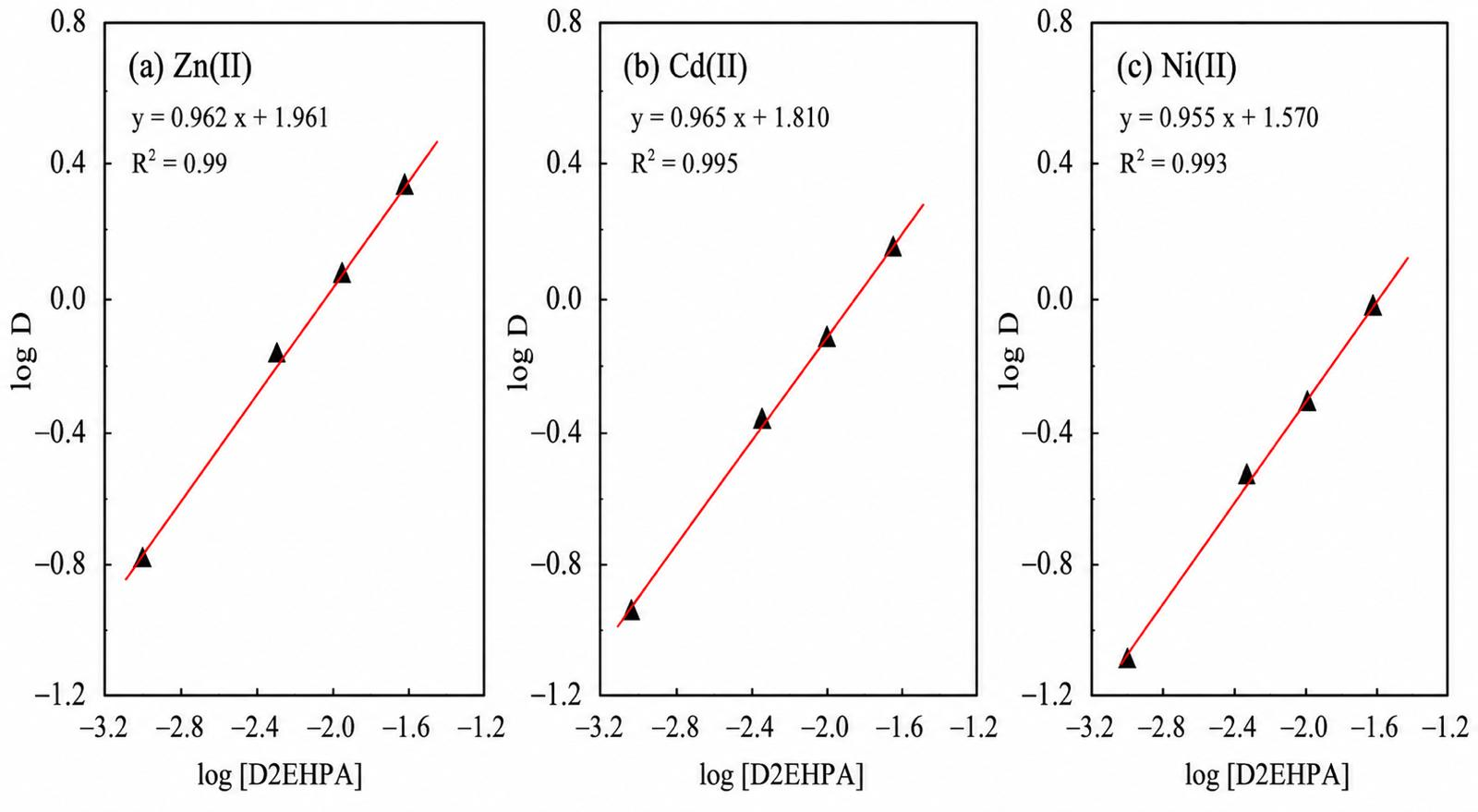
The stoichiometric coefficient n was determined using the slope analysis method by plotting log D as a function of log[D2EHPA] for Zn(II), Cd(II), and Ni(II). The experiments were carried out at constant temperature, contact time, phase ratio, and initial metal concentration in order to evaluate the dependence of the distribution coefficient on the extractant concentration.
The obtained plots showed excellent linear relationships for the three investigated metal ions, with correlation coefficients higher than 0.99. The corresponding regression equations were:
l o g D = 0.962 l o g [ D 2 E H P A ] + 1.961   for   Zn ( II ) log D = 0.965 log D 2 E H P A + 1.810   for   Cd ( II ) log D = 0.955 log D 2 E H P A + 1.570   for   Ni ( II )
The slopes obtained for Zn(II), Cd(II), and Ni(II) presented in Figure 2, were 0.962, 0.965, and 0.955, respectively. These values are close to unity, indicating an approximately first-order dependence of the extraction equilibrium with respect to the D2EHPA concentration. The similarity of the slopes confirms that Zn(II), Cd(II), and Ni(II) follow the same ex-traction pathway.
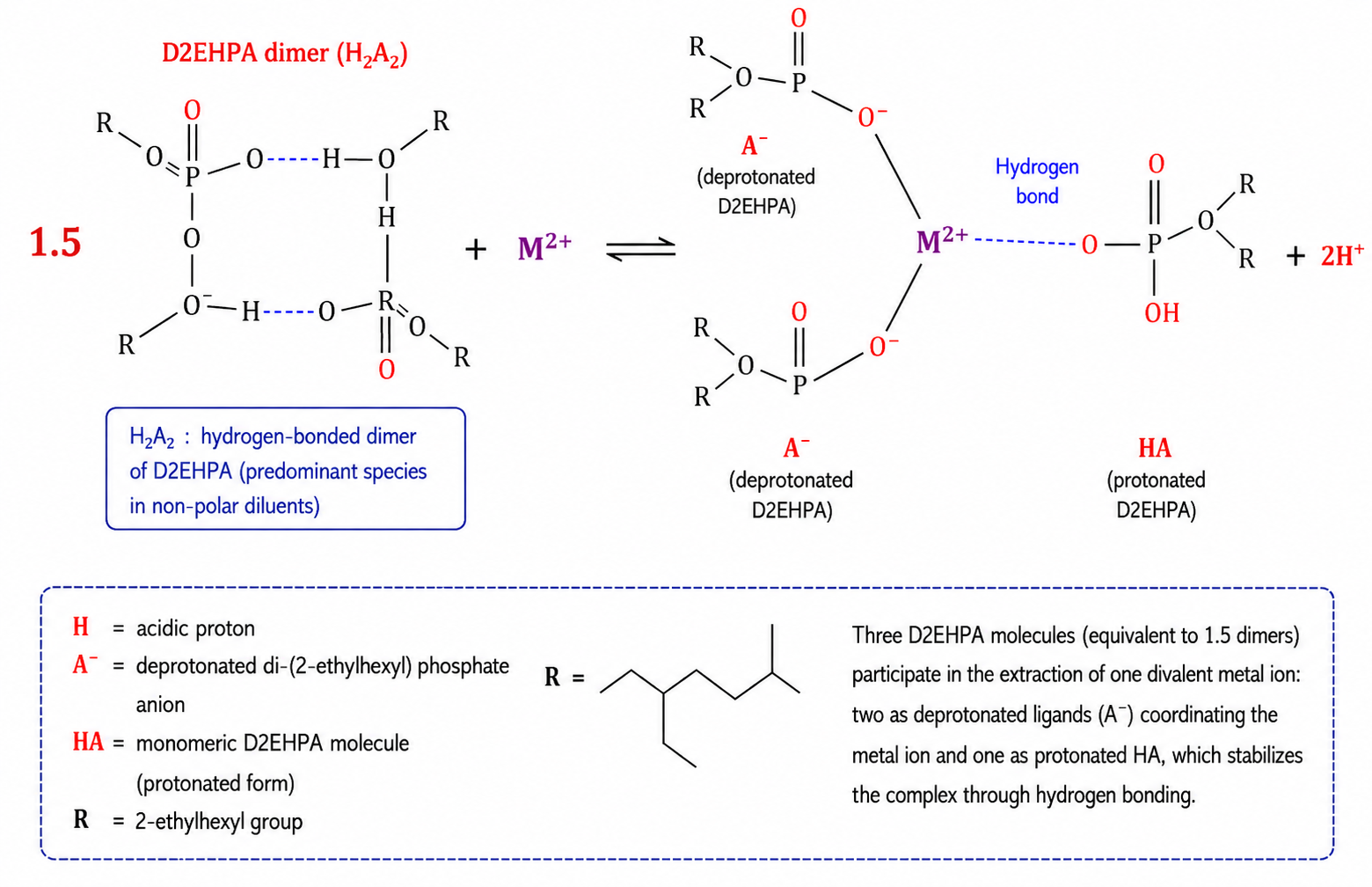
In addition, the dependence of log D on the initial aqueous pH, confirms the participation of hydrogen ions in the extraction process. Therefore, the extraction proceeds through a cation-exchange mechanism involving the release of two protons from D2EHPA for each divalent metal ion transferred into the organic phase. Combining the extractant concentration dependence with the pH dependence, the extracted species can be assigned to the neutral complex MA2(HA). This indicates that approximately 1.5 D2EHPA dimers, equivalent to three D2EHPA monomers, participate in the extraction of one divalent metal ion. The corresponding overall extraction equilibrium is presented after the slope-analysis results.
Figure 2. Log–log plots of the distribution coefficient (D) as a function of D2EHPA concentration for (a) Zn(II), (b) Cd(II), and (c) Ni(II). The slopes of the linear regressions were used to determine the extraction stoichiometry. Experimental conditions: [M2+] = 10 mM, Vaq/Vorg = 1, contact time = 30 min, and T = 20 °C.
Processes 14 02423 g002
Metal IonLinear EquationSlopeR2
Zn(II)log D = 0.962 log[D2EHPA] + 1.9610.9620.990
Cd(II)log D = 0.965 log[D2EHPA] + 1.8100.9650.995
Ni(II)log D = 0.955 log[D2EHPA] + 1.5700.9550.993
To support the mechanistic assignment, the slope-analysis results are explicitly presented here. Linear regressions of log D versus l o g [ D 2 EHPA ] yielded slopes of 0.962 for Zn(II), 0.965 for Cd(II), and 0.955 for Ni(II), with correlation coefficients of 0.990, 0.995, and 0.993, respectively. These results indicate an approximately first-order dependence of the extraction equilibrium on the extractant concentration over the investigated range. In addition, the increase in extraction efficiency with increasing aqueous pH supports the involvement of proton release, which is consistent with a cation-exchange mechanism. Taken together, the slope analysis and pH dependence provide a coherent basis for the proposed extraction stoichiometry, while the mechanistic interpretation should be understood as the most consistent model supported by the present experimental data.
A similar stoichiometry has been previously reported for Zn(II) and Ni(II) extraction from nitrate media using D2EHPA dissolved in conventional hydrocarbon diluents such as kerosene [10,11]. The agreement between the present results and those available in the literature suggests that the substitution of kerosene by diesel does not significantly modify the fundamental extraction mechanism. Consequently, the extraction equilibrium may be represented as:
1.5 ( H 2 A 2 ) ( org )   +   M ( a q ) 2 +   MA 2 ( H A ) ( org )   + 2 H ( a q ) +
In addition to extraction efficiency, the performance of the extraction system was evaluated using the distribution coefficient, separation factor, loading capacity, and stripping efficiency.
In this notation, HA represents one monomeric molecule of D2EHPA, where H corresponds to the acidic proton and A denotes the deprotonated di-(2-ethylhexyl) phosphate anion. Because D2EHPA exists predominantly as hydrogen-bonded dimers (H2A2) in non-polar diluents, the extraction reaction is expressed in terms of dimeric species. The overall stoichiometry indicates that three D2EHPA molecules (equivalent to 1.5 dimers) participate in the extraction of one divalent metal ion. Two molecules coordinate the metal ion after deprotonation, whereas the third remains protonated and contributes to the stabilization of the extracted neutral complex.
The proposed extraction mechanism confirms that D2EHPA acts primarily as a cation-exchange extractant, releasing two protons into the aqueous phase for each divalent metal ion transferred to the organic phase. Furthermore, the results demonstrate that diesel, despite its more complex hydrocarbon composition, preserves the characteristic dimeric extraction behavior commonly reported for purified laboratory diluents such as kerosene [8].
A schematic representation of the extracted metal–D2EHPA complex is presented in Figure 3.

3. Results and Discussion

3.1. Extraction Study of the Mixture of Zn(II), Cd(II), and Ni(II)

The extraction behavior of the Zn(II)–Cd(II)–Ni(II) ternary system was investigated under semi-pilot operating conditions using D2EHPA dissolved in diesel as the organic phase. Particular attention was given to the simultaneous recovery of the three metal ions, since competitive extraction phenomena may significantly affect process efficiency and selectivity in multicomponent systems. The influence of the main operating parameters, including contact time, aqueous-phase pH, initial metal concentration, aqueous-to-organic phase ratio (VA/VO), stirring speed, and stripping conditions, was systematically evaluated to identify the optimum extraction conditions and assess the suitability of the D2EHPA–diesel system for practical metal recovery applications.

3.2. Determination of the Equilibrium Time

Contact time is a key operational parameter in solvent extraction processes because it directly influences mass-transfer efficiency and determines the time required to establish equilibrium between the aqueous and organic phases. To identify the optimum contact time for the simultaneous extraction of Zn(II), Cd(II), and Ni(II), kinetic experiments were conducted under semi-pilot operating conditions over a contact-time range of 2–180 min. Following phase separation, the residual metal concentrations in the aqueous phase were determined by AAS, and the corresponding extraction yields were calculated.
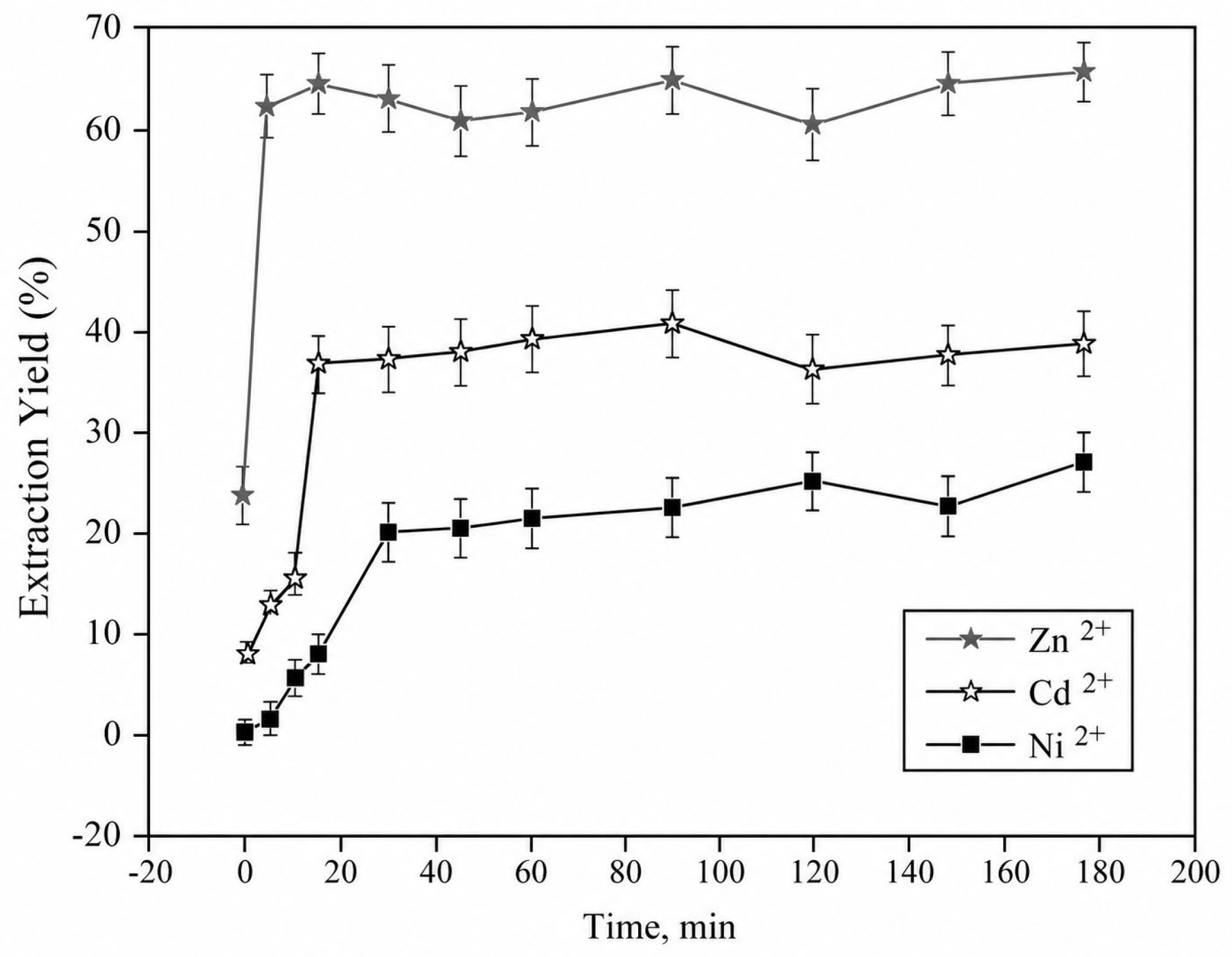
Figure 4 shows the evolution of extraction efficiency as a function of contact time for Zn(II), Cd(II), and Ni(II). A rapid increase in extraction yield was observed during the initial stage of the process for all three metals, indicating fast mass transfer and rapid formation of metal–D2EHPA complexes. However, significant differences in extraction kinetics were observed among the investigated metal ions.
Zn(II) exhibited the fastest extraction kinetics, reaching an equilibrium extraction yield of 62.94% within approximately 5 min. Beyond this point, only a slight increase was observed, with the extraction yield reaching 65.12% after 180 min. This behavior indicates that Zn(II) rapidly interacts with D2EHPA and that the extraction equilibrium is established within a very short contact period. Similar equilibrium times have been reported for Zn(II) extraction using D2EHPA in nitrate media [10,14,19,20].
Cd(II) displayed intermediate kinetic behavior, attaining an equilibrium extraction yield of 36.90% after approximately 15 min of contact [10]. In contrast, Ni(II) showed the slowest extraction kinetics, requiring nearly 30 min to reach equilibrium, with a maximum extraction yield of 21.36% [11]. The observed kinetic sequence can therefore be summarized as: Zn(II) >> Cd(II) > Ni(II).
This extraction order is consistent with the physicochemical properties of the investigated metal ions reported in the literature. The Gibbs free energies of hydration are approximately −1955, −1755, and −2105 kJ mol−1 for Zn(II), Cd(II), and Ni(II), respectively. Although Cd(II) exhibits the least negative hydration energy, Zn(II) possesses greater coordination flexibility and faster ligand-exchange kinetics, which facilitate the displacement of coordinated water molecules and promote the formation of stable complexes with D2EHPA. In contrast, Ni(II), characterized by the most negative hydration energy and slower water-exchange kinetics, requires a higher dehydration energy before complexation can occur, resulting in slower extraction kinetics. These physicochemical characteristics are therefore consistent with the experimentally observed extraction order, Zn(II) > Cd(II) > Ni(II) [14,19,20].
The slower extraction of Ni(II) may be attributed to its stronger hydration shell and slower complexation kinetics, which reduce the rate of transfer to the organic phase.
After the apparent equilibrium had been reached, slight fluctuations in the extraction efficiencies were observed, particularly for Zn(II) and Cd(II) at 120 min. As indicated by the standard deviation error bars in Figure 4, these variations remained within the experimental uncertainty and were therefore not considered statistically significant. They may be attributed to minor variations associated with sampling, phase disengagement, sample dilution, and atomic absorption spectrometric (AAS) analysis, together with small hydrodynamic fluctuations inherent to the continuously operated semi-pilot extraction system. Consequently, the extraction efficiencies after equilibrium should be interpreted as fluctuating around a stable equilibrium plateau rather than exhibiting a genuine decrease in metal extraction.
After the apparent equilibrium was reached, slight fluctuations in extraction efficiency were observed, particularly for Zn(II) and Cd(II) at 120 min. However, these variations remained within the experimental uncertainty represented by the standard-deviation error bars. Under post-equilibrium conditions, the relative standard deviation ranged from 4.34 to 5.56% for Zn(II), from 5.68 to 7.61% for Cd(II), and from 9.09 to 12.17% for Ni(II). These variations may be attributed to sampling, phase disengagement, sample dilution, AAS determination, and minor hydrodynamic fluctuations within the continuously agitated semi-pilot system. Therefore, the changes observed after equilibrium are interpreted as experimental fluctuations around an approximately stable plateau rather than as a genuine decline in metal extraction.
Considering that Ni(II) was the slowest-extracting species, an equilibrium contact time of 30 min was selected for all subsequent experiments. This contact time ensures equilibrium conditions for all three metals while maintaining practical operating requirements for continuous extraction processes. The selected value is also consistent with those commonly reported for Zn(II) and Ni(II) extraction using D2EHPA-based systems [10,11,21].

3.3. Characterization by Fourier Transform Infrared Spectroscopy (FTIR)

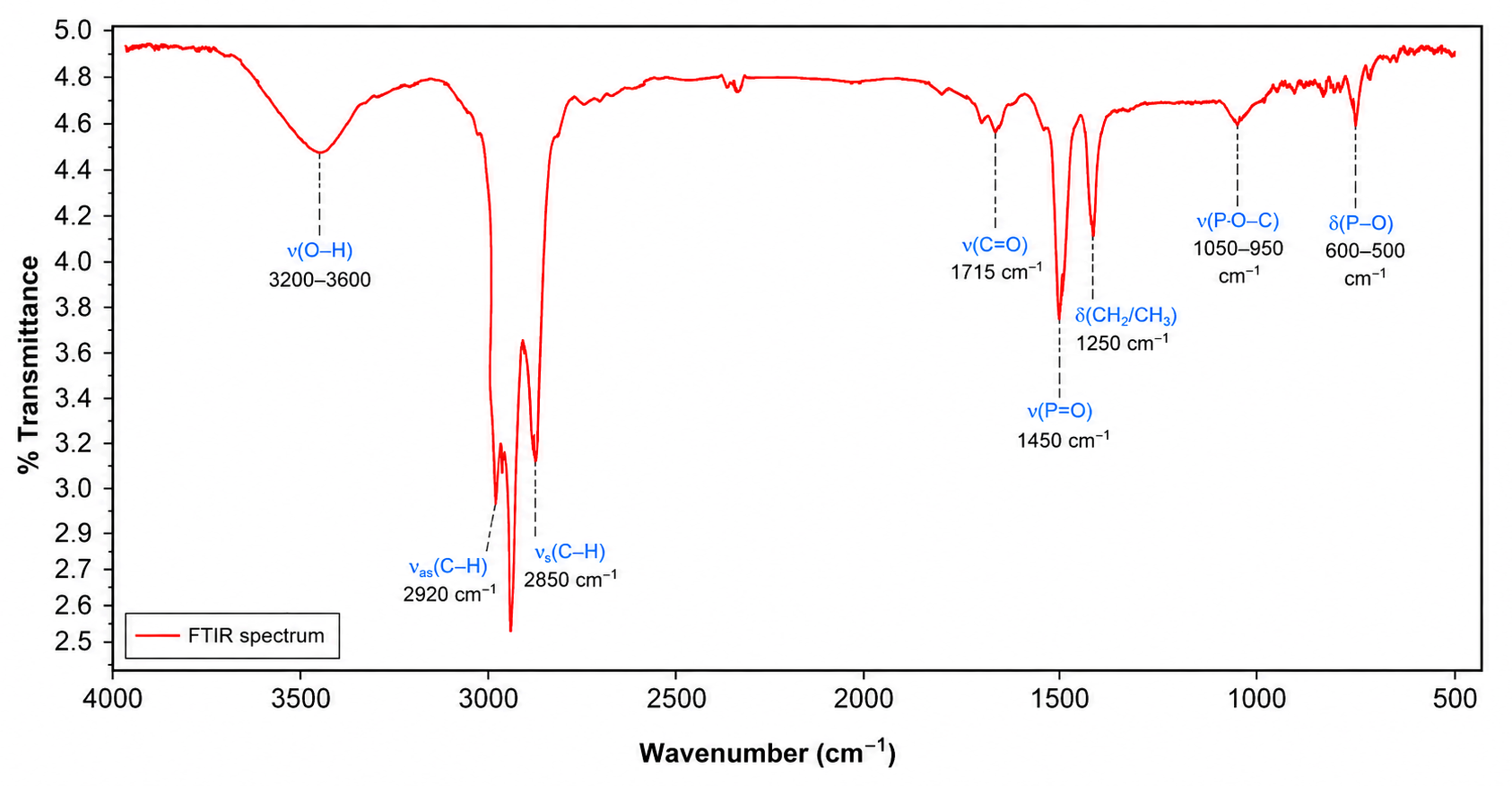
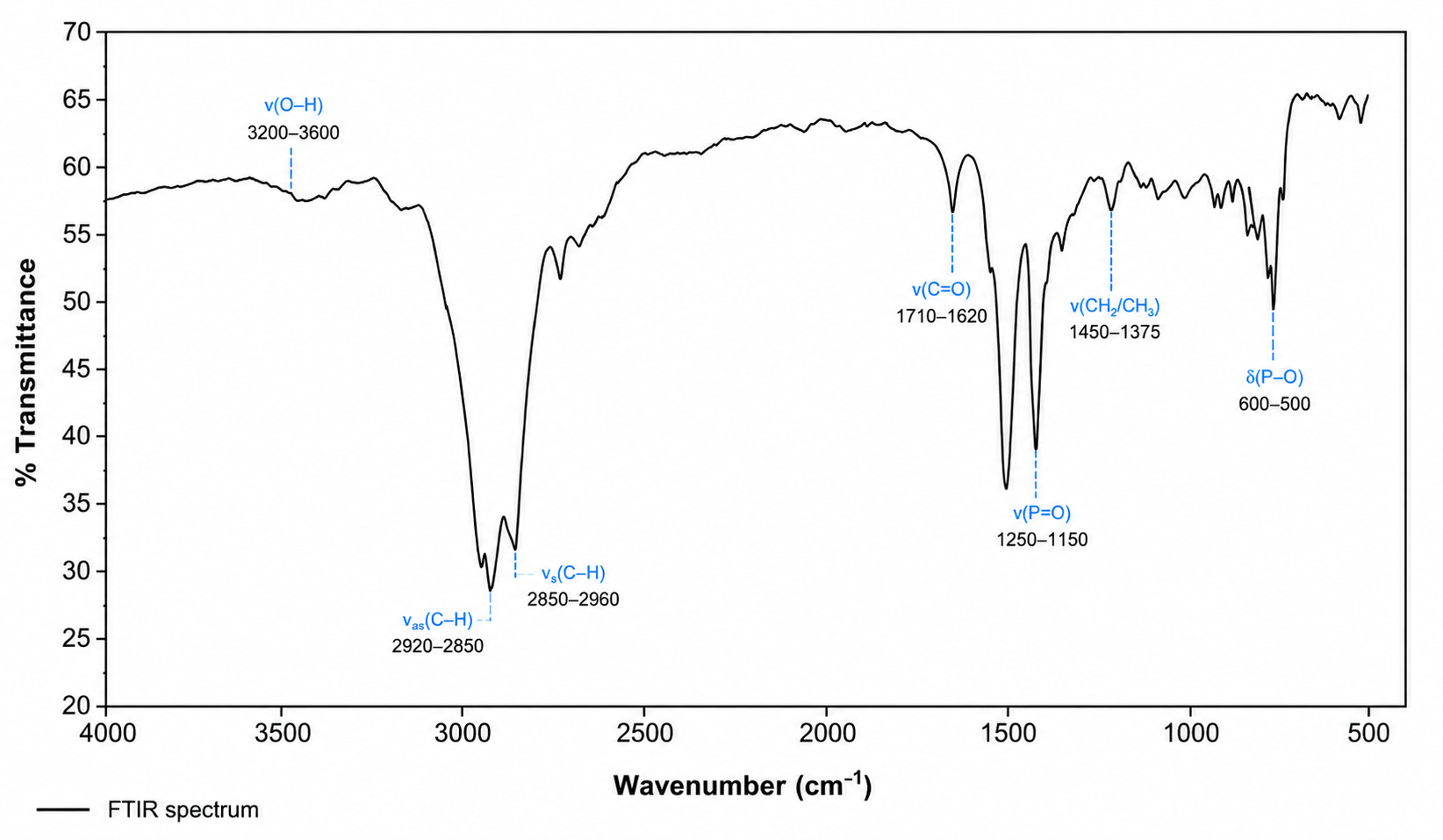
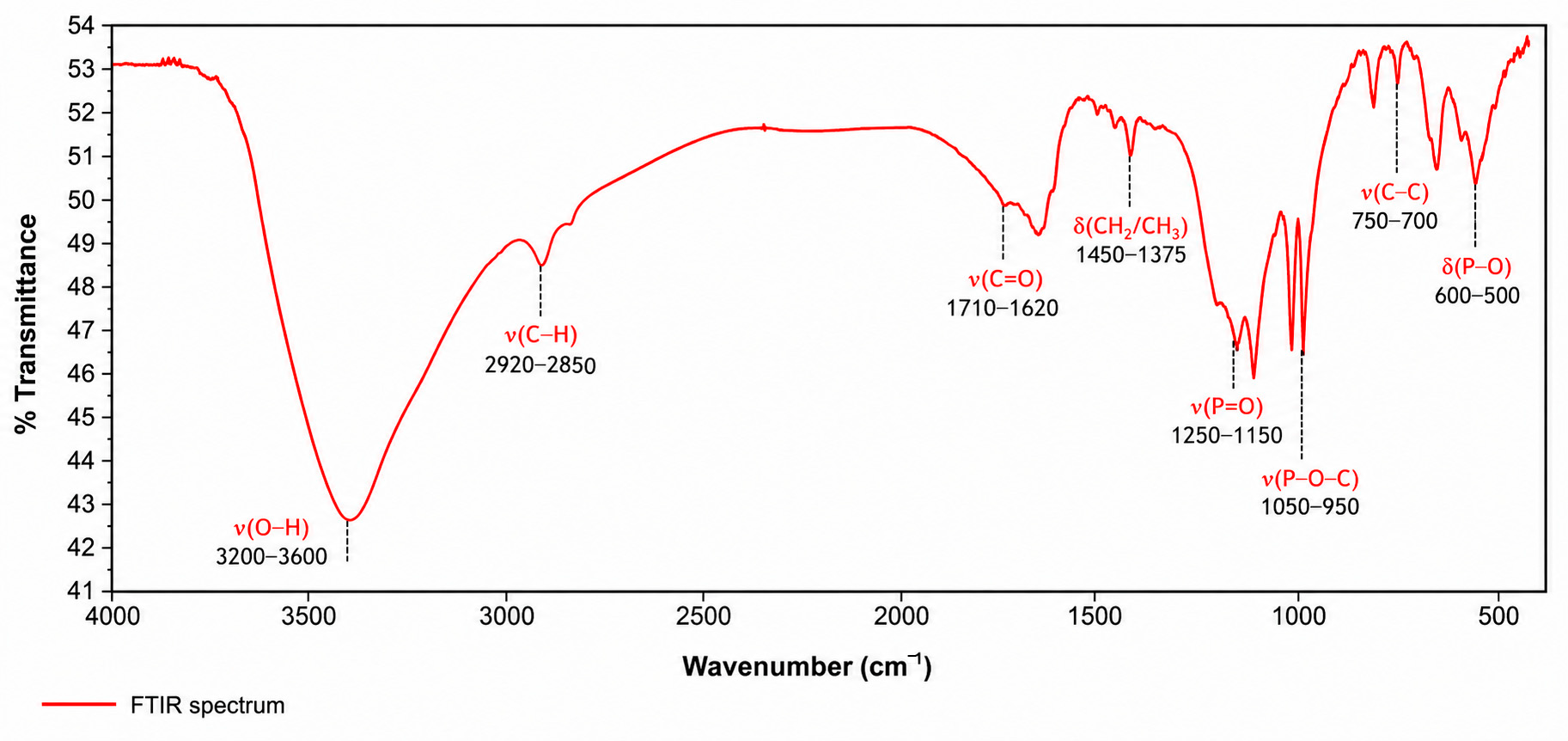
FTIR analysis was performed to characterize pure D2EHPA, pure diesel, and the diesel–D2EHPA mixture, and to identify the functional groups involved in the extraction process. The corresponding spectra are presented in Figure 5, Figure 6 and Figure 7.
The FTIR spectrum of pure D2EHPA (Figure 5) exhibits the characteristic absorption bands of the extractant. A broad band centered around 3400 cm−1 is assigned to the O–H stretching vibration of the phosphoric acid group involved in intermolecular hydrogen bonding. The bands observed at 2958–2850 cm−1 correspond to the asymmetric and symmetric stretching vibrations of aliphatic C–H groups. The characteristic absorption band at approximately 1248 cm−1 is attributed to the P=O stretching vibration, whereas the intense bands between 1160 and 1020 cm−1 are assigned to P–O and P–O–C stretching vibrations. These characteristic bands confirm the molecular structure of D2EHPA and provide a reference for interpreting the spectral changes observed after dissolution in diesel.
The FTIR spectrum of pure diesel (Figure 6) exhibited intense absorption bands in the region 2923–2932 cm−1, corresponding to the asymmetric and symmetric stretching vibrations of aliphatic –CH2– and –CH3 groups characteristic of hydrocarbon-based fuels. These bands confirm the predominance of aliphatic hydrocarbon chains in the diesel matrix.
The FTIR spectrum of the D2EHPA–diesel mixture showed additional absorption bands that were absent in pure diesel. A characteristic band located at 1059 cm−1 was assigned to the P–O–C stretching vibration, while the absorption peak observed at 1248 cm−1 corresponded to the P=O stretching vibration of the phosphoric acid group. These signals are characteristic of D2EHPA and are consistent with values reported for D2EHPA dissolved in conventional hydrocarbon diluents [10,18].
In addition, a broad absorption band centered at approximately 1691 cm−1 was observed. This band is attributed to O–H bending vibrations associated with hydrogen-bonded D2EHPA dimers (H2A2) and provides evidence for the existence of the dimeric extractant species in the diesel medium [8,11]. The presence of D2EHPA predominantly in its dimeric form is particularly important because dimerization governs the cation-exchange extraction mechanism responsible for metal transfer from the aqueous phase to the organic phase.
Overall, the FTIR results confirm that D2EHPA was successfully dissolved in diesel while maintaining its characteristic functional groups and dimeric structure. These observations support the extraction mechanism proposed in Section 3.2 and demonstrate that diesel can act as an effective diluent without altering the fundamental chemistry of the D2EHPA extraction system.
Compared with pure D2EHPA, the FTIR spectrum of the diesel–D2EHPA mixture (Figure 7) retained the characteristic phosphate bands, particularly those assigned to the P=O and P–O–C stretching vibrations. The preservation of these bands indicates that dissolution in diesel does not modify the fundamental chemical structure of D2EHPA. Only slight variations in band intensity and/or position were observed, which may be attributed to weak molecular interactions between D2EHPA and the hydrocarbon constituents of diesel rather than to chemical transformation of the extractant.

3.4. Parametric Study

The extraction efficiency of Zn(II), Cd(II), and Ni(II) is influenced by several physicochemical and operational parameters. Therefore, a systematic investigation was carried out to evaluate the effects of contact time, aqueous-phase pH, initial metal concentration, aqueous-to-organic phase ratio (VA/VO), stirring speed, and stripping conditions on the performance of the D2EHPA–diesel extraction system. The objective was to determine the optimum operating conditions and improve the understanding of the extraction behavior of the ternary metal mixture under semi-pilot conditions.

3.4.1. Effect of the Initial pH of the Aqueous Phase

Study of the Predominance of Zn(II), Cd(II), and Ni(II) Species
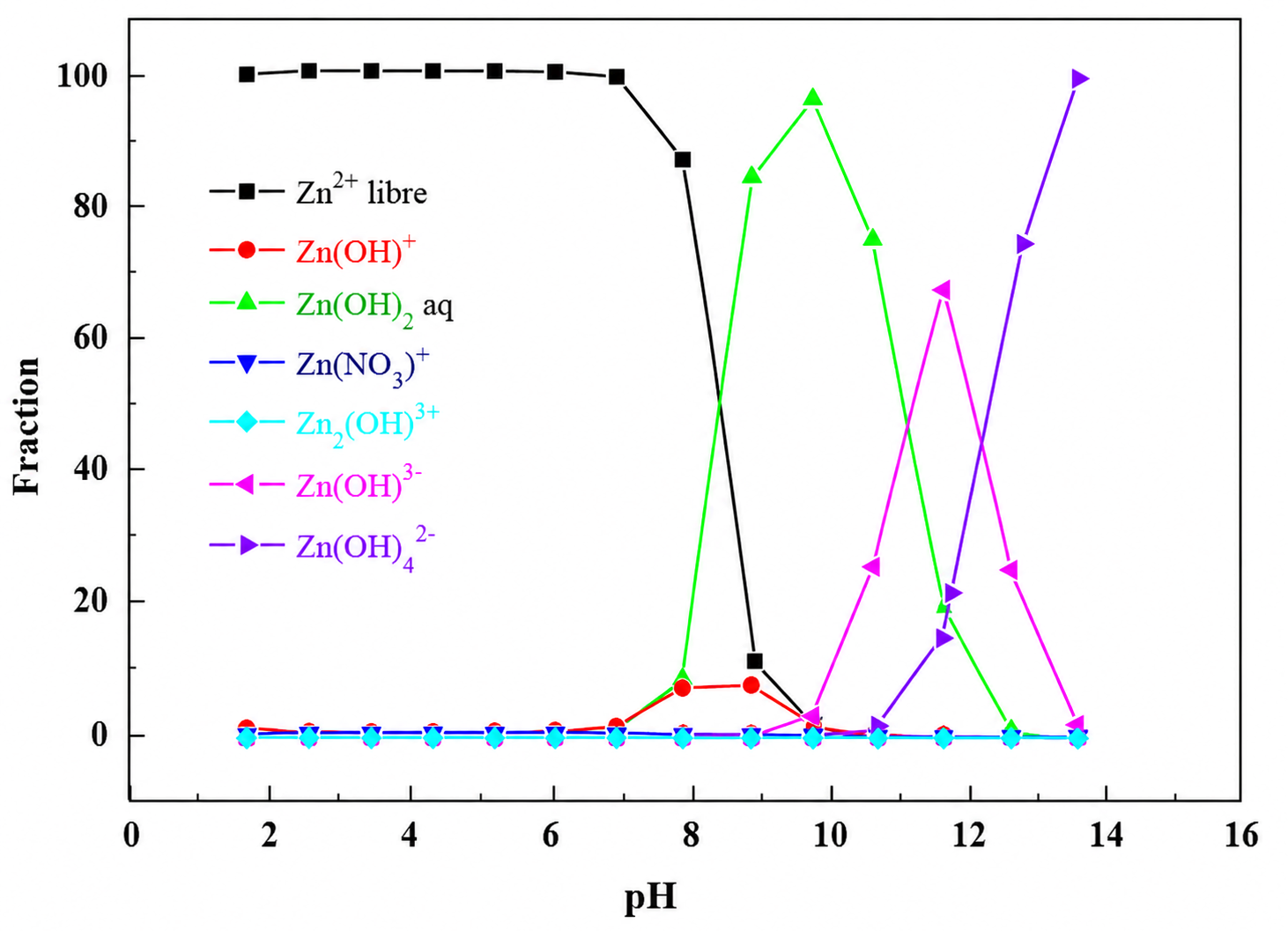
The pH of the aqueous phase plays a crucial role in solvent extraction processes because it directly affects both metal speciation and extractant protonation. Before evaluating the effect of pH on extraction efficiency, the predominant chemical species of Zn(II), Cd(II), and Ni(II) present in solution were examined using the chemical equilibrium software CHEAQS Pro (version L20.1). Predominance diagrams were generated to identify the pH ranges in which the metal ions remain available for cation-exchange extraction.
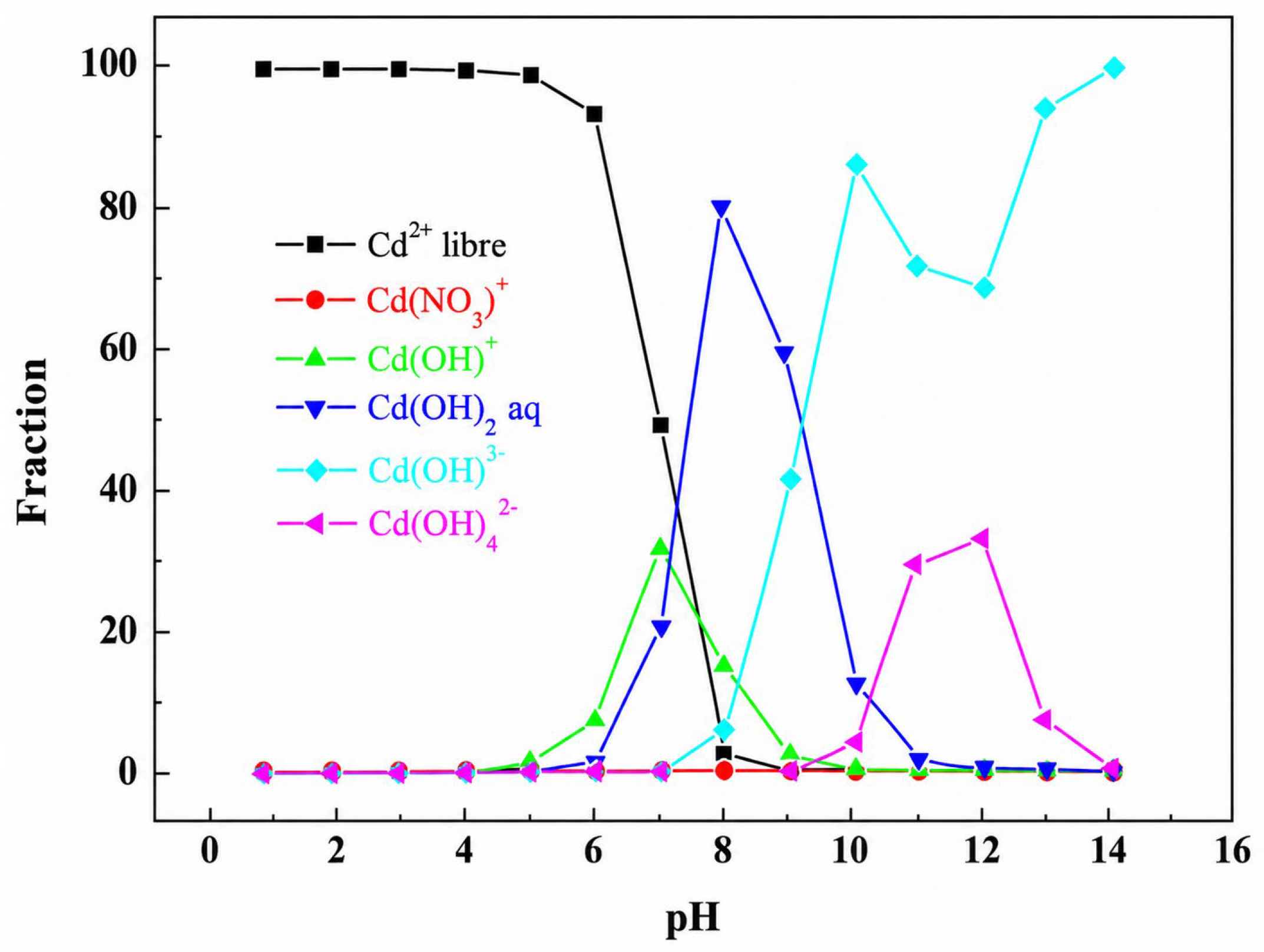
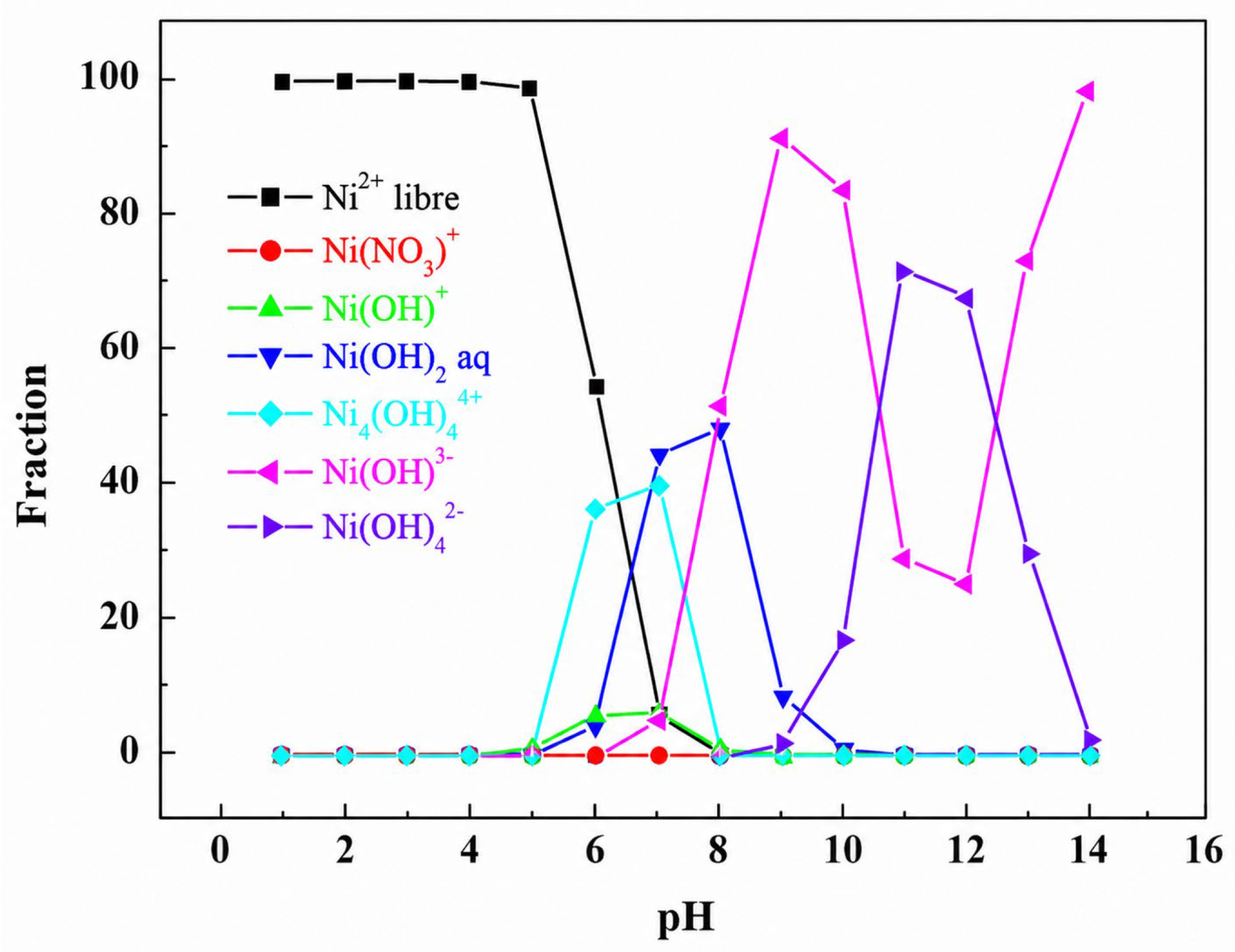
The calculated diagrams showed that Zn(II) remains predominantly in its free ionic form over a relatively wide pH range and starts to form hydroxylated species only when the pH exceeds approximately 7.0 [22]. In contrast, Cd(II) begins to undergo hydrolysis at lower pH values, leading to the gradual formation of hydroxide species above pH 6.0 [23]. A similar behavior was observed for Ni(II), which remains mainly as Ni2+ under acidic conditions but progressively forms hydrolyzed species as the pH approaches neutrality [22,23].
The predominance diagrams therefore indicate that Zn(II), Cd(II), and Ni(II) are present principally as free divalent cations within the investigated pH range, making them suitable for extraction by the cation-exchange mechanism of D2EHPA. However, operation at pH values above approximately 6.0 may promote the formation of poorly extractable hydrolyzed species and the precipitation of metal hydroxides, particularly for Cd(II) and Ni(II). Consequently, the pH range selected for the extraction experiments was restricted to acidic and mildly acidic conditions in order to avoid precipitation phenomena and ensure reliable evaluation of extraction performance.
Figure 8, Figure 9 and Figure 10 present the predominance diagrams of Zn(II), Cd(II), and Ni(II), respectively, as a function of aqueous-phase pH.
Figure 8. Diagram of the predominance of Zn(II) species in aqueous phase as a function of pH; given by CHEAQS; [Zn2+] = 100 ppm; 1 ≤ pH ≤ 14.
Processes 14 02423 g008
Figure 9. Diagram of the predominance of Cd(II) species in aqueous phase as a function of pH; given by CHEAQS; [Cd2+] = 100 ppm; 1 ≤ pH ≤ 14.
Processes 14 02423 g009
Figure 10. Diagram of the predominance of Ni(II) species in aqueous phase as a function of pH; given by CHEAQS; [Ni2+] = 100 ppm; 1 ≤ pH ≤ 14.
Processes 14 02423 g010
The predominance diagrams were calculated over the full pH range from 0 to 14 to illustrate the complete aqueous speciation behavior of Zn(II), Cd(II), and Ni(II). Although the extraction experiments were carried out only in the pH range 1.0–5.38, extending the diagrams to pH 14 makes it possible to identify the pH regions where hydrolysis and hydroxide formation become thermodynamically favorable. This information helps justify the choice of the experimental pH window and confirms that the extraction tests were performed well before the onset of extensive hydroxide precipitation.
The pH of the aqueous phase is one of the most influential parameters in solvent extraction processes employing acidic extractants such as D2EHPA. Since D2EHPA extracts metal ions through a cation-exchange mechanism, the extraction equilibrium is strongly dependent on the concentration of hydrogen ions present in solution [18]. At low pH values, the large excess of protons competes with metal ions for the active extraction sites, thereby reducing metal uptake. As the pH increases, this competition decreases and the extraction efficiency is generally enhanced [10,11].
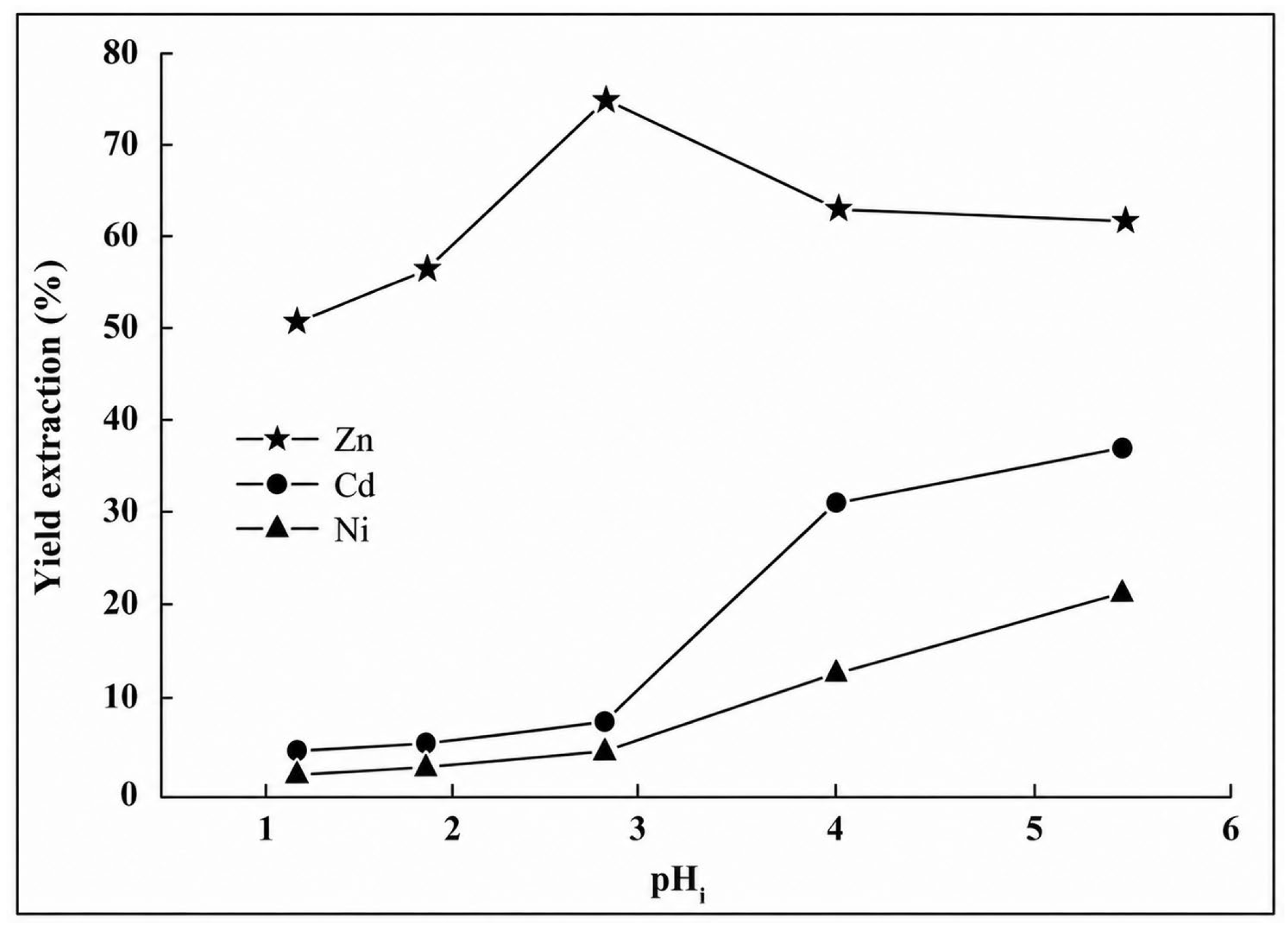
The effect of the initial pH on the extraction of Zn(II), Cd(II), and Ni(II) was investigated over the pH range 1.0–5.38. For Cd(II) and Ni(II), the extraction yield increased progressively with increasing pH, reaching maximum values of 36.80% and 21.36%, respectively, at pH 5.38. This behavior is characteristic of D2EHPA systems and reflects the greater availability of deprotonated extractant molecules at higher pH values. Similar trends have been reported for the extraction of Cd(II) and Ni(II) using organophosphorus extractants in mildly acidic media [19,20].
In contrast, Zn(II) exhibited a different extraction profile. The extraction efficiency increased rapidly from 50.32% at pH 1.25 to a maximum value of 75.21% at pH 2.45, followed by a slight decrease at higher pH values. Since the predominance diagram indicates that Zn(II) remains the dominant aqueous species throughout the investigated pH range, this slight decrease cannot be attributed to the formation of hydroxylated zinc species. Instead, it is more likely related to the increasing competitive extraction of Cd(II) and Ni(II), whose extraction efficiencies improve as the pH increases. As these metal ions compete with Zn(II) for the available D2EHPA molecules, a slight reduction in Zn(II) extraction is observed despite the absence of significant zinc hydrolysis [19,24].
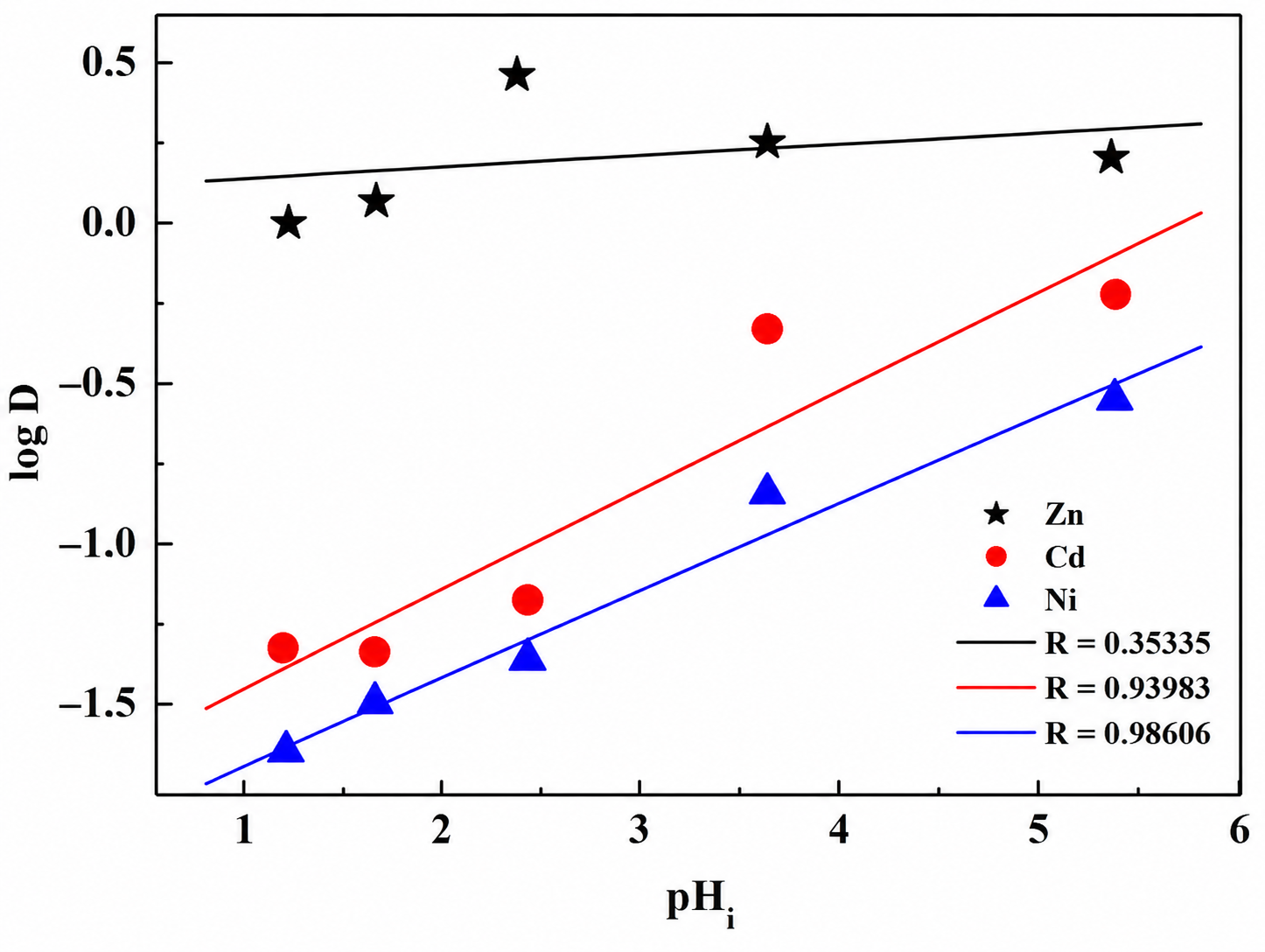
To complement the extraction-efficiency results and provide a quantitative interpretation of the extraction equilibrium, the corresponding distribution coefficients were calculated and expressed as log D as a function of the initial pH.
The log D versus pH plot for Zn(II) shows only a very weak positive trend, with a slope of 0.03. This value should be interpreted cautiously, as it does not by itself provide strong quantitative evidence for cation exchange. Nevertheless, when considered together with the extraction behavior of the system and the established acid-extractant chemistry of D2EHPA, the result remains broadly consistent with a proton-involved extraction process. For Cd(II) and Ni(II), the clearer positive dependence of log D on pH is more indicative of the expected cation-exchange behavior.
The positive dependence of log D on pH supports the involvement of hydrogen ions in the extraction reaction and is consistent with a cation-exchange mechanism involving D2EHPA [10,11,18]. Similar log D–pH relationships have been widely reported for divalent metal ion extraction by acidic organophosphorus extractants [20,25].
Figure 11 directly illustrates the effect of the initial aqueous-phase pH on the extraction efficiencies of Zn(II), Cd(II), and Ni(II). Overall, increasing the pH favored metal extraction, although Zn(II) reached its maximum extraction efficiency at pH 2.45, whereas Cd(II) and Ni(II) continued to increase up to pH 5.38.
Figure 11. Effect of the initial aqueous-phase pH on the extraction efficiency of Zn(II), Cd(II), and Ni(II). Experimental conditions: [Zn2+]i = [Cd2+]i = [Ni2+]i = 100 mg.L−1; [D2EHPA] = 1.0 × 10⁻³ mol L−1; Vaq = Vorg = 2.5 L; contact time = 30 min; stirring speed = 700 rpm; T = 294.15 K.
Processes 14 02423 g011
The evolution of the distribution coefficient as a function of the initial aqueous-phase pH is presented in Figure 12.
Figure 12. Evolution of log D as a function of pHi; [Zn2+]i = [Cd2+]i = [Ni2+]i =100 ppm; [D2EHPA] = 10−3 M; Vorg = 2.5 L; Vaq = 2.5 L; Stirring speed = 700 rpm; T = 294.15 K; t = 30 min.
Processes 14 02423 g012

3.4.2. Effect of Initial Metal Concentration

The initial concentration of metal ions in the aqueous phase is an important parameter in solvent extraction because it determines the metal-to-extractant ratio and influences both extraction equilibrium and organic-phase loading.
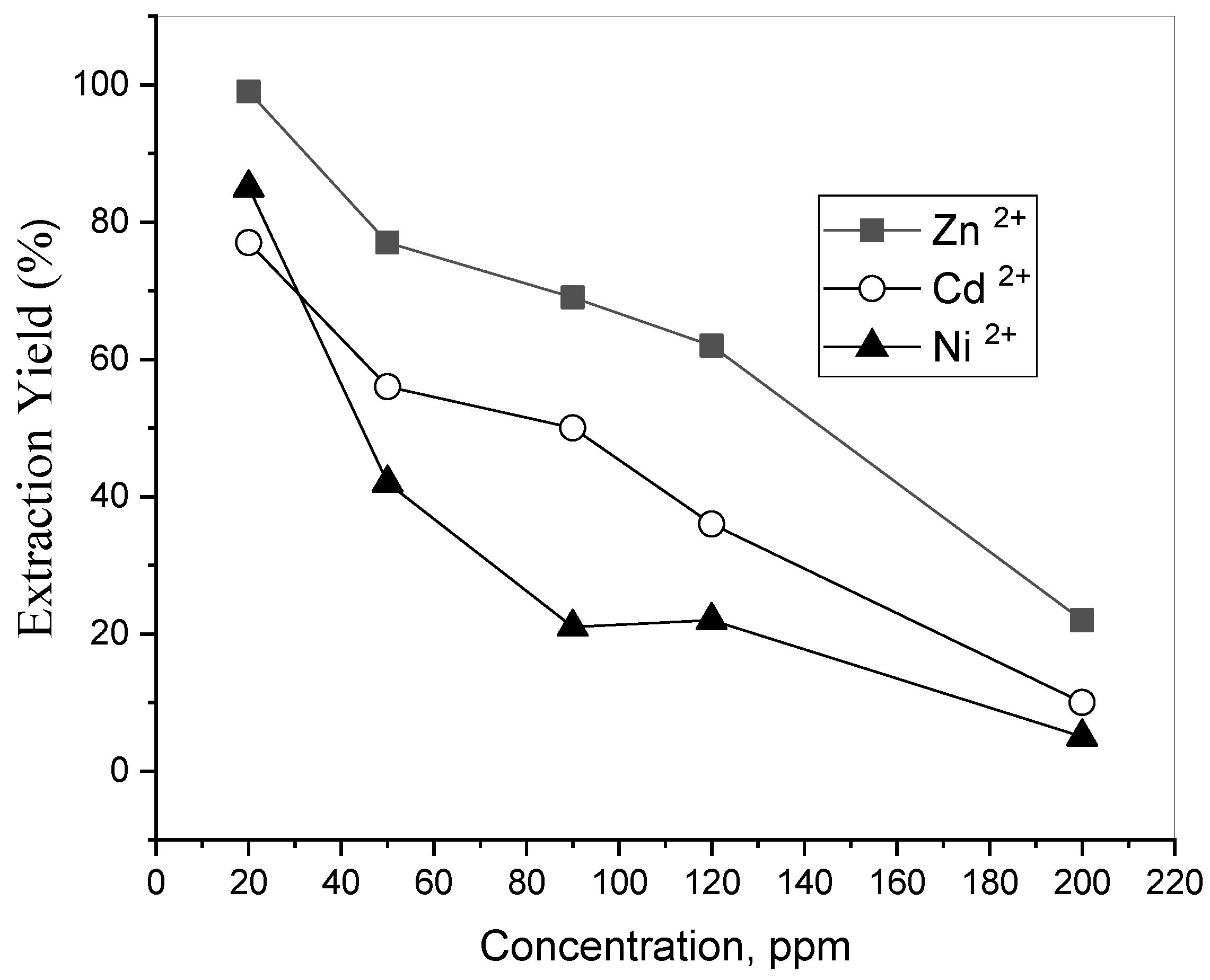
Figure 13 presents the extraction yields obtained at different initial metal concentrations. A clear inverse relationship was observed between metal concentration and extraction efficiency for all three investigated ions. The highest extraction yields were achieved at the lowest concentration tested (20 ppm), reaching 98.52% for Zn(II), 84.04% for Ni(II), and 76.86% for Cd(II).
The superior extraction performance observed at low metal concentrations can be attributed to the large excess of available D2EHPA molecules relative to the dissolved metal ions. Under these conditions, sufficient extraction sites are available to form metal–extractant complexes, resulting in high metal transfer to the organic phase. As the initial metal concentration increased, the extraction efficiency gradually decreased. This behavior is associated with the progressive loading of the organic phase and the reduction in the number of free extractant molecules available for complex formation [14].
The decrease in extraction efficiency became more pronounced at concentrations approaching 200 ppm, indicating that the extraction capacity of the organic phase was progressively being approached. Similar trends have been reported for Zn(II), Ni(II), and other divalent metals extracted by D2EHPA, where increasing metal concentration leads to lower extraction efficiencies due to extractant saturation effects [20].
From a process-design perspective, operating at low metal-to-extractant ratios favors higher extraction efficiencies and enhances the separation of individual metals within multicomponent systems. The pronounced differences observed between Zn(II), Cd(II), and Ni(II) extraction yields at low feed concentrations suggest that concentration control may be used as an effective strategy to improve selectivity and facilitate downstream purification steps [17,25].

3.4.3. Effect of the Aqueous-to-Organic Phase Ratio (VA/VO)

The aqueous-to-organic phase ratio (VA/VO) is an important operational parameter in solvent extraction because it determines the availability of extractant molecules relative to the amount of metal ions present in the feed solution. In addition, the phase ratio influences extraction equilibrium, organic-phase loading, and mass-transfer efficiency.
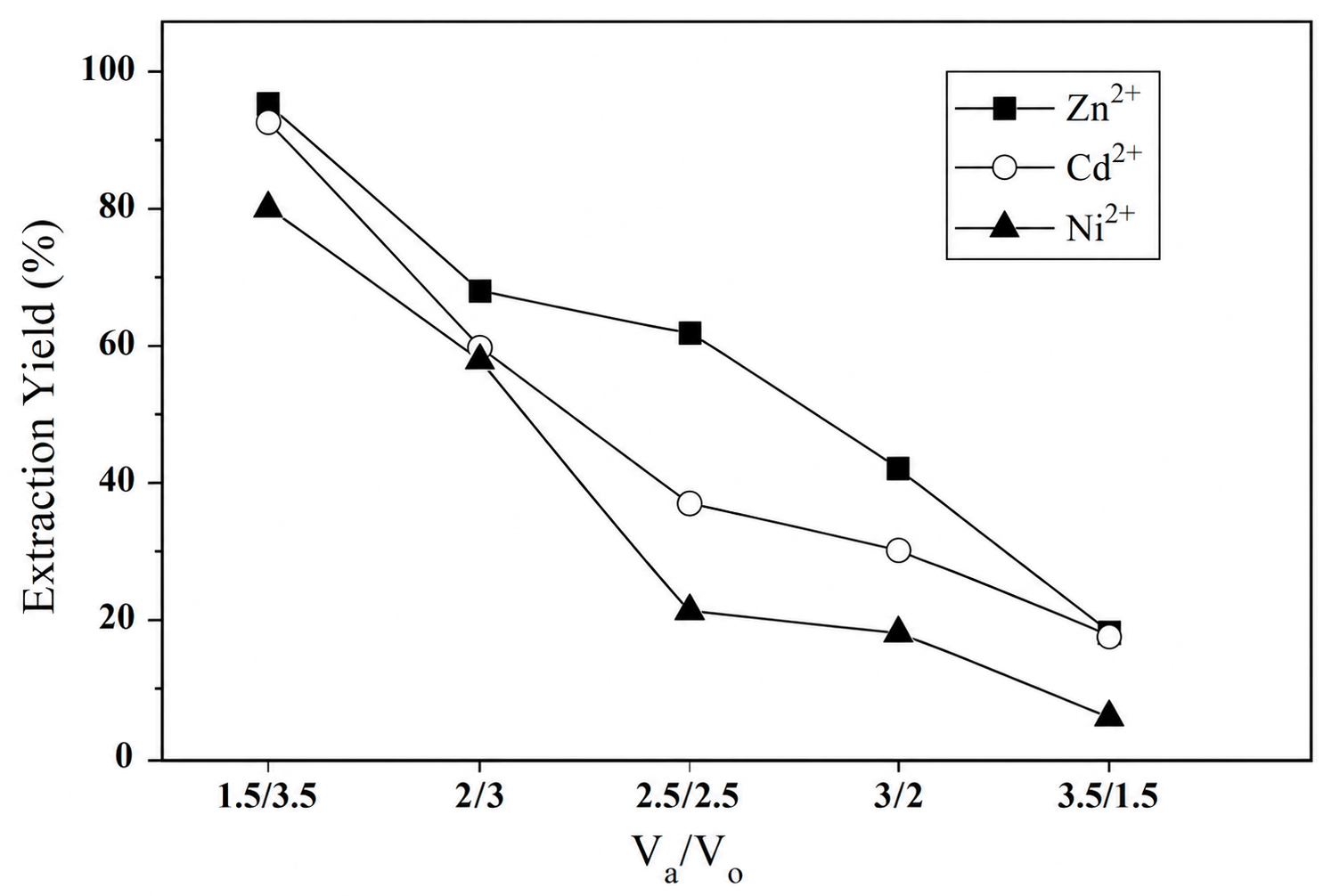
As shown in Figure 14, the extraction yields of Zn(II), Cd(II), and Ni(II) decreased progressively as the proportion of the aqueous phase increased. The highest extraction efficiencies were obtained at a VA/VO ratio of 1.5/3.5, reaching 93.79% for Zn(II), 90.86% for Cd(II), and 81.08% for Ni(II). Under these conditions, the organic phase was present in excess, providing a larger number of available D2EHPA molecules and a greater loading capacity for metal uptake.
As the VA/VO ratio increased, the metal-to-extractant ratio became progressively less favorable, resulting in a reduction in extraction efficiency. This behavior can be attributed to the gradual saturation of the organic phase and the limited availability of free extractant molecules for complex formation [17,19]. Similar trends have been reported for D2EHPA-based extraction systems, where lower aqueous-to-organic ratios generally improve metal recovery due to the increased availability of active extraction sites [7,9,26]. Furthermore, the phase ratio has been recognized as a critical parameter controlling extraction efficiency, metal loading, and separation performance in continuous hydrometallurgical solvent extraction circuits [4,6].
From a practical perspective, the use of large volumes of organic solvent increases operational costs, solvent inventory requirements, and phase management complexity. Therefore, although the VA/VO ratio of 1.5/3.5 provided the highest extraction efficiencies in the present study, industrial implementation would require optimization of the phase ratio to balance metal recovery, solvent consumption, and process economics. Similar considerations have been highlighted in the design and scale-up of D2EHPA-based solvent extraction processes for metal recovery from complex aqueous streams [4,6,14].
Although the lowest VA/VO ratio provided the highest extraction efficiencies, the use of a large excess of organic phase has practical drawbacks. In particular, it increases solvent inventory, circulation requirements, capital cost, and the environmental burden associated with handling, regeneration, and potential solvent losses. From an industrial perspective, the optimum phase ratio should therefore be selected not only on the basis of metal recovery but also by balancing extraction performance against solvent consumption, energy demand, and overall process sustainability. Further techno-economic and environmental assessment will be required to identify the most appropriate operating window for scale-up.

3.4.4. Effect of Stirring Speed

Stirring speed is a critical operational parameter in liquid–liquid extraction because it directly affects droplet formation, interfacial area generation, and mass-transfer efficiency between the aqueous and organic phases.
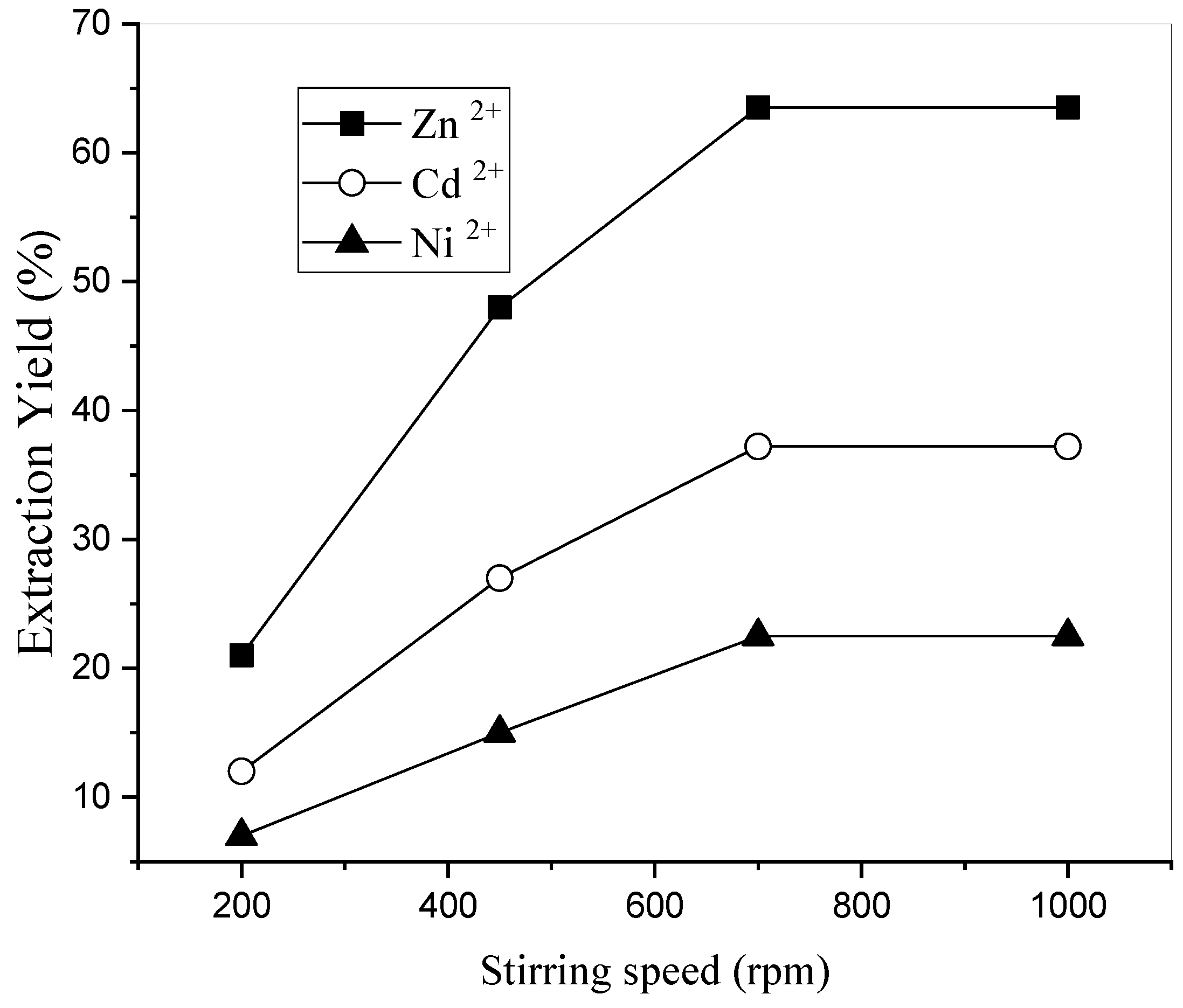
As shown in Figure 15, extraction yields increased significantly with increasing stirring speed. At 200 rpm, phase dispersion was limited, resulting in reduced interfacial contact between the two phases and consequently lower extraction efficiencies. Increasing the agitation speed enhanced droplet break-up and increased the interfacial area available for mass transfer, leading to improved extraction performance for all investigated metals.
The highest extraction efficiencies were obtained at 700 rpm, reaching 63.50% for Zn(II), 37.21% for Cd(II), and 22.46% for Ni(II). Further increasing the agitation speed to 1000 rpm produced only marginal improvements, indicating that equilibrium conditions had already been approached and that the mass-transfer resistance had been substantially reduced.
A similar dependence of extraction efficiency on agitation intensity has been reported in solvent extraction systems employing organophosphorus extractants, where the improvement in droplet dispersion and reduction in boundary-layer thickness enhance metal transfer rates up to a critical stirring speed, beyond which additional increases provide little benefit [3,27]. Comparable behavior has also been observed in extraction systems designed for battery-metal recovery and rare-earth separation, where agitation primarily affects extraction kinetics rather than equilibrium once sufficient phase dispersion is achieved [5,26].
The existence of a plateau region at high stirring speeds is commonly attributed to the transition from diffusion-controlled transport to a regime in which the extraction reaction itself becomes the limiting step [6]. Moreover, excessively intense agitation may generate very fine droplets that are difficult to coalesce, increasing the risk of stable emulsion formation, phase entrainment, and operational difficulties during phase disengagement [15].
The extraction yield increased with stirring speed up to 700 rpm, indicating improved droplet breakup and interfacial area generation. Increasing the speed to 1000 rpm produced only marginal additional benefit, suggesting that mass-transfer limitations were already largely overcome at 700 rpm. Although no severe phase-separation failure was reported under the present conditions, further increase in agitation can be expected to produce finer droplets, which may prolong settling time and increase the risk of emulsion formation or phase entrainment in continuous operation. For this reason, 700 rpm was selected as a practical compromise between extraction performance and hydrodynamic stability.
Table 3 summarizes the principal extraction parameters obtained under the investigated operating conditions. Zn(II) exhibited the highest distribution coefficient and extraction efficiency, followed by Cd(II) and Ni(II), confirming the preferential affinity of D2EHPA toward Zn(II). The calculated organic-phase loading values were obtained from the depletion of the aqueous phase and provide an estimate of extractant loading under the investigated conditions. This summary facilitates comparison of the operating parameters and provides a clearer overview of the extraction performance for future process scale-up.
Although equilibrium pH and independent mass-balance closure were not determined during the present work, the calculated distribution coefficients, separation factors, and organic-phase loading values provide useful preliminary information for evaluating the extraction performance under semi-pilot operating conditions. These results demonstrate the technical feasibility of the D2EHPA–diesel extraction system and provide a basis for future process scale-up. Further investigations should include direct analysis of the loaded organic phase, equilibrium pH measurements, complete mass-balance determination, residence-time characterization, and long-term extractant stability to strengthen the industrial evaluation of the process.

3.4.5. Re-Extraction Study

Efficient stripping of the loaded organic phase is essential for the economic viability of any solvent extraction process because it enables both metal recovery and regeneration of the extractant for subsequent extraction cycles. To evaluate the regeneration capability of the D2EHPA–diesel system, three stripping agents, namely sulfuric acid (H2SO4), hydrochloric acid (HCl), and acetic acid (CH3COOH), were investigated at a concentration of 0.5 M.
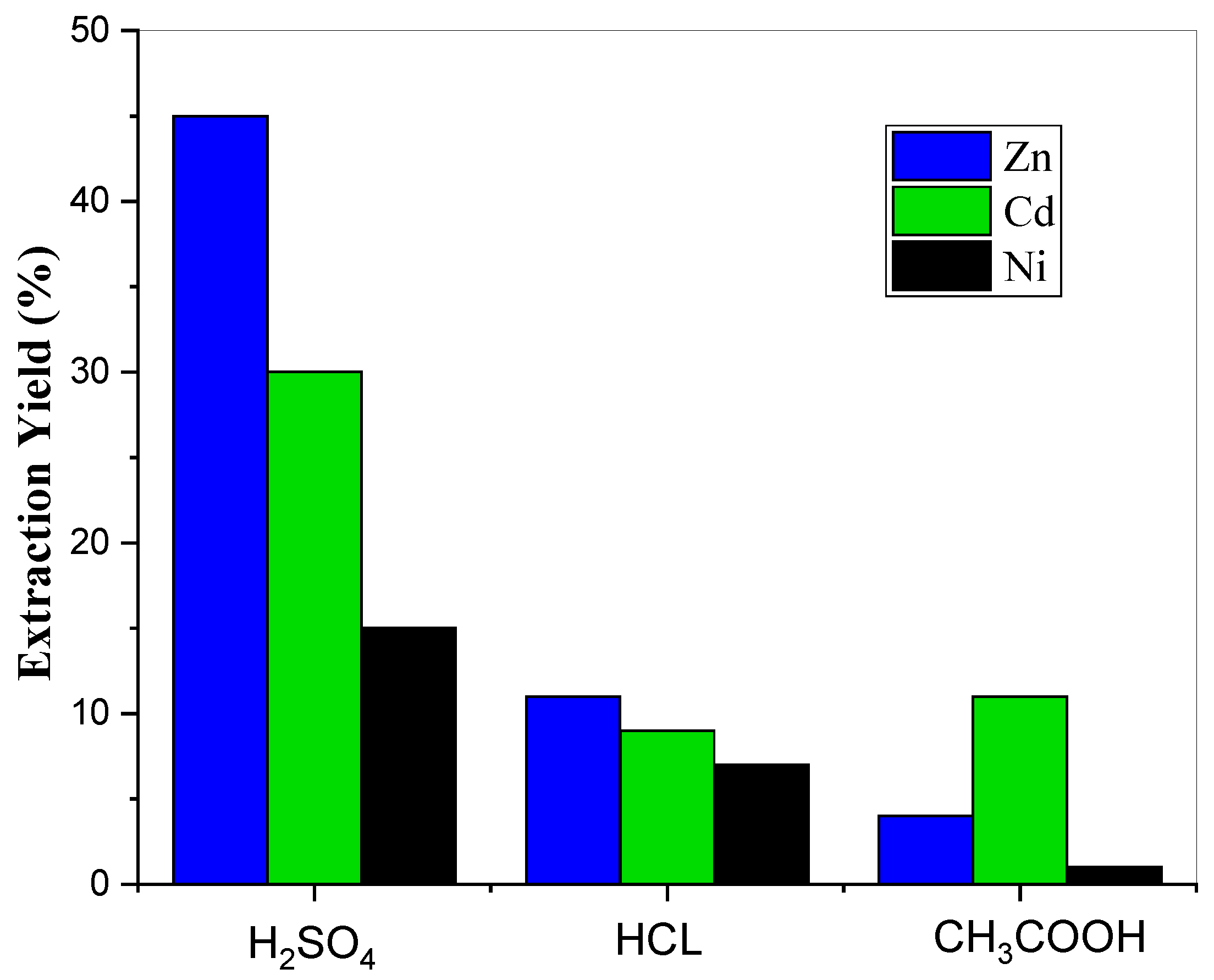
The results showed that H2SO4 was the most effective stripping reagent, yielding back-extraction efficiencies of 45.14% for Zn(II), 30.21% for Cd(II), and 16.12% for Ni(II). Hydrochloric acid exhibited intermediate performance, whereas acetic acid produced the lowest stripping efficiencies for all investigated metals. The superior performance of sulfuric acid can be attributed to its high proton activity and its ability to effectively displace metal ions from the organophosphorus complexes formed with D2EHPA [9,28].
Similar observations have been reported in hydrometallurgical solvent extraction processes involving transition metals, rare-earth elements, and battery-recycling streams, where sulfuric acid is frequently selected as the preferred stripping agent due to its effectiveness, low cost, and compatibility with downstream hydrometallurgical operations [7,29]. Furthermore, the formation of stable sulfate species in the aqueous phase favors the transfer of metal ions from the loaded organic phase, thereby enhancing stripping performance [28,30]. The re-extraction efficiencies of Zn(II), Cd(II), and Ni(II) from the loaded organic phase using different stripping agents are presented in Figure 16.
Figure 16. Re-extraction of Zn(II), Cd(II), and Ni(II) from the loaded organic phase; [H2SO4] = [HCl] = [CH3COOH] = 0.5 M; t = 60 min; stirring speed = 700 rpm.
Processes 14 02423 g016
Although the stripping efficiencies obtained in this work were moderate, it should be noted that the experiments were performed under single-stage conditions. Previous studies have shown that multistage counter-current stripping circuits and/or higher acid concentrations can significantly improve overall metal recovery and organic-phase regeneration. Therefore, further optimization of the stripping stage, including acid concentration, phase ratio, contact time, and number of stages, is recommended.
The results obtained in this study indicate that the D2EHPA–diesel system can extract Zn(II), Cd(II), and Ni(II) under continuous semi-pilot operating conditions. The extraction sequence, Zn(II) >> Cd(II) > Ni(II), is consistent with differences in hydration energy, hydrolysis behavior, and complexation affinity toward acidic organophosphorus extractants. Similar selectivity has been reported for D2EHPA systems using conventional diluents such as kerosene, suggesting that replacing laboratory-grade solvents with commercial diesel does not significantly alter the extraction chemistry [29,31].
The parametric study confirmed that aqueous-phase pH, initial metal concentration, phase ratio, and stirring speed are the key variables governing extraction performance. The strong effect of pH highlights the role of metal speciation and extractant protonation in the cation-exchange mechanism, while the decrease in extraction efficiency at higher metal concentrations reflects extractant loading limitations and competition among metal ions. A major outcome of this work is the successful operation of the extraction process under semi-pilot conditions. However, since the study was conducted using synthetic nitrate solutions, the applicability of the process to real industrial effluents remains to be demonstrated. Future work should therefore focus on multistage extraction–stripping circuits, real effluents, and techno-economic assessment of the process.
The results obtained in this study demonstrate that the D2EHPA–diesel system is capable of efficiently extracting Zn(II), Cd(II), and Ni(II) under continuous semi-pilot operating conditions. The observed extraction sequence, Zn(II) >> Cd(II) > Ni(II), is consistent with the different hydration energies, hydrolysis behavior, and complexation affinities of the investigated metal ions toward acidic organophosphorus extractants. Similar extraction selectivity has been reported in D2EHPA-based systems employing conventional diluents such as kerosene, indicating that the replacement of laboratory-grade solvents by commercial diesel does not significantly alter the fundamental extraction chemistry.
The parametric study confirmed that aqueous-phase pH, initial metal concentration, phase ratio, and stirring speed are the key variables controlling extraction performance. In particular, the strong influence of pH highlights the importance of metal speciation and extractant protonation on the cation-exchange mechanism. The decrease in extraction efficiency observed at higher metal concentrations further demonstrates the effect of extractant loading limitations and competition among metal ions in multicomponent systems.
A major outcome of this work is the successful operation of the extraction process under semi-pilot conditions. Most previously reported studies have been limited to laboratory-scale batch experiments, whereas the present work provides information under continuous counter-current conditions that are more representative of industrial practice. The results therefore contribute valuable data for future scale-up and process design.
Although sulfuric acid proved to be the most effective stripping agent among those investigated, the moderate stripping efficiencies obtained indicate that further optimization is still required. Future studies should focus on multistage extraction–stripping circuits, higher metal concentrations, real industrial effluents, and techno-economic evaluation of the process. Such investigations would provide a clearer assessment of the industrial applicability of the proposed D2EHPA–diesel extraction system. Table 4 summarizes the principal extraction parameters obtained under the investigated operating conditions.
Table 4. Compares the stripping performance of 0.5 M H2SO4, HCl, and CH3COOH for Zn(II), Cd(II), and Ni(II). H2SO4 gave the highest stripping efficiencies for all three metals, whereas HCl showed intermediate performance and CH3COOH gave the lowest values.
Stripping AgentZn(II)Cd(II)Ni(II)Interpretation
0.5 M H2SO445.14% 30.21% 16.12% Highest stripping efficiency among the reagents tested
0.5 M HClIntermediate, but lower than H2SO4Intermediate, but lower than H2SO4Intermediate, but lower than H2SO4Better than acetic acid, but not the best performer
0.5 M CH3COOHLowest stripping efficiencyLowest stripping efficiencyLowest stripping efficiencyWeakest of the three stripping agents

4. Conclusions

This study provides a comprehensive investigation of the simultaneous extraction of Zn(II), Cd(II), and Ni(II) using D2EHPA dissolved in commercial diesel in a continuous semi-pilot mixer–settler system. The findings contribute to the understanding of multicomponent solvent extraction under continuous operating conditions and may support future industrial applications.
The extraction kinetics followed the order Zn(II) (5 min) >> Cd(II) (15 min) > Ni(II) (30 min), highlighting the different hydration and complexation characteristics of the investigated metal ions. Among the operating parameters evaluated, aqueous-phase pH exerted the greatest influence on extraction performance. The highest extraction efficiencies were obtained at an initial metal concentration of 20 mg L−1, a VA/VO ratio of 1.5/3.5, and a stirring speed of 700 rpm, reaching 98.52% for Zn(II), 76.86% for Cd(II), and 84.04% for Ni(II).
FTIR characterization and slope analysis supported a dimeric cation-exchange mechanism involving D2EHPA in the organic phase, with the extraction process following the stoichiometry:
1.5(H2A2) + M2+ ⇌ MA2(HA) + 2H+
Commercial diesel proved to be a suitable alternative to conventional laboratory diluents without altering the fundamental extraction mechanism. Among the stripping agents evaluated, 0.5 M H2SO4 provided the highest stripping efficiency under the investigated conditions, although further optimization of the stripping stage is still required.
Overall, the present work demonstrates the technical feasibility of continuous solvent extraction under semi-pilot conditions and provides useful information for future process development. Nevertheless, additional hydrodynamic characterization, multistage extraction–stripping studies, experiments using real industrial effluents, and techno-economic evaluation will be required before industrial implementation and scale-up can be considered.

Author Contributions

Conceptualization, S.A.E. and A.K.; methodology, S.A.E. and A.K.; software, S.A.E.; validation, S.A.E., A.K., A.M.R. and D.M.; formal analysis, S.A.E.; investigation, S.A.E.; resources, D.M.; data curation, A.M.R., F.M.N. and D.M.; writing—original draft preparation, S.A.E. and D.M.; writing—review and editing, D.M.; visualization, S.A.E., A.K., A.M.R., F.M.N. and D.M.; supervision, F.M.N.; All authors have read and agreed to the published version of the manuscript.

Funding

The financial and logistical support provided by the Ministry of Higher Education and Scientific Research and the General Directorate for Scientific Research and Technological Development (DGRSDT), Algeria.

Data Availability Statement

The original contributions presented in this study are included in the article. Further inquiries can be directed to the corresponding author.

Conflicts of Interest

The authors declare no conflicts of interest.

References

  1. Okereafor, U.; Makhatha, M.; Mekuto, L.; Uche-Okereafor, N.; Sebola, T.; Mavumengwana, V. Toxic metal implications on agricultural soils, plants, animals, aquatic life and human health. Int. J. Environ. Res. Public Health 2020, 17, 2204. [Google Scholar] [CrossRef] [PubMed]
  2. Rahmati, S.; Adavodi, R.; Hosseini, M.R.; Veglio’, F. Efficient metal extraction from dilute solutions: A review of novel selective separation methods and their applications. Metals 2024, 14, 605. [Google Scholar] [CrossRef]
  3. Ahamed, A.M.; Swoboda, B.; Arora, Z.; Lansot, J.Y.; Chagnes, A. Low-carbon footprint diluents in solvent extraction for lithium-ion battery recycling. RSC Adv. 2023, 13, 23334–23345. [Google Scholar] [CrossRef] [PubMed]
  4. Salman, A.D.; Juzsakova, T.; Mohsen, S.; Abdullah, T.A.; Le, P.-C.; Sebestyen, V.; Sluser, B.; Cretescu, I. Scandium recovery methods from mining, metallurgical extractive industries, and industrial wastes. Materials 2022, 15, 2376. [Google Scholar] [CrossRef] [PubMed]
  5. Agrawala, M.; Sahu, S.; Devi, N. Valorization of Cobalt and Lithium from Spent Lithium-Ion Batteries via Reduction Roasting and Solvometallurgy. ACS Omega 2025, 10, 34292–34307. [Google Scholar] [CrossRef] [PubMed]
  6. Rodrigues, I.R.; Deferm, C.; Binnemans, K.; Riaño, S. Separation of cobalt and nickel via solvent extraction with Cyanex-272: Batch experiments and comparison of mixer-settlers and an agitated column as contactors for continuous counter-current extraction. Sep. Purif. Technol. 2022, 296, 121326. [Google Scholar] [CrossRef]
  7. Kozhevnikova, A.V.; Milevskii, N.A.; Lobovich, D.V.; Zakhodyaeva, Y.A.; Voshkin, A.A. Deep eutectic solvent (TOPO/D2EHPA/Menthol) for extracting metals from synthetic hydrochloric acid leachates of NMC-LTO batteries. Metals 2024, 14, 1441. [Google Scholar] [CrossRef]
  8. Grymonprez, B.; Lommelen, R.; Bussé, J.; Binnemans, K.; Riaño, S. Solubility of di-(2-ethylhexyl) phosphoric acid (D2EHPA) in aqueous electrolyte solutions: Studies relevant to liquid-liquid extraction. Sep. Purif. Technol. 2024, 333, 125846. [Google Scholar] [CrossRef]
  9. Grigorieva, N.; Fleitlikh, I.Y.; Tikhonov, A.Y.; Mamatyuk, V.; Karpova, E.; Logutenko, O. Recovery of indium from sulfate solutions with D2EHPA in the presence of organic proton-donor additives. Hydrometallurgy 2022, 213, 105925. [Google Scholar] [CrossRef]
  10. Mohammadzadeh, M.; Bagheri, H.; Ghader, S. Solvent extraction of nickel and zinc from nitric acid solution using D2EHPA: Experimental and modeling. J. Solut. Chem. 2022, 51, 424–447. [Google Scholar] [CrossRef]
  11. Mohammadzadeh, M.; Bagheri, H.; Ghader, S. Experimental Investigation and Thermodynamic Modeling of Zn and Ni Extraction from Zn Plant Residue using D2EHPA. Int. J. Eng. 2023, 36, 2015–2027. [Google Scholar] [CrossRef]
  12. El Maangar, A.; Zemb, T.; Fleury, C.; Duhamet, J.; Dufrêche, J.-F.; Pellet-Rostaing, S. Decreasing viscosity and increasing accessible load by replacing classical diluents with a hydrotrope in liquid–liquid extraction. Front. Chem. Eng. 2025, 6, 1476214. [Google Scholar] [CrossRef]
  13. Badihi, F.; Haghighi Asl, A.; Asadollahzadeh, M.; Torkaman, R. Applied novel functionality in separation procedure from leaching solution of zinc plant residue by using non-aqueous solvent extraction. Sci. Rep. 2023, 13, 1146. [Google Scholar] [CrossRef] [PubMed]
  14. Asadollahzadeh, M.; Torkaman, R.; Torab-Mostaedi, M.; Saremi, M. Recycling of zinc ions in disc-donut column considering forward mixing mass transfer, and effects of pulsed and non-pulsed condition. Sci. Rep. 2022, 12, 1609. [Google Scholar] [CrossRef] [PubMed]
  15. Anary-Abbasinejad, M.; Manafi, Z.; Zamani, F.; Salarizadeh, P.; Shahhoseini, M.; Vahedi, F.; Seyedbagheri, S.A. Efficient recovery of organic phase from crud in solvent extraction unit of Sarcheshmeh copper complex in Iran by powerful water-absorbent reagents. Hydrometallurgy 2025, 231, 106408. [Google Scholar] [CrossRef]
  16. Shakib, B.; Torkaman, R.; Torab-Mostaedi, M.; Asadollahzadeh, M. Mass transfer studies in RDC column by the coupling effects of perforated structure and reactive extraction of Mo (VI) and W (VI) from sulfate solution. Int. Commun. Heat Mass Transf. 2020, 118, 104903. [Google Scholar] [CrossRef]
  17. Zallaghi, M.; Chenarani, B.; Ghaemi, A. A synergistic combination of dichloromethane and Aliquat 336 for selective extraction of copper, nickel, zinc, and cadmium from industrial waste. Sci. Rep. 2025, 15, 31709. [Google Scholar] [CrossRef] [PubMed]
  18. Karmakar, A.K.; Hossen, A. Liquid-liquid extraction equilibrium study of vanadium (V) from nitrate medium by technical grade D2EHPA dissolved in kerosene. Preprint 2024. [Google Scholar] [CrossRef] [PubMed]
  19. Martins, J.M.A.; Guimaraes, A.S.; Dutra, A.J.B.; Mansur, M.B. Hydrometallurgical separation of zinc and copper from waste brass ashes using solvent extraction with D2EHPA. J. Mater. Res. Technol. 2020, 9, 2319–2330. [Google Scholar] [CrossRef]
  20. Goh, S.S.; Rafatullah, M.; Ismail, N.; Alam, M.; Siddiqui, M.R.; Seow, E.-K. Separation of chromium (VI), copper and zinc: Chemistry of transport of metal ions across supported liquid membrane. Membranes 2022, 12, 685. [Google Scholar] [CrossRef] [PubMed]
  21. Punt, T.; Bradshaw, S.M.; Van Wyk, P.; Akdogan, G. Phase Separation in a novel selective lithium extraction from citrate media with D2EHPA. Metals 2022, 12, 1400. [Google Scholar] [CrossRef]
  22. Shahid, M.; Khalid, S.; AL-Othman, Z.; Al-Kahtani, A.A.; Dumat, C.; Murtaza, B. A Comparative Study on Chemical Speciation of Trace Metals as a Function of Solution pH: A Multivariate Analysis and Simulation Approach. Commun. Soil Sci. Plant Anal. 2025, 56, 1132–1144. [Google Scholar] [CrossRef]
  23. Çelebi, H.; Gök, G.; Gök, O. Adsorption capability of brewed tea waste in waters containing toxic lead (II), cadmium (II), nickel (II), and zinc (II) heavy metal ions. Sci. Rep. 2020, 10, 17570. [Google Scholar] [CrossRef] [PubMed]
  24. Pośpiech, B.; Gęga, J. Solvent extraction of metal ions from sulfate solutions obtained in leaching of spent Ni-MH batteries. New Trends Prod. Eng. 2019, 2, 214–221. [Google Scholar] [CrossRef]
  25. Kamaruddin, M.A.; Ismail, N.; Osman, U.N.; Alrozi, R. Sustainable separation of Cu (II) and Cd (II) from aqueous solution by using solvent extraction technique with di-2-ethylhexylphosphoric acid (D2EHPA) as carrier: Optimization study. Appl. Water Sci. 2019, 9, 141. [Google Scholar] [CrossRef]
  26. Taamallah, A.; Hamdaoui, O. Synergistic Extraction of Samarium (III) from Water via Emulsion Liquid Membrane Using a Low-Concentration D2EHPA–TOPO System: Operational Parameters and Salt Effects. Separations 2025, 12, 233. [Google Scholar] [CrossRef]
  27. Gmar, S.; Mutelet, F.; Chagnes, A. Effect of the Addition of Amine in Organophosphorus Compounds on Molecular Structuration of Ionic Liquids–Application to Solvent Extraction. Molecules 2020, 25, 2584. [Google Scholar] [CrossRef] [PubMed]
  28. Nobahar, A.; Melka, A.B.; Pusta, A.; Lourenço, J.P.; Carlier, J.D.; Costa, M.C. A New Application of Solvent Extraction to Separate Copper from Extreme Acid Mine Drainage Producing Solutions for Electrochemical and Biological Recovery Processes. Mine Water Environ. 2022, 41, 387–401. [Google Scholar] [CrossRef]
  29. Prasetyo, E.; Anderson, C.; Jaya, A.F.; Muryanta, W.A.; Handoko, A.S.; Amin, M.; Al Muttaqii, M.; Bahfie, F. Fractionation of Transition Metals by Solvent Extraction and Precipitation from Tannic Acid-Acetic Acid Leachate as a Product of Lithium-Ion Battery Leaching. Metals 2022, 12, 882. [Google Scholar] [CrossRef]
  30. Song, S.J.; Le, M.N.; Lee, M.S. Separation of Gallium(III) and Indium(III) by Solvent Extraction with Ionic Liquids from Hydrochloric Acid Solution. Processes 2020, 8, 1347. [Google Scholar] [CrossRef]
  31. Rahmati, S.; Birloaga, I.; Romano, P.; Vegliò, F. Optimization of rare earth magnet recovery processes using oxalic acid in precipitation stripping: Insights from experimental investigation and statistical analysis. Heliyon 2024, 10, e34811. [Google Scholar] [CrossRef] [PubMed]
Figure 1. Schematic overview of the experimental system.
Processes 14 02423 g001
Figure 3. Proposed extraction mechanism of divalent metal ions by D2EHPA.
Processes 14 02423 g003
Figure 4. Evolution of the extraction efficiency of Zn(II), Cd(II), and Ni(II) as a function of contact time. Experimental conditions: [Zn2+]i = [Cd2+]i = [Ni2+]i = 100 mg L−1; [D2EHPA] = 10−3 mol L−1; Vorg = 2.5 L; Vaq = 2.5 L; pHi = 5.38; stirring speed = 700 rpm; T = 294.15 K. Data are presented as mean ± standard deviation of three independent experiments (n = 3).
Processes 14 02423 g004
Figure 5. FTIR spectrum of pure D2EHPA.
Processes 14 02423 g005
Figure 6. FTIR spectrum of pure diesel.
Processes 14 02423 g006
Figure 7. FTIR spectrum of the diesel–D2EHPA mixture.
Processes 14 02423 g007
Figure 13. Evolution of extraction yield as a function of the initial concentration of the metal mixture. Experimental conditions: [D2EHPA] = 10−3 M; Vorg = 2.5 L; Vaq = 2.5 L; pHi = 5.38; stirring speed = 700 rpm; T = 294.15 K; t = 30 min.
Processes 14 02423 g013
Figure 14. Evolution of extraction yield as a function of the VA/VO ratio; [Zn2+]i = [Cd2+]i = [Ni2+]i = 100 ppm; [D2EHPA] = 10−3 M; pHi = 5.38; t = 30 min; stirring speed = 700 rpm; T = 294.15 K.
Processes 14 02423 g014
Figure 15. Evolution of extraction yield as a function of stirring speed; [Zn2+]i = [Cd2+]i = [Ni2+]i = 100 ppm; [D2EHPA] = 10−3 M; Vorg = 2.5 L; Vaq = 2.5 L; pHi = 5.38; T = 294.15 K; t = 30 min.
Processes 14 02423 g015
Table 3. Summary of the extraction performance of Zn(II), Cd(II), and Ni(II) under the investigated operating conditions.
Experimental ConditionMetalInitial Concentration, C0 (mg L−1)Equilibrium Aqueous Concentration, Ce (mg L−1)Organic Loading (mg L−1 Organic Phase)Extraction (%)Distribution Coefficient (D)Initial pH
Equilibrium time (30 min)Zn10037.0662.9462.941.705.38
Cd10063.1036.9036.900.585.38
Ni10078.6421.3621.360.275.38
Optimum pHZn10024.7975.2175.213.032.45
Cd1005.38
Ni1005.38
Optimum phase ratio (VA/VO = 1.5/3.5)Zn1006.2140.2093.796.475.38
Cd1009.1438.9490.864.265.38
Ni10018.9234.7581.081.845.38
Optimum stirring speed (700 rpm)Zn10036.5063.5063.501.745.38
Cd10062.7937.2137.210.595.38
Ni10077.5422.4622.460.295.38
Disclaimer/Publisher’s Note: The statements, opinions and data contained in all publications are solely those of the individual author(s) and contributor(s) and not of MDPI and/or the editor(s). MDPI and/or the editor(s) disclaim responsibility for any injury to people or property resulting from any ideas, methods, instructions or products referred to in the content.