Review

Carbon Monoxide Purification Technologies for Diesel-Powered Mining Equipment: A Review

1
Inner Mongolia Research Institute, China University of Mining and Technology (Beijing), Ordos 017010, China
2
School of Emergency Management and Safety Engineering; China University of Mining and Technology (Beijing), Beijing 100083, China
*
Author to whom correspondence should be addressed.
Processes 2026, 14(13), 2225; https://doi.org/10.3390/pr14132225
Submission received: 12 June 2026 / Revised: 2 July 2026 / Accepted: 3 July 2026 / Published: 7 July 2026
(This article belongs to the Section Energy Systems)

Abstract

Diesel-powered equipment is widely used in underground coal mines for auxiliary transportation, material handling, and equipment relocation because of its long operating endurance, convenient refueling, and strong adaptability to complex operating conditions. However, carbon monoxide (CO) emissions from such equipment can accumulate locally under restricted ventilation, idling, and frequent start–stop operation, thereby threatening occupational health and mine safety. This review focuses on CO purification technologies for diesel-powered mining equipment. The operating characteristics and influencing factors are analyzed, and different technical routes are compared, including in-cylinder control, wet scrubbing, adsorption, non-thermal plasma (NTP), and catalytic oxidation. Recent advances in noble-metal catalysts, transition-metal and CeO2-based reducible oxide catalysts, and single-atom catalyst (SAC) design strategies are summarized. Research progress in exhaust aftertreatment systems is also discussed. Overall, CO purification for diesel-powered mining equipment requires coordinated optimization of low-temperature activity, safety-oriented thermal management, flow resistance, and long-term operational stability. Future research should focus on structured catalytic units, durability under coupled exhaust conditions, online monitoring, and field validation to improve the compatibility of CO purification systems with underground mining conditions.

1. Introduction

With the increasing mechanization and continuous operation of coal mining, underground auxiliary transportation, material handling, equipment relocation, and supporting operations for excavation and mining have become increasingly dependent on mobile power equipment. Although battery-electric and hybrid-powered equipment has been introduced into underground transportation, the large-scale replacement of diesel-powered equipment remains limited by battery endurance, equipment availability, safety concerns, and economic factors. These limitations are particularly significant in heavy-load, long-distance, and continuous operations that demand stable power and high reliability [1]. Accordingly, diesel-powered equipment is likely to remain an important part of underground mining fleets during the near- to medium-term transition toward electrified mining fleets [2]. Typical applications include trackless rubber-tired vehicles, load–haul–dump (LHD) vehicles, hydraulic support carriers, and underground engineering service vehicles. Consequently, exhaust emission control for such equipment remains practically necessary. Unlike open surface environments, underground coal mine roadways are relatively enclosed, with long ventilation paths and complex local airflow patterns. As a result, the dispersion and dilution of diesel exhaust are limited. Intensive vehicle operation, prolonged idling, and low-speed shuttle operation may all lead to local accumulation of pollutants [3,4,5,6,7,8]. As diesel-powered equipment continues to play an important role in underground auxiliary operations, carbon monoxide (CO) emission control and exhaust purification are of clear significance for occupational health protection and mine safety.
Diesel exhaust contains various pollutants, including CO, hydrocarbons (HCs), nitrogen oxides (NOx), particulate matter (PM), aldehydes, and sulfur-containing compounds. Among these species, CO is an important gaseous pollutant for evaluating incomplete combustion in diesel engines, the conversion performance of aftertreatment systems, and the local ventilation and dilution conditions in underground mines. CO is mainly produced by the incomplete oxidation of fuel under oxygen-deficient conditions, poor air–fuel mixing, locally low combustion temperature, or insufficient reaction residence time. Studies on transient cycles and aftertreatment thermal management of non-road diesel engines have shown that low-load operation, idling, frequent start–stop events, and transient acceleration or deceleration can cause fluctuations in combustion state and exhaust temperature. These fluctuations further affect engine-out CO emissions and the light-off performance of aftertreatment units such as diesel oxidation catalysts (DOCs) [9,10,11,12]. CO is colorless and odorless and can bind to hemoglobin and reduce the oxygen-carrying capacity of blood, and severe exposure may cause acute poisoning [13]. Occupational exposure limits further indicate the need for CO control: OSHA lists an 8-h permissible exposure limit of 50 ppm, NIOSH recommends a time-weighted average of 35 ppm with a ceiling limit of 200 ppm [14,15]. In addition, Chinese occupational health and coal mine safety standards also set control limits for CO exposure. GBZ 2.1-2019 specifies occupational exposure limits for CO, including a PC-TWA of 20 mg/m3 and a PC-STEL of 30 mg/m3, while the Coal Mine Safety Regulations specify a maximum allowable CO concentration of 0.0024% in mine air [16,17]. In underground environments with restricted ventilation, CO is not only an occupational health risk factor but also an important indicator of diesel combustion status, exhaust purification efficiency, and local ventilation dilution capacity [18].
Compared with conventional aftertreatment applications for surface vehicles, CO purification for diesel-powered mining equipment must also satisfy additional constraints related to explosion-proof safety, exhaust cooling, surface temperature control, ventilation dilution, and maintenance in confined spaces. DOCs can promote the oxidation of CO and HCs and influence the NO/NO2 ratio. However, their performance is affected by exhaust temperature, H2O, SO2, HCs, NOx, hydrothermal aging, and sulfur/phosphorus poisoning [19,20,21,22,23,24]. Explosion-proof diesel engines used in mines are usually equipped with safety components such as flame arresters, cooling devices, water scrubbers, or exhaust gas purification units. These components help reduce exhaust outlet temperature and external surface temperature, but they may also alter exhaust flow resistance, humidity level, and thermal state. Consequently, CO purification technologies developed for surface diesel vehicles cannot be directly transferred to mining applications. They must be redesigned according to the thermal, flow-resistance, safety, and maintenance boundaries of underground mines.
Existing CO control technologies can be divided into in-cylinder control and exhaust aftertreatment. In-cylinder control reduces CO formation by optimizing the combustion process, fuel injection strategies, intake conditions, fuel composition, and engine calibration. However, its effectiveness is constrained by explosion-proof modifications, power output requirements, and transient load variations. Exhaust aftertreatment technologies include wet scrubbing, adsorptive purification, non-thermal plasma (NTP), catalytic oxidation, and multi-unit integrated systems. Among them, wet scrubbing offers advantages in exhaust cooling, dust removal, and flame arresting. However, because CO has low solubility in water, wet scrubbing alone is difficult to use for deep CO purification. Catalytic oxidation can convert CO into CO2 and is one of the more mature, direct, and widely used aftertreatment routes for deep CO purification in diesel engines. Nevertheless, when applied to diesel-powered mining equipment, this technology must still be adapted to specific constraints, including explosion-proof safety, exhaust cooling, low-temperature light-off, high-humidity and sulfur-containing atmospheres, and backpressure limitations. In recent years, noble-metal catalysts, Pt/Pd bimetallic catalysts, single-atom catalysts (SACs), Pd/CeO2, Pt/CeO2, and non-noble metal oxide catalysts, such as CuO/CeO2, CuO–MnOx, MnO2-based oxides, Co3O4-based mixed oxides, and Fe–Co mixed oxides, have made progress in low-temperature CO oxidation, providing a material basis for CO purification in diesel-powered mining equipment [25,26,27,28,29,30,31].
However, existing research has not yet adequately bridged material-level performance and engineering application in mining environments. Although previous reviews have addressed diesel oxidation catalysts, low-temperature CO oxidation materials, or diesel exhaust dispersion, these topics have typically been discussed in isolation. Many studies have focused on the short-term activity of fresh catalysts under ideal simulated atmospheres, whereas their durability and system compatibility under humid, sulfur-containing, dust-laden, and vibration-prone mining exhaust conditions remain insufficiently addressed. In real exhaust, CO, HCs, NOx, SO2, water vapor, and PM coexist and may affect catalyst stability through competitive adsorption, side reactions, poisoning, and channel blockage. Previous studies have shown that SO2, water vapor, interfacial structure, and hydrophilic/hydrophobic regulation can influence CO oxidation activity, deactivation pathways, and regeneration potential [32,33,34,35,36,37]. Therefore, it is necessary to review CO purification technology routes, catalytic material adaptability, and aftertreatment system integration from the perspective of mining operating conditions. Accordingly, this review focuses on CO emission control and purification for diesel-powered mining equipment, covering its operating environment, the factors affecting CO formation and conversion, major purification routes, low-temperature catalytic oxidation materials, and recent progress in aftertreatment systems. By linking material properties with engineering constraints, this review provides guidance for material selection, system design, and practical application. Based on these considerations, the overall framework and logical structure of this review are summarized in Figure 1.
This review collected literature mainly from Web of Science, Scopus, ScienceDirect, Google Scholar, and major publisher databases using keyword combinations related to diesel oxidation catalysts, CO oxidation, underground mining diesel engines, explosion-proof exhaust systems, water and sulfur tolerance, CeO2-based catalysts, single-atom catalysts, and diesel aftertreatment systems. The search mainly covered publications from 2020 to 2026, with earlier studies included when they provided fundamental mechanisms, regulatory background, or representative engineering evidence; papers without clear relevance to CO purification or mining applications were excluded.

2. Operating Characteristics and Influencing Factors of CO Purification for Mining Diesel Engines

Diesel engines used in underground mines operate for long periods in enclosed or semi-enclosed roadway spaces, where pollutant dispersion mainly depends on the mine ventilation system. Local airflow organization, vehicle operating status, the dimensions of the working space, and the degree of equipment concentration during operation can all affect CO dilution and accumulation [5,6,7,8,38]. In addition, mining diesel engines must meet requirements for explosion-proof safety, surface temperature control, exhaust cooling, flame arresting, and maintenance reliability. These requirements make their aftertreatment systems different from those of surface vehicles in terms of thermal state, humidity, flow resistance, and operational stability [39]. Therefore, CO purification for mining diesel engines is jointly constrained by exhaust temperature, water vapor, sulfur-containing species, dust deposition, explosion-proof structures, and exhaust backpressure.

2.1. Exhaust Temperature

Exhaust temperature affects both CO formation and aftertreatment conversion efficiency. Underground transportation, loading, hydraulic support handling, and auxiliary operations are often characterized by low-speed driving, short-distance shuttle operation, frequent start–stop operation, idling, and transient acceleration and deceleration. These operating modes cause frequent deviations from steady high-load operation, resulting in fluctuations in exhaust flow rate and CO emissions. For underground mining applications, exhaust mass flow and CO concentration have been shown to vary nonlinearly with operating parameters such as torque, engine speed, boost pressure, aftertreatment pressure drop, and exhaust gas recirculation (EGR) rate [40]. In heavy-duty diesel engines, steady-state test cycles may only partially represent real driving conditions, and low-load conditions can make a high contribution to emissions [41]. Low-load, transient, and cold-start conditions also reduce exhaust temperature and aftertreatment conversion efficiency in diesel engines equipped with DOC, DPF, SCR, or electrically heated catalyst systems [9,10,11,36,42].
From the perspective of formation mechanisms, CO is an intermediate product in the oxidation of hydrocarbon fuels. Exhaust CO concentration may increase when the local mixture is overly rich, oxygen supply is insufficient, combustion temperature is low, or reaction residence time is inadequate [9,10,43]. For catalytic oxidation, exhaust temperature is one of the key factors determining whether a DOC or other CO catalytic units can reach effective light-off conditions. Under low-temperature conditions, the limiting factors vary among catalytic systems and may include insufficient O2 activation, coverage of active sites caused by excessively strong CO adsorption, and reduced surface reaction rates [19,20,21]. Therefore, CO purification for mining applications should not be evaluated only by the maximum conversion efficiency under ideal temperature conditions. Greater attention should be paid to low-temperature light-off performance, a broad operating temperature window, and purification capability under transient conditions.
From the perspective of reaction chemistry, the complete and incomplete oxidation of hydrocarbon components in diesel fuel can be simplified as follows:
CxHy + (x + y/4)O2 → xCO2 + (y/2)H2O
CxHy + (x/2 + y/4)O2 → xCO + (y/2)H2O
CO + 1/2O2 → CO2
These reactions indicate that CO is not an isolated product, but rather an intermediate formed during the complete oxidation of hydrocarbons in diesel fuel to CO2. Low temperature, oxygen deficiency, or insufficient residence time can cause the reaction to remain at the incomplete oxidation stage. These conditions also weaken the further conversion of CO to CO2 in the aftertreatment unit.
For mining diesel engines, the effect of exhaust temperature is further complicated by explosion-proof safety requirements. Catalytic CO oxidation requires the catalyst to remain within an effective temperature window, because DOC performance is strongly affected by temperature and light-off behavior [19,20,21]. However, underground explosion-proof diesel engines must also limit exhaust outlet temperature and external surface temperature to reduce risks associated with high-temperature surfaces and flame propagation [44,45,46]. Therefore, the catalyst location and cooling sequence are critical. Near-engine catalyst placement or thermal insulation can improve light-off performance, but may increase the thermal load of the catalyst housing and adjacent flame-arresting components. Conversely, intensive water cooling, wet scrubbing, or terminal cooling before the catalytic unit may reduce the catalyst inlet temperature and increase exhaust humidity, thereby weakening CO conversion and intensifying water-vapor inhibition [44,45]. Thus, CO purification systems for mining diesel engines should maintain effective catalytic conversion under the premise of explosion-proof safety, with simultaneous consideration of catalyst light-off, outlet temperature, shell temperature, pressure drop, and long-term operational reliability [4,46].

2.2. Water Vapor

Water vapor is a key factor in the catalytic purification of CO for mining diesel engines. It may inhibit the reaction through competitive adsorption or hydrothermal aging, while in some catalytic systems it may also modify surface hydroxyl species and oxygen migration processes. Water is generated during diesel combustion. In addition, the high-humidity underground environment can increase the water content of the intake air, while wet scrubbing, water-cooling systems, and exhaust gas purification water tanks may further increase exhaust humidity [25,26,47,48,49]. Therefore, mining aftertreatment systems are more likely to operate under high-humidity or alternating humid–thermal conditions, which may affect both surface reactions and the long-term stability of catalysts.
The effects of water vapor can be divided into short-term reaction inhibition and long-term hydrothermal deactivation [50,51]. In the short term, H2O may compete with CO and O2 for adsorption sites, occupying metallic active sites, oxygen vacancies on the support, or acid–base sites. This reduces the effective adsorption and activation of reactants [21,52,53]. Meanwhile, surface hydroxyl species may alter the electronic structure, oxygen migration, and reaction pathways. Under low-temperature conditions, adsorbed water and hydroxyl groups are difficult to desorb, making water-induced inhibition more pronounced. Long-term exposure to humid and thermal environments may also lead to support degradation, loss of specific surface area, changes in pore structure, and migration, agglomeration, or sintering of noble metals [24,52,53,54].
The influence of water vapor depends strongly on the catalytic system. Noble-metal catalysts usually exhibit high low-temperature activity, but they may be affected by water coverage and support aging. Transition-metal oxides rely on oxygen vacancies and multivalent redox cycles; therefore, the effects of water on surface hydroxyl groups, lattice oxygen migration, and oxygen-vacancy stability are more complex.
Several reported catalytic systems illustrate this material-dependent water effect. For noble-metal catalysts, Pt/CeO2 can exhibit high low-temperature CO oxidation activity, with some Pt/CeO2 catalysts converting 60–90% of CO even below 0 °C, but their performance depends strongly on Pt loading, Pt oxidation state, and the Pt–CeO2 interface [55]. Pt-based bimetallic catalysts have also been reported to show improved tolerance to moisture; for example, Pt–Co/Al2O3 exhibited favorable CO/toluene co-oxidation activity in the presence of H2O [56]. For transition-metal oxide systems, CuO/CeO2 and CeO2-modified CuO-based catalysts have attracted attention because CeO2 can promote CuO dispersion, enhance oxygen mobility, and suppress competitive H2O adsorption, thereby improving activity and water resistance under humid conditions [57]. These studies indicate that water vapor does not affect all catalysts in the same way, and that support hydroxyls, metal–support interfaces, oxygen vacancies, and hydrophobic/hydrophilic surface properties should be considered when evaluating catalysts for humid mining exhaust.
Molecular sieves, Ce-based oxides, Ti-based oxides, and hydrophobically modified supports can improve water tolerance through pore-structure regulation, hydrophilic/hydrophobic property adjustment, and metal–support interactions [52,57,58,59]. Therefore, the influence of water vapor should be evaluated from both short-term activity inhibition and long-term hydrothermal deactivation.

2.3. Sulfur-Containing Species

Sulfur-containing species are major contributors to the deactivation of CO oxidation catalysts. Sulfur compounds in diesel fuel and lubricating oil can be converted into SO2 during combustion and may further form SO3 or sulfate species under oxidizing atmospheres in the presence of catalysts [19,20,32,33,34,35,60]. Although the use of low-sulfur fuels has reduced sulfur emissions, long-term operation of mining diesel engines, variations in fuel quality, lubricating oil consumption, and low-temperature incomplete combustion may still result in continuous exposure of aftertreatment systems to sulfur-containing species [61].
The effects of SO2 on catalytic CO oxidation are often discussed in terms of reversible inhibition and irreversible poisoning. Under short-term exposure or relatively mild conditions, SO2 may compete with CO and O2 for adsorption sites and occupy noble-metal sites, oxygen vacancies, or surface acid–base sites, thereby inhibiting CO adsorption and oxygen activation [19,20,58]. During long-term operation or under strongly oxidizing atmospheres, SO2 may form stable sulfate species, leading to active-site coverage, changes in the electronic structure of metals, and reduced oxygen mobility [20,59]. However, the boundary between reversible inhibition and irreversible poisoning is catalyst-system-dependent rather than universal. The recovery ability after sulfur exposure depends strongly on catalyst composition, support properties, sulfur species formed on the surface, exposure temperature, and regeneration atmosphere [60,62]. For transition-metal oxides based on Cu, Mn, Co, and Fe, sulfate formation may weaken redox cycling and thereby reduce catalytic activity [32,35,47,48].
Sulfur-resistant modification can be achieved by strengthening metal–support interactions, improving oxygen mobility, reducing the tendency to form stable sulfates, constructing protective layers, or enhancing regeneration capacity after sulfur poisoning [20,32,47]. However, trade-offs exist among sulfur resistance, low-temperature activity, water tolerance, and cost. For mining applications, evaluation should focus on activity decay and recovery after sulfur exposure, particularly under humid and low-temperature exhaust conditions.
The sulfur-related reactions can be schematically expressed as follows:
S + O2 → SO2
SO2 + 1/2O2 ⇌ SO3
SO3 + H2O ⇌ H2SO4
SO2 + * ⇌ SO2*
SO2* + O* → SO3* + *
M–O + SO3 → M–SO4
where * represents a surface active site, O* represents adsorbed oxygen species, M–O denotes a metal oxide or oxide-supported active site, and M–SO4 denotes surface sulfate species. These reactions indicate that sulfur-containing species may consume active oxygen, compete for adsorption sites, and form stable sulfates, thereby inhibiting CO oxidation [20]. For example, sulfate accumulation on CuO–CeO2 catalysts has been reported to cover active sites and induce severe deactivation under SO2-containing atmospheres [63].

2.4. Explosion-Proof Structures and Exhaust Backpressure

Explosion-proof safety is a fundamental constraint for aftertreatment systems used in mining diesel engines. Flame arresters, cooling water jackets, exhaust cooling devices, exhaust gas purification water tanks, and thermal insulation structures help prevent flame propagation, reduce the risk of high-temperature surfaces, and control exhaust outlet temperature [44,45,46]. However, these components may also alter the thermal state, humidity, and flow resistance of the exhaust gas. For catalytic CO purification, cooling structures may lead to insufficient inlet temperature, wet components may intensify water-vapor inhibition, and honeycomb substrates, flame arresters, and complex pipelines may increase system backpressure.
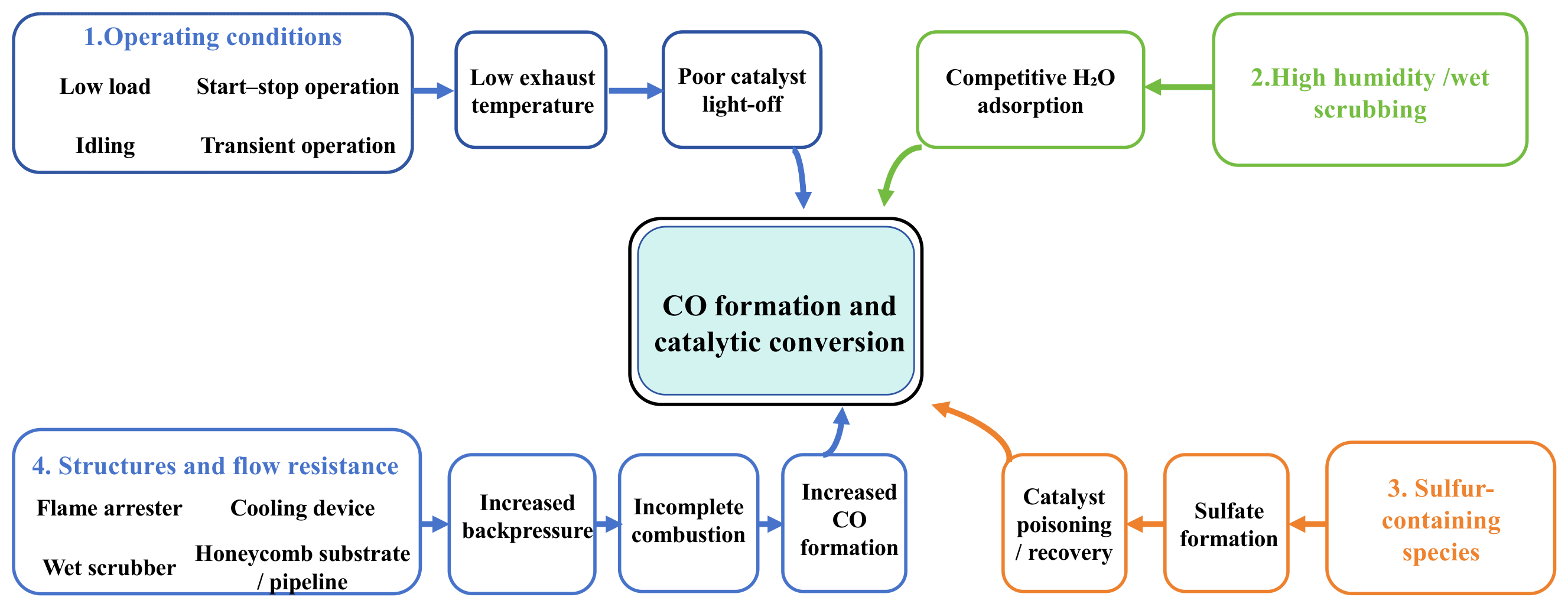
An increase in backpressure can alter the engine gas-exchange process, increase residual exhaust gas, and reduce intake efficiency, which may further lead to incomplete combustion and increased CO formation [43,64,65,66]. Backpressure also affects the flow distribution and residence time of exhaust gas in the aftertreatment system. If the flow-channel design is inappropriate, excessively high local flow velocity can reduce catalyst utilization. In addition, dust deposition or channel blockage may cause a continuous increase in pressure drop, forming an unfavorable cycle of “increased backpressure–deteriorated combustion–higher CO emissions–greater purification load” [67,68,69,70,71]. Figure 2 summarizes the major factors affecting CO purification in diesel-powered mining equipment.

3. Research Progress in CO Purification Technologies for Mining Diesel Engines

The selection of CO purification technologies for mining diesel engines should consider pollutant formation at the source, exhaust transport, aftertreatment reaction conditions, and underground safety constraints. Owing to the complexity of underground exhaust conditions, CO purification technologies should achieve effective coordination among source emission reduction, pretreatment, and end-stage conversion. Previous studies have shown that CO and PM can easily become enriched around vehicles, near exhaust outlets, and in areas with poor local ventilation [67,68]. Therefore, a rational purification strategy should integrate source control, process pretreatment, and end-stage catalytic conversion.

3.1. In-Cylinder Control Technologies

In-cylinder control aims to reduce the CO source strength during its formation stage. CO emissions from diesel engines mainly originate from local oxygen-deficient regions in the cylinder, non-uniform fuel–air mixing, low combustion temperature, or insufficient residence time. Studies on the EGR rate, oxygenated fuel components, and fuel injection parameters have shown that improving mixture formation, regulating combustion temperature, and optimizing the air–fuel ratio can alter the distribution of CO, HCs, NOx, and smoke opacity. However, these measures are usually accompanied by trade-offs among different pollutants [72,73,74]. The coupling of EGR and fuel injection parameters affects in-cylinder pressure, heat release rate, and combustion duration. Although an excessively high EGR rate can suppress NOx formation, it may increase CO or HC emissions because of reduced oxygen concentration and lower combustion temperature [75].
Underground mining diesel engines often operate under low-load, idling, and transient conditions. In addition, their intake and exhaust systems must be modified to meet explosion-proof requirements. Flame arresters, cooling devices, and exhaust purification components increase flow resistance and affect gas-exchange efficiency [44,45,46]. Therefore, in-cylinder control is suitable for reducing the CO source strength and alleviating the burden on aftertreatment systems. However, owing to explosion-proof modifications, power output requirements, and transient load variations, it is generally difficult for in-cylinder control alone to meet the requirements for stable CO control in underground mines [72,75].

3.2. Wet Purification Technologies

Wet purification is a common approach for exhaust cooling, flame arresting, and PM pretreatment in explosion-proof mining diesel engines. Exhaust gas purification water tanks, water scrubbers, spray purification devices, and water-bath structures can reduce exhaust temperature through gas–liquid heat exchange and capture part of soot, ash, and soluble pollutants. Studies on exhaust cooling systems for explosion-proof mining diesel engines have shown that conventional wet cooling or purification water tanks can meet the requirements for cooling and explosion-proof safety. However, they still have limitations in terms of power performance, fuel economy, blockage, and deep pollutant control [44,45].
The core advantage of wet purification lies in safety-oriented pretreatment rather than deep CO conversion [76]. Studies on atomized tubular scrubbing and wet dust removal have shown that water mist or spray processes can effectively capture diesel PM, smoke, and dust [69,77]. However, because CO has low solubility in water, simple water scrubbing is insufficient for efficient CO removal unless a dedicated oxidative absorption or catalytic conversion process is introduced. In addition, after water scrubbing, the exhaust temperature decreases and humidity increases, which may make subsequent catalyst light-off more difficult and intensify water-induced inhibition [44,45,46]. Therefore, wet purification should be positioned as a safety pretreatment unit rather than a deep CO purification unit.

3.3. Adsorption and NTP Purification Technologies

Adsorption and NTP technologies have potential for low-temperature exhaust treatment and are currently more suitable as auxiliary purification methods or emerging research directions. Adsorptive purification relies on materials such as activated carbon, molecular sieves, and metal-oxide-modified adsorbents to capture pollutants. Its selectivity toward CO depends on pore structure, metal sites, surface chemistry, adsorption heat, and related factors [78,79,80,81]. However, CO has weak molecular polarity, and H2O, CO2, HCs, NOx, SO2, and PM in real exhaust can compete for adsorption sites. In particular, high-humidity underground environments are unfavorable for maintaining adsorption capacity and selectivity. Regeneration after adsorbent saturation, dust blockage, and sulfur contamination also limit continuous operation.
NTP can promote low-temperature oxidation through high-energy electrons, free radicals, and reactive oxygen species, and is therefore of research interest for exhaust purification under low-load conditions [82]. Studies on NTP treatment of diesel exhaust have shown that it can convert NOx, HCs, and a fraction of CO. When coupled with activated carbon, catalysts, or adsorptive materials, NTP can further improve low-temperature reaction efficiency [82,83,84]. However, underground applications must address several challenges, including electrical explosion-proof requirements for high-voltage power supplies and discharge structures, energy consumption, by-product formation, discharge stability, and maintenance reliability [82,84,85]. Therefore, adsorption and NTP technologies are currently more suitable as low-temperature auxiliary or coupled purification technologies.

3.4. Catalytic Oxidation Technologies

Catalytic oxidation lowers the activation energy of the reaction between CO and O2, enabling CO to be converted into CO2 at relatively low temperatures. Catalytic oxidation represents one of the most engineering-feasible routes for efficient CO conversion in mining diesel engines, provided that catalyst activity can be maintained under the thermal and chemical conditions of mine exhaust. A DOC is the typical form of this technology in diesel exhaust aftertreatment. Its main functions are to promote the oxidation of CO and unburned HCs, while also affecting the conversion of NO to NO2 and the operation of downstream diesel particulate filter (DPF) and selective catalytic reduction (SCR) systems [19,20,21]. Studies on DOC + catalyzed diesel particulate filter (CDPF) + SCR systems for non-road diesel engines have shown that DOCs can significantly reduce CO and HC emissions and provide favorable conditions for the coordinated control of PM and NOx [4,86].
CO catalytic oxidation systems mainly include noble-metal catalysts, transition-metal oxides, and structured catalytic units. Noble-metal catalysts such as Pt, Pd, and Au exhibit favorable low-temperature activity and have been widely adopted in diesel aftertreatment systems. However, they are costly and susceptible to water vapor, sulfur compounds, and thermal shock [22,54,87]. Transition-metal oxides based on Cu, Mn, Co, and Fe are less expensive and possess tunable redox properties. Existing studies have also indicated their potential for low-cost supports and mining-oriented adaptation [88]. Structured catalysts and monolithic substrates are beneficial for reducing pressure drop, improving mass transfer, and enabling engineering integration, and they represent a key form for translating powder-based catalyst evaluation into practical devices.
Compared with conventional surface operating conditions, mining conditions impose more stringent requirements on catalytic oxidation. Low and fluctuating exhaust temperatures may keep the catalyst in a partially light-off state for extended periods [21,25]. High-humidity exhaust or exhaust after water scrubbing may intensify water-vapor inhibition and hydrothermal aging [22,54]. SO2 may cause sulfate deposition and poisoning of active sites, while dust deposition may cover active surfaces or block pores and channels [35,47]. Therefore, the application of catalytic oxidation in mining environments depends not only on catalyst activity, but also on whether this activity can be retained after integration with safety-oriented cooling and flow-control structures.

3.5. Applicability Analysis of Different Technologies

Different technologies play different roles in CO control for mining applications. In-cylinder control mainly focuses on source emission reduction, wet purification emphasizes safety-oriented cooling and pretreatment, adsorption and NTP are more suitable for low-temperature assistance or emerging exploration, and catalytic oxidation is responsible for CO conversion [89]. Existing studies have shown that the control efficiencies of CO, NOx, NO2, and ultrafine particles are closely related to exhaust temperature, maintenance status, and system configuration; therefore, field validation is essential [70,90,91]. Overall, CO purification for mining applications should adopt an integrated route consisting of “source emission reduction–safety pretreatment–catalytic conversion–condition monitoring” [46,70,86]. The applicability, advantages, limitations, and potential roles of different CO purification technologies in mining diesel engines are compared in Table 1.

4. Research Progress in Low-Temperature Catalytic Oxidation Materials for CO

Catalytic materials determine low-temperature CO conversion efficiency and stability. For diesel-powered mining equipment, material evaluation should consider not only initial activity, but also durability under humid, sulfur-containing, and dust-laden exhaust, together with compatibility with structured catalyst loading. In this review, low-temperature CO oxidation catalysts are discussed from two related perspectives: composition/support chemistry and active-site dispersion state. Noble-metal catalysts and transition-metal/CeO2-based reducible oxide catalysts are discussed according to their dominant active components, support functions, and redox properties, whereas SACs are treated as an atomic-scale active-site design strategy. Therefore, these categories are not strictly mutually exclusive; for example, atomically dispersed Pt/CeO2 or Pd/CeO2 can be discussed as SACs, whereas conventional nanoparticles, mixed oxides, and monolithic catalyst coatings are more appropriately discussed under noble-metal or reducible-oxide catalyst systems.
In this review, structured catalysts are not treated as a separate category of active materials. Instead, they refer to engineering catalytic units formed by loading the above active components onto monolithic supports, such as ceramic honeycombs, metallic honeycombs, and metal meshes, through washcoating, impregnation, in situ growth, or shaping. Their core functions are to reduce pressure drop, improve mass transfer, enhance mechanical stability, and facilitate aftertreatment system integration [87,94,95].

4.1. Mechanisms of Low-Temperature Catalytic CO Oxidation

The overall reaction of catalytic CO oxidation is expressed as CO + 1/2O2 → CO2. This reaction is thermodynamically favorable. However, under the low-temperature exhaust conditions of mining diesel engines, the adsorption and activation of CO and O2, as well as the surface reaction rate, are kinetically limited. Therefore, catalysts are required to lower the reaction activation energy. In different catalytic systems, CO oxidation is commonly interpreted through the Langmuir–Hinshelwood, Eley–Rideal, and Mars–van Krevelen mechanisms [50,51,96].
For noble-metal catalysts, the Langmuir–Hinshelwood mechanism is commonly used to describe low-temperature CO oxidation. In this mechanism, both CO and O2 are first adsorbed on the catalyst surface, followed by surface reactions between adsorbed species. The simplified pathway involving adsorbed surface oxygen can be written as follows:
CO + * ⇌ CO*
O2 + 2* ⇌ 2O*
CO* + O* → CO2 + 2*
Here, CO* and O* denote adsorbed CO and adsorbed oxygen, respectively, while * represents the active site released after the reaction. This pathway is suitable for explaining reaction processes controlled by CO adsorption and O2 activation on noble-metal surfaces such as Pt, Pd, and Au. Excessively strong CO adsorption may cause active-site coverage, whereas insufficient O2 activation can limit the reaction rate. Therefore, the particle size, electronic structure, dispersion state, and metal–support interfacial regulation of noble metals all influence low-temperature light-off performance [50,96].
The Eley–Rideal mechanism emphasizes the direct reaction between gas-phase CO and surface active oxygen, which can be simplified as follows:
CO(g) + O* → CO2 + *
This pathway highlights the importance of active surface oxygen species and is applicable to certain surfaces with high oxygen coverage, SACs, or oxide systems with strong oxygen activation capability. For low-temperature exhaust from mining diesel engines, catalysts that can continuously generate highly reactive oxygen species at low temperatures are beneficial for improving CO conversion efficiency before and after light-off [97,98].
For reducible oxides such as CeO2, MnOx, Co3O4, and CuO–CeO2, the Mars–van Krevelen mechanism better reflects the roles of lattice oxygen, oxygen vacancies, and oxygen migration in the reaction. The basic process can be expressed as follows:
CO + O_latt → CO2 + V_O
V_O + 1/2O2 → O_latt
Here, O_latt represents lattice oxygen, and V_O represents an oxygen vacancy.
It should be noted that the activation energy of CO oxidation is generally reported as an apparent kinetic parameter rather than a fixed value for a universal reaction pathway. Non-catalytic CO oxidation usually requires much higher temperatures and is not efficient under low-temperature exhaust purification conditions. In catalytic systems, the apparent activation energy depends strongly on the catalyst composition, support, surface coverage, gas composition, temperature range, and assumed kinetic model. Therefore, activation energy values are more suitable for comparing catalysts tested under similar conditions, rather than being treated as universal constants for all CO oxidation reactions. In general, catalysts reduce the apparent kinetic barrier by promoting CO adsorption, O2 activation, lattice or adsorbed oxygen participation, and transition-state stabilization at metal–support interfaces [50,51,99].
In real diesel exhaust, these mechanisms are not mutually exclusive [50,51,98,100]. Temperature, H2O, SO2, HCs, NOx, oxygen vacancies in the support, metal valence states, and interfacial structures may all alter the dominant reaction pathway. Under the low-temperature, high-humidity, and sulfur-containing conditions of mining diesel engines, the generation of active oxygen species, coverage by water-derived hydroxyl groups, sulfate formation, and PM deposition jointly affect the reaction rate and deactivation behavior. Therefore, mechanistic analysis should help explain activity retention and deactivation modes under complex exhaust conditions. To further clarify the relationship between catalytic mechanisms and mining application requirements, the typical CO oxidation pathways and their relevance to mining environments are summarized in Table 2.
Besides the classical L-H, E-R, and MvK mechanisms, CO oxidation over practical catalysts may involve mixed or derivative pathways. Interfacial or bifunctional mechanisms can occur on supported noble-metal catalysts, where CO and oxygen species are activated at different metal or metal–support sites. The dominant pathway over noble-metal catalysts may also vary with catalyst structure, support properties, and H2O content. In humid atmospheres, water- or hydroxyl-assisted pathways may affect oxygen activation, vacancy replenishment, and surface intermediate transformation [50]. Carbonate-mediated MvK pathways have also been proposed for Cu–Ce oxides, suggesting that carbonate-like intermediates may participate in low-temperature CO oxidation [104]. In addition, termolecular Eley–Rideal-type pathways have been reported for single-atom catalysts, in which CO and O2-derived species participate cooperatively [97]. These findings indicate that the dominant mechanism may change with catalyst composition, gas atmosphere, and surface state.

4.2. Noble-Metal Catalysts

Noble-metal catalysts are among the most active material systems for low-temperature CO oxidation and have been widely adopted in diesel aftertreatment systems. Typical active components include Pt, Pd, Au, Rh, and Ru [87,94,105,106]. Pt-based and Pd-based catalysts have been widely used in DOCs, where they mainly promote the oxidation of CO and HCs and influence the conversion of NO to NO2 [19,20,21]. Au-based catalysts have also attracted attention because of their remarkable activity for ultra-low-temperature CO oxidation [94]. The main advantages of noble-metal catalysts are their high low-temperature activity, extensive research foundation, and good compatibility with existing diesel aftertreatment technologies.
The low-temperature activity of noble-metal catalysts is closely related to metal particle size, dispersion state, support type, and metal–support interfacial structure. Increasing metal dispersion can expose more active sites and improve CO adsorption and oxygen activation [87,95]. Reducible oxides such as CeO2 and TiO2 can participate in the reaction through oxygen vacancies and active oxygen migration. In contrast, Al2O3, molecular sieves, and some non-oxide supports mainly affect catalytic performance by regulating metal dispersion, pore structure, acid–base properties, and interfacial electronic states [95,100,106,107]. Bimetallic structures such as Pt–Pd can further enhance activity and sulfur-poisoning recovery by modifying the electronic state, adjusting CO adsorption strength, and improving sintering resistance [58,108,109].
However, the application of noble-metal systems in mining environments is still limited by cost and stability. Water vapor may compete for active sites and induce hydrothermal aging, while SO2 may form sulfate species. PM deposition may also cover active surfaces or block pores and channels in the support [20,21,52,58,59]. In addition, mining diesel engines are subject to explosion-proof cooling and backpressure-control constraints, requiring catalysts to maintain activity at relatively low temperatures and under complex flow conditions. Therefore, noble-metal systems for mining applications should be developed toward lower metal loading, higher dispersion, and stronger poisoning resistance [35,52].

4.3. Transition-Metal and CeO2-Based Reducible Oxide Catalysts

Transition-metal oxides are potential low-cost alternatives or complementary materials to noble-metal catalysts. Typical systems include single oxides and composite oxides based on Cu, Mn, Co, and Fe [32,53,103,110]. These materials are widely available, relatively inexpensive, and compositionally tunable, making them suitable for large-scale application in mining equipment with lower maintenance costs. Their low-temperature CO oxidation activity mainly originates from multivalent metal redox cycling, lattice oxygen participation, oxygen-vacancy regulation, and synergistic effects at multi-metal interfaces [53,103].
Ce-based composite oxides play an important role in low-temperature CO oxidation. The reversible Ce3+/Ce4+ redox transition provides oxygen storage and release capacity, while oxygen vacancies facilitate O2 adsorption and activation. When Cu, Mn, Co, and other transition metals are combined with CeO2, synergistic redox cycles may be formed among multivalent metal species, thereby promoting electron transfer and the generation of active oxygen species [110,111,112,113,114,115,116,117].
Mechanistically, systems such as Cu–Ce, MnOx, and Co3O4 can be regarded as cyclic processes involving the joint participation of surface adsorbed oxygen, lattice oxygen, and oxygen vacancies. The low-temperature activity of transition-metal oxides depends not only on specific surface area or metal composition, but also on oxygen-vacancy stability, active oxygen generation capability, and the migration rate of lattice oxygen.
The main limitation of transition-metal oxides is their uncertain durability under complex exhaust conditions. Water vapor may alter surface hydroxyl states and oxygen migration, SO2 may form stable sulfates with metal sites or supports, and dust deposition may affect the accessibility of active sites [32,47,49,118]. In addition, many studies remain focused on powder catalysts or fixed-bed evaluations, whereas mining aftertreatment systems require monolithic loading, low pressure drop, vibration resistance, and blockage resistance. Therefore, the applicability of non-noble metal oxides in mining environments still needs to be verified under conditions with coexisting water vapor, sulfur species, and dust, as well as monolithic loading [88,118,119].
Although CeO2-based catalysts exhibit favorable redox properties and oxygen-storage/release capability, their use in mining diesel exhaust purification should also be considered from the perspective of resource utilization and cost-sensitive engineering deployment. Cerium is relatively abundant among rare-earth elements; however, Ce-containing catalysts still depend on rare-earth mining, separation, and processing, and their large-scale application may be affected by material cost, supply stability, and competing demand from other technological fields. Therefore, future catalyst design should not only improve the activity and stability of CeO2-based systems, but also reduce Ce loading, improve Ce utilization efficiency, and explore Ce-free or low-Ce alternatives such as Cu-, Mn-, Co-, Fe-based mixed oxides, spinel/perovskite oxides, and other earth-abundant transition-metal oxide systems for mining-oriented CO purification [31,120].

4.4. Single-Atom Catalysts

SACs contain metal active components anchored as isolated atoms on support surfaces, defect sites, or specific coordination environments, thereby achieving highly dispersed active sites and high metal utilization efficiency [25,121,122,123]. SACs are not a composition-based category completely independent of noble-metal or non-noble-metal catalysts. Instead, they represent an atomic-scale active-site design strategy. Noble-metal SACs based on Pt, Pd, and Au can help reduce noble-metal usage, whereas non-noble metal SACs based on Cu, Co, Ni, and Fe provide opportunities for low-cost catalyst design [25,101,121,122,123,124,125,126].
The advantages of SACs include high metal utilization, relatively well-defined active-site structures, and the possibility of regulating electronic structures and coordination environments through support defects, oxygen vacancies, or heteroatom modification [25,123,124,125]. Supports such as CeO2, TiO2, Al2O3, molecular sieves, and carbon materials can stabilize isolated metal atoms through metal–oxygen coordination or defect sites. However, their engineering application in mining environments still faces several challenges, including complex preparation procedures, aggregation at increased metal loadings [121,122,123], insufficient structural stability under humid, sulfur-containing, and dust-laden conditions, and limited research on washcoating onto monolithic substrates [25,125].

4.5. Performance Comparison and Mining Applicability of Catalytic Materials

Different material systems have distinct characteristics in terms of activity origin, cost, stability, and engineering applicability. Noble-metal catalysts exhibit high low-temperature activity and relatively mature compatibility with DOC technology, making them more suitable as candidates for near-term engineering validation [19,20,21,87,127]. Transition-metal oxides are low-cost and compositionally tunable, and thus represent an important direction for low-cost alternatives and composite catalytic systems [32,53,103,110,113,119,128]. SACs can improve metal utilization efficiency and help clarify reaction mechanisms, but they remain closer to a frontier research direction at present [25,101,121,122,123,124,125,126]. For CeO2-based systems, mining-oriented application should further consider rare-earth resource utilization, Ce loading, preparation cost, and supply stability, rather than evaluating these catalysts only according to low-temperature activity.
For diesel-powered mining equipment, catalyst selection should balance low-temperature CO oxidation activity, water and sulfur tolerance, dust resistance, pressure-drop control, cost, and ease of maintenance. Pt- and Pd-based catalysts supported on Al2O3, CeO2–ZrO2, TiO2, or other oxide washcoats remain the most mature candidates for near-term application because of their compatibility with DOC-type monolithic systems. However, their high cost and sensitivity to poisoning and aging require reduced noble-metal loading and stable support design. Cu-, Mn-, Co-, and Fe-based oxides are more attractive in terms of cost and raw-material availability, but their long-term durability under humid, sulfur-containing, and dust-laden exhaust still needs further verification. CeO2-based systems are more suitable as redox-promoting or oxygen-storage components in composite catalysts, and their Ce loading and utilization efficiency should be considered. SACs are promising for reducing noble-metal consumption, but their scalability, washcoating stability, and durability under mining exhaust conditions remain key challenges.
In addition, the support should not be regarded only as an inert carrier, because it affects active-site dispersion, metal–support interactions, oxygen mobility, hydrothermal stability, poisoning behavior, washcoat adhesion, mass transfer, and pressure drop in practical heterogeneous catalysts.
The selection of catalytic materials for mining applications should not be based solely on low-temperature activity under dry conditions. Because mining diesel exhaust involves humid, sulfur-containing, dust-laden, and thermally fluctuating conditions, material evaluation should place greater emphasis on activity retention, poisoning recovery, coating stability, and compatibility with monolithic structures [19,20,70,71,129]. In addition, attention should be paid to activity retention after water-vapor exposure, SO2 poisoning and recovery capability, pressure-drop changes after PM deposition, coating stability, and performance variation after long-term thermal cycling [20,52,59,70,86,130]. Their true engineering potential can be assessed only by comparing them under boundary conditions close to real mining exhaust [131]. Therefore, the material systems discussed above should be regarded as candidate bases for further engineering validation rather than as direct evidence of applicability in underground mining exhaust systems. A comparison of the activity origins, advantages, limitations, and future research priorities of different low-temperature CO oxidation catalyst systems is presented in Table 3.

5. Research Progress in Exhaust Aftertreatment Systems for Mining Diesel Engines

The exhaust aftertreatment system is the key link between catalytic material performance and practical purification effectiveness in underground engineering applications. The activity of a catalyst measured in a fixed-bed reactor or under simulated atmospheres cannot be directly equated with the actual purification capability of a mining aftertreatment system. In practical devices, additional requirements must be satisfied, including explosion-proof safety, exhaust cooling, low backpressure, resistance to humidity and dust, ease of maintenance, and long-term stable operation [44,45,46,90,93]. Therefore, research on mining aftertreatment systems should shift from the performance of individual purification units toward system-level matching among catalytic units, flame-arresting structures, cooling devices, flow-channel organization, and operation and maintenance requirements.

5.1. Wet Safety Pretreatment Systems

Wet aftertreatment systems have a relatively solid application basis in mining diesel engines. Exhaust gas purification water tanks, water-bath purification devices, spray purification systems, and wet flame-arresting and cooling structures bring exhaust gas into contact with water or purification liquid. Through gas–liquid heat exchange, these systems reduce exhaust temperature and capture part of the PM, smoke, dust, and soluble pollutants [77,92]. Their advantages lie in explosion-proof safety, exhaust cooling, and pretreatment functions. These systems have relatively simple structures, and their maintenance methods are similar to those of conventional exhaust purification devices used in explosion-proof mining diesel engines [44,45].
However, in the absence of enhanced oxidative absorption or subsequent catalytic conversion, wet systems generally cannot replace dedicated CO conversion units. Because CO has low solubility in water, simple water scrubbing is insufficient for efficient CO removal. Existing studies on wet scrubbing mainly demonstrate its role in controlling PM, smoke opacity, SOx/NOx, or soluble pollutants, whereas evidence for efficient and stable CO removal remains relatively limited [69,77,92,132,133]. In addition, after water scrubbing or water cooling, the exhaust temperature decreases and humidity increases, which may result in insufficient inlet temperature for downstream DOCs or CO catalytic units, intensified water-vapor inhibition, and contamination of catalytic substrates [21,134]. Therefore, wet systems are more suitable as pretreatment units for explosion-proof cooling and dust removal.

5.2. Dry Catalytic Aftertreatment Systems Combined with DOC

Dry catalytic aftertreatment systems rely on exhaust heat and catalytic surface reactions to oxidize and convert pollutants such as CO and HCs, making them one of the important directions for efficient CO control in mining applications [9,71]. Monolithic honeycomb catalysts, catalytic units with metal or ceramic substrates, and DOCs are typical forms of such systems. If the catalytic unit is placed upstream where substantial exhaust heat is still available, and heat loss is reduced through proper thermal insulation and flow-channel design, low-temperature light-off performance can be improved [11,44,134,135]. Monolithic substrates can also provide a relatively high specific surface area and low flow resistance within limited installation space [25,64,65].
From an engineering configuration perspective, DOCs are often coupled with particulate filtration units, SCR systems, and terminal cooling or flame-arresting structures to simultaneously address CO, HC, PM, NOx, and exhaust safety requirements [9,70,71,86,136,137,138]. In such systems, the DOC reduces CO and HC emissions, the particulate filtration unit decreases PM coverage on downstream catalytic layers, the SCR system controls NOx, and the downstream cooling or wet unit helps ensure exhaust safety at the outlet [70,71]. However, integrated systems may also introduce additional issues, including changes in the NO/NO2 ratio [19], DPF regeneration [139], the SCR temperature window, ammonia slip [137], increased system volume, higher pressure drop, and more complex maintenance. Therefore, DOC-based integrated systems for mining applications should not simply replicate the configurations used in surface diesel vehicles. Instead, they should be designed around low-temperature CO conversion and explosion-proof safety, while also considering HC, NOx, and PM control, as well as the risks of secondary pollutants such as NO2 and ammonia slip [140].

5.3. Explosion-Proof Structures, Backpressure, and Thermal Management

Explosion-proof structures, exhaust backpressure, and thermal management determine whether mining aftertreatment systems can operate reliably. Flame arresters, cooling water jackets, exhaust coolers, exhaust gas purification water tanks, insulation layers, catalyst housings, honeycomb substrates, and exhaust pipelines jointly affect system safety, purification efficiency, and flow resistance [45,46]. Flame-arresting and cooling structures can reduce exhaust temperature, control high-temperature surfaces, and suppress flame propagation. However, they may also lower the catalytic reaction temperature, increase exhaust humidity, and increase backpressure.
Backpressure is an important indicator for evaluating system applicability. Flame arresters, purification water tanks, honeycomb catalytic substrates, DPFs/particulate oxidation catalysts (POCs), and complex pipelines may all increase exhaust flow resistance [45,64,65,70]. Increased backpressure can affect the exhaust process and intake efficiency, weaken combustion completeness, and potentially increase CO formation. Meanwhile, backpressure also changes the gas-flow distribution and residence time inside the catalyst. Dust deposition and channel blockage may further cause a continuous increase in pressure drop [66,67,141]. Therefore, low-backpressure substrates, rational flow-channel design, and differential pressure monitoring are key design considerations for mining aftertreatment systems.
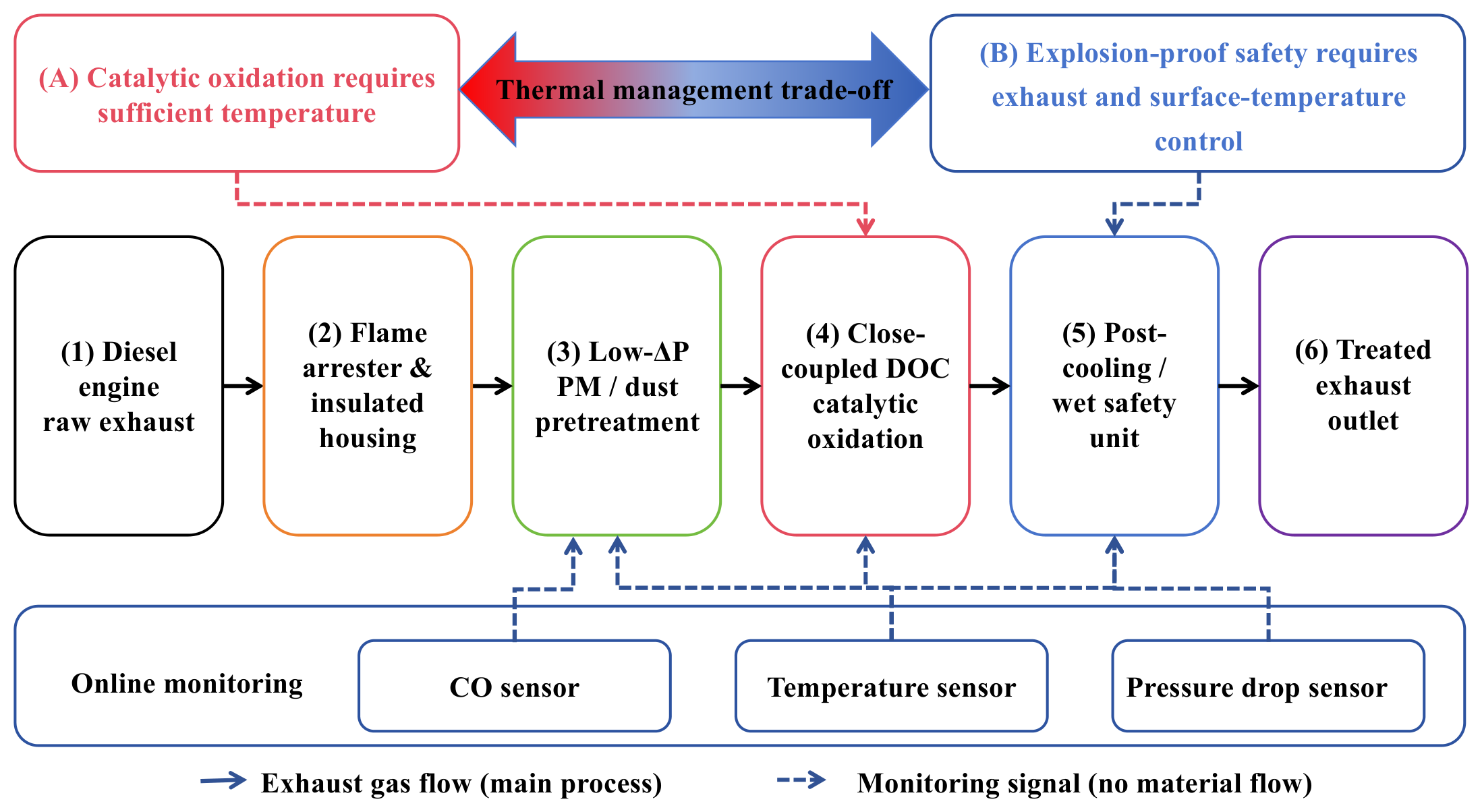
Thermal management remains a persistent design challenge for the entire system. Catalytic CO oxidation requires a certain temperature, whereas underground explosion-proof requirements impose limits on external surface temperature and exhaust outlet temperature [46]. Wet cooling is beneficial for terminal exhaust safety, but it may weaken catalytic reactions. Dry thermal insulation is favorable for catalyst light-off, but it requires solutions for shell temperature control and flame-arresting safety [134]. Under the premise of meeting the requirements for external surface temperature, explosion-proof thermal insulation, and flame-arresting safety, a configuration combining near-engine placement of the catalytic unit with downstream cooling may help balance catalytic light-off and terminal exhaust safety. At the same time, long-term system reliability should be improved through low-thermal-inertia monolithic substrates, low-backpressure flame-arresting structures, online monitoring of pressure drop, temperature, and CO, and modular maintenance design [65,93]. Figure 3 shows a schematic diagram of the integrated exhaust aftertreatment system for diesel-powered mining equipment.

6. Conclusions

CO purification for diesel-powered mining equipment is constrained by the combined effects of the underground ventilation environment, low-load and transient operation, multi-component exhaust interactions, explosion-proof safety, exhaust cooling, and backpressure control. Compared with aftertreatment systems for surface diesel vehicles, the main challenges lie in low-temperature light-off, high-humidity inhibition, sulfur poisoning, dust deposition, and the inherent conflict between the temperature required for catalysis and the cooling required for explosion-proof safety. Therefore, the evaluation of CO purification technologies for mining applications should shift from single activity indicators to stability and system compatibility under complex operating conditions.
Among existing technologies, in-cylinder control can reduce the CO source strength; wet purification is suitable for exhaust cooling, flame arresting, and dust-removal pretreatment; adsorption and NTP can serve as auxiliary technologies for low-temperature purification; and catalytic oxidation remains the core route for deep CO conversion. Noble-metal catalysts, transition-metal and CeO2-based reducible oxide catalysts, and SAC design strategies provide important candidate bases for low-temperature CO oxidation, but their direct applicability to mining diesel exhaust purification still requires further validation under coupled exhaust conditions. Therefore, future evaluation should move beyond single-factor activity tests and place greater emphasis on activity retention, poisoning recovery, dust resistance, Ce utilization, coating stability, pressure-drop control, and compatibility with explosion-proof exhaust cooling systems.
Future research should further integrate durable catalytic materials with structured purification units, safety-oriented thermal management, online monitoring, and field validation. By optimizing the integration of catalytic modules with flame-arresting structures, cooling devices, dust-removal units, low-backpressure substrates, and modular maintenance strategies, CO purification technologies for diesel-powered mining equipment may be gradually translated from laboratory-scale material research toward engineering applications after long-term validation under mining-representative conditions.

Author Contributions

Conceptualization, C.H. and Y.L.; methodology, C.H. and Y.L.; investigation, C.H., C.L. (Chengbing Liu) and C.L. (Cong Li); formal analysis, C.H. and C.L. (Chengbing Liu); writing—original draft preparation, C.H.; writing—review and editing, Y.L., C.L. (Chengbing Liu) and C.L. (Cong Li); supervision, Y.L.; funding acquisition, Y.L. All authors have read and agreed to the published version of the manuscript.

Funding

This research was funded by the Ordos Postdoctoral Research Fund, grant number OPRF2402.

Data Availability Statement

No new data were created or analyzed in this study. Data sharing is not applicable to this article.

Acknowledgments

During the preparation of this manuscript, the authors used ChatGPT (OpenAI, version GPT-5) for language polishing and improving the readability of the manuscript. The authors have reviewed and edited the output and take full responsibility for the content of this publication.

Conflicts of Interest

The authors declare no conflicts of interest.

Abbreviations

The following abbreviations are used in this manuscript:
DOCDiesel oxidation catalyst
NTPNon-thermal plasma
EGRExhaust gas recirculation
DPFDiesel particulate filter
SCRSelective catalytic reduction
CDPFCatalyzed diesel particulate filter

References

  1. Hooli, J.; Halim, A. Battery electric vehicles in underground mines: Insights from industry. Renew. Sustain. Energy Rev. 2025, 208, 115024. [Google Scholar] [CrossRef]
  2. Hooli, J.; Skawina, B.; Halim, A.; Sundqvist, F. Analysing Battery Swapping of Battery Electric Load Haul Dump (LHD) Machines in Block Cave Mining Using Discrete Event Simulation (DES). Min. Metall. Explor. 2024, 41, 2877–2890. [Google Scholar] [CrossRef]
  3. Yuan, X.; Lu, Y.; Bao, J.; Han, P.; Yin, Y.; Wang, X. Design and optimization on the degree of hybridization of underground hybrid electric trackless rubber-tyred vehicle. Energies 2022, 15, 6544. [Google Scholar] [CrossRef]
  4. Chen, X.Y.; Liu, Y.T.; Shi, J.X.; Li, L.; Gao, S.; Li, J.Y.; Li, J.; Zhang, Y.; Lin, Y.C. Study on optimization of exhaust gas purification device and CO catalytic elimination of industrial transport vehicles. Fuel Process. Technol. 2025, 276, 108286. [Google Scholar] [CrossRef]
  5. Xue, S.; Shi, G.; Tu, Q.; Li, F.; Li, C. Applying similar modeling to study vehicle exhaust transport in a confined mining space. Sci. Rep. 2024, 14, 24938. [Google Scholar] [CrossRef] [PubMed]
  6. Liu, Z.; Chen, X.; Fan, C.; Ge, S.; Deng, C.; Li, W. Similar experimental study on diffusion and distribution of diesel exhaust in confined space of a coal mine. Environ. Geochem. Health 2024, 46, 269. [Google Scholar] [CrossRef] [PubMed]
  7. Shi, G.; Xue, S.; Tu, Q.; Zhang, W.; Li, C. Numerical simulation study on the exhaust gas migration of fuel vehicles under an airflow field in the confined space of an underground coal mine. Fuel 2023, 349, 128674. [Google Scholar] [CrossRef]
  8. Zhang, H.; Li, M.; Xiao, Y.; Han, X.; Liu, B.; Yang, W. Numerical study on interactions between climate conditions and diesel exhaust and optimization of auxiliary ventilation in underground mines. Therm. Sci. Eng. Prog. 2023, 37, 101594. [Google Scholar]
  9. Hu, S.; Deng, B.; Wu, D.; Hou, K. Energy flow behavior and emission reduction of a turbo-charging and EGR non-road diesel engine equipped with DOC and DPF under NRTC (non-road transient cycle). Fuel 2021, 305, 121571. [Google Scholar]
  10. Han, S.; Nie, X.; Cui, J.; Bi, Y.; Shen, L. Effect of Different Exhaust Heat Management Strategies on the Transient Emission Characteristics of Diesel Aftertreatment Systems. ACS Omega 2025, 10, 24272–24283. [Google Scholar] [CrossRef] [PubMed]
  11. Duan, L.-S.; Tan, P.-Q.; Liu, J.-T.; Liu, Y.; Chen, Y.-J.; Lou, D.-M.; Hu, Z.-Y. Emission characteristics of a diesel engine with an electrically heated catalyst under cold start conditions. J. Clean. Prod. 2022, 380, 134965. [Google Scholar] [CrossRef]
  12. Li, Y.; Hu, J.; Li, J.; Xu, H.; Wu, Y.; Cai, Z.; Lin, Y.; Wu, H.; Li, Z. Experimental study on electrically heated catalyst coupling strategies for ultra-low emissions and energy-efficient thermal management in diesel engines. Appl. Therm. Eng. 2025, 280, 128450. [Google Scholar]
  13. Jiang, M.; Yu, C.-H.; Xu, Z.; Qin, Z. Binding of carbon monoxide to hemoglobin in an oxygen environment: Force field development for molecular dynamics. J. Chem. Theory Comput. 2024, 20, 4229–4238. [Google Scholar] [CrossRef] [PubMed]
  14. Occupational Safety and Health Administration. Carbon Monoxide. [EB/OL]. Available online: https://www.osha.gov/chemicaldata/462 (accessed on 2 July 2026).
  15. National Institute for Occupational Safety and Health. Carbon Monoxide. [EB/OL]. Available online: https://www.cdc.gov/niosh/npg/npgd0105.html (accessed on 2 July 2026).
  16. GBZ 2.1-2019; Occupational Exposure Limits for Hazardous Agents in the Workplace—Part 1: Chemical Hazardous Agents. Standards Press of China: Beijing, China, 2019; (accessed on 2 July 2026).
  17. Ministry of Emergency Management of the People’s Republic of China. Coal Mine Safety Regulations; Ministry of Emergency Management of the People’s Republic of China: Beijing, China, 2025.
  18. Gren, L.; Krais, A.M.; Assarsson, E.; Broberg, K.; Engfeldt, M.; Lindh, C.; Strandberg, B.; Pagels, J.; Hedmer, M. Underground emissions and miners’ personal exposure to diesel and renewable diesel exhaust in a Swedish iron ore mine. Int. Arch. Occup. Environ. Health 2022, 95, 1369–1388. [Google Scholar] [CrossRef] [PubMed]
  19. Zhang, Z.; Tian, J.; Li, J.; Cao, C.; Wang, S.; Lv, J.; Zheng, W.; Tan, D. The development of diesel oxidation catalysts and the effect of sulfur dioxide on catalysts of metal-based diesel oxidation catalysts: A review. Fuel Process. Technol. 2022, 233, 107317. [Google Scholar]
  20. Yang, W.W.; Gong, J.; Wang, X.; Bao, Z.H.; Guo, Y.B.; Wu, Z.L. A Review on the Impact of SO2 on the Oxidation of NO, Hydrocarbons, and CO in Diesel Emission Control Catalysis. ACS Catal. 2021, 11, 12446–12468. [Google Scholar] [CrossRef]
  21. Karre, A.V.; Garlapalli, R.K.; Jena, A.; Tripathi, N. State of the art developments in oxidation performance and deactivation of diesel oxidation catalyst (DOC). Catal. Commun. 2023, 179, 106682. [Google Scholar] [CrossRef]
  22. Khan, H.A.; Abou-Daher, M.; de Freitas, A.-L.S.; Subburaj, J.; Tall, O.E.; Farooq, A. Performance studies of Pt, Pd and PtPd supported on SBA-15 for wet CO and hydrocarbon oxidation. Catal. Today 2024, 426, 114370. [Google Scholar]
  23. Liu, K.; Liao, L.; Liao, G. Impact of catalyst support on water-assisted CO oxidation over PdO/MO 2 (M= Sn, Ti, and Si) catalysts: Experimental and theoretical investigation. Nanoscale 2024, 16, 21783–21793. [Google Scholar] [PubMed]
  24. Ding, X.; Liu, Z.; Liang, Y.; He, D.; Yao, P.; Lai, X.; Zhao, M.; Wang, J.; Chen, Y. The inhibition mechanism of H2O at hydrothermal aging over Pt/SiO2-Al2O3 for NO oxidation. J. Environ. Chem. Eng. 2021, 9, 105497. [Google Scholar]
  25. Hoang, S.; Guo, Y.; Binder, A.J.; Tang, W.; Wang, S.; Liu, J.; Tran, H.; Lu, X.; Wang, Y.; Ding, Y. Activating low-temperature diesel oxidation by single-atom Pt on TiO2 nanowire array. Nat. Commun. 2020, 11, 1062. [Google Scholar] [PubMed]
  26. Liu, X.; Jia, S.; Yang, M.; Tang, Y.; Wen, Y.; Chu, S.; Wang, J.; Shan, B.; Chen, R. Activation of subnanometric Pt on Cu-modified CeO2 via redox-coupled atomic layer deposition for CO oxidation. Nat. Commun. 2020, 11, 4240. [Google Scholar] [CrossRef] [PubMed]
  27. Lu, Y.; Lin, F.; Zhang, Z.; Thompson, C.; Zhu, Y.; Doudin, N.; Kovarik, L.; García Vargas, C.E.; Jiang, D.; Fulton, J.L. Enhancing activity and stability of Pd-on-TiO2 single-atom catalyst for low-temperature CO oxidation through in situ local environment tailoring. J. Am. Chem. Soc. 2024, 146, 28141–28152. [Google Scholar]
  28. Farhan, S.M.; Wang, P.; Yin, J.; Yi, J.; Chen, Z. Optimizing Pt/Pd ratios for enhanced low-temperature catalytic oxidation of CO and C3H6 on Al2O3 support. Catal. Lett. 2024, 154, 4678–4691. [Google Scholar] [CrossRef]
  29. He, J.; Yang, X.; Zhu, Z.; Luo, X.; Wu, C.-E.; Cui, Y.; Ge, Q.; Qiu, J.; Xu, L.; Chen, M. Enhanced low-temperature CO oxidation activity through crystal facet engineering of Pd/CeO2 catalysts. Ceram. Int. 2024, 50, 36363–36374. [Google Scholar]
  30. Han, M.; Wang, Y.; She, X.; Zhang, Z.; Li, X.; Guo, Z. Recent progress in CO oxidation over non-precious-metal catalysts. Ind. Eng. Chem. Res. 2024, 64, 36–52. [Google Scholar]
  31. Konsolakis, M.; Lykaki, M. Recent Advances on the Rational Design of Non-Precious Metal Oxide Catalysts Exemplified by CuOx/CeO2 Binary System: Implications of Size, Shape and Electronic Effects on Intrinsic Reactivity and Metal-Support Interactions. Catalysts 2020, 10, 160. [Google Scholar] [CrossRef]
  32. Shen, Z.; Xing, X.; She, Y.; Wang, S.; Lv, M.; Li, J.; Li, H. Revealing of K and SO2 poisoning mechanism on CuCeOx catalyst for low-temperature CO oxidation. Chem. Eng. J. 2024, 485, 149373. [Google Scholar]
  33. Yang, W.W.; Li, L.; Fang, Y.R.; Shan, Y.L.; Xu, J.; Shen, H.; Yu, Y.B.; Guo, Y.B.; He, H. Interfacial structure-governed SO2 resistance of Cu/TiO2 catalysts in the catalytic oxidation of CO. Catal. Sci. Technol. 2020, 10, 1661–1674. [Google Scholar] [CrossRef]
  34. Gao, Q.; Dong, C.; Hu, X.; Zhang, J.; Xue, J.; Zhao, Y.; Wang, X. Effect of the Fe2O3@ TiO2 core-shell structure on CO catalytic oxidation and SO2 poisoning resistance. Mol. Catal. 2023, 547, 113308. [Google Scholar] [CrossRef]
  35. Chen, J.; Su, Y.; Meng, Q.; Qian, H.; Shi, L.; Darr, J.A.; Wu, Z.; Weng, X. Palladium encapsulated by an oxygen-saturated TiO2 overlayer for low-temperature SO2-tolerant catalysis during CO oxidation. Angew. Chem. 2023, 135, e202310191. [Google Scholar] [CrossRef]
  36. Li, Y.; Liao, J.; Xu, H.; Wu, Y.; Cai, Z.; Hu, J. Comprehensive experimental analysis of a diesel engine with an electrically heated catalyst and Close-Coupled SCR during Cold/Hot WHTC. Appl. Therm. Eng. 2025, 262, 125277. [Google Scholar]
  37. Qi, X.R.; Fan, X.X.; Li, L. Graphite decorated Pt/α-Fe2O3 composite with outstanding CO oxidation performance in the presence of SO2 and moisture. J. Environ. Chem. Eng. 2025, 13, 119273. [Google Scholar] [CrossRef]
  38. Nie, W.; Liu, X.F.; Liu, C.Y.; Guo, L.D.A.; Hua, Y. Prediction of dispersion behavior of typical exhaust pollutants from hydraulic support transporters based on numerical simulation. Environ. Sci. Pollut. Res. 2022, 29, 38110–38125. [Google Scholar] [CrossRef] [PubMed]
  39. Kurnia, J.C.; Sasmito, A.P.; Wong, W.Y.; Mujumdar, A.S. Prediction and innovative control strategies for oxygen and hazardous gases from diesel emission in underground mines. Sci. Total Environ. 2014, 481, 317–334. [Google Scholar] [CrossRef] [PubMed]
  40. Panteleev, I.; Semin, M.; Grishin, E.; Kormshchikov, D.; Iziumova, A.; Verezhak, M.; Levin, L.; Plekhov, O. Deep Learning Prediction of Exhaust Mass Flow and CO Emissions for Underground Mining Application. Algorithms 2025, 18, 630. [Google Scholar] [CrossRef]
  41. Feng, R.; Yu, J.; Shu, X.; Deng, B.; Hua, Z. Can the world harmonized steady cycle (WHSC) accurately reflect real-world driving conditions for heavy-duty diesel engine emission valuations? A comprehensive experimental study. Therm. Sci. Eng. Prog. 2025, 59, 103321. [Google Scholar] [CrossRef]
  42. Zhang, X.W.; Huang, X.; Ni, P.Y.; Li, X. Strategies to Reduce Emissions from Diesel Engines under Cold Start Conditions: A Review. Energies 2023, 16, 5192. [Google Scholar] [CrossRef]
  43. Deng, B.; Cai, W.; Zhang, W.; Bian, L.; Che, X.; Xiang, Y.; Wu, D. A comprehensive investigation of EGR (exhaust gas recirculation) effects on energy distribution and emissions of a turbo-charging diesel engine under World Harmonized transient cycle. Energy 2025, 316, 134506. [Google Scholar] [CrossRef]
  44. Shi, Z.; Wei, H.; Li, G.; Wang, Y.; Li, Q.; Zheng, X.; Song, K.; Chen, C.; Ma, C.; Mozumder, S.A. Research and Analysis of Explosion-Proof Diesel Engine Performance Based on Different Exhaust Gas Cooling Systems. Energies 2025, 18, 610. [Google Scholar] [CrossRef]
  45. Shi, Z.; Feng, H.; Chen, C.; Nie, Y. Research on the performance degradation and failure mechanism of exhaust Systems for explosion proof diesel engines in different mining applications. PLoS ONE 2026, 21, e0329903. [Google Scholar] [CrossRef] [PubMed]
  46. Zhang, L.; Sang, L.; Bao, J.; Wang, F.; Tang, B.; Hu, D.; Yuan, X.; Yin, Y. Multi-elements exhaust purification device for explosion-proof diesel engine of TRTV based on EGR plus DOC plus CDPF plus EPTC. Proc. Inst. Mech. Eng. Part D J. Automob. Eng. 2026. [Google Scholar] [CrossRef]
  47. Wang, L.; Bai, Y.; Wang, H.; Wu, Z. Simple solid mixed Pt/TiO2-ZrO2 catalyst for CO oxidation with excellent sulfur and water resistance at relatively low temperature. Fuel 2024, 371, 131904. [Google Scholar] [CrossRef]
  48. He, K. In situ DRIFTS and TPD studies on surface properties affecting SO2-resistance of Pt/TiO2 catalyst in low-temperature CO oxidation. Surf. Sci. 2023, 734, 122315. [Google Scholar] [CrossRef]
  49. Yu, Z.; Cai, J.; Meng, Y.; Li, J.; Liang, W.; Fan, X. Loading Eu2O3 enhances the CO oxidation activity and SO2 resistance of the Pt/TiO2 catalyst. Catalysts 2025, 15, 783. [Google Scholar]
  50. Wang, Y.R.; Ma, J.M.; Wang, X.Y.; Zhang, Z.S.; Zhao, J.H.; Yan, J.; Du, Y.P.; Zhang, H.B.; Ma, D. Complete CO Oxidation by O2 and H2O over Pt-CeO2-δ/MgO Following Langmuir-Hinshelwood and Mars-van Krevelen Mechanisms, Respectively. ACS Catal. 2021, 11, 11820–11830. [Google Scholar] [CrossRef]
  51. Holm, A.; Davies, B.; Bibi, S.B.; Moncada, F.; Halldin-Stenlid, J.; Paskevicius, L.; Claman, V.; Slabon, A.; Tai, C.W.; dos-Santos, E.C.; et al. A Water-Promoted Mars-van Krevelen Reaction Dominates Low-Temperature CO Oxidation over Au-Fe2O3 but Not over Au-TiO2. ACS Catal. 2024, 14, 3191–3197. [Google Scholar] [CrossRef] [PubMed]
  52. Schuetz, J.; Stoermer, H.; Lott, P.; Deutschmann, O. Effects of hydrothermal aging on CO and NO oxidation activity over monometallic and bimetallic Pt-Pd catalysts. Catalysts 2021, 11, 300. [Google Scholar] [CrossRef]
  53. Zhao, S.; Wu, P.; Lin, J.; Li, Y.; Li, A.; Jin, X.; Chen, Y.; Zhao, B.; Zhao, Y.; Chen, G.; et al. Unveiling the water-resistant mechanism of Cu(I)-O-Co interfaces for catalytic oxidation. Chem. Eng. J. 2022, 429, 132219. [Google Scholar] [CrossRef]
  54. Hazlett, M.J.; Epling, W.S. Mechanistic effects of Water on Carbon monoxide and propylene oxidation on platinum and palladium bimetallic catalysts. Catal. Today 2021, 360, 401–410. [Google Scholar] [CrossRef]
  55. Boronin, A.I.; Slavinskaya, E.M.; Figueroba, A.; Stadnichenko, A.I.; Kardash, T.Y.; Stonkus, O.A.; Fedorova, E.A.; Muravev, V.V.; Svetlichnyi, V.A.; Bruix, A.; et al. CO oxidation activity of Pt/CeO2 catalysts below 0 °C: Platinum loading effects. Appl. Catal. B-Environ. Energy 2021, 286, 119931. [Google Scholar] [CrossRef]
  56. Peng, P.; Li, J.; Mo, S.P.; Zhang, Q.; Shen, T.M.; Xie, Q.L. Bimetallic Pt-Co Nanoparticle Deposited on Alumina for Simultaneous CO and Toluene Oxidation in the Presence of Moisture. Processes 2021, 9, 230. [Google Scholar] [CrossRef]
  57. Almousawi, M.; Xie, S.H.; Kim, D.; Ye, K.L.; Zhang, X.; Loukusa, J.; Ma, L.; Ehrlich, S.; Tetard, L.; Liu, F.D. Hydroxyls on CeO2 Support Promoting CuO/CeO2 Catalyst for Efficient CO Oxidation and NO Reduction by CO. Environ. Sci. Technol. 2023, 58, 883–894. [Google Scholar] [CrossRef] [PubMed]
  58. Ho, P.H.; Woo, J.W.; Ilmasani, R.F.; Han, J.; Olsson, L. The role of Pd-Pt Interactions in the Oxidation and Sulfur Resistance of Bimetallic Pd-Pt/γ-Al2O3 Diesel Oxidation Catalysts. Ind. Eng. Chem. Res. 2021, 60, 6596–6612. [Google Scholar] [CrossRef]
  59. Honkanen, M.; Huuhtanen, M.; Kärkkäinen, M.; Kanerva, T.; Lahtonen, K.; Väliheikki, A.; Kallinen, K.; Keiski, R.L.; Vippola, M. Characterization of Pt-based oxidation catalyst–Deactivated simultaneously by sulfur and phosphorus. J. Catal. 2021, 397, 183–191. [Google Scholar] [CrossRef]
  60. Shan, C.P.; Hou, X.Y.; Han, R.; Jia, Q.W.; Hou, N.; Wang, Y.C.; Liu, C.X.; Liu, Q.L. Recent Advances of Gaseous Pollutant Catalytic Oxidation over Precious Metal Catalysts with SO2 Exposure. Environ. Sci. Technol. 2025, 59, 2348–2367. [Google Scholar] [CrossRef] [PubMed]
  61. Ho, P.H.; Shao, J.L.; Yao, D.W.; Di, W.; Creaser, D.; Olsson, L. Role of the supports during phosphorus poisoning of diesel oxidation catalysts. Chem. Eng. J. 2023, 468, 143548. [Google Scholar] [CrossRef]
  62. Xiang, L.; Wang, C.Q.; Nie, G.; Lou, M.H.; Luo, X.Q.; Ding, J.Y.; Li, R.N.; Wu, Z.B.; Weng, X.L. In Situ-Formed Tridentate Pd-SOx Coordination for Sulfur-Tolerant CO Oxidation Catalysis. Environ. Sci. Technol. 2025, 59, 13073–13084. [Google Scholar] [CrossRef] [PubMed]
  63. Li, Z.Y.; Chen, J.D.; Jiang, M.; Li, L.N.; Zhang, J.Y.; Duan, W.B.; Wen, J.J.; Wang, H.M.; Liu, M.; Zhang, Q.L.; et al. Study on SO2 Poisoning Mechanism of CO Catalytic Oxidation Reaction on Copper-Cerium Catalyst. Catal. Lett. 2022, 152, 2729–2737. [Google Scholar] [CrossRef]
  64. Tan, P.-Q.; Yao, C.-J.; Wang, D.-Y.; Zhu, L.; Hu, Z.-Y.; Lou, D.-M. Design and optimization of exhaust gas aftertreatment system for a heavy-duty diesel engine. J. Cent. South Univ. 2022, 29, 2127–2141. [Google Scholar] [CrossRef]
  65. Qiang, T.P.; Peng, L.Y.; De Yuan, W.; Yuan, H.Z.; Di Ming, L. Effects of Catalyst Structural Parameters on the Performance of Exhaust Gas Aftertreatment System of Diesel Engines. Int. J. Automot. Technol. 2022, 23, 1085–1097. [Google Scholar] [CrossRef]
  66. Yu, T.; Li, K.; Wu, Q.; Yao, P.; Ke, J.; Wang, B.; Wang, Y. Diesel engine emission aftertreatment device aging mechanism and durability assessment methods: A review. Atmosphere 2023, 14, 314. [Google Scholar] [CrossRef]
  67. Liu, C.; Nie, W.; Hua, Y.; Niu, W. The migration of CO and PM under different working conditions of trackless rubber-tyred vehicle and health risk assessment of underground personnel. Chemosphere 2022, 307, 135750. [Google Scholar] [CrossRef] [PubMed]
  68. Hua, Y.; Nie, W.; Liu, Q.; Liu, X.; Liu, C.; Zhou, W.; Yu, F. Analysis of diffusion behavior of harmful emissions from trackless rubber-wheel diesel vehicles in underground coal mines. Int. J. Min. Sci. Technol. 2022, 32, 1285–1299. [Google Scholar] [CrossRef]
  69. Tabor, J.; Sarver, E.; Saylor, J.R. A fog-and-tube scrubber for the removal of diesel particulate matter from engine exhaust. Aerosol Air Qual. Res. 2021, 21, 210134. [Google Scholar]
  70. Feng, R.H.; Hu, X.L.; Li, G.H.; Sun, Z.W.; Deng, B.L. A comparative investigation between particle oxidation catalyst (POC) and diesel particulate filter (DPF) coupling aftertreatment system on emission reduction of a non-road diesel engine. Ecotoxicol. Environ. Saf. 2022, 238, 113576. [Google Scholar] [CrossRef] [PubMed]
  71. Hu, J.; Liao, J.; Hu, Y.; Lei, J.; Zhang, M.; Zhong, J.; Yan, F.; Cai, Z. Experimental investigation on emission characteristics of non-road diesel engine equipped with integrated DOC+ CDPF+ SCR aftertreatment. Fuel 2021, 305, 121586. [Google Scholar]
  72. Sethin, A.; Oo, Y.M.; Thawornprasert, J.; Somnuk, K. Effects of Blended Diesel-Biodiesel Fuel on Emissions of a Common Rail Direct Injection Diesel Engine with Different Exhaust Gas Recirculation Rates. ACS Omega 2024, 9, 20906–20918. [Google Scholar] [CrossRef] [PubMed]
  73. Ramesh, T.; Sathiyagnanam, A.; Poures, M.V.D.; Murugan, P. A comprehensive study on the effect of dimethyl carbonate oxygenate and EGR on emission reduction, combustion analysis, and performance enhancement of a CRDI diesel engine using a blend of diesel and Prosopis juliflora biodiesel. Int. J. Chem. Eng. 2022, 2022, 5717362. [Google Scholar] [CrossRef]
  74. Jayabal, R.; Thangavelu, L.; Subramani, S. Combined effect of oxygenated additives, injection timing and EGR on combustion, performance and emission characteristics of a CRDi diesel engine powered by sapota biodiesel/diesel blends. Fuel 2020, 276, 118020. [Google Scholar] [CrossRef]
  75. Suresh, A.; Babu, A.V.; Balaji, B.; Ranjit, P. Experimental investigation of NOx emission control using carbon nanotube additives and EGR configuration on CRDI engine fueled with ternary fuel. Biofuels 2024, 15, 1315–1329. [Google Scholar]
  76. Ni, P.Y.; Wang, X.L.; Li, H. A review on regulations, current status, effects and reduction strategies of emissions for marine diesel engines. Fuel 2020, 279, 118477. [Google Scholar] [CrossRef]
  77. Nguyen, K.T.; Vu, M.D.; Le, D.T.; Xuan, P.P. A feasibility Study on the exhaust-gas treatment efficiency of a wet-scrubber system equipped in a diesel engine: A focus on smoke emission. J. Mil. Sci. Technol. 2023, 89, 153–159. [Google Scholar]
  78. Feyzbar-Khalkhali-Nejad, F.; Hassani, E.; Rashti, A.; Oh, T.S. Adsorption-based CO removal: Principles and materials. J. Environ. Chem. Eng. 2021, 9, 105317. [Google Scholar] [CrossRef]
  79. Rehman, S.; Zheng, X.M.; Aujla, M.I.; Mehmood, T. Recent advances in adsorptive removal of hazardous VOCs by metal-organic-framework-based materials. Chem. Eng. J. 2025, 505, 159257. [Google Scholar] [CrossRef]
  80. Pérez-Botella, E.; Valencia, S.; Rey, F. Zeolites in Adsorption Processes: State of the Art and Future Prospects. Chem. Rev. 2022, 122, 17647–17695. [Google Scholar] [CrossRef] [PubMed]
  81. Lee, J.; Theis, J.R.; Kyriakidou, E.A. Vehicle emissions trapping materials: Successes, challenges, and the path forward. Appl. Catal. B-Environ. Energy 2019, 243, 397–414. [Google Scholar] [CrossRef]
  82. Khani, M.R.; Pour, E.B.; Rashnoo, S.; Tu, X.; Ghobadian, B.; Shokri, B.; Khadem, A.; Hosseini, S.I. Real diesel engine exhaust emission control: Indirect non-thermal plasma and comparison to direct plasma for NOX, THC, CO, and CO2. J. Environ. Health Sci. Eng. 2020, 18, 743–754. [Google Scholar] [CrossRef] [PubMed]
  83. Wang, Z.Y.; Kuang, H.L.; Zhang, J.F.; Zhang, W.; Chu, L.L.; Yu, C.R.; Ji, Y.L. Diesel engine exhaust denitration using non-thermal plasma with activated carbon. React. Chem. Eng. 2020, 5, 1845–1857. [Google Scholar] [CrossRef]
  84. Hsueh, M.H.; Wang, C.N.; Hsieh, M.C.; Lai, C.J.; Wang, S.H.; Hsieh, C.H.; Wu, T.L.; Yu, J.H. An Analysis of Exhaust Emission of the Internal Combustion Engine Treated by the Non-Thermal Plasma. Molecules 2020, 25, 6041. [Google Scholar] [CrossRef] [PubMed]
  85. Palma, V.; Cortese, M.; Renda, S.; Ruocco, C.; Martino, M.; Meloni, E. A Review about the Recent Advances in Selected NonThermal Plasma Assisted Solid-Gas Phase Chemical Processes. Nanomaterials 2020, 10, 1596. [Google Scholar] [CrossRef] [PubMed]
  86. Feng, R.H.; Hu, X.L.; Li, G.H.; Sun, Z.W.; Ye, M.; Deng, B.L. Exploration on the emissions and catalytic reactors interactions of a non-road diesel engine through experiment and system level simulation. Fuel 2023, 342, 127746. [Google Scholar] [CrossRef]
  87. Wang, S.; Li, X.M.; Lai, C.Y.; Zhang, Y.P.; Lin, X.; Ding, S.P. Recent advances in noble metal-based catalysts for CO oxidation. RSC Adv. 2024, 14, 30566–30581. [Google Scholar] [CrossRef] [PubMed]
  88. Liu, C.; Nie, W.; Hua, Y.; Lian, J.; Wu, H.; Song, X. Comparative study on the performance of different carrier-based perovskite exhaust gas removal agent for diesel vehicles in underground coal mines. Sep. Purif. Technol. 2025, 361, 131604. [Google Scholar] [CrossRef]
  89. Resitoglu, I.A.; Altinisik, K.; Keskin, A. The pollutant emissions from diesel-engine vehicles and exhaust aftertreatment systems. Clean Technol. Environ. Policy 2015, 17, 15–27. [Google Scholar] [CrossRef]
  90. Garcia-Gonzalez, H.; Menendez-Cabo, P. Evaluation of Emission Reduction Systems in Underground Mining Trucks: A Case Study at an Underground Mine. Clean Technol. 2025, 7, 107. [Google Scholar] [CrossRef]
  91. Bugarski, A.D.; Hummer, J.A. Contribution of various types and categories of diesel-powered vehicles to aerosols in an underground mine. J. Occup. Environ. Hyg. 2020, 17, 121–134. [Google Scholar] [CrossRef] [PubMed]
  92. Hu, S.; Gao, Y.; Feng, G.; Hu, F.; Liu, C.; Li, J. Experimental study of the dust-removal performance of a wet scrubber. Int. J. Coal Sci. Technol. 2021, 8, 228–239. [Google Scholar] [CrossRef]
  93. Bugarski, A.D. Emission-Assisted Maintenance for Advanced Diesel Engines and Exhaust Aftertreatment Systems in Underground Mining. Min. Metall. Explor. 2025, 42, 61–81. [Google Scholar] [CrossRef] [PubMed]
  94. Al-Shehri, B.M.; Shkir, M.; Khder, A.; Kaushik, A.; Hamdy, M.S. Noble metal nanoparticles incorporated siliceous TUD-1 mesoporous nano-catalyst for low-temperature oxidation of carbon monoxide. Nanomaterials 2020, 10, 1067. [Google Scholar] [PubMed]
  95. Zhang, T.; Zheng, P.; Gao, J.; Liu, X.; Ji, Y.; Tian, J.; Zou, Y.; Sun, Z.; Hu, Q.; Chen, G. Simultaneously activating molecular oxygen and surface lattice oxygen on Pt/TiO2 for low-temperature CO oxidation. Nat. Commun. 2024, 15, 6827. [Google Scholar] [PubMed]
  96. Zhang, J.Y.; Shu, M.; Niu, Y.X.; Yi, L.; Yi, H.H.; Zhou, Y.S.; Zhao, S.Z.; Tang, X.L.; Gao, F.Y. Advances in CO catalytic oxidation on typical noble metal catalysts: Mechanism, performance and optimization. Chem. Eng. J. 2024, 495, 153523. [Google Scholar] [CrossRef]
  97. Hussain, S.; Talib, S.H.; Shahzad, S.R.; Muhammad, S.; Mohamed, S.; Qurashi, A.; Wang, H.Y.; Lu, Z.S. Heterogeneous Co1/P1Mo12O40 single-atom catalyst for CO oxidation via termolecular Eley-Rideal (TER) mechanism. Mol. Catal. 2023, 550, 113539. [Google Scholar] [CrossRef]
  98. Bac, S.; Sharada, S.M. CO Oxidation with Atomically Dispersed Catalysts: Insights from the Energetic Span Model. ACS Catal. 2022, 12, 2064–2076. [Google Scholar] [CrossRef]
  99. Sarma, B.B.; Plessow, P.N.; Agostini, G.; Concepción, P.; Pfänder, N.; Kang, L.Q.; Wang, F.R.; Studt, F.; Prieto, G. Metal-Specific Reactivity in Single-Atom Catalysts: CO Oxidation on 4d and 5d Transition Metals Atomically Dispersed on MgO. J. Am. Chem. Soc. 2020, 142, 14890–14902. [Google Scholar] [CrossRef] [PubMed]
  100. Widmann, D.; Behm, R.J. Activation of Molecular Oxygen and the Nature of the Active Oxygen Species for CO Oxidation on Oxide Supported Au Catalysts. Acc. Chem. Res. 2014, 47, 740–749. [Google Scholar] [CrossRef] [PubMed]
  101. Abdel-Mageed, A.M.; Cisneros, S.; Mosrati, J.; Atia, H.; Vuong, T.H.; Rockstroh, N.; Wohlrab, S.; Brüeckner, A.; Rabeah, J. Controlling Activity of Heterogeneous Cu Single-Atom Catalysts by Fine-Tuning the Redox Properties of CeO2-TiO2 Supports. ChemCatChem 2023, 15, e202201669. [Google Scholar] [CrossRef]
  102. Li, X.D.; Ren, S.; Chen, Z.C.; Chen, L.; Wang, M.M.; Wang, L.; Wang, A.P. Promoting mechanism of CuO on catalytic performance of CeFe catalyst for simultaneous removal of NOx and CO. Fuel 2023, 347, 128435. [Google Scholar] [CrossRef]
  103. Polychronopoulou, K.; AlKhoori, A.A.; Efstathiou, A.M.; Jaoude, M.A.; Damaskinos, C.; Baker, M.A.; Almutawa, A.; Anjum, D.H.; Vasiliades, M.A.; Belabbes, A. Design aspects of doped CeO2 for low-temperature catalytic CO oxidation: Transient kinetics and DFT approach. ACS Appl. Mater. Interfaces 2021, 13, 22391–22415. [Google Scholar] [PubMed]
  104. Cha, X.W.; He, J.X.; Fu, Y.Q.; Jiang, B.; Ali, S.; Chen, S.B.; Zhan, G.W. Carbonate-mediated Mars-van Krevelen mechanism on CuxO/CeO2 catalysts for boosting CO oxidation. Chem. Eng. J. 2024, 501, 157643. [Google Scholar] [CrossRef]
  105. Fan, L.; Sun, Q.; Zheng, W.; Tang, Q.Y.; Zhang, T.; Tian, M.K. A Novel One-Step Hydrothermal Preparation of Ru/SnxTi1-xO2 Diesel Oxidation Catalysts and its Low-Temperature Performance. Nanoscale Res. Lett. 2020, 15, 109. [Google Scholar] [CrossRef] [PubMed]
  106. Stadnichenko, A.I.; Slavinskaya, E.M.; Stonkus, O.A.; Boronin, A.I. Low-Temperature CO Oxidation by the Pt/CeO2 Based Catalysts. ChemCatChem 2024, 16, e202301727. [Google Scholar] [CrossRef]
  107. Bi, F.; Ma, S.; Gao, B.; Yang, Y.; Wang, L.; Fei, F.; Xu, J.; Huang, Y.; Wu, M.; Zhang, X. Non-oxide supported Pt-metal-group catalysts for efficiently CO and toluene co-oxidation: Difference in water resistance and degradation intermediates. Fuel 2023, 344, 128147. [Google Scholar]
  108. Liu, C.H.; Porter, S.; Chen, J.J.; Pham, H.; Peterson, E.J.; Khatri, P.; Toops, T.J.; Datye, A.; Kyriakidou, E.A. Enhanced low temperature performance of bimetallic Pd/Pt/SiO2(core) @Zr(shell) diesel oxidation catalysts. Appl. Catal. B-Environ. Energy 2023, 327, 122436. [Google Scholar] [CrossRef]
  109. Meunier, F.C.; Cardenas, L.; Kaper, H.; Smíd, B.; Vorokhta, M.; Grosjean, R.; Aubert, D.; Dembélé, K.; Lunkenbein, T. Synergy between Metallic and Oxidized Pt Sites Unravelled during Room Temperature CO Oxidation on Pt/Ceria. Angew. Chem.-Int. Ed. 2021, 60, 3799–3805. [Google Scholar] [CrossRef] [PubMed]
  110. Ye, K.; Xie, S.; Zhang, X.; Kim, D.; Loukusa, J.; Ma, L.; Ehrlich, S.N.; Liu, F. CeO2 Promoted CuO/MgO-Al2O3 Catalyst with Enhanced Activity and Water-Resistance for CO Oxidation. ACS ES T Eng. 2025, 5, 2127–2137. [Google Scholar] [PubMed]
  111. Kim, H.J.; Jang, M.G.; Shin, D.; Han, J.W. Design of Ceria Catalysts for Low-Temperature CO Oxidation. ChemCatChem 2020, 12, 11–26. [Google Scholar] [CrossRef]
  112. Dey, S.; Dhal, G.C.; Mohan, D.; Prasad, R. Ambient temperature complete oxidation of carbon monoxide using hopcalite catalysts for fire escape mask applications. Adv. Compos. Hybrid. Mater. 2019, 2, 501–519. [Google Scholar] [CrossRef]
  113. Blinov, E.D.; Kulchakovskaya, E.V.; Sokovikov, N.A.; Svetlichnyi, V.A.; Kulinich, S.A.; Vodyankina, O.V. Unravelling the Cu and Ce Effects in MnO2-Based Catalysts for Low-Temperature CO Oxidation. Nanomaterials 2025, 15, 166. [Google Scholar] [PubMed]
  114. Cam, T.S.; Vishnevskaya, T.A.; Omarov, S.O.; Nevedomskiy, V.N.; Popkov, V.I. Urea-nitrate combustion synthesis of CuO/CeO2 nanocatalysts toward low-temperature oxidation of CO: The effect of Red/Ox ratio. J. Mater. Sci. 2020, 55, 11891–11906. [Google Scholar] [CrossRef]
  115. May, Y.A.; Wei, S.; Yu, W.Z.; Wang, W.W.; Jia, C.J. Highly Efficient CuO/α-MnO2 Catalyst for Low-Temperature CO Oxidation. Langmuir 2020, 36, 11196–11206. [Google Scholar] [CrossRef] [PubMed]
  116. Pan, Y.; Li, N.; Wu, C.; Zhou, Q.; Li, K. Unlocking the potential of metal-doping Fe2O3/rice husk ash catalysts for low-temperature CO-SCR enhancement. ACS Omega 2024, 9, 16621–16630. [Google Scholar] [PubMed]
  117. O’Donnell, R.; Ralphs, K.; Grolleau, M.; Manyar, H.; Artioli, N. Doping Manganese Oxides with Ceria and Ceria Zirconia Using a One-Pot Sol-Gel Method for Low Temperature Diesel Oxidation Catalysts. Top. Catal. 2020, 63, 351–362. [Google Scholar] [CrossRef]
  118. Fedyna, M.; Legutko, P.; Gryboś, J.; Janas, J.; Yu, X.; Zhao, Z.; Kotarba, A.; Sojka, Z. Screening investigations into the effect of cryptomelane doping with 3d transition metal cations on the catalytic activity in soot oxidation, NO2 formation and SO2 resistance. Appl. Catal. A Gen. 2021, 624, 118302. [Google Scholar] [CrossRef]
  119. Wang, J.; Chen, Z.; Cao, T.; Yang, J.; Kuang, Y.; Kang, J. The Effect of Adding Different Elements (Mg, Fe, Cu, and Ce) on the Properties of NiCo2OX for CO-Catalyzed Oxidation. Materials 2025, 18, 2554. [Google Scholar] [PubMed]
  120. Liu, S.Y.; Xue, Y.H.; Jia, Y.; Wang, H.X.; Nie, Q.; Fan, J.W. Catalytic CO oxidation on CeO2-based materials: Modification strategies, structure-performance relationships, challenges and prospects. Sep. Purif. Technol. 2025, 359, 130556. [Google Scholar] [CrossRef]
  121. Muravev, V.; Spezzati, G.; Su, Y.Q.; Parastaev, A.; Chiang, F.K.; Longo, A.; Escudero, C.; Kosinov, N.; Hensen, E.J.M. Interface dynamics of Pd-CeO2 single-atom catalysts during CO oxidation. Nat. Catal. 2021, 4, 469–478. [Google Scholar] [CrossRef]
  122. Zhang, Z.; Tian, J.; Lu, Y.; Yang, S.; Jiang, D.; Huang, W.; Li, Y.; Hong, J.; Hoffman, A.S.; Bare, S.R. Memory-dictated dynamics of single-atom Pt on CeO2 for CO oxidation. Nat. Commun. 2023, 14, 2664. [Google Scholar] [CrossRef] [PubMed]
  123. Jiang, D.; Yao, Y.G.; Li, T.Y.; Wan, G.; Pereira-Hernández, X.I.; Lu, Y.B.; Tian, J.S.; Khivantsev, K.; Engelhard, M.H.; Sun, C.J.; et al. Tailoring the Local Environment of Platinum in Single-Atom Pt1/CeO2 Catalysts for Robust Low-Temperature CO Oxidation. Angew. Chem.-Int. Ed. 2021, 60, 26054–26062. [Google Scholar] [CrossRef] [PubMed]
  124. Kauppinen, M.M.; Daelman, N.; Lopez, N.; Honkala, K. The role of polaronic states in the enhancement of CO oxidation by single-atom Pt/CeO2. J. Catal. 2023, 423, 26–33. [Google Scholar] [CrossRef]
  125. Dolcet, P.; Maurer, F.; Casapu, M.; Grunwaldt, J.-D. Insights into the structural dynamics of Pt/CeO2 single-site catalysts during CO oxidation. Catalysts 2021, 11, 617. [Google Scholar] [CrossRef]
  126. An, X.; Xu, J.; Lan, H.; Zhang, W.; Liu, Z.; Chen, Q.; Qu, J. Boosting the Low-Temperature CO Oxidation Activity of CeO2 via Photodirected Migration of Au Single Atoms. Environ. Sci. Technol. 2025, 59, 20367–20376. [Google Scholar] [PubMed]
  127. Dong, C.X.; Zong, X.P.; Jiang, W.S.; Niu, L.J.; Liu, Z.W.; Qu, D.; Wang, X.Y.; Sun, Z.C. Recent Advances of Ceria-Based Materials in the Oxidation of Carbon Monoxide. Small Struct. 2021, 2, 2000081. [Google Scholar] [CrossRef]
  128. Teymoori, S.M.; Alavi, S.M.; Rezaei, M. Catalytic oxidation of CO over the MOx–Co3O4 (M: fe, mn, cu, ni, cr, and Zn) mixed oxide nanocatalysts at low temperatures. Sci. Rep. 2025, 15, 25808. [Google Scholar] [CrossRef] [PubMed]
  129. Wegner, K.; Medicus, M.; Schade, E.; Grothe, J.; Kaskel, S. Tailoring Catalytic Properties of Copper Manganese Oxide Nanoparticles (Hopcalites-2G) via Flame Spray Pyrolysis. ChemCatChem 2018, 10, 3914–3922. [Google Scholar] [CrossRef]
  130. Dey, S.; Dhal, G.C. Deactivation and regeneration of hopcalite catalyst for carbon monoxide oxidation: A review. Mater. Today Chem. 2019, 14, 100180. [Google Scholar] [CrossRef]
  131. Mao, J.W.; Qin, L.; Tian, L.; He, L.T.; Zhu, Y.J.; Meng, Q.; Zhang, G.L. Hierarchical N-Doped CuO/Cu Composites Derived from Dual-Ligand Metal-Organic Frameworks as Cost-Effective Catalysts for Low-Temperature CO Oxidation. ACS Omega 2021, 6, 29596–29608. [Google Scholar] [CrossRef] [PubMed]
  132. Chin, T.; Tam, I.; Yin, C.-Y. Wet scrubbing process with oxidation and reduction in series for removal of SO2 and NO from marine diesel engine exhaust. Chem. Eng. J. 2023, 464, 142299. [Google Scholar] [CrossRef]
  133. Zhou, J.; Jiang, G. Study on removing marine multiple pollutants in raw exhaust gas with a novel composited method combined with pre-agglomeration and wet scrubbing technology. Environ. Sci. Pollut. Res. 2023, 30, 47262–47273. [Google Scholar] [CrossRef]
  134. Wu, G.; Feng, G.; Li, Y.; Ling, T.; Peng, X.; Su, Z.; Zhao, X. A review of thermal energy management of diesel exhaust after-treatment systems technology and efficiency enhancement approaches. Energies 2024, 17, 584. [Google Scholar] [CrossRef]
  135. Sun, K.; Zhang, G.; Wang, Z.; Li, D.; Li, G.; Bai, S.; Lin, C.; Cheng, H. Thermal Management of Diesel Engine Aftertreatment System Based on Ultra-Low Nitrogen Oxides Emission. Appl. Sci. 2023, 14, 237. [Google Scholar] [CrossRef]
  136. Liao, J.X.; Hu, J.; Zhong, J.; Yan, F.W.; Chen, P.; Hu, Y.Y.; Zhu, L. An experimental investigation of particle and NOx emissions for a non-road diesel engine equipped with an integrated DOC plus CDPF plus SCR aftertreatment system during different operations. Environ. Sci. Pollut. Res. 2022, 29, 63815–63836. [Google Scholar] [CrossRef] [PubMed]
  137. Liu, J.; Liang, W.; Ma, H.; Ji, Q.; Xiang, P.; Sun, P.; Wang, P.; Wei, M.; Ma, H. Effects of integrated aftertreatment system on regulated and unregulated emission characteristics of non-road methanol/diesel dual-fuel engine. Energy 2023, 282, 128819. [Google Scholar]
  138. Liu, Y.; Liu, J.; Ji, Q.; Wang, X.; Ao, C. Experimental study on performance and emission characteristics of non-road methanol/diesel dual-fuel engine with after-treatment system at full loads. J. Environ. Manag. 2025, 376, 124486. [Google Scholar] [CrossRef]
  139. Zhang, Z.; Dong, R.; Lan, G.; Yuan, T.; Tan, D. Diesel particulate filter regeneration mechanism of modern automobile engines and methods of reducing PM emissions: A review. Environ. Sci. Pollut. Res. 2023, 30, 39338–39376. [Google Scholar] [CrossRef]
  140. Bugarski, A.D.; Ritter, D.A. Advanced Diesel Powertrains for Underground Mining Mobile Equipment. Min. Metall. Explor. 2025, 42, 449–464. [Google Scholar] [CrossRef] [PubMed]
  141. Moon, S.; Park, S.; Son, J.; Oh, K.; Jang, S. Simplified Modeling and Analysis of Surface Temperature Distribution in Electrically Heated Catalyst for Diesel Urea-SCR Systems. Energies 2022, 15, 6406. [Google Scholar] [CrossRef]
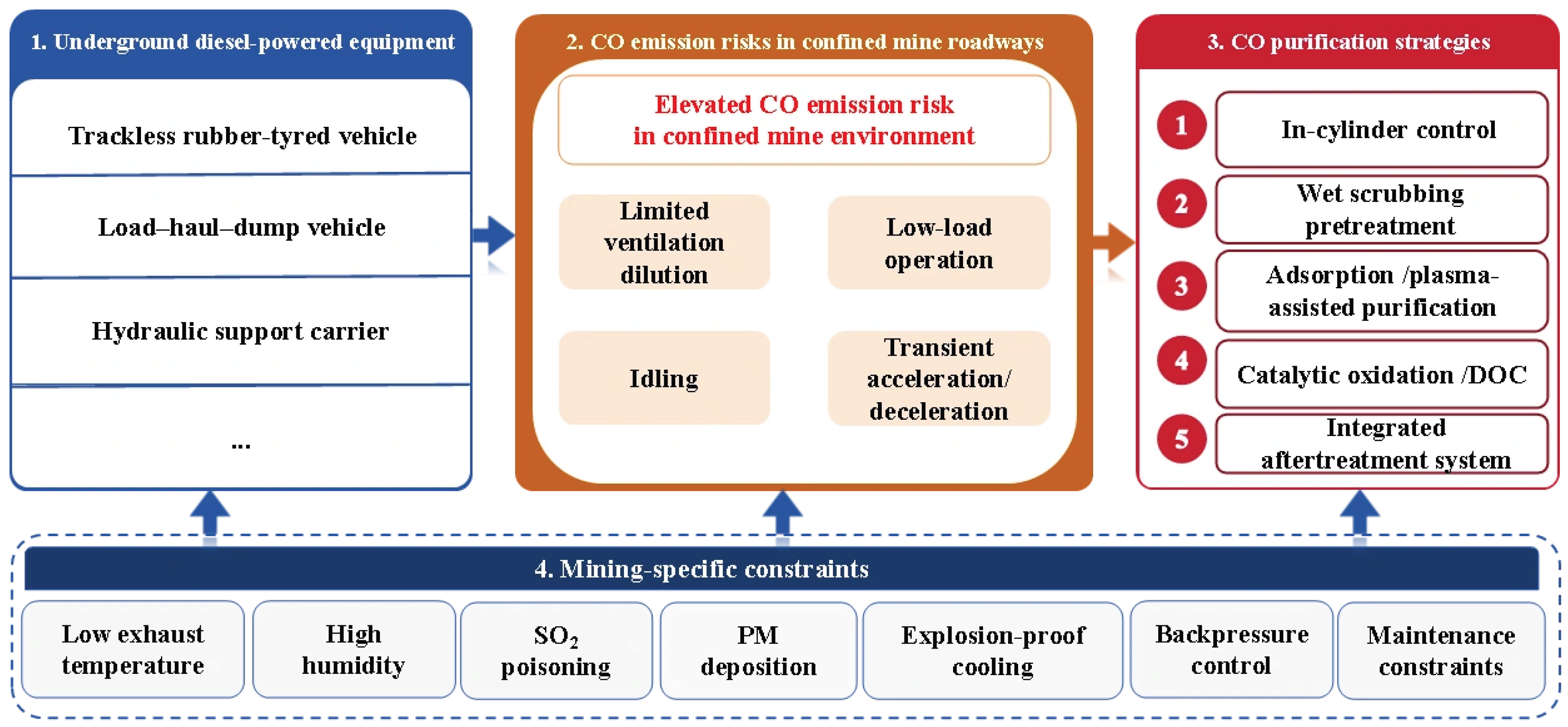
Figure 1. Review framework.
Processes 14 02225 g001
Figure 2. Influencing factors for CO purification in mining diesel engines.
Processes 14 02225 g002
Figure 3. Integrated exhaust aftertreatment system for diesel-powered mining equipment.
Processes 14 02225 g003
Table 1. Applicability of CO purification technologies in mining diesel engines.
Technology RouteMain FunctionAdvantagesMain LimitationsRole in Mining Applications
In-cylinder control [43,72,73,74,75]Reduces CO formation at the sourceDoes not increase aftertreatment system complexityLimited by operating conditions, explosion-proof modifications, and pollutant trade-offsFront-end emission reduction
Wet purification [44,45,69,76,77,92]Exhaust cooling, flame arresting, and dust removalWell-established in mining applications, with strong safety pretreatment capabilityCO has low solubility in water, resulting in limited deep purification capabilityPretreatment/safety unit
Adsorptive purification [78,79,80]Low-temperature adsorption or temporary buffering of some pollutantsOperates at low temperatures, with adjustable material propertiesDifficulties in selectivity, capacity, and regeneration; strongly affected by high humidityAuxiliary purification
Non-thermal plasma [82,83,84,85]Low-temperature activation of oxidation reactionsGood potential for low-temperature reaction activationProminent issues related to energy consumption, by-product formation, and explosion-proof electrical safetyEmerging hybrid technology
Catalytic oxidation/DOC [19,20,21,70,71]Converts CO into CO2Direct conversion pathway, with a solid application basis in diesel engine aftertreatmentHigh requirements for low-temperature light-off, water and sulfur tolerance, and backpressure controlCore purification unit
Integrated system [46,86,90,93]Coordinated control of multiple pollutantsAddresses CO, PM, HCs, NOx, and safety constraints simultaneouslyIncreased structural complexity, pressure drop, and maintenance difficultyIntegrated route with engineering application potential
Table 2. CO oxidation pathways and mining relevance.
Mechanism TypeKey StepsRelevance to Mining Applications
Langmuir–Hinshelwood [50,95,96]CO and O2 are adsorbed before undergoing a surface reactionFocuses on CO adsorption strength, O2 activation capability, and low-temperature light-off performance
Eley–Rideal [97,98,101]Gas-phase CO reacts directly with active surface oxygen speciesEmphasizes the supply of active oxygen species at low temperatures and rapid surface oxidation capability
Mars–van Krevelen [50,51,98,102,103]Lattice oxygen oxidizes CO, and O2 replenishes oxygen vacanciesFocuses on oxygen-vacancy stability, oxygen migration, and water and sulfur tolerance
Table 3. Comparison of low-temperature CO oxidation catalyst systems for mining applications.
Material SystemActivity OriginAdvantagesLimitationsFuture Research Focus
Noble-metal catalysts [50,87,94,96]CO/O2 adsorption and activation; metal–support interfacesHigh low-temperature activity and good compatibility with DOC technologyHigh cost; sensitive to water, sulfur, and thermal agingLow metal loading, poisoning resistance, and validation under coupled mining exhaust conditions
Transition-metal oxides [30,113,116,119,128]Multivalent redox cycling, lattice oxygen, and oxygen vacanciesLow cost, tunable composition, and relatively abundant elementsInsufficient durability under complex exhaust conditionsEvaluation under coexisting water vapor, sulfur species, and dust, as well as long-term aging
CeO2-based reducible oxide systems [26,29,50,102,121,126]Ce3+/Ce4+ redox cycling, oxygen storage/release, and oxygen migrationFavorable for oxygen activation and interfacial synergySusceptible to sulfate formation and hydrothermal aging; Ce loading and resource utilization need considerationOxygen-vacancy stabilization, interfacial regulation, and sulfur/water tolerance under coupled conditions
Single-atom catalysts [25,27,97,98]Atomically dispersed active sites and strong metal–support interactionsHigh metal utilization efficiency and clear mechanistic interpretationLimited scalability and insufficient long-term stabilityWashcoating on monolithic supports and durability under coexisting water vapor, sulfur species, dust, and vibration
Note: The cost-related descriptions in this table refer to relative material or active-metal costs rather than total system costs. Actual application costs may vary depending on multiple practical factors.
Disclaimer/Publisher’s Note: The statements, opinions and data contained in all publications are solely those of the individual author(s) and contributor(s) and not of MDPI and/or the editor(s). MDPI and/or the editor(s) disclaim responsibility for any injury to people or property resulting from any ideas, methods, instructions or products referred to in the content.