Article

Diagnostic Decomposition of Single-Scalar Severity Descriptors in Biomass Torrefaction: A SIC–CO Framework

1
Forest Industrial Materials Division, National Institute of Forest Science, 57, Hoegi-ro, Dongaemungu, Seoul 02455, Republic of Korea
2
Korea Research Institute on Climate Change, 11, Subyeongongwon-gil, Chuncheon 24239, Republic of Korea
3
Agriculture and Life Science Research Institute, Kangwon National University, Chuncheon 24341, Republic of Korea
*
Author to whom correspondence should be addressed.
These authors contributed equally to this work.
Processes 2026, 14(13), 2070; https://doi.org/10.3390/pr14132070 (registering DOI)
Submission received: 29 May 2026 / Revised: 19 June 2026 / Accepted: 24 June 2026 / Published: 25 June 2026
(This article belongs to the Section Environmental and Green Processes)

Abstract

Severity factors are widely used to compress torrefaction temperature–time history into a single scalar descriptor. However, whether such scalar representations are structurally sufficient to describe realised conversion across heterogeneous biomass samples remains unclear. In this study, we evaluated the adequacy of single-scalar severity descriptors using a literature-derived dry torrefaction dataset comprising 154 observations from 7 published studies, covering multiple biomass categories and operating conditions. A severity factor, SF(α), was formulated, and its scaling parameter α was optimised through a systematic α-sweep to maximise its relationship with the experimentally determined extent of conversion (EOC). Based on the optimised formulation, EOC was decomposed into severity-implied conversion (SIC) and conversion offset (CO), separating the dominant severity-controlled trajectory from sample-specific deviations. The optimised formulation (α* = 65.1) showed a strong global correlation with EOC (R2 = 0.8593), confirming that severity captures the main average conversion trend. However, nested model comparisons showed that including CO consistently improved explanatory power for both absolute fuel properties and enhancement ratios, with the greatest gains in enhancement space. SIC and CO accounted for 85.9% and 14.1% of the total variance, respectively, indicating that a non-negligible component of conversion variability was not captured by the single severity descriptor. These results show that, although a single severity scalar is useful for describing dataset-level trends, it does not fully resolve sample-level torrefaction behaviour within the analysed dataset. The SIC–CO framework is therefore proposed not as a new severity index or a pre-measurement predictive model, but as a post hoc diagnostic framework for identifying the explanatory limits of scalar severity representations in biomass torrefaction analysis.

1. Introduction

Torrefaction is widely employed as a thermochemical upgrading process to enhance the fuel quality of lignocellulosic biomass [1,2,3,4]. By partially decomposing hemicellulose and modifying the chemical structure of biomass, torrefaction improves energy density, hydrophobicity, and grindability, thereby facilitating downstream utilisation in combustion and co-firing systems [5,6,7,8,9]. Because torrefaction behaviour is strongly influenced by both temperature and residence time, numerous studies have attempted to represent process intensity using single-scalar severity descriptors that collapse temperature–time history into a unified metric [10,11,12,13,14,15,16,17,18].
Single-scalar severity formulations implicitly assume that conversion behaviour can be described as a deterministic function of imposed thermochemical intensity. Under this assumption, samples subjected to similar severity conditions are expected to exhibit comparable extents of conversion and physicochemical responses. Accordingly, considerable effort has been devoted to refining severity factors or adjusting scaling parameters to improve correlation with mass yield, elemental composition, and energy properties. Park et al. (2025) developed a mass-reduction-based predictive model incorporating an enhancement ratio to accurately estimate compositional and energy changes during torrefaction [19]. In parallel, Basu et al. (2017) proposed a Torrefaction Index grounded in energy density enhancement to quantify torrefaction degree and derived empirical correlations for performance prediction [20]. Building on severity-based approaches, Chen et al. (2019) introduced a Torrefaction Severity Factor (TSF) with a time exponent to integrate operating conditions and biomass type for improved prediction of torrefaction outcomes [17]. However, the inherent heterogeneity of biomass feedstocks has long been recognised as a source of variability in thermochemical behaviour [21,22].
However, accumulating experimental evidence suggests that torrefaction outcomes often display substantial dispersion even under similar temperature–time conditions. Optimising the temperature–time scaling may increase the explanatory power of severity, yet it does not guarantee a unique mapping between severity and conversion. This raises a structural question: does the limitation lie in parameter selection within the severity formulation, or in the assumption that a single scalar can fully represent conversion behaviour? Similar challenges of scalar compression have been noted in complex physical systems, where multi-dimensional variability cannot be fully collapsed into a single index [23].
Here, dataset-level trends refer to the average relationship observed across the compiled literature dataset, whereas sample-level behaviour refers to the deviation of individual biomass samples or experimental conditions from this average severity-implied trend. This distinction is central to the present analysis because a severity descriptor may explain the dominant dataset-level trend while still failing to resolve sample-specific conversion deviations.
The present study addresses this question from a structural perspective rather than by proposing a new severity index. Instead of redefining severity, we decompose the observed extent of conversion into a severity-implied conversion obtained from an optimised temperature–time scaling and a conversion offset that represents deviations from the global severity-driven trend. By systematically optimising the scaling parameter α and analysing the relationship between severity-implied conversion and conversion offset, we evaluate whether residual variability contains diagnostic structure not captured by the single-scalar severity framework. Through nested model comparisons across elemental, proximate, heating value, and enhancement variables, this work aims to diagnose the structural limits of severity-based representations. The objective is not to maximise predictive accuracy, but to determine whether a single thermochemical scalar is sufficient to describe dataset-level conversion trends and sample-level deviations, or whether an additional diagnostic component is needed to represent residual conversion behaviour within the available dataset.

2. Methodology

2.1. Literature Dataset Collection and Preprocessing

The dataset was compiled from previously published dry torrefaction studies that reported mass yield and at least one fuel-property variable after torrefaction. The final dataset contained 154 torrefaction observations obtained from 7 source studies [24,25,26,27,28,29,30]. The collected variables included biomass type, torrefaction temperature, residence time, mass yield, elemental composition, proximate composition, and higher heating value, where available. The processed dataset containing all 154 torrefaction observations used for the SIC–CO analysis is provided as Data S1. Data S1 includes source study, biomass type, biomass group, torrefaction temperature, residence time, mass yield, EOC, SF(α*), SIC, CO, and available fuel-property variables used in the response-specific regression analyses.
MY was converted from percentage to fractional dry mass yield before calculating the extent of conversion. To quantify the extent of thermal conversion, the extent of conversion (EOC) was defined as:
E O C = 1 M Y 100
Data were included only when the study reported dry torrefaction conditions with identifiable temperature, residence time, and mass yield. Data corresponding to hydrothermal carbonisation, fast pyrolysis, low-temperature pyrolysis, or treatments without a clearly defined torrefaction stage were excluded. Mass yield values were standardised on a dry basis. When mass yield was reported as a percentage, it was converted to a fractional value before calculating EOC. Fuel-property data were converted to consistent units where necessary. Missing variables were not imputed; instead, each response-specific regression was performed using the available observations for that variable.

2.2. Severity Factor Formulation

The imposed torrefaction severity was represented using a single scalar severity factor formulated as:
S F α = t × e x p T T r e f α
where t is the residence time (min), T is the torrefaction temperature (°C), and Tref is a reference temperature fixed at 100 °C. The reference temperature of 100 °C was selected as an empirical baseline corresponding approximately to the boundary between drying-dominated conditions and the onset of thermochemical degradation relevant to torrefaction. This value was used only as a consistent lower reference for severity scaling and was not interpreted as a universal kinetic threshold.
The parameter α controls the relative weighting between temperature and time in the severity formulation. The parameter α was treated as an empirical scaling parameter rather than a directly interpretable kinetic constant. Therefore, α was not used to infer activation energy or any universal reaction parameter.

2.3. Estimation of the Severity Scaling Parameter(α)

The scaling parameter α was estimated in a data-driven manner by systematically sweeping candidate values over a predefined range. For each candidate α, the severity factor SF(α) was calculated for all torrefaction conditions, and a linear regression model was fitted between EOC and SF(α):
E O C = β 0 + β 1 × S F ( α )
The explanatory power of each model was evaluated using the coefficient of determination (R2). The optimal parameter α* was identified as the value that maximised R2, with the Akaike information criterion (AIC) used as a secondary selection criterion in cases where similar R2 values were obtained. The identified α* was adopted as a dataset-specific severity scaling parameter for subsequent analyses.

2.4. Nonlinear Severity–Conversion Model Comparison

To examine whether the residual conversion offset resulted from the use of a linear severity–conversion relationship, additional nonlinear models were fitted between EOC and the optimised severity factor SF(α*). Logarithmic, exponential, and sigmoidal functional forms were compared with the linear model. Model performance was evaluated using R2, RMSE, AIC, and BIC. This analysis was used to determine whether nonlinear mapping of the same single-scalar severity descriptor could sufficiently account for the remaining conversion variability.

2.5. Residual Diagnostics and Biomass-Group Analysis

Residual diagnostics were conducted using unique torrefaction observations after removing response-specific duplicated rows. The CO distribution was summarised using mean, median, standard deviation, minimum, maximum, skewness, and kurtosis. A Wilcoxon signed-rank test was used to evaluate whether the median CO differed from zero. Differences in CO among broad biomass groups were evaluated using the Kruskal–Wallis test, followed by Dunn’s post hoc test when significant. Differences in CO dispersion among biomass groups were examined using the Fligner–Killeen test.
Because some detailed biomass categories contained limited observations, biomass samples were assigned to broad groups rather than highly subdivided classes. This grouping was used only for diagnostic comparison of CO and not for developing category-specific predictive models. In addition, multiple observations from the same source or experimental series were retained because they represented different torrefaction conditions; however, they were not interpreted as fully independent observations because they may share biomass origin, reactor configuration, analytical procedure, or laboratory-specific effects.

2.6. Severity-Based Conversion Analysis

Using the optimised severity factor SF(α*), the severity–conversion relationship was analysed to characterise the average conversion trend imposed by the torrefaction conditions. The severity-implied conversion (SIC) was defined as the regression-predicted EOC obtained from the linear model using SF(α*).
For each experimental condition, deviations from the average severity-implied trend were quantified as the conversion offset (CO), calculated as the difference between the observed EOC and the corresponding SIC value. This decomposition enabled separation of the average conversion behaviour attributable to imposed severity from sample-specific deviations not captured by a single scalar severity descriptor.

2.7. Enhancement Ratio Analysis

To evaluate compositional changes induced by torrefaction, enhancement ratios were calculated for elemental composition (C, H, N, S, O), proximate composition (volatile matter, fixed carbon, and ash), and higher heating value (HHV). For each experimental sequence, enhancement ratios were defined relative to the corresponding raw biomass sample:
X e n h = X t o r X r a w
where Xtor and Xraw denote the property value of the torrefied and raw samples, respectively. Enhancement ratios were evaluated only for torrefied conditions (T > 0 °C), and undefined ratios resulting from zero or missing reference values were excluded from further analysis.

3. Results & Discussions

3.1. Optimisation of the Severity Scaling Parameter

The optimisation of the severity scaling parameter α was performed using an α-sweep approach, in which α was varied over a wide range and the explanatory power of the resulting SF(α) for EOC was evaluated by linear regression. Figure 1 shows the variation in R2 as a function of α.
As α increased from low values, R2 rose sharply, indicating an improved consistency between the temperature–time scaling and the observed conversion behaviour. With further increases in α, the growth in R2 gradually diminished, forming a broad maximum region, followed by a slight decline at higher α values. This non-monotonic trend demonstrates that the performance of a single-scalar severity descriptor is highly sensitive to the chosen temperature–time scaling, and that both excessively small and overly large α values degrade descriptive performance. The optimal scaling parameter was identified as α* = 65.1, at which the maximum R2 of 0.859 was obtained (n = 154). The corresponding regression exhibited a highly significant slope, confirming a robust monotonic relationship between EOC and SF(α*) at the dataset level. It should be emphasised that α* is not interpreted as a universal constant or a kinetic parameter. Rather, it is a dataset-specific scaling parameter that maximises the descriptive capability of a single-scalar severity formulation under the present experimental conditions. Accordingly, α* is used hereafter solely as a reference value to assess the structural performance and limitations of severity-based representations. The full α-sweep results used to identify α* are provided as Data S2.

3.2. Relationship Between EOC and SF(α*)

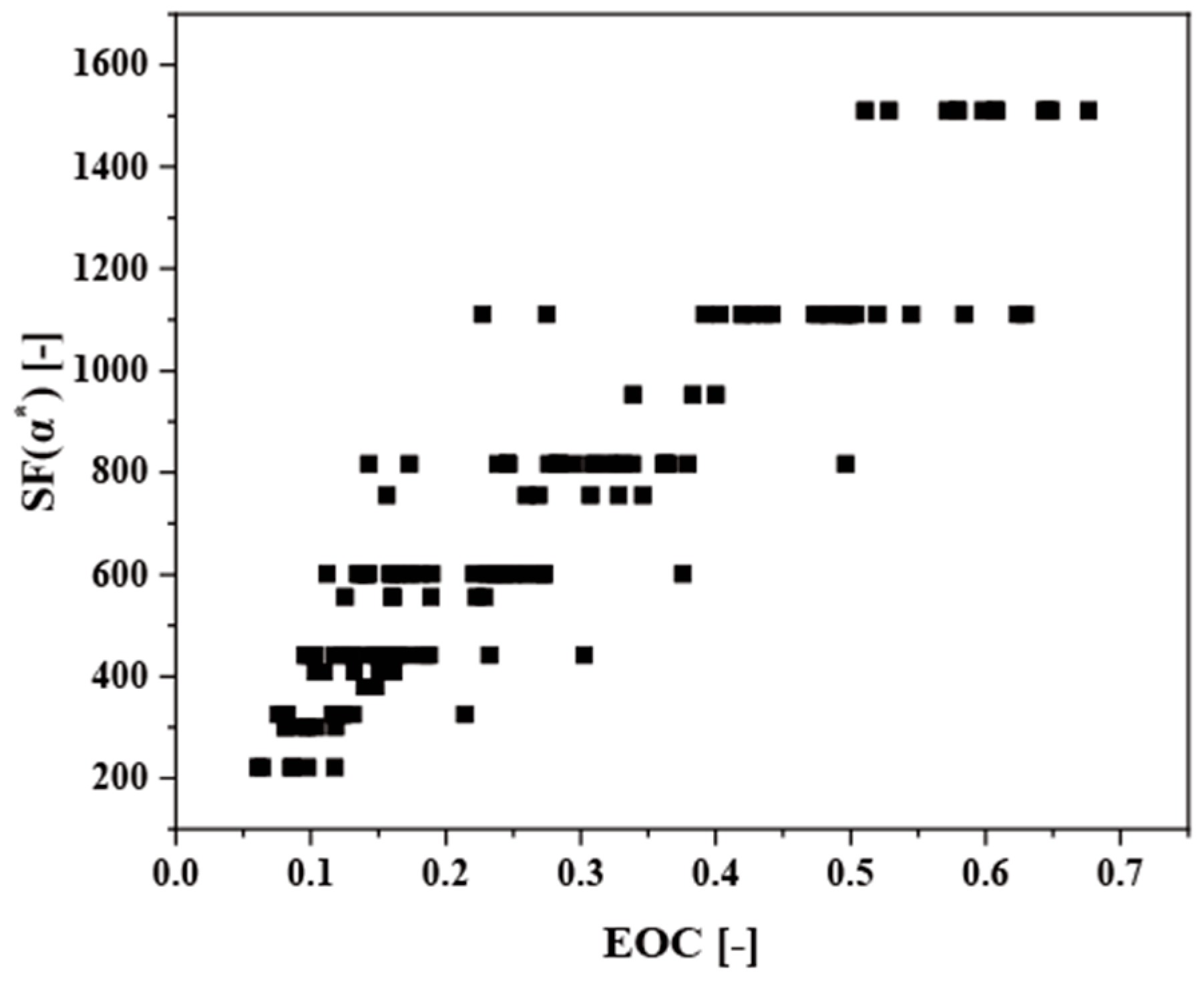
Figure 2 shows the relationship between EOC and the optimised severity factor SF(α*). Overall, EOC increases monotonically with increasing SF(α*), confirming that the severity formulation captures the average tendency of conversion to progress with increasing imposed severity. Despite this monotonic trend, the data exhibit pronounced dispersion across the entire severity range. At low EOC values (EOC ≤ 0.2), SF(α*) spans a wide interval, indicating that similar extents of conversion can be achieved under substantially different severity conditions. Conversely, at intermediate and high EOC levels (EOC ≈ 0.3–0.6), clusters of data points appear at comparable SF(α*) values while EOC varies appreciably. This pattern demonstrates that increases in severity do not translate into a unique conversion response. The observed scatter suggests possible sample-level deviations from the global severity trend, with distinct bands of SF(α*) corresponding to overlapping EOC values. This behaviour indicates that SF(α*) functions as an effective descriptor of the average conversion trajectory yet fails to uniquely resolve sample-level conversion outcomes. In other words, while severity provides a meaningful ordering of experimental conditions, it does not act as a deterministic predictor of EOC.
The dispersion observed in Figure 2 indicates that EOC is not uniquely determined by SF(α*) even after optimisation of the severity scaling parameter. However, visual dispersion alone is insufficient to establish structured residual behaviour. Therefore, the residual component was further examined using nonlinear severity–conversion model comparison, CO distribution statistics, biomass-group comparison, and study-level robustness checks.

3.3. Nonlinear Severity–Conversion Model Comparison

To determine whether the residual conversion offset was caused by the use of a linear severity–conversion relationship, additional nonlinear models were fitted between EOC and the optimised severity factor SF(α*). Logarithmic, exponential, and sigmoidal functional forms were compared with the linear model using R2, RMSE, AIC, and BIC. This analysis was conducted as a robustness check to evaluate whether nonlinear mapping of the same single-scalar severity descriptor could sufficiently account for the remaining conversion variability.
The results are summarised in Table 1. The linear model showed strong explanatory power, with R2 = 0.8593 and RMSE = 0.0611. Among the nonlinear models, the sigmoidal model provided the highest R2 value of 0.8677 and the lowest RMSE of 0.0592. However, the improvement relative to the linear model was limited, with ΔR2 = 0.0084. The logarithmic and exponential models showed lower explanatory power than the linear model, with R2 values of 0.7831 and 0.8116, respectively.
These results indicate that introducing a nonlinear transformation of the same severity descriptor can marginally improve the global severity–conversion fit, particularly when using a sigmoidal form. However, the improvement was small and did not remove the residual conversion variability. Therefore, the remaining conversion offset cannot be attributed solely to the use of a linear severity–conversion relationship. Rather, the results support the interpretation that a single temperature–time severity scalar captures the dominant dataset-level trend but does not fully resolve sample-level conversion deviations.
For consistency with the SIC–CO decomposition framework, SIC was retained as the EOC predicted from the linear SF(α*)–EOC relationship. The nonlinear models were used only as supplementary robustness checks, not to redefine SIC or to introduce a new severity index.

3.4. Conversion Offset (CO) and Structural Limitations of Severity-Based Representation

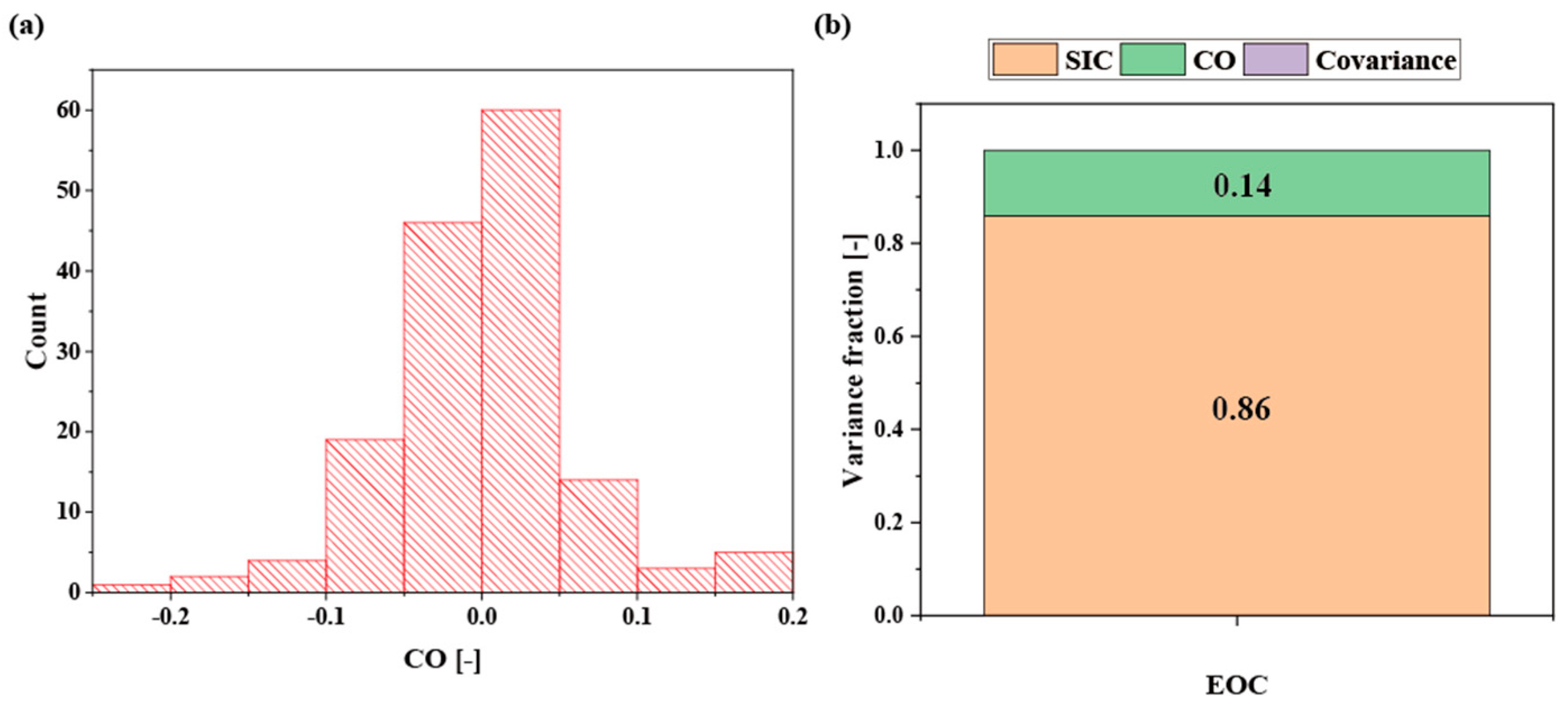
Figure 3a shows the distribution of CO, defined as the difference between the observed EOC and the severity-implied conversion predicted from SF(α*). The CO distribution was further evaluated using quantitative residual statistics. After removing duplicated response-specific rows, 154 unique torrefaction observations were used for this analysis. CO had a mean of 0.0000, median of 0.0034, standard deviation of 0.0613, and ranged from −0.2135 to 0.1884. The skewness value of 0.0495 indicated that the distribution was approximately centred around zero, whereas the kurtosis value of 1.9960 indicated a relatively broad distribution with non-negligible tails. The Wilcoxon signed-rank test showed that the median CO was not significantly different from zero (p = 0.9763), supporting the absence of systematic positive or negative bias in the severity-implied conversion. Detailed summary statistics of CO are provided in Table S1. The distribution is centred close to zero, indicating that the severity-based formulation successfully captures the average conversion behaviour across the dataset. This supports the interpretation that the optimised severity factor provides an approximately unbiased description of the central tendency of conversion. However, the CO distribution exhibits a considerable spread, extending approximately from −0.2 to +0.2. Given that the full EOC range in the dataset spans roughly 0–0.7, the magnitude of these deviations is non-trivial. This indicates that the discrepancies between observed and severity-implied conversion are substantial relative to the overall extent of conversion, and therefore cannot be dismissed as minor fluctuations.
As illustrated in Figure 3b, the total variance in EOC across samples was partitioned into a severity-imposed component and a residual offset. The severity-implied variance accounted for 85.9% of the total conversion variance, while the CO explained 14.1%. Notably, this unresolved portion exceeds one-tenth of the total variability, indicating that the residual structure is quantitatively meaningful rather than marginal. The covariance term was effectively zero (approximately 1.27 × 10⁻¹⁸), confirming orthogonality between the two components. Although severity captures the dominant share of variability, a measurable portion of structured variance remains unresolved by a single scalar descriptor. The presence of a residual variance component indicates that the optimised temperature–time severity descriptor does not fully describe conversion variability in the present dataset.
Consistent with these statistics, both positive and negative CO values were observed, indicating that deviations from the severity-implied trend occurred in both directions rather than reflecting a unidirectional bias. Positive CO values correspond to cases where the observed conversion exceeds the severity-implied expectation, whereas negative CO values indicate suppressed conversion under nominally similar severity conditions. The coexistence of both behaviours demonstrates that severity alone does not impose a unidirectional constraint on conversion outcomes. Importantly, the shape of the CO distribution is not sharply peaked, as would be expected if the offsets were dominated by experimental noise or regression error. Instead, the broad distribution suggests that CO may contain sample-dependent differences in conversion behaviour. The residual structure could not be systematically reduced to elemental or proximate variables, even when linear, quadratic, and interaction effects were tested. This suggests that the offset is not explained solely by the optimised temperature–time severity scalar and may reflect additional biomass- or process-level variability not explicitly represented in the present model.
These observations indicate a practical limitation of single-scalar severity representations within the present dataset. Even when the temperature–time scaling is optimised to maximise descriptive power, severity collapses conversion behaviour only at the level of an average trend. Sample-specific conversion pathways remain unresolved and manifest as structured deviations from severity-implied behaviour. Accordingly, CO should be interpreted as a post hoc diagnostic quantity that summarises deviations from the severity-implied trend. Because CO is calculated from the difference between observed EOC and SIC, it cannot be known before measuring MY. Therefore, CO may reflect biomass- and process-level heterogeneity, but it should not be treated as a pre-measurement predictive variable.
To examine whether the conversion offset showed biomass-level tendencies, CO was compared among preliminary broad biomass groups. The Kruskal–Wallis test indicated a significant difference in CO among the broad biomass groups (p = 0.0024). Biomass-group summary statistics of CO and the corresponding statistical test results are provided in Tables S2 and S3, respectively. This suggests that biomass class may partly contribute to deviations from the severity-implied conversion trend. However, because the grouping was broad and some categories contained limited observations, this result should be interpreted as diagnostic rather than as definitive evidence of a biomass-specific mechanism. The Fligner–Killeen test did not indicate a significant difference in CO dispersion among biomass groups (p = 0.0868), suggesting that the spread of CO was not clearly different among groups.

3.5. Nested Model Comparison: Severity Versus Severity + CO

To test whether the decomposition term CO contains explanatory structure beyond the imposed severity SF(α*), three nested linear models were compared for each response variable: M1 (Y ~ SF(α*)), M2 (Y ~ SF(α*) + CO), and M3 (Y ~ SF(α*) + CO + SF(α*) × CO). The comparison of goodness-of-fit metrics is summarised in Table 2. Overall, adding CO consistently improved goodness-of-fit compared with SF(α*) alone, with the strongest gains observed for enhancement variables, indicating that CO captures residual sample-specific information not represented by the single-scalar severity descriptor. For the absolute compositions, CO provided moderate but consistent improvements. For example, C increased from R2 = 0.7500 (M1) to 0.7923 (M2) and 0.7985 (M3). FC improved from 0.7794 to 0.8632 (M2) and 0.8699 (M3), and VM from 0.7162 to 0.7942 (M2) and 0.8005 (M3). In contrast, H remained weakly described by SF(α*) even after adding CO (R2 = 0.1695 → 0.2170 → 0.2204), implying that hydrogen variation is governed by factors not well aligned with the SF–EOC residual structure in this dataset. HHV showed only marginal improvement (R2 = 0.6737 → 0.6858 → 0.6951), suggesting that HHV is already largely explained by severity-driven trends and/or composite dependence on multiple constituents. Notably, the enhancement variables exhibited substantially larger improvements when CO was included, supporting the view that normalising by the raw baseline accentuates sample-specific deviation. Cenh increased sharply from R2 = 0.7905 (M1) to 0.9191 (M2) and 0.9268 (M3). Similarly, HHVenh improved from 0.8087 to 0.9098 and 0.9196, and VMenh from 0.7951 to 0.8641 and 0.8688. FCenh also improved (0.8081 → 0.8788 → 0.8812), while Oenh increased from 0.6468 to 0.7188 and 0.7217. These results suggest that CO contains residual explanatory information that becomes more apparent in enhancement space.
Coefficient-level results reinforce this interpretation. In M2, CO terms were statistically significant (p < 0.05) for most variables (e.g., C, O, VM, FC, HHV and multiple enhancement responses), confirming that CO contributes explanatory power beyond SF(α*). When the interaction term was introduced (M3), SF(α*):CO became significant for several key responses (e.g., C, O, VM, FC, HHV, and notably Cenh and HHVenh), indicating mild nonlinearity in how the CO offset manifests across severity. However, the incremental gains from M2 to M3 were consistently small (typically ΔR2 ≈ 0.0020–0.0100), and CO itself often became non-significant once the interaction was entered (e.g., C, O, VM, FC, HHV), implying that the interaction absorbed a limited portion of the CO effect without fundamentally changing the dominant additive structure.
Taken together, these comparisons show that a single severity scalar SF(α*) captures the broad average trend, while CO provides an additional diagnostic term that improves the description of sample-to-sample variability—particularly when responses are expressed as enhancement ratios. The limited incremental benefit of adding SF(α*) × CO suggests that the additive SIC + CO framework already captures most of the recoverable structure, with interaction effects acting as a secondary refinement rather than a primary driver. The consistent improvement obtained by introducing CO demonstrates that it contains explanatory structure orthogonal to the imposed severity dimension. In other words, the residual component does not simply correct the severity slope, but adds residual information not represented by the imposed severity descriptor.

3.6. Structural Interpretation of CO

The preceding model comparison demonstrates that CO consistently improves explanatory power beyond the single-scalar severity descriptor SF(α*). The key question, therefore, is not whether CO improves fit—which it clearly does—but what CO represents in structural terms. By construction, SF(α*) defines the imposed thermochemical trajectory and determines the expected mean behaviour of EOC. In contrast, CO represents the deviation of the observed EOC from SIC, quantifying how individual samples depart from the global severity trend.
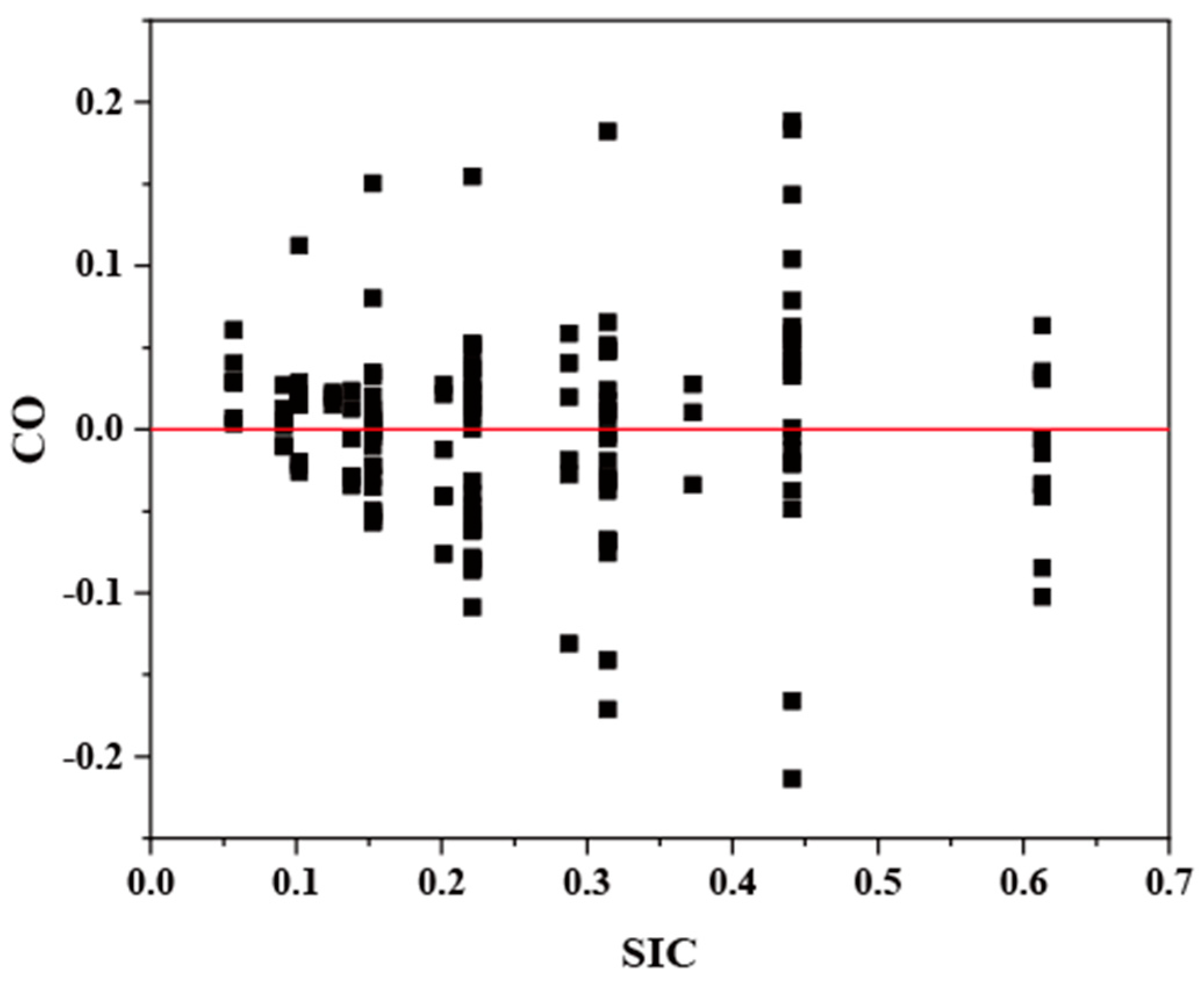
As shown in Figure 4, SIC and CO define a two-dimensional representation of conversion behaviour. The horizontal axis corresponds to SIC, capturing 85.9% of the total variance, while the vertical axis corresponds to CO, accounting for the remaining 14.1%. The dispersion along SIC reflects the dominant severity-controlled structure, whereas the vertical spread in CO represents the orthogonal residual component. The near-zero covariance is expected from the residual construction and indicates that CO is mathematically orthogonal to SIC in the fitted decomposition. Therefore, this orthogonality should be interpreted as a property of the decomposition framework rather than as direct evidence of a physically independent mechanism.
The systematic increase in R2 upon inclusion of CO indicates that the residual term contains explanatory information beyond SF(α*) alone. This interpretation is reinforced in enhancement space, where normalisation amplifies sample-dependent variability. The substantial R2 gains observed for enhancement variables upon inclusion of CO further suggest that the residual dimension captures variability that cannot be reduced to SF(α*) alone. Although the interaction term SF(α*) × CO was statistically significant for several responses, the associated ΔR2 values were modest. This indicates that the dominant explanatory structure is primarily additive rather than strongly nonlinear. Conversion behaviour can therefore be interpreted as the combination of a severity-imposed mean trajectory and a residual diagnostic component. The CO component may partly reflect unmeasured or incompletely reported process variables, including reactor configuration, heating rate, particle size, gas atmosphere, sample loading, and biomass preprocessing history. Therefore, the 14.1% CO component should not be interpreted as an irreducible fraction of torrefaction behaviour. Rather, it represents the portion of conversion variability not captured by the single temperature–time severity descriptor within the available dataset.
Taken together, these findings support a conceptual reframing of severity. A single scalar descriptor captures the dominant trajectory but does not fully describe the residual variability present in the dataset. The residual component suggests that scalar compression, while useful, does not fully describe conversion variability within the available dataset. Similar multidimensional behaviour has been noted in thermochemical modelling frameworks that distinguish primary kinetic drivers from material-specific deviations [9,31].

4. Conclusions

This study critically examined the structural adequacy of representing torrefaction conversion behaviour using a single scalar severity descriptor. By optimising the parameter α in the severity formulation and decomposing the EOC into an SIC and a CO, we evaluated whether additional explanatory structure exists beyond the imposed temperature–time history. The optimised severity formulation (α* = 65.1) achieved a strong global correlation with EOC (R2 = 0.8593), confirming that a properly calibrated severity factor captures the dominant mean conversion trajectory across samples. However, nested model comparisons revealed that adding the decomposition term CO consistently improved explanatory power for both absolute compositions and enhancement variables. The improvement was particularly pronounced in enhancement space, where R2 increases exceeded 0.12 in several cases. These findings indicate that CO contains residual explanatory information associated with sample-specific deviation from the global severity trend. While severity captures the majority of conversion variance, the 14.1% residual CO component represents the portion of conversion variance not captured by the single temperature–time severity descriptor in the present dataset. This component should not be interpreted as irreducible, because it may be reduced if consistently reported process variables such as particle size, heating rate, reactor configuration, gas atmosphere, and biomass preprocessing are incorporated.
Although the interaction term SF(α*) × CO was statistically significant for several responses, its contribution to overall explanatory power was limited. The incremental gains in R2 were small, indicating that the governing structure of torrefaction behaviour is primarily additive rather than strongly nonlinear. The conversion behaviour can therefore be interpreted as the combination of a severity-imposed mean trajectory and a residual sample-specific diagnostic component. Therefore, the interaction term was statistically detectable but practically secondary. Its inclusion did not materially change the interpretation that the main structure is captured by the additive separation of severity-implied conversion and conversion offset.
Taken together, the results show that while single-scalar severity metrics successfully describe the average thermochemical trend, they do not fully capture the structured dispersion observed across heterogeneous samples. The SIC + CO decomposition framework provides a clearer structural interpretation by separating imposed severity effects from residual sample- and process-level variability. This approach does not propose a new severity index, but rather offers a diagnostic lens for understanding the limits of scalar severity representations in biomass torrefaction analysis. These findings suggest that, within the available literature-derived dataset, torrefaction behaviour is not fully represented by a single temperature–time scalar. The SIC–CO framework should not be interpreted as the minimum complete dimensionality of torrefaction, but as a two-component diagnostic representation. Additional dimensions may be required when consistently reported feedstock and process variables become available.

Supplementary Materials

The following supporting information can be downloaded at: https://www.mdpi.com/article/10.3390/pr14132070/s1, Data S1: processed dataset containing all 154 torrefaction observations used for the SIC–CO analysis; Data S2: α-sweep results used to identify the optimal severity scaling parameter α*; Table S1: Summary statistics of conversion offset (CO); Table S2: Biomass-group summary of conversion offset (CO); Table S3: Statistical tests for CO diagnostics.

Author Contributions

Conceptualization, S.P., K.C.O. and D.K.; methodology, S.P. and K.C.O.; validation, S.P. and K.C.O.; investigation, S.P., K.C.O. and D.K.; formal analysis, S.P. and K.C.O.; writing—original draft, S.P. and D.K.; writing—review & editing, S.P., K.C.O. and D.K.; data curation, S.P. and K.C.O.; supervision, S.P. All authors have read and agreed to the published version of the manuscript.

Funding

This work was supported by the National Research Foundation of Korea [grant number NRF-2022R1C1C2009821].

Data Availability Statement

The original contributions presented in this study are included in the article/Supplementary Materials. Further inquiries can be directed to the corresponding author.

Conflicts of Interest

The authors declare no conflicts of interest.

References

  1. Devaraja, U.M.A.; Dissanayake, C.L.W.; Gunarathne, D.S.; Chen, W.H. Oxidative Torrefaction and Torrefaction-Based Biorefining of Biomass: A Critical Review. Biofuel Res. J. 2022, 9, 1672–1696. [Google Scholar] [CrossRef]
  2. van der Stelt, M.J.C.; Gerhauser, H.; Kiel, J.H.A.; Ptasinski, K.J. Biomass Upgrading by Torrefaction for the Production of Biofuels: A Review. Biomass Bioenergy 2011, 35, 3748–3762. [Google Scholar] [CrossRef]
  3. Bach, Q.V.; Skreiberg, O. Upgrading Biomass Fuels via Wet Torrefaction: A Review and Comparison with Dry Torrefaction. Renew. Sustain. Energy Rev. 2016, 54, 665–677. [Google Scholar] [CrossRef]
  4. Paudel, P.P.; Kafle, S.; Park, S.; Kim, S.J.; Cho, L.; Kim, D.H. Advancements in Sustainable Thermochemical Conversion of Agricultural Crop Residues: A Systematic Review of Technical Progress, Applications, Perspectives, and Challenges. Renew. Sustain. Energy Rev. 2024, 202, 114723. [Google Scholar] [CrossRef]
  5. Kota, K.B.; Shenbagaraj, S.; Sharma, P.K.; Sharma, A.K.; Ghodke, P.K.; Chen, W.H. Biomass Torrefaction: An Overview of Process and Technology Assessment Based on Global Readiness Level. Fuel 2022, 324, 124663. [Google Scholar] [CrossRef]
  6. Tu, R.; Jiang, E.; Yan, S.; Xu, X.; Rao, S. The Pelletization and Combustion Properties of Torrified Camellia Shell via Dry and Hydrothermal Torrefaction: A Comparative Evaluation. Bioresour. Technol. 2018, 264, 78–89. [Google Scholar] [CrossRef] [PubMed]
  7. Chen, D.; Gao, A.; Ma, Z.; Fei, D.; Chang, Y.; Shen, C. In-Depth Study of Rice Husk Torrefaction: Characterization of Solid, Liquid and Gaseous Products, Oxygen Migration and Energy Yield. Bioresour. Technol. 2018, 253, 148–153. [Google Scholar] [CrossRef] [PubMed]
  8. Felfli, F.F.; Luengo, C.A.; Suárez, J.A.; Beatón, P.A. Wood Briquette Torrefaction. Energy Sustain. Dev. 2005, 9, 19–22. [Google Scholar] [CrossRef]
  9. Thengane, S.K.; Kung, K.S.; Gomez-Barea, A.; Ghoniem, A.F. Advances in Biomass Torrefaction: Parameters, Models, Reactors, Applications, Deployment, and Market. Prog. Energy Combust. Sci. 2022, 93, 101040. [Google Scholar] [CrossRef]
  10. Cen, K.; Zhang, J.; Chen, D.; Chen, F.; Zhang, Y.; Ma, H. Comparative Study of the Fuel Quality and Torrefaction Performance of Biomass and Its Molded Pellets: Effects of Temperature and Residence Time. Energy Sources Part A Recovery Util. Environ. Eff. 2024, 46, 15961–15970. [Google Scholar] [CrossRef]
  11. Iglesias Canabal, A.; Proupín Castiñeiras, J.; Rodríguez Añón, J.A.; Eimil Fraga, C.; Rodríguez Soalleiro, R. Predicting the Energy Properties of Torrefied Debarked Pine Pellets from Torrefaction Temperature and Residence Time. Renew. Energy 2023, 218, 119346. [Google Scholar] [CrossRef]
  12. Homdoung, N.; Sasujit, K.; Uttharuan, J.; Tippayawong, N. Influence of Torrefaction Temperature and Time on the Yields and Properties of Torrefied Biomass. Eng. Appl. Sci. Res. 2019, 46, 170–175. [Google Scholar] [CrossRef]
  13. Valdez, E.; Tabil, L.G.; Mupondwa, E.; Cree, D.; Moazed, H. Microwave Torrefaction of Oat Hull: Effect of Temperature and Residence Time. Energies 2021, 14, 4298. [Google Scholar] [CrossRef]
  14. Liu, Z.; Han, G. Production of Solid Fuel Biochar from Waste Biomass by Low Temperature Pyrolysis. Fuel 2015, 158, 159–165. [Google Scholar] [CrossRef]
  15. Silveira, E.A.; Luz, S.; Candelier, K.; Macedo, L.A.; Rousset, P. An Assessment of Biomass Torrefaction Severity Indexes. Fuel 2021, 288, 119631. [Google Scholar] [CrossRef]
  16. Yu, S.; Kim, H.; Park, J.; Lee, Y.; Park, Y.K.; Ryu, C. Relationship Between Torrefaction Severity, Product Properties, and Pyrolysis Characteristics of Various Biomass. Int. J. Energy Res. 2022, 46, 8145–8157. [Google Scholar] [CrossRef]
  17. Chen, W.H.; Cheng, C.L.; Show, P.L.; Ong, H.C. Torrefaction Performance Prediction Approached by Torrefaction Severity Factor. Fuel 2019, 251, 126–135. [Google Scholar] [CrossRef]
  18. Kim, H.; Yu, S.; Ra, H.; Yoon, S.; Ryu, C. Prediction of Pyrolysis Kinetics for Torrefied Biomass Based on Raw Biomass Properties and Torrefaction Severity. Energy 2023, 278, 127759. [Google Scholar] [CrossRef]
  19. Park, S.; Kim, S.J.; Oh, K.C.; Kim, S.Y.; Kim, H.E.; Kim, D.H. Predictive Modelling of Lignocellulosic Biomass Fuel Changes During Torrefaction via Mass Reduction. J. Energy Inst. 2025, 118, 101910. [Google Scholar] [CrossRef]
  20. Basu, P.; Kulshreshtha, A.; Acharya, B. An Index for Quantifying the Degree of Torrefaction. Bioresources 2017, 12, 1749. [Google Scholar] [CrossRef]
  21. Bridgwater, A.V. Review of Fast Pyrolysis of Biomass and Product Upgrading. Biomass Bioenergy 2012, 38, 68–94. [Google Scholar] [CrossRef]
  22. Saha, N.; Klinger, J.; Rowland, S.M.; Dunning, T.; Carpenter, D.; Mills, Z.; Parks, J. Influence of Feedstock Variability on Thermal Decomposition of Forest Residue in a Screw Feeder for High Temperature Conversion. Fuel Process. Technol. 2023, 245, 107725. [Google Scholar] [CrossRef]
  23. Saltelli, A.; Aleksankina, K.; Becker, W.; Fennell, P.; Ferretti, F.; Holst, N.; Li, S.; Wu, Q. Why so Many Published Sensitivity Analyses Are False: A Systematic Review of Sensitivity Analysis Practices. Environ. Model. Softw. 2019, 114, 29–39. [Google Scholar] [CrossRef]
  24. Park, S.; Kim, S.J.; Oh, K.C.; Cho, L.; Jeon, Y.K.; Kim, D.H. Identification of Differences and Comparison of Fuel Characteristics of Torrefied Agro-Byproducts under Oxidative Conditions. Heliyon 2023, 9, e16746. [Google Scholar] [CrossRef] [PubMed]
  25. Park, S.Y.; Kim, S.J.; Oh, K.C.; Cho, L.H.; Jeon, Y.K.; Kim, D.H. Evaluation of the Optimal Conditions for Oxygen-Rich and Oxygen-Lean Torrefaction of Forestry Byproduct as a Fuel. Energies 2023, 16, 4763. [Google Scholar] [CrossRef]
  26. Park, S.; Oh, K.C.; Kim, S.J.; Kim, H.E.; Kim, S.Y.; Cho, L.; Jeon, Y.K.; Kim, D.H. Identifying Fuel Characteristics of Bamboo Chips as a Solid Biofuel Through Torrefaction. J. Mater. Cycles Waste Manag. 2024, 26, 2804–2813. [Google Scholar] [CrossRef]
  27. Park, S.; Jeong, H.R.; Shin, Y.A.; Kim, S.J.; Ju, Y.M.; Oh, K.C.; Cho, L.H.; Kim, D. Performance Optimisation of Fuel Pellets Comprising Pepper Stem and Coffee Grounds Through Mixing Ratios and Torrefaction. Energies 2021, 14, 4667. [Google Scholar] [CrossRef]
  28. Park, S.; Kim, S.J.; Oh, K.C.; Kim, S.Y.; Kim, H.E.; Kim, D.H. Utilising Torrefaction to Determine the Fuel Characteristics of Forestry and Agricultural Biomass for Solid Biofuel. J. Biosyst. Eng. 2024, 49, 167–185. [Google Scholar] [CrossRef]
  29. Park, S.; Kim, S.Y.; Oh, K.C.; Kim, S.J.; Paudel, P.P.; Park, D.S.; Kang, K.S.; Ryu, S.H.; Kim, D.H. Fuel Properties of Torrefied Pellets from Maize Residues and Cocopeat Byproducts. Biomass 2025, 5, 59. [Google Scholar] [CrossRef]
  30. Park, S.; Kim, S.J.; Kim, H.E.; Kim, S.Y.; Oh, K.C.; Cho, L.; Jeon, Y.K.; Kim, D.H. Potential of Torrefied Coffee Grounds to Be Used as Fuel in Thermal Power Plants. J. Biosyst. Eng. 2024, 49, 112–119. [Google Scholar] [CrossRef]
  31. Di Blasi, C. Modeling Chemical and Physical Processes of Wood and Biomass Pyrolysis. Prog. Energy Combust. Sci. 2008, 34, 47–90. [Google Scholar] [CrossRef]
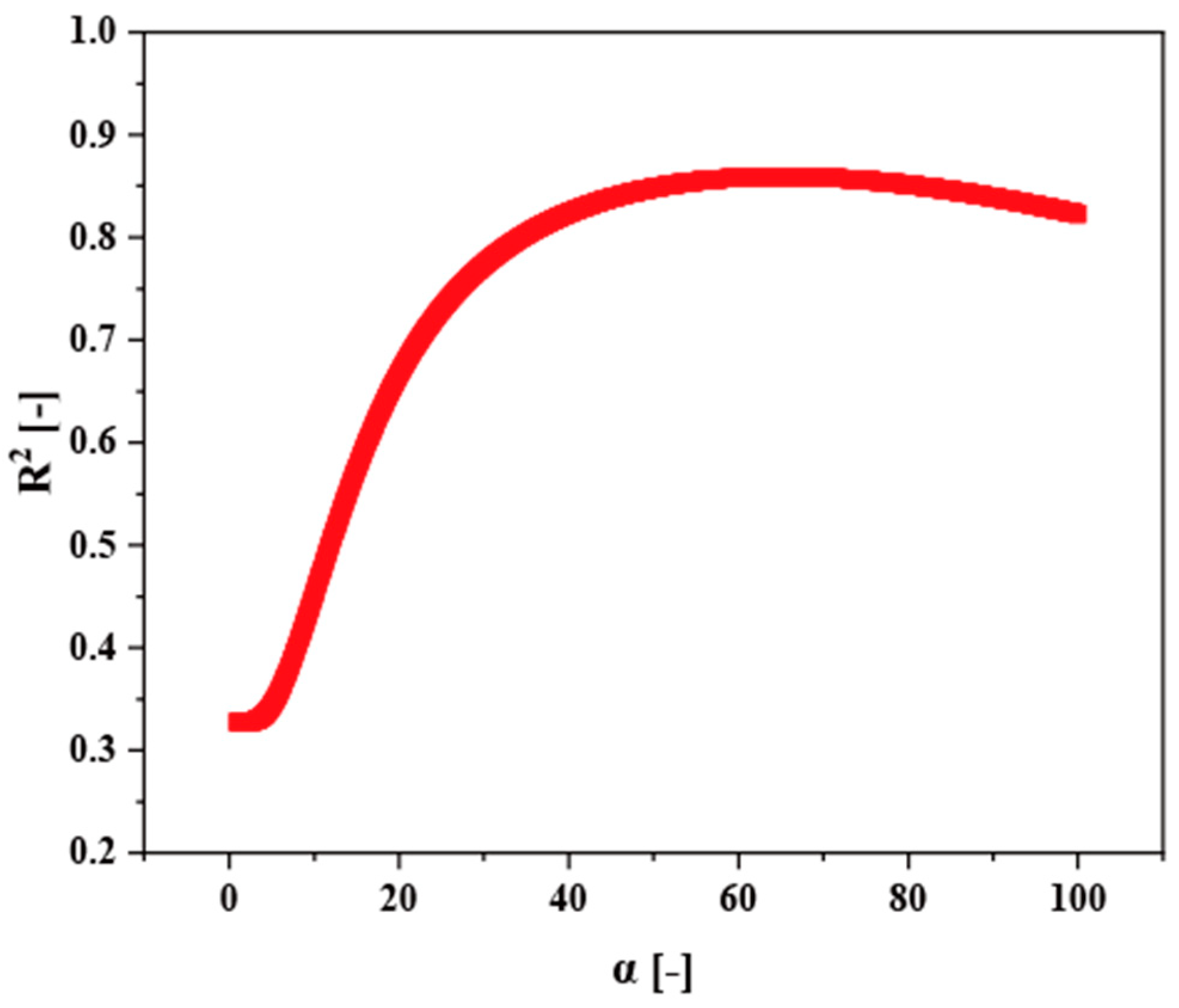
Figure 1. Variation in the coefficient of determination (R2) between EOC and SF(α) as a function of the severity scaling parameter α.
Processes 14 02070 g001
Figure 2. Relationship between observed conversion extent and the optimised severity factor SF(α)*.
Processes 14 02070 g002
Figure 3. Structural decomposition of conversion behaviour: (a) distribution of conversion offset using bin widths determined by the Freedman–Diaconis rule; (b) variance partitioning of EOC.
Processes 14 02070 g003
Figure 4. Two-dimensional representation of conversion behaviour in SIC–CO space.
Processes 14 02070 g004
Table 1. Comparison of linear and nonlinear severity–conversion models.
ModelR2RMSEAICBIC
Linear 0.85930.0611−856.9850−850.9111
Logarithmic0.78310.0759−790.3086−784.2347
Exponential0.81160.0707−812.0020−805.9281
Sigmoidal0.86770.0592−862.4907−850.3429
Table 2. Goodness-of-fit comparison among nested models (M1–M3) for absolute and enhancement responses.
YR2 (M1)R2 (M2)R2 (M3)Δ R2 (M2–M1)
C0.75000.79230.79850.0423
H0.16950.21700.22040.0475
O0.70030.72680.73480.0265
VM0.71620.79420.80050.0780
FC0.77940.86320.86990.0838
HHV0.67370.68580.69510.0121
Cenh0.79050.91910.92680.1286
Henh0.67220.71910.72030.0469
Oenh0.64680.71880.72170.0720
VMenh0.79510.86410.86880.0690
FCenh0.80810.87880.88120.0707
HHVenh0.80870.90980.91960.1011
Disclaimer/Publisher’s Note: The statements, opinions and data contained in all publications are solely those of the individual author(s) and contributor(s) and not of MDPI and/or the editor(s). MDPI and/or the editor(s) disclaim responsibility for any injury to people or property resulting from any ideas, methods, instructions or products referred to in the content.