Article

Experimental Investigation of Acid-Etched Creep Behavior and Mechanical Constitutive Modeling of Carbonate Rocks


1
School of Petroleum Engineering, China University of Petroleum (East China), Qingdao 266580, China
2
State Key Laboratory of Deep Oil and Gas, China University of Petroleum (East China), Qingdao 266580, China
3
PetroChina Tarim Oilfield Company, Korla 841000, China
*
Author to whom correspondence should be addressed.
Processes 2026, 14(13), 2038; https://doi.org/10.3390/pr14132038
Submission received: 20 May 2026 / Revised: 19 June 2026 / Accepted: 22 June 2026 / Published: 23 June 2026
(This article belongs to the Special Issue Advanced Research on Marine and Deep Oil & Gas Development)

Abstract

Deep and ultra-deep carbonate reservoirs commonly experience fracture closure and conductivity reduction under high-temperature and high-stress conditions. In this study, triaxial creep tests were conducted on unacid-etched and acid-etched carbonate cores under different stress levels to investigate their time-dependent deformation behavior and the influence of acid etching on rock rheology. The results indicate that carbonate rocks exhibit pronounced creep behavior, including instantaneous elastic deformation, primary creep, and steady-state creep. Acid etching significantly altered the creep characteristics and rheological parameters of carbonate rocks, leading to distinct time-dependent deformation responses compared with the unacid-etched core. The Burgers constitutive model was employed to characterize the creep behavior, and all fitting correlation coefficients exceeded 0.9. Finite element simulations based on the fitted parameters successfully reproduced the experimental creep curves, verifying the reliability of the constitutive model. This study provides a theoretical and numerical basis for evaluating the long-term deformation behavior of acid-etched carbonate rocks and its implications for fracture closure and conductivity evolution.

1. Introduction

As the exploration and development of oil and gas continues to advance towards deep and ultra-deep formations, carbonate reservoirs have become an important energy resource due to their large reserves and wide distribution [1,2,3,4]. In practical development, acid fracturing is a key technique for improving the productivity of carbonate reservoirs. It creates high conductivity fracture channels through acid etching, thereby significantly enhancing the reservoir productivity [5,6,7]. However, as the development depth increases, reservoir conditions gradually shift from low-temperature and low-stress environments in shallow formations to high-temperature and high-stress conditions in deep formations. Under such conditions, the stability of fractures becomes increasingly critical. Fractures are subjected to high closure stress, which leads to a continuous reduction in fracture width and even complete closure, resulting in a significant decline in fracture conductivity [8,9]. Therefore, accurately characterizing the fracture closure process and its associated mechanical behavior under high stress has become a key scientific problem in the development of deep carbonate reservoirs.
Under deep reservoir conditions, rocks exhibit significant time-dependent deformation under long-term high stress, known as creep behavior [10,11]. Creep is essentially a rheological process. The deformation rate depends not only on the stress level but also on temperature, rock anisotropy, and loading duration [12,13]. For acid-etched fractures in carbonate rocks, fracture closure is not instantaneous. Instead, it evolves gradually over time. This process is closely related to the creep properties. Therefore, investigating rock rheology from a time-dependent perspective is essential for understanding the evolution mechanism of fracture closure. At present, studies on rock creep behavior have established a research framework based on laboratory tests, empirical models, and constitutive theories. Various constitutive models have been proposed, including the Maxwell model, the Kelvin model, and their combined forms [14,15,16,17]. However, most of these studies focus on conventional rocks or shallow conditions. The creep response of deep carbonate rocks under complex treatment conditions remains insufficiently investigated. During the formation of fractures by acid fracturing in carbonate reservoirs, acid etching significantly alters the internal pore structure and microcrack development. This change has a strong impact on the macroscopic mechanical behavior of the rock, which further affects fracture closure and well productivity. Several studies have investigated the mechanical properties of carbonate rocks. Xie et al. [18] conducted conventional triaxial compression tests, triaxial creep tests, and coupled chemical–mechanical tests on porous limestone samples. Their results show that acid etching reduces mechanical parameters such as elastic modulus and cohesion, and also enhances time-dependent deformation. Gou et al. [19] studied the mechanical properties of dolomite after immersion in supercritical CO2 and formation water under high temperature and pressure conditions. They found that chemical dissolution enlarges pore size with increasing immersion time, leading to a significant reduction in rock strength. Li et al. [20] investigated the effects of acid etching time and temperature on the elastic modulus, Poisson’s ratio, and tensile strength of carbonate rocks. Their results indicate that these parameters decrease with increasing treatment time and temperature, which significantly influences the fracture initiation pressure. Nevertheless, most existing studies mainly focus on instantaneous mechanical properties. The time-dependent deformation behavior of carbonate rocks under high temperature and high stress conditions remains insufficiently understood [21].
In numerical simulations of fracture closure, some models are based on elastic or elastoplastic assumptions. These models do not fully consider the rheological behavior of rocks. As a result, they cannot accurately capture the long-term evolution of fractures under sustained stress. Lu et al. [22] employed the Drucker–Prager elastoplastic model to describe rock yielding. They conducted simulations of fracture contact and closure based on three-dimensional scanned fracture surfaces. Their results showed that stress state, mechanical properties, fracture roughness, and slip all significantly influence the closure process. Hou et al. [23] investigated fracture permeability evolution and closure behavior in granite using steady-state flow experiments, high-resolution laser scanning, and three-dimensional numerical modeling. They found that fracture permeability decreases following a quadratic exponential trend under confining stresses of 5–40 MPa, with an overall reduction of 82.1%. Meanwhile, fracture aperture decreases exponentially by 60.4%. However, under deep high-stress conditions, neglecting time-dependent effects may significantly underestimate fracture closure. This limitation prevents numerical models from reproducing the actual long-term evolution of fractures. Wei et al. [24] used a Maxwell model to characterize the creep behavior of shale. They conducted coupled simulations of fracture surfaces, proppant, and fluid flow. Their results indicate that both shale creep and proppant embedment increase fracture closure over production time. Zhang et al. [6] introduced a power-law model to describe rock rheology and investigated the evolution of acid-etched fracture morphology under stress. They found that surface strain and roughness vary significantly with time. To better account for the long-term closure behavior of fractures in deep carbonate reservoirs, recent studies have increasingly incorporated rock rheology into numerical simulations. Traditional elastic and elastoplastic fracture closure models are widely used to describe instantaneous deformation and stress redistribution; however, they generally neglect time-dependent creep effects, which are critical under sustained high-stress conditions. Recent developments in nonlinear creep constitutive modeling, including fractional derivative models, damage-coupled formulations, and nonlinear viscoelastic–plastic frameworks, have significantly improved the description of time-dependent deformation and progressive failure in rocks [25,26,27]. In addition, chemical processes such as acidification and dissolution have been shown to substantially alter the microstructure and mechanical behavior of carbonate rocks, leading to reduced stiffness, strength degradation, and enhanced time-dependent deformation response under stress [28]. These chemically induced changes further influence fracture surface evolution and contact behavior during long-term loading. Therefore, it is necessary to incorporate rock rheology and time-dependent effects into numerical simulations. This approach enables a more accurate investigation of the creep behavior of carbonate rocks and their impact on fracture closure.
To investigate the time-dependent deformation behavior of deep carbonate rocks under sustained high-stress conditions, triaxial creep experiments were conducted on unacid-etched and acid-etched carbonate core samples under varying stress levels. The creep behavior was characterized through analysis of the strain–time evolution during different creep stages. The primary objective of this study is to quantify how acid etching influences the creep behavior and rheological parameters of carbonate rocks. To this end, the Burgers constitutive model was employed to describe the complete creep process, including instantaneous elastic deformation, primary creep, and steady-state creep. The model parameters were determined through nonlinear fitting and inverse analysis of the experimental creep curves. Subsequently, the calibrated constitutive parameters were implemented into a finite element framework. Numerical simulations were performed under the same loading conditions as the laboratory experiments to validate the constitutive model and to evaluate the predictive capability of the identified rheological parameters. This study focuses on the evolution of time-dependent constitutive behavior induced by acid etching in carbonate rocks, providing a theoretical and numerical basis for characterizing their long-term deformation response under complex stress environments.

2. Experimental Materials and Methods

2.1. Experimental Sample Preparation

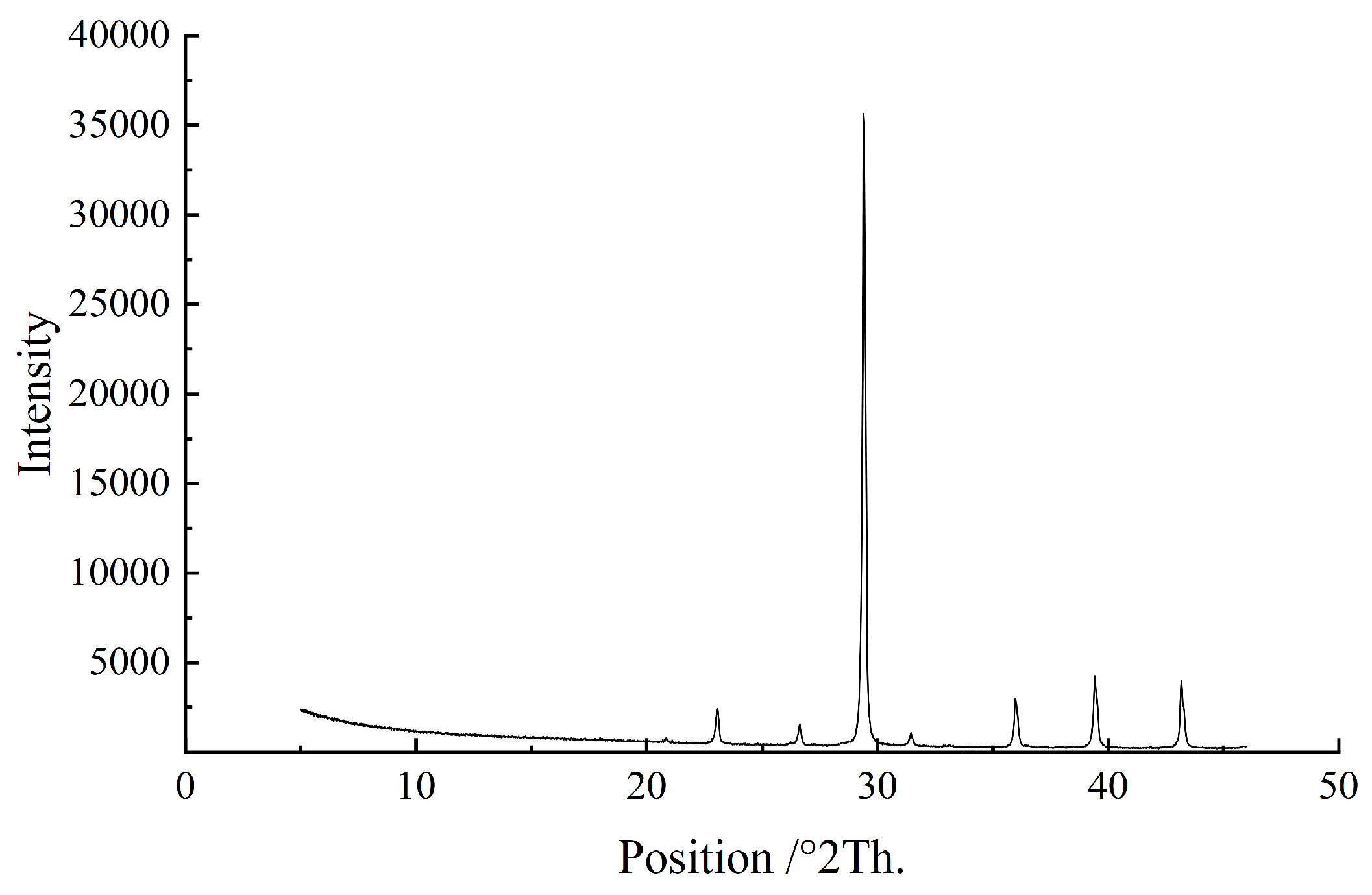
In this study, we selected limestone outcrop samples as the rock material. Prior to mechanical testing, we performed mineralogical analysis on the samples. The rock fragments were ground into powder and analyzed using X-ray diffraction (XRD) to determine the mineral composition (Figure 1). Quantitative phase analysis was conducted to obtain the relative content of each mineral. As shown in Table 1, the samples mainly consist of calcite (96.35%), with minor amounts of quartz (2.09%), aragonite (0.99%), and clay minerals (0.57%). These results confirm the lithological characteristics of the selected samples and provide a basis for subsequent acoustic and mechanical analyses.
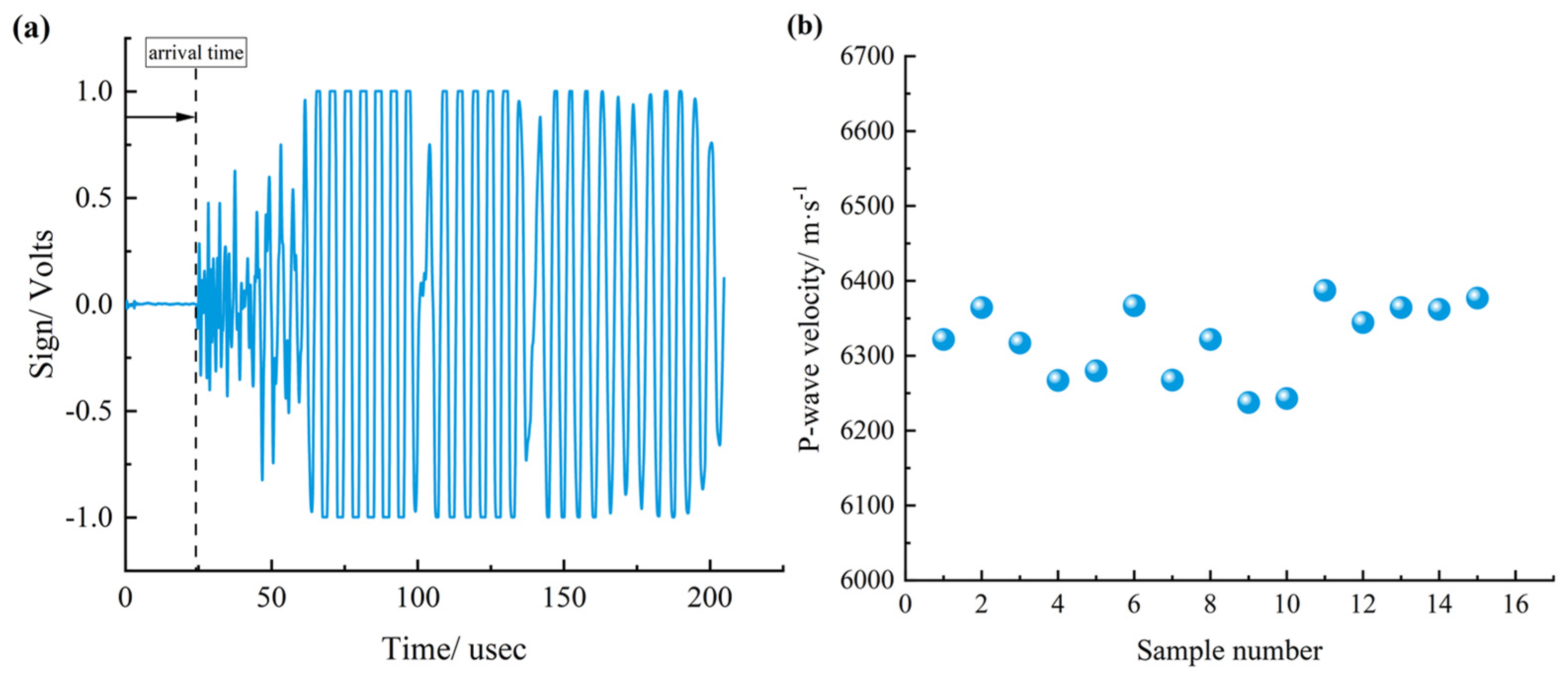
Following the standard procedures recommended by the International Society for Rock Mechanics (ISRM), the samples were processed into cylindrical cores with a diameter of 25 mm and a length of 50 mm [29,30]. After cutting, both ends of the samples were carefully polished. The flatness and parallelism of the end surfaces were measured using a digital micrometer and a dial indicator to ensure compliance with testing standards. After dimensional and visual screening, the qualified samples were subjected to ultrasonic testing to evaluate internal defects and integrity [31]. The tests were conducted using a high-temperature and high-pressure triaxial testing system equipped with ultrasonic measurement capability. Before testing, a small amount of coupling agent was applied to the loading platens to improve signal transmission and ensure stable contact between the platens and the sample ends. Ultrasonic signals were recorded to determine the travel time of the samples in the axial direction (Figure 2a). The P-wave velocity was calculated based on the travel time and sample length. Each sample was tested twice, and the average value was taken as the final result. The test results for different samples are shown in Figure 2b. Samples with significant deviations were excluded, and those with similar physical properties were selected for subsequent triaxial mechanical tests.

2.2. Experimental Methods

2.2.1. Rock Acid Etching Experiments

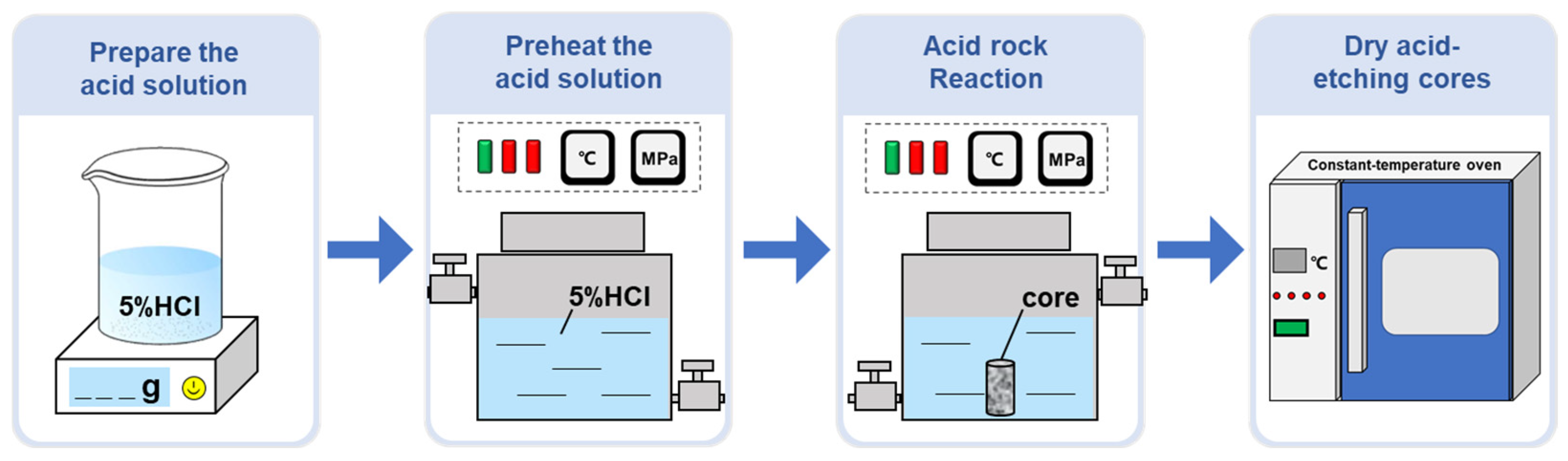
We adopted a static acid-etching method, and the experimental procedure is shown in Figure 3. First, a 5% HCl solution was prepared in a sufficient volume to fully immerse the core samples in the reaction vessel. The target temperature and pressure were then set in the control system, and the conditions inside the vessel were monitored in real time through the digital display panel. The acid solution was preheated to the target temperature in a preparation container and then injected into the reaction vessel through the pipeline. The temperature and pressure in the vessel were maintained constant during the reaction. After reacting with the cores for 30 min, the residual liquid and gas were discharged from the vessel. The cores were then removed, rinsed briefly, and dried in an oven until their mass remained constant. To reproduce the temperature and pressure conditions of deep carbonate reservoirs at a burial depth of approximately 6000 m, the experimental temperature and pressure were set to 120 °C and 7.5 MPa, respectively. The selected temperature and pressure conditions exceed the critical point of CO2. Therefore, these conditions satisfy the thermodynamic requirements for CO2 to potentially reach a supercritical state during the acid–rock reaction process. However, the actual phase behavior of CO2 depends on multiple factors, including CO2 generation, partial pressure, and gas–liquid equilibrium, and was not directly monitored in this study. Previous studies have reported that supercritical CO2 may significantly influence fluid–rock interactions, pore structure evolution, and the long-term rheological behavior of carbonate rocks under high-temperature and high-pressure conditions [32,33].

2.2.2. Triaxial Creep Mechanical Experiments

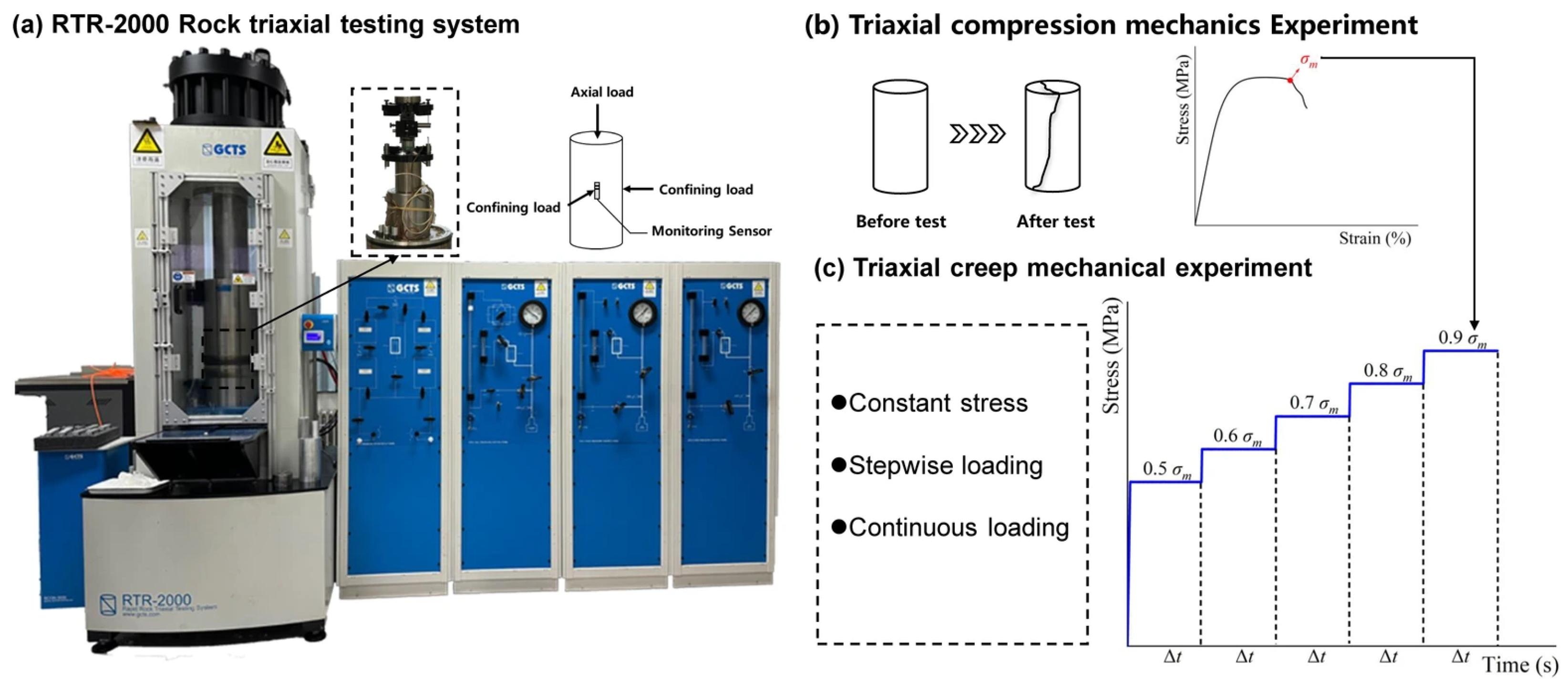
Creep tests are typically conducted under constant stress conditions to evaluate the rheological behavior of rocks over time, during which the evolution of strain with time is recorded. In this study, we performed mechanical experiments using the rock triaxial testing system (Figure 4a). This apparatus is a closed-loop digital servo-controlled system that enables various types of triaxial tests on rock specimens. It can simulate the mechanical behavior of rocks under in situ conditions, including compression and creep. An intelligent data acquisition system allows real-time monitoring and recording of experimental data.
In our study, we adopted a single-core stepwise continuous loading method to apply the load. This approach ensures loading stability and allows us to more clearly reveal the deformation characteristics of rocks under different stress levels. Meanwhile, it effectively avoids variability caused by using multiple specimens, thereby improving the reliability of the measured mechanical parameters [34,35,36]. The experimental procedure consists of two stages. First, we conducted triaxial compression tests (Figure 4b) on both acid-etched and unacid-etched cores. The obtained data were used to plot stress–strain curves. From these curves, we can clearly observe the evolution of strain as stress increases, as well as the entire process in which the rock reaches its peak compressive strength (σm) and eventually fails. Subsequently, triaxial creep tests were carried out (Figure 4c). Based on the peak compressive strength (σm) under the corresponding confining pressure, five stress levels were sequentially applied: 0.5 σm, 0.6 σm, 0.7 σm, 0.8 σm, and 0.9 σm. Each stress level was maintained for 24 h. After completing one loading stage, the creep test at the next stress level was initiated immediately. During the experiment, stress and strain data were automatically recorded every 5 s until all five loading stages were completed. The detailed experimental conditions are listed in Table 2.

3. Experimental Results and Analysis

3.1. Triaxial Mechanical Compression Characteristics Under Acid Etching

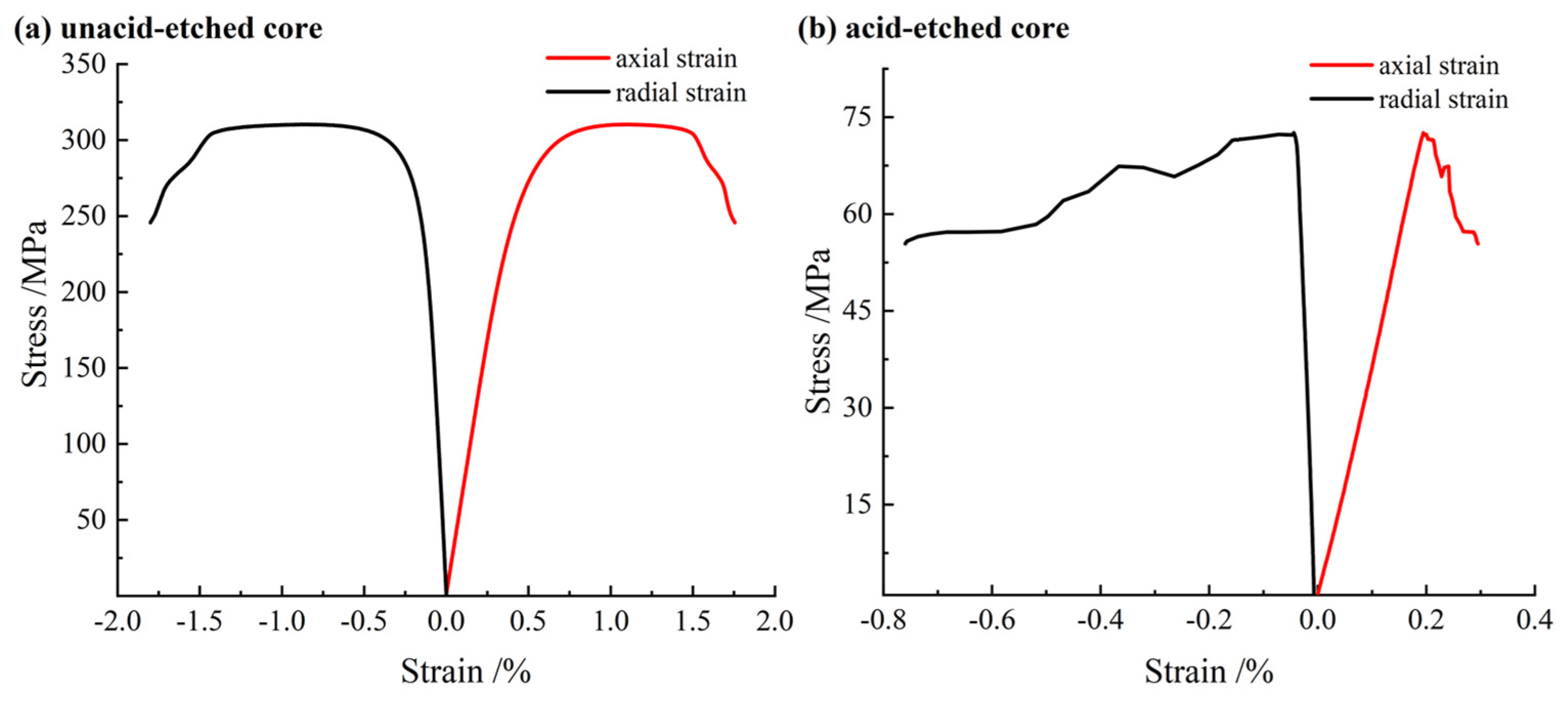
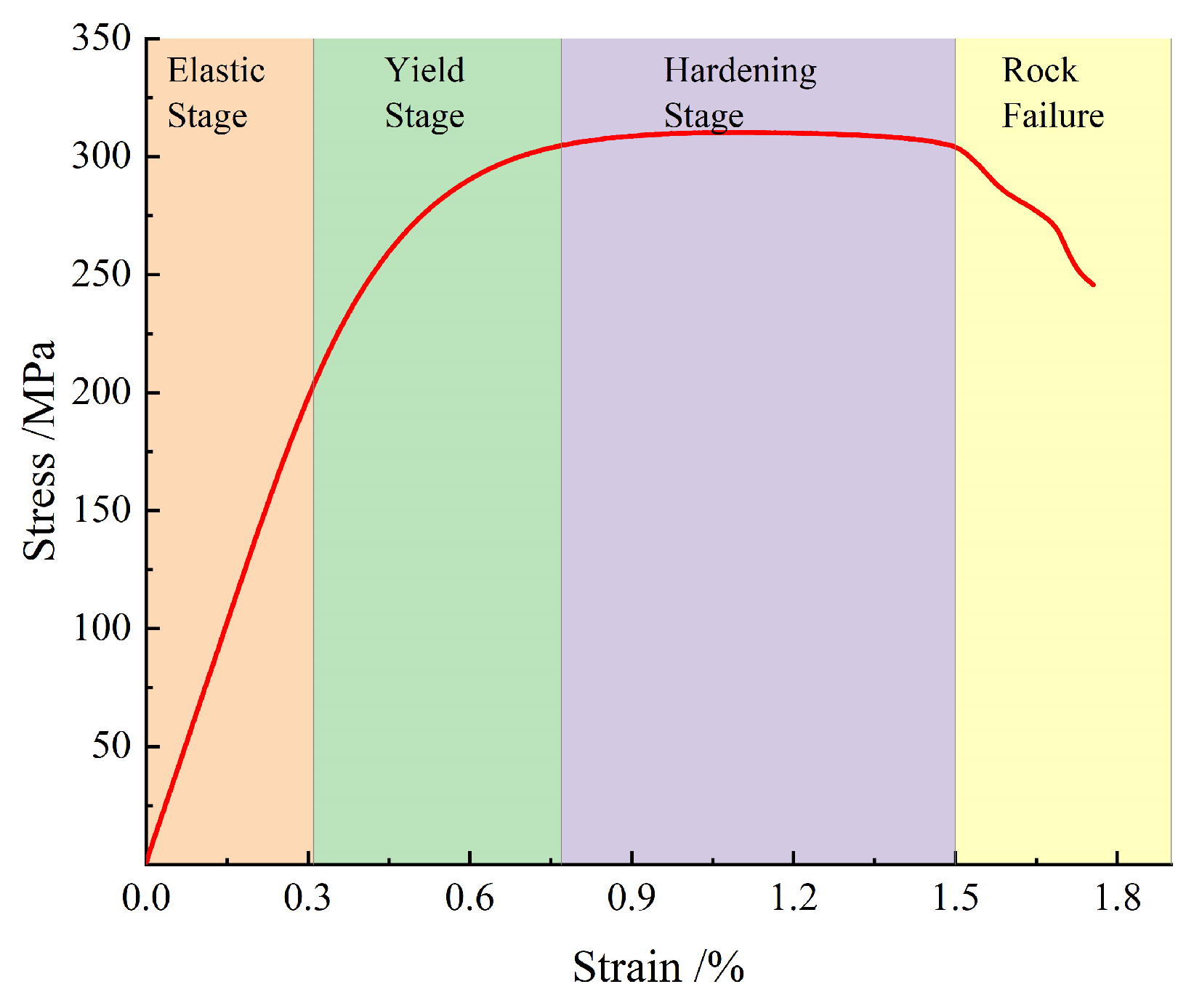
Triaxial compression tests were conducted on both unacid-etched and acid-etched cores under a confining pressure of 60 MPa. In all subsequent graph plots and result analyses in this paper, the axial loads were calculated using deviatoric stress. The corresponding stress–strain curves are shown in Figure 5. Taking the axial strain curve of the unacid-etched core as an example (Figure 6), we observe that the rock initially undergoes elastic deformation as the applied stress increases. This stage appears as a linear segment with a constant slope on the stress–strain curve. After the elastic stage, the stress–strain curve exhibits a noticeable change, and the slope gradually decreases, indicating that the rock enters the yielding stage and begins to develop irreversible plastic deformation. With further increase in stress, the curve transitions into a relatively flat plateau. At this stage, the rock enters a hardening state, internal damage accumulates, the stress no longer increases significantly, while the strain continues to grow, eventually leading to compressive failure.
By comparing the stress–strain curves of the acid-etched core, we find that its peak strength is significantly lower than that of the unacid-etched core. In addition, during loading, the acid-etched rock fails within a short period after the elastic stage. In contrast to the unacid-etched rock, no distinct yielding stage is observed.
Based on the stress–strain results obtained from the triaxial compression tests, we determined that the peak compressive strength of the unacid-etched core under a confining pressure of 60 MPa is 310 MPa, whereas that of the acid-etched core is 71 MPa. These results indicate that acid etching has a significant impact on the overall strength of the rock, leading to a pronounced reduction in compressive strength. Furthermore, the variations in mechanical properties can be clearly observed through the calculation and analysis of the elastic modulus and Poisson’s ratio (Table 3). The unacid-etched core exhibits an elastic modulus of 67 GPa and a Poisson’s ratio of 0.16, while the acid-etched core shows an elastic modulus of 35 GPa and a Poisson’s ratio of 0.15. The reduction in elastic modulus indicates that the rock’s resistance to deformation decreases, resulting in larger strain under the same applied stress. Similarly, the change in Poisson’s ratio further reflects the influence of acid etching on the rock structure, making the rock more susceptible to deformation under stress [37,38,39].

3.2. Triaxial Creep Mechanical Characteristics Under Acid Etching

3.2.1. Strain–Time Results

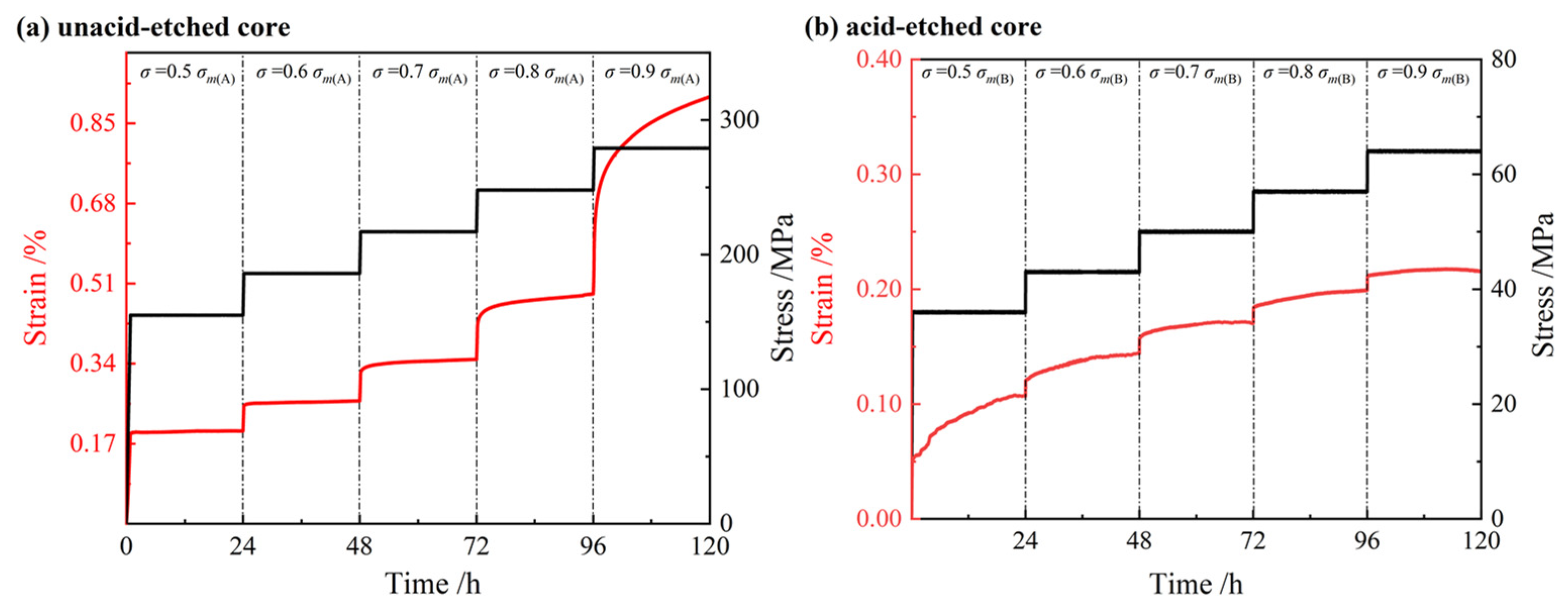
To further clarify the influence of acid etching on the creep behavior, we compare the creep responses of unacid-etched and acid-etched cores under identical loading conditions (Figure 7). The results show that the cumulative creep strain of the unacid-etched rock increases significantly with stress level, reaching 0.907% at the fifth loading stage. In contrast, the acid-etched rock exhibits a much lower cumulative strain, with a maximum value of only 0.217%.
A similar trend is observed for the incremental creep strain at each loading stage. For the unacid-etched core, the creep strain generally increases with increasing stress level, and a pronounced acceleration is observed at higher stress levels. In contrast, the acid-etched core exhibits relatively small incremental creep strains, with the maximum value of 0.107% occurring at the first loading stage and decreasing thereafter. It should be noted that the stress levels applied to the unacid-etched and acid-etched cores were defined as fractions of their respective peak strengths (0.5σm–0.9σm). Therefore, although both groups were tested under comparable normalized stress levels, the absolute stresses applied to the acid-etched core were substantially lower due to its reduced peak strength. The results indicate that acid etching significantly modifies the creep response of the limestone. Acid-induced dissolution weakens the load-bearing skeleton and reduces both the strength and stiffness of the rock, resulting in failure at lower absolute stress levels. Consequently, the acid-etched core does not accumulate large creep strains before failure, whereas the unacid-etched core is capable of sustaining higher absolute stresses and developing greater cumulative creep deformation. These results suggest that acid etching reduces the long-term deformation resistance of limestone and changes its creep deformation mechanism under sustained loading.

3.2.2. Creep Rate Evolution and Stage Characteristics

unacid-etched core
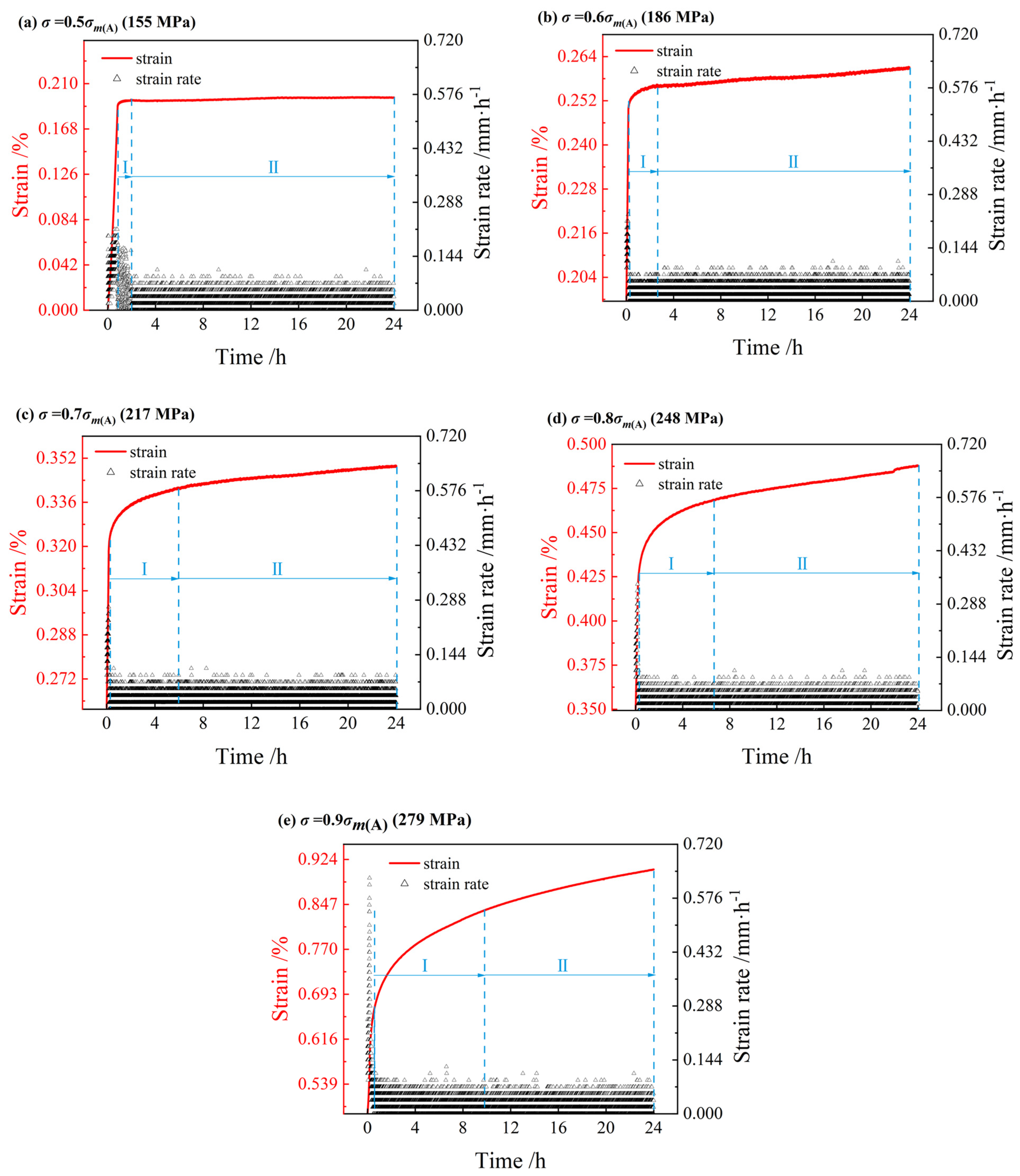
To further characterize the time-dependent evolution of creep strain under stress, we plotted the creep strain and instantaneous strain rate curves at different loading stages. The corresponding results are shown in Figure 8. The strain rate curve can more sensitively capture the transition of the rock from primary creep to steady-state, thereby revealing the characteristic features and rate evolution of each stage [40,41,42,43]. In the figure, the strain-time curve is divided into a decelerating creep stage (I) and a steady-state creep stage (II) based on changes in the strain rate.
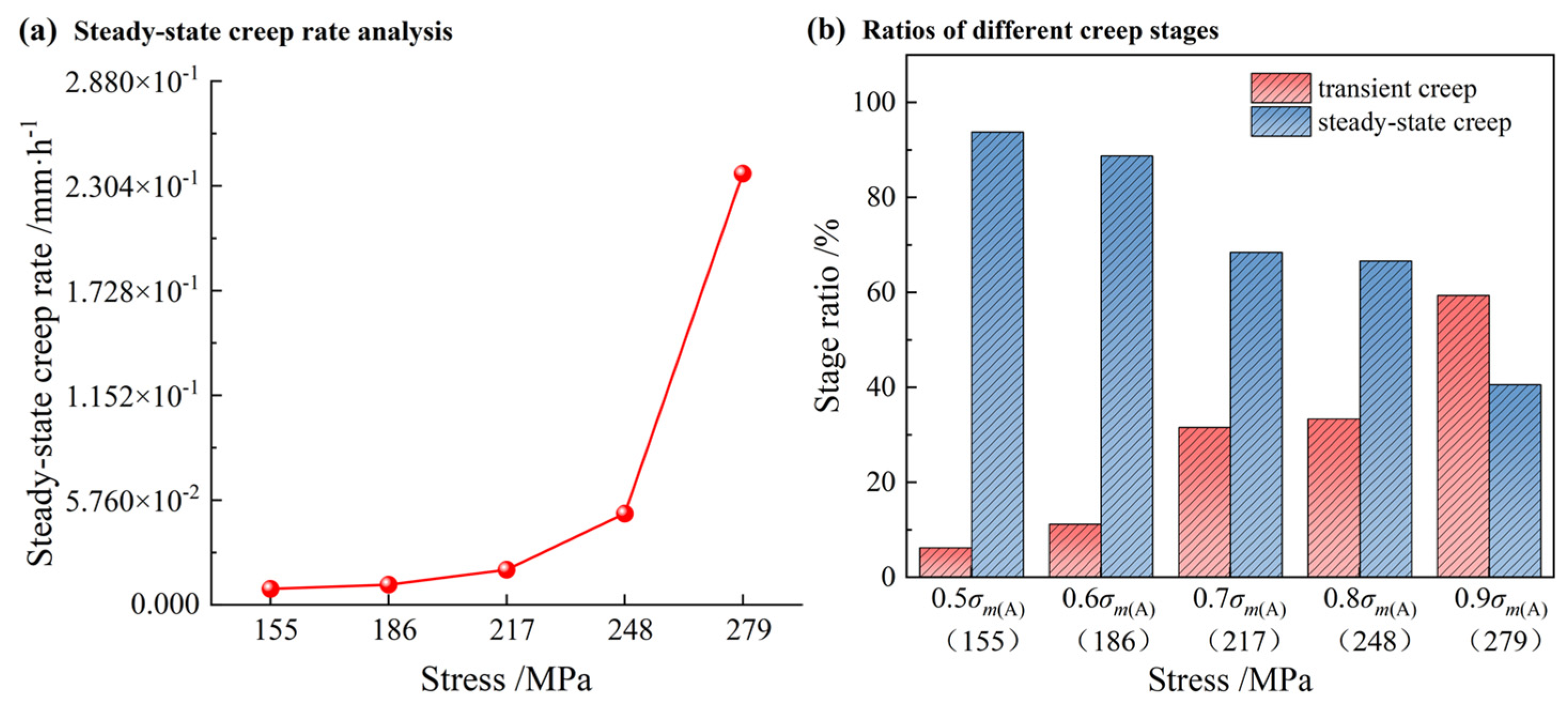
The results indicate that the instantaneous strain rate decreases rapidly from an initially high level to a stable low range within a short period. This behavior reflects that, during the initial application of stress, the strain increases rapidly, and the instantaneous creep rate remains relatively high. After reaching a constant stress level, the rock enters the primary creep stage, during which the instantaneous strain rate continuously decreases until it eventually stabilizes. A comparison of the instantaneous strain rates under different loading levels shows that the peak values during the initial stage increase with stress (Figure 9a). Specifically, the maximum instantaneous strain rates are 0.216 mm·h−1 at the first loading stage, 0.234 mm·h−1 at the second stage, 0.270 mm·h−1 at the third stage, 0.342 mm·h−1 at the fourth stage, and 0.630 mm·h−1 at the fifth stage. These results demonstrate that the instantaneous strain rate varies significantly with the applied stress level. Higher stress levels correspond to higher peak strain rates during the loading process.
We further divided the primary creep stage and the steady-state creep stage under different stress levels, as shown in Figure 9b. The results indicate that, with increasing stress, the proportion of time that the rock spends in the primary creep stage changes significantly. Specifically, the proportion of the primary creep stage is 6.22% at the first loading level, 11.24% at the second level, 31.57% at the third level, 33.37% at the fourth level, and 59.39% at the fifth level. These results show that, under low stress conditions, the primary creep stage occupies only a short duration. However, as the stress level increases, its proportion in the overall creep process increases markedly. In contrast, the proportion of the steady-state creep stage decreases progressively with increasing stress, indicating that the rock is unable to maintain a long-term stable creep deformation state under high stress conditions. Overall, these results demonstrate that the applied stress not only affects the magnitude of creep strain but also significantly controls the evolution of different creep stages, making it a key factor governing the time-dependent deformation behavior of the rock.
acid-etched core
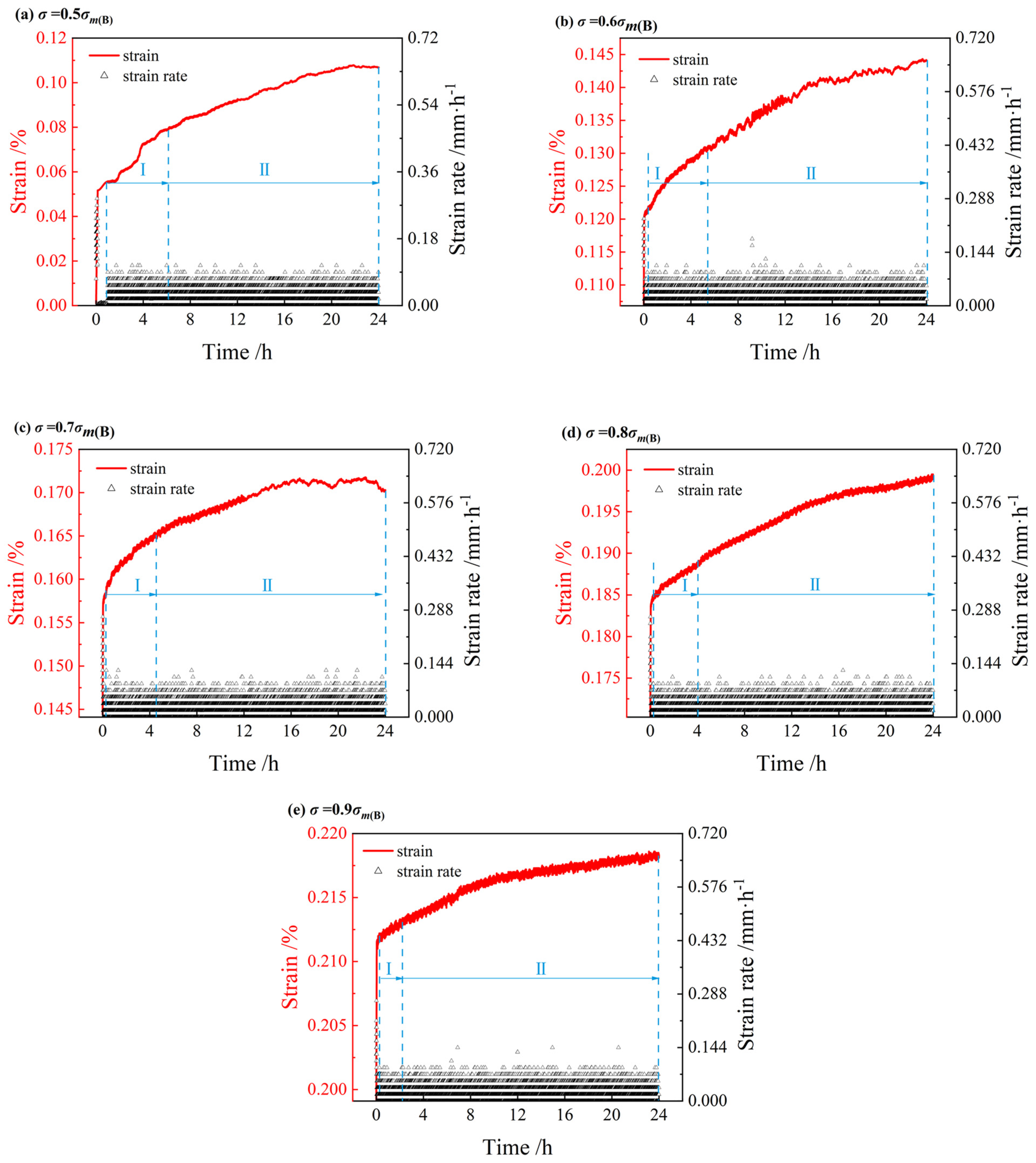
We plotted the creep strain and instantaneous strain rate curves at different loading stages, as shown in Figure 10. The results indicate that the instantaneous strain rate rapidly decreases from an initially high value to a stable low range within a short period. A comparison of the instantaneous strain rates under different loading levels shows that, during the initial stage when the creep rate reaches its maximum, the peak values are 0.288 mm·h−1 at the first loading stage and 0.270 mm·h−1 at the fifth stage. The peak instantaneous strain rate of the acid-etched samples did not change significantly with increasing loading level. The values varied from 0.288 mm·h−1 at the first stage to 0.270 mm·h−1 at the fifth stage, remaining within a relatively narrow range throughout the test. In contrast, the unacid-etched samples showed a more obvious increase in peak instantaneous strain rate with loading level, from 0.216 mm·h−1 to 0.630 mm·h−1. This difference suggests that acid etching altered the instantaneous deformation response of the carbonate rock during graded creep loading.
As shown in Figure 10, under constant stress, the strain curve initially exhibits a rapidly increasing linear segment, reflecting the rapid growth of strain during this stage. Subsequently, the slope of the curve decreases, indicating a decelerating process, and then the curve maintains a relatively constant slope with a continuous increasing trend. Compared with the unacid-etched core, the acid-etched core shows a much less pronounced decelerating stage during loading. The transition from the initial rapid increase to the later stable growth is shorter, and under low stress conditions, the strain curve does not exhibit a near-horizontal trend indicative of stabilization. The acid-etched core exhibits a different creep response from that of the unacid-etched core, particularly during the early stages of loading. The reduction in strength and stiffness caused by acid etching decreases the ability of the rock skeleton to resist long-term deformation, leading to noticeable changes in the rheological parameters and time-dependent deformation characteristics. These results indicate that acid etching significantly modifies the rheological response of limestone and influences its long-term deformation behavior under sustained loading.
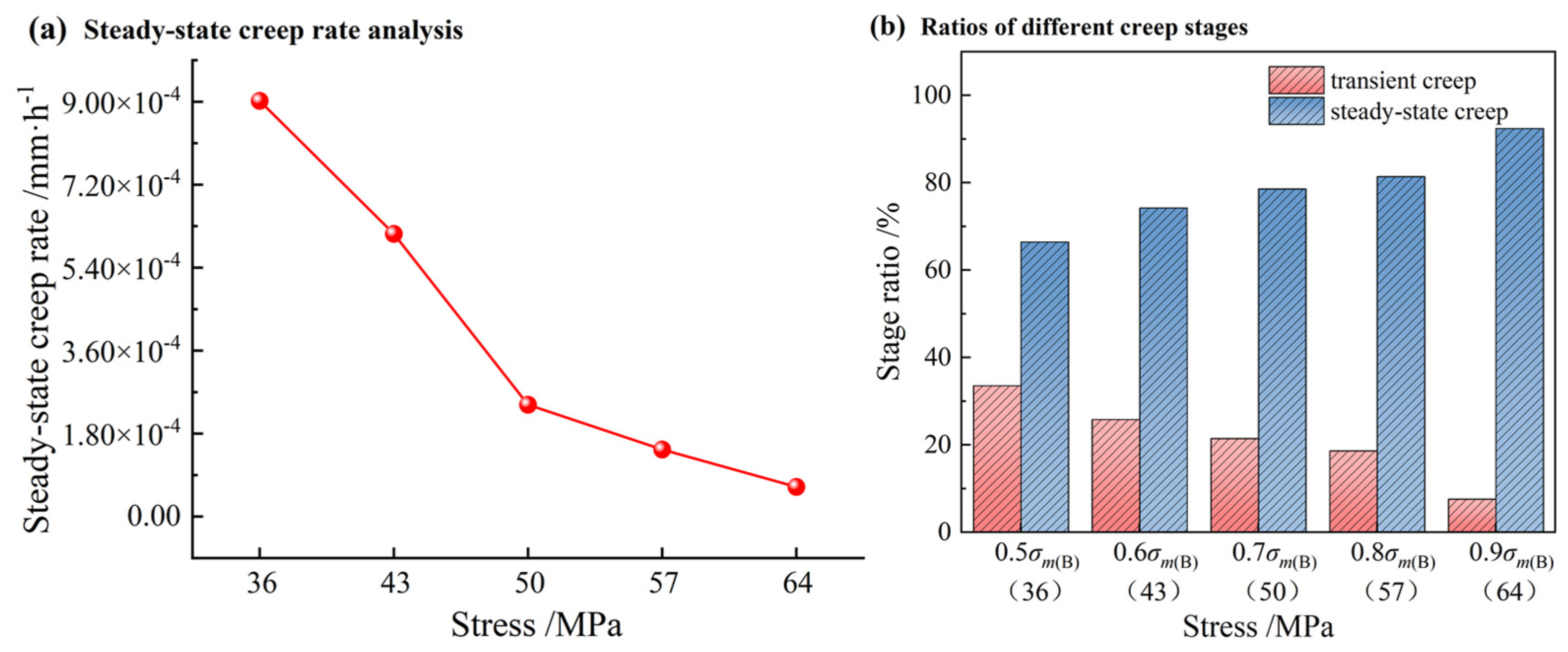
Linear regression was performed on the steady-state creep curves under different stress levels, and the corresponding steady-state creep strain rates are shown in Figure 11a. As the applied stress level increases, the steady-state creep strain rate decreases progressively. Compared with the first loading level (9 × 10⁻⁴ mm·h−1), the second, third, fourth, and fifth levels decrease by approximately 32%, 73%, 84%, and 93%, respectively. To further characterize the evolution of creep stages, the durations of the primary creep stage and steady-state creep stage under different loading levels were quantified, as shown in Figure 11b. The results indicate that the proportion of time occupied by the primary creep stage decreases with increasing stress level, from 33.55% at the first level to 7.58% at the fifth level. Correspondingly, the relative contribution of the steady-state creep stage increases with increasing stress level, indicating a transition toward a more rapidly stabilized deformation process. These results suggest that higher stress levels promote faster structural adjustment and earlier stabilization of creep deformation, leading to a reduced duration of the primary creep stage and a more dominant steady-state deformation behavior.

3.3. Constitutive Modeling of Creep Behavior

3.3.1. Creep Constitutive Model

Based on the creep test results, we observe that the deformation curves of carbonate rocks under constant stress exhibit distinct stage characteristics. These stages mainly include instantaneous elastic deformation at the initial loading stage, a primary creep stage with gradually decreasing strain rate, and a steady-state creep stage that approaches a constant rate at later times. Each stage corresponds to different mechanical response mechanisms, indicating that the deformation process is governed by the coupled effects of elasticity and viscosity [44,45,46].
Therefore, the constitutive model must be capable of uniformly characterizing the multi-stage creep behavior. The classical Maxwell model can describe steady-state creep but fails to capture the primary creep process. In contrast, the Kelvin model can represent primary creep behavior but cannot describe instantaneous elastic response or long-term steady flow. As a result, both models are insufficient to fit the complete experimental creep curves [17,47]. In comparison, the Burgers model effectively integrates the Maxwell and Kelvin elements in series, incorporating instantaneous elastic deformation, primary creep, and steady-state creep mechanisms. This enables a comprehensive description of the entire creep process of carbonate rocks. Based on the above analysis, we adopt the Burgers model to fit the experimental curves and to achieve a unified characterization of the time-dependent deformation behavior of the rock.
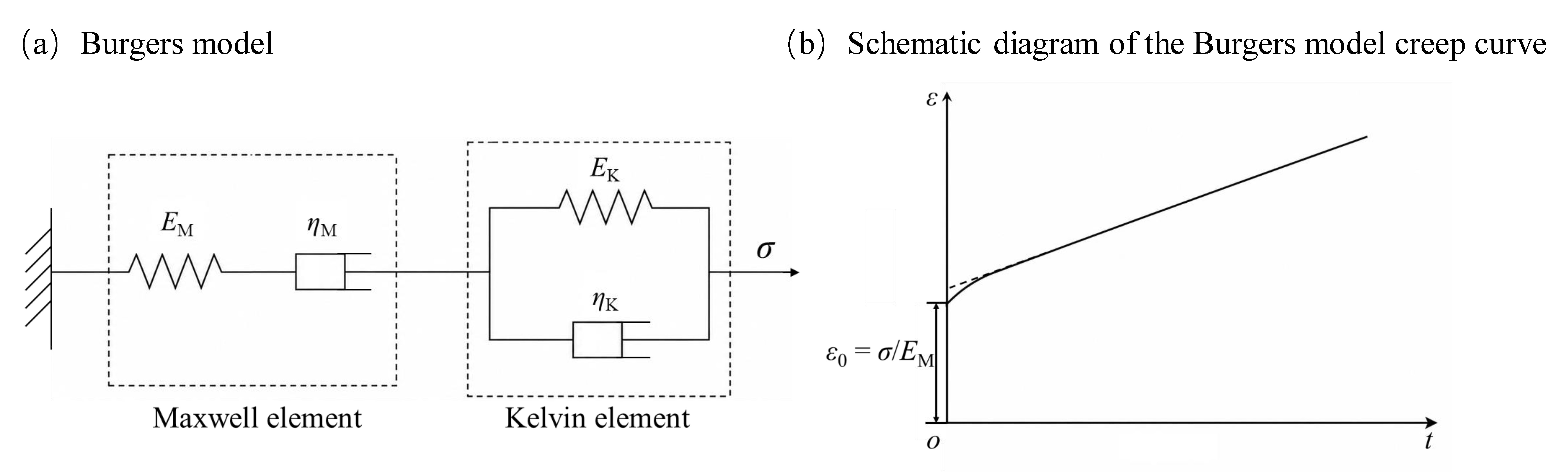
The Burgers model, also referred to as the M–K model, consists of a Maxwell element connected in series with a Kelvin element, as shown in Figure 12a. At t = 0, only the elastic spring responds, yielding an initial strain of ε0 = σ/EM. As t → ∞, the strain ε → ∞, as illustrated in Figure 12b; however, the rate of strain approaches a constant value.
The constitutive equation and the corresponding creep equation of the Burgers model are given as follows (Equations (1) and (2)):
σ ¨ + E M η K + E K η K + E M η M σ ˙ + E M E K η M η K σ = E M ε ¨ + E M E K η K ε ˙
ε t = σ E M + σ E K ( 1 - e - E K η K t ) + σ η M t
where ε(t) is the strain; σ is the applied constant stress; EM is the instantaneous elastic modulus, reflecting the elastic response capacity of the rock at the moment of loading; ηM is the viscosity coefficient of the Maxwell element, which governs the deformation rate during the steady-state creep stage; EK is the elastic modulus of the Kelvin element, mainly characterizing the recovery capacity during the primary creep stage; ηK is the viscosity coefficient of the Kelvin element, describing the time-dependent behavior of the primary creep process.
In the Burgers model, four parameters must be identified, among which EM denotes the elastic modulus. Under a constant applied stress σ, the elastic strain related to EM occurs instantaneously. Thus, at t = 0, EM can be determined from the ratio of stress to strain. The other three rheological parameters (EK, ηK, ηM) are obtained using the least squares approach [48]. For each time point ti, a theoretical strain value ε ¯ i can be calculated from Equation (3), corresponding to the measured strain εi. The least squares method aims to identify the optimal parameter combination by minimizing the objective function P, which is defined as the sum of the squared deviations between the measured and predicted strain values, as expressed in Equation (4).
ε ¯ i = σ E M + σ E K ( 1 - e E K η K t i ) + σ η M t i
P = i = 1 N ε ¯ i ε i 2
P E K = 0 P η K = 0 P η M = 0
An initial estimate of the rheological parameter vector P (EK, ηK, ηM), namely (EK0, ηK0, ηM0), is first assigned. The partial derivatives of strain with respect to each rheological parameter are then calculated to determine the corresponding parameter corrections (ΔEK, ΔηK, ΔηM). These corrections are applied to update the parameter set to (EK1, ηK1, ηM1). The updated parameters are subsequently used as the starting values for the next iteration. This iterative process continues until the three rheological parameters meet the convergence criterion specified in Equation (5) within the prescribed error range. The data were fitted using the least squares method, and the resulting parameter values and the coefficient of determination (R2) are shown in Table 4.
The fitting results show that the Burgers model parameters vary with stress level. Although several viscosity-related parameters exhibit a decreasing trend as the stress increases, the changes are not completely monotonic, and local fluctuations can be observed at certain loading stages. In contrast, the contribution of the viscous deformation component gradually increases under higher stress levels, indicating that the time-dependent deformation behavior becomes more pronounced. These results suggest that the rheological characteristics of carbonate rocks are affected by stress level, but the evolution of individual model parameters does not follow a simple linear or monotonic pattern. Compared with conventional elastoplastic models, the Burgers model can effectively describe the instantaneous deformation, decelerating creep, and steady-state creep observed in the experiments, making it suitable for characterizing the long-term deformation behavior of carbonate rocks under sustained loading conditions.

3.3.2. Finite Element Simulation and Validation
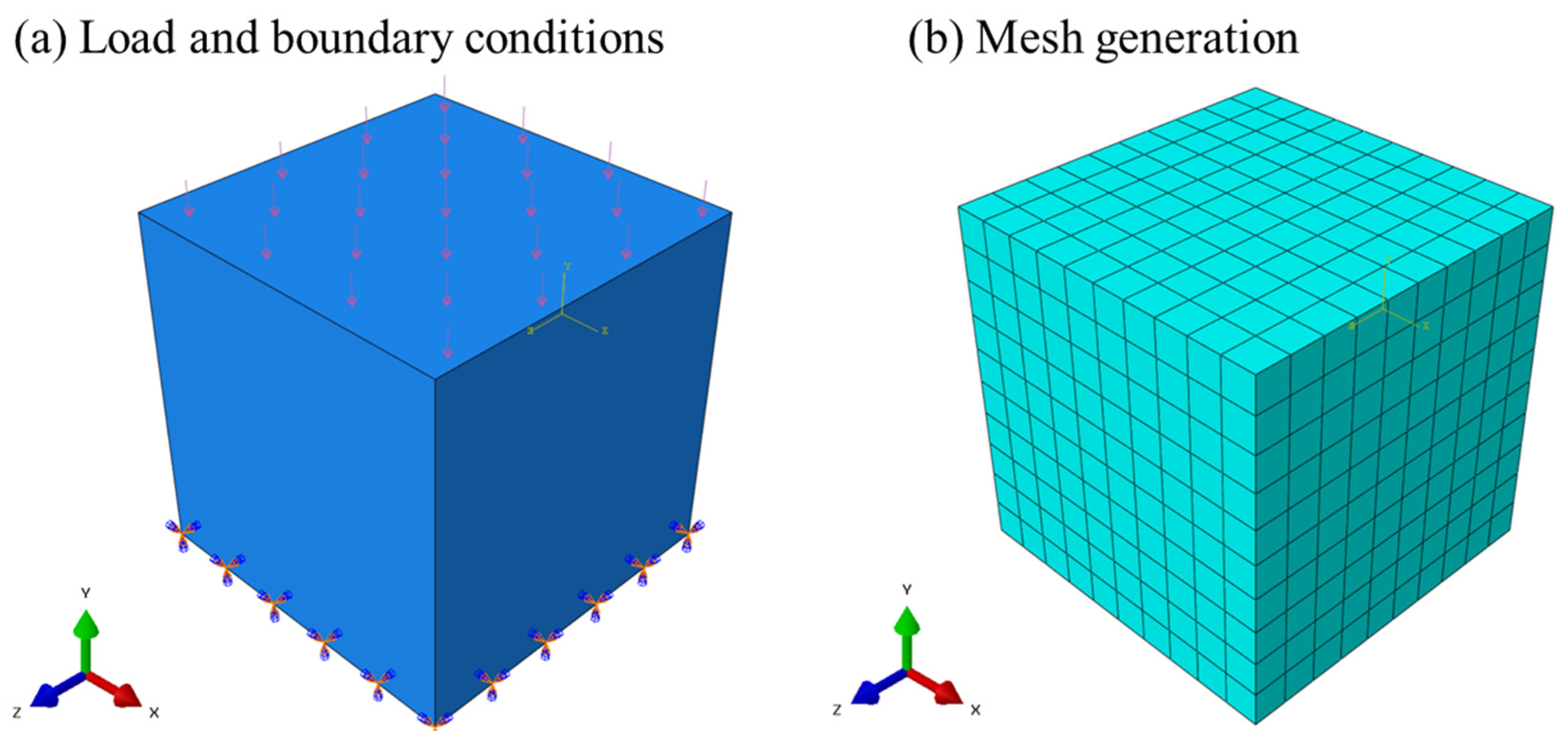
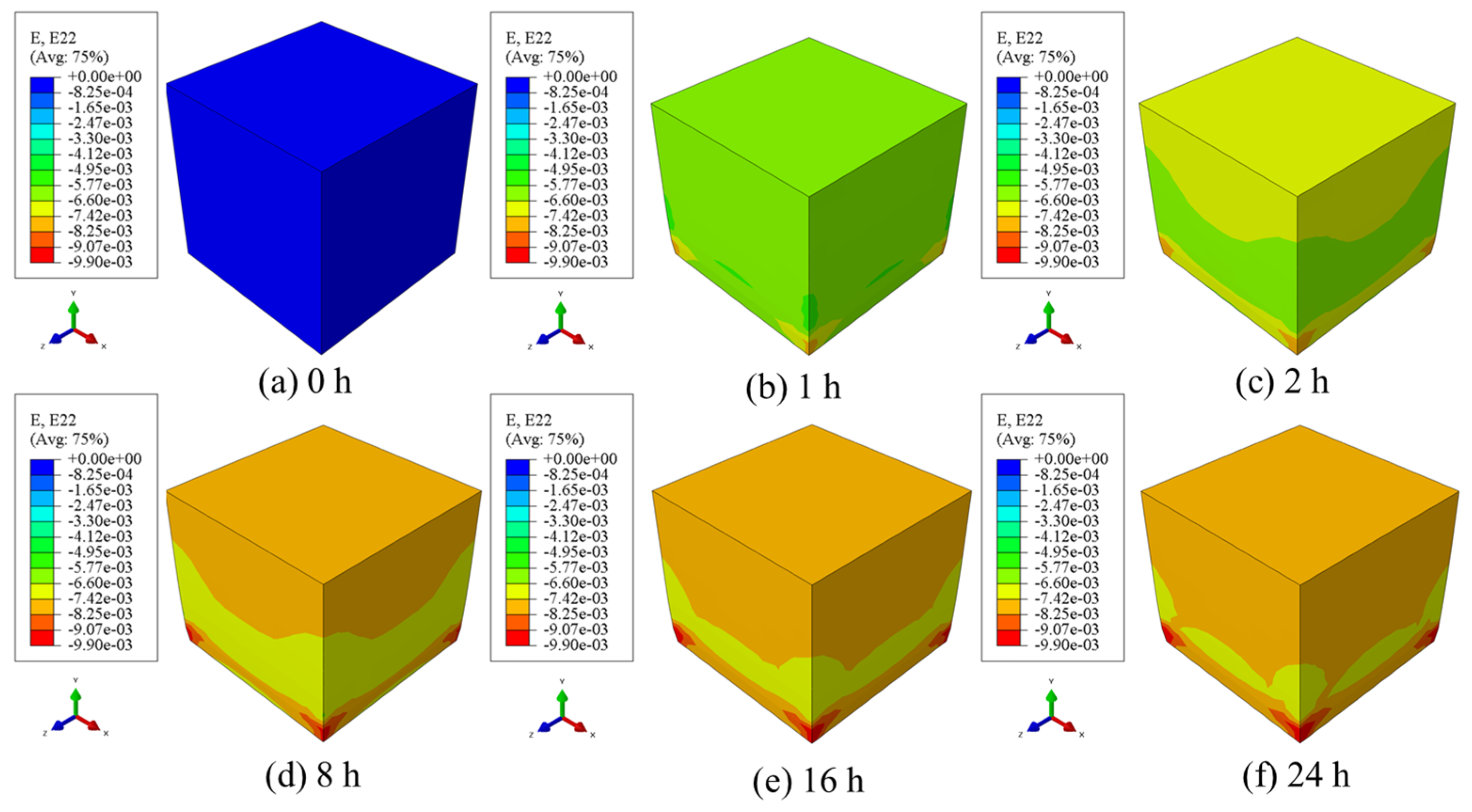
To validate the rationality of the established creep constitutive model, we developed a numerical model (20 mm × 20 mm × 20 mm) in finite element software (Abaqus version 2022), as shown in Figure 13. The numerical model was discretized using hexahedral elements (C3D8) and analyzed as a three-dimensional solid body. Boundary conditions were applied to the bottom surface with fully fixed constraints to simulate the fixed-end condition in the experiments. Meanwhile, a uniformly distributed constant axial stress was applied to the top surface. The same loading conditions and creep durations as those used in the laboratory tests were adopted in the numerical simulations. The Burgers constitutive parameters obtained from the inversion of the experimental creep curves were implemented into Abaqus through a user-defined creep subroutine. During the analysis, set the time step to 1 s and set the stress and strain output fields as a function of time (Figure 14). The simulated creep results were subsequently compared with the experimental results to evaluate the ability of the Burgers model to reproduce the time-dependent deformation behavior of carbonate rocks before and after acid etching.
Figure 13. Schematic diagram of stress-load boundary conditions and mesh generation for the finite element model.
Processes 14 02038 g013
Figure 14. Cloud map of strain results over time during the stress loading process (unacid-etched core stage 5: σ = 0.9 σm(A)).
Processes 14 02038 g014
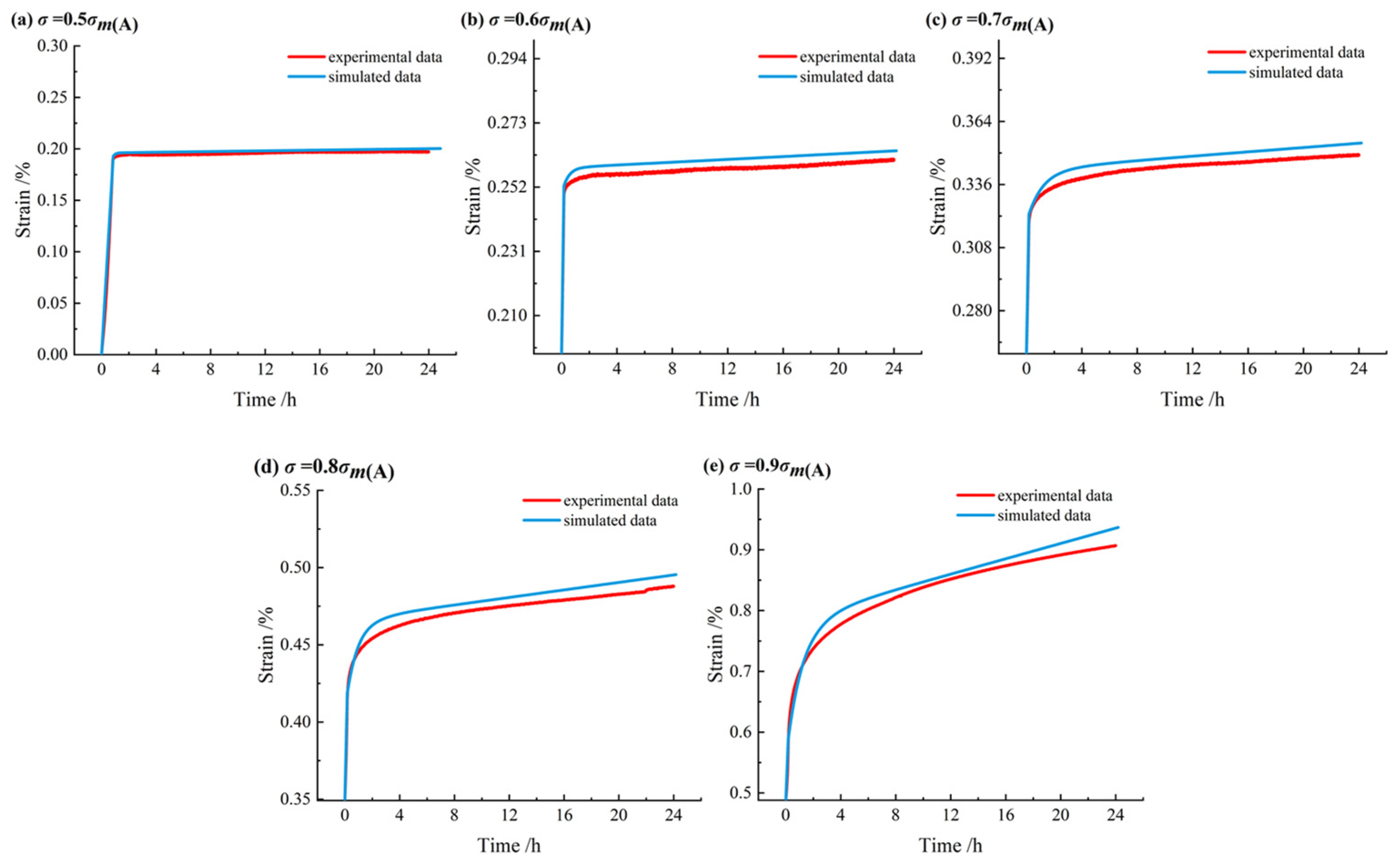
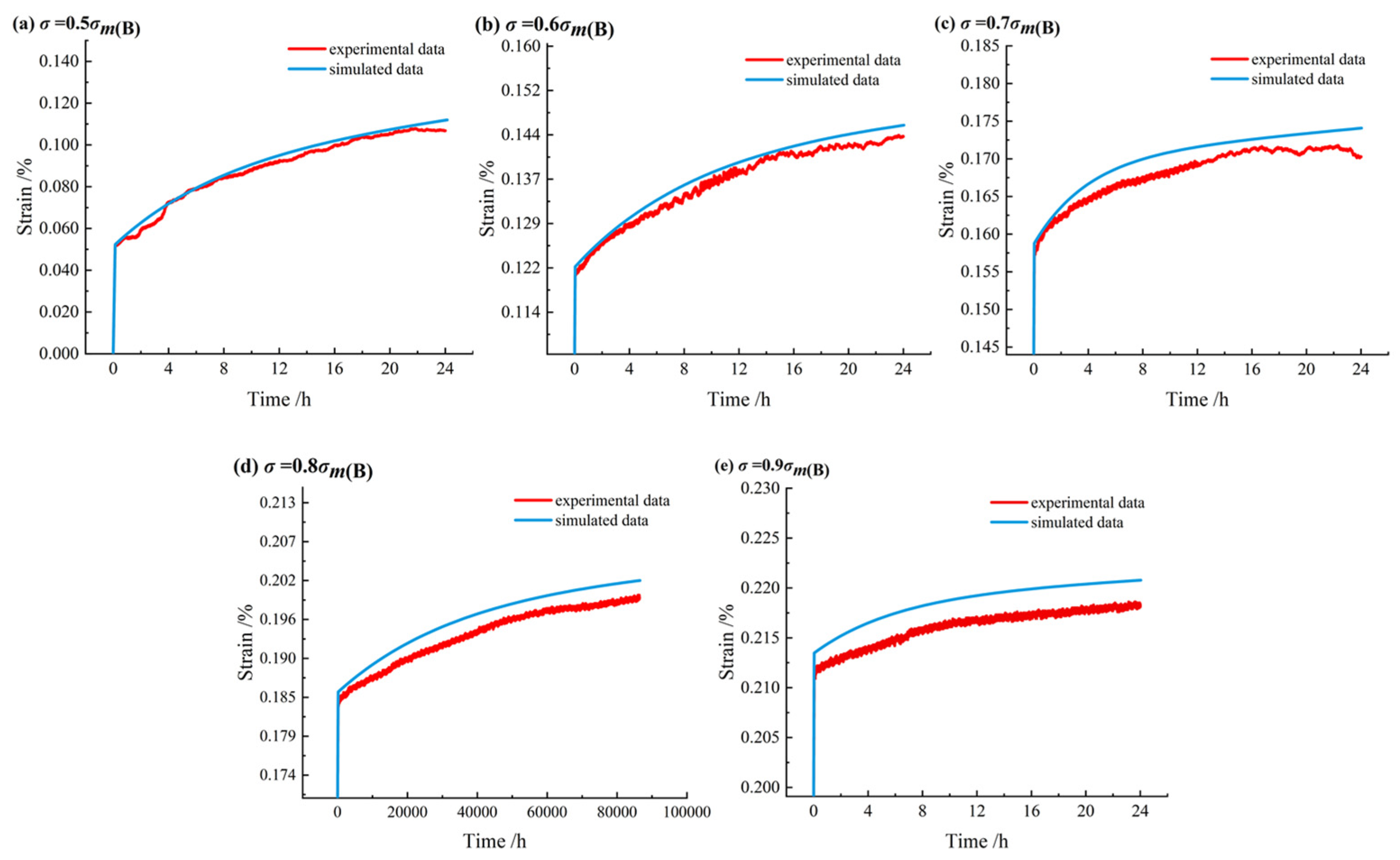
The comparison curves between the experimental data and the simulation results are shown below (Figure 15 and Figure 16). The comparison demonstrates that the simulation results are in good agreement with the experimental data, with a high degree of consistency in both curve morphology and strain magnitude. The simulated strain–time curves successfully reproduce the creep characteristics at different stages, including the instantaneous elastic stage, primary creep stage, and steady-state creep stage. These results indicate that the established finite element model can effectively characterize the time-dependent rheological behavior of carbonate rocks under long-term high-stress conditions.
Moreover, the numerical simulation successfully reproduces the characteristic deformation behavior of the different creep stages and captures the overall time-dependent strain accumulation of carbonate rocks under sustained loading conditions. However, some discrepancies between the simulation results and the experimental data are observed in the later stage of creep, where the model tends to slightly underestimate the strain evolution. These deviations can be attributed to the progressive development of microstructural damage, including microcrack initiation and propagation, as well as local heterogeneity and pore structure evolution induced by acid etching, which are not explicitly considered in the present model formulation. In this study, the rock is idealized as a homogeneous viscoelastic medium within the Burgers framework, and the coupling between time-dependent deformation and damage evolution is not incorporated. Despite these limitations, the model still provides a reasonable representation of the overall creep response and captures the essential features of long-term deformation. Therefore, it can be considered effective for describing the macroscopic rheological behavior of acid-etched carbonate rocks within the scope of the present assumptions. Future work should focus on incorporating damage-coupled or microstructure-dependent constitutive formulations to better represent the late-stage creep behavior and improve the predictive capability under complex stress and chemically altered conditions.

4. Conclusions

Triaxial creep experiments and numerical simulations were conducted to investigate the long-term deformation behavior of carbonate rocks before and after acid etching under deep high-stress conditions. Based on the experimental results and constitutive modeling analysis, the conclusions are as follows:
(1) Carbonate rocks exhibit significant rheological behavior under constant stress conditions, including instantaneous elastic deformation, primary creep, and steady-state creep. With increasing stress level, the creep stages become more distinct and the strain accumulation becomes more pronounced. Compared with the unacid-etched core, acid etching significantly altered the creep characteristics and rheological response of carbonate rocks. Although the acid-etched cores were subjected to lower absolute stress levels due to their reduced peak strength, they still exhibited evident time-dependent deformation behavior under comparable normalized stress levels. These results indicate that acid etching has a significant influence on the long-term deformation characteristics of carbonate rocks.
(2) Acid etching significantly reduced the mechanical properties of carbonate rocks, particularly the elastic modulus and compressive strength. In addition, noticeable changes were observed in the creep response and Burgers model parameters after acid treatment. These variations are likely associated with acid-induced alterations in the internal rock structure reported in previous studies. The results demonstrate that acid etching weakens the mechanical strength of carbonate rocks and modifies their long-term rheological behavior.
(3) The Burgers constitutive model effectively describes the full creep deformation process of carbonate rocks from initial loading to the steady state. The fitting results demonstrate a high level of accuracy, with all correlation coefficients (R2) exceeding 0.9. The identified constitutive parameters indicate that acid etching leads to significant changes in the rheological characteristics of carbonate rocks, including reduced elastic parameters and altered stress-dependent deformation responses.
(4) After incorporating the inverted constitutive parameters into the finite element model, the numerical simulations reproduced the experimental creep curves and stage-dependent deformation characteristics with good agreement. The results verify the applicability of the Burgers constitutive model for describing the creep behavior of carbonate rocks before and after acid etching. The established numerical model can provide a basis for further studies on the long-term deformation of acid-etched carbonate formations under deep reservoir conditions.

Author Contributions

Conceptualization, Z.Z. and N.Q.; methodology, Y.S.; software, Z.Z.; validation, Z.Z., P.J. and A.L.; formal analysis, Y.L.; investigation, S.Z.; resources, N.Q.; data curation, Y.W.; writing—original draft preparation, Y.S.; writing—review and editing, Z.Z.; visualization, Y.L.; supervision, P.J.; project administration, Y.W.; funding acquisition, N.Q. All authors have read and agreed to the published version of the manuscript.

Funding

This research was funded by the National Science and Technology Major Project, China (No. 2025ZD1402305), the Shandong Provincial Natural Science Foundation, China (No. ZR2024ME106, No. ZR2025MS853). Their support is gratefully acknowledged.

Data Availability Statement

The data supporting the findings of this study are not publicly available due to the confidentiality requirements of the research project, but can be obtained from the corresponding author upon reasonable request.

Conflicts of Interest

Author Yuyang Shen was employed by the company PetroChina Tarim Oilfield Company. The remaining authors declare that the research was conducted in the absence of any commercial or financial relationships that could be construed as a potential conflict of interest.

References

  1. Zhang, Y.; Zhao, P.; Liu, S.; Liu, C.; Cheng, Z.; Chen, Q.; Chen, G.; Zhang, F. Main Exploration Progress and Development Strategy of Sinopec during the 14th Five-Year Plan Period. China Pet. Explor. 2024, 29, 14–31. [Google Scholar]
  2. Xie, W.; Wen, L.; Wang, Z.; Luo, B.; Zhou, G.; Li, W.; Chen, X.; Fu, X.; Wu, S.; Xin, Y.; et al. Hydrocarbon Accumulation Condition and Exploration Potential of Deep-ultra-deep Carbonate Rocks in Sichuan Basin. China Pet. Explor. 2024, 29, 61–76. [Google Scholar]
  3. Shen, A.; Hu, A.; Qiao, Z.; Zheng, J.; Shen, A.; Hu, A.; Qiao, Z.; Zheng, J.; She, M.; Pan, L. Development and Preservation Mechanism of Deep and Ultra-deep Carbonate Reservoirs. Sci. China Earth Sci. 2024, 54, 3403–3420. [Google Scholar]
  4. Chen, X.; Huang, Q.; Liu, P.; Du, J.; Hu, H.; Liu, F.; Jia, Y.; Lei, M. GSE-2026-Review of Key Technologies for Ultra-Deep Carbonate Reservoir Development: Acid Fracturing and Challenges. Geoenergy Sci. Eng. 2026, 257, 214247. [Google Scholar] [CrossRef] [Scilit]
  5. Chen, X.; Wang, G.; Liu, P.; Du, J.; Tang, H.; Deng, Z.; Wu, Z. Diverting Fracturing Stimulation Using a Novel Diverting Agent: Laboratory Study and Field Application. Geoenergy Sci. Eng. 2025, 247, 213715. [Google Scholar] [CrossRef] [Scilit]
  6. Zhang, Z.; Qi, N.; Zhou, S.; Zhao, G.; Jiang, P.; Li, A.; Su, X. Numerical Simulation and Analysis of Acid-Etched Surface Morphology in Carbonate Reservoirs Under Stress. Geoenergy Sci. Eng. 2025, 254, 213997. [Google Scholar] [CrossRef] [Scilit]
  7. Chen, X.; Deng, Z.; Liu, P.; Zhang, T.; Du, J.; Tang, H.; Hu, H.; Gao, X.; Wang, Z.; He, X. IJRMMS-2026-Rapidly Improving the Acid-Fracture Conductivity in Deep and Ultra-Deep Carbonate Reservoirs through Mineral Alteration: A New Method. Int. J. Rock Mech. Min. Sci. 2026, 199, 106415. [Google Scholar] [CrossRef] [Scilit]
  8. Qin, Q.; Zhou, K.; Wei, B.; Du, Q.; Liu, Y.; Li, X.; Hou, J. GSE-2024-Experimental and Simulation Study on Deep Reservoir Fracturing Technology: A Review and Future Perspectives. Geoenergy Sci. Eng. 2024, 242, 213209. [Google Scholar] [CrossRef] [Scilit]
  9. Gou, B.; Liu, Z.; Zhou, J.; Xu, K.; Xiao, B.; Pu, K.; Guo, J. GSE-2025-Experimental and Modeling Study on the Acid-Etching and Conductivity of Hydraulic Fractures in Carbonate Rocks: A Critical Review. Geoenergy Sci. Eng. 2025, 245, 213517. [Google Scholar] [CrossRef] [Scilit]
  10. Song, J.; Xiang, D.; Hu, D.; Zhou, H.; Guo, D.; Zhang, G. IJRMMS-2022-Creep Characteristics of a Fracturing Fluid-Softened Shale Investigated by Microindentation. Int. J. Rock Mech. Min. Sci. 2022, 152, 105067. [Google Scholar] [CrossRef] [Scilit]
  11. Hashiba, K.; Fukui, K. RMRE-2025-Innovative Test Methods for Investigating the Time-Dependent Behavior of Rock: Review and New Insights. Rock Mech. Rock Eng. 2025, 58, 12913–12927. [Google Scholar] [CrossRef] [Scilit]
  12. Shan, R.; Bai, Y.; Ju, Y.; Han, T.; Dou, H.; Li, Z. Study on the Triaxial Unloading Creep Mechanical Properties and Damage Constitutive Model of Red Sandstone Containing a Single Ice-Filled Flaw. Rock Mech. Rock Eng. 2021, 54, 833–855. [Google Scholar] [CrossRef] [Scilit]
  13. Kou, H.; He, C.; Yang, W.; Wu, F.; Zhou, Z.; Fu, J.; Xiao, L. A Fractional Nonlinear Creep Damage Model for Transversely Isotropic Rock. Rock Mech. Rock Eng. 2023, 56, 831–846. [Google Scholar] [CrossRef] [Scilit]
  14. Zhou, H.W.; Wang, C.P.; Mishnaevsky, L.; Duan, Z.Q.; Ding, J.Y. A Fractional Derivative Approach to Full Creep Regions in Salt Rock. Mech. Time-Depend. Mater. 2013, 17, 413–425. [Google Scholar] [CrossRef] [Scilit]
  15. Hashiba, K.; Fukui, K. RMRE-2016-Time-Dependent Behaviors of Granite: Loading-Rate Dependence, Creep, and Relaxation. Rock Mech. Rock Eng. 2016, 49, 2569–2580. [Google Scholar] [CrossRef] [Scilit]
  16. Li, H.; Yang, C.; Ma, H.; Shi, X.; Zhang, H.; Dong, Z. A 3D Grain-Based Creep Model (3D-GBCM) for Simulating Long-Term Mechanical Characteristic of Rock Salt. J. Pet. Sci. Eng. 2020, 185, 106672. [Google Scholar] [CrossRef] [Scilit]
  17. Tarifard, A.; Török, Á.; Görög, P. RMRE-2024-Review of the Creep Constitutive Models for Rocks and the Application of Creep Analysis in Geomechanics. Rock Mech. Rock Eng. 2024, 57, 7727–7757. [Google Scholar] [CrossRef] [Scilit]
  18. Xie, S.Y.; Shao, J.F.; Xu, W.Y. Influences of Chemical Degradation on Mechanical Behaviour of a Limestone. Int. J. Rock Mech. Min. Sci. 2011, 48, 741–747. [Google Scholar] [CrossRef] [Scilit]
  19. Gou, B.; Wang, K.; Li, X.; Zhan, L.; Liu, C. Effect of Supercritical CO2 on Mechanical Properties of Tight Carbonate Rocks. J. Southwest Pet. Univ. Sci. Technol. Ed. 2024, 46, 65–76. [Google Scholar]
  20. Li, Y.; Jiang, X.; Tang, J.; Liu, B. RMRE-2024-Simulation Study of Acid Fracturing Initiation with Consideration of Rock Mechanics Parameter Variations. Rock Mech. Rock Eng. 2024, 57, 5743–5761. [Google Scholar] [CrossRef] [Scilit]
  21. Li, W.; An, X.; Li, H. Acta Geochim-2018-Limestone Mechanical Deformation Behavior and Failure Mechanisms: A Review. Acta Geochim. 2018, 37, 153–170. [Google Scholar] [CrossRef] [Scilit]
  22. Lu, C.; Luo, Y.; Guo, J.; Huang, C.; Ma, L.; Luo, B.; Zhou, G.; Song, M. JPSE-2022-Numerical Investigation of Unpropped Fracture Closure Process in Shale Based on 3D Simulation of Fracture Surface. J. Pet. Sci. Eng. 2022, 208, 109299. [Google Scholar] [CrossRef] [Scilit]
  23. Huo, J.; Meguid, M.A. Systematic Investigation of Stress-Induced Fracture Closure and Permeability Evolution in Lac Du Bonnet Granite. Int. J. Rock Mech. Min. Sci. 2025, 191, 106113. [Google Scholar] [CrossRef] [Scilit]
  24. Wei, S.-M.; Xia, Y.; Jin, Y.; Guo, X.-Y.; Zi, J.-Y.; Qiu, K.-X.; Chen, S.-Y. Production Induced Fracture Closure of Deep Shale Gas Well under Thermo-Hydro-Mechanical Conditions. Pet. Sci. 2024, 21, 1796–1813. [Google Scholar] [CrossRef] [Scilit]
  25. Wei, E.; Hu, B.; Li, J.; Cui, K.; Zhang, Z.; Cui, A.; Ma, L. Nonlinear Viscoelastic-Plastic Creep Model of Rock Based on Fractional Calculus. Adv. Civ. Eng. 2022, 2022, 3063972. [Google Scholar] [CrossRef] [Scilit]
  26. Wu, J.; Wang, W.; Cao, Y.; Liu, S.; Zhang, Q.; Chu, W. A Novel Nonlinear Fractional Viscoelastic–Viscoplastic Damage Creep Model for Rock-like Geomaterials. Comput. Geotech. 2023, 163, 105726. [Google Scholar] [CrossRef] [Scilit]
  27. Tian, D.-L.; Li, Z.-C.; Shen, F.; Li, Y.; Li, Z.; Zhou, X.-P. A Unified Nonlinear Creep Damage Coupled Model for Rocks Based on Fractional Calculus and Statistical Damage Model. Rock Mech. Rock Eng. 2025, 58, 7979–8010. [Google Scholar] [CrossRef] [Scilit]
  28. Chen, Y.; Chen, Q.; Pan, Y.; Xiao, P.; Du, X.; Wang, S.; Zhang, N.; Wu, X. A Chemical Damage Creep Model of Rock Considering the Influence of Triaxial Stress. Materials 2022, 15, 7590. [Google Scholar] [CrossRef] [Scilit] [PubMed]
  29. Komurlu, E. Loading Rate Conditions and Specimen Size Effect on Strength and Deformability of Rock Materials under Uniaxial Compression. Int. J. Geo-Eng. 2018, 9, 17. [Google Scholar] [CrossRef] [Scilit]
  30. Brabec, M.; Štetiar, J.; Krmíček, L. Mitigating the Effect of Specimen Size on Uniaxial Compressive Rock Strength Using a Generalised Correction and Experimental Testing Method. Bull. Eng. Geol. Environ. 2025, 84, 470. [Google Scholar] [CrossRef] [Scilit]
  31. Li, X.; Si, G.; Oh, J.; Canbulat, I.; Xiang, Z.; Li, T. A Pre-Peak Elastoplastic Damage Model of Gosford Sandstone Based on Acoustic Emission and Ultrasonic Wave Measurement. Rock Mech. Rock Eng. 2022, 55, 4819–4838. [Google Scholar] [CrossRef] [Scilit]
  32. André, L.; Azaroual, M.; Menjoz, A. Numerical Simulations of the Thermal Impact of Supercritical CO2 Injection on Chemical Reactivity in a Carbonate Saline Reservoir. Transp. Porous Media 2010, 82, 247–274. [Google Scholar] [CrossRef] [Scilit]
  33. Behnous, D.; Carneiro, J.; Carro, A.; Canteli, P.; Chacartegui, R.; Crespo, J.G.; Tyrologou, P.; Koukouzas, N. Optimising Supercritical CO2 Saturation and Reservoir Conditions for Geological Energy Storage with Transcritical Carbon Dioxide Systems. J. Energy Storage 2025, 139, 118924. [Google Scholar] [CrossRef] [Scilit]
  34. Zhou, Y.; Sheng, Q.; Li, N.; Fu, X. Numerical Analysis of the Mechanical Properties of Rock Materials under Tiered and Multi-Level Cyclic Load Regimes. Soil Dyn. Earthq. Eng. 2020, 135, 106186. [Google Scholar] [CrossRef] [Scilit]
  35. Feng, X.-T.; Gao, Y.; Zhang, X.; Wang, Z.; Zhang, Y.; Han, Q. Evolution of the Mechanical and Strength Parameters of Hard Rocks in the True Triaxial Cyclic Loading and Unloading Tests. Int. J. Rock Mech. Min. Sci. 2020, 131, 104349. [Google Scholar] [CrossRef] [Scilit]
  36. Zhu, L.; Cui, S.; Pei, X.; Cheng, J.; Liang, Y. Experimental Investigation of the Fatigue Damage and Strength Characteristics of Heterogeneous Rock Mass under Cyclic Loading. KSCE J. Civ. Eng. 2022, 26, 3007–3018. [Google Scholar] [CrossRef] [Scilit]
  37. Wang, Z.; Wang, J.; Yang, S.; Li, L.; Li, M. Failure Behaviour and Acoustic Emission Characteristics of Different Rocks under Uniaxial Compression. J. Geophys. Eng. 2019, 17, 76–88. [Google Scholar] [CrossRef] [Scilit]
  38. Tian, Y.; Yu, R.; Zhang, Y.; Zhao, X. Research on Damage Evolution of Deep Formation Rock Based on Acoustic Emission Test. Int. J. Damage Mech. 2021, 30, 145–159. [Google Scholar] [CrossRef] [Scilit]
  39. Geng, W.; Guo, S.; Huang, G.; Wang, J. Evaluation and Analysis of Brittleness and Acoustic Emission Characteristics of Tight Sandstone under the Influence of Acid-Treatment. Sci. Rep. 2026, 16, 11693. [Google Scholar] [CrossRef] [Scilit] [PubMed]
  40. Wang, R.; Li, L.; Simon, R. A Model for Describing and Predicting the Creep Strain of Rocks from the Primary to the Tertiary Stage. Int. J. Rock Mech. Min. Sci. 2019, 123, 104087. [Google Scholar] [CrossRef] [Scilit]
  41. Cao, W.; Chen, K.; Tan, X.; Chen, H. A Novel Damage-Based Creep Model Considering the Complete Creep Process and Multiple Stress Levels. Comput. Geotech. 2020, 124, 103599. [Google Scholar] [CrossRef] [Scilit]
  42. Frenelus, W.; Peng, H.; Zhang, J. Creep Behavior of Rocks and Its Application to the Long-Term Stability of Deep Rock Tunnels. Appl. Sci. 2022, 12, 8451. [Google Scholar] [CrossRef] [Scilit]
  43. Hashiba, K.; Fukui, K. Experimental Study on the Accelerating Creep of Rock Under Dry and Wet Conditions Based on a New Test Method. Rock Mech. Rock Eng. 2024, 57, 5969–5983. [Google Scholar] [CrossRef] [Scilit]
  44. Wu, F.; Liu, J.F.; Wang, J. An Improved Maxwell Creep Model for Rock Based on Variable-Order Fractional Derivatives. Environ. Earth Sci. 2015, 73, 6965–6971. [Google Scholar] [CrossRef] [Scilit]
  45. Lin, H.; Zhang, X.; Cao, R.; Wen, Z. Improved Nonlinear Burgers Shear Creep Model Based on the Time-Dependent Shear Strength for Rock. Environ. Earth Sci. 2020, 79, 149. [Google Scholar] [CrossRef] [Scilit]
  46. Hu, B.; Cui, A.; Cui, K.; Liu, Y.; Li, J. A Novel Nonlinear Creep Model Based on Damage Characteristics of Mudstone Strength Parameters. PLoS ONE 2021, 16, e0253711. [Google Scholar] [CrossRef] [Scilit] [PubMed]
  47. Song, F.; Rodriguez-Dono, A.; Sanchez Farfan, P. Modelling Underground Excavations in Rock Masses with Anisotropic Time-Dependent Behaviour. Geomech. Geophys. Geo-Energy Geo-Resour. 2022, 8, 146. [Google Scholar] [CrossRef] [Scilit]
  48. Tao, B.; Wu, F.; Guo, G.; Zhou, R. Flexibility of Visco-elastoplastic Model to Rheological Characteristics of Rock and Solution of Rheological Parameter. Chin. J. Rock Mech. Eng. 2005, 24, 3165–3171. [Google Scholar]
Figure 1. Mineral composition and content of the rock (XRD).
Processes 14 02038 g001
Figure 2. (a) The sonar signal curve and (b) P-wave velocity results for different core samples.
Processes 14 02038 g002
Figure 3. Schematic diagram of the rock acid-etching experiment process.
Processes 14 02038 g003
Figure 4. Schematic diagram of the triaxial creep mechanical experiment.
Processes 14 02038 g004
Figure 5. Results of triaxial mechanical compression tests ((a) unacid-etched core; (b) acid-etched core).
Processes 14 02038 g005
Figure 6. Analysis of strain-stress relationship during stress loading of the unacid-etched core.
Processes 14 02038 g006
Figure 7. Stress-time results from stepwise continuous loading creep test.
Processes 14 02038 g007
Figure 8. Strain–time relationship and creep strain rate variation curves under different stress loads (unacid-etched core).
Processes 14 02038 g008
Figure 9. Steady-state creep rate and ratio analysis under different stress loads (unacid-etched core).
Processes 14 02038 g009
Figure 10. Strain–time relationship and strain rate variation curves under different stress loads (acid-etched core).
Processes 14 02038 g010
Figure 11. Steady-state creep rate and ratio analysis under different stress loads (acid-etched core).
Processes 14 02038 g011
Figure 12. Burgers model and corresponding creep curves.
Processes 14 02038 g012
Figure 15. Comparison of creep experiment data and simulated data curves under different stress loads (unacid-etched).
Processes 14 02038 g015
Figure 16. Comparison of creep experiment data and simulated data curves under different stress loads (acid-etched).
Processes 14 02038 g016
Table 1. Results of rock mineral composition analysis.
CategoryCalciteQuartzAragoniteClay Minerals
Content/%96.352.090.990.57
Table 2. Detailed specifications for stepwise continuous-load creep experiment conditions.
Sample TypeNo.Confining Load/MPaAxial Load/MPaLoading Time/h
unetched coreA-1600.5 σm(A)24
0.6 σm(A)24
0.7 σm(A)24
0.8 σm(A)24
0.9 σm(A)24
acid-etched coreB-1600.5 σm(B)24
0.6 σm(B)24
0.7 σm(B)24
0.8 σm(B)24
0.9 σm(B)24
Table 3. Comparison of mechanical properties parameters between unacid-etched and acid-etched cores.
Sample TypeNo.Modulus of Elasticity/GPaPoisson RatioMaximum
Compressive Strength
σm
/MPa
unacid-etched coreA-2670.16310
acid-etched coreB-2350.1571
Table 4. Results of the Burgers model fit under different stress loads.
TypeStress
Load
EM/MPaEK/MPaηM/MPa·sηK/MPa·sR2
Unacid-etched coreStage 181,3654.56 × 1063.27 × 10102.57 × 1090.91
Stage 274,5193.23 × 1062.99 × 10115.14 × 1090.99
Stage 367,9821.11 × 1061.69 × 10114.53 × 1090.98
Stage 459,9325.35 × 1057.58 × 10101.63 × 1090.98
Stage 547,8891.47 × 1051.65 × 10106.25 × 1080.98
Acid-etched coreStage 169,6068.56 × 1041.77 × 10102.46 × 1090.99
Stage 235,7021.69 × 1056.86 × 10116.28 × 1090.99
Stage 331,8474.54 × 1051.12 × 10116.38 × 1090.97
Stage 431,0634.00 × 1051.99 × 10111.38 × 10100.99
Stage 530,3171.16 × 1063.31 × 10112.53 × 10100.99
Disclaimer/Publisher’s Note: The statements, opinions and data contained in all publications are solely those of the individual author(s) and contributor(s) and not of MDPI and/or the editor(s). MDPI and/or the editor(s) disclaim responsibility for any injury to people or property resulting from any ideas, methods, instructions or products referred to in the content.