Article

Impact of Seasonal Trade-Offs in Biomass Yield and Composition on Techno-Economic Performance of Anaerobic Digestion of Helianthus annuus


by
Anna Brózda
1,
Joanna Kazimierowicz
2 and
Marcin Dębowski
1,*
1
Department of Environment Engineering, Faculty of Geoengineering, University of Warmia and Mazury in Olsztyn, Str. Oczapowskiego 5, 10-719 Olsztyn, Poland
2
Department of Water Supply, Sewerage and District Heating, Faculty of Civil Engineering and Environmental Sciences, Bialystok University of Technology, 15-351 Bialystok, Poland
*
Author to whom correspondence should be addressed.
Processes 2026, 14(12), 1943; https://doi.org/10.3390/pr14121943 (registering DOI)
Submission received: 19 May 2026 / Revised: 9 June 2026 / Accepted: 11 June 2026 / Published: 14 June 2026
(This article belongs to the Special Issue Advanced Biofuel Production Processes and Technologies)

Abstract

The efficiency of anaerobic digestion (AD) of lignocellulosic biomass is strongly determined by biomass yield, chemical composition, and bioavailability, all of which undergo substantial seasonal variation. However, integrated analyses linking these factors with AD performance, process kinetics, and energy-economic efficiency remain limited. This study aimed to evaluate the effect of seasonal variability in the chemical composition of Helianthus annuus biomass on AD efficiency from a technological and economic perspective. The novelty of this study lies in integrating seasonal changes in biomass composition with AD kinetics, CH4 productivity per hectare, and CHP techno-economic performance to identify the optimal harvest window for Helianthus annuus. The experiments were conducted using biomass harvested from June to December. The results showed significant (p < 0.05) variability in biomass properties, including a progressive increase in lignocellulosic fractions over the growing season, with neutral detergent fiber (NDF) increasing from 30.58 ± 1.8 to 66.58 ± 3.1% TS and acid detergent lignin (ADL) from 5.13 ± 0.5 to 10.35 ± 0.9% TS, accompanied by a decline in substrate bioavailability. The maximum CH4 yield of 258 ± 13 mL/g VS was obtained in August, with a process rate of 29.0 ± 3.4 mL/g VS·d and the highest utilization of methane potential, reaching 62.5 ± 3.8% (BMPCH4/TBMP). Correlation and regression analyses indicated that ADL and NDF were the strongest empirical predictors of AD performance within the analyzed dataset, showing a negative association with both CH4 production yield and kinetics (R2 up to 0.86), whereas reducing sugars had a stimulatory effect. Multiple regression models showed high predictive performance, with R2 = 0.889 for BMPCH4. The highest energy and economic efficiency was achieved in summer. In August, CH4 production reached 3214 ± 596 m3/ha, corresponding to 11.2 ± 2.1 MWh/ha of electricity and a net result of 1559 ± 417 EUR/ha. Increased lignification in the later part of the season led to reduced process efficiency and a deterioration of the economic balance. From a practical perspective, these results demonstrate that harvest scheduling should be based on the trade-off between biomass quantity and biodegradability rather than on biomass yield alone.

1. Introduction

Plant biomass may represent an important supplement or alternative to organic wastes used in anaerobic digestion (AD) processes. This is particularly relevant in systems that require a continuous, stable, and predictable substrate supply [1]. Its use enables partial control of feedstock properties through agronomic practices as well as biomass preservation and storage strategies. However, it should be emphasized that an objective assessment of the suitability of energy crops as organic substrates should not be based solely on the verification of the unit methane (CH4) yield. An integrated approach is required, accounting for CH4 productivity both per unit mass and per unit area, as this is closely related to the chemical composition, structure, and anaerobic biodegradability of the biomass [2]. In the case of lignocellulosic biomass, high yield does not always translate into high AD efficiency, because the presence of lignin and structural fibers limits enzymatic hydrolysis and microbial access to polysaccharide fractions [3]. This represents a major technological challenge and highlights the need for further research on the efficient use of lignocellulosic biomass in AD processes.
Among potential energy feedstocks, plants of the genus Helianthus, including both perennial and annual species, are of particular importance. Perennial species, such as Helianthus tuberosus and Helianthus salicifolius, are characterized by relatively stable biomass yields of approximately 10–20 Mg TS/ha and an organic matter content of 85–90% TS [4]. At the same time, their biomass contains a substantial proportion of lignocellulosic fractions, including cellulose (approximately 30–45%), hemicellulose (20–30%), and lignin (10–20%). This compositional feature limits the rate of hydrolysis and affects AD process kinetics [5]. Consequently, methane yields for these species typically range from 170 to 320 mL CH4/g VS, depending on cultivation conditions and the experimental methodology applied [6].
Against this background, Helianthus annuus stands out as an annual species, which represents an important advantage from the perspective of agricultural and bioenergy systems. Its annual cultivation cycle enables greater flexibility in biomass production management, integration into crop rotation systems, and adjustment of the harvest date to the technological requirements of biogas plants [7]. Under temperate climate conditions, the dry matter yield of the aboveground biomass of common sunflower generally ranges from approximately 8 to 18 Mg TS/ha, with an organic matter content exceeding 85–90% TS [8]. The chemical composition of Helianthus annuus biomass changes substantially during the growing season. In the early growth stages, readily biodegradable compounds, such as soluble sugars and proteins, predominate, which promotes intensive hydrolysis and high microbial activity [9]. As the plant matures, the proportion of lignocellulosic fractions increases, including cellulose (approximately 25–40%), hemicellulose (15–25%), and lignin (8–18%) [10]. Available literature data indicate that the methane yield of Helianthus annuus biomass most commonly ranges from approximately 180 to 320 mL CH4/g VS, although under optimal conditions it may exceed 400 L CH4/kg VS [10,11]. At the same time, as the growing season progresses, biomass yield increases, accompanied by the accumulation of lignocellulosic fractions, including lignin, which reduces substrate bioavailability [12]. Consequently, an increase in biomass yield does not necessarily lead to higher CH4 productivity per unit cultivation area and, in many cases, may even result in its reduction [13].
Despite the available studies on methane yield and selected technological aspects of Helianthus annuus utilization, most research has focused on individual process parameters. Previous reports have mainly addressed specific methane yield, selected biomass characteristics, or pretreatment effects, whereas the combined effect of harvest date on biomass composition, AD kinetics, CH4 productivity per hectare, and energy-economic performance has not been sufficiently resolved. There is still a lack of studies that integrate, within a single experimental framework, the seasonal variability in biomass chemical composition with AD kinetic parameters, CH4 productivity per unit cultivation area, and an integrated energy-economic balance, which limits the optimization of bioenergy systems. Such integration is necessary because BMP alone does not account for biomass yield, conversion rate, retention-time implications, or the final energy-economic outcome. In particular, the quantitative relationships between lignocellulosic structure and the yield and dynamics of CH4 production remain insufficiently understood [14]. Therefore, the study was based on the hypothesis that harvest-date-driven changes in the biomass yield and lignocellulosic composition of Helianthus annuus significantly affect specific CH4 yield, AD kinetic parameters, CH4 productivity per hectare, and the net energy-economic outcome.
The aim of this study was to provide a comprehensive assessment of the effect of Helianthus annuus biomass harvest date on its physicochemical and structural properties, as well as on AD performance within an integrated framework encompassing methane yield, kinetic parameters, CH4 productivity per unit cultivation area, and energy-economic efficiency.

2. Materials and Methods

2.1. Experimental Concept and Study Design

The study was conducted in a batch experimental system to provide a quantitative and kinetic characterization of CH4 production during AD of Helianthus annuus biomass. The analytical scope included the determination of the technological, energy, and economic effects of the process. The experimental variants (V1–V7) corresponded to successive biomass harvest months, from June (V1) to December (V7). The adopted experimental design enabled assessment of the effect of the growing season on biomass yield, variability in substrate properties, and the influence of the investigated factors on the course of AD. Statistically significant relationships were identified, and empirical models describing AD yield and kinetics were developed, allowing the main factors determining process efficiency to be defined. CH4 productivity per unit cultivation area was also estimated, which, together with the assessment of incurred costs, enabled an application-oriented evaluation of energy and economic efficiency.

2.2. Materials

2.2.1. Helianthus annuus Biomass

The study used common sunflower (Helianthus annuus) biomass obtained from a plantation located in Bałdy, at the teaching and research station of the University of Warmia and Mazury in Olsztyn, north-eastern Poland (53°36.026′ N, 20°36.625′ E). Plant material was collected in a reproducible manner over three consecutive growing seasons, with biomass sampled three times per month in each analyzed period, approximately on days 10, 20, and 30. For each seasonal variant, biomass collected on the three monthly sampling dates over three consecutive growing seasons was treated as biological replication and represented harvest-date variability within the given month. Before physicochemical characterization and AD testing, the collected plant material was homogenized to obtain representative samples for each harvest variant. This approach reduced the effects of both interannual and short-term variability and increased sample representativeness. Immediately after harvesting and transport to the laboratory, approximately 40 km away, the biomass was mechanically comminuted to a particle size of 2–5 mm using a Retsch SM100 cutting mill (RETSCH GmbH, Haan, Germany). This was done to standardize particle size distribution and limit its influence on the AD process. Physicochemical analyses and fermentation tests were then performed. When required, after comminution, the biomass was stored at 4 ± 1 °C for no longer than 72 h. Due to the low temperature and short storage period, this procedure was not expected to significantly affect reducing sugar content, microbial activity, or biodegradability characteristics before AD testing. The same storage protocol was applied consistently to all harvest variants, thereby ensuring comparability of the seasonal variants. The characteristics of the biomass in the individual seasonal variants are presented in Section 3.

2.2.2. Anaerobic Sludge Inoculum

Anaerobic sludge obtained from a 1 MWe agricultural biogas plant of the “NAWARO” type, located in Łęguty, Warmińsko-Mazurskie Voivodeship, Poland, approximately 53°35′ N, 20°24′ E, was used in the study. The installation operates under mesophilic conditions (42 ± 1 °C), at an organic loading rate of 2.7–3.2 kg VS/m3·d and a hydraulic retention time of approximately 40 days. It is fed with, among others, pig slurry, maize silage, distillery stillage, poultry manure with straw, glycerol, and other plant biomass. Before use in the batch tests, the inoculum was acclimated to Helianthus annuus biomass. The acclimation was carried out in a reactor with a working volume of 5 L for 120 days, corresponding to approximately three hydraulic turnovers. The acclimation period was selected because three hydraulic turnovers are commonly used in anaerobic digestion studies as an operational criterion for microbial adaptation and stabilization under modified feeding conditions. This period allowed gradual adaptation of hydrolytic, acidogenic, acetogenic, and methanogenic microorganisms to Helianthus annuus biomass and supported stable methane production during subsequent batch AD tests. During acclimation, the reactor was fed with silage prepared from biomass harvested in August, at a loading rate of approximately 2.5 g VS/L·d and a moisture content of 90 ± 1%. August biomass was selected as a representative mid-season material suitable for preparing a stable silage substrate required for continuous feeding during the 120-day acclimation period.
The characteristics of the acclimated anaerobic sludge values without parentheses and the raw sludge values in parentheses are presented below. The total solids (TS) and volatile solids (VS) contents were 33.80 ± 1.75 (30.85 ± 1.60) g/L and 26.50 ± 1.55 (23.80 ± 1.45) g/L, respectively, with a mineral solids (MS) fraction of 7.30 ± 1.02 (7.05 ± 1.05) g/L. The total nitrogen (TN) and total phosphorus (TP) concentrations were 0.95 ± 0.08 (1.05 ± 0.10) g/L and 0.41 ± 0.05 (0.44 ± 0.05) g/L, respectively. The total carbon (TC), total organic carbon (TOC), and inorganic carbon (IC) contents were 20.80 ± 2.10 (18.50 ± 1.85), 14.20 ± 1.65 (12.40 ± 1.55), and 6.60 ± 0.85 (6.10 ± 0.80) g/L, respectively. Chemical oxygen demand (COD) reached 45.20 ± 5.10 (40.50 ± 4.70) g/L, whereas the dissolved fractions, CODD and TOCD, were 7.10 ± 1.00 (5.60 ± 0.90) and 2.00 ± 0.40 (1.40 ± 0.30) g/L, respectively. The COD/TN and TOC/TN ratios were 8.10 ± 0.85 (6.85 ± 0.70) and 46.50 ± 4.20 (38.90 ± 3.60), respectively. The pH remained at 7.55 ± 0.06 (7.40 ± 0.07), with volatile fatty acids (VFA) at approximately 2.30 ± 0.35 (1.70 ± 0.30) g/L. The buffer capacity, expressed as total inorganic carbonate alkalinity (TAC), was 6.20 ± 0.65 (5.60 ± 0.60) g CaCO3/L, corresponding to a FOS/TAC ratio of 0.37 ± 0.05 (0.30 ± 0.05).

2.3. AD Operation and Modeling

CH4 yield as affected by seasonal variability in the composition of Helianthus annuus biomass was determined using an OxiTop® Control respirometric system (WTW, Troisdorf, Germany). AD tests were conducted under controlled conditions in a thermostatic chamber at 42 ± 1 °C. The experiment was performed in sealed batch reactors with a total volume of 500 mL and a working volume of 200 mL, filled with inoculum. The remaining volume served as the headspace for accumulation of the produced gas. The substrate was dosed at an amount corresponding to an initial organic loading rate (OLR) of 5.0 g VS/L. Before the actual measurements, the inoculum was incubated for 10 days at 42 ± 1 °C without substrate addition. After reactor loading, the reactor contents were flushed with technical-grade nitrogen (2 min, 100 L/h). AD was conducted for 40 days, and the process was terminated only when the observed daily increase in biogas production did not exceed 1% for three consecutive days. A control assay containing only the inoculum was run in parallel, and its results were used for data correction. All AD batch tests, including inoculum-only controls, were performed in triplicate for each harvest variant. The OxiTop® Control system enabled systematic measurement of pressure changes and periodic sampling for chromatographic analysis of gas composition. The amount of produced gas was calculated using the ideal gas law and then converted to normal conditions (273 K, 1013 hPa):
n = p V R T
where n is the number of moles of gas [mol], p is the gas pressure in the reactor headspace [Pa], V is the headspace volume [m3], R is the universal gas constant [8.314 J/mol·K], and T is the absolute temperature [K]. The gas volume under normal conditions was then calculated as:
V N = n V m
where VN is the normalized gas volume [L], and Vm is the molar gas volume under normal conditions [22.414 L/mol]. Gas composition was determined at the end of the batch test by chromatographic analysis of gas samples collected from the reactor headspace. Therefore, CH4 concentration was not interpolated between sampling points. The cumulative CH4 volume was calculated from the cumulative biogas volume corrected to normal conditions and the final CH4 fraction determined by GC analysis. Gas production from inoculum-only controls was subtracted from the gross gas production measured in substrate-containing reactors before expressing the results per unit of VS added.
For the quantitative description of AD performance and CH4 production kinetics, the first-order model [15] and the modified Gompertz model [16] were applied. The first-order kinetic model was expressed as:
B t = B M P C H 4 1 e x p k C H 4 t
where B(t) is the cumulative CH4 production at digestion time t [mL CH4/g VS], BMPCH4 is the ultimate specific methane yield [mL CH4/g VS], kCH4 is the first-order kinetic constant [1/d], and t is the digestion time [d]. The methane production rate was calculated as:
r C H 4 = k C H 4 B M P C H 4
where rCH4 is the methane production rate [mL CH4/g VS·d].
The modified Gompertz model was expressed as:
B t = V m a x e x p e x p R m a x e V m a x λ t + 1
where Vmax is the maximum cumulative CH4 production [mL CH4/g VS], Rmax is the maximum CH4 production rate [mL CH4/g VS·d], λ is the lag phase duration [d], and e is Euler’s number equal to 2.7183.
The first-order model was used to estimate the methane production rate constant (kCH4) and the corresponding methane production rate (rCH4), whereas the modified Gompertz model was applied to determine the maximum methane production rate (Rmax), lag phase duration (λ), and asymptotic methane production potential (Vmax). The use of the Gompertz model was justified by the sigmoidal shape of the cumulative CH4 production curves, which included the lag phase, the phase of intensive production, and the stabilization phase [17]. Model parameters were estimated by nonlinear least-squares regression using the experimental data [18]. The goodness of fit was evaluated based on the coefficient of determination (R2) and the root mean square error (RMSE) [19]. The theoretical biomethane potential (TBMP) was calculated from the macromolecular composition of the biomass, including crude protein, crude lipids, and carbohydrate fractions, using stoichiometric conversion based on the Buswell and Mueller equation and assuming complete anaerobic conversion of organic matter into CH4 and CO2 [20]. The elemental contribution of C, H, O, and N required for the calculation was derived from the adopted composition of the individual macromolecular fractions. The general form of the Buswell and Mueller equation was expressed as:
C a H b O c N d + 4 a b 2 c + 3 d 4 H 2 O 4 a + b 2 c 3 d 8 C H 4 + 4 a b + 2 c + 3 d 8 C O 2 + d N H 3
The theoretical number of moles of CH4 was calculated as:
n C H 4 = a 2 + b 8 c 4 3 d 8
where a, b, c, and d represent the molar amounts of C, H, O, and N in the substrate, respectively. The obtained theoretical amount of CH4 was converted to volume under normal conditions using the molar gas volume of 22.414 L/mol and expressed per unit of VS. The uncertainty of TBMP estimation was calculated using error propagation, taking into account variability in biomass composition and the uncertainty of analytical determinations [21].

2.4. Calculation Methods

The methane potential and energy-economic efficiency of AD of Helianthus annuus biomass were analyzed based on BMP test results, biomass yield data, and incurred agrotechnical costs, expressed per unit mass and per unit cultivation area. A combined heat and power (CHP) system typical of agricultural biogas plants was assumed. The calculations included determination of CH4 production, chemical energy, and its conversion into electrical and thermal energy, followed by estimation of the economic value of the energy produced. The economic balance included biomass production costs (C_agro) and estimated plant operating costs (OPEX). The adopted OPEX level of 30% of the total energy value was used as a simplified screening-level assumption. Although the exact OPEX share is highly plant- and site-specific, this value is consistent with the order of magnitude reported in economic assessments of agricultural and farm-scale biogas plants, where operating, maintenance, labor, substrate logistics, digestate handling, and market-related costs are identified as key determinants of profitability [22,23,24]. Biomass production costs (C_agro) included both fixed costs, such as fertilization and basic agrotechnical operations, and variable costs related to biomass harvesting, comminution, and transport, which depended on the harvest date and properties of the plant material. The same unit-cost assumptions were applied to all harvest variants, whereas monthly differences in C_agro resulted mainly from changes in biomass yield, dry matter content, and harvest-related handling requirements. The calculation equations, together with the definitions of symbols and the adopted assumptions, are summarized in Table 1.

2.5. Analytical and Measurement Methods

The physicochemical characteristics of Helianthus annuus biomass, inoculum, and digestate were determined using standard analytical methods. TS was determined gravimetrically by drying at 105 °C (PN-EN 12880:2004 [25]; UF55 drying oven, Memmert GmbH & Co. KG, Schwabach, Germany), whereas VS was determined by ignition at 550 °C (PN-EN 12879:2004 [26]; L9/11 muffle furnace, Nabertherm GmbH, Lilienthal, Germany). MS was calculated as the difference between TS and VS. pH was measured potentiometrically using a Model 1000 L pH meter (VWR International, Radnor, PA, USA). TC, TOC, and TN were determined by catalytic combustion using a TOC-L CPH/CPN analyzer equipped with a TNM-L module (Shimadzu, Kyoto, Japan), whereas IC was calculated as the difference between TC and TOC. Alternatively, TN was determined by the Kjeldahl method (K-435 + K-350, Büchi Labortechnik AG, Flawil, Switzerland), and protein content was calculated as TN × 6.25. COD, TP, and nitrogen in the liquid phase were determined spectrophotometrically (DR 6000 + HT200S, Hach, Düsseldorf, Germany). Dissolved fractions, i.e., CODD and TOCD, were determined after centrifugation and filtration through a 1.2 µm pore-size filter (ROTINA 380 centrifuge, Andreas Hettich, Tuttlingen, Germany). The structural composition of the biomass, including cellulose, hemicellulose, lignin, NDF, ADF, and ADL, was determined using the Van Soest method (PN-EN ISO 13906 [27]; PN-EN 16472 [28]) with an ANKOM 2000 analyzer and the DaisyII system (ANKOM Technology, Macedon, NY, USA), whereas crude fiber was determined gravimetrically (PN-EN ISO 6865 [29]; Fibertec 8000, Foss Analytical A/S, Hillerød, Denmark). Reducing sugars were determined by the anthrone method (DR 2800, Hach-Lange, Düsseldorf, Germany), glucose by the enzymatic method (YSI 2700 Select, YSI Inc., Yellow Springs, OH, USA), and lipids by the Soxhlet method (B-811, Büchi Labortechnik AG, Flawil, Switzerland). VFA and TAC were determined by titration (TitraLab AT1000, Hach, Mississauga, ON, Canada), and the FOS/TAC ratio was calculated from the obtained values. The volume of gas produced was determined using the BMP method with the OxiTop® Control system (WTW, Troisdorf, Germany) or, in the continuous system, using a mass flow meter (Aalborg Instruments, Orangeburg, NY, USA). Gas composition, including CH4 and CO2, was analyzed by gas chromatography (GC-TCD; Agilent 7890A, Agilent, Santa Clara, CA, USA) using Hayesep Q, Porapak Q, and Molecular Sieve columns, with Ar/He as the carrier gas at a flow rate of 15 mL/min. Control analyses were performed using a multicomponent gas analyzer (GMF 430, Gas Data, Coventry, UK). All analytical instruments were calibrated according to the manufacturers’ recommendations and relevant analytical standards before each measurement series. The pH meter was calibrated using standard buffer solutions at pH 4.01, 7.00, and 10.00. TOC/TN analyses were performed using multi-point calibration curves prepared from certified carbon and nitrogen standards, and calibration quality was verified using blanks and control standards. Spectrophotometric determinations of COD, TP, and nitrogen forms were performed using certified reagent kits and calibration standards supplied by the manufacturer. Gas chromatographic analysis was calibrated using certified gas mixtures containing CH4 and CO2, and calibration stability was verified during each analytical series. Analytical blanks, duplicate determinations, and control standards were included as quality-control procedures. Results were accepted when calibration linearity and repeatability met the requirements of the applied analytical methods and the manufacturers’ specifications. When applicable, calibration curves were accepted at R2 ≥ 0.995, and duplicate measurements were repeated when the relative difference exceeded 5%. Physicochemical and structural analyses of biomass, inoculum, and digestate were performed in duplicate, and the results are presented as mean values ± standard deviation.

2.6. Statistical Methods

Statistical analysis was performed using STATISTICA 13.1 PL software (StatSoft, Tulsa, OK, USA). The normality of data distribution was verified using the Shapiro–Wilk test, and homogeneity of variance was assessed using Levene’s test. The significance of differences between seasonal variants was evaluated by one-way analysis of variance (ANOVA), and differences between means were identified using Tukey’s post hoc test. A significance level of p = 0.05 was adopted for all analyses. For biomass physicochemical and structural parameters, ANOVA was performed using biological replicates for each harvest variant (n = 9, corresponding to three monthly sampling dates over three growing seasons). Samples from different growing seasons were not analyzed as separate year-specific treatments; instead, interannual and within-month variability were included in the biological replication and reflected in the reported mean values and standard deviations. For AD performance and kinetic parameters, ANOVA was performed using triplicate batch reactors for each harvest variant (n = 3). Regression analyses were performed using the complete dataset of seasonal observations used for model development (n = 21). Empirical equations describing the relationships between the properties of Helianthus annuus biomass and CH4 production yield, as well as AD kinetic parameters, were developed using multiple regression with stepwise variable selection. In addition, 95% confidence intervals for regression coefficients were estimated to indicate the uncertainty and statistical robustness of the predictor effects. The selection of explanatory variables was based on statistical significance and the limitation of predictor collinearity. Collinearity among explanatory variables was assessed using the variance inflation factor (VIF), with VIF < 5 adopted as the criterion indicating no significant collinearity among predictors. However, VIF analysis was used only to identify severe statistical multicollinearity and does not imply full biological independence among lignocellulosic and compositional variables.
The response variables analyzed included CH4 production yield and selected kinetic parameters of the process. Model goodness of fit was evaluated using the coefficient of determination (R2) and the adjusted coefficient of determination (R2adj.), which accounts for the number of predictors in the model and reduces the risk of overestimating goodness of fit in multivariable models. The statistical significance of the models was verified using the F-test. Model selection and comparison were additionally supported by the Akaike information criterion (AIC), which enabled assessment of the relative goodness of fit of the equations while accounting for model complexity. Residual analysis was also performed, including evaluation of residual normality and identification of possible systematic trends. A lack-of-fit test was applied to assess model adequacy. Due to the lack of an independent external dataset obtained under comparable seasonal and operational conditions, external validation was not performed; therefore, model reliability was assessed using adjusted R2, AIC, VIF-based collinearity control, residual analysis, and lack-of-fit testing. The uncertainty of derived parameters was estimated by error propagation based on the standard deviations of the input variables.

3. Results and Discussion

3.1. Seasonal Variability in the Physicochemical Properties of Helianthus annuus Biomass

The results indicate a clear and statistically significant (p < 0.05) transformation pattern in Helianthus annuus biomass, involving a shift from highly bioavailable material in the summer period to structurally complex lignocellulosic biomass in the final stage of the growing season. These changes were integrated in nature and resulted from overlapping physiological, metabolic, and structural processes that determine both the chemical composition and biodegradability of the biomass [30]. The highest biomass productivity was recorded in August, when the fresh biomass yield reached 42.9 ± 5.9 Mg/ha, whereas in June and July it was 33.8 ± 4.7 Mg/ha and 38.6 ± 5.2 Mg/ha, respectively (Figure 1). These differences were statistically significant (p < 0.05) and indicate maximum photosynthetic activity and assimilate accumulation in the middle phase of the growing season [31].
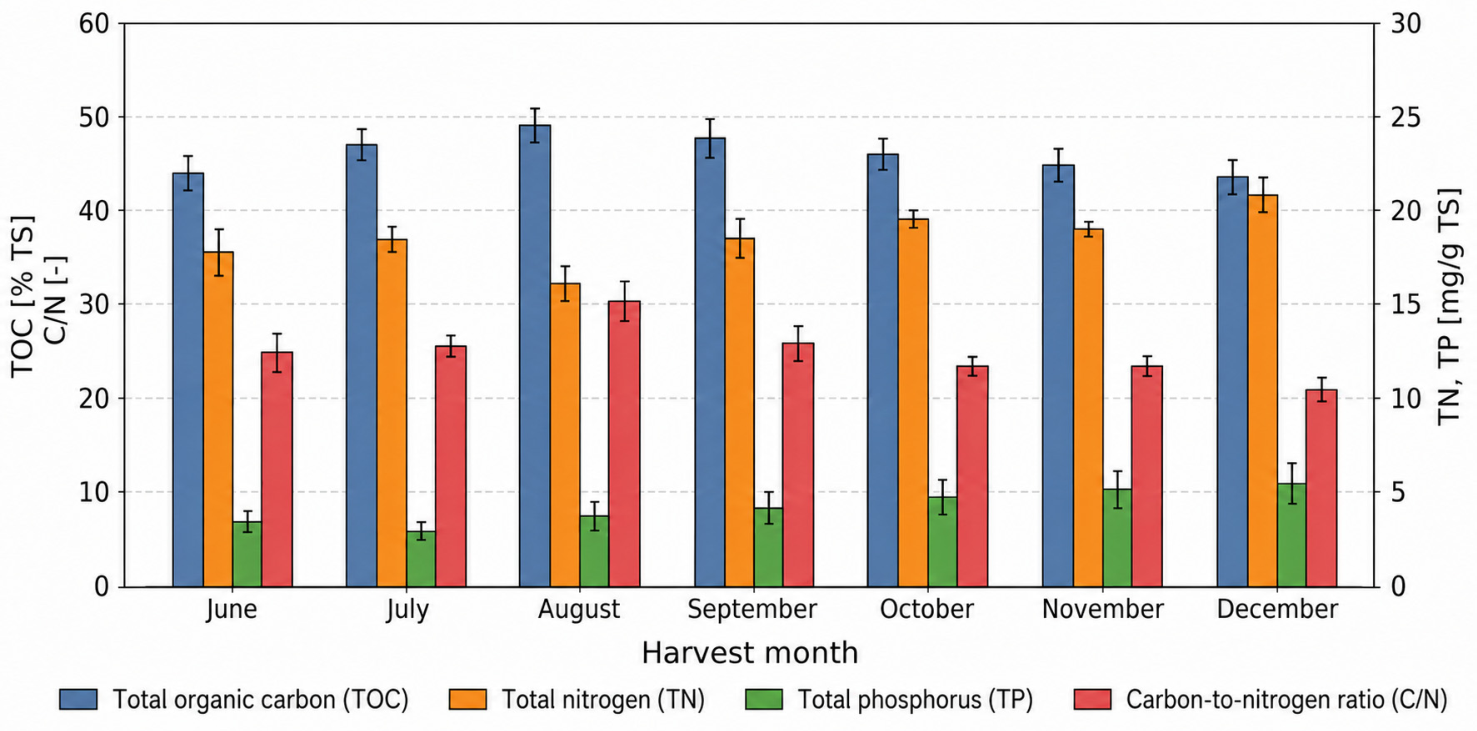
From September onward, a gradual decrease in yield was observed, reaching 36.1 ± 4.4 Mg/ha, followed by 31.7 ± 3.8 Mg/ha in October and 22.9 ± 2.8 Mg/ha in December. This decline was associated with the transition of plants into the senescence phase [32]. At the same time, TS content increased significantly (p < 0.05), from 23.0 ± 1.0% FM in June to 35.2 ± 1.0% FM in July and 36.4 ± 0.1% FM in September, reaching 38.9 ± 0.2% FM in December (Figure 1). The increase in TS resulted from water loss and intensified synthesis of structural components, leading to a higher proportion of lignocellulose in the biomass [30]. The organic matter content showed a significant (p < 0.05) decreasing trend, declining from 97.1 ± 0.2% TS in June to 94.5 ± 0.4% TS in September and 93.0 ± 0.4% TS in December. At the same time, organic carbon content increased from 43.8 ± 1.7% TS in June to a maximum of 48.6 ± 1.8% TS in August, and then decreased to 43.5 ± 1.8% TS in December (Figure 1).
TOC content increased from 43.8 ± 1.7% TS in June to a maximum of 48.6 ± 1.8% TS in August, followed by a gradual decrease to 43.5 ± 1.8% TS in December (Figure 2). The decline in TOC at the final stage of the season may be associated with the loss of readily metabolizable carbon compounds, respiratory processes, changes in the proportions of organic and mineral fractions, and an increased share of carbon bound in structures with lower bioavailability [33]. TN content increased significantly (p < 0.05) in the second half of the season. During the summer period, TN content was approximately 1.77 ± 0.13% TS in June and 1.61 ± 0.09% TS in August, whereas it reached 1.95 ± 0.03% TS in October and 2.08 ± 0.09% TS in December (Figure 2). Consequently, the C/N ratio reached a maximum of 30.2 ± 2.2 in August and then decreased to 23.5 ± 0.9 in October and 20.9 ± 1.3 in December (p < 0.05) (Figure 2). TP content increased significantly (p < 0.05), from 3.5 ± 0.6 mg/g TS in June to 4.8 ± 0.9 mg/g TS in October and 5.5 ± 1.1 mg/g TS in December, which resulted from a concentration effect and metabolic transformations [34] (Figure 2).
The increased contribution of nitrogen and phosphorus fractions in the final stage of the season may be associated with processes including proteolysis, degradation of structural and enzymatic proteins, amino acid release, and remobilization of mineral nutrients from senescing tissues to storage organs [35]. At the same time, growth inhibition, reduced metabolic activity, a partial decrease in TOC content, and biomass dehydration promote the concentration effect of N and P in dry matter. During AD, readily available nitrogen compounds are rapidly mineralized to NH4+. Under elevated pH conditions, part of NH4+ is converted into free ammonia (NH3), which can diffuse across methanogenic cell membranes, disrupt the proton gradient and enzymatic activity, and consequently reduce CH4 production and process stability [36]. However, under the applied batch AD conditions, ammonia inhibition thresholds were not expected to be approached. Although total ammonia nitrogen (TAN) was not directly measured, the nitrogen load introduced with Helianthus annuus biomass was relatively low at the applied initial OLR of 5.0 g VS/L. Even for the late-season biomass with the highest TN content, the substrate-derived nitrogen input did not exceed approximately 0.10–0.12 g N/L. At the measured pH of approximately 7.55 and the process temperature of 42 ± 1 °C, the free ammonia fraction was therefore not expected to reach inhibitory levels. Consequently, ammonia inhibition should be regarded only as a possible contributing mechanism, whereas the decline in CH4 production in the late-season variants was interpreted primarily in relation to increased lignification and reduced substrate bioavailability. Phosphorus, in turn, is an essential component for microbial growth and the buffering of metabolic transformations. However, its increase in late-season biomass also indicates a higher contribution of the mineral-structural fraction, which may accompany progressive tissue maturation and reduced susceptibility of part of the organic matter to hydrolysis [37].
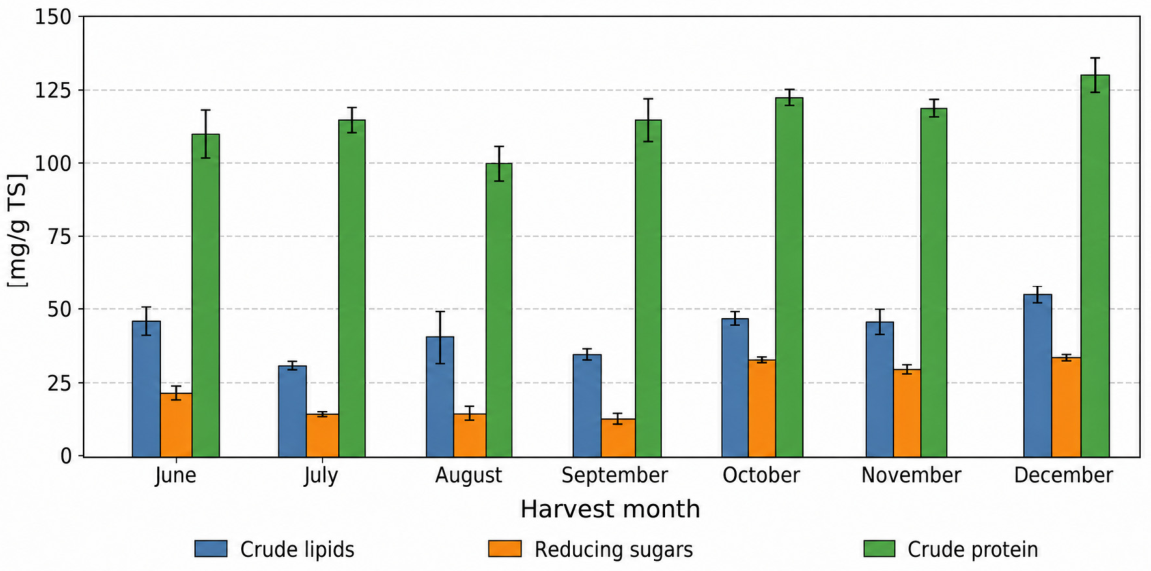
Lipid content showed an increasing trend in the final stage of the season, rising from a minimum of 30.3 ± 1.0 mg/g TS in July to 54.9 ± 2.4 mg/g TS in December. This corresponded to an increase of 24.6 mg/g TS, i.e., approximately 81% relative to the July value (Figure 3). This trend is usually associated with metabolic remodeling during maturation and a relative increase in the contribution of more energy-rich fractions to dry matter as biomass dehydration progresses [38]. The content of reducing sugars increased particularly markedly from September onward, from 13.1 ± 1.6 mg/g TS to 32.0 ± 0.4 mg/g TS in October and 33.5 ± 0.3 mg/g TS in December, indicating more than a 2.5-fold increase relative to the seasonal minimum (Figure 3). This trend may be linked to partial polysaccharide hydrolysis and the limited further utilization of simple sugars under conditions of growth inhibition and reduced metabolic activity in plant tissues.
In parallel, crude protein content, calculated based on TN, increased from the lowest level of 100.3 ± 5.7 mg/g TS in August to 121.9 ± 1.8 mg/g TS in October and 130.0 ± 5.6 mg/g TS in December, corresponding to an increase of approximately 29.6% relative to the minimum value (Figure 3). From the perspective of AD performance, the late-season increase in lipids and reducing sugars may enhance the availability of energy-rich and readily biodegradable fractions. In contrast, the increase in the protein fraction may promote more intensive nitrogen mineralization to NH4+ and, under elevated pH conditions, the formation of NH3, which may potentially inhibit methanogenic activity [39]. However, these factors were not decisive, because the proportion of fibrous fractions and lignin increased simultaneously, thereby reducing substrate bioavailability [40]. As a result, the potentially beneficial effects of lipids and sugars were counterbalanced by progressive biomass lignification.

3.2. Seasonal Variability in the Lignocellulosic Structure of Helianthus annuus Biomass

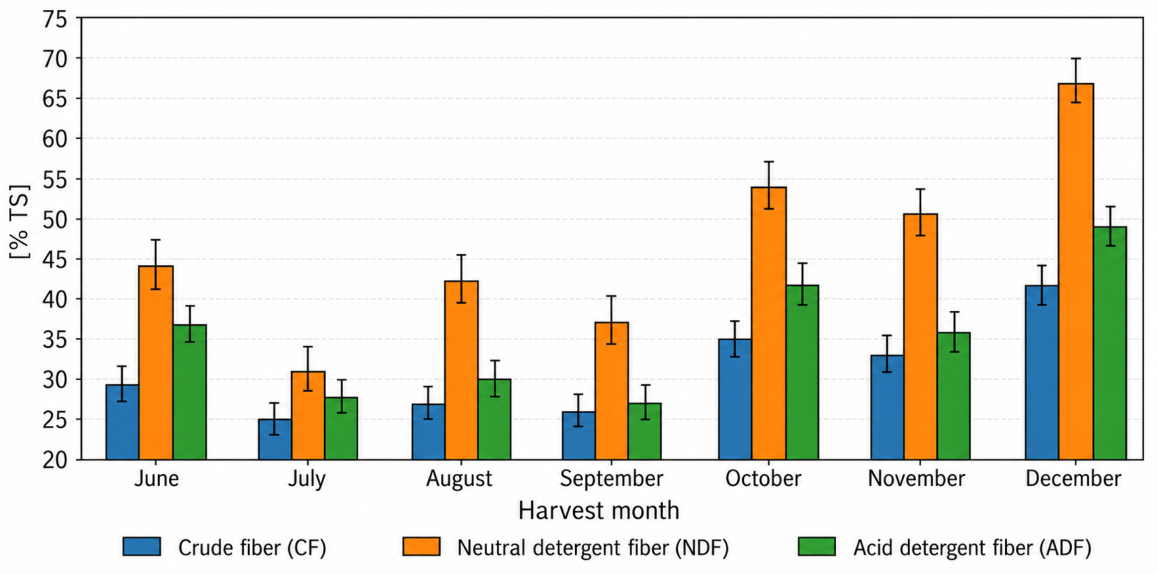
A key element of biomass transformation was the remodeling of the lignocellulosic structure, involving coordinated changes in the content of fiber fractions and their spatial organization. NDF content increased significantly (p < 0.05), from 30.58 ± 1.8% TS in July to 52.63 ± 2.6% TS in October and 66.58 ± 3.1% TS in December (Figure 4), indicating a dynamic increase in the total cell wall fraction. This phenomenon can be associated with the transition of the plant from the intensive growth phase to the maturation phase [41]. During this stage, the proportion of readily metabolizable cytoplasmic compounds decreases, while the relative contribution of structural cell wall components increases [42]. A similar trend was observed for ADF, whose share increased from 27.60 ± 1.7% TS in July to 40.60 ± 2.2% TS in October and 48.64 ± 2.6% TS in December (Figure 4). The increase in ADF indicates not only the accumulation of structural polysaccharides, but also progressive lignification and densification of the cell wall matrix, which restrict the access of hydrolytic enzymes to cellulose and hemicellulose [43]. Consequently, despite its high organic matter content, late-season biomass may exhibit lower susceptibility to hydrolysis and slower conversion during AD [44]. An additional indicator of structural changes was crude fiber (CF) content, which increased from 28.9 ± 1.6% TS in June to 34.8 ± 1.9% TS in October and 41.6 ± 2.2% TS in December, confirming the progressive accumulation of structural components [45] (Figure 4).
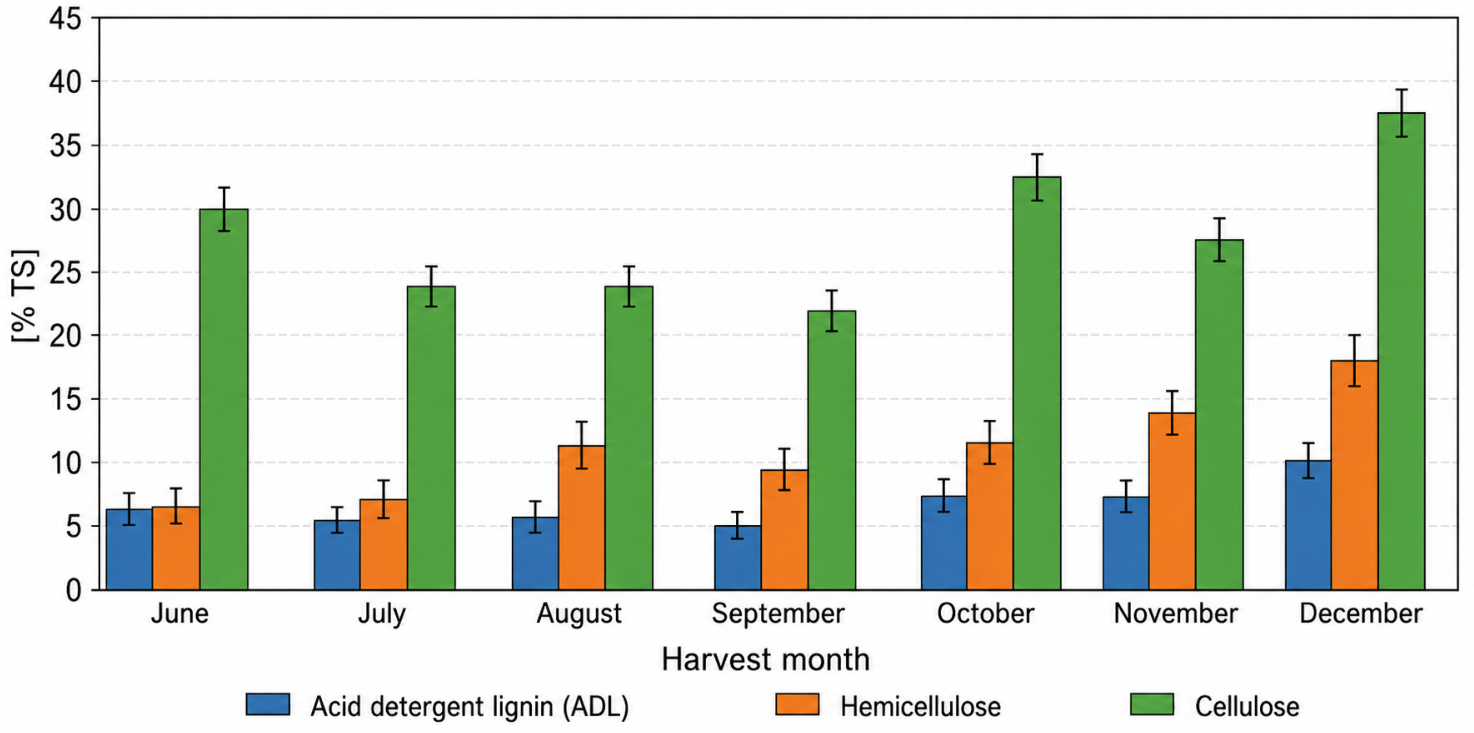
The increase in lignin content was particularly significant (p < 0.05), rising from 5.13 to 6.39% TS in the summer months to 7.63 ± 0.7% TS in October and 10.35 ± 0.9% TS in December (Figure 5). The lignification process is directly associated with activation of the phenylpropanoid pathway, leading to the biosynthesis of monolignols, including p-coumaryl, coniferyl, and sinapyl alcohols, which subsequently undergo polymerization and deposition in the cell wall [46]. The resulting lignin forms a three-dimensional, highly cross-linked structure that becomes integrated with hemicellulose through ester and ether bonds and, indirectly, also with cellulose [47].
The increase in cellulose content from approximately 22.19–24.56% TS during the summer period to 32.97 ± 2.1% TS in October and 38.29 ± 2.4% TS in December (Figure 5) indicates intensified biosynthesis of cellulose microfibrils, which constitute the main load-bearing component of the cell wall [48]. In parallel, hemicellulose content increased from 7.02 ± 0.9% TS in June to 12.03 ± 1.2% TS in October and 17.94 ± 1.6% TS in December (Figure 5), confirming its key role as a matrix linking cellulose with lignin [49]. Despite the increase in structural polysaccharide content, their bioavailability during AD is usually substantially reduced [50]. This results from the fact that lignin not only physically surrounds cellulose fibers, but also modifies their physicochemical properties by increasing the degree of cellulose crystallinity and limiting the penetration of hydrolytic enzymes [51]. In addition, the formation of lignin–hemicellulose complexes creates a diffusion barrier that restricts microbial and enzymatic access to the substrate [52]. Similar effects have been reported in studies showing that lignin structural properties and lignin–carbohydrate complexes reduce cellulose accessibility, promote non-productive enzyme adsorption, and decrease the efficiency of enzymatic hydrolysis [53,54].

3.3. Anaerobic Digestion

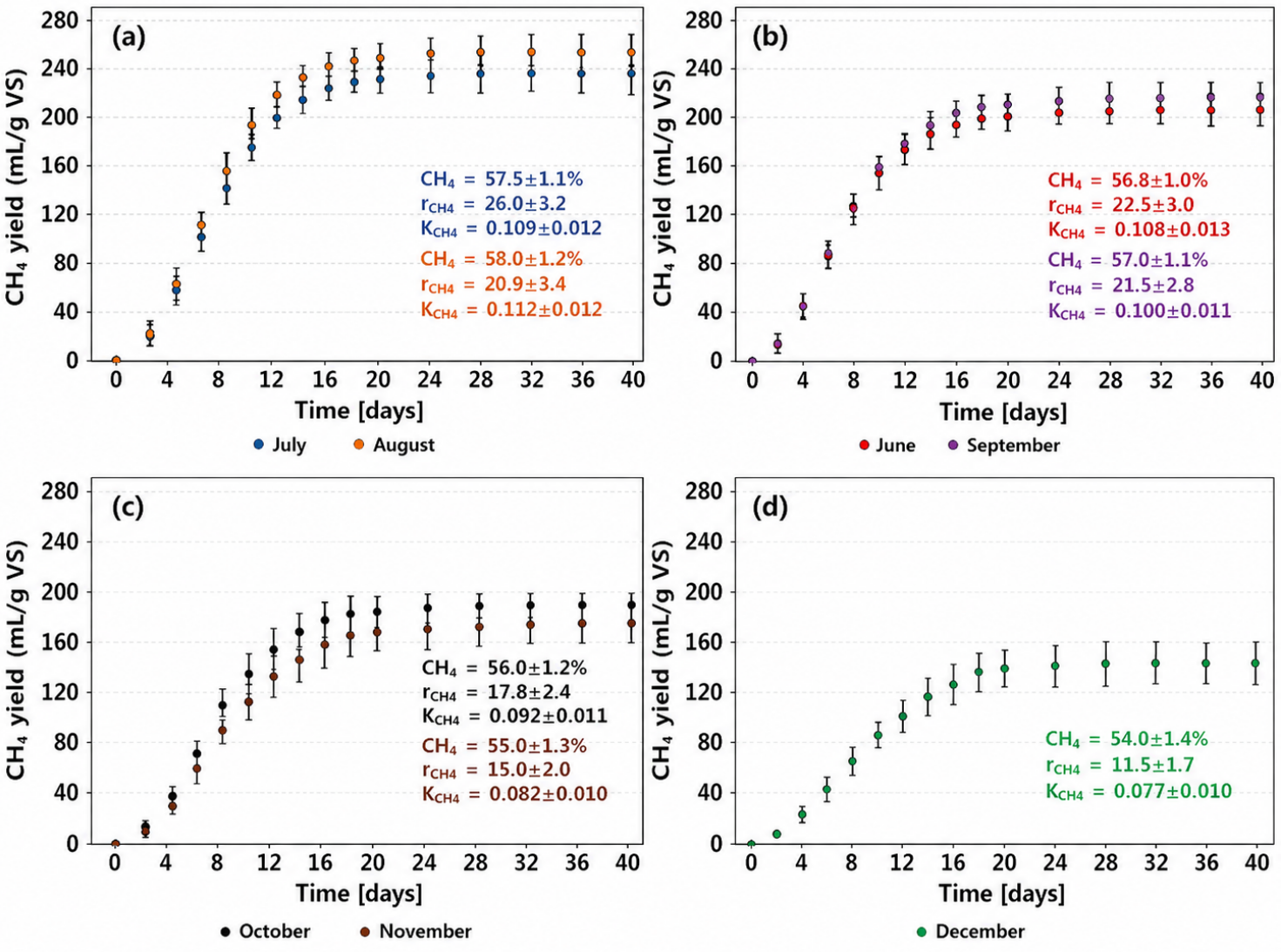
AD yield and kinetics of Helianthus annuus biomass showed clear seasonal variability, closely associated with changes in chemical composition (Figure 1, Figure 2 and Figure 3) and the degree of substrate lignification (Figure 4 and Figure 5). At the beginning of the season, in June, a moderately high CH4 yield of 208 ± 13 mL/g VS was obtained, with relatively favorable process kinetics (rCH4 = 22.5 ± 3.0 mL/g VS·d, kCH4 = 0.108 ± 0.013 1/d) (Figure 6b). This indicates that the biomass was susceptible to biodegradation, although its methane potential was not fully utilized, as reflected by BMPCH4/TBMP = 49.8 ± 3.5% (Table 2). In June, the limitation was not yet a strongly developed lignocellulosic barrier, as ADL and NDF contents were 6.39 ± 0.6% TS and 43.37 ± 2.2% TS, respectively (Figure 4 and Figure 5), but rather a less favorable relationship between the structural fraction and the pool of readily biodegradable compounds. In some cases, despite a moderate lignin content, the total amount of readily available organic carbon may be insufficient to support intensive production of intermediate metabolites, such as volatile fatty acids (VFA), which are direct substrates for methanogenic microorganisms [55]. The C/N ratio of 24.8 ± 2.1 remained lower than that recorded in August (Figure 2), which may have limited the intensity of conversion to CH4 through suboptimal nutritional conditions for methanogenic microorganisms and a potential shift in the balance between acidogenesis and methanogenesis [56].
The highest AD efficiency was achieved in August, when BMPCH4 reached 258 ± 13 mL/g VS and the process rate increased to rCH4 = 29.0 ± 3.4 mL/g VS·d (Figure 6a). The Gompertz model parameters also confirmed that this was the most favorable harvest date, as CH4Rmax reached 30.6 mL/g VS·d, with a short lag phase of λ = 2.03 d (Table 2). At the same time, the highest degree of methane potential utilization was recorded, i.e., BMPCH4/TBMP = 62.5 ± 3.8%, clearly indicating the highest efficiency of biological organic matter conversion in this month (Table 2). Although the content of reducing sugars in August (14.6 ± 2.1 mg/g TS) was not the highest over the entire season, the biomass exhibited the most favorable set of characteristics from the perspective of AD. These included a relatively low lignin content (ADL = 5.98 ± 0.5% TS), a moderate proportion of fibrous fractions, and the highest C/N ratio of 30.2 ± 2.2, which supported stable process performance (Figure 1, Figure 2 and Figure 3). The high C/N ratio limited ammonia accumulation and supported the activity of methanogenic microorganisms, whereas the moderate contribution of structural fractions ensured substrate accessibility for hydrolysis [57]. The CH4 content in the biogas, reaching 58.0 ± 1.2% (Figure 6a), confirmed the high efficiency of the final stages of methanogenesis and the absence of volatile fatty acid accumulation, indicating stable process conditions [58]. Due to the difference between the ensiled acclimation substrate and the fresh August biomass used in the BMP test, the possibility of preferential inoculum adaptation specifically to the fresh August variant was limited. Moreover, all harvest variants were tested with the same acclimated inoculum under identical batch conditions, which preserved the relative comparability of the results.
Against this background, July and September formed a group of months with comparable process efficiency, although they represented slightly different substrate-related conditions. In July, CH4 yield was 238 ± 19 mL/g VS and rCH4 was 26.0 ± 3.2 mL/g VS·d (Figure 6a), whereas in September the corresponding values were 218 ± 12 mL/g VS and 21.5 ± 2.8 mL/g VS·d (Figure 6b). This indicates that both months performed clearly worse than August, but remained substantially more favorable than the late-autumn period. In July, the relatively high efficiency was associated with the lowest proportion of structural fractions over the entire season (Figure 4 and Figure 5), which reduced hydrolytic barriers and promoted rapid fermentation [59]. In September, despite the still low lignin content (ADL = 5.13 ± 0.5% TS), process parameters had already deteriorated: BMPCH4/TBMP decreased to 52.9 ± 3.3%, and the lag phase extended to 2.47 d (Table 2). This indicates that, even at a still moderate lignin level, limitations related to changes in the ultrastructure of the cell wall began to emerge, including increased cellulose crystallinity and reorganization of the lignin–hemicellulose complex, which restricted the access of hydrolytic enzymes [60]. At the same time, the CH4 content in the biogas in July, August, and September remained relatively stable (57.0–58.0%), suggesting that seasonal differences mainly affected the extent and rate of organic matter conversion, and to a lesser extent the gas quality itself (Figure 6b).
Literature data indicate that CH4 yields from sunflower lignocellulosic residues vary considerably depending on biomass fraction and pretreatment. Zhurka et al. reported methane yields of 125–154 mL CH4/g VS for untreated and mildly pretreated sunflower head residues, approximately 152 mL CH4/g VS for untreated sunflower stalks, and up to 268 mL CH4/g VS for alkaline-pretreated sunflower heads [10]. At the cultivation-area scale, Amon et al. reported methane productivity from sunflower energy crops in the range of 2600–4550 m3N CH4/ha, depending on cultivar and production conditions [13]. Thus, the methane yields obtained in the summer harvest variants, particularly in July and August, were higher than those generally reported for untreated sunflower residues and comparable to values achieved after pretreatment, whereas the late-season variants were within or below the range reported for untreated sunflower biomass. The area-based CH4 productivity remained within the range reported for sunflower energy crops.
A clear decline in AD efficiency began in October. In this month, BMPCH4 decreased to 188 ± 10 mL/g VS, rCH4 to 17.8 ± 2.4 mL/g VS·d, and kCH4 to 0.092 ± 0.011 1/d (Figure 6c), accompanied by an increase in the lag phase to 3.12 d (Table 2). This trend intensified in November and December, when CH4 yield decreased to 173 ± 17 and 143 ± 17 mL/g VS, respectively, while the process rate declined to 15.0 ± 2.0 and 11.5 ± 1.7 mL/g VS·d (Figure 6c,d). At the same time, BMPCH4/TBMP decreased from 44.7 ± 3.0% in October to 33.3 ± 2.5% in December (Table 2), confirming progressively lower utilization of the theoretical substrate potential. This deterioration was closely associated with the increasing contribution of lignocellulosic fractions. In October, NDF increased to 52.63 ± 2.6% TS and ADL to 7.63 ± 0.7% TS, whereas in December these values reached 66.58 ± 3.1% TS and 10.35 ± 0.9% TS, respectively (Figure 4 and Figure 5). The increase in lignin content leads to physical shielding of cellulose and hemicellulose and restricts the diffusion of hydrolytic enzymes, thereby slowing biomass depolymerization [61]. Importantly, although high concentrations of reducing sugars, ranging from 29.0 to 33.5 mg/g TS, were recorded from October to December (Figure 3), their positive effect did not compensate for the negative impact of structural fractions. This shows that, at later harvest dates, AD performance was determined primarily by the physical accessibility of the substrate rather than merely by the presence of readily biodegradable compounds. This phenomenon is consistent with the concept of substrate accessibility limitation, according to which the process rate is governed by the availability of reactive surface area, not only by the chemical composition of the biomass [62].

3.4. Determinants of CH4 Yield and Kinetics as a Function of Biomass Composition

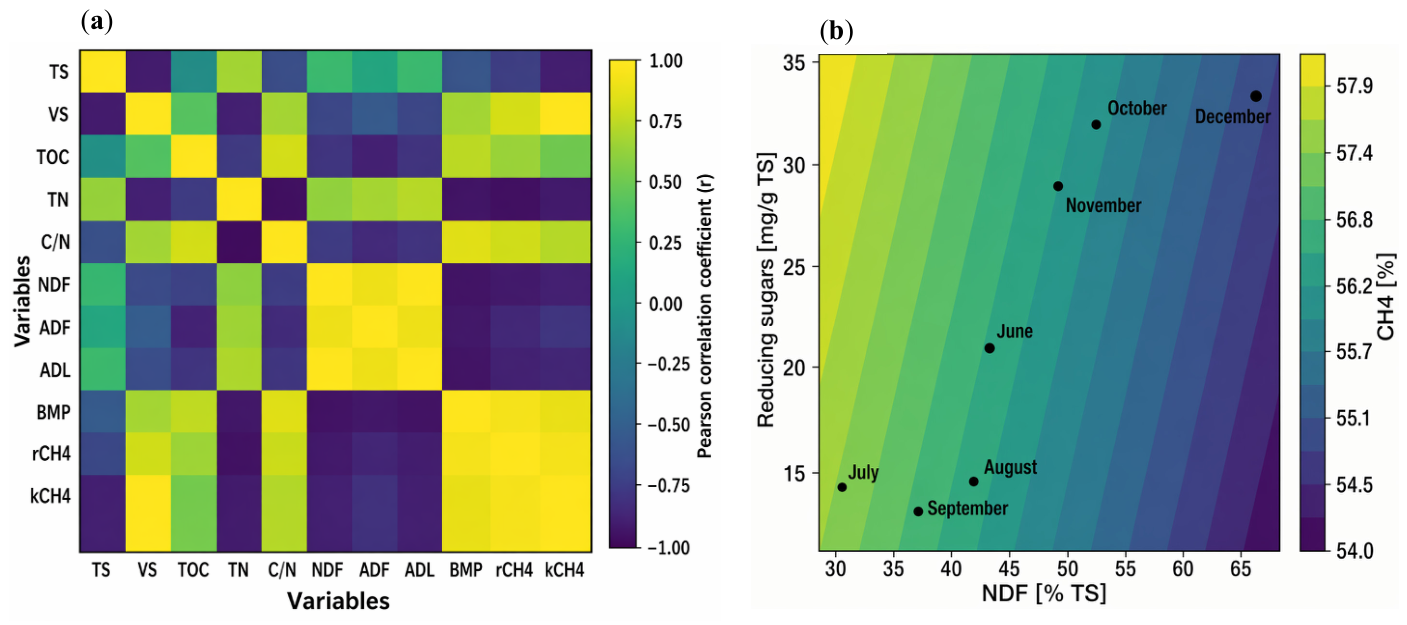
Linear regression analysis showed that CH4 yield and production rate were most strongly associated with parameters describing the lignocellulosic structure of the biomass. The best fit for BMPCH4 was obtained for ADL (R2 = 0.86) and NDF (R2 = 0.83), indicating that lignin and fibrous fractions were the main factors limiting process efficiency (Figure 7a). A similar pattern was observed for kinetic parameters, as CH4Rmax was strongly negatively correlated with both ADL (R2 = 0.84) and NDF (R2 = 0.80). In contrast, the positive effect of reducing sugars on process rate was also evident, although weaker (R2 = 0.78 for CH4Rmax and R2 = 0.75 for rCH4) (Figure 7a). This indicates that readily biodegradable compounds accelerated fermentation, but the final effect was strongly modulated by the degree of substrate lignification [63]. The positive relationship between the C/N ratio and BMPCH4 (R2 = 0.81) further indicates that nutrient balance plays an important role in process stabilization and maximization of CH4 yield [64]. A similar trend was also observed for biogas quality, expressed as the percentage content of CH4. The highest CH4 concentration was associated with biomass characterized by a relatively lower NDF content and greater sugar availability, whereas an increasing contribution of lignocellulosic structures shifted the system toward lower CH4 content (Figure 7b). These relationships are well illustrated by the correlation map and the contour plot showing CH4 [%] as a function of NDF and reducing sugars.
A more comprehensive understanding of the relationships between biomass composition and AD efficiency was obtained using multiple regression models, which showed very high predictive performance for all analyzed AD parameters. This approach is particularly justified for energy crops harvested at successive developmental stages, because seasonal biomass maturation leads to a simultaneous increase in structural fractions and changes in the content of readily hydrolysable components, directly affecting the course of hydrolysis and methanogenesis [65]. The model for BMPCH4, based on NDF, ADL, and reducing sugars, achieved R2 = 0.889 and R2adj = 0.869 (Table 3). The strongest individual negative regression coefficient was recorded for ADL (β = −8.75), accompanied by a negative effect of NDF (β = −1.92) and a positive effect of reducing sugars (β = +1.05). A similar pattern was observed for the kinetic parameters, namely rCH4 (R2 = 0.864; R2adj = 0.840) and Rmax (R2 = 0.872; R2adj = 0.849). In both models, NDF and ADL had negative effects, whereas reducing sugars had a positive effect (Table 3).
This indicates that the increasing contribution of lignin and fibrous fractions was strongly associated with reduced methane potential of the biomass. The direction of these relationships is consistent with studies on AD of other lignocellulosic substrates, including maize silage, sorghum, miscanthus, cereal straw, and energy grasses, where increases in lignin, NDF, or ADF content were most often associated with a decrease in BMP [66]. However, it should be emphasized that, in regression models for plant biomass, this relationship does not always show an unequivocally negative pattern [67]. In some studies, a positive regression coefficient for ADL may arise from the covariation of lignocellulosic fractions, compositional relationships among NDF, ADF, ADL, and VS, as well as predictor collinearity or the so-called statistical suppression effect, in which the sign of a partial regression coefficient does not directly reflect the mechanistic effect of lignin on substrate biodegradability [68]. Such a situation may occur particularly when an increase in ADL is simultaneously correlated with an increase in total organic matter content, dry matter content, or biomass yield, which may mask the actual inhibitory effect of lignification on AD [69]. In the present study, ADL showed a negative association with both BMPCH4 and the kinetic parameters of CH4 production, while VIF values did not indicate severe statistical collinearity among the explanatory variables. However, these variables should still be interpreted as biologically and compositionally related indicators of biomass maturation rather than as fully independent predictors.
The literature emphasizes that substrates with higher proportions of lignin and detergent fiber fractions usually require longer retention times to achieve maximum CH4 yield, whereas biomass richer in simple sugars and hemicelluloses may exhibit faster biogas production already during the initial stages of incubation [70]. A similar mechanism was also observed for CH4 content in biogas, for which the model achieved R2 = 0.848 and R2adj = 0.821. The negative coefficients for NDF (β = −0.085) and ADL (β = −0.22) indicate that an increased proportion of fibrous fractions and lignin reduced not only the quantitative production of CH4, but also its concentration in biogas. The variance inflation factor (VIF) values for the predictors were 3.1 for NDF, 2.8 for ADL, and 2.4 for reducing sugars, indicating no significant collinearity among the explanatory variables (VIF < 5). The very high R2 values obtained in the present models are higher than those often reported for heterogeneous mixtures of agricultural and municipal wastes. This can be explained by the more homogeneous nature of the investigated material, the controlled range of seasonal variability, and the clear biomass maturation gradient [68]. At the same time, due to the limited number of observational points, these models should be treated as empirical interpretative and predictive tools, and extrapolation beyond the analyzed range of variability in Helianthus annuus biomass composition should be approached with caution. Future validation using independent datasets is therefore required before applying these equations to other cultivars, locations, growing seasons, biomass preservation strategies, or AD scales. This limitation is particularly important because regression relationships determined for a single species and a specific seasonal harvest range may not be directly transferable to other cultivars, soil and climatic conditions, biomass preservation technologies, or technological scales of AD [71].

3.5. Energy and Economic Analysis

The results confirmed clear seasonal variability in the energy and economic efficiency of Helianthus annuus biomass utilization, resulting from the nonlinear relationship between biomass yield and CH4 production efficiency. This relationship reflects the trade-off between substrate quantity and quality, which is characteristic of lignocellulosic biomass [72]. Consequently, maximizing biomass yield often does not directly lead to maximized energy production, because substrate accessibility to microorganisms during hydrolysis becomes the key factor, with hydrolysis representing the rate-limiting step of the entire AD process [44].
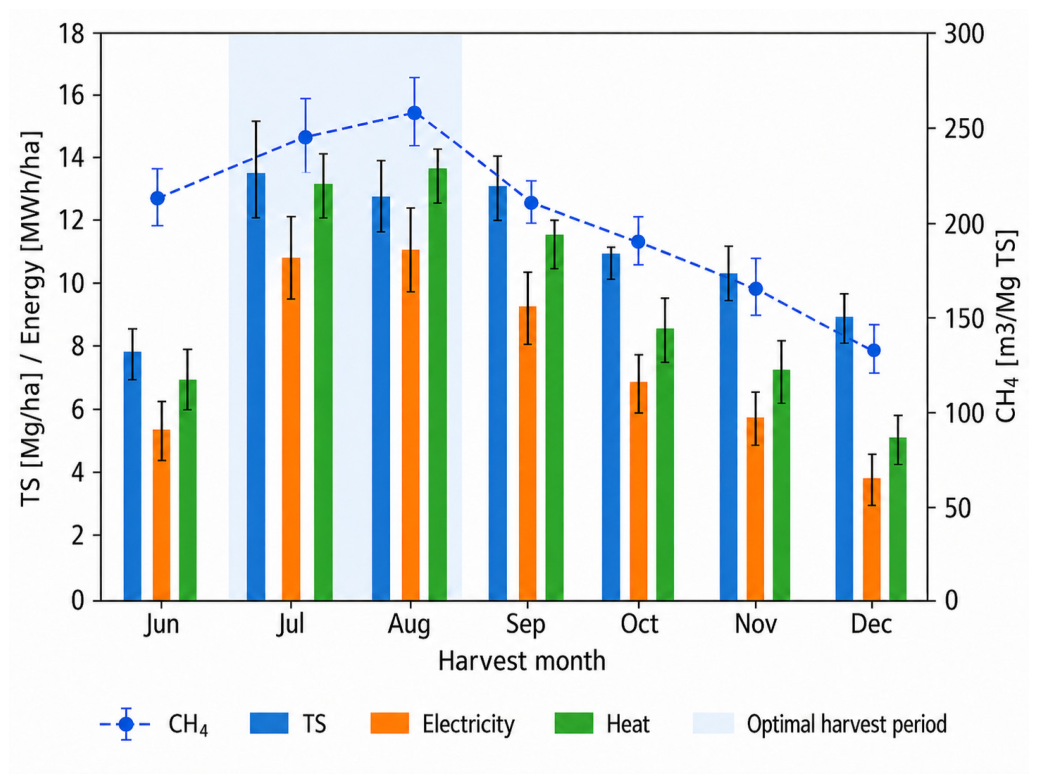
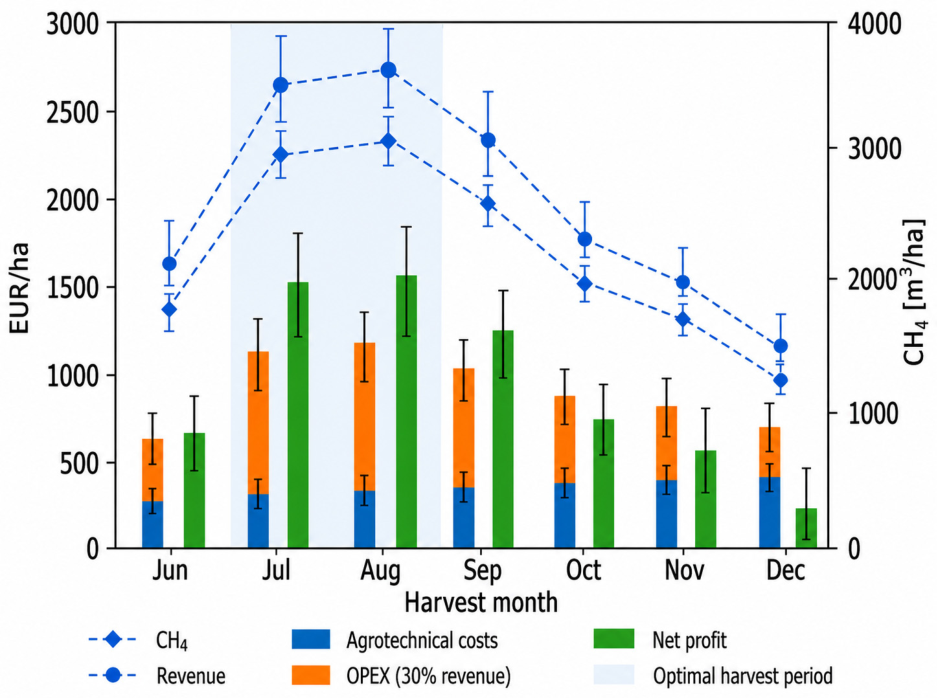
In June, the lowest biomass yield was obtained, at 7.8 ± 1.1 t TS/ha, together with CH4 production of 1570 ± 276 m3/ha. This corresponded to electrical and thermal energy production of 5.5 ± 1.0 MWh/ha and 6.8 ± 1.2 MWh/ha, respectively (Figure 8). Total energy revenue reached 1343 ± 184 EUR/ha, whereas the net result was 629 ± 194 EUR/ha (Figure 9). This indicates that, at the initial stage of the season, the system was limited by biomass quantity, despite the relatively favorable biodegradability of the substrate. Thus, methane potential was not fully utilized at the system level, because the limiting factor was the availability of organic matter per unit cultivation area rather than its quality [73].
The summer period was of key importance for system efficiency, as the highest values of all analyzed parameters were obtained during this time. CH4 production reached 3114 ± 576 m3/ha in July and 3214 ± 596 m3/ha in August (Figure 9). This corresponded to electrical energy production of 10.9 ± 2.0 MWh/ha and 11.2 ± 2.1 MWh/ha, respectively, and thermal energy production of 13.4 ± 2.5 MWh/ha and 13.9 ± 2.6 MWh/ha, respectively (Figure 8). Total revenue amounted to 2665 ± 384 EUR/ha in July and 2750 ± 398 EUR/ha in August, whereas the net result reached 1526 ± 403 EUR/ha and a maximum of 1559 ± 417 EUR/ha, respectively (Figure 9). The high efficiency recorded during this period resulted from the synergy between high biomass yield and high methane yield. At the same time, lignin and fiber fraction contents remained at levels that enabled efficient hydrolysis, which translated into high conversion of organic matter to CH4. August represented the optimal point; however, both months should be considered a common phase of maximum system efficiency, during which structural limitations of the biomass did not yet play a dominant role [74].
September represented a transition stage between the summer optimum and the period of declining efficiency. CH4 production reached 2706 ± 469 m3/ha, whereas electrical and thermal energy production amounted to 9.4 ± 1.6 MWh/ha and 11.7 ± 2.0 MWh/ha, respectively (Figure 8). Total revenue reached 2315 ± 313 EUR/ha, while the net result decreased to 1235 ± 329 EUR/ha (Figure 9). Despite the high biomass yield of 13.1 ± 1.6 t TS/ha, the decrease in BMPCH4 to 206 ± 11 m3/Mg TS indicated the increasing influence of structural factors (Figure 8). This means that, with the onset of biomass lignification, the availability of cellulose and hemicellulose became limited, leading to reduced hydrolysis efficiency and lower overall substrate conversion [75]. From October onward, a clear deterioration in system performance was observed. CH4 production decreased to 1998 ± 321 m3/ha, 1681 ± 282 m3/ha, and 1185 ± 207 m3/ha in the subsequent months, resulting in a substantial decline in energy production (Figure 9). Total revenue decreased from 1710 ± 214 EUR/ha in October to 1014 ± 138 EUR/ha in December, while the net result declined to 785 ± 227 EUR/ha, 571 ± 201 EUR/ha, and 248 ± 151 EUR/ha, respectively (Figure 9).
At the same time, agrotechnical costs increased from 311 ± 28 EUR/ha in June to 462 ± 45 EUR/ha in December, which further deteriorated the economic outcome. This increase was associated with higher dry matter content, greater mechanical resistance of the biomass, and less favorable harvesting conditions, leading to higher energy consumption and increased operating inputs. This means that, at later harvest dates, reduced energy production and increased costs occur simultaneously, producing a cumulative negative effect [76]. These results confirm that the efficiency of the AD–CHP system is determined by the interaction between biomass yield and bioavailability, rather than by a single parameter. Therefore, optimization of systems using lignocellulosic biomass should account for both quantitative and qualitative substrate parameters, with particular emphasis on hydrolytic limitations [77]. Therefore, the economic results should be interpreted as relative indicators of seasonal energy-economic performance under the adopted assumptions, rather than as definitive profitability estimates for a commercial biogas plant. A full techno-economic feasibility assessment would require additional consideration of CAPEX, detailed OPEX structure, substrate storage, silage losses, digestate management, labor, transport distance, heat utilization efficiency, and energy price variability.

4. Conclusions

The study demonstrated that seasonal variability in the chemical composition of Helianthus annuus biomass clearly determines the efficiency of anaerobic digestion and its energy-economic outcome. As the season progressed, a marked increase in lignocellulosic fractions, including NDF and lignin (ADL), was observed, leading to reduced substrate bioavailability and lower efficiency of conversion to CH4.
The highest process efficiency was achieved in August, when BMPCH4 reached 258 ± 13 mL/g VS and CH4 production amounted to 3214 ± 596 m3/ha. This resulted in the highest energy production and the maximum economic outcome of 1559 ± 417 EUR/ha. High efficiency was also recorded in July, indicating that, under the specific experimental conditions and screening-level economic assumptions adopted in this study, July–August represented the most favorable harvest window due to the favorable relationship between biomass yield and biodegradability.
Despite the still high biomass yield in September, methane yield decreased and CH4 production declined to 2706 ± 469 m3/ha, confirming the increasing influence of structural limitations. This effect intensified in the following months, leading to a clear deterioration in process parameters, with CH4 production decreasing to 1185 ± 207 m3/ha in December and the economic outcome falling to 248 ± 151 EUR/ha.
Overall, under the tested location, inoculum acclimation strategy, AD operating conditions, and adopted screening-level economic assumptions, the results indicate that the middle phase of the growing season provided the most favorable compromise between biomass quality and quantity. Further validation under different locations, cultivars, inoculum sources, and full-scale techno-economic scenarios is required before broader recommendations can be formulated.

Author Contributions

Conceptualization, A.B., J.K. and M.D.; methodology, A.B., J.K. and M.D.; validation, A.B. and M.D.; investigation, A.B., J.K. and M.D.; resources, A.B., J.K. and M.D.; data curation, A.B., J.K. and M.D.; supervision, A.B., J.K. and M.D.; writing—original draft preparation, A.B.; writing—review and editing, A.B., J.K. and M.D.; visualisation A.B., J.K. and M.D.; funding acquisition, M.D. All authors have read and agreed to the published version of the manuscript.

Funding

This research was financially supported by works No. 29.610.023-110 of the University of Warmia and Mazury in Olsztyn and WZ/WB-IIŚ/3/2025 of the Bialystok University of Technology, funded by the Ministry of Science and Higher Education.

Data Availability Statement

The original contributions presented in this study are included in the article. Further inquiries can be directed to the corresponding author.

Conflicts of Interest

The authors declare no conflicts of interest.

References

  1. Oleszek, M.; Matyka, M. Determination of the Efficiency and Kinetics of Biogas Production from Energy Crops through Nitrogen Fertilization Levels and Cutting Frequency. BioResources 2018, 13, 8505–8528. [Google Scholar] [CrossRef]
  2. Kazimierowicz, J.; Dzienis, L.; Dębowski, M.; Zieliński, M. Optimisation of Methane Fermentation as a Valorisation Method for Food Waste Products. Biomass Bioenergy 2021, 144, 105913. [Google Scholar] [CrossRef]
  3. Hendriks, A.T.W.M.; Zeeman, G. Pretreatments to Enhance the Digestibility of Lignocellulosic Biomass. Bioresour. Technol. 2009, 100, 10–18. [Google Scholar] [CrossRef]
  4. Stolarski, M.J.; Krzyżaniak, M.; Olba-Zięty, E. Biomass Yield and Quality of Perennial Herbaceous Crops in a Double Harvest in a Continental Environment. Ind. Crops Prod. 2022, 180, 114752. [Google Scholar] [CrossRef]
  5. Peni, D.; Stolarski, M.J.; Dębowski, M. Green Biomass Quality of Perennial Herbaceous Crops Depending on the Species, Type and Level of Fertilization. Ind. Crops Prod. 2022, 184, 115026. [Google Scholar] [CrossRef]
  6. Peni, D.; Dębowski, M.; Stolarski, M.J. Helianthus Salicifolius as a New Biomass Source for Biogas Production. Energies 2022, 15, 2921. [Google Scholar] [CrossRef]
  7. Oleszek, M.; Matyka, M. Energy Use Efficiency of Biogas Production Depended on Energy Crops, Nitrogen Fertilization Level, and Cutting System. BioEnergy Res. 2020, 13, 1069–1081. [Google Scholar] [CrossRef]
  8. Demirel, M.; Bolat, D.; Çelik, S.; Bakici, Y.; Çelik, S. Quality of Silages from Sunflower Harvested at Different Vegetational Stages. J. Appl. Anim. Res. 2006, 30, 161–165. [Google Scholar] [CrossRef]
  9. Monlau, F.; Barakat, A.; Steyer, J.P.; Carrere, H. Comparison of Seven Types of Thermo-Chemical Pretreatments on the Structural Features and Anaerobic Digestion of Sunflower Stalks. Bioresour. Technol. 2012, 120, 241–247. [Google Scholar] [CrossRef]
  10. Zhurka, M.; Spyridonidis, A.; Vasiliadou, I.A.; Stamatelatou, K. Biogas Production from Sunflower Head and Stalk Residues: Effect of Alkaline Pretreatment. Molecules 2020, 25, 164. [Google Scholar] [CrossRef]
  11. Lee, J.; Park, K.Y.; Cho, J.; Kwon, E.E.; Kim, J.Y. Anaerobic Digestion as an Alternative Disposal for Phytoremediated Biomass from Heavy Metal Contaminated Sites. Environ. Pollut. 2018, 243, 1704–1709. [Google Scholar] [CrossRef] [PubMed]
  12. Triolo, J.M.; Pedersen, L.; Qu, H.; Sommer, S.G. Biochemical Methane Potential and Anaerobic Biodegradability of Non-Herbaceous and Herbaceous Phytomass in Biogas Production. Bioresour. Technol. 2012, 125, 226–232. [Google Scholar] [CrossRef] [PubMed]
  13. Amon, T.; Amon, B.; Kryvoruchko, V.; Machmüller, A.; Hopfner-Sixt, K.; Bodiroza, V.; Hrbek, R.; Friedel, J.; Pötsch, E.; Wagentristl, H.; et al. Methane Production through Anaerobic Digestion of Various Energy Crops Grown in Sustainable Crop Rotations. Bioresour. Technol. 2007, 98, 3204–3212. [Google Scholar] [CrossRef] [PubMed]
  14. Triolo, J.M.; Sommer, S.G.; Møller, H.B.; Weisbjerg, M.R.; Jiang, X.Y. A New Algorithm to Characterize Biodegradability of Biomass during Anaerobic Digestion: Influence of Lignin Concentration on Methane Production Potential. Bioresour. Technol. 2011, 102, 9395–9402. [Google Scholar] [CrossRef]
  15. Donoso-Bravo, A.; Pérez-Elvira, S.I.; Fdz-Polanco, F. Application of Simplified Models for Anaerobic Biodegradability Tests. Evaluation of Pre-Treatment Processes. Chem. Eng. J. 2010, 160, 607–614. [Google Scholar] [CrossRef]
  16. Kafle, G.K.; Chen, L. Comparison on Batch Anaerobic Digestion of Five Different Livestock Manures and Prediction of Biochemical Methane Potential (BMP) Using Different Statistical Models. Waste Manag. 2016, 48, 492–502. [Google Scholar] [CrossRef]
  17. Zwietering, M.H.; Jongenburger, I.; Rombouts, F.M.; Van’t Riet, K. Modeling of the Bacterial Growth Curve. Appl. Environ. Microbiol. 1990, 56, 1875–1881. [Google Scholar] [CrossRef]
  18. Ware, A.; Power, N. Modelling Methane Production Kinetics of Complex Poultry Slaughterhouse Wastes Using Sigmoidal Growth Functions. Renew. Energy 2017, 104, 50–59. [Google Scholar] [CrossRef]
  19. Moriasi, D.N.; Gitau, M.W.; Pai, N.; Daggupati, P. Hydrologic and Water Quality Models: Performance Measures and Evaluation Criteria. Trans. ASABE 2015, 58, 1763–1785. [Google Scholar] [CrossRef]
  20. Buswell, A.M.; Mueller, H.F. Mechanism of Methane Fermentation. Ind. Eng. Chem. 2002, 44, 550–552. [Google Scholar] [CrossRef]
  21. Farrance, I.; Badrick, T.; Frenkel, R. Uncertainty in Measurement: A Review of the Procedures for Determining Uncertainty in Measurement and Its Use in Deriving the Biological Variation of the Estimated Glomerular Filtration Rate. Pract. Lab. Med. 2018, 12, e00097. [Google Scholar] [CrossRef] [PubMed]
  22. Klimek, K.; Kapłan, M.; Syrotyuk, S.; Bakach, N.; Kapustin, N.; Konieczny, R.; Dobrzyński, J.; Borek, K.; Anders, D.; Dybek, B.; et al. Investment Model of Agricultural Biogas Plants for Individual Farms in Poland. Energies 2021, 14, 7375. [Google Scholar] [CrossRef]
  23. Kusz, D.; Kusz, B.; Wicki, L.; Nowakowski, T.; Kata, R.; Brejta, W.; Kasprzyk, A.; Barć, M. The Economic Efficiencies of Investment in Biogas Plants—A Case Study of a Biogas Plant Using Waste from a Dairy Farm in Poland. Energies 2024, 17, 3760. [Google Scholar] [CrossRef]
  24. Karellas, S.; Boukis, I.; Kontopoulos, G. Development of an Investment Decision Tool for Biogas Production from Agricultural Waste. Renew. Sustain. Energy Rev. 2010, 14, 1273–1282. [Google Scholar] [CrossRef]
  25. PN-EN 12880:2004; Characterization of Sludges—Determination of Dry Residue and Water Content. Polish Committee for Standardization: Warsaw, Poland, 2004.
  26. PN-EN 12879:2004; Characterization of Sludges—Determination of the Loss on Ignition of Dry Mass. Polish Committee for Standardization: Warsaw, Poland, 2004.
  27. PN-EN ISO 13906:2009; Animal Feeding Stuffs—Determination of Acid Detergent Fibre (ADF) and Acid Detergent Lignin (ADL) Contents. Polish Committee for Standardization: Warsaw, Poland, 2009.
  28. PN-EN ISO 16472:2007; Animal Feeding Stuffs—Determination of Amylase-Treated Neutral Detergent Fibre Content (aNDF). Polish Committee for Standardization: Warsaw, Poland, 2007.
  29. PN-EN ISO 6865:2002; Animal Feeding Stuffs—Determination of Crude Fibre Content—Method with Intermediate Filtration. Polish Committee for Standardization: Warsaw, Poland, 2002.
  30. De la Rosa Santamaría, R.; Gamas-Alpuche, E.; Ramos-Juárez, J.A. Agronomy and Chemical Composition of Sunflower (Helianthus annuus L.) as a Forage Option in a Warm-Humid Intertropical Environment: Sunflower as a Tropical Forage. Agro Product. 2023, 16, 77–84. [Google Scholar] [CrossRef]
  31. Chen, X.; Zhang, H.; Yu, S.; Zhou, C.; Teng, A.; Lei, L.; Ba, Y.; Li, F. Optimizing Irrigation and Nitrogen Application Strategies to Improve Sunflower Yield and Resource Use Efficiency in a Cold and Arid Oasis Region of Northwest China. Front. Plant Sci. 2024, 15, 1429548. [Google Scholar] [CrossRef]
  32. Lee, S.; Masclaux-Daubresse, C. Current Understanding of Leaf Senescence in Rice. Int. J. Mol. Sci. 2021, 22, 4515. [Google Scholar] [CrossRef]
  33. Manyi-Loh, C.E.; Lues, R. Anaerobic Digestion of Lignocellulosic Biomass: Substrate Characteristics (Challenge) and Innovation. Fermentation 2023, 9, 755. [Google Scholar] [CrossRef]
  34. Quan, N.H.; Van, N.H.; Thuy, N.T.; Tam, V.T.M.; Thao, L.D.; Ngoan, L.D. Ensiling Techniques for Whole-Plant Sunflowers (Helianthus annuus) and Their Nutritive Values for Ruminants in Vietnam. Adv. Anim. Vet. Sci. 2022, 10, 1953–1961. [Google Scholar] [CrossRef]
  35. Estiarte, M.; Campioli, M.; Mayol, M.; Penuelas, J. Variability and Limits of Nitrogen and Phosphorus Resorption during Foliar Senescence. Plant Commun. 2023, 4, 100503. [Google Scholar] [CrossRef]
  36. Yang, J.; Zhang, J.; Du, X.; Gao, T.; Cheng, Z.; Fu, W.; Wang, S. Ammonia Inhibition in Anaerobic Digestion of Organic Waste: A Review. Int. J. Environ. Sci. Technol. 2024, 22, 3927–3942. [Google Scholar] [CrossRef]
  37. Xi, Z.; Wang, W.; Ping, Q.; Wang, L.; Pu, X.; Wang, B.; Li, Y. Anaerobic Digestion of Phosphorus-Rich Sludge and Digested Sludge: Influence of Mixing Ratio and Acetic Acid. Separations 2023, 10, 539. [Google Scholar] [CrossRef]
  38. De’Nobili, M.D.; Bernhardt, D.C.; Basanta, M.F.; Rojas, A.M. Sunflower (Helianthus annuus L.) Seed Hull Waste: Composition, Antioxidant Activity, and Filler Performance in Pectin-Based Film Composites. Front. Nutr. 2021, 8, 777214. [Google Scholar] [CrossRef]
  39. Parvez, K.; Ahammed, M.M. Effect of Composition on Anaerobic Digestion of Organic Fraction of Municipal Solid Wastes: A Review. Bioresour. Technol. Rep. 2024, 25, 101777. [Google Scholar] [CrossRef]
  40. Sun, Z.; Liu, Q.; Li, Y.; Mazarji, M.; Feng, L.; Pan, J. Deciphering the Impact of Lignin on Anaerobic Digestion: Focus on Inhibition Mechanisms and Methods for Alleviating Inhibition. ACS Omega 2024, 9, 44033–44041. [Google Scholar] [CrossRef] [PubMed]
  41. Jiang, H.; Wang, S.Y.; Wang, H.R.; Jing, Y.Y.; Qu, H.; Sun, L.; Wang, J.; Liu, B.; Gao, F.Q. Influence on the Fermentation Quality, Microbial Diversity, and Metabolomics in the Ensiling of Sunflower Stalks and Alfalfa. Front. Plant Sci. 2024, 15, 1333207. [Google Scholar] [CrossRef]
  42. Xu, L.; Tang, G.; Wu, D.; Zhang, J. Yield and Nutrient Composition of Forage Crops and Their Effects on Soil Characteristics of Winter Fallow Paddy in South China. Front. Plant Sci. 2023, 14, 1292114. [Google Scholar] [CrossRef]
  43. Bartzialis, D.; Giannoulis, K.D.; Gintsioudis, I.; Danalatos, N.G. Assessing the Efficiency of Different Nitrogen Fertilization Levels on Sorghum Yield and Quality Characteristics. Agriculture 2023, 13, 1253. [Google Scholar] [CrossRef]
  44. Wang, J.; Liu, S.; Feng, K.; Lou, Y.; Ma, J.; Xing, D. Anaerobic Digestion of Lignocellulosic Biomass: Process Intensification and Artificial Intelligence. Renew. Sustain. Energy Rev. 2025, 210, 115264. [Google Scholar] [CrossRef]
  45. Muhonen, S.; Julliand, V. Fibre Composition and Maturity of Forage-Based Diets Affects the Fluid Balance, Faecal Water-Holding Capacity and Microbial Ecosystem in French Trotters. Animals 2023, 13, 328. [Google Scholar] [CrossRef]
  46. Yao, T.; Feng, K.; Xie, M.; Barros, J.; Tschaplinski, T.J.; Tuskan, G.A.; Muchero, W.; Chen, J.G. Phylogenetic Occurrence of the Phenylpropanoid Pathway and Lignin Biosynthesis in Plants. Front. Plant Sci. 2021, 12, 704697. [Google Scholar] [CrossRef]
  47. Rao, X.; Barros, J. Modeling Lignin Biosynthesis: A Pathway to Renewable Chemicals. Trends Plant Sci. 2024, 29, 546–559. [Google Scholar] [CrossRef]
  48. Pedersen, G.B.; Blaschek, L.; Frandsen, K.E.H.; Noack, L.C.; Persson, S. Cellulose Synthesis in Land Plants. Mol. Plant 2023, 16, 206–231. [Google Scholar] [CrossRef]
  49. Kamdem Tamo, A.; Doench, I.; Deffo, G.; Zambou Jiokeng, S.L.; Doungmo, G.; Fotsop, C.G.; Tonleu Temgoua, R.C.; Montembault, A.; Serghei, A.; Njanja, E.; et al. Lignocellulosic Biomass and Its Main Structural Polymers as Sustainable Materials for (Bio)Sensing Applications. J. Mater. Chem. A 2025, 13, 24185–24253. [Google Scholar] [CrossRef]
  50. Basera, P.; Chakraborty, S.; Sharma, N. Lignocellulosic Biomass: Insights into Enzymatic Hydrolysis, Influential Factors, and Economic Viability. Discov. Sustain. 2024, 5, 311. [Google Scholar] [CrossRef]
  51. Wu, W.; Li, P.; Huang, L.; Wei, Y.; Li, J.; Zhang, L.; Jin, Y. The Role of Lignin Structure on Cellulase Adsorption and Enzymatic Hydrolysis. Biomass 2023, 3, 96–107. [Google Scholar] [CrossRef]
  52. Beck, S.; Choi, P.; Mushrif, S.H. Origins of Covalent Linkages within the Lignin–Carbohydrate Network of Biomass. Phys. Chem. Chem. Phys. 2022, 24, 20480–20490. [Google Scholar] [CrossRef]
  53. Yuan, Y.; Jiang, B.; Chen, H.; Wu, W.; Wu, S.; Jin, Y.; Xiao, H. Recent Advances in Understanding the Effects of Lignin Structural Characteristics on Enzymatic Hydrolysis. Biotechnol. Biofuels 2021, 14, 205. [Google Scholar] [CrossRef] [PubMed]
  54. Tarasov, D.; Leitch, M.; Fatehi, P. Lignin–Carbohydrate Complexes: Properties, Applications, Analyses, and Methods of Extraction: A Review. Biotechnol. Biofuels 2018, 11, 269. [Google Scholar] [CrossRef]
  55. Beschkov, V.N.; Angelov, I.K. Volatile Fatty Acid Production vs. Methane and Hydrogen in Anaerobic Digestion. Fermentation 2025, 11, 172. [Google Scholar] [CrossRef]
  56. Kaur, G.; Basak, N.; Kumar, S. State-of-the-Art Techniques to Enhance Biomethane/Biogas Production in Thermophilic Anaerobic Digestion. Process Saf. Environ. Prot. 2024, 186, 104–117. [Google Scholar] [CrossRef]
  57. Wang, Z.; Hu, Y.; Wang, S.; Wu, G.; Zhan, X. A Critical Review on Dry Anaerobic Digestion of Organic Waste: Characteristics, Operational Conditions, and Improvement Strategies. Renew. Sustain. Energy Rev. 2023, 176, 113208. [Google Scholar] [CrossRef]
  58. Ren, Y.; Wang, C.; He, Z.; Qin, Y.; Li, Y.Y. Biogas Production Performance and System Stability Monitoring in Thermophilic Anaerobic Co-Digestion of Lipids and Food Waste. Bioresour. Technol. 2022, 358, 127432. [Google Scholar] [CrossRef] [PubMed]
  59. Lymperatou, A.; Engelsen, T.K.; Skiadas, I.V.; Gavala, H.N. Prediction of Methane Yield and Pretreatment Efficiency of Lignocellulosic Biomass Based on Composition. Waste Manag. 2023, 155, 302–310. [Google Scholar] [CrossRef] [PubMed]
  60. Anacleto, T.M.; Kozlowsky-Suzuki, B.; Björn, A.; Yekta, S.S.; Masuda, L.S.M.; de Oliveira, V.P.; Enrich-Prast, A. Methane Yield Response to Pretreatment Is Dependent on Substrate Chemical Composition: A Meta-Analysis on Anaerobic Digestion Systems. Sci. Rep. 2024, 14, 1240. [Google Scholar] [CrossRef] [PubMed]
  61. Gao, Z.; Alshehri, K.; Li, Y.; Qian, H.; Sapsford, D.; Cleall, P.; Harbottle, M. Advances in Biological Techniques for Sustainable Lignocellulosic Waste Utilization in Biogas Production. Renew. Sustain. Energy Rev. 2022, 170, 112995. [Google Scholar] [CrossRef]
  62. Karthikeyan, P.K.; Iza, F.; Bandulasena, H.C.H.; Radu, T. Enhanced Biogas Production from Lignocellulosic Biomass via Integrated Fenton and Plasma Treatment. Biomass Bioenergy 2026, 208, 108812. [Google Scholar] [CrossRef]
  63. Song, C.; Cai, F.; Yang, S.; Wang, L.; Liu, G.; Chen, C. Machine Learning-Based Prediction of Methane Production from Lignocellulosic Wastes. Bioresour. Technol. 2024, 393, 129953. [Google Scholar] [CrossRef]
  64. Budiyono, B.; Matin, H.H.A.; Yasmin, I.Y.; Priogo, I.S. Effect of Pretreatment and C/N Ratio in Anaerobic Digestion on Biogas Production from Coffee Grounds and Rice Husk Mixtures. Int. J. Renew. Energy Dev. 2023, 12, 209–215. [Google Scholar] [CrossRef]
  65. Brózda, A.; Kazimierowicz, J.; Dębowski, M. Seasonal Changes in Biomass Composition of Giant Miscanthus (Miscanthus × giganteus) and Their Impact on Methane Fermentation Performance. Energies 2026, 19, 1669. [Google Scholar] [CrossRef]
  66. Stachowiak-Wencek, A.; Bocianowski, J.; Waliszewska, H.; Borysiak, S.; Waliszewska, B.; Zborowska, M. Statistical Prediction of Biogas and Methane Yields during Anaerobic Digestion Based on the Composition of Lignocellulosic Biomass. Bioresources 2021, 16, 7086–7100. [Google Scholar] [CrossRef]
  67. Crutzen, R.; Peters, G.J.Y. The Regression Trap: Why Regression Analyses Are Not Suitable for Selecting Determinants to Target in Behavior Change Interventions. Health Psychol. Behav. Med. 2023, 11, 2268684. [Google Scholar] [CrossRef]
  68. Rossi, E.; Pecorini, I.; Iannelli, R. Multilinear Regression Model for Biogas Production Prediction from Dry Anaerobic Digestion of OFMSW. Sustainability 2022, 14, 4393. [Google Scholar] [CrossRef]
  69. Radočaj, D.; Jurišić, M. Comparative Evaluation of Ensemble Machine Learning Models for Methane Production from Anaerobic Digestion. Fermentation 2025, 11, 130. [Google Scholar] [CrossRef]
  70. Jensen, M.B.; de Jonge, N.; Dolriis, M.D.; Kragelund, C.; Fischer, C.H.; Eskesen, M.R.; Noer, K.; Møller, H.B.; Ottosen, L.D.M.; Nielsen, J.L.; et al. Cellulolytic and Xylanolytic Microbial Communities Associated With Lignocellulose-Rich Wheat Straw Degradation in Anaerobic Digestion. Front. Microbiol. 2021, 12, 645174. [Google Scholar] [CrossRef]
  71. Ziero, H.D.D.; Romeiro, D.C.; Ampese, L.C.; Costa, J.M.; Miguel, M.G.; Forster-Carneiro, T. Evaluation of Methane Yield Prediction Models for Anaerobic Digestion of Agro-Industrial Biomass. Ind. Eng. Chem. Res. 2026, 65, 7805–7813. [Google Scholar] [CrossRef]
  72. Olafasakin, O.; Audia, E.M.; Mba-Wright, M.; Tyndall, J.C.; Schulte, L.A. Techno-Economic and Life Cycle Analysis of Renewable Natural Gas Derived from Anaerobic Digestion of Grassy Biomass: A US Corn Belt Watershed Case Study. GCB Bioenergy 2024, 16, e13164. [Google Scholar] [CrossRef]
  73. Czekała, W.; Frankowski, J.; Sieracka, D.; Pochwatka, P.; Kowalczyk-Juśko, A.; Witaszek, K.; Dudnyk, A.; Zielińska, A.; Wisła-Świder, A.; Dach, J. The Energy Efficiency Analysis of Sorghum Waste Biomass Grown in a Temperate Climate. Energy 2025, 320, 135433. [Google Scholar] [CrossRef]
  74. Kakuk, B.; Bagi, Z.; Rákhely, G.; Maróti, G.; Dudits, D.; Kovács, K.L. Methane Production from Green and Woody Biomass Using Short Rotation Willow Genotypes for Bioenergy Generation. Bioresour. Technol. 2021, 333, 125223. [Google Scholar] [CrossRef]
  75. López-Balladares, O.H.; De la Lama-Calvente, D.; Flores-Flor, F.J.; Borja, R. Valorization of Lignocellulosic Biomass Through Anaerobic Digestion after the Cultivation of the Edible Mushroom Lentinula Edodes and Enzymatic Pretreatment. Waste Biomass Valorization 2025, 17, 2341–2353. [Google Scholar] [CrossRef]
  76. Pochwatka, P.; Rozakis, S.; Kowalczyk-Juśko, A.; Czekała, W.; Qiao, W.; Nägele, H.J.; Janczak, D.; Mazurkiewicz, J.; Mazur, A.; Dach, J. The Energetic and Economic Analysis of Demand-Driven Biogas Plant Investment Possibility in Dairy Farm. Energy 2023, 283, 129165. [Google Scholar] [CrossRef]
  77. Kalaitzidis, A.; Mitraka, G.-C.; Katsantonis, D.; Prasad, S.; Singh, A.; Koutroubas, S.; Kougias, P.G.; Korres, N.E. Enhancing Methane Production from Rice Crop Residues via Pretreatment and Co-Digestion with Cattle or Swine Slurry. Front. Energy Res. 2026, 13, 1680055. [Google Scholar] [CrossRef]
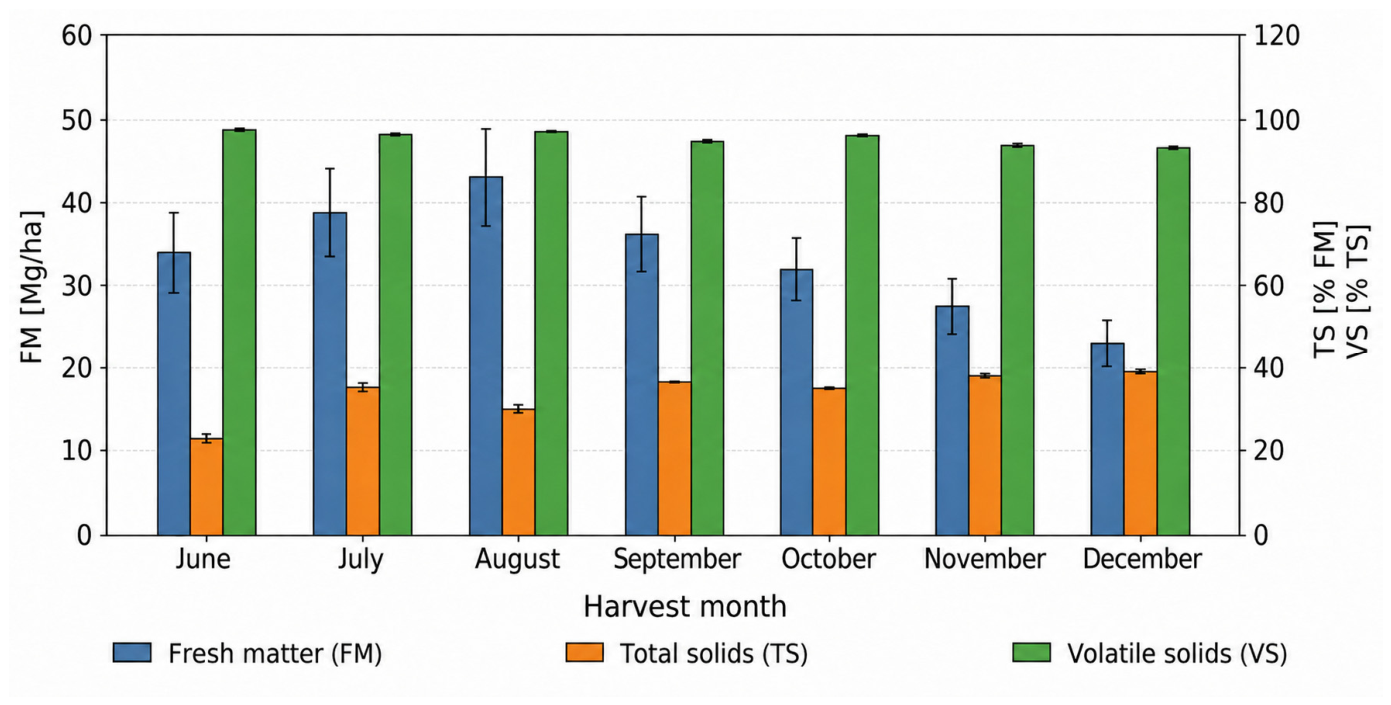
Figure 1. Seasonal variation in fresh matter yield (FM; Mg/ha), total solids content (TS; % FM), and volatile solids content (VS; % TS) of Helianthus annuus biomass harvested from June to December.
Processes 14 01943 g001
Figure 2. Seasonal variation in total organic carbon (TOC; % TS), total nitrogen (TN; mg/g TS), total phosphorus (TP; mg/g TS), and the carbon-to-nitrogen ratio (C/N; dimensionless) in Helianthus annuus biomass harvested from June to December.
Processes 14 01943 g002
Figure 3. Seasonal variation in crude lipids, reducing sugars, and crude protein contents (mg/g TS—total solids) in Helianthus annuus biomass harvested from June to December.
Processes 14 01943 g003
Figure 4. Seasonal variation in crude fiber (CF; % TS), neutral detergent fiber (NDF; % TS), and acid detergent fiber (ADF; % TS) contents in Helianthus annuus biomass harvested from June to December.
Processes 14 01943 g004
Figure 5. Seasonal variation in acid detergent lignin (ADL; % TS), hemicellulose (% TS), and cellulose (% TS) contents in Helianthus annuus biomass harvested from June to December.
Processes 14 01943 g005
Figure 6. Cumulative methane (CH4) production profiles during anaerobic digestion of Helianthus annuus biomass harvested from June to December: (a) July and August, (b) June and September, (c) October and November, and (d) December (CH4—methane content in biogas; rCH4—methane production rate (mL/g VS·d); kCH4—first-order kinetic rate constant (1/d); VS—volatile solids).
Processes 14 01943 g006
Figure 7. Relationships between biomass composition and anaerobic digestion performance of Helianthus annuus: (a) Pearson correlation heatmap; (b) contour plot of methane content in biogas (CH4; %) as a function of neutral detergent fiber (NDF; % TS) and reducing sugars (mg/g TS). TS—total solids; VS—volatile solids; TOC—total organic carbon; TN—total nitrogen; C/N—carbon-to-nitrogen ratio; ADF—acid detergent fiber; ADL—acid detergent lignin; BMP—methane yield; rCH4—methane production rate; kCH4—first-order kinetic rate constant.
Processes 14 01943 g007
Figure 8. Seasonal variation in total solids yield (TS; Mg/ha), electrical energy production (MWh/ha), thermal energy production (MWh/ha), and methane productivity (CH4; m3/ha) from anaerobic digestion of Helianthus annuus biomass harvested from June to December and converted in a combined heat and power (CHP) system. The shaded area indicates the most favorable harvest period.
Processes 14 01943 g008
Figure 9. Seasonal variation in agrotechnical costs, operating expenditures (OPEX; 30% of revenue), net profit, total revenue (EUR/ha), and methane productivity (CH4; m3/ha) for anaerobic digestion of Helianthus annuus biomass harvested from June to December and converted in a combined heat and power (CHP) system. The shaded area indicates the most favorable harvest period.
Processes 14 01943 g009
Table 1. Calculation equations and definitions of symbols used in the energy-economic.
NumberEquationSymbolUnitDefinition/Value
(1)E_VS = BMP_CH4 · LHV_CH4E_VSkWh/Mg VSPotential energy per unit mass of VS
BMP_CH4m3N/Mg VSSpecific CH4 production yield
LHV_CH4kWh/m3NLower heating value of CH4 (9.17)
(2)E_FM = E_VS · VS_FME_FMkWh/Mg FMPotential energy per unit mass of FM
VS_FMMg VS/Mg FMShare of VS in FM
(3)V_CH4,ha = M_VS,ha · BMP_CH4V_CH4,ham3N/haCH4 production yield per hectare
M_VS,haMg VS/haObtained VS yield
(4)E_ha = V_CH4,ha · LHV_CH4E_hakWh/haChemical energy of CH4 per hectare
(5)E_el,ha = E_ha · η_elE_el,hakWh/haElectrical energy from CH4 per hectare
η_elElectrical efficiency of the CHP unit (0.38)
(6)E_th,ha = E_ha · η_thE_th,hakWh/haThermal energy from CH4 per hectare
η_thThermal efficiency of the CHP unit (0.47)
(7)V_el = E_el,ha · P_elV_elEUR/haValue of electrical energy
P_elEUR/kWhElectricity price (0.18)
(8)V_th = E_th,ha · P_thV_thEUR/haValue of thermal energy
P_thEUR/kWhHeat price (0.05)
(9)V_tot = V_el + V_thV_totEUR/haTotal value of electrical and thermal energy
(10)B_net = V_tot − OPEX − C_agroB_netEUR/haEconomic balance
OPEXEUR/ha30% of the total energy value
C_agroEUR/haBiomass production costs by harvest month: VI—311 ± 28; VII—339 ± 31; VIII—366 ± 33; IX—386 ± 35; X—412 ± 39; XI—436 ± 42; XII—462 ± 45.
Table 2. Theoretical biomethane potential and modified Gompertz model parameters for methane production from Helianthus annuus biomass harvested from June to December.
Harvest MonthTBMP [mL/g VS]BMPCH4/TBMP [%]Gompertz Model Parameters (CH4)
Vmax [mL/g VS]Rmax [mL/g VS/d]λ [d]R2 [-]RMSE [mL/g VS]
June417.9 ± 3.349.8 ± 3.520824.32.080.99903.0
July408.7 ± 0.958.2 ± 3.923827.81.860.99923.2
August413.1 ± 6.162.5 ± 3.825830.62.030.99923.4
September412.2 ± 1.452.9 ± 3.321823.92.470.99874.0
October421.0 ± 1.444.7 ± 3.018819.73.120.99804.6
November420.9 ± 3.141.1 ± 2.817316.23.680.99735.3
December429.3 ± 1.933.3 ± 2.514312.84.190.99676.0
TBMP—theoretical biomethane potential; BMPCH4/TBMP—ratio of experimental methane yield to theoretical biomethane potential; Vmax—maximum cumulative methane yield; Rmax—maximum methane production rate; λ—lag phase duration; R2—coefficient of determination; RMSE—root mean square error; CH4—methane; VS—volatile solids. TBMP and BMPCH4/TBMP values are presented as means ± standard deviations.
Table 3. Multiple regression models describing the effects of lignocellulosic composition and reducing sugars on methane fermentation performance of Helianthus annuus biomass.
Model/UnitRegression EquationR2/R2adjAIC
BMPCH4
[mL/g VS]
BMPCH4 = 312.6 − 1.92·NDF − 8.75·ADL + 1.05·Sugars0.889/0.869118.6
rCH4
[mL/g VS·d]
rCH4 = 35.8 − 0.24·NDF − 1.35·ADL + 0.28·Sugars0.864/0.840102.4
Rmax
[mL/g VS·d]
Rmax = 38.2 − 0.27·NDF − 1.52·ADL + 0.31·Sugars0.872/0.849104.1
CH4
[%]
CH4 = 59.4 − 0.085·NDF − 0.22·ADL + 0.035·Sugars0.848/0.82185.7
BMPCH4—experimental methane yield; rCH4—methane production rate; Rmax—maximum methane production rate estimated using the modified Gompertz model; CH4—methane content in biogas; NDF—neutral detergent fiber; ADL—acid detergent lignin; Sugars—reducing sugar content; VS—volatile solids; R2—coefficient of determination; R2adj—adjusted coefficient of determination; AIC—Akaike information criterion.
Disclaimer/Publisher’s Note: The statements, opinions and data contained in all publications are solely those of the individual author(s) and contributor(s) and not of MDPI and/or the editor(s). MDPI and/or the editor(s) disclaim responsibility for any injury to people or property resulting from any ideas, methods, instructions or products referred to in the content.