Article

Study on Overburden Fracture Patterns and Support Load Mechanism in Shallow Coal Seam Mining Under Gully Terrain
1
School of Mining and Coal Engineering, Inner Mongolia University of Science and Technology, Baotou 014010, China
2
Inner Mongolia Key Laboratory of Mining Engineering, Baotou 014010, China
3
Inner Mongolia Research Center for Coal Safety Mining and Utilization Engineering and Technology, Baotou 014010, China
4
Inner Mongolia Cooperative Innovation Center for Coal Green Mining and Green Utilization, Baotou 014010, China
*
Author to whom correspondence should be addressed.
Processes 2026, 14(12), 1942; https://doi.org/10.3390/pr14121942 (registering DOI)
Submission received: 26 April 2026 / Revised: 30 May 2026 / Accepted: 9 June 2026 / Published: 14 June 2026
(This article belongs to the Section Energy Systems)

Abstract

Shallow-buried coal seams in western China are commonly overlain by deeply incised gully terrain, where mining is often accompanied by coal-wall spalling and abnormal increases in support resistance, which affect safe and efficient production. To investigate overburden failure during shallow-buried coal seam mining under gully terrain and to clarify the support–resistance mechanism, a typical working face was selected as the engineering background. Physical similarity simulation, 3DEC numerical simulation, and theoretical analysis were used to analyze overburden failure characteristics and the coupled evolution of the stress, displacement, and fracture fields. Mechanical models of key-stratum fracture and a support–resistance estimation model were established to reveal the influence of overburden-thickness variation on key-stratum fracture and support resistance. The results show that overburden failure in gully areas exhibits pronounced stage-dependent and asymmetric characteristics. In the similarity simulation, the initial fracture intervals of the key stratum in the downhill section were 32 m and 36 m, indicating an asymmetric fracture pattern with a shorter span on the left side and a longer span on the right side. In the uphill section, the periodic fracture interval of the key stratum decreased from 30 m to 24 m as the overburden thickness increased. During overburden failure in gully areas, the three fields exhibited a coupled relationship: stress concentration at the working face caused overburden failure and subsidence, which promoted fracture propagation, whereas stress redistribution in the goaf compacted the fractured overburden and promoted fracture closure. The overburden failure characteristics differed significantly between mining stages. During downhill mining, the key stratum behaved as a fixed-ended beam with a relatively large fracture interval, whereas during uphill mining, it formed a cantilever beam, and its fracture interval decreased with increasing overburden thickness. The loading mechanism of support resistance was shown to be jointly controlled by variations in gully overburden thickness and key-stratum fracture. During downhill mining, support loading increased gradually under the support of the fixed-ended beam key stratum. During uphill mining, support loading exhibited periodic abrupt increases under the combined effects of increasing overburden thickness and periodic fracture of the cantilever-beam key stratum. These findings provide a theoretical basis for strata pressure control at working faces in gully areas.

1. Introduction

China is the world’s largest producer and consumer of coal. Western China is a major coal-producing base, where the strata are commonly weakly cemented, low in strength, and characterized by rugged topography and densely distributed surface gullies. In addition, the coal seams are shallow-buried and have abundant reserves, making the region suitable for fully mechanized coal mining [1,2,3]. During underground coal extraction in gully areas, overburden instability and movement are highly complex, and fracture development is particularly pronounced [4,5,6]. Consequently, roof falls, rib spalling, abnormal strata pressure, and sudden increases in support resistance frequently occur at the working face, posing serious threats to operational safety and restricting the efficient exploitation of shallow-buried coal resources in western China [7,8].
Extensive studies have been conducted on key-stratum fracture, overburden movement, and strata-pressure behavior during shallow-buried coal seam mining. In western China, shallow-buried coal seams are typically controlled by a single key stratum that bears most of the overburden load [9]. Coal extraction causes the key stratum to undergo periodic hanging and breakage, resulting in synchronous subsidence of the overlying strata [10], the formation of numerous mining-induced fractures, periodic weighting, and sudden increases in support resistance at the working face [11]. To clarify the influence of gully terrain, related studies have also been carried out. Zhang et al. [12,13] analyzed key-stratum failure and strata-pressure variation in gully areas and established a plane-stress cantilever-beam model to reveal the key-stratum fracture mechanism under non-uniform loading. Lai et al. [14,15] developed a mechanical model for a non-uniformly loaded key-stratum beam under continuous gully terrain and calculated the initial sliding-instability interval and asymmetric fracture mechanism of the key stratum. Bai et al. [16,17] investigated fracture development in gully areas and revealed the fracture mechanism based on a voussoir-beam model of the key stratum. Wang et al. [18,19] studied the dynamic evolution of working-face stress with changing overburden thickness during coal mining in gully areas and established prediction methods for mining-induced hazards at different positions in gully terrain. Based on key-stratum theory and voussoir beam theory, Liu et al. [20,21,22] established theoretical models to analyze the roof fracture behavior and support loading mechanism during shallow coal seam mining.
Existing studies have mainly focused on overburden failure and strata-pressure behavior under relatively gentle topographic conditions. However, for the complete mining process in gully areas, the transformation of key-stratum structural forms and the mechanical mechanism of periodic fracture require further investigation. In addition, most previous studies have analyzed stress, displacement, or fracture evolution separately, without revealing the coupling relationship among these three fields under dynamically changing overburden thickness. Existing support–resistance estimation models are also largely based on uniformly distributed overburden loads or conventional voussoir-beam theory and therefore do not fully consider the combined influence of non-uniform overburden loading and key-stratum fracture on support resistance in gully areas. Therefore, in this study, a typical shallow-buried coal seam working face in a gully area was selected as the engineering background to investigate key-stratum fracture and support–resistance characteristics throughout the mining process. Physical similarity simulation was employed to analyze overburden instability and movement and the evolution of key-stratum fracture structures. A 3DEC numerical model was established to examine the spatiotemporal evolution of stress, displacement, and fracture fields and to clarify their coupling mechanism. Mechanical models of fixed-ended and cantilever beams were further developed to reveal the fracture mechanism of the key stratum under non-uniform loading. On this basis, a support load calculation model for the working face in gully areas was established. The results provide a theoretical basis for clarifying the overburden failure mechanism and strata pressure behavior at the working face in gully areas.

2. Engineering Background and Experimental Program

2.1. Engineering Background

Chuancaogedan Coal Mine is located in Weijiamao Town, Zhungeer Banner, Ordos City, Inner Mongolia, China, within the Zhungeer Coalfield. Multiple gullies are distributed across the surface of the mining area. The designed mining direction of the coal seam is perpendicular to the gully orientation. The maximum gully depth is approximately 60.5 m, and the maximum slope angle is about 33°. No perennial surface water bodies occur within the gully, and groundwater inflow is limited. The burial depth of the coal seam ranges from 77.36 m to 137.86 m, and the average seam thickness is 5.5 m. The average daily advance rate is 10 m/d, and the mining method is fully mechanized longwall mining with full-seam extraction along the strike. A schematic diagram of coal seam mining in the gully area is shown in Figure 1. According to the rock mechanical test results provided in the engineering geological data of the mining area, the mechanical parameters of the coal and rock strata are listed in Table 1.

2.2. Experimental Program

(1)
Physical similarity simulation model
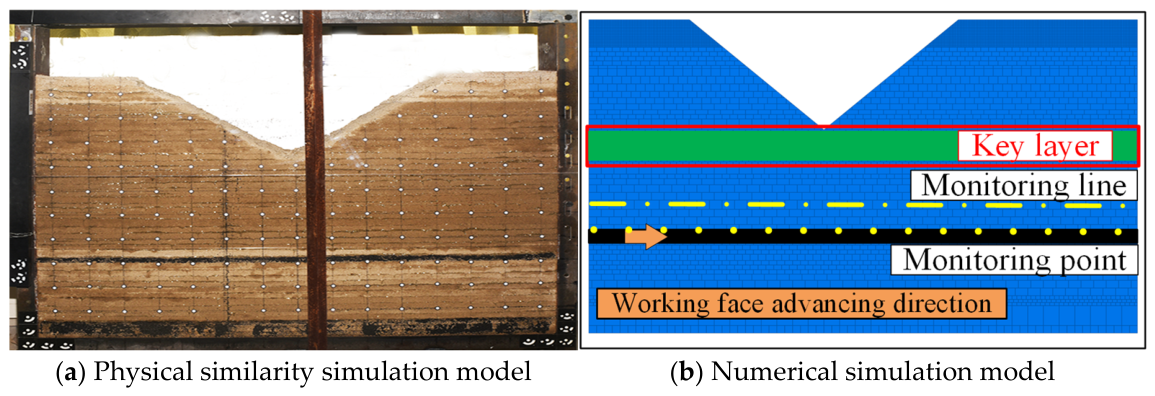
Using coal seam mining across a gully at the working face as the geological prototype, a 300 m long mining section starting from the vicinity of the open-off cut was selected as the experimental target. The surface of this area exhibits typical gully landform characteristics. The physical simulation platform used in the experiment had dimensions of 1.5 m × 0.16 m × 1.5 m (length × width × height). Based on similarity theory, the actual dimensions of the gully terrain, and the size of the simulation platform, the geometric similarity ratio was determined to be 1:200. Combined with the mechanical parameters of the coal and rock strata (Table 1) and the geometric similarity ratio (1:200), the material proportions of each coal and rock layer satisfying the mechanical similarity requirements were calculated. Fine sand, calcium carbonate, gypsum, and water were selected as similar materials [23], and the coal and rock strata were prepared layer by layer according to the designed material proportions and then laid on the simulation platform from bottom to top. Mica powder was spread between adjacent strata to simulate weak interlayer planes. Displacement monitoring points were arranged on the model surface in both the horizontal and vertical directions, with a spacing of 10 cm between adjacent points.
During coal seam extraction in the similarity simulation model, boundary effects were considered, and 20 cm protective coal pillars were reserved at both ends of the model. According to the average daily mining advance of 10 m/d, the excavation step of the simulated coal seam was set to 5 cm for each mining interval, with a total excavation length of 110 cm. A three-dimensional photogrammetry system was used to record overburden deformation and displacement data at the monitoring points during mining. The similarity simulation model is shown in Figure 2a.
(2)
Numerical simulation model
The same representative gully section as that used in the similar simulation was selected, and a two-dimensional numerical model was established using 3DEC. The model dimensions were determined according to the actual size of the gully terrain profile, with a length × width × height of 350 m × 5 m × 172 m. The thicknesses and mechanical parameters of the coal and rock strata in the model were taken from Table 1. The horizontal displacements of the four lateral boundaries were fixed, while both the horizontal and vertical displacements of the bottom boundary were constrained, and the upper boundary was set as a free surface. The Mohr–Coulomb yield criterion was adopted as the constitutive model [24,25].
During coal seam extraction in the numerical simulation, 40 m protective coal pillars were reserved at both the left and right boundaries of the model. According to the daily mining advance of 10 m/d, the excavation step of the simulated coal seam was set to 10 m for each mining interval, followed by 8000 calculation steps, with a total mining distance of 270 m. Among them, the mining range of 0–220 m was used for comparative validation with the similar simulation model, whereas the range of 220–270 m was mainly used to further analyze the evolution of stress, displacement, and fractures after the working face had completely passed through the gully area. Monitoring lines were arranged in the numerical model to record the stress and displacement data of the overburden during mining. The numerical simulation model is shown in Figure 2b.

3. Evolution of Overburden Structure During Coal Seam Mining in Gully Areas

3.1. Overburden Failure Characteristics from Similarity Simulation

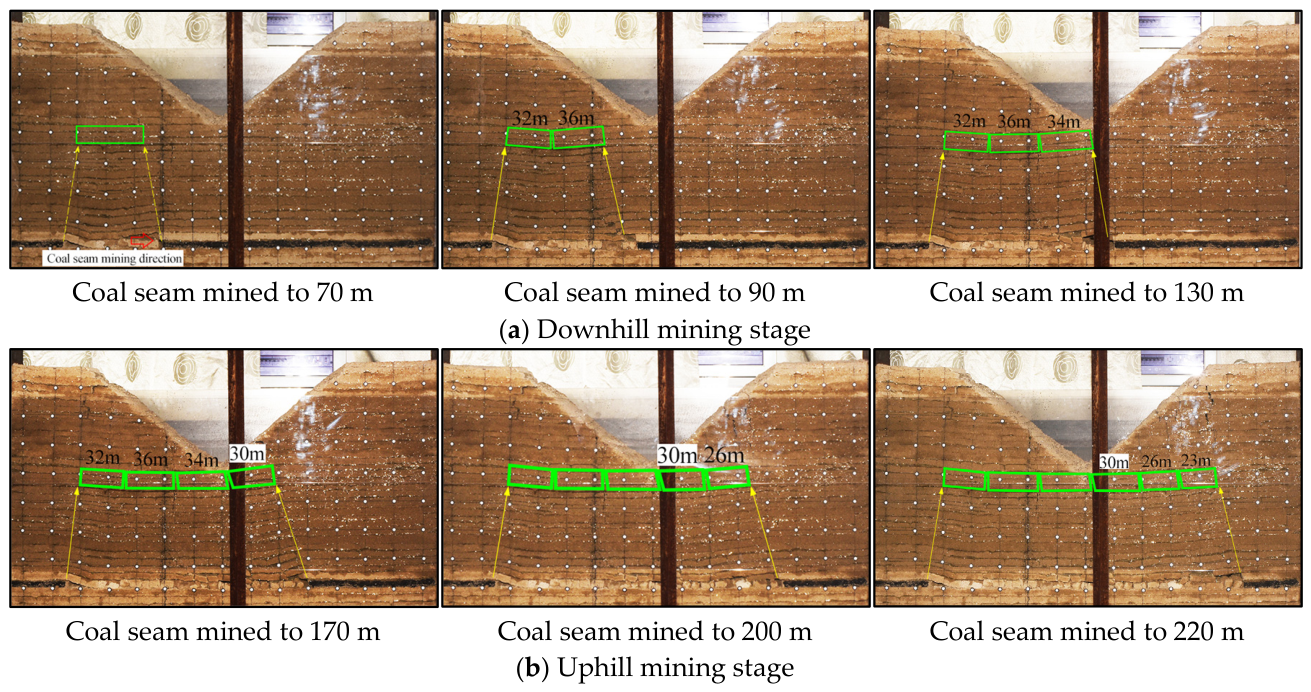
The failure characteristics of the overburden in the gully area during coal seam mining are shown in Figure 3. As shown in Figure 3a, during the downhill mining stage (0–110 m), the coal seam was extracted from the open-off cut toward the gully. When the mining distance reached 70 m, the overburden beneath the key stratum fractured and collapsed. At this stage, the key stratum remained intact and behaved as a fixed-ended beam. When the mining distance reached 100 m, the key stratum underwent its initial fracture, with fracture intervals of 32 m and 36 m. After key-stratum breakage, pronounced movement occurred in the overlying strata and further affected the gully surface.
As shown in Figure 3b, during the uphill mining stage (110–220 m), the key stratum underwent periodic fracture with an interval of 34 m when the working face advanced to the gully bottom at 130 m, owing to the relatively thin overburden in the gully area. As the overburden thickness gradually increased along the uphill section, the periodic fracture interval decreased significantly to 30 m, 26 m, and 23 m, respectively. During uphill mining, the key stratum behaved as a cantilever-beam structure. These results indicate that, under the influence of gully terrain, overburden fracture exhibits marked asymmetry, with larger key-stratum fracture intervals in the downhill section than in the uphill section.
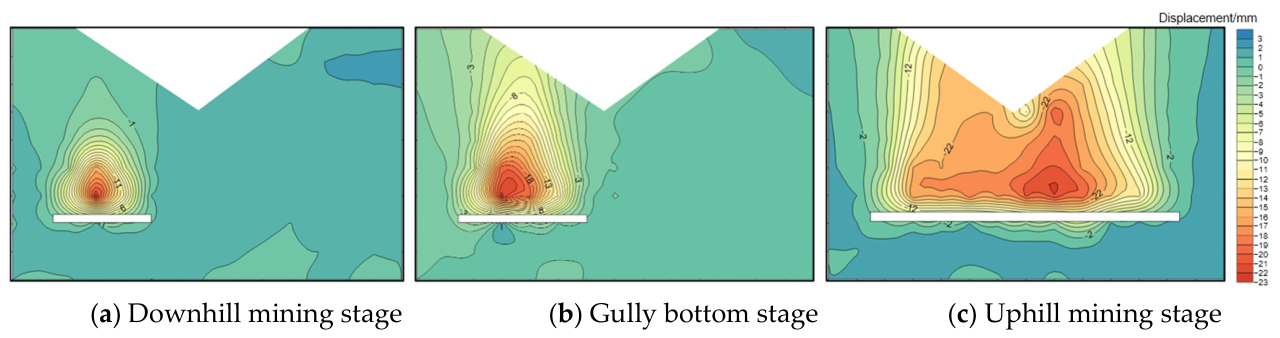
The subsidence characteristics of the overburden in the gully area during coal seam mining are shown in Figure 4. As shown in Figure 4a, during the downhill mining stage, the key stratum remained stable before fracture; therefore, the maximum subsidence was concentrated in the overburden within the goaf beneath the key stratum and reached 4.0 m. When mining advanced close to the gully bottom, the key stratum fractured, causing subsidence to occur throughout the overburden and at the ground surface above the goaf. At this stage, the maximum displacement was located in the middle–lower part of the goaf and reached 4.2 m.
As shown in Figure 4b, during the uphill mining stage, periodic key-stratum fracture caused overburden subsidence to extend into the uphill section. The largest subsidence in the uphill overburden occurred near the gully bottom, where the maximum displacement reached 4.8 m. These results indicate that overburden subsidence differs between the downhill and uphill sections of the gully and that periodic key-stratum fracture further increases overburden subsidence.
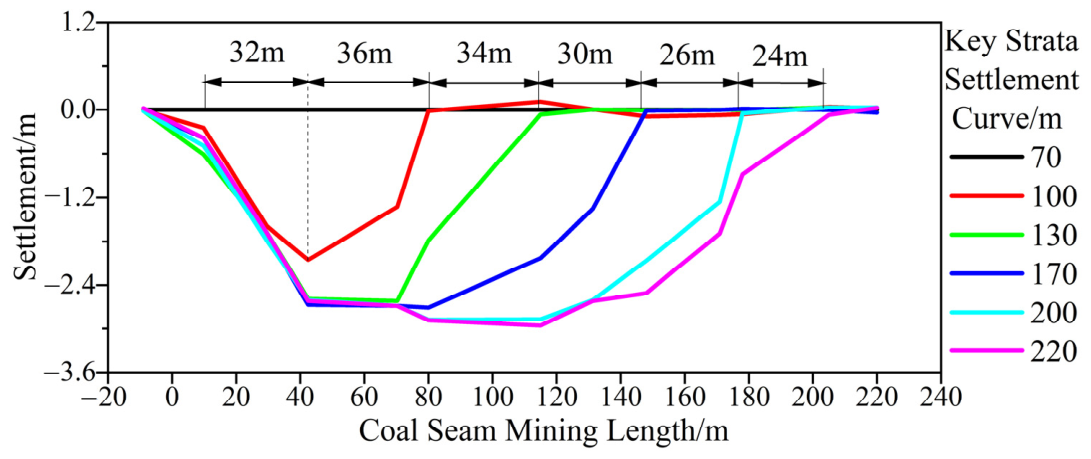
The subsidence displacement curves of the key stratum at different mining distances are shown in Figure 5. The key-stratum subsidence curves exhibit periodic variations corresponding to periodic fractures. The spacing between adjacent curves at different mining stages can be used to characterize the key-stratum fracture interval. During downhill mining, the fracture interval of the key stratum was relatively large, with a maximum value of 36 m. During uphill mining, the fracture interval was smaller, with a maximum value of 30 m. The maximum subsidence displacement of the key stratum was 2.7 m during downhill mining and 3.0 m during uphill mining, with the maximum subsidence occurring in the uphill section near the gully bottom. These results indicate that, under the dynamic variation in overburden thickness caused by gully terrain, the key stratum exhibits a relatively large fracture interval and small subsidence displacement during initial fracture in the downhill stage. In contrast, during uphill mining, the periodic fracture interval decreases with increasing overburden thickness, whereas key-stratum subsidence becomes larger near the gully bottom.

3.2. Evolution of the Three Overburden Fields from Numerical Simulation

(1)
Evolution of the stress field
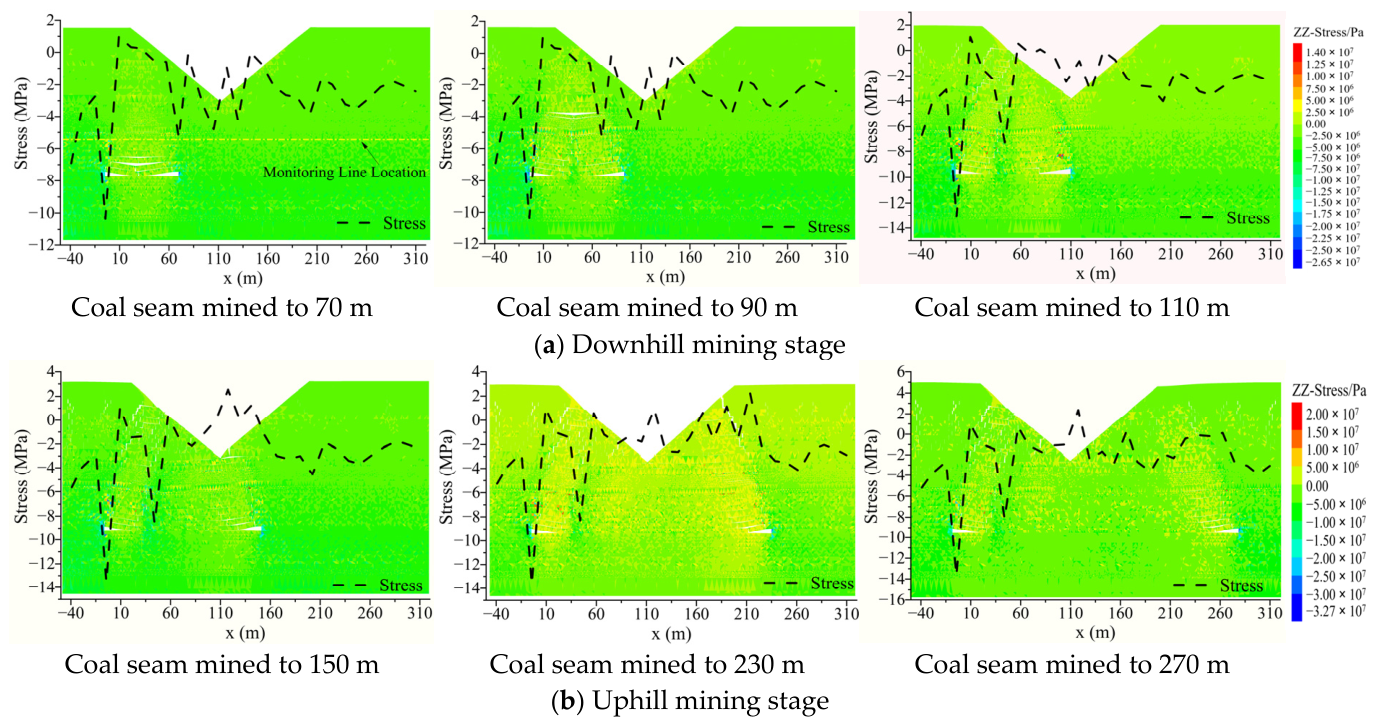
The stress variation along the monitoring lines in the gully overburden during coal seam mining is shown in Figure 6. As shown in Figure 6a, during downhill mining (0–110 m), stress was mainly concentrated near the working face when the mining distance was 0–70 m. As mining progressed from 70 m to 100 m, stress near the working face decreased because of overburden fracturing and the gradual thinning of the overburden along the downhill section, while a distinct pressure-relief zone developed in the central goaf. The stress influence range was relatively small on the left side of the pressure-relief zone but significantly larger on the right side. When mining advanced into the gully-bottom area (110–150 m), stress near the working face further decreased.
As shown in Figure 6b, during uphill mining (150–270 m), the high-stress concentration zone expanded progressively forward and upward as the working face advanced. Owing to the gradual increase in overburden thickness along the uphill section, stress near the working face increased steadily. These results indicate that, under gully terrain, the stress field exhibits markedly different characteristics between the downhill and uphill mining stages.
(2)
Evolution of the displacement field
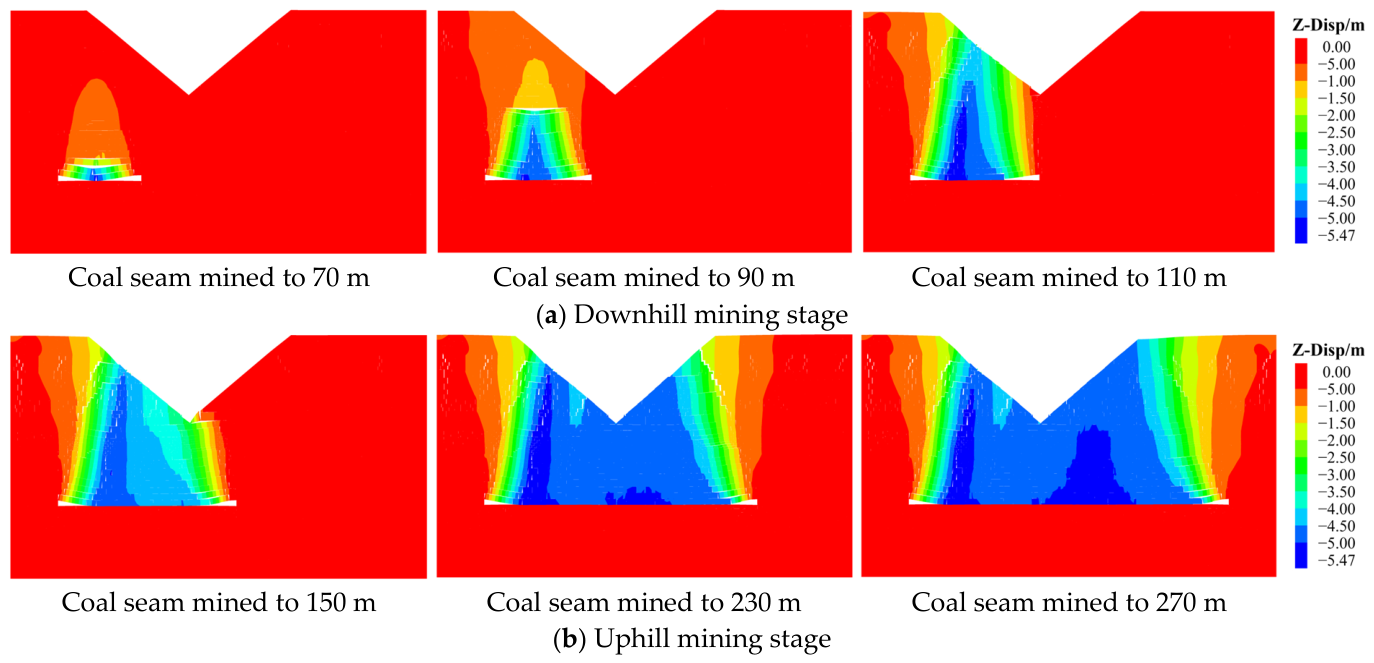
The displacement evolution of the overburden in the gully area during coal seam mining is shown in Figure 7. As shown in Figure 7a, during downhill mining (0–110 m), the overburden experienced periodic fracturing and displacement as the working face advanced. At a mining distance of 90 m, displacement in the central goaf was relatively large, whereas surface displacement remained small. When mining reached the gully-bottom area (110–150 m), surface displacement above the central goaf also increased markedly.
As shown in Figure 7b, during uphill mining (150–270 m), the influence range of overburden displacement expanded progressively forward and upward as the working face advanced. Moreover, the displacement-field distribution in the uphill section differed significantly from that in the downhill section. These results indicate that, in the gully area, overburden instability and movement exhibit distinct characteristics between the downhill and uphill mining stages.
(3)
Evolution of the fracture field
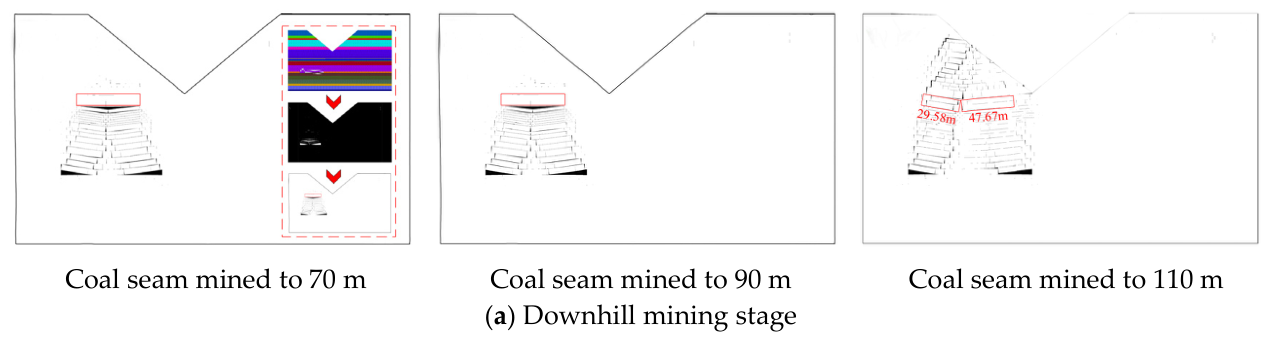
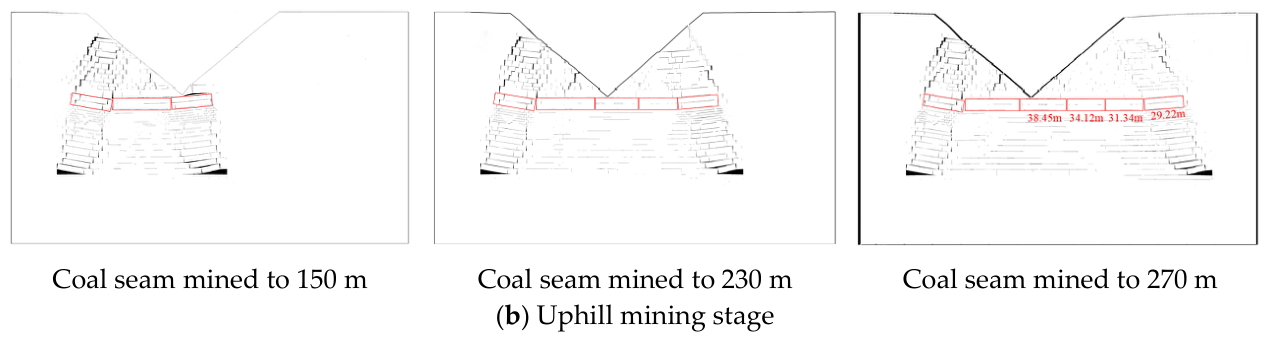
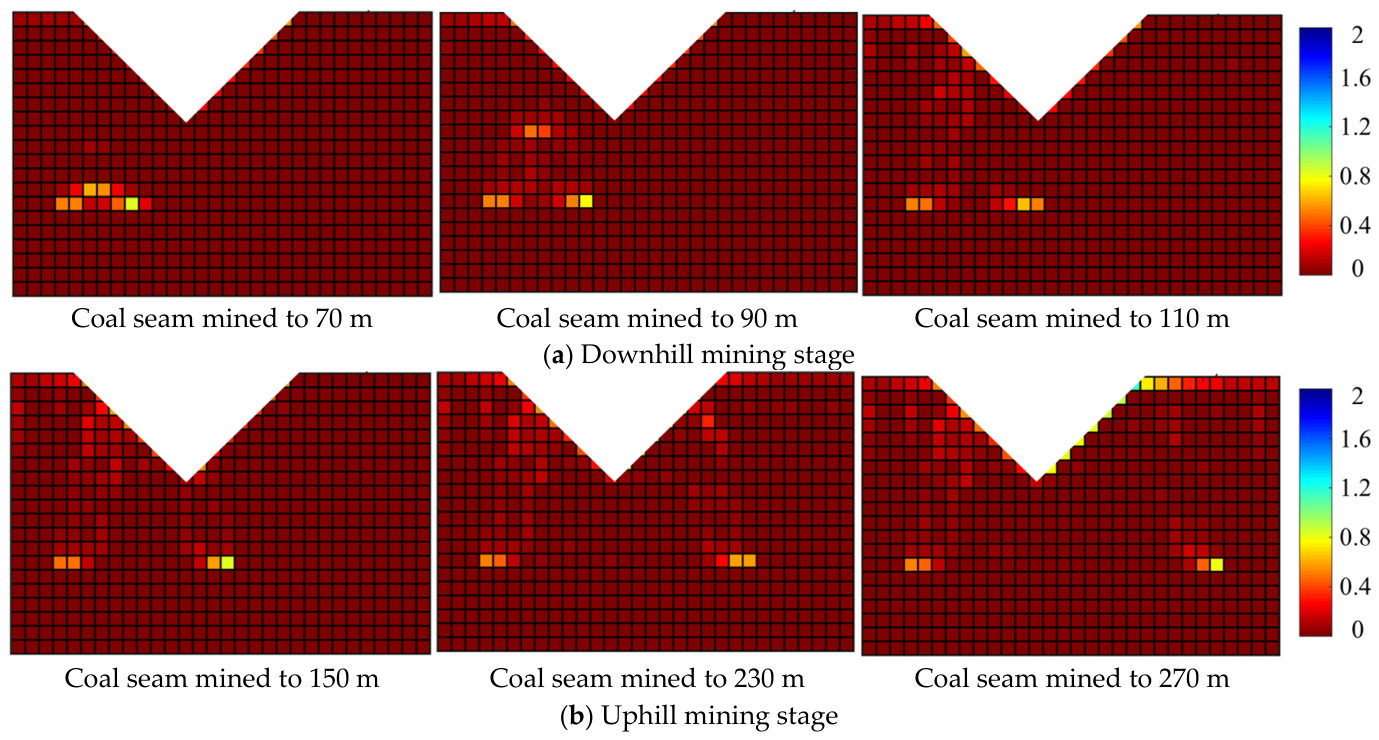
To extract overburden fractures, the numerical images after coal seam mining were binarized and inverted to obtain fracture maps of the overburden. The evolution of fractures in the gully overburden during coal seam mining is shown in Figure 8.
As shown in Figure 8a, during downhill mining (0–110 m), when the mining distance reached 90 m, the key stratum had not yet undergone initial fracture, but fractures in the overburden beneath the key stratum were already well developed. When the mining distance increased to 110 m, the key stratum experienced initial fracture, with fracture intervals of 29.58 m and 47.67 m, showing a distinct asymmetric pattern. At the same time, a large number of fractures also developed in the overburden above the key stratum.
As shown in Figure 8b, during uphill mining (150–270 m), the gradual increase in overburden thickness in the gully area induced periodic fracture of the key stratum, and the fracture interval decreased progressively from 38.45 m to 29.22 m. Overburden fractures varied periodically with key-stratum fracture, fractures in the middle of the goaf were compacted, closed, and gradually disappeared, whereas fractures near the working face continued to develop and propagate. When the mining distance reached 270 m, relatively few fractures were observed in the gully-bottom area, whereas fractures were more abundant near the open-off cut and the working face.
Fractal geometry was employed to quantitatively characterize the distribution of overburden fractures. The overburden fracture map was divided into equally sized grids (horizontal × vertical: 30 × 20), and the fractal dimension of fractures in each grid was calculated using the box-counting dimension formula (Equation (1)) [26,27]. The calculated results are shown in Figure 9.
D = lim r 0 log N ( r ) log 1 / r
where N(r) is the number of non-empty boxes and r is the box size.
As shown in Figure 9, the spatial distribution of overburden fractures exhibits clear regional characteristics, and fracture evolution follows a distinct opening–closure pattern. As shown in Figure 9a, during downhill mining (0–110 m), the fractal dimension was relatively high within the goaf beneath the key stratum, indicating a high degree of fracture development in this region. When the mining distance reached 110 m, initial key-stratum fracture caused the fractal dimension to decrease beneath the key stratum and increase above it.
As shown in Figure 9b, during uphill mining (150–270 m), high fractal dimensions were mainly concentrated near the working face, whereas the fractal dimension in the middle of the goaf decreased, especially beneath the key stratum. These results indicate that overburden fracture development is strongly affected by periodic key-stratum fracture: open fractures beneath the key stratum tend to close and decrease after periodic fracture, whereas fractures above the key stratum increase as periodic fracture progresses.

3.3. Coupling Mechanism of the Three Fields and Fracture Characteristics of the Key Stratum

(1)
Coupling mechanism of the three fields
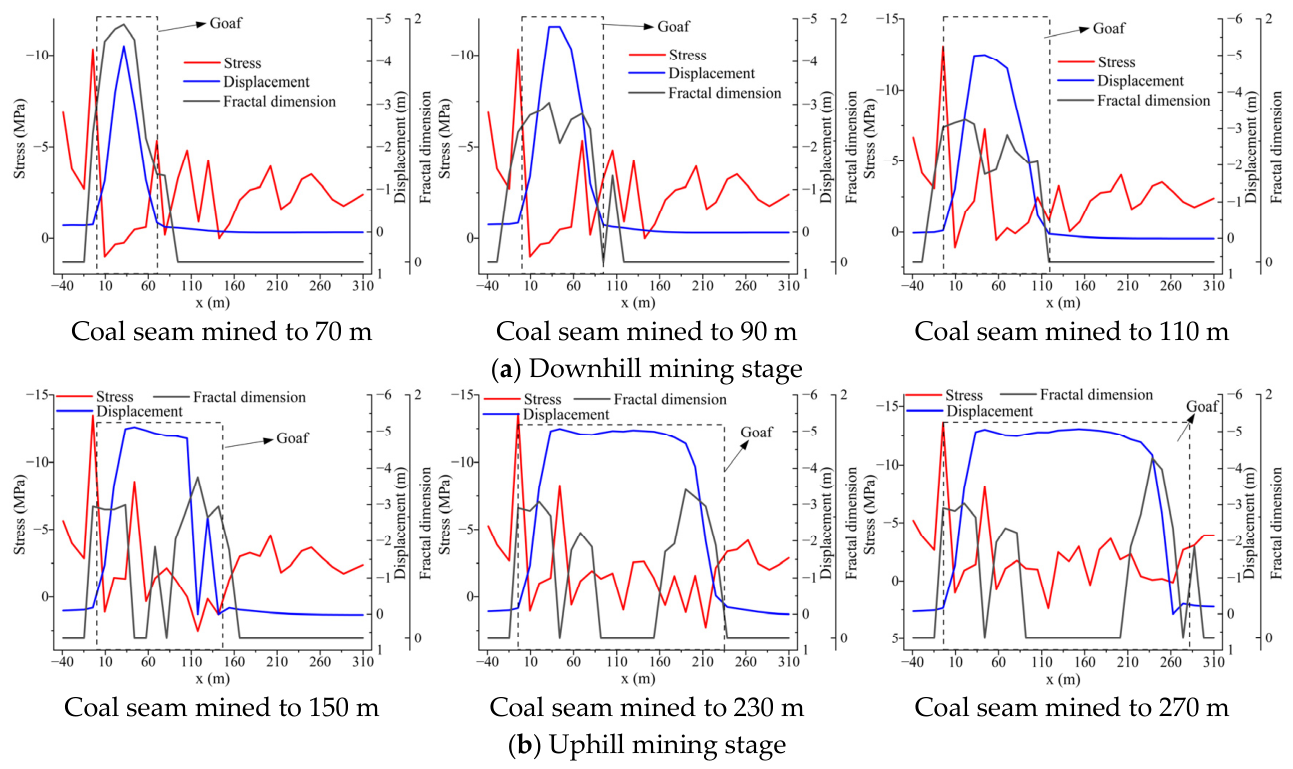
The stress, displacement, and fracture fractal-dimension data extracted along the monitoring line in the numerical simulation were used to analyze the variation of the three fields during coal seam mining, as shown in Figure 10. The negative values of stress and displacement follow the sign convention adopted in the numerical model.
The variation curves of the three fields exhibit a clear coupled relationship. Figure 10a shows the downhill mining stage (0–110 m), when the mining distance was 0–70 m, the key stratum had not yet fractured. At this stage, the stress was relatively high near the open-off cut and the working face, whereas the displacement and fracture fractal dimension were relatively small. In contrast, the stress in the middle of the goaf was relatively low, while the displacement and fracture fractal dimension were relatively large. Specifically, the stress at the open-off cut was 10.33 MPa, the displacement was 0 m, and the fractal dimension was 0. Near the working face, the stress was 5.34 MPa, the displacement was 0 m, and the fractal dimension was 0. Within the goaf, the maximum stress was 0.67 MPa, the maximum displacement was 4.36 m, and the maximum fractal dimension was 1.95. When the mining distance reached 110 m, the key stratum underwent its initial fracture, which caused stress release at the working face. As a result, the stress near the working face decreased to 0.83 MPa, while the displacement remained 0 m and the fractal dimension remained 0. Fracture of the key stratum also caused stress redistribution within the goaf. At the fracture position of the key stratum in the goaf, the maximum stress reached 7.25 MPa, the maximum displacement reached 5 m, and the minimum fractal dimension was 0.72.
Figure 10b shows the uphill mining stage (110–270 m). When the mining distances reached 150 m, 230 m, and 270 m, the key stratum underwent periodic fracture, which caused stress release and reduction at the working face. Meanwhile, owing to the increase in overburden thickness, working-face stress at different mining positions showed an increasing trend, whereas displacement and fracture fractal dimension remained very small. The corresponding stress values were 1.30 MPa, 3.37 MPa, and 3.90 MPa, respectively. Within the goaf, periodic key-stratum fracture caused stress redistribution, and the location with the maximum stress also exhibited the maximum displacement but the minimum fracture fractal dimension.
The results indicate that the curves of the three fields show obvious asymmetry during both downhill and uphill mining, demonstrating that variations in overburden thickness in the gully area significantly affect the evolution of the three fields. Changes in overburden thickness influence the fracture interval of the key stratum, whereas fracture of the key stratum plays a decisive role in controlling the variations of the three fields in the overburden beneath it. The coupled relationship among the three fields in the goaf differs depending on whether the key stratum is intact or fractured. Before key-stratum fracture, stress in the goaf is negatively correlated with displacement and fracture development, while displacement is positively correlated with fractures; that is, lower stress corresponds to larger displacement and more fractures. This indicates that, before fracture of the key stratum, no stress concentration occurs in the overburden beneath it, and overburden failure leads to increased displacement accompanied by enhanced fracture development. As overburden thickness in the gully area increases, the periodic fracture interval of the key stratum gradually decreases. After key-stratum fracture, stress and displacement in the goaf become positively correlated, whereas both stress and displacement are negatively correlated with fracture fractal dimension; that is, higher stress corresponds to larger displacement but fewer fractures. This indicates that fracture of the key stratum causes stress redistribution within the goaf, and at locations with higher stress, the subsidence displacement of the overburden further increases, while fractures are compacted and gradually close.
(2)
Fracture characteristics of the key stratum
The fracture intervals of the key stratum obtained from the similarity simulation and numerical simulation at different mining stages are listed in Table 2. The variation trends obtained by the two methods are generally consistent. During downhill mining, the key-stratum fracture interval is relatively large. In this stage, the key stratum is mainly characterized by a fixed-ended beam structure. Under the influence of the gradually decreasing overburden thickness in the gully area, it develops an asymmetric fracture pattern with a shorter span on the left side and a longer span on the right side. In contrast, during uphill mining, the key stratum is dominated by a cantilever-beam structure. Affected by the gradual increase in overburden thickness in the gully area, the periodic fracture interval of the key stratum gradually decreases. These results indicate that variations in overburden thickness in the gully area influence the fracture interval of the key stratum, while structural differences of the key stratum at different mining stages further lead to distinct fracture-interval characteristics.

4. Fracture Mechanism of the Key Stratum in Gully Areas

4.1. Mechanical Model of Key-Stratum Fracture

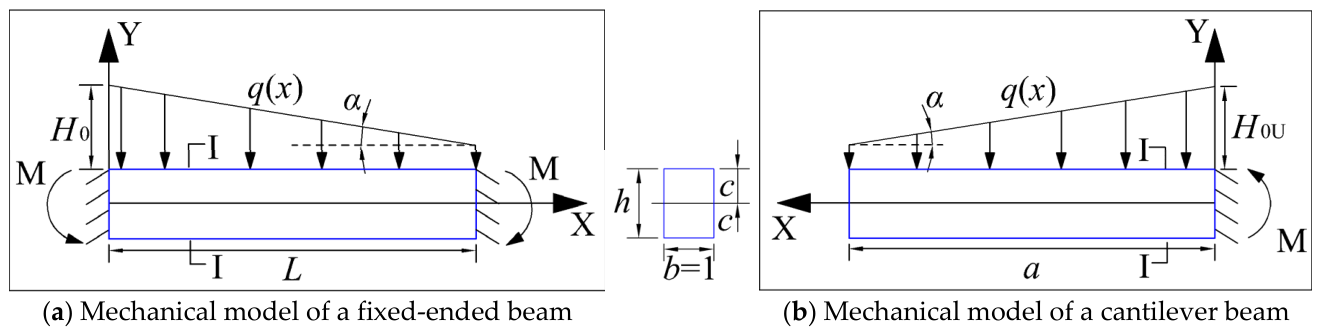
The non-uniform load distribution in the gully area causes the key stratum to exhibit different fracture characteristics during downhill and uphill mining. To analyze the fracture mechanism, the mechanical behavior of the key stratum was represented using simplified beam models.
(1)
Mechanical model of the fixed-ended beam in the downhill section
During downhill mining, the key stratum behaves as a fixed-ended beam over the goaf. Therefore, before initial fracture, it can be simplified as a beam with both ends constrained and subjected to a non-uniform load that varies with overburden thickness, as shown in Figure 11a.
According to Euler–Bernoulli beam theory [28,29], the deflection of a fixed-ended beam subjected to a vertically distributed load q(x) is governed by:
E I ω 4 x = q x
where E is the elastic modulus, I is the moment of inertia of the cross-section (for a unit beam width, b = 1, I = h 3 / 12 , with h being the thickness of the key stratum), ω x is the beam deflection.
Gully terrain causes the vertical thickness of the overburden above the key stratum to vary along the mining direction. Let α denote the gully slope angle, L the limit span for the initial fracture of the fixed-ended beam, and H0 the vertical thickness of the overburden above the key stratum at the open-off cut. When the coal seam is mined to position x, the vertical thickness of the overburden above the key stratum can be expressed as:
H x = H 0 x tan α ,   0 x L
The vertically distributed load acting on the key stratum is estimated from the self-weight of the key stratum and the overlying strata. Under the condition of a unit width (b = 1), the vertically distributed load q(x) can be expressed as:
q x = γ H x + γ h = γ H 0 + h x γ tan α
where: γ is the unit weight of the overburden.
For convenience of calculation, let A = γ H 0 + h , B = γ tan α , then q(x) can be expressed as:
q x = A + B x
Substituting Equation (5) into Equation (2) yields the fourth-order differential equation governing the deflection of the fixed-ended beam:
E I ω 4 x = q x = A + B x
Integrating Equation (6) four times and denoting the integration constants as C1, C2, C3, and C4, the deflection function and its derivatives can be expressed as:
E I ω x = A x + B 2 x 2 + C 1 E I ω x = A 2 x 2 + B 6 x 3 + C 1 x + C 2 E I ω x = A 6 x 3 + B 24 x 4 + C 1 2 x 2 + C 2 x + C 3 E I ω x = A 24 x 4 + B 120 x 5 + C 1 6 x 3 + C 2 2 x 2 + C 3 x + C 4
For a fixed-ended beam, not only is the deflection at both ends equal to zero, but the rotation angle at both ends is also zero, namely:
ω 0 = 0 ,     ω 0 = 0 ,     ω L = 0 ,     ω L = 0
Substituting Equation (8) into Equation (7), the relationships among the integration constants can be obtained as:
C 1 = L 10 A + 3 B L 20 C 2 = L 2 5 A + 2 B L 60 C 3 = 0 C 4 = 0
According to the mechanics of materials, the bending moment of the beam is given by:
M x = E I ω x
Substituting Equation (9) into Equation (7) yields:
E I ω x = A 2 x 2 + B 6 x 3 L 10 A + 3 B L 20 x + L 2 5 A + 2 B L 60
Substituting Equation (11) into Equation (10), the expression for the bending moment distribution of the fixed-ended beam under a non-uniformly distributed load can be obtained as:
M x = A 2 x 2 B 6 x 3 + L 10 A + 3 B L 20 x L 2 5 A + 2 B L 60
According to Equation (12), the position corresponding to the extreme bending moment is the location where the fixed-ended beam is most likely to fracture.
The maximum bending stress of the fixed-ended beam section can be calculated as follows:
σ max x = M x c I
where c = h / 2 .
Let the ultimate tensile strength of the fixed-ended beam key stratum be σ t . When the stress at a certain position in the key stratum satisfies σ max x σ t , the key stratum undergoes its initial fracture. By substituting the fracture condition into Equation (13), the criterion for the initial fracture of the key stratum can be obtained as:
M x = σ t I c
To determine the initial fracture position of the key stratum, the maximum value of σ max x needs to be obtained. Differentiating Equation (13) and setting it equal to zero yields:
x 1 , 2 = B 2 ± B 2 4 + A L 10 A + 5 B L 5 2 A
Substituting Equation (15) into Equation (14), the limiting span L can then be determined.
(2)
Mechanical model of the cantilever beam in the uphill section
During uphill mining, continued coal extraction induces periodic fracture of the key stratum, forming a structure near the working face with one end fixed and the other suspended. Accordingly, the key stratum in the uphill section can be simplified as a cantilever beam subjected to a non-uniform load that varies with overburden thickness, as shown in Figure 11b.
To establish the cantilever beam model, the following assumptions are made. The fixed end of the cantilever beam is located at the working face, where the coordinate x = 0 , while the free end is at x = a , where a is the cantilever length. The vertical thickness of the overburden above the key stratum at the working face is denoted as H0U. Accordingly, the vertical thickness of the overburden at any position along the key stratum can be expressed as:
H x = H 0 U x tan α
where H x is the vertical thickness of the overburden at position x, H 0 U is the vertical thickness of the overburden at the working face, α is the slope angle.
The vertical load acting on the cantilever beam comprises the self-weight of the key stratum and the overburden. For a beam with unit width (b = 1), the vertically distributed load can be expressed as:
q x = γ H x + γ h = γ H 0 U + h γ x tan α
For convenience of calculation, let A = γ H 0 U + h , B = γ tan α , then:
q x = A + B x
For a cantilever beam with a length of a, the bending moment at the fixed end is given by:
M = 0 a x q x d x = A 2 a 2 + B 3 a 3
The maximum axial tensile stress of the cantilever beam section can be expressed as:
σ max = M c I = 6 M h 2
When the maximum stress of the cantilever beam satisfies σ max = σ t , the key stratum fractures at the fixed end. Substituting this fracture condition into Equation (20), the expression for the critical cantilever length a can be obtained as:
σ t = 6 M h 2 = 6 h 2 A 2 a 2 + B 6 a 3 = 6 h 2 γ H 0 U + h 2 a 2 + γ tan α 6 a 3
As indicated by Equation (21), for constant values of parameters such as the ultimate tensile strength of the key stratum and the slope angle, the fracture distance a of the cantilever beam is governed by the overburden thickness H0U near the working face.

4.2. Estimation of the Key-Stratum Fracture Interval

(1)
Estimation of the key-stratum fracture interval in the downhill section
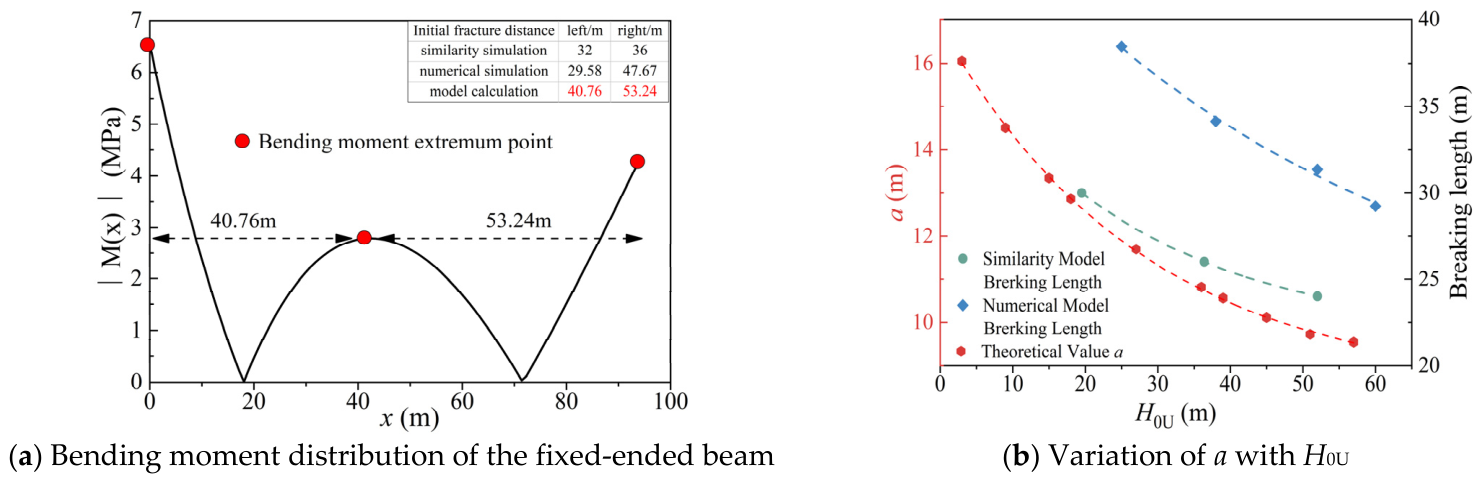
During downhill mining, the unbroken key stratum is simplified as a fixed-ended beam subjected to a linearly varying non-uniform load. Based on the engineering geological conditions in this study, the average unit weight of the overburden is taken as γ = 25 kN/m3, the thickness of the key stratum and overburden at the open-off cut as H 0 = 60 m, the thickness of the key stratum as h = 23 m, and the slope angle as α = 33 °, Considering the geometric constraint that the overburden thickness above the key stratum cannot be less than zero, the bending moment distribution of the key stratum is calculated using Equation (14), as shown in Figure 12a.
As shown in Figure 12a, the fixed-ended beam key stratum exhibits extreme points at both ends and within the beam. The internal extreme point corresponds to the location of the maximum tensile stress in the key stratum. When the maximum tensile stress at a certain position reaches the tensile-strength limit of the key stratum, initial fracture occurs. The theoretical calculation curve indicates that key-stratum fracture exhibits an asymmetric pattern characterized by a shorter span on the left side and a longer span on the right side. This pattern agrees well with the initial fracture characteristics observed in the simulation results, indicating that the fixed-ended beam model can effectively characterize the initial fracture behavior of the key stratum during downhill mining.
(2)
Estimation of the key-stratum fracture interval in the uphill section
During uphill mining, the fractured key stratum is simplified as a cantilever beam subjected to a linearly varying non-uniform load. Based on the geological conditions in this study, the maximum overburden thickness above the key stratum at the working face is taken as H 0 U = 60 m. Substituting this value into Equation (21) yields the relationship between the cantilever fracture distance a and overburden thickness, as shown in Figure 12b.
As shown in Figure 12b, the critical fracture distance a of the cantilever beam gradually decreases with increasing overburden thickness H0U. The periodic fracture characteristics of the key stratum obtained from theoretical calculation are consistent with the simulation results, indicating that the cantilever-beam model can effectively characterize the periodic fracture behavior of the key stratum during uphill mining.

5. Mechanism of Strata-Pressure Behavior at the Working Face in Gully Areas

5.1. Stage Dependent Evolution of Working Face Stress

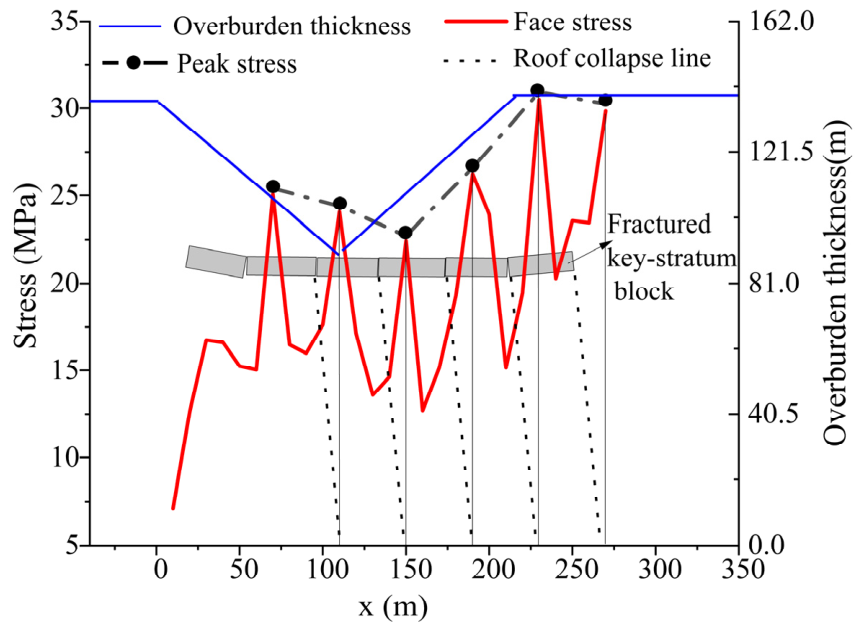
During coal seam mining across a gully, variations in overburden thickness alter the fracture characteristics of the key stratum and, consequently, the stress at the working face. To clarify the effects of gully-induced overburden-thickness changes and key-stratum fracture on working-face stress, stress data from monitoring points above the coal seam in the numerical simulation were extracted, as shown in Figure 13.
As shown in Figure 13, the stress at the working face exhibits distinct stage-dependent evolution during mining. During downhill mining (0–110 m), the peak working-face stress first increases and then decreases. When the mining distance is 0–70 m, the key stratum has not yet undergone initial fracture, and working-face stress increases with the suspended span of the key stratum. When the mining distance reaches 110 m, the key stratum undergoes initial fracture. Before key-stratum fracture, the peak working-face stress reaches 24.06 MPa. After fracture, the bearing condition near the working face is disrupted, and the bearing stress transmitted from the key stratum to the working face is released, causing working-face stress to decrease rapidly.
During uphill mining (110–270 m), the overburden thickness in the gully area increases as mining advances, and periodic fracture of the cantilever-beam key stratum causes periodic fluctuations in working-face stress. Before key-stratum fracture, the working-face stress reaches a peak; after fracture, stress is released and decreases. When the mining distances reach 150 m, 190 m, 230 m, and 270 m, the cantilever-beam key stratum undergoes periodic fracture. The corresponding peak stresses at the working face before fracture are 22.43 MPa, 26.23 MPa, 30.58 MPa, and 29.84 MPa, respectively. The overburden thicknesses above the coal seam are approximately 97.2 m, 117.4 m, 137.7 m, and 137.7 m, and the corresponding key-stratum fracture intervals are 38.45 m, 34.12 m, 31.34 m, and 29.22 m, respectively. The peak working-face stress increases with increasing overburden thickness and with decreasing periodic fracture interval of the key stratum.
The results indicate that the peak working-face stress decreases as overburden thickness decreases and increases as overburden thickness increases. In addition, the peak stress position at the working face corresponds to the key-stratum fracture position along the overburden caving line. Working-face stress reaches its peak before key-stratum fracture and decreases rapidly after fracture owing to stress release. Because the front abutment stress is mainly borne by the coal wall ahead of the working face, the likelihood of coal-wall spalling increases before periodic key-stratum fracture.

5.2. Analysis of Support Resistance at the Working Face

(1)
Analysis of support resistance in the downhill section
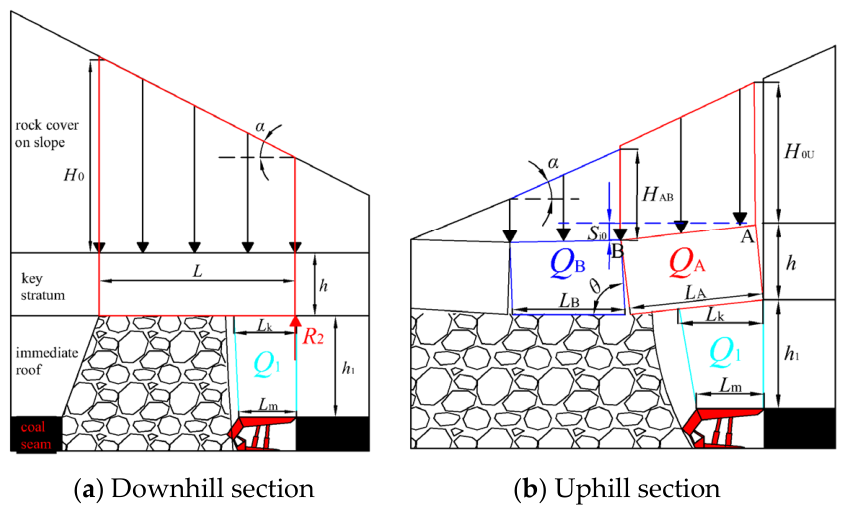
During the downhill mining stage, the key stratum behaves as a fixed-ended beam subjected to a non-uniform load before its initial fracture. At this stage, the support load comprises two components: the load from the immediate roof Q1, estimated from the thickness of the overburden beneath the key stratum, the support-controlled roof distance, and the unit weight of the rock mass; and the vertical supporting force R2, provided by the support to the fixed-ended beam [30]. The key stratum also transfers a vertical reaction force to the support via its beam-end constraints. As the suspended span of the fixed-ended beam increases, its bending deformation intensifies, and the support load gradually rises. When the span approaches the bearing limit of the key stratum, the support load reaches its peak. Since the immediate-roof load Q1, remains essentially stable, the increase in support load at the working face primarily results from the load transferred by the bending fixed-ended beam. The mechanical model as shown in Figure 14a.
The support load at the working face in the downhill section PD comprises the immediate roof load Q1, and the reaction force R2 required to support the fixed-ended beam:
P D = Q 1 + R 2
where PD is the support load at the working face in the downhill section.
The immediate roof load Q1 is given by:
Q 1 = γ h 1 L k + L m / 2
where Lk is the suspended roof span, f is the support width, Lm is the roof control distance, and h1 is the height of the immediate roof.
Because the reaction force R2 at the fixed end of the fixed-ended beam key stratum can be represented by the shear force at the fixed end, and the shear force of the fixed-ended beam key stratum can be obtained by differentiating Equation (12), it follows that:
V x = M x
The reaction force R2 of the fixed-ended beam key stratum at the working face is given by:
R 2 = V L = M L = L 20 10 A + 7 B L
Since the support load at the working face acts in the opposite direction to the reaction force R2, PD can be expressed as:
P D = Q 1 + R 2 = γ h 1 L k + L m / 2 + L γ b 20 10 H 0 + h 7 L tan α
(2)
Analysis of support resistance in the uphill section
During coal seam mining in the uphill section, the key stratum has already fractured and forms a cantilever beam structure, with the cantilever support point located on the coal wall in front of the working face. When the suspended length of the cantilever-beam key stratum reaches its bearing limit, the key stratum fractures, and the fractured block undergoes rotational instability and becomes hinged with the adjacent blocks, thereby forming a voussoir beam structure. At this stage, the rock blocks of the voussoir beam act on the supports at the working face. Therefore, a voussoir beam model was adopted to establish the mechanical model of support loading at the working face in the uphill section, as shown in Figure 14b.
At this stage, the support load at the working face also comprises two components: the immediate roof load Q1, and the load Q2 transferred from the voussoir beam structure formed after key-stratum fracture:
P U = Q 1 + Q 2
where PU is the support load at the working face in the uphill section.
According to the equilibrium principle of the voussoir beam, the load Q2 transferred to the working face when the voussoir beam structure undergoes sliding instability can be expressed as:
Q 2 = Q A + Q B L B Q B 2 h S i 0 tan φ θ
where:
Q A = L A γ h + γ L A 2 S i 0 2 2 H A B S i 0 + H 0 U Q B = L B γ h + γ L B 2 2 H A B L B tan α
where QA is the weight of block A and its applied load, QB is the weight of block B and its applied load, HU0 is the overburden thickness above the key stratum at the working face, HAB is the overburden thickness at the contact position between blocks A and B, LA is the length of block A, LB is the length of block B, Si0 is the subsidence of block B, h is the thickness of blocks A and B, and θ and φ are the fracture angle and internal friction angle of the rock blocks, respectively.
Substituting Equation (29) into Equations (28) and (27) yields:
P U = γ h 1 L k + L m / 2 + γ h L A + γ L A 2 S i 0 2 2 H A B S i 0 + H 0 U + γ h L B + γ L B 2 2 H A B L B tan α L 2 B γ h + 1 2 2 H A B L B tan α 2 h S i 0 tan φ θ
Let:
F = L B Q B 2 h S i 0 tan φ θ
F is the frictional force between blocks A and B, and it cannot exceed QA + QB. If the calculated value is greater than QA + QB, it indicates that sliding instability of the voussoir beam structure will not occur. In this case, Q2 can be taken as 0, and the minimum support load at the working face can be taken as the immediate roof load Q1, corresponding to the minimum value in the periodic variation of working-face stress in the uphill section. As the working face advances, when the support is positioned beneath the unfractured cantilever beam, the load of the key stratum and its overburden is supported by the cantilever structure, resulting in a small support load that can be approximated as Q1.

5.3. Field Monitoring of Support Resistance and Model Validation

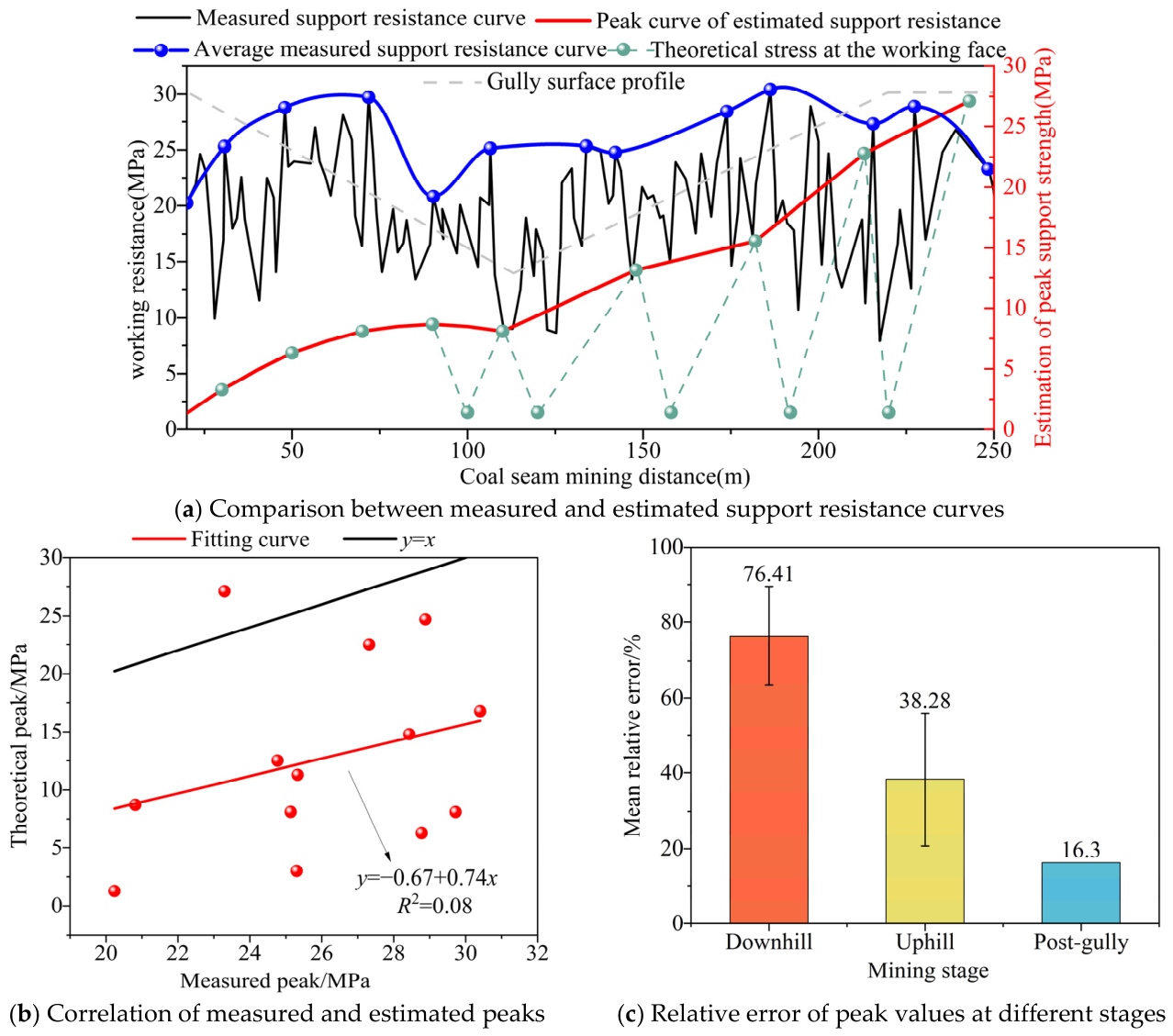
To verify the reliability and accuracy of the proposed method for estimating support loading at the working face, the following parameters were selected according to the occurrence conditions of the gully terrain: the height of the immediate roof was taken as h 1 = 52.36 m, the fracture angle of the key stratum as θ 70 ° , and the internal friction angle of the key stratum as φ = 38 ° 45 ° ; here, tan φ = 1 was adopted. The subsidence of the key-stratum block was taken as S i 0 3 m, the limit span of the fixed-ended beam key stratum in the downhill section was taken as L max 90 m, the fracture distances LA and LB of the key stratum in the uphill section were taken from the numerical simulation results, and the roof control distance of the support was taken as L k L m 5 m. Equations (26) and (30) were used to estimate the peak support resistance, from which the estimated support resistance values were obtained, and the peak-point curve of the estimated support resistance was then extracted. In addition, actual support resistance at the working face was monitored during coal seam mining across the gully. Resistance data were collected from three supports located in the upper, middle, and lower parts of the working face, respectively, and their average value was taken as the measured support resistance. The maximum value within each 20 m interval was then extracted to obtain the peak curve of the measured values. Correlation analysis was performed between the peak points of the measured and estimated values. Relative error analysis was further conducted using the peak data of measured and estimated support resistance at different mining stages. The curves and analysis results are shown in Figure 15.
As shown by the comparison curves of measured and estimated support resistance in Figure 15a, during coal seam mining, the evolution trend of the peak curve of the estimated support resistance is similar to that of the measured peak curve. During the downhill mining stage, the support resistance first increases and then decreases. In the gully bottom area, the support resistance drops to its minimum value. During the uphill mining stage, the support resistance shows a fluctuating upward trend. The results indicate that, during coal seam mining in gully areas, support resistance differs significantly among different mining stages and is jointly affected by variations in overburden thickness and key-stratum fracture. During the downhill mining stage, support resistance is mainly controlled by the unfractured key stratum and increases with the increase in the suspended span of the unfractured key stratum. During the uphill mining stage, support resistance is mainly affected by the combined influence of increasing overburden thickness and periodic fracture of the key stratum; it increases with overburden thickness and fluctuates with periodic key-stratum fracture.
As shown by the correlation analysis between the measured and estimated peak support resistance in Figure 15b, the correlation between the estimated and actual peak values is relatively weak, with an R2 of only 0.08. The scatter points are located below the line of equality, indicating that the theoretical values are smaller than the measured values. However, the fitted curve shows the same variation trend as the equality line, indicating that the support resistance estimation model can capture the variation trend of support resistance with changes in overburden thickness and key-stratum fracture structure during coal seam mining across the gully. The results suggest that, in actual mining, during the downhill mining stage, the unfractured key stratum forms a relatively stable structural condition, and the support resistance is affected not only by the load of the key stratum, but also by multiple factors such as the initial setting load of the supports, local breakage of the immediate roof, mining disturbance, and three-dimensional spatial effects. In contrast, the theoretical estimation model only considers the influence of the key-stratum structure under two-dimensional plane conditions, which leads to the relatively weak correlation between estimated and measured values. Nevertheless, the theoretical estimation model can still reasonably characterize the changing trend of support resistance in gully areas.
As shown by the relative error analysis of measured and estimated peak support resistance at different stages in Figure 15c, the average relative error of the peak values is the highest in the downhill section, reaching 76.41%, decreases to 38.28% in the uphill section, and further decreases to 16.3% after the working face has passed through the gully. The estimated support resistance is obviously underestimated during the downhill mining stage. After entering the uphill mining stage, the theoretical values gradually approach the measured values, and the relative error decreases progressively. The results indicate that, during the downhill mining stage, the combined effects of complex actual engineering conditions and the simplifications adopted in the theoretical estimation model cause the measured peak support resistance to be much larger than the estimated value. However, after entering the uphill mining stage, periodic fracture of the key stratum forms a relatively stable voussoir beam structure, and the relative error between measured and estimated support resistance gradually decreases, indicating that the proposed support resistance estimation model is more suitable for evaluating support loading in the uphill section.

6. Conclusions

This study used similar simulation, 3DEC numerical simulation, theoretical analysis, and field monitoring of support resistance to investigate overburden structure evolution, key stratum fracture mechanics, stress–displacement–fracture field coupling, and support loading response during coal mining across a gully. The main conclusions follow.
(1)
Overburden structure evolution and key stratum fracture characteristics in shallow coal mining under gully terrain show clear stage-dependent asymmetry. In the similar simulation: downhill mining gave initial key stratum fracture intervals of 32 m and 36 m (shorter left span, longer right span). Uphill mining gave periodic fracture intervals decreasing from 30 m to 24 m, meaning fracture interval drops as overburden thickness increases. Numerical simulation results agree with similar simulation. Thus, dynamic overburden thickness variation caused by gully terrain is a key factor influencing key stratum fracture.
(2)
Overburden thickness variation and key stratum fracture significantly affect spatiotemporal evolution of stress, displacement, and fracture fields. Downhill mining: stress concentration at the working face induces initial key stratum fracture, increasing subsidence and fracture development. Uphill mining: periodic key stratum fracture redistributes goaf stress, causing secondary overburden subsidence and progressive fracture closure. The coupled evolution mechanism is: working face stress concentration—key stratum fracture—increased overburden displacement—fracture development at working face—fracture compaction in goaf.
(3)
Based on non-uniform loading on the key stratum in gully areas, two fracture models were established: a fixed-ended beam model for downhill mining and a cantilever beam model for uphill mining. Theoretical results show downhill fracture is asymmetric (shorter left span, longer right span), while uphill fracture interval decreases with increasing overburden thickness. Theoretical results generally match simulation results.
(4)
Support resistance at the working face is jointly governed by overburden thickness variation and key-stratum fracture. During downhill mining, the unfractured key stratum bears part of the overburden load, causing support resistance to rise with increasing suspended span. During uphill mining, periodic key-stratum fracture forms a voussoir beam structure, resulting in a fluctuating increase in support resistance. The proposed estimation model captures the stage-dependent evolution of support resistance associated with changes in overburden thickness and key-stratum structural transformation.
(5)
The results provide a theoretical basis for predicting periodic weighting and stage-based support control at shallow-buried coal seam working faces in gully areas. However, because this study was based on two-dimensional and static equilibrium assumptions, without fully accounting for three-dimensional mining effects and mining-induced disturbances, the estimated peak support resistance was lower than the field-measured values. Future work should further examine overburden failure under three-dimensional mining conditions and the influence of mining-induced disturbances on support resistance to improve the accuracy of the estimation model.

Author Contributions

J.L.: Conceptualization, Supervision, Writing—review & editing, Funding acquisition; X.G.: Conceptualization, Methodology, Writing—original draft; J.C.: Investigation, Methodology, Software, Writing—review & editing. All authors have read and agreed to the published version of the manuscript.

Funding

This work was supported by the National Natural Science Foundation of China [grant number 52364006]; the Special Project for Scientific Research on Top Disciplines in Inner Mongolia Autonomous Region [grant number YLXKZX–NKD–035]; the Natural Science Foundation of Inner Mongolia Autonomous Region Project [grant number 2025MS05115]; and the Fundamental Research Funds for Inner Mongolia University of Science and Technology [grant number 2025QNJS001].

Data Availability Statement

The raw data supporting the conclusions of this article will be made available by the authors on request.

Conflicts of Interest

The authors declare no conflict of interest.

References

  1. Zhang, C.; Cheng, J.; He, J.; Lian, Y.; Bai, Q.; Da, Z.; Wang, Y. Development of the water–conducting fracture zone in longwall top–coal caving mining with super–large mining height and weak cemented overburden. Int. J. Coal Sci. Technol. 2026, 13, 40. [Google Scholar] [CrossRef]
  2. Chen, K.; Ge, Y.; Liu, Z.; Chen, L.; Zhang, Q. Overburden Failure Associated with Slicing Mining in a Super Thick Coal Seam under Special Weak Aquifers. Water 2022, 14, 3882. [Google Scholar] [CrossRef]
  3. Zhang, G.; Zhang, H.; Li, G.; Chen, J.; Zhao, L.; Zhou, G. Deformation characteristics of weakly cemented overburden in Western mining areas in China. Sci. Rep. 2026, 16, 14211. [Google Scholar] [CrossRef]
  4. Sun, Y.; Zuo, J.; Karakus, M.; Liu, L.; Zhou, H.; Yu, M. A New Theoretical Method to Predict Strata Movement and Surface Subsidence due to Inclined Coal Seam Mining. Rock Mech. Rock Eng. 2021, 54, 2723–2740. [Google Scholar] [CrossRef]
  5. Ma, S.; Kang, Y. Characteristics of Mining–Induced Slope Movement and Ground Behavior under Gully Landforms. Sustainability 2022, 14, 13941. [Google Scholar] [CrossRef]
  6. Lu, M.; Sun, X.; Xiao, Y.; Zhang, C. The development mining–induced surface cracks in shallow coal seam through double–gully terrain: A case study in a coal mine. Bull. Eng. Geol. Environ. 2022, 81, 383. [Google Scholar] [CrossRef]
  7. Zhu, W.; Qi, X.; Ju, J.; Xu, J. Mechanisms behind strong strata behaviour in high longwall mining face–ends under shallow covers. J. Geophys. Eng. 2019, 16, 559–570. [Google Scholar] [CrossRef]
  8. Zhou, H.; Huang, Q.; He, Y.; Wang, Q.; Wei, Y. A study on the mechanism and control technology of strong mine pressure in parallel coal pillar and hard roof mining. Front. Earth Sci. 2024, 12, 1407084. [Google Scholar] [CrossRef]
  9. Ju, J.; Xu, J. Surface stepped subsidence related to top–coal caving longwall mining of extremely thick coal seam under shallow cover. Int. J. Rock Mech. Min. Sci. 2015, 78, 27–35. [Google Scholar] [CrossRef]
  10. Ren, Z.; Zhang, C.; Wang, Y.; Yang, S.; Li, Q. Collaborative movement characteristics of overlying rock and loose layer based on block–particle discrete–element simulation method. Int. J. Coal Sci. Technol. 2025, 12, 17. [Google Scholar] [CrossRef]
  11. Huang, Q.; He, Y.; Cao, J. Experimental Investigation on Crack Development Characteristics in Shallow Coal Seam Mining in China. Energies 2019, 12, 1302. [Google Scholar] [CrossRef]
  12. Zhang, J.; Wang, L.; Yang, T.; Gao, S.; He, Y.; Wu, J. Study on overburden failure characteristics and ground pressure behavior in shallow coal seam mining underneath the gully. Front. Earth Sci. 2024, 12, 1375979. [Google Scholar] [CrossRef]
  13. Li, J.; Liu, C.; Zhao, T. Effects of gully terrain on stress field distribution and ground pressure behavior in shallow seam mining. Int. J. Min. Sci. Technol. 2016, 26, 255–260. [Google Scholar] [CrossRef]
  14. Lai, X.P.; Zhu, H.; Guo, Z.; Gu, H.; Li, X.; Zhao, Q.; Shan, P. Breaking dynamic load mechanism and application of high key strata in gully area of shallow coal seam. J. Min. Saf. Eng. 2024, 41, 879–888. [Google Scholar] [CrossRef]
  15. Wen, H.; Li, Y.; Wu, G.; Kong, D.; Xu, M.; Liao, J. Study on overlying strata breaking law and dynamic pressure characteristics of shallow buried coal seam mining under gully landform. Eng. Fail. Anal. 2025, 183, 110276. [Google Scholar] [CrossRef]
  16. Bai, W.; Xia, W.; Hu, Y.; Xu, Q.; Yang, X.; Xu, B.; He, X. Study on the initiation and propagation of mining induced fractures by underground coal mining in the loess gully region. Sci. Rep. 2025, 15, 8867. [Google Scholar] [CrossRef]
  17. Wang, F.; Zhai, W.; Man, J.; Huang, H. A hybrid cohesive phase–field numerical method for the stability analysis of rock slopes with discontinuities. Can. Geotech. J. 2025, 62, 1–16. [Google Scholar] [CrossRef]
  18. Wang, H.; Jiang, B.; Jiao, J.; Li, Y. Overburden stress evolution characteristics and prediction of disasters with across–gully mining. Front. Earth Sci. 2023, 11, 1115323. [Google Scholar] [CrossRef]
  19. Zhang, B.; Sun, D.; Zheng Rui, L. Evolution Law of Coal Seam Abutment Pressure under the Influence of Shallow Buried Complex Strata: A Case Study. Shock. Vib. 2021, 13, 6670175. [Google Scholar] [CrossRef]
  20. Liu, Y.; Qi, Q.; Wang, A. Influence of Valleys Terrain on Pressure of Fully Mechanized Working Faces in Shallow Coal Seams. Shock Vib. 2021, 11, 8880041. [Google Scholar] [CrossRef]
  21. Li, A.; Ma, Q.; Lian, Y.; Ma, L.; Mu, Q.; Chen, J. Numerical simulation and experimental study on floor failure mechanism of typical working face in thick coal seam in Chenghe mining area of Weibei, China. Environ. Earth Sci. 2020, 79, 118. [Google Scholar] [CrossRef]
  22. Wei, J.; Wang, S.; Song, S.; Sun, Q.; Yang, T. Experiment and numerical simulation of overburden and surface damage law in shallow coal seam mining under the gully. Bull. Eng. Geol. Environ. 2022, 81, 207. [Google Scholar] [CrossRef]
  23. Wang, Z.; Zhang, Q.; Shao, J.; Zhang, W.; Wu, X.; Zhu, X. New type of similar material for simulating the processes of water inrush from roof bed separation. ACS Omega 2020, 5, 30405–30415. [Google Scholar] [CrossRef] [PubMed]
  24. Cui, F.; Zhang, T.; Lai, X.; Cao, J.; Shan, P. Study on the evolution law of overburden breaking angle under repeated mining and the application of roof pressure relief. Energies 2019, 12, 4513. [Google Scholar] [CrossRef]
  25. Xu, C.; Wang, K.; Guo, L.; Zhao, C.; Wang, Y.; Yang, Y.; Wu, S. Fractal characteristics of mining–induced overburden fracture development during fully mechanized coal mining. Environ. Earth Sci. 2024, 83, 113. [Google Scholar] [CrossRef]
  26. Yang, D.; Sun, Y.; Xu, J.; Zhao, L. Study on the evolution of fractures in overlying strata during repeated mining of coal seams at extremely close distances. Front. Earth Sci. 2024, 12, 1472939. [Google Scholar] [CrossRef]
  27. Ling, C.; Liu, B.; Zhang, C.; Teng, T.; Zhang, K.; Sun, B.; Zhou, J. Fractal characteristics of overburden rock fractures and their impact on ground fissures in longwall coal mining. Fractal Fract. 2023, 7, 699. [Google Scholar] [CrossRef]
  28. Ji, S.; Lai, X.; Cui, F.; Liu, Y.; Pan, R.; Karlovšek, J. The failure of edge–cracked hard roof in underground mining: An analytical study. Int. J. Rock Mech. Min. Sci. 2024, 183, 105934. [Google Scholar] [CrossRef]
  29. Please, C.; Mason, D.; Khalique, C.; Ngnotchouye, J.; Hutchinson, A.; van der Merwe, J.; Yilmaz, H. Fracturing of an Euler–Bernoulli beam in coal mine pillar extraction. Int. J. Rock Mech. Min. Sci. 2013, 64, 132–138. [Google Scholar] [CrossRef]
  30. Bai, W.; Yang, X.; Hu, Y.; Xu, Q.; Wang, B.; Li, T.; Yi, L.; Li, Y.; Wei, S.; Xu, B.; et al. Study on mine pressure law and support resistance of working face under shallow buried gully terrain. Sci. Rep. 2025, 15, 16553. [Google Scholar] [CrossRef]
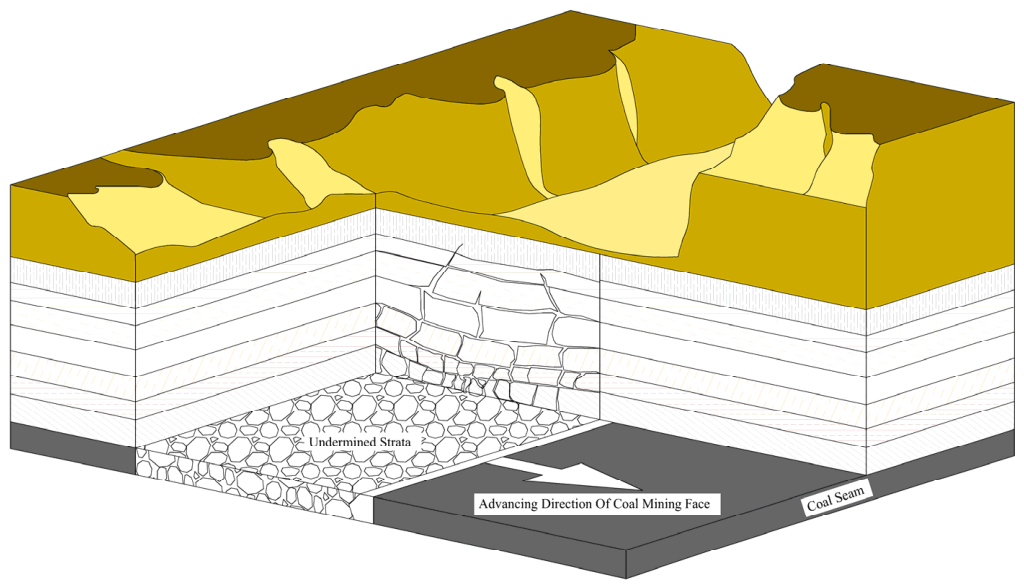
Figure 1. Schematic diagram of coal seam mining in the gully area.
Processes 14 01942 g001
Figure 2. Physical similarity simulation model and numerical simulation model.
Processes 14 01942 g002
Figure 3. Overburden fracture characteristics during coal seam mining across a gully.
Processes 14 01942 g003
Figure 4. Subsidence characteristics of the overburden during coal seam mining across a gully.
Processes 14 01942 g004
Figure 5. Subsidence displacement curves of the key stratum at different mining distances.
Processes 14 01942 g005
Figure 6. Evolution of the stress field.
Processes 14 01942 g006
Figure 7. Evolution of the displacement field.
Processes 14 01942 g007
Figure 8. Evolution of the fracture field.
Processes 14 01942 g008aProcesses 14 01942 g008b
Figure 9. Evolution of fractal dimension.
Processes 14 01942 g009
Figure 10. Coupling of the three fields during shallow-buried coal seam mining across a gully.
Processes 14 01942 g010
Figure 11. Mechanical model of the key stratum during coal seam mining across a gully.
Processes 14 01942 g011
Figure 12. Estimation of the key-stratum fracture interval based on the theoretical model.
Processes 14 01942 g012
Figure 13. Stress variation at the working face.
Processes 14 01942 g013
Figure 14. Analysis of support loading at the working face.
Processes 14 01942 g014
Figure 15. Validation and analysis of calculated and measured support resistance.
Processes 14 01942 g015
Table 1. Mechanical parameters of coal and rock strata.
Rock PropertiesThickness
/m
Density
/kg·m−3
Bulk Modulus
/MPa
Shear Modulus
/MPa
Cohesion
/MPa
Friction
Compressive Strength
/MPa
Tensile Strength
/MPa
Loess17.78237518.472376.240.17815.320.31
Siltstone9.18224418.182448.0810.053747.902.88
Sandy mudstone4.58253812.742537.885.603937.372.22
Fine sandstone9.91231610.742249.364.393628.381.95
Sandy mudstone4.425404.992544.554.643320.372.68
Coarse sandstone16.81240523.892405.6211.964455.943.79
Siltstone
(Key stratum)
22.84224418.182448.0810.053745.972.70
Coarse sandstone1.38231610.742249.364.393627.941.99
Siltstone12.73224418.182448.082.133737.902.28
Fine sandstone3.37224110.412249.876.763528.851.99
Sandy mudstone13.7425435.492540.295.463322.171.77
Coarse sandstone21.14240911.992299.365.393830.742.19
Coal seam5.514358.901438.265.13279.971.33
Bedrock strata50253659.112541.505.5636655.64
Table 2. Fracture characteristics of the key stratum.
Mining StageKey Stratum Fracture Interval
From Similar Simulation/m
Key Stratum Fracture Interval
from Numerical Simulation/m
downhill mining stage3229.58
3647.67
3438.45
uphill mining stage3034.12
2631.34
2429.22
Disclaimer/Publisher’s Note: The statements, opinions and data contained in all publications are solely those of the individual author(s) and contributor(s) and not of MDPI and/or the editor(s). MDPI and/or the editor(s) disclaim responsibility for any injury to people or property resulting from any ideas, methods, instructions or products referred to in the content.