Technological Transformation and Recent Advances in Early Kick Detection During Drilling Operations: A Comprehensive Review


Abstract
1. Introduction
- Research Gaps, Objectives, and Paper Structure
- To critically reassess conventional and advanced EKD technologies in relation to actual field requirements;
- To examine the principal physical and algorithmic limitations associated with acoustic sensing and leakage diagnostics; and
- To systematically relate state-of-the-art AI models to the drilling signals and detection methodologies for which they are most suitable.
2. Critical Re-Evaluation of Conventional Surface-Based Detection Systems
2.1. Pit Gain Monitoring: Masking Effects and Volumetric Latency
2.2. Flow Rate (Delta Flow) Monitoring: Transient Hydraulics and Ballooning
2.3. Standpipe Pressure (SPP) Analysis: Diagnostic Ambiguity and Multiphase Complexities
2.4. Mud Gas Detection and Logging
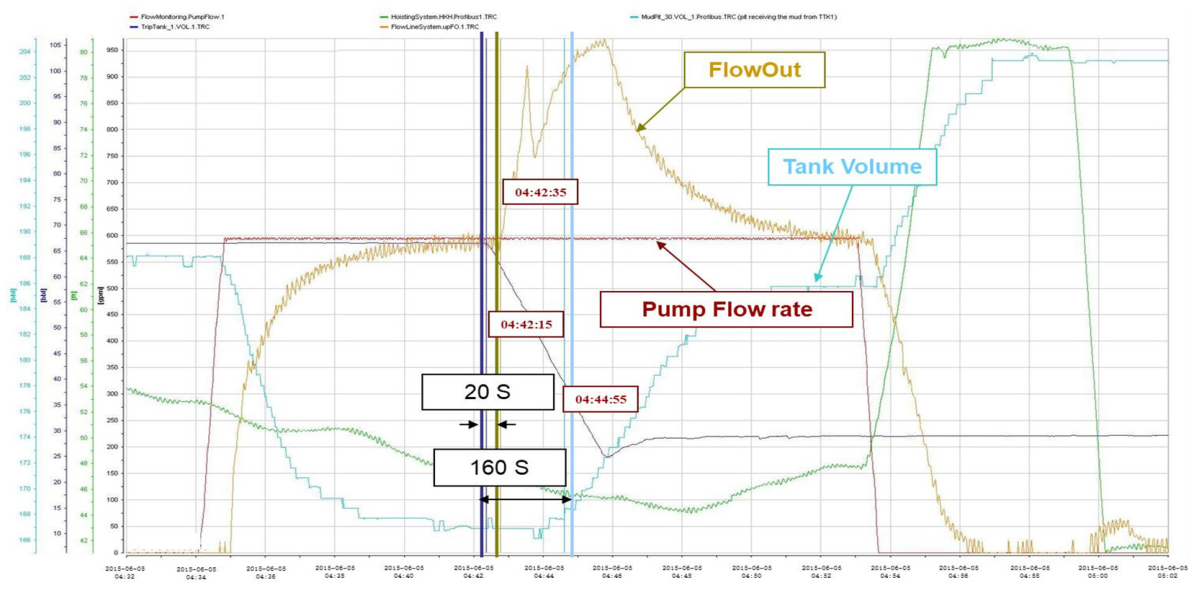
2.5. Trip Tank Volume Monitoring
2.6. Overall Limitations of Surface-Based Detection Systems
3. Downhole and Real-Time Sensing: The Ultrasonic Bottleneck
3.1. Acoustic and Ultrasonic Sensing
3.2. Pressure While Drilling (PWD) and Telemetry
3.3. Dual Measurement and Genetic Algorithms
4. Formation Leakage Diagnostics: Capabilities and Limitations
4.1. Current Capabilities in Monitoring and Detecting Leakage
4.2. Severe Limitations and Diagnostic Bottlenecks
5. Managed Pressure Drilling and Automated Well Control
5.1. Managed Pressure Drilling
5.2. Automated Well Control (AWC)
6. The Artificial Intelligence Revolution: Mapping AI Architectures to Drilling Methodologies
6.1. Artificial Neural Networks (ANNs)
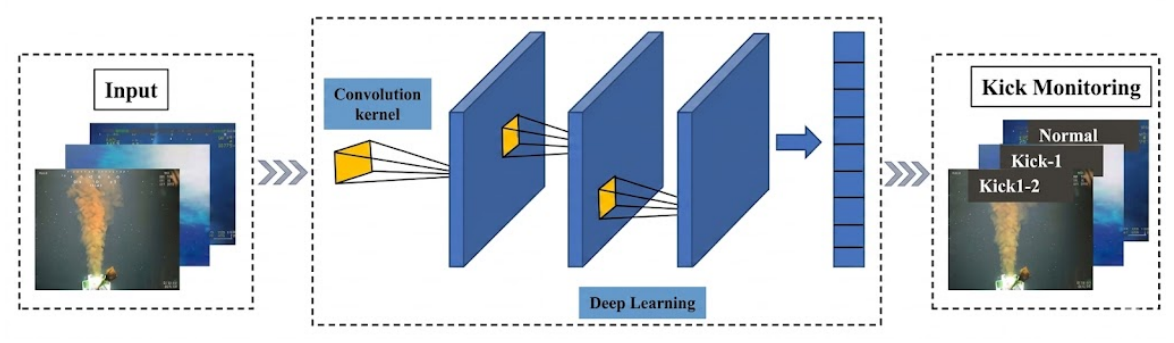
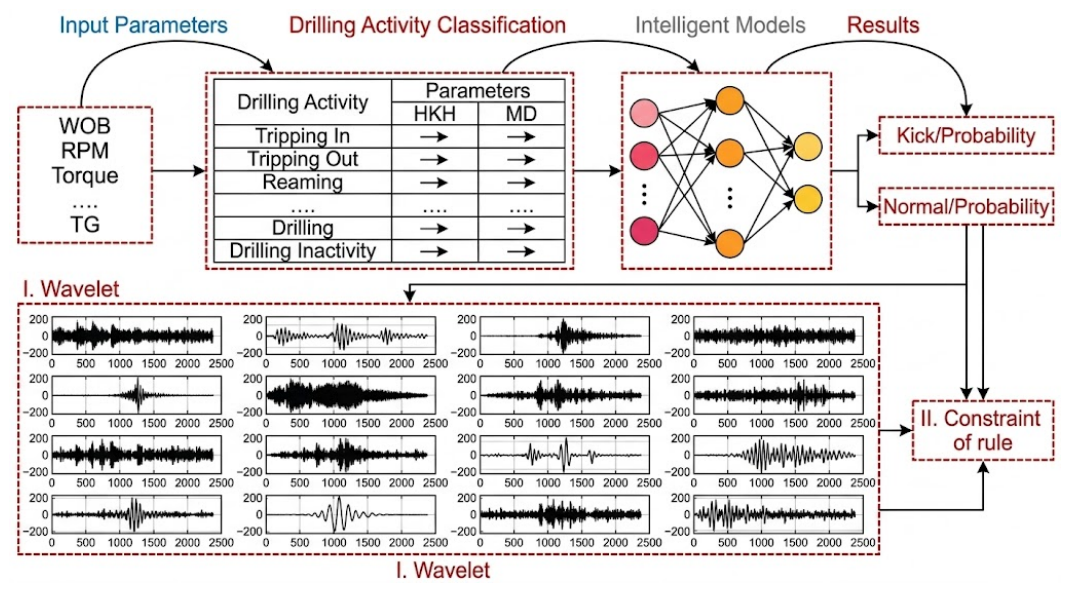
6.1.1. Convolutional Neural Networks (CNNs) for Spatial and Image-Based Logging Data
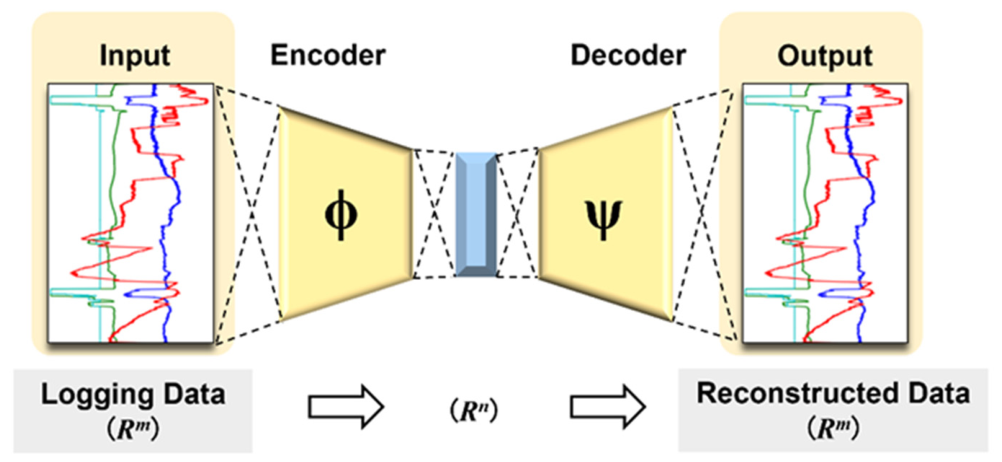
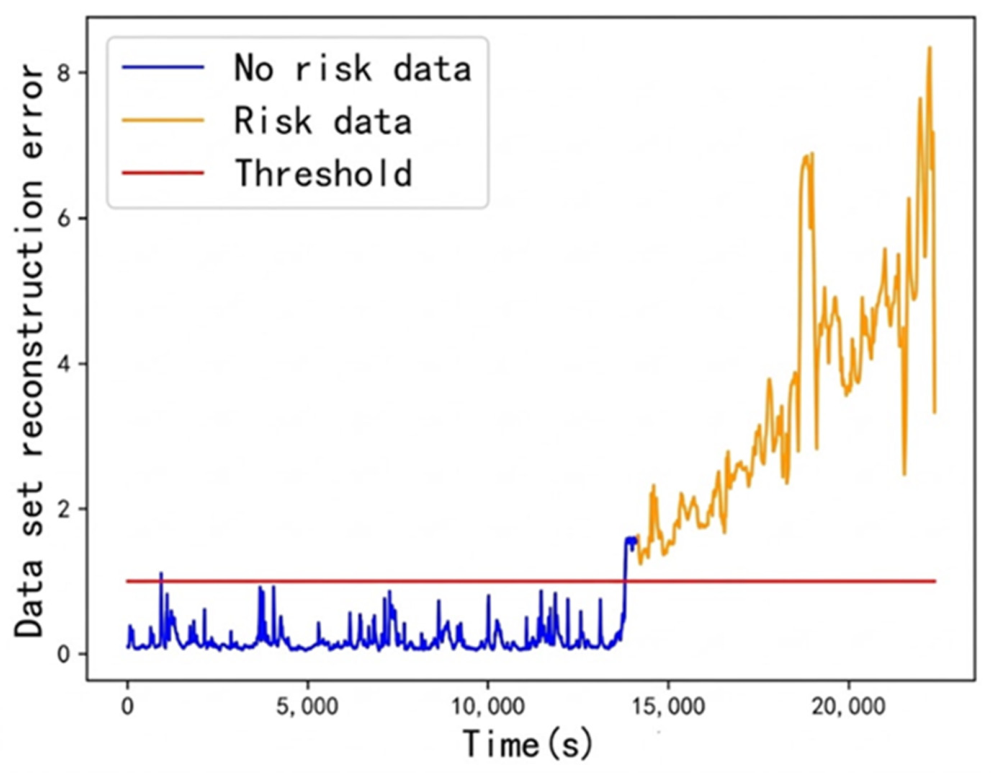
6.1.2. Sequence-to-Sequence Autoencoders for Unsupervised Anomaly Detection
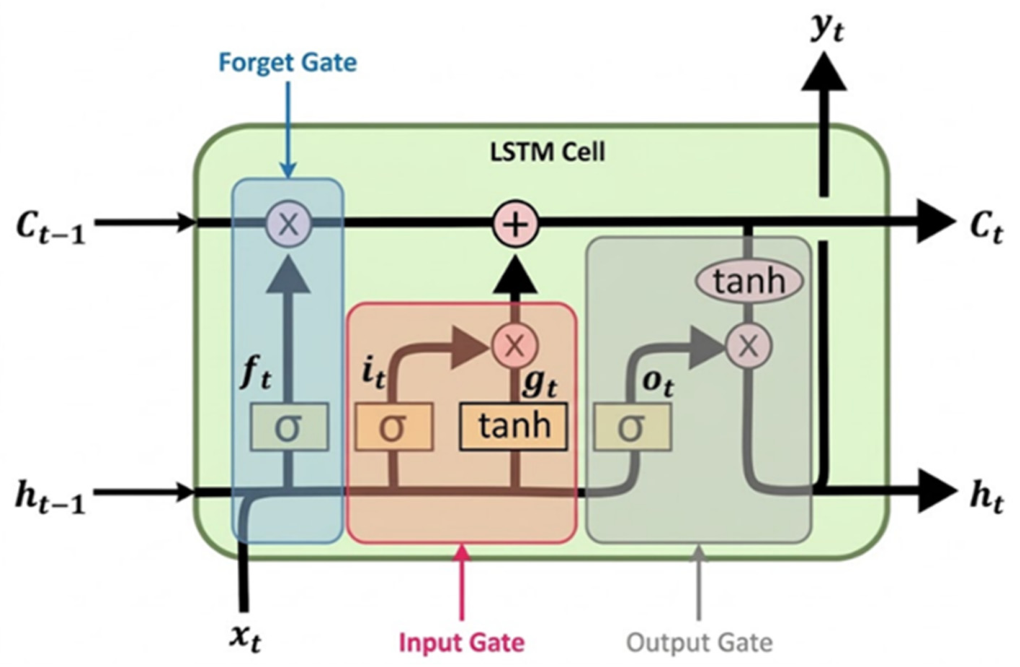
6.1.3. Long Short-Term Memory (LSTM) Networks for Temporal Hydraulic Transients
6.1.4. Hybrid Models (CNN-GRU/LSTM-RNN/CNN-LSTM)
6.2. Machine Learning Algorithms
Random Forests, Support Vector Machines, XGBoost, and Physics-Informed Feature Engineering
6.3. Real-Time Pattern Recognition and Trend Analysis
6.4. Data Engineering and Synthetic Augmentation
6.5. Challenges and Research Gaps in ML/AI Implementation
7. Performance Validation and Metrics for Key AL/ML Algorithms and Their Results
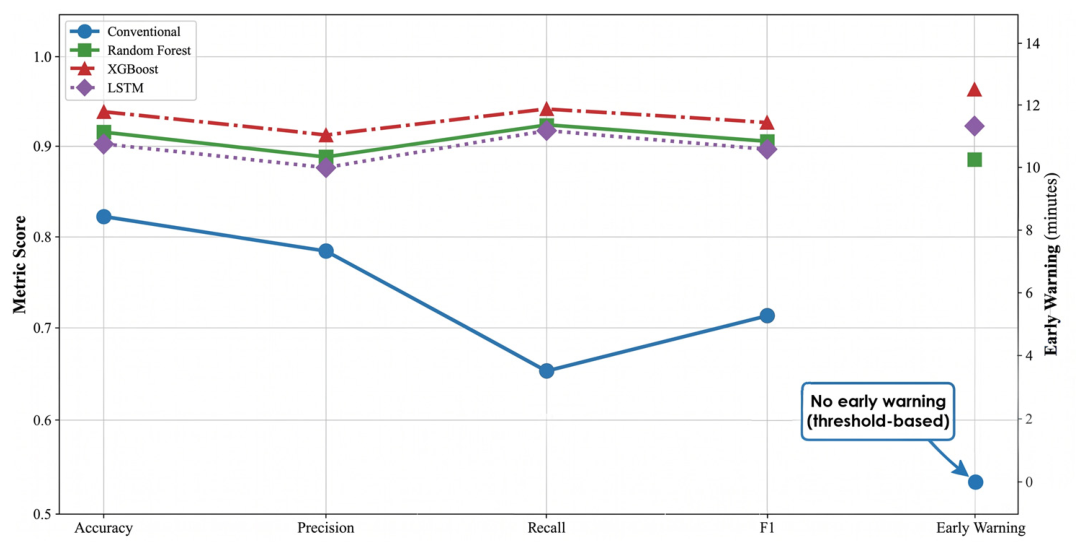
- Kick Response Time (KRT) gauges the interval between kick detection and shut-in. Automated systems have the potential to slash this timeframe, bringing it down from several minutes to mere seconds [173].
- False Alarm Rate assesses usability; AI models using attention processes have shown promise in lowering FAR by effectively distinguishing between different flow conditions [25].
8. Comparative Evaluation of EKD Technologies Against Field Requirements
9. Recommendations and Future Work Directions
- Development of Dynamic, Multiphase Acoustic CFD Solvers: As critically analyzed in Section 3, the field applicability of downhole ultrasonic detection is crippled by the severe acoustic scattering, attenuation, and multi-path propagation caused by gas–liquid–solid multiphase flow. Current inversion algorithms rely on simplistic linear wave equations that fail in turbulent suspensions. Future research must aggressively prioritize the development of advanced CFD solvers coupled with computational acoustics capable of modeling discrete bubble interphase transfer behavior in real time. By utilizing these supercomputing models to generate high-fidelity synthetic acoustic datasets, researchers can train sophisticated, physics-informed data inversion neural networks. These advanced inversion algorithms must be engineered to specifically filter out the acoustic shadowing caused by solid rock cuttings, thereby isolating the micro-gas signatures and completely overcoming the current thermodynamic limitations regarding gas expansion volumes.
- Standardizing Unsupervised AI and Synthetic Data Augmentation (TimeGANs): The chronic scarcity of labeled kick data ensures that standard supervised ML models will continually suffer from overfitting and generalization failures when deployed in novel geological basins. Future AI deployment protocols must mandate a pivot toward unsupervised learning frameworks, such as the BiLSTM–Autoencoders discussed in Section 6, that identify anomalies purely through reconstruction error against the baseline of normal operations. Concurrently, the industry must formally standardize the use of TimeGANs to synthesize highly realistic, physics-bound kick datasets. By augmenting training data with these synthetic, edge-case scenarios, engineers can mathematically force the sample imbalance ratio closer to parity, drastically improving the robustness and field reliability of identification models.
- Unifying Leakage Diagnostics with Kick Detection Architecture: Because severe formation leakage (lost circulation) fundamentally alters the hydrostatic column, masks primary kick indicators, and frequently induces secondary blowouts, EKD systems can no longer treat these phenomena as isolated events. Future AWC systems must be architecturally designed for unified diagnostic processing. Deep learning algorithms should be explicitly engineered to simultaneously cross-correlate distributed fiber optic micro-strain data (DAS/DTS) with real-time Coriolis mass flow metrics and intelligent rheological tracking. This multi-modal fusion is technically required to definitively resolve the “ballooning paradox,” allowing the system to instantly differentiate between elastic wellbore breathing, catastrophic fluid loss to a vugular matrix, and stealth gas influxes, thereby preventing the erroneous application of damaging lost circulation materials.
- Mandating Rig-Based Edge Computing Infrastructure: The extraordinary predictive capabilities of high-dimensional AI models (such as CNN-GRUs and transfer-learning image classifiers) are currently bottlenecked by the severe latency involved in transmitting gigabytes of high-frequency rig data to cloud servers via offshore satellite uplinks. To realize true AWC, future technical guidance dictates the mandatory deployment of localized, “high-performance edge computing” hardware directly on the drilling rig. Executing complex algorithmic inversions and AI predictions physically on-site ensures deterministic, microsecond response times. This edge architecture guarantees that automated choke manipulations and BOP shut-in protocols can execute instantly, entirely independent of vulnerable offshore internet connectivity.
- Regulatory Alignment and Mechanical Standardization of MPD Components: System reliability assessments indicate that the physical hardware enabling rapid kick mitigation, specifically the high-pressure valves, choke manifolds, and RCD in MPD systems, is highly proprietary, rig-specific, and vulnerable to single-point mechanical failures. Future industry efforts must pivot from solely digital advancements to the rigorous mechanical standardization of these primary barriers. Regulatory bodies must align autonomous response protocols with stringent international certification standards (e.g., API Specification 16RCD, NORSOK, DNV). Establishing universal, fail-safe mechanical standards is the only technical pathway to building sufficient operator trust, allowing drillers to confidently transition AWC systems from passive advisory modes into fully autonomous, closed-loop mitigation systems.
10. Conclusions
Author Contributions
Funding
Data Availability Statement
Conflicts of Interest
Abbreviations
| AI | Artificial Intelligence |
| ANFIS | Adaptive Neuro-Fuzzy Inference System |
| ANNs | Artificial Neural Networks |
| AWC | Automated Well Control |
| BHP | Bottom Hole Pressure |
| BiLSTM-AE | Bidirectional Long Short-Term Memory Autoencoder |
| CapEx | Capital Expenditure |
| CNNs | Convolutional Neural Networks |
| DAS | Distributed Acoustic Sensing |
| DL | Deep Learning |
| DNNs | Deep Neural Networks |
| DT | Decision Tree |
| DTS | Distributed Temperature Sensing |
| ECD | Equivalent Circulating Density |
| EKD | Early Kick Detection |
| XGBoost | eXtreme Gradient Boosting |
| FAR | False Alarm Rate |
| GANs | Generative Adversarial Networks |
| GAs | Genetic Algorithms |
| GEP | Gene Expression Programming |
| GMDH | Group Method of Data Handling |
| GOA | Grasshopper Optimization Algorithm |
| HPHT | High-pressure, High-temperature |
| HMIs | Human–Machine Interfaces |
| KNNs | K-Nearest Neighbors |
| KPIs | Key Performance Indicators |
| KRT | Kick Response Time |
| LWD | Logging While Drilling |
| LSTM | Long Short-Term Memory |
| ML | Machine Learning |
| MLP-AEs | Multilayer Perceptron Autoencoders |
| MPD | Managed Pressure Drilling |
| MWD | Measurement While Drilling |
| OBM | Oil-Based Mud |
| PLCs | Programmable Logic Controllers |
| PVT | Pit Volume Totalizer |
| PWD | Pressure While Drilling |
| QC | Quality Control |
| RF | Random Forest |
| RMSE | Root Mean Square Error |
| RNNs | Recurrent Neural Networks |
| ROC | Receiver Operating Characteristic |
| ROP | Rate of Penetration |
| ROVs | Remotely Operated Vehicles |
| RPM | Revolutions Per Minute |
| RCD | Rotating Control Device |
| RNNs | Recurrent Neural Network |
| SMO | Sequential Minimal Optimization |
| SPP | Standpipe Pressure |
| SVM | Support Vector Machine |
| SVR | Support Vector Regression |
| XAI | Explainable Artificial Intelligence |
| WBM | Water-Based Mud |
| WDP | Wired Drill Pipe |
| WOB | Weight on Bit |
References
- Huque, M.M.; Imtiaz, S.; Rahman, M.A.; Hossain, M.E. Kick detection and remedial action in managed pressure drilling: A review. SN Appl. Sci. 2020, 2, 7. [Google Scholar] [CrossRef]
- Guner, H. Simulation Study of Emerging Well Control Methods for Influxes Caused by Bottomhole Pressure Fluctuations During Managed Pressure Drilling. Master’s Thesis, Louisiana State University, Baton Rouge, LA, USA, 2009. [Google Scholar] [CrossRef]
- Olamigoke, O.; James, I. Advances in well control: Early kick detection and automated control systems. In Drilling Engineering and Technology-Recent Advances New Perspectives and Applications; IntechOpen: London, UK, 2022. [Google Scholar] [CrossRef]
- Al-Rubaii, M.M.; Al-Shargabi, M.; Aldahlawi, B.; Shehri, D.A.; Minaev, K.M. A Developed Robust Model and Artificial Intelligence Techniques to Predict Drilling Fluid Density and Equivalent Circulation Density in Real Time. Sensors 2023, 23, 6594. [Google Scholar] [CrossRef]
- Muojeke, S.; Venkatesan, R.; Khan, F. Supervised data-driven approach to early kick detection during drilling operation. J. Pet. Sci. Eng. 2020, 192, 107324. [Google Scholar] [CrossRef]
- Sun, X.; Sun, B.; Zhang, S.; Wang, Z.; Gao, Y.; Li, H. A new pattern recognition model for gas kick diagnosis in deepwater drilling. J. Pet. Sci. Eng. 2018, 167, 418. [Google Scholar] [CrossRef]
- Khan, M.A.; Li, M.-C.; Lv, K.; Sun, J.; Liu, C.; Liu, X.; Shen, H.; Dai, L.; Lalji, S.M. Cellulose derivatives as environmentally-friendly additives in water-based drilling fluids: A review. Carbohydr. Polym. 2024, 342, 122355. [Google Scholar] [CrossRef] [PubMed]
- Sircar, A.; Yadav, K.; Rayavarapu, K.; Bist, N.; Oza, H. Application of machine learning and artificial intelligence in oil and gas industry. Pet. Res. 2021, 6, 4. [Google Scholar] [CrossRef]
- Sun, Y.; Liu, Y.; Wang, J.; Xiang, C.; Yin, S.; Li, X. Intelligent monitoring method for kick risk based on CNN-GRU hybrid network model. J. Phys. Conf. Ser. 2024, 2901, 1. [Google Scholar] [CrossRef]
- Das Purkayastha, A.; Rana, R.; Talreja, R.; Rajaiah, N. Drilling Event Chart: A Kick Prevention Tool. In Proceedings of the SPE Gas & Oil Technology Showcase and Conference, Dubai, United Arab Emirates, 21–23 October 2019. [Google Scholar] [CrossRef]
- Amish, M.; Khodja, M. Review of detection, prediction and treatment of fluid loss events. Arab. J. Geosci. 2024, 18, 1. [Google Scholar] [CrossRef]
- Li, C.; Zhu, Z.; Cui, Y.; Wang, H.; Xu, Z.; Duan, S.; Zhou, M. Intelligent Kick Warning Model Based on Machine Learning. Processes 2025, 13, 2162. [Google Scholar] [CrossRef]
- Duan, S.; Song, X.; Yao, X.; Xu, Z.; Zhou, M.; Zhu, Z.; Cui, Y. Kick Warning and Pressure Inversion Method Based on Wellhead Pressure Signal. In Proceedings of the 58th U.S. Rock Mechanics/Geomechanics Symposium, Golden, CO, USA, 23–26 June 2024. [Google Scholar] [CrossRef]
- Griffin, P. Early Kick Detection Holds Kill Pressure Lower. In Proceedings of the SPE Mechanical Engineering Aspects of Drilling and Production Symposium, Fort Worth, TX, USA, 5–7 March 1967. [Google Scholar] [CrossRef]
- Yang, J.; Sun, T.; Zhao, Y.; Borujeni, A.T.; Shi, H.; Yang, H. Advanced Real-Time Gas Kick Detection Using Machine Learning Technology. In Proceedings of the 29th International Ocean and Polar Engineering Conference, Honolulu, HI, USA, 16–21 June 2019; Available online: https://onepetro.org/ISOPEIOPEC/proceedings-abstract/ISOPE19/ISOPE19/ISOPE-I-19-602/21663 (accessed on 28 April 2026).
- Satiarvand, M.; Orak, N.; Varshosaz, K.; Hassan, E.M.; Cheraghi, M. Providing a comprehensive approach to oil well blowout risk assessment. PLoS ONE 2023, 18, 12. [Google Scholar] [CrossRef]
- Ashena, R.; Bahreini, H.; Lotfi, M. Statistical analysis of past kicks and blowouts occurred in a Middle Eastern oilfield. J. Pet. Explor. Prod. Technol. 2023, 13, 2063. [Google Scholar] [CrossRef]
- Chhantyal, K.; Jondahl, M.H.; Viumdal, H.; Mylvaganam, S. Upstream Ultrasonic Level Based Soft Sensing of Volumetric Flow of Non-Newtonian Fluids in Open Venturi Channels. IEEE Sens. J. 2018, 18, 5002. [Google Scholar] [CrossRef]
- Islam, R.; Khan, F.I.; Venkatesan, R. Real time risk analysis of kick detection: Testing and validation. Reliab. Eng. Syst. Saf. 2017, 161, 25–37. [Google Scholar] [CrossRef]
- Abdali, M.R.; Mohamadian, N.; Ghorbani, H.; Wood, D.A. Petroleum Well Blowouts as a Threat to Drilling Operation and Wellbore Sustainability: Causes, Prevention, Safety and Emergency Response. J. Constr. Mater. 2021. [Google Scholar] [CrossRef]
- Ambrus, A.; Aarsnes, U.J.F.; Vajargah, A.K.; Akbari, B.; van Oort, E.; Aamo, O.M. Real-time estimation of reservoir influx rate and pore pressure using a simplified transient two-phase flow model. J. Nat. Gas Sci. Eng. 2016, 32, 439. [Google Scholar] [CrossRef]
- Hong, L.; Tianyin, Z.; Tongchun, H.; Xiaocheng, Z.; Xiaopeng, W.; Lei, Z. Prediction method of formation pressure for the adjustment well in the reservoir with fault. J. Phys. Conf. Ser. 2020, 1707, 012012. [Google Scholar] [CrossRef]
- Choe, J.; Schubert, J.J.; Juvkam-Wold, H.C. Analyses and Procedures for Kick Detection in Subsea Mudlift Drilling. SPE Drill. Compl. 2007, 22, 296–303. [Google Scholar] [CrossRef]
- Jardine, S.I.; White, D.B.; Billingham, J. Computer-aided real-time kick analysis and control. SPE Drill. Compl. 1994, 9, 3. [Google Scholar] [CrossRef]
- Li, S.; Jeff, G.; Purdy, C. Pore-Pressure and Wellbore-Stability Prediction to Increase Drilling Efficiency. J. Pet. Technol. 2012, 64, 98–101. [Google Scholar] [CrossRef]
- Swanson, B.W.; Gardner, A.; Brown, N.P.; Murray, P. Slimhole Early Kick Detection by Real-Time Drilling Analysis. SPE Drill. Compl. 1997, 12, 27–32. [Google Scholar] [CrossRef]
- Mu, C.; Paterson, G.; Zhao, J.; Tao, Y. An Innovative Automatic Alarm System for Early Kick or Influx Events by a Machine Learning Based Abnormal Flowback Detection. Paper presented at the ADIPEC, Abu Dhabi, United Arab Emirates, 2–5 October 2023. [Google Scholar] [CrossRef]
- Zhang, S.; Samuel, R. A Machine Learning Model for Real-Time Early Kick and Loss Prediction EKLP Application. In Proceedings of the ADIPEC, Abu Dhabi, United Arab Emirates, 4–7 November 2024. [Google Scholar] [CrossRef]
- Haeusler, D.; Makohl, F.; Harris, T.W.R. Applications and Field Experience of an Advanced Delta Flow Kick Detection System. In Proceedings of the SPE/IADC Drilling Conference, Amsterdam, Netherlands, 28 February–2 March 1995. [Google Scholar] [CrossRef]
- Alouhali, R.; Aljubran, M.; Gharbi, S. Drilling Through Data: Automated Kick Detection Using Data Mining. In Proceedings of the SPE International Heavy Oil Conference and Exhibition, Kuwait City, Kuwait, 10–12 December 2018. [Google Scholar] [CrossRef]
- Ding, D.; Mei, Y.; Su, G.; Yong, F.; Lu, Y.; Ge, Y. Trend Analysis for Calibrated Active System Volume and Differential Flow Significantly Reduces False Positive Kick Alarm During Drilling. In Proceedings of the APOGCE, Perth, Australia, 15–17 October 2024. [Google Scholar] [CrossRef]
- Hargreaves, D.; Jardine, S.I.; Jeffryes, B.P. Early Kick Detection for Deepwater Drilling: New Probabilistic Methods Applied in the Field. In Proceedings of the SPE Annual Technical Conference and Exhibition, New Orleans, LA, USA, 30 September–3 October 2001. [Google Scholar] [CrossRef]
- Xie, H.; Shanmugam, A.K.; Issa, R.R.A. Big Data Analysis for Monitoring of Kick Formation in Complex Underwater Drilling Projects. J. Comput. Civ. Eng. 2018, 32, 5. [Google Scholar] [CrossRef]
- Blay, F.L.; Villard, E.; Hilliard, S.C.; Grønås, T. A New Generation of Well Surveillance for Early Detection of Gains and Losses When Drilling Very High Profile Ultradeepwater Wells, Improving Safety, and Optimizing Operating Procedure. In Proceedings of the SPETT 2012 Energy Conference and Exhibition, Port-of-Spain, Trinidad, 11–13 June 2012. [Google Scholar] [CrossRef]
- Linot, B.; Dinet, J.; Charoy, F.; Shalin, V.L. Information gain in sociotechnical systems. In Proceedings of the ISCRAM 2018—15th International Conference on Information Systems for Crisis Response and Management, Rochester, NY, USA, 20–23 May 2018; Available online: https://hal.science/hal-01823245 (accessed on 28 April 2026).
- Tang, H.; Zhang, S.; Zhang, F.; Venugopal, S. Time series data analysis for automatic flow influx detection during drilling. J. Pet. Sci. Eng. 2019, 172, 1103. [Google Scholar] [CrossRef]
- Schubert, J.; Wright, J. Early Kick Detection Through Liquid Level Monitoring in the Wellbore. In Proceedings of the IADC/SPE Drilling Conference, Dallas, TX, USA, 3–6 March 1998. [Google Scholar] [CrossRef]
- Fjetland, A.K.; Zhou, J.; Abeyrathna, D.; Gravdal, J.E. Kick Detection and Influx Size Estimation During Offshore Drilling Operations Using Deep Learning. In Proceedings of the 2019 14th IEEE Conference on Industrial Electronics and Applications (ICIEA), Xi’an, China, 19–21 June 2019. [Google Scholar] [CrossRef]
- Dinh, N.M. Early kick detection using data-driven Bayesian network: Model development and experimental testing. Mem. Univ. Res. Repos. 2020, 138, 130–138. [Google Scholar]
- Mills, I.; Reitsma, D.; Hardt, J.; Tarique, Z. Simulator and the First Field Test Results of an Automated Early Kick Detection System That Uses Standpipe Pressure and Annular Discharge Pressure. In Proceedings of the SPE/IADC Managed Pressure Drilling and Underbalanced Operations Conference and Exhibition, Milan, Italy, 20–21 March 2012. [Google Scholar] [CrossRef]
- Sun, X.-Y.; Cui, M.; Ji, Y.; Wu, D.; Guo, W.; Jing, L.; Tian, Y.; Yang, X. Novel Kick Detection Tool Based on Knowledge-Data-Dual-Driven Approaches. In Proceedings of the SPE Offshore Europe Conference & Exhibition, Aberdeen, Scotland, UK, 5–8 September 2023. [Google Scholar] [CrossRef]
- Orban, J.J.; Zanner, K.J.; Orban, A.E. New Flowmeters for Kick and Loss Detection During Drilling. In Proceedings of the SPE Annual Technical Conference and Exhibition, Dallas, TX, USA, 27–30 September 1987. [Google Scholar] [CrossRef]
- Orban, J.J.; Zanker, K.J. Accurate Flow-Out Measurements for Kick Detection, Actual Response to Controlled Gas Influxes. In Proceedings of the IADC/SPE Drilling Conference, Dallas, TX, USA, 28 February–2 March 1988. [Google Scholar] [CrossRef]
- Hang, D.; Sun, W.; Dai, Y.; Bu, S.; Feng, J.; Huang, W. Intelligent kick detection using a parameter adaptive neural network. Geoenergy Sci. Eng. 2024, 234, 212694. [Google Scholar] [CrossRef]
- Zhang, Y.; Zhao, J.; Li, J.; Wang, X.; Sun, Y.; Chen, Y.; Zhang, D. A Noise-robust Multi-head Attention Mechanism for Formation Resistivity Prediction: Frequency Aware LSTM. arXiv 2024, arXiv:2406.03849. [Google Scholar] [CrossRef]
- Ahmed, M.A.; Hegab, O.A.; Sabry, A. Early detection enhancement of the kick and near-balance drilling using mud logging warning sign. Egypt. J. Basic Appl. Sci. 2016, 3, 85–93. [Google Scholar] [CrossRef][Green Version]
- He, H.; Sun, B.; Sun, X.; Wang, Z.; Li, X. Effects of gas dissolution on gas migration during gas invasion in drilling. ACS Omega 2022, 7, 42056–42072. [Google Scholar] [CrossRef] [PubMed]
- Su, Y.; Ma, H.; Xia, L.; Peng, C.; Guo, J.; Shen, X.; Fu, J.; Tang, Y. Prediction and analysis of flow behavior during gas kicks considering wellbore–formation coupling and gas solubility. Front. Earth Sci. 2025, 13, 1558305. [Google Scholar] [CrossRef]
- Leon, J.A.L.; Penteado, H.L.B.; Ellis, G.S.; Milkov, A.; Filho, J.G.M. Recognition of artificial gases formed during drill-bit metamorphism using advanced mud gas. Energies 2024, 17, 4383. [Google Scholar] [CrossRef]
- Zachopoulos, F.; Kokkinos, N. Mathematical modeling of oil and gas kick during drilling operations. AIP Conf. Proc. 2023, 2872, 020004. [Google Scholar] [CrossRef]
- Yalamarty, S.S.; Singh, K.; Kamyab, M.; Cheatham, C.; Crkvenjakov, V.; Flurry, K. Early Detection of Well Control Kick Events by Applying Data Analytics on Real Time Drilling Data. In Proceedings of the IADC/SPE International Drilling Conference and Exhibition, Galveston, TX, USA, 8–10 March 2022. [Google Scholar] [CrossRef]
- Cayeux, E. Safe mud pump management while conditioning mud: On the adverse effects of complex heat transfer and barite sag when establishing circulation. IFAC Proc. Vol. 2012, 45, 231–238. [Google Scholar] [CrossRef]
- Eldar, S.; Anar, A. Issue of drilling fluid absorption in the Absheron fields. Sci. Pap. Azerbaijan State Oil Ind. Univ. 2025, 6, 45–54. [Google Scholar] [CrossRef]
- Mao, Y.; Zhang, P. An Automated Kick Alarm System Based on Statistical Analysis of Real-Time Drilling Data. In Proceedings of the Abu Dhabi International Petroleum Exhibition & Conference, Abu Dhabi, United Arab Emirates, 11–14 November 2019. [Google Scholar] [CrossRef]
- Sule, I.; Khan, F.; Butt, S. Experimental investigation of gas kick effects on dynamic drilling parameters. J. Pet. Explor. Prod. Technol. 2018, 9, 605. [Google Scholar] [CrossRef]
- Ichenwo Lander, J.; Mirabel Homa, O. Retrieval-augmented LLM framework for contextual well control advisory in high-pressure drilling. J. Drill. Well Saf. Technol. 2026, 2, 12–21. [Google Scholar]
- Xu, Y.; Yang, J.; Hu, Z.; Xu, D.; Li, L.; Fu, C. An intelligent identification method for offshore drilling kick conditions based on remotely operated vehicle images: Coupled convolutional neural network and generative adversarial network. Process Saf. Environ. Prot. 2025, 196, 1102–1118. [Google Scholar] [CrossRef]
- Wang, X.; Wu, P.; Chen, Y.; Zhang, E.; Ye, X.; Huang, Q.; Peng, C.; Fu, J. An intelligent kick detection model for large-hole ultra-deep wells in the Sichuan Basin. Processes 2024, 12, 2589. [Google Scholar] [CrossRef]
- Nayeem, A.A.; Venkatesan, R.; Khan, F.I. Monitoring of down-hole parameters for early kick detection. J. Loss Prev. Process Ind. 2016, 40, 43–54. [Google Scholar] [CrossRef]
- Osarogiagbon, A.U.; Muojeke, S.; Venkatesan, R.; Khan, F.I.; Gillard, P. A new methodology for kick detection during petroleum drilling using long short-term memory recurrent neural network. Process Saf. Environ. Prot. 2020, 142, 126–137. [Google Scholar] [CrossRef]
- Tost, B.C.; Rose, K.; Carney, J.; Aminzadeh, F.; Suhag, A. Early Kick Detection from Downhole Measurements: A Novel Method for Reducing the Frequency and Magnitude of Loss-of-Well control. In Proceedings of the Offshore Technology Conference, Houston, TX, USA, 4–7 May 2020. [Google Scholar] [CrossRef]
- Yin, Q.; Yang, J.; Tyagi, M.; Zhou, X.; Hou, X.; Cao, B. Field data analysis and risk assessment of gas kick during industrial deepwater drilling process based on supervised learning algorithm. Process Saf. Environ. Prot. 2020, 146, 312. [Google Scholar] [CrossRef]
- Li, X.; Guan, C.; Sui, X.; Gangtao. A New Approach for Early Gas Kick Detection. In Proceedings of the SPE International Oil and Gas Conference and Exhibition in China, Beijing, China, 2–6 November 1998. [Google Scholar] [CrossRef]
- Indimath, S.; Fiorentini, S.; Bøklepp, B.R.; Avdal, J.; Johansen, T.F.; Måsøy, S.-E. Effect of bubble size on ultrasound backscatter from bubble clouds in the context of gas kick detection in boreholes. Sci. Rep. 2023, 13, 11825. [Google Scholar] [CrossRef]
- Sleiti, A.K.; Takalkar, G.; El-Naas, M.H.; Hasan, A.R.; Rahman, M.A. Early gas kick detection in vertical wells via transient multiphase flow modelling: A review. J. Nat. Gas Sci. Eng. 2020, 80, 103391. [Google Scholar] [CrossRef]
- Wang, Z.; Zhao, R.; Zang, Y.; Zhou, W.; Chen, G.-L.; Zhang, R. Downhole detection of gas kick using low-frequency elastic wave. Gas Sci. Eng. 2024, 125, 205297. [Google Scholar] [CrossRef]
- Bryant, T.M.; Grosso, D.S.; Wallace, S.N. Gas-influx detection with MWD technology. SPE Drill. Eng. 1991, 6, 273–278. [Google Scholar] [CrossRef]
- Ekechukwu, G.K.; Sharma, J.; William, M.J. A novel velocity band energy workflow for fiber-optic DAS interpretation and multiphase flow characterization. Sci. Rep. 2023, 13, 15142. [Google Scholar] [CrossRef] [PubMed]
- Sharma, J.; Mills, H.R. Deep learning-assisted automated detection of gas influx signature in wellbore using distributed acoustic sensor data. Proc. SPIE 2024, 13044, 175–178. [Google Scholar] [CrossRef]
- Haavik, K. On the Use of Low-Frequency Distributed Acoustic Sensing Data for In-Well Monitoring and Well Integrity: Qualitative Interpretation. SPE J. 2022, 28, 1517. [Google Scholar] [CrossRef]
- Sharma, J.; Santos, O.L.A.; Feo, G.; Ogunsanwo, O.; Williams, W. Well-scale multiphase flow characterization and validation using distributed fiber-optic sensors for gas kick monitoring. Opt. Express 2020, 28, 38773–38786. [Google Scholar] [CrossRef]
- Feng, G.; Yan, Z.; Li, J.; Ni, Y.; Li, M.; Li, Z.; Huang, X.; Li, J.; Liao, Q.; Liu, X. Experimental Laboratory Study on the Acoustic Response Characteristics of Fluid Flow in Horizontal Wells Based on Distributed Fiber Optic Sensing. Sensors 2025, 26, 2248. [Google Scholar] [CrossRef]
- Carney, J. Kick Signatures Through Advanced Multi-Phase Data (Report No. NETL-2332723); National Energy Technology Laboratory (NETL): Morgantown, WV, USA, 2023. Available online: https://www.osti.gov/servlets/purl/2332723 (accessed on 28 April 2026).
- Tost, B.; Rose, K.; Aminzadeh, F.; Ante, M.A.; Huerta, N. Kick Detection at the Bit: Early Detection via Low Cost Monitoring (Report No. NETL-1327810); Office of Scientific and Technical Information (OSTI): Oak Ridge, TN, USA, 2016. [CrossRef][Green Version]
- Zhang, Z.; Yin, X.; Sun, C.; Zhang, H.; Wei, Z.; Ma, G.; Li, W.; Li, X.; Yuan, X. Gas kick monitoring in deep-water drilling risers based on ultrasonic Doppler spectroscopy. Ocean. Eng. 2025, 321, 12045. [Google Scholar] [CrossRef]
- Mianowski, A.; Szul, M.; Radko, T.; Sobolewski, A.; Iluk, T. Literature Review on Thermodynamic and Kinetic Limitations of Thermal Decomposition of Methane. Energies 2023, 17, 5007. [Google Scholar] [CrossRef]
- Elahifar, B. Wellbore Instability Detection in Real Time Using Ultrasonic Measurements. Doctoral Dissertation, Montanuniversität Leoben, Leoben, Austria, 2012. Available online: https://www.academia.edu/93605440/Wellbore_Instability_Detection_in_Real_Time_Using_Ultrasonic_Measurements (accessed on 28 April 2026).
- Xu, Y.; Guan, Z.; Xu, C.; Liu, Y.; Tian, Y.; Sheng, Y.; Sun, S. Numerical simulation method of ultrasonic wave propagation in gas-liquid two-phase flow of deepwater riser. Mech. Syst. Signal Process. 2019, 118, 78–92. [Google Scholar] [CrossRef]
- Pink, S.; Horstmann, M. Use of Wired Drill Pipe, Along-String Measurements, and Advanced LWD Imaging Enhances Wellbore Condition Understanding and Improves Well Delivery Time, While Telemetry-Optimized Uldeep Resistivity Measurements Enable Precise Geological Well Placement. In Proceedings of the SPE Norway Subsurface Conference, Bergen, Norway, 17 April 2024. [Google Scholar] [CrossRef]
- Johnson, A.; Boucher, M.; Pink, S. Rethinking Event Detection and Drilling Processes Using High-Speed Downhole Telemetry and MPD Know-How. In Proceedings of the International Petroleum Technology Conference, Dhahran, Saudi Arabia, 12 February 2024. [Google Scholar] [CrossRef]
- Yin, Q.; Yang, J.; Tyagi, M.; Zhou, X.; Hou, X.; Wang, N.; Tong, G.; Cao, B. Machine Learning for Deepwater Drilling: Gas-Kick-Alarm Classification Using Pilot-Scale Rig Data with Combined Surface-Riser-Downhole Monitoring. SPE J. 2021, 26, 4. [Google Scholar] [CrossRef]
- Rasmus, J.; Dorel, A.; Azizi, T.; David, A.; Duran, E.; Lopez, H.; Aguiñaga, G.; Beltran, J.C.; Ospino, A.; Ochoa, E. Utilizing Wired Drill Pipe Technology During Managed Pressure Drilling Operations to Maintain Direction Control, Constant Bottom-hole Pressures and Well-bore Integrity in a Deep, Ultra-depleted Reservoir. In Proceedings of the SPE/IADC Drilling Conference, Amsterdam, The Netherlands, 5–7 March 2013. [Google Scholar] [CrossRef]
- Feo, G.; Sharma, J.; Kortukov, D.; Williams, W.; Ogunsanwo, T. Distributed Fiber Optic Sensing for Real-Time Monitoring of Gas in Riser during Offshore Drilling. Sensors 2020, 20, 267. [Google Scholar] [CrossRef]
- Yang, H.; Li, J.; Liu, G.; Liu, G. Development of a Dual-Measured-Points Early Gas Kick Detection Method based on the pressure responses of two PWD tools. Arab. J. Geosci. 2020, 13, 16. [Google Scholar] [CrossRef]
- Wang, B.; Li, J.; Zhang, G.; Li, Y.; Huang, H.; Zhan, J.; Yang, H. A novel early gas kick monitoring method using the difference between downhole dual measurement points pressure and a genetic algorithm-based model. Geoenergy Sci. Eng. 2023, 231, 212371. [Google Scholar] [CrossRef]
- Wang, J.; Yu, Z.; Guo, Y.; Li, K. A method of early gas kick monitoring based on DDMP-GWO fusion algorithm. J. Drill. Fluid Complet. Fluid 2024, 41, 747–755. [Google Scholar] [CrossRef]
- Yang, H.; Long, Z.; Li, J.; Zhang, G.; Chen, W.; Zhan, J.; Guan, L.; Wang, B.; Weng, C. Managed pressure drilling and automated well killing based on African vulture optimization-proportional integral derivative controller. Phys. Fluids 2025, 37, 027192. [Google Scholar] [CrossRef]
- Zhang, D.; Sun, W.; Dai, Y.; Wang, D.; Guo, Y.; Gong, C. Intelligent Micro-Kick Detection Using a Multi-Head Self-Attention Network. Processes 2025, 13, 465. [Google Scholar] [CrossRef]
- Beheshtian, S.; Roodbari, S.K.; Ghorbani, H.; Azodinia, M.; Mudabbir, M.; Varkonyi-Koczy, A.R. Advanced Machine Learning Methods for Accurate Prediction of Loss Circulation in Drilling Well Log. In Proceedings of the IEEE 11th International Conference on Computational Cybernetics and Cyber-Medical Systems (ICCC), Hanoi, Vietnam, 4–6 April 2024; pp. 000031–000036. [Google Scholar] [CrossRef]
- Al-Delfi, A.K.; Al-Mahdawi, F.H.M. A comprehensive review of lost circulation: Principles and treatments. AIP Conf. Proc. 2023, 2839, 020026. [Google Scholar] [CrossRef]
- Baldino, S.; Meng, M. Critical review of wellbore ballooning and breathing literature. Geomech. Energy Environ. 2021, 28, 100252. [Google Scholar] [CrossRef]
- Malik, A.; Pao, W.; Mohamad, H. Distributed acoustic sensing (DAS) in multiphase flow monitoring: A systematic review. Flow Meas. Instrum. 2026, 109, 103238. [Google Scholar] [CrossRef]
- Huang, Y.; Yang, W.; Hu, J.; Zhao, Y. Prediction of drilling fluid lost-circulation zone based on deep learning. Energy 2023, 276, 127495. [Google Scholar] [CrossRef]
- Huang, Y.; Yang, W.; Hu, J.; Zhao, Y. Temporal Convolutional and LSTM Networks for Complex Mechanical Drilling Speed Prediction. Symmetry 2025, 17, 1962. [Google Scholar] [CrossRef]
- Elahifar, B. Managed Pressure Drilling and Cementing and Optimizing with Digital Solutions; IntechOpen: London, UK, 2023. [Google Scholar] [CrossRef]
- Vieira, P.; Arnone, M.; Torres, F.; Barragan, F. Roles of Managed Pressure Drilling Technique in Kick Detection and Wellcontrol—The Beginning of the New Conventional Drilling Way. In Proceedings of the Middle East Drilling Technology Conference & Exhibition, Manama, Bahrain, 26–28 October 2009. [Google Scholar] [CrossRef]
- Habib, M. Real Time Kick Estimation and Monitoring in Managed Pressure Drilling System. Master’s Thesis, Memorial University of Newfoundland, St. John’s, NL, Canada, 2021. [Google Scholar] [CrossRef]
- Andia, P.; Israel, R.A. A Cyber-Physical Approach to Early Kick Detection. In Proceedings of the IADC/SPE Drilling Conference and Exhibition, Fort Worth, TX, USA, 6–8 March 2018. [Google Scholar] [CrossRef]
- Reitsma, D. A simplified and highly effective method to identify influx and losses during Managed Pressure Drilling without the use of a Coriolis flow meter. In Proceedings of the SPE/IADC Managed Pressure Drilling and Underbalanced Operations Conference and Exhibition, Kuala Lumpur, Malaysia, 24–25 February 2010. [Google Scholar] [CrossRef]
- Jinasena, A.; Holta, H.; Jondahl, M.; Wels, P.; Aamo, O.; Sharma, R.; Viumdal, H.; Lie, B. Model Based Early Kick/Loss Detection and Attenuation with Topside Sensing in Managed Pressure Drilling. In Proceedings of the 61st SIMS Conference on Simulation and Modelling SIMS 2020, Virtual Conference, Finland, 22–24 September 2021. [Google Scholar] [CrossRef]
- Das, A.K. Simulation Study Evaluating Alternative Initial Responses to Formation Fluid Influx During managed Pressure Drilling. Master’s Thesis, Louisiana State University, Baton Rouge, LA, USA, 2007. Available online: https://repository.lsu.edu/gradschool_theses/3893 (accessed on 18 April 2026).
- Oqaili, A.H.; Alzarea, T.N.; Iturrios, C.O. Maximizing Drilling Efficiency: A Novel Solution to Handle Wellbore Ballooning in High Pressure Formation Through Applying a Fit-For-Purpose Drilling Fluid and Managed Pressure Techniques. In Proceedings of the International Petroleum Technology Conference, Dhahran, Saudi Arabia, 12 February 2024. [Google Scholar] [CrossRef]
- Lloyd, G.M.; Bode, D.J.; Nickens, H.V.; Varnado, S.G. Practical Application of Real-Time Expert System for Automatic Well Control. In Proceedings of the IADC/SPE Drilling Conference, Houston, TX, USA, 27 February–2 March 1990. [Google Scholar] [CrossRef]
- Jacobs, T. Early Kick Detection: Testing New Concepts. J. Pet. Technol. 2015, 67, 44–49. [Google Scholar] [CrossRef]
- Qiao, Y.; Tu, X.; Zhou, L.P.; Guo, X. Hybrid Convolutional and Gated Recurrent Unit Network with Attention for Drilling Kick Prediction. SPE J. 2024, 29, 6852–6868. [Google Scholar] [CrossRef]
- Atchison, B. Automated well control: A step change in safety. Digit. Chem. Eng. 2022, 3, 100022. [Google Scholar] [CrossRef]
- Brakel, J.; Tarr, B.A.; Cox, W.; Jorgensen, F.; Straume, H.V. SMART Kick Detection; First Step on the Well Control Automation Journey. Distrib. Comput. 2015, 68, 74–76. [Google Scholar] [CrossRef]
- Atchison, B. Automated Well Control: From Automated Detection to Automated Shut-In. In Proceedings of the SPE/IADC Middle East Drilling Technology Conference and Exhibition, Abu Dhabi, United Arab Emirates, 25–27 May 2021. [Google Scholar] [CrossRef]
- Curina, F.; Abdo, E.; Bori, L.; Qushchi, A.T. Reducing Operator Stress in Well Control Operations Through the Implementation of a Kick Mitigation System. In Proceedings of the OMC Med Energy Conference and Exhibition, Ravenna, Italy, 28–30 September 2021; Available online: https://onepetro.org/OMCONF/proceedings/OMC21/All-OMC21/OMC-2021-062/473154 (accessed on 25 April 2026).
- Curina, F.; Abdo, E.; Mustapha, H. Reducing Human Error Through Automatic Kick Detection, Space Out and Dynamic Well Monitoring. In Proceedings of the IADC/SPE International Drilling Conference and Exhibition, Galveston, TX, USA, 8–10 March 2022. [Google Scholar] [CrossRef]
- Atchison, B.; Sarpangal, V. Automated Well Control Versus Traditional Well Control: A Human Error Comparison Process. In Proceedings of the IADC/SPE International Drilling Conference and Exhibition, Galveston, TX, USA, 8–10 March 2022. [Google Scholar] [CrossRef]
- Johnsen, O.; Sissel, O.; Sophie, W. Human Factors and Safety in Automated and Remote Operations in Oil and Gas: A Review. In Proceeding of the 33rd European Safety and Reliability Conference; Research Publishing: Singapore, 2023; Available online: https://www.semanticscholar.org/paper/Human-Factors-and-Safety-in-Automated-and-Remote-in-Johnsen-Winge/5a41008a6a8441a09480537b982e93542ff8e8b2 (accessed on 26 April 2026).
- American Petroleum Institute. Automated Safety Instrumented Systems for Onshore Blowout Preventer Actuation, 1st ed.; API Bulletin 16H; API Publishing: Washington, DC, USA, 2022. [Google Scholar]
- Dow, B.; Ferrando, P.; Abolins, N.I.; Leonard, T.; Abuelaish, A.; Gallinal Cuenca, N.; Hansen, J.; Rodriguez, F.R. Advancing Influx Detection Toward Automated Well Control. In Proceedings of the IADC/SPE International Drilling Conference and Exhibition, Galveston, TX, USA, 8–10 March 2022. [Google Scholar] [CrossRef]
- Dmitrievsky, A.N.; Sboev, A.G.; Eremin, N.A.; Chernikov, A.D.; Naumov, A.V.; Gryaznov, A.V.; Moloshnikov, I.A.; Borozdin, S.O.; Safarova, E.A. On increasing the productive time of drilling oil and gas wells using machine learning methods. Georesursy 2020, 22, 79–85. [Google Scholar] [CrossRef]
- Yang, H.; Shang, G.; Li, X.; Feng, Y. Application of Artificial Intelligence in Drilling and Completion; IntechOpen: London, UK, 2023. [Google Scholar] [CrossRef]
- Baksh, N.; Wadhwa, A.; Ahmed, A.; Hill, S. An Innovative Approach to Well Safety by Increasing Operational Awareness through Real-Time Monitoring. In Proceedings of the SPE International Conference and Exhibition on Health, Stavanger, Norway, 11–13 April 2016. [Google Scholar] [CrossRef]
- Moazzeni, A.; Nabaei, M.; Jegarluei, S.G. Decision Making for Reduction of Nonproductive Time through an Integrated Lost Circulation Prediction. Pet. Sci. Technol. 2012, 30, 2097–2107. [Google Scholar] [CrossRef]
- Hegde, C.; Gray, K.E. Use of machine learning and data analytics to increase drilling efficiency for nearby wells. J. Nat. Gas Sci. Eng. 2017, 40, 327–335. [Google Scholar] [CrossRef]
- Fattahi, H.; Bazdar, H.J.T. Applying improved artificial neural network models to evaluate drilling rate index. Tunn. Undergr. Space Technol. 2017, 70, 114–124. [Google Scholar] [CrossRef]
- He, M.; Zhang, Z.; Li, N. Deep convolutional neural network-based method for strength parameter prediction of jointed rock mass using drilling logging data. Int. J. Geomech. 2021, 21, 7. [Google Scholar] [CrossRef]
- Mahalingam, S.; Kuppusamy, B.; Natarajan, Y. Multi-objective Soft Computing Approaches to Evaluate the Performance of Abrasive Water Jet drilling Parameters on Die Steel. Arab. J. Sci. Eng. 2021, 46, 7893–7907. [Google Scholar] [CrossRef]
- Chandola, V.; Banerjee, A.; Kumar, V. Anomaly detection: A survey. ACM Comput. Surv. 2009, 41, 3. [Google Scholar] [CrossRef]
- Cayeux, E.; Daireaux, B. Early Detection of Drilling Conditions Deterioration Using Real-Time Calibration of Computer Models: Field Example from North Sea Drilling Operations. In Proceedings of the SPE/IADC Drilling Conference and Exhibition, Amsterdam, The Netherlands, 17–19 March 2009. [Google Scholar] [CrossRef]
- Srivastava, S.; Shah, R.N.; Teodoriu, C.; Sharma, A. Impact of data quality on supervised machine learning: Case study on drilling vibrations. J. Pet. Sci. Eng. 2022, 219, 111058. [Google Scholar] [CrossRef]
- Altindal, M.C.; Nivlet, P.; Tabib, M.; Rasheed, A.; Kristiansen, T.G.; Khosravanian, R. Anomaly detection in multivariate time series of drilling data. Geoenergy Sci. Eng. 2024, 237, 212778. [Google Scholar] [CrossRef]
- Sodemann, A.A.; Ross, M.P.; Borghetti, B.J. A review of anomaly detection in automated surveillance. IEEE Trans. Syst. Man Cybern. C 2012, 42, 1257–1272. Available online: http://ieeexplore.ieee.org/document/6392472/ (accessed on 22 April 2026). [CrossRef]
- Osarogiagbon, A.U.; Khan, F.; Venkatesan, R.; Gillard, P. Review and analysis of supervised machine learning algorithms for hazardous events in drilling operations. Process Saf. Environ. Prot. 2021, 147, 367–384. [Google Scholar] [CrossRef]
- Yoon, J.; Sohn, K.; Li, C.-L.; Arik, S.Ö.; Lee, C.-Y.; Pfister, T. Self-supervise, refine, repeat: Improving unsupervised anomaly detection. arXiv 2021, arXiv:2106.06115. [Google Scholar]
- Alloghani, M.; Al-Jumeily, D.; Mustafina, J.; Hussain, A.; Aljaaf, A.J. A Systematic Review on Supervised and Unsupervised Machine Learning Algorithms for Data Science. In Supervised and Unsupervised Learning for Data Science; Springer: Berlin/Heidelberg, Germany, 2020. [Google Scholar] [CrossRef]
- Liu, Z.; Song, X.; Kuru, E.; Li, H.A.; Zhu, Z.; Li, G. A New Workflow of Drilling Anomaly Detection Based on Prior Knowledge and Unsupervised Learning. SPE J. 2025, 30, 5974–5997. [Google Scholar] [CrossRef]
- Ji, H.; Lou, Y.; Cheng, S.; Xie, Z.; Zhu, L. An advanced Long Short-Term Memory (LSTM) neural network method for predicting Rate of Penetration (ROP). ACS Omega 2022, 7, 48123–48135. [Google Scholar] [CrossRef] [PubMed]
- Wang, J.; Ozbayoglu, E.M. Application of Recurrent Neural Network Long Short-Term Memory model on early kick detection. In Proceedings of the ASME 2022 41st International Conference on Ocean, Offshore and Arctic Engineering, Hamburg, Germany, 5–10 June 2022; Volume 10. [Google Scholar] [CrossRef]
- Obi, C.E.; Unrau, S.; Diyah, M.A. Supervised learning models for detection of kick and stuck pipe during drilling operations in complex formations. Pet. Sci. Eng. 2025, 9, 120–133. [Google Scholar] [CrossRef]
- Arifeen, M.; Petrovski, A.; Hasan, M.J.; Kotenko, I.; Sletov, M.; Hassard, P. DataDRILL: Formation Pressure Prediction and Kick Detection for Drilling Rigs. arXiv 2024, arXiv:2409.19724. [Google Scholar] [CrossRef]
- Elahifar, B.; Hosseini, E. Automated real-time prediction of geological formation tops during drilling operations: An applied machine learning solution for the Norwegian Continental Shelf. J. Pet. Explor. Prod. Technol. 2024, 14, 1661. [Google Scholar] [CrossRef]
- Tunkiel, A.T.; Sui, D.; Wiktorski, T. Impact of data pre-processing techniques on recurrent neural network performance in context of real-time drilling logs in an automated prediction framework. J. Pet. Sci. Eng. 2021, 208, 109760. [Google Scholar] [CrossRef]
- Luzhi, Z.; Liu, W.; Yang, S. Application of BP neural network in the intelligent early warning of drilling overflow in development Wells. Inf. Commun. 2014, 2, 3–4. Available online: https://scholar.google.com/scholar_lookup?title=Application+of+BP+neural+network+in+the+intelligent+early+warning+of+drilling+overflow+in+development+Wells&author=Luzhi,+Z.&author=Haibo,+L.&author=Jin,+Z.&author=Ling,+M.&publication_year=2014&journal=Inf.+Commun.&volume=2&pages=3%E2%80%934 (accessed on 15 May 2026).
- Liang, H.; Liu, G.; Gao, J.; Khan, M.J. Overflow remote warning using improved fuzzy c-means clustering in IoT monitoring system based on multi-access edge computing. Neural Comput. Appl. 2020, 32, 15399–15410. [Google Scholar] [CrossRef]
- Yin, Q.; Yang, J.; Borujeni, A.T.; Shi, S.; Sun, T.; Yang, Y.; Geng, Y.; Xia, Q.; Wu, X.; Zhao, X. Intelligent Early Kick Detection in Ultra-Deepwater High-Temperature High-Pressure (HPHT) Wells Based on Big Data Technology. In Proceedings of the 29th International Ocean and Polar Engineering Conference, Honolulu, HI, USA, 16–21 June 2019; Available online: https://onepetro.org/ISOPEIOPEC/proceedings-abstract/ISOPE19/ISOPE19/ISOPE-I-19-603/21691 (accessed on 28 April 2026).
- Pásztor, Á.; Ürmös, R. Problem Prediction During Trip in and Trip Out Procedures with Artificial Neural Networks. Acta Technol. 2021, 7, 3. [Google Scholar] [CrossRef]
- Ekechukwu, G.K.; Adejumo, A. Explainable machine-learning-based prediction of equivalent circulating density. Sci. Rep. 2024, 14, 17780. [Google Scholar] [CrossRef]
- Dabiri, M.-S.; Haji-Hashemi, R.; Hemmati-Sarapardeh, A.; Zabihi, R.; Mohammadi, M.-R.; Schaffie, M.; Ostadhassan, M. Artificial Intelligence Approaches to Modeling Equivalent Circulating Density for Improved Drilling Mud Management. ACS Omega 2025, 10, 19157. [Google Scholar] [CrossRef]
- Abdelgawad, K.Z.; Elzenary, M.; Elkatatny, S.; Mahmoud, M.; Abdulraheem, A.; Patil, S. New approach to evaluate the equivalent circulating density (ECD) using artificial intelligence techniques. J. Pet. Explor. Prod. Technol. 2018, 9, 1569. [Google Scholar] [CrossRef]
- Chen, G.; Wang, X.; Ji, P.; Zhong, J.; Zhang, J.; Sun, X.; Sun, B.; Wang, Z. A kick monitoring method for deepwater open-circuit drilling based on convolutional neural network. Geoenergy Sci. Eng. 2024, 234, 212656. [Google Scholar] [CrossRef]
- Masini, S.; Bacci, S.; Cipollini, F.; Bertaccini, B. Revealing the structural behaviour of Brunelleschi’s Dome with machine learning techniques. Data Min. Knowl. Disc. 2024, 38, 1440. [Google Scholar] [CrossRef]
- Yin, Q.; Zhu, Q.; Song, Z.; Guo, Y.; Yang, J.; Xu, Z.; Chen, K.; Sun, L.; Tyagi, M. Deep learning based early warning methodology for gas kick of deepwater drilling using pilot-scale rig data. Process Saf. Environ. Prot. 2025, 196, 106844. [Google Scholar] [CrossRef]
- Bayazitova, G.; Anastasiadou, M.; Santos, V. Oil and gas flow anomaly detection on offshore naturally flowing wells using deep neural networks. Geoenergy Sci. Eng. 2024, 242, 213240. [Google Scholar] [CrossRef]
- Rahman, R.A.; Kurnia, E.H.; Josiah, T. Early Kick Prediction by Data-Driven AI/ML Techniques. In The Practical Handbook of Well Control; CRC Press: Boca Raton, FL, USA, 2025. [Google Scholar] [CrossRef]
- Al-Mamoori, H.N.; Tian, J.; Ma, H. Stuck Pipe Detection in Oil and Gas Drilling Operations Using Deep Learning Autoencoder for Anomaly Diagnosis. Appl. Sci. 2025, 15, 5042. [Google Scholar] [CrossRef]
- Zhu, Z.; Yang, D.; Song, X.; Zhang, C.; Duan, S. Early gas kick warning based on temporal autoencoder. Energies 2023, 16, 4606. [Google Scholar] [CrossRef]
- Zhou, D.; Zhu, Z.; Zhou, C.; Song, X.; Li, G.; Zhang, C.; Li, Q.; Li, S. Unsupervised Learning–Based Kick Risk Warning with Dynamic Thresholds and Knowledge Embedding. SPE J. 2025. [Google Scholar] [CrossRef]
- Ki, S.; Jang, I.; Cha, B.; Seo, J.; Kwon, O. Restoration of Missing Pressures in a Gas Well Using Recurrent Neural Networks with Long Short-Term Memory Cells. Energies 2020, 13, 4696. [Google Scholar] [CrossRef]
- Zhang, S.; Samuel, R. Advanced Realtime Early Kick and Loss Detection (EKLD) Through a Hybrid Data-Driven and Physics-Constrained Approach. In Proceedings of the SPE Western Regional Meeting, Palo Alto, CA, USA, 16–18 April 2024. [Google Scholar] [CrossRef]
- Hu, Y.; Xin, X.; Yu, G.; Deng, W. Deep insight: An efficient hybrid model for oil well production forecasting using spatio-temporal convolutional networks and Kolmogorov–Arnold networks. Res. Sq. 2025, 15, 8221. [Google Scholar] [CrossRef]
- Zhang, S.; Samuel, R. Realtime Application of Early Kick and Loss Detection (EKLD) for the Entire Drilling Operation. In Proceedings of the SPE Eastern Regional Meeting, Wheeling, WV, USA, 8–10 October 2024. [Google Scholar] [CrossRef]
- Wang, B.; Li, J.; Yang, H.; Zhan, J.; Zhang, G.; Long, Z. An Early Intelligent Kick Detection Method Based on Variation Trend of Engineering Parameters. Pet. Drill. Tech. 2024, 52, 5. [Google Scholar] [CrossRef]
- Mardanirad, S.; Wood, D.A.; Zakeri, H. The application of deep learning algorithms to classify subsurface drilling lost circulation severity in large oil field datasets. SN Appl. Sci. 2021, 3, 9. [Google Scholar] [CrossRef]
- Fu, J.; Liu, W.; Zheng, X.; Han, X. Transfer Forest: A Deep Forest Model Based on Transfer Learning for Early Drilling Kick Detection. Energies 2023, 16, 2100. [Google Scholar] [CrossRef]
- Li, J.; Zhang, C.; Lin, Y.; Liu, Y.; Jin, Q.; Xiao, T.; Liu, X.; Zhang, Y. An early warning system for oil wells based on improved long short-term memory network. Front. Earth Sci. 2025, 12, 1508776. [Google Scholar] [CrossRef]
- Chen, X.; He, M.; Xu, M.; Wang, S.; Dai, B. Early gas kick detection-inversion-control integrated system: The significance of applications of managed pressure drilling: A review. Geoenergy Sci. Eng. 2023, 229, 212134. [Google Scholar] [CrossRef]
- Ahmed, M.I.B.; Zaghdoud, R.A.; Ahmed, M.S.; Alrabeea, M.; Alsuwaiti, A.; Alzaid, N.; Alyousef, A.; Khan, M.A.A.; Rahman, A.; Chabani, S.; et al. Intelligent Directional Survey Data Analysis to Improve Directional Data Acquisition. Math. Model. Eng. Probl. 2023, 10, 482. [Google Scholar] [CrossRef]
- Song, X.; Duan, S.; Pei, Z.; Zhu, Z. Research on Kick Detection Model Based on Machine Learning. In Proceedings of the International Conference on Offshore Mechanics and Arctic Engineering Proceedings Series, Virtual, 21–30 June 2021; Volume 10. [Google Scholar] [CrossRef]
- Wang, J.; Jing, H.; Ozbayoglu, E.; Baldino, S.; Zheng, D.; Li, X. Enhancing Well Kick Classification in Drilling Operations Using a Novel PCA-Based Machine Learning Approach. In Proceedings of the 58th U.S. Rock Mechanics/Geomechanics Symposium, Golden, CO, USA, 23–26 June 2024. [Google Scholar] [CrossRef]
- Olukoga, T.A.; Yin, F. A Case Study on the Classification of Lost Circulation Events During Drilling using Machine Learning Techniques on an Imbalanced Large Dataset. arXiv 2022, arXiv:2209.01607. [Google Scholar] [CrossRef]
- Khan, M.A.; Kazmi, M.M.; Misbah, A.R.; Lalji, S.M.; Ali, S.I.; Rasool, S.D.; Li, M.-C.; Lv, K.; Sun, J.; Maham, Y. A Comparative Study on AI-Predicted vs Actual Kick Detection in High-Pressure Wells. In Proceedings of the ADIPEC, Abu Dhabi, United Arab Emirates, 3–6 November 2025. [Google Scholar] [CrossRef]
- Xu, Y.; Yang, J.; Hu, Z.; Xu, D.; Fu, C. A Novel Pattern Recognition based Kick Detection Method for Offshore Drilling Gas Kick and Overflow Diagnosis. Processes 2023, 11, 1997. [Google Scholar] [CrossRef]
- Zachopoulos, F.; Kokkinos, N.C. Kick Behavior Analysis and Modeling Methodologies. In Recent Research on Sedimentology, Stratigraphy, Paleontology, Geochemistry, Volcanology, Tectonics, and Petroleum Geology; Springer Nature: New York City, NY, USA, 2024. [Google Scholar] [CrossRef]
- Luan, S.Z.; Sun, X.F.; Wang, K.L.; Geng, A.X. Summary in research on kick detection technology. Adv. Mater. Res. 2013, 821–822, 1422–1425. [Google Scholar] [CrossRef]
- Zhang, S.; Samuel, R. Reducing False Alarms for Early Kick and Loss Detection (EKLD) in Real-Time Application Using Knowledge-Assisted Case-Based Reasoning. In Proceedings of the ADIPEC, Abu Dhabi, United Arab Emirates, 4–7 November 2024. [Google Scholar] [CrossRef]
- Wu, L.; Zhou, D.; Li, G.; Gong, N.; Song, X.; Zhang, Q.; Yan, Z.; Pan, T.; Zhang, Z.Y. Kick risk diagnosis method based on ensemble learning models. Processes 2024, 12, 2704. [Google Scholar] [CrossRef]
- Olajiga, O.K.; Obiuto, N.C.; Adebayo, R.A.; Festus-Ikhuoria, I.C. Smart Drilling Technologies: Harnessing Ai for Precision and Safety in Oil And Gas Well Construction. Eng. Sci. Technol. J. 2024, 5, 1214. [Google Scholar] [CrossRef]
- Fraser, D.; Lindley, R.A.; Moore, D.D.; Staak, M. Early kick detection methods and technologies. In Proceedings of the SPE Annual Technical Conference and Exhibition, Amsterdam, The Netherlands, 27–29 October 2014. [Google Scholar] [CrossRef]
- De Brito, H.G.; de Paula Maitelli, C.W.S.; Chiavone-Filho, O. Detection of obstructions in oil and gas pipelines: Machine learning techniques for hydrate classification. arXiv 2025, arXiv:2506.11220. [Google Scholar] [CrossRef]
- Elmousalami, H.H.; Sakr, I. Automated lost circulation severity classification and mitigation system using explainable Bayesian optimized ensemble learning algorithms. J. Pet. Explor. Prod. Technol. 2024, 14, 2735. [Google Scholar] [CrossRef]
- Yin, H.; Zhou, Y.; Li, Q.; Zhao, X.; Wei, Q. Early kick detection based on multi-scale temporal modelling and interpretability framework. Process Saf. Environ. Prot. 2026, 206, 108177. [Google Scholar] [CrossRef]
- Zhang, Y.; Zhou, C.; Li, G.; Fang, C.; Fu, J.; Zhou, D.; Cui, L.; Liu, B. Intelligent Monitoring of Lost Circulation Risk Based on Shapelet Transformation and Adaptive Model Updating. Processes 2025, 13, 3981. [Google Scholar] [CrossRef]
- Obi, C.; Yusuf, F.; Manikonda, K.; Hasan, A.; Hassan, I.; Rahman, M. A Machine Learning Approach for Gas Kick Identification. SPE Drill. Compl. 2023, 38, 663–681. [Google Scholar] [CrossRef]
- Liu, W.; Wei, Y.; Fu, J.; Li, Q.; Zou, Y.; Pan, T.; Zhu, Z. Image-Based Deep Learning Approach for Drilling Kick Risk Prediction. Processes 2025, 13, 3251. [Google Scholar] [CrossRef]
- El-Ekhteiar, H.M.; Salem, A.M.; El-Fakharany, T. A Novel Approach for Enhancing Drilling Efficiency through Flat Time Optimization. Int. J. Eng. Trends Technol. 2024, 72, 104–117. [Google Scholar] [CrossRef]







| Parameter | Trend | Correlation |
|---|---|---|
| Pit volume | Increase | Major |
| Flow difference | Increase | Major |
| Drilling time | Decrease | Minor |
| Rate of penetration | Increase | Minor |
| Weight on bit | Decrease | Minor |
| Torque | Decrease | Minor/Major |
| Standpipe pressure | Increase/Decrease | Minor/Major |
| Fluid density | Increase/Decrease | Minor |
| Gas logging | Increase | Major |
| Electric conductivity | Increase/Decrease | Minor |
| Date/Era | Detection Method |
|---|---|
| Pre-1960s | Visual Flow Check |
| Late 1960s–1970s | Pit Volume Totalizer (PVT) |
| 1970s–1980s | Return Flow Rate Meter (Paddle Meter) |
| 1980s–1990s | Mud Logging & Gas Detection |
| 1990s–Early 2000s | Mass Flow Meters (Coriolis Effect) |
| Early 2000s | Bayesian and Neural Network Models |
| 2006–2010 | Managed Pressure Drilling (MPD) |
| 2010–2012 | Acoustic Velocity & Downhole Sensing |
| Mid-2010s to Late 2010s | Real-Time Data Analytics & ML |
| Late 2010s–Present | Distributed Acoustic Sensing (DAS) Distributed Temperature Sensing (DTS) |
| Algorithm Type | Key Parameters Monitored | Accuracy | Precision | Recall | F1-Score | Prediction Lead Time | Ref. |
|---|---|---|---|---|---|---|---|
| XGBoost | SPP Slope, Gas Acceleration, Pit Velocity, Depth | 93.8% | 91.2% | 94.1% | 92.6% | 12.5 ± 1.8 min | [166] |
| Random Forest | SPP, Pit Volume, ROP, Torque, WOB | 91.5% | 88.7% | 92.3% | 90.5% | 10.2 ± 2.1 min | [166] |
| LSTM | Surface/Downhole Pressure, Flow Rate | 90.2% | 87.5% | 91.7% | 89.6% | 11.3 ± 2.3 min | [166] |
| LSTM (Deepwater) | D-exponent, SPP, Time Series Data, MWD-BHP, Acoustic Riser, Flow Out | 91.6% | 93.0% | 92.0% | 92.0% | 2–7 s | [81] |
| ANN (PCA-based) | Multidimensional Real-time Data | 99.8% | 100% | 99.8% | 99.9% | Real-time | [164] |
| CNN–GRU–Attention | Coupled Multi-parameters (CNN-extracted) | 98.64% | 97.6% | 98.7% | N/A | 20 min | [176] |
| GA–Transformer-GRU | Optimized Time Series Features | 95.7% | 95.5% | 95.6% | 95.5% | 8 min | [167] |
| SVM (Linear) | Historical Well Logging Data | 96.8% | N/A | 94.0% | N/A | 1.3 s (lag) | [12] |
| SVM (Shapelet) | Flow Rate, Pressure, Density (Raw + Slope) | 91.2% | 92.3% | 90.5% | N/A | Improved | [177] |
| Decision Tree | Flow Rate, Pit Gain, Gas Evolution Data | 96–98% | N/A | N/A | N/A | Real-time | [178] |
| VGG16 (CNN) | Image-based Joint Logging Curve Samples | 95.7% | +5.8% vs. LSTM | +23.8% vs LSTM | 0.951 | 29 min (Delay) | [179] |
| KNN | Surface Parameter Gauges, Hook Load | >90% | N/A | N/A | N/A | Real-time | [30] |
| Detection Technology | Field Applicability & Environment | Operational Response Time | False Alarm Susceptibility | Critical Inherent Limitations |
|---|---|---|---|---|
| Pit Volume Totalizer (PVT) | Standard onshore and shallow offshore wells. Highly inadequate for deepwater. | High Latency: Relies entirely on slow physical fluid transit to the surface. | High: Easily masked by rig heave, crane ops, and routine mud transfers. | Requires a massive, potentially dangerous influx volume (10–20 bbls) to breach alarm thresholds; purely reactive. |
| Coriolis Mass Flow Meters | Advanced offshore rigs, strictly required for Managed Pressure Drilling (MPD). | Rapid: Can accurately detect mass variations of ~1 bbl/min. | Moderate: Susceptible to wellbore ballooning and fluid thermal expansion. | Accuracy is severely degraded if free gas breaks out of solution in the return line; high capital expenditure. |
| Downhole PWD Telemetry | Deepwater, HPHT, and extended-reach horizontal wells. | Moderate: Severely bottlenecked by acoustic mud-pulse telemetry bandwidth. | Moderate: Requires highly accurate real-time baseline ECD models for comparison. | Mud-pulse telemetry totally ceases during pump-off connections (highest kick risk periods); wired drill pipe is prohibitively expensive. |
| Ultrasonic/Acoustic Downhole Sensing | Specialized deepwater Logging While Drilling (LWD) applications. | Very Rapid: Detects microscopic phase and density changes directly at the bit. | High: Extremely sensitive to multiphase flow noise and solid drill cuttings. | Requires gas to reach a detectable expansion volume (bubble point); massive data inversion challenges in turbulent suspensions. |
| Hybrid AI/Machine Learning | Complex wells generating massive, multivariate, real-time datasets. | Predictive: Provides 10–20 min early warnings prior to any surface manifestation. | Low: When trained on balanced data utilizing robust attention mechanisms. | Heavily dependent on pristine data quality; the “black box” nature reduces operator trust; requires on-rig edge computing to avoid cloud latency. |
Disclaimer/Publisher’s Note: The statements, opinions and data contained in all publications are solely those of the individual author(s) and contributor(s) and not of MDPI and/or the editor(s). MDPI and/or the editor(s) disclaim responsibility for any injury to people or property resulting from any ideas, methods, instructions or products referred to in the content. |
© 2026 by the authors. Licensee MDPI, Basel, Switzerland. This article is an open access article distributed under the terms and conditions of the Creative Commons Attribution (CC BY) license.
Share and Cite
Azab, H.M.; Elfakharany, T.; Salem, A.M.; Zankoor, A.S. Technological Transformation and Recent Advances in Early Kick Detection During Drilling Operations: A Comprehensive Review. Processes 2026, 14, 1832. https://doi.org/10.3390/pr14111832
Azab HM, Elfakharany T, Salem AM, Zankoor AS. Technological Transformation and Recent Advances in Early Kick Detection During Drilling Operations: A Comprehensive Review. Processes. 2026; 14(11):1832. https://doi.org/10.3390/pr14111832
Chicago/Turabian StyleAzab, Hany M., Taher. Elfakharany, Adel M. Salem, and Ahmed S. Zankoor. 2026. "Technological Transformation and Recent Advances in Early Kick Detection During Drilling Operations: A Comprehensive Review" Processes 14, no. 11: 1832. https://doi.org/10.3390/pr14111832
APA StyleAzab, H. M., Elfakharany, T., Salem, A. M., & Zankoor, A. S. (2026). Technological Transformation and Recent Advances in Early Kick Detection During Drilling Operations: A Comprehensive Review. Processes, 14(11), 1832. https://doi.org/10.3390/pr14111832