A Review of Processes for Synthesis of Nanostructured TiC


Abstract
1. Introduction
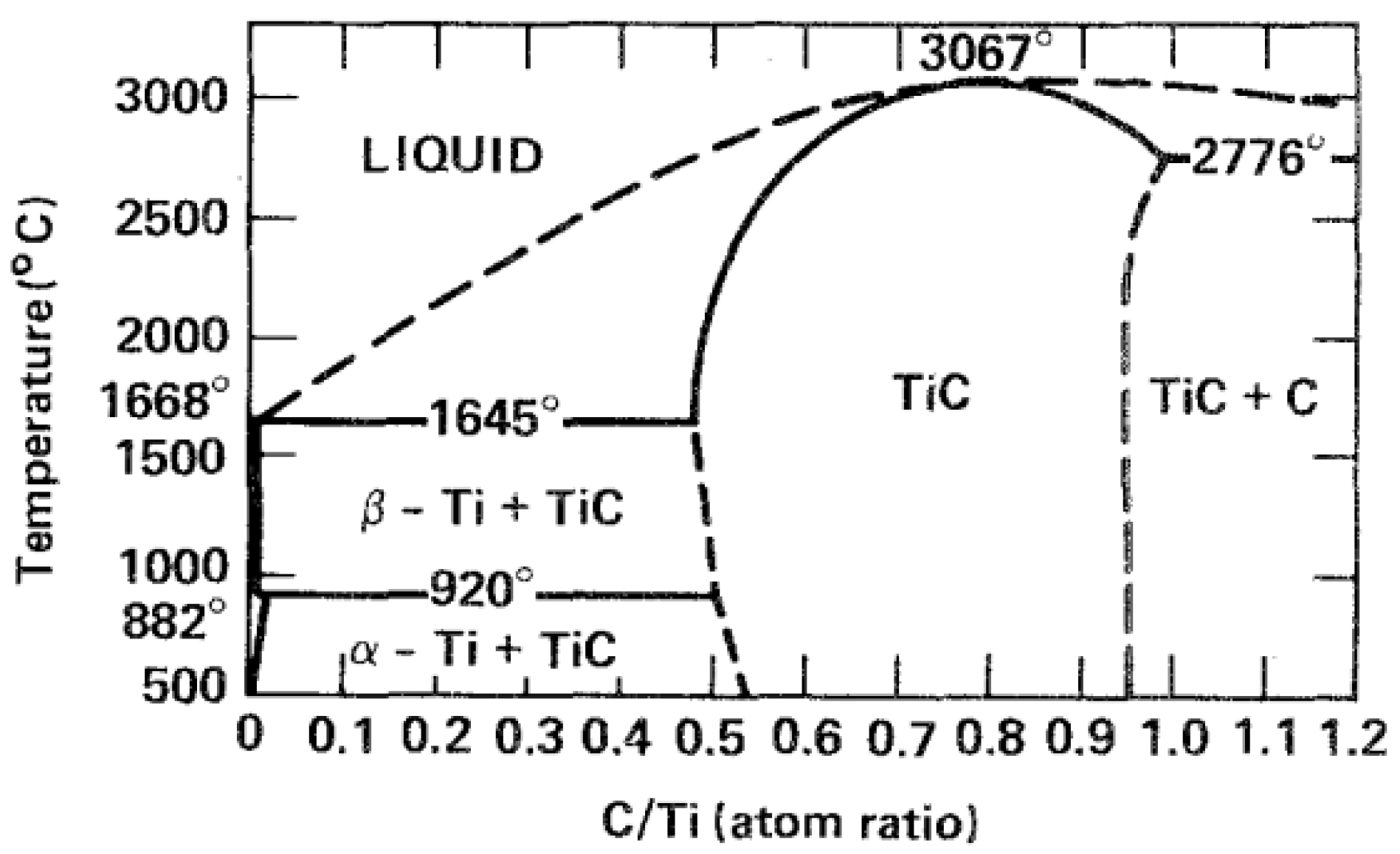
2. Phase Diagrams, Structures, and Properties
3. Processes for TiC Synthesis
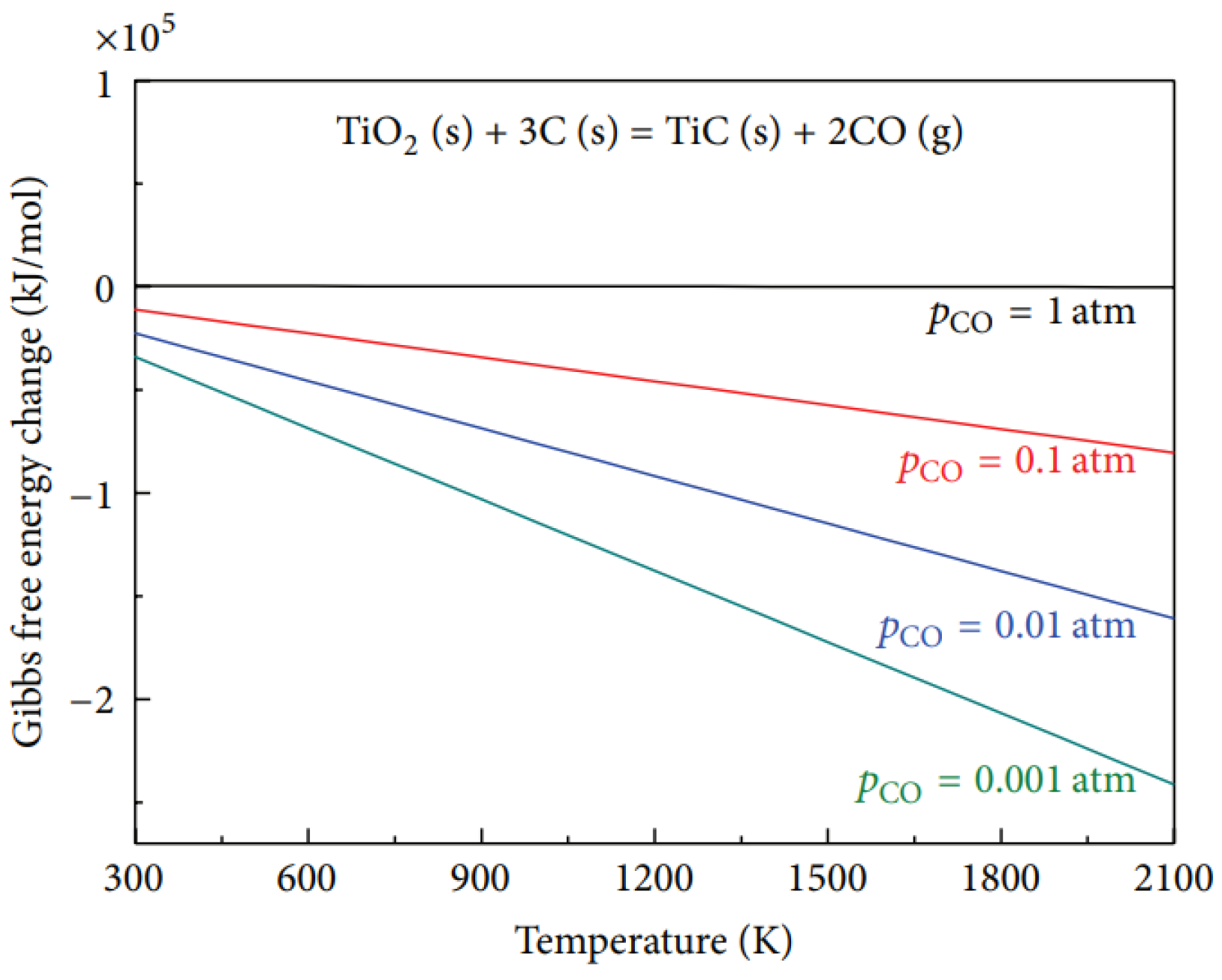
3.1. Carbothermal Reduction
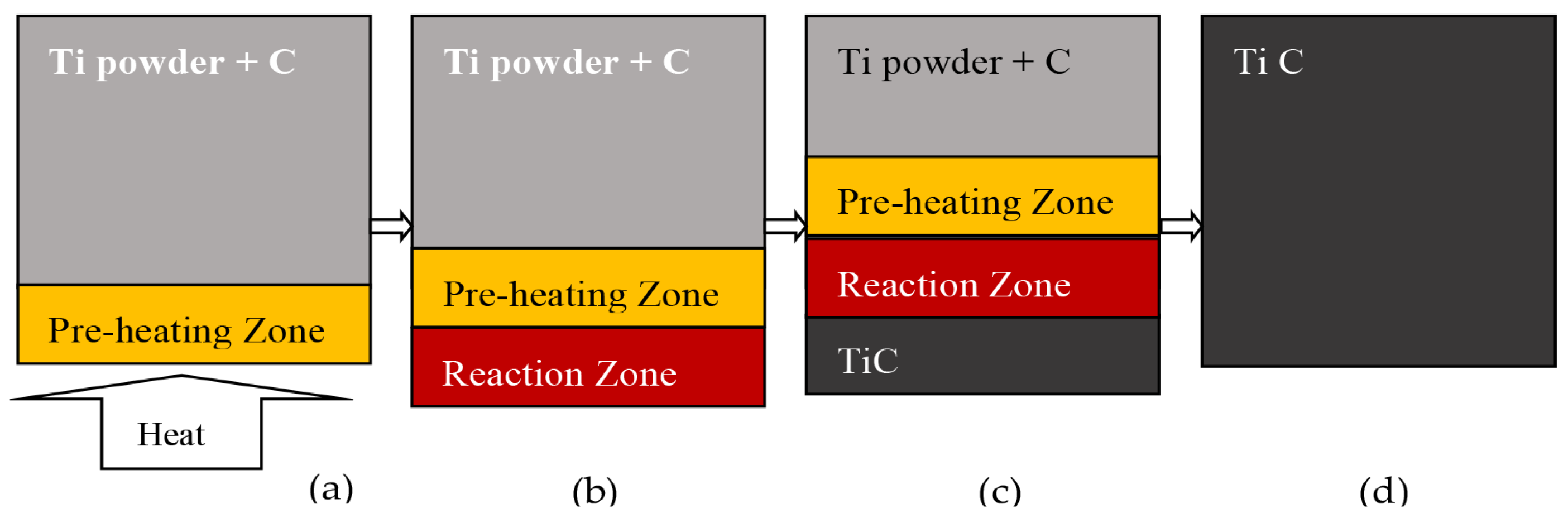
3.2. Combustion Reaction
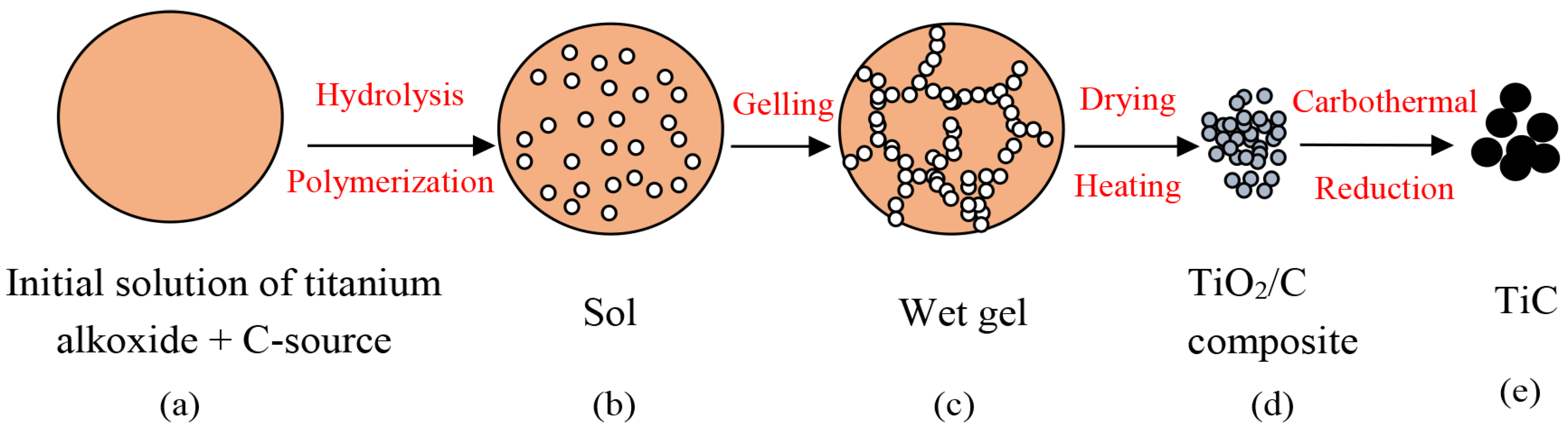
3.3. Sol–Gel Method
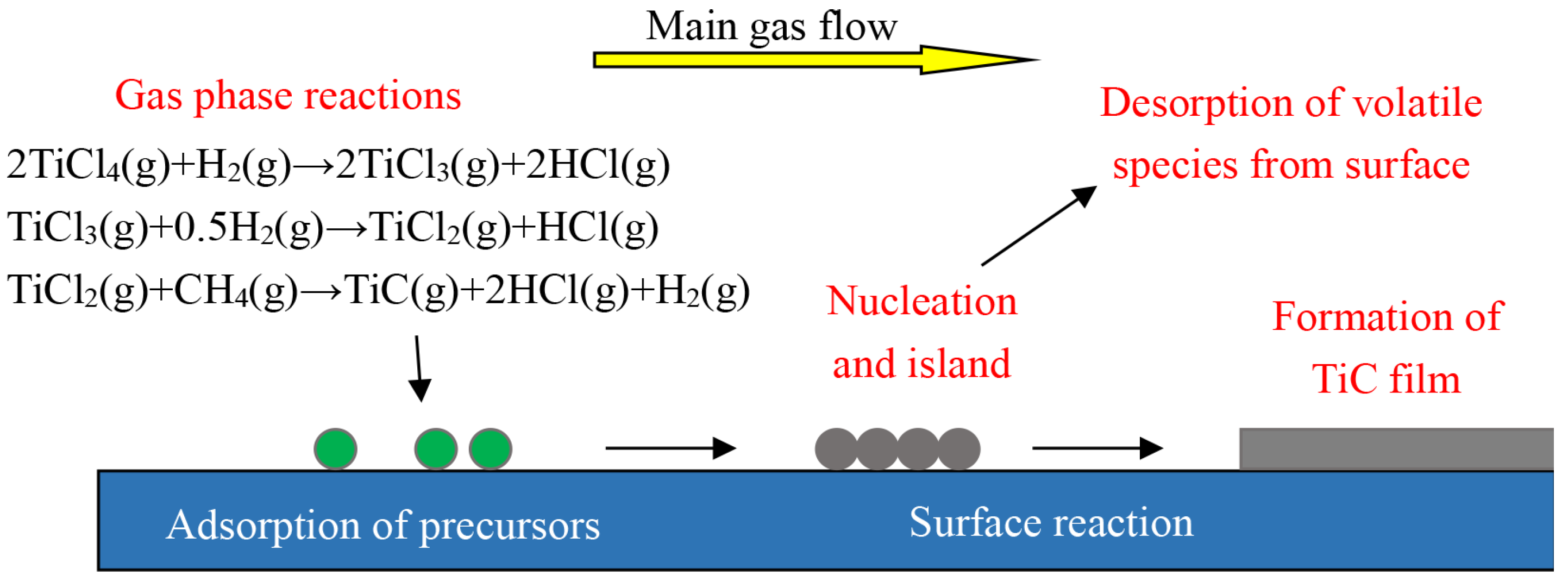
3.4. Gas Phase Reaction
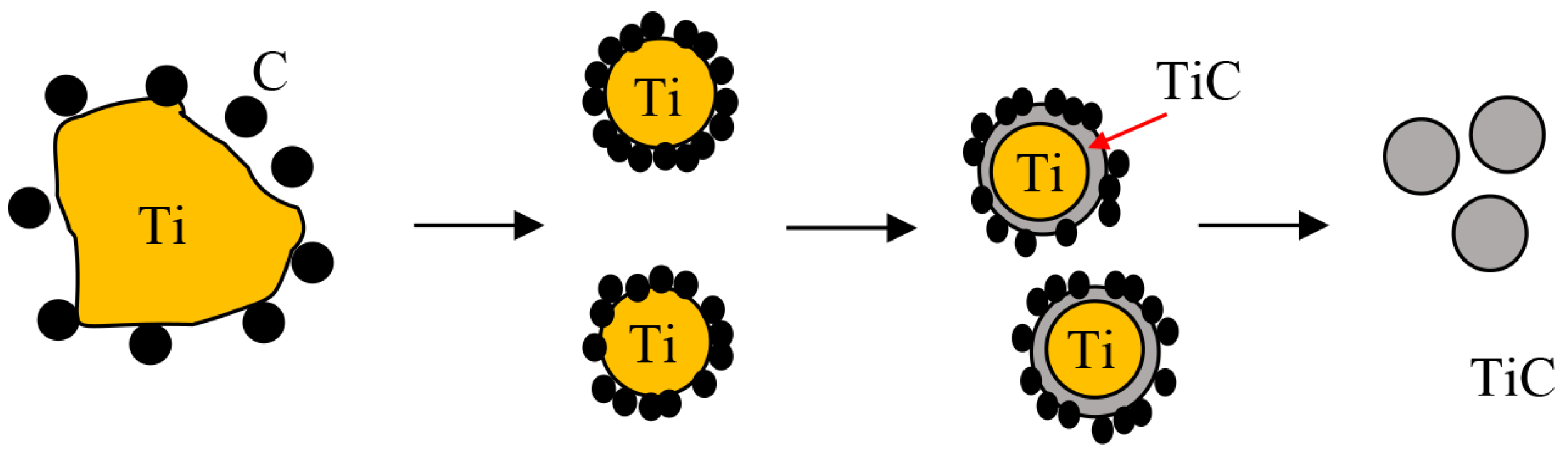
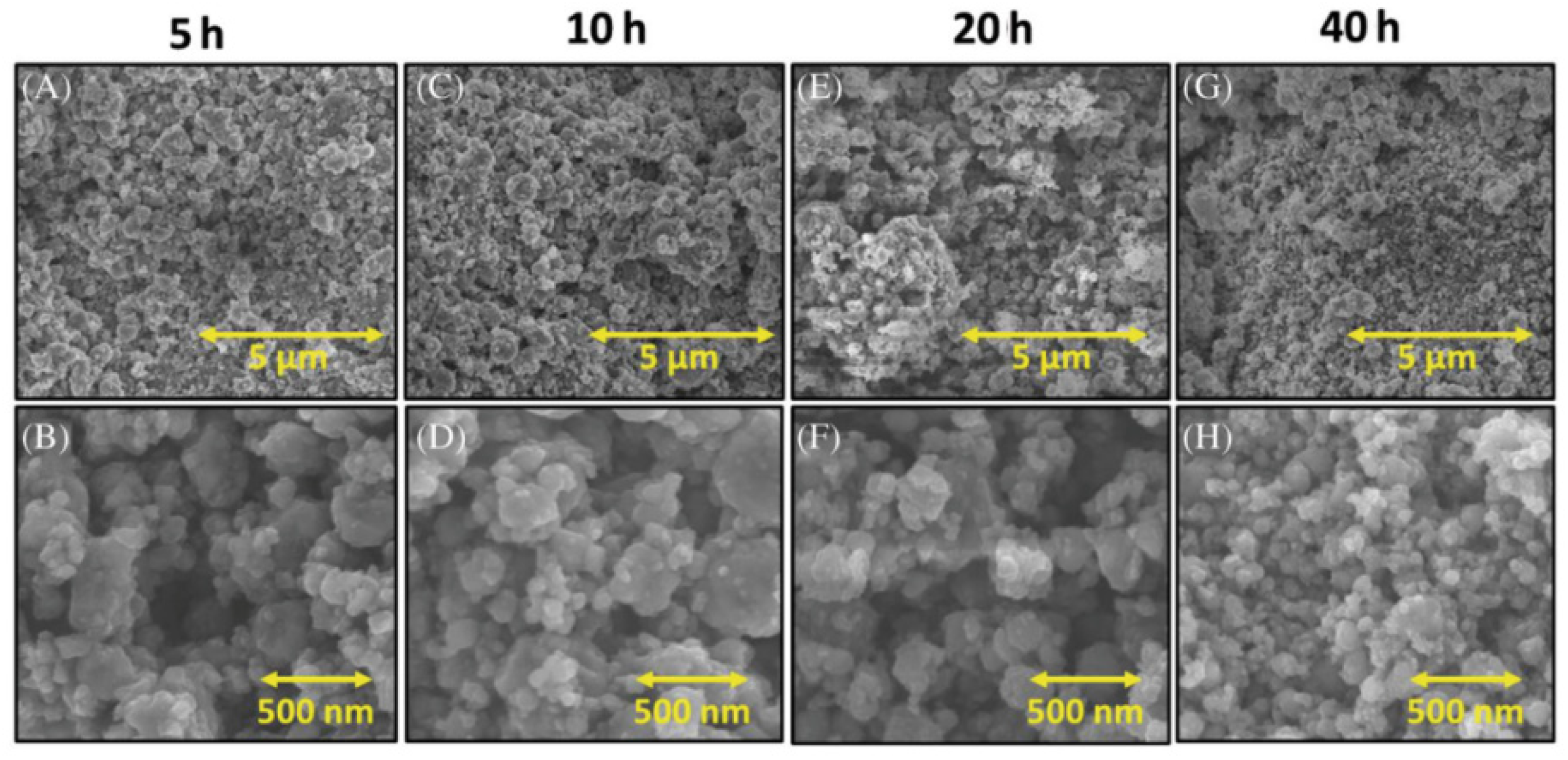
3.5. Mechanical Alloying
3.6. Summary of TiC Synthesis Processes
4. Application of Titanium Carbide
4.1. Cutting Tools and Wear-Resistant Coatings
4.2. Semiconductors and Energy
4.3. TiC-Reinforced Metal Matrix Composites and TiC-Based Metal Ceramics
4.4. Catalyst and Catalysts Supports
5. Conclusions and Future Perspectives
Author Contributions
Funding
Data Availability Statement
Conflicts of Interest
References
- Pierson, H. Handbook of Refractory Carbides and Nitrides: Properties, Characteristics, Processing and Applications, 1st ed.; William Andrew Inc.: Norwich, NY, USA, 1996; pp. 8–16. [Google Scholar]
- Blanchard, C.R.; Page, R.A. Effect of silicon carbide whisker and titanium carbide particulate additions on the friction and wear behavior of silicon nitride. J. Am. Ceram. Soc. 1990, 73, 3442–3452. [Google Scholar] [CrossRef]
- Parashivamurthy, K.I.; Kumar, R.K.; Seetharamu, S.; Chandrasekharaiah, M.N. Review on TiC reinforced steel composites. J. Mater. Sci. 2001, 36, 4519–4530. [Google Scholar] [CrossRef]
- Hu, Z.; Yin, H.; Li, M.; Li, J.; Zhu, H. Research and developments of ceramic-reinforced steel matrix composites—A comprehensive review. Int. J. Adv. Manuf. Technol. 2024, 131, 125–149. [Google Scholar] [CrossRef]
- Karadimas, G.; Salonitis, K. Ceramic matrix composites for aero engine applications—A Review. Appl. Sci. 2023, 13, 3017. [Google Scholar] [CrossRef]
- Rinawa, M.L.; Chauhan, P.; Sharma, A.K.; Singh, H.K.; Sudhakar, M. An investigation on synthesis, aggregation, and mechanical properties of Al 6082 nanocomposites reinforced by Titanium carbide. Mater. Today Proc. 2022, 59, 1526–1532. [Google Scholar] [CrossRef]
- Jose, S.A.; John, M.; Menezes, P.L. Cermet systems: Synthesis, properties, and applications. Ceramics 2022, 5, 210–236. [Google Scholar] [CrossRef]
- Vidal, A.B.; Feria, L.; Evans, J.; Takahashi, Y.; Liu, P.; Nakamura, K.; Illas, F.; Rodriguez, J.A. CO2 activation and methanol synthesis on novel Au/TiC and Cu/TiC catalysts. J. Phys. Chem. Lett. 2012, 3, 2275–2280. [Google Scholar] [CrossRef]
- Rodriguez, J.A.; Evans, J.; Feria, L.; Vidal, A.B.; Liu, P.; Nakamura, K.; Illas, F. CO2 hydrogenation on Au/TiC, Cu/TiC, and Ni/TiC catalysts: Production of CO, methanol, and methane. J. Catal. 2013, 307, 162–169. [Google Scholar] [CrossRef]
- Yue, R.; Xia, M.; Wang, M.; Chen, P.; Gong, W.; Liao, S.; Li, Z.; Gao, F.; Zhang, L.; Wang, J. TiN and TiC as stable and promising supports for oxygen reduction reaction: Theoretical and experimental study. Appl. Surf. Sci. 2019, 495, 143620. [Google Scholar] [CrossRef]
- Sahoo, S.K.; Ye, Y.; Lee, S.; Park, J.; Lee, H.; Lee, J.; Han, J. Rational design of TiC-supported single-atom electrocatalysts for hydrogen evolution and selective oxygen reduction reactions. ACS Energy Lett. 2019, 4, 126–132. [Google Scholar] [CrossRef]
- Kiran, V.; Srinivasu, K.; Sampath, S. Morphology dependent oxygen reduction activity of titanium carbide: Bulk vs. Nanowires. Phys. Chem. Chem. Phys. 2013, 15, 8744. [Google Scholar] [CrossRef]
- Zhong, Y.; Xia, X.; Shi, F.; Zhan, J.; Tu, J.; Fan, H. Transition metal carbides and nitrides in energy storage and conversion. Adv. Sci. 2016, 3, 1500286. [Google Scholar] [CrossRef]
- Yan, Y.; Zhang, S.; Yuan, N.; Jia, X.; Liu, Y. Morphology control and microwave absorbing properties of TiC powders. J. Ceram. 2024, 45, 985–992. [Google Scholar] [CrossRef]
- Wang, Y.; Luo, F.; Zhou, W.; Zhu, D. Dielectric and microwave absorption properties of TiC-Al2O3/silica coatings at high temperature. J. Electron. Mater. 2017, 46, 5225–5231. [Google Scholar] [CrossRef]
- Zhang, T.; Liu, B.; Bao, R.; Gong, S.; Liu, P.; Yuwen, C.; Wu, B. Effect of TiC doping on the microwave absorption performance and phase transitions of metatitanic acid in 915 MHz frequency. J. Mater. Sci.-Mater. Electron. 2023, 34, 356. [Google Scholar] [CrossRef]
- Saba, F.; Sajjadi, S.A.; Haddad-Sabzevar, M.; Zhang, F.M. TiC-modified carbon nanotubes, TiC nanotubes and TiC nanorods: Synthesis and characterization. Ceram. Int. 2018, 44, 7949–7954. [Google Scholar] [CrossRef]
- Geng, R.; Qiu, F.; Jiang, Q.C. Reinforcement in Al Matrix composites: A review of strengthening behavior of nano-sized particles. Adv. Eng. Mater. 2018, 20, 1701089. [Google Scholar] [CrossRef]
- Dong, X.; Qiu, F.; Li, Q.; Shu, S.; Yang, H.; Jiang, Q. The synthesis, structure, morphology characterizations and evolution mechanisms of nanosized titanium carbides and their further applications. Nanomaterials 2019, 9, 1152. [Google Scholar] [CrossRef] [PubMed]
- Duan, C.; Guan, L.; Yujie Zhu, Y.; Zhang, J.; Cheng, K.; Wang, Z.; Zhang, Y.; Huang, Z.; Gao, Q.; Guo, X.; et al. Rapid microwave heating synthesis and microwave coupling mechanism of transition metal high-entropy carbides. Ceram. Int. 2025, 51, 47506–47515. [Google Scholar] [CrossRef]
- Zhang, Y.; Zhang, Z.; Zhang, X.; Wu, K.; Riedel, R.; Hu, D.; Xu, Y.; Wu, L.; Sun, J. Machine learning guided design and ablation behavior of ZrC-TaC-SiC ternary coatings. Corros. Sci. 2026, 260, 113499. [Google Scholar] [CrossRef]
- Xiao, C.; Peng, J.; Jiao, Y.; Shen, Q.; Zhao, Y.; Zhao, F.; Li, H.; Song, Q. Strong and tough multilayer heterogeneous pyrocarbon based composites. Adv. Funct. Mater. 2024, 34, 2409881. [Google Scholar] [CrossRef]
- Mhadhbia, M.; Driss, M. Titanium carbide: Synthesis, properties and applications. J. Brill. Eng. 2021, 2, 1–11. [Google Scholar] [CrossRef]
- Larhlimi, H.; Ghailane, A.; Makha, M.; Alami, J. Magnetron sputtered titanium carbide-based coatings: A review of science and technology. Vacuum 2022, 197, 110853. [Google Scholar] [CrossRef]
- Saha, S.; Rajbongshi, B.M.; Ramani, V.; Verma, A. Titanium carbide: An emerging electrocatalyst for fuel cell and electrolyser. Int. J. Hydrogen Energy 2021, 46, 12801–12821. [Google Scholar] [CrossRef]
- Holt, J.B.; Munir, Z.A. Combustion synthesis of titanium carbide: Theory and experiment. J. Mater. Sci. 1986, 21, 251–259. [Google Scholar] [CrossRef]
- Storms, E.K. The Refractory Carbides; Academic Press: New York, NY, USA, 1967; p. 3. [Google Scholar]
- Hansen, M.; Anderko, K. Constitution of Binary Alloys; McGraw-Hill: New York, NY, USA, 1958; p. 383. [Google Scholar]
- Costa, P.; Conte, R. Properties of the carbides of transition metals. In Compounds of Interest in Nuclear Reactor Technology; Wuber, L., Chiotti, P., Eds.; The Metallurgical Society of AIME: New York, NY, USA, 1964; p. 784. [Google Scholar]
- Pierson, H. Carbides of Group IV: Titanium Zirconium, and Hafnium Carbide, Handbook-of-Refractory-Carbides and Nitrides; William Andrew: Norwich, NY, USA, 1996; pp. 55–80. [Google Scholar]
- Toth, L.E. Transition Metal Carbides and Nitrides; Academic Press: New York, NY, USA, 1971. [Google Scholar]
- Thorne, K.; Ting, S.; Chu, C. Synthesis of TiC via polymeric titanates: The preparation of fibres and thin films. J. Mater. Sci. 1992, 29, 4406–4414. [Google Scholar] [CrossRef]
- Koc, R. Kinetics and phase evolution during carbothermal synthesis of titanium carbide from ultrafine titania/carbon mixture. J. Mater. Sci. 1998, 33, 1049–1055. [Google Scholar] [CrossRef]
- Barin, I. Thermochemical Data of Pure Substances, 3rd ed.; VCH Verlagsgesellschaft mbH-Wiley: Weinheim, Germany, 1995. [Google Scholar]
- Shin, H.; Eun, J. Titanium carbide nanocrystals synthesized from a metatitanic acid-sucrose precursor via a carbothermal reduction. J. Nanomater. 2015, 2015, 469121. [Google Scholar] [CrossRef]
- Lv, H.; Tian, F.; Hu, T. Preparation of titanium carbide by carburisation of titanium dioxide. Processes 2024, 12, 102. [Google Scholar] [CrossRef]
- Sen, W.; Xu, B.; Yang, B.; Sun, H.; Song, J.; Wan, H.; Dai, Y. Preparation of TiC powders by carbothermal reduction method in vacuum. Trans. Nonferrous Met. Soc. China 2022, 21, 185–190. [Google Scholar] [CrossRef]
- Flach, J.; Figueiredo de Lima, P.; Sparks, J.; Islam, M.; Martinez-Duarte, R. Synthesis of titanium oxycarbide through carbothermal reduction of titanium dioxide nanoparticles and renewable biopolymers. ECS Trans. 2016, 72, 17–23. [Google Scholar] [CrossRef]
- Sun, H.; Yang, H.; Xu, B.; Ma, W.; Liu, D.; Dai, Y. Preparation of titanium carbide powders by carbothermal reduction of titania/charcoal at vacuum condition. Int. J. Refract. Met. Hard Mater. 2010, 28, 628–632. [Google Scholar] [CrossRef]
- Maitre, A.; Tetard, D.; Lefort, P. Role of some technological parameters during carburizing titanium dioxide. J. Eur. Ceram. Soc. 2000, 20, 15–22. [Google Scholar] [CrossRef]
- Koc, R.; Folmer, J.S. Carbothermal synthesis of titanium carbide using ultrafine titania powders. J. Mater. Sci. 1997, 32, 3101–3111. [Google Scholar] [CrossRef]
- Woo, Y.; Kang, H.; Kim, D. Formation of TiC particle during carbothermal reduction of TiO2. J. Eur. Ceram. Soc. 2007, 27, 719–722. [Google Scholar] [CrossRef]
- Bae, S.; Shin, H.; Jung, H.; Hong, K. Synthesis of titanium carbide nanoparticles with a high specific surface area from a TiO2 core-sucrose shell precursor. J. Am. Ceram. Soc. 2009, 92, 2512–2516. [Google Scholar] [CrossRef]
- Sarkar, D.; Chu, M.; Cho, S.; Kim, Y.; Basu, B. Synthesis and morphological analysis of titanium carbide nanopowder. J. Am. Ceram. Soc. 2009, 92, 2877–2882. [Google Scholar] [CrossRef]
- Wang, H.; Zhu, W.; Liu, Y.; Zeng, L.; Sun, L. The Microwave-assisted green synthesis of TiC powders. Materials 2016, 9, 904. [Google Scholar] [CrossRef]
- Binner, J.; Hassine, N.; Cross, T. The possible role of the pre-exponential factor in explaining the increased reaction rates observed during the microwave synthesis of titanium carbide. J. Mater. Sci. 1995, 30, 5389–5393. [Google Scholar] [CrossRef]
- Liu, P.; Yang, Q.; Shui, A.; Wang, H.; Cheng, X.S.; Zeng, L.K.; Liu, Y. Microwave synthesis of nano-titanium carbide. Adv. Mater. Res. 2011, 399–401, 561–564. [Google Scholar] [CrossRef]
- Munir, Z.A.; Anseimi-Tamburini, U. Self-propagating exothermic reactions: The synthesis of high-temperature materials by combustion. Mater. Sci. Rep. 1989, 3, 277–365. [Google Scholar] [CrossRef]
- Kobashi, M.; Ichioka, D.; Kanetake, N. Combustion synthesis of porous TiC/Ti composite by a self-propagating mode. Materials 2010, 3, 3939–3947. [Google Scholar] [CrossRef]
- Liang, Y.; Han, Z.; Li, X.; Zhang, Z.; Ren, L. Study on the reaction mechanism of self-propagating high-temperature synthesis of TiC in the Cu-Ti-C system. Mater. Chem. Phys. 2012, 137, 200–206. [Google Scholar] [CrossRef]
- Zhang, M.; Hu, Q.; Huo, Y.; Huang, B.; Li, J. Formation and growth mechanism of TiC terraces during self-propagating high-temperature synthesis from a FeTiC system. J. Cryst. Growth 2012, 355, 140–144. [Google Scholar] [CrossRef]
- Lee, W.; Chung, S. Ignition Phenomena and reaction mechanisms of the self-propagating high-temperature synthesis reaction in the titanium-carbon-aluminum system. J. Am. Ceram. Soc. 1997, 80, 53–61. [Google Scholar] [CrossRef]
- Benoit, C.; Ellen, H.; Nikhil, K.; Dominique, V.; Sylvain, D. TiC nucleation/growth processes during SHS reactions. Powder Technol. 2005, 157, 92–99. [Google Scholar] [CrossRef]
- Mullins, M.; Riley, E. The effect of carbon morphology on the combustion synthesis of titanium carbide. J. Mater. Res. 1989, 4, 408–411. [Google Scholar] [CrossRef]
- Nersisyan, H.; Lee, J.H.; Won, C.W. Self-propagating high-temperature synthesis of nano-sized titanium carbide powder. J. Mater. Res. 2002, 17, 2859–2864. [Google Scholar] [CrossRef]
- Niyomwas, S. Synthesis of titanium carbide from wood by self-propagating high temperature synthesis. Songklanakarin J. Sci. Technol. 2010, 32, 175–179. [Google Scholar]
- Camacho-Rios, M.; Herrera-Pérez, G.; RuizEsparza-Rodriguez, M.; Pérez-Bustamante, R.; Betancourt-Cantera, J.A.; Carreño-Gallardo, C.; Lardizabal-Gutierrez, D. Synthesis of titanium carbide nanoparticles by magnesiotermic method. Microsc. Microanal. 2024, 30, 1306–1307. [Google Scholar] [CrossRef]
- Akutagawa, D.; Sato, T.; Tokunaga, T.; Kobayashi, K.; Yamamoto, T. Rapid titanium carbide synthesis from titanium and graphite powders via ultrafast high-temperature sintering. Mater. Lett. 2025, 398, 138890. [Google Scholar] [CrossRef]
- Chen, X.; Fan, J.; Lu, Q. Synthesis and characterization of TiC nanopowders via sol-gel and subsequent carbothermal reduction process. J. Solid State Chem. 2018, 262, 44–52. [Google Scholar] [CrossRef]
- Zhong, J.; Liang, S.; Zhao, J.; Wu, D.; Liu, W.; Wang, H.; Chen, D.; Cheng, Y. Formation of novel mesoporous TiC microspheres through a sol-gel and carbothermal reduction process. J. Eur. Ceram. Soc. 2012, 32, 3407–3414. [Google Scholar] [CrossRef]
- Preiss, H.; Berger, L.; Schultze, D. Studies on the carbothermal preparation of titanium carbide from different gel precursors. J. Eur. Ceram. Soc. 1999, 19, 195–206. [Google Scholar] [CrossRef]
- Jiang, Z.; Rhine, W. Preparation of titanium nitride (TiN) and titanium carbide (TiC) from a polymeric precursor. Chem. Mater. 1991, 3, 1132–1137. [Google Scholar] [CrossRef]
- Hosseinzadeh, F.; Sarpoolaki, H.; Hashemi, H. Precursor selection for sol-gel synthesis of titanium carbide nanopowders by a new intuitionistic fuzzy multi-attribute group decision-making model. Int. J. Appl. Ceram. Technol. 2014, 11, 681–698. [Google Scholar] [CrossRef]
- Dutremez, S.; Gerbier, P.; Guerin, C.; Henner, B.; Merle, P. Metal alkoxide/hexa-2,4-diyne-1,6-diol hybrid polymers: Synthesis and use as precursors to metal carbides and nitrides. Adv. Mater. 1998, 10, 465–470. [Google Scholar] [CrossRef]
- Zālīte, I.; Letlena, A. Synthesis and characterization of nanosized titanium carbide by carbothermal reduction of precursor gels. Mater. Sci. (Medžiagotyra) 2012, 18, 75–78. [Google Scholar] [CrossRef]
- Song, M.; Yang, Y.; Xiang, M.; Zhu, Q.; Zhao, H. Synthesis of nano-sized TiC powders by designing chemical vapor deposition system in a fluidized bed reactor. Powder Technol. 2021, 380, 256–264. [Google Scholar] [CrossRef]
- Lee, M.; Richman, H. Chemical vapor deposition of a TiC coating on a cemented-carbide cutting tool. J. Electrochem. Soc. 1973, 120, 993. [Google Scholar] [CrossRef]
- Haubner, R.; Lessiak, M.; Pitonak, R.; Köpf, A.; Weissenbacher, R. Evolution of conventional hard coatings for its use on cutting tools. Int. J. Refract. Met. Hard Mater. 2017, 62, 210–218. [Google Scholar] [CrossRef]
- Liu, Y.; Yu, S.; Shi, Q.; Ge, X.; Wang, W. Multilayer coatings for tribology: A mini review. Nanomaterials 2022, 12, 1388. [Google Scholar] [CrossRef]
- Azadi, M.; Rouhaghdam, A.; Ahangarani, S. Mechanical behavior of TiN/TiC-n multilayer coatings and Ti(C,N) multicomponent coatings produced by PACVD. Strength Mater. 2016, 48, 279–289. [Google Scholar] [CrossRef]
- Łach, U.; Svyetlichnyy, D. Recent progress in heat and mass transfer modeling for chemical vapor deposition processes. Energies 2024, 17, 3267. [Google Scholar] [CrossRef]
- Sousa, V.; Silva, F. Recent advances on coated milling tool technology—A Comprehensive Review. Coatings 2020, 10, 235. [Google Scholar] [CrossRef]
- Jin, N.; Yang, Y.; Luo, X.; Xia, Z. Development of CVD Ti-containing films. Prog. Mater. Sci. 2013, 58, 1490–1533. [Google Scholar] [CrossRef]
- Bisch, C.; Nadal, M.; Teyssandier, F.; Bancel, M.; Vallon, B. Chemical vapour deposition of titanium carbide on WC-Co cemented carbides. Mater. Sci. Eng. A 1995, 202, 238–248. [Google Scholar] [CrossRef]
- Alexandrescu, R.; Borsella, E.; Botti, S.; Cesile, M.C.; Martelli, S.; Giorgi, R.; Turtu, S.; Zappa, G. Synthesis of TiC and SiC/TiC nanocrystalline powders by gas-phase laser-induced reaction. J. Mater. Sci. 1997, 32, 5629–5635. [Google Scholar] [CrossRef]
- De Persis, F.; Teyssandier, A.; McDaniel, M.; Allendorf, M. The Influence of carbon precursors on the gas-phase chemistry of titanium carbide CVD. Chem. Vap. Depos. 2002, 8, 63–73. [Google Scholar] [CrossRef]
- Fronk, K.T.; Cook, C.A.; Thompson, G.B. Laser chemical vapor deposition of TiC fibers and tubes. J. Eur. Ceram. Soc. 2024, 44, 7474–7481. [Google Scholar] [CrossRef]
- Kim, D.; Cho, Y.; Lee, M.; Hong, J.; Kim, Y.; Lee, K. Properties of TiN–TiC multilayer coatings using plasma-assisted chemical vapor deposition. Surf. Coat. Technol. 1999, 116–119, 906–910. [Google Scholar] [CrossRef]
- Noel, M.; Kovar, D. Laser chemical vapor deposition of TiC on tantalum. J. Mater. Sci. 2002, 37, 689–697. [Google Scholar] [CrossRef]
- Lee, D.; Alexandrovskii, S.; Kim, B. Mg-thermal reduction of TiCl4+CCl4 solution for producing ultrafine titanium carbide. Mater. Chem. Phys. 2004, 88, 23–26. [Google Scholar] [CrossRef]
- Grove, D.; Gupta, U.; Castleman, A., Jr. Effect of carbon concentration on changing the morphology of titanium carbide nanoparticles from cubic to cuboctahedron. ACS Nano 2010, 4, 49–54. [Google Scholar] [CrossRef]
- Benjamin, J.; Volin, T. The Mechanism of mechanical alloying. Metall. Trans. 1974, 5, 1929–1934. [Google Scholar] [CrossRef]
- Jia, H.; Zhang, Z.; Qi, Z.; Liu, G.; Bian, X. Formation of nanocrystalline TiC from titanium and different carbon sources by mechanical alloying. J. Alloys Compd. 2009, 472, 97–103. [Google Scholar] [CrossRef]
- Xing, T.; Rafal, G.; Chen, J. Synthesis of nanostructured titanium carbide (TiC) from bitumen coke by mechanical alloying process. Can. J. Chem. Eng. 2024, 102, 2443–2454. [Google Scholar] [CrossRef]
- Liu, Z.; Guo, J.; Ye, L.; Li, G.; Hu, Z. Formation mechanism of TiC by mechanical alloying. Appl. Phys. Lett. 1994, 65, 2666–2669. [Google Scholar] [CrossRef]
- Zhu, X.; Zhao, K.; Cheng, B.; Lin, Q.; Zhang, X.; Chen, T.; Su, Y. Synthesis of nanocrystalline TiC powder by mechanical alloying. Mater. Sci. Eng. C 2001, 16, 103–105. [Google Scholar] [CrossRef]
- Yuan, Q.; Zheng, Y.; Yu, H. Mechanism of synthesizing nanocrystalline TiC in different milling atmospheres. Int. J. Refract. Met. Hard Mater. 2009, 27, 696–700. [Google Scholar] [CrossRef]
- Ye, L.; Quan, M. Synthesis of nanocrystalline TiC powders by mechanical alloying. Nanostructured Mater. 1995, 5, 25–31. [Google Scholar] [CrossRef]
- Hong, S.; Park, J.; Park, E.; Kim, K.Y.; Lee, J.G.; Lee, M.K.; Rhee, C.K.; Lee, J.K. Fabrication of titanium carbide nano-powders by a very high speed planetary ball milling with a help of process control agents. Powder Technol. 2015, 274, 393–401. [Google Scholar] [CrossRef]
- Razavi, M.; Zamani, S.; Rahimipour, M.; Khatibzadeh, P. Pyromilling synthesis of nanocrystalline titanium carbide. Nano 2013, 8, 1350023. [Google Scholar] [CrossRef]
- Yang, C. Fast and efficient approach to synthesis of ultra-fine TiC powder. Mater. Res. Express 2019, 7, 016508. [Google Scholar] [CrossRef]
- Li, B.; Cui, L.; Zheng, Y.; Xu, C. Synthesis of TiC powder by mechanical alloying of titanium and asphalt. Chin. J. Chem. Eng. 2007, 15, 138–140. [Google Scholar] [CrossRef]
- Camacho-Ríos, M.; Herrera-Pérez, G.; Esparza-Rodríguez, M.; Pérez-Bustamante, R.; García-Herrera, J.E.; Betancourt-Cantera, J.A.; Lardizábal-Gutiérrez, D. Optimization of in-situ formation of a titanium carbide nanohybrid via mechanical alloying using stearic acid and carbon nanotubes as carbon sources. J. Compos. Sci. 2023, 7, 502. [Google Scholar] [CrossRef]
- Grzesik, W. Chapter Four-Cutting Tool Materials, Advanced Machining Processes of Metallic Materials, 2nd ed.; Elsevier: Amsterdam, The Netherlands, 2017; pp. 35–63. [Google Scholar]
- Rech, J. Influence of cutting tool coatings on the tribological phenomena at the tool-chip interface in orthogonal dry turning. Surf. Coat. Technol. 2006, 200, 5132–5139. [Google Scholar] [CrossRef]
- Raman, K.; Kiran, M.; Ramamurty, U.; Rao, G. Structure and mechanical properties of TiC films deposited using combination of pulsed DC and normal DC magnetron co-sputtering. Appl. Surf. Sci. 2012, 258, 8629–8635. [Google Scholar] [CrossRef]
- Dou, Z.; Zhang, F.; Guo, Y.; Chen, B. TiC nano-coating and their tribological properties were deposited by doal-ion beam sputtering on the tool surface. J. Phys. Conf. Ser. 2021, 1748, 062029. [Google Scholar] [CrossRef]
- Liu, Y.; Ding, Y.; Yang, L.; Sun, R.; Zhang, T.; Yang, X. Research and progress of laser cladding on engineering alloys: A review. J. Manuf. Process. 2021, 66, 341–363. [Google Scholar] [CrossRef]
- Kavishwar, S.; Bhaiswar, V.; Kochhar, S.; Fande, A.; Tandon, V. State-of-the-Art titanium carbide hard coatings: A comprehensive review of mechanical and tribological behaviour. Eng. Res. Express 2024, 6, 042401. [Google Scholar] [CrossRef]
- Wang, S.; Tsai, H.; Sun, H. Characterization of sputtered titanium carbide film as diffusion barrier for copper metallization. J. Electrochem. Soc. 2001, 148, C563. [Google Scholar] [CrossRef][Green Version]
- Appelbaum, A.; Murarka, S. TiC as a diffusion barrier between Al and CoSi2. J. Vac. Sci. Technol. 1986, 4, 637–640. [Google Scholar] [CrossRef]
- Sufyan, A.; Abbas, G.; Sajjad, M.; Larsson, A. Monolayer TiC-A high-performance Dirac anode with ultra low diffusion barriers and high energy densities for Li-ion and Na-ion batteries. Appl. Surf. Sci. 2024, 642, 158564. [Google Scholar] [CrossRef]
- Ghimire, P.; Schweiss, R.; Scherer, G.; Wai, N.; Lim, T.; Bhattarai, A.; Nguyen, T.; Yan, Q. Titanium carbide-decorated graphite felt as high performance negative electrode in vanadium redox flow batteries. J. Mater. Chem. A 2018, 6, 6625–6632. [Google Scholar] [CrossRef]
- Pan, G.; Cao, F.; Zhang, Y. Synthesis of titanium carbide/carbon composites for supercapacitor application. Mater. Res. Bull. 2021, 137, 111172. [Google Scholar] [CrossRef]
- Zhou, J.; Su, J.; Wen, L.; Zhao, L.; Mo, M.; Diao, H.; Wang, W.; Liu, X.; Wang, G. Preparation of titanium carbide thin films and their application to silicon heterojunction solar cells. Mater. Sci. Semicond. Process. 2025, 200, 110014. [Google Scholar] [CrossRef]
- He, L.; Guan, K.; Sun, B.; Huang, Z.; Wei, D.; Yin, H.; Xu, Y.; Ding, Y. Optimizing electron transport in crystalline silicon solar cells with oxygen-doped titanium carbide layer. Silicon 2025, 17, 4341–4348. [Google Scholar] [CrossRef]
- Khan, K.; Tareen, A.; Iqbal, M.; Hussain, I.; Mahmood, A.; Khan, U.; Khan, M.; Zhang, H.; Xie, Z. Recent advances in MXenes: A future of nanotechnologies. J. Mater. Chem. A 2023, 11, 19764–19811. [Google Scholar] [CrossRef]
- Srivastava, A.K.; Das, K. Microstructural and mechanical characterization of in situ TiC and (Ti, W) C-reinforced high manganese austenitic steel matrix composites. Mater. Sci. Eng. A 2009, 516, 1–6. [Google Scholar] [CrossRef]
- Sun, J.; Cao, Z.; Zhao, L.; Li, X.; Meng, L.; Du, Q.; Zhao, J. Developing high performance in titanium carbide nanocomposites containing hybrid SiC nanowire and CNT. J. Eur. Ceram. Soc. 2023, 43, 5466–5473. [Google Scholar] [CrossRef]
- Markovsky, P.; Savvakin, D.; Stasyuk, O.; Mecklenburg, M.; Pozuelo, M.; Roberts, C.; Ellison, V.; Prikhodko, S.V. Significant hardening effect of high-temperature aging of alloy Ti-6Al-4V composite reinforced with TiC. Mater. Des. 2023, 234, 112208. [Google Scholar] [CrossRef]
- Siva, R.; Vimalson, K.A.; Yogeshkumar, P.; Joy, N.; Sangeetha, M. Study on optimization of spur gear performance with titanium carbide incorporated aluminium matrix composite. Mater. Today Proc. 2021, 44, 3686–3691. [Google Scholar] [CrossRef]
- He, T.; Zhao, S.; Lu, D.; Jiang, Y.; Zhou, M. Abrasive wear performance of spherical hierarchical structured TiC/high-manganese steel composites. Materials 2025, 18, 130. [Google Scholar] [CrossRef]
- Gautam, A.; Kumar, K.; Singh, S.; Singh, A.; Pandey, R.; Dahiya, A.; Sharma, S.; Mohan, S.; Mohan, A. Enhancing the performance of copper composite by titanium carbide. In Recent Advances in Functional Materials, Volume 1. RAFM 2024; Springer Proceedings in Materials; Kumar, M., Singh, A.K., Sharma, S., Kumar, D., Eds.; Springer: Singapore, 2025; Volume 68. [Google Scholar] [CrossRef]
- Li, Y.; Bai, P.; Wang, Y.; Hu, J.; Guo, Z. Effect of TiC content on Ni/TiC composites by direct laser fabrication. Mater. Des. 2009, 30, 1409–1412. [Google Scholar] [CrossRef]
- Pirso, J.; Viljus, M.; Letunovits, S. Sliding wear of TiC–NiMo cermets. Tribol. Int. 2004, 37, 817–824. [Google Scholar] [CrossRef]
- Kübarsepp, J.; Klaasen, H.; Pirso, J. Behavior of TiC-based cermets in different wear conditions. Wear 2001, 249, 229–234. [Google Scholar] [CrossRef]
- Hussainova, I. Effect of microstructure on the erosive wear of titanium carbide-based cermets. Wear 2003, 255, 121–128. [Google Scholar] [CrossRef]
- Rajabi, A.; Ghazali, M.J.; Syarif, J.; Daud, A.R. Development and application of tool wear: A review of the characterization of TiC-based cermets with different binders. Chem. Eng. J. 2014, 255, 445–452. [Google Scholar] [CrossRef]
- Chen, M.; Zhang, X.; Xiao, X.; Zhao, H. Effect of Co and Ni contents on the sintering behavior, microstructure evolution, and mechanical properties of (Ti,M)C-based cermets. JOM 2021, 73, 3403–3410. [Google Scholar] [CrossRef]
- Vallauri, D.; Atías Adrián, I.; Chrysanthou, A. TiC-TiB2 composites: A review of phase relationships, processing and properties. J. Eur. Ceram. Soc. 2008, 28, 1697–1713. [Google Scholar] [CrossRef]
- Chen, J.; Li, W.; Jiang, W. Characterization of sintered TiC–SiC composites. Ceram. Int. 2009, 35, 3125–3129. [Google Scholar] [CrossRef]
- Back, S.; Jung, Y. TiC- and TiN-supported single-atom catalysts for dramatic improvements in CO2 electrochemical reduction to CH4. ACS Energy Lett. 2017, 2, 969–975. [Google Scholar] [CrossRef]
- Huang, T.; Fang, H.; Mao, S.; Yu, J.; Qi, L. In-situ synthesized TiC@CNT as high-performance catalysts for oxygen reduction reaction. Carbon 2018, 126, 566–573. [Google Scholar] [CrossRef]
- Rodriguez, J.A.; Ramírez, P.J.; Gutierrez, R.A. Highly active Pt/MoC and Pt/TiC catalysts for the low-temperature water-gas shift reaction: Effects of the carbide metal/carbon ratio on the catalyst performance. Catal. Today 2017, 289, 47–52. [Google Scholar] [CrossRef]
- Wang, Y.; Zhang, X.; Cheng, C.; Yang, Z. TiC supported single-atom platinum catalyst for CO Oxidation: A density functional theory study. Appl. Surf. Sci. 2018, 453, 159–165. [Google Scholar] [CrossRef]
- Regmi, Y.N.; Waetzig, G.R.; Duffee, K.D.; Schmuecker, S.M.; Thode, J.M.; Leonard, B.M. Carbides of group IVA, VA and VIA transition metals as alternative HER and ORR catalysts and support materials. J. Mater. Chem. A 2015, 3, 10085–10091. [Google Scholar] [CrossRef]
- Kumar, A.; Dixit, A. Synthesis and Characterization of Carbides for Fuel Cells. In Proceedings of the 1st International Conference on Materials and Thermophysical Properties, ICMTP 2024; Springer Proceedings in Physics; Kumari, S., Singh, A., Tripathi, B., Baboo, M., Eds.; Springer: Singapore, 2025; Volume 311. [Google Scholar] [CrossRef]
- Dehghanian, M.; Mahdavi, M.; Gheshlaghi, R.; Darband, G.; Absalan, Y. Synthesis of TiC@C–TiO2 as an emerging efficient nanostructure for anode modification in high-power microbial fuel cells. Int. J. Hydrogen Energy 2025, 116, 591–600. [Google Scholar] [CrossRef]
- Zheng, C.; Sun, X.; Qin, Y.; Guo, Y.; Yan, J.; Tong, X. Titanium carbide/carbon-supported platinum nanoparticles boost oxygen reduction reaction for fuel cells. J. Electron. Mater. 2023, 52, 342–350. [Google Scholar] [CrossRef]
- Chiwata, M.; Kakinuma, K.; Wakisaka, M.; Uchida, M.; Deki, S.; Watanabe, M.; Uchida, H. Oxygen reduction reaction activity and durability of Pt catalysts supported on titanium carbide. Catalysts 2015, 5, 966–980. [Google Scholar] [CrossRef]
- Blanco-Redondo, L.; Lobko, Y.; Darabut, A.; Nováková, J.; Dinhová, T.; Vorokhta, M.; Rodríguez, M.; Dopita, M.; Michal Mazur, M.; Hraníček, J.; et al. Effect of titanium-based supports on the electrochemical activity and stability of iridium nanoparticle catalysts for OER in PEM water electrolyzer. Renew. Energy 2026, 256, 124295. [Google Scholar] [CrossRef]



| Physical Properties | Values |
|---|---|
| Melting Point | 3067 °C (does not decompose) |
| Specific Heat (Cp) | 33.8 J/mole·K |
| Heat of Formation, ΔH, at 298 K | −184.6 (kJ/g-atom metal) |
| Thermal Conductivity (20 °C) | 21 W/m·K |
| Thermal Expansion (20 °C) | 7.4 × 10⁻⁶/°C |
| Electrical Resistivity | 50 ± 10 μΩ·cm |
| Vickers Hardness | 28–35 GPa |
| Modulus of Elasticity | 410–510 GPa |
| Shear Modulus | 186 GPa |
| Bulk Modulus | 240–390 GPa |
| Poisson’s Ratio | 0.191 |
| Transverse Rupture Strength | 240–390 MPa |
| Coefficient of Friction | 0.25 (on tool steel, 50% humidity) |
| Oxidation Resistance | Oxidizes slowly in air at 800 °C |
| Chemical Resistance | Resistant to most acids. Attacked by HNO3, and HF. Attacked by the halogens. Can be heated in hydrogen to its melting point without decomposition. |
| Method | Precursor/Processes | Process Temperature | Process Time | Scale | Characteristics of TiC Synthesized |
|---|---|---|---|---|---|
| Carbothermal reduction | TiO2 reduced by carbon at high temperature | 1700–2300 °C | Hours | Industrial | Micrometer-sized particles, or nanoparticles if synthesized by using microwave heating |
| Combustion reaction | Reaction between titanium metal and carbon through self-propagating high-temperature synthesis | 1727 to 3727 °C | Often within seconds | Limited | Porous materials or nanoparticles |
| Sol–gel method | Titanium alkoxides and organic carbon sources as precursors, the formation of TiC via sol–gel process followed by carbothermal reduction | 800–1350 °C | Hours | Scalable | Nanoparticles |
| Gas phase reaction | TiCl4 and CH4 (or CH2CH2) react in a CVD reactor | 900–1200 °C | Depending on the thickness | Laboratory to industrial | Thin films or nanoparticles |
| Mechanical alloying | Milling Ti and C to reduce the particles sizes and induce reaction to form TiC | Ambient | Hours | Scalable | Nano or micrometer sized particles |
| Functions | TiC Materials | Examples | Ref. |
|---|---|---|---|
| Diffusion barriers | Sputtered, or in situ formed TiC layer |
| [100,101] |
| Electrode and Contact Materials | TiC layer formed by CVD, carbothermal reaction of TiO2 on the surface |
| [102,103,104] |
| Electron Transport Layers (ETL) | Fabricated via electron beam evaporation, or radio frequency magnetron sputtering |
| [105,106] |
| TiC as starting material for MXene synthesis | MXenes from TiC-created Ti3AlC2 |
| [107] |
| Materials | TiC in Composite Materials | Use of TiC Composite Materials | Ref. |
|---|---|---|---|
| Metal Matrix Composites | TiC particles are added to metals (aluminum, steel, titanium, copper) |
| [6,110,111,112] |
| Cermets (Ceramic–Metal Composites) | TiC is a major component in cermets. Numerous elements (Fe, Cr, Co, Ni, Mo, and (Ni-Mo)) can be used as a binder for TiC-based cermets. |
| [116,117,118,119] |
| Ceramic Matrix Composites | TiC are combined into ceramics (TiC–TiB2, TiC-SiC composites) |
| [120,121] |
| Other reinforced TiC composite | Titanium carbide nano composites containing hybrid SiC nanowire and CNT |
| [109] |
Disclaimer/Publisher’s Note: The statements, opinions and data contained in all publications are solely those of the individual author(s) and contributor(s) and not of MDPI and/or the editor(s). MDPI and/or the editor(s) disclaim responsibility for any injury to people or property resulting from any ideas, methods, instructions or products referred to in the content. |
© 2026 by the authors. Licensee MDPI, Basel, Switzerland. This article is an open access article distributed under the terms and conditions of the Creative Commons Attribution (CC BY) license.
Share and Cite
Wu, X.; Li, W.; Hu, Y. A Review of Processes for Synthesis of Nanostructured TiC. Processes 2026, 14, 1830. https://doi.org/10.3390/pr14111830
Wu X, Li W, Hu Y. A Review of Processes for Synthesis of Nanostructured TiC. Processes. 2026; 14(11):1830. https://doi.org/10.3390/pr14111830
Chicago/Turabian StyleWu, Xiaoping, Wenjing Li, and Yijie Hu. 2026. "A Review of Processes for Synthesis of Nanostructured TiC" Processes 14, no. 11: 1830. https://doi.org/10.3390/pr14111830
APA StyleWu, X., Li, W., & Hu, Y. (2026). A Review of Processes for Synthesis of Nanostructured TiC. Processes, 14(11), 1830. https://doi.org/10.3390/pr14111830