


Review

Non-Conventional Enological Technologies: A State-of-the-Art Review and Practical Considerations


by
Ivana Karabegović
1,*,
Sandra Stamenković Stojanović
1,
Stojan Mančić
1,
Kristina Cvetković
1,
Marko Malićanin
2,
Dani Dordevic
3 and
Bojana Danilović
1
1
Faculty of Technology, University of Niš, Bulevar Oslobodjenja 124, 16000 Leskovac, Serbia
2
Faculty of Agriculture, University of Niš, Kosančićeva 4, 37000 Kruševac, Serbia
3
Department of Plant Origin Food Sciences, Faculty of Veterinary Hygiene and Ecology, University of Veterinary Sciences, 61242 Brno, Czech Republic
*
Author to whom correspondence should be addressed.
Processes 2026, 14(11), 1747; https://doi.org/10.3390/pr14111747
Submission received: 4 May 2026 / Revised: 20 May 2026 / Accepted: 25 May 2026 / Published: 27 May 2026
(This article belongs to the Section Food Process Engineering)

Abstract

This review synthesises current knowledge on five non-conventional technologies—high-power ultrasound, microwave treatment, pulsed electric fields, high hydrostatic pressure, and microbe-driven precision enology. These technologies have been applied at various stages of wine production, from pre-fermentative maceration to microbial stabilisation and ageing, with the aim of enhancing wine quality, processing efficiency, and stability. Reported achievements include faster and more selective extraction of colour and flavour compounds, improved clarity and chromatic intensity, and more consistent fermentation performance. Specifically, ultrasound treatment enhances phenolic and aromatic extraction through cavitation, accelerating maceration and improving colour and flavour complexity, while microwave treatment rapidly heats grape tissues via dipole rotation and ionic conduction, promoting pigment and aroma release and reducing fermentation or ageing time. Pulsed electric fields induce electroporation of grape cells, facilitating anthocyanin and tannin extraction, whereas high hydrostatic pressure stabilises finished wines by inactivating spoilage microorganisms and enzymes while preserving freshness, aroma, and sensory balance. Finally, microbe-driven precision enology provides a promising approach to producing distinctive wines with regional identity, representing an emerging experimental trend. Recent studies demonstrate that combining these technologies with established enological practices can result in measurable improvements in wine quality. The findings summarised in this review are of great importance for wineries aiming to enhance microbial control, reduce sulphur dioxide dosage in line with the growing demand for low-additive wines, shorten production time, and support more efficient and sustainable winemaking.

1. Introduction

Wine production has a long tradition that dates back to the distant past, gradually evolving from a simple and spontaneous practice into a scientifically grounded process. Although traditional winemaking techniques contribute to rich taste and aroma development, they are characterised by long maturation periods, high production costs, and an increased risk of microbiological contamination [1]. The wine sector is also economically sensitive, as it is highly vulnerable to external factors such as climate change and the rising costs of raw materials and energy sources [2]. Modern winemaking requires substantial amounts of energy due to the frequent use of cold treatments and the strict temperature control needed during fermentation, stabilisation, and storage. As a result, implementing technological improvements that enhance efficiency and reduce financial costs while improving product quality has become essential. Moreover, changes within the enology sector are increasingly driven by growing consumer demand for sustainably produced and organic wines, as these represent important pathways to lowering the carbon footprint of the wine industry [3,4].
In recent years, there has been a growing interest in adopting innovative technologies in winemaking, as these approaches offer opportunities to optimise production, reduce costs, and accelerate processing by increasing production throughput and shortening production cycles, thereby improving resource and space utilisation and supporting better economic performance while also enhancing sustainability through reduced energy, water, and cleaning agent use [5]. Many studies have shown that technologies such as microwave, ultrasound, high hydrostatic pressure, and pulsed electric fields can accelerate maceration and the extraction of phenolic and aromatic compounds, shortening the ageing process, while ensuring microbiological stability [6,7,8]. Consequently, the integration of these techniques has the potential to facilitate production, improve the utilisation of raw materials, and reduce both processing time and economic costs [5]. At the same time, the use of novel and site-specific yeast strains for the fermentation of grapes provides opportunities to create distinctive flavours and strengthen the regional identity of the wine. Hence, such technologies not only improve production efficiency but also open new possibilities for enhancing wine quality. As a biologically driven approach, the targeted selection and application of indigenous yeast populations align closely with the principles of precision enology, offering great potential when carefully managed and combined with other innovative technologies [9].
Over the past two decades, numerous review papers have examined individual non-thermal technologies in winemaking, focusing on their physical principles and their effects on phenolic extraction, colour development, and microbiological stability [10,11]. Comprehensive reviews have also explored the role of non-Saccharomyces yeasts in the fermentation of various grape varieties [12,13,14]. However, to our knowledge, a comprehensive review integrating both non-conventional physical and biological methods is still lacking. Therefore, this paper aims to provide a comprehensive overview of physical and microbiological innovations in winemaking and to summarise their impacts on the quality of wine, while highlighting their applicability and current limitations. By offering a comparative analysis of extraction efficiency, stability outcomes, sensory effects, and economic considerations, this work may serve as a reference point for future researchers and industry practitioners.

2. Materials and Methods

A narrative literature review was conducted to assess the current state of knowledge on non-conventional approaches in winemaking. The review focuses on ultrasound, microwave treatment, pulsed electric fields, high hydrostatic pressure, and yeast-driven precision enology, focusing on their mechanisms, technological roles, and reported effects on wine quality and process efficiency. A narrative review approach was selected because the available literature shows highly heterogeneous study designs, technological applications, analytical methodologies, and reported outcomes, limiting the applicability of a strictly systematic approach. Therefore, a narrative review format was considered the most appropriate for providing an integrative overview of emerging trends and technological perspectives in enology. Nevertheless, the literature selection process was guided by predefined inclusion and exclusion criteria to ensure consistency and reproducibility. The literature was retrieved from Web of Science, Scopus, PubMed, Academic Search Complete, CAB Abstracts, and EBSCO. Additional information was obtained from official documents and recommendations issued by international organisations, including the OIV, and from technical documentation provided by manufacturers of enological equipment.
A structured search approach was applied using predefined keywords and Boolean operators (AND, OR, NOT) in order to maximise the relevance and coverage of the literature. Search terms included combinations such as “non-thermal technologies AND enology”, “wine production AND ultrasound AND maceration”, “grape processing AND ultrasound-assisted extraction”, “wine production AND microwave treatment”, “pulsed electric fields AND wine AND maceration”, “high hydrostatic pressure AND wine AND microbial stability”, “yeast autolysis AND high pressure processing”, “non-Saccharomyces AND fermentation AND aroma compounds”, “non-thermal technologies AND wine ageing”, “native microbiota AND winemaking” and “precision enology AND volatile compounds”.
The literature search included publications in English published between 2000 and 2025, with earlier studies included where necessary to provide a foundational background. Priority was given to studies with clearly described experimental conditions, analytical methodologies, and reproducible technological parameters relevant to oenological applications. Both original research and review papers, as well as official technical and regulatory documents, were considered. The initial database search yielded 1468 records. After removal of duplicate records (n = 524), 944 publications remained for title and abstract screening. Following the screening process, 701 records were excluded because they were not directly related to winemaking, did not address the selected technologies, or lacked sufficient or scientific relevance. The full texts of the remaining 243 publications were assessed for eligibility. The inclusion criteria were defined as: (i) relevance to the application of the selected technologies in winemaking; (ii) focus on fermentation, microbial stability, or ageing processes; and (iii) contribution to understanding wine quality, technological performance, or applicability in enological practice. Following full-text evaluation, 145 studies were excluded due to insufficient methodological detail, limited relevance to oenological applications, or lack of accessible experimental data. Ultimately, 98 studies were included in the final review. The selected literature forms the basis for the subsequent discussion of the potential, limitations, and applicability of these emerging approaches in winemaking. A simplified PRISMA-style flow diagram summarising the literature selection procedure is provided in the Supplementary Materials (Figure S1).

3. Conventional Enological Practices: Limitations and Challenges

The traditional process of wine production includes several stages, among which are grape processing, maceration, alcoholic fermentation, stabilisation and ageing [15]. Each of these stages has a key role in the formation of the chemical, aromatic and sensory profile of the final product, but at the same time carries certain technological limitations that have encouraged the development of new approaches and methodologies in winemaking.
Maceration represents one of the most critical moments in the vinification of red wines, since during this process tannins, coloured substances, aromatic compounds and numerous other components crucial for the quality and complexity of the wine are released [16]. Extraction of these substances takes place simultaneously with alcoholic fermentation. The ethanol formed during fermentation acts as a solvent and contributes to the breakdown of the cell structures of the grape skin, facilitating the release of phenolic and aromatic components. The efficiency of extraction depends primarily on the duration of maceration, temperature, application of enzymes and physical and chemical properties of the grape variety [17]. Nevertheless, despite the importance of this process, prolonged maceration can lead to pronounced bitter and astringent notes, which negatively affect the sensory properties of the wine [5]. This balance between complete extraction and avoiding undesirable sensory effects is one of the main challenges of conventional maceration, which is why there is intense interest in techniques that allow faster and more selective extraction.
Fermentation is the “heart” of wine production. In this phase, yeasts metabolise sugars into ethanol and carbon dioxide, simultaneously producing a wide range of primary and secondary metabolites such as organic acids, esters, higher alcohols, aldehydes and other compounds that define the sensory identity of wine [15]. Given that each of these metabolites contributes to the aromatic characteristics of the wine, it largely determines the style and quality of the final product. In conventional practice, the most reliable choice for fermentation is a commercial Saccharomyces cerevisiae strain, known for their strong fermentation characteristics and ability to provide stable and predictable fermentation. These strains enable the production of wines of uniform quality and represent the standard approach of modern industrial vinification [18]. However, their application also has significant limitations, primarily in terms of reduced aromatic complexity and diminished varietal and terroir-specific attributes. Standardised strains often produce similar aromatic profiles regardless of grape origin, thereby diminishing the authenticity and complexity of the wine [19]. For this reason, a significant amount of research in recent years has been focused on the selection of new, indigenous yeast strains with specific oenological properties, and many of them have already found industrial application and contributed to the development of more diverse and authentic wine styles [20,21].
Ageing of wine represents the final, but extremely important phase, during which numerous physicochemical and biochemical changes take place. This process promotes wine maturation and stabilisation, softening the sharp notes of the young wine, developing the complexity of the aromas, harmonising the taste and forming a characteristic bouquet. The potential of wine for ageing primarily depends on the content and structure of phenolic compounds, especially tannins [15]. Ageing can take place in wooden barrels, which contribute wood-derived compounds to the wine such as polysaccharides, peptides and ellagitannins, or in the bottle, where reductive conditions dominate. However, natural ageing is a process that requires time, space and financial investment, which significantly affects the final price of the product [22]. This is one of the main reasons why technologies capable of accelerating specific ageing-related processes or contributing to the development of the desired properties in a shorter period of time are being researched more and more.
During all stages of wine production, from maceration and fermentation to maturation, there is a risk of the development of unwanted microbiota. Yeasts that are not typical for fermentation, as well as lactic and acetic acid bacteria, are the most common causes of microbiological spoilage of wine [23]. These microorganism origin from the vineyard, from the surface of the grapes or from the equipment, and their activity can lead to the creation of undesirable compounds, turbidity, changed taste and unpleasant aromas [15]. The conventional approach relies on the application of sulphur dioxide (SO2), which acts as a powerful antioxidant and antimicrobial agent, preventing oxidation, aroma degradation and the development of spoilage microorganisms [1]. However, SO2 has its drawbacks: legislation strictly limits the maximum allowed concentrations and it can cause unwanted reactions in sensitive consumers. Current European and global trends toward “clean-label” products further encourage the reduction in SO2 use, which puts pressure on the industry to find reliable alternatives.

4. Non-Conventional Enological Technologies

4.1. Ultrasound in Winemaking

Ultrasound, defined as sound waves above 20 kHz, has been applied in the food industry since the 1950s, using both low-power (2–20 MHz, <1 W/cm2) and high-power (20–100 kHz, 10–1000 W/cm2) systems [24,25]. High-energy ultrasound, typically in the low-frequency range, is widely used in food processing, whereas higher-frequency ultrasound is mainly applied in medical and diagnostic settings [26].
As ultrasonic waves propagate, alternating cycles of compression and rarefaction can form and collapse microbubbles, a process known as acoustic cavitation. This generates mechanical (shock waves, microjets, turbulence) and sonochemical effects (accelerated reactions, radical formation), which are responsible for the observed physical, chemical, and thermal changes [26,27,28,29]. Through these mechanisms, high-intensity ultrasound is applied across diverse food systems, assisting processes such as extraction, emulsification, gelation, mixing, fermentation, particle size reduction, dehydration, and filtration, while also enhancing mass transfer and inactivating enzymes and microorganisms, thereby improving food safety and shelf life [28,30,31,32]. Ultrasound can either replace traditional processing techniques—such as cutting, emulsification, sterilisation, tenderisation, and degassing—or assist and accelerate conventional methods, improving efficiency and overcoming limitations in processes including freezing, thawing, oxidation, and drying or dehydration [33].
In the field of enology, the application of ultrasound has gained increasing interest due to its potential to improve key stages of winemaking [34,35,36]. Cavitation promotes cell wall disruption, facilitating the release of intracellular compounds into the must [37]. By disrupting grape cell walls, ultrasound enhances the release of phenolics, polysaccharides, tannins, anthocyanins, and varietal aroma compounds [38,39,40], with efficiency depending on frequency, power, amplitude, and temperature [40,41,42]. When applied under controlled conditions, high-intensity ultrasound during the early stages of winemaking improves the diffusion of skin-derived phenolic and aromatic constituents into the must, thereby improving sensory attributes and overall wine quality [43,44]. Previous studies have demonstrated that applying ultrasound to Monastrell red grapes can cut maceration time by more than half while maintaining wine colour and stability [41]. The pre-fermentative ultrasound treatment has demonstrated significant benefits across different grape varieties. In red wines from Bobal grapes, ultrasound treatment increased anthocyanins, condensed tannins, and the total polyphenol index, while promoting a more favourable extraction of skin-derived tannins compared to seed-derived tannins. It also altered tannin composition by enhancing galloylation and epigallocatechin levels, which may contribute to improved colour stability and potentially influence wine structure and astringency perception. Nevertheless, the effect of ultrasound on wine aroma is not always uniform and depends strongly on processing conditions, grape matrix, and the volatility of individual compounds. In some cases, ultrasound treatment reduced the concentrations of certain esters, alcohols, and volatile phenols, likely due to ultrasound-induced heating and volatilisation effects [45]. Similar enhancements in phenolic extraction have been reported in Cabernet Franc grapes, where ultrasound increased anthocyanin, tannin, and total phenolic content, improving colour intensity, particularly under longer treatment times, although with higher energy demand [46]. Regarding aromatic composition, ultrasound has been shown to significantly enhance the levels of both free and bound varietal aroma compounds. Pre-fermentative treatment of Viognier grapes enhanced free terpenes and glycosidically bound fractions and reduced maceration time without compromising aroma quality, likely by limiting oxidative degradation [42,47]. In Monastrell grapes, sonicated musts contained significantly higher contents of free terpenes, C6-alcohols, and benzene derivatives than the untreated sample [48]. Ultrasound pre-treatment of Marselan grapes also increased higher alcohols and esters such as ethyl lactate, benzaldehyde, and 2,3-butanedione, resulting in wines with intensified fruity and complex aromatic profiles, including notes of plum, blackberry, strawberry, and raspberry, and minimal vegetal attributes [47].
Ultrasound treatment can also be applied during alcoholic fermentation. In Syrah wines, the application for 30–60 min per day increased volatile compound concentrations and improved sensory attributes, particularly red-fruit aromas. Shorter treatments (30 min) were more effective than longer ones, while excessive sonication may promote degradation of sensitive aroma compounds [49]. It was also reported that ultrasound treatment improved the sensory complexity of white wine when applied for up to 20 min, likely due to cavitation-induced release of aroma-active compounds, whereas treatments longer than 30 min negatively affected flavour [50]. According to Gracin et al. [51], high-power ultrasound treatment in a continuous-flow system may enhance wine stability and allow the use of lower amounts of SO2 compared to conventional preservation methods. Ultrasound treatment can also be considered a promising approach to reduce the use of fining agents, as it improves protein stability and may simplify winemaking while minimising quality losses associated with conventional fining [52].
Several authors have observed that ultrasound treatment shows cultivar-dependent effects [53,54]. Natrella et al. [54] demonstrated that applying ultrasound before maceration in Aglianico and Nero di Troia grapes resulted in higher levels of several alcohols and various volatile compounds. In Primitivo the total volatile content was lower than in the control after ultrasound treatment, which is easily disrupted under conventional conditions and therefore does not benefit from cavitation. The variations observed between grape cultivars and their corresponding wines arise from the distinct molecular structures of individual anthocyanins and other polyphenols [53].
A summary of the reported effects of ultrasound at different stages of winemaking is presented in Table 1.
The application of ultrasound in winemaking has been shown to enhance the extraction of anthocyanins, total polyphenols, and tannins, resulting in wines with improved ageing potential [53]. During ultrasonic treatment, the collapse of microbubbles generates localised high temperatures and pressures, which can accelerate reactions typically associated with wine ageing, such as oxidation, polymerisation, and condensation of aldehydes, alcohols, olefins, and esters. These reactions cause structural changes that enhance wine flavour and mouthfeel [60,61,62]. Ultrasound has also been observed to exert delayed effects during ageing. For example, wines obtained from Aglianico and Nero di Troia grapes treated with ultrasound showed distinct volatile profiles compared to control samples after 14 months, suggesting that ultrasound may facilitate the release of precursors or subsequent reactions generating volatile compounds [54].
While ultrasound treatment can enhance phenolic extraction, it may also lead to complex and sometimes unpredictable changes due to radical formation, high local temperatures and pressures, and interactions with ethanol, which can even result in phenolic degradation [63]. Unlike gradual oxygen-dependent natural ageing, ultrasonic treatment induces rapid physicochemical transformations that may either increase or decrease phenolic levels, depending on wine composition and processing conditions [60].
Traditional oak barrel ageing is known to provide gradual extraction of desirable compounds, contributing to aromatic and flavour complexity, but it is limited by long processing times and high costs [64,65]. Alternative approaches, such as the use of oak staves, chips, or shavings, can simulate barrel ageing and promote the formation of sensory attributes, and micro-oxygenation can introduce controlled oxygen amounts to mimic barrel effects [61,66,67]. The combination of ultrasound treatment with oak products has been explored both in model wine solutions and during ageing, showing improvements in aroma, colour, taste, and total phenolic content [68]. Studies on Tempranillo grapes confirm a positive effect but also indicate that the outcome depends on ultrasound conditions and is strongly influenced by the type of wood used [63]. Similarly, ultrasound treatment (400 W for 12 h with hourly on/off pulses) applied to young Tempranillo wine in contact with American and French toasted oak chips markedly increased vanillin, ethyl vanillate, guaiacol, syringol, and allyl syringol, with the extent of extraction depending on oak type, American oak generally providing greater compound recovery than French [69]. This approach can accelerate tannin evolution, intensify wood-derived aromatic compounds, and enhance overall sensory complexity, highlighting its potential as an effective alternative to traditional ageing [68,70].
Ageing on lees is highly valued for enhancing wine complexity, but it is a slow process that carries microbiological and sensory risks. When combined with ultrasound treatment, this stage can become more intense and considerably faster [71]. Ultrasound treatment enhances yeast autolysis, promoting the release of polysaccharides, mannoproteins, and small molecules that improve texture and sensory properties, limit anthocyanin polymerisation and strengthen colour stability, while polysaccharide–tannin interactions may additionally reduce astringency [72,73]. This effect is related to ultrasound’s ability to break down colloidal particles, including soluble pectic polysaccharides, as well as yeast cell walls. Ultrasound-assisted release of amino acids and polysaccharides is particularly effective when combined with active dry yeast, although it may also reduce colour, anthocyanins, tannins, and some aroma compounds, negatively affecting sensory profile if not carefully managed [70].
Microorganisms present in wine, including yeasts and bacteria, comprise both beneficial species that drive desirable fermentative and sensory transformations and spoilage species that, if uncontrolled, can interfere with fermentation and negatively affect wine quality and sensory properties. High-power ultrasound treatment offers an attractive method to inactivate these microorganisms before fermentation, either through a flow-through system during juice or must transfer or by direct application in tanks [74]. Accordingly, ultrasound has also been proposed as a complementary strategy for reducing SO2 requirements in winemaking through the control of spoilage microorganisms. At the same time, it has been shown that, by optimising ultrasound conditions, ultrasound treatments can have a stimulatory effect on S. cerevisiae. Matsuura et al. [75] reported that low-intensity ultrasound (30 mW/cm2, 43 kHz) reduced fermentation times by 36–50% in wine, beer, and sake production, while Dai et al. [76] found that sonication (28 kHz, 140 W/L, 1 h) increased yeast biomass by 127%, enhanced membrane permeability, and improved ethanol tolerance. Depending on treatment conditions, ultrasound may reduce the viability of wine-related yeast species and prolong the lag phase, indicating an inhibitory effect on microbial growth kinetics [77]. These findings suggest that carefully controlled ultrasound can not only inactivate spoilage microorganisms but also stimulate yeast growth and metabolic activity, potentially accelerating fermentation.
High-frequency waves and prolonged treatments can lead to microbial inactivation, as cavitation effects cause cell disruption, modifications in cellular activity, cell wall permeabilisation, and increased heat sensitivity. The intensity of these effects depends not only on the power and frequency of the ultrasound waves or the duration and intensity of the treatment, but also on biological parameters such as microbial species, strains or cell size [78,79]. Bacteria are generally more resistant than yeasts, while ultrasound can have a dual effect on yeasts, causing either a reversible reduction in vitality or an irreversible decrease in viability, depending on the treatment parameters. Even strains belonging to the same species exhibit different sensitivities [80]. Moreover, it has been observed that the effect of ultrasound on wine microorganisms depends not only on treatment conditions but also on the wine’s chemical characteristics (phenolic compounds, ethanol, and organic acids) and the stage of microbial development [80,81]. Combining ultrasound with other treatments can further improve its effectiveness [82].
Barrel sanitation represents a major challenge in winemaking because oak barrels are difficult to clean thoroughly, and standard washing procedures remove only surface residues while leaving behind tartrate deposits and microorganisms trapped within the wood. As a result, barrels can serve as reservoirs of spoilage yeasts such as Dekkera/Brettanomyces, which persist deep in the wood structure and subsequently contaminate wines, especially those with higher pH and low sulphur dioxide content [83]. Traditional sanitation methods, including steam treatment, are often insufficient because they penetrate only a few millimetres into the wood, leaving microbes located deeper unaffected. In this context, high-power ultrasound emerges as a promising approach, capable of reducing over 90% of Dekkera/Brettanomyces and potentially reaching microorganisms residing in deeper layers of the oak, offering an effective solution for barrel decontamination where conventional methods fail [74]. Gracin et al. [51] applied ultrasound (400 W, 24 kHz, 100 μm amplitude) in a continuous flow system to young wine, a blend of the native Croatian varieties Babić and Plavac mali, achieving a reduction in Brettanomyces by 89.1–99.7% and lactic acid bacteria by 71.8–99.3% in less than one minute.
The use of ultrasound in winemaking has been officially recognised by the International Organisation of Vine and Wine [84] for treating destemmed and crushed grapes to enhance the extraction of phenolic compounds, reduce maceration time, limit seed tannin extraction in less mature grapes, and accelerate grape processing.
However, although ultrasound represents a promising and already partially industrialised technology in enology, further studies are required to standardise processing conditions, improve scalability, and facilitate integration into precision winemaking strategies.

4.2. Microwaves in Winemaking

Microwaves are non-ionising electromagnetic waves with wavelengths ranging from 1 mm to 1 m and frequencies from 300 MHz to 300 GHz. They consist of oscillating electric and magnetic fields, with the electric field primarily responsible for heat generation through dipole rotation and ionic conduction. Microwaves are widely used in households and industry, as well as for signal transmission [85].
Energy transfer by microwaves differs significantly from conventional heating. Conventional heating relies on conduction, convection, and radiation, whereas microwaves directly interact with the molecules of the material being heated. Microwave energy can be absorbed by water molecules and other polar compounds in food and biological materials. This interaction induces molecular rotation, increasing molecular kinetic energy and consequently temperature. Unlike conventional heating, where heat is transferred gradually through the material, microwave heating produces rapid, volumetric heating [86].
In the food industry, microwaves are widely applied in processes such as sterilisation, pasteurisation, and drying [87,88]. More recently, microwave technology has been introduced into winemaking, applied to crushed grapes, which are heated through ionic conduction and dipole rotation mechanisms. During microwave treatment, intracellular liquid is rapidly heated, leading to evaporation and a consequent increase in internal pressure. This pressure disrupts cell walls and organelles, facilitating the release of phenolic and aromatic compounds [89,90]. The process involves enhanced heat and mass transfer, alterations in dielectric properties, and structural modifications of grape tissues. Primarily through rapid volumetric heating, microwave treatment disrupts grape tissues, enlarges intracellular and intercellular pores, and accelerates the extraction of phenolic and colour compounds. Consequently, microwave treatment substantially reduces maceration time and shortens the pre-fermentative phase [91,92].
Beyond phenolic and aromatic compounds, microwave-assisted maceration may also promote the release of grape-skin amino acids and polysaccharides (Table 2), which influence yeast nutrition, fermentation performance, and sensory quality [93].
In Pinot Noir and Merlot wines, applying microwaves has been shown to increase total phenolics, anthocyanins, and tannins, while simultaneously decreasing maceration time [92]. Cassassa et al. [91] reported that microwave treatment did not alter the basic chemical composition of Merlot wines but significantly enhanced anthocyanin extraction, particularly in early-harvest grapes, with increases of over 200% immediately after crushing. The treatment also promoted the formation of pyranoanthocyanins and tannin–anthocyanin dimers, and improved tannin extraction at pressing. Such changes may enhance wine colour intensity, body, mouthfeel, astringency, and overall sensory complexity, although excessive extraction could negatively affect balance through increased bitterness or harshness [91]. Microwave treatment of Garnacha grape significantly increased the extraction of flavonols, such as quercetin-3-glucoside, its glucuronide, and kaempferol-3-glucoside, with total flavonol content in treated wines being at least double that of control wines. This higher flavonol content not only contributes to copigmentation and colour stability but also enhances anthocyanin extraction, further improving the phenolic composition, visual quality, and potential sensory properties of red wines [100]. The same authors did not observe a significant effect of microwaves on the presence of aromatic compounds in wines made from treated grapes. Fanzone et al. [94] observed that microwave treatment led to increased polysaccharide content and modified volatile profiles in wines. However, the content of higher alcohols varied depending on the vintage, likely due to changes in nitrogen availability in the must, which influence yeast metabolism and shift the balance between higher alcohols and esters. The same authors reported that microwave-treated grapes produced wines with lower terpene content, likely due to thermal effects affecting the enzymes that release terpene compounds from their bound forms, leading to the reduction in the intensity of floral, citrus, and varietal aroma notes.
Most studies report positive sensory effects of microwave treatment, since the extraction of phenolics, flavonoids, anthocyanins, tannins, and polymeric pigments results in higher colour intensity and stability and a fuller body, particularly in Garnacha, Muscat Ottonel, Merlot, Pinot Noir, Nebbiolo, Barbera, and less ripe Merlot grapes [91,97,99,100]. These changes may also influence consumer perception because colour depth, violet-red hue, body, and phenolic structure are among the first quality parameters in red wines and may partially compensate for insufficient grape maturity by improving chromatic and mouthfeel-related attributes [91,97,100]. Sensory complexity is also substantially improved by microwave-assisted ageing, which accelerates reactions involved in aroma development and promotes the extraction of oak-derived compounds [69,101,102]. However, the sensory impact of microwave treatment is not uniformly positive, as it may reduce terpene content, probably by affecting enzymes involved in the release of bound terpenes and may therefore weaken varietal floral and fruity notes in wines [100]. In addition, microwave-treated Tempranillo wines showed reduced levels of certain higher alcohols, increased volatile acids, and the lowest aromatic intensity, wood perception, and red-fruit notes compared with both control and ultrasound-treated wines, indicating that excessive or poorly optimised microwave exposure can shift the volatile profile away from freshness, fruitiness, and sensory balance [58].
Microwave treatment can also contribute to microbiological stabilisation, particularly during early winemaking stages or wine ageing. The common use of SO2 to control microbial populations may be partially reduced by microwave treatment [103]. Carew et al. [92] demonstrated that microwave maceration was more effective than SO2 in lowering the population of grape-associated yeasts in must. While SO2 typically achieves a reduction of approximately two log units (to around 104 CFU/mL), which is considered sufficient to allow inoculated yeast to dominate fermentation, microwave-treated must showed yeast counts below 100 CFU/mL, indicating highly efficient sanitation. However, due to its antioxidant role, SO2 cannot be fully replaced, although microwave treatment may allow for its reduced use during crushing [92]. Some studies have suggested that low-level microwave treatment may involve non-thermal mechanisms [104,105]. The growth rate of S. cerevisiae can increase by up to 29% under low microwave power (11–25 mW) at frequencies around 42.0 GHz [106]. The effect of microwave treatment on wine microorganisms (microorganisms isolated from grapes, distilleries, wineries and fermentation tanks) was species-dependent, with different sensitivities observed among yeasts and bacteria. While microwave reduced both viability and vitality, some microorganisms showed the ability to recover over time, indicating variable resistance to the treatment [107]. The synergistic effect of ethanol and microwave treatment leads to membrane disorder and destabilisation, increasing cell membrane permeability. However, optimisation of microwave treatment conditions is essential to ensure microbial stability and product quality, particularly with respect to wine aroma [108]. In this context, Fanzone et al. [94] reported that microwave treatment may also influence yeast activity by enhancing nitrogen availability in must, thereby stimulating metabolism and increasing ethanol production. Their study on Bonarda grapes showed consistently higher ethanol levels in microwave-treated samples compared to the control over two consecutive seasons.
González-Arenzana et al. [109] demonstrated the application of high-frequency microwave treatment (3000 W, 3 min) for the sanitation of contaminated oak barrels. The treatment resulted in a near-complete reduction in bacterial populations and a significant decrease in yeasts, including spoilage species such as Brettanomyces bruxellensis, highlighting the potential of microwave treatment as an effective barrel sanitation method.
In addition, microwave treatment positively influences wine ageing. The presence of reactive species generated during microwave treatment can induce changes during ageing that offer several benefits. Research indicates that free radicals may contribute to an improved aromatic profile of wine [102]. Furthermore, the ageing process can be accelerated, allowing faster progression of the chemical reactions necessary for the development of complex aromas and flavours [101].
During ageing, microwave-treated Merlot wines, especially from early harvests, showed higher levels of small polymeric pigments and greater colour retention, with up to 52% more colour maintained compared to control wines after 150 days. These findings indicate that microwave application is particularly effective for enhancing phenolic content and colour stability in wines made from less ripe grapes [91].
Despite its widespread use in the food industry, microwave-assisted processing in winemaking remains at an experimental stage and has not yet been approved as an oenological practice by the International Organisation of Vine and Wine (OIV). Its scale-up from laboratory to industrial application is still challenging, and further research under realistic winemaking conditions is needed to support reliable implementation at larger scale.

4.3. Pulsed Electric Fields in Winemaking

Pulsed electric fields (PEFs) represent a non-thermal technology based on the application of short-term, high-intensity electric pulses between two electrodes, which induces an electric field in the treated material strong enough to cause electroporation of cell membranes [110]. The system enables the conversion of low-voltage direct current into a high-intensity pulsating electric field by means of several capacitors connected in series or in parallel [111].
A major advantage of PEFs in food technology, and therefore also in winemaking, is the possibility of improving product quality while reducing energy consumption [11,112,113,114,115], which aligns with the principles of sustainable winemaking [116]. The application of such treatment can improve process efficiency, which results in lower energy costs and higher production efficiency. Additionally, the fact that PEFs require a shorter processing time and take place at lower temperatures is particularly important for wine, as such conditions contribute to the preservation of sensitive bioactive and aromatic compounds [117]. On the other hand, one of the limitations of PEF technology is possible migration of metal ions from electrodes into wine, which may affect sensory quality, although under optimised conditions it remains within acceptable limits without significant impact on product quality or overall acceptability [118].
Across the available research summarised in Table 3, PEF treatments in enology have predominantly employed electric field intensities ranging from 1.5 to 31 kV/cm, with pulse durations typically between 0 and 488 µs or up to several milliseconds. There is no agreement on the optimum intensity of PEF treatment across the studies, as it depends on the grape variety and the specific stage of the winemaking process, making individual optimisation essential for each application.
Most studies applying moderate intensities (5–10 kV/cm) focused on improving phenolic extraction and colour stabilisation during maceration. It was demonstrated that PEF electroporates grape skin cells, substantially improving mass transfer of anthocyanins, tannins, and other polyphenols, thus achieving in two or three days the same extraction that normally requires five to ten days [116]. Specifically, in the study by López et al. [116], Mazuelo, Garnacha, and Graciano grapes were treated with PEFs at field strengths of 2, 5, and 10 kV/cm, resulting in significantly increased anthocyanin content and total polyphenol index (TPI), with Mazuelo exhibiting the strongest response. Similarly, López-Giral et al. [133] applied a continuous-flow PEF system at 7.4 kV/cm to Graciano, Tempranillo, and Grenache musts, achieving comparable improvements in colour intensity, TPI, and concentrations of resveratrol, with no observed colour degradation. Likewise, El Darra et al. [46] reported improved anthocyanin concentration and accelerated phenolic release in Cabernet Sauvignon using 0.8–5 kV/cm during fermentation, and Arcena et al. [129] demonstrated that a high-intensity PEF (41.5 kV/cm) enhanced yeast metabolism and phenolic liberation in Merlot must. Furthermore, Abca and Evrendilek [130] applied a continuous-flow PEF system (17–31 kV/cm, 10–30 °C, 40 mL/min, 3 μs, 500 pps) to red wines from Boğazkere and Öküzgözü grapes, achieving significant microbial inactivation while preserving colour, phenolic composition, and overall quality attributes. Silva et al. [120] observed that phenolic extraction by PEF appears to be selective and dependent on the matrix, particularly grape variety and skin structure. It was previously reported that monoterpenoids, C13 norisoprenoids, benzenoid compounds, and esters under PEF treatments show strong variety-dependent effects on volatile composition, with Grenache generally exhibiting increases in several aroma-related compounds, whereas Tempranillo and Graciano show neutral, decreasing, or compound-specific responses depending on treatment intensity [126]. These findings were further confirmed under pilot-scale vinification trials [11]. Praporscic et al. [132] highlighted the importance of the timing of PEF application to grapes, showing that pre-treatment prior to pressing is more effective than in-process treatment, resulting in higher juice yield and improved quality parameters.
One of the major applications of PEFs is the microbial inactivation of spoilage microorganisms, enabling a reduction in the amount of SO2 required during winemaking. Thermal methods that are often used for inactivation of undesired microorganisms in wine tend to change the sensory properties of the wine, while with PEFs this is not the case [117,134,135]. Higher PEF intensities (>30 kV/cm) are applied when no SO2 is used in the process, while lower values (15–20 kV/cm) act synergistically with reduced doses of SO2. For example, Raso et al. [11] achieved a synergistic 5–6 log reduction in B. bruxellensis by combining a moderate PEF (15 kV/cm) with 25 ppm SO2, whereas Feng et al. [115] reported a 5.4 log reduction in Saccharomyces bayanus at 31 kV/cm. Arcena et al. [129] used an even higher intensity of 41.5 kV/cm to enhance yeast metabolism and varietal aroma release in Merlot grapes, suggesting that specific oenological goals may dictate distinct PEF intensity ranges. In addition to PEF intensity, treatment efficiency is influenced by the shape, size, and morphological and biochemical characteristics of the microorganisms. Particularly, recent research on Tempranillo red wine showed that the efficacy of inactivation of bacteria using PEFs depends on the species or even the strain. Lactic acid bacteria exhibit greater resistance to the effects of PEFs compared to yeasts [109]. Additionally, several physicochemical factors such as pH, alcohol content, water activity, electrical conductivity, and temperature also influence the effectiveness of the treatment [117,136].
Regarding the sensory properties of wine, the most consistent observation is that PEFs generally preserve sensory properties or total acidity, even when it enhances phenolic extraction, colour intensity, wine structure, and microbial stability, suggesting improvements in technological and compositional parameters without major alterations to sensory identity [117,119,120]. In red wines such as Syrah and Tempranillo wines, treatment at 10 kV/cm improved the extraction of phenolic and colour compounds and strengthened wine structure, while most basic physicochemical parameters remained unchanged [119]. Similar effects were observed in Cabernet Sauvignon wine, where PEF treatment at 5 kV/cm increased phenolic and flavonol content, with these improvements persisting during ageing, but without significant changes in sensory properties [117]. In white wines from Arinto and Moscatel Graúdo, PEF applied before pressing enhanced phenolic extraction and colour intensity, whereas PEF applied before bottling provided microbial stabilisation with negligible impact on sensory attributes and most physicochemical parameters [120]. In some cases, such as Merlot fermentation, PEFs may even support varietal aroma expression by improving yeast metabolism and phenolic release, indicating that its sensory impact may range from preservation to targeted enhancement depending on treatment intensity and wine matrix [129].
The relevance of PEF technology in winemaking has been officially recognised by the International Organisation of Vine and Wine (OIV), which included grape treatment by PEF among the approved oenological practices [137]. This resolution acknowledges PEF as a technology capable of enhancing the extraction of intracellular compounds, such as polyphenols, aroma precursors, and yeast assimilable nitrogen, while simultaneously enabling a reduction in maceration time. Nevertheless, despite regulatory recognition and promising experimental and pilot-scale results, several challenges still remain in the scale-up process, including high equipment costs and maintenance complexity [113,114], treatment variability across grape varieties and batch sizes [116,133], as well as safety and standardisation concerns associated with high-voltage operation [112].

4.4. High Hydrostatic Pressure in Winemaking

High hydrostatic pressure (HHP), used in food processing since the 1990s, is recognised for its ability to inactivate microorganisms and enzymes, while preserving key quality attributes such as colour, aroma, taste, and nutritional value [138,139,140]. In addition, it has also been explored as a tool to reduce the need for salt and food additives [141]. This non-thermal technique relies on pressures of 100–800 MPa transmitted through a compression medium, making it an environmentally friendly processing technology. HHP is based on the principles of Le Châtelier, isostatic pressure distribution, and microscopic ordering [139,142]. During processing, pressure is applied uniformly throughout the food system via a pressure-transmitting medium, typically water, ensuring that the treatment is independent of product size and shape. According to Le Châtelier’s principle, the application of pressure shifts equilibria toward states of lower volume, thereby promoting molecular conformational changes and modifications in food components. In addition, increased pressure enhances molecular ordering by reducing intermolecular distances and restricting molecular mobility [139]. HHP mainly affects weak non-covalent interactions, such as hydrogen and ionic bonds, whereas covalent bonds remain largely stable even at high pressures, which explains the preservation of the primary molecular structure of food constituents and enables the retention of bioactive compounds such as vitamins, aroma compounds, antioxidants, and pigments, thereby preserving the sensory and nutritional quality of the product [139,141]. Consequently, unlike in thermal processing, the sensory and nutritional properties of foods remain largely unchanged after HHP treatment [112].
HHP is predominantly applied as a batch process, although semi-continuous and continuous systems have also been developed, particularly for fluid products prior to aseptic packaging. Furthermore, large-scale industrial systems based on multiple interconnected pressure vessels enable higher processing capacity in beverage production [143].
Considering the advantages of HHP, such as effective microbial inactivation, preservation of nutritional and sensory quality, reduced processing time, and the potential to decrease the use of chemical preservatives [144], its application in winemaking, including the treatment of juice, must or wine, has been increasingly investigated, with its effects on wine composition, microbial stability, and sensory properties summarised in Table 4.
As shown in Table 4, HHP is widely recognised as an effective non-thermal preservation technique, with most studies demonstrating that pressures between 200 and 600 MPa successfully inactivate yeasts and lactic and acetic acid bacteria, inactivate oxidative enzymes such as polyphenol oxidase, and preserve low-molecular-weight aroma compounds more effectively than thermal pasteurisation [112,145,146].
HHP inactivates microorganisms by damaging cellular structures and functions, disrupting vital cellular functions and leading to loss of viability [112]. However, HHP treatment effects differ considerably due to the wide range of processing conditions applied, pressure level, treatment time, and wine matrix, while microbial response has been shown to be species- and strain-dependent [159]. A clear pressure-dependent antimicrobial effect was observed, as partial microbial survival was still detected at 300 MPa (19.67% and 10.57% after 2 and 4 min, respectively), while complete inactivation was achieved at 400 MPa for 2 min in sweet Moscato wine, and further confirmed at 600 MPa for 3 min, resulting in total microbial reduction between the three tested Moscato wines [157]. Moderate pressures (≤200 MPa) can reduce yeast populations but may induce a VBNC (viable but non-culturable) state, allowing recovery during storage, whereas higher pressures are required for irreversible inactivation [159]. At lower pressures (≤300 MPa), the impact on microbial inactivation is limited, resulting in insufficient stabilisation of wine, although changes in phenolic composition and sensory properties are generally minimal [138]. In Tempranillo grapes, higher pressures (400–550 MPa) resulted in lower concentrations of fermentation-derived metabolites such as acetoin and 2,3-butanediol, suggesting a reduced contribution of native microbiota. In contrast, lower pressure (200 MPa) treatments showed volatile profiles more similar to the control, likely due to the persistence of native microorganisms [153]. Within the industrially most relevant pressure range (400–500 MPa), complete or near-complete microbial stabilisation was reported in both red and white wines, including reduction in S. cerevisiae, B. bruxellensis and acetic acid bacteria [138,153,159]. Importantly, sensory analyses generally revealed no significant differences between treated and untreated wines at these pressures, supporting their suitability as an alternative to sulphite-based stabilisation [6,150,151,154]. By reducing native microbial populations, HHP provides favourable conditions for inoculated yeasts, enabling greater control over fermentation dynamics and improving the consistency and predictability of wine fermentation processes. Furthermore, this microbial reduction also facilitates co-inoculation strategies involving yeast and lactic acid bacteria, supporting simultaneous alcoholic and malolactic fermentations under controlled conditions [161].
The reduced need for SO2 is primarily attributed to microbial load reduction after HHP treatment [146,153], while recent research shows that SO2 levels can be further reduced by 40–80% when HHP is combined with antioxidants, particularly glutathione, which protects varietal thiols and esters and ensures stability comparable to wines with standard SO2 doses [145]. Nevertheless, complete elimination of SO2 is not advised, as sulphur dioxide continues to provide broader antimicrobial protection [162].
A notable advantage of HHP is its ability to induce chemical changes that naturally occur during barrel maturation, effectively accelerating wine ageing and generating sensory profiles characteristic of wines aged for 6–12 months within only weeks or months [6,112,160]. For instance, in Cayetana white wine, HHP treatment in the presence of oak chips produced wines with sensory characteristics comparable to those obtained after 45 days of traditional maceration, effectively reducing the ageing time to less than 10 min, whereas the effect was much less pronounced in Tempranillo red wine, indicating a strong variety-dependent response [156]. In Touriga Nacional and Tinta Roriz wines, HHP promoted the condensation of flavan-3-ols and anthocyanins, leading to colour stabilisation and a reduction in monomeric pigments. Treatment at higher pressures (500 MPa/5 min; 600 MPa/20 min) resulted in increased cooked fruit and sulphur-like aromas and decreased fruity aroma intensity, while at 600 MPa it additionally enhanced metallic notes, bitterness, and persistence and reduced astringency, due to changes in phenolic composition and proanthocyanidin structure [148]. In Agiorgitiko wine from Greece region, HHP caused no immediate changes in colour, phenolics, antioxidants, or tannin structure, but during storage it reduced fruitiness and promoted jammy, spicy notes and fuller body, while differences from the control became less evident after 12 months [146]. Similar effects were observed in Mouchtaro wine from the same region, where moderate treatment conditions, particularly 400 MPa for 5 min, preserved optimal quality and produced wines perceived as more balanced, spicier, and richer in fruit, jam, and chocolate odours [147]. In Touriga national wine, HHP induced losses of anthocyanins, phenolic acids, and flavonols and changes in proanthocyanidin reactions, resulting in aged-like sensory characteristics, reduced astringency, and enhanced aroma complexity, especially at higher pressure intensity [148].
HHP treatment of Cabernet Sauvignon and Graševina wines exhibited minor effects on phenolic compounds at 200–400 MPa, with the most pronounced reductions observed at 600 MPa. In both wine types, higher pressures and longer treatments decreased total phenolics and most individual phenolic compounds (e.g., anthocyanins, flavanols, and phenolic acids such as caffeic and caftaric acid), while lower pressures caused only slight or selective changes, including occasional increases in some phenolic acids (e.g., gallic, protocatechuic, and p-coumaric acid) in Graševina wine. Overall, pressure was the main factor leading to phenolic modifications, with 600 MPa resulting in the lowest phenolic content in both wines [145]. These results further support a lower sensitivity of Sauvignon Blanc to HHP treatment at 400–500 MPa, as phenolic compounds remained largely unaffected, showing only minor variations (up to 14%) [154]. In Marselan wine, moderate HHP treatment (up to 400 MPa) enhanced the release of bound aroma precursors, leading to increased esters and higher alcohols [152], while treatments at 400–500 MPa/5 min induced long-term changes during storage, including more orange-red colour, reduced phenolics and anthocyanins, and aged-like sensory characteristics without negatively affecting overall quality [149]. No significant changes in total phenolic content were observed in Pinot Noir, Sauvignon Blanc, and Pinot Gris after HPP treatment (600 MPa), whereas Syrah showed an increase of approximately 15% [155]. In contrast, more severe treatments (≥600 MPa), particularly when combined with elevated temperature, were associated with pronounced modifications in phenolic composition [10,138,157,158]. In parallel, extended high-pressure treatments (2 h) at 650 MPa have been shown to reduce total phenolic content and modify sensory perception, including increased bitterness and decreased fruity aroma [150].
HHP shows potential by accelerating yeast autolysis and enhancing the release of polysaccharides, mannoproteins, antioxidants, and aroma compounds, which may improve wine sensory properties and accelerate the ageing on lees process [163]. However, reported results are inconsistent, as HHP can also inhibit autolytic enzyme activity [164], indicating that its effectiveness depends on treatment conditions and requires further investigation.
The optimal operating range varies among studies, but most authors agree that pressures of 300–500 MPa for 5–20 min at room temperature achieve microbial inactivation and desirable chemical changes without compromising volatile compounds [138,145,146,152,153]. Conversely, pressures exceeding 600 MPa or treatments longer than 30 min tend to cause losses of anthocyanins, tannins, and fruity esters [150]. Despite encouraging experimental outcomes, several practical limitations remain, including the high cost of equipment, restricted chamber volume, and the need for plastic packaging, as glass is unable to withstand the applied pressures.
The significance and potential of HHP in winemaking are further supported by its official acceptance by the International Organisation of Vine and Wine (OIV), which recognises the treatment of grapes and musts by discontinuous high-pressure processes as an approved oenological practice [165]. Within this framework, HHP is defined as a process applied at pressures exceeding 150 MPa (typically 200–400 MPa for yeast inactivation and 500–600 MPa for bacterial reduction, for 2–10 min) that enables the reduction in indigenous microbial populations while also contributing to reduced SO2 requirements and accelerated maceration in red winemaking.

4.5. Yeast-Driven Precision Enology

One of the major global trends in modern winemaking is the emphasis on authenticity and tradition. Consumers increasingly seek wines with distinctive character that are complex, balanced, and offer added cultural value. Many leading wine regions have already adapted to these expectations by producing wines from local grape varieties, using regionally specific yeast strains, and exploring alternative ageing techniques as strategies to meet market demands and elevate product quality [166]. Classical fermentations conducted with a single commercial S. cerevisiae strain, although robust and predictable, tend to limit sensory complexity because S. cerevisiae rapidly produces ethanol, thereby suppressing the growth of other microbes that could contribute to aroma and flavour diversity [167,168]. Reliance on single-species cultures in winemaking often results in products lacking aromatic uniqueness. Because most of the sensory compounds are formed during fermentation, the indigenous wine microbiota plays an essential role in defining the regional identity of the wine. It is composed largely of wild Saccharomyces and some non-Saccharomyces yeasts that can contribute distinctive sensory attributes when properly used [169]. Spontaneous fermentation naturally incorporates non-Saccharomyces yeasts but carries significant risks, including spoilage and formation of undesirable metabolites. Therefore, wild yeast strains require thorough characterisation before being applied in controlled winemaking [170,171]. As a result, attention has shifted toward the design of pure or sequential cultures that combine S. cerevisiae with indigenous yeast isolates.
Many non-Saccharomyces yeasts have been the subject of extensive research in recent years, with numerous studies reporting their beneficial effects on wine aroma and ethanol content [167,171,172]. Accordingly, their characteristics and technological potential have been well documented across a broad range of grape varieties [172,173,174,175,176,177]. Given the vast number of studies dealing with non-Saccharomyces yeasts, this section specifically focuses on research where indigenous strains were isolated from the same region as the grape variety origin and subsequently applied in fermentation trials. Indigenous yeast strains isolated from the grape’s region of origin are of particular interest because they act as authentic, site-linked biocatalysts that are often better adapted to local climatic and technological conditions and can therefore reinforce regional identity and typicity. Those wild yeasts represent specific microbial terroir, which is defined as the distinctive native microbiome of a geographical or vineyard region, influencing wine quality and sensory characteristics and contributing to the regional style of the wine. The combination of indigenous grape and native yeast represents a concept of precision enology, which, by definition, requires site-specific methodology in order to optimise cellar practices and management [178,179].
A growing number of research papers have focused on the systematic exploration of indigenous yeast populations within defined vineyard ecosystems. Investigations of yeast ecology during spontaneous fermentation, such as those conducted on the Grillo cultivar across multiple vineyards in the Marsala region, have revealed significant variability in species composition between vintages. Subsequent genotypic characterisation and technological screening demonstrated that only a limited number of wild S. cerevisiae strains exhibit desirable fermentative traits. Fourteen strains were selected and used as starters to ferment grape must, while three strains showed optimal technological properties, emphasising the necessity of targeted strain selection even within a single terroir [180]. This strain-specific behaviour is further supported by a study on indigenous yeast populations from Apulian grape varieties, where among 164 strains, three were selected based on their fermentation performance, stress tolerance, and volatile compound production, tailored for regional sparkling wine production [181]. Similarly, population genetic analyses in the New Zealand region have confirmed existing correlations between the genetic relatedness of regional S. cerevisiae sub-populations and their resulting wine phenotypes [182]. The same study also highlights the complexity of microbially driven regional differentiation in wine, as the chemical compounds responsible for these differences do not belong to a single class, indicating that the resulting phenotypic signatures arise from different metabolic processes. The specific impact of locally isolated yeast strains on the aromatic profile of indigenous grape wine is well illustrated in several studies. A study conducted by Álvarez-Pérez et al. [21] showed that targeted use of wild site-specific Saccharomyces yeasts can enable Prieto Picudo rosé wines to reach 4MP levels comparable to those of Sauvignon blanc. Successful pairing of the indigenous yeast Candida famata WB-1 isolated from the surface of local blackberries with the Prokupac grape variety resulted in wines with elevated glycerol and reduced ethanol and acetic acid compared with the control in both pure and sequential fermentations [179]. Additionally, indigenous Hanseniaspora uvarum S-2 and C. famata WB-1 isolated from the same region as the Tamjanika grape variety were applied in pure and sequential inoculation with commercial yeast S. cerevisiae QA23 in industrial-scale vinification of Tamjanika. The results showed that the produced wines had higher ester content with enhanced floral and fruity aromas of wine [183]. Furthermore, indigenous S. cerevisiae strains isolated from Negroamaro grapes in two micro districts were tested in microvinifications, revealing clear strain-dependent differences in esters and higher alcohols linked to their geographical origin, while the best strains produced wines with improved sensory profiles [184]. Similarly, in a study by Nikolaou et al. [185] spontaneous fermentations of Xynomavro and Muscat Hamburg grapes yielded 110 yeast isolates, of which 84 were identified as S. cerevisiae. Six strains were then chosen as starter cultures for wine fermentation based on favourable oenological properties, resulting in wines with enhanced fruity aroma profiles, highly rated in sensory evaluation and once again confirming the potential of selected indigenous strains to improve wine quality [185].
In line with these findings, certain attention has been directed toward the pied de cuve (PdC) approach, which represents a practical strategy to preserve vineyard microbiome and promote yeast populations with favourable fermentative characteristics [186]. The PdC can be prepared either from a single selected yeast strain, propagated under controlled conditions to ensure sufficient biomass and predictable fermentation performance, or from spontaneously fermenting must derived from early harvested grapes, resulting in a mixed microbial inoculum. While the first approach enables controlled dominance of a defined strain, the utilisation of grape must to start fermentation may better reflect microbial diversity and enhance the expression of terroir-related complexity in the final wine [179]. A limited number of studies have reported on the utilisation of this technique in wine production. Moschetti et al. used ethanol fortified PdC to accelerate the spontaneous alcoholic fermentation of the Nero d’Avola grape cultivar. Wines made with PdC were characterised by the highest scores of sensory intensity and complexity [187]. Borlin et al. evaluated the impact of PdC on S. cerevisiae genetic diversity and wine composition on an industrial scale. They concluded that the PdC technique achieved fermentation kinetics and wine chemical composition comparable to those obtained with active dry yeast, demonstrating its potential to effectively bridge the gap between spontaneous and controlled fermentation [188]. Morgan et al. examined the effect of sulphite addition along with PdC inoculation on the microbial communities and sensory profiles of Chardonnay wines. This study showed that fermentation strategy, including PdC inoculation, strongly influences microbial dynamics during Chardonnay fermentation. In all cases, fermentations were dominated by a highly diverse indigenous population of more than 150 Saccharomyces uvarum, highlighting the ability of native yeasts to drive fermentation under winery conditions [189]. Although the PdC method is regarded as having a positive influence on complexity and terroir expression, its enological performance is not consistently superior. This is evidenced by a comparative study of fermentation performed spontaneously, using PdC and commercial dry yeast in Chardonnay and Pinot Noir wines [190]. Metabolomic analysis revealed distinct biomarker profiles, with spontaneously fermented and PdC wines exhibiting a higher abundance of lipid-related compounds, while commercial dry yeast fermentations were associated with increased peptide-derived metabolites, as well as specific differences in amino acid metabolism and volatile compound composition. Despite this compositional difference, sensory evaluation indicated higher fruit intensity in Chardonnay wines produced by active dry yeast and spontaneous fermentation compared to PdC. Therefore, it can be concluded that the PdC approach holds significant potential when applied under well-controlled fermentation conditions. This is also demonstrated by a study which compared direct inoculation with a commercial starter and the PdC method at an industrial scale, showing that S. cerevisiae was the dominant species in both fermentation strategies, while non-Saccharomyces yeasts were mainly present in the early stages. Despite differences in yeast diversity, the inoculated commercial strain dominated all fermentation stages in both approaches, demonstrating that PdC can maintain controlled fermentation when a selected starter is used [191].
The integration of these biological tools can be further supported by advances in precision viticulture, including low-cost sensor networks and open-source monitoring systems [192] and the use of advanced analytics to interpret spatial and temporal variability in vineyards [193], which together enable more informed decisions about when and how to apply specific yeast consortia. From this perspective, the targeted use of indigenous Saccharomyces and non-Saccharomyces strains not only enhances sensory complexity and regional distinctiveness but can also contribute to energy savings and more sustainable winemaking [194], demonstrating that unconventional enology can benefit as much from biological innovation as from physical technologies and turning the native microbiota of a vineyard into a strategic tool for wine differentiation.

4.6. Combined Non-Conventional Enological Technologies

Based on the findings summarised in previous sections, emerging non-conventional technologies have demonstrated significant potential for improving various stages of the winemaking process. In this context, attention could potentially be directed toward the combined use of these technologies in winemaking, as such an approach may represent a promising direction with the potential to improve extraction efficiency, microbial stability, and wine composition, while also being aligned with sustainability objectives and reduced sulphur dioxide dosage. Despite the increasing number of studies investigating non-conventional enological technologies, most reported combinations are still based on the integration of a single emerging technology with conventional enological practices, while direct combinations of multiple novel non-conventional technologies remain scarce.
Nevertheless, the limited available studies indicate promising potential for combined approaches. For example, the combination of PEF treatment and ultrasound-assisted extraction was proposed as an effective strategy for improving the recovery of bioactive compounds from grape stems, where PEF pretreatment increased the extraction yield of polyphenols and volatile compounds, while subsequent ultrasound-assisted extraction further enhanced process efficiency [195]. Similarly, ultrasound treatment combined with low-temperature pretreatment positively affected the quality of Merlot red wine by increasing anthocyanin and phenolic content, improving antioxidant capacity, and favourably modifying aromatic and sensory properties [196]. These findings suggest that the integration of technologies with complementary mechanisms of action, such as electroporation, mechanical disruption, rapid energy transfer, or mild temperature control, may improve extraction kinetics, increase the recovery of phenolic and aromatic compounds, and reduce processing time compared to the individual application of single technologies. Such combined approaches could therefore be particularly relevant for grape skin maceration and the extraction of bioactive compounds in enological systems. A semi-industrial study on Monastrell grapes investigated the combined use of high-power ultrasound and enological enzymes during maceration for improving phenolic extraction and red wine colour. The results indicated that ultrasound treatment was more effective than enzymatic treatment alone, while their sequential application showed a synergistic effect, enhancing extraction efficiency and reducing maceration time while maintaining chromatic quality comparable to conventional maceration processes [197]. An additional strategy includes the combination of HHP processing with alternative sulphur dioxide substitutes, such as glutathione, chitosan, or ascorbic acid, aimed at improving antioxidant and antimicrobial protection in wine [112]. PEF has also been reported to show enhanced performance when applied in combination with mild thermal conditions or reduced doses of sulphur dioxide, indicating potential synergistic effects in microbial stabilisation and must treatment. However, most studies have been conducted at laboratory or pilot scale, and current limitations related to process intensity and flow rate still restrict full industrial implementation. These findings further support the relevance of integrated or hurdle approaches in enology, particularly for improving efficiency while maintaining wine quality and reducing SO2 dosage [198]. A study on Traminer, Grüner Veltliner, and Sangiovese wines investigated the combined application of PEF with enzymatic treatments and sulphur dioxide during maceration. The results showed improved extraction of phenolic compounds, increased aroma intensity, and reduced maceration time, although the effects varied depending on grape variety and processing conditions. Overall, these findings suggest that integrating PEF with conventional enological practices can enhance maceration efficiency and wine composition, supporting its relevance for industrial applications [199].
A study on yeast derivatives production illustrates a combined approach in oenology, where emerging non-thermal technologies such as ultrasound and HHP were applied in combination with different yeast strains (S. cerevisiae and Torulaspora delbrueckii). This integrated strategy demonstrates that the combination of microbial selection and processing technologies can effectively tailor the properties of oenological products, highlighting their potential for the development of targeted winemaking additives [200].
Despite the demonstrated potential of these integrated strategies, their industrial implementation remains limited, likely due to challenges related to process standardisation, scalability, equipment compatibility, and techno-economic feasibility. Furthermore, the interactions between combined technologies and their effects in enology are still not sufficiently understood and require further systematic investigation.

4.7. Techno-Economic Feasibility and Industrial Considerations

The industrial implementation of non-conventional enological technologies depends not only on their technological performance, but also on process scalability, equipment costs, operational feasibility, energy efficiency, maintenance requirements, and compatibility with existing winery infrastructure.
Among the reviewed technologies, ultrasound and PEF currently appear to be the most advanced in terms of industrial applicability. Ultrasound treatment has already been successfully transferred to industrial-scale winemaking, as demonstrated by commercial systems such as Ultrawine Perseo developed by the Agrovin Group [201] and high-power continuous-flow ultrasonic processors developed by the Hielscher company [202]. An important advantage of ultrasound treatment is that it can be implemented without altering existing winery equipment or processing lines, since the generator and transducer can be readily integrated into conventional systems, enabling adoption without major infrastructural modifications or disruptions to workflow [53].
In addition to enhancing the extraction of phenolic and aromatic compounds, ultrasound-assisted processes may significantly shorten maceration and extraction times and potentially accelerate certain wine maturation or ageing reactions (Table 1). From an industrial perspective, such process intensification could reduce overall processing time, lower labour and energy requirements associated with prolonged vinification, improve winery throughput, and enable earlier product release. These advantages may also decrease storage capacity needs and improve overall production efficiency and economic feasibility. Furthermore, ultrasound treatment is considered a relatively sustainable technology due to its potential to reduce energy consumption and solvent use compared to conventional processing approaches [203].
Nevertheless, several challenges still limit broader industrial adoption. The high initial investment required for industrial ultrasound systems, including transducers, generators, and control units, remains a significant barrier [31], particularly for small and medium-sized wineries. In large-scale applications, ensuring uniform treatment throughout bulk volumes remains technically challenging, often requiring multi-transducer configurations, which increases system complexity and operational costs [203]. In addition, process efficiency strongly depends on matrix characteristics and operating conditions, requiring application-specific optimisation of frequency, intensity, and treatment time [204]. The absence of standardised industrial protocols further limits reproducibility, scale-up, and technology transfer to commercial winemaking. Consequently, although ultrasound has strong potential for process intensification, its industrial implementation depends on balancing performance gains with investment and operating costs.
Scaling PEF from laboratory to industrial use is feasible but still faces technical and economic constraints. Current studies are mainly based on pilot-scale systems, which have demonstrated that even mild PEF conditions (2 kV/cm) can significantly increase grape tissue permeability, enabling high-throughput processing with low energy input [119]. Economic evaluations suggest very low operating costs, approximately 0.1–0.8 €/t of grapes, depending on process conditions [117,131]. However, these values exclude capital investment costs, which remain a key limitation. The main barrier is the requirement for high-voltage pulse generators with sufficient power capacity, with estimated investment costs of approximately 100,000–200,000 €. Nevertheless, prototype systems operating at industrially relevant flow rates indicate that full-scale winery implementation is technically feasible. The company Elea (Quakenbrück, Germany) provides commercially available pulsed electric field (PEF) systems of different capacities (e.g., PEF Advantage series), which are already implemented at an industrial scale in the food industry and designed for integration into existing processing lines, including applications in winemaking. Such systems are typically supplied as modular, application-specific installations, and their final investment cost depends on processing capacity and integration level within the winery production line [205].
Microwave-assisted processing in winemaking remains at an early stage of development and has not yet been approved as an oenological practice by the International Organisation of Vine and Wine (OIV). Although microwave treatment is already well established in several industrial sectors, including chemical engineering, food processing, catalysis, biomass conversion, nanoparticle synthesis, and construction materials, its application in winemaking remains limited to experimental studies [103,206].
At an industrial scale, microwave processing faces challenges related to energy distribution, penetration depth, and process control. As scale increases, microwave energy dissipation and limited penetration depth may lead to non-uniform heating and localised overheating, reducing process efficiency and selectivity. These effects are more pronounced in larger reactors, where longer microwave paths reduce the benefits of volumetric heating [5]. In addition, materials suitable for laboratory systems are often inadequate for industrial reactors, which require resistance to elevated temperature and pressure. Process monitoring and control also become more demanding at larger scales, requiring precise regulation of microwave power, temperature, and pressure [5,207].
From a techno-economic perspective, these limitations increase both capital and operating costs due to the need for specialised reactor design, advanced control systems, and higher energy input, which may negatively affect industrial feasibility [208]. Consequently, although microwave treatment shows strong potential for process intensification, its implementation in winemaking depends on achieving an optimal balance between energy efficiency, equipment cost, and controllability.
HHP represents another promising but capital-intensive technology. HHP has been officially recognised by the OIV for grape and must treatment [165] and has demonstrated benefits including microbial stabilisation, reduced SO2 dosage, and accelerated maceration (Table 4). However, industrial adoption remains limited due to high investment costs (approximately 0.5–3 million € depending on system capacity) and operational demands related to extreme pressure conditions [140]. Additional requirements include specialised infrastructure and maintenance systems. Nevertheless, because scale-up is largely independent of product geometry, industrial implementation is technically feasible [162]. Declining processing costs observed in other food sectors further suggest potential future economic improvement [142].
Beyond physical technologies, biological approaches based on yeast-driven precision enology also present important techno-economic and sustainability advantages. As discussed in Section 4.5, the targeted use of indigenous Saccharomyces and non-Saccharomyces strains, as well as strategies such as sequential fermentation and pied de cuve (PdC), may improve fermentation efficiency, enhance regional typicity, and increase the commercial value of wines through product differentiation and terroir expression. From an economic perspective, these approaches may enable wineries to access higher-value market segments associated with authenticity, local identity, and premium sensory quality.
Compared with most physical processing technologies, yeast-driven precision enology generally requires lower capital investment, since implementation mainly relies on microbiological screening, starter propagation, fermentation management, and analytical monitoring [9,179] rather than specialised industrial equipment. Therefore, these approaches may be particularly suitable for small and medium-sized wineries, although successful application still requires strain selection, microbiological control, and process optimisation. Operational costs are mainly associated with laboratory analyses, inoculum preparation, and strain maintenance, but may be compensated through improved fermentation reliability, reduced spoilage risk, and increased product value. Previous laboratory-scale studies involving the isolation and application of indigenous yeast strains further support the technical feasibility of these approaches under controlled winemaking conditions [179,209,210]. Nevertheless, several limitations still affect broader industrial implementation. The selection and validation of indigenous yeast strains require extensive microbiological and technological characterisation, along with appropriate laboratory infrastructure, trained personnel, and continuous process monitoring, in order to ensure fermentation reliability and consistent wine quality [179,210,211]. Overall, yeast-driven precision enology represents a relatively low-investment strategy with strong potential for value creation, regional differentiation, and sustainable wine production, although its industrial feasibility still depends on process optimisation and reliable quality control under specific regional winemaking conditions.

4.8. Comparative Overview of Non-Conventional Enological Technologies in Winemaking

Although all discussed technologies aim to improve wine quality, process efficiency, and microbial stability, they differ considerably in terms of mechanism of action, technological maturity, scalability, energy demand, sensory impact, regulatory acceptance, and industrial applicability. Some technologies, such as ultrasound, PEF and HHP, have already reached pilot- or industrial-scale implementation and have been recognised within the OIV framework [84,137,165], whereas others, particularly microwave-assisted processing, still require further optimisation and validation under diverse winemaking conditions [102]. In the European Union, OIV recommendations strongly influence the acceptance of emerging enological practices, while in the United States these technologies are generally assessed within broader food and beverage processing and safety frameworks. In addition, the suitability of each technology depends on the targeted oenological objective, grape variety, wine style, production scale, and economic feasibility.
Beyond technological performance, increasing attention is also being directed toward process sustainability, compatibility with low-intervention winemaking approaches, operational requirements, and consumer acceptance [5,212]. Biological approaches such as yeast-driven precision enology further expand the concept of non-conventional winemaking with relatively limited equipment requirements. Regulatory acceptance and consumer perception also represent important factors influencing the practical implementation of emerging enological technologies, particularly in the context of clean-label production, sustainable winemaking, and increasing market demand for minimally processed products [213]. Consumer acceptance may additionally depend on the perceived naturalness of these technologies, reduced additive use, sustainability, and the ability to preserve sensory quality and product authenticity. Figure 1 provides a comparative schematic overview of the principal mechanisms of action, advantages and limitations of the reviewed technologies, while Table 5 summarises their technological maturity, industrial feasibility, energy and process efficiency, regulatory status, sensory implications, and consumer and market considerations.

5. Future Directions and Perspectives in Winemaking

The future development of innovative enological approaches will likely depend on their integration into more comprehensive, digitally supported, and sustainable winemaking systems. Technologies such as ultrasound, microwave treatment, PEF, and HHP have already demonstrated significant potential for improving extraction efficiency, microbial stabilisation, and process intensification [5,112,114,162]. However, further progress will require optimisation under realistic industrial conditions, improved process standardisation, and better integration with existing winery infrastructure. An important future direction involves the combined application of multiple physical and biologically driven approaches, particularly in combination with yeast-driven precision enology. As discussed throughout this review, the integration of non-conventional technologies with selected indigenous Saccharomyces and non-Saccharomyces strains may improve fermentation control, accelerate ageing processes, reduce SO2 requirements, and enhance terroir expression while preserving wine authenticity and sensory complexity [9,179,210]. Such integrated strategies may therefore represent one of the key pathways toward more sustainable and economically efficient wine production systems.
In parallel, increasing digitalisation and the emergence of artificial intelligence (AI)-assisted process management may further transform modern winemaking. AI-based systems combined with advanced sensors, spectroscopy, biosensors, and real-time data analytics may support predictive fermentation control, optimisation of process parameters, early detection of problems with fermentations, and improved quality control during wine production and bottling [215,216,217]. In addition, AI-assisted analytical platforms could facilitate optimisation of grape and wine treatments by predicting extraction efficiency, microbial inactivation performance, sensory outcomes, and process efficiency under different processing conditions [215]. Although these approaches remain largely experimental in the wine sector, they may significantly improve process reproducibility, scalability, industrial feasibility, and process optimisation in the future. However, several limitations still remain, including high implementation costs, the need for large datasets, integration difficulties with traditional winery operations, and limited interpretability of some machine learning models associated with AI-assisted precision winemaking [215,216,217].
Overall, the future of modern winemaking will likely involve a combination of physical process intensification, biologically driven precision approaches, digital process control, and AI-assisted decision-making systems. Such integrated strategies may contribute to improved sustainability, greater process efficiency, reduced additive dependence, enhanced product consistency, and the development of wines with distinctive regional and sensory characteristics.

6. Conclusions

Non-conventional enological technologies are no longer only experimental tools, but increasingly realistic strategies of modern winemaking. Ultrasound, microwave treatment, PEF, HHP, and yeast-driven precision enology all show the ability to improve specific aspects of wine production. However, their value is not universal and depends strongly on the technological objective. Ultrasound and microwave treatment are particularly effective for intensifying extraction and modifying colour and aroma, but they may also cause volatile degradation, oxidation-related changes, excessive phenolic extraction, or loss of sensory balance if processing conditions are not carefully controlled. PEF appears especially promising as a selective technology, as it can improve phenolic extraction and microbial stability while largely preserving sensory properties and acidity. HHP offers strong potential for microbial stabilisation and accelerated ageing-like effects, although its cost, packaging limitations, and possible pressure-induced sensory changes remain important constraints. Yeast-driven precision enology represents a different but equally important direction, using indigenous and selected strains not as processing equipment, but as biological tools for enhancing aroma complexity, mouthfeel, authenticity, and regional identity.
The current state of the art therefore suggests that these technologies are valuable, but not yet universally transferable. Their main limitation is not the absence of positive results, but the lack of standardised, matrix-specific, and industrially validated protocols. The same treatment may produce desirable effects in one grape variety or wine style, while causing limited or even unfavourable changes in another. This is particularly important for sensory quality, because higher phenolic extraction, faster ageing, or stronger microbial reduction does not automatically mean better wine. Further progress will require descriptive sensory analysis, consumer acceptance testing, techno-economic evaluation, and validation under real winery conditions. Particular attention should be given to cultivar-specific responses, interactions with wine matrix composition, effects on volatile stability, electrode-related risks in PEF, thermal versus non-thermal effects in microwave treatment, and the scalability and energy efficiency of ultrasound and HHP systems.

Supplementary Materials

The following supporting information can be downloaded at: https://www.mdpi.com/article/10.3390/pr14111747/s1, Figure S1: Simplified PRISMA-style flow diagram of the literature selection procedure used in this narrative review.

Author Contributions

Conceptualisation, I.K. and S.S.S.; Writing—Original Draft Preparation, M.M., K.C. and I.K.; Writing—Review and Editing, I.K., S.S.S., S.M., K.C., M.M., D.D. and B.D.; Visualisation, S.M. and K.C.; Supervision, S.S.S.; Project Administration, I.K.; Funding Acquisition, B.D. All authors have read and agreed to the published version of the manuscript.

Funding

This research was funded by the Ministry of Science, Technological Development, and Innovation under Projects 451-03-34/2026-03/200133 and 451-03-33/2026-03/200133 assigned to the Faculty of Technology in Leskovac, and the Serbian Academy of Sciences and Arts (SASA), SASA Branch in Niš under Project O-31-23.

Data Availability Statement

No new data were created or analyzed in this study.

Conflicts of Interest

The authors declare no conflicts of interest.

References

  1. Feng, X.; Dong, Y.; Feng, Y.; Zhang, A.; Huang, Z.; Wang, S.; Niu, D. Recent Advances in Physical/Chemical Methods as Alternatives to SO2 for Winemaking: Principles, Challenges and Perspectives. Innov. Food Sci. Emerg. Technol. 2024, 97, 103839. [Google Scholar] [CrossRef]
  2. Tria, E.; Di Cosola, F.; Bozzo, F.; Casieri, A.; Zeka, E.; Petrontino, A. Sustainability and Quality in Wine Pricing: Insights from the Primitivo E-Commerce Market. Sustainability 2025, 17, 8094. [Google Scholar] [CrossRef]
  3. Blanco-Ward, D.; Monteiro, A.; Lopes, M.; Borrego, C.; Silveira, C.; Viceto, C.; Rocha, A.; Ribeiro, A.; Andrade, J.; Feliciano, M.; et al. Analysis of Climate Change Indices in Relation to Wine Production: A Case Study in the Douro Region (Portugal). BIO Web Conf. 2017, 9, 01011. [Google Scholar] [CrossRef]
  4. Cravero, M.C. Organic and Biodynamic Wines Quality and Characteristics: A Review. Food Chem. 2019, 295, 334–340. [Google Scholar] [CrossRef]
  5. Clodoveo, M.L.; Dipalmo, T.; Rizzello, C.G.; Corbo, F.; Crupi, P. Emerging Technology to Develop Novel Red Winemaking Practices: An Overview. Innov. Food Sci. Emerg. Technol. 2016, 38, 41–56. [Google Scholar] [CrossRef]
  6. van Wyk, S.; Farid, M.M.; Silva, F.V.M. SO2, High Pressure Processing and Pulsed Electric Field Treatments of Red Wine: Effect on Sensory, Brettanomyces Inactivation and Other Quality Parameters during One Year Storage. Innov. Food Sci. Emerg. Technol. 2018, 48, 204–211. [Google Scholar] [CrossRef]
  7. Bautista-Ortín, A.B.; Jiménez-Martínez, M.D.; Jurado, R.; Iniesta, J.A.; Terrades, S.; Andrés, A.; Gómez-Plaza, E. Application of High-power Ultrasounds during Red Wine Vinification. Int. J. Food Sci. Technol. 2017, 52, 1314–1323. [Google Scholar] [CrossRef]
  8. Santos-Buelga, C.; Freitas, V.D. Influence of Phenolics on Wine Organoleptic Properties. In Wine Chemistry and Biochemistry; Springer: New York, NY, USA, 2009; pp. 529–570. [Google Scholar]
  9. Pretorius, I.S. Tasting the Terroir of Wine Yeast Innovation. FEMS Yeast Res. 2020, 20, foz084. [Google Scholar] [CrossRef]
  10. Corrales, M.; Toepfl, S.; Butz, P.; Knorr, D.; Tauscher, B. Extraction of Anthocyanins from Grape By-Products Assisted by Ultrasonics, High Hydrostatic Pressure or Pulsed Electric Fields: A Comparison. Innov. Food Sci. Emerg. Technol. 2008, 9, 85–91. [Google Scholar] [CrossRef]
  11. Raso, J. Applications of Pulsed Electric Fields in Winemaking. BIO Web Conf. 2023, 68, 02036. [Google Scholar] [CrossRef]
  12. Ciani, M.; Maccarelli, F. Oenological Properties of Non-Saccharomyces Yeasts Associated with Wine-Making. World J. Microbiol. Biotechnol. 1997, 14, 199–203. [Google Scholar] [CrossRef]
  13. Varela, C.; Borneman, A.R. Yeasts Found in Vineyards and Wineries. Yeast 2017, 34, 111–128. [Google Scholar] [CrossRef]
  14. Borren, E.; Tian, B. The Important Contribution of Non-Saccharomyces Yeasts to the Aroma Complexity of Wine: A Review. Foods 2021, 10, 13. [Google Scholar] [CrossRef]
  15. Ribéreau-Gayon, P.; Dubourdieu, D.; Donèche, B.; Lonvaud, A. Handbook of Enology: The Microbiology of Wine and Vinifications; Wiley: Hoboken, NJ, USA, 2005; Volume 1. [Google Scholar]
  16. Ribéreau-Gayon, P.; Glories, Y.; Maujean, A.; Dubourdieu, D. Handbook of Enology, The Chemistry of Wine: Stabilization and Treatments, 2nd ed.; Wiley: Hoboken, NJ, USA, 2006; Volume 2. [Google Scholar]
  17. Sacchi, K.L.; Bisson, L.F.; Adams, D.O. A Review of the Effect of Winemaking Techniques on Phenolic Extraction in Red Wines. Am. J. Enol. Vitic. 2005, 56, 197–206. [Google Scholar] [CrossRef]
  18. Parapouli, M.; Vasileiadis, A.; Afendra, A.S.; Hatziloukas, E. Saccharomyces Cerevisiae and Its Industrial Applications. AIMS Microbiol. 2020, 6, 1. [Google Scholar] [CrossRef]
  19. Philipp, C.; Bagheri, B.; Horacek, M.; Eder, P.; Bauer, F.F.; Setati, M.E. Inoculation of Grape Musts with Single Strains of Saccharomyces Cerevisiae Yeast Reduces the Diversity of Chemical Profiles of Wines. PLoS ONE 2021, 16, e0254919. [Google Scholar] [CrossRef]
  20. Jolly, N.P.; Varela, C.; Pretorius, I.S. Not Your Ordinary Yeast: Non- Saccharomyces Yeasts in Wine Production Uncovered. FEMS Yeast Res. 2014, 14, 215–237. [Google Scholar] [CrossRef]
  21. Álvarez-Pérez, J.M.; Campo, E.; San-Juan, F.; Coque, J.J.R.; Ferreira, V.; Hernández-Orte, P. Sensory and Chemical Characterisation of the Aroma of Prieto Picudo Rosé Wines: The Differential Role of Autochthonous Yeast Strains on Aroma Profiles. Food Chem. 2012, 133, 284–292. [Google Scholar] [CrossRef]
  22. Heras-Roger, J.; Díaz-Romero, C.; Darias-Martín, J. A Comprehensive Study of Red Wine Properties According to Variety. Food Chem. 2016, 196, 1224–1231. [Google Scholar] [CrossRef]
  23. Lisanti, M.T.; Blaiotta, G.; Nioi, C.; Moio, L. Alternative Methods to SO2 for Microbiological Stabilization of Wine. Compr. Rev. Food Sci. Food Saf. 2019, 18, 455–479. [Google Scholar] [CrossRef]
  24. Bhargava, N.; Mor, R.S.; Kumar, K.; Sharanagat, V.S. Advances in Application of Ultrasound in Food Processing: A Review. Ultrason. Sonochem. 2021, 70, 105293. [Google Scholar] [CrossRef]
  25. Knorr, D.; Zenker, M.; Heinz, V.; Lee, D.-U. Applications and Potential of Ultrasonics in Food Processing. Trends Food Sci. Technol. 2004, 15, 261–266. [Google Scholar] [CrossRef]
  26. Li, W.; Gamlath, C.J.; Pathak, R.; Martin, G.J.O.; Ashokkumar, M. Ultrasound—The Physical and Chemical Effects Integral to Food Processing. In Innovative Food Processing Technologies; Elsevier: Amsterdam, The Netherlands, 2021; pp. 329–358. [Google Scholar]
  27. Gallo, M.; Ferrara, L.; Naviglio, D. Application of Ultrasound in Food Science and Technology: A Perspective. Foods 2018, 7, 164. [Google Scholar] [CrossRef]
  28. Taha, A.; Mehany, T.; Pandiselvam, R.; Anusha Siddiqui, S.; Mir, N.A.; Malik, M.A.; Sujayasree, O.J.; Alamuru, K.C.; Khanashyam, A.C.; Casanova, F.; et al. Sonoprocessing: Mechanisms and Recent Applications of Power Ultrasound in Food. Crit. Rev. Food Sci. Nutr. 2024, 64, 6016–6054. [Google Scholar] [CrossRef]
  29. Majid, I.; Nayik, G.A.; Nanda, V. Ultrasonication and Food Technology: A Review. Cogent Food Agric. 2015, 1, 1071022. [Google Scholar] [CrossRef]
  30. Awad, T.S.; Moharram, H.A.; Shaltout, O.E.; Asker, D.; Youssef, M.M. Applications of Ultrasound in Analysis, Processing and Quality Control of Food: A Review. Food Res. Int. 2012, 48, 410–427. [Google Scholar] [CrossRef]
  31. Prempeh, N.Y.A.; Nunekpeku, X.; Murugesan, A.; Li, H. Ultrasound in the Food Industry: Mechanisms and Applications for Non-Invasive Texture and Quality Analysis. Foods 2025, 14, 2057. [Google Scholar] [CrossRef]
  32. Samarasinghe, H.A.S.G.; Dharmaprema, S.; Manodya, U.; Kariyawasam, K.P.; Samaranayake, U.C. Exploring Impact of the Ultrasound and Combined Treatments on Food Quality: A Comprehensive Review. Turk. J. Agric.-Food Sci. Technol. 2024, 12, 349–365. [Google Scholar] [CrossRef]
  33. Tao, Y.; Sun, D.-W. Enhancement of Food Processes by Ultrasound: A Review. Crit. Rev. Food Sci. Nutr. 2015, 55, 570–594. [Google Scholar] [CrossRef]
  34. Pérez-Porras, P.; Gómez Plaza, E.; Martínez-Lapuente, L.; Ayestarán, B.; Guadalupe, Z.; Jurado, R.; Bautista-Ortín, A.B. High-Power Ultrasound in Enology: Is the Outcome of This Technique Dependent on Grape Variety? Foods 2023, 12, 2236. [Google Scholar] [CrossRef]
  35. Martínez-Lapuente, L.; Guadalupe, Z.; Ayestarán, B.; Pérez-Porras, P.; Bautista-Ortín, A.B.; Gómez-Plaza, E. Effects of Combining High Power Ultrasound and Enological Enzymes on the Composition of Polysaccharides in Red Wine. LWT 2022, 170, 114060. [Google Scholar] [CrossRef]
  36. Emilio, C.; Tomas, R.; Adelaide, G.; Andrea, N. High Power Ultrasound Treatment of Crushed Grapes: Beyond the Extraction Phenomena. BIO Web Conf. 2023, 56, 02011. [Google Scholar] [CrossRef]
  37. Zhang, Q.-A.; Zheng, H.; Lin, J.; Nie, G.; Fan, X.; García-Martín, J.F. The State-of-the-Art Research of the Application of Ultrasound to Winemaking: A Critical Review. Ultrason. Sonochem. 2023, 95, 106384. [Google Scholar] [CrossRef]
  38. Plaza, E.G.; Jurado, R.; Iniesta, J.A.; Bautista-Ortín, A.B. High Power Ultrasounds: A Powerful, Non-Thermal and Green Technique for Improving the Phenolic Extraction from Grapes to Must during Red Wine Vinification. BIO Web Conf. 2019, 12, 02001. [Google Scholar] [CrossRef]
  39. Kastelein, R.A.; Bunskoek, P.; Hagedoorn, M.; Au, W.W.L.; de Haan, D. Audiogram of a Harbor Porpoise (Phocoena Phocoena) Measured with Narrow-Band Frequency-Modulated Signals. J. Acoust. Soc. Am. 2002, 112, 334–344. [Google Scholar] [CrossRef] [PubMed]
  40. Chemat, F.; Rombaut, N.; Sicaire, A.-G.; Meullemiestre, A.; Fabiano-Tixier, A.-S.; Abert-Vian, M. Ultrasound Assisted Extraction of Food and Natural Products. Mechanisms, Techniques, Combinations, Protocols and Applications. A Review. Ultrason. Sonochem. 2017, 34, 540–560. [Google Scholar] [CrossRef]
  41. Pérez-Porras, P.; Bautista-Ortín, A.B.; Jurado, R.; Gómez-Plaza, E. Using High-Power Ultrasounds in Red Winemaking: Effect of Operating Conditions on Wine Physico-Chemical and Chromatic Characteristics. LWT 2021, 138, 110645. [Google Scholar] [CrossRef]
  42. Fernández, L.L.; Díaz-Maroto, M.C.; Pérez Porras, P.; Bautista-Ortín, A.B.; Alañón, M.E.; Gómez-Plaza, E.; Pérez-Coello, M.S. Power Ultrasound Treatment of Viognier Grapes as a Tool to Increase the Aromatic Potential of Wines. J. Sci. Food Agric. 2023, 103, 3613–3620. [Google Scholar] [CrossRef]
  43. Peinado, R.A.; Moreno, J.; Bueno, J.E.; Moreno, J.A.; Mauricio, J.C. Comparative Study of Aromatic Compounds in Two Young White Wines Subjected to Pre-Fermentative Cryomaceration. Food Chem. 2004, 84, 585–590. [Google Scholar] [CrossRef]
  44. Rokhina, E.V.; Lens, P.; Virkutyte, J. Low-Frequency Ultrasound in Biotechnology: State of the Art. Trends Biotechnol. 2009, 27, 298–306. [Google Scholar] [CrossRef] [PubMed]
  45. Lizama, V.; Álvarez, I.; García-Esparza, M.J. The Application of the Ultrasound Technique in the Production of Rosé and Red Wines. Fermentation 2024, 10, 164. [Google Scholar] [CrossRef]
  46. El Darra, N.; Grimi, N.; Maroun, R.G.; Louka, N.; Vorobiev, E. Pulsed Electric Field, Ultrasound, and Thermal Pretreatments for Better Phenolic Extraction during Red Fermentation. Eur. Food Res. Technol. 2013, 236, 47–56. [Google Scholar] [CrossRef]
  47. Pozzatti, M.; Guerra, C.C.; Martins, G.; dos Santos, I.D.; Wagner, R.; Ferrão, M.F.; Manfroi, V. Effects of Winemaking on ‘Marselan’ Red Wines: Volatile Compounds and Sensory Aspects. Ciência e Técnica Vitivinícola 2020, 35, 63–75. [Google Scholar] [CrossRef]
  48. Oliver Simancas, R.; Díaz-Maroto, M.C.; Alañón Pardo, M.E.; Pérez Porras, P.; Bautista-Ortín, A.B.; Gómez-Plaza, E.; Pérez-Coello, M.S. Effect of Power Ultrasound Treatment on Free and Glycosidically-Bound Volatile Compounds and the Sensorial Profile of Red Wines. Molecules 2021, 26, 1193. [Google Scholar] [CrossRef]
  49. Ruiz-Rodríguez, A.; Carrera, C.; Palma Lovillo, M.; García Barroso, C. Ultrasonic Treatments during the Alcoholic Fermentation of Red Wines: Effects on “Syrah” Wines. Vitis 2019, 58, 83–88. [Google Scholar]
  50. Cui, Y.; Lv, W.; Liu, J.F.; Wang, B.J. Effect of Different Ending Fermentation Technologies on Microbial-Stability of Italian Riesling Low Alcohol Sweet White Wine. Adv. Mat. Res. 2011, 393–395, 1165–1168. [Google Scholar] [CrossRef]
  51. Gracin, L.; Jambrak, A.R.; Juretić, H.; Dobrović, S.; Barukčić, I.; Grozdanović, M.; Smoljanić, G. Influence of High Power Ultrasound on Brettanomyces and Lactic Acid Bacteria in Wine in Continuous Flow Treatment. Appl. Acoust. 2016, 103, 143–147. [Google Scholar] [CrossRef]
  52. Celotti, E.; Osorio Barahona, M.S.; Bellantuono, E.; Cardona, J.; Roman, T.; Nicolini, G.; Natolino, A. High-Power Ultrasound on the Protein Stability of White Wines: Preliminary Study of Amplitude and Sonication Time. LWT 2021, 147, 111602. [Google Scholar] [CrossRef]
  53. Gambacorta, G.; Trani, A.; Punzi, R.; Fasciano, C.; Leo, R.; Fracchiolla, G.; Faccia, M. Impact of Ultrasounds on the Extraction of Polyphenols during Winemaking of Red Grapes Cultivars from Southern Italy. Innov. Food Sci. Emerg. Technol. 2017, 43, 54–59. [Google Scholar] [CrossRef]
  54. Natrella, G.; Noviello, M.; Trani, A.; Faccia, M.; Gambacorta, G. The Effect of Ultrasound Treatment in Winemaking on the Volatile Compounds of Aglianico, Nero Di Troia, and Primitivo Red Wines. Foods 2023, 12, 648. [Google Scholar] [CrossRef]
  55. Roman, T.; Tonidandel, L.; Nicolini, G.; Bellantuono, E.; Barp, L.; Larcher, R.; Celotti, E. Evidence of the Possible Interaction between Ultrasound and Thiol Precursors. Foods 2020, 9, 104. [Google Scholar] [CrossRef]
  56. Mărgean, A.; Pădureanu, V. The Influence of Ultrasound Treatment on Must Fermentation Process. Bull. Transilv. Univ. Braşov Ser. II For. Wood Ind. Agric. Food Eng. 2018, 11, 2. [Google Scholar]
  57. Celotti, E.; Stante, S.; Ferraretto, P.; Román, T.; Nicolini, G.; Natolino, A. High Power Ultrasound Treatments of Red Young Wines: Effect on Anthocyanins and Phenolic Stability Indices. Foods 2020, 9, 1344. [Google Scholar] [CrossRef]
  58. Sánchez-Córdoba, C.; Durán-Guerrero, E.; Castro, R. Olfactometric and Sensory Evaluation of Red Wines Subjected to Ultrasound or Microwaves during Their Maceration or Ageing Stages. LWT 2021, 144, 111228. [Google Scholar] [CrossRef]
  59. Martínez-Pérez, M.P.; Bautista-Ortín, A.B.; Pérez-Porras, P.; Jurado, R.; Gómez-Plaza, E. A New Approach to the Reduction of Alcohol Content in Red Wines: The Use of High-Power Ultrasounds. Foods 2020, 9, 726. [Google Scholar] [CrossRef] [PubMed]
  60. Zhang, Q.-A.; Shen, Y.; Fan, X.-H.; García Martín, J.F. Preliminary Study of the Effect of Ultrasound on Physicochemical Properties of Red Wine. CyTA-J. Food 2016, 14, 55–64. [Google Scholar] [CrossRef]
  61. Duley, G.; Poggesi, S.; Longhi, L.; Longo, E.; Boselli, E. How Does the Application of Ultrasound Energy Influence the Ageing of a Bottled Red Wine? Appl. Food Res. 2024, 4, 100540. [Google Scholar] [CrossRef]
  62. Zheng, X.; Zhang, M.; Fang, Z.; Liu, Y. Effects of Low Frequency Ultrasonic Treatment on the Maturation of Steeped Greengage Wine. Food Chem. 2014, 162, 264–269. [Google Scholar] [CrossRef]
  63. Jiménez-Sánchez, M.; Castro, R.; Rodríguez-Dodero, M.C.; Durán-Guerrero, E. The Impact of Ultrasound, Micro-Oxygenation and Oak Wood Type on the Phenolic and Volatile Composition of a Tempranillo Red Wine. LWT 2022, 163, 113618. [Google Scholar] [CrossRef]
  64. Tao, Y.; García, J.F.; Sun, D.-W. Advances in Wine Aging Technologies for Enhancing Wine Quality and Accelerating Wine Aging Process. Crit. Rev. Food Sci. Nutr. 2014, 54, 817–835. [Google Scholar] [CrossRef]
  65. Jackson, R.S. Wine Science: Principles and Applications; Elsevier/Academic Press: Burlington, MA, USA, 2008. [Google Scholar]
  66. Guerrero, E.D.; Castro Mejías, R.; Natera Marín, R.; Ruiz Bejarano, M.J.; Rodríguez Dodero, M.C.; García Barroso, C. Accelerated Aging of a Sherry Wine Vinegar on an Industrial Scale Employing Microoxygenation and Oak Chips. Eur. Food Res. Technol. 2011, 232, 241–254. [Google Scholar] [CrossRef]
  67. Morales, M.L.; Benitez, B.; Troncoso, A.M. Accelerated Aging of Wine Vinegars with Oak Chips: Evaluation of Wood Flavour Compounds. Food Chem. 2004, 88, 305–315. [Google Scholar] [CrossRef]
  68. Noviello, M.; Paradiso, V.M.; Natrella, G.; Gambacorta, G.; Faccia, M.; Caponio, F. Application of Toasted Vine-Shoot Chips and Ultrasound Treatment in the Ageing of Primitivo Wine. Ultrason. Sonochem. 2024, 104, 106826. [Google Scholar] [CrossRef]
  69. Muñoz García, R.; Oliver Simancas, R.; Díaz-Maroto, M.C.; Alañón Pardo, M.E.; Pérez-Coello, M.S. Effect of Microwave Maceration and SO2 Free Vinification on Volatile Composition of Red Wines. Foods 2021, 10, 1164. [Google Scholar] [CrossRef] [PubMed]
  70. Muñoz-García, R.; Díaz-Maroto, M.C.; Arévalo Villena, M.; Pérez-Coello, M.S.; Alañón, M.E. Ultrasound and Microwave Techniques as Physical Methods to Accelerate Oak Wood Aged Aroma in Red Wines. LWT 2023, 179, 114597. [Google Scholar] [CrossRef]
  71. Martín, J.F.G.; Sun, D.W. Ultrasound and Electric Fields as Novel Techniques for Assisting the Wine Ageing Process: The State-of-the-Art Research. Trends Food Sci. Technol. 2013, 33, 40–53. [Google Scholar] [CrossRef]
  72. Martínez Lapuente, L.; Guadalupe, Z.; Ayestarán, B.; Pérez-Porras, P.; Bautista-Ortín, A.B.; Gómez-Plaza, E. Ultrasound Treatment of Crushed Grapes: Effect on the Must and Red Wine Polysaccharide Composition. Food Chem. 2021, 356, 129669. [Google Scholar] [CrossRef] [PubMed]
  73. Liu, L.; Loira, I.; Morata, A.; Suárez-Lepe, J.A.; González, M.C.; Rauhut, D. Shortening the Ageing on Lees Process in Wines by Using Ultrasound and Microwave Treatments Both Combined with Stirring and Abrasion Techniques. Eur. Food Res. Technol. 2016, 242, 559–569. [Google Scholar] [CrossRef]
  74. Jiranek, V.; Grbin, P.; Yap, A.; Barnes, M.; Bates, D. High Power Ultrasonics as a Novel Tool Offering New Opportunities for Managing Wine Microbiology. Biotechnol. Lett. 2008, 30, 1–6. [Google Scholar] [CrossRef]
  75. Matsuura, K.; Hirotsune, M.; Nunokawa, Y.; Satoh, M.; Honda, K. Acceleration of Cell Growth and Ester Formation by Ultrasonic Wave Irradiation. J. Ferment. Bioeng. 1994, 77, 36–40. [Google Scholar] [CrossRef]
  76. Dai, C.; Xiong, F.; He, R.; Zhang, W.; Ma, H. Effects of Low-Intensity Ultrasound on the Growth, Cell Membrane Permeability and Ethanol Tolerance of Saccharomyces Cerevisiae. Ultrason. Sonochem. 2017, 36, 191–197. [Google Scholar] [CrossRef]
  77. García, R.M.; Fernández-Bermejo, M.Á.; Bevilacqua, A.; Speranza, B.; Arévalo-Villena, M. Effects of Ultrasound and Microwave Treatments on Oenological Yeast Microbiota: Comparison with a Flash Pasteurisation. Int. J. Food Sci. Technol. 2024, 59, 5213–5222. [Google Scholar] [CrossRef]
  78. John Wase, D.A.; Patel, Y.R. Effect of Cell Volume on Disintegration by Ultrasonics. J. Chem. Technol. Biotechnol. Biotechnol. 1985, 35, 165–173. [Google Scholar] [CrossRef]
  79. Gao, S.; Lewis, G.D.; Ashokkumar, M.; Hemar, Y. Inactivation of Microorganisms by Low-Frequency High-Power Ultrasound: 2. A Simple Model for the Inactivation Mechanism. Ultrason. Sonochem. 2014, 21, 454–460. [Google Scholar] [CrossRef]
  80. Muñoz, R.; Viveros, N.; Bevilacqua, A.; Pérez, M.S.; Arévalo-Villena, M. Effects of Ultrasound Treatments on Wine Microorganisms. Ultrason. Sonochem. 2021, 79, 105775. [Google Scholar] [CrossRef] [PubMed]
  81. Luo, H.; Schmid, F.; Grbin, P.R.; Jiranek, V. Viability of Common Wine Spoilage Organisms after Exposure to High Power Ultrasonics. Ultrason. Sonochem. 2012, 19, 415–420. [Google Scholar] [CrossRef]
  82. Campaniello, D.; Bevilacqua, A.; Speranza, B.; Sinigaglia, M.; Corbo, M.R. Inactivation of Salmonella Enterica in a Rice Beverage by Ultrasound: Study of the Parameters Affecting the Antibacterial Effect. Food Bioprocess Technol. 2018, 11, 1139–1148. [Google Scholar] [CrossRef]
  83. Breniaux, M.; Renault, P.; Meunier, F.; Ghidossi, R. Study of High Power Ultrasound for Oak Wood Barrel Regeneration: Impact on Wood Properties and Sanitation Effect. Beverages 2019, 5, 10. [Google Scholar] [CrossRef]
  84. OIV-OENO 616-2019; Resolution OIV-OENO 616-2019: Treatment of Crushed Grapes with Ultrasound to Promote the Extraction of Their Compounds. OIV: Paris, France, 2019.
  85. Kappe, C.O.; Stadler, A. Microwaves in Organic and Medicinal Chemistry; Wiley: Hoboken, NJ, USA, 2005. [Google Scholar]
  86. Kingston, H.M.; Jassie, L.B. Introduction to Microwave Sample Preparation: Theory and Practice; American Chemical Society: Washington, DC, USA, 1988. [Google Scholar]
  87. Guzik, P.; Kulawik, P.; Zając, M.; Migdał, W. Microwave Applications in the Food Industry: An Overview of Recent Developments. Crit. Rev. Food Sci. Nutr. 2022, 62, 7989–8008. [Google Scholar] [CrossRef] [PubMed]
  88. Hii, C.L.; Ong, S.P.; Yap, J.Y.; Putranto, A.; Mangindaan, D. Hybrid Drying of Food and Bioproducts: A Review. Dry. Technol. 2021, 39, 1554–1576. [Google Scholar] [CrossRef]
  89. Carew, A.L.; Close, D.C.; Dambergs, R.G. Yeast Strain Affects Phenolic Concentration in Pinot Noir Wines Made by Microwave Maceration with Early Pressing. J. Appl. Microbiol. 2015, 118, 1385–1394. [Google Scholar] [CrossRef]
  90. Barba, F.J.; Brianceau, S.; Turk, M.; Boussetta, N.; Vorobiev, E. Effect of Alternative Physical Treatments (Ultrasounds, Pulsed Electric Fields, and High-Voltage Electrical Discharges) on Selective Recovery of Bio-Compounds from Fermented Grape Pomace. Food Bioprocess Technol. 2015, 8, 1139–1148. [Google Scholar] [CrossRef]
  91. Casassa, L.F.; Sari, S.E.; Bolcato, E.A.; Fanzone, M.L. Microwave-Assisted Extraction Applied to Merlot Grapes with Contrasting Maturity Levels: Effects on Phenolic Chemistry and Wine Color. Fermentation 2019, 5, 15. [Google Scholar] [CrossRef]
  92. Carew, A.L.; Sparrow, A.M.; Curtin, C.D.; Close, D.C.; Dambergs, R.G. Microwave Maceration of Pinot Noir Grape Must: Sanitation and Extraction Effects and Wine Phenolics Outcomes. Food Bioprocess Technol. 2014, 7, 954–963. [Google Scholar] [CrossRef]
  93. Bell, S.J.; Henschke, P.A. Implications of Nitrogen Nutrition for Grapes, Fermentation and Wine. Aust. J. Grape Wine Res. 2005, 11, 242–295. [Google Scholar] [CrossRef]
  94. Fanzone, M.; Coronado, I.; Sari, S.; Catania, A.; Gil i Cortiella, M.; Assof, M.; Jofré, V.; Ubeda, C.; Peña-Neira, A. Microwave-Assisted Maceration and Stems Addition in Bonarda Grapes: Effects on Wine Chemical Composition over Two Vintages. Food Res. Int. 2022, 156, 111169. [Google Scholar] [CrossRef] [PubMed]
  95. Yuan, J.-F.; Hou, Z.-C.; Wang, D.-H.; Qiu, Z.-J.; Gong, M.-G.; Sun, J.-R. Microwave Irradiation: Effect on Activities and Properties of Polyphenol Oxidase in Grape Maceration Stage. Food Biosci. 2021, 44, 101378. [Google Scholar] [CrossRef]
  96. Wojdyło, A.; Samoticha, J.; Chmielewska, J. Effect of Different Pre-Treatment Maceration Techniques on the Content of Phenolic Compounds and Color of Dornfelder Wines Elaborated in Cold Climate. Food Chem. 2021, 339, 127888. [Google Scholar] [CrossRef]
  97. Bandici, L.; Vicaş, S.I.; Teuşdea, A.C.; Bandici, G.E.; Popa, D. Microwave-Assisted Extraction as a Method of Improving the Quality of Wines. J. Microw. Power Electromagn. Energy 2017, 51, 161–177. [Google Scholar] [CrossRef]
  98. Casassa, L.F.; Gannett, P.A.; Steele, N.B.; Huff, R. Multi-Year Study of the Chemical and Sensory Effects of Microwave-Assisted Extraction of Musts and Stems in Cabernet Sauvignon, Merlot and Syrah Wines from the Central Coast of California. Molecules 2022, 27, 1270. [Google Scholar] [CrossRef] [PubMed]
  99. Río Segade, S.; Torchio, F.; Giacosa, S.; Ricauda Aimonino, D.; Gay, P.; Lambri, M.; Dordoni, R.; Gerbi, V.; Rolle, L. Impact of Several Pre-Treatments on the Extraction of Phenolic Compounds in Winegrape Varieties with Different Anthocyanin Profiles and Skin Mechanical Properties. J. Agric. Food Chem. 2014, 62, 8437–8451. [Google Scholar] [CrossRef]
  100. Piñeiro, Z.; Fernández-Marin, M.I.; Gutiérrez-Escobar, R.; González-de-Peredo, A.V.; Aliaño-González, M.J.; Palma, M. Application of Microwaves during the Winemaking of Garnacha Grapes Grown in a Warm Climate: Effects on the Final Wine. Eur. Food Res. Technol. 2024, 250, 1667–1682. [Google Scholar] [CrossRef]
  101. Yuan, J.-F.; Wang, T.-T.; Chen, Z.-Y.; Wang, D.-H.; Gong, M.-G.; Li, P.-Y. Microwave Irradiation: Impacts on Physicochemical Properties of Red Wine. CyTA-J. Food 2020, 18, 281–290. [Google Scholar] [CrossRef]
  102. Lai, Y.-T.; Yuan, J.-F.; Chen, Z.-Y.; Wang, D.-H.; Sun, J.-R.; Ma, J.-L. Microwave Irradiation: Reduction of Higher Alcohols in Wine and the Effect Mechanism by Employing Model Wine. LWT 2023, 181, 114765. [Google Scholar] [CrossRef]
  103. Guo, Q.; Sun, D.-W.; Cheng, J.-H.; Han, Z. Microwave Processing Techniques and Their Recent Applications in the Food Industry. Trends Food Sci. Technol. 2017, 67, 236–247. [Google Scholar] [CrossRef]
  104. Woo, I.-S.; Rhee, I.-K.; Park, H.-D. Differential Damage in Bacterial Cells by Microwave Radiation on the Basis of Cell Wall Structure. Appl. Environ. Microbiol. 2000, 66, 2243–2247. [Google Scholar] [CrossRef]
  105. Zeng, S.-W.; Huang, Q.-L.; Zhao, S.-M. Effects of Microwave Irradiation Dose and Time on Yeast ZSM-001 Growth and Cell Membrane Permeability. Food Control 2014, 46, 360–367. [Google Scholar] [CrossRef]
  106. Grundler, W.; Keilmann, F.; Fröhlich, H. Resonant Growth Rate Response of Yeast Cells Irradiated by Weak Microwaves. Phys. Lett. A 1977, 62, 463–466. [Google Scholar] [CrossRef]
  107. Muñoz, R.; Bevilacqua, A.; Pérez, M.S.; Arévalo-Villena, M. Influence of Microwave Treatments on Viability and Vitality of Wine-origin Microorganisms. Int. J. Food Sci. Technol. 2023, 58, 3800–3809. [Google Scholar] [CrossRef]
  108. Breniaux, M.; Bonnaudin, F.; Ruffié, G.; Petrel, M.; Svahn, I.; Gontier, E.; Ghidossi, R. Effect of Microwave Treatment for Wine Microbial Stabilisation: Potential Use of a Weibullian Mathematical Model. OENO One 2023, 57, 1–12. [Google Scholar] [CrossRef]
  109. González-Arenzana, L.; Santamaría, P.; López, R.; Garijo, P.; Gutiérrez, A.R.; Garde-Cerdán, T.; López-Alfaro, I. Microwave Technology as a New Tool to Improve Microbiological Control of Oak Barrels: A Preliminary Study. Food Control 2013, 30, 536–539. [Google Scholar] [CrossRef]
  110. Garde-Cerdán, T.; Arias-Gil, M.; Marsellés-Fontanet, A.R.; Ancín-Azpilicueta, C.; Martín-Belloso, O. Effects of Thermal and Non-Thermal Processing Treatments on Fatty Acids and Free Amino Acids of Grape Juice. Food Control 2007, 18, 473–479. [Google Scholar] [CrossRef]
  111. Mohamed, M.E.A.; Ayman, H.A.E. Pulsed Electric Fields for Food Processing Technology. In Structure and Function of Food Engineering; InTech: Rijeka, Croatia, 2012. [Google Scholar]
  112. Otero, L.; Prado, L.D.; Morata, A. Innovative Applications of High Hydrostatic Pressure in Winemaking. Compr. Rev. Food Sci. Food Saf. 2025, 24, e70204. [Google Scholar] [CrossRef]
  113. Pizarro-Oteíza, S.; Salazar, F.; Cea, R.; Cavieres, O.; Meenu, M. Impact of High Hydrostatic Pressure, Ultrasound, and Pulsed Electric Field in Beverages Fermentation: A Review of Nutritional, Functional, and Sensory Aspects and the Future. Foods 2025, 14, 3576. [Google Scholar] [CrossRef]
  114. Perić, K.; Tomašević, M.; Ćurko, N.; Brnčić, M.; Kovačević Ganić, K. Non-Thermal Technology Approaches to Improve Extraction, Fermentation, Microbial Stability, and Aging in the Winemaking Process. Appl. Sci. 2024, 14, 6612. [Google Scholar] [CrossRef]
  115. Feng, Y.; Yang, T.; Zhang, Y.; Zhang, A.; Gai, L.; Niu, D. Potential Applications of Pulsed Electric Field in the Fermented Wine Industry. Front. Nutr. 2022, 9, 1048632. [Google Scholar] [CrossRef] [PubMed]
  116. López, N.; Puértolas, E.; Condón, S.; Álvarez, I.; Raso, J. Application of Pulsed Electric Fields for Improving the Maceration Process during Vinification of Red Wine: Influence of Grape Variety. Eur. Food Res. Technol. 2008, 227, 1099–1107. [Google Scholar] [CrossRef]
  117. Puértolas, E.; Saldaña, G.; Álvarez, I.; Raso, J. Effect of Pulsed Electric Field Processing of Red Grapes on Wine Chromatic and Phenolic Characteristics during Aging in Oak Barrels. J. Agric. Food Chem. 2010, 58, 2351–2357. [Google Scholar] [CrossRef]
  118. Yang, N.; Huang, K.; Lyu, C.; Wang, J. Pulsed Electric Field Technology in the Manufacturing Processes of Wine, Beer, and Rice Wine: A Review. Food Control 2016, 61, 28–38. [Google Scholar] [CrossRef]
  119. Carlos, S.S.; Redondo, L.M.; Aguiar-Macedo, M.; Granja-Soares, J.; Ricardo-da-Silva, J.M.; Silva, F.V.M. Red Wine Pilot-Scale Vinification Assisted by Pulsed Electric Fields: Effect on Sensory and Physico-Chemical Quality of Syrah and Tempranillo Varieties (Vitis vinifera L.). OENO One 2026, 60, e9539. [Google Scholar] [CrossRef]
  120. Silva, F.V.M.; Borgo, R.; Guanziroli, A.; Ricardo-da-Silva, J.M.; Aguiar-Macedo, M.; Redondo, L.M. Pilot Scale Continuous Pulsed Electric Fields Treatments for Vinification and Stabilization of Arinto and Moscatel Graúdo (Vitis vinifera L.) White Grape Varieties: Effects on Sensory and Physico-Chemical Quality of Wines. Beverages 2024, 10, 6. [Google Scholar] [CrossRef]
  121. Delso, C.; Berzosa, A.; Sanz, J.; Álvarez, I.; Raso, J. Microbial Decontamination of Red Wine by Pulsed Electric Fields (PEF) after Alcoholic and Malolactic Fermentation: Effect on Saccharomyces Cerevisiae, Oenococcus Oeni, and Oenological Parameters during Storage. Foods 2023, 12, 278. [Google Scholar] [CrossRef]
  122. Akdemir Evrendilek, G. Pulsed Electric Field Processing of Red Wine: Effect on Wine Quality and Microbial Inactivation. Beverages 2022, 8, 78. [Google Scholar] [CrossRef]
  123. Comuzzo, P.; Voce, S.; Grazioli, C.; Tubaro, F.; Marconi, M.; Zanella, G.; Querzè, M. Pulsed Electric Field Processing of Red Grapes (Cv. Rondinella): Modifications of Phenolic Fraction and Effects on Wine Evolution. Foods 2020, 9, 414. [Google Scholar] [CrossRef]
  124. Comuzzo, P.; Marconi, M.; Zanella, G.; Querzè, M. Pulsed Electric Field Processing of White Grapes (Cv. Garganega): Effects on Wine Composition and Volatile Compounds. Food Chem. 2018, 264, 16–23. [Google Scholar] [CrossRef]
  125. Delsart, C.; Grimi, N.; Boussetta, N.; Miot Sertier, C.; Ghidossi, R.; Vorobiev, E.; Mietton Peuchot, M. Impact of Pulsed-Electric Field and High-Voltage Electrical Discharges on Red Wine Microbial Stabilization and Quality Characteristics. J. Appl. Microbiol. 2016, 120, 152–164. [Google Scholar] [CrossRef]
  126. Garde-Cerdán, T.; Pérez-Álvarez, E.P.; Rubio-Bretón, P.; López-Giral, N. Pulsed Electric Fields as a Green Pretreatment to Enhance Mass Transfer from Grapes of Bioactive Molecules: Aromatic, Phenolic, and Nitrogen Compounds. In Trends and Innovations in Food Science; El-Samragy, Y., Ed.; IntechOpen: London, UK, 2022. [Google Scholar]
  127. González-Arenzana, L.; Portu, J.; López, R.; López, N.; Santamaría, P.; Garde-Cerdán, T.; López-Alfaro, I. Inactivation of Wine-Associated Microbiota by Continuous Pulsed Electric Field Treatments. Innov. Food Sci. Emerg. Technol. 2015, 29, 187–192. [Google Scholar] [CrossRef]
  128. Puértolas, E.; López, N.; Condón, S.; Raso, J.; Álvarez, I. Pulsed Electric Fields Inactivation of Wine Spoilage Yeast and Bacteria. Int. J. Food Microbiol. 2009, 130, 49–55. [Google Scholar] [CrossRef]
  129. Arcena, M.R.; Leong, S.Y.; Then, S.; Hochberg, M.; Sack, M.; Mueller, G.; Sigler, J.; Kebede, B.; Silcock, P.; Oey, I. The Effect of Pulsed Electric Fields Pre-Treatment on the Volatile and Phenolic Profiles of Merlot Grape Musts at Different Winemaking Stages and the Sensory Characteristics of the Finished Wines. Innov. Food Sci. Emerg. Technol. 2021, 70, 102698. [Google Scholar] [CrossRef]
  130. Abca, E.E.; Evrendilek, G.A. Processing of Red Wine by Pulsed Electric Fields with Respect to Quality Parameters. J. Food Process. Preserv. 2015, 39, 758–767. [Google Scholar] [CrossRef]
  131. Donsì, F.; Ferrari, G.; Fruilo, M.; Pataro, G. Pulsed Electric Fields—Assisted Vinification. Procedia Food Sci. 2011, 1, 780–785. [Google Scholar] [CrossRef]
  132. Praporscic, I.; Lebovka, N.; Vorobiev, E.; Mietton-Peuchot, M. Pulsed Electric Field Enhanced Expression and Juice Quality of White Grapes. Sep. Purif. Technol. 2007, 52, 520–526. [Google Scholar] [CrossRef]
  133. López-Giral, N.; López, R.; Santamaría, P.; González-Arenzana, L.; Garde-Cerdán, T. Phenolic and Colour Characteristics of Must and Wine Obtained from Red Grapes Treated by Pulsed Electric Fields. Efficacy of PEF to Reduce Maceration Time in Elaboration of Red Wines. Eur. Food Res. Technol. 2023, 249, 273–282. [Google Scholar] [CrossRef]
  134. Koubaa, M.; Barba, F.J.; Bursać Kovačević, D.; Putnik, P.; Santos, M.D.; Queirós, R.P.; Moreira, S.A.; Inácio, R.S.; Fidalgo, L.G.; Saraiva, J.A. Pulsed Electric Field Processing of Fruit Juices. In Fruit Juices; Elsevier: Amsterdam, The Netherlands, 2018; pp. 437–449. [Google Scholar]
  135. Ou, Q.-X.; Nikolic-Jaric, M.; Gänzle, M. Mechanisms of Inactivation of Candida Humilis and Saccharomyces Cerevisiae by Pulsed Electric Fields. Bioelectrochemistry 2017, 115, 47–55. [Google Scholar] [CrossRef]
  136. El-Hag, A.H.; Jayaram, S.H.; Gonzalez, O.R.; Griffiths, M.W. The Influence of Size and Shape of Microorganism on Pulsed Electric Field Inactivation. IEEE Trans. Nanobioscience 2011, 10, 133–138. [Google Scholar] [CrossRef]
  137. OIV-OENO 634-2020; Resolution OIV-OENO 634-2020: Treatment of Grapes by Pulsed Electric Fields (PEF). OIV: Paris, France, 2020.
  138. Buzrul, S. High Hydrostatic Pressure Treatment of Beer and Wine: A Review. Innov. Food Sci. Emerg. Technol. 2012, 13, 1–12. [Google Scholar] [CrossRef]
  139. Balasubramaniam, V.M.; Martínez-Monteagudo, S.I.; Gupta, R. Principles and Application of High Pressure–Based Technologies in the Food Industry. Annu. Rev. Food Sci. Technol. 2015, 6, 435–462. [Google Scholar] [CrossRef]
  140. Houška, M.; Silva, F.V.M.; Evelyn; Buckow, R.; Terefe, N.S.; Tonello, C. High Pressure Processing Applications in Plant Foods. Foods 2022, 11, 223. [Google Scholar] [CrossRef]
  141. Wang, Y.; Ma, C.; Yang, Y.; Wang, B.; Liu, X.; Wang, Y.; Bian, X.; Zhang, G.; Zhang, N. Effect of High Hydrostatic Pressure Treatment on Food Composition and Applications in Food Industry: A Review. Food Res. Int. 2024, 195, 114991. [Google Scholar] [CrossRef]
  142. Ozaybi, N. High-Pressure Processing of Milk and Dairy Products: Latest Update. Processes 2024, 12, 2073. [Google Scholar] [CrossRef]
  143. Daryaei, H.; Krishnamurthy, K. Packaging for High Pressure Processing. In Reference Module in Food Science; Elsevier: Amsterdam, The Netherlands, 2018. [Google Scholar]
  144. Muntean, M.-V.; Marian, O.; Barbieru, V.; Cătunescu, G.M.; Ranta, O.; Drocas, I.; Terhes, S. High Pressure Processing in Food Industry—Characteristics and Applications. Agric. Agric. Sci. Procedia 2016, 10, 377–383. [Google Scholar] [CrossRef]
  145. Lukić, K.; Ćurko, N.; Tomašević, M.; Kovačević Ganić, K. Phenolic and Aroma Changes of Red and White Wines during Aging Induced by High Hydrostatic Pressure. Foods 2020, 9, 1034. [Google Scholar] [CrossRef]
  146. Christofi, S.; Malliaris, D.; Katsaros, G.; Panagou, E.; Kallithraka, S. Limit SO2 Content of Wines by Applying High Hydrostatic Pressure. Innov. Food Sci. Emerg. Technol. 2020, 62, 102342. [Google Scholar] [CrossRef]
  147. Christofi, S.; Katsaros, G.; Mallouchos, A.; Cotea, V.; Kallithraka, S. Reducing SO2 Content in Wine by Combining High Pressure and Glutathione Addition. OENO One 2021, 55, 235–252. [Google Scholar] [CrossRef]
  148. Santos, M.C.; Nunes, C.; Jourdes, M.; Teissedre, P.-L.; Rodrigues, A.; Amado, O.; Saraiva, J.A.; Coimbra, M.A. Evaluation of the Potential of High Pressure Technology as an Enological Practice for Red Wines. Innov. Food Sci. Emerg. Technol. 2016, 33, 76–83. [Google Scholar] [CrossRef]
  149. Santos, M.C.; Nunes, C.; Cappelle, J.; Gonçalves, F.J.; Rodrigues, A.; Saraiva, J.A.; Coimbra, M.A. Effect of High Pressure Treatments on the Physicochemical Properties of a Sulphur Dioxide-Free Red Wine. Food Chem. 2013, 141, 2558–2566. [Google Scholar] [CrossRef]
  150. Tao, Y.; Sun, D.-W.; Górecki, A.; Błaszczak, W.; Lamparski, G.; Amarowicz, R.; Fornal, J.; Jeliński, T. Effects of High Hydrostatic Pressure Processing on the Physicochemical and Sensorial Properties of a Red Wine. Innov. Food Sci. Emerg. Technol. 2012, 16, 409–416. [Google Scholar] [CrossRef]
  151. Daoudi, L.; Quevedo, J.M.; Trujillo, A.J.; Capdevila, F.; Bartra, E.; Mínguez, S.; Guamis, B. Effects of High-Pressure Treatment on the Sensory Quality of White Grape Juice. High Press. Res. 2002, 22, 705–709. [Google Scholar] [CrossRef]
  152. Yi, Z.; Zhao, D.; Chang, T.; Chen, X.; Kai, J.; Luo, Y.; Peng, B.; Yang, B.; Ge, Q. Effects of High-Hydrostatic-Pressure Treatment on Polyphenols and Volatile Aromatic Compounds in Marselan Wine. Foods 2024, 13, 2468. [Google Scholar] [CrossRef]
  153. Morata, A.; Loira, I.; Vejarano, R.; Bañuelos, M.A.; Sanz, P.D.; Otero, L.; Suárez-Lepe, J.A. Grape Processing by High Hydrostatic Pressure: Effect on Microbial Populations, Phenol Extraction and Wine Quality. Food Bioprocess Technol. 2015, 8, 277–286. [Google Scholar] [CrossRef]
  154. Briones-Labarca, V.; Perez-Wom, M.; Habib, G.; Giovagnoli-Vicuña, C.; Cañas-Sarazua, R.; Tabilo-Munizaga, G.; Salazar, F.N. Oenological and Quality Characteristic on Young White Wines (Sauvignon Blanc): Effects of High Hydrostatic Pressure Processing. J. Food Qual. 2017, 2017, 8524073. [Google Scholar] [CrossRef]
  155. van Wyk, S.; Hong, L.; Silva, F.V.M. Non-Thermal High Pressure Processing, Pulsed Electric Fields and Ultrasound Preservation of Five Different Table Wines. Beverages 2021, 7, 69. [Google Scholar] [CrossRef]
  156. Valdés, M.E.; Ramírez, R.; Martínez-Cañas, M.A.; Frutos-Puerto, S.; Moreno, D. Accelerating Aging of White and Red Wines by the Application of Hydrostatic High Pressure and Maceration with Holm Oak (Quercus Ilex) Chips. Influence on Physicochemical and Sensory Characteristics. Foods 2021, 10, 899. [Google Scholar] [CrossRef]
  157. Delfini, C.; Conterno, L.; Carpi, G.; Rovere, P.; Tabusso, A.; Cocito, C.; Amati, A. Microbiological Stabilisation of Grape Musts and Wines by High Hydrostatic Pressures. J. Wine Res. 1995, 6, 143–151. [Google Scholar] [CrossRef]
  158. Mok, C.; Song, K.; Park, Y.; Lim, S.; Ruan, R.; Chen, P. High Hydrostatic Pressure Pasteurization of Red Wine. J. Food Sci. 2006, 71, M265–M269. [Google Scholar] [CrossRef]
  159. Tomašević, M.; Križanović, S.; Ježek, D.; Ćurko, N.; Lukić, K.; Kovačević Ganić, K. Inactivation of Brettanomyces Bruxellensis and Saccharomyces Cerevisiae in Dry and Sweet Wines by High Hydrostatic Pressure. OENO One 2020, 54, 657–670. [Google Scholar] [CrossRef]
  160. Santos, M.C.; Nunes, C.; Ferreira, A.S.; Jourdes, M.; Teissedre, P.-L.; Rodrigues, A.; Amado, O.; Saraiva, J.A.; Coimbra, M.A. Comparison of High Pressure Treatment with Conventional Red Wine Aging Processes: Impact on Phenolic Composition. Food Res. Int. 2019, 116, 223–231. [Google Scholar] [CrossRef]
  161. Morata, A.; Loira, I.; Vejarano, R.; González, C.; Callejo, M.J.; Suárez-Lepe, J.A. Emerging Preservation Technologies in Grapes for Winemaking. Trends Food Sci. Technol. 2017, 67, 36–43. [Google Scholar] [CrossRef]
  162. Silva, F.V.M.; van Wyk, S. Emerging Non-Thermal Technologies as Alternative to SO2 for the Production of Wine. Foods 2021, 10, 2175. [Google Scholar] [CrossRef]
  163. Comuzzo, P.; Calligaris, S.; Iacumin, L.; Ginaldi, F.; Palacios Paz, A.E.; Zironi, R. Potential of High Pressure Homogenization to Induce Autolysis of Wine Yeasts. Food Chem. 2015, 185, 340–348. [Google Scholar] [CrossRef]
  164. Blanco-Huerta, C.; Rodríguez-Nogales, J.M.; Vila-Crespo, J.; Ruipérez, V.; Fernández-Fernández, E. Impact of High Hydrostatic Pressure and Ultrasounds Technologies in the Autolytic Process of Saccharomyces Cerevisiae in a Model Wine System. Food Biosci. 2024, 57, 103614. [Google Scholar] [CrossRef]
  165. OIV-OENO 594A-2019; Resolution OIV-OENO 594A-2019: Reduction of Indigenous Microorganisms in Grapes and Musts by Discontinuous High Pressure Processes (High Hydrostatic Pressure–HHP). OIV: Paris, France, 2019.
  166. Belda, I.; Zarraonaindia, I.; Perisin, M.; Palacios, A.; Acedo, A. From Vineyard Soil to Wine Fermentation: Microbiome Approximations to Explain the “Terroir” Concept. Front. Microbiol. 2017, 8, 247040. [Google Scholar] [CrossRef]
  167. Jolly, N.P.; Augustyn, O.P.R.; Pretorius, L.S. The Effect of Non-Saccharomyces Yeasts on Fermentation and Wine Quality. S. Afr. J. Enol. Vitic. 2003, 24, 55–62. [Google Scholar] [CrossRef]
  168. Jolly, N.P.; Augustyn, O.P.H.; Pretorius, I.S. The Role and Use of Non-Saccharomyces Yeasts in Wine Production. S. Afr. J. Enol. Vitic. 2006, 27, 15–39. [Google Scholar] [CrossRef]
  169. Lambrechts, M.G.; Pretorius, I.S. Yeast and Its Importance to Wine Aroma—A Review. S. Afr. J. Enol. Vitic. 2000, 21, 97–129. [Google Scholar] [CrossRef]
  170. Combina, M.; Elía, A.; Mercado, L.; Catania, C.; Ganga, A.; Martinez, C. Dynamics of Indigenous Yeast Populations during Spontaneous Fermentation of Wines from Mendoza, Argentina. Int. J. Food Microbiol. 2005, 99, 237–243. [Google Scholar] [CrossRef]
  171. Mas, A.; Portillo, M.C. Strategies for Microbiological Control of the Alcoholic Fermentation in Wines by Exploiting the Microbial Terroir Complexity: A Mini-Review. Int. J. Food Microbiol. 2022, 367, 109592. [Google Scholar] [CrossRef]
  172. Benito, Á.; Calderón, F.; Benito, S. The Influence of Non-Saccharomyces Species on Wine Fermentation Quality Parameters. Fermentation 2019, 5, 54. [Google Scholar] [CrossRef]
  173. Escribano-Viana, R.; González-Arenzana, L.; Portu, J.; Garijo, P.; López-Alfaro, I.; López, R.; Santamaría, P.; Gutiérrez, A.R. Wine Aroma Evolution throughout Alcoholic Fermentation Sequentially Inoculated with Non- Saccharomyces/Saccharomyces Yeasts. Food Res. Int. 2018, 112, 17–24. [Google Scholar] [CrossRef]
  174. Ivit, N.N.; Longo, R.; Kemp, B. The Effect of Non-Saccharomyces and Saccharomyces Non-Cerevisiae Yeasts on Ethanol and Glycerol Levels in Wine. Fermentation 2020, 6, 77. [Google Scholar] [CrossRef]
  175. Lu, Y.; Huang, D.; Lee, P.R.; Liu, S.Q. Assessment of Volatile and Non-Volatile Compounds in Durian Wines Fermented with Four Commercial Non-Saccharomyces Yeasts. J. Sci. Food Agric. 2016, 96, 1511–1521. [Google Scholar] [CrossRef]
  176. Tofalo, R.; Perpetuini, G.; Rossetti, A.P.; Gaggiotti, S.; Piva, A.; Olivastri, L.; Cichelli, A.; Compagnone, D.; Arfelli, G. Impact of Saccharomyces Cerevisiae and Non-Saccharomyces Yeasts to Improve Traditional Sparkling Wines Production. Food Microbiol. 2022, 108, 104097. [Google Scholar] [CrossRef] [PubMed]
  177. Varela, C.; Sengler, F.; Solomon, M.; Curtin, C. Volatile Flavour Profile of Reduced Alcohol Wines Fermented with the Non-Conventional Yeast Species Metschnikowia Pulcherrima and Saccharomyces Uvarum. Food Chem. 2016, 209, 57–64. [Google Scholar] [CrossRef]
  178. Vigentini, I.; Maghradze, D.; Petrozziello, M.; Bonello, F.; Mezzapelle, V.; Valdetara, F.; Failla, O.; Foschino, R. Indigenous Georgian Wine-Associated Yeasts and Grape Cultivars to Edit the Wine Quality in a Precision Oenology Perspective. Front. Microbiol. 2016, 7, 352. [Google Scholar] [CrossRef]
  179. Mančić, S.; Stamenković Stojanović, S.; Danilović, B.; Djordjević, N.; Malićanin, M.; Lazić, M.; Karabegović, I. Oenological Characterization of Native Hanseniaspora Uvarum Strains. Fermentation 2022, 8, 92. [Google Scholar] [CrossRef]
  180. Settanni, L.; Sannino, C.; Francesca, N.; Guarcello, R.; Moschetti, G. Yeast Ecology of Vineyards within Marsala Wine Area (Western Sicily) in Two Consecutive Vintages and Selection of Autochthonous Saccharomyces Cerevisiae Strains. J. Biosci. Bioeng. 2012, 114, 606–614. [Google Scholar] [CrossRef] [PubMed]
  181. Garofalo, C.; Berbegal, C.; Grieco, F.; Tufariello, M.; Spano, G.; Capozzi, V. Selection of Indigenous Yeast Strains for the Production of Sparkling Wines from Native Apulian Grape Varieties. Int. J. Food Microbiol. 2018, 285, 7–17. [Google Scholar] [CrossRef]
  182. Knight, S.; Klaere, S.; Fedrizzi, B.; Goddard, M.R. Regional Microbial Signatures Positively Correlate with Differential Wine Phenotypes: Evidence for a Microbial Aspect to Terroir. Sci. Rep. 2015, 5, 14233. [Google Scholar] [CrossRef]
  183. Karabegović, I.; Malićanin, M.; Popović, N.; Stamenković Stojanović, S.; Lazić, M.; Stanojević, J.; Danilović, B. Native Non-Saccharomyces Yeasts as a Tool to Produce Distinctive and Diverse Tamjanika Grape Wines. Foods 2022, 11, 1935. [Google Scholar] [CrossRef]
  184. Tufariello, M.; Chiriatti, M.A.; Grieco, F.; Perrotta, C.; Capone, S.; Rampino, P.; Tristezza, M.; Mita, G. Influence of Autochthonous Saccharomyces Cerevisiae Strains on Volatile Profile of Negroamaro Wines. LWT-Food Sci. Technol. 2014, 58, 35–48. [Google Scholar] [CrossRef]
  185. Nikolaou, E.; Soufleros, E.H.; Bouloumpasi, E.; Tzanetakis, N. Selection of Indigenous Saccharomyces Cerevisiae Strains According to Their Oenological Characteristics and Vinification Results. Food Microbiol. 2006, 23, 205–211. [Google Scholar] [CrossRef]
  186. Francesca, N.; Gaglio, R.; Alfonzo, A.; Settanni, L.; Corona, O.; Mazzei, P.; Romano, R.; Piccolo, A.; Moschetti, G. The Wine: Typicality or Mere Diversity? The Effect of Spontaneous Fermentations and Biotic Factors on the Characteristics of Wine. Agric. Agric. Sci. Procedia 2016, 8, 769–773. [Google Scholar] [CrossRef][Green Version]
  187. Moschetti, G.; Corona, O.; Gaglio, R.; Squadrito, M.; Parrinello, A.; Settanni, L.; Barone, E.; Francesca, N. Use of Fortified Pied de Cuve as an Innovative Method to Start Spontaneous Alcoholic Fermentation for Red Winemaking. Aust. J. Grape Wine Res. 2016, 22, 36–45. [Google Scholar] [CrossRef]
  188. Börlin, M.; Miot-Sertier, C.; Vinsonneau, E.; Becquet, S.; Salin, F.; Bely, M.; Lucas, P.; Albertin, W.; Legras, J.L.; Masneuf-Pomarède, I. The “Pied de Cuve” as an Alternative Way to Manage Indigenous Fermentation: Impact on the Fermentative Process and Saccharomyces cerevisiae Diversity. OENO One 2020, 54, 335–342. [Google Scholar] [CrossRef]
  189. Morgan, S.C.; Mccarthy, G.C.; Watters, B.S.; Tantikachornkiat, M.; Zigg, I.; Cliff, M.A.; Durall, D.M. Effect of Sulfite Addition and Pied de Cuve Inoculation on the Microbial Communities and Sensory Profiles of Chardonnay Wines: Dominance of Indigenous Saccharomyces Uvarum at a Commercial Winery. FEMS Yeast Res. 2019, 19, foz049. [Google Scholar] [CrossRef]
  190. Álvarez-Barragán, J.; Mallard, J.; Ballester, J.; David, V.; Vichy, S.; Tourdot-Maréchal, R.; Alexandre, H.; Roullier-Gall, C. Influence of Spontaneous, “Pied de Cuve” and Commercial Dry Yeast Fermentation Strategies on Wine Molecular Composition and Sensory Properties. Food Res. Int. 2023, 174, 113648. [Google Scholar] [CrossRef] [PubMed]
  191. Li, E.; Liu, C.; Liu, Y. Evaluation of Yeast Diversity during Wine Fermentations with Direct Inoculation and Pied de Cuve Method at an Industrial Scale. J. Microbiol. Biotechnol. 2012, 22, 960–966. [Google Scholar] [CrossRef] [PubMed]
  192. Di Gennaro, S.F.; Matese, A.; Mancin, M.; Primicerio, J.; Palliotti, A. An Open-Source and Low-Cost Monitoring System for Precision Enology. Sensors 2014, 14, 23388–23397. [Google Scholar] [CrossRef]
  193. Santesteban, L.G. Precision Viticulture and Advanced Analytics. A Short Review. Food Chem. 2019, 279, 58–62. [Google Scholar] [CrossRef]
  194. Lappa, I.K.; Kachrimanidou, V.; Pateraki, C.; Koulougliotis, D.; Eriotou, E.; Kopsahelis, N. Indigenous Yeasts: Emerging Trends and Challenges in Winemaking. Curr. Opin. Food Sci. 2020, 32, 133–143. [Google Scholar] [CrossRef]
  195. Ntourtoglou, G.; Drosou, F.; Chatzimitakos, T.; Athanasiadis, V.; Bozinou, E.; Dourtoglou, V.G.; Elhakem, A.; Sami, R.; Ashour, A.A.; Shafie, A.; et al. Combination of Pulsed Electric Field and Ultrasound in the Extraction of Polyphenols and Volatile Compounds from Grape Stems. Appl. Sci. 2022, 12, 6219. [Google Scholar] [CrossRef]
  196. Xie, Q.; Tang, Y.; Wu, X.; Luo, Q.; Zhang, W.; Liu, H.; Fang, Y.; Yue, X.; Ju, Y. Combined Ultrasound and Low Temperature Pretreatment Improve the Content of Anthocyanins, Phenols and Volatile Substance of Merlot Red Wine. Ultrason. Sonochem. 2023, 100, 106636. [Google Scholar] [CrossRef] [PubMed]
  197. Pérez-Porras, P.; Bautista-Ortín, A.B.; Jurado, R.; Gómez-Plaza, E. Combining High-Power Ultrasound and Enological Enzymes during Winemaking to Improve the Chromatic Characteristics of Red Wine. LWT 2022, 156, 113032. [Google Scholar] [CrossRef]
  198. Delso, C.; Berzosa, A.; Sanz, J.; Álvarez, I.; Raso, J. Microbial Decontamination by Pulsed Electric Fields (PEF) in Winemaking. In Grapes and Wine; IntechOpen: London, UK, 2022. [Google Scholar]
  199. Kumar, Y.; Marangon, M.; Mayr Marangon, C. The Application of Non-Thermal Technologies for Wine Processing, Preservation, and Quality Enhancement. Beverages 2023, 9, 30. [Google Scholar] [CrossRef]
  200. Voce, S.; Bortolini, A.; Tat, L.; Natolino, A.; Comuzzo, P. Use of Emerging Technologies and Non-Saccharomyces Spp. for Tailoring the Composition of Yeast Derivatives: Effect on White Wine Aging. Foods 2025, 14, 652. [Google Scholar] [CrossRef]
  201. Agrovin Group. Ultrasound Applied in Wine Production; Agrovin Group: Ciudad Real, Spain, 2024. [Google Scholar]
  202. Hielscher Ultrasonics. Industry Applications of Ultrasonics; Hielscher Ultrasonics: Karlsbad, Germany, 2023. [Google Scholar]
  203. Arruda, T.R.; Vieira, P.; Silva, B.M.; Freitas, T.D.; do Amaral, A.J.B.; Vieira, E.N.R.; Leite Júnior, B.R.d.C. What Are the Prospects for Ultrasound Technology in Food Processing? An Update on the Main Effects on Different Food Matrices, Drawbacks, and Applications. J. Food Process Eng. 2021, 44, e13872. [Google Scholar] [CrossRef]
  204. Vinay, G.M.; Srilatha, P.; Kumar, B. Applications and Advances of Ultrasound in Food Processing. In Food Science and Agriculture: Research Highlights Vol. 1; BP International: Tsim Sha Tsui, Hong Kong, 2025; pp. 63–76. [Google Scholar]
  205. Elea Technology GmbH. Pulsed Electric Field (PEF) Systems for Food Processing and Wine Applications. Available online: https://www.eleapef.com/pef-wine (accessed on 17 May 2026).
  206. Goyal, H.; Chen, T.-Y.; Chen, W.; Vlachos, D.G. A Review of Microwave-Assisted Process Intensified Multiphase Reactors. Chem. Eng. J. 2022, 430, 133183. [Google Scholar] [CrossRef]
  207. Gentry, T.S.; Roberts, J.S. Design and Evaluation of a Continuous Flow Microwave Pasteurization System for Apple Cider. LWT-Food Sci. Technol. 2005, 38, 227–238. [Google Scholar] [CrossRef]
  208. Nguyen, T.T.; Zhang, W. Techno-Economic Feasibility Analysis of Microwave-Assisted Biorefinery of Multiple Products from Australian Lobster Shells. Food Bioprod. Process. 2020, 124, 419–433. [Google Scholar] [CrossRef]
  209. Mančić, S.; Stamenković-Stojanović, S.; Malićanin, M.; Danilović, B.; Karabegović, I. Optimization of Nutrient Medium and Process Conditions for Cell Growth of Yeast Strain Pichia Kluyveri K-1. Adv. Technol. 2025, 14, 57–70. [Google Scholar] [CrossRef]
  210. Mančić, S.; Stamenković-Stojanović, S.; Malićanin, M.; Đorđević, N.; Danilović, B.; Karabegović, I. Unlocking the Oenological Potential of Native Non-Saccharomyces Yeasts from Fruit Microbiota. Adv. Technol. 2024, 13, 22–34. [Google Scholar] [CrossRef]
  211. Mančić, S.; Danilović, B.; Malićanin, M.; Stamenković Stojanović, S.; Nikolić, N.; Lazić, M.; Karabegović, I. Fermentative Potential of Native Yeast Candida Famata for Prokupac Grape Must Fermentation. Agriculture 2021, 11, 358. [Google Scholar] [CrossRef]
  212. Mercanti, N.; Macaluso, M.; Pieracci, Y.; Flamini, G.; Scappaticci, G.; Marianelli, A.; Zinnai, A. Towards Sulphite-Free Winemaking: A New Horizon of Vinification and Maturation. Foods 2024, 13, 1108. [Google Scholar] [CrossRef] [PubMed]
  213. Capitello, R.; Sirieix, L. Consumers’ Perceptions of Sustainable Wine: An Exploratory Study in France and Italy. Economies 2019, 7, 33. [Google Scholar] [CrossRef]
  214. European Commission Delegated Regulation (EU) 2019/934 (2022/C 187/01) List and Description of the Files of the OIV Code of Oenological Practices. Off. J. Eur. Union 2022, C187, 1–95.
  215. Izquierdo-Bueno, I.; Moraga, J.; Cantoral, J.M.; Carbú, M.; Garrido, C.; González-Rodríguez, V.E. Smart Viniculture: Applying Artificial Intelligence for Improved Winemaking and Risk Management. Appl. Sci. 2024, 14, 10277. [Google Scholar] [CrossRef]
  216. Torello Pianale, L.; Rugbjerg, P.; Olsson, L. Real-Time Monitoring of the Yeast Intracellular State During Bioprocesses with a Toolbox of Biosensors. Front. Microbiol. 2022, 12, 802169. [Google Scholar] [CrossRef] [PubMed]
  217. Florea, A.; Sipos, A.; Stoisor, M.-C. Applying AI Tools for Modeling, Predicting and Managing the White Wine Fermentation Process. Fermentation 2022, 8, 137. [Google Scholar] [CrossRef]
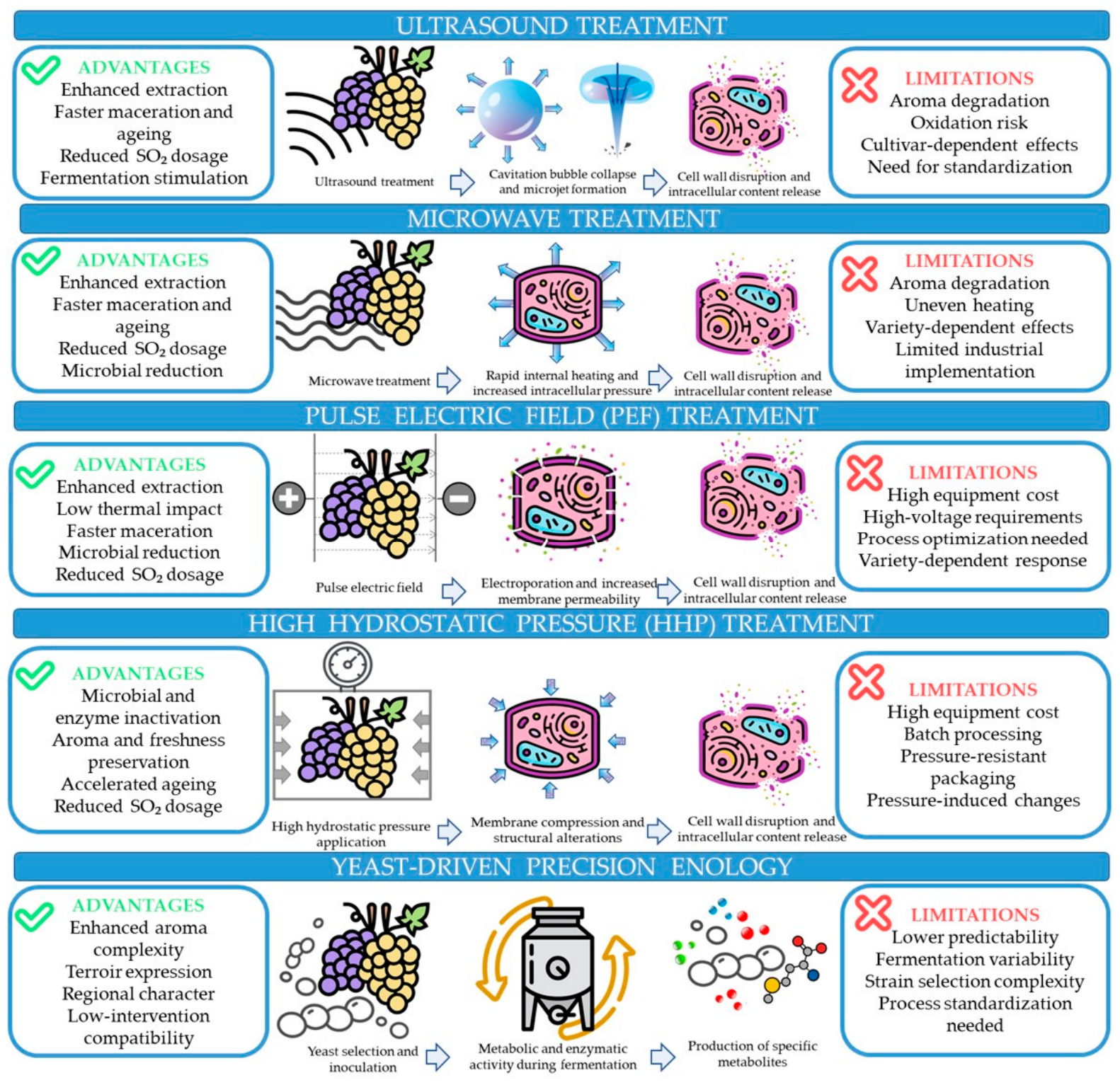
Figure 1. Comparative schematic overview of the principal mechanisms, main advantages and limitations of the reviewed non-conventional winemaking technologies.
Processes 14 01747 g001
Table 1. Effect of ultrasound treatment on wine production.
Grape, OriginUltrasound TreatmentEffect of TreatmentReference
Bobal grape, Utiel Requena, SpainBefore fermentation, continuous or pulsed sonication, 400 W, 25 KHz, 10 to 20 minHigher extraction of polyphenolic compounds, anthocyanins, higher colour density. Lower total concentration of esters, alcohols, and volatile phenols.[45]
Sauvignon Blanc grape, Trentino, ItalyCrushed grape berries, 20 kHz, continuous treatment, 153 µm amplitude, 200 W, 3 and 5 minIncreased conductivity and phenols. Decreased sulphur aroma precursors, and the concentration of 3-mercaptohexan-1-ol.[55]
Marselan grape, Santa Catarina, BrazilTreatment after crushing, ultrasound bath, 127 W; 40 kHz,
30 min, 25 °C
Higher concentrations of higher alcohols and esters.[47]
Monastrell and Tempranillo grapes, Murcia, SpainAfter crushing, 2500 W, 28 kHz, power density of 8 W/cm2,Significant reduction in maceration time, enhanced colour intensity, and increased total phenolic and tannin content.[38]
White Viognier grape, Jumilla, Murcia, SpainAfter crushing, 9 kW, 31 kHzEnhanced extraction of varietal free terpenes (geraniol, α-terpineol, linalool), minimal or no effect on esters, acetates, and n-alkyl-lactones.[42]
Monastrell grape, Jumilla, Murcia, SpainAfter crushing, 2500 W, 20 kHz and 28 kHz, power density of 8 W/cm2Increased the extraction of varietal compounds, particularly free terpenes, C6 alcohols, and norisoprenoids, as well as acids and esters, resulting in wines with more intense aromatic profiles.[48]
Monastrell grape, Murcia, SpainAfter crushing, 2500 W and 28 kHz, power density of 8 W/cm2Ultrasound increased tannin and total phenol content while maintaining similar anthocyanin levels, even with a shorter maceration time.[7]
Cabernet Franc grape, Bekaa, LebanonAfter crushing, 400 W, 24 kHz, 5–15 minEnhanced the extraction of phenolic compounds, anthocyanins, and tannins, increased colour intensity.[46]
Primitivo and Nero di Troia grapes, Apulia; Aglianico grape, Basilicata, Italy2 h of pre-fermentative ultrasound maceration, 25 kHz, 1500 W with 60 W/LPositive effect on alcohols and esters in Aglianico and Nero di Troia, a weaker effect in Primitivo.[54]
Primitivo grape (early ripening, Gioia del Colle, Puglia), Nero di Troia grape (medium-late ripening, Corato, Puglia), and Aglianico grape (late ripening, Avellino, Campania), Italy2 h of pre-fermentative ultrasound maceration or post-fermentative ultrasound maceration, 1500 W, 25 kHz Best results with Aglianico grapes, 20% increase in flavonoids, 15% in total polyphenols, 12% in antioxidant activity, and 20% in colour intensity. Cultivar-dependent effect of ultrasound treatment.[53]
Riesling grape, Dealu Mare, RomaniaDuring fermentation, 750 W, 20 kHz 3, 5, 8 and 10 minHigher total phenol content and colour density, slightly increased tartaric acid levels, and, in some cases, reduced fermentation time.[56]
Corvino and Corvinone grapes (50:50), ItalyAfter fermentation, ultrasound probe (13 mm diameter) continuous sonication, 200 W, 20 kHz, 3 min at two levels of amplitude (41% and 81%) Anthocyanins and phenolic compounds were preserved during sonication, maintaining wine colour, while higher ultrasound amplitude accelerated tannin degradation; the effect depended on the initial phenolic composition and the ratios between polyphenol classes.[57]
Italian Riesling grape, Baodi, Tianjin, ChinaDuring fermentation, 40 kHz, 5 or 10 minPronounced typical Riesling aroma profile, with pleasant fruity notes and good microbial stability.[50]
White wine blend Friuli-Venezia Giulia, Cortese wine, Piedmont, Italy.Continuous sonication, 200 W, 20 kHz, 5 or 10 min at three levels of amplitude (30%, 60%, or 90%)Higher ultrasound amplitude and longer treatment improved protein stability, producing an effect comparable to bentonite fining. [52]
Tempranillo grape, Jerez, SpainDuring the pre-fermentative maceration and during the ageing stage, 1000 W, 20 kHz, amplitude of 20%, “on” mode 40 s, “off” mode 20 s, and a total treatment time of 60 min, 25 °CHigher concentration of some acids and lower concentration of higher alcohol.
Stronger overall aroma, with more pronounced wood and red-fruit notes, compared to control sample.
[58]
Monastrell grape (two ripeness levels) Murcia, SpainPre maceration, 2500 W, 28 kHz frequency, power density of 8 W/cm2The wine made with the ultrasound-treated grapes showed very similar characteristics to the wine made with the more mature grapes, especially regarding total phenol and tannin content, but with an alcohol content 15% lower than the latter.[59]
Table 2. Effect of microwave treatment on wine production.
Grape, OriginMicrowave TreatmentEffect of TreatmentReference
Bonarda grape, Mendoza, ArgentinaAfter crushing, the effect of two maceration strategies without and with MW 2450 MHz, 7600 W, 15 min, 45–50 °C, combined with stems addition, also with and without MW treatment.
Pilot-scale microwave tunnel with orthogonal magnetrons, conveyor belt, and controlled air circulation
Increase in ethanol content, significantly higher total phenol and tannin levels, enhanced polysaccharide content, and decreased terpene concentration. Microwave treatment of destemmed grapes deepened wine colour with violet hue, while unstemmed grapes increased colour intensity with violet-blue tones. [94]
Cabernet Sauvignon grape, Shanxi, ChinaAfter crushing.
Effect of microwave power: 100–900 W (50 °C, 8 min), effect of temperature: 30–70 °C (500 W, 8 min), effect of treatment time: 2–16 min (500 W, 50 °C)
Reduced polyphenol oxidase activity by 39.58% (500 W, 50 °C, 8 min), which significantly enhanced polyphenol extraction and improved wine quality.[95]
Dornfelder grape, Wrocław, PolandAfter crushing, 1200 W (approx. 400 W/kg), 8 min, up to 80 °CThe highest polyphenols and anthocyanins content, wine with the greatest antioxidant capacity compared to other methods.[96]
Muscat Ottonel,
Merlot and Pinot Noir grapes, Crisana and Maramures region, Romania
After crushing, 200 W, 420 s, up to 47.4–49 °CEnhanced extraction of phenolics and flavonoids, improved antioxidant capacity, colour intensity, and body, with potential for reduced maceration time and variety-dependent effects.[97]
Cabernet Sauvignon, Merlot and Syrah grapes, California, USAAfter crushing, 1200 W, 10 min up to 40 °CIncreased flavonol content, enhanced anthocyanin-derived pigments, and improved wine colour and polymeric pigment formation.[98]
Nebbiolo and Barbera grapes, Piedmont, ItalyWhole grape berries, three treatment conditions—1 W/g for 30 s, 1 W/g for 60 s, and 2 W/g for 60 s, followed by rapid cooling to ambient temperature at 4 °C.The impact of microwave treatment varies with the grape variety. Significant increase in the acetylated glucoside anthocyanins was observed.[99]
Garnacha grape, Jerez de la Frontera, SpainAfter crushing, 750 W, 30 min (treatment 8 min, 2 min pause), up to 50 °CSubstantially increases flavonol extraction, enhancing copigmentation, colour stability, anthocyanin content, and overall phenolic composition.[100]
Merlot grapes (sequentially harvested targeting 21°, 23°, and 25° Brix), Mendoza, ArgentinaAfter crushing, 1200 W, 10 min (~400 W/kg), up to 40 °CEnhances phenolic extraction and wine colour in unripe grapes, increasing anthocyanins, pyranoanthocyanins, and small polymeric pigments.[91]
Tempranillo grapes, Jerez, SpainAfter crushing, 400 W, 10 min up to 30 °CReduces certain higher alcohols and increases specific volatile acids in wine. Lowest aromatic intensity, wood, and red-fruit perception in wine, compared to control and the sample treated by ultrasound.[58]
Pinot noir grapes, Northern Tasmania, AustraliaAfter crushing, 1150 W, 2 min, 1 min and 15–40 s, reached a peak temperature of 70–71 °C and held for 10 min.Reduced need for SO2, higher total phenolic, anthocyanin, tannin concentration, and high colour density compared with control wines.[92]
Tempranillo wine, Ciudad Real, SpainCommercial young Tempranillo wine, accelerated ageing with 7 g/L oak chips, microwave treatment: 900 W (10 min) and 700 W (10 and 20 min).Accelerated extraction of oak-derived compounds, enhancing colour, aroma, and phenolics, effectiveness depended on oak origin.[69]
Cabernet Sauvignon wine, Shaanxi Province, ChinaEffect of irradiation time (5–20 min at 60 °C, 500 W), temperature (40–70 °C for 15 min at 500 W), and microwave power (100–900 W at 60 °C for 15 min).Accelerated wine ageing and colour evolution (stable pigment formation), but reduced phenolics, anthocyanins, and antioxidant capacity. Effects increase with higher time, power, and temperature.[101]
Table 3. Effect of pulsed electric field (PEF) treatment on wine production.
Grape, OriginPEF TreatmentEffect of TreatmentReference
Syrah grape, Beira Interior, Portugal and Tempranillo grape, Dão, PortugalSyrah: 10 kV, 90 A, 25 µs, 150 Hz; Tempranillo: 10 kV, 80 A, 50 µs, 100 Hz, with a constant flow rate of 4.5 t/h and specific energy of 2.0–2.8 kJ/kg depending on grape variety.Enhanced extraction of phenolic and colour compounds, improved wine colour intensity and structure, while most basic physicochemical parameters remain unchanged.[119]
Arinto (Pedernã), and Moscatel Graúdo (Moscatel de Setúbal) grapes, Sobral de Monte Agraço, PortugalPEF1 (must treatment before pressing): 6–8 kV (1.2–1.6 kV/cm), 30–50 A, 50 µs, 100 Hz
PEF2 (wine stabilisation before bottling): 10 kV (10 kV/cm), 85–104 A, 25 µs, 150 Hz, 60–70 kJ/kg
PEF1: Enhanced extraction of phenolic compounds and colour intensity, increased turbidity and slight pH rise, while sensory properties and total acidity remain unchanged.
PEF2: Effective microbial stabilisation with negligible impact on sensory attributes and most physicochemical parameters.
[120]
Garnacha grape,
Carinena, Spain, Graciano and Mazuelo grapes, La Rioja Spain
2, 5, 10 kV/cm; 5–100 µs; 0.4–6.7 kJ/kg, up to 30 °CIncreased colour intensity, anthocyanins, and total polyphenols; shortened maceration; the strongest effect observed in Mazuelo.[116]
Grenache wine, Aragón, Spain10 µs; 15–25 kV/cm; 35–120 kJ/kg; 10 L/h flow rate; 30–50 °C (±2 °C)PEF + SO2 achieved strong microbial stability (up to 4 log10 reduction in S. cerevisiae and O. oeni), with complete yeast inactivation and <100 CFU/mL O. oeni after 4 months, without negative effects on wine physicochemical or sensory quality. O. oeni is more PEF sensitive. [121]
Cabernet Franc grape, Bekaa, Lebanon0.8–5 kV/cm; 0.5 ± 0.1 Hz, 100 ± 1 µs, 10 s intervals between two series of pulses were to avoid the product heating Improved colour intensity and anthocyanin concentration; accelerated
extraction of phenolics during
alcoholic fermentation.
[46]
Okuzgozu wine, Elazig Province, Turkey0–31 kV/cm; 0–488 µs, 500 pps of frequency, 20 μs pulse delay time, 40 mL/min flow rate Inactivation of undesirable and pathogenic microorganisms without affecting quality or sensory attributes. [122]
Rondinella grapes, Valpolicella, Verona, Italy0 μs (control); 1 μs (2 kJ/kg); 5 μs (10 kJ/kg); 10 μs (20 kJ/kg); 400 Hz; 250 L/min flow ratePEF (10–20 kJ/kg) increased colour intensity and stability, anthocyanins, tannins, and polymerised pigments; low energy (2 kJ/kg) improved yield but reduced colour and phenolics.[123]
Garganega grapes, Valpolicella, Verona, Italy0 μs (control); 8 μs (11 kJ/kg); 16 μs (22 kJ/kg); 600 Hz, 200 L/min flow rateNo effect on basic composition or fermentation; increased dry extract, colour, and phenolics. Higher specific energy enhanced aroma precursors and oxidative stability without excessive extraction.[124]
A commercial red wine, Cotes de Bordeaux, France 20 kV/cm; 1–10 msInactivation of microorganisms present in wine before bottling. Minor effects on wine composition, contributing to the preservation of polyphenols, anthocyanins, and colour stability, primarily through enzyme inactivation.[125]
Graciano, Tempranillo, and Grenache grapes, Rioja, Spain7.4 kV/cm; 300–400 Hz; 10–20 μs (Treat1: 10 μs–300 Hz; Treat2: 10 μs–400 Hz; Treat3: 20 μs–300 Hz; Treat4: 20 μs–400 Hz)Varietal-dependent effect on monoterpenoids, with a decrease in Graciano, an increase in Tempranillo, and a marked increase in Grenache.[126]
Tempranillo sterile wine, La Rioha, Spain, with added microbial culturesELCRACK-HVP5 (DIL, Quakenbrück, Germany), 0.047 s residence time, 13.75 L/h, inlet 18 °C,
outlet < 22 °C
Species-dependent microbial inactivation. Inactivation ranged from ~0.6 to 4.9 log units, with Acetobacter spp. and some yeasts showing higher sensitivity, while LAB were generally more resistant. No significant differences among species were observed under milder treatments.[127]
Commercial red wine (Cariñena, Spain) or must (Greip, Vitoria, Spain) with added microbial cultures 16–31 kV/cm; 1 Hz, number of pulses from 0 to 100, specific energies per pulse from1.02 to 3.77 kJ/kg Reduction in undesirable microbiota by up to 99.9%; lowered spoilage risk from Brettanomyces and Lactobacillus species.[128]
Cabernet Sauvignon grape, Somontano, Spain5 kV/cm, ~50 pulses (3 μs), 122 Hz, 3.67 kJ/kg, 118 kg/h flow rate, ΔT < 2 °CIncreased phenolic and flavonol content, persisting during ageing, with no significant changes in sensory properties, indicating improved phenolic composition without sensory impact.[117]
Merlot grape, Hawke’s Bay, New Zealand41.5 kV/cm; treatment duration not specifiedImproved yeast metabolism, enhanced phenolic release, and increased varietal aroma during fermentation[129]
Red wine from Bogazkere and Okuzgozu grapes inoculated with microbial cultures, Elazig Province, Turkey17–31 kV/cm (control 0), 10–30 °C, flow rate: 40 mL/min, 3 μs, 500 ppsEnsures effective microbial inactivation without significant changes in colour, phenolics, or sensory properties, with efficacy depending on processing intensity.[130]
Aglianico, Piedirosso, Nebbiolo and Casavecchia grapes, Avellino,
Italy
1.5 and 3.0 kV/cm; 10 and 20 kJ/kg, 1 and 10 kHzSignificantly increased polyphenols, anthocyanins, colour intensity, and antioxidant activity in Aglianico. Effects were consistent across vintages but variety-dependent.[131]
Muscadelle, Sauvignon and Semillon grapes, Bordeaux, France1.5 kV (≈750 V/cm) or 1.0 kV (≈750 V/cm); 100 pulses/train (100 μs, 100 ms interval), 2 s pause, total pressing 45 minPEF pre-treatment increased juice yield, improved juice quality, accelerating expression and reducing oxidation risk. Pre-treatment was more efficient than treatment during pressing.[132]
Table 4. Effect of high hydrostatic pressure (HHP) treatment on wine production.
Grape, OriginHHP TreatmentEffect of TreatmentReference
Cabernet Sauvignon and Graševina wines, Erdut, Croatia200, 400, 600 MPa, 5–25 min;
≤25 °C, ageing study: HHP treatment (200 MPa, 5 min) in combination with SO2 and glutathione additions for 12 months
Slight chemical changes immediately after treatment. HHP with glutathione preserved phenolics and aroma comparable to the control. Reduction in phenolic compounds and increased colour intensity.[145]
Agiorgitiko
wine, Nemea, Peloponnese, Greece
350 MPa, 10 min, 8 °C Immediately after treatment, no changes in colour, phenolics, antioxidants, or tannin structure. After 6 months, HHP wines showed increased hue and decreased anthocyanins and flavanols, while after 12 months no significant differences vs. control. Reduced fruitiness and increased jammy, spicy notes and body.[146]
Mouchtaro wine, Biotia, Greece200, 400, 600 MPa, 0–15 min; (optimum 400 MPa for 5 min)Longer treatments reduced phenolics, while 400 MPa for 5 min ensured optimal quality. Treated wine: more balanced, spicier, pronounced fruit, jam and chocolate odours.[147]
Touriga Nacional (50%), Tinta Roriz (50%), Dão, Portugal600 MPa for 20 min or 500 MPa for 5 min, 20 °CPromoting anthocyanin, phenolic acid, and flavonol losses and altering proanthocyanidin reactions, leading to aged-like sensory characteristics with reduced astringency and enhanced aroma complexity (more pronounced at 600 MPa).[148]
Touriga Nacional wine, Dão, Portugal425 and 500 MPa, 5 min at 20 °C Promoted phenolic condensation during storage, leading to reduced phenolics and aged-like sensory characteristics without quality loss.[149]
Nero d’Avola (93%), Syrah (7%) wine,
Italy
650 MPa, 0.25–2 h, ~18 °CHigh pressure (≥600 MPa) reduced total phenolics, anthocyanins, flavonols, tannins; colour intensity slightly decreased; fruity aromas diminished, astringency increased; simulates ageing. [150]
Parrellada grape, Spain400 MPa (2 °C and 40 °C, 10 min) and 500 MPa (2 °C, 10 min); storage: 1, 30, and 60 daysNo significant initial changes; enhanced colour stability during storage; inhibition of fermentation/spoilage; stable sensory quality with a slight decrease in fresh aroma over time.[151]
Marselan wine, Helan Mountains, China100–600 MPa, 10–30 minUp to 400 MPa increased total polyphenols, resveratrol, protocatechuic acid, and ester levels, increase in fruit and floral aromas without off-flavours.[152]
Tempranillo grape200, 400 and 550 MPa,
10 min, 20 °C
Complete yeast inactivation at ≥400 MPa, facilitated anthocyanin extraction, reduced SO2 need. Reduced total volatile compounds (lower microbial contribution).[153]
Sauvignon Blanc wine, Casablanca Valley, Chile400–500 MPa; 5–15 min,
at ambient temperature
Preserved physicochemical and sensory properties; minimal colour changes; potential to reduce SO2 dosage at bottling.[154]
Shiraz, Pinot Noir, Sauvignon Blanc, Pinot Gris (commercial wine)600 MPa; 5 min, <40 °CMinimal impact on phenolics, pH, antioxidant activity, and colour. During storage, preserved wine stability, with slight decreases in phenolics and antioxidant activity, and a slight increase in colour density, with only minor wine-specific variations.[155]
Tempranillo and Cayetana wines, Almendralejo, Spain400 MPa, 5 and 30 minAcceleration of the wine ageing process, positive effect on sensory characteristics.[156]
Barbera grape, Moscato, Asti Spumante and Moscato d’Asti wines (high sugar content), Italy300–600 MPa, 2–4 min,
inoculated with vegetative cells and spores (~106–107 CFU/mL)
Strong antimicrobial efficacy, achieving complete inactivation at 400 MPa for 2 min, while preserving key sensory properties with no significant changes in colour, aroma, or taste. Spores showed higher
resistance in grape must and the need
for higher pressures for
complete inactivation.
[157]
Campbell Early low alcohol wine, Chungcheongbuk-do, Korea100–350 MPa; 0–30 min, 25 °CEffective microbial inactivation at ≥300–350 MPa with minimal changes in wine sensory properties.[158]
Cabernet Sauvignon and Graševina (sweet) wines, Erdut, Croatia100 and 200 MPa, 1–25 min,
inoculation with B. bruxellensis (5.5 log CFU/mL) and S. cerevisiae (4.4 log CFU/mL)
200 MPa caused a significant short-term reduction in yeasts, particularly B. bruxellensis (complete inactivation at 15 min), with partial recovery during storage. Quality parameters remained largely unaffected.[159]
Cabernet Sauvignon wine, Australia400 MPa; 5 s, <40 °C, B. bruxellensis inoculation (2.3 × 10⁵–5.9 × 10⁵ CFU/mL)Complete inactivation of B. bruxellensis, with no effect on the sensory properties. Colour density increased up to 6 months, then decreased significantly after 10 months, causing browning.[6]
Touriga Nacional (50%), Tinta Roriz (50%), Dão, Portugal500 MPa, 5 min, 20 °CAccelerated ageing-like effects and increased phenolic polymerisation.[160]
Table 5. Technological, sensory, regulatory, and industrial comparison of emerging non-conventional winemaking technologies.
TechnologyTechnology Maturity/
Implementation Status
Scalability/
Industrial Feasibility
Energy/Process EfficiencyOIV/EU
Regulation *
Impact on Sensory QualityConsumer/Market Considerations
Ultrasound treatmentPartially industrialised, commercially available systemsHigh scalability, particularly in continuous-flow systemsReduced processing time and lower energy demand compared to prolonged conventional maceration and ageingApprovedImproved colour intensity, mouthfeel, and aroma complexity, accelerated ageing effects, excessive treatment may negatively affect aroma profilePotentially favourable perception due to reduced SO2 use and minimally invasive processing
Microwave treatmentExperimental to pilot-scale in winemaking, industrially established in the food industryIndustrial-scale winery application remains
limited
Rapid volumetric heating shortens processing time and may improve energy efficiency and process throughputNot approved for oenological useAccelerated extraction and maturation, improved colour stability, overheating may negatively affect volatile profilePossible consumer scepticism due to thermal processing perception
Pulsed electric fields (PEFs)Pilot- to industrial-scale implementation, commercially available systemsTechnically feasible for industrial continuous processingLow energy consumption, improved processing throughput, reduced extraction timeApprovedGenerally preserves freshness, acidity, and sensory balanceAssociated with freshness preservation, reduced SO2 use, and minimally processed wine production
High hydrostatic pressure (HHP)Industrially established in the food sector, approved for oenological applicationsScalable but economically demandingNon-thermal preservation with relatively high energy requirementsApprovedEnhanced aroma complexity and aged-like sensory characteristics, excessive pressure may reduce fruity aromasAssociated with microbial stability, reduced preservative requirements, and clean-label wine production
Yeast-driven precision enologyIndustrial applicability depends on strain selection and process standardisationScalable after strain optimisation and process standardisationNo additional energy demandCompatible with existing oenological practicesIncreased aromatic complexity, mouthfeel, regional typicity, and sensory differentiationCompatible with natural, regional, and low-intervention winemaking concepts
Information presented in this table is based primarily on the studies discussed throughout Section 4.1, Section 4.2, Section 4.3, Section 4.4 and Section 4.5 and on general trends reported in the current literature. * [84,137,165,214].
Disclaimer/Publisher’s Note: The statements, opinions and data contained in all publications are solely those of the individual author(s) and contributor(s) and not of MDPI and/or the editor(s). MDPI and/or the editor(s) disclaim responsibility for any injury to people or property resulting from any ideas, methods, instructions or products referred to in the content.


