Exploiting the Flexibility and Frequency Support Capability of Grid-Forming Energy Storage: A Bi-Level Robust Planning Model Considering Uncertainties

Abstract
1. Introduction
- The frequency response models for grid-forming BESS and renewable energy sources are established, providing a theoretical foundation for characterizing the dynamic support capabilities of diverse resources in system planning.
- Embeddable dynamic FSCs are developed, incorporating both the spatial distribution of system inertia and the time-delay characteristics of virtual inertia resources, enabling accurate frequency performance assessment in high-VRE power systems.
- A novel quantification method for spatial inertia distribution in systems is proposed, which leads to a bi-level robust planning model that considers VRE uncertainty and is solved by the column-and-constraint generation (C&CG) algorithm.
- Finally, multi-scenario case studies based on a modified NPCC-140 bus system are conducted to verify the effectiveness of the proposed method in enhancing system frequency security, optimizing inertia distribution, and promoting VRE integration.
2. Analysis of Dynamic Frequency Characteristics in Power Systems Considering Grid-Forming Resource Support
2.1. The Frequency Response Model for Grid-Forming BESS
2.1.1. Characterization of Virtual Inertia Support from BESS
2.1.2. Frequency Response Model of BESS
2.1.3. Operational Model of BESS
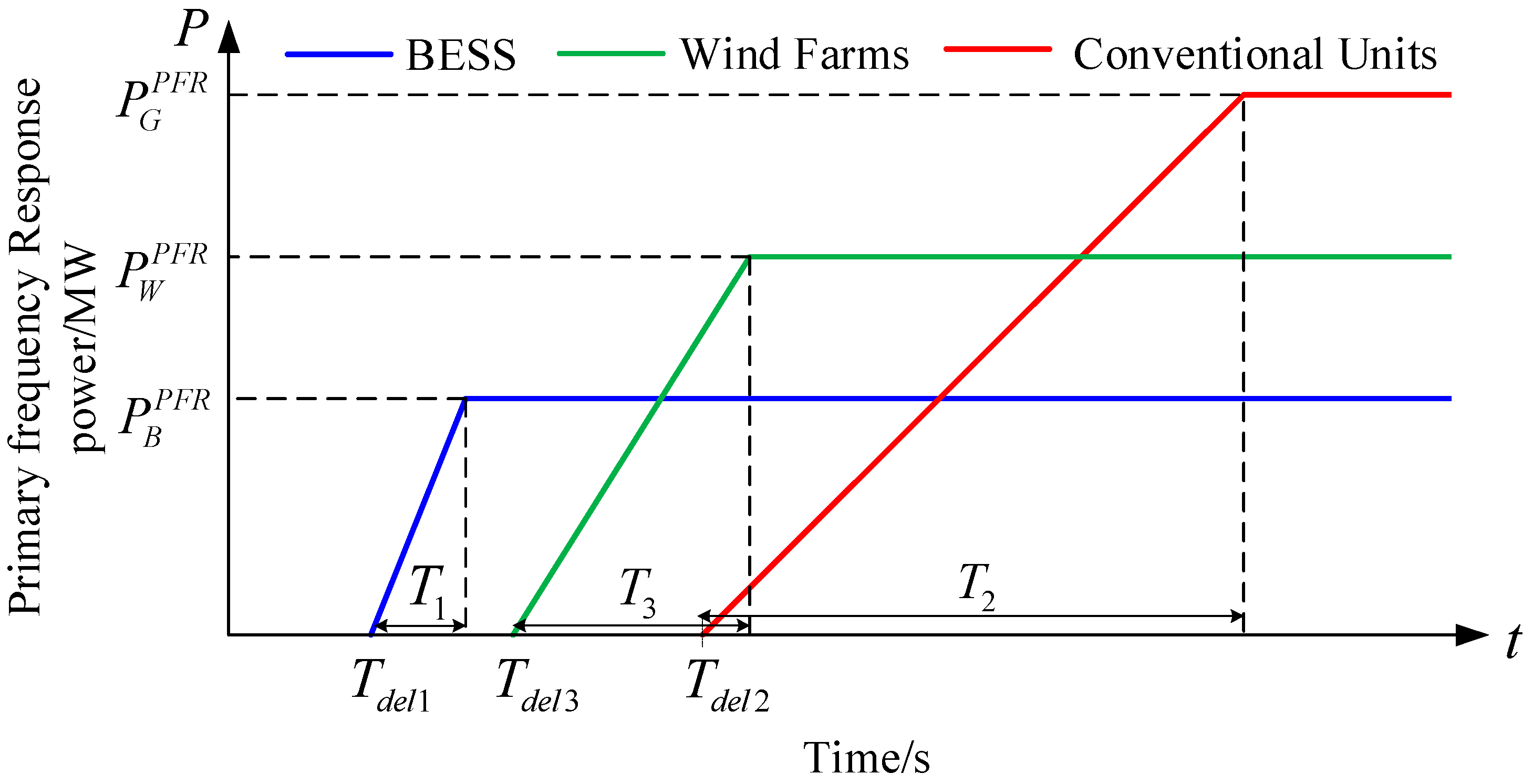
2.2. Modeling of the Dynamic Frequency Response Process Considering VIR Delay
2.3. Modeling FSC Incorporating Grid-Forming Resources
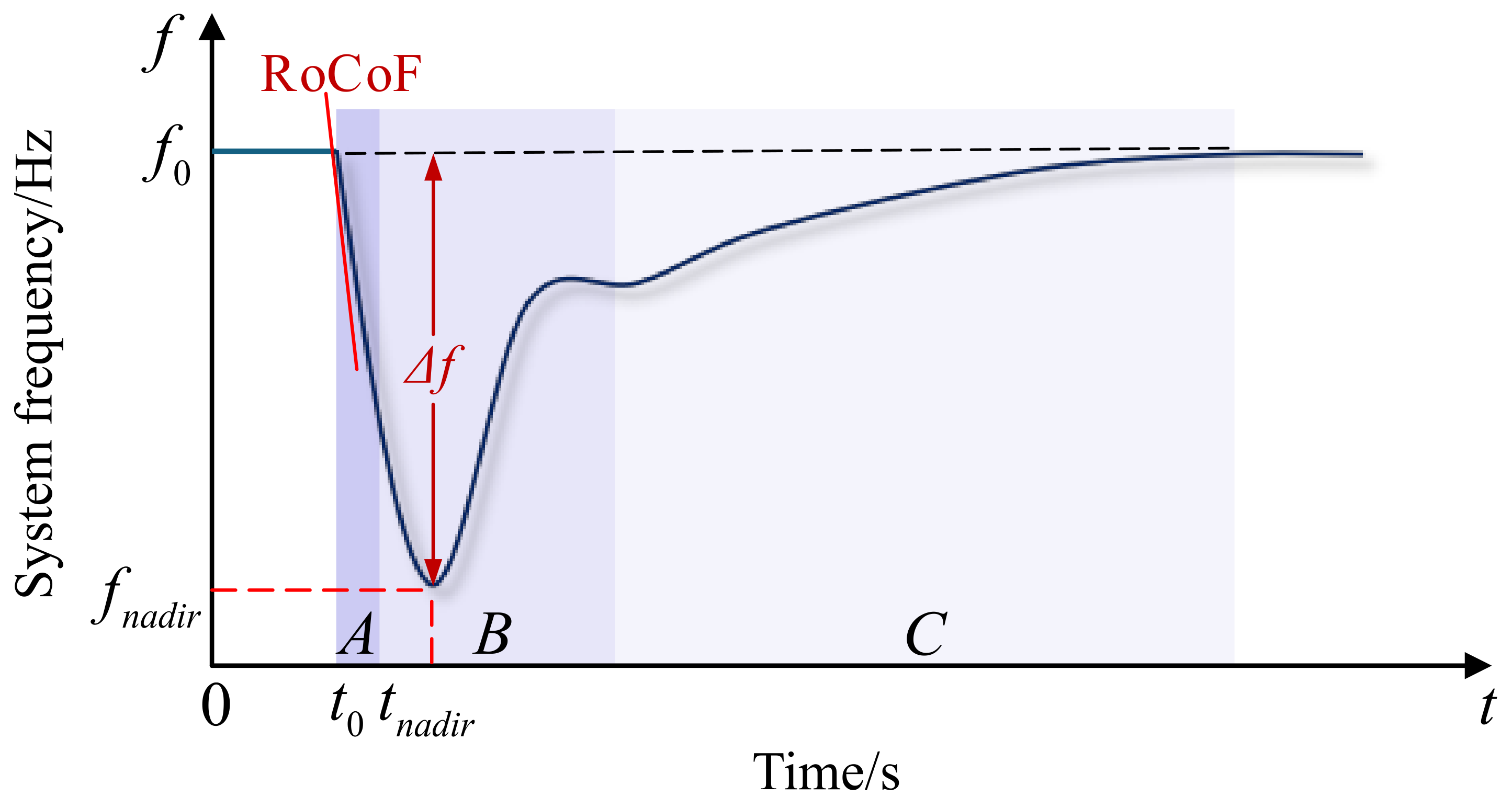
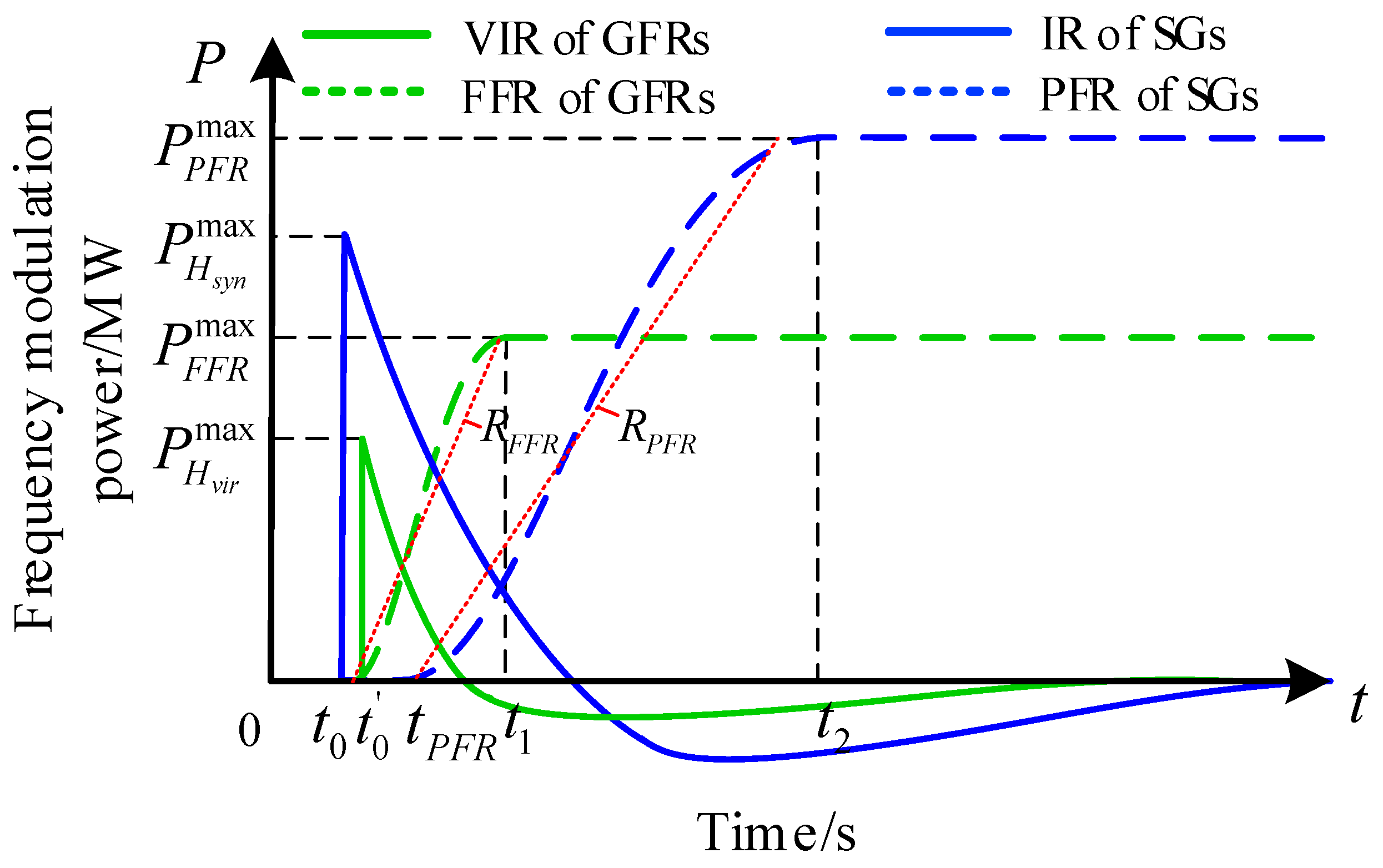
- : An excessively high may lead to mechanical damage in rotating equipment due to abrupt speed changes, disconnection of distributed generation resources due to protection activation, islanding operation of the system, and oscillations in stabilizers [6]. Furthermore, to ensure sufficient time and margin for subsequent PFR, the inertia, in the form of kinetic energy, must satisfy:where represents the maximum tolerable rate of frequency change.
- Maximum Frequency Deviation : This is the difference between the steady-state frequency and the frequency nadir. It is influenced by the combined effects of the IR and PFR. To prevent the system from triggering under-frequency load shedding or even a system collapse due to an excessive frequency drop [7], the following condition must be satisfied:where is the time at which the frequency nadir occurs, and is the maximum allowable frequency deviation for the system.
- 1.
- Constraint on the ;
- 2.
- Minimum System Frequency Constraint
3. Analysis of the Spatial Distribution Characteristics of Inertia in a Power System with High Penetration of RES
4. A Bi-Level Robust Planning Model of Grid-Forming BESS and VRE Considering Frequency Security
4.1. Objective Function
4.2. Constraints on the Planning of Multiple Types of Grid-Forming Resources
- 1.
- Operational Model of BESS
- 2.
- Investment Cost and VRE Retrofit Constraints
4.3. Typical Day Operational Constraints
- 1.
- Nodal Power Balance Constraints
- 2.
- Line Power Flow Constraints
- 3.
- Thermal Power Unit Operational Constraints
- 4.
- VRE Output Constraints
- 5.
- BESS Operational Constraints
- 6.
- Frequency Security Constraints
4.4. Model Solution
4.4.1. Linearization of the FSC
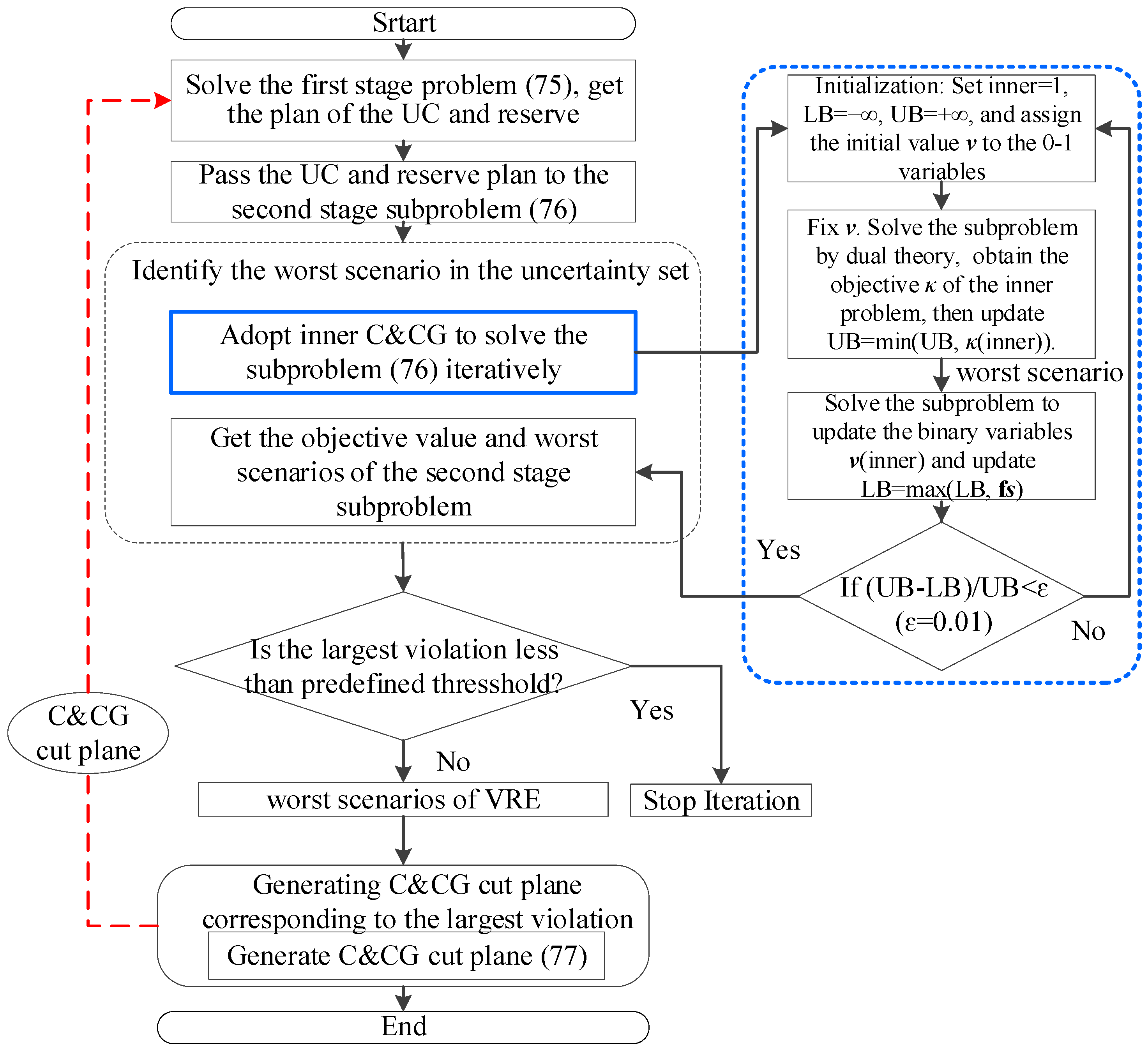
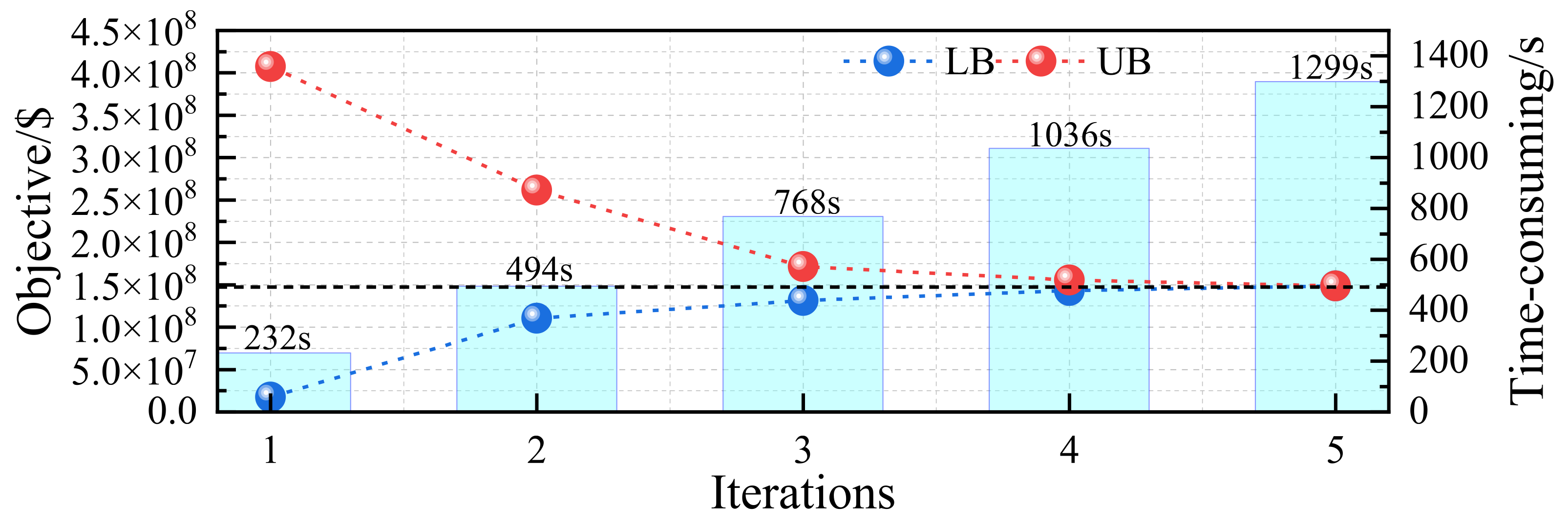
4.4.2. Model Solution Based on Nested C&CG Algorithm
| Algorithm 1: Improved column-and-constraint generation algorithm | |
| 1: | Enter Outer-Layer C&CG: |
| 2: | Initialization: Set the iteration count iter = 0. |
| 3: | while iter < itermax do |
| 4: | Solve master problem Equation (75) (iter): |
| 5: | (75) |
| 6: | Let (, ) be the optimal solution; |
| 7: | Solve Subproblem Equation (76) (iter): |
| 8: | (76) |
| 9: | Obtain (, ); |
| 10: | Invoke Inner-Layer C&CG: |
| 11: | Initialization: Set iinner ← 1, LB ←, UB ←; |
| 12: | Initialize binary variable vector v. |
| 13: | while True do |
| 14: | Solve Dual Problem Equation (77) (iter): |
| 15: | (77) |
| 16: | Let (κ, , ) be the optimal solution; |
| 17: | Update UB ← min{UB, κ}. |
| 18: | Fix ←, ←; |
| 19: | Solve the optimization problem for v in the subproblem to obtain slack s; |
| 20: | Update LB ← max{LB, fᵀ s}. |
| 21: | if then |
| 22: | ψ ← UB; |
| 23: | return (ψ, , ); |
| 24: | Return to outer layer. |
| 25: | else |
| 26: | iinner ← iinner + 1. |
| 27: | end if |
| 28: | end while |
| 29: | (ψ, , ) ← Inner C&CG (, ); |
| 30: | if ψ > 0 then |
| 31: | Generate cut; |
| 32: | Generate new variables siter +1, pu iter+1, viter+1; |
| 33: | Add a new C&CG Benders cut to the master problem; |
| 34: | Update iteration iter ← iter + 1. |
| 35: | else |
| 36: | Termination x* ← xiter, p* ← piter; |
| 37: | break. |
| 38: | end if |
| 39: | end while |
5. Case Studies
5.1. Modified NPCC-140 Bus System Case Study
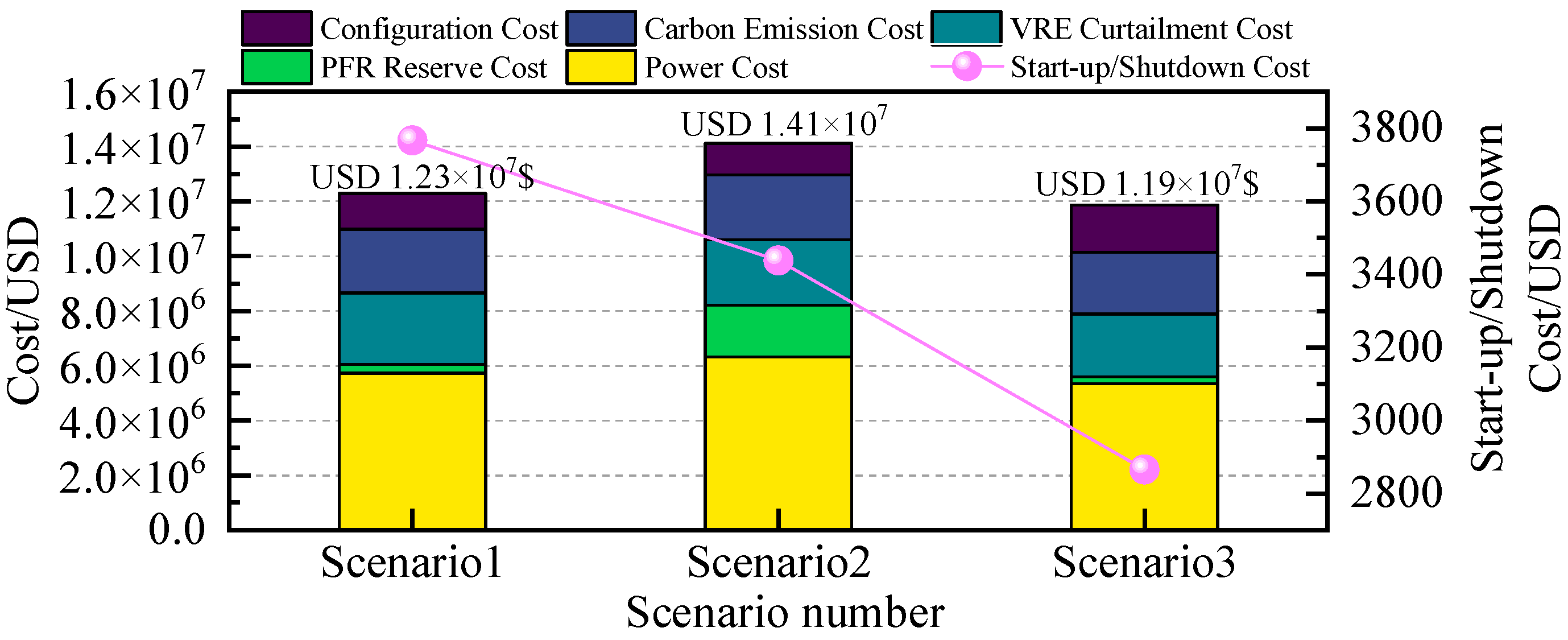
5.2. Planning Results and Cost Analysis
5.3. Analysis of the Impact of FSC on Planning Results
5.3.1. The Impact on Planning Results of FSC
5.3.2. Sensitivity Analysis of FSC Constraints to Frequency Security Thresholds
5.3.3. Sensitivity Analysis of the Selection of Delay Times and
5.4. Impact of Grid-Forming Resource Planning on the Inertia Spatial Distribution
5.4.1. Inertia Spatial Distribution Results
5.4.2. Sensitivity Analysis to Line Reactance Uncertainty
5.5. Analysis of the Impact of VRE Uncertainty on Planning Results
5.5.1. The Impact on Planning Results of VRE Uncertainty
5.5.2. Sensitivity Analysis of the Temporal Uncertainty Budgets and for VRE
5.6. Effectiveness of the Solution Algorithm
6. Conclusions
- (1)
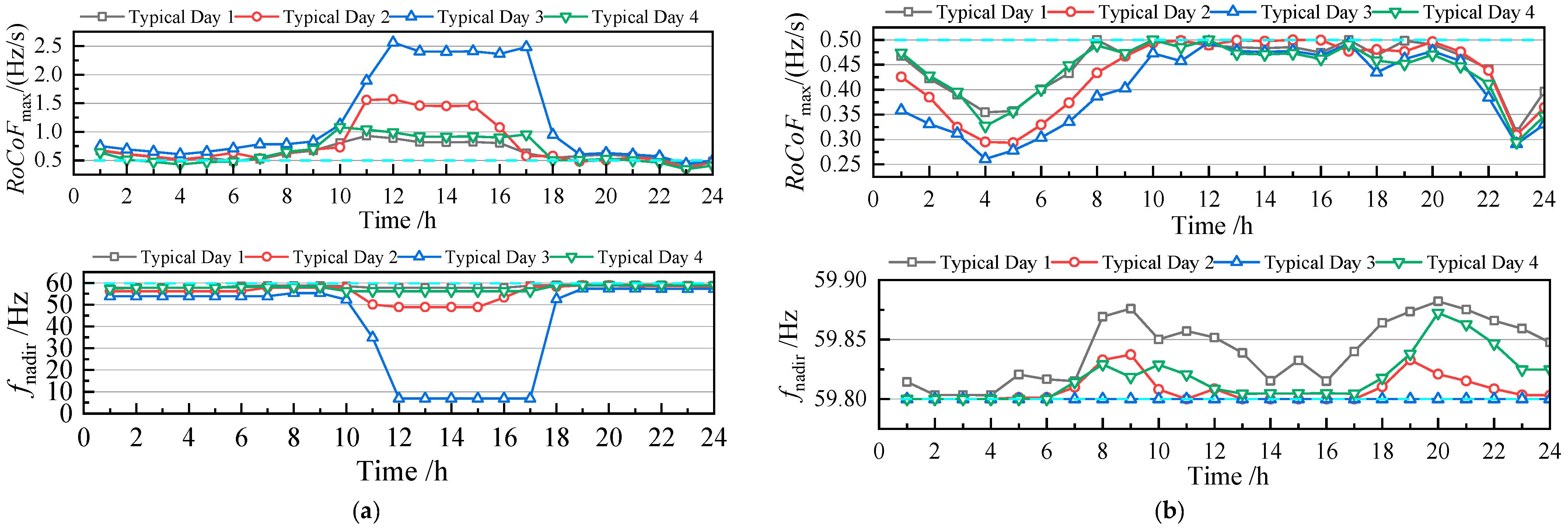
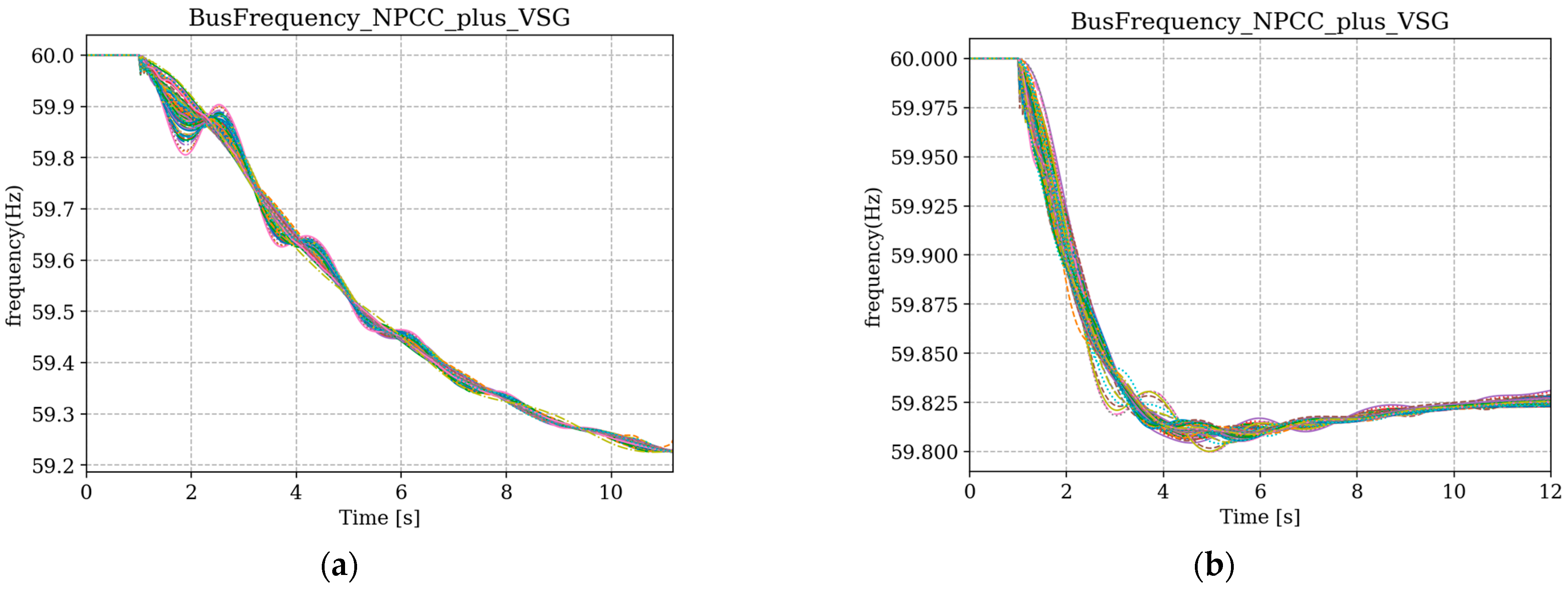
- The system frequency dynamics modeling, which accounts for the response delay of VSG, can accurately characterize the VIR of grid-forming resources. Guiding BESS planning based on the spatial distribution calculation method of system inertia effectively mitigates the uneven distribution of inertia caused by VRE integration. This method enhanced the system’s frequency security support capability, ensuring RoCoF of each node remained below 0.5 Hz/s and the frequency nadir above 59.8 Hz under the considered disturbance in the planning study.
- (2)
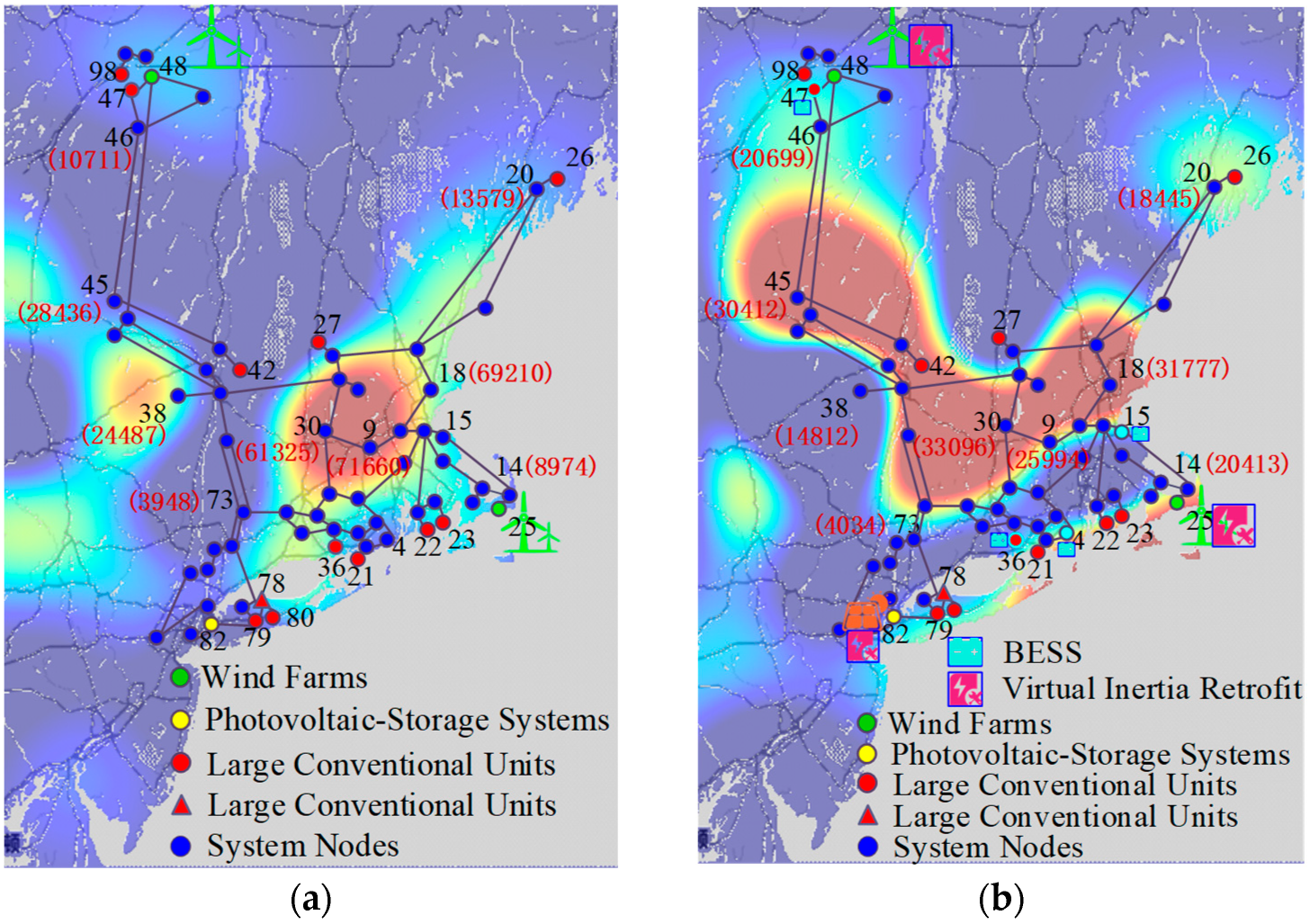
- The proposed cooperative planning model for multiple types of grid-forming resources effectively balances the economy and security of the planning results. By linearizing nonlinear FSC via second-order cone convex optimization, the planning scheme not only satisfies the frequency security threshold but also reduces the total cost by up to 15.9% compared to a single-resource solution. Specifically, the optimal cooperative plan involved deploying 2400 MW/4800 MWh of BESS alongside retrofitting 2050 MW of wind power and 1000 MW of PV capacity with grid-forming capabilities, demonstrating cost-effective resource synergy.
- (3)
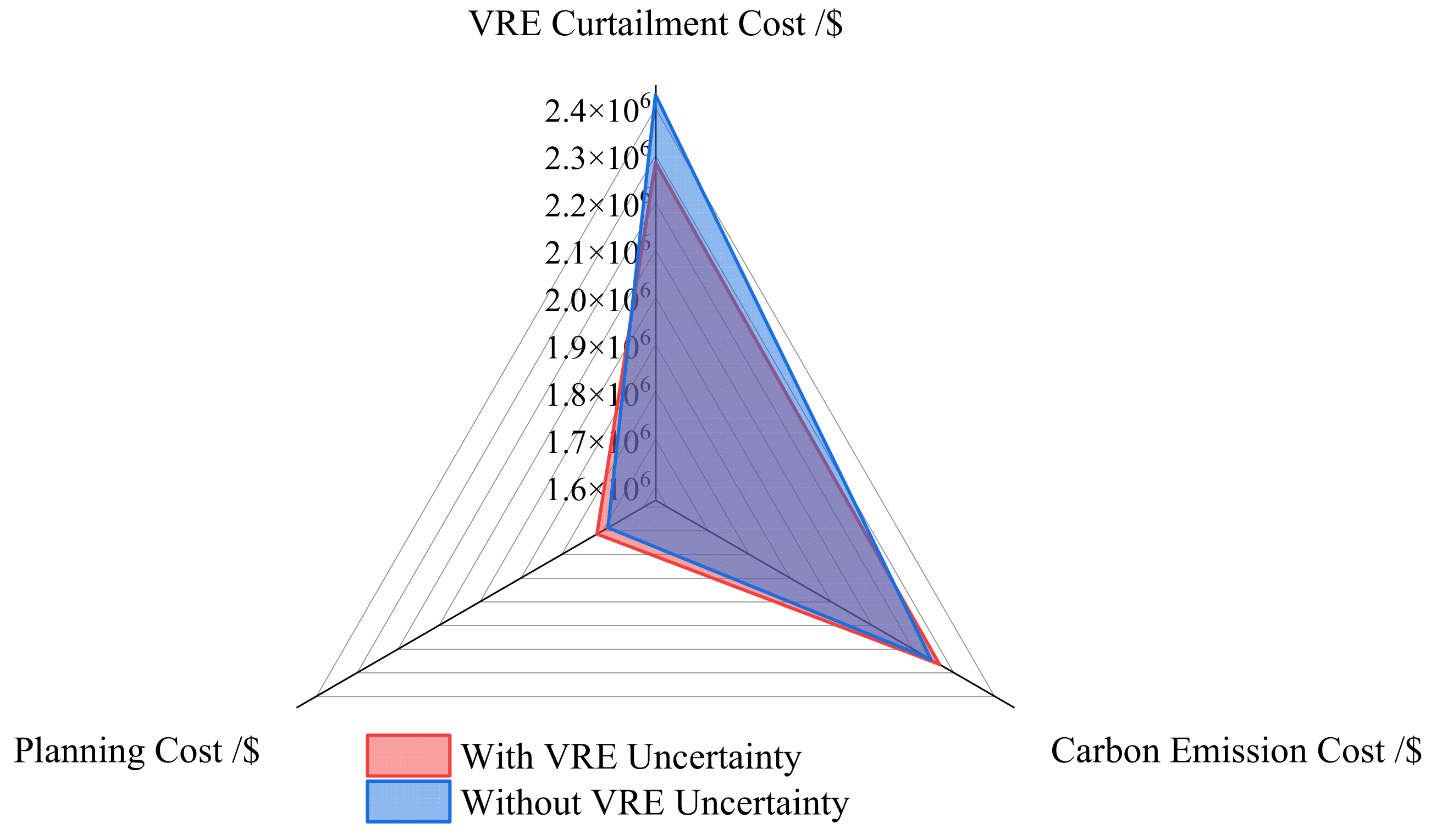
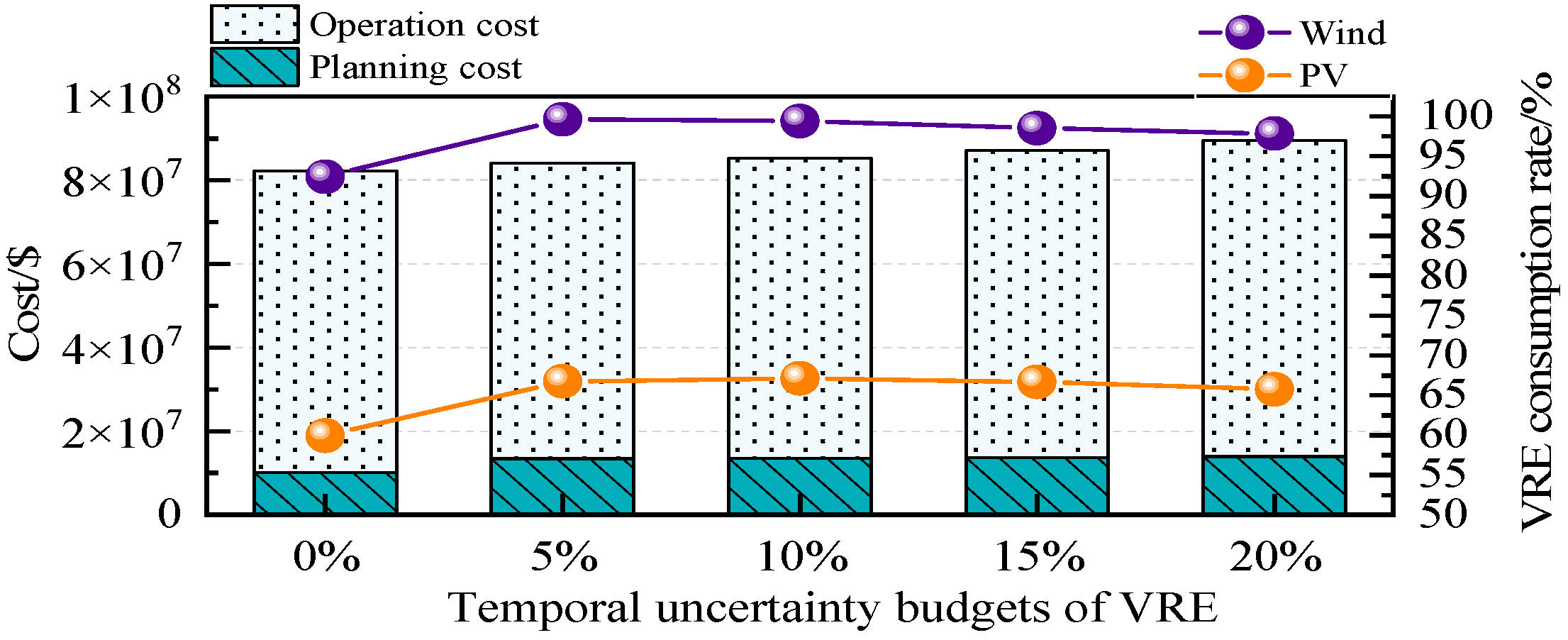
- The proposed cooperative optimization planning method can effectively mitigate the impact of VRE uncertainty. By adopting a nested C&CG robust optimization algorithm, the model leverages the flexible charging and discharging advantages of BESS. This ensures the reliability of planning results under uncertainty, reducing the VRE curtailment rate and improving VRE accommodation, while necessitating a robust plan that increased BESS capacity by 100% and wind retrofit capacity by approximately 228% compared to a deterministic scenario.
Author Contributions
Funding
Data Availability Statement
Conflicts of Interest
Abbreviations
| BESS | Battery energy storage system |
| VRE | Variable renewable energy generation |
| VSG | Virtual synchronous generator |
| RES | Renewable energy sources |
| C&CG | Column-and-constraint generation |
| SGs | Synchronous generators |
| RoCoF | Rate of change of frequency |
| PV | Photovoltaic |
| FSC | Frequency security constraints |
| PFR | Primary frequency regulation |
| IR | Inertia response |
| VIR | Virtual inertia response |
| SOC | State of charge |
Appendix A


| Resource Type | Capacity/MW | Resource Type | Capacity/MW |
|---|---|---|---|
| Thermal Power | 1165 | Nuclear Power | 300 |
| Conventional Hydropower | 250 | Wind Power | 400 |
| Pumped Storage Hydropower | 100 | PV | 1600 |
- 2.
- Considering the range of cost variations, the costs for grid-forming BESS planning and the grid-forming virtual inertia retrofitting of wind and PV power in the case studies of this paper were comprehensively determined, along with the relevant system operational parameters, as shown in Table A2. The BESS planning capacity must ensure a continuous discharge duration of 2 h.
| Parameters | Values | Parameters | Values |
|---|---|---|---|
| BESS Rated Power/MW | 600 | Wind Farm Lifespan/years | 20 |
| BESS Capacity Planning Range/MWh | [0,1200] | PV Power Station Lifespan/years | 30 |
| BESS Unit Capacity Cost/(USD/MWh) | 200,000 | BESS Lifespan/years | 20 |
| BESS Unit Power Cost/(USD/MW) | 214,285 | Carbon Emission Cost/(USD/t) | 28.57 |
| Wind Power Retrofit Cost/(USD/MW) | 28,571 | VRE Curtailment Penalty/(USD/MW) | 100 |
| PV Retrofit Cost/(USD/MW) | 357,142 | BESS Charge/Discharge Efficiency/% | 0.95 |
| Virtual Inertia Constant/s | 8 | Discount Rate/% | 0.08 |
- 3.
- In the improved NPCC-140 node system, the grid nodes for VRE integration to be retrofitted and the candidate nodes for BESS planning are shown in Table A3.
| Resource Type | Wind Farm | PV | BESS |
|---|---|---|---|
| Candidate nodes | 25, 48 | 56, 82 | 2, 4, 5, 9, 15, 36, 47, 57 |
References
- China Electricity Council. 2024–2025 National Electricity Supply and Demand Analysis and Forecast Report. Available online: https://www.cec.org.cn/detail/index.html?3-341403 (accessed on 20 November 2025).
- Li, Y.; Gao, S.; Chen, X.; Fan, D.; Zhang, M. Load Frequency Control of Power Systems Based on Deep Reinforcement Learning with Leader–Follower Consensus Control for State of Charge. Processes 2025, 13, 3669. [Google Scholar] [CrossRef] [Scilit]
- Pantaleon, E.; Paucara, J.; Saly, R.D. Power Analysis Produced by Virtual Inertia in Single-Phase Grid-Forming Converters Under Frequency Events Intended for Bidirectional Battery Chargers. Energies 2025, 18, 5560. [Google Scholar] [CrossRef] [Scilit]
- Nandini, K.K.; Anubhav, K.P.; Sumana, S.R. Machine learning based annual solar energy forecasting for enhanced grid integration of photovoltaic systems. Bull. Electr. Eng. Inform. 2025, 14, 4267–4278. [Google Scholar] [CrossRef] [Scilit]
- Nandini, K.K.; Anubhav, K.P.; Shilpi, B.; Sujit, G.M. Smart inverters based technological advancements in future smart grids for improved flexible renewable energy penetration. Discov. Energy 2025, 5, 28. [Google Scholar] [CrossRef] [Scilit]
- Qaisar, M.W.; Fang, J. Grid-Forming Converters for Renewable Generation: A Comprehensive Review. Energies 2025, 18, 4565. [Google Scholar] [CrossRef] [Scilit]
- Zhang, Z.; Zhou, M.; Wu, Z.; Liu, J.; Liu, S. Energy Storage Location and Capacity Planning Method Considering Dynamic Frequency Support. Proc. CSEE 2023, 43, 2708–2721. [Google Scholar] [CrossRef]
- Zhang, Y.; Yu, Y.; Zhang, Y.; Chen, B.; Liu, Z. Frequency Regulation Performance of a Wind–Energy Storage Hybrid System During Turbine Shutdown Due to Extreme Wind. Processes 2025, 13, 3383. [Google Scholar] [CrossRef] [Scilit]
- Silva, A.; Amaro, M.; Mirez, J. Design of a Fuzzy Logic Control System for a Battery Energy Storage System in a Photovoltaic Power Plant to Enhance Frequency Stability. Energies 2025, 18, 4550. [Google Scholar] [CrossRef] [Scilit]
- Zhong, Q.; George, W. Synchronverters: Inverters that Mimic Synchronous Generators. IEEE Trans. Ind. Electron. 2011, 58, 1259–1267. [Google Scholar] [CrossRef] [Scilit]
- Li, H.; Zhang, X.; Wang, Y.; Zhu, X. Virtual Inertia Control of DFIG-based Wind Turbines Based on the Optimal Power Tracking. Proc. CSEE 2012, 32, 32–39. [Google Scholar] [CrossRef]
- Yang, Y.; Wu, Z.; Quan, X.; Xiong, J.; Wan, Z.; Wei, Z. A Unified Control Strategy Integrating VSG and LVRT for Current-Source PMSGs. Processes 2025, 13, 3432. [Google Scholar] [CrossRef] [Scilit]
- Simon, D.R.; Pieter, T.; Barry, R.; Dirk, V.H.; Johan, D. Trading energy yield for frequency regulation: Optimal control of kinetic energy in wind farms. IEEE Trans. Power Syst. 2021, 30, 2469–2478. [Google Scholar] [CrossRef] [Scilit]
- Assogna, R.; Ciabattoni, L.; Comodi, G. PSO-Based Supervisory Adaptive Controller for BESS-VSG Frequency Regulation Under High PV Penetration. Energies 2025, 18, 5401. [Google Scholar] [CrossRef] [Scilit]
- Liu, R.; Wang, Z.; Wu, J.; Zhao, T.; Chan, Y. Planning Optimization of Virtual Inertia Considering Spatial Distribution Characteristics of Frequency. Autom. Electr. Power Syst. 2024, 48, 122–130. [Google Scholar]
- Huang, D.; Sun, P.; Yao, W.; Liu, C.; Zhai, H.; Gao, Y. Bi-Level Planning of Grid-Forming Energy Storage–Hydrogen Storage System Considering Inertia Response and Frequency Parameter Optimization. Energies 2025, 18, 3915. [Google Scholar] [CrossRef] [Scilit]
- Zhu, L.; Dong, K.; Tang, L.; Li, Z.; Yu, J. Joint Optimal Clearing Model for Electric Energy, Inertia and Primary Frequency Response Considering Synchronous Inertia and Energy Storage Virtual Inertia Values. Proc. CSEE 2024, 44, 7543–7555. [Google Scholar] [CrossRef]
- Zhu, Y.; Qin, L.; Yan, Q.; Wei, Z. Wind-storage combined frequency regulation strategy and optimal planning method of energy storage system considering process of frequency response. Electr. Power Autom. Equip. 2021, 41, 28–35. [Google Scholar] [CrossRef]
- Ding, Q.; Zhang, X.; Zhang, N.; Li, Z.; Li, W. A Joint planning and Planning Method for Power System Inertia and Primary Frequency Regulation Reserve Considering Extreme Events. Proc. CSEE 2024, 1–17. Available online: http://kns.cnki.net/kcms/detail/11.2107.TM.20240829.1246.008.html (accessed on 18 October 2025).
- Zhou, M.; Wang, W.; Li, X.; Li, P.; Chen, Y. A Coordinated Control Strategy for Black Start of Wind Diesel Storage Microgrid Considering SOC Balance of Energy Storage. Processes 2025, 13, 3770. [Google Scholar] [CrossRef] [Scilit]
- Cui, H.; Konstantinopoulos, S.; Osipov, D.; Wang, J.; Li, F.; Tomsovic, K.L. Disturbance Propagation in Power Grids with High Converter Penetration. Proc. IEEE 2023, 111, 873–890. [Google Scholar] [CrossRef] [Scilit]
- Li, Y.; Hu, P.; Cao, Y.; Yu, Y. Data-driven Estimation Method for Inertia Parameters of Grid-forming Converter Considering Frequency Response Delay. Autom. Electr. Power Syst. 2024, 48, 80–88. [Google Scholar]
- Dörfler, F.; Bullo, F. Kron reduction of graphs with applications to electrical networks. IEEE Trans. Circuits Syst. 2013, 60, 150–163. [Google Scholar] [CrossRef] [Scilit]
- Yang, N.; Zeng, S. Three-phase power flow solution for multi-grounded four-wire residential networks considering neutral grounding. Energy Build. 2024, 323, 114784. [Google Scholar] [CrossRef] [Scilit]
- Zhang, Z.; Guo, Z.; Zhou, M.; Wu, Z.; Bo, Y.; Chen, Y.; Li, G. Equalizing multi-temporal scale adequacy for low carbon power systems by co-planning short-term and seasonal energy storage. J. Energy Storage 2024, 84, 111518. [Google Scholar] [CrossRef] [Scilit]
- Joe, H.C.; Graham, R. User Manual for Power System Toolbox, Version 3.0. 2008. Available online: https://sites.ecse.rpi.edu/~chowj/ (accessed on 20 November 2025).
- GB/T 15945-2008; General Administration of Quality Supervision, Inspection and Quarantine of the People’s Republic of China, Standardization Administration of the People’s Republic of China. Power Quality-Frequency Deviation for Power System. Standards Press of China: Beijing, China, 2008.
- Cui, H.; Li, F.; Tomsovic, K. Hybrid Symbolic-Numeric Framework for Power System Modeling and Analysis. IEEE Trans. Power Syst. 2021, 36, 1373–1384. [Google Scholar] [CrossRef] [Scilit]


| Scenario | Multiple Types of Grid-Forming Resources | FSC | VRE Uncertainty | ||
|---|---|---|---|---|---|
| BESS | Wind Power | PV | |||
| Scenario 1 | × | √ | √ | √ | √ |
| Scenario 2 | √ | × | × | √ | √ |
| Scenario 3 | √ | √ | √ | √ | √ |
| Scenario | Multiple Types of Grid-Forming Resources | |||
|---|---|---|---|---|
| BESS Power/MW | BESS Storage Power/MWh | Wind Power Retrofit Capacity/MW | PV Retrofit Capacity/MW | |
| Scenario 1 | × | × | 3976 | 950 |
| Scenario 2 | 3600 | 7200 | × | × |
| Scenario 3 | 2400 | 4800 | 2050 | 1000 |
| Scenario | Multiple Types of Grid-Forming Resources | |||
|---|---|---|---|---|
| BESS Power/MW | BESS Storage Power/MWh | Wind Power Retrofit Capacity/MW | PV Retrofit Capacity/MW | |
| Without FSC | 1200 | 2400 | 624 | 128 |
| With FSC | 2400 | 4800 | 2050 | 1000 |
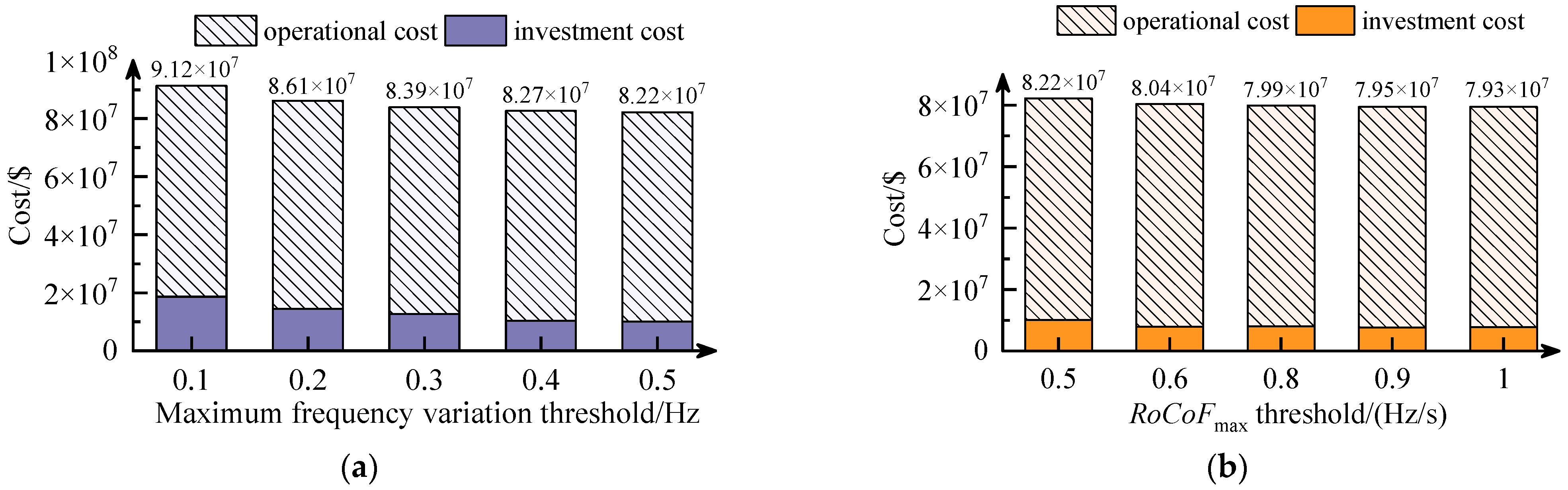
| Maximum Frequency Variation Threshold/Hz (RoCoFmax = 0.5 Hz/s) | Multiple Types of Grid-Forming Resources | |||
| BESS Power/MW | BESS Storage Power/MWh | Wind Power Retrofit Capacity/MW | PV Retrofit Capacity/MW | |
| 0.1 | 4800 | 9600 | 4000 | 1292 |
| 0.2 | 1800 | 3600 | 4000 | 1349 |
| 0.3 | 2400 | 4800 | 4000 | 962 |
| 0.4 | 2400 | 4800 | 3372 | 549 |
| 0.5 | 1800 | 3600 | 4000 | 709 |
| RoCoFmax threshold/(Hz/s) (Maximum frequency variation threshold = 0.5 Hz/s) | Multiple Types of Grid-Forming Resources | |||
| BESS Power/MW | BESS Storage Power/MWh | Wind Power Retrofit Capacity/MW | PV Retrofit Capacity/MW | |
| 0.5 | 1800 | 3600 | 4000 | 709 |
| 0.6 | 2400 | 4800 | 446 | 535 |
| 0.8 | 1800 | 3600 | 402 | 593 |
| 0.9 | 1800 | 3600 | 295 | 650 |
| 1.0 | 1800 | 3600 | 247 | 584 |
| /s ( = 5 s) | Multiple Types of Grid-Forming Resources | ||||
| BESS Power/MW | BESS Storage Power/MWh | Wind Power Retrofit Capacity/MW | PV Retrofit Capacity/MW | Total Cost/USD | |
| 0.1 | 3600 | 7200 | 2654 | 0 | 7.98 × 10⁷ |
| 0.3 | 2400 | 4800 | 3056 | 231 | 8.13 × 10⁷ |
| 0.5 | 1800 | 3600 | 4000 | 709 | 8.22 × 10⁷ |
| 0.7 | 1200 | 2400 | 4000 | 965 | 8.61 × 10⁷ |
| 0.9 | 1200 | 2400 | 4000 | 1423 | 9.12 × 10⁷ |
| /s ( = 0.5 s) | Multiple Types of Grid-Forming Resources | ||||
| BESS Power/MW | BESS Storage Power/MWh | Wind Power Retrofit Capacity/MW | PV Retrofit Capacity/MW | Total Cost/USD | |
| 2 | 1800 | 3600 | 3064 | 526 | 7.88 × 10⁷ |
| 5 | 1800 | 3600 | 4000 | 709 | 8.22 × 10⁷ |
| 8 | 3000 | 6000 | 4000 | 567 | 9.97 × 10⁷ |
| 10 | 4800 | 9600 | 3676 | 0 | 1.001 × 10⁸ |
| 12 | 4800 | 9600 | 4000 | 0 | 1.006 × 10⁸ |
| Node Calculation Inertia/MWs | Line Reactance Uncertainty (Line 20–26; Line 45–46) | Standard Deviation σ | ||||
|---|---|---|---|---|---|---|
| −10% | −5% | 0 | +5% | +10% | ||
| No. 20 | 21,329.8 | 21,311.3 | 21,286.1 | 21,261.7 | 21,236.4 | 33.48 |
| No. 45 | 22,776.4 | 22,741.7 | 22,699.1 | 22,657.5 | 22,622.8 | 61.93 |
| Scenario | Multiple Types of Grid-Forming Resources | |||
|---|---|---|---|---|
| BESS Power/MW | BESS Storage Power/MWh | Wind Power Retrofit Capacity/MW | PV Retrofit Capacity/MW | |
| Without VRE Uncertainty | 1200 | 2400 | 624 | 128 |
| With 10% VRE Uncertainty | 2400 | 4800 | 2050 | 1000 |
| Temporal Uncertainty Budgets of VRE | Multiple Types of Grid-Forming Resources | |||
|---|---|---|---|---|
| BESS Power/MW | BESS Storage Power/MWh | Wind Power Retrofit Capacity/MW | PV Retrofit Capacity/MW | |
| 0 | 1200 | 2400 | 1063 | 561 |
| 5% | 1800 | 3600 | 2561 | 713 |
| 10% | 1800 | 3600 | 4000 | 709 |
| 15% | 2400 | 4800 | 2388 | 984 |
| 20% | 3000 | 6000 | 4000 | 1002 |
Disclaimer/Publisher’s Note: The statements, opinions and data contained in all publications are solely those of the individual author(s) and contributor(s) and not of MDPI and/or the editor(s). MDPI and/or the editor(s) disclaim responsibility for any injury to people or property resulting from any ideas, methods, instructions or products referred to in the content. |
© 2025 by the authors. Licensee MDPI, Basel, Switzerland. This article is an open access article distributed under the terms and conditions of the Creative Commons Attribution (CC BY) license.
Share and Cite
Yuan, Y.; Fan, Z.; Jiang, X.; Wu, Y.; Chi, C. Exploiting the Flexibility and Frequency Support Capability of Grid-Forming Energy Storage: A Bi-Level Robust Planning Model Considering Uncertainties. Processes 2026, 14, 90. https://doi.org/10.3390/pr14010090
Yuan Y, Fan Z, Jiang X, Wu Y, Chi C. Exploiting the Flexibility and Frequency Support Capability of Grid-Forming Energy Storage: A Bi-Level Robust Planning Model Considering Uncertainties. Processes. 2026; 14(1):90. https://doi.org/10.3390/pr14010090
Chicago/Turabian StyleYuan, Yijia, Zheng Fan, Xirui Jiang, Yanan Wu, and Chengbin Chi. 2026. "Exploiting the Flexibility and Frequency Support Capability of Grid-Forming Energy Storage: A Bi-Level Robust Planning Model Considering Uncertainties" Processes 14, no. 1: 90. https://doi.org/10.3390/pr14010090
APA StyleYuan, Y., Fan, Z., Jiang, X., Wu, Y., & Chi, C. (2026). Exploiting the Flexibility and Frequency Support Capability of Grid-Forming Energy Storage: A Bi-Level Robust Planning Model Considering Uncertainties. Processes, 14(1), 90. https://doi.org/10.3390/pr14010090