Is Photocatalysis Ready for Scale Yet?
 , , , , , , and
Abstract
1. Introduction
2. Methodology
2.1. Search Strategy and Data Extraction
- TITLE-ABS-KEY((photocataly* AND (water OR wastewater OR effluent*))
- AND (("techno-economic" OR "cost analysis" OR "economic feasibility")
- OR ("life cycle assessment" OR "LCA" OR "environmental impact")))
2.2. Screening and Prioritization Framework
2.2.1. Data Cleaning and Preprocessing
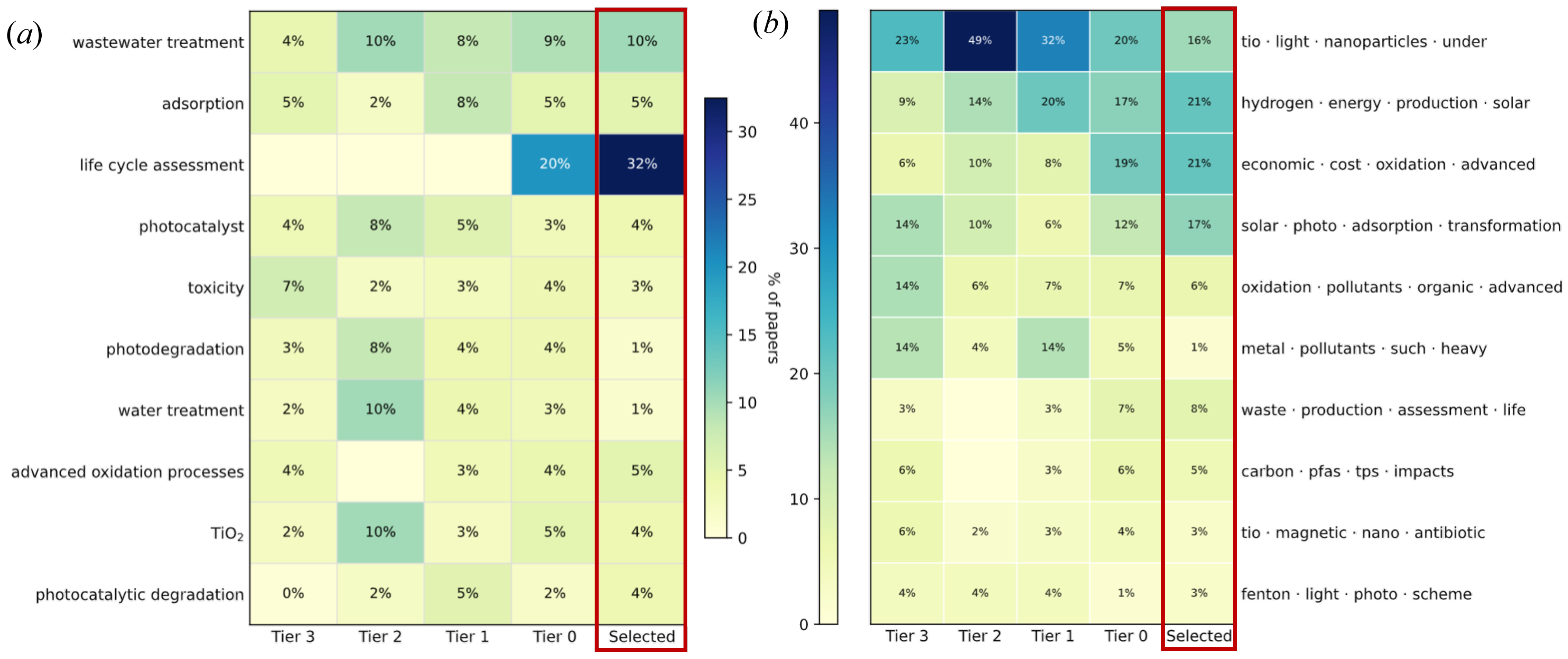
2.2.2. Keyword-Based Relevance Scoring and Tiered Prioritization
2.3. Thematic Analysis via Topic Modeling
3. Results
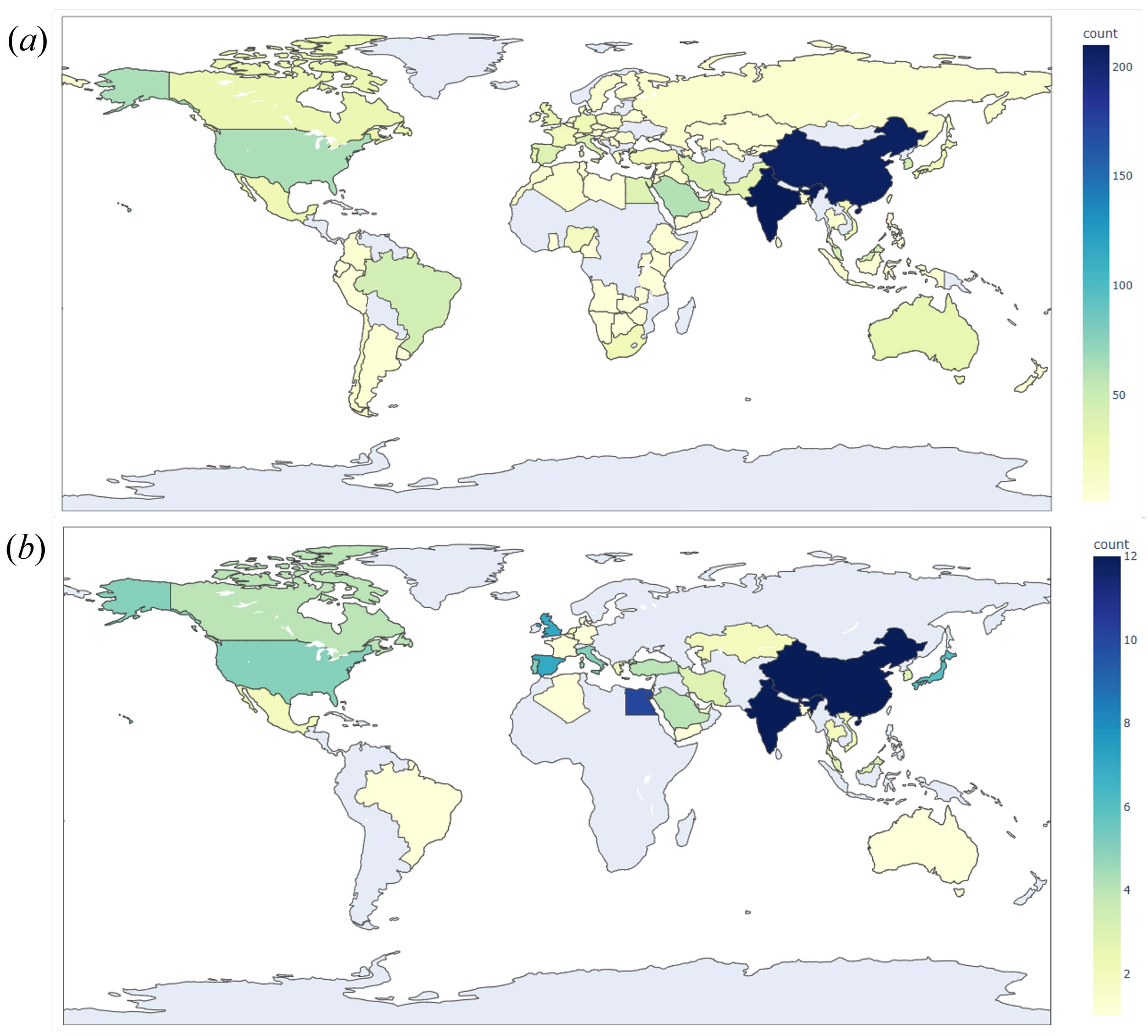
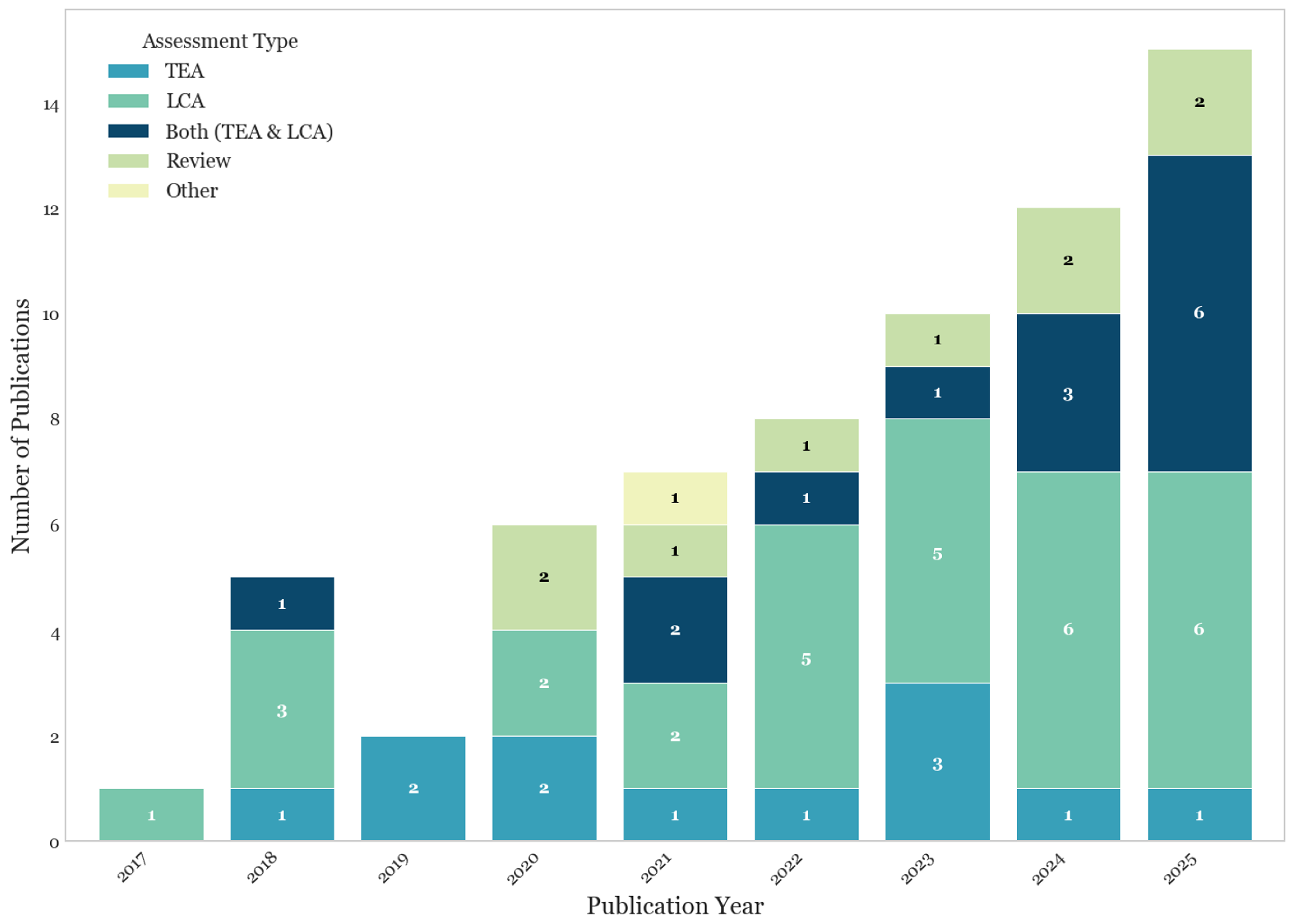
3.1. Overview of the Analytical Dataset
3.2. The Core Literature

| References | Technology | Application | Assessment Type |
|---|---|---|---|
| Aghel (2025) [4] | Fe3O4, SiO2, TiO2, Ag-TiO2 (Immobilized/Suspended) | WWT (Phenol removal) | Both (LCA & LCC) |
| Ahmaruzzaman (2024) [25] | Review of Phenolic Treatment Technologies | WWT (Phenolic WW) | Review (Cost/Sustainability) |
| Alhalafi (2025) [42] | ZnO Quantum Dots | WWT (Dye Degradation) | Both (Economic & Ecotoxicity) |
| Alsayegh (2019) [43] | Photocatalytic Water Splitting | H2 production | TEA (Economics/Energy Analysis) |
| Aydin (2021) [36] | Review (Photocatalysis, PEC, Fermentation) | H2 production/WWT | Review (LCA, TEA, Other) |
| Baaloudj (2022) [44] | Bi12TiO20 Catalytic System | WWT (Pharmaceutical WW) | TEA (Economic Evaluation) |
| Bahadur (2020) [45] | TiO2 in TADOX | WWT (COD reduction) | TEA (Techno-Economic Feasibility) |
| Balakrishnan (2021) [22] | UV/Chitosan-TiO2 Beads | WWT (Pesticide abatement) | Other (Energy & Cost Analysis) |
| Barman (2021) [46] | FA_NPC*O Catalyst | Other (HMF production from waste) | LCA (Environmental Performance) |
| Bhargava (2023) [47] | UV photo-Fenton, UV/TiO2 photocatalysis | WWT (Textile WW) | TEA (Techno-Economic Feasibility) |
| de Boer (2022) [28] | Review (Photocatalytic, Fenton-based, UV) | WWT (Tertiary, Micropollutants) | Review (LCA, TEA) |
| Carvalho (2023) [48] | g-C3N4 nanosheets, nano-TiO2 synthesis | H2 production (Synthesis context) | LCA (Synthesis impacts) |
| Chauhan (2025) [49] | SCBW-10 Composite Photocatalyst | WWT (OTC degradation) | LCA (Environmental Performance) |
| Chawla (2020) [29] | Anatase and P25 TiO2 | WWT (Dye degradation) | TEA (Techno-economic evaluation) |
| Chen (2025) [26] | MOF-based Photocatalysis | WWT/Other (H2O2 gen., Cr(VI) photoreduction) | Both (TEA & LCA proxy) |
| Chen (2025b) [27] | K@Z-2 Piezo-photocatalysis | WWT (TC removal) | LCA (Sustainability Assessment) |
| Costamagna (2020) [50] | Rare Earth doped ZnO | WWT (Phenol degradation) | LCA (Environmental Performance) |
| Dihan (2025) [12] | Review (Photocatalytic/PEC, e.g., TiO2, Cd0.5Zn0.5S) | H2 production | Review (LCA, TEA) |
| Dominguez (2018) [51] | Photocatalysis (TiO2), PV-Photocatalysis | WWT (Greywater reuse) | LCA (Technology Comparison) |
| Dubsok (2022) [38] | Nano-TiO2/FeCl3 Photocatalysis | WWT (Cyanate degradation) | LCA (Environmental Performance) |
| Elgarahy (2022) [33] | Review (Gold-TiO2, Copper-TiO2 etc.) | H2 production | Review (TEA, Cost analysis) |
| Elhami (2023) [52] | Chl/TiO2 Photocatalyst | WWT (Rhodamine B removal) | LCA (Environmental Performance) |
| Feijoo (2020) [53] | Fe3O4 Nanoparticles (Photo-Fenton) | WWT (Antibiotic removal/WW) | LCA (Environmental Performance) |
| Feng (2024) [54] | Fe-C3N4 (Photo-Fenton-like) | WWT (Livestock WW, TC-HCl) | Both (LCA & Technical) |
| Foteinis (2018) [2] | Solar Photo-Fenton (Ferrioxalate-assisted) | WWT (Pharmaceutical WW) | LCA (Environmental Performance) |
| Foteinis (2018b) [55] | Light-driven AOPs (UV-A/TiO2, Photo-Fenton) | WWT (EE2 removal) | LCA (Comparative) |
| El Golli (2024) [30] | PTC-based process, TiO2 | WWT (Water treatment) | TEA (Economic Assessment) |
| Gomes (2018) [56] | Solar Photo-Fenton (CPC systems) | WWT (Leachate treatment) | TEA (Cost analysis) |
| Gowland (2024) [39] | Immobilized vs. Suspended TiO2 | WWT (NOM removal) | LCA (Environmental Performance) |
| Hargreaves (2020) [57] | Thermal, Electro-, Photo-catalysis | Other (NH3, H2O2 production) | Review (Sustainability) |
| Jia (2025) [58] | UiO-66/CN Photocatalyst | WWT (DMP removal) | LCA (Environmental Performance) |
| Luo (2024) [34] | CDs/CdS/CNU Photocatalyst | WWT & H2 production | LCA (Environmental Performance) |
| Magdy (2021) [11] | Solar Photo-Fenton, TiO2, TiO2/AC, Electro-Fenton | WWT (Phenolic WW) | Both (LCA & Economic) |
| Mao (2024) [59] | Solar-driven Photocatalytic Membrane Reactors (PMR) | WWT (PDWW treatment) | LCA (GHG Assessment) |
| Maurya (2023) [23] | TNRs, CNF:TNRs, g-C3N4-S, BiOI/g-C3N4-S | H2 production | TEA (LCOH Model) |
| Maurya (2023b) [60] | TNRs, CNF:TNRs, g-C3N4-S, BiOI/g-C3N4-S | H2 production | LCA (GHG/EPBT) |
| McKee (2022) [40] | UV-LED/TiO2 vs. UV-BL/TiO2 | WWT (BPA removal) | LCA (Environmental Performance) |
| Mule (2021) [61] | TiO2/H-MOR (Visible-light-driven) | WWT (Pesticide removal) | Review (Technical) |
| Ngulube (2024) [31] | ZnO@Mg(OH)2 Nanocomposite | WWT (Dye-laden wastewater) | Both (LCA & TEA) |
| Notarnicola (2023) [62] | UV-C+TiO2 and related UV-C systems | WWT (CECs removal, tertiary treatment) | LCA (Comparative) |
| Oviedo (2025) [37] | nSOD@CuO-NPs Nanocatalyst | WWT (Organic pollutants degradation) | TEA (Cash Flow Analysis) |
| Patiño-Arévalo (2025) [63] | Hom./Het. Fenton/Fenton-like (CA-Fe-II/CA-Fe-III) | WWT (Phenol degradation) | Both (LCA & Cost) |
| Pelayo (2023) [64] | UV-A/TiO2, UV-C/TiO2 and related systems | WWT (CECs removal) | Both (Economic & LCA proxy) |
| Pesqueira (2020) [65] | Review (Photocatalysis, PF, OZ, etc.) | WWT (PSs and CECs removal) | Review (LCA) |
| Pesqueira (2021) [66] | Solar TiO2 Photocatalysis, Photo-Fenton | WWT (Micropollutant removal) | LCA (Comparative) |
| Pesqueira (2024) [32] | Solar/GO-TiO2 Photocatalysis vs. Solar/TiO2 | WWT (PSs and CECs removal) | LCA (Comparative) |
| Pini (2017) [67] | Nano-TiO2 coated float glass | Other (Material Production/Coating) | LCA (Synthesis) |
| Pookmanee (2025) [68] | TiO2 and N-TiO2 Photocatalysts Synthesis | Other (Material Synthesis) | LCA (Comparative) (Synthesis impacts) |
| Qureshi (2024) [69] | Review (PEC, PC water splitting) | H2 production | Review (LCA, TEA) |
| Ran (2025) [70] | Heterogeneous Coupling Systems (e.g., Light-US-PMS) | WWT (Phenolic WW) | LCA (Comparative GWP) |
| Rezaie (2025) [5] | rGH,Fe3O4@SnO2/Ag-based | WWT (2,4-DCP removal) | Both (LCA & Cost) |
| Rodríguez (2018) [71] | Various WW treatments (incl. Photocatalysis context) | WWT (Chrome plating WW) | Both (LCA & TEA) |
| Rumayor (2022) [35] | Photocatalysis (Photoreforming, TiO2) | H2 production (from glycerol waste) | LCA (Prospective ex-ante) |
| Sahoo (2024) [3] | Review (g-C3N4-based photocatalyst) | WWT (Organic pollutant remediation) | Review (LCA) |
| Sendão (2025) [41] | CDs Nanocomposites (TiO2/Ag) | WWT (MB photodegradation) | LCA (Synthesis/FU-based) |
| Serik (2026) [72] | Solar H2 by Photocatalysis (Review context) | H2 production | Review (TEA, Sustainability) |
| Shah (2024) [73] | BCN Nanomaterials Synthesis | Other (Material Synthesis) | LCA (Synthesis impacts) |
| Sharmila (2019) [74] | TADOX treatment (implied context) | WWT (Sludge pre-treatment) | TEA (Economic Analysis) |
| Souza (2023) [75] | TiO2 Photocatalytic Surface (UVA-LED) | WWT (Greywater reuse) | LCA (Environmental Performance) |
| Srivastava (2023) [76] | Review (Photonic energy materials) | H2 production (Solar H2) | Review (LCA) |
| Supramaniam (2025) [77] | Photocatalysis (Review Context) | H2 production (Review) | Review (Technical) |
| Tsalidis (2022) [78] | P25-TiO2, Cu2O-coated/P25-TiO2 | H2 production (Generation) | LCA (Prospective) |
| Wang (2021) [79] | Magnetic AgVO3/ZnFe2O4 Nanocomposites | WWT (Dye degradation) | Other (Technical) |
| Wang (2024) [80] | KPTI/PTI Photocatalysts | Other (Material Synthesis/OER) | LCA (Equivalent CO2 emissions) |
| Yang (2022) [81] | Suspended Photocatalytic System | H2 production | LCA (Environmental Performance) |
| Yaqub (2023) [82] | Membrane/Chemical processes (UV included in context) | WWT (Textile ZLD Scenarios) | TEA (Cost analysis) |
3.3. An Overview of the Scaling Challenges of Photocatalytic Technologies
Strategies to Accelerate Scale Up
3.4. TEA and LCA for Photocatalysis
3.4.1. LCA Scope and Methodology Trends
3.4.2. Environmental Hotspots
3.4.3. Overview of Techno-Economic Assessment Reports
4. Discussion
4.1. A Field in Transition
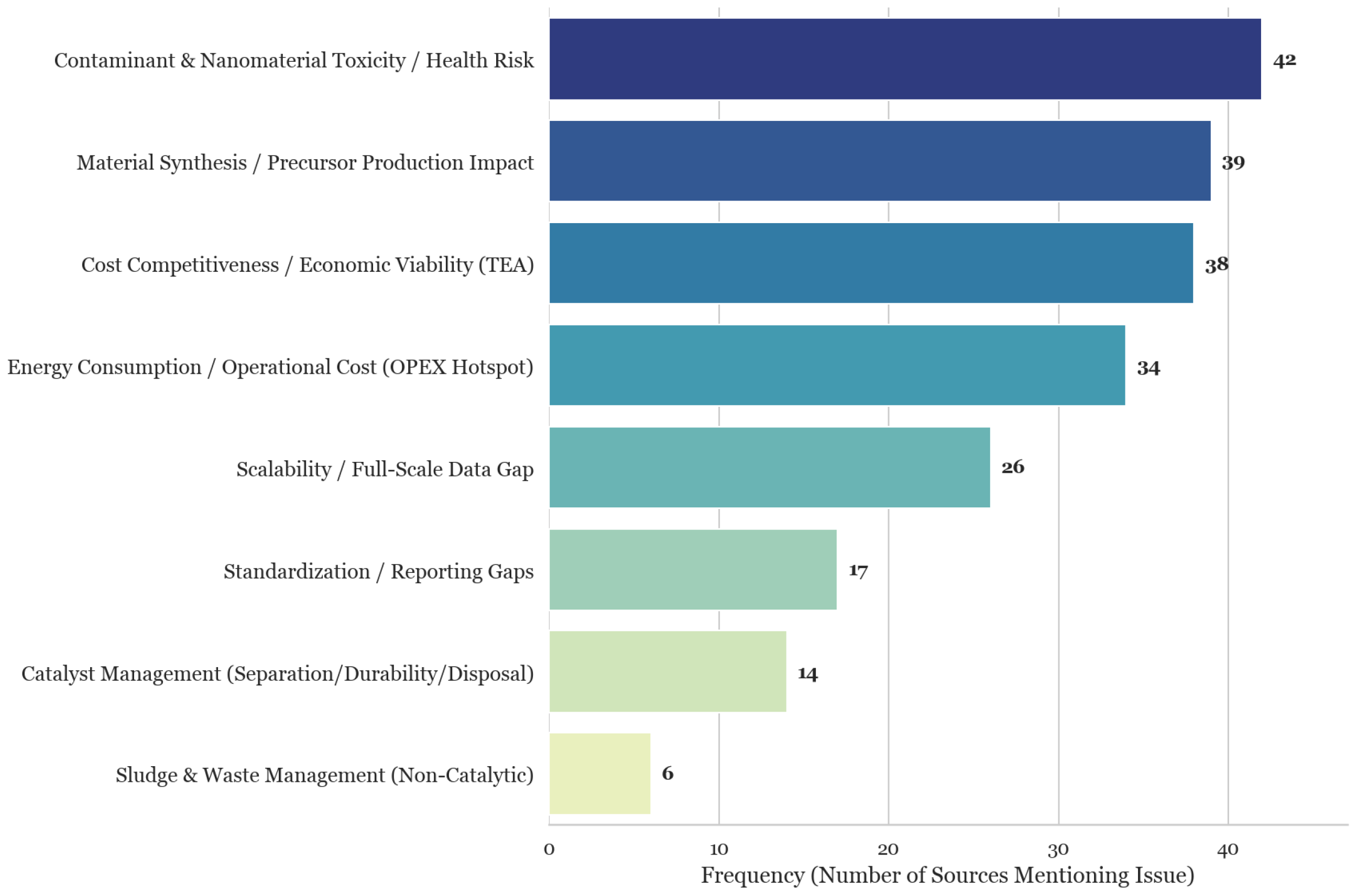
4.2. Key Limitations to Further Expansion
4.3. Strategic Roadmap for Scale-Up
- 1.
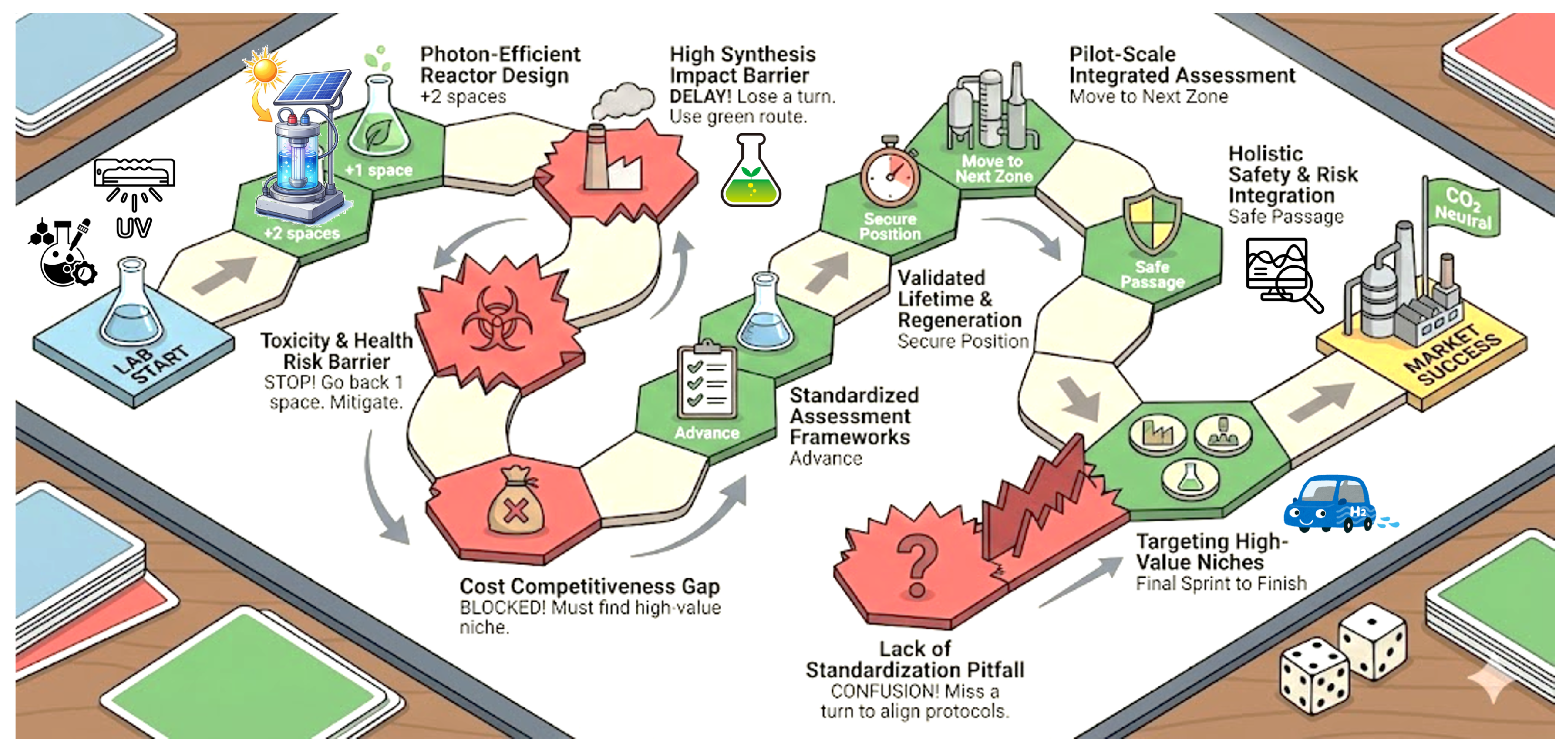
- Photon-efficient reactor design. TEA and LCA consistently identify electricity consumption as the dominant hotspot in UV-driven systems. Future research should prioritize reactor configurations that maximize photon utilization and minimize electrical input, such as thin-film geometries, light-guiding architectures, and solar-first designs, rather than focusing solely on intrinsic catalytic activity.
- 2.
- Scalable, low-impact material synthesis. Assessment results show that complex, multi-step synthesis often trades performance gains at the expense of high cradle-to-gate impacts. Research should prioritize materials producible via low-temperature, solvent-efficient, and high-yield routes (e.g., aqueous sol-gel) using abundant precursors, even if this entails accepting moderate activity in exchange for manufacturability [4,50].
- 3.
- Standardized assessment frameworks. The comparability of existing studies is severely limited by heterogeneous assumptions regarding functional units, energy inputs, and system boundaries. Adopting harmonized reporting protocols for photon fluxes, reactor geometries, and life-cycle inventories is essential to facilitate robust, evidence-based decision-making [12,60].
- 4.
- Validated lifetime and regeneration benchmarks. A major source of uncertainty in economic and environmental models is the lack of long-term durability data. Future studies must systematically quantify degradation rates and regeneration efficiency under representative operating conditions, as catalyst replacement frequency is a primary driver of life-cycle burdens.
- 5.
- Shift to pilot-scale integrated assessment. Many favorable projections rely on optimistic laboratory assumptions that fail under continuous-flow conditions. Research must pivot toward integrated pilot systems that combine reactors, hydraulics, and downstream separation, supported by ex-ante TEA/LCA to identify technological lock-in risks early in development [35].
- 6.
- Holistic safety and risk integration. Beyond performance, the potential release of nanomaterials and toxic leachates remains a critical barrier. Experimental evaluation of spent catalyst toxicity and fate-and-transport modeling should be incorporated routinely into process development, particularly for treated effluents intended for agricultural reuse [13,42].
- 7.
- Targeting high-value niches. Rather than pursuing direct competition with low-cost biological treatments, research should identify applications where photocatalysis provides unique system-level value. This includes decentralized treatment, removing recalcitrant contaminants (e.g., APIs) where chemical inputs must be minimized, or coupling with renewable energy for waste valorization.
5. Conclusions
Author Contributions
Funding
Data Availability Statement
Acknowledgments
Conflicts of Interest
References
- Alhajeri, N.; Tawfik, A.; Nasr, M.; Osman, A. Artificial intelligence-enabled optimization of Fe/Zn@biochar photocatalyst for 2,6-dichlorophenol removal from petrochemical wastewater: A techno-economic perspective. Chemosphere 2024, 352, 141476. [Google Scholar] [CrossRef]
- Foteinis, S.; Monteagudo, J.; Duran Segovia, A.; Chatzisymeon, E. Environmental sustainability of the solar photo-Fenton process for wastewater treatment and pharmaceuticals mineralization at semi-industrial scale. Sci. Total Environ. 2018, 612, 605–612. [Google Scholar] [CrossRef] [PubMed]
- Sahoo, S.; Mahamallik, P.; Das, R.; Panigrahi, S. A critical review on non-metal doped g-C3N4 based photocatalyst for organic pollutant remediation with sustainability assessment by life cycle analysis. Environ. Res. 2024, 258, 119390. [Google Scholar] [CrossRef] [PubMed]
- Aghel, S.; Bahramifar, N.; Younesi, H.; Ziyarati, M. An integrated life cycle assessment of phenol photocatalytic degradation: Evaluating environmental and economic impacts of immobilized versus suspended TiO2-based photocatalysts. J. Water Process Eng. 2025, 77, 108411. [Google Scholar] [CrossRef]
- Rezaie, A.; Khaki, E.; Boleydei, H.; Khoshnevisan, B.; Fayyaz, S. Environmental, energy and economic assessment of four recyclable nano-sized semiconductor photocatalysts to remove 2,4-dichlorophenol. J. Water Process Eng. 2025, 77, 108351. [Google Scholar] [CrossRef]
- Pérez-Álvarez, D.T.; Brown, J.; Elgohary, E.A.; Mohamed, Y.M.A.; El Nazer, H.A.; Davies, P.; Stafford, J. Challenges surrounding nanosheets and their application to solar-driven photocatalytic water treatment. Mater. Adv. 2022, 3, 4103–4131. [Google Scholar] [CrossRef]
- Younis, S.; Kim, K.H. Heterogeneous Photocatalysis Scalability for Environmental Remediation: Opportunities and Challenges. Catalysts 2020, 10, 1109. [Google Scholar] [CrossRef]
- Wafi, A.; Aji, D.; Khan, M.M. Recent Advances in Photocatalysis: From Laboratory to Market. Results Chem. 2025, 18, 102672. [Google Scholar] [CrossRef]
- Tummino, M.L.; Navarro Yerga, R.M. Editorial: Air and Water Purification Processes through Photocatalysis—Scale-Up Perspectives, 2nd Edition. Catalysts 2024, 14, 434. [Google Scholar] [CrossRef]
- Amaya Santos, G.; Ali, A.Z.; Lettieri, P. Sustainable advanced wastewater treatment via photoelectrocatalytic oxidation: Insights from life cycle assessment. npj Clean Water 2025, 8, 94. [Google Scholar] [CrossRef]
- Magdy, M.; Gar Alalm, M.; El-Etriby, H. Comparative life cycle assessment of five chemical methods for removal of phenol and its transformation products. J. Clean. Prod. 2021, 291, 125923. [Google Scholar] [CrossRef]
- Dihan, M.; Rahman, T.; Jaman Riad Khan, M.; Banhi, T.; Sadaf, S.; Reza, M.; Afroze, S.; Islam, S.; Islam, M. Photocatalytic and photoelectrochemical H2 generation for sustainable future: Performance improvement, techno-economic analysis, and life cycle assessment for shaping the reality. Fuel 2025, 392, 134356. [Google Scholar] [CrossRef]
- Ngulube, K.; Abdelhaleem, A.; Osman, A.; Peng, L.; Nasr, M. Advancing sustainable water treatment strategies: Harnessing magnetite-based photocatalysts and techno-economic analysis for enhanced wastewater management in the context of SDGs. Environ. Sci. Pollut. Res. 2024, 32, 28159–28195. [Google Scholar] [CrossRef] [PubMed]
- European Commission; Joint Research Centre. Delivering the EU Green Deal: Progress Towards Targets; Publications Office: Luxembourg, 2025.
- Nyambiya, I.; Chapungu, L.; Sawunyama, L.; Musvoto, E.V.; Nhamo, L.; Zvimba, J.N. Circular economy drivers, opportunities, and barriers, for wastewater services within low- and medium-income countries. Phys. Chem. Earth Parts A/B/C 2025, 138, 103871. [Google Scholar] [CrossRef]
- Reback, J.; McKinney, W.; Van Den Bossche, J.; Augspurger, T.; Cloud, P.; Klein, A.; Hawkins, S.; Roeschke, M.; Tratner, J.; She, C.; et al. pandas-dev/pandas: Pandas. Zenodo 2020, 21, 1–9. [Google Scholar] [CrossRef]
- McKinney, W. Data Structures for Statistical Computing in Python. In Proceedings of the 9th Python in Science Conference, Austin, TX, USA, 28 June–3 July 2010; van der Walt, S., Millman, J., Eds.; pp. 56–61. [Google Scholar] [CrossRef]
- Sjögårde, P.; Ahlgren, P.; Waltman, L. Algorithmic labeling in hierarchical classifications of publications. J. Assoc. Inf. Sci. Technol. 2021, 72, 1266–1282. [Google Scholar] [CrossRef]
- Blei, D.M.; Ng, A.Y.; Jordan, M.I. Latent dirichlet allocation. J. Mach. Learn. Res. 2003, 3, 993–1022. [Google Scholar]
- Řehůřek, R.; Sojka, P. Gensim—Python framework for vector space modelling. Nlp Lrec 2011, 11, 6. [Google Scholar]
- Bird, S.; Klein, E.; Loper, E. Natural Language Processing with Python: Analyzing Text with the Natural Language Toolkit; O’Reilly Media, Inc.: Sebastopol, CA, USA, 2009. [Google Scholar]
- Balakrishnan, A.; Gopalram, K.; Appunni, S. Photocatalytic degradation of 2,4-dicholorophenoxyacetic acid by TiO2 modified catalyst: Kinetics and operating cost analysis. Environ. Sci. Pollut. Res. 2021, 28, 33331–33343. [Google Scholar] [CrossRef]
- Maurya, J.; Gemechu, E.; Kumar, A. The development of techno-economic assessment models for hydrogen production via photocatalytic water splitting. Energy Convers. Manag. 2023, 279, 116750. [Google Scholar] [CrossRef]
- Safo, K.; Rubangakene, N.O.; Noby, H.; El-Shazly, A.H. Photocatalytic purification of dye-containing wastewater using a novel embedded hybrid TiO2–slag catalyst heterojunction nanocomposite coupled with statistical models: A sustainable and techno-economic approach. Water Sci. Eng. 2025, 18, 151–164. [Google Scholar] [CrossRef]
- Ahmaruzzaman, M.; Mishra, S.; Gadore, V.; Yadav, G.; Roy, S.; Bhattacharjee, B.; Bhuyan, A.; Hazarika, B.; Darabdhara, J.; Kumari, K. Phenolic compounds in water: From toxicity and source to sustainable solutions—An integrated review of removal methods, advanced technologies, cost analysis, and future prospects. J. Environ. Chem. Eng. 2024, 12, 112964. [Google Scholar] [CrossRef]
- Chen, G.; Han, W.; Lin, C.; Li, Y.; Zhou, S.; Kong, Y. Multifunctional Cu-engineered NH2-MIL-125Ti@ZnIn2S4 heterojunction with dual-channel H2O2 activation for ultrafast water-mediated Cr(VI) photoreduction. Chem. Eng. J. 2025, 520, 165937. [Google Scholar] [CrossRef]
- Chen, Z.; Zhao, C.; Ma, R.; Yao, Z.; Guo, Z.; Zhao, Z.; Zheng, Y.; Fu, H. Interface and Polarization Engineering of ZIF-67(Co)-Based Heterojunctions for Selective Non-Radical PMS Activation: Simultaneous Generation of 1O2 and Co(IV)=O for Efficient and Safe Water Remediation. Adv. Funct. Mater. 2025, e16474. [Google Scholar] [CrossRef]
- de Boer, S.; González-Rodríguez, J.; Conde, J.; Moreira, M. Benchmarking tertiary water treatments for the removal of micropollutants and pathogens based on operational and sustainability criteria. J. Water Process Eng. 2022, 46, 102587. [Google Scholar] [CrossRef]
- Chawla, P.; Sharma, S.; Toor, A. Techno-economic evaluation of anatase and p25 TiO2 for treatment basic yellow 28 dye solution through heterogeneous photocatalysis. Environ. Dev. Sustain. 2020, 22, 231–249. [Google Scholar] [CrossRef]
- El Golli, A.; Fendrich, M.; Bajpai, O.; Bettonte, M.; Edebali, S.; Orlandi, M.; Miotello, A. Parabolic trough concentrator design, characterization, and application: Solar wastewater purification targeting textile industry dyes and pharmaceuticals—techno-economic study. Euro-Mediterr. J. Environ. Integr. 2024, 9, 1907–1919. [Google Scholar] [CrossRef]
- Ngulube, K.; Abdelhaleem, A.; Fujii, M.; Nasr, M. Synthesis of smart ZnO@Mg(OH)2 core–shell nanocomposite and its application for methylene blue photocatalytic degradation: Life cycle sustainability assessment and techno-economics. J. Water Process Eng. 2024, 64, 105605. [Google Scholar] [CrossRef]
- Pesqueira, J.; Pereira, M.; Silva, A. Carbon-based composites in advanced wastewater treatment: A life cycle assessment of TiO2 and GO-TiO2 solar photocatalysis. J. Clean. Prod. 2024, 444, 140845. [Google Scholar] [CrossRef]
- Elgarahy, A.M.; Eloffy, M.G.; Hammad, A.; Saber, A.N.; El-Sherif, D.M.; Mohsen, A.; Abouzid, M.; Elwakeel, K.Z. Hydrogen production from wastewater, storage, economy, governance and applications: A review. Environ. Chem. Lett. 2022, 20, 3453–3504. [Google Scholar] [CrossRef]
- Luo, Y.; Su, R. Environmental Impact of Waste Treatment and Synchronous Hydrogen Production: Based on Life Cycle Assessment Method. Toxics 2024, 12, 652. [Google Scholar] [CrossRef]
- Rumayor, M.; Corredor, J.; Rivero, M.; Ortiz Uribe, I. Prospective life cycle assessment of hydrogen production by waste photoreforming. J. Clean. Prod. 2022, 336, 130430. [Google Scholar] [CrossRef]
- Aydin, M.; Karaca, A.; Qureshy, A.; Dincer, I. A comparative review on clean hydrogen production from wastewaters. J. Environ. Manag. 2021, 279, 111793. [Google Scholar] [CrossRef]
- Oviedo, L.; Loureiro, S.; Nora, L.; da Silva, W. Exploratory data analysis and economic feasibility on the scale-up of an industrial wastewater treatment using a green nanocatalyst in heterogeneous photocatalysis system. J. Water Process Eng. 2025, 77, 108508. [Google Scholar] [CrossRef]
- Dubsok, A.; Khamdahsag, P.; Kittipongvises, S. Life cycle environmental impact assessment of cyanate removal in mine tailings wastewater by nano-TiO2/FeCl3 photocatalysis. J. Clean. Prod. 2022, 366, 132928. [Google Scholar] [CrossRef]
- Gowland, D.; Robertson, N.; Chatzisymeon, E. Life Cycle Assessment of Immobilised and Slurry Photocatalytic Systems for Removal of Natural Organic Matter in Water. Environments 2024, 11, 114. [Google Scholar] [CrossRef]
- McKee, S.; Chatzisymeon, E. Assessing the environmental sustainability of light emitting diodes and conventional blacklight lamps for the treatment of bisphenol-A in water. Environ. Impact Assess. Rev. 2022, 97, 106886. [Google Scholar] [CrossRef]
- Sendão, R.; Esteves Da Silva, J.; Pinto da Silva, L. Comparative life cycle assessment of the fabrication of visible-light-driven photocatalytic TiO2—Carbon dots nanocomposites for wastewater treatment. NanoImpact 2025, 38, 100556. [Google Scholar] [CrossRef] [PubMed]
- Alhalafi, Z.; Sharahili, M.; Alhalafi, M.; Alsharari, A.; Alsharif, M.; Yousef, T.; Ferjani, H.; El-Metwally, N. ZnO quantum dots for wastewater Remediation: Phytotoxicity, photocatalytic performance, and economic assessment. Opt. Mater. 2025, 168, 117391. [Google Scholar] [CrossRef]
- Alsayegh, S.; Johnson, J.; Ohs, B.; Wessling, M. Methanol production via direct carbon dioxide hydrogenation using hydrogen from photocatalytic water splitting: Process development and techno-economic analysis. J. Clean. Prod. 2019, 208, 1446–1458. [Google Scholar] [CrossRef]
- Baaloudj, O.; Badawi, A.; Kenfoud, H.; Benrighi, Y.; Hassan, R.; Nasrallah, N.; Assadi, A. Techno-economic studies for a pilot-scale Bi12TiO20 based photocatalytic system for pharmaceutical wastewater treatment: From laboratory studies to commercial-scale applications. J. Water Process Eng. 2022, 48, 102847. [Google Scholar] [CrossRef]
- Bahadur, N.; Das, P.; Bhargava, N. Improving energy efficiency and economic feasibility of photocatalytic treatment of synthetic and real textile wastewater using bagasse fly ash modified TiO2. Chem. Eng. J. Adv. 2020, 2, 100012. [Google Scholar] [CrossRef]
- Barman, S.; Chakraborty, R. Sustainable HMF synthesis from waste cooked rice water using fly-ash based Al2SiO5 supported nano-photocatalyst under halogen-ultrasound synergistic-energy: LCA and DFT based simulation. J. Environ. Chem. Eng. 2021, 9, 106736. [Google Scholar] [CrossRef]
- Bhargava, N.; Bahadur, N.; Kansal, A. Techno-economic assessment of integrated photochemical AOPs for sustainable treatment of textile and dyeing wastewater. J. Water Process Eng. 2023, 56, 104302. [Google Scholar] [CrossRef]
- Aquino de Carvalho, N.; Gilbertson, L. Comparative life cycle assessment of graphitic carbon nitride synthesis routes. J. Ind. Ecol. 2023, 27, 1008–1020. [Google Scholar] [CrossRef]
- Chauhan, S.; Bhar, R.; Ray, K.; Chowdhury, S.; Ghangrekar, M.; Dubey, B. Enhanced visible light photocatalytic degradation of oxytetracycline through sugarcane bagasse biochar supported layered WS2 type-II staggered heterojunction: Towards performance, degradation pathway, toxicity, and life cycle assessment. Environ. Res. 2025, 271, 121100. [Google Scholar] [CrossRef] [PubMed]
- Costamagna, M.; Ciacci, L.; Paganini, M.; Calza, P.; Passarini, F. Combining the highest degradation efficiency with the lowest environmental impact in zinc oxide based photocatalytic systems. J. Clean. Prod. 2020, 252, 119762. [Google Scholar] [CrossRef]
- Dominguez, S.; Laso, J.; Margallo, M.; Aldaco, R.; Rivero, M.; Irabien, A.; Ortiz Uribe, I. LCA of greywater management within a water circular economy restorative thinking framework. Sci. Total Environ. 2018, 621, 1047–1056. [Google Scholar] [CrossRef] [PubMed]
- Elhami, M.; Bahramifar, N.; Bijanzadeh, H.; Abyar, H. Process efficiency and life cycle assessment of novel waste-derived Chl/TiO2 photocatalyst for rhodamine B removal. J. Water Process Eng. 2023, 56, 104425. [Google Scholar] [CrossRef]
- Feijoo, S.; González-Rodríguez, J.; Fernández, L.; Vázquez-Vázquez, C.; Feijoo, G.; Moreira, M. Fenton and photo-fenton nanocatalysts revisited from the perspective of life cycle assessment. Catalysts 2020, 10, 23. [Google Scholar] [CrossRef]
- Feng, Y.; Liang, Y.; Ding, C.; Jiang, Y.; Jin, H.; Rong, S.; Wu, J.; He, S.; Xia, C.; Xue, L. Sustainable design of photo-Fenton-like oxidation process in actual livestock wastewater through the highly dispersed FeCl3 anchoring on a g-C3N4 substrate. Water Res. 2024, 259, 121889. [Google Scholar] [CrossRef] [PubMed]
- Foteinis, S.; Borthwick, A.; Frontistis, Z.; Mantzavinos, D.; Chatzisymeon, E. Environmental sustainability of light-driven processes for wastewater treatment applications. J. Clean. Prod. 2018, 182, 8–15. [Google Scholar] [CrossRef]
- Gomes, A.; Silva, T.; Duarte, M.; Boaventura, R.; P Vilar, V. Cost-effective solar collector to promote photo-Fenton reactions: A case study on the treatment of urban mature leachate. J. Clean. Prod. 2018, 199, 369–382. [Google Scholar] [CrossRef]
- Hargreaves, J.; Chung, Y.M.; Ahn, W.S.; Hisatomi, T.; Domen, K.; Kung, M.; Kung, H. Minimizing energy demand and environmental impact for sustainable NH3 and H2O2 production—A perspective on contributions from thermal, electro-, and photo-catalysis. Appl. Catal. A Gen. 2020, 59, 117419. [Google Scholar] [CrossRef]
- Jia, H.; Yang, Y.; Zhang, Y.; Li, Z.; Yu, H.; Zhang, Y.; Lu, Y.; Zhou, D. Synergy of adsorption and photo catalysis in UiO-66/g-C3N4 Z-scheme photo catalyst for micropollutants DMP removal: Performance, mechanisms, and LCA. Sep. Purif. Technol. 2025, 369, 133119. [Google Scholar] [CrossRef]
- Mao, J.; Chen, H.; Xu, X.; Zhu, L. Assessing greenhouse gas emissions from the printing and dyeing wastewater treatment and reuse system: Potential pathways towards carbon neutrality. Sci. Total Environ. 2024, 927, 172301. [Google Scholar] [CrossRef] [PubMed]
- Maurya, J.; Gemechu, E.; Kumar, A. Life cycle assessment of earth-abundant photocatalysts for enhanced photocatalytic hydrogen production. Int. J. Hydrogen Energy 2023, 48, 20077–20095. [Google Scholar] [CrossRef]
- Mule, C.; Doltade, S.; Pandit, A. A review on pesticide degradation from irrigation water and techno-economic feasibility of treatment technologies. Water Environ. Res. 2021, 93, 2391–2413. [Google Scholar] [CrossRef]
- Notarnicola, B.; Tassielli, G.; Renzulli, P.; Di Capua, R.; Astuto, F.; Mascolo, G.; Murgolo, S.; de Ceglie, C.; Curri, M.; Comparelli, R.; et al. Life Cycle Assessment of UV-C based treatment systems for the removal of compounds of emerging concern from urban wastewater. Sci. Total Environ. 2023, 857, 159309. [Google Scholar] [CrossRef]
- Patiño-Arévalo, C.; Alemán-Luna, E.; Zarate-Navarro, M.; Ocampo-Pérez, R.; Romero-Cano, L.; Zárate-Guzmán, A. Comparison of the environmental impact of Fenton and Fenton-like reactions in heterogeneous and homogeneous phase applied to organic pollutant degradation through life cycle assessment. Environ. Res. 2025, 285, 122517. [Google Scholar] [CrossRef]
- Pelayo, D.; Rivero, M.; Santos, G.; Gómez, P.; Ortiz Uribe, I. Techno-economic evaluation of UV light technologies in water remediation. Sci. Total Environ. 2023, 858, 161376. [Google Scholar] [CrossRef] [PubMed]
- Pesqueira, J.; Pereira, M.; Silva, A. Environmental impact assessment of advanced urban wastewater treatment technologies for the removal of priority substances and contaminants of emerging concern: A review. J. Clean. Prod. 2020, 261, 121078. [Google Scholar] [CrossRef]
- Pesqueira, J.; Pereira, M.; Silva, A. A life cycle assessment of solar-based treatments (H2O2, TiO2 photocatalysis, circumneutral photo-Fenton) for the removal of organic micropollutants. Sci. Total Environ. 2021, 761, 143258. [Google Scholar] [CrossRef] [PubMed]
- Pini, M.; Cedillo-Gonzalez, E.; Neri, P.; Siligardi, C.; Ferrari, A. Assessment of environmental performance of TiO2 nanoparticles coated self-cleaning float glass. Coatings 2017, 7, 8. [Google Scholar] [CrossRef]
- Pookmanee, P.; Promwanna, K.; Sangsrichan, S.; Kittikul, J.; Thanomwat, M.; Chaiwoot, P.; Kruefu, V.; Ubolsook, P.; Jansanthea, P. Calcination-Free Hydrothermal Synthesis of Nitrogen-Doped TiO2: Integrating Photocatalytic Performance and Life Cycle Assessment for Sustainable Water Treatment. ChemistrySelect 2025, 10, e03820. [Google Scholar] [CrossRef]
- Qureshi, F.; Tahir, M. Photoelectrochemical water splitting with engineering aspects for hydrogen production: Recent advances, strategies and challenges. Int. J. Hydrogen Energy 2024, 69, 760–776. [Google Scholar] [CrossRef]
- Ran, M.; Hu, Y.; Cao, J.; Jiang, Y.; Xing, M. Piezo-photocatalytic-Fenton-like ternary coupling system for enhanced resourceful conversion of organic pollutants. Water Res. 2025, 285, 124122. [Google Scholar] [CrossRef] [PubMed]
- Rodríguez, R.; Espada, J.; Gallardo, M.; Molina, R.; López-Muñoz, M. Life cycle assessment and techno-economic evaluation of alternatives for the treatment of wastewater in a chrome-plating industry. J. Clean. Prod. 2018, 172, 2351–2362. [Google Scholar] [CrossRef]
- Serik, A.; Kuspanov, Z.; Daulbayev, C. Cost-effective strategies and technologies for green hydrogen production. Renew. Sustain. Energy Rev. 2026, 226, 116242. [Google Scholar] [CrossRef]
- Shah, Y.; Gilbertson, L. Balancing functional properties and environmental impact of graphitic carbon nitride: A case study on boron doping syntheses. Environ. Sci. Nano 2023, 11, 78–90. [Google Scholar] [CrossRef]
- Godvin Sharmila, V.; M, M.; Angappane, S.; Zhen, G.; Yeom, I.; Rajesh Banu, J. Evaluation of photocatalytic thin film pretreatment on anaerobic degradability of exopolymer extracted biosolids for biofuel generation. Bioresour. Technol. 2019, 279, 132–139. [Google Scholar] [CrossRef] [PubMed]
- de Simone Souza, H.; Falqui, L.; Xuereb, R.; Mamo, J.; Abela, S.; Grech, M.; Refalo, P. Environmental assessment of a single-family photocatalytic greywater treatment system based on the design and operating conditions. Sustain. Prod. Consum. 2023, 35, 483–494. [Google Scholar] [CrossRef]
- Srivastava, N.; Saquib, M.; Rajput, P.; Bhosale, A.; Singh, R.; Arora, P. Prospects of solar-powered nitrogenous fertilizers. Renew. Sustain. Energy Rev. 2023, 187, 113691. [Google Scholar] [CrossRef]
- Supramaniam, L.; Lam, S.M.; Sin, J.C.; Lahijani, P.; Mohamed, A. Recent advances in hydrogen production by solar photoreforming of plastic feedstocks using nanocatalytic materials: A review. Int. J. Hydrogen Energy 2025, 145, 95–118. [Google Scholar] [CrossRef]
- Tsalidis, G.; Soeteman-Hernández, L.; Noorlander, C.; Saedy, S.; van Ommen, J.; Vijver, M.; Korevaar, G. Safe-and-Sustainable-by-Design Framework Based on a Prospective Life Cycle Assessment: Lessons Learned from a Nano-Titanium Dioxide Case Study. Int. J. Environ. Res. Public Health 2022, 19, 4241. [Google Scholar] [CrossRef]
- Wang, X.; Masten, S.; Esfahanian, E. Comparison of the photocatalytic efficacy and environmental impact of CdS, ZnFe2O4, and NiFe2O4under visible light irradiation. Water Sci. Technol. 2021, 83, 993–1004. [Google Scholar] [CrossRef] [PubMed]
- Wang, J.; Huang, Z.; Nie, L. Molten Salt Modulation of Potassium-Nitrogen-Carbon for the Breaking Kinetics Bottleneck of Photocatalytic Overall Water Splitting and Environmental Impact Reduction. ACS Nano 2024, 18, 26902–26910. [Google Scholar] [CrossRef] [PubMed]
- Yang, Y.; Liu, S.; Jing, D.; Zhao, L. Continuous hydrogen production characteristics and environmental analysis of a pilot-scale hydrogen production system by photocatalytic water splitting. Energy Convers. Manag. 2022, 268, 115988. [Google Scholar] [CrossRef]
- Yaqub, M.; Çelebi, M.; Dilaver, M.; Bhagat, S.; Kobya, M.; Lee, W. Treating Textile Wastewater to Achieve Zero Liquid Discharge: A Comprehensive Techno-economic Analysis. Water Air Soil Pollut. 2023, 234, 651. [Google Scholar] [CrossRef]
- Gusmão, C.D.A.; Borges, L.T.; Palharim, P.H.; Otubo, L.; Rodrigues, O.; Gouvea, D.; Ramos, B.; Teixeira, A.C.S.C. Synthesis, Characterization, and Application of Pt/PtO2-TiO2/SiO2 Materials on a Continuous Flow Packed Bed Microreactor for Enhanced Photocatalytic Activity under Sunlight. Water 2022, 14, 3864. [Google Scholar] [CrossRef]
- Palharim, P.H.; Pereira, R.K.S.; Silva, G.T.; De Assis, G.C.; Ramos, B.; Teixeira, A.C.S.C. Scaling up immobilized WO3-Ag-AgCl photocatalysts for continuous acetaminophen removal using dual irradiation. Sol. Energy 2026, 303, 114140. [Google Scholar] [CrossRef]
- Takata, T.; Jiang, J.; Sakata, Y.; Nakabayashi, M.; Shibata, N.; Nandal, V.; Seki, K.; Hisatomi, T.; Domen, K. Photocatalytic water splitting with a quantum efficiency of almost unity. Nature 2020, 581, 411–414. [Google Scholar] [CrossRef] [PubMed]
- De Araújo Gusmão, C.; Palharim, P.H.; Ramos, B.; Teixeira, A.C.S.C. Enhancing the visible-light photoactivity of silica-supported TiO2 for the photocatalytic treatment of pharmaceuticals in water. Environ. Sci. Pollut. Res. 2022, 29, 42215–42230. [Google Scholar] [CrossRef] [PubMed]
- Cunha, I.L.C.; Machado, P.G.; Ribeiro, C.d.O.; Kulay, L. Bibliometric analysis of Advanced Oxidation Processes studies with a focus on Life Cycle Assessment and Costs. Environ. Sci. Pollut. Res. 2024, 31, 22319–22338. [Google Scholar] [CrossRef] [PubMed]
- Ngulube, K.; Abdelhaleem, A.; Fujii, M.; Nasr, M. Synergism of Artificial Intelligence and Techno-Economic for Sustainable Treatment of Methylene Blue Dye-Containing Wastewater by Photocatalysis. Sustainability 2024, 16, 529. [Google Scholar] [CrossRef]
- Li, J.; Zhang, Y.; Huang, Y. Noble-metal free plasmonic nanomaterials for enhanced photocatalytic applications—A review. Nano Res. 2022, 15, 10268–10291. [Google Scholar] [CrossRef]
- Li, R.; Wang, X.; Chen, M. Non-Noble Metal and Nonmetallic Plasmonic Nanomaterials with Located Surface Plasmon Resonance Effects: Photocatalytic Performance and Applications. Catalysts 2023, 13, 940. [Google Scholar] [CrossRef]
- Xavier Silva, C.; Moncada Botero, J.; Sastre, F.; van den Ham, J.; Buskens, P.; Meulendijks, N.; Detz, R. Techno-economic analysis for the sunlight-powered reverse water gas shift process: Scenarios, costs, and comparative insights. Sustain. Energy Technol. Assess. 2024, 65, 103768. [Google Scholar] [CrossRef]
- Zhou, J.; Zhao, X.; Huang, L.; Zhang, Y.; Zhou, X.; Fan, Y.; Mo, S.; Sun, Y.; Xie, Q.; Ye, D. A C-modified engineering strategy of porous In2O3 catalysts for point-concentrated solar-driven photothermal CO2 hydrogenation. Sep. Purif. Technol. 2025, 355, 129672. [Google Scholar] [CrossRef]


| Category Name | Keywords (Case-Insensitive) |
|---|---|
| Economic Assessment | techno-economic, technoeconomic, cost analysis, economic feasibility, economic assessment, economic viability, cost-effectiveness, cost-effective, operating cost, production cost |
| Environmental Assessment | life cycle assessment, LCA, life-cycle assessment, environmental impact, environmental assessment, carbon footprint, global warming potential, GWP, ecotoxicity, sustainability assessment |
| Core Process | photocatalysis, photocatalytic, photodegradation, photo-Fenton, photoelectrochemical, photo-oxidation |
| Application Context | wastewater, water treatment, water purification, effluent, remediation, decontamination, water reuse |
| Contaminant Type | dye, textile, pharmaceutical, antibiotic, pollutant, contaminant, microplastic, pesticide, phenol |
| Specific Catalyst | TiO2, titanium dioxide, Zn0, zinc oxide, g-C3N4, carbon nitride, MOF, metal-organic framework, nanoparticle, nanocomposite, mxene |
| Energy Source | solar, sunlight, UV, visible light |
| Major Product | hydrogen, H2, H2O2, hydrogen peroxide |
| Application | Technology | Cost Metric | Reported Cost | Ref. |
|---|---|---|---|---|
| Hydrogen Production | Photocatalytic Water Splitting Reforming (SMR) | LCOH | 4.90–7.80 USD/kg H2 | [23] |
| Steam Methane Reforming (SMR) | LCOH | 0.85–2.00 USD/kg H2 | [23] | |
| Particulate Suspension Systems | LCOH | $18.32/kg H2 | [12] | |
| Photoelectrochemical (PEC) Systems | LCOH | 8.43–19.98 USD/kg H2 | [12,69] | |
| Photoreforming of Plastic Waste | LCOH | 5.50–6.00 USD/kg H2 | [77] | |
| Wastewater Treatment | Phenolic Wastewater (per m3) | |||
| Adsorption by Activated Carbon | Treatment Cost | 0.74 USD/m3 | [11] | |
| Solar Photo-Fenton | Treatment Cost | 1.55 USD/m3 | [25] | |
| Solar Photocatalysis (bare TiO2) | Treatment Cost | 1.66 USD/m3 | [25] | |
| Photocatalysis/Adsorption (TiO2/AC) | Treatment Cost | 2.19 USD/m3 | [25] | |
| Electro-Fenton | Treatment Cost | 6.12 USD/m3 | [11] | |
| Textile Dye Wastewater (per m3) | ||||
| TiO2-steel slag nanocomposite | Operational Cost | 0.84 USD/m3 | [24] | |
| ZnO@Mg(OH)2 core-shell nanocomposite | Capital & Op. Cost | 2.70–4.00 USD/m3 | [31] | |
| Methylene Blue (ANN Optimized) | Total Cost | 7.70 USD/m3 | [88] | |
Disclaimer/Publisher’s Note: The statements, opinions and data contained in all publications are solely those of the individual author(s) and contributor(s) and not of MDPI and/or the editor(s). MDPI and/or the editor(s) disclaim responsibility for any injury to people or property resulting from any ideas, methods, instructions or products referred to in the content. |
© 2025 by the authors. Licensee MDPI, Basel, Switzerland. This article is an open access article distributed under the terms and conditions of the Creative Commons Attribution (CC BY) license.
Share and Cite
Cunha, I.L.C.; Assis, G.C.d.; Metolina, P.; Palharim, P.H.; Gusmão, C.d.A.; Kulay, L.; Teixeira, A.C.S.C.; Ramos, B. Is Photocatalysis Ready for Scale Yet? Processes 2026, 14, 102. https://doi.org/10.3390/pr14010102
Cunha ILC, Assis GCd, Metolina P, Palharim PH, Gusmão CdA, Kulay L, Teixeira ACSC, Ramos B. Is Photocatalysis Ready for Scale Yet? Processes. 2026; 14(1):102. https://doi.org/10.3390/pr14010102
Chicago/Turabian StyleCunha, Isadora Luiza Climaco, Geovania Cordeiro de Assis, Patricia Metolina, Priscila Hasse Palharim, Carolina de Araújo Gusmão, Luiz Kulay, Antonio Carlos Silva Costa Teixeira, and Bruno Ramos. 2026. "Is Photocatalysis Ready for Scale Yet?" Processes 14, no. 1: 102. https://doi.org/10.3390/pr14010102
APA StyleCunha, I. L. C., Assis, G. C. d., Metolina, P., Palharim, P. H., Gusmão, C. d. A., Kulay, L., Teixeira, A. C. S. C., & Ramos, B. (2026). Is Photocatalysis Ready for Scale Yet? Processes, 14(1), 102. https://doi.org/10.3390/pr14010102