Article

Study of the Maximum Pressures in an Evaporator of a Direct Expansion Heat Pump Using R744 Assisted by Solar Energy


by
Jéssica C. C. M. Silva
1,
Tiago F. Paulino
2,3,*,
Luiz Machado
1 and
Willian M. Duarte
1
1
Post-Graduate Program in Mechanical Engineering, Federal University of Minas Gerais (UFMG), Belo Horizonte 31270-901, Brazil
2
Post-Graduate Program in Mechanical Engineering, Federal Center of Technological Education of Minas Gerais (CEFET-MG), Belo Horizonte 30510-000, Brazil
3
Centre for Smart Energy Research (CPEI-CEFET-MG), Belo Horizonte 30510-000, Brazil
*
Author to whom correspondence should be addressed.
Processes 2026, 14(1), 103; https://doi.org/10.3390/pr14010103 (registering DOI)
Submission received: 26 November 2025 / Revised: 19 December 2025 / Accepted: 24 December 2025 / Published: 27 December 2025
(This article belongs to the Special Issue Process Design and Performance Analysis of Heat Pumps)

Abstract

Replacing electric water heaters with heat pumps significantly lowers energy consumption and greenhouse gas emissions. Among the refrigerants considered, carbon dioxide (CO2 or R744) has attracted considerable attention from refrigeration specialists. However, the high operating pressures of R744 can exceed safe limits when heat pump components are exposed to intense solar radiation and elevated temperatures. This study develops a mathematical model for the evaporator of a Direct Expansion Solar-Assisted Heat Pump (DX-SAHP) to analyze pressure behavior when the system is inactive but subjected to solar radiation. The model also examines how these pressures affect component integrity, accounting for the mass of R744 trapped inside the evaporator. Meteorological data from Brazil’s four regions, provided by INMET, were used in the simulations. Simulations were conducted using information from five different cities and up to 10 years of climate data. Results show that for a refrigerant mass fraction of 12%, the maximum pressure reached approximately 122 bar, compared to the manufacturer’s specified limit of 132 bar for the evaporator tubes.

1. Introduction

The energy sector is a major industry in Brazil. Community and industrial expansion, connected to a scarcity of natural resources, has prompted a quest for new ways to create energy that are less harmful to the environment, as well as new ways to transform energy with fewer losses. According to data conducted by the Energy Data Company of Brazil (2024) [1], the usage of renewable energies in Brazil has been progressively increasing, with solar energy increasing by 51.1% between 2023 and 2022, accounting for a total of 5.4% of renewable energies utilized. Despite a growth in solar energy as a household energy source, it remains far behind other energy sources such as sugarcane derivatives, wind, and biodiesel, which in 2023 will account for 49.1% of the domestic energy supply.
Heat pumps that combine environmental energy sources like solar or geothermal energy with thermal energy are one of the options mentioned in the literature for producing energy with less of an impact on the environment [2,3,4]. Many studies employing solar energy in various configurations have been conducted to enhance the performance of heat pumps [5]. One may argue that the initial research on heat pumps was published as a direct result of efforts to raise population standards while having the least negative effects on the environment. Buker and Riffat [5] state that Sporn and Ambrose [6] and Jordan and Threlkeld [7] presented the first research that explained how a SAHP worked. Since then, a number of studies have been conducted to further this technology.
The collector–evaporator (combined in direct series variants), compressor, heat exchange storage tank, condenser, refrigerant, and thermal expansion valves are the six main components of a solar-assisted heat pump. The idea behind a heat pump that uses solar energy to aid with operation is to collect solar radiation in the evaporator, transport that energy as heat in the condenser, and then transfer that heat to the storage tank. In a direct expansion solar-assisted heat pump (DX-SAHP), the process involves compressing and expanding the refrigerant gas, which results in the release and receipt of energy. Numerous heat pump architectures may be found in the literature, and one of the most used is the DX-SAHP [8].
The properties of the refrigerant gas affect not only how well the heat pump works but also how they affect the environment. Gases that harm the ozone layer have been replaced since the Montreal Protocol, 1996, which established the global reduction in CFC gas emissions, was implemented. R744, which is plentiful in nature and has a unique quality compared to other refrigerants owing to its low normal boiling point, is one of the practical possibilities for replacing the refrigerant fluid [9].
The use of R744 as a natural refrigerant gas for refrigeration was used a long time ago and was re-introduced by Professor Gustav Lorentzen in 1993 [10] because of its benefits over CFC gases and its minimal environmental effect (GWP = 1). On the other hand, R744 is a greenhouse gas that causes global warming and has the ability to alter the environment if its atmospheric concentration changes. Because CO2 has a substantially higher pressure level than conventional refrigerants, the relationship between pressure drop and temperature loss in evaporators is significantly lower for CO2 [10].
A dynamic model of a heat pump used to heat domestic water is presented by De Oliveira et al. [11], who demonstrate that R744 has a volumetric cooling capacity that is almost five times higher than that of R-22. The effects of opening the expansion valve in a DX-SAHP heat pump system that uses R744 as a refrigerant gas are discussed by Rabelo et al. [12]. Based on their research, they conclude that the system’s COP increased by 21% when thermal radiation increased from 48 W/m2 to 715 W/m2. They also observed some other effects, such as a decrease in compressor outlet temperature, an increase in R744 mass flow, and a decrease in the difference in enthalpy between the evaporator and condenser.
Assessing the DX-SAHP’s energetic performance is the primary goal of the majority of research that can be found in the literature that has been consulted. In Table 1, these studies are listed. This research used uncovered flat plate (UFP), covered flat plate (CFP), and photovoltaic thermal hybrid solar collectors (PV-T) as the four types of evaporators or collectors. The two goals of the installations were to generate space heating (SH) or domestic hot water (DWH). Other studies have different goals. For instance, Rabelo et al. [13] analyze the expansion valve mass flow of a R744 heat pump. Rabelo et al. [12] and Chaturvedi et al. [14] analyze the economic performance of a heat pump. Cervantes and Torres-Reyes [15] and Paradeshi et al. [16] study the exergetic performance. Buker and Riffat [5] and Li et al. [17] analyze the impact of solar evaporator geometry on a heat pump’s performance. Rocha et al. [18], Rabelo et al. [13], and Luz et al. [19] propose new models for expansion devices used in a DX-SAHP. The first research combining R744 and SAHP was conducted by Islam et al. [20], demonstrating positive outcomes with R744 refrigerant gas and a COP of 2.75 for a solar radiation of 700 W/m2. However, if the compressor is not operating, no research has been conducted on the pressures that may be reached on a hot, sunny day.
CFD modeling of solar air heaters (SAHs) has become a key tool to overcome the limitations of experimental studies. By solving continuity, momentum, and energy equations, along with radiation models such as Discrete Ordinates, simulations provide detailed insights into velocity, temperature, and flow distributions that experiments cannot capture. Mesh refinement near absorber surfaces enhances accuracy, while post-processing with tools like Tecplot or Matlab helps visualize streamlines and isotherms. Overall, CFD enables efficient optimization of SAHs, revealing heat transfer mechanisms and guiding structural improvements for higher thermal performance [49]. However, the computational cost associated with a CFD simulation of solar collectors is high [50].
According to the study mentioned above, no research has yet been conducted on how the evaporator behaves in the presence of sunlight when the compressor is switched off, for example, during vacation days. If the compressor is not operating, a small mass of refrigerant can be trapped in the evaporator/collector. A large amount of solar energy will heat/pressure a small mass of refrigerant. Chaichana et al. [51] demonstrate that a solar heat system can achieve over 60 °C, and the smaller the mass being heated, the higher the final temperature will be. Since the critical temperature of R744 is 31 °C and 73 bar, temperatures above 31 °C can lead to pressures that exceed the ultimate tensile strength of the metal used in the evaporator tube. The primary goal of this study is to investigate the evaporator’s behavior and create a mathematical model for the heat pump evaporator that assesses how the evaporator’s pressure behaves while the compressor is off.

2. System Description

An experimental configuration of a DX-SAHP system using R744 as a refrigerant is provided in Figure 1 for this investigation. The components of the system include an oil separator, a flat plate evaporator, a compressor, a concentric tube gas cooler, a thermal expansion valve, and a water reservoir. The R744 cycle’s location is shown by the numbers 1, 2, 3, and 4 in the image, which also roughly depicts the heat pump’s operation. The letters a and b stand for the gas cooler’s water input and output, respectively. The device is intended to generate hot water in a 200 L storage tank. The heat pump’s parts and specifications are listed in Table 2. The evaporator is painted black to absorb more solar radiation, and its emissivity was measured by comparing the temperature measured by a thermal camera with a thermocouple installed in the device. The arrows shown in Figure 1 indicate the direction of flow of the refrigerant and water in the experimental device.

3. Mathematical Model

The mathematical model used in this work is a heat transfer model. This model is a lumped model; therefore, the temperature is the same throughout at any given instant, even as it changes over time. The following formula is provided by Duffie and Beckman [53] to assess the net heat transfer within the solar evaporator, considering that heat transfer through the edges is negligible:
Q ˙ o = A F S U L T f T a
where  Q ˙ o is the net heat transfer rate, A is the area of the evaporator, F is the efficiency factor, S is the net radiation absorbed, Tf is the R744 temperature, Ta is the air temperature, and UL is the global heat transfer coefficient. The net radiation absorbed is evaluated as performed by Kong et al. [38]:
S = α I ε σ ( T ¯ f 4 T s k y 4 )
where α is the solar absorptance, I is the solar radiation, ε is the emissivity, σ is the Stefan–Boltzmann constant, and Tsky is the sky temperature. The sky temperature was estimated by the method proposed by Gliah et al. [54] (Equation (3)), using the correlation of Angstrom presented by Berdahl and Fromberg [55] for sky emissivity (Equation (4)), that is a function of the dew point temperature (Tdp).
T s k y = ( ε s k y T a 4 ) 1 / 4
ε s k y = 0.734 + 0.0061 ( T d p 273.15 )
The efficiency factor is given by Duffie and Beckman [53]:
F = 1 / U L W 1 U L D 0 + η ( W D 0 ) + 1 C + 1 π D i h f
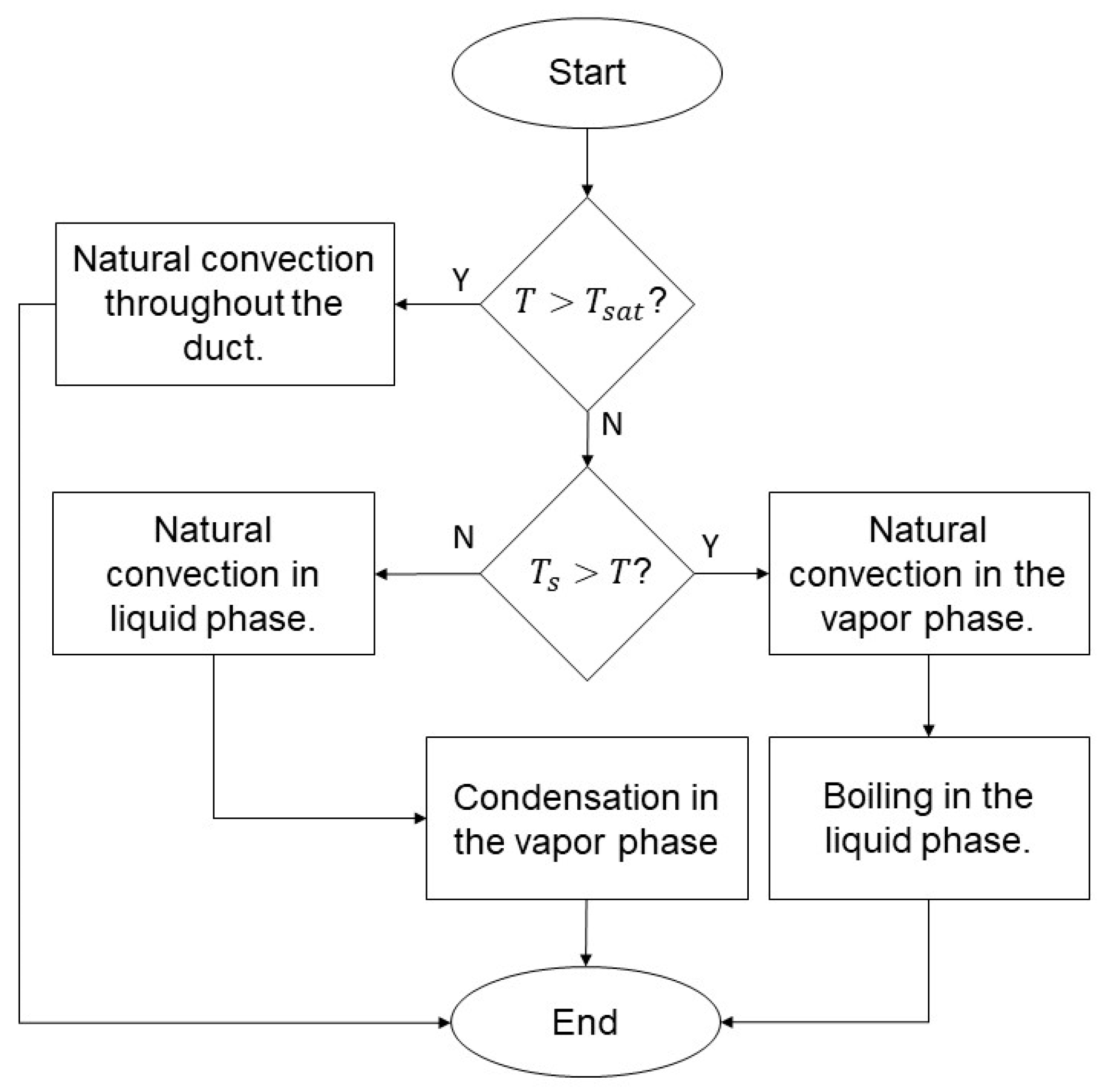
where W is the distance between the collector tubes, DO is the outer tube diameter, Di is the inner tube diameter, η is the fin efficiency, C is the weld thermal conductance, and hf is the transfer coefficient between the pipe wall and the fluid. The convection heat transfer coefficient (h_f) is determined using the flowchart in Figure 2. For natural convection, the equations are used with an angle of 150°; for boiling, the correlation of Cooper [56]. For cases in which there is a phase change, the value of (hf) is determined by making the weighted average between the two phases, considering the length as the weight. Surface temperature is given by Equation (6).
T s = Q ˙ o π D i h f L e + T f
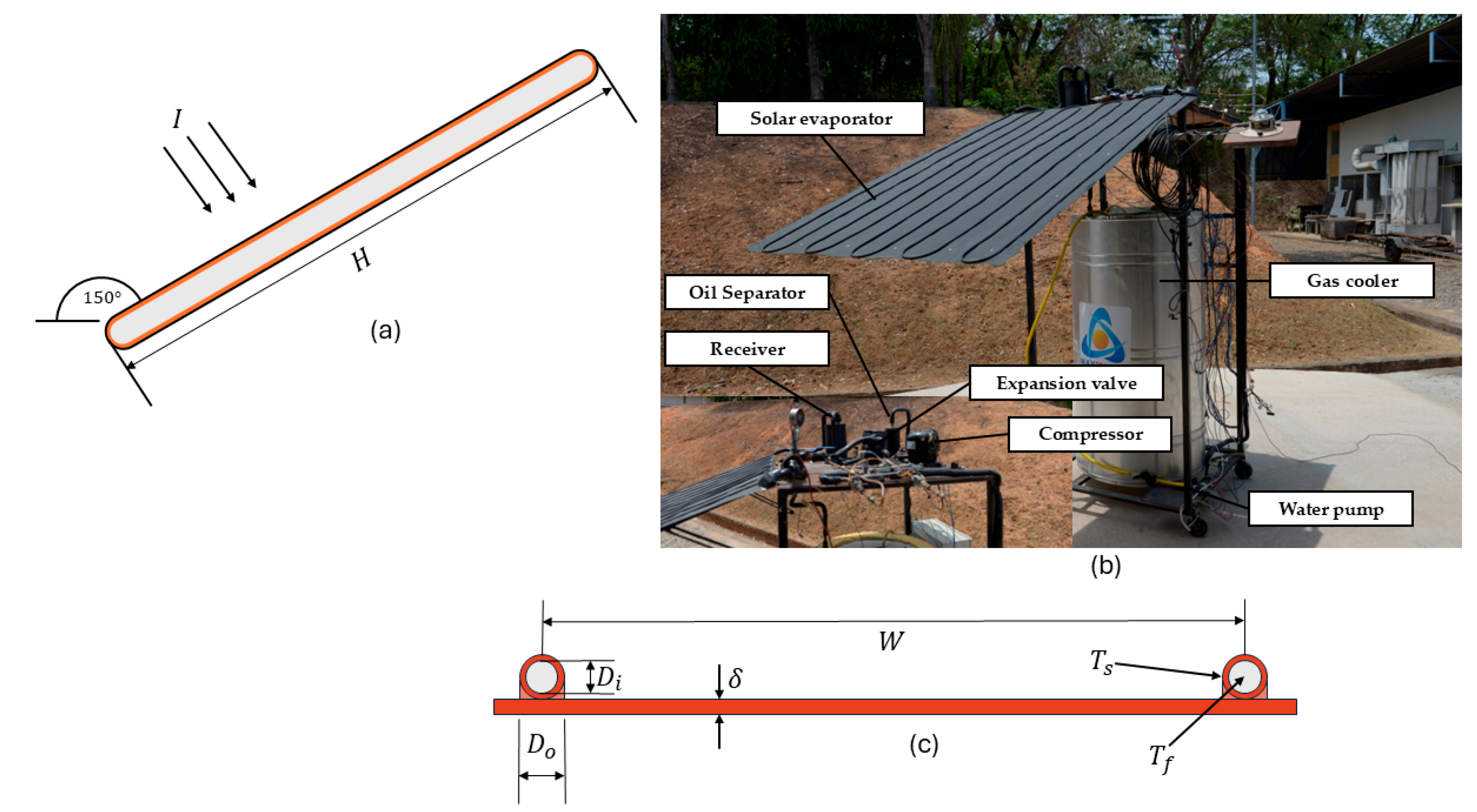
For natural convection in confined spaces, Hollands et al. [57] present Equation (7) for large shape ratios where H/L > 12 and the tilt angle is smaller than the critical angle (θcr). In this equation, H, L, and θ are the height, width, and inclination of the confined space. Evaporator/solar collector details are shown in Figure 3, and for this work, since the confined space is a tube,  L = D i . The dimensionless parameters B1 and B2 must always have positive values and saturate at zero, since if Ra cos θ < 1708, there is no advection. For H/L > 12, the critical angle value is 70°, and this angle indicates the change in flow from the pattern typically found in horizontal spaces to the pattern found in vertical spaces.
N u ¯ = 1 + B 1 + 1.44 B 2 1 1708 s i n ( 1.8 θ ) 1.6 R a   c o s ( θ )
B 1 = R a   c o s ( θ ) 5830 1 / 3 1
B 2 = 1 1708 R a   c o s ( θ )
For slope values above the critical, Incropera et al. [52] and Cengel and Ghajar [58] recommend Equation (10) for θcr < θ < 90 and Equation (11) for 90 < θ < 180. In these equations, Nuvert is the Nusselt number for a vertical body that can be calculated by the Shewen et al. [59] correlation described in Equation (12), which has been tested for H/L > 40.
N u ¯ = N u ¯ v e r t [ s i n ( θ ) ] 1 / 4
N u ¯ = 1 + N u ¯ v e r t 1 s i n ( θ )
N u ¯ v e r t = 1 + 0.0665 R a 1 / 3 1 + 9000 / R a 1.4 2 1 / 2
The fin efficiency can be evaluated by Duffie and Beckman [53]:
η = t a n h ( W D 0 ) / 2 U L / ( k δ )   ( W D 0 ) / 2 U L / ( k δ )
where k is the thermal conductivity, and δ is the fin thickness. Kumar and Mullick [60] describe the wind-induced convection heat transfer in Equation (14). The coefficient is used to assess UL. In Equation 14, Vwd is the wind speed, a = 6.90 W/(m2K), and b = 3.87 J/(m3K).
h = a V w d + b
From the balance of energy, the net heat transfer is equal to the energy stored in the system ASHRAE [61]:
Q ˙ i = m c T t c u + m u t f
where m is the mass, c is the heat capacity, t is time, and u is the specific internal energy. The subscript cu and f refer to copper and R744 properties, respectively. The specific internal energy of R744 can be obtained using CoolProp Library [62] and temperature and density as input. Additionally, R744 characteristics and properties are presented in Table 3 and Appendix A.
The R744 density is given by:
ρ f = m f L e π D i 2 / 4
where Le is the length of the evaporator tube. The mass of the copper is given by:
m c u = D 0 2 D i 2 π L e / 4 + A δ ρ c u
The set of Equations (1) to (17) is a system of differential equations that can be reduced to an algebraic equation system using the Euler method described by Chapra et al. [63], in which the time derivatives are approximated by:
T t T T 0 Δ t
u t u u 0 Δ t
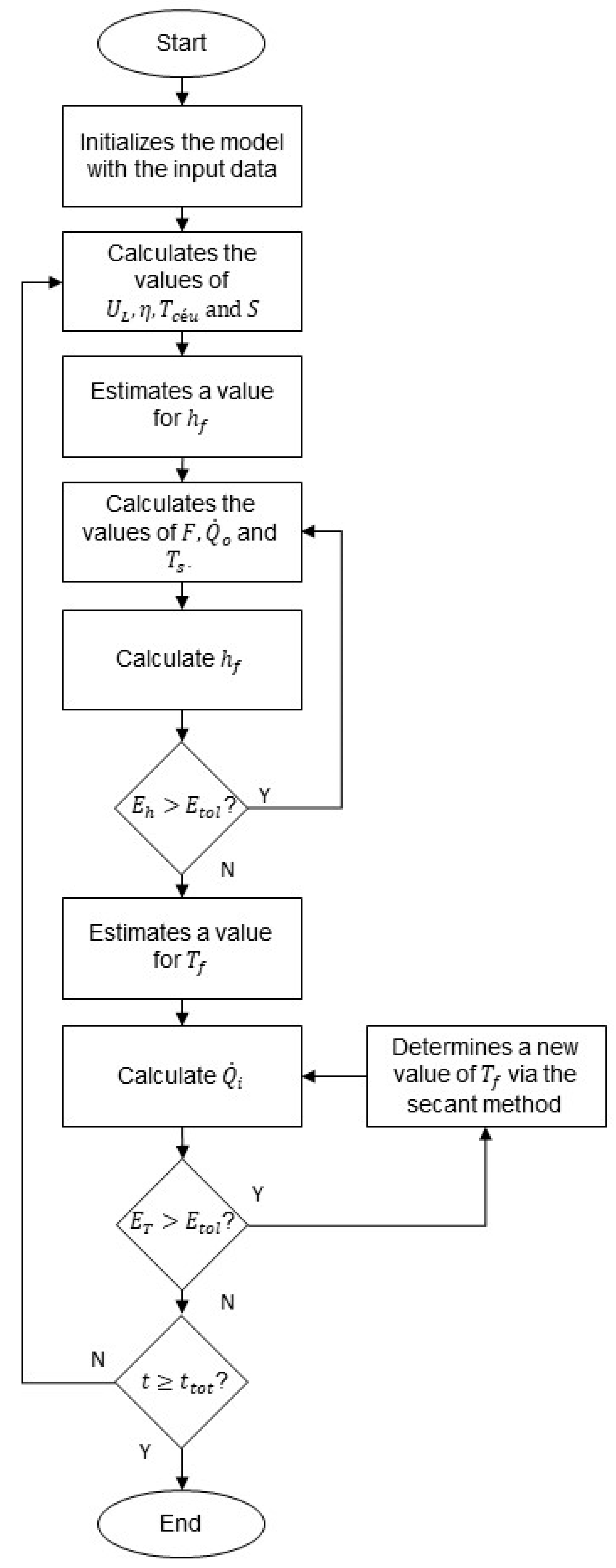
where the superscript 0 indicates the value at the previous instant or the previous iteration. The flowchart shown in Figure 4 is used to solve the algebraic system. The secant method is described by Chapra and Canale [63] in detail. In Figure 4, Etol is the tolerated error (0.01%), ttot is the total simulation time, and the errors ET and Eh are given by:
E T = Q ˙ i Q ˙ o Q ˙ o   ×   100
E h = h f 0 h f h f   ×   100
When a refrigeration system with an automatic expansion valve is turned off, the valve tends to one of the upper or lower limits and closes the refrigerant passage, so that a part of the fluid remains trapped inside the evaporator tube. Humia et al. [64] studied the mass distribution in the heat pump object of this work. The mass present in the evaporate oscillates between 8 and 12% of the total mass, and this value varies with the intensity of solar radiation. The total mass of R744 in the heat pump is 645 g [64]. The simulations were made considering that the compressor is not running all day long, which is the most critical situation. That situation typically occurs during vacation days when there is no occupant in the house to consume hot water.
To determine the maximum pressure that the heat pump evaporator will be exposed to, climate data such as ambient temperature, solar irradiation, and wind speed are required. The meteorological data of the work were taken from the INMET website (National Institute of Meteorology). In fact, INMET provide data of global radiation in kJ/m2/hour that were converted to an average value in W/m2. Due to the tropical climate, in Brazil, the temperature reaches values above 31 °C, the critical temperature of R744.
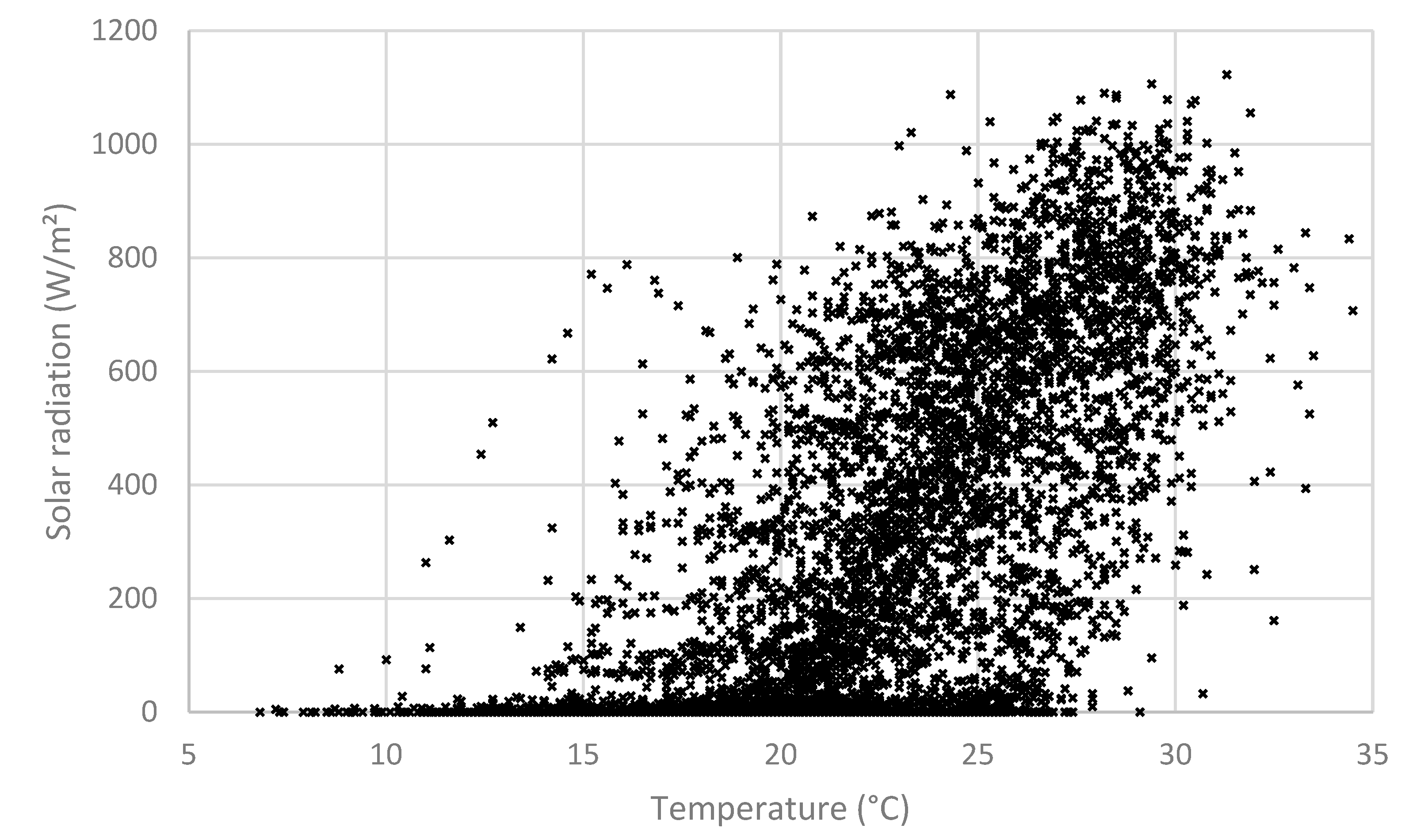
Based on Figure 5, it is possible to see that there is a positive relationship between temperature and irradiation; that is, when irradiation increases, temperature also tends to increase. However, as mentioned, this relationship is not perfect, and there are variations in the data that do not follow this trend. It is important to remember that the relationship between these two variables does not necessarily imply a causal relationship. In this case, irradiation may be a factor that contributes to the increase in temperature, but there may also be other factors that influence temperature, such as air humidity and atmospheric pressure, among others.
The study will operate on the assumption that the compressor and pump have been switched off, leaving the evaporator with the least amount of refrigerant gas possible. An expansion device model for the ideal pump shutdown is presented by Murphy and Goldschmidt [65]. This model aims to minimize the quantity of gas left in the evaporator until the pump resumes. The remaining refrigerant gas in the evaporator will gradually evaporate and exchange heat with the surrounding air when the pump is switched off, according to the authors, because of thermal equilibrium with the surrounding temperature. Consequently, the best model has the least amount of mass conceivable inside the evaporator and an ideally charged refrigerant for steady-state operation without extra refrigerant. The initial temperate was assumed at 12 °C.

4. Results

4.1. Grid Test

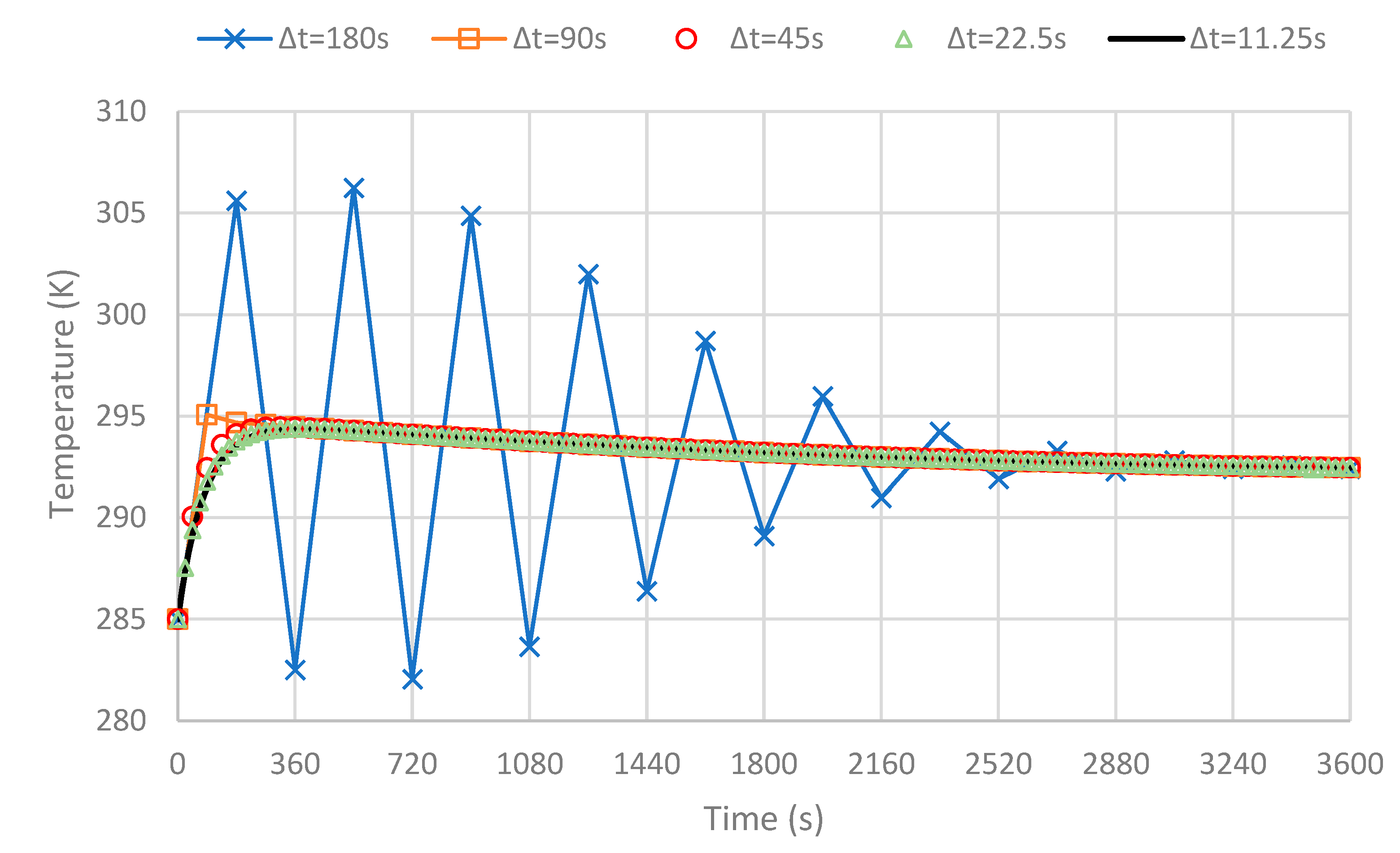
To solve the differential equation system, a mesh test was performed to find the smallest time variation to be considered for the calculation of interaction in the system. In Figure 6, the test shows the different values of Δt during a total simulation time of one hour. Comparing the simulations, as the value of Δt reduces, the result converges to a single curve. For the results with 22.5 s and 11.5 s, there are no significant variations in the results. In fact, the absolute mean variation between the temperature of the last two simulations, Δt = 22.5 s and Δt = 11.5 s, was 0.017 °C, a value much lower than the uncertainty of thermometers used in meteorological stations. For the other simulations, the value of ∆t = 22.5 s will be used.

4.2. Effect of Solar Radiation on the DX-SAHP Performance

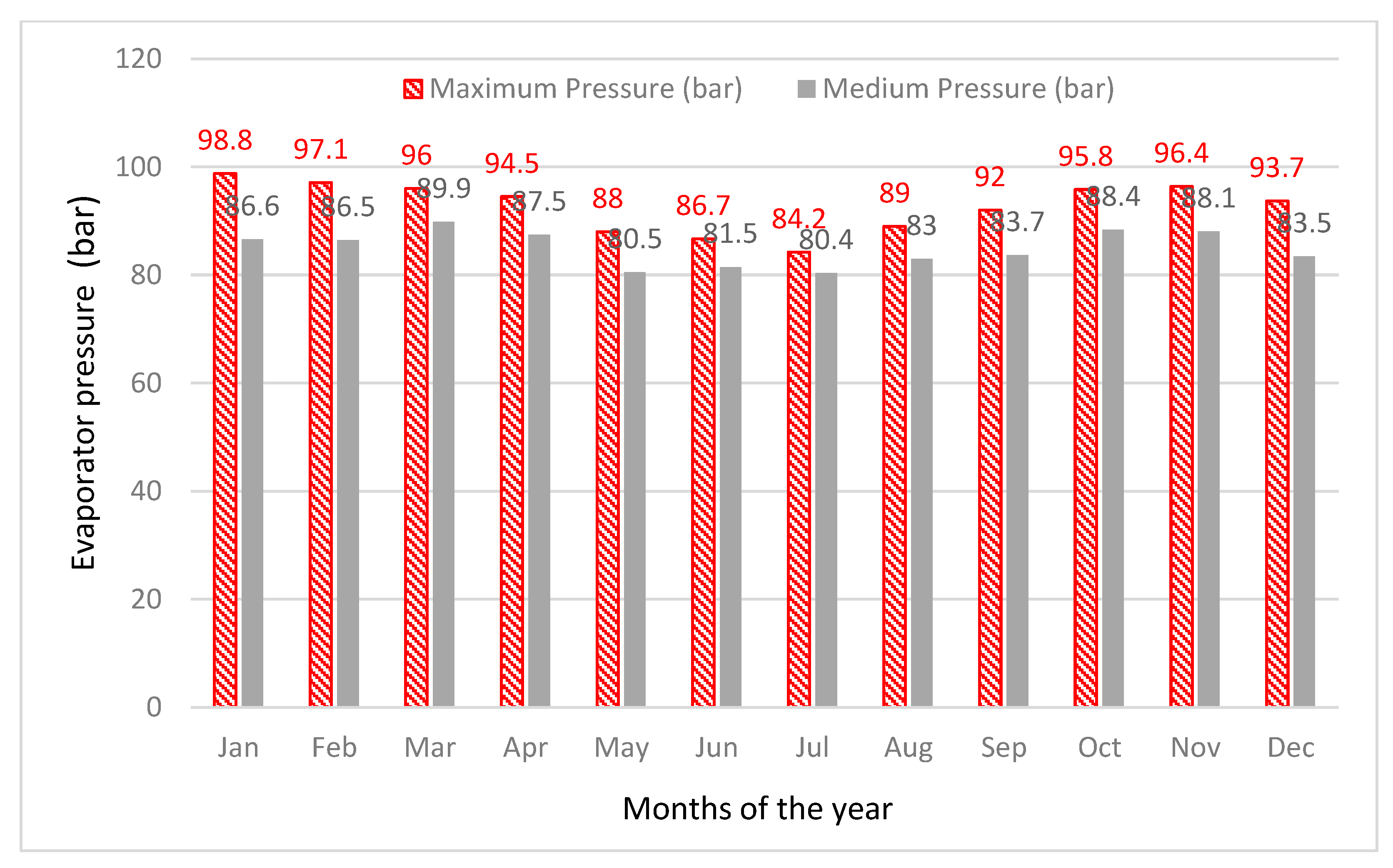
Initially, the year 2022 was considered and the data provided by INMET for the Pampulha meteorological station in Belo Horizonte, MG. The results found were analyzed, and the highest value for evaporator pressure within each month was plotted on the graph, as shown in Figure 7. The values of evaporator pressure for the city of Belo Horizonte showed significant numbers. This is because the city is located approximately at 19° south latitude, which places it in a region with a good potential for solar radiation throughout the year. As it is also a mountainous region, the atmospheric density is lower, which may result in a greater amount of solar irradiation. It is important to emphasize that the simulated data were for the evaporator that is not operating and is continuously exposed to the Sun.
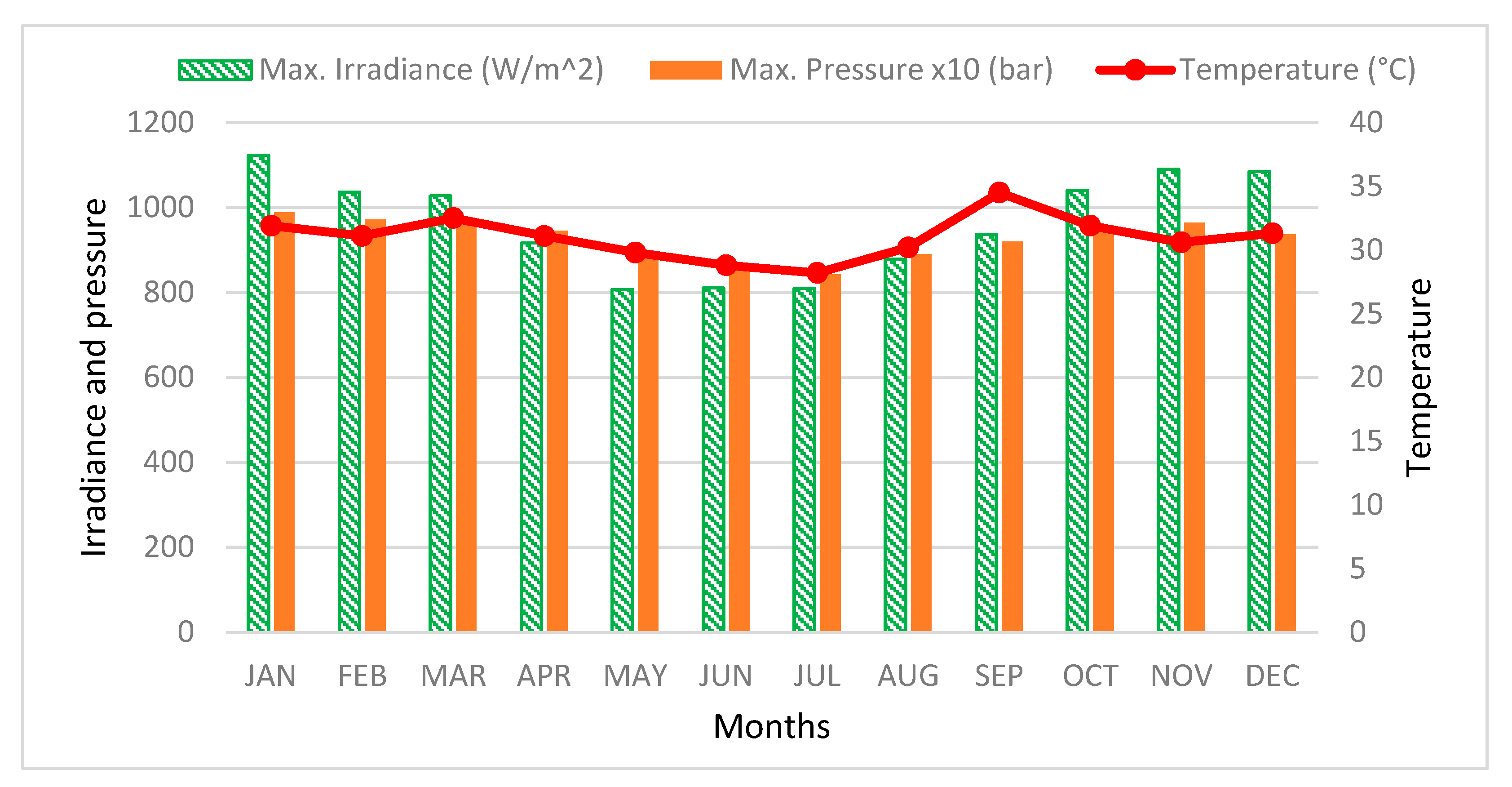
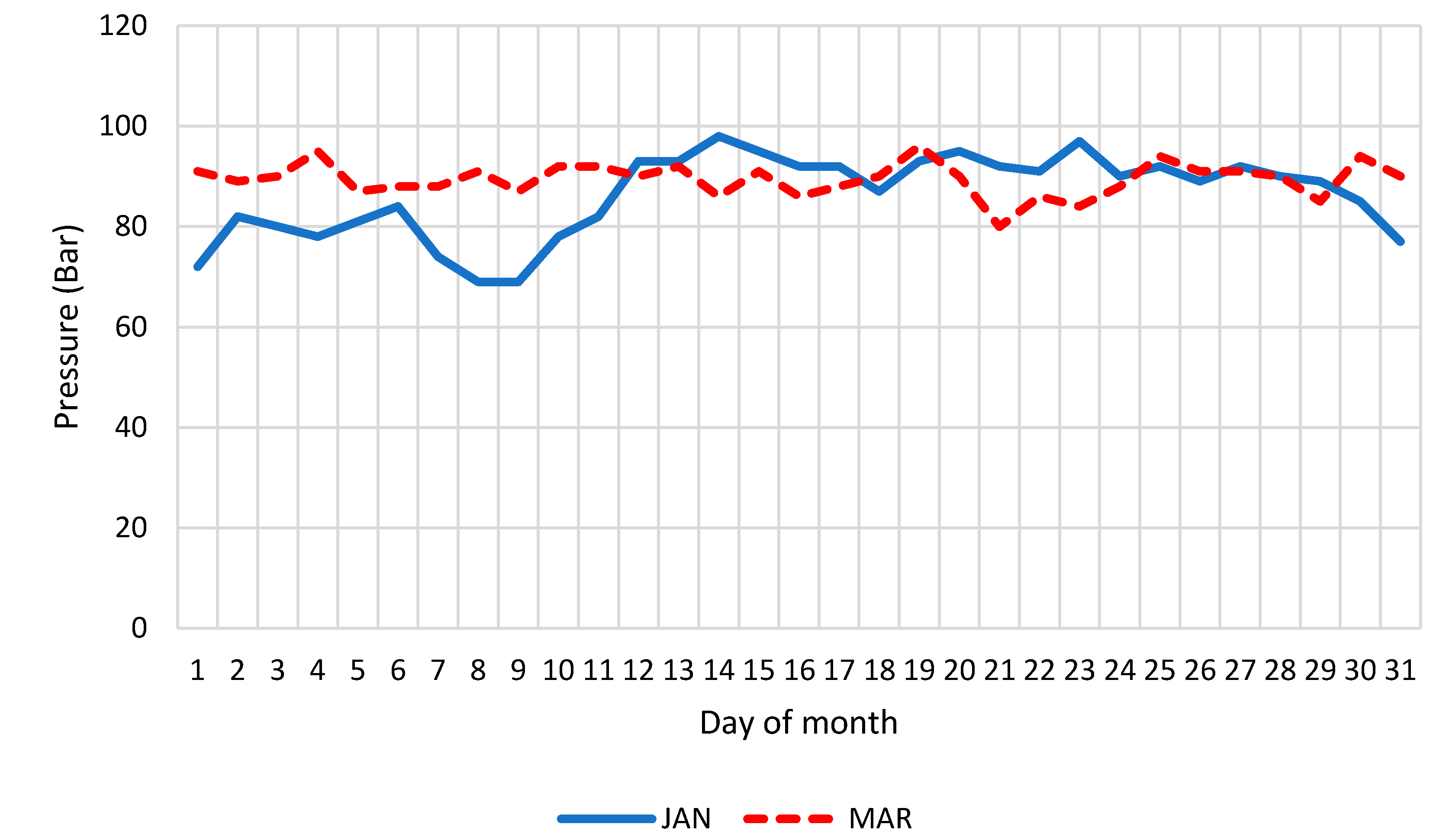
During the month of March 2022, the month with the highest values of solar radiation during the year was presented. Despite the fact that, as shown in Figure 8, January is the month with the highest annual pressure value, March was the month with the highest average pressure, in which most of the month presented pressures above 80 bar, with the maximum pressure of 96 bar, as shown in Figure 9. It is important to note that during the simulated period, the highest temperatures were not necessarily the times with the highest values of solar irradiation. For example, March 31 was the day with the highest temperature, but the day with the highest pressure value was the 19th, with a temperature of 30.5 °C at 6 pm (UTC). This happens because the intensity of radiation depends on a series of factors, such as the position of the Sun in the sky, the time of year, latitude, altitude, cloud cover, and the concentration of gases in the atmosphere.
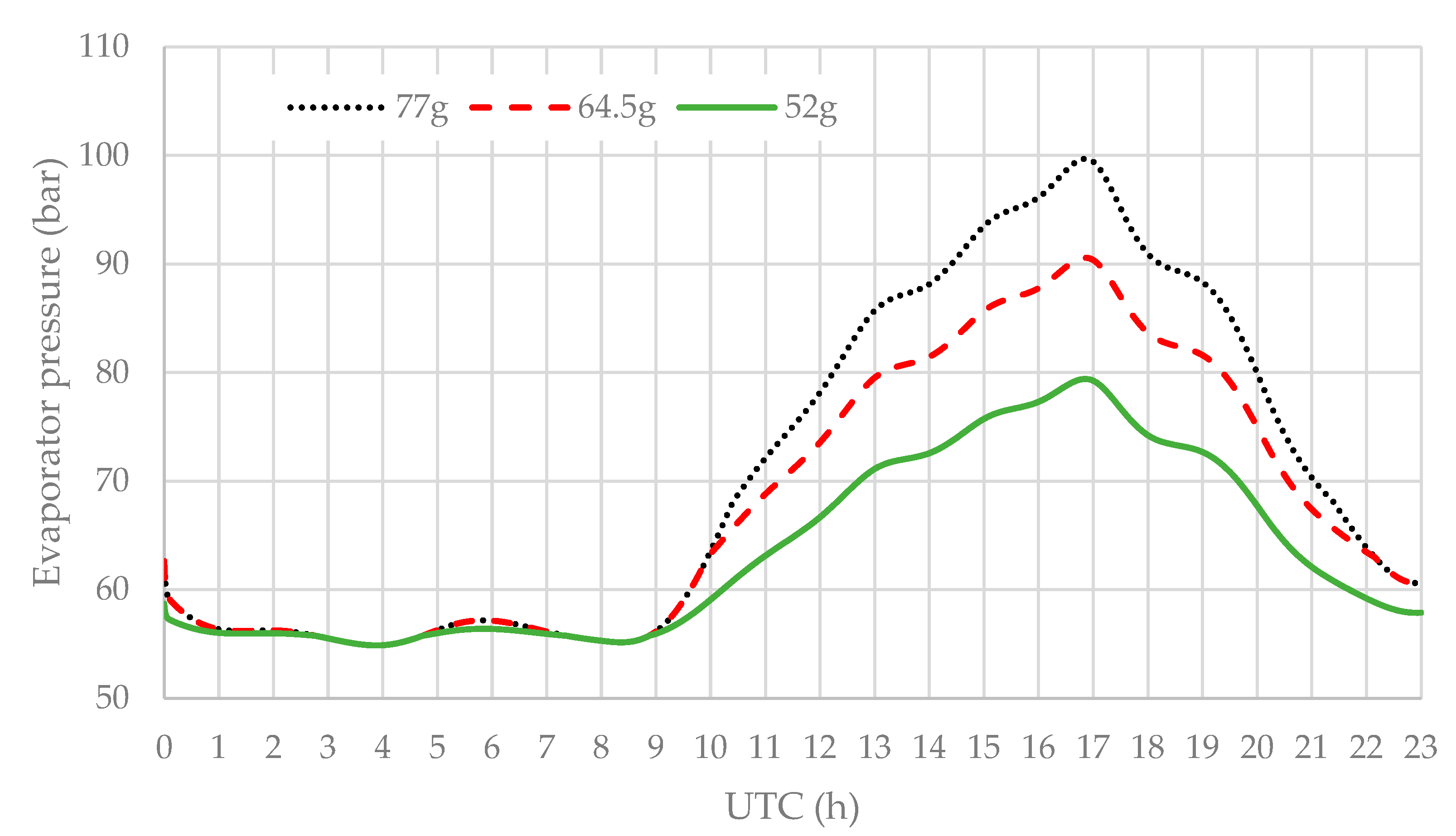
As previously seen, the amount of mass of R744 inside the evaporator influences the maximum pressure. Therefore, a study was carried out from the day with the highest value of pressure (January 14, in the present study) to analyze the results of the influence of mass on the pressure behavior inside the evaporator.
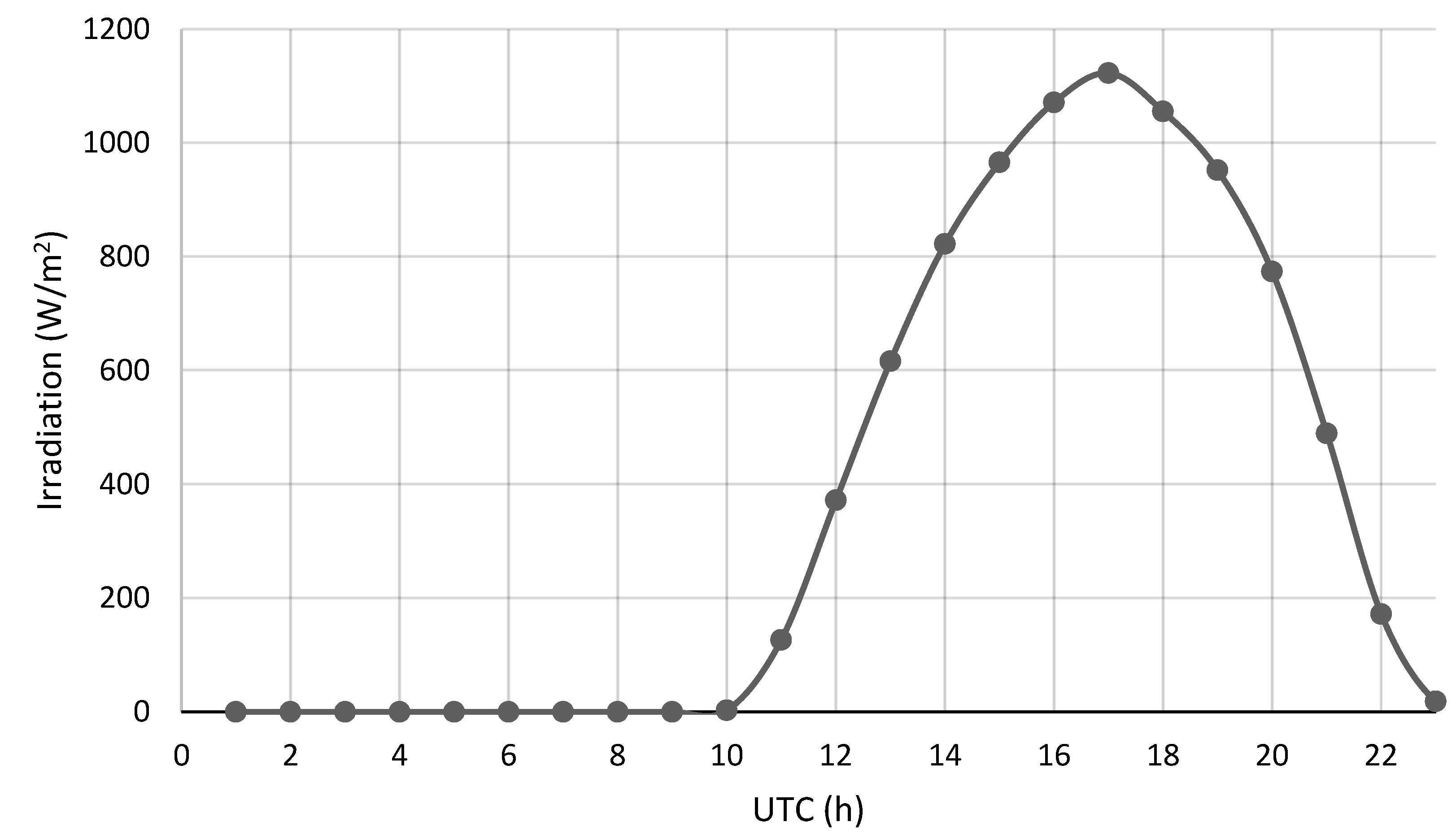
Using the interaction time of 22.5 s, it is possible to generate results of the amount of solar radiation that reaches the plate during a simulation day. The radiation intensity starts at 0 W/m2, which is the night period; at that time, the plate temperature was around 24 °C. From 9 am (UTC), when the Sun begins to focus on the plate, the intensity of the radiation gradually increases up to a maximum value of approximately 1122.92 W/m2, which occurred around 4 pm (UTC).
Figure 10 shows that the shift in solar irradiance during the day is gradual, as is the drop in radiation intensity. In the current investigation, the temperature of the fluid rises during the day to a maximum of 32 °C at about 4 p.m. (UTC). Because the temperature fluctuates somewhat during the day, so does the fluid pressure, which may be related to the wind speed, which is frequent on hot days in Belo Horizonte. The manufacturer’s maximum pressure for the 14” copper tube is 132 bar, and the highest pressure that the refrigerant fluid achieves on the day of the simulation is 98 bar, which is within the predicted range.
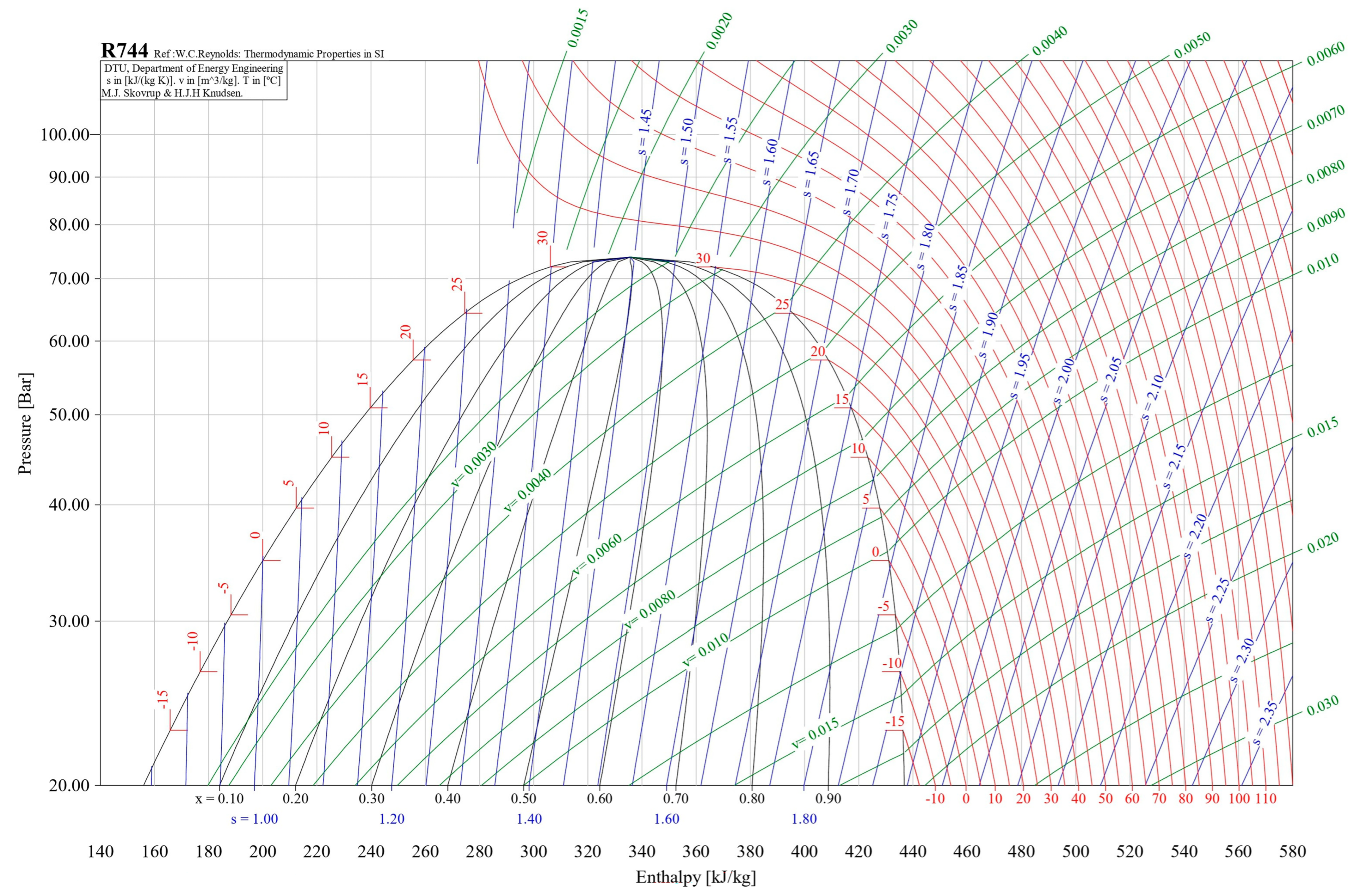
In Figure 11, it is possible to see that a higher percentage of R744 refrigerant present in the tube (77 g) generates a higher pressure throughout the day, approximately 25% higher compared to the lower percentage of mass (52 g). On this day, the maximum temperature value was 31.9 °C, being the highest pressure point in the month. The influence of mass on the maximum pressure in the evaporator is related to the physical properties of R744. Since the evaporator volume is practically constant, an increase in mass reduces the specific volume of the R744 trapped in the evaporator. Considering any isotherm above the critical pressure in the diagram in Appendix A, a reduction in specific volume results in an increase in pressure. The diagram in Appendix A was obtained from Coolpack v1.5 software.
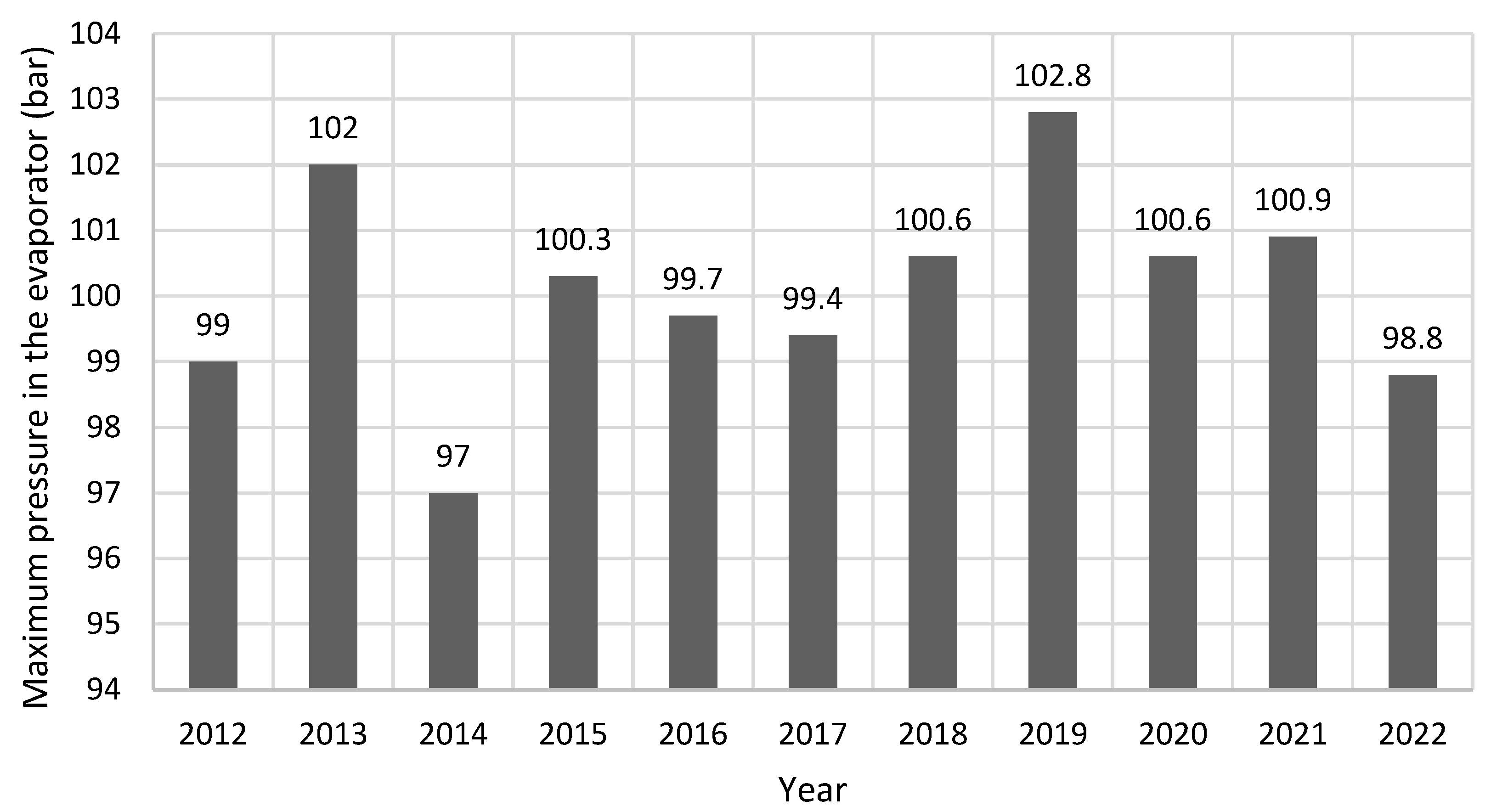
Figure 12 shows the maximum values of pressure in the evaporator for each of the years for the city of Belo Horizonte/MG, during the period from 2012 to 2022, considering the value of 72 g, the amount of mass of R744 contained inside the evaporator.
R744, despite being a gas with low global warming potential, high availability, low environmental impact, and good performance at low temperatures, is a refrigerant with high operating pressure, which means that the heat pump system with R744 requires specific and stronger components to withstand the pressure. Even with a value, the maximum pressure value over the 10 years of simulation did not reach the maximum value provided by the evaporator manufacturer, 132 bar.
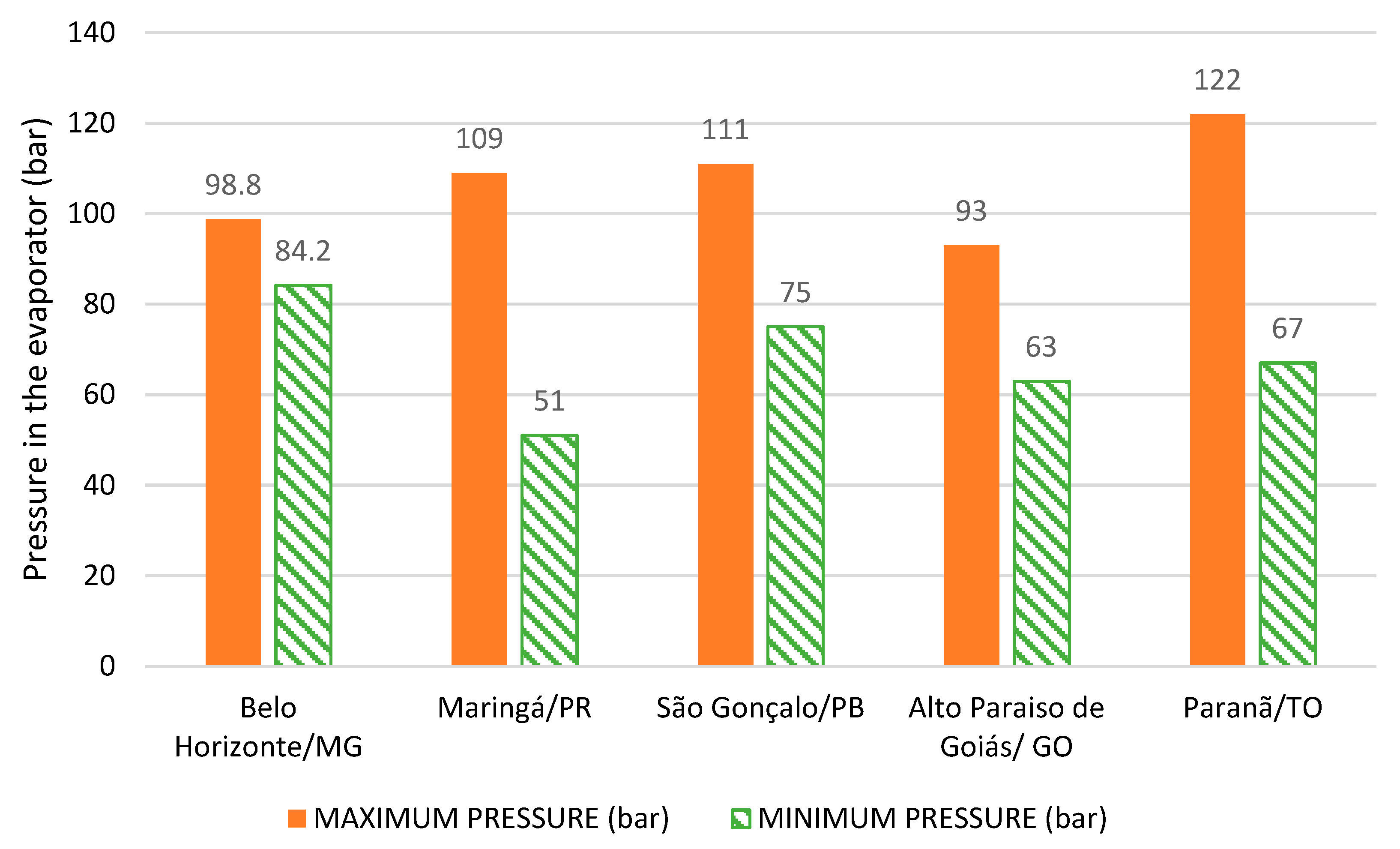
Figure 13 presents simulated data for cities in each region of Brazil, namely: (a) for the Southeast region, Belo Horizonte/MG; (b) for the South region, Maringá/PR; (c) for the Midwest region, Alto Paraíso de Goiás/GO; (d) for the North region, Paranã/TO; (e) for the Northeast region, São Gonçalo/PB. The chosen cities were selected based on the highest amount of global solar irradiation incident on these cities. It is important to point out that the meteorological data taken from INMET for some regions showed some flaws; that is, on some days, it was not possible to obtain data for the simulation. All cities are located in tropical or subtropical regions. Therefore, they receive a high intensity of solar irradiation throughout the year. However, cities closer to the equator, such as Paranã/TO, Alto Paraíso de Goiás/GO, and São Gonçalo/PB, tend to receive even more intense solar irradiation.
Understanding the influence of solar irradiance in different regions of Brazil is very relevant, taking into account the variation in the number of hours of sunlight available throughout the seasons. This variation is especially notable in southern Brazil, where seasonal changes can significantly affect the amount of incoming solar radiation. When analyzing the behavior of evaporator pressure in different regions, it is important to consider factors such as temperature intensity, wind intensity, amount of solar irradiation, and mass value in the evaporator.
Duarte et al. [42] present 88 different experimental results of the heat pump DX-SAHP when it is operating, during some hours of the day, with an average value of 42.7 bar for Belo Horizonte/MG. The value found by the authors is about 43% lower than the value presented in this work for the same city, Belo Horizonte, in the year 2022; however, for the latter, the heat pump DX-SAHP is not operating and is continuously exposed to the Sun and to the environment.
The study uses data or participants from a specific geographic area, specifically Brazilian data. The authors did not find data in the same format as Brazilian data from other countries. Despite this, Brazil is one of the countries with the largest territorial area, and it is possible to find a huge variety of climatic conditions. Finally, due to limitations of time and financial resources, it was not possible to experimentally validate the model.

5. Conclusions

Regarding the simulation of the mathematical model for calculating the maximum pressures in the evaporator, taking into account the intensity of daily radiation, temperature at each hour of the day, and amount of mass accumulated in the evaporator, it was able to predict the value of the fluid pressure in the evaporator of the DX-SAHP heat pump with R744 when the equipment was off. The operating pressures of R744 when the heat pump components are exposed to intense solar radiation and elevated temperatures with the compressor off are higher than the pressures on regular operation of DX-SAHP. The maximum pressure value that the fluid reaches when the pump is off in the year 2022 was 98.8 bar, in the city of Belo Horizonte/MG. This value represents approximately 74.8% of the maximum acceptable total pressure value for the evaporator, according to the manufacturer’s standards.
The analysis of the maximum pressure in the evaporator, considering other regions of Brazil and considering the highest value among the analyzed regions of Brazil, was 122.0 bar for the city of Paranã/TO. This value represents about 92% of the maximum value of total acceptable pressure that the fluid can reach within the manufacturer’s standards for the evaporator. For the other regions, the values are listed in Table 4.
In addition, it is important that the refrigerant charge in the evaporator be minimized to ensure that the maximum system pressure remains within safe limits. Excessive refrigerant charge can lead to excessive system pressures and possible equipment failure.

Author Contributions

Conceptualization, J.C.C.M.S. and W.M.D.; methodology, J.C.C.M.S. and W.M.D.; software, J.C.C.M.S. and W.M.D.; validation, T.F.P., L.M., and W.M.D.; formal analysis, J.C.C.M.S., T.F.P., and W.M.D.; investigation, J.C.C.M.S.; resources, L.M.; data curation, W.M.D.; writing—original draft preparation, J.C.C.M.S. and W.M.D.; writing—review and editing, T.F.P.; visualization, T.F.P. and W.M.D.; supervision, W.M.D.; project administration, L.M.; funding acquisition, L.M. All authors have read and agreed to the published version of the manuscript.

Funding

This work was supported by the Foundation for Research Support of the State of Minas Gerais (FAPEMIG), Brazil, and the National Council for Scientific and Technological Development (CNPq), Brazil. This study was financed in part by the Coordenação de Aperfeiçoamento de Pessoal de Nvel Superior—Brazil (CAPES)—Finance Code 001.

Data Availability Statement

The original contributions presented in this study are included in the article. Further inquiries can be directed to the corresponding author.

Conflicts of Interest

The authors declare no conflicts of interest.

Abbreviations

The following abbreviations are used in this manuscript.
Latin letters
Q ˙ Heat transfer rate [W]
AArea [m2]
BAuxiliary parameter [dimensionless]
CThermal conductance of solder [W/K]
cSpecific heat [J/kgK]
DDiameter [m]
EErro [%]
FFin efficiency [dimensionless]
hConvective heat transfer coefficient [W/m2K]
HHeight [m]
ISolar irradiance [W/m2]
kThermal conductivity [W/mK]
LLength [m]
mMass [kg]
NuNusselt number [dimensionless]
RaRayleigh number [dimensionless]
SNet radiation absorbed [W/m2]
TTemperature [K]
tTime [s]
uInternal energy [kJ/kgK]
UOverall heat transfer coefficient [W/m2K]
VVelocity [m/s]
WDistance between the tubes [m]
Greek letters
αSolar absorptance [dimensionless]
εEmissivity [dimensionless]
ρDensity [kg/m3]
σStefan–Boltzmann constant [W/m2K4]
δFin thickness [m]
ηFin efficiency [dimensionless]
ϴAngle [°]
Subscripts
aAir
skySky
crCritical
cuCopper
dpDew point
eEvaporator
fFluid
hConvective coefficient
iInternal
LLosses
oExternal
TTemperature
tolTolerated
totTotal
vertVertical
wdWind

Appendix A. R744 Pressure vs. Specific Enthalpy Diagram
Processes 14 00103 i0a1

References

  1. Empresa de Pesquisa Energética. Balanço Energético Nacional 2024. EPE. 2021. Available online: https://www.epe.gov.br/sites-pt/publicacoes-dados-abertos/publicacoes/PublicacoesArquivos/publicacao-819/topico-715/BEB_Summary_Report_2024.pdf (accessed on 1 December 2025).
  2. Blázquez, C.S.; Nieto, I.M.; García, J.C.; García, P.C.; Martín, A.F.; González-Aguilera, D. Comparative analysis of ground source and air source heat pump systems under different conditions and scenarios. Energies 2023, 16, 1289. [Google Scholar] [CrossRef]
  3. Resende, S.I.D.M.; Diniz, H.A.G.; Faria, R.N.D.; de Oliveira, R.N. Design and Experimental Evaluation of a Controller for a Direct-Expansion Solar-Assisted Heat Pump with Propane. Processes 2025, 13, 3583. [Google Scholar] [CrossRef]
  4. Yang, L.; Pu, J.; Ma, S.; Zhou, P.; Wang, Y.; Jiang, Y. Holistic Sustainability Assessment of Solar Ground Source Heat Pump Systems: Integrating Life Cycle Assessment, Carbon Emissions and Emergy Analyses. Sustainability 2025, 17, 776. [Google Scholar] [CrossRef]
  5. Buker, M.S.; Riffat, S.B. Solar assisted heat pump systems for low temperature water heating applications: A systematic review. Renew. Sustain. Energy Rev. 2016, 55, 399–413. [Google Scholar] [CrossRef]
  6. Sporn, P.; Ambrose, E. The heat pump and solar energy. In Proceedings of the World Symposium on Applied Solar Energy, Tucson, AZ, USA, 1–5 November 1955; pp. 1–5. [Google Scholar]
  7. Jordan, R.; Threlkeld, J. Design and economics of solar energy heat pump system. Heat. Pip. Air Cond. USA 1954, 26, 122–130. [Google Scholar]
  8. Duarte, W.M. Numeric Model of a Direct Expansion Solar Assisted Heat Pump Water Heater Operating with Low GWP Refrigerants (R1234yf, R290, R600a and R744) for Replacement of R134a. Ph.D. Thesis, Federal University of Minas Gerais, Belo Horizonte, Brazil, 2018. [Google Scholar]
  9. Zanetti, E.; Azzolin, M.; Girotto, S.; Del Col, D. Performance and control of a CO2 dual source solar assisted heat pump with a photovoltaic-thermal evaporator. Appl. Therm. Eng. 2023, 218, 119286. [Google Scholar] [CrossRef]
  10. Lorentzen, G. Revival of carbon dioxide as a refrigerant. Int. J. Refrig. 1994, 17, 292–301. [Google Scholar] [CrossRef]
  11. Oliveira, R.N.; Faria, R.N.; Antonanzas-Torres, F.; Machado, L.; Koury, R.N.N. Dynamic model and experimental validation for a gas cooler of a CO2 heat pump for heating residential water. Sci. Technol. Built Environ. 2016, 22, 30–40. [Google Scholar] [CrossRef]
  12. Rabelo, S.N.; Paulino, T.F.; Machado, L.; Duarte, W.M. Economic analysis and design optimization of a direct expansion solar assisted heat pump. Sol. Energy 2019, 188, 164–174. [Google Scholar] [CrossRef]
  13. Rabelo, S.N.; Paulino, T.F.; Soares, C.P.; Duarte, W.M.; Machado, L.; Nunes, R.O. Mass flow characteristics of CO2 operating in a transcritical cycle flowing through a needle expansion valve in a direct-expansion solar assisted heat pump. J. Build. Eng. 2023, 67, 105963. [Google Scholar] [CrossRef]
  14. Chaturvedi, S.; Gagrani, V.; Abdel-Salam, T. Solar-assisted heat pump–a sustainable system for low temperature water heating applications. Energy Convers. Manag. 2014, 77, 550–557. [Google Scholar] [CrossRef]
  15. Cervantes, J.G.; Torres-Reyes, E. Experiments on a solar-assisted heat pump and an exergy analysis of the system. Appl. Therm. Eng. 2022, 22, 1289–1297. [Google Scholar] [CrossRef]
  16. Paradeshi, L.; Mohanraj, M.; Srinivas, M.; Jayaraj, S. Exergy analysis of direct-expansion solar-assisted heat pumps working with R22 and R433a. J. Therm. Anal. Calorim. 2018, 134, 2223–2237. [Google Scholar] [CrossRef]
  17. Li, Y.; Wang, R.; Wu, J.; Xu, Y. Experimental performance analysis and optimization of a direct expansion solar-assisted heat pump water heater. Energy 2007, 32, 1361–1374. [Google Scholar] [CrossRef]
  18. Rocha, T.T.M.; de Paula, C.H.; Maia, A.A.T.; de Freitas Paulino, T.; de Oliveira, R.N. Experimental assessment of a CO2 direct-expansion solar-assisted heat pump operating with capillary tubes and air-solar heat source. Sol. Energy 2021, 218, 413–424. [Google Scholar] [CrossRef]
  19. Luz, A.P.; Diniz, H.A.G.; Duarte, W.M.; Machado, L. Experimental study and semi-empirical model of a thermostatic expansion valve of a R290 direct-expansion solar heat pump. Int. J. Refrig. 2024, 163, 56–70. [Google Scholar] [CrossRef]
  20. Islam, M.R.; Sumathy, K.; Gong, J.; Khan, S.U. Performance study on solar assisted heat pump water heater using CO2 in a transcritical cycle. In International Conference on Renewable Energies and Power Quality; Citeseer: Princeton, NJ, USA, 2012. [Google Scholar]
  21. Chaturvedi, S.K.; Shen, J.Y. Thermal performance of a direct expansion solar-assisted heat pump. Sol. Energy 1984, 33, 155–162. [Google Scholar] [CrossRef]
  22. Chaturvedi, S.K.; Chen, D.; Kheireddine, A. Thermal performance of a variable capacity direct expansion solar-assisted heat pump. Energy Convers. Manag. 1998, 39, 181–191. [Google Scholar] [CrossRef]
  23. Ito, S.; Miura, N.; Wang, K. Performance of a heat pump using direct expansion solar collectors. Sol. Energy 1999, 65, 189–196. [Google Scholar] [CrossRef]
  24. Torres-Reyes, E.; Gortari, J.C. Optimal performance of an irreversible solar-assisted heat pump. Exergy Int. J. 2001, 1, 107–111. [Google Scholar] [CrossRef]
  25. Hawlader, M.; Chou, S.; Ullah, M. The performance of a solar assisted heat pump water heating system. Appl. Therm. Eng. 2001, 21, 1049–1065. [Google Scholar] [CrossRef]
  26. Chyng, J.; Lee, C.; Huang, B. Performance analysis of a solar-assisted heat pump water heater. Sol. Energy 2003, 74, 33–44. [Google Scholar] [CrossRef]
  27. Kuang, Y.; Sumathy, K.; Wang, R. Study on a direct-expansion solar-assisted heat pump water heating system. Int. J. Energy Res. 2003, 27, 531–548. [Google Scholar] [CrossRef]
  28. Ito, S.; Miura, N.; Takano, Y. Studies of heat pumps using direct expansion type solar collectors. J. Sol. Energy Eng. 2005, 127, 60–64. [Google Scholar] [CrossRef]
  29. Kuang, Y.; Wang, R. Performance of a multi-functional direct-expansion solar assisted heat pump system. Sol. Energy 2006, 80, 795–803. [Google Scholar] [CrossRef]
  30. Xu, G.; Deng, S.; Zhang, X.; Yang, L.; Zhang, Y. Simulation of a photovoltaic/thermal heat pump system having a modified collector/evaporator. Sol. Energy 2009, 83, 1967–1976. [Google Scholar] [CrossRef]
  31. Chow, T.T.; Pei, G.; Fong, K.; Lin, Z.; Chan, A.; He, M. Modeling and application of direct-expansion solar-assisted heat pump for water heating in subtropical Hong Kong. Appl. Energy 2010, 87, 643–649. [Google Scholar] [CrossRef]
  32. Kong, X.; Zhang, D.; Li, Y.; Yang, Q. Thermal performance analysis of a direct-expansion solar-assisted heat pump water heater. Energy 2011, 36, 6830–6838. [Google Scholar] [CrossRef]
  33. Moreno-Rodríguez, A.; González-Gil, A.; Izquierdo, M.; Garcia-Hernando, N. Theoretical model and experimental validation of a direct-expansion solar assisted heat pump for domestic hot water applications. Energy 2012, 45, 704–715. [Google Scholar] [CrossRef]
  34. Fernández-Seara, J.; Piñeiro, C.; Dopazo, J.A.; Fernandes, F.; Sousa, P.X. Experimental analysis of a direct expansion solar assisted heat pump with integral storage tank for domestic water heating under zero solar radiation conditions. Energy Convers. Manag. 2012, 59, 1–8. [Google Scholar] [CrossRef]
  35. Zhang, D.; Wu, Q.; Li, J.; Kong, X. Effects of refrigerant charge and structural parameters on the performance of a direct-expansion solar-assisted heat pump system. Appl. Therm. Eng. 2014, 73, 522–528. [Google Scholar] [CrossRef]
  36. Sun, X.; Dai, Y.; Novakovic, V.; Wu, J.; Wang, R. Performance comparison of direct expansion solar-assisted heat pump and conventional air source heat pump for domestic hot water. Energy Procedia 2015, 70, 394–401. [Google Scholar] [CrossRef]
  37. Deng, W.; Yu, J. Simulation analysis on dynamic performance of a combined solar/air dual source heat pump water heater. Energy Convers. Manag. 2016, 120, 378–387. [Google Scholar] [CrossRef]
  38. Kong, X.; Li, Y.; Lin, L.; Yang, Y. Modeling evaluation of a direct-expansion solar-assisted heat pump water heater using R410A. Int. J. Refrig. 2017, 76, 136–146. [Google Scholar] [CrossRef]
  39. Mohamed, E.; Riffat, S.; Omer, S. Low-temperature solar-plate-assisted heat pump: A developed design for domestic applications in cold climate. Int. J. Refrig. 2017, 81, 134–150. [Google Scholar] [CrossRef]
  40. Diniz, H.A.G. Estudo Comparativo Da Eficiência Energética de Uma Bomba de Calor Assistida Por Energia Solar Operando Com Condensadores Por Imersão E Coaxial. Master’s Thesis, Federal University of Minas Gerais, Belo Horizonte, Brazil, 2017. [Google Scholar]
  41. Rabelo, S.N.; Paulino, T.F.; Duarte, W.M.; Sawalha, S.; Machado, L. Experimental analysis of the influence of water mass flow rate on the performance of a CO2 direct-expansion solar assisted heat pump. Int. J. Chem. Mol. Nucl. Mater. Metall. Eng. 2018, 12, 327–331. [Google Scholar]
  42. Kong, X.; Sun, P.; Dong, S.; Jiang, K.; Li, Y. Experimental performance analysis of a direct-expansion solar assisted heat pump water heater with R134a in summer. Int. J. Refrig. 2018, 91, 12–19. [Google Scholar] [CrossRef]
  43. Kong, X.; Yang, Y.; Zhang, M.; Li, Y.; Li, J. Experimental investigation on a direct-expansion solar-assisted heat pump water heater using r290 with micro-channel heat transfer technology during the winter period. Int. J. Refrig. 2020, 113, 38–48. [Google Scholar] [CrossRef]
  44. Duarte, W.M.; Rabelo, S.N.; Paulino, T.F.; Pabón, J.J.; Machado, L. Experimental performance analysis of a co2 direct-expansion solar assisted heat pump water heater. Int. J. Refrig. 2021, 125, 52–63. [Google Scholar] [CrossRef]
  45. Diniz, H.A.G.; de Melo Resende, S.I.; Maia, A.A.T.; Machado, L.; de Oliveira, R.N. Development, experimental validation through infrared thermography and applications of a mathematical model of a direct-expansion solar-assisted heat pump with R290 based on energy, exergy, economic and environmental (4E) analyses. Sol. Energy 2023, 260, 94–110. [Google Scholar] [CrossRef]
  46. Abbasi, B.; Li, S.; Mwesigye, A. Investigation of the thermodynamic performance of a direct-expansion solar-assisted heat pump under very cold climatic conditions with and without glazing. Int. J. Refrig. 2024, 158, 329–344. [Google Scholar] [CrossRef]
  47. Reis, H.O.; Paulino, T.F.; Machado, L.; Maia, A.A.; Duarte, W.M. Optimal high-pressure correlation for transcritical CO2 cycle in direct expansion solar assisted heat pumps. J. Build. Eng. 2024, 97, 110616. [Google Scholar] [CrossRef]
  48. Sharma, D.K.; Vaishak, S.; Bhale, P.V.; Rathod, M.K. Analysis of water and refrigerant-based PV/T systems with double glass PV modules: An experimental and computational approach. Sol. Energy 2024, 268, 112296. [Google Scholar] [CrossRef]
  49. Jia, B.; Song, Z.; Li, X.; Hu, Z.; Li, Q. Enhancing thermal performance: The evolution and future of solar air heaters with baffles. Case Stud. Therm. Eng. 2025, 75, 107163. [Google Scholar] [CrossRef]
  50. Nedunchezhiyan, M.; Ramalingam, S.; Natesan, P.; Sampath, S. CFD-based optimization of solar water heating systems: Integrating evacuated tube and flat plate collectors for enhanced efficiency. Case Stud. Therm. Eng. 2025, 69, 106017. [Google Scholar] [CrossRef]
  51. Chaichana, C.; Kiatsiriroat, T.; Nuntaphan, A. Comparison of conventional flat-plate solar collector and solar boosted heat pump using unglazed collector for hot water production in small slaughterhouse. Heat Transf. Eng. 2010, 31, 419–429. [Google Scholar] [CrossRef]
  52. Incropera, F.; De Witt, D.; Bergman, T. Fundamentos de Transferência de Calor E de Massa, 6th ed.; LTC: Rio de Janeiro, Brasil, 2008. [Google Scholar]
  53. Duffie, J.A.; Beckman, W.A. Solar Engineering of Thermal Processes; John Wiley & Sons: Hoboken, NJ, USA, 2013. [Google Scholar]
  54. Gliah, O.; Kruczek, B.; Etemad, S.G.; Thibault, J. The effective sky temperature: An enigmatic concept. Heat Mass Transf. 2011, 47, 1171–1180. [Google Scholar] [CrossRef]
  55. Berdahl, P.; Fromberg, R. The thermal radiance of clear skies. Sol. Energy 1982, 29, 299–314. [Google Scholar] [CrossRef]
  56. Cooper, M. Saturated nucleate pool boiling-a simple correlation. In Proceedings of the 1st UK National Heat Transfer Conference, Yorkshire, UK, 3–5 July 1984; pp. 785–793. [Google Scholar]
  57. Hollands, K.; Unny, T.; Raithby, G.; Konicek, L. Free convective heat transfer across inclined air layers. J. Heat Transfer 1976, 98, 189–193. [Google Scholar] [CrossRef]
  58. Cengel, Y.A.; Ghajar, A.J. Tranferência de Calor e Massa; AMGH Editora: Porto Alegre, Brazil, 2015. [Google Scholar]
  59. Shewen, E.; Hollands, K.; Raithby, G. Heat transfer by natural convection across a vertical air cavity of large aspect ratio. J. Heat Transf. 1996, 118, 993–995. [Google Scholar] [CrossRef]
  60. Kumar, S.; Mullick, S. Wind heat transfer coefficient in solar collectors in outdoor conditions. Sol. Energy 2010, 84, 956–963. [Google Scholar] [CrossRef]
  61. ASHRAE. ASHRAE Handbook—Fundamentals (SI Edition); American Society of Heating, Refrigerating and Air-Conditioning Engineers, Inc.: Peachtree Corners, GA, USA, 2013. [Google Scholar]
  62. Bell, I.H.; Wronski, J.; Quoilin, S.; Lemort, V. Pure and pseudo-pure fluid thermophysical property evaluation and the open-source thermophysical property library coolprop. Ind. Eng. Chem. Res. 2014, 53, 2498–2508. [Google Scholar] [CrossRef]
  63. Chapra, S.C.; Canale, R.P. Numerical Methods for Engineers; Mcgraw-Hill: New York, NY, USA, 2011. [Google Scholar]
  64. Humia, G.M.; Duarte, W.M.; Pabon, J.J.G.; Paulino, T.F.; Machado, L. Experimental study and simulation model of a direct expansion solar assisted heat pump to CO2 for water heating: Inventory, coefficient of performance and total equivalent warming impact. Sol. Energy 2021, 230, 278–297. [Google Scholar] [CrossRef]
  65. Murphy, W.; Goldschmidt, V. Cycling characteristics of a residential air conditioner-modeling of shutdown transients. ASHRAE Trans. 1986, 92, 186–202. [Google Scholar]
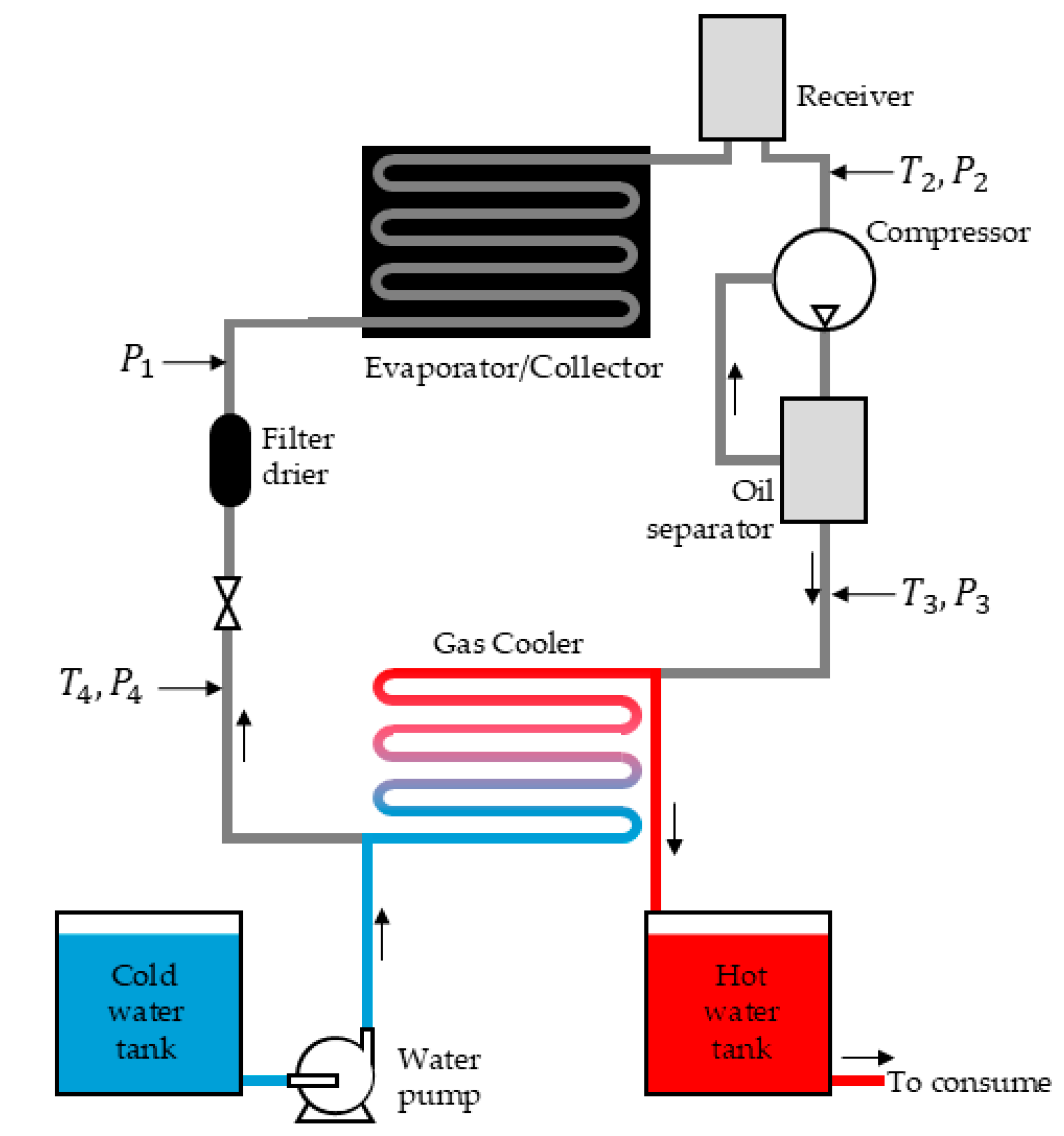
Figure 1. Experimental heat pump R744 DX-SAHP [42].
Processes 14 00103 g001
Figure 2. Flowchart for calculating the hf.
Processes 14 00103 g002
Figure 3. Evaporator/solar collector details: (a) side view of evaporator, (b) photo of DX-SAHP [42], (c) cross section of evaporator.
Processes 14 00103 g003
Figure 4. Flowchart used to solve model equations.
Processes 14 00103 g004
Figure 5. Solar radiation versus ambient temperature in 2022, Belo Horizonte—MG.
Processes 14 00103 g005
Figure 6. Grid Test.
Processes 14 00103 g006
Figure 7. Pressures considering the climate of Belo Horizonte, 2022.
Processes 14 00103 g007
Figure 8. Comparison graph between maximum evaporator pressure, temperature, and maximum radiation values for each month.
Processes 14 00103 g008
Figure 9. Maximum evaporator pressure values in January and March.
Processes 14 00103 g009
Figure 10. Radiation on 14 January 2022.
Processes 14 00103 g010
Figure 11. Fluid pressure variation over the day for different masses of R744 in the evaporator.
Processes 14 00103 g011
Figure 12. Values of maximum pressures in the evaporator from 2012 to 2022.
Processes 14 00103 g012
Figure 13. Maximum evaporator pressure for different regions of Brazil.
Processes 14 00103 g013
Table 1. Studies on energetic performance of DX-SAHP.
AuthorsCollector TypeCollector Size (m2)RefrigerantCOPStudyMaximum Pressure Analysis
TheoreticalExperimental
Chaturvedi and Shen (1984) [21]UFP3.4R122.0–3.0
Chaturvedi et al. (1998) [22]UFP3.5R122.5–4.5
Ito et al. (1999) [23]UFP3.2R222.0–8.0
Torres-Reyes and Gortari (2001) [24]UFP4.5R225.6–4.4
Hawlader et al. (2001) [25]UFP3.0R134a4.0–9.0
Chyng et al. (2003) [26]UFP1.9R134a1.7–2.5
Kuang et al. (2003) [27]UFP2.0R224.0–6.0
Ito et al. (2005) [28]PVT1.9R224.5–6.5
Kuang and Wang (2006) [29]UFP10.5R222.6–3.3
Li et al. (2007) [17]UFP4.2R225.21
Xu et al. (2009) [30]PVT2.3R224.9–5.1
Chow et al. (2010) [31]UFP12R134a6.5–10.0
Kong et al. (2011) [32]UFP4.2R225.2–6.6
Moreno-Rodríguez et al. (2012) [33]UFP5.6R134a1.7–2.9
Islam et al. (2012) [20]CFP-R7441.5–2.7
Fernández- Seara et al. (2012) [34]UFP1.6R134a2.0–4.0
Zhang et al. (2014) [35]UFP4.2R223.5–6.0
Sun et al. (2015) [36]UFP2.0-4.0–5.5
Deng and Yu (2016) [37]CFP2.5R134a3.9–6.2
Kong et al. (2017) [38]UFP4.2R410a5.2–6.6
Mohamed et al. (2017) [39]UFP4.2R407C5.2–6.6
Diniz (2017) [40]UFP1.6R134a2.1–2.9
Rabelo et al. (2018) [41]UFP1.6R7443.5–5.5
Kong et al. (2018) [42]UFP2.1R134a3.6–5.6
Rabelo et al. (2019) [12]UFP1.57R7442.58
Kong et al. (2020) [43]UFP2.1R2902.12–4.43
Duarte et al. (2021) [44]UFP1.57R7443.2–5.4
Diniz et al. (2023) [45]UFP1.6R2902.1–2.9
Zanetti et al. (2023) [9]PVT4.9R7442.94–4.4
Abbasi et al. (2024) [46]CFP2.3R134a2.6–3.9
Reis et al. (2024) [47]UFP1.57R7441.8–2.8
Sharma et al. (2024) [48]PVT0.65R134a3.75
The symbols ✓ and ✗ denote, respectively, the presence or absence of the specified analysis in each study.
Table 2. Characteristics and parameters of the evaporator.
ParameterValor
Tube and fins metalCopper
Outside diameter of the tube D o = 6.34   m m
Tube inner diameter D i = 4.66   m m
Pipe length L e = 16.3   m
Evaporator height H = 1.6   m
Distance between tubes W = 0.1   m
Fin thickness δ = 0.5   m m
Plate area A = 1.57   m 2
Copper conductivity [52] k = 401   W / m K
Emissivity ε = 0.95
Table 3. Characteristics and properties of R744 [8,60].
Property Value/Characteristic
Chemical formula CO2
Critical temperature31.1 °C
Critical pressure73.8 bar
Boiling point (at 1 atm)−78 °C
Global Warming Potential (GWP)1
Ozone Depletion Potential (ODP)0
FlammabilityNon-flammable
ToxicityNon-toxic
Table 4. Maximum pressure in the evaporator in selected locations.
City/StateMaximum Pressure (bar)Acceptable Limit
Alto Paraíso de Goiás/GO9371.5%
Belo horizonte/MG98.881.0%
Maringá/PR10983.8%
Paranã/TO12292.0%
São Gonçalo/PB11185.0%
Disclaimer/Publisher’s Note: The statements, opinions and data contained in all publications are solely those of the individual author(s) and contributor(s) and not of MDPI and/or the editor(s). MDPI and/or the editor(s) disclaim responsibility for any injury to people or property resulting from any ideas, methods, instructions or products referred to in the content.