Experimental Study on the Creep Behavior and Permeability Evolution of Tuff Under Unloading Confining Pressure with Seepage–Stress Coupling Effects

Abstract
1. Introduction
2. Materials and Methods
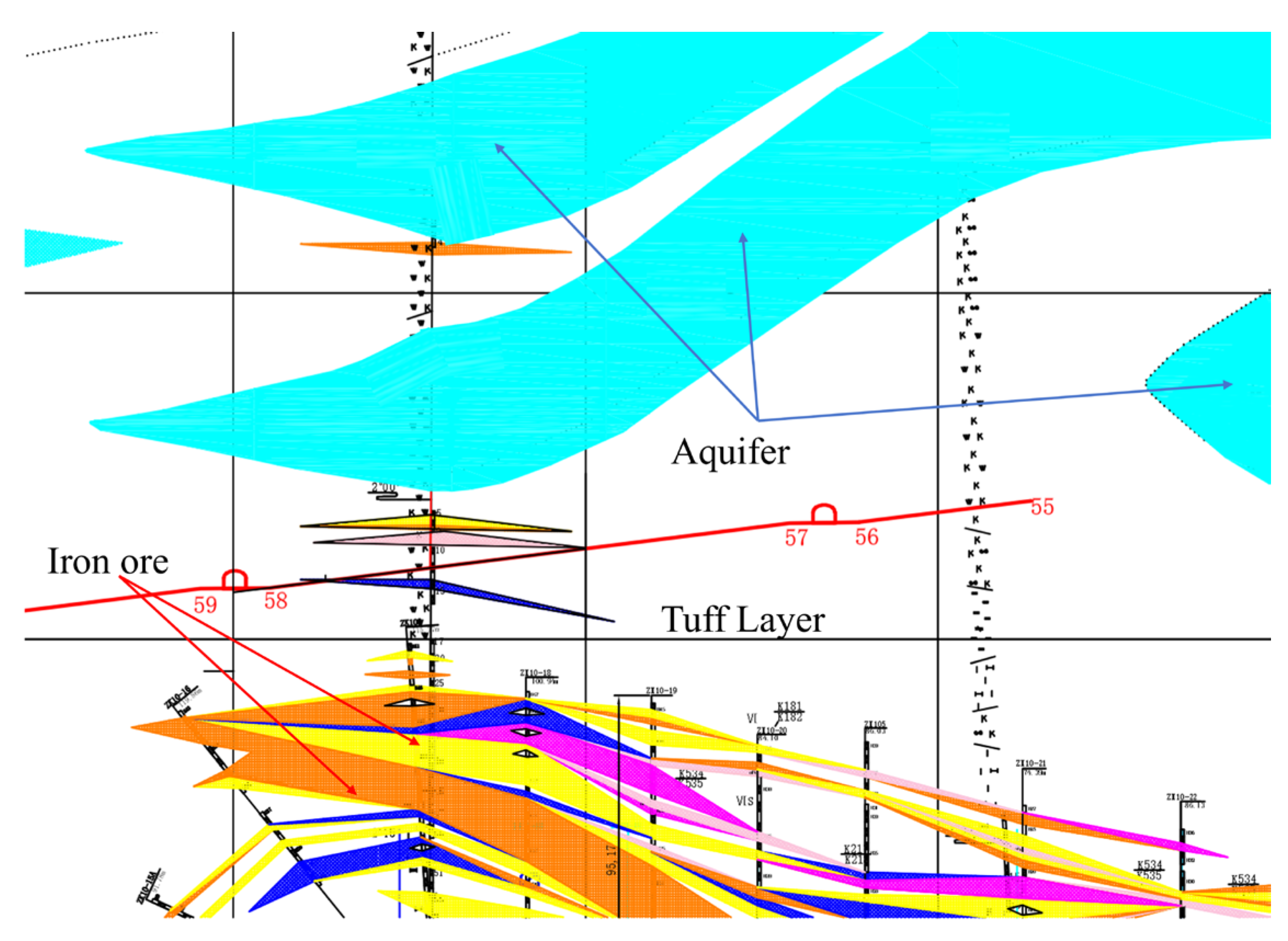
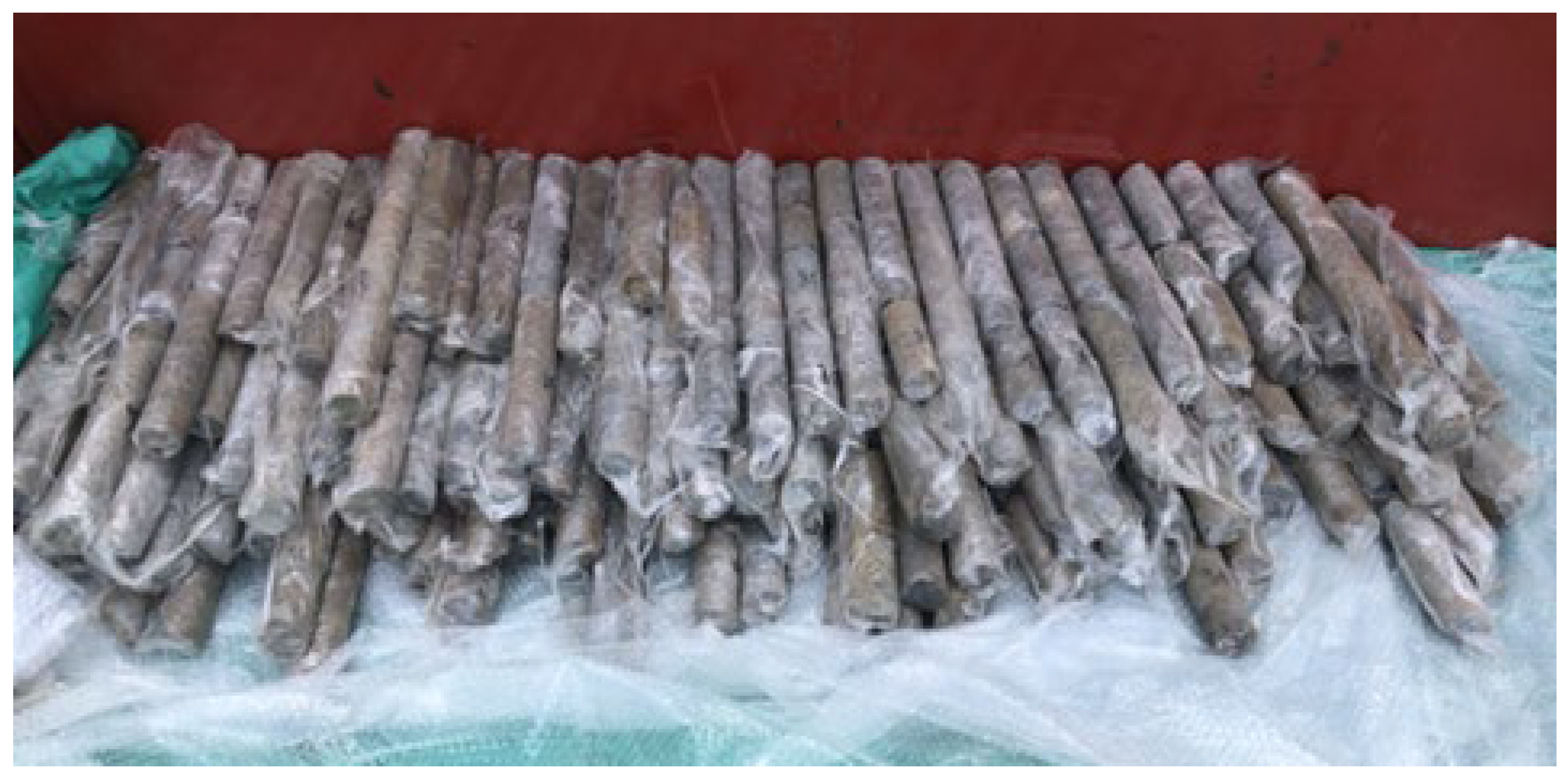
2.1. Experimental Materials and Specimen Preparation
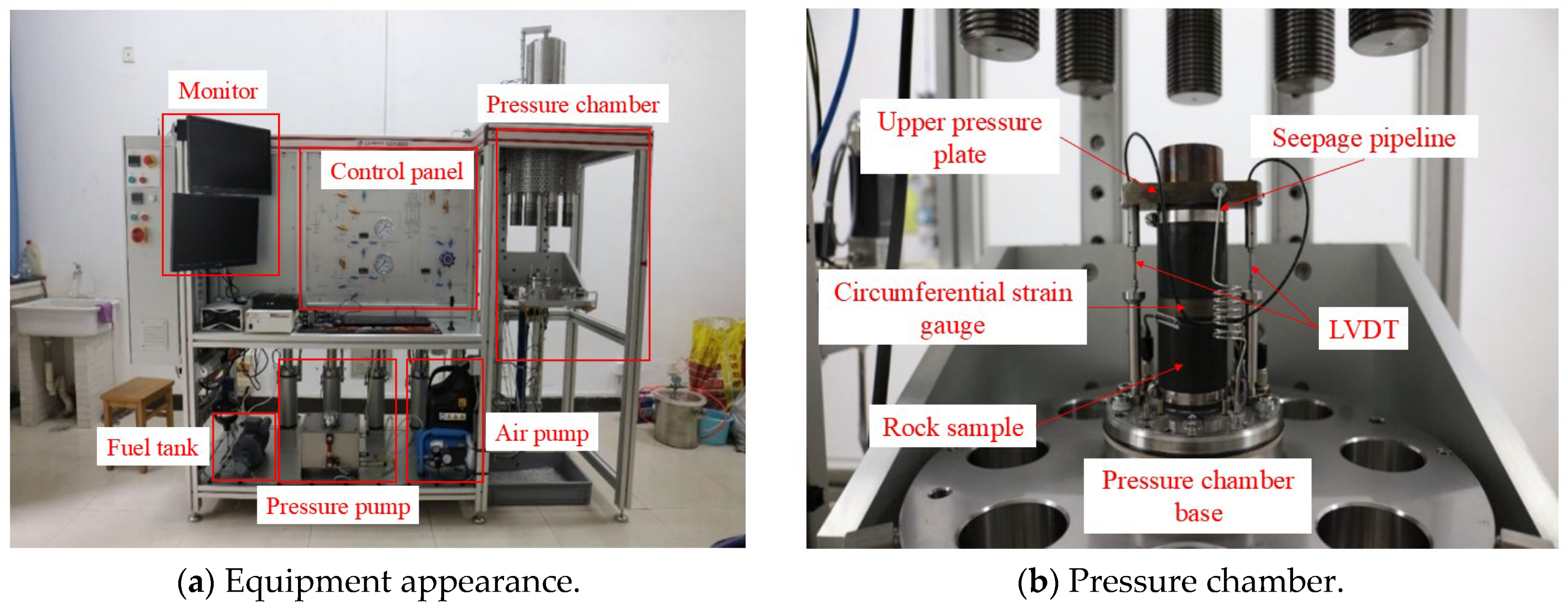
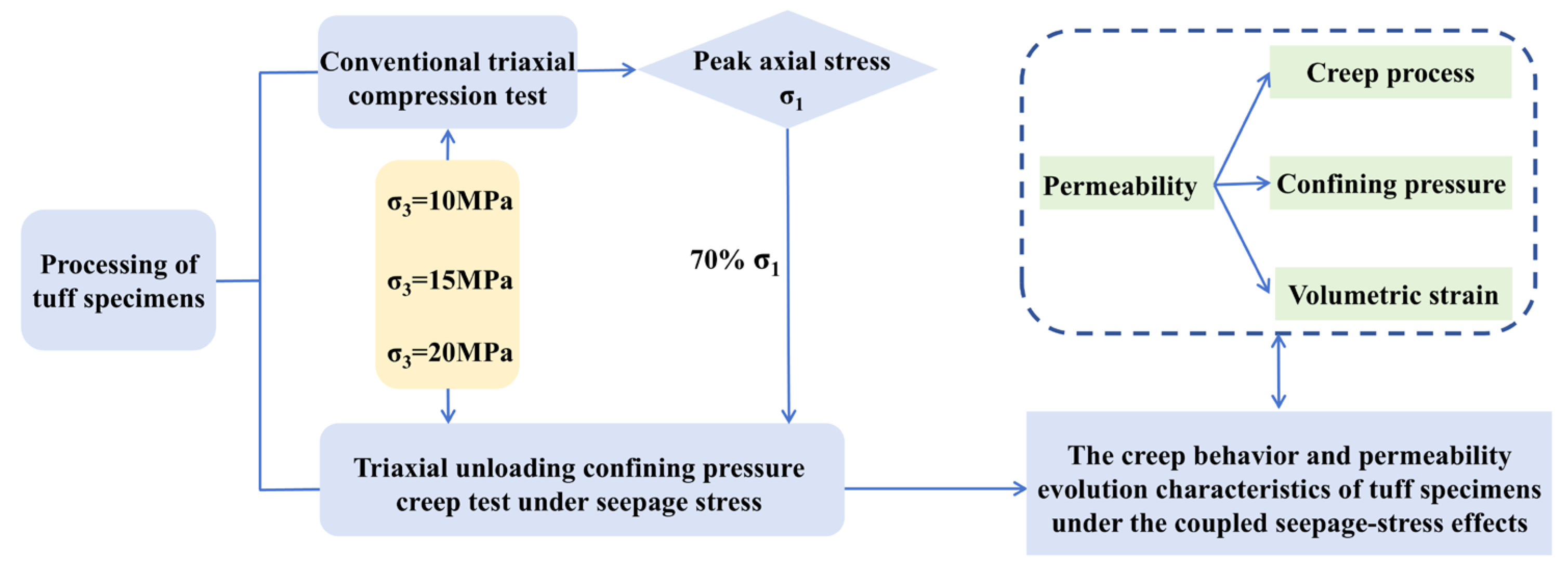
2.2. Experimental Equipment and Process
- (1)
- The saturated rock specimen was placed inside the triaxial pressure chamber, ensuring the correct positioning and calibration of both the sensor and the seepage apparatus.
- (2)
- Confining pressure was applied at a controlled rate of 1 MPa per minute until the target value was reached.
- (3)
- After establishing the confining pressure, the seepage pressure was increased to 4 MPa at a rate of 1 MPa per minute.
- (4)
- Once the seepage pressure stabilized, axial stress was applied at a rate of 0.05 MPa per second until the preset axial stress value was reached. The axial stress was then maintained constant until the end of the test.
- (5)
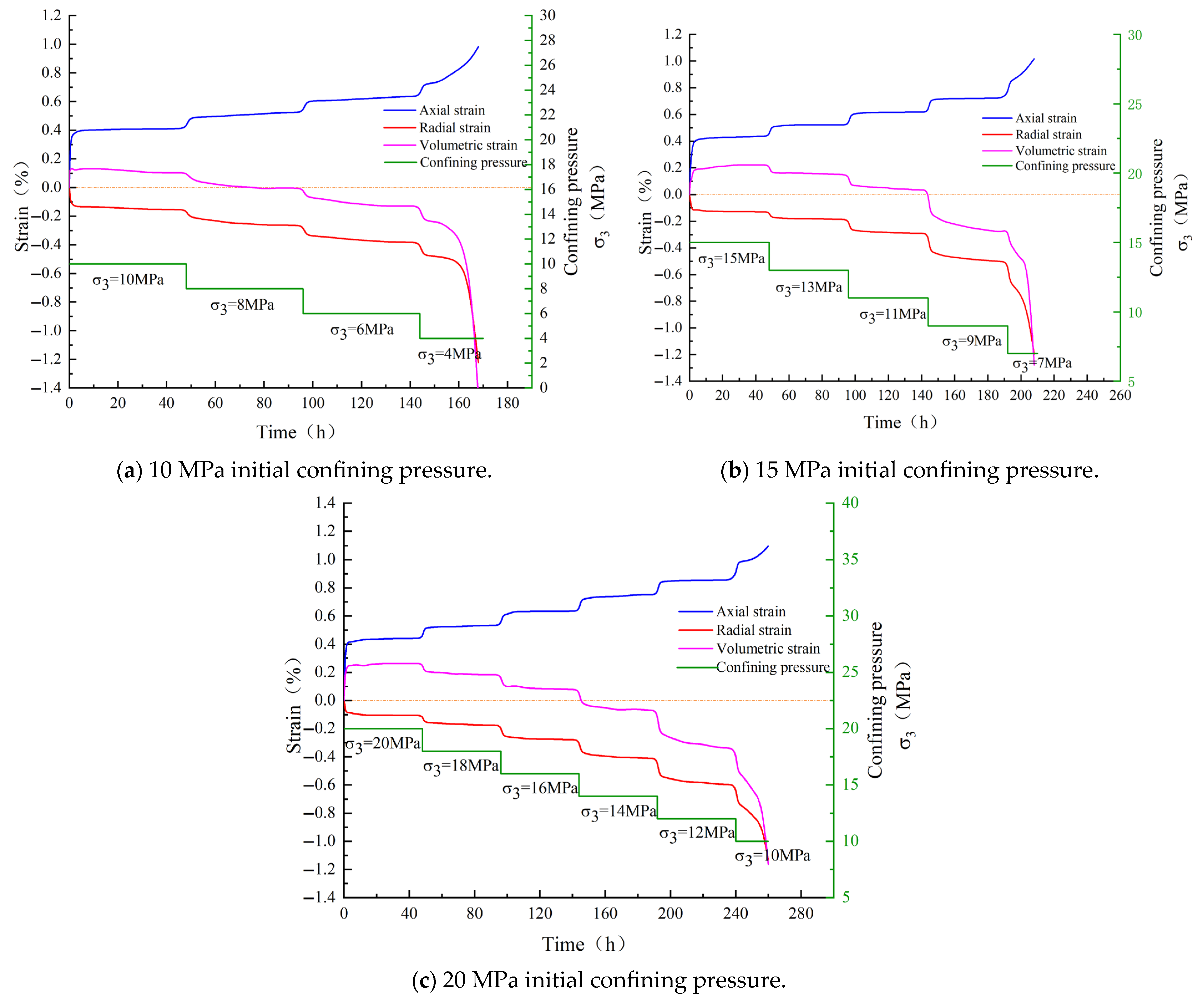
- Upon completion of axial stress loading, the confining pressure was gradually reduced at a rate of 0.05 MPa per second. The unloading process was in increments of 2 MPa, with a 48 h holding period at each decrement, continuing until the specimen experienced ultimate failure.
3. Experiment Results and Discussion
3.1. Results of Conventional Triaxial Compression Tests
3.2. Experimental Analysis of Creep Under Unloading Confining Pressure Coupled with Seepage Stress
3.3. Analysis of the Evolution Pattern of Permeability During the Tests
3.4. Relationship Between Permeability and Strain
3.5. Relationship Between Permeability and Confining Pressure
4. Conclusions
- (1)
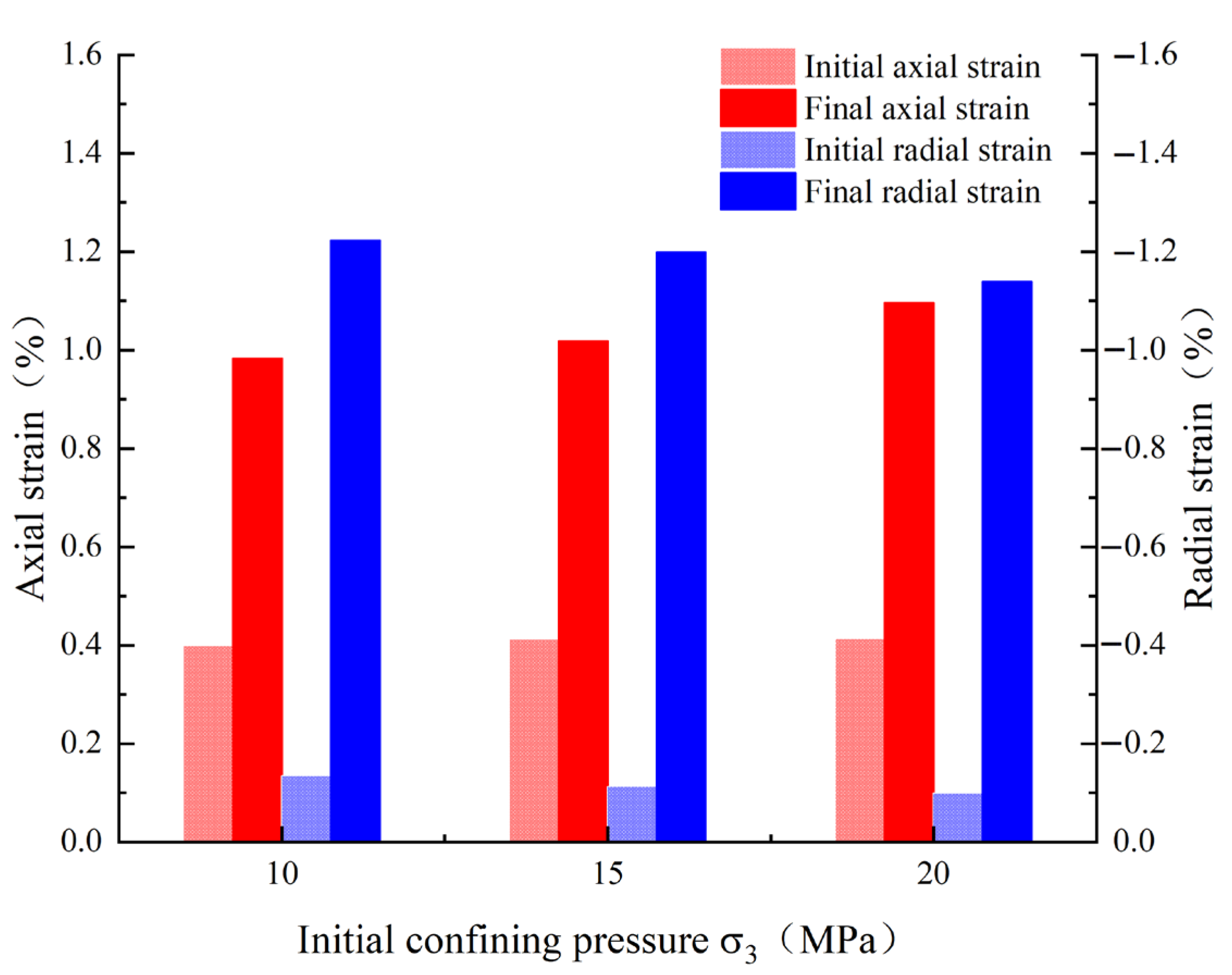
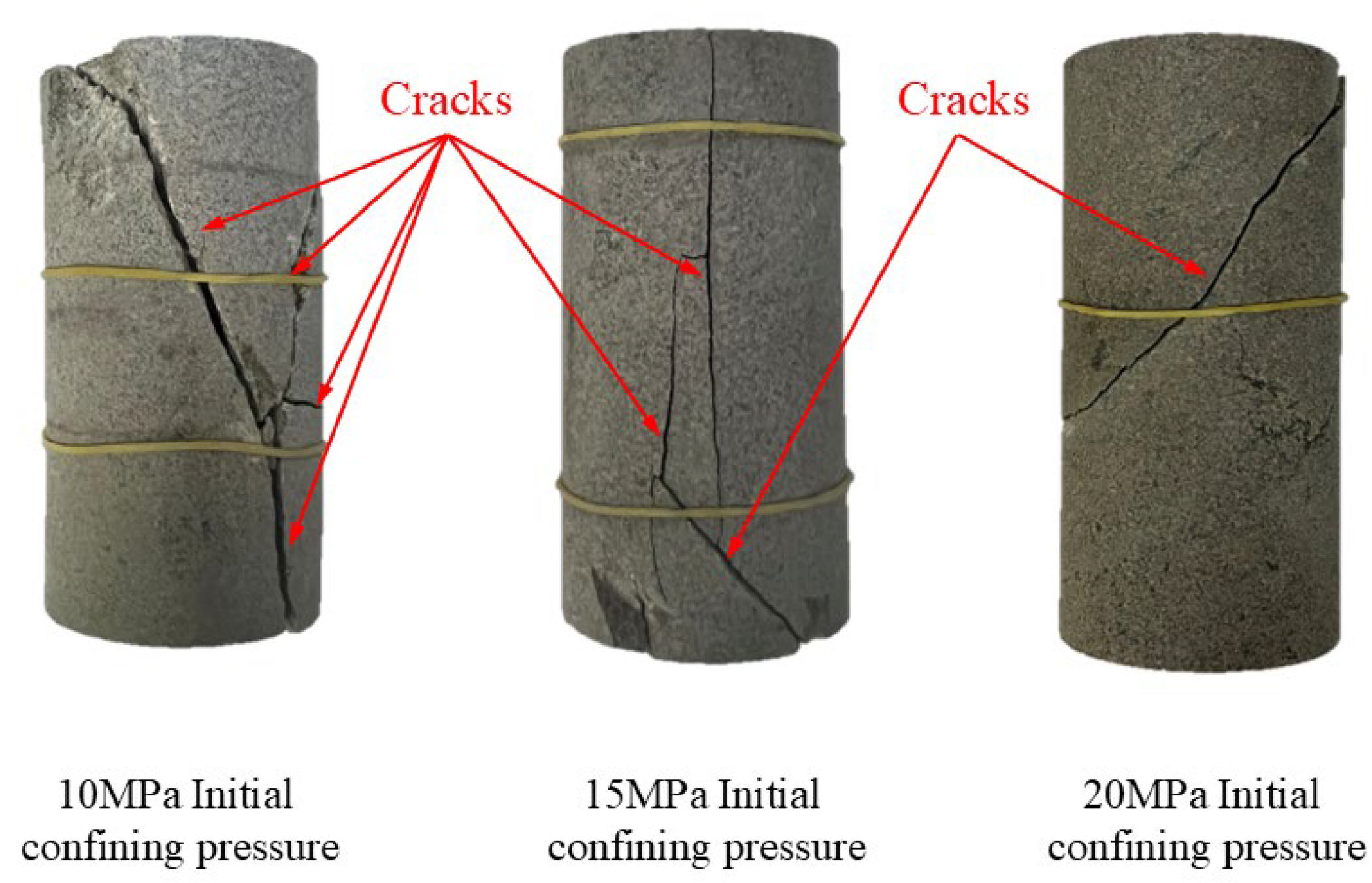
- A comprehensive experimental study on the creep behavior of tuff under the combined effects of seepage and stress was conducted, emphasizing how their interaction influences the rock’s mechanical properties and permeability. The results reveal that the axial strain was initially greater than the radial strain; however, with each successive unloading step, the radial strain rate increased more rapidly. When the specimens failed, the radial strain exceeded the axial strain, indicating that rock failure under these conditions is mainly marked by significant radial expansion. For instance, under an initial confining pressure of 10 MPa, the radial strain was 1.24 times the axial strain at failure.
- (2)
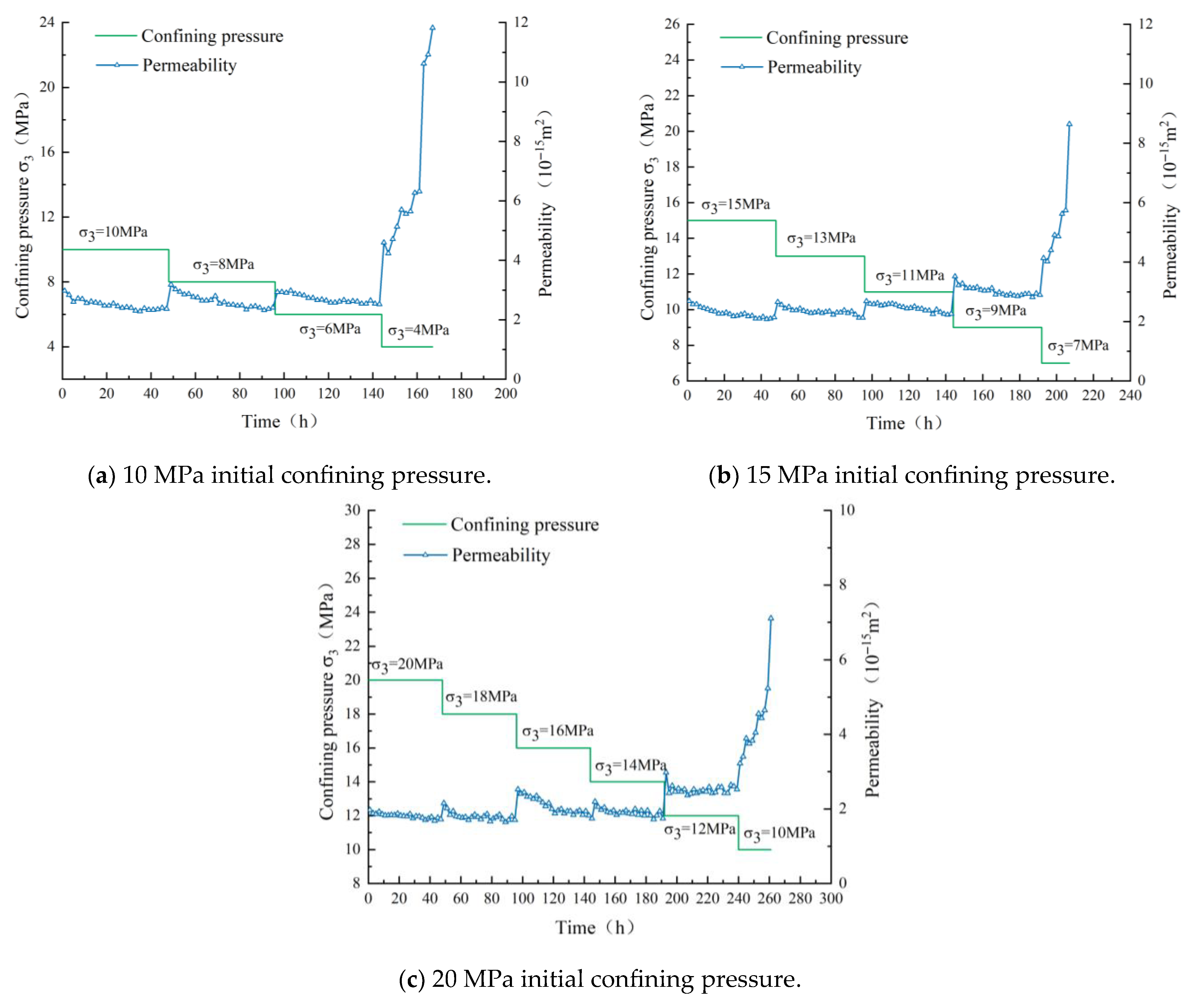
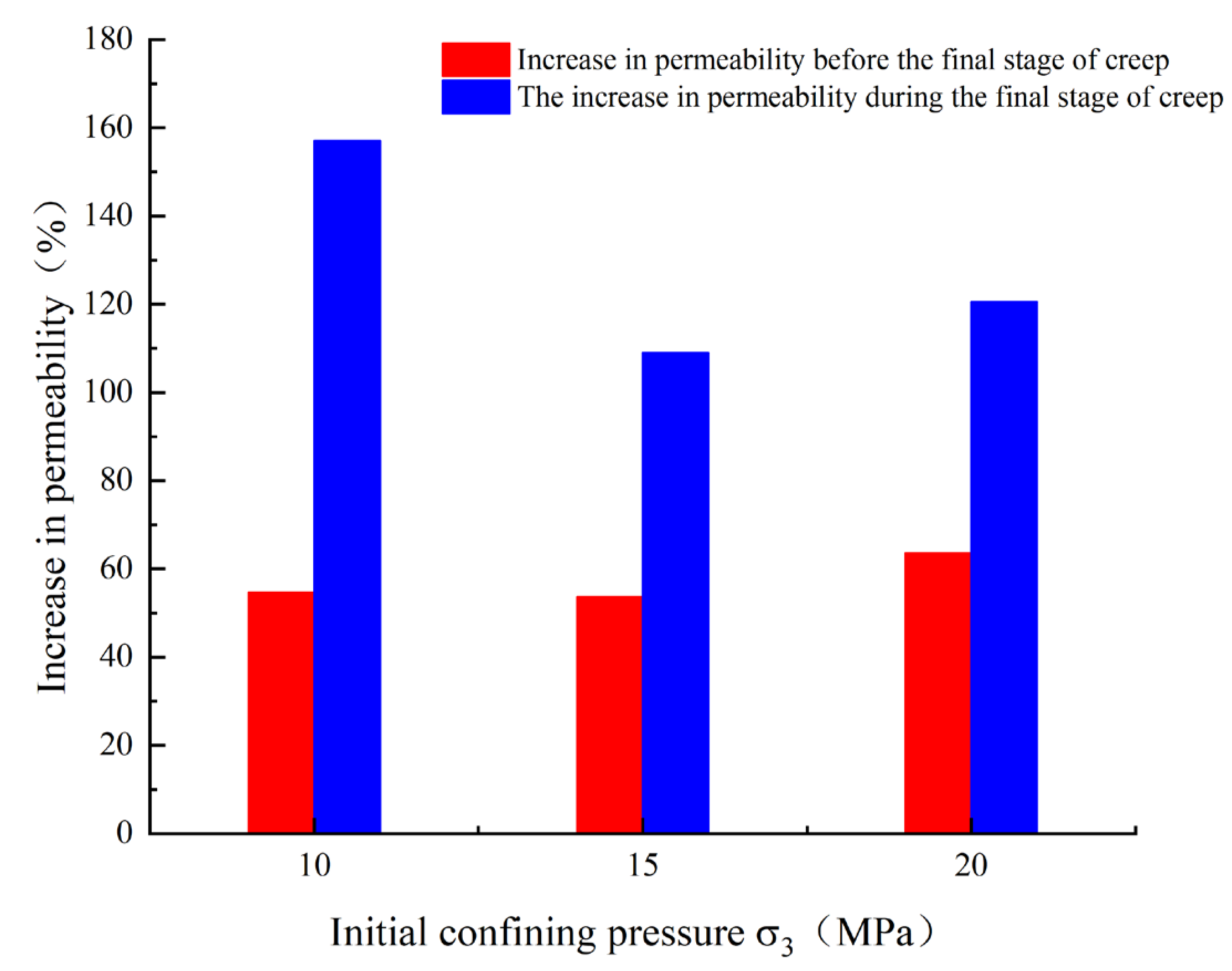
- The progression of permeability is closely linked to the different stages of creep deformation. During the stable creep phases, permeability showed moderate and cumulative increases. Upon entering the accelerated creep phase, permeability increases significantly, exceeding the total permeability changes observed in all previous stages combined. This pattern suggests that extensive propagation and interconnection of internal microcracks, which create new flow pathways, mainly occur during the accelerated creep phase just before failure.
- (3)
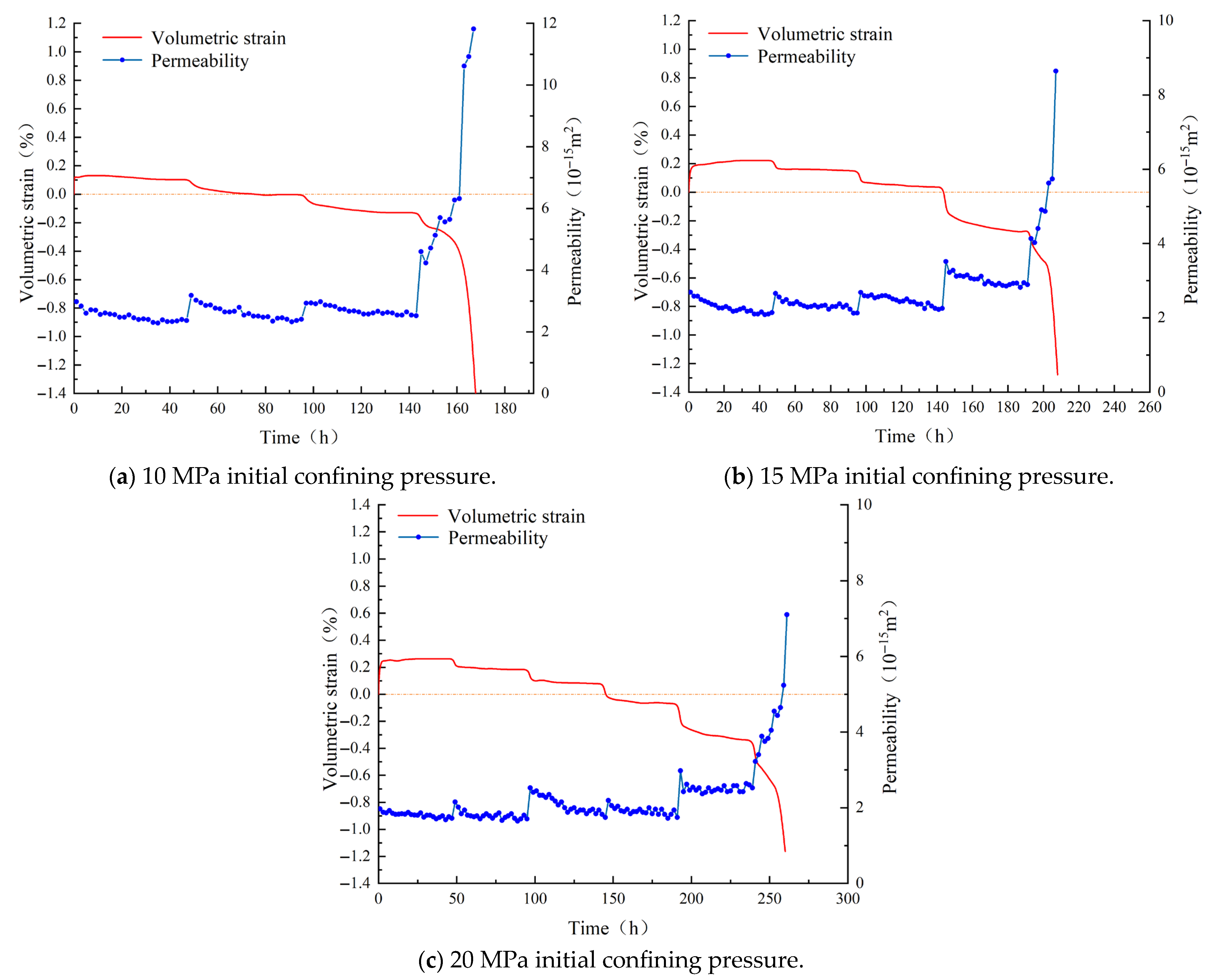
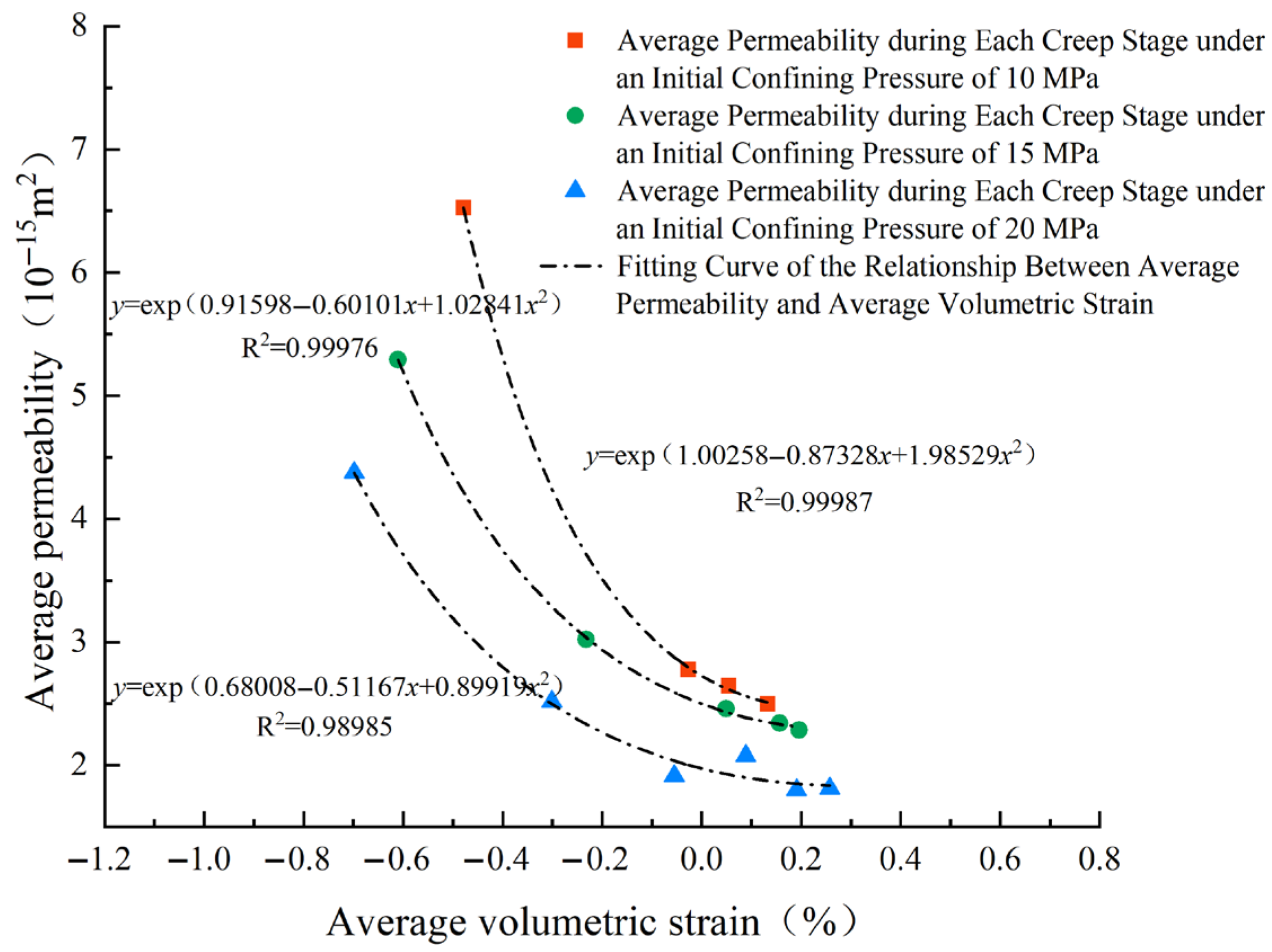
- A strong quantitative correlation between permeability and volumetric strain was established. The analysis shows that permeability remains relatively constant when volumetric strain is positive, indicating compaction. In contrast, when volumetric strain becomes negative, signifying dilation, permeability increases exponentially. A high correlation function (R2 > 0.98) was measured, establishing that the fitted curve accurately characterizes this relationship across both stable and accelerated creep stages, offering a reliable predictive model for permeability evolution based on deformation.
- (4)
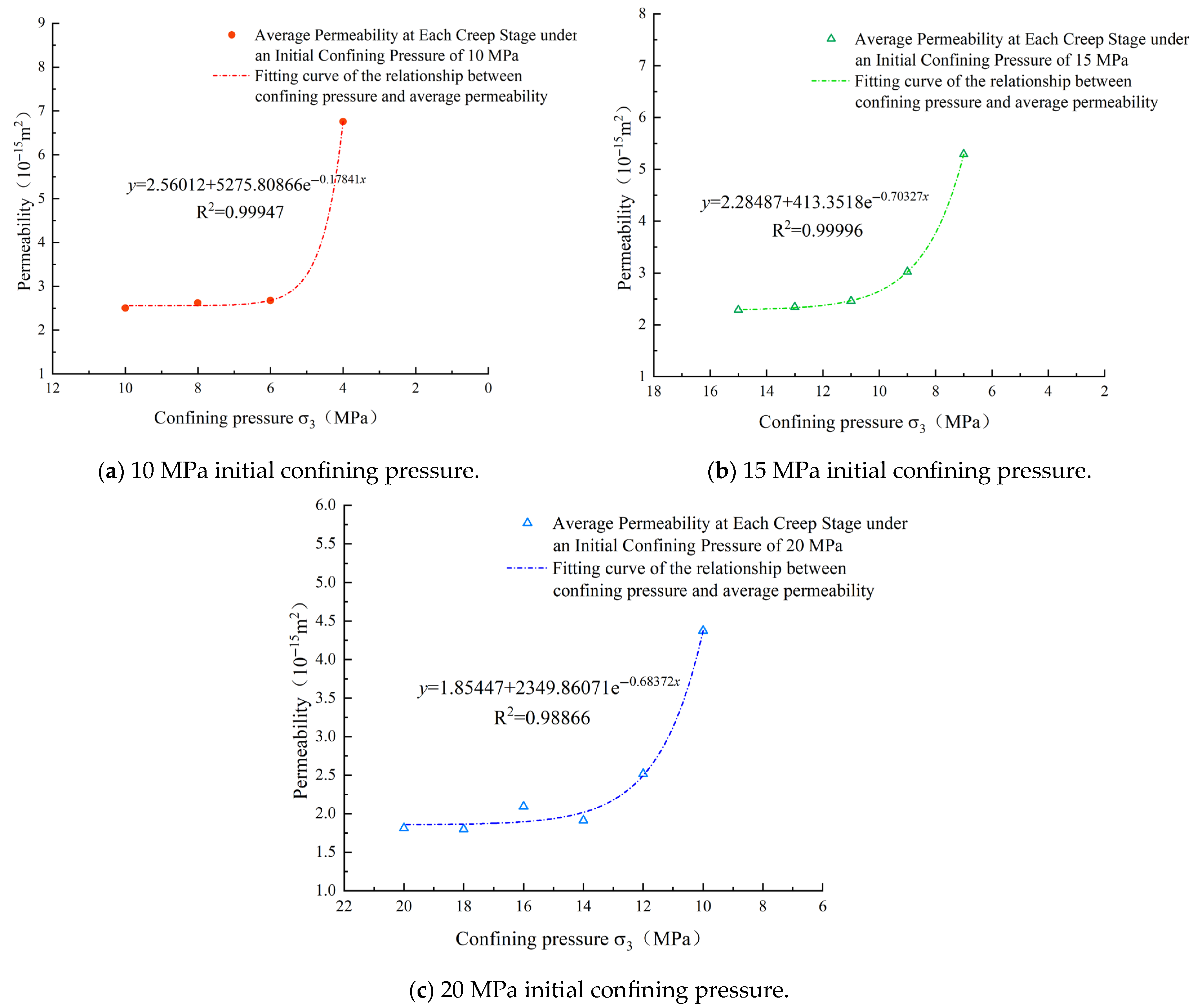
- Confining pressure plays a fundamental role in controlling permeability. The relationship between average permeability and the confining pressure during each creep stage follows a decaying exponential trend. Additionally, higher initial confining pressures more effectively limit internal fracture expansion, leading to a progressively smaller increase in permeability during the accelerated creep phase. These findings highlight the crucial role of confining pressure in reducing damage evolution and its subsequent impact on hydraulic properties.
Author Contributions
Funding
Data Availability Statement
Conflicts of Interest
References
- Li, T.; Mei, T.T.; Sun, X.H.; Lv, Y.G.; Sheng, J.Q.; Cai, M. A study on a water-inrush incident at Laohutai coalmine. Int. J. Rock Mech. Min. 2013, 59, 151–159. [Google Scholar] [CrossRef]
- Zhang, G.H.; Jiao, Y.Y.; Wang, H.; Cheng, Y.; Chen, L.B. On the mechanism of inrush hazards when Denghuozhai Tunnel passing through granite contact zone. Tunn. Undergr. Space Technol. 2017, 68, 174–186. [Google Scholar] [CrossRef]
- Huang, Z.; Zeng, W.; Wu, Y.; Li, S.J.; Zhao, K. Experimental investigation of fracture propagation and inrush characteristics in tunnel construction. Nat. Hazards 2019, 97, 193–210. [Google Scholar] [CrossRef]
- Liang, D.X.; Jiang, Z.Q.; Zhu, S.Y.; Sun, Q.; Qian, Z.W. Experimental research on water inrush in tunnel construction. Nat. Hazards 2016, 81, 467–480. [Google Scholar] [CrossRef]
- Jiang, H.M.; Li, L.; Rong, X.L.; Wang, M.Y.; Xia, Y.P.; Zhang, Z.C. Model test to investigate waterproof-resistant slab minimum safety thickness for water inrush geohazards. Tunn. Undergr. Space Technol. 2017, 62, 35–42. [Google Scholar] [CrossRef]
- Yu, H.T.; Zhu, S.Y.; Wang, X.H. Research on groundwater seepage through fault zones in coal mines. Hydrogeol. J. 2021, 29, 1647–1656. [Google Scholar] [CrossRef]
- Li, B.Y.; Yang, F.W.; Du, P.Z.; Liu, Z.H. Study on the triaxial unloading creep mechanical properties and creep model of shale in different water content states. Bull. Eng. Geol. Environ. 2022, 81, 420. [Google Scholar] [CrossRef]
- Yu, M.L.; Wang, Z.W.; Xu, Y.; Wang, Y.T.; Wang, L.Y.; Wen, J.H. Study on mechanical properties and energy evolution characteristics of excavation unloading rock under freeze-thaw temperature range. Eng. Fract. Mech. 2025, 325, 111293. [Google Scholar] [CrossRef]
- Chen, X.Z.; Jiang, H.; Chen, L.L.; Du, W.; Gong, S. Experimental Study on Creep Characteristics of Unloaded Rock Masses for Excavation of Rock Slopes in Cold Areas. Appl. Sci. 2023, 13, 3138. [Google Scholar] [CrossRef]
- Wang, S.S.; Xu, W.Y.; Chen, H.J.; Yan, L. The time-dependent behaviour and failure mechanism of dacite under unloading condition. Eur. J. Environ. Civ. Eng. 2022, 26, 7756–7770. [Google Scholar] [CrossRef]
- Yang, S.Q.; Tang, J.Z.; Wang, S.S.; Yang, D.S.; Zheng, W.T. An Experimental and Modeling Investigation on Creep Mechanical Behavior of Granite Under Triaxial Cyclic Loading and Unloading. Rock Mech. Rock Eng. 2022, 55, 5577–5597. [Google Scholar] [CrossRef]
- Liu, X.; Ying, Z.Q.; Zheng, F.K.; Duan, C.S.; Wang, H.Y.; Hao, Y. Mechanical and deformation behaviors of sandy mudstone under triaxial unloading creep testing. Front. Earth Sci. 2025, 13, 1574818. [Google Scholar] [CrossRef]
- Zhang, X.J.; Zhao, J.; Jiang, M.F.; Xue, J.C.; He, B.G. Creep Failure Mechanism and Model of Granite under True Triaxial Loading and Unloading Conditions. Int. J. Geomech. 2024, 24, 06024015. [Google Scholar] [CrossRef]
- Heap, M.J.; Baud, P.; Meredith, P.G.; Bell, A.F.; Main, I.G. Time-dependent brittle creep in Darley Dale sandstone. Geophys. Res. Solid Earth 2009, 114. [Google Scholar] [CrossRef]
- Liu, J.F.; Wang, L.; Pei, J.L.; Zheng, L.; Bian, Y. Experimental study on creep deformation and long-term strength of unloading-fractured marble. Eur. J. Environ. Civ. Eng. 2015, 19, S97–S107. [Google Scholar] [CrossRef]
- Xiao, F.K.; Mo, R.H. Study on Creep Energy Dissipation and Damage Deformation Characteristics of Rock Under Unloading Confining Pressure. Rock Mech. Rock Eng. 2025. [Google Scholar] [CrossRef]
- Xu, W.Y.; Wang, R.B.; Wang, W.; Zhang, Z.L.; Zhang, J.C.; Wang, W.Y. Creep properties and permeability evolution in triaxial rheological tests of hard rock in dam foundation. J. Cent. South Univ. 2012, 19, 252–261. [Google Scholar] [CrossRef]
- Yang, S.Q.; Hu, B. Creep and Long-Term Permeability of a Red Sandstone Subjected to Cyclic Loading After Thermal Treatments. Rock Mech. Rock Eng. 2018, 51, 2981–3004. [Google Scholar] [CrossRef]
- Xu, P.; Yang, S.Q. Permeability evolution of sandstone under short-term and long-term triaxial compression. Int. J. Rock Mech. Min. 2016, 85, 152–164. [Google Scholar] [CrossRef]
- Zhou, H.W.; Wang, L.J.; Rong, T.L.; Zhang, L.; Ren, W.G.; Su, T. Creep-based permeability evolution in deep coal under unloading confining pressure. J. Nat. Gas Sci. Eng. 2019, 65, 185–196. [Google Scholar] [CrossRef]
- Huang, G.; Lu, G.; Zhang, J.; Zhou, F.J.; Li, D.W. Study on the evolution of permeability properties of limestone under different stress paths. Appl. Rheol. 2024, 34, 20240003. [Google Scholar] [CrossRef]
- Yan, L.; Xu, W.Y.; Wang, R.B.; Wang, H.L.; Xie, W.C. Mechanical and Permeability Characteristics of Basalt During Unloading Confining Pressure Creep Tests Under Coupled Hydro-Mechanical Conditions. Rock Mech. Rock Eng. 2021, 54, 6091–6103. [Google Scholar] [CrossRef]
- Oda, M.; Takemura, T.; Aoki, T. Damage growth and permeability change in triaxial compression tests of Inada granite. Mech. Mater. 2002, 34, 313–331. [Google Scholar] [CrossRef]
- Zhu, T.E.; Li, W.P.; Tian, J.W.; Cheng, Y.; Lv, Z.M. Creep deformation and permeability evolution of the/paleoweathered rocks in the bending zone under triaxial unloading-loading confining pressure. Environ. Earth Sci. 2023, 82, 179. [Google Scholar] [CrossRef]
- Zhang, Y.L.; Yang, L.; Sheng, X.C.; Hu, H.; Yang, Y.; Tu, W.F.; Sun, W.; Li, Z.F. Study on the seepage-induced failure behavior of water-rich ultracataclasite surrounding rock. Phys. Fluids 2025, 37, 077160. [Google Scholar] [CrossRef]
- Zhang, J.L.; Zhou, X.H.; Liu, X.R.; Fang, L.; Liu, Y.Y.; Wang, Y. Deformation and permeability of fractured rocks using fluid-solid coupling under loading-unloading conditions. J. Rock Mech. Geotech. 2025, 17, 4889–4907. [Google Scholar] [CrossRef]
- Wang, Y.C.; Chen, F.; Sui, W.H.; Meng, F.S.; Geng, F. Large-scale model test for studying the water inrush during tunnel excavation in fault. Bull. Eng. Geol. Environ. 2022, 81, 238. [Google Scholar] [CrossRef]
- Chen, X.Z.; Zhang, Q.; Ding, X.C.; Chen, L.L.; Du, W.; Jiang, H.; Gong, S. Study on the Creep Characteristics and Fractional Order Model of Granite Tunnel Excavation Unloading in a High Seepage Pressure Environment. Sustainability 2023, 15, 4558. [Google Scholar] [CrossRef]
- Xue, Y.; Gao, F.; Liu, X.G.; Liang, X. Permeability and pressure distribution characteristics of the roadway surrounding rock in the damaged zone of an excavation. Int. J. Min. Sci. Technol. 2017, 27, 211–219. [Google Scholar] [CrossRef]
- Li, Z.Q.; Nie, L.C.; Xue, Y.G.; Li, W.; Fan, K.R. Model Testing on the Processes, Characteristics, and Mechanism of Water Inrush Induced by Karst Caves Ahead and Alongside a Tunnel. Rock Mech. Rock Eng. 2025, 58, 5363–5380. [Google Scholar] [CrossRef]
- Chen, Z.Q.; Ma, C.C.; Li, T.B.; He, C. Experimental investigation of the failure mechanism of deep granite under high seepage water pressure and strong unloading effect. Acta Geotech. 2022, 17, 5009–5030. [Google Scholar] [CrossRef]
- Yang, S.Q.; Jing, H.W.; Cheng, L. Influences of pore pressure on short-term and creep mechanical behavior of red sandstone. Eng. Geol. 2014, 179, 10–23. [Google Scholar] [CrossRef]
- Wei, L.D.; Lin, Z.A.; Long, H.F.; Ye, Q.Y. Experimental Study on Permeability Evolution of Sandstone during Triaxial Compression Damage. Appl. Sci. 2023, 13, 11579. [Google Scholar] [CrossRef]
- Jia, C.J.; Xu, W.Y.; Wang, S.S.; Wang, R.B.; Yu, J. Experimental analysis and modeling of the mechanical behavior of breccia lava in the dam foundation of the Baihetan Hydropower Project. Bull. Eng. Geol. Environ. 2019, 78, 2681–2695. [Google Scholar] [CrossRef]
- Feng, W.L.; Qiao, C.S.; Niu, S.J. Study on sandstone creep properties of Jushan Mine affected by degree of damage and confining pressure. Bull. Eng. Geol. Environ. 2020, 79, 869–888. [Google Scholar] [CrossRef]
- Zhao, J.; Feng, X.T.; Zhang, X.W.; Yang, C.X.; Zhou, Y.Y. Time-dependent behaviour and modeling of Jinping marble under true triaxial compression. Int. J. Rock Mech. Min. 2018, 110, 218–230. [Google Scholar] [CrossRef]
- Chen, L.L.; Chen, X.Z.; Jiang, H.; Gong, S. Study on Creep Damage Behaviors and Model of Rock Mass During Excavation and Unloading Under High Seepage Pressure. Fatigue Fract. Eng. Mater. Struct. 2025, 49, 102–118. [Google Scholar] [CrossRef]
- Yan, Q.; Qin, S.F.; Sang, X.F.; Luo, Z.S.; Liang, M.H. Research on creep characteristics of loading and unloading of hard Flint limestone. Front. Mater. 2023, 10, 1177733. [Google Scholar] [CrossRef]
- Wang, S.S.; Wang, H.L.; Xu, W.Y.; Cai, M. A coupled elasto-plastic damage model for fine-grained sandstone under triaxial compression and lateral extension loading conditions. Eur. J. Environ. Civ. Eng. 2022, 26, 838–854. [Google Scholar] [CrossRef]
- Zhang, X.D.; Zhou, Z.C.; Yang, J.J.; Pang, S.; Geng, J.; Li, W.L.; Zhang, X.F. Creep properties of siltstone-like materials with different unloading confining pressures under seepage. Front. Earth Sci. 2022, 10, 949916. [Google Scholar] [CrossRef]
- Hirth, G.; Beeler, N.M. The role of fluid pressure on frictional behavior at the base of the seismogenic zone. Geology 2015, 43, 223–226. [Google Scholar] [CrossRef]
- Lin, T.; Meng, W.; Chen, Y.D.; Zhao, Z.H.; Liu, B.; Zhang, J.T.; Chen, S.C.; Zhao, X.G. Unloading-induced permeability recovery in rock fractures. J. Rock Mech. Geotech. 2023, 15, 3148–3162. [Google Scholar] [CrossRef]



| Author | Materials | Methods | Investigation Purpose |
|---|---|---|---|
| Heap et al. [14] | Darley Dale sandstone | triaxial creep test | relationship between axial strain rate and differential stress |
| Liu et al. [15] | fractured marble | triaxial creep test | long-term strength of fractured marble |
| Xiao and Mo [16] | white sandstone | triaxial creep test | long-term strength stress level under different confining pressures |
| Huang et al. [21] | limestone | various triaxial stress paths | evolution of permeability properties |
| Yan et al. [22] | basalt | triaxial unloading-induced creep tests | coupled mechanical–permeability response of basalt |
| Oda, Takemura and Aoki [23] | fracture-damaged granite | triaxial tests | coupled dynamics between damage evolution and permeability variation |
| Zhu et al. [24] | paleo-weathered rocks | triaxial cyclic loading–unloading confining pressure tests | creep deformation and permeability evolution |
| Zhang et al. [25] | water-blocking rock | seepage failure tests | seepage failure mechanisms and disaster modes |
| Zhang et al. [26] | fractured rock | fluid–solid coupling triaxial tests | deformation and seepage characteristics |
| No. | Density (kg·m−3) | UCS (MPa) | BTS (MPa) | Elasticity Modulus (GPa) | Poisson’s Ratio |
|---|---|---|---|---|---|
| 1–1 | 3035.75 | 91.65 | 6.39 | 21.53 | 0.21 |
| 1–2 | 3102.26 | 96.78 | 7.13 | 22.62 | 0.19 |
| 1–3 | 3088.56 | 92.55 | 6.94 | 20.89 | 0.19 |
| Average value | 3075.52 | 93.66 | 6.82 | 21.68 | 0.20 |
| Initial Confining Pressure (MPa) | Seepage Pressure (MPa) | Axial Stress (MPa) | Confining Pressure Stage (MPa) | Creep Duration per Stage (h) |
|---|---|---|---|---|
| 10 | 4 | 70% σ1 1 | 10, 8, 6, 4 | 48 |
| 15 | 4 | 70% σ1 | 15, 13, 11, 9, 7 | 48 |
| 20 | 4 | 70% σ1 | 20, 18, 16, 14, 12, 10 | 48 |
| Confining Pressure (MPa) | (MPa) | (MPa) | Axial Peak Strain (%) | Radial Peak Strain (%) | Elastic Modulus (GPa) | Poisson’s Ratio |
|---|---|---|---|---|---|---|
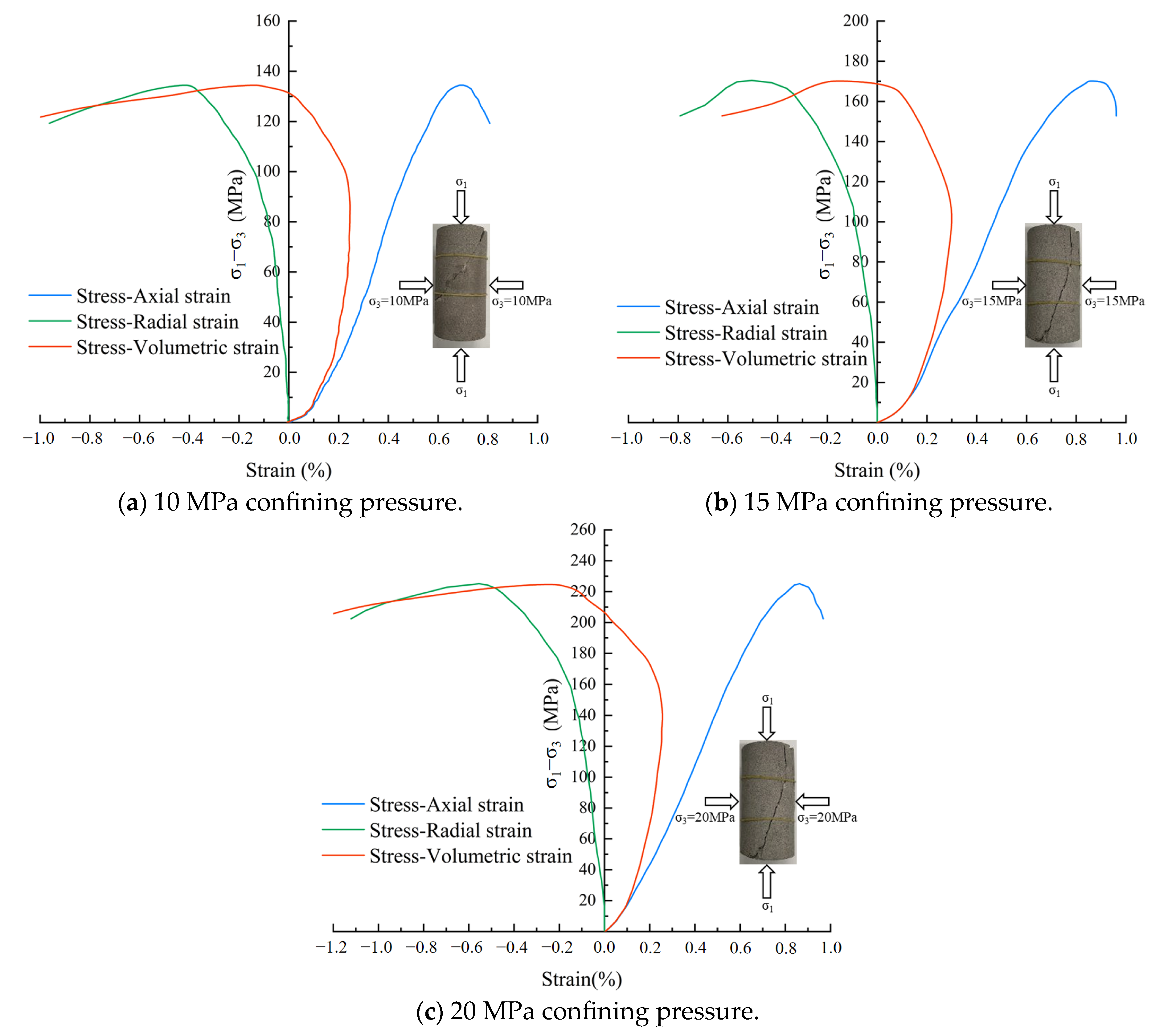
| 10 | 144.45 | 134.45 | 0.702 | −0.426 | 28.57 | 0.24 |
| 15 | 185.43 | 170.43 | 0.847 | −0.504 | 29.38 | 0.22 |
| 20 | 245.11 | 225.11 | 0.863 | −0.555 | 33.17 | 0.21 |
| Initial Confining Pressure (MPa) | Confining Pressure (MPa) | Time (h) | Instantaneous Strain (%) | Total Strain (%) | ||||
|---|---|---|---|---|---|---|---|---|
| Axial | Radial | Volumetric | Axial | Radial | Volumetric | |||
| 10 | 10 | 48 | 0.398 | −0.134 | 0.130 | 0.413 | −0.155 | 0.103 |
| 8 | 48 | 0.068 | −0.047 | −0.026 | 0.112 | −0.110 | −0.108 | |
| 6 | 48 | 0.071 | −0.064 | −0.057 | 0.112 | −0.118 | −0.124 | |
| 4 | 24 | 0.080 | −0.085 | −0.090 | 0.346 | −0.839 | −1.332 | |
| 15 | 15 | 48 | 0.411 | −0.112 | 0.187 | 0.437 | −0.130 | 0.177 |
| 13 | 48 | 0.068 | −0.041 | −0.014 | 0.085 | −0.060 | −0.035 | |
| 11 | 48 | 0.074 | −0.075 | −0.077 | 0.096 | −0.103 | −0.110 | |
| 9 | 48 | 0.09 | −0.131 | −0.172 | 0.135 | −0.215 | −0.295 | |
| 7 | 16 | 0.092 | −0.145 | −0.198 | 0.265 | −0.692 | −1.119 | |
| 20 | 20 | 48 | 0.413 | −0.098 | 0.217 | 0.442 | −0.115 | 0.212 |
| 18 | 48 | 0.071 | −0.048 | −0.025 | 0.092 | −0.072 | −0.052 | |
| 16 | 48 | 0.072 | −0.069 | −0.066 | 0.101 | −0.102 | −0.103 | |
| 14 | 48 | 0.082 | −0.086 | −0.09 | 0.118 | −0.135 | −0.152 | |
| 12 | 48 | 0.088 | −0.119 | −0.15 | 0.133 | −0.192 | −0.251 | |
| 10 | 20 | 0.095 | −0.121 | −0.149 | 0.210 | −0.523 | −0.836 | |
Disclaimer/Publisher’s Note: The statements, opinions and data contained in all publications are solely those of the individual author(s) and contributor(s) and not of MDPI and/or the editor(s). MDPI and/or the editor(s) disclaim responsibility for any injury to people or property resulting from any ideas, methods, instructions or products referred to in the content. |
© 2025 by the authors. Licensee MDPI, Basel, Switzerland. This article is an open access article distributed under the terms and conditions of the Creative Commons Attribution (CC BY) license (https://creativecommons.org/licenses/by/4.0/).
Share and Cite
Dong, W.; Han, L.; Liu, Z.; Zong, Y.; Tang, J.; Yang, D. Experimental Study on the Creep Behavior and Permeability Evolution of Tuff Under Unloading Confining Pressure with Seepage–Stress Coupling Effects. Processes 2025, 13, 4089. https://doi.org/10.3390/pr13124089
Dong W, Han L, Liu Z, Zong Y, Tang J, Yang D. Experimental Study on the Creep Behavior and Permeability Evolution of Tuff Under Unloading Confining Pressure with Seepage–Stress Coupling Effects. Processes. 2025; 13(12):4089. https://doi.org/10.3390/pr13124089
Chicago/Turabian StyleDong, Wenlong, Lijun Han, Zishuo Liu, Yijiang Zong, Jun Tang, and Dalong Yang. 2025. "Experimental Study on the Creep Behavior and Permeability Evolution of Tuff Under Unloading Confining Pressure with Seepage–Stress Coupling Effects" Processes 13, no. 12: 4089. https://doi.org/10.3390/pr13124089
APA StyleDong, W., Han, L., Liu, Z., Zong, Y., Tang, J., & Yang, D. (2025). Experimental Study on the Creep Behavior and Permeability Evolution of Tuff Under Unloading Confining Pressure with Seepage–Stress Coupling Effects. Processes, 13(12), 4089. https://doi.org/10.3390/pr13124089