Article

The Mechanism of Calcium Leaching from Steel Slag Based on the “Water-Acetic Acid” Two-Step Leaching Route
1
North China University of Science and Technology, Tangshan 063210, China
2
School of Architectural Engineering, Tangshan Polytechnic University, Tangshan 063299, China
3
HBIS Group, Wu’Steel, Wugang 462500, China
4
Yanzhao Iron and Steel Laboratory, North China University of Science and Technology, Tangshan 063210, China
*
Authors to whom correspondence should be addressed.
Processes 2025, 13(12), 4077; https://doi.org/10.3390/pr13124077
Submission received: 24 November 2025 / Revised: 10 December 2025 / Accepted: 13 December 2025 / Published: 17 December 2025
(This article belongs to the Special Issue Processes in 2025)

Abstract

Converter steel slag (BOFS) contains abundant reactive Ca-bearing minerals and represents a promising feedstock for indirect CO2 mineralization. However, conventional acid leaching suffers from excessive reagent consumption and low process sustainability. This study develops a “water–acetic acid” two-step leaching strategy aimed at reducing acid/alkali usage while enhancing calcium recovery. Thermodynamic calculations were performed to elucidate the hydrolysis behaviors of primary phases (f-CaO, C3S, and β-C2S) and the stability of secondary minerals in BOFS. The kinetic behavior and dissolution mechanisms of water-leached residues in acetic acid were further analyzed. Parametric experiments were conducted to evaluate the effects of the liquid-to-solid ratio (L/S), temperature, stirring rate, and acid concentration. Results show that the L/S is the dominant factor controlling Ca dissolution in both steps, while temperature exerts opposite effects: lower temperatures favor water leaching due to the exothermic nature of silicate hydrolysis, whereas higher temperatures enhance acid leaching. The proposed two-step route achieves a Ca recovery of 75.9%, representing a 7.6% improvement over direct acid leaching, while lowering acid consumption by ∼90%. This work provides mechanistic insight and process evidence supporting the efficient and sustainable utilization of BOFS for indirect CO2 mineralization.

1. Introduction

The global pursuit of carbon neutrality has elevated the importance of reducing industrial CO2 emissions while advancing resource recycling. As a byproduct of steelmaking, steel slag accounts for approximately 12–15% of crude steel output, with annual production exceeding 100 million tons [1]. In China, the utilization rate of steel slag remains below 30%, and conventional disposal through landfilling not only consumes land resources but also risks environmental contamination [2,3]. Steel slag is rich in alkaline minerals such as active calcium oxide and calcium silicate, which exhibit high reactivity in carbon dioxide mineralization reactions, making it a vital mineral resource for carbon capture and storage (CCS)/carbon capture and utilization (CCU) [4]. Consequently, steel slag carbonation technology has emerged as a significant approach for synergistically managing solid waste recycling and CO2 emission reduction [5].
Carbonation of steel slag occurs through reactions between Ca/Mg-rich phases—such as CaO, C2S, C3S, and MgO—and CO2 to form stable carbonates like CaCO3 [6]. Depending on the mode of contact with CO2, carbonation routes are classified as direct or indirect. Direct carbonation is operationally simple but suffers from low conversion efficiency, high energy demand, and limited product quality. Indirect carbonation, by decoupling leaching and carbonation, allows calcium to be extracted under milder conditions and enables the formation of high-purity CaCO3, making it more suitable for resource-efficient CO2 mineralization [7,8]. Calcium dissolution from steel slag is controlled by mineralogy, leaching agent type, temperature, reaction time, and kinetic regime, reflecting a complex interaction of hydrolysis, dissolution, and mass-transfer processes.
Acidic solutions remain the most widely employed leaching media in indirect carbonation, with hydrogen ions facilitating the dissolution of Ca-bearing phases [9]. Their overall leaching effectiveness generally follows the order: strong mineral acids (H2SO4, HCl, HNO3) > organic acids (HCOOH, CH3COOH) > ammonium salts > alkaline solutions [10]. Strong acids provide high extraction efficiency but generate extremely low-pH leachates that require extensive neutralization, leading to significant consumption of acid and alkali reagents and compromising economic and environmental sustainability [11,12].
Steel slag exhibits high alkalinity and contains water-soluble reactive mineral phases such as free lime, C3S, and β-C2S. Consequently, the aqueous leachate of steel slag inherently possesses high alkalinity [13]. Leveraging this characteristic, a preliminary indirect carbonation strategy employing a “water–acid” two-step leaching approach has been proposed for calcium extraction. This process involves: (1) leaching with water to dissolve alkaline components from steel slag, thereby generating a highly alkaline aqueous leachate; (2) subjecting the water-leached residue to acid leaching to obtain a low-pH acid leachate; (3) mixing the alkaline aqueous leachate with the acidic leachate to solve with a moderated pH; and (4) introducing CO2 into the mixed leachate to facilitate carbonation. Despite its potential advantages, several critical challenges remain. Specifically: (1) the thermodynamic governing direct water leaching of raw steel slag and subsequent acid leaching of the water-leached residue are not yet fully elucidated; (2) quantitative assessments of the overall calcium extraction efficiency achieved by the “water–acid” two-step process are lacking; and (3) a systematic evaluation model for acid and alkali consumption has not been established.
This work employs converter steel slag (BOFS) as the Ca source. Thermodynamic and leaching experimental law analyses were used to elucidate the dissolution behavior of key mineral phases. Orthogonal and single-factor experiments examined the roles of temperature, liquid-to-solid ratio (L/S), stirring, and acid concentration. The advantages of the two-step leaching method were quantified in terms of calcium recovery and reagent savings.

2. Materials and Methods

2.1. Experimental Materials

2.1.1. BOFS

The BOFS used in the experiment was obtained from a domestic steel company. The diameter of the original steel slag is about 3 cm, which is not conducive to element leaching. The slag was crushed using a crusher, sieved through a 500-mesh standard sieve (<30 μm), and then placed in a constant-temperature blast drying oven (DGG-9140B, Wujiang, China) for continuous drying at 105 °C for 24 h. After cooling, the slag samples were stored in a desiccator for later use.

2.1.2. Chemical Reagents

The magnesium chloride anhydrous (AR, 99%), sodium hydroxide (AR ≥ 96.0%), glacial acetic acid (AR, 36~67%), and nitric acid (AR, 68%) used in the experiments were all purchased from Shanghai Aladdin (Shanghai, China).

2.2. Experimental Methods

2.2.1. Chemical Composition Analysis

The chemical composition of the steel slag was detected using an X-ray fluorescence spectrometer (XRF, Panalytical Axios, Almelo, The Netherlands). The analysis results were output in the form of oxides.

2.2.2. Mineral Phase Composition Analysis

X-ray diffraction (XRD) was employed to collect diffraction data of the steel slag sample within the 10°~90° range at a scanning rate of 10°/min. Qualitative and semi-quantitative analysis of the mineral phases in the slag sample was conducted using the JADE 9.0 software with the ICDD PDF 2009 database.

2.2.3. Thermodynamic Analysis

The Reaction Equations module of HSC Chemistry 6.0 thermodynamic software was used to simulate and calculate the potential reactions of free lime (ƒ-CaO), C2S, and C3S in the raw BOFS with water under standard conditions. Based on the XRD results of the water-leached residue, a thermodynamic analysis was performed on Fe3O4, C2S, Ca2Fe2O5, MgFe2O4, and Mg2SiO4 in the water-leached slag. The relationships between enthalpy change, entropy change, standard Gibbs free energy (ΔrGθ), and equilibrium constant with temperature for different active mineral phases at various temperatures were derived. The Reaction Equations module of HSC Chemistry was utilized for thermodynamic analysis. Each substance was set to its most stable phase, with the reaction pressure fixed at 1 atm, the mass expressed in mol, and the temperature in °C. Thermodynamic calculations were conducted over a temperature range of 0–100 °C, with a step size of 10 °C.

2.2.4. “Water-Acetic Acid” Two-Step Leaching Experiment

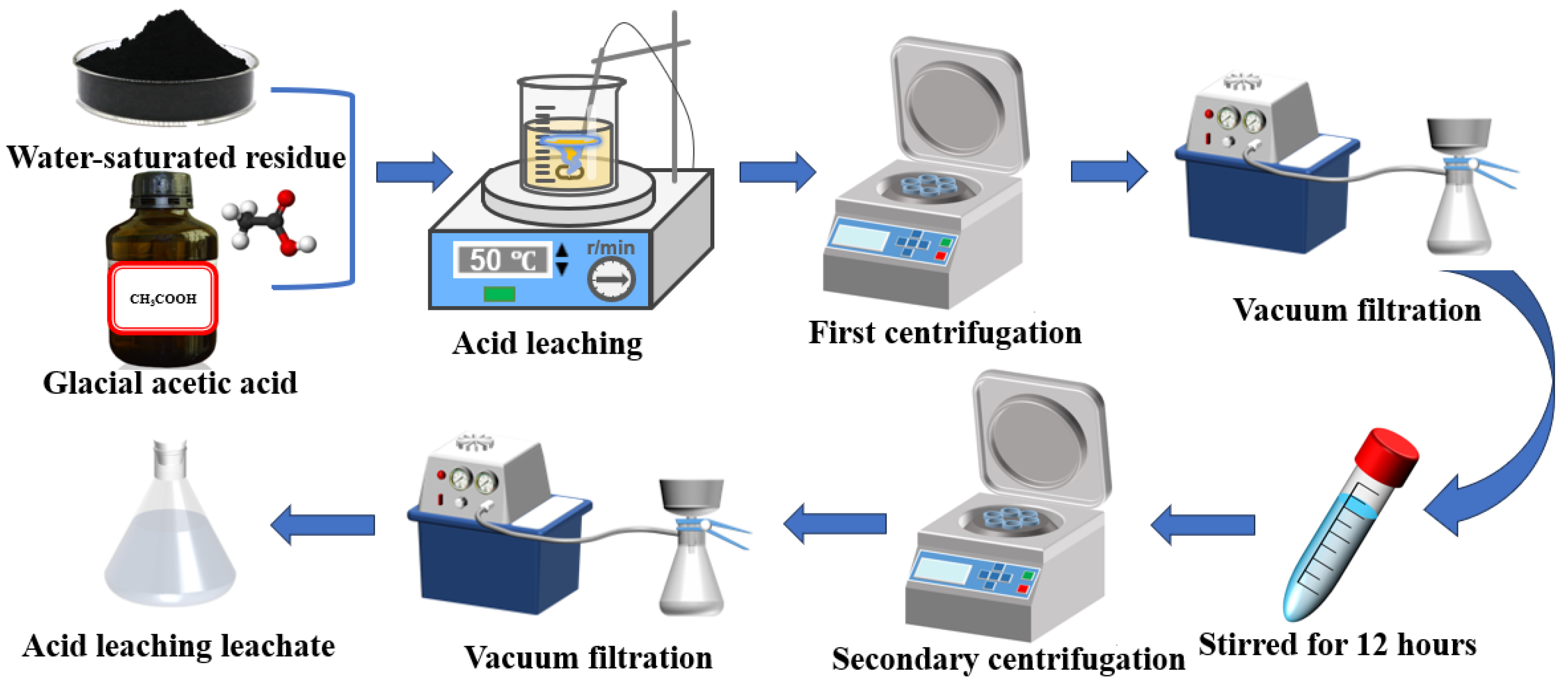
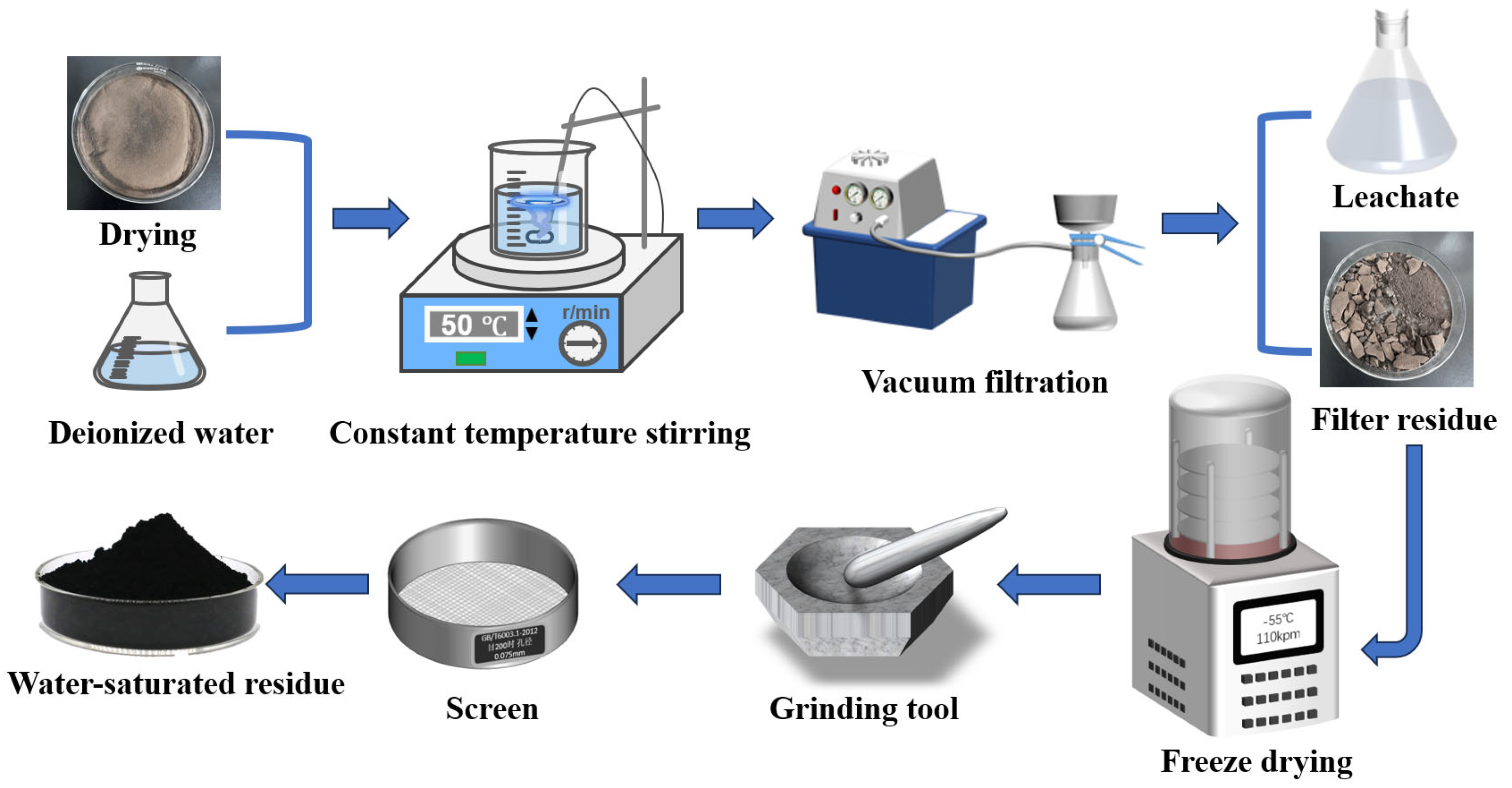
The equipment and process for the water leaching experiment of raw BOFS are illustrated in Figure 1. First, a beaker containing a certain amount of deionized water and a stirring rotor was placed in a constant-temperature magnetic water bath, and the heating device of the water bath was activated to raise the leaching solution system to the preset experimental temperature. Then, 5 g of BOFS was weighed and added to the beaker, and magnetic stirring was initiated to agitate the leaching slurry at a specific rate. After the leaching time was reached, the slurry was filtered using a 0.22 μm organic filter membrane via a vacuum filtration apparatus to separate the water-leached residue and the water leachate. Finally, the water-leached residue was dried using a freeze dryer.
The equipment and process for the acid leaching experiment of the water-leached residue are illustrated in Figure 2. Acetic acid was chosen as the weak acid because its moderate acidity allows selective dissolution of Ca-bearing phases while suppressing excessive leaching of Fe, Al, and Si. It is also environmentally benign, biodegradable, and safer to handle than strong mineral acids. In addition, acetate ions can complex with Ca2+, promoting Ca dissolution under weakly acidic conditions. With its low cost and wide industrial availability, acetic acid provides a practical and selective leaching agent for extracting Ca from converter steel slag. For the acid leaching tests, acetic acid solutions of various concentrations were prepared, and the aforementioned steps were repeated. At the beginning of the experiment, a certain volume of acetic acid solution was added to the beaker, and the reaction vessel was immersed in a constant-temperature magnetic water bath to control the leaching temperature. For acetic acid concentration, tests were conducted within the range of 0.5~2.5 mol·L−1. Once the acetic acid solution reached the desired temperature, 5 g of the water-leached residue was weighed and added to the reaction vessel. Simultaneously, a magnetic stirrer was activated to agitate the mixed slurry at varying rates to enhance the dissolution of calcium ions. After the leaching time was reached, a centrifuge was used for solid–liquid separation, so as to quickly collect leachate and filtration residue, followed by further filtration through a 0.22 μm organic filter membrane to achieve thorough solid–liquid separation. The leachate was allowed to stand for 12 h, after which it was centrifuged and filtered again to remove precipitates (silica gel), ultimately yielding the acid leachate. Two sets of parallel experiments were designed for each of the experiments.
A certain volume of the clarified leachate was measured, diluted, and volumetrically fixed by adding 1% HNO3. The calcium concentration in the solution was analyzed using inductively coupled plasma optical emission spectrometry (ICP-OES, ThermoFisher ICAP-7000, Waltham, MA, USA). Finally, the leaching rate of calcium in the BOFS was calculated based on the measured data, as shown in Formula (1):
Z = C 1 n V m k 100 %
In the formula: Z represents the element leaching rate in steel slag, %; C1 represents the element concentration detected from the diluted solution by ICP, mg·L−1; n represents the dilution factor of the leachate; V represents the volume of the leachate, L; m represents the mass of the steel slag used for leaching, mg; k represents the mass fraction of the element in steel slag measured by XRF, %.

2.2.5. Orthogonal Experimental Design

The factors influencing the dissolution rate of elements in steel slag mainly include the L/S, reaction temperature, reaction time [14], and the concentration of acetic acid in acid leaching experiments. To investigate the influence of various factors on calcium dissolution during water leaching of BOFS, using Orthogonal Design Assistant V3.1 software, a 4-factor 4-level orthogonal experiment was designed based on an L16(45) orthogonal array, incorporating the liquid-to-solid ratio, reaction temperature, reaction time, and stirring rate. Combined with previous pre-experimental experience, The selected factor levels were as follows: reaction temperature T at 25, 45, 65, and 85 °C; L/S at 10, 20, 30, and 50 mL·g−1; reaction time t at 10, 30, 50, and 60 min; and stirring rate r at 200, 400, 600, and 800 r·min−1.
To investigate the influence of various factors on calcium dissolution during the acid leaching process of water-leached residue, a 4-factor 4-level orthogonal experiment was designed based on an L16(45) orthogonal array, incorporating L/S, reaction temperature, reaction time, and acetic acid concentration. The stirring rate was kept constant at 600 r·min−1. The selected factor levels were as follows: T at 25, 45, 65, and 85 °C; L/S at 10, 20, 30, and 50 mL·g−1; t at 5, 20, 60, and 120 min; and acetic acid concentration C at 0.25, 0.5, 1.0, and 1.5 mol·L−1.
Based on the calculated calcium ion leaching rates, the experimental results were recorded and subjected to range analysis. By comparing the range values of each factor, the primary and secondary factors influencing the leaching rate were identified, and the optimal level for each factor was determined. The optimal combination of conditions was visually interpreted through factor range diagrams.

3. Results

3.1. Chemical Composition of BOFS

The XRF results are presented in Table 1. The BOFS used in the experiment exhibited high contents of CaO and Fe2O3, reaching 37.893% and 36.418%, respectively. The contents of SiO2, MgO, Al2O3, and P2O5 were 0.095%, 5.209%, 1.56%, and 3.63%, respectively. The quaternary basicity R W C a O + W M g O W S i O 2 + W A l 2 O 3 = 3.70 , indicating that the BOFS used is highly alkaline.

3.2. Mineral Phase Composition of BOFS

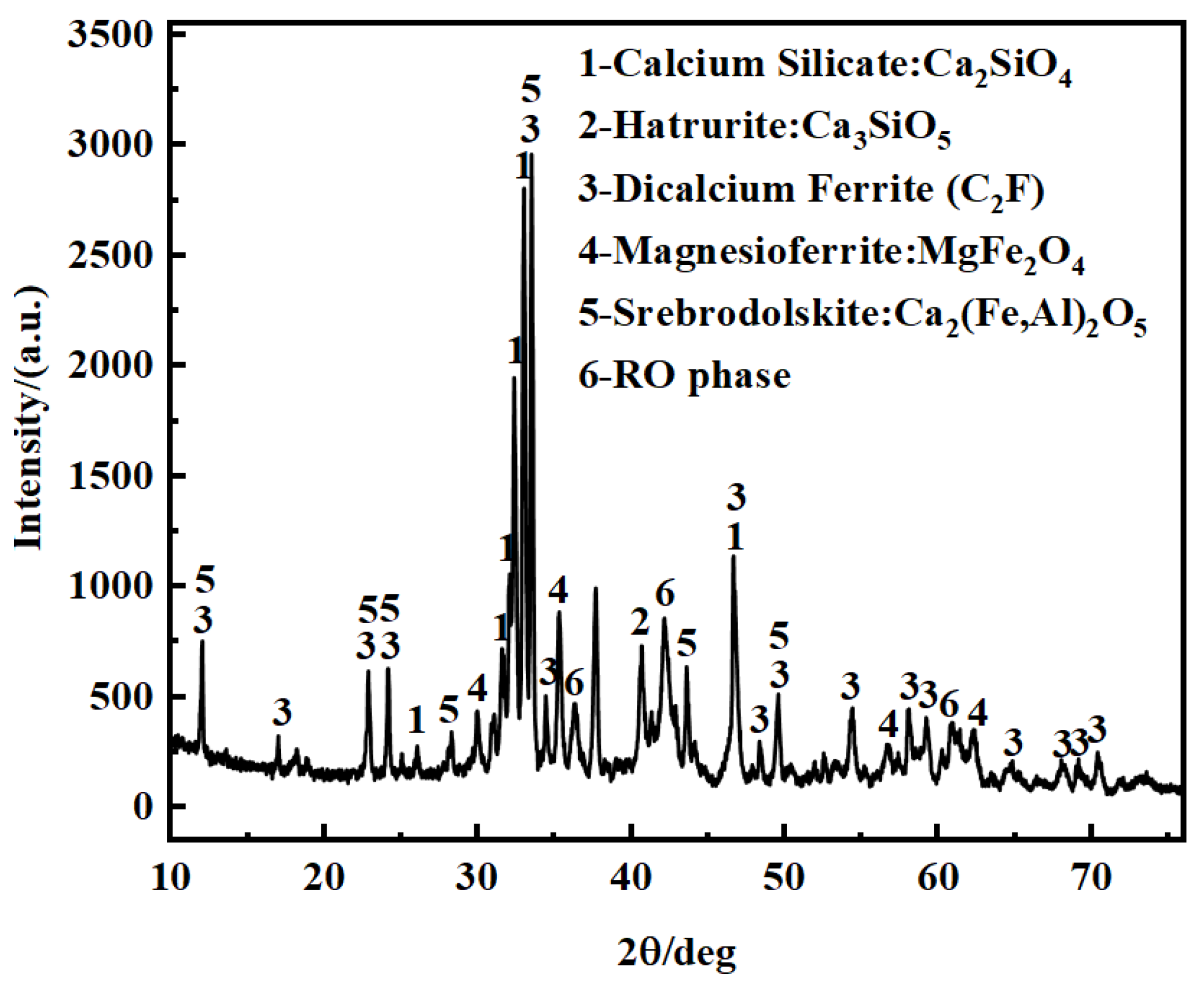
The XRD pattern of the BOFS is shown in Figure 3. The main mineral phases in the steel slag include β-C2S, C3S, dicalcium ferrite (C2F), and the RO phase (a continuous solid solution composed of CaO, MgO, etc.), and Ca2(Fe, Al)2O5. 2CaO·SiO2 and 2CaO·Fe2O3 are the predominant mineral phases, accounting for 48.5% and 37.6% by mass in the crystalline phases of the BOFS, respectively.

3.3. Hydrolysis of Initial Phases in BOFS

It is known that steel slag is a heterogeneous mixture of multiple mineral phases. Lee et al. [15] found that the calcium extraction rate from slag is significantly influenced by its mineral composition. Among these phases, CaO possesses a crystal structure of the NaCl type [16], where O2− ions are arranged in a face-centered cubic close-packed structure, and Ca2+ ions occupy the octahedral voids formed by O2−. The coordination number of Ca2+ is 6, and the [CaO6] octahedra are connected through edges [17]. CaO crystals lack cleavage, and the chemical bond strength between Ca2+ and O2− is uniformly distributed in space, with no weak crystal planes or less reactive phases. Consequently, crushed CaO particles exhibit a polyhedral morphology. f-CaO is a major component of steel slag with poor stability, and it readily reacts with water to form bulky Ca(OH)2 [18].
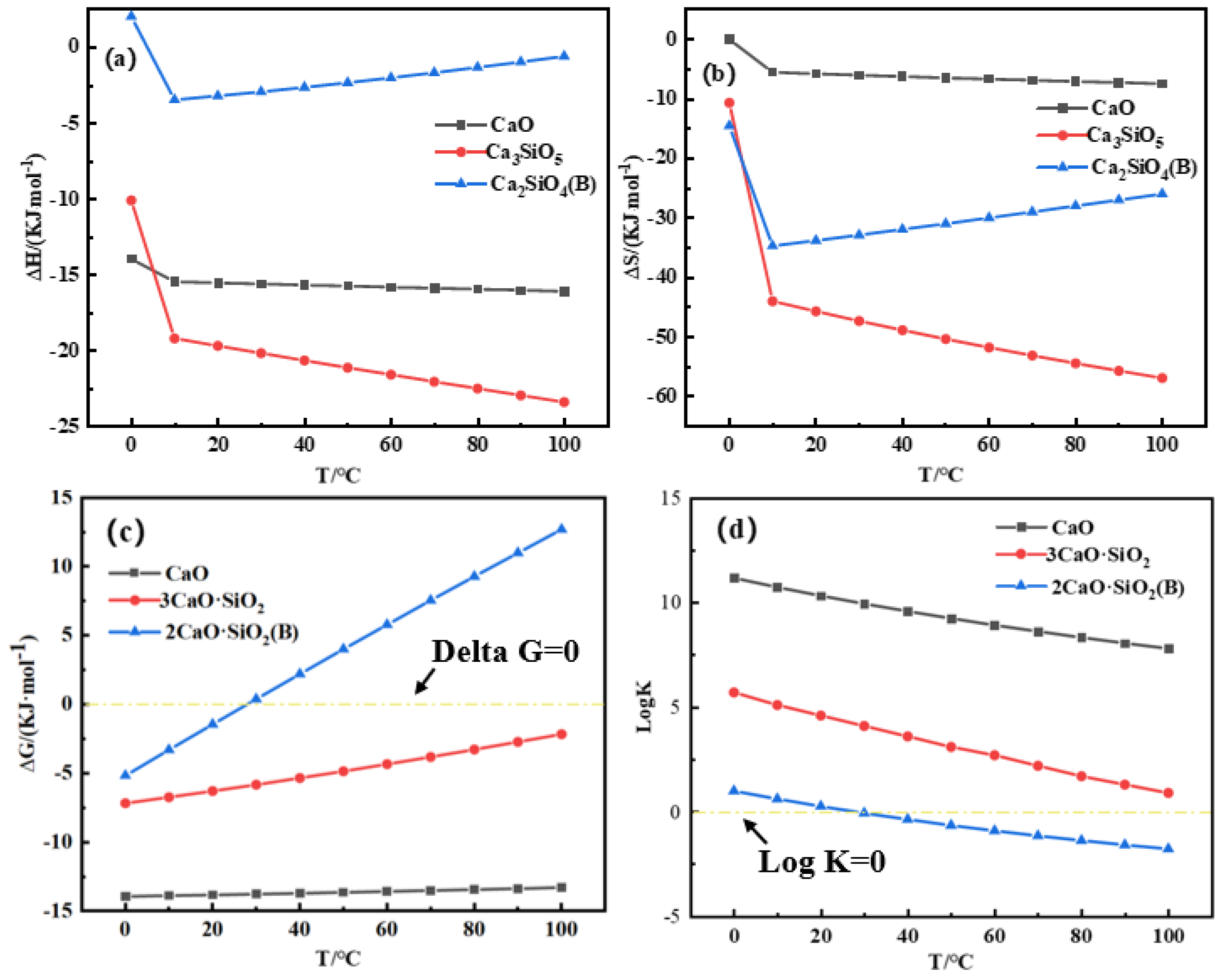
Secondly, C2S is another common silicate mineral in slag, existing in polymorphic forms, including α-C2S, α′-C2S, β-C2S, and γ-C2S [19]. β-C2S has higher internal energy than γ-C2S and tends to spontaneously transform into γ-C2S at certain temperatures [20]. However, steel slag typically contains 1~4% P2O5, which incorporates into C2S grains as Ca3(PO4)2, stabilizing the C2S crystal lattice and inhibiting the transformation of β-C2S to γ-C2S [21]. Additionally, trace elements such as V, Mn, and Cr in steel slag act as lattice stabilizers, further suppressing the β-C2S to γ-C2S transformation. Thus, incompletely transformed β-C2S remains metastable at room temperature, exhibiting high reactivity. The raw steel slag also contains C3S, which is an incongruent melting compound. During the cooling process of steel slag, C3S may decompose at high temperatures, but this decomposition occurs only within a narrow temperature range around 1250 °C. Below this range, the decomposition reaction is unlikely to proceed. Therefore, similar to β-C2S, C3S also exists in a metastable state at room temperature. Metastable C3S possesses high internal energy, which is the primary reason for its high reactivity and strong hydration capacity. The hydration reaction of C3S at room temperature produces calcium silicate hydrate (C-S-H gel) and calcium hydroxide [22]. Accordingly, the reactions of CaO, β-C2S, and C3S with water at different temperatures were calculated. The reaction equations [23] and ΔrGθ (Table 2), as well as the relationships between enthalpy change, entropy change, ΔrGθ, equilibrium constant, and temperature for the above reactions, are shown in Figure 4.
Within the temperature range of 0~100 °C, as shown in Figure 4a, the enthalpy changes (ΔH) for the reactions of the phases ƒ-CaO, C3S, and β-C2S are all negative (ΔH < 0), indicating exothermic reactions. Entropy is a thermodynamic function representing the degree of disorder of microscopic particles in a system. An increase in system disorder favors spontaneous reaction progression. As shown in Figure 4b, the entropy changes (ΔS) for the reactions of the phases ƒ-CaO, C3S, and β-C2S are all less than zero (ΔS < 0). However, the reaction can only proceed spontaneously when |TΔS| < |ΔH|, meaning that the phases ƒ-CaO, C3S, and β-C2S remain spontaneously reactive at low temperatures throughout the water leaching process. For any chemical reaction, enthalpy change is only one factor influencing spontaneity; entropy change is another. Nevertheless, the change in standard ΔrGθ can directly serve as the criterion for determining whether a reaction can proceed.
As shown in Table 2 and Figure 4c,d, within the temperature range of 0~100 °C, the standard ΔrGθ for the reactions of the mineral phases ƒ-CaO and C3S in BOFS are all negative, while the reaction equilibrium constants are significantly positive. This indicates that the water leaching reactions of BOFS can proceed spontaneously under atmospheric pressure within the corresponding temperature range, and progress relatively completely in the forward direction. It is worth noting that β-C2S only has ΔrGθ < 0 and LogK > 0 at 0~25 °C, indicating that it cannot react spontaneously when the temperature exceeds 25 °C. The obtained thermodynamic calculation results are consistent with established theoretical principles.

3.4. Mineral Phase Analysis of Water-Leached Residue

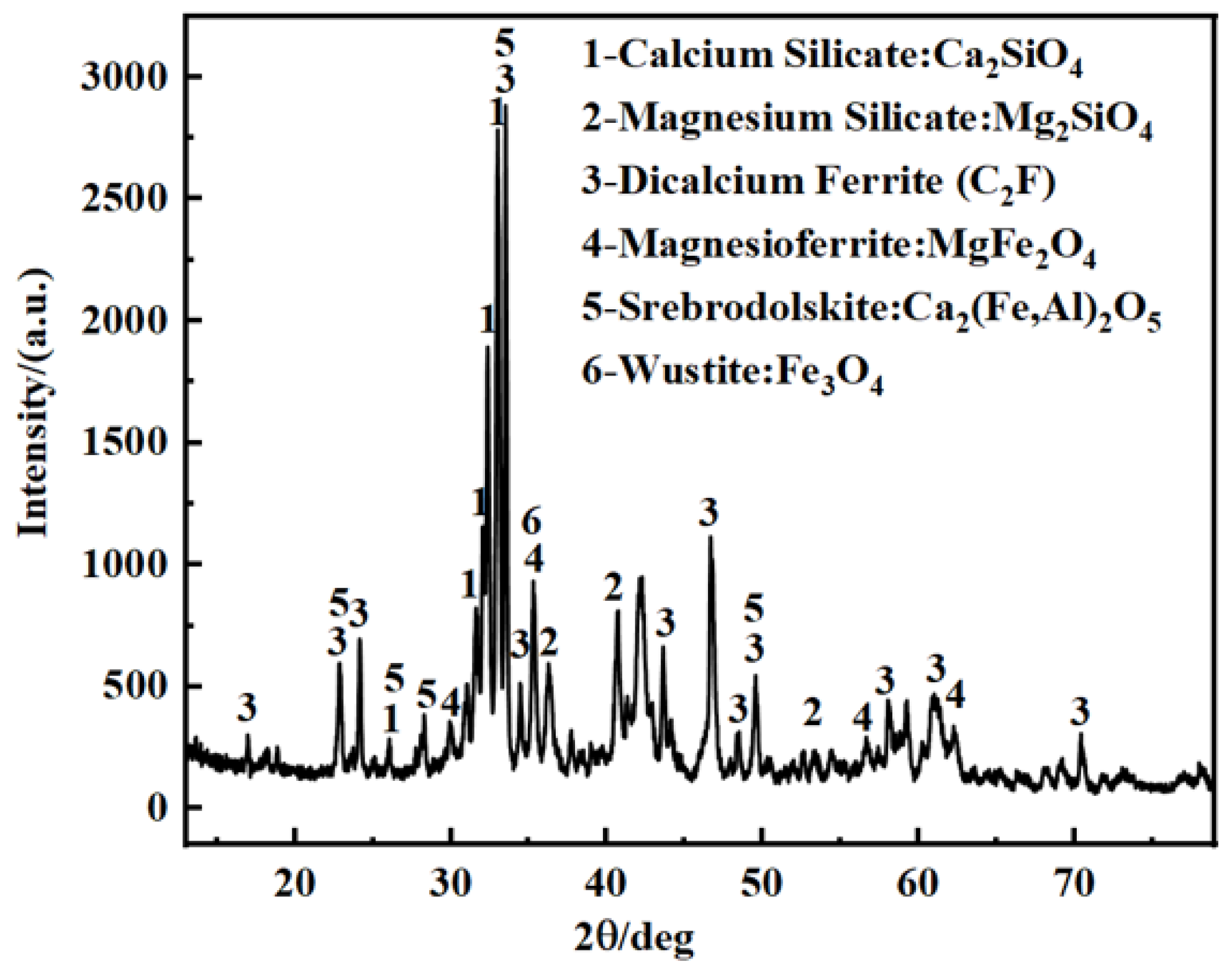
The XRD pattern of the water-leached residue is shown in Figure 5. The main mineral phases in the water-leached residue include C2S, Mg2SiO4, Ca2Fe2O5, MgFe2O4, and Fe3O4. Among these, C2S and Ca2Fe2O5 are the predominant phases, accounting for approximately 48.4% and 28.9% of the total crystalline phase mass, respectively. Fe3O4 and MgFe2O4 are the major secondary phases, representing about 12.5% and 10.1% of the total crystalline phase mass, respectively. Based on the comparison of XRD analysis results between the raw slag and the water-leached residue, the RO phase (primarily f-CaO) disappeared, C3S vanished, and the content of C2S decreased. It is thus concluded that f-CaO, C3S, and C2S played active roles during the water leaching process. These findings are consistent with the thermodynamic calculations for the water leaching of BOFS.

3.5. Acid Dissolution of Mineral Phases in Water-Leached Residue

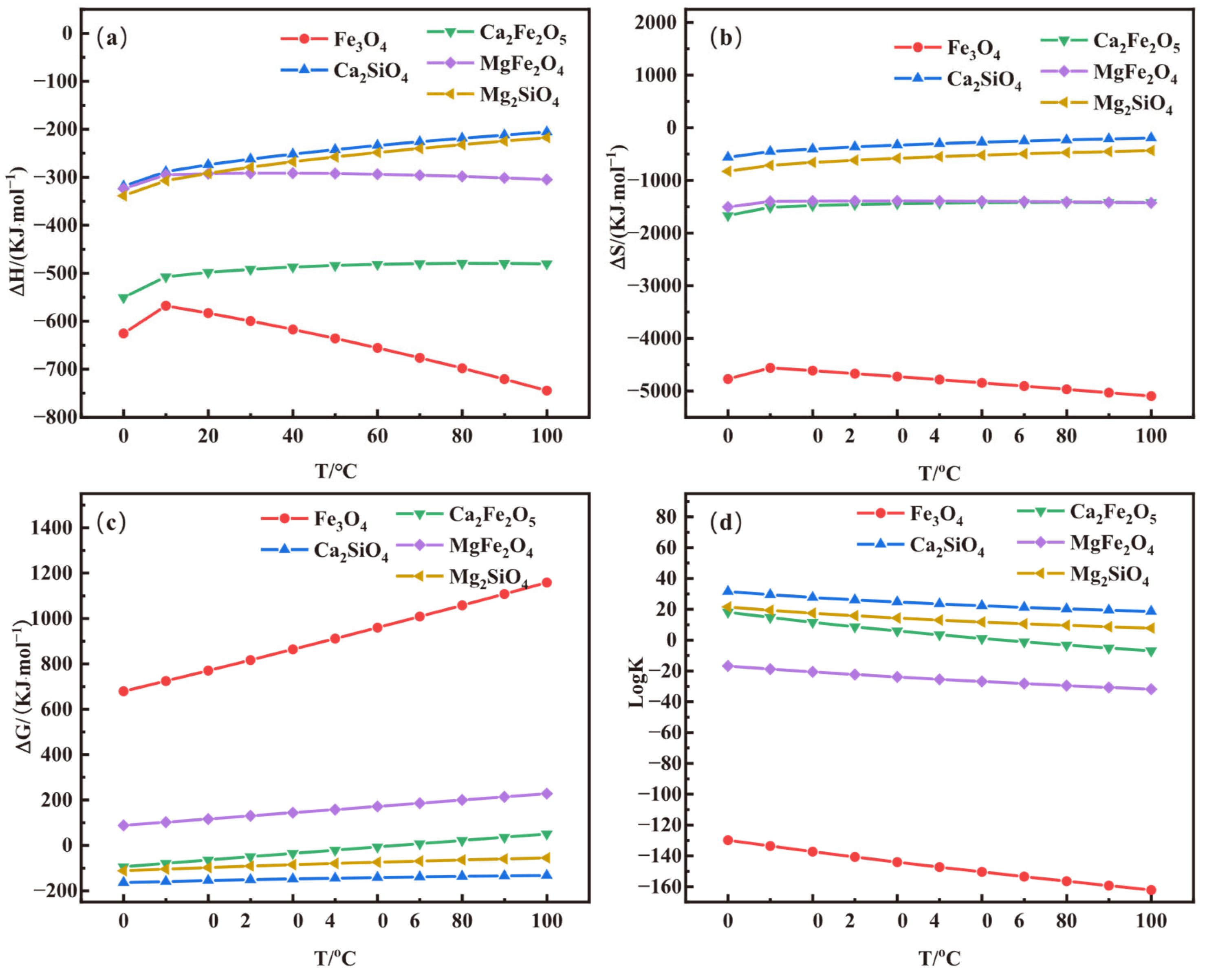
It is known that, in addition to silicates, the water-leached residue contains a significant amount of iron-bearing phases, namely Ca2Fe2O5, MgFe2O4, and Fe3O4. Among these, Ca2Fe2O5 belongs to the orthorhombic crystal system [24]. From the thermodynamics of the Ca-Fe-O system [25], it can be observed that adding CaO to Fe2O3 can form various ferrite phases. The overall stability of the crystal structure of Ca2Fe2O5 is stable but partially unstable. On the other hand, MgFe2O4 and Fe3O4 are common spinel minerals belonging to the cubic crystal system. They possess an AB2O4 type structure, where A represents a divalent cation, and B represents a trivalent cation. For Fe3O4, one O2− ion connects one [FeO4] tetrahedron and three [FeO6] octahedra. Fe2+ ions occupy the [FeO4] tetrahedra, while Fe3+ ions occupy the [FeO6] octahedra, indicating a stable structure for Fe3O4. For MgFe2O4, one O2− ion connects to one tetrahedron and three octahedra [26], demonstrating that the structure of MgFe2O4 is also stable. However, extensive studies have shown that acidic reagents can dissolve both calcium-bearing phases and iron-bearing crystals. Therefore, based on the XRD analysis results of the water-leached residue, a thermodynamic analysis was conducted on Fe3O4, C2S, Ca2Fe2O5, MgFe2O4, and Mg2SiO4 in the residue. From a thermodynamic perspective, the reaction equations between the mineral phases in the water-leached residue and acetic acid [27] and ΔrGθ (Table 3), as well as the relationships between enthalpy change, entropy change, standard ΔrGθ, equilibrium constant, and temperature, were derived, as shown in Figure 6.
As shown in Figure 6a,b, within the temperature range of 0~100 °C, the enthalpy changes (ΔH) and entropy changes (ΔS) for the reactions of the phases Fe3O4, C2S, Ca2Fe2O5, MgFe2O4, and Mg2SiO4 are all negative. When |TΔS| < |ΔH|, the reactions of phases Fe3O4, Ca2Fe2O5, MgFe2O4, and Mg2SiO4 can proceed spontaneously.
According to Table 3 and Figure 6c,d, within the 0~100 °C temperature range, the standard ΔrGθ changes for the reaction of phase Mg2SiO4 in the water-leached residue are all negative, indicating that the acid leaching of the water-leached residue can proceed spontaneously throughout this temperature range. In contrast, the reaction between C2S and acetic acid is spontaneous below 90 °C but becomes non-spontaneous above this temperature. For Ca2Fe2O5, ΔrGθ < 0 below 70 °C, allowing spontaneous reaction, while above this temperature, the reaction is non-spontaneous. These thermodynamic investigations further demonstrate the feasibility of using acetic acid for the acid leaching treatment of water-leached residue.

3.6. Water-Acetic Acid Leaching of Calcium from BOFS

3.6.1. Analysis of Orthogonal Experimental Results

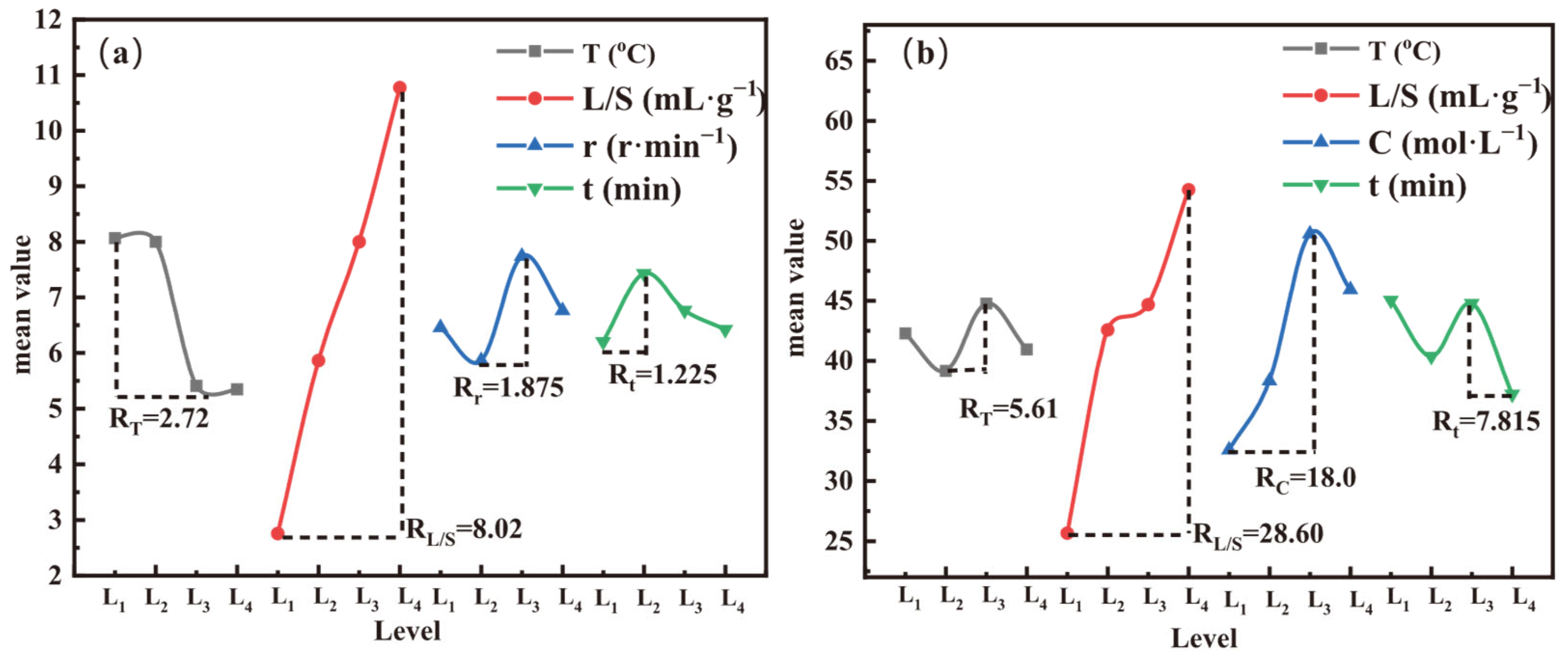
As shown in Figure 7a, for the water leaching experiments, the range value for L/S is 8.02, indicating the most significant influence, followed by T with a range of 2.72. This suggests that these two factors are the primary variables affecting calcium ion leaching. The range values for r and t are 1.875 and 1.225, respectively, showing relatively minor effects. Based on the range analysis of the orthogonal experiments, the order of influence of the factors on calcium leaching rate during water leaching is as follows: L/S > T > r > t. The optimal leaching conditions for the water leaching system are determined as L/S = 50 mL·g−1, T = 25 °C, r = 600 r·min−1, and t = 30 min.
As shown in Figure 7b, for the acid leaching process, the range values for T, L/S, t, and C are 5.61, 28.598, 7.815, and 18.0, respectively. The range analysis of the orthogonal experiments indicates that the L/S has the greatest influence. The order of influence of the factors on calcium leaching rate during acid leaching is as follows: L/S > C > t > T. The optimal leaching conditions for the acid leaching system are determined as L/S = 50 mL·g−1, C = 1 mol·L−1, t = 60 min, and T = 65 °C.
Table 4 and Table 5 show the analysis of variance of the influencing factors of water leaching and acid leaching experiments, respectively. In Table 4, the L/S factor has a significant influence, indicating that the main controlling factor of the water leaching process is L/S; In the acid leaching experiment, L/S and C factors are significant, which indicates that the main controlling factors in the water leaching process are L/S and C. Combining the results of range analysis and variance analysis, it can be concluded that the water leaching experiment should focus on L/S, while the acid leaching experiment should focus on L/S and C.

3.6.2. Analysis of Single-Factor Experimental Results for the Water Leaching Process

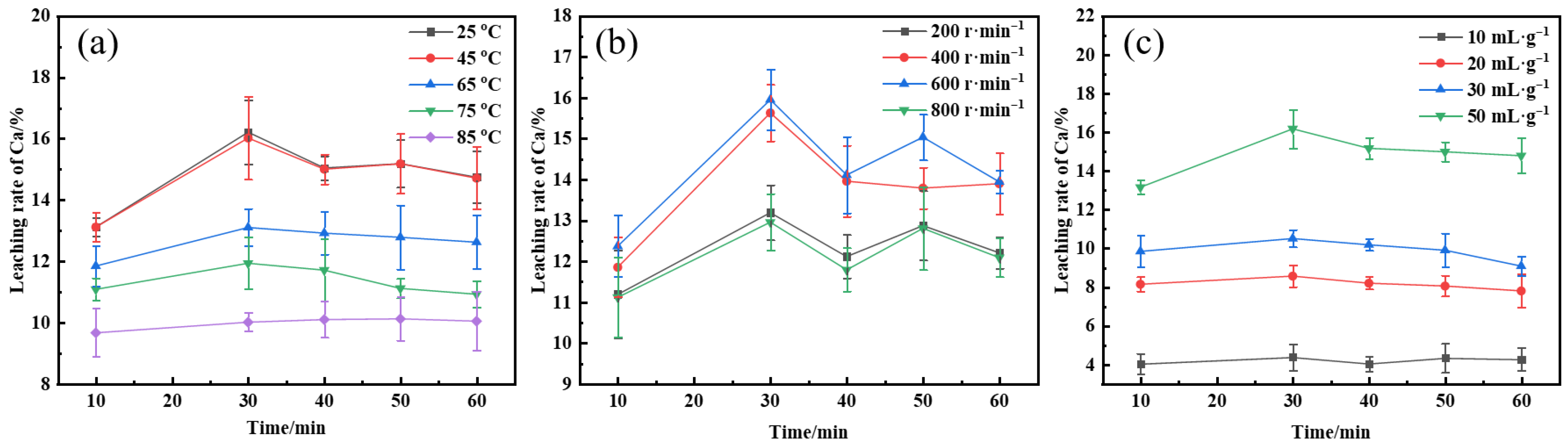
As shown in Figure 8a, in the water leaching experiments, the calcium leaching rate exhibits an inverse trend with increasing temperature. The highest leaching rate is observed at 25 °C. This phenomenon occurs because the standard ΔrGθ for the reaction of the C2S phase in the raw steel slag is greater than zero, indicating that the reaction between γ-C2S and water cannot proceed spontaneously. The reactions of the phases ƒ-CaO and C3S with water are both exothermic. Additionally, the steel slag contains a certain amount of β-C2S, whose hydration reaction is also exothermic. For an exothermic reaction that has already reached equilibrium, an increase in temperature shifts the chemical equilibrium toward the reverse direction. Consequently, this shift results in a decrease in the leaching rate.
As shown in Figure 8b, in the water leaching experiments, the leaching rate increases with higher stirring speeds. This is attributed to improved suspension of steel slag particles and a reduction in the thickness of the mass transfer boundary layer on the particle surfaces [28]. However, it was observed that as the stirring speed increased from 600 r·min−1 to 800 r·min−1, the calcium extraction rate decreased. This indicates a weakening of interfacial diffusion between the steel slag particles and the solution. Additionally, excessive stirring may break the original crystalline particles due to high shear forces, generating numerous fine fragments. These fine particles, with increased surface defects, tend to adsorb impurities, ultimately leading to a decline in leaching rate. Therefore, higher stirring speeds are not conducive to improving calcium extraction, and 600 r·min−1 is identified as the optimal stirring rate.
As shown in Figure 8c, in the water leaching experiments, the calcium leaching rate increases with higher L/S. This is because the leaching system of steel slag and solution forms a slurry, where diffusion resistance and mass transfer resistance exist during the reaction process. Increasing the L/S reduces the viscosity of the solution, allowing more thorough contact between steel slag particles and the solution, thereby enhancing the mass transfer rate between the solid and liquid phases [29]. However, continuously increasing the stirring rate may weaken the interfacial diffusion between steel slag particles and the solution. Thus, an L/S of 50 mL·g−1 is identified as the optimal choice.

3.6.3. Analysis of Single-Factor Experimental Results for the Acid Leaching Process

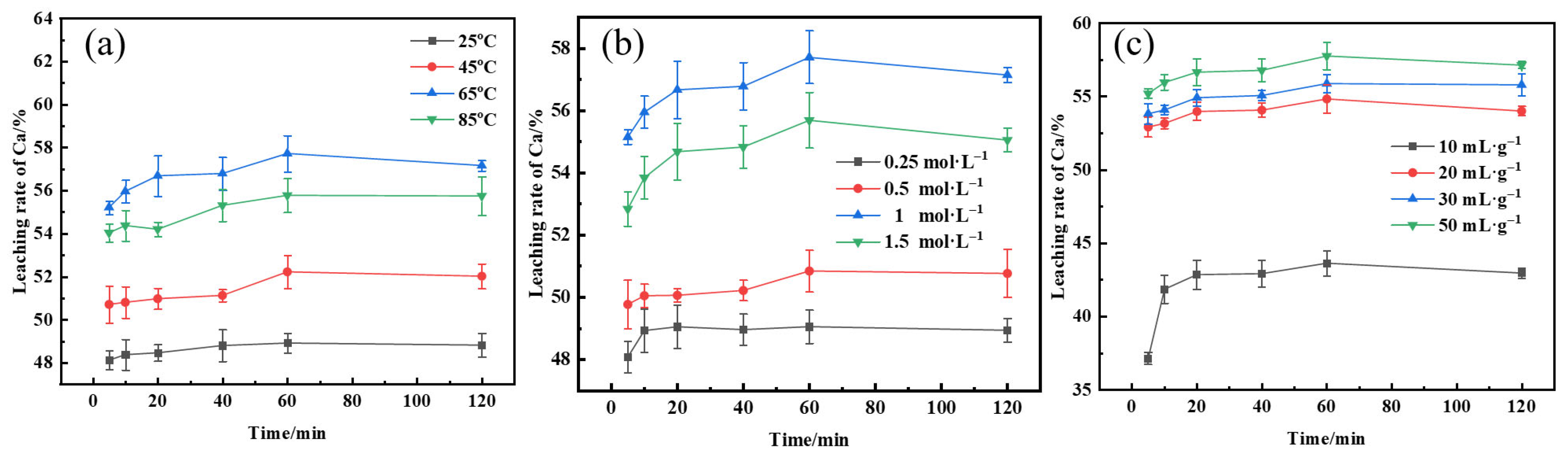
As shown in Figure 9a, in the acid leaching experiments, the calcium leaching rate initially increases with rising temperature, reaching its maximum at 65 °C. However, when the temperature continues to rise to 85 °C, the leaching rate decreases. According to thermodynamic equilibrium estimations, the main mineral phase in steel slag is Ca2Fe2O5. The reaction of Ca2Fe2O5 is spontaneous (ΔrGθ < 0) below 70 °C but ceases beyond this temperature. The dissolution reaction of calcium ions from C2S in acetic acid solution is an exothermic process, which can occur below 90 °C. Therefore, when the temperature increases to 85 °C, the primary mineral phases in steel slag no longer participate in the reaction, which is one of the main reasons for the decrease in calcium leaching rate at this temperature. Additionally, the ionization of acetic acid is an endothermic reaction. Increasing temperature promotes the ionization of acetic acid, leading to a higher ionization constant. Both water and acetic acid ionize more hydrogen ions at elevated temperatures. However, the effect of temperature on the ionization constant of acetic acid is nonlinear, with a distinct inflection point. Beyond this inflection point, the ionization constant of acetic acid exhibits an opposite trend with further temperature increase. This also explains why the calcium leaching rate decreases when the temperature exceeds 85 °C.
As shown in Figure 9b, in the acid leaching experiments, the calcium leaching rate increases with higher acetic acid concentration. This is because, at elevated acid concentrations, calcium-bearing phases and iron-containing crystals undergo dissolution [30]. Higher concentrations of acetic acid and calcium ions increase the probability of reaction occurrence, thereby enhancing the leaching rate of metal ions [31]. However, excessively high concentrations may lead to the formation of by-products such as Fe and Al ions during the reaction, reducing the purity of the calcium-rich solution. Therefore, an appropriately increased acid concentration can achieve efficient calcium dissolution [32], necessitating moderate control. Additionally, although the acidity of the aqueous solution can be enhanced by continuously increasing the acetic acid concentration, the inert calcium and magnesium resources in BOFS remain difficult to dissolve in the leaching medium. Continuously increasing the acetic acid concentration would also result in significant consumption of acid and alkali reagents. In this experiment, when the leaching agent concentration reached 1 mol·L−1, the maximum conversion rate of calcium ions exceeded 57.11%.
As shown in Figure 9c, an increase in the L/S implies a reduction in the amount of steel slag used in the experiment. Compared to the abundant acetic acid relative to the calcium-containing minerals in the slag, this ensures that sufficient hydrogen ions participate in the calcium ion leaching reaction. Under high L/S conditions, the concentration of Ca ions in the aqueous phase is lower than under low L/S conditions [33], which increases the concentration gradient of Ca ions between the molten slag and the aqueous phase. This facilitates the diffusion of calcium ions from the slag matrix into the bulk solution, increases the concentration of valuable metal ions in the leachate, and significantly improves the leaching rate. However, for acid leaching experiments, continuously increasing the L/S would lead to substantial reagent consumption, making it unsuitable to persistently raise this parameter. Simultaneously, numerous studies have indicated that an appropriate increase in the L/S can promote calcium ion leaching [34].

3.6.4. Mineral Phase Analysis of Acid-Leached Residue

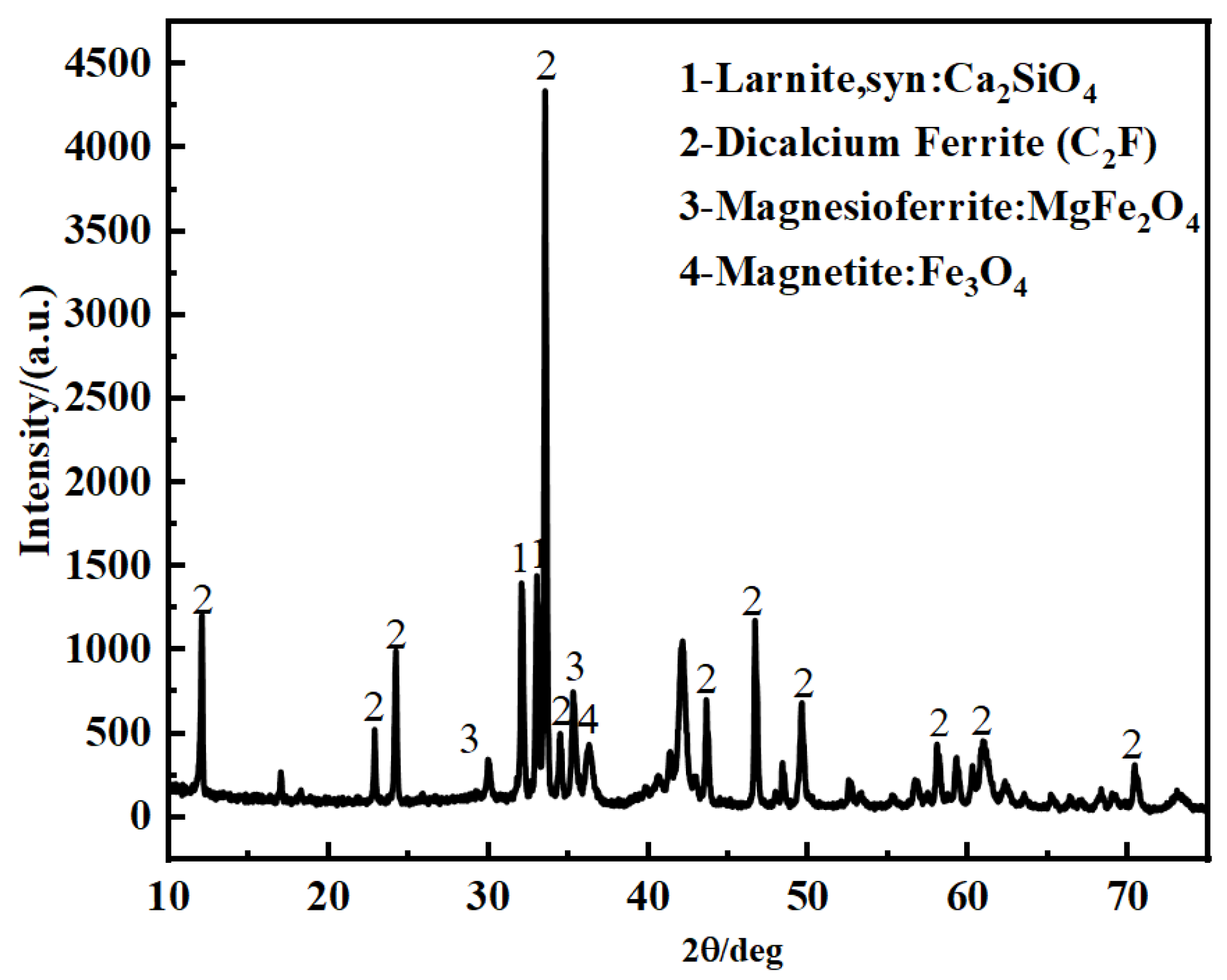
The XRD pattern of the acid-leached residue (Figure 10) shows that the dominant mineral phases are C2S, C2F, MgFe2O4, and Fe3O4. Compared with the water-leached residue, C2F remains the principal phase, indicating that its crystal structure is highly stable and undergoes minimal alteration during acid leaching. Nevertheless, the C2F diffraction peaks are significantly weakened after acid treatment, suggesting that acetic acid further facilitates Ca dissolution from this phase.
These observations indicate that Ca is primarily released from f-CaO, C3S, and part of the C2S during the water-leaching step, whereas the residual C2S serves as the main Ca source during acid leaching. This phase-specific dissolution behavior is fully consistent with the thermodynamic predictions.
In the final residue, calcium is essentially depleted, leaving a concentration of relatively pure and stable iron-bearing phases. These Fe-rich residues present potential value for further utilization in iron-product processing or other metallurgical applications.

3.6.5. Enhancement of Calcium Extraction Efficiency by Two-Step Leaching Method

Using the same experimental conditions as the acid leaching process (65 °C, 1 mol·L−1 CH3COOH, L/S of 50 mL·g−1, 60 min, 600 r·min−1), direct acid leaching was performed on the raw steel slag, representing the traditional calcium extraction method for indirect wet carbonation. The calcium leaching rate achieved by leaching the steel slag with 1 mol·L−1 acetic acid was 68.31%. For the two-step leaching method, the water leaching step yielded a calcium leaching rate of 15.47%, while the acid leaching step achieved a rate of 57.11%. The overall leaching rate was calculated using the following formula, resulting in a comprehensive leaching rate of 75.9%. Thus, the two-step leaching method demonstrates a superior rate in extracting calcium from steel slag compared to direct one-step acid leaching, producing a calcium-rich leachate (as shown in Formula (2)).
Z = m 1 + m 2 × 4 5 m s u m = C 1 n 1 V 1 + C 2 n 2 V 2 × 4 5 m s u m
In the formula: Z represents the comprehensive leaching rate of the element in the steel slag, %; C1 represents the element concentration measured by ICP in the diluted water leachate, mg·L−1; n1 represents the dilution factor of the water leachate; V1 represents the volume of the water leachate, L; C2 represents the element concentration measured by ICP in the diluted acid leachate, mg·L−1; n2 represents the dilution factor of the acid leachate; V2 represents the volume of the acid leachate, L; m1 represents the mass of calcium extracted from the water leaching step, mg; m2 represents the mass of calcium extracted from the acid leaching step, mg; msum represents the total mass of the leached steel slag, mg.

3.6.6. Economic Analysis and Environmental Assessment

The proposed water–acetic acid two-step leaching process demonstrates clear economic and environmental advantages compared with conventional direct acid leaching. Economically, the water leaching step selectively removes highly reactive alkaline phases (f-CaO, C3S, and part of C2S), thereby substantially decreasing the acid demand in the subsequent step. Under identical reaction conditions, the two-step route achieves a Ca recovery of 75.9% while reducing acetic acid consumption by approximately 90% relative to direct 1 mol·L−1 acid leaching. Given that acid reagents typically constitute a major portion of operational expenditure in chemical leaching systems, the drastic reduction in acid usage directly translates into lower reagent cost, reduced demands for neutralizing agents, and minimized secondary treatment expenses.
From an environmental perspective, the two-step approach minimizes the generation of strongly acidic effluents, thereby lowering the burden on downstream wastewater treatment and decreasing the overall chemical footprint of the process. Moreover, using acetic acid—a biodegradable and environmentally benign weak organic acid—further reduces risks associated with corrosive mineral acids. The selective dissolution behavior also results in a calcium-rich leachate with fewer co-dissolved impurities, enabling more controlled precipitation of CaCO3 and decreasing potential solid–liquid separation challenges. In addition, the final acid-leached residue is enriched in stable iron-containing phases (Fe3O4, MgFe2O4, C2F), which present opportunities for subsequent valorization, thereby improving the overall resource efficiency of the system.
Overall, the two-step leaching route offers a more sustainable and economically favorable pathway for BOFS utilization by lowering chemical consumption, reducing environmental impacts, and enabling cleaner downstream carbonation and residue management processes.

4. Discussion

When applying an equivalent amount of acidic reagent, the two-step leaching method demonstrates a superior rate compared to direct acetic acid leaching. To achieve the same leaching rate, the two-step acid leaching process can reduce the consumption of acidic reagents to one-tenth of the original amount. Therefore, based on the indirect wet carbonation process route, the “water-acetic acid” two-step leaching method is a practical and feasible approach to obtain a calcium-rich leachate.
Simultaneously, as the carbonation reaction requires alkaline conditions, while the calcium-rich leachate after calcium and magnesium ion extraction remains acidic, it is necessary to adjust the pH to an alkaline environment before introducing CO2 for carbonation. However, pH adjustment also demands significant amounts of alkaline reagents. Under optimal leaching conditions, the mixed aqueous solution from the two-step leaching method exhibits a significantly higher pH than that from direct acetic acid leaching. When adjusted to the same carbonation reaction conditions, the two-step method requires substantially less alkaline reagent than direct acid leaching, thereby effectively reducing the consumption of alkaline reagents.
Thus, this method partially addresses the issue of excessive acid-base reagent consumption caused by the need to use alkaline reagents such as sodium hydroxide or ammonia to raise the pH of the leachate for carbonation after the leaching reaction with acidic reagents.

5. Conclusions

(1)
Water leaching selectively dissolved f-CaO, C3S, and part of C2S, while acetic acid further dissolved residual C2S and Ca2Fe2O5, fully aligning with thermodynamic predictions.
(2)
The liquid-to-solid ratio was the primary controlling factor in both leaching steps, with temperature and acetic acid concentration additionally governing acid leaching. The optimal conditions were as follows: water leaching at 25 °C, L/S = 50 mL·g−1, and 600 r·min−1 for 30 min, followed by acid leaching at 65 °C, 1 mol·L−1 CH3COOH, and L/S = 50 mL·g−1 for 60 min.
(3)
The two-step leaching route achieved a Ca recovery of 75.9%, outperforming direct acetic acid leaching (68.31%) and reducing acid consumption by ~90%, demonstrating its clear advantages for efficient and sustainable BOFS utilization in indirect carbonation.

Author Contributions

Conceptualization, Y.W. (Yajun Wang) and Y.W. (Yitong Wang); data curation, K.Z. and Q.C.; formal analysis, K.Z., Q.C. and L.P.; funding acquisition, Y.W. (Yitong Wang). and Y.W. (Yajun Wang); investigation, K.Z. and L.P.; methodology, K.Z., Q.C. and L.P.; project administration, Y.W. (Yajun Wang); resources, Y.W. (Yitong Wang) and Y.W. (Yajun Wang); software, S.Z. and H.L.; supervision, Y.W. (Yitong Wang) and Y.W. (Yajun Wang); validation, S.Y., B.H. and X.Y.; visualization, H.L., S.Y., B.H. and X.Y.; writing—original draft, K.Z. and L.P.; writing—review & editing, Q.C., Y.W. (Yitong Wang), S.Z., P.D. and Y.W. (Yajun Wang). All authors have read and agreed to the published version of the manuscript.

Funding

The authors wish to acknowledge the financial support from Yanzhao Iron and Steel Laboratory Regional Innovation Ability Promotion Project (YZISL2024009), Scientific and Technological Project of Tangshan (23130205E), Central Guidance Local Science and Technology Development Fund Project of Hebei Province (236Z3803G, 236Z3802G), Innovative Research Group Project of Natural Science Foundation of Hebei Province (E2022209093), Youth Teacher Pre Research Fund Project of the School of Metallurgy and Energy (YJY20244373).

Data Availability Statement

The original contributions presented in this study are included in the article. Further inquiries can be directed to the corresponding author.

Conflicts of Interest

Author Lijie Peng was employed by HBIS Group, Wu’Steel. The remaining authors declare that the research was conducted in the absence of any commercial or financial relationships that could be construed as a potential conflict of interest.

References

  1. Richmond, S.; Millsteed, W.; Wilson, R. Steel and Steel Making Raw Materials: Prospects for Iron Ore, Steel, Metallurgical Coal and Nickel. Aust. Commod. Forecast. Issues 2020, 13, 115–136. [Google Scholar]
  2. Zhang, K.; Wang, Y.; Li, J.; Xu, Z.; Wang, Y.; Liu, T.; Gao, A. Leaching Mechanism of Ca and Mg from Converter Steel Slag in Seawater. J. Environ. Chem. Eng. 2025, 13, 119805. [Google Scholar] [CrossRef]
  3. Dhoble, Y.N.; Ahmed, S. Review on the innovative uses of steel slag for waste minimization. J. Mater. Cycles Waste Manag. 2018, 20, 1373–1382. [Google Scholar] [CrossRef]
  4. Hills, C.D.; Tripathi, N.; Carey, P.J. Mineralization Technology for Carbon Capture, Utilization, and Storage. Front. Energy Res. 2020, 8, 142. [Google Scholar] [CrossRef]
  5. Elyasi, G.K.; Rezaei, G.S.; Hughes, D.; Ahmed, T. Exploring the potential of steel slag waste for carbon sequestration through mineral carbonation: A comparative study of blast-furnace slag and ladle slag. J. Environ. Manag. 2024, 351, 119835. [Google Scholar] [CrossRef]
  6. Appel, A.M.; Bercaw, J.E.; Bocarsly, A.B.; Dobbek, H. Frontiers, opportunities, and challenges in biochemical and chemical catalysis of CO2 fixation. Chem. Rev. 2013, 113, 6621–6658. [Google Scholar] [CrossRef]
  7. Ding, Q.; Cai, W.J.; Wang, C.; Sanwal, M. The relationships between household consumption activities and energy consumption in china—An input-output analysis from the lifestyle perspective. Appl. Energy 2017, 207, 520–532. [Google Scholar] [CrossRef]
  8. Liu, L.C.; Fan, X.H.; Gan, M.; Wei, J.Y.; Gao, Z.T. Microwave-enhanced selective leaching calcium from steelmaking slag to fix CO2 and produce high value-added CaCO3. Sep. Purif. Technol. 2024, 330, 125395. [Google Scholar] [CrossRef]
  9. Shi, D.; Cui, B.; Li, L.J.; Xu, M.; Zhang, Y.Z. Removal of calcium and magnesium from lithium concentrated solution by solvent extraction method using D2EHPA. Desalination 2020, 479, 114306. [Google Scholar] [CrossRef]
  10. Hall, C.; Large, D.J.; Adderley, B.; West, H.M. Calcium leaching from waste steelmaking slag: Significance of leachate chemistry and effects on slag grain mineralogy. Miner. Eng. 2014, 65, 156–162. [Google Scholar] [CrossRef]
  11. Maraghechi, H.; Rajabipour, F.; Pantano, C.G.; Burgos, W.D. Effect of calcium on dissolution and precipitation reactions of amorphous silica at high alkalinity. Cem. Concr. Res. 2016, 87, 1–13. [Google Scholar] [CrossRef]
  12. Zhang, M.; Gu, J.; Liu, Y. Engineering feasibility, economic viability and environmental sustainability of energy recovery from nitrous oxide in biological wastewater treatment plant. Bioresour. Technol. 2019, 282, 514–519. [Google Scholar] [CrossRef] [PubMed]
  13. Chen, B.; Yoon, S.W.; Zhang, Y.; Han, L.X. Reduction of steel slag leachate pH via humidification using water and aqueous reagents. Sci. Total Environ. 2019, 671, 598–607. [Google Scholar] [CrossRef] [PubMed]
  14. Ragipani, R.; Bhattacharya, S.; Akkihebbal, S.K. Understanding dissolution characteristics of steel slag for resource recovery. Waste Manag. 2020, 117, 179–187. [Google Scholar] [CrossRef]
  15. Lee, S.M.; Lee, S.H.; Jeong, S.K.; Youn, M.H. Calcium extraction from steelmaking slag and production of precipitated calcium carbonate from calcium oxide for carbon dioxide fixation. J. Ind. Eng. Chem. 2017, 53, 233–240. [Google Scholar] [CrossRef]
  16. Kudłacz, K.; Carlos, R.N. The mechanism of vapor phase hydration of calcium oxide: Implications for CO2 capture. Environ. Sci. Technol. 2014, 48, 12411–12418. [Google Scholar] [CrossRef]
  17. Firor, R.; Seff, K. Near zero coordinate calcium(2+) and strontium(2+) in zeolite A. Crystal structures of dehydrated Ca6-A and Sr6-A. J. Am. Chem. Soc. 1978, 100, 3091–3096. [Google Scholar] [CrossRef]
  18. Salvadori, B.; Dei, L. Synthesis of Ca(OH)2 Nanoparticles from Diols. Langmuir 2001, 17, 2371–2374. [Google Scholar] [CrossRef]
  19. Cruz, R.T.; Bielefeldt, W.V.; Bragança, S.R. Influence of ladle slag composition in the dissolution process of the dicalcium silicate (C2S) layer on doloma-C refractories. Ceram. Int. 2017, 43, 15360–15369. [Google Scholar] [CrossRef]
  20. Du, X.Y.; Huang, J.Z.; Chang, J. Understanding the carbonation reactivity of α′L-C2S, β-C2S and γ-C2S based on the DFT simulation and experimental verification. Ceram. Int. 2025, 51, 23471–23483. [Google Scholar] [CrossRef]
  21. Brough, A.R.; Dobson, C.M.; Richardson, I.G. In situ solid-state NMR studies of Ca3SiO5: Hydration at room temperature and at elevated temperatures using 29Si enrichment. J. Mater. Sci. 1994, 29, 3926–3940. [Google Scholar] [CrossRef]
  22. Dhankhar, S.; Bhalerao, G.; Ganesamoorthy, S.; Baskar, K. Growth and comparison of single crystals and polycrystalline brownmillerite Ca2Fe2O5. J. Cryst. Growth 2017, 468, 311–315. [Google Scholar] [CrossRef]
  23. Goodbrake, C.J.; Young, J.F.; Berger, R.L. Reaction of beta-dicalcium silicate and tricalcium silicate with carbon dioxide and water vapor. J. Am. Ceram. Soc. 1979, 62, 168–171. [Google Scholar] [CrossRef]
  24. Hidayat, T.; Shishin, D.; Decterov, S.A. Thermodynamic optimization of the Ca-Fe-O system. Metall. Mater. Trans. B 2016, 47, 256–281. [Google Scholar] [CrossRef]
  25. Khot, V.M.; Salunkhe, A.B.; Phadatare, M.R.; Pawar, S.H. Formation, microstructure and magnetic properties of nanocrystalline MgFe2O4. Mater. Chem. Phys. 2012, 132, 782–787. [Google Scholar] [CrossRef]
  26. Wu, Y.J.; Li, M.; Zhu, F. Variation on leaching behavior of caustic compounds in bauxite residue during dealkalization process. J. Environ. Sci. 2020, 92, 141–150. [Google Scholar] [CrossRef]
  27. Marchioli, C.; Soldati, A. Mechanisms for particle transfer and segregation in a turbulent boundary layer. J. Fluid Mech. 2002, 468, 283–315. [Google Scholar] [CrossRef]
  28. Cao, Q.; Nastac, L. Mathematical Investigation of Fluid Flow, Mass Transfer, and Slag-steel Interfacial Behavior in Gas-stirred Ladles. Metall. Mater. Trans. B 2018, 49, 1388–1404. [Google Scholar] [CrossRef]
  29. Yang, Z.Y.; Chen, T.F.; Gao, X.J. Carbonation kinetics of steel slag in CO2-loaded potassium glycine solution: Maximization of carbonation conversion. Constr. Build. Mater. 2025, 492, 143025. [Google Scholar] [CrossRef]
  30. Geng, H.H.; Wang, F.; Yan, C.C.; Tian, Z.J. Leaching behavior of metals from iron tailings under varying pH and low-molecular-weight organic acids. J. Hazard. Mater. 2020, 383, 121136. [Google Scholar] [CrossRef]
  31. Wang, L.; Nancollas, G.H. Calcium orthophosphates: Crystallization and dissolution. Chem. Rev. 2008, 108, 4628–4669. [Google Scholar] [CrossRef]
  32. Wang, L.; Jin, Y.Y.; Nie, Y.F. Investigation of accelerated and natural carbonation of MSWI fly ash with a high content of Ca. J. Hazard. Mater. 2010, 174, 334–343. [Google Scholar]
  33. Li, Y.Q.; Ma, J.W.; Ren, Y.Q.; Li, Y.J. Calcium leaching characteristics in landfill leachate collection systems from bottom ash of municipal solid waste incineration. J. Environ. Manag. 2021, 280, 111729. [Google Scholar] [CrossRef]
  34. Xia, Y.; Zhang, H.; Phoungthong, K.; Shi, D.X. Leaching characteristics of calcium-based compounds in MSWI Residues: From the viewpoint of clogging risk. Waste Manag. 2015, 42, 93–100. [Google Scholar] [CrossRef]
Figure 1. Schematic diagram of water leaching test equipment.
Processes 13 04077 g001
Figure 2. Acid leaching test equipment schematic diagram.
Processes 13 04077 g002
Figure 3. Mineral phase composition of BOFS.
Processes 13 04077 g003
Figure 4. The relationship between enthalpy change, entropy change, ΔrGθ, and equilibrium constant and temperature of active mineral phase at different temperatures during the leaching process of steel slag of converter: (a) ΔH; (b) ΔS; (c) ΔG; (d) LogK.
Processes 13 04077 g004
Figure 5. Water leaching slag mineral phase composition.
Processes 13 04077 g005
Figure 6. The relationship between enthalpy change, entropy change, ΔrGθ, and equilibrium constant and temperature of active mineral phase at different temperatures during acid leaching of water leaching slag: (a) ΔH; (b) ΔS; (c) ΔG; (d) LogK.
Processes 13 04077 g006
Figure 7. Range analysis of influence factors in leaching test: (a) Water leaching test; (b) Acid leaching test.
Processes 13 04077 g007
Figure 8. Influence of different factors on calcium leaching in water leaching experiment: (a) Temperature; (b) Stirring rate; (c) L/S.
Processes 13 04077 g008
Figure 9. Influence of different factors on calcium leaching in acid leaching experiment: (a) Temperature; (b) Acetic acid concentration; (c) L/S.
Processes 13 04077 g009
Figure 10. Acid leaching slag mineral phase composition.
Processes 13 04077 g010
Table 1. Chemical composition of steel slag of converter (mass percent, %).
OxideCaOFe2O3SiO2MgOAl2O3TiO2Cr2O3P2O5Others
Mass percent/%37.89336.41810.0955.2091.560.6390.3033.6434.240
Table 2. Reaction equation and its ΔrGθ in the leaching process of steel slag.
Mineral FaciesThe First Leaching ExperimentLog(K)ΔrGθ (kJ·mol−1)
ƒ-CaOCaO + H2O = Ca2+ + 2OH10.322−57.923
C3S2C3S + 6H2O = 3CaO·2SiO2·3H2O + 3Ca2+ + 6OH4.699−5.838
β-C2S2C2S(B) + 5H2O = CaO·2SiO2·2H2O + 3Ca(OH)20.095−0.542
Ca2Fe2O5CaO·Fe2O3 + 4H2O = Ca(OH)2 + 2Fe(OH)3−1.90510.873
Ca2Al2O5CaO·Al2O3 + 4H2O = Ca(OH)2 + 2Al(OH)33.209−18.317
Table 3. Reaction equation and its ΔrGθ in the acid leaching process of water leaching residue.
Mineral FaciesThe Second Leaching ExperimentLog(K)ΔrGθ(kJ·mol−1)
Fe3O4Fe3O4 + 8CH3COOH = 2Fe3+ + Fe2+ + 8CH3COO + 4H2O−137.274770.343
C2S C2S + 4CH3COOH = 2Ca2+ + 4CH3COO + SiO2 + 2H2O27.694−155.409
Ca2Fe2O5Ca2Fe2O5 + 10CH3COOH = 2Ca2+ + 2Fe3+ + 10CH3COO + 5H2O11.517−64.630
MgFe2O4MgFe2O4 + 8CH3COOH = Mg2+ + 2Fe3+ + 8CH3COO + 4H2O−20.642115.834
Mg2SiO4Mg2SiO4 + 4CH3COOH = 2Mg2+ + 4CH3COO + SiO2 + 2H2O17.470−98.035
Table 4. Analysis of variance of influencing factors of the water immersion test.
FactorsSum of Squared DeviationsDegrees of
Freedom
FCritical ValueSignificance
T/°C0.00330.8333.290Absence
L/S/(mL·g−1)0.01433.8893.290Presence
r/(r·min−1)0.00130.2783.290Absence
t/min0.00030.0003.290Absence
Error0.0215
Table 5. Analysis of variance of influencing factors of the acid immersion test.
FactorsSum of Squared DeviationsDegrees of
Freedom
FCritical ValueSignificance
T/°C0.00830.1112.190Absence
L/S/(mL·g−1)0.21432.9642.190Presence
C/(mol·L−1)0.09332.2882.190Presence
t/min0.01330.1802.190Absence
Error0.03615
Disclaimer/Publisher’s Note: The statements, opinions and data contained in all publications are solely those of the individual author(s) and contributor(s) and not of MDPI and/or the editor(s). MDPI and/or the editor(s) disclaim responsibility for any injury to people or property resulting from any ideas, methods, instructions or products referred to in the content.