Article

Numerical Geometric Evaluation of an L-Shaped Oscillating Water Column Wave Energy Converter Under the Realistic Sea State Found in Rio Grande-RS

by
Maycon da Silveira Paiva
1,
Ana Paula Giussani Mocellin
1,
Elizaldo Domingues dos Santos
1,
Luiz Alberto Oliveira Rocha
1,
Bianca Neves Machado
2 and
Liércio André Isoldi
1,*
1
School of Engineering, Federal University of Rio Grande (FURG), Rio Grande 96203-900, RS, Brazil
2
Interdisciplinary Department, Federal University of Rio Grande do Sul (UFRGS), Tramandaí 95590-000, RS, Brazil
*
Author to whom correspondence should be addressed.
Processes 2025, 13(12), 3942; https://doi.org/10.3390/pr13123942
Submission received: 5 November 2025 / Revised: 2 December 2025 / Accepted: 2 December 2025 / Published: 5 December 2025

Abstract

This study conducts a numerical investigation of the geometry of the oscillating water column (OWC) wave energy converter under realistic irregular wave conditions found off the coast of Rio Grande, southern Brazil. Two OWC models were compared: the conventional design and the L-shaped configuration (L-OWC). The OWC structure consists of a hydropneumatic chamber and an air duct, where a turbine is coupled to an electric generator. Additionally, in the L-shaped chamber configuration, a water intake duct is considered. The constructal design method was employed for the geometric evaluation of the devices. For the L-OWC, the influence of the height-to-length ratio of the water intake duct on the obtained hydropneumatic power available was analyzed. In parallel, for the conventional OWC, the free-board submergence was investigated. Subsequently, the optimal geometry for each OWC model was selected to study the height-to-length ratio of the hydropneumatic chamber. Numerical simulations were performed using ANSYS Fluent software. Thus, the performance of the converters was improved by approximately 35.76 times for the L-OWC and 3.78 times for the conventional OWC. However, it is noteworthy that the optimal configuration of the conventional OWC achieved a performance 2.62 times higher than the optimal L-OWC geometry.

1. Introduction

Demographic expansion and technological progress have caused a steep rise in the usage of fossil fuels, which are not only finite but also have a negative environmental impact [1]. Consequently, the transition to a sustainable energy matrix stands as one of the major global challenges of the 21st century. To mitigate the effects of climate variability on power generation, this transition requires the diversification of the renewable sources being explored. Narula [2] identifies marine energy as a viable alternative for harnessing renewables, highlighting the diverse types of energy available in the oceans.
Among these sources, wave energy is particularly noteworthy, holding the potential to meet a substantial fraction of the global electricity demand [3]. This energy potential has been extensively quantified in various regions around the globe through numerous recent studies, for instance: Shadman et al. [4] estimated the wave energy potential off the Brazilian coast using the MFWAM third-generation wave model (version Cycle 43T1); Ahn et al. [5] employed the WAVEWATCH III model (WW3, version 5.08), to calculate the annual wave energy potential across different regions of the United States; Amarouche et al. [6] conducted a similar assessment for the Algerian Basin using the Simulating Waves Nearshore (SWAN) model (version 41.20); Sergent et al. [7] used Scilab 6.0.x to perform a statistical analysis of the wave energy potential along the French coast, based on the Anemoc database and in situ measurements from the Candhis buoy network; Patel et al. [8] performed an analysis along the Indian coastline with the WW3 model (version 4.18); Liu et al. [9] evaluated Australia’s wave energy resources also using WW3 (version 6.07); and Ye et al. [10] assessed the resource at varying depths in China’s Wanshan Archipelago with the SWAN model (version 41.31).
Technologies designed to capture ocean wave energy, such as the oscillating water column (OWC) devices, are capable of converting the kinetic energy from waves into electricity. This system consists of a hydropneumatic chamber submerged below the water surface and an air duct exposed to the atmosphere, which houses a turbine connected to an electrical generator. As incident waves drive the oscillating motion of the water column inside the chamber, the resulting cyclic compression and decompression of the air above it force a bidirectional airflow through the air duct, spinning the turbine and activating the generator [11].
The OWC devices have been extensively investigated; in the experimental domain, alongside laboratory tests, several prototypes are currently being developed globally [12]. In parallel, numerical studies offer a financially efficient option for analyzing wave energy converters (WECs), as they require fewer financial and human resources. In this context, constructal theory [13] provides a framework for geometric evaluation, allowing for the maximization of the device’s performance. According to this theory, flow systems in nature follow a physical principle, the constructal law, which governs the generation of their configurations and geometric patterns, aiming to facilitate easier access to flow. This leads to the constructal design method [14,15], which enables the evaluation of how a system’s geometry affects its performance and can be employed for geometric optimization when associated with an optimization technique.
Recent research on OWC WECs has largely focused on this kind of optimization: Letzow et al. [16] evaluated the chamber’s height-to-length ratio considering different front wall submersions on a large-scale OWC with seabed ramps; Gomes et al. [17] assessed an OWC under a joint North Sea wave project (JONSWAP) spectrum, analyzing four different geometric configurations: rectangular, trapezoidal, inverted trapezoidal, and double trapezoidal. More recently, studies have incorporated realistic irregular waves using the WaveMIMO methodology: Maciel et al. [18] and Mocellin et al. [19] evaluated OWC WECs subjected to realistic sea state conditions in Southern Brazil, from the municipalities of Rio Grande and Tramandaí, respectively.
Additionally, comparative studies of different shapes have become a central theme. For instance, López et al. [20] conducted a comprehensive numerical study comparing classic, stepped-bottom, U-shaped OWC (U-OWC), and L-shaped OWC (L-OWC) under regular waves, concluding that the L-OWC design performed better and was easily tunable to resonate at a target wave period. This finding is supported by Supriyanto et al. [21], who, through experimental analysis, confirmed that the L-shaped chamber consistently outperformed the U-shaped variant in converting wave energy into pneumatic power.
The geometry of the U-OWC has also been extensively investigated, as in Muduli et al. [22] and Muduli and Karmakar [23], who used the boundary element method (BEM) to analyze U-OWCs, finding that employing an inward-inclined top wall improves its efficiency, and that performance remains effective even in array configurations integrated with breakwaters. Other studies have examined specific components: Samak et al. [24] performed a numerical study to evaluate the contribution of an L-shaped front wall, finding it could improve performance in long waves despite reducing chamber pressure; and Ulm et al. [25] realized experimental investigations on the impact of a heave plate with V-shaped channels on a cylindrical OWC performance in intermediate water depths.
Innovation in OWC design continues to explore novel concepts and hybrid applications. Yang et al. [26] numerically investigated a dual cylindrical OWC integrated into a caisson breakwater, while Lyu et al. [27] designed a floating OWC-breakwater hybrid, demonstrating its dual functionality in energy capture and wave attenuation. Other innovative concepts include the implementation of a dual-chamber configuration [28]; the multi-chamber cylindrical OWCs [29]; the attachment of a heave plate to a floating cylindrical OWC to significantly increase its energy capture bandwidth [30]; and the Leeward Inlet OWC for enhanced long-wave attenuation and power generation [31].
More examples of experimental studies addressing OWC WECs are found in [32,33,34,35,36,37,38,39,40,41,42], while more numerical studies are found in [43,44,45,46,47,48,49,50,51,52,53,54,55,56]. Collectively, the literature demonstrates a mature yet evolving field where advancements have progressed along three main fronts: the geometric optimization of conventional OWCs, evolving from studies under regular [16,17] to realistic irregular [18,19] waves; the comparative analysis of novel geometries [20,21,22,23] and component innovations [24,25]; and multi-functional designs [26,27,28,29,30,31]. Studies like those of Maciel et al. [18] and Mocellin et al. [19] represent significant steps towards evaluating devices under realistic wave conditions. However, a systematic comparative analysis of different OWC models under realistic irregular waves remains underexplored. This gap is crucial because device performance is highly wave-climate dependent, and findings from idealized conditions may not translate to real-world operation.
Within this framework, the current study proposes a geometric assessment of the OWC device subjected to realistic irregular waves from the municipality of Rio Grande, located in the state of Rio Grande do Sul (RS), southern Brazil. This region has the highest wave energy potential along the Brazilian coast [4], justifying its selection. To ensure an accurate reproduction of the realistic irregular wave behavior, the WaveMIMO methodology [57] was employed. It is noted that this methodology has been validated against experimental data for the generation of irregular waves in Paiva et al. [58], where the authors gathered theoretical recommendations regarding its application.
To achieve these objectives, this paper is structured as follows. First, the numerical model for generating realistic irregular waves is verified. Then, the constructal design method [14,15] is applied in a two-stage geometric evaluation: initially assessing the optimal intake duct geometry for the L-OWC and the submersion of the frontal wall for the conventional OWC; followed by an analysis of the hydropneumatic chamber using the optimal geometric configuration obtained for each device. Finally, a comprehensive comparison between the two optimized converter designs is presented, highlighting the differences and parallels in the fluid dynamic behavior of the device models. Additionally, the geometric evaluation of the L-OWC under realistic irregular waves is an original contribution of this study, advancing research related to WECs. Thus, the findings from the present paper offer valuable insights for regions with analogous wave climates.

2. Mathematical and Numerical Modeling

This section details the mathematical foundations and numerical setup. Section 2.1 details the governing equations of the multiphase flow model using the volume of fluid (VoF) method and the numerical schemes. Section 2.2 describes the WaveMIMO methodology for generating realistic irregular waves, while Section 2.3 defines the representative regular wave parameters used for spatial and temporal discretization.

2.1. Governing Equations and Numerical Methods

Numerical simulations of realistic irregular wave generation in a channel were performed using the software ANSYS Fluent 2024 R2 (Ansys, Canonsburg, PA, USA, 2024). This software is a CFD package founded on the finite volume method (FVM), which has been validated for wave channels [18,58]. The VoF [59] model handled the interface between the phases, the water, and the air. These phases are represented by the volumetric fraction ( α ) contained in each control volume (CV), which requires that the sum of the phases in a CV must always equal 1, as follows [59]:
α w a t e r + α a i r = 1 .
For immiscible fluids in the VoF model, the interface between phases satisfies the following:
α w a t e r = 1 α a i r ,
thus, when a computational cell is entirely filled with either water or air, the following applies:
α w a t e r = 1 ,
α a i r = 1 .
The volumetric fraction is considered throughout the computational domain via a transport equation. When the VOF model is used, the governing equations are the conservation equations for mass, volumetric fraction, and momentum as follows [60]:
ρ t + ρ V = 0 ,
α t + α V = 0 ,
t ρ V + ρ ( V ) V = ( p ) + ( τ ̿ ) ρ g + S .
where ρ is the fluid density (kg/m3), calculated for the mixture of phases as follows [61]:
ρ = α w a t e r ρ w a t e r + 1 α w a t e r ρ a i r ,
while t is the time (s); V is the velocity vector (m/s); p is the static pressure (Pa); g is the gravity acceleration vector (m/s2); and τ ̿ is the strain rate tensor (N/m2), given by the following [60]:
τ ̿ = 2 μ u t + γ ( V ) μ ( V ) μ ( V ) 2 μ w t + γ ( V ) ,
where γ is the viscosity relating stresses to volumetric deformation (kg/m·s), set to zero due to incompressible flow; and μ is the dynamic viscosity (kg/m·s), calculated as follows [61]:
μ = α w a t e r μ w a t e r + 1 α w a t e r μ a i r ,
moreover, S is a sink term (N/m2). This term refers to the numerical beach approach, considered during the numerical model verification stage to prevent the wave reflection at the end of the channel. The formulation for S is given by the following [62,63]:
S = C 1 ρ V + 1 2 C 2 ρ V V 1 z z f s z b z f s x x s x e x s 2 ,
where C 1 the linear (s−1) damping coefficients; and C 2 is the quadratic (m−1) damping coefficient; V is the velocity along the z direction (m/s); x and z are, respectively, the horizontal and vertical coordinates (m); x s and x e are the starting and ending positions of the numerical beach (m), respectively; z f s is the vertical position of the free-surface (m); and z b is the vertical position of the channel bottom (m). In accordance with Lisboa et al. [64], the damping coefficients C 1 and C 2 , were set as 20 s−1 and 0 m−1, respectively.
The governing equations were solved using the following numerical configuration: pressure-implicit with splitting of operators (PISO) for pressure–velocity coupling; pressure staggering option (PRESTO) for the spatial discretization of the pressure equation; first-order upwind for advective terms; and geo-reconstruction for interface interpolation. Additionally, under-relaxation factors of 0.3 (pressure) and 0.7 (momentum) were applied, with convergence criteria of 10−3 for residuals. The selection of these methods and numerical configurations is based on methodologies previously established [18,19,57,58].

2.2. Generation of Realistic Irregular Waves

The WaveMIMO methodology [57] generates realistic irregular waves in ANSYS Fluent by imposing discretized orbital velocity profiles of the wave propagation in the horizontal ( u ) and vertical ( w ) directions as a boundary condition. This approach processes realistic sea state data to obtain these profiles. In the present study, these data originate from the TELEMAC-based operational model addressing wave action computation (TOMAWAC) spectral model, which obtains them by solving the wave action conservation equation, given by the following [65]:
N t + x ˙ N x + y ˙ N y + k ˙ x N k x + k ˙ y N k y = Q t ,   x ,   y , k x , k y ,
where N represents the directional spectrum of wave action density (m2/Hz/rad); k x the component x of the wave number vector (m−1); k y the component y of the wave number vector (m−1); and Q is the source term (m2/rad) aggregating spectral wave processes [66].
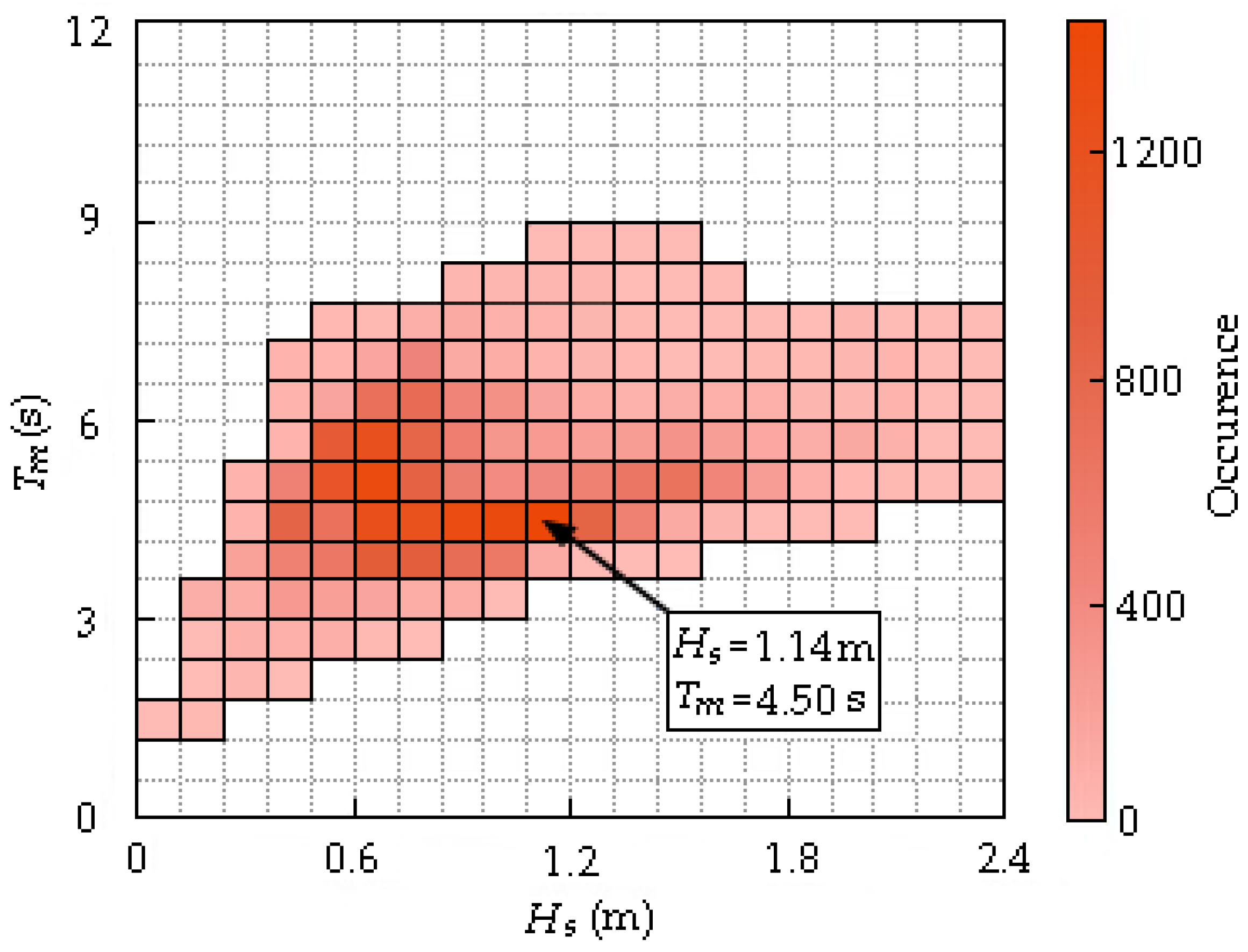
The study uses realistic data from a point 171.06 m from the Molhes da Barra breakwater in Rio Grande-RS (32°11′24″ S, 52°04′45″ W). These data correspond to the significant wave height ( H s ) and the mean wave period ( T m ) recorded in this region throughout 2018. Figure 1 presents the bivariate histogram that correlates the occurrences of H s and T m , identifying the most frequent combination: conditions recorded on 11 September 2018, from 07:15 to 07:30.
From the TOMAWAC database, a wave spectrum with these characteristics is selected and converted into a free-surface elevation ( η ) time series. For this purpose, the Spec2Wave (version 1.2.1) software is used, which employs the inverse Fourier transform, as detailed in Oleinik et al. [67]. Also using Spec2Wave, η is decomposed into depth-varying horizontal ( u ) and vertical ( w ) orbital velocity profiles. These profiles were then imposed as prescribed velocity boundary conditions in ANSYS Fluent, enabling the simulation of realistic irregular waves in a numerical wave channel.

2.3. Representative Regular Waves of a Realistic Sea State

Representative regular waves provide a simplified alternative for analyzing the sea state, with uniform characteristics. In this approach, the wave height ( H ) is defined as H s (the average height of the highest one-third of the waves recorded) [68]; and the wave period ( T ) is equal to T m (the arithmetic average of the periods recorded) [66]. With these characteristics and the water depth ( h ) at the study location (32°11′24″ S, 52°04′45″ W), the wavelength derives from the dispersion relation [69]:
ω 2   =   g   k tanh k h ,
where ω is the angular frequency (rad/s) and k the wave number vector (m−1); they are given as follows [69]:
ω = 2 π T ,
k = 2 π λ ,
where λ is the wavelength (m).
Thus, the characteristics defining the representative regular waves for this sea state are as follows: height, H = 1.14 m; period T = 4.50 s; wavelength, λ = 31.50 m; and water depth, h = 13.29 m. Although not generated in this study, these parameters guide the spatial and temporal discretization of the computational domain [57,58].

3. Problem Description

This section describes the computational setup and geometric evaluation methodology. It is organized into three main parts: Section 3.1 details the verification of the numerical wave generation model; Section 3.2 presents the computational domains and monitoring strategies for both OWC devices; and Section 3.3 explains the application of the constructal design method, defining the geometric parameters, degrees of freedom, and constraints for the systematic evaluation of both converter models.

3.1. Numerical Model Verification—Description

To verify the adequate reproduction of realistic irregular waves, a two-dimensional computational domain representing a wave channel without WECs was considered. The geometric characteristics of this channel are summarized in Table 1, with the third dimension considered unitary in this two-dimensional approach.
It should be mentioned that h t is fixed relative to the water level at rest (WLR), while L C refers to the distance from the wave data point to the Molhes da Barra breakwater. The varying channel depth replicates the local bathymetry from Rio Grande-RS, as recommended by Mocellin et al. [19]. Bathymetric data acquired from nautical charts provided by the Brazilian Navy’s Directorate of Hydrography and Navigation were used [70].
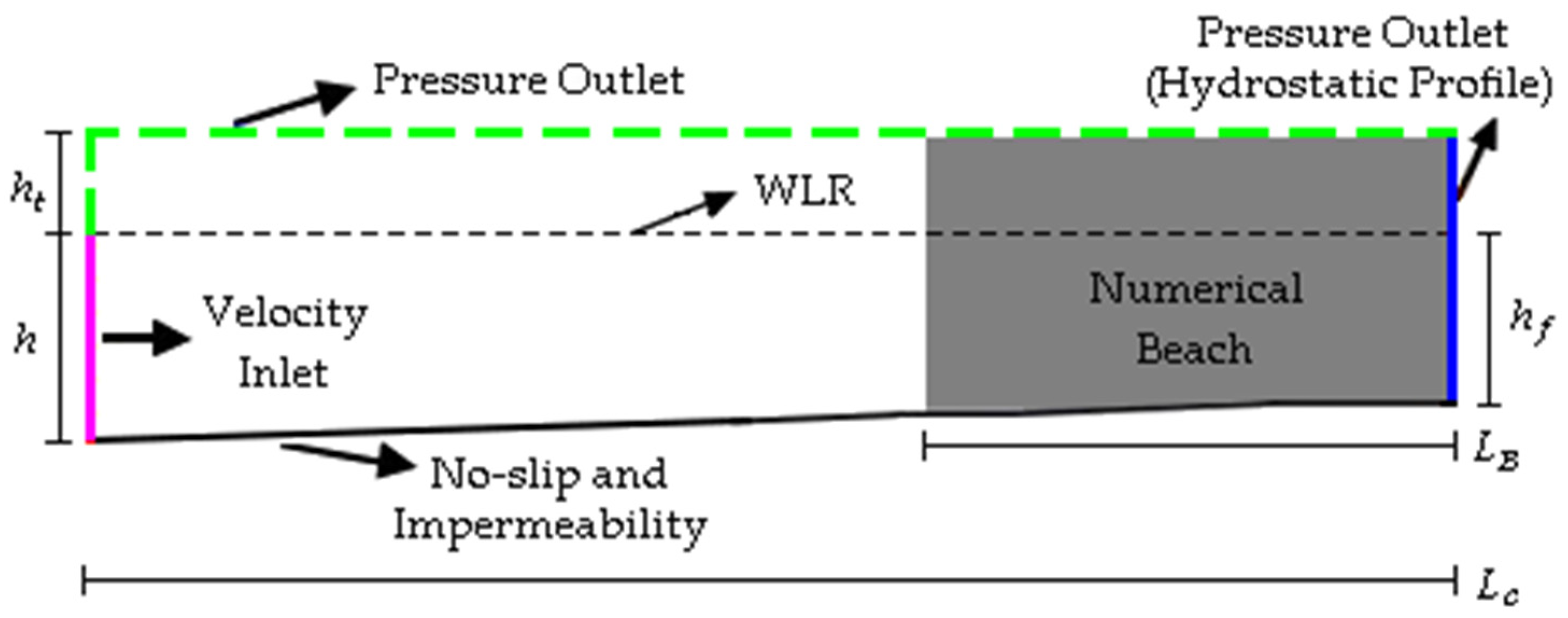
Subsequently, Figure 2 illustrates the employed computational domain, indicating the main dimensions of the wave channel, the boundary conditions applied, the numerical beach region, and the WLR.
As observed in Figure 2, the boundary conditions implemented in the computational domain were as follows [17,18,19,57,58]:
  • Prescribed velocity: lower part of the left wall (pink solid line), where the discretized orbital velocity profiles are imposed [57]. Following Paiva et al. [58], this region is subdivided into 15 segments: the first two segments, closest to the WLR, with height h / 28 ; the other 13 segments, extending to the channel bottom, with height h / 14 ;
  • Pressure outlet: upper portion of the left wall and channel top (green dashed line), where atmospheric pressure was specified ( p = 101.30 kPa);
  • No-slip and impermeability: channel bottom (black solid line), where the velocities were set to zero ( V = 0 m/s);
  • Pressure outlet with hydrostatic profile: right wall (blue solid line) to model an open channel. The hydrostatic profile ensures the retention of water within the domain, preventing its drainage. It allows the numerical beach (gray region) to absorb wave energy and minimize reflections effectively. As established by Lisboa et al. [64], the numerical beach region extends 2 λ , which corresponds to L B = 63.00 m when considering the wavelength of the representative regular waves ( λ = 31.50 m).
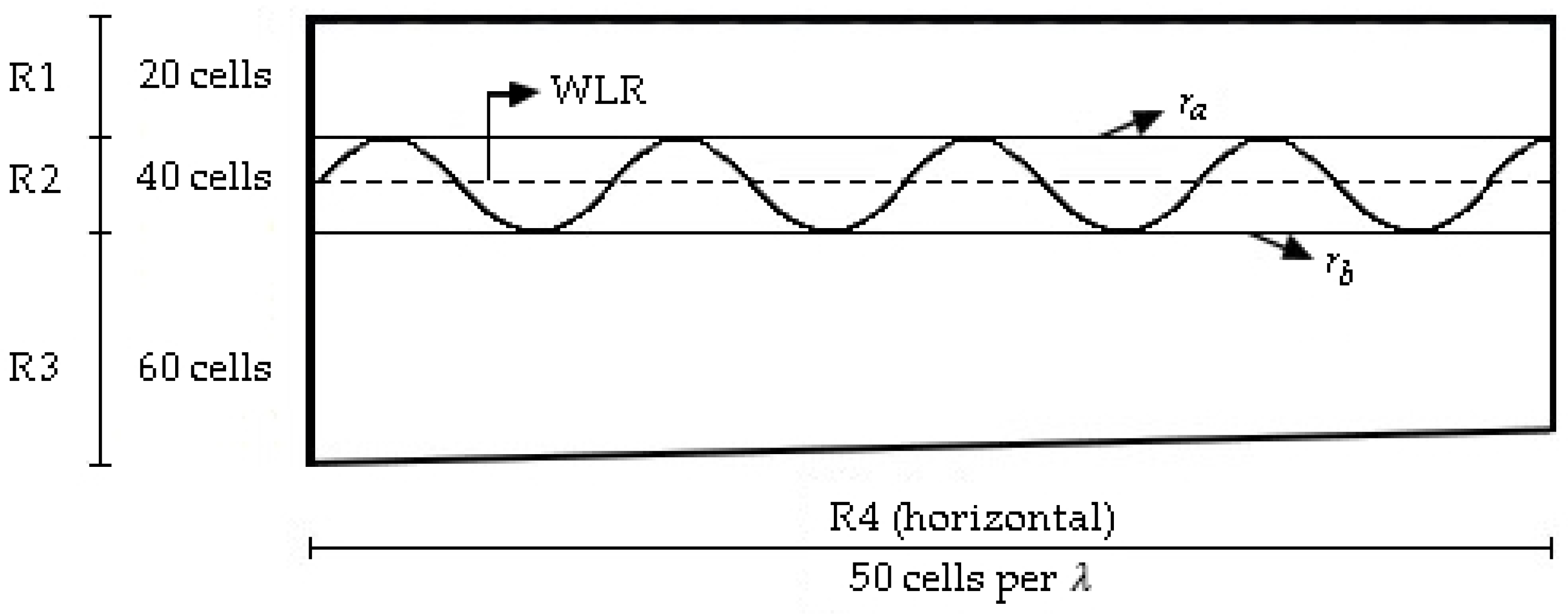
For the spatial discretization of the computational domain, a stretched mesh configuration [17] was implemented. This mesh model is characterized by its high level of refinement in the region of interest, specifically the free-surface region. This configuration divides the computational domain into three vertical regions (R1, R2, and R3) and one horizontal region (R4), as follows:
  • R1: this region consists only of air and requires less refinement. It was discretized into 20 computational cells [19,57,58];
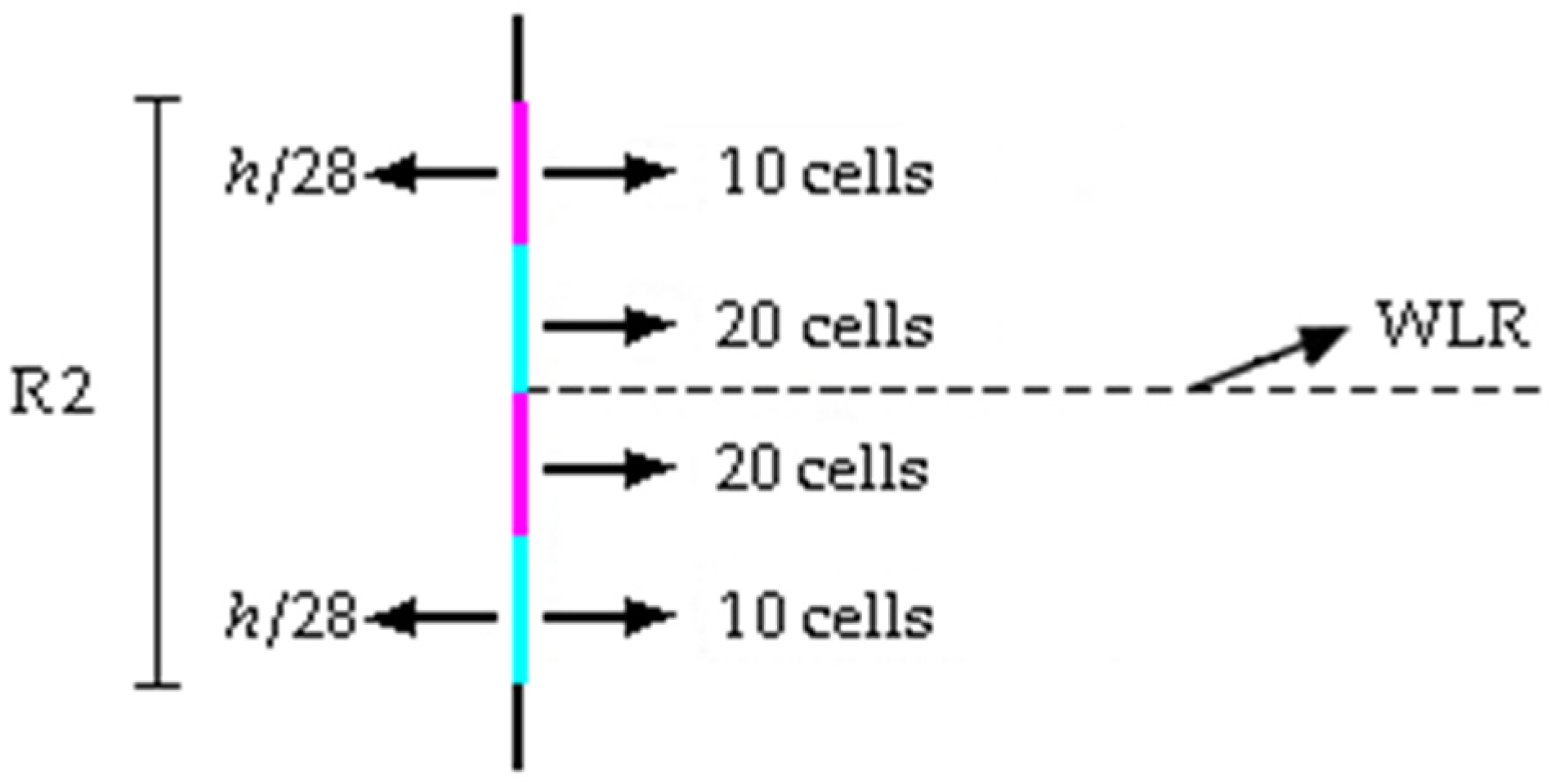
  • R2: this region contains the interface between the phases, demanding a higher mesh density. Following Paiva et al. [58], this region is composed of two segments above and below the WLR, all of size h / 28 . The segments immediately adjacent to the WLR are discretized into 20 cells, whereas the remaining segments use 10 cells, resulting in a total of 60 computational cells for the entire region, as illustrated in Figure 3;
  • R3: this region consists exclusively of water and is subdivided into 13 segments, each with a size of h / 14 . A discretization of five computational cells per segment was applied, resulting in a total of 65 cells for this zone [58];
  • R4: this horizontal region was discretized with 50 computational cells per λ of the representative regular waves, totaling 272 cells across its length [17,18,19,57,58].
Figure 4 presents the stretched mesh used in the study. Additionally, Figure 4 illustrates the upper and lower boundaries of region R2, represented by the lines r a and r b , respectively.
The temporal discretization used a time step Δ t = 0.0375 s, equivalent to T m / 120 , as recommended by Paiva et al. [58]. A total simulation time of 900 s of wave generation and propagation was considered.
To verify the numerical model employed, the free-surface elevation was monitored by a probe located within the generation zone, at x = 0 m. The numerical results were compared against the data from the TOMAWAC model. For a quantitative assessment, the mean absolute error (MAE) and root mean square error (RMSE) metrics [71] were used. In line with Paiva et al. [58] and Maciel et al. [72], these error metrics were normalized. The normalized versions, NMAE and NRMSE, are, respectively, defined as follows:
N M A E = 1 M i = 1 M O i P i 100 P m a x P m i n ,
N R M S E = 1 M i = 1 M O i P i 2 100 P m a x P m i n ,
where O i represents the value obtained from ANSYS Fluent (m) in the present study; P i are TOMAWAC reference values (m), with P m a x and P m i n being the maximum and minimum ones, respectively; and M denotes the total amount of data.
The verification focused on the channel inlet ( x = 0 m) since WaveMIMO methodology has been extensively validated: Machado et al. [57], for comparing free-surface elevation at x = 0 m and at the end of the channel via spectral density; Paiva et al. [58], for realistic irregular waves generation and propagation; Maciel et al. [72], for the generation of regular waves impinging upon a conventional OWC device.

3.2. Computational Domain for Geometric Evaluation of the OWC Devices

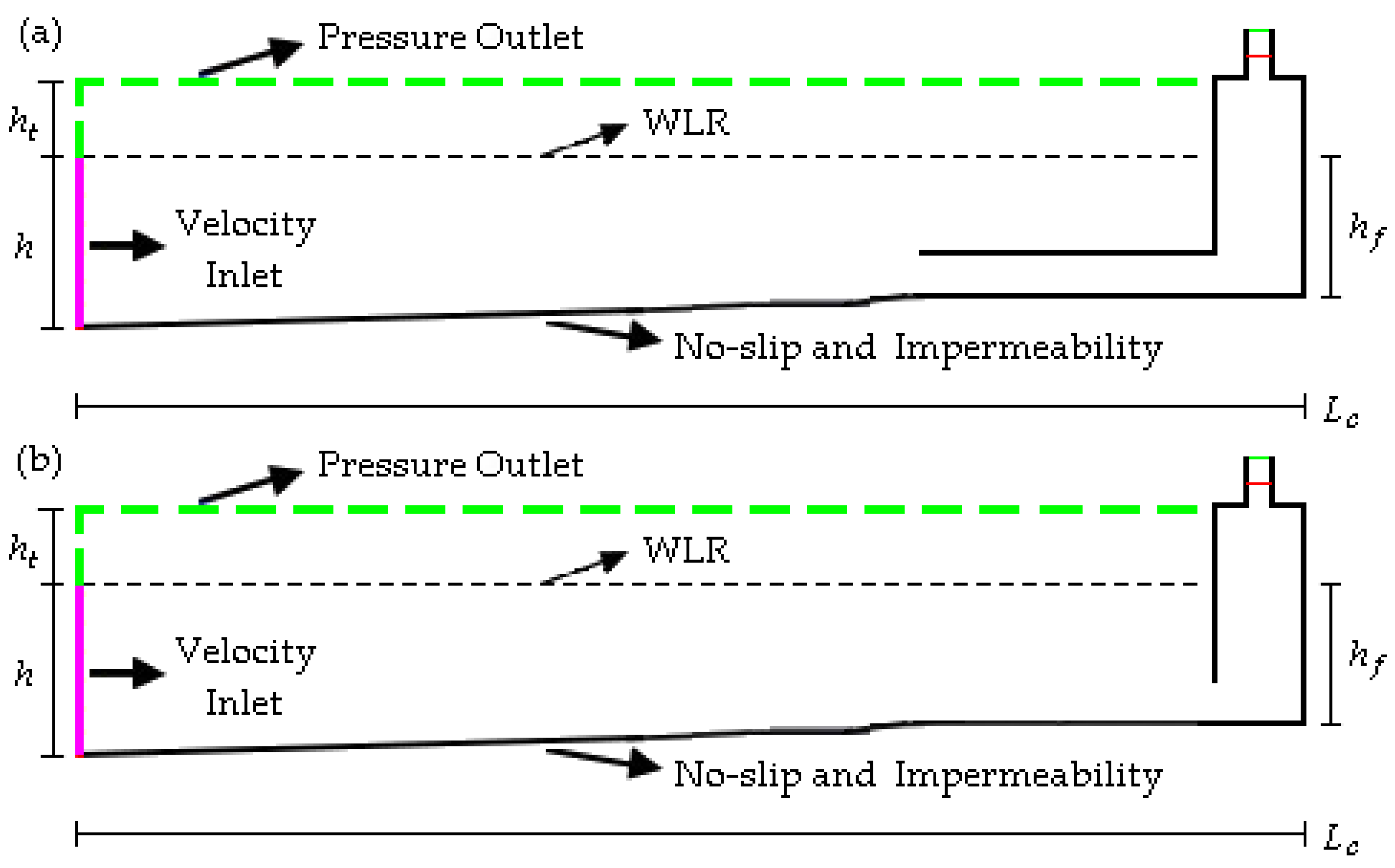
The computational domain from Section 3.1 was adapted for the geometric evaluation of the OWC WECs. Thus, the numerical beach was removed, allowing waves to reach the end of the channel, representing onshore devices. Figure 5 shows the computational domains for both (a) L-OWC and (b) conventional OWC devices, highlighting the main dimensions; the adopted boundary conditions; and the monitoring probe, positioned at the center of the air duct (solid red line).
As shown in Figure 5, the no-slip and impermeability boundary conditions were applied to the devices’ structure, while a pressure outlet was applied to the air duct, allowing the air to flow through it [17,18,19]. The remaining boundary conditions previously adopted were preserved, as were the wave channel dimensions specified in Table 1.
The monitoring probe placed at the center of the air duct recorded both the air pressure and the mass flow rate. To quantify these data, the Root Mean Square (RMS) metric was employed as follows [68]:
R M S = 1 M i = 1 M X i 2 ,
where X represents the quantity to be measured. The resulting available hydropneumatic power is calculated according to [17] as follows:
P H = p + ρ a i r v a i r 2 2 M ˙ a i r ρ a i r ,
where P H is the available hydropneumatic power (W); v a i r is the air velocity (m/s); and M ˙ a i r is the mass flow rate of air (kg/s).
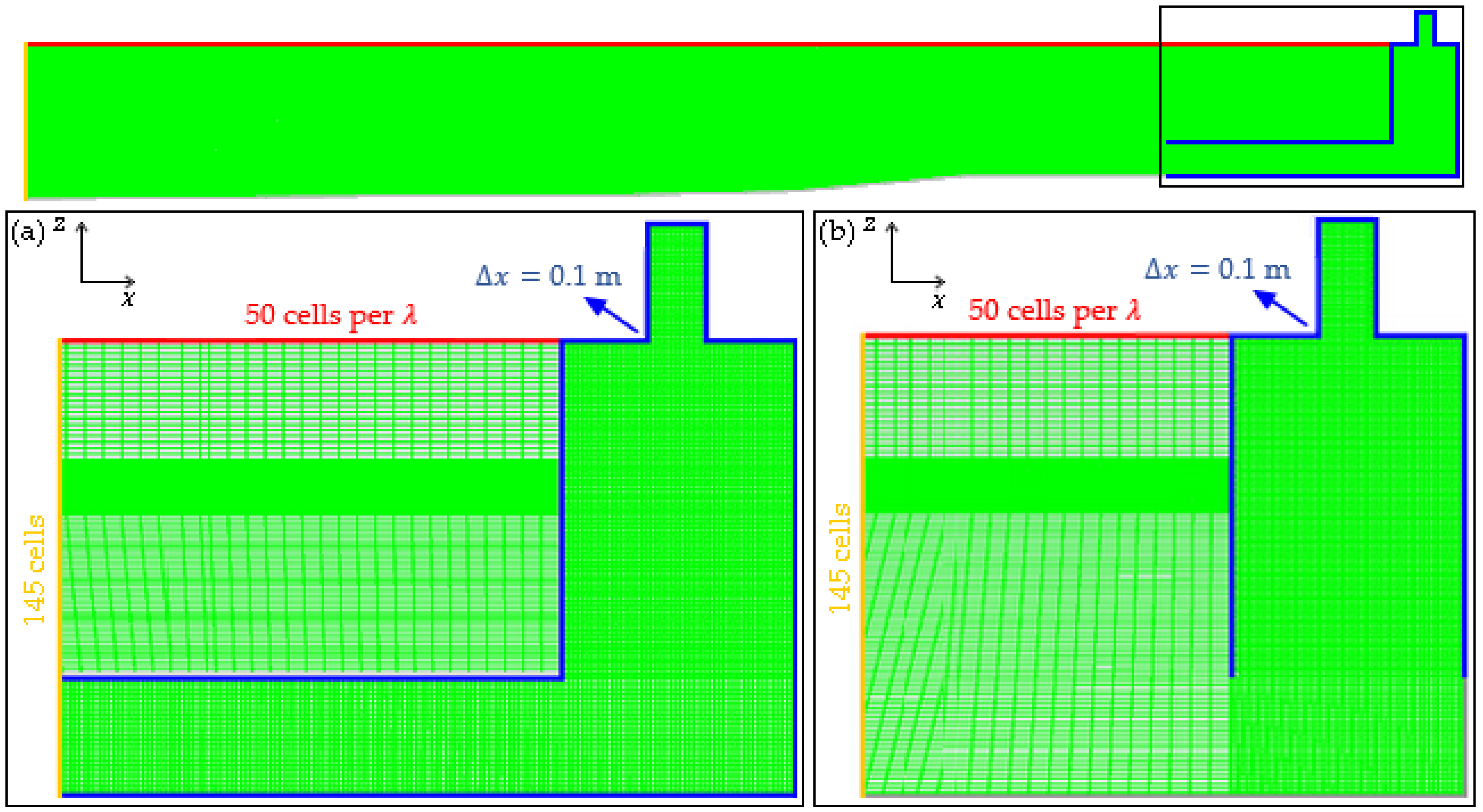
Regarding the spatial discretization of the computational domain, the stretched mesh type was maintained. Vertically, this results in 145 cells along the channel. However, in the interior of the OWC devices, quadrilateral cells with a side length of Δ x = 0.1 m were considered [17,19,72]. Figure 6 provides a detailed view of the mesh configuration employed in the OWCs region. Regarding the temporal discretization, as previously, Δ t = 0.0375 s was used for a total simulation time of 900 s.

3.3. Geometric Evaluation of the OWC Devices Through the Constructal Design

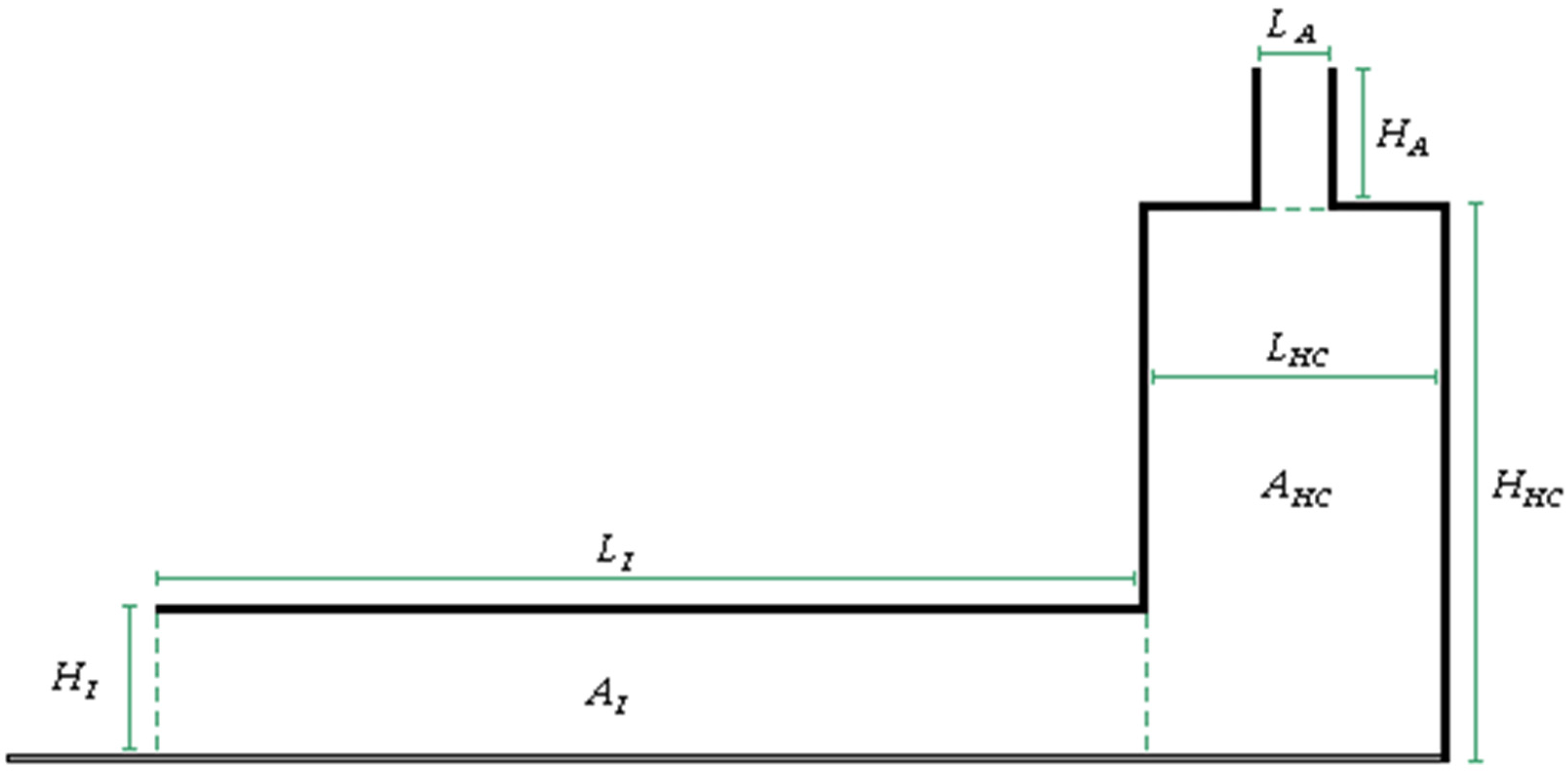
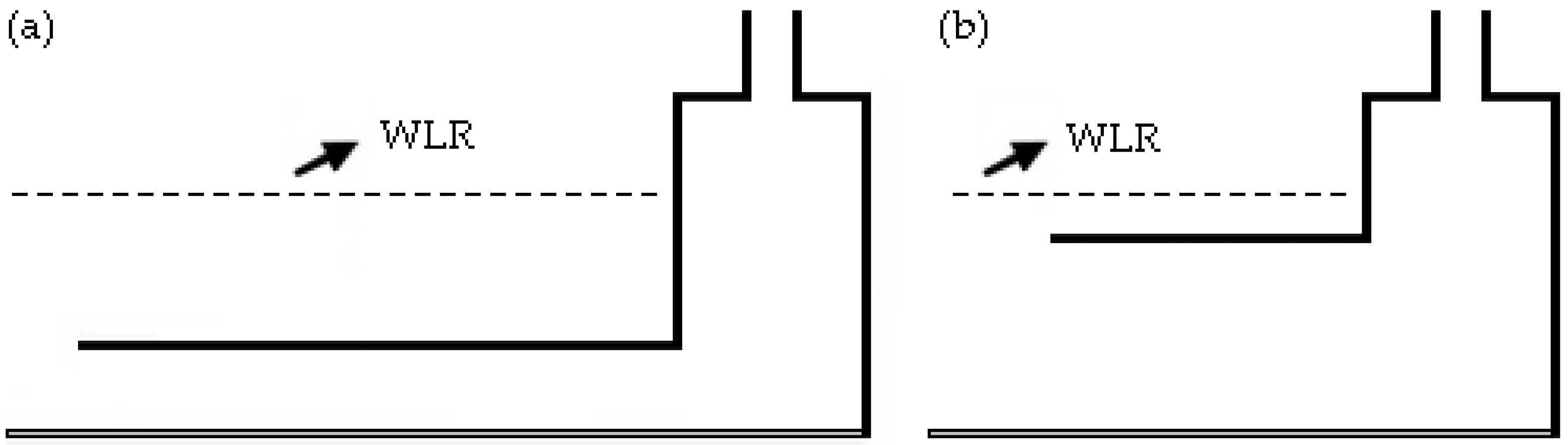
The objective of the present work is to geometrically evaluate the OWC WEC, comparing two models: the L-shaped (L-OWC) and the conventional one. The first step in applying the constructal design method consists of defining the physical system to be studied; in this case, an OWC device subjected to the incidence of realistic irregular waves in a numerical channel. The OWC device is composed of a hydropneumatic chamber and an air duct. The L-OWC was initially investigated, which distinguishes it from the conventional OWC model because its hydropneumatic chamber possesses a water inlet duct. Figure 7 presents the configuration of the L-OWC device.
The initial geometry adopted for the L-OWC has the following dimensions: height of the water inlet duct, H I = 4.00 m; length of the water inlet duct, L I = 27.00 m; height of the hydropneumatic chamber, H H C = 15.50 m; length of the hydropneumatic chamber, L H C = 8.00 m; height of the air duct, H A = 4.00 m; length of the air duct, L A = 2.00 m. The proportions between the dimensions of L I and L H C and between H I and H H C are in agreement with those of the best geometries considered in the geometric evaluation of the L-OWC conducted by López et al. [20].
To employ the constructal design, the following parameters were established:
  • Performance indicator: available hydropneumatic power ( P H ), to be maximized;
  • Geometric restrictions: area of the water inlet duct ( A I ); area of the hydropneumatic chamber ( A H C ); and total area of the wave channel ( A C );
  • Degrees of freedom: ratio between the height and length of the water inlet duct ( H I / L I ); and the ratio between the height and length of the hydropneumatic chamber ( H H C / L H C ).
Therefore, three area restrictions were considered in this study. For simplification purposes, a wave channel area of A C = 3128.69 m2 was adopted, representing a flat-bottom wave channel with a depth of h = 13.29 m. Furthermore, there is the area of the water inlet duct, given by the following:
A I =   H I L I ,
where A I = 108.00 m2. The hydropneumatics chamber area is given by the following:
A H C =   H H C L H C ,
Here, A H C = 124.00 m2.
Thus, it is possible to define an area fraction dimensionless number for each investigated degree of freedom, which is given, respectively, by the following:
ϕ 1 = A I A C ,
ϕ 2 = A H C A C ,
Here, the following is assumed: ϕ 1 = 0.0345 and ϕ 2 = 0.0396 .
Once the area restrictions were established, it was possible to define the investigated degrees of freedom. Starting with H I / L I , by dividing both sides of Equation (20) by L I 2 and isolating the degree of freedom, the following applies:
H I L I = A I ( L I ) 2   ,
This allows the dimensions of H I and L I to be defined for each H I / L I ratio.
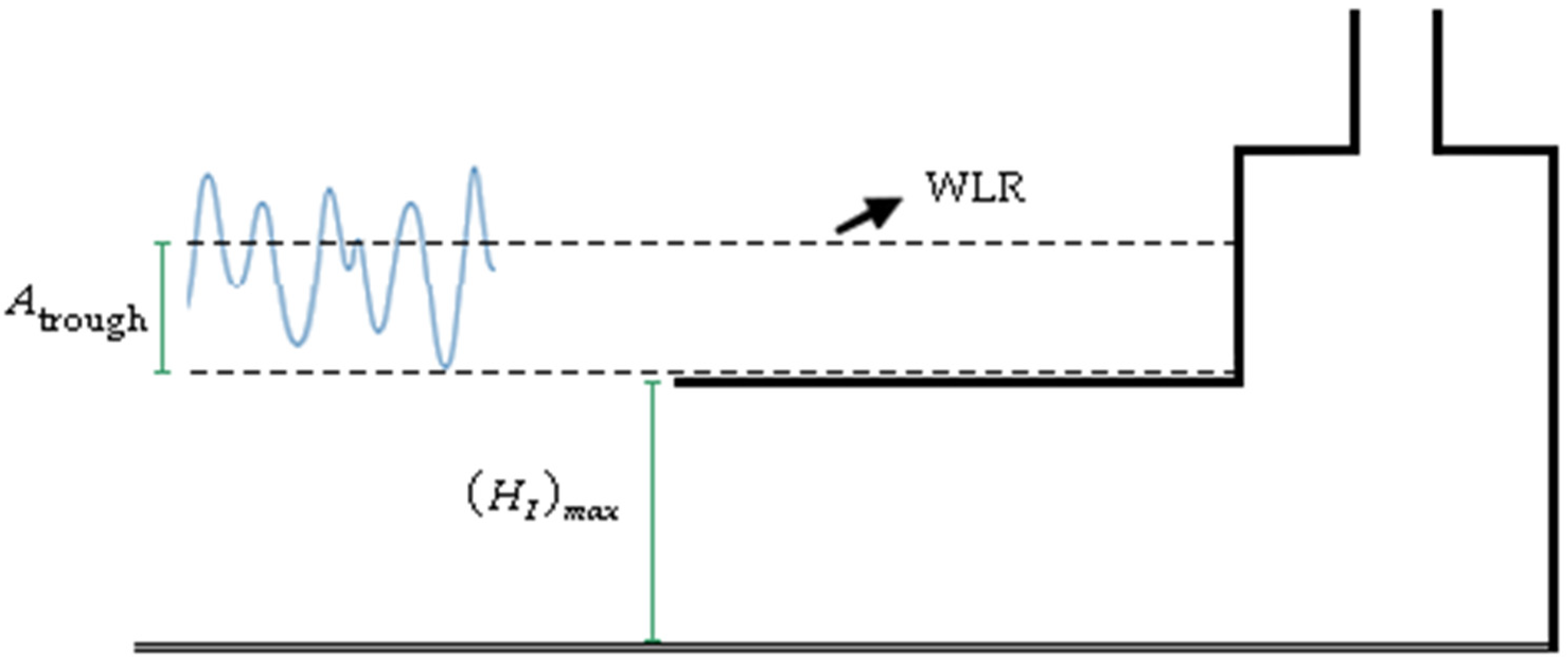
Additionally, another geometric restriction was established: the intake duct of the L-OWC device remains submerged during the simulation. To ensure this condition, a criterion for the maximum height of H I , was defined as follows:
H I m a x < h f A t r o u g h ,
where A t r o u g h represents the modulus of the largest trough amplitude recorded in the realistic irregular waves, corresponding to A t r o u g h = 1.41 m, as illustrated in Figure 8.
After defining all restrictions, thirteen H I / L I ratios were established, ranging from 0.15 to 0.75 with increments of 0.05. This upper limit is imposed by Equation (25) to ensure the intake duct remains fully submerged under all wave conditions. Table 2 presents the H I / L I values and the respective dimensions of H I and L I for each evaluated geometric configuration.
Smaller H I / L I ratios represent longer and lower water inlet ducts, while larger ones feature shorter and taller ducts (see Table 2). Figure 9 illustrates this variation’s effect on the L-OWC design, with other geometric parameters fixed. For this purpose, the extreme cases are shown, where H I / L I = 0.15 corresponds to the initial geometry; and H I / L I = 0.75 is the maximum value satisfying Equation (25).
After defining the optimal ratio for H I / L I , the ratio H H C / L H C was investigated. By dividing both sides of Equation (21) by L H C 2 , the following applies:
H H C   L H C = A H C ( L H C ) 2   ,
This allows for the determination of H H C and L H C for each H H C / L H C ratio.
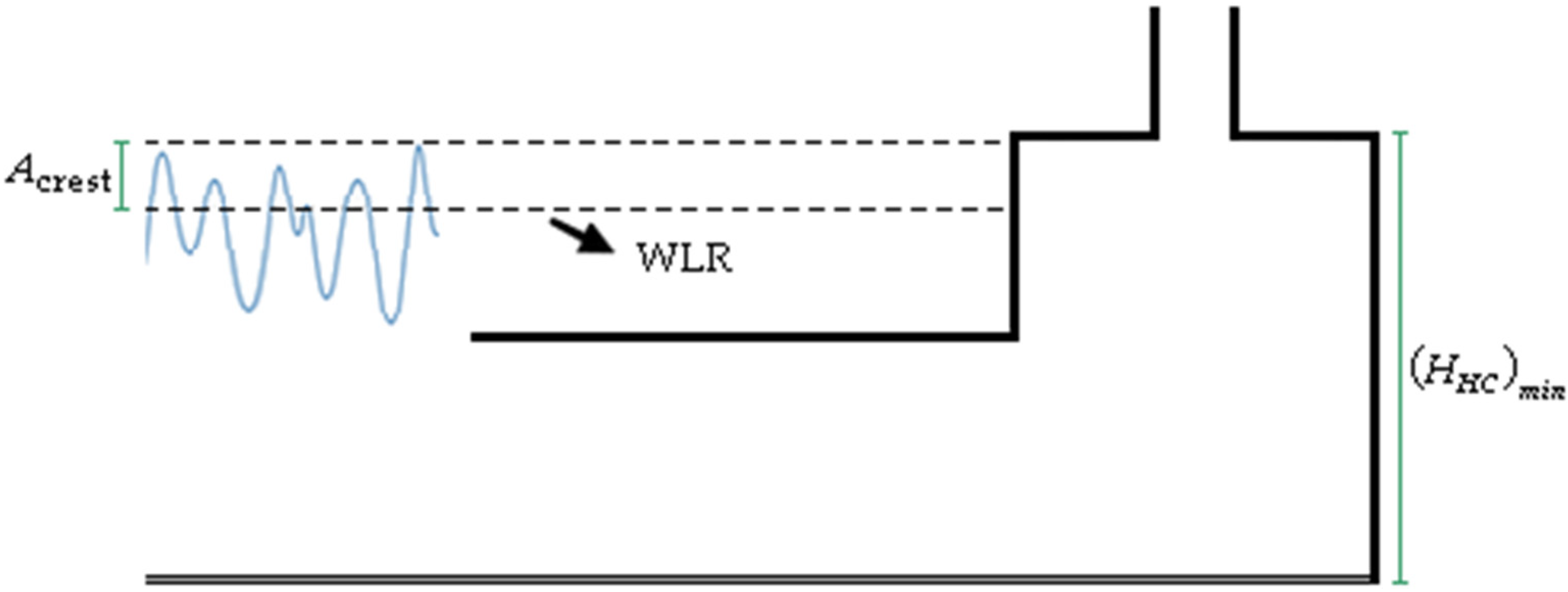
As before, another geometric restriction was established: the top of the L-OWC device’s hydropneumatic chamber must remain above water during the simulation. Thus, a restriction on the minimum height of H H C was defined by the following:
H H C m i n > h f + A c r e s t ,
where A c r e s t represents the largest crest amplitude recorded, being A c r e s t = 1.03 m. This restriction is illustrated in Figure 10.
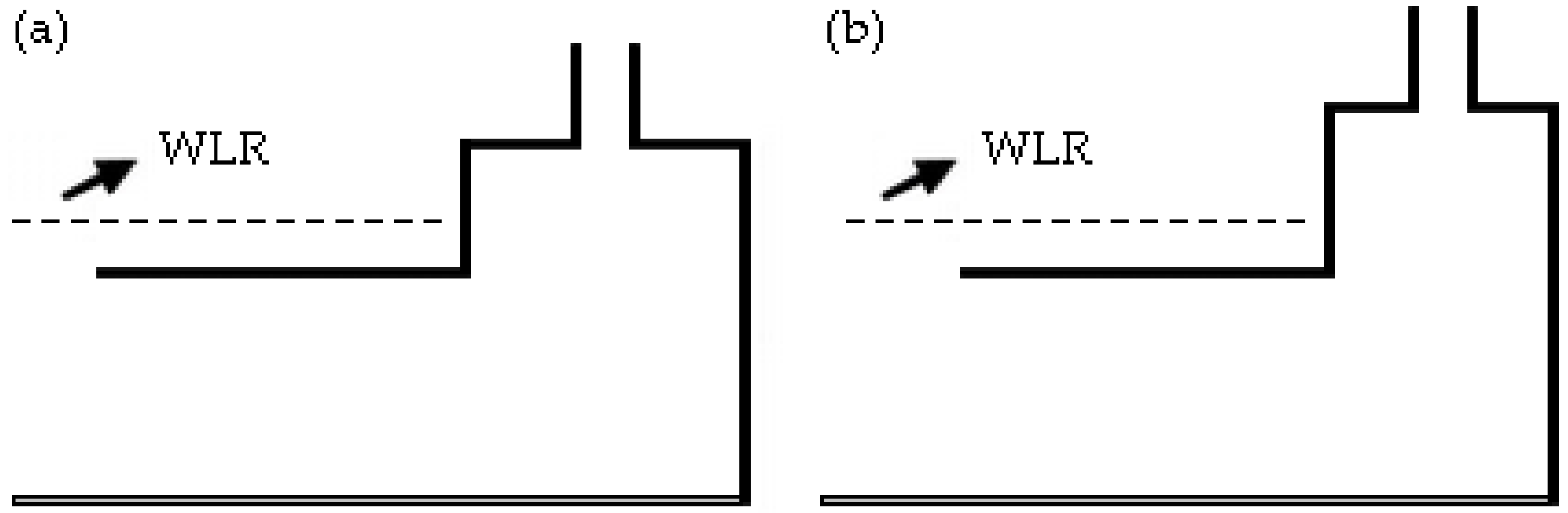
After defining the geometric restrictions, five H H C / L H C ratios were established, ranging from 1.18 to 1.94 with increments of 0.19. The reduced number of ratios evaluated is based on studies that assessed its influence on the performance of the OWC device, such as those conducted by Maciel et al. [18] and Mocellin et al. [19]. These studies found an inversely proportional relationship between H H C / L H C and the performance of the conventional OWC model. Table 3 presents the H H C / L H C values and corresponding dimensions of H H C and L H C for each geometric configuration.
Smaller H H C / L H C ratios represent longer and lower hydropneumatic chambers, while the larger ones represent geometries with shorter and taller chambers. The effect of varying H H C / L H C on the L-OWC geometry is illustrated in Figure 11. Here, the extreme cases are presented: H H C / L H C = 1.18 , which is the minimum value that satisfies Equation (27); H H C / L H C = 1.94 , which corresponds to the initial geometry.
Therefore, thirteen H I / L I and five H H C / L H C ratios were simulated, totaling eighteen L-OWC configurations. Through the systematic variation in these ratios and the comparison of the numerical results obtained with each other (characterizing a geometric optimization process based on an exhaustive search), it was possible to determine the optimal geometric configuration for the L-OWC device subjected to the realistic irregular waves found off Rio Grande.
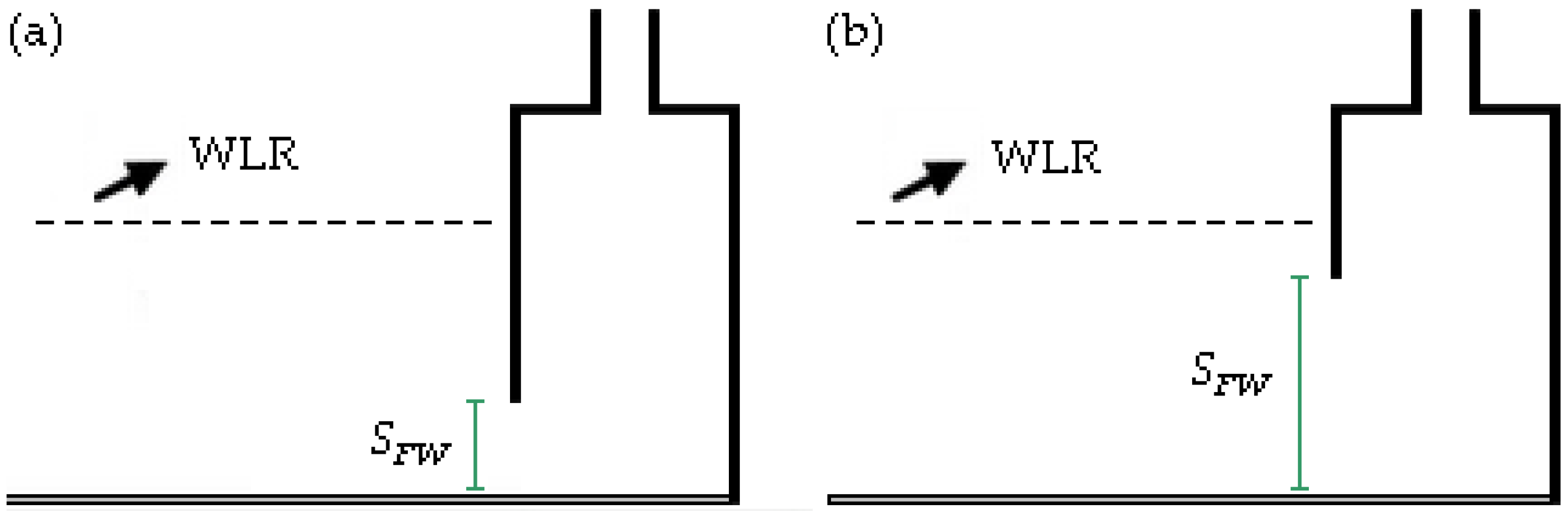
Following the geometric investigation of the L-OWC, the same configurations were evaluated for the conventional OWC model, that is, without the water inlet duct characteristic of the L-OWC. Thus, the H I / L I ratio study was replaced by the front wall submersion ( S F W ) analysis using the same values as H I in Table 2. Consequently, the S F W values also respect the submersion constraint defined for the L-OWC by Equation (25), ensuring a consistent comparison between the two models. Figure 12 illustrates the effect of varying the degree of freedom, S F W , on the conventional OWC design. The extreme cases are presented, where S F W = 4.00 m corresponds to the geometry with H I / L I = 0.15 in the L-OWC model; and S F W = 9.00 m corresponds to H I / L I = 0.75 in the L-OWC.
It is highlighted that the conventional OWC maintained the same hydropneumatic chamber ( H H C , L H C ) and air duct ( H A , L A ) dimensions considered for the L-OWC. After defining the optimal S F W for the conventional OWC, the degree of freedom H H C / L H C was also investigated. The same H H C / L H C ratios evaluated for the L-OWC were considered for the conventional OWC, allowing for a fair comparison between the results obtained by the different models of the OWC WEC. Thus, thirteen S F W values and five H H C / L H C ratios were considered, totaling eighteen simulations for the conventional OWC.

4. Results and Discussions

This section was divided to present and discuss the results obtained for: the verification of the numerical model employed in Section 4.1; the investigation of the H I / L I and S F W degrees of freedom in Section 4.2; the investigation of the H H C / L H C degree of freedom in Section 4.3. Furthermore, it culminates in a linear regression analysis with performance projections in Section 4.4; a qualitative analysis of the hydrodynamic behavior comparing the optimal configurations in Section 4.5.

4.1. Numerical Model Verification—Results

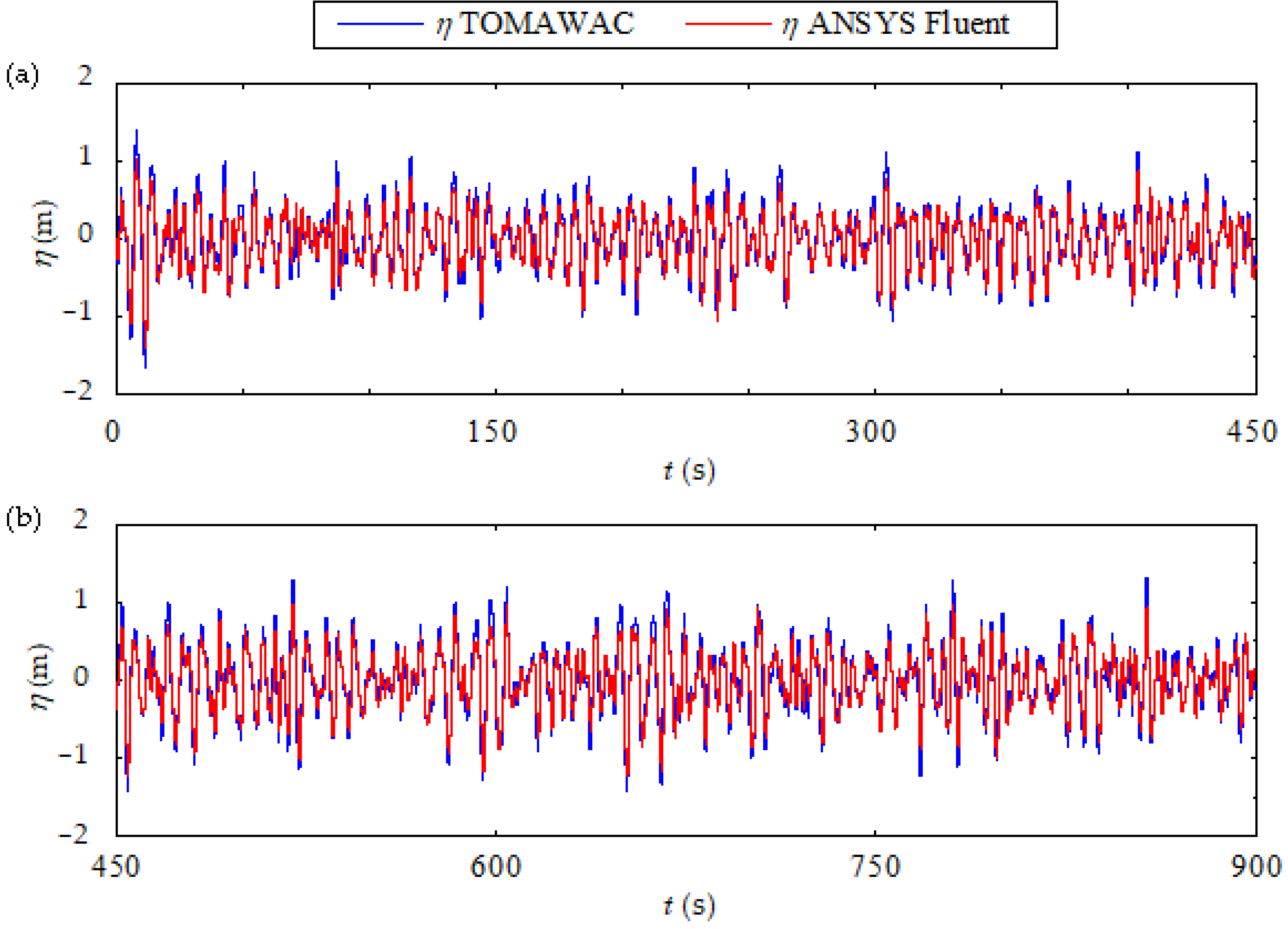
To verify the WaveMIMO methodology [57], Figure 13 presents a qualitative comparison between the numerically generated realistic irregular waves against TOMAWAC reference data over 900 s. For clarity, the comparison of the free-surface elevation ( η ) is divided into two 450 s time intervals.
Figure 13 shows that the computational model successfully reproduced the realistic sea state found off the coast of Rio Grande. Initial fluid inertia effects are absent since the monitoring probe was at x = 0 m. The quantitative evaluation yielded metrics of N M A E = 3.45 % and N R M S E = 4.44 %, indicating an excellent agreement when compared to values present in the literature [58,72,73,74], which confirms the robustness of the WaveMIMO methodology in accurately simulating these waves.
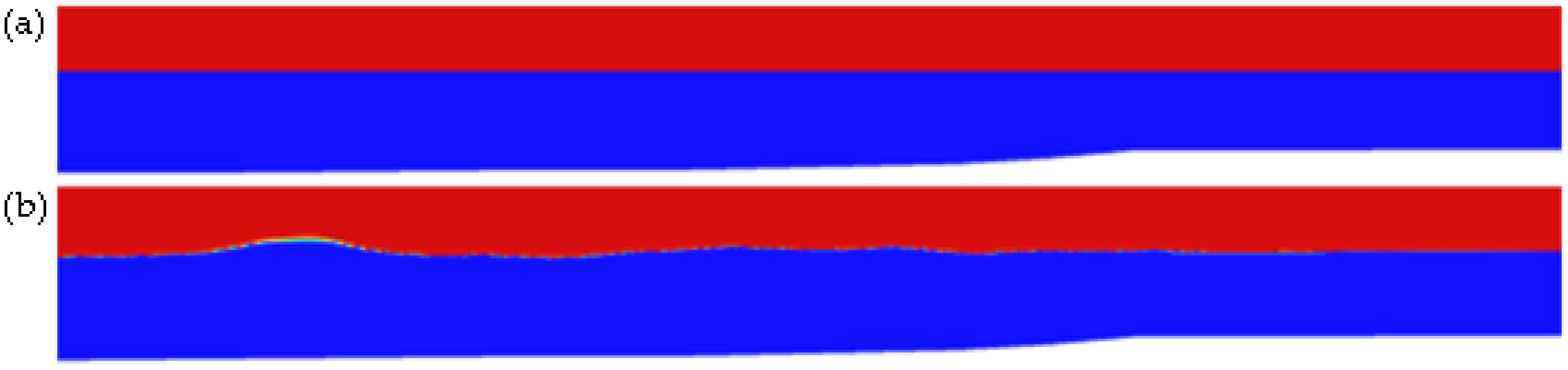
To visualize the physical phenomenon reproduced numerically, Figure 14 shows the volumetric fraction field, where the air and water phases are depicted in red and blue, respectively. Figure 14a displays the initial condition ( t = 0 s), while the final moments of the simulation ( t = 900 s) are presented in Figure 14b.
Figure 14a shows fluids at rest with no free-surface elevations, resulting from initial fluid inertia. Figure 14b displays a non-uniform behavior in the free-surface elevations, reproducing the realistic sea state recorded in Rio Grande, with evident wave attenuation in the numerical beach region, demonstrating the effective damping of incident waves.
The computational model was thus verified quantitatively through low NMAE and NRMSE values, and qualitatively through Figure 13 and Figure 14. This excellent agreement ensures that the subsequent geometric evaluation is based on a faithful reproduction of the target sea state. While this minor level of uncertainty naturally propagates to the monitored results, the comparative analysis between the two OWC models remains robust and conclusive, as they were subjected to the identical wave series.

4.2. Geometric Evaluation OWC Converter Device— H I / L I and S F W Investigation

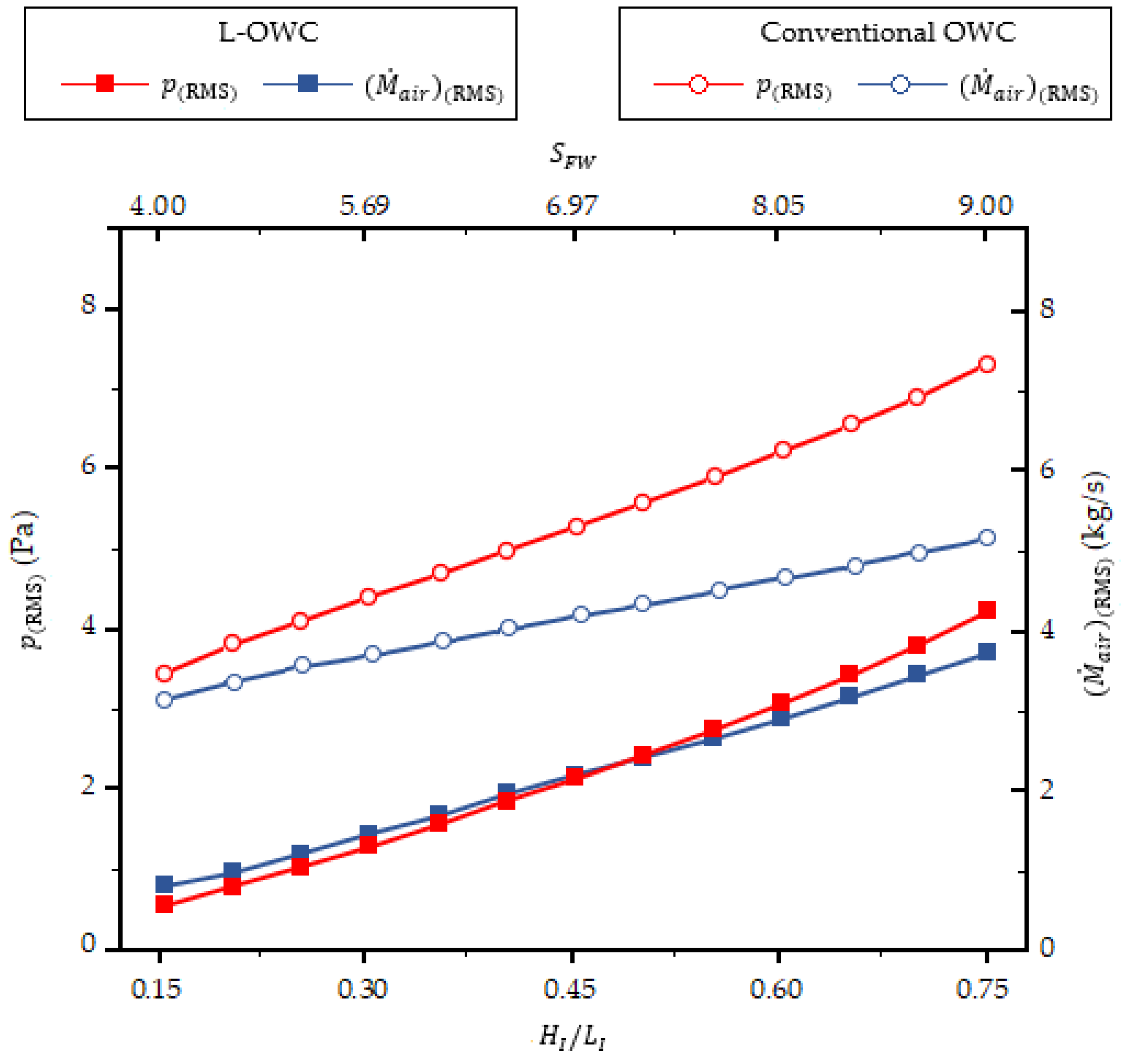
This study employed the constructal design method to conduct a geometric evaluation of an OWC device under the incidence of realistic irregular waves, comparing two models: the L-OWC, which features a water intake duct coupled to the hydropneumatic chamber; and the conventional OWC. This section presents the results related to the investigation of the degree of freedom H I / L I (for the L-OWC) and S F W (for the conventional OWC). In both cases, the height-to-length ratio of the hydropneumatic chamber was fixed at H H C / L H C = 1.94 . Figure 15 presents the calculated metrics for the monitored air pressure, p ( R M S ) , and air mass flow rate, ( M ˙ a i r ) ( R M S ) .
Figure 15 shows increasing trends for both p ( R M S ) (in red) and ( M ˙ a i r ) ( R M S ) (in blue) with rising H I / L I in both OWC models. However, for the L-OWC, geometries within the range 0.15 H I / L I 0.45 display higher values for ( M ˙ a i r ) ( R M S ) compared to p ( R M S ) , with the curves intersecting at H I / L I = 0.50 . This behavior is not repeated in the conventional OWC, where higher values were obtained for p ( R M S ) than for ( M ˙ a i r ) ( R M S ) in all cases, showing a progressive divergence between the metrics as S F W increases.
For all simulated geometries, the L-OWC yielded lower p ( R M S ) and ( M ˙ a i r ) ( R M S ) values than the conventional OWC. The present results, obtained under realistic irregular waves, are consistent with what was observed under more stable conditions. Samak et al. [24], considering regular waves in the laboratory scale, also reported that the L-OWC reduces the air pressure inside the chamber compared to a conventional design, attributing this effect to vortex generation. Furthermore, it was noted that the geometric variation had a greater influence on p ( R M S ) than for M ˙ a i r   ( R M S ) in both models. Quantitatively, the L-OWC showed variations of 667% ( p ( R M S ) ) and 363% ( ( M ˙ a i r ) ( R M S ) ), while the conventional OWC exhibited oscillations of approximately 111% ( p ( R M S ) ) and 65% ( ( M ˙ a i r ) ( R M S ) ).
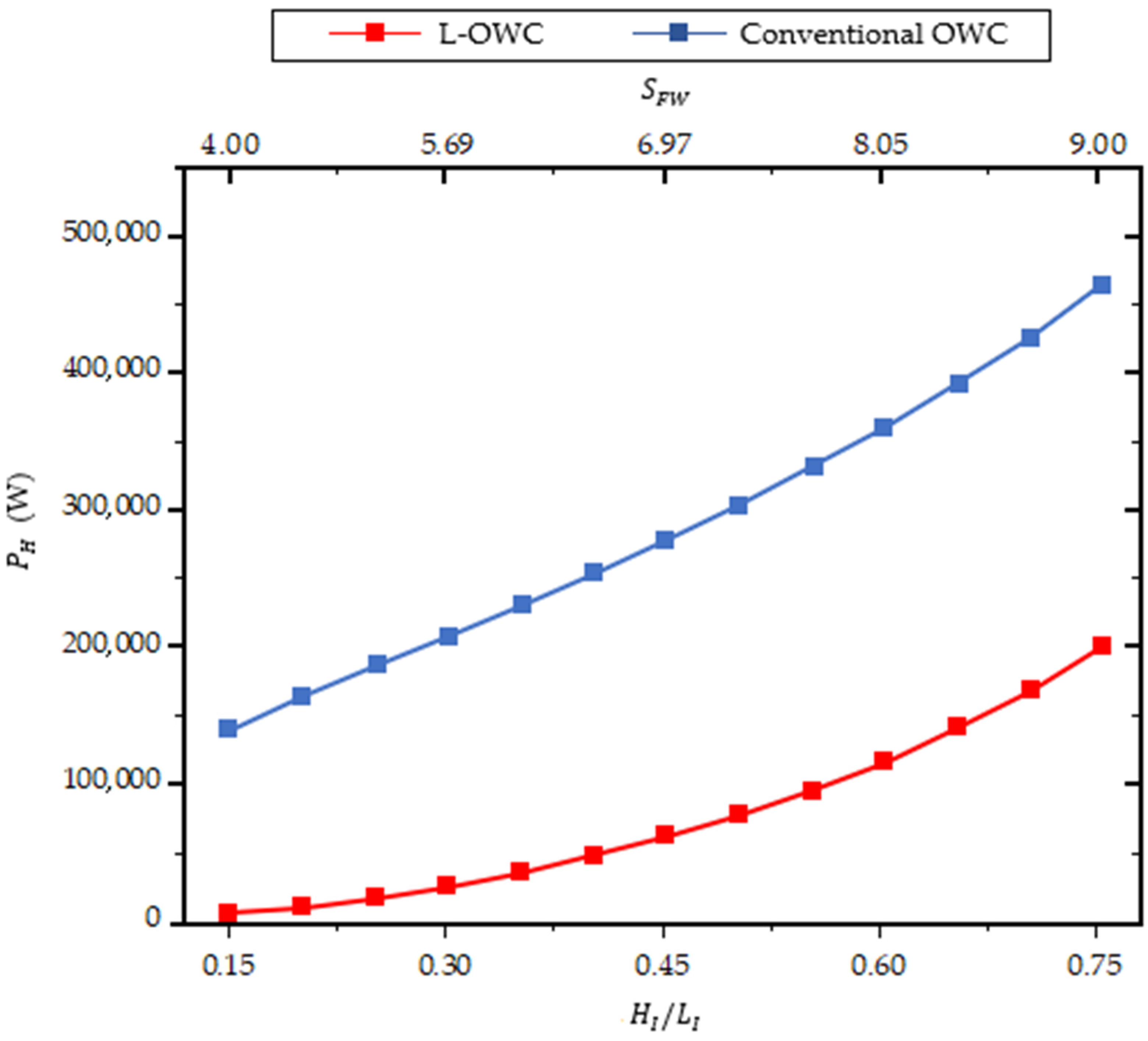
Continuing the analysis of the results obtained, Figure 16 presents the effect of the H I / L I (for the L-OWC) and S F W (for the conventional OWC) on the available hydropneumatic power ( P H ) for each evaluated geometry.
Analogously to p ( R M S ) and ( M ˙ a i r ) ( R M S ) , Figure 16 exhibits a growing trend P H with increasing H I / L I (in red) and S F W (in blue). This occurs because higher values of the respective degrees of freedom position the water intake duct (L-OWC) or the hydropneumatic chamber opening (conventional OWC) closer to the free-surface region. These geometries facilitate the access of incident waves to the interior of the hydropneumatic chamber, intensifying the oscillation within it. This behavior was also reported in Letzow et al. [16], where the authors evaluated the geometry of a conventional OWC device considering two frontal wall dimensions. Furthermore, it aligns with Samak et al. [24], who concluded that shorter intake duct lengths (corresponding to higher H I / L I ratios) are favorable for the performance of the L-OWC model.
For a quantitative assessment, Table 4 presents the following: the P H values obtained for each geometry; the relative differences ( D R ) between geometries of the same model, where each geometry is compared to the one preceding it; and the differences between the converter models ( D M ), using the L-OWC results as a reference. This approach quantifies P H variation across configurations and the relative performance of the two models.
Table 4 confirms the increasing trends illustrated in Figure 16, as the optimal geometry of both models at the upper investigation limits. The L-OWC model demonstrated greater sensitivity to geometric variations, as D R exceeded 50% for 0.15 H I / L I 0.30 and remained above 19% in the other cases, except for H I / L I = 0.70 and 0.75. Consequently, P H exhibited a total variation of 3475% when comparing the worst ( H I / L I = 0.15 ) and optimal ( H I / L I o = 0.75 ) L-OWC cases.
Similarly, conventional OWC configurations with the greatest variation occurred between 4.00   m S F W 5.69   m (corresponding to 0.15 H I / L I 0.30 in the L-OWC). However, this model exhibited a smaller variation in the obtained P H , with all D R values below 18% and below 10% for 7.35   m S F W 9.00   m . The P H variation between the worst ( S F W = 4.00 m) and optimal ( S F W o = 9.00 m) cases for the conventional OWC was 236%, indicating lower sensitivity to the geometric variations.
Although D R variations are more pronounced in the L-OWC, its absolute P H values remain significantly lower than the conventional OWC, as shown by the high D M values. In the initial configurations ( 0.15 H I / L I 0.25 for the L-OWC; 4.00   m S F W 5.20   m for the conventional model), D M exceeds 1000%. This difference gradually decreases with increasing the values of the respective degrees of freedom. However, even at optimal configurations, the conventional OWC maintains 132% superior performance.
In absolute terms, the difference in P H magnitude is significant, such that the optimal performance of the L-OWC ( H I / L I o = 0.75 ) falls below most conventional OWC configurations (except for 4.00   m S F W 5.20   m ). Despite the gradual reduction in D M , the difference in absolute P H values increase continuously, explaining the diverging curves in Figure 16. Thus, although the L-OWC exhibits greater geometric sensitivity, the conventional OWC model shows superior absolute performance.

4.3. Geometric Evaluation OWC Converter Device— H H C / L H C Investigation

This section discusses the results of the investigation of the degree of freedom H H C / L H C for both OWC models, based on the optimal geometries from Section 4.2, namely: H I / L I o = 0.75 , for the L-OWC; and S F W o = 9.00 m, for the conventional OWC. These geometries are counterparts of each other, meaning that the S F W o corresponds to the height of the water intake duct of H I / L I o . Figure 17 presents the air pressure ( p ( R M S ) ) and air mass flow rate ( ( M ˙ a i r ) ( R M S ) ) metrics for each geometry.
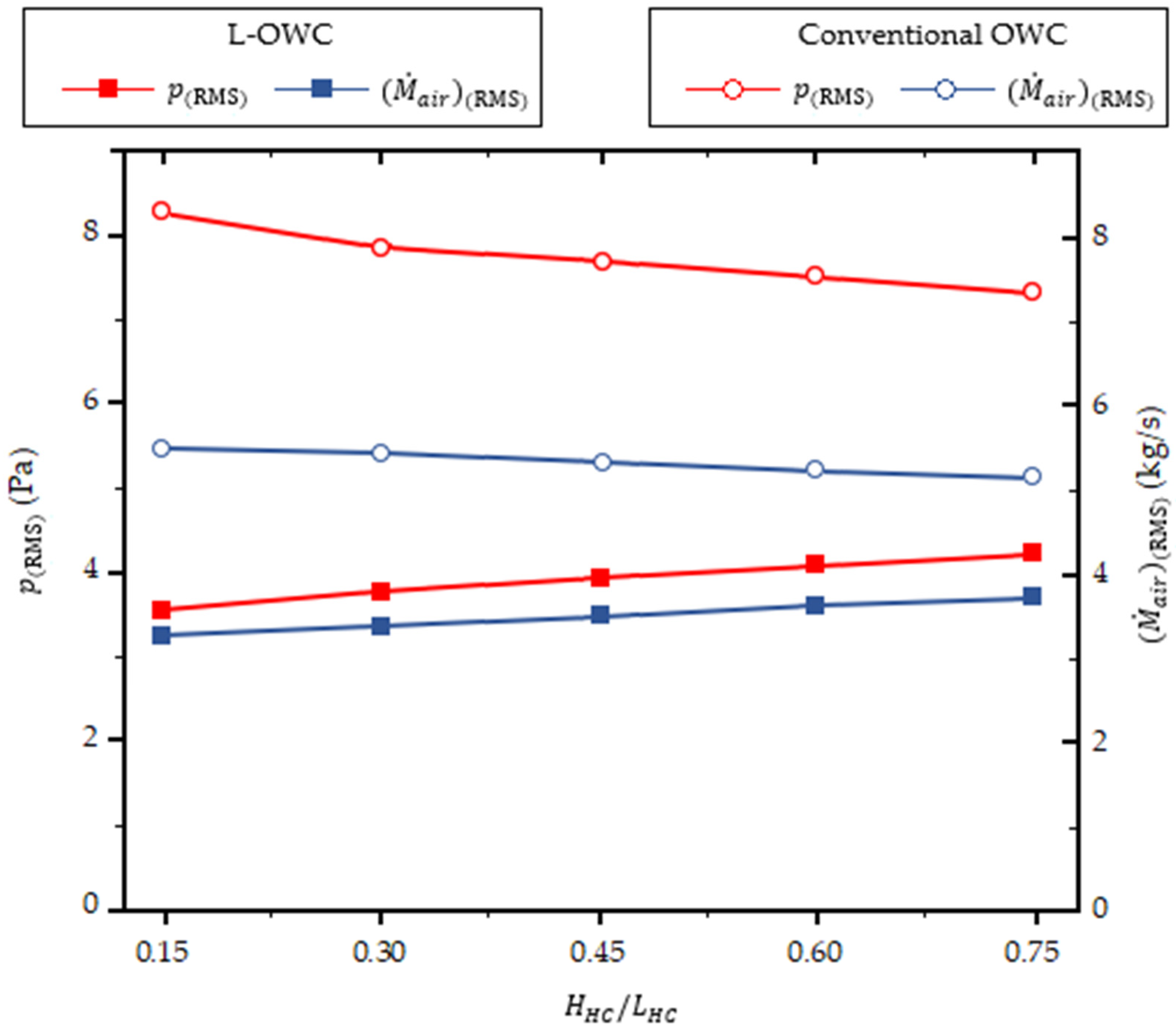
As shown in Figure 17, the curves illustrating the effect of the H H C / L H C variation on p ( R M S ) (in red) and on ( M ˙ a i r ) ( R M S ) (in blue) behave differently depending on the OWC model, contrary to the trend observed in the previous section. Specifically, the curves exhibit an increasing trend for the L-OWC and a decreasing trend for the conventional OWC. For both models, ( M ˙ a i r ) ( R M S ) remained lower than p ( R M S ) across all analyzed geometries, though the metrics were closer for the L-OWC than for the conventional OWC.
As before, the evaluated degree of freedom had a greater influence on p ( R M S ) than on ( M ˙ a i r ) ( R M S ) ; however, smaller variations than previously observed, indicating lower geometric sensitivity. Quantitatively, variations of 19% ( p ( R M S ) ) and 14% ( ( M ˙ a i r ) ( R M S ) ) were recorded for the L-OWC, while the conventional OWC showed variations of 12% ( p ( R M S ) ) and 6% ( ( M ˙ a i r ) ( R M S ) ).
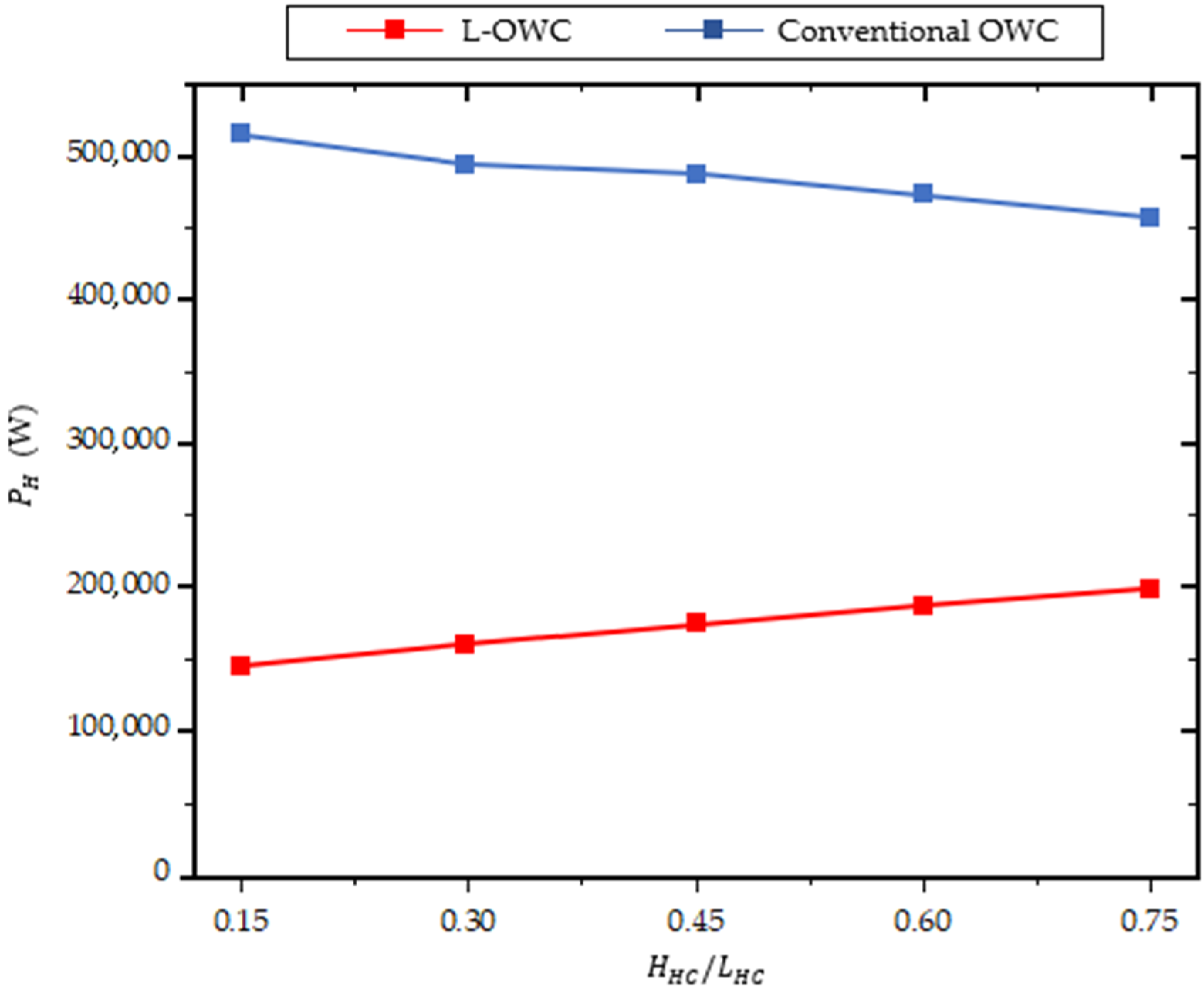
Continuing the analysis, Figure 18 presents the effect of the H H C / L H C variation on the available hydropneumatic power ( P H ) for each evaluated geometry.
Similarly to p ( R M S ) and ( M ˙ a i r ) ( R M S ) , Figure 18 shows that the curves describing the influence of H H C / L H C on P H present an increasing trend for the L-OWC (in red), but a decreasing one for the conventional OWC (in blue). These results align with the findings of Maciel et al. [18] and Mocellin et al. [19], who evaluated this parameter for a conventional OWC and concluded that lower H H C / L H C ratios favored the device’s performance. These results are also consistent with López et al. [20], who concluded that geometries with higher hydropneumatic chambers (and consequently, higher H H C / L H C ratios) improve the performance of the L-OWC converter.
Table 5 provides a quantitative assessment, presenting the P H obtained for each geometry, along with the relative differences ( D R ) between them and the differences between the converter models ( D M ), using the L-OWC as reference.
Table 5 confirms the divergent response of the two OWC models seen in Figure 18. Both P H (increasing for L-OWC, decreasing for conventional) and D R variations differ between models. In both cases, the greatest variation was recorded for H H C / L H C = 1.18 and 1.37. However, for the L-OWC, the D R values progressively decrease for ratios 1.56 H H C / L H C 1.94 . In contrast, for the conventional OWC, the D R variations increase over this range. This opposing trend underscores the distinct hydrodynamic mechanisms of each converter model.
As in Section 4.2, the L-OWC model exhibited greater geometric sensitivity, with D R values surpassing the conventional OWC across all geometric configurations. However, the influence of H H C / L H C on P H is markedly lower than that for H I / L I and S F W . The L-OWC’s P H increased by 37% from the worst-performing, H H C / L H C = 1.18 , to the optimal configuration, H H C / L H C o o = 1.94 . Conversely, the conventional OWC’s P H decreased by 11% from its optimal, H H C / L H C o o = 1.18 , to the worst geometry, H H C / L H C = 1.94 .
Despite the improving performance of the L-OWC with increasing H H C / L H C , the conventional OWC maintains a substantial advantage across all configurations. Although D M decreases from 259.58% to 132.31% as H H C / L H C increases, the conventional OWC consistently delivers more than double the P H of its L-OWC counterpart. Thus, higher H H C / L H C ratios only partially mitigate, but do not eliminate, its inherent performance disadvantage in comparison to the conventional OWC.
The finding that the conventional OWC consistently outperforms the L-OWC under realistic irregular waves contradicts López et al. [20], who identified the L-OWC as the best-performing design under regular waves. As noted, the L-OWC presents an easy tunability to resonate the target wave period [20], which is harder to accomplish under an irregular wave spectrum. This discrepancy highlights a critical point: the optimal geometry and relative performance of WECs are intrinsically linked to the wave climate. This interpretation is strongly supported by Mocellin et al. [19,75], who compared regular and irregular wave incidence on a full-scale conventional OWC and found that regular waves overestimate the converter’s performance. In addition, the geometry that performed best under irregular waves was the worst under regular waves [19,75]. Therefore, the present results emphasize that evaluations under realistic sea states are crucial for reliable device design, as they prevent over-optimization for idealized conditions that do not represent actual operational environments.

4.4. Linear Regression and Performance Projection Analysis

To further investigate this trend, a linear regression analysis was performed on the data from Table 5. The resulting trend lines for the L-OWC ( P H , L ) and the conventional OWC ( P H , C ) are given, respectively, by the following:
P H , L = 67,500   ( H H C / L H C ) + 60,000 ,
P H , C = 73,000   ( H H C / L H C ) + 610,760 ,
This projects a potential convergence of P H outputs at H H C / L H C = 3.92 ( H H C = 21.08 and L H C = 5.63 ), where P H , L = P H , C = 324,600 W. Although it is outside the constructal design range in the present study, this ratio respects the restriction defined by Equation (27), since only the minimum height of the chamber was established, not the maximum. In this configuration, the top of the chamber is positioned 10.54 m above the WLR. This value is close to that of the worst geometries evaluated in Maciel et al. [18] and Mocellin et al. [19], which corresponded to the geometry of the OWC device installed on Pico Island, whose top is 10.00 m above the WLR.
To verify this analytical prediction, the corresponding geometries were simulated under the same sea state previously addressed. The results found were: P H = 281,642.41 W, for the L-OWC; and P H = 332,142.48 W, for the conventional model. The L-OWC underperformed predictions, suggesting a limited power generation potential with greater stabilization than implied by linear trends. In contrast, the conventional OWC exhibited more predictable behavior, achieving closer alignment with projected values, which reinforces its reliability and superior performance as a WEC.

4.5. OWC Hydrodynamic Behavior Analysis

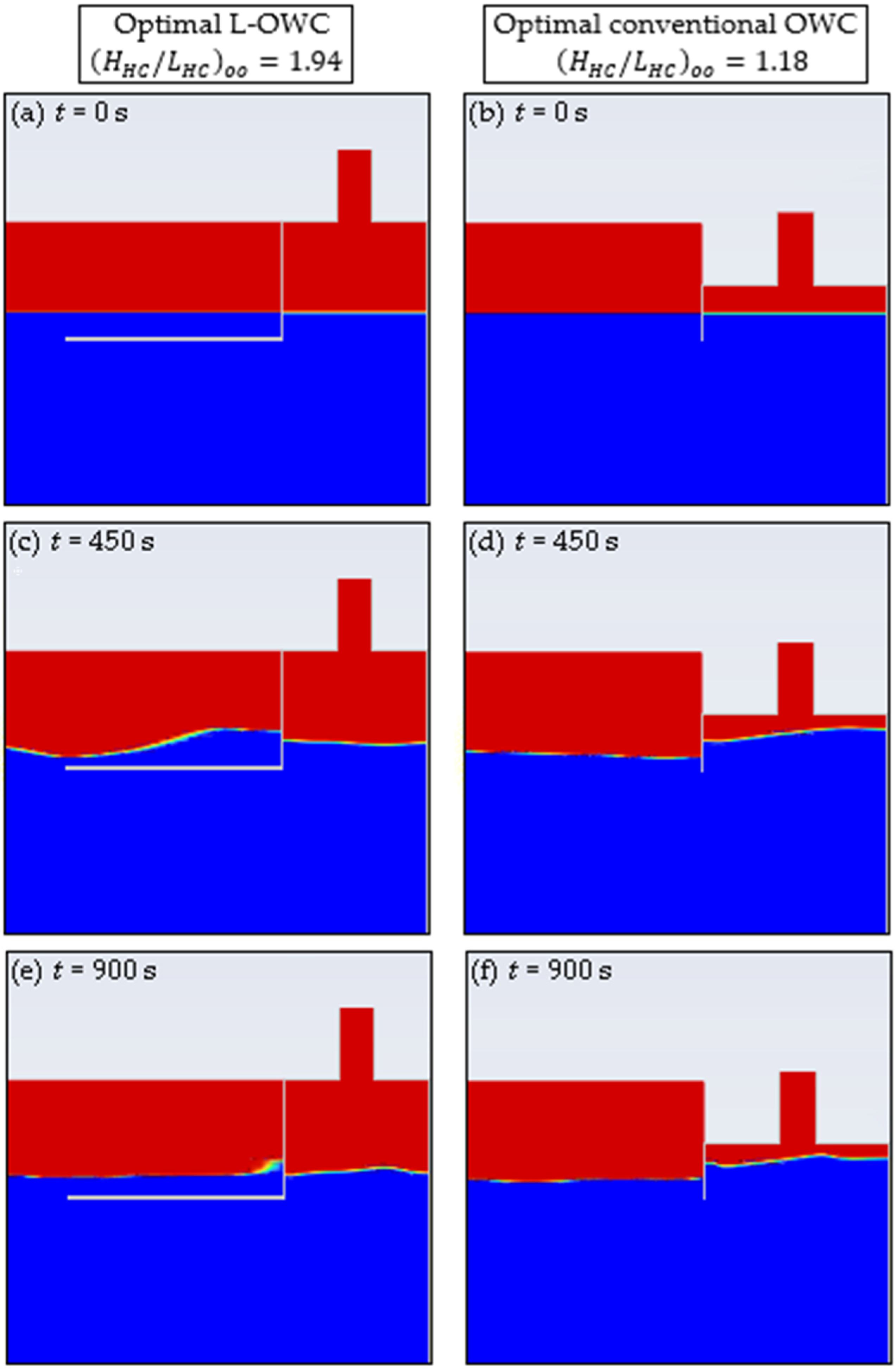
Finally, to provide a visual representation of the OWC converters’ hydrodynamic behavior, Figure 19 presents the phase topology for the optimal-case scenario of each model. As previously determined, the optimal geometry for each model lies at the extremes of the geometric range evaluated: H H C / L H C o o = 1.94 with H I / L I o = 0.75 for the L-OWC, as shown in Figure 19a,c,e; and H H C / L H C o o = 1.18 with S F W o = 9.00 m for the conventional OWC, as shown in Figure 19b,d,f. The water and air phases are again represented in blue and red, respectively. Figure 19 illustrates the interaction of realistic irregular waves with the aforementioned geometries at t = 0 s, 450 s, and 900 s.
Figure 19a,b show the initial condition ( t = 0 s), with no wave action inside the chambers due to fluid rest. In Figure 19c,d, corresponding to the mid-simulation point ( t = 450 s), a wave crest is seen interacting with the converters. However, Figure 19c shows the L-OWC’s water intake duct impairing performance, as the internal water level remains nearly unchanged while waves pass above the duct. In contrast, Figure 19d shows a significant rise of the water column inside the conventional OWC chamber compared to the external level.
In Figure 19e,f, corresponding to the final simulation instant ( t = 900 s), oscillatory motion occurs in both chambers but is less pronounced in the L-OWC. Once again, it is confirmed that the conventional model facilitates the access of incident waves into the hydropneumatic chamber, demonstrating its superior efficiency under the same realistic irregular wave conditions. In other words, the difference in the recorded P H magnitudes were reflected in the hydrodynamic behavior illustrated in Figure 19.

5. Conclusions

This paper analyzed geometric variations in two distinct OWC models under realistic irregular waves, which reproduce the coastal conditions off Rio Grande, southern Brazil. The target sea state was numerically simulated through the WaveMIMO methodology [57] implemented in the ANSYS Fluent software. The numerical model used was verified using NMAE and NRMSE metrics, complemented by a visual comparison between the generated waves and the reference time series of irregular free-surface elevations.
The OWC models considered were the L-shaped design (L-OWC) and the conventional OWC. For each geometry adopted for the L-OWC, a conventional counterpart was defined by omitting the water intake duct. The constructal design method first investigated the ratio between the height and length of the water intake duct ( H I / L I ) for the L-OWC and the submersion of the frontal wall ( S F W ) for the conventional OWC. The optimal geometries identified were H I / L I o = 0.75 for the L-OWC and S F W o = 9.00 m, its counterpart, for the conventional model. This confirms that positioning the chamber intake closer to the free-surface enhances hydrodynamic performance for converting the incident wave energy, agreeing with Letzow et al. [16].
Subsequently, the constructal design assessed the influence of the ratio between the height and length of the hydropneumatic chamber ( H H C / L H C ) on the optimal geometries. In this case, the geometric variation affected each model differently. For the L-OWC, geometries with higher H H C / L H C ratios yielded higher hydropneumatic power available ( P H ), with the optimal configuration being H H C / L H C o o = 1.94 , consistent with López et al. [20]. In contrast, the optimal performance for the conventional OWC was achieved with H H C / L H C o o = 1.18 , demonstrating an inversely proportional behavior between H H C / L H C and the P H magnitude, which aligns with Maciel et al. [18] and Mocellin et al. [19].
By comparing the optimal and worst geometric configurations for each model, it is evident that the constructal design improved converter performance by 35.76 times for the L-OWC and 3.78 times for the conventional OWC. Despite this significant optimization, the conventional model still performs 2.61 times better than the L-OWC. A comparison of converter performance confirmed that the L-OWC yielded lower P H across all geometric configurations. These results contradict López et al. [20], who found the L-OWC superior under regular waves, a divergence that can be attributed to methodological differences, as the use of realistic irregular waves and full-scale analysis.
The practical significance of these findings is twofold. First, for regions with wave climates similar to the one studied here, the conventional OWC design is a more reliable and efficient choice, potentially leading to higher energy yield and better return on investment for future projects. Second, the results demonstrate that geometric optimization must be conducted under realistic wave conditions. This outcome provides clear research direction: rather than abandoning the L-OWC concept, future work should investigate why its performance was inferior and how its design principles can be refined.
Therefore, future studies should focus on the influence of the device’s air duct geometry, a parameter not addressed in the present paper; this is an important aspect for optimal design, since the dimensions of the air duct directly impact the P H obtained in both OWC models. Additionally, different values for the hydropneumatic chamber area ( A H C ) and water intake duct area ( A I ) should be considered to analyze if the devices are properly dimensioned for the specific sea state and regional geographical conditions. Furthermore, analyzing different sea states is suggested to evaluate the robustness and generalizability of the findings reported here.

Author Contributions

Conceptualization, M.d.S.P., A.P.G.M., B.N.M. and L.A.I.; methodology, M.d.S.P., A.P.G.M., L.A.O.R., E.D.d.S., B.N.M. and L.A.I.; software, M.d.S.P., L.A.O.R., E.D.d.S., B.N.M. and L.A.I.; validation, M.d.S.P., A.P.G.M., B.N.M. and L.A.I.; formal analysis, M.d.S.P., A.P.G.M., B.N.M. and L.A.I.; investigation, M.d.S.P., A.P.G.M., B.N.M. and L.A.I.; resources, L.A.O.R., E.D.d.S., B.N.M. and L.A.I.; data curation, M.d.S.P. and A.P.G.M.; writing—original draft preparation, M.d.S.P. and A.P.G.M.; writing—review and editing, M.d.S.P., A.P.G.M., B.N.M. and L.A.I.; visualization, L.A.O.R. and E.D.d.S.; supervision, B.N.M. and L.A.I.; project administration, B.N.M. and L.A.I.; funding acquisition, L.A.O.R., E.D.d.S., B.N.M. and L.A.I. All authors have read and agreed to the published version of the manuscript.

Funding

This research was funded by Brazilian Coordination for the Improvement of Higher Education Personnel—CAPES (Finance Code 001), Brazilian National Council for Scientific and Technological Development—CNPq (Processes: 307791/2019-0, 308396/2021-9, 309648/2021-1, and 403408/2023-7), and for the institutional research assistance program for newly hired professors at the Federal University of Rio Grande do Sul—UFRGS.

Data Availability Statement

The original contributions presented in this study are included in the article. Further inquiries can be directed to the corresponding author.

Acknowledgments

M.d.S.P. and A.P.G.M. thank CAPES and CNPq for their doctoral scholarships. L.A.O. Rocha, E. D. dos Santos, and L.A. Isoldi thank CNPq for research grants and financial support.

Conflicts of Interest

The authors declare no conflicts of interest. The funders had no role in the design of the study, in the collection, analyses, or interpretation of data, or in the writing of the manuscript, as well as in the decision to publish the results.

References

  1. Sayed, E.T.; Olabi, A.G.; Alami, A.H.; Radwan, A.; Mdallal, A.; Rezk, A.; Abdelkareem, M.A. Renewable Energy and Energy Storage Systems. Energies 2023, 16, 1415. [Google Scholar] [CrossRef]
  2. Narula, K. The Maritime Dimension of Sustainable Energy Security; Springer Nature: Singapore, 2018. [Google Scholar]
  3. Pecher, A.; Kofoed, J.P. Handbook of Ocean Wave Energy; Springer Open: Cham, Switzerland, 2017. [Google Scholar]
  4. Shadman, M.; Silva, C.; Faller, D.; Wu, Z.; de Freitas Assad, L.P.; Landau, L.; Levi, C.; Estefen, S.F. Ocean Renewable Energy Potential, Technology, and Deployments: A Case Study of Brazil. Energies 2019, 12, 3658. [Google Scholar] [CrossRef]
  5. Ahn, S.H.; Haas, K.A.; Neary, V.S. Wave Energy Resource Characterization and Assessment for Coastal Waters of the United States. Appl. Energy 2020, 267, 114922. [Google Scholar] [CrossRef]
  6. Amarouche, K.; Akpimar, A.; Bachari, N.E.I.; Houma, F. Wave energy resource assessment along the Algerian coast based on 39-year wave hindcast. Renew. Energy 2020, 152, 840–860. [Google Scholar] [CrossRef]
  7. Sergent, P.; Baudry, V.; Bonviller, A.D.; Michard, B.; Dugor, J. Numerical Assessment of Onshore Wave Energy in France: Wave Energy, Conversion and Cost. J. Mar. Sci. Eng. 2020, 8, 947. [Google Scholar] [CrossRef]
  8. Patel, R.P.; Nagababu, G.; Kachhwaha, S.S.; Arun Kumar, S.V.V.; Seemanth, M. Combined Wind and Wave Resource Assessment and Energy Extraction along the Indian Coast. Renew. Energy 2022, 195, 931–945. [Google Scholar] [CrossRef]
  9. Liu, J.; Meucci, A.; Liu, Q.; Babanin, A.V.; Ierodiaconou, D.; Xu, X.; Young, I.R. A High-Resolution Wave Energy Assessment of South-East Australia Based on a 40-Year Hindcast. Renew. Energy 2023, 215, 118943. [Google Scholar] [CrossRef]
  10. Ye, Z.; Ma, X.; Yang, N.; Cui, L. Assessment of Wave Energy Resources in the Pearl River Estuary of China. Desalin. Water Treat. 2023, 298, 222–232. [Google Scholar] [CrossRef]
  11. Falcão, A.F.O.; Henriques, J.C.C. Oscillating-water-column wave energy converters and air turbines: A review. Renew. Energy 2016, 85, 1391–1424. [Google Scholar] [CrossRef]
  12. IEA; OES. Annual Report: An Overview of Ocean Energy Activities in 2021; IEA: Paris, France, 2022. [Google Scholar]
  13. Bejan, A. Shape and Structure, from Engineering to Nature; Cambridge University Press: Cambridge, UK, 2000. [Google Scholar]
  14. Bejan, A.; Lorente, S. Constructal Theory of generation of configuration in nature and engineering. J. Appl. Phys. 2006, 100, 5. [Google Scholar] [CrossRef]
  15. Bejan, A.; Lorente, S. Design with Constructal Theory; Wiley: Hoboken, NJ, USA, 2008. [Google Scholar]
  16. Letzow, M.; Lorenzini, G.; Barbosa, D.V.E.; Hübner, R.G.; Rocha, L.A.O.; Gomes, M.N.; Isoldi, L.A.; dos Santos, E.D. Numerical Analysis of the Influence of Geometry on a Large Scale Onshore Oscillating Water Column Device with Associated Seabed Ramp. Int. J. Des. Nat. Ecodyn. 2020, 15, 873–884. [Google Scholar] [CrossRef]
  17. Gomes, M.N.; Salvador, H.; Magno, F.; Rodrigues, A.A.; Santos, E.D.; Isoldi, L.A.; Rocha, L.A.O. Constructal Design Applied to Geometric Shapes Analysis of Wave Energy Converters. Defect Diffus. Forum 2021, 407, 147–160. [Google Scholar] [CrossRef]
  18. Maciel, R.P.; Oleinik, P.H.; Dos Santos, E.D.; Rocha, L.A.O.; Machado, B.N.; Gomes, M.d.N.; Isoldi, L.A. Constructal Design Applied to an Oscillating Water Column Wave Energy Converter Device under Realistic Sea State Conditions. J. Mar. Sci. Eng. 2023, 11, 2174. [Google Scholar] [CrossRef]
  19. Mocellin, A.P.G.; Maciel, R.P.; Oleinik, P.H.; dos Santos, E.D.; Rocha, L.A.O.; Ziebell, J.S.; Isoldi, L.A.; Machado, B.N. Geometrical Analysis of an Oscillating Water Column Converter Device Considering Realistic Irregular Wave Generation with Bathymetry. J. Exp. Theor. Anal. 2023, 1, 24–43. [Google Scholar] [CrossRef]
  20. López, I.; Carballo, R.; Fouz, D.M.; Iglesias, G. Design Selection and Geometry in OWC Wave Energy Converters for Performance. Energies 2021, 14, 1707. [Google Scholar] [CrossRef]
  21. Supriyanto, E.; Rohman, A.T.; Malakani, A.I.; Ikhsanudin, I.Y.; Wibowo, A.; Suryantoro, M.T.; Musthofa, A.; Soewono, R.T.; Helios, M.P.; Nugraha, A.D.; et al. Experimental Study of Flow Characteristics in Hydrodynamic and Aerodynamic L-Shaped and U-Shaped Oscillating Water Column Chambers. Results Eng. 2025, 25, 103762. [Google Scholar] [CrossRef]
  22. Muduli, R.; Patil, S.B.; Karmakar, D. Hydrodynamic Performance of Pile Restrained U-Shaped OWC Device Using Boundary Element Method. Eng. Anal. Bound. Elem. 2024, 158, 139–159. [Google Scholar] [CrossRef]
  23. Muduli, R.; Karmakar, D. Hydrodynamic Analysis of Arrays of Integrated U-Shaped OWC Device and Π-Breakwater. Ocean Eng. 2025, 334, 121602. [Google Scholar] [CrossRef]
  24. Samak, M.M.; Elgamal, H.; Elmekawy, A.M.N. The Contribution of L-Shaped Front Wall in the Improvement of the Oscillating Water Column Wave Energy Converter Performance. Energy 2021, 226, 120421. [Google Scholar] [CrossRef]
  25. Ulm, N.; Huang, Z.; Cross, P. Experimental Study of a Fixed OWC-Type Wave Energy Converter with a Heave Plate and V-Shaped Channels for Intermediate-Water-Depth Applications. Energies 2023, 16, 5988. [Google Scholar] [CrossRef]
  26. Yang, C.; Wan, C.; Bai, X.; Xu, T.; Zhao, L.; Chen, H.; Johanning, L.; Baldock, T.E. Numerical Investigation on the Hydrodynamic and Conversion Performance of a Dual Cylindrical OWC Integrated into a Caisson-Type Breakwater. Ocean Eng. 2024, 305, 117991. [Google Scholar] [CrossRef]
  27. Lyu, X.; Mi, C.; Collions, S.; Chen, W.; Yang, D.; Huang, L. Design and Experimental Tests for Novel Shapes of Floating OWC Wave Energy Converters with the Additional Purpose of Breakwater. Ocean Eng. 2025, 328, 121031. [Google Scholar] [CrossRef]
  28. Fu, L.; Ning, D.; Wang, R.; Mayon, R. Numerical and Experimental Study on Hydrodynamic Performance of a Land-Based Dual-Chamber OWC Device Under Irregular Waves. Renew. Sustain. Energy Rev. 2025, 207, 114895. [Google Scholar] [CrossRef]
  29. Spanò, A.S.; Malara, G.; Arena, F. Multi-Chamber Cylindrical OWC: Analytical Model and Numerical Results. Appl. Ocean Res. 2025, 161, 104695. [Google Scholar] [CrossRef]
  30. Sheng, W. An Experimental Study for Improving Performance of a Cylindrical OWC WEC with a Heave Plate. Renew. Sustain. Energy Rev. 2025, 214, 115517. [Google Scholar] [CrossRef]
  31. Peng, C.; Ning, D.; Zhou, F.; Chen, L. Hydrodynamic Performance of a Leeward Inlet OWC (LI-OWC) Device for Long-Wave Attenuation and Power Generation. Renew. Energy 2026, 256, 124185. [Google Scholar] [CrossRef]
  32. Liu, Z.; Xu, C.; Shi, H.; Qu, N. Wave-flume tests of a model-scaled OWC chamber-turbine system under irregular wave conditions. Appl. Ocean Res. 2020, 99, 102141. [Google Scholar] [CrossRef]
  33. Moretti, G.; Malara, G.; Scialò, A.; Daniele, L.; Romolo, A.; Vertechy, R.; Fontana, M.; Arena, F. Modelling and field testing of a breakwater-integrated U-OWC wave energy converter with dielectric elastomer generator. Renew. Energy 2020, 146, 628–642. [Google Scholar] [CrossRef]
  34. Singh, U.; Abdussamie, N.; Hore, J. Hydrodynamic performance of a floating offshore OWC wave energy converter: An experimental study. Renew. Sustain. Energy Rev. 2020, 117, 109501. [Google Scholar] [CrossRef]
  35. Zhou, Y.; Ning, D.; Shi, W.; Johanning, L.; Liang, D. Hydrodynamic investigation on an OWC wave energy converter integrated into an offshore wind turbine monopile. Coast. Eng. 2020, 162, 103731. [Google Scholar] [CrossRef]
  36. Zhao, X.; Zhang, L.; Li, M.; Johanning, L. Experimental investigation on the hydrodynamic performance of a multi-chamber OWC-breakwater. Renew. Sustain. Energy Rev. 2021, 150, 111512. [Google Scholar] [CrossRef]
  37. Yu, T.; Guo, Q.; Shi, H.; Li, T.; Meng, X.; He, S.; Li, P. Experimental investigation of a novel OWC wave energy converter. Ocean Eng. 2022, 257, 111567. [Google Scholar] [CrossRef]
  38. Çelik, A. An experimental investigation into the effects of front wall geometry on OWC performance for various levels of applied power take off dampings. Ocean Eng. 2022, 248, 110761. [Google Scholar] [CrossRef]
  39. Zhou, Y.; Ning, D.; Chen, L.; Mayon, R.; Zhang, C. Experimental investigation on an OWC wave energy converter integrated into a floating offshore wind turbine. Energy Convers. Manag. 2023, 276, 116546. [Google Scholar] [CrossRef]
  40. He, F.; Pan, J.; Lin, Y.; Song, M.; Zheng, S. Laboratory Modelling of Nonlinear Power Take-Off Damping and Its Effects on an Offshore Stationary Cylindrical OWC Device. Energy 2024, 296, 131217. [Google Scholar] [CrossRef]
  41. Harikrishnan, T.A.; Manu; Rao, S.S. Experimental Investigation on L-Oscillating Water Column Wave Energy Converter Integrated with Floating Cylindrical Breakwater. Ocean Eng. 2025, 315, 119806. [Google Scholar] [CrossRef]
  42. Xu, C.; Yang, J.; Yao, Y.; Zuo, J.; Wen, Q.; Li, J. Performance of a Closely-Spaced Array of Circular U-OWC Devices for Wave Power Extraction and Breakwater Applications. Ocean Eng. 2025, 324, 120654. [Google Scholar] [CrossRef]
  43. Zhao, M.; Palmer, H.; Dhamelia, V.; Wu, H. Three-Dimensional Numerical Simulation of a Cylindrical Oscillating Water Column (OWC) Device Placed in a Wave Flume. Renew. Energy 2024, 231, 120930. [Google Scholar] [CrossRef]
  44. Didier, E.; Teixeira, P.R.F. Performance of an L-Shaped Duct OWC-WEC Integrated into Vertical and Sloped Breakwaters by Using a Free-Surface RANS-Based Numerical Model. Fluids 2025, 10, 114. [Google Scholar] [CrossRef]
  45. Marta, A.S.D.; Deendarlianto; Kongko, W.; Aprijanto; Rohman, A.T.; Wibowo, A.; Ikhsanudin, I.Y. The Influence of Wave Characteristics, Tides, and Installation Conditions of L-Shaped OWC Wave Energy Converter on Energy Absorption Capability. Evergreen 2024, 11, 2607–2617. [Google Scholar] [CrossRef]
  46. Gurnari, L.; Filianoti, P.G.F.; Camporeale, S.M. Fluid Dynamics Inside a U-Shaped Oscillating Water Column (OWC): 1D vs. 2D CFD Model. Renew. Energy 2022, 193, 687–705. [Google Scholar] [CrossRef]
  47. Kim, J.-S.; Nam, B.W.; Kim, K.-H.; Park, S.; Shin, S.H.; Hong, K. A Numerical Study on Hydrodynamic Performance of an Inclined OWC Wave Energy Converter with Nonlinear Turbine–Chamber Interaction based on 3D Potential Flow. J. Mar. Sci. Eng. 2020, 8, 176. [Google Scholar] [CrossRef]
  48. Han, M.M.; Wang, C.M. Coupled analytical-numerical approach for determining hydrodynamic responses of breakwater with multiple OWCs. Mar. Struct. 2021, 80, 103097. [Google Scholar] [CrossRef]
  49. Kim, J.-S.; Kim, K.-H.; Park, J.; Park, S.; Shin, S.H. A Numerical Study on Hydrodynamic Energy Conversions of OWC-WEC with the Linear Decomposition Method under Irregular Waves. Energies 2021, 14, 1522. [Google Scholar] [CrossRef]
  50. Pols, A.; Gubesch, E.; Abdussamie, N.; Penesis, I.; Chin, C. Mooring Analysis of a Floating OWC Wave Energy Converter. J. Mar. Sci. Eng. 2021, 9, 228. [Google Scholar] [CrossRef]
  51. Cong, P.; Teng, B.; Liu, Y.; Ning, D. A numerical approach for hydrodynamic performance evaluation of multi-degree-of-freedom floating oscillating water column (OWC) devices. J. Fluids Struct. 2022, 114, 103730. [Google Scholar] [CrossRef]
  52. Gang, A.; Guo, B.; Hu, Z.; Hu, R. Performance analysis of a coast–OWC wave energy converter integrated system. App. Energy 2022, 311, 118605. [Google Scholar] [CrossRef]
  53. Qu, M.; Yu, D.; Xu, Z.; Gao, Z. The effect of the elliptical front wall on energy conversion performance of the offshore OWC chamber: A numerical study. Energy 2022, 255, 124428. [Google Scholar] [CrossRef]
  54. Cannata, G.; Simone, M.; Gallerano, F. Numerical Investigation into the Performance of an OWC Device under Regular and Irregular Waves. J. Mar. Sci. Eng. 2023, 11, 735. [Google Scholar] [CrossRef]
  55. Naik, N.; Gayathri, R.; Behera, H.; Tsai, C.C. Wave power extraction by a dual OWC chambers over an undulated bottom. Renew. Energy 2023, 216, 119026. [Google Scholar] [CrossRef]
  56. Qu, M.; Yu, D.; Li, Y.; Gao, Z. Effect of relative chamber width on energy conversion and mechanical characteristics of the offshore OWC device: A numerical study. Energy 2023, 275, 127372. [Google Scholar] [CrossRef]
  57. Machado, B.N.; Oleinik, P.H.; Kirinus, E.P.; Dos Santos, E.D.; Rocha, L.A.O.; Gomes, M.d.N.; Conde, J.M.P.; Isoldi, L.A. WaveMIMO Methodology: Numerical Wave Generation of a Realistic Sea State. J. Appl. Comput. Mech. 2021, 7, 2129–2148. [Google Scholar] [CrossRef]
  58. Paiva, M.d.S.; Mocellin, A.P.G.; Oleinik, P.H.; dos Santos, E.D.; Rocha, L.A.O.; Isoldi, L.A.; Machado, B.N. Theoretical Recommendations and Validation for the Generation of Realistic Irregular Waves Through the WaveMIMO Methodology. Processes 2025, 13, 1395. [Google Scholar] [CrossRef]
  59. Hirt, C.W.; Nichols, B.D. Volume of fluid (VoF) method for the dynamics of free boundaries. J. Comput. Phys. 1981, 39, 201–225. [Google Scholar] [CrossRef]
  60. Versteeg, H.K.; Malalasekera, W. An Introduction to Computational Fluid Dynamics—The Finite Volume Method; Pearson Education Limited: London, UK, 2007. [Google Scholar]
  61. Srinivasan, V.; Salazar, A.J.; Saito, K. Modeling the disintegration of modulated liquid jets using volume-of-fluid (VoF) methodology. Appl. Math. Model. 2011, 35, 3710–3730. [Google Scholar] [CrossRef]
  62. Park, J.C.; Kim, M.H.; Miyata, H.; Chun, H.H. Fully nonlinear numerical wave tank (NWT) simulations and wave run-up prediction around 3-D structures. Ocean Eng. 2003, 30, 1969–1996. [Google Scholar] [CrossRef]
  63. Foyhirun, C.; Kositgittiwong, D.; Ekkawatpanit, C. Wave Energy Potential and Simulation on the Andaman Sea Coast of Thailand. Sustainability 2020, 12, 3657. [Google Scholar] [CrossRef]
  64. Lisboa, R.C.; Teixeira, P.R.; Didier, E. Regular and Irregular wave propagation analysis in a flume with numerical beach using a Navier-stokes based model. Defect Diffus. Forum 2017, 372, 81–90. [Google Scholar] [CrossRef]
  65. Awk, T. TOMAWAC User Manual, Version 7.2. 7.2.3; The Telemac-Mascaret Consortium: Chatou, France, 2017.
  66. Benoit, M.; Marcos, F.; Becq, F. TOMAWAC: Software for Sea State Modelling on Unstructured Grids over Oceans and Coastal Seas, Release 6.1; EDF R&D: Paris, France, 2011. [Google Scholar]
  67. Oleinik, P.H.; Maciel, R.P.; dos Santos, E.D.; Rocha, L.A.O.; Machado, B.N.; Isoldi, L.A. Numerical method for the characterization of sea states using realistic irregular waves on computational fluid dynamics simulations for application on wave energy converters. Sustain. Energy Technol. Assess. 2025, 73, 104093. [Google Scholar] [CrossRef]
  68. Holthuijsen, L.H. Waves in Oceanic and Coastal Waters; Cambridge University Press: Cambridge, UK, 2007. [Google Scholar]
  69. McCormick, M.E. Ocean Engineering Mechanics: With Applications; Cambridge University Press: New York, NY, USA, 2010. [Google Scholar]
  70. Cardoso, S.D.; Marques, W.C.; Kirinus, E.d.P.; Stringari, C.E. Levantamento batimétrico usando cartas náuticas. In Proceedings of the 13ª Mostra da Produção Universitária, Rio Grande, Brazil, 14–17 October 2014. (In Portuguese). [Google Scholar]
  71. Chai, T.; Draxler, R.R. Root mean square error (RMSE) or mean absolute error (MAE)? Arguments against avoiding RMSE in the literature. Geosci. Model Dev. 2014, 7, 1247–1250. [Google Scholar] [CrossRef]
  72. Maciel, R.P.; Fragassa, C.; Machado, B.N.; Rocha, L.A.O.; Dos Santos, E.D.; Gomes, M.; Das, N.; Isoldi, L.A. Verification and Validation of a Methodology to Numerically Generate Waves Using Transient Discrete Data as Prescribed Velocity Boundary Condition. J. Mar. Sci. Eng. 2021, 9, 896. [Google Scholar] [CrossRef]
  73. López, I.; Pereiras, B.; Castro, F.; Iglesias, G. Optimisation of Turbine-Induced Damping for an OWC Wave Energy Converter Using a RANS–VOF Numerical Model. Appl. Energy 2014, 127, 105–114. [Google Scholar] [CrossRef]
  74. Windt, C.; Davidson, J.; Ransley, E.J.; Greaves, D.; Jakobsen, M.; Kramer, M.; Ringwood, J.V. Validation of a CFD-Based Numerical Wave Tank Model for the Power Production Assessment of the Wavestar Ocean Wave Energy Converter. Renew. Energy 2020, 146, 2499–2516. [Google Scholar] [CrossRef]
  75. Mocellin, A.P.G.; Paiva, M.d.S.; dos Santos, E.D.; Rocha, L.A.O.; Isoldi, L.A.; Ziebell, J.S.; Machado, B.N. Geometric Evaluation of an Oscillating Water Column Wave Energy Converter Device Using Representative Regular Waves of the Sea State Found in Tramandaí, Brazil. Processes 2024, 12, 2352. [Google Scholar] [CrossRef]
Figure 1. Bivariate histogram of H s and T m .
Processes 13 03942 g001
Figure 2. Computational domain for the numerical model verification.
Processes 13 03942 g002
Figure 3. Discretization applied to the segments in the R2 region.
Processes 13 03942 g003
Figure 4. Illustration of the stretched mesh regions.
Processes 13 03942 g004
Figure 5. Computational domain for the geometric evaluation: (a) L-OWC; (b) conventional OWC.
Processes 13 03942 g005
Figure 6. Spatial discretization focusing on the devices’ region: (a) L-OWC; (b) conventional OWC.
Processes 13 03942 g006
Figure 7. Geometry of the L-OWC device.
Processes 13 03942 g007
Figure 8. Illustration of the H I m a x parameterization.
Processes 13 03942 g008
Figure 9. Geometric configurations of the L-OWC: (a) H I / L I = 0.15 ; (b) H I / L I = 0.75 .
Processes 13 03942 g009
Figure 10. Illustration of the H H C m i n parameterization.
Processes 13 03942 g010
Figure 11. Geometric configurations of the L-OWC: (a) H H C / L H C   = 1.18 ; (b) H H C / L H C = 1.94 .
Processes 13 03942 g011
Figure 12. Geometric configurations of the conventional OWC: (a) S F W = 4.00 m; (b) S F W = 9.00 m.
Processes 13 03942 g012
Figure 13. Qualitative comparison of the realistic irregular waves used for computational model verification: (a) 0   s t 450   s ; (b) 450   s t 900   s .
Processes 13 03942 g013
Figure 14. Physical phenomenon representation at: (a) t = 0 s; (b) t = 900 s.
Processes 13 03942 g014
Figure 15. Results found for p ( R M S ) and M ˙ a i r   ( R M S ) when varying H I / L I and S F W .
Processes 13 03942 g015
Figure 16. Results found for P H when varying H I / L I and S F W .
Processes 13 03942 g016
Figure 17. Results found for p ( R M S ) and M ˙ a i r   ( R M S ) when varying H H C / L H C .
Processes 13 03942 g017
Figure 18. Results found for P H when varying H H C / L H C .
Processes 13 03942 g018
Figure 19. Phase topology of the hydrodynamic behavior of the L-OWC (left) and conventional OWC (right) at: (a,b) t = 0 s; (c,d) t = 450 s; (e,f) t = 900 s.
Processes 13 03942 g019
Table 1. Geometric characteristics of the numerical wave channel.
CharacteristicNomenclatureDimension (m)
Length L C (m)171.06
Top Height h t (m)5.00
Initial Depth h (m)13.29
Final Depth h f (m)10.54
Table 2. Geometric configurations for the analysis of the influence of H I / L I .
H I / L I H I (m) L I (m)
0.154.0027.00
0.204.6523.24
0.255.2020.78
0.305.6918.97
0.356.1517.57
0.406.5716.43
0.456.9715.49
0.507.3514.70
0.557.7114.01
0.608.0513.42
0.658.3812.89
0.708.6912.42
0.759.0012.00
Table 3. Geometric configurations for the analysis of the influence of H H C / L H C .
H H C / L H C H H C (m) L H C (m)
1.1812.1110.26
1.3713.059.53
1.5613.938.93
1.7514.758.43
1.9415.508.00
Table 4. Quantitative comparison of the results from the geometric evaluation of the L-OWC and conventional OWC devices: H I / L I and S F W analysis.
L-OWCConventional OWC D M (%)
H I / L I P H (W) D R (%) S F W (m) P H (W) D R (%)
0.155566.82-4.00137,728.91-2374.11
0.209743.5775.034.65162,106.9417.701563.73
0.2515,850.8962.685.20184,824.2114.011066.02
0.3024,270.7653.125.69205,874.8611.39748.24
0.3534,416.5241.806.15228,040.6910.77562.59
0.4047,361.8937.616.57251,532.3010.30431.09
0.4561,266.0929.366.97276,773.3110.03351.76
0.5076,120.2024.257.35301,839.589.06296.53
0.5593,809.7823.247.71329,260.439.08250.99
0.60114,532.2922.098.05358,373.578.84212.90
0.65139,336.6721.668.38389,747.808.75179.72
0.70166,153.4919.258.69423,569.358.68154.93
0.75199,061.9119.819.00462,446.099.18132.31
Table 5. Quantitative comparison of the results from the geometric evaluation of the L-OWC and conventional OWC devices: H H C / L H C analysis.
H H C / L H C L-OWCConventional OWC D M (%)
P H (W) D R (%) P H (W) D R (%)
1.18144,867.57-520,915.68-259.58
1.37160,092.6610.51500,010.14–4.01212.33
1.56174,352.778.91492,488.45–1.50182.47
1.75187,129.767.33478,402.75–2.86155.65
1.94199,061.916.38462,446.09–3.34132.31
Disclaimer/Publisher’s Note: The statements, opinions and data contained in all publications are solely those of the individual author(s) and contributor(s) and not of MDPI and/or the editor(s). MDPI and/or the editor(s) disclaim responsibility for any injury to people or property resulting from any ideas, methods, instructions or products referred to in the content.