CO2 Poisoning of Solid Oxide Fuel Cell Cathodes: Mechanisms, Solutions, and Progress

 ,
,
Abstract

1. Introduction

2. CO2 Poisoning Mechanism
2.1. Description of the Basic CO2 Poisoning Process

2.2. General Impact Patterns of A-Site Elements on Poisoning
2.3. General Impact Patterns of B-Site Elements on Poisoning
3. Correlation Analysis Between SOFC Operating Parameters and Cathode CO2 Tolerance
4. Strategies for Enhancing Cathode Resistance to CO2 Poisoning
4.1. High-Acidity Cation Doping Strategy (Strategy via High-Acidity Cation Doping)
4.2. Composite SOFC Cathodes with Ceria-Based Electrolytes (SDC/GDC)
4.3. Cathode Fabrication via Infiltration Strategy
4.4. CO2-Induced In Situ Self-Reconstruction of the Cathode Surface
5. Characterization
5.1. Operando Characterizations
5.2. DFT Calculations
6. Conclusions and Perspectives
- (1)
- Developing new low-alkali/alkali-free perovskite cathode materials. The thermodynamic driving force of carbonate formation can be fundamentally avoided by designing and synthesizing high-performance perovskite cathode materials with no alkaline earth metals or low alkaline earth metal content. From this aspect, future research can focus on perovskite structures with rare earth elements (La, Pr, Sm, etc.) as the dominant A-sites.
- (2)
- Systematic screening and optimization of high-acidity/high-valence B-site dopants. High-acidity dopants are the key factor determining CO2 tolerance, and systematic evaluation of the mechanism will promote an in-depth understanding. Establishing the structural–activity relationship between dopants, structural stability, and CO2 tolerance by combining theoretical calculations and high-throughput experiments can open up novel strategies for synthesizing CO2-resistent perovskite.
- (3)
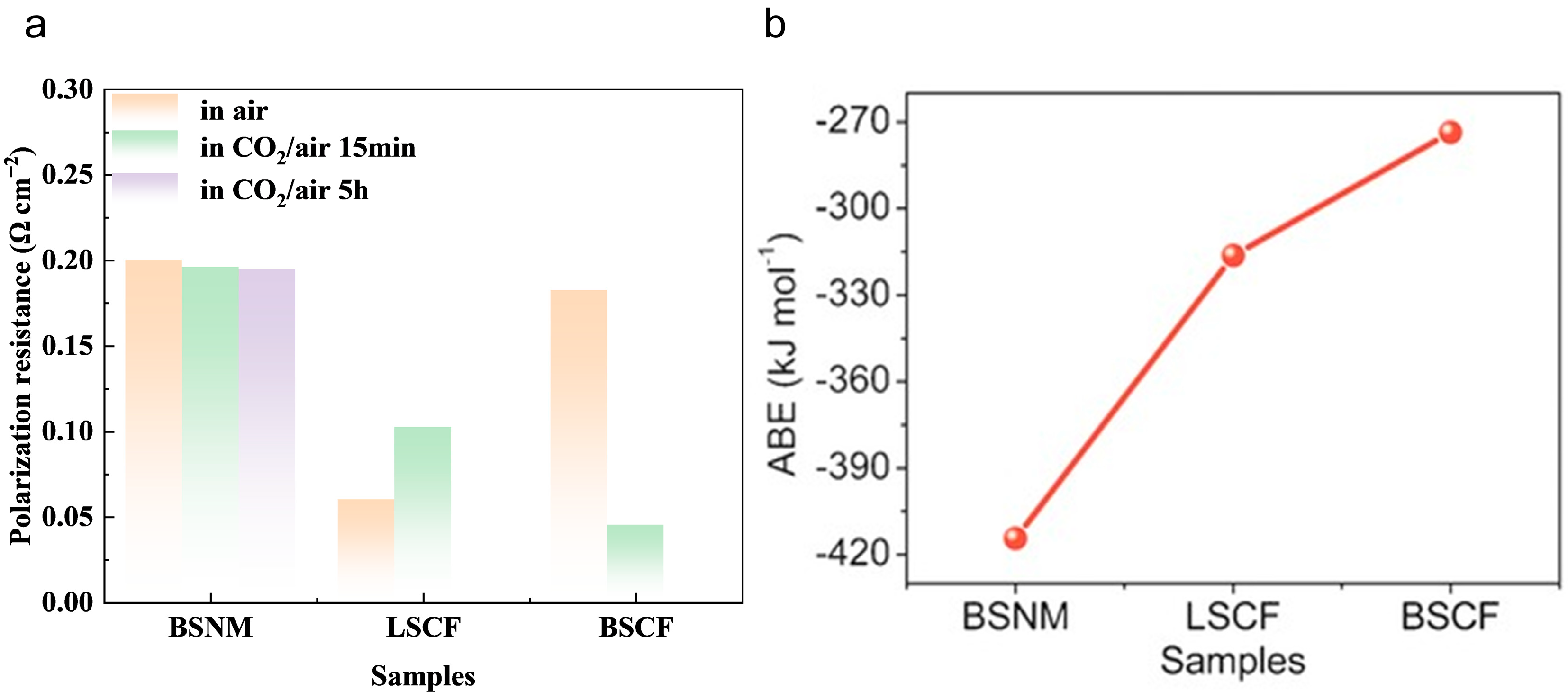
- Construct material systems with high ABE values. The value of ABE can be well used to evaluate the priority of carbonation reactions and thus can reflect the tolerance of the perovskite system to CO2. Priority should be given to developing material systems with high ABE values. For instance, by introducing elements such as Fe, Ti, and Zr to strengthen the B-O bond, the chemical adsorption of CO2 and the formation of carbonates can be inhibited. It is also expected to synthesize materials with high CO2 resistance.
- (4)
- Optimization of composite cathode structures and interface engineering. At present, research on composite cathodes mainly focuses on verifying the effectiveness, while in-depth study is required for the understanding of the microstructure of the composite interface, the uniformity of phase distribution, and long-term stability. In the future, efforts should be made to optimize the composite ratio and preparation process and to study at the microscopic scale how the SDC/GDC electrolyte phase acts as a physical barrier and highly active sites to precisely regulate gas transport and surface reaction pathways, so as to maximize the synergistic effect.
- (5)
- In-depth development of surface modification and in situ reconstruction strategies. Future research should focus on systematically revealing the thermodynamic boundaries and dynamic mechanisms of the reconstruction process. By precisely controlling the atmosphere, temperature, and time, the negative impact of CO2 is explored to be transformed into a controllable and beneficial surface self-assembly and activation process, thereby developing smart cathode materials with adaptive and self-repairing functions.
- (6)
- Innovation of operational strategies and system integration. By regularly introducing CO2-free air or controllable reducing atmosphere into the cathode can potentially restore the cathode activity by promoting carbonate decomposition; therefore, periodic atmosphere purging, temperature modulation, controlled reducing gas treatment, and other methods can be adopted to promote the decomposition and activity recovery of surface carbonates, and the impact of these dynamic strategies on the overall battery life, energy consumption, and system complexity should be systematically evaluated.
- (7)
- Strengthen the guidance of theoretical calculation in the assessment and prediction of the chemical stability of cathode materials. In addition to empirical stability assessment through exposure testing, the computational method based on density functional theory (DFT) provides profound insights into the intrinsic chemical stability of cathode materials from a fundamental perspective and offers a new angle for the traditional experimental trial-and-error approach. Dai et al. [107] demonstrated this by calculating the Gibbs free energy of the interaction between CO2 and Ca-doped LaMnO3 (LCaM) surfaces. Their DFT calculations incorporated vibrational entropy, and the results indicated that the adsorption of CO2 on the LCaM was thermodynamically unfavorable throughout the entire operating temperature range. This theoretical prediction of high stability was eventually confirmed by experimental observations: after long-term exposure to 600 °C CO2 atmosphere, the LCaM phase remained unchanged, and the fuel cell using the LCaM cathode exhibited highly stable output. The good consistency between computational predictions and experimental results indicates that the DFT-based energetics provides a powerful predictive descriptor for screening and designing CO2-resistant cathode materials, thereby laying a more reasonable foundation for material selection beyond the traditional trial-and-error method.
- (8)
- Application of practical operando tools coupled with electrochemical readouts. For CO2 poisoning, near-ambient pressure X-ray photoelectron spectroscopy (NAP/AP-XPS) (C 1s for carbonate/bicarbonate, O 1s for lattice/OH/CO32−, Sr/Ba core levels for A-site segregation) under realistic --T-bias can be paired with synchrotron or lab in-situ XRD to follow phase changes, while operando Raman/DRIFTS tracks ν3(CO32−) and OH features. Complementary online MS (CO2/CO/H2O) together with simultaneous EIS/ASR helps relate surface chemistry to kinetics; occasional 13CO2/18O switching can clarify intermediate lifetimes and exchange routes. In related multi-pollutant contexts, in situ/operando SERS with mapping has already shown promise: for example, Chen et al. [110] detected and located SrCrO4 forming on LSCF surfaces in real time under operating conditions, providing direct evidence of the poisoning pathway. Building on such demonstrations, carefully designed broad-spectrum anti-poisoning strategies (targeting CO2, Cr, H2O) can be evaluated with the same operando toolset. To keep results comparable, we suggest reporting basic test histories (, , T, flow, bias/time, and recovery steps) and presenting simple operating “maps” indicating where carbonate or other surface species persist or decompose. This measured approach should gradually clarify load- and humidity-dependent behavior on Sr/Ba-containing perovskites versus LSM/ceria-type surfaces and provide practical guidance for material choices and operating windows.
Funding
Data Availability Statement
Conflicts of Interest
References
- Adler, S.B. Factors governing oxygen reduction in solid oxide fuel cell cathodes. Chem. Rev. 2004, 104, 4791–4843. [Google Scholar] [CrossRef]
- Cimenti, M.; Hill, J.M. Direct Utilization of Liquid Fuels in SOFC for Portable Applications: Challenges for the Selection of Alternative Anodes. Energies 2009, 2, 377–410. [Google Scholar] [CrossRef]
- Chitgar, N.; Moghimi, M. Design and evaluation of a novel multi-generation system based on SOFC-GT for electricity, fresh water and hydrogen production. Energy 2020, 197, 117162. [Google Scholar] [CrossRef]
- Chen, J.M.P.; Ni, M. Economic analysis of a solid oxide fuel cell cogeneration/trigeneration system for hotels in Hong Kong. Energy Build. 2014, 75, 160–169. [Google Scholar] [CrossRef]
- Steele, B.C.H. Materials for IT-SOFC stacks 35 years: The inevitability of gradualness? Solid State Ion. 2000, 134, 3–20. [Google Scholar] [CrossRef]
- Yang, Z.; Guo, M.; Wang, N.; Ma, C.; Wang, J.; Han, M. A short review of cathode poisoning and corrosion in solid oxide fuel cell. Int. J. Hydrogen Energy 2017, 42, 24948–24959. [Google Scholar] [CrossRef]
- Ivers-Tiffée, E.; Weber, A.; Herbstritt, D. Materials and technologies for SOFC-components. J. Eur. Ceram. Soc. 2001, 21, 1805–1811. [Google Scholar] [CrossRef]
- Malzbender, J.; Steinbrech, R.W. Advanced measurement techniques to characterize thermo-mechanical aspects of solid oxide fuel cells. J. Power Sources 2007, 173, 60–67. [Google Scholar] [CrossRef]
- Noviyanti, A.R.; Malik, Y.T.; Zain, S.M.; Risdiana. Figure-of-Merit Compatibility of Solid Oxide Fuel Cells. Energy Technol. 2023, 11, 2201418. [Google Scholar] [CrossRef]
- Exner, J.; Nazarenus, T.; Kita, J.; Moos, R. Dense Y-doped ion conducting perovskite films of BaZrO3, BaSnO3, and BaCeO3 for SOFC applications produced by powder aerosol deposition at room temperature. Int. J. Hydrogen Energy 2020, 45, 10000–10016. [Google Scholar] [CrossRef]
- Litzelman, S.J.; Lemmon, J.P. The Promise and Challenges of Intermediate Temperature Fuel Cells. ECS Trans. 2015, 68, 39. [Google Scholar] [CrossRef]
- Iwanschitz, B.; Sfeir, J.; Mai, A.; Schütze, M. Degradation of SOFC Anodes upon Redox Cycling: A Comparison Between Ni/YSZ and Ni/CGO. J. Electrochem. Soc. 2010, 157, B269–B278. [Google Scholar] [CrossRef]
- Li, Y.H.; Gemmen, R.; Liu, X.B. Oxygen reduction and transportation mechanisms in solid oxide fuel cell cathodes. J. Power Sources 2010, 195, 3345–3358. [Google Scholar] [CrossRef]
- Li, W.; Sunarso, J.; Yang, Y.; Chen, Y.; Ge, C.; Wang, W.; Guo, Y.; Ran, R.; Zhou, W. Strategies for improving oxygen ionic conducting in perovskite oxides and their practical applications. Energy Rev. 2024, 3, 100085. [Google Scholar] [CrossRef]
- Wang, H.; Cheng, J.; Chen, H.; Li, X.; Liu, D.; Li, X.; Li, W.; Wei, G.; Shen, S.; Chi, B.; et al. Applications of perovskite oxides for oxygen evolution and oxygen reduction reactions in alkaline media. Energy Rev. 2025, 4, 100139. [Google Scholar] [CrossRef]
- Boldrin, P.; Ruiz-Trejo, E.; Mermelstein, J.; Menéndez, J.M.B.; Reina, T.R.; Brandon, N.P. Strategies for Carbon and Sulfur Tolerant Solid Oxide Fuel Cell Materials, Incorporating Lessons from Heterogeneous Catalysis. Chem. Rev. 2016, 116, 13633–13684. [Google Scholar] [CrossRef] [PubMed]
- Shao, Z.; Haile, S.M. A high-performance cathode for the next generation of solid-oxide fuel cells. Nature 2004, 431, 170–173. [Google Scholar] [CrossRef] [PubMed]
- Tsvetkov, N.; Lu, Q.Y.; Sun, L.X.; Crumlin, E.J.; Yildiz, B. Improved chemical and electrochemical stability of perovskite oxides with less reducible cations at the surface. Nat. Mater. 2016, 15, 1010–1016. [Google Scholar] [CrossRef]
- Choi, S.; Davenport, T.C.; Haile, S.M. Protonic ceramic electrochemical cells for hydrogen production and electricity generation: Exceptional reversibility, stability, and demonstrated faradaic efficiency. Energy Environ. Sci. 2019, 12, 206–215. [Google Scholar] [CrossRef]
- Zhang, Y.; Chen, B.; Guan, D.; Xu, M.; Ran, R.; Ni, M.; Zhou, W.; O’Hayre, R.; Shao, Z. Thermal-expansion offset for high-performance fuel cell cathodes. Nature 2021, 591, 246–251. [Google Scholar] [CrossRef]
- Zhang, Y.; Liu, Z.; Li, J.; Lin, K.; Guan, D.; Song, Y.; Yang, G.; Zhou, W.; Ge, J.; Shao, M.; et al. Interfacial oxide wedging for mechanical-robust electrode in high-temperature ceramic cells. Nat. Commun. 2025, 16, 8715. [Google Scholar] [CrossRef] [PubMed]
- Yang, H.X.; Zhang, Y.; Liu, Z.P.; Hu, C.F.; Li, J.B.; Liao, H.L.; Shao, M.H.; Ni, M.; Chen, B.; Shao, Z.P.; et al. Hydration-induced stiffness enabling robust thermal cycling of high temperature fuel cells cathode. Nat. Commun. 2025, 16, 3154. [Google Scholar] [CrossRef]
- Li, J.; Zhang, Y.; Zhu, H.; Yang, H.; Liu, Z.; Lin, K.; Sun, H.; Tian, Y.; Shen, S.; Xie, H.; et al. Mechanically-Enhanced, Single-Phased, and Triple-Conducting Air Electrode for Robust Oxygen-Ion and Proton Conducting Ceramic Cells. Adv. Funct. Mater. 2025, 35, 2502771. [Google Scholar] [CrossRef]
- Zhao, Z.; Liu, L.; Zhang, X.M.; Wu, W.M.; Tu, B.F.; Cui, D.A.; Ou, D.R.; Cheng, M.J. High- and low- temperature behaviors of La0.6Sr0.4Co0.2Fe0.8O3- δ cathode operating under CO2/H2O-containing atmosphere. Int. J. Hydrogen Energy 2013, 38, 15361–15370. [Google Scholar] [CrossRef]
- Qiu, P.; Lin, H.; Peng, Z.; Qi, H.; Tu, B.; Li, N.; Zhu, T.; Lu, Y.; Yang, Y. Research progress on the poisoning behavior of air electrodes and corresponding protection strategies for protonic ceramic cells. Energy Rev. 2025, 4, 100150. [Google Scholar] [CrossRef]
- Tofan, C.; Klvana, D.; Kirchnerova, J. Decomposition of nitric oxide over perovskite oxide catalysts: Effect of CO2, H2O and CH4. Appl. Catal. B-Environ. Energy 2002, 36, 311–323. [Google Scholar] [CrossRef]
- Bucher, E.; Egger, A.; Caraman, G.B.; Sitte, W. Stability of the SOFC Cathode Material (Ba,Sr)(Co,Fe)O3−δ in CO2-Containing Atmospheres. J. Electrochem. Soc. 2008, 155, B1218. [Google Scholar] [CrossRef]
- Partovi, K.; Liang, F.; Ravkina, O.; Caro, J. High-Flux Oxygen-Transporting Membrane Pr0.6Sr0.4Co0.5Fe0.5O3−δ: CO2 Stability and Microstructure. ACS Appl. Mater. Interfaces 2014, 6, 10274–10282. [Google Scholar] [CrossRef]
- Athanasiou, C.; Drosakis, C.; Booto, G.K.; Elmasides, C. Economic Feasibility of Power/Heat Cogeneration by Biogas–Solid Oxide Fuel Cell (SOFC) Integrated Systems. Energies 2023, 16, 404. [Google Scholar] [CrossRef]
- Han, Z.; Yang, Y.; Kong, D. Surface-scale affinity and adsorption selectivity of alkaline earth metal oxides to H2O and CO2: Insight into SOFC anode modification. Appl. Surf. Sci. 2020, 503, 144333. [Google Scholar] [CrossRef]
- Feldhoff, A.; Arnold, M.; Martynczuk, J.; Gesing, T.M.; Wang, H. The sol-gel synthesis of perovskites by an EDTA/citrate complexing method involves nanoscale solid state reactions. Solid State Sci. 2008, 10, 689–701. [Google Scholar] [CrossRef]
- Feldhoff, A.; Martynczuk, J.; Wang, H. Advanced Ba0.5Sr0.5Zn0.2Fe0.8O3−δ perovskite-type ceramics as oxygen selective membranes: Evaluation of the synthetic process. Prog. Solid State Chem. 2007, 35, 339–353. [Google Scholar] [CrossRef]
- Zhou, W.; Ran, R.; Shao, Z. Progress in understanding and development of Ba0.5Sr0.5Co0.8Fe0.2O3−δ-based cathodes for intermediate-temperature solid-oxide fuel cells: A review. J. Power Sources 2009, 192, 231–246. [Google Scholar] [CrossRef]
- Wang, Z.G.; Dewangan, N.; Das, S.; Wai, M.H.; Kawi, S. High oxygen permeable and CO2-tolerant SrCoxFe0.9-xNb0.1O3-δ(x=0.1-0.8) perovskite membranes: Behavior and mechanism. Sep. Purif. Technol. 2018, 201, 30–40. [Google Scholar] [CrossRef]
- Shao, Z.; Yang, W.; Cong, Y.; Dong, H.; Tong, J.; Xiong, G. Investigation of the permeation behavior and stability of a Ba0.5Sr0.5Co0.8Fe0.2O3−δ oxygen membrane. J. Membr. Sci. 2000, 172, 177–188. [Google Scholar] [CrossRef]
- Shao, Z.P.; Xiong, G.X.; Tong, J.H.; Dong, H.; Yang, W.S. Ba effect in doped Sr(Co0.8Fe0.2)O3-δ on the phase structure and oxygen permeation properties of the dense ceramic membranes. Sep. Purif. Technol. 2001, 25, 419–429. [Google Scholar] [CrossRef]
- Yan, A.Y.; Maragou, V.; Arico, A.; Cheng, M.; Tsiakaras, P. Investigation of a Ba0.5Sr0.5Co0.8Fe0.2O3- δ based cathode SOFC II.: The effect of CO2 on the chemical stability. Appl. Catal. B-Environ. 2007, 76, 320–327. [Google Scholar] [CrossRef]
- Qiu, P.; Wang, A.; Li, J.; Li, Z.B.; Jia, L.C.; Chi, B.; Pu, J.; Li, J. Promoted CO2-poisoning resistance of La0.8Sr0.2MnO3-δ-coated Ba0.5Sr0.5Co0.8Fe0.2O3- δ cathode for intermediate temperature solid oxide fuel cells. J. Power Sources 2016, 327, 408–413. [Google Scholar] [CrossRef]
- Yan, A.; Cheng, M.; Dong, Y.L.; Yang, W.S.; Maragou, V.; Song, S.Q.; Tsiakaras, P. Investigation of a Ba0.5Sr0.5Co0.8Fe0.2O3-δ based cathode IT-SOFC: I. The effect of CO2 on the cell performance. Appl. Catal. B Environ. 2006, 66, 64–71. [Google Scholar] [CrossRef]
- Zhang, Y.; Li, J.; Xie, H.; Liu, Z.; Shen, S.; Teng, Y.; Guan, D.; Zhai, S.; Song, Y.; Zhou, W.; et al. CO2-induced reconstruction for ORR-enhanced solid oxide fuel cell cathode. Chem. Eng. J. 2023, 462, 142216. [Google Scholar] [CrossRef]
- Tan, X.Y.; Liu, N.; Meng, B.; Sunarso, J.; Zhang, K.; Liu, S.M. Oxygen permeation behavior of La0.6Sr0.4Co0.8Fe0.2O3 hollow fibre membranes with highly concentrated CO2 exposure. J. Membr. Sci. 2012, 389, 216–222. [Google Scholar] [CrossRef]
- Arratibel Plazaola, A.; Cruellas Labella, A.; Liu, Y.; Badiola Porras, N.; Pacheco Tanaka, D.A.; Sint Annaland, M.V.; Gallucci, F. Mixed Ionic-Electronic Conducting Membranes (MIEC) for Their Application in Membrane Reactors: A Review. Processes 2019, 7, 128. [Google Scholar] [CrossRef]
- Jiang, S.P. A comparison of O2 reduction reactions on porous (La,Sr)MnO3 and (La,Sr)(Co,Fe)O3 electrodes. Solid State Ion. 2002, 146, 1–22. [Google Scholar] [CrossRef]
- Xia, C.R.; Rauch, W.; Chen, F.L.; Liu, M.L. Sm0.5Sr0.5CoO3 cathodes for low-temperature SOFCs. Solid State Ion. 2002, 149, 11–19. [Google Scholar] [CrossRef]
- Choi, S.; Yoo, S.; Kim, J.; Park, S.; Jun, A.; Sengodan, S.; Kim, J.; Shin, J.; Jeong, H.Y.; Choi, Y.; et al. Highly efficient and robust cathode materials for low-temperature solid oxide fuel cells: PrBa0.5Sr0.5Co2-xFexO5+δ. Sci. Rep. 2013, 3, srep02426. [Google Scholar] [CrossRef]
- Chen, D.J.; Shao, Z.P. Surface exchange and bulk diffusion properties of Ba0.5Sr0.5Co0.8Fe0.2O3- δ mixed conductor. Int. J. Hydrogen Energy 2011, 36, 6948–6956. [Google Scholar] [CrossRef]
- Zhao, Z.; Liu, L.; Zhang, X.M.; Wu, W.M.; Tu, B.F.; Ou, D.R.; Cheng, M.J. A comparison on effects of CO2 on La0.8Sr0.2MnO3+δ and La0.6Sr0.4CoO3-δ cathodes. J. Power Sources 2013, 222, 542–553. [Google Scholar] [CrossRef]
- Zhang, H.; Cong, Y.; Yang, W. Effect of CO2 Treatment on the Performance of Sm0.5Sr0.5CoO3-δ Cathode Electrocatalyst. Chin. J. Catal. 2008, 29, 7–9. [Google Scholar] [CrossRef]
- Kharton, V.V.; Yaremchenko, A.A.; Kovalevsky, A.V.; Viskup, A.P.; Naumovich, E.N.; Kerko, P.F. Perovskite-type oxides for high-temperature oxygen separation membranes. J. Membr. Sci. 1999, 163, 307–317. [Google Scholar] [CrossRef]
- Dong, F.; Chen, D.; Ran, R.; Park, H.; Kwak, C.; Shao, Z. A comparative study of Sm0.5Sr0.5MO3−δ (M = Co and Mn) as oxygen reduction electrodes for solid oxide fuel cells. Int. J. Hydrogen Energy 2012, 37, 4377–4387. [Google Scholar] [CrossRef]
- Kim, J.H.; Baek, S.W.; Lee, C.; Park, K.; Bae, J. Performance analysis of cobalt-based cathode materials for solid oxide fuel cell. Solid State Ion. 2008, 179, 1490–1496. [Google Scholar] [CrossRef]
- Nagai, T.; Ito, W.; Sakon, T. Relationship between cation substitution and stability of perovskite structure in SrCoO3–δ-based mixed conductors. Solid State Ion. 2007, 177, 3433–3444. [Google Scholar] [CrossRef]
- Yi, J.; Feng, S.; Zuo, Y.; Liu, W.; Chen, C. Oxygen Permeability and Stability of Sr0.95Co0.8Fe0.2O3-δ in a CO2- and H2O-Containing Atmosphere. ChemInform 2006, 37, e21. [Google Scholar] [CrossRef]
- Khromushin, I.V.; Aksenova, T.I.; Zhotabaev, Z.R. Mechanism of gas-solid exchange processes for some perovskites. Solid State Ion. 2003, 162, 37–40. [Google Scholar] [CrossRef]
- Zakowsky, N.; Williamson, S.; Irvine, J.T.S. Elaboration of CO2 tolerance limits of BaCe0.9Y0.1O3-δ electrolytes for fuel cells and other applications. Solid State Ion. 2005, 176, 3019–3026. [Google Scholar] [CrossRef]
- Kaus, I.; Wiik, K.; Krogh, B.; Dahle, M.; Hofstad, K.H.; Aasland, S. Stability of SrFeO3-based materials in H2O/CO2-containing atmospheres at high temperatures and pressures. J. Am. Ceram. Soc. 2007, 90, 2226–2230. [Google Scholar] [CrossRef]
- Wang, H.; Tablet, C.; Yang, W.; Caro, J. In situ high temperature X-ray diffraction studies of mixed ionic and electronic conducting perovskite-type membranes. Mater. Lett. 2005, 59, 3750–3755. [Google Scholar] [CrossRef]
- Meng, B.; Wang, Z.G.; Liu, Y.Y.; Tan, X.Y.; da Costa, J.C.D.; Liu, S.M. Preparation and oxygen permeation properties of SrCo0.9Nb0.1O3-δ hollow fibre membranes. Sep. Purif. Technol. 2011, 78, 175–180. [Google Scholar] [CrossRef]
- Meng, B.; Wang, Z.G.; Tan, X.Y.; Liu, S.M. SrCo0.9Sc0.1O3-δ perovskite hollow fibre membranes for air separation at intermediate temperatures. J. Eur. Ceram. Soc. 2009, 29, 2815–2822. [Google Scholar] [CrossRef]
- Wang, Z.G.; Kathiraser, Y.; Kawi, S. High performance oxygen permeable membranes with Nb-doped BaBi0.05Co0.95O3-δ perovskite oxides. J. Membr. Sci. 2013, 431, 180–186. [Google Scholar] [CrossRef]
- Zhang, Y.; Yang, G.M.; Chen, G.; Ran, R.; Zhou, W.; Shao, Z.P. Evaluation of the CO2 Poisoning Effect on a Highly Active Cathode SrSc0.175Nb0.025Co0.8O3-δ in the Oxygen Reduction Reaction. Acs Appl. Mater. Interfaces 2016, 8, 3003–3011. [Google Scholar] [CrossRef]
- Hu, B.X.; Mahapatra, M.K.; Keane, M.; Zhang, H.; Singh, P. Effect of CO2 on the stability of strontium doped lanthanum manganite cathode. J. Power Sources 2014, 268, 404–413. [Google Scholar] [CrossRef]
- Klande, T.; Efimov, K.; Cusenza, S.; Becker, K.-D.; Feldhoff, A. Effect of doping, microstructure, and CO2 on La2NiO4+δ-based oxygen-transporting materials. J. Solid State Chem. 2011, 184, 3310–3318. [Google Scholar] [CrossRef]
- Liang, F.L.; Chen, J.; Jiang, S.P.; Chi, B.; Pu, J.; Jian, L. High performance solid oxide fuel cells with electrocatalytically enhanced (La, Sr)MnO3 cathodes. Electrochem. Commun. 2009, 11, 1048–1051. [Google Scholar] [CrossRef]
- Huang, Y.Y.; Vohs, J.M.; Gorte, R.J. Fabrication of Sr-doped LaFeO3 YSZ composite cathodes. J. Electrochem. Soc. 2004, 151, A646–A651. [Google Scholar] [CrossRef]
- Orikasa, Y.; Nakao, T.; Oishi, M.; Ina, T.; Mineshige, A.; Amezawa, K.; Arai, H.; Ogumi, Z.; Uchimoto, Y. Local structural analysis for oxide ion transport in La0.6Sr0.4FeO3-δ cathodes. J. Mater. Chem. 2011, 21, 14013–14019. [Google Scholar] [CrossRef]
- Liu, H.Y.; Zhu, X.F.; Cong, Y.; Zhang, T.Y.; Yang, W.S. Remarkable dependence of electrochemical performance of SrCo0.8Fe0.2O3-δ on A-site nonstoichiometry. Phys. Chem. Chem. Phys. 2012, 14, 7234–7239. [Google Scholar] [CrossRef]
- Orui, H.; Watanabe, K.; Chiba, R.; Arakawa, M. Application of LaNi(Fe)O3 as SOFC Cathode. J. Electrochem. Soc. 2004, 151, A1412. [Google Scholar] [CrossRef]
- Baharuddin, N.A.; Muchtar, A.; Somalu, M.R.; Samat, A.A. Thermal Decomposition of Cobalt-free SrFe0.9Ti0.1O3-δ Cathode for Intermediate Temperature Solid Oxide Fuel Cell. Procedia Eng. 2016, 148, 72–77. [Google Scholar] [CrossRef]
- Jiang, S.; Sunarso, J.; Zhou, W.; Shen, J.; Ran, R.; Shao, Z. Cobalt-free SrNbxFe1−xO3−δ (x = 0.05, 0.1 and 0.2) perovskite cathodes for intermediate temperature solid oxide fuel cells. J. Power Sources 2015, 298, 209–216. [Google Scholar] [CrossRef]
- Chen, Y.B.; Qian, B.M.; Shao, Z.P. Tin and iron co-doping strategy for developing active and stable oxygen reduction catalysts from SrCoO3-δ for operating below 800 °C. J. Power Sources 2015, 294, 339–346. [Google Scholar] [CrossRef]
- Zhu, Y.L.; Sunarso, J.; Zhou, W.; Shao, Z.P. Probing CO2 reaction mechanisms and effects on the SrNb0.1Co0.9-xFexO3- δ cathodes for solid oxide fuel cells. Appl. Catal. B-Environ. 2015, 172, 52–57. [Google Scholar] [CrossRef]
- Zhou, W.; Shao, Z.P.; Ran, R.; Cai, R. Novel SrSc0.2Co0.8O3-δ as a cathode material for low temperature solid-oxide fuel cell. Electrochem. Commun. 2008, 10, 1647–1651. [Google Scholar] [CrossRef]
- Zhou, W.; Jin, W.Q.; Zhu, Z.H.; Shao, Z.P. Structural, electrical and electrochemical characterizations of SrNb0.1Co0.9O3-δ as a cathode of solid oxide fuel cells operating below 600 °C. Int. J. Hydrogen Energy 2010, 35, 1356–1366. [Google Scholar] [CrossRef]
- Fukunaga, H.; Koyama, M.; Takahashi, N.; Wen, C.; Yamada, K. Reaction model of dense Sm0.5Sr0.5CoO3 as SOFC cathode. Solid State Ion. 2000, 132, 279–285. [Google Scholar] [CrossRef]
- Zając, W.; Świerczek, K.; Molenda, J. Thermochemical compatibility between selected (La,Sr)(Co,Fe,Ni)O3 cathodes and rare earth doped ceria electrolytes. J. Power Sources 2007, 173, 675–680. [Google Scholar] [CrossRef]
- Wang, R.; Jin, F.; Ta, L.; He, T. SrCo1−xMoxO3−δ perovskites as cathode materials for LaGaO3-based intermediate-temperature solid oxide fuel cells. Solid State Ion. 2016, 288, 32–35. [Google Scholar] [CrossRef]
- Yang, G.M.; Su, C.; Chen, Y.B.; Dong, F.F.; Tade, M.O.; Shao, Z.P. Cobalt-free SrFe0.9Ti0.1O3-δ as a high-performance electrode material for oxygen reduction reaction on doped ceria electrolyte with favorable CO2 tolerance. J. Eur. Ceram. Soc. 2015, 35, 2531–2539. [Google Scholar] [CrossRef]
- Li, J.; Zhang, Q.; Qiu, P.; Jia, L.; Chi, B.; Pu, J.; Li, J. A CO2-tolerant La2NiO4+δ-coated PrBa0.5Sr0.5Co1.5Fe0.5O5+δ cathode for intermediate temperature solid oxide fuel cells. J. Power Sources 2017, 342, 623–628. [Google Scholar] [CrossRef]
- Zhu, Y.; Zhou, W.; Chen, Y.; Shao, Z. An Aurivillius Oxide Based Cathode with Excellent CO2 Tolerance for Intermediate-Temperature Solid Oxide Fuel Cells. Angew. Chem. Int. Ed. 2016, 55, 8988–8993. [Google Scholar] [CrossRef]
- Peña, M.A.; Fierro, J.L.G. Chemical Structures and Performance of Perovskite Oxides. Chem. Rev. 2001, 101, 1981–2018. [Google Scholar] [CrossRef]
- Nomura, K.; Ujihira, Y.; Hayakawa, T.; Takehira, K. CO2 absorption properties and characterization of perovskite oxides, (Ba,Ca) (Co,Fe) O3−δ. Appl. Catal. A Gen. 1996, 137, 25–36. [Google Scholar] [CrossRef]
- Yan, A.Y.; Bin, L.; Dong, Y.L.; Tian, Z.J.; Wang, D.Z.; Cheng, M.J. A temperature programmed desorption investigation on the interaction of Ba0.5Sr0.5Co0.8>Fe0.2O3- δ perovskite oxides with CO2 in the absence and presence of H2O and O2. Appl. Catal. B-Environ. 2008, 80, 24–31. [Google Scholar] [CrossRef]
- Scholten, M.J.; Schoonman, J.; van Miltenburg, J.C.; Oonk, H.A.J. Synthesis of strontium and barium cerate and their reaction with carbon dioxide. Solid State Ion. 1993, 61, 83–91. [Google Scholar] [CrossRef]
- Chen, Y.; Yoo, S.; Choi, Y.; Kim, J.H.; Ding, Y.; Pei, K.; Murphy, R.; Zhang, Y.; Zhao, B.; Zhang, W.; et al. A highly active, CO2-tolerant electrode for the oxygen reduction reaction. Energy Environ. Sci. 2018, 11, 2458–2466. [Google Scholar] [CrossRef]
- Almar, L.; Störmer, H.; Meffert, M.; Szász, J.; Wankmüller, F.; Gerthsen, D.; Ivers-Tiffée, E. Improved Phase Stability and CO2 Poisoning Robustness of Y-Doped Ba0.5Sr0.5Co0.8Fe0.2O3−δ SOFC Cathodes at Intermediate Temperatures. ACS Appl. Energy Mater. 2018, 1, 1316–1327. [Google Scholar] [CrossRef]
- Huang, Y.W.; Ding, J.W.; Xia, Y.P.; Miao, L.N.; Li, K.; Zhang, Q.P.; Liu, W. Ba0.5Sr0.5C0.8-xFe0.2NbxO3-δ (x ≤ 0.1) as cathode materials for intermediate temperature solid oxide fuel cells with an electron-blocking interlayer. Ceram. Int. 2020, 46, 10215–10223. [Google Scholar] [CrossRef]
- Kim, J.; Choi, S.; Jun, A.; Jeong, H.Y.; Shin, J.; Kim, G. Chemically Stable Perovskites as Cathode Materials for Solid Oxide Fuel Cells: La-Doped Ba0.5Sr0.5Co0.8Fe0.2O3−δ. ChemSusChem 2014, 7, 1669–1675. [Google Scholar] [CrossRef] [PubMed]
- Bi, L.; Fabbri, E.; Traversa, E. Novel Ba0.5Sr0.5(Co0.8Fe0.2)1−xTixO3−δ (x = 0, 0.05, and 0.1) cathode materials for proton-conducting solid oxide fuel cells. Solid State Ion. 2012, 214, 1–5. [Google Scholar] [CrossRef]
- Li, J.; Hou, J.; Lu, Y.; Wang, Q.; Xi, X.; Fan, Y.; Fu, X.-Z.; Luo, J.-L. Ca-containing Ba0·95Ca0·05Co0·4Fe0·4Zr0·1Y0·1O3-δ cathode with high CO2-poisoning tolerance for proton-conducting solid oxide fuel cells. J. Power Sources 2020, 453, 227909. [Google Scholar] [CrossRef]
- Zhang, Y.; Gao, X.; Sunarso, J.; Liu, B.; Zhou, W.; Ni, M.; Shao, Z. Significantly Improving the Durability of Single-Chamber Solid Oxide Fuel Cells: A Highly Active CO2-Resistant Perovskite Cathode. ACS Appl. Energy Mater. 2018, 1, 1337–1343. [Google Scholar] [CrossRef]
- Su, M.; Huan, D.; Hu, X.; Zhu, K.; Peng, R.; Xia, C. Understanding the favorable CO2 tolerance of Ca-doped LaFeO3 perovskite cathode for solid oxide fuel cells. J. Power Sources 2022, 521, 230907. [Google Scholar] [CrossRef]
- Xue, J.; Liao, Q.; Wei, Y.; Li, Z.; Wang, H. A CO2-tolerance oxygen permeable 60Ce0.9Gd0.1O2−δ–40Ba0.5Sr0.5Co0.8Fe0.2O3−δ dual phase membrane. J. Membr. Sci. 2013, 443, 124–130. [Google Scholar] [CrossRef]
- Li, M.; Zhou, W.; Zhu, Z. Highly CO2-Tolerant Cathode for Intermediate-Temperature Solid Oxide Fuel Cells: Samarium-Doped Ceria-Protected SrCo0.85Ta0.15O3−δ Hybrid. ACS Appl. Mater. Interfaces 2017, 9, 2326–2333. [Google Scholar] [CrossRef] [PubMed]
- Li, M.; Zhao, X.; Min, H.; Yuan, G.; Ding, X. Synergistically enhancing CO2-tolerance and oxygen reduction reaction activity of cobalt-free dual-phase cathode for solid oxide fuel cells. Int. J. Hydrogen Energy 2020, 45, 34058–34068. [Google Scholar] [CrossRef]
- Gu, B.; Sunarso, J.; Zhang, Y.; Song, Y.; Yang, G.; Zhou, W.; Shao, Z. A high performance composite cathode with enhanced CO2 resistance for low and intermediate-temperature solid oxide fuel cells. J. Power Sources 2018, 405, 124–131. [Google Scholar] [CrossRef]
- Yang, K.C.; Wang, Y.H.; Yang, Z.B.; Wang, Y.R.; Jin, C. Degradation of cobalt-free Ba0.95La0.05FeO3-δ cathode against CO2-H2O and Ce0.9Gd0.1O2-δ modification. Int. J. Hydrogen Energy 2020, 45, 34080–34088. [Google Scholar] [CrossRef]
- Zhao, H.; Li, W.; Wang, H.; Zhou, J.; Sun, X.; Wang, E.; Zhao, L.; Dong, B.; Wang, S. Surface modification of La0.6Sr0.4Co0.2Fe0.8O3 cathode by infiltrating A-site deficient non-strontium La0.94Ni0.6Fe0.4O3 perovskite for solid oxide fuel cells. Appl. Surf. Sci. 2022, 572, 151382. [Google Scholar] [CrossRef]
- Pei, K.; Zhou, Y.C.; Ding, Y.; Xu, K.; Zhang, H.; Yuan, W.; Sasaki, K.; Choi, Y.M.; Liu, M.L.; Chen, Y. An improved oxygen reduction reaction activity and CO2-tolerance of La0.6Sr0.4Co0.2Fe0.8O3-δ achieved by a surface modification with barium cobaltite coatings. J. Power Sources 2021, 514, 230573. [Google Scholar] [CrossRef]
- Liu, D.; Chen, W.; Zhou, C.; Fei, M.; Liang, F.; Gu, Y.; Xu, M.; Ran, R.; Zhou, W. CO2-induced in-situ surface reconfiguration of strontium cobaltite-based perovskite for accelerated oxygen reduction reaction. Appl. Surf. Sci. 2023, 629, 157452. [Google Scholar] [CrossRef]
- Gu, H.X.; Sunarso, J.; Yang, G.M.; Zhou, C.; Song, Y.F.; Zhang, Y.; Wang, W.; Ran, R.; Zhou, W.; Shao, Z.P. Turning Detrimental Effect into Benefits: Enhanced Oxygen Reduction Reaction Activity of Cobalt-Free Perovskites at Intermediate Temperature via CO2-Induced Surface Activation. Acs Appl. Mater. Interfaces 2020, 12, 16417–16425. [Google Scholar] [CrossRef]
- Wang, H.; Zhu, W.; Gong, J.; Guan, M.; Xu, L.; Zhang, W.; Liu, X.; Yan, C.; Meng, J. Effect of octahedral occupancy of bimetal-doping and CO2-induced surface reconstruction on oxygen reduction reaction of cobalt-based perovskite oxides. Chem. Eng. J. 2024, 485, 149770. [Google Scholar] [CrossRef]
- Pagliari, M.; Marasi, M.; Donazzi, A. Electrocatalytic and operando characterization of state-of-the-art SOFC cathodes for applications at high CO2 concentration in novel clean power production cycles. Electrochim. Acta 2024, 501, 144779. [Google Scholar] [CrossRef]
- Opitz, A.K.; Nenning, A.; Rameshan, C.; Kubicek, M.; Götsch, T.; Blume, R.; Hävecker, M.; Knop-Gericke, A.; Rupprechter, G.; Klötzer, B.; et al. Surface Chemistry of Perovskite-Type Electrodes During High Temperature CO2 Electrolysis Investigated by Operando Photoelectron Spectroscopy. ACS Appl. Mater. Interfaces 2017, 9, 35847–35860. [Google Scholar] [CrossRef] [PubMed]
- Yu, Y.; Mao, B.H.; Geller, A.; Chang, R.; Gaskell, K.; Liu, Z.; Eichhorn, B.W. CO2 activation and carbonate intermediates: An operando AP-XPS study of CO2 electrolysis reactions on solid oxide electrochemical cells. Phys. Chem. Chem. Phys. 2014, 16, 11633–11639. [Google Scholar] [CrossRef]
- Matras, D.; Vamvakeros, A.; Jacques, S.D.M.; Middelkoop, V.; Vaughan, G.; Aran, M.A.; Cernik, R.J.; Beale, A.M. In situ X-ray diffraction computed tomography studies examining the thermal and chemical stabilities of working Ba0.5Sr0.5Co0.8Fe0.2O3-δ membranes during oxidative coupling of methane. Phys. Chem. Chem. Phys. 2020, 22, 18964–18975. [Google Scholar] [CrossRef]
- Dai, H.; Xu, X.; Liu, C.; Ma, C.; Zhang, Q.; Bi, L. Tailoring a LaMnO3 cathode for proton-conducting solid oxide fuel cells: Integration of high performance and excellent stability. J. Mater. Chem. A 2021, 9, 12553–12559. [Google Scholar] [CrossRef]
- Zhu, K.Y.; Liu, H.Y.; Li, X.N.; Li, Q.M.; Wang, J.H.; Zhu, X.F.; Yang, W.S. Oxygen evolution reaction over Fe site of BaZrxFe1-xO3-δ perovskite oxides. Electrochim. Acta 2017, 241, 433–439. [Google Scholar] [CrossRef]
- Zhang, S.; Han, N.; Tan, X. Density functional theory calculations of atomic, electronic and thermodynamic properties of cubic LaCoO3 and La1−xSrxCoO3 surfaces. RSC Adv. 2015, 5, 760–769. [Google Scholar] [CrossRef]
- Chen, Y.; Yoo, S.; Li, X.; Ding, D.; Pei, K.; Chen, D.; Ding, Y.; Zhao, B.; Murphy, R.; deGlee, B.; et al. An effective strategy to enhancing tolerance to contaminants poisoning of solid oxide fuel cell cathodes. Nano Energy 2018, 47, 474–480. [Google Scholar] [CrossRef]



| Material | Temperature (°C) | CO2 (vol%) | Time (h) | Impedance: Start to End |
|---|---|---|---|---|
| BSCF | 700 | 1 3 | 50 | Relative value: 1.0 to 2.8 Relative value: 1.0 to 12 |
| BSCF-10%Y (BSCF10Y) | 700 | 1 3 | 50 | Relative value: 1.0 to 1.7 Relative value: 1.0 to 8 |
| BCFZY | 700 | 1 10 | 120 | Rp: 0.368 to 0.574 Ω cm2 Rp: 0.503 to 0.682 Ω cm2 |
| BCaCFZY | 700 | 1 10 | 120 | Rp: 0.357 to 0.423 Ω cm2 Rp: 0.431 to 0.495 Ω cm2 |
| PBCC | 750 | 1 | 1001 | Rp: ≈0.024 Ω cm2 |
| SSTF75 | 600 | 10 | 0.5 | Relative value: 1 to ~8.2 |
| LCFe | 700 | 10 | 72 | Rp: ~0.24 to 0.29 Ωcm2 |
| Material | Temperature (°C) | CO2 (vol%) | Time (h) | Impedance: Start to End (Ω cm2) |
|---|---|---|---|---|
| BLF (Ba0.95La0.05FeO3−δ) | 700 | 3 (+5% H2O) | 24 | Rp: 0.161 to 0.773 |
| BLF-GDC (mechanical mixture) | 700 | 3 (+5% H2O) | 24 | Rp: 0.148 to 0.274 |
| BLF-GDC (nano-GDC surface coating) | 700 | 3 (+5% H2O) | 24 | Rp: 0.126 to 0.160 |
| BLF | 700 | 10 | 2 | Rp: 0.190 to 0.264 |
| BLF-30% SDC (biphasic) | 700 | 10 | 2 | Rp: 0.121 to 0.150 |
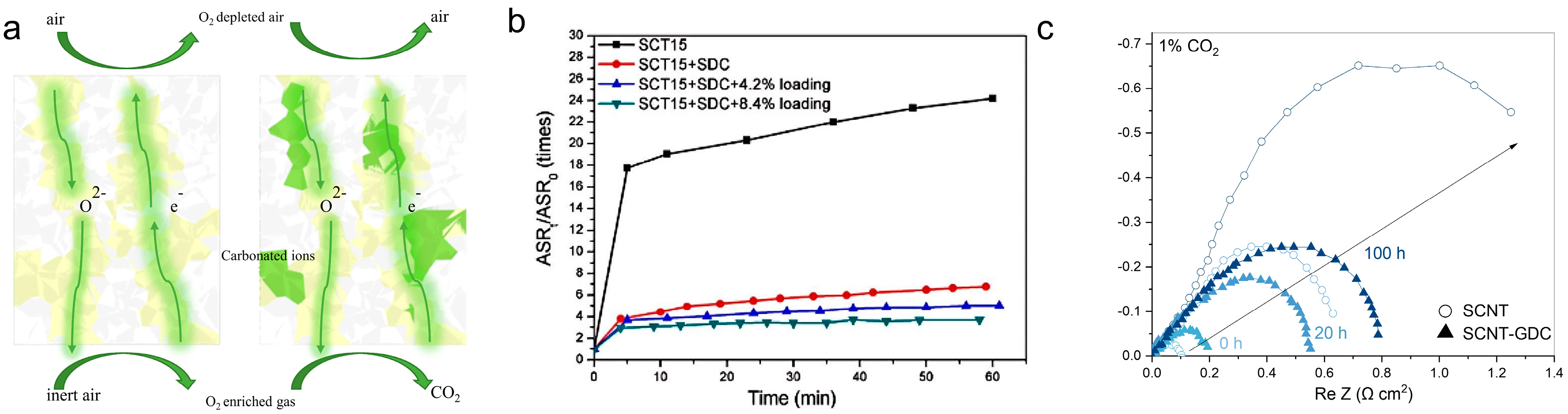
| SCNT (SrCo0.8Nb0.1Ta0.1O3−δ) | 550 | 1 | 100 | Rp: ~0.13 to ~1.3 |
| SCNT-GDC composite | 550 | 1 | 100 | Rp: ~0.17 to ~0.8 |
| Material | Temperature (°C) | CO2 (vol%) | Time (h) | Impedance: Start to End (Ω cm2) |
|---|---|---|---|---|
| LSCF (blank) | 700 | 8 | 100 | Rp: 0.26 to 1.92 |
| LSCF-BaCoO3−δ coating (BCO-LSCF) | 700 | 8 | 100 | Rp: 0.11 to 0.32 |
| PBSCF (PrBa0.5Sr0.5Co1.5Fe0.5O5+δ) | 700 | 10 | 0.167 (10 min) | Rp: 2.50 to 3.63 |
| PBSCF-LN (La2NiO4+δ-coated PBSCF) | 700 | 10 | 20 | Rp: 1.19 to ~1.56 |
| Strategy | Mechanism | Operation Complexity | Advantages | Limitations |
|---|---|---|---|---|
| High-acidity/high-valence cation doping | Increases ABE and lowers carbonate-formation ΔG; intrinsically stabilizes lattice/surface | Moderate | Intrinsic and durable stabilization; scalable with standard ceramic processing; improved long-term CO2 tolerance | Possible conductivity/ORR trade-off; requires optimization of sintering, phase compatibility and TEC; some dopants add cost |
| Composite cathodes (e.g., SDC/GDC) | Dilutes Ba/Sr exposure and supplies stable ORR sites; microstructural/interface buffering against CO2 | Simple | Drop-in friendly (mixing/light infiltration); fast, tunable gains via phase ratio/porosity control; maintains ORR while improving CO2 robustness | Must ensure phase/TEC compatibility; potential interdiffusion/interface reactions over long operation if co-fired |
| Surface infiltration/coating | LSM/LNO/BCO nano-layers tune adsorption/exchange and transport; shield susceptible sites | Moderate | Retrofittable to existing electrodes; fine surface control; targeted suppression of CO2 adsorption/carbonates | Performance hinges on thickness/uniformity/durability; excessive layers add resistance |
| CO2-induced in situ self-reconstruction | Controlled CO2 forms reversible carbonate/oxide nano-films or core-shell; adaptive passivation with potential mid-T ORR boost | Complex | Adaptive protection without foreign phases; reversible performance rebound; possibility of performance enhancement | Narrow process window (time/temperature/); over-accumulation to poisoning; higher demands on reproducibility and in-process control; strict material selectivity/compatibility required |
Disclaimer/Publisher’s Note: The statements, opinions and data contained in all publications are solely those of the individual author(s) and contributor(s) and not of MDPI and/or the editor(s). MDPI and/or the editor(s) disclaim responsibility for any injury to people or property resulting from any ideas, methods, instructions or products referred to in the content. |
© 2025 by the authors. Licensee MDPI, Basel, Switzerland. This article is an open access article distributed under the terms and conditions of the Creative Commons Attribution (CC BY) license (https://creativecommons.org/licenses/by/4.0/).
Share and Cite
Liu, F.; Luo, Q.; Sun, M.; Song, Z.; Li, J.; Chen, B.; Zhang, Y. CO2 Poisoning of Solid Oxide Fuel Cell Cathodes: Mechanisms, Solutions, and Progress. Processes 2025, 13, 3931. https://doi.org/10.3390/pr13123931
Liu F, Luo Q, Sun M, Song Z, Li J, Chen B, Zhang Y. CO2 Poisoning of Solid Oxide Fuel Cell Cathodes: Mechanisms, Solutions, and Progress. Processes. 2025; 13(12):3931. https://doi.org/10.3390/pr13123931
Chicago/Turabian StyleLiu, Fang, Quan Luo, Meishen Sun, Zhaoqi Song, Junbiao Li, Bin Chen, and Yuan Zhang. 2025. "CO2 Poisoning of Solid Oxide Fuel Cell Cathodes: Mechanisms, Solutions, and Progress" Processes 13, no. 12: 3931. https://doi.org/10.3390/pr13123931
APA StyleLiu, F., Luo, Q., Sun, M., Song, Z., Li, J., Chen, B., & Zhang, Y. (2025). CO2 Poisoning of Solid Oxide Fuel Cell Cathodes: Mechanisms, Solutions, and Progress. Processes, 13(12), 3931. https://doi.org/10.3390/pr13123931