Article

Development of Nanostructured Al2O3-TiO2 Mixed Oxides as Supports for NiMoW Catalysts and Their Evaluation in 3-Methyl Thiophene Hydrodesulfurization

by
Alma I. Gochi-Bautista
1,
Rafael Huirache-Acuña
1,*,
Mario A. Guzmán-Cruz
2,
Franklin J. Méndez
3,
Yasmin Esqueda-Barrón
4,
Carlos E. Soto-Arteaga
5,
Juan A. Medina-Cervantes
5 and
Jorge N. Díaz de León
5,*
1
Facultad de Ingeniería Química, Universidad Michoacana de San Nicolas de Hidalgo, Ciudad Universitaria, Morelia 58060, Michoacán, Mexico
2
División Académica Multidisciplinaria de Jalpa de Méndez, Universidad Juárez Autónoma de Tabasco, Carretera Estatal Libre Villahermosa-Comalcalco KM. 27+000 s/n Ranchería Ribera Alta, Jalpa de Méndez 86205, Tabasco, Mexico
3
Departamento de Materia Condensada, Instituto de Física, Universidad Nacional Autónoma de México, Ciudad de México 04510, Mexico
4
Centro de Investigación Científica y Educación Superior de Ensenada-CICESE, Ensenada 22860, Baja California, Mexico
5
Centro de Nanociencias y Nanotecnología, Universidad Nacional Autónoma de México, Ensenada 22860, Baja California, Mexico
*
Authors to whom correspondence should be addressed.
Processes 2025, 13(12), 3886; https://doi.org/10.3390/pr13123886
Submission received: 20 October 2025 / Revised: 22 November 2025 / Accepted: 24 November 2025 / Published: 2 December 2025

Abstract

The present work aims to synthesize trimetallic catalysts supported on mixed oxides such as Al2O3-TiO2. These mixed oxides have been synthesized via the hydrothermal method, which enables us to determine the favorable textural properties that facilitate the oxide in achieving a high dispersion of the NiMoWS active phase. The synthesis of NiMoW supported on Al2O3-TiO2 with varying morphological characteristics presents a wide range of research opportunities related to catalysts for HDS. The knowledge generated by the proposed parametric studies will be essential in establishing a scientific basis for preparing catalysts with suitable properties in this field. Moreover, this study provides two key contributions to the field of hydrotreating catalysis. First, we demonstrate that hydrothermal synthesis assisted by Triton X-100 enables the formation of Al2O3–TiO2 nanostructures with controlled defect density and Ti distribution, features not attainable through conventional sol–gel or mechanical mixing methods. Second, we show that these defect-rich mixed oxides uniquely modulate the dispersion and electronic structure of NiMoW sulfide phases, revealing a nonlinear dependence of activity on W incorporation. These findings offer new guidelines for the rational design of mixed oxide supports for deep hydrotreating applications.

1. Introduction

The refining industry faces several challenges, including the growing demand for petroleum products linked to the country’s economic development [1], the commitment to environmental care through the development of ultraclean fuels [2], and the maximization of the value of the oil processed to improve efficiency and profitability. Additionally, there is uncertainty regarding the availability of crude oil, as it is becoming heavier and therefore requires more complex and costly processing [3]. The sulfur present in fossil fuels is incorporated into the structure of organic compounds, such as sulfides, disulfides, and thiophenes, which release SOx-type compounds into the environment upon combustion [4]. As a result, regulatory agencies are imposing increasingly stringent standards for the maximum sulfur content in fuels used for transportation [5,6]. In recent years, increasing attention has been paid to the role of catalysts and other factors influencing the desulfurization of less reactive sulfur species [3].
Most catalytic materials used in hydrotreating processes are based on transition metal sulfides, typically molybdenum and tungsten, promoted by cobalt or nickel and supported by inert materials [7]. However, studies have shown that NiMoW trimetallic catalysts have greater activity in hydrotreating processes than NiMo and NiW catalysts do [8]. NiMoW trimetallic catalysts have also been synthesized, and by partially substituting Mo for W, an amorphous phase is obtained, whose decomposition and sulfidation produce more catalytically active materials [9]. Alumina is the most common support material for HDS reactions [10,11] because of its acid-base, mechanical, and textural properties [12]. However, this material has several disadvantages, mainly related to the presence of undesired interactions between the transition metal and the support, as these interactions are complex to sulfurize in the catalysts [7,13]. Consequently, the modification and development of new supports have been used as a strategy to modify surface properties, optimize the formation of the active phase, and improve catalytic performance [14]. The effect of supports on the catalysts is a crucial and much-debated question, as it is known to influence the active phase in terms of size, morphology, orientation, or degree of sulfidation [15]. Compared with traditional alumina-supported catalysts, catalysts prepared with MoS2 and NiMo supported on titania have been reported to exhibit significant increases in activity for the direct desulfurization of refractory molecules, such as DBT and 4,6-DMDBT [16]. However, TiO2 has been discarded for industrial purposes due to its low specific surface area (10–50 m2/g) and low thermal stability [14,17].
To overcome these disadvantages, mixed oxides of TiO2 with Al2O3 have been utilized as supports to leverage the favorable characteristics of both systems [18]. To reduce the metal-support interaction, the use of mixed oxides has recently been used since it is possible to modify the surface, acid-base characteristics, and oxidation-reduction capacities of the metal [19]. In recent studies, it has been observed that substituting the support for NiW catalysts provides specific morphological parameters for the sulfide active phase. The authors determined that the NiW/Al2O3-TiO2 and NiW/ZrO2-TiO2 catalysts presented the highest 3-methylthiophene hydrodesulfurization activity compared with that observed for NiW catalysts supported on pure oxides [20]. Several synthesis methods are employed to obtain mixed oxides, including sol–gel [21,22,23], mechanical mixing, ion exchange, in situ synthesis [19], coprecipitation [21], one-pot synthesis, and thermal processing of mixed powders synthesis [22,24]. However, for catalytic supports, catalysts are intended to be as small and active as possible, which is usually achieved by increasing the surface area using nanoparticles [25]. Since nanostructures offer advantages in terms of activity, selectivity, and efficiency over bulk catalysis [26], this approach is often employed. Today, the evolution of technology for synthesizing nanoscale materials has made it possible to obtain several oxides with specific morphologies for a wide variety of metal oxides [25], particularly in the nanometer size regime. Hydrothermal synthesis offers exciting new possibilities for unique catalytic, textural, acid–base, optical, and electrical properties [27,28]. In addition to its proven ability to produce complex oxide powders and nanoparticles at low cost, hydrothermal synthesis has also been demonstrated to be a cost-effective method for making these materials [29]. For the synthesis of nanostructured mixed oxides, structure-directing agents have been employed. For instance, Huang et al. (2015) obtained “hedgehog”-like hollow Al2O3 microspheres via the hydrothermal method using Triton X-100 as the directing agent [27]. Based on this reference and by using the pertinent adaptations, recently, the work of Mendoza et al. (2022) and the work of Ortiz et al. (2024) demonstrated that this technique allows the incorporation of mixed oxides and yields nanostructures such as nanospheres, nanowhiskers, and nanowraps that provide auspicious properties in diverse applications, such as 2-propanol transformation reactions and water–gas shift reactions, respectively [19,26,30].
Our research is based on the synthesis of nanostructured mixed oxides of TiO2/Al2O3 with different ratios via a hydrothermal method assisted with Triton X-100 as a structure-directing agent to clarify the effects of Ti modification on the support properties. We then focused on the synthesis of nanostructured binary mixed oxide Al2O3/TiO2 to explore the impact of interactions with a trimetallic NiMoW sulfide phase by varying the amount of W. The support and catalysts were characterized by SEM, TEM, XPS, XRD, nitrogen physisorption, and electrophoretic measurements and evaluated via the 2-propanol dehydrogenation reaction. The sulfide-phase catalysts were characterized via HRTEM, XPS, and Raman and were tested in the HDS reaction of a naphtha model compound.
Finally, despite extensive research on Al2O3–TiO2 mixed oxides and on NiMoW catalysts, two gaps remain in the literature. First, most studies rely on sol–gel or mechanical mixing approaches that do not allow for control of defect density, Ti dispersion, or nanoscale morphology, thereby limiting the ability to understand how the support structure governs trimetallic sulfide dispersion. Second, the interaction between hydrothermally generated Al2O3–TiO2 nanostructures and NiMoW active phases—particularly the effect of Ti-induced oxygen vacancies on the dispersion and electronic properties of Mo(W)S2 slabs—has not been systematically examined. In this work, we address these gaps by synthesizing Al2O3–TiO2 mixed oxides via Triton X-100-assisted hydrothermal synthesis, producing hierarchical nanostructures with tunable Ti aggregation and defect concentration. We demonstrate that these structural features have a significant impact on the coordination environment of Mo and W species, the dispersion of sulfide slabs, and ultimately, the HDS performance. The unique combination of hydrothermal mixed oxide synthesis and controlled W substitution provides mechanistic insights not previously reported for NiMoW systems.

2. Materials and Methods

2.1. Support Synthesis

The support synthesis, utilizing the hydrothermal synthesis method, was based on the techniques employed by our working group [19,26]. For the synthesis of the mixed oxide nanostructure, the Al2O3/TiO2 molar ratio varied between 2.4, 2.0, 1.6, and 0.0. Aluminum sulfate [Al2(SO4)3·18H2O] was used as a precursor of aluminum, and titanium (IV) oxysulfate (Ti-OSO4) was used as a source of titanium. The surfactant used was tert-octyl polyoxyethylene ether (Triton X-100). Briefly, Triton X-100 was dissolved in deionized H2O with vigorous stirring for one hour. All reagents were acquired from Sigma-Aldrich, Toluca, Mexico. After the agitation time had elapsed, the amount of determined aluminum sulfate was added to the solution, and vigorous agitation was maintained for an additional 30 min. The amount of titanium oxysulfate required for each Al2O3/TiO2 molar ratio variation was subsequently added, and the mixture was stirred for 30 min. Finally, urea was added, and agitation was maintained for one hour. The resulting solution was placed in a Teflon-coated autoclave and then heat-treated for 24 h at 120 °C. The resulting precipitate was filtered and washed with deionized water and anhydrous ethanol (1:1). The solids were subsequently dried at 60 °C for 12 h and calcined at 550 °C for 6 h with a heating rate of 10 °C/min. Each reactive amount was calculated to have the nominal weight percentage of TiO2 and the following molar proportion: 1:1.2:600:14 for metallic ions (Ti and Al), Triton X-100, water, and urea, respectively. The samples were identified as HAlTi-x, with x as the Al2O3/TiO2 molar ratio. Therefore, the samples were labeled as follows: HAlTi-2.4, HAlTi-2.0, HAlTi-1.6, and HAlTi-0.0.

2.2. Catalyst Synthesis

For the synthesis of the NiMoW-x catalysts, the textural properties of the synthesized supports were analyzed to choose the most suitable sample (see Section 2.3). However, the impregnation method used was the same for all the W variations. Briefly, aqueous solutions of nickel nitrate hexahydrate (N2NiO6·6H2O, Aldrich 99.4%), ammonium heptamolybdate tetrahydrate [(NH4)6Mo7O24·4H2O, Aldrich 99%], and ammonium metatungstate hydrate (H26N6O40W12·18H2O, 99%) were used as precursors of the NiO, MoO3, and WO3 oxide phases, respectively. The samples were impregnated via the sequential pore-filling technique with a nominal concentration of 13% by weight for metals (NiMoW), an impregnation density of 2.8 Mo atoms·nm−2, and an atomic ratio of N i N i + M o = 0.31 . Subsequently, 15, 10, 5, and 0% Mo atoms were replaced by W atoms. We refer to these catalysts as NiMoW0-HAlTi-2.0, NiMoW5-HAlTi-2.0, NiMoW10-HAlTi-2.0, and NiMoW15-HAlTi-2.0, respectively. After impregnation, the wet powders were left to stand for 12 h, then dried at room temperature for an additional 12 h. They were subsequently calcined at 45 °C for 4 h with a heating ramp of 5 °C/min.

2.3. Characterization of the Supports and Catalysts

Scanning electron microscopy (SEM) was performed using a JEOL (Tokyo, Japan) JIB-4500 instrument at 15 kV, and the magnifications employed allowed for the acquisition of micrographs with scales of microns (μm) and nanometers (nm). High-resolution transmission electron microscopy was performed using a JEOL (Tokyo, Japan) 2010 microscope, which offers a point-to-point resolution of approximately 1.9 Å. The catalysts analyzed by this technique required screening (between 80 and 120 mesh) and were previously activated by sulfidation. Sulfiding was carried out ex situ in a reactor (U-shaped quartz tube) at 400 °C and 450 °C for two hours for the NiMoW0 and NiMoW-x catalysts, respectively, with a flow rate of 40 mL·min−1 of the sulfiding mixture (H2/H2S 15% v/v H2S). The length and distribution of layer stacking in the active phase Mo(W)S2 were estimated by counting approximately 400 crystallites identified in several HRTEM micrographs taken from different parts of each sulfided catalyst and were calculated using the following equations.
Average sulfide length:
L = i = l n ( n i l i ) i = l n n i
Average number of layers of sulfide stacking:
N = i = l n ( n i N i ) i = l n n i
where li is the length of the slabs, ni is the number of slabs with slab length li or the number of slabs with stacking Ni, and Ni is the number of layers in slab i. The degree of dispersion [ f W ( M o ) ] of sulfides W(Mo) over the analyzed catalysts was obtained according to the equation based on the reported method [17]:
N f W ( M o ) = W e d g e W t o t a l = i = 1 t 6 ( n i 1 ) i = 1 t ( 3 n i 2 3 n i + 1 )
Here, Wedge is the number of W(Mo) atoms located at the edge of the NiMoWS slabs, Wtot represents the total number of W(Mo) atoms of average size, ni represents the number of W(Mo) atoms along the edge of an individual NiMoWS slab, derived from its length (L = 3.2 (2ni − 1) Å), and t represents the total number of slabs taken from the HRTEM images of the sulfided catalysts.
Nitrogen adsorption–desorption isotherms were obtained at 77 K using a Micromeritics (Norcross, GA, USA) Tristar II 3020 instrument on samples that had been previously degassed at 573 K for three hours. X-ray diffraction (XRD) measurements were performed with an Aeris Malvern Panalytical spectrometer using CuKα radiation (λ = 0.154 nm). UV-vis diffuse reflectance spectra were recorded using a UV-vis spectrophotometer (Agilent (Santa Clara, CA, USA) Cary-5000) equipped with an integrating sphere at room temperature. XPS spectra of the samples were recorded via a SPECS (Berlin, Germany) spectrometer with a PHOIBOS 150 WAL hemispherical energy analyzer with angular resolution (<0.5°) equipped with an XR 50 X-ray Al-X-ray source and an X-ray monochromator (FOCUS 500 (Al excitation line)). The binding energies (BEs) were referenced to the Al 2p peak (74.4 eV) to account for charging effects. After background subtraction, mixed Gaussian/Lorentzian functions were employed according to the Shirley equation. Raman spectroscopy studies were conducted using a Horiba (Kyoto, Japan) Scientific X’plora instrument, coupled with an Olympus (Kyoto, Japan) BX42 microscope.

2.4. Catalytic Activity Measurements

To perform the catalytic evaluation of the 3MT molecule (a model gasoline compound), sulfurization was performed in situ by using a sulfiding mixture (H2/H2S 15% v/v H2S) at a flow rate of 40 mL·min−1 in a two-phase continuous microflow reactor operating at atmospheric pressure; sulfidation was maintained for two hours at 400 and 450 °C for the NiMoW0 catalysts and NiMoW-x catalysts, respectively. After this time, the sulfiding flux was changed to the reaction mixture, and the saturator was maintained at 20 °C with 3MT (Aldrich Chemical 99.99%). A flow rate of 60 cm3 ·min−1 for H2 flow downstream was used to avoid conversions greater than 25%, and the reaction was tested at 280, 300, and 320 °C using 40 mg of preactivated catalyst with an approximate particle size of 80–120 mesh as the catalytic bed.

3. Results

3.1. Support Characterization

3.1.1. Morphological Analysis

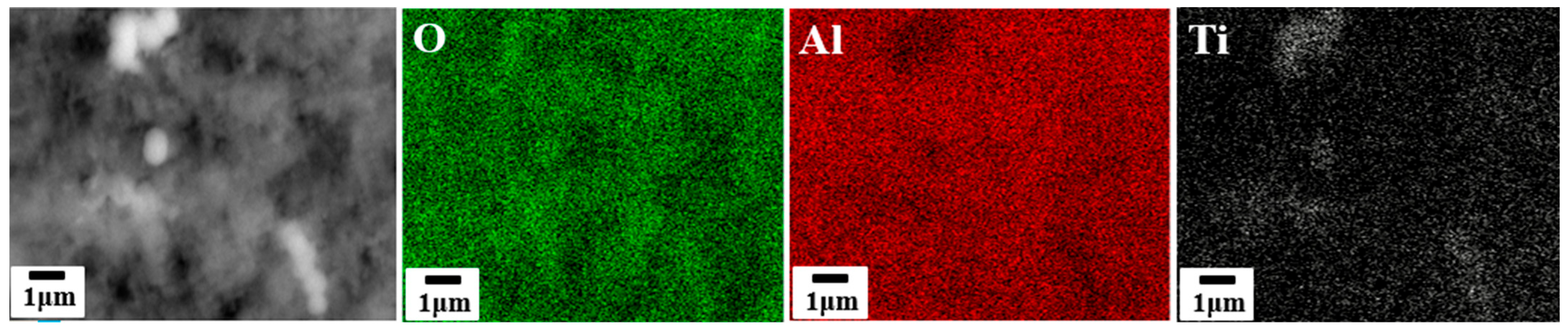
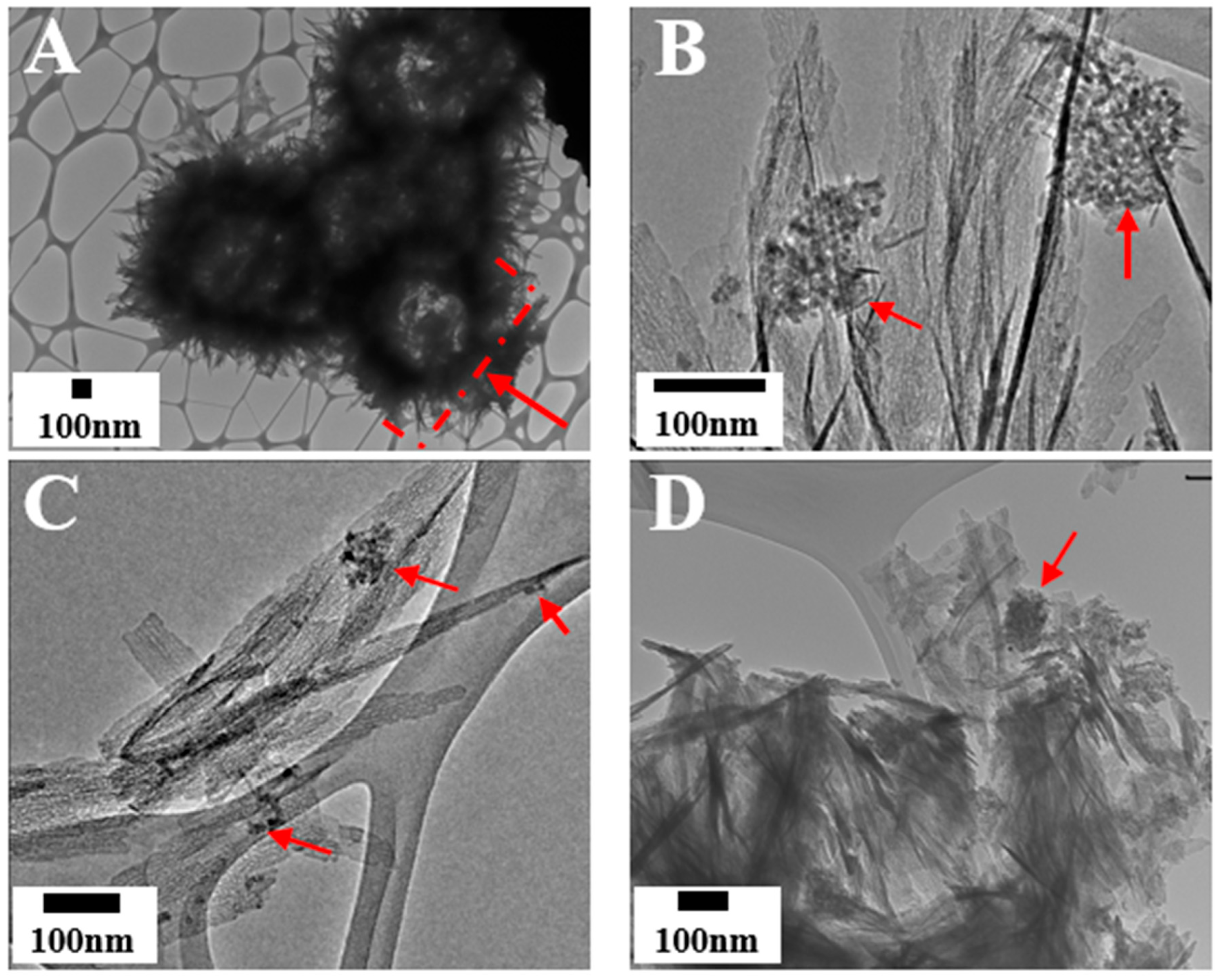
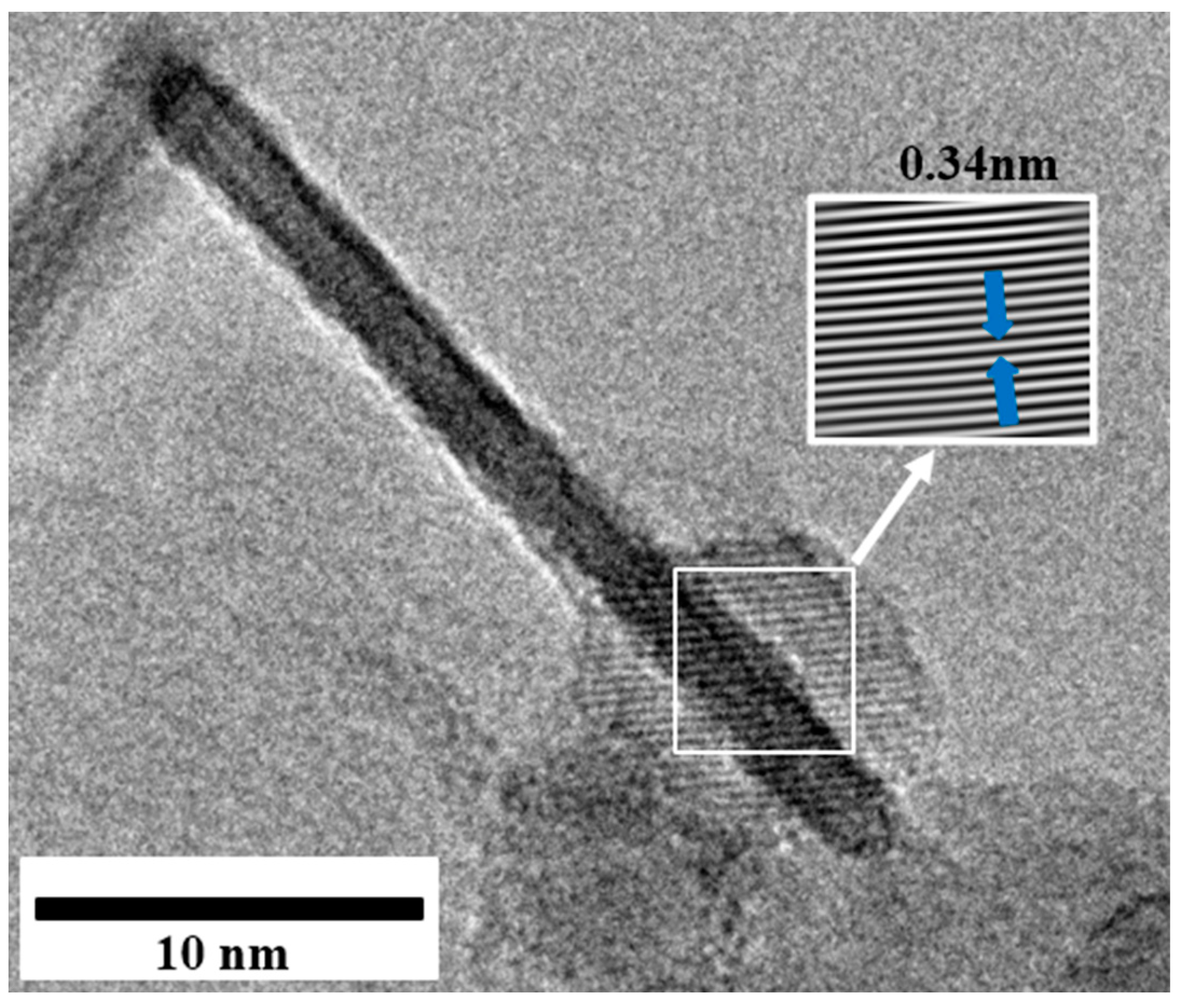
The synthesis of alumina-based materials via the hydrothermal method has been previously reported by different authors, yielding well-defined nanostructures [19,26,27]. Indeed, we observed the formation of hollow microspheres in the HAlTi-0.0 pure alumina sample, which was composed of nanorods or nanoneedles, as shown in the SEM micrograph presented in Figure 1A. This morphology corroborated previously reported results by our research group [19]. For the HAlTi-1.6, HAlTi-2.0, and HAlTi-2.4 mixed oxide samples (Figure 1B–D), we observed that distorted microspheres and aggregates had average sizes of 1.3 μm, 1.1 μm, and 0.67 μm, respectively. From the elemental mapping, it was observed that aggregates formed for Ti, while Al exhibited a well-dispersed distribution (Figure 2). With respect to TEM micrographs (Figure 3), we confirmed the presence of 3–5 μm hollow microspheres in the Ti-free alumina samples. These microspheres, in turn, were formed by alumina sheets covering the hollow sphere, as shown in Figure 3A, of which the interplanar distances corresponding to the γ-alumina planes were difficult to determine. For the HAlTi-2.0, the aggregates were formed by spheres that were dispersed and exposed with interplanar distances of 3.33 Å and 3.35 Å, corresponding to the crystalline plane (101) for TiO2-anatase; these spheres were ≤10.0 nm in size. (Figure 4). Similarly, Figure S3 shows the dispersion of TiO2 aggregates on Al2O3 sheets for HAlTi-1.6, HAlTi-2.0, and HAlTi-2.4.

3.1.2. X-Ray Diffraction (XRD) of Al2O3-TiO2

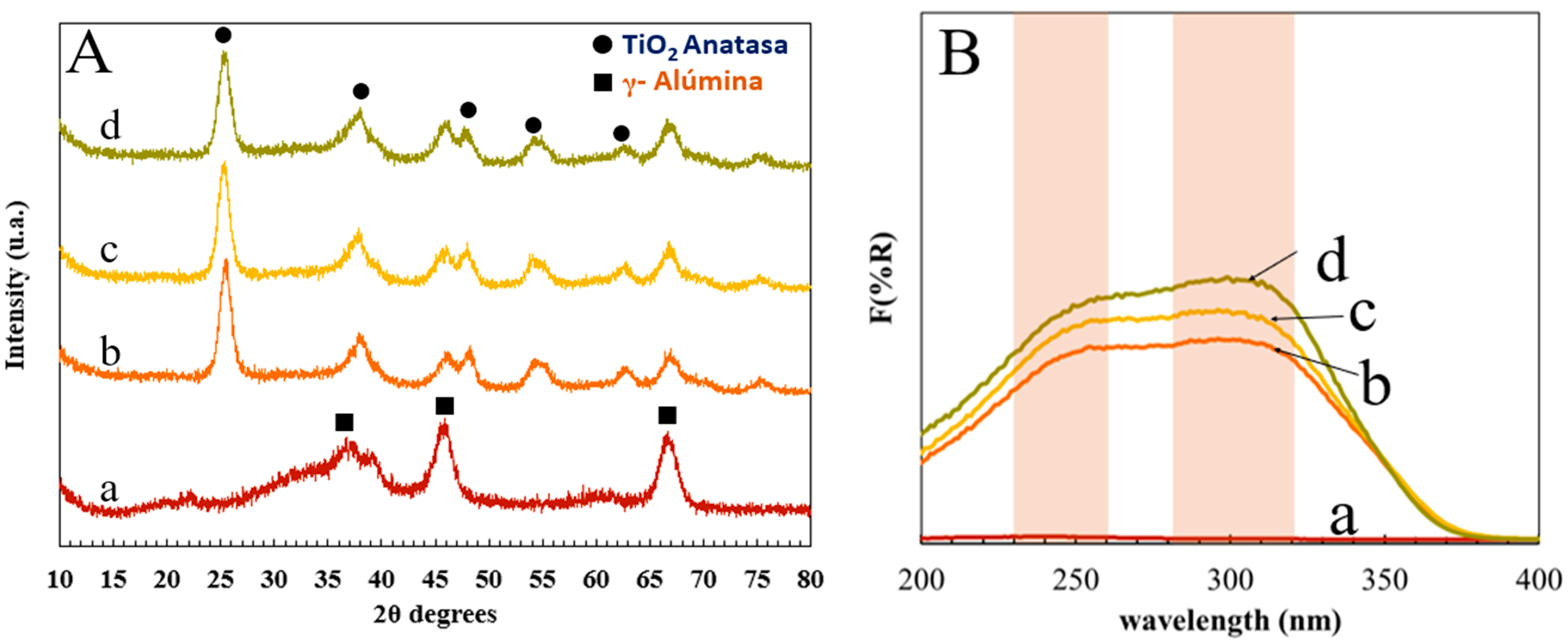
The XRD analyses performed on all samples for the mixed oxides labeled as the HAlTi-x series, spanning a range of 10° to 80°, are shown in Figure 5A. The diffractogram corresponding to the alumina synthesized via the hydrothermal method illustrated in subparagraph (a) shows signals at 37°, 45°, and 66°, related to the (311), (400), and (440) planes, respectively, which are typical diffractions observed for γ-alumina. The samples enriched with titania exhibited intense signals at 25° and 37°. In addition, signals at 47.5°, 55°, 63°, and 75.5° correspond to the (101), (004), (200), (211), (204), and (301) planes of the anatase titania phase [31]. In the Ti-containing samples (HAlTi-1.6, HAlTi-2.0, HAlTi-2.4, corresponding to subparagraphs b, c, and d, respectively), the reflections associated with γ-Al2O3 remain present, although with lower relative intensity and broader profiles compared to pure alumina. This behavior reflects the nanoscale character of the mixed oxides and partial overlapping with anatase reflections. As expected for TiO2-anatase, the (101) reflection at ~25° displays the highest intensity among Ti-containing phases. Therefore, its presence confirms the formation of anatase nanodomains rather than indicating agglomeration by itself. The combined evidence from XRD, TEM, and XPS supports the coexistence of γ-Al2O3 sheets and dispersed TiO2 aggregates in the composite oxide. The crystal size and lattice parameters were determined via the Scherrer equation and Bragg’s law for a gamma-alumina cubic system. The crystal sizes increased with the presence of Ti in the materials, whereas the lattice parameters remained close to those reported in the crystallographic card (7.93 Ǻ). However, this slight change can be attributed to the dislocations caused by Ti in the HAlTi-1.6, HAlTi-2.0, and HAlTi-2.4 materials (see Table S1).

3.1.3. Diffuse Reflectance Spectroscopy of Mixed Oxides

The diffuse reflectance spectra in the UV-vis region for the mixed oxides labeled as the HAlTi-x series are shown in Figure 5B. The spectra showed absorption bands at approximately 250 and 300 nm. The band with the lowest intensity corresponds to the bands related to the electronic transition of O2− to Ti2+ (TiO4) associated with tetrahedral species, and the band with the highest intensity is associated with the electronic transition from the O valence band to the Ti conduction band, corresponding to a transition from O2− to Ti4+ (TiO6) present in octahedral species [32,33]. On the other hand, the absorption bands for pure alumina have been reported close to 179 nm [33], which is outside of the UV-vis DRS analysis range.

3.1.4. Textural Properties

Nitrogen adsorption–desorption measurements were used to determine the textural properties of the synthesized supports. The adsorption isotherms for all the supports were of type IV, which is characteristic of mesoporous solids [34,35]. Isotherms with type H3 hysteresis related to nonrigid aggregates of plate-like particles with slit-like pores were observed. Table 1 shows that the authors obtained a surface area of 208 m2·g−1 for pure alumina. It was observed that with the incorporation of titania, the surface area gradually decreased, as shown in Figures S1A and S2A. Similarly, the pore diameter decreased by 8 Å compared to that of HAlTi-2.4, whereas for Vp, we did not observe a significant variation.

3.1.5. X-Ray Photoelectron Spectroscopy

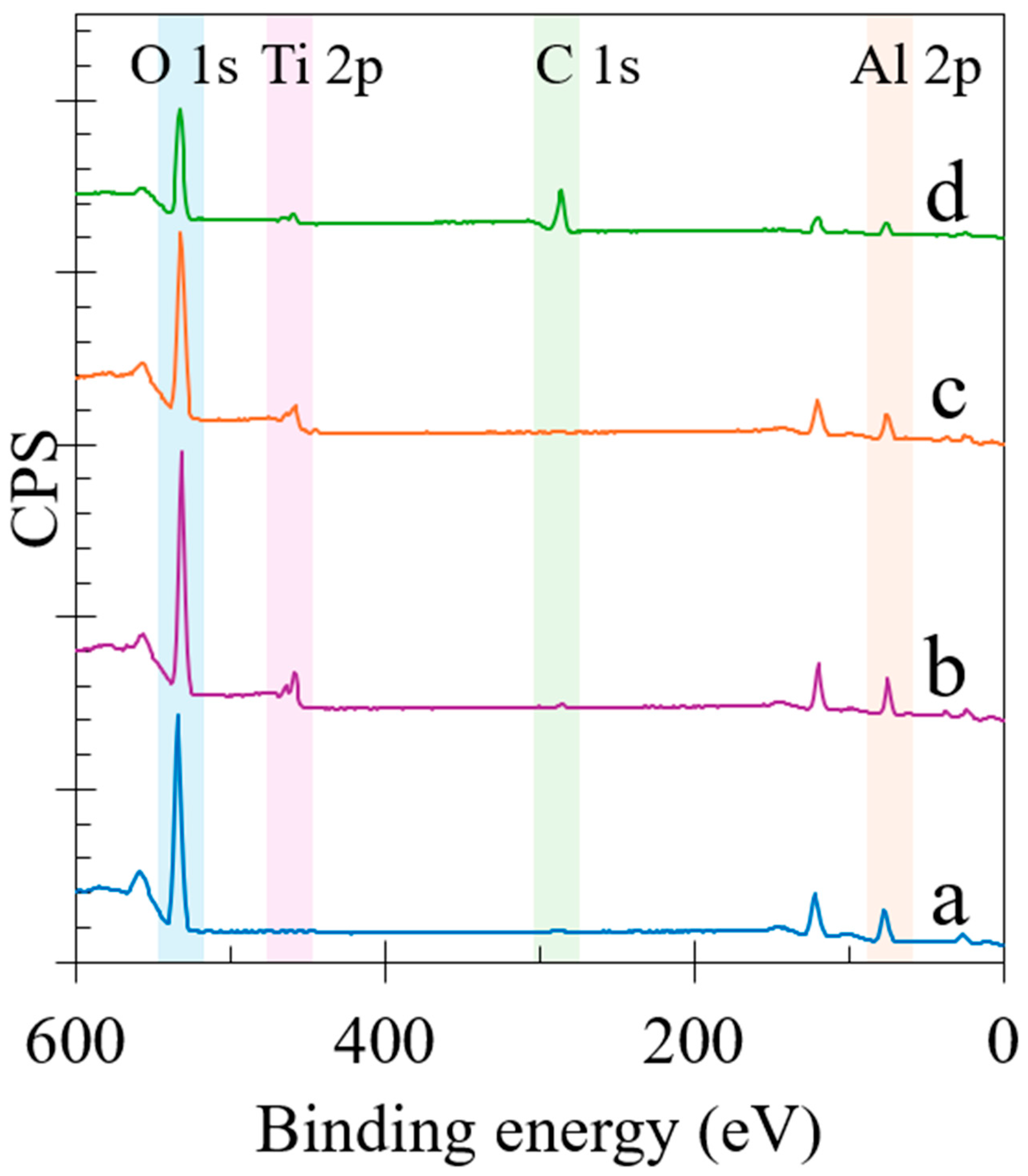
In Figure 6, we can observe the general survey spectra for all the samples in the range of 600 eV to the Fermi level (0 eV). The presence of Al and O in the HAlTi-0.0 sample was confirmed. We observed the O 1s core emission region for all samples at approximately 531.6 eV, corresponding to the binding energy (BE) of oxygen in Al2O3. In the case of the titanium-containing samples, the peak of O 1s apparently shifted to 532 eV, although it appeared to be broader than that in the HAlTi-0.0 sample. The presence of oxygen related to TiO2 could cause this widening since this oxygen peak occurs at a BE of 529.4 eV, as reported in [32,36,37] it is worth noting that the C 1s peak appears with low intensity in the survey spectra of HAlTi-0.0, HAlTi-1.6, and HAlTi-2.0, whereas it is more clearly observed in the HAlTi-2.4 sample. This difference arises from variations in the amount of adventitious carbon adsorbed on the surface and from differences in surface charging compensation among the mixed oxides. The Ti-rich HAlTi-2.4 sample exhibits a slightly higher coverage of surface carbon species, which enhances the visibility of the C 1s peak in the survey scan. High-resolution C 1s spectra for all samples are provided in the Supplementary Information to confirm the presence of carbon in all materials.
The quantitative analysis of the general XPS spectra and high-resolution windows presented in the Supplementary Information allowed us to obtain the atomic composition data for each sample, as shown in Table 2. Atomic percentages reported in the table were obtained from the high-resolution XPS spectra by integrating the area under each core-level peak (O 1s, Al 2p, Ti 2p) after Shirley background subtraction. The atomic percentage of each element i was calculated using the following equation:
A t . % i = A i S F i i A i S F i ×   100    
where Ai is the fitted area and SFi is the sensitivity factor for element i. Peak fitting was performed using mixed Gaussian/Lorentzian functions with full width at half-maximum (FWHM) constraints appropriate for metal oxide environments. All spectra were charge-corrected using the Al 2p peak at 74.4 eV.
This table also indicates the nominal ratios (Al/Ti) (% atomic/% atomic, see Table S2) and the EDS ratios (Al/Ti). Although EDS is not a technique for determining atomic composition, it provides us with a semiquantitative overview of the material.

3.1.6. Catalytic Activity of Nanostructured Al2O3/TiO2 in 2-Propanol Dehydration

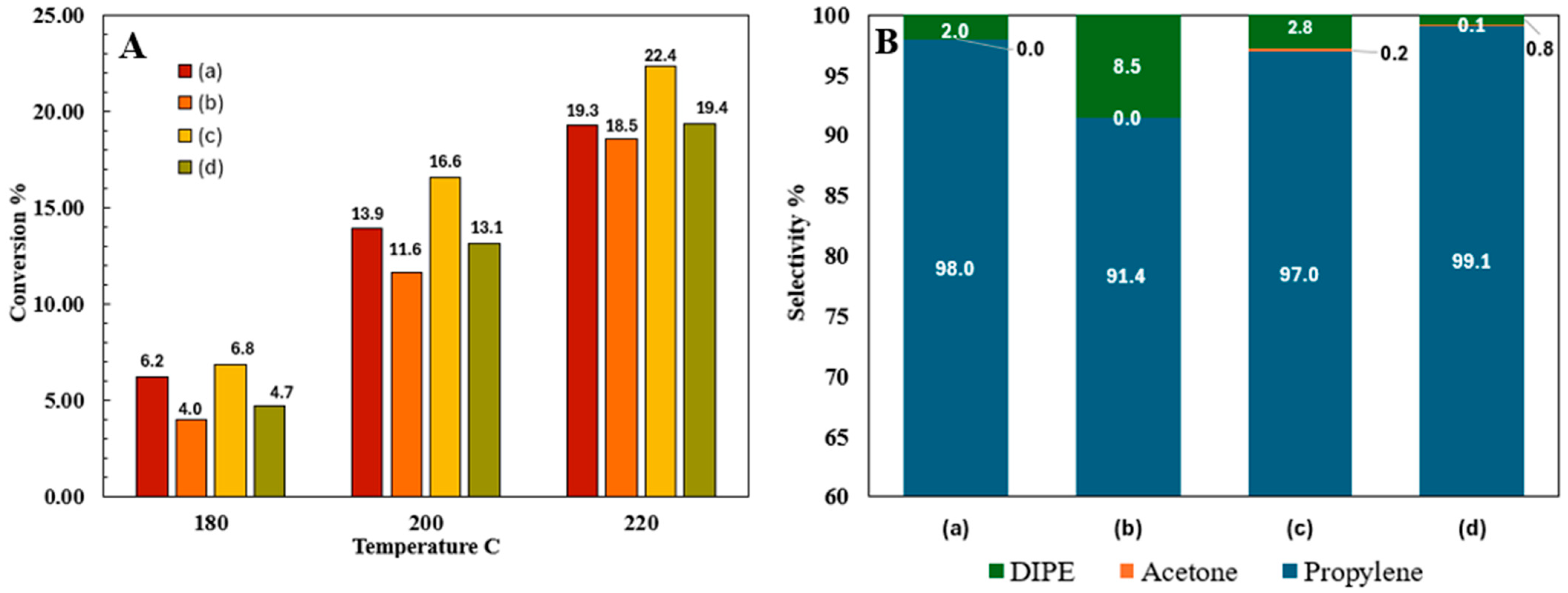
The catalytic 2-propanol dehydration reaction was performed to obtain information about the acid-base properties of the supports. It has been reported that acid sites undergo direct dehydration to produce propylene. Over basic sites, acetone is produced, and di-isopropyl ether (DIPE) depends on a combination of both types of sites [14,16]. Figure 7A shows that the material labeled as HAlTi-2.0 obtained the highest conversion among the samples, with a conversion of 22% at 220 °C. However, the other materials also achieved an average conversion rate of 19%. The selectivity was calculated at 200 °C to obtain values under a differential regime and at a steady state. Figure 7B presents the selectivity results for the samples. All materials exhibited predominantly acidic behavior, as indicated by the very low selectivity toward acetone (near zero) and the high selectivity toward propylene. Among the samples, HAlTi-2 showed the highest propylene selectivity (≈98%), reflecting a stronger contribution of acid-catalyzed dehydration pathways. The remaining samples—HAlTi-1.6 and HAlTi-2.4—also displayed high propylene selectivity (≈88–90%), confirming that acidity dominates over basic or redox pathways in all cases. Although the differences are subtle, the higher selectivity of HAlTi-2 correlates with its optimal distribution of TiO2 domains and oxygen vacancies, which enhances the number of accessible acidic surface sites. Based on its superior combination of activity, selectivity, and structural properties, HAlTi-2 was selected as the support for further catalytic studies with NiMoW sulfides.

3.2. Characterization of the Catalysts

3.2.1. X-Ray Diffraction (XRD) of the NiMoW Catalysts

Based on the X-ray diffraction results of the NiMoW0-HAlTi-2.0, NiMoW5-HAlTi-2.0, NiMoW10-HAlTi-2.0, and NiMoW15-HAlTi-2.0 catalysts shown in Figure S4, we observed that the diffractograms of the catalysts corresponded to the characteristic signals observed for HAlTi-2.0 mixed oxide. Moreover, no differences associated with crystalline WO3 were observed. Also, given that tungsten oxide particles smaller than approximately 3–5 nm generally produce XRD features too broad or too weak to be observed with conventional laboratory diffractometers, the absence of WO3 reflections suggest that tungsten species are either highly dispersed, sub-nanometric, or present as amorphous WOx domains on the mixed oxide surface.
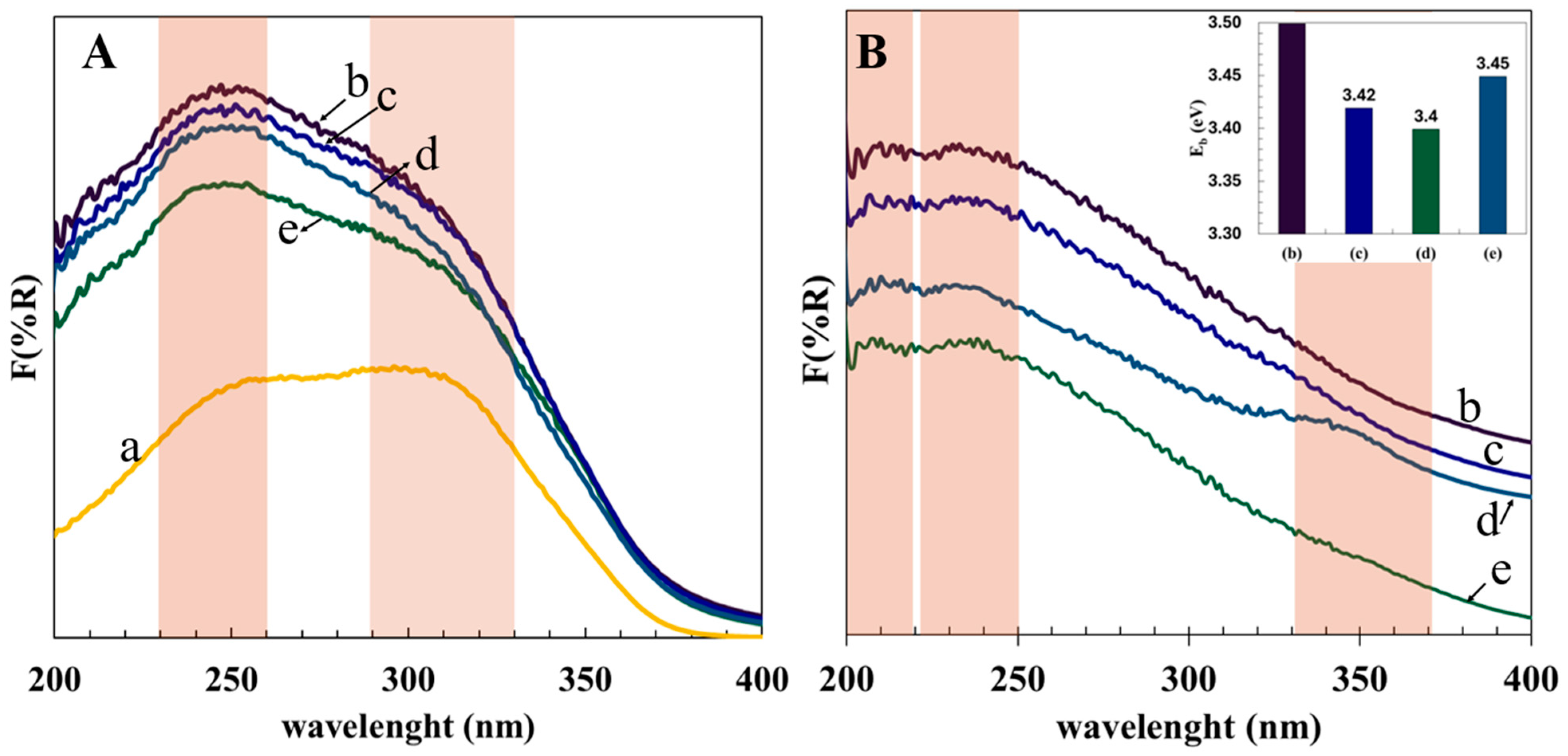
The coordination environments of the Ni+2 and Mo+6(W+6) ions on the oxide catalysts were studied via UV-vis diffuse reflectance spectroscopy (UV-vis DRS). The spectra are shown in Figure 8A as a Kubelka–Munk–Schuster function. The catalysts in the oxide state presented a mixture of Mo and W oxide species in different coordination states, with two bands observed at 230–260 nm and 280–320 nm. Based on previous studies, the adsorption band of tetrahedral molybdenum is in the range of 260–280 nm, and that of octahedral molybdenum is between 300 and 320 nm, whereas the charge transfer transitions O2− and W6+ in tetrahedral species occur at 200–300 nm, and that of octahedral species of tungsten corresponds to bands at 300–400 nm [38]. However, these bands are difficult to assign since the titania support hides the charge transfer transition bands of W(Mo), and the tetrahedral transition from O2−a Al3+ (AlO4) has been reported to occur within the same interval [15]. Therefore, the observed intensity is the result of the constructive sum of tetrahedral species. In Figure 8B, the support spectrum was subtracted to appreciate only the spectrum caused by the NiMoW-impregnated metals. These spectra show two bands at approximately 200–220 nm and 220–250 nm for the entire NiMoW-x series, which have been reported for tetrahedral and octahedral species for Mo and W oxides supported on mixed oxides [32,39]. For the NiMoW10-HAlTi-2.0 sample, an additional band is observed near 350 nm, attributed to the formation of agglomerates of octahedral Mo and W oxide species [40,41].
The values inserted in Figure 8B also show the edge energies (Eb) of the NiMoW-x series catalysts, which were determined from the F(R) versus Tauc values. The edge energies are closely related to the metallic species formed and the degree of dispersion of these species as a function of Tauc. It has been reported that a higher edge energy increases the dispersion of the active species [42,43]; thus, the material with the lowest dispersion of Mo(W) species corresponds to the NiMoW10-HAlTi2.0 catalyst.

3.2.2. Raman Spectroscopy of the NiMoW Catalysts

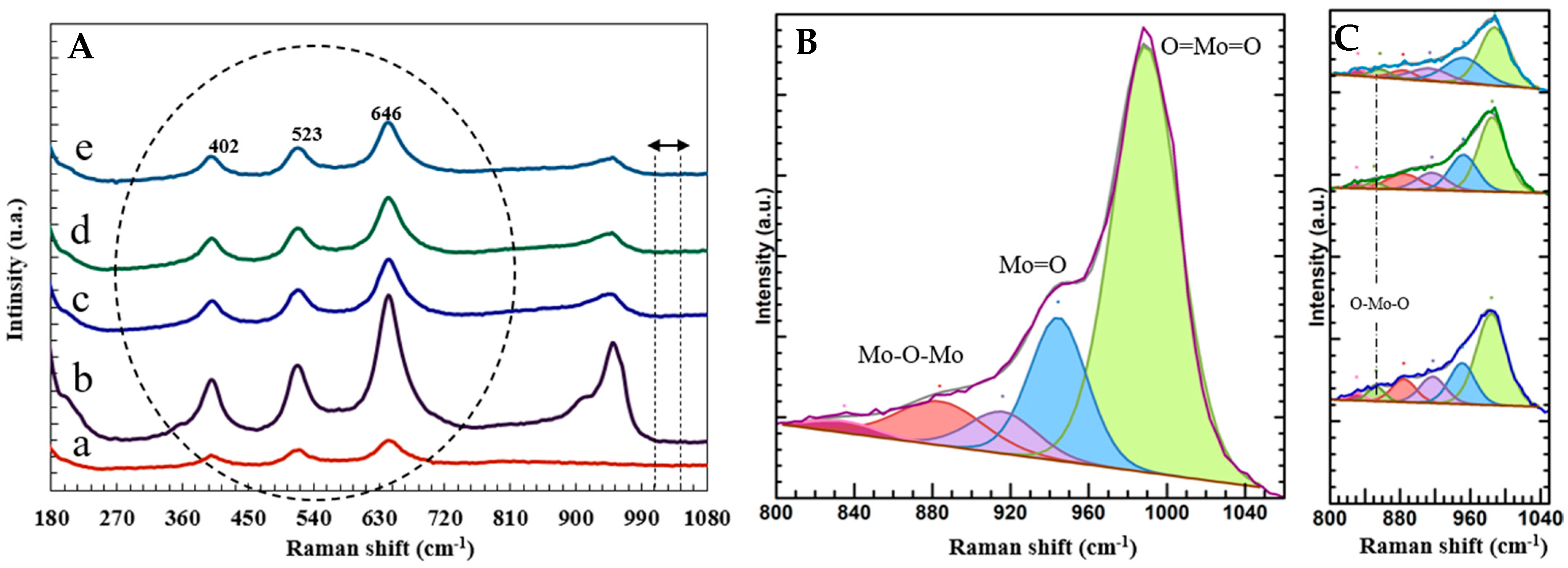
Raman spectroscopy was used for characterizing the deposited Ni, Mo, and W oxide species. This technique provides more detailed information about the surface structure of Ni, Mo, and W catalysts. Figure 9A shows the Raman spectra in the 180–1080 cm−1 region. All catalysts presented signals at 402, 523, and 646 cm−1, which are characteristic of the anatase phase for TiO2 [17]. The absence of bands in the 1040–1060 cm−1 region confirms the complete removal of nitrate ions upon calcination at 450 °C. The catalysts showed a band in the region of 800–1050 cm−1, where the amplitude and position of this band depend on the presence of various W(Mo) species. As shown in Figure 9A, the signals of the support do not overlap with those corresponding to the metal oxides deposited on the support, as these are at higher frequencies. For this reason, and to gain a deeper understanding of the signals caused by the Mo or W (Me) species, deconvolution was performed in the 800–1050 cm−1 region.
In Figure 9B, the deconvolution generated in the 800–1050 cm−1 region for NiMoW0-HAlTi-2.0 showed five bands at 989, 948, 917, 878, and 832 cm−1. The high-frequency band at 981 cm−1 is attributed to the symmetric stretching vibrations on the surface of the Mo(=O)2 species of irregular polymolybdates [44], and the bands at 948 cm−1 are indicative of the presence of octahedral Mo6+ dispersed on the support [41]. These bands are related to the presence of symmetrical and antisymmetrical Mo=O species supported on the surface; the band at 878 cm−1 is associated with the presence of Mo7O246− species [32]. The bands near 917 cm−1, which were obtained by deconvolution, are mainly associated with the antisymmetric and Mo-O-Mo bridge deformation modes for the polymolybdate species [15,45]. Similar Raman bands associated with Mo–O stretching vibrations of octahedrally coordinated Mo6+ species have been reported for supported molybdenum oxides on alumina and titania [39,46]. The band observed at approximately 832 cm−1 is assigned to asymmetric stretching vibrations between the Mo–O–Mo bonds of the octahedral Mo species [32]. In Figure 9C, we observed bands corresponding to NiMoW5-HAlTi-2.0, NiMoW10-HAlTi-2.0, and NiMoW15-HAlTi-2.0, with an additional band compared with the bands of NiMoW0-HAlTi2 at 853 cm−1 associated with the asymmetric stretching modes of the O-Mo-O stretching modes observed in the NiMoO4 phases. Considering the relationship between the species (Me=O + O=Me=O)/Me-O-Me present in the catalysts, we can determine the structure and dispersion of the MeOx species supported on alumina–titania [47,48]. The results are presented in Table 3, where we can observe the Raman ratios of 3.84, 3.00, 2.82, and 3.58. These results imply that NiMoW10-HAlTi-2.0 is the catalyst with the least dispersion of nanoparticles.

3.2.3. HRTEM Images of the NiMoW-x Catalysts

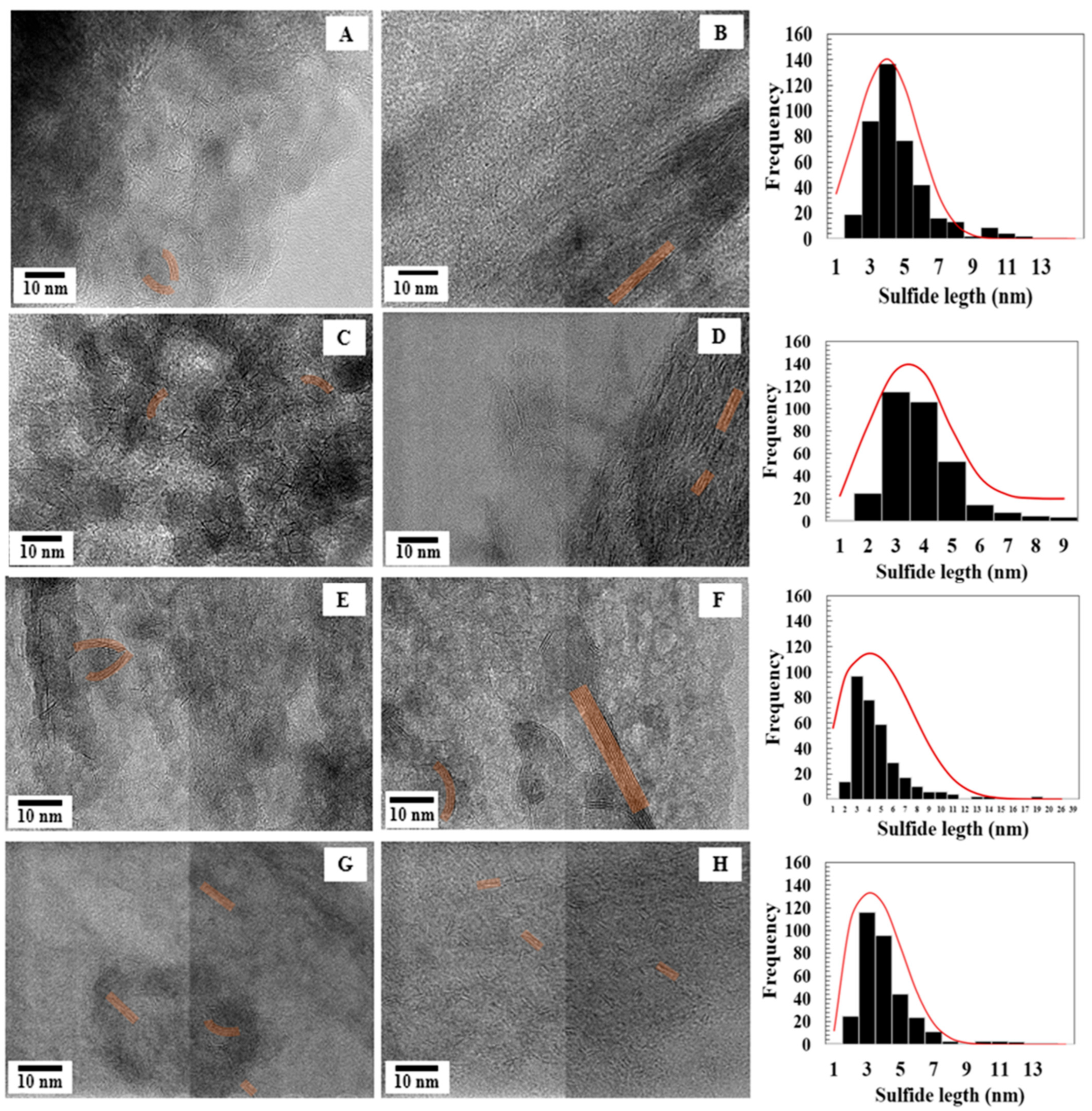
The HRTEM micrographs of the sulfided catalysts demonstrate the formation and dispersion of Mo(W) sulfides in all catalysts supported on the mixed oxide HAlTi-2.0. As illustrated in Figure 10, the orange highlights indicate the presence of sulfides within the laminated and semi-laminated γ-alumina sheets, within the pores of the γ-alumina sheets, and within the titania aggregates. In the NiMoW10-HAlTi-2.0 catalyst (see Figure 10E,F), slightly curved sulfide lengths of up to 37 nm were observed. In contrast, for the remaining materials (NiMoW0-HAlTi-2.0, NiMoW5-HAlTi-2.0, and NiMoW15-HAlTi-2.0), the lengths oscillate between 4 and 5 nm.
From the average length (L) resulting from the TEM micrographs, we used the methodology proposed by Kasztelan [15,45,49] to determine the total number of atoms ( W t ) and the number of metal atoms located at the edges (We) of a hexagonal MoS2-type slab, which directly affects the proportion of edge vs. basal planes; with these data, we calculated the dispersion of the sulfides in our support, considering the degree of dispersion as the ratio between the number of atoms available to carry out a reaction and the total number of atoms in the catalyst ( f M e = W e W t ) . Therefore, we can observe in Table 4 that the catalysts have a very similar degree of dispersion; however, the NiMoW10-HAlTi-2.0 catalyst has a degree of dispersion lower than 0.24, which is indicative of a lower dispersion of the sulfide phases.

3.2.4. X-Ray Photoelectron Spectroscopy (XPS)

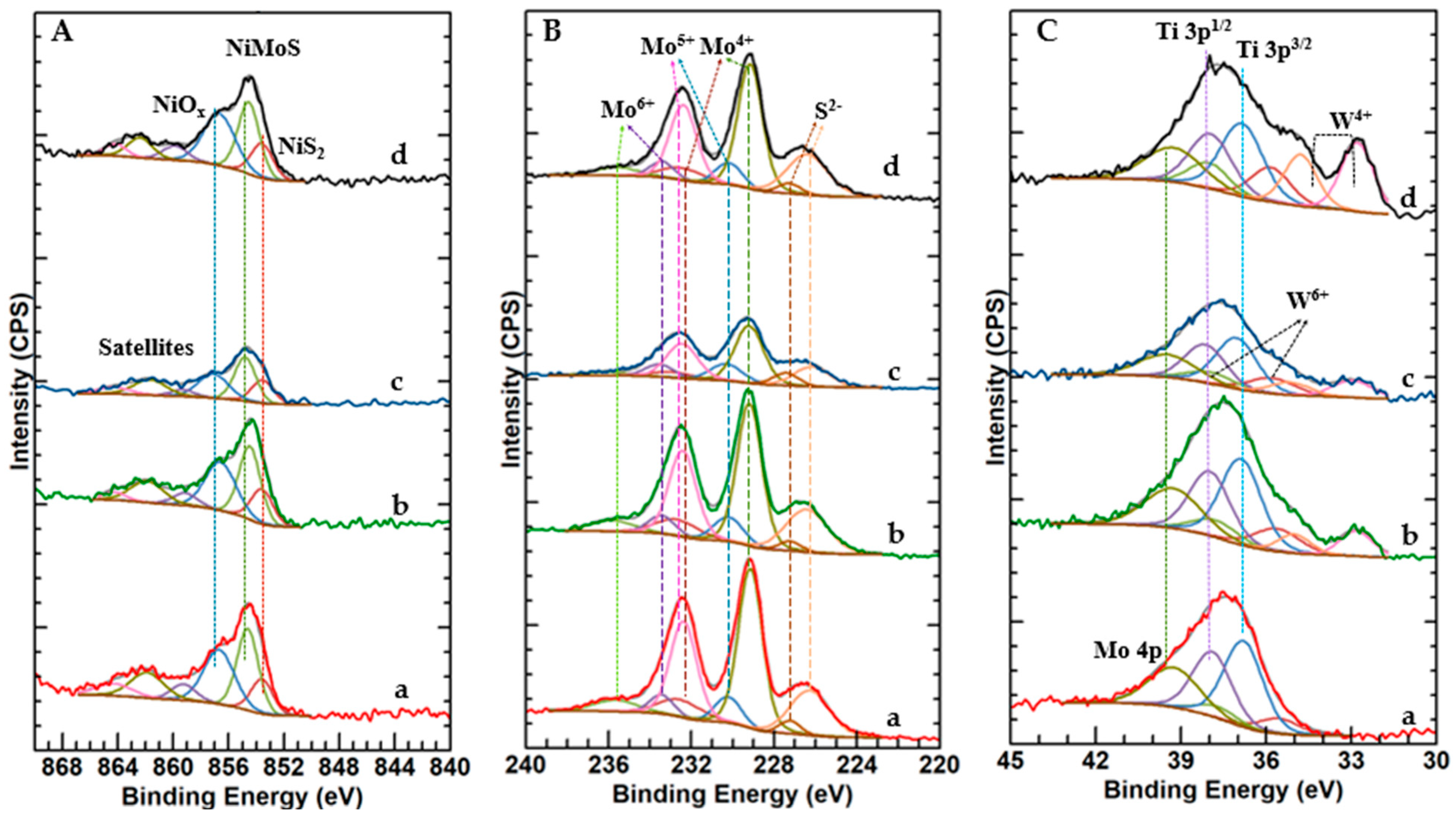
The sulfided NiMoW-x-supported catalysts on HAlTi-2.0 were analyzed by XPS to determine the oxidation states of the NiMo(W) species they contain and to correlate this with the catalytic activity presented by the catalysts in the HDS reaction of 3-methylthiophene. Figure 11A shows the spectra for the electrons that arise from the emission levels of the Ni 2p nucleus in the decomposition of the spectrum in this region, where signals appear at 853.3 eV assigned to NiSx species, another at 854.6 eV related to NiMoS species, and another at 856.6 eV corresponding to NiOx species [46]. Figure 11B shows the Mo 3d5/2 region, and the deconvolution of the spectrum resulted in four signals centered at 229.1 eV, 230.2 eV, and 233.4 eV, which correspond to the oxidation states of Mo4+, Mo5+,, and Mo6+, respectively [50]. Additionally, in all cases, a seventh component centered at 226 eV was observed, corresponding to the 2s electrons of sulfur (S2−) [51]. Regarding Figure 11C, because the Mo 4p electrons and the Ti 3p electrons appear in the emission region of the W 4f electrons, deconvolution corresponding to the NiMoW0 sulfided catalysts was performed. In this region, signals corresponding to Mo 4p appeared at 39.3 eV [52], and for Ti 3p1/2 and Ti 3p3/2, at 37.6 and 36.9 eV, respectively [53]. In contrast, for the samples with tungsten, NiMoW5, NiMoW10, and NiMoW15, additional signals were found, as expected. In the deconvolution, four new shoulders centered at 32.8, 35, 35.6, and 37.8 eV appeared, which are attributed to the Wf7/2 and Wf5/2 electrons of the WSx (W4+) and WOx (W6+) species, respectively [13,51].

3.3. Catalytic Activity

3MT HDS Measurements to Perform the Catalytic Evaluation of 3MT Molecules

It was necessary to dry and sulfide them in situ (before each reaction), as described in Section 2. At the end of the sulfiding process in the continuous microflow reactor, the sulfiding flow was switched to the reaction mixture, and the saturator was maintained at 20 °C with 3MT (Aldrich Chemical 99.99%). A flow of 60 cm3·min−1 of H2 was used downstream to avoid conversions higher than 25%, ensuring functionality under a differential regime; the reaction for all catalysts was tested at 200, 220, 240, 260, 280, 300, and 320 °C, under steady-state conditions (see Figure S6).
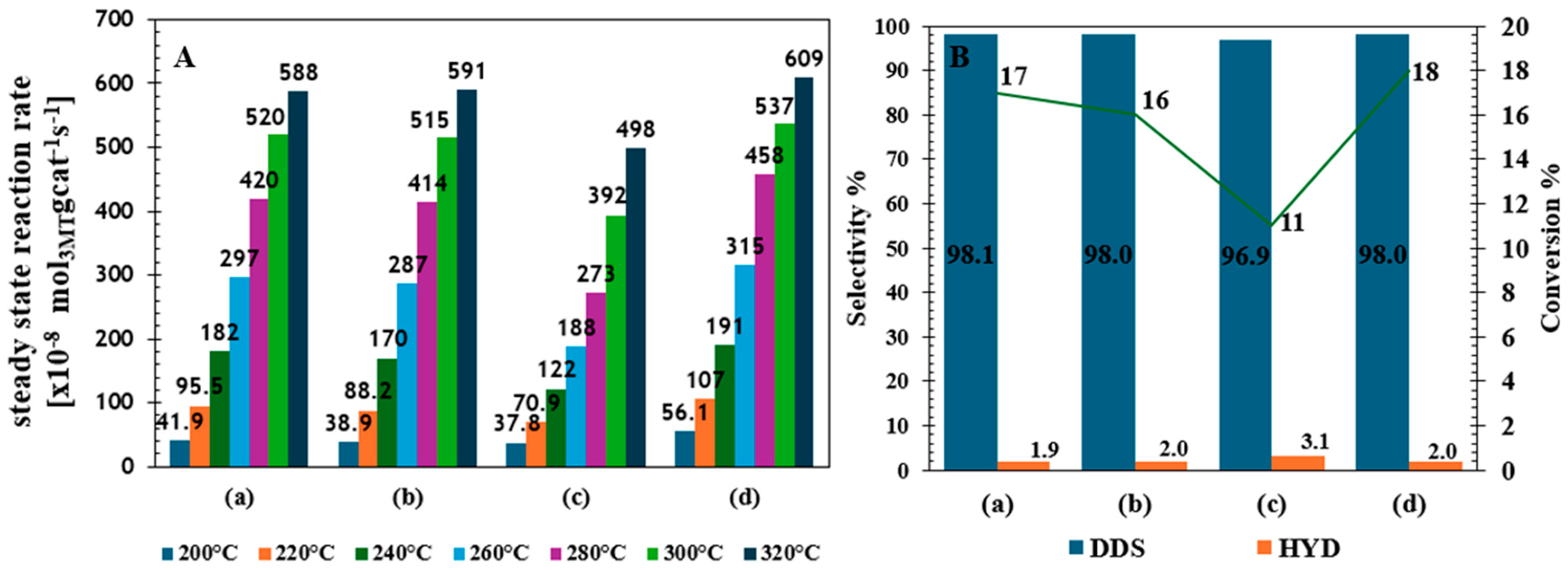
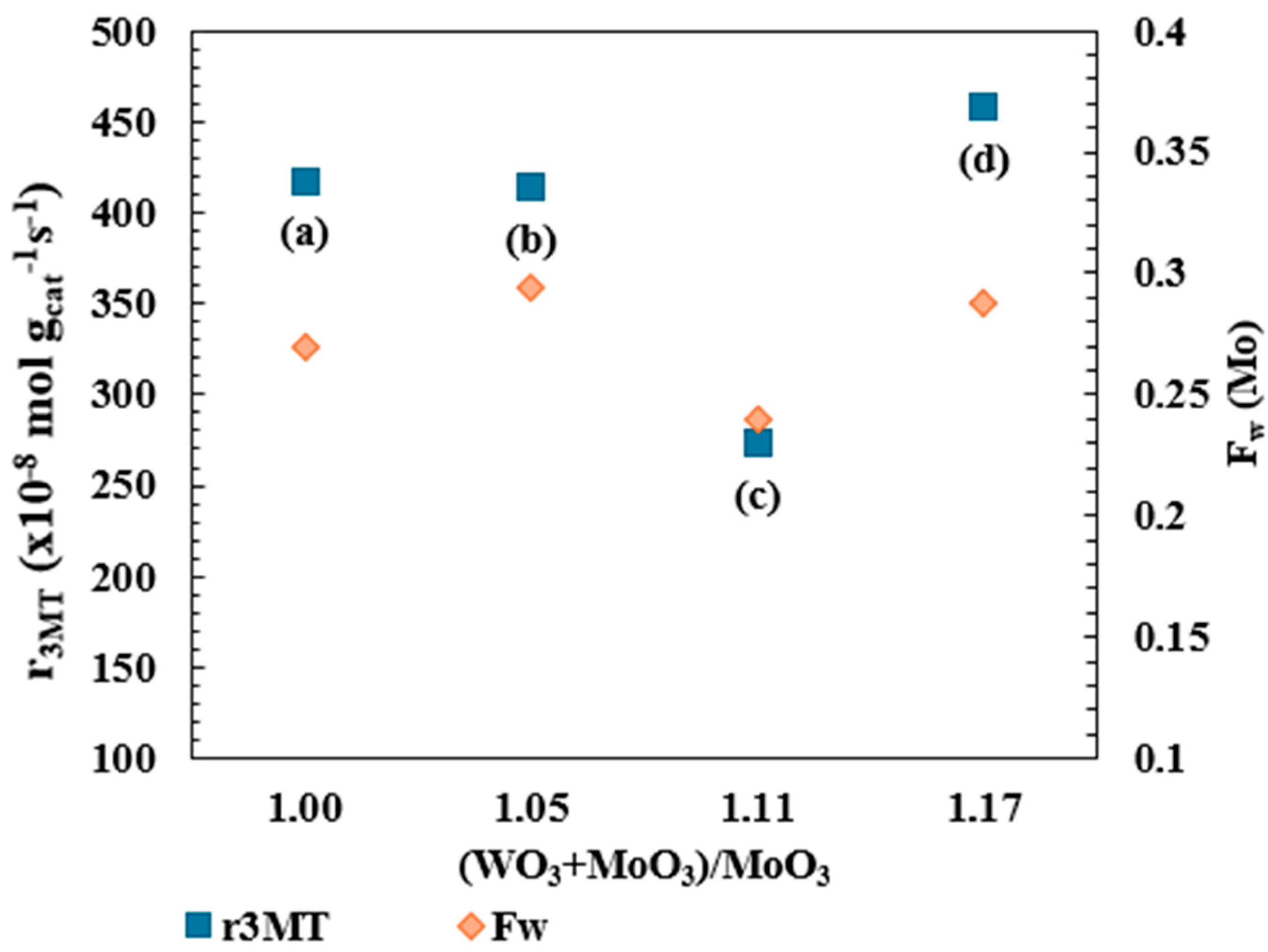
Figure 12A shows that the catalyst with the highest reaction rate was NiMoW15-HAlTi-2.0, followed by NiMoW0-HAlTi-2.0 and NiMoW5-HAlTi-2.0, with the lowest reaction rate exhibited by the NiMoW10-HAlTi-2.0 catalyst. On the other hand, Figure 12B shows the percentage of reaction selectivity on the right axis of the graph, while the left axis represents the percentage of 3MT molecule conversion for the catalysts evaluated in the HDS reaction. The NiMoW10-HAlTi-2.0 catalyst had the highest selectivity toward hydrodesulfurization. However, all catalysts showed a preference for the direct desulfurization pathway. This same graph showed that this catalyst also had the lowest conversion percentage of the 3MT molecule at 11%, while the highest percentages were obtained by the NiMoW15-HAlTi-2.0 and NiMoW0-HAlTi-2.0 catalysts, with 18% and 17% conversion of 3MT, respectively. Figure 13 shows the reaction rate of the 3MT molecule at 280 °C, which exhibits a similar trend to that observed for the degree of dispersion calculated from the TEM data, indicating that this factor influences catalytic activity with respect to the WO3 content impregnated in all catalysts. Finally, the nearly identical performance of NiMoW0 and NiMoW5 is likely due to highly dispersed WOx at low W loading; differences become significant only when W causes changes in oxide precursor aggregation and subsequent sulfide slab structure (see Raman, UV–vis, and HRTEM results).

4. Discussion

Among the mixed oxides obtained, the presence of the γ-alumina and titanium phases in the anatase phase was observed for all of them. After varying the molar ratio of Al2O3/TiO2, HATi2 was used as the catalytic support, as it provided relatively better textural properties (As, Vp, and Dp). HAlTi2 presented a greater acid character in the dehydration reaction of 2-propanol and had a greater distribution of titanium aggregates than that observed for its counterparts. XPS analysis confirmed the presence of oxygen-defective TiO2 species in all Ti-containing samples, consistent with partial reduction or vacancy formation in the mixed oxide lattice. However, in the case of HAlTi-2.0, the XPS features—together with the XRD, Raman, UV–vis, and acidity results—indicate a particularly favorable combination of Ti dispersion and defect density. This balanced structural environment enhances the interaction with Ni, Mo, and W precursor ions during impregnation, contributing to the improved dispersion and catalytic behavior observed for this composition.
The synthesis and evaluation of the Al2O3-TiO2 mixed oxide as a support for the NiMoW catalyst revealed several relevant aspects regarding its structural, electronic, and catalytic properties. Among the series of supports obtained, the HAlTi-2.0 material proved to be the most suitable, exhibiting a balance between surface area, pore volume, and acidity, which are crucial parameters for achieving efficient dispersion of the metallic active phase. Compared with HAlTi-1.6 and HAlTi-2.4, the HAlTi-2.0 sample showed not only higher activity in the 2-propanol transformation reaction, indicating a stronger acidic character, but also a larger distribution of TiO2 aggregates that contributed to the creation of surface defects. These results were confirmed by XPS analyses, which revealed the presence of oxygen vacancies associated with the Ti4+ species in anatase. The presence of such oxygen-deficient sites has been previously reported to improve metal–support interactions and facilitate the anchoring of promoters and active phase precursors [32]. This correlation between hydrothermal Ti incorporation, oxygen vacancy formation, and improved NiMoW dispersion has not been previously reported for mixed Al2O3–TiO2 supports. Another relevant observation is related to the coordination of the titanium species in the support. The UV-vis diffuse reflectance spectra revealed a predominance of octahedral TiO6 species over tetrahedral TiO4, which typically display higher Lewis acidity. This relative decrease in Lewis acidity reduces the strong anchoring of Ni2+ and MoO42− species, avoiding excessive metal-support interactions and thus favoring a more homogeneous dispersion of the active phase after impregnation and sulfidation. This feature is consistent with earlier reports indicating that an optimal balance of acidity and metal–support interactions is essential to obtain highly active HDS catalysts [16,32]. In terms of metallic dispersion, the catalysts supported on HAlTi-2.0 exhibited different behaviors depending on the W content. Raman and UV-vis analyses revealed that the progressive incorporation of tungsten led to structural rearrangements in the oxide precursors. For example, the NiMoW10-HAlTi-2.0 catalysts displayed an additional band near 350 nm and a Raman ratio indicative of a lower dispersion of Mo(W)Ox species. This trend was confirmed by HRTEM, where NiMoW10 exhibited sulfide slabs with larger average lengths and reduced edge atom density, resulting in the lowest degree of dispersion (fw = 0.24). In contrast, NiMoW15-HAlTi-2.0 exhibited better sulfide dispersion and stacking, which was directly correlated with its superior catalytic activity in the hydrodesulfurization of 3-methylthiophene (3MT). The results clearly demonstrated a nonlinear relationship between the dispersion of the sulfide phase and catalytic activity, with an optimal W content being necessary to promote active edge sites without generating excessive aggregation [41,51]. Catalytic evaluation confirmed that NiMoW15-HAlTi-2.0 was the most active catalyst, achieving the highest reaction rate for 3MT hydrodesulfurization. This behavior can be attributed to the coexistence of highly dispersed Mo(W)S2 phases on both the alumina sheets and the titania aggregates, which provided a synergistic effect between the support and the active phase. Notably, the catalytic trend (NiMoW15 > NiMoW0≈, NiMoW5 > NiMoW10) closely follows the degree of sulfide dispersion determined by TEM, highlighting the importance of maintaining a high fraction of edge sites in the active phase for HDS activity. Similar correlations were reported for NiMoW catalysts supported on ordered mesoporous and mixed oxides [7,41]. Additionally, the selectivity profiles suggest that the incorporation of tungsten not only influences dispersion but also modifies the electronic properties of the sulfide phase. XPS analyses confirmed the coexistence of Mo4+/Mo5+/Mo6+ and W4+/W6+ species, along with the NiSx and NiMoS phases, which are well known to promote hydrogenation and direct desulfurization routes. The higher HYD/DDS balance observed in NiMoW15 may be attributed to the electronic modulation of the active phase by tungsten incorporation, in line with previous findings that partial substitution of Mo by W generates more reducible and catalytically active sulfide phases [5,9,42]. Overall, these results highlight the critical role of the support in modulating the dispersion and electronic structure of the NiMoW active phase. The hydrothermal synthesis of Al2O3-TiO2 assisted by Triton X-100 allowed the generation of nanostructured mixed oxides with tunable acidity and defect density, which in turn governed the dispersion and activity of the support trimetallic sulfides. Compared to conventional alumina, the Al2O3-TiO2 mixed oxides demonstrated a superior ability to stabilize dispersed phases, while overcoming the low surface area and poor thermal stability typically associated with pure titania [9,51,53]. Nevertheless, some limitations remain. The decrease in surface area with increasing Ti content could negatively affect metal dispersion in other formulations, and the anomalous behavior of NiMoW10 suggests that excessive aggregation of Mo(W)Ox species may occur at intermediate compositions. The identification of a non-monotonic effect of W incorporation—where intermediate W levels generate poorly dispersed Mo(W)Ox species—is a new observation that clarifies inconsistencies in earlier reports that assumed a linear promotional effect of W. Future work should therefore focus on fine-tuning the Ti/Al ratio and exploring the use of additional structure-directing agents or dopants to optimize textural and acid–base properties further. Moreover, extending the catalytic evaluation to more refractory sulfur compounds, such as 4,6 DMTBT, will provide further insights into the potential of these materials for deep HDS applications.
In summary, the present study demonstrated that hydrothermally synthesized nanostructured Al2O3-TiO2 mixed oxides are promising supports for NiMoW trimetallic catalysts, enabling the preparation of materials with improved dispersion, balanced acidity, and enhanced HDS activity. This finding contributes to the rational design of advanced catalytic systems to produce ultralow-sulfur fuels. Also, to our knowledge, this is the first study to demonstrate a direct correlation between Ti-induced support defects, Mo(W)S2 slab dispersion, and 3MT hydrodesulfurization activity in NiMoW catalysts supported on hydrothermally synthesized mixed oxides.

5. Conclusions

This work demonstrates that hydrothermally synthesized Al2O3–TiO2 mixed oxides provide a tunable support environment that strongly influences the structure and performance of NiMoW sulfide catalysts in DBT hydrodesulfurization. Among all formulations, the NiMoW15–HAlTi-2.0 catalyst achieved the highest activity due to the synergistic effect of optimal Ti dispersion and enhanced W incorporation, which together promote the formation of highly dispersed Mo(W)S2 slabs with the greatest fraction of edge sites. The combined spectroscopic and microscopic evidence indicates that Ti-induced oxygen vacancies and mixed Ti–O–Al sites improve electron transfer and metal–support interactions, while higher W content increases slab dispersion and electronic promotion. These effects converge in the NiMoW15–HAlTi-2.0 system, yielding the most active and structurally favorable catalytic phase. Overall, the study shows that precise control of Ti content and W substitution is key to engineering sulfide catalysts with superior HDS performance.

Supplementary Materials

The following supporting information can be downloaded at https://www.mdpi.com/article/10.3390/pr13123886/s1, Table S1: Crystal sizes and lattice parameters of the synthesized mixed oxides; Figure S1: (A) N2 adsorption-desorption isotherms for the mixed oxides (a) HAlTi-0.0, (b) HAlTi-1.6, (c) HAlTi-2.0, (d) HAlTi-2.4. (B) N2 adsorption-desorption isotherms for the catalysts (c) HAlTi-2.0, (e) NiMoW0-HAlTi-2.0, (f) NiMoW5-HAlTi-2.0, (g) NiMoW10-HAlTi-2.0, (h) NiMoW15-HAlTi-2.0; Figure S2: (A) Pore size distributions for all the mixed oxides: (a) HAlTi-0.0, (b) HAlTi-1.6, (c) HAlTi-2.0, and (d) HAlTi-2.4. (B) Pore size distributions for all the catalysts: (c) HAlTi-2.0, (e) NiMoW0-HAlTi-2.0, (f) NiMoW5-HAlTi-2.0, (g) NiMoW10-HAlTi-2.0, and (h) NiMoW15-HAlTi-2.0; Table S2: Semiquantitative EDS analysis and nominal percentages of the materials; Figure S3: HRTEM micrographs for (A) HAlTi-1.6, (B) HAlTi-2.0, (C) y (D) HAlTi-2.4; Figure S4: XRD diffractograms of the catalysts (a) HAlTi-2.0, (b) NiMoW0-HAlTi-2.0, (c) NiMoW5-HAlTi-2.0, (d) NiMoW10-HAlTi-2.0, and (e) NiMoW15-HAlTi-2.0; Figure S5: XPS spectra in the high-resolution windows of O 1s, Al 2p, and Ti 2p for all the samples. (a) HAlTi-0.0, (b) HAlTi-1.6, (c) HAlTi-2.0, and (d) HAlTi-2.4; Figure S6: Conversion percentages of 3-Methyl Thiophene for catalysts HAlTi-0.0, HAlTi-1.6, HAlTi-2.0, and HAlTi-2.4.

Author Contributions

Conceptualization, R.H.-A., F.J.M. and J.N.D.d.L.; Methodology, A.I.G.-B., Y.E.-B., C.E.S.-A. and J.A.M.-C.; Validation, F.J.M.; Formal analysis, R.H.-A., M.A.G.-C., C.E.S.-A., J.A.M.-C. and J.N.D.d.L.; Investigation, A.I.G.-B., M.A.G.-C., F.J.M., Y.E.-B., C.E.S.-A. and J.A.M.-C.; Resources, R.H.-A. and J.N.D.d.L.; Writing—original draft, A.I.G.-B. and F.J.M.; Writing—review and editing, R.H.-A. and J.N.D.d.L.; Supervision, R.H.-A. and J.N.D.d.L.; Project administration, R.H.-A.; Funding acquisition, R.H.-A. and J.N.D.d.L. All authors have read and agreed to the published version of the manuscript.

Funding

The research for this publication has been supported by ICTI-PICIR-22-047-C, CIC-UMSNH-2024-2025, SEP-CONACYT-ANUIES-ECOS NORD-322574, and M22P01 and DGAPA-PAPIIT-IT100425 Projects.

Data Availability Statement

The original contributions presented in this study are included in the article/Supplementary Materials. Further inquiries can be directed to the corresponding authors.

Acknowledgments

To I. Gradilla, E. Aparicio. J.A. Díaz, E. Flores, P. Casillas, and D. Dominguez for their expert technical assistance.

Conflicts of Interest

The authors declare no conflicts of interest.

References

  1. Pérez-Romo, P.; Navarrete-Bolaños, J.; Aguilar-Barrera, C.; Angeles-Chavez, C.; Laredo, G.C. Morphological and structural study of the Si deposition on the sulfided NiMo/γ-Al2O3 catalyst: Effect on the support. Appl. Catal. A Gen. 2014, 485, 84–90. [Google Scholar] [CrossRef] [Scilit]
  2. Roukoss, C.; Laurenti, D.; Devers, E.; Marchand, K.; Massin, L.; Vrinat, M. Hydrodesulfurization catalysts: Promoters, promoting methods and support effect on catalytic activities. Comptes Rendus Chim. 2009, 12, 683–691. [Google Scholar] [CrossRef] [Scilit]
  3. Stanislaus, A.; Marafi, A.; Rana, M.S. Recent advances in the science and technology of ultra low sulfur diesel (ULSD) production. Catal. Today 2010, 153, 1–68. [Google Scholar] [CrossRef] [Scilit]
  4. Hassan, M.; Hayyan, M.; Ali, M.; Hayyan, A. The role of ionic liquids in desulfurization of fuels: A review. Renew. Sustain. Energy Rev. 2016, 76, 1534–1549. [Google Scholar] [CrossRef] [Scilit]
  5. Ho, T.C. Deep HDS of diesel fuel: Chemistry and catalysis. Catal. Today 2004, 98, 3–18. [Google Scholar] [CrossRef] [Scilit]
  6. Diaz, Y.; Sevilla, A.; Mónaco, A.; Méndez, F.; Rosales, P.; Garcí, L.; Brito, J. Metallic monoliths of AISI 304 stainless steel, aluminum, FeCrAlloy® and brass, coated by Mo and W oxides for thiophene hydrodesulfurization. Fuel 2013, 110, 235–248. [Google Scholar] [CrossRef] [Scilit]
  7. López-Mendoza, M.A.; Nava, R.; Peza-Ledesma, C.; Millán-Malo, B.; Huirache-Acuña, R.; Skewes, P.; Rivera-Muñoz, E. Characterization and catalytic performance of Co-Mo-W sulfide catalysts supported on SBA-15 and SBA-16 mechanically mixed. Catal. Today 2016, 271, 114–126. [Google Scholar] [CrossRef] [Scilit]
  8. Yu, H.; Li, S.; Jin, G. Catalytic hydrotreating of the diesel distillate from Fushun shale oil for the production of clean fuel. Energy Fuels 2010, 24, 4419–4424. [Google Scholar] [CrossRef] [Scilit]
  9. Soled, S.L.; Miseo, S.; Krycak, R.; Vroman, H.; Ho, T.; Rilley, K. Nickel Molybdotungstate Hydrotreating Catalysts. U.S. Patent WO9903578, 28 January 2001. [Google Scholar]
  10. Topsøe, H.; Hinnemann, B.; NorsKov, J.; Lauritsen, J.; Besenbacher, F.; Hansen, P.; Hytoft, G.; Egeberg, R.; Knudsen, K. The role of reaction pathways and support interactions in the development of high activity hydrotreating catalysts. Catal. Today 2005, 107–108, 12–22. [Google Scholar] [CrossRef] [Scilit]
  11. Huang, Z.D.; Bensch, W.; Kienle, L.; Fuentes, S.; Alonso, G.; Ornelas, C. SBA-15 as support for Ni-MoS2 HDS catalysts derived from sulfur-containing molybdenum and nickel complexes in the reaction of HDS of DBT: An all sulfide route. Catal. Lett. 2009, 127, 132–142. [Google Scholar] [CrossRef] [Scilit]
  12. Trueba, M.; Trasatti, S.P. γ-alumina as a support for catalysts: A review of fundamental aspects. Eur. J. Inorg. Chem. 2005, 17, 3393–3403. [Google Scholar] [CrossRef] [Scilit]
  13. Díaz De León, J.N.; Picquart, M.; Massin, L.; Vrinat, M.; De Los Reyes, J.A. Hydrodesulfurization of sulfur refractory compounds: Effect of gallium as an additive in NiWS/γ-Al2O3 catalysts. J. Mol. Catal. A Chem. 2012, 363–364, 311–321. [Google Scholar] [CrossRef] [Scilit]
  14. Tavizón-Pozos, J.A.; Suárez-Toriello, V.; De Los Reyes, J.; Guevara-Lara, A.; Pawelec, B.; Fierro, J.; Vrinat, M.; Geantet, C. Deep Hydrodesulfurization of Dibenzothiophenes over NiW Sulfide Catalysts Supported on Sol-Gel Titania-Alumina. Top. Catal. 2016, 59, 241–251. [Google Scholar] [CrossRef] [Scilit]
  15. Díaz de León, J.N.; Castañeda-García, A.; Soto-Arteaga, C.; Torres-Otañez, G.; Esqueda-Barrón, Y.; Guzmán-Cruz, M.; Alonso-Nuñez, G.; Fuentes-Moyado, S. Selective removal of sulfur from 3-methyl thiophene under mild conditions over NiW/Al2O3-TiO2 modified by surfactants. Catal. Today 2021, 377, 59–68. [Google Scholar] [CrossRef] [Scilit]
  16. Ninh, T.K.T.; Massin, L.; Laurenti, D.; Vrinat, M. A new approach in the evaluation of the support effect for NiMo hydrodesulfurization catalysts. Appl. Catal. A Gen. 2011, 407, 29–39. [Google Scholar] [CrossRef] [Scilit]
  17. Ramirez, J.; Ruíz-Ramírez, L.; Cedeno, L.; Harle, V.; Vrinat, M.; Breysee, M. Titania-Alumina Mixed Oxides as Supports for Molybdenum Hydrotreating Catalysts. Appl. Catal. A 1993, 93, 163–180. [Google Scholar] [CrossRef] [Scilit]
  18. Murali Dhar, G.; Srinivas, B.N.; Rana, M.S.; Kumar, M.; Maity, S.K. Mixed oxide supported hydrodesulfurization catalysts—A review. Catal. Today 2003, 86, 45–60. [Google Scholar] [CrossRef] [Scilit]
  19. Mendoza-Núñez, E.M.; Solis-Arteaga, A.; Ortíz-Domínguez, C.; Soto-Arteaga, C.; Domínguez, D.; Contreras, O.; Fuentes-Moyado, S.; Díaz de León, J.N. Insight into alcohol transformation over binary Al2O3-Y2O3 mixed oxide nanoparticles. Appl. Catal. B 2022, 315, 121567. [Google Scholar] [CrossRef] [Scilit]
  20. Guzmán-Cruz, M.A.; Pacheco-Sosa, J.; Morales- de la Garza, L.; Gochi-Bautista, A.; Medina-Cervantes, J.; Gutierrez-López, E.; Fuentes-Moyado, S.; Díaz de León, J.N. Systematic analysis of the gallium ions and structure-directing agents in the preparation of NiW HDS catalysts over mixed oxides of Al2O3-TiO2. Mater Res. Express 2024, 11, 055507. [Google Scholar] [CrossRef] [Scilit]
  21. Fu, L.; Yang, H.; Hu, Y.; Wu, D.; Navrotsky, A. Tailoring Mesoporous γ-Al2O3 Properties by Transition Metal Doping: A Combined Experimental and Computational Study. Chem. Mater. 2017, 29, 1338–1349. [Google Scholar] [CrossRef] [Scilit]
  22. Gutiérrez-López, E.D.; Ortíz -Domínguez, C.; Caudillo-Flores, U.; Guzmán-Cruz, M.; Fuentes-Moyado, S.; Morales-Garza, L.; Díaz de León, J.N. Direct obtaining of pure anatase TiO2 nanoestructures, characterization, size-tuning, and applications. Nano-Struct. Nano-Objects 2024, 39, 101215. [Google Scholar] [CrossRef] [Scilit]
  23. Ningthoujam, R.; Singh, Y.; Babu, P.; Tirkey, A.; Pradhan, S.; Sarma, M. Nanocatalyst in remediating environmental pollutants. Chem. Phys. Impact 2022, 4, 100064. [Google Scholar] [CrossRef] [Scilit]
  24. Zhang, P.; Mu, F.; Zhou, Y.; Long, Y.; Wei, Q.; Liu, X.; You, Q.; Shan, Y.; Zhou, W. Synthesis of highly ordered TiO2-Al2O3 and catalytic performance of its supported NiMo for HDS of 4, 6-dimethyldibenzothiophene. Catal. Today 2023, 423, 112716. [Google Scholar] [CrossRef] [Scilit]
  25. Zhang, M.; Fan, J.; Chi, K.; Duan, A.; Zhao, Z.; Meng, X.; Zhang, H. Synthesis, characterization, and catalytic performance of NiMo catalysts supported on different crystal alumina materials in the hydrodesulfurization of diesel. Fuel Process. Technol. 2017, 156, 446–453. [Google Scholar] [CrossRef] [Scilit]
  26. Ortiz-Domínguez, M.C.; Solis-García, A.; Venezia, A.; Jiménez-Lam, S.; Fuentes-Moyado, S.; Pacheco-Sosa, J.; Díaz de León, J.N. The role of Ga and Y on binary Al2O3-Y2O3 and Al2O3-Ga2O3 mixed oxides nanoparticles towards potential Ni water-gas shift catalysts. Nano-Struct. Nano-Objects 2024, 38, 101165. [Google Scholar] [CrossRef] [Scilit]
  27. Huang, H.; Wang, L.; Cai, Y.; Zhou, C.; Yuan, Y.; Zhang, X.; Wan, H.; Guan, G. Facile fabrication of urchin-like hollow boehmite and alumina microspheres with a hierarchical structure via Triton X-100 assisted hydrothermal synthesis. CrystEngComm 2015, 17, 1318–1325. [Google Scholar] [CrossRef] [Scilit]
  28. López, T.; Bosch, P.; Tzompantzi, F.; Gómez, R.; Navarrete, J.; López- Salinas, E.; Llanos, M. Effect of sulfation methods on TiO2-SiO2 sol-gel catalyst acidity. Appl. Catal. A Gen. 2000, 197, 107–117. [Google Scholar] [CrossRef] [Scilit]
  29. Fu, L.; Yang, H. Tailoring the Electronic Structure of Mesoporous Spinel γ-Al2O3 at Atomic Level: Cu-Doped Case. J. Phys. Chem. C 2014, 118, 26, 14299–14315. [Google Scholar] [CrossRef] [Scilit]
  30. Vrinat, M.; Breysse, M.; Geantet, C.; Ramirezb, J.; Massoth, A. Effect of MoS2 Morphology on the HDS Activity of Hydrotreating Catalysts. Catal. Lett. 1994, 26, 25–35. [Google Scholar] [CrossRef] [Scilit]
  31. Yan, P.; Tao, Z.; Hao, K.; Wang, Y.; Yang, Y.; Li, Y. Effect of impregnation methods on nickel-tungsten catalysts and its performance on hydrocracking Fischer-Tropsch wax. Ranliao Huaxue Xuebao/J. Fuel Chem. Technol. 2013, 41, 691–697. [Google Scholar] [CrossRef] [Scilit]
  32. Mendoza-Nieto, J.A.; Vera-Vallejo, O.; Escobar-Alarcón, L.; Solís-Casados, D.A.; Klimova, T. Development of new trimetallic NiMoW catalysts supported on SBA-15 for deep hydrodesulfurization. Fuel 2013, 110, 268–277. [Google Scholar] [CrossRef] [Scilit]
  33. Gutiérrez-Alejandre, A.; Ramírez, J.; Val, I.; Peñuelas-Galaz, M.; Sánchez-Neri, P.; Torres-Mancera, P. Activity of NiW catalysts supported on TiO2-Al2O3 mixed oxides: Effect of Ti incorporation method on the HDS of 4,6-DMDBT. Catal. Today 2005, 107–108, 879–884. [Google Scholar] [CrossRef] [Scilit]
  34. Liu, Q.; Gao, J.; Gu, F.; Lu, X.; Liu, Y.; Li, H.; Zhong, Z.; Liu, B.; Xu, G.; Su, F. One-pot synthesis of ordered mesoporous Ni-V-Al catalysts for CO methanation. J. Catal. 2015, 326, 127–138. [Google Scholar] [CrossRef] [Scilit]
  35. Yuan, Q.; Yin, A.; Luo, C.; Sun, L.; Zhang, Y.; Duan, W.; Liu, H.; Yan, C. Facile synthesis for ordered mesoporous γ-aluminas with high thermal stability. J. Am. Chem. Soc. 2008, 130, 3465–3472. [Google Scholar] [CrossRef] [Scilit] [PubMed]
  36. Temperton, R.H.; Gibson, A.; Shea, J.N.O. In situ XPS analysis of the atomic layer deposition of aluminium oxide on titanium dioxide. Phys. Chem. Chem. Phys. 2019, 21, 1393–1398. [Google Scholar] [CrossRef] [Scilit]
  37. Avilés-García, O.; Espino-Valencia, J.; Romero-Romero, R.; Rico-Cerda, J.L.; Arroyo-Albiter, M.; Solís-Casados, D.A.; Natividad-Rangel, R. Enhanced photocatalytic activity of titania by co-doping with Mo and W. Catalysts 2018, 8, 631. [Google Scholar] [CrossRef] [Scilit]
  38. Guevara-Lara, A.; Bacaud, R.; Vrinat, M. Highly active NiMo/TiO2-Al2O3 catalysts: Influence of the preparation and the activation conditions on the catalytic activity. Appl. Catal. A Gen. 2007, 328, 99–108. [Google Scholar] [CrossRef] [Scilit]
  39. Dieterle, M.; Weinberg, G.; Mestl, G. Raman spectroscopy of molybdenum oxides. Part I. Structural characterization of oxygen defects in MoO3−x by DR UV/VIS, Raman spectroscopy and X-ray diffraction. Phys. Chem. Chem. Phys. 2001, 4, 812–821. [Google Scholar] [CrossRef] [Scilit]
  40. Cervantes-Gaxiola, M.E.; Arroyo-Albiter, M.; Pérez-Larios, A.; Balbuena, P.B.; Espino-Valencia, J. Experimental and theoretical study of NiMoW, NiMo, and NiW sulfide catalysts supported on an AlTiMg mixed oxide during the hydrodesulfurization of dibenzothiophene. Fuel 2013, 113, 733–743. [Google Scholar] [CrossRef] [Scilit]
  41. Gutiérrez, O.Y.; Klimova, T. Effect of the support on the high activity of the (Ni)Mo/ZrO2-SBA-15 catalyst in the simultaneous hydrodesulfurization of DBT and 4,6-DMDBT. J. Catal. 2011, 281, 50–62. [Google Scholar] [CrossRef] [Scilit]
  42. Díaz de León, J.N.; Antunes-García, J.; Alonso-Nuñez, G.; Zepeda, T.; Galvan, D.; De los Reyes, J.; Fuentes, S. Support effects of NiW hydrodesulfurization catalysts from experiments and DFT calculations. Appl. Catal. B 2018, 238, 480–490. [Google Scholar] [CrossRef] [Scilit]
  43. Weber, R.S. Effect of Local Structure on the UV-Visible Absorption Edges of molybdenum Oxide Clusters and Supported Molybdenum Oxides. J. Catal. 1995, 151, 470–474. [Google Scholar] [CrossRef] [Scilit]
  44. González-Cortés, S.L.; Rugmini, S.; Xiao, T.; Green, M.; Rodulfo-Baechler, S.; Imbert, F. Deep hydrotreating of different feedstocks over a highly active Al2O3-supported NiMoW sulfide catalyst. Appl. Catal. A Gen. 2014, 475, 270–281. [Google Scholar] [CrossRef] [Scilit]
  45. Nadeina, K.A.; Budukva, S.; Vatutina, Y.; Mukhacheva, P.; Gerasimov, E.; Pakharukova, V.; Prosvirin, I.; Larina, T.; Klimov, O.; Noskov, A.; et al. Optimal Choice of the Preparation Procedure and Precursor Composition for a Bulk Ni–Mo–W Catalyst. Inorganics 2023, 11, 89. [Google Scholar] [CrossRef] [Scilit]
  46. Zhou, W.; Yang, L.; Liu, L.; Chen, Z.; Zhou, A.; Zhang, Y.; He, X.; Shi, F.; Zhao, Z. Synthesis of novel NiMo catalysts supported on highly ordered TiO2-Al2O3 composites and their superior catalytic performance for 4,6-dimethyldibenzothiophene hydrodesulfurization. Appl. Catal. B 2020, 268, 118428. [Google Scholar] [CrossRef] [Scilit]
  47. Zepeda, T.A.; Pawelec, B.; Olivas, A.; Fierro, J.L.G. Effect of stacking of MoS2 slabs on catalytic performance of supported CoMo-catalysts in hydrodesulfurization of dibenzothiophene. Mater. Res. Innov. 2007, 11, 19–20. [Google Scholar] [CrossRef] [Scilit]
  48. Barton, D.G.; Shtein, M.; Wilson, R.D.; Soled, S.L.; Iglesia, E. Structure and electronic properties of solid acids based on tungsten oxide nanostructures. J. Phys. Chem. B 1999, 103, 630–640. [Google Scholar] [CrossRef] [Scilit]
  49. Zhang, L.; Long, X.; Li, D.; Gao, X. Study on high-performance unsupported Ni-Mo-W hydrotreating catalyst. Catal. Commun. 2011, 12, 927–931. [Google Scholar] [CrossRef] [Scilit]
  50. Mozhaev, A.V.; Nikulshin, P.A.; Pimerzin, A.A.; Maslakov, K.I.; Pimerzin, A. Investigation of co-promotion effect in NiCoMoS/Al2O3 catalysts based on Co2Mo10-heteropolyacid and nickel citrate. Catal. Today 2016, 271, 80–90. [Google Scholar] [CrossRef] [Scilit]
  51. Huang, W.; Liu, H.; Huang, M.; Jia, Y.; Tao, J.; Liu, C.; Deng, K.; Zhao, L.; Liu, X.; Wei, Q.; et al. Effect of TiO2-Al2O3 support surface properties on active phase structure and hydrodenitrogenation performances of the corresponding NiWS supported catalysts. Fuel 2023, 343, 127922. [Google Scholar] [CrossRef] [Scilit]
  52. Wang, X.; Cormier, C.; Khosravi, A.; Smyth, C.; Shallenberger, J.; Addou, R.; Wallace, R. In situ exfoliated 2D molybdenum disulfide analyzed by XPS. Surf. Sci. Spectra 2020, 27, 014019. [Google Scholar] [CrossRef] [Scilit]
  53. Komornicki, S.; Radecka, M.; Sobaś, P. Structural properties of TiO2-WO3 thin films prepared by r.f. sputtering. J. Mater. Sci. Mater. Electron. 2004, 15, 527–531. [Google Scholar] [CrossRef] [Scilit]
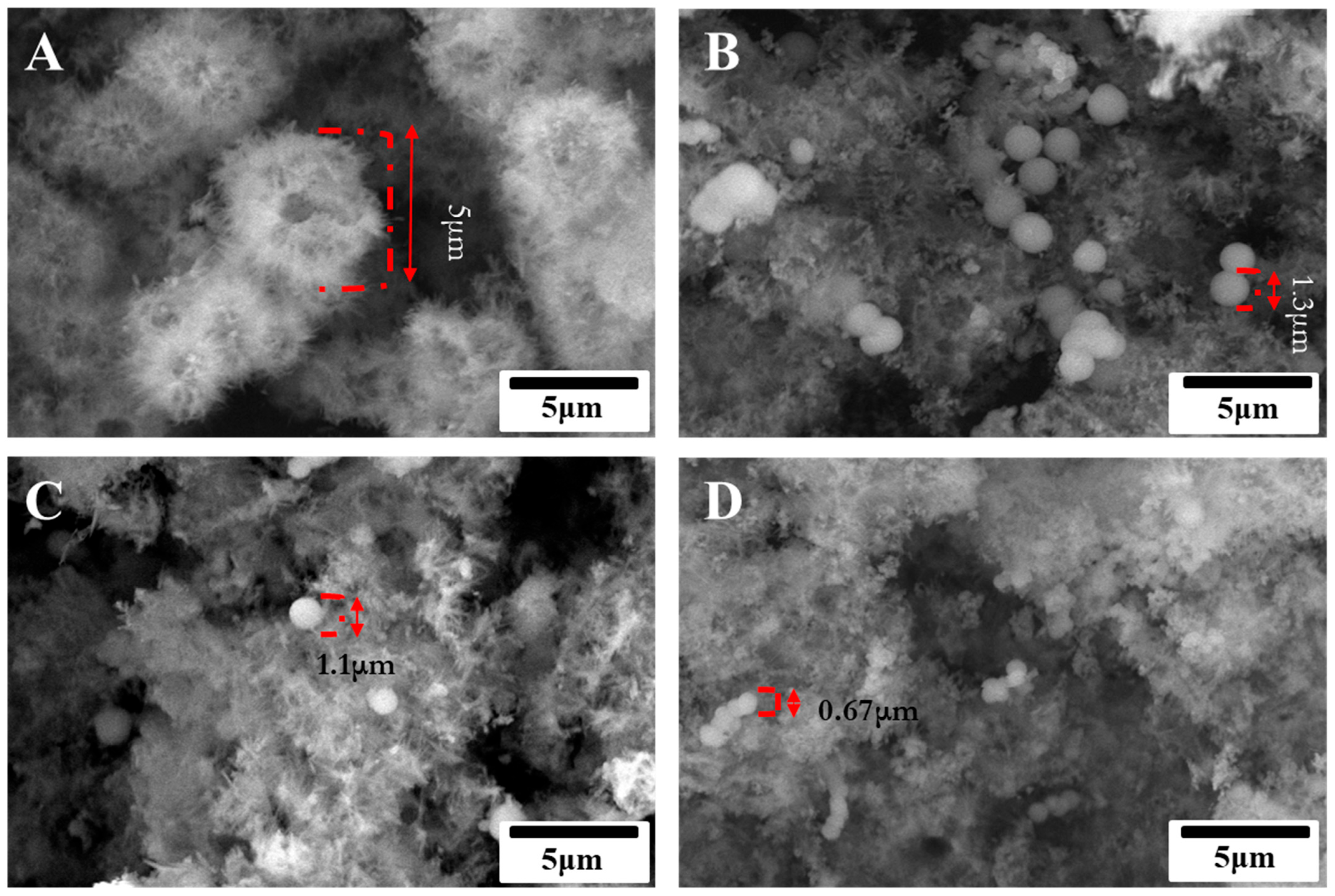
Figure 1. SEM micrographs for (A) HAlTi-0.0, (B) HAlTi-1.6, (C) HAlTi-2.0, and (D) HAlTi-2.4.
Processes 13 03886 g001
Figure 2. Elemental mapping for HAlTi-2.4 sample.
Processes 13 03886 g002
Figure 3. Transmission electron micrographs of the mixed oxides: (A) HAlTi-0.0, (B) HAlTi-1.6, (C) HAlTi-2.0, and (D) HAlTi-2.4.
Processes 13 03886 g003
Figure 4. Interplanar distances of the HAlTi-2.0 sample using TEM.
Processes 13 03886 g004
Figure 5. (A) XRD diffractograms and (B) UV-vis DRS spectra for (a) HAlTi-0.0, (b) HAlTi-1.6, (c) HAlTi-2.0, and (d) HAlTi-2.4.
Processes 13 03886 g005
Figure 6. XPS survey spectra for the (a) HAlTi-0.0, (b) HAlTi-1.6, (c) HAlTi-2.0, and (d) HAlTi-2.4 samples.
Processes 13 03886 g006
Figure 7. (A) Graph of % conversion and (B) selectivity of (a) HAlTi-0.0, (b) HAlTi-1.6, (c) HAlTi-2, and (d) HAlTi-2.4 materials in the dehydration of alcohols (2-propanol) at 200 °C.
Processes 13 03886 g007
Figure 8. (A) UV-vis spectra of (a) HAlTi-2.0, (b) NiMoW0-HAlTi-2.0, (c) Ni-MoW5-HAlTi-2.0, (d) NiMoW10-HAlTi-2.0, and (e) NiMoW15-HAlTi-2.0. (B) UV-vis spectra of the NiMoW-x catalysts with subtraction of the spectrum of the HAlTi-2.0 catalytic support and Tauc plot of the edge energies (b), (c), (d), and (e).
Processes 13 03886 g008
Figure 9. (A) Raman spectra of materials: (a) HAlTi-2.0, (b) NiMoW0-HAlTi-2.0, (c) NiMoW5-HAlTi-2.0, (d) NiMoW10-HAlTi-2.0, and (e) NiMoW15-HAlTi-2.0. (B) Raman spectra of NiMoW0-HAlTi-2.0. (C) Raman spectra of NiMoW5-HAlTi-2.0, NiMoW10-HAlTi-2.0, and NiMoW15-HAlTi-2.0.
Processes 13 03886 g009
Figure 10. TEM images of fresh sulfide catalysts: (A,B) NiMoW0-HAlTi-2.0, (C,D) NiMoW5-HAlTi-2.0, (E,F) NiMoW10-HAlTi-2.0, and (G,H) NiMoW15-HAlTi-2.0.
Processes 13 03886 g010
Figure 11. (A) XPS spectra of the Ni 2p emission line regions of (a) NiMoW0-HAlTi-2.0, (b) NiMoW5-HAlTi-2.0, (c) NiMoW10-HAlTi-2.0, and (d) NiMoW15-HAlTi-2.0. (B) XPS fits of the Mo 3d emission line region for (a), (b), (c), and (d). (C) Fit of the XPS spectra in the W 4f region for (a), (b), (c), and (d).
Processes 13 03886 g011
Figure 12. (A) Steady-state catalytic activity at 200, 220, 240, 260, 280, 300, and 320 °C for all the catalysts, (a) NiMoW0-HAlTi-2.0, (b) NiMoW5-HAlTi-2.0, (c) NiMoW10-HAlTi-2.0, and (d) NiMoW15-HAlTi-2.0, and (B) selectivity of the catalysts in the HDS of 3MT at 280 °C. [Hydrogenation (HYD) Direct desulfurization (DDS)].
Processes 13 03886 g012
Figure 13. Relationship between the catalytic activity in the 3MT HDS reaction and the degree of dispersion of the sulfur phases for all the catalysts: (a) NiMoW0-HAlTi-2.0, (b) NiMoW5-HAlTi-2.0, (c) NiMoW10-HAlTi-2.0, and (d) NiMoW15-HAlTi-2.0.
Processes 13 03886 g013
Table 1. Surface BET area (As), pore volume (Vp), and pore diameter (Ps) for synthesized catalytic supports.
SupportAs
m2·g−1
Vp
cm3·g−1
Ps
Å
HAlTi-0.02020.3065
HAlTi-1.61870.3161
HAlTi-2.01930.3255
HAlTi-2.41810.2857
Table 2. Semiquantitative XPS analysis of the materials.
MaterialExperimental Atomic %Nominal (%at/%at)SEM Composition
OAlTiAl/TiAl/TiAl/Ti
HAlTi-0.055.344.7-000
HAlTi-1.657.039.73.312.03.23.9
HAlTi-2.057.240.02.814.34.03.8
HAlTi-2.463.134.62.315.04.84.7
Table 3. Semiquantitative Raman analysis of the Mo(W)Ox species.
Catalyst988 cm−1
%O=Me=O
948 cm−1
%Me=O
917 cm−1
%Mo-O-Mo
Polymolybdate
878 cm−1
%Mo-O-Mo
(NiMoO4)
853 cm−1 %O-Mo-O (NiMoO4)832 cm−1 %Mo-O-Mo
Molibdate
O=Me + O=Me=O
Me-O-Me
NiMoW0-HAlTi-2.064.6118.586.418.64--1.763.84
NiMoW5-HAlTi-2.051.0419.4812.6610.184.502.143.00
NiMoW10-HAlTi-2.047.9523.4512.2312.132.581.862.82
NiMoW15-HAlTi-2.046.8826.8713.115.834.442.873.58
Table 4. Statistical analysis of the average length, average stacking number, and fw of the NiMoWS sulfide catalysts.
CatalystLaverage (Å)ni (Å)W edgeWtotal atomsAverage Stacking Numberfw
NiMoW0-HAlTi-2.0447.438.21422.190.27
NiMoW5-HAlTi-2-0406.734.5117.42.20.29
NiMoW10-HAlTi-2.0508.343.8183.32.250.24
NiMoW15-HAlTi-2.0416.935.4123.42.150.28
Disclaimer/Publisher’s Note: The statements, opinions and data contained in all publications are solely those of the individual author(s) and contributor(s) and not of MDPI and/or the editor(s). MDPI and/or the editor(s) disclaim responsibility for any injury to people or property resulting from any ideas, methods, instructions or products referred to in the content.