Review

A Review on Pyrometallurgical Extraction of Antimony from Primary Resources: Current Practices and Evolving Processes


by
Elmira Moosavi-Khoonsari
1,*,
Sina Mostaghel
2,
Andreas Siegmund
3 and
Jean-Pierre Cloutier
4
1
Department of Mechanical Engineering, École de Technologie Supérieure, 1100 Notre-Dame St W, Montreal, QC H3C 1K3, Canada
2
SNC-Lavalin, 195 The West Mall, Toronto, ON M9C 5K1, Canada
3
LanMetCon LLC, 780 Lark Street, Lantana, TX 76226, USA
4
SNC-Lavalin, 455 Rene-Levesque Blvd., Montreal, QC H2Z 1Z3, Canada
*
Author to whom correspondence should be addressed.
Processes 2022, 10(8), 1590; https://doi.org/10.3390/pr10081590
Submission received: 25 July 2022 / Revised: 4 August 2022 / Accepted: 4 August 2022 / Published: 12 August 2022
(This article belongs to the Special Issue Process Analysis and Simulation in Extractive Metallurgy)

Abstract

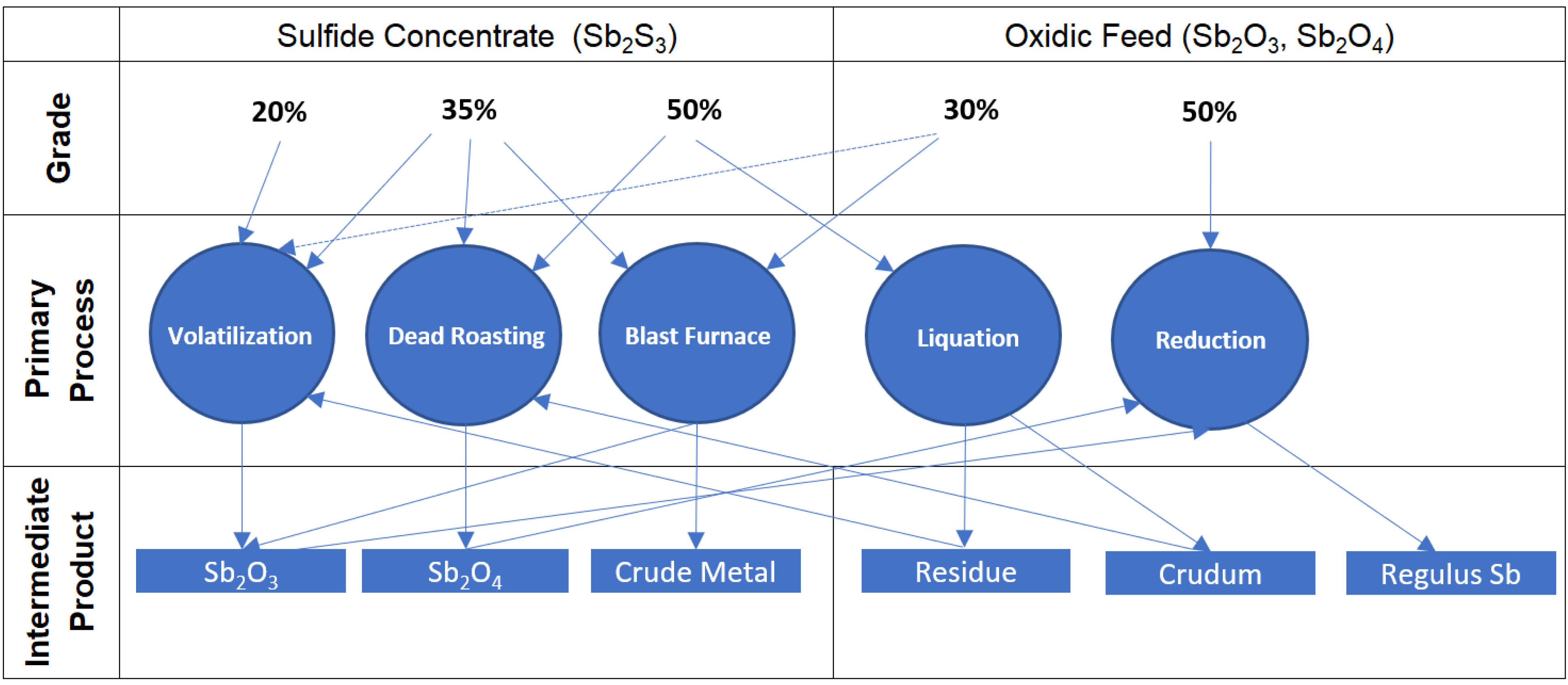
Antimony is classified as a critical/strategic metal. Its primary production is predominated by China via pyrometallurgical routes such as volatilization roasting—reduction smelting or direct reduction smelting. The performance of most of the pyro-processes is very sensitive to concentrate type and grade. Therefore, technology selection for a greenfield plant is a significant and delicate task to maximize the recovery rate of antimony and subsequently precious metals (PMs), mainly gold, from the concentrates. The current paper reviews the conventional pyrometallurgical processes and technologies that have been practiced for the treatment of antimony concentrates. The blast furnace is the most commonly used technology, mainly because of its adaptability to different feeds and grades and a high recovery rate. In addition, several other more environmentally friendly pyrometallurgical routes, that were recently developed, are reviewed but these are still at laboratory- or pilot-scales. For example, decarbonization of antimony production through the replacement of carbonaceous reductants with hydrogen seems to be feasible, although the process is still at its infancy, and further research and development are necessary for its commercialization. At the end, available refining methods for removal of the most important impurities including arsenic, sulfur, lead, iron, and copper from crude antimony are discussed.
Keywords: antimony; critical metals; extractive metallurgy; refining; technology selection antimony; critical metals; extractive metallurgy; refining; technology selection