_Bryant.png)
MCD-Temporal: Constructing a New Time-Entropy Enhanced Dynamic Weighted Heterogeneous Ensemble for Cognitive Level Classification


Abstract
1. Introduction
- 1.
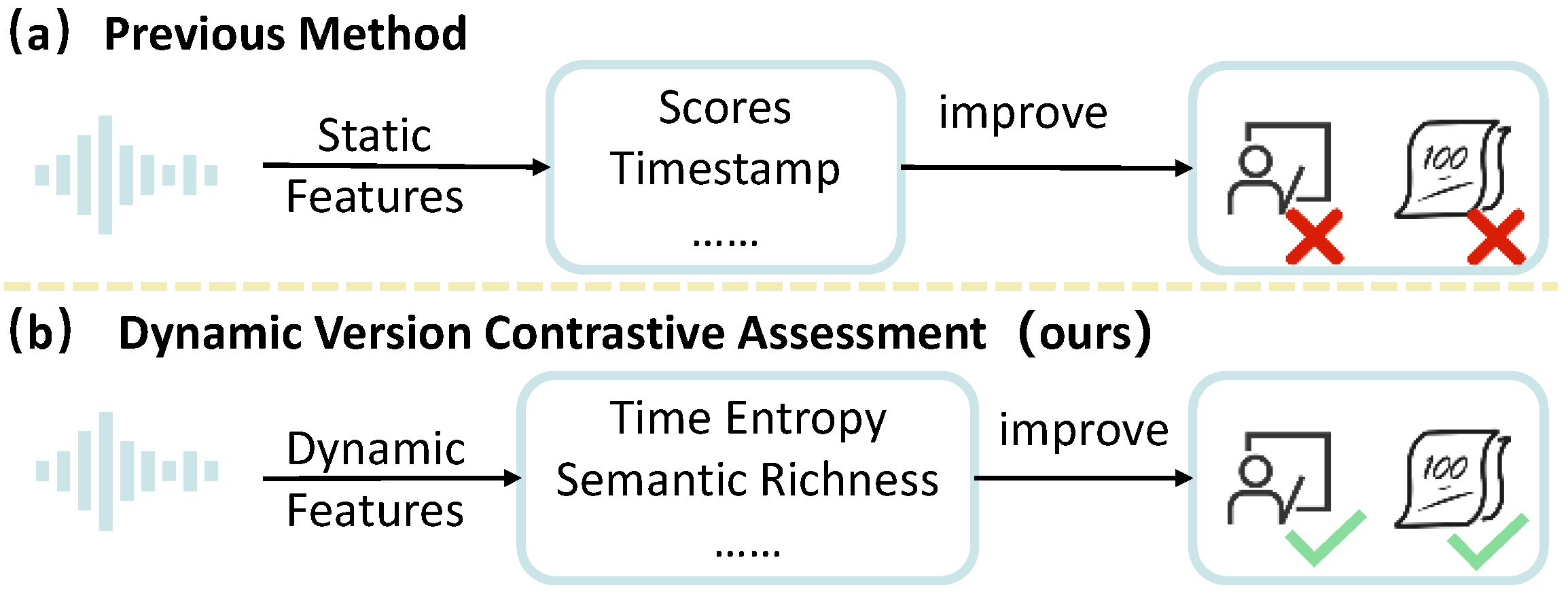
- We propose time entropy and semantic richness features to dynamically quantify teaching style and dialogue quality, moving beyond static textual analysis.
- 2.
- 3.
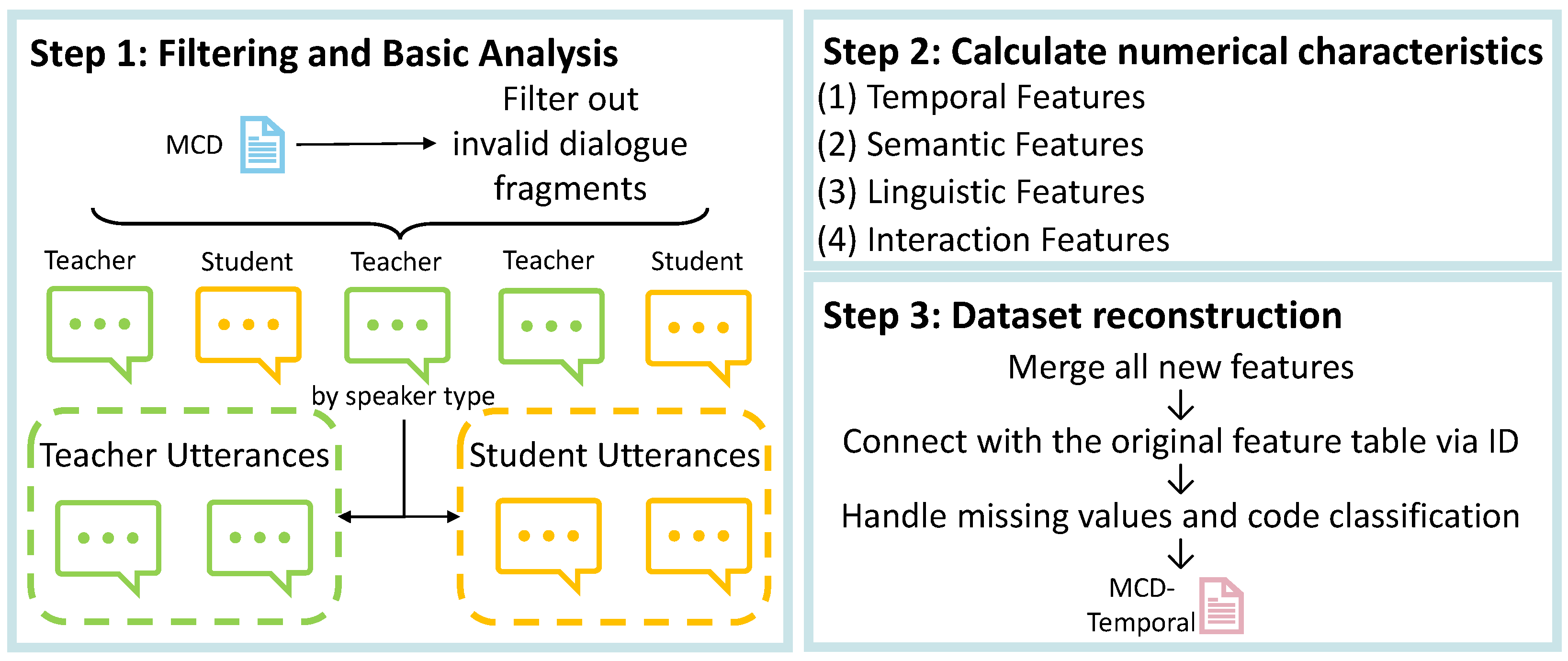
- We construct the MCD-temporal dataset, enhancing the original MCD dataset with nine dynamic features to support temporal-semantic research in education.
- 4.
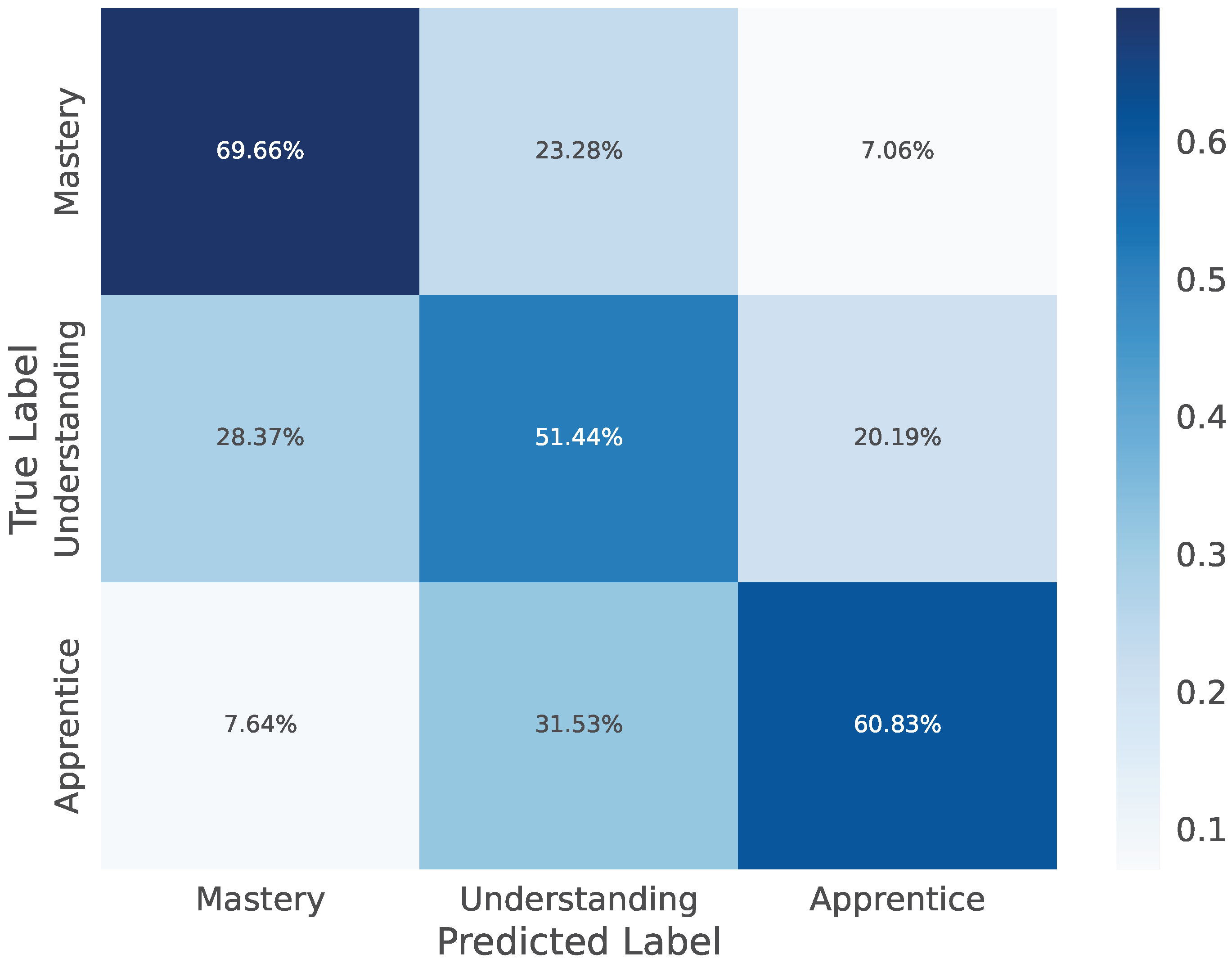
- We demonstrate superior and robust performance, achieving a macro-F1 score of 0.6236 and showing significant gains on the challenging minority class.
2. Related Work
2.1. Current State and Challenges of Cognitive Assessment in Instructional Dialogues
2.2. Application and Limitations of Temporal Dynamic Features in the Educational Analysis
2.3. Advances in Ensemble Learning for Imbalanced Educational Data
3. Dataset
3.1. Dataset Reconstruction and Enhancement
- (1)
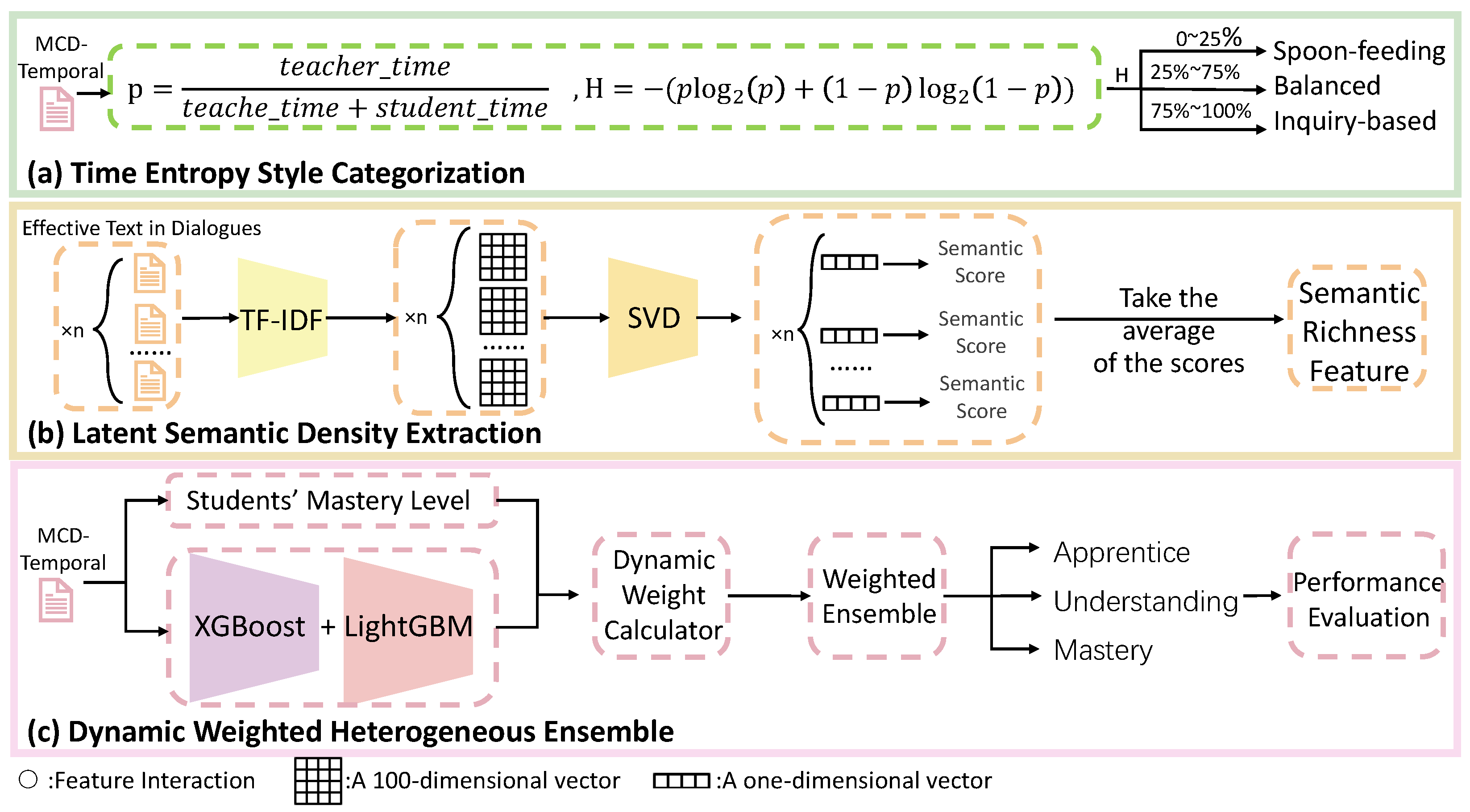
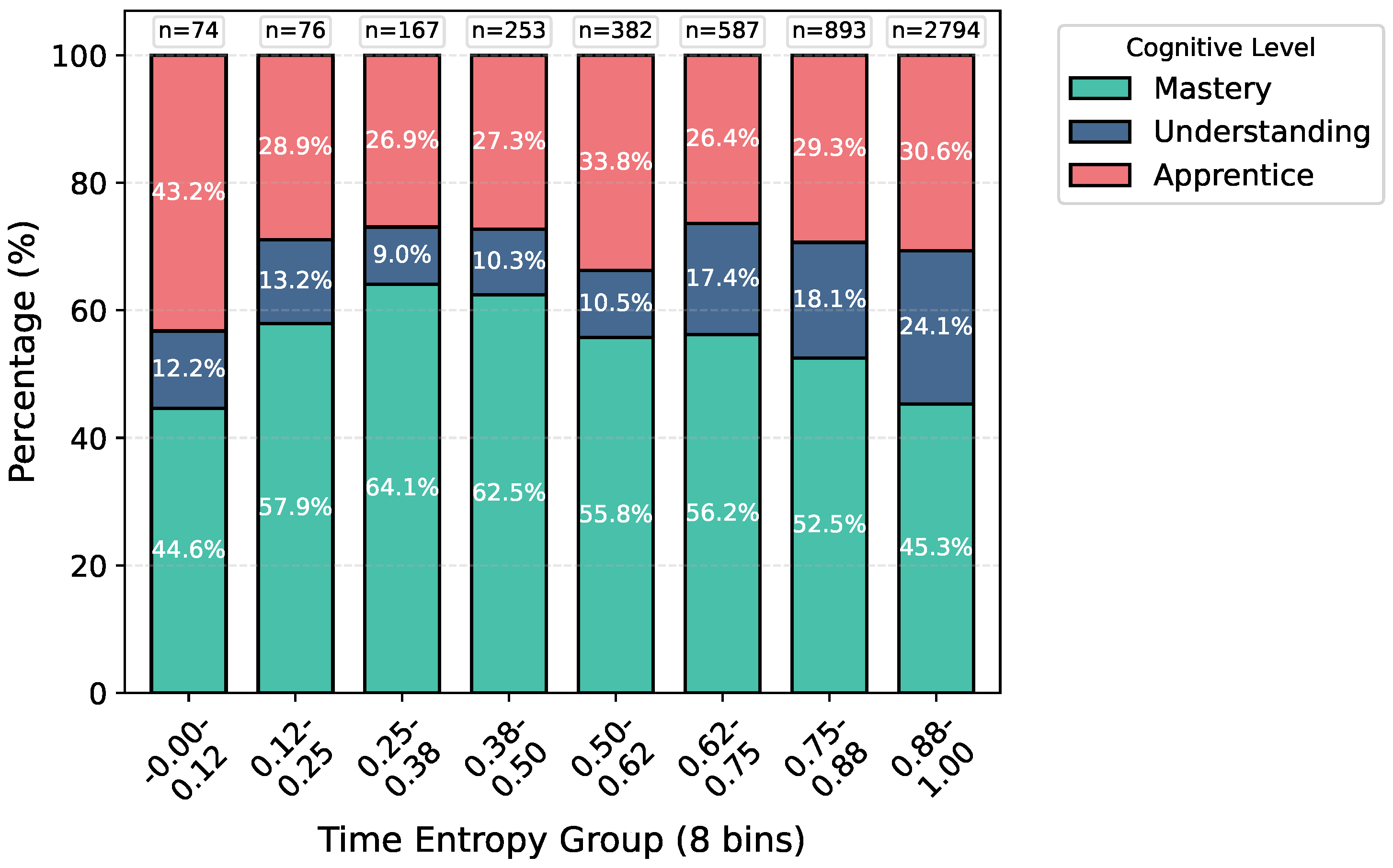
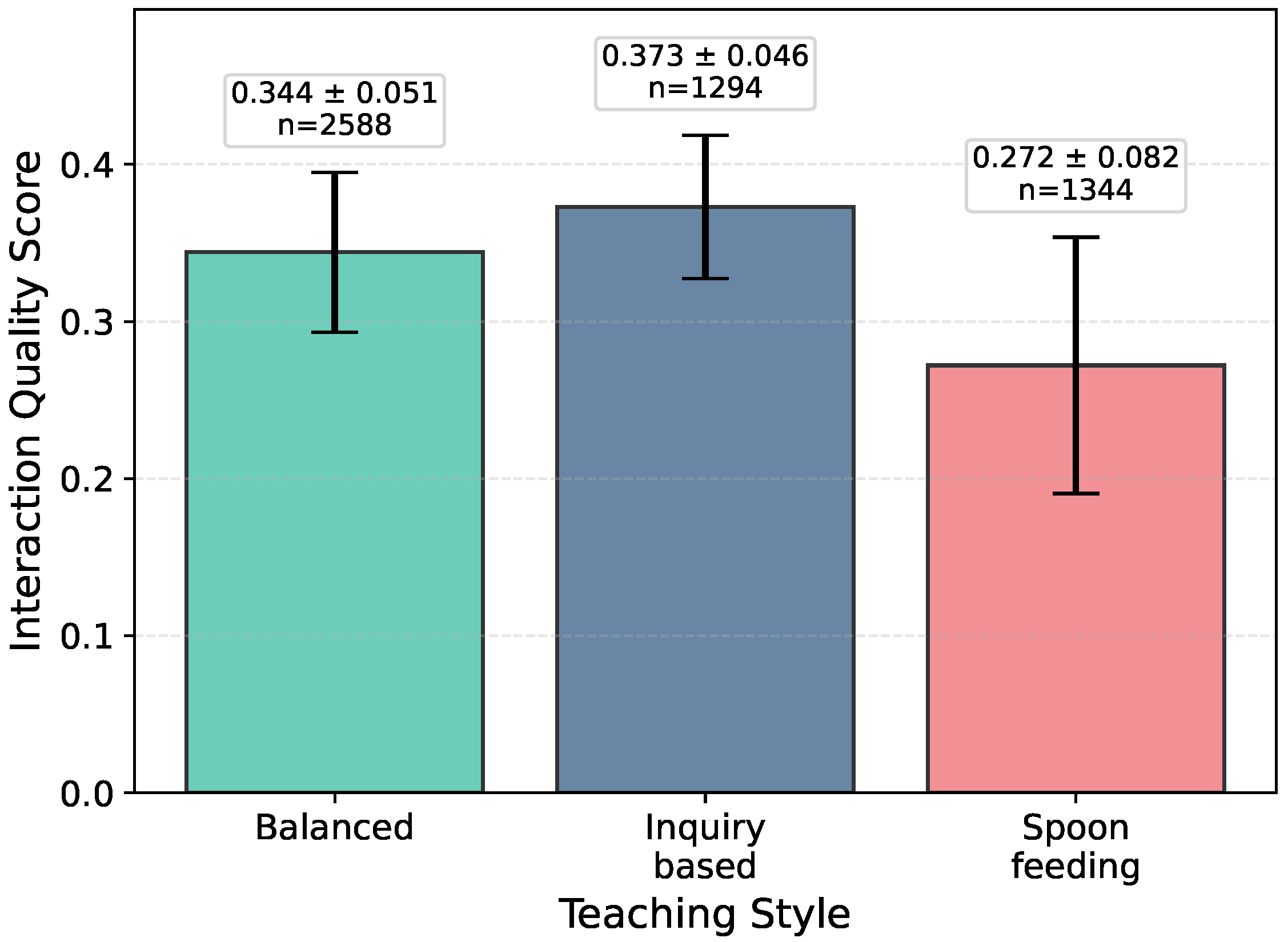
- Temporal Features: Time entropy quantifies the teacher–student speaking balance to categorize instructional styles, ranging from lecture-heavy (low entropy) to dialogic and student-active (high entropy). Teaching style classifies patterns, enabling tailored analysis of instructional efficacy.
- (2)
- Semantic Features: Semantic richness evaluates information density, signaling dialogue substance and cognitive demand.
- (3)
- Student Features: Lexical diversity reflects vocabulary breadth, pointing to language development needs. Explanation ratio measures logical elaboration, tracing the growth of structured reasoning. Student mastery score evaluates proficiency, informing personalized learning paths.
- (4)
- Teacher Features: Question ratio quantifies questioning, assessing the use of inquiry. Explanation ratio assesses exposition, measuring direct knowledge transfer. Guidance ratio evaluates prompting, gauging scaffolding effectiveness. Teacher guidance score integrates impact, benchmarking instructional quality.
- (5)
- Interaction Features: Student response depth measures relevance, capturing moment-to-moment engagement quality. Teacher question quality identifies open-ended prompts, highlighting catalysts for critical thinking. Dialogue coherence evaluates continuity, ensuring the conversation builds knowledge logically.
- (6)
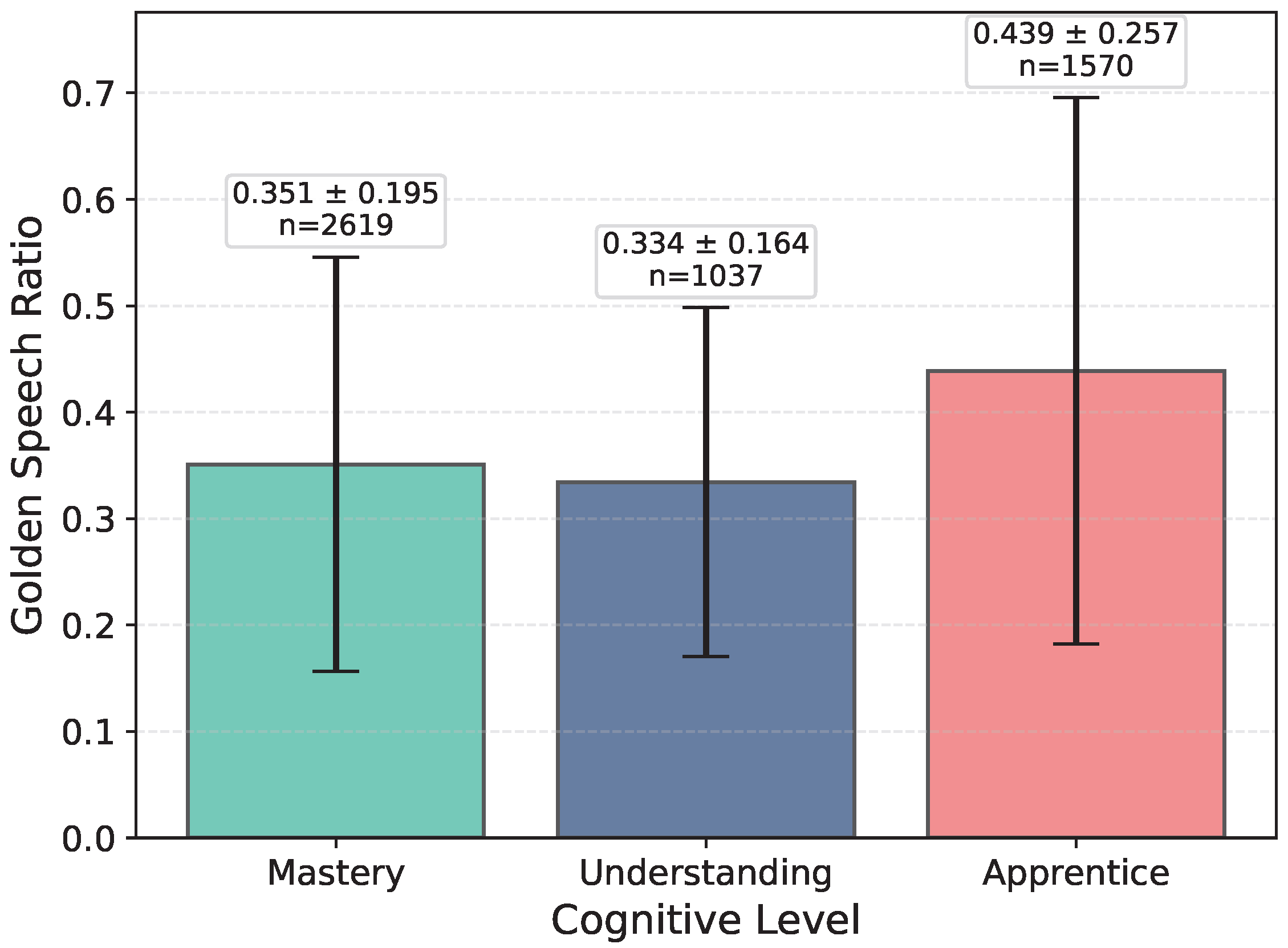
- Comprehensive Evaluation Features: Golden speech ratio detects pivotal responses, spotlighting transformative learning moments. Interaction quality score rates effectiveness, quantifying the overall pedagogical value of a dialogue.
3.2. Detailed Feature Computation
4. Methodology
4.1. Time Entropy Style Categorization
| Algorithm 1: Teaching style classification |
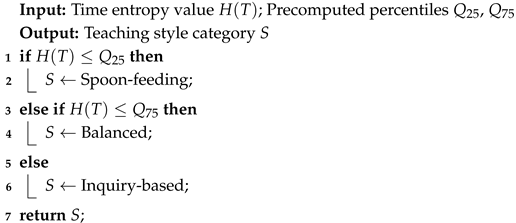 |
4.2. Latent Semantic Density Extraction
4.2.1. TF-IDF Vectorization with SVD for Extraction
4.2.2. Role of Semantic Richness in the Ensemble
4.3. Dynamic Weighted Heterogeneous Ensemble
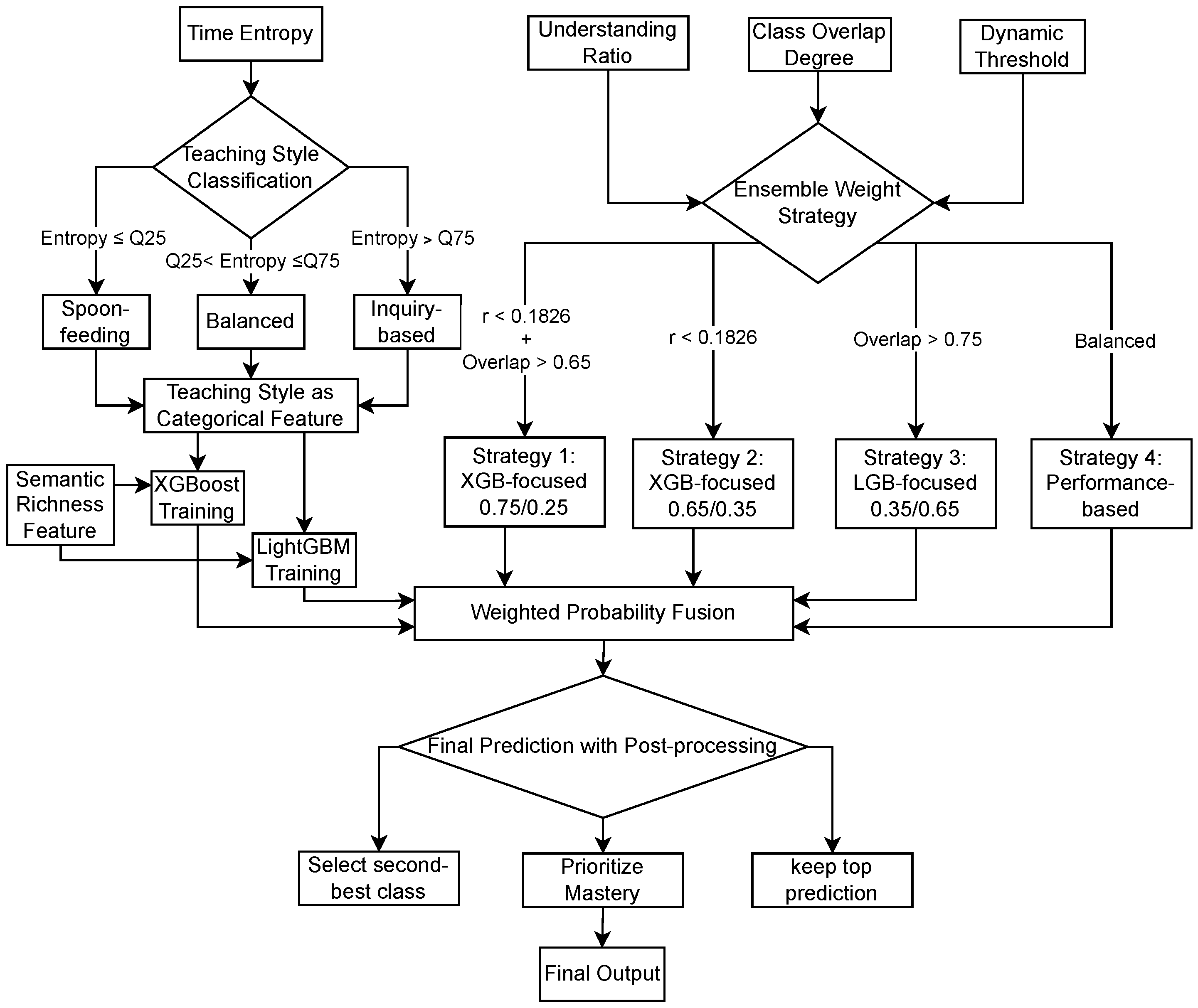
4.3.1. Dynamic Weight Calculation Strategy
| Algorithm 2: Dynamic weight calculation strategy |
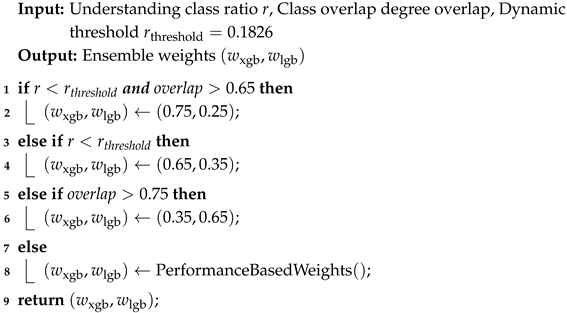 |
4.3.2. Weighted Probability Fusion Mechanism
4.3.3. Feature Importance Analysis
4.3.4. Comprehensive Evaluation System
4.4. Decision Flow for Practical Implementation
5. Experiments
5.1. Experimental Setup
5.1.1. Experimental Dataset
5.1.2. Evaluation Metrics and Experimental Design
5.1.3. Comparison Methods
5.2. Results and Analysis
5.2.1. Dataset Statistical Analysis
5.2.2. Overall Performance Comparison
5.2.3. Ablation Study Analysis
5.2.4. Statistical Significance Test
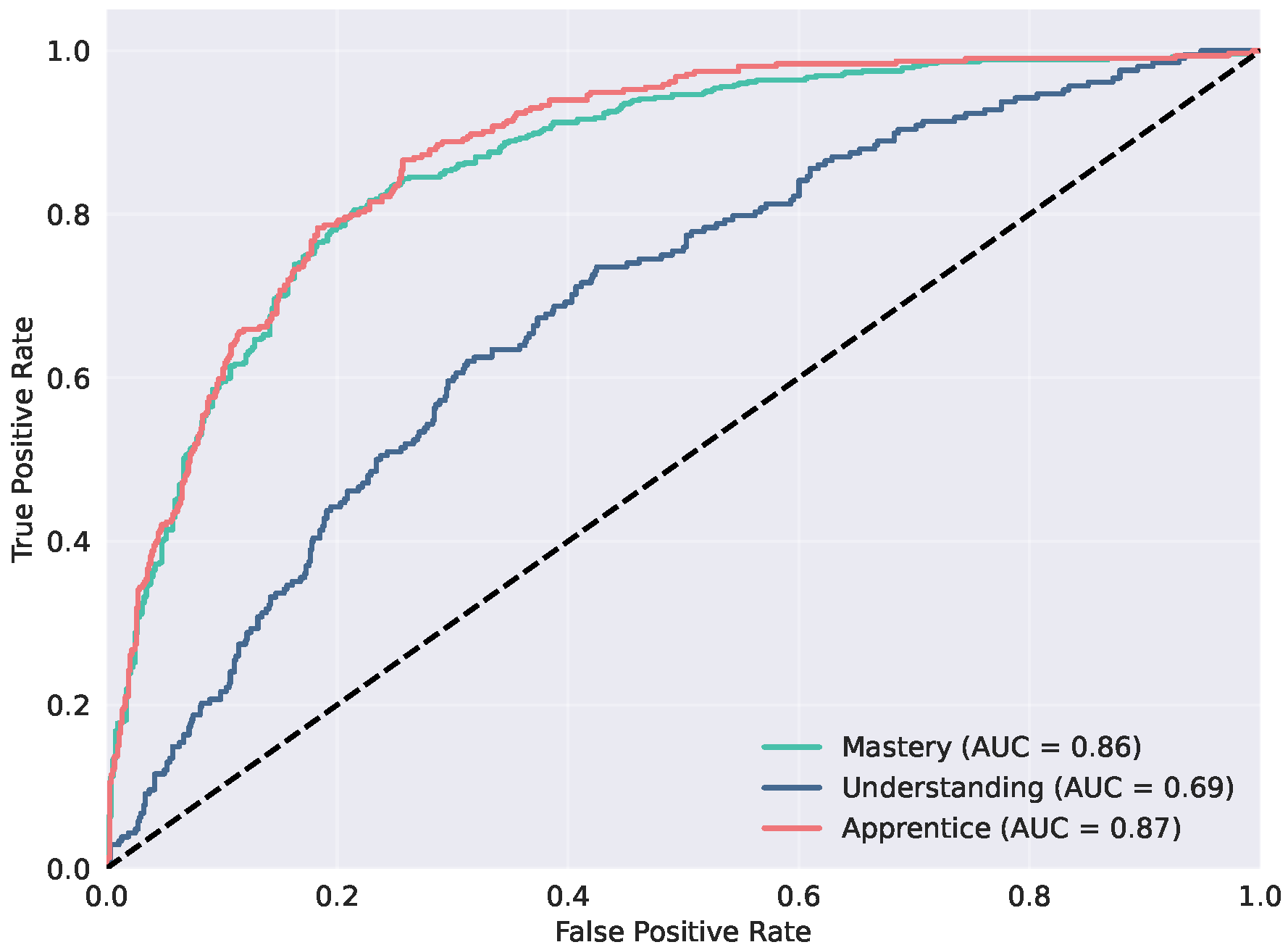
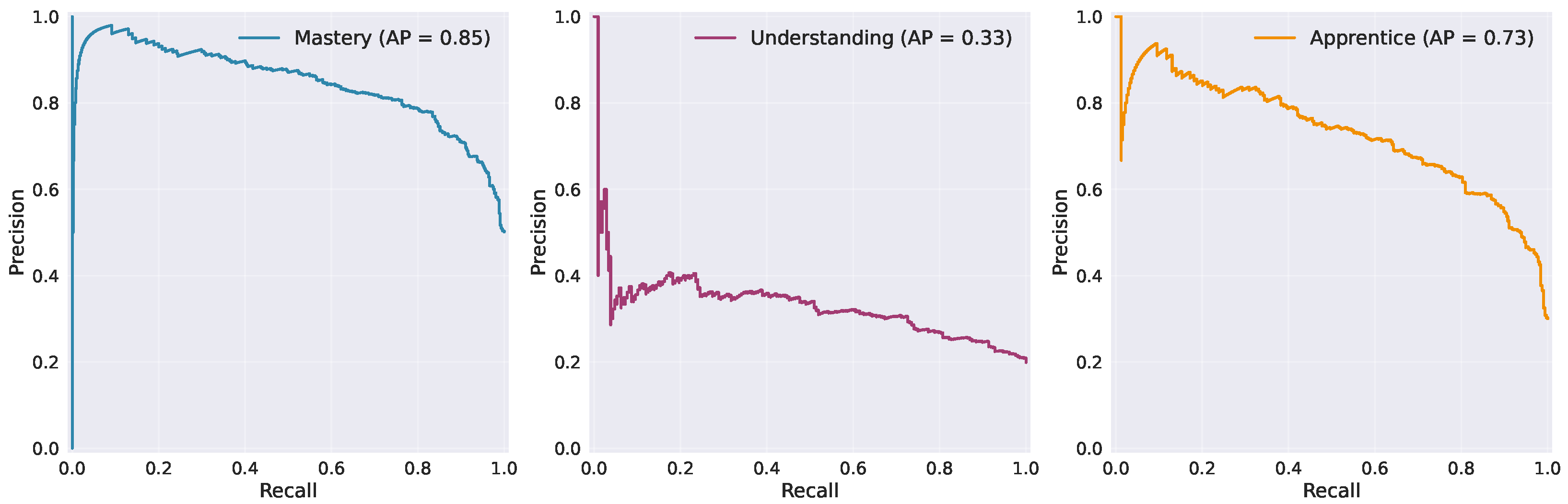
5.2.5. ROC and Model Discriminative Ability
5.2.6. Fine-Grained Error Analysis and Feature Refinement Directions
6. Discussion
6.1. Experimental Validation and Core Advantages of the DWHE Framework
6.2. Implications and Implementation Paths of Teaching Practice
7. Conclusions
Author Contributions
Funding
Institutional Review Board Statement
Informed Consent Statement
Data Availability Statement
Acknowledgments
Conflicts of Interest
Abbreviations
| MCD | Multi-turn Classroom Dialogue |
| DWHE | Dynamic Weighted Heterogeneous Ensemble |
| TF-IDF | Term Frequency-Inverse Document Frequency |
| SVD | Singular Value Decomposition |
| XGBoost | Extreme Gradient Boosting |
| LightGBM | Light Gradient Boosting Machine |
| SMOTE | Synthetic Minority Over-Sampling Technique |
| ROC-AUC | Receiver Operating Characteristic-Area Under Curve |
Appendix A. Summary of Limitations and Proposed Solutions

| Aspect | Prior Work Limitations | Our Contribution |
|---|---|---|
| Temporal Features | Relies on static textual features; overlooks dynamic temporal interactions and speaking balance | Introduces time entropy to quantify teacher–student speaking patterns; adds 9 dynamic temporal-semantic features |
| Style Modeling | Lacks quantitative teaching style framework; uses theoretical thresholds for categorization | Proposes a data-driven percentile-based teaching style classification (spoon-feeding/balanced/inquiry-based) |
| Imbalance Handling | Employs homogeneous ensembles or static weighting schemes; fails to adapt to class distribution | Designs DWHE with adaptive weighting based on multi-faceted data characteristics |
| Reproducibility Assets | Limited public datasets with dynamic temporal features; lack of comprehensive feature codes | Constructs and releases MCD-temporal dataset with all feature computation code publicly available in Gitee repository |
Appendix B. Hyperparameter Tuning Details for DWHE Base Learners
Appendix B.1. Hyperparameter Search Space and Optimization Methodology
| Parameter | XGBoost Search Space | LightGBM Search Space |
|---|---|---|
| max_depth | [4, 6, 8] | [4, 7, 10] |
| n_estimators | [100, 300, 500] | [100, 300, 500] |
| learning_rate | [0.01, 0.05, 0.1] | [0.01, 0.05, 0.1] |
| subsample | [0.7, 0.8, 0.9] | [0.7, 0.8, 0.9] |
| colsample_bytree | [0.7, 0.8, 0.9] | [0.7, 0.8, 0.9] |
| reg_alpha | [0, 0.1, 1.0] | [0, 0.1, 1.0] |
| reg_lambda | [0.1, 1.0, 10.0] | [0.1, 1.0, 10.0] |
| Imbalance Handling | scale_pos_weight: [1.0, 2.5, 5.0] | class_weight: [None, ‘balanced’] |
Appendix B.2. Top-Performing Configurations and Analysis
| Rank | F1 Score | max_depth | n_estimators | learning_rate | scale_pos_weight | subsample | colsample_bytree | reg_alpha | reg_lambda |
|---|---|---|---|---|---|---|---|---|---|
| 1 (ours) | 0.6121 | 4 | 100 | 0.1 | 1.0 | 0.8 | 0.9 | 1.0 | 0.1 |
| 2 | 0.6121 | 4 | 100 | 0.1 | 2.5 | 0.8 | 0.9 | 1.0 | 0.1 |
| 3 | 0.6121 | 4 | 100 | 0.1 | 5.0 | 0.8 | 0.9 | 1.0 | 0.1 |
| 4 | 0.6107 | 4 | 100 | 0.1 | 1.0 | 0.7 | 0.9 | 0.1 | 1.0 |
| 5 | 0.6107 | 4 | 100 | 0.1 | 2.5 | 0.7 | 0.9 | 0.1 | 1.0 |
| 6 | 0.6107 | 4 | 100 | 0.1 | 5.0 | 0.7 | 0.9 | 0.1 | 1.0 |
| 7 | 0.6105 | 4 | 100 | 0.1 | 1.0 | 0.8 | 0.8 | 0.0 | 10.0 |
| 8 | 0.6105 | 4 | 100 | 0.1 | 2.5 | 0.8 | 0.8 | 0.0 | 10.0 |
| 9 | 0.6105 | 4 | 100 | 0.1 | 5.0 | 0.8 | 0.8 | 0.0 | 10.0 |
| 10 | 0.6103 | 4 | 100 | 0.1 | 1.0 | 0.8 | 0.9 | 0.0 | 0.1 |
| Rank | F1 Score | max_depth | n_estimators | learning_rate | class_weight | subsample | colsample_bytree | reg_alpha | reg_lambda |
|---|---|---|---|---|---|---|---|---|---|
| 1 (ours) | 0.6338 | 10 | 300 | 0.01 | balanced | 0.7 | 0.7 | 0.1 | 0.1 |
| 2 | 0.6338 | 10 | 300 | 0.01 | balanced | 0.8 | 0.7 | 0.1 | 0.1 |
| 3 | 0.6338 | 10 | 300 | 0.01 | balanced | 0.9 | 0.7 | 0.1 | 0.1 |
| 4 | 0.6331 | 7 | 100 | 0.01 | balanced | 0.7 | 0.8 | 1.0 | 1.0 |
| 5 | 0.6331 | 7 | 100 | 0.01 | balanced | 0.8 | 0.8 | 1.0 | 1.0 |
| 6 | 0.6331 | 7 | 100 | 0.01 | balanced | 0.9 | 0.8 | 1.0 | 1.0 |
| 7 | 0.6330 | 4 | 100 | 0.1 | balanced | 0.7 | 0.9 | 1.0 | 10.0 |
| 8 | 0.6330 | 4 | 100 | 0.1 | balanced | 0.8 | 0.9 | 1.0 | 10.0 |
| 9 | 0.6330 | 4 | 100 | 0.1 | balanced | 0.9 | 0.9 | 1.0 | 10.0 |
| 10 | 0.6329 | 7 | 300 | 0.01 | balanced | 0.7 | 0.7 | 0.1 | 1.0 |
Appendix B.3. Key Findings from Hyperparameter Optimization
Appendix B.3.1. XGBoost Configuration Analysis
Appendix B.3.2. LightGBM Configuration Analysis
Appendix C. Dynamic Weight Threshold Analysis
Appendix C.1. Empirical Threshold Determination
| Fold | Understanding Ratio | Dynamic Threshold | Train Samples | Understanding Samples |
|---|---|---|---|---|
| 1 | 0.1983 | 0.1824 | 4180 | 829 |
| 2 | 0.1983 | 0.1823 | 4181 | 829 |
| 3 | 0.1985 | 0.1826 | 4181 | 830 |
| 4 | 0.1985 | 0.1826 | 4181 | 830 |
| 5 | 0.1985 | 0.1826 | 4181 | 830 |
Appendix C.2. Statistical Summary
| Statistic | Value |
|---|---|
| Mean Threshold | 0.1825 |
| Standard Deviation | 0.0001 |
| Minimum | 0.1823 |
| Maximum | 0.1826 |
| Median | 0.1826 |
| Recommended Threshold | 0.1826 |
Appendix C.3. Parameter Selection Rationale
Appendix C.4. Reproduction Specification
| Recommended: | r_threshold = 0.1826 |
| Parameters: | ± = 0.15, adjustment = 0.92, min_threshold = 0.12 |
References
- Geethanjali, K.S.; Umashankar, N. Enhancing Educational Outcomes with Explainable AI: Bridging Transparency and Trust in Learning Systems. In Proceedings of the 2025 International Conference on Emerging Systems and Intelligent Computing (ESIC), Bhubaneswar, India, 8–9 February 2025; pp. 325–328. [Google Scholar] [CrossRef] [Scilit]
- Antoniol, G.; Hayes, J.H.; Gueheneuc, Y.G.; di Penta, M. Reuse or Rewrite: Combining Textual, Static, and Dynamic Analyses to Assess the Cost of Keeping a System up-to-Date. In Proceedings of the 2008 IEEE International Conference on Software Maintenance, Beijing, China, 28 September–4 October 2008; pp. 147–156. [Google Scholar] [CrossRef] [Scilit]
- Fatalian, A.; Nayeri, Z.A.; Azadnia, M. Impact of Using Semantic Social Networks on Organizations. In Proceedings of the 2009 International Conference on Advances in Social Network Analysis and Mining, Athens, Greece, 20–22 July 2009; pp. 47–52. [Google Scholar] [CrossRef] [Scilit]
- Moazeni, S.; Pourmohammadi, H. Smart Teaching Quantitative Topics through the VARK Learning Styles Model. In Proceedings of the 2013 IEEE Integrated STEM Education Conference (ISEC), Princeton, NJ, USA, 9 March 2013; pp. 1–7. [Google Scholar] [CrossRef] [Scilit]
- Escudero-Viñolo, M.; López-Cifuentes, A. CCL: Class-Wise Curriculum Learning for Class Imbalance Problems. In Proceedings of the 2022 IEEE International Conference on Image Processing (ICIP), Bordeaux, France, 16–19 October 2022; pp. 1476–1480. [Google Scholar] [CrossRef] [Scilit]
- Chen, J.; Liu, Z.; Hou, M.; Zhao, X.; Luo, W. Multi-Turn Classroom Dialogue Dataset: Assessing Student Performance from Oneon- one Conversations. In Proceedings of the 33rd ACM International Conference on Information and Knowledge Management, Boise, ID, USA, 21–25 October 2024; pp. 5333–5337. [Google Scholar] [CrossRef] [Scilit]
- Wang, D.; Yang, J.; Zhou, Y. Human Action Recognition Based on Multi-Mode Spatial-Temporal Feature Fusion. In Proceedings of the 2019 22th International Conference on Information Fusion (FUSION), Ottawa, ON, Canada, 2–5 July 2019; pp. 1–7. [Google Scholar] [CrossRef] [Scilit]
- Bertocco, M.; Giorgi, G.; Narduzzi, C. Innovation-Based Timestamp Validation for Reliable Sensor Network Synchronization. In Proceedings of the 2013 IEEE International Instrumentation and Measurement Technology Conference (I2MTC), Minneapolis, MN, USA, 6–9 May 2013; pp. 784–789. [Google Scholar] [CrossRef] [Scilit]
- Zhao, F. A Resource Sharing System for Music Education Using the Entropy Technology. Mob. Inf. Syst. 2022, 2022, 3382742. [Google Scholar] [CrossRef] [Scilit]
- Zhang, Y.; Mariano, V.Y.; Bringula, R.P. Prediction of Student’s Grade by Combining Educational Knowledge Graph and Collaborative Filtering. IEEE Access 2024, 12, 68382–68392. [Google Scholar] [CrossRef] [Scilit]
- Sun, L. Application and Improvement of Xgboost Algorithm Based on Multiple Parameter Optimization Strategy. In Proceedings of the 2020 5th International Conference on Mechanical, Control and Computer Engineering (ICMCCE), Harbin, China, 25–27 December 2020; pp. 1822–1825. [Google Scholar] [CrossRef] [Scilit]
- Cai, Z.; Huang, H.; Sun, G.; Li, Z.; Ouyang, C. Advancing Predictive Models: Unveiling LightGBM Machine Learning for Data Analysis. In Proceedings of the 2023 4th International Conference on Computer, Big Data and Artificial Intelligence (ICCBD+AI), Guiyang, China, 15–17 December 2023; pp. 109–112. [Google Scholar] [CrossRef] [Scilit]
- Yadav, S.; Shukla, S. Analysis of K-Fold Cross-Validation over Hold-Out Validation on Colossal Datasets for Quality Classification. In Proceedings of the 2016 IEEE 6th International Conference on Advanced Computing (IACC), Bhimavaram, India, 27–28 February 2016; pp. 78–83. [Google Scholar] [CrossRef] [Scilit]
- Kobayashi, S.; Fujita, D.; Shibutani, H.; Gohara, S.; Kobashi, S. ESWL Outcome Prediction with SMOTE and Stratified Sampling. In Proceedings of the 2024 Joint 13th International Conference on Soft Computing and Intelligent Systems and 25th International Symposium on Advanced Intelligent Systems (SCIS&ISIS), Himeji, Japan, 9–12 November 2024; pp. 1–2. [Google Scholar] [CrossRef] [Scilit]
- Özbey, C.; Ülgen, E.K. Distribution of High-Frequency Words: An Analytical Investigation. In Proceedings of the 2023 11th International Symposium on Digital Forensics and Security (ISDFS), Chattanooga, TN, USA, 11–12 May 2023; pp. 1–6. [Google Scholar] [CrossRef] [Scilit]
- Jing, C.; Jing, X.; Dongbo, W.; Jianming, Z. Analyzing Syntactic Features of Chinese Structures Base on the Statistics of Tsinghua Treebank. In Proceedings of the 2012 IEEE International Conference on Computer Science and Automation Engineering (CSAE), Zhangjiajie, China, 25–27 May 2012 ; Volume 2, pp. 121–125. [Google Scholar] [CrossRef] [Scilit]
- Bhattacharjee, I.; Bhattacharja, P. Stock Price Prediction: A Comparative Study between Traditional Statistical Approach and Machine Learning Approach. In Proceedings of the 2019 4th International Conference on Electrical Information and Communication Technology (EICT), Khulna, Bangladesh, 20–22 December 2019; pp. 1–6. [Google Scholar] [CrossRef] [Scilit]
- Tam, V.; Lam, E.Y.; Fung, S.T.; Fok, W.W.T.; Yuen, A.H.K. Enhancing Educational Data Mining Techniques on Online Educational Resources with a Semi-Supervised Learning Approach. In Proceedings of the 2015 IEEE International Conference on Teaching, Assessment, and Learning for Engineering (TALE), Zhuhai, China, 10–12 December 2015; pp. 203–206. [Google Scholar] [CrossRef] [Scilit]
- Santoni, M.M.; Basaruddin, T.; Junus, K.; Lawanto, O. Automatic Detection of Students’ Engagement During Online Learning: A Bagging Ensemble Deep Learning Approach. IEEE Access 2024, 12, 96063–96073. [Google Scholar] [CrossRef] [Scilit]
- Yang, B.; Gao, H.x.; Chen, Z. Efficient Sampling Strategies for Large-Scale Complex Networks. In Proceedings of the 2008 International Conference on Management Science and Engineering 15th Annual Conference Proceedings, Long Beach, CA, USA, 10–12 September 2008; pp. 334–339. [Google Scholar] [CrossRef] [Scilit]
- Xu, H. Hierarchical Cost-Sensitive Techniques for Class Imbalance Learning. In Proceedings of the 2021 4th International Conference on Artificial Intelligence and Big Data (ICAIBD), Chengdu, China, 28–31 May 2021; pp. 604–609. [Google Scholar] [CrossRef] [Scilit]
- Möller, S.; Köster, F.; Weiss, B. Modelling Speech Service Quality: From Conversational Phases to Communication Quality and Service Quality. In Proceedings of the 2017 Ninth International Conference on Quality of Multimedia Experience (QoMEX), Erfurt, Germany, 31 May–2 June 2017; pp. 1–3. [Google Scholar] [CrossRef] [Scilit]
- Stach, W.; Kurgan, L.A.; Pedrycz, W. Numerical and Linguistic Prediction of Time Series with the Use of Fuzzy Cognitive Maps. IEEE Trans. Fuzzy Syst. 2008, 16, 61–72. [Google Scholar] [CrossRef] [Scilit]
- Jain, S.; Jain, S.K.; Vasal, S. An Effective TF-IDF Model to Improve the Text Classification Performance. In Proceedings of the 2024 IEEE 13th International Conference on Communication Systems and Network Technologies (CSNT), Jabalpur, India, 6–7 April 2024; pp. 1–4. [Google Scholar] [CrossRef] [Scilit]
- Cottrell-Boyce, A. Banking and Debunking: Applying Freirean Theory to the Educational Challenges of Conspiracy Culture. J. Philos. Educ. 2024, 58, 562–581. [Google Scholar] [CrossRef] [Scilit]
- Cai, L.; Msafiri, M.M.; Kangwa, D. Exploring the Impact of Integrating AI Tools in Higher Education Using the Zone of Proximal Development. Educ. Inf. Technol. 2025, 30, 7191–7264. [Google Scholar] [CrossRef] [Scilit]
- Nguyen, V.H.; Halpin, R.; Joy-Thomas, A.R. Guided Inquiry-Based Learning to Enhance Student Engagement, Confidence, and Learning. J. Dent. Educ. 2024, 88, 1040–1047. [Google Scholar] [CrossRef] [Scilit] [PubMed]
- Stoltz, T.; Weger, U.; da Veiga, M. Consciousness and Education: Contributions by Piaget, Vygotsky and Steiner. Front. Psychol. 2024, 15. [Google Scholar] [CrossRef] [Scilit] [PubMed]
- Wei, Z.; Narin, A.B.; Mukherjee, S. Multidimensional Population Health Modeling: A Data-Driven Multivariate Statistical Learning Approach. IEEE Access 2022, 10, 22737–22755. [Google Scholar] [CrossRef] [Scilit]
- Tan, C.; Wei, Z.; Wu, Z.; Chen, Y.; Gu, J. Parallel Optimization of K-SVD Algorithm for Image Denoising Based on Spark. In Proceedings of the 2016 IEEE 13th International Conference on Signal Processing (ICSP), Chengdu, China, 6–10 November 2016; pp. 820–825. [Google Scholar] [CrossRef] [Scilit]
- Chirila, C.B.; Şora, I. The Optimization of a Page Rank Based Key Classes Classifier Using Simulated Annealing with ROC-AUC and Recall Metrics. In Proceedings of the 2019 IEEE 13th International Symposium on Applied Computational Intelligence and Informatics (SACI), Timișoara, Romania, 29–31 May 2019; pp. 21–26. [Google Scholar] [CrossRef] [Scilit]
- Yuan, D.; Huang, J.; Yang, X.; Cui, J. Improved Random Forest Classification Approach Based on Hybrid Clustering Selection. In Proceedings of the 2020 Chinese Automation Congress (CAC), Shanghai, China, 6–8 November 2020; pp. 1559–1563. [Google Scholar] [CrossRef] [Scilit]
- Ambesange, S.; A, V.; Uppin, R.; Patil, S.; Patil, V. Optimizing Liver Disease Prediction with Random Forest by Various Data Balancing Techniques. In Proceedings of the 2020 IEEE International Conference on Cloud Computing in Emerging Markets (CCEM), Bengaluru, India, 4–7 November 2020; pp. 98–102. [Google Scholar] [CrossRef] [Scilit]
- Luo, L.; Lv, W.; Zhang, R. An Empirical Study on Balance of Trade in China Based on Random Forest Regression Model. In Proceedings of the 2010 5th International Conference on Computer Science & Education, Hefei, China, 24–27 August 2010; pp. 561–564. [Google Scholar] [CrossRef] [Scilit]
- Bhavani, R.; Balamanigandan, R.; Priscilla, A.A. Analyzing the Performance of Novel Logistic Regression over Linear Regression Algorithms for Predicting Fake Job with Improved Accuracy. In Proceedings of the 2024 5th International Conference on Electronics and Sustainable Communication Systems (ICESC), Coimbatore, India, 7–9 August 2024; pp. 1728–1732. [Google Scholar] [CrossRef] [Scilit]
- Kharis, M. Crafting AI-Driven Open Educational Resources (OER) Videos for Enhanced German Language Learning. In Proceedings of the 2024 IEEE International Symposium on Consumer Technology (ISCT), Bali, Indonesia, 13–16 August 2024; pp. 137–141. [Google Scholar] [CrossRef] [Scilit]
- Luo, D.; Zheng, Y. The Research of Online Teaching Pattern Based on MOOC. In Proceedings of the 2015 International Symposium on Educational Technology (ISET), Wuhan, China, 27–29 July 2015; pp. 120–124. [Google Scholar] [CrossRef] [Scilit]
- Li, H.; Zou, P.; Han, W.; Xia, R. A Combination Method for Multi-class Imbalanced Data Classification. In Proceedings of the 2013 10th Web Information System and Application Conference, Yangzhou, China, 10–15 November 2013; pp. 365–368. [Google Scholar] [CrossRef] [Scilit]





| Feature Category | MCD | MCD-Temporal (Ours) |
|---|---|---|
| Basic Statistical Features | Dialogue turn num, etc. | Remain unchanged. |
| Temporal Features | Elapsed time std, etc. | Time Entropy |
| Teaching Style | ||
| Semantic Features | N-gram similarity, etc. | Semantic richness |
| Student Features | Student x num, etc. | Lexical Diversity |
| Explanation Ratio | ||
| Student Mastery Score | ||
| Teacher Features | Key question words, etc. | Question Ratio |
| Explanation Ratio | ||
| Guidance Ratio | ||
| Teacher Guidance Score | ||
| Interaction Features | × | Student Response Depth |
| Teacher Question Quality | ||
| Dialogue Coherence | ||
| Comprehensive Evaluation Features | × | Golden Speech Ratio |
| Interaction Quality Score |
| Class | Sample Count | Percentage |
|---|---|---|
| Mastery | 2619 | 50.1% |
| Understanding | 1037 | 19.8% |
| Apprentice | 1570 | 30.1% |
| Method | Macro-F1 ↑ | Std. Dev. ↓ |
|---|---|---|
| Random Forest [33] | 0.6156 | 0.0149 |
| Logistic Regression [35] | 0.6233 | 0.0081 |
| Balanced Random Forest [34] | 0.6195 | 0.0130 |
| XGBoost [11] | 0.5937 | 0.0111 |
| LightGBM [12] | 0.6035 | 0.0157 |
| DWHE (ours) | 0.6236 | 0.0110 |
| The arrows indicate the desired direction of performance: ↑ higher values are better; ↓ lower values are better. | ||
| Model Variant | XGBoost | LightGBM | Dynamic Weighting | Macro-F1 ↑ | Std. Dev. ↓ | Understanding F1 ↑ |
|---|---|---|---|---|---|---|
| XGBoost_Only | ✓ | × | × | 0.6205 | 0.0128 | 0.2468 |
| LightGBM_Only | × | ✓ | × | 0.6152 | 0.0176 | 0.3695 |
| Static Weight Ensemble | ✓ | ✓ | × | 0.6182 | 0.0137 | 0.3196 |
| DWHE (ours) | ✓ | ✓ | ✓ | 0.6236 | 0.0110 | 0.4044 |
Disclaimer/Publisher’s Note: The statements, opinions and data contained in all publications are solely those of the individual author(s) and contributor(s) and not of MDPI and/or the editor(s). MDPI and/or the editor(s) disclaim responsibility for any injury to people or property resulting from any ideas, methods, instructions or products referred to in the content. |
© 2025 by the authors. Licensee MDPI, Basel, Switzerland. This article is an open access article distributed under the terms and conditions of the Creative Commons Attribution (CC BY) license (https://creativecommons.org/licenses/by/4.0/).
Share and Cite
Wu, Y.; Zhang, L.; Li, B.; Zhang, W. MCD-Temporal: Constructing a New Time-Entropy Enhanced Dynamic Weighted Heterogeneous Ensemble for Cognitive Level Classification. Informatics 2025, 12, 134. https://doi.org/10.3390/informatics12040134
Wu Y, Zhang L, Li B, Zhang W. MCD-Temporal: Constructing a New Time-Entropy Enhanced Dynamic Weighted Heterogeneous Ensemble for Cognitive Level Classification. Informatics. 2025; 12(4):134. https://doi.org/10.3390/informatics12040134
Chicago/Turabian StyleWu, Yuhan, Long Zhang, Bin Li, and Wendong Zhang. 2025. "MCD-Temporal: Constructing a New Time-Entropy Enhanced Dynamic Weighted Heterogeneous Ensemble for Cognitive Level Classification" Informatics 12, no. 4: 134. https://doi.org/10.3390/informatics12040134
APA StyleWu, Y., Zhang, L., Li, B., & Zhang, W. (2025). MCD-Temporal: Constructing a New Time-Entropy Enhanced Dynamic Weighted Heterogeneous Ensemble for Cognitive Level Classification. Informatics, 12(4), 134. https://doi.org/10.3390/informatics12040134