

Entropic Geometry and Information Dynamics in Green Cryptocurrency Markets


Abstract
1. Introduction
- (Q1) Did the Russia–Ukraine war strengthens or weaken information sharing between cryptocurrencies, and did these effects differ between GCs and DCs?
- (Q2) Did signal regularity and predictability, as measured by approximate entropy, change during the conflict in a manner consistent with the Adaptive Market Hypothesis?
- (Q3) Does RLNNEE uncover local regimes of informational instability that global measures fail to detect, particularly during periods of extreme stress?
2. Literature Review
2.1. Geopolitical Risk and Cryptocurrency Markets
2.2. GCs and DCs and Energy Concerns
2.3. Information Transmission and Entropy-Based Approaches
2.4. Research Gap and Positioning of the Study
3. Data and Methods
3.1. Data
3.2. Methods
3.2.1. Why Mutual Information as a Measure of Dependence?
3.2.2. Approximate Entropy
3.2.3. Rolling Local Nearest Neighbour Entropy Estimator
4. Result and Discussion
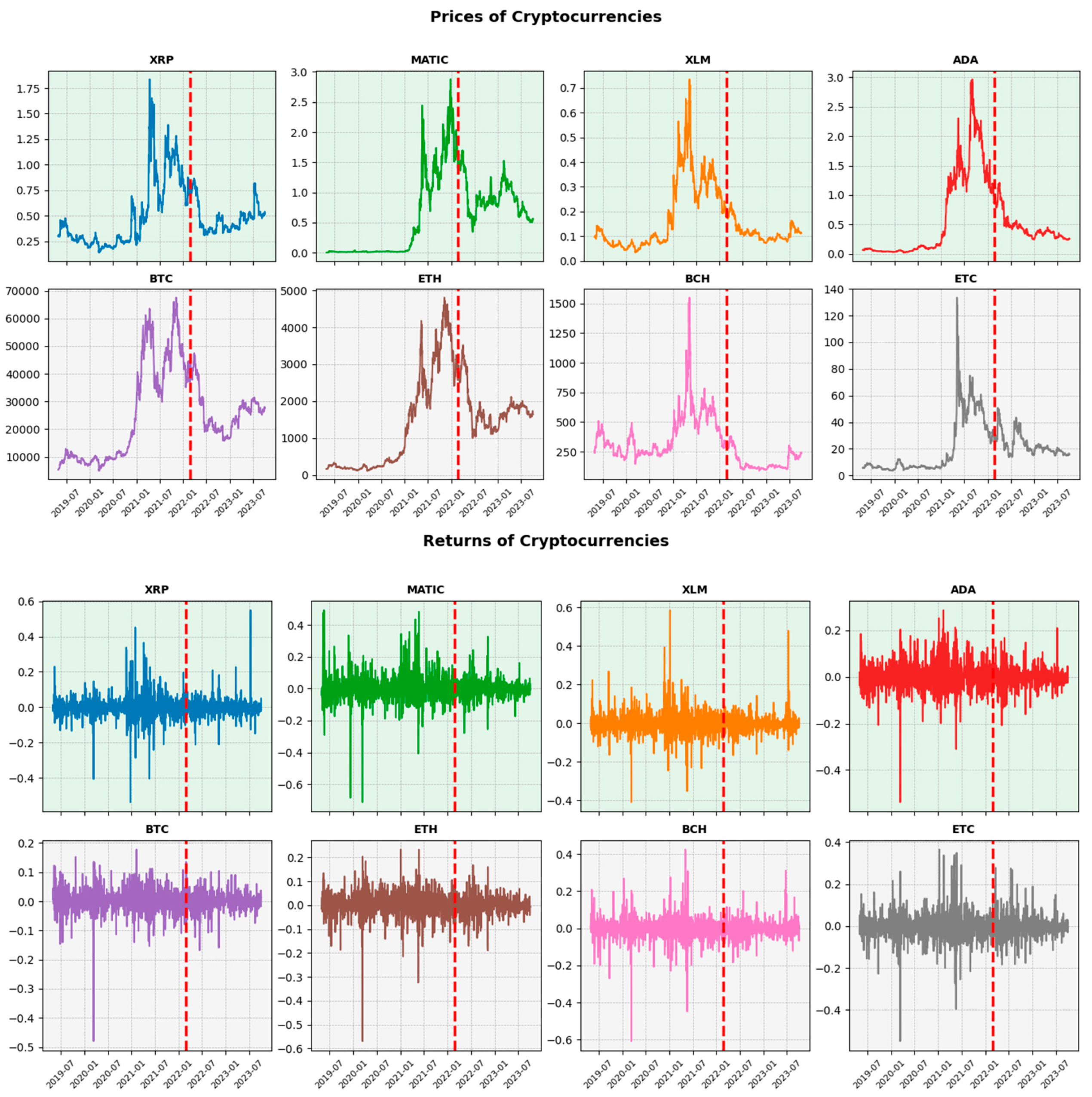
4.1. Preliminary Analysis
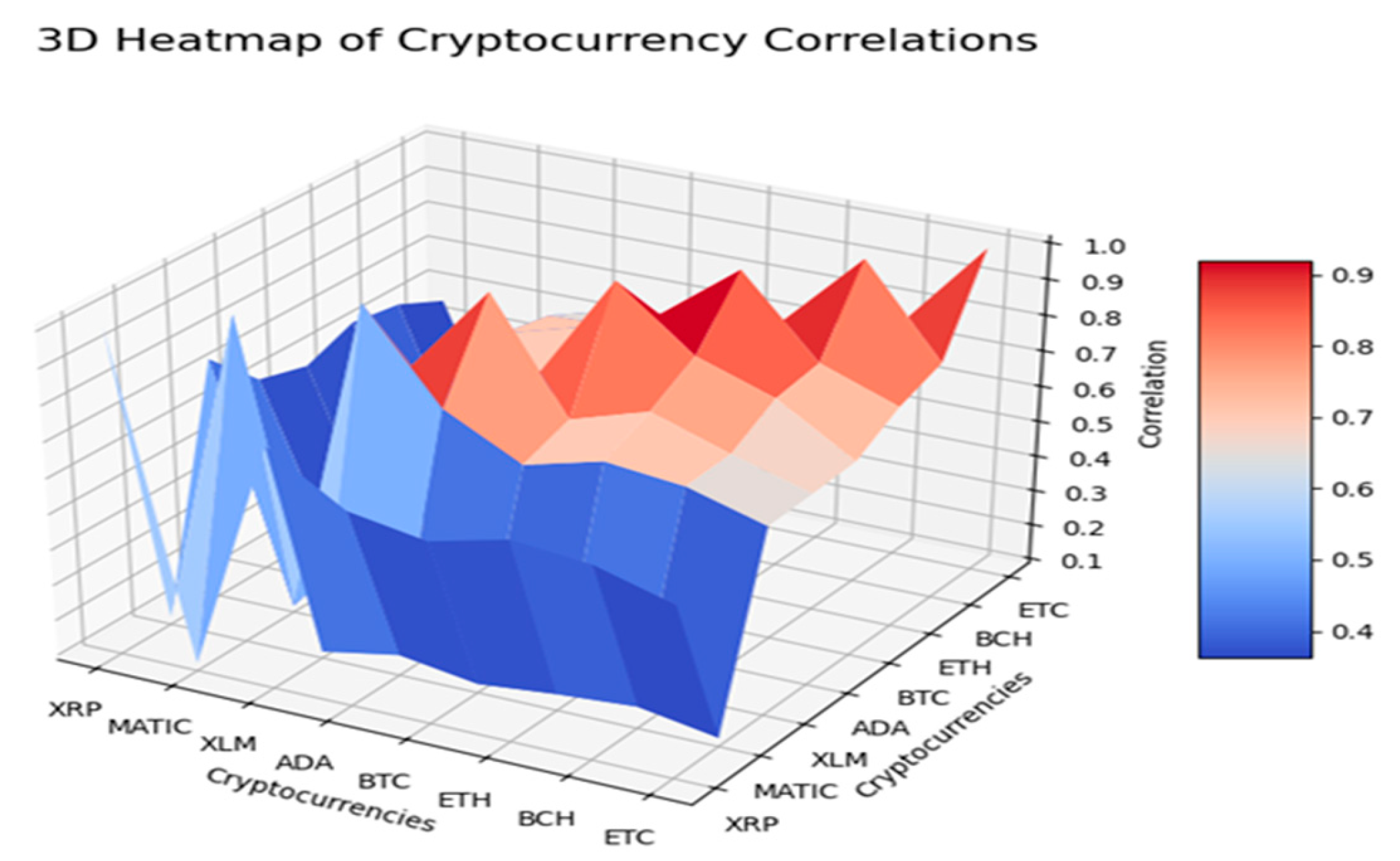
4.2. Mutual Information Analysis
4.3. Changes in Mutual Information Between War and Prewar
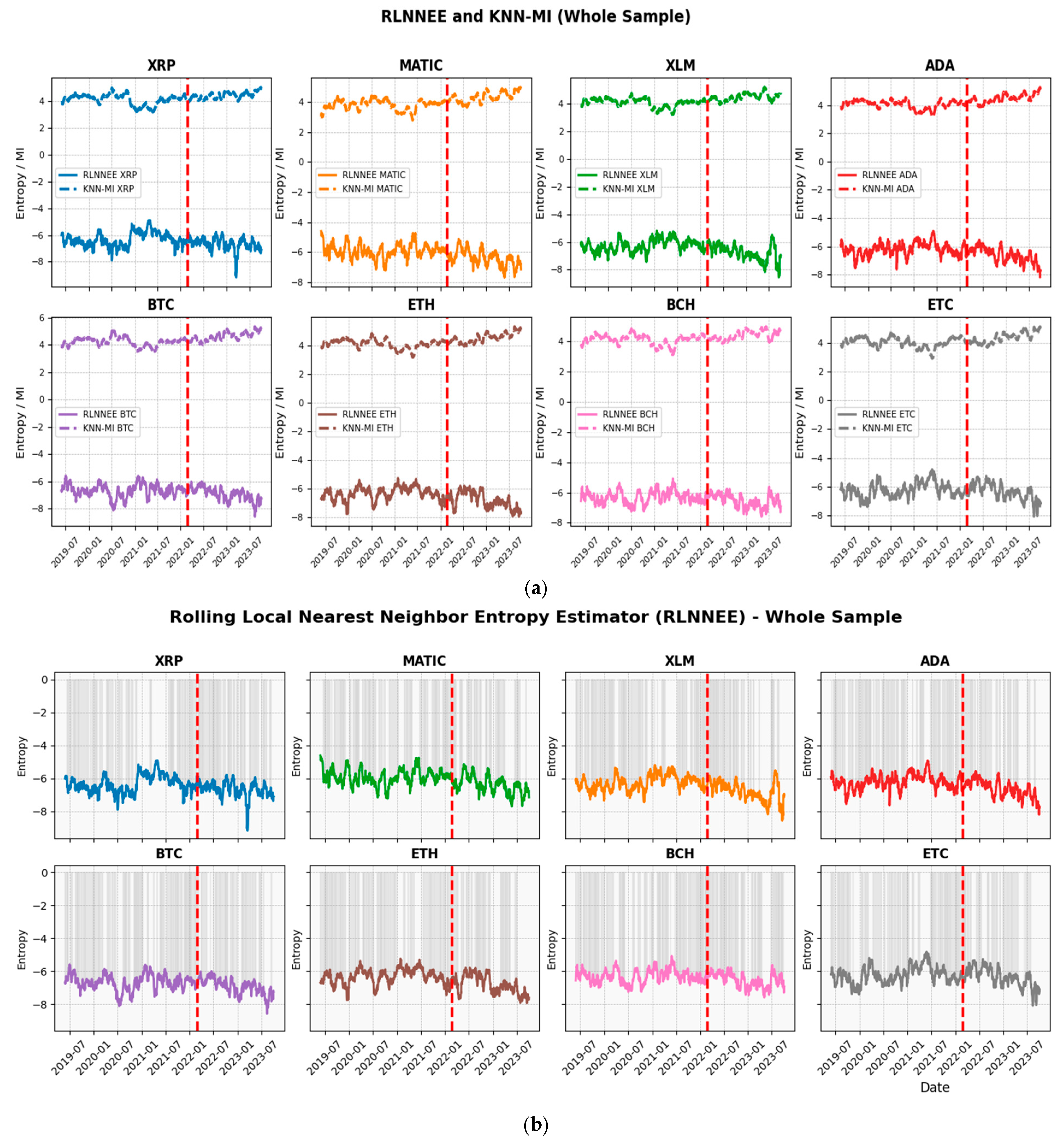
4.4. Estimating Mutual Information over Time Using the Rolling Local Nearest Neighbour Entropy Estimator (RLNNEE)
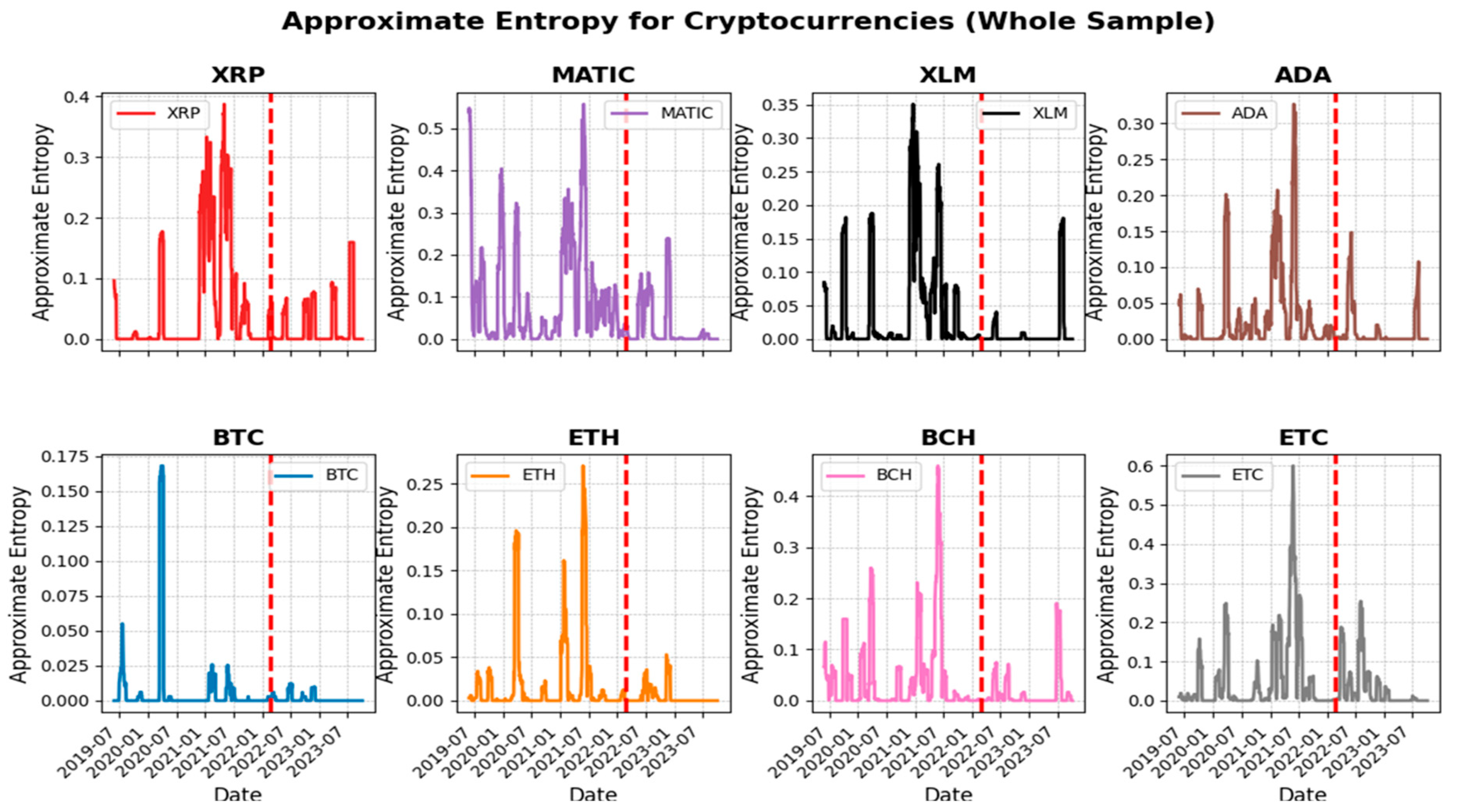
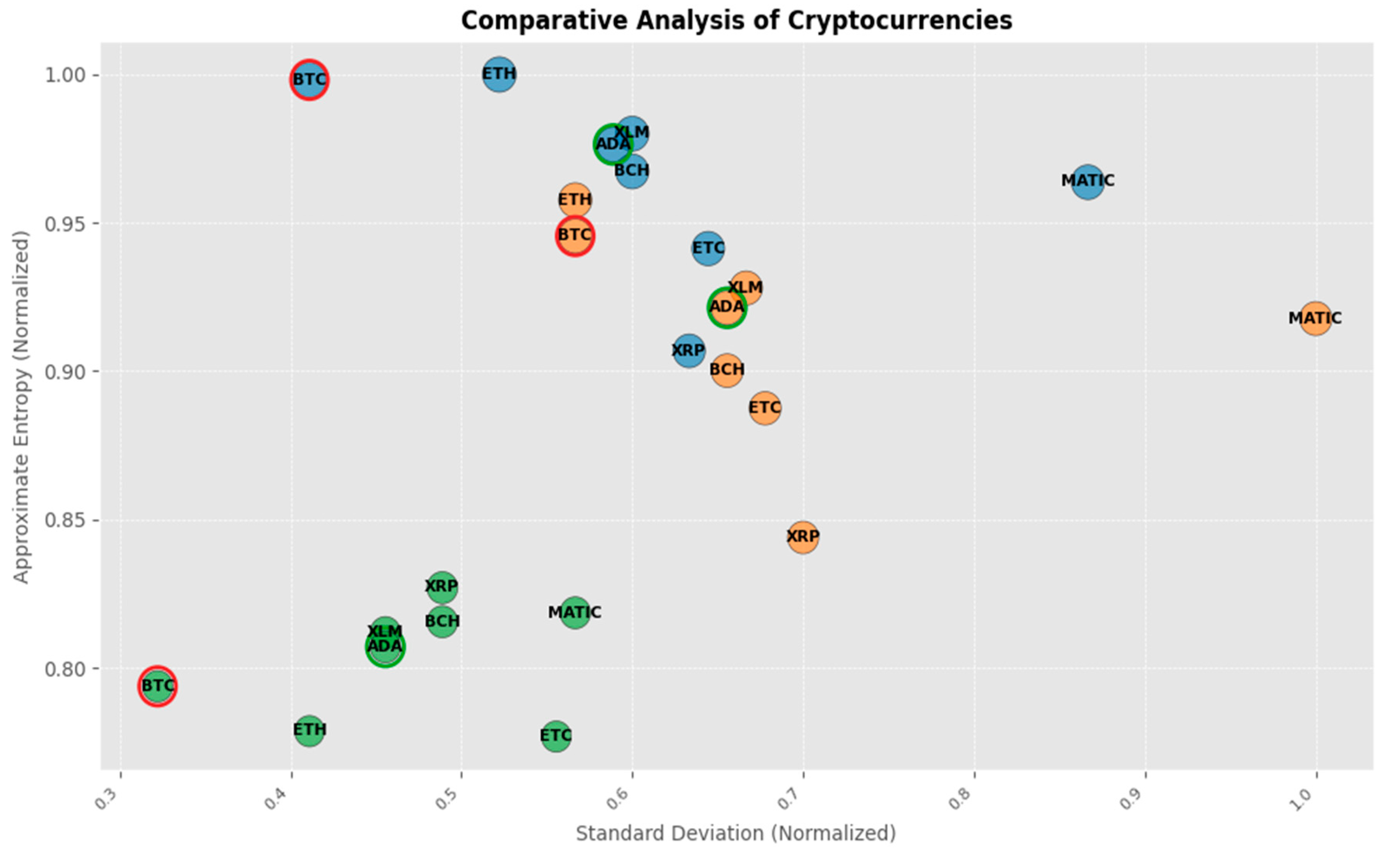
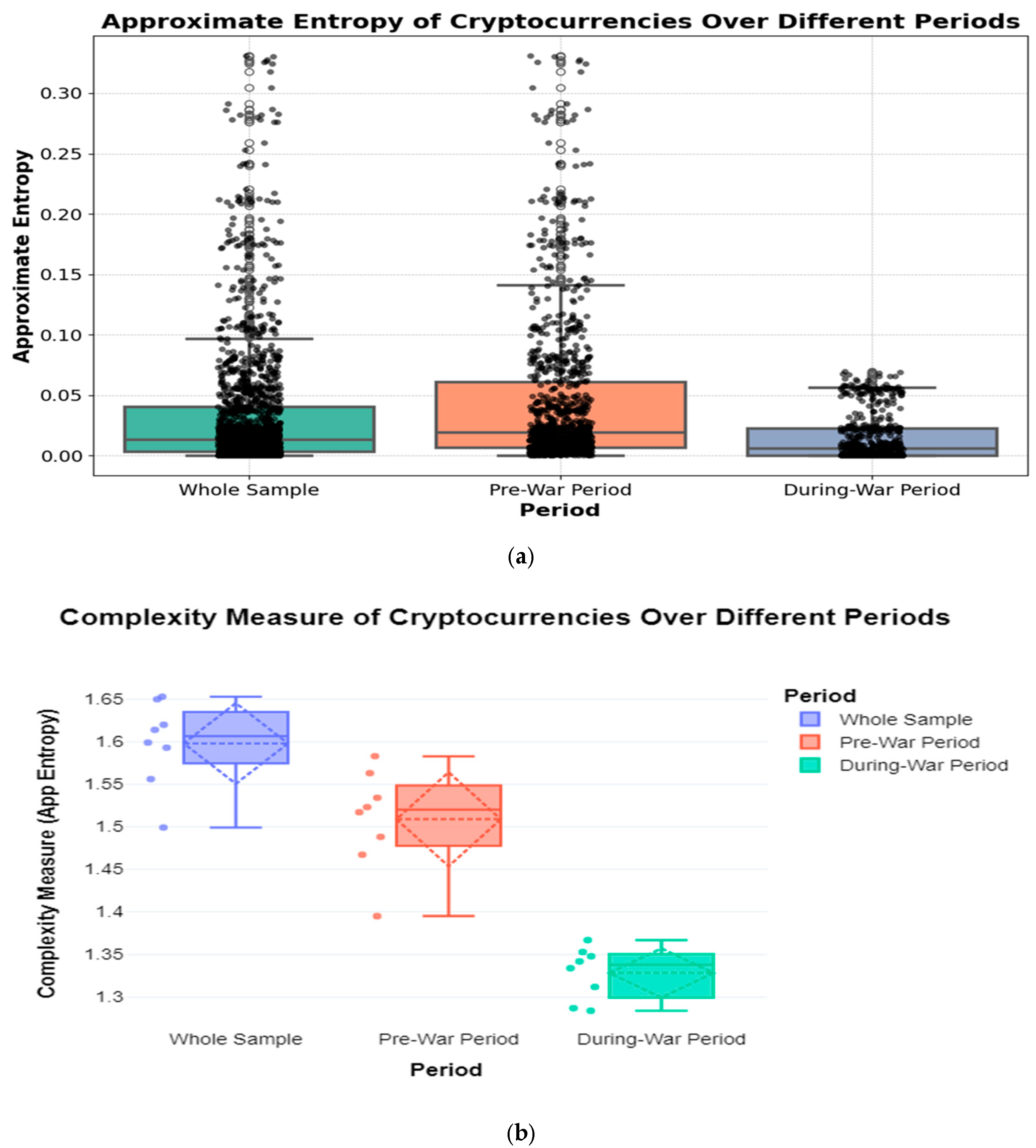
4.5. Approximate Entropy Analysis
4.6. Discussion
5. Conclusions and Implications
Author Contributions
Funding
Data Availability Statement
Conflicts of Interest
Appendix A
Appendix A.1. Approximate Entropies
Appendix A.2. Theoretical Foundations of RLNNEE
- The process is strictly stationary and ergodic. That is, there exists a probability measure on such thatMoreover, any shift-invariant event has probability 0 or 1. Time averages converge almost surely to expectations under .
- The common marginal law is continuous with respect to the Lebesgue measure on , with density satisfyingMoreover, there exists a compact set and constants such that
- The density is (locally) Hölder-continuous on its support: there exist constants and such that for allIn particular, is continuous -almost everywhere on .
- The metric measure space is doubling there exists a constant such that, for all and all ,where .In the Euclidean case , we have the standard volume behaviour
- Let denote the window size and the number of nearest neighbours used in the estimator, indexed by the total sample size . We assume that, as ,In addition, for each window , we have almost surely non-degenerate nearest-neighbour distances:so that the k-NN radii are strictly positive with probability one.
- The process is α-mixing (strongly mixing) with mixing coefficients defined byWe assume thatand that the decay is sufficiently fast to ensure a law of large numbers for functions of ; for example,for some , which is a standard sufficient condition for asymptotic normality and consistency of nonparametric estimators under dependence.
- Let have density satisfying (A1)–(A6). Then, for almost every ,and
- The function is locally Lipschitz on any compact interval .
- Inside any finite window , each has a unique ordered set of neighbours.
- Under (A1)–(A5):and
- For all windows and all :
- Let with . Then:
- Define entropy increments:If , with a threshold computed via a self-normalised statistic, a structural break is detected with significance .
- This extends the local instability framework of Zhang et al. (2024) to the case of rolling entropic geometry.
| Algorithm A1 |
| Using KD-trees, per window, total . |
References
- Ali, Fahad, Muhammad Usman Khurram, Ahmet Sensoy, and Xuan Vinh Vo. 2024. Green cryptocurrencies and portfolio diversification in the era of green paths. Renewable and Sustainable Energy Reviews 191: 114137. [Google Scholar] [CrossRef]
- Andrieş, Alin Marius, and Bogdan Căpraru. 2014. The nexus between competition and efficiency: The European banking industry’s experience. International Business Review 23: 566–79. [Google Scholar] [CrossRef]
- Arora, Ruchi, Meera Kapoor, Nidhi Singh, and Muhammad Zafar Yaqub. 2025. Green cryptocurrency and business strategies: Framework and insights from a stewardship literature review. Business Strategy and the Environment 34: 804–29. [Google Scholar] [CrossRef]
- Assaf, Ata, Husni Charif, and Ender Demir. 2022. Information sharing among cryptocurrencies: Evidence from mutual information and approximate entropy during COVID-19. Finance Research Letters 47: 102556. [Google Scholar] [CrossRef] [PubMed]
- Bajra, Ujkan Q., Florin Aliu, and Vlora Prenaj. 2025. Connectivity of green financial assets under geopolitical risks and market-implied volatility. Finance Research Letters 76: 107037. [Google Scholar] [CrossRef]
- Bank for International Settlements (BIS). 2025. Annual Economic Report 2024/25. Basel: Bank for International Settlements, 262p. Available online: https://www.bis.org/publ/arpdf/ar2025e.htm (accessed on 29 June 2025).
- Bariviera, Aurelio F. 2017. The inefficiency of Bitcoin revisited: A dynamic approach. Economics Letters 161: 1–4. [Google Scholar] [CrossRef]
- Bariviera, Aurelio F., and Ignasi Merediz-Solà. 2021. Where do we stand in cryptocurrencies economic research? A survey based on hybrid analysis. Journal of Economic Surveys 35: 377–407. [Google Scholar] [CrossRef]
- Bhaduri, Saumitra N. 2014. Applying approximate entropy (ApEn) to speculative bubble in the stock market. Journal of Emerging Market Finance 13: 43–68. [Google Scholar] [CrossRef]
- Boungou, Whelsy, and Alhonita Yatié. 2022. The impact of the Ukraine–Russia war on world stock market returns. Economics Letters 215: 110516. [Google Scholar] [CrossRef]
- Boungou, Whelsy, and Alhonita Yatié. 2024. Crypto-Assets, uncertainties, and geopolitical risks. Review of Development Finance 14: 55–64. [Google Scholar]
- Bouri, Elie, Konstantinos Gkillas, and Rangan Gupta. 2020. Trade uncertainties and the hedging abilities of Bitcoin. Economic Notes 49: e12173. [Google Scholar] [CrossRef]
- Caldara, Dario, and Matteo Iacoviello. 2022. Measuring geopolitical risk. American Economic Review 112: 1194–225. [Google Scholar] [CrossRef]
- Chortane, Sana Gaied, and Kamel Naoui. 2022. Information entropy theory and asset valuation: A literature survey. International Journal of Accounting, Business and Finance 2: 42–60. [Google Scholar] [CrossRef]
- Chortane, Sana Gaied, and Kamel Naoui. 2025. The End of Mean-Variance? Tsallis Entropy Revolutionises Portfolio Optimisation in Cryptocurrencies. Journal of Risk and Financial Management 18: 77. [Google Scholar] [CrossRef]
- Cover, Thomas M., and Joy A. Thomas. 2006. Elements of Information Theory, 2nd ed. Hoboken: John Wiley & Sons. [Google Scholar]
- De Vries, Alex. 2020. Bitcoin’s energy consumption is underestimated: A market dynamics approach. Energy Research & Social Science 70: 101721. [Google Scholar] [CrossRef]
- Dionisio, Andreia, Rui Menezes, and Diana A. Mendes. 2004. Mutual information: A measure of dependency for nonlinear time series. Physica A: Statistical Mechanics and its Applications 344: 326–29. [Google Scholar] [CrossRef]
- Gao, Weihao, Sewoong Oh, and Pramod Viswanath. 2018. Demystifying fixed $ k $-nearest neighbor information estimators. IEEE Transactions on Information Theory 64: 5629–61. [Google Scholar] [CrossRef]
- Gao, Weihao, Sreeram Kannan, Sewoong Oh, and Pramod Viswanath. 2017. Estimating mutual information for discrete-continuous mixtures. Advances in Neural Information Processing Systems 30. [Google Scholar]
- Giudici, Giancarlo, Alistair Milne, and Dmitri Vinogradov. 2020. Cryptocurrencies: Market analysis and perspectives. Journal of Industrial and Business Economics 47: 1–18. [Google Scholar] [CrossRef]
- Haq, Inzamam Ul. 2023. Cryptocurrency Environmental Attention, green Financial Assets, and Information Transmission: Evidence From the COVID-19 Pandemic. Energy Research Letters 4: 1–7. [Google Scholar] [CrossRef]
- Haq, Inzamam Ul, Muhammad Abubakr Naeem, Chunhui Huo, and Walid Bakry. 2025. Unveiling time-frequency linkages among diverse cryptocurrency classes and climate change concerns. International Review of Economics & Finance 99: 104064. [Google Scholar] [CrossRef]
- Hassan, M. Kabir, Bokhtiar Hasan, Zairihan Abdul Halim, Neal Maroney, and Mamunur Rashid. 2022. Exploring the dynamic spillover of cryptocurrency environmental attention across the commodities, green bonds, and environment-related stocks. The North American Journal of Economics and Finance 61: 101700. [Google Scholar] [CrossRef]
- International Monetary Fund (IMF). 2022. Global Financial Stability Report No. 2022/001: Shockwaves from the War in Ukraine. Washington, DC: International Monetary Fund, 103p. [Google Scholar] [CrossRef]
- Kamal, Elham, and Elie Bouri. 2025. Green bond, stock, cryptocurrency, and commodity markets: A multiscale analysis and portfolio implications. Financial Innovation 11: 100. [Google Scholar] [CrossRef]
- Khalfaoui, Rabeh, Giray Gozgor, and John W. Goodell. 2023. Impact of Russia–Ukraine war attention on cryptocurrency: Evidence from quantile dependence analysis. Finance Research Letters 52: 103365. [Google Scholar] [CrossRef]
- Kozachenko, Leonid Fedorovich, and Nikolai Nikolaevich Leonenko. 1987. Sample estimate of the entropy of a random vector. Problem Peredacha Informatsii 23: 95–101. [Google Scholar]
- Lahmiri, Salim, and Stelios Bekiros. 2020. Rényi entropy and mutual information measurement of market expectations and investor fear during the COVID-19 pandemic. Chaos, Solitons & Fractals 139: 110084. [Google Scholar] [CrossRef]
- Lee, Chi-Chuan, Chin-Hsien Yu, and Jian Zhang. 2023. Heterogeneous dependence among cryptocurrency, GCs bonds, and sustainable equity: New insights from Granger-causality in quantiles analysis. International Review of Economics & Finance 87: 99–109. [Google Scholar]
- Lo, Andrew W. 2004. The Adaptive Markets Hypothesis: Market efficiency from an evolutionary perspective. The Journal of Portfolio Management 30: 15–29. [Google Scholar] [CrossRef]
- Nakamoto, Satoshi. 2008. Bitcoin: A Peer-to-Peer Electronic Cash System. Available online: http://pdos.csail.mit.edu/6.824/papers/bitcoin.pdf (accessed on 9 January 2014).
- Patel, Ritesh, Mariya Gubareva, and Muhammad Zubair Chishti. 2024. Assessing the connectedness between cryptocurrency environment attention index and green cryptos, energy cryptos, and green financial assets. Research in International Business and Finance 70: 102339. [Google Scholar] [CrossRef]
- Patel, Ritesh, Sanjeev Kumar, Elie Bouri, and Najaf Iqbal. 2023. Spillovers between green and dirty cryptocurrencies and socially responsible investments around the war in Ukraine. International Review of Economics & Finance 87: 143–62. [Google Scholar] [CrossRef]
- Pham, Linh, Sitara Karim, Muhammad Abubakr Naeem, and Cheng Long. 2022. A tale of two tails among carbon prices, green and non-green cryptocurrencies. International Review of Financial Analysis 82: 102139. [Google Scholar] [CrossRef]
- Pincus, Philip. 1991. Colloid stabilisation with grafted polyelectrolytes. Macromolecules 24: 2912–19. [Google Scholar] [CrossRef]
- Pincus, Steven M., and Ary L. Goldberger. 1994. Physiological time-series analysis: What does regularity quantify? American Journal of Physiology-Heart and Circulatory Physiology 266: H1643–56. [Google Scholar] [CrossRef] [PubMed]
- Ren, Boru, and Brian Lucey. 2022a. A clean, green cryptocurrencies haven?—Examining the relationship between clean energy and clean and dirty cryptocurrencies. Energy Economics 109: 105951. [Google Scholar] [CrossRef]
- Ren, Boru, and Brian Lucey. 2022b. Do clean and dirty cryptocurrency markets herd differently? Finance Research Letters 47: 102795. [Google Scholar] [CrossRef]
- Richman, Joshua S., and J. Randall Moorman. 2000. Physiological time-series analysis using approximate entropy and sample entropy. American Journal of Physiology-Heart and Circulatory Physiology 278: H2039–49. [Google Scholar] [CrossRef]
- Saleh, Fahad. 2021. Blockchain without waste: Proof-of-stake. The Review of Financial Studies 34: 1156–90. [Google Scholar] [CrossRef]
- Sebai, Lamia, and Yasmina Jaber. 2025. Connectedness between green financial and cryptocurrency markets: A multivariate analysis using TVP-VAR model and wavelet-based VaR analysis. Journal of Risk and Financial Management 18: 483. [Google Scholar] [CrossRef]
- Sedlmeir, Johannes, Hans Ulrich Buhl, Gilbert Fridgen, and Robert Keller. 2020. The energy consumption of blockchain technology: Beyond myth. Business & Information Systems Engineering 62: 599–608. [Google Scholar] [CrossRef]
- Shannon, Claude E. 1948. A mathematical theory of communication. The Bell System Technical Journal 27: 379–423. [Google Scholar] [CrossRef]
- Shao, Shi-Feng, Yonglin Li, and Jinhua Cheng. 2025. Clean cryptocurrency and green assets: A quantile connectedness approach. Applied Economics Letters 32: 775–83. [Google Scholar] [CrossRef]
- Suriano, Micaela, Leonidas Facundo Caram, Cesar Caiafa, Hernán Daniel Merlino, and Osvaldo Anibal Rosso. 2025. Information Theory Quantifiers in Cryptocurrency Time Series Analysis. Entropy 27: 450. [Google Scholar] [CrossRef]
- Tiwari, Milind, Cayle Lupton, Ausma Bernot, and Khaled Halteh. 2024. The cryptocurrency conundrum: The emerging role of digital currencies in geopolitical conflicts. Journal of Financial Crime 31: 1622–34. [Google Scholar] [CrossRef]
- Touhami, Kamel, Ilyes Abidi, Mariem Nsaibi, and Maissa Mejri. 2025. Can Environmental Variables Predict Cryptocurrency Returns? Evidence from Bitcoin, Ethereum, and Tether Using a Time-Varying Coefficients Vector Autoregression Model. Risks 13: 72. [Google Scholar] [CrossRef]
- Umar, Zaghum, Ahmed Bossman, and Najaf Iqbal. 2023. The cryptocurrency environmental attention and GCs bond connectedness. Environmental Science and Pollution Research 30: 114667. [Google Scholar] [CrossRef] [PubMed]
- Urquhart, Andrew. 2016. The inefficiency of Bitcoin. Economics Letters 148: 80–82. [Google Scholar] [CrossRef]
- Vidal-Tomás, David, Ana M. Ibáñez, and José E. Farinós. 2021. The effect of the launch of bitcoin futures on the cryptocurrency market: An economic efficiency approach. Mathematics 9: 413. [Google Scholar] [CrossRef]
- Vukovic, Darko B., M. Kabir Hassan, Vyacheslav Zinovev, Elena Moiseevna Rogova, and Mohammed Shakib. 2025. Time-Varying Efficiency and Predictability in Cryptocurrency Markets: Forward-Looking Dynamics. International Journal of Finance & Economics, Early View. [Google Scholar] [CrossRef]
- Wang, Yizhi, Brian Lucey, Samuel Alexandre Vigne, and Larisa Yarovaya. 2022. An index of cryptocurrency environmental attention (ICEA). China Finance Review International 12: 378–414. [Google Scholar] [CrossRef]
- Yan, Wan-Lin, and Jiawei Yuan. 2025. The impact of green cryptocurrency and non-green cryptocurrency on energy markets: Evidence from geopolitical risk and higher-order moment connectedness. The North American Journal of Economics and Finance 81: 102527. [Google Scholar] [CrossRef]
- Zeng, Hongjun, Qingcheng Huang, Mohammad Zoynul Abedin, Abdullahi D. Ahmed, and Brian Lucey. 2025. Connectedness and frequency between green bonds, cryptocurrencies, and green energy-related metals during the COVID-19 outbreak. Research in International Business and Finance 73: 102547. [Google Scholar] [CrossRef]
- Zhang, Chao, Yihuang Zhang, Mihai Cucuringu, and Zhongmin Qian. 2024. Volatility forecasting with machine learning and intraday commonality. Journal of Financial Econometrics 22: 492–530. [Google Scholar] [CrossRef]
- Zhong, Yufei, Xuesheng Chen, Chengfang Wang, Zhixian Wang, and Yuchen Zhang. 2023. The hedging performance of green bond markets in China and the US: Novel evidence from cryptocurrency uncertainty. Energy Economics 128: 107194. [Google Scholar] [CrossRef]
- Zhou, En, and Xinyu Wang. 2024. Who are the receivers and transmitters of volatility spillovers: Oil, clean energy, and green and non-green cryptocurrency markets. Environmental Science and Pollution Research 31: 5735–61. [Google Scholar] [CrossRef]





| Dimension | What the Literature Mainly Does | Aggregated Limitations/Gaps | What This Study Adds |
|---|---|---|---|
| Geopolitical risk and crypto markets | Examines the effects of geopolitical tensions and wars on cryptocurrency returns, volatility, and market instability. | Focuses mainly on price dynamics and volatility; limited attention to information transmission and informational stability during armed conflicts. | Shifts the analysis toward information dynamics, comparing informational behaviour before and during the Russia–Ukraine war. |
| Sustainability perspective (GCs vs. DCs cryptocurrencies) | Classifies cryptocurrencies by energy intensity (PoW vs. PoS) and examines spillovers, diversification, and links to energy and GCs finance markets. | Evidence is fragmented and mixed; geopolitical shocks are rarely integrated into GCs vs. DCs comparisons; informational resilience remains unexplored. | Provides a unified framework linking GCs/DCs classification, geopolitical stress, and informational resilience. |
| Main methodological approaches | Relies on volatility models, spillover indices, connectedness measures, and parametric econometric frameworks. | Predominantly volatility-centred and often unable to capture nonlinear dependence and information regime changes. | Introduces information-theoretic tools to capture nonlinear dependence and shifts in complexity. |
| Information transmission and dependence | Uses correlation-based or time-varying connectedness measures; limited use of information theory. | Nonlinear information sharing and changes in predictability are insufficiently modelled, especially during crisis periods. | Employs mutual information to assess nonlinear information sharing across cryptocurrencies. |
| Market complexity and predictability | Assesses efficiency mainly through returns and volatility persistence. | Ignores signal regularity, predictability, and complexity changes under extreme uncertainty. | Uses approximate entropy to evaluate predictability and market complexity dynamics. |
| Local and time-varying informational regimes | Captures global or average dynamics using rolling or time-varying models. | Local instability regimes and short-lived informational disruptions remain largely undetected. | Applies RLNNEE to identify local and time-varying informational regimes during geopolitical stress. |
| Theoretical interpretation | Implicitly assumes static market efficiency. | Limited integration of the Adaptive Market Hypothesis (AMH) in geopolitical and sustainability contexts. | Interprets AMH results, highlighting adaptive efficiency under geopolitical shocks. |
| BTC | ETH | BCH | ETC | XRP | MATIC | XLM | ADA | |
|---|---|---|---|---|---|---|---|---|
| Panel A: Full sample | ||||||||
| Mean | 0.001 | 0.001 | 0.000 | 0.001 | 0.000 | 0.003 | 0.000 | 0.001 |
| Std. Dev | 0.037 | 0.047 | 0.054 | 0.058 | 0.057 | 0.078 | 0.054 | 0.053 |
| Max | 0.172 | 0.231 | 0.421 | 0.352 | 0.549 | 0.498 | 0.559 | 0.279 |
| Min | −0.465 | −0.551 | −0.561 | −0.506 | −0.551 | −0.716 | −0.410 | −0.504 |
| Skewness | −1.290 | −1.307 | −0.513 | 0.087 | 0.457 | 0.085 | 1.069 | −0.232 |
| Kurtosis | 18.464 | 15.486 | 15.701 | 10.756 | 20.217 | 14.049 | 18.100 | 7.673 |
| Jarque–Bera | 23,542.74 | 16,708.022 | 16,770.616 | 7840.543 | 27,741.327 | 13,373.540 | 22,501.344 | 4004.77 |
| Panel B: Pre-war period | ||||||||
| Mean | 0.002 | 0.003 | 0.000 | 0.002 | 0.001 | 0.006 | 0.001 | 0.002 |
| Std. Dev | 0.040 | 0.051 | 0.059 | 0.061 | 0.063 | 0.090 | 0.060 | 0.059 |
| Max | 0.172 | 0.231 | 0.421 | 0.352 | 0.445 | 0.498 | 0.559 | 0.279 |
| Min | −0.465 | −0.551 | −0.561 | −0.506 | −0.551 | −0.716 | −0.410 | −0.504 |
| Skewness | −1.454 | −1.494 | −0.815 | −0.140 | −0.114 | 0.011 | 0.756 | −0.296 |
| Kurtosis | 18.880 | 15.948 | 15.851 | 11.562 | 15.017 | 11.679 | 14.277 | 7.181 |
| Jarque–Bera | 15,776.60 | 11,382.89 | 10,979.37 | 5784.95 | 9754.357 | 5899.179 | 8913.157 | 2246.57 |
| Panel C: During the war | ||||||||
| Mean | −0.001 | −0.001 | 0.000 | −0.001 | 0.000 | −0.002 | −0.001 | −0.002 |
| Std. Dev | 0.029 | 0.037 | 0.044 | 0.050 | 0.044 | 0.051 | 0.041 | 0.041 |
| Max | 0.136 | 0.166 | 0.305 | 0.281 | 0.549 | 0.325 | 0.476 | 0.214 |
| Min | −0.174 | −0.192 | −0.177 | −0.187 | −0.217 | −0.290 | −0.178 | −0.204 |
| Skewness | −0.490 | −0.438 | 0.806 | 0.763 | 3.138 | 0.159 | 2.416 | −0.078 |
| Kurtosis | 5.730 | 4.671 | 7.368 | 5.604 | 42.029 | 7.042 | 31.353 | 4.359 |
| Jarque–Bera | 836.365 | 559.455 | 1406.884 | 834.879 | 44,564.27 | 1229.439 | 24,838.69 | 471.488 |
| BTC | ETH | BCH | ETC | XRP | MATIC | XLM | ADA | |
|---|---|---|---|---|---|---|---|---|
| Panel A: Full sample | ||||||||
| BTC | NA | 0.623 | 0.517 | 0.410 | 0.408 | 0.305 | 0.370 | 0.427 |
| ETH | 0.623 | NA | 0.545 | 0.532 | 0.494 | 0.364 | 0.451 | 0.532 |
| BCH | 0.517 | 0.545 | NA | 0.559 | 0.441 | 0.287 | 0.445 | 0.447 |
| ETC | 0.410 | 0.532 | 0.559 | NA | 0.417 | 0.311 | 0.408 | 0.439 |
| XRP | 0.408 | 0.494 | 0.441 | 0.417 | NA | 0.300 | 0.563 | 0.474 |
| MATIC | 0.305 | 0.364 | 0.287 | 0.311 | 0.300 | NA | 0.296 | 0.391 |
| XLM | 0.370 | 0.451 | 0.445 | 0.408 | 0.563 | 0.296 | NA | 0.503 |
| ADA | 0.427 | 0.532 | 0.447 | 0.439 | 0.474 | 0.391 | 0.503 | NA |
| Panel B: Pre-war period | ||||||||
| BTC | NA | 0.562 | 0.542 | 0.378 | 0.403 | 0.240 | 0.360 | 0.382 |
| ETH | 0.562 | NA | 0.586 | 0.504 | 0.515 | 0.292 | 0.451 | 0.512 |
| BCH | 0.542 | 0.586 | NA | 0.594 | 0.522 | 0.267 | 0.475 | 0.481 |
| ETC | 0.378 | 0.504 | 0.594 | NA | 0.447 | 0.269 | 0.430 | 0.402 |
| XRP | 0.403 | 0.515 | 0.522 | 0.447 | NA | 0.270 | 0.572 | 0.491 |
| MATIC | 0.240 | 0.292 | 0.267 | 0.269 | 0.270 | NA | 0.257 | 0.320 |
| XLM | 0.360 | 0.451 | 0.475 | 0.430 | 0.572 | 0.257 | NA | 0.523 |
| ADA | 0.382 | 0.512 | 0.481 | 0.402 | 0.491 | 0.320 | 0.523 | NA |
| Panel C: During the war | ||||||||
| BTC | NA | 0.834 | 0.552 | 0.574 | 0.504 | 0.593 | 0.485 | 0.605 |
| ETH | 0.834 | NA | 0.545 | 0.683 | 0.529 | 0.641 | 0.536 | 0.646 |
| BCH | 0.552 | 0.545 | NA | 0.598 | 0.399 | 0.415 | 0.490 | 0.485 |
| ETC | 0.574 | 0.683 | 0.598 | NA | 0.468 | 0.521 | 0.475 | 0.619 |
| XRP | 0.504 | 0.529 | 0.399 | 0.468 | NA | 0.495 | 0.632 | 0.527 |
| MATIC | 0.593 | 0.641 | 0.415 | 0.521 | 0.495 | NA | 0.474 | 0.670 |
| XLM | 0.485 | 0.536 | 0.490 | 0.475 | 0.632 | 0.474 | NA | 0.534 |
| ADA | 0.605 | 0.646 | 0.485 | 0.619 | 0.527 | 0.670 | 0.534 | NA |
| BTC | ETH | BCH | ETC | XRP | MATIC | XLM | ADA | |
|---|---|---|---|---|---|---|---|---|
| BTC | 1 | 1 | 1 | 1 | 1 | 1 | 1 | |
| ETH | 1 | 1 | 1 | 1 | 1 | 1 | ||
| BCH | 0 | 0 | 1 | 1 | 0 | |||
| ETC | 1 | 1 | 1 | 1 | ||||
| XRP | 1 | 1 | 1 | |||||
| MATIC | 1 | 1 | ||||||
| XLM | 1 | |||||||
| ADA |
| BTC | ETH | BCH | ETC | XRP | MATIC | XLM | ADA | |
|---|---|---|---|---|---|---|---|---|
| Panel A: Full sample | ||||||||
| BTC | NA | 0.692 | 0.573 | 0.446 | 0.437 | 0.307 | 0.404 | 0.457 |
| ETH | 0.692 | NA | 0.591 | 0.577 | 0.520 | 0.385 | 0.506 | 0.586 |
| BCH | 0.573 | 0.591 | NA | 0.602 | 0.462 | 0.311 | 0.507 | 0.482 |
| ETC | 0.446 | 0.577 | 0.602 | NA | 0.449 | 0.312 | 0.440 | 0.478 |
| XRP | 0.437 | 0.520 | 0.462 | 0.449 | NA | 0.313 | 0.639 | 0.478 |
| MATIC | 0.307 | 0.385 | 0.311 | 0.312 | 0.313 | NA | 0.306 | 0.403 |
| XLM | 0.404 | 0.506 | 0.507 | 0.440 | 0.639 | 0.306 | NA | 0.548 |
| ADA | 0.457 | 0.586 | 0.482 | 0.478 | 0.478 | 0.403 | 0.548 | NA |
| Panel B: Pre-war period | ||||||||
| BTC | NA | 0.610 | 0.585 | 0.424 | 0.403 | 0.208 | 0.390 | 0.400 |
| ETH | 0.610 | NA | 0.643 | 0.552 | 0.535 | 0.296 | 0.473 | 0.591 |
| BCH | 0.585 | 0.643 | NA | 0.651 | 0.522 | 0.263 | 0.516 | 0.517 |
| ETC | 0.424 | 0.552 | 0.651 | NA | 0.472 | 0.240 | 0.451 | 0.438 |
| XRP | 0.403 | 0.535 | 0.522 | 0.472 | NA | 0.241 | 0.648 | 0.476 |
| MATIC | 0.208 | 0.296 | 0.263 | 0.240 | 0.241 | NA | 0.255 | 0.319 |
| XLM | 0.390 | 0.473 | 0.516 | 0.451 | 0.648 | 0.255 | NA | 0.541 |
| ADA | 0.400 | 0.591 | 0.517 | 0.438 | 0.476 | 0.319 | 0.541 | NA |
| Panel C: During the war | ||||||||
| BTC | NA | 0.872 | 0.517 | 0.554 | 0.498 | 0.522 | 0.447 | 0.621 |
| ETH | 0.872 | NA | 0.530 | 0.694 | 0.476 | 0.642 | 0.485 | 0.603 |
| BCH | 0.517 | 0.530 | NA | 0.544 | 0.355 | 0.369 | 0.507 | 0.429 |
| ETC | 0.554 | 0.694 | 0.544 | NA | 0.420 | 0.534 | 0.440 | 0.628 |
| XRP | 0.498 | 0.476 | 0.355 | 0.420 | NA | 0.466 | 0.643 | 0.468 |
| MATIC | 0.522 | 0.642 | 0.369 | 0.534 | 0.466 | NA | 0.421 | 0.652 |
| XLM | 0.447 | 0.485 | 0.507 | 0.440 | 0.643 | 0.421 | NA | 0.517 |
| ADA | 0.621 | 0.603 | 0.429 | 0.628 | 0.468 | 0.652 | 0.517 | NA |
| Full Sample | Pre-War | During-War | |
|---|---|---|---|
| BTC | 1.650 | 1.563 | 1.312 |
| ETH | 1.653 | 1.583 | 1.287 |
| BCH | 1.599 | 1.488 | 1.348 |
| ETC | 1.556 | 1.467 | 1.284 |
| XRP | 1.499 | 1.395 | 1.367 |
| MATIC | 1.593 | 1.517 | 1.353 |
| XLM | 1.620 | 1.534 | 1.342 |
| ADA | 1.614 | 1.523 | 1.334 |
Disclaimer/Publisher’s Note: The statements, opinions and data contained in all publications are solely those of the individual author(s) and contributor(s) and not of MDPI and/or the editor(s). MDPI and/or the editor(s) disclaim responsibility for any injury to people or property resulting from any ideas, methods, instructions or products referred to in the content. |
© 2026 by the authors. Licensee MDPI, Basel, Switzerland. This article is an open access article distributed under the terms and conditions of the Creative Commons Attribution (CC BY) license.
Share and Cite
Gaied Chortane, S.; Naoui, K. Entropic Geometry and Information Dynamics in Green Cryptocurrency Markets. Risks 2026, 14, 30. https://doi.org/10.3390/risks14020030
Gaied Chortane S, Naoui K. Entropic Geometry and Information Dynamics in Green Cryptocurrency Markets. Risks. 2026; 14(2):30. https://doi.org/10.3390/risks14020030
Chicago/Turabian StyleGaied Chortane, Sana, and Kamel Naoui. 2026. "Entropic Geometry and Information Dynamics in Green Cryptocurrency Markets" Risks 14, no. 2: 30. https://doi.org/10.3390/risks14020030
APA StyleGaied Chortane, S., & Naoui, K. (2026). Entropic Geometry and Information Dynamics in Green Cryptocurrency Markets. Risks, 14(2), 30. https://doi.org/10.3390/risks14020030