Article

Efficacy and Safety of Nitrous Oxide and Midazolam Sedation Protocols in Pediatric Dentistry: A Multicenter Clinical Retrospective Study


by
Lucia Giannini
1,*,
Niccolò Cenzato
1,2,
Gregorio Menozzi
1,2,
Alessandra Gianfiori
1,2,
Gianna Dipalma
2,3,4 and
Cinzia Maspero
1,2
1
Fondazione IRCCS Ca’ Granda Ospedale Maggiore Policlinico, 20133 Milan, Italy
2
Department of Biomedical, Surgical and Dental Sciences, University of Milan, 20122 Milan, Italy
3
Department of Interdisciplinary Medicine, University of Bari Aldo Moro, 70121 Bari, Italy
4
Department of Life Science, Health and Health Professions, Link Campus University, 00165 Rome, Italy
*
Author to whom correspondence should be addressed.
Children 2026, 13(7), 956; https://doi.org/10.3390/children13070956

Submission received: 29 June 2026 / Revised: 17 July 2026 / Accepted: 18 July 2026 / Published: 20 July 2026
(This article belongs to the Special Issue Recent Advances in Pediatric Dentistry: Techniques and Treatments)

Abstract

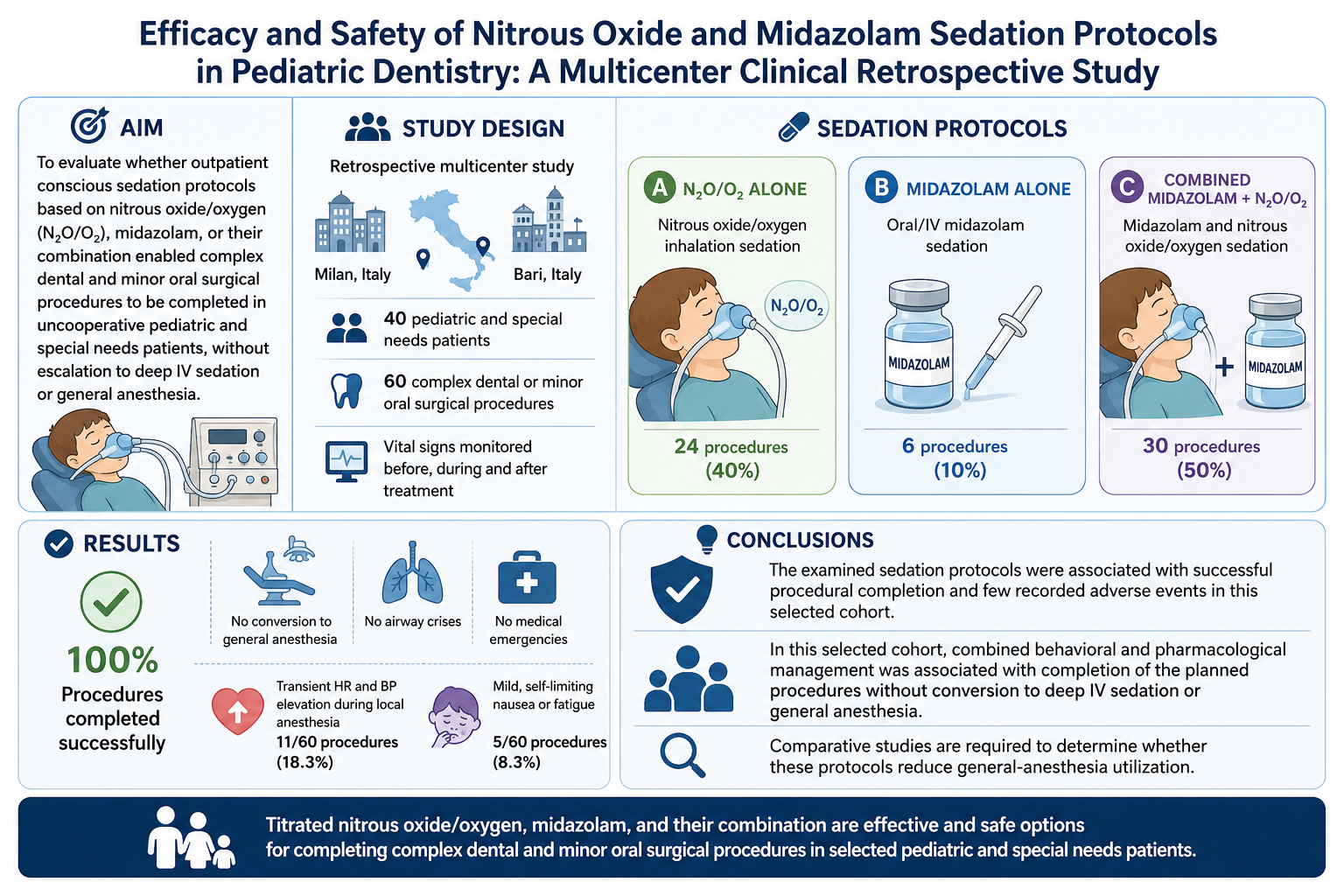
Aim: This two-center retrospective observational study evaluated whether outpatient conscious sedation protocols based on titrated nitrous oxide/oxygen, midazolam, or their combination enabled complex dental and minor oral surgical procedures to be completed in uncooperative pediatric and special needs patients, without escalation to deep intravenous sedation or general anesthesia. Materials and Methods: Forty pediatric and special needs patients treated at the Conscious Sedation Units of Fondazione IRCCS Ca’ Granda Ospedale Maggiore Policlinico (Milan, Italy) and Policlinico of Bari (Bari, Italy) were included. Overall, 60 complex dental or minor oral surgical procedures were performed. Procedures were classified according to the sedation protocol administered: Protocol A, nitrous oxide/oxygen inhalation sedation alone; Protocol B, midazolam alone; and Protocol C, combined midazolam and nitrous oxide/oxygen sedation. Vital signs were monitored before, during, and after treatment. The primary outcome was successful procedural completion, defined as completion of the planned procedure without premature termination, escalation to deep intravenous sedation or general anesthesia, or the need for unplanned airway or emergency medical intervention. Results: Forty patients underwent 60 procedures. The mean age was 8.7 ± 2.3 years (range, 4–14 years). Protocol A was used in 24 procedures (40%), Protocol B in 6 procedures (10%), and Protocol C in 30 procedures (50%). All procedures were completed successfully, with no conversion to general anesthesia, no airway crises, and no medical emergencies. Transient elevations in heart rate and blood pressure during local anesthesia occurred in 11/60 procedures (18.3%), and mild self-limiting nausea or fatigue occurred in 5/60 procedures (8.3%). Conclusions: The evaluated protocols were associated with successful procedural completion and few recorded adverse events in this selected cohort. Combined behavioral and pharmacological management was associated with completion of the planned procedures without conversion to deep intravenous sedation or general anesthesia. Comparative studies are required to determine whether these protocols reduce general-anesthesia utilization.
Keywords: conscious sedation; pediatric dentistry; nitrous oxide sedation; special needs patients; midazolam; dental anxiety conscious sedation; pediatric dentistry; nitrous oxide sedation; special needs patients; midazolam; dental anxiety
Graphical Abstract