Cross-Segmental Transfer Effects of Lower Limb Cross-Training Priming on Upper Extremity Functional Recovery in Pediatric Unilateral Cerebral Palsy: A Randomized Controlled Trial

 , , , , ,
Abstract
1. Introduction
2. Materials and Methods
2.1. Design Overview
2.2. Participants
2.2.1. Sample Size Calculation
2.2.2. Randomization and Blinding
2.3. Outcome Measures
2.3.1. Affected Handgrip Strength
2.3.2. Grasping Skills
2.3.3. Manual Dexterity
2.4. Interventions
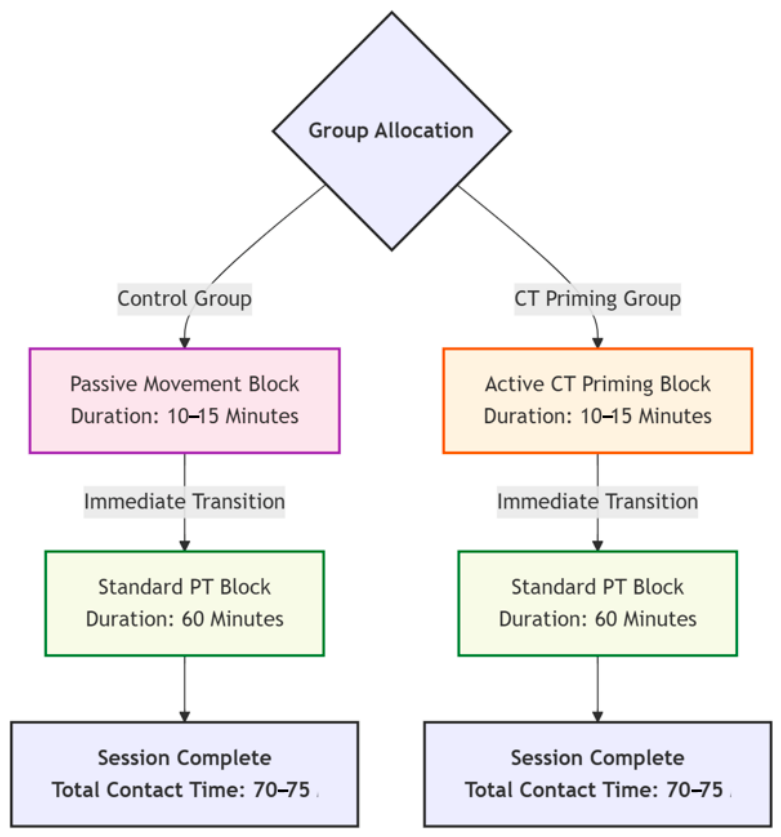
2.4.1. PT Group (Passive Movement + Standard Rehabilitation)
2.4.2. CT Group (Priming + Standard Rehabilitation)
- Biomechanical and Contractile Specifics: The priming protocol targeted the primary muscle groups of the non-paretic limb, specifically the knee flexors, knee extensors, ankle dorsiflexors, and plantar flexors. Each exercise sequence integrated into a triphasic contraction pattern (comprising isometric, concentric, and eccentric phases) with each phase maintained for a strict duration of two seconds to ensure high-quality motor unit recruitment [45].
- Individualized Titration and Intensity: Training loads were tailored to each participant’s functional capacity based on a priori assessment of optimal resistance and repetition thresholds. To ensure a standardized physiological stressor, training intensity was calibrated to a moderate perceived exertion level (Borg CR-10: 4–6). Given the fluctuating muscle tone in UCP, formal 1RM testing was unfeasible. Instead, resistance was applied using pediatric elastic bands and manual therapist resistance, dynamically adjusted by the treating therapist during each session to maintain the target exertion level for 10-repetition sets [46].
- Volume and Recovery Parameters: The total training volume was limited to 30 repetitions per muscle group, subdivided into three discrete sets of 10 repetitions. To prevent peripheral fatigue from confounding the subsequent rehabilitation session, standardized recovery intervals of 2–3 min were enforced between sets.
- Preparatory and Recovery Phases: Every therapeutic session was initiated with a standardized 5 min pre-training conditioning phase, designed to elevate core body temperature and optimize neuromuscular readiness. This preliminary block comprised three minutes of sub-maximal aerobic engagement—such as slow-paced ambulation or unloaded cycle ergometry—followed by a two-minute sequence of rhythmic dynamic mobilization. These activities specifically included marching in place and controlled partial squats, aimed at enhancing multi-joint proprioceptive feedback and joint lubrication.
2.5. Statistical Analysis
3. Results
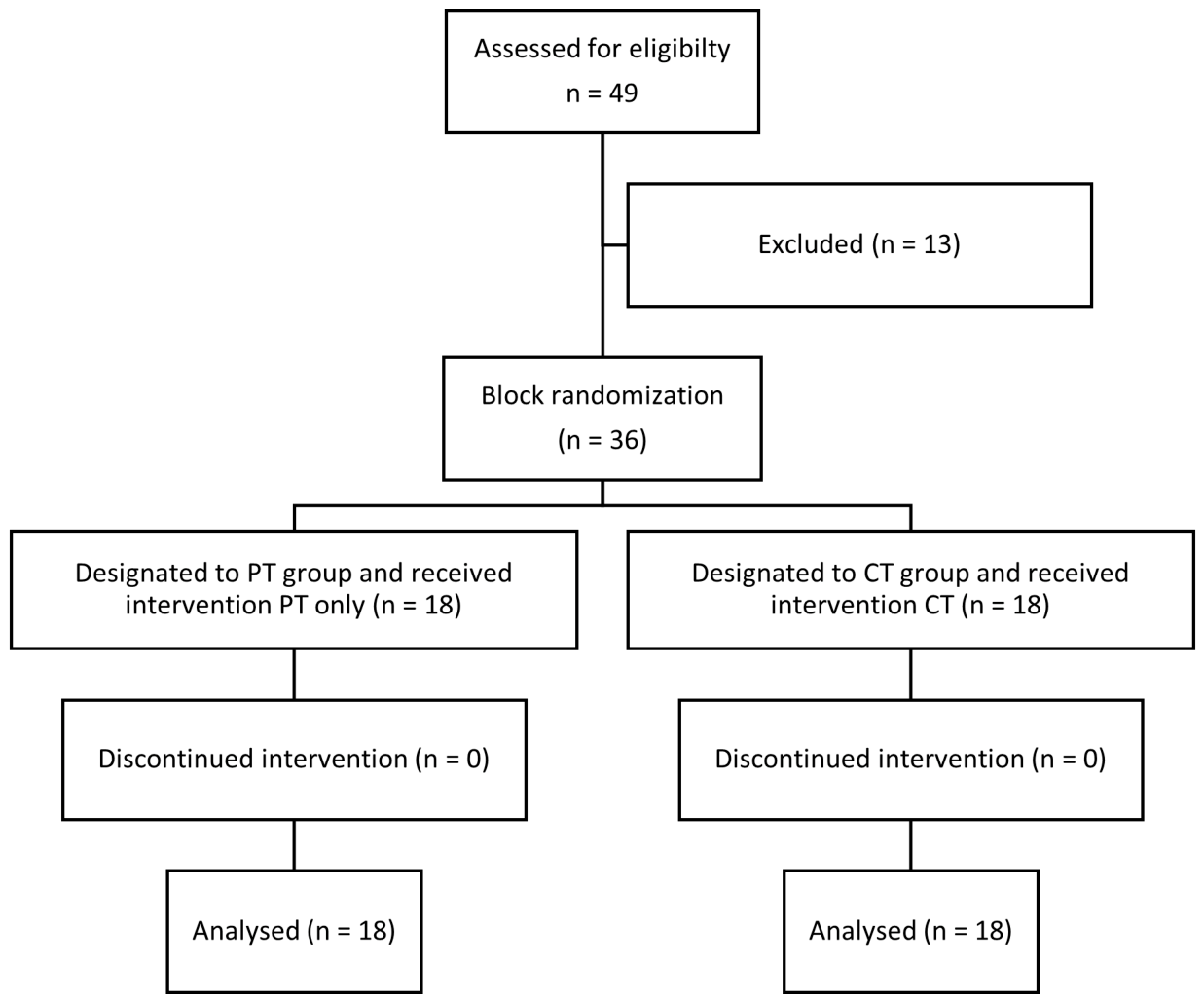
3.1. Participant Flow and Randomization
3.2. Baseline Homogeneity
3.3. Differential Effects of Intervention
4. Discussion
4.1. The “Neural Overflow” and Interhemispheric Modulation
4.2. Systemic Metabolic Priming: The BDNF Mechanism
4.3. Biomechanical Synergy: Proximal Stability for Distal Mobility
4.4. Statistical Nuance and the “Threshold Phenomenon”
4.5. Limitations
4.6. Clinical and Research Implications
5. Conclusions
Author Contributions
Funding
Institutional Review Board Statement
Informed Consent Statement
Data Availability Statement
Acknowledgments
Conflicts of Interest
Abbreviations
| ANCOVA | Analysis of Covariance |
| BBT | Box and Block Test |
| BDNF | Brain-Derived Neurotrophic Factor |
| BMI | Body Mass Index |
| CI | Confidence Interval |
| CONSORT | Consolidated Standards of Reporting Trials |
| CP | Cerebral Palsy |
| CT | Cross-Training |
| DSR | Deanship of Scientific Research |
| fMRI | Functional Magnetic Resonance Imaging |
| GDTT | Goal-Directed Task Training |
| HGS | Handgrip Strength |
| ICF | International Classification of Functioning, Disability and Health |
| IHI | Interhemispheric Inhibition |
| LL | Lower Limb |
| LTP | Long-term Potentiation |
| MANCOVA | Multivariate Analysis of Covariance |
| MANOVA | Multivariate Analysis of Variance |
| MAS | Modified Ashworth Scale |
| NDT | Neurodevelopmental Treatment |
| PDMS-2 | Peabody Developmental Motor Scales–Second Edition |
| PDMS-FM | Peabody Developmental Motor Scales–Fine Motor |
| PT | Physical Therapy |
| RCT | Randomized Controlled Trial |
| SD | Standard Deviation |
| TMS | Transcranial Magnetic Stimulation |
| UCP | Unilateral Cerebral Palsy |
| UL | Upper Limb |
| WAQF | KAU Endowment |
References
- Sadowska, M.; Sarecka-Hujar, B.; Kopyta, I. Cerebral Palsy: Current Opinions on Definition, Epidemiology, Risk Factors, Classification and Treatment Options. Neuropsychiatr. Dis. Treat. 2020, 16, 1505–1518. [Google Scholar] [CrossRef]
- Ferre, C.L.; Carmel, J.B.; Flamand, V.H.; Gordon, A.M.; Friel, K.M. Anatomical and Functional Characterization in Children with Unilateral Cerebral Palsy: An Atlas-Based Analysis. Neurorehabil. Neural Repair 2020, 34, 148–158. [Google Scholar] [CrossRef]
- Elnaggar, R.K.; Ramirez-Campillo, R.; Azab, A.R.; Alrawaili, S.M.; Alghadier, M.; Alotaibi, M.A.; Alhowimel, A.S.; Abdrabo, M.S.; Elbanna, M.F.; Aboeleneen, A.M.; et al. Optimization of Postural Control, Balance, and Mobility in Children with Cerebral Palsy: A Randomized Comparative Analysis of Independent and Integrated Effects of Pilates and Plyometrics. Children 2024, 11, 243. [Google Scholar] [CrossRef]
- Graham, H.K.; Rosenbaum, P.; Paneth, N.; Dan, B.; Lin, J.-P.; Damiano, D.L.; Becher, J.G.; Gaebler-Spira, D.; Colver, A.; Reddihough, D.S.; et al. Cerebral palsy. Nat. Rev. Dis. Primers 2016, 2, 15082. [Google Scholar] [CrossRef] [PubMed]
- Errante, A.; Bozzetti, F.; Piras, A.; Beccani, L.; Filippi, M.; Costi, S.; Ferrari, A.; Fogassi, L. Lesion mapping and functional characterization of hemiplegic children with different patterns of hand manipulation. Neuroimage Clin. 2024, 41, 103575. [Google Scholar] [CrossRef]
- Fernández-López, D.; Natarajan, N.; Ashwal, S.; Vexler, Z.S. Mechanisms of perinatal arterial ischemic stroke. J. Cereb. Blood Flow. Metab. 2014, 34, 921–932. [Google Scholar] [CrossRef]
- Tan, A.P.; Svrckova, P.; Cowan, F.; Chong, W.K.; Mankad, K. Intracranial hemorrhage in neonates: A review of etiologies, patterns and predicted clinical outcomes. Eur. J. Paediatr. Neurol. 2018, 22, 690–717. [Google Scholar] [CrossRef]
- Nuara, A.; Papangelo, P.; Avanzini, P.; Fabbri-Destro, M. Body Representation in Children with Unilateral Cerebral Palsy. Front. Psychol. 2019, 10, 354. [Google Scholar] [CrossRef] [PubMed]
- De Luca, G.; Kalkantzi, A.; Mailleux, L.; Palomo-Carrión, R.; Feys, H.; Boyd, R.N.; Beani, E.; Cianchetti, M.; Filogna, S.; Prencipe, G.; et al. A Holistic Approach Towards Evaluating Upper Limb Function in Children with Unilateral Cerebral Palsy: A Narrative Review of Clinical Tools and Promising Technologies for Comprehensive Assessment. J. Clin. Med. 2025, 14, 6539. [Google Scholar] [CrossRef]
- Handsfield, G.G.; Williams, S.; Khuu, S.; Lichtwark, G.; Stott, N.S. Muscle architecture, growth, and biological Remodelling in cerebral palsy: A narrative review. BMC Musculoskelet. Disord. 2022, 23, 233. [Google Scholar] [CrossRef] [PubMed]
- Mohammed, A.H.; El-Serougy, H.R.; Karim, A.E.A.; Sakr, M.; Sheha, S.M. Correlation Between Selective Motor Control of the Lower Extremities and Balance in Spastic Hemiplegic Cerebral Palsy: A Randomized Controlled Trial. BMC Sports Sci. Med. Rehabil. 2023, 15, 24. [Google Scholar] [CrossRef]
- Roby-Brami, A.; Jarrassé, N.; Parry, R. Impairment and Compensation in Dexterous Upper-Limb Function After Stroke. From the Direct Consequences of Pyramidal Tract Lesions to Behavioral Involvement of Both Upper-Limbs in Daily Activities. Front. Hum. Neurosci. 2021, 15, 662006. [Google Scholar] [CrossRef] [PubMed]
- Mallo-López, A.; Cuesta-Gómez, A.; Fernández-Pardo, T.E.; Aguilera-Rubio, Á.; Molina-Rueda, F. Influence of Impaired Upper Extremity Motor Function on Static Balance in People with Chronic Stroke. Sensors 2024, 24, 4311. [Google Scholar] [CrossRef]
- Rozaire, J.; Paquin, C.; Henry, L.; Agopyan, H.; Bard-Pondarré, R.; Naaim, A.; Duprey, S.; Chaleat-Valayer, E. A systematic review of instrumented assessments for upper limb function in cerebral palsy: Current limitations and future directions. J. Neuroeng. Rehabil. 2024, 21, 56. [Google Scholar] [CrossRef]
- Das, S.P.; Ganesh, G.S. Evidence-Based Approach to Physical Therapy in Cerebral Palsy. Indian J. Orthop. 2019, 53, 20–34. [Google Scholar] [CrossRef]
- Khanna, S.; Arunmozhi, R.; Goyal, C. Neurodevelopmental Treatment in Children with Cerebral Palsy: A Review of the Literature. Cureus 2023, 15, e50389. [Google Scholar] [CrossRef] [PubMed]
- Shierk, A.; Barry Thias, B.; Becker, H.; Allen, B.; Chaiprasert, B.; Lampe, K.C.; Wallace-McCollom, A.; O’Brien, A.; Roberts, H. Defining Goal-Directed Training for Children with Cerebral Palsy: A Scoping Review and Framework for Implementation. Children 2025, 12, 1039. [Google Scholar] [CrossRef]
- Kumar, J.; Patel, T.; Sugandh, F.; Dev, J.; Kumar, U.; Adeeb, M.; Kachhadia, M.P.; Puri, P.; Prachi, F.; Zaman, M.U.; et al. Innovative Approaches and Therapies to Enhance Neuroplasticity and Promote Recovery in Patients with Neurological Disorders: A Narrative Review. Cureus 2023, 15, e41914. [Google Scholar] [CrossRef]
- Zotey, V.; Andhale, A.; Shegekar, T.; Juganavar, A. Adaptive Neuroplasticity in Brain Injury Recovery: Strategies and Insights. Cureus 2023, 15, e45873. [Google Scholar] [CrossRef] [PubMed]
- Stoykov, M.E.; Madhavan, S. Motor priming in neurorehabilitation. J. Neurol. Phys. Ther. 2015, 39, 33–42. [Google Scholar] [CrossRef]
- Mark, J.I.; Ryan, H.; Fabian, K.; DeMarco, K.; Lewek, M.D.; Cassidy, J.M. Aerobic exercise and action observation priming modulate functional connectivity. PLoS ONE 2023, 18, e0283975. [Google Scholar] [CrossRef]
- Hendy, A.M.; Lamon, S. The Cross-Education Phenomenon: Brain and Beyond. Front. Physiol. 2017, 8, 297. [Google Scholar] [CrossRef] [PubMed]
- Elsaeed, T.M.; Elnaggar, R.K.; Elbanna, M.F.; Alghadier, M.; Kamel, A.M.; Aboeleneen, A.M.; Qissi, F.A.; Ismaeel, M.M. Movement-Based Priming: A Clinical Trial on the Effect of Cross-Training on Locomotor Abilities of Children with Unilateral Cerebral Palsy. Children 2025, 12, 508. [Google Scholar] [CrossRef]
- Green, L.A.; Gabriel, D.A. The cross education of strength and skill following unilateral strength training in the upper and lower limbs. J. Neurophysiol. 2018, 120, 468–479. [Google Scholar] [CrossRef]
- Paillard, T. Cross-Education Related to the Ipsilateral Limb Activity on Monopedal Postural Control of the Contralateral Limb: A Review. Front. Physiol. 2020, 11, 496. [Google Scholar] [CrossRef]
- Binks, J.A.; Emerson, J.R.; Scott, M.W.; Wilson, C.; van Schaik, P.; Eaves, D.L. Enhancing upper-limb neurorehabilitation in chronic stroke survivors using combined action observation and motor imagery therapy. Front. Neurol. 2023, 14, 1097422. [Google Scholar] [CrossRef] [PubMed]
- Gunduz, M.E.; Bucak, B.; Keser, Z. Advances in Stroke Neurorehabilitation. J. Clin. Med. 2023, 12, 6734. [Google Scholar] [CrossRef] [PubMed]
- Berlot, E.; Prichard, G.; O’Reilly, J.; Ejaz, N.; Diedrichsen, J. Ipsilateral finger representations in the sensorimotor cortex are driven by active movement processes, not passive sensory input. J. Neurophysiol. 2019, 121, 418–426. [Google Scholar] [CrossRef]
- Zhang, Y.-S.; Li, Y.-D.; Ou, C.-X.; Bi, Z.-T.; Xiao, J.-H.; Zhang, J.-M.; Wei, J.-X.; Xu, J.-W.; Huang, L. Comparative efficacy and mechanistic insights of non-invasive neuromodulation and motor rehabilitation on functional reorganization of the supplementary motor area in subacute stroke: A narrative review. Front. Physiol. 2026, 17, 1744260. [Google Scholar] [CrossRef]
- Loffi, R.G.; Souto, D.O.; Cruz, T.K.F.; de Lima, A.F.B.; Rocha, F.R.M.C.; Barreto, S.R.; Santana, P.A.N.; Nascimento, A.A.A.C.; Haase, V.G. Narrative Review of the Theoretical-Methodological Foundations of the TREINI Program. Children 2024, 11, 1181. [Google Scholar] [CrossRef]
- Küçük, K.E.; Cekmece, C. The Effect of Core Stabilization Exercises on Upper Extremity Function and Balance in Children with Cerebral Palsy: A Randomized Controlled Trial. Healthcare 2025, 13, 1454. [Google Scholar] [CrossRef]
- Clark, D.J. Automaticity of walking: Functional significance, mechanisms, measurement and rehabilitation strategies. Front. Hum. Neurosci. 2015, 9, 246. [Google Scholar] [CrossRef] [PubMed]
- Johnston, M.V. Plasticity in the developing brain: Implications for rehabilitation. Dev. Disabil. Res. Rev. 2009, 15, 94–101. [Google Scholar] [CrossRef]
- Ansari, N.N.; Naghdi, S.; Arab, T.K.; Jalaie, S. The interrater and intrarater reliability of the Modified Ashworth Scale in the assessment of muscle spasticity: Limb and muscle group effect. NeuroRehabilitation 2008, 23, 231–237. [Google Scholar] [CrossRef]
- Giguère, A.; Zomahoun, H.T.V.; Carmichael, P.H.; Uwizeye, C.B.; Légaré, F.; Grimshaw, J.M.; Gagnon, M.-P.; Auguste, D.U.; Massougbodji, J. Printed educational materials: Effects on professional practice and healthcare outcomes. Cochrane Database Syst. Rev. 2020, 8, CD004398. [Google Scholar] [CrossRef] [PubMed]
- Salazar, J.; Moustgaard, H.; Bracchiglione, J.; Hróbjartsson, A. Empirical evidence of observer bias in randomized clinical trials: Updated and expanded analysis of trials with both blinded and non-blinded outcome assessors. J. Clin. Epidemiol. 2025, 183, 111787. [Google Scholar] [CrossRef] [PubMed]
- Gąsior, J.S.; Pawłowski, M.; Williams, C.A.; Dąbrowski, M.J.; Rameckers, E.A. Assessment of Maximal Isometric Hand Grip Strength in School-Aged Children. Open Med. 2018, 13, 22–28. [Google Scholar] [CrossRef]
- Wang, H.H.; Liao, H.F.; Hsieh, C.L. Reliability, sensitivity to change, and responsiveness of the peabody developmental motor scales-second edition for children with cerebral palsy. Phys. Ther. 2006, 86, 1351–1359. [Google Scholar] [CrossRef]
- Chałupka-Borowska, A.; Sobieska, M. Peabody Developmental Motor Scales-Second Edition: A Reliable Tool for Assessing Motor Development in Children. J. Clin. Med. 2025, 14, 8936. [Google Scholar] [CrossRef]
- Zapata-Figueroa, V.; Ortiz-Corredor, F. Assessment of Manual Abilities Using the Box and Block Test in Children with Bilateral Cerebral Palsy. Occup. Ther. Int. 2022, 2022, 9980523. [Google Scholar] [CrossRef]
- Prochaska, E.; Ammenwerth, E. A Digital Box and Block Test for Hand Dexterity Measurement: Instrument Validation Study. JMIR Rehabil. Assist. Technol. 2023, 10, e50474. [Google Scholar] [CrossRef]
- Ismaeel, M.M.I. Contralateral effect of unilateral motor priming on grasping in children with unilateral spastic cerebral palsy. Physiother. Q. 2022, 30, 46–50. [Google Scholar] [CrossRef]
- Sudati, I.P.; Sakzewski, L.; Fioroni Ribeiro da Silva, C.; Jackman, M.; Haddon, M.; Pool, D.; Patel, M.; Boyd, R.N.; de Campos, A.C. Efficacy and threshold dose of intensive training targeting mobility for children with cerebral palsy: A systematic review and meta-analysis. Dev. Med. Child Neurol. 2024, 66, 1542–1557. [Google Scholar] [CrossRef]
- Haddon, M.; Sudati, I.P.; Kenworthy-Groen, J.; Pool, D.; O’cOnnor, L.; Ware, R.; Lee, C.; Dolling, K.; Sakzewski, L. Lower Limb Training Threshold Dose and Motor Learning Strategy Reporting in Children with Cerebral Palsy. Pediatr. Phys. Ther. 2026, 38, 2–18. [Google Scholar] [CrossRef]
- Carroll, T.J.; Herbert, R.D.; Munn, J.; Lee, M.; Gandevia, S.C. Contralateral effects of unilateral strength training: Evidence and possible mechanisms. J. Appl. Physiol. 2006, 101, 1514–1522. [Google Scholar] [CrossRef]
- Williams, N. The Borg rating of perceived exertion (RPE) scale. Occup. Med. 2017, 67, 404–405. [Google Scholar] [CrossRef]
- Afonso, J.; Clemente, F.M.; Nakamura, F.Y.; Morouço, P.; Sarmento, H.; Inman, R.A.; Ramirez-Campillo, R. The Effectiveness of Post-Exercise Stretching in Short-Term and Delayed Recovery of Strength, Range of Motion and Delayed Onset Muscle Soreness: A Systematic Review and Meta-Analysis of Randomized Controlled Trials. Front. Physiol. 2021, 12, 677581. [Google Scholar] [CrossRef]
- Liang, C.; Liu, H. Effects and mechanisms of resistance training on corticospinal adaptation. Front. Physiol. 2025, 16, 1569639. [Google Scholar] [CrossRef] [PubMed]
- Bartolomei, S.; Hoffman, J.R.; Stout, J.R.; Merni, F. Effect of Lower-Body Resistance Training on Upper-Body Strength Adaptation in Trained Men. J. Strength Cond. Res. 2018, 32, 13–18. [Google Scholar] [CrossRef] [PubMed]
- Ji, S.; Boschmann, M.; Behringer, M.; Wahl, P.; Franz, A. Local and Systemic Responses to Low-Intensity Cycling with Blood Flow Restriction Compared to High-Intensity Cycling: A Randomized Crossover Study. Scand. J. Med. Sci. Sports 2025, 35, e70157. [Google Scholar] [CrossRef]
- Azizan, N.A.; Basaruddin, K.S.; Salleh, A.F. The Effects of Leg Length Discrepancy on Stability and Kinematics-Kinetics Deviations: A Systematic Review. Appl. Bionics Biomech. 2018, 2018, 5156348. [Google Scholar] [CrossRef] [PubMed]
- Farivar, M.; Harris, S.; Agana, A.; King, A.C. Lower Limb Cross-Over Effects on Postural Control: Impact of Proximal and Distal Muscle Fatigue. Biomechanics 2024, 4, 50–62. [Google Scholar] [CrossRef]


| PT Group (n = 18) | CT Group (n = 18) | p-Value | |
|---|---|---|---|
| Demographic, anthropometric, and clinical measures | |||
| Age, year | 7.09 ± 0.74 | 7.15 ± 0.58 | 0.793 ‡ |
| Gender (b/g), n (%) | 12 (66.7)/6 (33.3) | 10 (55.6)/8 (44.4) | 1.0 § |
| Weight, kg | 27.69 ± 2.56 | 27.92 ± 2.18 | 0.781 ‡ |
| Height, m | 1.2 ± 0.03 | 1.2 ± 0.04 | 0.516 ‡ |
| BMI, kg/m2 | 19.09 ± 1.37 | 19.57 ± 2.09 | 0.42 ‡ |
| Side affected (RT/LT), n (%) | 7 (38.9)/11 (61.1) | 6 (33.3)/12 (66.7) | 0.732 § |
| MAS level (1/1+), n (%) | 9 (50)/9 (50) | 9 (50)/9 (50) | 1.0 § |
| Baseline measures of the dependent outcomes | |||
| HGS, kg | 2.94 ± 0.41 | 3.03 ± 0.53 | 0.575 ‡ |
| PDMS-FM Grasping Age Equivalent, Month | 26.11 ± 3.79 | 25.78 ± 3.26 | 0.785 ‡ |
| BBT, Number of Blocks | 10.67 ± 2.33 | 10.28 ± 1.71 | 0.571 ‡ |
| PT Group (n = 18) | CT Group (n = 18) | Between-Subjects Effect | ||
|---|---|---|---|---|
| p-Value | Partial η2 | |||
| HGS, kg | ||||
| Pre | 2.94 ± 0.41 | 3.03 ± 0.53 | 0.169 * | 0.0566 |
| Post | 3.49 ± 0.88 | 3.89 ± 0.79 | ||
| p-value | 0.0069 * | 0.0052 * | ||
| Hedges’s g_z (95% CI) | 0.721 (0.202–1.239) | 0.691 (0.177–1.206) | ||
| PDMS-FM Grasping Age Equivalent, Month | ||||
| Pre | 26.11 ± 3.79 | 25.78 ± 3.26 | 0.113 * | 0.0745 |
| Post | 31.62 ± 3.66 | 34.28 ± 6.33 | ||
| p-value | 0.0001 * | 0.00001 * | ||
| Hedges’s g_z (95% CI) | 1.268 (0.648–1.889) | 1.18 (0.578–1.781) | ||
| BBT, Number of Blocks | ||||
| Pre | 10.67 ± 2.33 | 10.28 ± 1.71 | 0.382 * | 0.0232 |
| Post | 12.94 ± 2.41 | 13.61 ± 2.17 | ||
| p-value | 0.0095 * | 0.0001 * | ||
| Hedges’s g_z (95% CI) | 1.209 (0.601–1.816) | 0.659 (0.149–1.168) | ||
Disclaimer/Publisher’s Note: The statements, opinions and data contained in all publications are solely those of the individual author(s) and contributor(s) and not of MDPI and/or the editor(s). MDPI and/or the editor(s) disclaim responsibility for any injury to people or property resulting from any ideas, methods, instructions or products referred to in the content. |
© 2026 by the authors. Licensee MDPI, Basel, Switzerland. This article is an open access article distributed under the terms and conditions of the Creative Commons Attribution (CC BY) license.
Share and Cite
El-Saeed, T.M.; Elbanna, M.F.; Aboeleneen, A.M.; Alkhateeb, A.M.; Gmmash, A.S.; Sabir, O.A.; Jamal, A.S.; Ismaeel, M.M.I. Cross-Segmental Transfer Effects of Lower Limb Cross-Training Priming on Upper Extremity Functional Recovery in Pediatric Unilateral Cerebral Palsy: A Randomized Controlled Trial. Children 2026, 13, 731. https://doi.org/10.3390/children13060731
El-Saeed TM, Elbanna MF, Aboeleneen AM, Alkhateeb AM, Gmmash AS, Sabir OA, Jamal AS, Ismaeel MMI. Cross-Segmental Transfer Effects of Lower Limb Cross-Training Priming on Upper Extremity Functional Recovery in Pediatric Unilateral Cerebral Palsy: A Randomized Controlled Trial. Children. 2026; 13(6):731. https://doi.org/10.3390/children13060731
Chicago/Turabian StyleEl-Saeed, Tamer M., Mohammed F. Elbanna, Ahmed M. Aboeleneen, Afnan M. Alkhateeb, Afnan S. Gmmash, Ohud A. Sabir, Abeer S. Jamal, and Marwa M. I. Ismaeel. 2026. "Cross-Segmental Transfer Effects of Lower Limb Cross-Training Priming on Upper Extremity Functional Recovery in Pediatric Unilateral Cerebral Palsy: A Randomized Controlled Trial" Children 13, no. 6: 731. https://doi.org/10.3390/children13060731
APA StyleEl-Saeed, T. M., Elbanna, M. F., Aboeleneen, A. M., Alkhateeb, A. M., Gmmash, A. S., Sabir, O. A., Jamal, A. S., & Ismaeel, M. M. I. (2026). Cross-Segmental Transfer Effects of Lower Limb Cross-Training Priming on Upper Extremity Functional Recovery in Pediatric Unilateral Cerebral Palsy: A Randomized Controlled Trial. Children, 13(6), 731. https://doi.org/10.3390/children13060731