Vulnerable Attachment Style Questionnaire: Preliminary Evidence for a Revised Factor Structure Among Adolescents in Residential Care



Highlights
- The reduced version of the VASQ demonstrated a three-factor structure with acceptable psychometric properties in adolescents in residential care.
- Insecure attachment styles were significantly associated with greater psychological adjustment difficulties, whereas proximity-seeking showed a mixed pattern of associations.
- The restructured VASQ shows potential as a brief tool for identifying vulnerable attachment patterns and psychological risk among adolescents in residential care.
- Results underscore the importance of training residential care staff and strengthening caregiver–youth relationships to improve emotional regulation and overall adjustment.
Abstract
1. Introduction
Current Study
2. Materials and Methods
2.1. Participants
2.2. Measures
2.2.1. Vulnerable Attachment Style Questionnaire (VASQ [19,24])
2.2.2. Strengths and Difficulties Questionnaire (SDQ [29,30])
2.3. Procedures
2.3.1. Data Collection
2.3.2. Data Analysis
3. Results
3.1. Exploratory Factor Analysis of the VASQ
3.2. Confirmatory Factor Analysis of the VASQ
3.3. Concurrent Validity with External Variables
4. Discussion
4.1. Limitations
4.2. Implications for Practice
5. Conclusions
Author Contributions
Funding
Institutional Review Board Statement
Informed Consent Statement
Data Availability Statement
Conflicts of Interest
Abbreviations
| CFA | Confirmatory Factor Analysis |
| EFA | Exploratory Factor Analysis |
| RCS | Residential care setting |
| SDQ | Strengths and Difficulties Questionnaire |
| VASQ | Vulnerable Attachment Style Questionnaire |
Appendix A

| VASQ Dimensions | SDQ Domains | AUC (95% CI) | p | Cutoff | Sensitivity | Specificity | Youden Index (J) |
|---|---|---|---|---|---|---|---|
| Insecure-ambivalent | Emotional symptoms | 0.707 0.647–0.768 | 0.000 | 19 | 0.561 | 0.756 | 0.317 |
| Behavioral problems | 0.689 0.631–0.746 | 0.000 | 18 | 0.625 | 0.659 | 0.284 | |
| Hyperactivity | 0.633 0.569–0.697 | 0.000 | 16 | 0.779 | 0.429 | 0.208 | |
| Peer relationship | 0.656 0.582–0.729 | 0.000 | 17 | 0.733 | 0.519 | 0.252 | |
| Prosocial behaviors | 0.541 0.460–0.622 | 0.323 | 17 | 0.582 | 0.493 | 0.075 | |
| SDQ Total score | 0.791 0.745–0.837 | 0.000 | 18 | 0.706 | 0.725 | 0.431 | |
| Insecure-avoidant | Emotional symptoms | 0.646 0.579–0.713 | 0.000 | 13 | 0.418 | 0.826 | 0.245 |
| Behavioral problems | 0.518 0.458–0.579 | 0.555 | 8 | 0.904 | 0.168 | 0.072 | |
| Hyperactivity | 0.550 0.483–0.616 | 0.143 | 10 | 0.705 | 0.385 | 0.090 | |
| Peer relationships | 0.644 0.568–0.720 | 0.000 | 12 | 0.533 | 0.693 | 0.226 | |
| Prosocial behaviors | 0.417 0.334–0.500 | 0.050 | 16 | 0 | 1 | 0.000 | |
| SDQ Total score | 0.618 0.561–0.674 | 0.000 | 12 | 0.471 | 0.722 | 0.192 | |
| Proximity-seeking | Emotional symptoms | 0.618 0.550–0.685 | 0.001 | 15 | 0.418 | 0.779 | 0.198 |
| Behavioral problems | 0.516 0.452–0.580 | 0.630 | 18 | 0.096 | 0.952 | 0.048 | |
| Hyperactivity | 0.582 0.515–0.648 | 0.016 | 14 | 0.474 | 0.656 | 0.130 | |
| Peer relationships | 0.496 0.411–0.581 | 0.928 | 17 | 0.167 | 0.899 | 0.066 | |
| Prosocial behaviors | 0.314 0.238–0.390 | 0.000 | 20 | 0.036 | 0.99 | 0.026 | |
| SDQ Total score | 0.567 0.508–0.625 | 0.025 | 15 | 0.338 | 0.768 | 0.106 |
References
- Zhang, Y.; Cecil, C.C.A.M.; Barker, E.D.; Mori, S.; Lau, J.Y.F. Dimensionality of early adversity and associated behavioral and emotional symptoms: Data from a sample of Japanese institutionalized children and adolescents. Child Psychiatry Hum. Dev. 2018, 50, 425–438. [Google Scholar] [CrossRef] [PubMed]
- Moreno-Manso, J.M.; García-Baamonde, M.E.; Guerrero-Barona, E.; Godoy-Merino, M.J.; Guerrero-Molina, M.; Barbosa-Torres, C. Externalizing and internalizing symptoms and coping strategies in young victims of abuse. Curr. Psychol. 2023, 42, 5580–5589. [Google Scholar] [CrossRef]
- Hoffnung Assouline, A.A.; Attar-Schwartz, S. Staff support and adolescent adjustment difficulties: The moderating role of length of stay in the residential care setting. Child Youth Serv. Rev. 2020, 110, 104761. [Google Scholar] [CrossRef]
- Instituto da Segurança Social, I.P. CASA 2023: Relatório de Caracterização Anual da Situação de Acolhimento das Crianças e Jovens. Available online: https://www.seg-social.pt/documents/10152/13326/Relat%C3%B3rio_CASA_2023/da8913ce-97e0-4b5d-ae10-bf16c7a88901 (accessed on 15 February 2025).
- Bowlby, J. The making and breaking of affectional bonds. I. Aetiology and psychopathology in the light of attachment theory. Br. J. Psychiatry 1977, 130, 201–210. [Google Scholar] [CrossRef]
- Ainsworth, M.D.S. Attachments across the life span. Bull. N. Y. Acad. Med. 1985, 61, 792–812. [Google Scholar]
- Ainsworth, M.D.S.; Blehar, M.C.; Waters, E.; Wall, S. Patterns of Attachment: A Psychological Study of the Strange Situation; Psychology Press: New York, NY, USA, 2015. [Google Scholar]
- Waters, E.; Weinfield, N.S.; Hamilton, C.E. The stability of attachment security from infancy to adolescence and early adulthood: General discussion. Child Dev. 2000, 71, 703–706. [Google Scholar] [CrossRef]
- Sroufe, L.A. Attachment and development: A prospective, longitudinal study from birth to adulthood. Attach. Hum. Dev. 2005, 7, 349–367. [Google Scholar] [CrossRef]
- Paquette, D.; Dubois Comtois, K.; Cyr, C.; Bigras, M.; Bacro, F.; Couture, S.; Lemelin, J.P. Family configurations of attachment relationships in infancy: Associations with children’s externalizing and internalizing behaviors in toddlerhood. J. Child Fam. Stud. 2025, 34, 601–611. [Google Scholar] [CrossRef]
- Cahill, O.; Holt, S.; Kirwan, G. Keyworking in residential child care: Lessons from research. Child Youth Serv. Rev. 2016, 65, 216–223. [Google Scholar] [CrossRef]
- Lionetti, F.; Pastore, M.; Barone, L. Attachment in institutionalized children: A review and meta-analysis. Child Abus. Negl. 2015, 42, 135–145. [Google Scholar] [CrossRef]
- Barone, L.; Dellagiulia, A.; Lionetti, F. When the primary caregiver is missing: Investigating proximal and distal variables involved in institutionalised children’s adjustment. Child Abus. Rev. 2016, 25, 454–468. [Google Scholar] [CrossRef]
- Anglin, J. The legacy of The Other 23 Hours and the future of child and youth care. Resid. Treat. Child Youth 2019, 36, 27–34. [Google Scholar] [CrossRef]
- Mota, C.P.; Matos, P.M. Questionário de Ligação a Professores e Funcionários—QLPF. Unpublished Doctoral Thesis, Faculdade de Psicologia e de Ciências da Educação, Universidade do Porto, Porto, Portugal, 2005. [Google Scholar]
- Mota, C.P.; Matos, P.M. Adolescentes institucionalizados: O papel das figuras significativas na predição da assertividade, empatia e autocontrolo. Anál. Psicol. 2012, 28, 245–254. [Google Scholar] [CrossRef]
- Rodrigues, G.A.; Obeldobel, C.A.; Kochendorfer, L.B.; Brumariu, L.E.; Fareri, D.S.; Kerns, K.A. Parent-child attachment security and depressive symptoms in early adolescence: The mediating roles of gratitude and forgiveness. Child Psychiatry Hum. Dev. 2024, 55, 262–273. [Google Scholar] [CrossRef] [PubMed]
- Santos, S.; do Céu Salvador, M. Depression in institutionalized adolescents: The role of memories of warmth and safeness, shame and self-criticism. Span. J. Psychol. 2021, 24, e27. [Google Scholar] [CrossRef]
- Bifulco, A.; Mahon, J.; Kwon, J.-H.; Moran, P.M.; Jacobs, C. The Vulnerable Attachment Style Questionnaire (VASQ): An interview-based measure of attachment styles that predict depressive disorder. Psychol. Med. 2003, 33, 1099–1110. [Google Scholar] [CrossRef]
- Ravitz, P.; Maunder, R.; Hunter, J.; Sthankiya, B.; Lancee, W. Adult attachment measures: A 25-year review. J. Psychosom. Res. 2010, 69, 419–432. [Google Scholar] [CrossRef]
- Kupeli, N.; Norton, S.; Chilcot, J.; Schmidt, U.H.; Campbell, I.C.; Troop, N.A. A confirmatory factor analysis and validation of the Vulnerable Attachment Style Questionnaire. J. Psychopathol. Behav. Assess. 2015, 37, 153–163. [Google Scholar] [CrossRef][Green Version]
- Bifulco, A.; Jacobs, C.; Ilan-Clarke, Y.; Spence, R.; Oskis, A. Adolescent attachment style in residential care: The Attachment Style Interview and Vulnerable Attachment Style Questionnaire. Br. J. Soc. Work 2017, 47, 1870–1883. [Google Scholar] [CrossRef][Green Version]
- Babo, F.; Pinheiro Mota, C.; Santos, B.; Mena Matos, P.; Carvalho, H. ‘I just know I am upset, and that’s it!’: The role of adolescents’ attachment, emotions, and relationship with caregivers in residential care. Child Abus. Rev. 2024, 33, e2843. [Google Scholar] [CrossRef]
- Lemos, I.; Silva, I. Características de Empatia, Psicopatologia, e Vinculação em Adolescentes com Medida de Acolhimento Institucional. Master’s Thesis, Universidade do Algarve, Faro, Portugal, 2019. [Google Scholar]
- Morais, F.; Mota, C.P.; Matos, P.M.; Santos, B.; Costa, M.; Carvalho, H. Facets of care in youth: Attachment, relationships with care workers and the residential care environment. Resid. Treat. Child Youth 2024, 41, 183–200. [Google Scholar] [CrossRef]
- Bifulco, A.; Moran, P.M.; Ball, C.; Bernazzani, O. Adult attachment style. I: Its relationship to clinical depression. Soc. Psychiatry Psychiatr. Epidemiol. 2002, 37, 50–59. [Google Scholar] [CrossRef] [PubMed]
- Bifulco, A.; Moran, P.M.; Ball, C.; Lillie, A. Adult attachment style. II: Its relationship to psychosocial depressive vulnerability. Soc. Psychiatry Psychiatr. Epidemiol. 2002, 37, 60–67. [Google Scholar] [CrossRef] [PubMed]
- Hambleton, R.; Merenda, P.; Spielberger, C. Adapting Educational and Psychological Tests for Cross-Cultural Assessment; Lawrence Erlbaum Associates: Mahwah, NJ, USA, 2004. [Google Scholar]
- Goodman, R. The Strengths and Difficulties Questionnaire: A research note. J. Child Psychol. Psychiatry 1997, 38, 581–586. [Google Scholar] [CrossRef]
- Pechorro, P.; Poiares, C.; Vieira, R. Propriedades psicométricas do Questionário de Capacidades e Dificuldades na versão portuguesa de auto-resposta. J. Consult. Liaison Psychiatry 2011, 16, 99–109. [Google Scholar]
- Goodman, A.; Lamping, D.L.; Ploubidis, G.B. When to use broader internalising and externalising subscales instead of the hypothesised five subscales on the Strengths and Difficulties Questionnaire (SDQ). J. Abnorm. Child Psychol. 2010, 38, 1179–1191. [Google Scholar] [CrossRef]
- Goodman, R. Psychometric properties of the Strengths and Difficulties Questionnaire. J. Am. Acad. Child Adolesc. Psychiatry 2001, 40, 1337–1345. [Google Scholar] [CrossRef]
- IBM Corp. IBM SPSS Statistics for Windows, Version 30.0; IBM Corp.: Armonk, NY, USA, 2024.
- Gallucci, M.; Jentschke, S. SEMLj: Jamovi SEM Analysis [Jamovi Module]. 2021. Available online: https://semlj.github.io/ (accessed on 17 September 2025).
- The Jamovi Project. Jamovi (Version 2.6) [Computer Software]. 2024. Available online: https://www.jamovi.org (accessed on 17 September 2025).
- R Core Team. R: A Language and Environment for Statistical Computing; R Foundation for Statistical Computing: Vienna, Austria, 2024; Available online: https://cran.r-project.org (accessed on 17 September 2025).
- Hair, J.F.; Black, W.C.; Babin, B.J.; Anderson, R.E. Multivariate Data Analysis, 8th ed.; Pearson: Harlow, UK, 2019. [Google Scholar]
- Marôco, J. Análise Estatística com o SPSS Statistics, 8th ed.; ReportNumber: Pêro Pinheiro, Portugal, 2021. [Google Scholar]
- Marôco, J. Análise de Equações Estruturais: Fundamentos Teóricos, Software & Aplicações, 3rd ed.; ReportNumber: Pêro Pinheiro, Portugal, 2021. [Google Scholar]
- Epskamp, S.; Stuber, S.; Nak, J.; Veenman, M.; Jorgensen, T.D. semPlot: Path Diagrams and Visual Analysis of Various SEM Packages’ Output (R Package Version 1.1.6) [Computer Software]. 2022. Available online: https://cran.r-project.org/package=semPlot (accessed on 17 September 2025).
- Rosseel, Y. lavaan: An R package for structural equation modeling. J. Stat. Softw. 2012, 48, 1–36. [Google Scholar] [CrossRef]
- Sala Roca, J.; Jariot García, M.; Villalba Biarnés, A.; Rodríguez, M. Analysis of factors involved in the social inclusion process of young people fostered in residential care institutions. Child Youth Serv. Rev. 2009, 31, 1251–1257. [Google Scholar] [CrossRef]
- Mota, C.P.; Matos, P.M. Adolescents in institutional care: Significant adults, resilience and well-being. Child Youth Care Forum 2015, 44, 209–224. [Google Scholar] [CrossRef]
- Field, A. Discovering Statistics Using IBM SPSS Statistics, 6th ed.; SAGE Publications: London, UK, 2024. [Google Scholar]
- Howell, D.C. Alternative correlational techniques. In Statistical Methods for Psychology, 8th ed.; Wadsworth Cengage Learning: Belmont, CA, USA, 2013; pp. 303–324. [Google Scholar]
- Shechory, M.; Sommerfeld, E. Attachment style, home-leaving age and behavioral problems among residential care children. Child Psychiatry Hum. Dev. 2007, 37, 361–373. [Google Scholar] [CrossRef] [PubMed]
- Costa, M.; Tagliabue, S.; Melim, B.; Mota, C.P.; Matos, P.M. Adolescents’ attachment, quality of relationships with residential caregivers, and emotion regulation. J. Adolesc. 2022, 94, 703–717. [Google Scholar] [CrossRef] [PubMed]
- Campos, J.; Barbosa-Ducharne, M.; Dias, P.; Rodrigues, S. Saúde mental de crianças e adolescentes portugueses em acolhimento residencial. Configuracoes 2019, 23, 105–122. [Google Scholar] [CrossRef]
- Tucker, D.J.; MacKenzie, M.J. Attachment theory and change processes in foster care. Child Youth Serv. Rev. 2012, 34, 2208–2219. [Google Scholar] [CrossRef]
- Sagone, E.; Commodari, E.; Indiana, M.L.; La Rosa, V.L. Exploring the association between attachment style, psychological well-being, and relationship status in young adults and adults. Eur. J. Investig. Health Psychol. Educ. 2023, 13, 525–539. [Google Scholar] [CrossRef]
- Simpson, J.A.; Rholes, W.S. Adult attachment, stress, and romantic relationships. Curr. Opin. Psychol. 2017, 13, 19–24. [Google Scholar] [CrossRef]
- Lawrence, K.; Bucci, S.; Berry, K.; Carter, L.A.; Taylor, P. Fluctuations in proximity seeking and paranoia. Br. J. Clin. Psychol. 2022, 61, 1019–1037. [Google Scholar] [CrossRef]
- Lavy, S.; Mikulincer, M.; Shaver, P.R. Autonomy–proximity imbalance: An attachment theory perspective on intrusiveness in romantic relationships. Pers. Individ. Dif. 2010, 48, 552–556. [Google Scholar] [CrossRef]
- Ruff, S.C.; Linville, D.; Ramirez, C.; Vasquez, N.; Schwabenland, C. A qualitative investigation of foster youth mental health outcomes: Measuring what matters. J. Child Fam. Stud. 2025, 34, 587–600. [Google Scholar] [CrossRef]
- Girme, Y.U.; Agnew, C.R.; VanderDrift, L.E.; Harvey, S.M.; Rholes, W.S.; Simpson, J.A. The ebbs and flows of attachment: Within-person variation in attachment undermine secure individuals’ relationship wellbeing across time. J. Pers. Soc. Psychol. 2018, 114, 397–421. [Google Scholar] [CrossRef]
- Lai, Y.; Carr, S. Is parental attachment security contextual? Exploring context-specific child–parent attachment patterns and psychological well-being in Taiwanese youths. J. Res. Adolesc. 2020, 30, 389–405. [Google Scholar] [CrossRef]

| VASQ Items | M | SD | S | K | Item-Total Correlation | α If Item Deleted |
|---|---|---|---|---|---|---|
| 1 | 3.31 | 1.18 | −0.34 | −0.77 | 0.31 | 0.83 |
| 2 | 3.06 | 1.09 | −0.23 | −0.66 | 0.13 | 0.83 |
| 3 | 3.32 | 1.10 | −0.28 | −0.47 | 0.51 | 0.82 |
| 4 | 3.27 | 1.21 | −0.28 | −0.81 | 0.38 | 0.82 |
| 5 | 3.40 | 1.15 | −0.36 | −0.60 | 0.50 | 0.82 |
| 6 | 3.13 | 1.22 | −0.23 | −0.82 | 0.36 | 0.82 |
| 7 | 3.15 | 0.98 | −0.34 | −0.15 | 0.26 | 0.83 |
| 8 | 3.03 | 1.18 | −0.02 | −0.81 | 0.51 | 0.82 |
| 9 | 2.80 | 1.19 | 0.10 | −0.85 | 0.43 | 0.82 |
| 10 | 2.74 | 1.22 | 0.19 | −0.82 | 0.57 | 0.81 |
| 11 | 4.05 | 1.08 | −1.02 | 0.29 | 0.33 | 0.83 |
| 12 | 2.45 | 1.19 | 0.48 | −0.59 | 0.28 | 0.83 |
| 13 | 2.97 | 1.27 | 0.07 | −1.01 | 0.46 | 0.82 |
| 14 | 2.93 | 1.18 | 0.04 | −0.74 | 0.34 | 0.82 |
| 15 | 3.85 | 1.07 | −0.77 | 0.14 | 0.18 | 0.83 |
| 16 | 3.47 | 1.22 | −0.35 | −0.81 | 0.44 | 0.82 |
| 17 | 2.35 | 1.19 | 0.54 | −0.66 | 0.30 | 0.83 |
| 18 | 3.47 | 1.16 | −0.46 | −0.47 | 0.47 | 0.82 |
| 19 | 3.09 | 1.22 | −0.07 | −0.92 | 0.52 | 0.82 |
| 20 | 2.85 | 1.24 | 0.14 | −0.87 | 0.54 | 0.82 |
| 21 | 3.52 | 1.12 | −0.50 | −0.28 | 0.18 | 0.83 |
| 22 | 3.57 | 1.19 | −0.49 | −0.64 | 0.46 | 0.82 |
| No | Item | Factor | Communalities | ||
|---|---|---|---|---|---|
| 1 | 2 | 3 | |||
| 10 | I feel people are against me | 0.75 | 0.62 | ||
| 12 | I often get into arguments | 0.71 | 0.55 | ||
| 9 | People close to me often get on my nerves | 0.67 | 0.45 | ||
| 20 | I feel people haven’t done enough for me | 0.63 | 0.47 | ||
| 17 | I feel uneasy when others confide in me | 0.54 | 0.42 | ||
| 8 | I feel uncomfortable when people get too close to me | 0.51 | 0.40 | ||
| 14 | I look forward to spending time on my own | 0.43 | 0.26 | ||
| 22 | I find it difficult to confide in people | 0.74 | 0.57 | ||
| 15 | I like making decisions on my own | 0.61 | 0.42 | ||
| 18 | I find it hard to trust others | 0.58 | 0.43 | ||
| 1 | I take my time getting to know people | 0.49 | 0.25 | ||
| 4 | I miss the company of others when I am alone | 0.72 | 0.54 | ||
| 21 | It’s important to have people around me | 0.64 | 0.41 | ||
| 7 | I usually rely on advice from others when I’ve got a problem | 0.61 | 0.45 | ||
| 6 | I worry a lot if people I live with arrive back later than expected | 0.58 | 0.37 | ||
| 2 | I rely on others to help me make decisions | 0.56 | 0.39 | ||
| Explained variance | 23% | 12% | 9% | ||
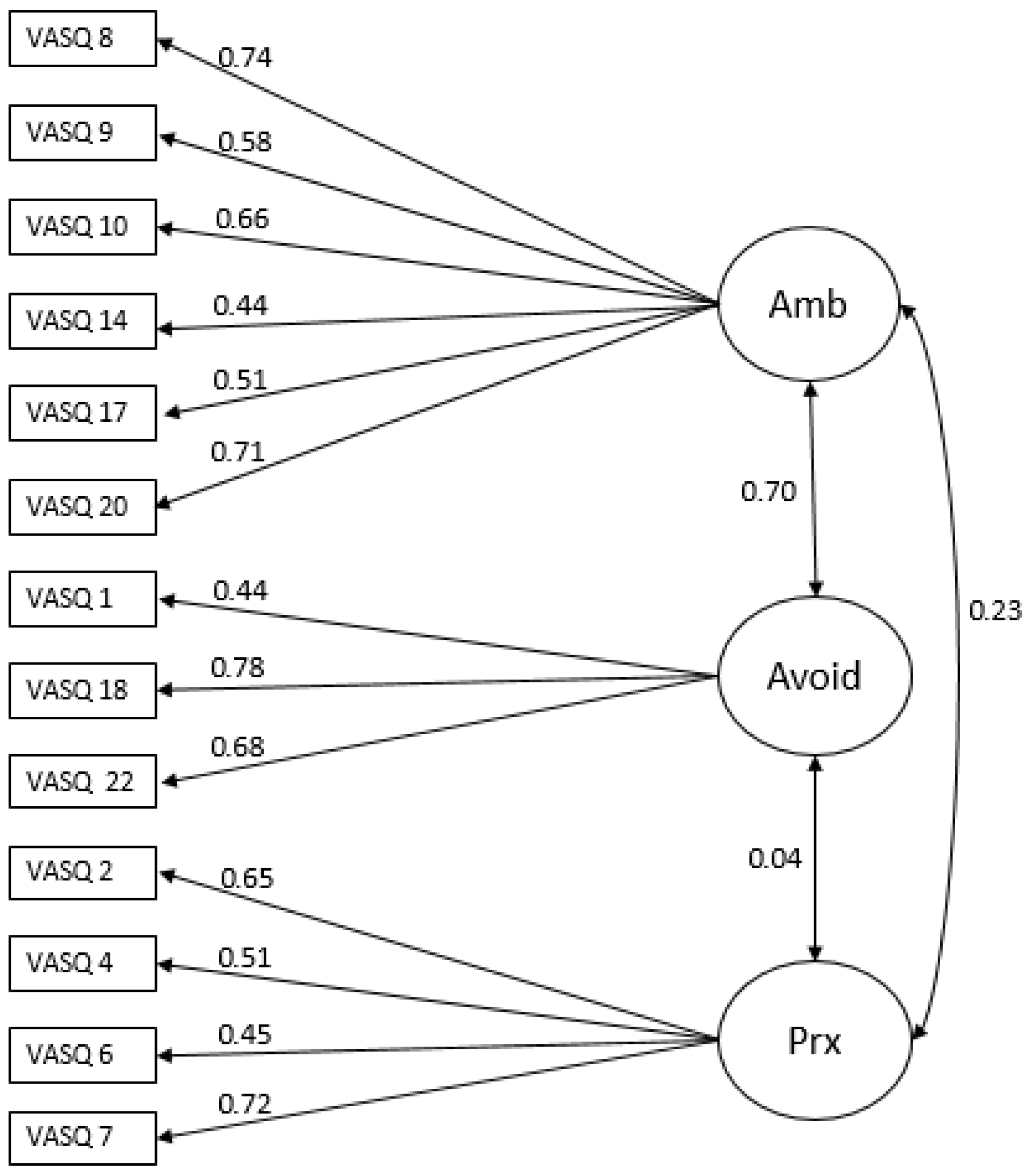
| Models/Indices | p Value | CFI | TLI | RMSEA | RMSEA 90% CI | |
|---|---|---|---|---|---|---|
| Present study: 3 factors, 13 items | 131/62 | <0.001 | 0.92 | 0.90 | 0.06 | 0.05–0.08 |
| Original study [31]: 2 factors, 22 items | 837/208 | <0.001 | 0.74 | 0.71 | 0.08 | 0.08–0.09 |
| Validation study [34]: 4 factors, 14 items | 225/71 | <0.001 | 0.89 | 0.85 | 0.07 | 0.06–0.08 |
| VASQ Dimensions | Alpha | MIIC | CITCR |
|---|---|---|---|
| Insecure-ambivalent | 0.78 | 0.37 | 0.36–0.62 |
| Insecure-avoidant | 0.66 | 0.40 | 0.37–0.54 |
| Proximity-seeking | 0.67 | 0.34 | 0.38–0.50 |
| 1 | 2 | 3 | 4 | 5 | 6 | 7 | 8 | 9 | |
|---|---|---|---|---|---|---|---|---|---|
| 1. Insecure-ambivalent | - | 0.44 *** | 0.15 ** | 0.53 *** | 0.41 *** | 0.35 *** | 0.31 *** | 0.40 *** | −0.11 * |
| 2. Insecure-avoidant | - | 0.07 | 0.26 ** | 0.34 ** | 0.04 | 0.09 | 0.23 ** | 0.15 * | |
| 3. Proximity-seeking | - | 0.14 ** | 0.28 *** | 0.02 | 0.09 | −0.04 | 0.27 *** | ||
| 4. SDQ total | - | 0.75 *** | 0.70 *** | 0.70 *** | 0.63 *** | −0.14 ** | |||
| 5. Emotional problems | - | 0.27 *** | 0.37 *** | 0.37 *** | 0.21 *** | ||||
| 6. Behavioral problems | - | 0.42 *** | 0.33 *** | −0.31 *** | |||||
| 7. Hyperactivity/inattention | - | 0.12 * | −0.15 ** | ||||||
| 8. Peer relationship problems | - | −0.19 *** | |||||||
| 9. Prosocial behaviors | - | ||||||||
| M(SD) | 16.69 | 10.34 | 12.61 | 15.95 | 4.63 | 3.09 | 4.82 | 3.41 | 7.21 |
| (4.83) | (2.69) | (3.15) | (6.18) | (2.43) | (2.05) | (2.31) | (2.06) | (2.30) |
| VASQ Dimensions | SDQ Domains | AUC (95% CI) | p | Cutoff | Sensitivity | Specificity | Youden Index (J) |
|---|---|---|---|---|---|---|---|
| Insecure-ambivalent | Emotional symptoms | 0.707 0.647–0.768 | 0.000 | 19 | 0.561 | 0.756 | 0.317 |
| Behavioral problems | 0.689 0.631–0.746 | 0.000 | 18 | 0.625 | 0.659 | 0.284 | |
| Hyperactivity | 0.633 0.569–0.697 | 0.000 | 16 | 0.779 | 0.429 | 0.208 | |
| Peer relationship | 0.656 0.582–0.729 | 0.000 | 17 | 0.733 | 0.519 | 0.252 | |
| SDQ Total score | 0.791 0.745–0.837 | 0.000 | 18 | 0.706 | 0.725 | 0.431 | |
| Insecure-avoidant | Emotional symptoms | 0.646 0.579–0.713 | 0.000 | 13 | 0.418 | 0.826 | 0.245 |
| Peer relationships | 0.644 0.568–0.720 | 0.000 | 12 | 0.533 | 0.693 | 0.226 | |
| SDQ Total score | 0.618 0.561–0.674 | 0.000 | 12 | 0.471 | 0.722 | 0.192 | |
| Proximity-seeking | Emotional symptoms | 0.618 0.550–0.685 | 0.001 | 15 | 0.418 | 0.779 | 0.198 |
| SDQ Total score | 0.567 0.508–0.625 | 0.025 | 15 | 0.338 | 0.768 | 0.106 |
| Emotional | Behavioral | Hyperactivity | Peer | Prosocial | SDQ Total | ||
|---|---|---|---|---|---|---|---|
| Insecure-ambivalent | χ2 (df = 1)/p | 23.87/<0.001 | 26.41/<0.001 | 12.81/<0.001 | 5.75/0.017 | 0.20/0.655 | 72.10/<0.001 |
| Cramer’s V/p | 0.23/<0.001 | 0.25/<0.001 | 0.17/<0.001 | 0.12/0.017 | 0.02/0.655 | 0.41/<0.001 | |
| OR 95% CI | 0.32 [0.20–0.51] | 0.31 [0.20–0.49] | 0.43 [0.27–0.69] | 0.52 [0.30–0.89] | 0.88 [0.50–1.56] | 0.16 [0.10–0.25] | |
| Insecure-avoidant | χ2 (df = 1)/p | 16.75/<0.001 | 0.20/0.659 | 1.44/0.230 | 11.87/<0.001 | 1.95/0.162 | 15.52/<0.001 |
| Cramer’s V/p | 0.20/<0.001 | 0.02/0.659 | 0.06/0.230 | 0.17/<0.001 | 0.07/0.162 | 0.19/<0.001 | |
| OR 95% CI | 0.39 [0.25–0.62] | 0.90 [0.57–1.43] | 0.75 [0.47–1.20] | 0.39 [0.22–0.67] | 1.56 [0.83–3.03] | 0.43 [0.28–0.66] | |
| Proximity-seeking | χ2 (df = 1)/p | 15.28/<0.001 | 0.14/0.711 | 5.40/0.020 | 0.12/0.727 | 7.84/0.005 | 5.46/0.019 |
| Cramer’s V/p | 0.19/<0.001 | 0.02/0.711 | 0.11/0.020 | 0.02/0.727 | 0.13/0.005 | 0.11/0.019 | |
| OR 95% CI | 0.39 [0.24–0.63] | 0.91 [0.56–1.49] | 0.56 [0.35–0.92] | 0.90 [0.49–1.64] | 3.33 [1.37–7.69] | 0.59 [0.38–0.92] | |
Disclaimer/Publisher’s Note: The statements, opinions and data contained in all publications are solely those of the individual author(s) and contributor(s) and not of MDPI and/or the editor(s). MDPI and/or the editor(s) disclaim responsibility for any injury to people or property resulting from any ideas, methods, instructions or products referred to in the content. |
© 2026 by the authors. Licensee MDPI, Basel, Switzerland. This article is an open access article distributed under the terms and conditions of the Creative Commons Attribution (CC BY) license.
Share and Cite
Simão, A.; Martins, C.; Bifulco, A.; Nunes, C. Vulnerable Attachment Style Questionnaire: Preliminary Evidence for a Revised Factor Structure Among Adolescents in Residential Care. Children 2026, 13, 551. https://doi.org/10.3390/children13040551
Simão A, Martins C, Bifulco A, Nunes C. Vulnerable Attachment Style Questionnaire: Preliminary Evidence for a Revised Factor Structure Among Adolescents in Residential Care. Children. 2026; 13(4):551. https://doi.org/10.3390/children13040551
Chicago/Turabian StyleSimão, Ana, Cátia Martins, Antonia Bifulco, and Cristina Nunes. 2026. "Vulnerable Attachment Style Questionnaire: Preliminary Evidence for a Revised Factor Structure Among Adolescents in Residential Care" Children 13, no. 4: 551. https://doi.org/10.3390/children13040551
APA StyleSimão, A., Martins, C., Bifulco, A., & Nunes, C. (2026). Vulnerable Attachment Style Questionnaire: Preliminary Evidence for a Revised Factor Structure Among Adolescents in Residential Care. Children, 13(4), 551. https://doi.org/10.3390/children13040551