Sensor Technologies in Medicine–Food Homology: A Comprehensive Review

Abstract
1. Introduction
2. Overview of Sensors: Definitions, Principles, and Their Central Role in the MFH Field
3. Sensor Classification System: Systematic Categorization Based on Detection Principles and Operational Mechanisms
3.1. Physical Sensors: Non-Destructive Monitoring of Environmental Parameters
3.2. Chemical Sensors: Efficient Recognition of Chemical Components
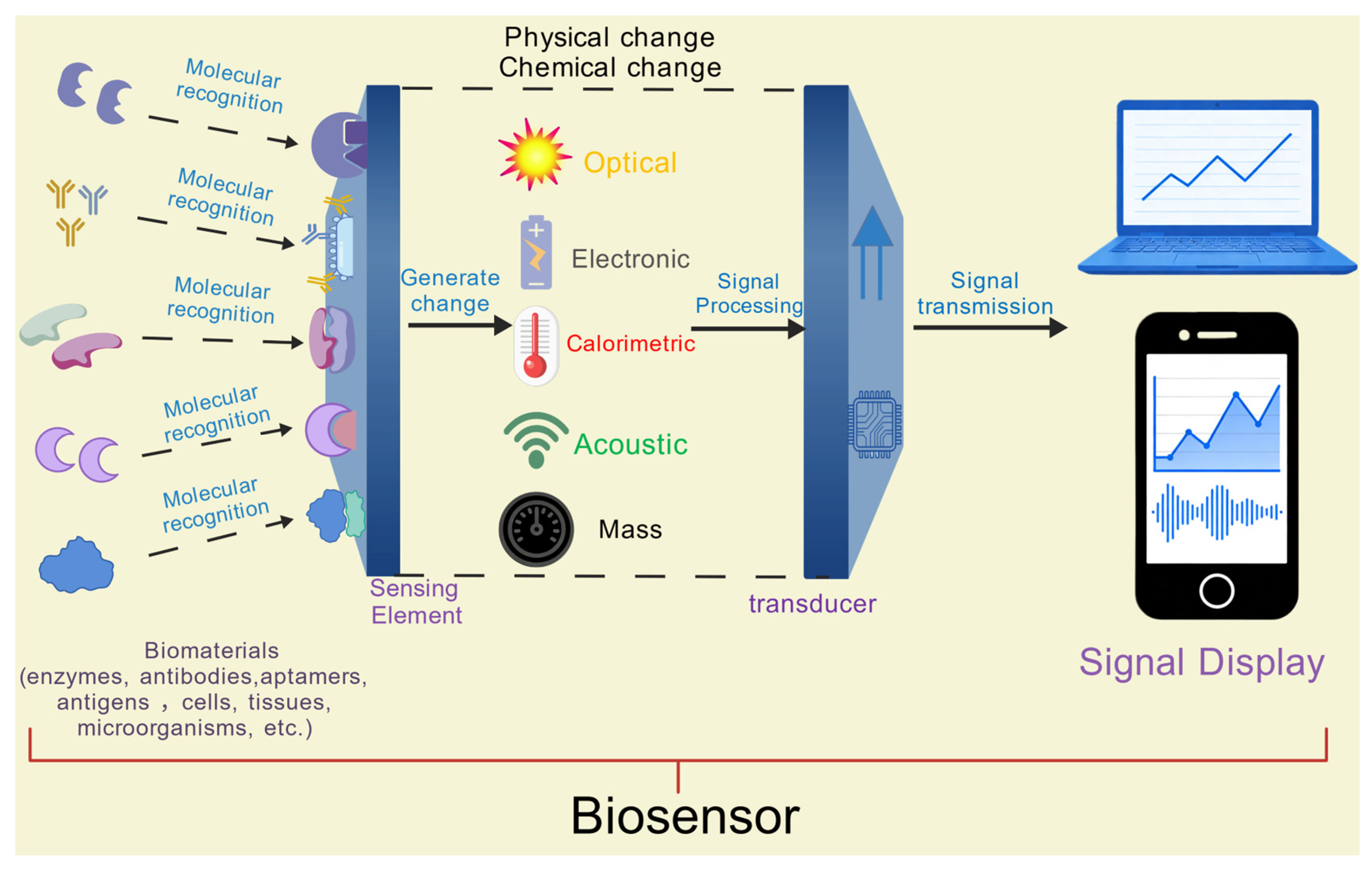
3.3. Biosensors: High-Specificity Detection Based on Biological Recognition

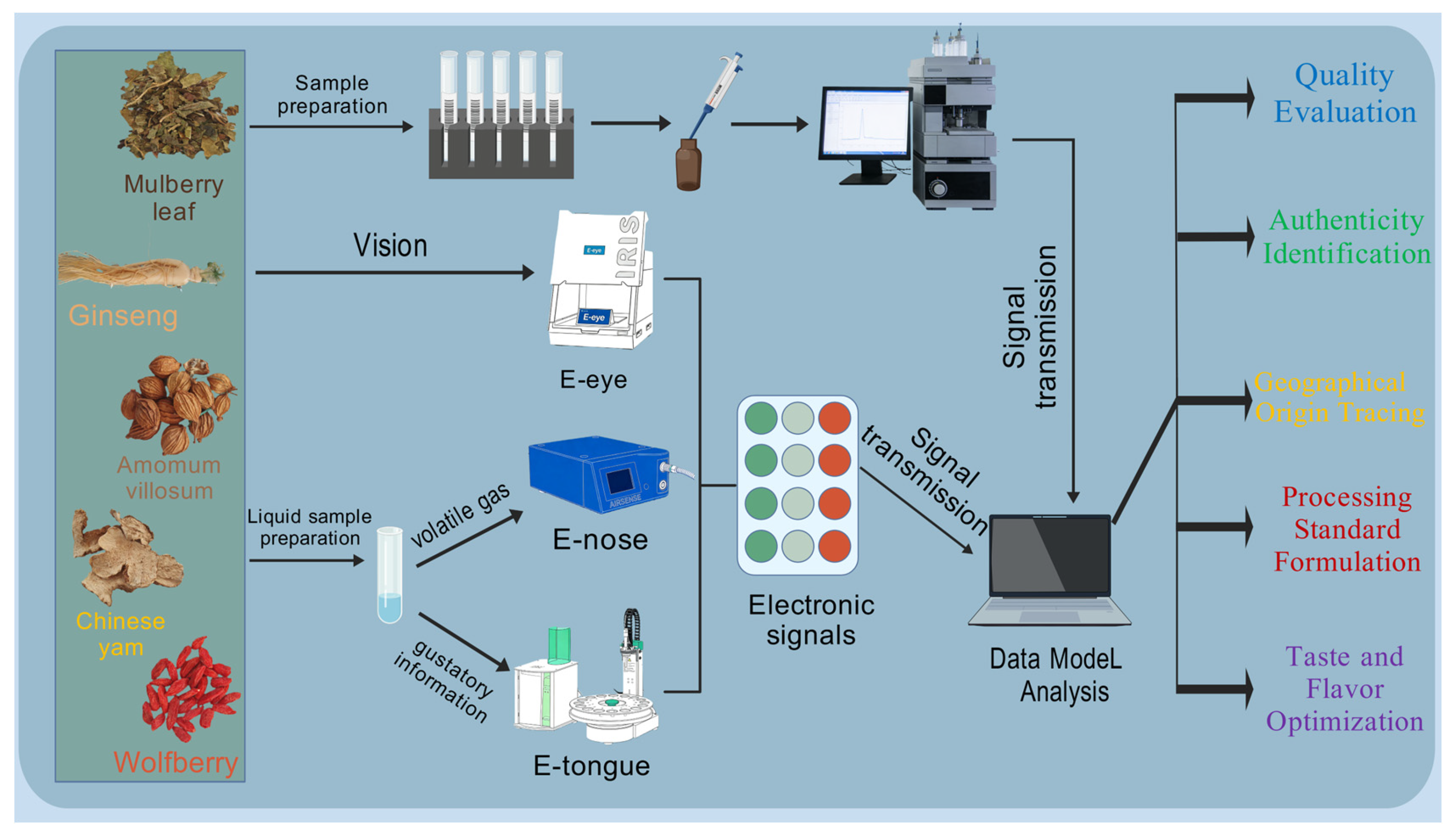
4. Artificial Intelligence Sensory Technology
4.1. Electronic Eye (E-Eye)
4.2. Electronic Nose (E-Nose)
4.3. Electronic Tongue (E-Tongue)
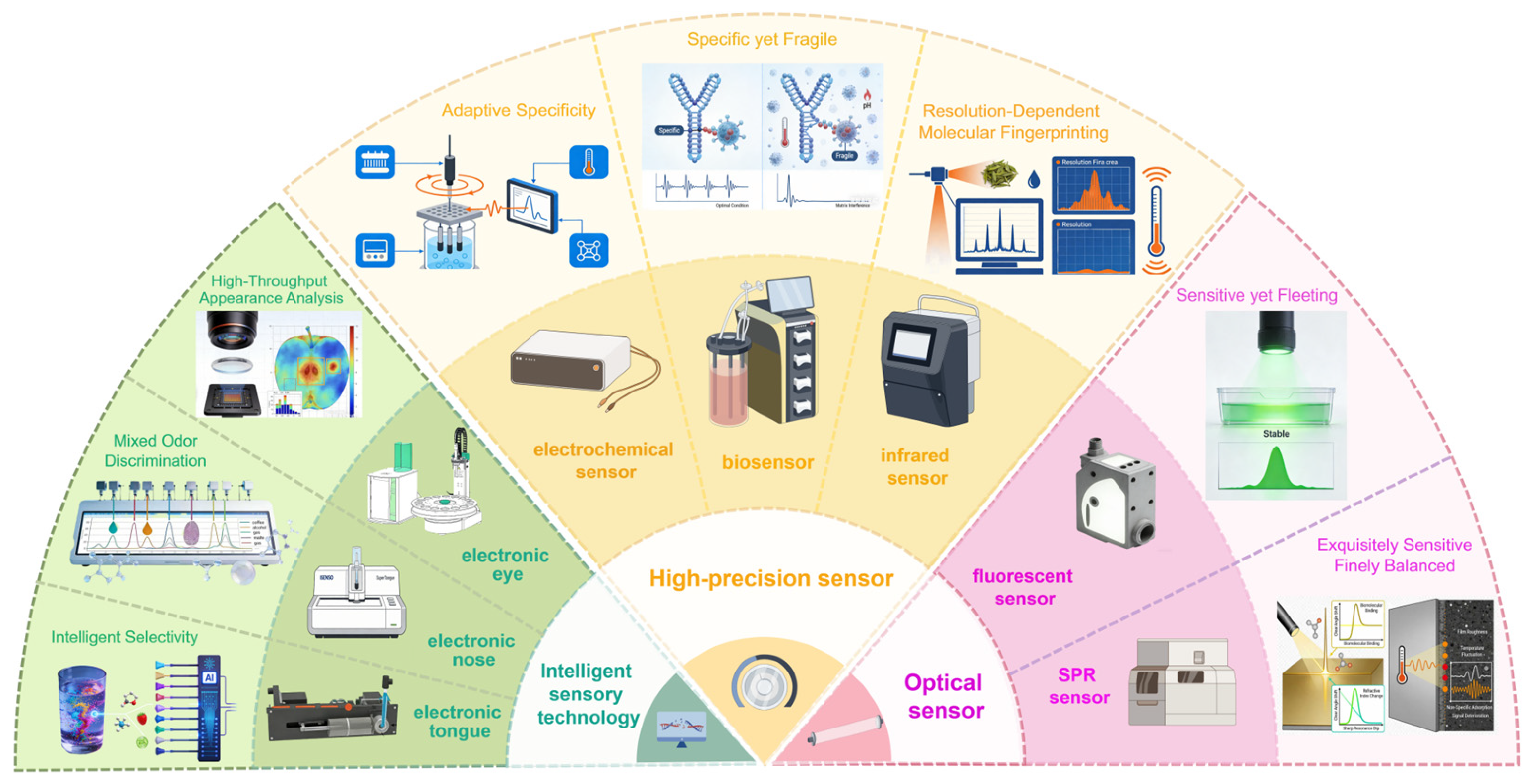
5. High-Precision Sensors
5.1. Electrochemical Sensors
5.2. Infrared Sensors
5.3. Fluorescent Sensors
5.4. Surface Plasmon Resonance (SPR) Sensors
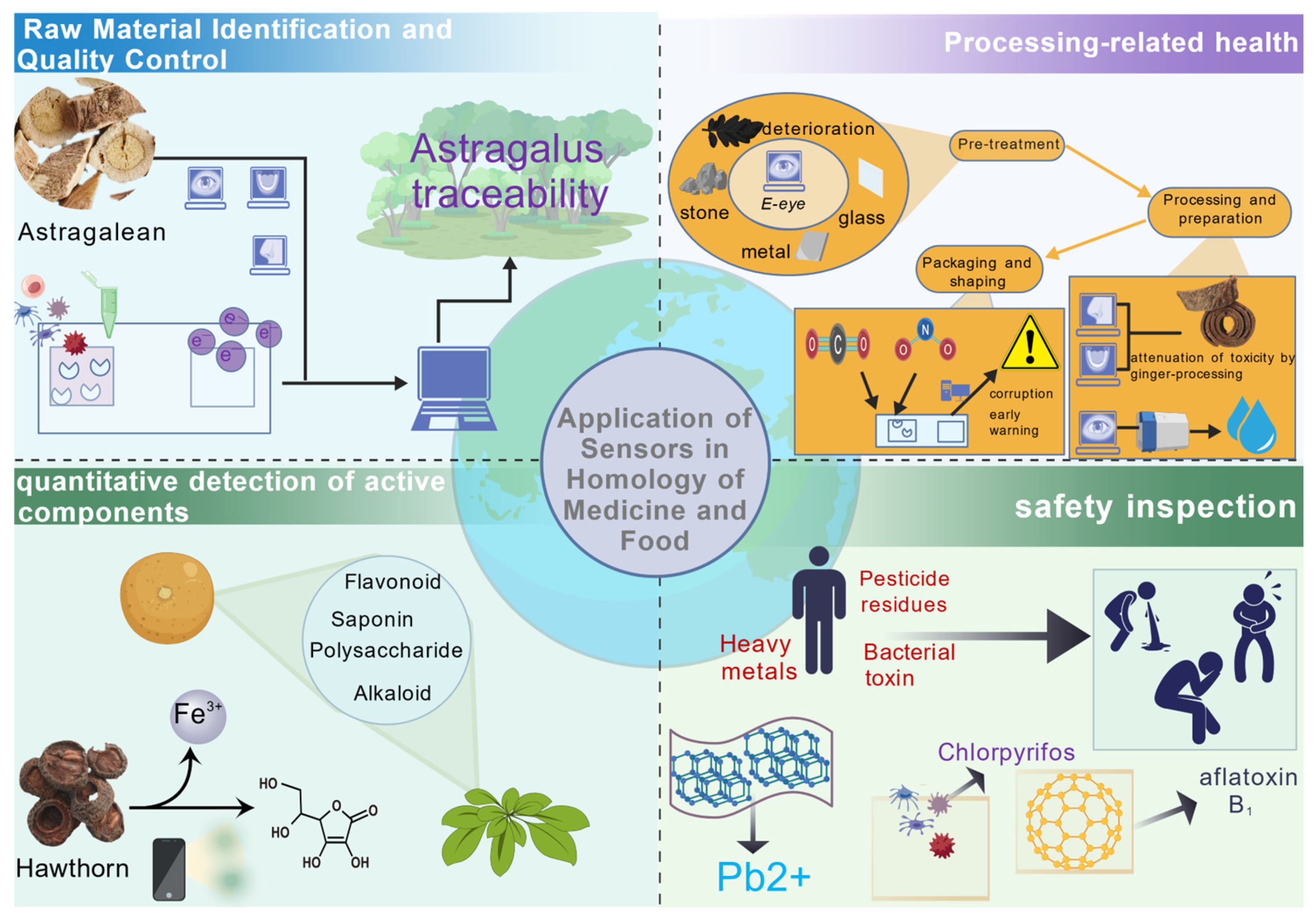
6. Applications in MFH Production and Research
6.1. Raw Material Identification and Quality Control
6.2. Processing Monitoring
6.2.1. Preprocessing and Cleaning
6.2.2. Processing (Paozhi)
6.2.3. Formulation and Packaging
6.3. Quantitative Detection of Active Components
6.4. Quality and Safety Screening
7. Research Status and Development Trends
7.1. Research Status
7.2. Development Trends
8. Conclusions
Author Contributions
Funding
Institutional Review Board Statement
Informed Consent Statement
Data Availability Statement
Conflicts of Interest
Abbreviations
| AFB1 | aflatoxin B1 |
| AI | Artificial Intelligence |
| CMM | Chinese Materia Medica |
| EAB | electrochemical aptamer biosensor |
| HSI | hyperspectral imaging |
| IoT | Internet of Things |
| LOD | Limit of Detection |
| MFH | medicine–food homology |
| MIR | mid-infrared |
| NIR | near-infrared |
| OTA | ochratoxin A |
| PAAM | porous anodic alumina membrane |
| PAT | process analytical technology |
| SPR | surface plasmon resonance |
| TCM | Traditional Chinese Medicine |
References
- Marchianò, V.; Tricase, A.; Cimino, A.; Cassano, B.; Catacchio, M.; Macchia, E.; Torsi, L.; Bollella, P. Inside out: Exploring edible biocatalytic biosensors for health monitoring. Bioelectrochemistry 2025, 161, 108830. [Google Scholar] [CrossRef] [PubMed]
- Zou, L.; Li, H.; Ding, X.; Liu, Z.; He, D.; Kowah, J.A.H.; Wang, L.; Yuan, M.; Liu, X. A Review of The Application of Spectroscopy to Flavonoids from Medicine and Food Homology Materials. Molecules 2022, 27, 7766. [Google Scholar] [CrossRef]
- Bert, P.; Neil, B.; Diána, B.; Paul, B.; Steven, G.; Nevena, H.; Mourinha, C.S.; Samim, S.; John, S.; Charon, W.; et al. Food inauthenticity: Authority activities, guidance for food operators, and mitigation tools. Compr. Rev. Food Sci. Food Saf. 2022, 21, 4776–4811. [Google Scholar] [CrossRef] [PubMed]
- Zonouri, S.A.; Mehdipourbashi, S.; Malekshahi, M.R. Diplexer based microwave sensor for noninvasive detection of sucrose and sorbitol in pharmaceutical syrups. Sci. Rep. 2025, 15, 37220. [Google Scholar] [CrossRef]
- Rajbongshi, B.; Nickhil, C.; Deka, S.C. Colorimetric sensor technologies for quality detection in grains: A comprehensive review. J. Food Meas. Charact. 2025, 19, 4439–4474. [Google Scholar] [CrossRef]
- Lin, J.; Wu, S. Recent Advances in Agricultural Sensors: Towards Precision and Sustainable Farming. Chemosensors 2025, 13, 399. [Google Scholar] [CrossRef]
- Bombiński, S.; Skajster, J.K.; Jemielniak, K. New developments and future prospects in commercial tool condition monitoring systems. Measurement 2025, 255, 118037. [Google Scholar] [CrossRef]
- Urban, G. Jacob Fraden: Handbook of modern sensors: Physics, designs, and applications, 5th ed. Anal. Bioanal. Chem. 2016, 408, 5667–5668. [Google Scholar]
- Hamidi, M.; Osmani, A. Human Activity Recognition: A Dynamic Inductive Bias Selection Perspective. Sensors 2021, 21, 7278. [Google Scholar] [CrossRef]
- Xie, J.; Li, X.D.; Li, M.; Zhu, H.Y.; Cao, Y.; Zhang, J.; Xu, A.J. Advances in surface plasmon resonance for analyzing active components in traditional Chinese medicine. J. Pharm. Anal. 2024, 14, 100983. [Google Scholar] [CrossRef] [PubMed]
- Catania, P.; Gaglio, R.; Orlando, S.; Settanni, L.; Vallone, M. Design and Implementation of a Smart System to Control Aromatic Herb Dehydration Process. Agriculture 2020, 10, 332. [Google Scholar] [CrossRef]
- Wu, S.; Liu, Y.; Fan, X.; Shen, Y.; Qu, H. Trends and new process analytical technologies in pharmaceutical manufacturing. Int. J. Pharm. 2025, 682, 125957. [Google Scholar] [CrossRef]
- Chugh, V.; Gaskin, P.; Zhang, W. Recent progress in current and emerging techniques for the detection of PFAS—the forever chemicals. Sens. Diagn. 2026, 5, 305–325. [Google Scholar] [CrossRef]
- Oancea, E.; Tula, I.A.; Stanciu, G.; Ștefan-van Staden, R.-I.; van Staden, J.; Mititelu, M. Advanced Amperometric Microsensors for the Electrochemical Quantification of Quercetin in Ginkgo biloba Essential Oil from Regenerative Farming Practices. Metabolites 2025, 15, 6. [Google Scholar] [CrossRef] [PubMed]
- JanMisera, J.; Melchert, J.; Hüffer, T. Biosensing and Biosensors—Terminologies, Technologies, Theories and Ethics. Geogr. Compass 2024, 18, e70007. [Google Scholar] [CrossRef] [PubMed]
- Rani, A.Q.; Zhu, B.; Ueda, H.; Kitaguchi, T. Recent progress in homogeneous immunosensors based on fluorescence or bioluminescence using antibody engineering. Analyst 2023, 148, 1422–1429. [Google Scholar] [CrossRef]
- Wang, K.; Wang, S.; Margolis, S.; Cho, J.M.; Zhu, E.; Dupuy, A.; Yin, J.; Park, S.K.; Magyar, C.E.; Adeyiga, O.B.; et al. Rapid prediction of acute thrombosis via nanoengineered immunosensors with unsupervised clustering for multiple circulating biomarkers. Sci. Adv. 2024, 10, eadq6778. [Google Scholar] [CrossRef]
- Naresh, V.; Lee, N. A Review on Biosensors and Recent Development of Nanostructured Materials-Enabled Biosensors. Sensors 2021, 21, 1109. [Google Scholar] [CrossRef]
- Kimmel, D.W.; Leblanc, G.; Meschievitz, M.E.; Cliffel, D.E. Electrochemical Sensors and Biosensors. Anal. Chem. 2012, 84, 685–707. [Google Scholar] [CrossRef]
- Liu, Y.-T.; Zhang, Q.-Q.; Yao, S.-Y.; Cui, H.-W.; Zou, Y.-L.; Zhao, L.-X. Dual-recognition “turn-off-on” fluorescent Biosensor triphenylamine-based continuous detection of copper ion and glyphosate applicated in environment and living system. J. Hazard. Mater. 2024, 477, 135216. [Google Scholar] [CrossRef]
- Dabhade, A.H.; Paramasivan, B.; Kumawat, A.S.; Saha, B. Miniature lab-made electrochemical biosensor: A promising sensing kit for rapid detection of E. coli in water, urine and milk. Talanta 2025, 285, 127306. [Google Scholar] [CrossRef]
- Goumas, G.; Vlachothanasi, E.N.; Fradelos, E.C.; Mouliou, D.S. Biosensors, Artificial Intelligence Biosensors, False Results and Novel Future Perspectives. Diagnostics 2025, 15, 1037. [Google Scholar] [CrossRef]
- Jiang, S.; Li, H.; Zhang, L.; Mu, W.; Zhang, Y.; Chen, T.; Wu, J.; Tang, H.; Zheng, S.; Liu, Y.; et al. Generic Diagramming Platform (GDP): A comprehensive database of high-quality biomedical graphics. Nucleic Acids Res. 2025, 53, D1670–D1676. [Google Scholar] [CrossRef]
- Huang, Y.; Hu, A.; Ren, L.; Long, W.; Lan, W.; He, Y.; She, Y.; Chen, H.; Fu, H. Smartphone app with cloud-based machine learning and visual sensor array for instrument-free detection of species, geographic origin, and quality marker in functional food Gancao. Food Control 2025, 173, 111219. [Google Scholar] [CrossRef]
- Carrillo, J.K.; Durán, C.M.; Cáceres, J.M.; Cuastumal, C.A.; Ferreira, J.; Ramos, J.; Bahder, B.; Oates, M.; Ruiz, A. Assessment of E-Senses Performance through Machine Learning Models for Colombian Herbal Teas Classification. Chemosensors 2023, 11, 354. [Google Scholar] [CrossRef]
- Kallel, J.; Ben Aissa, S.; Ousji, B.; Chevalier, Y.; Hbaieb, S.; Bordes, C. Evaluation of bitterness in mother tinctures by an electronic tongue: Impact of cyclodextrin complexation. Int. J. Pharm. 2025, 686, 126345. [Google Scholar] [CrossRef] [PubMed]
- Wang, L.; Liu, K.; Wu, T.; Chen, X.; Chen, Y.; Yue, C.; Wang, Z.; Wu, H.; Tang, L. Effective strategy for distinguishing raw and vinegar Schisandrae Chinensis Fructus based on electronic eye and electronic tongue combined with chemometrics. Phytochem. Anal. 2025, 36, 156–165. [Google Scholar] [CrossRef] [PubMed]
- Choi, C.; Lee, G.J.; Chang, S.; Song, Y.M.; Kim, D.H. Nanomaterial-Based Artificial Vision Systems: From Bioinspired Electronic Eyes to In-Sensor Processing Devices. ACS Nano 2024, 18, 1241–1256. [Google Scholar] [CrossRef]
- Li, H.; Wang, P.P.; Lin, Z.Z.; Wang, Y.L.; Gui, X.J.; Fan, X.H.; Dong, F.Y.; Zhang, P.P.; Li, X.L.; Liu, R.X. Identification of Bletilla striata and related decoction pieces: A data fusion method combining electronic nose, electronic tongue, electronic eye, and high-performance liquid chromatography data. Front. Chem. 2023, 11, 1342311. [Google Scholar] [CrossRef] [PubMed]
- Shen, Z.; Xie, H.; Zhang, J.; Li, M.; Wang, B.; Wu, Y.; Yu, H.; Nie, X.; Hao, J.; Jia, J.; et al. Rapid evaluation of the quality of Epimedium with different processing degrees by E-eye and NIR spectroscopy combined with machine learning. Microchem. J. 2024, 205, 111181. [Google Scholar] [CrossRef]
- Rabehi, A.; Helal, H.; Zappa, D.; Comini, E. Advancements and Prospects of Electronic Nose in Various Applications: A Comprehensive Review. Appl. Sci. 2024, 14, 4506. [Google Scholar] [CrossRef]
- Xu, W.; Zhang, C.; Xu, R.; Yang, J.; Kong, Y.; Liu, L.; Tao, S.; Wu, Y.; Liao, H.; Mao, C.; et al. E-Nose and HS-SPME-GC-MS unveiling the scent signature of Ligusticum chuanxiong and its medicinal relatives. Front. Plant Sci. 2025, 16, 1476810. [Google Scholar] [CrossRef] [PubMed]
- Melikoglu, M. The electronic nose: A critical global review of advances in analytical methods and real-world applications. Microchem. J. 2025, 218, 115363. [Google Scholar] [CrossRef]
- Ijaz, U.; Ali, M.; Ahmad, I.; Hamza, S.A.; Kim, H.-D. A comprehensive review of electronic nose systems: Design, sensors, and future directions. Chem. Eng. J. 2025, 524, 169482. [Google Scholar] [CrossRef]
- Anisimov, D.S.; Abramov, A.A.; Gaidarzhi, V.P.; Kaplun, D.S.; Agina, E.V.; Ponomarenko, S.A. Food Freshness Measurements and Product Distinguishing by a Portable Electronic Nose Based on Organic Field-Effect Transistors. ACS Omega 2023, 8, 4649–4654. [Google Scholar] [CrossRef] [PubMed]
- Zhan, X.; Guan, X.; Wu, R.; Wang, Z.; Wang, Y.; Li, G. Discrimination between Alternative Herbal Medicines from Different Categories with the Electronic Nose. Sensors 2018, 18, 2936. [Google Scholar] [CrossRef]
- Steiner, D.; Meyer, A.; Immohr, L.I.; Pein-Hackelbusch, M. Critical View on the Qualification of Electronic Tongues Regarding Their Performance in the Development of Peroral Drug Formulations with Bitter Ingredients. Pharmaceutics 2024, 16, 658. [Google Scholar] [CrossRef]
- Wang, L.; Zhu, X.; Liu, H.; Sun, B. Medicine and food homology substances: A review of bioactive ingredients, pharmacological effects and applications. Food Chem. 2025, 463, 141111. [Google Scholar] [CrossRef]
- Lin, Z.; Zhang, Q.; Liu, R.; Gao, X.; Zhang, L.; Kang, B.; Shi, J.; Wu, Z.; Gui, X.; Li, X. Evaluation of the Bitterness of Traditional Chinese Medicines using an E-Tongue Coupled with a Robust Partial Least Squares Regression Method. Sensors 2016, 16, 151. [Google Scholar] [CrossRef]
- Chen, Y.; Liao, Z.; Wang, Z.; Shi, W.; Xu, J. Isolation and Identification of Bitter Compounds in Ginseng (Panax ginseng C. A. Mey.) Based on Preparative High Performance Liquid Chromatography, UPLC-Q-TOF/MS and Electronic Tongue. Separations 2024, 11, 114. [Google Scholar] [CrossRef]
- Zabitler, D.; Ülker, E.; Turan, K.; Erdoğan, N.Ö.; Aydoğdu Tığ, G. Electrochemical Sensor for Biological Samples Monitoring. Top. Catal. 2025, 69, 95–125. [Google Scholar] [CrossRef]
- Baranwal, J.; Barse, B.; Gatto, G.; Broncova, G.; Kumar, A. Electrochemical Sensors and Their Applications: A Review. Chemosensors 2022, 10, 363. [Google Scholar] [CrossRef]
- Cadre, J.E.V.; Viteri, J.H.; Fernández, L.A.G.; Piña, J.J.; Peláez, O.L.; Hidalgo, L.; Domínguez, I.A.R.; Cruz, R.; Torres, I.R.; Castillo, N.A.M.; et al. Recent advances in electrochemical sensors applied to samples of industrial interest. Microchem. J. 2025, 210, 112931. [Google Scholar] [CrossRef]
- Zhang, N.; Wu, Y.; Liang, T.; Su, Y.; Xie, X.; Zhang, T.; Wang, H.; Zhang, K.; Jiang, R. Upconversion nanoparticles incorporated with three-dimensional graphene composites for electrochemical sensing of baicalin from natural plants. RSC Adv. 2024, 14, 36084–36092. [Google Scholar] [CrossRef]
- Argoubi, W.; Algethami, F.K.; Raouafi, N. Enhanced sensitivity in electrochemical detection of ochratoxin A within food samples using ferrocene- and aptamer-tethered gold nanoparticles on disposable electrodes. RSC Adv. 2024, 14, 8007–8015. [Google Scholar] [CrossRef]
- Makani, N.; Wu, J.; Florentino, J.; Chafin, C.F.; Gautam, B.; Chao, S.; Han, S. A Sensitive Electrochemical Cholinesterase-Inhibiting Biosensor for Organophosphorus Pesticides Based on Ti3C2TX MXene Quantum Dots. Biosensors 2025, 15, 575. [Google Scholar] [CrossRef]
- Mazaafrianto, D.N.; Ishida, A.; Maeki, M.; Tani, H.; Tokeshi, M. An Electrochemical Sensor Based on Structure Switching of Dithiol-modified Aptamer for Simple Detection of Ochratoxin A. Anal. Sci. 2019, 35, 1221–1226. [Google Scholar] [CrossRef]
- Liu, W.; Zhang, Z.; Liu, Y.; Jiang, L.; Li, P.; Fan, W. A Novel Pattern Recognition Method for Non-Destructive and Accurate Origin Identification of Food and Medicine Homologous Substances with Portable Near-Infrared Spectroscopy. Molecules 2025, 30, 3565. [Google Scholar] [CrossRef] [PubMed]
- Peng, X.; Yu, X.; Lu, L.; Ye, X.; Zhong, L.; Hu, W.; Chen, S.; Song, Q.; Cai, Y.; Yin, J. Application of handheld near infrared spectrometer in quality control of traditional Chinese medicine: Rapid screening and quantitative analysis of Lonicerae Japonicae Flos adulteration. Spectrochim. Acta Part A Mol. Biomol. Spectrosc. 2025, 326, 125215. [Google Scholar] [CrossRef]
- Qing, L.; Yan, X.-J.; Zhao, K.; Li, L.; Peng, S.-G.; Luo, X.; Wen, Y.-S.; Yan, Z.-Y. Fast Inspection of Saffron on the Spot Based on Cloud-Connected Portable Near-Infrared Technology. Spectrosc. Spectr. Anal. 2020, 40, 3029–3037. [Google Scholar]
- Deconinck, E.; Djiogo, C.A.S.; Bothy, J.L.; Courselle, P. Detection of regulated herbs and plants in plant food supplements and traditional medicines using infrared spectroscopy. J. Pharm. Biomed. Anal. 2017, 142, 210–217. [Google Scholar] [CrossRef]
- Adair, L.D.; New, E.J. Molecular fluorescent sensors for in vivo imaging. Curr. Opin. Biotechnol. 2023, 83, 102973. [Google Scholar] [CrossRef] [PubMed]
- Hu, X.; Mu, Z.; Li, Y.; Bai, L.; Qing, M. Metal–organic frameworks-scaffold gold nanoclusters enabled aggregation-induced enhanced fluorescent sensor array for high-throughput detection of heavy metal ions. Microchem. J. 2025, 210, 113020. [Google Scholar] [CrossRef]
- Mu, X.-Q.; Wang, D.; Mu, L.-Y.; Wang, Y.Q.; Chen, J. Glutathione-modified graphene quantum dots as fluorescent probes for detecting organophosphorus pesticide residues in Radix Angelica Sinensis. Spectrochim. Acta Part A Mol. Biomol. Spectrosc. 2023, 286, 122021. [Google Scholar] [CrossRef]
- Ong, B.H.; Yuan, X.; Tjin, S.C.; Zhang, J.; Ng, H.M. Optimised film thickness for maximum evanescent field enhancement of a bimetallic film surface plasmon resonance biosensor. Sens. Actuators B Chem. 2005, 114, 1028–1034. [Google Scholar] [CrossRef]
- Wei, Y.; Tang, Y.; Zhang, Y.; Liu, C.; Ren, P.; Liu, C.; Shi, C.; Zhang, Z.; Liu, Z. Wave type fiber SPR sensor for rapid and highly sensitive detection of hyperoside. Biomed. Opt. Express 2024, 15, 3859–3868. [Google Scholar] [CrossRef]
- Klantsataya, E.; François, A.; Ebendorff-Heidepriem, H.; Hoffmann, P.; Monro, T.M. Surface Plasmon Scattering in Exposed Core Optical Fiber for Enhanced Resolution Refractive Index Sensing. Sensors 2015, 15, 25090–25102. [Google Scholar] [CrossRef]
- Tang, Y.; Wei, Y.; Li, X.; Sun, W.; Xuan, Y.; Huang, Q.; Zhang, Y.; Liu, Z. Ring core optical fiber SPR sensor for high-sensitivity detection of isoquercitrin. Opt. Laser Technol. 2025, 186, 112569. [Google Scholar] [CrossRef]
- Sun, X.Y.; Zheng, Y.P.; Sun, K.M.; He, C.N.; Xiao, P.G. Review, revision, and prospect of list of substances with both edible and medicinal values in China. Zhongguo Zhong Yao Za Zhi 2025, 50, 346–355. [Google Scholar]
- Miao, X.; Cui, Q.; Wu, H.; Qiao, Y.; Zheng, Y.; Wu, Z. New sensor technologies in quality evaluation of Chinese materia medica: 2010–2015. Acta Pharm. Sin. B 2017, 7, 137–145. [Google Scholar] [CrossRef] [PubMed]
- Catalão Moura, P.; Raposo, M. Thin-films–based sensors: Physics contribution to medicine, environment and food. Europhys. Lett. 2025, 151, 66001. [Google Scholar] [CrossRef]
- Adeyeye, S.A.O.; Adeyeye, B.R. Recent Advances in Electronic Eye, Electronic Nose, and Electronic Tongue in Sensory Evaluation of Food: A Review. J. Food Process Eng. 2025, 48, e70281. [Google Scholar] [CrossRef]
- Zhou, H.; Luo, D.; GholamHosseini, H.; Li, Z.; He, J. Identification of Chinese Herbal Medicines with Electronic Nose Technology: Applications and Challenges. Sensors 2017, 17, 1073. [Google Scholar] [CrossRef]
- Jin, X.; Wang, Z.; Ma, J.; Liu, C.; Bai, X.; Lan, Y. Electronic eye and electronic tongue data fusion combined with a GETNet model for the traceability and detection of Astragalus. J. Sci. Food Agric. 2024, 104, 5930–5943. [Google Scholar] [CrossRef]
- Yang, R.; Wang, Y.; Wang, J.; Guo, X.; Zhao, Y.; Zhu, K.; Zhu, X.; Zou, H.; Yan, Y. Geographical Origin Traceability of Atractylodis Macrocephalae Rhizoma Based on Chemical Composition, Chromaticity, and Electronic Nose. Molecules 2024, 29, 4991. [Google Scholar] [CrossRef]
- Guo, X.; Yang, R.; Wang, Y.; Wang, J.; Wang, Y.; Zou, H.; Yan, Y. Prediction of Chemical Composition and Sensory Information of Codonopsis Radix Based on Electronic Nose. Molecules 2025, 30, 1146. [Google Scholar] [CrossRef]
- Andreeva, V.D.; Regeni, I.; Yang, T.; Elmanova, A.; Presselt, M.; Dietzek-Ivanšić, B.; Bonnet, S. Red-to-Blue Triplet–Triplet Annihilation Upconversion for Calcium Sensing. J. Phys. Chem. Lett. 2024, 15, 7430–7435. [Google Scholar] [CrossRef]
- Wanjun, L.; Yuting, G.; Guanghua, L.; Zikang, H.; Hengye, C.; Yuanbin, S.; Haiyan, F. Machine learning-assisted visual sensor array for identifying the origin of Lilium bulbs. Sens. Actuators B Chem. 2024, 399, 134812. [Google Scholar]
- Bian, Y.; Xiang, C.; Xu, Y.; Zhu, R.; Qin, S.; Zhang, Z. A Diboronic Acid-Based Fluorescent Sensor Array for Rapid Identification of Lonicerae Japonicae Flos and Lonicerae Flos. Molecules 2024, 29, 4374. [Google Scholar] [CrossRef]
- Huang, F.; Cai, X. Dual-response fluorescent switching sensor for sequential detection of Fe3+ and vitamin C in hawthorn. Sci. Rep. 2025, 15, 32107. [Google Scholar] [CrossRef]
- Sun, B.; Gao, C.; He, H.; Li, D.; Zhou, M.; Da, X.; Sun, K.; Chai, G.; Hao, Q.; Hu, F.; et al. A novel electrochemical sensor based on CS/ACK@CeO2/GCE for high selectivity and sensitivity analysis of baicalin in complex samples. J. Solid State Electrochem. 2025, 29, 2037–2049. [Google Scholar] [CrossRef]
- Wei, Y.; Tang, Y.; Zhang, Y.; Liu, C.; Liu, C.; Shi, C.; Ren, P.; Zhang, Z.; Liu, Z. A Novel High Sensitivity Fiber SPR Sensor for the Specific Detection of Baohuoside-I. IEEE Sens. J. 2024, 24, 7947–7953. [Google Scholar] [CrossRef]
- Liu, Y.; Li, X.; Chen, C.; Leng, A.; Qu, J. Effect of mineral excipients on processing traditional Chinese medicines: An insight into the components, pharmacodynamics and mechanism. Chin. Med. 2021, 16, 143. [Google Scholar] [CrossRef] [PubMed]
- Liakos, K.G.; Athanasiadis, V.; Bozinou, E.; Lalas, S.I. Machine Learning for Quality Control in the Food Industry: A Review. Foods 2025, 14, 3424. [Google Scholar] [CrossRef] [PubMed]
- Nielsen, M.S.; Lauridsen, T.; Christensen, L.B.; Feidenhans’l, R. X-ray dark-field imaging for detection of foreign bodies in food. Food Control 2013, 30, 531–535. [Google Scholar] [CrossRef]
- Bauer, C.; Wagner, R.; Leisner, J. Foreign Body Detection in Frozen Food by Dual Energy X-Ray Transmission. Sens. Transducers 2021, 253, 23–30. [Google Scholar]
- Xu, Y.; Jia, F.; Wu, Y.; Jiang, J.; Zheng, T.; Zheng, H.; Yang, Y. The Impact of Extrusion Cooking on the Physical Properties, Functional Components, and Pharmacological Activities of Natural Medicinal and Edible Plants: A Review. Foods 2025, 14, 1869. [Google Scholar] [CrossRef] [PubMed]
- Wu, X.; Wang, S.; Lu, J.; Jing, Y.; Li, M.; Cao, J.; Bian, B.; Hu, C. Seeing the unseen of Chinese herbal medicine processing (Paozhi): Advances in new perspectives. Chin. Med. 2018, 13, 4. [Google Scholar] [CrossRef]
- Yang, L.; Xue, Z.; Li, Z.; Li, J.; Yang, B. An integrated approach for discrimination of Magnoliae officinalis cortex before and after being processed by ginger juice combining LC/MS, GC/MS, intelligent sensors, and chemometrics. Phytochem. Anal. 2025, 36, 194–204. [Google Scholar] [CrossRef]
- da Silva Ferreira, M.V.; Ahmed, M.W.; Oliveira, M.; Sarang, S.; Ramsay, S.; Liu, X.; Malvandi, A.; Lee, Y.; Kamruzzaman, M. AI-Enabled Optical Sensing for Smart and Precision Food Drying: Techniques, Applications and Future Directions. Food Eng. Rev. 2024, 17, 75–103. [Google Scholar] [CrossRef]
- Fu, D.-K.; Yang, W.Z.; Yang, M.Q.; Yang, T.M.; Wang, Y.Z.; Zhang, J.Y. Based on metabolomics and fourier transforms near infrared spectroscopy characterization of Lanxangia tsaoko chemical profile differences among fruit types and development of rapid identification and nutrient prediction models. Food Biosci. 2025, 66, 106238. [Google Scholar] [CrossRef]
- Ma, L.; Yang, X.; Xue, S.; Zhou, R.; Wang, C.; Guo, Z.; Wang, Y.; Cai, J. Raman plus X dual-modal spectroscopy technology for food analysis: A review. Compr. Rev. Food Sci. Food Saf. 2025, 24, e70102. [Google Scholar] [CrossRef]
- Mkhari, T.; Adeyemi, J.O.; Fawole, O.A. Recent Advances in the Fabrication of Intelligent Packaging for Food Preservation: A Review. Processes 2025, 13, 539. [Google Scholar] [CrossRef]
- Siciliano, S.; Lopresto, C.G.; Carnì, D.L.; Lamonaca, F. Optical gas sensors in smart food bio-packaging: Innovation for monitoring the product freshness and safety. Meas. Food 2025, 19, 100245. [Google Scholar] [CrossRef]
- Winiarska, A.; Tomczyk-Warunek, A.; Jachimowicz-Rogowska, K.; Kwiecień, M.; Czernecki, T.; Lis, M.; Kazimierczak, W. Anti-Obesogenic Effects of Culinary Herbs Through Modulation of Inflammation and Metabolic Pathways. Nutrients 2026, 18, 993. [Google Scholar] [CrossRef] [PubMed]
- Liu, Y.; Zhang, L.; Zhang, X.; Bian, X.; Tian, W. Modern spectroscopic techniques combined with chemometrics for process quality control of traditional Chinese medicine: A review. Microchem. J. 2025, 213, 113605. [Google Scholar] [CrossRef]
- Yeganeh-Salman, E.; Alinezhad, H.; Ghasemi, S.; Hasantabar, V. Novel Schiff base embedded in nanostructured molecularly imprinted polymers as OFF–ON fluorescent sensor for highly selective detection of rutin residues in fruit juice. Sens. Actuators A Phys. 2024, 374, 115475. [Google Scholar] [CrossRef]
- Katiyar, D.; Manish; Saxena, P.R.; Priya, B.; Abhishek, K.; Surya, P. Electrochemical Sensors for Detection of Phytomolecules: A Mechanistic Approach. Comb. Chem. High Throughput Screen. 2024, 27, 1887–1899. [Google Scholar] [CrossRef] [PubMed]
- Liu, C.; Du, H.-Y.; Xin, C.; Di, X. Synthesis of porphyrin-based metal-organic framework and biomass-derived carbon composite for electrochemical detection of Rutin. J. Electroanal. Chem. 2025, 984, 119058. [Google Scholar] [CrossRef]
- Suman, B.; Amsmrit, B.; Bhagyashree, R. Surface Plasmon Resonance: A Comprehensive Review of Principles, Instrumentation, Analytical Procedures, and Pharmaceutical Applications. J. Prev. Diagn. Treat. Strateg. Med. 2025, 4, 93–103. [Google Scholar]
- Chirco, A.; Meacci, E.; Margheri, G. A Tutorial Review on Surface Plasmon Resonance Biosensors: Applications in Biomedicine. ACS Bio Med Chem Au 2025, 5, 922–946. [Google Scholar] [CrossRef]
- Minunni, M.; Bilia, A.R. SPR in drug discovery: Searching bioactive compounds in plant extracts. Methods Mol. Biol. 2009, 572, 203–218. [Google Scholar] [PubMed]
- Carpena, M.; Barciela, P.; Vazquez, A.P.; Noras, K.; Trafiałek, J.; Prieto, M.A.; Trząskowska, M. Assessment of the Chemical Hazards in Herbs Consumed in Europe: Toxins, Heavy Metals, and Pesticide Residues. Proceedings 2024, 102, 2054. [Google Scholar]
- Gjoni, H.; Rovelli, D.; Dall’Asta, C. Safety assessment of botanicals: Cutting through complexity. Curr. Opin. Food Sci. 2025, 63, 101313. [Google Scholar] [CrossRef]
- Hu, W.X.; Xiao, S.P.; Chen, M.; Qian, D. Quality standards of medicinal and food homologous substances based on dual attributes. Zhongguo Zhong Yao Za Zhi 2024, 49, 4545–4552. [Google Scholar] [PubMed]
- Meng, C.; Wang, P.; Hao, Z.; Gao, Z.; Li, Q.; Gao, H.; Liu, Y.; Li, Q.; Wang, Q.; Feng, F. Ecological and health risk assessment of heavy metals in soil and Chinese herbal medicines. Environ. Geochem. Health 2022, 44, 817–828. [Google Scholar] [CrossRef]
- Bassil, M.; Daou, F.; Hassan, H.; Yamani, O.; Abi Kharma, J.; Attieh, Z.; Elaridi, J. Lead, cadmium and arsenic in human milk and their socio-demographic and lifestyle determinants in Lebanon. Chemosphere 2018, 191, 911–921. [Google Scholar] [CrossRef] [PubMed]
- Eksin, E.; Erdem, A.; Fafal, T.; Kıvçak, B. Eco-friendly Sensors Developed by Herbal Based Silver Nanoparticles for Electrochemical Detection of Mercury (II) Ion. Electroanalysis 2019, 31, 1075–1082. [Google Scholar] [CrossRef]
- Tu, J.; Zhou, Z.; Liu, Y.; Li, T.; Lu, S.; Xiao, L.; Xiao, P.; Zhang, G.; Sun, Z. Nanochannel-based sensor for the detection of lead ions in traditional Chinese medicine. RSC Adv. 2021, 11, 3751–3758. [Google Scholar] [CrossRef]
- Keter, L.; Too, R.; Mwikwabe, N.; Mutai, C.; Orwa, J.; Mwamburi, L.; Ndwigah, S.; Bii, C.; Korir, R. Risk of Fungi Associated with Aflatoxin and Fumonisin in Medicinal Herbal Products in the Kenyan Market. Sci. World J. 2017, 2017, 1892972. [Google Scholar] [CrossRef]
- Pallares, N.; Tolosa, J.; Ferrer, E.; Berrada, H. Mycotoxins in raw materials, beverages and supplements of botanicals: A review of occurrence, risk assessment and analytical methodologies. Food Chem. Toxicol. 2022, 165, 113013. [Google Scholar] [CrossRef] [PubMed]
- Liu, B.H.; Meng, L.Y.; Han, L.H.; Jin, B. Ultra-high sensitivity electrochemical aptamer biosensor based on a carbon nano-confined interface for the detection of aflatoxin B1 in traditional chinese materia medica decoction pieces. Carbon Lett. 2025, 35, 1461–1472. [Google Scholar] [CrossRef]
- Liu, L.; Tanveer, Z.I.; Jiang, K.; Huang, Q.; Zhang, J.; Wu, Y.; Han, Z. Label-Free Fluorescent Aptasensor for Ochratoxin A Detection Based on CdTe Quantum Dots and (N-Methyl-4-pyridyl) Porphyrin. Toxins 2019, 11, 447. [Google Scholar] [CrossRef] [PubMed]
- Jamal, R.B.; Bay Gosewinkel, U.; Ferapontova, E.E. Electrocatalytic aptasensor for bacterial detection exploiting ferricyanide reduction by methylene blue on mixed PEG/aptamer monolayers. Bioelectrochemistry 2024, 156, 108620. [Google Scholar] [CrossRef]
- Peng, B.; Xie, Y.; Lai, Q.; Liu, W.; Ye, X.; Yin, L.; Zhang, W.; Xiong, S.; Wang, H.; Chen, H. Pesticide residue detection technology for herbal medicine: Current status, challenges, and prospects. Anal. Sci. 2024, 40, 581–597. [Google Scholar] [CrossRef]
- Granja, H.S.; Jonatas de Oliveira, S.S.; Andrade, Y.B.; Farrapeira, R.O.; Sussuchi, E.M.; Freitas, L.S. Emerging carbonaceous material based on residual grape seed applied in selective and sensitive electrochemical detection of fenamiphos. Talanta 2024, 281, 126784. [Google Scholar] [CrossRef] [PubMed]
- Sun, B.; Lv, Y.; Ma, Q.; Shi, H.; Dang, Q.; Wang, X.; Zhou, M.; Da, X.; Yang, L.; Shi, X. Electrochemical biosensor based on PANI/AuNPs composites for highly specific rapid detection of chlorpyrifos residues in traditional Chinese medicines. J. Appl. Electrochem. 2025, 55, 1357–1370. [Google Scholar] [CrossRef]
- Li, K.; Liu, Q.; Lian, Y.; Wang, Y.; Chen, Y.; Yuan, X.; Zhang, M. Enzymatic reaction modulated hydride generation of arsenic for parathion-methyl monitoring in traditional Chinese medicine by atomic fluorescence spectrometry. Microchem. J. 2023, 191, 108882. [Google Scholar] [CrossRef]
- Sun, B.; Yu, S.; Ma, Q.; Shi, H.; Dang, Q.; Liu, Y.; Hu, J.; Bao, L.; Yang, L.; Shi, X. A Rapid and Easy Procedure of Enzyme Biosensor based on Nitrogen-Doped Graphene for Detection of Methyl Parathion in CHM. J. Electrochem. Soc. 2024, 171, 037522. [Google Scholar] [CrossRef]
- Wang, B.; Habilou, O.-K.; Li, S.-H.; Li, H.; Wang, X.; Xie, X.; Daniel, D.Z. Functional materials for powering and implementing next-generation miniature sensors. Mater. Today 2023, 69, 333–354. [Google Scholar] [CrossRef]
- Chen, Y.; Zhang, J.; Liu, J.; Hu, H.; Wang, L.; Jin, L. Comparative Study on Morphological Features and Chemical Components of Wild and Cultivated Angelica sinensis Based on Bionic Technologies and Chemometrics. ACS Omega 2024, 9, 41408–41418. [Google Scholar] [CrossRef] [PubMed]
- Ziani, I.; Bouakline, H.; Guerraf, A.E.; Bachiri, A.E.; Fauconnier, M.L.; Sher, F. Integrating AI and advanced spectroscopic techniques for precision food safety and quality control. Trends Food Sci. Technol. 2025, 156, 104850. [Google Scholar] [CrossRef]
- Wang, Y.; Wang, Z.; Zeng, W.; Wang, J.; Wang, Z.; Lan, Y. Identification of the geographical origin of wolfberry by synergetic application of electronic eye and near-infrared spectroscopy combined with a Swin Transformer multi-scale fusion model. Microchem. J. 2025, 213, 113800. [Google Scholar] [CrossRef]
- Li, C.; Xu, F.; Cao, C.; Shang, M.-Y.; Zhang, C.-Y.; Yu, J.; Liu, G.-X.; Wang, X.; Cai, S.-Q. Comparative analysis of two species of Asari Radix et Rhizoma by electronic nose, headspace GC-MS and chemometrics. J. Pharm. Biomed. Anal. 2013, 85, 231–238. [Google Scholar] [CrossRef]
- Li, T.; Tan, H.; Liu, Y.; Ge, C.; Sun, Z.; Tang, Z.; Yang, L. Preparation of responsive photonic crystals and their application in the detection of food hazards. Food Control 2026, 181, 111753. [Google Scholar] [CrossRef]
- Kuang, Y.; Wu, J.; Zhang, R.; Jin, Y.; Gu, Y.; Ni, W.; Huang, H.; Han, J. Cross-responsive fluorescence sensor arrays combined with machine learning for dietherapeutic phytochemicals recognition in food-medicine homology. Coord. Chem. Rev. 2026, 548, 217196. [Google Scholar] [CrossRef]
- Que, M.; Lin, C.; Sun, J.; Chen, L.; Sun, X.; Sun, Y. Progress in ZnO Nanosensors. Sensors 2021, 21, 5502. [Google Scholar] [CrossRef] [PubMed]
- Huynh, G.T.; Henderson, E.C.; Frith, J.E.; Meagher, L.; Corrie, S.R. Stability and Performance Study of Fluorescent Organosilica pH Nanosensors. Langmuir 2021, 37, 6578–6587. [Google Scholar] [CrossRef] [PubMed]
- Sagitova, A.; Markelova, M.; Nikolaeva, A.; Polomoshnov, S.; Generalov, S.; Khmelevskiy, N.; Grigoriev, Y.; Konstantinova, E.; Krivetskiy, V. Restraining SnO2 gas sensor response degradation through heterovalent doping. Sens. Actuators B Chem. 2025, 429, 137345. [Google Scholar] [CrossRef]
- Dhaffouli, A. Eco-friendly nanomaterials synthesized greenly for electrochemical sensors and biosensors. Microchem. J. 2025, 217, 115051. [Google Scholar] [CrossRef]
- Liu, Y.; Qi, W.Z.; Wu, Y.T.; Zhu, S.X.; Zhao, X.J.; Xie, Q.T.; Guo, Y.F.; Zhao, J.; Li, N.; Wang, S.J.; et al. Development of intelligent equipment for rapid microbial detection of Atractylodis Macrocephalae Rhizoma decoction pieces based on measurement technology for traditional Chinese medicine manufacturing. Zhongguo Zhong Yao Za Zhi 2025, 50, 4610–4618. [Google Scholar]
- Woo, L.S.; Hee, K.B.; Ho, S.Y. Olfactory system-inspired electronic nose system using numerous low-cost homogenous and hetrogenous sensors. PLoS ONE 2023, 18, e0295703. [Google Scholar]
- Zhang, Y.; He, X.; Liu, N.; Peng, D.; Xiao, J.; Xu, D.; Yang, N. Smartphone-assisted dual-mode portable sensor for highly sensitive detection of ochratoxin A in foods. Talanta 2026, 300, 129220. [Google Scholar] [CrossRef]
- Narayana, G.P.; Singh, D.K.; Chudasama, M.H.; Deotale, S.; Reddy, N.B.P.; Thivya, P. Intelligent packaging of functional foods: A comprehensive review of its advances, recyclability, and regulatory frameworks. Bioresour. Technol. Rep. 2025, 32, 102449. [Google Scholar] [CrossRef]



| Application Domain | Research Object/Target | Core Technology/Methodology | Limitations | LOD/Sensitivity | Ref. |
|---|---|---|---|---|---|
| Raw Material Identification & Quality Control | Atractylodes macrocephala (Baizhu) | Electronic nose integrated with three machine learning approaches | Physicochemical indicators are unstable and cannot distinguish origin; color parameters are greatly affected by processing methods; classification accuracy below 80% | 100% accuracy | [65] |
| Lilium (Baihe) | Gold nanocluster and quantum dot sensor array | Batch-to-batch stability not verified; generalization ability to new origins needs validation; long-term sensor stability not reported | Successful discrimination | [68] | |
| Lonicera japonica (Jinyinhua) and Lonicera macranthoides (Shanyinhua) | 2 × 3 six-channel fluorescent sensor array | Accuracy for distinguishing single phenolic acid components is only 91.50%; generalization ability to more products from unknown manufacturers not verified; applicability of sample pretreatment method in different matrices needs confirmation | Rapid differentiation | [69] | |
| Quantitative Detection of Active Constituents | Crataegus pinnatifida (Shanzha) | Smartphone-assisted dual-mode fluorescent sensor | Deacidification treatment leads to loss of functional components (e.g., flavonoids); high organic acid content requires addition of large amounts of sugar for flavoring, limiting use by elderly and diabetic patients; lack of products that preserve functional components while improving taste | Sequential detection of Fe3+ and vitamin C | [70] |
| Baicalin | CS/ACK@CeO2-NPs composite electrochemical sensor | Low bioavailability and poor gastrointestinal absorption are major challenges; blood–brain barrier penetration is controversial; lack of clinical research, safety not fully established | 4.81 × 10⁻⁹ mol/L | [71] | |
| Epimedium (Baohuoside I) | Graded-index multimode fiber SPR sensor | Sensitive to temperature changes, requiring constant-temperature environment; fabrication involves precise fiber processing (tapering, grooving, coating), resulting in relatively high cost; long-term stability of targeted protein immobilization on fiber surface needs verification | 0.66 nm/(μg/mL); LOD: 0.15 μg/mL | [72] |
| Application Domain | Research Object/Target | Core Technology/Methodology | Limitations | LOD/Sensitivity | Ref. |
|---|---|---|---|---|---|
| Safety Screening: Heavy Metal Detection | Heavy metal ions (eight species) | MOF-supported gold nanocluster fluorescent sensor array | Fluorescence quantum yield of gold nanoclusters is low; stability of MOF in complex matrices requires further validation; sensor fabrication reproducibility needs evaluation | 0.5–50 μM range | [53] |
| Pb2+ | Pb2+-specific peptide-modified porous anodic alumina sensor | Although selectivity was verified for 11 interfering ions, unknown interferences may exist in more complex matrices; preparation involves multiple chemical modification steps, making the process rather complicated; reusable over 50 cycles but degree of performance decline not specified | 0.1 ppb; >50 cycles | [99] | |
| Safety Screening: Mycotoxin Detection | Aflatoxin B1 (AFB1) | N-doped carbon nanofiber/carbon fiber electrochemical aptasensor | Batch-to-batch reproducibility of electrospun nanofibers needs evaluation; long-term storage stability of the sensor not verified | Rapid and efficient detection | [102] |
| Ochratoxin A (OTA) | OTA-triggered antiparallel G-quadruplex fluorescent sensor | Coexisting substances such as nickel ions, mercury ions, and pesticides in complex environmental samples may quench CdTe QDs fluorescence, affecting detection accuracy; applicability in more actual sample matrices needs verification | High selectivity | [103] | |
| Safety Screening: Pesticide Residue Detection | Chlorpyrifos | Acetylcholinesterase electrochemical biosensor | Biological enzymes have poor stability and insufficient tolerance; enzyme inhibition techniques may produce false positives | 7.90 × 10⁻⁵ ppm | [107] |
| Glyphosate/Cu2+ | Triphenylamine-based dual-recognition fluorescent biosensor | Continuous detection relies on “turn-off-on” sequence; the two analytes may interfere with each other when present simultaneously; detection performance in real TCM samples needs further verification; triphenylamine-based fluorescent probes may have photobleaching issues | Rapid and reversible detection | [20] | |
| Safety Screening: Microbial Detection | Escherichia coli | Silver nanoparticle-modified microcarbon electrode aptasensor | Selectivity against other bacterial species needs further verification; long-term stability of silver nanoparticles; applicability in more complex matrices such as TCM extracts needs validation | 34 CFU/mL; 15 min | [21] |
Disclaimer/Publisher’s Note: The statements, opinions and data contained in all publications are solely those of the individual author(s) and contributor(s) and not of MDPI and/or the editor(s). MDPI and/or the editor(s) disclaim responsibility for any injury to people or property resulting from any ideas, methods, instructions or products referred to in the content. |
© 2026 by the authors. Licensee MDPI, Basel, Switzerland. This article is an open access article distributed under the terms and conditions of the Creative Commons Attribution (CC BY) license.
Share and Cite
Qi, Y.; Yan, S.; Chai, J.; Wang, T.; Wang, Y. Sensor Technologies in Medicine–Food Homology: A Comprehensive Review. Chemosensors 2026, 14, 95. https://doi.org/10.3390/chemosensors14040095
Qi Y, Yan S, Chai J, Wang T, Wang Y. Sensor Technologies in Medicine–Food Homology: A Comprehensive Review. Chemosensors. 2026; 14(4):95. https://doi.org/10.3390/chemosensors14040095
Chicago/Turabian StyleQi, Yifan, Shuwen Yan, Jianrong Chai, Tingrui Wang, and Yuming Wang. 2026. "Sensor Technologies in Medicine–Food Homology: A Comprehensive Review" Chemosensors 14, no. 4: 95. https://doi.org/10.3390/chemosensors14040095
APA StyleQi, Y., Yan, S., Chai, J., Wang, T., & Wang, Y. (2026). Sensor Technologies in Medicine–Food Homology: A Comprehensive Review. Chemosensors, 14(4), 95. https://doi.org/10.3390/chemosensors14040095