Article

A COF-Based Turn-On Fluorescent Sensor for Rapid Visual Detection of Histamine in Food Spoilage


School of Materials Science and Chemical Engineering, Ningbo University, Ningbo 315211, China
*
Author to whom correspondence should be addressed.
Chemosensors 2026, 14(5), 104; https://doi.org/10.3390/chemosensors14050104
Submission received: 19 March 2026 / Revised: 26 April 2026 / Accepted: 29 April 2026 / Published: 1 May 2026

Abstract

Unsafe food poses a significant threat to global public health and the economy, making the early detection of food spoilage an ongoing and critical imperative. Herein, we report the design of a straightforward and highly effective fluorescence sensor for monitoring histamine (HI), a key biomarker of food deterioration, utilizing the direct interaction between the analyte and the sensor. We demonstrate that the inherently weak luminescent covalent organic framework (COF), TpPa-1, functions as a highly responsive “turn-on” luminescent switch in the presence of HI. Upon interaction with HI, the luminescence of TpPa-1 is significantly enhanced; this phenomenon is attributed to the generation of anionic N species via the deprotonation of the N−H unit, which effectively suppresses the electron transfer pathway from the nitrogen lone pair to the COF backbone. The TpPa-1 sensor exhibits excellent sensitivity and reproducibility for HI detection. Furthermore, we developed a reusable, fluorescent COF-based film that displays a distinct, naked-eye visible color transition from red to yellow-green upon exposure to histamine, establishing a robust platform for rapid, and preliminary food quality assessment. This work presents a novel, COF-based strategy for HI detection, offering substantial significance for public health and food safety monitoring.

1. Introduction

With the rapid expansion of industrial production and global trade, food spoilage has emerged as a critical issue for both consumers and the food industry [1,2]. Food deterioration not only causes substantial economic losses but also poses severe threats to public health [3]. The World Health Organization estimates that tens of millions of people fall ill annually due to the consumption of spoiled food [4,5]. Microorganisms in decaying food typically generate biogenic amines (BAs), notably histamine (HI), which can trigger severe physiological reactions such as hypotension, skin irritation, headaches, and even death [6]. Consequently, histamine levels have become a primary indicator for food quality control. While numerous analytical methods—including liquid chromatography [7,8], gas chromatography [9], capillary electrophoresis [10,11], enzymatic approaches, thin-layer chromatography–densitometry, and colorimetric assays [12,13,14]—have been reported for HI determination, these conventional techniques are often labor-intensive, time-consuming, and reliant on expensive, sophisticated instrumentation. These limitations severely impede their practical application for the real-time, on-site monitoring of food spoilage. Therefore, developing simple, rapid, and accurate sensing technologies for the real-time evaluation of food freshness remains an urgent necessity [15,16].
Over the past decade, fluorescence sensing techniques have garnered widespread attention due to their high sensitivity, rapid response, operational simplicity, and cost-effectiveness [17,18,19]. A variety of fluorescent materials have been explored as histamine sensors, including quantum dots [13], organic–inorganic hybrid nanomaterials [20,21], organic dyes [22], and metal–organic frameworks (MOFs) [23]. Among these, ratiometric luminescent MOF-based sensors have shown satisfactory performance owing to their fast response, excellent sensitivity, and high-resolution color recognition. For instance, Chen et al. [24] and Yan et al. [25] reported ratiometric HI sensors based on dual-emitting MOF hybrids, fabricated by encapsulating fluorescein 5-isothiocyanate (5-FITC) or the organic dye methyl red (MR) within MOF pores. These systems exhibit a dual-emissive response to HI, accompanied by a clearly distinguishable color transition.
Covalent organic frameworks (COFs), the purely organic analogs of MOFs, are constructed from molecular building blocks via strong covalent bonds. Characterized by regular pore structures, high surface areas, excellent biocompatibility, and tunable functionalities, COFs have sparked considerable interest in fluorimetric sensing [26]. Luminescent COF sensors offer two distinct advantages over conventional fluorescent probes: (1) their intrinsic porosity and exceptional adsorption capabilities facilitate the preconcentration of analytes within the framework, thereby significantly enhancing detection sensitivity, and (2) their chemical adjustability allows for straightforward post-synthesis modification or guest encapsulation to achieve targeted sensing functions. Consequently, COFs have demonstrated broad application prospects across various fields, including adsorption [27,28], catalysis [29,30], drug delivery [31], separation [32], proton conduction [33], optical devices [34], energy storage [35,36], and chemical sensing [37,38]. Nevertheless, studies exploring luminescent COFs specifically for HI sensing remain exceedingly rare. Recently, Zhang and co-workers embedded sulfur-doped carbon dots (S-CDs) within COFs to develop an HI probe with enhanced sensing properties [39]. However, the fluorescence of this probe is quenched by electron transfer from the S-CDs to HI. This “turn-off” fluorescence quenching cannot be readily identified by the naked eye, and the complex precursor preparation limits its practical deployment.
In this work, we report for the first time a “turn-on” luminescent sensor based on the COF TpPa-1 for the highly sensitive and visual detection of HI. By exploiting the direct interaction between the intrinsic COF structure and the analyte, we eliminate the need for complex pre-modifications. Synthesized via a reversible Schiff base reaction between Tp and Pa-1, the pristine TpPa-1 adopts a keto-form structure with an abundance of exposed N−H bonds and exhibits intrinsically weak luminescence. Upon exposure to the Lewis base HI, the N−H bonds undergo targeted deprotonation to form anionic nitrogen species. This transformation effectively suppresses the nitrogen-related fluorescence quenching pathways, resulting in strong, amplified luminescence. Leveraging this pronounced enhancement, TpPa-1 demonstrates a robust linear response to HI concentrations ranging from 0.2 to 0.9 mM, with a remarkably low limit of detection (LOD) of 9.0 μM. Furthermore, we have successfully fabricated a reusable, fluorescent COF-based film for practical HI monitoring. The distinct fluorescence enhancement under an ultraviolet lamp can be clearly recognized by the naked eye, providing a highly effective and rapid platform for preliminary food quality assessments.

2. Materials and Methods

All chemicals were commercially available and used as received. Deionized water was used during the whole period of the experiments. p-toluenesulfonic acid, 1,3,5-Triformylphloroglucinol (Tp) and p-phenylenediamine(Pa) were procured from Sigma-Aldrich (St. Louis, MO, USA). Histamine (HI), putrescine (PUT), cadaverine (CAD), ethylenediamine (ETH), spermine (SPE), histidine (HIS), and lysine (LYS) were purchased from Adamas (Emeryville, CA, USA).
Powder X-ray diffraction (PXRD) patterns were recorded with a D8 Advance X-ray powder diffractometer (Karlsruhe, Baden-Württemberg, Germany) using CuKa radiation (40 kV and 40 mA). The scanning angle range was 3–50 °C (2θ). Scanning electron microscopy (SEM) images were obtained with a Hitachi S-4800 scanning electron microscope (Tokyo, Japan). Fourier transform infrared spectra (FTIR) were recorded on a Nicolet 6700 FTIR spectrometer (Waltham, MA, USA). UV–Vis spectra were recorded with a LAMBDA 850+ spectrophotometer (Shelton, CT, USA). The photoluminescence (PL) spectra and decay curves were obtained using an Edinburgh FLS980 spectrometer (Livingston, West Lothian, UK). Thermogravimetric analysis (TGA) was performed on an SIITG/DTA730 thermal analyzer (Chiba-shi, Chiba, Japan) in the temperature range of 30–900 °C with a heating rate of 10 °C min−1. Fourier transform infrared spectra (FTIR) were recorded on a Nicolet 6700 FTIR spectrometer.
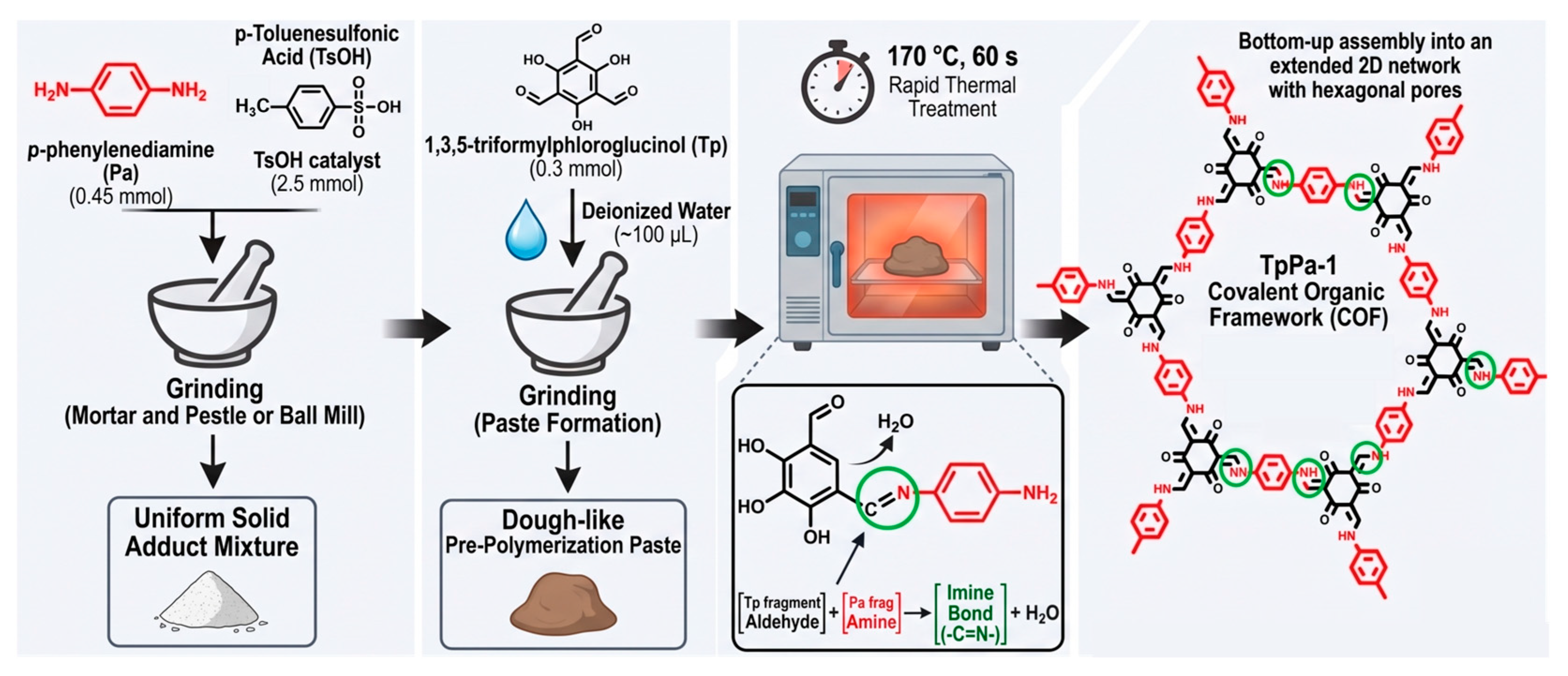
Mechanochemical Synthesis of TpPa-1: TpPa-1 was synthesized according to previously reported procedures with minor modifications [39,40]. Briefly, p-toluenesulfonic acid (2.5 mmol) and p-phenylenediamine (Pa-1, 0.45 mmol) were thoroughly ground together to form a uniform solid mixture. Subsequently, 1,3,5-triformylphloroglucinol (Tp, 0.3 mmol) and approximately 100 μL of deionized water were introduced. The components were continuously ground until a homogeneous, dough-like paste was formed. This mixture was then heated at 170 °C for 60 s. The resulting dark red powder was extensively washed with copious amounts of hot water, N,N-dimethylacetamide (DMA), and acetone to remove any unreacted precursors and oligomers. Finally, the purified product was dried in a vacuum oven at 90 °C overnight to yield the crystalline TpPa-1 powder. The synthetic yield calculated based on the p-phenylenediamine ligand is ~90%.
Luminescence Turn-on Sensing of Histamine: A uniform stock suspension was prepared by dispersing 2 mg of finely ground TpPa-1 in 4 mL of deionized water under ultrasonication. For the sensing assays, specific aliquots of aqueous histamine (HI) solution were added to the TpPa-1 suspension, and the mixture was agitated for approximately 5 min to ensure complete interaction prior to spectral analysis. Fluorescence emission spectra were recorded using an excitation wavelength (λex) of 410 nm, with emission data collected across a range of 450 to 650 nm, unless otherwise specified. To ensure reproducibility and statistical accuracy, all measurements were performed in triplicate.
Regeneration of the TpPa-1 Sensor: To evaluate reusability, the HI-exposed TpPa-1 powder was recovered following each sensing cycle and washed twice with 2 mL of deionized water. This washing procedure effectively displaced the bound HI, which was confirmed by an observable decrease in the fluorescence back to the baseline intensity. The analytical capability of the regenerated TpPa-1 was fully restored, exhibiting the characteristic luminescence enhancement upon the subsequent addition of a fresh aqueous HI solution.
Fabrication of Solid-State Sensing Film. We employed vegetable parchment as the substrate. Unlike natural parchment, which often contains lignin that exhibits baseline auto-fluorescence under UV excitation, pure vegetable parchment provides an optically inert background. Furthermore, the intrinsic micro-porosity of the cellulose matrix facilitates excellent capillary wicking for rapid sample distribution, while its surface topography provides strong physical anchoring points for the COF particles, ensuring high mechanical adherence. The coating protocol has been strictly standardized. The ink formulation is defined at a concentration of 10 mg/mL of TpPa-1 dispersed in an ethanol matrix. To counteract the strong π–π stacking interactions inherent to COFs that drive agglomeration, the protocol mandates high-energy ultrasonication for 30 min immediately prior to drop-casting. The application volume is rigidly controlled at 50 μL/cm2. The evaporation rate directly determines the structural uniformity of the film. To prevent the “coffee-ring” effect and localized particle agglomeration, the drying conditions are now controlled via vacuum desiccation at 55 °C for 3 h.

3. Results and Discussion

3.1. Characterization of TpPa-1

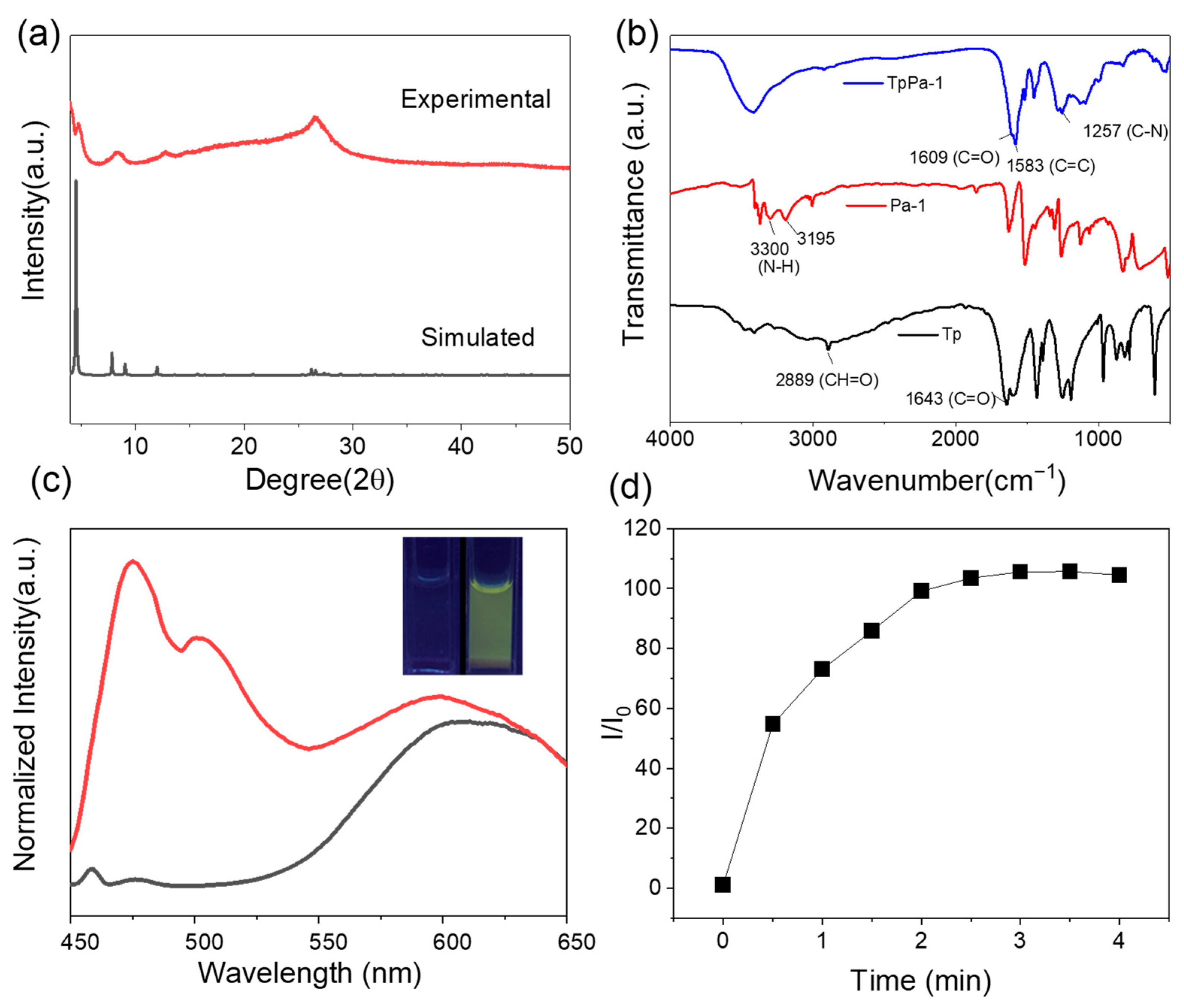
The synthetic pathway for the imine-linked TpPa-1 is illustrated in Figure 1. The formation of TpPa-1 proceeds via a two-step process: an initial reversible Schiff base condensation between Tp and Pa to establish the crystalline framework, followed by an irreversible enol−keto tautomerization that significantly enhances the chemical stability of the resulting structure [41]. As illustrated in Figure 2a, the powder X-ray diffraction (PXRD) pattern of the synthesized TpPa-1 features a prominent low-angle reflection at 2θ = 4.8°, corresponding to the (100) plane. Additional minor peaks emerge at 2θ = 8.3°, 12.7°, and 26.6°, with the latter assigned to the (001) reflection. The strong agreement between the experimental and simulated PXRD profiles confirms the successful crystallization of the framework. Notably, the experimental pattern exhibits broader peaks and reduced intensity relative to the simulation; these features are likely inherent physical consequences of the rapid kinetic synthetic methodology employed in this study. Simulated PXRD patterns conventionally assume an idealized, infinite crystal lattice with large domains, typically achieved through prolonged, thermodynamically controlled solvothermal synthesis (often 3–7 days). In contrast, our mechanochemical approach, coupled with brief thermal exposure (60 s at 170 °C), drives polymerization and irreversible enol–keto tautomerization at extreme kinetic rates [42]. Consequently, the framework rapidly locks into position, yielding abundant nanoscale crystallites rather than bulk monocrystals, which is validated by the SEM study (Figure S1). As defined by the Scherrer equation, this significant reduction in coherent scattering domain size intrinsically dictates the pronounced broadening of diffraction peaks. Furthermore, the 2D COF architecture relies on non-covalent π–π stacking between adjacent polymeric sheets. The rapid kinetic synthesis and localized shear forces induce “random layer displacement” or partial exfoliation—a phenomenon well-documented in rapid COF syntheses. Because the intensity of the prominent (100) reflection depends heavily on the long-range eclipsed alignment of hexagonal pore channels along the z-axis, even minor translational offsets between adjacent layers profoundly diminish this peak [41]. Crucially, this localized displacement does not compromise the in-plane covalent bonds; the robust β-keto-enamine framework remains fully intact and chemically stable.
Fourier transform infrared (FT-IR) spectroscopy was employed to further verify the structural linkages (Figure 2b). The spectrum of the Pa monomer displays characteristic N−H stretching vibrations at 3209 cm−1 and 3411 cm−1, while the Tp monomer exhibits an aldehyde (−CHO) stretching band at approximately 1652 cm−1. In the spectrum of TpPa-1, these primary amine (−NH2 at 3372, 3300, and 3195 cm−1) and aldehyde bands completely disappear. Concurrently, new stretching vibration bands emerge at 1257 cm−1 (C−N), 1609 cm−1 (C=O), and 1583 cm−1 (C=C), indicating the successful enol−keto tautomerization and the structural integrity of TpPa-1. Thermogravimetric analysis (TGA) of the activated TpPa-1 confirms its robust thermal stability (Figure S2). The TGA curve shows an initial minor weight loss of 6% up to 100 °C, attributed to the desorption of trapped water molecules. A subsequent weight loss of 17.37% around 130 °C corresponds to the elimination of residual organic reagents. The framework remains stable up to approximately 300 °C, at which point a sharp 62.24% weight loss indicates the thermal disintegration of the COF structure.
Driven by the irreversible enol–keto tautomerization, the resulting TpPa-1 predominantly adopts a keto-form structure. Upon excitation at 410 nm, the pristine TpPa-1 aqueous suspension exhibits weak intrinsic fluorescence centered at 608 nm, a photophysical behavior characteristic of many COF materials (Figure 2c). For comparison, the luminescence of the isolated precursors was also investigated; Tp exhibits an emission peak at 470 nm, whereas Pa is entirely non-emissive (Figures S3 and S4). The emission spectrum of the physical mixture of Tp and Pa under identical conditions highlights the distinct photophysical transformation that occurs upon the formation of the covalent TpPa-1 framework (Figure S5). The interaction between TpPa-1 and histamine (HI) was initially probed via fluorescence spectroscopy. Upon the introduction of HI to the TpPa-1 aqueous suspension, a prominent new emission peak emerged at 475 nm, accompanied by a shoulder near 501 nm (Figure 2c). Control experiments confirmed that adding identical concentrations of HI to the individual Tp and Pa-1 ligands did not induce any comparable fluorescence enhancement; in fact, the native fluorescence of Tp was quenched (Figures S3 and S4). Furthermore, the HI-induced luminescence enhancement of TpPa-1 generates a stark visual contrast, enabling easy naked-eye observation under standard 395 nm UV irradiation (Figure 2c, inset). Time-dependent measurements indicate that the fluorescence intensity increases rapidly, reaching a stable maximum plateau within 5 min (Figure 2d and Figure S6). These results underscore the exceptional capability of TpPa-1 for the in situ, real-time visual monitoring of HI using portable UV excitation.

3.2. Fluorescence Turn-On Sensing of HI

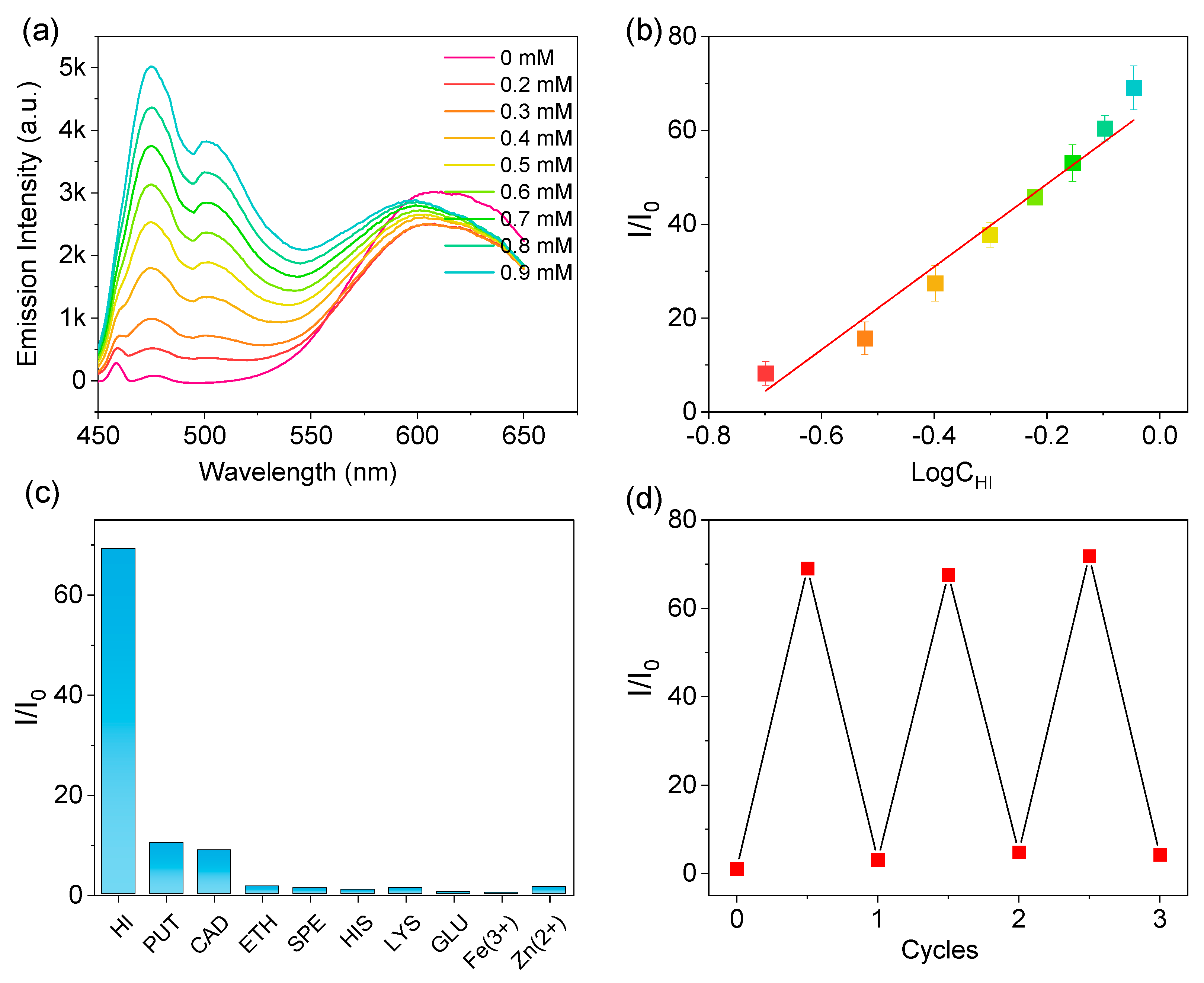
To quantitatively evaluate the HI sensing performance, fluorescence titration assays were conducted. PL emission spectra of the TpPa-1 aqueous suspension (0.5 mg/mL) were recorded upon incremental additions of HI. As the HI concentration increased, the emission intensity at 475 nm rose dramatically, while the baseline red emission at 608 nm exhibited only negligible fluctuations (Figure 3a). Consequently, we utilized the intensity ratio of the emission at 475 nm to 608 nm (I/I0) as the primary quantitative detection parameter. The calibration curve (Figure 3b) demonstrates that TpPa-1 exhibits a wide linear response to HI concentrations ranging from 0.2 to 0.9 mM. The linear correlation is expressed by the following equation:
I/I0 = 87.447 logC − 8.435 (C = 0.2 − 0.9 mM)
where C is the concentration of the HI aqueous (in mM), and I and I0 represent the luminescence intensities of the solution in the presence and absence of HI, respectively. The correlation coefficient (R2) is 0.995.
The limit of detection (LOD) was calculated to be 9 × 10⁻⁶ M (1.0 ppm) based on the IUPAC definition (3σ/K), where σ is the standard deviation of ten blank measurements, and K is the slope of the calibration curve. According to the most recent, rigorously updated Compliance Policy Guides issued by the U.S. Food and Drug Administration (FDA) in 2024/2025 (CPG Sec. 540.525), the strict regulatory safety action limit for histamine in scombrotoxin-forming fish is 50 ppm [42]. Furthermore, the FDA legally recognizes 35 ppm as a definitive biomarker indicating significant tissue decomposition and mishandling. A detection limit of 1.0 ppm is fully 35 times lower than the strictest global regulatory decomposition marker (35 ppm) and 50 times lower than the safety threshold (50 ppm), explicitly clarifying the practical adequacy of our sensor. It is true that instrumental techniques such as HPLC-MS/MS or highly customized complex MOF architectures can routinely achieve limits of detection in the low nanomolar (parts-per-billion) range. However, the true commercial and clinical value of the TpPa-1 sensor lies not in competing with the absolute sensitivity limits of HPLC-MS/MS spectrometry but in providing an instantaneous, instrument-free, naked-eye visual screening platform that operates flawlessly within the critical regulatory hazard window.
Optimization studies evaluating probe concentrations (0.1, 0.5, and 1 mg/mL) confirmed that the 0.5 mg/mL suspension provides the highest sensitivity (Figures S7–S9). Additionally, reproducibility assays demonstrated that the TpPa-1 powder could undergo three consecutive regeneration cycles without any significant loss in its “turn-on” fluorescence response (Figure 3d), validating its excellent reusability for practical applications. To assess the effect of pH on sensing performance, we have designed and executed a pH-profiling experiment (Figure S10) across a broad, strictly controlled physiological gradient (ranging from pH 4.0 to 9.0), utilizing a universal Britton–Robinson buffer system to maintain constant ionic strength. When interrogating the pristine TpPa-1 suspension with blank buffer solutions entirely lacking histamine, the intrinsic baseline fluorescence remained consistently muted across the entire gradient. Most importantly, even when the bulk solvent alkalinity was raised to a highly basic pH of 9.0, the fluorescence did not significantly “turn on”. This likely reflects that bulk hydroxide (OH) ions present in the surrounding solvent, hindered by their massive hydration shells and the intrinsic hydrophobicity of the COF nanochannels, are insufficient to deeply penetrate the pores and trigger non-specific deprotonation of the protected keto-enamine linkages. Conversely, when a uniform concentration of histamine (0.9 mM) was spiked into the identically buffered suspensions, a robust fluorescence enhancement was triggered specifically within the operational window of pH 6 to 9 (where the imidazole nitrogen of histamine deprotonates and activates its proton-accepting capability). The critical proof of specificity is explicitly demonstrated by the fact that the introduction of targeted histamine at a perfectly neutral pH of 7.0 generates a magnitude-higher fluorescence intensity than a completely blank buffer solution raised artificially to a highly alkaline pH of 9.0. This stark contrast unequivocally proves that the mechanism does not rely on a generic reaction to macroscopic bulk solvent alkalinity. Instead, the turn-on response is likely driven primarily by the specific, supramolecular localized docking and the precise spatial proton-transfer alignment between the sterically matched rigid histamine molecule and the inner pore wall.
Selectivity is a paramount parameter for evaluating the practical viability of any fluorescent sensor. To assess the anti-interference capability of the TpPa-1 probe, its luminescence response was systematically evaluated against a spectrum of potentially interfering species that commonly coexist with biogenic amines in spoiled food matrices, including prevalent aliphatic diamines and polyamines (putrescine (PUT), cadaverine (CAD), ethylenediamine (ETH), and spermine (SPE)), primary matrix metabolites (histidine (HIS), lysine (LYS), and glucose (GLU)), and trace metal ions (Fe3+ and Zn2+). Notably, while the emission intensity of TpPa-1 exhibited a discernible enhancement in the presence of PUT and CAD, this response was substantially weaker than that elicited by histamine. The remaining interferents induced negligible changes in the emission profile, confirming the exceptional selectivity of the framework for histamine detection.
We hypothesize that this selectivity is governed by a synergistic combination of specific basicity, pore confinement effects, and non-covalent secondary interactions. The well-defined, rigid 1D hexagonal pore channels of the TpPa-1 framework impose strict spatial constraints on diffusing analytes. When histamine penetrates the pore, its rigid imidazole ring optimally aligns to engage in strong non-covalent π–π stacking interactions with the extensive conjugated network of the COF pore walls. This supramolecular docking significantly increases the residence time of histamine within the pore, essentially pre-organizing the molecule into the exact geometric conformation required for its basic nitrogen atoms to closely approach and successfully deprotonate the sterically shielded N−H functional groups embedded within the keto-enamine linkages. The purely aliphatic putrescine and cadaverine lack this aromatic structural motif, cannot participate in π–π stacking, and therefore exhibit transient pore residence times and chaotic spatial alignments, precluding the efficient execution of the targeted proton-transfer event [43]. Conversely, other interferents—including primary matrix metabolites and metal cations—lack the requisite basicity for the targeted deprotonation process.
To assess the probe’s analytical accuracy, spike-and-recovery experiments were initially executed using unpurified tap water as a representative complex aqueous matrix. Environmental water samples intrinsically contain various trace minerals, dissolved competing ions, and background organic matter that typically induce severe matrix effects and interfere with fluorescence readouts. The tap water samples were deliberately spiked with known concentrations of HI (0.2, 0.4, 0.6, and 0.8 mM). Remarkably, despite the potential matrix interference, the TpPa-1 sensor yielded excellent quantitative recoveries ranging from 86.5% to 107.1% and low relative standard deviations (RSD) across all tested concentration gradients (Table S1).
Given that real biological matrices contain structural proteins, complex lipid emulsions, and free amino acids that typically induce severe matrix suppression and non-specific fluorescence quenching, demonstrating efficacy in unpurified tap water is insufficient to substantiate the claim of a practical food spoilage sensor. To further validate the probe’s practical utility in real-world scenarios, we acquired a fresh sample of tuna muscle (one of the Scombridae family species notorious for high levels of histidine decarboxylation). Because the TpPa-1 sensor is not suitable for the direct analysis of raw tuna slurries, a standardized, green extraction protocol was employed prior to measurement. Rather than utilizing highly corrosive and hazardous trichloroacetic acid, which can complicate the baseline pH of our acid–base-dependent sensor, we employed a saturated aqueous sodium chloride (41% w/w NaCl) salting-out technique coupled with ultrasound-assisted extraction at 50 °C for 10 min [44]. The extreme ionic strength of the saturated NaCl aggressively competes for hydration shells, inducing rapid protein denaturation and precipitation via the salting-out effect, while successfully retaining the highly polar biogenic amines entirely within the aqueous phase. Following centrifugation and membrane filtration, the complex biological supernatants were deliberately spiked with known concentration gradients of histamine and interrogated using the TpPa-1 sensor. Despite the intense biochemical complexity of the true fish matrix, the sensor demonstrated extraordinary resilience and accuracy, yielding quantitative recovery percentages ranging from 94.2% to 103.5%, with RSD consistently below 6.8% (Table S2).
We next conducted longitudinal monitoring of endogenous histamine generation in naturally spoiling tuna muscle tissue. Fresh tuna muscle was procured and immediately divided into controlled sub-samples. To induce natural bacterial putrefaction, a subset of samples was incubated at room temperature (25 °C) for 12 h. Over this period, small tissue segments were periodically excised, subjected to the aforementioned rapid NaCl salting-out protocol, and analyzed blindly using the TpPa-1 fluorescent sensor without dilution. Notably, throughout this longitudinal study, no exogenous histamine was spiked into the samples. The empirical data generated from this natural spoilage study (Table S3) reveal that samples subjected to temperature abuse (25 °C) displayed severe, non-linear endogenous histamine accumulation. Levels rose from undetectable at 0 h to 126.5 ppm by 12 h, closely aligning with established marine spoilage microbial kinetics. These results demonstrate that the TpPa-1 sensor successfully tracks the endogenous generation of histamine.

3.3. Luminescence Sensing Mechanism of TpPa-1 Toward HI

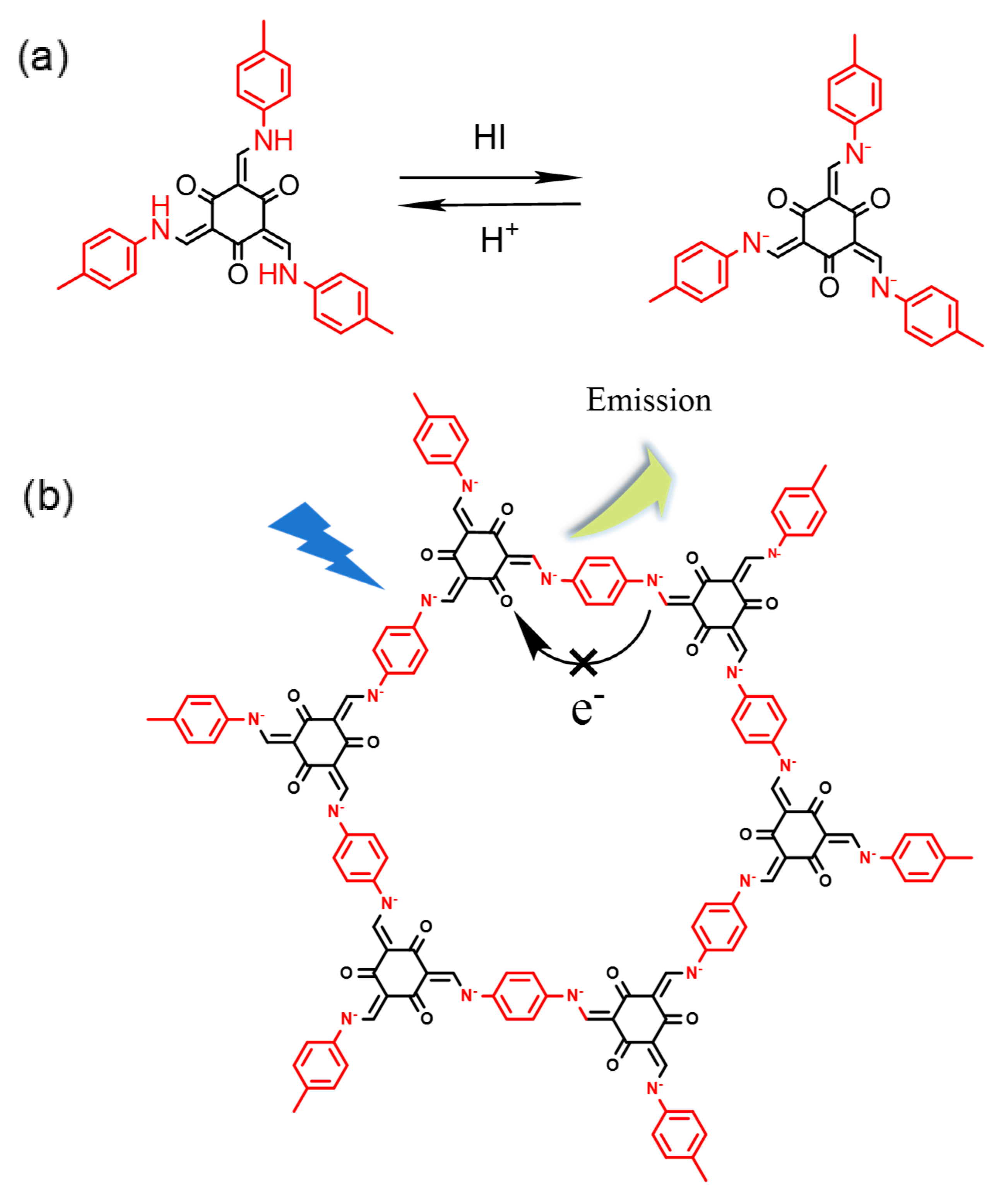
We reason that the mechanism driving the “turn-on” response relies on the targeted chemical interaction between the Lewis base HI and the TpPa-1 framework (Figure 4). The structural linkage of pristine TpPa-1 consists of a nitrogen-containing imine. In its initial state, the nitrogen atoms within this linkage effectively quench the intrinsic fluorescence of TpPa-1, likely by acting as electron donors that facilitate rapid, non-radiative intramolecular charge transfer (ICT) to the framework backbone. However, the N−H bonds distributed throughout the structure are highly chemically active and susceptible to deprotonation. Upon interaction with HI—a well-known Lewis base—these active nitrogen−hydrogen bonds are successfully deprotonated. This specific acid–base reaction converts the native N−H units into anionic N species. The formation of this localized anionic state fundamentally alters the electronic environment, effectively eliminating the photoinduced electron transfer from the nitrogen lone pair to the TpPa-1 framework. By successfully mitigating this primary fluorescence quenching pathway, the intrinsic light-emitting activity of the material is highly amplified.
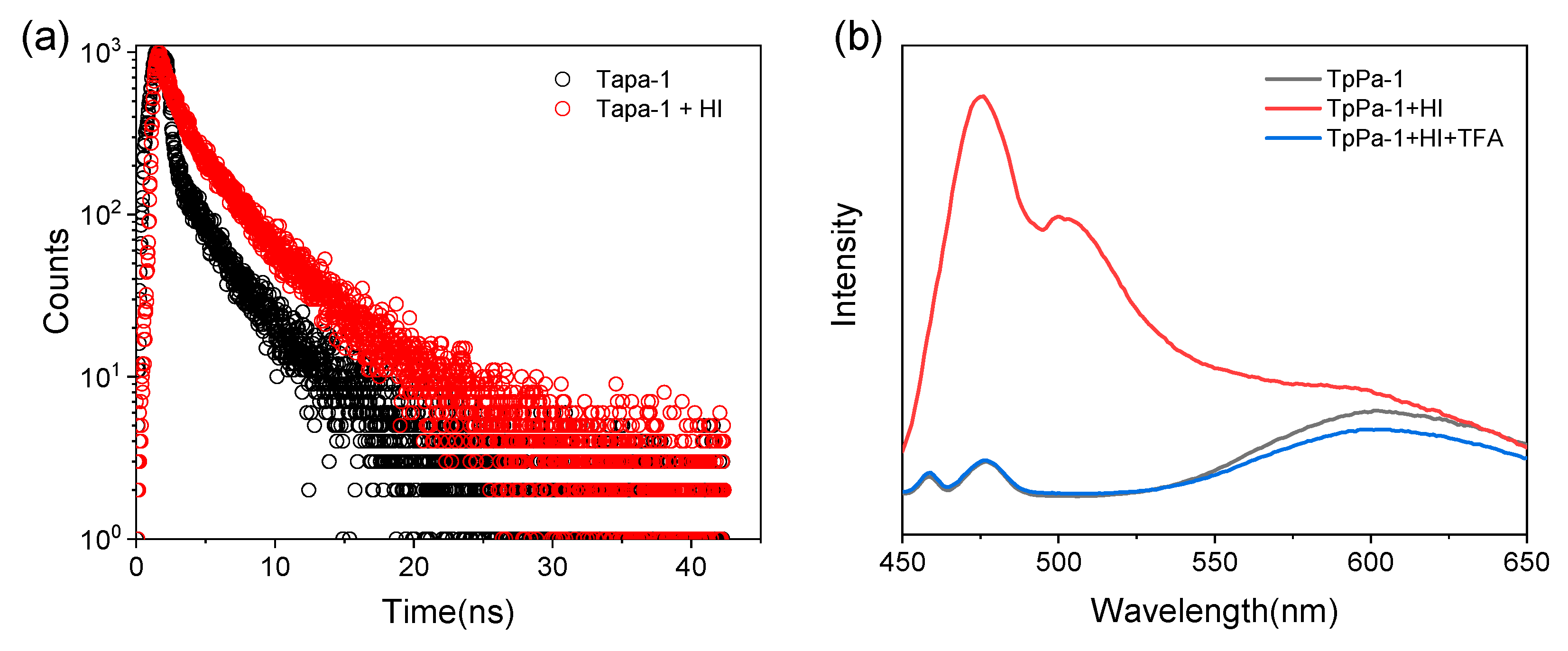
This proposed kinetic hypothesis was initially corroborated by time-resolved fluorescence spectroscopy (Figure 5a). The excited-state lifetime of the pristine TpPa-1 suspension was measured to be 2.7 ns. Following the addition of HI, this excited-state lifetime was distinctly prolonged to 3.8 ns. This measurable increment provides definitive kinetic evidence that the generation of the N species successfully suppresses the rapid electron transfer from the linkage to the TpPa-1 backbone. This suppression restricts non-radiative relaxation channels, thereby stabilizing the excited state and significantly enhancing the luminescent output. To further validate that this photophysical transformation is governed by a reversible acid−base reaction mechanism, trifluoroacetic acid (TFA) was introduced to the highly emissive, HI-treated solution. As shown in Figure 5b, the addition of TFA completely reverted the enhanced fluorescence back to its original, baseline state. This observation demonstrates that TFA can regenerate the native N−H units via the direct protonation of the N anions.
To provide direct chemical evidence of the proposed deprotonation mechanism, we conducted X-ray photoelectron spectroscopy (XPS). XPS is uniquely sensitive to changes in localized electron density. In the pristine TpPa-1 framework, the high-resolution N 1s spectrum exhibits a primary peak centered at 398.0 eV. This binding energy is highly characteristic of the secondary amine (–NH–) nitrogen within the conjugated β-keto-enamine system. According to our proposed mechanism, exposure to histamine results in the abstraction of this specific amine proton, generating an anionic nitrogen center (N). This deprotonation substantially increases the localized electron density around the nitrogen atom, enhancing the screening effect on the core electrons. Consistent with this physical model, the N 1s XPS spectrum (Figure S11) of the histamine-treated COF reveals a pronounced shift in the primary peak toward a significantly lower binding energy (shifting by –1.5 eV to 396.5 eV). A shift of this magnitude to lower binding energy is a classical spectroscopic signature of deprotonation and the formation of a negatively charged nitrogen species. Crucially, the XPS spectra show no emergence of drastically different nitrogen species (such as highly oxidized N or cleaved molecular fragments) that would be expected if the framework were undergoing a degradative chemical transformation. Therefore, this targeted XPS analysis provides direct, solid-state evidence that the fluorescence turn-on is driven by an acid–base proton transfer, firmly corroborating our proposed mechanism.

3.4. Solid-State Sensing Film for Practical Application

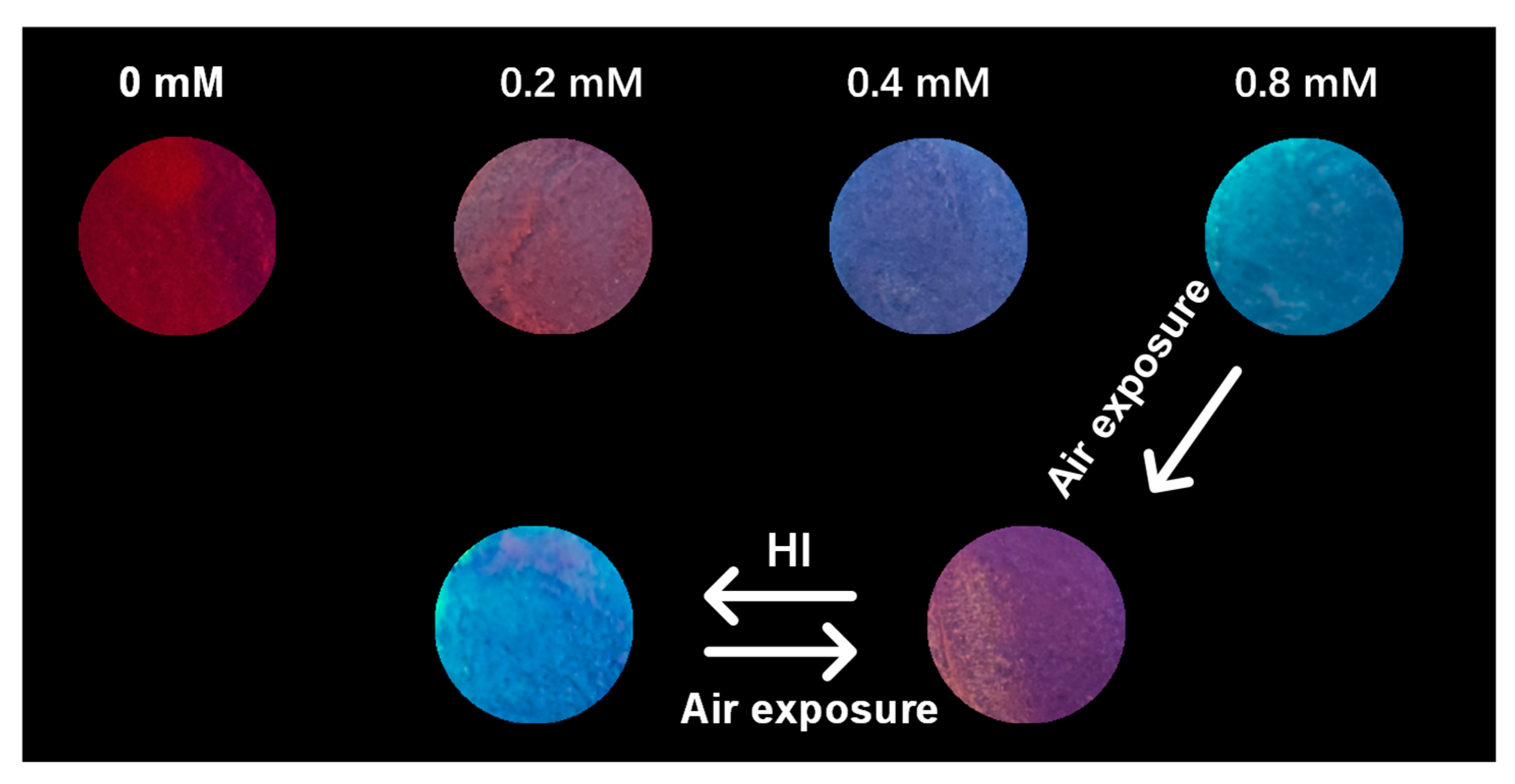
To transition from solution-phase analysis to a rapid, on-site testing platform in practical applications, a solid-state sensing device was engineered. This was achieved by coating an ethanol suspension of the TpPa-1 probe onto a brown parchment substrate with negligible auto-fluorescence to form a uniform thin film. Mirroring its solution-phase behavior, the baseline TpPa-1 film exhibits a distinct red emission. To evaluate its sensitivity for semi-quantitative visual monitoring, the solid-state films were exposed to incrementally increasing concentrations of histamine. As depicted in Figure 6, a progressive and striking colorimetric transition occurred: the film shifted from its initial red state to yellow-green and ultimately to a saturated green color at higher HI concentrations. This dynamic, real-time visual response is highly sensitive and can be readily recognized by the naked eye, highlighting the tremendous potential of the TpPa-1 film as a practical platform for rapid, on-site food quality assessment.
Crucially, the luminescent “on” state of the solid-state sensor demonstrates excellent reversibility. Upon exposure for 3 min under ambient conditions, the fluorescence of TpPa-1 film reverted to its initial red state. To further assess the robustness of this solid-state switching, cycling experiments were conducted. By repeatedly exposing the regenerated film to HI for three cycles, the identical rapid color transition was observed without any significant degradation in luminescence intensity or responsiveness. This outstanding fatigue resistance unequivocally verifies the reusability of the TpPa-1 film, confirming its viability as a highly stable and reliable sensor for continuous food safety monitoring.
Because histamine is a highly polar, non-volatile biogenic amine, it cannot spontaneously evaporate from the porous solid-state matrix within three minutes and trigger the PL reversion. Therefore, we attribute the rapid, autonomous reversibility of the TpPa-1 film to environmental acid–base chemistry—specifically, the neutralization of surface-bound amines by ambient carbon dioxide (CO2) and moisture. When the film is wetted with the aqueous histamine sample, the localized environment within the COF pores becomes basic, leading to deprotonation and the subsequent fluorescent “on” state. However, as the sample droplet evaporates, the damp film is exposed directly to the atmosphere. CO2 rapidly dissolves into the microscopic hydration layers of the substrate to form weak carbonic acid. Furthermore, the primary and secondary amines of the docked histamine rapidly react with atmospheric CO2 to form zwitterionic intermediates, which stabilize as carbamates or bicarbonate salts. This process neutralizes the localized basicity, allowing the highly reactive anionic N species of the TpPa-1 framework to abstract protons from the surrounding moisture. As the covalent backbone reprotonates to its native N-H state, the non-radiative PET quenching pathway is fully re-established, and the green fluorescence is extinguished.

4. Conclusions

In summary, we have successfully developed a highly responsive, “turn-on” fluorescent probe based on the covalent organic framework TpPa-1 for the sensitive visual detection of HI in food. The fundamental sensing mechanism is governed by a targeted acid-base interaction; the selective deprotonation of the active N−H bonds within the imine linkage generates anionic N species, which effectively suppresses the non-radiative electron-transfer quenching pathway and dramatically amplifies the intrinsic luminescence of the framework. Because this pronounced “off-to-on” fluorescence enhancement generates a stark optical signal, the platform significantly improves the practicality and sensitivity of naked-eye visual inspections for HI. Notably, the fabricated solid-state TpPa-1 films demonstrate a distinct and reversible colorimetric transition from red to yellow-green under standard UV illumination in response to increasing analyte concentrations. This dynamic optical response establishes the solid-state film as a highly robust, reusable platform for the rapid and preliminary on-site monitoring of food quality. We anticipate that the novel COF-based sensing strategy presented in this work will provide valuable insights and contribute significantly to the advancement of next-generation food safety diagnostic technologies.

Supplementary Materials

The following supporting information can be downloaded at: https://www.mdpi.com/article/10.3390/chemosensors14050104/s1, Figure S1: SEM images of TpPa-1; Figure S2: TGA curve for TpPa-1; Figure S3: Excitation (black line) and emission (red line) spectra of the Tp precursor in aqueous solution, along with the emission spectrum (blue line) of the Tp solution following the addition of histamine; Figure S4: Excitation (black line) and emission (red line) spectra of the Pa precursor in aqueous solution, alongside the emission spectrum of the Pa-1 solution following the addition of histamine (blue line); Figure S5: Room-temperature emission spectra (λex = 410 nm) of the synthesized TpPa-1 aqueous suspension (green line) compared to a physical mixture of the unreacted Tp; and Pa-1 precursors in aqueous solution (blue line); Figure S6: Time-dependent fluorescence emission spectra of the TpPa-1 aqueous suspension following the addition of 10−3 M histamine (λex = 410 nm); Figure S7: Fluorescence emission spectra of the TpPa-1 aqueous suspension at a probe concentration of 0.1 mg/mL, recorded upon the incremental addition of histamine from 0 to 0.9 mM (λex = 410 nm); Figure S8: Fluorescence emission spectra of the TpPa-1 aqueous suspension at a probe concentration of 1 mg/mL, recorded upon the incremental addition of histamine from 0 to 0.9 mM (λex = 410 nm); Figure S9: Calibration curves plotting the fluorescence intensity ratio (I/I0) against histamine concentration for different initial concentrations of the TpPa-1 probe; Figure S10: PL emission profiles (475 nm) of TpPa-1 across a pH range of 4.0 to 9.0, both in the absence and presence of histamine (HI, 0.9 mM); Figure S11: N 1s XPS spectra of TpPa-1 before and after treating with HI (1 mM); Table S1: HI detection for the spiked tap water samples using TpPa-1 probe; Table S2: HI detection for the spiked complex biological supernatant (extracted from fresh tuna muscle) samples using TpPa-1 probe; Table S3: Kinetic data tracking of endogenous histamine monitoring in naturally spoiling tuna tissue (25 °C) using the TpPa-1 sensor.

Author Contributions

Conceptualization, Y.Z. and Z.W.; methodology, Z.W. and H.Z.; software, Z.W. and H.Z.; validation, Z.W., H.Z. and Y.Z.; formal analysis, Z.W., H.Z. and Y.Z.; investigation, Z.W., H.Z. and Y.Z.; resources, Y.Z.; data curation, Z.W., H.Z. and Y.Z.; writing—original draft preparation, Z.W., H.Z. and Y.Z.; writing—review and editing, Y.Z.; visualization, Y.Z.; supervision, Y.Z.; project administration, Y.Z.; funding acquisition, Y.Z. All authors have read and agreed to the published version of the manuscript.

Funding

This research was supported by the National Natural Science Foundation of China (21701092), the Natural Science Foundation of Zhejiang Province (LY21B010002, LQ22A040003), and the Natural Science Foundation of Ningbo (2022J104).

Institutional Review Board Statement

Not applicable.

Informed Consent Statement

Not applicable.

Data Availability Statement

Data will be available upon request.

Conflicts of Interest

The authors declare no conflicts of interest.

References

  1. Lin, T.; Wu, Y.; Li, Z.; Song, Z.; Guo, L.; Fu, F. Visual Monitoring of Food Spoilage Based on Hydrolysis-Induced Silver Metallization of Au Nanorods. Anal. Chem. 2016, 88, 11022–11027. [Google Scholar] [CrossRef]
  2. Hicks, C.C.; Cohen, P.J.; Graham, N.A.; Nash, K.L.; Allison, E.H.; D’Lima, C.; Mills, D.J.; Roscher, M.; Thilsted, S.H.; Thorne-Lyman, A.L.; et al. Harnessing global fisheries to tackle micronutrient deficiencies. Nature 2019, 574, 95–98. [Google Scholar] [CrossRef]
  3. Ferguson, N.M.; Ghani, A.C.; Donnelly, C.A.; Hagenaars, T.J.; Anderson, R.M. Estimating the human health risk from possible BSE infection of the British sheep flock. Nature 2002, 415, 420–424. [Google Scholar] [CrossRef]
  4. Chan, E.Y.Y.; Griffiths, S.M.; Chan, C.W. Public-health risks of melamine in milk products. Lancet 2008, 372, 1444–1445. [Google Scholar] [CrossRef]
  5. Ruiz-Capillas, C.; Herrero, A.M. Impact of Biogenic Amines on Food Quality and Safety. Foods 2019, 8, 62. [Google Scholar] [CrossRef] [PubMed]
  6. Shalaby, A.R. Significance of biogenic amines to food safety and human health. Food Res. Int. 1996, 29, 675–690. [Google Scholar] [CrossRef]
  7. Baldovini, N.; Chaintreau, A. Identification of key odorants in complex mixtures occurring in nature. Nat. Prod. Rep. 2020, 37, 1589–1626. [Google Scholar] [CrossRef] [PubMed]
  8. Peng, J.F.; Fang, K.T.; Xie, D.H.; Ding, B.; Yin, J.Y.; Cui, X.M.; Zhang, Y.; Liu, J.F. Development of an automated on-line pre-column derivatization procedure for sensitive determination of histamine in food with high-performance liquid chromatography–fluorescence detection. J. Chromatogr. A 2008, 1209, 70–75. [Google Scholar] [CrossRef] [PubMed]
  9. Hwang, B.-S.; Wang, J.-T.; Choong, Y.-M. A rapid gas chromatographic method for the determination of histamine in fish and fish products. Food Chem. 2003, 82, 329–334. [Google Scholar] [CrossRef]
  10. Male, K.B.; Luong, J.H. Derivatization, stabilization and detection of biogenic amines by cyclodextrin-modified capillary electrophoresis–laser-induced fluorescence detection. J. Chromatogr. A 2001, 926, 309–317. [Google Scholar] [CrossRef]
  11. Nakashima, M.; Sugiyama, A. Rapid analysis of histamine in fish using capillary electrophoresis. Food Hyg. Saf. Sci. 1999, 40, 285–290. [Google Scholar] [CrossRef] [PubMed]
  12. McCoin, C.S.; Franczak, E.; Deng, F.; Pei, D.; Ding, W.X.; Thyfault, J.P. Acute exercise rapidly activates hepatic mitophagic flux. J. Appl. Physiol. 2022, 132, 862–873. [Google Scholar] [CrossRef]
  13. Khan, S.; Carneiro, L.S.; Vianna, M.S.; Romani, E.C.; Aucelio, R.Q. Determination of histamine in tuna fish by photoluminescence sensing using thioglycolic acid modified CdTe quantum dots and cationic solid phase extraction. J. Lumin. 2017, 182, 71–78. [Google Scholar] [CrossRef]
  14. Patange, S.B.; Mukundan, M.K.; Kumar, K.A. A simple and rapid method for colorimetric determination of histamine in fish flesh. Food Control 2005, 16, 465–472. [Google Scholar] [CrossRef]
  15. Ma, Z.; Chen, P.; Cheng, W.; Yan, K.; Pan, L.; Shi, Y.; Yu, G. Highly sensitive, printable nanostructured conductive polymer wireless sensor for food spoilage detection. Nano Lett. 2018, 18, 4570–4575. [Google Scholar] [CrossRef]
  16. Guo, L.; Wang, T.; Wu, Z.; Wang, J.; Wang, M.; Cui, Z.; Ji, S.; Cai, J.; Xu, C.; Chen, X. Portable food-freshness prediction platform based on colorimetric barcode combinatorics and deep convolutional neural networks. Adv. Mater. 2020, 32, 2004805. [Google Scholar] [CrossRef] [PubMed]
  17. Zhu, S.; Wu, Z.; Cong, X.; Cuan, J.; Zhou, Y. Dual-responsive luminescent dye@MOF hybrids for ratiometric trace detection, colorimetric visualization, and precise discrimination of tetracycline antibiotics. Sens. Actuators B Chem. 2024, 411, 135793. [Google Scholar] [CrossRef]
  18. Kunwar, N.; Naithani, S.; Goswami, T.; Dubey, R.; Layek, S.; Kumar, S.; Mangalam, J. CsPbX3@MOF nanocomposites: Design strategies for efficient luminescence sensing and photocatalysis. Coord. Chem. Rev. 2026, 552, 217517. [Google Scholar] [CrossRef]
  19. Jiang, Y.; Lv, S.; Zhou, Z.; Kong, W.; Liu, J.; Zhang, Y.; Zhu, M.; Sun, Y.; Wu, S. Water-stable luminescent metal-organic frameworks: Sensing applications in aqueous environments. Coord. Chem. Rev. 2026, 547, 217124. [Google Scholar] [CrossRef]
  20. Chaicham, A.; Kongwutthivech, J.; Tuntulani, T.; Tomapatanaget, B. Couple of Histamine blue fluorescence chemosensor and surface charge selector of FC-modified silica nanoporous for highly specific histamine detection via FRET-process. Sens. Actuators B Chem. 2018, 258, 621–627. [Google Scholar] [CrossRef]
  21. Han, A.; Xiong, L.; Hao, S.; Yang, Y.; Li, X.; Fang, G.; Liu, J.; Pei, Y.; Wang, S. Highly Bright Self-Assembled Copper Nanoclusters: A Novel Photoluminescent Probe for Sensitive Detection of Histamine. Anal. Chem. 2018, 90, 9060–9067. [Google Scholar] [CrossRef]
  22. Qin, Y.; Huang, P.; Wu, F.Y. Histamine-responsive dye-incorporated carbon dots for visual monitoring of food spoilage. Sens. Actuators B Chem. 2022, 365, 131911. [Google Scholar] [CrossRef]
  23. Guo, X.; Zhu, N.; Wang, S.P.; Li, G.; Bai, F.Q.; Li, Y.; Han, Y.; Zou, B.; Chen, X.B.; Shi, Z.; et al. Stimuli-Responsive Luminescent Properties of Tetraphenylethene-Based Strontium and Cobalt Metal-Organic Frameworks. Angew. Chem. Int. Ed. 2020, 59, 19716–19721. [Google Scholar] [CrossRef] [PubMed]
  24. Wang, J.; Li, D.; Ye, Y.; Qiu, Y.; Liu, J.; Huang, L.; Liang, B.; Chen, B. A Fluorescent Metal-Organic Framework for Food Real-Time Visual Monitoring. Adv. Mater. 2021, 33, e2008020. [Google Scholar] [CrossRef]
  25. Xu, X.Y.; Lian, X.; Hao, J.N.; Zhang, C.; Yan, B. A Double-Stimuli-Responsive Fluorescent Center for Monitoring of Food Spoilage based on Dye Covalently Modified EuMOFs: From Sensory Hydrogels to Logic Devices. Adv. Mater. 2017, 29, 1702298. [Google Scholar] [CrossRef] [PubMed]
  26. Wang, H.; Zeng, Z.; Xu, P.; Li, L.; Zeng, G.; Xiao, R.; Tang, Z.; Huang, D.; Tang, L.; Lai, C.; et al. Recent progress in covalent organic framework thin films: Fabrications, applications and perspectives. Chem. Soc. Rev. 2019, 48, 488–516. [Google Scholar] [CrossRef]
  27. Zhou, M.; Zeng, F.; Wang, J.; Li, Y.; Ma, B. Synthesis and adsorption applications of a novel Ni-MOF@2DPA-1 COF hybrid material. New J. Chem. 2026, 50, 2105–2115. [Google Scholar] [CrossRef]
  28. Wang, C.; Li, M.; Xu, M.; Li, Y.; Yang, Q.; Jia, W.; Wang, J. Photocatalytic capture of uranium via phosphorylated MOF@COF: Unveiling the dual functions from adsorption-reduction to uranium peroxide precipitation. Appl. Catal. B Environ. Energy 2026, 388, 126561. [Google Scholar] [CrossRef]
  29. Zhang, K.; Yuan, L.; Cai, D.; Tang, X.; Alsudairy, Z.; Zheng, S.; Xie, M.; Fan, J.; Zhang, Y.; Zhang, W.; et al. A Macro-Mesoporous Chiral Covalent Organic Framework for Enhanced Asymmetric Catalysis in Water. Chem. Mater. 2026, 38, 1305–1314. [Google Scholar] [CrossRef]
  30. Irie, T.; Das, S.; Negishi, Y. Covalent organic frameworks as precision nanocarriers for targeted drug delivery: Developments, hurdles, and horizons. Nanoscale Horiz. 2026, 11, 928–952. [Google Scholar] [CrossRef]
  31. Yang, L.; Zhang, S.; Luo, Q.; Shu, H.; Xu, W.; Zhu, X.; Hu, P.; Wu, Y.; Shu, L.; Liu, J.; et al. A pH-responsive guanidino-based covalent organic framework nanodrugs for enhanced neuroprotection against subarachnoid hemorrhage by targeting NLRP3 inflammasome. Biomaterials 2026, 324, 123467. [Google Scholar] [CrossRef] [PubMed]
  32. Zhai, L.; Gao, S.; Guo, L.; Luo, S.; Li, Z.; Wang, H.; Zhang, S.; Wang, J. Highly efficient light-gated COF membrane for precise multistage molecular separation. Sci. Adv. 2026, 12, eadz1929. [Google Scholar] [CrossRef]
  33. Chen, H.; Liu, Y.; Zheng, M.; Chen, C.; Li, H.; Niu, B.; Wu, W.; Wang, J. Water-Retentive Covalent Organic Framework Membranes for Efficient Proton Conduction in PEMFCs. Adv. Funct. Mater. 2026, 36, e20568. [Google Scholar] [CrossRef]
  34. Dey, P.; Pal, P.; Das, B.K.; Bhattacharjee, S.; Chakraborty, N.; Das, B.; Ruidas, S.; Chattopadhyay, K.K. High Nonlinear Optical Response of Covalent Organic Framework by SSPM for Implementation in Photonic Diode. Laser Photonics Rev. 2026, e02455. [Google Scholar] [CrossRef]
  35. Lavilluniere, H.; Pham-Truong, T.N.; Nguyen, T.-K.; Cousin, F.; Mallouki, M.; Vancaeyzeele, C.; Aubert, P.H. Engineering Highly Conductive COF-5-Based Architectures: A Strategy to Capitalize on Pore Structure for High-Performance Ion Storage. Energy Storage Mater. 2026, 86, 105006. [Google Scholar] [CrossRef]
  36. Xu, X.; Li, T.; Zhang, R.; Zhang, Z.; Cao, W.; Wang, Y.; Hu, Y.; Liu, X.; Qiao, S. Covalent Organic Framework Nanofilm Heterojunctions: Lamination Effect and Suppressed Self-Discharge in Flexible Micro-Supercapacitors Energy Storage. Small 2026, 22, 2412642. [Google Scholar] [CrossRef]
  37. Li, W.; Yang, C.X.; Yan, X.P. A versatile covalent organic framework-based platform for sensing biomolecules. Chem. Commun. 2017, 53, 11469–11471. [Google Scholar] [CrossRef]
  38. Peng, Y.; Huang, Y.; Zhu, Y.; Chen, B.; Wang, L.; Lai, Z.; Zhang, Z.; Zhao, M.; Tan, C.; Yang, N.; et al. Ultrathin two-dimensional covalent organic framework nanosheets: Preparation and application in highly sensitive and selective DNA detection. J. Am. Chem. Soc. 2017, 139, 8698–8704. [Google Scholar] [CrossRef]
  39. Zhang, D.; Wang, Y.; Xie, J.; Geng, W.; Liu, H. Ionic-liquid-stabilized fluorescent probe based on S-doped carbon dot-embedded covalent-organic frameworks for determination of histamine. Microchim. Acta 2019, 187, 28. [Google Scholar] [CrossRef]
  40. Karak, S.; Kandambeth, S.; Biswal, B.P.; Sasmal, H.S.; Kumar, S.; Pachfule, P.; Banerjee, R. Constructing Ultraporous Covalent Organic Frameworks in Seconds via an Organic Terracotta Process. J. Am. Chem. Soc. 2017, 139, 1856–1862. [Google Scholar] [CrossRef]
  41. Kandambeth, S.; Mallick, A.; Lukose, B.; Mane, M.V.; Heine, T.; Banerjee, R. Construction of crystalline 2D covalent organic frameworks with remarkable chemical (acid/base) stability via a combined reversible and irreversible route. J. Am. Chem. Soc. 2012, 134, 19524–19527. [Google Scholar] [CrossRef]
  42. FDA Issues Final Compliance Policy Guide for Scombrotoxin (Histamine)-Forming Fish and Fishery Products. 2024. Available online: https://www.fda.gov/food/hfp-constituent-updates/fda-issues-final-compliance-policy-guide-scombrotoxin-histamine-forming-fish-and-fishery-products (accessed on 10 April 2026).
  43. Sahudin, M.A.; Tan, J.X.; Azmi, K.N.; Suhaimi, N.A.; Hisham, S.; Abu Bakar, N.K.; Zainol Abidin, M.N.; Ishak, K.A.; Abd Karim, N.H. Putrescine Detection Via PMMA-Zinc (II) Complex Optical Chemosensor: Meat Spoilage Screening Tool. J. Fluoresc. 2025, 35, 12651–12664. [Google Scholar] [CrossRef] [PubMed]
  44. Aoua, C.; Yacoubi, B.; Zekhnini, A. Development of a new method for extracting histamine from marine fish flesh using the salting-out technique. Ital. J. Food Saf. 2024, 13, 12117. [Google Scholar] [CrossRef] [PubMed]
Figure 1. Schematic illustration of bottom-up mechanochemical synthesis of the TpPa-1 framework via the condensation of Tp and Pa, yielding a chemically stable keto-form structure.
Chemosensors 14 00104 g001
Figure 2. (a) PXRD patterns of the as-synthesized TpPa-1 and those simulated from the single-crystal structure. (b) FT-IR spectra of Tp (black), Pa (red), and TpPa-1 (blue). (c) Luminescence spectra of TpPa-1 with (red) and without (black) HI (10−3 M) in aqueous solutions (λex = 410 nm). Inset: the corresponding photos under 365 nm UV light irradiation. (d) Time-dependent emission intensity of TpPa-1 at 475 nm with HI; the concentration of HI is 10−−3 M (λex = 410 nm).
Chemosensors 14 00104 g002
Figure 3. (a) Fluorescence emission spectra of the TpPa-1 aqueous suspension (0.05 mg/mL) upon the addition of histamine at concentrations ranging from 0 to 0.9 mM (λex = 410 nm). (b) Linear calibration curve plotting the fluorescence intensity ratio (I/I0) against the histamine concentration. (c) Selectivity profile illustrating the fluorescence intensity ratio (I/I0) of TpPa-1 toward histamine and various interferents (0.9 mM). (d) Reusability of the sensor, demonstrating the fluorescence intensity of TpPa-1 at 475 nm over three consecutive regeneration cycles with 10−3 M histamine (λex = 410 nm).
Chemosensors 14 00104 g003
Figure 4. Schematic illustration of the proposed sensing mechanism: (a) Reversible deprotonation of the imine N−H bond by histamine (HI) and its subsequent structural regeneration via acid treatment. (b) The photophysical “turn-on” mechanism, demonstrating how this specific deprotonation suppresses non-radiative electron transfer from the nitrogen lone pair to the COF backbone, thereby eliminating the primary quenching pathway and activating strong fluorescence.
Chemosensors 14 00104 g004
Figure 5. (a) Time-resolved fluorescence decay profiles of the TpPa-1 aqueous suspension (monitored at 475 nm) in the absence and presence of histamine (10−3 M). (b) Fluorescence emission spectra of TpPa-1 before and after the sequential addition of histamine (HI) and trifluoroacetic acid (TFA).
Chemosensors 14 00104 g005
Figure 6. Visual detection of histamine (HI) using solid-state TpPa-1 films under UV light: (top) concentration-dependent fluorescence color transitions after 1 min of HI wetting; (bottom) reversible red-to-green fluorescence switching over alternating cycles of HI wetting and exposure in ambient air.
Chemosensors 14 00104 g006
Disclaimer/Publisher’s Note: The statements, opinions and data contained in all publications are solely those of the individual author(s) and contributor(s) and not of MDPI and/or the editor(s). MDPI and/or the editor(s) disclaim responsibility for any injury to people or property resulting from any ideas, methods, instructions or products referred to in the content.