


Abstract
In this investigation, the local mode model for C-H overtone transitions in hydrocarbons and the thermal lens (TL) technique are used to obtain vibrational overtone spectra and subsequent analysis of hydrocarbon impurities in liquid solutions. The experimental thermal lens design enables the detection of hydrocarbon solutes in trace amounts within a hydrocarbon solvent by exciting two distinct vibrational overtones. To exemplify the method, we present the thermal lens signal corresponding to the (Δυ = 6) overtone of benzene or naphthalene as impurities in solvents such as n-hexane or iso-octane. The lowest composition recorded for benzene in n-hexane was 0.005%, while for naphthalene in n-hexane it was 0.001%. Additionally, we explore more sensitive experiments where the (Δυ = 5) transition of the impurity is detected concurrently with the (Δυ = 6) transition of the solvent. This analytical method can also be adapted for use with saturated alcohols in solution contaminating hydrocarbon solvents.
1. Introduction
In this paper, we detect impurities in hydrocarbon solutions by monitoring their overtone absorption without interference from the solvent. To this end, we provide examples of overtone absorption from various molecules, highlighting the spectral regions in which they appear. To exemplify this issue, first, we present the mid-IR spectra of benzene and naphthalene in liquid hexane solutions with varying compositions. The spectra distinctly illustrate the solvent’s interference at solute concentrations below 10%. Subsequently, we display the thermal lens spectra of the (Δυ = 6) overtone transitions of benzene or naphthalene as impurities in n-hexane solution, free from any solvent interference. Finally, we present the (Δυ = 7) transition of a potential solvent (iso-octane), which serves as a representative for solvents such as n-pentane, n-hexane, or n-heptane. We also explore more sensitive experiments where the (Δυ = 5) transition of the impurity is detected while simultaneously obtaining the (Δυ = 6) transition of the solvent in a different region of the visible spectrum.
The paper is structured with a brief overview of the local mode model and the thermal lens effect, accompanied by relevant literature. Section 2 includes a description of the typical instrumentation employed for the thermal lens technique, followed by a comprehensive explanation of the double-beam instrument developed in our laboratory. After the results are presented, there is a discussion that includes a summary of recent literature, an analysis of the results, and future experiments.
1.1. Local Mode Model
The local mode model and overtone spectroscopy [1,2] have been successfully employed to clarify the molecular structure and conformation of various polyatomic molecules that include C-H, N-H, and O-H bonds [3,4,5,6,7,8,9]. The stretching of a single chemical bond exhibits greater anharmonicity compared to vibrations that involve two or more bonds, which are characteristic of fundamental frequencies depicted by normal modes. Local modes have larger oscillation strengths in high overtone transitions. Absorption peak energies are fit by the one-dimensional anharmonic oscillator equation [1].
where , , and are the mechanical frequency, anharmonicity, and vibrational quantum number respectively. Overtone transition energies have been found [3,4] to follow the order methylene < methyl < aryl olefinic < acetylenic, which is consistent with the bond dissociation energies and the frequencies of the C-H fundamentals [4]. In both normal and branched alkanes, it is possible to detect a series of absorption peaks at each overtone, with each peak corresponding to the excitation of a distinct C-H oscillator linked to a -CH, -CH2, or -CH3 group within the molecule.
The overtone spectra are frequently less complex and more straightforward to interpret compared to the spectra of the fundamental region, as the primary absorptions are attributed only to X-H (where X = C, O, N) bonds, which occur in distinct regions of the visible spectrum [7,8]. Overtone studies have also been able to differentiate non-equivalent C-H bonds within individual methyl groups [5]. When the methyl group resides in a conformationally anisotropic environment influenced by an adjacent heteroatom (N, O, S), or by a C=C double bond, the overtone spectra reveal distinct bands for each non-equivalent C-H bond [5,6,7,8]. This non-equivalence is evidenced in experiments due to the significant disparity in time scales between visible absorption and the rotation of the methyl group [6,7,8,9]. The studies of overtone spectra are particularly advantageous for structural investigations, analysis of gas mixtures, and examination of liquid solutions. The only problem with high overtones (Δυ = 5, 6, and 7) is that they are usually very weak absorptions [10] that are obtained with sensitive techniques like photo-acoustic [4,11,12,13] and photo-thermal [14,15] techniques for liquids and gases, and cavity ring down methods [16,17,18] for gases.
1.2. Thermal Lens Effect
The thermal lens (TL) effect is commonly described as a change in the optical path of a sample caused by absorption of a laser having a Gaussian intensity profile (TEM00). The sample is most strongly heated at the beam center, where the intensity is greatest, and the resulting temperature distribution is accompanied by an analogous change in the refractive index. A probe laser detects the lens effect. In most liquids, the temperature gradient of the refractive index is negative, and so, the thermo-optical element is shaped as a divergent lens [19,20]. The thermal lens effect was first discovered by Leyte et al. [21] and Gordon et al. [22]. Subsequently, Grabiner et al. [23] utilized these findings to create the first dual-beam thermal lens apparatus and study energy transfer in gases. Hu and Whinnery [24] and Whinnery [25] explored the extra cavity thermal lens sensitivity for absorption measurements. Twarowski and Kliger [26,27], along with Swofford [28], made advances to the technique modeling the thermal lens effect using pulse and modulated excitation. Dovichi et al. [29,30] introduced the transverse configuration of the probe beam. Vyas et al. [31] and Vyas and Gupta [32] offered a theoretical analysis of the topic, encompassing stationary and flowing media, for pulsed and continuous wave excitation, and for transverse and collinear geometries. The thermal lens effect was theoretically characterized under various experimental situations [28,31,33,34] to understand the factors influencing the intensity of the thermal lens, facilitating its optimization and subsequent application as an ultrasensitive spectroscopic technique.
The sensitivity of thermal lensing is greater than that of absorption spectroscopy due to the amplification of the optical signal by the photothermal effect. This enhancement depends on the thermo-optical characteristics of the sample and the power of the excitation laser [35]. Thermal lens is a non-destructive method where detection limits are influenced by background absorbance and convective noise. The technique can detect concentrations of the order of 10−11 to 10−10 mol/L, equivalent to absorbances [36] between 10−7 and 10−6 cm−1.
A review of literature before 2004 was given by Navas [36] with applications to metal ions, pesticides, fatty acids, and carotenoids; in some cases, a separation by ion chromatography, high-performance capillary electrophoresis, and HPLC occurs before detection by thermal lens. Several research groups have reported successful construction of commercial instruments specifically designed for microchip analysis in capillary systems [37,38,39]. Another review by Franko and Tran [40] published in 2010 gives a comprehensive overview of applications in environmental science, agriculture, food science, biochemistry, and biomedicine.
2. Materials and Methods
2.1. Materials
Chemicals in the experiment were used without further purification. Benzene (CAS Number 71-43-2, 99.0%), naphthalene (CAS Number 91-20-3, 99%), n-hexane (CAS Number 110-54-3, 99%), and isooctane (2,2,4-trimethylpentane, CAS Number 540-84-1, 99%) were purchased from Millipore Sigma (Burlington, MA, USA). All chemicals were of ACS reagent grade. Stock solutions of benzene and naphthalene were created by diluting them in hexane. Solutions with the required compositions were prepared by further diluting the stock solutions. Chemicals and stock solutions were kept in amber glass bottles at 20 °C in the dark to avoid decomposition. Absorption scans were conducted to check for any potential contamination.
2.2. Methods
2.2.1. Fourier Transform Infrared Instrument
For the infrared spectra, a Thermo Nicolet (Thermo Fisher Scientific Inc., Waltham, MA, USA) Fourier transform spectrometer, specifically the Nexus 670 model, was utilized. A combination of an Ever-Glow source, an XT-KBr beam splitter, and a DTGS-KBr detector is employed to cover the spectral range from 350 to 7000 cm−1. This spectrometer allows for high-resolution spectra with a minimum spacing of 0.06 cm−1. Control and data acquisition on this device are managed using Nicolet’s OMNIC software (version 9); its user-friendly interface facilitates the optimization of the spectrometer’s performance and data analysis. The cell used is a commercial model SL-3 from International Crystal Laboratories (11 Erie St, Garfield, NJ, USA), a stainless steel sealed liquid spectrophotometer cell featuring a pathlength of 0.025 mm and KBr windows.
2.2.2. Instrumentation
Typical components of the thermal lens technique are a laser source, a modulation technique, signal detection, and data acquisition and processing [41,42,43,44,45,46,47,48]. Laser sources are selected as continuous wave (cw) or pulsed lasers for excitation. Among cw lasers are argon ion lasers and tunable dye lasers that can produce several watts of power. Other lasers are He-Cd (441.6 nm), He-Ne (632.8 or 3.3 nm), Kr, and semiconductor lasers in the near-infrared. Pulsed lasers are N2, Nd3+:YAG, and dye lasers and optical parametric oscillators (OPO) pumped by solid-state lasers. OPO-based lasers have the advantage of tunable wavelengths in the range from 410 to 2300 nm and from 200 to 400 nm by frequency doubling with a crystal. Probe lasers are low-power He-Ne, He-Cd, and Ar [41,43].
Mechanical choppers, electronic shutters, and opto-acoustic devices ensure precise and efficient modulation of continuous wave (cw) lasers. Electronic shutters operate at frequencies as low as 0.10 Hz. Opto-acoustic modulators are employed in high-frequency measurements (up to 150 kHz) for applications in chromatographic detection [43].
Signal detection in thermal lens spectrometry is performed with photodiodes (PD) and photomultiplier tubes (PMT). Photodiode arrays and CCD cameras are used for probe-beam imaging [44]. The measurement of thermal lens signals using photodiodes and photomultiplier tubes is typically accompanied by masking elements such as pinholes and slits. In double beam configuration, filters are used for the selection of the probe laser and rejection of the pump laser. These components facilitate the selection of a portion of the probe beam.
Selection of PD and PMT is influenced by both the minimum signal to be detected and the probe wavelength. For power levels larger than 10−7 W and a wavelength of 500 nm, photodiodes are used. For power levels below 10−7 W and as low as 10−11 W, avalanche photodiodes and photomultiplier tubes are more suitable. Silicon photodiodes are recommended in the near-infrared region [45].
Signal acquisition with a lock-in amplifier is used for modulated cw lasers to reduce noise. When dealing with pulsed excitation, most modern oscilloscopes have signal-averaging capabilities to reduce noise.
2.2.3. Thermal Lens Apparatus
Thermal lens instruments can be divided into single-beam and dual-beam configurations. The single-beam arrangement allowed the determination of parameters like laser power, optical path length, beam divergence, sample concentration, and flow dynamics [41]. The dual-beam configuration offers greater possibilities for analyzing a broader range of spectral regions [20,42]. The separation of lasers for the pump and probe beams can produce advantages in the efficacy of thermal lens detection [46]. In the dual-beam transverse configuration, the excitation beam is directed perpendicularly onto the sample in relation to the probe beam. The monitored volume at the intersection of the two beams could be in the order of a few picoliters. The transverse configuration is advantageous for small volume samples and low concentration solutions. Transverse detection has enabled the measurement of both refractive index and absorption variations during the elution of samples from chromatographic columns [47].
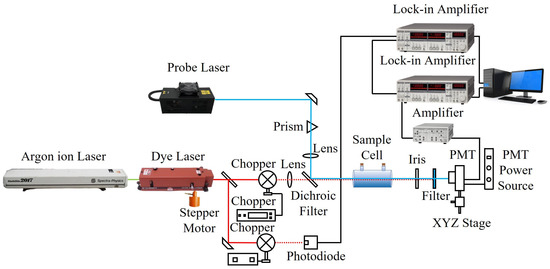
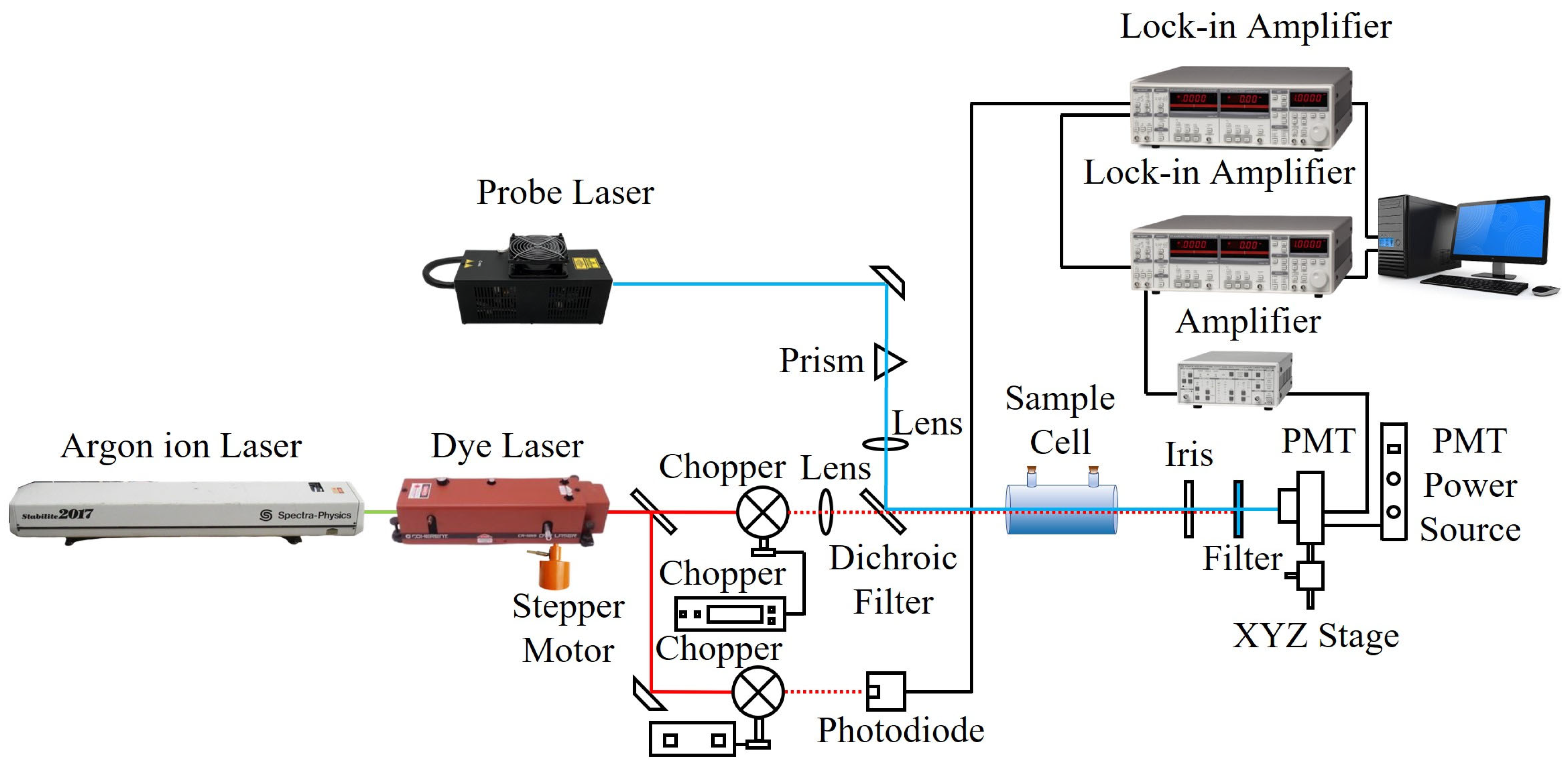
The experimental arrangement of ur technique is illustrated in Figure 1. An argon ion laser, Spectra Physics model Stabilite 2017 (Spectra Physics, Milpitas, CA, USA), set at 514 nm, is used to pump a continuous-wave dye laser (Coherent CR-599) (Coherent, Inc., Santa Clara, CA, USA). The argon laser delivers an output power of 2.8 W, whereas the peak power of the dye laser reaches 500 mW. Excitation of the sample is performed with the dye laser, which is scanned in the range of the laser dyes: Rhodamine 110 (510–605 nm) or Rhodamine 6G (572–665 nm). The excitation dye laser beam is modulated at 5 Hz with a combination of a (SRS model DS345) function generator (SRS Stanford Research Systems, Sunnyvale, CA, USA) that controls a low-frequency optical shutter (Electro-optical products model CH-60) (Escondido, CA, USA). A fraction of the excitation beam is selected and modulated at 250 Hz with a mechanical chopper (SRS model SR 540), and detected with a photo-sensor (Newport, 256 Model 882) (Newport Corporation, Irvine, CA, USA) and sent to a lock-in amplifier (Ithaco 3962A, New York, NY, USA). A second argon ion laser (488 nm, 6 mW) serves as a probe beam.
Figure 1.
Experimental setup of the thermal lens spectrometer.
A blue dichroic filter combines the excitation and probe beams that now travel collinearly through the sample cell of 10 cm. The excitation beam is focused onto the sample cell at a confocal distance of 51 cm, producing a spot radius of 0.030 cm. The probe beam is expanded using a diverging lens to achieve a larger size compared to that of the excitation beam. At the cell, the spot radius of the probe beam measures 0.091 cm, while its confocal distance is 0.87 cm. After exiting the cell, an iris is positioned in the path of the beams to spatially select the center of the probe. Then, an interference filter blocks the excitation beam and allows the probe beam to pass through. A blue glass filter is placed following the interference filter to cancel any residual excitation transmission. The intensity of the probe beam is detected using a photomultiplier tube (PMT, GCA McPherson EU-701-93). A pinhole with a diameter of 20 μm, mounted on an XYZ stage, allows precise signal localization and intensity maximization. The signal detected with the PMT is pre-amplified with a Stanford Research System (SRS) low noise pre-amplifier (model SR 560) and sent to another lock-in amplifier (Ithaco 3962A). The signal is normalized by dividing the probe signal output by the excitation beam signal. A stepper motor, which is remotely controlled via a computer and LabVIEW software (version 5), is used for frequency tuning of the dye laser (1.0 cm−1). The TL signal is sent to a computer for further analysis.
3. Results
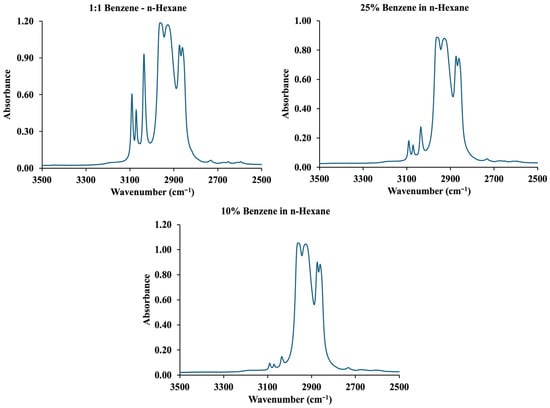
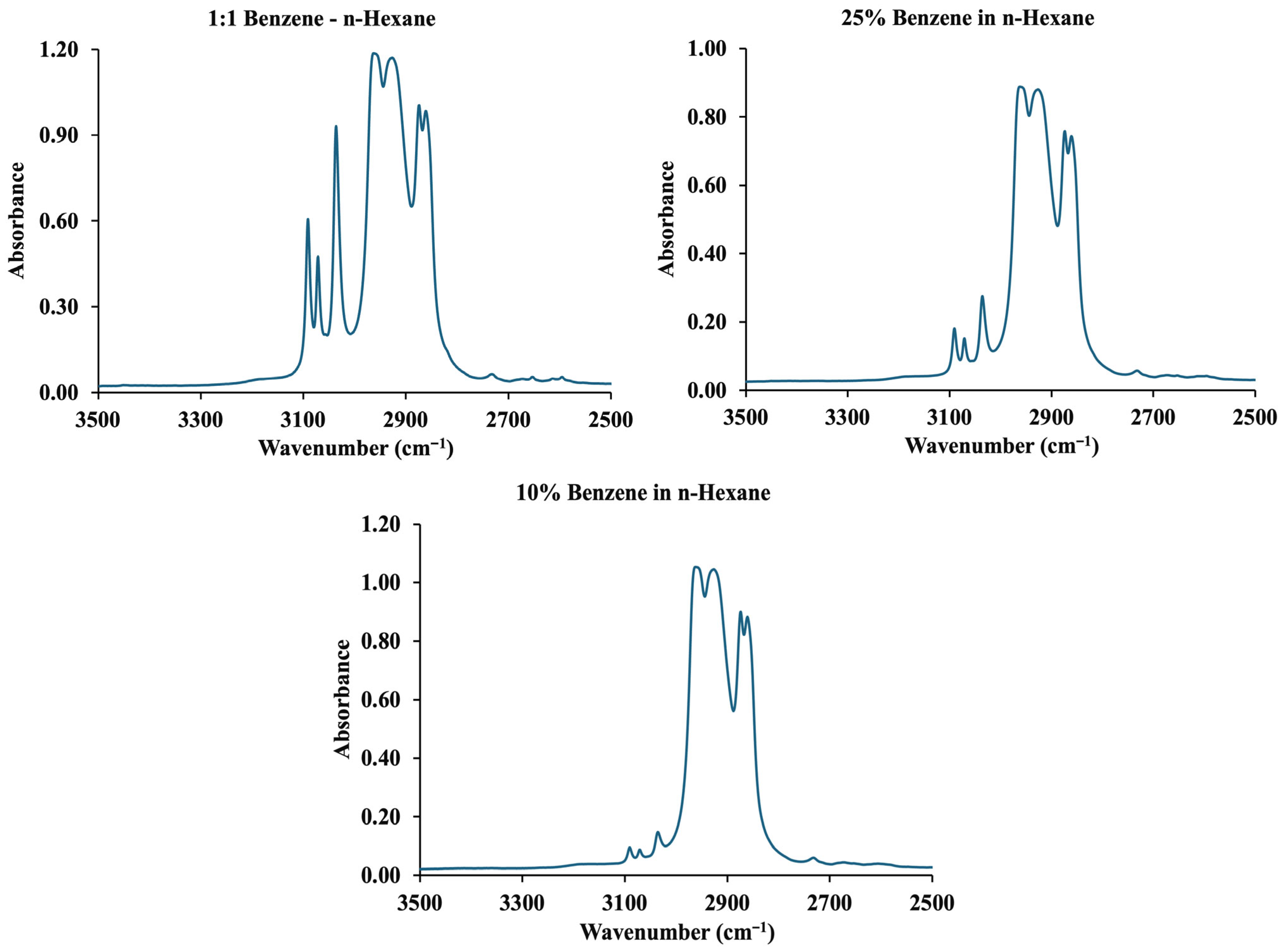
Figure 2 shows the C-H absorption bands in the range from 3500 cm−1 to 2500 cm−1, in the spectra of a 1:1 liquid solution of benzene and n-hexane, as well as a 25% and 10% benzene in n-hexane. It shows that below 10% is not possible to detect the benzene band using IR spectra because the solvent absorption band is larger than the benzene band near the base of the hexane band.
Figure 2.
FT-IR spectra of 1:1, 25%, and 10% solutions of benzene-n-hexane in the C-H absorption region between 3500 and 2500 cm−1. Liquid cell pathlength 0.025 mm with KBr windows.
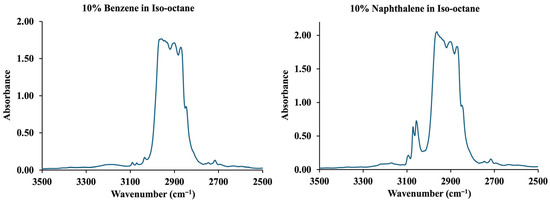
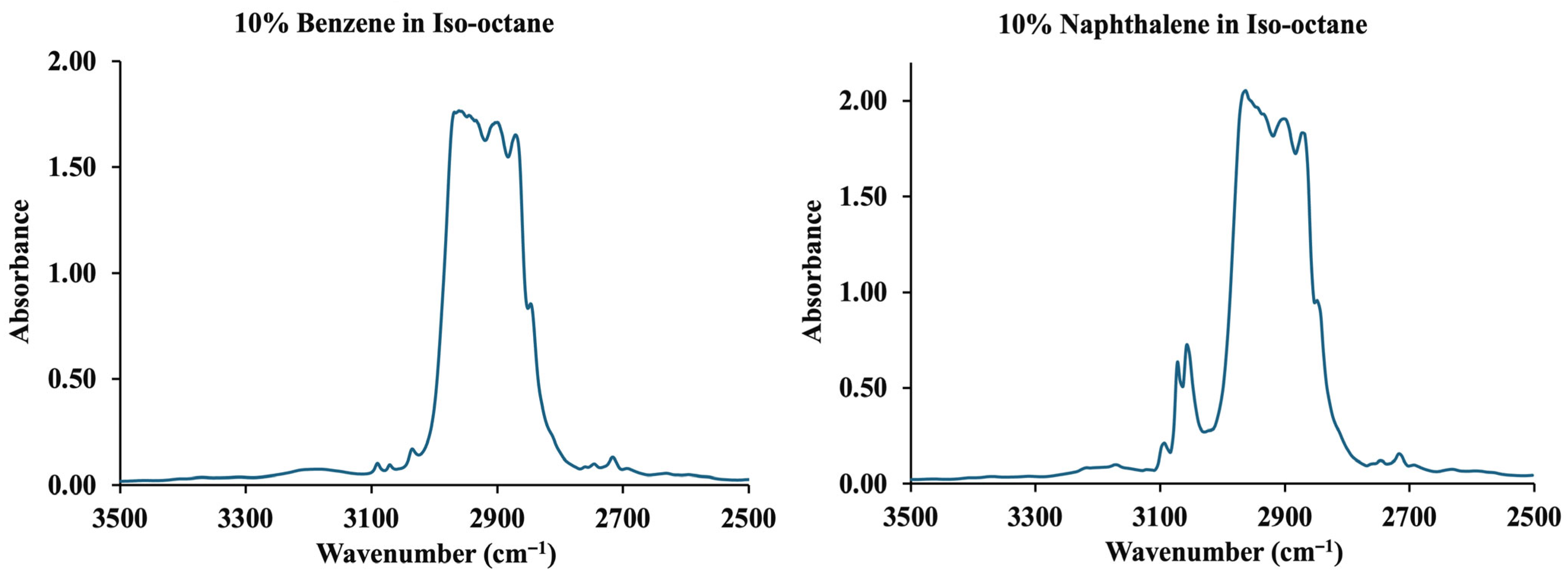
Figure 3 shows the C-H absorption bands in the range from 3500 cm−1 to 2500 cm−1, the C-H absorption bands in the spectra of a 10% liquid solution of benzene in iso-octane (2,2,4-trimethylpentane), and a 10% naphthalene solution in iso-octane. In this case, the benzene absorption will disappear below 10%, but the naphthalene absorption, having a greater absorption coefficient than benzene, will eventually disappear at lower compositions. The problem is the same as with the hexane absorptions. The C-H detection of the aromatics will not be possible using IR spectra because the solvent absorption band is larger near the base of the solvent band. A similar result will occur using pentane or heptane as solvents. The same interference of the solvent could be extended to transitions around the first overtone (Δυ = 2) in the 5200–6200 cm−1 region because of the presence of strong combination bands of the solvent, while the impurity transition is too weak. Not enough separation of the bands (due to anharmonicity) could be observed.
Figure 3.
FT-IR spectra of 10% solutions of benzene and naphthalene in iso-octane in the C-H absorption region between 3500 and 2500 cm−1. Liquid cell pathlength 0.025 mm with KBr windows.
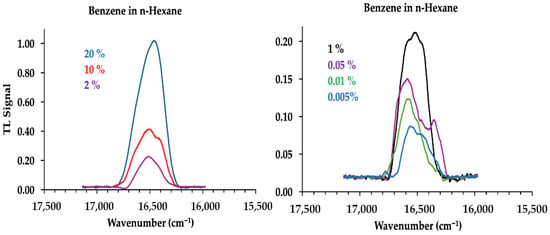
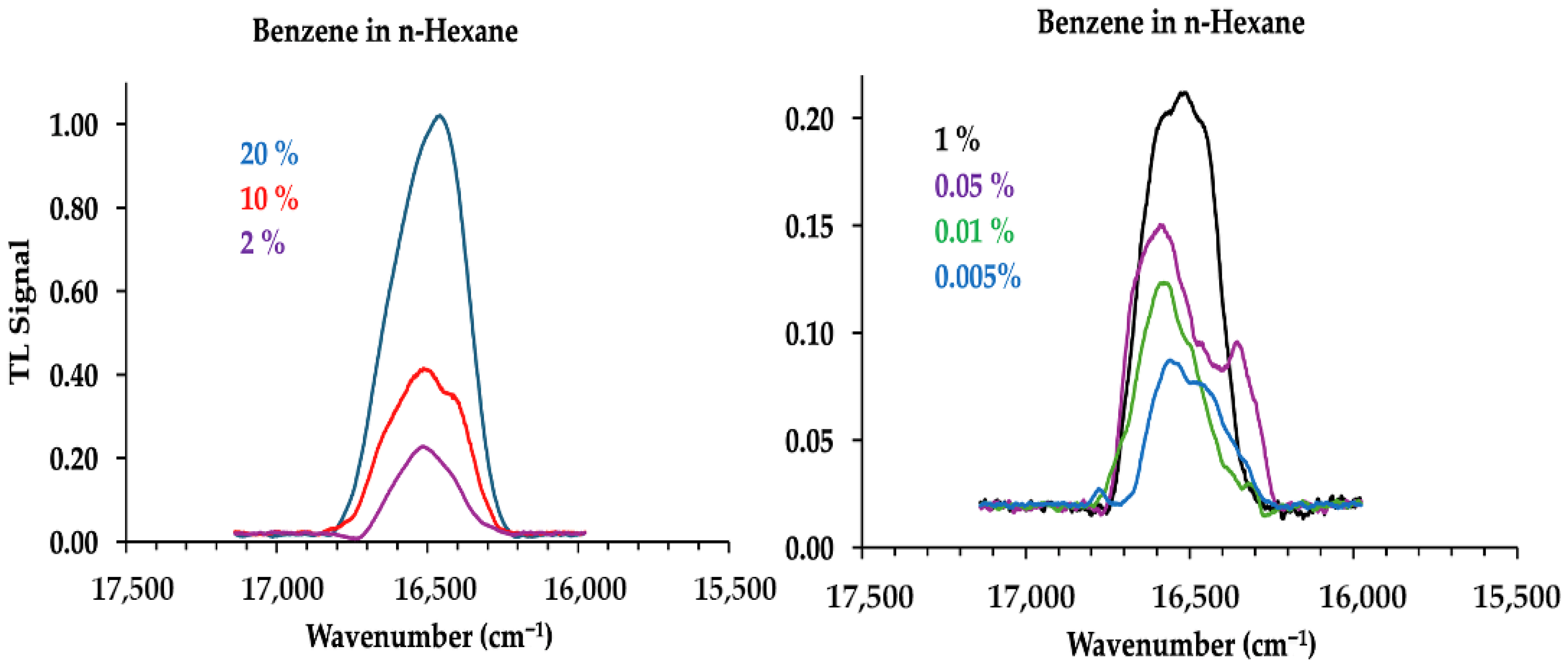
The thermal lens spectra of the fifth C-H overtone (Δυ = 6) of several compositions of benzene in n-hexane at room temperature are shown in Figure 4. The spectra were obtained using a quartz cell of 10 cm pathlength. The power of the pump laser was 4 W, the dye laser had an absorption of 80–85%, which generates an excitation beam of 540 mW, and the shutter frequency was 4 Hz. The maximum signal is localized around 16,457 cm−1.
Figure 4.
Thermal lens C-H (Δυ = 6) spectra of solutions of benzene in hexane at compositions below 20%. The aromatic C-H absorption region is between 16,000 cm−1 and 17,000 cm−1. Signals below 1% were multiplied by different factors to show details of the bands.
The limit of detection and quantitation of benzene in n-hexane was calculated from the integrated thermal lens band versus the composition. The residual standard deviation of the regression line (d) was obtained and divided by the slope (S) of the line. The limit of detection (LOD) and limit of quantitation (LOQ) were calculated in accordance with LOD = 3.3 (d/S) and LOQ = 10 (d/S). The standard deviation = d = 0.00196, and the slope is 34.9 0.2. The LOD = 3.3 (0.002/34.9) = 0.0002 (0.02%) and the LOQ = 10 (0.002/34.9) = 0.0006 (0.06%). To obtain these numbers, we only used compositions below 1% (0.01) to see the linearity at low concentrations. The numbers from the statistical analysis are very good, but higher than the experimental ones because we can see a band at 0.0005%. We consider our results preliminary. More careful experiments are needed at low compositions. For analytical applications, we will measure only at the peak absorption instead of scanning the entire band. That will give us a better idea of the sensitivity of the technique. The high composition (above 1%) plot is also linear with a smaller slope. The reason is not known, but we suspect a change in absorption (two-photon absorption) at low concentrations. Future experiments will explore this possibility.
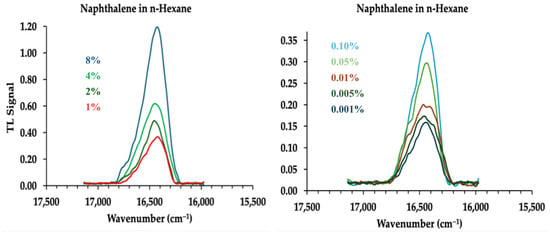
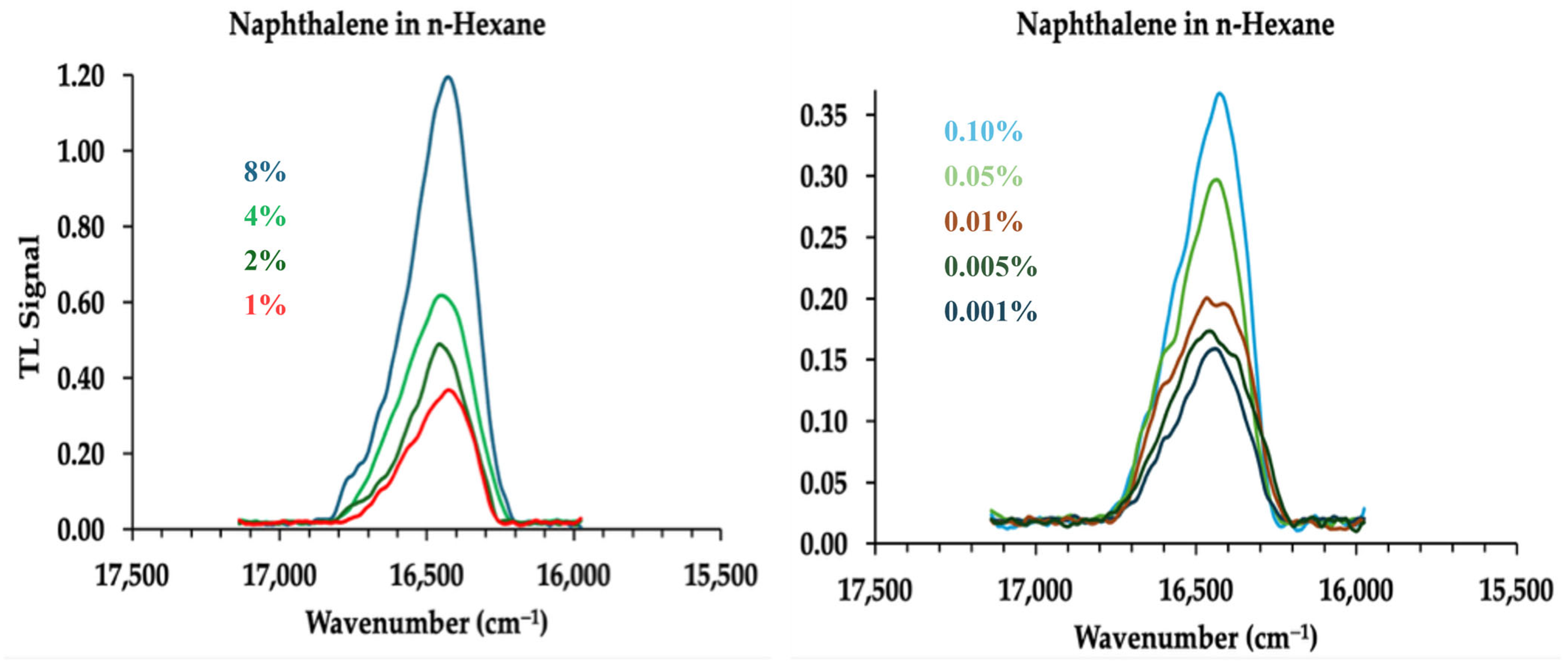
The thermal lens spectra of the fifth C-H overtone (Δυ = 6) of several compositions of naphthalene in n-hexane at room temperature are shown in Figure 5. The spectra were obtained using a quartz cell of 10 cm pathlength. The maximum signal is localized around 16,428 cm−1.
Figure 5.
Thermal lens C-H (Δυ = 6) spectra of solutions of naphthalene in hexane at compositions below 8%. The aromatic C-H absorption region is between 16,000 cm−1 and 17,000 cm−1. Signals were multiplied by different factors to show details of the bands.
The C-H aromatic spectra are presented in the 15,500 cm−1 to 17,500 cm−1. The (Δυ = 6) C-H spectra of the saturated alkanes occur in the 15,000 cm−1 to 16,200 cm−1.
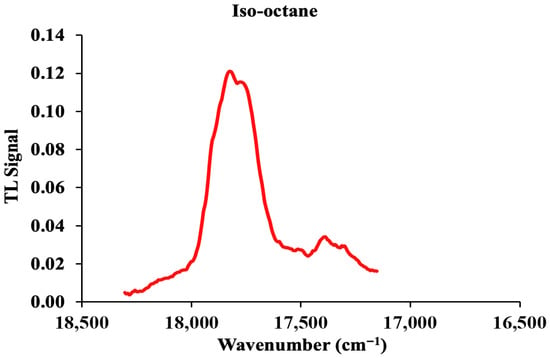
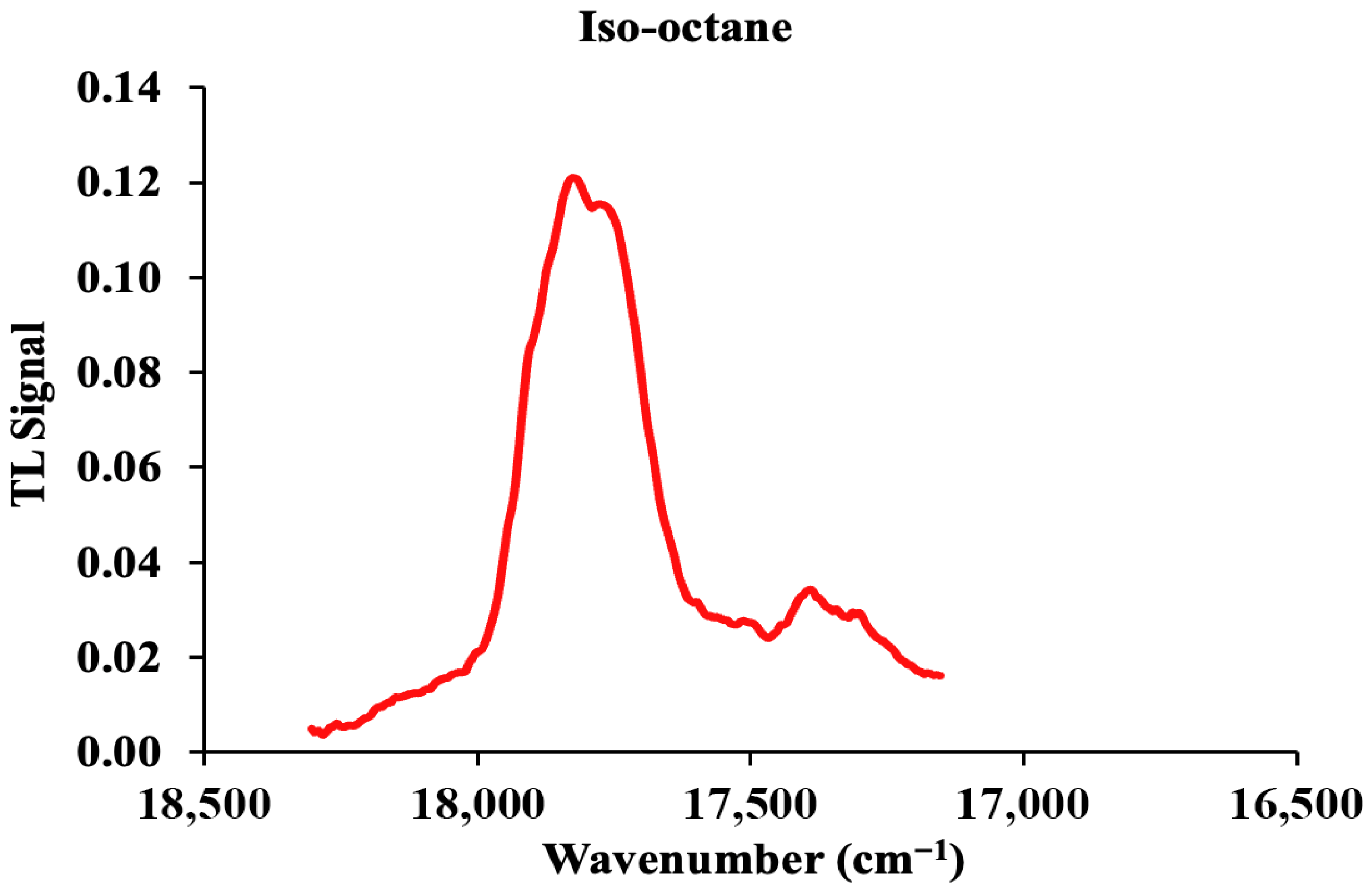
Although the alkane solvent spectra are separated from the aromatic solute spectra in this region, it is better to excite the solvent at a higher level. To illustrate this, we show the (Δυ = 7) spectrum of iso-octane in Figure 6.
Figure 6.
Thermal lens spectrum of the C-H (Δυ = 7) band of iso-octane between 17,000 cm−1 and 18,500 cm−1.
The limit of detection and quantitation of naphthalene in n-hexane was calculated from the integrated thermal lens band versus the composition. As before, the residual standard deviation of the regression line (d) was obtained and divided by the slope (S) of the line. The limit of detection (LOD) and limit of quantitation (LOQ) were calculated in accordance with LOD = 3.3 (d/S) and LOQ = 10 (d/S). The standard deviation = d = 0.024, and slope 492 29. The LOD = 3.3 (0.024/492) = 0.00016 and LOQ = 10 (0.024/492) = 0.0005 (0.05%). To obtain these numbers, we only used compositions below 0.1% (0.001) to see the linearity at low concentrations. As with benzene, we consider the statistical results preliminary. For analytical applications, we will measure only the peak absorption.
4. Discussion
4.1. Recent Applications of Thermal Lens in Analytical Chemistry
The most recent applications of thermal lens in analytical chemistry include femtosecond thermal lens spectroscopy (FTLS) applied to multi-component mixtures in perfumes [49]. The photothermal response of carboxylic modulators commonly employed in metal–organic frameworks (MOFs). In this case, the carboxylic acids studied include formic acid, acetic acid, and their fluorinated derivatives, difluoro acetic acid, and trifluoroacetic acid [50]. An analytical model to assess the applicability of continuous wave (cw) approximations in the analysis of high-repetition pulsed laser-induced thermal lens spectroscopy experimental data [51]. A femtosecond laser-induced thermal lens spectroscopy to observe distinct effects of water inclusion on the heat transfer characteristics of methanol and ethanol compared to ethylene glycol and glycerol [52]. Thermal lens spectroscopy to study the role of intermolecular interactions, such as hydrogen bonding, in determining solvent properties, solvation behavior, and solute reactivity [53]. A double crossed-beam photo thermal lens spectroscopy (PTLS) was developed to detect arsenate in water samples based on the molybdenum blue (MB) reaction [54]. The use of a Fabry–Perot optical resonator allows multi-passing of the probe beam through the sample to enhance the sensitivity of the thermal lens spectroscopy [55]. A new scanning optical microscopic method is reported, coupled with a thermal lens technique [56]. A dual-beam transient thermal lens spectroscopy technique with a high repetition frequency pulsed pump laser is used instead of a continuous wave source to study water samples colored with a tartrazine dye [57]. Experimental and numerical thermal lens spectroscopy behavior of ethyl acetate and ethanol has been studied [58]. Thermal lens to study thermodiffusion in a binary mixture [59], to detect biodiesel and oil–biodiesel blends [60], to probe into liquid-air interfaces [61], to measure the thermo-optical parameters of alcohols–trichloromethane mixtures [62]. Studies of the influence of laser wavelength on the thermal lens parameters values, such as: tc, vx, D, θ, PE, α0 and dn/dT [63]. Other studies are the application of reflection-based photothermal beam deflection (PTD) and photothermal mirror (PTM) spectroscopy in comparison with established fiber-optic-based attenuated total reflection spectroscopy (ATR) for real-time analysis of solutes in the mid-infrared range [64]. Thermal lens to determine the fluorescence quantum yield of a fluorescence molecule [65]. The study of molecular structure by measuring the effects of molecular isomerization on thermal lens measurements is applied to structural isomers of butanol, namely, normal-butanol (n-BuOH), secondary-butanol (s-BuOH), iso-butanol (i-BuOH), and tertiary-butanol (t-BuOH) [66]. A review considers the advantages and the limitations that thermal lens spectrometry has over conventional spectrophotometry for the measurement of optical absorption in specific applications [35]. A dual laser system with an IR source tuned to the mid-IR wavelength is used to perform laboratory Optical-Photo-Thermal InfraRed (O-PTIR) measurements and compare O-PTIR data to existing IR absorption data and laboratory FTIR measurements for planetary materials [67].
4.2. Vibrational Overtones
High vibrational overtones (Δυ = 5, 6, and 7) have very weak absorptions that can only be detected with sensitive techniques. In this paper, we presented the thermal lens technique that we normally use for vibrational overtone detection in liquids [68,69]. The limits of detection of our technique have been reported [70]. Based on our results for dilute methane–nitrogen solutions [70] at low temperatures, we determined that, according to the definition provided by Harris, Dovichi [48], a value of 0.0026% (15 ppm) was obtained for our LOD. Room temperature studies report similar LODs. Absorbances associated with these results are in the range from 3.2 × 10⁻⁷ to 9.0 × 10⁻⁸ cm−1.
Another method is the photoacoustic technique that uses piezoelectric detection of vibrational overtones for liquids [12,13] and intracavity photoacoustic detection of gases with hearing aid microphones [4,11]. Cavity ring down is also a very sensitive technique where an optical cavity produces a path length of several kilometers, but it is limited to gases [16,17,18]. All these techniques that detect vibrational overtones can also be used for the detection of impurities in gas mixtures and liquid solutions.
The technique presented in this paper was designed for vibrational overtone spectroscopy and for the analysis of hydrocarbon mixtures. In analytical applications, there is no need to scan the laser to obtain the complete band of the thermal lens signal. Using a single laser frequency of a pulsed or continuous wave laser, a calibration curve using the excitation lines that correspond to any of the alkanes, aromatic molecules, alcohols, or amines could be constructed to determine the concentration of an unknown impurity in a sample.
We excited the impurity around Δυ = 6 to show that the detection of impurities can be performed with the weakest of the absorptions using the thermal lens technique. The Δυ = 5 overtone transition is approximately 10 times stronger than the Δυ = 6, and lower compositions could be detected. To know which overtone levels to select to do a determination of impurities in solution, we can use the information given by previous reports of the overtone bands of aromatic molecules, alkanes, and alcohols. A summary is presented in Table 1, where only frequencies of peak absorptions are given.
Table 1.
Observed band maxima for the CH-stretching overtone spectra of several alkanes, aromatic molecules, alcohols, and amines (cm−1).
In Table 1, peak wavenumbers for Δυ = 5 and 6 are experimental. Except for Δυ = 7 of isooctane that we determined in this paper, the Δυ = 7 values of the other alkanes are calculated from a two-parameter (harmonic frequency, anharmonicity) local mode equation given in each reference of Table 1. The overtone spectra can identify the peaks from CH3 (primary) and CH2 (secondary, shoulders) bands.
For analytical applications of impurities, we obtain the absorption of benzene around 14,024 cm−1 (Δυ = 5), knowing that any of the alkanes will absorb around 13,400 cm−1 (Δυ = 5) or 15,700 cm−1 (Δυ = 6). Conversely, we can detect alkane impurities in aromatic samples. Hexane could be excited around 13,378 cm−1 without the interference of the solvent (benzene), whose closest absorption is 646 cm−1 above at 14,024 cm−1. In this case, the alkane impurity cannot be detected using fluorescence or UV absorption. Another possibility is the detection of alcohol impurities in hydrocarbons. The O-H absorption of an alcohol as an impurity is easier to detect in alkanes because it is always stronger in the region of absorption of the alkane. For example, if the alkane transition is around Δυ = 5 at 13,400 cm−1, the alcohol absorption in the same region is for Δυ = 4 around 13,700 cm−1, but because it is a lower Δυ, the O-H absorption is ten times stronger than the C-H absorption.
The TL technique has already been used to detect impurities in water using electronic transitions [72] instead of overtones. The advantage of this approach is that electronic transitions have larger absorption cross sections than overtone transitions. TL is also a good method of detection for saturated amines because they absorb UV and visible radiation and are not fluorescent molecules. Aromatic molecules have electronic absorptions in the ultraviolet (UV) region; however, thermal lens is not recommended for the detection of aromatic molecules and, in general, for the detection of polycyclic aromatic hydrocarbons (PAHs) based on electronic transitions because all of them have strong fluorescence emission that considerably reduces the magnitude of the TL signal. To achieve the maximum efficiency of the thermal lens signal, zero or very weak fluorescence emission is an important consideration when using the TL technique for analytical applications of composition.
4.3. Future Experiments
To our knowledge, this is the first time that overtone spectroscopy combined with thermal lens has been used in an analytical fashion to detect impurities of hydrocarbons diluted in hydrocarbon solvents. In this investigation, we have shown that this is an excellent method for saturated hydrocarbons and alcohols. Fluorescence emission and synchronous fluorescence are the best methods to detect aromatic hydrocarbons as impurities in solvents, but are limited to fluorescent molecules. Another technique, the UV absorption method, will not work for all molecules in water or other solvents because saturated hydrocarbons and alcohols only absorb in the vacuum UV below 200 nm. The proposed TL technique, exciting vibrational overtones, is a very good alternative for the detection of impurities because of the high sensitivity of the TL technique. Future experiments will be the determination of the limit of detection of saturated hydrocarbons and alcohols using single-frequency lasers to excite at the peak (Table 1) of the overtone instead of scanning the bands.
We plan to build a pulsed laser thermal lens spectrometer to do the analysis of impurities in hydrocarbons and alcohols. To cover all the wavelengths in the visible and near-IR without the need for laser dye changes, the laser source will be a commercial laser like the Opotek model Opolette 355 (Opotek, Carlsbad, CA, USA) tunable laser source that consists of a pump at 355 nm, and an optical parametric oscillator (OPO) to produce a tunable wavelength in the 410–2300 nm range with energy around 9 mJ and 6 cm−1 linewidth. Pulses are 5 ns in duration with up to 20 Hz pulse repetition rate. Wavelength tuning is motorized and computer-controlled. A laser like this is preferred because all the frequency lines for overtone excitation are available to tune the laser to the frequency of the peak overtone absorption given in Table 1. By selecting the overtone peak absorption, there will not be interferences due to combination bands of the molecule. For example, it is well known that the most important combination band of any high overtone, for example, 6ν(C-H) is the 5ν(C-H) + 2ν(C-H bending) that borrows some intensity but never overlaps the main overtone. The simplicity of the C-H, O-H, or N-H overtone absorptions in the visible region is that there are no other bands like the ones (CO, CC, etc.) that occur in the fundamental region.
5. Conclusions
The thermal lens technique that has been used for spectroscopy is successfully presented as an alternative spectroscopic technique for chemical analysis of hydrocarbons in solution. We propose the TL technique for the detection of impurities in saturated hydrocarbons. As examples, the analysis of two aromatic hydrocarbons in liquid hexane has been presented to illustrate the method. In general, overtone absorption is the suggested method for impurity detection in cases where the molecules do not fluoresce or have a strong electronic absorption in the UV from 200 nm to 400 nm. The method of analysis covers a wide range of molecules that do not absorb UV radiation, such as saturated hydrocarbons and saturated alcohols.
Author Contributions
Conceptualization, methodology, formal analysis, original draft preparation, review and editing, visualization, supervision, C.E.M. Investigation, original draft preparation, D.C., M.R.-E., P.N., H.D.-y.-R. All authors have read and agreed to the published version of the manuscript.
Funding
This research received no external funding.
Institutional Review Board Statement
Not applicable.
Informed Consent Statement
Not applicable.
Data Availability Statement
The original contributions presented in this study are included in the article. Further inquiries can be directed to the corresponding author.
Acknowledgments
This work was supported by the Baylor University Research Committee and the Vice Provost for Research.
Conflicts of Interest
The authors declare no conflicts of interest.
References
- Herzberg, G. Molecular Spectra and Molecular Structure. In Infrared and Raman Spectra of Polyatomic Molecules; Van Nostrand: New York, NY, USA, 1945; Volume II. [Google Scholar]
- Henry, B.R. The local mode model and overtone spectra: A probe of molecular structure and conformation. Acc. Chem. Res. 1987, 20, 429–435. [Google Scholar] [CrossRef] [Scilit]
- Greenlay, W.R.A.; Henry, B.R. The discrete excitation of nonequivalent CH oscillators: A local mode analysis of the high energy overtone spectra of the alkanes. J. Chem. Phys. 1978, 69, 82–91. [Google Scholar] [CrossRef] [Scilit]
- Wong, J.S.; Moore, C.B. Inequivalent C-H oscillators of gaseous alkanes and alkenes. J. Chem. Phys. 1982, 77, 603–615. [Google Scholar] [CrossRef] [Scilit]
- Fang, H.L.; Swofford, R.L.; McDevitt, M.; Anderson, A.B. Carbon-hydrogen stretching overtone spectrum of propylene. Molecular-orbital analysis in the local-mode model. J. Phys. Chem. 1985, 89, 225–229. [Google Scholar] [CrossRef] [Scilit]
- Fang, H.L.; Meister, D.M.; Swofford, R.L. Overtone spectroscopy of nonequivalent methyl carbon-hydrogen oscillators. Influence of conformation on vibrational overtone energies. J. Phys. Chem. 1984, 88, 410–416. [Google Scholar] [CrossRef] [Scilit]
- Fang, H.L.; Swofford, R.L.; Compton, D.A. Overtone absorption spectra of gaseous amines: CH3NH2, (CH3)2NH, Et2NH, and N2H4. Conformationally non-equivalent C-H and N-H local mode oscillators. Chem. Phys. Lett. 1984, 108, 539–546. [Google Scholar] [CrossRef] [Scilit]
- Fang, H.L.; Compton, D.A.C. Vibrational overtones of gaseous alcohols. J. Phys. Chem. 1988, 92, 6518–6527. [Google Scholar] [CrossRef] [Scilit]
- Manzanares, C.; Yamasaki, N.L.S.; Weitz, E. Spectroscopy of high vibrational levels in pyramidal molecules: Carbon-hydrogen stretching overtones of trimethylamine, trimethylphosphine, and trimethylarsine. J. Phys. Chem. 1987, 91, 3959–3969. [Google Scholar] [CrossRef] [Scilit]
- Henry, B.R.; Greenlay, W.R.A. Detailed features in the local mode overtone bands of ethane, neopentane, tetramethylbutane, and hexamethylbenzene. J. Chem. Phys. 1980, 72, 5516–5524. [Google Scholar] [CrossRef] [Scilit]
- Reddy, K.V.; Heller, D.F.; Berry, M.J. Highly vibrationally excited benzene: Overtone spectroscopy and intramolecular dynamics of C6H6, C6D6, and partially deuterated or substituted benzenes. J. Chem. Phys. 1982, 76, 2814–2837. [Google Scholar] [CrossRef] [Scilit]
- Tam, A.C.; Patel, C.K.; Kerl, R.J. Measurement of small absorptions in liquids. Opt. Lett. 1979, 4, 81–84. [Google Scholar] [CrossRef] [Scilit] [PubMed]
- Manzanares, C.E.; Mina-Camilde, N.; Brock, A.; Blunt, V.M. Piezoelectric detection of vibrational overtones at cryogenic temperatures. Rev. Sci. Instrum. 1995, 66, 2644–2651. [Google Scholar] [CrossRef] [Scilit]
- Burberry, M.S.; Morrell, J.A.; Albrecht, A.C.; Swofford, R.L. Local mode overtone intensities of C–H stretching modes in alkanes and methyl substituted benzenes. J. Chem. Phys. 1979, 70, 5522–5526. [Google Scholar] [CrossRef] [Scilit]
- Swofford, R.L.; Long, M.E.; Albrecht, A.C. C–H vibrational states of benzene, naphthalene, and anthracene in the visible region by thermal lensing spectroscopy and the local mode model. J. Chem. Phys. 1976, 65, 179–190. [Google Scholar] [CrossRef] [Scilit]
- Lewis, E.K.; Reynolds, D.; Li, X.; deVillele, G.; Leduc, C.; Cedeño, D.L.; Manzanares, C.E. Phase shift cavity ring down measurement of C-H (∆v = 6) vibrational overtone absorptions. Chem. Phys. Lett. 2001, 334, 357–364. [Google Scholar] [CrossRef] [Scilit]
- Engeln, R.; von Helden, G.; Berden, G.; Meijer, G. Phase shift cavity ring down absorption spectroscopy. Chem. Phys. Lett. 1996, 262, 105–109. [Google Scholar] [CrossRef] [Scilit]
- O’Keefe, A.; Deacon, D.A.G. Cavity ring-down optical spectrometer for absorption measurements using pulsed laser sources. Rev. Sci. Instrum. 1988, 59, 2544–2551. [Google Scholar] [CrossRef] [Scilit]
- Dovichi, N.J. Thermo-optical Spectrophotometries in Analytical Chemistry. CRC Crit. Rev. Anal. Chem. 1987, 17, 357–405. [Google Scholar] [CrossRef] [Scilit]
- Harris, J.M. Thermal Lens Effect. In Analytical Applications of Laser; Piepmeier, E.H., Ed.; Chemical Analysis 87; Wiley & Sons: New York, NY, USA, 1986. [Google Scholar]
- Leite, R.C.; Moore, R.S.; Whinnery, J.R. Low Absorption Measurements by Means of the Thermal Lens Effect Using an He-Ne Laser. Appl. Phys. Lett. 1964, 5, 141–143. [Google Scholar] [CrossRef] [Scilit]
- Gordon, J.P.; Leite, C.C.; Moore, R.S.; Porto, P.S.; Whinnery, J.R. Long-Transient Effects in Lasers with Inserted Liquid Samples. J. Appl. Phys. 1965, 36, 3–8. [Google Scholar] [CrossRef] [Scilit]
- Grabiner, F.R.; Siebert, D.R.; Flynn, G.W. Laser Induced Time-Dependent Thermal Lensing Studies of Vibrational Relaxation: Translational Cooling in CH3F. Chem. Phys. Lett. 1972, 17, 189–193. [Google Scholar] [CrossRef] [Scilit]
- Hu, C.; Whinnery, J.R. New Thermo-optical Measurement Method and a Comparison with Other Methods. Appl. Opt. 1973, 12, 72–78. [Google Scholar] [CrossRef] [Scilit] [PubMed]
- Whinnery, J.R. Laser Measurement of Optical Absorption in Liquids. Acc. Chem. Res. 1974, 7, 225–231. [Google Scholar] [CrossRef] [Scilit]
- Twarowski, A.J.; Kliger, D.S. Multiphoton Absorption Spectra Using Thermal Blooming I, Theory. Chem. Phys. 1977, 20, 253–258. [Google Scholar] [CrossRef] [Scilit]
- Twarowski, A.J.; Kliger, D.S. Multiphoton Absorption Spectra Using Thermal Blooming II, Two-photon Spectrum of Benzene. Chem. Phys. 1977, 20, 259–264. [Google Scholar] [CrossRef] [Scilit]
- Swofford, R.; Morrell, J. Analysis of the Repetitively Pulsed Dual-beam Thermo-optical Absorption Spectrometer. J. Appl. Phys. 1978, 49, 3667–3674. [Google Scholar] [CrossRef] [Scilit]
- Dovichi, N.J.; Nolan, T.G.; Weimer, W.A. Theory for Laser-induced Photothermal Refraction. Anal. Chem. 1984, 56, 1700–1704. [Google Scholar] [CrossRef] [Scilit]
- Dovichi, N.J.; Nolan, T.G.; Weimer, W.A. Laser-induced Photothermal Refraction for Small Volume Absorbance Determination. Anal. Chem. 1984, 56, 1704–1707. [Google Scholar] [CrossRef] [Scilit]
- Vyas, R.; Monson, B.; Nie, Y.; Gupta, R. Continuous Wave Photothermal Deflection Spectroscopy in a Flowing Medium. Appl. Opt. 1988, 27, 3914–3920. [Google Scholar] [CrossRef] [Scilit]
- Vyas, R.; Gupta, R. Photothermal Lensing Spectroscopy in a Flowing Medium: Theory. Appl. Opt. 1988, 27, 4701–4711. [Google Scholar] [CrossRef] [Scilit]
- Gupta, R. The Theory of Photothermal Effect in Fluids. In Photothermal Investigations of Solids and Fluids; Academic Press: New York, NY, USA, 1989; pp. 81–126. [Google Scholar]
- He, Q.; Vyas, R.; Gupta, R. Photothermal Lensing Detection: Theory and Experiment. Appl. Opt. 1997, 36, 7046–7058. [Google Scholar] [CrossRef] [Scilit]
- Georges, J. Advantages and Limitations of Thermal Lens Spectrometry over Conventional Spectrophotometry for Absorbance Measurements. Talanta 1999, 48, 501–509. [Google Scholar] [CrossRef] [Scilit] [PubMed]
- Navas, M.; Jimenez, A. Thermal Lens Spectrometry as Analytical Tool. Crit. Rev. Anal. Chem. 2003, 33, 77–88. [Google Scholar] [CrossRef] [Scilit]
- Proskurnin, A.; Pirogov, V.; Slyadnev, N.; Borzenko, G.; Zolotov, Y. Comparison of the possibilities of Thermal Lens Detection in Capillaries and Microchips. J. Anal. Chem. 2004, 59, 828–833. [Google Scholar] [CrossRef] [Scilit]
- Mawatari, K.; Naganuma, Y.; Shimoide, K. Portable thermal lens spectrometer with focusing system. Anal. Chem. 2005, 77, 687–692. [Google Scholar] [CrossRef] [Scilit]
- Tamaki, E.; Hibara, A.; Tokeshi, M.; Kitamori, T. Tunable Thermal Lens Spectrometry Utilizing Microchannel-assisted Thermal Lens Spectrometry. Lab A Chip 2005, 5, 129–151. [Google Scholar] [CrossRef] [Scilit]
- Franko, M.; Tran, C.D. Thermal Lens Spectroscopy. In Encyclopedia of Analytical Chemistry; Meyers, R.A., Ed.; Wiley & Sons: New York, NY, USA, 2010; Volume 1, pp. 1249–1279. [Google Scholar] [CrossRef] [Scilit]
- Franko, M.; Tran, C.D. Analytical Thermal Lens Instrumentation. Rev. Sci. Instrum. 1996, 67, 1–18. [Google Scholar] [CrossRef] [Scilit]
- Bialkowski, S. Photothermal Spectroscopy Methods for Chemical Analysis; Chemical Analysis 134; Wiley & Sons: New York, NY, USA, 1996. [Google Scholar] [CrossRef] [Scilit]
- Almond, D.; Patel, P. Photothermal Science and Techniques; Chapman & Hall: London, UK, 1996. [Google Scholar]
- Ramis-Ramos, G. Analytical Characteristics, Applications and Perspectives in Thermal Lens Spectrometry. Anal. Chim. Acta 1993, 283, 623–634. [Google Scholar] [CrossRef] [Scilit]
- Hess, P. (Ed.) Photoacoustic, Photothermal and Photochemical Processes in Gases; Springer: New York, NY, USA, 1989. [Google Scholar]
- Fang, H.L.; Swofford, R.L. The Thermal Lens in Absorption Spectroscopy. In Ultrasensitive Laser Spectroscopy; Kliger, D.S., Ed.; Academic Press: New York, NY, USA, 1983; pp. 175–233. [Google Scholar] [CrossRef] [Scilit]
- Bornhop, D.J.; Dovichi, N.J. Simultaneous Laser-based Refractive Index and Absorbance Determinations with Micrometer Diameter Capillary Tubes. Anal. Chem. 1987, 59, 1632–1636. [Google Scholar] [CrossRef] [Scilit]
- Harris, J.M.; Dovichi, N.J. Thermal Lens Calorimetry. Anal. Chem. 1980, 52, 695A–706A. [Google Scholar] [CrossRef] [Scilit]
- Goswami, R.; Kumar Rawat, A.; Goswami, S.; Goswami, D. Analysis of Fragrance Accords Using Femtosecond Thermal Lens Spectroscopy. Chem. Asian J. 2025, 20, e00521. [Google Scholar] [CrossRef] [Scilit] [PubMed]
- Sharma, A.; Gupta, S.K.; Goswami, D. Photo thermal response of carboxylic modulators using thermal lens spectroscopy. J. Mol. Liq. 2025, 436, 128197. [Google Scholar] [CrossRef] [Scilit]
- Isidro-Ojeda, M.A.; Alvarado-Gil, J.J.; Zambrano-Arjona, M.A. Thermal Response in Liquids Induced by Pulsed Laser Beams in Thermal Lens Spectroscopy: An Analytical Approach. J. Mol. Liq. 2025, 436, 128191. [Google Scholar] [CrossRef] [Scilit]
- Maurya, R.K.; Mishra, A.K.; Chakraborty, S.; Goswami, D. Unravelling molecular interactions in various alcohol-water binary mixtures using femtosecond laser-induced thermal lens spectroscopy. J. Mol. Struct. 2025, 1319, 139527. [Google Scholar] [CrossRef] [Scilit]
- Gupta, S.K.; Sharma, A.; Goswami, D. Exploring acid hydration dynamics with thermal lens spectroscopy. J. Mol. Struct. 2025, 1335, 141952. [Google Scholar] [CrossRef] [Scilit]
- Khani, R.; Alizadeh, N. Photothermal lens spectroscopy in near-infrared region for trace arsenate determination in water samples. Spectrochim. Acta Part A Mol. Biomol. Spectrosc. 2025, 347, 127033. [Google Scholar] [CrossRef] [Scilit]
- Cedeño, E.; Zuleta, R.; Mejorada Sánchez, J.L.; Alvarado, S.; Marín, E. A Differential Thermal Lens Spectrometry Method for Trace Detection. Appl. Spectrosc. 2024, 78, 644–649. [Google Scholar] [CrossRef] [Scilit]
- Shimosaka, T.; Iwamoto, K.; Izako, M.; Suzuki, A.; Uchiyama, K.; Hobo, T. Development of a scanning microscopy by total internal reflection coupled with thermal lens spectroscopy. Micron 2004, 35, 297–302. [Google Scholar] [CrossRef] [Scilit]
- Vargas-Vargas, A.D.; Mejorada-Sánchez, J.L.; Castellanos-Durán, F.R.; Vargas, E.; Isidro-Ojeda, M.A.; Cedeño, E.; Marín, E. Dual beam transient thermal lens spectroscopy with high repetition pulsed IR-Laser Excitation: Photothermal and fluorescence quantum yields determination. Infrared Phys. Technol. 2023, 129, 104561. [Google Scholar] [CrossRef] [Scilit]
- Mohebbifar, M.R.; Mohammadi-Manesh, E. Experimental and numerical study of laser energy effect on the thermal lensing behavior of ethyl acetate and ethanol by thermal lens spectroscopy. Optik 2021, 228, 166149. [Google Scholar] [CrossRef] [Scilit]
- Ovseychook, O.O.; Ivanov, V.I.; Ivanova, G.D. Thermal lens spectroscopy in two-component liquid. J. Phys. Conf. Ser. 2018, 1038, 012091. [Google Scholar] [CrossRef] [Scilit]
- Ventura, M.; Simionatto, E.; Andrade, L.H.C.; Simionatto, E.L.; Riva, D.; Lima, S.M. The use of thermal lens spectroscopy to assess oil–biodiesel blends. Fuel 2013, 103, 506–511. [Google Scholar] [CrossRef] [Scilit]
- Chakraborty, S.; Mishra, A.K.; Rawat, A.K.; Goswami, D. Interfacial sensing of liquid-air interfaces using thermal lens spectroscopic measurements. Nonlinear Opt. Appl. XIV 2025, 13524, 63–67. [Google Scholar] [CrossRef] [Scilit]
- Mohebbifar, M.R. Accurate measurement of thermo-optical parameters of trichloromethane–alcohol mixtures by laser thermal lens Spectroscopy. Int. J. Thermophys. 2021, 42, 117. [Google Scholar] [CrossRef] [Scilit]
- Zidan, M.D.; Allahham, A.; Ghanem, A.; Mousa, N. Wavelength dependence of thermal lens and all-optical switching of DB dye solution. Spectrosc. Lett. 2025, 58, 1044–1051. [Google Scholar] [CrossRef] [Scilit]
- Kau-Wacht, D.; Astrath, N.G.; Lukasievicz, G.V.; Lindenbauer, L.; Dabrowska, A.; Wieland, K.; Lendl, B. Laser-based mid-IR photothermal spectroscopy of liquids: A new avenue for in-line sensing in process analytical technology. Anal. Bioanal. Chem. 2025, 417, 5731–5740. [Google Scholar] [CrossRef] [Scilit]
- Estupiñán-López, C.; Dominguez, C.T.; Cabral Filho, P.E.; Fontes, A.; de Araujo, R.E. Quantum dots fluorescence quantum yield measured by thermal lens spectroscopy. In Quantum Dots: Applications in Biology; Springer: NY, USA, 2014; pp. 93–101. [Google Scholar] [CrossRef] [Scilit]
- Kumar, P.; Dinda, S.; Goswami, D. Effect of molecular structural isomers in thermal lens spectroscopy. Chem. Phys. Lett. 2014, 601, 163–167. [Google Scholar] [CrossRef] [Scilit]
- Cox, C.; Haynes, J.; Duffey, C.; Bennett, C.; Brisset, J. Photothermal spectroscopy for planetary sciences: Mid-IR absorption made easy. Planet. Space Sci. 2025, 261, 106101. [Google Scholar] [CrossRef] [Scilit]
- Lopez-Calvo, A.; Manzanares, C.E. Vibrational overtone spectroscopy of saturated hydrocarbons dissolved in liquefied Ar, Kr, Xe, and N2. J. Phys. Chem. 2008, 112, 1730–1740. [Google Scholar] [CrossRef] [Scilit]
- Lopez-Calvo, A.; Diez-y-Riega, H.; Manzanares, C.E. Vibrational C-H overtone spectroscopy and bond distances of butenes dissolved in liquid Xe. J. Mol. Struct. 2009, 935, 39–46. [Google Scholar] [CrossRef] [Scilit]
- Lopez-Calvo, A.; Manzanares, C.E. Overtone Spectroscopy and thermal lens detection limit of methane in cryo-solutions. Mol. Phys. 2008, 106, 907–918. [Google Scholar] [CrossRef] [Scilit]
- Mizugai, Y.; Takimoto, F.; Katayama, M. The fourth overtone of the free O-H stretching vibrations of alcohols and their solvent effect. Chem. Phys. Lett. 1980, 76, 615–618. [Google Scholar] [CrossRef] [Scilit]
- Franko, M.; Goljat, L.; Liu, M.; Budasheva, H.; Žorž Furlan, M.; Korte, D. Recent progress and applications of thermal lens spectrometry and photothermal beam deflection techniques in environmental sensing. Sensors 2023, 23, 472. [Google Scholar] [CrossRef] [Scilit]

Disclaimer/Publisher’s Note: The statements, opinions and data contained in all publications are solely those of the individual author(s) and contributor(s) and not of MDPI and/or the editor(s). MDPI and/or the editor(s) disclaim responsibility for any injury to people or property resulting from any ideas, methods, instructions or products referred to in the content. |
© 2026 by the authors. Licensee MDPI, Basel, Switzerland. This article is an open access article distributed under the terms and conditions of the Creative Commons Attribution (CC BY) license.