
Article

Pt/ZnO-Decorated Laser-Induced Graphene for Nonenzymatic Glucose Monitoring Under Physiological Conditions

1
Center for Bioelectronics, Old Dominion University, Norfolk, VA 23508, USA
2
Department of Electrical and Computer Engineering, Old Dominion University, Norfolk, VA 23508, USA
*
Author to whom correspondence should be addressed.
Chemosensors 2026, 14(2), 48; https://doi.org/10.3390/chemosensors14020048
Submission received: 10 December 2025 / Revised: 29 January 2026 / Accepted: 3 February 2026 / Published: 10 February 2026

Abstract

Diabetes continues to impose significant global health and economic burdens, driving the demand for robust, enzyme-free glucose sensors capable of reliable operation under physiological conditions. Here, we report the development of a high-performance nonenzymatic glucose sensor based on laser-induced graphene (LIG) modified with zinc oxide (ZnO) and platinum (Pt) nanostructures. ZnO was electrodeposited onto LIG with modulation potential and deposition duration systematically optimized. The ZnO/LIG electrodes were characterized electrochemically using potassium ferricyanide and evaluated for glucose oxidation in phosphate-buffered solution. Subsequent electrodeposition of Pt under analogous optimized conditions yielded a ternary Pt/ZnO/LIG architecture with enhanced electrocatalytic activity. Sensor performance was assessed by cyclic voltammetry and chronoamperometry, with hydrodynamic conditions optimized for maximal response. The Pt/ZnO/LIG sensor demonstrated a high sensitivity of 37.125 µA mM−1 cm−2, a wide linear dynamic range (0.5–10 mM; 12–28 mM), and a low detection limit of 77.78 µM. The electrode exhibited excellent reproducibility, long-term stability over 7 weeks, and strong selectivity against common interfering species. Robust performance was also confirmed through real sample testing, highlighting its applicability in physiologically relevant matrices. These findings highlight the Pt/ZnO/LIG platform as a promising candidate for next-generation enzyme-free glucose monitoring systems for clinical and point-of-care diabetes management.

1. Introduction

Diabetes remains one of the most prevalent chronic diseases globally and is among the leading causes of mortality [1]. In several regions including rural South Africa, the USA, England, China, and Mexico, diabetes is the dominant cause of death in middle-aged and elderly populations [2]. According to the 2024 USA diabetes report and the International Diabetes Federation (IDF), an estimated 38 million Americans and 589 million individuals worldwide currently live with diabetes, contributing to approximately 3.4 million deaths annually. This is equivalent to one death every 9–10 s [3]. The economic consequences are also substantial. The American Diabetes Association reported U.S. expenditures of $413 billion, representing 25% of the nation’s total healthcare budget, while global spending approaches $1 trillion, or roughly 12% of worldwide healthcare expenditures [4,5]. These costs are exacerbated by severe diabetic complications including kidney failure, blindness, cardiovascular disease, stroke, and limb amputations, which arise largely from the accumulation of glycated intermediates when blood glucose levels exceed physiological thresholds [6,7,8]. Early and continuous glucose monitoring is therefore essential, particularly as global diabetes prevalence is projected to increase by 45%, reaching 853 million cases by 2045 [9]. Compounding this challenge, many individuals remain undiagnosed, as highlighted in the IDF’s 11th edition report (2025).
Clinicians typically aim to maintain patients’ fasting blood glucose (FBG) below 5.6 mM and random blood glucose (RBG) below 7.8 mM, with hyperglycemia diagnosed at levels above 7.0 mM (FBG) and 11.1 mM (RBG) [10,11,12]. Current diagnostic technologies such as optical, electrochemical, acoustic, and electromagnetic sensors exhibit inherent limitations such as susceptibility to ambient noise, photobleaching, limited sensitivity, complex calibration, and costly fabrication processes [13,14,15]. Among these, electrochemical glucose sensors are particularly promising due to their high sensitivity, strong specificity, minimal interference, ease of integration, and low cost [16,17]. Most commercial electrochemical glucose meters rely on the enzyme glucose oxidase (GOx) to catalyze glucose oxidation; however, enzyme-based devices suffer from environmental instability (temperature, pH, humidity), enzyme denaturation, limited operational lifespan, and costly immobilization procedures [18,19,20]. These challenges highlight the need for durable, low-cost, enzyme-free sensing platforms.
Non-enzymatic glucose sensors have emerged as a compelling alternative, relying on catalytic metallic nanostructures to directly oxidize glucose under harsh conditions without degradation [21]. Metal oxides such as CuO, NiO, Fe2O3, MnO2, TiO2, and sulfides like CuS and NiS have also been extensively investigated [22,23,24,25,26,27,28]. Among these, zinc oxide (ZnO) has gained substantial interest due to its wide bandgap, non-toxicity, biocompatibility, high stability, and high isoelectric point, which facilitates biomolecule immobilization [29,30]. Although ZnO alone is not strongly electrocatalytic toward glucose, its tunable morphology enables large surface areas for loading catalytically active species.
Studies highlight the advantages of ZnO, including its tunable morphology, large surface-to-volume ratio, biocompatibility, high isoelectric point, and ability to uniformly support catalytically active species such as CuO, Pt, Pd, or nitrogen dopants [29,30,31,32,33,34]. These features facilitate enhanced electrocatalytic activity and improved electron transfer, leading to appreciable sensitivity and detection limits. Thus, ZnO-based glucose sensors have been demonstrated to exhibit promising analytical performance and illustrate the versatility of ZnO as a functional component in non-enzymatic sensing platforms. Cheng et al. developed a CuO-doped, screen-printed ZnO electrode on fluorine-doped tin oxide (CuO/ZnO/FTO), achieving a detection range of 0–7 mM and a limit of detection (LOD) of 13.9 µM in 0.1 M NaOH using cyclic voltammetry [31]. Liu et al. further enhanced ZnO’s catalytic activity by sputtering platinum onto hydrothermally grown ZnO nanorods, yielding a sensitivity of 32.05 µA mM−1 cm−2 for glucose oxidation in 0.1 M NaOH [32]. In another case, Dai et al. prepared nitrogen-doped ZnO through a combination of freeze-drying, carbonization, and hydrothermal treatment, resulting in a significantly higher sensitivity of 255.9 µA mM−1 cm−2 and an LOD of 0.39 µM in 0.1 M NaOH [33]. Beyond chemical modification, external stimulation has also been explored to activate ZnO. Zhou et al. synthesized ZnO nanorods on stainless-steel wire mesh and demonstrated that UV irradiation nearly doubled the sensitivity from 36.4 µA mM−1 cm−2 to 91.8 µA mM−1 cm−2 in 0.1 M NaOH [34]. More recently, Aviha et al. integrated palladium-decorated ZnO onto laser-induced graphene (LIG), demonstrating a sensitivity of 25.625 µA mM−1 cm−2 across 2–24 mM with an LOD of 130 µM [35]. Despite these analytical performances, most ZnO-based glucose sensors exhibit optimal performance only in strongly alkaline media (typically 0.1–1.0 M NaOH). This reliance on high pH arises because ZnO itself is not strongly electrocatalytic toward glucose; instead, it primarily serves as a structural scaffold, while glucose oxidation is driven by surface-bound hydroxyl species generated under alkaline conditions. As a result, ZnO-based electrodes often show limited activity, reduced kinetics, or inactivity in neutral physiological fluids such as sweat, saliva, tears, interstitial fluid, or blood. This restricts their direct applicability in point-of-care or continuous monitoring systems that must operate at physiological pH.
To overcome this limitation, noble metals, particularly platinum, are widely explored due to their ability to generate surface hydroxyl species that drive glucose oxidation even at neutral pH. For example, Lin et al. reported a Pt/Au alloy-based sensor operating in PBS with a sensitivity of 2.82 µA mM−1 cm−2 [36], while Imran et al. demonstrated a ZnO-Pt-g-C3N4 composite with a sensitivity of 3.34 µA mM−1 cm−2 across 0.25–110 mM in PBS [37]. Although these studies highlight beneficial synergistic effects, further improvement in sensitivity and surface-to-volume utilization is still needed for practical physiological sensing.
In this work, we address these challenges by leveraging LIG as a scalable, low-cost, mechanically robust, and highly porous carbon platform. The intrinsic 3D microporous architecture of LIG provides a large electroactive surface area and excellent electrical conductivity, enabling rapid and efficient electron transfer. To further expand the active surface and facilitate catalytic loading, ZnO nanostructures are electrodeposited onto LIG via amperometric deposition in a Zn(NO3)2·6H2O precursor with 0.1 M KCl. This deposition strategy affords precise morphological control and promotes a synergistic integration of ZnO’s n-type semiconductor properties with the conductive LIG network. A subsequent electrodeposition of Pt nanostructures yields a hierarchical Pt/ZnO/LIG architecture. The resulting Pt/ZnO/LIG electrode offers multiple synergistic advantages for non-enzymatic glucose detection under physiologically relevant conditions. Additionally, Pt provides abundant catalytic sites capable of generating chemisorbed hydroxyl species at neutral pH, thereby supporting efficient glucose oxidation without requiring strongly alkaline electrolytes. When coupled with ZnO, catalytic performance is further enhanced due to ZnO’s high isoelectric point, tunable nanostructures, and strong metal-oxide interactions, which promote uniform Pt nucleation, improved dispersion, and increased catalytic turnover. The LIG scaffold further amplifies these effects by supplying a high-surface-area, electrically conductive, and mechanically robust framework that accelerates interfacial charge transfer between Pt, ZnO, and the underlying carbon matrix. These structural and catalytic synergies translate into strong electroanalytical performance. The Pt/ZnO/LIG sensor demonstrated a high sensitivity of 37.125 µA mM−1 cm−2, a broad linear dynamic range spanning 0.5–10 mM and 12–28 mM, and a low detection limit of 77.78 µM. The electrode also exhibited excellent reproducibility, long-term operational stability over 7 weeks, and strong selectivity against common electroactive interfering species, emphasizing its robustness and reliability. The scalability and cost-effectiveness of laser-induced graphene fabrication further position the Pt/ZnO/LIG platform as a compelling candidate for next-generation, enzyme-free glucose sensors suitable for continuous monitoring and point-of-care diagnostic applications.

2. Experimental Section

2.1. Chemicals and Reagents

Kapton polyimide (PI) tape purchased from TapeMaster (Troy, MI, USA) and polyethylene terephthalate (PET) sheets (Amazon, Seattle, WA, USA) were used as structural support material. Zinc nitrate hexahydrate (Zn(NO3)2·6H2O, 98%) obtained from Sigma-Aldrich (Burlington, MA, USA) served as the ZnO precursor and chloroplatinic acid obtained from Yellow Springs, OH, was used for the Pt precursor. Other chemicals used from Sigma-Aldrich were potassium chloride (KCl, 99%), D-(+) glucose (C6H12O6, 99%), D-(+) maltose (C12H22O11·H2O,   99.0%), uric acid (C5H4N4O3, 99.0%), potassium ferricyanide (K3[Fe(CN)6], 99%), potassium phosphate monobasic (KH2PO4, 99%), sodium dibasic phosphate (Na2HPO4, 99.0%) and ethanol (94–96%). L-(+) ascorbic acid (C6H8O6, 99.0%) and dopamine (C8H11NO2, 99.0%) were obtained from Alfa Aesar (Haverhill, MA, USA). Sucrose (C12H22O11,   99.0%) and Sodium chloride (NaCl, 99.5%) were obtained from Thermo Scientific (Waltham, MA, USA). D-(−) fructose (C6H12O6, 99%) was obtained from ACROS (Geel, Belgium). The phosphate-buffered solution (1XPBS, pH 7.4) was prepared by mixing 0.24 g of KH2PO4, 1.44 g of Na2HPO4, 8.0 g of NaCl, and 0.2 g of KCl in one liter of deionized (DI) water with resistivity 18.20 MΩ·cm. The synthetic urine was made using creatinine (C4H7N3O) obtained from Kanto Chemical, INC (Tokyo, Japan), ammonium chloride (NH4Cl) obtained from Hanso Chemicals (Buffalo, NY, USA), calcium chloride (CaCl2) obtained from Hawkins, Inc. (Roseville, MN, USA), magnesium sulfate (MgSO4) from ProChem, Inc. (Rockford, IL, USA), sodium chloride, potassium chloride, and phosphate salts, which remain consistent with standard formulations.

2.2. Equipment

The LIG electrodes were fabricated using a CO2 pulsed laser engraver (BOSS LS-1416) controlled via LightBurn software (v. 0.909) (Boss Laser, LLC, Sanford, FL, USA). Electrodeposition of ZnO and Pt nanostructures onto the LIG surface was performed using a two-step amperometric protocol on a Metrohm DropSens µStat-i-MultiX (Metrohm DropSens, Asturias, Spain) electrochemical workstation. A platinum wire served as the counter electrode (CE) and an Ag/AgCl (3 M NaCl) electrode as the reference electrode (RE), while the pristine LIG functioned as the working electrode (WE). Following deposition, electrodes were rinsed with DI water and dried in a laboratory oven (Precision, ThermoScientific) to ensure structural stabilization. All electrochemical characterizations of the LIG, ZnO/LIG, and Pt/ZnO/LIG electrodes including cyclic voltammetry (CV) and chronoamperometry (CA) were conducted using the same µStat-i-MultiX workstation to evaluate electron-transfer behavior, catalytic activity, and sensor performance. All measurements were performed using freshly prepared phosphate-buffered electrolyte solutions to ensure reproducibility. The morphological characteristics of the unmodified and modified LIG electrodes (LIG, ZnO/LIG, Pt/LIG, and Pt/ZnO/LIG) were examined using field-emission scanning electron microscopy (FE-SEM, JSM-IT700HR InTouchScopeTM, JEOL Ltd., Tokyo, Japan) to assess structural features such as porosity, ZnO crystal formation, and Pt nanoparticle distribution. Elemental composition and spatial distribution of Zn, Pt, C, and O were confirmed through energy-dispersive X-ray spectroscopy (EDXS) integrated with the SEM system.

2.3. Fabrication of the LIG Electrodes

A PET sheet was first cleaned with ethanol, rinsed thoroughly with DI water, and air-dried in a vertical position at room temperature. A 1.25 cm wide strip of PI film was then affixed to the dried PET substrate to provide mechanical support during laser processing. The cleaning procedure was repeated for the PI-PET assembly. The PI-PET sheet was subsequently placed under a CO2 pulsed laser system for graphene patterning. All pattern design and laser parameter adjustments were performed using LightBurn software. The WE region was patterned to form a 4 mm × 4 mm active area. Optimal laser parameters were determined as follows: translation speed of 250 mm/s, focal height of 20.1 mm, line spacing of 0.1 mm, and an output power setting of 18% (~10.8 W). Following laser scribing, a thin layer of nail enamel was applied to the stem region between the active area and the contact pad to define and maintain a consistent geometric surface area throughout electrochemical measurements. After drying, the patterned LIG electrodes were rinsed thoroughly with DI water to remove residual debris and allowed to dry at room temperature before further modification.

2.4. ZnO Electrodeposition

Electrodeposition was carried out using a three-electrode configuration, with the LIG serving as the WE, a platinum wire as the CE, and an Ag/AgCl (3 M NaCl) electrode as the RE. The deposition solution consisted of an aqueous precursor containing 20 mM Zn(NO3)2·6H2O and 0.1 M KCl at 50 °C. Reverse CV scans (10 cycles) from 0.0 to −1.4 V at 100 mV/s was applied to initiate nitrate reduction of zinc ions that acted as a seed layer for the ZnO nanostructures [35]. The subsequent ZnO formation on the graphene surface was achieved via amperometry. Deposition time (10, 20, 45, and 60 min) and potential (−0.75, −0.85, −1.00, −1.15, and −1.30 V for 20 min) under 125 rpm stirring were optimized to promote uniform ZnO nucleation and growth while preserving the porous morphology of LIG. Following electrodeposition, the ZnO-modified electrodes (ZnO/LIG) were rinsed with DI water to remove unbound species and dried under controlled conditions to stabilize the ZnO nanostructures prior to Pt deposition.

2.5. Pt Electrodeposition

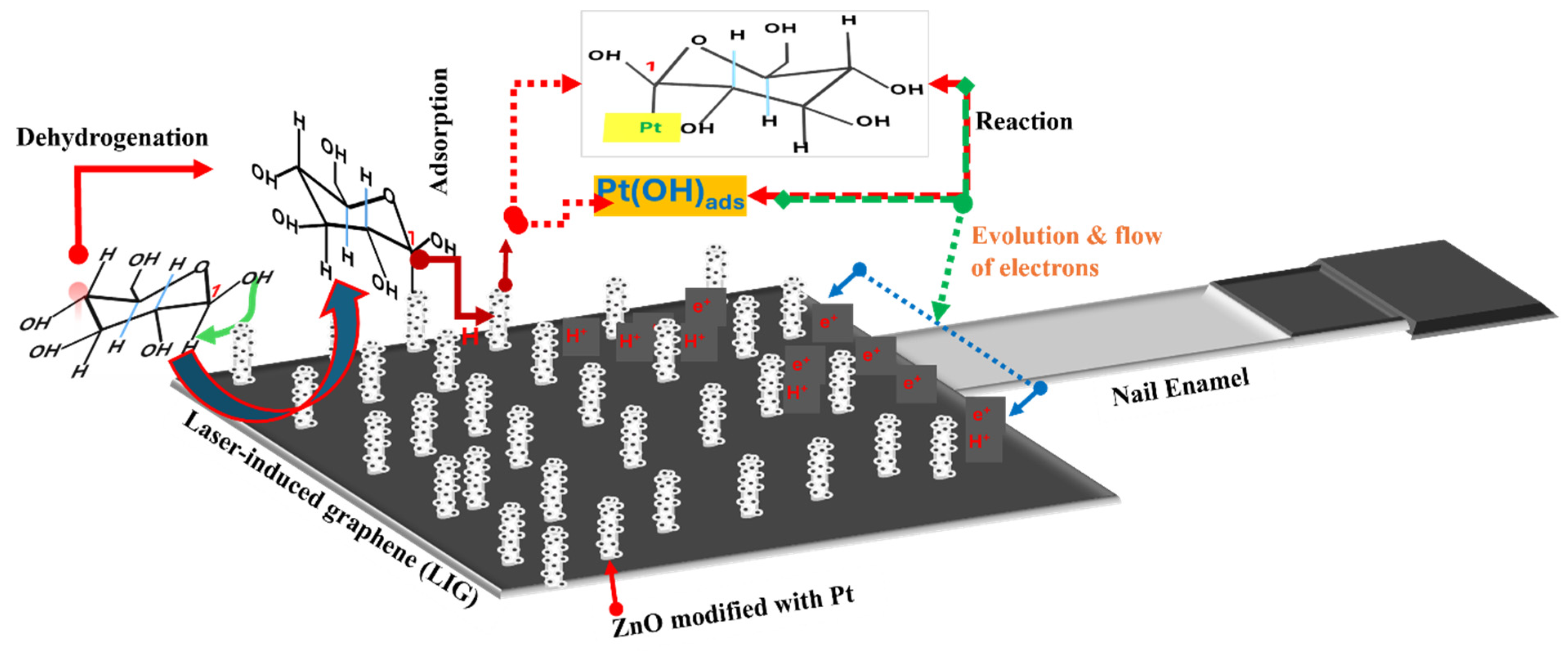
Platinum nanostructures were deposited onto the ZnO/LIG electrodes using a second amperometric electrodeposition step on the same three-electrode system. The ZnO/LIG electrode functioned as the working electrode, while the CE and RE remained unchanged. Pt deposition was performed in an aqueous chloroplatinic acid under a constant deposition potential (+0.150, −0.050, −0.125, −0.225, and −0.350 V) for 25 min to promote controlled nucleation and growth of Pt nanostructures across the ZnO surface. The presence of ZnO facilitated enhanced Pt dispersion through strong metal-oxide interfacial interactions. ZnO also plays a complementary role in the catalytic oxidation of glucose by Pt. It facilitates charge separation and providing an electron pathway that couples to Pt nanoparticles. This synergy is expected to lower the resistance to the charge transfer and, in turn, stabilizes the Pt oxidation states, which eventually enhances the adsorption and activation of hydroxyl intermediates. The resulting hierarchical Pt/ZnO/LIG electrodes were rinsed thoroughly with DI water and dried in the oven to ensure structural stability. These electrodes were subsequently used for electrochemical characterization and non-enzymatic glucose sensing based on chemisorption under neutral pH conditions, as illustrated in Scheme 1.

3. Results and Discussions

3.1. Fabrication and Optimization of Pt/ZnO on LIG

The electrochemical performance of the bare LIG electrode toward glucose oxidation was first evaluated in PBS using CV from −1.0 to +1.0 V at 50 mV/s under varying glucose concentrations (Figure S1, Supporting Information). As expected, bare LIG exhibited minimal electrocatalytic response, showing no discernible oxidation peak and only slight variations in current across glucose concentrations. This observation aligns with previous reports demonstrating the low intrinsic electrocatalytic activity of unmodified LIG and related graphitic carbons for glucose oxidation [38,39]. The largely inert sp2-hybridized carbon lattice, devoid of catalytic redox sites, limits the adsorption and oxidation of glucose, thereby necessitating surface modification. To enhance electrocatalytic activity, LIG was first electrochemically activated in PBS at +1.80 V for 200 s under stirring. This pretreatment step has been shown to introduce oxygen-containing surface functionalities and defect sites that improve the adhesion and nucleation of subsequently deposited nanomaterials [40].

3.2. Optimization of ZnO Electrodeposition

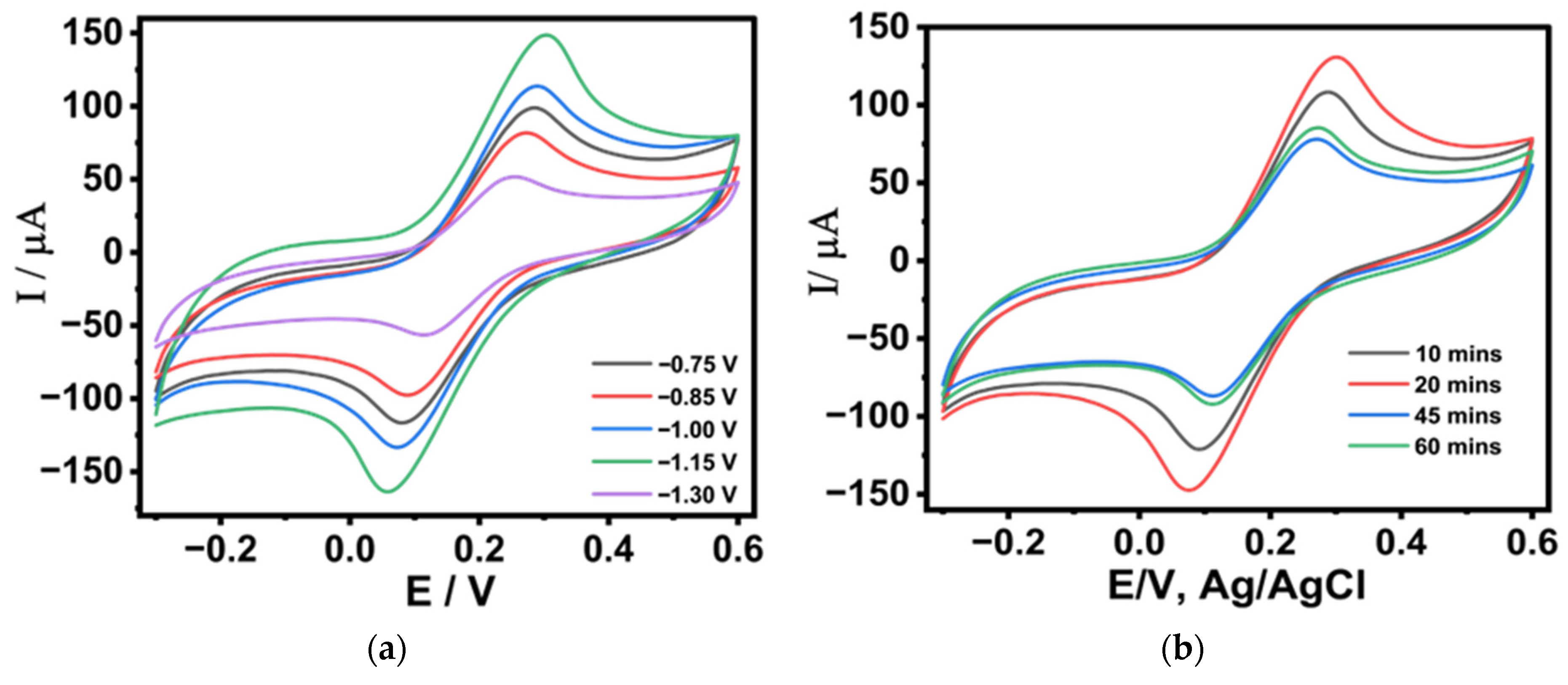
ZnO nanostructures were electrodeposited on the activated LIG to increase electroactive surface area and improve electron-transfer kinetics. Electrodeposition was performed using a growth solution composed of 20 mM Zn(NO3)2·6H2O mixed in equal volume with 0.1 M KCl and maintained at 50 °C, conditions consistent with optimized literature protocols [35]. Before stirring, ZnO nucleation was initiated through ten reverse CV cycles from 0.0 to −1.4 V at 100 mV/s, establishing a broad nitrate-reduction peak spanning −0.80 to −1.20 V (Figure S2, Supporting Information), which informed the voltage range used for chronoamperometric optimization. ZnO growth was evaluated at fixed potentials of −0.75, −0.85, −1.00, −1.15, and −1.30 V for 20 min under 125 rpm stirring. Electrokinetic behavior of resulting ZnO/LIG electrodes was assessed using the [Fe(CN)6]3−/4− redox couple (Figure 1a). Electrodes synthesized at −1.15 V exhibited the highest redox peak currents and the smallest peak-to-peak separation and lower potentials (−0.75 and −0.85 V) exhibited sluggish redox activity. Therefore, increasing the potential to −1.00 and −1.15 V resulted in accelerated electrocatalytic activity. However, an excessively high potential (−1.30 V) caused diminishing electrocatalysis. Thus, −1.15 V was selected as the optimal deposition potential.
The impact of deposition time was further investigated at −1.15 V for durations of 10, 20, 45, and 60 min (Figure 1b). A 10 min chronoamperometry deposition produced limited redox activity. A substantial increase in electrochemical performance was observed at 20 min. Extended growth time (45 and 60 min) was expected to result in excessive agglomeration, reducing surface area and redox performance. These trends align with previous ZnO electrodeposition studies [35], confirming 20 min at −1.15 V and 50 °C as the optimal synthesis condition. CV characterization from −1.0 to +1.0 V at a scan rate of 50 mV/s in PBS containing increasing glucose concentrations further validated the improved electrocatalytic behavior of ZnO/LIG (Figure S3, Supporting Information). Unlike bare LIG, ZnO/LIG displayed a broad oxidation feature between −0.2 and +0.1 V, attributed to increased active surface area and incorporation of catalytic defects, facilitating glucose adsorption and electron transfer [40]. The broadened oxidation window appears to be stable as opposed to the more negative potential, which could be influenced by background interferences. However, the current response showed limited concentration dependence, likely due to the weakly adsorbed OH species on ZnO that rapidly protonate under neutral pH, limiting catalytic turnover.

3.3. Optimization of Pt Electrodeposition on ZnO/LIG

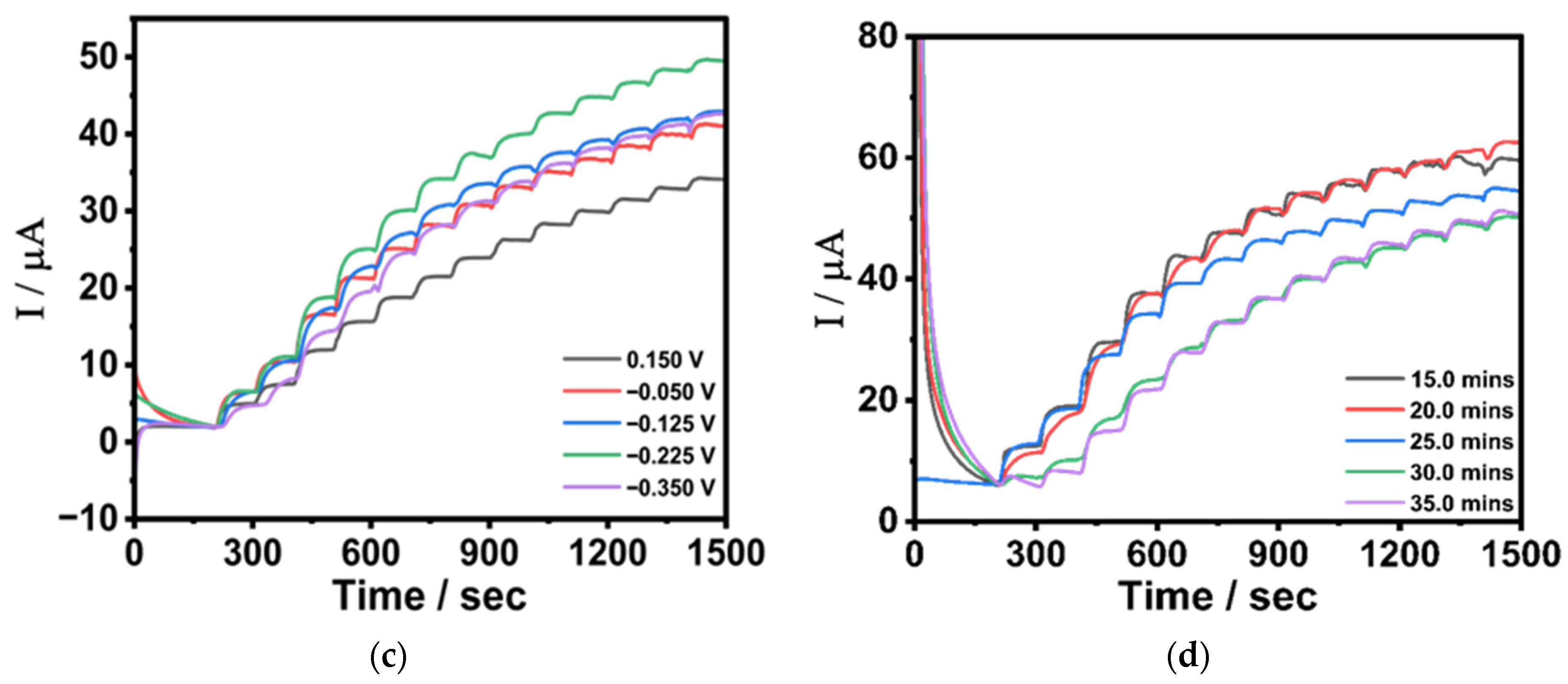
To overcome the limited glucose-dependent response of ZnO/LIG, Pt nanostructures were amperometrically electrodeposited to create a hierarchical Pt/ZnO/LIG composite. Pt was selected over Pd due to its partially filled d-band, stronger affinity for water activation, and the ability to form chemisorbed Pt(OH)ads even at neutral pH, enabling efficient glucose oxidation under physiological conditions [41,42]. Pt/LIG electrode evaluated in PBS with varying glucose concentrations exhibited a signal increase with increasing glucose concentration due to the catalytic property of the Pt (Figure S4, Supporting Information). Hence, initial Pt deposition conditions were based on prior work [43,44], using a potential of −0.225 V for 25 min. The ZnO/LIG electrode was then electrodeposited at optimized potentials of +0.150, −0.050, −0.125, −0.225, and −0.350 V, followed by chronoamperometric (CA) evaluation at +0.30 V in PBS with stepwise glucose additions (Figure 1c). Electrodes prepared at −0.225 V demonstrated higher current responses, consistent with literature trends. Slightly negative potentials (−0.050 to −0.125 V) improved current responses relative to positive potentials, where water-reduction side reactions may hinder Pt deposition. At more negative potentials (−0.225 V), efficient Pt2+ reduction resulted in enhanced catalytic activity. Excessively negative potential (−0.350 V) caused rapid Pt ion depletion, mass-transport limitations, and water reduction, yielding diminished performance [45,46]. Thus, −0.225 V was selected as the optimal Pt deposition potential.
The effect of deposition time (15, 20, 25, 30, and 35 min) at −0.225 V was evaluated using CA at 0.3 V in PBS at 125 rpm (Figure 1d). Pt structures grown for 30–35 min exhibited reduced performance. This can be attributed to the agglomeration of Pt nanostructures, decreasing the active catalytic surface area. At 25 min, performance improved but remained lower than shorter-duration depositions. Deposition for 15 and 20 min produced improved current responses, with the 20 min electrode showing slightly better performance. These findings were corroborated through CV analysis (Figure S5, Supporting Information), where Pt/ZnO/LIG grown for 20 min exhibited the largest glucose-dependent peak current differences, confirming optimal catalytic behavior. Overall, the hierarchical Pt/ZnO/LIG structure benefits from synergistic interactions among Pt, ZnO, and the porous LIG scaffold. ZnO provides increased surface area and favorable metal-oxide interfacial sites for Pt anchoring, while Pt delivers high catalytic turnover for glucose oxidation at neutral pH. Furthermore, the underlying LIG supports rapid electron transport and structural stability to enable enhanced glucose oxidation under physiological conditions. All subsequent experiments were conducted using the optimized parameters established during the fabrication and modification processes.

3.4. Influence of Hydrodynamics on Glucose Sensing Performance

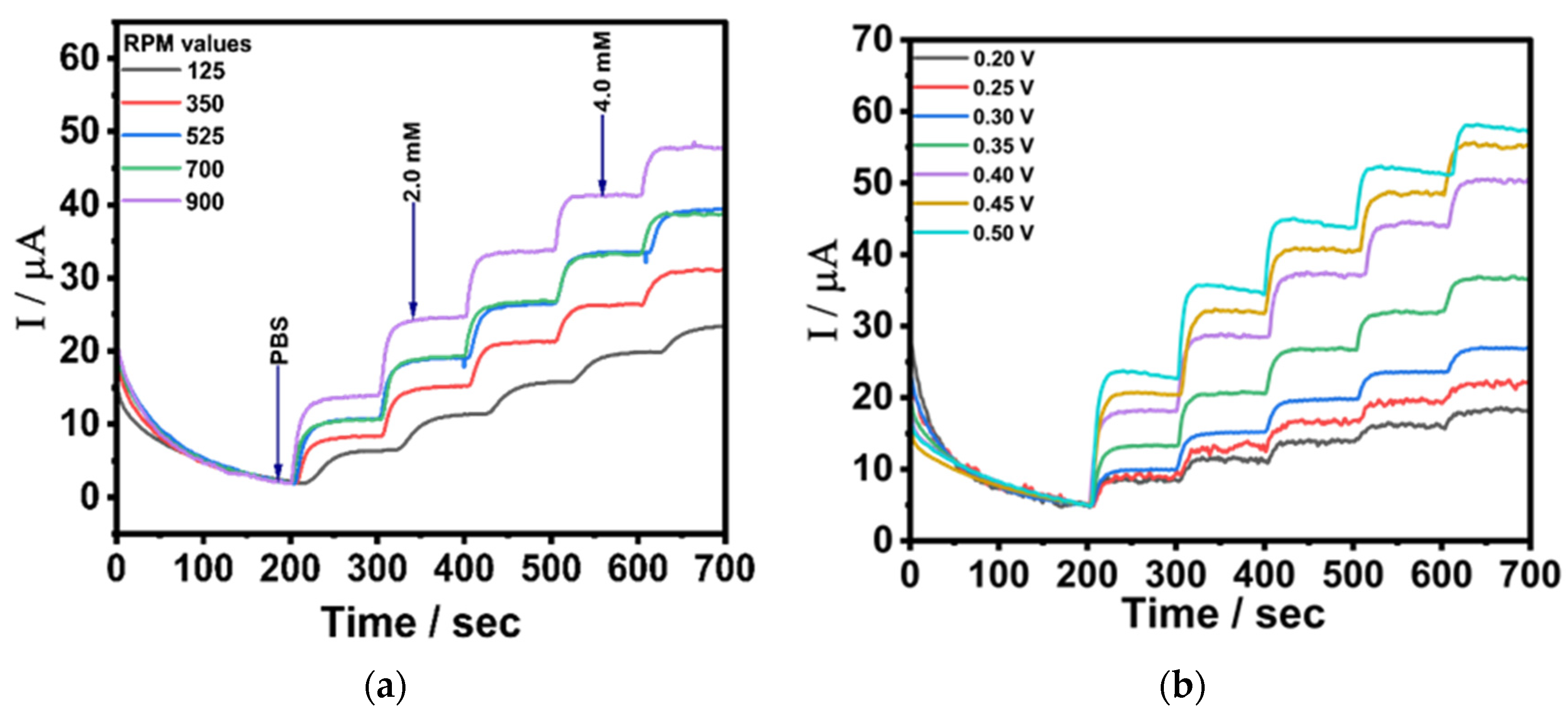
The influence of hydrodynamic conditions and applied potential on the glucose sensing performance of the optimized Pt/ZnO/LIG electrode was systematically investigated to ensure stable, sensitive, and reproducible detection. The two primary parameters evaluated were the magnetic stirring speed (rpm) and the CA biasing potential, both of which directly affect mass transport, signal magnitude, and noise levels during electrochemical measurements. To assess the impact of hydrodynamics, the CA biasing potential was held constant at 0.30 V while the stirring rate was varied across five rpm values (125, 350, 525, 700, and 900). The resulting glucose-response profiles, shown in Figure 2a, exhibited clear stepwise increases in current with each glucose injection, and the magnitude of these steps rose proportionally with increasing rpm. Response times were quantified using the 1 mM glucose increment by extracting the time required to reach 95% of the steady-state signal (Figure S6, Supporting Information). At lower stirring speeds (125 and 350 rpm), the current responses were small and associated with noticeably longer response times, indicating that insufficient convection led to thick diffusion layers and limited mass transport of glucose from the bulk solution to the electrode surface [47]. As the rpm increased to 525 and 700, both current responses and response times improved significantly, reflecting more efficient disruption of the diffusion layer and enhanced analyte transport. Increasing the stirring speed further to 900 rpm yielded faster responses and higher signal amplitudes, but at the cost of increased noise during prolonged measurements, an effect also reported in prior electrochemical sensor studies [48]. The noisy effect described refers to the baseline fluctuations as the rmp increased. Given the balance between signal magnitude, response time, and noise, 525 rpm was selected as the optimal stirring rate for all subsequent glucose detection experiments, ensuring stable and reliable performance across a broad concentration range.
The applied CA biasing potential was also optimized to maximize electrocatalytic activity while minimizing interference. Using the optimized stirring rate of 525 rpm, CA measurements were performed at six potentials (0.20, 0.25, 0.30, 0.35, 0.40, 0.45, and 0.50 V), as shown in Figure 2b. Calibration curves constructed from these measurements revealed a clear dependence of sensor sensitivity on the applied potential (Figure S7, Supporting Information). The slope of the calibration curves increased progressively from 2.45 µA mM−1 to 8.58 µA mM−1 as the potential increased from 0.20 to 0.45 V. This is attributable to the greater driving force available for glucose oxidation at a more positive potential. Further increasing the potential to 0.50 V resulted in a slight decline in slope, suggesting the onset of side reactions or competing oxidation processes that can introduce background current or reduce sensitivity. The highest sensitivity was obtained at 0.45 V, which therefore represents the optimal biasing potential for this sensor platform. This potential provides sufficient overpotential for efficient glucose oxidation on Pt sites while minimizing the risk of oxidative interference, thereby ensuring accurate detection under physiologically relevant conditions.

3.5. Morphological Characterization of As-Fabricated Electrodes

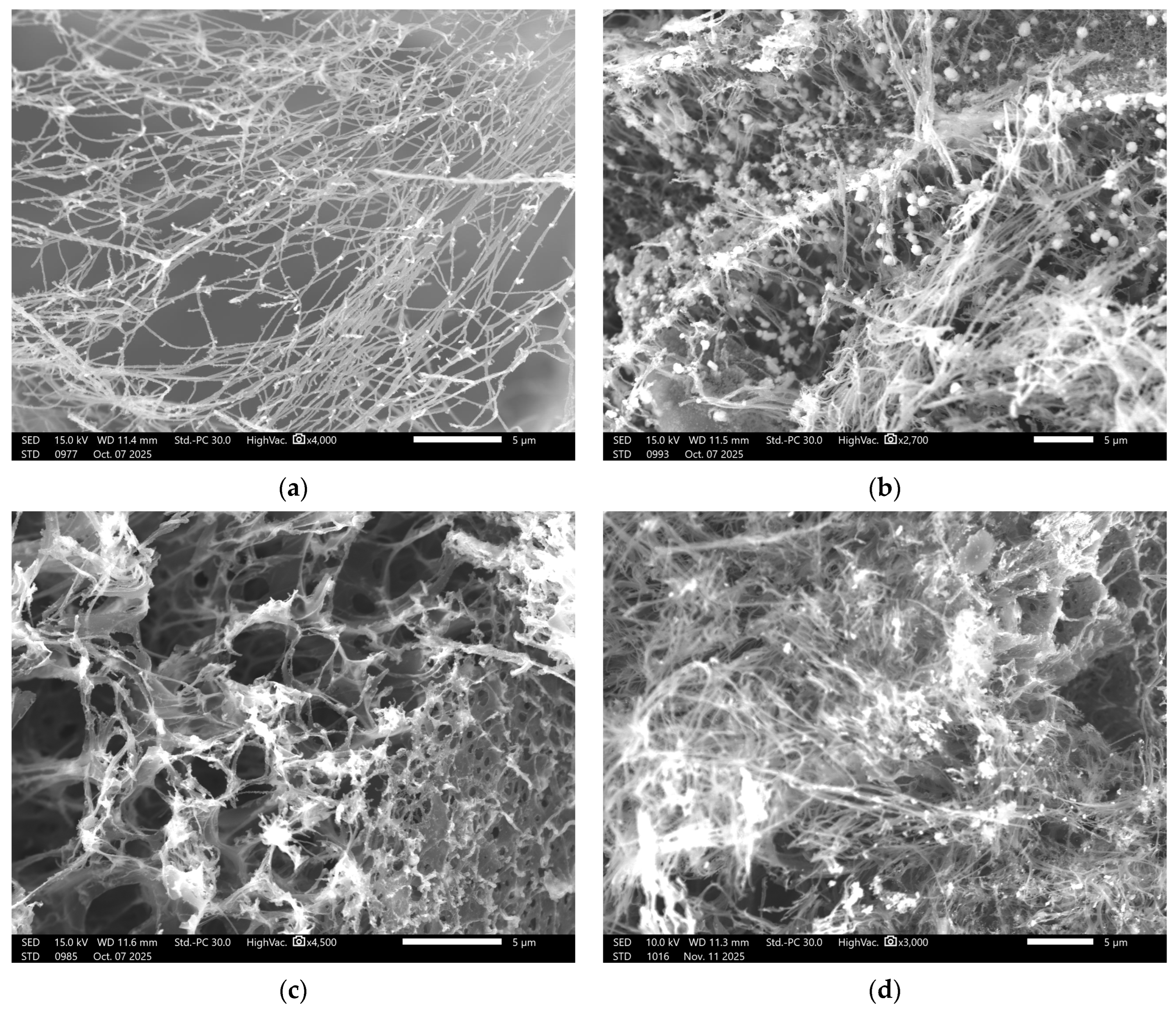
The morphological features of the LIG-based electrodes and their subsequent modifications were systematically examined using FE-SEM. As shown in Figure 3a, the pristine LIG exhibited a highly porous, three-dimensional, and densely interconnected network of graphene-like fibers. This characteristic nanofibrous topology is consistent with previous reports by Torati et al. [49], who similarly attributed such architectures to the rapid localized heating and carbonization inherent to laser-induced graphene processes. The pronounced defect density observed in the LIG structure is indicative of bond-breaking events involving functional groups such as C–O, C=O, and N–C during laser ablation, in agreement with earlier findings that highlight the disruptive chemical modifications induced by high-energy laser patterning [49,50]. These defects are known to enhance electroactive surface area and facilitate charge transfer, thereby providing a beneficial scaffold for subsequent nanomaterial integration.
Upon electrodeposition of ZnO onto the LIG substrate, the morphology transformed into spherically aggregated nanostructures, as depicted in Figure 3b. This ZnO nanostructure assembly significantly increases the accessible surface area and promotes improved electron mobility across the interface. Such surface features are particularly advantageous for constructing composite sensing platforms, as they support uniform nucleation of additional catalytic layers while mitigating diffusion limitations. Moreover, the ZnO nanostructures can enhance catalytic activity by exposing multiple high-energy facets, thereby improving electrocatalytic kinetics. In contrast, electrodeposition of Pt directly onto LIG yielded compact, densely packed Pt clusters embedded within the porous graphene network (Figure 3c). The uniform integration of Pt across the LIG surface confirms successful deposition and effectively amplifies the electrocatalytic capacity for glucose oxidation. However, the tendency of Pt to form aggregated clusters can potentially reduce the number of accessible active sites, highlighting the value of incorporating additional nanostructured materials to modulate dispersion and strengthen catalytic stability.
To this end, the LIG substrate was sequentially modified by first depositing ZnO nanostructures, followed by Pt electrodeposition, resulting in a Pt/ZnO/LIG composite architecture (Figure 3d). The resulting morphology exhibits Pt nanoparticles uniformly anchored onto the ZnO structures rather than forming densely compacted clusters. This hierarchical arrangement suggests a synergistic interaction between Pt and ZnO, where ZnO provides a high surface area scaffold that enhances Pt distribution while simultaneously contributing to improved electron transport pathways. The reduced aggregation of Pt, coupled with the expanded electroactive surface conferred by the ZnO nanostructures, synergistically supports enhanced electrocatalytic activity toward glucose oxidation.
Elemental composition of the Pt/ZnO/LIG composite was further validated by energy-dispersive X-ray spectroscopy (EDAX). The spectra confirmed the presence of carbon, oxygen, zinc, and platinum with atomic percentages of 86.74%, 9.66%, 0.33%, and 0.27%, respectively, and corresponding weight percentages of 76.34%, 11.32%, 1.59%, and 3.91% (Figure S8, Supporting Information). These results confirm the successful incorporation of ZnO and Pt into the LIG framework. The combination of enhanced surface morphology, hierarchical nano-structuring, and material composition showcases the functional advantages of the Pt/ZnO/LIG electrode architecture for high-performance, non-enzymatic glucose sensing.

3.6. Electrochemical Characterization of LIG-Based Modified Electrodes

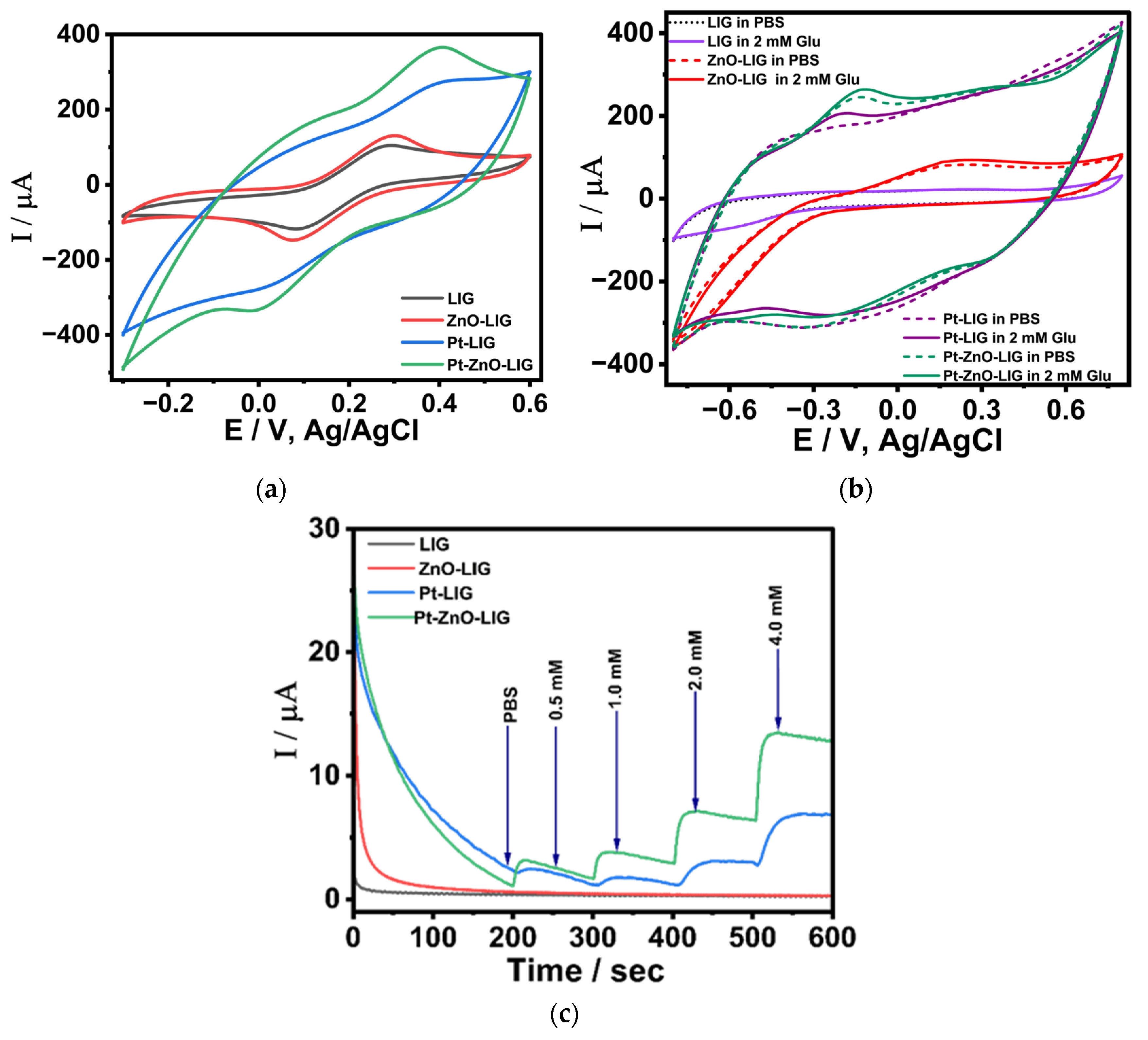
The electron-transfer characteristics of the LIG electrode and its sequential modifications were investigated using CV in 5 mM K3[Fe(CN)6] in 0.1 M KCl. CV scans were recorded from −0.30 to +0.60 V at a scan rate of 50 mV s−1. As shown in Figure 4a, the bare LIG electrode exhibited well-defined and nearly symmetric redox peaks corresponding to the reversible Fe(CN)63−/4− couple, demonstrating the inherent capability of the porous 3D graphene network to facilitate efficient electron transfer [51]. This characteristic behavior is consistent with the high conductivity and defect-rich structure of LIG, which promotes rapid charge transport across the electrode–electrolyte interface. Following electrodeposition of ZnO nanostructures onto the LIG scaffold, the redox peak currents increased noticeably relative to bare LIG. This enhancement is attributed primarily to the enlarged electrochemically active surface area (ECSA) arising from the spherically nanostructured morphology of ZnO, as well as its intrinsic n-type semiconductor properties, which improve electron mobility and redox accessibility at the interface. Subsequent electrodeposition of Pt nanostructures on the ZnO/LIG platform led to a further increase in peak currents, reflecting the high conductivity and strong electrocatalytic activity of Pt nanoparticles. Thereby, resulting in the largest redox peak currents among all configurations. This enhanced response suggests strong synergistic behavior among Pt, ZnO, and LIG, whereby ZnO provides a high-surface-area scaffold for Pt nucleation and LIG ensures rapid charge transport through its interconnected 3D conductive network. The improvement in electron-transfer kinetics across the material series (LIG → ZnO/LIG → Pt/LIG → Pt/ZnO/LIG) therefore highlights the importance of multicomponent integration in developing high-performance electrochemical sensing platforms [52]. The observed capacitive currents for Pt/LIG and Pt/ZnO/LIG electrodes can be attributed to the high electrodeposition rates of the Pt on LIG and ZnO/LIG, which resulted in a rapid increase in the surface area, composite thickness, as well as a change in the dielectric properties of the electrode.
To quantitatively assess the ECSA of each electrode surface modification, the Randles-Sevcik equation was applied [53]:
E C S A = i p 2 69 × 10 5 n 3 2 D 1 2 C ν 1 2
where ip is the forward CV peak current in the redox probe (K3[Fe(CN)6]), n (n = 1) is the number of electrons transferred in the half-redox reaction as shown in Equation (2).
K 3 F e C N 6 3 + e K 3 F e C N 6 4
D is the diffusion coefficient (7.6 × 10 6   c m 2 / s ), and v (50 mV/s) is the scan rate during CV, while C is the concentration (5.0 ×   10 3   mol/cm3) of the probe solution. The corresponding LIG, ZnO/LIG, Pt/LIG, and Pt/ZnO/LIG were ECSAs of 0.126, 0.158, 0.332, and 0.443 cm2, respectively. This reaffirms that the Pt/ZnO/LIG composite provides the greatest electroactive interface for redox reactions and efficient electrocatalytic turnover.
The electrocatalytic activity of the LIG electrodes toward glucose oxidation was further evaluated in PBS using CV over the potential range of −0.80 to +0.80 V at 50 mV s−1 (Figure 4b). The bare LIG electrode showed negligible current changes in the absence or presence of 2.0 mM glucose, confirming the low intrinsic catalytic capability of unmodified carbonaceous materials toward glucose oxidation under neutral conditions. Incorporation of ZnO yielded a broader anodic feature in PBS, attributed to improved glucose adsorption due to increased surface area and enhanced charge-transfer properties of the ZnO-modified surface. Electrodeposition of Pt onto LIG increased the current response and produced a distinct oxidation peak near +0.1 V, consistent with Pt-mediated glucose oxidation pathways in neutral media. This Pt/ZnO/LIG composite’s current response demonstrates additive and synergistic enhancements arising from ZnO’s high surface area, facilitating glucose pre-concentration at the electrode surface and Pt catalyzing its oxidation.
To further validate these observations, CA measurements were performed at an optimized potential of +0.45 V under constant stirring at 525 rpm, with successive additions of glucose every 100 s (Figure 4c). Bare LIG and ZnO/LIG exhibited minimal response, consistent with their weak catalytic activity. In contrast, Pt/LIG showed a pronounced stepwise current increase with successive glucose additions. The Pt/ZnO/LIG electrode produced the most prominent and well-defined step changes, indicating rapid electron-transfer kinetics, efficient glucose oxidation, and a high density of accessible catalytic sites. These CA results align with the CV findings, demonstrating that the Pt/ZnO/LIG electrode benefits from the combined effects of the porous and conductive LIG scaffold, the high-surface-area ZnO nanostructures that improve mass transport and adsorption, and the electrocatalytic Pt nanoparticles that drive glucose oxidation.

3.7. Electrocatalytic Performance of Pt/ZnO/LIG to Glucose

The electrocatalytic performance of the Pt/ZnO/LIG electrode toward glucose oxidation under physiological pH was systematically evaluated. The CV response over the potential window of −0.80 to +0.80 V at a scan rate of 50 mV/s for glucose concentrations ranging from 2 mM to 40 mM is presented in Figure S9a (Supporting Information). In the absence of glucose, no faradaic peak was observed, confirming that the background current originates primarily from double-layer charging. Upon the introduction of 2.0 mM glucose, a distinct electrocatalytic oxidation feature emerged near 0.03 V, which progressively shifted to more positive potentials as glucose concentration increased. This potential shift is characteristic of surface site saturation and accumulation of adsorbed intermediates, both of which increase the overpotential required to sustain oxidation. At concentrations above 30 mM, the peak current began to decrease, indicating surface saturation and hindered reaction kinetics due to poisoning-like species and diffusion layer thickening, consistent with previously reported behavior for Pt-based catalytic systems [54].
The Pt/ZnO/LIG electrode exhibited strong linearity with a regression coefficient of 0.9852 (Figure S9b, Supporting Information), demonstrating reliable performance within this range. The proposed glucose oxidation mechanism is described by Equations (3)–(5) and Scheme 1, where glucose first interacts with surface Pt sites (Equation (3)). Concurrently, the formation of Pt(OH)ads species (Equation (4)) provides the necessary oxidative environment for dehydrogenation of the glucose–Pt adduct, ultimately generating electrons, protons, and regenerating Pt active sites (Equation (5)). This mechanism aligns with classical interpretations of Pt-catalyzed glucose oxidation in neutral media.
C 6 H 12 O 6 C 6 H 12 O 6 P t
P t + H 2 O P t O H a d s + H + + e
C 6 H 12 O 6 P t + P t O H a d s C 6 H 12 O 6 + 2 H + + 2 e + 2 P t
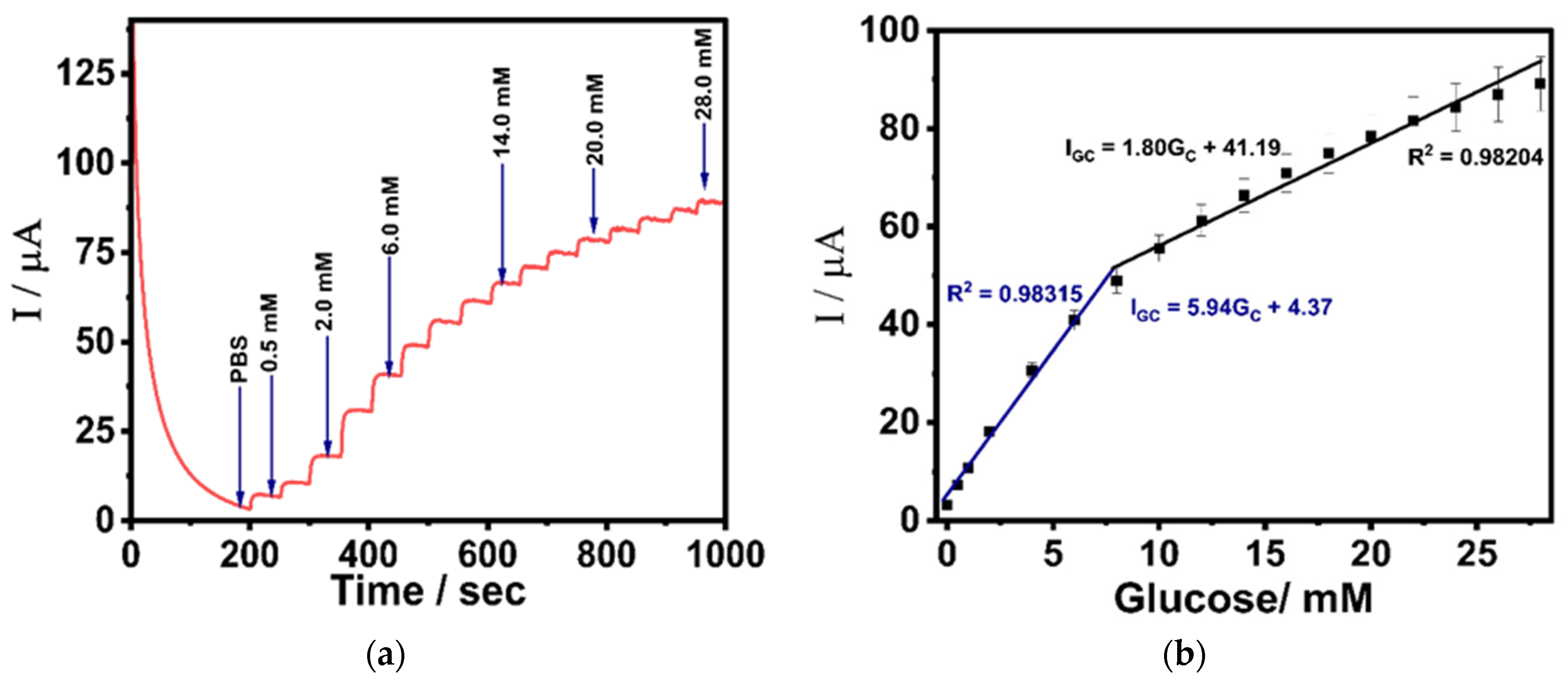
To further validate sensor performance under operational conditions, CA measurements were conducted at the optimized potential of 0.45 V. The glucose concentration was stepped at intervals of 0.5 mM and 1 mM for the initial additions and then increased in 2 mM increments up to 28 mM (Figure 5a). The resulting calibration curve exhibited a bilinear response, distinguishing two kinetic regimes: a highly linear and sensitive region at low concentrations (0–10 mM) and a secondary, lower-sensitivity region (12–28 mM). This behavior is consistent with the transition from an adsorption-controlled process, where abundant catalytic sites on Pt/ZnO/LIG efficiently bind and oxidize glucose, to a diffusion-controlled regime dominated by mass transport limitations and surface intermediate accumulation. Additionally, this was confirmed by plotting peak currents versus the square root of the scan rate (Figure S10a,b, Supporting Information). A strong linear relationship with high regression values (0.9991 and 0.9993 for both reduction and oxidation peak currents, respectively) was established. Thereby confirming diffusion-controlled mechanism [55]. Comparable bilinear trends have been documented in nonenzymatic Pt- and ZnO-based glucose sensors [56,57].
The sensitivities calculated from the slopes of the two regions, normalized to the geometric area of the working electrode, were 37.125 µA mM−1 cm−2 for the lower concentration range (0.5–10 mM) and 11.25 µA mM−1 cm−2 for the higher range (12–28 mM). The LOD was determined using Equation (6),
L o D = 3.3 × δ S
where δ represents the standard deviation of blank measurements from three identically prepared Pt/ZnO/LIG electrodes, and S is the slope. The calculated LOD was 77.78 µM, confirming the electrode’s suitability for physiological glucose monitoring, where fasting glucose levels typically fall between 3 and 7 mM.
A comparative summary of the Pt/ZnO/LIG sensor’s performance relative to reported nonenzymatic glucose sensors is presented in Table 1. Notably, the proposed electrode demonstrates a higher sensitivity under neutral pH compared to several Pt- and ZnO-based systems, which often require alkaline conditions to achieve optimal performance. The ability to operate effectively in PBS (pH 7.4) highlighted the practical advantage of the Pt/ZnO/LIG architecture for applications involving real biological fluids.

3.8. Reproducibility, Stability and Selectivity of Pt/ZnO/LIG

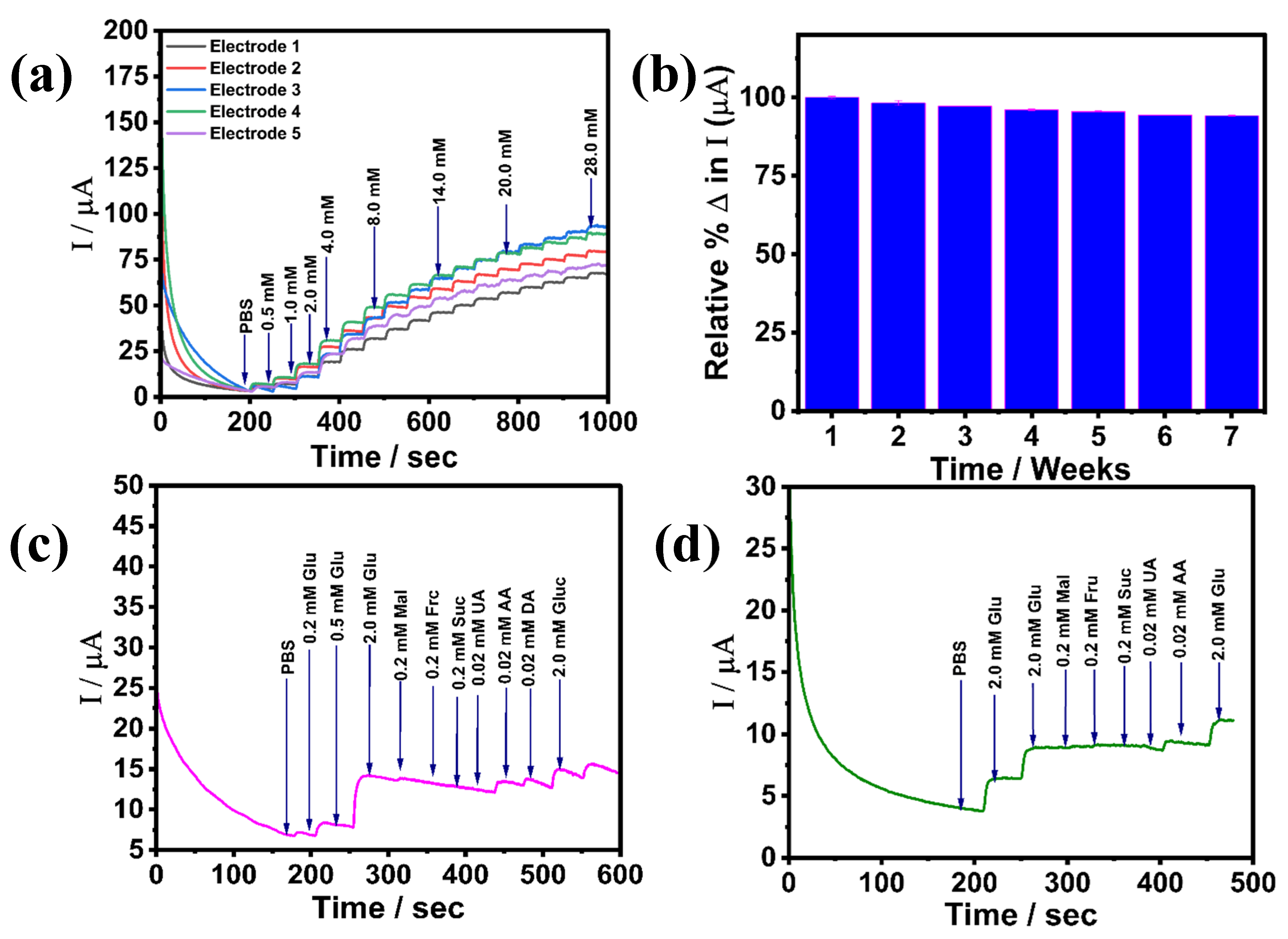
The reproducibility of the Pt/ZnO/LIG electrodes was assessed across five independently fabricated electrodes, each tested with replicate glucose concentrations (Figure 6a). The calculated standard deviation corresponded to variability values of 1.56% and 6.53% across the tested concentrations, as illustrated in Table S2 (Supporting Information). Although the upper bound slightly exceeds the commonly cited 5% benchmark for excellent reproducibility, the Pt/ZnO/LIG electrodes still exhibit strong reproducibility within acceptable experimental limits. Automation of laser scribing of the polyimide to generate uniform graphene thickness, followed by subsequent batch electrodeposition under uniform conditions, may be explored to reduce the variability. Moreover, this level of consistency achieved reflects the uniformity in the Pt-ZnO nanostructure formation on the LIG framework and highlights the reliability of the electrode fabrication protocol. Additionally, the operational stability of the electrode was evaluated over an extended 7-week period. Weekly averaged peak currents and corresponding standard deviations were calculated (Figure 6b). After seven weeks, the electrode retained over 94% of its initial peak current, a promising indication of its structural and electrocatalytic robustness. Such long-term stability suggests that the synergistic Pt/ZnO/LIG architecture effectively mitigates catalyst degradation, a common limitation in nonenzymatic glucose sensors operating under neutral physiological conditions.
To evaluate selectivity, the amperometric response of the Pt/ZnO/LIG electrode was recorded upon sequential addition of glucose, common saccharides (maltose, fructose, sucrose), and physiologically relevant interfering species (uric acid (UA), ascorbic acid (AA), and dopamine (DA)). Concentrations of glucose (2.0 mM), saccharides. (0.2 mM), and interferents (0.02 mM) were chosen to reflect their relative physiological abundances. As shown in Figure 6c, the electrode exhibited a pronounced stepwise increase in current upon glucose addition that remained effectively unchanged following introduction of maltose, fructose, and sucrose, confirming minimal cross-reactivity with structurally similar saccharides. UA also resulted in negligible interference. However, AA and DA introduced 16.54% and 10.76% increase in the initial glucose response signal, respectively. This partial susceptibility to AA and DA is attributed to the coexistence of facet-dependent catalytic sites in the Pt-ZnO composite, which may promote partial oxidation of these smaller redox-active molecules. To address this limitation, we investigated a preliminary strategy for enhancing selectivity by incorporating a selective membrane. A 1 wt.% chitosan was cast onto the Pt/ZnO/LIG electrode and allowed to dry before testing. The chitosan-modified electrode displayed a nearly identical response to 2.0 mM glucose before and after the addition of interfering analytes, in stark contrast to the unmodified counterpart (Figure 6d). This improvement is attributed to chitosan’s size-exclusion and charge-selective behavior, which restricts access of larger or oppositely charged interferents while permitting diffusion of glucose. This result, even though a proof-of-concept, provides clear evidence that integrating selective membranes such as chitosan can significantly enhance the anti-interference performance of the Pt/ZnO/LIG system. Similarly, 05 wt.% of Nafion was evaluated and was shown to minimize the interference effects, while suppressing the glucose signal in the process (Figure S11, Supporting Information). Future work will address this limitation with an appropriate strategy in the optimization of different selective layers.

3.9. Real-Sample Feasibility Analysis Using Synthetic Urine

The feasibility of the Pt/ZnO/LIG electrode for real-world applications was further evaluated using a synthetic urine sample to simulate physiological conditions. To minimize potential matrix interference, the synthetic urine was diluted 1000-fold in PBS. CA measurements were then conducted at 0.45 V, while glucose concentrations were sequentially introduced at evenly spaced intervals. The resulting current responses were compared with those obtained in PBS alone, as illustrated in Figure S12a (Supporting Information). To quantitatively assess sensor performance in the complex urine matrix, recovery studies were performed using known glucose concentrations of 0.5–26.0 mM. The observed concentrations were used to calculate recovery rates, which ranged from 94.00% to 105.78% (Table S1, Supporting Information). These results indicate that the Pt/ZnO/LIG electrode maintains accuracy in glucose detection in complex biological fluids. The slight variations at higher glucose concentrations may reflect minor matrix effects or adsorption phenomena on the electrode surface. Moreover, at lower dilution rates (×500, ×100 and ×20), a significant signal suppression was observed (Figure S12b, Supporting Information). The as-fabricated sensor is ideal for a single-time use in complex biological matrices. Future work will incorporate repetitive measurements upon optimization of various selective membranes to reduce biofouling and other related interferences without suppressing the glucose signal.

4. Conclusions

This study presents the fabrication and optimization of a Pt/ZnO/LIG electrode as a promising platform for nonenzymatic glucose detection under physiological conditions. The performance of the electrode can be attributed to the intrinsic advantages of LIG, including its flexibility, high conductivity, tunable porosity, scalability, and cost-effectiveness, combined with the synergistic electrocatalytic activity of ZnO and Pt, which enhances electron transfer and glucose oxidation at neutral pH. The Pt/ZnO/LIG electrode exhibited an excellent electrochemical response in PBS (pH 7.4), with a sensitivity of 37.125 µA mM−1 cm−2 in the low concentration range (0.5–10 mM) and 11.25 µA mM−1 cm−2 in the higher range (12–28 mM), alongside a low limit of detection of 77.78 µM. These results demonstrate that the electrode is capable of accurately detecting physiologically relevant glucose concentrations, making it a strong candidate for continuous, nonenzymatic glucose monitoring in the management of diabetes. Furthermore, its robust performance in synthetic urine, coupled with high reproducibility and long-term stability, emphasizes the potential for practical application in complex biological matrices. The electrode also demonstrated good selectivity, highlighting its capacity to minimize interference from coexisting analytes, although further optimization through the incorporation of selective membranes or surface modifications could further enhance specificity. These findings not only advance the design of practical, enzyme-free glucose sensors but also provide a framework for the future development of wearable or point-of-care devices, addressing the growing need for accessible and reliable glucose management tools in diabetic care.

Supplementary Materials

The following supporting information can be downloaded at: https://www.mdpi.com/article/10.3390/chemosensors14020048/s1, Figure S1. Cyclic voltammogram (CV) of LIG electrode in PBS, pH 7.4 for varying glucose concentration. 50 mV/s; Figure S2. CV response for an LIG electrode in 10 mM Zn(NO3)2.6H2O. Scan rate: 100 mV/s; Figure S3. CV response of ZnO/LIG electrodes in the presence of glucose, (PBS, pH 7.4) Scan rate: 50 mV/s; Figure S4. CV response of Pt/LIG electrodes in the presence of glucose, (PBS, pH 7.4) Scan rate: 50 mV/s; Figure S5. Graphical representation of Pt/ZnO/LIG electrodes modified at varying time durations: CV peak current response to different glucose concentrations; Figure S6. Chronoamperometric (CA) response of Pt-ZnO-LIG in the presence of 1 mM glucose (pH 7.4) under various hydrodynamic conditions (125–900 rpm); Figure S7. Calibration curves of Pt/ZnO/LIG to varying glucose concentration at different bias potentials (0.2, 0.25, 0.30, 0.35, 0.40, 0.45 and 0.50 V); Figure S8. EDAX analysis of the Pt/ZnO/LIG electrode; Figure S9. (a) CV of Pt/ZnO/LIG sensor at varying glucose concentration and (b) its corresponding calibration. Scan rate: 50 mV/s; Figure S10. (a) CV response in K3[Fe(CN)6]-3 in 0.1 M KCl and (b) corresponding calibration of anodic and cathodic peak currents against the square root of the scan rate [10–200 mV/s]; Figure S11. CA response to glucose and different concentrations of interferences on a Pt/ZnO/LIG electrode modified with 0.5 wt. % Nafion; Figure S12. CA response of Pt/ZnO/LIG at 0.45 V for varying glucose concentration in (a) PBS (red curve) and ×1000 of synthetic urine sample (black curve), and (b) comparison for glucose signal in PBS at higher synthetic urine dilutions; Table S1. % recovery of LIG/ZnO/Pt sensor in synthetic urine; Table S2. Coefficient of variation from electrode to another for the reproducibility studies of the Pt/ZnO/LIG electrode.

Author Contributions

Conceptualization, G.S. and R.A.; methodology, R.A. and G.S.; validation, R.A.; formal analysis, R.A.; investigation, R.A.; resources, G.S.; data curation, R.A.; writing—original draft preparation, R.A.; writing—review and editing, R.A. and G.S.; supervision and G.S.; project administration, G.S.; funding acquisition, G.S. All authors have read and agreed to the published version of the manuscript.

Funding

This research received no external funding.

Institutional Review Board Statement

Not applicable.

Informed Consent Statement

Not applicable.

Data Availability Statement

The original contributions presented in this study are included in the article/Supplementary Material. Further inquiries can be directed to the corresponding author.

Conflicts of Interest

The authors declare no conflicts of interest.

References

  1. Wagh, K.; Kirpich, A.; Chowell, G. The Future Diabetes Mortality: Challenges in Meeting the 2030 Sustainable Development Goal of Reducing Premature Mortality from Diabetes. J. Clin. Med. 2025, 14, 3364. [Google Scholar] [CrossRef] [PubMed]
  2. Duncan, B.B.; Magliano, D.J.; Boyko, E.J. IDF Diabetes Atlas 11th edition 2025: Global prevalence and projections for 2050. Nephrol. Dial. Transplant. 2025, 41, 7–9. [Google Scholar] [CrossRef] [PubMed]
  3. Genitsaridi, I.; Salpea, P.; Salim, A.; Sajjadi, S.F.; Tomic, D.; James, S.; Thirunavukkarasu, S.; Issaka, A.; Chen, L.; Basit, A.; et al. IDF Diabetes Atlas: Global, Regional and National Diabetes Prevalence Estimates for 2024 and Projections for 2050; International Diabetes Federation: Brussels, Belgium, 2025. [Google Scholar]
  4. Parker, E.D.; Lin, J.; Mahoney, T.; Ume, N.; Yang, G.; Gabbay, R.A.; ElSayed, N.A.; Bannuru, R.R. Economic Costs of Diabetes in the U.S. in 2022. Diabetes Care 2023, 47, 26–43. [Google Scholar] [CrossRef] [PubMed]
  5. Pachauri, A. Mapping the Diabetes Comorbidome: A New Frontier in Personalised Medicine. Prev. Med. Res. Rev. 2025, 2, 249–251. [Google Scholar] [CrossRef]
  6. Parameswari, R.; Kumar, P.M.; Pavithra, S.A.; Iswarya, S.J.; Yogesh, T.; Babujanarthanam, R. Diabetes: Secondary Complications; Springer Nature: Singapore, 2025; p. 35. [Google Scholar]
  7. Kropp, M.; Golubnitschaja, O.; Mazurakova, A.; Koklesova, L.; Sargheini, N.; Vo, T.-T.K.S.; de Clerck, E.; Polivka, J.; Potuznik, P.; Stetkarova, I.; et al. Diabetic retinopathy as the leading cause of blindness and early predictor of cascading complications—Risks and mitigation. EPMA J. 2023, 14, 21–42. [Google Scholar] [CrossRef]
  8. Khalid, M.; Petroianu, G.; Adem, A. Advanced Glycation End Products and Diabetes Mellitus: Mechanisms and Perspectives. Biomolecules 2022, 12, 542. [Google Scholar] [CrossRef]
  9. Mahmood, F.; Adnan, Z. Estimation and forecasting of the economic cost of diabetes and productivity loss. Commun. Stat. Case Stud. Data Anal. Appl. 2025, 11, 475–494. [Google Scholar] [CrossRef]
  10. Tehrani, F.R.; Farzadfar, F.; Hosseinpanah, F.; Rahmati, M.; Firouzi, F.; Abedini, M.; Hadaegh, F.; Valizadeh, M.; Torkestani, F.; Khalili, D.; et al. Does fasting plasma glucose values 5.1–5.6 mmol/L in the first trimester of gestation a matter? Front. Endocrinol. 2023, 14, 1155007. [Google Scholar] [CrossRef]
  11. Adak, S. Comparison between capillary blood glucose and venous plasma glucose after 75 g of oral glucose tolerance test for diagnosis of gestational diabetes mellitus. Diabetes Technol. Ther. 2011, 14, 131–134. [Google Scholar]
  12. Thiessen, U.J. The Role of Glucose Level on the Performance of the Framingham Risk Score. Ph.D. Thesis, Walden University, Minneapolis, MN, USA, 2019. [Google Scholar]
  13. Rahimi-Iman, A. Semiconductor Photonics of Nanomaterials and Quantum Structures: Applications in Optoelectronics and Quantum Technologies; Springer Nature: Cham, Switzerland, 2021. [Google Scholar]
  14. Li, X.; Li, C.; Zhang, S.; Cui, C.; Li, J.; Gao, Q. Simple and fast colorimetric and electrochemical methods for the ultrasensitive detection of glucose. Anal. Bioanal. Chem. 2021, 413, 5725–5731. [Google Scholar] [CrossRef]
  15. Sedighi, A.; Kou, T.; Huang, H.; Li, Y. Noninvasive On-Skin Biosensors for Monitoring Diabetes Mellitus. Nano-Micro Lett. 2026, 18, 16. [Google Scholar] [CrossRef]
  16. Wu, J.; Liu, H.; Chen, W.; Ma, B.; Ju, H. Device integration of electrochemical biosensors. Nat. Rev. Bioeng. 2023, 1, 346–360. [Google Scholar] [CrossRef] [PubMed]
  17. Radhakrishnan, S.; Lakshmy, S.; Santhosh, S.; Kalarikkal, N.; Chakraborty, B.; Rout, C.S. Recent Developments and Future Perspective on Electrochemical Glucose Sensors Based on 2D Materials. Biosensors 2022, 12, 467. [Google Scholar] [CrossRef] [PubMed]
  18. Li, Z.; Chen, Y.; Chen, X.; Guo, Z.; Guan, G.; Feng, Y.; Chen, H. Modification and applications of glucose oxidase: Optimization strategies and high-throughput screening technologies. World J. Microbiol. Biotechnol. 2025, 41, 266. [Google Scholar] [CrossRef] [PubMed]
  19. Dong, X.; Qi, Y.; Wang, Z. A review of enzyme immobilization technology in continuous glucose monitoring systems. Front. Chem. Sci. Eng. 2025, 19, 53. [Google Scholar] [CrossRef]
  20. Chung, G.S.; Si, Y.; Aryal, K.; Bahendeka, S.; Banegas, J.R.; Bärnighausen, T.; Barreto, M.; Basit, A.; Bello-Chavolla, O.Y.; Bovet, P.; et al. Attainment of global diabetes targets in 2021: A pooled analysis of individual-level data from national surveys in 100 low-income, middle-income, and high-income countries. Lancet Glob. Health 2025, 14, e21–e32. [Google Scholar] [CrossRef]
  21. Chen, J.; Ma, Q.; Li, M.; Chao, D.; Huang, L.; Wu, W.; Fang, Y.; Dong, S. Glucose-oxidase like catalytic mechanism of noble metal nanozymes. Nat. Commun. 2021, 12, 3375. [Google Scholar] [CrossRef]
  22. Khan, M.; Nagal, V.; Nakate, U.T.; Khan, M.R.; Khosla, A.; Ahmad, R. Engineered CuO Nanofibers with Boosted Non-Enzymatic Glucose Sensing Performance. J. Electrochem. Soc. 2021, 168, 067507. [Google Scholar] [CrossRef]
  23. Ahamad, N.; Banerjee, S.; Wei, C.-C.; Lu, K.-C.; Khedulkar, A.P.; Jian, W.-B.; Mahmood, S.; Chu, C.-W.; Lin, H.-C. Flexible Non-Enzymatic Glucose Sensors: One-Step Green Synthesis of NiO Nanoporous Films via an Electro-Exploding Wire Technique. ACS Appl. Mater. Interfaces 2024, 16, 64494–64504. [Google Scholar] [CrossRef]
  24. Yu, J.; Shan, X.; Zhou, D.; Zhao, X.; Sheng, W. Non-enzymatic Glucose Detection by Fe2O3 Nanorods-reduced Graphene under Physiological pH. Curr. Pharm. Anal. 2024, 20, 275–282. [Google Scholar] [CrossRef]
  25. Filimonenkov, I.S.; Mokhova, A.I.; Kurzhumbaev, D.Z.; Urvanov, S.A. The role of electrodeposition conditions in creating MnO2-based flexible non-enzymatic glucose sensors. Next Mater. 2025, 8, 100915. [Google Scholar] [CrossRef]
  26. Jeong, H.; Yoo, J.; Park, S.; Lu, J.; Park, S.; Lee, J. Non-Enzymatic Glucose Biosensor Based on Highly Pure TiO2 Nanoparticles. Biosensors 2021, 11, 149. [Google Scholar] [CrossRef] [PubMed]
  27. Zhang, C.; Li, Y.; Wang, H.; Niu, X.; Deng, D.; Qin, X.; Yan, X.; He, H.; Luo, L. Low temperature growth of CuS nanosheets on hollow Co9S8 nanotubes: Synthesis and analytical application. Microchem. J. 2022, 183, 108037. [Google Scholar] [CrossRef]
  28. Singh, R.; Ayyub, M.M. Atomic Layer Deposition of Crystalline β-NiS for Superior Sensing in Thin-Film Non-Enzymatic Electrochemical Glucose Sensors. ACS Appl. Electron. Mater. 2021, 3, 1912–1919. [Google Scholar] [CrossRef]
  29. Vagena, I.-A.; Gatou, M.-A.; Theocharous, G.; Pantelis, P.; Gazouli, M.; Pippa, N.; Gorgoulis, V.G.; Pavlatou, E.A.; Lagopati, N. Functionalized ZnO-Based Nanocomposites for Diverse Biological Applications: Current Trends and Future Perspectives. Nanomaterials 2024, 14, 397. [Google Scholar] [CrossRef]
  30. Slaughter, G.; Sunday, J. Fabrication of Enzymatic Glucose Hydrogel Biosensor Based on Hydrothermally Grown ZnO Nanoclusters. IEEE Sens. J. 2014, 14, 1573–1576. [Google Scholar] [CrossRef]
  31. Cheng, C.-E.; Tangsuwanjinda, S.; Cheng, H.-M.; Lee, P.-H. Copper Oxide Decorated Zinc Oxide Nanostructures for the Production of a Non-Enzymatic Glucose Sensor. Coatings 2021, 11, 936. [Google Scholar] [CrossRef]
  32. Liu, Y.-H.; Young, S.-J.; Hsien, C.-Y.; Chu, Y.-L.; Wang, Z.-H.; Chang, S.-J. Improved Non-enzymatic Glucose Sensors of ZnO Nanorods by Adsorb Pt Nanoparticles. IEEE Trans. Nanotechnol. 2024, 23, 303–310. [Google Scholar] [CrossRef]
  33. Dai, J.; Huang, J.H.; Gao, L.F.; Qi, Z.K.; Chen, K.F. Green synthesis of Nano-ZnO/N-Doped porous carbon composites for High-Performance Non-Enzymatic electrochemical glucose sensing. Microchem. J. 2025, 212, 113272. [Google Scholar] [CrossRef]
  34. Zhou, F.; Li, Y.; Tang, Y.; Gao, F.; Jing, W.; Du, Y.; Han, F. A novel flexible non-enzymatic electrochemical glucose sensor of excellent performance with ZnO nanorods modified on stainless steel wire sieve and stimulated via UV irradiation. Ceram. Int. 2022, 48, 14395–14405. [Google Scholar] [CrossRef]
  35. Aviha, R.; Joshi, A.; Slaughter, G. Fabrication of Palladium-Decorated Zinc Oxide Nanostructures for Non-Enzymatic Glucose Sensing. Chemosensors 2025, 13, 201. [Google Scholar] [CrossRef]
  36. Lin, F.-Y.; Lee, P.-Y.; Chu, T.-F.; Peng, C.-I.; Wang, G.-J. Neutral Nonenzymatic Glucose Biosensors Based on Electrochemically Deposited Pt/Au Nanoalloy Electrodes. Int. J. Nanomed. 2021, 16, 5551–5563. [Google Scholar] [CrossRef] [PubMed]
  37. Imran, H.; Vaishali, K.; Francy, S.A.; Manikandan, P.N.; Dharuman, V. Platinum and zinc oxide modified carbon nitride electrode as non-enzymatic highly selective and reusable electrochemical diabetic sensor in human blood. Bioelectrochemistry 2021, 137, 107645. [Google Scholar] [CrossRef] [PubMed]
  38. Behrent, A.; Griesche, C.; Sippel, P.; Baeumner, A.J. Process-property correlations in laser-induced graphene electrodes for electro-chemical sensing. Microchim. Acta 2021, 188, 159. [Google Scholar] [CrossRef]
  39. Berni, A.; Amine, A.; García-Guzmán, J.J.; Cubillana-Aguilera, L.; Palacios-Santander, J.M. Feather-like Gold Nanostructures Anchored onto 3D Mesoporous Laser-Scribed Graphene: A Highly Sensitive Platform for Enzymeless Glucose Electrochemical Detection in Neutral Media. Biosensors 2023, 13, 678. [Google Scholar] [CrossRef]
  40. Santos, N.F.; Rodrigues, J.; Pereira, S.O.; Fernandes, A.J.S.; Monteiro, T.; Costa, F.M. Electrochemical and photoluminescence response of laser-induced graphene/electrodeposited ZnO composites. Sci. Rep. 2021, 11, 17154. [Google Scholar] [CrossRef]
  41. Neha, N.; Rafaïdeen, T.; Faverge, T.; Maillard, F.; Chatenet, M.; Coutanceau, C. Revisited Mechanisms for Glucose Electrooxidation at Platinum and Gold Nanoparticles. Electrocatalysis 2022, 14, 121–130. [Google Scholar] [CrossRef]
  42. Zeledón, J.A.Z.; Stevens, M.B.; Gunasooriya, G.T.K.K.; Gallo, A.; Landers, A.T.; Kreider, M.E.; Hahn, C.; Nørskov, J.K.; Jaramillo, T.F. Tuning the electronic structure of Ag-Pd alloys to enhance performance for alkaline oxygen reduction. Nat. Commun. 2021, 12, 620. [Google Scholar] [CrossRef]
  43. Banerjee, S.; Slaughter, G. Flexible battery-less wireless glucose monitoring system. Sci. Rep. 2022, 12, 12356. [Google Scholar] [CrossRef]
  44. Hasan, Q.; Kuis, R.; Narayanan, J.S.; Slaughter, G. Fabrication of highly effective hybrid biofuel cell based on integral colloidal platinum and bilirubin oxidase on gold support. Sci. Rep. 2018, 8, 16351. [Google Scholar] [CrossRef]
  45. Kim, H.; Hong, S.; Bang, J.; Jun, Y.; Choe, S.; Kim, S.Y.; Ahn, S.H. Self-terminated electrodeposition of Pt group metal: Principles, synthetic strategies, and applications. Energy Mater. 2024, 4, 400010. [Google Scholar] [CrossRef]
  46. Abraham, B.G.; Chetty, R. Influence of electrodeposition techniques and parameters towards the deposition of Pt electrocatalysts for methanol oxidation. J. Appl. Electrochem. 2020, 51, 503–520. [Google Scholar] [CrossRef]
  47. Shitanda, I.; Mizuno, M.; Loew, N.; Watanabe, H.; Itagaki, M.; Tsujimura, S. Insights into the performance-determining aspects of electrochemical biosensor strips by diffusion profile visualization using finite element method simulation. Sens. Diagn. 2025, 4, 839–845. [Google Scholar] [CrossRef]
  48. Khalafi, L.; Nikzad, N.; Alhajeri, A.; Bacon, B.; Alvarado, K.; Rafiee, M. Electrochemistry under Microscope: Observing the Diffusion Layer and Measuring Diffusion Coefficient. J. Chem. Educ. 2023, 100, 4056–4061. [Google Scholar] [CrossRef]
  49. Torati, S.R.; Hanson, B.; Shinde, M.; Slaughter, G. Gold-Deposited Laser-Induced Graphene Electrode for Detection of miRNA-141. IEEE Sens. J. 2023, 24, 2154–2161. [Google Scholar] [CrossRef]
  50. Sarode, A.; Torati, S.R.; Hossain, F.; Slaughter, G. A photo-driven bioanode based on MXene-decorated graphene. Electrochim. Acta 2024, 498, 144637. [Google Scholar] [CrossRef]
  51. Movaghgharnezhad, S.; Kang, P. Laser-induced graphene: Synthesis advances, structural tailoring, enhanced properties, and sensing applications. J. Mater. Chem. C 2024, 12, 6718–6742. [Google Scholar] [CrossRef]
  52. Liu, Y.; Zhao, X.; Hu, T.; Sun, Y.; Li, S.; Ding, S.; Yu, Y.; Li, L. Synergistic effect of noble metal Pt and Zn0.25Cd0.75S QDs on ZnO: Broad spectral response and its outstanding photocatalytic performance. J. Nanopart. Res. 2024, 26, 152. [Google Scholar] [CrossRef]
  53. Ali, M.; Mir, S.; Ahmed, S. Non-enzymatic amperometric glucose sensing on CuO/mesoporous TiO2 modified glassy carbon electrode. RSC Adv. 2023, 13, 26275–26286. [Google Scholar] [CrossRef]
  54. Thakur, N.; Mehta, D.; Chaturvedi, A.; Mandal, D.; Nagaiah, T.C. Glucose oxidation assisted hydrogen and gluconic/glucaric acid production using NiVP/Pi bifunctional electrocatalyst. J. Mater. Chem. A 2023, 11, 15868–15877. [Google Scholar] [CrossRef]
  55. Ghosh, R.; Li, X.; Yates, M.Z. Nonenzymatic Glucose Sensor Using Bimetallic Catalysts. ACS Appl. Mater. Interfaces 2024, 16, 17–29. [Google Scholar] [CrossRef]
  56. Zhu, Y.; Zhang, X.; Sun, J.; Li, M.; Lin, Y.; Kang, K.; Meng, Y.; Feng, Z.; Wang, J. A non-enzymatic amperometric glucose sensor based on the use of graphene frameworks-promoted ultrafine platinum nanoparticles. Microchim. Acta 2019, 186, 538. [Google Scholar] [CrossRef]
  57. Bi, C.; Lv, H.-W.; Peng, H.-L.; Li, Q.-F. Development of non-enzymatic glucose electrode based on Au nanoparticles decorated single-walled carbon nanohorns. J. Mater. Sci. Mater. Electron. 2021, 32, 12705–12715. [Google Scholar] [CrossRef]
  58. Gengan, S.; Gnanamuthu, R.; Sankaranarayanan, S.; Reddy, V.M.; Marepally, B.C.; Biroju, R.K. Electrochemical modified Pt nanoflower @ rGO for non- enzymatic electrochemical sensing of glucose. Sens. Actuators A Phys. 2023, 353, 114232. [Google Scholar] [CrossRef]
  59. Han, W.; Zhang, X.; Wang, R.; Bai, T.; Liu, H.; Cui, L.; Liu, J.; Liang, X. Non-enzymatic electrochemical glucose sensor based on Pt2Pd1 alloy nanocrystals with high-index facets. J. Alloys Compd. 2023, 936, 168287. [Google Scholar] [CrossRef]
  60. Li, Q.-F.; Chen, X.; Wang, H.; Liu, M.; Peng, H.-L. Pt/MXene-Based Flexible Wearable Non-Enzymatic Electrochemical Sensor for Continuous Glucose Detection in Sweat. ACS Appl. Mater. Interfaces 2023, 15, 13290–13298. [Google Scholar] [CrossRef]
Scheme 1. The proposed chemisorption mechanism of nonenzymatic glucose detection in phosphate-buffered solution (PBS, pH 7.4).
Chemosensors 14 00048 sch001
Figure 1. Cyclic voltammogram (CV) response of ZnO/LIG electrodes in 5 mM K3[Fe(CN)6] in 0.1 M KCl electrodeposited at variable (a) potentials and (b) durations. Chronoamperometric (CA) response towards successive addition of glucose (0.5–24 mM) in PBS (pH 7.4) for Pt/ZnO/LIG optimized on axis of (c) electrodeposition potential and (d) electrodeposition duration. Bias potential: 0.3 V.
Chemosensors 14 00048 g001aChemosensors 14 00048 g001b
Figure 2. CA response to successive addition of 1 mM glucose: (a) under different stirring speeds (rpm) at a bias potential of 0.3 V and (b) under constant stirring (525 rpm) at different biasing potentials. (PBS, pH 7.4).
Chemosensors 14 00048 g002
Figure 3. Scanning electron micrograph of (a) LIG, (b) ZnO/LIG, (c) Pt/LIG and (d) Pt/ZnO/LIG.
Chemosensors 14 00048 g003
Figure 4. CV of LIG-modified electrode surfaces in (a) 5.0 mM K3[Fe(CN)6] in 0.1 M KCl, (b) PBS in the absence (dotted line) and in the presence (solid line) of 2 mM glucose (scan rate: 50 mV/s) and (c) CA response in the presence of varying glucose concentration. Bias potential: 0.45 V.
Chemosensors 14 00048 g004
Figure 5. (a) CA response of Pt/ZnO/LIG to varying glucose concentration at 0.45 V and (b) corresponding calibration curve (PBS, pH 7.4).
Chemosensors 14 00048 g005
Figure 6. (a) CA response of five identically fabricated Pt/ZnO/LIG to glucose, (b) Graphical representation of stability profile over 7 weeks, (c) CA response of Pt/ZnO/LIG to glucose in presence of interfering analytes, and (d) CA response of 1 wt.% chitosan/Pt/ZnO/LIG to glucose in presence of interfering analytes at 0.45 V.
Chemosensors 14 00048 g006
Table 1. Pt/ZnO/LIG sensor’s performance relative to reported nonenzymatic glucose sensors.
ElectrodeMethodSensitivity
(µA mM−1cm−2)
LOD (μM)Linear Range (mM)MediumRef.
Pt/ZnO nanorods CA32.05720.390.002–3.28Alkaline (NaOH, pH 13.0)[32]
Pd-ZnO-LIG CA25.6251302–10 Alkaline (NaOH, pH 13.0)[35]
Pt/Au nano-alloy CA2.820.70.03–3.5Neutral (PBS, pH 7.4)[36]
ZnO-Pt-g-C3N4CA3.340.10.25–110Neutral (PBS, pH 7.4)[37]
PtNF-rGO/GCE CV335.51.250.3–3.5 Alkaline (KOH, pH 13.0)[58]
Pt2Pd alloy NCsCA31.30.24510−6–40Neutral (PBS, pH 7.1)[59]
Pt/MXene@CH/GCECA3.430.000710−6–0.1Neutral (PBS, pH 7.4)[60]
Pt-ZnO-LIGCA37.12577.780.5–10Neutral (PBS, pH 7.4)This work
11.2512–28
Abbreviations: CA—Chronoamperometry, CV—Cyclic Voltammetry, LOD—Limit of Detection, PBS—Phosphate-Buffered Saline, GCE—Glassy Carbon Electrode, LIG—Laser-Induced Graphene, rGO—reduced Graphene Oxide, MXene—2D Transition Metal Carbide/Nitride Material, NCs—Nanoclusters, PtNF—Platinum Nanoflowers, ZnO—zinc oxide, NaOH—sodium hydroxide, KOH—potassium hydroxide and g-C3N4—Graphitic Carbon Nitride.
Disclaimer/Publisher’s Note: The statements, opinions and data contained in all publications are solely those of the individual author(s) and contributor(s) and not of MDPI and/or the editor(s). MDPI and/or the editor(s) disclaim responsibility for any injury to people or property resulting from any ideas, methods, instructions or products referred to in the content.