Article

Simple Moisture Sensing Element Using Carbon Nanotube Composite Paper


1
Faculty of Engineering, Yokohama National University, 79-5, Tokiwadai, Hodogaya-ku, Yokohama 240-8501, Japan
2
SQIE Research Center, Institute for Multidisciplinary Sciences, Yokohama National University, 79-5, Tokiwadai, Hodogaya-ku, Yokohama 240-8501, Japan
3
Azbil Corporation Fujisawa Technology Center, 1-12-2, Kawana, Fujisawa 251-8522, Japan
4
Mitsubishi Materials Corporation, 3-2-3, Marunouchi, Chiyoda-ku, Tokyo 100-8117, Japan
*
Author to whom correspondence should be addressed.
Chemosensors 2025, 13(10), 373; https://doi.org/10.3390/chemosensors13100373
Submission received: 25 August 2025 / Revised: 9 October 2025 / Accepted: 15 October 2025 / Published: 16 October 2025
(This article belongs to the Special Issue Application of Carbon Nanotubes in Sensing)

Abstract

We propose a unique moisture sensing element (including humidity sensor) using carbon nanotube (CNT) composite paper. The CNT composite paper is a composite material consisting of CNTs and cellulose paper, which can be easily produced using a method based on the Japanese washi papermaking process. Since this composite paper contains CNTs, it is a conductive paper. In addition, the cellulose fibers that make up the paper are known to show a volume change of up to 35% with humidity. The proposed moisture sensing element uses this volume change and the electrical resistance derived from the CNT network contained in the composite paper. Through various experiments, it was confirmed that the electrical resistance of the CNT composite paper changes in response to moisture of various sizes, such as water droplets and vapors (humidity). It was concluded that these changes were the result of the volume change of paper fibers due to moisture, which greatly affected the structure of the CNT network contained within the composite paper. The results of this study will be useful for the practical application of simple and flexible paper-based moisture sensing elements in the near future.

1. Introduction

Dramatic changes in the environment in recent years have occurred on a wide range from our living environment scale to the global scale. Environmental sensing is extremely important to respond to, improve, and resolve such situations. In particular, the importance of detecting moisture across a wide range of fields—such as environmental humidity and the presence of water in a certain place—is increasing, and expectations for moisture sensing elements are growing in various fields. If environmental sensing can be used to make our daily living environment more comfortable [1,2], it is also expected to make it possible to detect disasters in advance [1,3,4,5,6]. With the recent development of Internet of Things (IoT) technology, the use of sensors (including for moisture/humidity) is also advancing [2,7,8]. They are used for moisture/humidity monitoring indoor environments in offices and factories [8,9], collecting information for weather forecasting [10], safety management such as heat stroke prevention (by monitoring temperature and humidity) [11], detecting water levels in rivers [12], and checking the condition of collapsible ground (by monitoring moisture condition of ground) [4].
Generally, a moisture sensing element (here, including a humidity sensor) is a sensor that can determine the presence or absence of moisture by using, for example, changes in the capacitance or resistance of the electrodes that compose the sensor caused by water droplets or vapor [13]. Humidity detection has been practiced for a long time. In addition to this, there has been a growing demand in recent years for the detection of visible water droplets. For example, in the logistics industry, there is a need to track the environmental conditions where products are transported. Specifically, environments with rapid temperature changes can cause condensation, and water droplets formed by the condensation could potentially lead to product malfunction or deterioration. Therefore, there is a need to detect whether water droplets have formed. Furthermore, in greenhouse horticulture within the agricultural field and industrial plants, there is a need for direct condensation sensing similar to the requirements in the logistics industry mentioned above, as well as for detecting liquid leaks from piping or similar equipment.
We here utilize a “carbon nanotube (CNT) composite paper [14].” CNTs [15], discovered in 1991, are known for their high chemical stability, mechanical strength, high electrical and thermal conductivity, and metallic and semiconducting electrical properties [16,17,18,19,20,21]. Due to the various beneficial properties mentioned above, the practical application of various objects made of CNTs is highly anticipated [22]. However, CNTs are generally very small, with a diameter of several nm and a length of several μm, and most commercially available products are in powder form or dispersion form, making them difficult to handle as they are and making it difficult to develop applications. One way to solve this problem is to mix CNTs with other materials and treat them as CNT composite materials. By making composite materials, handling becomes easier and the functions of CNTs can be used as they are [23,24,25,26]. As our CNT composite materials, we are developing the CNT composite paper which can be easily handled as “familiar objects” with the various features of CNTs. That is, our CNT composite paper is a cellulose paper-based substance, like filter paper or drawing paper, and actually possesses the characteristics of ordinary paper. It has attracted attention as a unique and new material because it has the same processability and deformability as paper while maintaining the various functions of CNTs. Various applications of the composites have already been under investigation, including the feasibility of “paper dye-sensitized solar cells [27]”, “thermoelectric power generating papers [28,29]”, “paper-based triboelectric nanogenerators [30]”, and “paper actuators [31]”. However, in the use of our CNT composite paper, there were slight changes in electrical properties that depended on the season in which the CNT composite paper was used. Specifically, the electrical resistance of the same CNT composite paper changed slightly in summer (during the rainy season in Japan) and winter (when it is often dry). We considered that this was the result of a structural change in the CNT network within the composite paper due to the reaction between the paper fibers contained in the composite paper and moisture [32,33,34,35], and we considered actively exploiting this behavior in this study.
In general, paper fibers composed of cellulose and other materials are known to change in volume by up to 35% depending on humidity [35,36]. Assuming a fiber diameter of 1 µm, this would result in a change of up to 350 nm. Since CNTs fixed to paper fibers are nanometer-scale materials, as mentioned above, even a 35% change for paper fibers would be affected by a change in position more than 100 times greater for CNTs. A change of this size would lead to a significant change in resistance for the CNT network, which is the origin of the conductivity of the composite paper. Therefore, in this research, we aim to develop a new moisture sensing element that can detect water droplets and humidity as well by utilizing that considered characteristic. The proposed CNT composite paper-based sensors that utilize this principle are simple in principle and easy to handle themselves.
In the following sections, the feasibility of the CNT composite paper-based moisture sensing element demonstrated in this study will be discussed together with some experimental results. Many studies on sensors using CNTs have been reported [37,38,39,40], including moisture sensing elements [41,42,43,44,45]. In contrast, we believe that the sensor developed in this study is unique, simple, and highly feasible.

2. Materials and Methods

2.1. Carbon Nanotube Composite Paper Fabrication Method

The CNT composite paper-making method is based on the traditional Japanese washi papermaking method [14,27,28,29,30,31]. In this method, pulp dispersion and CNT dispersion are first prepared and mixed. The pulp dispersion is made by mixing pulp, the raw material of paper, in pure water, and the CNT dispersion is made by dispersing CNTs in pure water with a dispersant by ultrasonication (Figure 1a). Next, the water is strained out of the mixture using a fine net, as shown in Figure 1b. Finally, as shown in Figure 1c, the paper is heat pressed to shape it. With this process, the CNT composite paper is made very easily. As pulp material, eucalyptus-derived pulp, which is commonly used for ordinary paper, rayon, or other fiber materials can be selected [28]. Furthermore, inorganic as well as natural fibers can be selected. As CNTs, both single-walled and multi-walled CNTs (SWCNTs and MWCNTs) can be selected [30]. Many dispersants can also be selected, such as sodium dodecyl sulfate (SDS) [27,28,29,30], which is often used in the preparation of CNT dispersions, catechins [31], or other dispersants.
In this report, as the first step of the study, we used eucalyptus-derived pulp material, three types of CNTs (SG101 and (6,5)-chirality CNTs, which are SWCNT, and NC7000, which is MWCNT), and SDS as a dispersant. The quantities of each material for the preparation of a single CNT composite paper were 200 mg of pulp, 200 mg of SDS, and the quantities listed in Table 1 for CNTs. The amount of CNTs used was varied depending on the type of CNT in order to achieve a sheet resistance of around 1 kΩ/sq. for the single CNT composite paper. The differences were due to the different lengths and types of CNTs.
There have been other studies of moisture sensing elements that combine CNTs with paper as a substrate, in which CNTs are deposited on paper, for example [46]. In contrast, this fabrication method enables the CNTs to be uniformly placed inside the paper, and it is thought that the effect of the changes in the volume of the paper by moisture can be utilized more effectively.

2.2. Evaluation of Carbon Nanotube Composite Paper for Moisture Sensing

In this study, we conducted the following experiments to evaluate our CNT composite papers for moisture sensing. The moisture targeted here covers a broad range, from visible water droplets to invisible moisture, i.e., humidity.
To evaluate the volume change of CNT composite paper in response to moisture (visible water droplets) absorption, a 3D shape measuring device (3D Optical Profilometer Head, VR-6200, Keyence corporation, Osaka, Japan) that can observe the volume change of an object is used in this study. This device, which can observe changes on the micrometer scale, makes it possible to compare changes before and after a sample absorbs moisture.
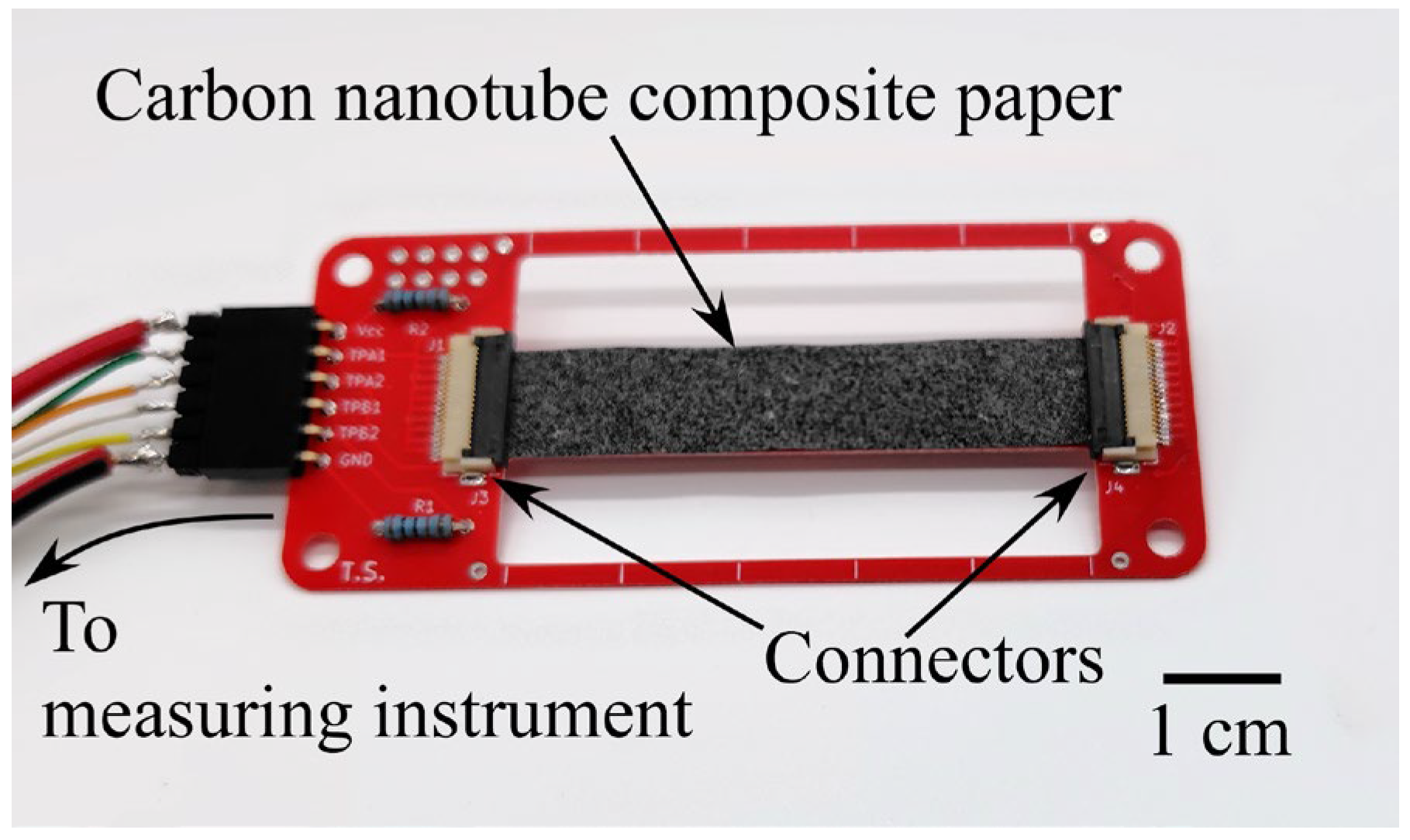
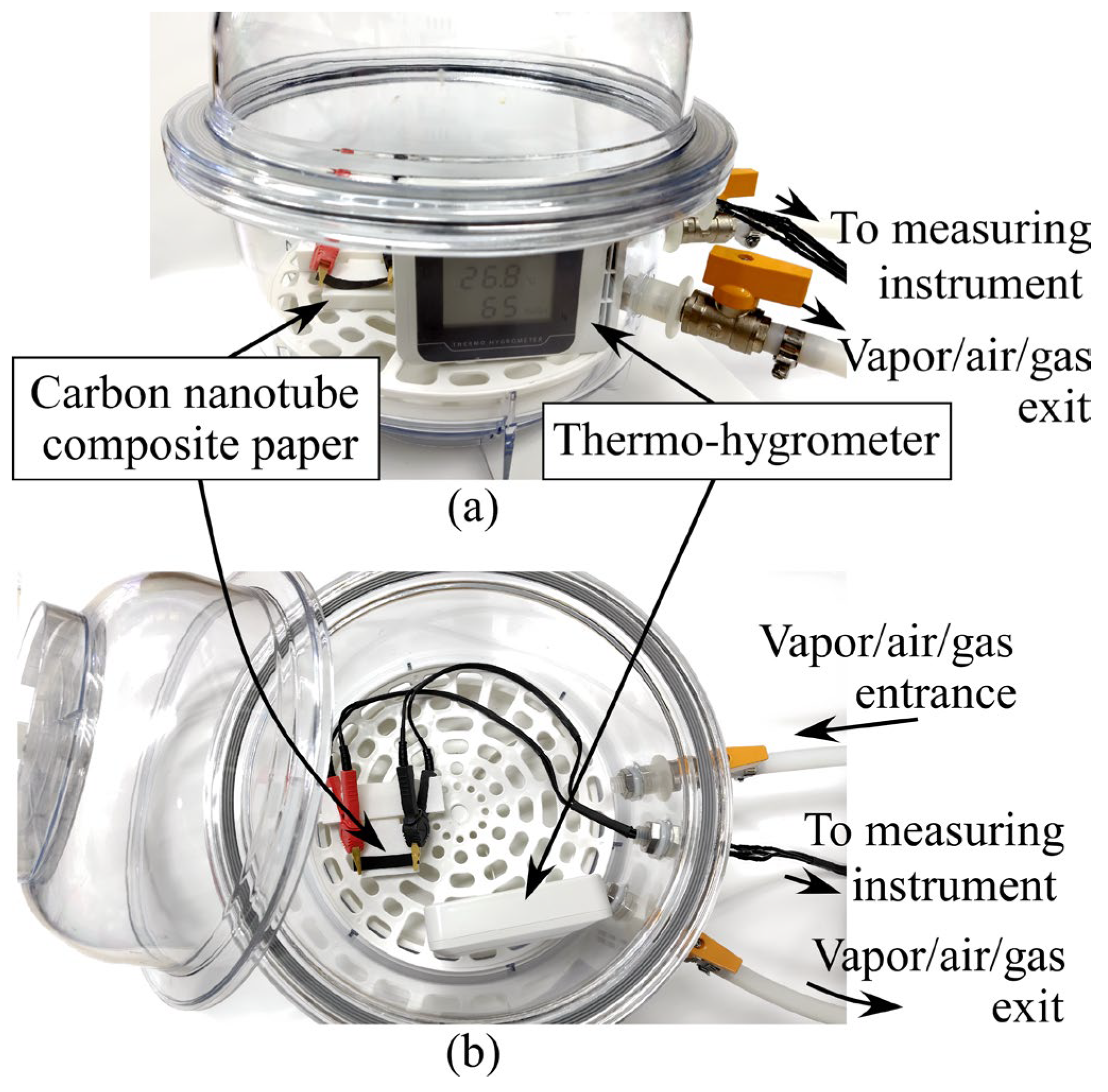
For electrical measurements, the resistance values of the samples before and after moisture absorption were each measured by a four-terminal measurement method in this experiment, and the rate of change in resistance was evaluated. Specifically, the rate of change was evaluated through three different experiments. The first was associated with the observation made with the 3D shape measuring device described above. In the observation with the 3D shape measuring device, the volume change was measured before and after 10 μL of water (visible water droplets) was dropped onto the center of a sample cut into 1 × 5 cm2, and the resistance values before and after the drop of water were measured. Second, since it was difficult to observe the resistance change in real time with the above 3D shape measuring device due to the measurement environment, we measured the resistance change in real time without using the shape measuring device. For precise measurement, a special substrate as shown in Figure 2 was fabricated and the time response of the resistance change was measured. Third, to evaluate the response to invisible vapor (humidity) as well as visible water droplets, we prepared a desiccator (RVD-250, AS ONE Corporation, Osaka, Japan) as shown in Figure 3 and investigated the resistance change of the sample to humidity change. Here, since the substrate for measurement shown in Figure 2 could be affected by humidity, resistance measurement was performed by simple wiring without using the substrate.

3. Results and Discussion

3.1. Resistivity of CNT Composite Paper

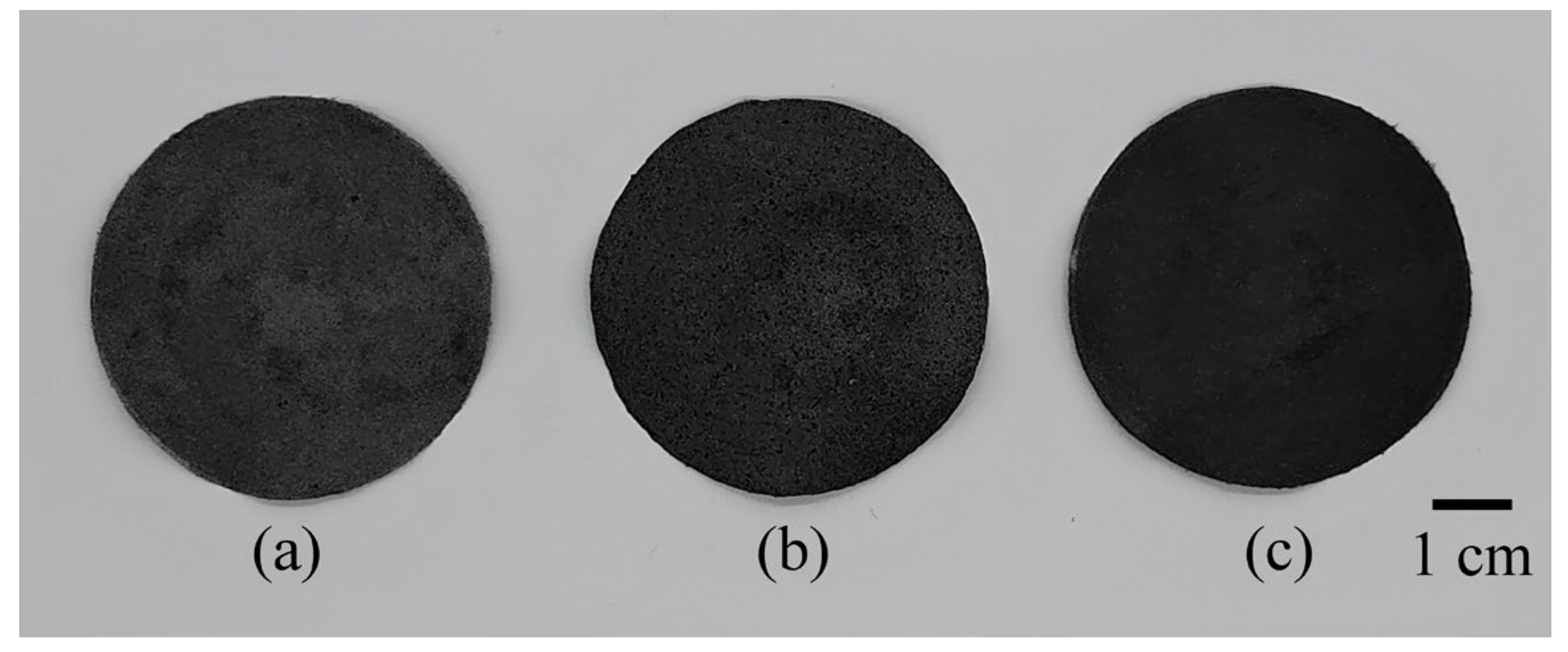
After the CNT composite papers were prepared by following the methods described in Section 2.1, their resistivity was measured. Figure 4 shows the fabricated CNT composite papers, and Table 2 shows the measured results. From the table, it can be seen that the targeted resistance values were generally obtained, although there is some variation in the values obtained due to manual sample preparation.
We have already clarified the basic physical properties of CNT composite papers in our previous research using several methods, including scanning electron microscopy (SEM), transmission electron microscopy (TEM), Raman scattering spectroscopy, and X-ray fluorescence (XRF) spectrometry [14,28,29]. Since the making methods and materials used have many similarities, the internal structure and other features can generally be considered to be largely the same as those clarified in our previous studies.
For practical applications, investigation into the durability and reliability of the CNT network and cellulose fibers over time is expected. The durability (including strength) of the CNT composite paper has been discussed in our previous research [30]. In addition, we have confirmed that our CNT composite paper can maintain its shape for at least 15 years (still in existence). Furthermore, applying longevity techniques used in existing papermaking technologies could enable even longer-term use. Moreover, the traditional Japanese washi paper has examples dating back over 1000 years that still exist today, suggesting it should be sufficiently durable for long-term use. The reliability of CNT composite paper is considered to depend on the precision of its fabrication. Although the fabrication method used in this study is manual, it is essentially highly compatible with industrial papermaking techniques [47]. This means that high-quality CNT composite papers can be fabricated in a factory setting.

3.2. Evaluation of Changes in Volume and Resistivity of CNT Composite Paper with Moisture Absorption

3.2.1. Evaluation of Relationship Between Volume and Resistance Changes

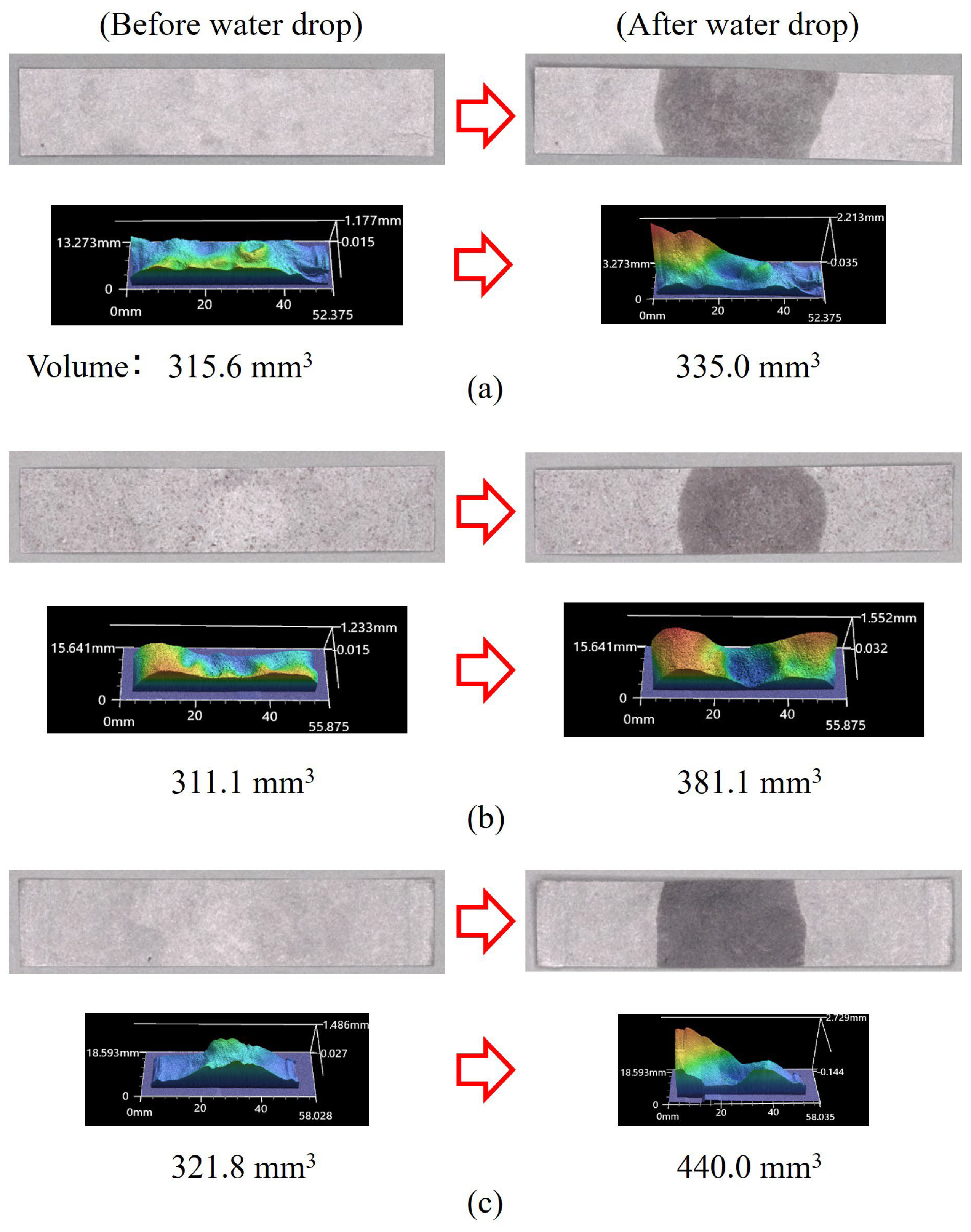
After fixing the prepared samples to a substrate for resistance measurement, they were placed inside a 3D shape measuring device to measure the shape change before and after water drops and the resistance value at that time. Figure 5 shows the observed results obtained from three CNT composite papers, respectively, and Table 3 shows measured resistance values. From the results, it was found that a large volume change occurred for all samples due to the visible water drop, as expected. In some samples, such as the NC7000 sample shown in Table 3, a large volume change of more than 35% was observed. This is thought to be due not only to the volume expansion of the cellulose fibers themselves, but also to the efficient expansion of the space formed by the fiber network, which resulted in a large volume change in the paper as a whole. In the 3D shape profile, a larger change was observed at the edge of the sample than at the center before and after the drop of water, which indicates that the paper has visibly warped due to water absorption and the resulting volume change. In this verification, we took this into account and correctly evaluated the volume change in the area where water absorption occurred. It was also confirmed that a large change in the measured resistance value occurred in accordance with this change. The results show that the volume expansion of the paper fibers that make up the CNT composite paper due to moisture absorption has a significant effect on the composition of the internal CNT network. On the other hand, the difference in the rate of resistance change depending on the type of CNTs used is thought to be derived from their length and shape.
For example, in the case of the CNT composite paper using SG101, which had the smallest rate of change, we consider the reason to be its very long length compared to other CNTs. According to information given by the supplier, the length of SG101 is several hundred µm. In contrast, the expansion of the paper fibers due to moisture absorption is also several hundred μm. Therefore, even if the CNT network was affected by the expansion of the paper fibers, CNT connections were maintained without being broken, which is considered to be a high ratio. Therefore, the rate of change in resistance is considered to be lower than the others. Furthermore, the longer length of CNTs, which are known to have high mechanical strength, inhibited expansion on the paper fiber side, and as a result, the volume change of the CNT composite paper as a whole was suppressed compared to other samples.
In the case of the CNT composite paper using NC7000, the sample exhibited a 36.7% volume change. Assuming equal volume expansion in all three x, y, and z axes and calculating the expansion per axis, the expansion degree is approximately 1.11 times. NC7000 has a diameter of about 10 nm and a length on the order of 1 μm. Unlike paper, each CNT itself does not undergo volume expansion. Based on our previous research [14], we have found that CNTs were somewhat fixed to the surface of the paper fibers. Assuming that conductivity arises from multiple CNTs being interconnected in an alternating manner along the fiber direction, it is expected that the volume expansion of the paper fibers will cause the CNT connection points to shift (be separated). Assuming the fiber length before volume expansion is 1 μm, a simple calculation yields 1.11 μm after the expansion. If the length of the CNT connection point is 50 nm for example, the volume expansion would cause the CNT connections to break. Consequently, this is thought to have resulted in the observed resistance change shown in Table 3.
Although interest is growing in the internal conditions of samples, including nanoscale CNT networks after moisture absorption, detailed observation is currently difficult. This is because moisture-containing samples generally cannot be evaluated using SEM. On the other hand, optical microscopes capable of observing moisture-containing samples cannot observe nanoscale CNTs, making evaluation of the CNT network challenging. In the future, once a method for observing moisture-containing nanoscale networks is established, we aim to clarify the condition of the moisture-containing CNT composite paper.
In order to realize a CNT composite paper-based moisture sensing element that utilizes the expansion of paper fibers due to moisture absorption, it is considered important to select CNTs of appropriate length and CNT content to the extent that the network is moderately broken by the expansion of paper fibers.

3.2.2. Real-Time Observation of Resistance Change to Water Droplet Absorption

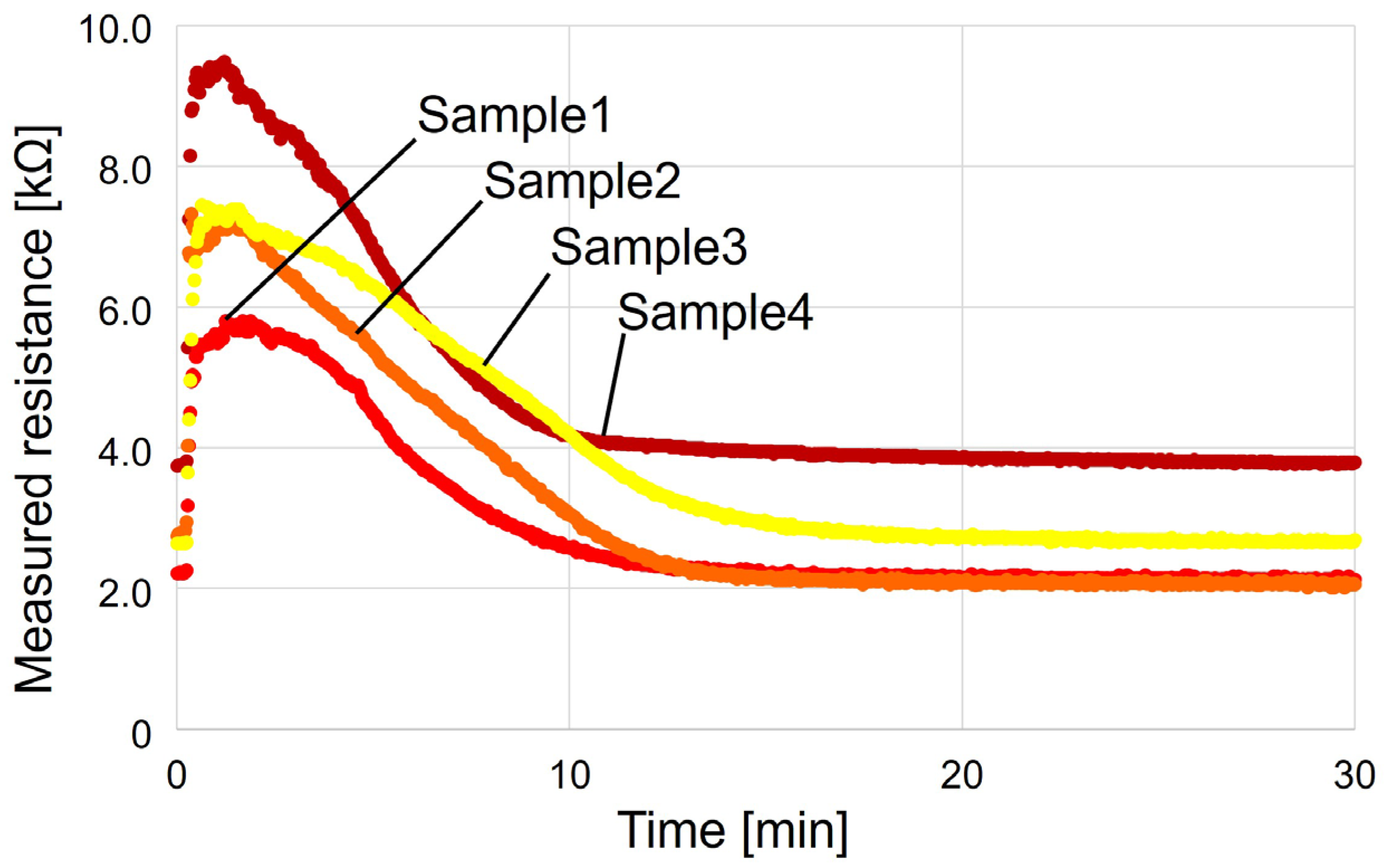
To observe the time response of the resistance change, we set the samples on the substrate (Figure 2) described in Section 2.2. As mentioned above, the volume and resistance changes resulting from visible water droplets were observed in all CNT composite paper samples. Here, therefore, the results of real-time resistance measurement of CNT composite paper containing NC7000 as a representative example are shown in Figure 6. In this measurement, moisture (visible mist-like water droplets) was supplied by mist spraying in order to observe the resistance change not only during water drop absorption but also during the natural drying process. Since the CNT composite paper samples were prepared by hand, there is some variation in the initial resistance. Nevertheless, all samples showed an increase in resistance with the water drop and a behavior that returned to the initial resistance value as the paper fibers contracted with the evaporation of water. The reason that the maximum resistance value after the change was not as large as the values listed in Table 3 is thought to be simply because the amount of water supplied was small. The reason why the increase in resistance with water drop is not instantaneous but takes some time to reach its peak is thought to depend on the time taken for the paper fiber to absorb the water drop. In other words, it took a few seconds for the sample used in this experiment to absorb the water droplets into the paper after they were dropped, and this was reflected in the change in resistance with time. In the sample of CNT composite paper with a certain degree of hydrophobicity, water droplets are not easily absorbed, and the resistance change does not appear accordingly. The CNT network inside the composite paper, which was destroyed as the paper expanded in volume, is thought to have reconstructed the network again inside the composite paper as the paper shrunk, resulting in a return to the initial resistance value. In support of this, when the amount of CNTs used at the time of fabrication was high, more networks were formed during paper shrinkage compared to the initial state, and some samples were confirmed to have a lower resistance value than the initial resistance value. Sample 2 in Figure 6 shows slightly such a tendency. Although the making conditions were the same as the other samples, it is thought that the CNTs were locally concentrated in the composite paper and the resultant concentration was apparent. On the other hand, when the amount of CNTs used is low, the CNT network cannot be reconstructed as much as in the initial state during paper shrinkage, and some samples were confirmed to show higher resistance values than the initial resistance values. In all cases, the phenomenon of the resistance value increasing with the water drop was indeed observed. Based on the above results, CNT composite paper is expected to be applied as a moisture sensing element, since the resistance change occurs immediately with the absorption of moisture. In addition, it is clear that the paper can be used repeatedly as a sensor if the appropriate balance of CNTs and pulp material is used.

3.2.3. Evaluation of Resistance Change Regarding Humidity

Finally, to evaluate the response to invisible vapor (humidity) as well as visible water droplets, the change in resistance of the sample to humidity change was examined. As in Section 3.2.2, the results of changes in humidity for CNT composite paper containing NC7000 are shown here as a representative example. First, before starting the experiment, the experimental samples were stored in a dry desiccator (ND-1S, AS ONE Corporation, Osaka, Japan) set at 30% humidity for two days to ensure that the initial conditions for the moisture content at the start of the experiment were the same. Next, the humidity of the measurement environment was lowered to 30% by initially introducing dry nitrogen into the desiccator shown in Figure 3. After setting the samples in the desiccator, vapor was introduced to raise the humidity in it, and changes in the resistance values of the samples in response to changes in humidity were measured. In addition, we also investigated the response to sudden changes in humidity.
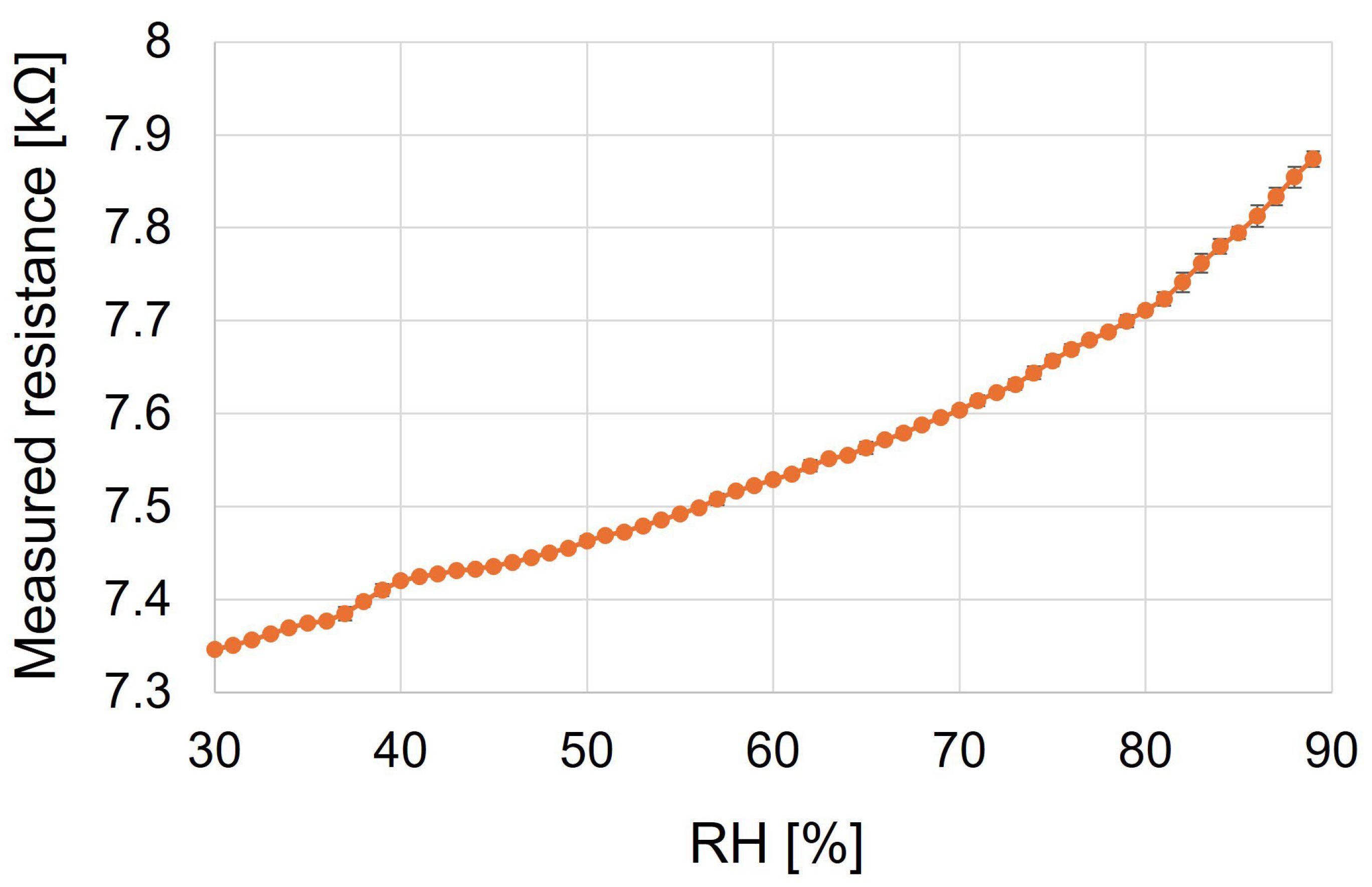
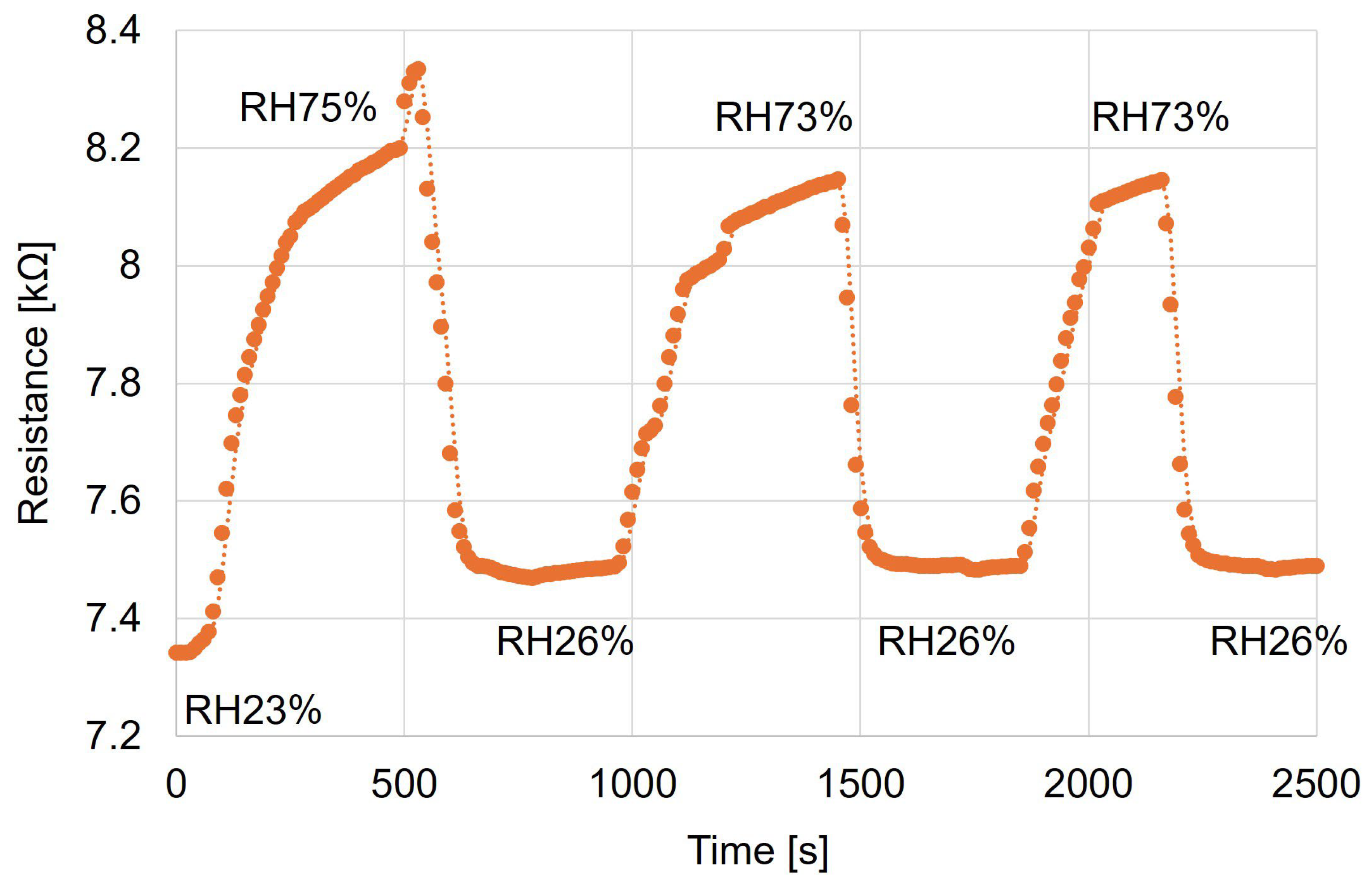
The experimental results of resistance variation with humidity are shown in Figure 7 and Figure 8. The experimental results show that the samples respond well to humidity. In Figure 7, the results also showed that the change in resistance was relatively linear in relation to humidity, whereas the rate of change in resistance was greater under high humidity conditions (approximately 75% RH or higher). This is thought to be due to the fact that the volume expansion of paper fibers is greater under high humidity conditions. In Figure 8, the results of the repeated drying and vapor exposure test are shown. Although some variation existed in humidity control levels and timing due to experimental environment factors, the result was generally desirable and as expected. A small peak appears at the end of the first cycle in the graph. This is because moisture that had condensed along the vapor inlet line was blown off by the gas pressure when the vapor was introduced into the container and directly attached to the sample. This response suggests that water droplets can potentially be detected even in high-humidity environments. (The adhered moisture droplets evaporated and disappeared during the second cycle of drying). Comparing the measurement results in Figure 7 and Figure 8 with those of an existing capacitive- or resistive-type humidity sensor [13,48], while the response speed shows a time constant that is several times slower in some cases, the sensitivity results are comparable. In the following Section 3.3, the performance and characteristics of our sample will be discussed in detail with comparisons to other research cases. Regarding the response speed (Figure 8), the delay during the exchange of dry/wet air during the experiment was included in the measurement. So, the actual response speed of the sample may be faster than the results shown in Figure 8. In addition, since the quantitative balance between CNTs and pulp has not yet been optimized at this stage, further studies are expected to improve the response speed. Moreover, advantages in flexibility, ease of fabrication, and manufacturing cost are considered to exist (the CNT content in the formed CNT composite paper sample was less than 250 µg and can be further reduced depending on the conditions), suggesting suitability for practical applications.

3.3. Comparison with Other Studies on Moisture Sensing Elements

Based on the above results, the CNT composite paper can detect a wide range of moisture, from large droplets such as visible water droplets to invisible minute moisture that can affect humidity, by taking advantage of the responsiveness to liquids of the cellulose that makes up the paper. In this study, the temperature of the experimental environment was room temperature (approximately 25 °C). Pressure was not specifically controlled but is assumed to be atmospheric pressure. The moisture detection mechanism is thought to primarily operate based on the volume change of cellulose due to moisture absorption. Research on cellulose itself has been conducted for a long time, as introduced in Refs. [35,36], and its physical properties have been clarified. We believe that at least for use in the daily environment, it will not deviate significantly from the results of the evaluation conducted in this study. In addition, there are many reports on sensing elements utilizing the responsiveness of cellulose to water [46,49,50,51,52,53]. Furthermore, there are research examples that have successfully developed high-performance humidity sensors by combining cellulose itself or cellulose paper with additional functionalities [54,55,56,57,58]. Comparing several research examples with the examples in this study, they appear to be comparable as shown in Table 4. This demonstrates that despite our approach’s simplicity of fabrication, it exhibits performance comparable to sensing elements reported in other studies. Unlike other reports, we have clearly established that our sensing element can be applied across a broad range, from humidity to water droplets. In reports on other 2D or 3D sensing elements [51,52], for example, moisture sensing is achieved by attaching comb-shaped electrodes to the sample. If moisture adheres to areas outside the electrode region, it may not be able to be detected. Another study [54] demonstrates a humidity sensor with a simple structure: conductive tape attached to printing paper. However, there is a constraint that the electrode spacing must be less than a few mm. Additionally, there are reports using ordinary printing paper as a substrate [54,56,57]; while printing paper is easy to use, it can take time until the water absorption begins. There are also examples where high-performance humidity sensors are achieved by incorporating hygroscopic or deliquescent substances such as LiCl or NaCl into cellulose itself or cellulose paper [57,58]. Such substances are generally ionic compounds, and because they are easy to prepare in solution, they can also be readily incorporated into cellulose. This allows for easy enhancement of the responsiveness of sensors to humidity. However, these ionic compounds also possess high water solubility. Therefore, if condensation occurs on the humidity sensor incorporating them or if the sensor becomes submerged, the ionic compounds may leak out, resulting in significant performance degradation. Our approach, in contrast, does not require comb-shaped electrodes to be placed on the surface; electrodes attached only to both ends of the sample suffice. While verification is needed for extremely long samples, there are no particular limitations on the electrode spacing for samples around several cm in length. With this simple structure, detection is possible not only across the entire paper surface but also when only part of the paper is wet. Moreover, it can be mass-produced in paper mills. Considering practicality, ease of manufacturing can be a significant point. This approach demonstrated that our CNT composite paper can be used as a sufficiently effective humidity/water sensing element without introducing any substances other than CNTs onto the cellulose paper. If necessary in the future, it is possible to add further functional substances as described above, i.e., the CNT composite paper is capable of accommodating other functional substances, which may result in the humidity/water sensing element with even higher performance.
The proposed humidity/water sensing method can be described as a DC resistance-based approach. This method is not commonly used and differs from the conventional humidity sensors [13,59,60,61,62], such as resistance, capacitance, impedance, optical, frequency, and rising voltage (self-powered electrochemical and triboelectricity humidity sensors) types. However, as demonstrated in this study, our approach can be applied from humidity to visible water droplets. Furthermore, practical manufacturing methods and the circuits and systems connecting to the sensing element (CNT composite paper) are undergoing concrete development. Therefore, this DC resistance type is also expected to be utilized in the future.
While this proposed sensing element may potentially be used for more advanced detection in the future, its initial application is expected to monitor how conditions change from the start of sensing. For practical use, the connection between the CNT composite paper and the accompanying circuits is intended, as shown in Figure 2 (it does not show the circuit, but it is assumed that the circuit is connected to the end of the lead wire). At the start of use, the sensing system installed on that circuit is intended to memorize the initial resistance value of the CNT composite paper and operate accordingly. Therefore, even if the CNT composite paper exhibits initial value variations like those in Figure 6, the sensing system will perform compensation, so it is considered acceptable for use.

4. Conclusions

In this study, we aimed to develop a moisture sensing element including a humidity sensor based on the CNT composite paper, which is a composite material of CNTs and paper and contains cellulose as a constituent material of the paper. Cellulose is known to change its volume by up to 35% when moisture is absorbed. The paper fibers are on the micrometer scale, while the CNTs contained in the composite paper are on the nanometer scale. This means that when cellulose changes in volume by 35%, the CNTs attached to the fibers undergo a dramatic change in shape, resulting in a change in the resistance of the CNT composite paper.
In the experiments, it was confirmed that the volume change actually occurs with the absorption of moisture, which is closely related to the resistance change. Furthermore, the change in resistance was confirmed not only during moisture absorption but also during the following drying process. This means that real-time moisture detection is possible. Moreover, it became clear that not only the response to visible water droplets but also changes in humidity can be detected. In this study, since the samples were made manually, there was some variation in the initial resistance values; however, all samples showed the same response to moisture. For practical application, it will be necessary to standardize parameters including resistance values, though we anticipate that this issue can be resolved by utilizing existing paper manufacturing processes and technologies.
In summary, we have demonstrated the feasibility of a CNT composite paper-based moisture sensing element that is easy to fabricate and has a simple principle of operation. Our CNT composite paper, being in the form of paper, can be introduced into everyday paper products such as cardboard boxes, wallpapers, and furniture. In other words, these everyday paper products themselves can become moisture sensing elements. Furthermore, regarding power sources for operation of the sensors and circuit implementation to control and monitor them, we are also studying paper-based power sources and circuit elements in our other research. Additionally, research in areas such as printable electronics and paper electronics is advancing to develop the power sources and circuits by other research groups. Therefore, this moisture sensing element is expected to be useful in fields such as the IoT in the near future.

Author Contributions

All authors contributed equally. Conceptualization, T.O., T.S., Y.M. and K.A.; methodology, T.O., T.S., Y.M. and K.A.; validation, T.O., T.S., Y.M. and K.A.; formal analysis, T.O., T.S. and K.A.; investigation, T.O. and K.A.; resources, T.O., T.S., Y.M. and K.A.; data curation, T.O., T.S. and Y.M.; model, T.O.; writing—original draft preparation, T.O.; writing—review and editing, T.O., T.S., Y.M. and K.A.; visualization, T.O., T.S. and Y.M.; supervision, T.O.; project administration, T.O. All authors have read and agreed to the published version of the manuscript.

Funding

This research was partly funded by JSPS KAKENHI, grant number JP23K17814.

Institutional Review Board Statement

Not applicable.

Informed Consent Statement

Not applicable.

Data Availability Statement

The data that support the findings of this study are available from the corresponding author upon reasonable request.

Conflicts of Interest

Author Tadashi Saito is employed by the company Azbil Corporation. And authors Yuma Morita and Koya Arai are employed by the company Mitsubishi Materials Corporation. The remaining author declares that the research was conducted in the absence of any commercial or financial relationships that could be construed as a potential conflict of interest.

Abbreviations

The following abbreviations are used in this manuscript:
IoTInternet of Things
CNTCarbon nanotube
SWCNTSingle-walled carbon nanotube
MWCNTMulti-walled carbon nanotube
SDSSodium dodecyl sulfate
3DThree dimensional
2DTwo dimensional
1DOne dimensional

References

  1. Hart, J.K.; Martinez, K. Environmental sensor networks: A revolution in the earth system science? Earth-Sci. Rev. 2006, 78, 177–191. [Google Scholar] [CrossRef]
  2. Kelly, S.D.T.; Suryadevara, N.K.; Mukhopadhyay, S.C. Towards the implementation of IoT for environmental condition monitoring in homes. IEEE Sens. J. 2013, 13, 3846–3853. [Google Scholar] [CrossRef]
  3. Chen, D.; Liu, Z.; Wang, L.; Dou, M.; Chen, J.; Li, H. Natural disaster monitoring with wireless sensor networks: A case study of data-intensive applications upon low-cost scalable systems. Mob. Netw. Appl. 2013, 18, 651–663. [Google Scholar] [CrossRef]
  4. Benoit, L.; Briole, P.; Martin, O.; Thom, C.; Malet, J.-P.; Ulrich, P. Monitoring landslide displacements with the Geocube wireless network of low-cost GPS. Eng. Geol. 2015, 195, 111–121. [Google Scholar] [CrossRef]
  5. Wang, L.; Ma, W.; Xu, L.; Chen, W.; Zhu, Y.; Xu, C.; Kotov, N.A. Nanoparticle-based environmental sensors. Mater. Sci. Eng. R Rep. 2010, 70, 265–274. [Google Scholar] [CrossRef]
  6. Shakeel, A.; Rizwan, K.; Farooq, U.; Iqbal, S.; Iqbal, T.; Awwad, N.S.; Ibrahium, H.A. Polymer based nanocomposites: A strategic tool for detection of toxic pollutants in environmental matrices. Chemosphere 2022, 303, 134923. [Google Scholar] [CrossRef]
  7. Catarinucci, L.; de Donno, D.; Mainetti, L.; Palano, L.; Patrono, L.; Stefanizzi, M.L.; Tarricone, L. An IoT-aware architecture for smart healthcare systems. IEEE Internet Things J. 2015, 2, 515–526. [Google Scholar] [CrossRef]
  8. Li, W.; Kara, S. Methodology for monitoring manufacturing environment by using wireless sensor networks (WSN) and the Internet of Things (IoT). Procedia CIRP 2017, 61, 323–328. [Google Scholar] [CrossRef]
  9. Dong, B.; Andrews, B.; Lam, K.P.; Höynck, M.; Zhang, R.; Chiou, Y.-S.; Benitez, D. An information technology enabled sustainability test-bed (ITEST) for occupancy detection through an environmental sensing network. Energy Build. 2010, 42, 1038–1046. [Google Scholar] [CrossRef]
  10. Rivera, A.; Ponce, P.; Mata, O.; Molina, A.; Meier, A. Local Weather Station Design and Development for Cost-Effective Environmental Monitoring and Real-Time Data Sharing. Sensors 2023, 23, 9060. [Google Scholar] [CrossRef]
  11. Sulzer, M.; Christen, A.; Matzarakis, A. Predicting indoor air temperature and thermal comfort in occupational settings using weather forecasts, indoor sensors, and artificial neural networks. Build. Environ. 2023, 234, 110077. [Google Scholar] [CrossRef]
  12. Chan, K.; Schillereff, D.N.; Baas, A.C.; Chadwick, M.A.; Main, B.; Mulligan, M.; O’Shea, F.T.; Pearce, R.; Smith, T.E.; van Soesbergen, A.; et al. Low-cost electronic sensors for environmental research: Pitfalls and opportunities. Prog. Phys. Geogr. Earth Environ. 2020, 45, 305–338. [Google Scholar] [CrossRef]
  13. Farahani, H.; Wagiran, R.; Hamidon, M.N. Humidity sensors principle, mechanism, and fabrication technologies: A comprehensive review. Sensors 2014, 14, 7881–7939. [Google Scholar] [CrossRef] [PubMed]
  14. Oya, T.; Ogino, T. Production of electrically conductive paper by adding carbon nanotubes. Carbon 2008, 46, 169–171. [Google Scholar] [CrossRef]
  15. Iijima, S. Helical micro-tubules of graphitic carbon. Nature 1991, 354, 56–58. [Google Scholar] [CrossRef]
  16. Popov, V.N. Carbon nanotubes: Properties and application. Mater. Sci. Eng. R Rep. 2004, 43, 61–102. [Google Scholar] [CrossRef]
  17. Odom, T.W.; Huang, J.L.; Kim, P.; Lieber, C.M. Atomic structure and electronic properties of single-walled carbon nanotubes. Nature 1998, 391, 62–64. [Google Scholar] [CrossRef]
  18. Ebbesen, T.W.; Lezec, H.J.; Hiura, H.; Bennett, J.W.; Ghaemi, H.F.; Thio, T. Electrical conductivity of individual carbon nanotubes. Nature 1996, 382, 54–56. [Google Scholar] [CrossRef]
  19. Yu, M.F.; Files, B.S.; Arepalli, S.; Ruoff, R.S. Tensile loading of ropes of single wall carbon nanotubes and their mechanical properties. Phys. Rev. Lett. 2000, 84, 5552–5555. [Google Scholar] [CrossRef]
  20. Dresselhaus, M.S.; Dresselhaus, G.; Avouris, P. (Eds.) Carbon Nanotubes: Synthesis, Structure, Properties, and Applications; Springer: Berlin, Germany, 2000. [Google Scholar]
  21. Jorio, A.; Dresselhaus, M.S.; Dresselhaus, G. (Eds.) Carbon Nanotubes: Advanced Topics in the Synthesis, Structure, Properties, and Applications; Springer: Berlin, Germany, 2008. [Google Scholar]
  22. Hata, K. Great expectations for a dream material, 21st century industrial revolution. AIST Stories 2013, 1, 18–19. [Google Scholar]
  23. Lau, A.K.-T.; Hui, D. The revolutionary creation of new advanced materials—Carbon nanotube composites. Compos. Part B Eng. 2002, 33, 263–277. [Google Scholar] [CrossRef]
  24. Khare, R.; Bose, S. Carbon nanotube based composites—A review. J. Miner. Mater. Charact. Eng. 2005, 4, 31–46. [Google Scholar] [CrossRef]
  25. Byrne, M.T.; Gun’ko, Y.K. Recent advances in research on carbon nanotube–polymer composites. Adv. Mater. 2010, 22, 1672–1688. [Google Scholar] [CrossRef] [PubMed]
  26. Esawi, A.M.K.; Farag, M.M. Carbon nanotube reinforced composites: Potential and current challenges. Mater. Des. 2007, 28, 2394–2401. [Google Scholar] [CrossRef]
  27. Kou, Y.; Oya, T. Unique dye-sensitized solar cell using carbon nanotube composite-papers with gel electrolyte. J. Compos. Sci. 2023, 7, 232. [Google Scholar] [CrossRef]
  28. Kamekawa, Y.; Arai, K.; Oya, T. Development of transpiration-type thermoelectric power generating material using carbon-nanotube-composite papers with capillary action and heat of vaporization. Energies 2023, 16, 8032. [Google Scholar] [CrossRef]
  29. Miyama, A.; Oya, T. Improved performance of thermoelectric power generating paper based on carbon nanotube composite papers. Carbon Trends 2022, 7, 100149. [Google Scholar] [CrossRef]
  30. Okochi, K.; Oya, T. Unique triboelectric nanogenerator using carbon nanotube composite papers. Appl. Sci. 2024, 14, 10030. [Google Scholar] [CrossRef]
  31. Toyomasu, R.; Oya, T. Development and Improvement of a “Paper Actuator” Based on Carbon Nanotube Composite Paper with Unique Structures. J. Compos. Sci. 2024, 8, 391. [Google Scholar] [CrossRef]
  32. Suhas; Gupta, V.K.; Carrott, P.J.M.; Singh, R.; Chaudhary, M.; Kushwaha, S. Cellulose: A review as natural, modified and activated carbon adsorbent. Bioresour. Technol. 2016, 216, 1066–1076. [Google Scholar] [CrossRef]
  33. Sheppard, S.E.; Newsome, P.T. The sorption of water by cellulose. Ind. Eng. Chem. 1934, 26, 284–290. [Google Scholar] [CrossRef]
  34. Etale, A.; Onyianta, A.J.; Turner, S.R.; Eichhorn, S.J. Cellulose: A review of water interactions, applications in composites, and water treatment. Chem. Rev. 2023, 123, 2016–2048. [Google Scholar] [CrossRef]
  35. Chami Khazraji, A.; Robert, S. Interaction effects between cellulose and water in nanocrystalline and amorphous regions: A novel approach using molecular modeling. J. Nanomater. 2013, 2013, 409676. [Google Scholar] [CrossRef]
  36. Morehead, F.F. A method for studying the effect of humidity on the cross-sectional swelling of some common fibers. Text. Res. J. 1952, 22, 535–539. [Google Scholar] [CrossRef]
  37. Schroeder, V.; Savagatrup, S.; He, M.; Lin, S.; Swager, T.M. Carbon nanotube chemical sensors. Chem. Rev. 2019, 119, 599–663. [Google Scholar] [CrossRef] [PubMed]
  38. Lim, T.C.; Ramakrishna, S. A conceptual review of nanosensors. Z. Fuer Naturforschung A Phys. Sci. 2006, 61, 402–412. [Google Scholar] [CrossRef]
  39. Wang, J. Carbon-nanotube based electrochemical biosensors: A review. Electroanalysis 2005, 17, 7–14. [Google Scholar] [CrossRef]
  40. Mauter, M.S.; Elimelech, M. Environmental applications of carbon-based nanomaterials. Environ. Sci. Technol. 2008, 42, 5843–5859. [Google Scholar] [CrossRef]
  41. Chen, W.-P.; Zhao, Z.-G.; Liu, X.-W.; Zhang, Z.-X.; Suo, C.-G. A Capacitive Humidity Sensor Based on Multi-Wall Carbon Nanotubes (MWCNTs). Sensors 2009, 9, 7431–7444. [Google Scholar] [CrossRef]
  42. Zhang, X.; Maddipatla, D.; Bose, A.K.; Hajian, S.; Narakathu, B.B.; Williams, J.D.; Mitchell, M.F.; Atashbar, M.Z. Printed carbon nanotubes-based flexible resistive humidity sensor. IEEE Sens. J. 2020, 20, 12592–12601. [Google Scholar] [CrossRef]
  43. Cao, C.L.; Hu, C.G.; Fang, L.; Wang, S.X.; Tian, Y.S.; Pan, C.Y. Humidity sensor based on multi-walled carbon nanotube thin films. J. Nanomater. 2011, 2011, 707303. [Google Scholar] [CrossRef]
  44. Zhu, P.; Liu, Y.; Fang, Z.; Kuang, Y.; Zhang, Y.; Peng, C.; Chen, G. Flexible and highly sensitive humidity sensor based on cellulose nanofibers and carbon nanotube composite film. Langmuir 2019, 35, 4834–4842. [Google Scholar] [CrossRef] [PubMed]
  45. Yeow, J.T.W.; She, J.P.M. Carbon nanotube-enhanced capillary condensation for a capacitive humidity sensor. Nanotechnology 2006, 17, 5441. [Google Scholar] [CrossRef]
  46. Han, J.-W.; Kim, B.; Li, J.; Meyyappan, M. Carbon nanotube based humidity sensor on cellulose paper. J. Phys. Chem. C 2012, 116, 22094–22097. [Google Scholar] [CrossRef]
  47. Clapperton, R.H. (Ed.) The Paper-making Machine: Its Invention, Evolution, and Development; Pergamon Press: Oxford, UK, 1967. [Google Scholar]
  48. Zhao, Q.; Yuan, Z.; Duan, Z.; Jiang, Y.; Li, X.; Li, Z.; Tai, H. An ingenious strategy for improving humidity sensing properties of multi-walled carbon nanotubes via poly-L-lysine modification. Sens. Actuators B Chem. 2019, 289, 182–185. [Google Scholar] [CrossRef]
  49. Qi, H.; Liu, J.; Deng, Y.; Gao, S.; Mäder, E. Cellulose fibres with carbon nanotube networks for water sensing. J. Mater. Chem. A 2014, 2, 5541–5547. [Google Scholar] [CrossRef]
  50. Qi, H.; Mäder, E.; Liu, J. Unique water sensors based on carbon nanotube–cellulose composites. Sens. Actuators B Chem. 2013, 185, 225–230. [Google Scholar] [CrossRef]
  51. Guan, X.; Hou, Z.; Wu, K.; Zhao, H.; Liu, S.; Fei, T.; Zhang, T. Flexible humidity sensor based on modified cellulose paper. Sens. Actuators B Chem. 2021, 339, 129879. [Google Scholar] [CrossRef]
  52. Zhu, L.; Li, X.; Kasuga, T.; Uetani, K.; Nogi, M.; Koga, H. All-cellulose-derived humidity sensor prepared via direct laser writing of conductive and moisture-stable electrodes on TEMPO-oxidized cellulose paper. J. Mater. Chem. A 2022, 10, 3712–3719. [Google Scholar] [CrossRef]
  53. Zhu, P.; Wei, Y.; Kuang, Y.; Qian, Y.; Liu, Y.; Jiang, F.; Chen, G. Porous and conductive cellulose nanofiber/carbon nanotube foam as a humidity sensor with high sensitivity. Carbohydr. Polym. 2022, 292, 119684. [Google Scholar] [CrossRef]
  54. Duan, Z.; Jiang, Y.; Yan, M.; Wang, S.; Yuan, Z.; Zhao, Q.; Sun, P.; Xie, G.; Du, X.; Tai, H. Facile, flexible, cost-saving, and environment-friendly paper-based humidity sensor for multifunctional applications. ACS Appl. Mater. Interfaces 2019, 11, 21840–21849. [Google Scholar] [CrossRef]
  55. Liu, X.; Wang, L.; Lei, Y.; Li, X.; Cheng, C.; Yang, L.; Jiao, L.; Yang, S.; Shu, D.; Cheng, B. Highly sensitivity and wide-range flexible humidity sensor based on LiCl/cellulose nanofiber membrane by one-step electrospinning. Chem. Eng. J. 2025, 503, 158018. [Google Scholar] [CrossRef]
  56. Niu, G.; Wang, Z.; Xue, Y.; Yan, J.; Dutta, A.; Chen, X.; Wang, Y.; Liu, C.; Du, S.; Guo, L.; et al. Pencil-on-paper humidity sensor treated with NaCl solution for health monitoring and skin characterization. Nano Lett. 2023, 23, 1252–1260. [Google Scholar] [CrossRef] [PubMed]
  57. Zhang, R.; Huang, J.; Guo, Z. Functionalized paper with intelligent response to humidity. Colloids Surf. A Physicochem. Eng. Asp. 2022, 633, 127844. [Google Scholar] [CrossRef]
  58. Tachibana, S.; Wang, Y.-F.; Sekine, T.; Takeda, Y.; Hong, J.; Yoshida, A.; Abe, M.; Miura, R.; Watanabe, Y.; Kumaki, D.; et al. A printed flexible humidity sensor with high sensitivity and fast response using a cellulose nanofiber/carbon black composite. ACS Appl. Mater. Interfaces 2022, 14, 5721–5728. [Google Scholar] [CrossRef]
  59. Arman Kuzubasoglu, B. Recent studies on the humidity sensor: A mini review. ACS Appl. Electron. Mater. 2022, 4, 4797–4807. [Google Scholar] [CrossRef]
  60. Gabrielli, V.; Frasconi, M. Cellulose-based functional materials for sensing. Chemosensors 2022, 10, 352. [Google Scholar] [CrossRef]
  61. Zhang, M.; Xu, T.; Liu, K.; Zhu, L.; Miao, C.; Chen, T.; Gao, M.; Wang, J.; Si, C. Modulation and mechanisms of cellulose-based hydrogels for flexible sensors. SusMat. 2025, 5, e255. [Google Scholar] [CrossRef]
  62. Teodoro, K.B.R.; Sanfelice, R.C.; Migliorini, F.L.; Pavinatto, A.; Facure, M.H.M.; Correa, D.S. A review on the role and performance of cellulose nanomaterials in sensors. ACS Sens. 2021, 6, 2473–2496. [Google Scholar] [CrossRef]
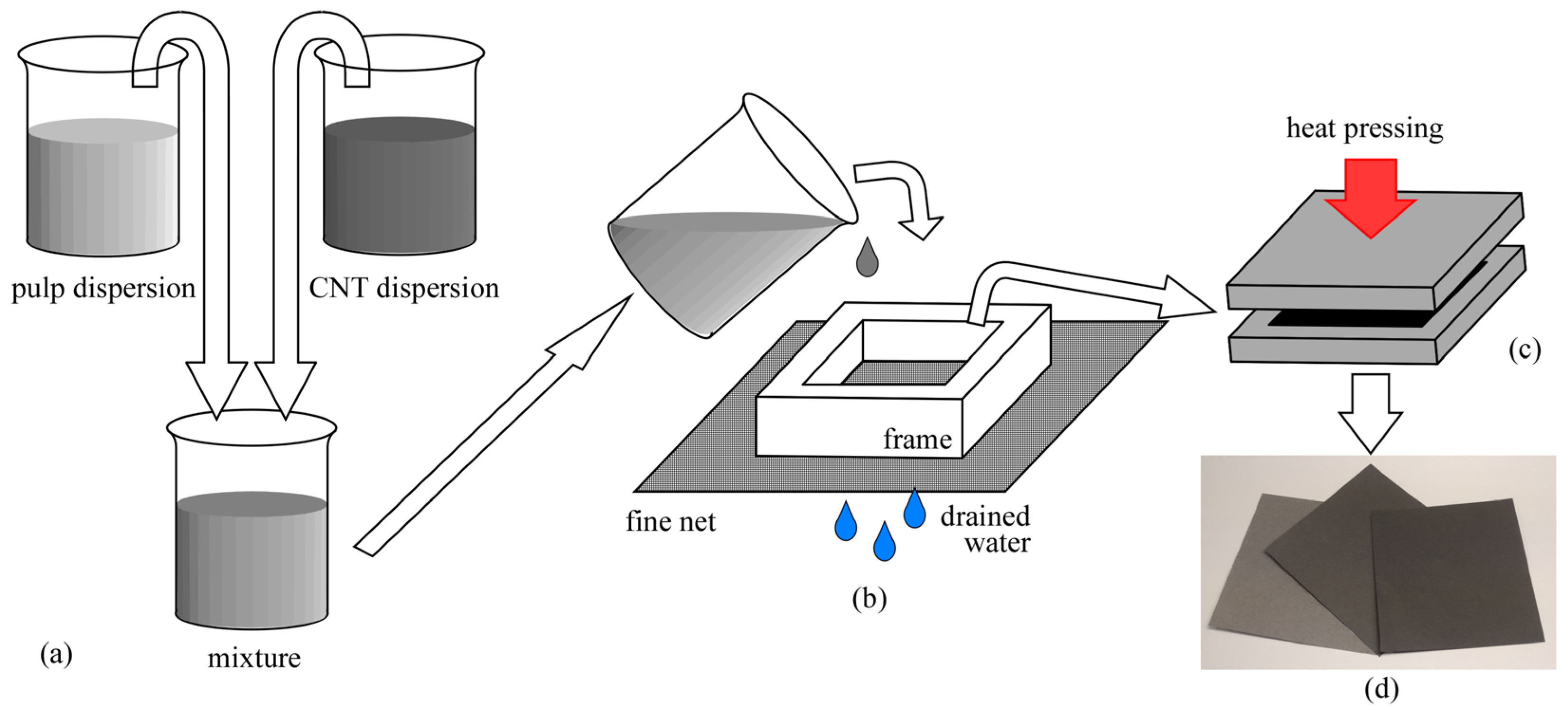
Figure 1. Carbon nanotube composite paper-making method: (a) preparing mixed solution, (b) straining water with fine net, and (c) heat pressing. (d) Samples of carbon nanotube composite papers (color differences were caused by amounts of carbon nanotubes they contained) (from Ref. [29] under License CC BY 4.0).
Chemosensors 13 00373 g001
Figure 2. Prepared substrate for CNT composite paper to evaluate its moisture sensing ability.
Chemosensors 13 00373 g002
Figure 3. Experimental setup for CNT composite paper to evaluate its humidity sensing ability. (a) Side view and (b) top view (lid of desiccator opened for easier viewing).
Chemosensors 13 00373 g003
Figure 4. Fabricated CNT composite papers made with (a) SG101, (b) (6,5)-chirality CNT, and (c) NC7000.
Chemosensors 13 00373 g004
Figure 5. Volume changes before and after visible water drops into samples using (a) SG101, (b) (6,5)-chirality CNT, and (c) NC7000. Optical photographs show CNT composite papers before and after water drops. Color images show shape of samples observed by 3D shape measuring device. Each volume has increased due to water drop.
Chemosensors 13 00373 g005
Figure 6. Resistance changes obtained from CNT composite papers containing NC7000 as a function of time. In this measurement, a mist-like water droplet was supplied to the sample by mist spray immediately after starting, and the increase in resistance due to wetting and the decrease in resistance due to natural drying thereafter were measured.
Chemosensors 13 00373 g006
Figure 7. Resistance changes obtained from CNT composite papers as a function of humidity.
Chemosensors 13 00373 g007
Figure 8. Response and recovery time for humidity of CNT composite paper.
Chemosensors 13 00373 g008
Table 1. Chosen CNTs and their quantities for preparation of CNT composite papers.
CNTQuantity [mg]Supplier
SG1010.5ZEON CORPORATION,
Tokyo, Japan
(6,5)-chirality
(SG65i)
2.0CHASM, Boston, MA, USA
NC70001.0Nanocyl SA,
Sambreville, Belgium
Table 2. Measured results obtained from fabricated CNT composite papers.
Contained CNTSheet Resistance [kΩ/sq.]Thickness [mm]
(Averaged)
SG1011.400.092
(6,5)-chirality0.640.119
NC70001.580.100
Table 3. Measured resistance obtained from CNT composite papers and their estimated change rate.
Contained CNTResistance [kΩ]
(After Water Drop)
Rate of Resistance Change [%]Rate of Volume
Change [%]
SG10110.0243.66.1
(6,5)-chirality8.15155.522.5
NC700016.84112.636.7
Table 4. Summary of characteristics of cellulose(paper)-based humidity/water sensing elements.
StructureMaterialsMethod of
Fabrication
Ease of
Fabrication
TargetSensing
Range
Response/
Recovery Time
Ref.
Fiber
(1D)
MWCNT
/Cellulose
Dip coatingGoodWater
(Immersion)

(When immersed)
N/A[49]
Film
(2D)
MWCNT
/Cellulose
Drying gel 1FairWater
(Immersion)

(When immersed)
N/A[50]
Sheet
(2D)
COOH-functionalized SWCNT
/Cellulose paper
Drop-cast coatingFairHumidity10% to 95% RH6 s/120 s[46]
Sheet
(2D)
EPTAC 2/
Cellulose paper/
Silver
Immersion/
Screen printing
FairHumidity11% to 95% RH35 s/180 s[51]
Sheet
(2D)
Printing (cellulose) paper/
Polyester conductive tape
Tape-attachGoodHumidity41.1% to 91.5% RH472 s/19 s[54]
Sheet
(2D)
LiCl/
Cellulose
nanofiber
ElectrospinningFairHumidity5% to 98% RH99 s/110 s[55]
Sheet
(2D)
Printing
(cellulose)
paper/NaCl
SoakingGoodHumidity6% to 90% RH1208 s/537 s[56]
Sheet
(2D)
Printing (cellulose) paper/
Nitrocellulose/
MWCNT
CoatingGoodHumidity
(Water is acceptable)
54% to 75% RH500 to 1000 s/
N/A
[57]
Film
(2D)
MWCNT
/Cellulose nanofiber/
Silver paste
Stencil
printing/
Annealing
FairHumidity30% to 90% RH10 s/6 s[58]
Film
(2D)
Cellulose
nanofiber
Vacuum
filtration/Processing with CO2
laser
FairHumidity11% to 98% RH60 s/495 s[52]
Foam
(3D)
Cellulose
nanofiber/
MWCNT
Freeze
drying
FairHumidity11% to 95% RH322 s/442 s[53]
Sheet
(3D 3)
CNT 4
/Cellulose
paper
PapermakingGoodBoth
humidity and water droplet
23% to 89% RH 5
< 10 μL 6
160 s/60 s 7This work
1 First, preparing the MWCNT/cellulose dispersion, then gelating it and drying it on a glass plate. 2 Glycidyl trimethyl ammonium chloride. 3 Meaning that not only the surface but also the internal structure is usable. 4 Both SWCNT and MWCNT are acceptable. 5 The measurement range is limited due to issues with the measurement environment. Detection is expected to be possible even beyond this measurement range. 6 As shown in Figure 5, this water volume is to wet one-third of the sample (approximately 1 × 5/3 cm2). This water volume is not the detection limit. 7 Estimated values from Figure 8. Due to issues with the measurement environment, the values may be higher than the actual values.
Disclaimer/Publisher’s Note: The statements, opinions and data contained in all publications are solely those of the individual author(s) and contributor(s) and not of MDPI and/or the editor(s). MDPI and/or the editor(s) disclaim responsibility for any injury to people or property resulting from any ideas, methods, instructions or products referred to in the content.