Article

Patient Safety Culture Assessment in Primary Care Settings in Greece
by
Ioannis Antonakos
1,*,
Kyriakos Souliotis
2,
Theodora Psaltopoulou
3,
Yannis Tountas
3 and
Maria Kantzanou
3
1
Laboratory of Hygiene, Epidemiology and Medical Statistics, University of Athens Medical School, 115 27 Athens, Greece
2
Faculty of Social & Political Sciences, University of Peloponnese, 20131 Corinth, Greece
3
Department of Hegiene, School of Medicine, University of Athens, 115 27 Athens, Greece
*
Author to whom correspondence should be addressed.
Healthcare 2021, 9(7), 880; https://doi.org/10.3390/healthcare9070880

Submission received: 14 June 2021 / Revised: 1 July 2021 / Accepted: 9 July 2021 / Published: 13 July 2021

Abstract

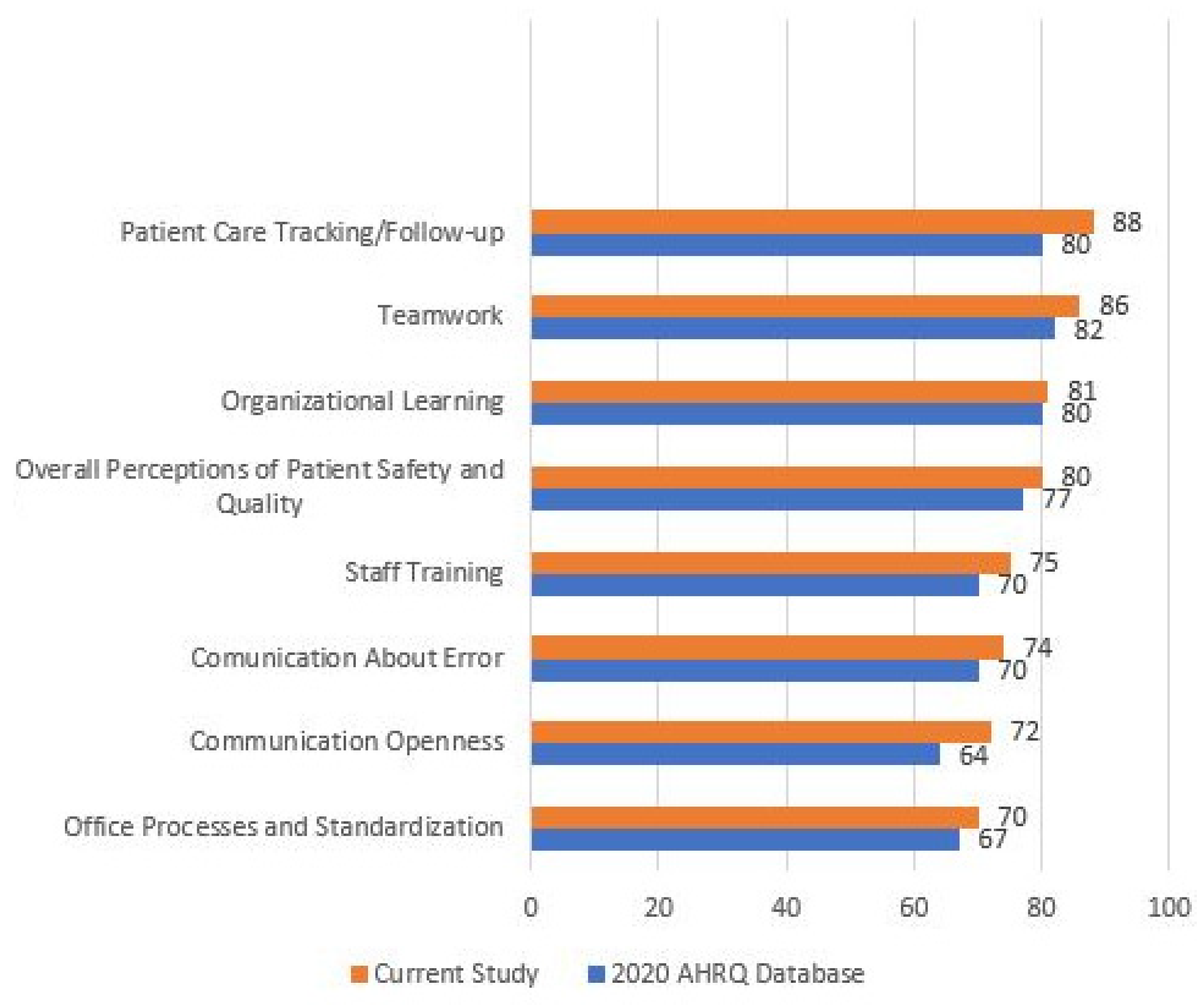
Introduction: A positive safety culture is considered a pillar of safety in health organizations and the first crucial step for quality health services. In this context, the aim of this study was to set a reference evaluation for the patient safety culture in the primary health sector in Greece, based on health professionals’ perceptions. Methods: We used a cross-sectional survey with a 62% response rate (n = 459), conducted in primary care settings in Greece (February to May 2020). We utilized the “Medical Office Survey on Patient Safety Culture” survey tool from the Agency for Healthcare Research and Quality (AHRQ). The study participants were health professionals who interacted with patients from 12 primary care settings in Greece. Results: The most highly ranked domains were: “Teamwork” (82%), “Patient Care Tracking/Follow-up” (80% of positive scores), and “Organizational Learning” (80%); meanwhile, the lowest-ranked ones were: “Leadership Support for Patient Safety” (62%) and “Work Pressure and Pace” (46%). The other domains, such as “Overall Perceptions of Patient Safety and Quality” (77%), “Staff Training“ (70%), “Communication about Error” (70%), “Office Processes and Standardization” (67%), and “Communication Openness” (64%), ranked somewhere in between. Conclusions: A positive safety culture was identified in primary care settings in Greece, although weak areas concerning the safety culture should be addressed in order to improve patient safety.
Keywords: primary care; patient safety culture; Agency of Healthcare Research and Quality primary care; patient safety culture; Agency of Healthcare Research and Quality