Article

Identifying the Structure of CSCL Conversations Using String Kernels
1
Computer Science and Engineering Department, University Politehnica of Bucharest, 313 Splaiul Independentei, 060042 Bucharest, Romania
2
‘Simion Stoilow’ Institute of Mathematics of the Romanian Academy, 21 Calea Grivitei, 010702 Bucharest, Romania
3
Academy of Romanian Scientists, Str. Ilfov, Nr. 3, 050044 Bucharest, Romania
*
Author to whom correspondence should be addressed.
Mathematics 2021, 9(24), 3330; https://doi.org/10.3390/math9243330

Submission received: 10 November 2021 / Revised: 10 December 2021 / Accepted: 17 December 2021 / Published: 20 December 2021

Abstract

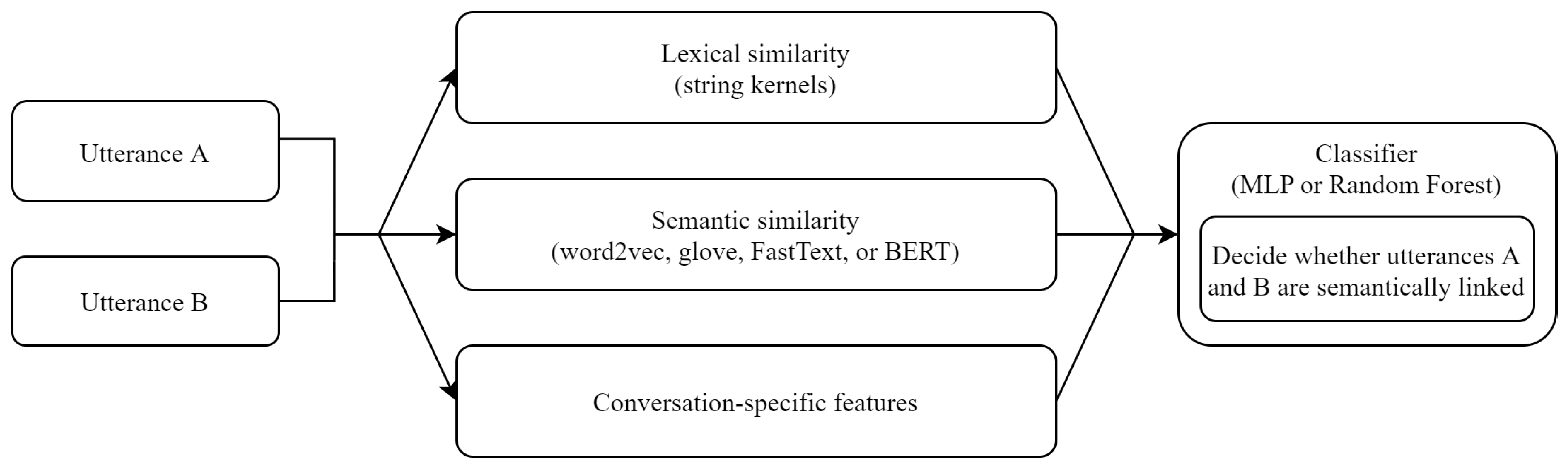
Computer-Supported Collaborative Learning tools are exhibiting an increased popularity in education, as they allow multiple participants to easily communicate, share knowledge, solve problems collaboratively, or seek advice. Nevertheless, multi-participant conversation logs are often hard to follow by teachers due to the mixture of multiple and many times concurrent discussion threads, with different interaction patterns between participants. Automated guidance can be provided with the help of Natural Language Processing techniques that target the identification of topic mixtures and of semantic links between utterances in order to adequately observe the debate and continuation of ideas. This paper introduces a method for discovering such semantic links embedded within chat conversations using string kernels, word embeddings, and neural networks. Our approach was validated on two datasets and obtained state-of-the-art results on both. Trained on a relatively small set of conversations, our models relying on string kernels are very effective for detecting such semantic links with a matching accuracy larger than 50% and represent a better alternative to complex deep neural networks, frequently employed in various Natural Language Processing tasks where large datasets are available.
Keywords: Natural Language Processing; educational technology; neural networks; CSCL conversations; string kernels Natural Language Processing; educational technology; neural networks; CSCL conversations; string kernels