1. Introduction
In 2019, the European Union (27 countries) produced a total of around 617.52 Mtoe of electricity for its energy consumption needs, of which 100.63 Mtoe concern solid fossil fuels [
1]. To produce energy of this magnitude, large quantities of fuel are required, at great expense. Fusion energy can provide a viable alternative energy source to fossil fuels.
One of the biggest obstacles to fusion is the question of how to hold the reactants long enough for the energy production to exceed the energy input. It is essential to understand the dynamics and confinement of plasma.
Recently, these types of experiments have been carried out with the help of Tokamak devices, which use a powerful magnetic field to confine the plasma to a toroidal shape. The tokamak is one of several types of magnetic confinement devices developed to produce controlled thermonuclear fusion energy. As of 2021, it is the leading candidate for a practical fusion reactor.
A crucial component in this task is the magnetohydrodynamic equilibrium (MHD) which defines the geometry of the confinement magnetic field. The MHD equations produce a second-order nonlinear differential equation known as the Grad–Shafranov equation [
2,
3], which is the equilibrium equation in MHD ideal for a two-dimensional plasma (e.g., axial-symmetric toroidal plasma in a tokamak). In axisymmetry the Grad–Shafranov equation is given by:
where
is the toroidal plasma current,
is the flux function and
) are the standard cylindrical coordinates.
The literature contains a large amount of scientific articles that address the tokamak balance problem, adopting different approaches.
For example, if the reference system is oblate toroidal, the Grad–Shafranov equation in vacuum admits an analytic solution highlighted in the works [
4,
5]. In case the source term assumes simple forms, the existence of analytical solutions of the nonlinear Grad–Shafranov equation has been shown [
6,
7,
8,
9].
The problem of finding the solution of the Grad–Shafranov equation was also addressed from the numerical point of view, through the development of some predictive equilibrium codes [
10,
11,
12,
13,
14]. Semi-analytical methods have also been adopted in [
15,
16].
An interesting approach to analytically solve the Grad–Shafranov equation with non-constant source terms through the technique of separable variables was used in [
17,
18].
The exact analytical solution of the Grad–Shafranov equation in vacuum has been found only if the reference system has a standard circular shape or has an oblate elliptical toroidal geometry [
4,
5]. Both of these geometries are unsuitable for current tokamak experiments, which are all based on prolate elliptical geometry. In 2019, Crisanti cite Crisanti observed that, in axisymmetry, the Grad–Shafranov equation of vacuum coincides with the Laplace equation for the toroidal component of the vector potential. Cristanti faces the problem of finding the analytical solution for the Grad–Shafranov equation in vacuum (and therefore also of the Laplace equation) when the reference system is written in toroidal prolate elliptic cap-cyclide coordinates. A detailed study of the geometric and metric properties of these coordinates allows us to elaborate the analytical solution of both equations in terms of the Wangerin functions, the analytical expression of which is, however, not known.
The work of Crisanti [
19] opens up the possibility of creating a reconstructive code of equilibrium based on an elongated geometry. Wangerin functions were first evaluated in [
4]. However, to use them in a budget code, an independent evaluation and a cross-check will be required [
19]. Furthermore, it will be necessary to evaluate the derivatives, to derive the poloidal magnetic field and find the Green’s function for this [
19] geometry.
The literature shows us a wide range of scientific articles that address the problem of the analytical solution of the Laplace equation (in its various variants), see for example [
20,
21,
22,
23,
24].
In this article, starting from the recent work of Crisanti [
19], we transform the Laplace equation into the Heun equation, and based on the work of A.M. Ishkhanyan [
25], we provide an analytical solution of the Laplace equation for some parameter values. Since the Laplace equation and the Grad–Shafranov equation differ by one sign, the procedure presented in this manuscript can be repeated to find the analytical solution of the Grad–Shafranov equation. In
Section 2, we introduce the cap-cyclide geometry and, through some transformations of variables, we pass from the Grad–Shafranov equation to the Heun equation. In
Section 3, we define the standard toroidal geometry as a special case of the cap-cyclide geometry. In
Section 4 we find the analytical solution of the Laplace equation valid in standard toroidal geometry. In
Section 5 we find the analytical solution of the Laplace equation in cap-cyclide coordinates for some parameter values. In
Section 6, we present the conclusions.
1.1. Hypergeometric Functions
Definition 1. A hypergeometric series is formally defined as a power seriesin which the ratio of successive coefficients is a rational function of n, that iswith and polynomials in n.
It is customary to assume to be 1. The polynomials and can be factored into linear factors of the form and respectively, where the and are complex numbers. For historical reasons, it is assumed that is a factor of .
The ratio between consecutive coefficients now has the form
where
c and
d are the leading terms of
and
. The series then has the form
or, by scaling
z by the appropriate factor and rearranging
This series is usually denoted by
The series, if convergent, defines a generalized hypergeometric function, which may then be defined over a wider domain of the argument by analytic continuation.
Historically, the most important are the functions of the form . These are sometimes called Gauss’s hypergeometric functions.
1.2. Heun Functions
Definition 2. The local Heun function (Karl L. W. Heun 1889) is the solution of Heun’s differential equation, that iswhere
is a real number such that the Fuchsian condition
is satisfied. This relation is needed to ensure regularity of the point at ∞.
Function is holomorphic and such that .
The local Heun function is called a Heun function if it is regular at , and is called a Heun polynomial if it is regular at all three finite singular points .
The complex number Q is called the accessory parameter. Heun’s equation has four regular singular points: and ∞ with exponents , and .
2. From Grad–Shafranov Equation to Heun Equation
Starting from [
19], the vacuum Grad–Shafranov equation are tackled in the elliptical prolate toroidal cap-cyclide coordinates framework.
In axisymmetric cylindrical coordinates
,
, the vacuum Grad–Shafranov equation is given by:
This equation is formally similar to the Laplace equation:
(Note that Equations (
9) and (
10) differ for a sign in the first derivative part).
Consequently, it is obvious that any analytical solution found for the Laplace equation will be correlated to the analytical solution of the Grad–Shafranov equation.
For the present toroidal elongated tokamak, the most appropriate coordinate system is the cap-cyclide one [
26], that is
where
are the standard Cartesian coordinates,
, and
are the Jacobi elliptic functions,
is a dimensional scale parameter and
The variation range of new variables
is defined as
Here
and
are respectively the real and the imaginary complete elliptic integrals
where
k and
are respectively the parameter and the complementary parameter of the elliptic integrals.
By varying the parameter
k, the coordinate transformation (
11) describes a large set of quite different geometries [
19]. For
, independently of
k, the geometry resembles the standard toroidal geometry; for larger values of
the shape of the constant
surfaces depend on the value of the
k parameter. For
the surfaces tends to a bean shape. For intermediate values of
k the surfaces can be either
D or purely elliptical prolate shaped. For
all the surfaces are similar to the standard toroidal ones, independently of the value of
[
19].
As it is proved in [
26] and subsequently reported by Crisanti [
19], the Laplace Equation (
10) in the cap-cyclide coordinates admits a quasi-separable solution of the type
where the functions
satisfy the following ordinary differental equations
with
and
,
p and
q being constants, not necessarily integers [
26].
In the rest of the paper, we refer to the Equation (
14) as the
Laplace equations.
The analytic solution of (
14)
is obtained immediately and is written as:
From [
19], by substituting
and
, (
) the two equations for
and
can be written as
where
Following [
25] and applying the transformation
Equation (
16) is reduced to the general Heun equation [
25,
27]
where
and under Fuchsian condition (
8)
Remark 1. Knowing the solution of Heun’s Equation (
19),
it is consequential to go back to the solution of Wangerin’s Equation (
16)
given byso that, the solution of the Equation (
14)
in terms of μ and ν is given by 3. Standard Toroidal Geometry as a Particular Case of Cap-Cyclide Geometry
As already pointed out in [
19,
26], if
and
, the cap-cyclide geometry reduces to the standard toroidal one. Toroidal coordinates are a three-dimensional orthogonal coordinate system that results from rotating the two-dimensional bipolar coordinate system about the axis that separates its two foci. Thus, the two foci
and
in bipolar coordinates become a ring of radius
a in the
plane of the toroidal coordinate system; the
y-axis is the axis of rotation. The focal ring is also known as the reference circle. The toroidal coordinates are given by the following expressions [
26]:
together with
and
. The
coordinate of a point
P equals the angle
and the
coordinate equals the natural logarithm of the ratio of the distances
and
to opposite sides of the focal ring
The coordinate ranges are , and . Both geometries (standard toroidal and cap-cyclide) are obtained by rotating a two-dimensional coordinate system around the y axis, being respectively:
If
, then the two-dimensional coordinate system of cap-cyclide geometry becomes
Moreover, when
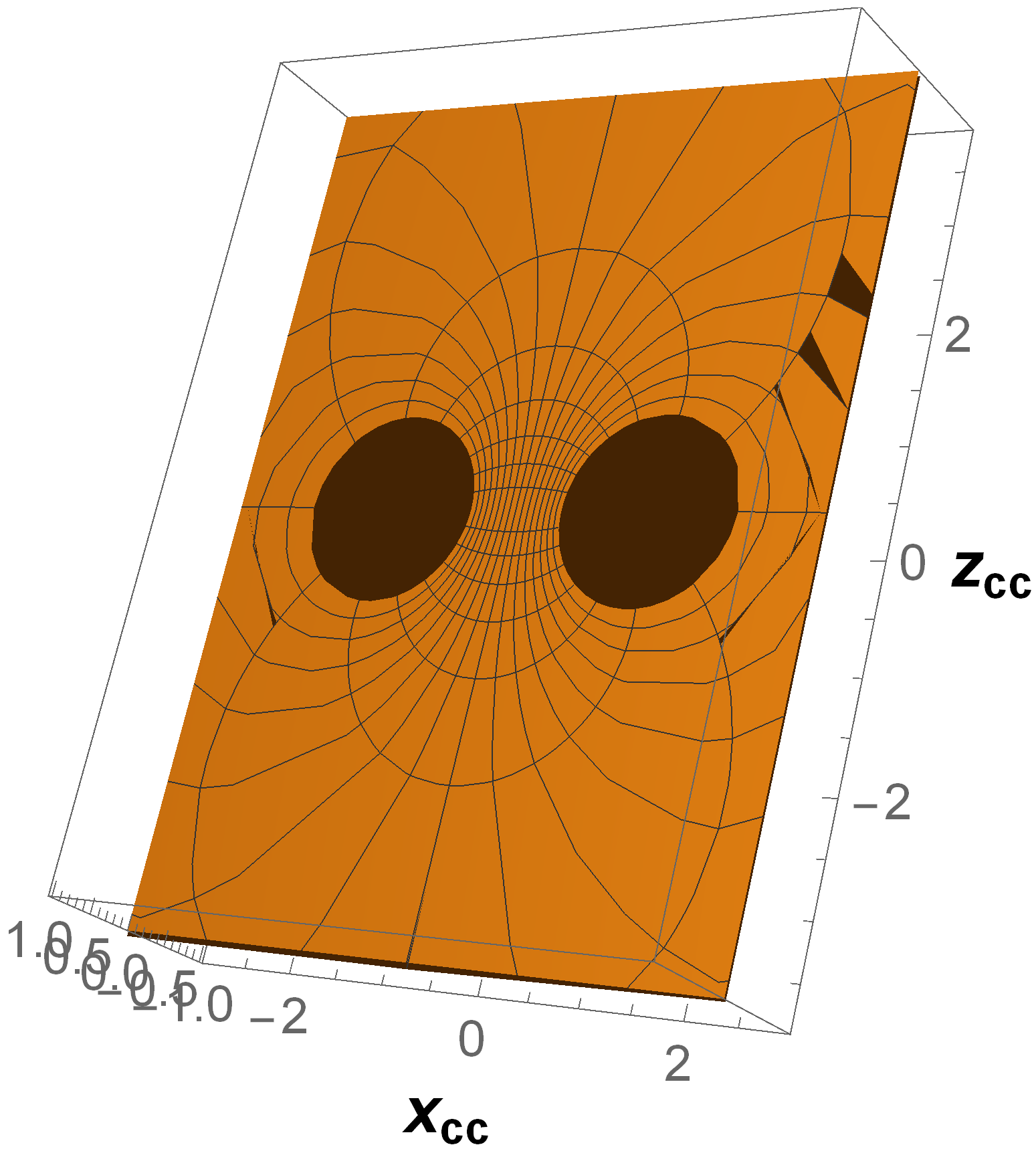
is close to zero, then the cap-cyclide bi-dimensional system approaches standard toroidal geometry, as in the
Figure 1.
We emphasize that even if in the limit for
and
, the two geometries have the same shape, the metrics are different. In fact, the metric of the standard toroidal geometry is not obtained as a particular case of that of the cap-cyclide geometry (as also can be seen in [
26]). This can also be noted in the formulas in
Table 1: in fact even when
,
and
.
In [
26], the authors obtained the analytic solution of Laplace equation in standard toroidal coordinates as
where
where
are Legendre functions and
A and
B are constants.
5. Analytic Solutions of Laplace Equation (14) in Cap-Cyclide Geometry
In this section, we determine the analytical form of the solution of Equation (
14)
valid in the cap-cyclide geometry in terms of hypergeometric functions and for particular values of the parameters.
Let’s solve the Heun Equation (
19) first.
Following [
25], we impose that the following series developed around the singularity
:
is a solution of the Heun equation and that it reduces to a generalized hypergeometric function.
Let q be integer. This condition will allow us to construct a solution in terms of hypergeometric functions.
Let
. The generalized hypergeometric function
is defined as the series [
29]
where the coefficients satisfy the two-term recurrence relation
Since
q is integer, then
is also integer. Assume that
is negative, i.e.,
. Following [
25], we set
,
, and
with
being certain constants.
It can be shown that the Heun Equation (
19) admits the following solution [
25]
if and only if the following polynomial
in an auxiliary variable
n is identically zero [
25]:
where
The term of degree in is automatically canceled, while the term of degree is zero owing to the Fuchsian condition. Then, by canceling the coefficients of the polynomial , we obtain a system of algebraic equations, N of which are used to determine the N constants and the last equetion imposes a restriction on the accessory parameter Q: this restriction is obtained by substituting the expressions of the constants in the last equation thus arriving at a polynomial equation of degree in the variable Q.
Therefore, there are many solutions of Equation (
19) in terms of a single generalized hypergeometric function
if
is a negative interger and the accessory parameter
Q satisfies a certain polynomial equation [
25].
Similarly, another solution can be constructed in terms of a power series in the vicinity of the singularity
:
Let
. Such a series can be reduced to a generalized hypergeometric series for any negative integer
[
25], i.e.,
The accessory parameter
Q and the parameters
involved in solution (
39) are determined from a system of
algebraic equations constructed by equating the coefficients of the following polynomial
in an auxiliary variable
n to zero [
25]:
where
The restrictions imposed on
Q obtained from the polynomial
(
36) and then from the polynomial
(
40) are identical.
The two solutions (
35) and (
39) are linearly independent, indeed their Wronskian turns out to be:
Thus, if
,
and
Q satisfies a certain polynomial equation of
degree, the general solution of the Heun Equation (
19) is given by:
Similarly, the general analytic solution of Laplace equation is given by:
Now we write hypergeometric solution of the Heun equation for some values of parameter .
5.1. Case:
In this case, the Heun equation becomes
and admits a solution in terms of the ordinary hypergeometric function:
Since the Fuchsian condition (
8) reduces to
, from Equations (
36) and (
40), we obtain the restriction on
Q 5.2. Case
In this case, the Heun equation becomes
and admits a solution in terms of the generalized hypergeometric function:
with constants
. Since the Fuchsian condition (
8) reduces to
, the polynomials (
36) and (
40) give
Besides, the accessory parameter
Q satisfies the following polinomial equation of second degree
From
, we get
and the Fuchsian condition (
8) reads
. Besides, from Equation (
17) we obtain
Since
, then from Equation (
56), we get
From Equation (
55), we get the
Q values
The expression
gives the relation between
k and
pThe Heun equation reduces to
whose solution,
is given by
and .
Hence, the solution of the corresponding Wangerin equation for any
k is given by
and .
Consequently, the solution of the corresponding (
14)
is written as
and .
The same solution as for .
5.3. Positive Integer
Let
now be a positive integer. Following [
25], we apply a change of the dependent variable in order to obtain a Heun equation with altered parameters and with a negative characteristic exponent
. Let
: this change transforms the Heun equation into another Heun equation with the altered parameter
, i.e.,
where
and
.
Then, for
, we have a Heun equation with a zero or negative integer
. As a result, we obtain the solution
The only exception is the case
: we do not know an
solution in this exceptional case [
25].
In this case, the Heun equation becomes
6. Conclusions and Discussion
In this paper, we have presented the analytic solution of Laplace’s Equation (
14)
in terms of linear combinations of generalized hypergeometric functions which hold for integer values of
and when the accessory parameter
Q satisfies a particular polynomial equation, the degree of which is related to the value of the integer
.
being an integer is not a particularly significant limitation, since
and
q is generally an integer.
The second Laplace Equation (
14)
still remains to be solved: it too is reduced to a Heun equation (but with different parameters) and can therefore be solved with the technique applied here.
Once this is done, the complete solution of the three-dimensional Laplace Equation is constructed.
At this respect, since the Laplace equation and the Grad–Shafranov equation differ by one sign (plus instead of minus in the term of the first derivative), one can also apply the technique presented in this manuscript to the Grad–Shafranov equation to construct its solution in terms of a linear combination of hypergeometric functions. We will investigate these latter aspects in future work.