On the Exploration and Exploitation Capabilities of the Artificial Bee Colony Algorithm




Abstract
1. Introduction
- A direct measurement of exploration (successful, failed, deceptive, successful rejection) and exploitation (successful, unsuccessful) in the ABC algorithm.
- An analysis of the influence of ABC’s control parameters on exploration and exploitation.
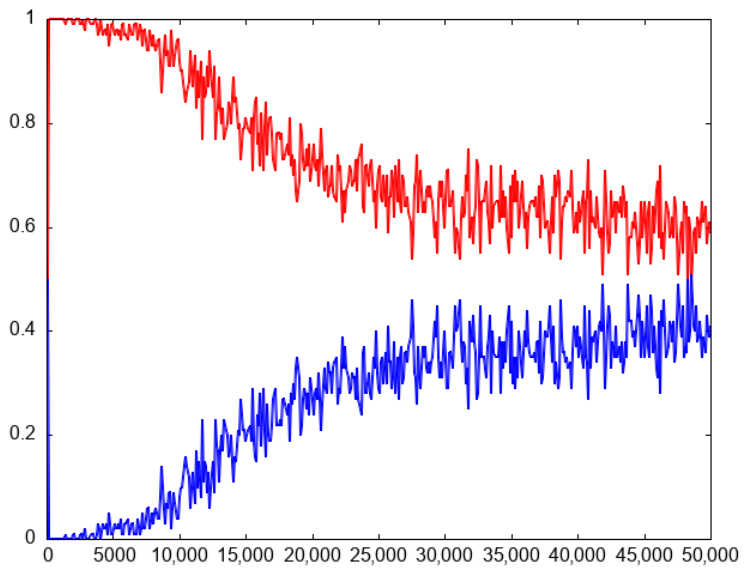
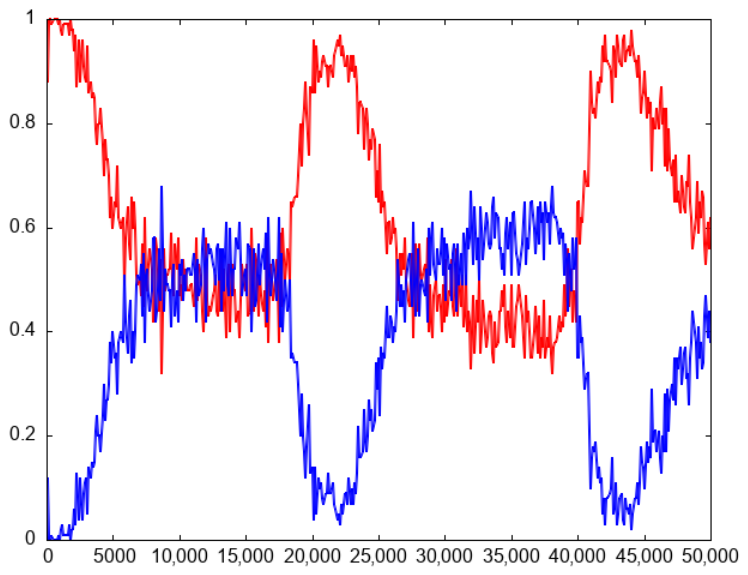
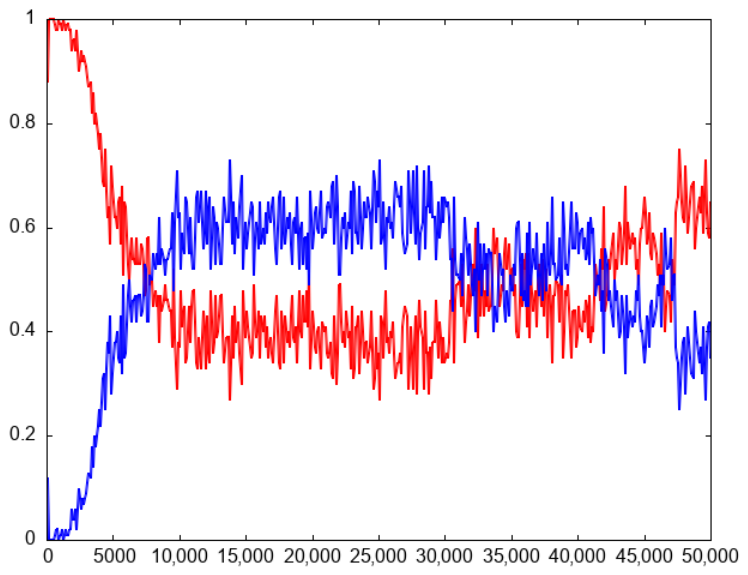
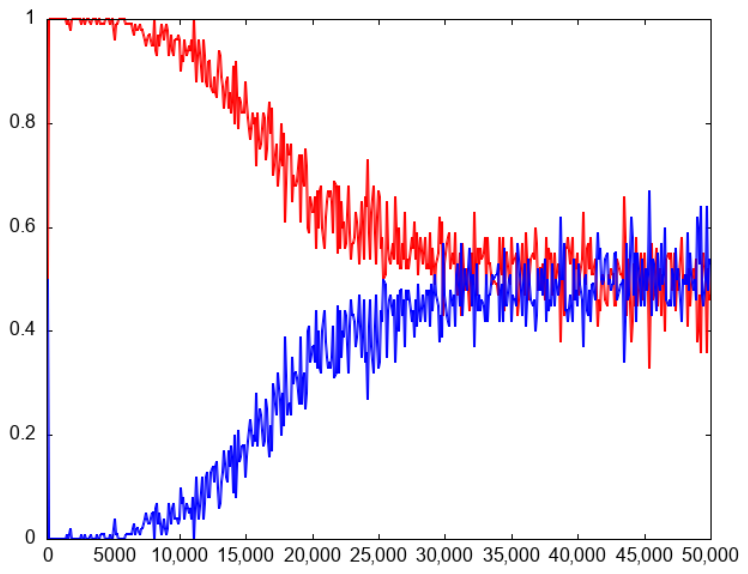
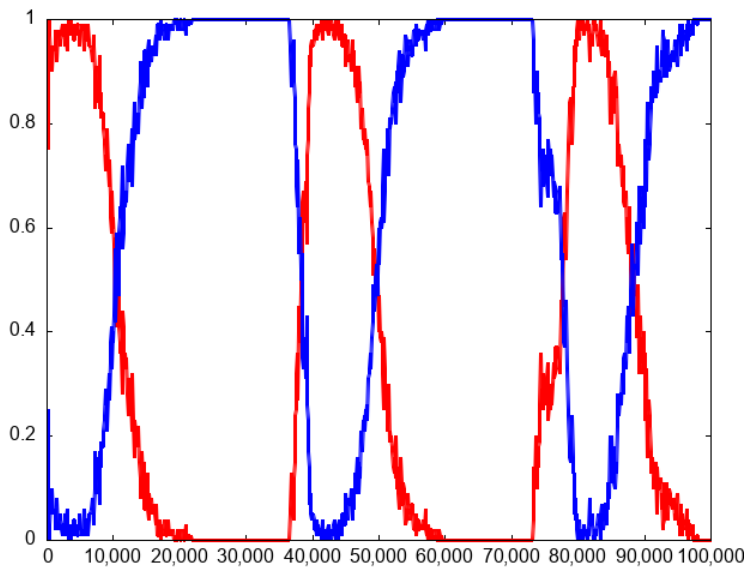
- A demonstration and explanation of the limitations of indirect diversity measures for assessing exploration and exploitation using a specially designed EA.
2. Related Work
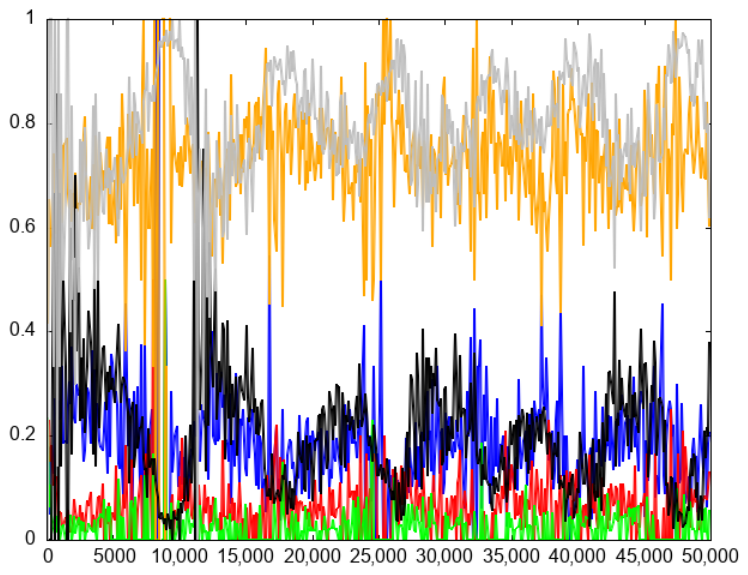
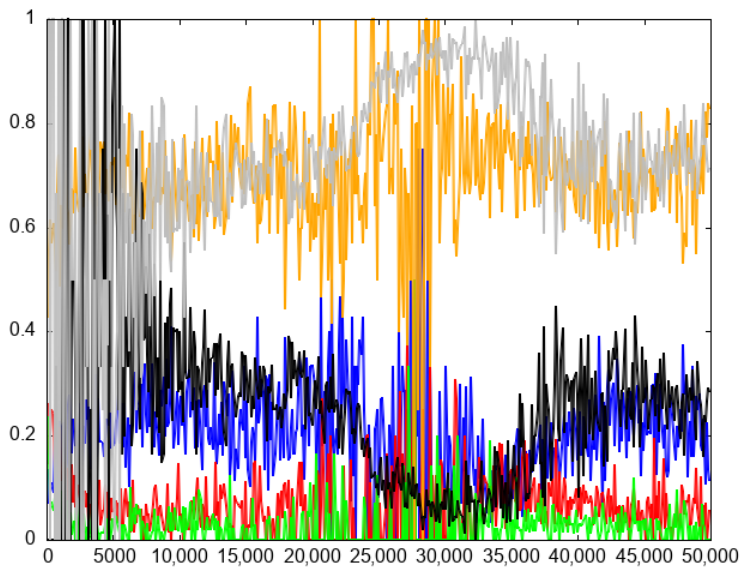
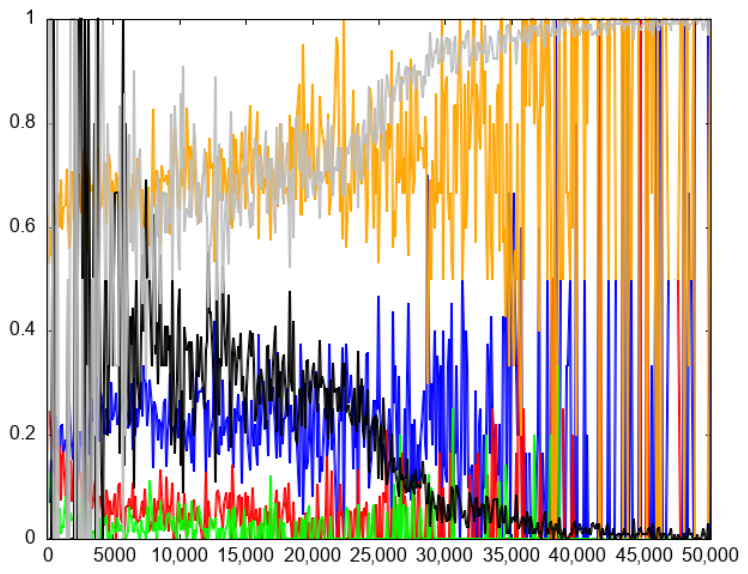
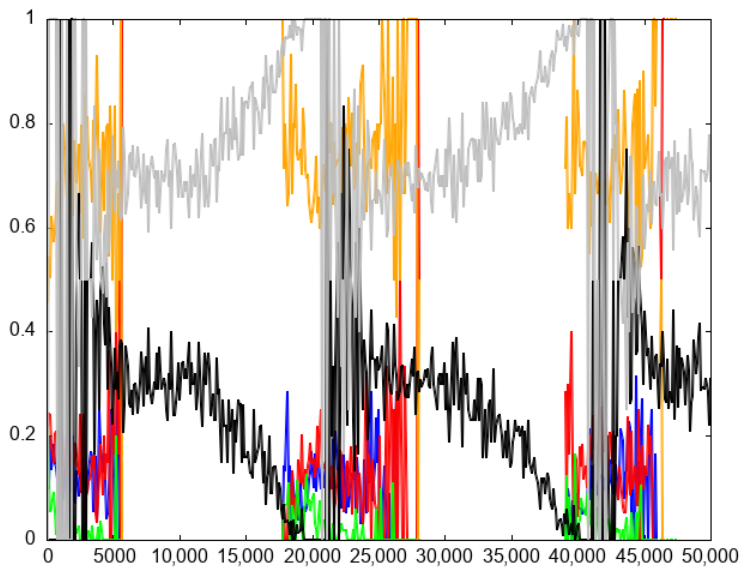
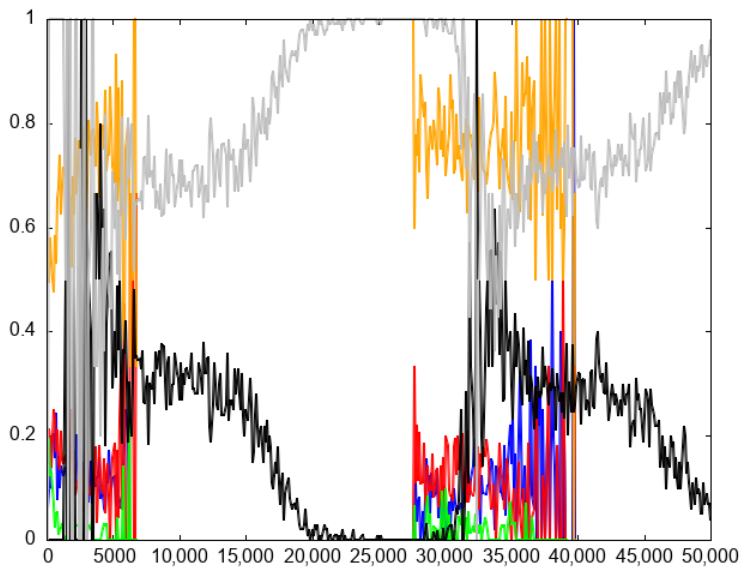
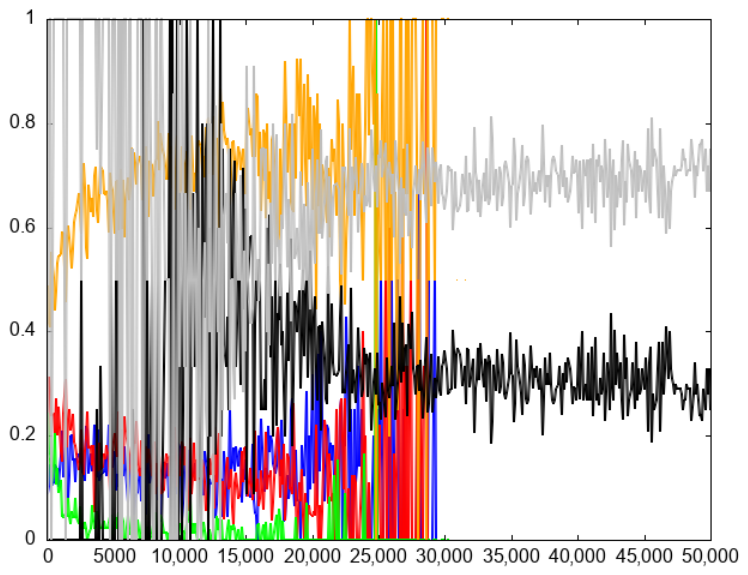
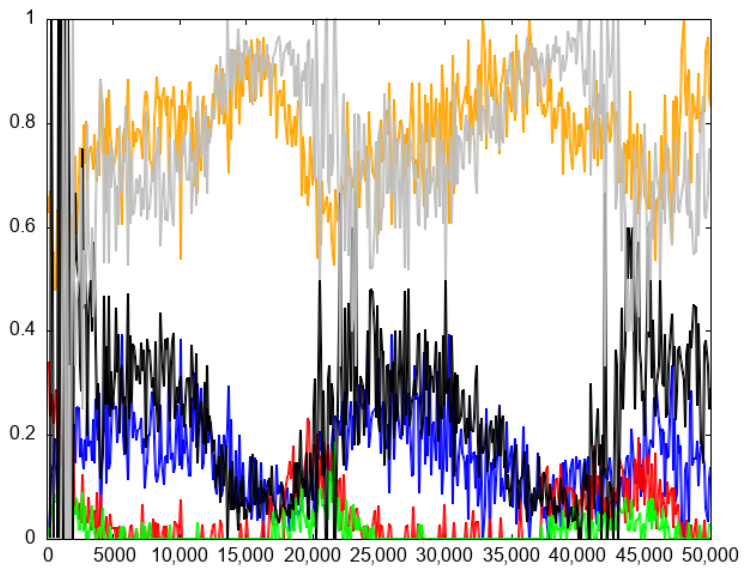
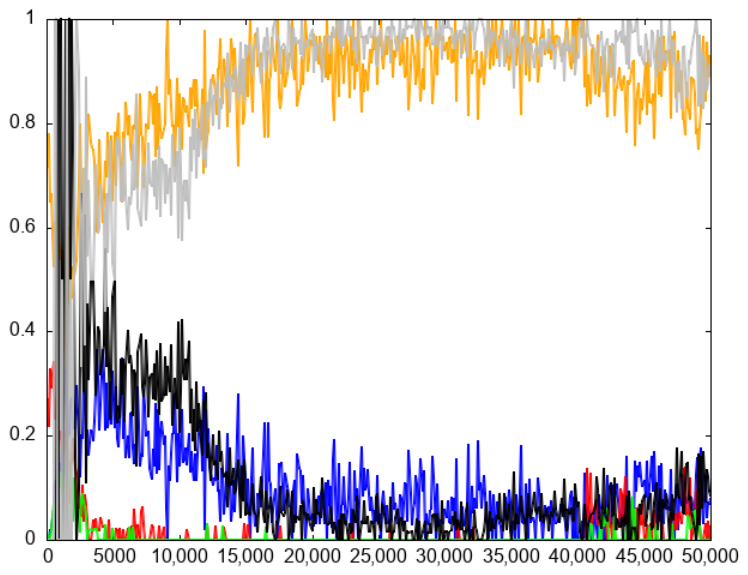
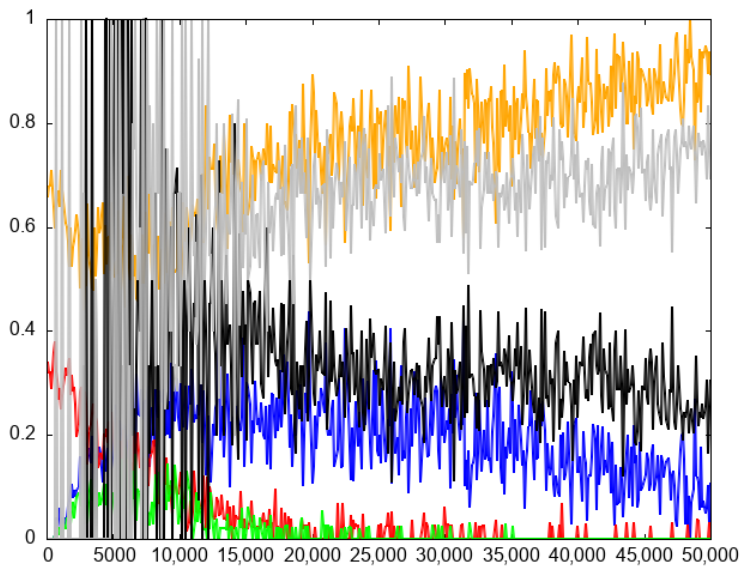
- Successful exploration (SE): The fitness of a new solution is better than the parent’s fitness, greedy survival selection will preserve a new solution, and the new solution is in a better attraction basin than the parent’s attraction basin. We find a better solution in a better attraction basin, and we can declare the exploration as successful.
- Successful rejection (SR): The fitness of a new solution is worse than the parent’s fitness, greedy survival selection will preserve the parent, and the new solution is in a worse attraction basin than the parent’s attraction basin. We find a worse solution in a worse attraction basin, and we reject it successfully.
- Failed exploration (FE): The fitness of a new solution is worse than the parent’s fitness, greedy survival selection will preserve the parent, and the new solution is in a better attraction basin than the parent’s attraction basin. We find a solution in a better attraction basin, but we fail to accept it.
- Deceptive exploration (DE): The fitness of a new solution is better than the parent’s fitness, greedy survival selection will preserve the new solution, and the new solution is in a worse attraction basin than the parent’s attraction basin. We find a better solution in a worse attraction basin and accept it, moving from an attraction basin with a better local optimum to one with a worse local optimum. This action is undesirable and should be avoided by the search algorithm.
3. Material and Methods
| Algorithm 1 Pseudocode for Artificial Bee Colony (ABC) |
| Input: : number of food sources (population size)
Input: : maximum number of trials before abandonment Input: : maximum number of fitness evaluations Output: Initialize for to do generate random solution (Equation (1)) [2] end for while do for to do ▹ Employed Bees Phase generate new solution by Equation (2) [2] if then else end if if then break end if end for Update Compute selection probabilities using fitness values (Equations (3) and (4)) [2] , while and do ▹ Onlooker Bees Phase if then generate new solution by Equation (2) [2] if then else end if end if end while Update ▹ Scout Bee Phase if then generate random solution (Equation (1)) [2] end if Update end while |
4. Results
- , where ;
- ;
- ;
- .
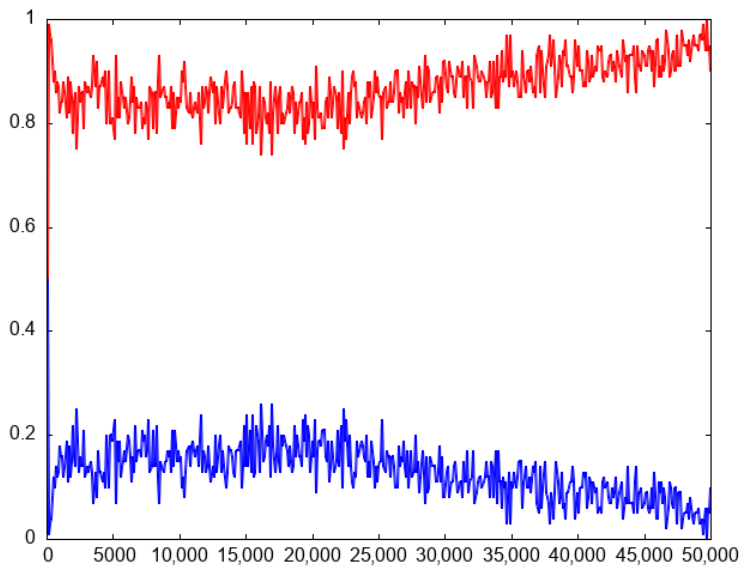
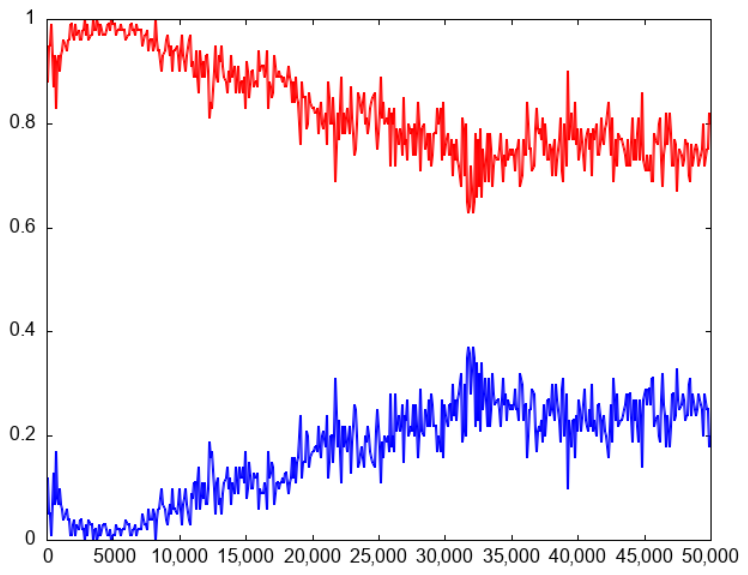
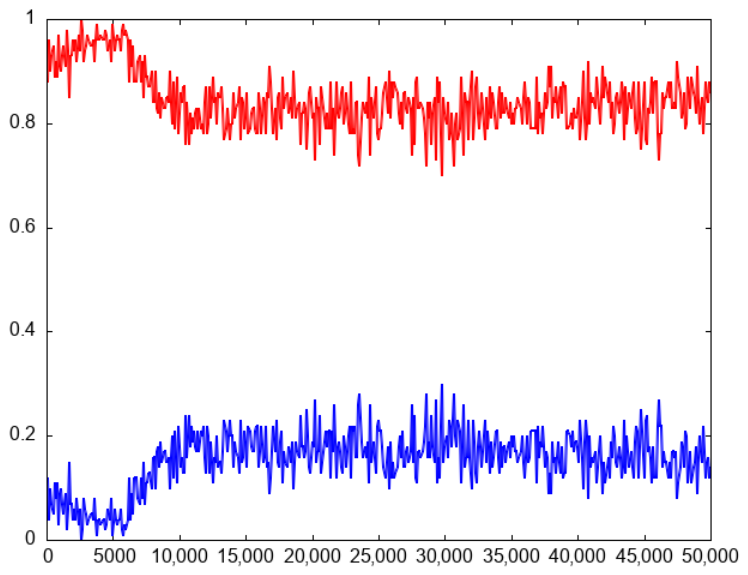
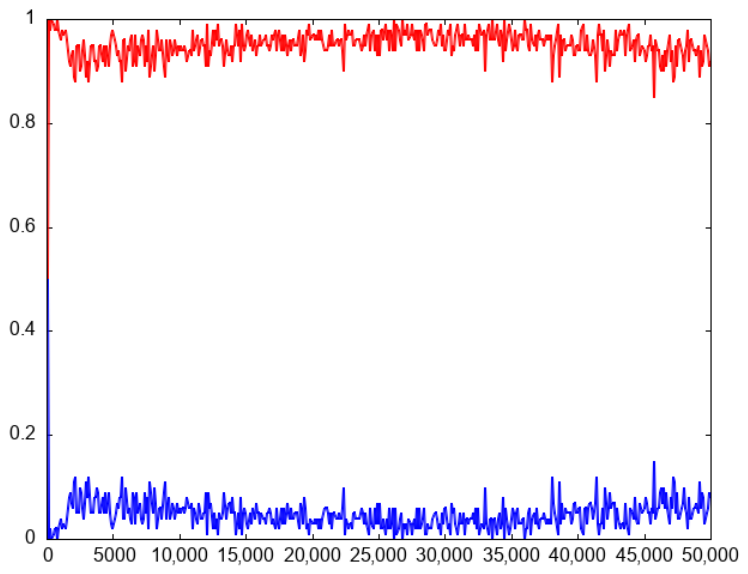
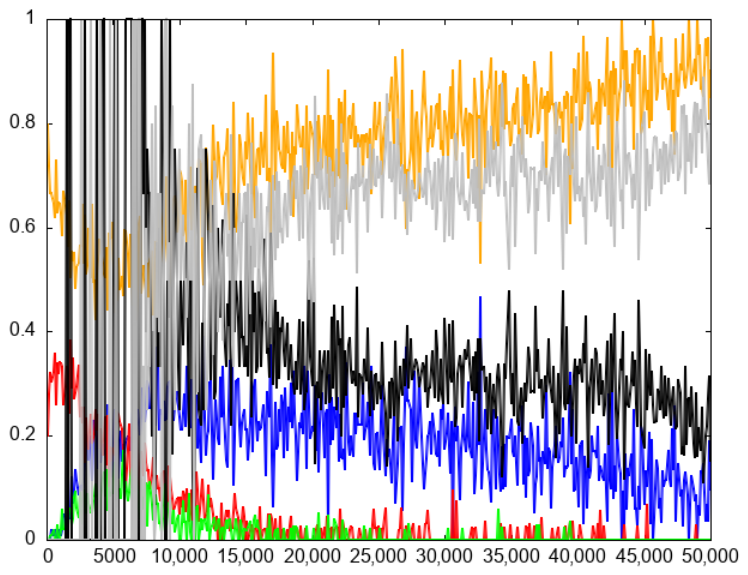
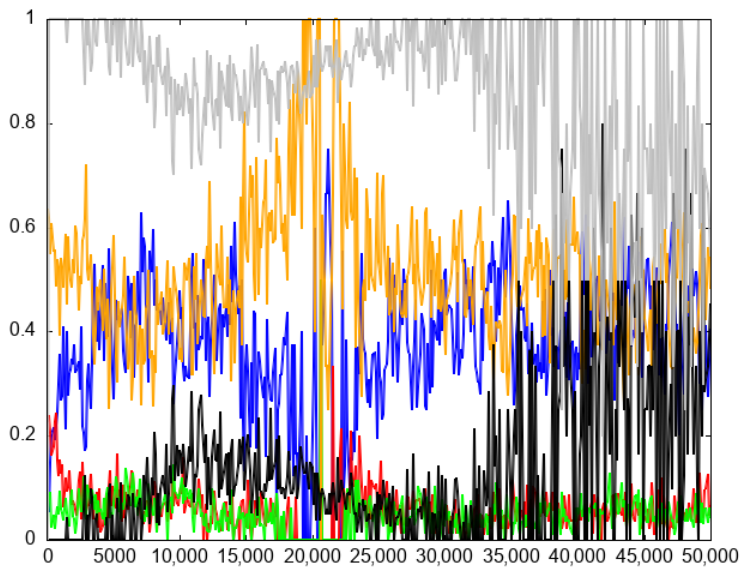
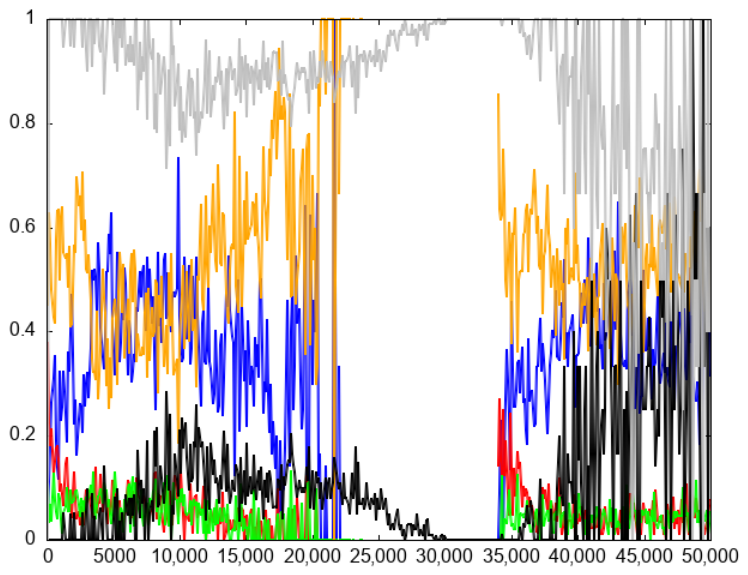
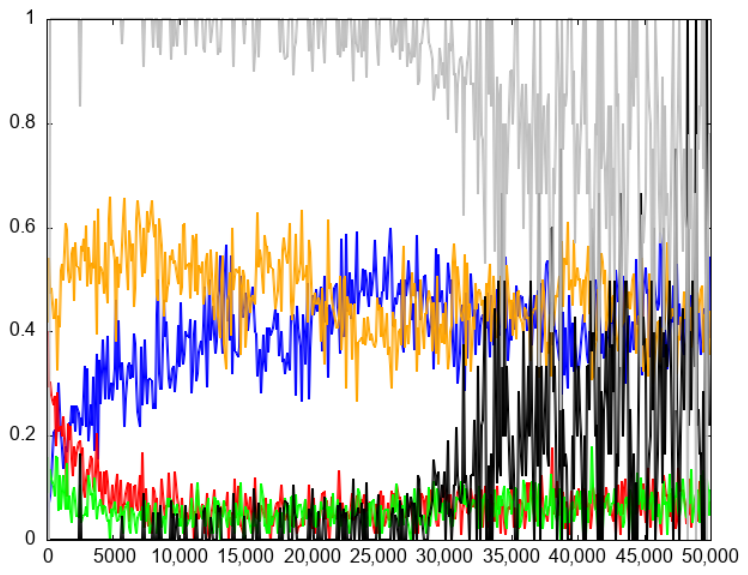
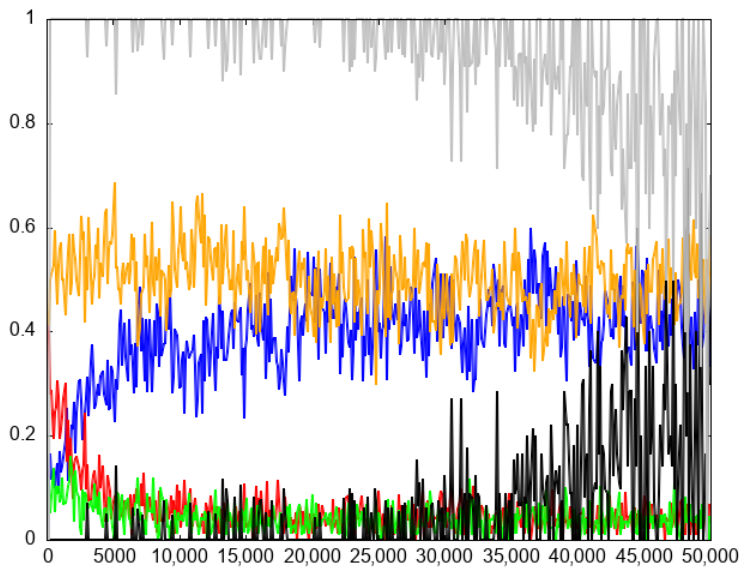
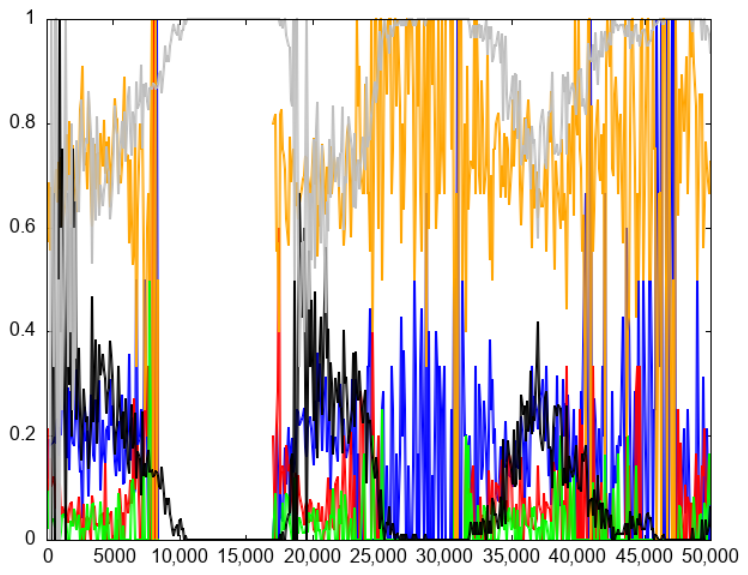
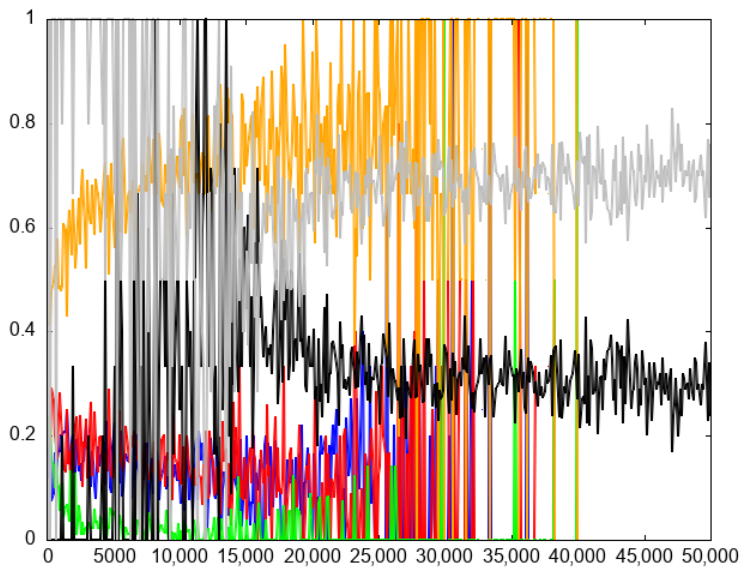
- Successful rejection is high, above .
- Deceptive exploration is not problematic, and is usually below .
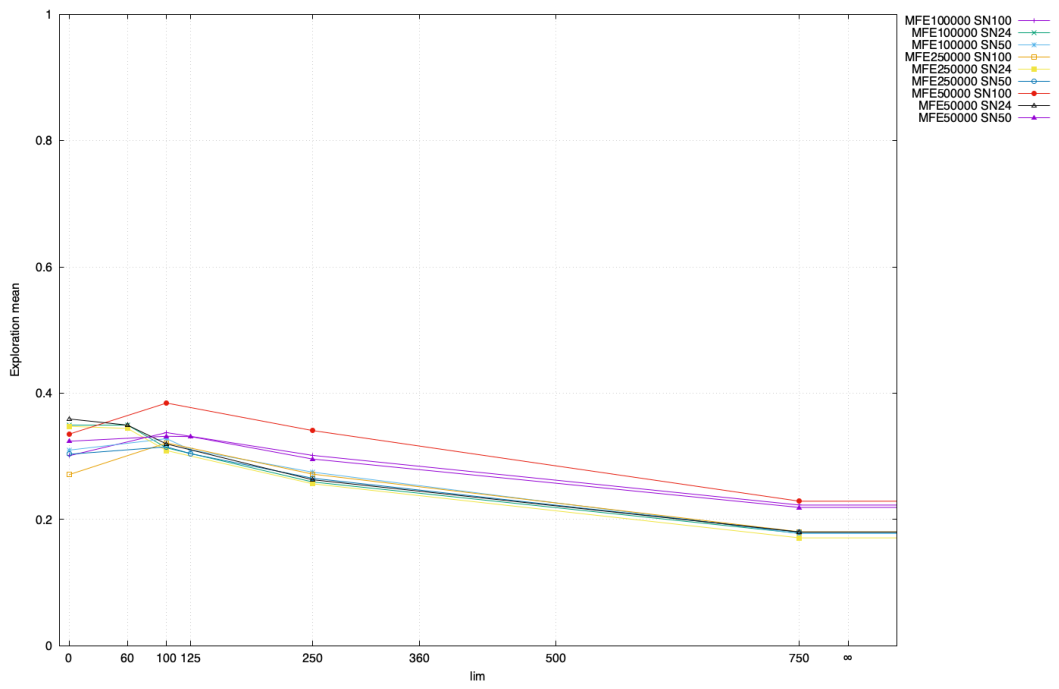
- Successful exploration is low, between and .
- The amount of failed exploration is usually higher than successful exploration, between and .
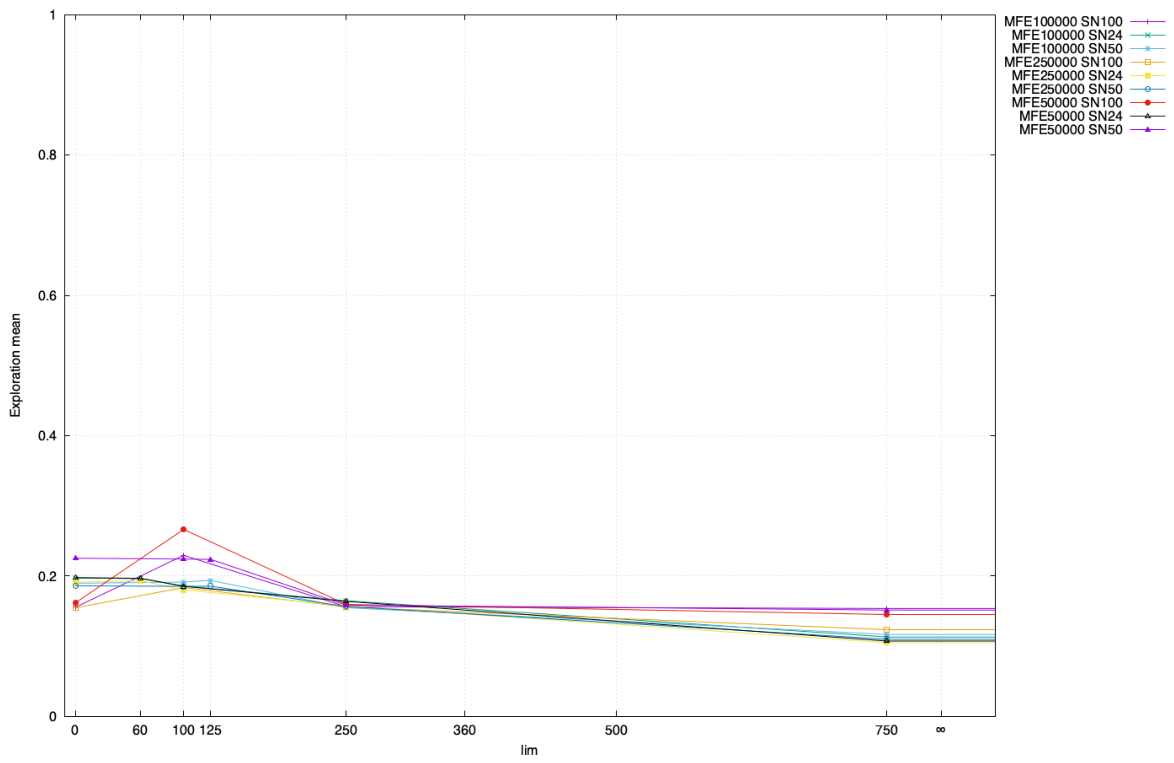
- Successful exploitation is low, between and .
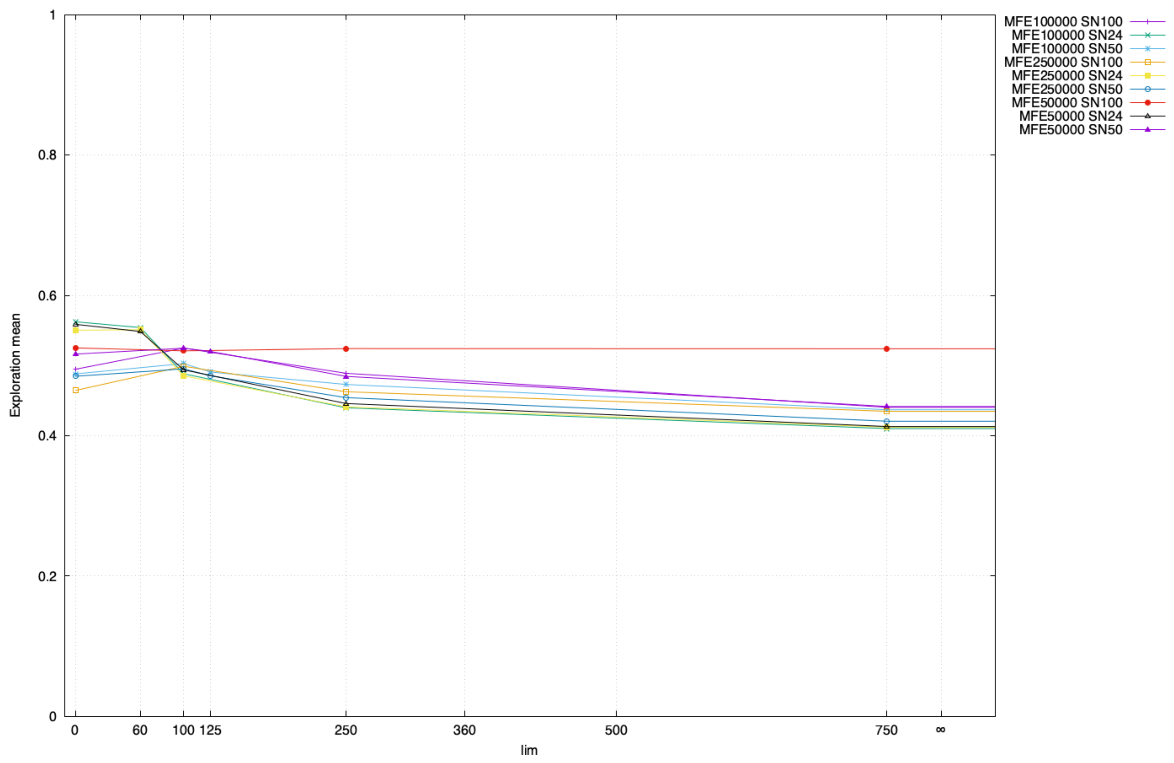
- Unsuccessful exploitation is high, between and .
5. Conclusions
- The amount of deceptive exploration is small and not problematic.
- Often, the amount of failed exploration is higher than the amount of successful exploration. This is especially problematic, since better attraction basins have been found but rejected due to greedy survival selection.
- The ratio between successful and unsuccessful exploitation is surprisingly very low, indicating that searching the neighborhood with existing equations is often not efficient.
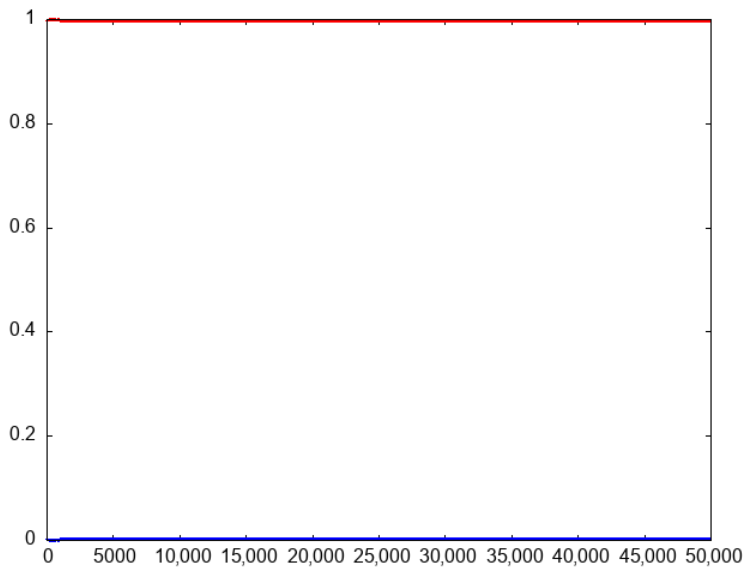
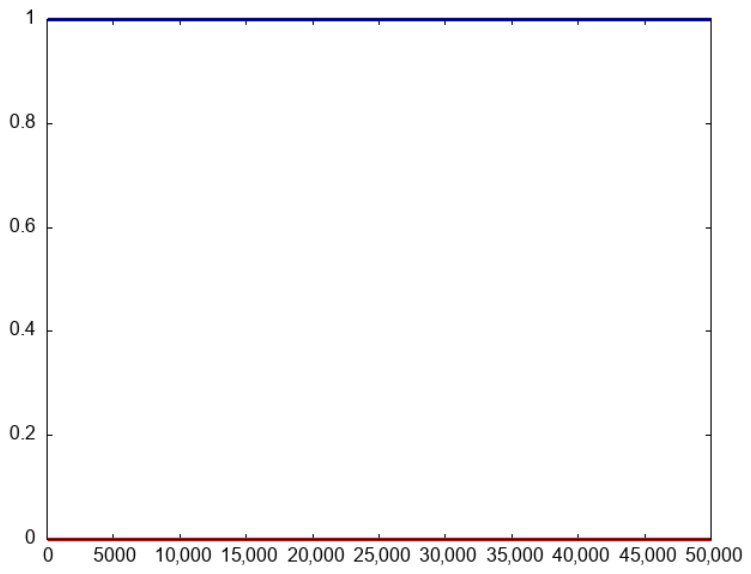
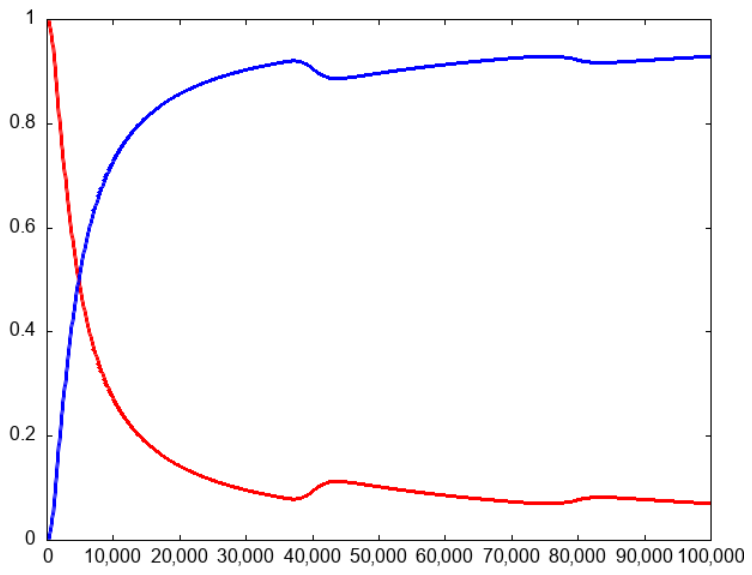
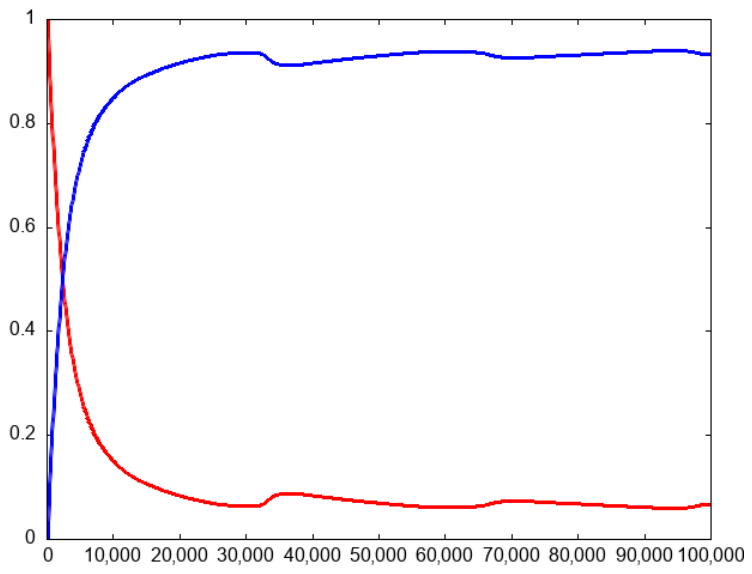
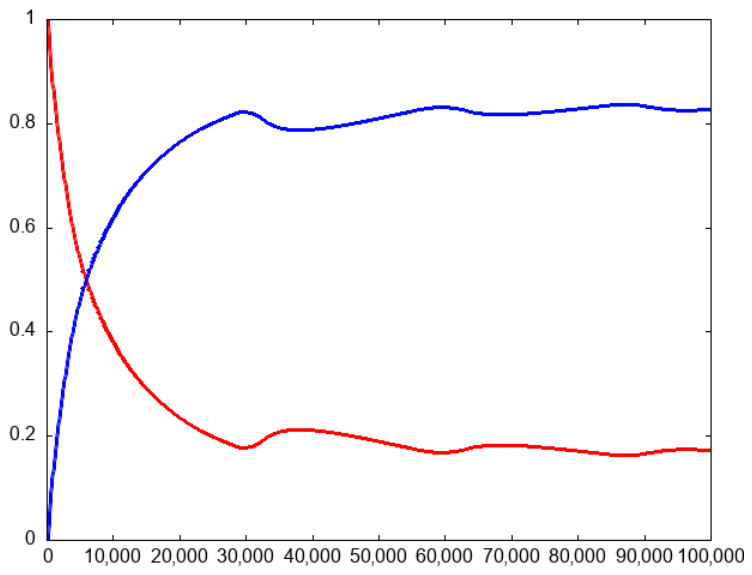
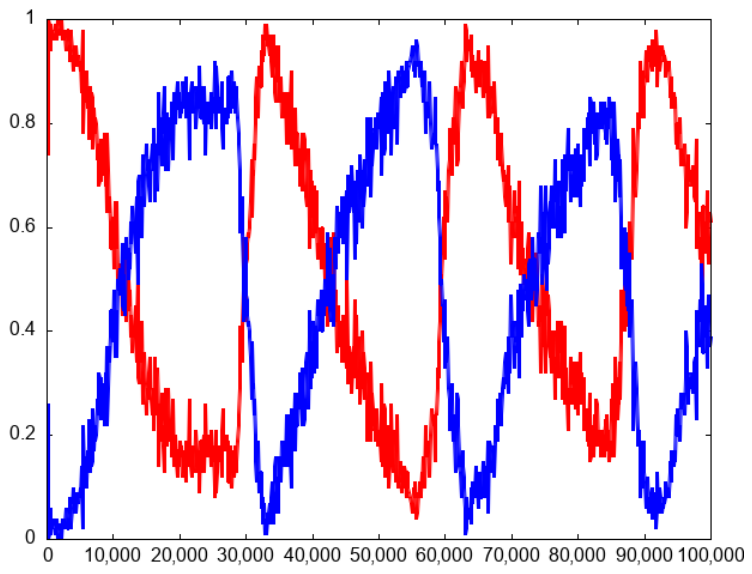
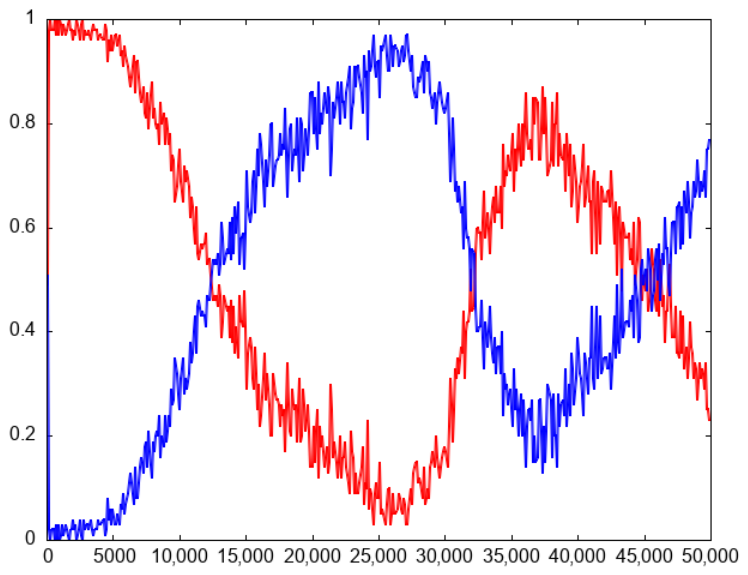
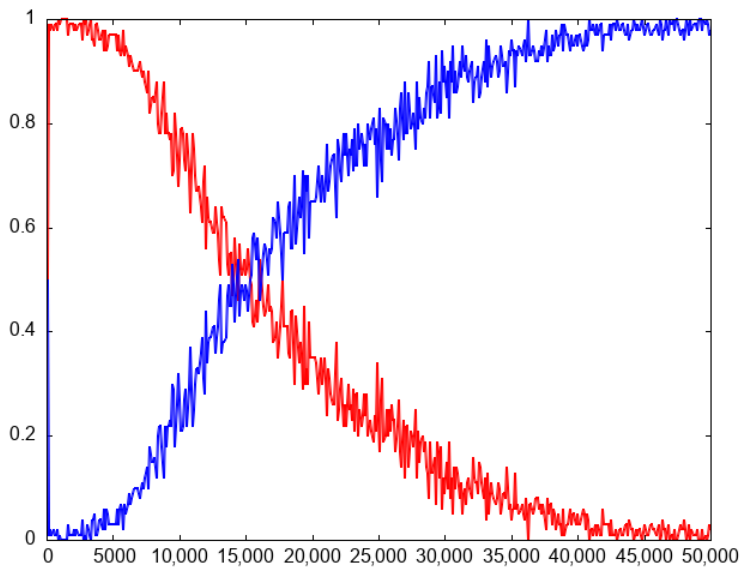
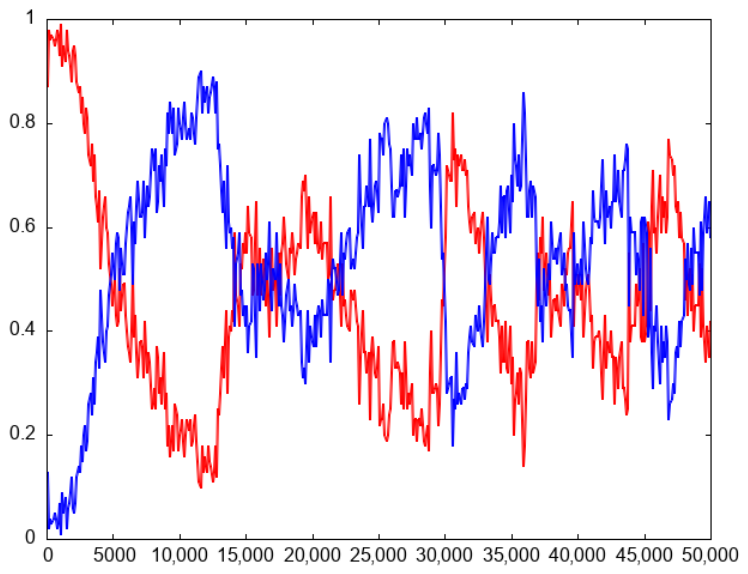
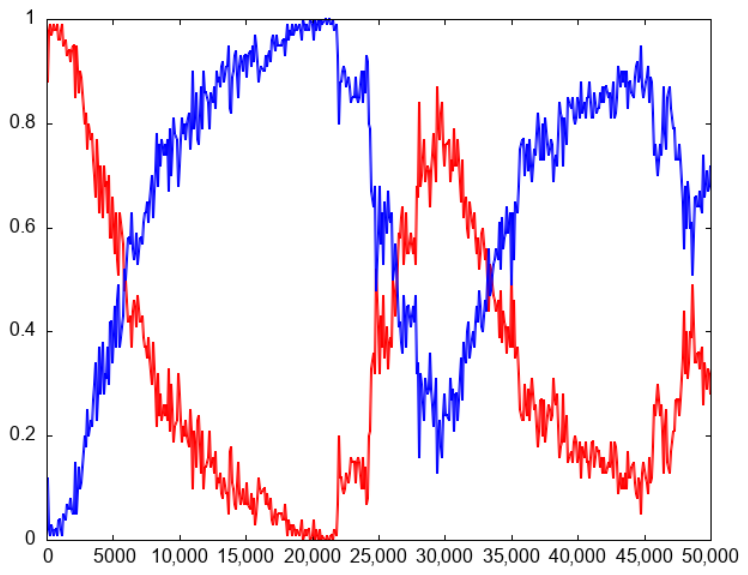
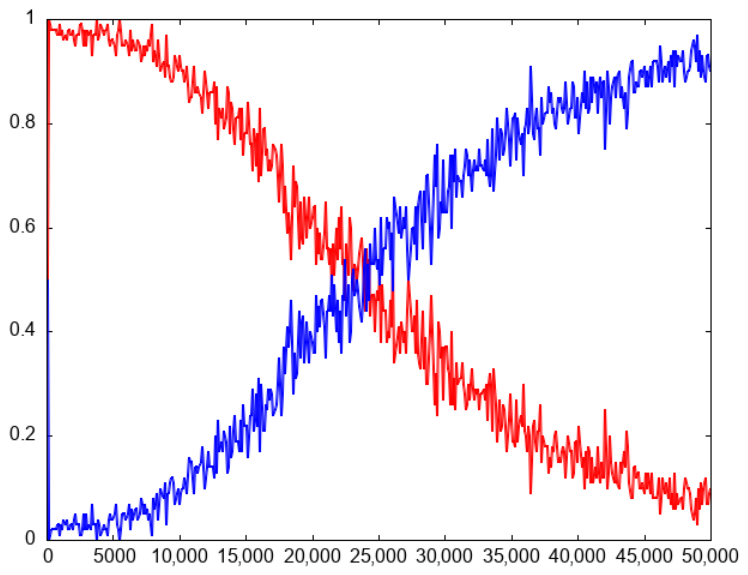
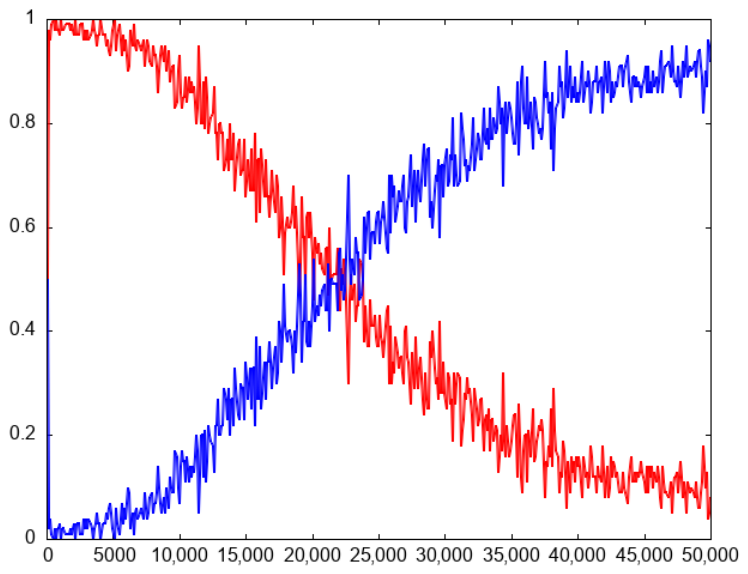
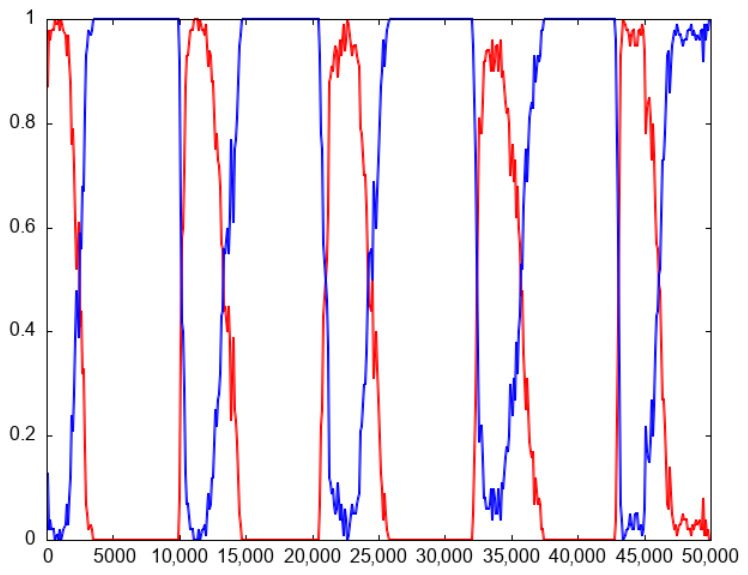
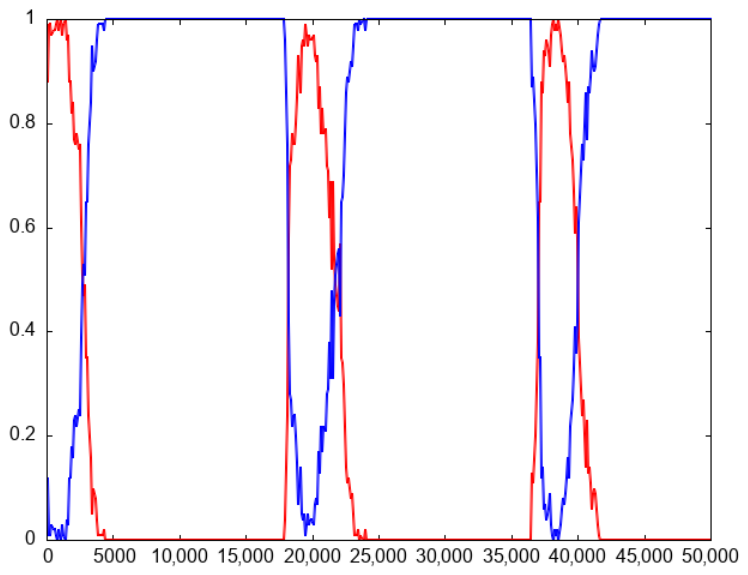
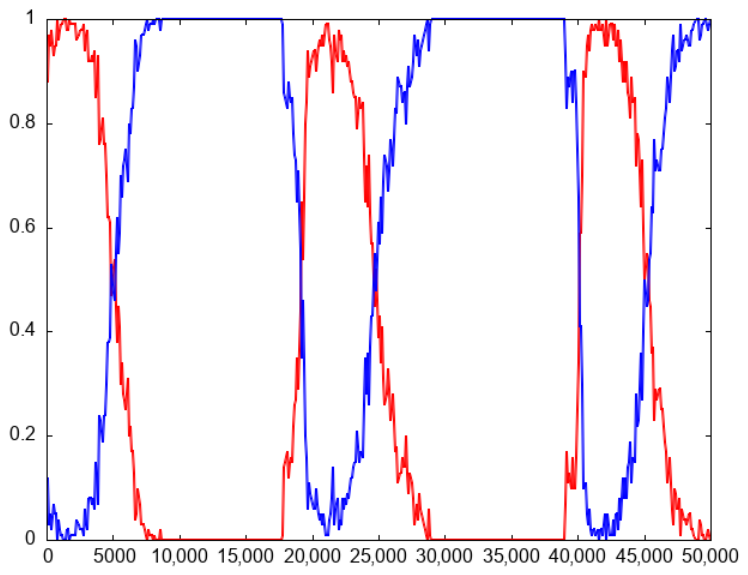
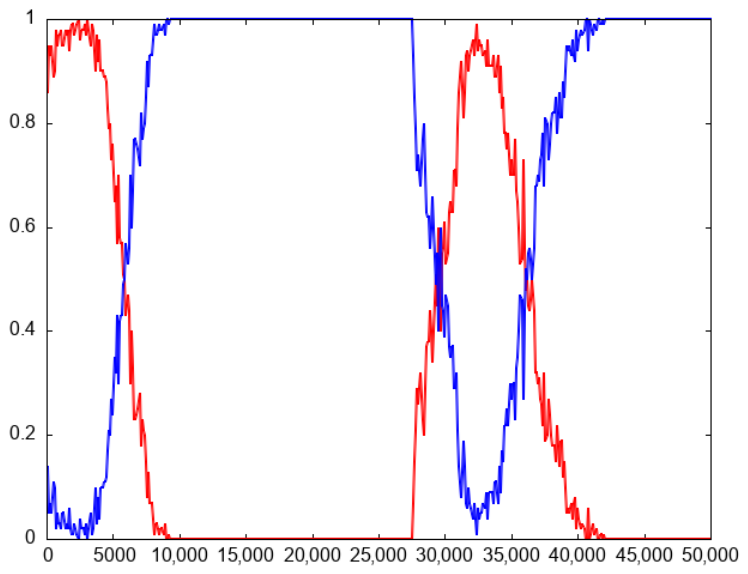
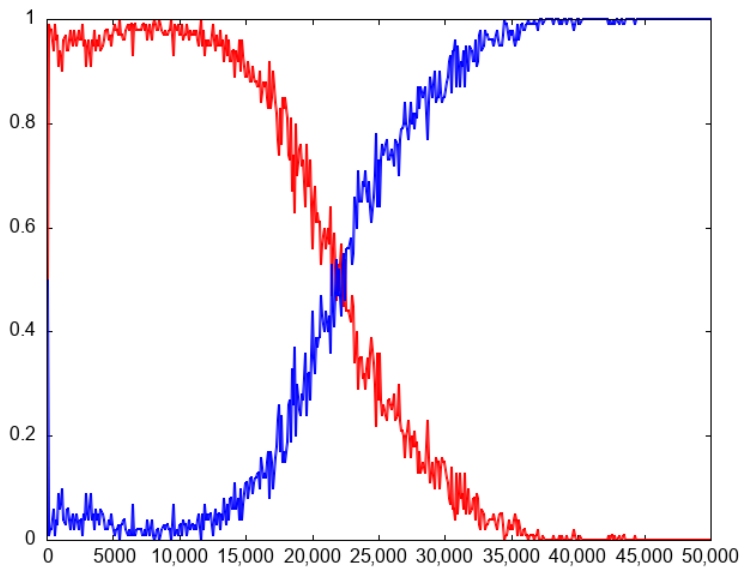
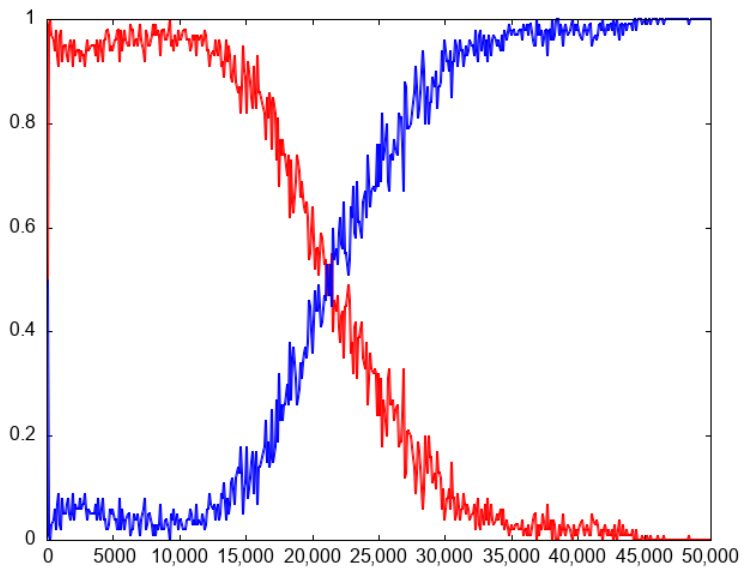
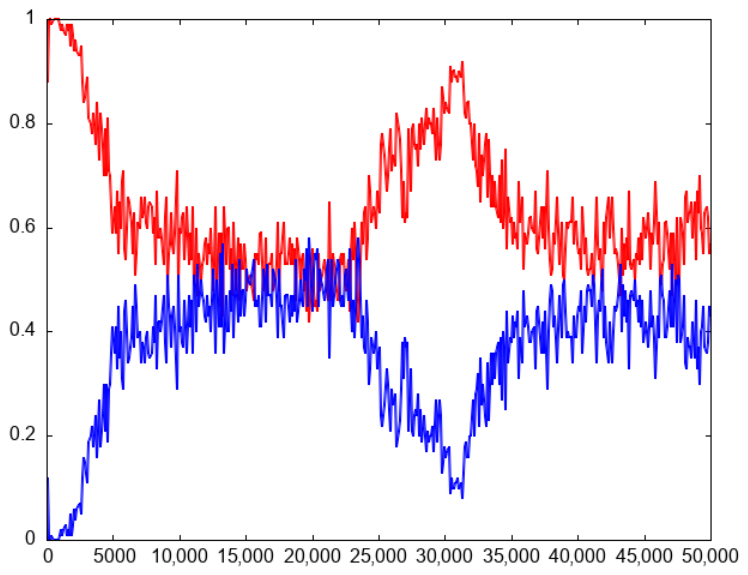
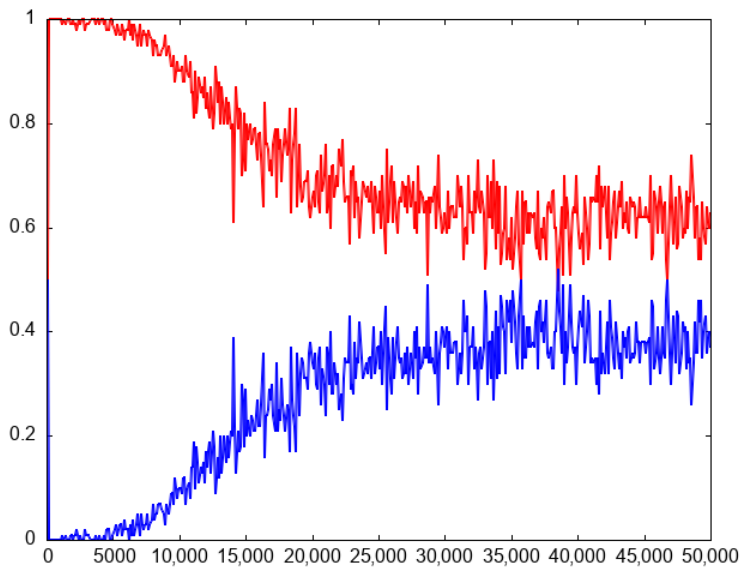
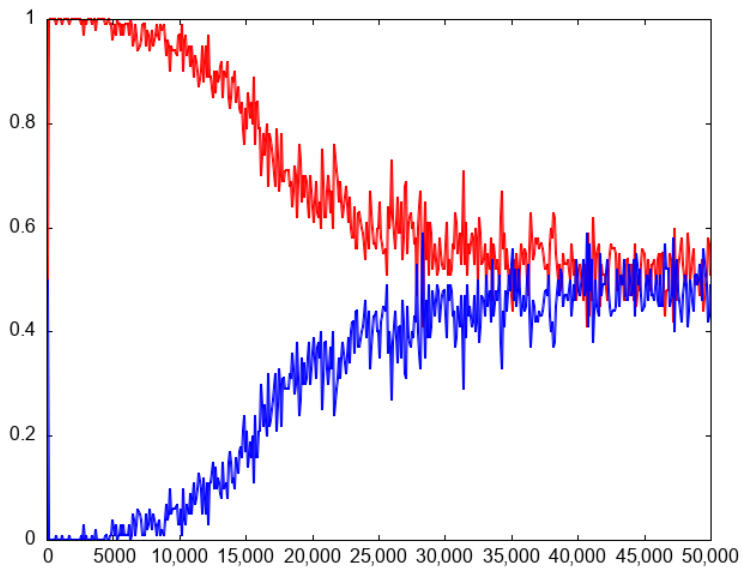
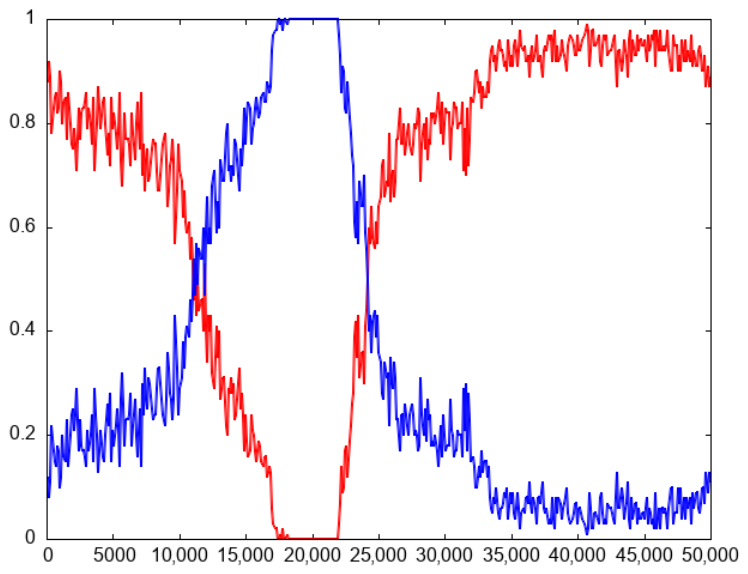
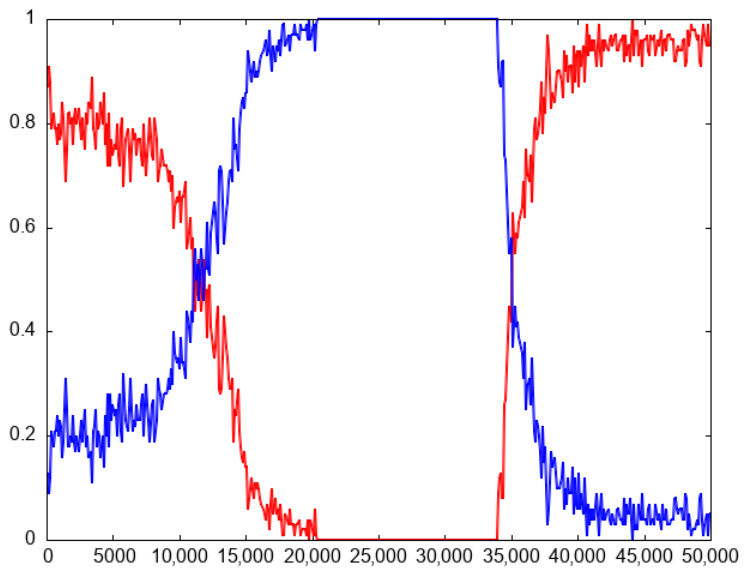
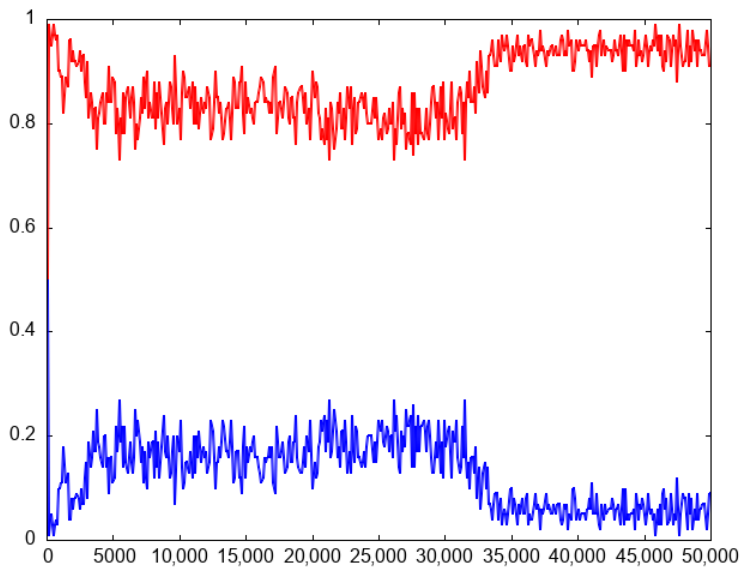
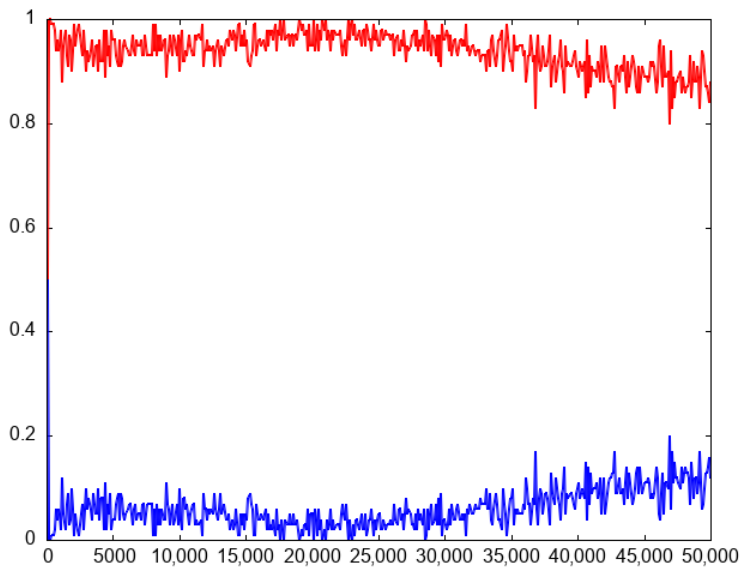
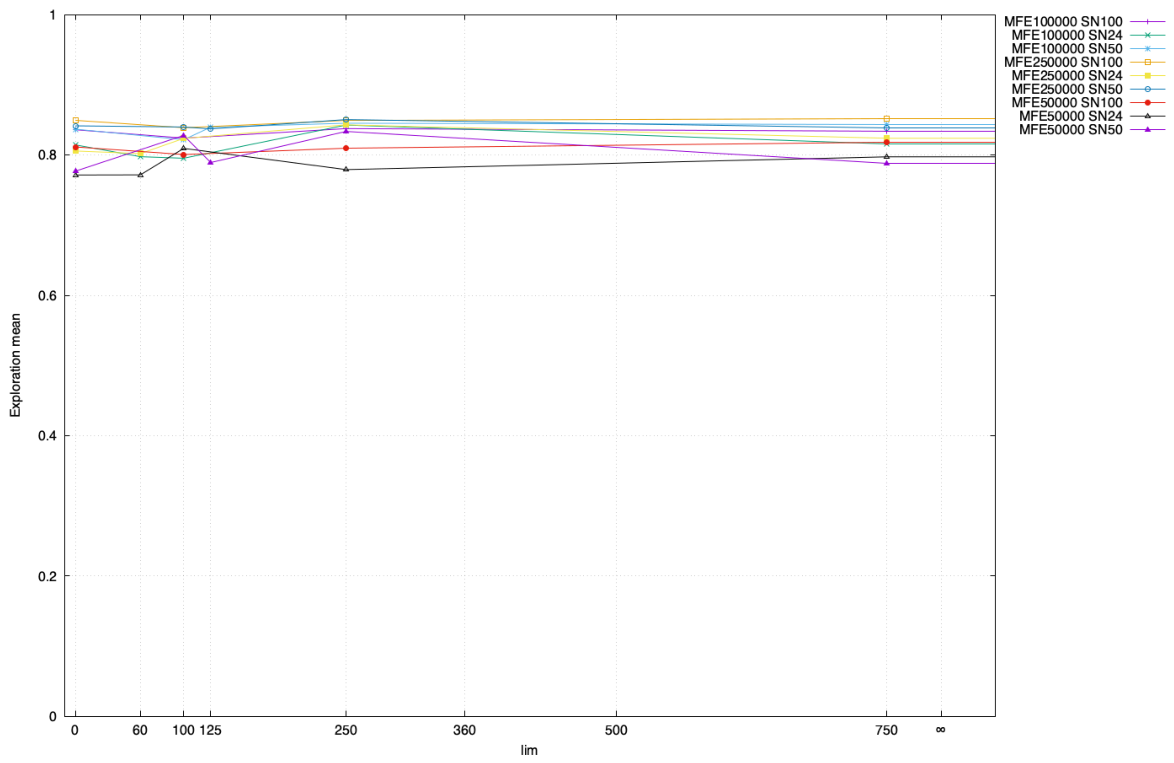
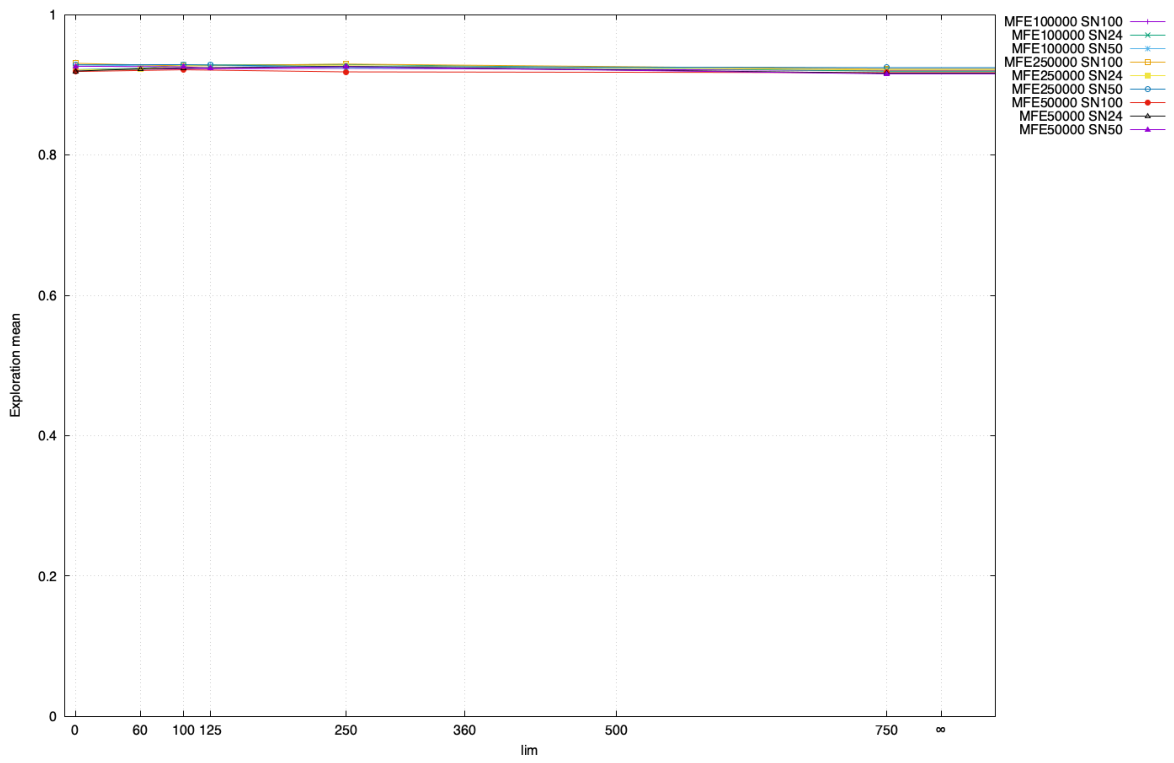
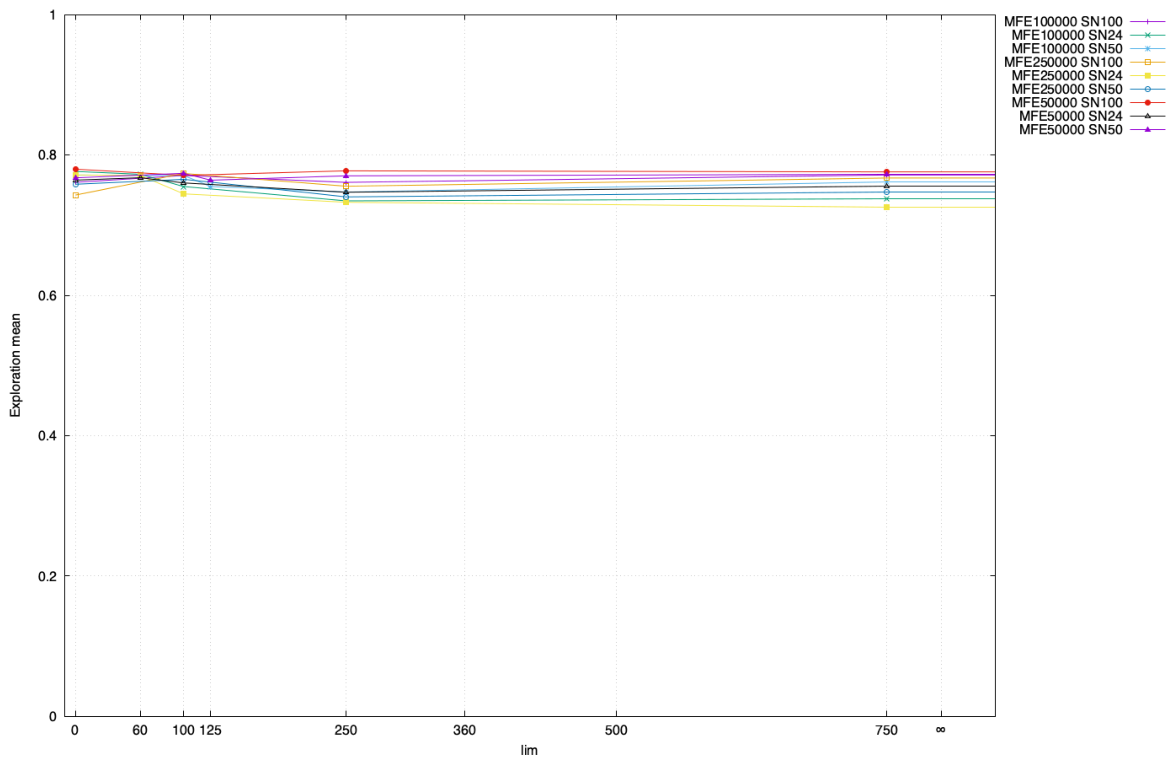
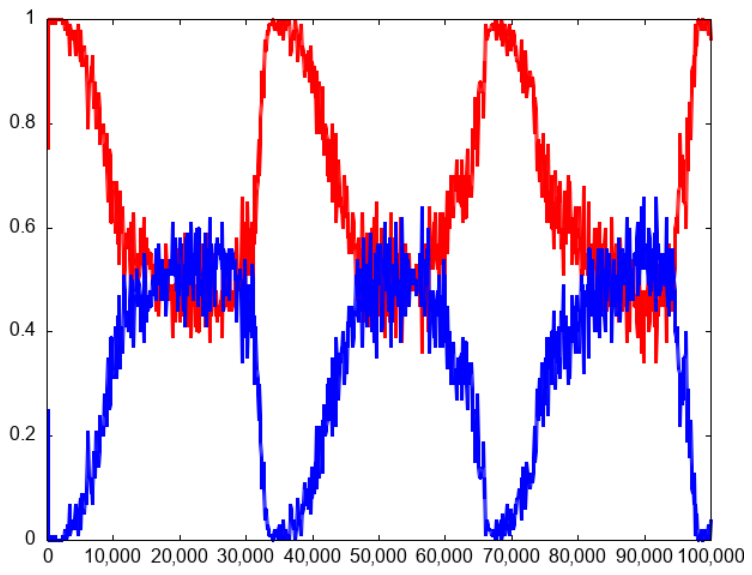
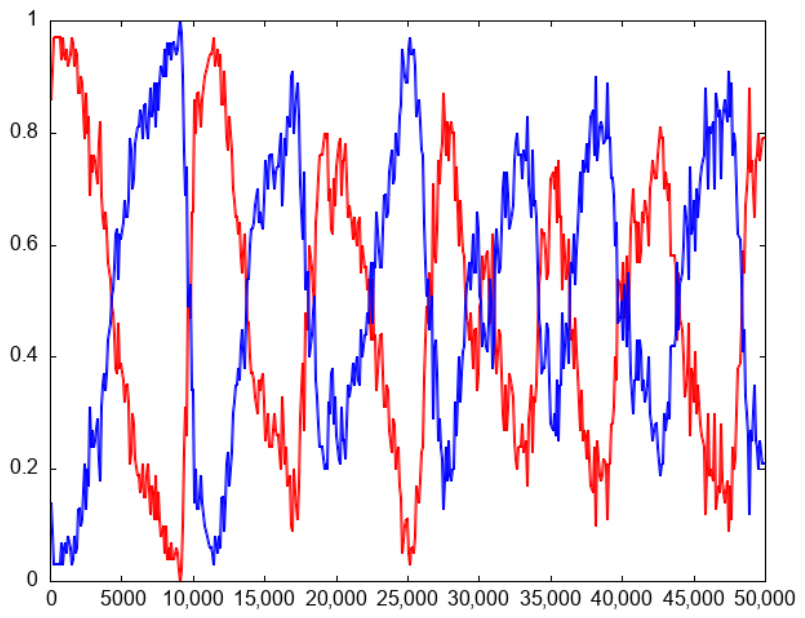
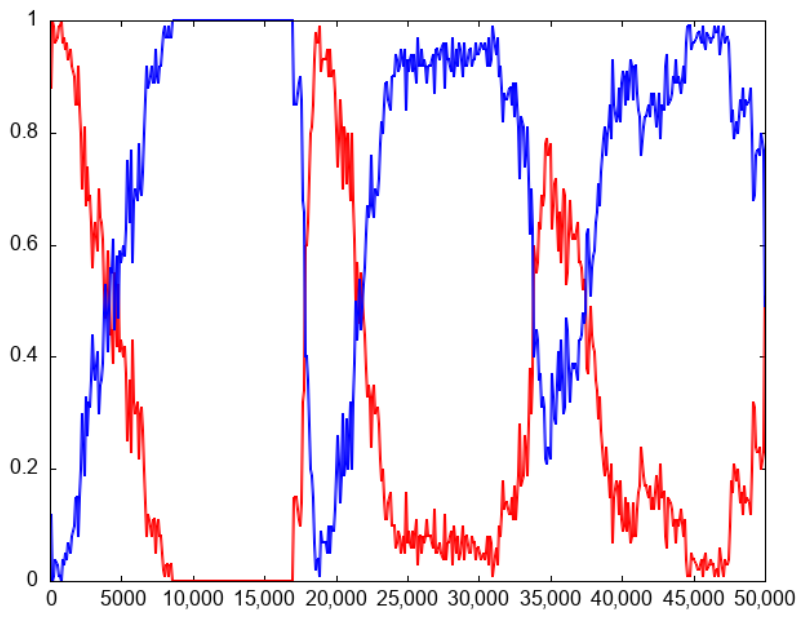
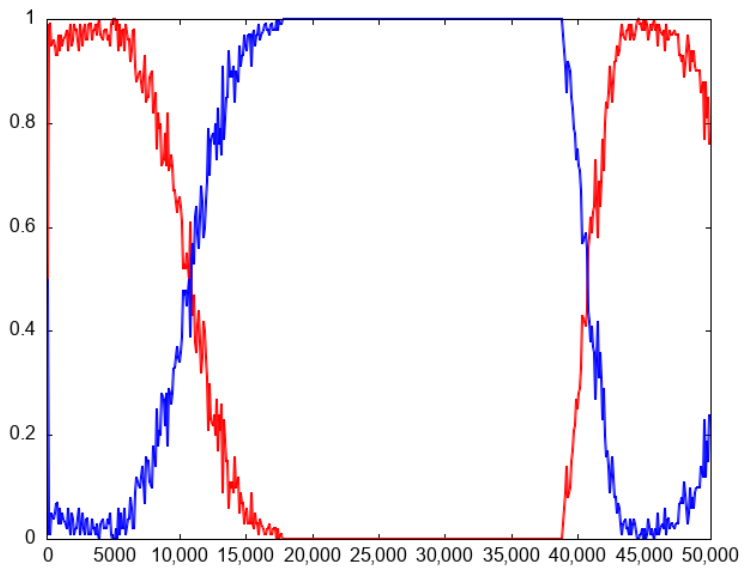
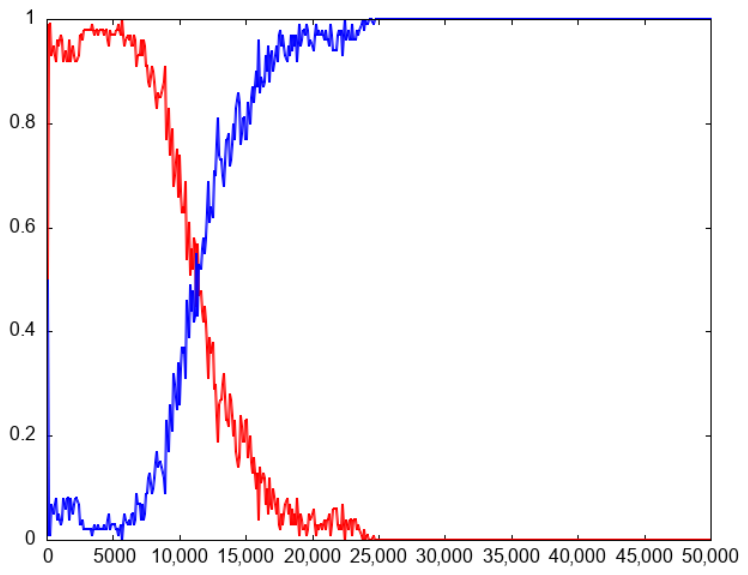
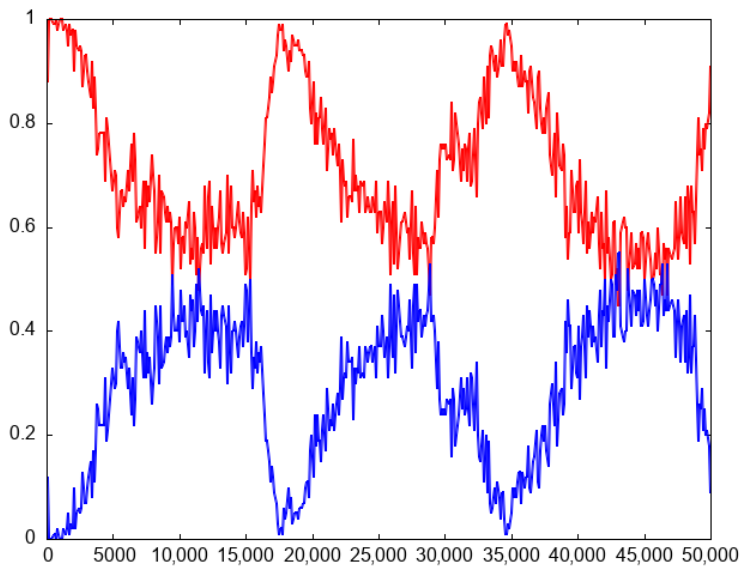
- Measuring exploration and exploitation alone is not sufficient and cannot be related directly to metaheuristics performance. Two different metaheuristics might have the same ratio between exploration and exploitation, yet very different performance. Hence, identification is needed of the different types of exploration and exploitation. Important is the ratio between desired and undesired explorations, as well as between successful and unsuccessful exploitation, although a general pattern of exploration and exploitation is descriptive and important (see the patterns in Figure 9, Figure 10, Figure 11, Figure 12, Figure 13, Figure 14, Figure 15, Figure 16, Figure 17, Figure 18, Figure 19, Figure 20, Figure 21, Figure 22, Figure 23, Figure 24, Figure 25, Figure 26, Figure 27, Figure 28, Figure 29, Figure 30, Figure 31, Figure 32, Figure 33, Figure 34, Figure 35, Figure 36, Figure 37, Figure 38, Figure 39 and Figure 40).
- Despite exploring the search space, it is not guaranteed that a better region has been discovered. This situation is depicted by successful rejection, deceptive exploration and failed exploration. In the latter case, a better region is discovered, but it is abandoned due to greedy survival selection.
- Despite exploiting the search space, it is not guaranteed that a better solution has been discovered, due to unsuccessful sampling of the neighborhood. This situation is depicted by unsuccessful exploitation.
- The amount of successful exploitation should be higher than that of successful exploration, as the global optimum can be reached mostly by exploitation of a neighborhood.
- A combination of successful rejection and unsuccessful exploitation depicts algorithm stagnation.
- When an increase in successful exploration precedes an increase in successful exploitation, investment in exploration has paid off.
- Unsuccessful exploitation is undesired, since the neighborhood has been searched, but no better solution has been found.
Author Contributions
Funding
Data Availability Statement
Conflicts of Interest
References
- Karaboga, D.; Basturk, B. On the performance of artificial bee colony (ABC) algorithm. Appl. Soft Comput. 2008, 8, 687–697. [Google Scholar] [CrossRef] [Scilit]
- Akay, B.; Karaboga, D. A modified Artificial Bee Colony algorithm for real-parameter optimization. Inf. Sci. 2012, 192, 120–142. [Google Scholar] [CrossRef] [Scilit]
- Tsai, C.; Chiang, M. Handbook of Metaheuristic Algorithms: From Fundamental Theories to Advanced Applications; Elsevier: Amsterdam, The Netherlands, 2023. [Google Scholar]
- Rajwar, K.; Deep, K.; Das, S. An exhaustive review of the metaheuristic algorithms for search and optimization: Taxonomy, applications, and open challenges. Artif. Intell. Rev. 2023, 56, 13187–13257. [Google Scholar] [CrossRef] [Scilit]
- Ding, Z.; Huang, M.; Lu, Z. Structural damage detection using artificial bee colony algorithm with hybrid search strategy. Swarm Evol. Comput. 2016, 28, 1–13. [Google Scholar] [CrossRef] [Scilit]
- Jesenik, M.; Trbušić, M. The approach of using a horizontally layered soil model for Inhomogeneous soil, by taking into account the deeper layers of the soil, and determining the model’s parameters using evolutionary methods. Appl. Sci. 2025, 15, 1420. [Google Scholar] [CrossRef] [Scilit]
- Jesenik, M.; Mernik, M.; Trlep, M. Determination of a Hysteresis Model Parameters with the Use of Different Evolutionary Methods for an Innovative Hysteresis Model. Mathematics 2020, 8, 201. [Google Scholar] [CrossRef] [Scilit]
- Li, G.; Liu, C.; Wu, L.; Xiao, W. A mixing algorithm of ACO and ABC for solving path planning of mobile robot. Appl. Soft Comput. 2023, 148, 110868. [Google Scholar] [CrossRef] [Scilit]
- Jesenik, M.; Ravber, M.; Trbušić, M. Innovative Approach for the Determination of a DC Motor’s and Drive’s Parameters Using Evolutionary Methods and Different Measured Current and Angular Speed Responses. Mathematics 2024, 12, 42. [Google Scholar] [CrossRef] [Scilit]
- Gülsün, B.; Aydin, M.R. Optimizing a Machine Learning Algorithm by a Novel Metaheuristic Approach: A Case Study in Forecasting. Mathematics 2024, 12, 3921. [Google Scholar] [CrossRef] [Scilit]
- Touafek, N.; Tayeb, F.B.S.; Ladj, A.; Baghdadi, R. Advanced Optimization of Flowshop Scheduling with Maintenance, Learning and Deteriorating Effects Leveraging Surrogate Modeling Approaches. Mathematics 2025, 13, 2381. [Google Scholar] [CrossRef] [Scilit]
- Civicioglu, P.; Besdok, E. A conceptual comparison of the Cuckoo-search, particle swarm optimization, differential evolution and artificial bee colony algorithms. Artif. Intell. Rev. 2013, 39, 315–346. [Google Scholar] [CrossRef] [Scilit]
- Aslan, S. A comparative study between artificial bee colony (ABC) algorithm and its variants on big data optimization. Memetic Comput. 2020, 12, 129–150. [Google Scholar] [CrossRef] [Scilit]
- Mernik, M.; Liu, S.H.; Karaboga, D.; Črepinšek, M. On clarifying misconceptions when comparing variants of the Artificial Bee Colony Algorithm by offering a new implementation. Inf. Sci. 2015, 291, 115–127. [Google Scholar] [CrossRef] [Scilit]
- Črepinšek, M.; Liu, S.H.; Mernik, M. Exploration and Exploitation in Evolutionary Algorithms: A Survey. ACM Comput. Surv. 2013, 45, 35. [Google Scholar] [CrossRef] [Scilit]
- Eiben, A.E.; Smith, J.E. Introduction to Evolutionary Computing; Natural Computing Series; Springer: Berlin/Heidelberg, Germany, 2003. [Google Scholar]
- Michalewicz, Z. Genetic Algorithms + Data Structures = Evolution Programs; Springer: Berlin/Heidelberg, Germany, 1999. [Google Scholar]
- Zhu, G.; Kwong, S. Gbest-guided artificial bee colony algorithm for numerical function optimization. Appl. Math. Comput. 2010, 217, 3166–3173. [Google Scholar] [CrossRef] [Scilit]
- Gao, W.; Liu, S.; Huang, L. A Novel Artificial Bee Colony Algorithm Based on Modified Search Equation and Orthogonal Learning. IEEE Trans. Cybern. 2013, 43, 1011–1024. [Google Scholar] [CrossRef] [Scilit]
- Gao, W.; Liu, S.; Huang, L. Enhancing artificial bee colony algorithm using more information-based search equations. Inf. Sci. 2014, 270, 112–133. [Google Scholar] [CrossRef] [Scilit]
- Wang, H.; Wu, Z.; Rahnamayan, S.; Sun, H.; Liu, Y.; Pan, J.S. Multi-strategy ensemble artificial bee colony algorithm. Inf. Sci. 2014, 279, 587–603. [Google Scholar] [CrossRef] [Scilit]
- Wang, B. A novel artificial bee colony algorithm based on modified search strategy and generalized opposition-based learning. J. Intell. Fuzzy Syst. 2015, 28, 1023–1037. [Google Scholar] [CrossRef] [Scilit]
- Kiran, M.S.; Hakli, H.; Gunduz, M.; Uguz, H. Artificial bee colony algorithm with variable search strategy for continuous optimization. Inf. Sci. 2015, 300, 140–157. [Google Scholar] [CrossRef] [Scilit]
- Song, X.; Zhao, M.; Yan, Q.; Xing, S. A high-efficiency adaptive artificial bee colony algorithm using two strategies for continuous optimization. Swarm Evol. Comput. 2019, 50, 100549. [Google Scholar] [CrossRef] [Scilit]
- Zhou, X.; Lu, J.; Huang, J.; Zhong, M.; Wang, M. Enhancing artificial bee colony algorithm with multi-elite guidance. Inf. Sci. 2021, 543, 242–258. [Google Scholar] [CrossRef] [Scilit]
- Wang, Y.; Jiao, J.; Liu, J.; Xiao, R. A labor division artificial bee colony algorithm based on behavioral development. Inf. Sci. 2022, 606, 152–172. [Google Scholar] [CrossRef] [Scilit]
- Singh, A.; Deep, K. Exploration–exploitation balance in Artificial Bee Colony algorithm: A critical analysis. Soft Comput. 2019, 23, 9525–9536. [Google Scholar] [CrossRef] [Scilit]
- Veček, N.; Liu, S.H.; Črepinšek, M.; Mernik, M. On the importance of the artificial bee colony control parameter ‘Limit’. Inf. Technol. Control 2017, 46, 566–604. [Google Scholar] [CrossRef] [Scilit]
- Alsamia, S.; Koch, E.; Albedran, H.; Ray, R. Adaptive Exploration Artificial Bee Colony for Mathematical Optimization. AI 2024, 5, 2218–2236. [Google Scholar] [CrossRef] [Scilit]
- Jerebic, J.; Mernik, M.; Liu, S.H.; Ravber, M.; Baketarić, M.; Mernik, L.; Črepinšek, M. A novel direct measure of exploration and exploitation based on attraction basins. Expert Syst. Appl. 2021, 167, 114353. [Google Scholar] [CrossRef] [Scilit]
- Li, M.; Chang, C.; Liu, Z. A discrete artificial bee colony algorithm and its application in flexible flow shop scheduling with assembly and machine deterioration effect. Appl. Soft Comput. 2024, 159, 111593. [Google Scholar] [CrossRef] [Scilit]
- Luo, Q.; Rao, Y.; Du, B. An effective discrete artificial bee colony for the rectangular cutting problem with guillotine in transformer manufacturing. Appl. Soft Comput. 2024, 159, 111617. [Google Scholar] [CrossRef] [Scilit]
- Yu, Y.; Zhang, F.; Yang, G.; Wang, Y.; Huang, J.; Han, Y. A discrete artificial bee colony method based on variable neighborhood structures for the distributed permutation flowshop problem with sequence-dependent setup times. Swarm Evol. Comput. 2022, 75, 101179. [Google Scholar] [CrossRef] [Scilit]
- Soza, C.; Becerra, R.L.; Riff, M.C.; Coello Coello, C.A. Solving timetabling problems using a cultural algorithm. Appl. Soft Comput. 2011, 11, 337–344. [Google Scholar] [CrossRef] [Scilit]
- Olorunda, O.; Engelbrecht, A.P. Measuring exploration/exploitation in particle swarms using swarm diversity. In Proceedings of the 2008 IEEE Congress on Evolutionary Computation (IEEE World Congress on Computational Intelligence); IEEE: Piscataway, NJ, USA, 2008; pp. 1128–1134. [Google Scholar]
- Cheng, S.; Shi, Y.; Qin, Q.; Zhang, Q.; Bai, R. Population Diversity Maintenance In Brain Storm Optimization Algorithm. J. Artif. Intell. Soft Comput. Res. 2014, 4, 83–97. [Google Scholar] [CrossRef] [Scilit]
- Yang, Q.; Chen, W.N.; Deng, J.D.; Li, Y.; Gu, T.; Zhang, J. A Level-Based Learning Swarm Optimizer for Large-Scale Optimization. IEEE Trans. Evol. Comput. 2018, 22, 578–594. [Google Scholar] [CrossRef] [Scilit]
- Hussain, K.; Salleh, M.N.M.; Cheng, S.; Shi, Y. On the exploration and exploitation in popular swarm-based metaheuristic algorithms. Neural Comput. Appl. 2019, 31, 7665–7683. [Google Scholar] [CrossRef] [Scilit]
- Li, D.; Guo, W.; Lerch, A.; Li, Y.; Wang, L.; Wu, Q. An adaptive particle swarm optimizer with decoupled exploration and exploitation for large scale optimization. Swarm Evol. Comput. 2021, 60, 100789. [Google Scholar] [CrossRef] [Scilit]
- Morales-Castañeda, B.; Zaldívar, D.; Cuevas, E.; Fausto, F.; Rodríguez, A. A better balance in metaheuristic algorithms: Does it exist? Swarm Evol. Comput. 2020, 54, 100671. [Google Scholar] [CrossRef] [Scilit]
- Liu, S.H.; Mernik, M.; Hrnčič, D.; Črepinšek, M. A parameter control method of evolutionary algorithms using exploration and exploitation measures with a practical application for fitting Sovova’s mass transfer model. Appl. Soft Comput. 2013, 13, 3792–3805. [Google Scholar] [CrossRef] [Scilit]
- Popič, J.; Bošković, B.; Brest, J. Improving mutation strategies in differential evolution with a new pbest selection mechanism. Appl. Soft Comput. 2025, 185, 113978. [Google Scholar] [CrossRef] [Scilit]
- Malan, K.M.; Engelbrecht, A.P. Fitness Landscape Analysis for Metaheuristic Performance Prediction. In Recent Advances in the Theory and Application of Fitness Landscapes; Richter, H., Engelbrecht, A., Eds.; Springer: Berlin/Heidelberg, Germany, 2014; pp. 103–132. [Google Scholar]
- Gonzalez-Fernandez, Y.; Chen, S. Leaders and followers—A new metaheuristic to avoid the bias of accumulated information. In Proceedings of the 2015 IEEE Congress on Evolutionary Computation (CEC); IEEE: Piscataway, NJ, USA, 2015; pp. 776–783. [Google Scholar]
- Baketarić, M.; Mernik, M.; Kosar, T. Attraction Basins in Metaheuristics: A Systematic Mapping Study. Mathematics 2021, 9, 3036. [Google Scholar] [CrossRef] [Scilit]
- Cotta, C.; Gallardo, J.E.; Mathieson, L.; Moscato, P. Memetic Algorithms: A Contemporary Introduction. In Wiley Encyclopedia of Electrical and Electronics Engineering; John Wiley & Sons, Ltd.: Hoboken, NJ, USA, 2016; pp. 1–15. [Google Scholar]
- Neri, F.; Cotta, C.; Moscato, P. Handbook of Memetic Algorithms; Springer: Berlin/Heidelberg, Germany, 2011; Volume 379. [Google Scholar]
- Chen, S.; Bolufé-Röhler, A.; Montgomery, J.; Tamayo-Vera, D.; Hendtlass, T. Measuring the Effects of Increasing Dimensionality on Fitness-Based Selection and Failed Exploration. In Proceedings of the 2022 IEEE Congress on Evolutionary Computation (CEC); IEEE: Piscataway, NJ, USA, 2022; pp. 1–8. [Google Scholar]
- Ochoa, G.; Tomassini, M.; Vérel, S.; Darabos, C. A Study of NK Landscapes’ Basins and Local Optima Networks. In Proceedings of the 10th Annual Conference on Genetic and Evolutionary Computation; Association for Computing Machinery: New York, NY, USA, 2008; pp. 555–562. [Google Scholar]
- Pitzer, E.; Affenzeller, M.; Beham, A. A closer look down the basins of attraction. In Proceedings of the 2010 UK Workshop on Computational Intelligence; IEEE: Piscataway, NJ, USA, 2010; pp. 1–6. [Google Scholar]
- Tsang, K.K. Basin of Attraction as a measure of robustness of an optimization algorithm. In Proceedings of the 2018 14th International Conference on Natural Computation, Fuzzy Systems and Knowledge Discovery; IEEE: Piscataway, NJ, USA, 2018; pp. 133–137. [Google Scholar]
- Drugan, M.M. Estimating the number of basins of attraction of multi-objective combinatorial problems. J. Comb. Optim. 2019, 37, 1367–1407. [Google Scholar] [CrossRef] [Scilit]
- Ferhat, A.; Zitouni, F.; Lakbichi, R.; Limane, A.; Harous, S. Measures of exploration and exploitation rates in MAs: Classification, comparison, and convergence analysis. Memetic Comput. 2025, 17, 37. [Google Scholar] [CrossRef] [Scilit]
- Yildizdan, G.; Baykan, Ö.K. A New Hybrid BA_ABC Algorithm for Global Optimization Problems. Mathematics 2020, 8, 1749. [Google Scholar] [CrossRef] [Scilit]
- Awad, N.; Ali, M.; Liang, J.; Qu, B.; Suganthan, P.; Definitions, P. Evaluation criteria for the CEC 2017 special session and competition on single objective real-parameter numerical optimization. Technol. Rep. 2016, 9. [Google Scholar]
- Veček, N.; Črepinšek, M.; Mernik, M. On the influence of the number of algorithms, problems, and independent runs in the comparison of evolutionary algorithms. Appl. Soft Comput. 2017, 54, 23–45. [Google Scholar] [CrossRef] [Scilit]


















| Problem | D | SE | FE | DE | SR | XPL | XPT | ||
|---|---|---|---|---|---|---|---|---|---|
| Rastrigin | 5 | 0.0702 ± 0.0014 | 0.1875 ± 0.0084 | 0.0316 ± 0.0010 | 0.7107 ± 0.0101 | 0.1469 ± 0.0354 | 0.8531 ± 0.0354 | 0.2896 ± 0.0573 | 0.7104 ± 0.0573 |
| Rastrigin | 10 | 0.0567 ± 0.0029 | 0.1700 ± 0.0108 | 0.0147 ± 0.0013 | 0.7586 ± 0.0146 | 0.1685 ± 0.0373 | 0.8315 ± 0.0373 | 0.2678 ± 0.0438 | 0.7322 ± 0.0438 |
| Rastrigin | 30 | 0.0986 ± 0.0147 | 0.0746 ± 0.0662 | 0.0033 ± 0.0028 | 0.8235 ± 0.0636 | 0.2211 ± 0.0794 | 0.7789 ± 0.0794 | 0.4409 ± 0.1855 | 0.5591 ± 0.1855 |
| Ackley | 5 | 0.1525 ± 0.0039 | 0.1410 ± 0.0045 | 0.0481 ± 0.0014 | 0.6584 ± 0.0094 | 0.1995 ± 0.0371 | 0.8005 ± 0.0371 | 0.1713 ± 0.0344 | 0.8287 ± 0.0344 |
| Ackley | 10 | 0.1546 ± 0.0079 | 0.1139 ± 0.0066 | 0.0312 ± 0.0022 | 0.7003 ± 0.0162 | 0.2214 ± 0.0355 | 0.7786 ± 0.0355 | 0.1702 ± 0.0363 | 0.8298 ± 0.0363 |
| Ackley | 30 | 0.1932 ± 0.0234 | 0.0717 ± 0.0633 | 0.0197 ± 0.0172 | 0.7154 ± 0.0583 | 0.2713 ± 0.0583 | 0.7287 ± 0.0583 | 0.3225 ± 0.2439 | 0.6775 ± 0.2439 |
| Griewank | 5 | 0.0412 ± 0.0095 | 0.1210 ± 0.0251 | 0.0140 ± 0.0033 | 0.8238 ± 0.0376 | 0.1235 ± 0.0289 | 0.8765 ± 0.0289 | 0.4880 ± 0.0424 | 0.5120 ± 0.0424 |
| Griewank | 10 | 0.0562 ± 0.0160 | 0.1282 ± 0.0286 | 0.0201 ± 0.0057 | 0.7954 ± 0.0498 | 0.1382 ± 0.0419 | 0.8618 ± 0.0419 | 0.3851 ± 0.0381 | 0.6149 ± 0.0381 |
| Griewank | 30 | 0.2087 ± 0.0367 | 0.0454 ± 0.0406 | 0.0056 ± 0.0049 | 0.7403 ± 0.0511 | 0.2384 ± 0.0736 | 0.7616 ± 0.0736 | 0.3684 ± 0.1665 | 0.6316 ± 0.1665 |
| F03 | 5 | 0.0502 ± 0.0120 | 0.4273 ± 0.0197 | 0.0442 ± 0.0096 | 0.4783 ± 0.0115 | 0.0811 ± 0.0135 | 0.9189 ± 0.0135 | 0.8217 ± 0.0232 | 0.1783 ± 0.0232 |
| F03 | 10 | 0.0557 ± 0.0150 | 0.1134 ± 0.0135 | 0.0167 ± 0.0045 | 0.8142 ± 0.0281 | 0.2190 ± 0.0512 | 0.7810 ± 0.0512 | 0.9319 ± 0.0268 | 0.0681 ± 0.0268 |
| F03 | 30 | 0.0920 ± 0.0437 | 0.0323 ± 0.0289 | 0.0090 ± 0.0080 | 0.8667 ± 0.0379 | 0.0549 ± 0.0096 | 0.9451 ± 0.0096 | 0.9268 ± 0.0049 | 0.0732 ± 0.0049 |
| F10 | 5 | 0.0213 ± 0.0092 | 0.4336 ± 0.0171 | 0.0185 ± 0.0077 | 0.5266 ± 0.0035 | 0.0662 ± 0.0211 | 0.9338 ± 0.0211 | 0.9243 ± 0.0039 | 0.0757 ± 0.0039 |
| F10 | 10 | 0.0384 ± 0.0144 | 0.1390 ± 0.0227 | 0.0060 ± 0.0017 | 0.8166 ± 0.0109 | 0.0745 ± 0.0145 | 0.9255 ± 0.0145 | 0.9296 ± 0.0254 | 0.0704 ± 0.0254 |
| F10 | 30 | 0.0680 ± 0.0263 | 0.0148 ± 0.0161 | 0.0024 ± 0.0024 | 0.9148 ± 0.0243 | 0.0687 ± 0.0233 | 0.9313 ± 0.0233 | 0.9431 ± 0.0035 | 0.0569 ± 0.0035 |
| F20 | 5 | 0.0135 ± 0.0072 | 0.2882 ± 0.0084 | 0.0086 ± 0.0041 | 0.6897 ± 0.0130 | 0.0789 ± 0.0312 | 0.9211 ± 0.0312 | 0.7613 ± 0.0135 | 0.2387 ± 0.0135 |
| F20 | 10 | 0.0150 ± 0.0066 | 0.2966 ± 0.0072 | 0.0065 ± 0.0028 | 0.6819 ± 0.0118 | 0.0746 ± 0.0253 | 0.9254 ± 0.0253 | 0.6959 ± 0.0089 | 0.3041 ± 0.0089 |
| F20 | 30 | 0.0469 ± 0.0218 | 0.0491 ± 0.0587 | 0.0025 ± 0.0030 | 0.9016 ± 0.0519 | 0.0634 ± 0.0160 | 0.9366 ± 0.0160 | 0.9440 ± 0.0235 | 0.0560 ± 0.0235 |
| Problem | D | SE/DE | SE/FE | / | SE/ | / |
|---|---|---|---|---|---|---|
| Rastrigin | 5 | 2.2215 | 0.3744 | 3.5641 | 0.4779 | 0.1722 |
| Rastrigin | 10 | 3.8571 | 0.3335 | 4.4142 | 0.3365 | 0.2026 |
| Rastrigin | 30 | 29.8788 | 1.3217 | 11.8370 | 0.4460 | 0.2839 |
| Ackley | 5 | 3.1705 | 1.0816 | 4.2882 | 0.7644 | 0.2492 |
| Ackley | 10 | 4.9551 | 1.3573 | 5.8918 | 0.6983 | 0.2844 |
| Ackley | 30 | 9.8071 | 2.6946 | 9.9409 | 0.7121 | 0.3723 |
| Griewank | 5 | 2.9429 | 0.3405 | 6.4074 | 0.3336 | 0.1409 |
| Griewank | 10 | 2.7960 | 0.4384 | 5.7424 | 0.4067 | 0.1604 |
| Griewank | 30 | 37.2679 | 4.5969 | 18.6078 | 0.8754 | 0.3130 |
| F03 | 5 | 1.1357 | 0.1175 | 1.1209 | 0.6190 | 0.0883 |
| F03 | 10 | 3.3353 | 0.4912 | 6.6864 | 0.2543 | 0.2804 |
| F03 | 30 | 10.2222 | 2.8483 | 23.2131 | 1.6758 | 0.0581 |
| F10 | 5 | 1.1514 | 0.0491 | 1.2119 | 0.3218 | 0.0709 |
| F10 | 10 | 6.4000 | 0.2763 | 5.8966 | 0.5154 | 0.0805 |
| F10 | 30 | 28.3333 | 4.5946 | 57.1395 | 0.9898 | 0.0738 |
| F20 | 5 | 1.5698 | 0.0468 | 2.3693 | 0.1711 | 0.0857 |
| F20 | 10 | 2.3077 | 0.0506 | 2.2992 | 0.2011 | 0.0806 |
| F20 | 30 | 18.7600 | 0.9552 | 18.3818 | 0.7397 | 0.0677 |
Disclaimer/Publisher’s Note: The statements, opinions and data contained in all publications are solely those of the individual author(s) and contributor(s) and not of MDPI and/or the editor(s). MDPI and/or the editor(s) disclaim responsibility for any injury to people or property resulting from any ideas, methods, instructions or products referred to in the content. |
© 2026 by the authors. Licensee MDPI, Basel, Switzerland. This article is an open access article distributed under the terms and conditions of the Creative Commons Attribution (CC BY) license.
Share and Cite
Jerebic, J.; Ravber, M.; Mernik, L.; Mernik, M. On the Exploration and Exploitation Capabilities of the Artificial Bee Colony Algorithm. Mathematics 2026, 14, 1406. https://doi.org/10.3390/math14091406
Jerebic J, Ravber M, Mernik L, Mernik M. On the Exploration and Exploitation Capabilities of the Artificial Bee Colony Algorithm. Mathematics. 2026; 14(9):1406. https://doi.org/10.3390/math14091406
Chicago/Turabian StyleJerebic, Jernej, Miha Ravber, Luka Mernik, and Marjan Mernik. 2026. "On the Exploration and Exploitation Capabilities of the Artificial Bee Colony Algorithm" Mathematics 14, no. 9: 1406. https://doi.org/10.3390/math14091406
APA StyleJerebic, J., Ravber, M., Mernik, L., & Mernik, M. (2026). On the Exploration and Exploitation Capabilities of the Artificial Bee Colony Algorithm. Mathematics, 14(9), 1406. https://doi.org/10.3390/math14091406