Article

Influence of the Mechanical Damage and Static Prestress on the Thermal Quality Factor of Viscothermoelastic Micro-Resonators Based on the Dual-Phase-Lag Heat Conduction Model


Mechanical Engineering Department, College of Engineering and Architecture, Umm Al-Qura University, Makkah 21955, Saudi Arabia
Mathematics 2026, 14(8), 1343; https://doi.org/10.3390/math14081343
Submission received: 5 February 2026 / Revised: 16 March 2026 / Accepted: 13 April 2026 / Published: 16 April 2026

Abstract

Mechanical and thermal relaxation times are of utmost importance in determining the thermal quality of micro- and nano-resonators. The interplay between mechanical and thermal activity governs energy dissipation in these resonators. In a recent paper, an analytical thermal model was developed to incorporate mechanical and thermal relaxation times, thereby increasing the quality factor under mechanical damage, while accounting for static prestress in a micro-viscothermoelastic resonator. The effects of the relaxation time parameters and static prestress on the thermal quality factor have been addressed. This model assumes that static prestress can serve as a tuning knob for significant improvements in thermal efficiency variables. The mechanical and thermal relaxation times, isothermal frequency, and mechanical damage parameter have substantial effects on the resonator’s thermal quality factor.

1. Introduction

The enhanced focus on micro-mechanical systems stems from the consideration of the thermal quality factor (Q-factor) in resonator and sensor applications. Thermoelastic damping (TED) is widely recognized as a significant contributor to mechanical losses in microresonators [1,2]. Zener was the pioneer in proposing an approximation formula for computing thermoelastic damping. Additionally, he conducted the initial effort to quantify the magnitude of thermoelastic damping using a solid model [3,4,5]. The field of thermoelasticity has attracted considerable interest among researchers in calculating the thermal quality factor in thermoelastic damping, following the pioneering work of Zener [6,7,8]. Lifshitz and Roukes improved the precise mathematical expression that characterizes thermoelastic damping. Thermoelastic damping modeling is widely recognized as a crucial advancement in the field, but its use for device design objectives is limited by its inherent inaccuracies [9]. Sun and colleagues developed an alternative model that relies on the non-Fourier heat conduction law [10]. Thermal damping has been calculated by solving the coupled thermoelasticity model using eigenvectors and eigenvalues derived from the uncoupled thermoelastic equations [10,11]. The application of an axial force can alter the resonant frequency of a resonator. For instance, the tensile force increases the natural frequency [12,13]. Furthermore, the investigations conducted have indicated that applying tensile stress increases the thermal quality factor [14]. The findings of this experiment are in direct opposition to the anticipated outcomes predicted by current theories of damping expression [15]. In their initial state, elastic materials often contain intrinsic flaws such as voids or microcracks. Interior voids or gaps can expand and merge during deformation. Furthermore, the formation of additional microdefects in regions of high stress might lead to material separation. These phenomena, which ultimately lead to a complete breakdown of material integrity and the formation of macroscopic fissures, are sometimes referred to as mechanical damage. Brittle, ductile, creep, and fatigue damage are among the macroscopic phenomena that have been used to categorize material damage [16]. Analysis of the macroscopic behavior of a damaged material has been further explored within the context of continuum mechanics. The concept of mechanical damage theory serves as a bridge connecting classical continuum mechanics and fracture mechanics. Liyuan Liu et al. developed a thermo-hydro-mechanical-damage (THMD) coupled model to describe the coupling between rock damage and mechanical, fluid flow and heat transfer fields [17]. Dechun Lu et al. developed a modeling method with an incremental stress–strain–environment constitutive model to predict the change in the plastic mechanical behavior of concrete caused by environmental action [18]. Zhong et al. introduced a discrete element simulation of damage mechanisms in stone cultural relics under dynamic impact [19]. Keren Wang et al. investigated high-Q resonance engineering in momentum space for highly coherent and rainbow-free thermal emission [20].
Gulshan Makkad et al. studied the fractional thermoviscoelastic damping response in a non-simple micro-beam via DPL and KG nonlocality effects [21]. Weng et al. discussed the size-dependent thermoelastic damping analysis of functionally graded polymer micro-plate resonators reinforced with graphene nanoplatelets based on a three-phase-lag heat conduction model [22]. Qian ei al. studied the thermoelastic damping in micro-disk resonators with in-plane extensile vibration [23]. Al-Lehaibi investigated the vibration of a ceramic micro-circular ring with viscothermoelastic properties under the classical Caputo and Caputo–Fabrizio fractional-order derivative [24].
The novelty of the present work lies in studying the impact of the mechanical damage variable, in combination with static prestress, on viscothermoelastic micro-resonators based on the dual-phase-lag heat conduction model. This model aims to enhance the quality factor by accounting for the impact of mechanical damage on the static prestress in a viscothermoelastic micro-resonator. The effects of time and static prestress on the thermal quality factor are examined.

2. Mechanical Damage

The mechanical damage variable can be calculated in many ways. An area element d A n and unit normal vector n are assumed within the cross-section of the damaged body. “ d A D ” denotes the defective area; then, the amount of damage can be obtained using the area fraction as follows [16]:
Λ n = d A D d A n , 0 Λ n < 1
Λ n = 0 compiles with the undamaged situation of the material, while Λ n = 1 theoretically gives the completely damaged case of the material with a total loss of stress-carrying capacity (fracture case). The materials take a value in the range of Λ n = 0.0 , 0.5 the damage that takes place. If the mechanical damage is constant across a finite area, under uniaxial tension, relation (1) reduces to
Λ n = A D / A
In the case of an isotropic material, the mechanical damage “ Λ ” is independent of the unit normal vector; hence, the effective stresses are given by [16]:
σ i j = 1 Λ σ i j
where σ i j gives the average stresses in the undamaged case of the material.
This definition of damage mechanics has been used in several articles [25,26,27,28].

3. Basic Equations and Model Formulation

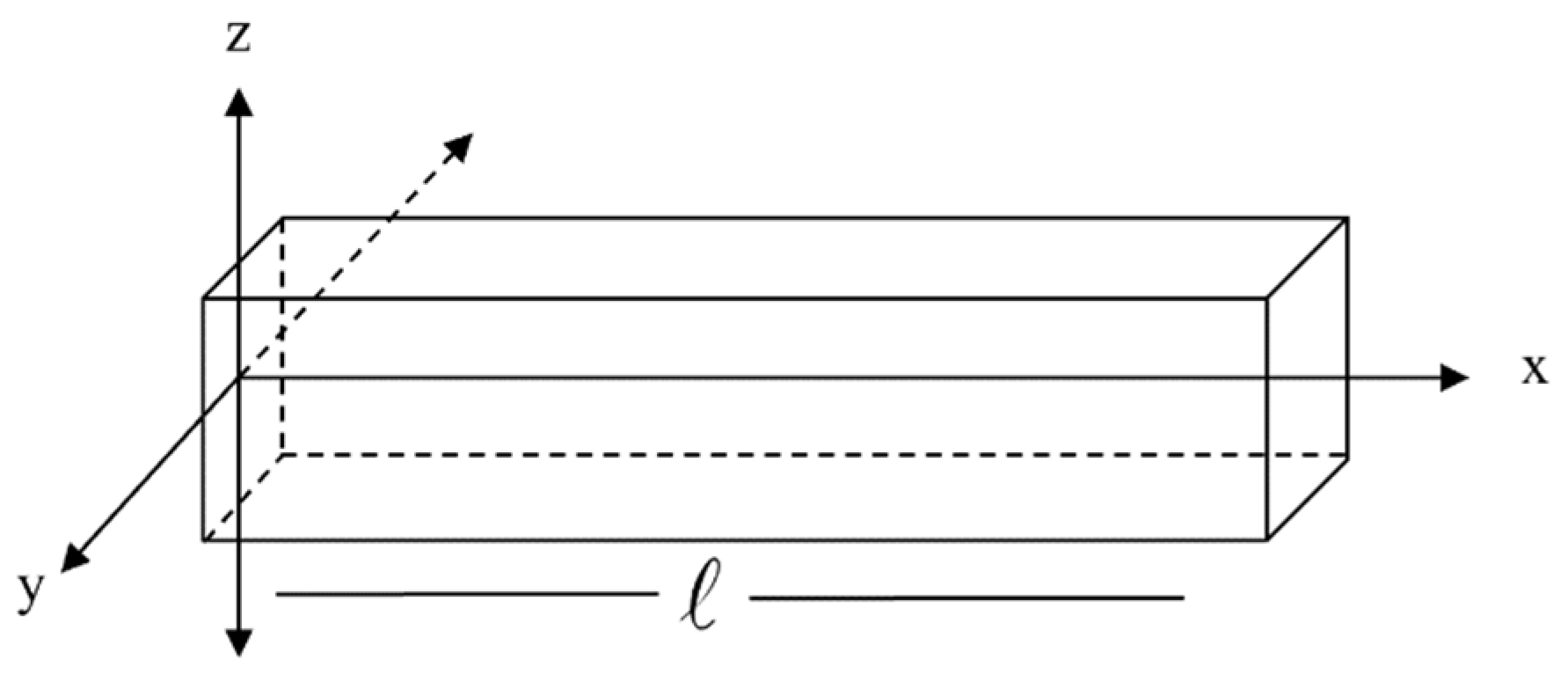
We consider that there are small deflections in a thin thermoelastic micro-resonator of length 0 x l , width b / 2 z b / 2 , and thickness h / 2 y h / 2 . We assume that the x, y, and z-axes are regarded as the longitude, width, and thickness of the micro-resonator, respectively, as in Figure 1.
In assuming the Lifshitz–Roukes’ approach to obtain the exact solution for a prestressed micro-resonator, the constitutive one-dimensional equation for a Euler–Bernoulli beam with length L, width b, and depth h along the x, y, and z-axes, respectively, and elastic displacement w x ,   y ,   z ,   t can be written as [9]
σ x x = σ 0 1 Λ E y 2 w x 2 1 Λ E α T θ
where I is the moment of inertia, F is the applied axial force, σ 0 = F / A is the prestress due to the applied axial force, A is the area of the cross-section of the beam, E is the well-known Young’s modulus, and α T is the coefficient of thermal expansion.
When the beam is in equilibrium, the temperature is T 0 , and the ensuing vibration will result in a temperature field T = T 0 + θ , where θ is the temperature increment.
By deriving the equation of motion for thermoelastic vibration, we obtain [2,10,29,30,31]
1 Λ E I 4 w x 4 F 2 w x 2 + 1 Λ E α T 2 I T x 2 + ρ A 2 w t 2 = 0
where
I = h / 2 h / 2 b / 2 b / 2 y 2 d y d z = b h 3 12 ,  
and
I T = h / 2 h / 2 b / 2 b / 2 θ y d y d z = b h / 2 h / 2 θ y d y
The dual-phase-lag heat equation takes the following form [8,32,33,34,35]:
K 1 + τ T t 2 θ = t + τ q 2 t 2 ρ C ν θ + 1 Λ E α T T 0 1 2 ν ε
where υ is Poisson’s ratio, C υ is the specific heat at constant strain, and K is the thermal conductivity. τ q and τ T are the thermal relaxation of the temperature and its gradient, respectively.
The volumetric deformation (cubical strain) is as follows [35,36]:
ε = ε x x + ε y y + ε z z
where
1 Λ E ε x x = σ 0 y 1 Λ E 2 w x 2 , 1 Λ E ε y y = υ σ 0 + υ y 1 Λ E 2 w x 2 + 1 + υ α T 1 Λ E θ 1 Λ E ε z z = υ σ 0 + υ y 1 Λ E 2 w x 2 + 1 + υ α T 1 Λ E θ
Then, we have
1 Λ E ε = 1 2 υ σ 0 1 2 υ y 1 Λ E 2 w x 2 + 2 1 + υ α T 1 Λ E θ
Substituting Equation (10) into Equation (8), we obtain [35,36,37]
1 + τ T t 2 θ = η t + τ q 2 t 2 θ + α T T 0 K t + τ q 2 t 2 2 1 + υ α T 1 2 υ 1 Λ E θ y 1 Λ E 2 w x 2
which gives
1 + τ T t 2 θ + α T T 0 1 Λ E K y t + τ q 2 t 2 2 w x 2 = t + τ q 2 t 2 η + 2 1 Λ E T 0 α T 2 1 + υ K 1 2 ν θ
where η = ρ C υ K .
For viscothermoelastic materials, we consider Young’s modulus in the following form [32,33,35,38]:
E G t = E 0 1 + E 1 t G t
E 0 denotes Young’s modulus for the usual case, while E 1 is the mechanical relaxation time. G t is any function affected by E .
Hence, Equation (13) takes the following form:
1 + τ T t 2 θ + Δ E α T 1 Λ 1 + E 1 t t + τ q 2 t 2 y 2 w x 2 = t + τ q 2 t 2 η + 2 Δ E 1 + υ 1 2 υ 1 Λ 1 + E 1 t θ
where Δ E = T 0 α T 2 E 0 K .
Because the temperature gradients in the plane of the cross-section along the y-direction are much larger than those along the x-direction, and no gradients exist in the z-direction, we can replace 2 θ with 2 θ y 2 [36,37]. Hence, we have
1 + τ T t 2 θ y 2 + Δ E α T y 1 Λ 1 + E 1 t t + τ q 2 t 2 2 w x 2 = t + τ q 2 t 2 η + 2 Δ E 1 + υ 1 2 υ 1 Λ 1 + E 1 t θ
We consider the following functions [2,35,36,37]:
θ ( x , y , t ) = ϑ ( x , y ) e i ω t , w ( x , t ) = W ( x ) e i ω t
which give that
t θ , w = i ω ϑ , W , 2 t 2 θ , w = ω 2 ϑ , W
Using the relations in (18) in Equation (16), we obtain that
1 + i τ T ω 2 ϑ y 2 + Δ E α T 1 Λ 1 + i E 1 ω i ω τ q ω 2 y d 2 W d x 2 e i ω = i ω τ q ω 2 η + 2 Δ E 1 + υ 1 2 υ 1 Λ 1 + i E 1 ω ϑ e i ω
Hence, Equation (19) will be in the following form:
1 + i τ T ω 2 ϑ y 2 + Δ E α T 1 Λ 1 + i E 1 ω i ω τ q ω 2 y d 2 W d x 2 = i ω τ q ω 2 η + 2 Δ E 1 + υ 1 2 υ 1 Λ 1 + i E 1 ω ϑ
which gives
2 y 2 λ 2 ϑ x , y = α y d 2 W x d x 2
where λ = λ ω = i ω τ q ω 2 1 + i τ T ω η + 2 Δ E 1 + v 1 2 v 1 Λ 1 + i E 1 ω and α = α ω = Δ E α T 1 Λ 1 + i E 1 ω i ω τ q ω 2 1 + i τ T ω .
The general solution of the partial differential Equation (21) takes the form
ϑ x , y = A sin λ y + B cos λ y + α λ 2 y d 2 W x d x 2
The boundary conditions take the forms
ϑ x , y y y = 0 = ϑ x , y y y = h = 0
Thus, we have
ϑ = α λ 2 y sin λ y λ cos λ h / 2 d 2 W d x 2
From Equations (5), (7) and (17), we obtain
E 0 1 Λ I ρ A 1 + i ω E 1 4 W x x 4 + E 0 1 Λ α T b ρ A 1 + i ω E 1 2 x 2 h / 2 h / 2 y ϑ x , y d y F ρ A 2 W x x 2 = ω 2 W x
Substituting Equation (24) in Equation (25), we get
E 0 1 Λ I ρ A 1 + i ω E 1 4 W x x 4 + E 0 1 Λ α T α b ρ A λ 2 1 + i ω E 1 4 W x x 4 h / 2 h / 2 y y sin λ y λ cos λ h / 2 d y F ρ A 2 W x x 2 = ω 2 W x
Finally, we get
4 W x x 4 F I E ω 2 W x x 2 = ρ A ω 2 I E ω W x
where E ω = E 0 1 Λ 1 + i ω E 1 f ω and f ω = 1 + α T b α λ 2 I h 3 12 + h λ 2 2 λ 3 tan λ h / 2 .
For a clamped beam at both ends, the analytical exact solution for the natural frequency is in the following form [2,9,35,36,37]:
ω = π L ρ A F + π 2 I E 0 L 2 1 Λ 1 + i ω 0 E 1 f ω 0
where ω 0 is the isothermal value of frequency given by [2,9]
ω 0 = q n 2 h E 0 12 ρ , q n = 1 L 4.73 , 7.853 , 10.996 , , n = 1 , 2 , 3 ,
Hence, we get
ω = π 2 L 2 I E 0 ρ A L 2 π 2 I E 0 F + 1 Λ 1 + i E 1 ω 0 1 + Δ E b h 3 1 Λ 1 + i E 1 ω 0 12 I ε 1 1 + 12 ε 2 h 2 ε 1 24 h 3 tan λ h / 2 ε 1 1 + i τ T ω 0 3 / 2
where ε 1 = η + 1 + υ 1 2 υ 2 Δ E 1 + i E 1 ω 0 , ε 2 = 1 + i τ T ω 0 ω 0 i τ q ω 0 .
For thermal systems, the thermal quality factor describes how long temperature oscillations persist before being damped by thermal diffusion or dissipation. This means that the high thermal quality gives weak thermal damping, while a low-thermal-quality factor gives strong thermal damping [20,39,40].
The thermal quality Q-factor Q 1 is defined as the quality of thermal damping [9,30,41,42,43]:
Q 1 = 2 Im ω Re ω

4. Numerical Results and Discussion

The numerical findings were studied using a micro-resonator, composed of silicon and clamped at both ends. The following are the material characteristics of silicon nitride [2,35,36,37,44]:
K = 141.04 Wm 1 k 1 , ρ = 2330 kg m 3 , T 0 = 300 K , C υ = 1.64 × 10 6 Jm 3 K 1 , α = 2.6 × 10 6 K 1 , E = 165 GPa , τ q = 0.01 × 10 10 s
The aspect ratios of the micro-resonator were fixed to L / h = 50 and b = h . For the micro-resonator, we took the beam’s thickness h = 0.0002 m .
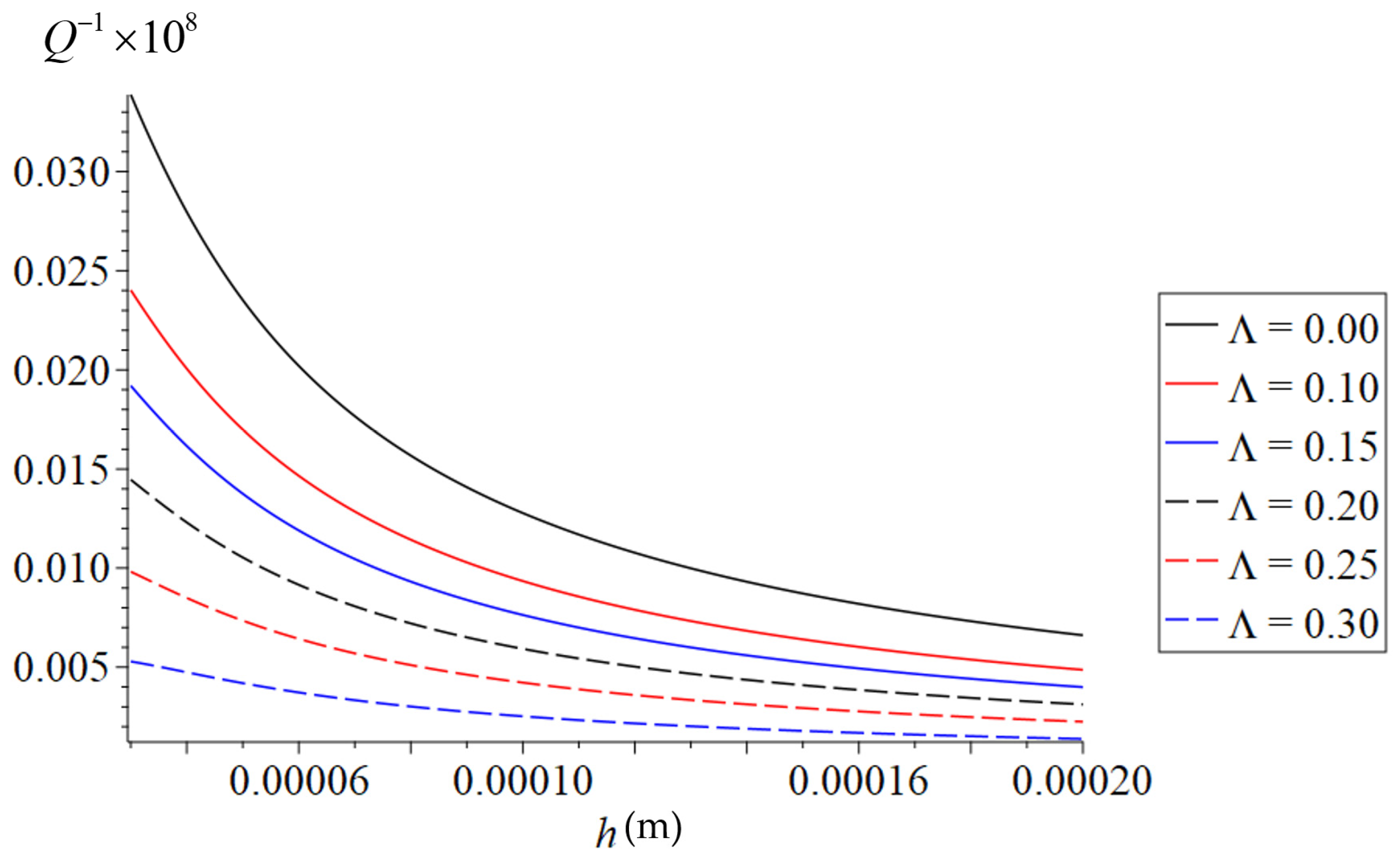
Figure 2 presents the thermal damping quality factor Q 1 of the micro-resonator with a different value of the damage mechanics variable Λ = 0.00 , 0.10 , 0.15 , 0.20 , 0.25 , 0.30 . Note that the damage mechanics variable has a significant impact on the thermal damping quality factor Q 1 —the value of the thermal damping quality factor Q 1 decreases when the damage mechanics variable increases, which means that the damage mechanics variable resists the enhancement of the quality factor.
The adopted damage threshold Λ = 0.3 lies within the moderate damage regime where the assumptions of linear continuum mechanics remain a reasonable approximation for brittle materials such as silicon, while higher damage levels would require nonlinear fracture or discontinue modeling approaches.
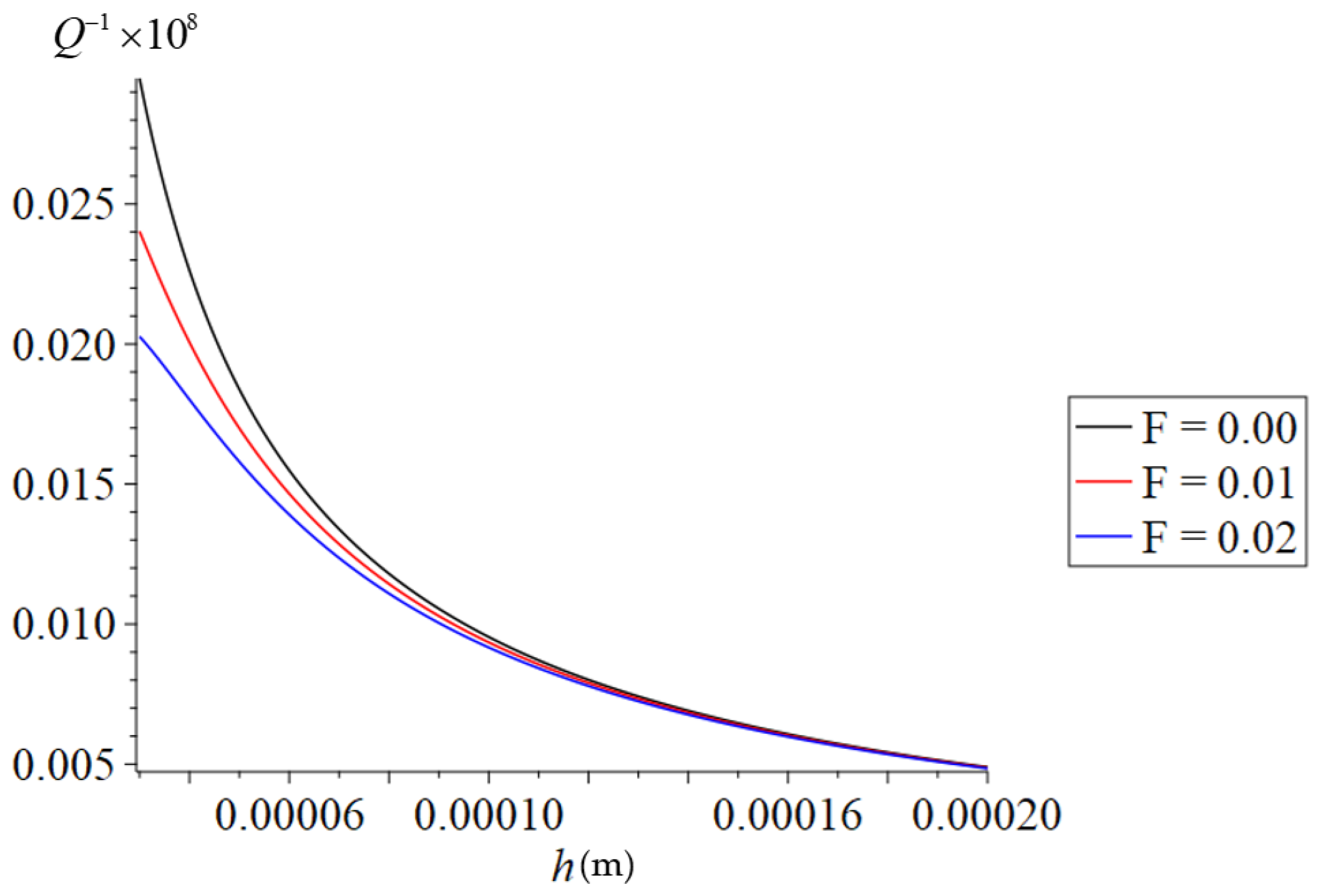
Figure 3 shows the thermal damping quality factor Q 1 of the micro-resonator with a different value of the force F = 0.0 , 0.01 , 0.02 of the static prestress. It is observed that the static prestress force has a significant impact on the thermal damping quality factor Q 1 —the thermal damping quality factor decreases as the static prestress force increases. In other words, the static prestress force resists the enhancement of the quality factor Q 1 .
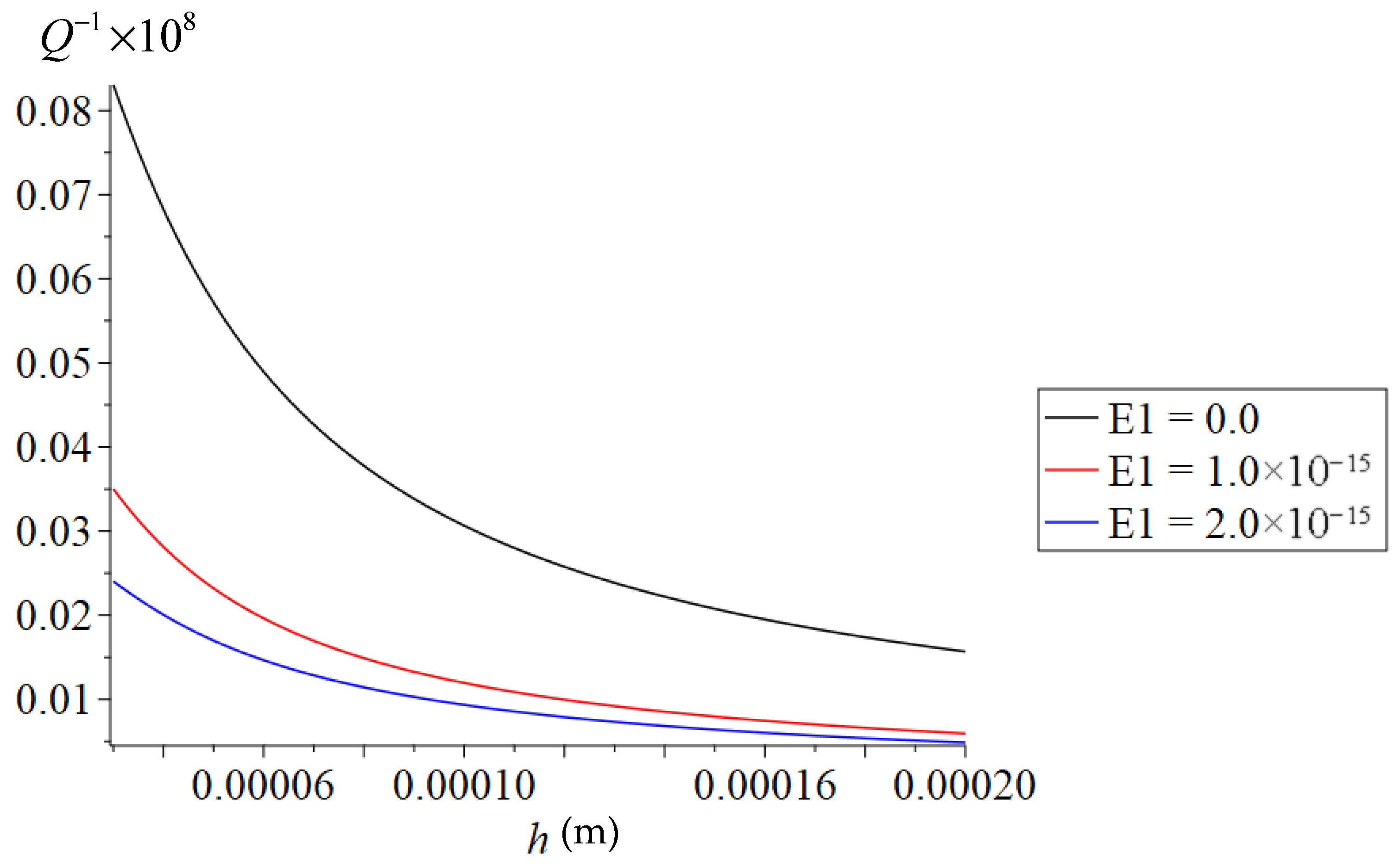
Figure 4 presents the thermal damping quality factor Q 1 of the micro-resonator per unit area with a different value of the mechanical relaxation time E 1 = 0 , 1 , 2 × 10 15 s of the static prestress [45]. Note that the mechanical relaxation time has a significant effect on the thermal damping quality factor Q 1 ; the thermal damping quality factor increases as the mechanical relaxation time increases. The values of the damping quality factor Q 1 take the following order:
Q 1 E 1 = 0.0 > Q 1 E 1 = 2.0 × 10 15 > Q 1 E 1 = 1.0 × 10 15
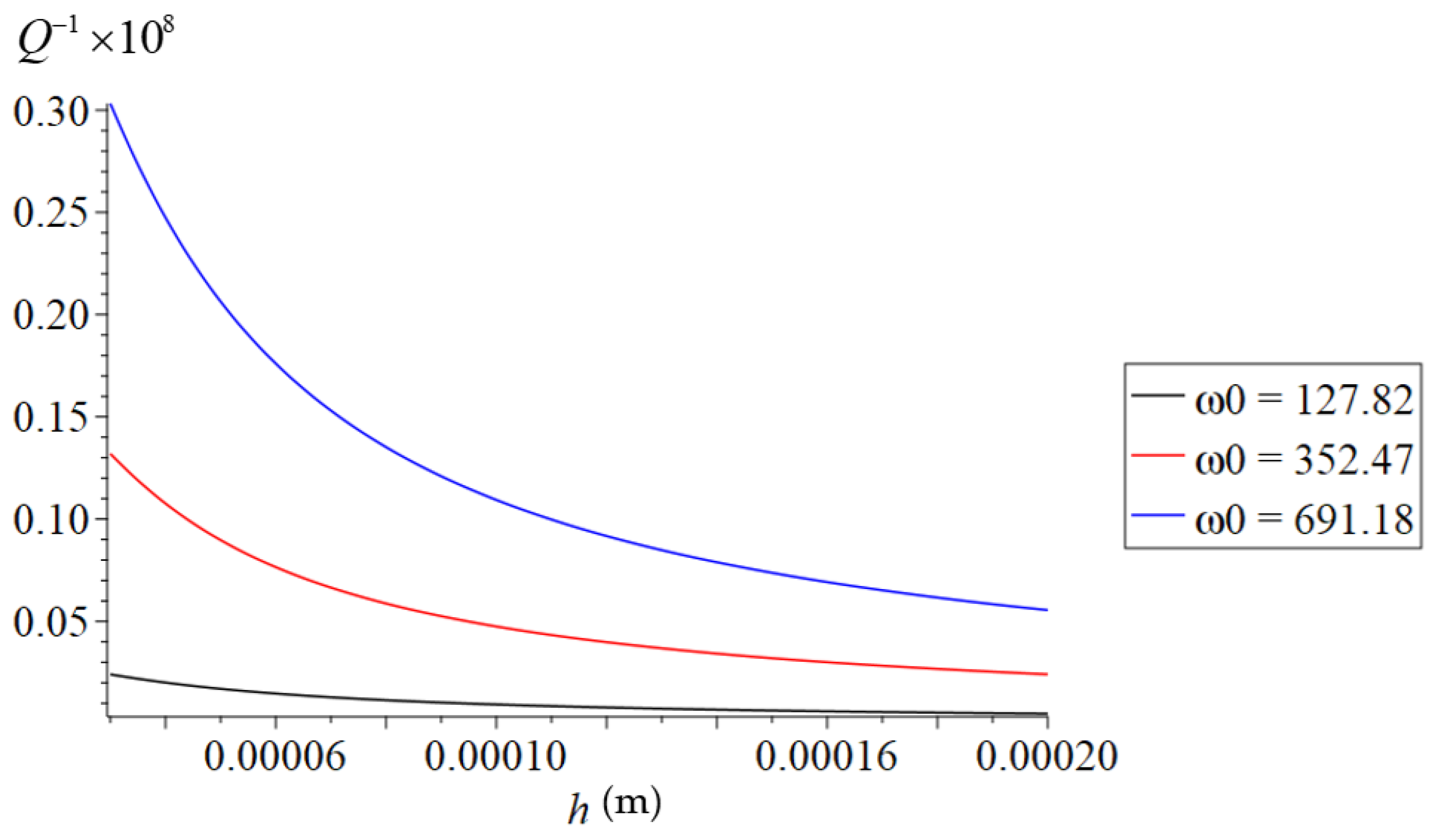
Figure 5 presents the thermal damping quality factor Q 1 of the micro-resonator with a different value of the isothermal frequency ω 0 = 127.82 , 352.47 , 691.18 , which was calculated using Equation (29). Note that the value of the isothermal frequency has a significant effect on the thermal damping quality factor Q 1 —the value of the thermal damping quality factor Q 1 The value increases when the isothermal frequency value increases.
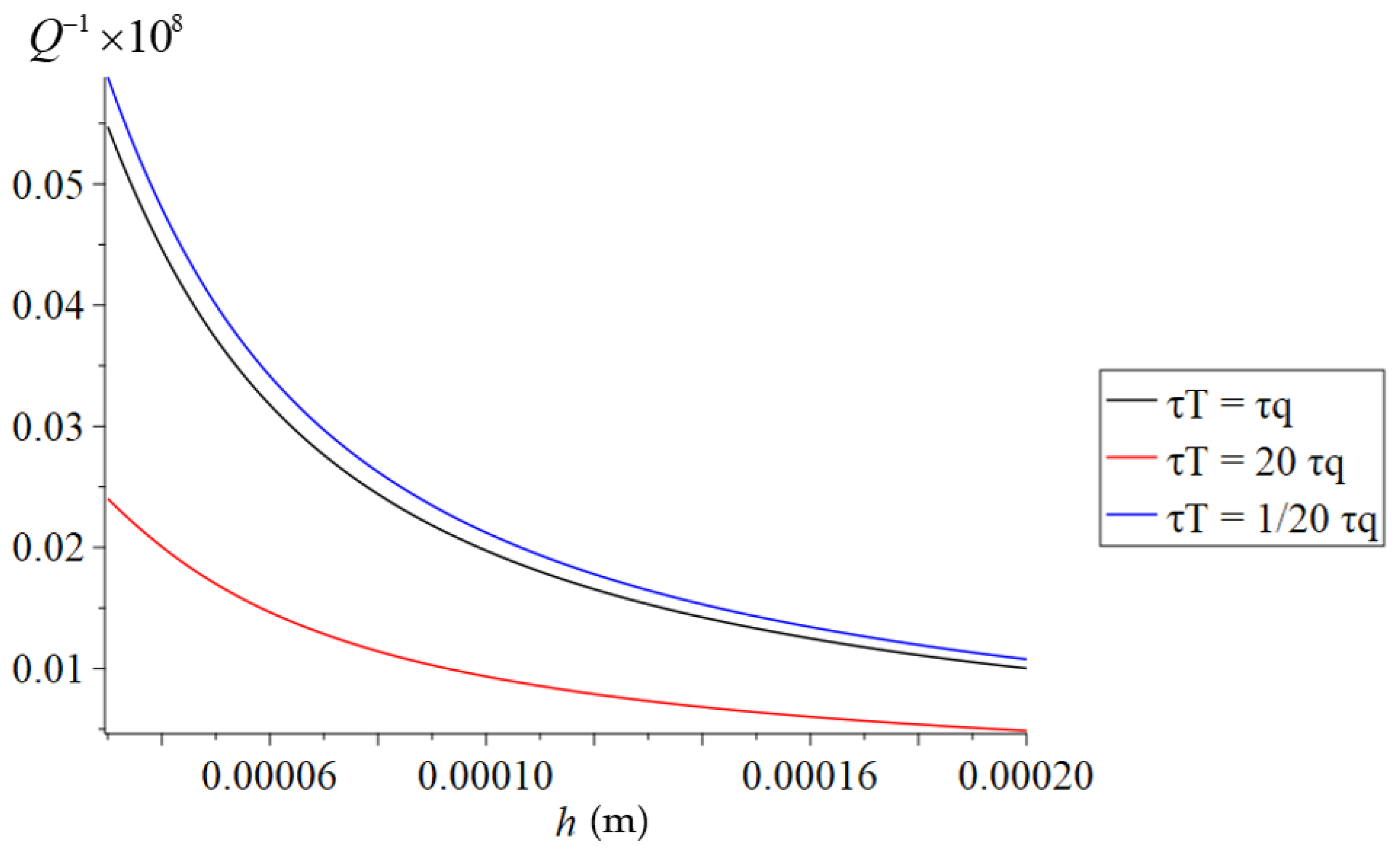
Figure 6 shows the thermal damping quality factor Q 1 of the micro-resonator with different values of the thermal relaxation times τ q = τ T , τ q > τ T , τ q < τ T , respectively. Note that the values of thermal relaxation times have a significant effect on the thermal damping quality factor Q 1 . The value of the thermal damping quality factor Q 1 depends on the respective ratio τ q / τ T according to the following order:
Q 1 τ q > τ T > Q 1 τ q = τ T > Q 1 τ q < τ T
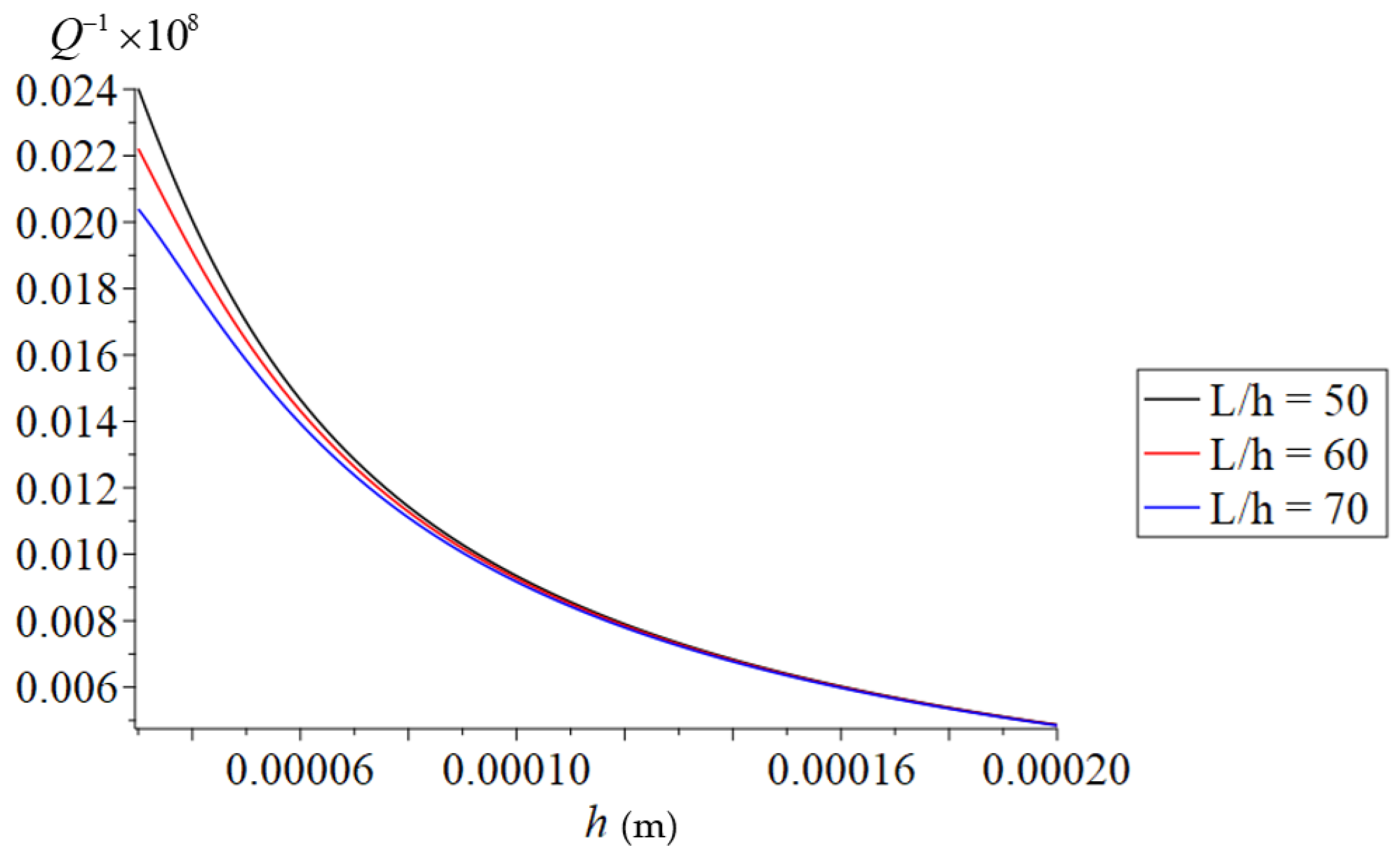
Figure 7 shows the thermal damping quality factor Q 1 of the micro-resonator with different values of the ratio of the beam’s length to width L / h = 50 , 60 , 70 . Note that this ratio has a significant effect on the thermal damping quality factor Q 1 —the value of the thermal damping quality factor Q 1 decreases when the value of the ratio L / h increases.
Micro-resonators are widely used in microelectromechanical and nanoelectromechanical systems for sensing applications such as mass, pressure, and biological detection. The thermal quality factor strongly influences the frequency stability and sensitivity of these devices. Understanding the role of mechanical damage and prestress helps us optimize resonator design and improve device performance. This work is also relevant for micro-thermal actuators, micro-heat engines, infrared detectors, and micro-energy harvesting systems [39,40,42].

5. Validation

To validate the results, we observe that the current results agree with those in references [36,37]. Note that the thermal quality factor in the current work (Equation (31)) increases when the ratio τ q / τ T increases, as in Ref. [17] (Equation (38)). Moreover, the current work states that the thermal damping quality factor decreases as the static prestress force increases, as in Refs. [17,18].

6. Conclusions

At the micro-scale, an analytical model for viscothermoelastic relaxation times in silicon nitride resonators under axial static prestress, accounting for mechanical damage, has been established within the context of the dual-phase-lag heat conduction model.
The results give us the following conclusions:
When a tensile axial prestress is utilized, the model predicts a considerable reduction in thermal quality damping.
The decrease in thermal damping can be attributed to a reduction in relaxation rate relative to the beam resonator’s natural frequency.
Each mechanical damage variable, including static prestress, mechanical relaxation time, thermal relaxation time, and isothermal frequency, is essential in the thermal quality damping factor.
Increasing the damage mechanics variable, static prestress force, mechanical relaxation time, and ratio of the beam’s length to width leads to a decrease in the value of the thermal damping quality factor Q 1 .
An increase in the isothermal frequency leads to an increase in the thermal damping quality factor Q 1 .

Funding

This research work was funded by Umm Al-Qura University, Saudi Arabia, under grant number: 26UQU4250163GSSR03.

Institutional Review Board Statement

Not applicable.

Data Availability Statement

The author declares that the paper has no data to share.

Acknowledgments

The authors extend their appreciation to Umm Al-Qura University, Saudi Arabia for funding this research work through grant number 26UQU4250163GSSR03.

Conflicts of Interest

The author declares no competing interests.

References

  1. Yi, Y. Geometric effects on thermoelastic damping in MEMS resonators. J. Sound Vib. 2008, 309, 588–599. [Google Scholar] [CrossRef]
  2. Kumar, S.; Haque, M.A. Stress-dependent thermal relaxation effects in micro-mechanical resonators. Acta Mech. 2010, 212, 83–91. [Google Scholar] [CrossRef]
  3. Zener, C. Internal friction in solids. I. Theory of internal friction in reeds. Phys. Rev. 1937, 52, 230. [Google Scholar] [CrossRef]
  4. Zener, C. Internal friction in solids II. General theory of thermoelastic internal friction. Phys. Rev. 1938, 53, 90. [Google Scholar] [CrossRef]
  5. Zener, C.; Otis, W.; Nuckolls, R. Internal friction in solids III. Experimental demonstration of thermoelastic internal friction. Phys. Rev. 1938, 53, 100. [Google Scholar] [CrossRef]
  6. Nayfeh, A.H.; Younis, M.I. Modeling and simulations of thermoelastic damping in microplates. J. Micromech. Microeng. 2004, 14, 1711. [Google Scholar] [CrossRef]
  7. Rajagopalan, J.; Saif, M.T. Single degree of freedom model for thermoelastic damping. J. Appl. Mech. 2007, 74, 461–468. [Google Scholar] [CrossRef]
  8. Guo, F.; Rogerson, G. Thermoelastic coupling effect on a micro-machined beam resonator. Mech. Res. Commun. 2003, 30, 513–518. [Google Scholar] [CrossRef]
  9. Lifshitz, R.; Roukes, M.L. Thermoelastic damping in micro-and nanomechanical systems. Phys. Rev. B 2000, 61, 5600. [Google Scholar] [CrossRef]
  10. Sun, Y.; Fang, D.; Soh, A.K. Thermoelastic damping in micro-beam resonators. Int. J. Solids Struct. 2006, 43, 3213–3229. [Google Scholar] [CrossRef]
  11. Duwel, A.; Candler, R.N.; Kenny, T.W.; Varghese, M. Engineering MEMS resonators with low thermoelastic damping. J. Microelectromech. Syst. 2006, 15, 1437–1445. [Google Scholar] [CrossRef]
  12. Harris, C.M.; Piersol, A.G. Harris’ Shock and Vibration Handbook; McGraw-Hill: New York, NY, USA, 2002; Volume 5. [Google Scholar]
  13. Shaker, F.J. Effect of Axial Load on Mode Shapes and Frequencies of Beams; NASA: Washington, DC, USA, 1975. [Google Scholar]
  14. Verbridge, S.S.; Shapiro, D.F.; Craighead, H.G.; Parpia, J.M. Macroscopic tuning of nanomechanics: Substrate bending for reversible control of frequency and quality factor of nanostring resonators. Nano Lett. 2007, 7, 1728–1735. [Google Scholar] [CrossRef] [PubMed]
  15. Kumar, S.; Haque, M.A. Reduction of thermo-elastic damping with a secondary elastic field. J. Sound Vib. 2008, 318, 423–427. [Google Scholar] [CrossRef]
  16. Gross, D.; Seelig, T. Fracture Mechanics: With an Introduction to Micromechanics; Springer: Berlin/Heidelberg, Germany, 2017. [Google Scholar]
  17. Liu, L.; Li, Y.; Cao, W.; Wang, T.; Zhang, L.; Feng, X. Coupled thermo-hydro-mechanical-damage modeling of cold-water injection in deep geothermal reservoirs. J. Rock Mech. Geotech. Eng. 2025, 18, 39–54. [Google Scholar] [CrossRef]
  18. Lu, D.; Meng, F.; Zhou, X.; Zhuo, Y.; Gao, Z.; Du, X. A dynamic elastoplastic model of concrete based on a modeling method with environmental factors as constitutive variables. J. Eng. Mech. 2023, 149, 04023102. [Google Scholar] [CrossRef]
  19. Zhong, H.; Zhu, Z.; Zhang, D.; Zhang, B.; Zhang, X. Discrete element simulation of damage mechanisms in stone cultural relics under dynamic impact. npj Herit. Sci. 2025, 13, 249. [Google Scholar] [CrossRef]
  20. Wang, K.; Sun, K.; Ding, Q.; Zeng, L.; Du, J.; Han, Z.; Huang, L.; Wang, W. High-Q resonance engineering in momentum space for highly coherent and rainbow-free thermal emission. Nano Lett. 2025, 25, 3613–3619. [Google Scholar] [CrossRef]
  21. Makkad, G.; Khalsa, L.; Varghese, V. Fractional thermoviscoelastic damping response in a non-simple micro-beam via DPL and KG nonlocality effect. Sci. Temp. 2025, 16, 4151–4164. [Google Scholar] [CrossRef]
  22. Peng, W.; Zhang, X.; He, T.; Gao, Y.; Li, Y. Size-dependent thermoelastic damping analysis of functionally graded polymer micro plate resonators reinforced with graphene nanoplatelets based on three-phase-lag heat conduction model. Math. Mech. Solids 2025, 30, 745–764. [Google Scholar] [CrossRef]
  23. Qian, H.; Zhu, M.; Li, P.; Zhou, H. Thermoelastic damping in micro-disk resonators with in-plane extensile vibration. J. Therm. Stress. 2026, 1–23. [Google Scholar] [CrossRef]
  24. Al-Lehaibi, E.A. The vibration of micro-circular ring of ceramic with viscothermoelastic properties under the classical caputo and caputo-fabrizio of fractional-order derivative. Front. Phys. 2025, 12, 1490664. [Google Scholar] [CrossRef]
  25. Öchsner, A. Continuum damage mechanics. In Continuum Damage and Fracture Mechanics; Springer: Berlin/Heidelberg, Germany, 2016; pp. 65–84. [Google Scholar]
  26. Voyiadjis, G.Z.; Kattan, P.I. Introducing damage mechanics templates for the systematic and consistent formulation of holistic material damage models. Acta Mech. 2017, 228, 951–990. [Google Scholar] [CrossRef]
  27. Youssef, H.M. Thermal shock problem of a generalized thermoelastic solid sphere affected by mechanical damage and thermal diffusion. J. Eng. Therm. Sci. 2021, 1, 1–16. [Google Scholar] [CrossRef]
  28. Raushan, R.; Singhal, V.; Jha, R.K. Damage detection in concrete structures with multi-feature backgrounds using the yolo network family. Autom. Constr. 2025, 170, 105887. [Google Scholar] [CrossRef]
  29. Prabhakar, S.; Vengallatore, S. Theory of thermoelastic damping in micromechanical resonators with two-dimensional heat conduction. J. Microelectromech. Syst. 2008, 17, 494–502. [Google Scholar] [CrossRef]
  30. Sharma, J.; Sharma, R. Damping in micro-scale generalized thermoelastic circular plate resonators. Ultrasonics 2011, 51, 352–358. [Google Scholar] [CrossRef]
  31. Youssef, H.M.; Al Thobaiti, A.A. The vibration of a thermoelastic nanobeam due to thermo-electrical effect of graphene nano-strip under green-naghdi type-ii model. J. Eng. Therm. Sci. 2022, 2, 1–12. [Google Scholar] [CrossRef]
  32. Biot, M.A. Theory of stress-strain relations in anisotropic viscoelasticity and relaxation phenomena. J. Appl. Phys. 1954, 25, 1385–1391. [Google Scholar] [CrossRef]
  33. Ezzat, M.A.; El-Karamany, A.S. The relaxation effects of the volume properties of viscoelastic material in generalized thermoelasticity. Int. J. Eng. Sci. 2003, 41, 2281–2298. [Google Scholar] [CrossRef]
  34. Othman, M.I.; Atwa, S.Y.; Eraki, E.; Ismail, M.F. Dual-phase-lag model on microelongated thermoelastic rotating medium. J. Eng. Therm. Sci. 2022, 2, 13–26. [Google Scholar] [CrossRef]
  35. Alghamdi, N.A.; Youssef, H.M. Influence of the static pre-stress in micro-viscothermoelastic resonators based on dual-phase-lagging heat conduction. Math. Probl. Eng. 2020, 2020, 1316281. [Google Scholar] [CrossRef]
  36. Youssef, H.M.; AL-Lehaibi, E.A. Characterization of the thermal quality factor due to the static pre-stress in thermoelastic nano resonator of silicon under time-fractional dual-phase-lag heat conduction. Silicon 2022, 14, 6425–6433. [Google Scholar] [CrossRef]
  37. Youssef, H.M.; El-Bary, A.A.; Al-Lehaibi, E.A. Characterization of the quality factor due to the static prestress in classical caputo and caputo–fabrizio fractional thermoelastic silicon microbeam. Polymers 2020, 13, 27. [Google Scholar] [CrossRef]
  38. Drozdov, A. A constitutive model in finite thermoviscoelasticity based on the concept of transient networks. Acta Mech. 1999, 133, 13–37. [Google Scholar] [CrossRef]
  39. Boley, B.A.; Weiner, J.H. Theory of Thermal Stresses; Courier Corporation: North Chelmsford, MA, USA, 2012. [Google Scholar]
  40. Borjalilou, V.; Asghari, M.; Esmaeili, S.; Baghestani, A.M. Two-dimensional modeling of thermoelastic damping in small-sized circular plates with size-dependent behavior in both mechanical and thermal areas. Arch. Civ. Mech. Eng. 2025, 25, 76. [Google Scholar] [CrossRef]
  41. Koyama, T.; Bindel, D.S.; He, W.; Quévy, E.P.; Govindjee, S.; Demmel, J.W.; Howe, R.T. Simulation tools for damping in high frequency resonators. In SENSORS, 2005 IEEE; IEEE: Piscataway, NJ, USA, 2005; 4p. [Google Scholar]
  42. Li, P.; Fang, Y.; Hu, R. Thermoelastic damping in rectangular and circular microplate resonators. J. Sound Vib. 2012, 331, 721–733. [Google Scholar] [CrossRef]
  43. Wong, S.; Fox, C.; McWilliam, S. Thermoelastic damping of the in-plane vibration of thin silicon rings. J. Sound Vib. 2006, 293, 266–285. [Google Scholar] [CrossRef]
  44. Al-Lehaibi, E.A. Two-temperature generalized thermoelastic infinite medium with cylindrical cavity subjected to time exponentially decaying laser pulse. Int. J. Acoust. Vib. 2016, 21, 222–229. [Google Scholar] [CrossRef]
  45. Alotaibi, B.; Al-Yousef, H.A.; El-Bary, A.A.; Youssef, H.M.; Alsaif, N.A.; Alotiby, M.F.; Alhuzaymi, T.M. An analysis of the static-pre-stress effect on the thermal quality factor of a silicon viscothermoelastic nano resonator under the hyperbolic two-temperature dual-phase-lag heat transfer. Silicon 2025, 17, 29–37. [Google Scholar] [CrossRef]
Figure 1. Isotropic rectangular thermoelastic micro-resonator.
Mathematics 14 01343 g001
Figure 2. The thermal damping quality factor Q 1 with different values of the damage mechanics variable when F = 0.01 , E 1 = 1.0 × 10 14 , ω 0 = 127.82 , τ T = 20 × τ q ,   τ q = 0.01 × 10 10 , L = 50 × h , b = h .
Mathematics 14 01343 g002
Figure 3. The thermal damping quality factor Q 1 with different static prestress force values when Λ = 0.1 , E 1 = 1.0 × 10 14 , ω 0 = 127.82 , τ T = 20 × τ q , τ q = 0.01 × 10 10 ,   L = 50 × h , b = h .
Mathematics 14 01343 g003
Figure 4. The thermal damping quality factor Q 1 with different mechanical relaxation time parameter values when Λ = 0.1 , F = 0.01 , ω 0 = 127.82 , τ T = 20 × τ q , τ q = 0.01 × 10 10 , L = 50 × h , b = h .
Mathematics 14 01343 g004
Figure 5. The thermal damping quality factor Q 1 with different isothermal frequency values when Λ = 0.1 , F = 0.01 , E 1 = 1.0 × 10 14 , τ q = 0.01 × 10 10 , τ T = 20 × τ q , L = 50 × h , b = h .
Mathematics 14 01343 g005
Figure 6. The thermal damping quality factor Q 1 per unit area with different thermal relaxation times when Λ = 0.1 , F = 0.01 , E 1 = 1.0 × 10 14 , ω 0 = 127.82 , τ q = 0.01 × 10 10 , L = 50 × h , b = h .
Mathematics 14 01343 g006
Figure 7. The thermal damping quality factor Q 1 per unit area with different beam length scale valuess when Λ = 0.1 , F = 0.01 , E 1 = 1.0 × 10 14 , ω 0 = 127.82 , b = h , τ q = 0.01 × 10 10 , τ T = 20 × τ q .
Mathematics 14 01343 g007
Disclaimer/Publisher’s Note: The statements, opinions and data contained in all publications are solely those of the individual author(s) and contributor(s) and not of MDPI and/or the editor(s). MDPI and/or the editor(s) disclaim responsibility for any injury to people or property resulting from any ideas, methods, instructions or products referred to in the content.