Article

A Multi-Strategy Improved Catch Fish Optimization Algorithm for Microgrid Scheduling Optimization and Real-World Engineering Applications

1
School of Computer Science and Engineering, The University of New South Wales, Kensington, Sydney, NSW 2052, Australia
2
School of Electronic Information and Electrical Engineering, Shanghai Jiao Tong University, Shanghai 200240, China
*
Author to whom correspondence should be addressed.
Mathematics 2026, 14(8), 1342; https://doi.org/10.3390/math14081342
Submission received: 16 March 2026 / Revised: 31 March 2026 / Accepted: 9 April 2026 / Published: 16 April 2026

Abstract

Complex engineering optimization problems are typically characterized by high dimensionality, multimodality, and strong constraints, posing significant challenges to traditional swarm intelligence algorithms in terms of convergence speed, solution accuracy, and robustness. The Catch Fish Optimization Algorithm (CFOA), a recently proposed swarm-based metaheuristic, exhibits promising global search capability; however, it still suffers from deficiencies in search direction stability, elite solution utilization, and exploitation performance in the later stages of optimization. To address these limitations, this paper proposes an Improved Catch Fish Optimization Algorithm, named Elite-Driven Reinforced Catch Fish Optimization Algorithm (EDR-CFOA). On the basis of the original CFOA framework, EDR-CFOA integrates three complementary elite-based enhancement strategies: an elite-enhanced search strategy, an elite differential evolution strategy, and an elite random local search strategy. Through a multi-level elite-guided mechanism, these strategies collaboratively improve the reliability of search directions, strengthen solution-space recombination, and enhance fine-grained exploitation of high-quality solutions, thereby significantly improving the overall optimization performance of the algorithm. The proposed EDR-CFOA is systematically evaluated on the CEC2020 and CEC2022 benchmark test suites under 10-dimensional and 20-dimensional settings and is compared with eight classical and recently developed high-performance metaheuristic algorithms. The Friedman mean ranking results demonstrate that EDR-CFOA achieves the lowest average rank in all four test scenarios (CEC2020: 1.30 for 10D and 2.20 for 20D; CEC2022: 1.17 for 10D and 1.08 for 20D), consistently ranking first overall and significantly outperforming the competing algorithms. Furthermore, Wilcoxon rank-sum tests confirm that EDR-CFOA exhibits statistically significant superiority on the majority of benchmark functions. In addition, EDR-CFOA is applied to the economic optimal scheduling problem of a grid-connected microgrid and several typical constrained engineering design problems, where experimental results verify its feasibility, robustness, and practical engineering applicability. Comprehensive numerical experiments and real-world engineering case studies indicate that EDR-CFOA is a highly effective swarm intelligence algorithm featuring high solution accuracy, strong stability, and excellent generalization capability, making it well suited for complex engineering optimization problems.

1. Introduction

With the rapid development of energy systems, intelligent manufacturing, and complex engineering structures, real-world engineering optimization problems have been continuously increasing in scale, dimensionality, and complexity. Such problems are typically characterized by strong nonlinearity, multimodality, and complex constraints. Traditional optimization techniques based on gradient information or analytical formulations usually rely on strict mathematical assumptions and often struggle to simultaneously achieve high solution accuracy and computational efficiency when applied to these complex scenarios [1,2,3]. Consequently, intelligent optimization algorithms with strong global search capability and high adaptability have gradually become indispensable tools for solving complex engineering optimization problems [4,5].
As a key category within intelligent optimization methods, swarm-based algorithms draw inspiration from the cooperative behaviors observed in natural biological groups to effectively navigate and search complex solution spaces. Representative algorithms include Particle Swarm Optimization (PSO) [6], Ant Colony Optimization (ACO) [7], Gray Wolf Optimizer (GWO) [8], as well as the numerous swarm-based algorithms newly proposed in recent years. These algorithms are widely favored due to their simple structures, relatively few control parameters, and low requirements on the continuity and differentiability of objective functions, and they have been successfully applied in numerical optimization, system scheduling, engineering design, and energy management, among other fields [9,10,11,12,13]. However, as problem dimensionality and complexity continue to increase, traditional swarm intelligence algorithms gradually reveal inherent limitations in terms of search efficiency, convergence stability, and exploitation capability in the later optimization stages [14,15,16]. To overcome these deficiencies, a large number of novel swarm intelligence algorithms have been proposed in recent years, incorporating diverse design philosophies such as behavior modeling, information-sharing mechanisms, and hybrid search strategies.
Over the past two to three years, many high-performance optimization algorithms have been developed to address the exploration–exploitation trade-off. Examples include the Newton Downhill Optimizer, which is derived from Newton’s downhill method for solving nonlinear equations through iterative linearization [17]; the Philosophical Proposition Optimizer, inspired by epistemological concepts of knowledge acquisition [18]; the Farthest Better or Nearest Worse Optimizer, which leverages distance and fitness relationships among agents in the search space [19]; the Electromagnetic Wave Propagation Algorithm, modeled on the propagation behavior of electromagnetic waves [20]; the Wave Optics Optimizer, inspired by Fraunhofer diffraction experiments [21]; the Red-Billed Blue Magpie Optimizer, which simulates the social and cooperative foraging behaviors of red-billed blue magpies [22]; the Dung Beetle Optimizer, based on various natural behaviors of dung beetles such as rolling, dancing, foraging, stealing, and reproduction [23]; the Centered Collision Optimizer, motivated by classical head-on collision equations in physics [24]; and the Cuckoo Catfish Optimizer, inspired by the predation and parasitic behaviors between cuckoo catfish and cichlids in Lake Tanganyika [25]. Although these algorithms demonstrate promising performance improvements on specific problems, extensive experimental studies indicate that their optimization effectiveness remains highly problem-dependent. In high-dimensional, multimodal, or strongly constrained scenarios, many of these algorithms still suffer from unstable convergence, premature stagnation in local optima, and large solution fluctuations.
The No Free Lunch (NFL) theorem [26] states that no single optimization algorithm can outperform all others across the entire set of possible optimization problems. This theoretical result fundamentally reveals the problem-dependent nature of intelligent optimization algorithms and has motivated continuous efforts to develop new algorithms or improve existing ones to enhance their performance for specific problem classes. In recent years, numerous improved swarm intelligence algorithms have been proposed by focusing on key issues such as search mechanism design, elite information utilization, and exploration–exploitation balance, leading to noticeable improvements in convergence speed and solution accuracy [27,28,29,30]. Nevertheless, challenges such as premature convergence, unstable search directions, and insufficient exploitation capability in the later optimization stages remain prevalent, particularly in high-dimensional, multimodal, or strongly constrained optimization problems.
The Catch Fish Optimization Algorithm (CFOA) [31] is a recently proposed swarm intelligence algorithm inspired by cooperative fish-catching behaviors. By simulating individual exploration and collective capture mechanisms, CFOA enables effective exploration of the solution space. Existing studies have demonstrated that CFOA possesses certain global search capabilities in continuous optimization problems. However, because its search process heavily relies on random individual interactions and population statistical information, CFOA still exhibits notable shortcomings when addressing complex, multimodal, or high-dimensional optimization problems. Specifically, limitations in search direction stability, inefficient utilization of elite solutions, and weak exploitation ability in the later stages restrict its optimization performance and practical engineering applicability.
To address these issues, this paper proposes a Multi-Strategy Elite-Driven Reinforced Catch Fish Optimization Algorithm (EDR-CFOA) without altering the original fish-catching search framework of CFOA. The proposed algorithm introduces an elite-enhanced search strategy to improve the reliability and stability of search directions, an elite differential evolution strategy to strengthen solution-space recombination and mitigate premature convergence, and an elite random local search strategy to perform fine-grained exploitation of high-quality solutions in the later optimization stages. By combining these mechanisms in a coordinated manner, EDR-CFOA effectively maintains an adaptive trade-off between global search and local refinement, leading to marked improvements in both convergence precision and algorithmic robustness.
The key contributions of the present work are summarized below:
(1)
An elite-driven multi-strategy enhancement framework is proposed, which significantly improves the search direction stability, population diversity, and local exploitation capability of the original CFOA.
(2)
A novel synergistic mechanism integrating elite-enhanced search, elite differential evolution, and elite random local search is developed, enabling EDR-CFOA to effectively balance global exploration and local exploitation.
(3)
Extensive experiments reveal that EDR-CFOA achieves superior convergence accuracy, robustness, and scalability compared with state-of-the-art algorithms, particularly in high-dimensional and complex optimization problems.
The remainder of this paper is organized as follows. Section 2 introduces the basic principles of CFOA and the proposed EDR-CFOA improvement strategies. Section 3 presents the experimental design and result analysis based on benchmark functions. Section 4 applies EDR-CFOA to the economic optimal scheduling of a grid-connected microgrid. Section 5 further validates the engineering applicability of the algorithm through typical constrained engineering design problems. Finally, Section 6 concludes the paper and outlines directions for future research.

2. Catch Fish Optimization Algorithm and Proposed Methodology

2.1. Catch Fish Optimization Algorithm

The Catch Fish Optimization Algorithm (CFOA) [31] is a population-based metaheuristic inspired by the cooperative foraging behavior of fish schools during prey capture. In CFOA, candidate solutions evolve through stochastic individual movements and group-based cooperative behaviors, enabling the algorithm to explore the search space effectively and gradually converge toward optimal regions.
Let X i ( t ) = x i , 1 ( t ) , x i , 2 ( t ) , , x i , D ( t ) denote the position of the i -th individual at iteration t , where D is the problem dimension and i = 1 , 2 , , N . The fitness value of each individual is evaluated by the objective function f ( X i ( t ) ) . The best solution found up to iteration t is denoted by [31]:
X b e s t ( t ) = arg   m i n X i ( t )   f ( X i ( t ) )
(1)
Population Initialization and Fitness Evaluation
At the beginning of the optimization process, the population is initialized randomly within the feasible search space defined by the lower and upper bounds lb and ub :
x i , j ( 0 ) = l b j + r a n d i , j ( u b j l b j ) , j = 1 , , D ,
where r a n d i , j ( 0 , 1 ) is a uniformly distributed random number. The fitness values of all individuals are computed, and the initial global best solution X b e s t ( 0 ) is identified [31].
(2)
Independent Search Mechanism
In the exploration stage, CFOA employs an independent search mechanism to enhance population diversity. For the i -th individual, a randomly selected individual r i is chosen as a reference. The fitness difference between the two individuals is used to construct an adaptive exploration factor [31]:
E x p i , r ( t ) = f ( X i ( t ) ) f ( X r ( t ) ) m a x k   f ( X k ( t ) ) f ( X b e s t ( t ) )
where k   =   1 , 2 ,   ,   N and N is the population size.
The position update is then given by
X i n e w ( t ) = X i ( t ) + E x p i , r ( t ) · X r ( t ) X i ( t ) + | E x p i , r ( t ) | · R i ( t )
where R i ( t ) is a random perturbation vector defined as
R i ( t ) = X r ( t ) X i ( t ) u r a n d 1 t T u
and u [ 1 , 1 ] D is a uniformly distributed random vector. This mechanism allows individuals to explore the search space adaptively according to relative fitness differences.
(3)
Group Capture Mechanism
To model cooperative hunting behavior, CFOA introduces a group capture mechanism in which a small group of individuals jointly moves toward a collective target. Let G = { X i 1 ( t ) , , X i m ( t ) } denote a randomly selected group of m individuals. The group target position is calculated as a fitness-weighted center [31]:
X a i m ( t ) = k = 1 m   f ( X i k ( t ) ) l = 1 m   f ( X i l ( t ) ) X i k ( t )
Each individual in the group updates its position according to
X i k n e w ( t ) = X i k ( t ) + r a n d X a i m ( t ) X i k ( t ) + 1 2 t T · Z
where z [ 1 , 1 ] D is a random vector. This mechanism enhances information sharing among neighboring individuals and promotes coordinated exploration.
(4)
Collective Capture Mechanism
As the iteration proceeds, CFOA gradually shifts from exploration to exploitation by activating a collective capture mechanism centered around the global best solution. For the i -th individual, the update rule is defined as [31]:
X i n e w ( t ) = X b e s t ( t ) + X b e s t ( t ) X ¯ ( t ) r 3 2 1 t T 1 t T 2 + 1
where X ¯ ( t ) denotes the population mean position and r { 1 , 2 , 3 } is a random integer. This mechanism encourages convergence toward promising regions while maintaining stochasticity.

2.2. Elite-Driven Reinforced Catch Fish Optimization Algorithm

The Catch Fish Optimization Algorithm (CFOA) simulates the cooperative foraging behavior of fish schools to perform population-based search and has demonstrated strong global exploration capability in continuous optimization problems. However, since its search mechanism mainly relies on random individual interactions and population statistical information, CFOA still exhibits several limitations when dealing with complex, multimodal, or high-dimensional optimization problems:
(1)
The search direction is highly influenced by randomness, resulting in unstable convergence behavior;
(2)
The utilization efficiency of high-quality solutions in the middle and later stages is limited, which may slow down convergence;
(3)
The lack of dedicated exploitation mechanisms for elite solutions leads to insufficient final solution accuracy.
To systematically address these issues, this paper proposes the Elite-Driven Reinforced Catch Fish Optimization Algorithm (EDR-CFOA). Without altering the original foraging framework of CFOA, EDR-CFOA introduces multiple elite-centered reinforcement strategies. By integrating elite guidance, differential recombination, and fine-grained local exploitation, the proposed algorithm significantly enhances convergence performance and solution quality. Specifically, EDR-CFOA incorporates three improvement strategies: Elite-Enhanced Search (EES), Elite Differential Evolution (EDE), and Elite Random Local Search (ERLS).

2.2.1. Elite-Enhanced Search Strategy (EES)

In the original CFOA, the position update of individuals mainly depends on randomly selected individuals or population mean information. Although such a mechanism maintains a certain level of exploration ability, the learning sources lack selectivity, leading to unstable search directions. This issue becomes particularly evident in the middle and later stages of the optimization process, where individuals may oscillate around promising regions without effectively exploiting high-quality solutions.
To improve the reliability of search directions and enhance the utilization of high-quality information, EDR-CFOA introduces the Elite-Enhanced Search (EES) strategy. This strategy restricts learning sources to an elite subset, thereby guiding the population toward promising regions in a more stable and efficient manner.
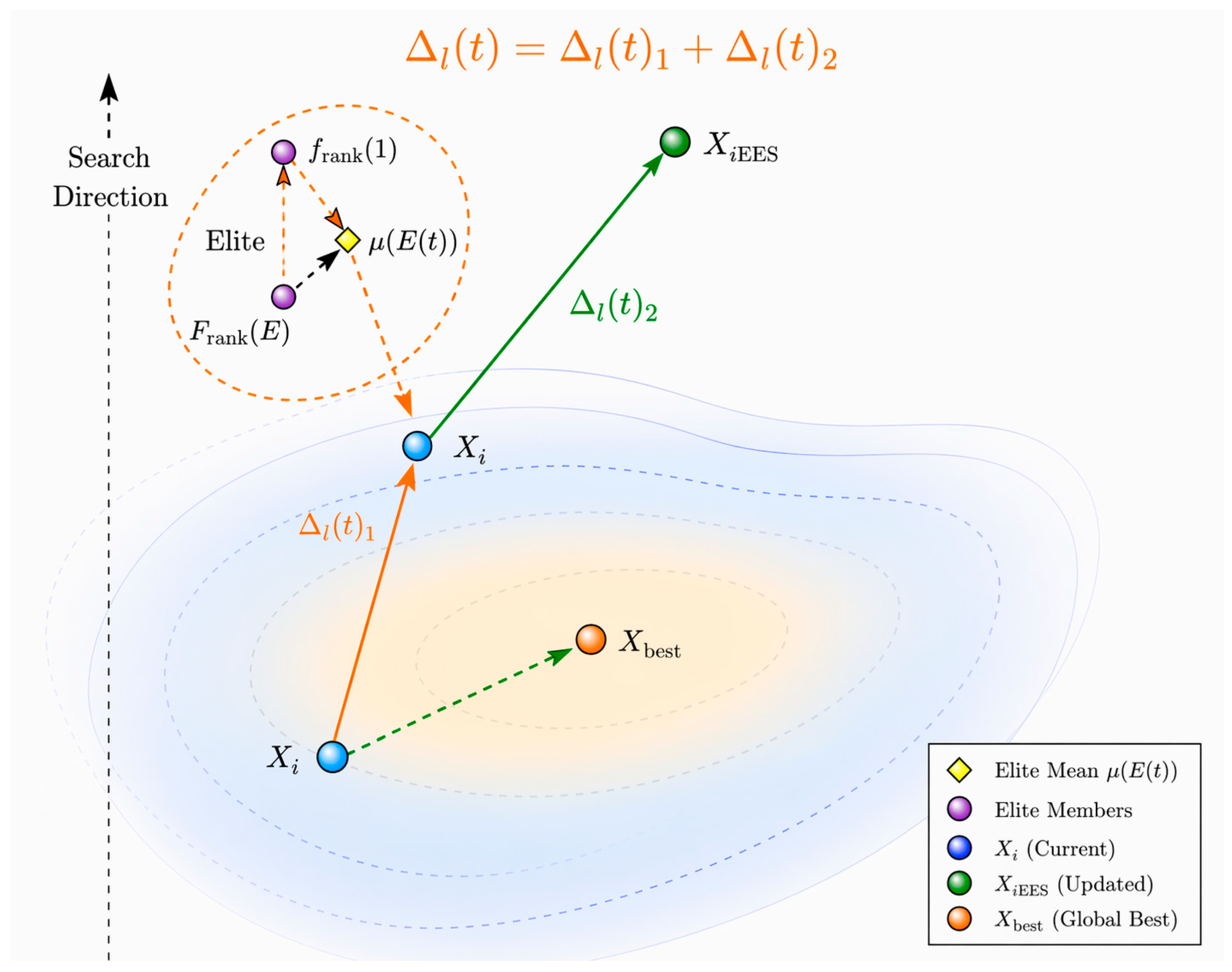
As shown in Figure 1, at iteration t , the population is first sorted in ascending order of fitness values, and the top
E = m a x 3 , 0.2 N
individuals are selected to form the elite set E ( t ) , where N denotes the population size.
To adapt to different search stages, an adaptive step-size factor is defined as
C ( t ) = 0.30 1 t T + 0.02
where T is the maximum number of iterations. A larger step size is employed in the early stage to enhance exploration, while a smaller step size is used in the later stage to improve search precision.
The adaptive step size C ( t ) defined in Equation (10) directly controls the magnitude of the update term δ in Equation (11), where δ represents the direction vector constructed from elite-based differences. Therefore, C ( t ) determines the step length, while δ defines the search direction. For the i -th individual, the elite-enhanced update is defined as
X i E E S ( t ) = X i ( t ) + Δ i ( t ) Δ i t = C ( t ) X b e s t ( t ) X i ( t )
where Δ i ( t ) is adaptively constructed according to the search stage. In the early stage, Δ i ( t ) is generated based on the difference between an elite individual and a randomly selected individual to strengthen exploration. In the middle stage, a hybrid difference combining elite–elite and elite–random interactions is adopted to balance exploration and exploitation. In the late stage, Δ i ( t ) is mainly constructed using the difference between an elite individual and the current individual to accelerate convergence toward high-quality regions.
To prevent the update direction from deviating from the current global best solution X b e s t ( t ) , a direction screening mechanism is introduced:
i f X i E E S ( t ) X i ( t ) X b e s t ( t ) X i ( t ) < 0
then the update direction is mirrored as
X i n e w ( t ) = X i ( t ) X i E E S ( t ) X i ( t )
Through this mechanism, EES significantly enhances directional consistency and convergence stability while preserving sufficient exploration capability.

2.2.2. Elite Differential Evolution Strategy (EDE)

Although the EES effectively improves search direction stability, its update mechanism is still primarily based on linear guidance, which provides limited solution-space recombination capability. In complex multimodal problems, relying solely on elite guidance may reduce population diversity and increase the risk of premature convergence.
To enhance information exchange among individuals and strengthen solution-space recombination, EDR-CFOA incorporates an Elite Differential Evolution (EDE) strategy, which integrates the differential evolution mechanism with elite guidance to improve the ability to escape local optima.
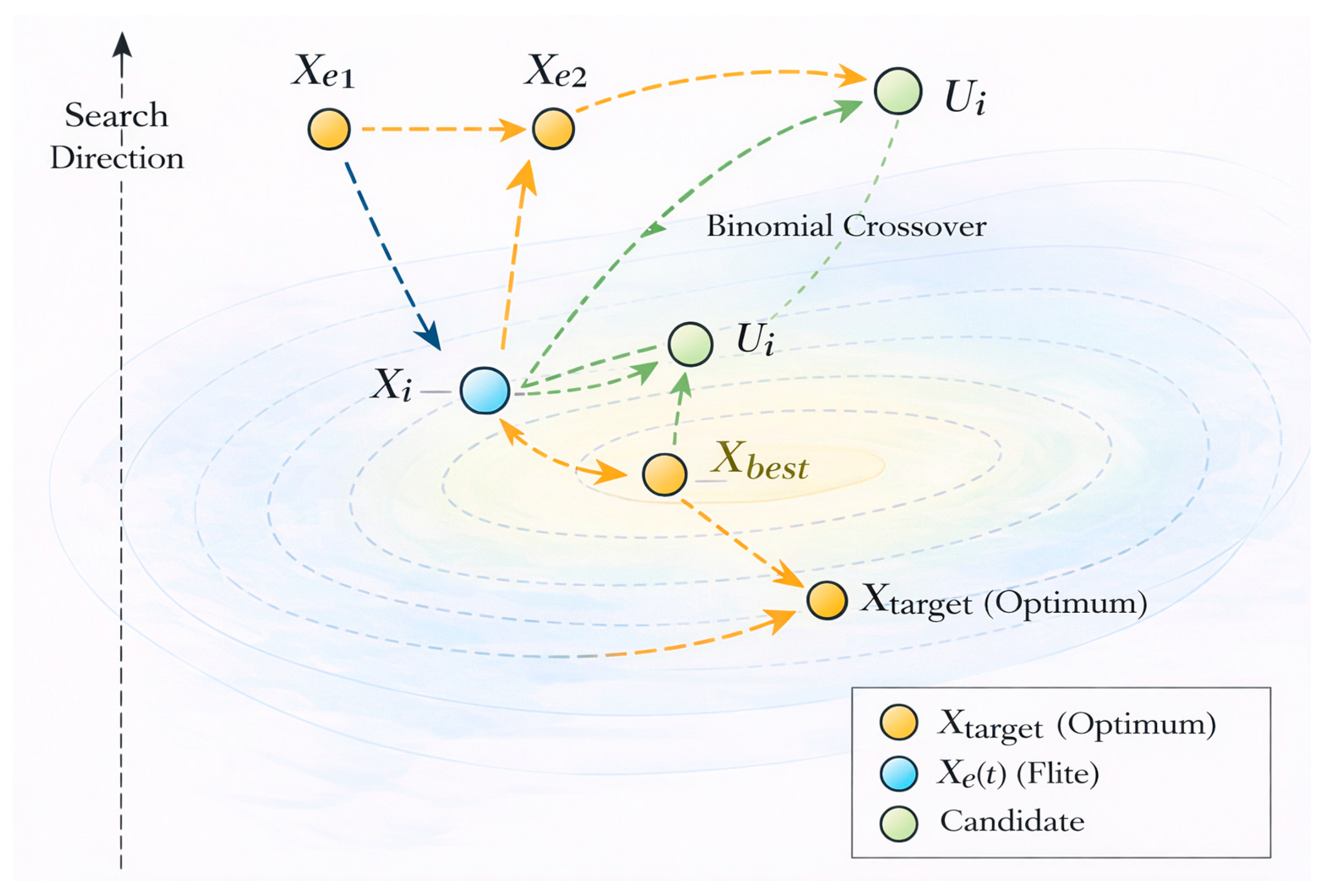
At iteration t , the mutation vector for the i -th individual is constructed as
X i n e w ( t ) = X i ( t ) + F ( t ) X e 1 ( t ) X i ( t ) + F ( t ) X e 1 ( t ) X e 2 ( t )
where X e 1 ( t ) and X e 2 ( t ) are two distinct individuals randomly selected from the elite set E ( t ) .
The scaling factor F ( t ) is defined using a linear decreasing scheme:
F ( t ) = 0.9 0.5 t T
which ensures strong exploration in the early stage and refined exploitation in the later stage.
As shown in Figure 2, by combining elite guidance with differential recombination, EDE effectively maintains population diversity while accelerating convergence.

2.2.3. Elite Random Local Search Strategy (ERLS)

In CFOA and its variants, the search process in the later stage often lacks dedicated fine-grained exploitation mechanisms for high-quality solutions. As a result, the algorithm may approach promising regions rapidly but fail to further improve solution accuracy.
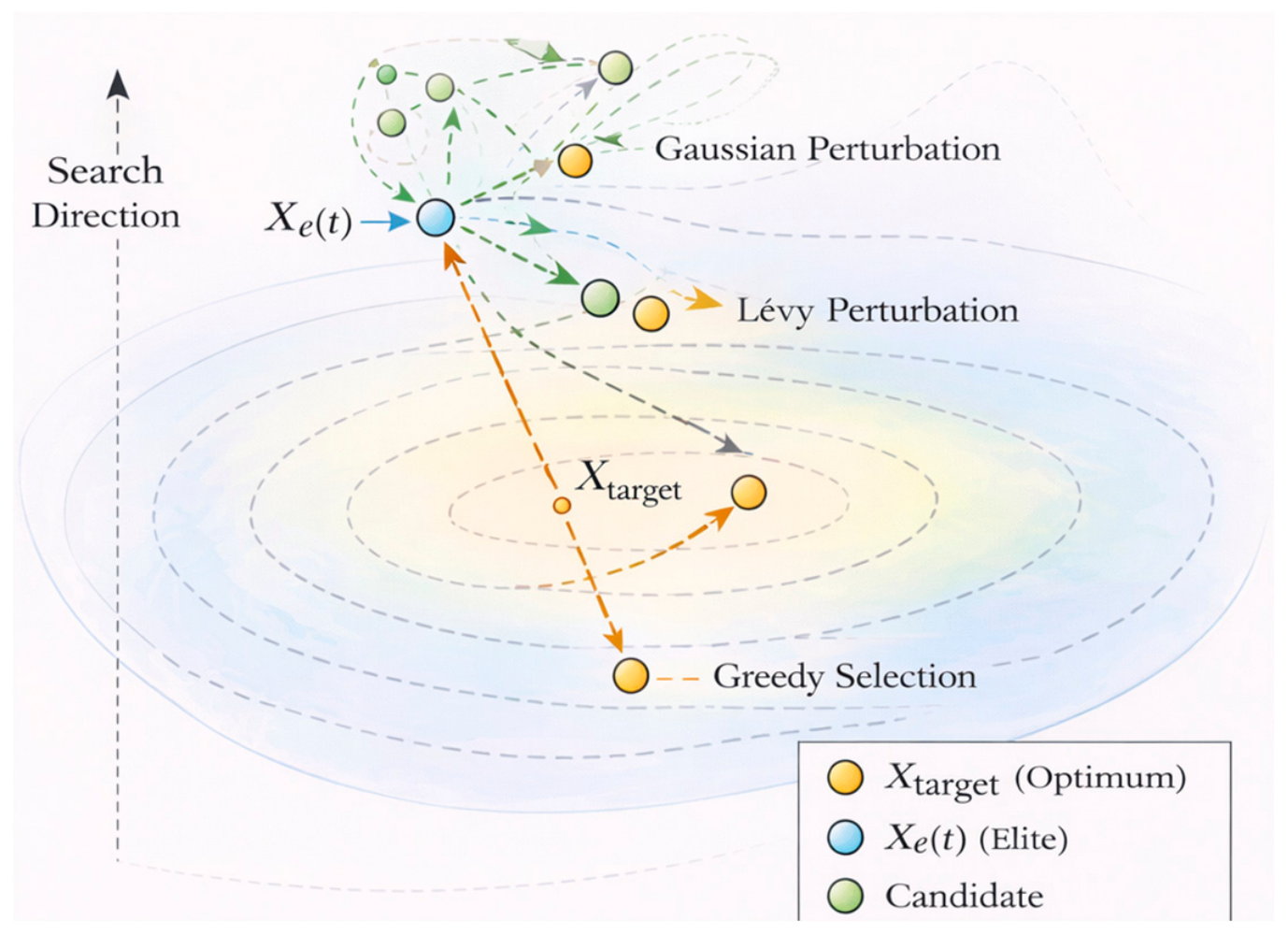
To fully exploit the neighborhood of elite solutions, EDR-CFOA introduces an Elite Random Local Search (ERLS) strategy, which performs stochastic local perturbations around elite individuals to enhance exploitation capability in the later search stage.
For each elite individual X e ( t ) , a local candidate solution is generated as
X i n e w ( t ) = X e ( t ) + δ ( t ) · N ( 0 , I ) ( u b l b ) + η · L e v y ( D ) ( u b l b )
where N ( 0 , I ) denotes standard Gaussian perturbation, Levy represents the Lévy flight operator, u b and l b are the upper and lower bounds of decision variables, respectively, and η = 0.005 is a constant weight.
The step-size control parameter is defined as
δ ( t ) = 0.20 1 t T + 0.01
which gradually decreases with iterations to ensure fine-grained adjustments in the later stage.
As shown in Figure 3, by repeatedly performing local perturbations around elite individuals and adopting a greedy selection mechanism, ERLS effectively improves the final solution accuracy and robustness of the algorithm.
To clarify the synergistic mechanism of the three strategies, the execution process is designed as follows. In each iteration, EES is first applied to guide individuals toward promising regions using elite information, ensuring stable search directions. Subsequently, EDE is employed to enhance population diversity through differential recombination among elite individuals. Finally, ERLS performs fine-grained local exploitation around elite solutions to refine solution accuracy.
The three strategies are executed sequentially with equal importance, without explicit weight coefficients, forming a hierarchical cooperation mechanism. EES mainly dominates exploration and directional guidance, EDE maintains diversity and prevents premature convergence, and ERLS focuses on exploitation in later stages. This sequential cooperation ensures a dynamic balance between exploration and exploitation throughout the optimization process.
Based on the above discussion, the pseudocode for EDR-CFOA is presented in Algorithm 1.
Algorithm 1. Pseudo-Code of EDR-CFOA.
1: Initialize the parameters (population N , D ,  u b ,   l b ), Max iterations T .
2: Initialize the  X i  randomly within  [ l b , u b ] ,   i   =   1 , , N .
3: while  t = 1 : T  do
4: Sort Fisher by ascending fit.
5: Select elite set  E  from top  0.2 N  individuals.
6: for  i = 1 : N
7: ▷ EES: elite-enhanced search:
8: Update Fisher using elite-guided differences and adaptive step size.
9: ▷ EDE: elite differential evolution:
10: Apply elite-based differential mutation and crossover.
11: ▷ ERLS: elite random local search:
12: Perform local Gaussian–Levy perturbation around elite individuals.
13: ▷ CFOA movement generation
14: if  t = T / 2
15: Generate newFisher using independent search or group capture.
16: else
17: Generate newFisher using collective capture around  X b e s t
18: end if
19: end for
20: Update the best solution found so far  X b e s t .
21: End while
22: Return  X b e s t .
Note: The three strategies (EES, EDE, ERLS) are executed sequentially for each individual in each generation. Although this increases the computational load per iteration, ERLS is only applied to elite individuals (about 20% of the population), which effectively controls the computational overhead. Meanwhile, the significant improvement in convergence speed and solution accuracy greatly reduces the total number of iterations required to reach the optimal value. The overall computational efficiency is comprehensively balanced, which is reasonable for complex optimization problems requiring high precision.
In steps 7–12, the updated position X i n e w is generated sequentially by applying EES, EDE, and ERLS. These operations are applied to each individual in the population, ensuring that all individuals benefit from elite guidance and local refinement.

2.3. Computational Complexity Analysis

The computational complexity of the proposed Elite-Driven Reinforced Catch Fish Optimization Algorithm (EDR-CFOA) is analyzed in this section. Let N denote the population size, D the dimensionality of the problem, and T the maximum number of iterations. For the original Catch Fish Optimization Algorithm (CFOA), the dominant computational cost arises from the position update and fitness evaluation of all individuals across iterations. Therefore, the overall time complexity of CFOA can be expressed as O ( N × D × T ) .
In EDR-CFOA, three additional elite-driven strategies are incorporated, namely the Elite-Enhanced Search (EES), Elite Differential Evolution (EDE), and Elite Random Local Search (ERLS). At each iteration, the algorithm first constructs the elite set by sorting individuals according to their fitness values, which introduces a computational cost of O ( N   l o g   N ) . Subsequently, the EES performs elite-guided position updates through vector operations, while the EDE strategy applies differential mutation and recombination among elite individuals. In addition, the ERLS conducts stochastic local perturbations around elite solutions to enhance exploitation capability. These operations mainly involve vector calculations in the search space and therefore introduce an additional computational cost proportional to O ( N × D ) per iteration.
Despite the introduction of these enhancement strategies, the dominant computational cost of EDR-CFOA still lies in the repeated population updates and fitness evaluations across iterations. Consequently, the overall time complexity of EDR-CFOA remains O ( N × D × T ) , which is consistent with that of the original CFOA. Although the proposed strategies introduce additional computational overhead, these operations are primarily composed of simple vector manipulations and stochastic perturbations, resulting in only constant-level increases in computational cost. More importantly, the elite-driven mechanisms significantly improve convergence efficiency, which can effectively reduce the number of ineffective iterations in practical optimization processes.

3. Performance Evaluation and Comparative Analysis

3.1. Comparative Algorithms and Parameter Settings

To verify the performance of the proposed EDR-CFOA, comprehensive evaluations are conducted on the CEC2020 and CEC2022 benchmark test suites. Furthermore, EDR-CFOA is compared with several variants of classical optimization algorithms, including Elite Archives-driven Particle Swarm Optimization (EAPSO) [32], Enhanced Gray Wolf Optimizer (EGWO) [33], Fractional Order Dung Beetle Optimizer with Reduction Factor (FORDBO) [34], as well as high-performance optimization algorithms proposed in the past two years, namely Animated Oat Optimization (AOO) [35], Beaver Behavior Optimizer (BBO) [36], Holistic Swarm Optimization (HSO) [37], Birds of Prey-Based Optimization (BPBO) [38], and the standard Catch Fish Optimization Algorithm (CFOA) [31]. The implementation settings of the algorithms involved in the comparison are reported in Table 1.
To minimize stochastic effects and guarantee the objectivity of the experimental comparison, all competing algorithms were evaluated under a unified experimental framework. The population size was uniformly set to 30, while the maximum iteration count was limited to 500. Each algorithm was executed independently over 30 runs. Performance evaluation relied on statistical measures, namely the average value (Ave) and standard deviation (Std), with superior outcomes emphasized in boldface. All numerical simulations were carried out in MATLAB 2024b on a Windows 10 platform, utilizing a computer equipped with an Intel® Core™ i5-13400 (13th Generation) processor (Micro-Star International Co., Ltd. (MSI), New Taipei City, Taiwan) at 2.5 GHz and 16 GB of memory.

3.2. Parameter Sensitivity Analysis

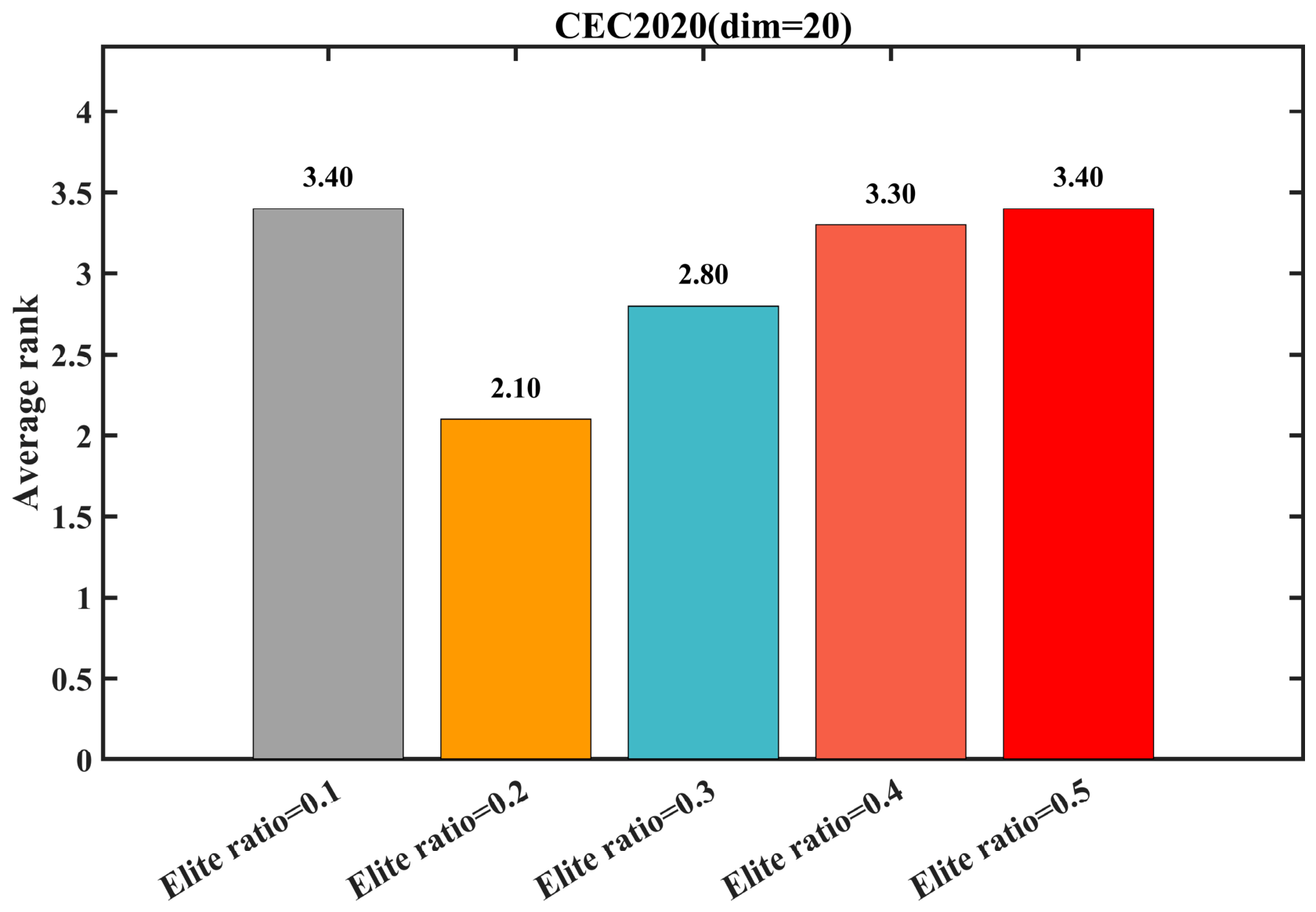
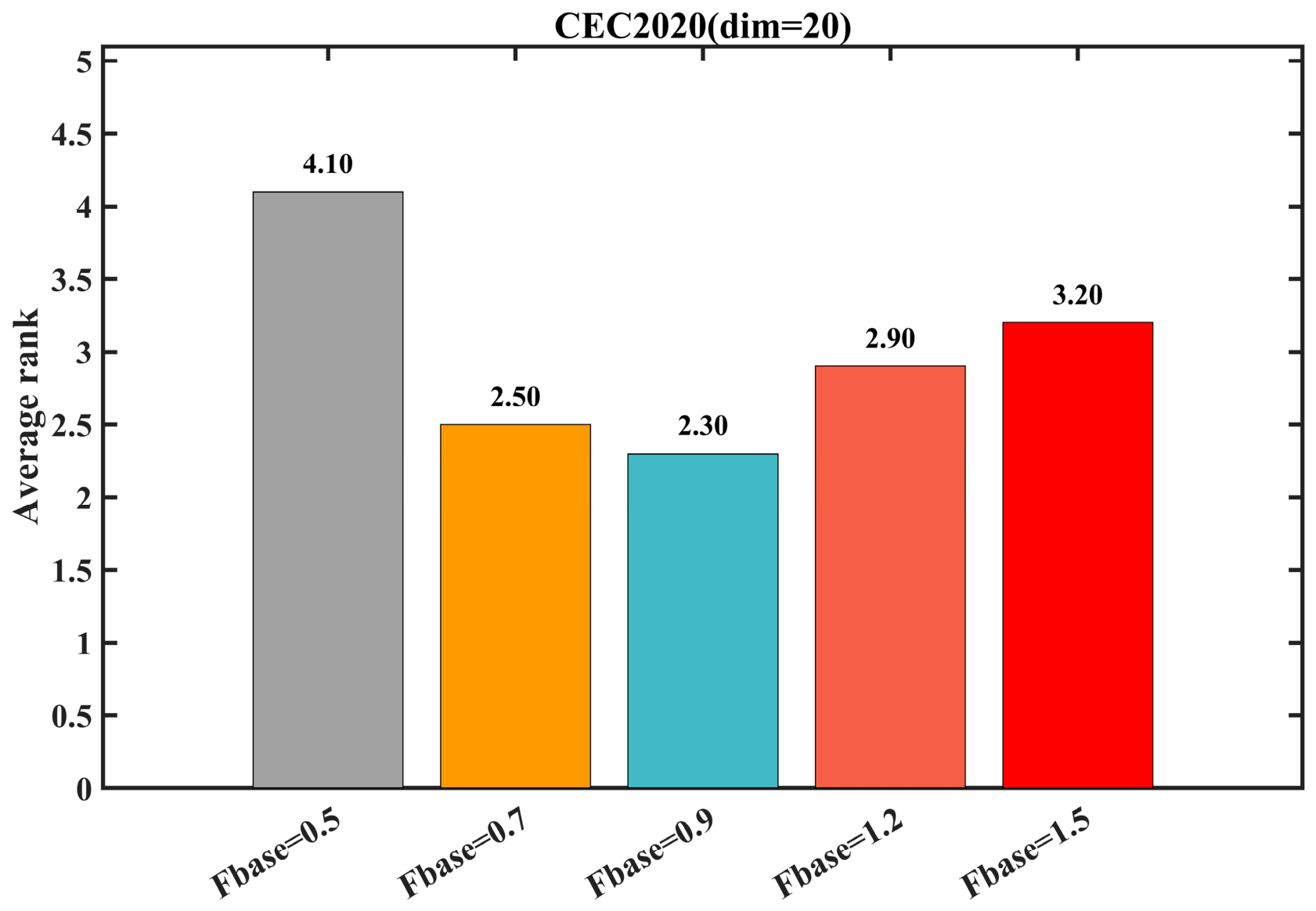
To investigate the effects of the elite ratio, search step size, and differential scaling factor on the optimization performance of the algorithm, parameter sensitivity experiments were conducted on the 20-dimensional CEC2020 benchmark suite. The results are presented in Figure 4, Figure 5 and Figure 6.
Figure 4 illustrates the average rankings corresponding to different elite ratios. When the elite ratio is 0.1, the average ranking is 3.40. Due to the insufficient number of elite individuals, the population lacks stable and effective search guidance. When the ratio increases to 0.2, the algorithm achieves the average ranking of 2.10. At this level, the number of elite individuals is sufficient to effectively propagate high-quality information while maintaining population diversity. As the ratio further increases to 0.3, 0.4, and 0.5, the rankings deteriorate to 2.80, 3.30, and 3.40, respectively. An excessively large elite proportion leads to population homogenization and increases the risk of premature convergence to local optima. Therefore, 0.2 is identified as the optimal elite ratio that balances search guidance and population diversity.
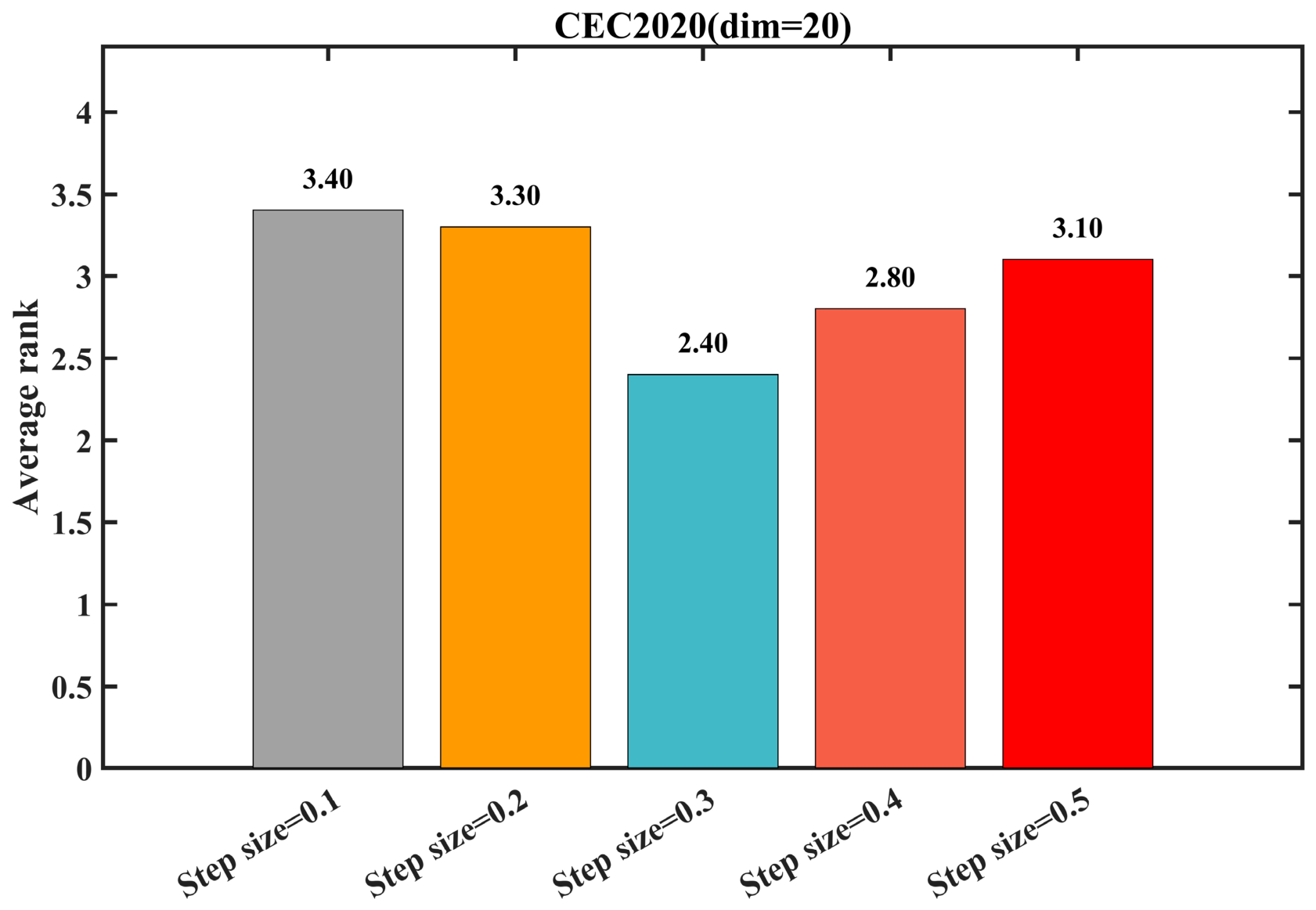
Figure 5 shows the impact of different search step sizes on algorithm performance. When the step size is 0.1 and 0.2, the rankings are 3.40 and 3.30, respectively. Smaller step sizes limit the global exploration capability of the algorithm and significantly reduce the convergence speed. When the step size is set to 0.3, the average ranking reaches the optimal value of 2.40, achieving a good balance between global exploration and local exploitation. As the step size further increases to 0.4 and 0.5, the rankings decline to 2.80 and 3.10, respectively. Excessively large step sizes induce oscillations in the search process and reduce convergence stability. These results indicate that 0.3 is the most suitable step size.
Figure 6 presents the sensitivity analysis results for different base scaling factors ( F b a s e ). When F b a s e   =   0.5 , the ranking is only 4.10, indicating that insufficient scaling weakens the differential evolution capability and makes it difficult to escape local optima. When F b a s e increases to 0.9, the algorithm achieves the best ranking of 2.30. At this level, the mutation and crossover strengths are well balanced, enhancing both information exchange within the population and the reconstruction capability of the solution space. Further increasing F b a s e to 1.2 and 1.5 results in degraded rankings of 2.90 and 3.20, respectively. Excessive mutation perturbations disrupt high-quality solution structures and weaken local exploitation performance. In summary, F b a s e   =   0.9 enables the algorithm to achieve optimal optimization accuracy and stability.

3.3. Ablation Study

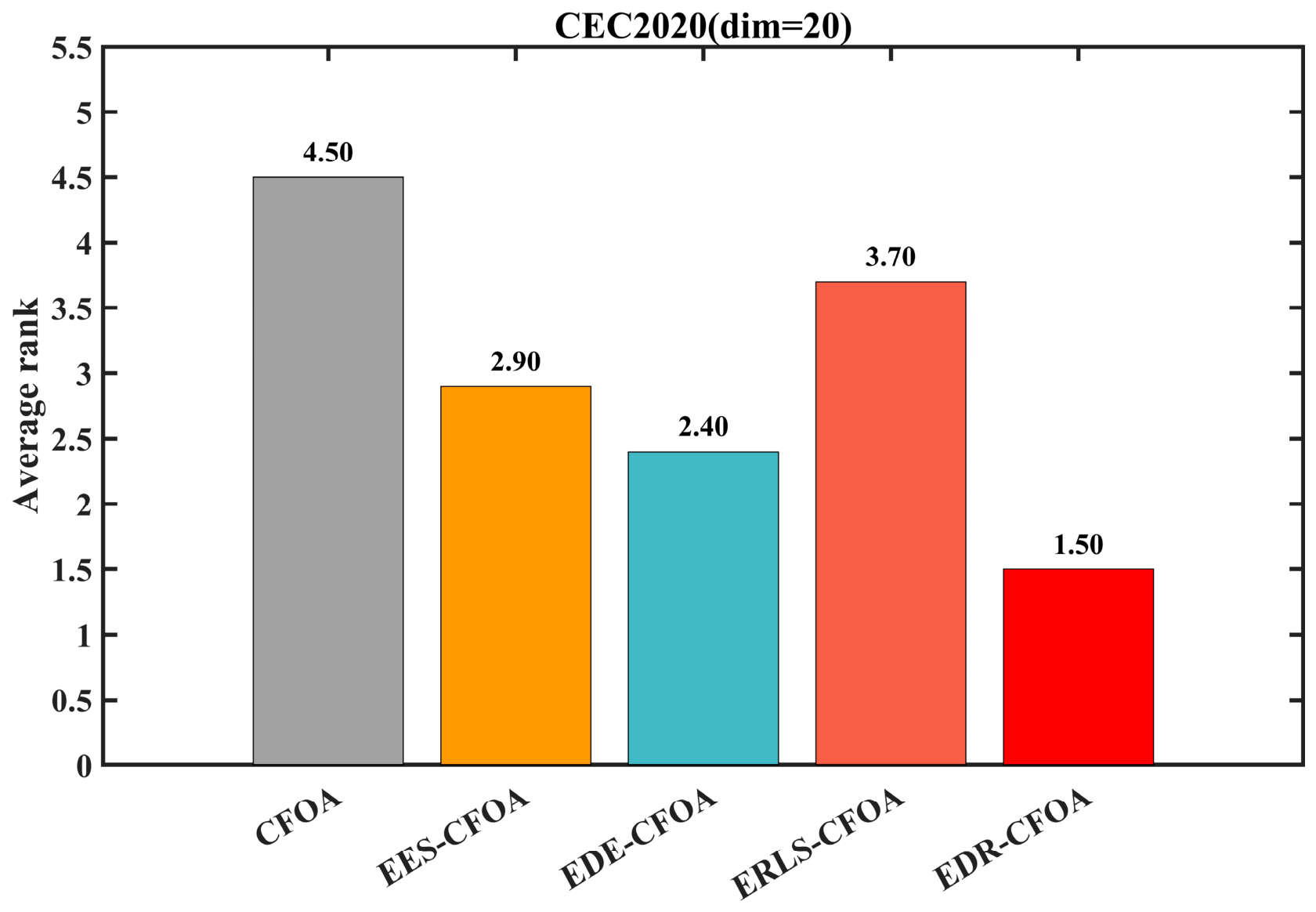
To evaluate the individual contributions and synergistic effects of the three proposed elite-driven enhancement strategies, ablation experiments were conducted on the 20-dimensional CEC2020 benchmark suite. The original Catch Fish Optimization Algorithm (CFOA), along with its variants incorporating a single strategy—EES-CFOA, EDE-CFOA, and ERLS-CFOA—and the fully integrated EDR-CFOA were compared. The average ranking results are shown in Figure 7.
The results indicate that the original CFOA achieves an average ranking of 4.50, performing the worst among all compared algorithms. This poor performance is directly attributed to its unstable search direction, low utilization of elite information, and insufficient exploitation capability in the later stages. By incorporating only the Elite Enhanced Search (EES) strategy, EES-CFOA improves the average ranking to 2.90, demonstrating that stabilizing the search direction and strengthening the guidance of high-quality solutions effectively enhance convergence reliability. The EDE-CFOA variant, which integrates the Elite Differential Evolution (EDE) strategy, achieves a better ranking of 2.40, indicating that elite-based differential mutation significantly improves the solution space reconstruction capability and achieves a better balance between exploration and exploitation. The ERLS-CFOA, which introduces the Elite Random Local Search (ERLS) strategy, obtains a ranking of 3.70. Although it outperforms the original algorithm, the improvement is less pronounced than that of the other two strategies, reflecting its role primarily in fine-grained local exploitation.
Finally, the EDR-CFOA, which integrates all three strategies (EES, EDE, and ERLS), achieves the best average ranking of 1.50, significantly outperforming all single-strategy variants. This result clearly demonstrates that the three strategies form an effective synergy during the optimization process: EES stabilizes the search direction, EDE maintains population diversity, and ERLS enhances fine-grained local exploitation in the later stages. Through their complementary and cooperative effects, these strategies fundamentally overcome the key limitations of the original CFOA, enabling EDR-CFOA to achieve superior convergence accuracy, stability, and global optimization capability in high-dimensional complex optimization problems.

3.4. Experimental Design and Result Analysis on the CEC2020 Benchmark

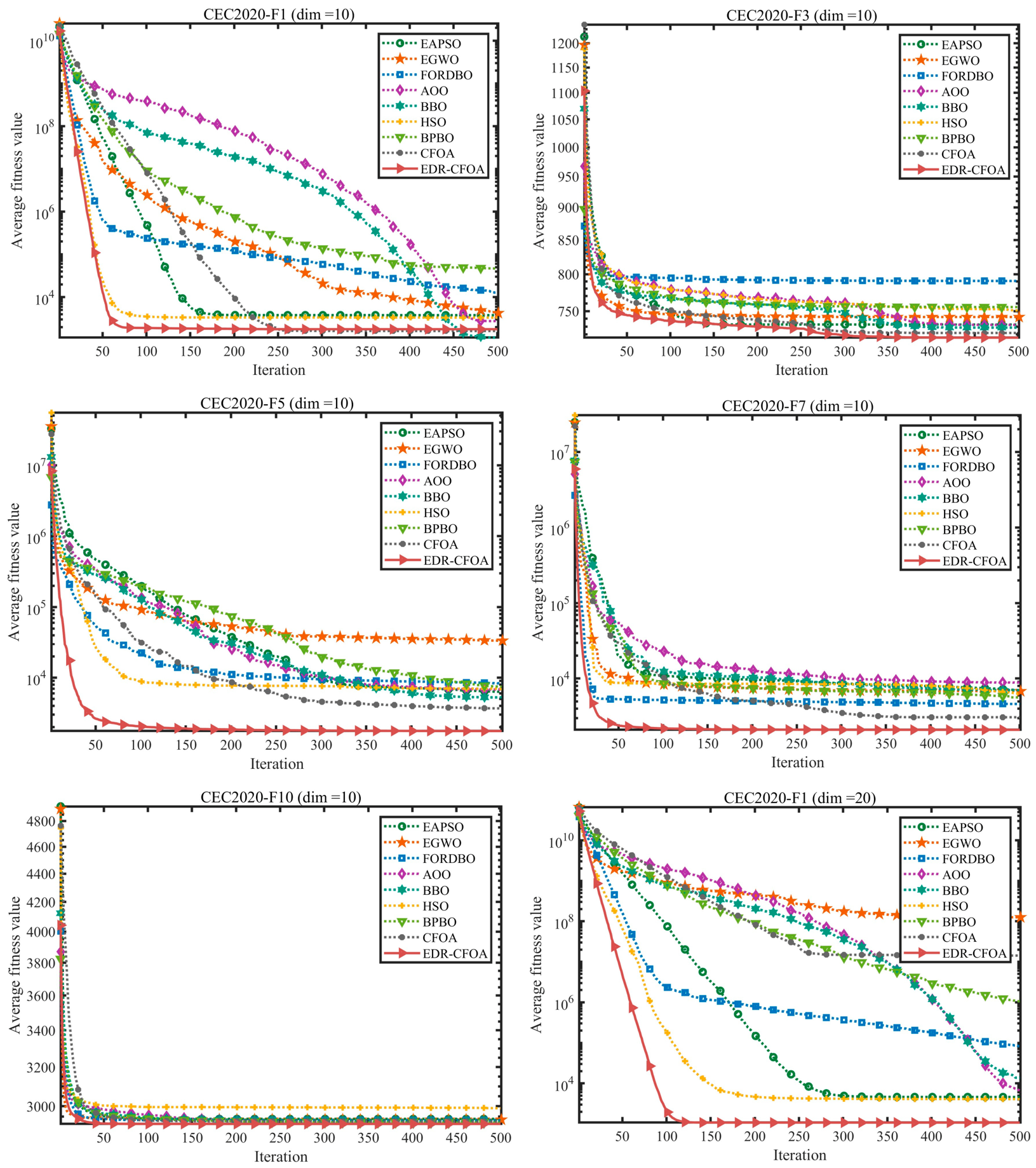
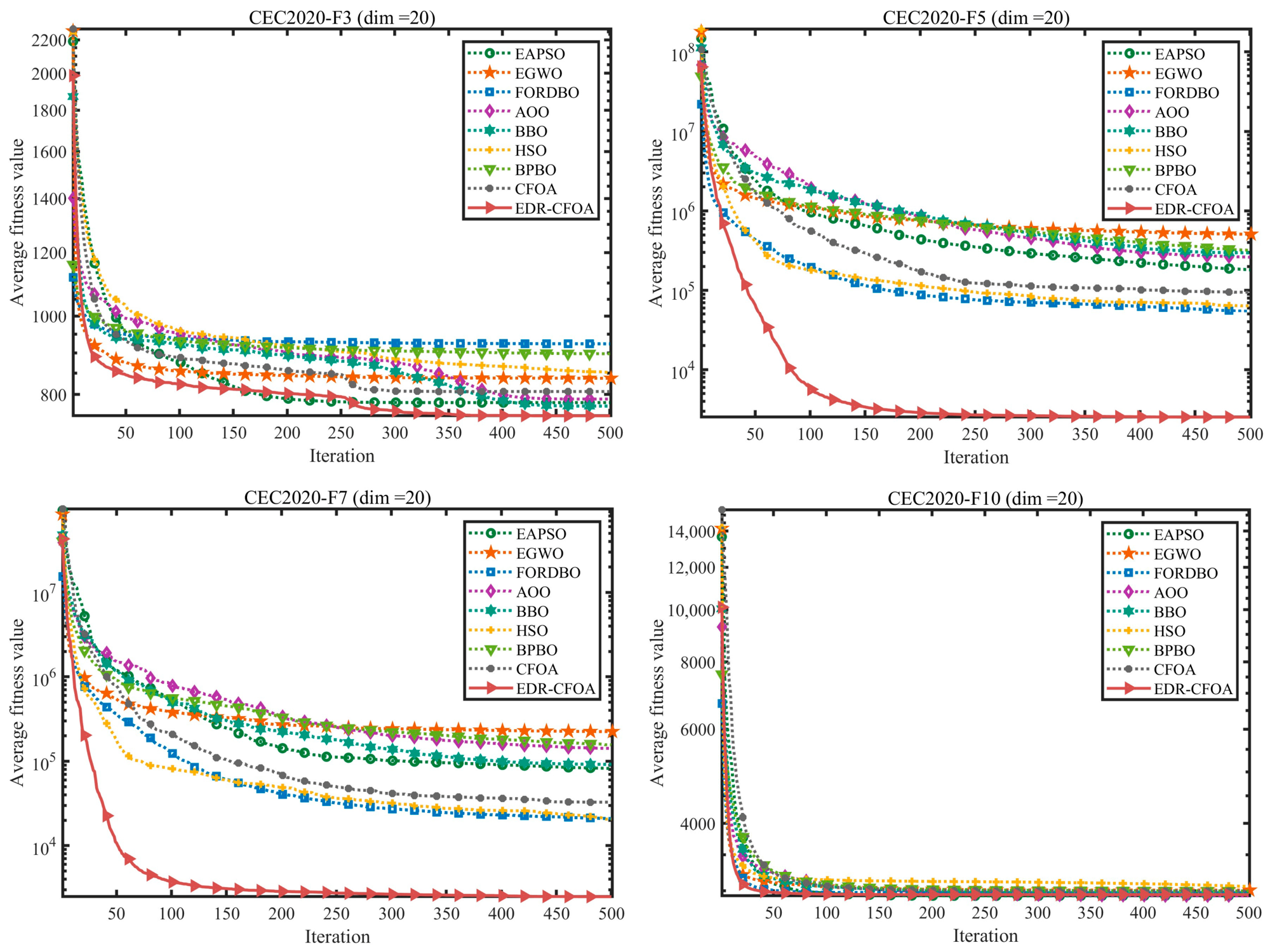
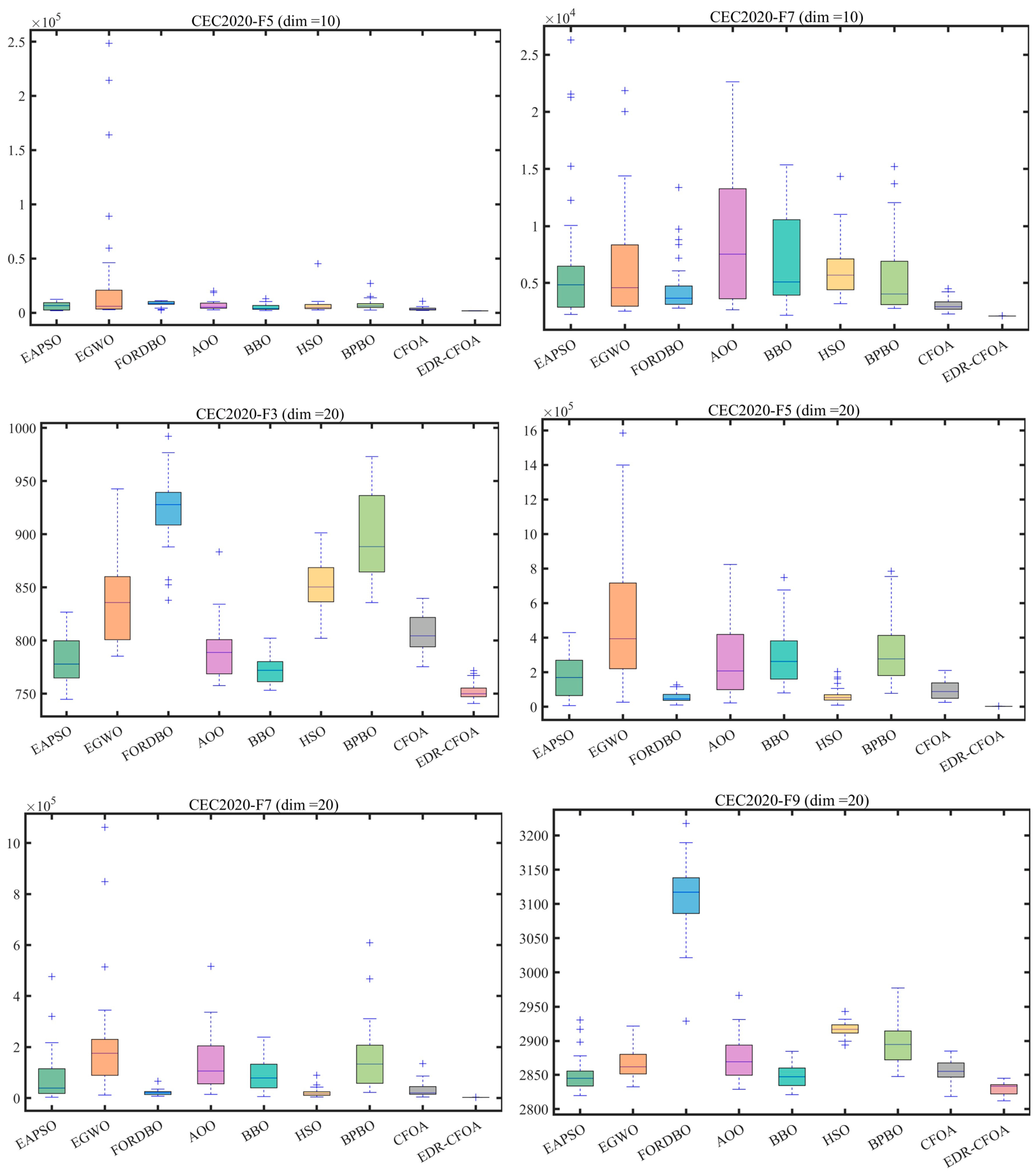
The experimental results on the CEC2020 benchmark for 10-dimensional and 20-dimensional scenarios (Table 2 and Table 3), together with convergence behaviors and result distribution visualizations (Figure 8 and Figure 9), comprehensively validate the performance differences between EDR-CFOA and eight comparative algorithms. In the tables, bold values are used to indicate the best-performing result in that row or column.
As shown in Table 2 for the 10-dimensional case, EDR-CFOA achieves the minimum mean fitness values on all ten test functions, demonstrating significant advantages in both solution accuracy and optimization stability. Taking function F5 as an example, EDR-CFOA attains a mean value of 1.7667 × 10³ with a standard deviation of only 5.8887 × 101, which is markedly superior to the original CFOA (mean 3.6858 × 10³, standard deviation 1.7310 × 10³) as well as the other comparison algorithms. For function F7, EDR-CFOA achieves a mean value of 2.1040 × 10³ with an extremely small standard deviation of 4.5757 × 100, representing an order-of-magnitude improvement over CFOA and indicating outstanding optimization stability. Even for the relatively low-sensitivity function F4, EDR-CFOA maintains the best mean fitness value (1.9008 × 10³) and the smallest standard deviation (2.2860 × 10⁻¹), highlighting its fine-grained search capability in low-variance optimization problems.
It should be noted that on certain functions such as F1 and F9, EDR-CFOA does not achieve the absolute best performance. This is mainly because these functions exhibit relatively simple landscapes or strong regularity, where excessive exploitation may slightly reduce diversity. Similarly, in functions such as F10, some algorithms like FORDBO and EAPSO demonstrate competitive performance due to their specific search mechanisms tailored to such landscapes. However, EDR-CFOA still maintains strong overall performance and stability across all functions, as confirmed by statistical tests.
When the problem dimensionality increases to 20 (Table 3), the performance of most comparative algorithms deteriorates significantly, with substantial increases in both mean values and standard deviations. In contrast, EDR-CFOA consistently preserves excellent optimization performance and robustness. For the high-dimensional F1 function, EDR-CFOA achieves a mean value of only 1.0761 × 10³, which is dramatically lower than those of the original CFOA (1.4244 × 10⁷) and EGWO (1.2554 × 10⁸). On functions F5 and F7, EDR-CFOA records mean values of 2.5340 × 10³ and 2.4868 × 10³, respectively, with standard deviations controlled within 300, significantly outperforming several algorithms whose mean values exceed 104. For function F6, where the performances of all algorithms tend to converge under the 20-dimensional setting, EDR-CFOA maintains the same mean value as the other algorithms while preserving its original stability, indicating that its optimization mechanism is insensitive to dimensionality growth and exhibits strong adaptability to high-dimensional problems.
The convergence speed comparison in Figure 8 further confirms the superiority of EDR-CFOA. In both 10-dimensional and 20-dimensional cases, EDR-CFOA demonstrates the fastest convergence rates on key benchmark functions such as F3, F5, F7, and F10. It rapidly drives the fitness values into the optimal region within the early stages of iteration (within 100 iterations) and maintains a smooth and stable descent in the middle and later stages without noticeable oscillations. In contrast, the original CFOA and other comparative algorithms either converge slowly in the early stages or suffer from severe fitness oscillations in later iterations, and some even exhibit fitness deterioration in high-dimensional problems (e.g., EGWO and CFOA on the 20-dimensional F1 function). This advantage can be attributed to the integration of elite-enhanced search and differential evolution strategies in EDR-CFOA, which effectively identify promising search directions in the early phase and subsequently employ elite-based stochastic local search for fine-grained exploitation, thereby avoiding slow convergence or premature stagnation commonly observed in traditional algorithms.
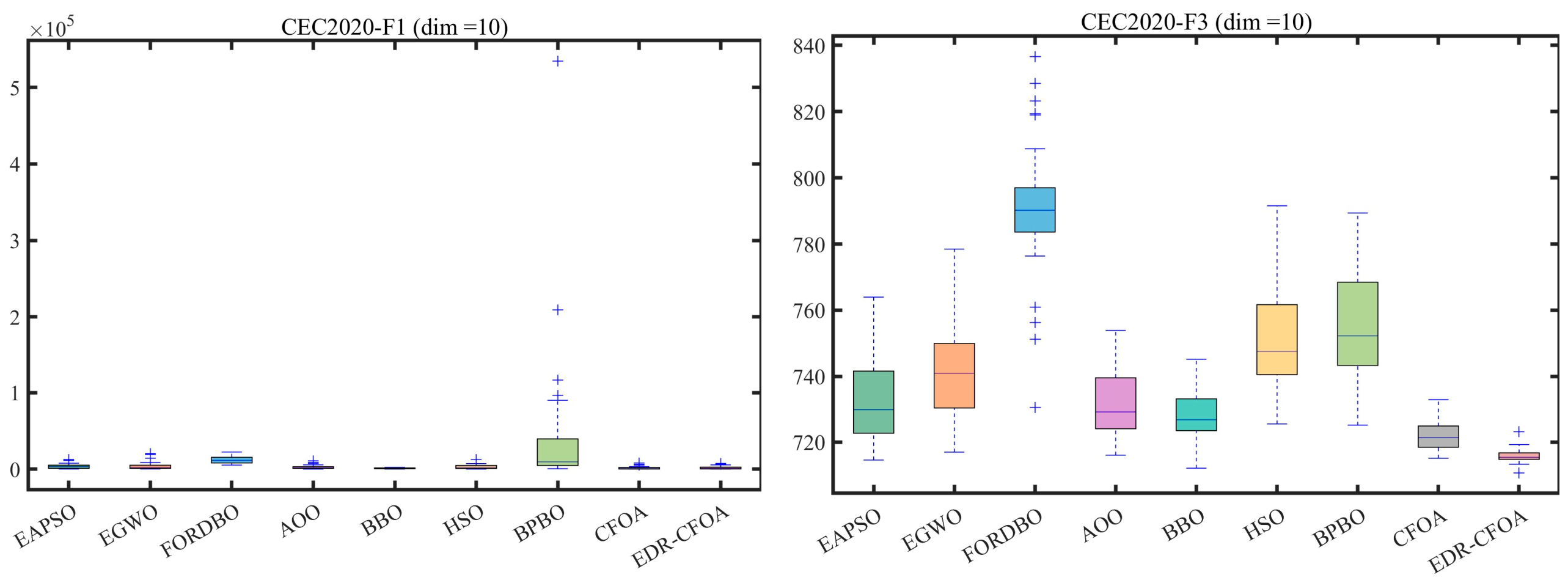
The box-plot analysis in Figure 9 illustrates the distribution characteristics of optimization results over 30 independent runs. For the 10-dimensional F5 and F7 functions, EDR-CFOA exhibits the narrowest boxes and shortest whiskers, indicating highly concentrated results and minimal randomness across multiple runs. In the 20-dimensional F5, F7, and F9 functions, the box distributions of EDR-CFOA are located significantly lower than those of the other algorithms, with no outliers observed, whereas the original CFOA and HSO present numerous extreme high-value outliers, reflecting poor stability. Even for function F1, where the performance discrepancies among algorithms are relatively large, the result distribution of EDR-CFOA remains concentrated in the low-fitness region. These observations clearly demonstrate that the multiple elite-reinforcement strategies employed in EDR-CFOA effectively reduce search randomness and enhance the consistency and reliability of optimization outcomes.
In summary, EDR-CFOA consistently outperforms the original CFOA and other mainstream optimization algorithms on the CEC2020 benchmark in terms of solution accuracy, convergence speed, and result stability. Moreover, it maintains its performance advantages in high-dimensional and complex optimization problems, thereby validating the effectiveness of the proposed elite-enhancement strategies and the strong adaptability of the algorithm.

3.5. Experimental Design and Result Analysis on the CEC2022 Benchmark

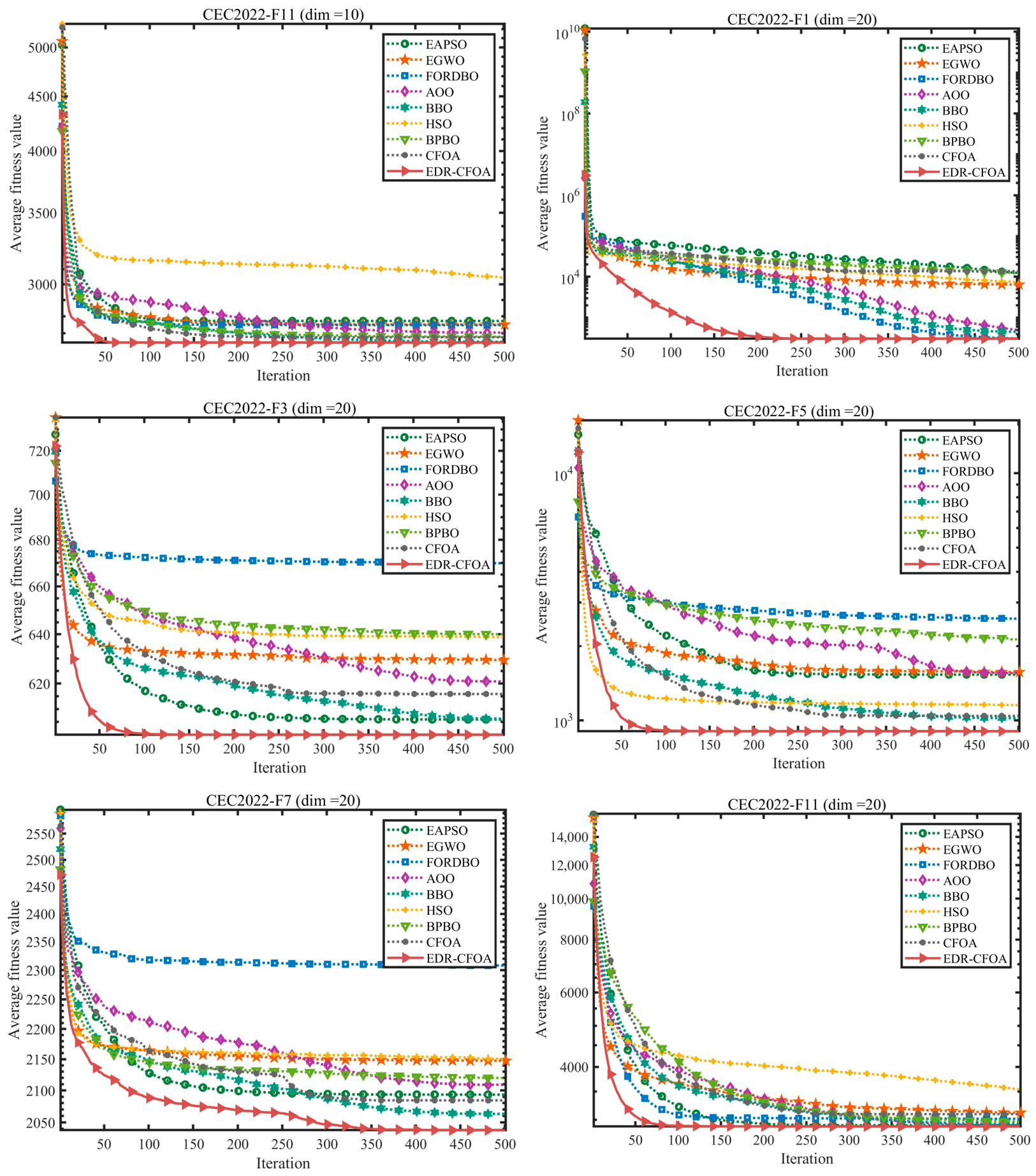
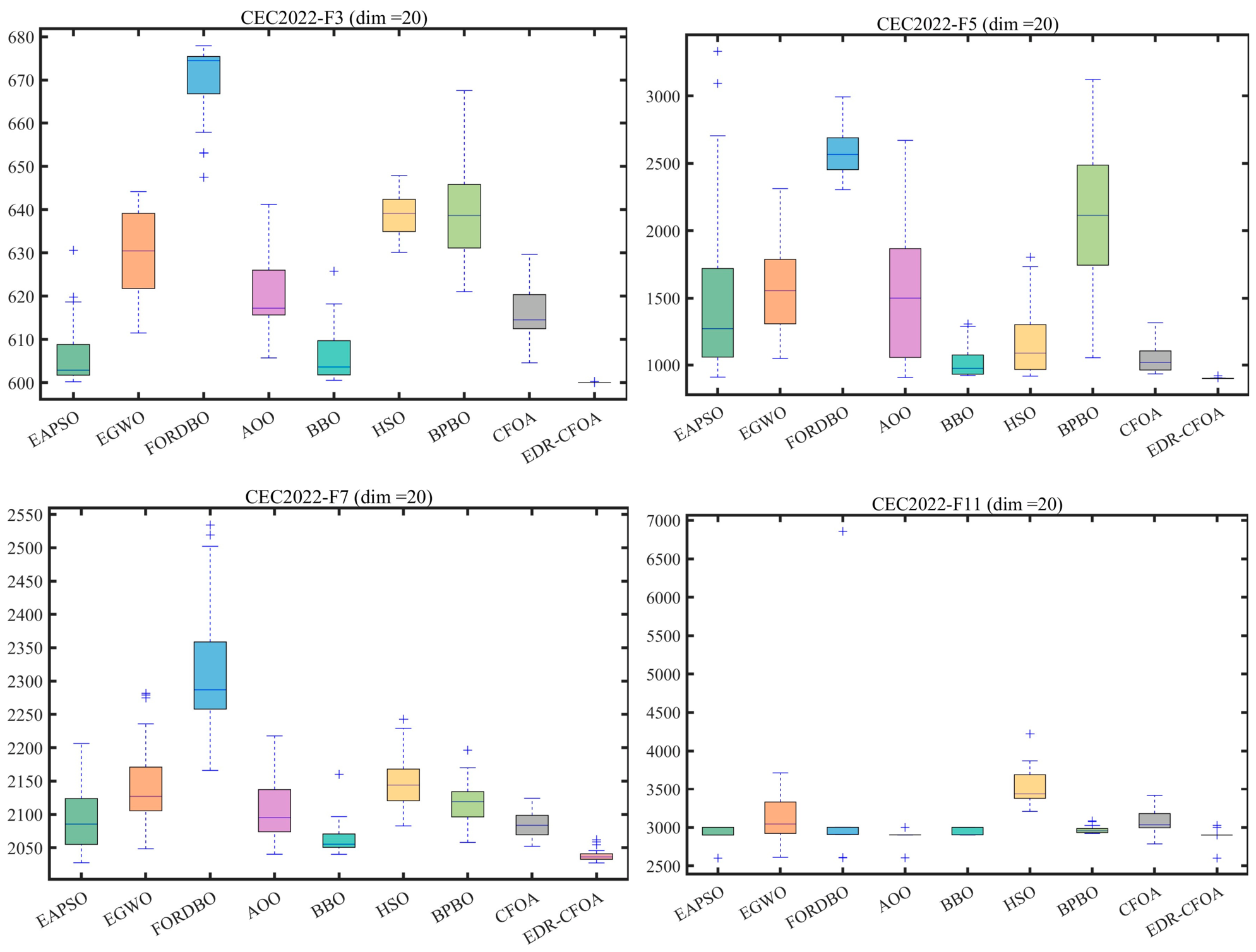
To further verify the generalization capability and optimization performance of the proposed EDR-CFOA under complex optimization scenarios, additional experiments were conducted on the CEC2022 benchmark suite. Comparative evaluations were carried out in both 10-dimensional and 20-dimensional settings, where EDR-CFOA was benchmarked against the original CFOA and eight mainstream optimization algorithms. The solution accuracy and stability were quantitatively assessed using the mean fitness value and standard deviation, while the convergence characteristics and result distribution patterns were intuitively analyzed through convergence curves (Figure 10) and box plots (Figure 11). This comprehensive evaluation aims to rigorously examine the performance of EDR-CFOA across optimization problems with varying levels of complexity, thereby providing stronger experimental support for its potential engineering applications.
Table 4 and Table 5 report the numerical experimental results of all algorithms on the CEC2022 test suite in 10-dimensional and 20-dimensional scenarios, respectively, clearly demonstrating the superiority of EDR-CFOA in terms of quantitative performance metrics. In the 10-dimensional case (Table 4), EDR-CFOA achieves the theoretical optimal mean fitness values on functions F1, F3, and F5, with standard deviations reaching the order of 10−12 to 10−7, indicating nearly bias-free and highly stable optimization performance. For complex functions such as F6, F8, and F11, EDR-CFOA attains significantly lower mean fitness values than the other algorithms. Specifically, on function F6, EDR-CFOA records a mean value of 1.8049 × 10³, representing an approximate 50% reduction compared with the original CFOA (3.6295 × 10³), while its standard deviation is only 5.1435 × 100, which is substantially smaller than the thousand-level standard deviations observed for the comparison algorithms. Even for functions F2, F4, and F7, where the performance differences among algorithms are relatively small, EDR-CFOA consistently achieves the minimum mean values and standard deviations, demonstrating robust and stable superiority.
When the problem dimensionality increases to 20 (Table 5), the search space complexity grows substantially, leading to a marked degradation in solution accuracy and stability for most comparison algorithms. In contrast, EDR-CFOA maintains excellent overall performance. On the high-dimensional F1 function, EDR-CFOA achieves a mean fitness value of 3.0632 × 10², which is significantly lower than those of EAPSO (1.2239 × 10⁴) and the original CFOA (1.3599 × 10⁴), with a standard deviation of only 1.1095 × 101, indicating absolute superiority in both accuracy and stability. For functions F3, F5, and F9, the mean values obtained by EDR-CFOA are close to the theoretical optima, while the corresponding standard deviations are as low as 6.7133 × 10⁻², 3.8723 × 100, and 9.8756 × 10⁻³, respectively, representing reductions of one to two orders of magnitude compared with the competing algorithms. Furthermore, for difficult-to-optimize functions such as F6, F10, and F12, EDR-CFOA again achieves the smallest mean values and standard deviations, fully confirming its strong robustness in high-dimensional and complex optimization problems.
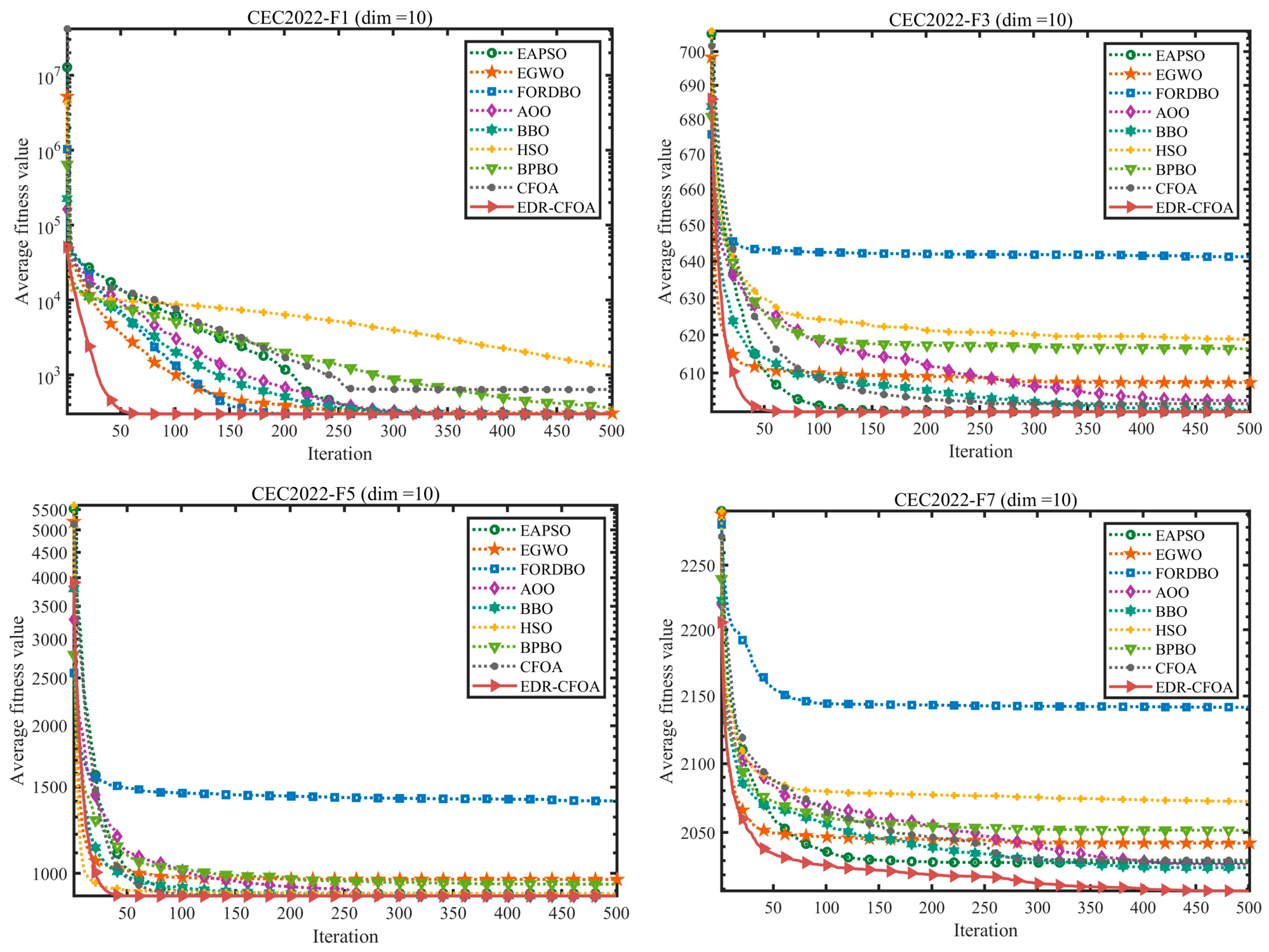
The convergence curves presented in Figure 10 provide further intuitive evidence of the convergence advantages of EDR-CFOA. For key benchmark functions in both 10-dimensional and 20-dimensional scenarios, EDR-CFOA consistently exhibits rapid convergence, smooth fitness reduction in later iterations, and no noticeable oscillations. In the 10-dimensional F1 and F5 functions, EDR-CFOA drives the fitness values into the optimal region within the early iterations (within 50 iterations) and subsequently continues fine-grained exploitation with steadily decreasing fitness values. In the 20-dimensional F1, F5, and F7 functions, most comparison algorithms suffer from slow convergence and stagnation during the middle iterations, whereas EDR-CFOA maintains a fast convergence trend throughout the optimization process without any fitness deterioration. This behavior can be attributed to the synergistic effects of the elite-enhancement strategies, which rapidly identify promising search directions through elite-enhanced search and differential evolution, and subsequently perform fine-grained local exploitation via elite-based stochastic local search, effectively balancing global exploration and local exploitation.
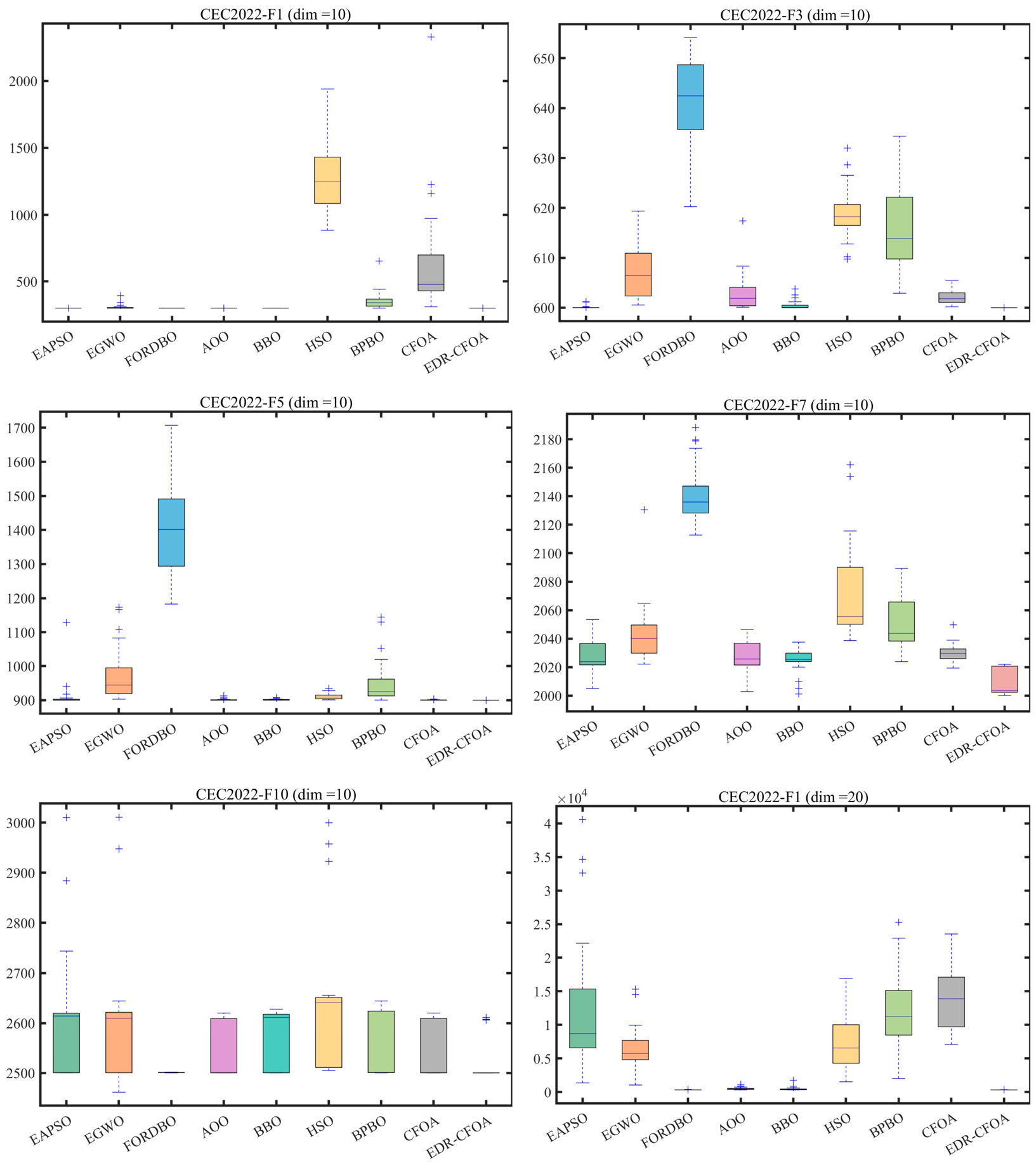
The box-plot analysis in Figure 11 reflects the stability of all algorithms over 30 independent runs from the perspective of result distribution. Across all test functions, EDR-CFOA consistently exhibits the lowest box positions, the narrowest box widths, the shortest whiskers, and no outliers. For the 10-dimensional F1, F5, and F7 functions, the box plots of EDR-CFOA almost collapse into a single point, indicating highly consistent results across multiple independent runs with minimal randomness. In the 20-dimensional F3, F5, and F9 functions, the comparison algorithms show high box positions, wide spreads, and numerous extreme outliers, whereas the box plots of EDR-CFOA remain tightly concentrated in the low-fitness region with no outliers. These results demonstrate that EDR-CFOA effectively reduces search randomness and mitigates the issues of premature convergence and large performance fluctuations commonly observed in traditional algorithms. Even for functions F2 and F4, where the performance differences among algorithms are relatively small, EDR-CFOA still achieves the most favorable distribution characteristics, further confirming its stable optimization capability.
In summary, under both 10-dimensional and 20-dimensional scenarios of the CEC2022 benchmark, EDR-CFOA consistently outperforms the original CFOA and other mainstream optimization algorithms in terms of solution accuracy, convergence speed, and result stability. Even when confronted with high-dimensional and complex optimization problems, EDR-CFOA maintains strong robustness and generalization capability, thereby fully validating the effectiveness and rationality of the proposed multiple elite-enhancement strategies and establishing a solid experimental foundation for its application in practical engineering optimization problems.

3.6. Experimental Design and Result Analysis on the CEC2017 Benchmark

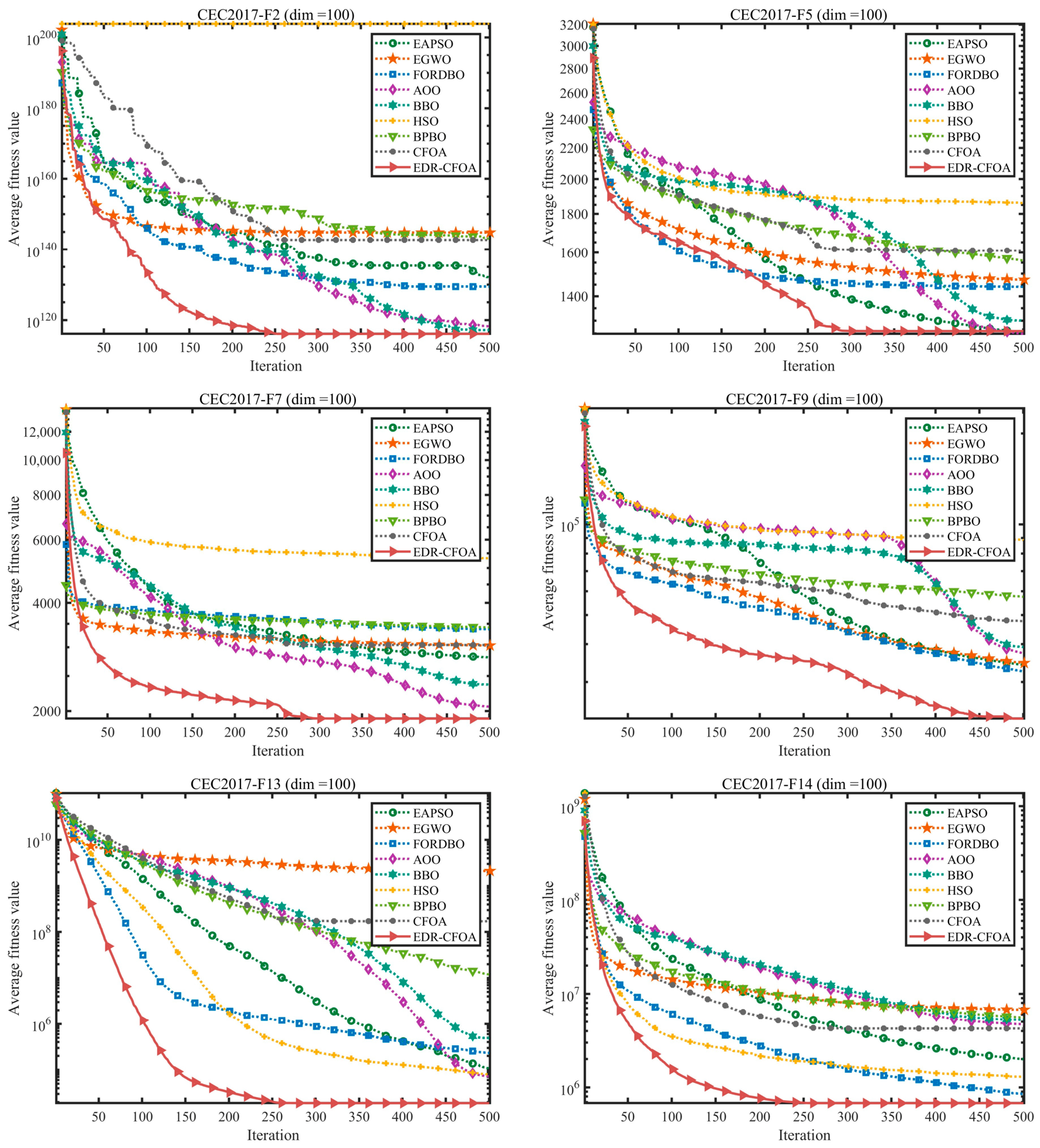
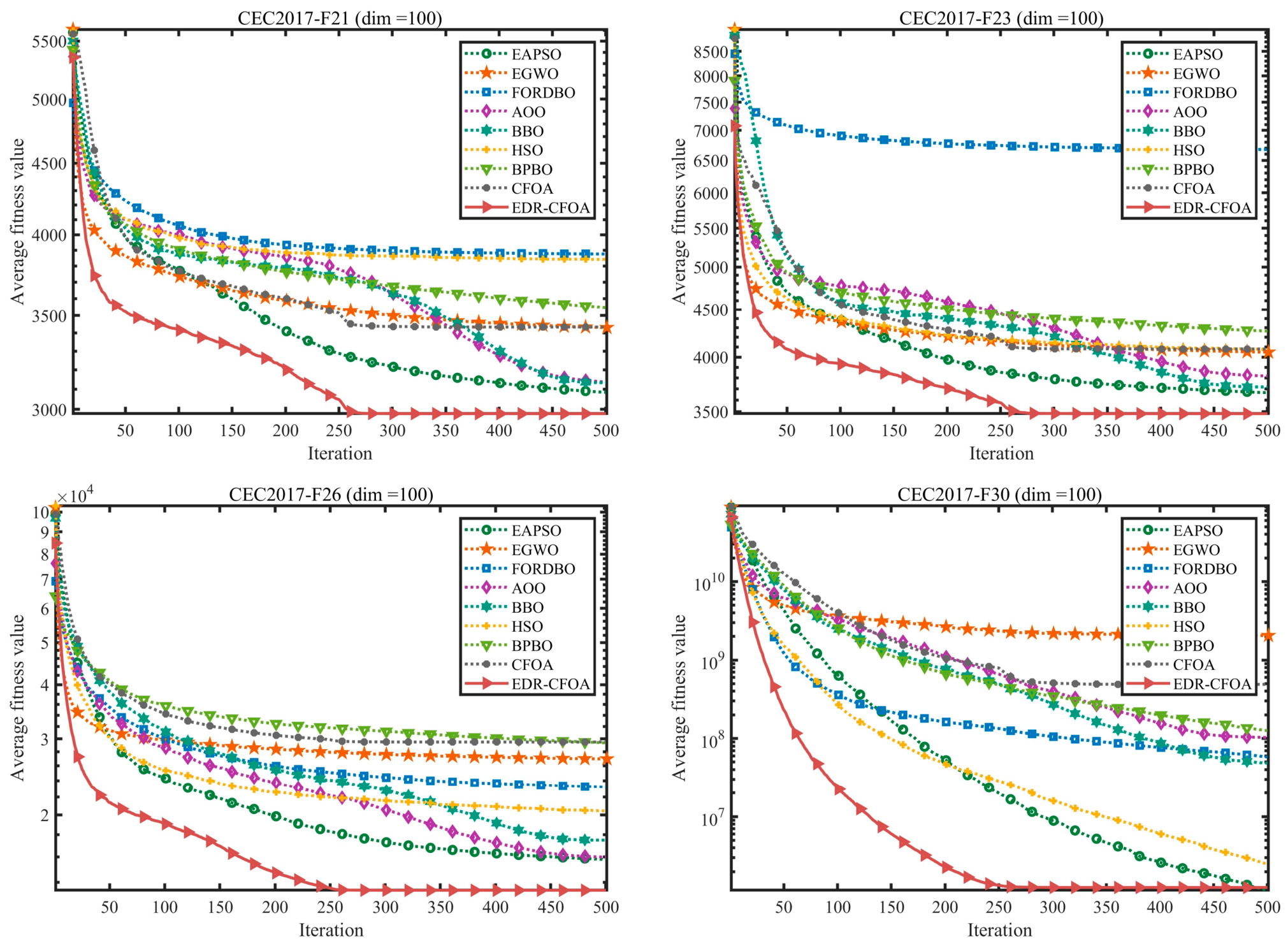
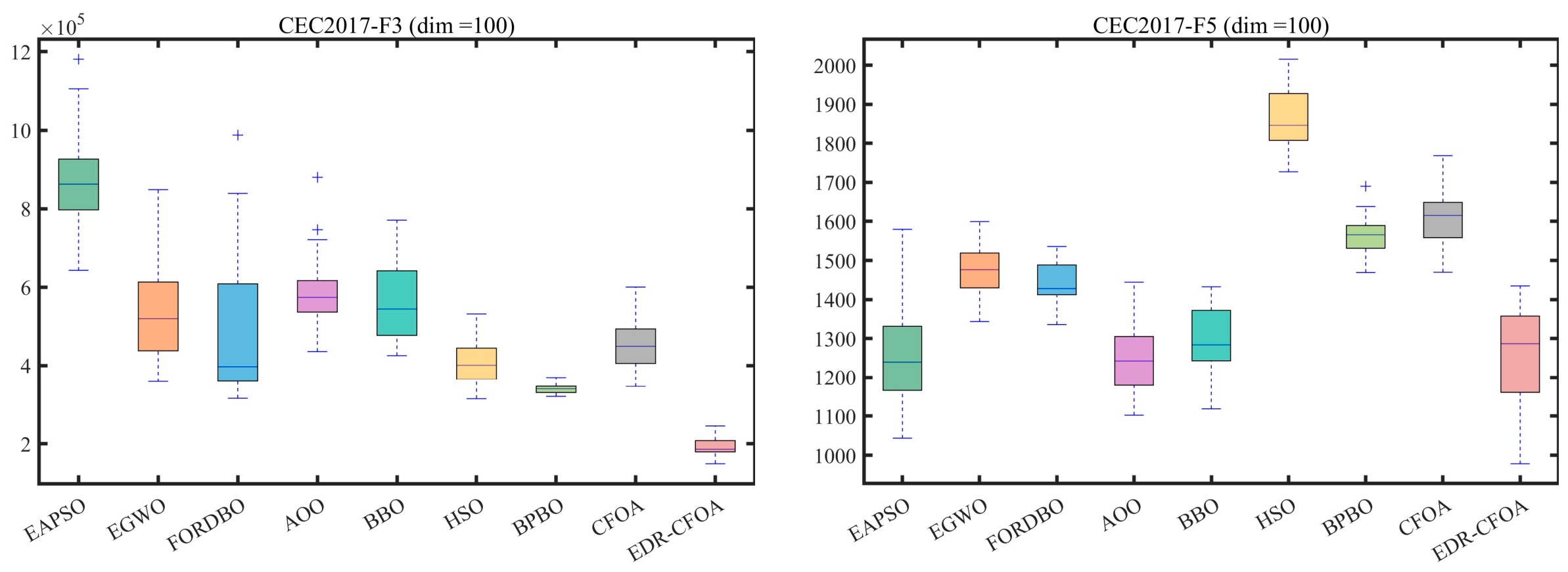
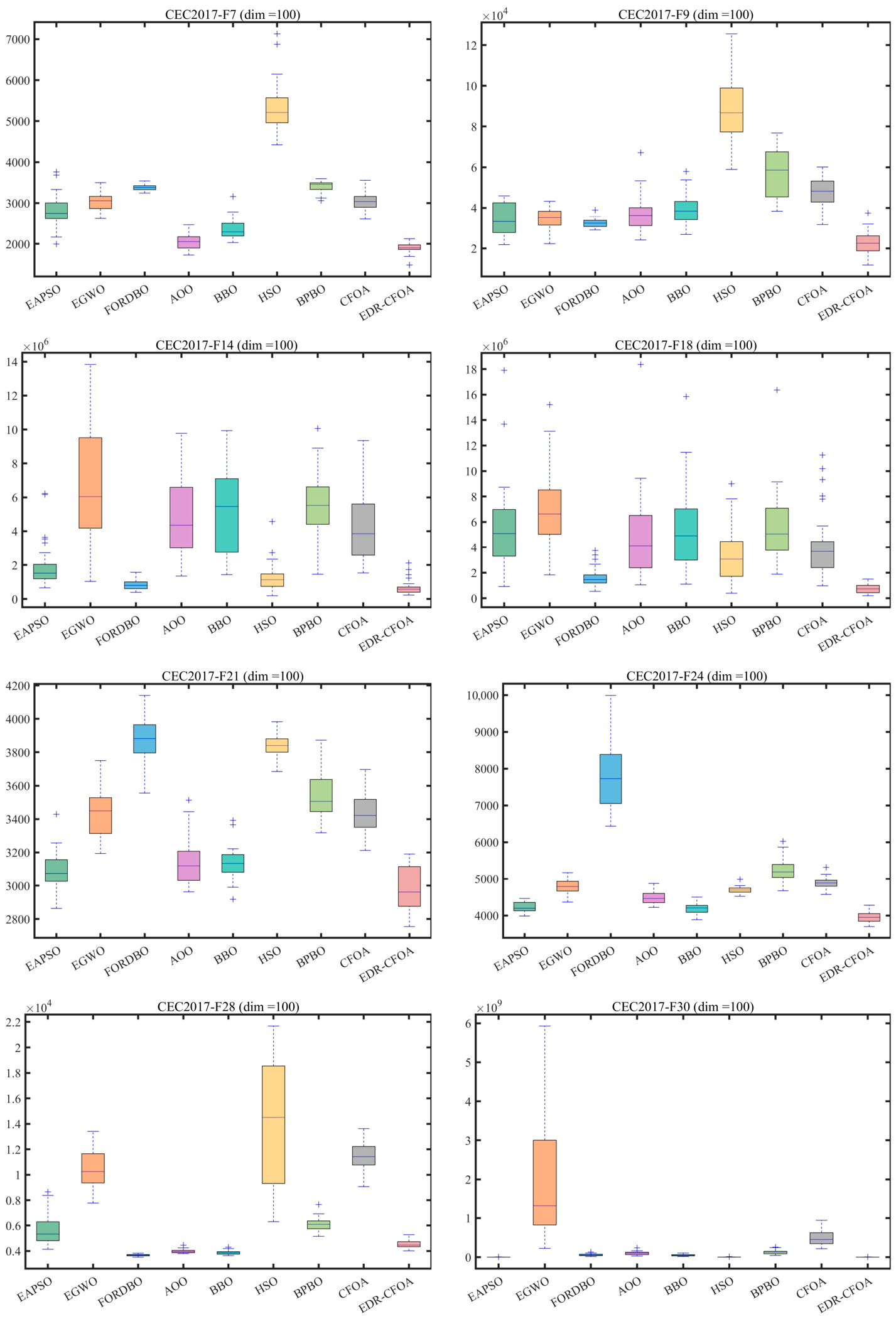
To further validate the generalization capability and robustness of EDR-CFOA in ultra-high-dimensional and large-scale complex optimization problems, this section conducts numerical experiments on the 100-dimensional CEC2017 benchmark suite. The proposed algorithm is comprehensively compared with eight state-of-the-art intelligent optimization algorithms. The results are presented in Table 6 and Figure 12 and Figure 13.
Table 6 reports the best, mean, and standard deviation values obtained by each algorithm over 30 independent runs under the 100-dimensional setting. The results demonstrate that EDR-CFOA achieves the best mean values and the lowest standard deviations on the vast majority of high-dimensional complex functions among the 30 CEC2017 test functions. Notably, on large-scale optimization problems characterized by strong multimodality, ill-conditioning, and high condition numbers—such as F1, F2, F9, F11, F13, F18, F19, F26, and F30—the superiority of EDR-CFOA is particularly significant. Among the comparison algorithms, EAPSO, AOO, and BBO exhibit acceptable performance on certain unimodal or low-complexity functions; however, in the 100-dimensional scenario, they generally suffer from a sharp decline in accuracy and a substantial increase in performance variability. The original CFOA, EGWO, and BPBO show severe degradation in convergence performance under high-dimensional conditions, with significantly worse mean and standard deviation values, highlighting the inherent limitations of traditional algorithms, such as premature convergence and unstable search behavior in ultra-high-dimensional spaces.
Figure 12 presents the convergence curves for representative test functions. Even in the 100-dimensional setting, EDR-CFOA maintains the fastest convergence speed and the lowest final fitness values. It rapidly approaches high-quality solution regions in the early iterations, exhibits steady improvement during the mid-stage, and performs refined exploitation in the later stage without noticeable oscillations or stagnation. In contrast, most comparison algorithms exhibit slow convergence in the early stage, become trapped in local optima during the mid-stage, and fail to achieve further accuracy improvements in the later stage. Some algorithms even show fitness rebound phenomena, indicating insufficient global exploration capability in high-dimensional search spaces.
Figure 13 shows the boxplot comparisons of solution distributions. EDR-CFOA demonstrates highly concentrated distributions with the lowest dispersion and no significant outliers. Its median, upper quartile, and lower quartile are all significantly better than those of the comparison algorithms, indicating excellent stability and consistency in ultra-high-dimensional scenarios. In contrast, algorithms such as CFOA, EGWO, and HSO exhibit wide boxplot ranges, numerous outliers, and dispersed distributions, reflecting high randomness and poor robustness, making them unsuitable for large-scale high-dimensional optimization tasks.
In summary, on the 100-dimensional CEC2017 benchmark suite, EDR-CFOA outperforms all comparison algorithms comprehensively in terms of convergence accuracy, convergence speed, robustness, and generalization capability. These results validate that the proposed multi-strategy elite-driven framework possesses significant advantages and practical value in solving large-scale, high-complexity, ultra-high-dimensional engineering optimization problems.

3.7. Statistical Analysis

3.7.1. Algorithm Performance Significance Analysis Based on the Wilcoxon Rank-Sum Test

To statistically verify whether the performance advantages of EDR-CFOA over the comparison algorithms are significant, the Wilcoxon rank-sum test was employed to quantitatively analyze the experimental results obtained on the CEC2017, CEC2020 and CEC2022 benchmark suites under different dimensional settings. The notation +/=/− represents the number of benchmark functions for which EDR-CFOA achieves statistically superior performance, comparable results, or inferior outcomes relative to each competing algorithm, respectively. A summary of the corresponding statistical comparisons is reported in Table 7. Since the Wilcoxon rank-sum test is a distribution-free nonparametric method, it enables a reliable and stringent evaluation of performance differences among algorithms. The results obtained from this test provide strong statistical support for the performance advantage of EDR-CFOA.
From the statistical results on the CEC2020 benchmark, EDR-CFOA exhibits remarkable statistical dominance in both 10-dimensional and 20-dimensional scenarios. In the 10-dimensional case, the +/=/− results for EAPSO, EGWO, FORDBO, HSO, and BPBO are all 10/0/0, indicating that EDR-CFOA significantly outperforms these algorithms on all ten test functions. For AOO and CFOA, the results are 8/0/2, while for BBO the result is 9/0/1. Notably, no algorithm shows any case where EDR-CFOA is significantly inferior, and only a small number of functions exhibit statistically equivalent performance. These results clearly demonstrate that the performance advantages of EDR-CFOA in the CEC2020 10-dimensional scenario are highly statistically significant. In the 20-dimensional setting, the statistical superiority of EDR-CFOA remains stable. FORDBO, BPBO, and CFOA retain perfect results of 10/0/0, while EGWO, AOO, and HSO achieve 9/0/1, and EAPSO and BBO yield 8/0/2. Importantly, the values for all comparison algorithms remain zero, indicating that even with the increased complexity of high-dimensional search spaces, EDR-CFOA never performs significantly worse than any competitor, and its superiority remains statistically significant.
For the CEC2022 benchmark under both 10-dimensional and 20-dimensional scenarios, the statistical advantages of EDR-CFOA become even more pronounced. Owing to the increased number of test functions (12 in total), these results provide a more comprehensive validation of the algorithm’s generalization capability. In the 10-dimensional case, the +/=/− results for EAPSO, EGWO, AOO, BBO, and HSO are all 12/0/0, indicating statistically significant superiority on all test functions. FORDBO, BPBO, and CFOA achieve 11/0/1, with only one function showing statistically equivalent performance and no cases of inferiority. These results highlight the stable dominance of EDR-CFOA in solving complex optimization problems under the CEC2022 10-dimensional setting. In the 20-dimensional scenario, EGWO, AOO, HSO, BPBO, and CFOA again maintain perfect results of 12/0/0, while EAPSO, FORDBO, and BBO achieve 11/0/1. As in the lower-dimensional case, the values for all comparison algorithms remain zero, confirming that even in more challenging high-dimensional optimization scenarios with higher problem complexity, the performance advantages of EDR-CFOA consistently pass the statistical significance test and do not degrade with increasing dimensionality.
Under the 100-dimensional CEC2017 benchmark setting, EDR-CFOA achieves a complete dominance over BPBO and the original CFOA, with a result of 30/0/0, indicating statistically significant superiority on all test functions, with no equivalent or inferior cases. This demonstrates that the proposed multi-strategy elite-driven mechanism effectively overcomes the inherent limitations of the original algorithm in high-dimensional spaces, including unstable search behavior, susceptibility to premature convergence, and insufficient exploitation capability. Compared with EGWO and FORDBO, EDR-CFOA attains results of 29/0/1, exhibiting statistically equivalent performance on only one function and significantly outperforming them on all others. Against HSO, EDR-CFOA achieves 28/0/2. When compared with AOO and BBO, the results are 25/0/5 and 24/0/6, respectively, still maintaining overwhelming superiority across the majority of test functions. Even when compared with the relatively competitive EAPSO (22/0/8), EDR-CFOA demonstrates statistically significant improvements on more than two-thirds of the functions. Overall, in the ultra-high-dimensional and complex 100-dimensional scenario, EDR-CFOA shows no statistically inferior cases compared to any of the benchmark algorithms and achieves significant superiority on the vast majority of functions. These results provide strong statistical evidence that the proposed algorithm delivers stable, reliable, and statistically significant optimization performance in high-dimensional search spaces, supporting its applicability to ultra-high-dimensional engineering optimization problems.
Overall, the Wilcoxon rank-sum test results across both benchmark suites demonstrate that, in all tested scenarios—CEC2017, CEC2020 and CEC2022, 10-dimensional and 20-dimensional—the values of EDR-CFOA relative to the eight comparison algorithms are consistently zero, meaning that EDR-CFOA is never statistically inferior to any competitor. Moreover, EDR-CFOA achieves statistically significant superiority on the vast majority of test functions, with only a very small number of cases exhibiting statistically equivalent performance. These statistical findings are highly consistent with the conclusions drawn from the numerical results, convergence curves, and box-plot analyses on both benchmark suites. From a statistical perspective, they further confirm the superiority and robustness of EDR-CFOA and demonstrate that the introduction of the proposed elite-enhancement strategies fundamentally improves optimization performance with reliable statistical significance, thereby providing rigorous statistical support for the application of EDR-CFOA to practical engineering optimization problems.

3.7.2. Overall Algorithm Performance Ranking Analysis Based on the Friedman Mean Rank Test

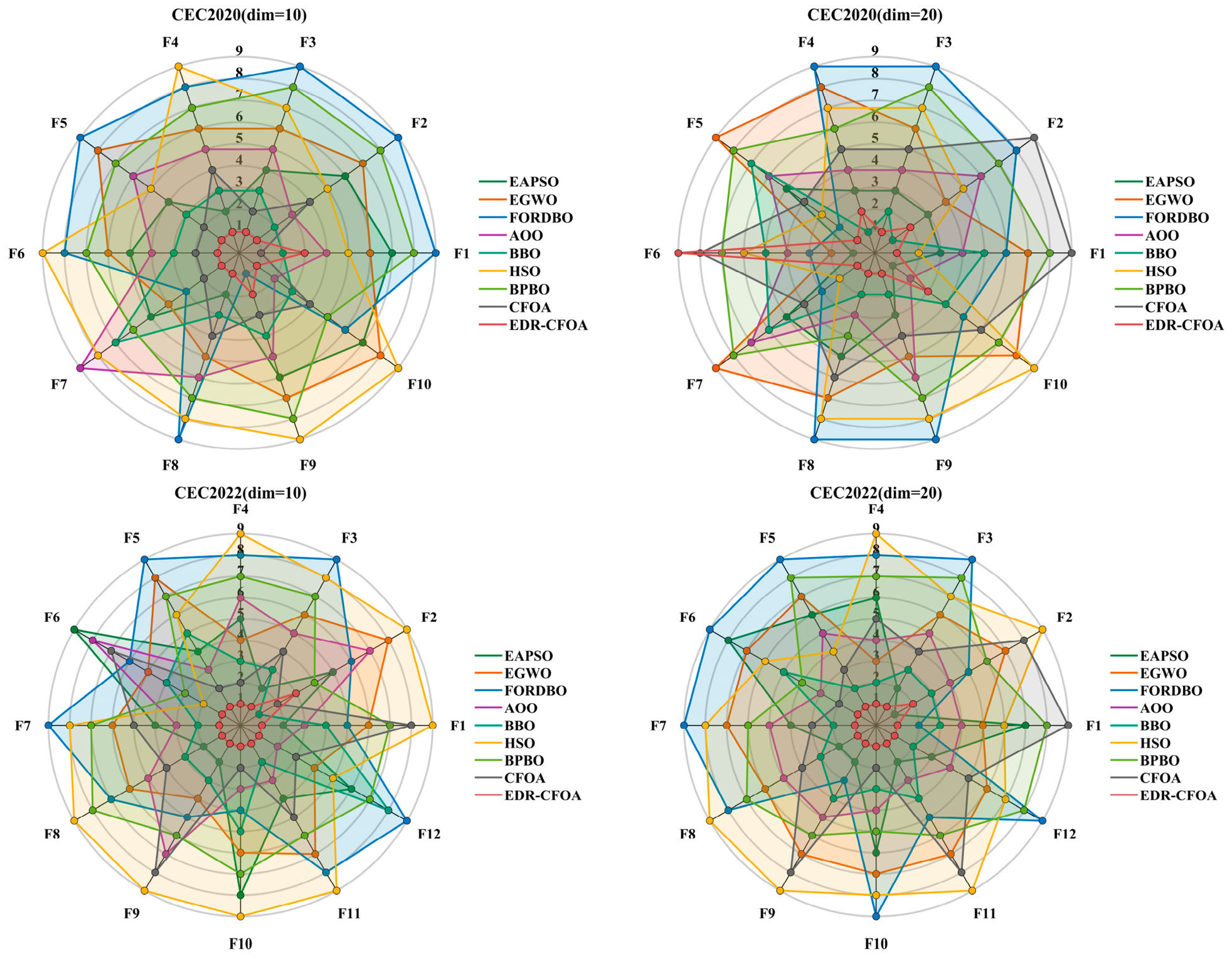
To further quantitatively evaluate the overall optimization performance of all algorithms across different dimensional settings on the CEC2020 and CEC2022 benchmark suites, the Friedman mean rank test was employed to conduct a comprehensive statistical analysis of the experimental results. Two indicators—mean rank (M.R.) and total rank (T.R.)—were used to rank the overall performance of the nine algorithms, where a smaller rank value indicates superior comprehensive performance. The statistical results are summarized in Table 8, and the rank distribution visualization (Figure 14) is further provided to intuitively illustrate the performance gap between EDR-CFOA and the comparison algorithms, thereby validating the overall superiority of EDR-CFOA from a global perspective.
The statistical results of the Friedman mean rank test clearly show that EDR-CFOA achieves the smallest mean rank and total rank among all algorithms in every dimensional scenario on both the CEC2017, CEC2020 and CEC2022 benchmark suites, consistently ranking first in overall performance with a pronounced rank gap relative to the comparison algorithms. This outcome demonstrates the absolute dominance of EDR-CFOA in terms of comprehensive optimization capability. In the 10-dimensional scenario of the CEC2020 benchmark, EDR-CFOA attains a mean rank of only 1.30 and a total rank of 1, which is substantially lower than those of the second-ranked original CFOA (mean rank 2.80, total rank 2). In the 20-dimensional high-dimensional scenario, EDR-CFOA maintains its leading position with a mean rank of 2.20 and a total rank of 1, again significantly outperforming the second-ranked EAPSO (mean rank 3.20, total rank 2). These results indicate that even with the increased complexity of high-dimensional search spaces, EDR-CFOA preserves globally optimal comprehensive performance.
For the more challenging CEC2022 benchmark suite, the overall advantages of EDR-CFOA become even more pronounced. In the 10-dimensional scenario, EDR-CFOA achieves a mean rank as low as 1.17 with a total rank of 1, while in the 20-dimensional scenario, its mean rank further decreases to 1.08, again with a total rank of 1. In both cases, the rank values approach the theoretical minimum and exhibit an even larger gap compared with the second-ranked BBO (mean ranks of 3.58 in 10 dimensions and 3.00 in 20 dimensions). These results provide strong evidence that EDR-CFOA maintains overwhelming overall performance advantages when solving optimization problems of higher complexity.
An examination of the rank distributions of the comparison algorithms reveals that all of them exhibit mean ranks and total ranks that are significantly higher than those of EDR-CFOA, with clear stratification in performance levels. Although the original CFOA ranks relatively high in certain scenarios, a non-negligible rank gap still exists between it and EDR-CFOA, confirming that the proposed elite-enhancement strategies yield substantial performance improvements over the baseline algorithm. Across both the CEC2020 and CEC2022 benchmarks, algorithms such as HSO, FORDBO, and BPBO consistently exhibit higher rank values and lower overall rankings, with some showing pronounced rank increases in high-dimensional scenarios. This behavior suggests that these algorithms are more sensitive to dimensionality changes and exhibit weaker adaptability to high-dimensional optimization problems. While EAPSO and BBO perform competitively in certain scenarios, their overall rank values remain considerably higher than those of EDR-CFOA, indicating an inability to maintain stable optimal performance across different dimensions and problem complexities.
Under the 100-dimensional CEC2017 benchmark setting, EDR-CFOA achieves an average rank of only 2.27, consistently securing the top overall position and significantly outperforming all other comparison algorithms. This result highlights its superior comprehensive optimization capability on ultra-high-dimensional and complex functions.
Among the competing algorithms, EAPSO ranks second with an average rank of 3.37, followed by AOO and BBO with average ranks of 3.77 and 3.73, respectively. These algorithms maintain relatively good stability in high-dimensional scenarios; however, a clear performance gap remains compared to EDR-CFOA. The average ranks of FORDBO, HSO, BPBO, and EGWO increase progressively, indicating a gradual decline in their adaptability to high-dimensional problems. In contrast, the original CFOA records the worst performance with an average rank of 7.33, ranking last overall. This further demonstrates that CFOA suffers from premature convergence, search oscillation, and insufficient exploitation capability in high-dimensional spaces, leading to significant degradation in overall performance.
The rank distribution visualization in Figure 14 further reinforces these observations. Across all test functions in both the CEC2020 and CEC2022 benchmark suites, the rank values of EDR-CFOA are consistently concentrated in the lowest region and are equal to 1 for the vast majority of functions, with no noticeable rank fluctuations. In contrast, the comparison algorithms exhibit varying degrees of rank instability, with some algorithms showing sharp rank increases on specific functions, reflecting performance inconsistency. For instance, on complex functions such as F1 and F5 in the 20-dimensional CEC2020 benchmark, the rank values of EGWO and CFOA increase significantly, whereas EDR-CFOA consistently retains a rank of 1. Similarly, for difficult-to-optimize functions such as F6 and F10 in the 20-dimensional CEC2022 benchmark, all comparison algorithms experience rank deterioration to varying extents, while EDR-CFOA remains stably ranked at the lowest level. These observations are highly consistent with the statistical conclusions of the Friedman mean rank test and provide an intuitive illustration of the stable and superior performance of EDR-CFOA across different types and complexities of optimization problems.
In summary, both the Friedman mean rank test results and the rank distribution visualizations confirm that EDR-CFOA consistently ranks first in comprehensive optimization performance across all 10-dimensional and 20-dimensional scenarios on the CEC2020 and CEC2022 benchmark suites, with rank values significantly lower than those of all comparison algorithms. These findings not only validate the overall superiority of EDR-CFOA but also demonstrate the synergistic effectiveness of the proposed elite-enhanced search, elite differential evolution, and elite stochastic local search strategies in improving global exploration and local exploitation capabilities. Consequently, EDR-CFOA is able to maintain stable and optimal performance across optimization problems of varying dimensionality and complexity. Moreover, as a global performance evaluation method, the Friedman mean rank test provides conclusions that are highly consistent with those obtained from numerical experiments, convergence analyses, box-plot evaluations, and the Wilcoxon rank-sum test, collectively offering comprehensive and rigorous experimental evidence for the effectiveness, superiority, and robustness of EDR-CFOA, and supporting its application to practical engineering optimization problems.

4. Optimal Scheduling of the Grid-Connected Microgrid

4.1. Microgrid Operation Framework and Problem Description

This study focuses on the economic optimal scheduling problem of a grid-connected microgrid over a 24-h scheduling horizon. The considered microgrid integrates multiple types of distributed energy resources (DERs), including renewable generation units, dispatchable conventional generators, an energy storage system, and bidirectional power exchange with the main utility grid. Such a configuration reflects a realistic microgrid architecture commonly encountered in practical engineering applications [10].
The main components of the microgrid system can be summarized as follows:
  • Renewable energy sources: Photovoltaic (PV) panels and wind turbines (WT) are incorporated as clean energy units. Due to their inherent intermittency and uncertainty, their power outputs are treated as known inputs derived from typical-day forecast data.
  • Dispatchable conventional generators: Fuel cells (FC), micro gas turbines (MT), and gas generators (GS) are modeled as controllable units whose output powers can be adjusted within predefined operational limits to meet system demand.
  • Energy storage system (ESS): A battery-based storage system is introduced to smooth power fluctuations, support peak-load shifting, and enhance the operational flexibility of the microgrid.
  • Utility grid interface: The microgrid is allowed to purchase electricity from or sell surplus power to the main grid, subject to capacity constraints on power exchange.
The technical parameters of all DERs, including rated capacities, operating costs, and fuel consumption coefficients, are specified in advance and listed in Table 9 [10]. These parameters serve as the basis for constructing the mathematical optimization model.

4.2. Mathematical Modeling of Distributed Energy Resources

The abbreviations in the scheduling model are defined as follows: P V (Photovoltaic), W T (Wind Turbine), F C (Fuel Cell), M T (Micro Turbine), G S (Gas Generator), E S S (Energy Storage System), S O C (State of Charge), O & M (Operation and Maintenance).

4.2.1. Renewable Energy Generation Model

The power outputs of PV and WT units are primarily affected by environmental conditions such as solar irradiance and wind speed. In this work, their outputs are assumed to be accurately forecasted and are therefore excluded from the decision variables. The renewable generation models are expressed as [10]:
P P V ( t ) = P P V p r e d ( t ) P W T ( t ) = P W T p r e d ( t )
where t denotes the scheduling time interval, and P P V p r e d ( t ) and P W T p r e d ( t ) represent the predicted power outputs of PV and WT units, respectively.

4.2.2. Dispatchable Generator Model

Fuel cells, micro gas turbines, and gas generators are treated as dispatchable units. Their output powers can be flexibly adjusted while remaining within their respective minimum and maximum operating limits [10]:
P F C m i n P F C ( t ) P F C m a x P M T m i n P M T ( t ) P M T m a x P G S m i n P G S ( t ) P G S m a x
where P F C ( t ) , P M T ( t ) , and P G S ( t ) denote the power outputs of FC, MT, and GS units at time t , respectively.

4.2.3. Energy Storage System Model

The energy storage system is constrained by both power limits and state-of-charge (SOC) requirements. The charging and discharging power constraints are defined as [10]:
P B T m i n P B T ( t ) P B T m a x
where positive values of P B T ( t ) indicate charging, while negative values correspond to discharging.
The SOC dynamics of the battery are described by [10]:
S O C m i n S O C ( t ) S O C m a x S O C ( t + 1 ) = S O C ( t ) P B T ( t ) C B T
where C B T denotes the rated capacity of the battery.

4.2.4. Grid Power Exchange Model

The microgrid can exchange power with the main grid in both directions. The exchanged power is constrained as follows [10]:
P G R I D m i n P G R I D ( t ) P G R I D m a x
Positive values of P G R I D ( t ) represent electricity purchase, while negative values indicate electricity selling.

4.3. Objective Function Formulation

The objective of the microgrid scheduling problem is to minimize the total operational cost over the scheduling horizon. The overall cost function consists of five components: fuel cost, operation and maintenance cost, emission treatment cost, grid trading cost, and a penalty term for power imbalance. The objective function is formulated as [10]:
m i n F = F F u e l + F O M + F E m i + F G r i d + F P e n
Each component is described below.

4.3.1. Fuel Cost

Fuel costs are associated with the operation of FC, MT, and GS units and depend on their power outputs, fuel consumption coefficients, and natural gas price:
F F u e l = c k F C , f t = 1 24   P F C ( t ) + k M T , f t = 1 24   P M T ( t ) + k G S , f t = 1 24   P G S ( t )

4.3.2. Operation and Maintenance Cost

The operation and maintenance (O&M) cost accounts for routine expenses of all DERs and the energy storage system [10]:
F O M = k P V , o t = 1 24   P P V ( t ) + k W T , o t = 1 24   P W T ( t )   + k F C , o t = 1 24   P F C ( t ) + k M T , o t = 1 24   | P M T ( t ) |   + k G S , o t = 1 24   P G S ( t ) + k B T , o t = 1 24   | P B T ( t ) |

4.3.3. Emission Treatment Cost

To reflect the environmental impact of pollutant emissions, treatment costs for C O 2 , S O 2 , and N O x are introduced [10]:
F E m i = p = 1 3   C p β F C , p t = 1 24   P F C ( t ) + β M T , p t = 1 24   P M T ( t ) + β G S , p t = 1 24   P G S ( t ) + β G R D , p t = 1 24   P G R I D ( t )

4.3.4. Grid Trading Cost

The electricity trading cost between the microgrid and the utility grid is calculated based on time-varying electricity prices [10]:
F G r i d = t T b u y   P G R I D ( t ) c G r i d ( t ) + t T s e l l   P G R I D ( t ) c G r i d ( t )

4.3.5. Power Imbalance Penalty

To enforce power balance, a penalty term is added to penalize deviations between supply and demand [10]:
F P e n = t = 1 24   | P P V ( t ) + P W T ( t ) + P F C ( t ) + P M T ( t ) + P G S ( t ) + P B T ( t ) + P G R I D ( t ) P L o a d ( t ) |

4.4. System Operational Constraints

At each scheduling interval, the total power generation and exchange must satisfy the load demand [10]:
P L a a d ( t ) = P P V ( t ) + P W T ( t ) + P F C ( t ) + P M T ( t ) + P G S ( t ) + P E T ( t ) + P G R I D ( t )
All generation units and the energy storage system must operate within their technical limits, and SOC constraints must be satisfied throughout the entire scheduling horizon.

4.5. Simulation Results and Discussion

The microgrid is located in Guangdong Province, China. The solar irradiance, cell temperature, and wind speed data are derived from the typical meteorological year database of Guangdong, which reflects the real renewable energy output characteristics.
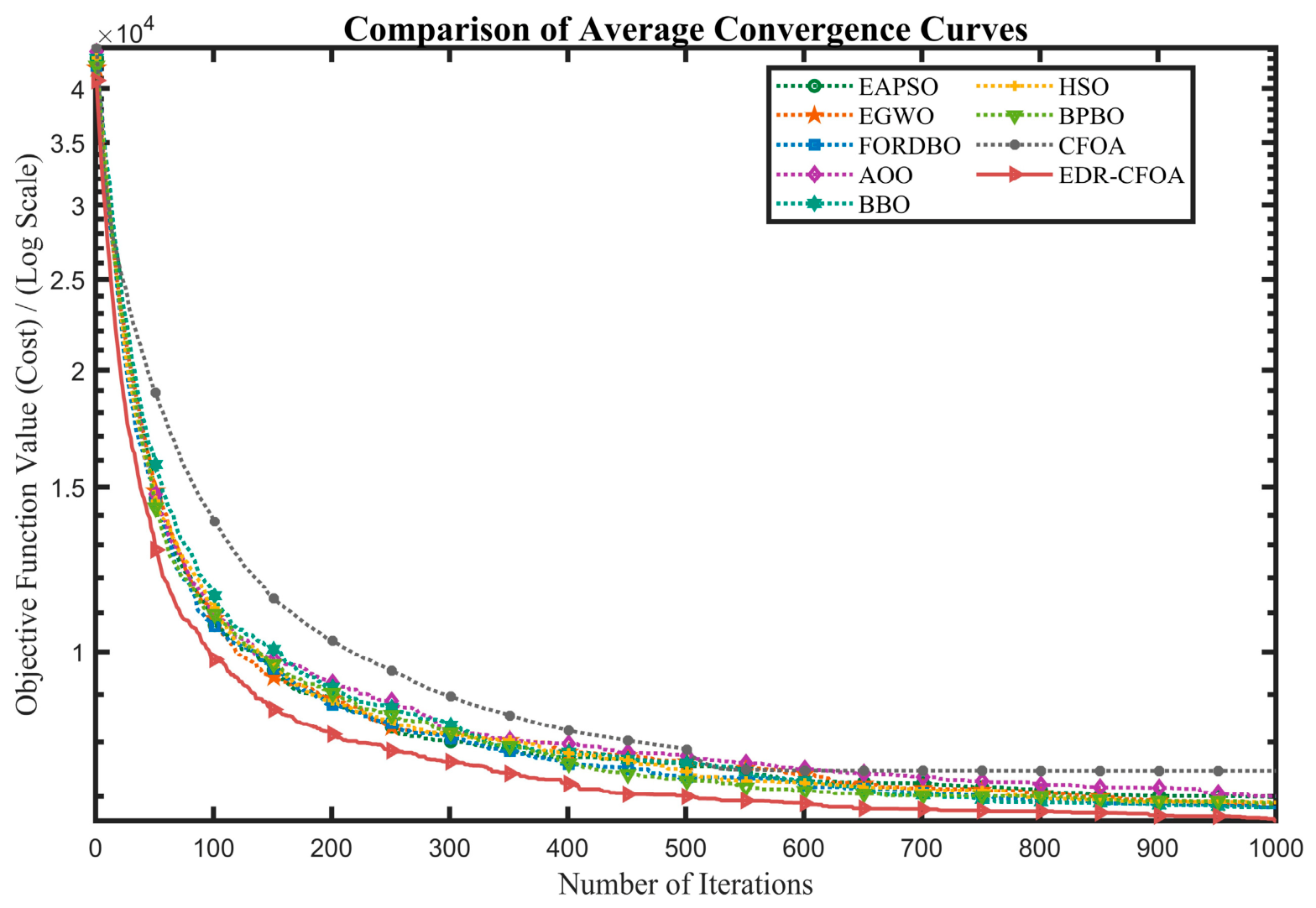
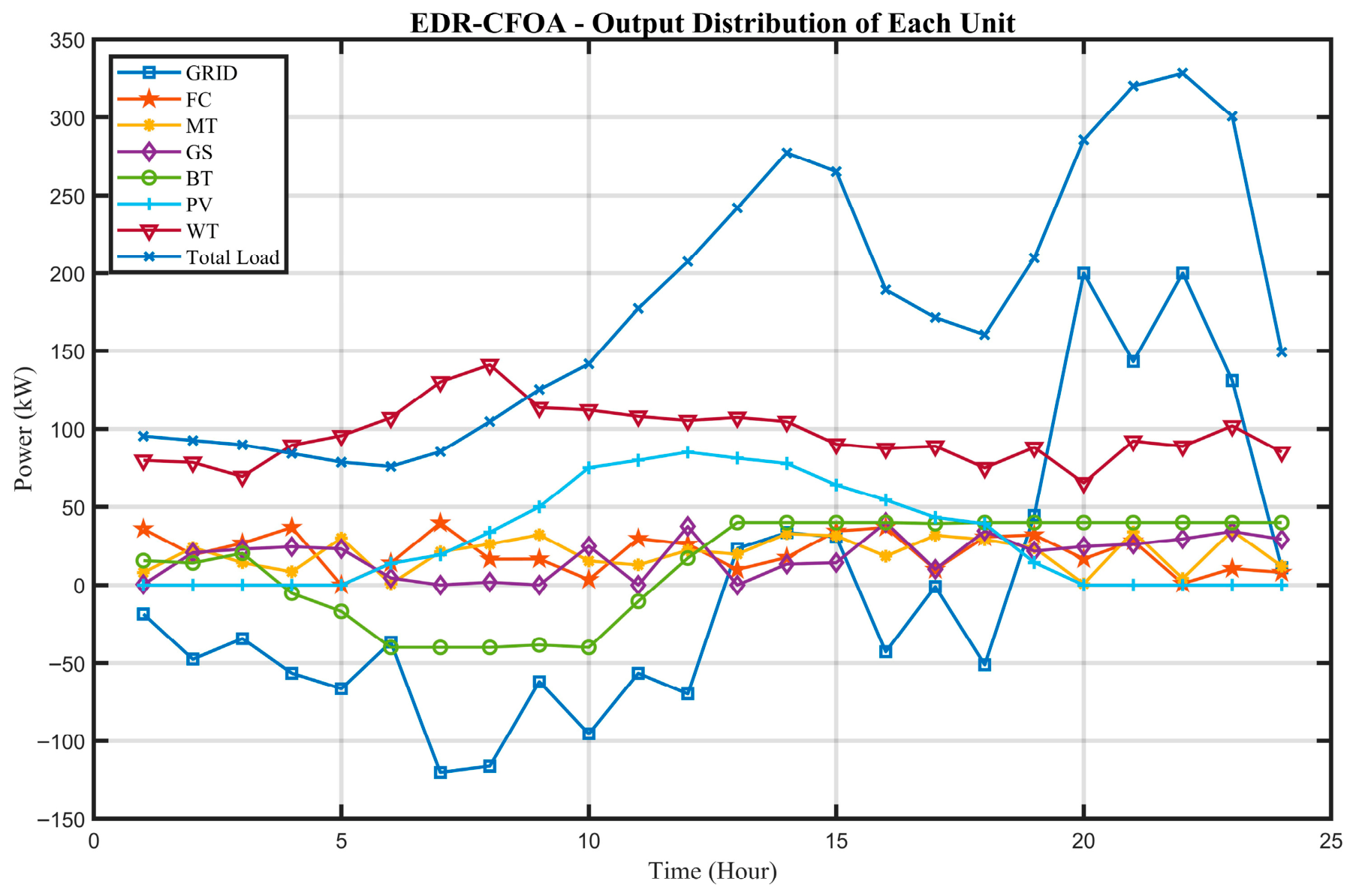
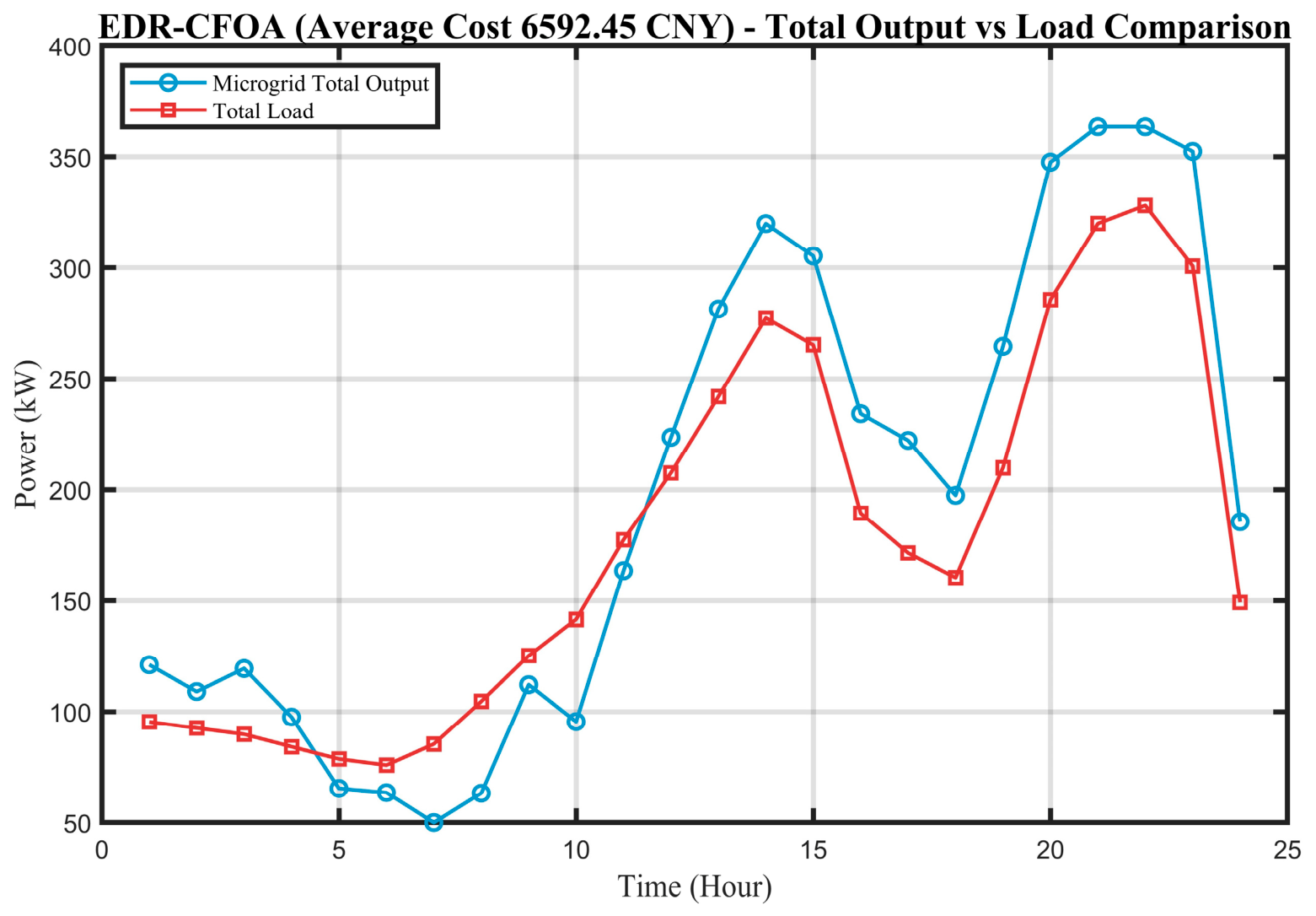
The microgrid scheduling case study is simulated using MATLAB. For a fair comparison, all algorithms are configured with a swarm size of 30 and a termination criterion of 1000 iterations, with 30 independent trials conducted for each method to alleviate stochastic effects. The upper limit of power exchanged with the main grid is constrained to 200 kW. The simulation is designed to reflect the operating conditions of a representative day in Guangdong Province. The corresponding results are reported in Table 10 and illustrated in Figure 15, Figure 16 and Figure 17.
Table 10 presents a statistical comparison of the operating costs obtained by different algorithms for the economic optimal scheduling problem of a grid-connected microgrid. The results cover key evaluation metrics from 30 independent runs, including the maximum cost, minimum cost, mean cost, standard deviation, and overall ranking, thereby providing a comprehensive assessment of the optimization performance of each algorithm. As indicated by the data, the proposed EDR-CFOA consistently outperforms all competing algorithms across all statistical indicators. Specifically, EDR-CFOA achieves the lowest minimum operating cost of 5521.87, while its maximum cost is effectively controlled at 7392.32, which is also the smallest maximum value among all algorithms. Moreover, EDR-CFOA yields the lowest mean operating cost of 6592.45, which is significantly lower than those of the comparison algorithms, and a standard deviation of only 435.20, demonstrating excellent solution stability.
In contrast, the original CFOA exhibits the poorest performance, with a mean cost of 7461.46 and a large standard deviation of 2114.22, indicating severe randomness and instability in its optimization results. Although other mainstream algorithms such as FORDBO, BBO, and EGWO achieve relatively lower mean costs, their standard deviations remain noticeably higher than that of EDR-CFOA. These results confirm that the elite-enhancement strategies embedded in EDR-CFOA effectively balance exploration and exploitation, enabling the algorithm to consistently produce high-quality and stable scheduling solutions for microgrid operation.
The convergence cost curves of different algorithms shown in Figure 15 further provide intuitive evidence of the superiority of EDR-CFOA in terms of convergence speed and optimization accuracy. During the early iterations (within the first 200 iterations), EDR-CFOA exhibits a significantly faster cost reduction rate than the other algorithms, rapidly approaching the low-cost optimal region. In contrast, algorithms such as AOO and EAPSO demonstrate slow initial convergence and only achieve noticeable cost reductions in the later stages, reflecting relatively low exploration efficiency in the optimal solution space.
In the middle and later stages of the iteration process (200–1000 iterations), the cost curve of EDR-CFOA continues to decrease smoothly without noticeable oscillations, whereas the curves of CFOA, HSO, and some other algorithms show pronounced fluctuations. This behavior indicates that these algorithms are prone to premature convergence and struggle to perform fine-grained exploitation near the optimal region. The sustained convergence advantage of EDR-CFOA can be attributed to the synergistic effects of its three elite-enhancement strategies: the elite-enhanced search strategy rapidly identifies promising search directions, the elite differential evolution strategy preserves population diversity and mitigates premature convergence, and the elite stochastic local search strategy enables fine-grained exploitation around elite solutions. Together, these mechanisms drive the algorithm to converge stably and efficiently toward the global optimum.
Figure 16 illustrates the 24-h optimized power output profiles of different energy units within the microgrid obtained by EDR-CFOA, highlighting the adaptability and rationality of the generated scheduling scheme with respect to load demand and energy source characteristics. Photovoltaic (PV) and wind turbine (WT) units, which incur zero fuel costs, are prioritized for power generation, and their outputs dynamically vary according to renewable resource availability, thereby maximizing clean energy utilization and reducing reliance on conventional dispatchable generators.
Fuel cells (FC), characterized by relatively low operating and fuel costs, maintain a stable output throughout the scheduling horizon and serve as the base-load supply units. In contrast, the microturbine (MT) and gas generator (GS), which have higher operating costs, are only activated during peak load periods, effectively controlling fuel consumption and operational expenses. The battery storage system (BT) performs peak shaving and valley filling through flexible charging and discharging operations: surplus energy is stored during periods of high renewable generation and low demand, and discharged during peak load periods to compensate for power deficits. This strategy reduces power exchanges with the main grid and the associated transaction costs. Power exchange with the main grid (GRID) is maintained within a reasonable range, avoiding excessive electricity purchases or sales and complying with exchange capacity constraints, which further contributes to minimizing the total operating cost of the microgrid.
Figure 17 compares the total power output of the microgrid under the EDR-CFOA scheduling strategy with the 24-h load demand profile, directly validating the satisfaction of the power balance constraint. Throughout the entire scheduling horizon, the total power output curve closely follows the load demand curve, indicating that the generated power precisely tracks load variations without noticeable power surplus or shortage. This result demonstrates that EDR-CFOA not only minimizes the total operating cost of the microgrid but also strictly satisfies the power balance constraint and the operational constraints of all energy units, thereby producing scheduling solutions with strong engineering practicality. The accurate matching between power supply and load demand further benefits from the effective coordination of renewable energy sources, dispatchable generators, energy storage systems, and the main grid, which fully exploits the operational flexibility of all microgrid components.
In summary, the EDR-CFOA exhibits outstanding performance in the economic optimal scheduling of grid-connected microgrids. It consistently achieves the minimum total operating cost while generating feasible scheduling solutions that comply with the operational characteristics and constraints of all energy units. The rational power output distribution and precise fulfillment of the power balance constraint clearly demonstrate the practical engineering value of EDR-CFOA for microgrid scheduling problems, providing an effective and reliable optimization approach for real-world microgrid operation.

5. Real-World Engineering Applications

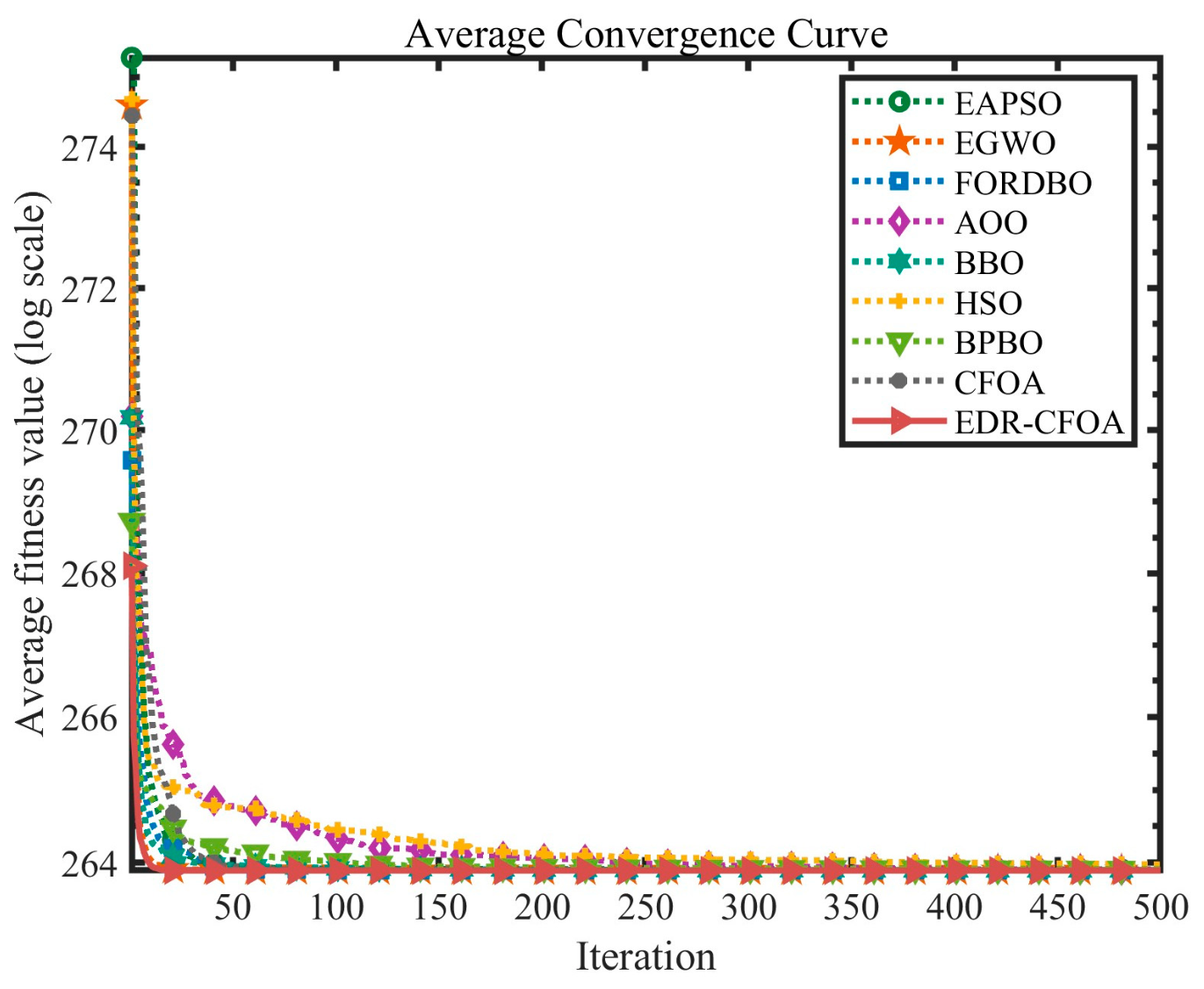
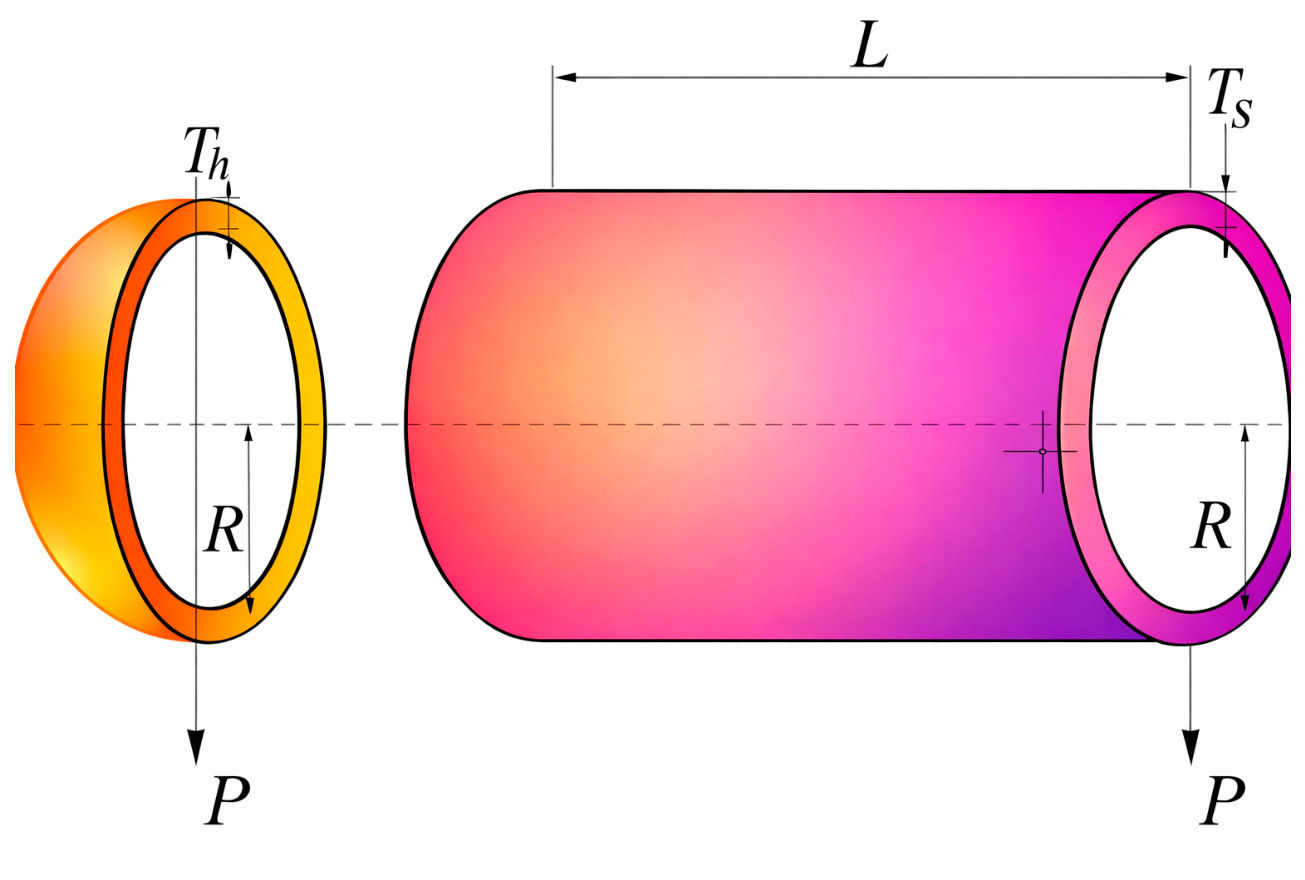
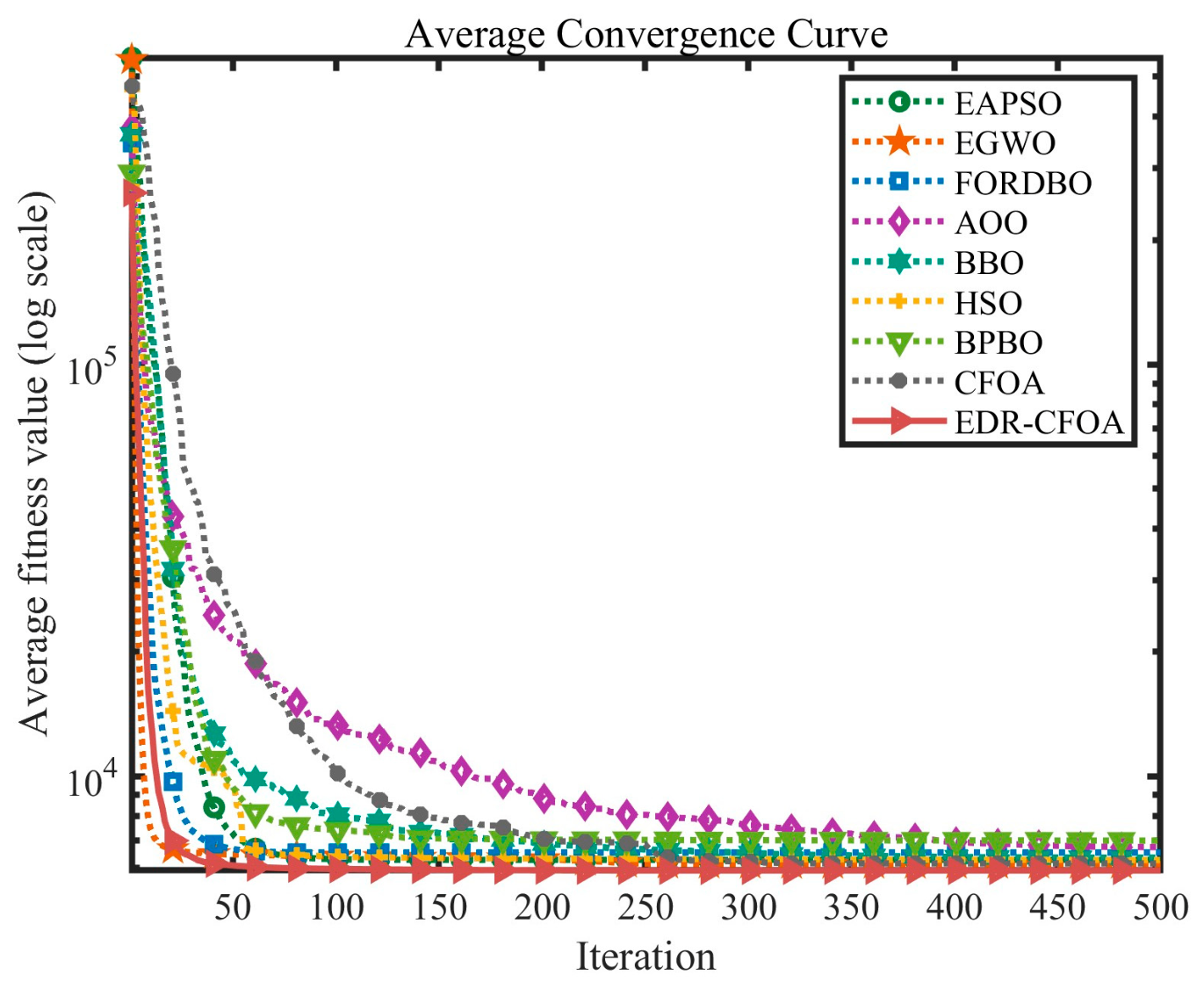
To further demonstrate the applicability and robustness of the proposed improved fishing optimization algorithm in solving practical engineering problems, two classical constrained engineering design problems are investigated in this section. These benchmark problems are widely used in the optimization literature due to their nonlinear objective functions, multiple constraints, and strong engineering backgrounds. Specifically, the three-bar truss design problem, and the pressure vessel design problem are considered.

5.1. Three-Bar Truss Design Problem

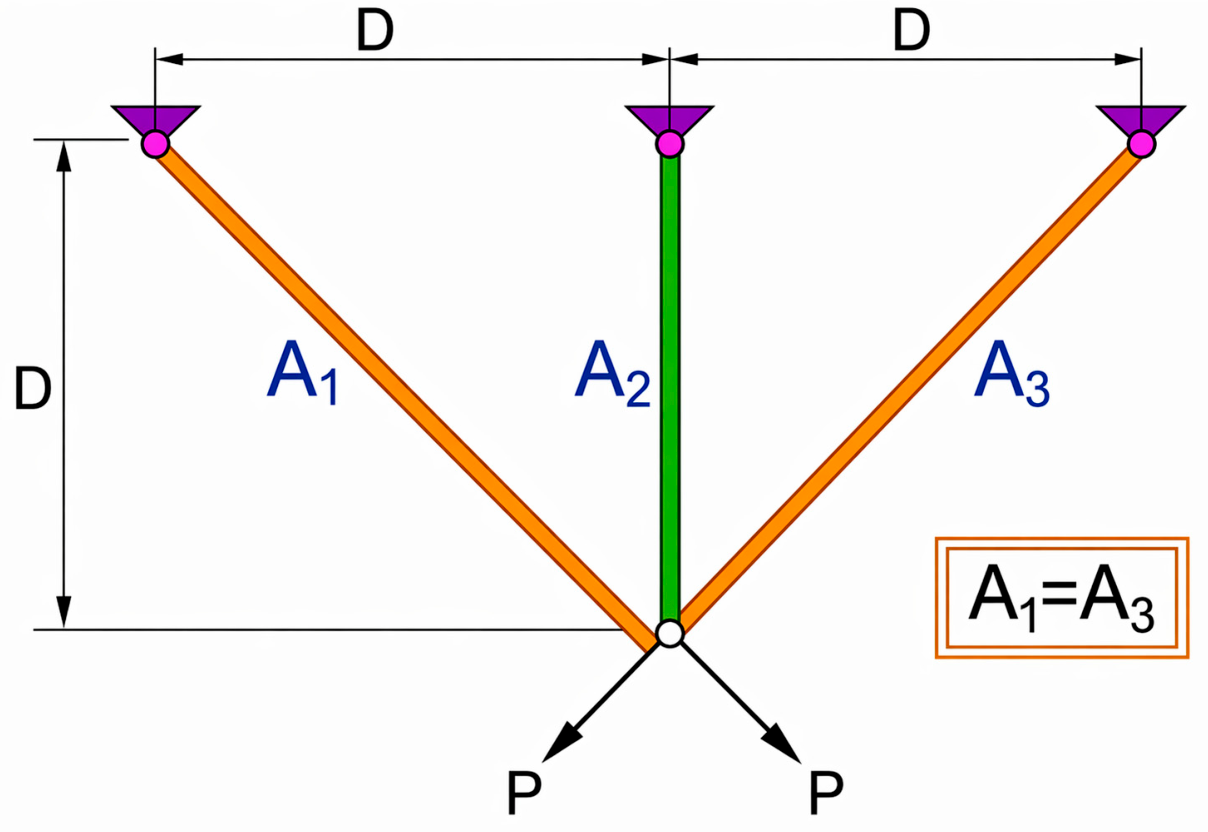
The three-bar truss design problem is a classical constrained optimization problem in structural engineering and is widely used as a benchmark to evaluate the performance of optimization algorithms under nonlinear stress constraints. As illustrated in Figure 18, the structure consists of three bars connected in a planar configuration and subjected to a vertical external load P applied at the joint. The optimization objective is to minimize the total structural weight of the truss by properly selecting the cross-sectional areas of the members, while ensuring that the induced stresses do not exceed the allowable stress limit.
Due to the symmetry of the structure, the cross-sectional areas of bars 1 and 3 are assumed to be identical and are denoted by x 1 , while the cross-sectional area of bar 2 is denoted by x 2 . The total weight of the truss is proportional to the volume of material used and can be expressed as
m i n f ( X ) = 2 2 x 1 + x 2 L ρ
where L is the length of each bar and ρ is the material density. The coefficient 2 2 reflects the geometric configuration and relative lengths of bars 1 and 3.
The constraints of this problem are derived from stress limitations. Under the applied load P , the axial stress in each bar is inversely proportional to its cross-sectional area. To ensure structural safety, the stress in every bar must not exceed the maximum allowable stress σ m a x . Accordingly, the stress constraints can be formulated as
g 1 ( X ) = P 2 x 1 + x 2 σ m a x 0 g 2 ( X ) = P 2 x 1 σ m a x 0 g 3 ( X ) = P x 2 σ m a x 0
In addition, practical design considerations impose lower and upper bounds on the cross-sectional areas, which are defined as
x 1 m i n x 1 x 1 m a x , x 2 m i n x 2 x 2 m a x
The combination of nonlinear stress constraints and continuous design variables makes this problem a challenging benchmark for testing the constraint-handling ability of optimization algorithms.
Table 11 reports the statistical results of different algorithms for solving the three-bar truss design problem. Although all algorithms are able to locate the theoretical optimum of 2.6390 × 10², substantial differences are observed in terms of solution stability. Among them, EDR-CFOA exhibits an absolute advantage: its mean value is exactly equal to the theoretical optimum, and its standard deviation is as low as 1.7345 × 10⁻¹³, ranking first according to the Friedman test. Notably, EDR-CFOA is the only algorithm that reduces the standard deviation to the order of 10−13, indicating that it can converge to the global optimum in an almost unbiased and highly stable manner over 30 independent runs.
The original CFOA achieves relatively high accuracy, with a standard deviation of 5.4331 × 10⁻⁵, but its stability is far inferior to that of EDR-CFOA. Algorithms such as BBO and EGWO exhibit standard deviations on the order of 10−3, while EAPSO and AOO show further degradation, with standard deviations increasing to the order of 10−2. In contrast, HSO produces a mean value deviating from the theoretical optimum and a standard deviation as high as 4.7086 × 10⁻², indicating the poorest stability. These results demonstrate that the elite-enhancement strategies employed in EDR-CFOA can substantially reduce search randomness while maintaining optimization accuracy, leading to superior constraint-handling capability and solution robustness compared with the competing algorithms.
The average fitness convergence curves shown in Figure 19 provide an intuitive comparison of the convergence behaviors of all algorithms. EDR-CFOA rapidly converges to the theoretical optimal fitness level in the early iterations, and its convergence curve remains smooth and stable thereafter, without noticeable local oscillations or repeated searches, reflecting both fast convergence and strong stability. Although the other algorithms also eventually converge to the optimal solution, clear deficiencies are observed in their convergence processes. HSO and EAPSO exhibit relatively slow convergence, with small fitness fluctuations persisting in the middle iterations, while BPBO and AOO converge more quickly but show slight oscillations when approaching the optimum, indicating residual randomness during local exploitation.
The superior convergence behavior of EDR-CFOA can be attributed to the fine-grained Gaussian–Lévy perturbations and the precise direction-selection mechanism embedded in the elite stochastic local search strategy. Once the optimal solution region is identified, these mechanisms enable rapid and unbiased convergence, effectively avoiding the convergence oscillations and accuracy degradation that commonly occur in traditional algorithms when addressing constrained optimization problems.
In summary, for the three-bar truss design problem—a representative nonlinear constrained structural engineering optimization task—EDR-CFOA demonstrates significantly superior stability and convergence robustness compared with all competing algorithms. While achieving accuracy fully consistent with the theoretical optimum, it realizes nearly unbiased and highly stable convergence, thereby validating its effectiveness and superiority in solving engineering design problems with nonlinear stress constraints.

5.2. Pressure Vessel Design Problem

The pressure vessel design problem is a classical constrained optimization problem in mechanical and chemical engineering, where the objective is to minimize the total manufacturing cost of a cylindrical pressure vessel subject to strength, volume, and geometric constraints. As shown in Figure 20, the pressure vessel consists of a cylindrical shell with hemispherical heads at both ends.
The design variables are defined as the shell thickness T s , the head thickness T h , the inner radius R , and the length of the cylindrical section L . The total fabrication cost, which includes material, forming, and welding costs, is modeled by the following objective function:
m i n f ( X ) = 0.6224 T s R L + 1.7781 T h R 2 + 3.1661 T s 2 L + 19.84 T s 2 R
The constraints of this problem arise from material strength requirements and geometric limitations. To ensure that the vessel can safely withstand the internal pressure, the shell and head thicknesses must satisfy:
g 1 X = 0.0193 R T s 0 g 2 X = 0.00954 R T h 0 g 3 ( X ) = π R 2 L + 4 3 π R 3 1296000 0 g 4 ( X ) = L 240 0
The design variables are restricted to the following bounds:
1 T s , T h 99 , 10 R , L 200
Table 12 presents the statistical results of different algorithms for solving the pressure vessel design problem. The proposed EDR-CFOA demonstrates significant overall superiority, achieving the theoretical optimal solution of 5.8853 × 10³. Its mean cost is as low as 5.9134 × 10³, with a standard deviation of only 6.1496 × 101, and it ranks first according to the Friedman test, indicating the best performance in terms of optimization accuracy, average solution quality, and result stability.
By comparison, although EGWO and the original CFOA are able to reach the theoretical optimum, their mean values and standard deviations are noticeably higher than those of EDR-CFOA. Algorithms such as EAPSO and FORDBO exhibit clear deviations in both best and mean solutions, while BPBO performs the worst among all competitors, yielding the highest mean cost and standard deviation. These results demonstrate that, when addressing the pressure vessel design problem—a highly constrained and nonlinear mechanical engineering optimization task—EDR-CFOA is capable of accurately identifying the global optimum while maintaining strong solution stability. In contrast, traditional algorithms tend to suffer from insufficient optimization accuracy and large performance fluctuations.
The average convergence curves shown in Figure 21 further validate the convergence advantages of EDR-CFOA. In the early iterations, EDR-CFOA exhibits a rapid decline in fitness values, quickly approaching the optimal solution region. During the middle and later stages, its convergence curve decreases smoothly without noticeable oscillations, indicating an efficient and stable convergence process. In contrast, several comparison algorithms exhibit clear shortcomings. AOO and BPBO converge slowly, with fitness values remaining at relatively high levels throughout the iteration process. EGWO and CFOA show relatively fast convergence but experience slight oscillations when approaching the optimum, reflecting insufficient local exploitation capability. Meanwhile, HSO and FORDBO suffer from convergence stagnation, failing to perform fine-grained exploitation in the vicinity of the optimal region.
The superior convergence performance of EDR-CFOA can be attributed to the synergistic integration of elite-enhanced search and differential evolution strategies. These mechanisms enable the algorithm to rapidly identify promising search directions under elite guidance while performing fine-grained local exploitation to accurately refine candidate solutions, thereby effectively matching the optimization characteristics of the pressure vessel design problem.
In summary, for the classical pressure vessel design problem in mechanical engineering, EDR-CFOA significantly outperforms the comparison algorithms in terms of optimization accuracy, convergence speed, and solution stability. These results convincingly demonstrate the strong applicability and robustness of EDR-CFOA in solving multi-constraint, nonlinear engineering design problems, providing an efficient and reliable optimization approach for complex mechanical engineering applications.

6. Conclusions and Future Work

This paper proposes a Multi-Strategy Elite-Driven Reinforced Catch Fish Optimization Algorithm (EDR-CFOA) to address the limitations of the original CFOA when solving complex optimization problems, including unstable search directions, insufficient utilization of elite solutions, and limited exploitation capability in the later optimization stages. By incorporating three complementary reinforcement strategies—namely, elite-enhanced search, elite differential evolution, and elite random local search—the overall optimization performance of CFOA is significantly improved.
Extensive experimental results based on the CEC2020 and CEC2022 benchmark test suites demonstrate that EDR-CFOA consistently outperforms the original CFOA and other state-of-the-art optimization algorithms in terms of solution accuracy, convergence speed, and result stability. The Friedman mean rank analysis shows that EDR-CFOA achieves the best overall ranking in all tested scenarios, while statistical tests further confirm that its performance advantages are statistically significant. Moreover, the engineering application results indicate that EDR-CFOA is capable of effectively reducing system operating costs while satisfying complex constraints, highlighting its strong practical engineering applicability.
Despite the excellent performance of EDR-CFOA in both numerical optimization and engineering applications, several limitations remain. First, due to the introduction of multiple elite-driven reinforcement strategies, the algorithm exhibits increased structural complexity compared with the original CFOA, leading to higher computational overhead per iteration. As a result, further improvements in computational efficiency are desirable for extremely large-scale optimization problems. Second, the parameter settings adopted in this study are mainly determined empirically, and the development of adaptive or self-tuning parameter mechanisms for different problem scenarios remains an open research issue. In addition, the current study primarily focuses on single-objective static optimization problems, and the applicability of EDR-CFOA to dynamic, multi-objective, and uncertainty-based optimization problems has not yet been systematically investigated.
Future research directions will focus on the following aspects. First, extending EDR-CFOA to handle multi-objective and dynamic optimization problems will be explored. Second, adaptive or learning-based mechanisms will be incorporated to further reduce parameter sensitivity and enhance algorithm robustness. Third, the proposed algorithm will be applied to larger-scale and more complex real-world engineering systems to further validate its generality and practical potential.

Author Contributions

Conceptualization, X.Y. and Y.F.; methodology, X.Y. and Y.F.; software, X.Y. and Y.F.; validation, X.Y. and Y.F.; formal analysis, X.Y. and Y.F.; investigation, X.Y. and Y.F.; resources, X.Y. and Y.F.; data curation, X.Y. and Y.F.; writing—original draft preparation, X.Y. and Y.F.; writing—review and editing, X.Y. and Y.F.; visualization, X.Y. and Y.F.; supervision, X.Y. and Y.F.; funding acquisition, X.Y. and Y.F. All authors have read and agreed to the published version of the manuscript.

Funding

This research received no external funding.

Data Availability Statement

The original contributions presented in this study are included in the article. Further inquiries can be directed to the corresponding author.

Conflicts of Interest

The authors declare no conflicts of interest.

References

  1. Fu, Y.; Liu, D.; Chen, J.; He, L. Secretary bird optimization algorithm: A new metaheuristic for solving global optimization problems. Artif. Intell. Rev. 2024, 57, 123. [Google Scholar] [CrossRef]
  2. Ma, J.; Yang, Z.; Chen, M. 3D Spatial Path Planning Based on Improved Particle Swarm Optimization. Futur. Internet 2025, 17, 406. [Google Scholar] [CrossRef]
  3. Zhang, J.; Qi, H.; Wu, J.J.; Mao, X.; Zhang, H.; Amin, N.; Xu, F.; Dong, C.; Wang, C.; Wang, P.; et al. Disposable Peptidoglycan-Specific Biosensor for Noninvasive Real-Time Detection of Broad-Spectrum Gram-Positive Bacteria in Exhaled Breath Condensates. Anal. Chem. 2024, 96, 9817–9825. [Google Scholar] [CrossRef]
  4. Liu, D.; Shen, Q.; Liu, J. The Health-Wealth Gradient in Labor Markets: Integrating Health, Insurance, and Social Metrics to Predict Employment Density. Computation 2026, 14, 22. [Google Scholar] [CrossRef]
  5. Yan, J.; Cheng, Y.; Zhang, F.; Li, M.; Zhou, N.; Jin, B.; Wang, H.; Yang, H.; Zhang, W. Research on multimodal techniques for arc detection in railway systems with limited data. Struct. Health Monit. 2025, 14759217251336797. [Google Scholar] [CrossRef]
  6. Kennedy, J.; Eberhart, R. Particle swarm optimization. In Proceedings of the ICNN’95—International Conference on Neural Networks, Perth, Australia, 27 November–1 December 1995; Volume 4, pp. 1942–1948. [Google Scholar]
  7. Dorigo, M.; Birattari, M.; Stützle, T. Ant Colony Optimization. IEEE Comput. Intell. Mag. 2006, 1, 28–39. [Google Scholar] [CrossRef]
  8. Mirjalili, S.; Mirjalili, S.M.; Lewis, A. Grey Wolf Optimizer. Adv. Eng. Softw. 2014, 69, 46–61. [Google Scholar] [CrossRef]
  9. Qin, Z.; Pan, D. Improved Dual-Center Particle Swarm Optimization Algorithm. Mathematics 2024, 12, 1698. [Google Scholar] [CrossRef]
  10. Cao, L.; Wei, Q. SZOA: An Improved Synergistic Zebra Optimization Algorithm for Microgrid Scheduling and Management. Biomimetics 2025, 10, 664. [Google Scholar] [CrossRef]
  11. Wu, X.; Wang, H.; Zhang, Y.; Zou, B.; Hong, H. A Tutorial-Generating Method for Autonomous Online Learning. IEEE Trans. Learn. Technol. 2024, 17, 1532–1541. [Google Scholar] [CrossRef]
  12. Wu, X.; Dong, J.; Bao, W.; Zou, B.; Wang, L.; Wang, H. Augmented Intelligence of Things for Emergency Vehicle Secure Trajectory Prediction and Task Offloading. IEEE Internet Things J. 2024, 11, 36030–36043. [Google Scholar] [CrossRef]
  13. Fan, D.; Zhu, X.; Xiang, Z.; Lu, Y.; Quan, L. Dimension-Reduction Many-Objective Optimization Design of Multimode Double-Stator Permanent Magnet Motor. IEEE Trans. Transp. Electrif. 2025, 11, 1984–1994. [Google Scholar] [CrossRef]
  14. Shen, Q.; Liu, D.; Zou, Y.; Xiao, Z.; Zhang, T. Business Resilience Index (BRI): Evaluating Economic Recovery Through Event-Study Heterogeneity. 2026. Available online: https://www.researchsquare.com/article/rs-8952268/v1 (accessed on 8 April 2026).
  15. Shen, Q.; Zhang, J. AI-Enhanced Disaster Risk Prediction with Explainable SHAP Analysis: A Multi-Class Classification Approach Using XGBoost. Preprint 2025. [Google Scholar]
  16. Shen, Q.; Zhang, J. MFTFormer: Meteorological-Frequency-Temporal Transformer with Block-Aligned Fusion for Traffic Flow Prediction. Preprint 2026. [Google Scholar]
  17. Xiao, W.; Lian, J.J.; Ouyang, K.; Gu, S.; Ke, Z.; Wei, D.; Sha, X.; Wang, J.; Fu, S.; Qiu, M.; et al. Newton downhill optimizer with application to engineering optimization and breast cancer feature selection. Biomed. Signal Process. Control 2026, 117, 109184. [Google Scholar] [CrossRef]
  18. Talatahari, S.; Bayazidi, H.; Sareh, P. Philosophical proposition optimizer (ΦPO): An epistemology-inspired algorithm for numerical optimization. Artif. Intell. Rev. 2025, 58, 405. [Google Scholar] [CrossRef]
  19. Taheri, A.; RahimiZadeh, K.; Baumbach, J.; Beheshti, A.; Zolotareva, O.; Al-Betar, M.A.; Mirjalili, S.; Gandomi, A.H. Farthest better or nearest worse optimizer: A novel metaheuristic algorithm. Artif. Intell. Rev. 2026, 59, 79. [Google Scholar] [CrossRef]
  20. Abdullah, M.; Alimgeer, K.S.; Hafeez, G.; Alghamdi, B.; Alsafran, A.S.; Babar, M.Z. Electromagnetic wave propagation algorithm: A novel electromagnetic wave propagation-inspired optimizer for engineering applications. Ain Shams Eng. J. 2025, 16, 103615. [Google Scholar] [CrossRef]
  21. Peng, Y.; Gu, S.; Liang, Y.; Ouyang, K.; Li, Y.; Wang, K.; Wu, G.; Fan, C. Wave Optics Optimizer: A novel meta-heuristic algorithm for engineering optimization. Commun. Nonlinear Sci. Numer. Simul. 2025, 152, 109337. [Google Scholar] [CrossRef]
  22. Fu, S.; Li, K.; Huang, H.; Ma, C.; Fan, Q.; Zhu, Y. Red-billed blue magpie optimizer: A novel metaheuristic algorithm for 2D/3D UAV path planning and engineering design problems. Artif. Intell. Rev. 2024, 57, 134. [Google Scholar] [CrossRef]
  23. Xue, J.; Shen, B. Dung beetle optimizer: A new meta-heuristic algorithm for global optimization. J. Supercomput. 2023, 79, 7305–7336. [Google Scholar] [CrossRef]
  24. Lang, Y.; Gao, Y.; Chen, T.; Wang, H. Centered Collision Optimizer: A novel and efficient physics-based metaheuristic optimization algorithm for solving complex real-world engineering optimization problems. Comput. Methods Appl. Mech. Eng. 2025, 448, 118491. [Google Scholar] [CrossRef]
  25. Wang, T.-L.; Gu, S.-W.; Liu, R.-J.; Chen, L.-Q.; Wang, Z.; Zeng, Z.-Q. Cuckoo catfish optimizer: A new meta-heuristic optimization algorithm. Artif. Intell. Rev. 2025, 58, 326. [Google Scholar] [CrossRef]
  26. Wolpert, D.H.; Macready, W.G. No free lunch theorems for optimization. IEEE Trans. Evol. Comput. 1997, 1, 67–82. [Google Scholar] [CrossRef]
  27. Wang, J.; Bao, Z.; Dong, H. An Improved Northern Goshawk Optimization Algorithm for Mural Image Segmentation. Biomimetics 2025, 10, 373. [Google Scholar] [CrossRef] [PubMed]
  28. Tang, X.; Lian, J.J.; Ma, L.; Wu, X.; Zhong, R.; Zhang, Y.; Chen, H. IECO: An improved educational competition optimizer for state-of-the-art engineering optimization. J. Big Data 2025, 12, 200. [Google Scholar] [CrossRef]
  29. Fan, D.; Miao, D.; Shan, W.; Xiang, Z.; Zhu, X. Short-Circuit Fault Demagnetization Assessment and Optimization of Double-Electrical-Port Vernier Permanent Magnet Motor. IEEE Trans. Ind. Appl. 2025, 1–10. Available online: https://ieeexplore.ieee.org/document/11218138 (accessed on 8 April 2026). [CrossRef]
  30. Guo, S.; Song, Y.; Wu, Y.; Hu, J.; Lu, J.; Wang, C.; Jia, Z.; Hua, L. Microscopic mechanism of enhanced strength-plasticity synergy in pre-damaged TC11 titanium alloys via novel electroshock treatment. J. Alloys Compd. 2026, 1052, 186139. [Google Scholar] [CrossRef]
  31. Jia, H.; Wen, Q.; Wang, Y.; Mirjalili, S. Catch fish optimization algorithm: A new human behavior algorithm for solving clustering problems. Clust. Comput. 2024, 27, 13295–13332. [Google Scholar] [CrossRef]
  32. Zhang, Y. Elite archives-driven particle swarm optimization for large scale numerical optimization and its engineering applications. Swarm Evol. Comput. 2022, 76, 101212. [Google Scholar] [CrossRef]
  33. Iraninezhad, R.; Asheghi, R.; Ahmadi, H. A new enhanced grey wolf optimizer to improve geospatially subsurface analyses. Model. Earth Syst. Environ. 2025, 11, 108. [Google Scholar] [CrossRef]
  34. Xia, H.; Ke, Y.; Liao, R.; Zhang, H. Fractional order dung beetle optimizer with reduction factor for global optimization and industrial engineering optimization problems. Artif. Intell. Rev. 2025, 58, 308. [Google Scholar] [CrossRef]
  35. Wang, R.-B.; Hu, R.-B.; Geng, F.-D.; Xu, L.; Chu, S.-C.; Pan, J.-S.; Meng, Z.-Y.; Mirjalili, S. The Animated Oat Optimization Algorithm: A nature-inspired metaheuristic for engineering optimization and a case study on Wireless Sensor Networks. Knowledge-Based Syst. 2025, 318, 113589. [Google Scholar] [CrossRef]
  36. Ouyang, K.; Wei, D.; Sha, X.; Yu, J.; Zhao, Y.; Qiu, M.; Fu, S.; Heidari, A.A.; Chen, H. Beaver behavior optimizer: A novel metaheuristic algorithm for solar PV parameter identification and engineering problems. J. Adv. Res. 2025, in press. [Google Scholar] [CrossRef]
  37. Akbari, E.; Rahimnejad, A.; Gadsden, S.A. Holistic swarm optimization: A novel metaphor-less algorithm guided by whole population information for addressing exploration-exploitation dilemma. Comput. Methods Appl. Mech. Eng. 2025, 445, 118208. [Google Scholar] [CrossRef]
  38. Ghasemi, M.; Akbari, M.A.; Zare, M.; Mirjalili, S.; Deriche, M.; Abualigah, L.; Khodadadi, N. Birds of prey-based optimization (BPBO): A metaheuristic algorithm for optimization. Evol. Intell. 2025, 18, 88. [Google Scholar] [CrossRef]
Figure 1. Schematic illustration of the Elite-Enhanced Search Strategy.
Mathematics 14 01342 g001
Figure 2. Schematic illustration of the Elite Differential Evolution Strategy.
Mathematics 14 01342 g002
Figure 3. Schematic illustration of the Elite Random Local Search Strategy.
Mathematics 14 01342 g003
Figure 4. Average ranking of EDR-CFOA with different parameter (elite ratio) combinations on CEC2020 (dim = 20).
Mathematics 14 01342 g004
Figure 5. Average ranking of EDR-CFOA with different parameter (step size) combinations on CEC2020 (dim = 20).
Mathematics 14 01342 g005
Figure 6. Average ranking of EDR-CFOA with different parameter (scaling factor) combinations on CEC2020 (dim = 20).
Mathematics 14 01342 g006
Figure 7. Average ranking of CFOA improved by different strategies on CEC2020 (dim = 20).
Mathematics 14 01342 g007
Figure 8. Convergence speed comparison among various algorithms on the CEC2020 benchmark suite.
Mathematics 14 01342 g008aMathematics 14 01342 g008b
Figure 9. Boxplot-based performance comparison of various algorithms on the CEC2020 benchmark suite.
Mathematics 14 01342 g009aMathematics 14 01342 g009b
Figure 10. Convergence speed comparison among various algorithms on the CEC2022 benchmark suite.
Mathematics 14 01342 g010aMathematics 14 01342 g010b
Figure 11. Boxplot-based performance comparison of various algorithms on the CEC2022 benchmark suite.
Mathematics 14 01342 g011aMathematics 14 01342 g011b
Figure 12. Convergence speed comparison among various algorithms on the CEC2017 benchmark suite.
Mathematics 14 01342 g012aMathematics 14 01342 g012b
Figure 13. Boxplot-based performance comparison of various algorithms on the CEC2017 benchmark suite.
Mathematics 14 01342 g013aMathematics 14 01342 g013b
Figure 14. Ranking distribution of different algorithms across various test functions.
Mathematics 14 01342 g014
Figure 15. Comparison of cost variation trends across different algorithms.
Mathematics 14 01342 g015
Figure 16. Optimized power output profiles of individual energy sources by EDR-CFOA.
Mathematics 14 01342 g016
Figure 17. Comparison between the total power output of the microgrid and the load demand under the EDR-CFOA strategy.
Mathematics 14 01342 g017
Figure 18. Schematic diagram of the three-bar truss structure.
Mathematics 14 01342 g018
Figure 19. Performance comparison of different algorithms on the Three-Bar Truss design problem based on average fitness curves.
Mathematics 14 01342 g019
Figure 20. Schematic diagram of the pressure vessel structure.
Mathematics 14 01342 g020
Figure 21. Performance comparison of different algorithms on the pressure vessel design problem based on average fitness curves.
Mathematics 14 01342 g021
Table 1. Parameter settings of the compared algorithms.
AlgorithmsName of the ParameterValue of the Parameter
EAPSO w R , λ 1 , λ 2 [0, 1], [0, 1], [0, 1]
EGWO a , s t d _ d e v 2   t o   0 ,   e x p ( 100 t / T )
FORDBO k , b , λ , S , a 0.1, 0.3, 0.5, 0.5, 1.6
AOO K , θ [0.5, 1.5], [0, π]
BBO / /
HSO α 3
BPBO P i 0.7
CFOA c [3, 4]
Table 2. Performance Comparison on the CEC2020 Benchmark in 10 Dimensions.
FunctionMetricEAPSOEGWOFORDBOAOOBBOHSOBPBOCFOAEDR-COFA
F1Ave3.7958 × 1034.2489 × 1031.2295 × 1042.7594 × 1031.1335 × 1033.3261 × 1034.6757 × 1041.6221 × 1031.7840 × 103
Std3.3687 × 1035.1549 × 1034.8930 × 1032.9777 × 1036.6566 × 1023.3048 × 1031.0292 × 1052.1502 × 1031.9495 × 103
F2Ave1.8016 × 1031.7842 × 1032.3171 × 1031.7033 × 1031.5508 × 1031.7378 × 1031.8967 × 1031.7089 × 1031.3762 × 103
Std3.0948 × 1023.0521 × 1023.5201 × 1023.1582 × 1022.2565 × 1022.9532 × 1023.0235 × 1022.3337 × 1021.6677 × 102
F3Ave7.3256 × 1027.4227 × 1027.9060 × 1027.3207 × 1027.2862 × 1027.5091 × 1027.5531 × 1027.2183 × 1027.1587 × 102
Std1.2574 × 1011.4133 × 1012.2488 × 1011.0436 × 1017.9209 × 1001.6306 × 1011.7980 × 1014.7187 × 1002.2706 × 100
F4Ave1.9013 × 1031.9021 × 1031.9066 × 1031.9015 × 1031.9012 × 1031.9086 × 1031.9040 × 1031.9014 × 1031.9008 × 103
Std5.7315 × 10−11.4983 × 1003.3585 × 1006.3057 × 10−16.5227 × 10−16.3391 × 1002.1067 × 1007.8386 × 10−12.2860 × 10⁻¹
F5Ave6.3207 × 1033.3634 × 1048.2985 × 1036.7868 × 1035.2662 × 1036.8777 × 1037.3999 × 1033.6858 × 1031.7667 × 103
Std3.5969 × 1036.3507 × 1042.3716 × 1034.2173 × 1032.7066 × 1037.6060 × 1034.8750 × 1031.7310 × 1035.8887 × 101
F6Ave1.6101 × 1031.6068 × 1031.6133 × 1031.6022 × 1031.6043 × 1031.6161 × 1031.6019 × 1031.6011 × 1031.6006 × 103
Std2.3112 × 1011.2107 × 1017.2973 × 1004.2024 × 1006.7991 × 1001.6178 × 1013.0494 × 1003.5808 × 10−12.4665 × 10⁻¹
F7Ave6.9711 × 1036.7950 × 1034.6119 × 1038.8438 × 1037.0307 × 1036.2687 × 1035.6052 × 1033.0836 × 1032.1040 × 103
Std6.2761 × 1035.2270 × 1032.4937 × 1035.8281 × 1034.0599 × 1032.5812 × 1033.4741 × 1035.4284 × 1024.5757 × 100
F8Ave2.4112 × 1032.3016 × 1033.5381 × 1032.3363 × 1032.3281 × 1032.3729 × 1032.3044 × 1032.2946 × 1032.2883 × 103
Std2.9138 × 1021.4338 × 1013.7506 × 1021.8176 × 1021.5647 × 1021.0996 × 1021.5837 × 1012.5388 × 1013.1811 × 101
F9Ave2.7339 × 1032.7450 × 1032.5002 × 1032.7332 × 1032.7255 × 1032.7723 × 1032.7296 × 1032.7016 × 1032.6818 × 103
Std6.4134 × 1014.8617 × 1015.0412 × 10−26.4282 × 1016.1977 × 1016.6054 × 1007.8450 × 1018.3662 × 1011.0206 × 102
F10Ave2.9382 × 1032.9345 × 1032.9323 × 1032.9192 × 1032.9295 × 1032.9900 × 1032.9208 × 1032.9264 × 1032.9139 × 103
Std2.6719 × 1012.1394 × 1012.2596 × 1012.4006 × 1012.2219 × 1013.3748 × 1012.4891 × 1012.2679 × 1012.1778 × 101
Table 3. Performance Comparison on the CEC2020 Benchmark in 20 Dimensions.
FunctionMetricEAPSOEGWOFORDBOAOOBBOHSOBPBOCFOAEDR-COFA
F1Ave4.6006 × 1031.2554 × 1088.1703 × 1046.6802 × 1031.3687 × 1044.0863 × 1031.0538 × 1061.4244 × 1071.0761 × 103
Std3.3328 × 1033.3181 × 1082.1016 × 1043.1884 × 1031.1977 × 1043.5818 × 1035.6524 × 1051.0528 × 1071.2797 × 103
F2Ave2.6350 × 1032.7227 × 1033.9727 × 1032.9318 × 1032.3499 × 1032.7188 × 1033.4066 × 1033.8031 × 1032.5878 × 103
Std4.3793 × 1025.3666 × 1025.2440 × 1024.2391 × 1023.2341 × 1024.8134 × 1024.7435 × 1024.2688 × 1023.0306 × 102
F3Ave7.8184 × 1028.3779 × 1029.2401 × 1027.8977 × 1027.7416 × 1028.5140 × 1028.9830 × 1028.0688 × 1027.5303 × 102
Std2.2831 × 1014.0869 × 1013.4928 × 1012.6471 × 1011.4642 × 1012.4819 × 1014.1319 × 1011.8773 × 1018.2798 × 100
F4Ave1.9043 × 1031.9414 × 1031.9273 × 1031.9047 × 1031.9036 × 1031.9232 × 1031.9204 × 1031.9147 × 1031.9035 × 103
Std1.8827 × 1003.4022 × 1011.0960 × 1011.4495 × 1001.1137 × 1001.1488 × 1017.5315 × 1007.8761 × 1008.7148 × 10−1
F5Ave1.8155 × 1055.0911 × 1055.4478 × 1042.6165 × 1052.9757 × 1056.4053 × 1043.1813 × 1059.4869 × 1042.5340 × 103
Std1.3401 × 1054.2837 × 1053.0947 × 1042.1317 × 1051.7823 × 1054.7425 × 1041.8792 × 1055.3821 × 1042.9055 × 102
F6Ave1.7473 × 1031.7473 × 1031.7473 × 1031.7473 × 1031.7473 × 1031.7473 × 1031.7473 × 1031.7473 × 1031.7473 × 103
Std1.4156 × 1021.4156 × 1021.4156 × 1021.4156 × 1021.4156 × 1021.4156 × 1021.4156 × 1021.4156 × 1021.4156 × 102
F7Ave8.1879 × 1042.2434 × 1052.0901 × 1041.4195 × 1059.1740 × 1042.0626 × 1041.5539 × 1053.2707 × 1042.4868 × 103
Std1.0551 × 1052.2670 × 1051.1232 × 1041.1833 × 1056.3426 × 1041.7335 × 1041.3146 × 1052.9769 × 1041.4472 × 102
F8Ave3.5517 × 1033.7708 × 1034.9507 × 1033.2160 × 1032.7698 × 1033.3012 × 1032.3857 × 1032.3181 × 1032.2991 × 103
Std1.3357 × 1031.3592 × 1031.5054 × 1031.2709 × 1039.8729 × 1029.0562 × 1024.0803 × 1025.2285 × 1007.5134 × 100
F9Ave2.8502 × 1032.8654 × 1033.1081 × 1032.8738 × 1032.8469 × 1032.9173 × 1032.8968 × 1032.8554 × 1032.8293 × 103
Std2.6020 × 1012.1188 × 1015.3120 × 1013.2187 × 1011.5472 × 1011.0339 × 1013.1816 × 1011.6315 × 1019.3885 × 100
F10Ave2.9350 × 1033.0081 × 1032.9751 × 1032.9351 × 1032.9594 × 1033.0560 × 1032.9977 × 1032.9958 × 1032.9507 × 103
Std3.0421 × 1014.4907 × 1013.0758 × 1012.8578 × 1013.2312 × 1014.4474 × 1011.9215 × 1012.5200 × 1013.2054 × 101
Table 4. Performance Comparison on the CEC2022 Benchmark in 10 Dimensions.
FunctionMetricEAPSOEGWOFORDBOAOOBBOHSOBPBOCFOAEDR-COFA
F1Ave3.0000 × 1023.0711 × 1023.0003 × 1023.0000 × 1023.0000 × 1021.2796 × 1033.5699 × 1026.3820 × 1023.0000 × 102
Std1.9179 × 10−41.8433 × 1019.5897 × 10−31.7260 × 10−32.4482 × 10−32.8199 × 1026.7911 × 1013.9578 × 1022.9139 × 10−12
F2Ave4.0997 × 1024.1214 × 1024.0756 × 1024.0811 × 1024.0284 × 1024.4506 × 1024.1249 × 1024.0604 × 1024.0435 × 102
Std1.6816 × 1011.8077 × 1011.2341 × 1011.3576 × 1019.2553 × 1002.8414 × 1012.3196 × 1011.7331 × 1013.8348 × 100
F3Ave6.0010 × 1026.0750 × 1026.4118 × 1026.0294 × 1026.0046 × 1026.1885 × 1026.1635 × 1026.0211 × 1026.0000 × 102
Std2.9426 × 10−15.8198 × 1008.2013 × 1003.6118 × 1008.8342 × 10−15.0192 × 1008.7931 × 1001.4976 × 1001.0962 × 10−7
F4Ave8.2169 × 1028.1738 × 1028.2956 × 1028.2108 × 1028.1366 × 1028.3910 × 1028.2102 × 1028.0876 × 1028.0741 × 102
Std1.1003 × 1017.0389 × 1006.2489 × 1001.0217 × 1016.3409 × 1005.5154 × 1006.6920 × 1003.9357 × 1002.4444 × 100
F5Ave9.1063 × 1029.7237 × 1021.4032 × 1039.0131 × 1029.0115 × 1029.1088 × 1029.5105 × 1029.0046 × 1029.0000 × 102
Std4.1825 × 1017.6626 × 1011.2999 × 1022.6734 × 1001.7139 × 1007.8369 × 1006.1716 × 1017.8957 × 10−16.5847 × 10⁻⁹
F6Ave4.6896 × 1033.6036 × 1033.4351 × 1034.2576 × 1033.2271 × 1032.9828 × 1033.0927 × 1033.6295 × 1031.8049 × 103
Std2.1724 × 1031.9381 × 1031.3094 × 1032.2007 × 1031.6826 × 1031.2276 × 1031.4290 × 1031.3170 × 1035.1435 × 100
F7Ave2.0286 × 1032.0424 × 1032.1415 × 1032.0275 × 1032.0251 × 1032.0722 × 1032.0515 × 1032.0304 × 1032.0087 × 103
Std1.1975 × 1012.0191 × 1012.0565 × 1019.7463 × 1008.1153 × 1003.2190 × 1011.9848 × 1016.1957 × 1008.9510 × 100
F8Ave2.2259 × 1032.2278 × 1032.2278 × 1032.2227 × 1032.2225 × 1032.2721 × 1032.2272 × 1032.2220 × 1032.2078 × 103
Std2.2732 × 1012.2788 × 1016.7187 × 1005.5852 × 1004.0749 × 1006.0680 × 1014.5903 × 1006.5968 × 1008.5541 × 100
F9Ave2.5293 × 1032.5454 × 1032.5832 × 1032.5342 × 1032.5342 × 1032.6632 × 1032.5392 × 1032.5300 × 1032.5293 × 103
Std6.0305 × 10−134.4980 × 1017.2015 × 1012.6815 × 1012.6826 × 1015.0526 × 1013.7257 × 1011.1318 × 1000.0000 × 100
F10Ave2.6020 × 1032.5903 × 1032.5010 × 1032.5384 × 1032.5736 × 1032.6304 × 1032.5475 × 1032.5339 × 1032.5147 × 103
Std1.1540 × 1021.2296 × 1023.5257 × 10−15.4618 × 1015.6824 × 1011.2817 × 1026.2634 × 1015.2045 × 1013.7287 × 101
F11Ave2.7718 × 1032.7502 × 1032.7470 × 1032.7034 × 1032.6502 × 1033.0441 × 1032.6787 × 1032.6763 × 1032.6452 × 103
Std1.6063 × 1021.7814 × 1021.7200 × 1021.6290 × 1021.0678 × 1021.8684 × 1021.3198 × 1029.5428 × 1017.0180 × 101
F12Ave2.8703 × 1032.8652 × 1032.8822 × 1032.8644 × 1032.8664 × 1032.8690 × 1032.8658 × 1032.8643 × 1032.8634 × 103
Std2.0096 × 1012.2588 × 1002.5733 × 1011.3783 × 1001.6628 × 1001.5295 × 1011.9805 × 1001.7923 × 1001.7418 × 100
Table 5. Performance Comparison on the CEC2022 Benchmark in 20 Dimensions.
FunctionMetricEAPSOEGWOFORDBOAOOBBOHSOBPBOCFOAEDR-COFA
F1Ave1.2239 × 1046.4140 × 1033.0939 × 1025.0122 × 1024.5116 × 1027.4019 × 1031.2016 × 1041.3599 × 1043.0632 × 102
Std9.7041 × 1033.1774 × 1031.9346 × 1011.9623 × 1022.7355 × 1023.6571 × 1035.1413 × 1034.2614 × 1031.1095 × 101
F2Ave4.4897 × 1024.9454 × 1024.5740 × 1024.5458 × 1024.5565 × 1025.8675 × 1024.7569 × 1025.1389 × 1024.5290 × 102
Std1.7651 × 1013.6776 × 1012.6779 × 1011.1257 × 1011.0831 × 1016.8190 × 1012.4933 × 1014.5940 × 1011.0046 × 101
F3Ave6.0591 × 1026.2940 × 1026.6987 × 1026.2084 × 1026.0624 × 1026.3888 × 1026.4005 × 1026.1588 × 1026.0002 × 102
Std6.9779 × 1001.0113 × 1018.4631 × 1009.5197 × 1006.3176 × 1004.7680 × 1001.1469 × 1015.5509 × 1006.7133 × 10−2
F4Ave8.6195 × 1028.6291 × 1028.8787 × 1028.5931 × 1028.4587 × 1029.1614 × 1028.7358 × 1028.6285 × 1028.3435 × 102
Std1.5166 × 1012.1813 × 1012.0431 × 1011.6396 × 1011.4174 × 1019.0888 × 1001.5898 × 1011.1415 × 1018.0514 × 100
F5Ave1.5276 × 1031.5650 × 1032.5825 × 1031.5500 × 1031.0199 × 1031.1511 × 1032.1299 × 1031.0415 × 1039.0194 × 102
Std6.7419 × 1023.2567 × 1021.6808 × 1025.6570 × 1021.1448 × 1022.3522 × 1025.6062 × 1029.3107 × 1013.8723 × 100
F6Ave8.4063 × 1035.5406 × 1031.3819 × 1044.9122 × 1034.9994 × 1035.2427 × 1035.2582 × 1034.3230 × 1032.1386 × 103
Std5.8411 × 1033.0330 × 1035.3598 × 1033.7115 × 1032.9972 × 1033.5668 × 1033.9242 × 1032.1169 × 1034.0076 × 102
F7Ave2.0934 × 1032.1473 × 1032.3081 × 1032.1090 × 1032.0632 × 1032.1502 × 1032.1196 × 1032.0844 × 1032.0381 × 103
Std4.9706 × 1016.6376 × 1019.6189 × 1014.7537 × 1012.3674 × 1014.0250 × 1013.0565 × 1011.8815 × 1018.3925 × 100
F8Ave2.2485 × 1032.2605 × 1032.3323 × 1032.2559 × 1032.2550 × 1032.4587 × 1032.2689 × 1032.2344 × 1032.2269 × 103
Std4.2418 × 1014.7767 × 1011.2265 × 1024.8280 × 1015.0917 × 1011.2021 × 1025.2886 × 1012.1223 × 1012.4119 × 100
F9Ave2.4808 × 1032.5019 × 1032.4809 × 1032.4824 × 1032.4811 × 1032.7688 × 1032.4887 × 1032.5031 × 1032.4808 × 103
Std4.0276 × 10−42.1009 × 1017.0161 × 10−21.7921 × 1003.1385 × 10−19.6301 × 1018.6374 × 1001.4448 × 1019.8756 × 10−3
F10Ave3.4017 × 1033.7326 × 1035.1768 × 1033.3033 × 1033.1034 × 1033.9875 × 1033.2504 × 1032.8600 × 1032.7882 × 103
Std7.0285 × 1028.4627 × 1024.7405 × 1027.7067 × 1026.0910 × 1026.6586 × 1021.0724 × 1038.4877 × 1024.4500 × 102
F11Ave2.9100 × 1033.1166 × 1033.0137 × 1032.9114 × 1032.9319 × 1033.5365 × 1032.9687 × 1033.0919 × 1032.8909 × 103
Std9.5953 × 1012.5090 × 1027.4029 × 1027.0679 × 1014.5582 × 1012.3136 × 1024.7585 × 1011.6504 × 1028.5754 × 101
F12Ave2.9733 × 1032.9923 × 1033.2942 × 1032.9702 × 1032.9639 × 1033.0194 × 1033.0302 × 1032.9781 × 1032.9431 × 103
Std3.5476 × 1013.6543 × 1011.6350 × 1022.1431 × 1011.8876 × 1017.7697 × 1017.8730 × 1012.1166 × 1016.6324 × 100
Table 6. Performance Comparison on the CEC2017 Benchmark in 100 Dimensions.
FunctionMetricEAPSOEGWOFORDBOAOOBBOHSOBPBOCFOAEDR-COFA
F1Ave1.2425 × 10107.9261 × 10102.9717 × 1074.4619 × 1084.7932 × 1081.0157 × 10101.2692 × 10106.7009 × 10106.7589 × 108
Std4.6301 × 1091.2467 × 10101.3421 × 1071.3093 × 1081.9991 × 1085.7311 × 1092.8029 × 1098.8096 × 1092.5975 × 108
F2Ave1.0760 × 101326.4070 × 101442.9127 × 101291.7958 × 101181.4871 × 101177.7539 × 102031.1755 × 101435.0699 × 101421.2340 × 10116
Std5.7197 × 101323.4992 × 101451.5953 × 101307.3639 × 101185.3718 × 101176.5535 × 1044.5501 × 101431.7565 × 101436.7583 × 10116
F3Ave8.8330 × 1055.2974 × 1054.8648 × 1055.8379 × 1055.5509 × 1054.0584 × 1053.3977 × 1054.5262 × 1051.9104 × 105
Std1.3469 × 1051.1272 × 1051.8072 × 1059.4873 × 1049.5943 × 1044.6964 × 1041.2334 × 1045.8598 × 1042.3070 × 104
F4Ave2.0134 × 1039.2684 × 1039.1904 × 1021.0919 × 1031.0200 × 1033.9460 × 1032.7663 × 1039.0291 × 1031.1977 × 103
Std9.0697 × 1022.0880 × 1037.4005 × 1019.6528 × 1019.3261 × 1011.0619 × 1035.2857 × 1021.1101 × 1031.1751 × 102
F5Ave1.2545 × 1031.4718 × 1031.4405 × 1031.2487 × 1031.3004 × 1031.8604 × 1031.5603 × 1031.6089 × 1031.2594 × 103
Std1.3358 × 1026.3954 × 1015.3267 × 1018.6503 × 1018.5315 × 1017.7161 × 1014.8520 × 1016.4242 × 1011.2499 × 102
F6Ave6.5423 × 1026.7694 × 1026.7119 × 1026.6465 × 1026.5847 × 1026.9859 × 1026.8164 × 1026.7703 × 1026.2004 × 102
Std1.0582 × 1016.0665 × 1002.9081 × 1007.7992 × 1006.8904 × 1006.2998 × 1004.2963 × 1006.1053 × 1004.3362 × 100
F7Ave2.8144 × 1033.0354 × 1033.3793 × 1032.0550 × 1032.3672 × 1035.3279 × 1033.4178 × 1033.0457 × 1031.9043 × 103
Std3.8424 × 1021.9422 × 1027.4605 × 1011.9042 × 1022.4250 × 1026.1471 × 1021.3587 × 1022.0026 × 1021.2540 × 102
F8Ave1.5454 × 1031.8768 × 1031.9054 × 1031.5691 × 1031.6194 × 1032.1651 × 1031.9957 × 1031.9684 × 1031.4979 × 103
Std1.2282 × 1021.0331 × 1026.1459 × 1019.5835 × 1018.4338 × 1017.1030 × 1015.5383 × 1018.4337 × 1011.6243 × 102
F9Ave3.4101 × 1043.4625 × 1043.2489 × 1043.7257 × 1043.9126 × 1048.8501 × 1045.7515 × 1044.7784 × 1042.2707 × 104
Std7.6533 × 1035.0644 × 1032.1661 × 1039.4422 × 1037.4232 × 1031.6817 × 1041.2036 × 1046.5932 × 1035.8812 × 103
F10Ave1.7803 × 1041.9385 × 1041.6675 × 1041.7487 × 1041.7117 × 1042.6577 × 1042.3399 × 1042.8605 × 1042.6102 × 104
Std1.4134 × 1031.8417 × 1031.7968 × 1031.4355 × 1031.6206 × 1031.6757 × 1033.5963 × 1031.0063 × 1031.7409 × 103
F11Ave1.0792 × 1056.9389 × 1049.8273 × 1033.4612 × 1044.7502 × 1048.5195 × 1049.4560 × 1041.1059 × 1051.2925 × 104
Std2.8282 × 1041.1279 × 1042.3300 × 1031.5174 × 1041.4830 × 1042.1994 × 1041.7754 × 1042.2944 × 1042.3235 × 103
F12Ave4.3540 × 1082.0944 × 10104.2530 × 1085.2178 × 1084.5785 × 1083.4480 × 1081.7732 × 1098.3185 × 1094.4027 × 108
Std3.1396 × 1089.3432 × 1091.6602 × 1082.2729 × 1082.1117 × 1082.5665 × 1085.4244 × 1082.1760 × 1091.1788 × 108
F13Ave1.0844 × 1052.1188 × 1092.3106 × 1057.2214 × 1044.8859 × 1057.8951 × 1041.2000 × 1071.7136 × 1081.8979 × 104
Std3.6247 × 1051.9609 × 1094.5343 × 1042.5502 × 1042.7767 × 1052.9927 × 1046.7729 × 1068.8449 × 1078.4158 × 103
F14Ave1.9942 × 1066.7510 × 1068.5183 × 1054.6994 × 1065.2759 × 1061.2987 × 1065.5694 × 1064.2437 × 1066.8090 × 105
Std1.3783 × 1063.1868 × 1063.2820 × 1052.3853 × 1062.4433 × 1068.7415 × 1051.9694 × 1062.0056 × 1064.2681 × 105
F15Ave8.5816 × 1034.9201 × 1081.2029 × 1051.4411 × 1051.1588 × 1052.9424 × 1041.4920 × 1062.6432 × 1067.3766 × 103
Std4.5313 × 1038.2561 × 1082.5612 × 1044.2346 × 1054.7532 × 1041.4336 × 1041.8180 × 1063.1034 × 1064.4162 × 103
F16Ave6.0361 × 1038.7577 × 1038.0670 × 1036.7706 × 1036.5872 × 1037.8667 × 1038.1899 × 1038.1715 × 1036.7218 × 103
Std6.0939 × 1021.0052 × 1039.7564 × 1027.7943 × 1026.6319 × 1021.0815 × 1037.7556 × 1029.0129 × 1028.0923 × 102
F17Ave5.2296 × 1039.2712 × 1036.3351 × 1035.4326 × 1035.3009 × 1035.9201 × 1036.6723 × 1035.9049 × 1034.9612 × 103
Std5.8046 × 1023.8097 × 1037.8815 × 1025.7556 × 1026.8901 × 1024.5803 × 1024.4971 × 1025.7217 × 1025.3654 × 102
F18Ave5.5497 × 1066.8534 × 1061.6177 × 1064.8908 × 1065.3746 × 1063.4739 × 1065.6311 × 1064.2983 × 1067.4884 × 105
Std3.4944 × 1062.9849 × 1067.4963 × 1053.4210 × 1063.1033 × 1062.1922 × 1062.7458 × 1062.5896 × 1063.7567 × 105
F19Ave1.2610 × 1042.8225 × 1081.0924 × 1074.7279 × 1063.8288 × 1062.8715 × 1045.8243 × 1066.0686 × 1064.7151 × 103
Std1.2499 × 1044.2589 × 1084.0772 × 1062.1340 × 1062.7161 × 1061.9851 × 1044.8785 × 1064.6427 × 1062.7824 × 103
F20Ave5.4452 × 1035.5635 × 1035.7428 × 1035.3635 × 1035.2994 × 1035.3554 × 1036.1023 × 1036.2321 × 1035.4402 × 103
Std8.3512 × 1026.1449 × 1024.5230 × 1025.7388 × 1024.7171 × 1025.7161 × 1029.6604 × 1024.5453 × 1023.4246 × 102
F21Ave3.0845 × 1033.4308 × 1033.8751 × 1033.1369 × 1033.1342 × 1033.8410 × 1033.5484 × 1033.4335 × 1032.9786 × 103
Std1.1659 × 1021.3678 × 1021.3582 × 1021.3333 × 1029.7727 × 1016.4306 × 1011.4190 × 1021.1191 × 1021.3572 × 102
F22Ave2.0314 × 1042.3085 × 1042.0320 × 1042.0447 × 1042.0732 × 1042.8968 × 1042.6992 × 1043.0779 × 1042.7758 × 104
Std1.3600 × 1031.6430 × 1031.5187 × 1031.4247 × 1031.3137 × 1031.3129 × 1032.6381 × 1039.0954 × 1021.7979 × 103
F23Ave3.6659 × 1034.0497 × 1036.6763 × 1033.8191 × 1033.7181 × 1034.0799 × 1034.2645 × 1034.0818 × 1033.4822 × 103
Std1.0865 × 1021.5500 × 1027.1053 × 1021.2543 × 1021.2627 × 1024.5941 × 1011.9111 × 1028.0860 × 1011.7193 × 102
F24Ave4.2261 × 1034.7835 × 1037.7804 × 1034.4855 × 1034.1977 × 1034.6977 × 1035.2158 × 1034.8880 × 1033.9529 × 103
Std1.3630 × 1022.0718 × 1027.8957 × 1021.7503 × 1021.4153 × 1029.0827 × 1013.1267 × 1021.4203 × 1021.3861 × 102
F25Ave4.6351 × 1038.5266 × 1033.5891 × 1033.8406 × 1033.7536 × 1037.4198 × 1034.9773 × 1038.3230 × 1033.9319 × 103
Std4.3960 × 1021.3003 × 1036.5534 × 1011.0949 × 1026.9090 × 1018.6020 × 1023.4989 × 1027.2463 × 1021.2216 × 102
F26Ave1.5797 × 1042.6964 × 1042.3208 × 1041.5986 × 1041.7494 × 1042.0411 × 1042.9361 × 1042.9494 × 1041.3428 × 104
Std1.4022 × 1033.9308 × 1037.3856 × 1033.6545 × 1033.4032 × 1032.3946 × 1033.9708 × 1032.7255 × 1031.1931 × 103
F27Ave3.8534 × 1034.7119 × 1034.3419 × 1034.0560 × 1033.8781 × 1034.2790 × 1035.0209 × 1034.7819 × 1033.8664 × 103
Std1.3667 × 1023.6839 × 1024.1261 × 1021.8670 × 1021.1105 × 1022.5508 × 1025.7114 × 1022.4963 × 1021.0891 × 102
F28Ave5.7319 × 1031.0306 × 1043.6650 × 1033.9776 × 1033.8620 × 1031.4172 × 1046.0942 × 1031.1453 × 1044.5171 × 103
Std1.2240 × 1031.4925 × 1037.2947 × 1011.4786 × 1021.7405 × 1024.7964 × 1035.1824 × 1021.0096 × 1032.8897 × 102
F29Ave7.5467 × 1031.2861 × 1041.0401 × 1049.0414 × 1038.9136 × 1039.4115 × 1031.1917 × 1041.1697 × 1048.3885 × 103
Std6.3218 × 1022.1737 × 1037.5355 × 1026.8327 × 1026.5197 × 1027.1262 × 1021.2871 × 1038.4981 × 1025.3082 × 102
F30Ave1.1615 × 1062.0502 × 1095.7971 × 1071.0284 × 1084.8596 × 1072.5050 × 1061.2590 × 1084.8942 × 1081.2603 × 106
Std1.2900 × 1061.6559 × 1092.7553 × 1074.5092 × 1072.1163 × 1071.9253 × 1065.2685 × 1071.9836 × 1088.9367 × 105
Table 7. Wilcoxon rank-sum test results on the CEC benchmarks.
AlgorithmCEC2020-Dim = 10 (+/=/−)CEC2020-Dim = 20 (+/=/−)CEC2022-Dim = 10 (+/=/−)CEC2022-Dim = 20 (+/=/−)CEC2017-Dim = 100 (+/=/−)
EAPSO(10/0/0)(8/0/2)(12/0/0)(11/0/1)(22/0/8)
EGWO(10/0/0)(9/0/1)(12/0/0)(12/0/0)(29/0/1)
FORDBO(10/0/0)(10/0/0)(11/0/1)(11/0/1)(29/0/1)
AOO(8/0/2)(9/0/1)(12/0/0)(12/0/0)(25/0/5)
BBO(9/0/1)(8/0/2)(12/0/0)(10/0/2)(24/0/6)
HSO(10/0/0)(9/0/1)(12/0/0)(12/0/0)(28/0/2)
BPBO(10/0/0)(10/0/0)(11/0/1)(12/0/0)(30/0/0)
CFOA(8/0/2)(10/0/0)(11/0/1)(12/0/0)(30/0/0)
Table 8. Friedman mean rank test results on the CEC benchmarks.
SuitesCEC2020CEC2022CEC2017
Dimensions10201020100
Algorithms M . R T . R M . R T . R M . R T . R M . R T . R M . R T . R
EAPSO4.8043.2024.4244.0833.372
EGWO6.3066.5085.8366.2567.138
FORDBO7.1076.3077.0887.0884.535
AOO4.9054.6044.5854.2543.774
BBO3.3033.5033.5823.0023.733
HSO7.4095.7057.6797.5895.836
BPBO7.1077.0096.3376.5877.037
CFOA2.8026.0064.3335.0857.339
EDR-COFA1.3012.2011.1711.0812.271
Table 9. Key parameters of distributed generation units in the microgrid.
Power TypeMinimum Power (kW)Maximum Power (kW)Operating Cost ($·kW−1)Fuel Cost ($·kW−1)
PV0350.009600
WT0450.450000
FC0400.029330.2435
MT0400.041900.4090
GS0400.125800.6031
EES−40400.055000
Table 10. Statistical comparison of operating costs achieved by different optimization methods.
AlgorithmMaxMinMeanStdRank
EAPSO7904.176230.256995.75452.307
EGWO8139.855604.806855.59470.484
FORDBO8436.565711.516812.85595.652
AOO8718.215599.297005.67684.858
BBO7896.345988.486814.48531.943
HSO7807.825726.066895.55577.586
BPBO8336.995824.146882.14583.235
CFOA13,045.245983.537461.462114.229
EDR-CFOA7392.325521.876592.45435.201
Table 11. Comparative statistical analysis of algorithmic results for the three-bar truss structural design case.
AlgorithmBestMeanStdFriedman_RankRank
EAPSO2.6390 × 1022.6391 × 1021.9717 × 10−26.608
EGWO2.6390 × 1022.6390 × 1021.3516 × 10−34.774
FORDBO2.6390 × 1022.6390 × 1021.1010 × 10−34.875
AOO2.6390 × 1022.6390 × 1021.1487 × 10−26.307
BBO2.6390 × 1022.6390 × 1021.0102 × 10−34.203
HSO2.6390 × 1022.6398 × 1024.7086 × 10−28.909
BPBO2.6390 × 1022.6391 × 1025.1737 × 10−25.906
CFOA2.6390 × 1022.6390 × 1025.4331 × 10−52.47 2
EDR-COFA2.6390 × 1022.6390 × 1021.7345 × 10−131.001
Table 12. Comparative statistical analysis of algorithmic results for the pressure vessel structural design case.
AlgorithmBestMeanStdFriedman_RankRank
EAPSO5.9049 × 1036.2750 × 1033.6033 × 1024.804
EGWO5.8853 × 1036.1286 × 1033.8094 × 1023.502
FORDBO5.8853 × 1036.5375 × 1036.0503 × 1025.336
AOO5.8919 × 1036.7397 × 1035.8794 × 1026.338
BBO5.9627 × 1036.3547 × 1032.2114 × 1026.007
HSO5.8998 × 1036.2705 × 1032.7013 × 1025.105
BPBO6.0085 × 1036.9815 × 1034.5797 × 1027.839
CFOA5.9038 × 1036.1552 × 1031.9500 × 1024.333
EDR-COFA5.8853 × 1035.9134 × 1036.1496 × 1011.771
Disclaimer/Publisher’s Note: The statements, opinions and data contained in all publications are solely those of the individual author(s) and contributor(s) and not of MDPI and/or the editor(s). MDPI and/or the editor(s) disclaim responsibility for any injury to people or property resulting from any ideas, methods, instructions or products referred to in the content.