Article

How Coupling and Noise Transform Quiescent Neurons into Complex Chaotic Oscillations

Institute of Natural Sciences and Mathematics, Ural Federal University, Lenina 51, 620000 Ekaterinburg, Russia
*
Author to whom correspondence should be addressed.
Mathematics 2026, 14(8), 1335; https://doi.org/10.3390/math14081335
Submission received: 14 March 2026 / Revised: 27 March 2026 / Accepted: 14 April 2026 / Published: 16 April 2026
(This article belongs to the Section C1: Difference and Differential Equations)

Abstract

This paper is devoted to the problem of identifying the mechanisms of hard excitation of oscillations in coupled systems of equilibrium neurons. In this study, a system of two coupled Chialvo neurons is used. For the deterministic model, we studied how increased coupling causes an abrupt transformation of the quiescent neurons into complex oscillations, both regular and chaotic. We show that even in the case when the deterministic system is in equilibrium, similar spike oscillations can be generated by noise. The important role of fractal basins of short and long deterministic transients is discussed. The potential of the principal directions and confidence domain methods for analyzing noise-induced excitation is demonstrated. The phenomena of coherence resonance and the global transition from order to chaos are explored.

1. Introduction

Historically, continuous-time systems defined by differential equations have been the first to be used in the study of neural activity. The most well-known of these are the Hodgkin–Huxley [1], FitzHugh–Nagumo [2], Morris–Lecar [3], and Hindmarsh–Rose [4,5] models. The shift from studying isolated neurons to investigating complex processes in systems of coupled neurons and neural networks has forced researchers to use discrete neural models [6], which are simpler for both theoretical analysis and numerical modeling. Map-based models, such as those of Rulkov [7], Izhikevich [8], and Courbage–Nekorkin–Vdovin [9], are known to mimic key features of neural behavior, namely the quiescence, spiking and bursting. Recently, along with these models, the Chialvo model [10] has been actively used. This map-based model is used in studies of neural networks, synchronization phenomena, order–chaos transitions, and memristor effects (see, e.g., refs. [11,12,13,14,15,16,17,18] and the bibliography therein).
High sensitivity, even to small stimuli, is a key operating characteristic of any neuron. This is achieved through nonlinear internal functional connections. It is well known that the interaction of strong nonlinearity and stochasticity can generate various phenomena, such as noise-induced transitions [19,20], stochastic bifurcations [21,22], noise-induced excitability [23], stochastic resonance [24], coherence resonance [25,26], noise-provoked chaos [27,28], etc. In the analysis of these phenomena, along with the time-consuming direct numerical simulation, a new approach based on the stochastic sensitivity technique and confidence domain method is actively applied [29,30]. Stochastic effects in nonlinear neural models are an actively developing area of modern mathematical neuroscience (see, e.g., refs. [31,32,33,34] and the bibliography therein).
In studies of various synchronization processes, the case of coupled elements that, when isolated, are already in an oscillatory mode is typically considered. However, of undoubted interest is the study of the processes of excitation of oscillations in systems consisting of elements that are in equilibrium in an isolated state, but when coupled begin to exhibit oscillatory behavior. The aim of this paper is to investigate the mechanisms of such coupling- and noise-induced excitation in neural systems. As a basic mathematical model, we consider a two-neuron coupled system using the Chialvo map. In Section 2, we study how increasing strength of coupling transforms the system of the quiescent neurons into complex oscillations, both regular and chaotic. In Section 3, a constructive role of noise in generation of such oscillations is revealed and studied by the new method of the principal directions and confidence domains. Here, the phenomena of coherence resonance and the global transition from order to chaos are explored by statistics of oscillations and largest Lyapunov exponents.

2. Coupling-Induced Oscillations in the Deterministic System of Two Resting Chialvo Neurons

As an initial model of the isolated neuron, we consider a discrete-time system proposed by Chialvo in [10]:
x t + 1 = x t 2 exp ( y t x t ) + I , y t + 1 = a y t b x t + c .
Here, x and y are activation and recovery variables. In system (1), the parameter a is a recovery time constant, b characterizes the dependence of recovery processes on the activity level, c is a parameter of displacement, and I models the injection of the ion current. Following [10], we fix a = 0.89 , b = 0.18 , c = 0.28 .
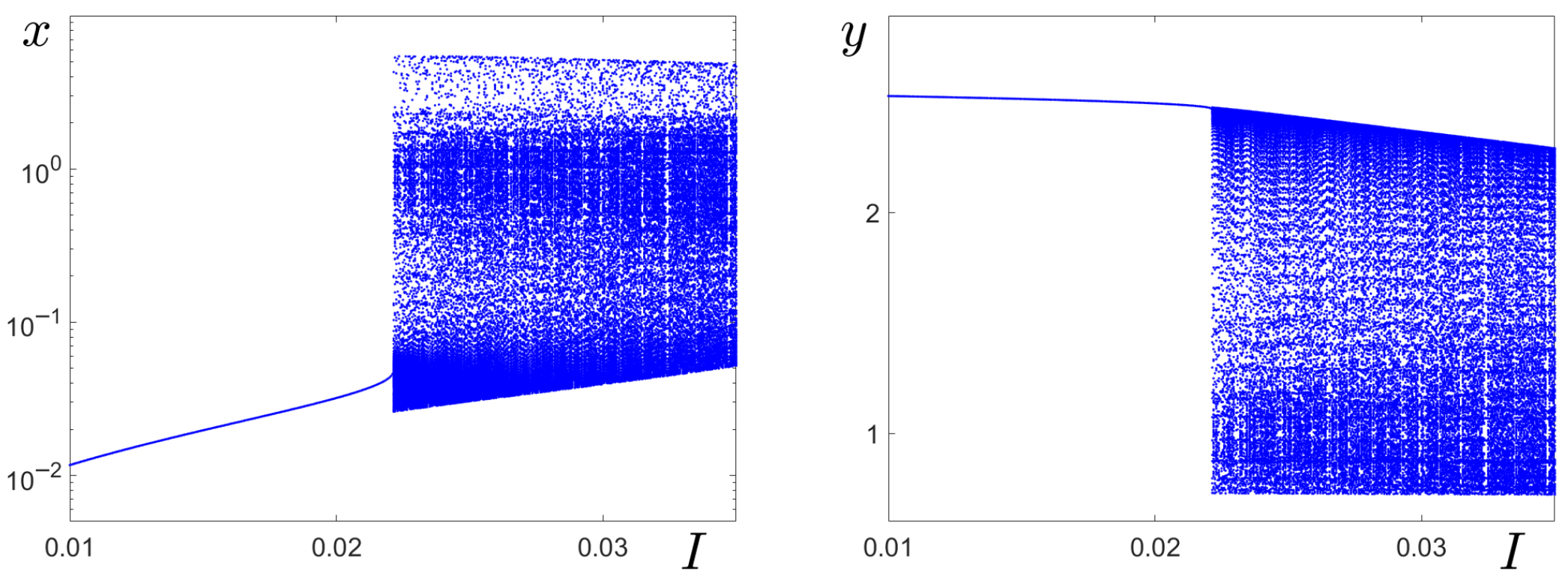
System (1) models various regimes of neuronal dynamics, both quiescence and firing. The transition from quiescence to firing with increasing I is shown in bifurcation diagrams in Figure 1. At I c = 0.02212 , system (1) undergoes a crisis bifurcation with the abrupt transformation of the equilibrium mode into large-amplitude oscillations.
In this paper, we study the collective dynamics of two Chialvo neurons coupled by electrical means:
x 1 , t + 1 = x 1 , t 2 exp ( y 1 , t x 1 , t ) + I + k ( x 2 , t x 1 , t ) y 1 , t + 1 = a y 1 , t b x 1 , t + c x 2 , t + 1 = x 2 , t 2 exp ( y 2 , t x 2 , t ) + I + k ( x 1 , t x 2 , t ) y 2 , t + 1 = a y 2 , t b x 2 , t + c .
We examine the effects of coupling on the behavior of the two-neuron system (2) when the isolated neurons exhibit quiescence modes in the form of stable equilibria. Here, we focus on the range I < I c and consider the coupling strength k as a bifurcation parameter.
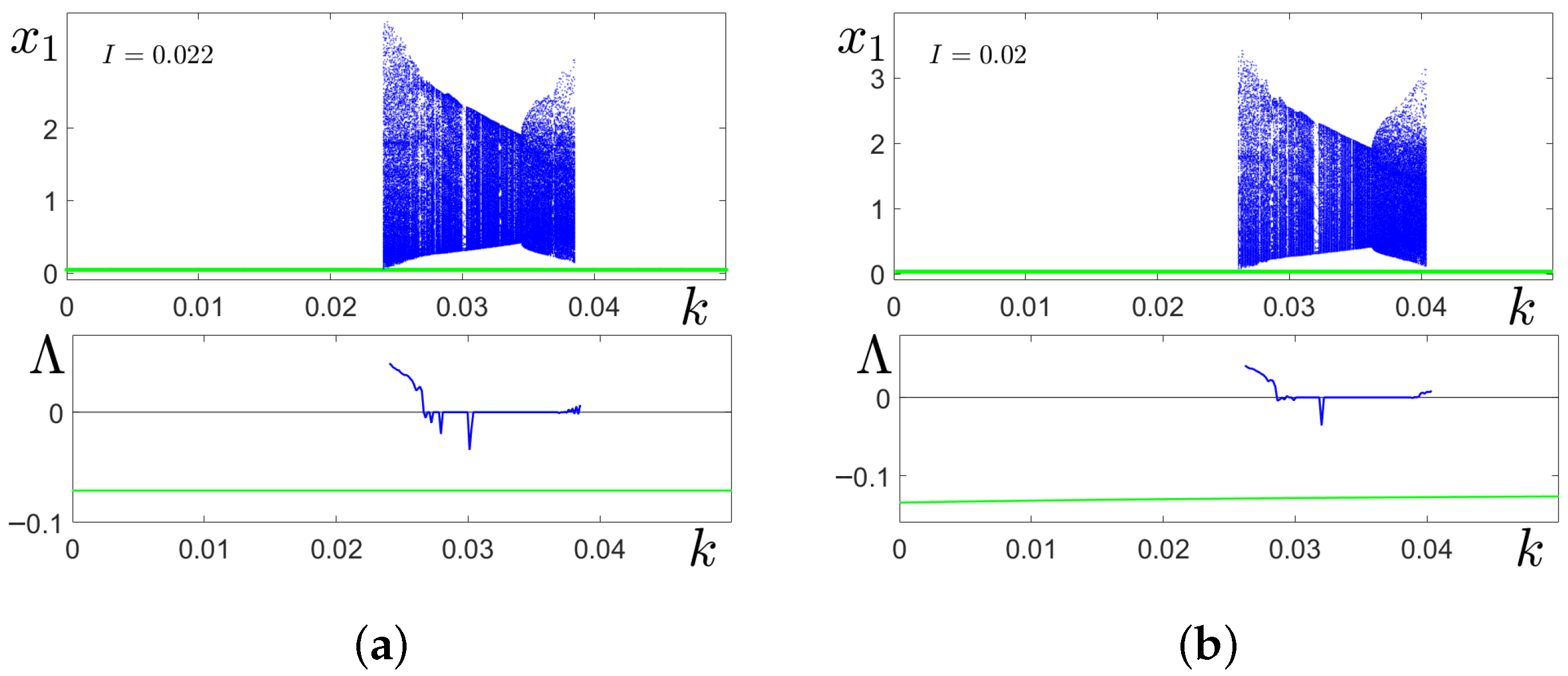
In Figure 2a, for system (2) with I = 0.022 < I c and 0 k 0.05 , x 1 -coordinates of attractors (top) and corresponding largest Lyapunov exponents (bottom) are plotted. For I = 0.022 , system (2) possesses the stable equilibrium E ( x ¯ 1 , y ¯ 1 , x ¯ 2 , y ¯ 2 ) with x ¯ 1 = x ¯ 2 = 0.0436577 , y ¯ 1 = y ¯ 2 = 2.474015 , which does not depend on the coupling strength k. The equilibrium E is shown in Figure 2a in green. In the interval k 1 < k < k 2 , where k 1 = 0.02399 , k 2 = 0.03865 , system (2) with I = 0.022 is bistable: along with E, oscillatory attractors (blue) are observed. A similar picture is observed when I = 0.02 < I c (see Figure 2b). It is seen that the bistability range ( k 1 , k 2 ) moves to the right: here, the bifurcation values are k 1 = 0.02615 and k 2 = 0.04036 .
Thus, coupling can transform equilibrium modes of separate Chialvo neurons into the oscillatory regimes, and hence, coupling fires quiescent neurons.

2.1. Oscillatory Attractors in the Bistability Zone

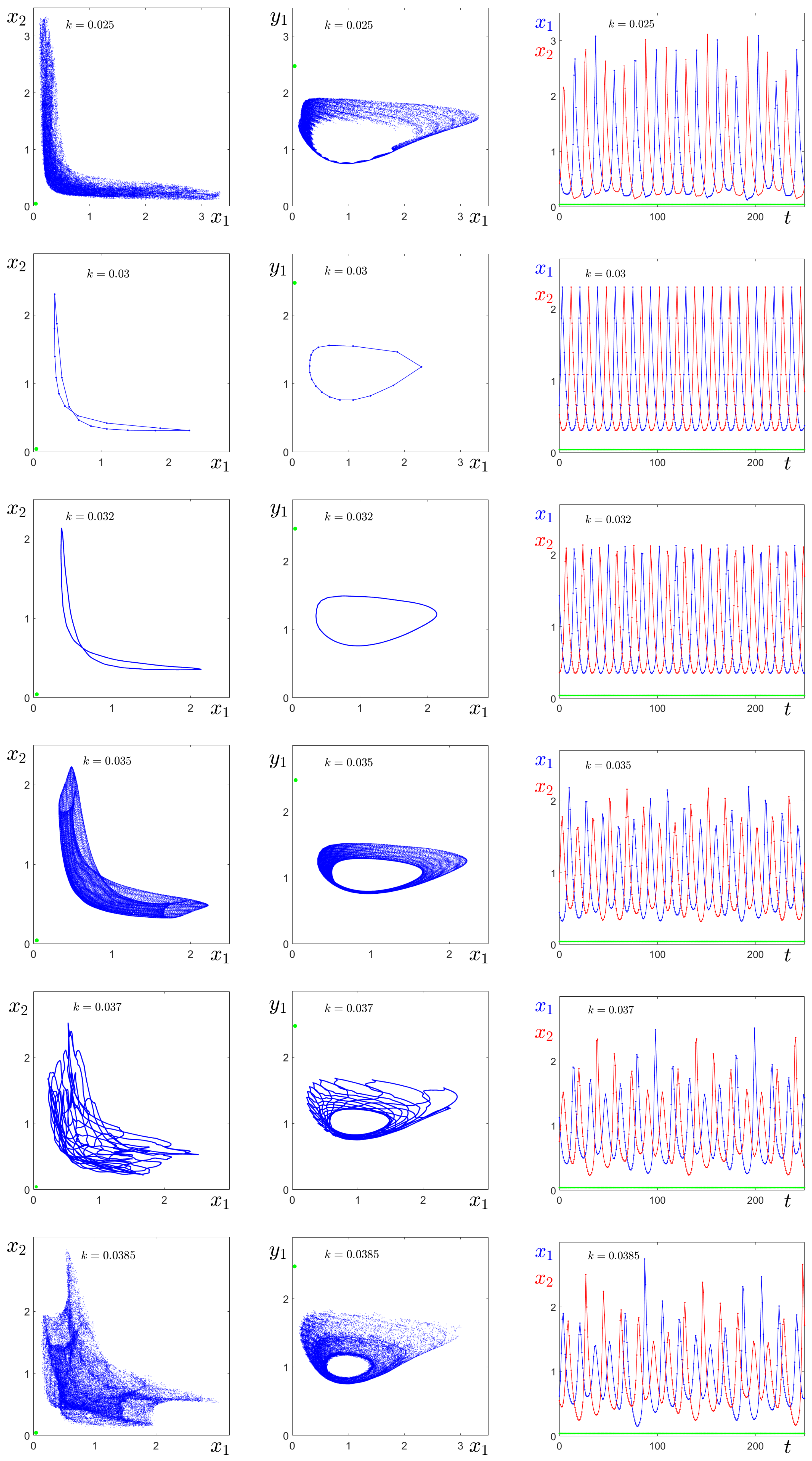
Let us consider details of oscillatory behavior in system (2) for the fixed value I = 0.022 . Oscillatory attractors of system (2) in the bistability interval k 1 < k < k 2 have a different shape. Examples of such attractors are presented in Figure 3, where we plot phase trajectories in projections on the planes ( x 1 , x 2 ) and ( x 1 , y 1 ) , and corresponding time series of x 1 - and x 2 -coordinates. The stable equilibrium E is shown by the green dot.
Here, for different k ( k 1 , k 2 ) , one can see both regular (discrete cycle for k = 0.03 and closed invariant curves for k = 0.032 , k = 0.037 ) and chaotic attractors. Time series show that oscillations have a spiking form, and in addition, the two neurons exhibit anti-phase synchronization. Thus, the coupling can give rise to complex oscillatory spiking regimes even when isolated neurons are at rest.
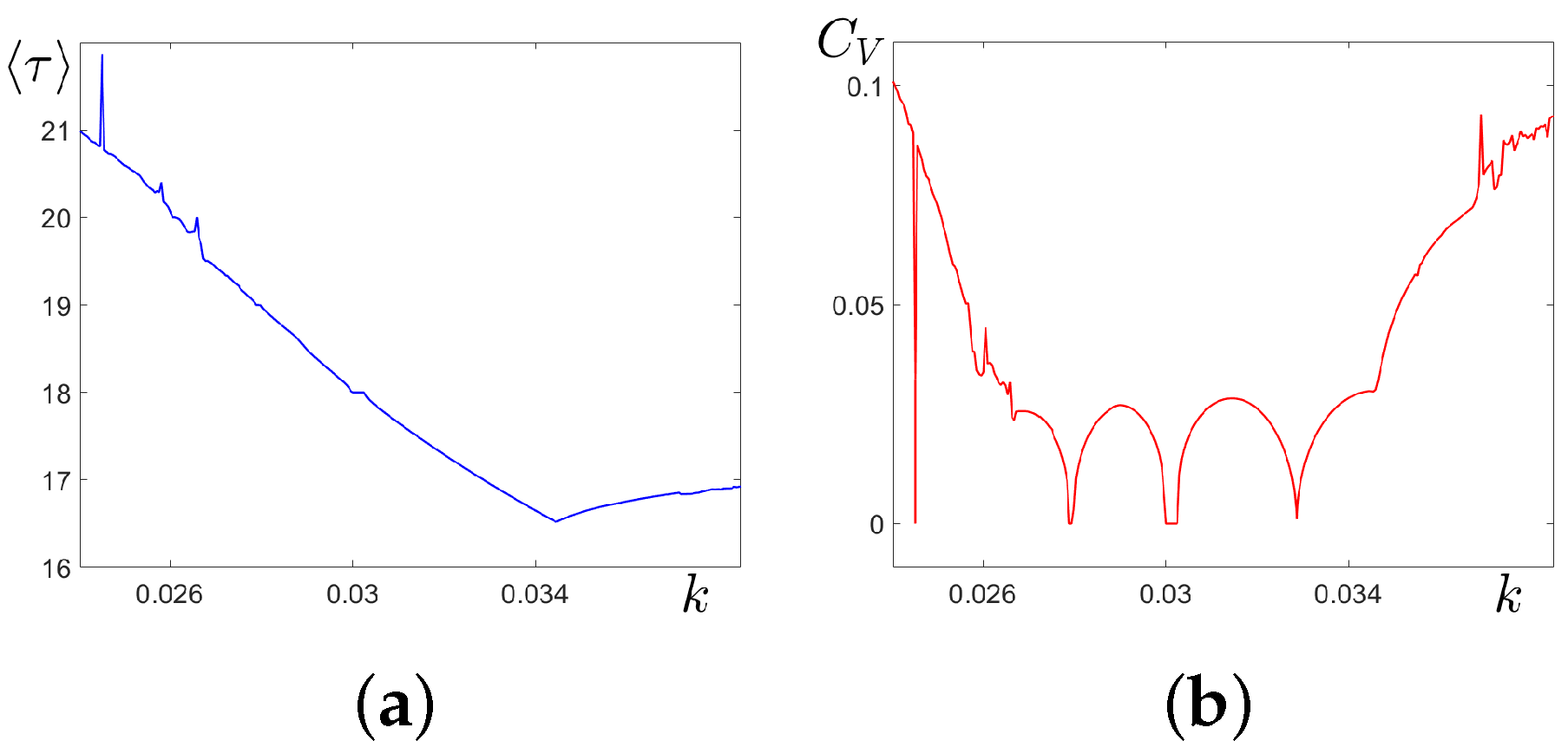
Let us consider in more detail characteristics of this coupling-induced spiking. In Figure 4a, we plot mean values τ of the interspike intervals τ in the parameter zone k 1 < k < k 2 of oscillations. As a whole, a frequency of spikes slightly grows with increasing k. In Figure 4b, the plot of the coefficient C V of variation is given. As can be seen, for the 18th cycle (see Figure 3 for k = 0.03 ), this coefficient equals zero. Moreover, we have found that in the zone 0.02788 < k < 0.02798 , system (2) possesses a stable 19th cycle. In the zone 0.0328661 < k < 0.0328669 , system (2) has a stable 17th cycle. In the zone 0.02448 < k < 0.02451 , system (2) possesses a stable 22nd cycle.
In this subsection, oscillatory properties of the coupled system (2) were related to the presence of oscillatory attractors. However, even in the case of monostability, when the system lacks such attractors, the oscillatory properties can be related to the specific nature of transient processes. This is discussed in the next subsection.

2.2. Transient Oscillatory Dynamics in the Monostability Equilibrium Zone

Let us now consider some details in the behavior of system (2) in the monostability zone 0 < k < k 1 = 0.02399 where the stable equilibrium E is the single attractor. Of course, all solutions here converge to the equilibrium point E regardless of the initial state. However, a transient process depends significantly on the initial state.
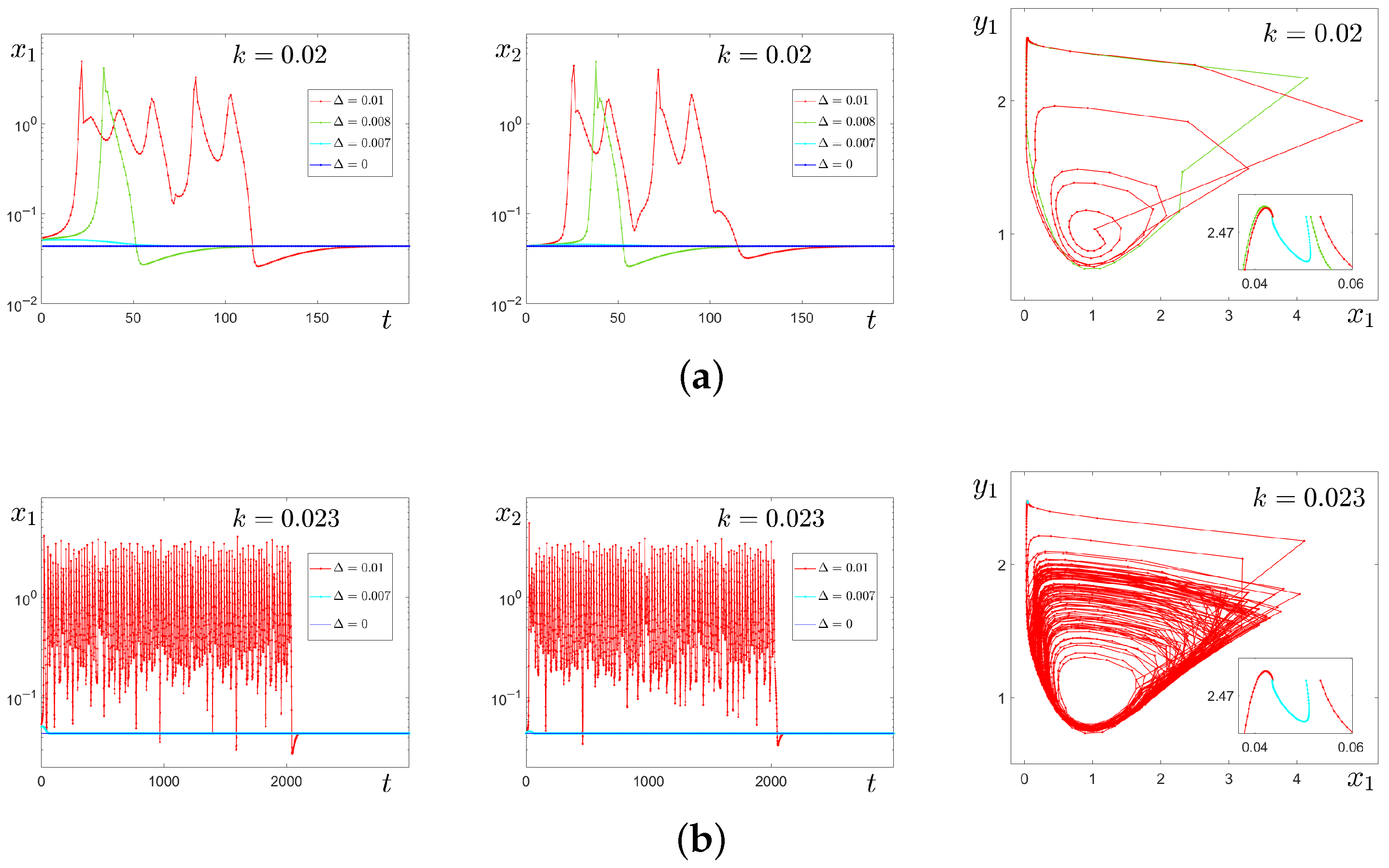
In Figure 5a, for k = 0.02 < k 1 , we show time series and phase trajectories of system (2) solutions starting near the equilibrium point E ( x ¯ 1 , y ¯ 1 , x ¯ 2 , y ¯ 2 ) . As initial data, we choose points ( x ¯ 1 + Δ , y ¯ 1 , x ¯ 2 , y ¯ 2 ) with different deviations Δ . For small Δ (see light blue curve for Δ = 0.007 ), the solution immediately converges to the equilibrium point E. For Δ = 0.008 (green), the solution initially exhibits a large-amplitude spike before monotonic convergence to E. For Δ = 0.01 (red curve), such a transition process takes more than 100 steps before the solution begins to approach the equilibrium. In the plane ( x 1 , y 1 ) , one can see corresponding large-amplitude loops.
In Figure 5b, such transients are shown for k = 0.023 , which is closer to the bifurcation point k 1 . As can be seen, here the duration of large-amplitude oscillatory transients is much greater than for k = 0.02 .
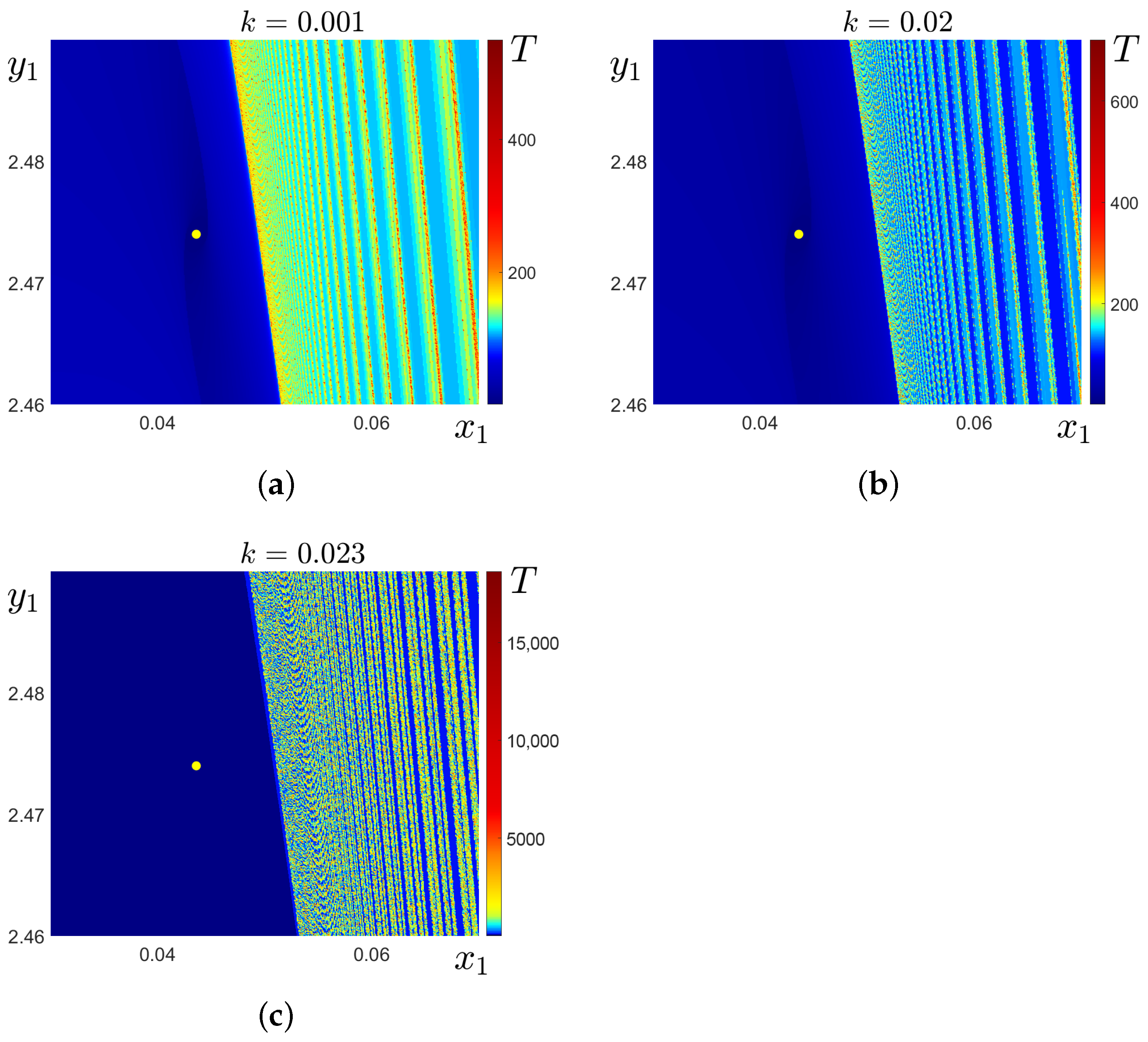
Additional details of the dependence of the duration of large-amplitude oscillatory transients on the parameter k and initial data are illustrated in Figure 6. Here, by color, we show time T that is necessary for the system (2) solution starting at ( x 1 , y 1 , x ¯ 2 , y ¯ 2 ) to reach the equilibrium E ( x ¯ 1 , y ¯ 1 , x ¯ 2 , y ¯ 2 ) with an accuracy of 0.001. As can be seen, around the equilibrium E (yellow-filled circle), there exists a solid part with quite short transients (ST-zone). To the right of this ST-zone, we observe a complex fractal structure, where even for close initial states, the corresponding solutions have significantly different durations of transient processes. Here, it is also seen that as the coupling parameter k approaches k 1 , the transient processes become significantly longer (compare Figure 6a–c).
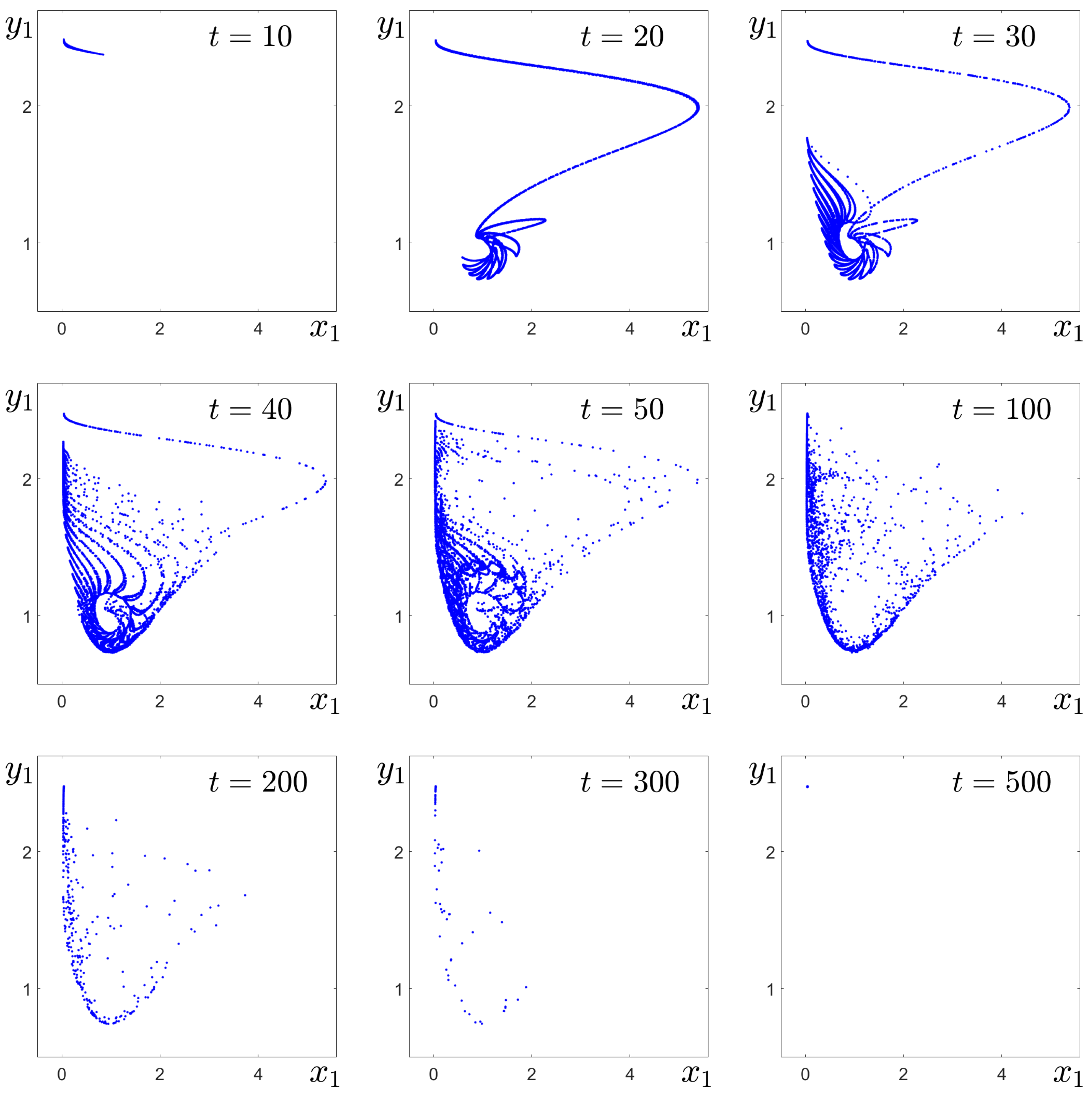
It is interesting to track geometry of the transient behavior of system (2) solutions. In Figure 7, as initial data, we choose the uniform grid ( x ˜ 1 , y ˜ 1 ) [ 0.02 , 0.06 ] × [ 2.45 , 2.49 ] around the stable equilibrium E ( x ¯ 1 , y ¯ 1 , x ¯ 2 , y ¯ 2 ) and plot states of the ensemble of solutions after t steps. Here, the metastable distribution observed between t = 40 and t = 200 can be considered as a transient attractor. This transient attractor is destroyed with the further increase in t, and for t = 500 , all solutions almost coincide with E.
These transients of the deterministic model (2) play an important role in stochastic phenomena, which will be considered in the following sections.

3. Noise-Induced Phenomena in the Stochastic Model of Two Coupled Chialvo Neurons

Consider a stochastic version of the system of two coupled neurons modeled by the Chialvo map:
x 1 , t + 1 = x 1 , t 2 exp ( y 1 , t x 1 , t ) + I + ε ξ 1 , t + k ( x 2 , t x 1 , t ) y 1 , t + 1 = a y 1 , t b x 1 , t + c x 2 , t + 1 = x 2 , t 2 exp ( y 2 , t x 2 , t ) + I + ε ξ 2 , t + k ( x 1 , t x 2 , t ) y 2 , t + 1 = a y 2 , t b x 2 , t + c .
Here, ξ 1 , t , ξ 2 , t model random disturbances in the parameter I of the ion current injected into the first and second neurons, respectively. In this paper, it is assumed that these random processes are independent white Gaussian noises of intensity ε . Note that in the presence of these random disturbances, two neurons become non-identical.
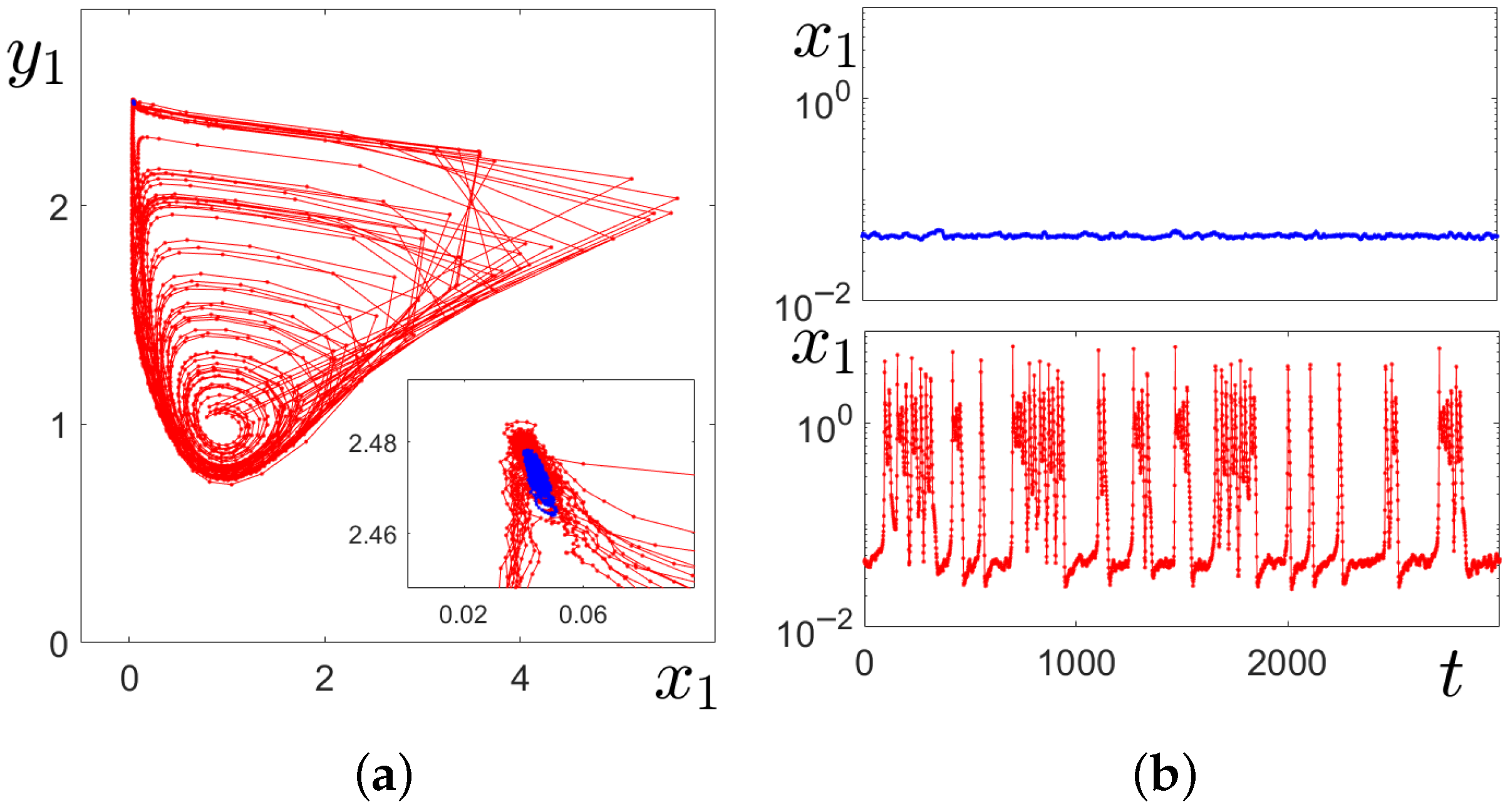
Let us consider an impact of noise in monostability zones k < k 1 and k > k 2 , where the equilibrium E is a single attractor (see Figure 2). In Figure 8, for k = 0.02 < k 1 , we show the results of random disturbances on the equilibrium E. For weak noise (with ε = 0.0005 ), system (3) solutions (blue) starting at E are localized near this equilibrium. As the noise level increases, the dynamics of the system change significantly: for ε = 0.0015 , solutions (red) demonstrate complex oscillations with the alternation of large-amplitude spikes and bursts.
In the parametric analysis of the phenomenon of stochastic excitation presented here, one can use the stochastic sensitivity technique and the method of confidence ellipses [29,30,35]. In this method, the matrix W of stochastic sensitivity of the stable equilibrium E is the main quantitative characteristic. This matrix is a unique solution of the following equation
W = F W F + Q ,
where F is the Jacobi matrix of the deterministic system (2) at the equilibrium point E ( x ¯ 1 , y ¯ 1 , x ¯ 2 , y ¯ 2 ) . Here,
F = ( 2 x 1 x 1 2 ) e y 1 x 1 k x 1 2 e y 1 x 1 k 0 b a 0 0 k 0 ( 2 x 2 x 2 2 ) e y 2 x 2 k x 2 2 e y 2 x 2 0 0 b a .
For the stochastic system (3), the matrix Q = diag [ 1 , 0 , 1 , 0 ] .
Using the matrix W of stochastic sensitivity, one can find a four-dimensional confidence ellipsoid for the geometrical description of the spatial features of the dispersion of system (3), with states x = ( x 1 , y 1 , x 2 , y 2 ) around the equilibrium x ¯ = ( x ¯ 1 , y ¯ 1 , x ¯ 2 , y ¯ 2 ) :
x x ¯ , W 1 ( x x ¯ ) = ε 2 K ( P ) .
Here, P is the fiducial probability, and the function K ( P ) is inverse to the function
P ( K ) = Φ ( K ) Φ ( ) , Φ ( K ) = 0 K e t 2 2 t 3 d t .
Let us consider how the method of confidence ellipsoids can be used in the analysis of stochastic excitation in system (3) with k = 0.02 . In this case, eigenvalues of the matrix W are the following:
λ 1 = 24.33216 , λ 2 = 12.177 , λ 3 = 2.8543 , λ 4 = 2.2371 .
Here, values λ 1 and λ 2 are significantly greater than λ 3 and λ 3 , so the dispersion of random states dominates in directions of the eigenvectors
u 1 = ( 0.408395 , 0.577246 , 0.408395 , 0.577246 ) , u 2 = ( 0.436907 , 0.555979 , 0.436907 , 0.555979 ) ,
corresponding to λ 1 , λ 2 . Thus, vectors u 1 and u 2 determine a two-dimensional plane Π of principal directions. This allows one to reduce the dimension of geometrical analysis from four to two and study mechanisms of noise-induced excitation in the two-dimensional plane Π . In the plane Π , the confidence domain is a two-dimensional ellipse
α 2 λ 1 + β 2 λ 2 = 2 ε 2 ln ( 1 P ) ,
where α and β are coordinates of the ellipse in the basis of normalized eigenvectors u 1 , u 2 of the matrix W with the origin at the equilibrium point E.
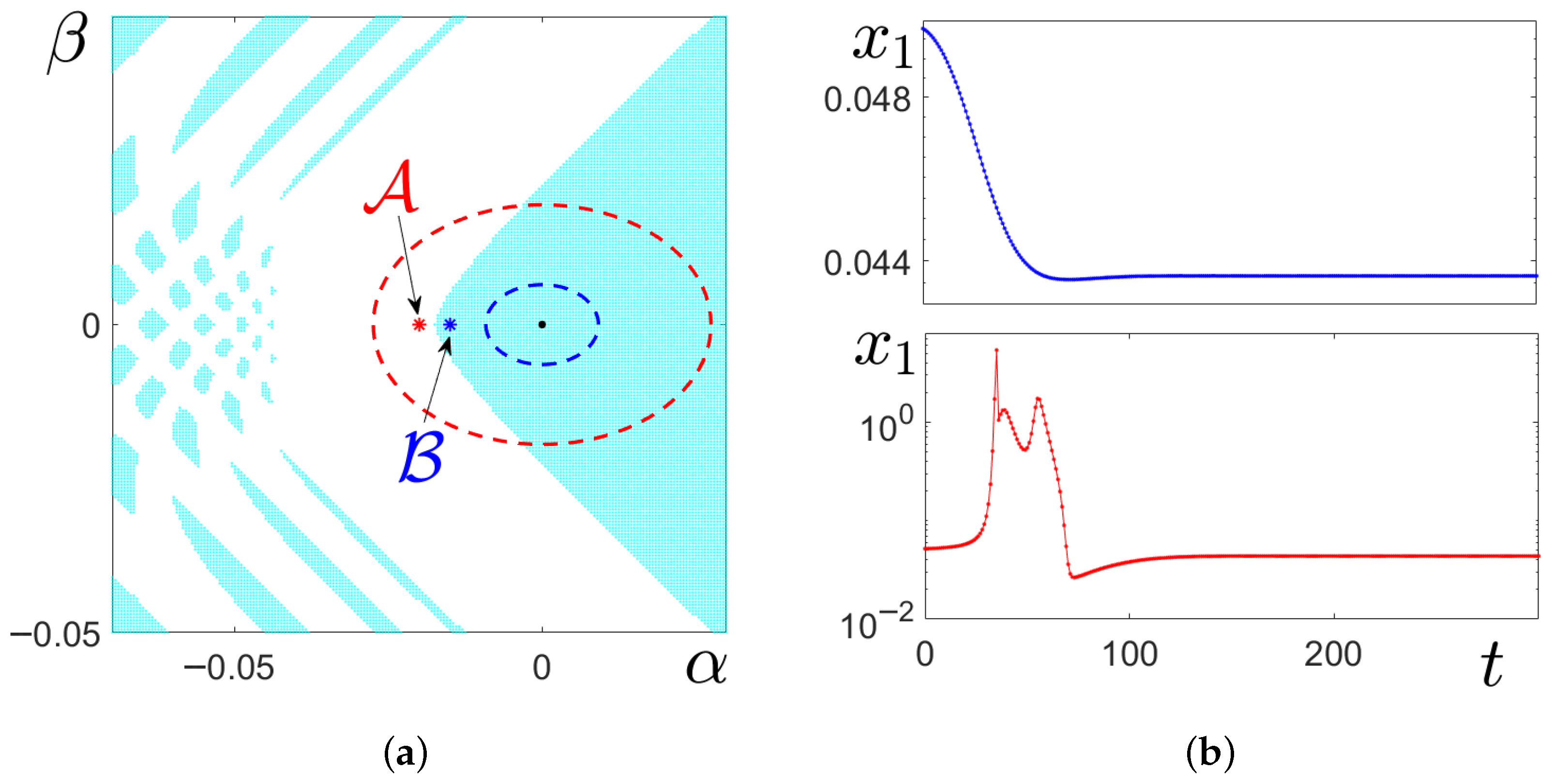
In Figure 9, we illustrate how the confidence ellipse can be used in the constructive analysis of noise-induced excitation in system (3) with k = 0.02 . In Figure 9a, in the plane Π , the basin of short transients (STB) is shown: we plot in light blue the initial points of solutions that converge to the equilibrium E in 100 steps with an accuracy of 0.001. The basin of long transients (LTB) is shown in white. Point B ( 0.015 , 0 ) belongs to STB, and the solution starting at B tends towards E immediately (see the time series shown in blue in Figure 9b). Point A ( 0.02 , 0 ) is close to B but belongs to LTB, so the solution starting at A tends towards E after the large-amplitude burst (see the time series shown in red in Figure 9b). For the noise intensity ε = 0.0005 , the confidence ellipse (blue) belongs entirely to STB. This means that random states are located near the equilibrium E and stochastic excitation does not occur. With increasing noise, the size of the ellipse increases too, and for ε = 0.0015 , the confidence ellipse (red) contains points of the LTB. This signals large-amplitude excursions of stochastic trajectories, indicating that noise-induced excitation occurs. This theoretical prediction agrees well with the results of direct numerical simulation shown in Figure 8.
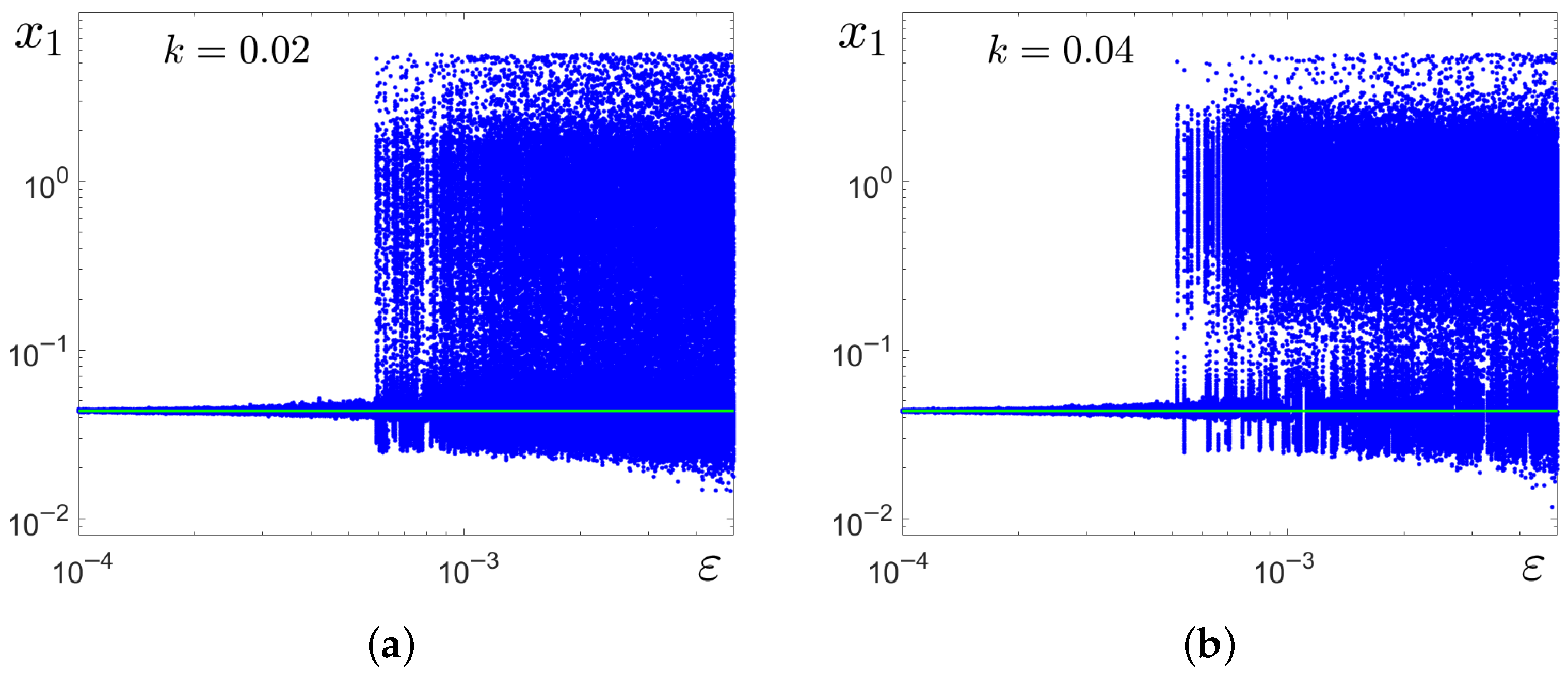
This sharp change in dynamics of system (3) with k = 0.02 for the gradual increase in the noise intensity ε can be seen in Figure 10a where x 1 -coordinates of system (3) solutions starting at the equilibrium E are plotted. A similar phenomenon of stochastic excitation is also observed in the other monostability zone k > k 2 (see Figure 10b for k = 0.04 ).
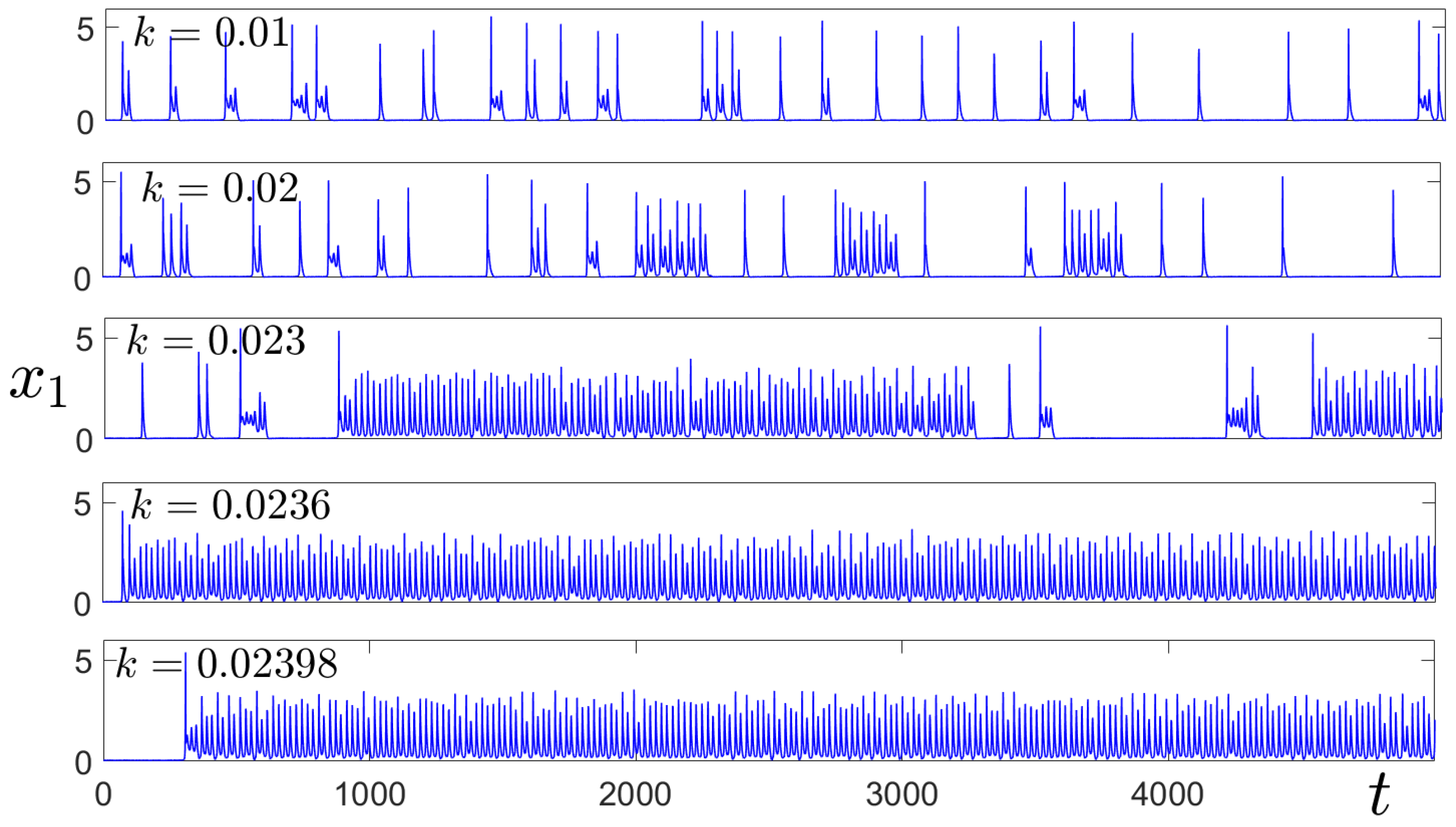
It is worth noting that in the regime of noise-induced excitation, the shape of stochastic oscillations significantly depends on the parameter k. In Figure 11, we plot the time series of x 1 -coordinates of system (3) solutions starting at the equilibrium E for ε = 0.001 and different values of k. For a small k, system (3) generates spikes and bursts with a small number of spikes in the train. With increasing k, the duration of bursts increases. As k approaches the bifurcation point k 1 , the time series begins to look like a sequence of only spikes.
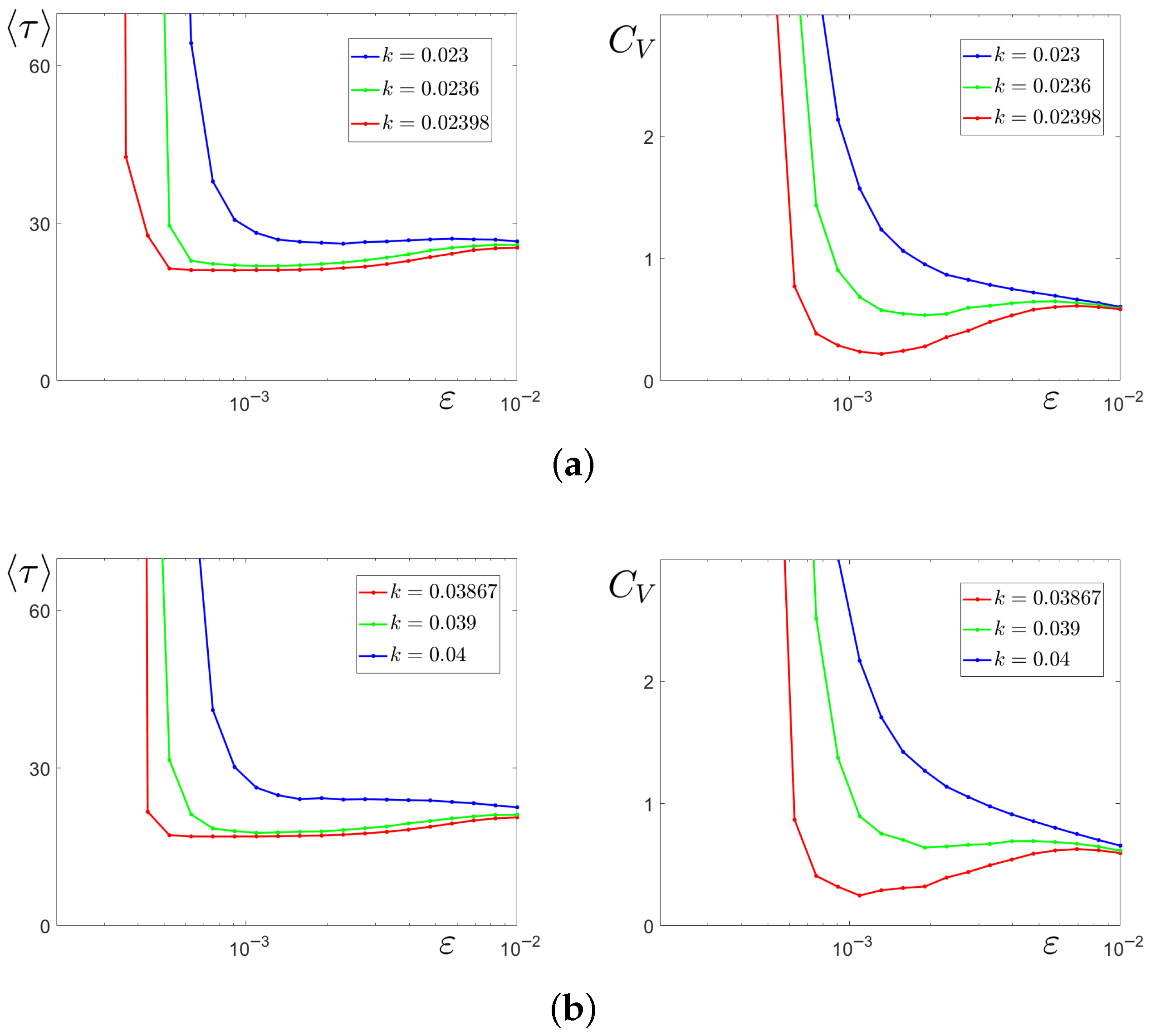
Note that interspike interval (ISI) statistics analyze the variability in neural firing times, defined as the time τ between consecutive action potentials. Here, key measures are the mean τ of ISIs and the coefficient of variation C V to quantify irregularity of oscillations. C V is the ratio of the standard deviation of the ISIs to the mean value of the ISIs. Small values of C V close to zero indicate regular firing, whereas large values of C V indicate irregular firing. Coherence resonance refers to the phenomenon in which an optimal, non-zero level of noise enhances the regularity of neural firing within an excitable system. This effect is quantified by a minimum in the coefficient of variation C V .
For the system under consideration, statistics of interspike intervals τ in the regime of noise-induced spiking near the bifurcation point k 1 are shown in Figure 12a. A sharp decrease in the mean values τ (Figure 12a, left) localizes ε -zone of noise-induced excitation of spiking. In Figure 12a, right, plots of the coefficient C V of variation are shown versus noise intensity for the same values of k. The clearly visible minimum of C V marks the noise intensity ε corresponding to the coherence resonance.
We have also found that in the parameter k-zone close to the bifurcation value k 2 , similar stochastic effects are observed. The statistics of interspike intervals in this zone are presented in Figure 12b, where the coherence resonance effect is also clearly visible.
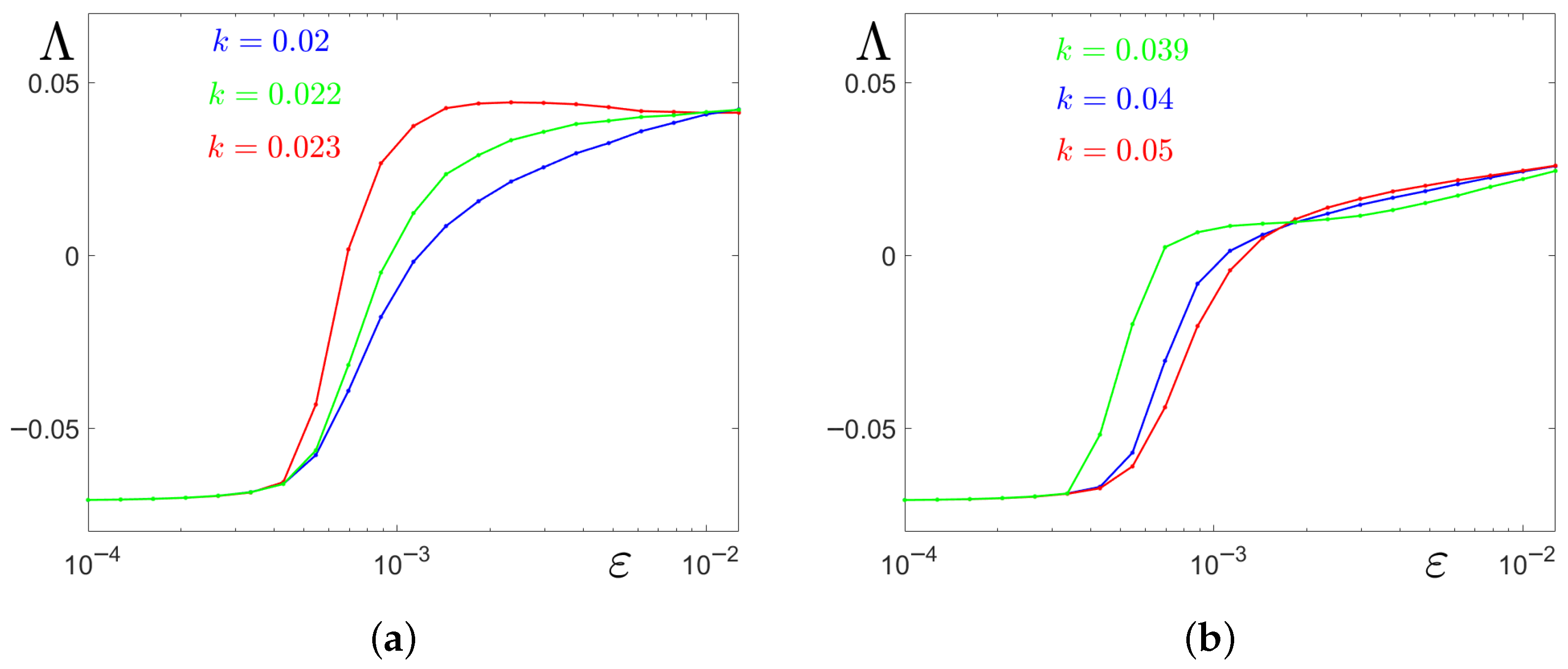
Now, after studying the frequency–amplitude characteristics of oscillations in the stochastic excitation mode, let us consider the qualitative changes in the internal dynamics, quantified by the largest Lyapunov exponent Λ . The positivity of Λ is a generally accepted criterion for chaos. In this study, for the estimating of the Lyapunov exponents through stochastic map (3), a standard discrete-time modification of the Benettin algorithm [36] is used. In Figure 13, we plot the largest Lyapunov exponent Λ versus noise intensity ε for several values of the parameter k in monostability zones k < k 1 (Figure 13a) and k > k 2 (Figure 13b). As can be seen, the process of noise-induced excitation of large-amplitude oscillations is accompanied by a transition from order to chaos. The closer k is to the bifurcation points k 1 and k 2 , the smaller the noise that generates chaos.
In the final part of the paper, we will consider additional details of the behavior of the Lyapunov exponent Λ for system (3) solutions starting at the equilibrium E over the entire range of the parameter k.
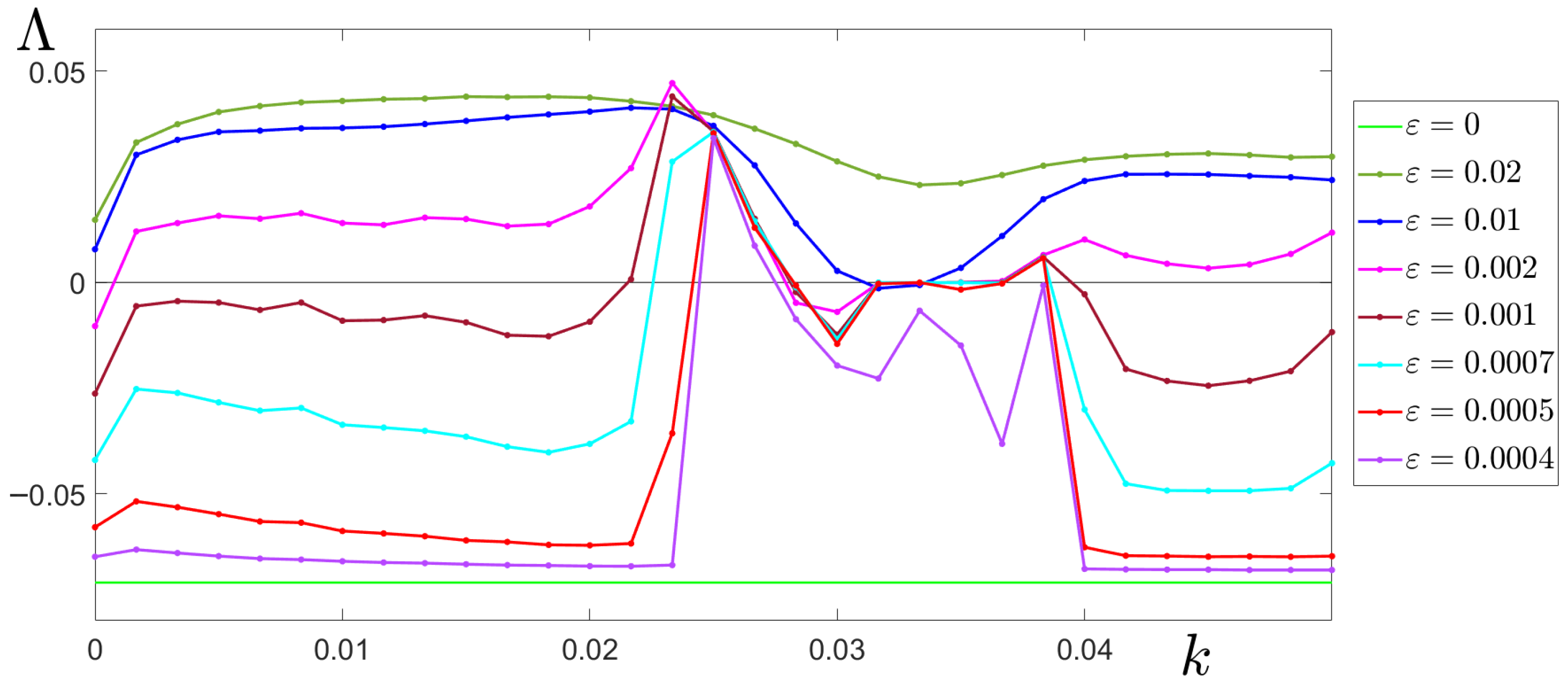
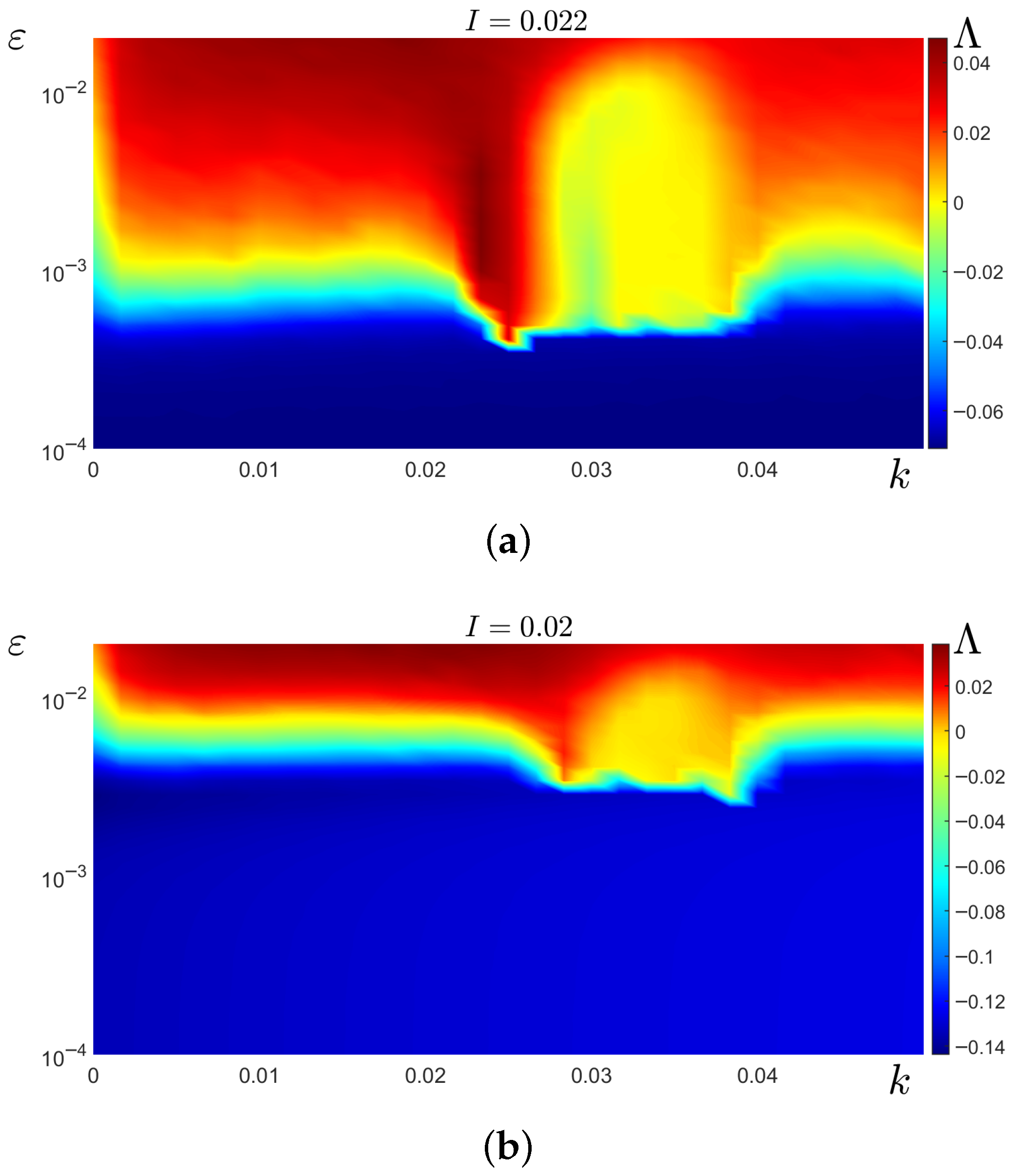
In Figure 14, we show plots of the largest Lyapunov exponent Λ ( k ) for I = 0.022 and several values of the noise intensity ε . In Figure 15a, the largest Lyapunov exponent Λ is plotted by color in the ( k , ε ) -plane. As can be seen, for weak noise, the values of Λ ( k ) are negative, so the dynamics of system (3) are regular. For strong noise, the values of Λ ( k ) are positive, so the system (3) dynamics are chaotic. Note that the transition from order to chaos is extremely non-uniform and significantly depends on the coupling parameter k. In Figure 15b, the largest Lyapunov exponent Λ ( k , ε ) is shown for I = 0.02 . Compared to the case I = 0.022 , it should be noted that the transition from order to chaos for I = 0.02 requires stronger noise.

4. Conclusions

The paper explored the problem of identifying the mechanisms of excitation of oscillatory activity in neural coupled systems in which neurons, being isolated, are in equilibrium. This problem is studied on the basis of a conceptual system of two coupled Chialvo models. For the deterministic version of this model, it was found that, with the small coupling parameter k, this two-neuron coupled system maintains an equilibrium state. However, as the parameter k of the coupling strength increases, the system becomes bistable, where, alongside the equilibrium state, a complex oscillatory regime with various forms of regular and chaotic attractors is observed. It should be noted that in this coupling-induced regime, two oscillating neurons exhibit anti-phase synchronization. The next step was to study the influence of random disturbances. We showed that even in the k-zone of monostability, where a deterministic system is in equilibrium, noise can generate complex spike oscillations. A study of excitation processes depending on noise intensity was conducted, showing that the transition from low-amplitude fluctuations near a stable equilibrium to large-amplitude oscillations occurs abruptly. This abrupt excitation is explained by the presence of complex fractal basins of short and long transients in the deterministic system. For a parametric study of excitation processes, the analytical method of confidence domains was used. In this method, the key quantitative characteristic of equilibrium is the stochastic sensitivity matrix. Using this matrix, a four-dimensional ellipsoid can be constructed around the stable equilibrium. The spectral features of the stochastic sensitivity matrix for the system under study allowed us to reduce the dimension of the geometric analysis by identifying the plane of principal directions of random states dispersion. In this case, the analysis of noise-induced excitation can be limited to two-dimensional confidence ellipses. The results of this new constructive approach are in good agreement with direct numerical simulation. In the final part of the paper, the frequency characteristics of noise-generated spike oscillations were investigated, and the phenomenon of coherence resonance was revealed. A parametric study of the largest Lyapunov exponents showed that with increasing noise intensity, a global transition from order to chaos occurs. The obtained results shed light on the excitation mechanisms of neural systems, and the proposed method for identifying the principal directions in the study of the dispersion of random states is of interest to researchers of stochastic nonlinear systems.

Author Contributions

Conceptualization, I.B. and L.R.; methodology, I.B. and L.R.; software, I.B.; validation, I.B. and L.R.; formal analysis, I.B. and L.R.; investigation, I.B. and L.R.; writing—original draft preparation, I.B. and L.R.; writing—review and editing, I.B. and L.R.; visualization, I.B.; funding acquisition, L.R. All authors have read and agreed to the published version of the manuscript.

Funding

The work was supported by the Russian Science Foundation (N 24-11-00097).

Data Availability Statement

The original contributions presented in this study are included in the article. Further inquiries can be directed to the corresponding authors.

Conflicts of Interest

The authors declare no conflicts of interest.

References

  1. Hodgkin, A.L.; Huxley, A.F. A quantitative description of membrane current and its application to conduction and excitation in nerve. J. Physiol. 1952, 117, 500–544. [Google Scholar] [CrossRef] [PubMed]
  2. FitzHugh, R. Impulses and physiological states in theoretical models of nerve membrane. Biophys. J. 1961, 1, 445–466. [Google Scholar] [CrossRef] [PubMed]
  3. Morris, C.; Lecar, H. Voltage oscillations in the Barnacle giant muscle fiber. Biophys. J. 1981, 35, 193–213. [Google Scholar] [CrossRef] [PubMed]
  4. Hindmarsh, J.L.; Rose, R.M. A model of the nerve impulse using two first-order differential equations. Nature 1982, 296, 162–164. [Google Scholar] [CrossRef]
  5. Shilnikov, A.; Kolomiets, M. Methods of the qualitative theory for the Hindmarsh-Rose model: A case study. A tutorial. Int. J. Bifurc. Chaos 2008, 18, 2141–2168. [Google Scholar] [CrossRef]
  6. Ibarz, B.; Casado, J.M.; Sanjuán, M.A.F. Map-based models in neuronal dynamics. Phys. Rep. 2011, 501, 1–74. [Google Scholar] [CrossRef]
  7. Rulkov, N. Regularization of synchronized chaotic bursts. Phys. Rev. Lett. 2001, 86, 183–186. [Google Scholar] [CrossRef]
  8. Izhikevich, E.M. Dynamical Systems in Neuroscience: The Geometry of Excitability and Bursting; MIT Press: Cambridge, UK, 2007; p. 521. [Google Scholar]
  9. Courbage, M.; Nekorkin, V.I.; Vdovin, L.V. Chaotic oscillations in a map-based model of neural activity. Chaos 2007, 17, 043109. [Google Scholar] [CrossRef]
  10. Chialvo, D. Generic excitable dynamics on a two-dimensional map. Chaos Solitons Fractals 1995, 5, 461–479. [Google Scholar] [CrossRef]
  11. Wang, F.; Cao, H. Mode locking and quasiperiodicity in a discrete-time Chialvo neuron model. Commun. Nonlinear Sci. Numer. Simul. 2018, 56, 481–489. [Google Scholar] [CrossRef]
  12. Muni, S.S.; Fatoyinbo, H.O.; Ghosh, I. Dynamical effects of electromagnetic flux on Chialvo neuron map: Nodal and network behaviors. Int. J. Bifurc. Chaos 2022, 32, 2230020. [Google Scholar] [CrossRef]
  13. Vivekanandhan, G.; Natiq, H.; Merrikhi, Y.; Rajagopal, K.; Jafari, S. Dynamical Analysis and Synchronization of a New Memristive Chialvo Neuron Model. Electronics 2023, 12, 545. [Google Scholar] [CrossRef]
  14. Ma, M.; Xiong, K.; Li, Z.; Sun, Y. Dynamic behavior analysis and synchronization of memristor-coupled heterogeneous discrete neural networks. Mathematics 2023, 11, 375. [Google Scholar] [CrossRef]
  15. Kuznetsov, A.; Sedova, Y.; Stankevich, N. Dynamics of non–identical coupled Chialvo neuron maps. Chaos Solitons Fractals 2024, 186, 115237. [Google Scholar] [CrossRef]
  16. Bashkirtseva, I.; Ryashko, L.; Prado-Reynoso, M.A.; Sanjuán, M.A.F. Noise-induced bursting near a crisis bifurcation in a map-based neuron model. Phys. Rev. E 2025, 112, 14212. [Google Scholar] [CrossRef]
  17. Wang, L.; Gao, H.; Li, C.; Tang, Q.; Chialvo, D. Complex synchronization in memristor-coupled Chialvo Neurons. Eur. Phys. J. Spec. Top. 2025, 234, 8441–8455. [Google Scholar] [CrossRef]
  18. Qin, M.; Lai, Q.; Fortuna, L.; Zhao, X.W. Rich dynamics induced by memristive synapse in Chialvo neuron network. Nonlinear Dyn. 2025, 113, 17095–17109. [Google Scholar] [CrossRef]
  19. Horsthemke, W.; Lefever, R. Noise-Induced Transitions: Theory and Applications in Physics, Chemistry, and Biology; Springer: Berlin/Heidelberg, Germany, 1984. [Google Scholar]
  20. Jhangeer, A.; Imran, M. Stochastic Dynamics and Control in Nonlinear Waves with Darboux Transformations, Quasi-Periodic Behavior, and Noise-Induced Transitions. Mathematics 2026, 14, 251. [Google Scholar] [CrossRef]
  21. Arnold, L. Random Dynamical Systems; Springer: Berlin/Heidelberg, Germany, 1998; p. 586. [Google Scholar]
  22. Bashkirtseva, I.; Ryazanova, T.; Ryashko, L. Stochastic bifurcations caused by multiplicative noise in systems with hard excitement of auto-oscillations. Phys. Rev. E 2015, 92, 42908. [Google Scholar] [CrossRef]
  23. Lindner, B.; Garcia-Ojalvo, J.; Neiman, A.; Schimansky-Geier, L. Effects of noise in excitable systems. Phys. Rep. 2004, 392, 321–424. [Google Scholar] [CrossRef]
  24. McDonnell, M.D.; Stocks, N.G.; Pearce, C.E.M.; Abbott, D. Stochastic Resonance: From Suprathreshold Stochastic Resonance to Stochastic Signal Quantization; Cambridge University Press: Cambridge, UK, 2008; p. 446. [Google Scholar]
  25. Pikovsky, A.S.; Kurths, J. Coherence resonance in a noise-driven excitable system. Phys. Rev. Lett. 1997, 78, 775–778. [Google Scholar] [CrossRef]
  26. Bukh, A.; Nikishina, N.; Ryabov, A.; Rybalova, E.; Semenov, V.; Vadivasova, T. Spike activity and coherence resonance in networks of excitable FitzHugh–Nagumo neurons: Effects of coupling, noise, and periodic signal. Eur. Phys. J. Spec. Top. 2025, 234, 1107–1123. [Google Scholar] [CrossRef]
  27. Gao, J.B.; Hwang, S.K.; Liu, J.M. When can noise induce chaos? Phys. Rev. Lett. 1999, 82, 1132–1135. [Google Scholar] [CrossRef]
  28. Bashkirtseva, I.; Ryashko, L.; Slepukhina, E. Order and chaos in the stochastic Hindmarsh-Rose model of the neuron bursting. Nonlinear Dyn. 2015, 82, 919–932. [Google Scholar] [CrossRef]
  29. Bashkirtseva, I.; Ryashko, L. Stochastic sensitivity of regular and multi-band chaotic attractors in discrete systems with parametric noise. Phys. Lett. A 2017, 381, 3203–3210. [Google Scholar] [CrossRef]
  30. Bashkirtseva, I.; Ryashko, L. Stochastic Sensitivity Analysis of Noise-Induced Phenomena in Discrete Systems. In Recent Trends in Chaotic, Nonlinear and Complex Dynamics; World Scientific Series on Nonlinear Science Series B; World Scientific: Singapore, 2021; pp. 173–192. [Google Scholar] [CrossRef]
  31. Laing, C.; Lord, G.J. Stochastic Methods in Neuroscience; Oxford University Press: Oxford, UK, 2009; p. 396. [Google Scholar]
  32. McDonnell, M.D.; Goldwyn, J.H.; Lindner, B. Editorial: Neuronal Stochastic Variability: Influences on Spiking Dynamics and Network Activity. Front. Comput. Neurosci. 2016, 10, 38. [Google Scholar] [CrossRef]
  33. Rehák, B.; Lynnyk, V. Synchronization of a network composed of stochastic Hindmarsh–Rose neurons. Mathematics 2021, 9, 2625. [Google Scholar] [CrossRef]
  34. Garipova, Y.; Yonekura, S.; Kuniyoshi, Y. Noise and dynamical synapses as optimization tools for spiking neural networks. Entropy 2025, 27, 219. [Google Scholar] [CrossRef]
  35. Ryashko, L.; Otman, A.; Bashkirtseva, I. Dynamic diversity in a discrete population model with competition. Mathematics 2025, 13, 857. [Google Scholar] [CrossRef]
  36. Benettin, G.; Galgani, L.; Strelcyn, J.M. Kolmogorov entropy and numerical experiments. Phys. Rev. A 1976, 14, 2338–2345. [Google Scholar] [CrossRef]
Figure 1. Bifurcation diagrams of the isolated neuron (1).
Mathematics 14 01335 g001
Figure 2. Bifurcation diagrams of the coupled system (2) for (a) I = 0.022 , (b) I = 0.02 . In the bottom panels, the largest Lyapunov exponents are shown by corresponding colors. In (a), bifurcation values are k 1 = 0.02399 and k 2 = 0.03865 . In (b), bifurcation values are k 1 = 0.02615 and k 2 = 0.04036 .
Mathematics 14 01335 g002
Figure 3. Attractors and time series of system (2) with I = 0.022 .
Mathematics 14 01335 g003
Figure 4. Statistics of interspike intervals τ for oscillatory attractors of system (2) versus coupling parameter k: (a) mean values τ ; (b) coefficient C V of variation.
Mathematics 14 01335 g004
Figure 5. Time series and phase curves in ( x 1 , y 1 ) -plane of system (1) solutions starting at ( x ¯ 1 + Δ , y ¯ 1 , x ¯ 2 , y ¯ 2 ) for different deviations Δ for (a) k = 0.02 , (b) k = 0.023 .
Mathematics 14 01335 g005
Figure 6. Basins of transient processes with different durations in the ( x 1 , y 1 ) -plane. By color, we show that time T is necessary for the system (2) solution starting at ( x 1 , y 1 , x ¯ 2 , y ¯ 2 ) to reach equilibrium E ( x ¯ 1 , y ¯ 1 , x ¯ 2 , y ¯ 2 ) (yellow-filled circle) with an accuracy of 0.001 for (a) k = 0.001 , (b) k = 0.02 , (c) k = 0.023 .
Mathematics 14 01335 g006
Figure 7. Deterministic system (2) with I = 0.022 , k = 0.02 : dynamics of the ensemble of solutions starting at the nodes ( x ˜ 1 , y ˜ 1 , x ¯ 2 , y ¯ 2 ) of the uniform grid ( x ˜ 1 , y ˜ 1 ) [ 0.02 , 0.06 ] × [ 2.45 , 2.49 ] around the stable equilibrium E ( x ¯ 1 , y ¯ 1 , x ¯ 2 , y ¯ 2 ) .
Mathematics 14 01335 g007
Figure 8. Noise-induced excitation in the stochastic system with I = 0.022 , k = 0.02 : (a) phase curves; (b) corresponding time series for ε = 0.0005 (blue) and ε = 0.0015 (red).
Mathematics 14 01335 g008
Figure 9. Method of confidence ellipses for stochastic system (3) with I = 0.022 , k = 0.02 . In (a), in the plane Π , the basin of short transients (STB) is shown in light blue. Confidence ellipse (red) corresponds to ε = 0.0015 , and ellipse (blue) corresponds to ε = 0.0005 . In (b), time series are shown for solutions starting at the points B ( 0.015 , 0 ) (blue asterisk) and A ( 0.02 , 0 ) (red asterisk).
Mathematics 14 01335 g009
Figure 10. Noise-induced excitation: random states (blue dots) of system (3) solutions starting at the equilibrium E versus noise intensity ε for (a) k = 0.02 , (b) k = 0.04 . The equilibrium E is shown in green.
Mathematics 14 01335 g010
Figure 11. Time series of x 1 -coordinates of solutions starting at the equilibrium E for system (3) with I = 0.022 , fixed noise intensity ε = 0.001 , and different values of the parameter k.
Mathematics 14 01335 g011
Figure 12. Statistics of ISI for system (3) solutions starting at the equilibrium E in monostability zones: (a) for k < k 1 , (b) for k > k 2 .
Mathematics 14 01335 g012
Figure 13. Largest Lyapunov exponents for system (3) solutions starting at the equilibrium E in the monostability zones: (a) for k < k 1 , (b) for k > k 2 .
Mathematics 14 01335 g013
Figure 14. Largest Lyapunov exponents Λ ( k ) for solutions of system (3) with I = 0.022 starting at the equilibrium E for several values of noise intensity ε .
Mathematics 14 01335 g014
Figure 15. Colored diagrams for the largest Lyapunov exponents in the ( k , ε ) -plane for system (3) solutions starting at the equilibrium E: (a) for I = 0.022 , (b) I = 0.02 .
Mathematics 14 01335 g015
Disclaimer/Publisher’s Note: The statements, opinions and data contained in all publications are solely those of the individual author(s) and contributor(s) and not of MDPI and/or the editor(s). MDPI and/or the editor(s) disclaim responsibility for any injury to people or property resulting from any ideas, methods, instructions or products referred to in the content.