Article

A Spatiotemporal Cluster Analysis and Dynamic Evaluation Model for the Rock Mass Instability Risk During Deep Mining of Metal Mine

School of Resources and Safety Engineering, Central South University, Changsha 410083, China
*
Author to whom correspondence should be addressed.
Mathematics 2026, 14(8), 1261; https://doi.org/10.3390/math14081261
Submission received: 6 March 2026 / Revised: 1 April 2026 / Accepted: 3 April 2026 / Published: 10 April 2026
(This article belongs to the Section D2: Operations Research and Fuzzy Decision Making)

Abstract

With the increasing depth of mining operations, accurate identification and assessment of rock mass instability risks are crucial for ensuring mine safety. This study proposes an integrated framework combining the Hierarchical Density-Based Spatial Clustering of Applications with Noise (HDBSCAN), fuzzy comprehensive evaluation (FCE) and kernel density estimation (KDE) for the identification and dynamic assessment of high-risk zones in deep mining. Using microseismic monitoring data from a lead–zinc mine in Northwest China (January–June 2023), the HDBSCAN algorithm adaptively identified 86 high-density clusters from 11,638 events. The weights of five evaluation indicators (moment magnitude, apparent stress, stress drop, peak ground acceleration, and ringing count) were determined objectively using the Euclidean distance method. FCE was then applied to classify cluster risk levels, revealing that 70.9% of the clusters were rated as high-risk (Level IV). KDE further illustrated the spatiotemporal migration of high-risk zones, showing a systematic shift from northeast to southwest along stopes and roadways, driven by mining unloading and geological structures. The integrated HDBSCAN-FCE-KDE framework demonstrates strong applicability and reliability in identifying and predicting rock mass instability risks, providing a scientific basis for proactive risk management in deep mining environments.

1. Introduction

Long-term continuous large-scale mining has progressively depleted global shallow metal mineral resources, making deep mining an inevitable strategic direction to sustain the supply of these critical industrial raw materials essential for national economic development, social progress, and technological innovation [1]. This trend is particularly pronounced in China, where decades of sustained high-intensity development have significantly reduced shallow resources, propelling the mining industry to advance comprehensively into greater depths. Currently, over 20 underground metal mines in China have reached or exceeded depths of 1000 m, operating in environments characterized by extremely high in situ stress [2]. Under such high-stress conditions, mining excavation activities are highly prone to triggering destructive rockburst phenomena, leading to severe dynamic hazards such as rockbursts, rib failures, roof collapses, and water inrushes. These pose significant threats to production safety and operational continuity. Rock mass instability risks intensify with increasing mining depth, particularly in geotechnically complex areas where landslides and large-scale rock collapses become more prevalent [3]. Fundamentally, deep rock masses exist in a state of high stress equilibrium, which excavation activities disrupt. During tunnel or mining face advancement, sudden unloading of the free face drastically alters the state of high static stress, triggering the instantaneous release of accumulated strain energy within the rock mass as kinetic energy or vibration waves. This manifests as rockbursts or mine tremors [4]. Such rock mass failures can generate intense vibrations and cause significant damage to underground structures [5]. To this end, quantitative analysis of the spatiotemporal relationships between seismic event frequency, released energy and stress–strain parameters provides a foundational methodology for predicting the distribution of mining-induced seismic activity [6]. Meanwhile, studies on the dynamic cFharacteristics of crack formation in geomaterials such as soil under drying-wetting cycles [7] have revealed three stages of crack initiation, propagation, and stabilization, along with their relationship to microstructural damage. Chai et al. [8] investigated the vibration response of a viscoelastic rock slope with a filled structural plane under P-wave incidence using a time-domain recursive method, revealing the influences of structural plane dip angle and thickness on the slope amplification coefficient. These intricate physical processes collectively demonstrate the profound complexity of progressive rock failure within extreme deep underground engineering environments. Consequently, accurately identifying and evaluating potential risk zones for rock mass instability has become critical for ensuring deep mining safety and implementing proactive risk management.
To address the severe challenges posed by deep mining operations, microseismic monitoring has emerged as the primary technology for real-time monitoring of rock fracture and stress evolution. Microseismic systems detect elastic waves generated by sudden energy releases from microfractures, enabling spatiotemporal localization of seismic sources, it is the foundation for hazard assessment. The precision of event localization is critical, Dong et al. [9] developed a velocity-free acoustic emission source localization method combined with traveltime tomography, which dynamically tracks crack propagation and velocity field evolution in rocks under compressive loading, providing enhanced accuracy in complex media [10]. Beyond mere localization, advanced signal processing techniques, such as waveform stacking combined with time-frequency transform feature optimization, enhance signal recognition while suppressing noise interference [11]. Artificial intelligence has revolutionized the discrimination and classification of microseismic signals. Huang et al. [12] employed a transfer learning framework using one-dimensional convolutional neural networks (CNNs) to identify microseismic signals with near-perfect accuracy even under conditions of limited labeled data or low signal-to-noise ratios. Ren et al. [13] demonstrated that CNNs outperform traditional parameter-based methods in classifying tension and shear failure signals, providing deeper insights into rock failure mechanisms. Furthermore, in the aspect of rock failure precursor identification, Liu et al. [14] proposed shear strain mutation rate and absolute standard deviation indicators based on digital image correlation technology, providing new experimental evidence for the microscopic mechanisms. Su et al. [7] have revealed three stages of crack initiation, propagation, and stabilization, along with their relationship to microstructural damage. Chai et al. [8] investigated the vibration response of a viscoelastic rock slope with a filled structural plane under P-wave incidence using a time-domain recursive method, revealing the influences of structural plane dip angle and thickness on the slope amplification coefficient.
The richness of MS/AE data has catalyzed a paradigm shift toward data-driven risk prediction and early warning. There is a significant and growing adoption of machine learning and deep learning in rockburst prevention studies [15]. Researchers have developed optimized neural networks [16], ensembles of six machine learning models [17], hybrid algorithms like an enhanced random forest combined with a cloud model [18] and intelligent prediction models driven by microseismic temporal features [19], all demonstrating superior predictive accuracy for rockburst intensity and occurrence. These models leverage multi-parameter inputs, moving beyond the limitations of single-parameter warning indicators. Furthermore, advanced algorithms are revolutionizing the entire data processing workflow; for instance, methods based on fractal theory and feature fusion have significantly improved the automatic picking of microseismic signal first arrival times [20]. In addition, ResNet18 networks can identify crack types from high-speed images and Deep Neural Networks (DNNs) can predict the complete stress–strain response of rocks under dynamic loading [21]. Integrated frameworks are being constructed for the early warning of rock hazards. Despite these advances, the effective prediction of rockbursts remains challenging due to their complex, multi-factorial nature involving unclear mechanisms and uncertain causes [22].
Spatial clustering is essential for a comprehensive analysis of event areas, grouping spatial units so that attributes within clusters are similar and spatially contiguous as possible [23], It can identify areas of concentrated microseismic activity typically associated with geological structures or mining fronts. Traditional clustering algorithms like K-means require a predefined cluster count and struggle with non-convex shapes, while Density-Based Spatial Clustering of Applications with Noise (DBSCAN), though density-based, can be sensitive to parameter selection and may over-segment areas of uniform density [24]. Enhanced versions of DBSCAN have shown promise in improving the accuracy of source location by robustly handling outliers [25]. However, for the complex, unevenly distributed point patterns of MS events, the Hierarchical Density-Based Spatial Clustering of Applications with Noise (HDBSCAN) algorithm offers distinct advantages. HDBSCAN constructs a hierarchical clustering structure, automatically determines the optimal number of clusters based on data density, effectively identifies and excludes noise, and excels at finding clusters of arbitrary shapes and varying densities, providing enhanced robustness over DBSCAN [26]. Its theoretical and practical superiority has been demonstrated across diverse real-world datasets [27], making it particularly suitable for delineating high-risk MS event clusters in mining environments.
Once high-risk spatial clusters are identified, a robust framework is required to evaluate their hazard level. Risk assessment in geomechanics often grapples with uncertainty and fuzziness. To quantify these uncertainties, various advanced models have been developed, such as the SPA–IAHP–PCN model for the status evaluation of rock instability in metal mines [28]. While machine learning models offer powerful predictive capabilities, the Fuzzy Comprehensive Evaluation (FCE) method provides a structured, multi-indicator approach well-suited for handling such ambiguity. FCE incorporates membership functions to quantify the contribution of various factors to an overall risk grade, effectively managing the nonlinearities inherent in rock mass instability. Owing to the ability of fuzzy comprehensive evaluations to solve problems with multiple levels, thereby overcoming the drawbacks of single-solution approaches, FCE models have been widely used in engineering, economics, and society [29]. This method allows for a nuanced assessment that considers multiple seismic parameters, offering a more holistic view than assessments based on a single parameter. The integration of objective weighting methods, such as the Euclidean distance method, can further enhance the objectivity of the FCE by determining indicator weights based on data variability.
Finally, understanding the spatiotemporal evolution of identified risk zones is crucial for proactive management. Spatial trend analysis methods reveal the dynamic migration and concentration patterns of hazards. Techniques such as GIS spatial analysis and rescaled range analysis have been used to uncover the macro-evolutionary patterns of mining accidents [30], while methods coupling baseline estimation with curve-fitting have been applied to disentangle natural and mining-induced hydrological trends [31]. For visualizing and analyzing the density distribution of point-based events like MS occurrences, Kernel Density Estimation (KDE) is a classic and powerful non-parametric tool. KDE generates smooth density surfaces that intuitively reveal hotspots and their evolution. Recent advancements address KDE’s computational challenges with big data, including GPU-accelerated adaptive bandwidth algorithms [32] and quad-tree-based fast adaptive methods that maintain accuracy while improving efficiency and visualization [33]. Furthermore, data-driven fused KDE methods have been developed to achieve lower estimation error for complex, multi-modal distributions, enhancing the tool’s analytical power [34]. Applying KDE to the temporal series of high-risk cluster locations can, therefore, vividly illustrate the migration pathways of stress concentration and potential failure zones, linking spatial patterns directly to mining progression and rock mass stress evolution.
In summary, despite significant advances in microseismic monitoring, intelligent signal processing, machine learning-based prediction, spatial clustering, fuzzy evaluation, and density-based trend analysis, these methods are often applied in isolation. This study focused on the identification and evaluation of rock mass instability risk zones under deep mining conditions by establishing an integrated methodology combining HDBSCAN spatial density clustering, fuzzy comprehensive evaluation, and kernel density estimation. This framework fills the research gap concerning the lack of a unified approach that simultaneously enables adaptive clustering identification, multi-indicator objective evaluation, and spatiotemporal dynamic tracking, achieving the goal of accurately delineating high-risk zones from complex microseismic event clouds and dynamically assessing their evolution patterns. The research findings provide new perspectives and theoretical support for the refined prevention and control of rock mass instability risks during deep mining operations in metal mines.

2. Methodology

2.1. Data Sources and Evaluation Indicators

With the development of microseismic monitoring technology, more accurate data can be collected by deploying a sufficient number of sensors at appropriate locations. In this study, mining data including energy flux, seismic moment, seismic energy, apparent stress, source radius, peak velocity, ringing count and other parameters were collected by microseismic monitoring. This enables the acquisition of stress, strain, displacement, and microseismic activity associated with rock mass instability during mining operations. Such data facilitates quantitative safety assessment and analysis, contributing to improved risk management in deep mining [5].
In order to systematically evaluate rock mass instability risks in deep mining, this study constructs a hierarchical indicator system based on theoretical frameworks, monitoring requirements, and literature support. According to the mining safety monitoring data, a set of multi-dimensional and hierarchical comprehensive evaluation index system for rock mass instability was constructed in this study. This system aims to reveal the rock mass instability during deep mining from multiple dimensions, and evaluate the instability risk of the mine by combining spatial density clustering methods, high-density zone risk assessment, and kernel density analysis.
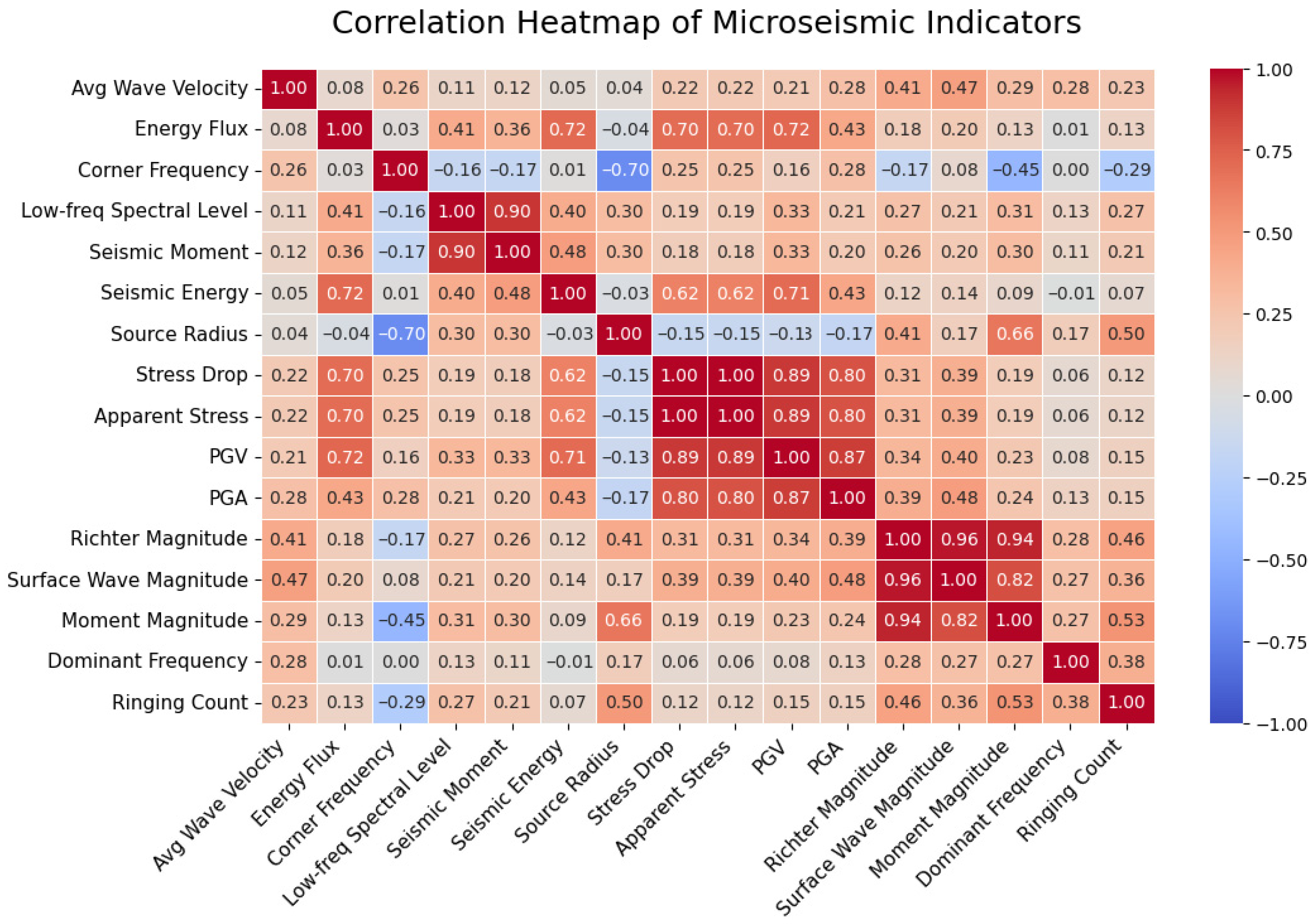
A total of 16 seismic acoustic parameters related to mining activities were monitored using sensors, including: average wave velocity, energy flux, corner frequency, low-frequency spectral level, seismic moment, seismic energy, source radius, stress drop, apparent stress, peak ground velocity, peak ground acceleration, Richter magnitude scale, surface wave magnitude scale, moment magnitude scale, dominant frequency, and ringing count. Most of these indicators are related to seismology and rock mechanics, used to characterize seismic events and rock mass instability. Initially, a comprehensive set of 16 microseismic parameters was considered for the risk evaluation model. However, strong correlations exist between some indicators, directly incorporating all parameters would introduce severe multicollinearity and information redundancy, which compromises the reliability of the assessment. So in rock mass instability risk assessments, certain redundant indicators may be excluded to avoid information redundancy and enhance evaluation efficiency [35]. As illustrated in the Pearson correlation matrix (Figure 1), the 16 parameters exhibit distinct clustering behaviors. To construct a scientifically rigorous and concise framework, this study identified five independent indicators based on the statistical correlations among these parameters and their underlying physical mechanisms.
(1)
The Richter magnitude scale, surface wave magnitude scale, and moment magnitude scale are all used to measure earthquake size. The Richter magnitude scale and surface wave magnitude scale are highly correlated with the moment magnitude scale for moderate-sized earthquakes. However, the moment magnitude scale, based on seismic moment, possesses clearer physical significance. It is applicable to earthquakes of all scales, accurately reflects earthquake size, and correlates with energy release and stress reduction. It serves as the fundamental indicator for assessing the scale of rock mass instability [36]. Therefore, the moment magnitude scale alone can be selected as the evaluation metric for rock mass instability risk.
Moment magnitude scale (Mω) serves as the core indicator of energy release, quantifying the average energy scale of regional seismic activity through mean analysis. It is a standard measure for describing earthquake size, reflecting the overall scale of energy release in seismic events, and is directly related to the range of rock mass instability and potential destructive force. It is calculated by Equation (1) [37] based on the seismic moment (M0).
M ω = 2 3 log 10 M 0 10.7
M 0 = μ A D
where μ denotes the stiffness of the rock (Pa); A denotes the area of the fault slip area (m2); D denotes the average slip distance of the rock mass on both sides of the fault (m).
(2)
Both seismic energy and energy flux are related to the energy released by an earthquake. However, energy flux is significantly influenced by propagation path and distance, making it unsuitable as a direct evaluation metric. Apparent stress combines energy and moment magnitude, representing the ratio of seismic energy to moment magnitude and reflecting the average stress level [38]. High apparent stress may indicate higher rock strength or stress concentration, aiding in evaluating the rock mass susceptibility to brittle fracture. Therefore, apparent stress alone is retained as the evaluation metric.
Apparent stress represents the ratio of radiant energy (ER) released per unit volume to total strain energy (ES) during an earthquake. To characterize the conversion efficiency of stress and strain energy during fracture, the high apparent stress indicates the strength degradation of the rock mass or the existence of high stress concentration. The apparent stress is calculated by Equation (3) [39].
σ a p p = η μ D r
where σapp is the apparent stress (Pa), η denotes the radiation efficiency, representing the ratio of radiant energy to total mechanical energy; μ is the shear modulus of the rock (Pa), r denotes the source radius (m), D denotes the average slip distance of the rock mass on both sides of the fault (m).
The stress can also be calculated by Equation (4) [40], directly from the seismic moment and the radiant energy.
σ a p p = E R M 0 μ
where σapp is the apparent stress (Pa), ER is the radiated seismic energy (J), M0 is the seismic moment (N·m), and μ is the shear modulus of the rock (Pa).
(3)
The seismic moment (M0) is a fundamental parameter strongly correlated with the source radius (r) and stress drop (Δσ). The corner frequency (fc) is related to the source radius. The low-frequency spectrum level is directly related to the seismic moment, as the low-frequency amplitude of the spectrum is proportional to M0. The stress drop directly indicates the change in stress before and after the earthquake, closely related to the stress state of the rock mass and the fracture process. High stress drop typically indicates the rock mass is under high stress conditions, increasing the risk of instability [41]. Therefore, stress drop alone can be selected as a representative parameter, as it directly reflects the amount of stress released and is closely related to the risk of rock mass instability. Moment magnitude, source radius, corner frequency, and low-frequency spectrum levels need not be selected.
As the core indicator of stress release intensity during rock mass fracturing, stress drop (Δσ) quantifies the average stress change acting on the fracture surface before and after an earthquake through elastic theory models. It serves as a key parameter for describing the stress state and fracture efficiency in the seismic source region, directly reflecting the magnitude of the original driving force behind rock mass fracturing and the concentration of transient energy release. It can be calculated using Equation (5) based on the seismic moment (M0) and the source radius (r).
σ = 7 16 × M 0 r 3
where Δσ is the stress drop (Pa), M0 is the seismic moment (N·m), and r is the source radius (m). This formulation follows the Brune circular crack model.
Equation (5) is derived from the classic circular crack model, which is widely adopted in seismology and mining microseismics [42,43]. It calculates the stress drop based on linear elastic fracture mechanics.
From a theoretical perspective, Equation (5) is formulated based on the assumption of a linear elastic macroscopic medium. It is necessary to acknowledge that under extreme dynamic loading, the rock mass in the immediate focal region inevitably undergoes complex non-linear and plastic deformation, such as micro-crack yielding and frictional slip [44,45]. Consequently, the linear elastic assumption cannot fully capture the localized energy dissipation within this non-elastic state. However, because microseismic sensors record far-field seismic waves radiating through the predominantly elastic surrounding rock, the stress drop calculated via Equation (5) essentially serves as a ‘macroscopic equivalent parameter’. While it may not precisely depict the microscopic plastic yielding at the fracture tip, it effectively characterizes the average static stress release over the entire rupture plane. Therefore, from an engineering perspective, this macroscopic index remains highly reliable and is a robust standard for evaluating the overall degradation and dynamic instability risk of the rock mass.
(4)
Both peak ground velocity and peak ground acceleration describe ground motion intensity, and the two are highly correlated in most cases, especially for high-frequency events. In rock engineering risk assessment, peak ground acceleration is more commonly used. It directly relates to inertial forces and rock mass instability, providing a direct measure of ground motion intensity that influences the dynamic response and stability of rock masses [46]. In engineering practice, it serves as a key parameter for evaluating risks such as landslides and rockfalls. Therefore, peak ground acceleration alone can be selected as the evaluation criterion.
Peak ground acceleration (PGA) is the maximum acceleration of ground motion in ground motion. It reflects the intensity of ground vibration, which directly affects the instability of the equipment and the safety of the supporting structure.
(5)
The dominant frequency characterizes spectral features but may be influenced by propagation paths and site conditions. In risk assessment, the dominant frequency has a weak direct correlation with rock mass instability risk and is typically covered indirectly by stress drop or seismic intensity indicators [47]. Therefore, it may be omitted. Average wave velocity primarily reflects the elastic properties of the rock medium rather than source parameters, exhibiting a low direct correlation with instability risk. Ring count indicates the activity frequency of microseismic events and is directly related to the rock mass fracture event rate. High ring counts typically indicate accelerated accumulation of rock mass damage, serving as a crucial indicator of impending rock mass instability. Consequently, principal frequency and average wave velocity may be omitted, with ring count selected as the evaluation metric for rock mass instability risk.
Ring count (N) serves as a direct indicator of rock mass microfracture event frequency and activity. By quantifying the relative intensity of individual events or total activity within a time period through counting the number of times seismic waveform signals exceed a preset threshold, it acts as a sensitive metric for describing the cumulative damage process and fracture evolution patterns within rock masses [48]. This metric is closely related to the initiation, propagation, and breakthrough behavior of internal fractures. Counting is based on comparing waveform signals against set thresholds, typically expressed as either the count value or count rate over a specific time interval.
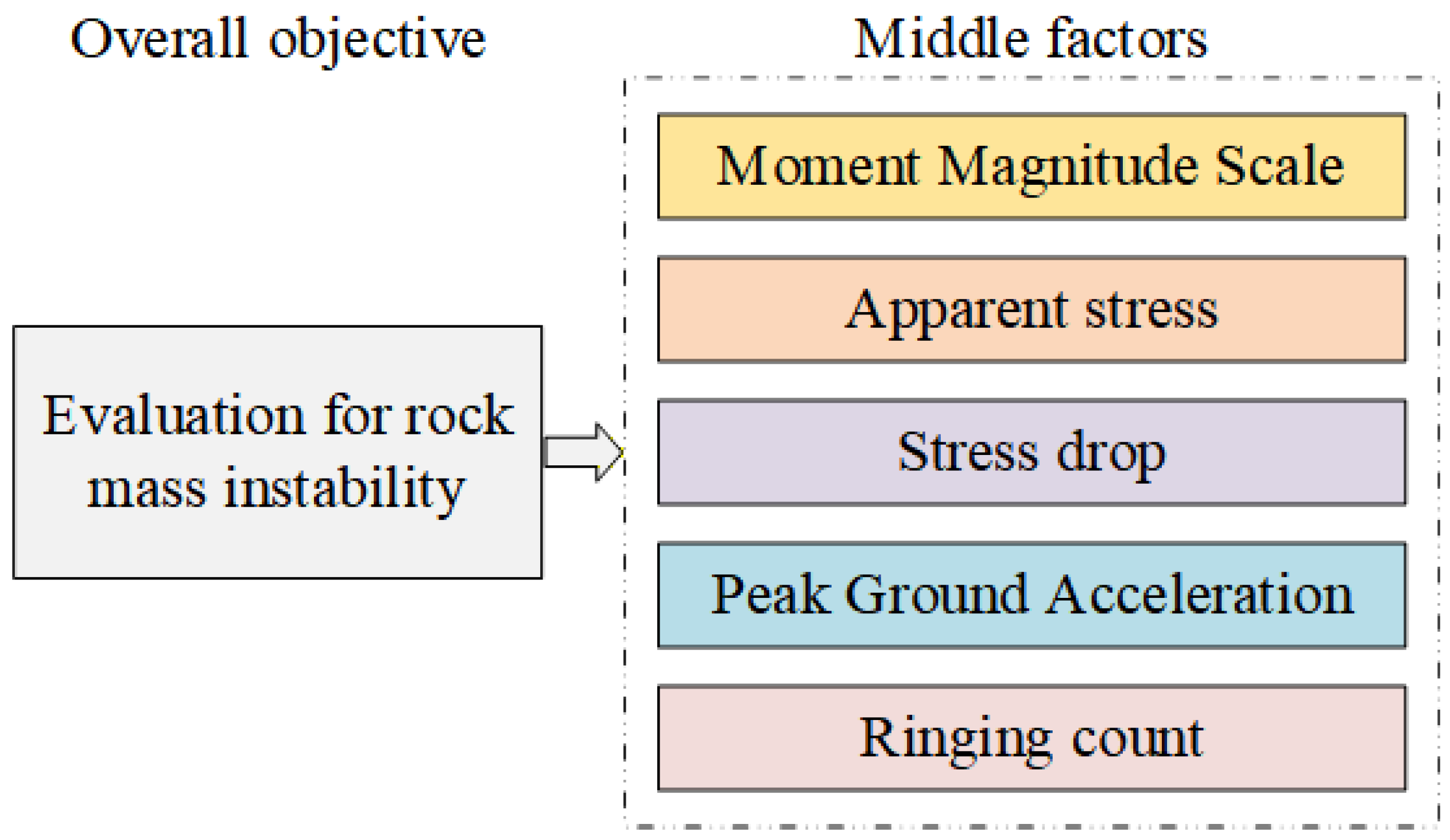
A systematic evaluation framework was ultimately established using moment magnitude scale, stress drop, apparent stress, peak ground acceleration, and ringing count by avoiding highly correlated redundant indicators (Figure 2). This framework comprehensively addresses key aspects including earthquake magnitude, stress state, ground motion, and rock mass fracture severity. These indicators possess clear physical significance and measurability in rock mass instability risk assessment, thereby enhancing the accuracy and practicality of evaluations.

2.2. Spatial Density Clustering Analysis

Hierarchical Density-Based Spatial Clustering of Applications with Noise (HDBSCAN) is a clustering algorithm developed by Campello, Moulavi, and Sander. It extends DBSCAN by converting DBSCAN to a hierarchical clustering algorithm, and then using a technique to extract planar clusters based on the stability of the clusters. HDBSCAN clustering algorithm is a density-based algorithm. Unlike k-means, it does not need to assign each data point to a cluster, because it identifies a dense cluster, and points that are not assigned to the cluster are regarded as outlier or noise. Algorithms that can effectively find different groups in the data set and identify outlier values are a valuable method [49].
Density-based clustering is a data clustering method based on the density distribution of samples. Generally, density clustering starts from the perspective of sample density, checks the connectivity between samples, and continuously expands the clustering on the basis of connectable samples to obtain the final clustering result. DBSCAN has been widely used as a classical density clustering algorithm [50]. It is an advanced algorithm that combines the advantages of hierarchical clustering and density clustering, especially suitable for adaptive clustering analysis under complex data distribution. Its core principle is to overcome the sensitivity of traditional density clustering algorithms to global density parameters by constructing a density hierarchy and extracting stable clusters. The algorithm first constructs a minimum spanning tree based on Mutual Reachability Distance, where mutual Reachability distance is defined as the maximum value of the Euclidean distance of a point pair and its core distance (that is, the distance between the point and its k-th neighbor), which can be calculated by Equation (6).
d m r ( a , b ) = max { d c ( a ) , d c ( b ) , d ( a , b ) }
where dmr(a, b) is the mutual reachability distance between point a and b (m); dc(a) and dc(b) denotes the core distance of point a and b (m); d(a, b) denotes the Euclidean distance between point a and b (m).
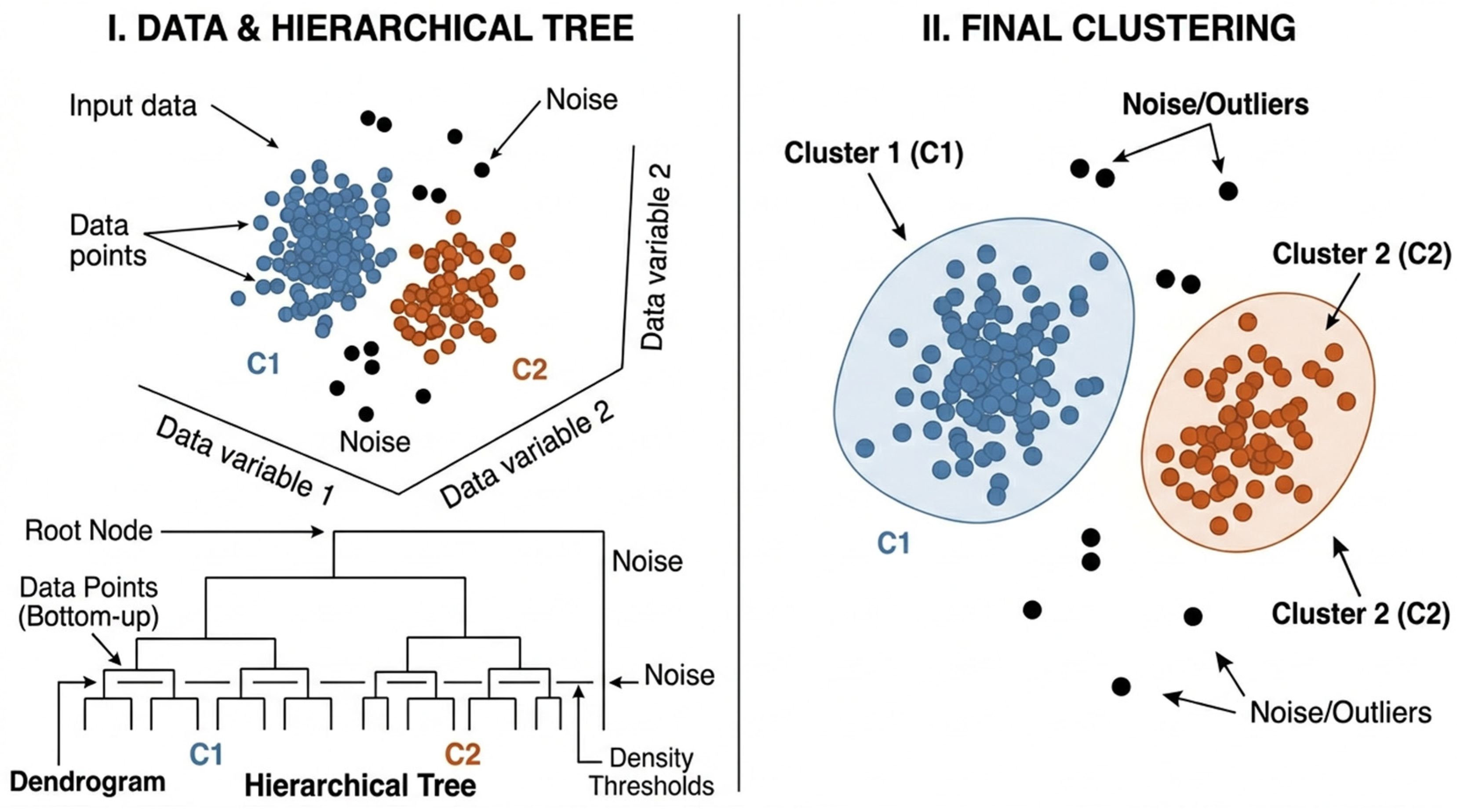
This design significantly improves noise robustness by amplifying the distance between points in sparse areas and keeping the distance between points in dense areas unchanged. Subsequently, the hierarchical tree is pruned by the parameter min_cluster_size (minimum cluster size), sub-clusters that do not meet the conditions are removed, and the optimal clustering result is selected based on the stability of the cluster (that is, the persistence of the cluster within the density threshold). At the application level, HDBSCAN does not need to preset the number of clusters, can adaptively identify clusters of different densities, and automatically separate noise data, which can be achieved through Python (v3.9). Figure 3 shows the basic principle of the HDBSCAN algorithm.

2.3. Risk Assessment for High-Density Areas

2.3.1. Determining Indicator Weights

In the multi-indicator evaluation system for rock mass instability risks in mines, scientifically and reasonably determining the weight of each evaluation indicator is crucial to ensuring the accuracy of evaluation results. The Euclidean distance method is an objective weighting approach based on the fundamental principle that: the greater the variation in an indicator’s observed values across all evaluation scenarios, the greater its role in the comprehensive assessment, and thus the higher weight it should be assigned [51]. Conversely, lower weights are assigned to indicators with smaller variations. This method effectively leverages the statistical properties inherent in the data itself, minimizing the influence of subjective factors. The calculation steps are as follows:
Step 1: Construct the initial decision matrix. Given m samples to be evaluated and an evaluation system comprising n criteria, obtain the observed values of all criteria for each sample through field surveys, monitoring, and laboratory testing. Construct the initial decision matrix X (Equation (7)).
X = ( x i j ) m × n = x 11 x 12 x 1 n x 21 x 22 x 2 n x n 1 x n 2 x n n
where xij denotes the raw observation value of the i sample under the j evaluation metric (i = 1, 2, …, m; j = 1, 2, …, n).
Step 2: Data Standardization. Since evaluation indicators typically possess different units and magnitudes, initial decision matrices require standardization to eliminate non-comparability. For rock mass instability risk assessment in mines, indicators are generally categorized as benefit-type (higher values are better) and cost-type (lower values are better). The standardization method is as follows:
For benefit-type indicators, Equation (8) can be used for calculation.
r i j = x i j min i ( x i j ) max i ( x i j ) min i ( x i j )
where xij is the raw value of the i-th sample for the j-th indicator, mini(xij) and maxi(xij) are the minimum and maximum values of the j-th indicator across all samples, and rij is the normalized value.
For cost-type indicators, Equation (9) can be used for calculation.
r i j = max i ( x i j ) x i j max i ( x i j ) min i ( x i j )
After standardization, the normalized decision matrix R is obtained (Equation (10)):
R = ( r i j ) m × n
where R is the normalized decision matrix of size m × n, m is the number of samples, n is the number of evaluation indicators, and rij is the normalized value of the i-th sample for the j-th indicator (rij ∈ [0, 1]).
Step 3: Determine the ideal values for each indicator. Based on the standardized matrix R, establish the positive ideal value Sj+ for each indicator. After standardization, all indicators have been converted into benefit-oriented metrics, where the positive ideal value is 1 and the negative ideal value is 0. This is shown in Equation (11):
Sj+ = 1, Sj = 0 (j = 1, 2, …, n)
Step 4: Calculate the Euclidean distance for each indicator. Calculate the Euclidean distance between the observed value of each sample’s indicator and its positive ideal value Sj+ and negative ideal value Sj respectively.
The distance Di+ from the i sample to the positive ideal point is calculated by Equation (12).
D i + = j = 1 n ( r i j S j + ) 2 = j = 1 n ( r i j 1 ) 2
where Di+ is the Euclidean distance from the i-th sample to the positive ideal solution, rij is the normalized value of the i-th sample for the j-th indicator, Sj+ is the positive ideal value of the j-th indicator, and n is the number of indicators.
The distance Di from the i sample to the negative ideal point is calculated by Equation (13).
D i = j = 1 n ( r i j S j ) 2 = j = 1 n ( r i j 0 ) 2 = j = 1 n r i j 2
where Di is the Euclidean distance from the i-th sample to the negative ideal solution, rij is the normalized value of the i-th sample for the j-th indicator (dimensionless), Sj is the negative ideal value of the j-th indicator and n is the number of indicators.
Step 5: Calculate the relative proximity of each indicator. Compute the relative proximity Ci of each sample to the ideal solution by Equation (14), which characterizes the quality of that sample.
C i = D i D i + + D i
where Ci is the relative closeness of the i-th sample to the ideal solution (0 ≤ Ci ≤ 1), Di+ is the distance to the positive ideal solution, and Di is the distance to the negative ideal solution. A higher Ci indicates better rock mass stability.
Step 6: Establish the relationship between Euclidean distance and proximity and calculate indicator weights. If a change in an indicator’s value causes significant fluctuations in the relative proximity Ci of all samples, then that indicator is sensitive and important. Therefore, the discriminative capability of each indicator is measured by calculating the Euclidean distance between its value and the proximity sequence of the samples.
(1)
Calculate the contribution distance dj for each indicator:
Treat the standardized value sequence (r1j, r2j, …, rmj)T of each indicator j as a vector in an m-dimensional space. Treat the relative proximity sequence (C1, C2, …, Cm)T of the sample as another vector. Calculate the Euclidean distance dj between these two vectors by Equation (15):
d j = i = 1 m ( r i j C i ) 2
where dj is the contribution distance of the j-th indicator, m is the number of samples, rij is the normalized value of the i-th sample for the j-th indicator and Ci is the relative closeness of the i-th sample.
This distance dj reflects the overall deviation between the j-th indicator and the composite evaluation result. A larger deviation indicates that the indicator exerts a greater influence on the ranking outcome and carries a higher weight.
(2)
Normalizing the weights: The contribution distance dj for each indicator is normalized to obtain the final weight ωj for each indicator (Equation (16)):
ω j = d j k = 1 n d k
where ωj is the weight of the j-th indicator (ωj ≥ 0 and j = 1 n ω j = 1 ), dj is the contribution distance of the j-th indicator, and n is the number of indicators.
By following the six steps outlined above, the weight vector W = (ω1, ω2, …, ωn) for each evaluation indicator of rock mass instability risk in mines can be objectively determined based on the Euclidean distance method. The obtained weights will be used as the basis for the fuzzy comprehensive evaluation in the following section.

2.3.2. Fuzzy Comprehensive Evaluation Method

When evaluating mine risks, many risk factors cannot be represented by accurate numbers. The fuzzy comprehensive evaluation method introduces the concept of fuzzy mathematics and establishes a risk set and a risk evaluation set on the basis of a risk index system. The entropy weight method is used to obtain the weight matrix R of each parameter and the fuzzy matrix S of the membership of the risk level, and finally the fuzzy matrix C = R·S is used to represent the comprehensive evaluation results [52]. The process of fuzzy comprehensive evaluation method is as follows.
Step 1: Define Evaluation Factors and Levels.
Let U = {U1, U2, U3, …, Um} be the m factors that describe the evaluated object, that is the middle factors. Let U1 = {U11, U12, U13, …, U1n}; U2 = {U21, U22, U23, …, U2n}; U3 = {U31, U32, U33, …, U3n}; … Um = {Un1, Un2, Un3, …, Unn}, a sub-factor under m factors, is the secondary evaluation index.
U1~4 represent 4 middle factors; U11~14 represent the four criteria under the Moment magnitude factors, respectively. U21~24 represent the four criteria under the Apparent stress factors. U31~34 represent the four criteria under the Peak Ground Acceleration factor; U41~44 represent the four criteria under the Source radius factors.
Step 2: Determine the evaluation level. V = {V1, V2, V3, …, Vn} is the n decisions that describe the state of each factor, that is, the evaluation level. According to the classification of coal mining risk assessment level, it can be divided into five risk levels: V = {Very Low Risk (I), Low Risk (II), Medium Risk(III), High Risk(IV) and Very high Risk(V)}. There is a detailed division in Table 1.
Step 3: Construct judgment matrix and determine weights (Equation (17)). The membership degree rij of factor Ui to level Vj is determined using frequency distributions of historical data.
R = ( r i j ) m × n = r 11 r 12 r 1 n r 21 r 22 r 2 n r n 1 r n 2 r n n
where rij indicates that from the perspective of the factor Ui, the evaluation object can be rated as the membership degree of Vi (i = 1, 2, …, m; j = 1, 2, …, n), specifically, rij represents the frequency distribution of the i factor Ui on the j comment Vj, which is generally normalized to satisfy ∑rij = 1. The weight of each index is determined by analytic hierarchy process W = (W1, W2, …, Wm).
Step 4: Determine the one-factor fuzzy evaluation matrix (Equation (18)).
D = W B i r B i
where WBi denotes the weight of the second-level index under the i first-level index, RBi denotes the second-level fuzzy comprehensive evaluation matrix (i = 1, 2, 3, 4) under the i-th first-level index, and the weighted average fuzzy operator is represented by the * in this paper.
Step 5: Determine the univariate fuzzy evaluation matrix D (Equation (19)). The comprehensive evaluation result D is obtained by combining the entropy weights W and fuzzy matrix R:
B = W D
where B represents the membership degree to risk level Vj.
Step 6: Risk Level Determination. The final risk level is assigned based on the maximum membership principle or weighted scoring. For instance, if C = (0.1, 0.3, 0.4, 0.15, 0.05), the region is classified as “Medium Risk (III)”.

2.4. Trend Analysis of Rock Mass Instability Areas

After determining the density of the mine and determining the safety level of the high-density area, the kernel density estimation (KDE) method was used to analyze the spatial dimension. KDE is a non-parametric method for estimating the probability density function of data. The basic idea is to place a kernel function around each observation, and then accumulate and normalize the kernel functions of all observations to obtain an estimate of the probability density within the entire data space. KDE places a small probability distribution map for each data point, and then overlays the probability distribution map on all data points to form a complete high probability density map. A high probability density plot represents the probability distribution of the entire data set. In areas with dense data points, the value of vertical coordinates increases, and vice versa [53]. For datasets with unknown distribution, the estimated probability density function can be obtained by this method [54]. The higher the density value, the higher the concentration of hazardous events in the area. Generally speaking, given independent homogeneous samples (x1, x2, …, xn) drawn from a univariate distribution, and the kernel density estimate for the unknown probability density function f(x) for any given point x is calculated by Equation (20).
f ^ ( x , y ) = 1 n h d i = 1 n K ( x x i p h )
where h denotes the bandwidth parameter (h > 0), which determines the smoothness and accuracy of the estimation density function. The higher the h value, the smoother the density function, and the smaller the value, the clearer the density function. n is the total number of sampling points, d corresponds to the dimension of the data, and p is the paradigm of the control distance calculation.
K(x) is a kernel function that is symmetrical to the center of the training sample point, and commonly used kernel functions include uniform, triangular, normal, and Gaussian kernel functions. In this paper, the Gaussian kernel function is used, and the expression of the one-dimensional Gaussian kernel function is as follows (Equation (21)).
k ( x x i ) = exp ( x x i 2 ( 2 δ 2 ) )
where σ denotes the radial parameter of the function, which is used to control the radial range of the function.
In this study, to avoid the subjective bias associated with manual parameter setting, the bandwidth was adaptively determined using Scott’s rule [55]. This data-driven approach dynamically adjusts the search radius according to the spatial distribution characteristics and sample size of the microseismic events. It effectively balances the highlighting of localized high-risk hotspots with the prevention of over-smoothing, thereby ensuring an objective and accurate representation of the spatial clustering of microseismic activities.
This paper analyzes trends in high-risk areas by calculating KDE values for different regions within mines and overlaying them across temporal and spatial dimensions. It identifies migration, expansion, or contraction trends in disaster zones through dynamic variations in density distribution. During the data preprocessing stage, spatio-temporal coordinates of hazardous events are standardized, spatial grids are delineated, and missing values are addressed to ensure temporal continuity. Subsequently, the overall density distribution is calculated by selecting kernel functions and bandwidth parameters. Finally, spatio-temporal dynamic analysis is conducted to examine trend characteristics in high-density areas, such as directional diffusion and periodic fluctuations. Statistical validation is performed by selecting data from different periods to assess the accuracy of the trend analysis methodology.
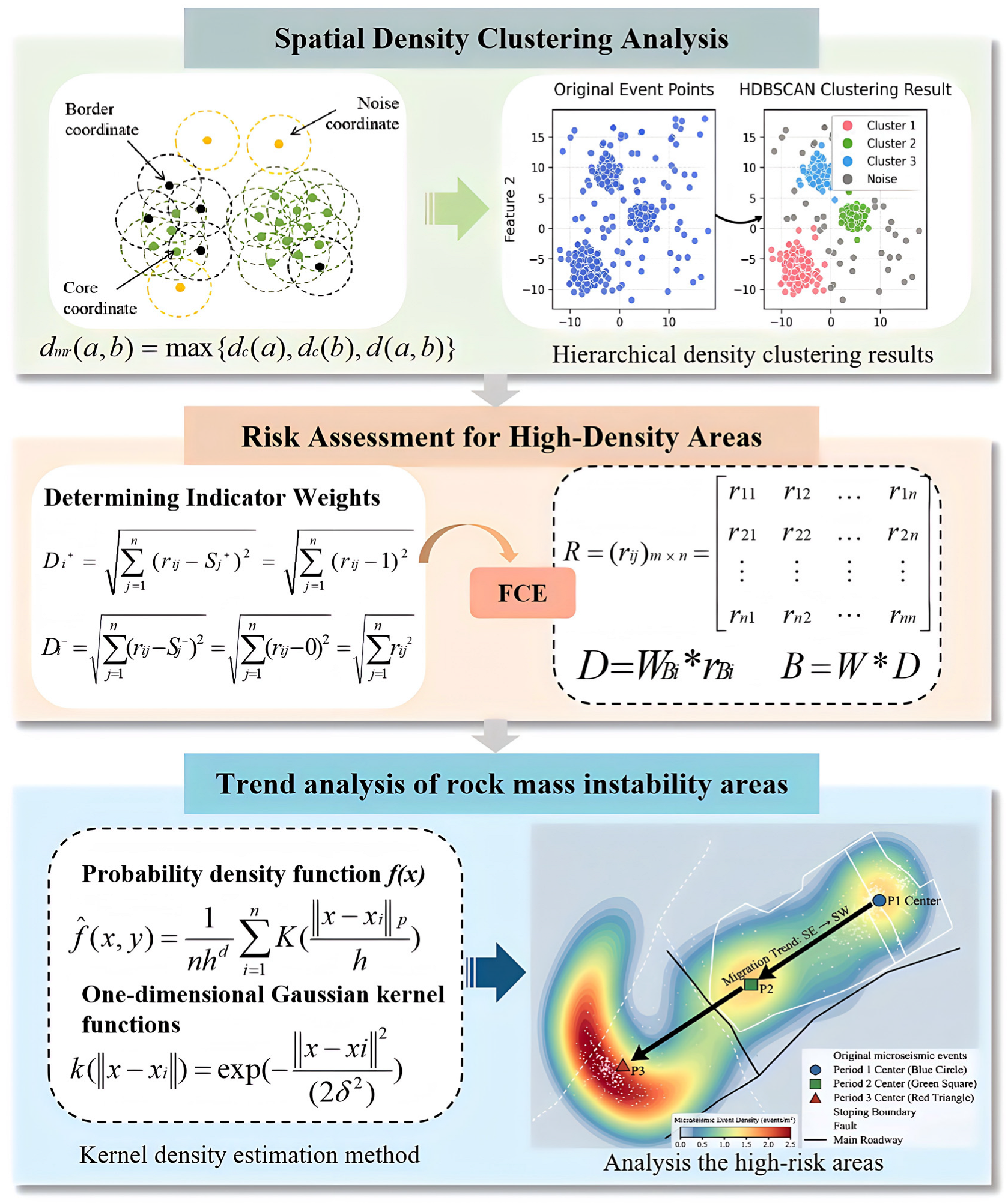
The specific methodological flowchart of this study is shown in Figure 4.

3. Case Study

3.1. Research Areas and Data Collection

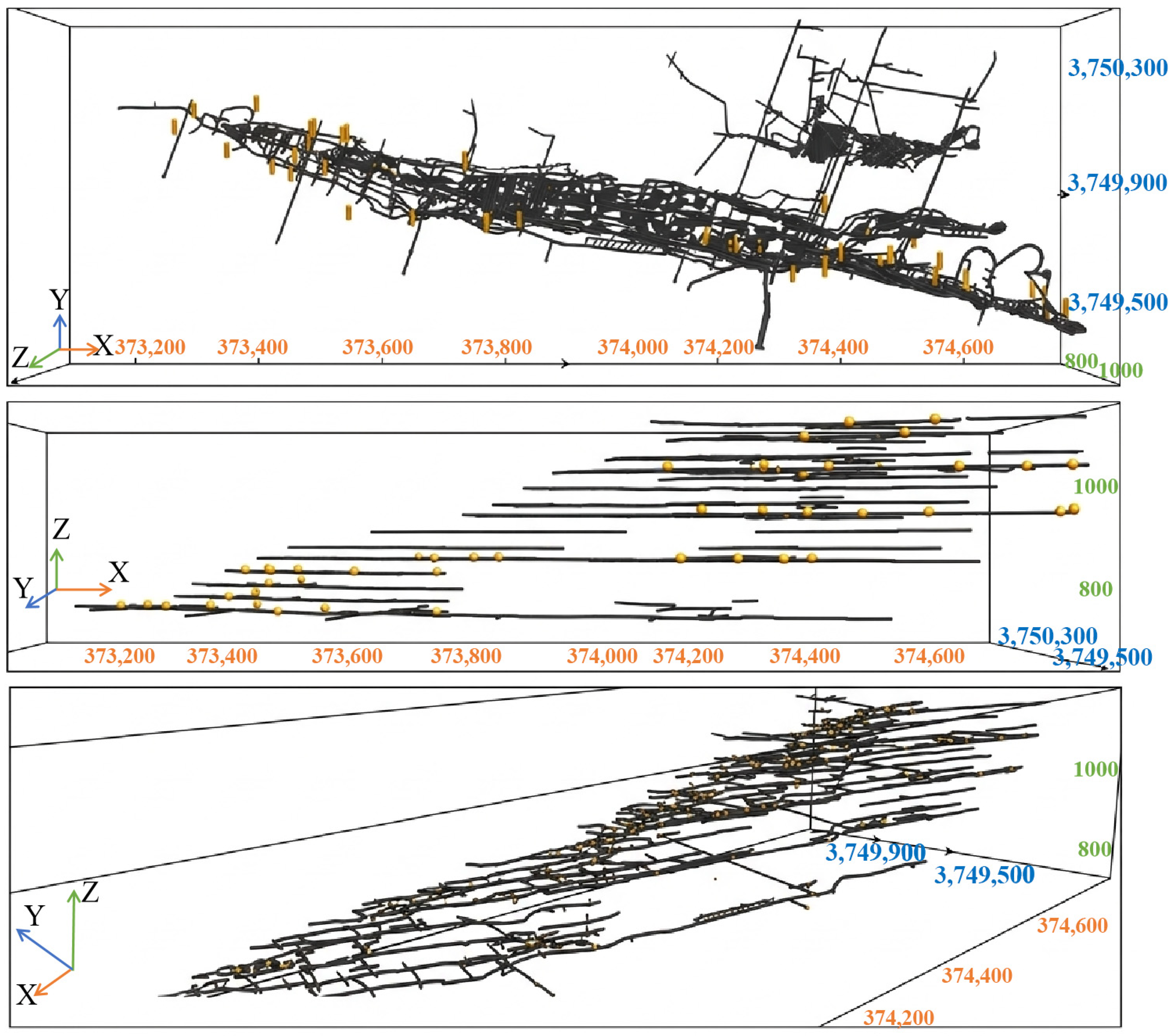
This study analyzes and evaluates rock mass instability at a lead–zinc metal mine in Northwest China using the methodology proposed in this paper. It further conducts spatial trend analysis and prediction for areas with high event density, enabling appropriate measures to mitigate risks. Figure 5 presents a three-dimensional view of the lead–zinc metal mine, with golden markers indicating sensor layouts.
The current mining area exhibits a pronounced high-stress background. In situ rock stress measurements indicate that with increasing mining depth, the superposition of tectonic stress fields and gravity significantly elevates horizontal stress levels. The ejection behavior of schistose phyllite during roadway excavation reveals an abrupt energy accumulation and release characteristic. Deep engineering rock masses remain in a high-energy storage state, with surrounding rock failure exhibiting a brittle-ductile transition trend, significantly exacerbating rockburst susceptibility. Rockburst risks are particularly pronounced in deep high-stress environments [56]. Although publicly reported frequency data on deep rockbursts is limited, field monitoring reveals that rock mass displacement in deep mining areas exhibits nonlinear abrupt changes directly correlated with sudden increases in energy release rates. Primary triggers for rock mass instability may include: imbalance between energy accumulation and release, fault activation, and rock strength degradation.
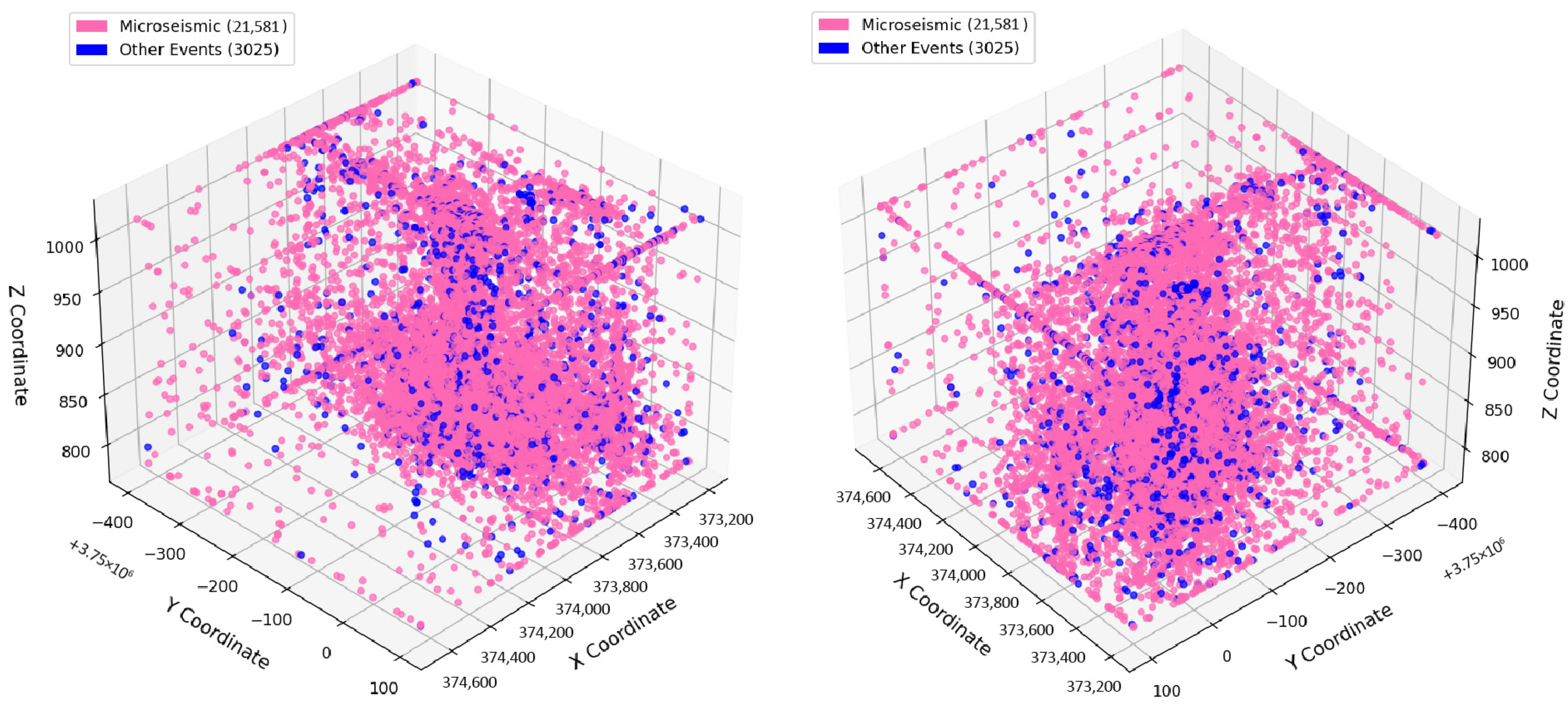
Systematic risk identification and prevention are particularly crucial for addressing rock mass instability risks induced by high in situ stress and complex fault structures at the deep levels of a lead–zinc mine in Baoji City, Shaanxi Province. This study deployed a microseismic monitoring system composed of sensors across the research area, covering key mining zones such as working faces, roadways, and fault zones to enable real-time data collection. Sensor data capturing microseismic events and blasting activities within the mine were utilized for analysis and evaluation in this paper. This study selected 24,706 events collected over 181 days from 1 January 2023 to 30 June 2023. The collected data parameters include time, event type, number of waveforms, X, Y, Z components, average wave velocity, energy flux, corner frequency, low-frequency spectral level, seismic moment, seismic energy, source radius, stress drop, apparent stress, peak ground velocity, peak ground acceleration, Richter magnitude scale, surface wave magnitude scale, moment magnitude scale, dominant frequency, and ringing count. These parameters were utilized for calculation, analysis, and prediction. After removing unclassified events, a total of 24,606 events were available for subsequent research in this paper. The distribution of all events is shown in Figure 6.

3.2. Data Processing

3.2.1. HDBSCAN Clustering Analysis

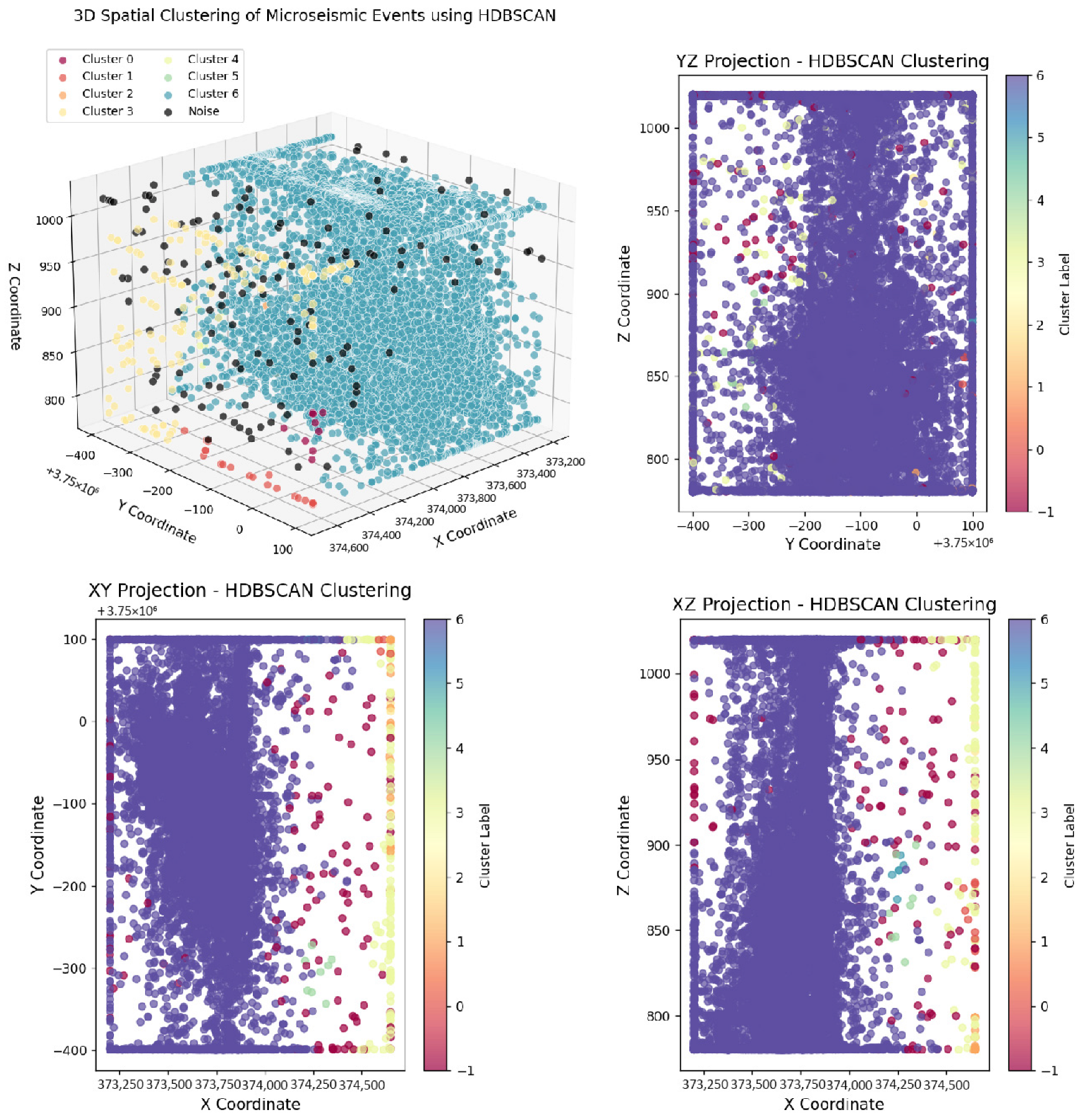
A global clustering analysis was conducted on 24,606 events spanning six months in 2023. Figure 7 presents the HDBSCAN clustering results for the entire dataset. As shown in Figure 7, when analyzing all data together, the large volume of data and dense event distribution resulted in unclear clustering outcomes. The coordinate ranges in the data are: X ∈ [373,200.01, 374,649.99], Y ∈ [3,749,600.00, 3,750,100.00]. Therefore, to more precisely identify and evaluate the specific conditions and trend changes within rock mass instability risk zones, the data was spatially grouped based on its X and Y coordinates. The data segmentation points were set at: X = 373,729.97, Y = 3,749,883.96. This divides the data into four groups: the Northeast Region, Northwest Region, Southwest Region, and Southeast Region. Table 2 shows the specific grouping details. Spatial analysis is then conducted on each of these four regions.
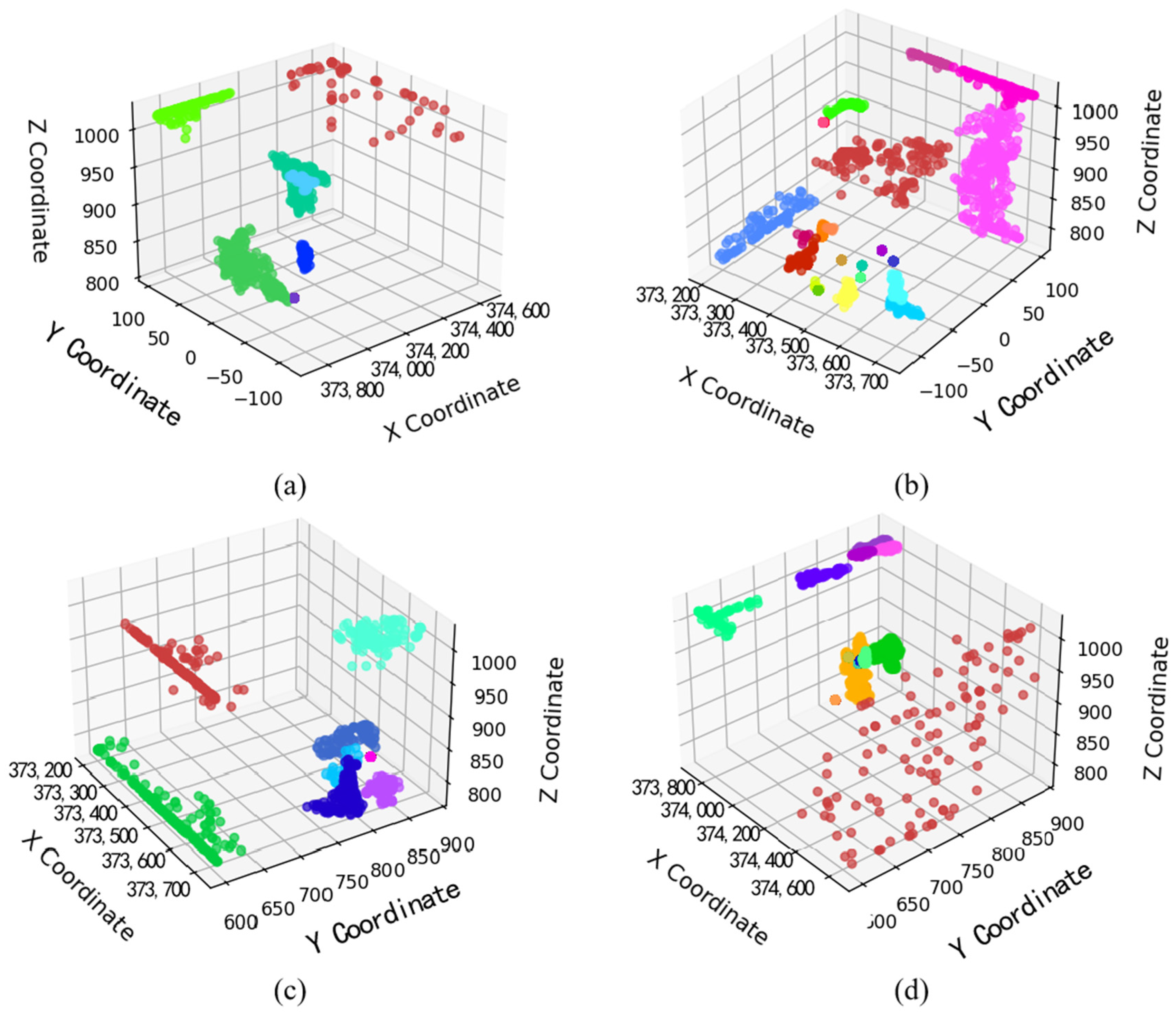
Read the X, Y, and Z coordinate data of events within each grouped region from the Excel file. Different colors represent different clusters, while gray points indicate noise points. Using the HDBSCAN method, perform cluster analysis. In this study, the min_cluster_size parameter of HDBSCAN was set to 50 based on a trade-off between detecting meaningful high-density clusters and avoiding excessive fragmentation of the dataset [27]. Sensitivity tests showed that smaller values produced many small clusters with limited practical significance, whereas larger values merged distinct high-risk zones, reducing spatial resolution. The selected value was empirically determined to best capture the primary microseismic clusters corresponding to known geological structures. The overall results are shown in the figure below. Figure 8 reveals that microseismic events are densely distributed in the northwest and southeast regions, consistent with the actual mining operations at the site. These two areas will be prioritized for further investigation in subsequent research.
Following clustering analysis using HDBSCAN and removal of noise points, 11 high-density clusters were identified in the northeastern region, 36 in the northwestern region, 13 in the southwestern region, and 26 in the southeastern region, resulting in a total of 86 high-density clusters encompassing 11,638 microseismic events. In the subsequent Results section, spatial analysis will be conducted with primary reference to these data and high-density clusters.

3.2.2. Calculation of Evaluation Indicator Weights

This study employed the Euclidean distance method to determine the weights of the evaluation indicators. Using 24,606 sets of microseismic monitoring data from a mine as samples, we calculated the entropy weight of each indicator through the Euclidean distance approach, thereby obtaining relatively objective weights.
Among the evaluation indicators, moment magnitude scale, apparent stress, stress drop, peak ground acceleration, and ringing count are all cost-type indicators. This means that higher values of these indicators correspond to a greater risk of rock mass instability, more energy released by the event, and a less stable system. When applying the Euclidean distance method to determine the weights, it is essential to ensure that all indicators are aligned in the same computational direction. Therefore, we first normalized the aforementioned five cost-type indicators before performing the calculations, which yielded the final weights for all evaluation indicators. The results are presented in Table 3.
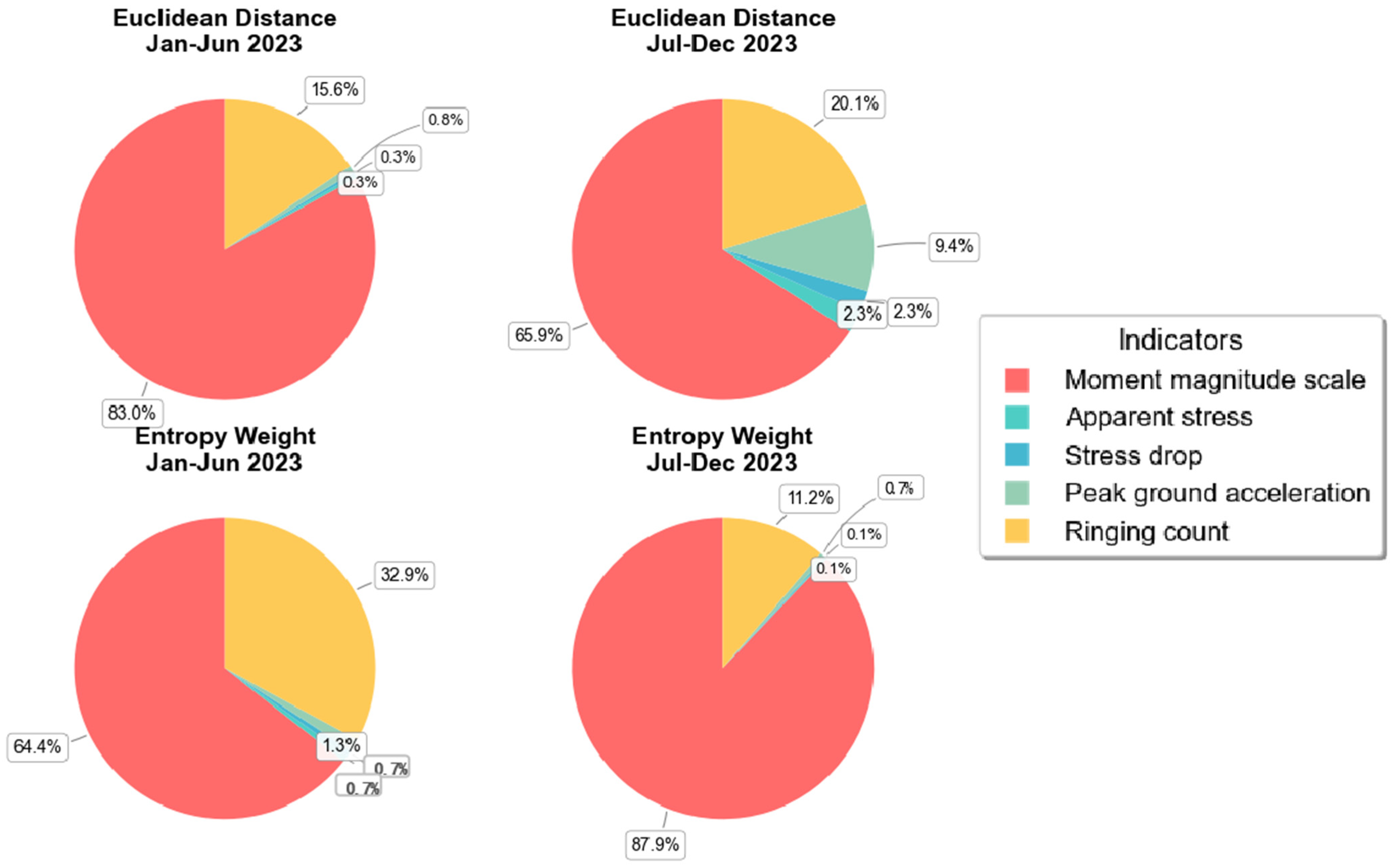
Based on the Euclidean distance method, the weights of evaluation indicators for mine rock mass instability risk were calculated. The results reveal significant differences in the contribution of each indicator within the comprehensive evaluation system (Table 3). The moment magnitude scale holds an absolute dominant position with a weight of 82.97%, while the ringing count serves as a secondary contributing indicator with a weight of 15.57%. In contrast, the three indicators—apparent stress, stress drop, and peak ground acceleration—collectively account for only 1.46% of the total weight, exerting a minimal influence. It is crucial to clarify that a minor objective weight does not equate to statistical redundancy. As demonstrated by the correlation analysis (Figure 1), these five indices are mutually independent and free of multicollinearity, ensuring that each inputs unique geomechanical information into the Fuzzy Comprehensive Evaluation (FCE) model.
The primary reason for this highly concentrated weight distribution lies in the sensitivity of the Euclidean distance method to the variability of indicator values. As the core parameter measuring the scale of seismic events, the moment magnitude scale exhibits a wide range of variation across different events, particularly in deep high-stress environments where some events show significantly higher magnitudes. This amplifies the differences in normalized values of this indicator, leading to a higher contribution in weight calculation. The ringing count, serving as a direct indicator reflecting the frequency of micro-fractures, also displays considerable fluctuation across different regions and time periods, thus obtaining a relatively high weight. In contrast, the three indicators—apparent stress, stress drop, and peak ground acceleration—show relatively concentrated value distributions and smaller coefficients of variation within the dataset of this study. This results in weaker discriminative power during Euclidean distance calculation and significantly lower weights. Furthermore, these indicators share certain intrinsic physical correlations with moment magnitude, and partial information overlap may also reduce their independent contribution in the comprehensive evaluation. From the perspective of risk composition, the moment magnitude scale serves as the primary indicator constituting high risk, with its high weighting reflecting that under deep mining conditions, rock mass instability risk is predominantly driven by large-scale energy release events. As a secondary indicator, the ringing count embodies the contribution of micro-fracture frequency to risk accumulation.
The low weights assigned to stress and kinematic parameters are a mathematical reflection of their relatively narrow variance within the specific monitoring period, contrasting with the massive fluctuation of moment magnitude. However, eliminating these ‘low-weight’ independent variables would severely compromise the robustness of the evaluation framework [57]. Firstly, retaining them allows the objective weighting algorithm to dynamically adapt to extreme, non-typical instability scenarios in the future. Secondly, in the FCE matrix computation, when the dominant indicator places a microseismic cluster near the fuzzy boundary between two risk levels, the combined influence of these four independent parameters acts as a critical tie-breaker, ensuring accurate risk classification. Consequently, maintaining this five-indicator multidimensional structure is scientifically mandatory to prevent the model from degenerating into a unidimensional energy-ranking system.

4. Results and Discussion

4.1. Risk Assessment of High-Density Event Clusters

Conduct risk assessments for each high-density event cluster within the spatial regions obtained through HDBSCAN clustering. Employing a fuzzy comprehensive evaluation method, calculate the indicator values for each high-density area. Combine these values with weights determined using the Euclidean distance method to generate a set of evaluation results. Finally, based on the maximum membership degree principle, identify the evaluation grade corresponding to the largest number within the result set—this represents the risk level for that high-density area.
As shown in Table 4, based on the FCE calculation results and the determined risk levels, the safety status of these regional clusters exhibits a pronounced concentration of risk, with the vast majority of high-density areas at a medium-to-low safety level. Specifically, over 70% of the regions are rated as “High Risk”, constituting the main body of the risk distribution. Nearly 30% fall within the “Medium Risk” category. Together, these two levels account for 97.6% of all regions, reflecting a generally concerning overall safety situation. Notably, only a very small proportion of regions achieve a “Low Risk” rating, while none attain the highest safety level. Furthermore, 1.2% of regions remain in the most hazardous Level V state.
This risk distribution indicates that the regional cluster faces widespread security vulnerabilities, necessitating systematic risk management measures. Particular attention should be given to the significantly more hazardous areas, which constitute the absolute majority. Priority should be given to deploying security monitoring and protective facilities in these areas to prevent further escalation of risks. Subsequent analysis will focus on high-risk zones classified as High Risk (IV) and Very High Risk (V). Detailed FCE calculation results for each region are provided in Supplementary Material.

4.2. Kernel Density Estimation

Revealing the spatial distribution patterns and dynamic evolution of microseismic events through kernel density estimation. Analyzing microseismic event data from high-risk zones recorded between 1 January and 30 June 2023, density calculations were performed using Gaussian kernel functions, followed by integrated spatiotemporal dynamic analysis.
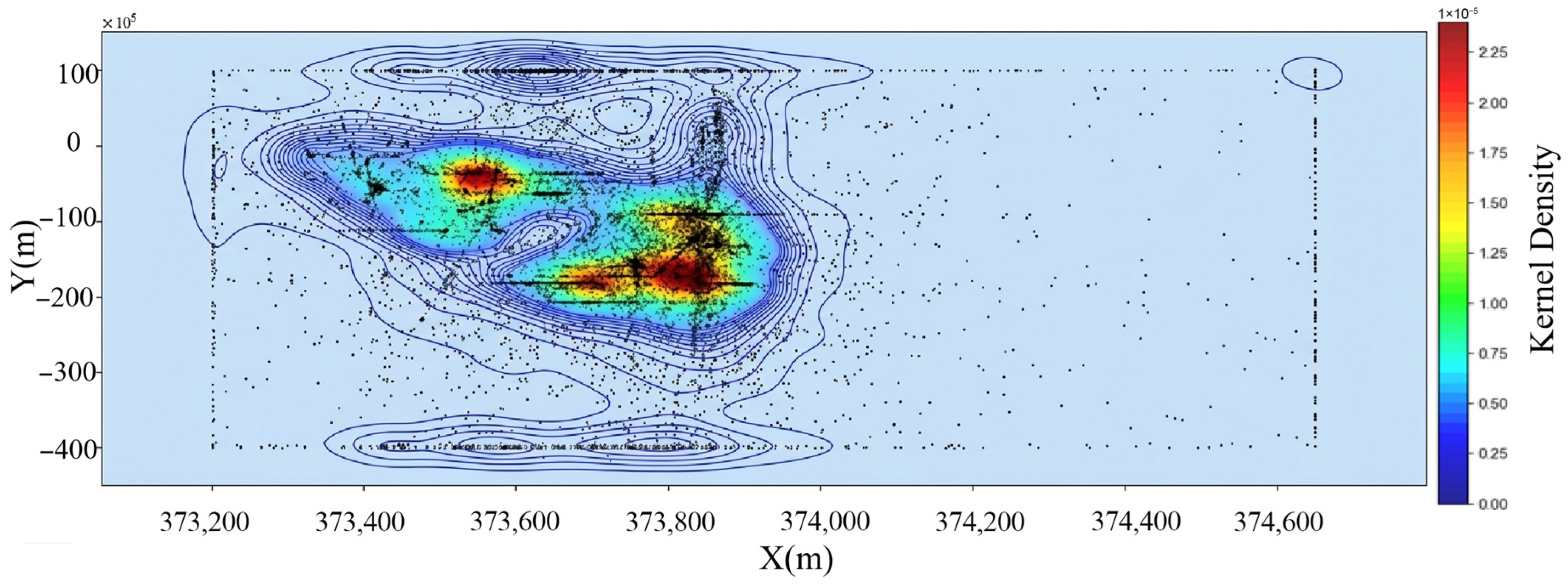
The warm-colored areas (red and yellow) in Figure 9 indicate zones with high-density microseismic events, representing potential high-risk regions; the cool-colored areas (blue and green) denote low-density or sparse zones. It is clearly observable that high-density zones are primarily distributed along the western tunnel and the boundaries of the mined-out areas, which closely aligns with the known major geological structures and mining activity trajectories within the mining area. The risk of dynamic hazards in the mine is jointly controlled by mining activities and geological engineering structures. Its spatial evolution is dominated by a northeast-southwest orientation, exhibiting a macro-scale pattern where the northeast region serves as the source area, with hazards propagating southwestward to form a multi-center network configuration.
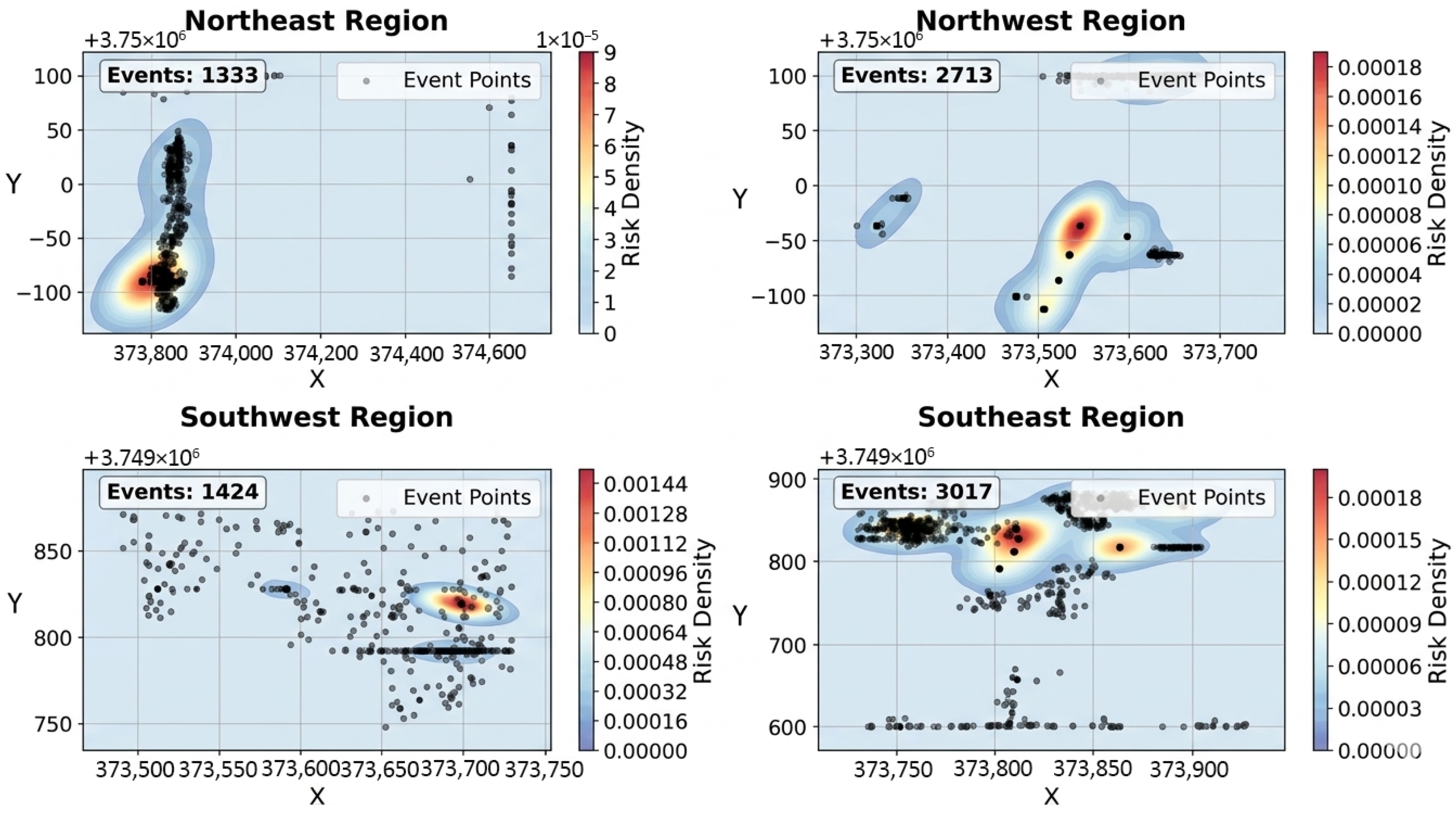
By conducting KDE modeling and visualization of the spatial location and density variation of high-density clusters over time series, we can clearly delineate the dynamic migration trajectory of stress concentration zones and potential failure regions within the rock mass. This trajectory not only reveals the orientation of rock mass instability but also indicates the evolving front of hazard risk. The specific spatial distribution and dynamic evolution of these high-risk events are visually presented in the KDE-based heatmaps (Figure 10).
(1)
Spatiotemporal Migration Characteristics of High-Risk Areas
Microseismic monitoring data from the mine revealed distinct formation patterns in high-risk zones across different regions between January and February 2023. The G1 high-risk zone in the northeast region formed a significant initial core stress concentration area at its northeastern corner (X ≈ 374,600, Y ≈ 3750,050), exhibiting significantly higher event density than other areas. Together with the G2 zone in the same northeast region, it formed a northwest-southeast trending high-risk belt. Meanwhile, the northwest region scattered multiple small cluster centers. These clusters were relatively dispersed without a dominant area, indicating characteristics controlled by local geological structures. The southeast region exhibits a ring-shaped distribution pattern along the boundaries of the mined-out areas, characterized by moderate event intensity but uniform spatial distribution, reflecting the initial stress adjustment process along these boundaries. During this period, the southwest region has stabilized into a multi-center pattern, with three active centers maintaining relatively fixed spatial positions and exhibiting diversified event types. This distribution pattern is clearly controlled by multiple intersecting joint systems.
From March to April 2023, high-risk zones across all regions exhibited pronounced dynamic evolution. The northeast region demonstrated the most active migration trend, with the southeastward primary migration path extending approximately 100–150 m southeastward from the G1 core zone, directly targeting the southeastern goaf. This migration simultaneously activated the G3 and G4 zone within this area, establishing it as a new risk frontier. Concurrently, the northeast region developed a secondary southwestward migration pathway, with the G2 zone spreading southwestward and exhibiting pronounced synergistic effects with the G3 zone. The northwest region exhibited a unique tectonically controlled migration pattern during this period, with risk zones displaying “jump-like” migration characteristics along fault structures, expanding collectively toward the mine boundary. The southeast region exhibited a pronounced centripetal aggregation trend, with the risk zone migrating deeper to form a more concentrated annular distribution. This phenomenon reflects the gradual formation of the stress arch effect in the goaf. The southwest region’s evolution during this phase was relatively moderate, with only a slow outward expansion of the risk zone boundary. Each sub-region maintained a relatively stable multi-center pattern, expanding at a significantly slower pace than other areas.
Entering May to June 2023, the high-risk patterns in each region further solidified and exhibited distinct stabilized forms. The northeast region formed a typical tri-center pattern: the northeastern core zone (G1) maintained persistent risk but showed dispersed energy trends; the central-southern risk zone (G3 and G4) emerged as a new focal point for concentrated energy, exhibiting heightened activity; while the deep western zone (G10 and G11) remained active, posing potential rockburst risks. During this period, the northwest region developed a linear risk aggregation pattern along geological structural belts. The distribution of risks showed weak correlation with the advancement direction of mining faces, indicating strong geological structural control. The southeast region entered a relatively stable phase after energy release, with its ring-shaped distribution pattern largely solidified, signaling the preparatory stage for the next stress accumulation-release cycle. The southwest region ultimately formed a stable grid-like risk distribution pattern, showing clear correlation with tunnel layout and maintaining a state of long-term stable accumulation overall.
(2)
Characteristics of Energy Density Variation Across Regions
Regarding energy density evolution, distinct regional variations emerged. In the Northeast region, Area G1 exhibited a sustained rise in energy density from January to March, peaking before experiencing a noticeable energy shift after April. Areas G3 and G4 saw a sharp increase exceeding 30% in energy density during April and May, becoming new focal points of energy concentration. Meanwhile, Areas G10 and G11 maintained a consistently high state of energy concentration. The Northwest region overall exhibited a gradual energy accumulation process without pronounced energy transfer, with only localized short-term energy concentrations occurring. The Southeast region demonstrated distinct periodic energy fluctuations, featuring a significant energy density peak in April. Following energy release, regional stability improved, forming a complete accumulation-release cycle. The Southwest region maintained relatively balanced energy distribution, with minor variations in energy density across sub-regions, remaining in a stable accumulation state overall.
Synthesizing the spatiotemporal evolution patterns across regions reveals pronounced cross-regional coupling effects. Stress field transmission path analysis indicates that the Northeast region transmits stress influences to the Northwest region via the central structural belt, while simultaneously undergoing stress adjustments with the Southeast region through goaf linkage. Significant stress field coupling effects exist between all regions.
Regarding the spatiotemporal correlation of risk evolution, the risk evolution path in the Northeast region exhibits clear temporal synchrony with other regions. Spatially, a risk diffusion trend from northeast to southwest has formed, fully reflecting the systematic reorganization process of the mine’s overall stress field. These findings provide scientific basis for establishing differentiated prevention and control strategies tailored to regional characteristics, and lay the theoretical foundation for shifting mine safety management from localized prevention to systematic governance.
(3)
Analysis of Migration Driving Mechanisms
Mining Unloading Guidance: The primary migration direction points toward goafs and roadways, consistent with the “mining unloading” effect. Additionally, aseismic slip may facilitate the spatiotemporal migration of high-risk zones by modulating local stress fields and energy release patterns, which aligns with the migration phenomena observed along structural belts in this study [58]. Rock masses in front of working faces and around goafs are areas most prone to stress concentration. Consequently, high-risk zones migrate toward these potential free surfaces [9].
Geological Structure Control: Displacement paths exhibit distinct banded and discrete characteristics rather than uniform diffusion. This strongly suggests control by geological structures such as concealed faults, joint zones, or lithological interfaces. Stress is more readily transmitted and released along these weak planes.
Human Activity Catalysis: Time series data reveal that microseismic events frequently cluster in adjacent zones following blasting and rock drilling operations. This indicates that human mining activities directly catalyze the migration of high-risk zones by actively altering the original rock stress equilibrium.
The migration pathways of high-risk zones clearly demonstrate that rock mass instability in mines is a dynamic process characterized by progression from near to far, from shallow to deep, controlled by tectonics, and advancing with mining operations. Analyzing the dynamic evolution pathways of high-risk zones enables spatial prediction of disaster risks [59]. Based on this, it is recommended to install additional anchor cables to reinforce support in high-risk clusters and to implement stress-relief drilling or blasting ahead of the predicted migration path to proactively release strain energy. Additionally, a dynamic early-warning mechanism based on KDE should be established.

4.3. Verification of the Proposed Method

The proposed integrated method of “HDBSCAN-FCE-KDE” demonstrates excellent applicability and effectiveness in identifying and evaluating risk zones for rock mass instability in deep mining. Regarding indicator weight determination, this study employs the Euclidean distance method for objective weighting. Compared to the traditional entropy weighting method, the Euclidean distance method places greater emphasis on the variability of indicator values across samples, thereby better reflecting the inherent distribution characteristics of the data. For instance, in this study, the moment magnitude scale was assigned a weight as high as 82.97% due to its significant numerical variation across different events, objectively reflecting its dominant role in deep rock mass instability risk. The weight distribution of all five indicators is shown in Figure 11. Building upon this foundation, the Fuzzy Comprehensive Evaluation method incorporates the uncertainty of each indicator into the evaluation system through membership functions. This approach effectively addresses the ambiguity and nonlinearityt in mine risk assessment, yielding evaluation results that closely align with actual conditions.
To validate the effectiveness of the Euclidean distance method in weight determination, this study compares it with the entropy weight method. Calculations were performed using 16,339 data sets from July to December 2023, with the weight calculation results shown in Table 5. The overall weight distribution patterns of the two methods are similar. While the overall weight distribution patterns derived from both methods are similar, the Euclidean distance method assigns a significantly higher weight of 82.97% to moment magnitude compared to the result from the entropy weight method (64.43%). This better aligns with the actual mechanism where large-scale energy release events dominate risks in deep mining operations. Furthermore, perturbation tests on the sample data demonstrated greater stability for the Euclidean distance method, with a lower coefficient of variation in weights compared to the entropy weighting method. This indicates its superior suitability for highly variable microseismic data.
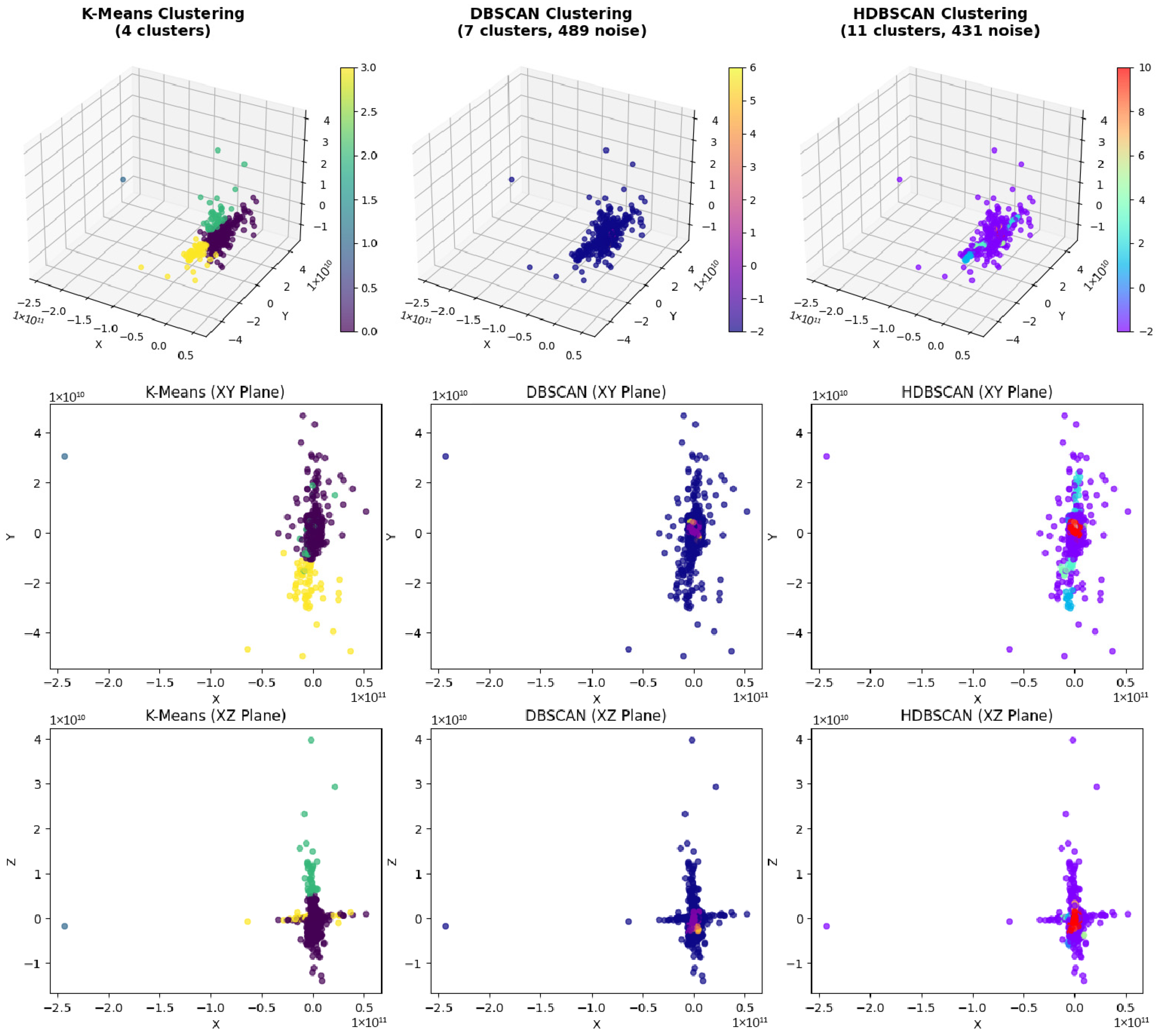
K-Means partitions data into spherical clusters with a predefined number of clusters and cannot identify noise. DBSCAN detects clusters of arbitrary shape based on global density parameters but is sensitive to parameter selection and may over-segment regions with varying densities. HDBSCAN extends DBSCAN by constructing a density hierarchy, adaptively determining the optimal number of clusters, effectively handling clusters of varying densities, and automatically labeling noise points, making it particularly suitable for complex, non-uniform microseismic event distributions. In terms of cluster analysis, the HDBSCAN algorithm demonstrates significant advantages. It is particularly suitable for non-spherical, elongated microseismic event clusters distributed along faults [60], enabling more accurate detection of potential risk clusters. Furthermore, HDBSCAN automatically identifies and isolates noise points. In this study, it successfully identified 86 high-density zones encompassing 11,638 microseismic events. The clustering results in Figure 12 clearly reveal the spatial correlation between mining activities and geological structures.
The comparison of clustering evaluation metrics (Table 6) shows that HDBSCAN outperforms DBSCAN in both the contour coefficient (0.9314) and DB index (0.4446), indicating higher clustering quality and better intra-cluster consistency. Although K-Means achieves the best CH index, its clustering number requires manual setting and it cannot identify noise points, resulting in limited flexibility for practical applications.
Furthermore, when processing microseismic event data with fuzzy boundaries and uneven densities, HDBSCAN reduces the number of noise points by approximately 15% compared to DBSCAN, enabling more accurate detection of potential risk clusters. In this study, a total of 86 high-density clusters were identified, covering 11,638 microseismic events. The clustering results reflect the spatial correlation between mining activities and geological structures.
The Kernel Density Estimation (KDE) method further reveals the spatiotemporal migration patterns of high-risk zones. By constructing density heatmaps, this study captures the migration path of high-risk zones from the northeast to the southwest direction, reflecting the reorganization process of the overall mine stress field. To validate the effectiveness of the method, a retrospective test was conducted using part of the monitoring data after June 2023. The results show that multiple microseismic events indeed occurred in the high-risk zones identified by the proposed method during the subsequent period, confirming its predictive capability.
In terms of predicting spatial trends of rock mass instability, the multi-method integrated framework proposed in this study shows clear advantages over single clustering or statistical analysis. For example, compared to traditional warning methods based on magnitude thresholds, this study integrates fuzzy comprehensive evaluation with kernel density analysis, achieving a multi-dimensional assessment that shifts from “whether it is hazardous” to “how hazardous it is” and “how the hazardous zones evolve,” significantly reducing the false-negative rate.
The findings of this study provide clear guidance for on-site mine safety management. In line with actual mining conditions, most of the identified high-risk clusters are located along main roadways and goaf boundaries. It is recommended to enhance support measures in these areas, such as installing additional rock bolts or applying shotcrete, to improve surrounding rock stability. Moreover, by analyzing the spatiotemporal migration paths of high-risk zones, the future development direction of stress concentration zones can be anticipated. This provides a basis for the mine to implement proactive control measures, such as advanced pressure relief or adjustments to the mining sequence, thereby facilitating a shift from “post-incident remediation” to “pre-incident prevention.”

4.4. Limitations and Prospects

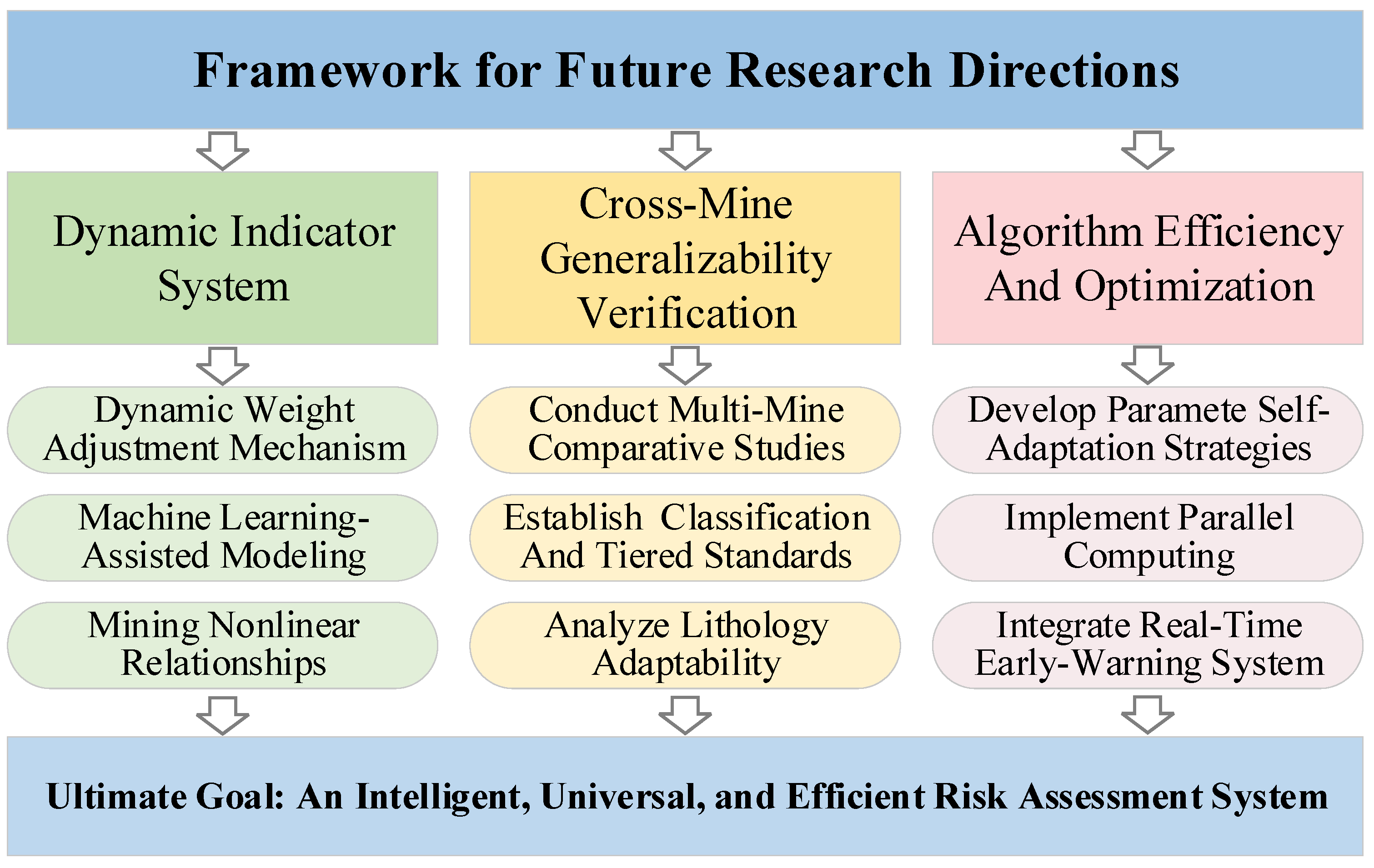
This study has achieved certain results by establishing a risk identification and evaluation system for rock mass instability in deep mining areas based on HDBSCAN-FCE-KDE. Its effectiveness has been validated using actual mine data. However, the study still has the following limitations that require further refinement and expansion in future research. As shown in Figure 13, future research should focus on three directions: dynamic indicator systems, cross-mining area applicability verification, and algorithm efficiency optimization.
(1)
Indicator System Construction: This study established a five-dimensional evaluation framework based on microseismic monitoring data, incorporating moment magnitude scale, stress drop, apparent stress, peak ground acceleration, and ringing count. While indicator selection thoroughly considered physical significance and data redundancy, the dynamic characteristics of these indicators and their nonlinear relationship with rock mass instability processes remain under-explored in practical applications. Future work may incorporate dynamic weight adjustment mechanisms or integrate machine learning approaches to develop more adaptive intelligent indicator systems that better reflect risk evolution patterns across different mining phases.
(2)
Cross-mine generalizability remains unvalidated: This study uses a specific lead–zinc mine as a case study, characterized by unique geological conditions and mining methods. Although the proposed method demonstrates broad applicability in typical hard rock mines, its suitability for soft rock mining areas requires further validation due to significant differences in mechanical behavior, fracture mechanisms, and energy release characteristics among diverse rock types. Future comparative studies across different mine types, such as coal mines and salt rock mines, should explore the influence of rock properties on method applicability and establish a classified, graded risk assessment standard system.
(3)
Algorithm Parameter Dependency and Computational Efficiency: While the HDBSCAN, FCE, and KDE methods employed in this study demonstrate excellent performance in clustering and spatial analysis, their effectiveness remains influenced by parameter settings. The key algorithmic parameters were optimized for the site-specific geological conditions of the studied lead–zinc mine. Extending this framework to other mine types warrants further validation and adaptive recalibration to ensure its broader applicability. Additionally, they exhibit certain computational complexities when processing large-scale, high-dimensional data. Future research may explore adaptive parameter optimization strategies or incorporate advanced technologies like parallel computing and deep learning to enhance method automation and operational efficiency, thereby meeting real-time risk warning requirements.
In summary, future research should focus on three directions: dynamic indicator systems, cross-mining area applicability verification, and algorithm efficiency optimization. This will advance deep mining rock mass instability risk identification and evaluation methods toward greater intelligence, universality, and efficiency.

5. Conclusions

This study focused on the identification and evaluation of rock mass instability risk zones under deep mining conditions by establishing an integrated methodology combining HDBSCAN spatial density clustering, fuzzy comprehensive evaluation, and kernel density estimation. The approach was systematically validated using microseismic monitoring data from a lead–zinc mine in Northwest China between January and June 2023. The proposed method developed in this study demonstrates strong engineering applicability and early warning value. It provides systematic technical support for identifying, evaluating, and dynamically monitoring rock mass instability risk zones under deep mining conditions, thereby facilitating the transition of mine safety management from passive response to active prevention. The major contents and results of this study are summarized below:
(1)
The proposed HDBSCAN-FCE-KDE integrated method demonstrates significant effectiveness in identifying and dynamically assessing rock mass instability risks in deep mines. Without requiring predefined cluster numbers, HDBSCAN adaptively identified 86 high-density zones encompassing 11,638 microseismic events, clearly revealing the spatial clustering of events along faults and mining activities. Compared to traditional clustering methods, HDBSCAN achieved better silhouette coefficient (0.9314) and DB index (0.4446), indicating superior clustering quality and noise handling capability.
(2)
The objective weighting mechanism based on Euclidean distance effectively reflects the variability of each indicator and its differential contribution to risk assessment. The moment magnitude scale and ringing count received weights of 0.8297 and 0.1557 respectively, together accounting for 98.54% of the total weight, indicating their decisive influence on rock mass instability risk in this dataset. In contrast, the combined weight of apparent stress, stress drop, and peak ground acceleration was only 1.46%. Coupled with fuzzy comprehensive evaluation, the results show that 70.9% of the 86 high-density clusters are classified as high risk (Level IV) and 26.7% as medium risk (Level III), reflecting generally poor rock mass stability across the study area.
(3)
Kernel density estimation revealed the spatiotemporal migration and clustering patterns of high-risk zones: spatially, high-risk areas concentrated along western roadways and the boundaries of mined-out zones; temporally, they exhibit a systematic migration trend from northeast to southwest. This migration is jointly driven by mining unloading, geological structures, and human activities, reflecting the dynamic reorganization of the mine’s overall stress field and the evolutionary path of the risk frontier. Method comparison and retrospective validation demonstrate that this integrated approach possesses strong reliability in risk identification accuracy and trend prediction.

Supplementary Materials

The following supporting information can be downloaded at: https://www.mdpi.com/article/10.3390/math14081261/s1. The supplementary material provides the complete FCE assessment results for all 86 high-density clusters identified via HDBSCAN, including the cluster ID, number of microseismic events, FCE value, and corresponding risk level.

Author Contributions

Y.B.: Writing—Original Draft, Writing—Review and Editing, Software, Validation, Investigation, Conceptualization, Methodology, Formal Analysis, Visualization, Data curation. W.Z.: Writing—Review and Editing, Software, Validation, Investigation, Formal Analysis, Conceptualization, Resources. F.Y.: Conceptualization, Methodology, Formal Analysis, Investigation, Writing—Review and Editing, Project administration, Supervision, Funding acquisition, Resources. X.H.: Conceptualization, Methodology, Formal Analysis, Visualization, Software, Validation. All authors have read and agreed to the published version of the manuscript.

Funding

The study is supported by Deep Earth Probe and Mineral Resources Exploration—National Science and Technology Major Project (No. 2025ZD1010902), National Natural Science Foundation of China (52474280, 52104108).

Data Availability Statement

The original contributions presented in this study are included in the article and Supplementary Material. Further inquiries can be directed to the corresponding author.

Acknowledgments

We gratefully acknowledge the financial support from the Deep Earth Probe and Mineral Resources Exploration—National Science and Technology Major Project and the National Natural Science Foundation of China. Our sincere thanks also go to the academic editors and anonymous reviewers for their insightful suggestions and valuable comments.

Conflicts of Interest

The authors declare no conflicts of interest.

References

  1. Li, P.; Cai, M. Challenges and New Insights for Exploitation of Deep Underground Metal Mineral Resources. Trans. Nonferrous Met. Soc. China 2021, 31, 3478–3505. [Google Scholar] [CrossRef]
  2. Cai, M.; Li, P.; Tan, W.; Ren, F. Key Engineering Technologies to Achieve Green, Intelligent, and Sustainable Development of Deep Metal Mines in China. Engineering 2021, 7, 1513–1517. [Google Scholar] [CrossRef]
  3. Wang, J.; Dong, L.; Ji, S. Rock Mass Instability Early Warning Model: A Case Study of a High and Steep Annular Slope Mining Areas Using Sen’s Slope Trend Analysis. Tunn. Undergr. Space Technol. 2025, 159, 106514. [Google Scholar] [CrossRef]
  4. He, M.; Wang, Q. Rock Dynamics in Deep Mining. Int. J. Min. Sci. Technol. 2023, 33, 1065–1082. [Google Scholar] [CrossRef]
  5. Dong, L.; Zhu, H.; Yan, F.; Bi, S. Risk Field of Rock Instability Using Microseismic Monitoring Data in Deep Mining. Sensors 2023, 23, 1300. [Google Scholar] [CrossRef]
  6. Nazarov, L.A.; Nazarova, L.A.; Yaroslavtsev, A.F.; Miroshnichenko, N.A.; Vasil’eva, E.V. Evolution of Stress Fields and Induced Seismicity in Operating Mines. J. Min. Sci. 2011, 47, 707–713. [Google Scholar] [CrossRef]
  7. Su, Y.; Zeng, P.; Yao, W.; Gao, J.; Zhou, C.; Duan, J.; Zhang, Y.; Han, B.; Zhu, W.; Chen, T.; et al. Investigating the Dynamic Characteristics of Crack Formation of Jiangxi Lateritic Soil Subjected to Drying-Wetting Cycles. J. Saf. Sustain. 2025, 2, 195–206. [Google Scholar] [CrossRef]
  8. Chai, S.; Wen, C.; Yu, J.; Chai, L.; Yue, S. Vibration of Viscoelastic Rock Slope with a Filled Structural Plane Caused by Incident P-Wave. J. Saf. Sustain. 2025, 2, 257–267. [Google Scholar] [CrossRef]
  9. Zhang, Y.; Hao, C.; Dong, L.; Pei, Z.; Fan, F.; Bascompta, M. Identification of Regionalized Multiscale Microseismic Characteristics and Rock Failure Mechanisms under Deep Mining Conditions. Int. J. Min. Sci. Technol. 2025, 35, 1357–1378. [Google Scholar] [CrossRef]
  10. Dong, L.; Pei, Z.; Xie, X.; Zhang, Y.; Yan, X. Early Identification of Abnormal Regions in Rock-Mass Using Traveltime Tomography. Engineering 2023, 22, 191–200. [Google Scholar] [CrossRef]
  11. Chen, H.; Xue, S.; Zheng, X. Multi-Master Event Waveform Stacking Microseismic Location Method Based on Time-Frequency Transformation. J. Appl. Geophys. 2024, 220, 105267. [Google Scholar] [CrossRef]
  12. Huang, L.; Liu, W.; Li, X.; Wang, Z. Transfer Learning from Physical Scale Information: A Signal Identification Method for Mine System Security Monitoring. Reliab. Eng. Syst. Saf. 2026, 266, 111665. [Google Scholar] [CrossRef]
  13. Ren, F.; Zhu, C.; Yuan, Z.; Karakus, M.; Tang, S.; He, M. Recognition of Shear and Tension Signals Based on Acoustic Emission Parameters and Waveform Using Machine Learning Methods. Int. J. Rock Mech. Min. Sci. 2023, 171, 105578. [Google Scholar] [CrossRef]
  14. Liu, Q.; Ren, Y.; Wang, P.; Liu, C.; Fu, Y. Identification of Precursor for Fracture Failure of Brittle Rocks Based on Digital Image Correlation Technique. J. Saf. Sustain. 2025, 2, 231–242. [Google Scholar] [CrossRef]
  15. Dong, L.; Yan, X.; Wang, J.; Tang, Z.; Wang, H.; Wu, W. Case Study on Pre-Warning and Protective Measures against Rockbursts Utilizing the Microseismic Method in Deep Underground Mining. J. Appl. Geophys. 2025, 237, 105687. [Google Scholar] [CrossRef]
  16. Feng, X.; Chen, B.; Li, S.; Zhang, C.; Xiao, Y.; Feng, G.; Zhou, H.; Qiu, S.; Zhao, Z.; Yu, Y.; et al. Studies on the evolution process of rockbursts in deep tunnels. J. Rock Mech. Geotech. Eng. 2012, 4, 289–295. [Google Scholar] [CrossRef]
  17. Ma, K.; Shen, Q.; Sun, X.; Ma, T.; Hu, J.; Tang, C. Rockburst Prediction Model Using Machine Learning Based on Microseismic Parameters of Qinling Water Conveyance Tunnel. J. Cent. South Univ. 2023, 30, 289–305. [Google Scholar] [CrossRef]
  18. Sun, J.; Wang, W.; Xie, L. Predicting Short-Term Rockburst Using RF–CRITIC and Improved Cloud Model. Nat. Resour. Res. 2024, 33, 471–494. [Google Scholar] [CrossRef]
  19. Xu, G.; Shan, P.; Lai, X.; Hu, Q.; Yang, S.; Xu, H. Thermomechanical Behavior and Damage Mechanism of the Lining Backfill Body of High-Temperature Thermal Energy Storage Reservoirs in Mines. Tunn. Undergr. Space Technol. 2026, 171, 107409. [Google Scholar] [CrossRef]
  20. Xu, H.; Li, K.; Shan, P.; Wu, X.; Zhang, S.; Wang, Z.; Liu, C.; Yan, Z.; Wu, L.; Wang, H. Automatic Picking Method for the First Arrival Time of Microseismic Signals Based on Fractal Theory and Feature Fusion. Fractal Fract. 2025, 9, 679. [Google Scholar] [CrossRef]
  21. Zhu, C.; Xu, Y.; He, M.; Jiang, Y.; Karakus, M.; Hu, L.; Jiang, Y.; Ren, F. Identification of failure behaviors of underground structures under dynamic loading using machine learning. J. Rock Mech. Geotech. Eng. 2025, 17, 414–431. [Google Scholar] [CrossRef]
  22. Zhou, J.; Zhang, Y.; Li, C.; He, H.; Li, X. Rockburst Prediction and Prevention in Underground Space Excavation. Undergr. Space 2024, 14, 70–98. [Google Scholar] [CrossRef]
  23. Wang, H.; Song, C.; Wang, J.; Gao, P. A Raster-Based Spatial Clustering Method with Robustness to Spatial Outliers. Sci. Rep. 2024, 14, 4103. [Google Scholar] [CrossRef] [PubMed]
  24. Kang, Y.; Wu, K.; Gao, S.; Ng, I.; Rao, J.; Ye, S.; Zhang, F.; Fei, T. STICC: A Multivariate Spatial Clustering Method for Repeated Geographic Pattern Discovery with Consideration of Spatial Contiguity. Int. J. Geogr. Inf. Sci. 2022, 36, 1518–1549. [Google Scholar] [CrossRef]
  25. Rui, Y.; Zhou, Z.; Cai, X.; Dong, L. A Novel Robust Method for Acoustic Emission Source Location Using DBSCAN Principle. Measurement 2022, 191, 110812. [Google Scholar] [CrossRef]
  26. Wu, X.; Wang, D.; Yang, M.; Liang, C. CEEMDAN-SE-HDBSCAN-VMD-TCN-BiGRU: A Two-Stage Decomposition-Based Parallel Model for Multi-Altitude Ultra-Short-Term Wind Speed Forecasting. Energy 2025, 330, 136660. [Google Scholar] [CrossRef]
  27. Campello, R.J.G.B.; Moulavi, D.; Zimek, A.; Sander, J. Hierarchical Density Estimates for Data Clustering, Visualization, and Outlier Detection. ACM Trans. Knowl. Discov. Data 2015, 10, 1–51. [Google Scholar] [CrossRef]
  28. Yan, F.; Li, X.; Dong, L.; Du, S.; Wang, H.; Sun, D. A Status Evaluation of Rock Instability in Metal Mines Based on the SPA–IAHP–PCN Model. Appl. Sci. 2025, 15, 2614. [Google Scholar] [CrossRef]
  29. Feng, S.; Zhao, L.; Ying, C.; Shen, S.; Wang, W.; Gao, X.-Z.; Pirasteh, S. Fuzzy Comprehensive Three-Level Evaluation for Deep Learning Classification Targeting High-Dimensional Data. Appl. Soft Comput. 2026, 188, 114443. [Google Scholar] [CrossRef]
  30. He, Y.; Qin, R. Analysis of the Spatial Distribution and Future Trends of Coal Mine Accidents: A Case Study of Coal Mine Accidents in China from 2005–2022. Spat. Stat. 2024, 63, 100851. [Google Scholar] [CrossRef]
  31. Jackson, T.R.; Zhan, G. Coupled Baseline Estimation and Trend Analysis Approach to Differentiate Natural and Mine-Related Stresses on Groundwater Levels. Mine Water Environ. 2024, 43, 294–312. [Google Scholar] [CrossRef]
  32. Zhang, G.; Zhu, A.-X.; Huang, Q. A GPU-Accelerated Adaptive Kernel Density Estimation Approach for Efficient Point Pattern Analysis on Spatial Big Data. Int. J. Geogr. Inf. Sci. 2017, 31, 2068–2097. [Google Scholar] [CrossRef]
  33. Yuan, K.; Cheng, X.; Gui, Z.; Li, F.; Wu, H. A Quad-Tree-Based Fast and Adaptive Kernel Density Estimation Algorithm for Heat-Map Generation. Int. J. Geogr. Inf. Sci. 2019, 33, 2455–2476. [Google Scholar] [CrossRef]
  34. He, Y.-L.; Chen, C.-J.; Chen, J.-Q. A Data-Driven Fused Kernel Density Estimator for Multi-Modal Distribution. Inf. Fusion 2026, 125, 103434. [Google Scholar] [CrossRef]
  35. Cai, M.; Morioka, H.; Kaiser, P.K.; Tasaka, Y.; Kurose, H.; Minami, M.; Maejima, T. Back-Analysis of Rock Mass Strength Parameters Using AE Monitoring Data. Int. J. Rock Mech. Min. Sci. 2007, 44, 538–549. [Google Scholar] [CrossRef]
  36. Das, R.; Sharma, M.; Choudhury, D.; Gonzalez, G. A Seismic Moment Magnitude Scale. Bull. Seismol. Soc. Am. 2019, 109, 1542–1555. [Google Scholar] [CrossRef]
  37. Mendecki, A.J. Seismic Monitoring in Mines; Springer Science & Business Media: Berlin/Heidelberg, Germany, 1996. [Google Scholar]
  38. Brown, L.; Hudyma, M. Identification of Stress Change within a Rock Mass through Apparent Stress of Local Seismic Events. Rock Mech. Rock Eng. 2017, 50, 81–88. [Google Scholar] [CrossRef]
  39. Hanks, T.C.; Kanamori, H. A Moment Magnitude Scale. J. Geophys. Res. Solid Earth 1979, 84, 2348–2350. [Google Scholar] [CrossRef]
  40. Wyss, M.; Brune, J.N. Seismic Moment, Stress, and Source Dimensions for Earthquakes in the California-Nevada Region. J. Geophys. Res. 1968, 73, 4681–4694. [Google Scholar] [CrossRef]
  41. Yin, S.; Song, D.; He, X.; Lou, Q.; Qiu, L.; Li, Z.; Peng, C.; Li, J.; Liu, Y. Structural Health Monitoring of Building Rock Based on Stress Drop and Acoustic-Electric Energy Release. Struct. Control Health Monit. 2022, 29, e2875. [Google Scholar] [CrossRef]
  42. Brune, J.N. Tectonic Stress and the Spectra of Seismic Shear Waves from Earthquakes. J. Geophys. Res. 1970, 75, 4997–5009. [Google Scholar] [CrossRef]
  43. Gibowicz, S.J.; Kijko, A. An Introduction to Mining Seismology; Elsevier: Amsterdam, The Netherlands, 2013; Volume 55. [Google Scholar]
  44. Scholz, C.H. The Mechanics of Earthquakes and Faulting; Cambridge University Press: Cambridge, UK, 2019. [Google Scholar]
  45. Kanamori, H.; Brodsky, E.E. The Physics of Earthquakes. Phys. Today 2001, 54, 34–40. [Google Scholar] [CrossRef]
  46. Huang, J.; Zhao, X.; Zhao, M.; Du, X.; Wang, Y.; Zhang, C.; Zhang, C. Effect of Peak Ground Parameters on the Nonlinear Seismic Response of Long Lined Tunnels. Tunn. Undergr. Space Technol. 2020, 95, 103175. [Google Scholar] [CrossRef]
  47. Niu, Y.; Zhou, X.-P.; Berto, F. Temporal Dominant Frequency Evolution Characteristics during the Fracture Process of Flawed Red Sandstone. Theor. Appl. Fract. Mech. 2020, 110, 102838. [Google Scholar] [CrossRef]
  48. Tang, J.; Chen, X.; Dai, F.; Wei, M. Experimental Investigation of Fracture Damage of Notched Granite Beams under Cyclic Loading Using DIC and AE Techniques. Fatigue Fract. Eng. Mater. Struct. 2020, 43, 1583–1596. [Google Scholar] [CrossRef]
  49. Duykers, J.L.; Ardana, K.; Yulistiani, R.; Irwansyah, E.; Fitrianah, D. Identifying Factors for Supporting Early Warning Flood Using Clustering Approach and Geo-Spatial Analysis. Procedia Comput. Sci. 2023, 227, 540–547. [Google Scholar] [CrossRef]
  50. Wang, L.; Chen, P.; Chen, L.; Mou, J. Ship AIS Trajectory Clustering: An HDBSCAN-Based Approach. J. Mar. Sci. Eng. 2021, 9, 566. [Google Scholar] [CrossRef]
  51. Dokmanic, I.; Parhizkar, R.; Ranieri, J.; Vetterli, M. Euclidean Distance Matrices: Essential Theory, Algorithms, and Applications. IEEE Signal Process. Mag. 2015, 32, 12–30. [Google Scholar] [CrossRef]
  52. Zhao, Y.; Zhang, C.; Wang, Y.; Lin, H. Shear-Related Roughness Classification and Strength Model of Natural Rock Joint Based on Fuzzy Comprehensive Evaluation. Int. J. Rock Mech. Min. Sci. 2021, 137, 104550. [Google Scholar] [CrossRef]
  53. Ke, N.; Lu, X.; Kuang, B.; Zhang, X. Regional Disparities and Evolution Trend of City-Level Carbon Emission Intensity in China. Sustain. Cities Soc. 2023, 88, 104288. [Google Scholar] [CrossRef]
  54. Niu, Y.; Li, H.; Tang, Z.; Liu, L.; Long, H.; Yan, H.; Zhu, M.; Zhang, J. STP-KDE: A Spatiotemporal Trajectory Protection and Publishing Method Based on Kernel Density Estimation. Comput. Electr. Eng. 2024, 117, 109328. [Google Scholar] [CrossRef]
  55. Scott, D.W. Multivariate Density Estimation; John Wiley & Sons, Inc.: Hoboken, NJ, USA, 2015. [Google Scholar] [CrossRef]
  56. Li, X.; Gong, F.; Tao, M.; Dong, L.; Du, K.; Ma, C.; Zhou, Z.; Yin, T. Failure Mechanism and Coupled Static-Dynamic Loading Theory in Deep Hard Rock Mining: A Review. J. Rock Mech. Geotech. Eng. 2017, 9, 767–782. [Google Scholar] [CrossRef]
  57. Zhou, J.; Yang, P.; Peng, P.; Khandelwal, M.; Qiu, Y. Performance Evaluation of Rockburst Prediction Based on PSO-SVM, HHO-SVM, and MFO-SVM Hybrid Models. Min. Metall. Explor. 2023, 40, 617–635. [Google Scholar] [CrossRef]
  58. Wang, J.; Shu, W. A Brief Review on the Role of Aseismic Slip on Experimental Faults: Implications for Fault-Involved Geological Engineering Safety. J. Saf. Sustain. 2025, 2, 1–10. [Google Scholar] [CrossRef]
  59. Ma, T.H.; Tang, C.A.; Tang, L.X.; Zhang, W.D.; Wang, L. Rockburst Characteristics and Microseismic Monitoring of Deep-Buried Tunnels for Jinping II Hydropower Station. Tunn. Undergr. Space Technol. 2015, 49, 345–368. [Google Scholar] [CrossRef]
  60. Stewart, G.; Al-Khassaweneh, M. An Implementation of the HDBSCAN* Clustering Algorithm. Appl. Sci. 2022, 12, 2405. [Google Scholar] [CrossRef]
Figure 1. Pearson correlation matrix of the 16 initial microseismic parameters used for feature selection and dimensionality reduction.
Mathematics 14 01261 g001
Figure 2. Rock Mass Instability Risk Evaluation Index.
Mathematics 14 01261 g002
Figure 3. Principle of the HDBSCAN algorithm.
Mathematics 14 01261 g003
Figure 4. Flowchart of the proposed HDBSCAN-FCE-KDE methodology. The framework consists of three main stages: (I) spatial clustering and noise identification of microseismic events using HDBSCAN; (II) risk level classification of the identified high-density clusters via fuzzy comprehensive evaluation with indicator weights objectively determined by the Euclidean distance method; and (III) spatiotemporal migration analysis of high-risk zones using kernel density estimation (KDE).
Mathematics 14 01261 g004
Figure 5. Three-dimensional view of a lead–zinc metal mine.
Mathematics 14 01261 g005
Figure 6. Overall distribution of rock mass instability events at the mine under study.
Mathematics 14 01261 g006
Figure 7. HDBSCAN clustering results for all data.
Mathematics 14 01261 g007
Figure 8. HDBSCAN Clustering Results (a) Northeast Region; (b) Northwest Region; (c) Southwest Region; (d) Southeast Region.
Mathematics 14 01261 g008
Figure 9. Microseismic Event Kernel Density Distribution.
Mathematics 14 01261 g009
Figure 10. Spatial Distribution Map of High-Risk Events Based on Kernel Density Estimation.
Mathematics 14 01261 g010
Figure 11. Weight Calculation Results Comparison Chart.
Mathematics 14 01261 g011
Figure 12. Comparison of HDBSCAN, DBSCAN, and K-Means Clustering Performance.
Mathematics 14 01261 g012
Figure 13. Framework for Future Research Directions.
Mathematics 14 01261 g013
Table 1. Classification of risk levels.
Risk LevelIIIIIIIVV
Parameter distribution(0.8, 1)(0.6, 0.8](0.4, 0.6](0.2, 0.4](0, 0.2]
Table 2. Grouping Details.
GroupTotal Number of Incidents
Northeast Region8221
Northwest Region8221
Southwest Region4082
Southeast Region4082
Table 3. Weights of Evaluation Indicators Based on Euclidean Distance Calculation.
Evaluation IndicatorsMoment Magnitude ScaleApparent StressStress DropPeak Ground AccelerationRinging Count
Weights0.82970.00340.00340.00770.1557
Table 4. Summary of FCE Risk Assessment Results for High-Density Clusters.
RegionTotal ClustersLow Risk (II)Medium Risk (III)High Risk (IV)Very High-Risk Clusters (V)
Northeast110% (0)18.2% (2)81.8% (9)0% (0)
Northwest362.8% (1)30.6% (11)63.9% (23)2.8% (1)
Southwest130% (0)23.1% (3)76.9% (10)0% (0)
Southeast260% (0)26.9% (7)73.1% (19)0% (0)
Overall861.2% (1)26.7% (23)70.9% (61)1.2% (1)
Note: The numbers in parentheses represent the number of clusters assigned to each risk level within each region.
Table 5. Comparison of indicator weights determined by Euclidean distance and entropy weight methods.
Evaluation IndicatorsEuclidean Distance Method
(Jan–Jun/Jul–Dec)
Entropy Weight Method
(Jan–Jun/Jul–Dec)
Moment Magnitude scale0.8297/0.65910.6443/0.8791
Apparent Stress0.0034/0.02310.0068/0.0014
Stress Drop0.0034/0.02310.0068/0.0014
Peak Ground Acceleration0.0077/0.09360.0133/0.0058
Ringing Count0.1557/0.20120.3287/0.1122
Table 6. Comparison Table of Clustering Method Evaluation Metrics.
MethodNumber of ClustersSilhouette CoefficientCH IndexDB Index
K-Means40.96345532.61620.5014
DBSCAN70.9341585.57070.6260
HDBSCAN110.93143370.30290.4446
Disclaimer/Publisher’s Note: The statements, opinions and data contained in all publications are solely those of the individual author(s) and contributor(s) and not of MDPI and/or the editor(s). MDPI and/or the editor(s) disclaim responsibility for any injury to people or property resulting from any ideas, methods, instructions or products referred to in the content.