Article

On Wind Effects in a Hyperbolic Advection–Reaction–Diffusion Forest Fire Model: Analytical Solutions, Stability, and Bifurcation Analysis


by
Elena V. Nikolova
*,
Gergana N. Nikolova
and
Tsvetomir Ch. Pavlov
Institute of Mechanics, Bulgarian Academy of Sciences, Acad. G. Bonchev Str., Bl. 4, 1113 Sofia, Bulgaria
*
Author to whom correspondence should be addressed.
Mathematics 2026, 14(7), 1118; https://doi.org/10.3390/math14071118
Submission received: 28 February 2026 / Revised: 21 March 2026 / Accepted: 25 March 2026 / Published: 26 March 2026
(This article belongs to the Special Issue Advances in Nonlinear Analysis: Theory, Methods and Applications)

Abstract

We revisit a hyperbolic wildfire model based on reaction–diffusion dynamics with relaxation effects and extend it by incorporating an advection transport term that accounts for wind-driven fire spread. After a planar two-dimensional reformulation and non-dimensionalization of the model, the analysis is restricted to the minimal ignition regime characterized by the presence of a logistic reaction term governing the evolution of the fire-affected tree fraction. The focus of the study is to assess the influence of the effective wind velocity on the propagation dynamics of the fire-affected tree fraction. For this purpose, analytical solutions of the extended wildfire model are derived by applying the Simple Equations Method (SEsM) in its (1,1) variant using a Riccati-type ordinary differential equation as a simple equation. The obtained families of exact solutions describe physically relevant transition fronts connecting fire-unaffected and fully fire-affected states, or vice versa. Numerical simulations of the derived analytical solutions are performed to demonstrate how the internal front thickness and the profile morphology depend on the specific variant of the Riccati-type solution and on the magnitude of the effective wind velocity. A phase-plane stability and bifurcation analysis of the reduced traveling wave system is carried out. Hopf bifurcation thresholds with respect to the effective wind velocity parameter are identified, revealing transitions between monotone front propagation and oscillatory regimes. A regime map is constructed in the parameter plane spanned by the effective wind velocity and the traveling wave speed. This regime diagram delineates regions of qualitatively different propagation behavior, including monotone advancing fronts, possible oscillatory regimes, and regimes in which traveling wave fronts cease to exist.

1. Introduction

Nonlinear differential equations constitute the backbone of mathematical descriptions for a wide class of complex phenomena observed in natural systems and in human activities [1,2,3,4,5,6,7]. Mathematical modeling based on such equations provides a versatile framework for exploring, interpreting, and forecasting the dynamical behavior of processes arising in biology and medicine [8,9,10,11], physics and engineering [12,13,14,15,16,17], population dynamics and ecological applications [18,19], and many other scientific fields.
From an analytical perspective, nonlinear models are frequently investigated using constructive techniques for obtaining exact solutions [20,21,22,23,24,25,26,27,28], as well as methods from the qualitative theory of dynamical systems, including stability analysis, bifurcation theory, and the study of complex and chaotic behavior [8,12,13,14,15,16,17]. In the present study, we combine a dedicated analytical solution technique with qualitative dynamical analysis to elucidate the mechanisms governing wind-assisted forest fire propagation.
Mathematical modeling of forest fire propagation has a long tradition driven by the need to understand, predict, and control wildfire spread under varying environmental conditions. Wildfire dynamics result from a complex interplay between combustion kinetics, heat transfer, wind forcing, and terrain effects. Consequently, a wide spectrum of modeling approaches has been developed, ranging from empirical and semi-empirical formulations to models based on ordinary differential equations (ODEs) and partial differential equations (PDEs). Comprehensive reviews highlight the diversity of physical, quasi-physical, and phenomenological models proposed in the literature [29,30,31].
Among PDE-based descriptions, parabolic reaction–diffusion and advection–reaction–diffusion equations have become standard tools for investigating wildfire propagation. In many physically motivated formulations, the governing system consists of coupled nonlinear evolution equations for temperature and fuel mass fraction derived from conservation laws and combustion kinetics. Such parabolic models enable systematic investigation of front propagation, wave speeds, and qualitative front structure [32,33,34,35].
In most cases, reaction–diffusion wildfire models employ Fisher–KPP-type nonlinearities to describe the balance between local ignition and fuel depletion through nonlinear growth and saturation mechanisms. However, due to their parabolic character, these models predict an infinite propagation speed assumption that becomes questionable when modeling real wildfire fronts advancing with finite transport velocities [36].
To overcome this limitation, hyperbolic reaction–diffusion and reaction–transport models have been introduced. By incorporating relaxation (inertial) effects, these formulations ensure finite propagation speed and account for memory effects in the transport process. Hyperbolic corrections substantially modify both the propagation speed and the internal structure of fronts compared to their parabolic counterparts [36,37,38]. These effects are particularly relevant for forest fires, where ignition delay and finite heat transfer rates play an essential role.
In realistic wildfire scenarios, advection induced by wind or terrain slope decisively influences the directionality, asymmetry, and stability of propagating fire fronts. Wind-driven fire spread has been investigated using a variety of modeling approaches, including operational fire spread models, cellular automata, level-set techniques, and coupled atmosphere–fire simulations [39,40,41,42,43]. Within PDE frameworks, advection–reaction–diffusion models exhibit strong anisotropy and complex wave morphologies that cannot be captured by purely diffusion formulations [39,40]. When combined with hyperbolic transport, advection produces a rich interplay between reaction kinetics, finite-speed effects, and directional transport [37,38].
The derivation of exact traveling wave solutions to wildfire models is essential for clarifying fire front propagation, as such solutions provide a reduced yet physically meaningful description of the front and allow systematic classification of propagation regimes. Analytical insight into these regimes is often complemented by numerical simulations illustrating the influence of parameters such as advection strength, relaxation time, and reaction nonlinearity on front shape and stability [34,35]. In addition, the realistic derivation of exact traveling wave solutions to nonlinear evolution equations describing real processes is crucial for obtaining reliable information for prediction and control. Such solutions provide benchmark profiles, clarify parameter dependencies, and support further stability and bifurcation analysis. For instance, the qualitative structure of traveling wave solutions is closely linked to the dynamical properties of equilibria in the reduced traveling wave systems associated with the investigated PDE models, including their stability type and transitions between different dynamical regimes. These transitions are governed by Hopf bifurcation thresholds marking the onset of oscillatory instabilities. Such mechanisms are well established in the general theory of front propagation into unstable states [44] and in reaction–transport systems with finite propagation speed [37,38].
In this study, we reconsider the hyperbolic reaction–diffusion model for wildfire propagation introduced in [36]. We reformulate the dynamical variable and additionally incorporate an advection transport term to account for wind-induced effects. To the best of our knowledge, analytical investigations of hyperbolic wildfire propagation models including wind-driven advection remain limited in the existing literature. While the model introduced in [36] admits a particular traveling wave solution in the absence of advection, the combined analytical study of the present hyperbolic formulation together with stability and bifurcation analysis has not been previously reported. Motivated by this observation, the present work aims to provide a systematic analytical investigation of the extended wildfire propagation model proposed here. The resulting two-dimensional planar formulation of the modified model is presented in Section 2. One of the main goals of the present study is to derive exact traveling wave solutions to the extended model. For this purpose, we apply the Simple Equations Method (SEsM) [45,46], due to its universal character, as emphasized in [47]. A brief description of one of the implemented SEsM (1,1) algorithm variants is also provided in Section 2. In Section 3, physically relevant families of exact solutions of the extended wildfire model are constructed, in accordance with the main dynamical features of the considered process. The steps of the applied SEsM algorithm are formulated as mathematical statements to ensure clarity and structural transparency. The obtained analytical solutions are further supported and illustrated by numerical simulations. In Section 4, we perform stability and bifurcation analysis of the equilibrium states of the reduced traveling wave model and relate the structure of its traveling wave solutions to the dynamical type of the corresponding equilibria both analytically and numerically. Finally, in Section 5, the main results are summarized and conclusions are drawn in the context of wind-assisted forest fire propagation.

2. Formulation of the Problem and the SEsM (1,1) Algorithm

2.1. On the Extended Model

We build upon the following hyperbolic reaction–diffusion wildfire model introduced in [36]:
τ n t t + n t = D 2 n + F ( n ) + τ F ( n ) n t .
In contrast to the interpretation adopted in [36], where n ( x , t ) is treated as the density of burning trees, in the present study, we interpret n ( x , t ) as the fire-affected tree fraction (or effective fire-affected tree density).
In Equation (1), the term n t t introduces inertial effects and accounts for a finite fire propagation speed, n t describes the local temporal rate of change of the fire-affected tree fraction, 2 n represents diffusive interaction between neighboring regions, and F ( n ) is the nonlinear reaction term modeling local ignition dynamics. The coefficient τ > 0 introduces a finite response time of the fire flux and therefore leads to a hyperbolic formulation of the model. Physically, this parameter accounts for the delayed adjustment of the fire front caused by inertial effects and local ignition processes. The parameter D > 0 is the diffusion coefficient corresponding to random fire spread. In [36], the reaction term is given explicitly by
F ( n ) = r f = r n β ( 1 n ) , β 1 ,
where r > 0 is the reaction rate constant (inverse characteristic reaction time), and the parameter β quantifies the ignition sensitivity, i.e., the number of fire-affected trees required to ignite a neighboring unburned tree.
Starting from Equation (1), we incorporate an advection transport term to account for wind-induced effects. Assuming an incompressible wind field · v = 0 , we have · ( v n ) = v · n . The extended model then reads
τ n t t + n t = D 2 n v · n + F ( n ) + τ F ( n ) n t .
We consider the two-dimensional case n = n ( x , y , t ) . Following the non-dimensionalization procedure in [36], we introduce
x * = x L , y * = y L , t * = r t , τ * = r τ , v * = v D r .
For simplicity, we drop the asterisks in the sequel, with all quantities understood to be dimensionless.
We focus on the simplest ignition regime β = 1 , corresponding to f ( n ) = n ( 1 n ) . This choice represents a minimal ignition mechanism, where a single fire-affected tree is sufficient to ignite a neighboring unburned tree. Physically, this regime is appropriate for relatively dense and homogeneous forests, where local heat transfer and flame contact can readily trigger combustion. In this case, fire spread is reaction-limited rather than ignition threshold-limited.
The final two-dimensional dimensionless extended model takes the form
r τ n t t + 1 r τ 1 2 n n t = n x x + n y y v 0 ( c 1 n x + c 2 n y ) + n ( 1 n ) ,
where n ( x , y , t ) denotes the dimensionless fire-affected tree fraction (or, equivalently, the dimensionless fire-affected tree density), with 0 n ( x , y , t ) 1 , v 0 denotes the magnitude of the dimensionless wind velocity, and c 1 , c 2 satisfy
c 1 2 + c 2 2 = 1 ,
so that the wind velocity vector is written as v = v 0 ( c 1 , c 2 ) . The parameter v 0 controls the strength of advection, while the unit vector c = ( c 1 , c 2 ) determines its direction. In the traveling wave analysis that follows, both possible orientations of the propagating planar front are considered, allowing for downwind and upwind propagation regimes.
We note that, in realistic wildfire dynamics, the relaxation time is typically smaller than the characteristic reaction time, which justifies treating τ as a small positive parameter in comparison with the reaction time scale. Therefore, the combination r τ acts as a dimensionless relaxation parameter and characterizes the strength of hyperbolic effects in the model, leading to finite fire propagation speeds. In addition, the parameters in Equation (5) satisfy
r > 0 , τ > 0 , v 0 0 ,
while the wind direction coefficients satisfy (6).

2.2. On the SEsM (1,1) Algorithm

Within the SEsM framework, the notation SEsM ( M , N ) indicates that, in the general setting, M nonlinear differential equations are solved using N simple equations. In the present study, we focus on the case SEsM (1, 1), which is also referred to as the Modified Method of the Simplest Equation (MMSE) [48,49]. This SEsM variant has been successfully applied to a wide range of nonlinear problems (for instance, see [50,51,52,53]).
The SEsM (1,1) can be used for obtaining analytical solutions of NPDEs in the following general form:
Ω ( u ( x , t ) , ) = 0
where the left-hand side of Equation (7) is a relationship containing the function u(x, t) and some of its derivatives. A brief outline of the method is provided below:
  • Introduction of traveling wave transformation and construction of the solution of Equation (7). Introducing an appropriate traveling wave transformation, the function u ( x , t ) = u ( k . x ± c t ) = u ( ξ ) is presented in a finite power series
    u ( ξ ) = i = 0 p a i f ( ξ ) i ,
    or (as we use in this study)
    u ( ξ ) = i = 0 p a i [ V b 0 , b 1 , , b q ( ξ ; k , l , q ) ] i ,
    where a i ( i = 0 , 1 , , p ) are constants to be determined, and V b 0 , b 1 , , b q ( ξ ; k , l , q ) denotes a generalized special function that can present any known exact solution of the chosen simple equation (the ODE). In detail, its explicit form is strongly determined by the specific form of the simple equation.
  • Choice of the simple equation. The general form of the simple equation can be written as
    d k f d ξ k l = j = 0 q b j f j ( ξ )
    where k is the order of the derivative of f ( ξ ) , l is the degree of derivatives in the defining ODE, q is the highest degree of the polynomials of f ( ξ ) in the defining ODE, and b j , ( j = 0 , , q ) are the coefficients in the polynomials of f ( ξ ) , respectively. The general form of Equation (10) allows one to choose a specific simple equation by fixing k, l, q, and b j to values corresponding to an ODE with a known exact solution that matches the expected wave dynamics of the modeled system.
  • Balance procedure and extraction of the algebraic system. Substitution of Equation (8) (or Equation (9)) and the specific form of Equation (10) into Equation (7) leads to a polynomial in powers of f ( ξ ) (or V b 0 , b 1 , , b q ( ξ ; k , l , q ) ). The balance procedure considers all possible combinations of powers of the functions mentioned above to establish relations between the degrees of the selected simple equation and the solution (8). One of these balance relations is chosen depending on two basic principles: (1) ensuring that each of the coefficients in front of f ( ξ ) (or V b 0 , b 1 , , b q ( ξ ; k , l , q ) ) in the polynomial mentioned above has at least two terms; (2) ensuring the accounting of the main physical effects involved in the modeled system. Setting all coefficients in front of powers f ( ξ ) (or the specific V b 0 , b 1 , , b q ( ξ ; k , l , q ) ) to zero leads to a nonlinear algebraic system that defines the relationships between the coefficients of Equation (8), Equation (10), and Equation (7).
  • Derivation of exact solutions. Any nontrivial solution of this algebraic system yields an exact analytical solution of the studied nonlinear partial differential equation of kind (8) (or (9)).

3. Derivation of Exact Solutions of Equation (5) Applying SEsM (1,1)

3.1. Traveling Wave Reduction and Construction of the Solution of Equation (5)

We introduce a planar traveling wave transformation of the form
n ( x , y , t ) = n ( ξ ) , ξ = 1 x + 2 y c t ,
where = ( 1 , 2 ) is chosen (without loss of generality) as a unit normal to the planar wavefronts · x = const , i.e., 1 2 + 2 2 = 1 , and c R denotes the oriented traveling wave speed. The sign of c determines the direction of propagation relative to the chosen orientation of ; reversing the orientation is equivalent to changing the sign of c.
Since the wind velocity v = v 0 c introduces a preferred direction in the plane, it is natural to parameterize the front orientation relative to c . In two spatial dimensions, the orthonormal basis { c , c } , where c = ( c 2 , c 1 ) , provides a convenient decomposition of any planar propagation direction.
To allow for both orientations of the traveling front, we introduce σ { + 1 , 1 } and set
( μ , σ ) = σ c + μ c 1 + μ 2 , μ R .
Equivalently,
1 = σ c 1 μ c 2 1 + μ 2 , 2 = σ c 2 + μ c 1 1 + μ 2 .
Hence,
1 2 + 2 2 = 1 , c · = σ 1 1 + μ 2 .
Substituting (11) into (5) and using (14), we obtain the reduced traveling wave equation
1 r τ c 2 n + c σ v 0 1 + μ 2 r τ c 1 2 n n + n ( 1 n ) = 0 ,
where primes denote differentiation with respect to ξ . Only the projection of the wind velocity onto the front normal enters (15), which motivates the definition of the effective (oriented) advection speed
v eff = v · = σ v 0 1 + μ 2 .
Here, σ = + 1 corresponds to the downwind orientation ( aligned with c ), whereas σ = 1 represents the upwind orientation.
The general solution of Equation (5) (or (15)) has the form
n ( ξ ) = i = 0 p a i f ( ξ ) i ,
or (as we use in this study)
n ( ξ ) = i = 0 p a i [ V b 0 , b 1 , , b q ( ξ ; k , l , q ) ] i ,
where the value of p is fixed below.
We note that the reaction term n ( 1 n ) possesses two homogeneous equilibria, n = 0 and n = 1 . In the context of combustion modeling, physically relevant traveling wave solutions are therefore expected to represent heteroclinic fronts connecting these states, i.e.,
lim ξ n ( ξ ) = n , lim ξ + n ( ξ ) = n + , { n , n + } = { 0 , 1 } ,
together with n ( ξ ) 0 as ξ ± . This observation guides the subsequent choice of the simple equation within the SEsM framework.

3.2. The Balance Equation and the Algebraic System

3.2.1. The Balance Equation

Lemma 1. 
Let f ( ξ ) be the solution of the simplest Equation (10) (with b q 0 and q > 1 ) in the general solution (16) of (5). Then, a consistent dominant-balance analysis of (15), accounting simultaneously for the combined diffusion–relaxation contribution, the wind-driven transport contribution, and the specific nonlinear reaction structure, yields the unique admissible (model-consistent) balance equation leading to a nontrivial polynomial form (16) of n ( ξ ) with p = q 1 .
Proof. 
We substitute (16) together with (10) into (15) and therefore we obtain the dominant powers
n f p , n f p + q 1 , n f p + 2 q 2 , n 2 f 2 p , n n f 2 p + q 1 .
We now perform a dominant-balance comparison term by term in (15), considering its physical contributions in (5). Then:
  • Combined diffusion–relaxation term versus the reaction term: Balancing ( 1 r τ c 2 ) n against n ( 1 n ) = n n 2 means balancing the highest power from n with the highest power from n ( 1 n ) , i.e., with n 2 leading to
    p + 2 q 2 = 2 p p = 2 q 2 .
  • Combined diffusion–relaxation term versus the linear advection transport part: Balancing ( 1 r τ c 2 ) n against ( c v eff r τ c ) n yields
    p + 2 q 2 = p + q 1 q = 1 .
  • Combined diffusion–relaxation term versus the relaxation-induced nonlinear transport part: The nonlinear transport contribution is contained in [ c v eff r τ c ( 1 2 n ) ] n = ( c v eff r τ c ) n + 2 r τ c n n . Balancing ( 1 r τ c 2 ) n against 2 r τ c n n gives
    p + 2 q 2 = 2 p + q 1 p = q 1 .
  • Reaction term versus linear advection transport part: Balancing n ( 1 n ) against ( c v eff r τ c ) n gives (using n 2 as the dominant part of n ( 1 n ) )
    2 p = p + q 1 p = q 1 .
  • Reaction term versus relaxation-induced nonlinear transport part: Balancing n ( 1 n ) against 2 r τ c n n yields
    2 p = 2 p + q 1 q = 1 ,
Collecting the above comparisons, Equation (15) admits several formal balance relations, namely, p = 2 q 2 , q = 1 , and p = q 1 . The case q = 1 leads to a linear simplest equation and is excluded in the present consideration. The balance p = 2 q 2 corresponds to a classical reaction–diffusion scaling in which the relaxation-induced nonlinear transport contribution n n does not enter at dominant order. In contrast, the relation p = q 1 is the only balance that preserves at leading order the combined diffusion–relaxation second-derivative term together with the relaxation-induced nonlinear transport while remaining compatible with the wind-driven transport and the nonlinear reaction structure n ( 1 n ) . Hence, p = q 1 is the unique admissible (model-consistent) balancing condition leading to a nontrivial polynomial form (16) where p = q 1 . □
The accuracy of the above balance equation will be further confirmed in the next paragraph.

3.2.2. The Algebraic System

Let us fix q = 2 . Then, Equation (10) reduces to the generalized ODE of Riccati:
d f d ξ = b 0 + b 1 f + b 2 f 2
Then, according to the balance equation defined above, Equation (16) reduces to
n ( ξ ) = a 0 + a 1 f ,
and Equation (20) reduces to
n ( ξ ) = a 0 + a 1 V b 0 , b 1 , b 2 ( ξ ; 1 , 1 , 2 )
Lemma 2. 
Let us consider the case where the simple equation used for finding exact solutions of (5) is of kind (18). The application of the SEsM (1,1) with the construction (19) reduces (5) to the following system of nonlinear algebraic equations:
2 r τ c a 1 2 b 2 + 2 a 1 b 2 2 2 r τ c 2 a 1 b 2 2 = 0 v eff a 1 b 2 + 2 r τ c a 0 a 1 b 2 r τ c a 1 b 2 + c a 1 b 2 a 1 2 + 2 r τ c a 1 2 b 1 + 3 a 1 b 1 b 2 3 r τ c 2 a 1 b 1 b 2 = 0 2 a 1 b 2 b 0 v eff a 1 b 1 r τ c 2 a 1 b 1 2 + c a 1 b 1 + a 1 b 1 2 + a 1 2 r τ c 2 a 1 b 2 b 0 + 2 r τ c a 0 a 1 b 1 r τ c a 1 b 1 2 a 0 a 1 + 2 r τ c a 1 2 b 0 = 0 a 0 2 + a 1 b 1 b 0 r τ c a 1 b 0 + a 0 + 2 r τ c a 0 a 1 b 0 r τ c 2 a 1 b 1 b 0 + c a 1 b 0 v eff a 1 b 0 = 0
Proof. 
Applying the SEsM ( 1 , 1 ) to Equation (5) means that we substitute (19) together with (18) and (11)–(14) into (5). Next, we set to zero the coefficients of the resulting polynomials in f in (5). This procedure leads to the algebraic system given in (21). Moreover, it is evident that each equation in (21) consists of at least two terms, which confirms that the balance relation p = q 1 has been chosen correctly. Furthermore, exact solutions of (5) (or (15)) can be derived only under this balance equation. □

3.3. Derivation of Exact Solutions of Equation (5)

Several possible analytical solutions of Equation (5) can be derived depending on the numerical values of coefficients in Equation (18), leading to use of different special function forms (for instance, see [28]). Moreover, although the algebraic system admits many nontrivial solutions, we choose a solution in which the coefficients of the simple Equation (18) are free parameters. In addition, we ensure that the eventual disappearance of these parameters does not induce algebraic singularities or a collapse of the coefficients in Equation (20). As a result, the same algebraic framework is sufficient to represent all families of solutions associated with the different reductions of the Riccati-type ODE under small corrections (zeroing) of any of its parameters.
Proposition 1. 
The exact solutions of Equation (5) of the form (20) obtained when Equation (18) is used as a simple equation, which are real-valued and satisfy the physically admissible constraint 0 < n ( ξ ) < 1 , are as follows:
  • When b 0 0 , b 1 0 , b 2 0 in Equation (18) and Δ = b 1 2 4 b 0 b 2 > 0 :
    n ( 1 ) ( ξ ) = 1 2 Δ b 1 Δ b 2 Δ V b 0 , b 1 , b 2 ( 1 ) ( ξ ; 1 , 1 , 2 )
    where
    V b 0 , b 1 , b 2 ( 1 ) ( ξ ; 1 , 1 , 2 ) = b 1 2 b 2 Δ 2 b 2 tanh Δ ( ξ + ξ 0 ) 2 + D cosh 2 Δ ( ξ + ξ 0 ) 2 E 2 b 2 D Δ tanh Δ ( ξ + ξ 0 ) 2
    for D 0 , | E | > 2 b 2 D Δ , | b 2 | Δ | D | | E | 2 b 2 D Δ ε , ε 0 , 1 2 , where D , E and ξ 0 are constants and ξ = l 1 x + l 2 y c t .
    n ( 2 ) ( ξ ) = 1 2 Δ b 1 Δ b 2 Δ V b 0 , b 1 , b 2 ( 2 ) ( ξ ; 1 , 1 , 2 )
    where
    V b 0 , b 1 , b 2 ( 2 ) ( ξ ; 1 , 1 , 2 ) = b 1 2 b 2 Δ 2 b 2 tanh Δ ( ξ + ξ 0 ) 2
    for D = 0 in Equation (23), where ξ 0 is constant and ξ = l 1 x + l 2 y c t .
  • When b 0 0 , b 1 = 0 , b 2 0 in Equation (18):
    n ( 3 ) ( ξ ) = 1 2 1 2 b 2 b 2 b 0 V b 0 , 0 , b 2 ( ξ ; 1 , 1 , 2 )
    where
    V b 0 , 0 , b 2 ( ξ ; 1 , 1 , 2 ) = b 0 b 2 tanh b 0 b 2 ( ξ + ξ 0 )
    for b 0 b 2 < 0 , where ξ 0 is constant and ξ = l 1 x + l 2 y c t .
  • When b 0 = 0 , b 1 0 , b 2 0 , and b 2 < 0 and b 1 > 0 in Equation (18):
    n ( 4 ) ( ξ ) = b 2 b 1 V 0 , b 1 , b 2 ( ξ ; 1 , 1 , 2 )
    where
    V 0 , b 1 , b 2 ( ξ ; 1 , 1 , 2 ) = b 1 exp b 1 ( ξ + ξ 0 ) 1 b 2 exp b 1 ( ξ + ξ 0 )
    where ξ 0 is constant and ξ = l 1 x + l 2 y c t .
Proof. 
Let us consider the case where the simple equations used for finding exact solutions of (5) are of kind (18), where Δ = b 1 2 4 b 0 b 2 > 0 . We apply the SEsM (1,1) to (5) based on substitutions of (20), (18), and (11)–(14) into (5). As a result, we obtain the system of nonlinear algebraic equations presented in (21). A nontrivial solution of this system is as follows:
a 0 = 1 2 b 1 2 4 b 2 b 0 b 1 b 1 2 4 b 2 b 0 , a 1 = b 2 b 1 2 4 b 2 b 0 r = b 1 2 4 b 2 b 0 τ v eff b 1 2 4 b 2 b 0 1 v eff , c = v eff b 1 2 4 b 2 b 0 1 b 1 2 4 b 2 b 0
  • When b 0 0 , b 1 0 , b 2 0 in Equation (18): The substitution of a 0 and a 1 from (30) into (20), together with (23) and (25), leads to the solutions (22) and (24) of (5), respectively. The condition Δ = b 1 2 4 b 0 b 2 > 0 guarantees the reality of all coefficients and of the hyperbolic functions appearing in (22)–(25). For D 0 , the function V b 0 , b 1 , b 2 ( 1 ) ( ξ ; 1 , 1 , 2 ) contains an additional rational term whose denominator remains nonzero for all ξ provided that
    | E | > 2 b 2 D Δ .
    Under this condition, V ( 1 ) ( ξ ; 1 , 1 , 2 ) is real, smooth, and bounded. Moreover, the correction term satisfies
    | a 1 R ( ξ ) | | b 2 | Δ | D | | E | 2 b 2 D Δ .
    Imposing
    | b 2 | Δ | D | | E | 2 b 2 D Δ ε , ε 0 , 1 2 ,
    ensures that the solution n ( 1 ) ( ξ ) remains strictly within the interval ( 0 , 1 ) for all ξ . For D = 0 , the function V ( 1 ) reduces to the bounded hyperbolic solution V ( 2 ) , which yields
    n ( 2 ) ( ξ ) = 1 2 1 + tanh Δ ( ξ + ξ 0 ) 2 .
    Since tanh ( · ) ( 1 , 1 ) for all finite arguments, it follows that 0 < n ( 2 ) ( ξ ) < 1 for all ξ , with the limiting values attained only asymptotically as ξ ± . Hence, no additional constraints beyond Δ > 0 are required in this case.
  • When b 0 0 , b 1 = 0 , b 2 0 in Equation (18): Setting b 1 = 0 in Equation (30) reduces it to
    a 0 = 1 2 , a 1 = 1 2 b 2 b 2 b 0 , r = 2 b 2 b 0 τ 2 v eff b 2 b 0 1 v eff , c = 2 v eff b 2 b 0 1 2 b 2 b 0 .
    The substitution of a 0 and a 1 from (31) into (20), together with (27), leads to the solution (26) of (5). The condition b 0 b 2 < 0 ensures the reality of b 0 b 2 and hence of the function V b 0 , 0 , b 2 ( ξ ; 1 , 1 , 2 ) defined in (27). Since tanh ( · ) ( 1 , 1 ) , this function is bounded for all ξ , which implies that n ( 3 ) ( ξ ) is real-valued and takes values strictly in ( 0 , 1 ) for all finite ξ .
  • When b 0 = 0 , b 1 0 , b 2 0 in Equation (18): Substituting b 0 = 0 into Equation (30) yields
    a 0 = 0 , a 1 = b 2 b 1 , r = b 1 τ v eff b 1 1 v eff , c = v eff b 1 1 b 1 .
    The substitution of a 0 and a 1 from (32) into (20), together with (29), leads to the solution (28) of (5). For the solution n ( 4 ) ( ξ ) to be real-valued and to satisfy 0 < n ( ξ ) < 1 , the parameters must satisfy b 1 > 0 and b 2 < 0 . Under these conditions, V 0 , b 1 , b 2 ( ξ ; 1 , 1 , 2 ) > 0 for all ξ , while b 2 / b 1 is positive, ensuring that n ( 4 ) ( ξ ) remains strictly between 0 and 1. There is also an alternative b 1 < 0 and b 2 > 0 in (18), when b 0 = 0 , as is shown in [28], but it leads to negative or unbounded values of n ( ξ ) for finite ξ and is therefore excluded as physically inadmissible for the considered model.
The analytical calculations and the numerical simulations reported in the following sections were carried out using Mathematica 10.1.0 Standard Edition (Wolfram Research, Inc., Champaign, IL, USA).

3.4. Numerical Comparative Analysis of Traveling Fronts Based on the Exact Solutions

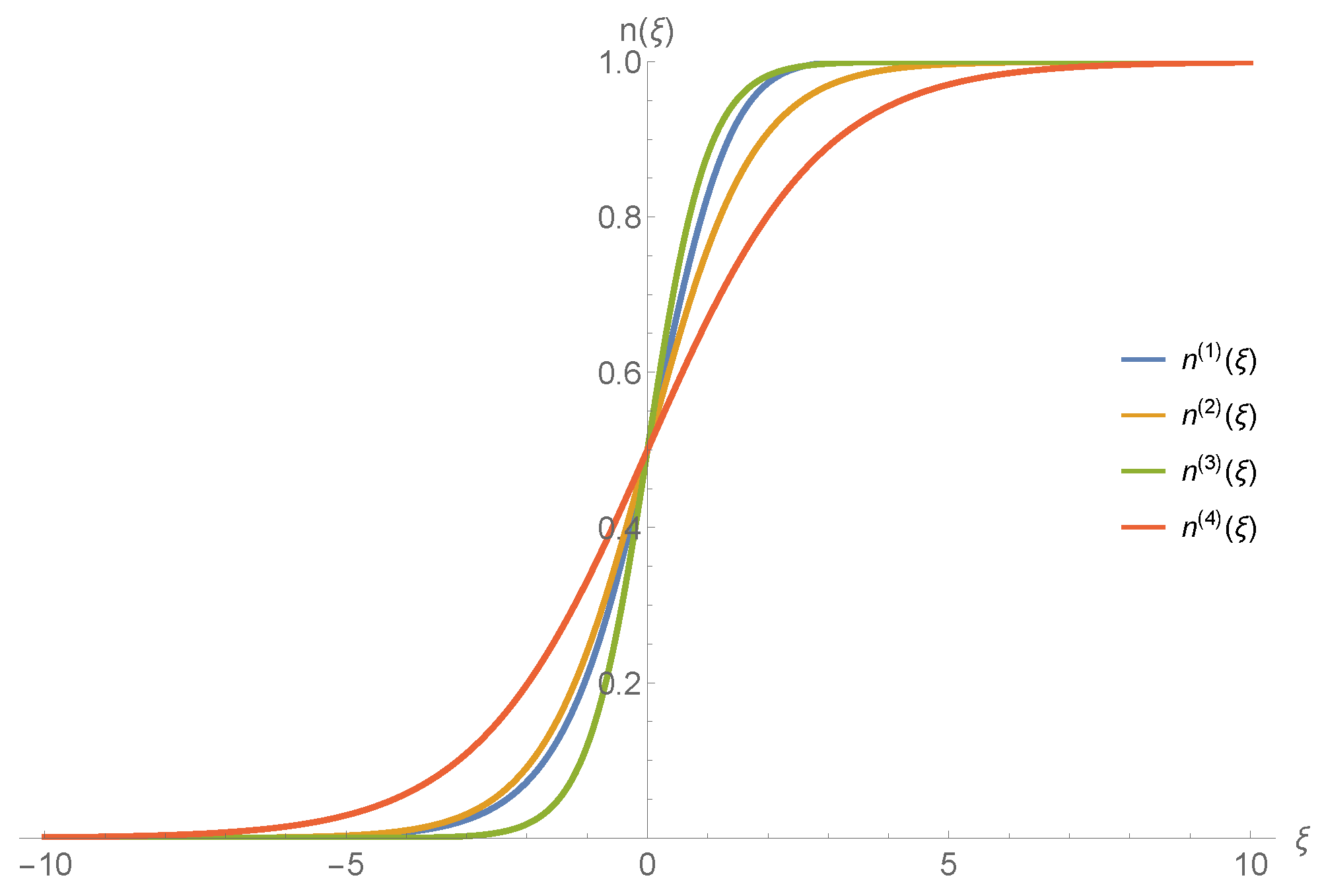
The exact traveling wave solutions derived above form a parametric family of monotone traveling fronts. Although all solutions satisfy the same asymptotic constraints and arise from the same traveling wave reduction, their internal structure depends on the specific form of the simple equation, as well as on the selected parameter set. To illustrate the physical implications of these differences in the context of wildfire front propagation, we compare numerically the traveling wave profiles given by Equations (22)–(29) in Figure 1. The parameter values used in the numerical simulations for n ( 1 ) ( ξ ) n ( 4 ) ( ξ ) are listed in Table 1. In Figure 1, all profiles are centered by imposing n ( ξ ¯ ) = 0.5 .
Figure 1 highlights the quantitative distinctions between the profiles. While their asymptotic limits coincide, the spatial rate at which the transition occurs varies significantly. In particular, the wave profile n ( 3 ) ( ξ ) exhibits the most abrupt change around the inflection point, indicating the thinnest transition layer. The solution n ( 1 ) ( ξ ) (with D 0 ) produces a comparably steep front, though with a slightly smoother central region. The case D = 0 in n ( 2 ) ( ξ ) leads to a visibly wider transition zone, whereas the logistic profile n ( 4 ) ( ξ ) displays the most gradual spatial variation characterized by a smaller maximum gradient and slower approach to saturation. These differences demonstrate that, even within the same traveling wave framework, the analytical construction influences the effective front thickness and the spatial distribution of the transition dynamics.
From a physical perspective, each traveling wave profile describes how the fire-affected tree fraction (or the fire-affected tree density) varies with the coordinate ξ , i.e., in the frame moving with the propagating fire front. The transition from low to high values of n ( ξ ) corresponds to the conversion of fire-unaffected (unburned) trees into fire-affected (burned) trees as the front passes. In the framework of Equation (15) and the reaction, diffusion, and transport contributions introduced in Section 3.2, the shape of the traveling wave profiles can be explained in terms of the balance between these mechanisms, together with the additional nonlinear state-dependent transport effect. Therefore, the profile n ( 3 ) ( ξ ) , which exhibits the most abrupt increase, corresponds to a very sharp transition in the traveling coordinate, indicating a narrow front region and a highly localized transition between unburned and burned states. This behavior suggests that the balance between the governing mechanisms favors strong localization of the front. The profile n ( 1 ) ( ξ ) also produces a relatively steep transition but with a slightly smoother central region, reflecting a moderate spatial spreading of the fire-affected tree zone in the moving frame. In contrast, the profile n ( 2 ) ( ξ ) corresponds to a visibly wider transition region, indicating that the fraction of fire-affected trees increases more gradually and that the front is more spatially diffusive. This can be interpreted as a regime in which the spreading effects dominate, leading to a broader transition zone. Finally, the profile n ( 4 ) ( ξ ) corresponds to the most gradual increase in n ( ξ ) , presenting the smoothest and most extended transition among the considered solutions. In summary, in the wildfire context, these structural differences correspond to variations in the sharpness of the propagating fire front. Steeper profiles represent narrower transition regions and more abrupt changes between fire-unaffected and fire-affected states, whereas broader profiles correspond to more spatially diffusive front structures. Thus, the presented family of exact solutions, based on different Riccati–ODE solution structures, provides additional flexibility, enabling controlled variation of both front steepness and internal profile morphology within the same modeling framework. This flexibility is important for describing different fire spread regimes under varying environmental conditions.
In the presence of wind, the effective advection velocity entering the traveling wave Equation (15) depends on both the wind intensity and the front orientation which is incorporated through the effective velocity v eff . By fixing the wind magnitude and varying the orientation parameter, one isolates the effect of the front inclination on the traveling wave structure.
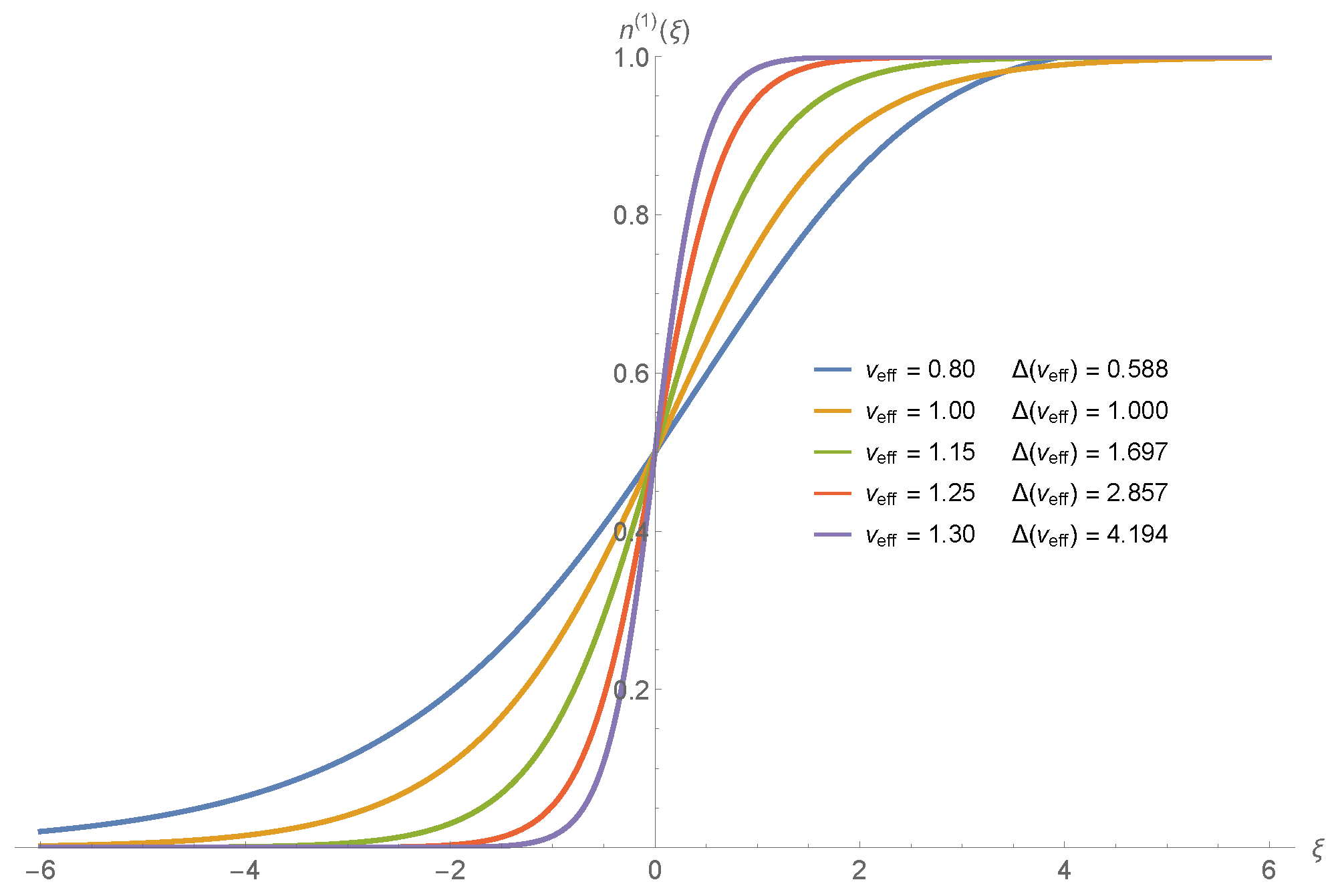
The traveling wave profiles shown in Figure 2 correspond to the exact solution n ( 1 ) (see Equation (22)), evaluated for several values of the effective advection velocity v eff . Although v eff does not appear explicitly in the expression (22), its influence enters through the discriminant Δ = b 1 2 4 b 0 b 2 . Thereby, using the relation given in Equation (30), we rewrite Δ in terms of r τ and v eff , which yields Δ ( v eff ) = r τ v eff v eff 2 r τ 1 . This expression is well defined provided that v eff 0 , v eff 2 r τ 1 , which ensure the non-singularity of the traveling wave solution. Under these assumptions, Figure 2 presents the profiles of Equation (22) for physical parameters r = 1 and τ = 0.5 , while the parameters of the solution of an ODE of Riccati are b 0 = 0.6 ,   b 1 = 0.8 ,   b 2 = 1 ,   D = 0.15 , and E = 0.80 . All profiles are centered by imposing the condition n ( 1 ) ( ξ ¯ ) = 0.5 .
As indicated by the values of Δ reported in the legend of Figure 2, smaller values of v eff correspond to larger values of | Δ | , whereas increasing v eff leads to a reduction in | Δ | . Since the dominant contribution to the front slope is governed by Δ , a larger | Δ | produces sharper and more localized transition layers, while a smaller | Δ | generates broader and smoother profiles. This trend is clearly visible in Figure 2: decreasing v eff yields steeper and thinner fire fronts, whereas increasing v eff results in wider transition regions. Owing to the presence of the deformation term ( D 0 ), the effect of v eff is not merely a uniform horizontal rescaling of the profile. Instead, variations in v eff alter the effective front thickness while preserving the monotone heteroclinic structure of the solution.
From a wildfire propagation perspective, this demonstrates that wind-induced advection, mediated by front orientation, directly influences the sharpness of the combustion front: weaker effective advection produces concentrated and abrupt fire lines, whereas stronger effective advection leads to more spatially distributed and smoother burning transitions.
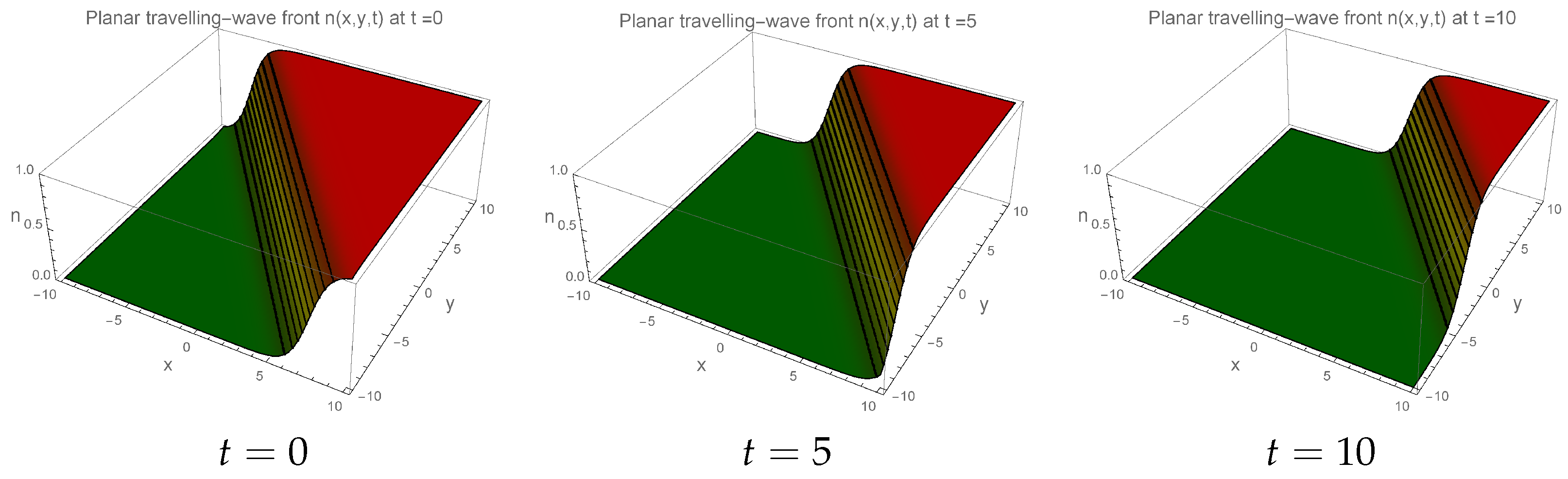
Finally, Figure 3 presents three-dimensional visualizations of the solution n ( 1 ) ( ξ ) , where ξ = l 1 x + l 2 y c t , at three distinct time instants. The numerical simulations are performed for the parameter values b 0 = 0.2 , b 1 = 0.6 , b 2 = 1 , D = 0.15 , and E = 0.7 . The traveling wave direction is determined by the unit vector ( l 1 , l 2 ) = ( 0.8 , 0.6 ) , satisfying l 1 2 + l 2 2 = 1 , and the wave speed is set to c = 0.6 . As can be seen from Figure 3, at the initial time, the solution exhibits the characteristic sigmoidal structure of a traveling front, smoothly connecting two distinct asymptotic states. As time increases, the entire surface translates rigidly along the direction ( l 1 , l 2 ) , while its shape, amplitude, and steepness remain unchanged. No deformation or spreading of the transition layer is observed. This confirms that the analytical construction indeed represents a stable planar traveling wave propagating with constant speed c, consistent with the traveling coordinate reduction.
From a dynamical perspective, the moving interface corresponds to a connection between two equilibrium states of the reduced traveling wave system. The invariance of the profile in the moving frame indicates that these equilibria govern the asymptotic states ahead of and behind the front. Therefore, the qualitative behavior observed in the two-dimensional visualizations naturally leads to a local stability analysis of the corresponding equilibrium points. Such an analysis allows one to determine their dynamical character and to classify the possible propagation regimes of the traveling fronts.

4. Qualitative Analysis of the Equilibria of the Traveling Wave Equation (15)

For our convenience, we introduce the notation in Equation (15)
A = 1 r τ c 2 , B ( n ) = c v eff r τ c ( 1 2 n ) , f ( n ) = n ( 1 n ) ,
so that it takes the compact form
A n + B ( n ) n + f ( n ) = 0 .
Introducing
u 1 = n , u 2 = n ,
Equation (34) can be rewritten as the planar system
u 1 = u 2 , u 2 = B ( u 1 ) u 2 + f ( u 1 ) A ,
Below, we analyze the equilibria and their local stability in the phase plane.

4.1. Equilibria

Lemma 3. 
The system (36) possesses exactly two equilibria:
E 0 = ( 0 , 0 ) , E 1 = ( 1 , 0 ) .
Proof. 
The equilibria satisfy u 1 = u 2 = 0 . From u 1 = u 2 , it follows that u 2 * = 0 . Substituting into the second equation yields f ( u 1 * ) = 0 . Since f ( n ) = n ( 1 n ) , we obtain u 1 * { 0 , 1 } , which completes the proof. □
Thus, the traveling wave solutions presented in the previous section correspond to phase-plane trajectories of (36) connecting or returning to the equilibria E 0 and E 1 .

4.2. Local Stability Classification of the Equilibria

Proposition 2. 
Let A = 1 r τ c 2 0 and define B ( 0 ) = c v eff r τ c , B ( 1 ) = c v eff + r τ c with v eff = σ v 0 / 1 + μ 2 . The equilibria E 0 = ( 0 , 0 ) and E 1 = ( 1 , 0 ) of the traveling wave system (36) are qualitatively classified as follows:
(a) 
For E 0 :
If A < 0 , then E 0 is a saddle.
If A > 0 and B ( 0 ) > 0 , then E 0 is asymptotically stable; moreover, it is a stable node if B ( 0 ) 2 > 4 A and a stable focus if B ( 0 ) 2 < 4 A .
If A > 0 and B ( 0 ) < 0 , then E 0 is unstable; moreover, it is an unstable node if B ( 0 ) 2 > 4 A and an unstable focus if B ( 0 ) 2 < 4 A .
(b) 
For E 1 :
If A > 0 , then E 1 is a saddle.
If A < 0 and B ( 1 ) < 0 , then E 1 is asymptotically stable; moreover, it is a stable node if B ( 1 ) 2 > 4 A and a stable focus if B ( 1 ) 2 < 4 A .
If A < 0 and B ( 1 ) > 0 , then E 1 is unstable; moreover, it is an unstable node if B ( 1 ) 2 > 4 A and an unstable focus if B ( 1 ) 2 < 4 A .
Proof. 
Linearizing (36) at an equilibrium ( u 1 * , 0 ) yields the Jacobian
J ( u 1 * , 0 ) = 0 1 f ( u 1 * ) A B ( u 1 * ) A , f ( n ) = n ( 1 n ) ,
with characteristic polynomial
λ 2 + T j λ + D j = 0 ,
where
T j = tr J ( E j ) = B ( u 1 * ) A , D j = det J ( E j ) = f ( u 1 * ) A
are the Routh–Hurwitz coefficients.
Since f ( 0 ) = 1 and f ( 1 ) = 1 , we obtain
T 0 = B ( 0 ) A , D 0 = 1 A , T 1 = B ( 1 ) A , D 1 = 1 A .
Hence, D 0 < 0 if and only if A < 0 , implying that E 0 is a saddle, whereas D 1 < 0 if and only if A > 0 , implying that E 1 is a saddle. If D j > 0 , stability is governed by the Routh–Hurwitz condition T j > 0 , which yields the stated conditions on B ( 0 ) and B ( 1 ) .
Finally, the node–focus transition is determined by the discriminant
Δ j = T j 2 4 D j ,
that is,
Δ 0 = B ( 0 ) 2 4 A A 2 , Δ 1 = B ( 1 ) 2 + 4 A A 2 .
Therefore:
(a)
For E 0 (thus, A > 0 ),
node Δ 0 > 0 B ( 0 ) 2 > 4 A , focus Δ 0 < 0 B ( 0 ) 2 < 4 A ,
with the transition (double real eigenvalue) at
B ( 0 ) 2 = 4 A v eff = c ( 1 r τ ) ± 2 A .
(b)
For E 1 (thus, A < 0 ),
node Δ 1 > 0 B ( 1 ) 2 > 4 A , focus Δ 1 < 0 B ( 1 ) 2 < 4 A ,
with the transition at
B ( 1 ) 2 = 4 A v eff = c ( 1 + r τ ) ± 2 A .
The explicit appearance of v eff in the above relations is included to facilitate the bifurcation analysis presented in the next subsection.
Remark 1. 
Equation (36) provides a phase-plane representation for the spatial profiles of traveling wave solutions. In particular, the asymptotic behavior of a traveling wave profile near an equilibrium E j is governed by the linear type of E j , as classified in Proposition 2.
If E j is a node (stable or unstable), the traveling wave profile approaches the equilibrium in a monotone manner, and the corresponding wave tail is smooth and non-oscillatory.
If E j is a focus (stable or unstable), the traveling wave profile approaches the equilibrium in an oscillatory manner, leading to a wave tail with damped (or growing) spatial oscillations.
The node–focus transition described above reflects a change in the linear classification of a hyperbolic equilibrium and represents a qualitative variation within the same dynamical regime. As such, it does not constitute a bifurcation.
In contrast, transitions between genuinely different qualitative regimes of traveling wave behavior, such as the emergence of periodic orbits in the phase plane, require a loss of hyperbolicity of the equilibrium and are associated with true bifurcations. These phenomena will be analyzed in the next subsection in the context of Hopf bifurcations with respect to the parameter v eff .

4.3. Bifurcation Analysis with Respect to v eff

In this paragraph, we investigate how the qualitative behavior of the traveling wave system (36) changes as the effective velocity v eff varies. Throughout, we use the notation and the local stability classification of the equilibria E 0 and E 1 established in the previous section.
Proposition 3. 
Assume A 0 . Then:
(a) 
If A > 0 , then the equilibrium E 0 has a Hopf threshold at
v eff H , 0 = c ( 1 r τ ) .
At v eff = v eff H , 0 , one has T 0 = 0 , D 0 > 0 , and the eigenvalues are λ 1 , 2 = ± i ω 0 with ω 0 = 1 / A . Moreover,
d T 0 d v eff = 1 A 0 ,
hence the crossing is transversal.
(b) 
If A < 0 , then the equilibrium E 1 has a Hopf threshold at
v eff H , 1 = c ( 1 + r τ ) .
At v eff = v eff H , 1 one has T 1 = 0 , D 1 > 0 and λ 1 , 2 = ± i ω 1 with ω 1 = 1 / A , and
d T 1 d v eff = 1 A 0 .
Proof. 
At E j , a Hopf threshold (a purely imaginary pair in the linearization) occurs when T j = 0 and D j > 0 in λ 2 + T j λ + D j = 0 . For E 0 , we have D 0 > 0 A > 0 , and T 0 = 0 B ( 0 ) = 0 v eff = c ( 1 r τ ) . The eigenvalues are ± i D 0 = ± i / A . Transversality follows from d T 0 / d v eff = 1 / A 0 . The proof for E 1 is analogous using D 1 > 0 A < 0 and T 1 = 0 B ( 1 ) = 0 . □
Remark 2. 
Since λ 1 , 2 = T j 2 ± 1 2 T j 2 4 D j , for D j > 0 , the equilibrium is linearly asymptotically stable if T j > 0 and unstable if T j < 0 . Hence, for A > 0 , the equilibrium E 0 changes from stable to unstable as v eff increases through v eff H , 0 (because B ( 0 ) decreases with v eff ), whereas, for A < 0 , the equilibrium E 1 changes from unstable to stable as v eff increases through v eff H , 1 .
A genuine Hopf bifurcation (i.e., the birth of a small-amplitude periodic orbit) additionally requires the standard non-degeneracy condition, namely, a nonzero first Lyapunov coefficient. The explicit computation of the first Lyapunov coefficient, and thus the determination of the criticality (supercritical or subcritical) of the Hopf bifurcation, is beyond the scope of the present study.
The local stability classification and the bifurcation analysis with respect to v eff can now be synthesized into a unified regime structure, summarized in Table 2, which organizes the qualitative traveling wave behavior according to the dynamical type of the equilibria.

4.4. Complete Regime Map, Representative Phase-Plane Portraits, and Physical Interpretation

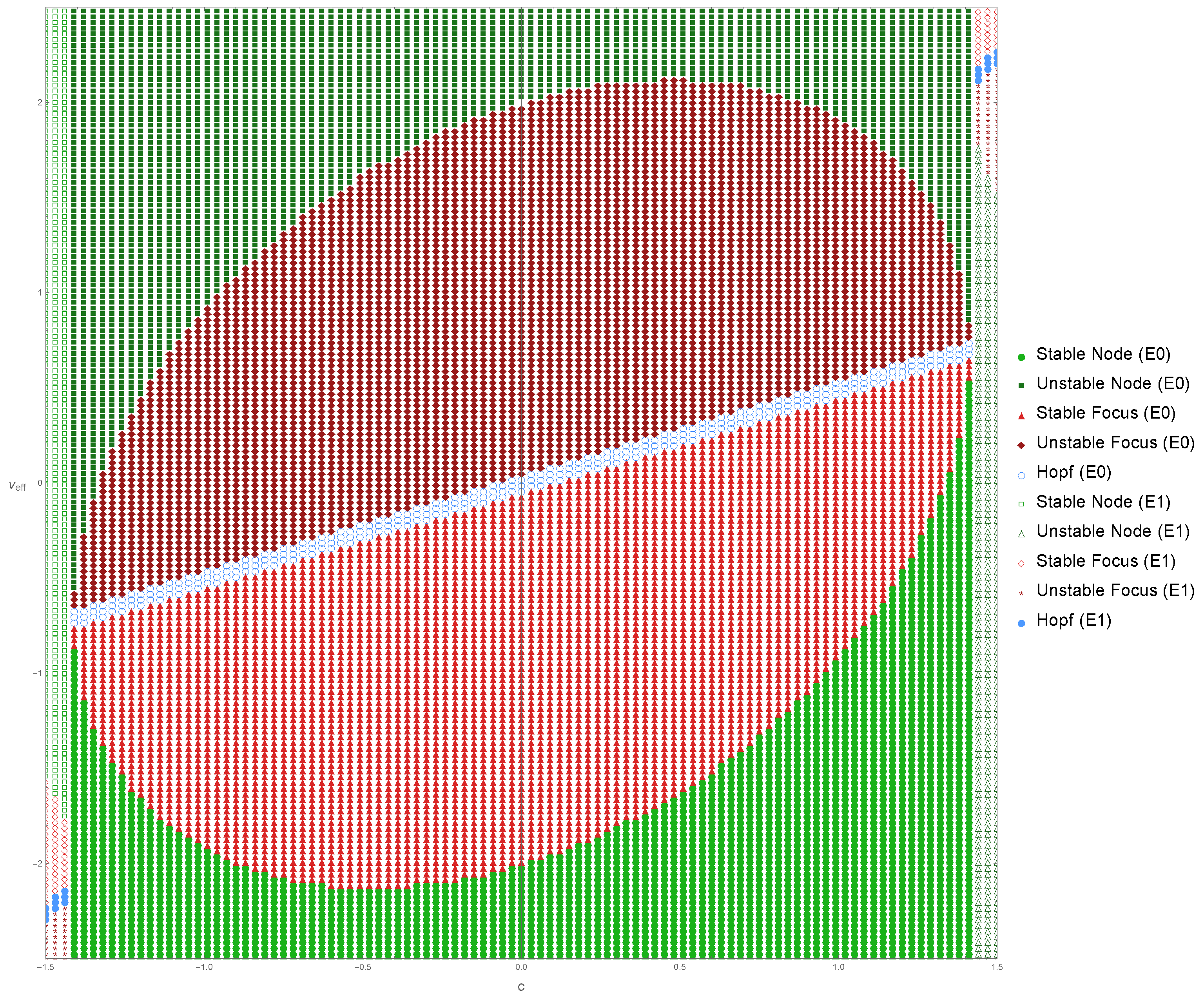
Based on the qualitative classification summarized in Table 2, a complete regime map in the ( c , v eff ) parameter plane is constructed and displayed in Figure 4.
The regime map is created for fixed parameter values r = 1 and τ = 0.5 , thereby restricting the study to a representative cross-section of the full parameter space. The parameters c and v eff are considered with both positive and negative signs because they represent oriented quantities. The sign of c determines the direction of front propagation relative to the chosen normal vector, while v eff = v · is the signed projection of the wind velocity onto the front normal, allowing for both downwind and upwind regimes. In Figure 4, the advection velocity v eff is restricted in the interval [ 2.5 , 2.5 ] , while the traveling wave speed c is varied within [ 1.5 , 1.5 ] . These bounds are chosen consistently with the constraints introduced during the construction of the model and its reduction to a traveling wave formulation, where the admissible parameter values follow from the imposed physical and mathematical assumptions. In particular, the selected interval for c includes the critical threshold defined by 1 r τ c 2 = 0 , while the range of v eff covers dynamically relevant regimes in which advection varies from weak to dominant relative to diffusion and reaction. As can be seen, the regime map visualizes the regions in parameter space where different types of the two equilibrium states E 0 and E 1 (stable and unstable nodes and foci) are realized, as well as the loci of Hopf bifurcations. In this way, it provides a comprehensive picture of the qualitative dynamics of the reduced traveling wave system (36) for the specified values of r and τ . We note that varying the values of r and τ would mainly lead to a rescaling of the regime boundaries and a redistribution of the corresponding parameter intervals while preserving the overall qualitative structure of the dynamical picture. Although the regime map represents the complete classification of all possible dynamical regimes in the ( c , v eff ) parameter plane, additional restrictions arise from the specific form of the coefficients of the exact traveling wave solutions of Equation (15) presented in Section 3. In particular, for the selected set of coefficients obtained from the algebraic system (21) (for instance, see (30)–(32)), one derives the relation c = 1 r τ v eff . Since r τ > 0 , it follows that c v eff > 0 , that is, c and v eff must have the same sign. We emphasize that this constraint is not intrinsic to the full dynamical system but is specific to the chosen family of exact solutions corresponding to coefficient sets (30)–(32). For other alternative solutions of the algebraic system (21), this restriction may not hold. Nevertheless, in the representative phase portraits presented below, this analytically induced constraint is taken into account by selecting parameter pairs ( c , v eff ) consistent with c v eff > 0 within the regime map.
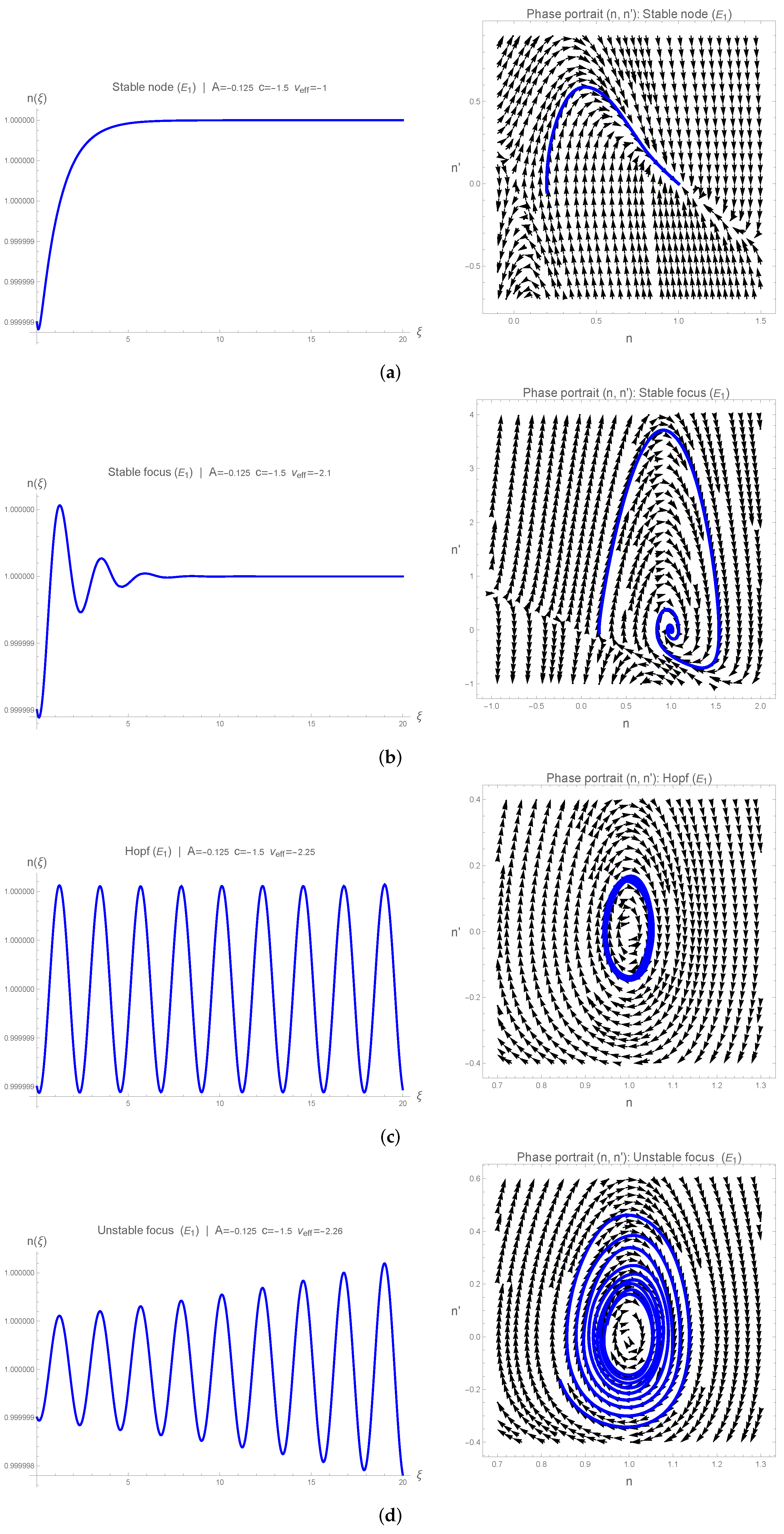
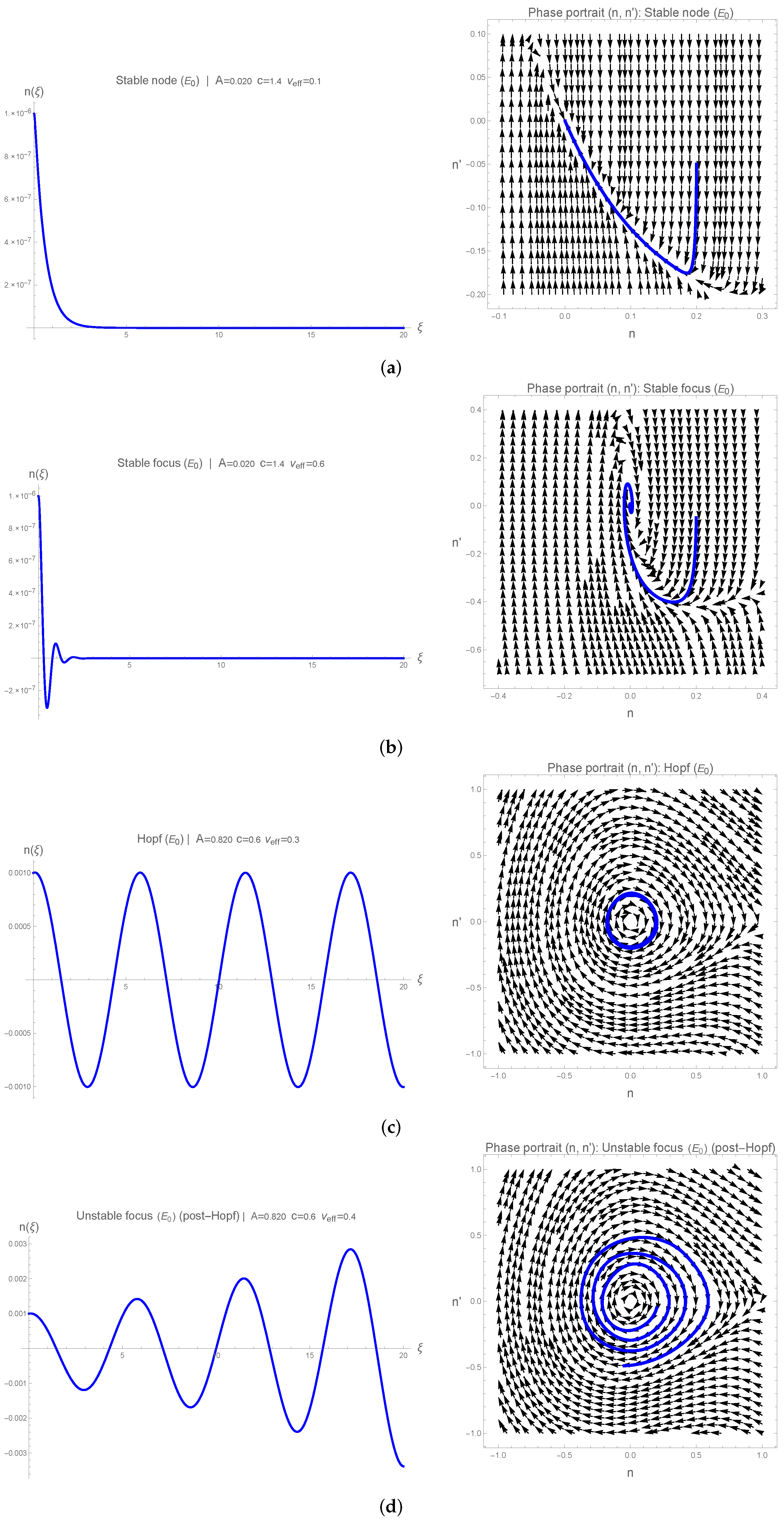
To illustrate the dynamical regimes identified in the regime map, we present representative phase-plane portraits together with the corresponding traveling wave profiles in Figure 5 and Figure 6. Each panel shows trajectories of Equation (36) in the ( n , n ) plane, highlighting the type and stability of the equilibria E 0 = ( 0 , 0 ) and E 1 = ( 1 , 0 ) , as well as the behavior of the traveling wave near them.
The qualitative phase-plane analysis presented here aims to clarify under which parameter regimes the analytically constructed traveling wave solutions correspond to physically meaningful invasion fronts. Since the variable n represents the fire-affected fraction, the equilibria E 0 and E 1 correspond to the completely fire-unaffected ( n = 0 ) and fully fire-affected ( n = 1 ) states, respectively. It is obvious that the traveling wave front corresponds to a heteroclinic connection in the reduced system (36). In the traveling coordinate ξ , such a front can occur only when one equilibrium is a saddle (providing a one-dimensional unstable manifold) and the other is asymptotically stable (providing a stable manifold). Therefore, Figure 5 and Figure 6 illustrate in detail the two physically plausible scenarios for the propagation of the forest fire wave front in accordance with the model system (36).
In Figure 5, the scenario A = 1 r τ c 2 > 0 is illustrated when E 1 is a saddle and E 0 , representing the fire-unaffected (or extinguished) state, is a non-saddle. Then, the heteroclinic relation E 1 E 0 describes a relaxation towards an unburned forest. If E 0 is a stable node (for v eff < c ( 1 r τ ) 2 A ), the disturbances decay monotonically (see Figure 5a). This means that any local ignition will quickly decay and cannot develop into a sustained combustion. This corresponds to a fire-resistant environment, for example, with high moisture content, low ambient temperature, weak reaction intensity, or strong heat dissipation. If E 0 is a stable focus (for c ( 1 r τ ) 2 A < v eff < c ( 1 r τ ) ), the disturbances decay oscillatorily (see Figure 5b). Physically, small attempts at ignition may lead to temporary fluctuations in combustion or minor attempts at re-ignition, but the system eventually returns to an unburned state, i.e., the forest remains stable against ignition. At the Hopf threshold of E 0 (for v eff = c ( 1 r τ ) ), the system reaches the ignition limit, and prolonged combustion oscillations can occur (see Figure 5c). After this point, when E 0 becomes unstable (for c ( 1 r τ ) < v eff < c ( 1 r τ ) + 2 A ), small perturbations grow instead of decaying (see Figure 5d). Physically, this corresponds to ignition instability or self-ignition, i.e., spontaneous sustained combustion can occur. In this regime, the initial heteroclinic relationship with E 0 disappears and the system instead evolves to an active combustion state, potentially generating a propagating forest fire front.
In Figure 6, the opposite scenario A = 1 r τ c 2 < 0 is illustrated when E 0 is a saddle and E 1 , corresponding to the fire-affected state, is non-saddle. Then, the heterocline is E 0 E 1 and it describes a self-sustained wildfire front. If E 1 is a stable node (for v eff > c ( 1 + r τ ) + 2 A ), the approach along the heteroclinic orbit is monotone (see Figure 6a). The corresponding wave profile exhibits a smooth, non-oscillatory transition from a fire-unaffected to fire-affected state. Physically, this represents a steady and robust combustion regime, i.e., the fire propagates with constant structure, the fire-affected fraction stabilizes behind the front, and no secondary fluctuations occur. This regime corresponds to sufficiently dry fuel, a strong exothermic reaction, and effective heat transfer, ensuring a stable and continuous wildfire propagation. If E 1 is a stable focus (for c ( 1 + r τ ) < v eff < c ( 1 + r τ ) + 2 A ), the heteroclinic orbit approaches it in a spiral manner (see Figure 6b). The wave profile then exhibits damped oscillations behind the front. Physically, this reflects transient fluctuations in the fire-affected region due to competition between heat production and dissipation. The fire remains self-sustained, but the post-front dynamics may involve small-scale secondary effects. Although dynamically richer, this regime still corresponds to stable wildfire propagation since perturbations decay asymptotically. At the Hopf threshold (for v eff = c ( 1 + r τ ) ), the fire-affected equilibrium loses hyperbolicity and the system reaches marginal stability (see Figure 6c). This marks the transition to a pulsating combustion regime. Once E 1 becomes unstable (unstable focus) (for c ( 1 + r τ ) 2 A < v eff < c ( 1 + r τ ) ), its stable manifold disappears and the unstable manifold of the saddle can no longer connect to it (see Figure 6d). Consequently, the heteroclinic orbit, and thus the traveling wave front, ceases to exist. Physically, this means that the fire-affected state cannot remain stable, i.e., either the fire loses its steady self-sustained character and the front breaks down or the system transitions to a dynamically unstable, oscillatory wildfire regime with possible front fragmentation and spatio-temporal instabilities.
In summary, from both mathematical and physical perspectives, the existence of a fire traveling wave front, and equivalently of the analytical traveling wave solutions derived in Section 3, is directly determined by the stability properties of the equilibria of the reduced system (36). A traveling wave solution can exist only when the terminal equilibrium ( E 0 or E 1 ) of the corresponding heteroclinic orbit is asymptotically stable, ensuring the persistence of the associated stable manifold in phase space. Physically, this means that a combustion front can propagate in a sustained manner only if the state behind the front (fire-affected or fire-unaffected) is dynamically stable with respect to small perturbations. The node–focus transition influences only the way the wave tail approaches the equilibrium, either monotonically or through damped spatial oscillations, without affecting the existence of the front itself.
However, once the equilibrium loses stability, typically via a Hopf bifurcation, the stable manifold disappears, the heteroclinic connection is destroyed, and the corresponding analytical traveling wave solutions lose their dynamical validity within the full phase space dynamics. In physical terms, this corresponds to the breakdown of steady wildfire propagation and the transition toward oscillatory, unstable, or spontaneously igniting combustion regimes.

5. Conclusions

In this study, we extended a hyperbolic reaction–diffusion model of a forest fire with relaxation effects by including an advection transport term that accounts for the wind-induced propagation of the fire wave. In fact, the inclusion of an advection term in the model is not just a technical extension, but a qualitative change in the framework of the modeled physical process. In the original reaction–diffusion model, the transport is isotropic and the dynamics of the traveling wave front are controlled primarily by the competition between reaction and diffusion at a finite velocity (via the relaxation term). Once advection is included, the transport becomes directional and the dynamics acquire an explicit dependence on the relative orientation between the wind field and the spreading front. In our extended model formulation, this directional dependence is encapsulated by the oriented effective velocity v eff = v · , which acts as a key bifurcation parameter controlling both the existence and the qualitative structure of traveling wave fire fronts. Thus, advection alters the propagation regimes of the model by introducing an inherent “preferred direction” and by shifting the stability limits and allowable wave profiles in the parameter space. The main assumption regarding the extended wildfire model presented in this work is that the wind can be oriented either in the direction of the front propagation (downwind) or against it (upwind). This is important because real fire propagation can occur in complex wind front configurations, including opposing flows or a changing wind direction relative to the front normal.
Using SEsM (1,1) with an ODE of Riccati as a simple equation, we derived several exact solutions of the extended model equation that describe the transitions between fire-free and fully fire-affected states, or vice versa. Unlike other related analytical methods in this area, the SEsM framework is very flexible because it can use different simple equations of type (10) with known analytical solutions, depending on the specific dynamic characteristics of the studied physical model. In the present study, the ODE of Riccati is chosen because of its ability to generate solutions presenting kink or anti-kink traveling waves, which are compatible with the expected wave dynamics during forest fire propagation and naturally follow from the logistic nature of the reaction term in Equation (5). A significant feature of the approach proposed in this study is that the coefficients of the ODE of Riccati (18) are retained as free parameters after a purposeful choice among all possible nontrivial solutions of the algebraic system arising within the SEsM (1,1) algorithm. This is one of the contributions of the present work in a purely analytical sense, since it leads to to a significant simplification and reduction of the standard procedure steps required to derive different analytical solutions to PDEs of kind (5). Therefore, the obtained traveling wave solutions presented in Section 3 arise naturally from the same nontrivial solution of the resulting algebraic system (21). On the other hand, the proposed approach is a generalization of several analytical methods for finding exact solutions of nonlinear PDEs based on use of the simple (auxiliary) Riccati-type equation. For example, in this specific case, by appropriate reductions (i.e., zeroing) of the coefficients of (18), one reaches its sub-forms, underlying well-known analytical techniques such as the Tanh method [54] and the original method of simplest equation [55], where ODEs of the tanh function and Bernoulli type are used as simple equations, respectively. Thus, these established approaches can be interpreted as particular implementations embedded in the more general SEsM (1,1) framework applied here. In addition, the present study uses the ODE of Riccati in its general form together with a new generalized analytical solution that is not available within the standard formulations of the methods mentioned above (e.g., see Equation (23)). In summary, expressing the coefficients in the exact solutions of Equation (5) in terms of the coefficients of the simple equation used allows a unified representation of several physically relevant front profiles within a single analytical framework. Through numerical simulations, we showed that exact solutions with different analytical forms can provide additional information about the thickness, steepness, and spatial attenuation of the fire front and thus serve as comparative configurations that can help further calibrate the model and analyze its sensitivity. Numerical simulations of one of the obtained exact solutions confirmed that variations in the effective wind velocity significantly affect the internal morphology of the fire front.
Furthermore, the analysis of the equilibrium states of the model further elucidates the dynamical mechanisms underlying this process. In a traveling wave system, the existence of an invasion front requires a heteroclinic relationship between the equilibria, which, in turn, requires one equilibrium to be a saddle while the other is asymptotically stable. Stable wildfire propagation corresponds to the configuration in which the fire-free state E 0 is a saddle and the fully fire-affected state E 1 is an attractor. Conversely, when E 0 is stable and E 1 loses stability, sustained fire penetration is dynamically suppressed. In addition, Hopf thresholds, identified by the effective wind velocity, mark critical transitions where the local character of the equilibria changes, altering the geometry of the invariant manifolds and, in certain regimes, destroying the heteroclinic structure that supports stable traveling wave fronts.
The regime map in the ( c , v eff ) plane can be interpreted as a global framework for different scenarios. On the one hand, it summarizes in a unified geometric way the full range of dynamic possibilities associated with the signs (directions) of c and v eff , including downwind and upwind propagation; on the other hand, it also accounts for transitions between monotonic and oscillatory regimes and parametric regions where traveling wave fire fronts are not supported. In this sense, the regime map provides a structured basis for exploring “what if” scenarios of fire spread at different wind intensities and orientations without prior commitment to a single qualitative behavior. In this framework, fire controllability can be interpreted in terms of equilibrium stability: maintaining parameters in regions where the fire-free equilibrium remains stable and no stable heteroclinic relationship exists corresponds to suppression of sustained spread, while regimes in which the fire-affected equilibrium is stable indicate self-sustaining and potentially uncontrolled spread.
At the same time, we emphasize again that the exact traveling wave solutions of the model presented in Section 3 impose an additional analytical constraint connecting the wave speed and the effective wind velocity. In particular, for the families of analytical solutions presented here, there is an additional constraint c v eff > 0 , which means that the projection of the wind onto the front normal and the motion of the traveling wave are co-directed. Therefore, although the global regime map is two-sided and supports both upwind and downwind configurations, the detailed numerical illustrations in this study are limited to the case where the wind and the wave front are moving in the same direction. This constraint should not be interpreted as an inherent limitation of the dynamical system itself, but rather as a characteristic of the particular families of analytical solutions that we have chosen to show in this paper. However, another choice of solution to the algebraic system (21) or another choice of simple equations of the type (10) can allow for the reverse orientation c v eff < 0 , which is a natural direction for future research.
Overall, the exact traveling wave solutions of the extended model proposed in this paper, combined with stability analysis of its equilibrium states and bifurcation analysis, aim to emphasize that wind-driven advection introduces qualitative dynamical transitions, rather than simply quantitative adjustments to the propagation speed of fire-affected tree density. The effective wind velocity emerges as a key control parameter governing the morphology, stability, and admissibility of fire front waves.
Future work may extend the present framework in several directions: First, an analytical treatment of regimes with opposite wind front orientation ( c v eff < 0 ) would allow a systematic investigation of their structure and stability, as well as their implications for wildfire dynamics. Second, incorporating spatially and temporally varying wind fields through the addition of a coupled evolution equation would enable the model to account for dynamically changing environmental conditions and thereby yield a more realistic representation of wildfire propagation.
In addition to these perspectives, several limitations of the present study should be noted: First, regarding the reaction term in the model, we chose to start from the simplest scenario of local fire dynamics, namely, a logistic-type formulation. This specific choice of fire dynamics not only imposed a restriction on the class of admissible traveling wave solutions, limiting them to advancing front-type structures, but also effectively constrained the class of simple equations used within the SEsM framework. In the present case, this naturally led to the use of first-order ODEs, such as the Riccati equation, which generate solutions with a predefined functional structure (kink- or anti-kink-type profiles), thereby restricting the range of admissible wave morphologies. This limitation, however, is not intrinsic to the SEsM itself. For example, in future work, we plan to include a reaction term with a more complex local fire mechanism.
The introduction of a more complex reaction term would allow the use of a broader class of simple equations within the SEsM framework, and, consequently, would enable the derivation of exact solutions exhibiting richer wave dynamics, including multi-wave structures arising from the interaction of different physical mechanisms governing wildfire propagation. The dynamical picture associated with the stability of the equilibria in such a model would also become richer.
Second, the present results are obtained within the traveling wave framework and therefore represent only a subset of the full model dynamics. Moreover, the numerical simulations presented here are primarily illustrative and do not constitute a complete validation of the model. A necessary next step is to perform a comprehensive numerical investigation, including parameter sensitivity analysis and validation against available data (if such data can be identified in the literature), which will be addressed in future work. Such developments may also support the application of the model to practical problems related to wildfire prediction, control, and management.

Author Contributions

Conceptualization, E.V.N. and G.N.N.; methodology, E.V.N. and G.N.N.; software, G.N.N.; validation, E.V.N., G.N.N., and T.C.P.; formal analysis, E.V.N., G.N.N., and T.C.P.; investigation, E.V.N., G.N.N., and T.C.P.; data curation, G.N.N. and T.C.P.; writing—original draft, E.V.N., G.N.N., and T.C.P.; writing—review and editing, E.V.N. and G.N.N.; visualization, G.N.N.; supervision, E.V.N.; project administration, E.V.N.; funding acquisition, E.V.N. All authors have read and agreed to the published version of the manuscript.

Funding

This research was partially supported by the project “Artificial intelligence for investigation and modeling of real processes”, KP-06-H82/4, funded by the Bulgarian National Science Fund.

Data Availability Statement

The original contributions presented in this study are included in the article. Further inquiries can be directed to the corresponding author.

Acknowledgments

This work was realized by the Center of Competence for Mechatronics and Clean Technologies “Mechatronics, Innovation, Robotics, Automation and Clean Technologies”—MIRACle, with the financial support of contract no. BG16RFPR002-1.014-0019-C01, funded by the European Regional Development Fund (ERDF) through the Programme “Research, Innovation and Digitalisation for Smart Transformation” (PRIDST) 2021–2027.

Conflicts of Interest

The authors declare no conflicts of interest.

References

  1. Strogatz, S.H. Nonlinear Dynamics and Chaos: With Applications to Physics, Biology, Chemistry, and Engineering, 2nd ed.; Chapman and Hall/CRC: Boca Raton, FL, USA, 2018. [Google Scholar] [CrossRef]
  2. Braga da Costa Campos, L.M. Non-Linear Differential Equations and Dynamical Systems; CRC Press: Boca Raton, FL, USA, 2019. [Google Scholar] [CrossRef]
  3. Bartels, S. Numerical Approximation of Partial Differential Equations; Springer: Cham, Switzerland, 2016. [Google Scholar] [CrossRef]
  4. Murray, J.D. Mathematical Biology I: An Introduction, 3rd ed.; Springer: New York, NY, USA, 2002. [Google Scholar] [CrossRef]
  5. Murray, J.D. Mathematical Biology II: Spatial Models and Biomedical Applications, 3rd ed.; Springer: New York, NY, USA, 2003. [Google Scholar] [CrossRef]
  6. Ntouyas, S.K. (Ed.) Fractional Differential Equations, Inclusions and Inequalities with Applications; MDPI: Basel, Switzerland, 2020. [Google Scholar] [CrossRef]
  7. Jena, R.M.; Chakraverty, S. (Eds.) Fractional Differential Equations: Computation and Modelling with Applications; MDPI: Basel, Switzerland, 2025. [Google Scholar] [CrossRef]
  8. Nikolov, S.; Wolkenhauer, O.; Vera, J. Tumors as chaotic attractors. Mol. BioSyst. 2014, 10, 172–179. [Google Scholar] [CrossRef] [PubMed]
  9. Santos, G.; Nikolov, S.; Lai, X.; Eberhardt, M.; Dreyer, F.S.; Paul, S.; Schuler, G.; Vera, J. Model-based genotype-phenotype mapping used to investigate gene signatures of immune sensitivity and resistance in melanoma micrometastasis. Sci. Rep. 2016, 6, 24967. [Google Scholar] [CrossRef] [PubMed]
  10. Vitanov, N.K.; Vitanov, K.N. Epidemic Waves and Exact Solutions of a Sequence of Nonlinear Differential Equations Connected to the SIR Model of Epidemics. Entropy 2023, 25, 438. [Google Scholar] [CrossRef] [PubMed]
  11. Vitanov, N.K.; Dimitrova, Z.I. Computation of the Exact Forms of Waves for a Set of Differential Equations Associated with the SEIR Model of Epidemics. Computation 2023, 11, 129. [Google Scholar] [CrossRef]
  12. Zlatanov, V.D.; Nikolov, S.G. Vibrations of a Chain in the Braking Regime of the Motion Mechanism in Load-Lifting Machines. In Advances in Mechanical Engineering; Evgrafov, A., Ed.; Lecture Notes in Mechanical Engineering; Springer: Cham, Switzerland, 2019; pp. 221–232. [Google Scholar] [CrossRef]
  13. Chua, L.O.; Tetzlaff, R.; Slavova, A. (Eds.) Memristor Computing Systems; Springer: Cham, Switzerland, 2022. [Google Scholar]
  14. Slavova, A.; Tetzlaff, R. Edge of chaos in reaction diffusion CNN model. Open Math. 2017, 15, 21–29. [Google Scholar] [CrossRef]
  15. Slavova, A.; Ignatov, V. Edge of Chaos in Reaction-Diffusion System with Memristor Synapses. In New Trends in the Applications of Differential Equations in Sciences. NTADES 2023; Slavova, A., Ed.; Springer Proceedings in Mathematics & Statistics; Springer: Cham, Switzerland, 2024; Volume 449, pp. 407–417. [Google Scholar] [CrossRef]
  16. Nikolov, S.G.; Vassilev, V.M. Complex Dynamics of Rössler–Nikolov–Clodong O Hyperchaotic System: Analysis and Computations. Axioms 2023, 12, 185. [Google Scholar] [CrossRef]
  17. Uzunov, I.M.; Nikolov, S.G.; Arabadzhiev, T.N. One approach to find the pulsating pulse solutions of the complex cubic Ginzburg–Landau equation considering intrapulse Raman scattering. Opt. Quantum Electron. 2025, 57, 348. [Google Scholar] [CrossRef]
  18. Nikolova, E.V.; Serbezov, D.Z.; Jordanov, I.P.; Vitanov, N.K. Non-Linear Waves of Interacting Populations with Density-Dependent Diffusion. In Advanced Computing in Industrial Mathematics; Studies in Computational Intelligence; Springer: Cham, Swotzerland, 2021; Volume 961, pp. 383–396. [Google Scholar] [CrossRef]
  19. Vitanov, N.K.; Jordanov, I.P.; Dimitrova, Z.I. On nonlinear dynamics of interacting populations: Coupled kink waves in a system of two populations. Commun. Nonlinear Sci. Numer. Simul. 2009, 14, 2379–2388. [Google Scholar] [CrossRef]
  20. Aksenov, A.V.; Polyanin, A.D. Review of methods for constructing exact solutions of equations of mathematical physics based on simpler solutions. Theor. Math. Phys. 2022, 211, 567–594. [Google Scholar] [CrossRef]
  21. Iqbal, M.S.; Seadawy, A.R.; Baber, M.Z.; Qasim, M. Application of modified exponential rational function method to Jaulent–Miodek system leading to exact classical solutions. Chaos Solitons Fractals 2022, 164, 112600. [Google Scholar] [CrossRef]
  22. Malik, S.; Hashemi, M.S.; Kumar, S.; Rezazadeh, H.; Mahmoud, W.; Osman, M.S. Application of new Kudryashov method to various nonlinear partial differential equations. Opt. Quantum Electron. 2023, 55, 8. [Google Scholar] [CrossRef]
  23. Ganie, A.H.; Sadek, L.H.; Tharwat, M.M.; Iqbal, M.A.; Miah, M.M.; Rasid, M.M.; Elazab, N.S.; Osman, M.S. New investigation of the analytical behaviors for some nonlinear PDEs in mathematical physics and modern engineering. Partial. Differ. Equ. Appl. Math. 2024, 9, 100608. [Google Scholar] [CrossRef]
  24. Popivanov, P.; Slavova, A. Exact Formulas to the Solutions of Several Generalizations of the Nonlinear Schrödinger Equation. In Advances in Microlocal and Time-Frequency Analysis; Birkhäuser: Cham, Switzerland, 2020; pp. 419–429. [Google Scholar]
  25. Popivanov, P.; Slavova, A. Nonlinear Waves: A Geometric Approach; World Scientific: Singapore, 2018. [Google Scholar]
  26. Slavova, A.; Popivanov, P. Explicit solutions of some equations and systems of mathematical physics. Adv. Differ. Equ. 2020, 2020, 592. [Google Scholar] [CrossRef]
  27. Vitanov, N.K.; Dimitrova, Z.I.; Kantz, H. Application of the Method of Simplest Equation for Obtaining Exact Traveling-Wave Solutions for the Extended Korteweg–de Vries Equation and Generalized Camassa–Holm Equation. Appl. Math. Comput. 2013, 219, 7480–7492. [Google Scholar] [CrossRef]
  28. Nikolova, E.V. Exact Travelling-Wave Solutions of the Extended Fifth-Order Korteweg-de Vries Equation via Simple Equations Method (SEsM): The Case of Two Simple Equations. Entropy 2022, 24, 1288. [Google Scholar] [CrossRef]
  29. Weber, R.O. Toward a Comprehensive Wildfire Spread Model. Int. J. Wildland Fire 1991, 1, 245–248. [Google Scholar] [CrossRef]
  30. Pastor, E.; Zárate, L.; Planas, E.; Arnaldos, J. Mathematical Models for Wildland Fire Behaviour. Prog. Energy Combust. Sci. 2003, 29, 139–153. [Google Scholar] [CrossRef]
  31. Sullivan, A.L. Wildland Surface Fire Spread Modelling, 1990–2007. 1: Physical and quasi-physical models Available to Purchase. Int. J. Wildland Fire 2009, 18, 349–368. [Google Scholar] [CrossRef]
  32. Mallet, V.; Keyes, D.E.; Fendell, F.E. Modeling Wildland Fire Propagation with Level Set Methods. Comput. Math. Appl. 2009, 57, 1089–1101. [Google Scholar] [CrossRef]
  33. Linn, R.R.; Reisner, J.M.; Colman, J.J.; Winterkamp, J. Studying Wildfire Behavior Using FIRETEC. Int. J. Wildland Fire 2002, 11, 233–246. [Google Scholar] [CrossRef]
  34. Reisch, C.; Navas-Montilla, A.; Özgen-Xian, I. Analytical and Numerical Insights into Wildfire Dynamics. Comput. Math. Appl. 2024, 158, 179–198. [Google Scholar] [CrossRef]
  35. Mitra, K.; Peng, Q.; Reisch, C. Studying Wildfire Fronts Using ADR Models. In Numerical Mathematics and Advanced Applications ENUMATH 2023; Lecture Notes in Computational Engineering; Springer: Cham, Switzerland, 2025; Volume 154, pp. 182–192. [Google Scholar]
  36. Méndez, V.; Llebot, J.E. Hyperbolic Reaction-Diffusion Equations for a Forest Fire Model. Phys. Rev. E 1997, 56, 6557–6563. [Google Scholar] [CrossRef]
  37. Méndez, V.; Campos, D.; Fedotov, S. Front Propagation with Finite Jump Speed. Phys. Rev. E 2004, 70, 036121. [Google Scholar] [CrossRef] [PubMed][Green Version]
  38. Méndez, V.; Fedotov, S.; Horsthemke, W. Reaction–Transport Systems; Springer: Berlin/Heidelberg, Germany, 2010. [Google Scholar]
  39. Anderson, H.E. Predicting Wind-Driven Wildland Fire Size and Shape; USDA Forest Service: Ogden, UT, USA, 1983.
  40. Sharples, J.J.; McRae, R.H.D.; Wilkes, S.R. Wind–Terrain Effects on Wildfire Propagation. Int. J. Wildland Fire 2012, 21, 282–296. [Google Scholar] [CrossRef]
  41. Alexandridis, A.; Vakalis, D.; Siettos, C.I.; Bafas, G.V. A cellular automata model for forest fire spread prediction: The case of the wildfire that swept through Spetses Island in 1990. Appl. Math. Comput. 2008, 204, 191–201. [Google Scholar] [CrossRef]
  42. Finney, M.A. FARSITE: Fire Area Simulator; USDA Forest Service: Missoula, MT, USA, 1998.
  43. Filippi, J.B.; Bosseur, F.; Mari, C.; Lac, C.; Le Moigne, P.; Cuenot, B.; Veynante, D.; Cariolle, D.; Balbi, J.H. Coupled Atmosphere–Wildland Fire Modeling. J. Adv. Model. Earth Syst. 2009, 1, 1–24. [Google Scholar] [CrossRef]
  44. van Saarloos, W. Front Propagation into Unstable States. Phys. Rep. 2003, 386, 29–222. [Google Scholar] [CrossRef]
  45. Vitanov, N.K. Simple Equations Method (SEsM): An Effective Algorithm for Obtaining Exact Solutions of Nonlinear Differential Equations. Entropy 2022, 24, 1653. [Google Scholar] [CrossRef]
  46. Vitanov, N.K.; Dimitrova, Z.I. Simple Equations Method and Non-Linear Differential Equations with Non-Polynomial Non-Linearity. Entropy 2021, 23, 1624. [Google Scholar] [CrossRef]
  47. Vitanov, N.K.; Dimitrova, Z.I.; Vitanov, K.N. Simple Equations Method (SEsM): Algorithm, Connection with Hirota Method, Inverse Scattering Transform Method, and Several Other Methods. Entropy 2021, 23, 10. [Google Scholar] [CrossRef]
  48. Vitanov, N.K. Modified Method of Simplest Equation: Powerful Tool for Obtaining Exact and Approximate Traveling-Wave Solutions of non-linear PDEs. Commun. Non-Linear Sci. Numer. Simul. 2011, 16, 1176–1185. [Google Scholar] [CrossRef]
  49. Vitanov, N.K. On Modified Method of Simplest Equation for Obtaining Exact and Approximate Solutions of non-linear PDEs: The Role of the Simplest Equation. Commun. Non-Linear Sci. Numer. Simul. 2011, 16, 4215–4231. [Google Scholar] [CrossRef]
  50. Vitanov, N.K.; Dimitrova, Z.I.; Kantz, H. Modified Method of Simplest Equation and Its Application to Nonlinear PDEs. Appl. Math. Comput. 2010, 216, 2587–2595. [Google Scholar] [CrossRef]
  51. Vitanov, N.K.; Dimitrova, Z.I.; Vitanov, K.N. Modified Method of Simplest Equation for Obtaining Exact Analytical Solutions of Nonlinear Partial Differential Equations: Further Development of the Methodology with Applications. Appl. Math. Comput. 2015, 269, 363–378. [Google Scholar] [CrossRef]
  52. Nikolova, E.V.; Dimitrova, Z.I. Exact Traveling-Wave Solutions of a Generalized Kawahara Equation. J. Theor. Appl. Mech. 2019, 49, 124–136. [Google Scholar] [CrossRef]
  53. Nikolova, E.V. Evolution Equation for Propagation of Blood Pressure Waves in an Artery with an Aneurysm. In Advanced Computing in Industrial Mathematics; Studies in Computational Intelligence; Springer: Cham, Switzerland, 2019; Volume 793, pp. 327–339. [Google Scholar] [CrossRef]
  54. Malfliet, W. Solitary wave solutions of nonlinear wave equations. Am. J. Phys. 1992, 60, 650–654. [Google Scholar] [CrossRef]
  55. Kudryashov, N.A. Simplest Equation Method to Look for Exact Solutions of non-linear Differential Equations. Chaos Solitons Fractals 2005, 24, 1217–1231. [Google Scholar] [CrossRef]
Figure 1. Numerical comparison of analytical traveling wave solutions n ( i ) ( ξ ) , i = 1 , , 4 .
Mathematics 14 01118 g001
Figure 2. Influence of the effective velocity v eff on the traveling wave wildfire profile generated by Equation (22).
Mathematics 14 01118 g002
Figure 3. Planar traveling wave front profiles of Equation (22) for different times t.
Mathematics 14 01118 g003
Figure 4. Regime map in the ( c , v eff ) parameter plane based on Table 2 at fixed r τ = 0.5 .
Mathematics 14 01118 g004
Figure 5. Representative traveling wave profiles and phase-plane portraits for Case I ( A = 1 r τ c 2 > 0 ), corresponding to regimes governed by the equilibrium E 0 = ( 0 , 0 ) for r τ = 0.5 : (a) stable node, (b) stable focus, (c) Hopf threshold, (d) unstable focus.
Mathematics 14 01118 g005
Figure 6. Representative traveling wave profiles and phase-plane portraits for Case II ( A = 1 r τ c 2 < 0 ), corresponding to regimes governed by the equilibrium E 1 = ( 1 , 0 ) for r τ = 0.5 : (a) stable node, (b) stable focus, (c) Hopf threshold, (d) unstable focus.
Mathematics 14 01118 g006
Table 1. Parameters of the representative analytical traveling wave profiles used in Figure 1.
SolutionStructural Riccati–ODE Classification b 0 b 1 b 2 DE
n ( 1 ) ( ξ ) General Riccati solution ( D 0 )0.150.85−10.250.8
n ( 2 ) ( ξ ) Degenerate Riccati solution ( D = 0 )0.300.35−10
n ( 3 ) ( ξ ) Reduced (symmetric) Riccati solution ( b 1 = 0 )1−1
n ( 4 ) ( ξ ) Reduced (asymmetric) Riccati solution ( b 0 = 0 )0.70−1
Table 2. Qualitative regimes of the traveling wave system with respect to the oriented effective velocity v eff = σ v 0 / 1 + μ 2 . Here, A = 1 r τ c 2 .
Parameter RegimeEquilibrium TypeWave Tail Behavior
Case I: A > 0 (non-saddle equilibrium E 0 , saddle E 1 )
v eff < c ( 1 r τ ) 2 A E 0 stable nodemonotone approach
c ( 1 r τ ) 2 A < v eff < c ( 1 r τ ) E 0 stable focusdamped oscillatory tail
v eff = c ( 1 r τ ) E 0 Hopf thresholdcritical transition
c ( 1 r τ ) < v eff < c ( 1 r τ ) + 2 A E 0 unstable focusoscillatory departure
v eff > c ( 1 r τ ) + 2 A E 0 unstable nodemonotone departure
Case II: A < 0 (non-saddle equilibrium E 1 , saddle E 0 )
v eff < c ( 1 + r τ ) 2 A E 1 unstable nodemonotone departure
c ( 1 + r τ ) 2 A < v eff < c ( 1 + r τ ) E 1 unstable focusoscillatory departure
v eff = c ( 1 + r τ ) E 1 Hopf thresholdcritical transition
c ( 1 + r τ ) < v eff < c ( 1 + r τ ) + 2 A E 1 stable focusdamped oscillatory tail
v eff > c ( 1 + r τ ) + 2 A E 1 stable nodemonotone approach
Disclaimer/Publisher’s Note: The statements, opinions and data contained in all publications are solely those of the individual author(s) and contributor(s) and not of MDPI and/or the editor(s). MDPI and/or the editor(s) disclaim responsibility for any injury to people or property resulting from any ideas, methods, instructions or products referred to in the content.