1. Introduction
The rapid advancement of technology is bringing significant changes to the lifestyles of people, including the way financial transactions are conducted. Concerning this development, Digital Financial Services (DFSs) have continued to expand and become widely recognized as a complement to cash-based payments. According to Pazarbasioglu et al. [
1], DFSs include the use of digital technology to deliver financial services that are accessible and usable by consumers. The adoption of DFSs in Indonesia has increased significantly alongside rapid developments in information technology, strong government, and public support for the implementation of non-cash financial systems [
2]. A major widely used form of DFS is the digital wallet (electronic wallet or e-wallet), which enables fast financial transactions through mobile devices. The growing use of digital wallets has led to the occurrence of various service alternatives, including DANA, ShopeePay, OVO, GoPay, and LinkAja, all of which offer improved convenience through continuously changing features, fees, and service quality. This situation requires an analytical tool that helps users to select DFSs more comprehensively by considering multiple evaluation criteria.
Selecting an optimal digital wallet constitutes a multi-criteria decision-making (MCDM) problem, as it comprises multiple alternatives and various evaluation criteria, including security level, ease of use, service fees, service quality, and transaction features. This selection process does not rely solely on quantitative data but also includes subjective user judgments, which are often associated with uncertainty. Although classical MCDM methods such as the Analytic Hierarchy Process (AHP) and Preference Ranking Organization Method for Enrichment Evaluation (PROMETHEE) have been widely applied to this type of problem, several limitations have been identified when they are used. For instance, Islam and Sivanantham [
3] indicated that the AHP method requires an extensive pairwise comparison process, potentially leading to confusion. Meanwhile, the PROMETHEE method heavily depended on subjective threshold values, which might influence the resulting alternative rankings [
4]. These limitations indicate that incorporating classical MCDM methods with strategies that handle uncertainty and subjective assessments is essential to overcome the challenges.
In this context, fuzzy soft sets (FSSs) provide a suitable theoretical framework for modeling the subjectivity and ambiguity inherent in selecting an optimal digital wallet. According to Maji et al. [
5], FSS incorporates fuzzy set theory proposed by Zadeh [
6] with soft set theory introduced by Molodtsov [
7]. By using membership degree values in a parameterized structure, the FSS framework provides an effective method for representing vague and uncertain information in decision-making. For example, when an investor evaluates several companies based on criteria including ESG risk, financial risk, and environmental performance, a traditional (crisp) method often rigidly classifies each criterion, assigning a value of 1 when it meets a certain threshold and 0 otherwise. On the other hand, real-world conditions are not often that straightforward. FSS addresses this limitation by allowing criteria such as “low ESG risk” to be expressed gradually through membership values ranging from 0 to 1. Through this process, a company may be considered very low (0.9), moderately low (0.6), or closer to medium risk (0.3), as stated in [
8]. By organizing these evaluations in FSS, investor preferences can be represented more flexibly and realistically, better reflecting the uncertainty as well as the nuance of real decision-making situations. This theory has attracted considerable attention, both through theoretical developments that have led to extensions of the concept and model variations [
9]. The hypothesis has also been widely applied in decision-making problems [
10] and incorporated into various hybrid methods [
8].
Although modeling uncertainty is essential, the selection of digital wallets also requires a reliable method for ranking competing alternatives. In this context, the Technique for Order Preference by Similarity to Ideal Solution (TOPSIS), developed by Hwang and Yoon [
11], has become a widely used MCDM method. This method ranks alternatives based on the relative closeness to the positive ideal solution (PIS) as well as the distance from the negative ideal solution (NIS), making it both intuitive and computationally efficient. TOPSIS has been proven effective in various decision-making problems and widely applied in numerous case studies, including supplier selection [
12] and location selection [
13]. These considerations support incorporating TOPSIS with FSS to develop a more comprehensive decision-making framework. The incorporation enables systematic and objective evaluation of alternatives while considering fuzzy information, producing more accurate decisions associated with user preferences.
Relating to earlier discussion, determining attribute weights is a critical aspect of MCDM, and various methods have been developed to suit different decision contexts. In general, weighting methods can be classified into subjective (such as AHP [
14] and BWM [
15]), objective (consisting of entropy [
16], standard deviation (SD) [
17], and CRITIC [
18]), and incorporated methods that combine the strategies [
19]. However, the increasing complexity of modern decision-making problems often demands more adaptive and sophisticated weighting mechanisms. Recent studies have addressed challenges related to large-scale group participation, linguistic information representation, and multi-granularity evaluation. For example, Jiang et al. [
20] proposed a rough incorporated asymmetric cloud model for large-group decision-making in multi-granularity linguistic environments, effectively managing uncertainty while incorporating diverse decision-maker perspectives. Weighting methods based on Dempster–Shafer theory [
21], hesitant fuzzy sets [
22], and probabilistic linguistic term sets [
23] have been developed, each offering suitable mechanisms for handling uncertainty in different decision contexts. Therefore, the selection of an appropriate weighting method eventually depends on the characteristics of the problem and the availability of data.
In the context of digital wallet selection, objective weighting methods are more appropriate where evaluations depend on objective service characteristics, such as fees and security features, rather than subjective group judgments. CRITIC offers distinct advantages among these methods, as entropy and SD consider only data dispersion, while CRITIC also considers inter-criteria conflict through correlation analysis [
17]. Using this method, criteria with higher variability and lower correlation are assigned greater weights, as the variables are considered to provide more significant and independent information in the decision-making process, as explained by Lestari et al. [
8]. The incorporation of CRITIC into the TOPSIS framework, together with its incorporation into the FSS concept, ensures that the evaluation of alternatives considers uncertainty and subjectivity, using objectively calculated criterion weights. Consequently, the resulting alternative rankings are reasonable, comprehensive, and reproducible. The incorporation of these three methods forms the proposed FSS–CRITIC–TOPSIS decision-making framework.
Several previous studies related to FSS, CRITIC, TOPSIS, and other relevant analyses are reviewed to show the contribution of the method to the advancement of scientific knowledge as well as the novelty it offers. A recent study by Carnia et al. [
24] developed an integrative Weighted Fuzzy N-Soft Set–CODAS framework to support decision-making in circular economy-based waste management in Indonesia. This study showed that incorporating MCDM methods with soft set frameworks and their variants were effectively applied to real-world decision-making problems. Lestari et al. [
8] incorporated the CRITIC method into the Weighted Fuzzy Soft Set (WFSS), referred to as the integrative CRITIC–WFSS strategy, and applied it to sustainable investment decision-making. The results evidently showed the superiority of CRITIC as a weighting method over AHP and entropy, particularly in evaluating the relative contribution of each criterion to the final decision. Another study by Du et al. [
25] applied the CRITIC–TOPSIS method to evaluate the transformation of coal resource-based cities. The findings showed that incorporating CRITIC-based weighting into the TOPSIS framework produced more systematic and equitable evaluation outcomes, particularly in cases including complex criteria. These results provide further evidence that the CRITIC–TOPSIS method is effective for MCDM problems and has strong potential for adaptation to other contexts, particularly for digital wallet selection. This advantage is also supported by other studies, including Bhadra et al. [
26], who applied the method to natural fiber selection, and Gaur et al. [
27], who used it for construction project evaluation.
Further study on DFSs has continued to grow alongside the increasing adoption of digital technology and financial services. Harahap et al. [
28] discussed the application of digital financial literacy in investment decision-making systems using the AHP method. The results showed that MCDM methods helped the public to make investment decisions more systematically. Furthermore, NS et al. [
29] applied the TOPSIS method to determine the best digital wallet among several alternatives. The study signified the limitations of TOPSIS, particularly its assumption of deterministic data and the arbitrary determination of criterion weights. Meanwhile, Aisyah [
30] explained that decisions of users to select Sharia-based digital wallets were influenced by factors such as trust, compliance with Sharia principles, ease of use, and perceived service benefits. This study focused primarily on factor analysis without combining an incorporated decision-making framework. Other studies have also been conducted to select the best DFS, as reported in [
3], or to identify factors that influence user decision-making [
31].
Based on a review of previous studies, this study occupies an important position in advancing knowledge by introducing a hybrid decision-making method, namely FSS–CRITIC–TOPSIS, which incorporates three main methods with complementary strengths. First, FSS is used as a modeling framework capable of handling uncertainty and representing subjective information through membership functions. Second, the CRITIC method is applied as an objective weighting mechanism that more reliably assesses the importance of each criterion and reduces potential bias. Third, the TOPSIS method is used to systematically rank alternatives based on the closeness to the positive ideal and NIS. The application of the hybrid FSS–CRITIC–TOPSIS framework to the selection of digital wallets in Indonesia represents the novelty of this study. No analysis has comprehensively incorporated the advantages of these three methods into a unified framework for selecting the optimal digital wallet in Indonesia, as shown by a previous study. Therefore, this study extends the application of soft set theory and the CRITIC–TOPSIS method and provides practical contributions for users in making optimal decisions regarding DFS. The analysis also contributes to the achievement of the Sustainable Development Goals (SDGs) through the use of more efficient and inclusive DFS, in line with SDG 8, namely Decent Work and Economic Growth. It further supports innovation in digital financial systems in line with SDG 9 on Industry, Innovation and Infrastructure, and contributes to reducing inequalities in access to financial services, as shown in SDG 10 on Reduced Inequalities.
4. Results
4.1. Application of the Hybrid FSS–CRITIC–TOPSIS Algorithm
This section applied the FSS–CRITIC–TOPSIS model to an MCDM problem to show the effectiveness of the proposed model by selecting the optimal digital wallet based on various assessment criteria. The case study included several widely used and officially licensed digital wallets in Indonesia, which were designated as decision alternatives and represented as . These alternatives were presented during the process of the analysis, respectively:
: ShopeePay;
: GoPay;
: OVO;
: LinkAja;
: DANA.
Next, the evaluation criteria were established based on the main characteristics of digital wallets that users commonly consider [
43]:
These criteria were defined as a set of parameters in the proposed model, represented by .
4.1.1. Membership Function for Each Alternative Concerning Each Criterion
Membership functions were used to represent the performance of each digital wallet alternative in relation to each criterion in the form of membership values in the interval . These values reflected the degree to which an alternative satisfied the corresponding criterion. The construction of membership functions for each criterion was explained in detail as follows.
According to Apriliani et al. [
44], the quality of service of an application had a direct influence on user ratings. Therefore, the “service quality” parameter was selected as a criterion for selecting digital wallets in this study. The data used to assess this parameter consisted of application ratings for each alternative obtained from the digital application distribution platform, namely the Google Play Store (
https://play.google.com/, accessed on 24 January 2026). The values were in the interval
and represented aggregate assessments of users concerning the overall service quality. This study focused on smartphone application ratings because digital wallets were generally accessed and used on these devices.
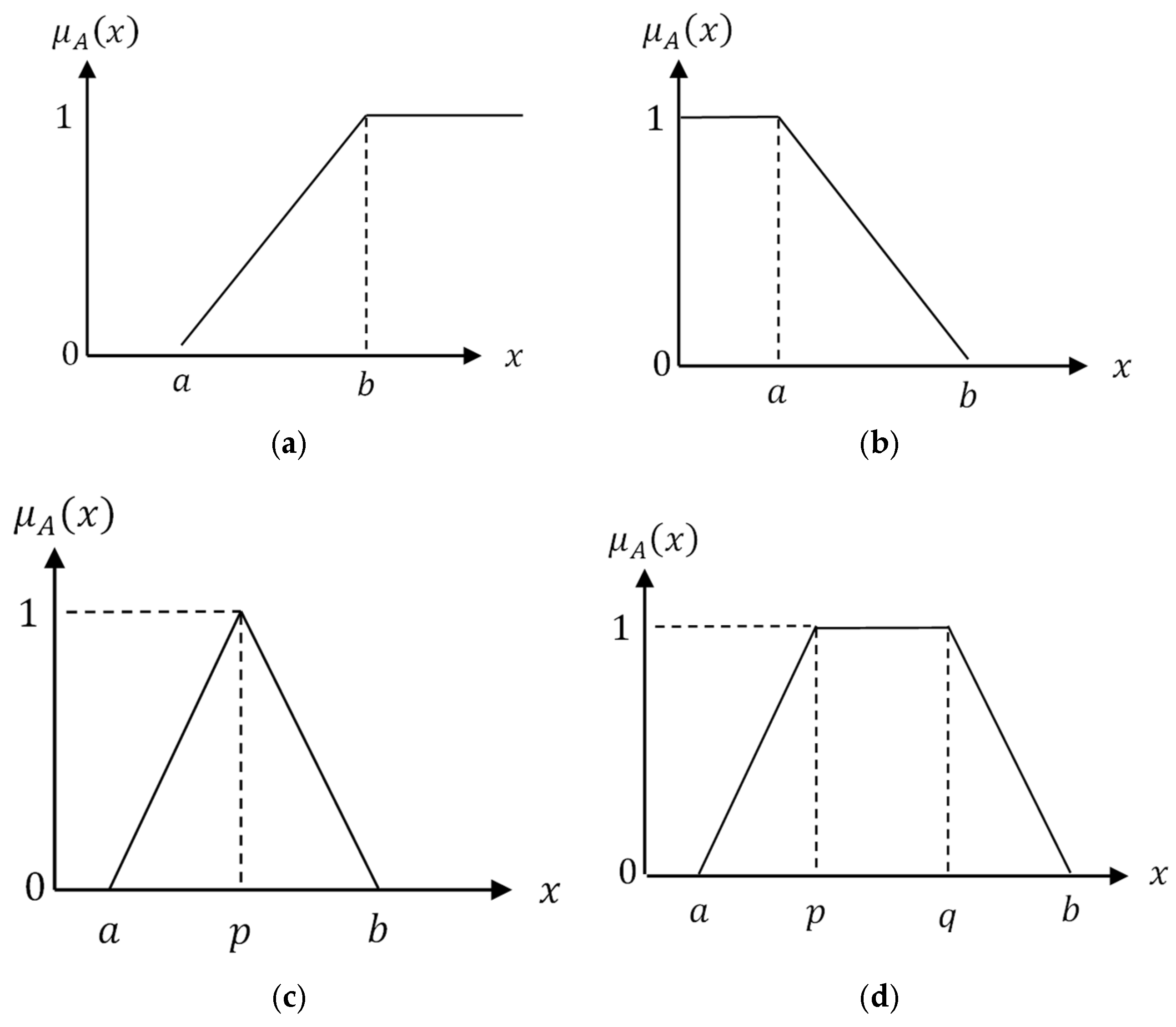
Following the discussion above, the membership function was described using a linear membership function. This assumed that higher application ratings indicated better perceived service quality, as the function was defined as Equation (30).
where
represent the fuzzy membership degree of the alternative
for parameter
, and
is the application rating value of
, for each
. Equation (30) signifies an increasing linear membership function, as in Equation (3). In this context, the rating value
served as the input variable. The simplified linear transformation was appropriate because application ratings in the Google Play Store were already normalized to a five-point scale. Additionally, an existing study confirmed that higher ratings linearly corresponded to better perceived service quality. The linear assumption preserved the ordinal nature of the ratings, providing interpretable and directly comparable degrees of membership across alternatives. The application rating values for each alternative, along with the membership degrees, are shown in
Table 6.
The use of the “security and privacy level” parameter as a criterion for selecting a digital wallet was based on a study by Muhtasim et al. [
45] showing that security and privacy factors significantly influenced customer satisfaction with digital wallet services. In addition, the data used to assess these parameters were obtained by analyzing the official privacy policies published on the website of each service provider, as well as data security information available on the Google Play Store (accessed on 30 January 2026). The evaluation criteria used included user data confidentiality, data integrity from unauthorized changes, and data availability, known as the CIA triad (confidentiality, integrity, and availability) [
46].
Relating to the process, the membership function was determined using the formula in Equation (31).
where
, each representing the assessment score for the aspects of confidentiality, integrity, and availability in alternative
. The value
represented the fuzzy membership degree of the alternative
for parameter
, for each
. Moreover, Equation (31) uses an arithmetic mean of three component scores, which differs from the parametric membership functions presented in
Section 2.1. This method was adopted because security and privacy comprised multiple distinct dimensions, namely confidentiality, integrity, and availability, that were assessed independently. The averaging operation effectively aggregated these dimensions into a composite membership degree while maintaining the interpretability of each component.
Scores were determined based on the clarity of data protection information (confidentiality), efforts to maintain data integrity, and service availability, as explained in the official privacy policy of each digital wallet. Differences in scores reflected the level of completeness and explicitness of the security as well as privacy information provided. The degree of membership for each alternative was calculated using Equation (31), with the detailed calculations presented in Equation (32). Furthermore, the membership degrees of each alternative are shown in
Table 7.
The “service fee” parameter was included as a selection criterion for a digital wallet because it directly affected user satisfaction. As the service fee charged by a digital wallet became lower, the level of user preference for that service became higher. The service fees analyzed included transfer (between digital wallet users and transfers to banks), cash withdrawal, and cash deposit fees. Moreover, the data were obtained from a literature review of official sources, namely the websites of each digital wallet provider, and were then validated through comparisons across sources, which were accessed on 31 January 2026. Details of the service fee components for each alternative are presented in
Appendix A (
Table A1).
Service fees were calculated based on the assumption that each service was used once per month. During the process, fees expressed as ranges were reported using the median value. The four cost components were represented as
(transfer fee between digital wallet users),
(transfer fee to banks),
(cash withdrawal fee), and
(cash deposit fee). The total service cost for the alternative
(signified
) was calculated as the sum of all of these cost components. Furthermore, the membership function during the process was defined as Equation (33).
where
represented the total service cost for the alternative
,
was the maximum value of the total service cost, and
signified the minimum value of the total service cost. The value
represented the fuzzy membership degree of the alternative
for parameter
, for each
. Following the discussion, Equation (33) is a direct application of the decreasing linear membership function defined in Equation (4). The decreasing form appropriately captured the inverse relationship between cost and desirability, where lower service fees produced higher membership degrees. This selection was consistent with standard practice in MCDM, where cost criteria were transformed using decreasing functions to maintain unidirectional preference orientation [
18]. The membership degree of each alternative is shown in
Table 8.
The membership degree of each alternative, as shown in
Table 8, was calculated using Equation (33), with the detailed calculations presented as follows.
with
and
.
According to Shetu et al. [
47], ease of use is an important variable to consider when selecting a digital wallet service. This parameter was assessed based on the ease of transaction flow, ease of access to features, and the availability of user guides on the official website or digital wallet application. The membership degree of each alternative is shown in
Table 9.
Each usability indicator was rated on a five-point scale, where 1 indicated very difficult/poor, and 5 very easy/very good. The final score was then normalized to [0, 1] using an increasing linear membership function. This function assumed that higher ease-of-use scores signified a better user experience, consistent with empirical findings reported by Shetu et al. [
47]. During the process, the data were obtained from observations of features and other information published by digital wallet service providers (accessed on 8 February 2026).
According to Biswas and Pamucar [
43], promotions as well as attractive offers positively influenced user ratings and decisions when selecting a digital wallet. These parameters were assessed based on the type and size of promotions offered, such as cashback, vouchers, discounts, or other attractive offers. Data was collected by directly observing the promotional features on the applications and official websites of each digital wallet, accessed on 8 February 2026. These observations included cashback or bonus balances, vouchers, merchant offers, and discounts or free admin fees. The degree of membership for each alternative is shown in
Table 10.
Each indicator was rated on a five-point scale, where 1 indicated very little/not interesting, and 5 very much/very interesting. Similar to ease of use, the promotion score was normalized linearly to [0, 1]. The linear assumption was supported by a marketing study indicating that promotional attractiveness tended to scale proportionally with the magnitude and variety of offers [
43].
4.1.2. Implementation of the Hybrid FSS–CRITIC–TOPSIS Algorithm
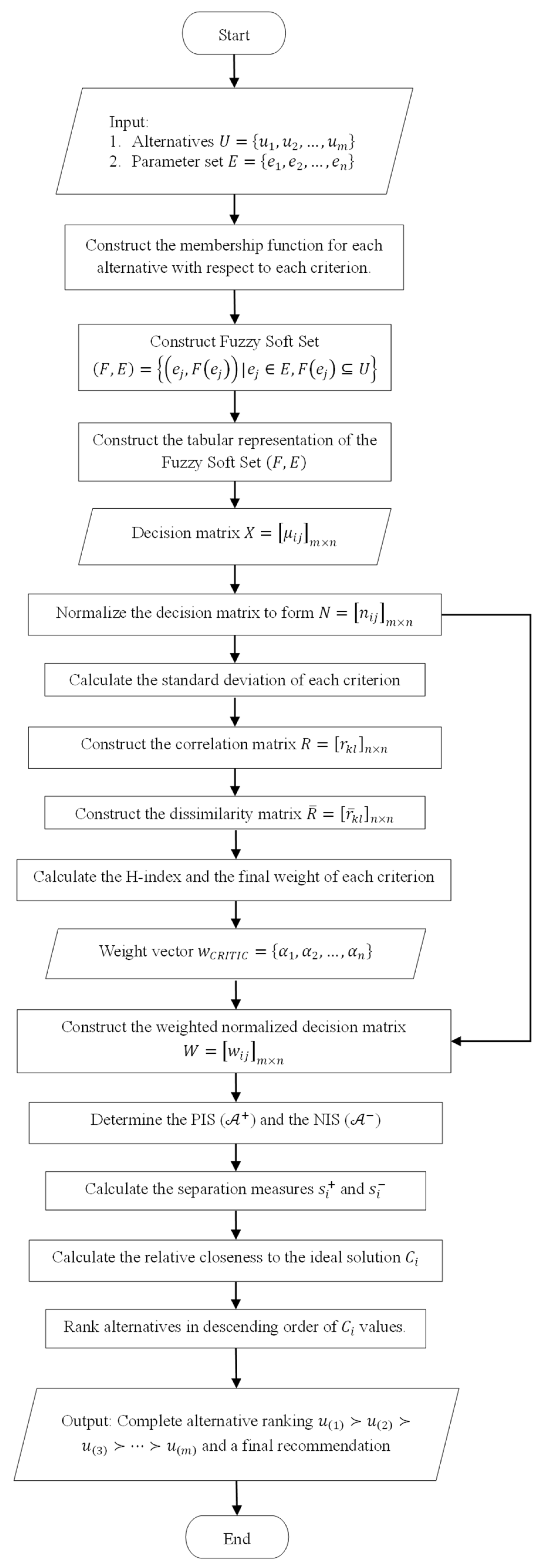
Step 1: Consider the universal set
and the parameter set
as defined in
Section 4.1. The FSS
was defined as
where
The formation of the FSS was based on the results of assessing all alternatives against each assessment criterion, as described in
Section 4.1.1. Furthermore, the tabular representation of the FSS
is shown in
Table 11.
Table 11 was used as a decision matrix in the weighting and ranking process.
Step 2: The weight of each parameter was calculated using the CRITIC method based on the decision matrix.
Table 11 was further represented as
to facilitate the calculation.
- (1)
Construction of the normalized decision matrix
Before forming the normalized decision matrix, the minimum and maximum values for each parameter are first shown in
Table 12.
The normalized decision matrix is shown in
Table 13.
A normalized decision matrix, as shown in
Table 13, was performed using the formula in Equation (13). As a calculation example, the normalization process for each parameter in the alternative
is presented as follows.
- (2)
Calculation of the standard deviation for each parameter
The SD was calculated using Equation (14), after first calculating the mean based on Equation (15). The results of the processes in this study are shown in
Table 14.
- (3)
Creation of correlation matrix
The correlation matrix was computed using Equation (16) to measure the strength of the relationship between parameters. The correlation matrix during this study is shown in
Table 15.
Following the process, the dissimilarity matrix
was formed using Equation (17). In addition, the results of this matrix are shown in
Table 16.
- (4)
Calculation of H-index
The H-index value
for each
is calculated using Equation (18), with the calculation results as in Equation (37).
- (5)
Calculation of the final weight of each parameter
The final weight
for each
was calculated using Equation (19), with the calculation results as presented in Equation (38).
Following the process, the H-index values and final weights for each parameter are shown in
Table 17.
Based on
Table 17, the parameter
had the highest weight of 0.276, indicating that security and privacy were the most dominant factors in selecting a digital wallet. Consequently, parameter
had the lowest weight of 0.126, indicating that promotions and attractive offers had a relatively smaller influence than other parameters.
Step 3: Consider the normalized decision matrix in
Table 13. The matrix was used as the basis for the ranking process using the TOPSIS method. The steps taken during the process in this study were as follows.
- (1)
Constructing a weighted normalized decision matrix
Matrix
was formed by applying the weight of each parameter in
Table 17 to the normalized decision matrix shown in
Table 13, where each element
was calculated using Equation (21). The form of the weighted normalized decision matrix is shown in
Table 18.
- (2)
Determining the positive ideal solution (PIS) and negative ideal solution (NIS)
The determination of PIS and NIS was performed using Equations (24) and (25). In addition, the values of PIS and NIS are presented in Equations (39) and (40), respectively.
All elements used during the process were handled as benefit criteria. This was due to the normalization process, which considered cost criteria previously conducted at the CRITIC step. In this process, the decision matrix used in TOPSIS was unidirectional, with higher values indicating better performance.
- (3)
Calculate the separation measures (alternative distance from PIS) and (alternative distance from NIS)
The values of
and
, for each
were shown in
Table 19.
The values
and
in
Table 19 were calculated using Equations (26) and (27), respectively. For example, the calculation process for the alternative
is presented as follows.
- (4)
Calculate the relative closeness to the ideal solution ()
The relative closeness was calculated using the formula in Equation (28). The calculation process in this section is presented in Equation (43).
- (5)
Rank the alternatives based on the values from lowest to highest.
Based on Equation (43), the ranking results using the TOPSIS method were obtained and are shown in
Table 20.
Based on the ranking results in
Table 20, the DANA digital wallet application (
) ranked first with the highest relative closeness value of
. This result showed that DANA was the most optimal digital wallet selection based on evaluation of the five criteria used in this study. In second place, the digital wallet alternative
(ShopeePay) obtained a relative closeness value of
. This value was close to the first rank, indicating that ShopeePay also performed well. The alternative
(GoPay) was in third place with a relative closeness value of
. These three digital wallets had closeness values greater than
, indicating that their individual performance was close to the ideal solution and they were categorized as high-performance alternatives. Meanwhile, the alternatives
(OVO) and
(LinkAja) obtained lower relative closeness values. In this process,
for LinkAja did not necessarily imply that the service was infeasible. Rather, the variable indicated that its performance was relatively distant from the ideal solution compared to the other alternatives based on the evaluated criteria. The relative closeness value
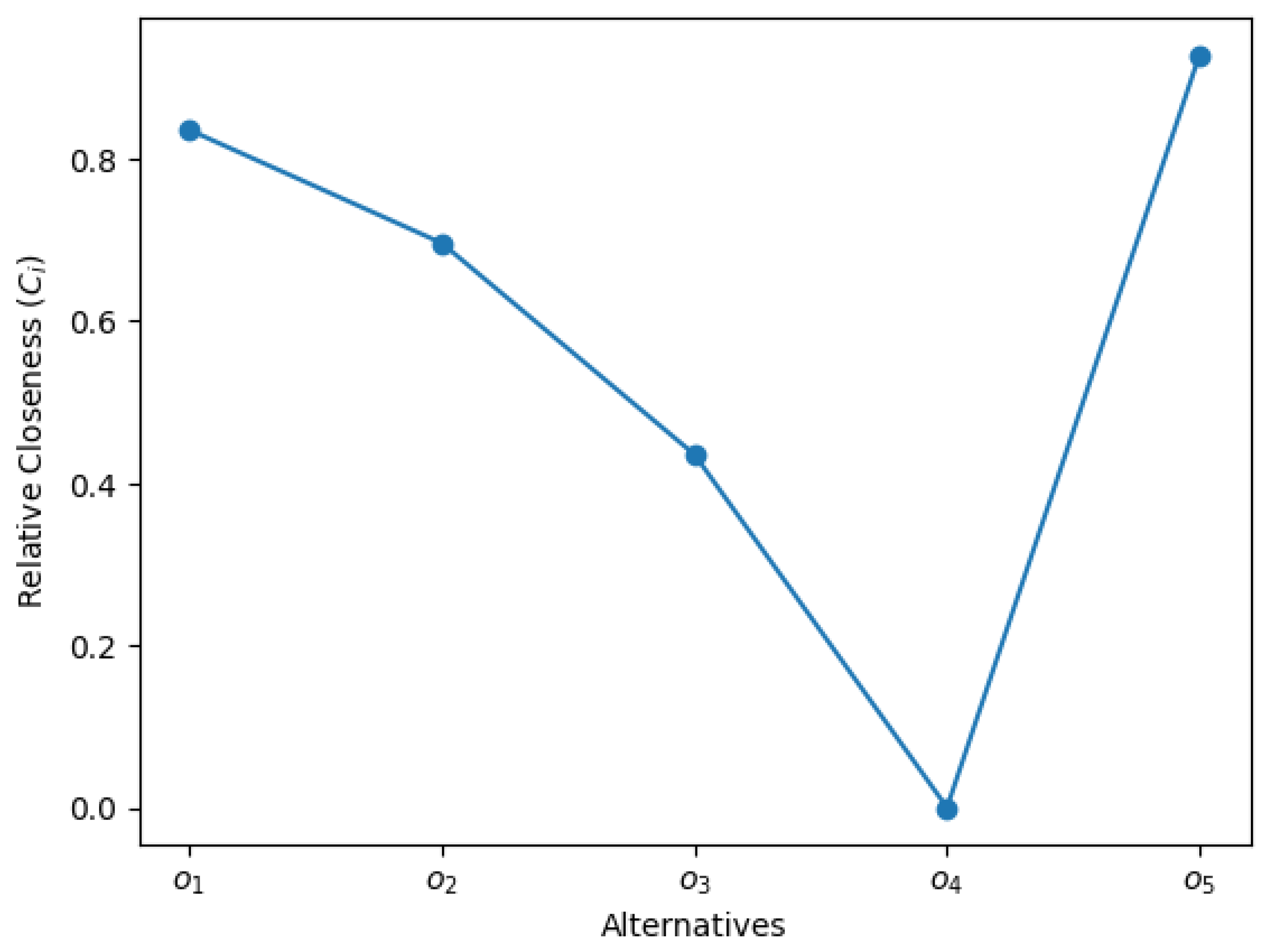
is shown in
Figure 3.
Figure 3 showed the superiority of the FSS–CRITIC–TOPSIS method for clearly and measurably distinguishing among alternative preference levels. The significant difference in
values signified that this method captured the performance variation of each alternative across all criteria. These results were also reinforced by application ranking data on the Google Play Store (
https://play.google.com/, accessed on 8 February 2026), showing that DANA ranked as the Top 1 Free Finance app. ShopeePay and GoPay followed in second and third place, respectively. Meanwhile, OVO ranked ninth, and LinkAja did not appear in the top ten of the finance categories. The result was associated with the ranking results from the FSS–CRITIC–TOPSIS method, strengthening the validity of this study. The development of ShopeePay showed excellent performance. Although this application was relatively new compared to others (see
Table 5), ShopeePay competed and even outperformed several earlier digital wallets. LinkAja, the earliest application among the five alternatives, has not shown competitive performance. This condition showed that the age of the service was not the only determining factor for success. Preferably, continuous improvement is needed across service quality, feature innovation, and user experience to compete effectively in the digital wallet market.
4.2. Comparative Study
In this section, a comparative study was conducted between the proposed FSS–CRITIC–TOPSIS model and other methods to show the advantages as well as the effectiveness of the proposed model. The four benchmark methods used during this study were as follows.
- (1)
Energy-Based FSS: This model, as described by Mudrić-Staniškovski et al. [
48], used FSS energy as the basis for evaluating alternatives. The steps for constructing the decision matrix using an FSS were conducted in the same way as Step 1 of the proposed method. Subsequently, the energy of each alternative was calculated, and the ranking was determined based on the smallest energy value. This model did not include criteria weighting or distance calculations to the ideal solution.
- (2)
FSS–TOPSIS: This model did not consider criterion weighting in the TOPSIS ranking process, enabling all criteria to be assumed to have equal importance. The steps for constructing the decision matrix using an FSS were conducted in the same process as Step 1 of the proposed method, leading to
Table 11. Subsequently, the normalized decision matrix was formed using Equation (20), followed by the TOPSIS procedure as described in
Section 2.4, without incorporating criteria weights.
- (3)
CRITIC–TOPSIS: This model, as described by Yin et al. [
49], used the CRITIC method to calculate criterion weights, which were then applied in the TOPSIS method. The decision matrix was constructed directly from the original quantitative data, without considering the uncertainty or subjectivity modeled by an FSS. The alternative ranking process was conducted using the TOPSIS method as described in
Section 2.4.
- (4)
FSS–SD–TOPSIS: This model followed the structure of the proposed method but replaced the CRITIC method with SD weighting [
17] to determine the criterion weights.
All of the models were applied to the same dataset, as the differences in the results were solely due to the methods and data processing mechanisms of each method. This allowed a more objective evaluation of the performance and advantages of the proposed FSS–CRITIC–TOPSIS model. The results of the comparative analysis, including the scores and final rankings of each alternative across the five models, are shown in
Table 21.
Based on
Table 21, the rankings produced by the five models during the process differ. However, all models consistently identified the structure of alternative preferences in general, particularly in distinguishing between superior, intermediate, and inferior alternative groups. The main difference was shown in the positions of ShopeePay (
) and DANA (
). In the FSS–SD–TOPSIS and FSS–CRITIC–TOPSIS models, DANA ranked first. Meanwhile, ShopeePay ranked first in the other three models, or there was a swap in rankings between the two alternatives. The shift in ranking indicated that incorporating objective weighting methods into the FSS framework affected the sensitivity of the model to data characteristics when combined with TOPSIS. This result was different from models that did not incorporate the two. In models that did not fully incorporate objective weighting and the FSS framework simultaneously, the ranking structure tended to be more influenced by the distribution of initial values than by statistical information across criteria when weight adjustments were not applied. On the other hand, all models consistently placed GoPay (
), OVO (
), and LinkAja (
) in the same ranking, signifying that the performance of these three digital wallets was relatively stable according to all models used. This showed that, despite differences in method and weight calculations across models, the evaluation results for most alternatives remained consistent, providing additional validity for the accuracy of the ranking assessment. The distribution of scores for the five models is shown in
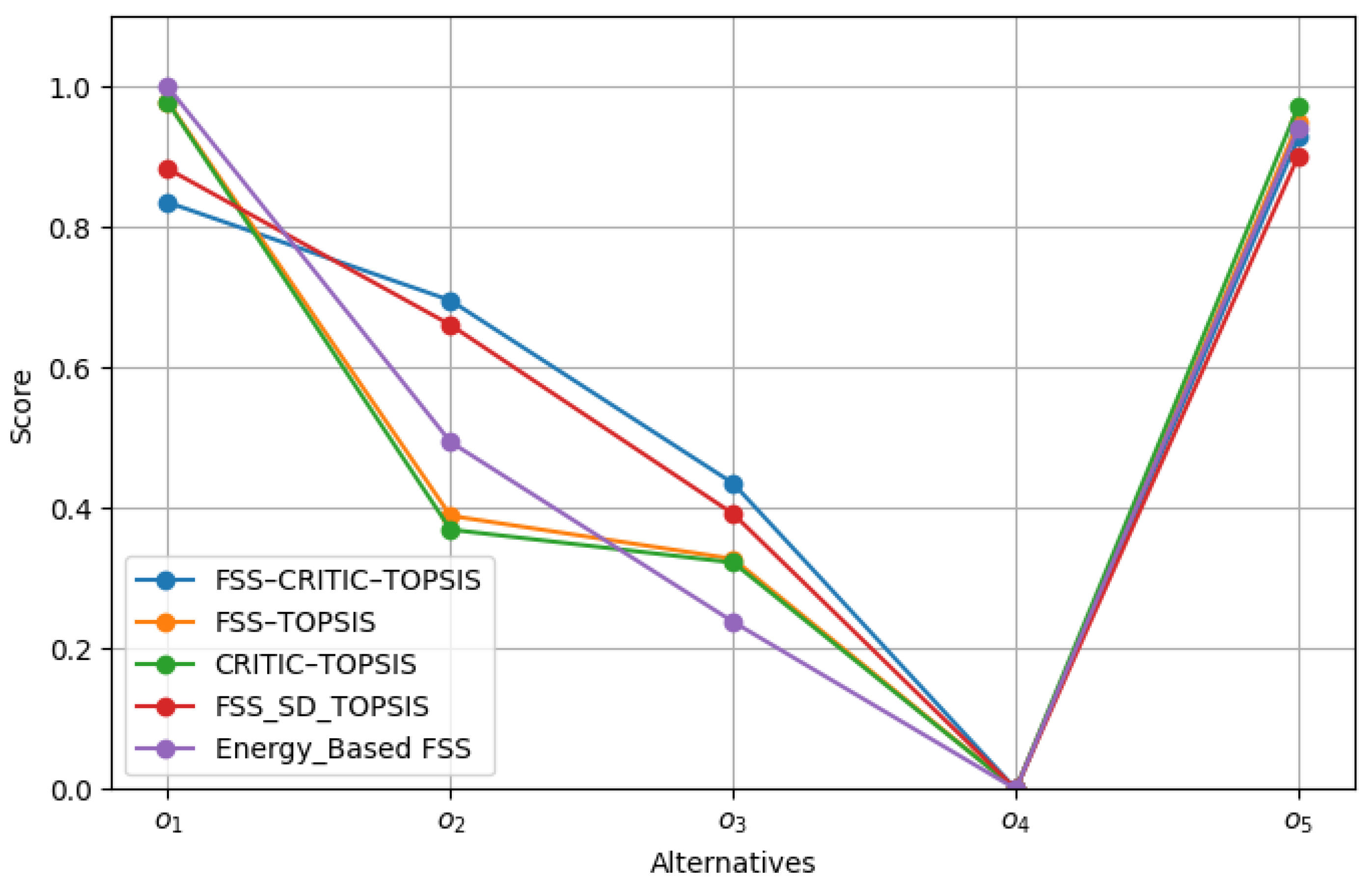
Figure 4 to describe the comparison adequately.
Figure 4 shows that the distributions of scores for each alternative across the five models tested presented a relatively similar trend, indicating consistency in the preference structure across alternatives. For example, the alternative
(LinkAja) consistently scored 0.0000 across all models, implying that the model ranked last in the assessment. This result is consistent with actual data showing that LinkAja is not among the top ten free financial apps according to the Google Play Store. Similarly, the alternatives
(GoPay) and
(OVO) ranked third and fourth, respectively, in all models. However, the score distribution results signified that the FSS–CRITIC–TOPSIS and FSS–SD–TOPSIS were superior because the produced rankings associated with field conditions. As shown in
Figure 4, the
alternative scored above 0.5 in both models, placing it among the top three digital payment platforms, after DANA and ShopeePay. Empirically, GoPay was higher than OVO (ranked ninth), where the difference in scores produced by these two models was more consistent with reality. In the other three models, the scores for GoPay tended to be closer to those of OVO but relatively far from those of DANA and ShopeePay. This distribution of scores showed a lack of sensitivity in the models for capturing the actual performance differences among alternatives in the middle group, producing a preference gap that did not accurately reflect the actual market hierarchy.
The results obtained from the two models that incorporated objective weighting and FSS, namely FSS–CRITIC–TOPSIS and FSS–SD–TOPSIS for the two top-ranked alternatives, showed a representation that was in line with actual conditions. In both models, DANA () ranked first, followed by ShopeePay (). These results correlated with Google Play Store ranking data showing that DANA was at the top of the digital wallet category, followed by ShopeePay. However, the FSS–CRITIC–TOPSIS model signified a more proportional and discriminatory score distribution compared to FSS–SD–TOPSIS. The score difference between DANA and ShopeePay was relatively moderate in FSS–CRITIC–TOPSIS. It maintained a visible distance from other alternatives, making the preference structure appear more measurable and stable. Consequently, the score differences in FSS–SD–TOPSIS tended to be narrower and did not fully reflect the degree of variation and conflict among criteria. This advantage was explained by the CRITIC weighting mechanism, which considered SD as a measure of dispersion and criterion correlations. Therefore, criteria with high information and significant conflict with other criteria received higher weights. The action led to a score distribution that reflected actual conditions and strengthened the case for FSS–CRITIC–TOPSIS as a more adaptive as well as accurate model for evaluating superior alternatives.
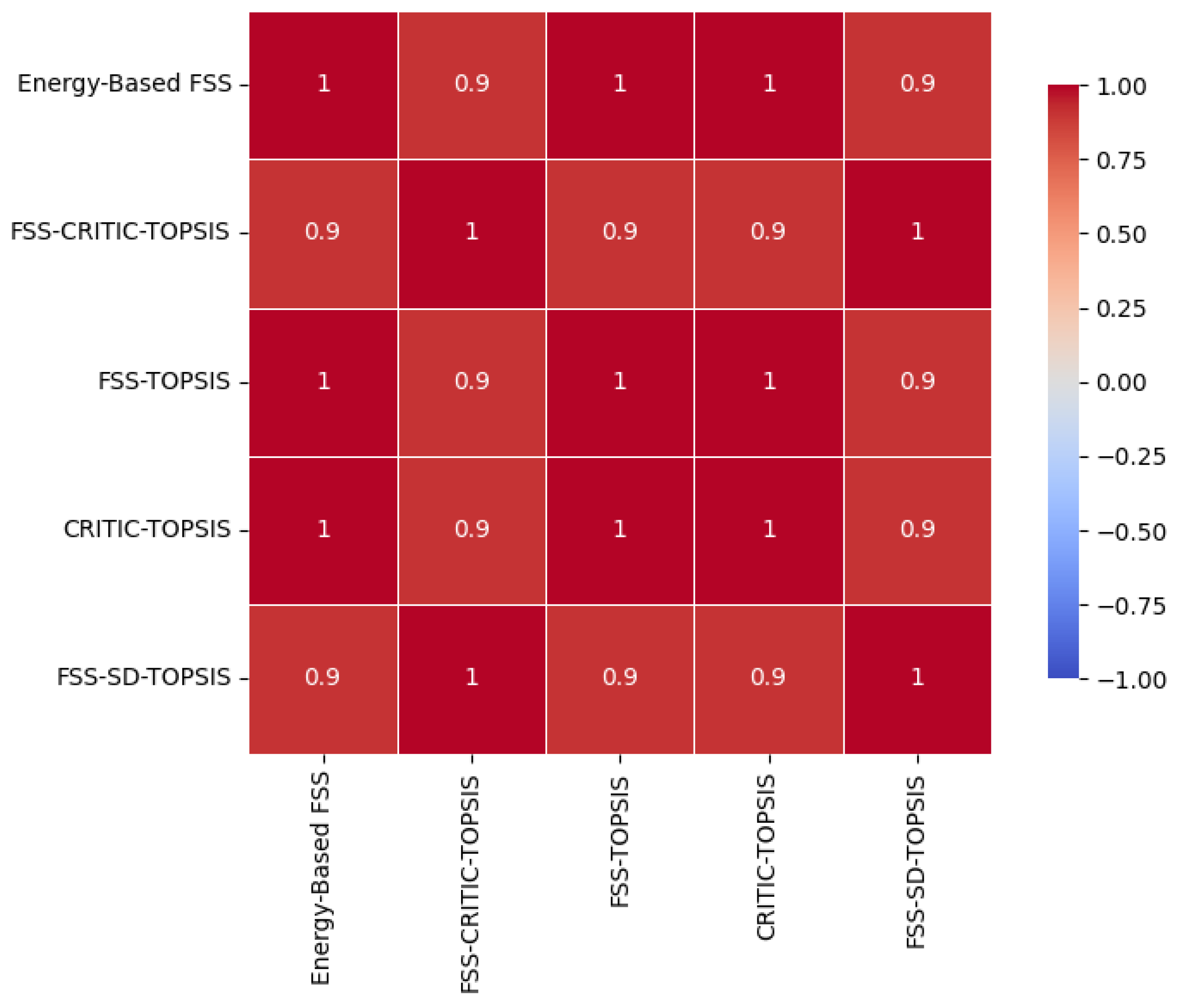
Spearman’s rank correlation coefficient was computed for each pair of methods using the standard formula as presented in [
50], and the results are shown in
Figure 5. This was conducted to quantitatively validate ranking consistency and provide robust statistical evidence.
Figure 5 showed that all correlation coefficients ranged from 0.900 to 1.000, indicating strong positive correlations across all model pairs. This implied that the ranking structures generated by each method were essentially consistent and did not change significantly between methods. In other words, the incorporation of FSS and objective weighting methods did not drastically alter the alternative dominance pattern, but only affected the sensitivity as well as score distribution. Correlation values reaching 1 showed that the five models agree strongly in the determination of the alternative hierarchy. The differences that appeared were more related to score intensity and discrimination accuracy, rather than to extreme order changes. This confirmed previous results that the FSS–CRITIC–TOPSIS model excelled in numerical representation without forfeiting the consistency of the decision structure.
4.3. Sensitivity Analysis
A sensitivity analysis was conducted by varying the parameter to evaluate how changes influenced the ranking results. Weight variations were considered across several scenarios to simulate differences in the preferences of the decision-makers and the relative importance of each parameter. As the baseline scenario (), the weights obtained through the CRITIC method, , were used as the reference condition. These values reflected the standard evaluation setting, and the resulting rankings served as a benchmark for comparison with outcomes under the other scenarios.
Following the discussion above, several weighting scenarios were systematically designed to represent variations in the preferences of decision-makers. Scenario
applied uniform weights to all parameters to test the stability of digital wallet rankings when all criteria were handled equally without any specific priority. Scenarios
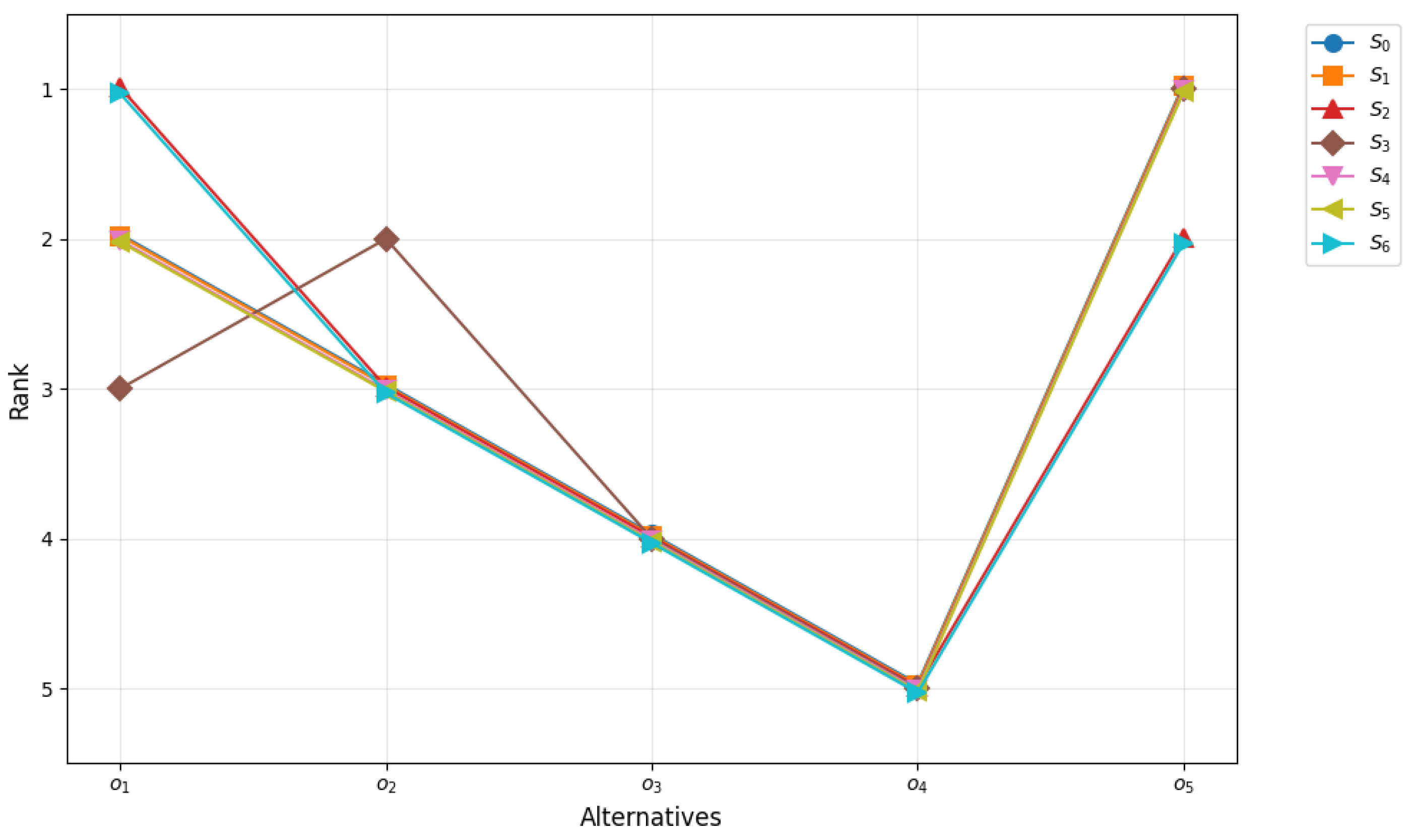
were designed by sequentially increasing the weight of one parameter at a time, while keeping the weights of the other parameters uniform. This method simulated conditions in which a particular aspect became the primary focus of the decision-maker, and it still considered the other parameters. Comparing the alternative rankings across all scenarios assessed the robustness and consistency of the FSS–CRITIC–TOPSIS model. The weights applied in each sensitivity analysis scenario are shown in
Table 22. In addition,
Figure 6 shows the comparison of alternative rankings under the various evaluation conditions.
Based on
Figure 6, most alternatives maintained relatively consistent ranking positions across all scenarios, indicating that the proposed model was stable in relation to weight variations. The alternatives
(LinkAja) and
(OVO) showed the highest stability, with the rankings remaining consistent across all scenarios in fifth and fourth place, respectively. This signified that the performance of these two alternatives was relatively insensitive to changes in the preferences of the decision-makers. The outcome also indicated that the models consistently occupied less competitive positions compared to the other alternatives. The alternative
(GoPay) showed a fairly good level of stability, maintaining the third rank in almost all scenarios, except for scenario
, when the weight of the parameter
(security and privacy) was prioritized. This indicated that the performance of GoPay was relatively stable in relation to changes in most parameter weights, but became more sensitive when the security and privacy aspect was given greater priority in the evaluation process.
In this context, the alternatives (ShopeePay) and (DANA) showed more significant ranking variations when parameter weights were adjusted. The alternative shifted the first to the third position, while moved between the first and second ranks. These changes indicated that both alternatives were more sensitive to variations in certain parameter weights. In general, the sensitivity analysis confirmed that the model generated stable rankings, with any variations remaining within reasonable and logically explainable limits. These results also reflected field conditions, where three alternatives, namely DANA, ShopeePay, and GoPay, consistently competed for the top three positions. Meanwhile, OVO and LinkAja tended to rank lower, making the alternatives relatively less competitive than the other alternatives across various evaluation scenarios.
5. Discussion
5.1. Conceptual Framework and Analytical Rationale of the Proposed Model
The FSS-CRITIC-TOPSIS hybrid model was developed conceptually to leverage the advantages of all three methods in a complementary multi-level decision structure, even though previous studies had used FSS, CRITIC, and TOPSIS independently or in paired combinations (such as CRITIC-TOPSIS [
26]) in decision-making problems. First, the FSS concept was applied to convert subjective assessments and data uncertainty into a decision matrix
, for
alternatives and
criteria, where
represented the membership degree of the
-th alternative in relation to the
-th parameter, for each
and
. This limited representation ensured that the data scale was controlled from the outset, reducing heterogeneity and maintaining numerical stability before the weighting as well as ranking processes were performed. Second, the CRITIC method was used to calculate the weight of each criterion by using the decision matrix
obtained from the previous FSS application. The method computed weights
, for each
, from the normalized data by combining the contrast of each criterion (standard deviation
) and the redundancy (pairwise correlations
, for each
). This calculation included for each criterion an information index
as in Equation (18) and then normalized the process to obtain the weight
. Since
depended on both variability and independence, CRITIC added greater weight to criteria that were both informative (high contrast) and non-redundant (low correlation with others). As a result, CRITIC produced a transparent, statistically interpretable weight vector that directly reflected the capacity of each criterion to discriminate alternatives.
Third, TOPSIS ranked alternatives based on weighted Euclidean-like distances to the positive and negative ideals. Mathematically, since the distance between alternatives in TOPSIS was calculated in a weighted space as in Equations (26) and (27), an increase in the weight of informative criteria increased the contribution to the distance. As a result, real differences between alternatives became more detectable, increasing the discriminatory power of the model compared to methods with uniform weights. When several criteria comprised high correlations, the penalty factor in the CRITIC calculation reduced their weight. Therefore, redundant information was not accumulated excessively in the distance calculation, making the model more resistant to multicollinearity as well as data noise and improving the structural robustness of the system. In terms of stability, the normalization and weighting processes did not result in extreme scale expansion since all initial values were in the domain
. Theoretically, changes in the closeness coefficient due to small variations in weights were limited linearly to the norm of weight changes, allowing small fluctuations in estimates not to cause drastic variations in rankings. This is consistent with the sensitivity analysis results shown in
Section 4.3.
In relation to the discussion above, the advantages of the proposed method became progressively more evident when compared to the three methods used separately. Without incorporation with other methods, alternative ranking in the FSS was conducted through a comparison table, as shown in
Table 2. The final score was obtained by subtracting the number of rows from the number of columns, allowing the decision to be based solely on the frequency of dominance between alternatives. The method did not consider the magnitude of differences in membership values, variations, or interrelationships among parameters, limiting the discriminatory power. In this study, CRITIC produced objective weights based on variance as well as correlation and did not provide a mechanism for evaluating alternatives against the ideal solution. Meanwhile, TOPSIS without objective weighting depended on external weight assumptions that might not necessarily reflect data characteristics. In the CRITIC–TOPSIS method, the process still operated on deterministic data without a formal stage for modeling parameter uncertainty, as weighting and ranking were incorporated. Therefore, the incorporation of FSS–CRITIC–TOPSIS included a combination of techniques, producing three main structural reinforcements: (1) numerical stability using a limited membership domain, (2) increased discriminatory power through a variance contrast mechanism, and (3) resistance to redundancy via correlation penalties. In general, the final weighted separations in TOPSIS were read as composite, criterion-specific contributions to the distance from the ideal of an alternative. The process preserved interpretability at both the criterion and overall levels. These general aspects explained the methodological advantages of the proposed framework over the FSS and CRITIC–TOPSIS methods used separately.
5.2. Theoretical Analysis of the Proposed Framework
The section explained why incorporating FSS representation with CRITIC weighting produced a more discriminative TOPSIS ranking to complement the practical interpretation of the study findings. Let be the set of alternatives and be the set of parameters. In the FSS framework, each alternative was represented as a membership vector , enabling all alternatives to be mapped as points in the bounded decision space . The distances between alternatives were calculated using the standard Euclidean norm in this space, allowing alternatives with similar performance profiles to be geometrically closer to each other. The normalization step preserved this geometric structure while ensuring comparability across criteria , and the major transformation occurred during CRITIC weighting. Let be the weight vector derived from SD and the correlation matrix, as shown in Definition 3. The weighting process was expressed as a linear transformation , where . Therefore, CRITIC weighting was mathematically equivalent to a diagonal scaling operator acting on the decision space. This operation geometrically rescaled each coordinate axis according to its weight. Criteria with higher variance and lower correlation received relatively larger scaling factors, while less informative or highly correlated criteria were relatively contracted. As a result, the originally isotropic Euclidean space became anisotropic, signifying that different directions contributed unequally to distance calculations.
The distances to the ideal solutions were computed using Equations (26) and (27). The outcome showed that the standard Euclidean distance was replaced by a weighted Euclidean norm, where each dimension contributed proportionally to
. Consequently, differences between alternatives along informative dimensions (large
) were magnified, and distinctions along redundant dimensions were attenuated. This metric transformation explained why the relative closeness values became more dispersed under the proposed framework. Formally, the scaling matrix
increased the variance of the distance distribution along informative directions and reduced the contribution of correlated dimensions, increasing the separation between alternatives in the ranking space. Considering a mathematical perspective, the incorporation of FSS representation and CRITIC weighting transformed the decision space from an isotropic Euclidean space into a weighted metric space. This transformation improved both the discriminative power and the stability of the TOPSIS ranking, providing a formal explanation for the empirical development observed in the comparative analysis. The geometric interpretation followed the empirical results shown in
Figure 4, where the proposed method produced more evenly distributed relative closeness values compared to unweighted FSS-TOPSIS or CRITIC-TOPSIS without FSS.
5.3. Analysis of Computational Complexity
The computational efficiency of the proposed framework was an important factor in determining the applicability to real-world MCDM problems in relation to accuracy and robustness. The workflow of the FSS–CRITIC–TOPSIS model followed the sequential structure described in Algorithm 1, which consisted of three main phases, namely construction of the FSS decision matrix, objective weighting using the CRITIC method, and ranking using the TOPSIS procedure. This section provided a formal analysis of the time and space complexity of Algorithm 1 in terms of the number of alternatives and the number of criteria . First, the FSS construction phase required computing membership values for each combination of alternatives and criteria. Since all membership functions in the implementation were simple linear or arithmetic expressions that required constant-time operations, this phase had time complexity and space for storing the membership matrix. The construction of the decision matrix and the subsequent normalization step, which included finding the minimum and maximum values for each criterion, also required operations.
Second, the CRITIC weighting mechanism forced the most significant computational demand. Calculating SD for each criterion required operations. However, the construction of the inter-criteria correlation matrix dominated the complexity, as each of the unique criterion pairs required aggregating data across all alternatives, leading to operations. The dissimilarity matrix construction as well as H-index calculations added operations, and final weight computation contributed . Therefore, the overall complexity of the CRITIC stage was dominated by the correlation computation and expressed as . Third, the remaining TOPSIS procedures required at most operations. In the TOPSIS procedure, determining the positive and NIS, as well as computing weighted Euclidean distances for all alternatives, each required operations. Sorting the relative closeness coefficients to obtain the final ranking required . Therefore, the total computational complexity of the TOPSIS was .
By combining all stages, the total time complexity of the FSS–CRITIC–TOPSIS framework was
, which simplified to
when
. This complexity showed that the algorithm improved linearly with the number of alternatives and quadratically with the number of criteria. In terms of space complexity, the method required storing the
decision matrix and the
correlation matrix. Therefore, the overall space complexity of the matrix during the process was
. In practical decision-making scenarios, the number of criteria was typically smaller than the number of alternatives (i.e.,
). Under this condition, the quadratic component
remained relatively small, and the overall computational burden was effectively close to linear in
, making the proposed framework computationally efficient in practice. In comparison with hybrid models such as classical FSS and AHP–TOPSIS [
26], which required up to
and
operations, the proposed FSS–CRITIC–TOPSIS framework remained computationally more efficient while avoiding subjective pairwise comparisons. Therefore, it offered a well-balanced trade-off between efficiency, objectivity, and robustness for decision-making under uncertainty.
5.4. Comparative Positioning of the Proposed Framework
The section analytically positioned the FSS-CRITIC-TOPSIS model relative to several established methods, namely energy-based FSS [
48], CRITIC–TOPSIS [
25], classical FSS decision models [
34], and AHP–TOPSIS [
26]. The proposed model extended classical FSS decision schemes by introducing a structured weighting and distance-based ranking mechanism. Classical FSS effectively modeled parameterized uncertainty; however, the criteria were treated equally in many implementations. When alternatives showed similar membership patterns, this uniform weighting limited discriminatory resolution. By incorporating objective criterion weights and distance separation from ideal solutions, the proposed framework improved sensitivity while preserving the interpretability of fuzzy membership degrees.
The distinction depended primarily on the representation level compared with CRITIC–TOPSIS. Conventional CRITIC–TOPSIS operated on crisp numerical matrices, as the proposed model incorporated FSS modeling before weight determination. This allowed uncertainty to be explicitly embedded in the decision structure while retaining variance–correlation-based objective weighting. The present contribution might be viewed as a structural extension of CRITIC–TOPSIS to a parameterized fuzzy decision environment. The difference from AHP–TOPSIS concerned the philosophy of weight derivation. Moreover, AHP depended on subjective pairwise comparisons, which introduced cognitive bias and consistency constraints. The proposed framework used the CRITIC mechanism to derive weights from statistical dispersion and inter-criterion correlation. This data-driven strategy reduced subjectivity while structurally considering redundancy among criteria, improving robustness.
The proposed framework introduced an additional geometric transformation of the decision space compared with energy-based FSS methods. Through CRITIC weighting, the metric structure was diagonally rescaled before TOPSIS distance computation. The informative dimensions were amplified, while highly correlated dimensions were relatively attenuated. This structural scaling led to a broader distribution of relative closeness values as well as clearer separation among alternatives, which was confirmed by comparative and sensitivity analyses. By considering a computational perspective, the overall asymptotic complexity remained polynomial, as reviewed in
Section 5.3. The dominant term arose from the correlation-based weighting stage, and the ranking procedure maintained standard distance-based complexity. Therefore, improved discriminatory structure was achieved without introducing prohibitive computational overhead.
5.5. Limitations and Future Study Directions
Several limitations were observed, even though this study contributed to MCDM modeling for digital payment services. First, this study used a static set of criteria and alternatives, which did not fully capture the dynamic evolution of digital payment services over time. Changes in user preferences, regulations, and technological innovations affected the relevance of the criteria and the weights applied. Second, the determination of criteria weights was based solely on an objective method, which did not fully reflect the actual preferences of decision-makers or users, even though the model was capable of reducing subjectivity. In practice, factors such as user experience, risk perception, and specific needs often influence the evaluation process, which were not explicitly considered in this study.
Future studies can extend the proposed model by combining objective and subjective methods to determine criterion weights, by incorporating the CRITIC method with expert judgment or user surveys. Additionally, expanding the number of alternatives, using longitudinal data, as well as applying the model across different regional contexts and service types can provide a more comprehensive understanding of its reliability and flexibility. Further studies that compare this method with other decision-making strategies can enrich the theoretical and practical implications of this study.
6. Conclusions
In this study, an integrated FSS–CRITIC–TOPSIS decision-making framework was developed and applied to select an optimal digital wallet based on multiple evaluation criteria. The framework models uncertainty using fuzzy soft sets, determines criterion weights objectively using the CRITIC method, and generates a structured ranking of alternatives using the TOPSIS method. The main methodological contribution of this research is the formulation of a unified decision-making algorithm that coherently integrates uncertainty representation, objective weighting, and distance-based evaluation within a single analytical framework.
The application of the model to five major digital wallets (ShopeePay, GoPay, OVO, LinkAja, and DANA) using five evaluation criteria indicates that security and privacy () is the most dominant factor (weight 0.276). At the same time, promotions and attractive offers () have the smallest influence (weight 0.126). The ranking results identify DANA as the best alternative with a relative closeness score of 0.9282, followed by ShopeePay (0.8354), GoPay (0.6958), OVO (0.4353), and LinkAja (0.000). These results are consistent with actual data, which show that DANA, ShopeePay, and GoPay rank among the top three in the free finance category on the Google Play Store. At the same time, OVO ranks ninth, and LinkAja does not appear in the top ten.
The superiority of the FSS–CRITIC–TOPSIS method is further demonstrated through comparative analysis with alternative approaches, including FSS–TOPSIS, CRITIC–TOPSIS, FSS-SD-CRITIC, and energy-based FSS. The proposed model not only produces stable and proportionate rankings but also more accurately reflects real market conditions, with rank correlations approaching perfection. Sensitivity analysis of criterion weights shows that the top three rankings remain consistent, indicating the model’s robustness to changes in decision-maker preferences. Overall, the FSS–CRITIC–TOPSIS framework proves to be an effective, objective, and reliable multi-criteria decision-support tool for handling uncertainty. Future research can further develop the proposed framework by integrating subjective approaches, expanding the scope of alternatives and criteria, and applying the model in different contexts and time periods to enhance the generalizability and practical relevance of the results.





 ,
,