E-Commerce Platforms’ Cross-Platform Targeted Advertising Strategies: Cooperation with Social Media Platforms or Remaining Independent



Abstract
1. Introduction
- (1)
- What factors influence e-commerce platforms’ decision-making regarding cross-platform targeted advertising strategies in cooperation with social media platforms?
- (2)
- When considering the influence of social media relationships, is cross-platform targeted advertising on e-commerce platforms still effective?
- (3)
- How should e-commerce platforms choose between single-platform and cross-platform strategies to maximize profits in fully and partially overlapping user groups?
2. Literature Review
2.1. The Effectiveness of Targeted Advertising
2.2. Targeted Advertising Incorporating the Characteristics of Social Media Platforms
2.3. Strategies for Targeted Advertising Delivery
3. Model Description
4. Results and Equilibrium Analysis
4.1. E-Commerce Platform Adopts a Single-Platform Targeted Advertising Strategy
4.2. E-Commerce Platform Adopts a Cross-Platform Targeted Advertising Strategy
- a.
- If , the e-commerce platform’s equilibrium targeting precision , equilibrium advertising intensity , and equilibrium profit ; the brand owner’s equilibrium price and equilibrium profit ; and the social media platform’s equilibrium profit are as shown in Table 2. For any , , or , or , , equilibrium solutions exist and remain non-negative.
- b.
- If , the e-commerce platform’s equilibrium targeting precision , equilibrium advertising intensity , and equilibrium profit ; the brand owner’s equilibrium price and equilibrium profit ; and the social media platform’s equilibrium profit are as shown in Table 2. For any , , and , equilibrium solutions exist and remain non-negative.
4.3. Numerical Simulation
4.4. Comparing Single- and Cross-Platform Strategies
4.5. Comparing Fully and Partially Overlapping User Groups
5. Discussion
- (1)
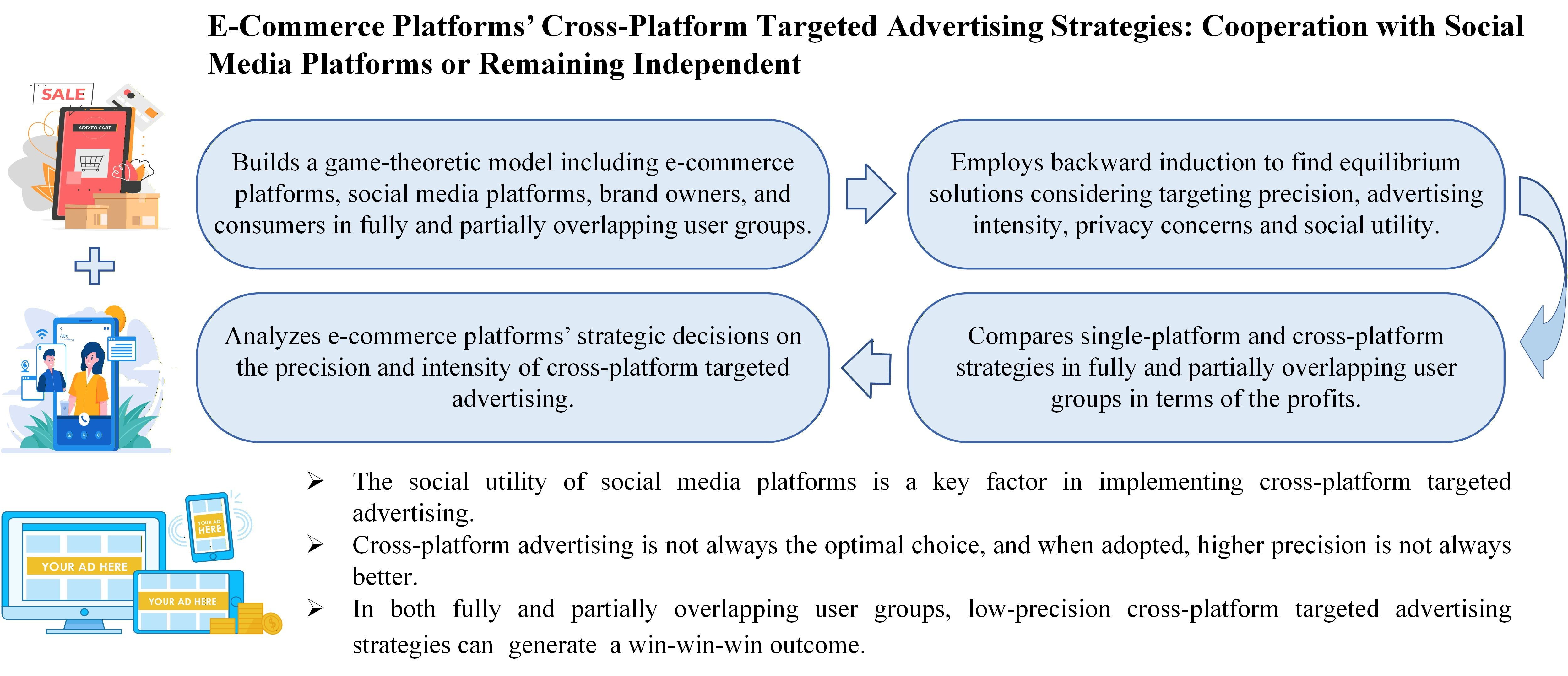
- The social utility of social media platforms is a key factor in implementing cross-platform targeted advertising. Cross-platform targeted advertising strategies exhibit different equilibrium outcomes at different precision levels. In fully overlapping user group, these are jointly determined by the proportion of privacy-sensitive consumers, the e-commerce platform’s profitability and the social utility provided by the social media platform. By contrast, under the single-platform targeted advertising strategy, the e-commerce platform’s decision depends solely on its commission rate. In partially overlapping user group, equilibrium outcomes are also determined by the shares of loyal users.
- (2)
- Cross-platform targeted advertising is not always the optimal choice for e-commerce platforms. Whether in fully or partially overlapping user group, if the gains from cooperation can offset cooperation costs, the e-commerce platform will choose a low precision cross-platform strategy; otherwise, a single-platform strategy is preferable. In terms of the e-commerce platform’s profit alone, higher precision does not necessarily deliver better advertising performance or higher profit.
- (3)
- Low-precision cross-platform strategy achieves three-party optimum in fully and partially overlapping user groups. Although targeting is relatively coarse under low precision, the consumer base is larger, privacy intrusions are fewer, and consumers receive the social utility of the social media platform. As a result, relatively high sales can be achieved. Therefore, the e-commerce platform can maintain relatively high profits while facilitating synergistic gains for both the brand owner and the social media platform.
- (1)
- E-commerce platforms should prudently use social media platforms instead of relying excessively on their traffic. In the long run, increasing traffic dependence may reshape the balance of power between e-commerce platforms and social media platforms, which could influence the stability of cooperative advertising arrangements. In practice, increasing reliance on external traffic sources may gradually strengthen the bargaining power of social media platforms. As e-commerce platforms become more dependent on third-party traffic, social media platforms may gain greater leverage in advertising cooperation. This dynamic dependence could affect the long-term sustainability of the three-party optimal outcome identified in this study. E-commerce platforms can reduce their dependence on external channels by developing proprietary communities, membership programs, and customer repurchase mechanisms. Membership programs and repurchase mechanisms may help mitigate privacy-related attrition risks associated with cross-platform data sharing. Taking JD.com as an example, after ending its partnership with WeChat, the platform may strengthen its connection with members to enhance user loyalty and reduce reliance on external traffic sources. By strengthening user loyalty, these mechanisms encourage consumers to maintain long-term relationships with the platform even when privacy concerns arise. As a result, they can help e-commerce platforms stabilize their user base and reduce the potential negative effects of privacy concerns on user retention.
- (2)
- E-commerce platforms should not regard cross-platform cooperation as the default option but as a differentiated, situation-specific decision. Consider the case of the partnership between JD.com and WeChat, which has experienced both the establishment and dissolution of its cooperation [59]. On one hand, cooperation allows JD.com to obtain user traffic from WeChat; on the other hand, non-cooperation compels JD.com to allocate budgets flexibly to new channels such as TikTok and offline stores. In the long term, non-cooperation may drive JD.com to pursue a digital transformation of its supply chain, fostering a multi-polar growth structure [60]. When deciding whether to cooperate with social media platforms, e-commerce platforms should identify the actual situation. Evaluating their own profitability, the proportion of privacy sensitive consumers, the shares of loyal users, the social utility and the type of user group is necessary. Under certain conditions, a single-platform targeted advertising strategy may be more cost-effective.
- (3)
- E-commerce platforms should promote co-creation of value and proprietary data accumulation when cooperating with social media platforms. Compared with single-platform and high-precision cross-platform advertising strategies, low-precision cross-platform advertising strategy may achieve a win–win–win outcome for e-commerce platforms. When promoting co-creation of value, e-commerce platforms can choose low-precision cross-platform advertising strategy. However, low-precision cross-platform advertising strategy relies more heavily on third-party user traffic. From a long-term perspective, a portion of user data may remain within the social media platform, potentially limiting the e-commerce platform’s ability to accumulate proprietary data. Taking JD.com as an example, WeChat’s vast social data enable JD.com to leverage external data resources to support its data infrastructure without incurring substantial costs. However, once the partnership ends, JD.com may incur considerable costs to rebuild its own dataset. This consideration further suggests that e-commerce platforms should adopt cross-platform strategies cautiously.
6. Conclusions
Author Contributions
Funding
Data Availability Statement
Conflicts of Interest
References
- Kapoor, A.; Kumar, M. Frontiers: Generative AI and Personalized Video Advertisements. Manag. Sci. 2025, 44, 733–747. [Google Scholar] [CrossRef]
- Sandu, A.; Cotfas, L.; Ioanăș, C.; Cișmașu, I.; Delcea, C. E-Commerce Meets Emerging Technologies: An Overview of Research Characteristics, Themes, and Trends. J. Theor. Appl. Electron. Commer. Res. 2025, 20, 320. [Google Scholar] [CrossRef]
- Liu, J.; Zhong, W.; Zhang, J.; Mei, S. The effectiveness of cross-platform targeted advertising strategy. Electron. Commer. Res. 2024, 24, 2831–2847. [Google Scholar] [CrossRef]
- Rawangngam, N.; Pongsakornrungsilp, S.; Pongsakornrungsilp, P.; Pongsakornrungsilp, P.; Moghadas, S. TikTok Marketing Strategies and Consumer Response: A Structural Equation Modeling Study on Purchase Intention in Thailand. J. Theor. Appl. Electron. Commer. Res. 2025, 20, 319. [Google Scholar] [CrossRef]
- Waisman, C.; Sahni, N.S.; Nair, H.S.; Lin, X.L. Parallel Experimentation and Competitive Interference on Online Advertising Platforms. Mark. Sci. 2025, 44, 437–456. [Google Scholar] [CrossRef]
- Plantin, J.C.; Seta, G. WeChat as infrastructure: The techno-nationalist shaping of Chinese digital platforms. Chin. J. Commun. 2019, 12, 257–273. [Google Scholar] [CrossRef]
- Fong, N.M. How Targeting Affects Customer Search: A Field Experiment. Manag. Sci. 2016, 63, 2353–2364. [Google Scholar] [CrossRef]
- Syamsuar, D.; Witarsyah, D. The Role of Perceived Value and Risk in Shaping Purchase Intentions in Live-Streaming Commerce: Evidence from Indonesia. J. Theor. Appl. Electron. Commer. Res. 2025, 20, 298. [Google Scholar] [CrossRef]
- Mandal, P.; Guchhait, R.; Dey, B.K.; Sarkar, M.; Pareek, S.; Ganguly, A. Customized Product Design and Cybersecurity Under a Nash Game-Enabled Dual-Channel Supply Chain Network. Mathematics 2026, 14, 192. [Google Scholar] [CrossRef]
- Swaminathan, V.; Sorescu, A.; Steenkamp, J.; O’Guinn, T.; Schmitt, B. Branding in a Hyperconnected World: Refocusing Theories and Rethinking Boundaries. J. Mark. 2020, 84, 24–46. [Google Scholar] [CrossRef]
- Despotakis, S.; Yu, J. Multidimensional Targeting and Consumer Response. Manag. Sci. 2023, 69, 4518–4540. [Google Scholar] [CrossRef]
- Shim, H.; Lee, J.; Park, Y.S. Watching Ad or Paying Premium: Optimal Monetization of Online Platforms. J. Theor. Appl. Electron. Commer. Res. 2025, 20, 347. [Google Scholar] [CrossRef]
- Pires, P.B.; Prisco, M.; Delgado, C.; Santos, J.D. A Conceptual Approach to Understanding the Customer Experience in E-Commerce: An Empirical Study. J. Theor. Appl. Electron. Commer. Res. 2024, 19, 1943–1983. [Google Scholar] [CrossRef]
- Hoeck, L.; Spann, M. An Experimental Analysis of the Effectiveness of Multi-Screen Advertising. J. Interact. Mark. 2020, 50, 81–99. [Google Scholar] [CrossRef]
- Ballerini, J.; Yahiaoui, D.; Giovando, G.; Ferraris, A. E-commerce channel management on the manufacturers’ side: Ongoing debates and future research pathways. Rev. Manag. Sci. 2024, 18, 413–447. [Google Scholar] [CrossRef]
- Bingi, P.; Mir, A.; Khamalah, J. The challenges facing global E-commerce. Inf. Syst. Manag. 2000, 17, 26–34. [Google Scholar] [CrossRef]
- Kocarslan, H.; Stoycheva, B. The Effect of Digital Literacy on Online Purchase Intention: The Mediating Role of Social Media Use. J. Theor. Appl. Electron. Commer. Res. 2025, 20, 355. [Google Scholar] [CrossRef]
- Nemec Zlatolas, L.; Hrgarek, L.; Welzer, T.; Hölbl, M. Models of Privacy and Disclosure on Social Networking Sites: A Systematic Literature Review. Mathematics 2022, 10, 146. [Google Scholar] [CrossRef]
- Shin, J.; Yu, J.J. Targeted Advertising and Consumer Inference. Mark. Sci. 2021, 40, 900–922. [Google Scholar] [CrossRef]
- Sahni, N.S. Advertising Spillovers: Evidence from Online Field Experiments and Implications for Returns on Advertising. J. Mark. Res. 2016, 53, 459–478. [Google Scholar] [CrossRef]
- Segijn, C.M.; Voorveld, H.A.M.; Vakeel, K.A. The Role of Ad Sequence and Privacy Concerns in Personalized Advertising: An Eye-Tracking Study into Synced Advertising Effects. J. Advert. 2021, 50, 320–329. [Google Scholar] [CrossRef]
- Iyer, G.; Soberman, D.; Villas-Boas, J.M. The Targeting of Advertising. Mark. Sci. 2005, 24, 461–476. [Google Scholar] [CrossRef]
- Belanger, F.; Crossler, R.E. Privacy in the Digital Age: A Review of Information Privacy Research in Information Systems. MIS Q. 2011, 35, 1017–1041. [Google Scholar] [CrossRef]
- Martin, K.D.; Murphy, P.E. The role of data privacy in marketing. J. Acad. Mark. Sci. 2017, 45, 135–155. [Google Scholar] [CrossRef]
- Pavlou, P.A. State of the Information Privacy Literature: Where are We Now And Where Should We Go? MIS Q. 2011, 35, 977–988. [Google Scholar] [CrossRef]
- Smith, H.J.; Dinev, T.; Xu, H. Information Privacy Research: An Interdisciplinary Review. MIS Q. 2011, 35, 989-A27. [Google Scholar] [CrossRef]
- Zhang, J.; Liang, Q.; Huang, J. Forward advertising: A competitive analysis of new product preannouncement. Inf. Econ. Policy 2016, 37, 3–12. [Google Scholar] [CrossRef]
- Shen, Y. Price and advertising competition in an online marketplace: The tradeoff between quality and cost. Electron. Commer. Res. Appl. 2023, 60, 101276. [Google Scholar] [CrossRef]
- Gal-Or, E.; Gal-Or, M.; May, J.H.; Spangler, W.E. Targeted Advertising Strategies on Television. Manag. Sci. 2006, 52, 713–725. [Google Scholar] [CrossRef]
- Goldfarb, A.; Tucker, C. Privacy Regulation and Online Advertising. Manag. Sci. 2011, 57, 57–71. [Google Scholar] [CrossRef]
- Shen, Y.; Zhong, W.; Mei, S. Advertising strategies of competing firms considering consumer privacy concerns. Manag. Decis. Econ. 2023, 44, 2424–2437. [Google Scholar] [CrossRef]
- Gal-Or, E.; Gal-Or, R.; Penmetsa, N. The Role of User Privacy Concerns in Shaping Competition Among Platforms. Inf. Syst. Res. 2018, 29, 698–722. [Google Scholar] [CrossRef]
- Koh, B.; Raghunathan, S.; Nault, B.R. Is voluntary profiling welfare enhancing? MIS Q. 2017, 41, 23–41. [Google Scholar] [CrossRef]
- Attar, R.W.; Almusharraf, A.; Alfawaz, A.; Hajli, N. New Trends in E-Commerce Research: Linking Social Commerce and Sharing Commerce: A Systematic Literature Review. Sustainability 2022, 14, 16024. [Google Scholar] [CrossRef]
- Belanger, F.; Hiller, J.S.; Smith, W.J. Trustworthiness in electronic commerce: The role of privacy, security, and site attributes. J. Strateg. Inf. Syst. 2002, 11, 245–270. [Google Scholar] [CrossRef]
- Riswanto, A.L.; Ha, S.; Lee, S.; Kwon, M. Online Reviews Meet Visual Attention: A Study on Consumer Patterns in Advertising, Analyzing Customer Satisfaction, Visual Engagement, and Purchase Intention. J. Theor. Appl. Electron. Commer. Res. 2024, 19, 3102–3122. [Google Scholar] [CrossRef]
- Ahn, Y.; Lee, J. The Impact of Online Reviews on Consumers’ Purchase Intentions: Examining the Social Influence of Online Reviews, Group Similarity, and Self-Construal. J. Theor. Appl. Electron. Commer. Res. 2024, 19, 1060–1078. [Google Scholar] [CrossRef]
- Theodorakopoulos, L.; Theodoropoulou, A.; Klavdianos, C. Interactive Viral Marketing Through Big Data Analytics, Influencer Networks, AI Integration, and Ethical Dimensions. J. Theor. Appl. Electron. Commer. Res. 2025, 20, 115. [Google Scholar] [CrossRef]
- Krämer, J.; Schnurr, D.; Wohlfarth, M. Winners, Losers, and Facebook: The Role of Social Logins in the Online Advertising Ecosystem. Manag. Sci. 2018, 65, 1678–1699. [Google Scholar] [CrossRef]
- Libai, B.; Muller, E.; Peres, R. Decomposing the Value of Word-of-Mouth Seeding Programs: Acceleration versus Expansion. J. Mark. Res. 2013, 50, 161–176. [Google Scholar] [CrossRef]
- Campbell, A. Word-of-Mouth Communication and Percolation in Social Networks. Am. Econ. Rev. 2013, 103, 2466–2498. [Google Scholar] [CrossRef]
- Bimpikis, K.; Ozdaglar, A.; Yildiz, E. Competitive Targeted Advertising Over Networks. Oper. Res. 2016, 64, 705–720. [Google Scholar] [CrossRef]
- Zhen, X.; George Cai, G.; Song, R.; Jang, S. The effects of herding and word of mouth in a two-period advertising signaling model. Eur. J. Oper. Res. 2019, 275, 361–373. [Google Scholar] [CrossRef]
- Turner, J. The Planning of Guaranteed Targeted Display Advertising. Oper. Res. 2012, 60, 18–33. [Google Scholar] [CrossRef][Green Version]
- Lim, J.S.; Ri, S.Y.; Egan, B.D.; Biocca, F.A. The cross-platform synergies of digital video advertising: Implications for cross-media campaigns in television, Internet and mobile TV. Comput. Hum. Behav. 2015, 48, 463–472. [Google Scholar] [CrossRef]
- Athey, S.; Calvano, E.; Gans, J.S. The Impact of Consumer Multi-homing on Advertising Markets and Media Competition. Manag. Sci. 2016, 64, 1574–1590. [Google Scholar] [CrossRef]
- Taylor, J.; Kennedy, R.; Mcdonald, C.; Larguinat, L.; El Ouarzazi, Y.; Haddad, N. Is the Multi-Platform Whole More Powerful Than Its Separate Parts? Measuring the Sales Effects of Cross-Media Advertising. J. Advert. Res. 2013, 53, 200–211. [Google Scholar] [CrossRef]
- Sayedi, A. Real-Time Bidding in Online Display Advertising. Mark. Sci. 2018, 37, 553–568. [Google Scholar] [CrossRef]
- Zhou, H.; Li, G.; Tan, Y. Advertising mode of duopoly competitive enterprises based on asymmetric cost efficiency and converter preference. Electron. Commer. Res. Appl. 2023, 62, 101329. [Google Scholar] [CrossRef]
- Zhang, K.Z.K.; Benyoucef, M. Consumer behavior in social commerce: A literature review. Decis. Support Syst. 2016, 86, 95–108. [Google Scholar] [CrossRef]
- Chen, T.; Peng, L.; Yang, J.; Cong, G.; Li, G. Evolutionary Game of Multi-Subjects in Live Streaming and Governance Strategies Based on Social Preference Theory during the COVID-19 Pandemic. Mathematics 2021, 9, 2743. [Google Scholar] [CrossRef]
- Zhang, R.; Zhang, X.; Liu, B. Stackelberg Game Perspective on Pricing Decision of a Dual-Channel Supply Chain with Live Broadcast Sales. Complexity 2022, 2022, 6102963. [Google Scholar] [CrossRef]
- Xin, B.; Hao, Y.; Xie, L. Strategic product showcasing mode of E-commerce live streaming. J. Retail. Consum. Serv. 2023, 73, 103360. [Google Scholar] [CrossRef]
- Kamrad, B.; Ord, K.; Schmidt, G.M. Maximizing the probability of realizing profit targets versus maximizing expected profits: A reconciliation to resolve an agency problem. Int. J. Prod. Econ. 2021, 238, 108154. [Google Scholar] [CrossRef]
- Catonini, E.; Penta, A. Backward Induction Reasoning beyond Backward Induction. Am. Econ. J. Microecon. 2026, 18, 30–58. [Google Scholar] [CrossRef]
- Bonanno, G. Behavior and deliberation in perfect-information games: Nash equilibrium and backward induction. Int. J. Game Theory 2018, 47, 1001–1032. [Google Scholar] [CrossRef]
- Bondi, T.; Rafieian, O.; Yao, Y.J. Privacy and Polarization: An Inference-Based Framework. Manag. Sci. 2025, 72, 1389–1409. [Google Scholar] [CrossRef]
- Zhao, W.; Chang, Y.; Yan, J.; Chai, S. Mapping cross-platform personalization: How path configurations impact ad effectiveness. J. Retail. Consum. Serv. 2026, 92, 104783. [Google Scholar] [CrossRef]
- JD Mobile Ad Placements—WeChat Moments Ads. Available online: https://www.jd.com/phb/zhishi/bdd9103637f683de.html (accessed on 15 March 2026).
- What Is JD Trying to Do with Four “Jing X Projects” in Two Years? Available online: https://www.sohu.com/a/167399480_116978 (accessed on 15 March 2026).



| Notation | Description |
|---|---|
| : brand owner, e-commerce platform, social media platform, privacy-sensitive and privacy-insensitive consumer | |
| : high precision and low precision, respectively | |
| : single-platform strategy and cross-platform strategy, respectively | |
| Consumer utility | |
| Demand | |
| Advertising intensity | |
| Product price | |
| Targeting precision | |
| Profit | |
| Proportion of privacy-sensitive consumers | |
| Commission paid to the e-commerce platform for product sales | |
| Consumer valuation of the product | |
| Per unit cost paid for cooperation with the social media platform | |
| Social utility | |
| Loyal users of a platform in a partially overlapping user group |
Disclaimer/Publisher’s Note: The statements, opinions and data contained in all publications are solely those of the individual author(s) and contributor(s) and not of MDPI and/or the editor(s). MDPI and/or the editor(s) disclaim responsibility for any injury to people or property resulting from any ideas, methods, instructions or products referred to in the content. |
© 2026 by the authors. Licensee MDPI, Basel, Switzerland. This article is an open access article distributed under the terms and conditions of the Creative Commons Attribution (CC BY) license.
Share and Cite
Wu, F.; Mei, S.; Zhong, W.; Xu, H. E-Commerce Platforms’ Cross-Platform Targeted Advertising Strategies: Cooperation with Social Media Platforms or Remaining Independent. Mathematics 2026, 14, 1119. https://doi.org/10.3390/math14071119
Wu F, Mei S, Zhong W, Xu H. E-Commerce Platforms’ Cross-Platform Targeted Advertising Strategies: Cooperation with Social Media Platforms or Remaining Independent. Mathematics. 2026; 14(7):1119. https://doi.org/10.3390/math14071119
Chicago/Turabian StyleWu, Fan, Shue Mei, Weijun Zhong, and Haiying Xu. 2026. "E-Commerce Platforms’ Cross-Platform Targeted Advertising Strategies: Cooperation with Social Media Platforms or Remaining Independent" Mathematics 14, no. 7: 1119. https://doi.org/10.3390/math14071119
APA StyleWu, F., Mei, S., Zhong, W., & Xu, H. (2026). E-Commerce Platforms’ Cross-Platform Targeted Advertising Strategies: Cooperation with Social Media Platforms or Remaining Independent. Mathematics, 14(7), 1119. https://doi.org/10.3390/math14071119