Article

A Novel Meta-Heuristic Approach to Solving the Assembly Line Worker Assignment and Balancing Problem with Equity of Work Distribution


by
Yusuf Alptekin Türkkan
1 and
Hamid Yılmaz
2,*
1
Department of Electronics and Automation, Orhangazi Yeniköy Asil Çelik Vocational School, Bursa Uludag University, Bursa 16059, Türkiye
2
Industrial Engineering Department, Bursa Technical University, Bursa 16310, Türkiye
*
Author to whom correspondence should be addressed.
Mathematics 2026, 14(6), 927; https://doi.org/10.3390/math14060927
Submission received: 27 January 2026 / Revised: 21 February 2026 / Accepted: 24 February 2026 / Published: 10 March 2026

Abstract

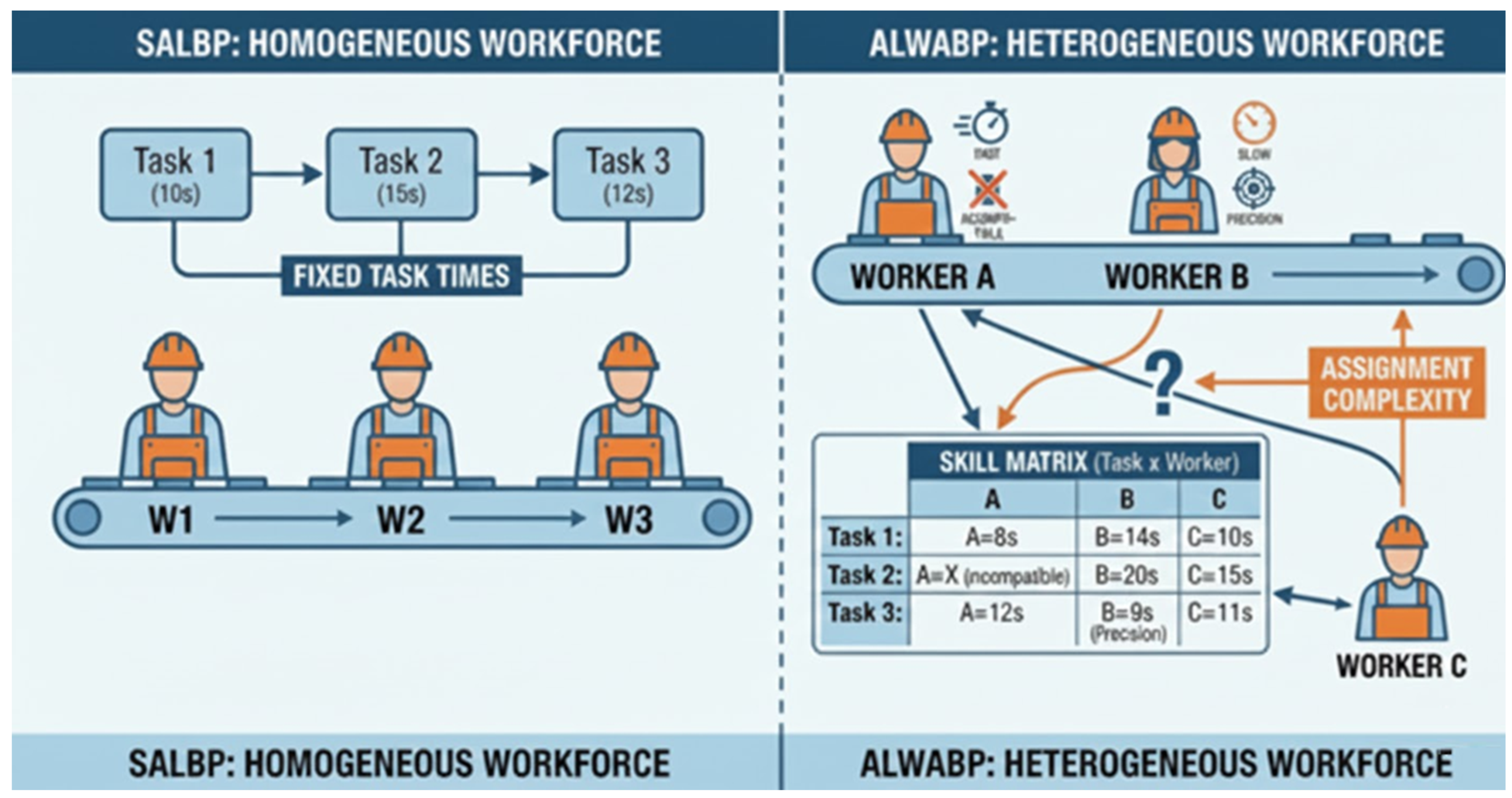
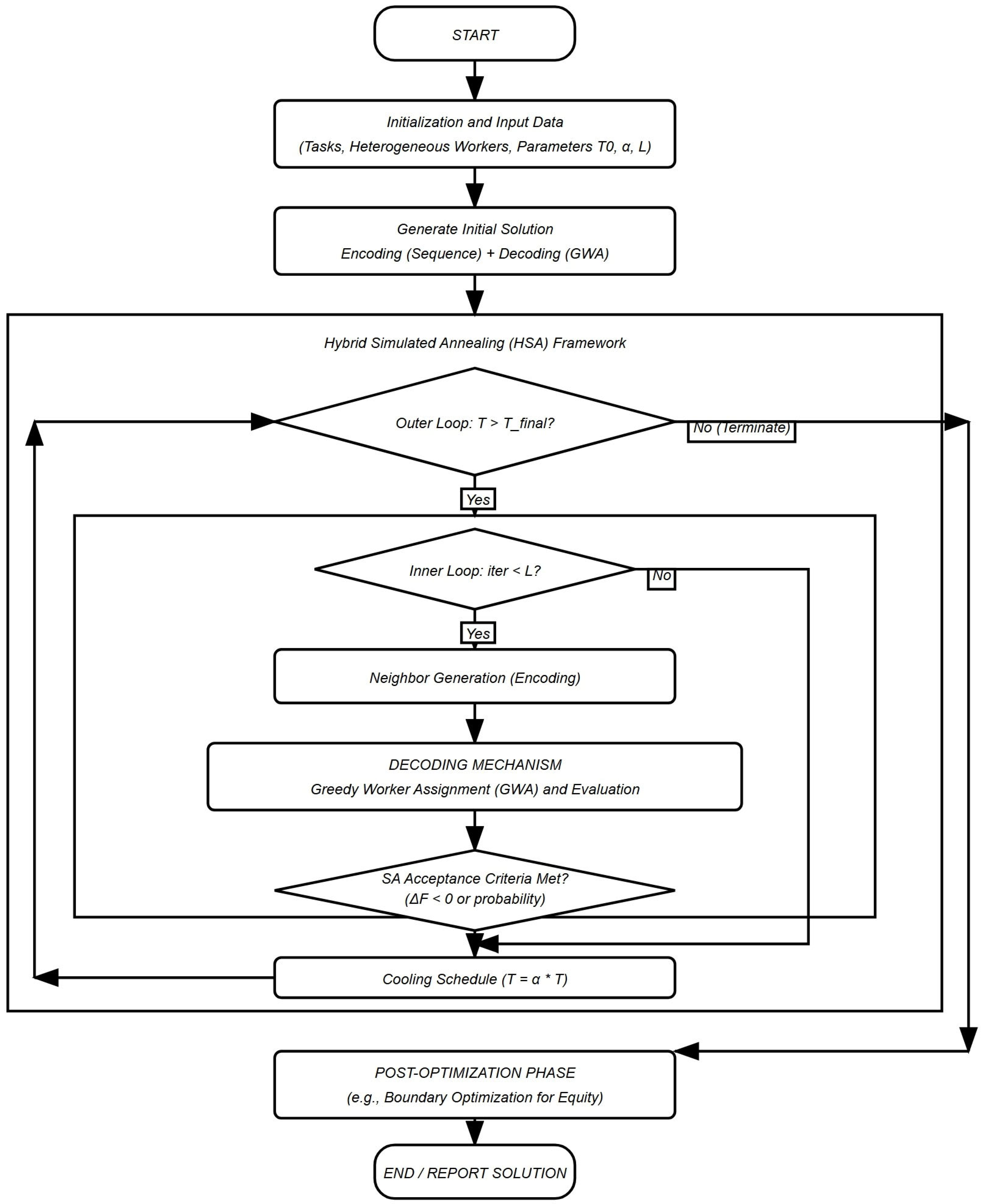
The assembly line worker assignment and balancing problem (ALWABP) has become a necessity for organizing workforces with different skill levels, particularly in Industry 5.0 environments and sheltered work centers. When the literature is examined, it is seen that most existing studies focus primarily on minimizing cycle times. However, this approach often neglects the balance of workstation utilization. As a result of this situation, ergonomic issues may arise, and fairness among employees can be negatively affected. For this reason, a new mixed integer linear programming (MILP) formulation is presented in this paper. Building upon foundational models, the proposed approach explicitly integrates a workload-smoothing objective alongside cycle time minimization to ensure fair assignments. By embedding a distinct linear formulation for workload equity—which addresses the computational complexities of traditional variance-based metrics—this method achieves superior equilibrium in task distribution. To overcome the computational intractability of this NP-hard problem in large-scale instances, a simulated annealing-based meta-heuristic algorithm is developed. The computational experiments are twofold: first, we demonstrate that the proposed mathematical model achieves superior workload balance compared to classical formulations with small-to-medium datasets; second, we validate the efficacy of the meta-heuristic against the exact model, proving its capability to generate near-optimal solutions with negligible computational time for large-scale problems. The results confirm that the proposed approach provides a robust mechanism for simultaneously enhancing line efficiency and ensuring workload equity in heterogeneous production environments.
Keywords: ALWABP; workload smoothing; heterogeneous workforce; mixed-integer linear programming ALWABP; workload smoothing; heterogeneous workforce; mixed-integer linear programming