1. Introduction
With the rapid advancement of artificial intelligence technology, autonomous robots are being increasingly deployed across industrial, agricultural, and service sectors. In scenarios such as forest fire prevention, patrol surveillance, and disaster relief operations, robots are required to efficiently and comprehensively cover all accessible points within a designated area [
1]. The Complete Coverage Path Planning (CCPP) problem pertains to operational contexts where mobile devices must traverse all points in a target area in an efficient manner. As a subfield of industrial motion planning, resolving the CCPP problem in an optimal way carries broad significance [
2].
Traditional CCPP methods mainly rely on explicit rules or mathematical models to generate repeatable and predictable paths. Conventional algorithms include boustrophedon coverage and inward-spiral coverage [
3], along with their variants. Traditional CCPP methods provide simplicity, low memory requirements, and fast response times. However, due to the limited global environmental information utilized by this algorithm, its adaptability to complex environments is suboptimal. The traditional methods utilize limited global environmental information, which often leads to a high repetition rate in the generated full-coverage paths. Bio-inspired intelligent CCPP algorithms, motivated by natural collective behaviors, include genetic algorithms (GA) [
4], ant colony optimization (ACO) [
5], particle swarm optimization (PSO) [
6], and their variants. The methods offer flexible search processes. However, these algorithms often yield paths with excessive turns, redundant points, and inefficiencies. The path planning method based on the Biologically Inspired Hybrid Optimization Algorithm (AB-WOA) integrates multiple biomimetic mechanisms such as Ant Colony Optimization, Whale Optimization Algorithm, and Artificial Potential Field. The AB-WOA method demonstrates strong obstacle avoidance capability and path smoothness in complex environments. However, the AB-WOA method still faces practical challenges, including difficulties in parameter tuning and high computational complexity [
7]. In summary, balancing convergence efficiency and real-time performance remains a significant challenge in current research.
Chaotic systems are deterministic nonlinear dynamical systems whose behavior is characterized by unpredictability, boundedness, recurrence, and high sensitivity to initial conditions [
8], which render them suitable for random CCPP, that is, CCRPP. To the best of our knowledge, Nakamura et al. first introduced a chaotic path planning algorithm for mobile robots [
9]. Zhao et al. proposed the GSGWO algorithm, which enhances convergence stability through a golden sine strategy and mitigates the issue of chaotic trajectories caused by traditional GWO’s tendency to fall into local optima in obstacle-avoidance path planning [
10]. Kvitko et al. utilized a neuron-based chaotic mapping to drive the Pseudorandom Bit Generator (PRBG) for path planning, preserving stochasticity while suppressing disordered wandering through parameter P and a memory mechanism, thereby avoiding trajectory chaos caused by Lorenz open-loop instability [
11]. Li et al. used a Chebyshev map for random coverage path planning, achieving good ergodicity and uniformity, though with suboptimal randomness [
12]. Paths generated using the Taylor-Chirikov map exhibited low coverage and high repetition rates [
13]. Common solutions to this issue include the incorporation of a sinusoidal transformation [
14] or a random number generator [
15] to enhance the randomness of the chaotic map and improve distribution uniformity. Some researchers have endeavored to constructmulti-attractor chaotic systems aimed at generating paths characterized by strong randomness, high coverage, and good uniformity [
16]. Sridharan et al. designed online search algorithms for unknown terrains using chaotic systems and maps with the objective of enhancing time efficiency while maintaining randomness [
17]. These approaches involved an excessive number of parameters and lacked generalizability. Nevertheless, constructing chaotic attractors that exhibit both strong randomness and high uniformity remains a promising solution for effective random path planning. Multi-scroll hyperchaotic systems exhibit greater sensitivity and unpredictability [
18]. Additionally, fractal-fractional descriptions integrate both fractal and fractional-order characteristics, revealing complex phenomena unattainable with single fractional operators. The integration of fractal and fractional-order characteristics has garnered significant research interest and led to applications in medicine [
19], engineering [
20], finance [
21], and other fields.
Fractional-order chaotic systems have attracted widespread attention due to their ability to model memory effects and generate more complex dynamical behaviors than integer-order systems. These systems exhibit higher unpredictability and richer dynamic characteristics, making them highly promising tools for chaotic path planning. Feng et al. proposed the 2D-VFCQHM hyperchaotic map, which overcomes the limitations of traditional integer-order and fixed fractional-order chaotic maps by introducing a state-adaptive variable fractional-order structure, thereby achieving a broader chaotic parameter range, higher entropy complexity, and stronger sequence randomness [
22]. Almatroud et al. proposed a variable-order fractional discrete memristive Duffing map, which simulates a short-memory effect by employing piecewise constant orders, thereby overcoming the computational redundancy associated with traditional long-memory fractional-order systems. This approach induces rich, coexisting hidden attractors across multiple sub-intervals, offering a more flexible and complex chaotic source for dynamics-based encryption applications [
23]. Jiang et al. proposed a fractional-order Hopfield neural network based on a parametric deformed exponential ReLU memristor. By introducing the memristor into the classical HNN to enhance nonlinear coupling and further incorporating fractional calculus theory, the model achieves the coexistence of multiple dynamical behaviors ranging from periodic to hyperchaotic states, thereby providing a highly complex chaotic sequence source [
24]. Biolek extended higher-order elements to the fractional-order domain and generalized duality transformations, constructing a tunable chaotic circuit system using signal flow graphs. This framework advances chaotic systems toward fractional-order, memory-aware, and dual-realizable designs, offering a unified approach for complex dynamic circuit synthesis [
25]. Agrawal et al. constructed a fractional-order financial chaotic system based on Caputo derivatives, which overcomes the limitations of traditional integer-order models in describing memory effects and nonlinear dynamics of financial systems by introducing Legendre wavelets and the Adam-Bashforth method, thereby achieving more accurate market behavior simulation and stability analysis [
26]. Zhang et al. constructed a class of fractional-order spiking neural networks based on Caputo derivatives, which overcomes the challenges of discontinuous pulse activation functions by introducing Filippov solutions and phase space partitioning, thereby proving the existence of multiple stable equilibrium points under fractional orders less than 1 and enhancing the robustness and reliability of neural networks for applications such as pattern recognition [
27]. Yu et al. proposed a non-polynomial memristive Hopfield neural network capable of generating controllable multiscroll attractors using a memristor that satisfies the Lipschitz condition, with the objective of decoupling the number of scrolls from circuit resource consumption while preserving mathematical smoothness [
28]. Furthermore, multi-attractor chaotic systems have also been investigated to enhance the randomness and ergodic uniformity of paths. By generating scrolls, such systems can produce trajectories with greater ergodicity, facilitating full coverage tasks. However, existing multi-scroll systems often suffer from complex structures, excessive parameters, or limited generalizability. To mitigate these limitations, this paper proposes a novel four-dimensional chaotic system based on the Chen system by integrating fractal-fractional calculus with a multi-scroll structure, thereby combining the advantages of both. This system not only exhibits higher complexity and entropy but also achieves better coverage in mobile robot path planning.
Building upon research on fractional-order chaotic systems, this paper aims to advance the field of mobile robot path planning. The core innovation lies in proposing a novel four-dimensional fractal-fractional multi-scroll chaotic system, whose notable feature is the dual influence of the fractal dimension and fractional order. This achievement is realized by introducing fractal-fractional operators and a multi-scroll nonlinear term into the classical Chen system. Based on the framework of reference [
29], we construct a fractal-fractional multi-scroll chaotic system incorporating the Atangana–Baleanu memory kernel. The final system exhibits unique characteristics, including higher Lyapunov exponents, a multi-scroll structure, and the coexistence of multiple chaotic attractors, thereby providing greater flexibility for random coverage tasks in path planning. The main contributions of this work are summarized as follows:
- (1)
The construction of a higher-dimensional hyperchaotic system by adding state variables based on Chen’s chaotic system.
- (2)
The development of a fractal-fractional chaotic system featuring a multi-scroll structure is achieved by introducing the definition of fractal-fractional order and incorporating a non-linear component into the established higher-dimensional chaotic system.
- (3)
The developed fractal-fractional chaotic system is applied to drive the mobile robot for area coverage, enhancing its randomness and coverage capability.
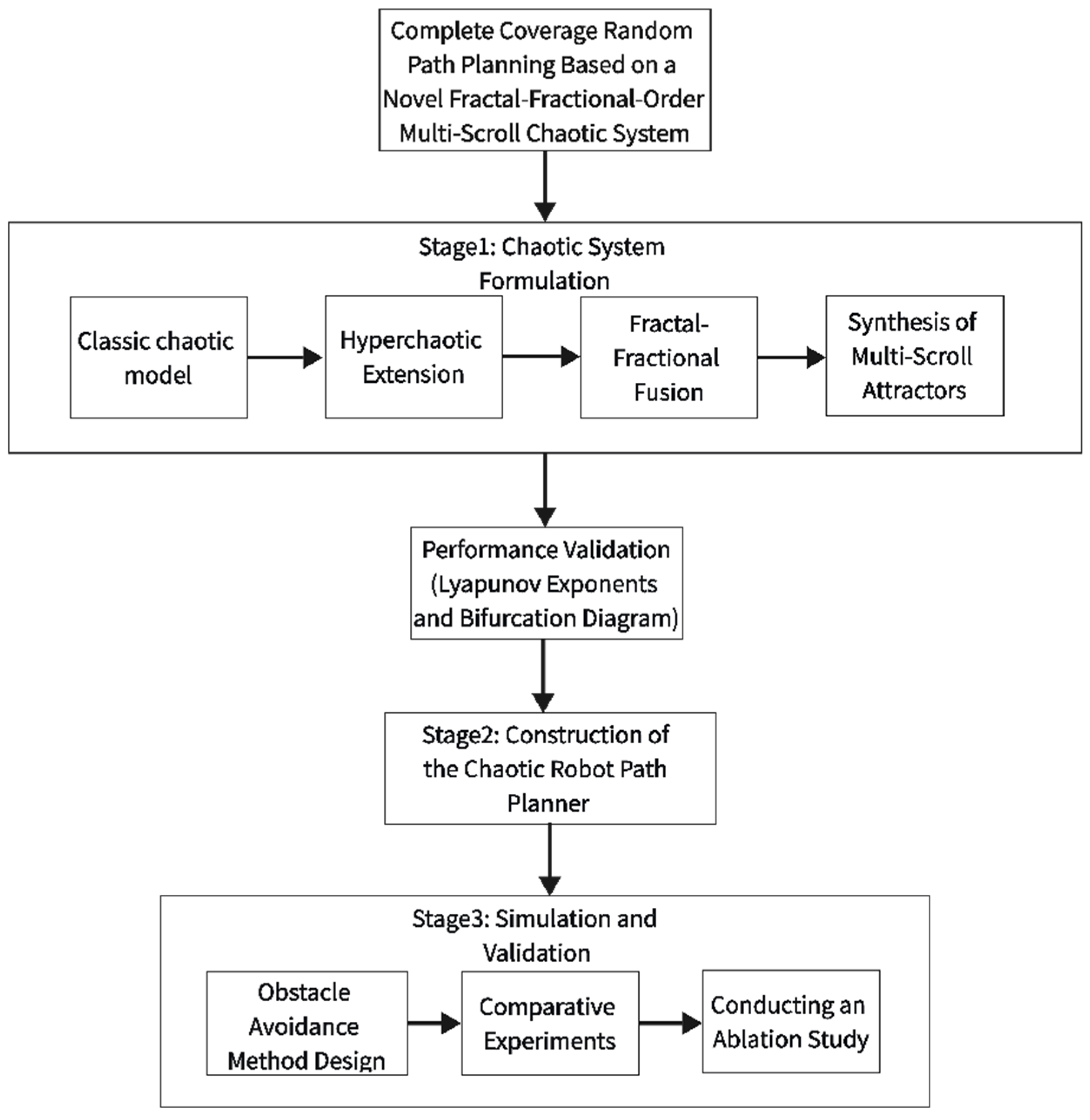
As depicted in
Figure 1, the article is structured as follows: firstly, the procedure for constructing a new chaotic system is explained; secondly, the development of a chaotic robot path planner is presented; finally, simulation and ablation studies are conducted. The paper is structured as follows:
Section 2 introduces the definition and solution methods of fractal-fractional chaotic systems;
Section 3 focuses on the dynamic characteristics of a novel fractal-fractional chaotic system, providing in-depth discussion through theoretical derivation and numerical analysis;
Section 4 applies this system to CCRPP; and
Section 5 provides a summary of the paper.
3. Results and Analysis
This section will perform a dynamical characteristics analysis of the proposed fractal-fractional multi-scroll chaotic system and evaluate its coverage performance in mobile robot path planning. Through sensitivity tests, comparative experiments, and ablation studies, the effectiveness and superiority of the proposed method will be rigorously validated.
3.1. Chaotic System Characteristics
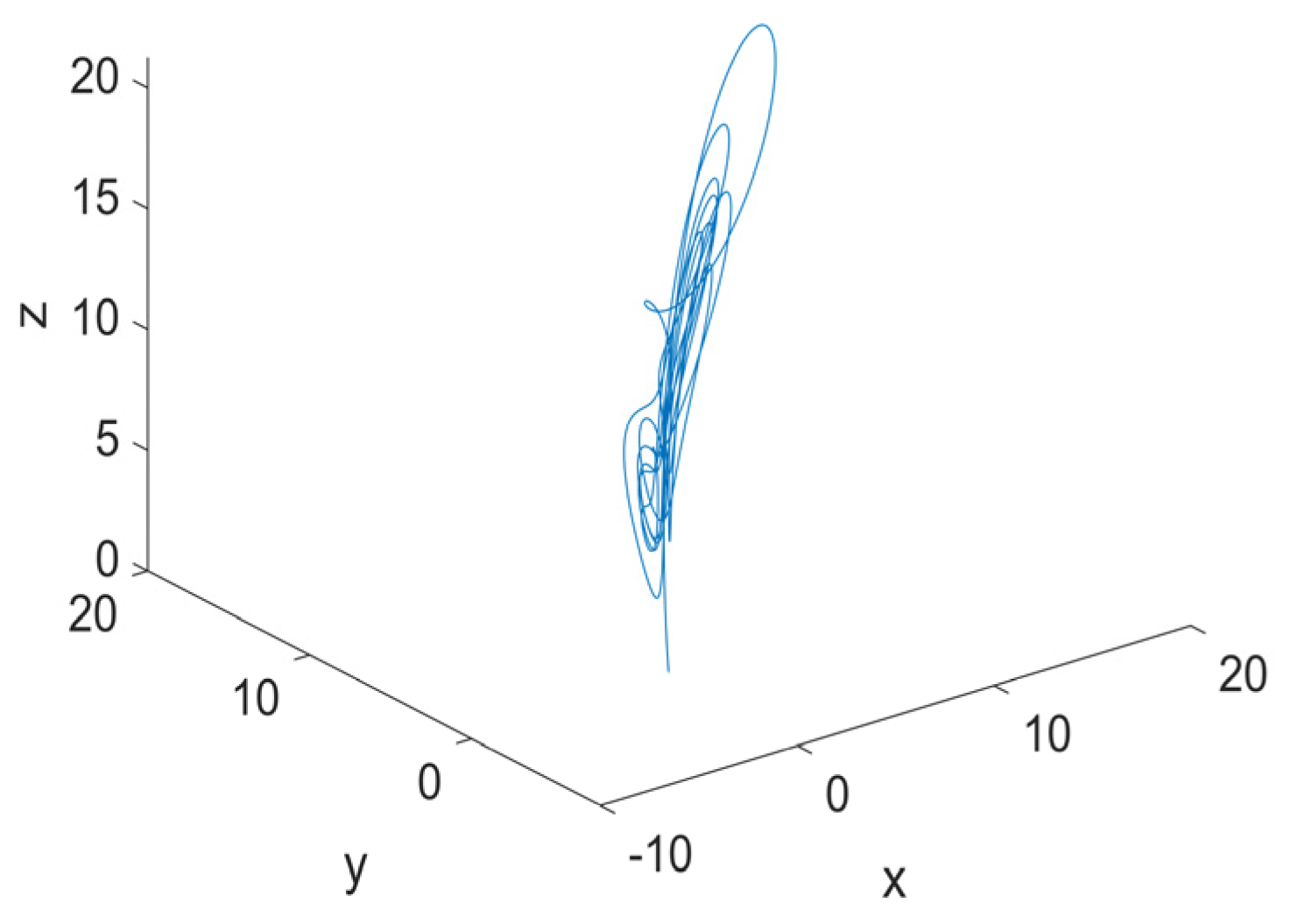
Equation (8) is simulated under the initial values with
,
,
, and
. The system underwent
iterations.
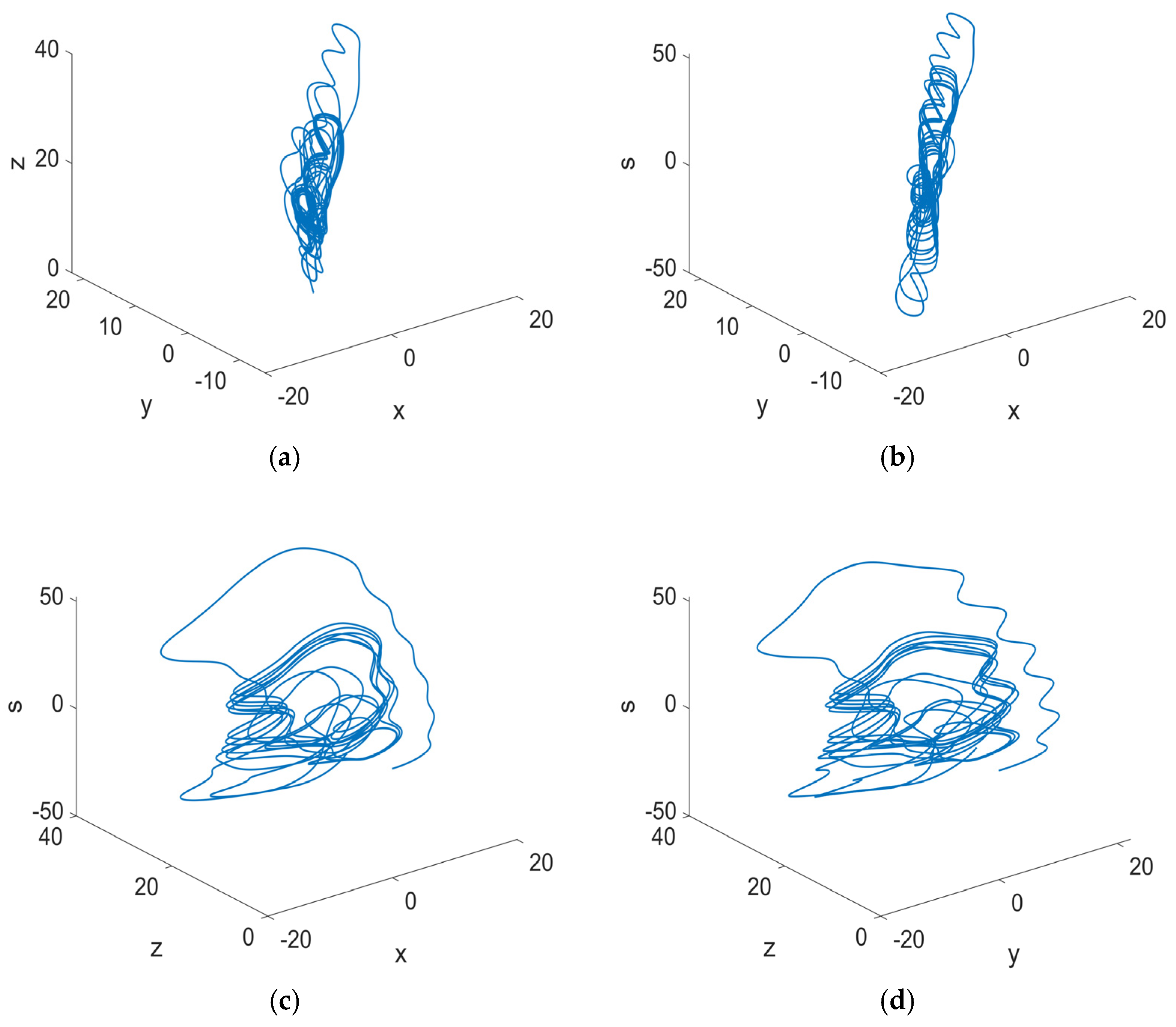
Figure 3 shows the phase space structure. As shown in
Figure 3, the new four-dimensional system incorporating state variables still exhibits a clear chaotic phase structure.
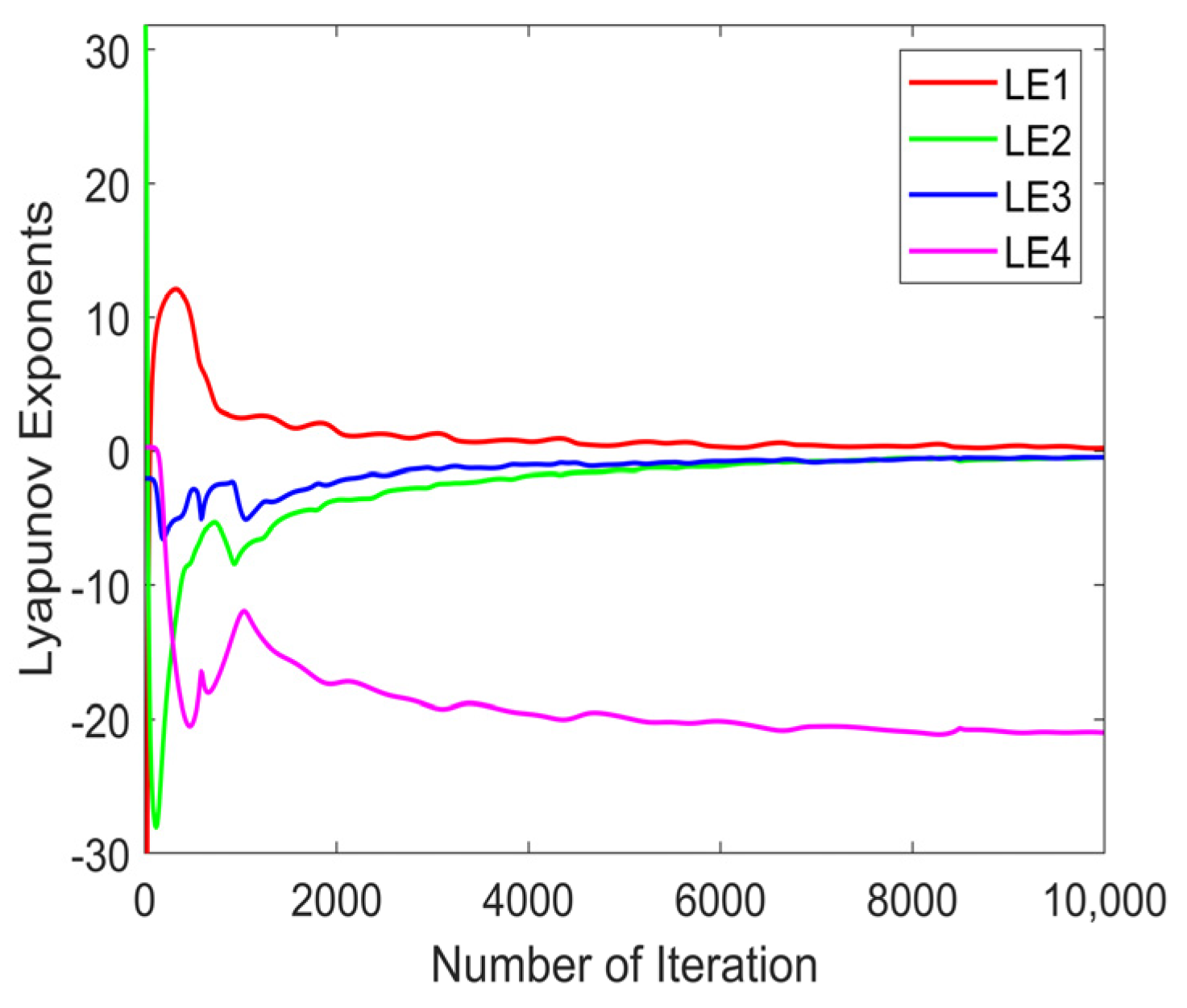
To quantitatively assess the dynamic characteristics of the constructed fractal-fractional chaotic system, this paper employs numerical methods to compute the system’s Lyapunov exponent spectrum. Given that the long-range memory effect in fractal-fractional systems makes exact analytical calculations extremely difficult, we adopt a numerical estimation approach based on the linearized approximation of continuous systems.
Specifically, during each iteration step, the system state variables are updated using the fractal-fractional discrete integration formula Equation (6). Meanwhile, based on the current system state, we compute the Jacobian matrix and numerically integrate the variational equations via the fourth-order Runge-Kutta method to evolve four orthogonal perturbation vectors. These perturbation vectors are periodically subjected to Gram-Schmidt orthogonalization and normalization, and the cumulative growth rates along each orthogonal direction are recorded. Finally, the Lyapunov exponents are obtained by dividing the cumulative growth rates by the total integration time.
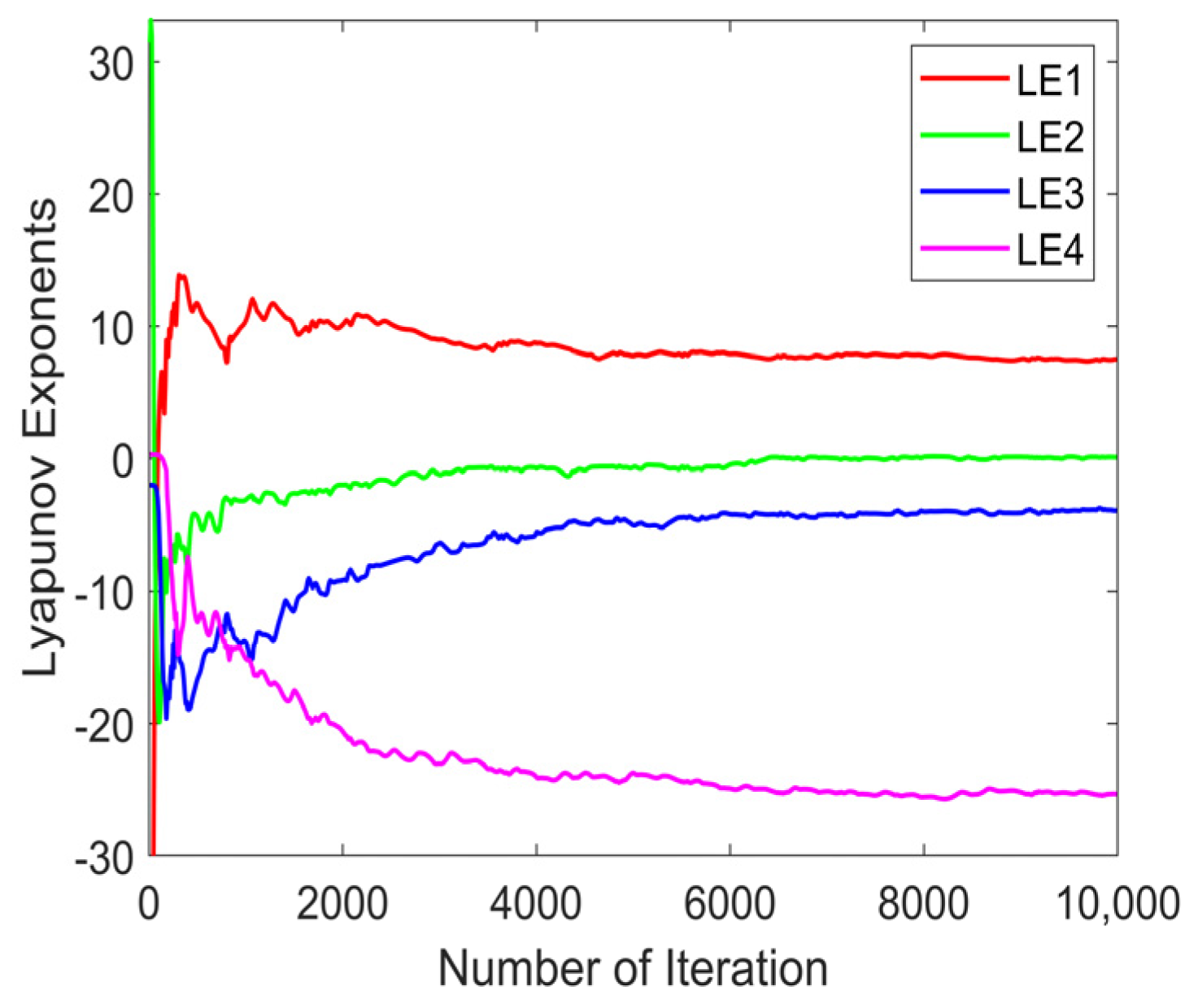
However, the calculation of the Lyapunov exponent spectrum shows that the four Lyapunov exponents for Equation (8) are
,
,
, and
, as presented in
Figure 4.
For Equation (9), a simulation experiment is conducted using the initial parameters
,
,
,
. The total number of iterations performed in this experiment is set to 10,000. The computed Lyapunov exponents for Equation (9) are
,
,
,
. The corresponding Lyapunov exponent spectrum is shown in
Figure 5.
As depicted in
Figure 5, Equation (9) exhibits greater Lyapunov exponents compared to Equation (8). A larger Lyapunov exponent value indicates a faster rate of chaotic trajectory separation. The system state becomes completely different in a shorter time. Any small initial error will be greatly amplified. The unpredictability of the system is enhanced.
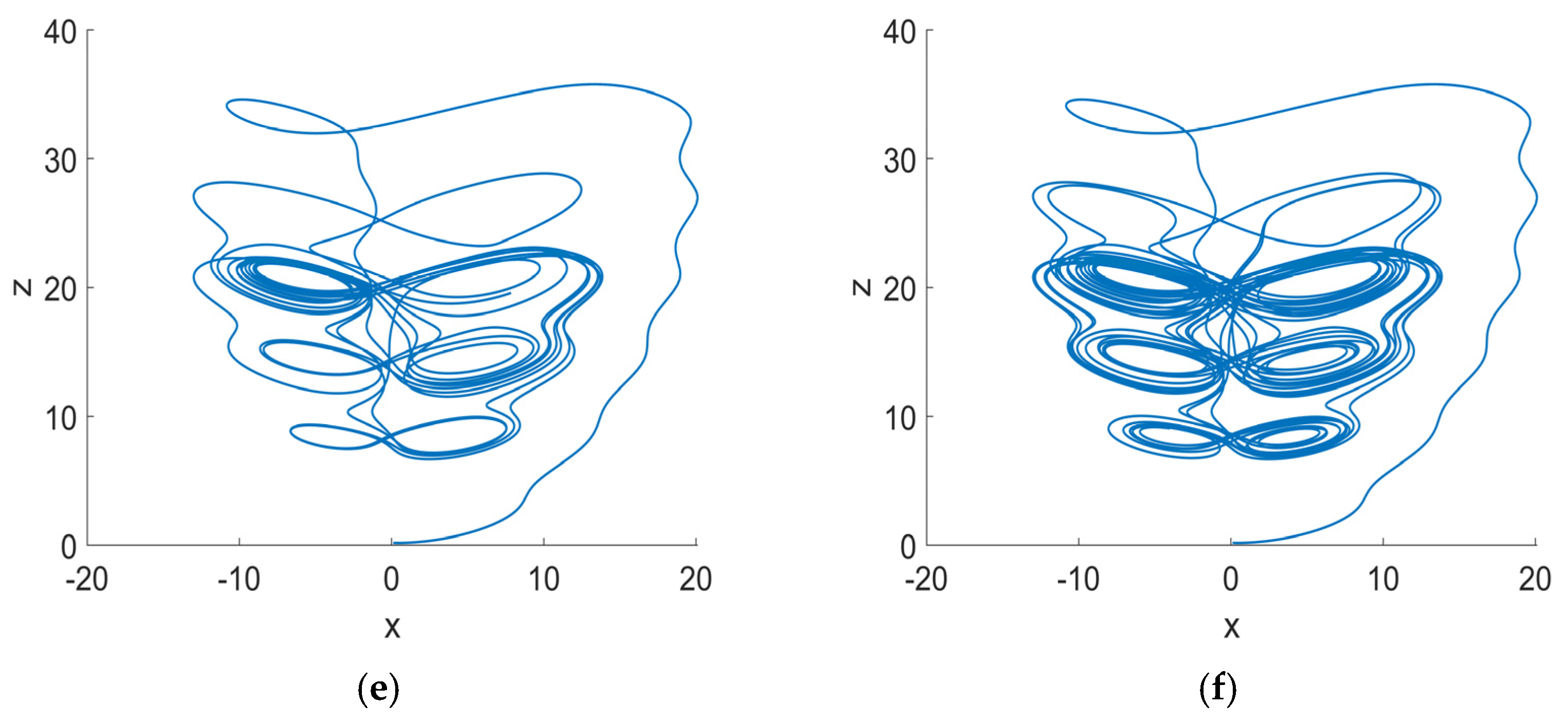
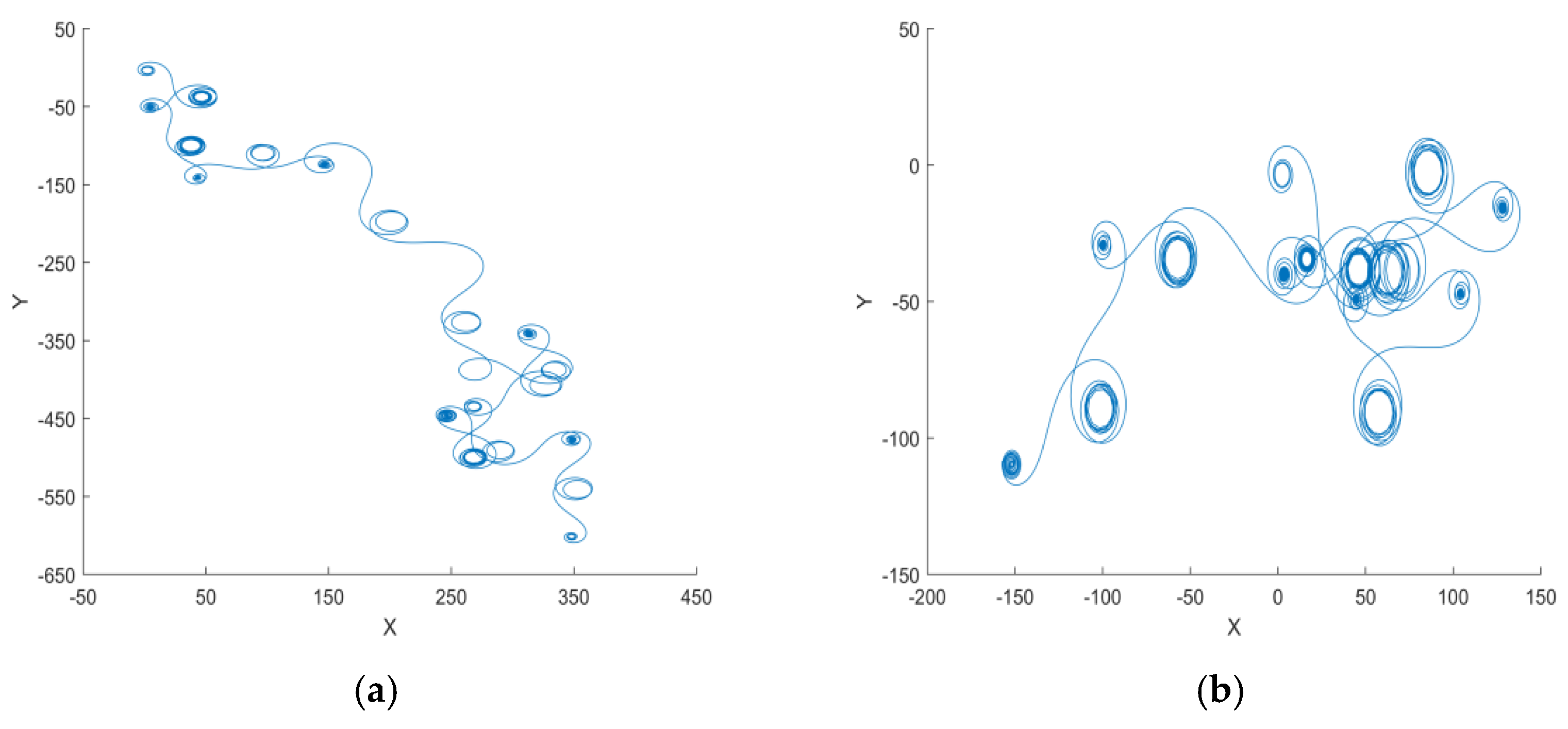
The phase space structures of Equation (9) are shown in
Figure 6. As depicted in
Figure 6, after the introduction of the nonlinear term, the system exhibits a multi-scroll structure, which becomes more pronounced with an increasing number of iterations. Multi-scroll [
34] structures and fractal-fractional operators can impart enhanced complexity to chaotic systems.
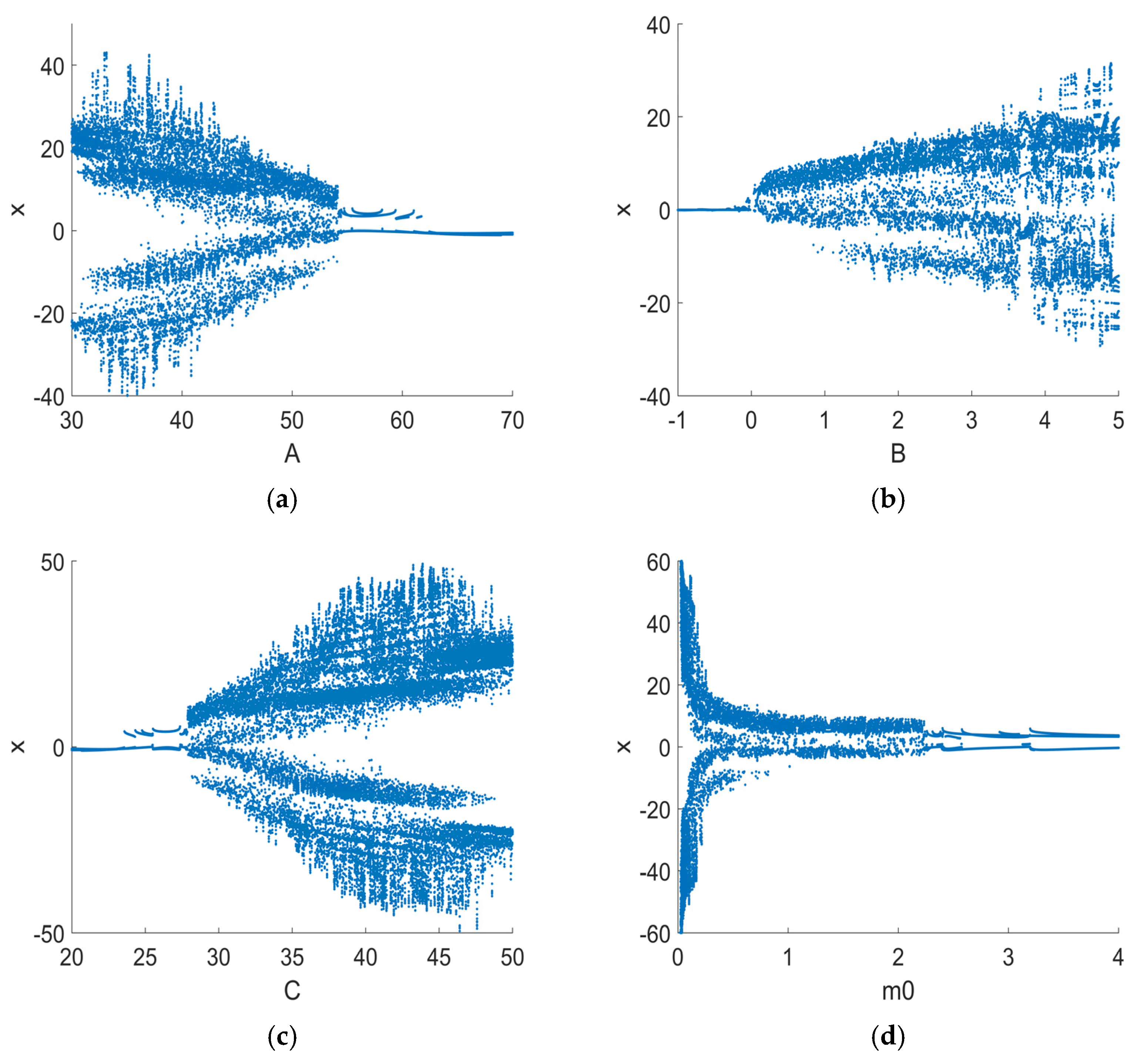
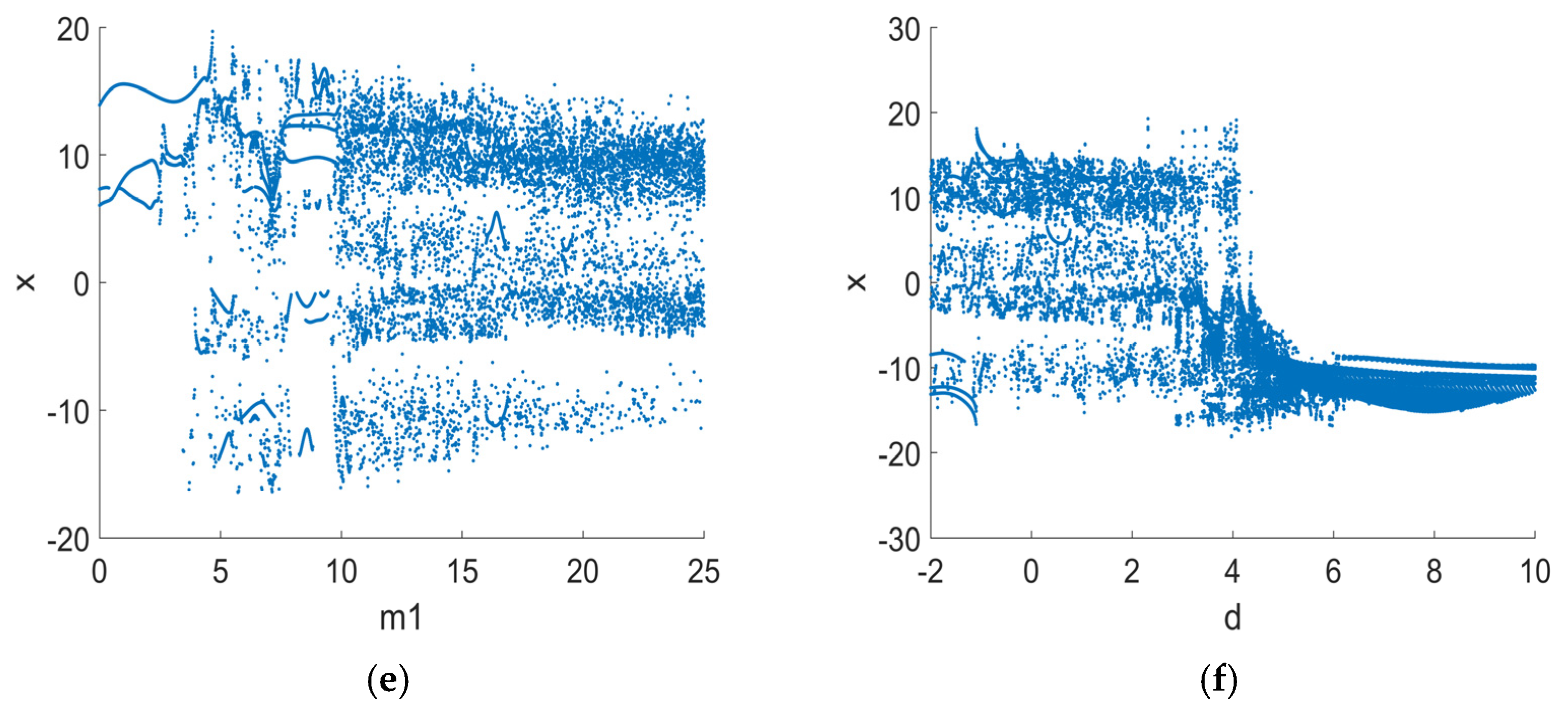
The bifurcation diagrams corresponding to various parameters is presented in
Figure 7. The bifurcation diagram visually demonstrates that the system is indeed in a chaotic state near the selected parameters. By observing the bifurcation diagram, parameter values that generate strong chaotic behavior can be selected based on evidence, rather than through blind trial and error. In path planning, the selected parameter points should be located in a wide chaotic band to avoid accidentally falling into a periodic window.
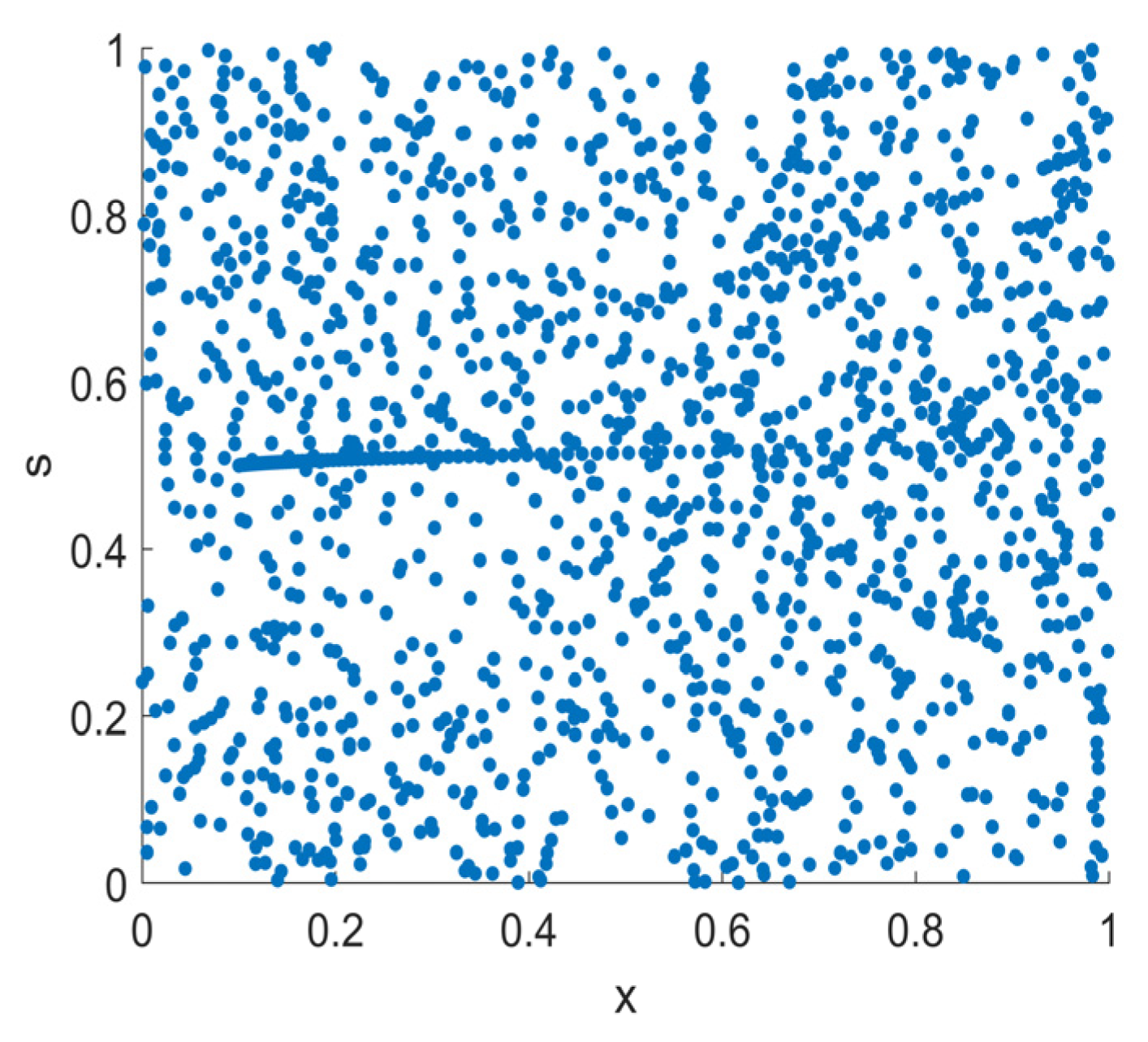
Chaotic systems possess ergodicity, meaning they can visit every point within the chaotic region within a finite time. For the given chaotic system time series, the ergodic region is a
area on the
plane. After
iterations of Equation (9), the distribution of its time series is shown in
Figure 8.
The ergodic distribution diagram visually illustrates which regions in the phase space are frequently visited by system trajectories and which regions are less frequently visited. In path planning, this corresponds to which areas are covered repeatedly and which areas are under-covered. An ideal and efficient coverage path requires a distribution that is as uniform as possible. As can be seen from
Figure 8, the distribution diagram shows consistent color and density of points throughout the chaotic region, indicating that the system exhibits excellent ergodicity.
In the analysis of chaotic systems, spectral entropy (
) and complexity (
) are two important quantitative metrics used to characterize the dynamic behavior, complexity, and unpredictability of these systems [
35].
is calculated by first transforming the time series signal into the frequency domain to decompose it into energy components across various frequencies. Subsequently, entropy is calculated based on the uniformity of this energy distribution. In contrast,
is calculated by extracting and removing periodic or stable components from the signal, thereby retaining only the residual irregular fluctuations. The randomness or unpredictability of these residual fluctuations is then statistically evaluated to indirectly assess chaotic characteristics. For parameters (
,
,
,
,
) = (
,
,
,
,
), with parameter
(
,
) and
(
,
),
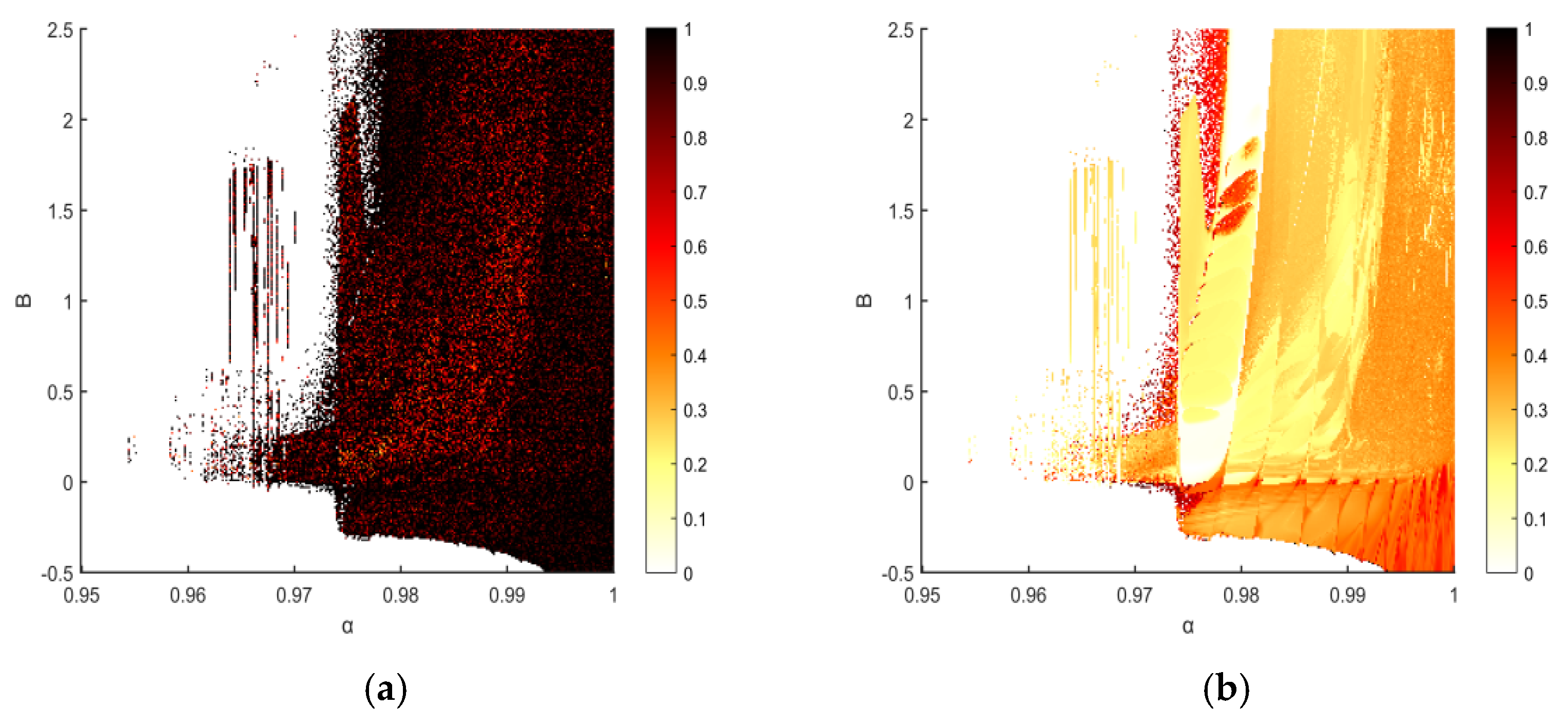
Figure 9a shows the
complexity while
Figure 9b depicts the
complexity; it is evident that when parameter
is fixed, the system complexity progressively increases as the fractional order rises.
When the parameter plane is examined within the same interval, differences arising from distinct initial conditions can indicate the presence of multistability. Multistability is a typical phenomenon in nonlinear dynamical systems, referring to the scenario where, under identical system parameters, different initial conditions lead the system to converge to distinct steady-state behaviors. In chaotic systems, this implies that multiple attractors can coexist, each corresponding to a unique dynamical state. The asymptotic behavior of systems that support multistability depends on the set of initial conditions of the state variables. Consequently, in certain systems, the same region of the parameter plane may exhibit chaotic behavior for specific initial conditions while displaying periodic behavior for others. This characteristic is particularly significant in path planning, as it enables the same chaotic system to generate diverse trajectories, thereby enhancing the randomness and adaptability of the paths.
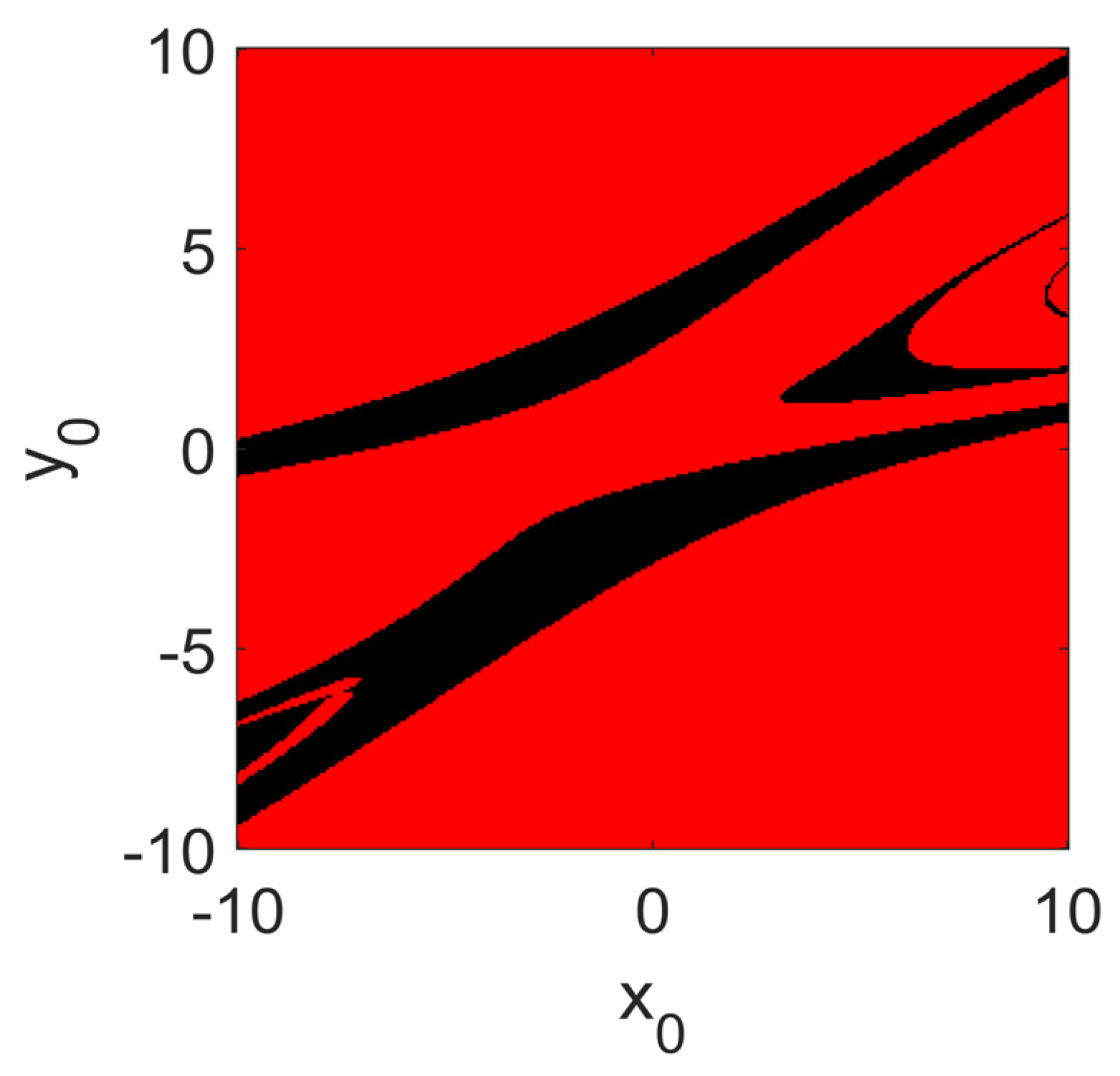
As depicted in
Figure 10,
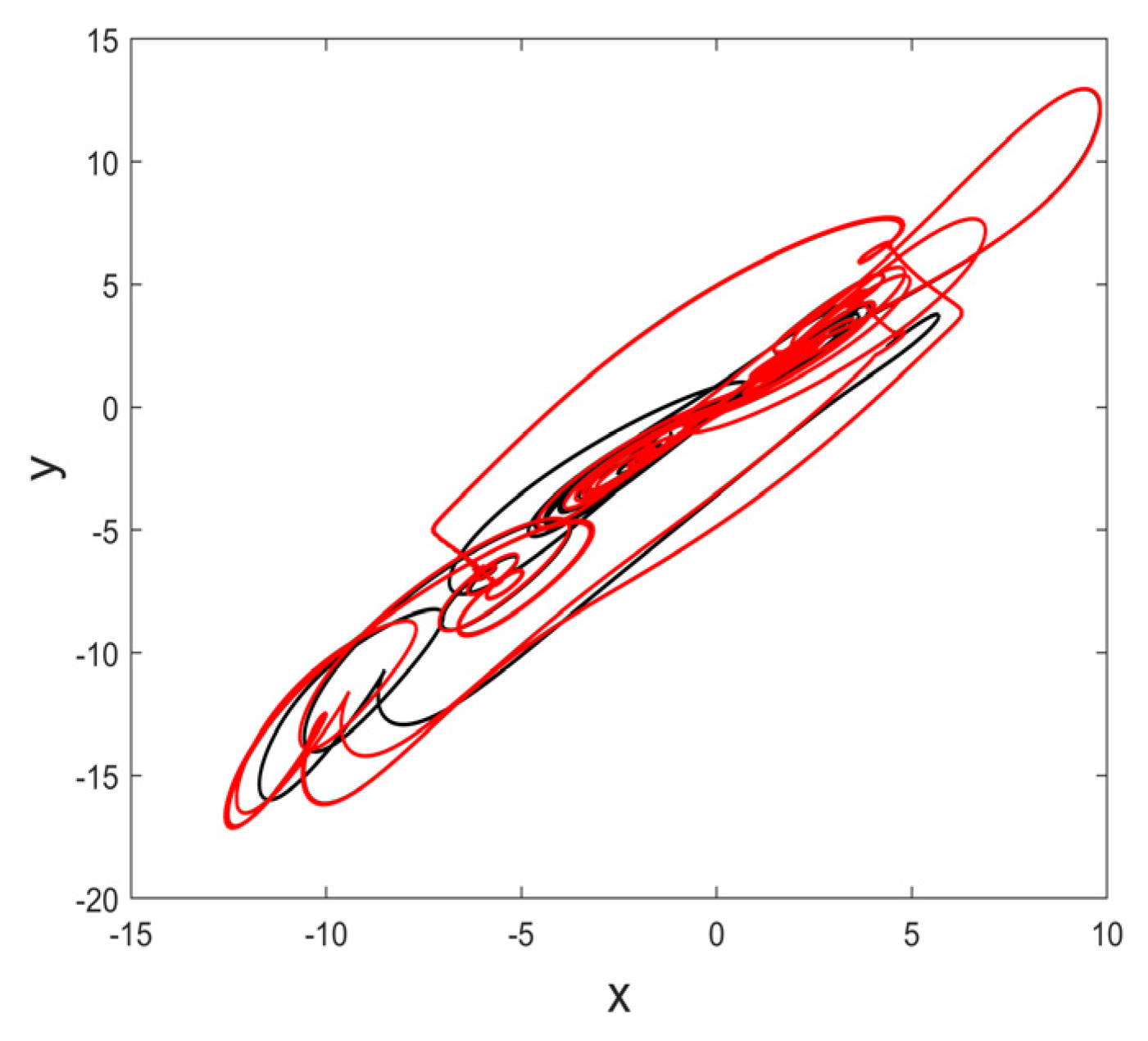
Figure 10 shows the basins of attraction associated with the coexisting chaotic and periodic attractors in phase space when the parameter A = 54. In each basin, the black regions represent the initial conditions that cause the system to converge to the periodic attractor in phase space, while the red regions represent the initial conditions that lead the system to converge to the chaotic attractor in phase space. It should be clarified that the basin of attraction is inherently four-dimensional and is therefore defined by the set of initial conditions
. Consequently,
Figure 10 presents the projection of this four-dimensional basin onto the
initial conditions, which are constructed in this example by setting
= 0.2 and
= 0.5. As long as an initial condition point
is chosen within the red region, the system will tend towards a chaotic attractor in phase space; whereas if selected within the black region, the system will be guided towards the periodic attractor.
Figure 11 illustrates the coexistence of periodic and chaotic attractors in the phase space of system (9). All results correspond to the parameters A = 54, B = 2, C = 30, d = −0.2, m0 = 0.4, m1 = 15, α = 0.995, β = 1.1. The initial conditions of the system are set to
= (0, 0, 0.2, 0.5). In the figure, the red region represents initial conditions that lead the system to converge to a chaotic state, while the black region corresponds to periodic states. Furthermore,
Figure 11 shows the coexisting attractor structures of the system when typical initial points are selected within these two basins of attraction. Specifically, the red trajectory corresponds to a chaotic attractor, and the black trajectory corresponds to a periodic attractor. This phenomenon indicates that even when the system parameters remain unchanged, the system can exhibit distinctly different dynamical behaviors solely by varying the initial conditions. Such a characteristic provides an additional degree of freedom in path planning, allowing different motion modes to be selected according to task requirements under the same chaotic system structure, thereby enhancing the flexibility and adaptability of trajectory generation.
3.2. Sensitivity Test
The constructed chaotic system demonstrates sensitivity to initial conditions, whereby even minor alterations in its initial values can significantly affect the robot’s movement trajectory. This characteristic of the chaotic system effectively meets the requirement for randomness in mobile robot path planning. Under identical settings, two distinct sets of initial values for the chaotic system were defined (
,
,
,
) = (
,
,
,
) and (
,
,
,
) = (
,
,
,
). The number of iterations was consistently set at 5000 for both cases. The resulting system trajectories are shown in
Figure 12.
As observed in
Figure 12, slight modifications to initial values generate markedly divergent trajectories after finite iterations. The greater the alteration in initial values, the more significant the trajectory divergence becomes. This property facilitates the generation of stochastic and unpredictable surveillance paths for mobile robots.
3.3. Path Planning Performance
When the initial values (
= (
,
,
,
,
,
) are set and the grid size is configured to a uniform
cells layout, the initial value was selected based on empirical tests showing that it produces the most uniform trajectory distribution and the highest coverage rate among candidate points. Simulation experiments for the mobile robot were conducted in MATLAB R2021b for
and
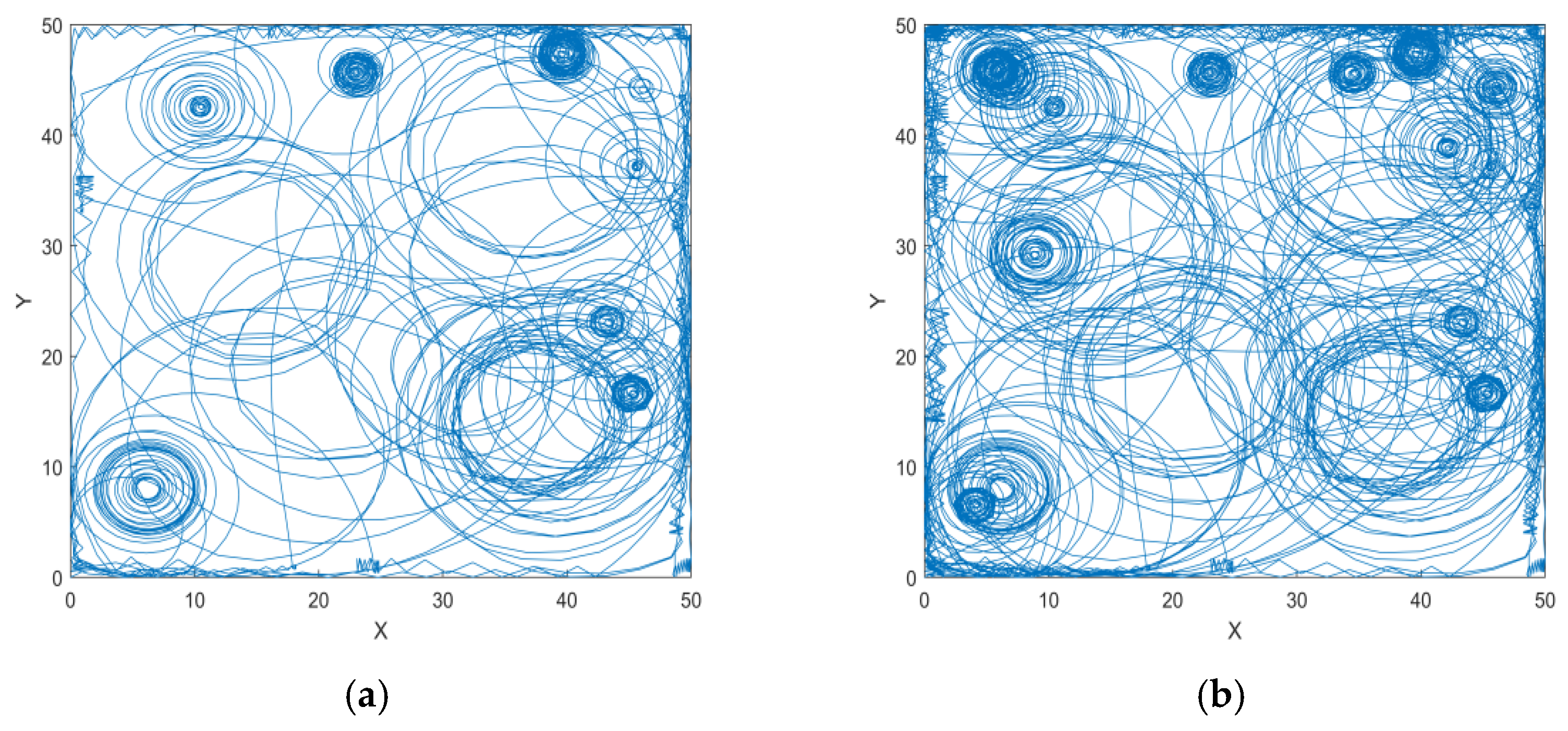
iterations respectively. The resulting robot trajectories within the
×
area are shown in
Figure 13. It is evident from
Figure 13 that, with increasing iterations, the robot’s movement trajectory can cover more areas, resulting in an increased number of covered trajectories.
To verify the advantages of the proposed fractal-fractional multi-scroll chaotic system in mobile robot path planning, a comparison is performed with the methods from references [
18,
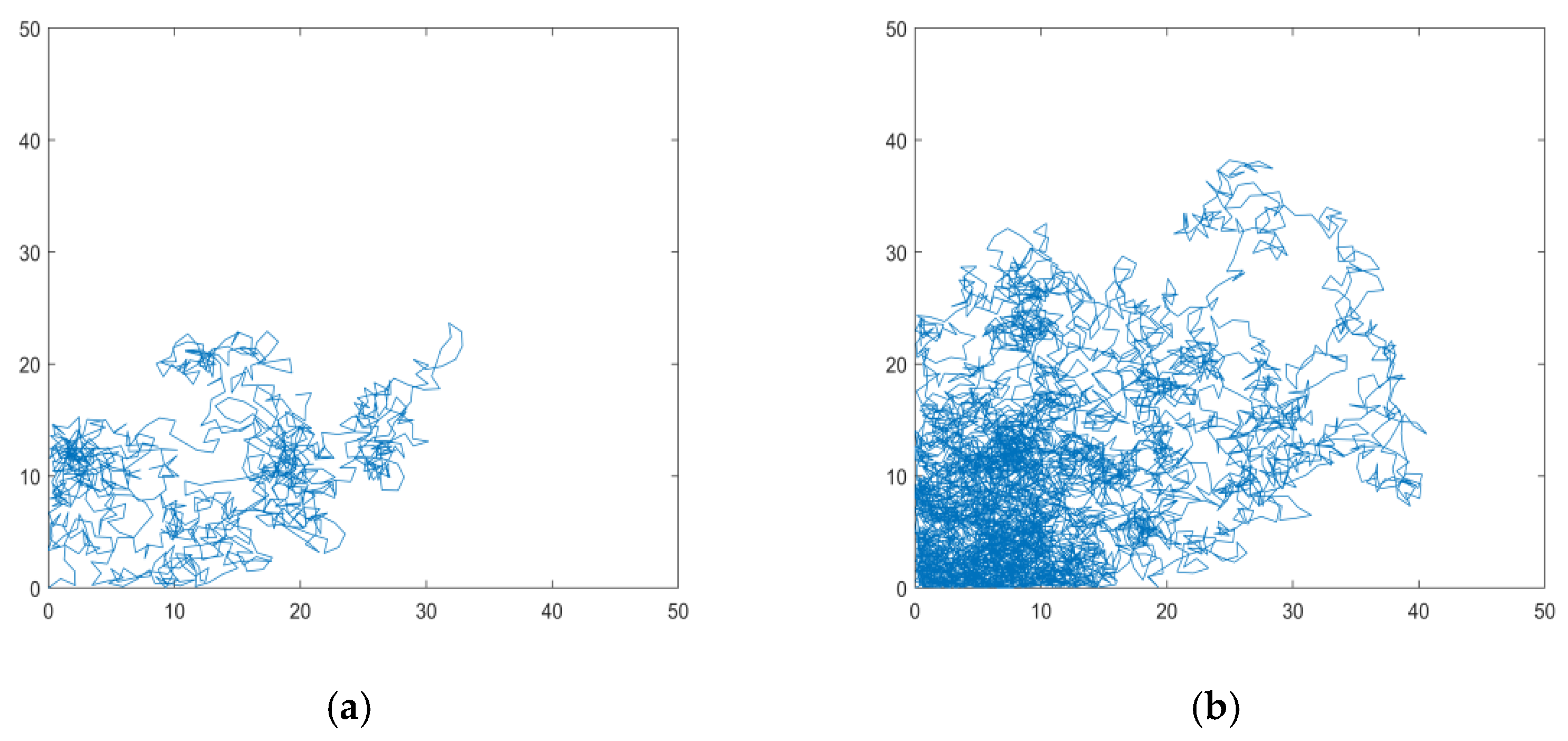
35], and a random walk approach. The random walk method is implemented as follows: initially, the robot randomly selects a direction for linear motion; subsequently, at fixed time intervals
randomly turns to a new direction for the next movement. The trajectories generated by mobile robot path planning using the random walk method within a
×
area over
and
movements ar shown in
Figure 14. As shown in
Figure 14, the robot under the random walk method achieves progressively greater coverage of target areas as the iteration count increases.
The coverage rates calculated for the mobile robot driven by the fractal-fractional chaotic system, along with those derived from other methods, are shown in
Table 1. The proposed fractal-fractional multi-scroll chaotic system achieves a superior area coverage rate compared to the other methods, meeting the requirements for mobile robot coverage tasks more effectively.
As part of the While the sensitivity to initial conditions is a fundamental characteristic of chaotic systems that contributes to path randomness, for practical coverage tasks, it is crucial that high performance remains consistent across different initializations, ensuring the method’s robustness for daily deployment. To address this, we conducted a comprehensive robustness test. In this experiment, the four state variables of the proposed fractal-fractional multi-scroll chaotic system were independently and randomly sampled from a uniform distribution within the range for each trial. For each set of randomly generated initial conditions, the integrated chaotic path planner was used to drive the mobile robot for iterations within the same grid environment. This procedure was repeated for 100 independent trials.
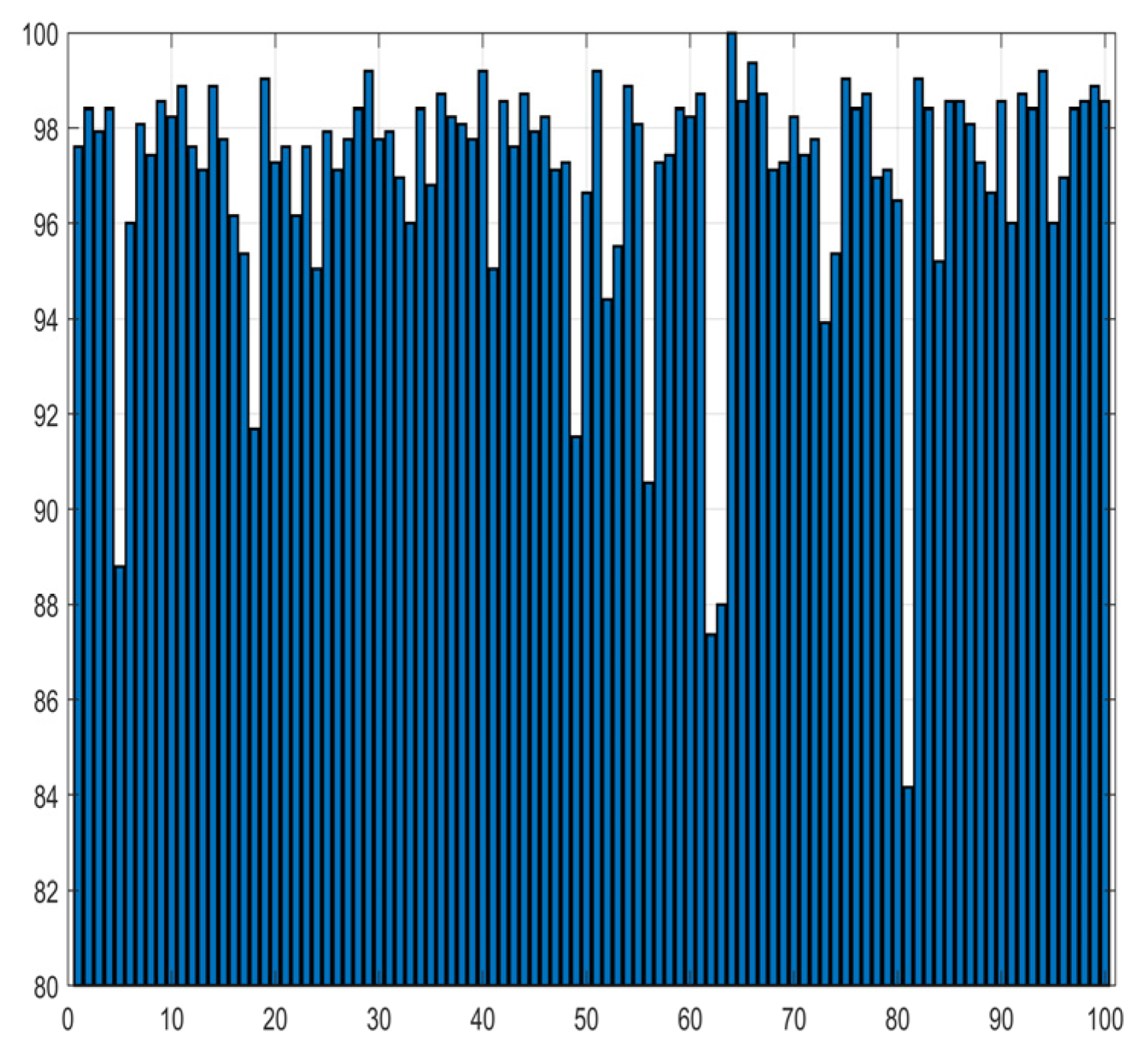
As shown in
Figure 15, the initial values of the state variables
for the constructed fractal-fractional multi-scroll chaotic system were randomly and independently sampled from the uniform interval [−10, 10] in each trial. The mobile robot was then driven by the system within the 50 × 50 grid area for
iterations per run. Over 100 such randomized trials, the average coverage rate reached 97.072%. Although coverage occasionally fell below 90% in rare outliers, the vast majority of trials achieved rates above 95%. Critically, even under random initializations, the coverage performance consistently surpasses that of all comparative methods listed in
Table 1. These results confirm that the high coverage efficacy is a robust property of our system, ensuring reliable performance in practical deployment despite its inherent sensitivity to initial conditions.
3.4. Ablation Study Analysis
As part of the evaluation of the proposed system, A comprehensive ablation study was conducted to validate the contribution of each component. This section compares:
the performance of the full model with three simplified variants;
an integer-order version;
a version without the multi-scroll nonlinear term;
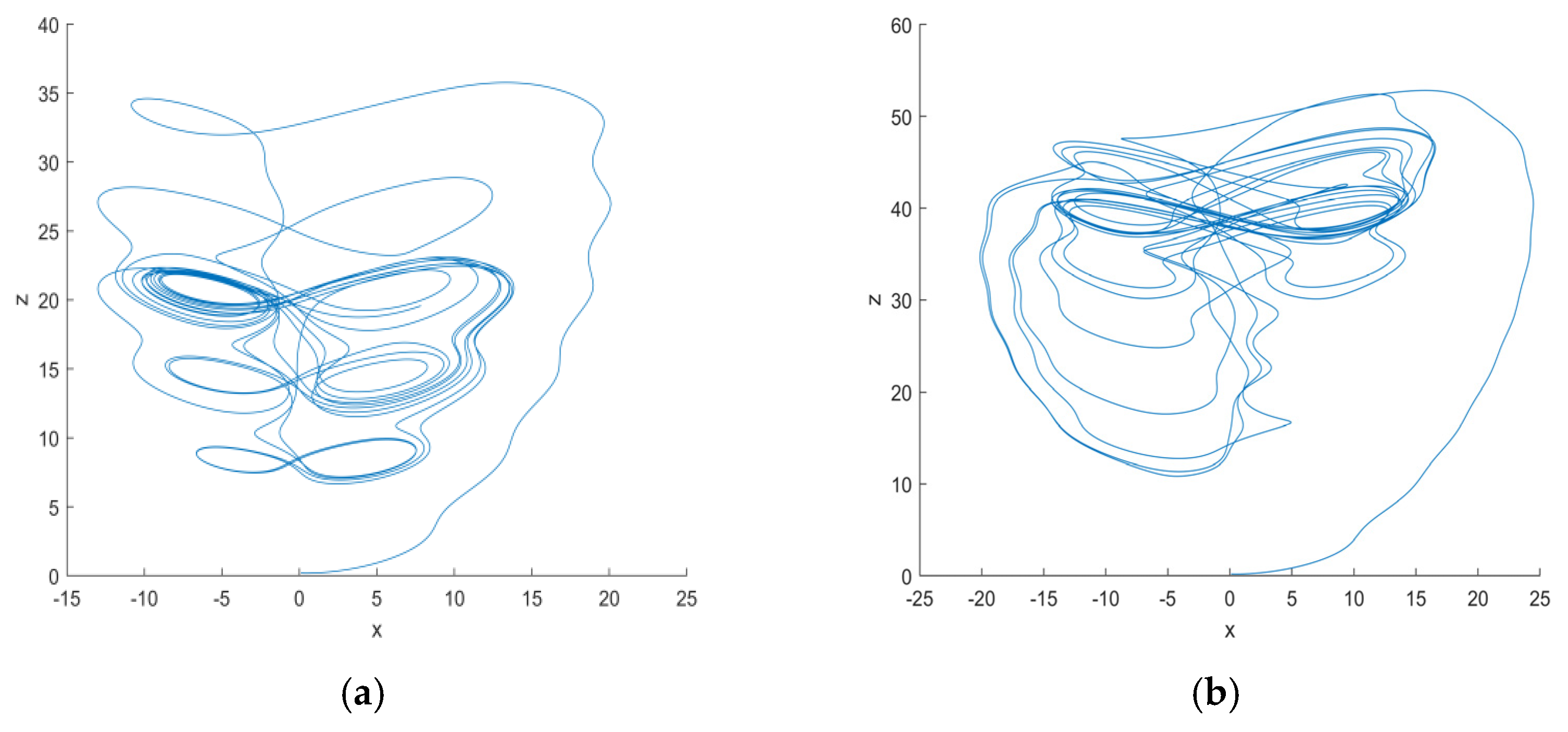
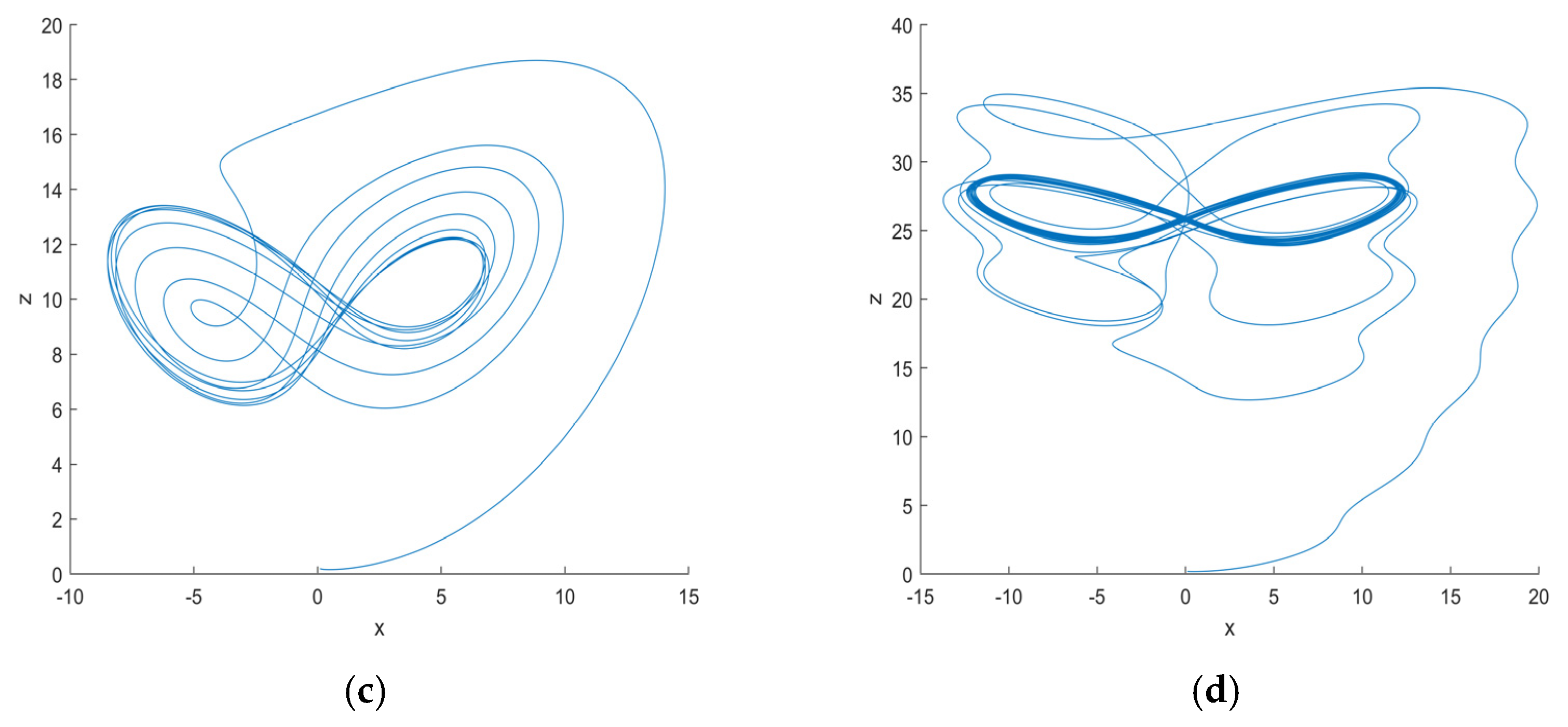
a version without the fractal dimension. All other parameters and initial conditions remained consistent with the previous experiments. The simulation results are shown in
Figure 16, and the initial values, parameters, and the corresponding coverage rates are shown in
Table 2.
As shown in
Figure 16a, with the same number of iterations, the fractal-fractional-order multi-scroll system
proposed in this paper is capable of forming a relatively dense multi-scroll structure.
Figure 16b illustrates the chaotic system
, which is derived from Equation (9) by replacing the fractional order with an integer order. The integer-order chaotic system generates fewer scroll layers along the z-axis under identical iteration conditions.
Figure 16c presents system
, obtained by removing the nonlinear term from Equation (9), where no distinct scroll structure or layered phenomenon emerges.
Figure 16d shows the structure of system
, configured by setting the fractal dimension to be
in Equation (9), demonstrating that the fractal dimension exerts a considerable influence on the chaotic system’s behavior.
As shown in
Table 2, the Lyapunov exponents of systems
,
, and
are all lower than those of the proposed system
. Correspondingly, the coverage rates achieved by mobile robots driven by systems
,
, and
are also inferior to those achieved under system
. These ablation studies demonstrate that the synergistic interplay among the fractal-fractional order, the nonlinear term and the fractal dimension is crucial for enhancing the complexity of the chaotic system and achieving high coverage in path planning.