1. Introduction
Discrete-time eco-evolutionary models have been widely used to investigate the interplay between population dynamics and trait evolution, particularly in settings with non-overlapping generations and density-dependent regulation [
1]. A growing body of work has shown that incorporating evolutionary feedback into classical population models can fundamentally alter their dynamical behavior, leading to rich phenomena such as multistability, oscillations, and bifurcations that are absent in purely ecological formulations [
2,
3,
4,
5,
6,
7]. In this context, several recent studies have explored evolutionary extensions of discrete-time growth models, focusing on stability, bifurcation structure, and the emergence of complex dynamics in canonical population models of Ricker type [
8,
9,
10,
11,
12] and in the Beverton–Holt model [
13,
14,
15,
16,
17], highlighting the generality and robustness of eco-evolutionary feedback mechanisms across different density-dependent growth formulations.
Among these models, the one-dimensional logistic map occupies a paradigmatic position [
18,
19,
20,
21]. Despite its apparent simplicity, it captures a rich variety of dynamical regimes and has become a canonical example in the study of discrete dynamical systems, both as a research tool and as a pedagogical model [
20]. Its systematic analysis has shaped much of the modern understanding of bifurcation theory, chaos, and nonlinear dynamics [
18].
Motivated by recent developments in eco-evolutionary theory, there has been growing interest in extending such classical population models to incorporate evolutionary processes and feedback mechanisms [
2,
4,
5,
6]. In particular, discrete-time eco-evolutionary models allow one to study how trait evolution interacts with population regulation, potentially giving rise to novel dynamical behaviors that are absent in purely ecological systems. However, the inclusion of evolutionary variables typically increases both the dimensionality and the analytical complexity of the model, making rigorous analysis substantially more challenging [
4].
Despite the extensive literature on eco-evolutionary extensions of classical discrete-time growth models, an evolutionary counterpart of the logistic map has not been developed in a unified and systematic way. While evolutionary versions of Ricker-type and Beverton–Holt models have been introduced and rigorously analyzed in recent years, an analogous extension for the logistic population model remains comparatively unexplored. The main motivation of this paper is to fill this gap by proposing and studying a discrete-time eco-evolutionary system whose ecological component preserves logistic-type density regulation, thereby providing a natural evolutionary extension of the classical logistic map.
Thus, in this work, I study a two-dimensional discrete-time eco-evolutionary system in which population dynamics are governed by a logistic-type mechanism, while trait evolution is driven by stabilizing selection and nonlinear eco-evolutionary feedback. The model can be viewed as a natural extension of the classical logistic map, retaining its bounded ecological phase space while enriching the dynamics through evolutionary coupling. This structure makes the system particularly well suited for a systematic and rigorous dynamical analysis.
Throughout this paper, I use standard tools from discrete dynamical systems, including invariant set analysis, linearization, Jury stability criteria, center manifold reduction, and normal form theory [
22,
23]. Using these methods, I provide a complete description of the existence and stability of equilibria, establish the presence of a compact global attractor, and rigorously classify the bifurcations of the interior equilibrium, including transcritical, period-doubling, and Neimark–Sacker bifurcations.
From a biological viewpoint, represents the (scaled) population density of a species with non-overlapping generations, while represents a continuous quantitative trait (e.g., the trait mean) affecting fitness. The factor models stabilizing selection around an optimal trait value (set to 0 without loss of generality), so that deviations from the optimum reduce per capita reproduction. The parameter can be interpreted as an effective genetic variance (or, more broadly, evolutionary responsiveness), controlling the rate at which the trait responds to selection. The feedback term captures density-dependent selection pressures mediated by crowding or resource limitation; in particular, it increases sharply as x approaches , thereby strengthening the eco-evolutionary coupling at high densities.
Overall, the model provides a minimal benchmark for eco-evolutionary dynamics in seasonal or discrete-generation populations (e.g., annual plants, insects, or laboratory populations), where demography and rapid trait change may interact on comparable timescales.
Beyond its specific ecological interpretation, this work is also motivated by the need for analytically tractable benchmark models in discrete-time eco-evolutionary theory. In the same spirit in which the one-dimensional logistic map is often used as a first introduction to nonlinear dynamics, the present model provides a natural next step: it retains a logistic-type ecological backbone while incorporating biologically meaningful evolutionary feedback, and it remains amenable to a systematic, rigorous analysis. I therefore expect it to serve as a pedagogical case study illustrating how classical techniques extend to low-dimensional eco-evolutionary systems and to be useful both for researchers entering the field and for graduate-level instruction in dynamical systems and mathematical biology.
This paper is organized as follows. In
Section 2, I derive the model. In
Section 3, I establish a positively invariant (and absorbing) region and derive basic boundedness properties.
Section 4 addresses the existence of equilibria, while
Section 5 is devoted to their stability analysis. Bifurcations of the interior equilibrium are studied in
Section 6. In
Section 7, I discuss the implications of eco-evolutionary feedback.
Section 8 contains the conclusions, and
Section 9 outlines several directions for future research.
2. Model Formulation and Preliminaries
I consider discrete-time models as a natural framework for the study of populations with non-overlapping generations and evolutionary change occurring across successive reproductive cycles. In this context, nonlinear difference equations are widely used to describe density-dependent regulation, selection mechanisms, and feedbacks between ecological and evolutionary processes.
Among classical discrete-time population models, logistic-type equations occupy a central role due to their bounded state space and their ability to capture essential features of population growth under resource limitation. These models have also become canonical examples in the theory of nonlinear discrete dynamical systems, serving as a baseline for the analysis of more complex coupled dynamics.
I recall that the discrete logistic model for a single species can be written as
where
denotes the population density (or abundance) at time unit
t and
is the density-dependent per capita growth factor. The parameter
represents the intrinsic growth rate at low density (since
), whereas
measures the strength of density dependence (crowding). In particular, the positive equilibrium of (
1), when it exists, is
so larger
c corresponds to a smaller characteristic population scale. Throughout, it is assumed that
and
and
, under which the interval
is forward invariant for (
1). The dynamics of (
1) are well documented in standard references on discrete dynamical systems; see, for instance, [
18,
19,
20,
21].
Motivated by eco-evolutionary models [
3,
4,
6,
14], I adopt the following Darwinian framework:
Here,
is the
fitness function and
is the
growth rate contribution of an individual with trait value
v in a population of density
x and mean trait
u. The parameter
represents the (additive) genetic variance and sets the timescale of evolutionary change.
In this paper I focus on the evolutionary logistic-type case in which the growth rate contribution takes the form
where
v is the inherited trait of a focal individual and
u is the population mean trait. The trait-dependent density-free birth rate is modeled by a Gaussian-shaped function
so that individuals with trait values closer to
have higher baseline reproductive output. Since no reference scale is imposed on the phenotypic trait, the variance in
is set to 1 without loss of generality; with this normalization,
attains its unique maximum at
.
The coefficient
c in the density-dependent term of
r (motivated by logistic regulation) quantifies the per capita effect of intraspecific competition, that is, the reduction in an individual’s reproductive output caused by a single conspecific competitor. This competitive effect is assumed to depend on the trait difference
and is taken in the special form
where
is a positive, continuously differentiable function on
. In particular, set
With these modeling choices, I obtain the fitness gradient
Evaluating at
yields
and therefore
With
and
satisfying
and
, the resulting eco-evolutionary logistic-type model is
where
denotes discrete time. In particular, the update for
is well defined whenever
.
The variable denotes the (normalized) population density at time t, and is the mean value of a quantitative trait. The parameter is the baseline (density-free) reproductive rate, and models logistic-type density regulation with crowding intensity . Stabilizing selection around the optimal trait value is represented by the factor . The parameter represents the (additive) genetic variance of the trait. In discrete time it plays the role of a step size in the mean trait update; for the analysis, it is convenient to restrict to , which keeps the linear part of the trait update, , within the standard nondegenerate range . The parameter measures the strength (and direction) of eco-evolutionary feedback in the trait update.
Therefore, throughout this paper I assume
and consider initial conditions
.
Under these assumptions, system (
2) defines a nonlinear two-dimensional discrete-time dynamical system generated by the map
In
Section 3 I show that
for all
t whenever
and that the full dynamics admit a compact absorbing positively invariant set. For an initial condition
, the trajectory is
,
.
3. Invariant Region
To analyze the long-term dynamics of system (
2), I first identify a compact positively invariant set in which all trajectories evolve. This provides a natural phase space for the subsequent analysis.
3.1. Positivity and Boundedness of the Population Variable
Given
and
, I observe that the population component remains non-negative for all
. Indeed, since
and
, it follows from the first equation in (
2) that
whenever
.
Moreover, if
, then
since
. For
with
such that
, the logistic map
maps
into itself, and therefore
whenever
. In particular, if
, then
for all
.
3.2. Boundedness of the Evolutionary Variable
Assume that
for all
. Then the nonlinear feedback term satisfies
since
. Consequently, the second equation in (
2) yields
If
, then
. Hence,
By standard iteration of linear difference inequalities (see, e.g., [
19,
24]), for any
it follows that
In particular, there exists a constant
such that
for any initial condition
and for all sufficiently large
t. Thus the interval
is absorbing for the evolutionary dynamics. Hence, I may choose, for instance,
3.3. A Positively Invariant Set
Combining the previous estimates yields the following result.
Theorem 1. Assume thatThen the setwith chosen as above, is compact, absorbing, and positively invariant under the dynamics of system (2). Proof. Let
. From the first equation in (
2) and the bounds derived above, it follows that
. Similarly, the estimate on
ensures that
whenever
. Therefore,
, which proves the claim. □
The set
is a compact and biologically meaningful phase space for (
2), and it confines all trajectories for the subsequent analysis.
3.4. Global Attractor
Now, I establish the existence of a global attractor for system (
2).
Theorem 2. AssumeThen system (2) generates a continuous discrete-time dynamical system on possessing a compact global attractor . Proof. From Theorem 1, there exists a compact set
, which is absorbing and positively invariant. Define
Since
F is continuous and
, the set
is nonempty, compact, and strictly invariant. Moreover, for any bounded set
, there exists
such that
for all
, implying that
attracts
B. Hence
is a compact global attractor. □
4. Existence of Equilibria
In this section I characterize the fixed points of system (
2) and provide conditions for the existence of a nontrivial equilibrium.
An equilibrium
of system (
2) satisfies
Theorem 3 (Equilibria).
Assume Then the following statements hold.- 1.
System (2) admits the equilibrium . - 2.
If , then is the only equilibrium with . If , then system (2) admits exactly two equilibria in : the trivial equilibrium and a unique nontrivial equilibrium with , where
Moreover, the sign of the evolutionary component is determined by the sign of . In particular, if then , if then , and if then .
Proof. It is immediate that
satisfies the equilibrium conditions; hence
is an equilibrium of system (
2).
Assume now that
. Dividing the first equilibrium equation by
x yields
The second equilibrium equation implies
Substituting (
6) into (
5), one obtains the scalar equation
Define the continuous function on
,
A direct computation gives
so
for all
and therefore
is strictly decreasing on
. Moreover,
Hence, by continuity and strict monotonicity, Equation (
7) admits a unique solution
. The corresponding value
uniquely determines the nontrivial equilibrium
.
Finally, since , the sign of is the sign of . □
5. Stability
In this section I investigate the stability properties of the equilibria of system (
2). First, I establish the global asymptotic stability of the trivial equilibrium when
. Then I analyze the local stability of the nontrivial equilibrium by means of the linearization principle. Throughout this section, stability is understood in the sense of discrete-time dynamical systems, that is, in terms of the location of the eigenvalues of the Jacobian matrix with respect to the unit circle.
For the associated map
F, the Jacobian matrix at a point
is given by
5.1. Stability of the Trivial Equilibrium
The trivial equilibrium
always exists and corresponds to population extinction. Evaluating the Jacobian at
yields
The eigenvalues are therefore
Since , it follows that . Hence the local asymptotic stability (LAS) of is determined solely by .
Proposition 1 (LAS of the origin). The trivial equilibrium is locally asymptotically stable if and unstable if . At , a change of stability occurs.
This threshold coincides with the classical persistence condition for discrete-time population models.
I next consider the global asymptotic stability (GAS) of the origin.
Theorem 4 (GAS of the origin).
Let , and . Assume that and that the initial conditions satisfy and . Then, the extinction equilibrium of model (2) is globally asymptotically stable on . In particular, Proof. If
, then
for all
t, and the trait equation reduces to
so that
since
.
Assume now that
. Then
for all
t, since every factor in the
x-equation lies in the unit interval. Thus,
for all
t. Moreover, since
, I obtain for all
If
, then iterating (
8) yields
; hence
. If
, then (
8) yields
so
is strictly decreasing and bounded below by 0. Hence
. Passing to the limit in the inequality
gives
If
, division by
L yields
, a contradiction. Thus
.
It remains to show that
as
. From the second equation in (
2),
Since
and
f is continuous at 0, we have
.
Iterating the recurrence [
19,
24] yields, for all
,
Since
, the first term in (
9) converges to 0. For the convolution term, let
. Since
,
Fix
and choose
N such that
for all
. For
, set
Then
where I used the reindexings
in the first finite sum and
in the second sum. Letting
yields
. Since
is arbitrary, it follows that
.
Returning to (
9), we obtain
and hence
. □
Corollary 1. Assume that , , and . Then the global attractor of system (2) reduces to the singleton Proof. By Theorem 4, the equilibrium
is globally asymptotically stable in
; that is,
Since
is compact, invariant and attracts all bounded sets, it must be contained in the basin of attraction of
. Moreover, invariance implies that
cannot contain any point other than
. Hence
. □
5.2. Local Stability of the Nontrivial Equilibrium
Assume that
so that system (
2) admits a unique nontrivial equilibrium
The equilibrium values satisfy
Linearizing system (
2) at
and using (
10), the Jacobian matrix takes the form
Let
and
denote the trace and determinant of
, respectively. A direct computation yields
and
where we have used the identity
.
The local asymptotic stability of
is determined by the Jury [
25] conditions for two-dimensional discrete-time systems, namely
Substituting (
11) and (
12) into (
13) and simplifying, we obtain the following result.
Proposition 2. The nontrivial equilibrium is locally asymptotically stable if and only if the following conditions are satisfied: Proof. It is a straightforward computation to obtain conditions (J1) and (J3) by substituting (
11) and (
12) into (
13) and simplifying.
Moreover, condition (J2) in (
13) is equivalent to
Since
,
, and
imply
, both terms are non-negative and at least one is strictly positive whenever
and
. Hence (J2) holds automatically for all admissible parameter values, and the local asymptotic stability of
is characterized by (J1) and (J3) alone. □
Remark 1. The stability of the nontrivial equilibrium is determined by the interplay between density dependence, genetic variance, and the strength of eco-evolutionary feedback. In particular, increasing reduces damping in the evolutionary component, while increasing amplifies nonlinear feedback effects. Loss of stability may occur through a flip (period-doubling) bifurcation when condition (J1) fails or through a Neimark–Sacker bifurcation when condition (J3) is violated. These mechanisms illustrate how evolutionary feedback can destabilize otherwise stable ecological dynamics.
6. Bifurcations
In this section I investigate the bifurcations of the interior fixed point of system (
2). The intrinsic growth rate
plays a fundamental role: it governs the extinction–persistence transition and the appearance of a nontrivial equilibrium. Thus
is taken as the primary bifurcation parameter. Once persistence is established, the genetic variance
and the eco-evolutionary feedback strength
act as secondary parameters that can destabilize the interior equilibrium and generate more complex dynamics.
For a smooth two-dimensional map depending on a parameter, a fixed point may lose stability in three basic ways. A
fold (saddle-node) bifurcation is associated with a real eigenvalue crossing
; equivalently
where
and
.
A
flip (period-doubling) bifurcation occurs when a real eigenvalue crosses
; equivalently
Finally, a
Neimark–Sacker bifurcation occurs when a complex-conjugate pair of eigenvalues crosses the unit circle, which (for a two-dimensional map) is signaled by
In the present model, the loss of stability at is not a generic fold: rather, lies on a branch of equilibria (the extinction equilibrium), and the bifurcation is of transcritical type under appropriate nondegeneracy conditions. This is analyzed next.
6.1. Transcritical Bifurcation
I now classify the bifurcation that occurs in system (
2) as
passes through the critical value
.
Theorem 5 (Transcritical bifurcation).
Let , , and . Consider system (2) and the trivial equilibrium . Then, at the Jacobian at has eigenvalues Moreover, for sufficiently close to 1,
there exists a nontrivial equilibrium with that emerges continuously from and satisfies In particular, writing with small, one has the expansions Proof. The Jacobian at
is
with eigenvalues
and
. Hence at
,
and
.
For
, equilibria with
satisfy (
5)–(
6); equivalently
Let
with
small. Seeking a small equilibrium, set
and
. Using
the first equilibrium condition becomes
That is,
Substituting into
and using
gives
Thus a nontrivial equilibrium branch emerges from
for
close to 1, and the transcritical nature follows from the exchange of stability between
and
. □
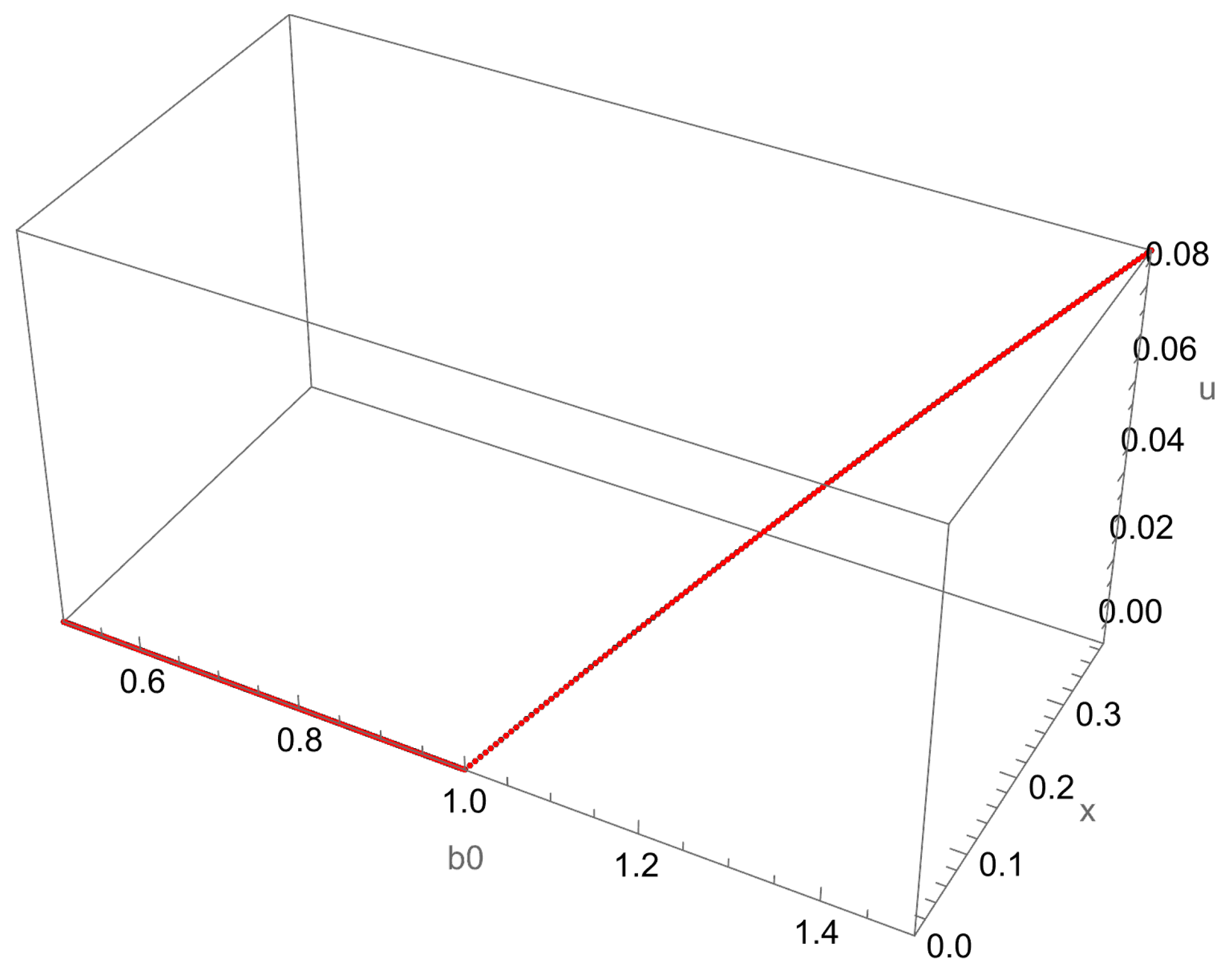
Remark 2. The threshold corresponds to the classical persistence condition in discrete-time population models: for the extinction equilibrium attracts all trajectories in the biologically relevant region, while for a nontrivial equilibrium branch emerges from . Subsequent destabilization of may occur via flip (period-doubling) or Neimark–Sacker bifurcations, driven by and . Figure 1 illustrates the transcritical bifurcation for the parameter set used throughout the numerical examples. 6.2. Period-Doubling (Flip) Bifurcation
Assume that
so that the interior equilibrium
exists with
and
Recall that the trace and determinant of the Jacobian matrix
are given by
and
A
period-doubling (flip) bifurcation occurs when a real eigenvalue of
crosses
as the parameter
varies. In terms of
and
, this corresponds to the condition
together with
, which ensures that the second eigenvalue remains strictly inside the unit circle.
Substituting (
14) and (
15) into (
16), the flip condition reduces to the scalar equation
Theorem 6 (Period-doubling bifurcation).
Suppose that there exists such that the interior equilibrium exists and satisfies the flip condition (17) together with . Assume, moreover, that the flip transversality condition holds; i.e., Then system (2) undergoes a period-doubling (flip) bifurcation at .Furthermore, let c denote the flip normal form coefficient given by (A4). If (respectively ), then the flip bifurcation is supercritical (respectively subcritical). Proof. At
, the characteristic polynomial of
reads
and condition (
16) implies that
is a simple eigenvalue, while the second eigenvalue satisfies
.
To determine transversality, I differentiate the characteristic equation implicitly with respect to
along the eigenvalue branch
, which yields
Evaluating at
, where
and
, we obtain
Since
by the implicit function theorem, the equality
holds only if
. As shown in
Appendix A,
P is a polynomial (of degree at most two); hence the condition
defines a nongeneric subset of the parameter space. Therefore the transversality condition
holds for generic parameter values.
Now I turn to the normal form and criticality. Reducing the dynamics to the one-dimensional critical center manifold associated with the eigenvalue
(see [
23]) yields the flip normal form
where
c is the flip normal form coefficient. Following Kuznetsov,
c can be computed by the invariant formula (
A4); see
Appendix A for the explicit expressions of
A,
B,
C,
p, and
q in the present model.
The sign of c determines the criticality: if , the flip bifurcation is supercritical and a locally asymptotically stable period-two orbit is born at ; if , the flip bifurcation is subcritical and the emerging period-two orbit is unstable. □
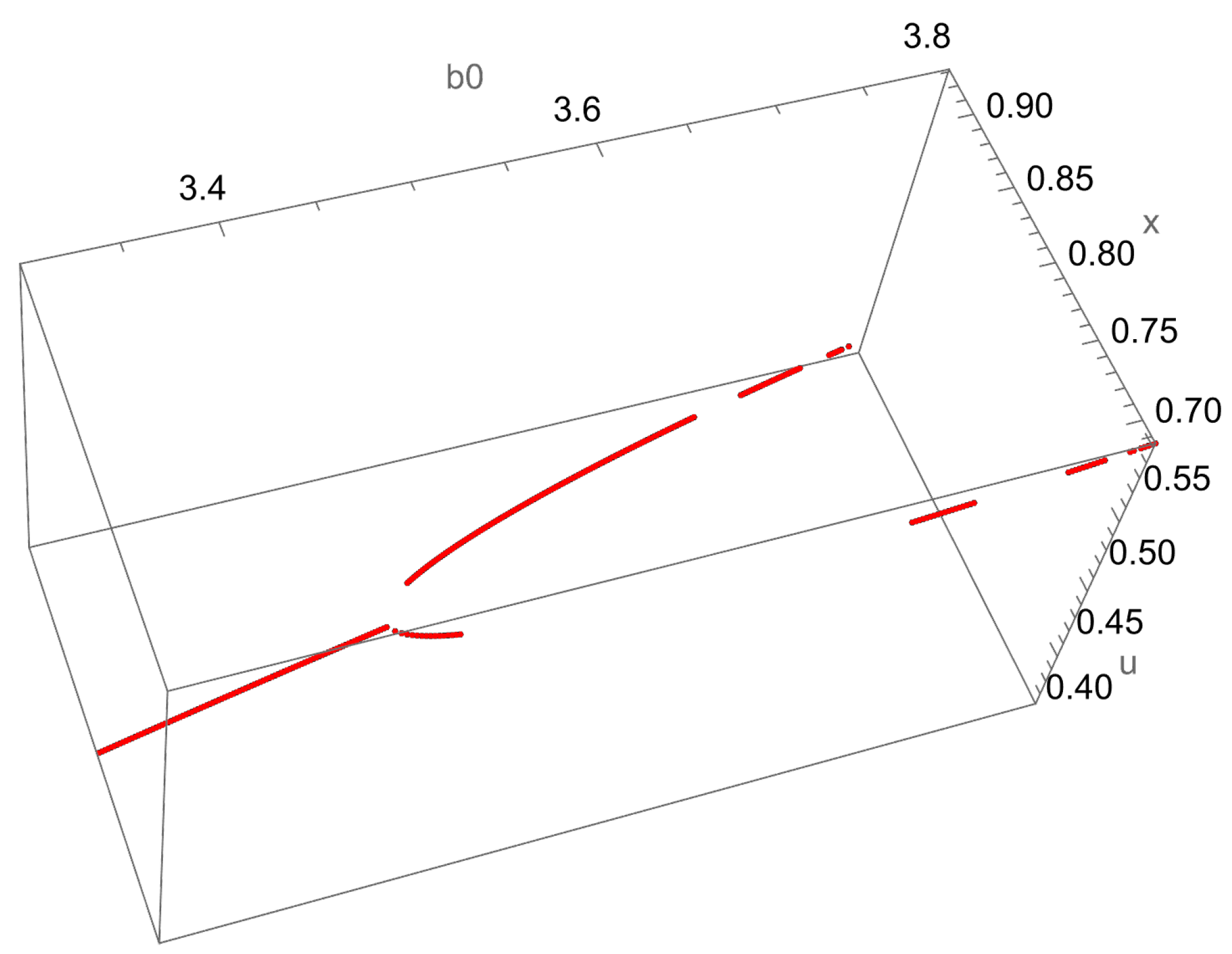
Example 1. Consider system (2) withand take as the bifurcation parameter. Solving the equilibrium equations together with the flip condition yieldsAt the Jacobian at satisfiesand , so one eigenvalue crosses while the second remains strictly inside the unit circle. The flip normal form coefficient computed from (A4) isso Theorem 6 predicts a subcritical flip bifurcation. Moreover, a numerical finite-difference approximation yieldsconfirming the transversality condition in Theorem 6. Consistently, for the period-two orbit born at the flip is numerically unstable: solving near and evaluating the monodromy matrix yields . Figure 2 provides a numerical illustration. 6.3. Neimark–Sacker Bifurcation
In this subsection I study the occurrence of a Neimark–Sacker bifurcation in system (
2). The analysis follows the standard local theory for maps, as presented in [
23]. For recent studies of concrete discrete-time models exhibiting Neimark–Sacker (discrete Hopf) bifurcations, I refer, for instance, to discrete-time epidemic models [
26,
27], predator–prey and related ecological maps [
28,
29,
30,
31], discrete neural systems [
32], and coupled-map constructions [
33].
Assume that
so that the interior equilibrium
exists with
and
A
Neimark–Sacker bifurcation (discrete Hopf bifurcation) occurs when a complex-conjugate pair of eigenvalues of the Jacobian matrix
crosses the unit circle with nonzero speed as a parameter varies.
Recall that the Jacobian at
is
Let
and
. As computed in
Section 5.2,
and
For a smooth planar map, a Neimark–Sacker bifurcation at
is detected by the spectral conditions
for some parameter value
. Under (
20), the eigenvalues satisfy
Using (
19), the Neimark–Sacker condition
is equivalent to
together with
.
Theorem 7 (Neimark–Sacker bifurcation).
Assume that so that the interior equilibrium exists. Suppose that there exists such that Assume in addition that:- 1.
(Transversality) ;
- 2.
(Non-resonance) (equivalently, );
- 3.
(Nondegeneracy) the first Lyapunov coefficient at satisfies .
Then system (2) undergoes a Neimark–Sacker bifurcation of at . Moreover, the bifurcation is supercritical (respectively, subcritical) if (respectively, ), producing a stable (respectively, unstable) invariant closed curve for on the side where (respectively, ). I now express the transversality condition in a convenient explicit form.
Theorem 8 (Transversality criterion).
Assume (20) holds at and that , , and . Then Moreover, and therefore transversality holds whenever In particular, the degeneracy condition defines an algebraic subset of codimension one in the parameter space; hence transversality holds for generic parameter values. Proof. At a Neimark–Sacker point the eigenvalues are complex conjugates and satisfy
. Differentiating gives
and since
we obtain
proving the equivalence.
Next, since
depends smoothly on
along the interior branch,
. Differentiating (
19) with respect to
x yields
Substituting
gives (
22), and multiplying by the strictly positive factor
yields the polynomial condition (
23). The final statement follows since
is a single algebraic equation. □
Next, I address the non-resonance condition.
Proposition 3 (Non-resonance condition).
Assume (20). Then the only possible resonances of order correspond to . In particular, if then no resonance of order occurs. Proof. With , we have and . Resonances for correspond to , giving . The condition excludes , leaving . □
Next, I consider the nondegeneracy condition and the fundamental first Lyapunov coefficient. The nondegeneracy condition is determined by the first Lyapunov coefficient
, which can be computed from second and third derivatives of the map at
using standard normal form theory for planar maps [
23]. We provide the explicit formula and the required derivatives for the present model in
Appendix B. In applications below,
is evaluated numerically at the Neimark–Sacker point to determine the criticality (supercritical/subcritical) of the bifurcation.
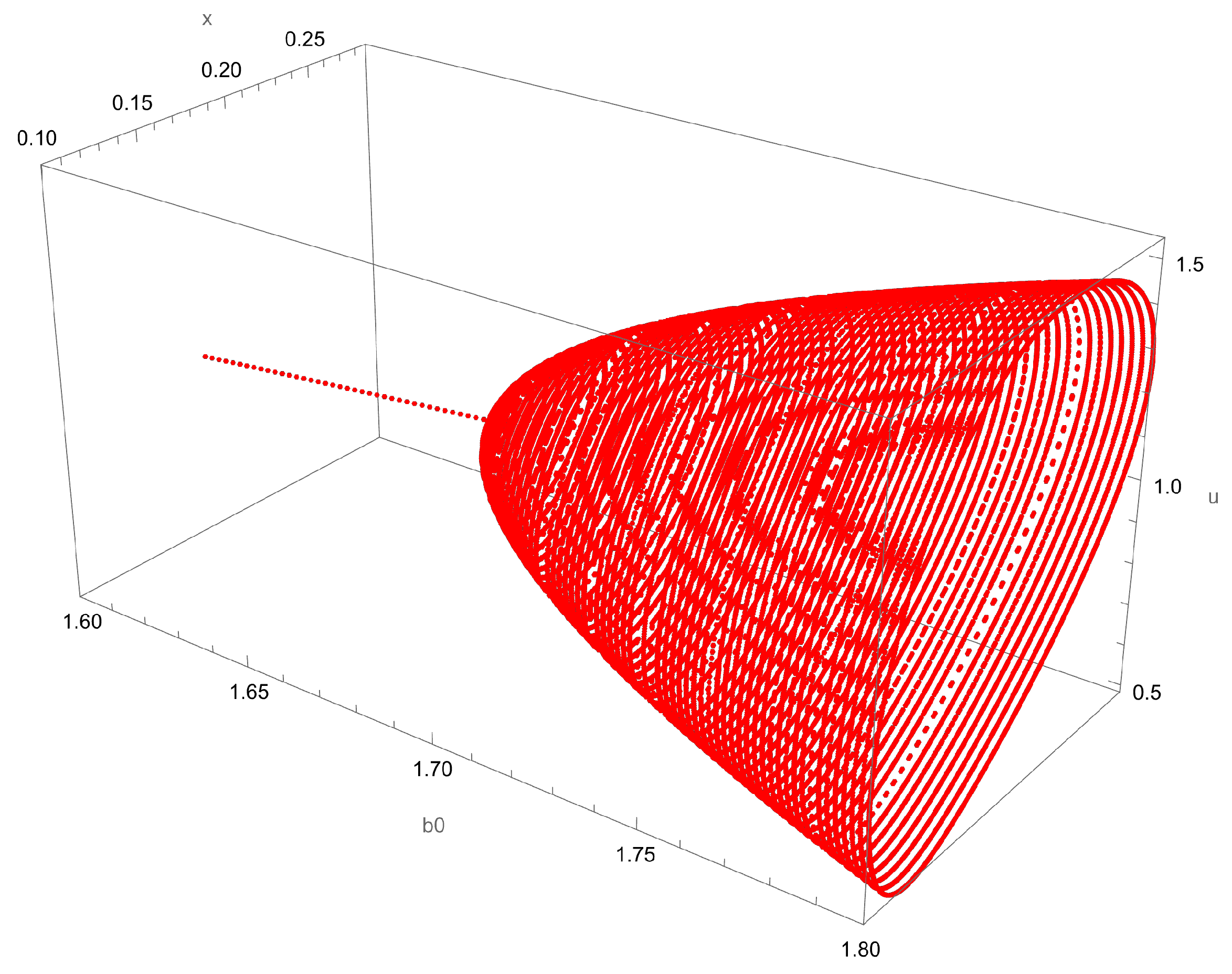
Remark 3. Condition (21) together with determines candidate Neimark–Sacker points. The transversality condition reduces to , and non-resonance is ensured by excluding the isolated values . Finally, holds for generic parameters (otherwise a codimension-one degeneracy occurs) and its sign determines whether a stable or unstable invariant closed curve is born. Example 2. Consider system (2) withand take as the bifurcation parameter. Solving the fixed-point equations yields the interior equilibrium branch . Neimark–Sacker point. Solving simultaneously the equilibrium equations and the Neimark–Sacker condition yieldsAt we obtainso the critical eigenvalues form a complex-conjugate pair on the unit circle, Transversality. A finite-difference approximation givesconfirming transversal crossing. Criticality. The first Lyapunov coefficient computed from the invariant formula (A19) (Appendix B) isHence the Neimark–Sacker bifurcation is subcritical. Consequently, the invariant closed curve born at the bifurcation is unstable, and nonlinear dynamics near may display bistability and large-amplitude oscillations depending on initial conditions. Figure 3 provides a numerical illustration of the emergence of oscillatory population–trait dynamics as is increased past the Neimark–Sacker threshold. 7. Dynamical Consequences of Evolutionary Feedback
In this section, I highlight the qualitative impact of introducing evolutionary dynamics into a classical discrete-time logistic framework. In the absence of eco-evolutionary feedback (
), the trait dynamics decouple and satisfy
, so
for
. Consequently, the asymptotic population dynamics are governed by the corresponding density-regulated one-dimensional map, whose behavior is well understood [
20] in discrete time and includes transitions from fixed points to periodic and more complex regimes as
increases.
Introducing evolutionary feedback () fundamentally alters this picture. The coupling between population density and trait evolution, mediated by the feedback coefficient and the genetic variance , yields a genuinely two-dimensional map with richer dynamical behavior. While the threshold still marks the transition from extinction to persistence through a transcritical bifurcation, the stability of the interior equilibrium is no longer guaranteed.
The analysis shows that increasing either the strength of eco-evolutionary feedback or the genetic variance may destabilize the interior equilibrium. Loss of stability can occur through a flip (period-doubling) bifurcation, leading to the creation of stable or unstable two-cycles, or through a Neimark–Sacker bifurcation, associated with the appearance of invariant closed curves (stable or unstable) and quasiperiodic population–trait oscillations. In the supercritical case a stable invariant closed curve is born locally at the bifurcation, whereas in the subcritical case the local curve is unstable and multistability and large-amplitude oscillations may arise from nonlinear global effects. These mechanisms are absent in the purely ecological setting and arise from the interaction between ecological and evolutionary timescales.
From a biological perspective, these results indicate that rapid evolution can act as a destabilizing force, generating sustained oscillations or complex fluctuations even in environments where population dynamics alone might predict convergence to equilibrium. From a dynamical systems viewpoint, the model provides a minimal setting in which eco-evolutionary feedback induces classical discrete-time bifurcations and higher-dimensional attractors.
Taken together, these results demonstrate that incorporating evolution into population models is not merely a quantitative refinement, but can lead to qualitatively new dynamical regimes, emphasizing the central role of eco-evolutionary feedbacks in shaping long-term population behavior.
8. Conclusions
In this work I studied a discrete-time eco-evolutionary logistic-type model obtained by coupling density-regulated population growth with trait dynamics driven by selection and genetic variance. I provided a rigorous dynamical analysis of the model, including the existence of equilibria, global asymptotic stability of the extinction equilibrium, and a detailed classification of local bifurcations of the interior fixed point.
I showed that the extinction equilibrium is globally asymptotically stable when the intrinsic growth rate satisfies , while for a nontrivial equilibrium emerges through a transcritical bifurcation. Once persistence is established, the stability of the interior equilibrium is strongly affected by eco-evolutionary feedback. Depending on the feedback strength and on the genetic variance, the equilibrium may lose stability through either a flip (period-doubling) bifurcation or a Neimark–Sacker bifurcation, leading to oscillatory regimes. In the Neimark–Sacker scenario, invariant closed curves and quasiperiodic dynamics may occur, with the detailed outcome depending on the criticality of the bifurcation and on nonlinear global effects.
These results highlight how even a minimal evolutionary component can generate qualitatively new dynamical regimes in discrete-time population models. From both mathematical and biological perspectives, the model illustrates how eco-evolutionary interactions may destabilize ecological equilibria and give rise to persistent fluctuations.
9. Future Directions
I outline several natural extensions of the present work that deserve further investigation.
A natural and challenging open problem concerns the global stability of the interior equilibrium. While the analysis presented in this paper provides sharp conditions for local asymptotic stability and a complete description of the local bifurcation structure, global asymptotic stability cannot be expected in general for discrete-time systems of this type. Indeed, the occurrence of flip and Neimark–Sacker bifurcations implies the possible coexistence of periodic or quasiperiodic attractors even when the interior equilibrium is locally stable. Nevertheless, it remains an interesting question whether global asymptotic stability of the interior fixed point can be established in restricted parameter regimes, for instance under weak eco-evolutionary feedback or small genetic variance. Addressing this problem would require genuinely global techniques, such as the construction of suitable Lyapunov functions or the identification of order-preserving or contractive structures in the dynamics.
I also plan to consider periodically forced environments. Allowing the intrinsic growth rate or other demographic parameters to vary periodically in time would lead to a nonautonomous eco-evolutionary system. Such models are biologically relevant in seasonal environments and are known to generate rich dynamical behavior even in purely ecological settings. Understanding how periodic forcing interacts with evolutionary feedback, and how it modifies the bifurcation structure described here, remains an open and challenging problem.
Another natural extension is to higher-dimensional trait spaces. In many biological applications, adaptation occurs along multiple trait axes, leading to vector-valued evolutionary dynamics. The resulting eco-evolutionary system would involve a higher-dimensional map, where the interaction between population density and multivariate trait evolution could give rise to new instability mechanisms, mode interactions, and complex attractors.
From a mathematical viewpoint, such extensions raise questions about the structure of invariant manifolds, the persistence of invariant tori, and the possible coexistence of multiple attractors. From a biological standpoint, they would allow for a more realistic representation of adaptive processes in structured populations.
I expect that the framework developed in this paper provides a solid basis for addressing these questions and for further exploring the dynamical consequences of eco-evolutionary feedbacks in discrete-time models.